One Minute Reflection – 19 August – Twentieth Sunday in Ordinary Time, Year B – Today’s Gospel: John 6:51-58
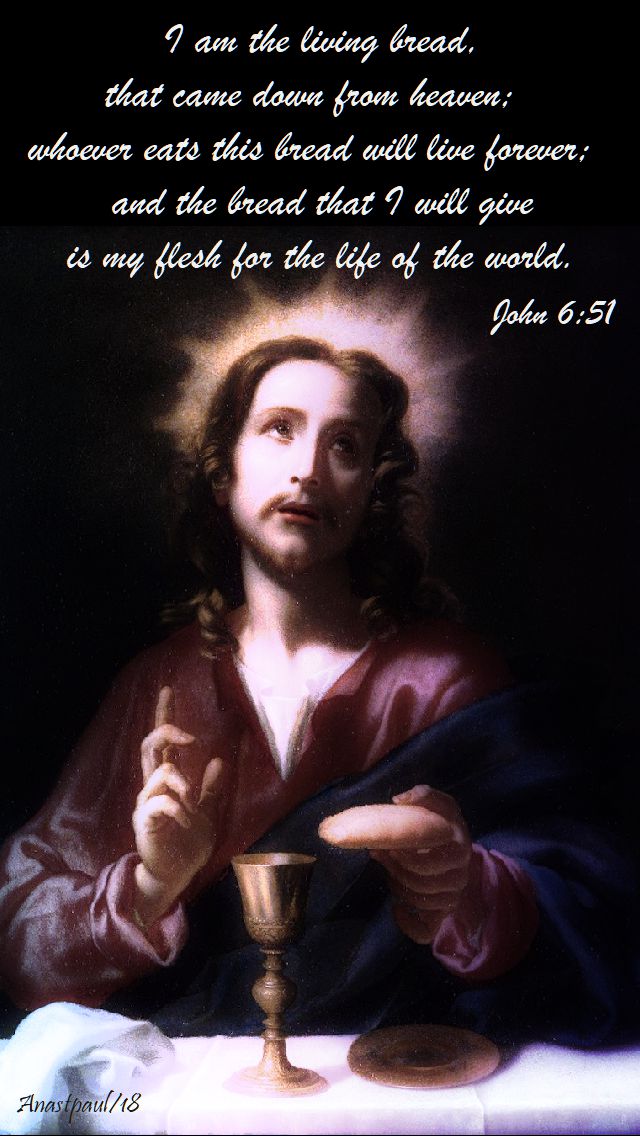
“I am the living bread that came down from heaven; whoever eats this bread will live forever; and the bread that I will give is my flesh for the life of the world.”...John 6:51
REFLECTION – “The Eucharist is Jesus Himself who gives Himself entirely to us. Nourishing ourselves on Him and abiding in Him through Eucharistic Communion, if we do so with faith, transforms our life: transforms it into a gift to God and to our brothers and sisters. Nourishing ourselves of that “Bread of Life” means entering into harmony with the heart of Christ, assimilating His choices, His thoughts, His behaviour. It means entering into a dynamism of love and becoming people of peace, people of forgiveness, of reconciliation, of sharing in solidarity. …Pope Francis – (Angelus, 16 August 2015)
PRAYER – Lord God, You have called us and prepared for those who love You, what no eye has seen, no ear has heard. Fill our hearts with Your love, so that loving You above all and in all, we may attain Your promises and become images of Your Son. With Mary our merciful and loving Mother who is constantly reaching down to assist us, to intercede for us and bring us to You, we make our prayer through Jesus our Lord, in union with the Holy Spirit, one God forever, amen.
Our Morning Offering – 13 August – Monday of the Nineteenth week in Ordinary Time, B
The Day is Filled with Splendour, is a hymn written by the Benedictine Nuns of Stanbrook Abbey. It is sung during Morning Prayer in the Divine Office. It is set to the hymn tune: Paderborn, first published in the Katholische Kirchengesänge of 1616. Psalter Week 3.
The Day is Filled with Splendour
The day is filled with splendour
When God brings light from light,
And all renewed creation
Rejoices in His sight. —
The Father gives His children
The wonder of the world
In which His power and glory
Like banners are unfurled. —
With every living creature,
Awaking with the day,
We turn to God our Father,
Lift up our hearts and pray: —
O Father, Son and Spirit,
Your grace and mercy send,
That we may live to praise You
Today and to the end.
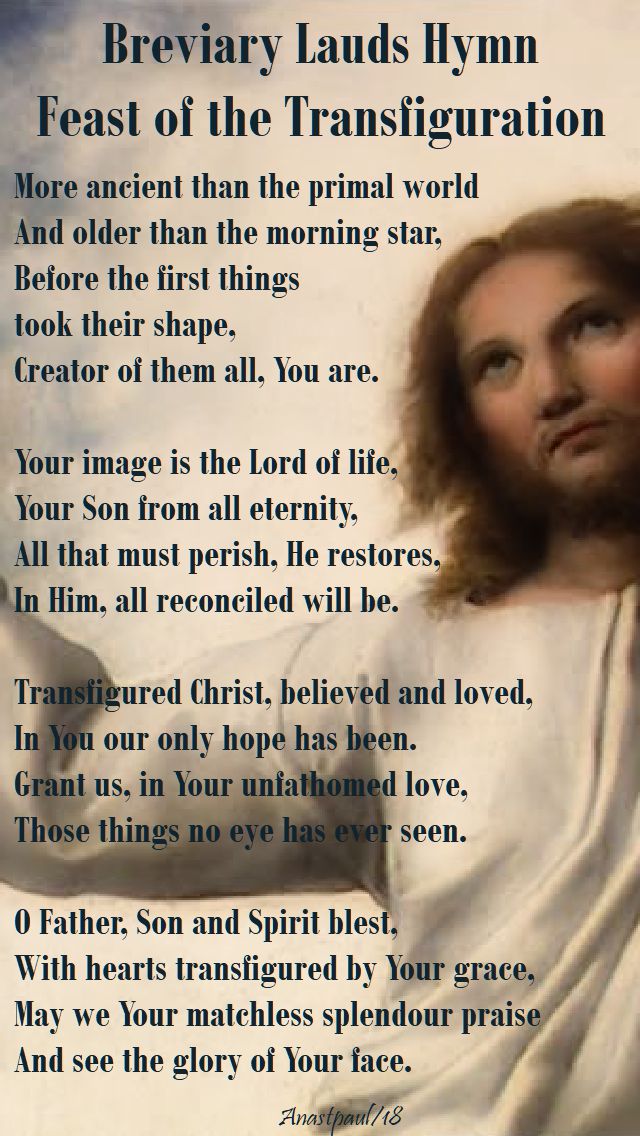
One Minute Reflection 6 August – Feast of the Transfiguration of the Lord – Today’s Gospel: Mark 9:2–10
And a cloud overshadowed them, and a voice came out of the cloud, “This is my beloved Son; listen to him.”...Mark 9:7
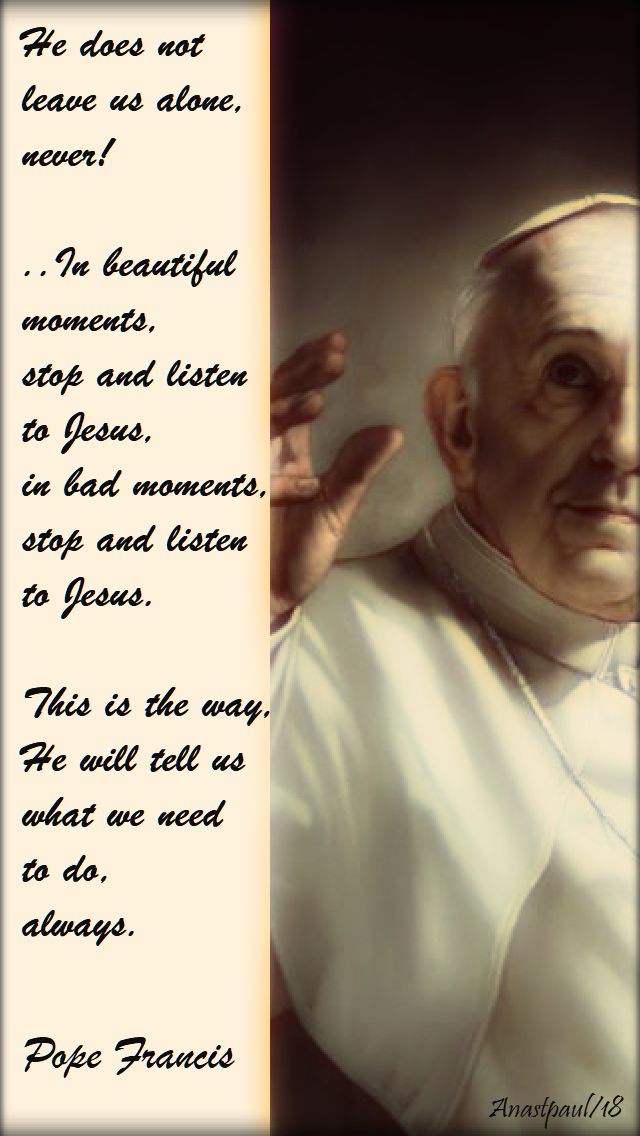
REFLECTION – …”And the path of Jesus is another, Jesus triumphs through humiliation, the humiliation of the cross. But, as this would be a scandal for them, Jesus lets them see what will come next, what is after cross, what awaits us, all of us. This glory and this heaven. And this is very beautiful, very beautiful because Jesus and this feels good, always prepares us for the test. In one way or another but this is the message. It always prepares us. It gives us the strength to go on in moments of trial and to win with its strength. Jesus does not leave us alone in the trials of life, He always prepares us, He helps us as He prepares these (the disciples) with the vision of His glory. And so they remembered this moment, to bear the weight of the humiliation. And this is the first thing that the church teaches, that Jesus always prepares us and rehearses with us. He does not leave us alone, never!
“This is my beloved son. Listen to him.” This is the message which the Father gives to the Apostles, the message of Jesus prepares them to see His glory, the message of the Father is “Listen to him.” There is no moment in life which cannot be fully lived by listening to Jesus. In beautiful moments, stop and listen to Jesus, in bad moments, stop and listen to Jesus. This is the way, He will tell us what we need to do, always.”…Pope Francis 25 February 2018
PRAYER – Father, at the Transfiguration in glory of Your only-begotten Son, You confirmed the mysteries of faith by the witness to Jesus of the prophets Moses and Elijah. You foreshadowed what we shall be when You bring our sonship to its perfection. Grant that by listening to the voice of Jesus, we may become heirs with Him, who lives and reigns with You and the Holy Spirit, God forever and may Mary, our tender and caring Mother, help us to be bright rays of the saving light of her Son Jesus. Amen
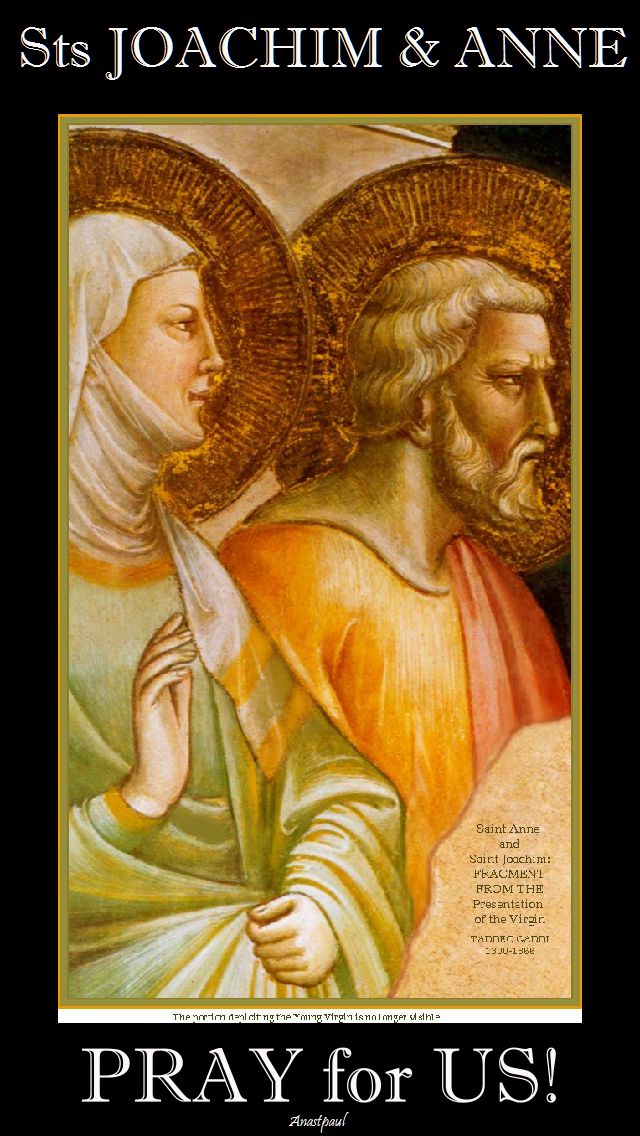
One Minute Reflection – 26 July – The Memorial of Sts Joachim and Anne, Parents of the Blessed Virgina nd Grandparents of Jesus
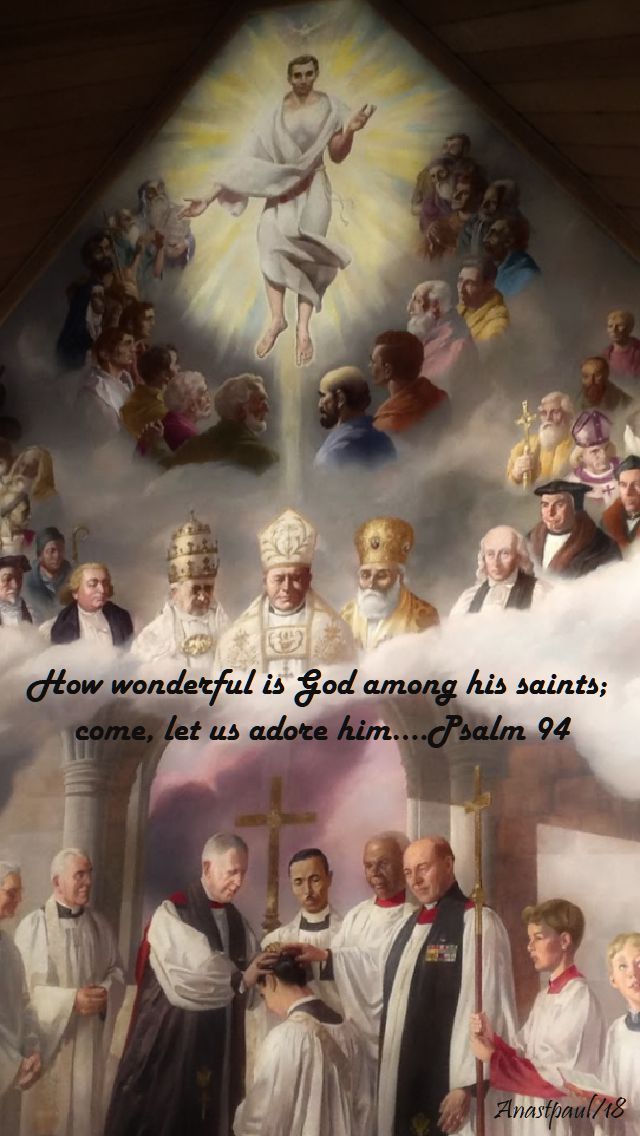
How wonderful is God among his saints; come, let us adore him…..Psalm 94
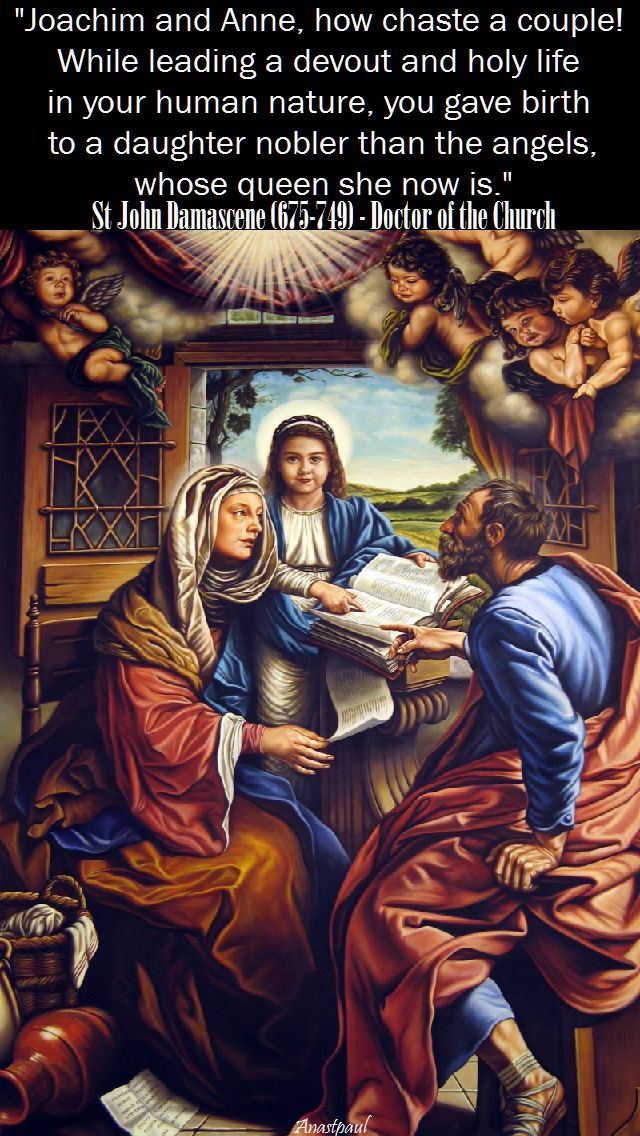
REFLECTION – “Joachim and Anne, how blessed a couple! All creation is indebted to you. For at your hands the Creator was offered a gift excelling all other gifts: a chaste mother, who alone was worthy of Him. Joachim and Anne, how blessed and spotless a couple! You will be known by the fruit you have borne, as the Lord says: “By their fruits you will know them.” The conduct of your life pleased God and was worthy of your daughter. For by the chaste and holy life you led together, you have fashioned a jewel of virginity: she who remained a virgin before, during and after giving birth . She alone for all time would maintain her virginity in mind and soul as well as in body. Joachim and Anne, how chaste a couple! While leading a devout and holy life in your human nature, you gave birth to a daughter nobler than the angels, whose queen she now is.” – from a sermon by Saint John Damascene (675-749) – Doctor of the Church
PRAYER – O Lord, God of our Fathers, who bestowed on Saints Joachim and Anne this grace, that of them should be born the Mother of your incarnate Son, grant, through the prayers of both, that we may attain the salvation you have promised to your people. Through our Lord Jesus Christ, your Son, who lives and reigns with you in the unity of the Holy Spirit, one God, for ever and ever. Sts Joachim and Anne, pray for us! Amen
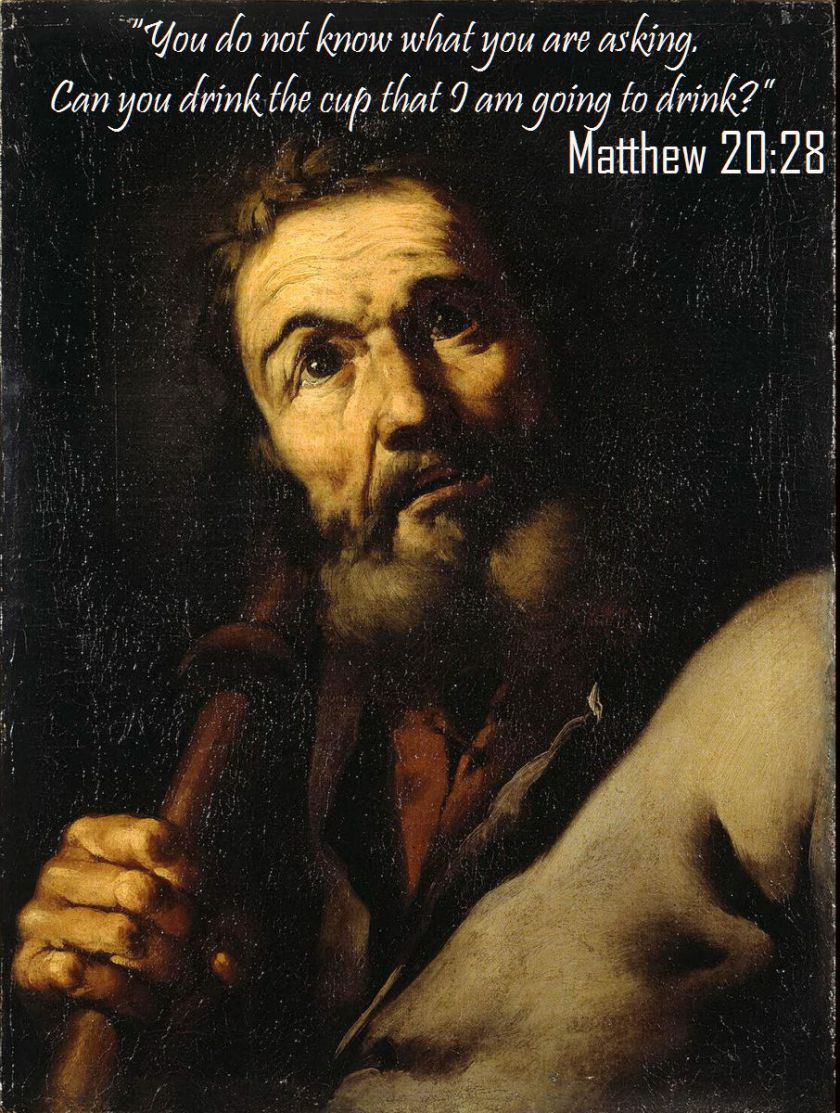
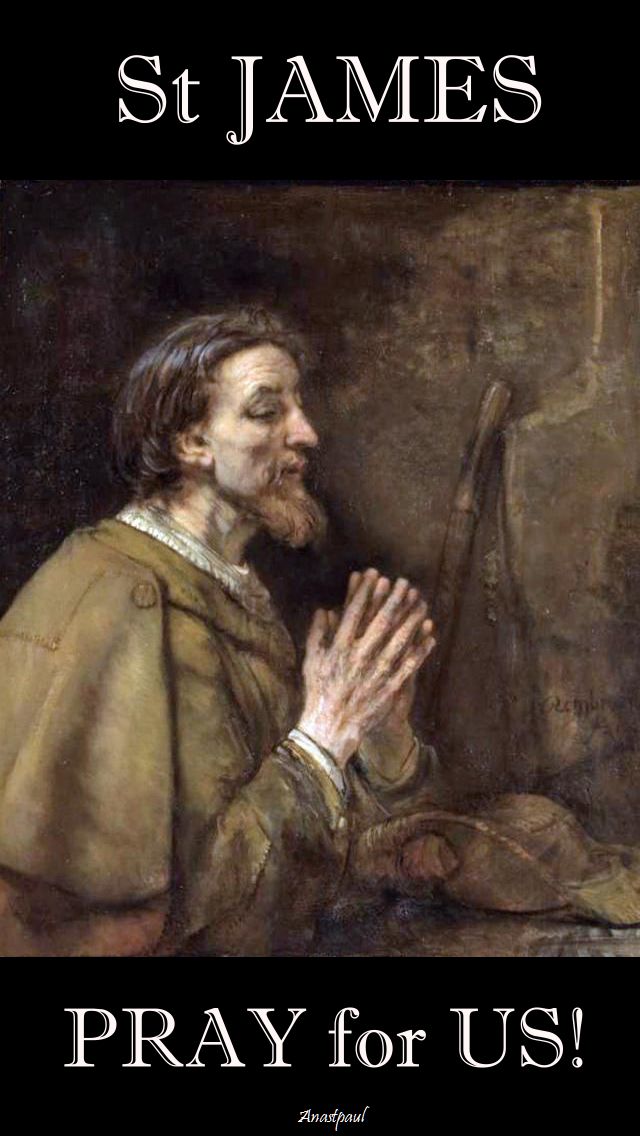
One Minute Reflection – 25 July – The Memorial of St James the Greater, Apostle of Christ – Today’s Gospel: Matthew 20:20–28
Jesus said in reply, “You do not know what you are asking. Can you drink the cup that I am going to drink?” They said to him, “We can.”……Matthew 20:28
REFLECTION – “Through their mother’s mediation, the sons of Zebedee press Christ as follows in the presence of their fellow apostles: “Command that we may sit, one at your right side and one at your left” (cf. Mk 10:35f.)… Christ hastens to free them from their illusions, telling them they must be prepared to suffer insults, persecutions, even death. “You do not know what you are asking. Are you able to drink the cup that I shall drink?” Let no one be surprised to see the apostles displaying such imperfect dispositions. Wait until the mystery of the cross has been fulfilled and the strength of the Holy Spirit given to them. If you want to see the strength of their souls, take a look at them later on and you will see them to be above all human weakness. Christ does not conceal their pettiness so you will be able to see what they become later on by the power of the grace that will transform them…”… St John Chrysostom (c 345-407) Father & Doctor of the Church
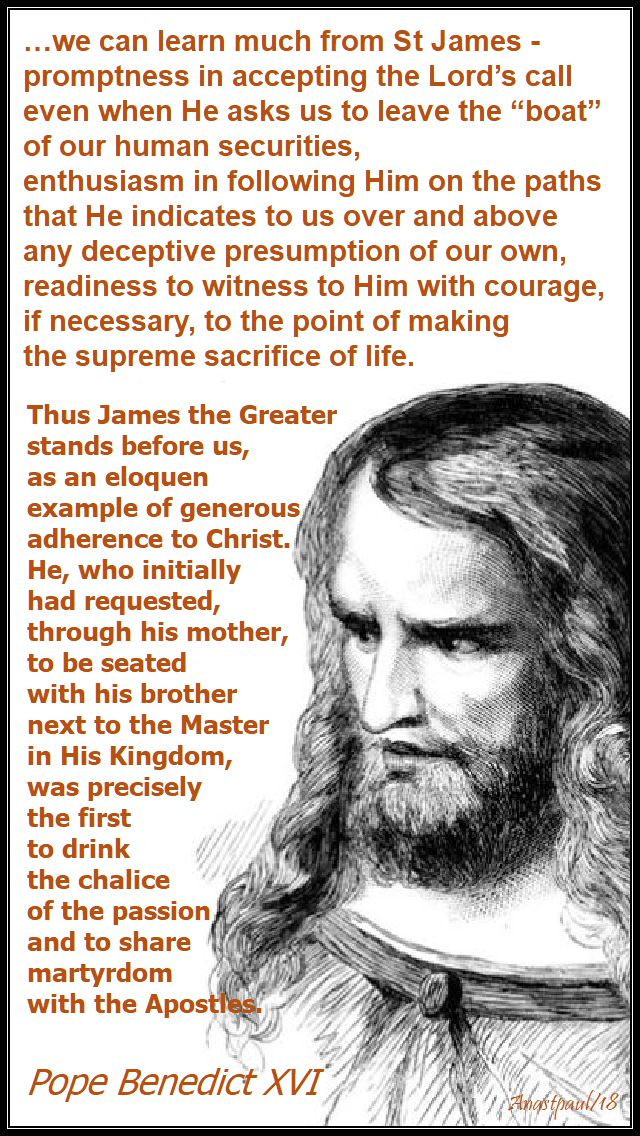
“…we can learn much from St James: promptness in accepting the Lord’s call even when He asks us to leave the “boat” of our human securities, enthusiasm in following Him on the paths that He indicates to us over and above any deceptive presumption of our own, readiness to witness to Him with courage, if necessary to the point of making the supreme sacrifice of life. Thus James the Greater stands before us, as an eloquent example of generous adherence to Christ. He, who initially had requested, through his mother, to be seated with his brother next to the Master in His Kingdom, was precisely the first to drink the chalice of the passion and to share martyrdom with the Apostles.”…Pope Benedict XVI – General Audience, 21 June 2006
PRAYER – Lord our God, You accepted the sacrifice of St James, the first of Your Apostles to give his life for Your sake. May Your Church find strength in his martyrdom and support in his constant prayer. Through our Lord Jesus Christ, your Son, who lives and reigns with you in the unity of the Holy Spirit, one God, for ever and ever. St James the Greater, Apostle of Christ, Pray for us! Amen
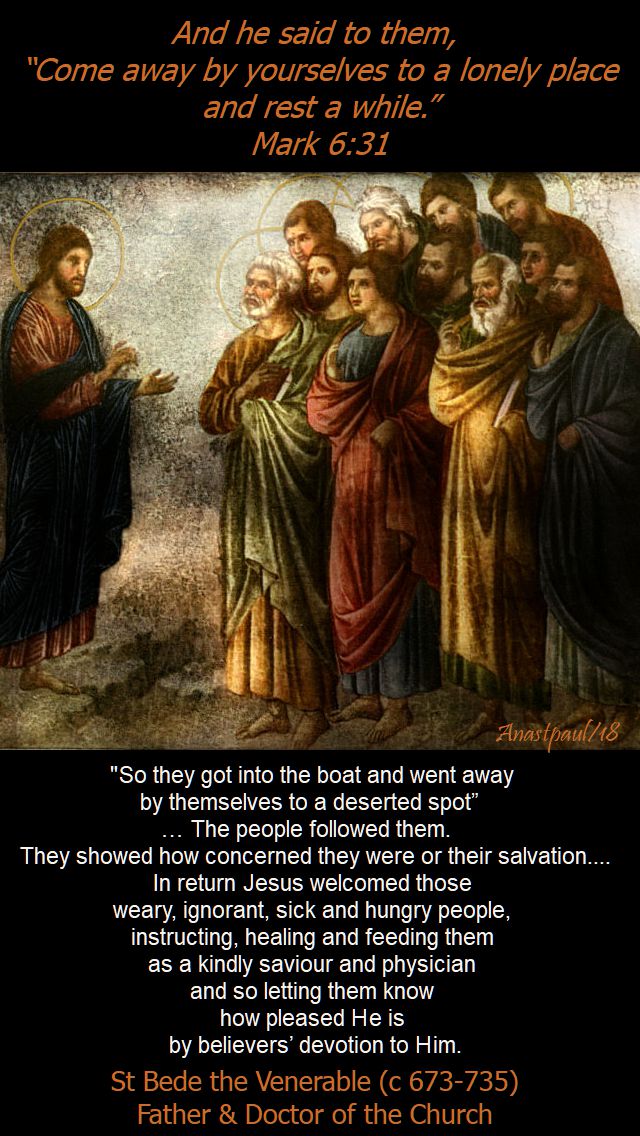
One Minute Reflection – 22 July – Sixteenth Sunday in Ordinary Time, Year B – Today’s Gospel: Mark 6:30-34
And he said to them, “Come away by yourselves to a lonely place and rest a while.”...Mark 6:31
REFLECTION – “So they got into the boat and went away by themselves to a deserted spot”… The people followed them. They showed how concerned they were for their salvation by the effort they made in going along the deserted road, not on donkeys or in carts of various kinds but on foot. In return Jesus welcomed those weary, ignorant, sick and hungry people, instructing, healing and feeding them as a kindly saviour and physician and so letting them know how pleased He is by believers’ devotion to Him.”…Saint Bede the Venerable (c 673-735) Father & Doctor of the Church (Commentary on Saint Mark’s gospel, 2 ; CCL 120, 510)
“Today we could pray during this mass for our shepherds, that the Lord may give them the grace to walk with the people and to be present for them with much tenderness and closeness. When people find their shepherd, they feel that special sensation only felt in the presence of God. The amazement comes from the feeling of the closeness and tenderness of God in the shepherd.”…Pope Francis – Santa Marta, 30 January 2018
PRAYER – Be gracious, Lord, to us who serve You and in Your kindness increase Your gifts of grace within us, so that fervent in faith, hope and love, we may be ever on the watch and persevere in doing what You command. Guard, protect and inspire our own shepherds, our priests who serve Your people, keep them faithful, loyal and prayerful. May our Mother, the most Holy and Pure Blessed Virgin Mary, keep our priests and all of us at her side. Through our Lord Jesus Christ, one God with Holy Spirit, forever and ever, amen.
Our Morning Offering – 29 June – The Solemnity of Saints Peter and Paul
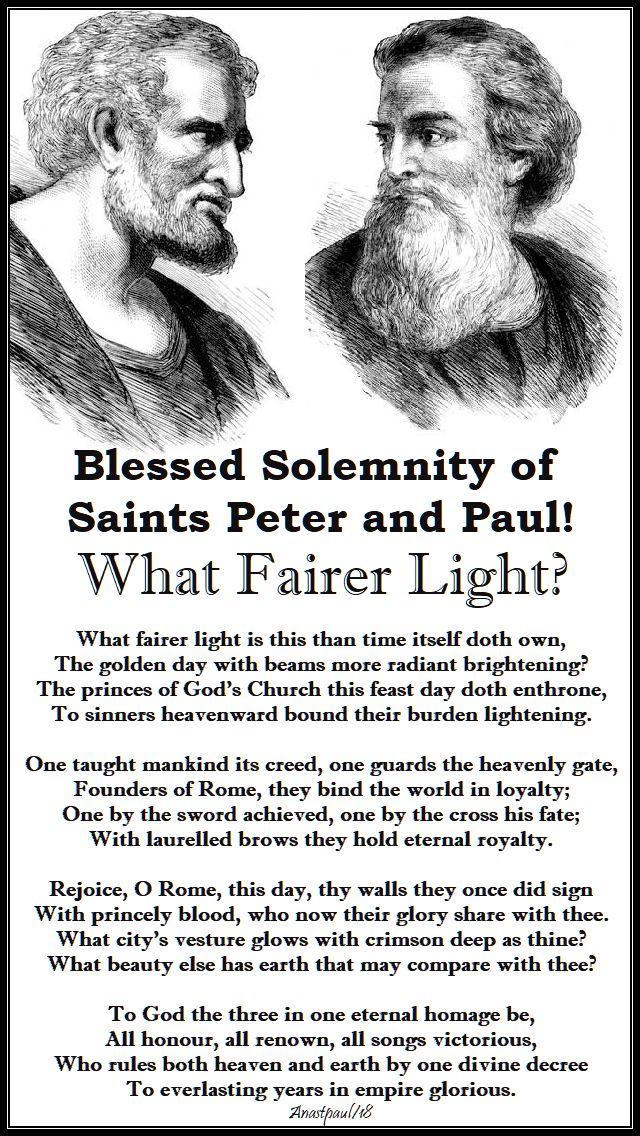
What Fairer Light?
Hymn for the Solemnity of Sts Peter and Paul Elphis, c 493, wife of Boethius c 477– 524 Translation: R A Knox, 1888-1957
What fairer light is this than time itself doth own,
The golden day with beams more radiant brightening?
The princes of God’s Church this feast day doth enthrone,
To sinners heavenward bound their burden lightening.
One taught mankind its creed, one guards the heavenly gate,
Founders of Rome, they bind the world in loyalty;
One by the sword achieved, one by the cross his fate;
With laurelled brows they hold eternal royalty.
Rejoice, O Rome, this day, thy walls they once did sign
With princely blood, who now their glory share with thee.
What city’s vesture glows with crimson deep as thine?
What beauty else has earth that may compare with thee?
To God the three in one eternal homage be,
All honour, all renown, all songs victorious,
Who rules both heaven and earth by one divine decree
To everlasting years in empire glorious.
Thought for the Day – 24 June – The Solemnity of the Nativity of St John the Baptist, B
John challenges us Christians to the fundamental attitude of Christianity—total dependence on the Father, in Christ. Except for the Mother of God, no one had a higher function in the unfolding of salvation. Yet the least in the kingdom, Jesus said, is greater than he, for the pure gift that the Father gives. The attractiveness as well as the austerity of John, his fierce courage in denouncing evil—all stem from his fundamental and total placing of his life within the will of God.
The Benedictus, below, is prayed every morning in the Breviary and so, the Church remembers this “forerunner of Jesus” at the beginning of every day. The opening words of this Canticle are the source of its Latin title, “Blessed be the Lord, the God of Israel”.
What does it mean for Catholics, that we sing this song about John the Baptists at the start of every new day? After having been “silenced” by sleep throughout the night, God opens our mouths and one of the first things we do, is to sing this blessing of God, whose dawn breaks forth to shine on us and guide our way to peace.
In the Benedictus, we join ourselves to the mission of St John the Baptist, who came to prepare a way for the Lord by being a witness of God’s salvation, living a simple and penitential life and calling others to do the same. Our work each day, then, is to use our voice – like Zechariah and his son – and the witness of our lives, to make God’s presence known wherever we go and to whom whomever we encounter.
Ant. The mouth of Zechariah was opened and he spoke this prophecy: Blessed be the Lord, the God of Israel.
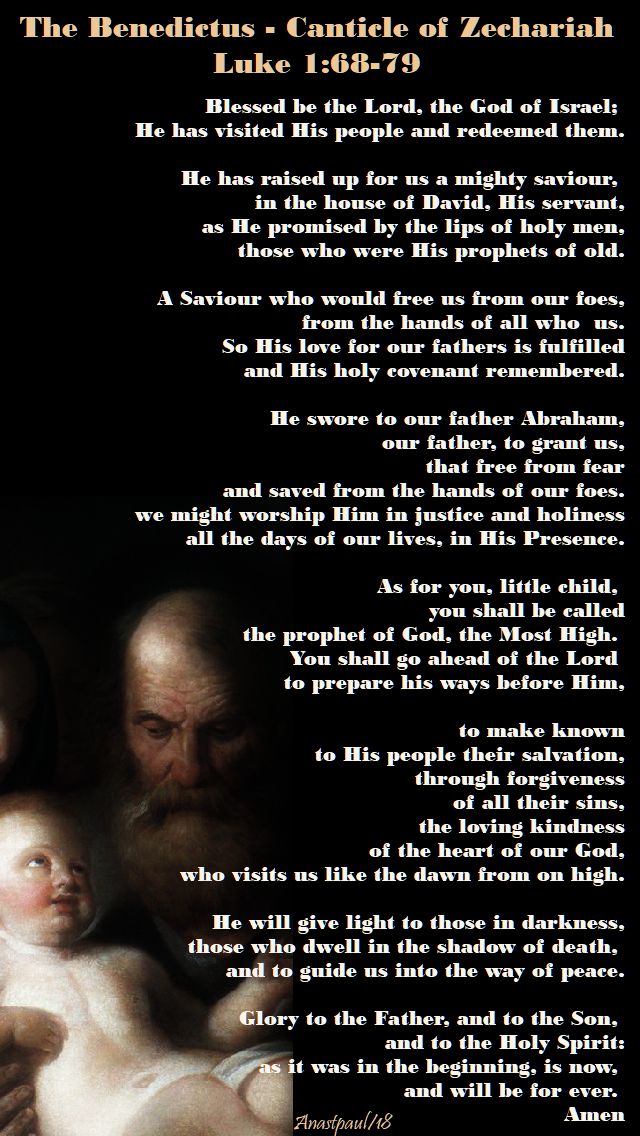
The Benedictus – Canticle of Zechariah Luke 1:68-79 The Messiah and His forerunner
Blessed be the Lord, the God of Israel;
He has visited His people and redeemed them.
He has raised up for us a mighty saviour,
in the house of David, His servant,
as He promised by the lips of holy men,
those who were His prophets of old.
A Saviour who would free us from our foes,
from the hands of all who us.
So His love for our fathers is fulfilled
and His holy covenant remembered.
He swore to our father Abraham, our father, to grant us,
that free from fear and saved from the hands of our foes.
we might worship Him in justice and holiness
all the days of our lives, in His Presence.
As for you, little child,
you shall be called the prophet of God, the Most High.
You shall go ahead of the Lord
to prepare His ways before Him,
to make known to His people their salvation,
through forgiveness of all their sins,
the loving kindness of the heart of our God,
who visits us like the dawn from on high.
He will give light to those in darkness,
those who dwell in the shadow of death,
and to guide us into the way of peace.
Glory to the Father, and to the Son,
and to the Holy Spirit:
as it was in the beginning, is now,
and will be for ever. Amen
Ant. The mouth of Zechariah was opened and he spoke this prophecy: Blessed be the Lord, the God of Israel.
One Minute Reflection – 11 June – Memorial of St Barnabas, Apostle – Today’s First Reading Acts of the Apostles 11:21b-26.13:1-3.
News of this came to the ears of the church in Jerusalem and they sent Barnabas to Antioch. When he came and saw the grace of God, he was glad and he exhorted them all, to remain faithful to the Lord, with steadfast purpose; for he was a good man, full of the Holy Spirit and of faith. And a large company was added to the Lord...Acts 11:22-24
REFLECTION – “While we cannot see God, there is something we can do, to open a way, for the eye of our understanding to come to Him. It is certain that we can see now in His servants, one whom we can in no way see in Himself. When we see them doing astonishing things, we can be sure that God dwells in their hearts… None of us can look directly at the rising sun by gazing at its orb. Our eyes are repelled as they strain to see its rays. But we look at mountains bathed in sunlight and see that it has risen. Because we cannot see the Sun of righteousness (Mal 3,20) Himself, let us see the mountains bathed in His brightness, I mean the holy apostles. They shine with virtues and gleam with miracles… The power of His divinity, is in itself, like the sun in the sky; in human beings it is like the sun shining on earth…”…St Pope Gregory the Great (c 540-604), Father & Doctor of the Church (Homilies on the Gospel, no 30)
PRAYER – O God, who decreed that Saint Barnabas, a man filled with faith and the Holy Spirit, should be set apart to convert the nations, grant that the Gospel of Christ, which he strenuously preached, may be faithfully proclaimed by word and by deed. We pray you Lord, that by the intercession of St Barnabas, we too may grow in faith and love and live to glorify Your kingdom. Through our Lord Jesus Christ, Your Son, who lives and reigns with you in the unity of the Holy Spirit, one God, forever and ever. Amen.
Thought for the Day – 31 May – The Last Day of Mary’s Month and the Feast of the Visitation of the Blessed Virgin Mary from St Bede the Venerable
Writing in the early 8th century, St Bede explains why the Magnificat, Mary’s prayer on the occasion of her Visitation of Elizabeth, is used daily in the liturgy of the hours (a.k.a the divine office) for Vespers or evening prayer. With Mary’s soul, our souls magnify the Lord and rejoice in God our Saviour.
My soul glorifies the Lord and my spirit rejoices in God my saviour.
With these words Mary first acknowledges the special gifts she has been given. Then she recalls God’s universal favours, bestowed unceasingly on the human race.
REJOICE IN GOD’S GREATNESS
When a man devotes all his thoughts to the praise and service of the Lord, he proclaims God’s greatness. His observance of God’s commands, moreover, shows that he has God’s power and greatness always at heart. His spirit rejoices in God his saviour and delights in the mere recollection of his creator who gives him hope for eternal salvation.
These words are offered for all God’s creations but especially for the Mother of God. She alone was chosen and she burned with spiritual love for the son she so joyously conceived. Above all other saints, she alone could truly rejoice in Jesus, her saviour, for she knew that He, who was the source of eternal salvation, would be born in time in her body, in one person both her own son and her Lord.
HOLY IS HIS NAME For the Almighty has done great things for me, and holy is his name.
Mary attributes nothing to her own merits. She refers all her greatness to the gift of the one whose essence is power and whose nature is greatness, for He fills with greatness and strength the small and the weak who believe in Him.
She did well to add: and holy is his name, to warn those who heard and indeed all who would receive His words, that they must believe and call upon His name. For they too could share in everlasting holiness and true salvation, according to the words of the prophet – and it will come to pass, that everyone who calls on the name of the Lord will be saved. This is the name she spoke of earlier – and my spirit rejoices in God my saviour.
VESPERS & THE MAGNIFICAT: AN EVENING CANTICLE
Therefore it is an excellent and fruitful custom of holy Church that we should sing Mary’s hymn at the time of evening prayer. By meditating upon the incarnation, our devotion is kindled and by remembering the example of God’s Mother, we are encouraged to lead a life of virtue. Such virtues are best achieved in the evening. We are weary after the day’s work and worn out by our distractions. The time for rest is near and our minds are ready for contemplation.
The great canticle by the Blessed Virgin Mary, the Magnificat, proclaimed by Mary during her Visitation to St Elizabeth, is celebrated and explained in this excerpt from a homily by Saint Bede the Venerable (Lib 1,4:CCL 122, 25-26, 30) which is used in the Roman Catholic Liturgy’s Divine Office of Readings for the Feast of the Visitation, 31 May, with the accompanying biblical reading being from Song of Songs 2:8-14 and 8:6-7. With Mary’s soul, we proclaim the greatness of the Lord and rejoice in God, her Saviour and ours, each evening in Vespers prayer.
St Bede the Venerable (673-735) Father & Doctor of the Church
Our Morning Offering – 31 May – The Last Day of Mary’s Month and the Feast of the Visitation of the Blessed Virgin Mary
The Magnificat, is Mary’s great gift to scripture, one of its most beautiful prayers. It is prayed every evening in the Liturgy of the Hours by millions around the world. With that, Mary’s great acclamation becomes the Church’s.
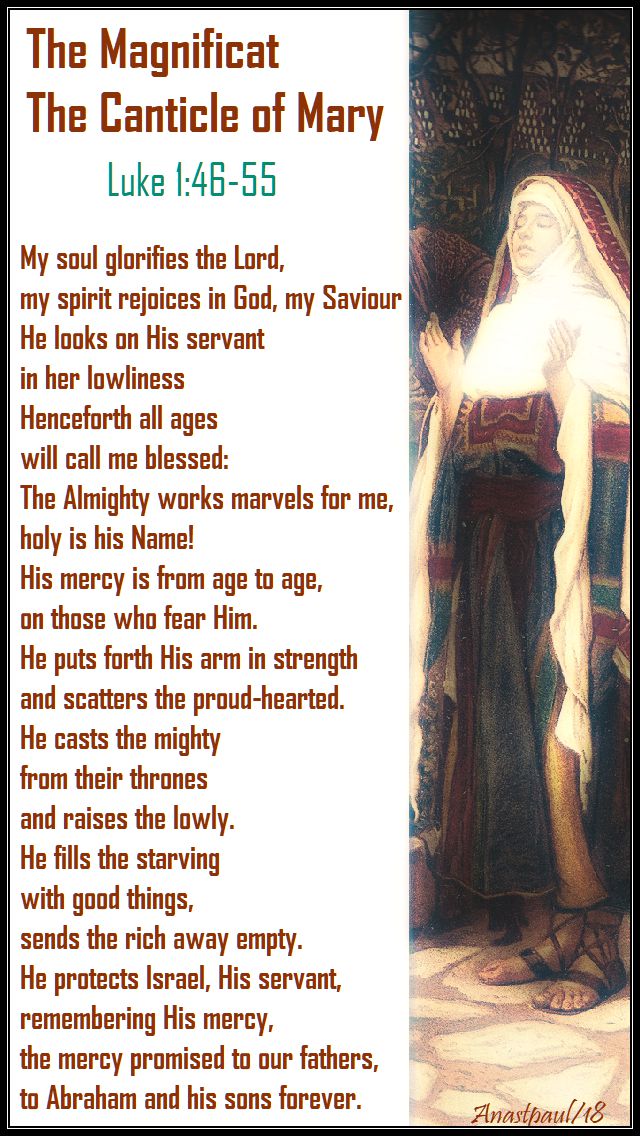
The Magnificat The Canticle of Mary Luke 1:46-55
My soul glorifies the Lord,
my spirit rejoices in God, my Saviour
He looks on His servant in her lowliness
Henceforth all ages will call me blessed:
The Almighty works marvels for me,
holy is his Name!
His mercy is from age to age,
on those who fear Him.
He puts forth His arm in strength
and scatters the proud-hearted.
He casts the mighty from their thrones
and raises the lowly.
He fills the starving with good things,
sends the rich away empty.
He protects Israel, His servant,
remembering His mercy,
the mercy promised to our fathers,
to Abraham and his sons forever.
Excerpt (18) from the Apostolic Exhortation “Marialis Cultus”
Blessed Pope Paul VI – 2 February 1974
“18. Mary is also the Virgin in prayer. She appears as such in the visit to the mother of the precursor, when she pours out her soul in expressions glorifying God and expressions of humility, faith and hope. This prayer is the Magnificat (cf. Lk. 1:46-55), Mary’s prayer par excellence, the song of the messianic times in which there mingles the joy of the ancient and the new Israel. As St Irenaeus seems to suggest, it is in Mary’s canticle, that there was heard once more, the rejoicing of Abraham who foresaw the Messiah (cf. Jn. 8:56)(48) and there rang out in prophetic anticipation the voice of the Church: “In her exultation Mary prophetically declared in the name of the Church: ‘My soul proclaims the glory of the Lord….'”
And in fact Mary’s hymn has spread far and wide and has become the prayer of the whole Church in all ages.”
One Minute Reflection – 27 May – The Solemnity of the Most Holy Trinity
“Go therefore and make disciples of all nations, baptising them in the name of the Father and of the Son and of the Holy Spirit…“…Matthew 28:19
REFLECTION – “The Son is in the Father and the Father in the Son. O adorable mystery which has been from eternity! I adore You. O my incomprehensible Creator, before whom I am an atom, a being of yesterday or an hour ago! Go back a few years and I simply did not exist, I was not in being and things went on without me but You are from eternity and nothing whatever from one moment could go on without You. O adorable mystery! In the name of God, the Omnipotent Father, who created me! In the name of Jesus Christ, our Lord, Son of the living God, who bled for me! In the name of the Holy Spirit, who has been poured out on me!”…Bl John Henry Newman (1801-1890)
PRAYER – God our Father, You revealed the great mystery of Your Godhead to men, when You sent into the world, the Word who is Truth and the Spirit who makes us holy. Help us to believe in You and worship You, as the true faith teaches, three persons eternal in glory, one God, infinite in mystery. We make our prayer through Jesus our Lord, in the unity of the Holy Spirit, one God with you forever amen.
Our Morning Offering – 27 May – The Solemnity of the Most Holy Trinity
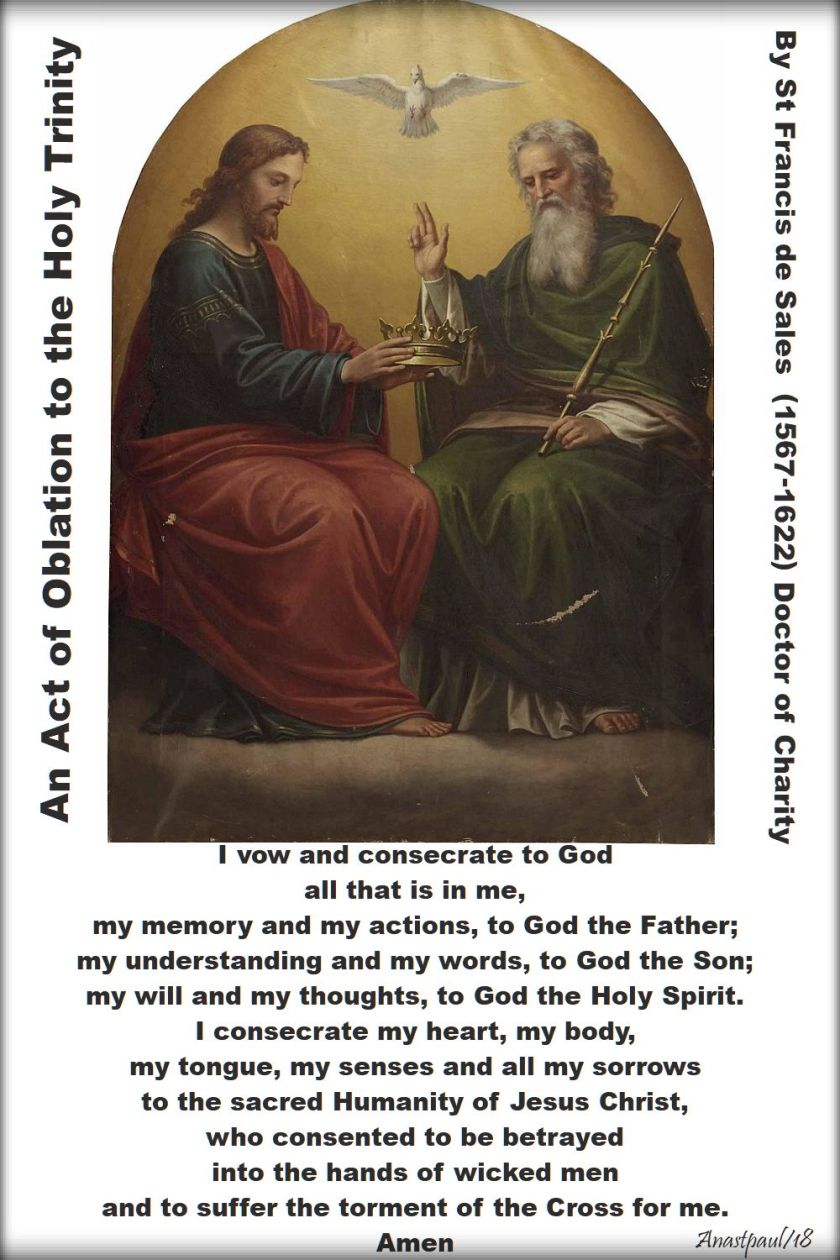
An Act of Oblation to the Holy Trinity By St Francis de Sales (1567-1622) Doctor of Charity
I vow and consecrate to God
all that is in me,
my memory and my actions, to God the Father;
my understanding and my words, to God the Son;
my will and my thoughts, to God the Holy Spirit.
I consecrate my heart, my body,
my tongue, my senses and all my sorrows
to the sacred Humanity of Jesus Christ,
who consented to be betrayed
into the hands of wicked men
and to suffer the torment of the Cross for me.
Amen
Wishing you all a Blessed and Holy Solemnity of the Most Holy Trinity – Trinity Sunday – 27 May 2018
HISTORY AND LITURGY
ORIGIN — The greatest dogma of the Christian faith is the mystery of the Holy Trinity. (Mystery, in this connection, means a supernatural fact revealed by God which in itself transcends the natural power of human reasoning.) During the first thousand years of Christianity there was no special feast celebrated in honour of this mystery but, as Pope Alexander II (1073) declared, every day of the liturgical year was devoted to the honour and adoration of the Sacred Trinity.
However, to counteract the Arian heresy, which denied the fullness of divinity to the Son, a special Mass text in honour of the Holy Trinity was introduced and incorporated in the Roman liturgical books. This Mass was not assigned for a definite day but could be used on certain Sundays according to the private devotion of each priest. (Such Mass texts which are not prescribed but open to choice on certain days are now known as “votive Masses.”) From the ninth century on, various bishops of the Frankish kingdoms promoted in their own dioceses a special feast of the Holy Trinity, usually on the Sunday after Pentecost. They used a Mass text that Abbot Alcuin (804) is said to have composed.
Thus the custom of observing a special feast in honour of the Trinity became increasingly popular in the northern countries of Europe. Several synods prescribed it for their respective territories in France, Germany, England and The Netherlands. In the thirteenth centur, the orders of the Benedictines and Cistercians adopted the annual celebration of the feast. It was kept on different Sundays in different places, until in 1334 Pope John XXII accepted the festival into the official calendar of the Western Church and ordered that henceforth it should be held everywhere on the Sunday after Pentecost.
A new Mass text was written and published. It is interesting to note that the beautiful Preface of the Trinity as read today is the same one that appeared in the first text of the Sacramentary of Saint Pope Gregory the Great (540-604) Father and Doctor of the Church. Most of the other prayers are of later origin. The Divine Office in its present form, was arranged under Pope Saint Pius V (1572). It is one of the most sublime offices of the breviary.
The Feast of the Holy Trinity, now belongs among the great annual festivals of Christianity. Although it is not observed with additional liturgical services outside the Mass, its celebration quickly took root in the hearts and minds of the faithful and in all countries of Europe popular traditions are closely associated with this feast.
SIGN OF THE CROSS — The making of the sign of the cross, which professes faith both in the redemption of Christ and in the Trinity, was practised from the earliest centuries. Saint Augustine (431) mentioned and described it many times in his sermons and letters. In those days Christians made the sign of the cross (Redemption) with three fingers (Trinity) on their foreheads. The words (“In the name of the Father and the Son and the Holy Ghost”) were added later. Almost two hundred years before Augustine, in the third century, Tertullian had already reported this touching and beautiful early Christian practice:
“In all our undertakings — when we enter a place or leave it; before we dress; before we bathe; when we take our meals; when we light the lamps in the evening; before we retire at night; when we sit down to read; before each new task — we trace the sign of the cross on our foreheads.” Tertullian (160-220)
DOXOLOGY — The ancient Christian doxology (prayer of praise) “Glory be to the Father, and to the Son, and to the Holy Ghost” was used in the Oriental Church. The second part (“as it was in the beginning…”) seems to have been added at the time of Emperor Constantine. During the fifth century this beautiful short prayer came into the Western Church and spread very quickly. Since then it has been in constant use in both liturgical and private devotions. Finally, the Council of Narbonne (589) prescribed that it should be added after every psalm and hymn in the Divine Office. It is an ancient tradition that in poetical hymns of the liturgy the Gloria Patri is rendered in a paraphrase (free version) within the last stanza.
EASTERN RITES — The churches of the Byzantine Rite do not celebrate the Feast of the Holy Trinity. Instead, they observe the Sunday after Pentecost as the Feast of All Saints (Kyriake Ton Hagion Panton). The official calendar of the Greek Church announces this feast with the interesting words “Today, on the first Sunday after Pentecost, we celebrate the festive day of all Saints everywhere in the world: in Asia, Lybia, in northern and eastern Europe.” As may be seen from the territories mentioned, the term “whole world” applies only to the countries of that rite. The Uniate Armenians keep the Feast of the Holy Trinity on the same day as the Latin Church.
FOLKLORE
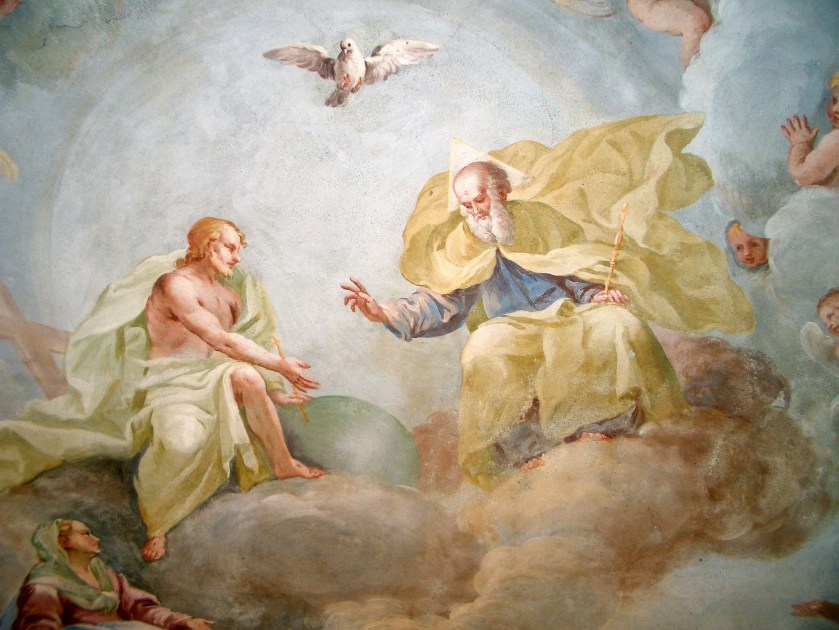
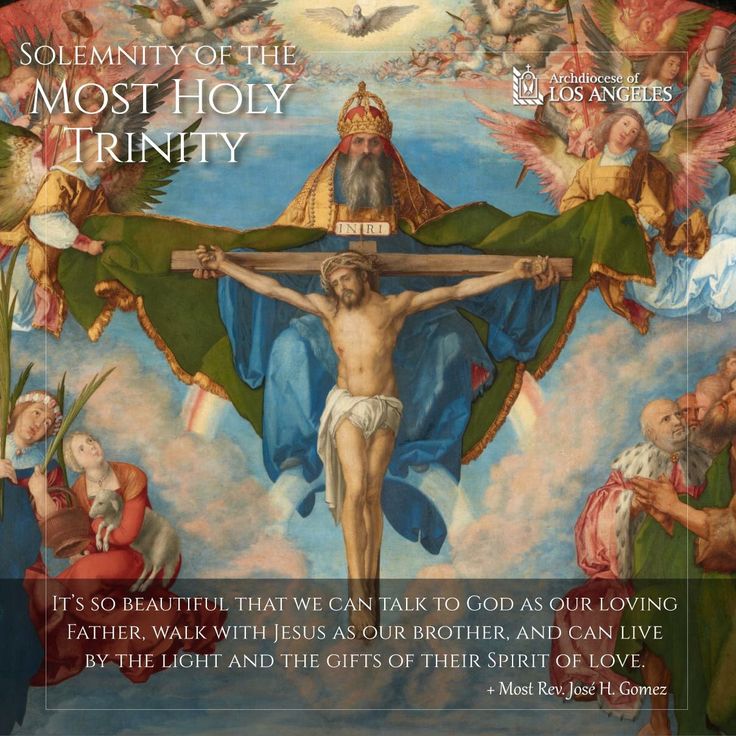
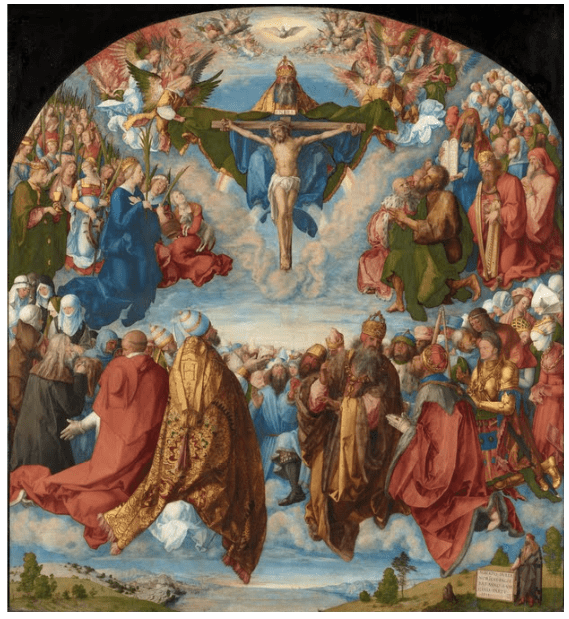
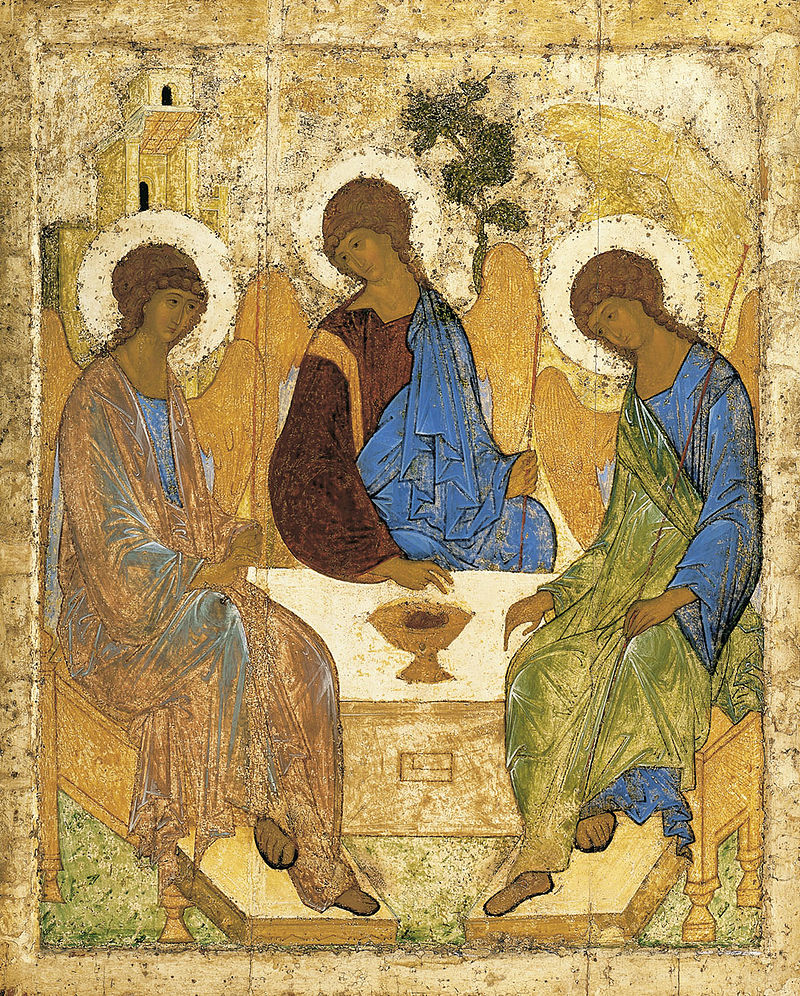
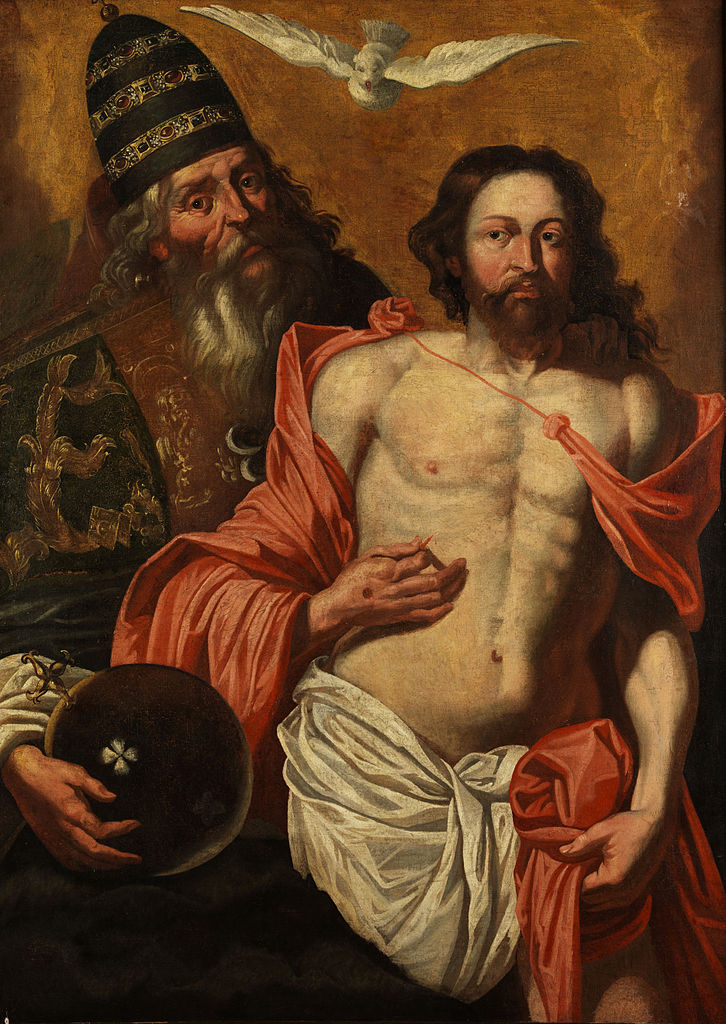
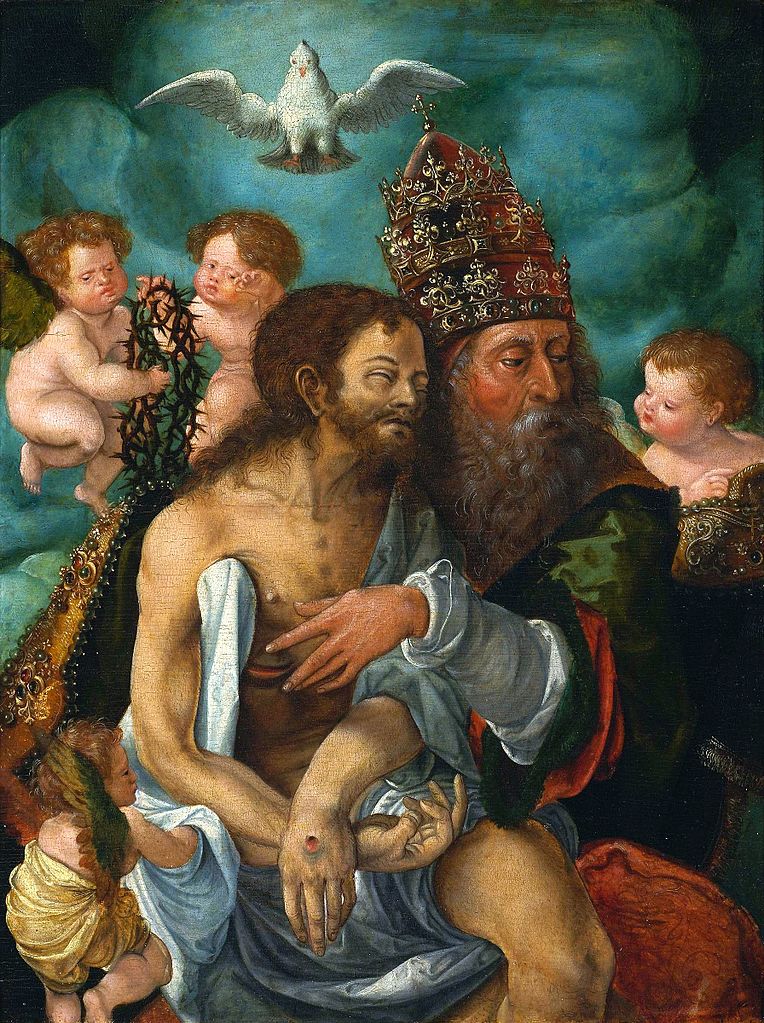
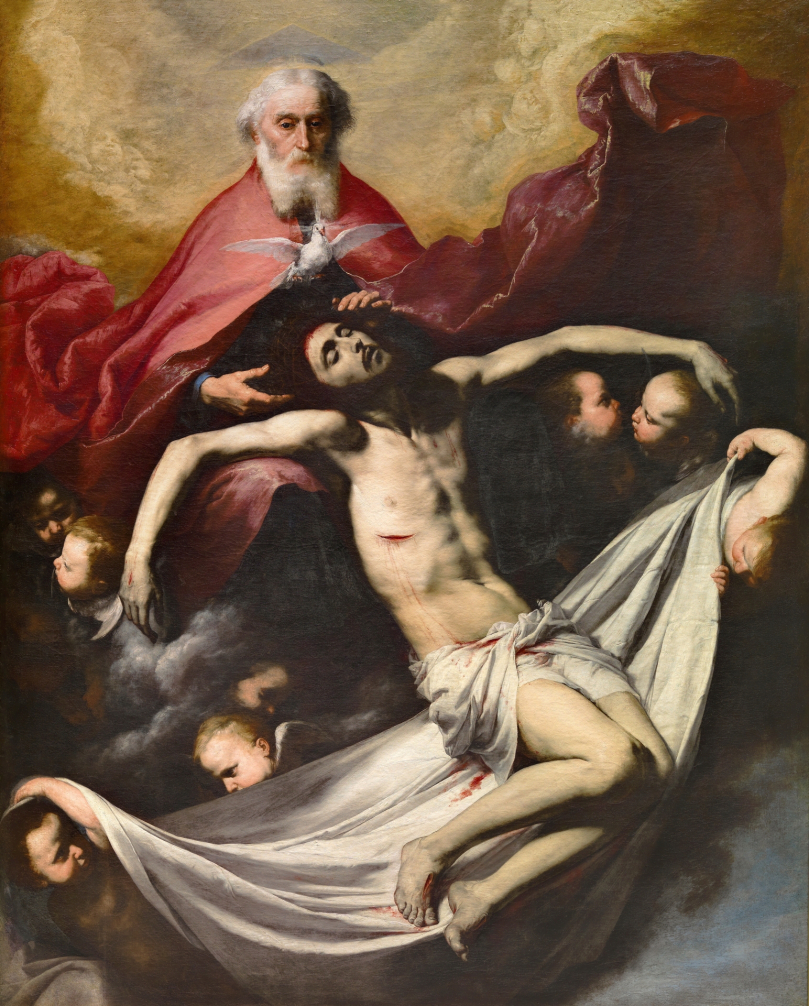
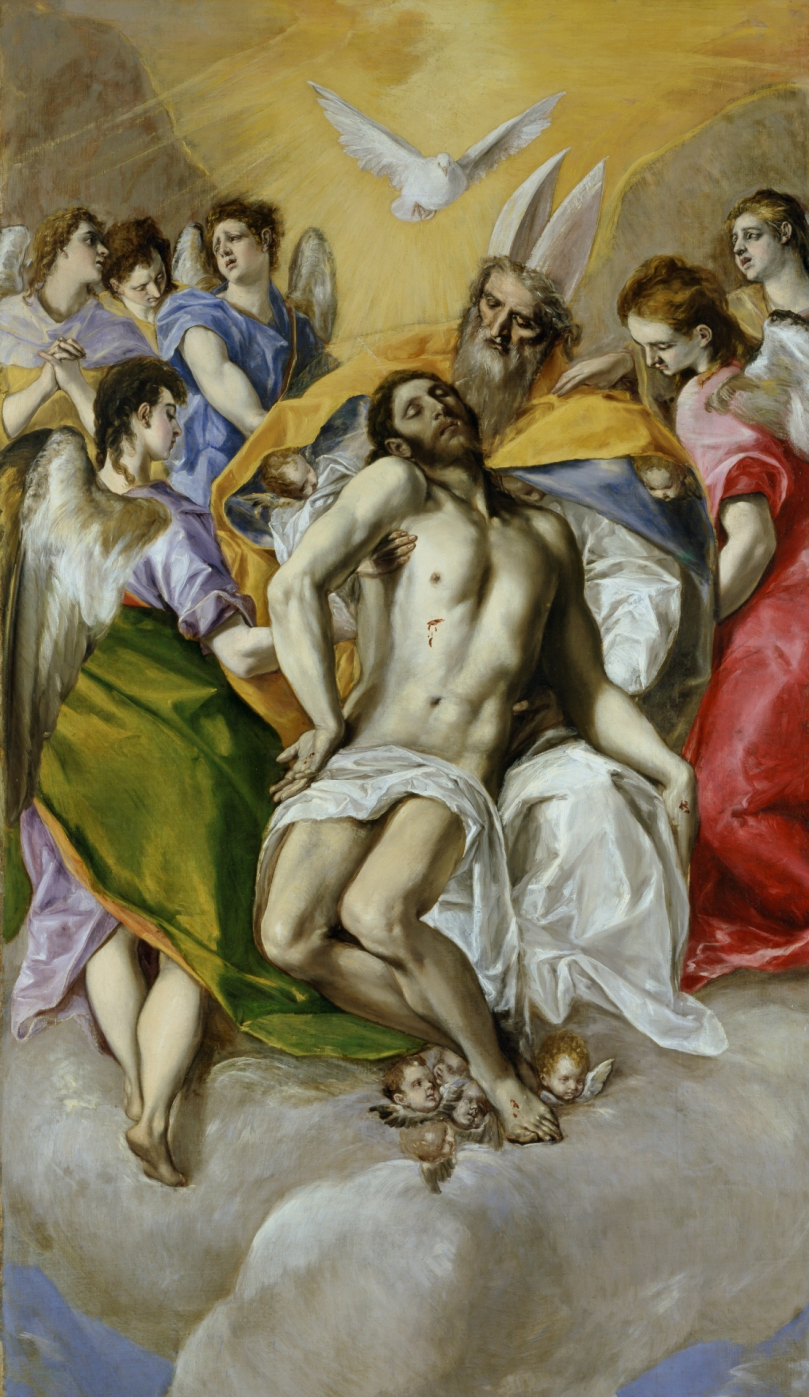
SYMBOLS — During the first centuries of the Christian era the Holy Trinity was sometimes represented in paintings by three young men of identical shape and looks. By the sixth century, however, it had become an accepted practice that only the Father and Son should be shown in human form; the Holy Spirit is represented by the figure of a dove.
In medieval times there were many imaginative and symbolic pictures, as well as designs, to indicate the great mystery of the faith. The Church has not officially accepted any of them, has tolerated some, forbidden others. One of the best-known symbols of this kind is the trefoil (shamrock). A second plant to which this symbolism is attached is the pansy (viola tricolor), which even today is called “Trinity flower” in many parts of Europe. In Puerto Rico a delicately perfumed white flower with three petals is called Trinitaria. Another symbol is the figure of a triangle (Trinity) surrounded by rays (divinity) with the picture of an eye inside the triangle (omniscience and providence). This design became very popular and may be found all over Europe in homes, on wayside shrines and even in churches. An interesting version of this symbol may be seen in the Great Seal of the United States (reproduced on every one-dollar bill).
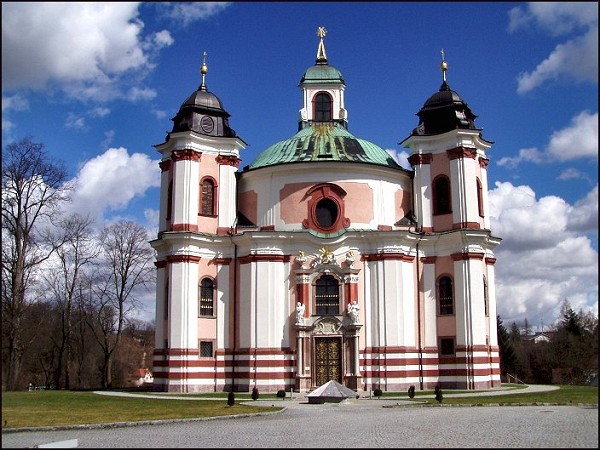
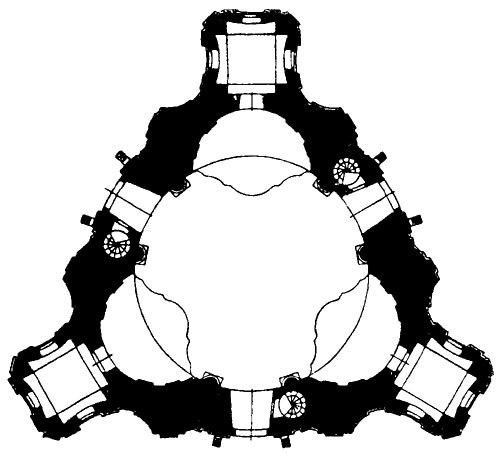
Centuries ago, architecture made use of many and sometimes strange, symbols to indicate the Trinity, like three animals (hares, stags, birds) in a circle, or three interlocked rings, or a candle with three flames. Some churches display an architectural number symbolism in honour of the Trinity. One of the most remarkable examples of this kind is the Holy Trinity Church of Stadl-Paura, Austria, built in 1722 – see below. It has three aisles, three towers, three doors, three windows on either side, three altars, three bells, and three rows of pews.
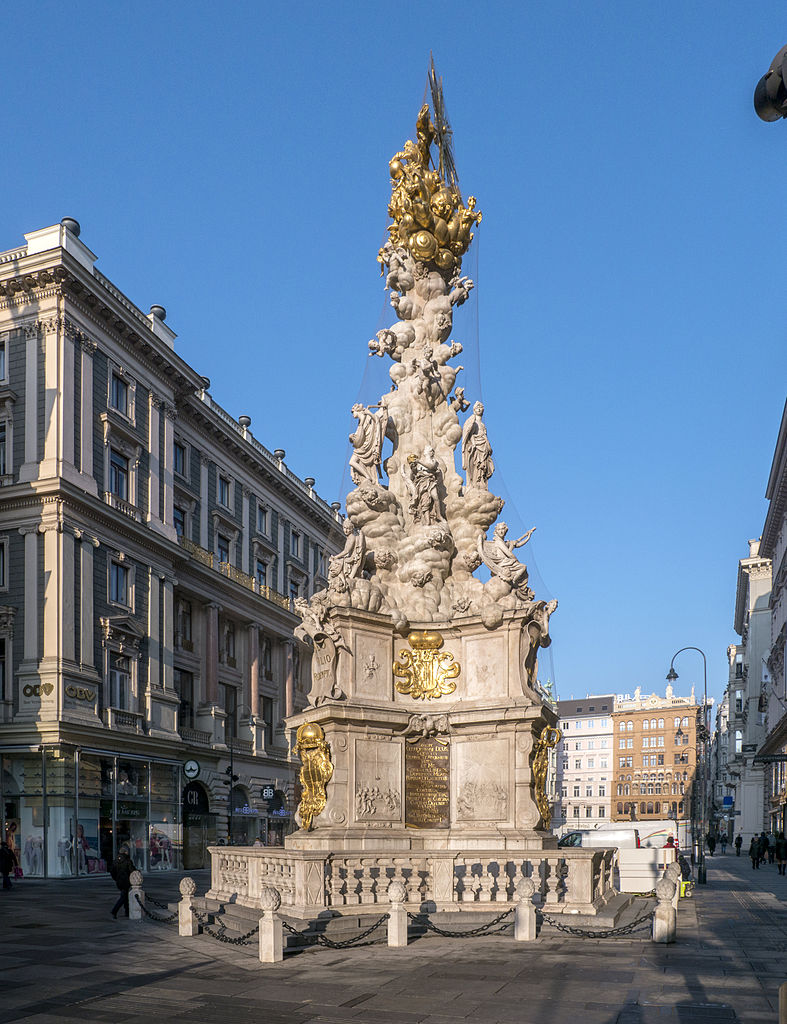
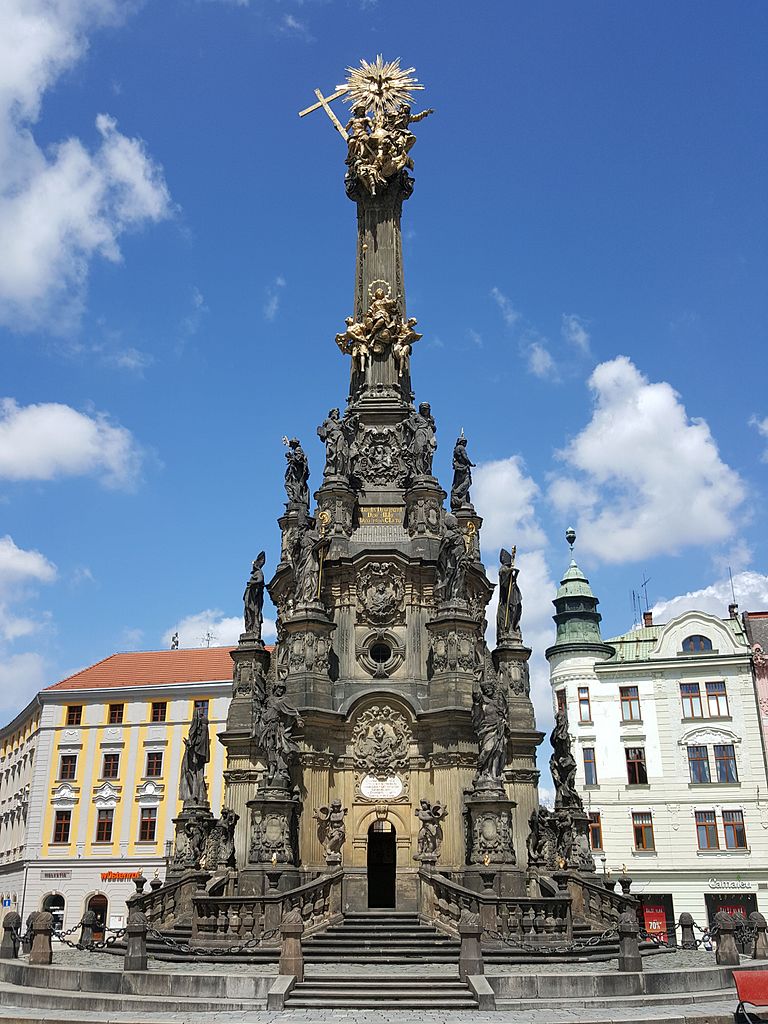
SHRINES AND COLUMNS — From the fourteenth century on, the Holy Trinity was generally invoked for help against the dreaded epidemics of the Black Death. Hundreds of Trinity churches in Europe owe their existence to public vows made in time of pestilence and cholera. In subsequent ravages of those terrible diseases, these churches became much-frequented pilgrim shrines. Later, during the seventeenth and eighteenth centuries, public columns in honour of the Holy Trinity were placed in the main squares of cities and towns in central Europe. Sculptured in marble or granite, they carry the traditional image of the Trinity and statues of the saints who were patrons against epidemics. Many of these columns are outstanding examples of late baroque art. The city of Vienna alone has eleven such Trinity columns which were erected during the epidemics of 1679 and 1713.
Plague Column, Vienna, AustriaThe Holy Trinity Column, Olomouc, Czech Republic, a World Heritage Site
POPULAR CELEBRATION — During the late Middle Ages and up to the eighteenth century, the Feast of the Holy Trinity was celebrated with popular manifestations of solemnity, special honour and joy. As an example may serve the festival at the Trinity column of downtown Vienna, in 1680, where the famous Augustinian preacher Abraham a Santa Clara (1709) delivered a sermon before many thousands in the festively decorated square. At the end he appealed to the choir band to express with their instruments the honour, adoration and gratitude of all to the Holy Trinity, “upon which the whole group of many trumpets and kettle-drums right joyfully broke out in a ringing fanfare.”
A proof of the great devotion to the Trinity was the Holy Trinity Confraternities, which flourished to such a degree during the seventeenth century that they surpassed most of the other similar organisations both in the number of local groups and in membership…
Handbook of Christian Feasts and Customs by Francis X. Weiser, S.J., Harcourt, Brace and Company, New York, 1958.
COLLECT PRAYER
God our Father, who by sending into the world the Word of truth and the Spirit of sanctification made known to the human race your wondrous mystery, grant us, we pray, that in profession the true faith, we may acknowledge the Trinity of eternal glory and adore your Unity, powerful in majesty. Through our Lord Jesus Christ, your Son, who lives and reigns with you in the unity of the Holy Spirit, one God, for ever and ever.
Glory and honour be to God in the Unity of the Trinity; to the Father and to the Son with the Holy Spirit, forever and ever.
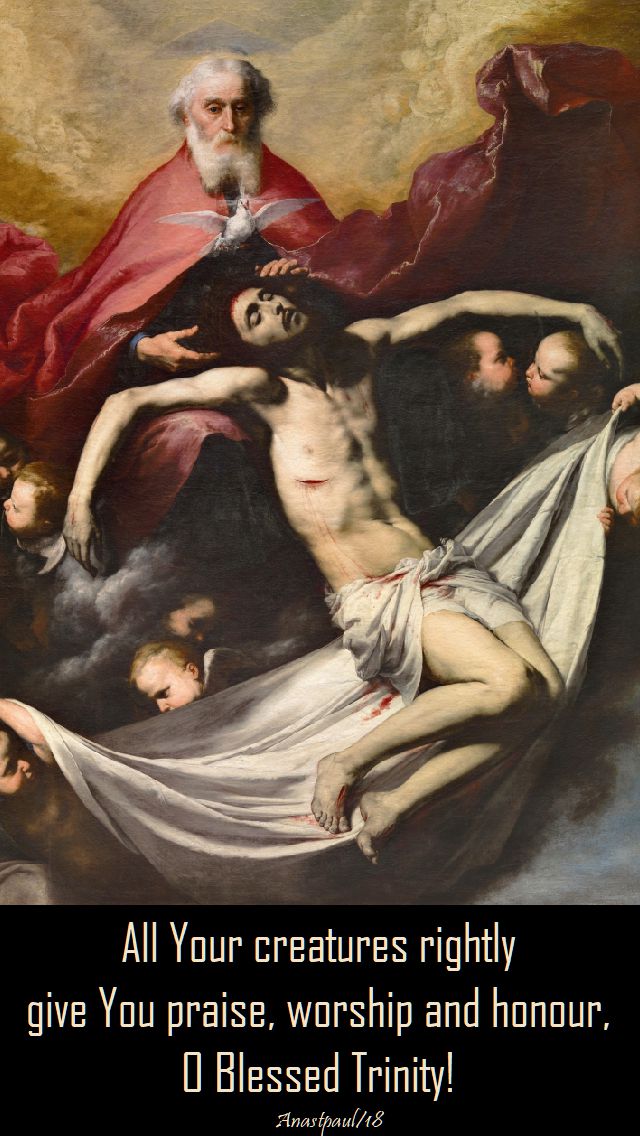
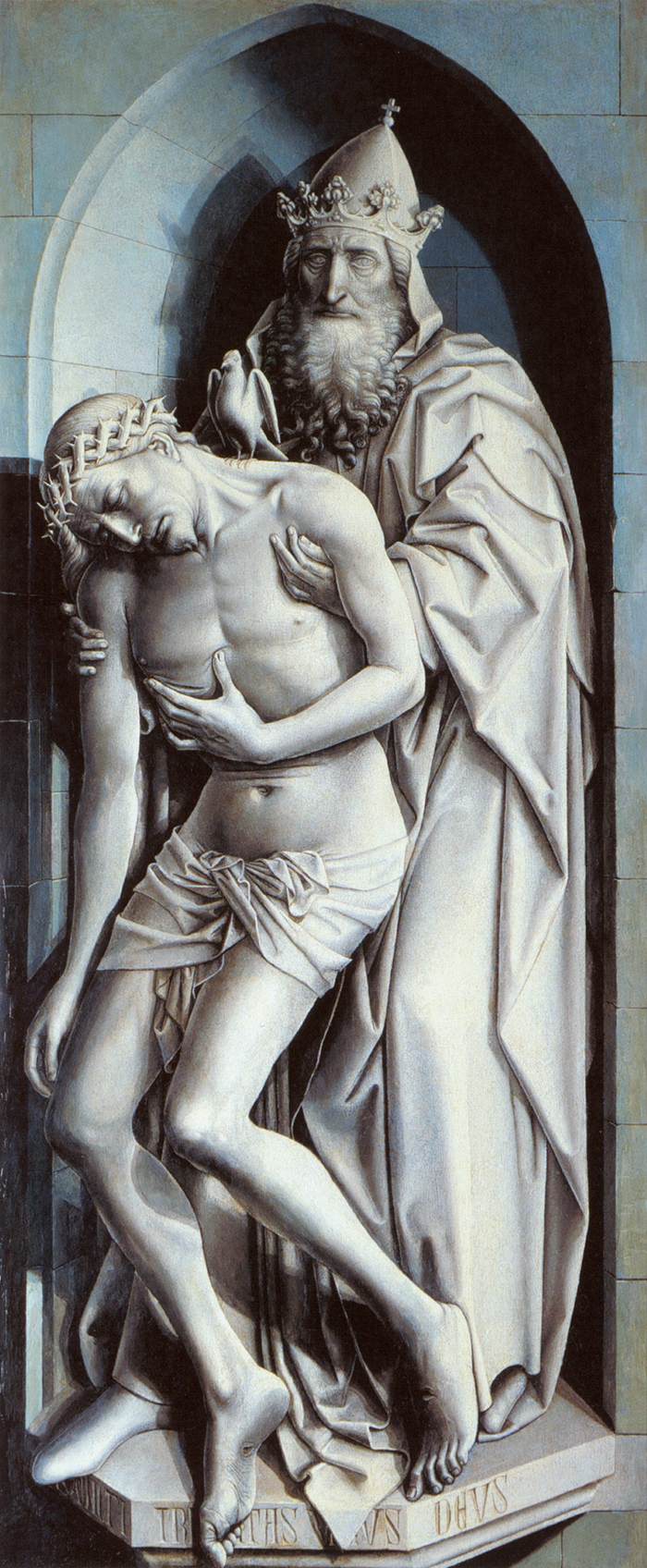
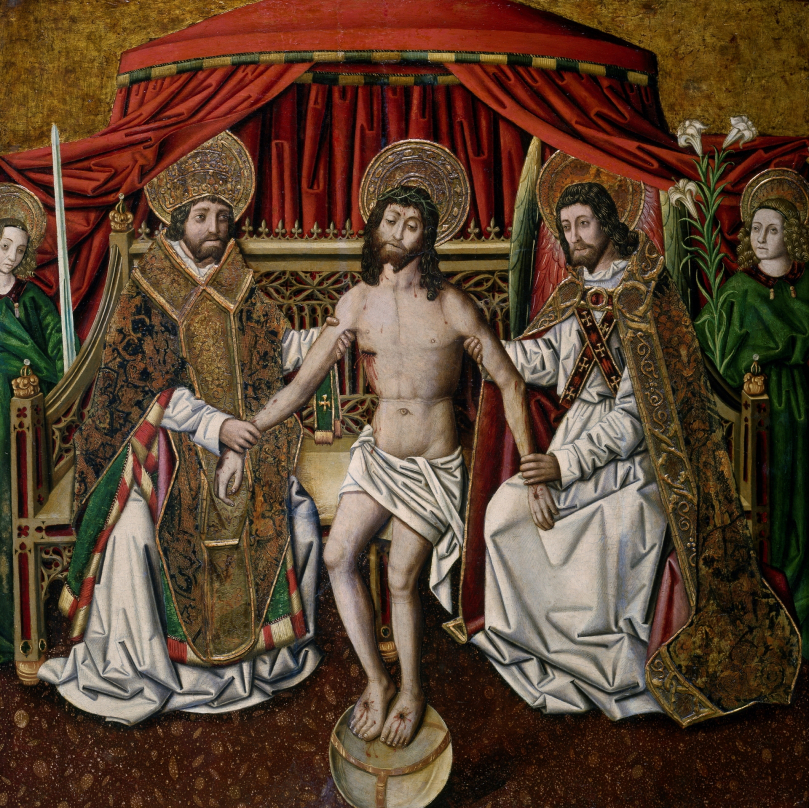
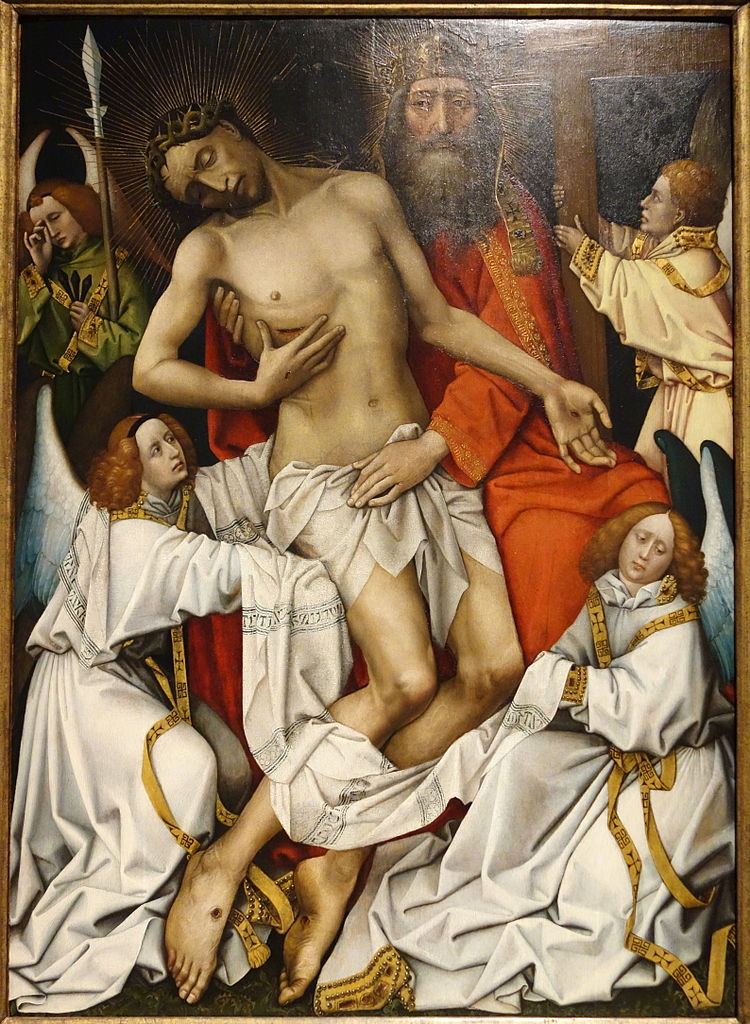
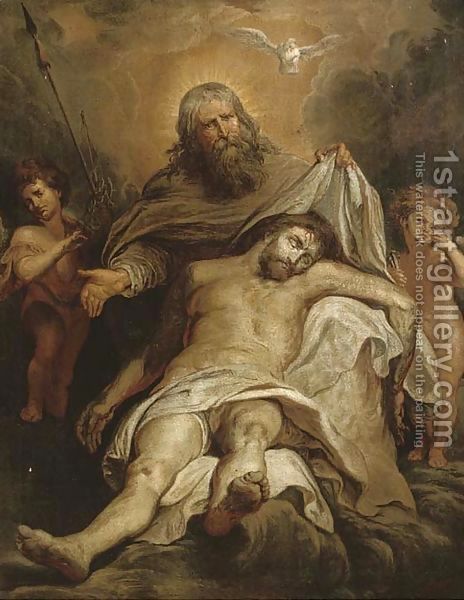
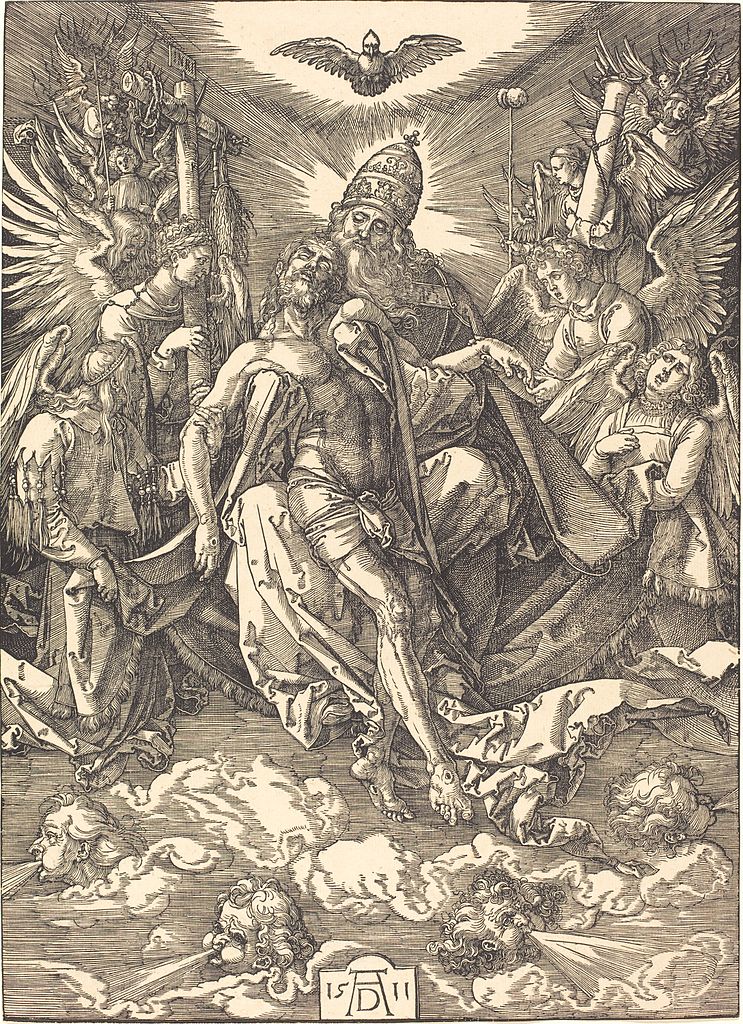
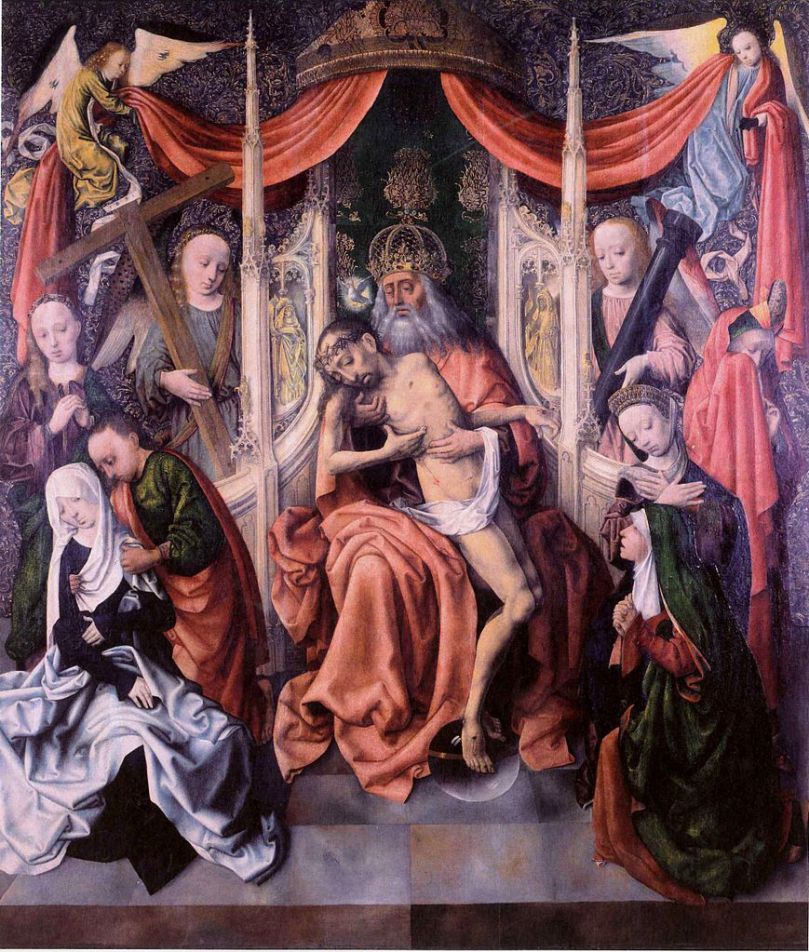
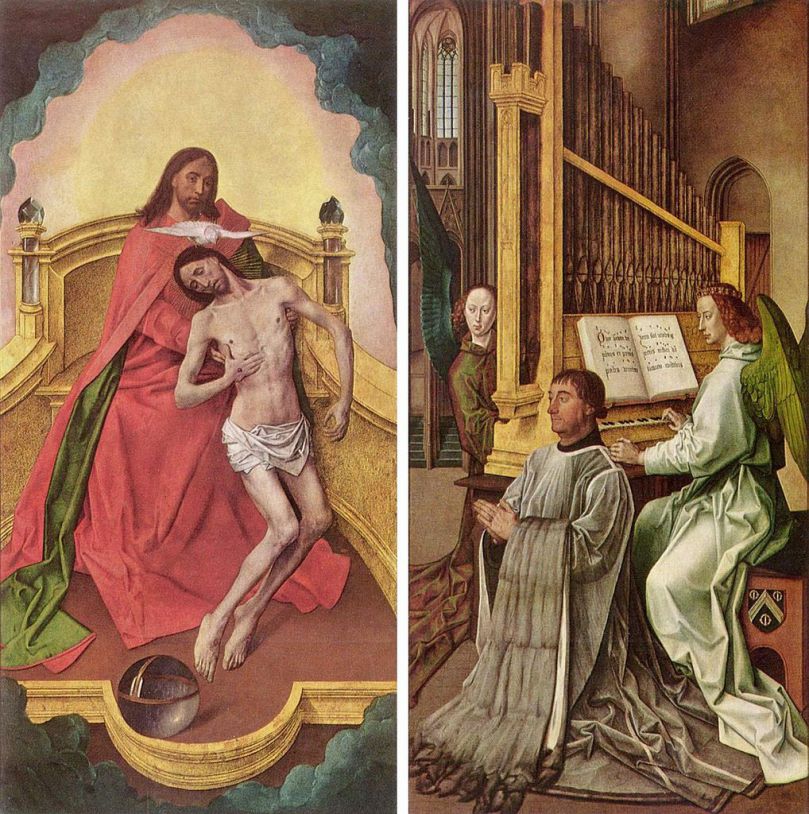
Follower of Artus Wolffort, 17th century.Master of the Lille Adoration, 1530s.Ribera, c. 1635.El Greco, 1577-79.
Our Morning Offering – 11 May “Mary’s Month” – Friday of the Sixth Week of Eastertide
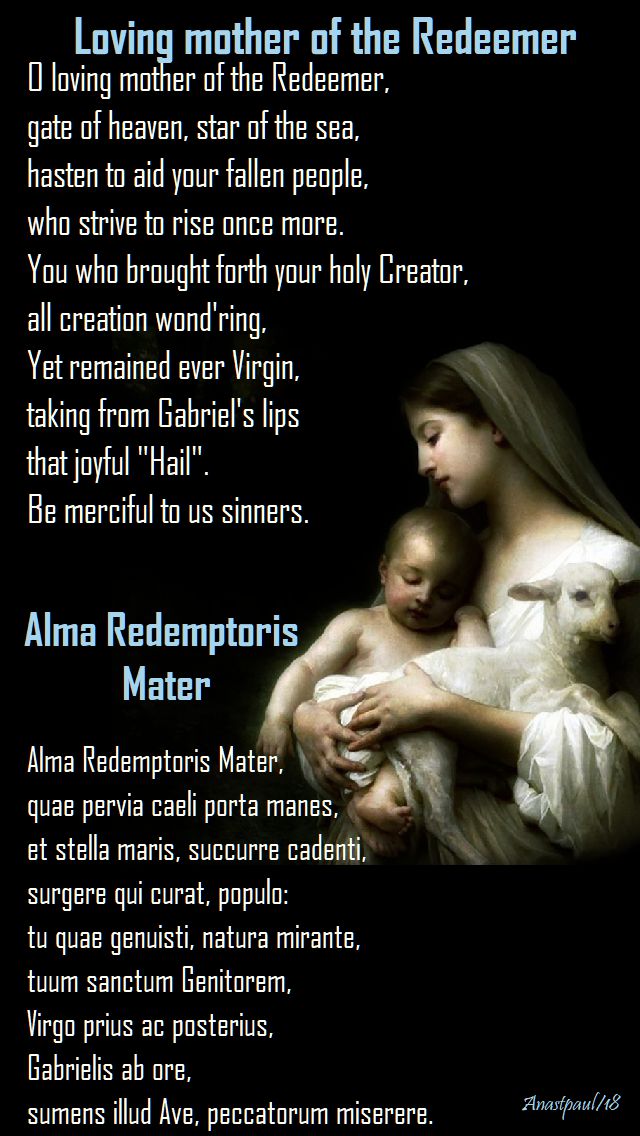
Alma Redemptoris Mater Loving mother of the Redeemer Prayers of the Church from the Breviary
Loving mother of the Redeemer,
gate of heaven, star of the sea,
assist your people who have fallen,
yet strive to rise again.
To the wonderment of nature
you bore your Creator,
Yet remained a virgin after as before.
You who received Gabriel’s joyful greeting,
have pity on us poor sinners.
Alma Redemptoris Mater,
quae pervia caeli porta manes,
et stella maris, succurre cadenti,
surgere qui curat, populo:
tu quae genuisti, natura mirante,
tuum sanctum Genitorem,
Virgo prius ac posterius,
Gabrielis ab ore,
sumens illud Ave, peccatorum miserere.
This is one of four Marian antiphons, with following versicles and prayers, traditionally said or sung after night prayer, immediately before going to sleep. It is said from the beginning of Advent (from night before the fourth Sunday before Christmas) through 1 February.
One Minute Reflection – 28 April – Saturday of the Fourth Week of Eastertide and the Memorial of St Gianna Beretta Molla (1922-1962) Today’s Gospel: John 14:7–14
Whatever you ask in my name, I will do it, that the Father may be glorified in the Son; if you ask anything in my name, I will do it...John 14:13-14
REFLECTION – “The stillness of prayer is the most essential condition for fruitful action. Before all else, the disciple kneels down.”…St Gianna Beretta Molla
PRAYER – Since it is from You God, our Father, that redemption comes to us, Your adopted children, look with favour on the family You love, give us true freedom and to all who believe in Christ and bring us all alike to our eternal heritage. Grant we pray, that by the prayers of Your holy one, St Gianna, we may run this race always in prayer, trusting in Your divine Son’s intercession, to attain the Glory of Your Kingdom and the Light of Your Face. Through Jesus Christ, in the union of the Holy Spirit, one God with You, forever and ever, amen.
Our Morning Offering – – 18 April – Wednesday of the Third Week of Eastertide
At the Lamb’s High Feast We Sing
At the Lamb’s high feast we sing
praise to our victorious King,
who hath washed us in the tide
flowing from His piercèd side;
praise we Him whose love divine
gives His sacred blood for wine,
gives His body for the feast,
Christ the Victim, Christ the Priest.
Where the paschal blood is poured,
death’s dark angel sheathes his sword;
Israel’s hosts triumphant go
through the wave that drowns the foe.
Praise we Him, whose blood was shed,
Paschal Victim, Paschal Bread;
with sincerity and love
eat we manna from above.
Mighty Victim from the sky,
pow’rs of hell beneath Thee lie;
death is conquered in the fight,
Thou hast brought us life and light;
hymns of glory and of praise,
risen Lord, to Thee we raise;
Holy Father, praise to Thee,
with the Spirit, ever be.
Paschal triumph, Paschal joy,
only sin can this destroy;
from the death of sin set free,
souls reborn, dear Lord, in Thee.
Hymns of glory, songs of praise,
Father unto Thee we raise;
risen Lord, all praise to Thee,
Ever with the Spirit be.
Translator: Robert Campbell Robert Campbell was a Catholic advocate residing in Edinburgh. He died in 1868.
Our Morning Offering – 15 April – The Third Sunday of Easter Year B
Prayer to the Blessed Virgin Mary Before Holy Mass
O most blessed Virgin Mary,
Mother of tenderness and mercy,
I, a miserable and unworthy sinner,
fly to you with all the affection of my heart
and I beseech your motherly love,
that, as you stood by your most dear Son,
while he hung on the Cross,
so, in your kindness,
you may be pleased to stand by me, a poor sinner,
and all Priests who today are offering the Sacrifice
here and throughout the entire holy Church,
so that with your gracious help
we may offer a worthy and acceptable oblation
in the sight of the most high and undivided Trinity.
Amen.
(This prayer is adapted from the Priests’ Prayers Before each Mass)
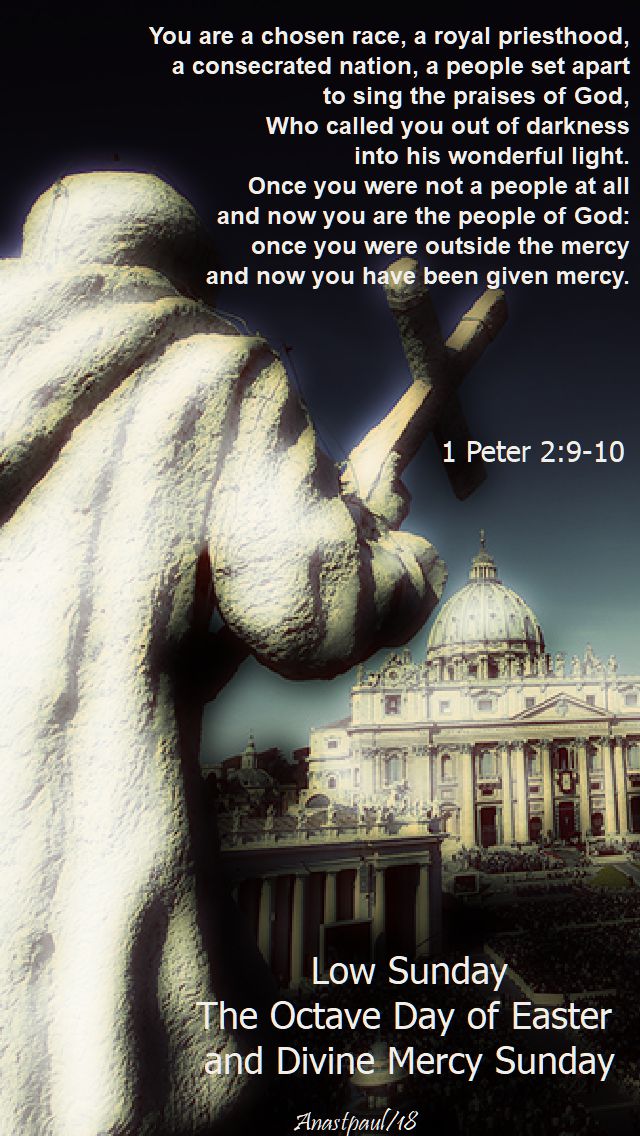
Quote of the Day – 8 April – Low Sunday the Octave Day of Easter and Divine Mercy Sunday
“You are a chosen race, a royal priesthood, a consecrated nation, a people set apart to sing the praises of God, Who called you out of darkness into his wonderful light. Once you were not a people at all and now you are the people of God: once you were outside the mercy and now you have been given mercy.”
The beautiful ancient Easter sequence Victimae Paschali Laudes can be said or sung before the Gospel every day during the Octave:
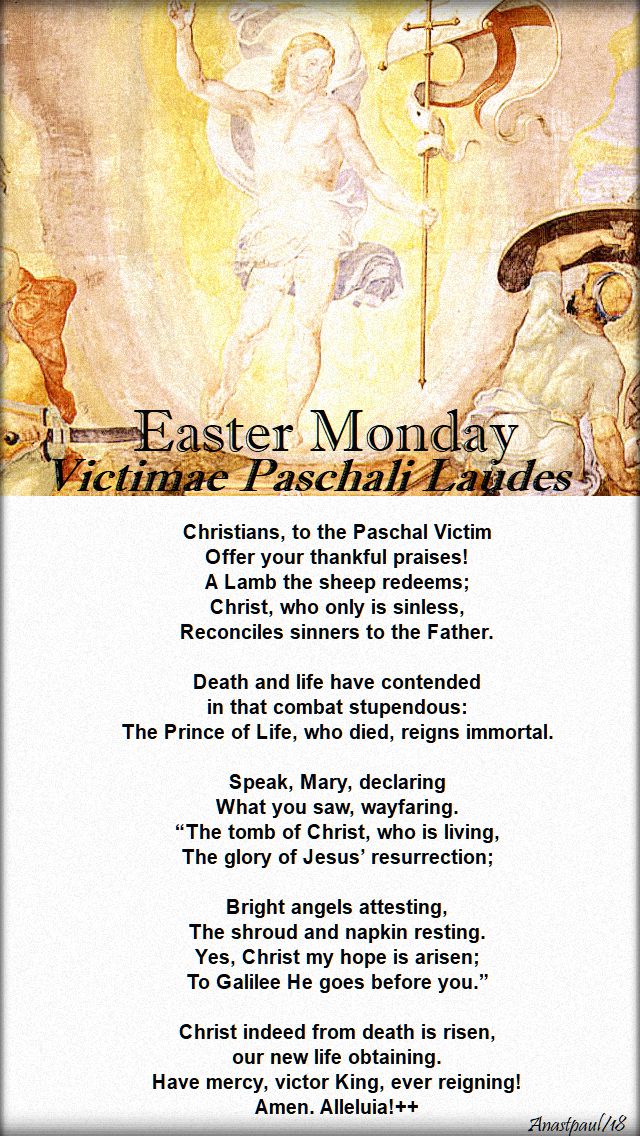
Victimae Paschali Laudes
Christians, to the Paschal Victim
Offer your thankful praises!
A Lamb the sheep redeems;
Christ, who only is sinless,
Reconciles sinners to the Father.
Death and life have contended
in that combat stupendous:
The Prince of Life, who died, reigns immortal.
Speak, Mary, declaring
What you saw, wayfaring.
“The tomb of Christ, who is living,
The glory of Jesus’ resurrection;
Bright angels attesting,
The shroud and napkin resting.
Yes, Christ my hope is arisen;
To Galilee He goes before you.”
Christ indeed from death is risen,
our new life obtaining.
Have mercy, victor King, ever reigning!
Amen. Alleluia!++
One Minute Reflection – 19 March – The Solemnity of the Feast of St Joseph, Spouse of the Blessed Virgin Mary and Patron of the Universal Church
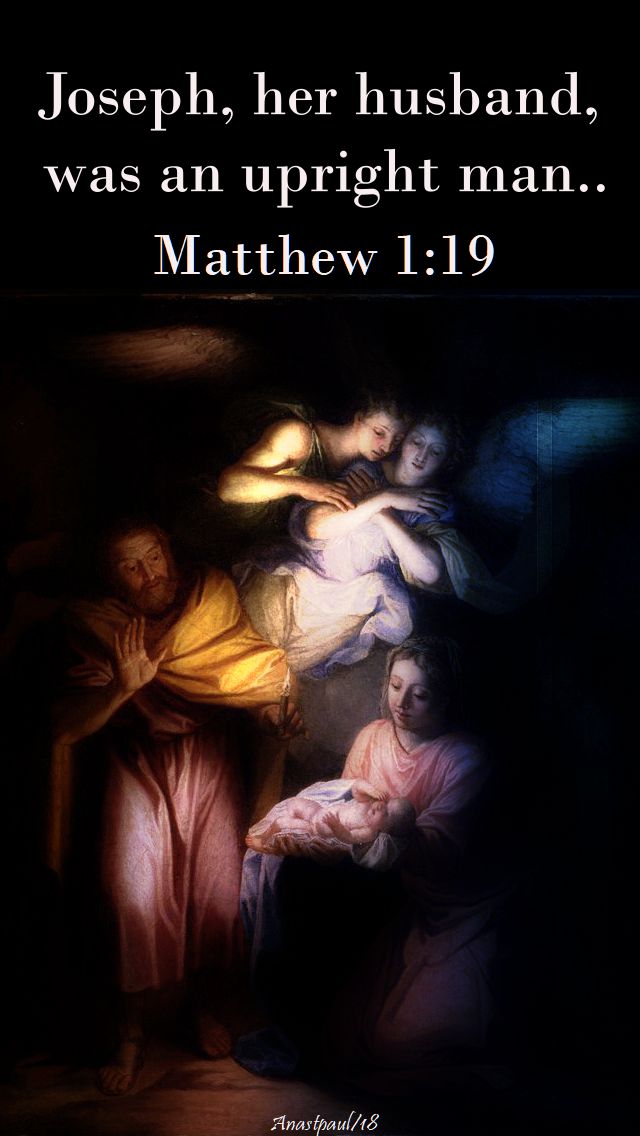
Joseph, her husband, was an upright man...Matthew 1:19
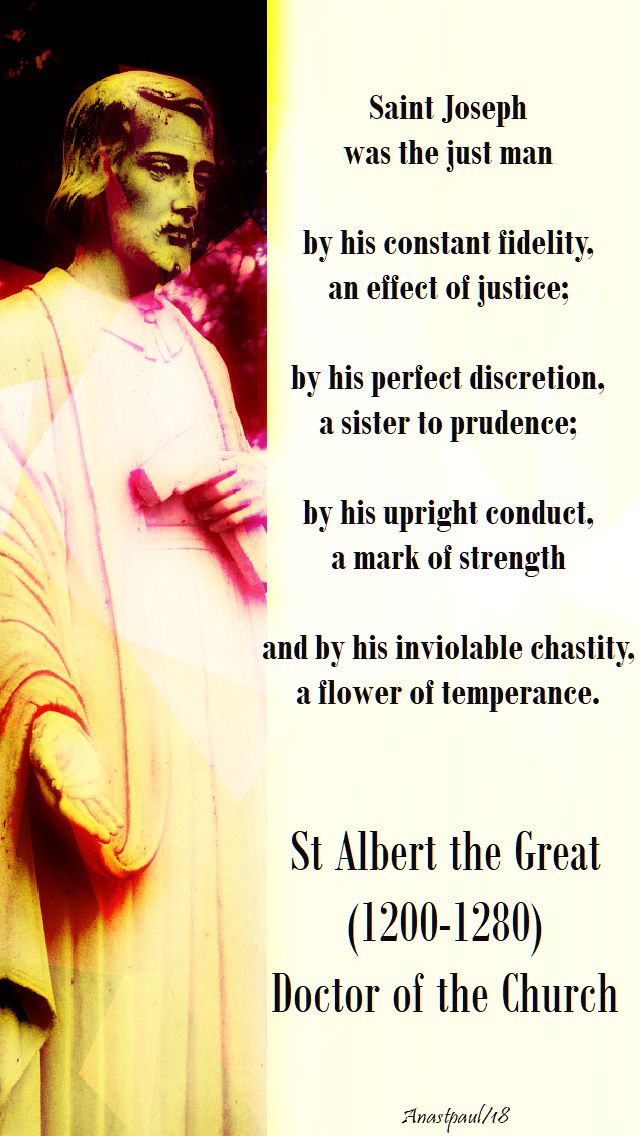
REFLECTION – Saint Joseph was the just man by his constant fidelity, an effect of justice; by his perfect discretion, a sister to prudence; by his upright conduct, a mark of strength and by his inviolable chastity, a flower of temperance…St Albert the Great (1200-1280) Doctor of the Church
PRAYER – Almighty God, at the beginning of our salvation, when Mary conceived Your Son and brought Him forth into the world, You placed them under Joseph’s watchful care. May his prayer still guide us and help Your Church, to be an equally faithful guardian of Your Mysteries and a sign of Christ to mankind. Through Your Son, our Saviour, in unity of the Holy Spirit, one God forever, amen.
Our Morning Offering – 19 March – The Solemnity of the Feast of St Joseph, Spouse of the Blessed Virgin Mary, Guardian of Jesus and Patron of the Universal Church, Patron of Fathers, Patron of the Dying, Patron of Workers. et al
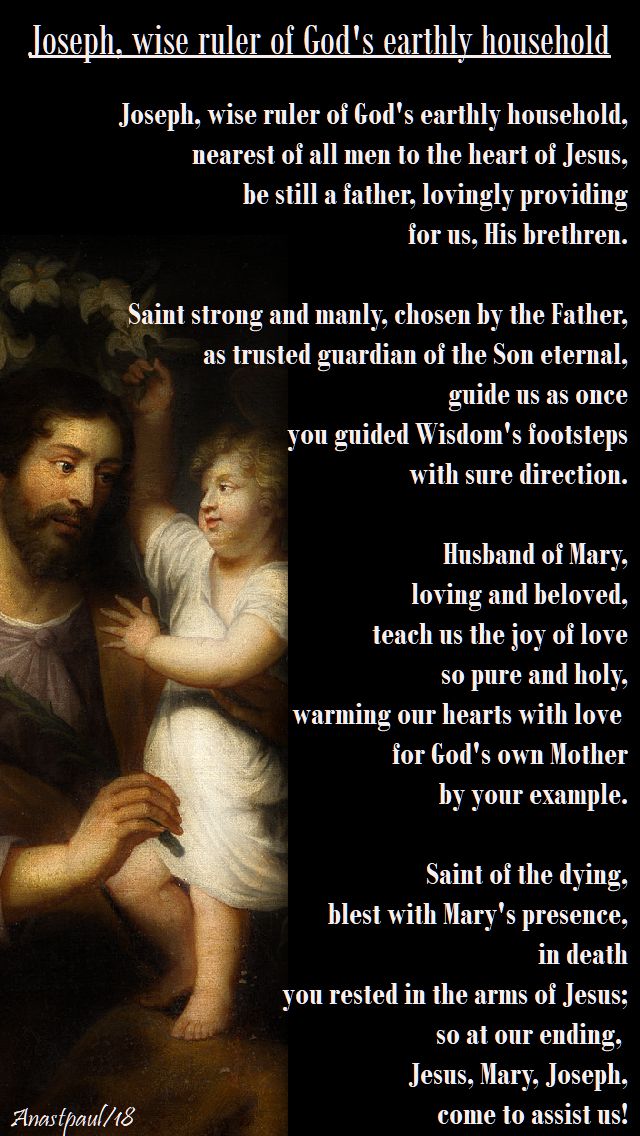
Joseph, wise ruler of God’s earthly household
Joseph, wise ruler of God’s earthly household,
nearest of all men to the heart of Jesus,
be still a father, lovingly providing
for us, His brethren.
Saint strong and manly, chosen by the Father,
as trusted guardian of the Son eternal,
guide us as once you guided Wisdom’s footsteps
with sure direction.
Husband of Mary, loving and beloved,
teach us the joy of love so pure and holy,
warming our hearts with love
for God’s own Mother by your example.
Saint of the dying, blest with Mary’s presence,
in death you rested in the arms of Jesus;
so at our ending, Jesus, Mary, Joseph,
come to assist us!
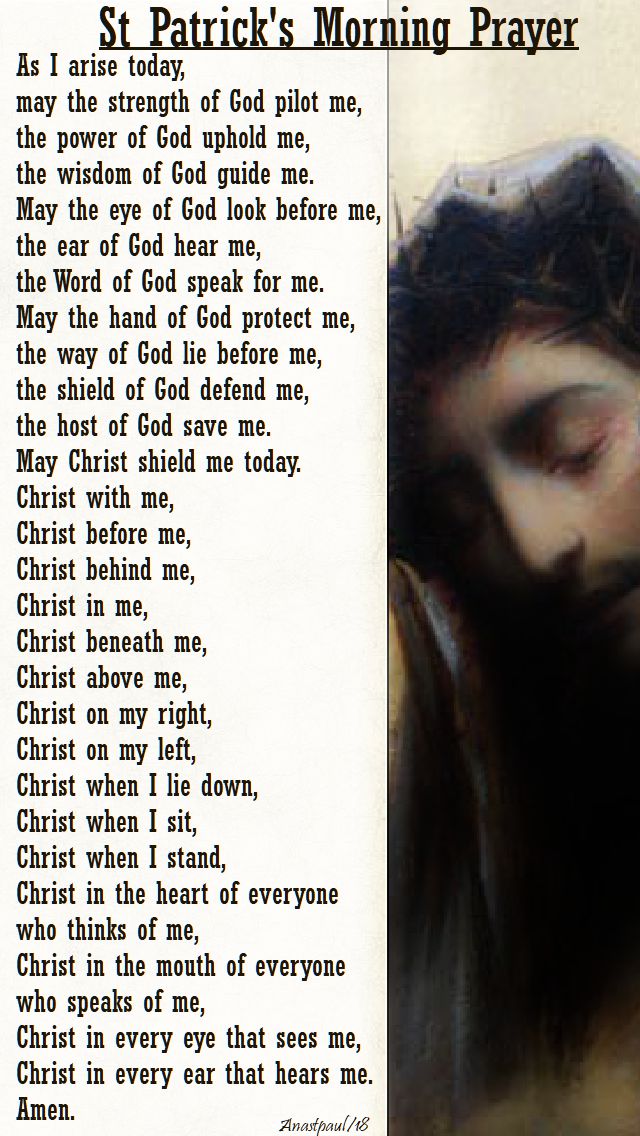
As I arise today,
may the strength of God pilot me,
the power of God uphold me,
the wisdom of God guide me.
May the eye of God look before me,
the ear of God hear me,
the Word of God speak for me.
May the hand of God protect me,
the way of God lie before me,
the shield of God defend me,
the host of God save me.
May Christ shield me today.
Christ with me,
Christ before me,
Christ behind me,
Christ in me,
Christ beneath me,
Christ above me,
Christ on my right,
Christ on my left,
Christ when I lie down,
Christ when I sit,
Christ when I stand,
Christ in the heart of everyone
who thinks of me,
Christ in the mouth of everyone
who speaks of me,
Christ in every eye that sees me,
Christ in every ear that hears me.
Amen.
Our Morning Offering – 8 January – The Baptism of the Lord
God in flesh made manifest By Christopher Wordsworth (1807-1885) (nephew of the great lake-poet, William Wordsworth)
Songs of thankfulness and praise,
Jesus, Lord, to You we raise,
manifested by the star
to the sages from afar;
branch of royal David’s stem,
in Your birth at Bethlehem.
Manifest at Jordan’s stream,
Prophet, Priest and King supreme;
and at Cana, wedding guest,
in Your Godhead manifest,
You revealed Your power divine,
changing water into wine.
Manifest in making whole
weakened body, fainting soul;
manifest in valiant fight,
quelling all the devil’s might;
manifest in gracious will,
ever bringing good from ill.
Anthems be to Thee addressed.
God in man made manifest.
Our Morning Offering – 29 December – Fifth Day of the Octave and the Memorial of St Thomas a Becket
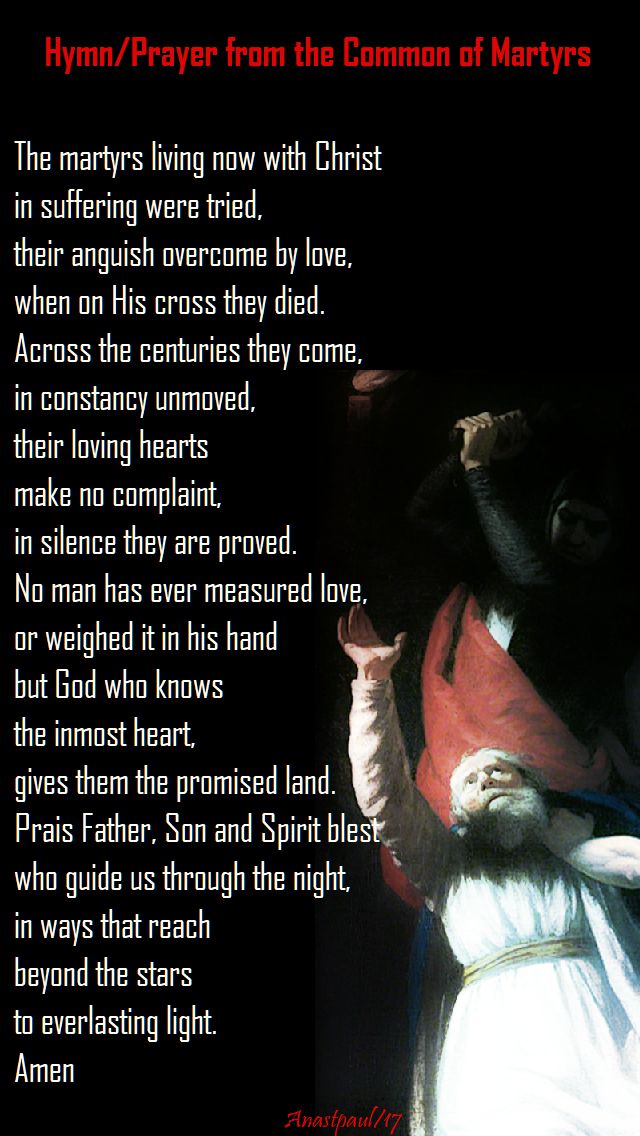
Hymn/Prayer from the Common of Martyrs
The martyrs living now with Christ
in suffering were tried,
their anguish overcome by love,
when on His cross they died.
Across the centuries they come,
in constancy unmoved,
their loving hearts make no complaint,
in silence they are proved.
No man has ever measured love,
or weighed it in his hand
but God who knows the inmost heart,
gives them the promised land.
Prais Father, Son and Spirit blest
who guide us through the night,
in ways that reach beyond the stars
to everlasting light.
Amen











 AnaStpaul
You must be logged in to post a comment.