Quote/s of the Day – 15 November – The Memorials of St Albert the Great (1200-1280) Doctor of the Church and St Raphael Kalinowski (1835-1907)
“Nor could He have commanded anything more lovable, for this sacrament produces love and union. It is characteristic of the greatest love to give itself as food. “Had not the men of my text exclaimed: ‘ Who will feed us with his flesh to satisfy our hunger?’ as if to say: ‘I have loved them and they have loved me so much that I desire to be within them and they wish to receive me so that the, may become my members.’ There is no more intimate or more natural means for them to be united to me and I to them. Nor could He have commanded anything which is more like eternal life. Eternal life flows from this sacrament because God with all sweetness pours Himself out upon the blessed.”
St Albert the Great (1200-1280) Doctor of the Church
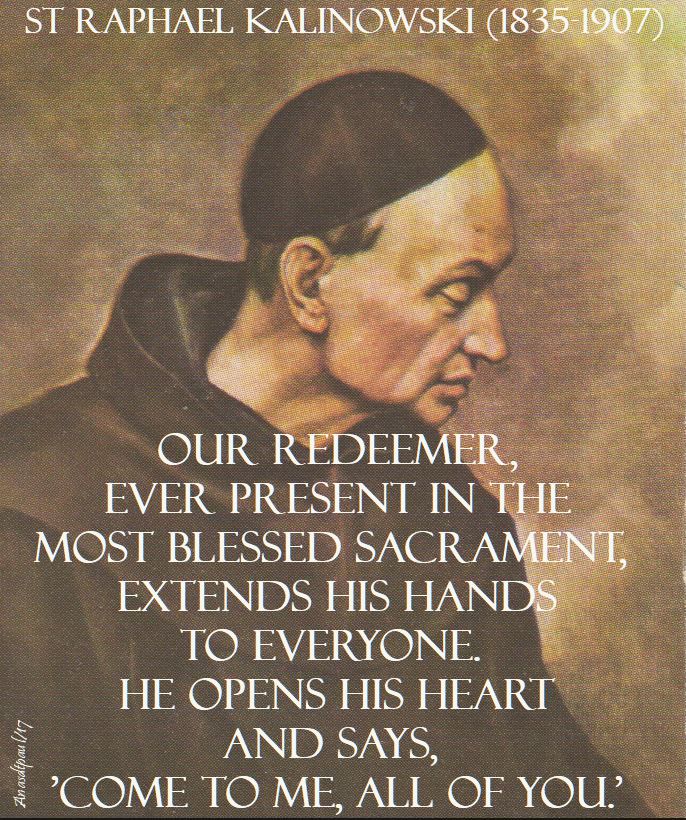
“Our Redeemer ever present in the most Blessed Sacrament, extends His hands to everyone. He opens His heart and says, ‘Come to Me, all of you.'”
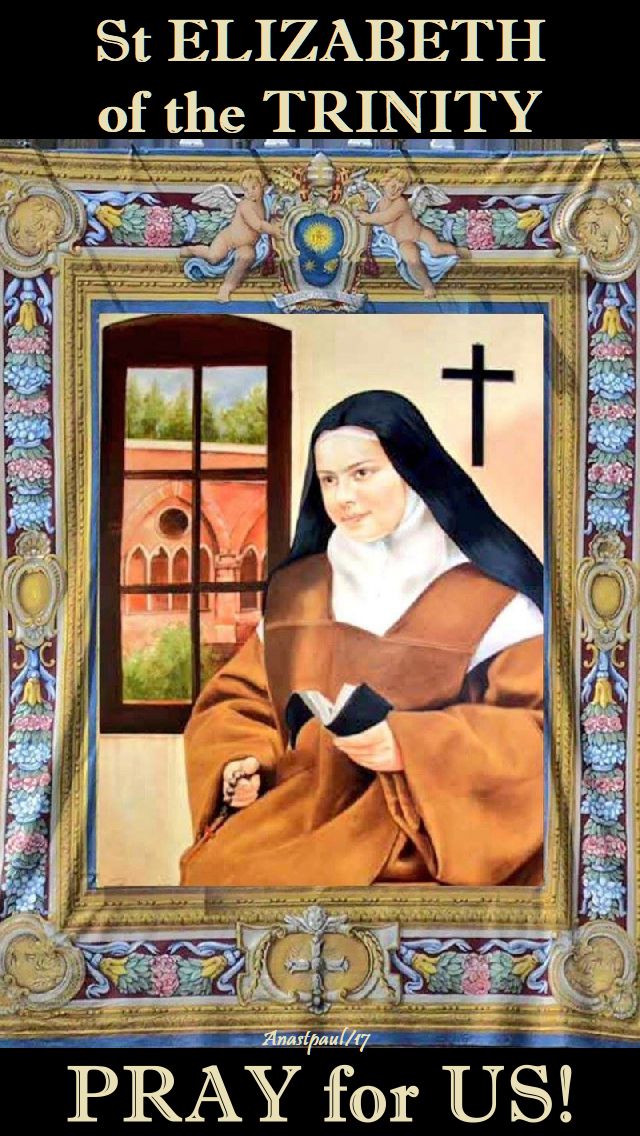
Thought for the Day – 8 November – The Memorial of St Elizabeth of the Trinity (1880-1906)
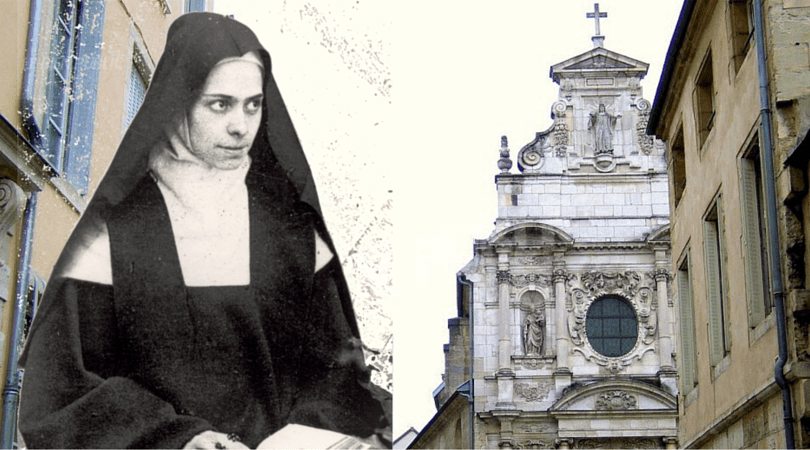
Elizabeth Catez offers hope to any parent who struggles with a strong-willed child. A holy terror as a toddler, she once embarrassed her mother by shouting out at Mass, “Bad priest! Bad priest! That’s my doll!” The priest had secretly borrowed her doll to be used as the Christ Child in his creche. But gradually Elizabeth channeled her willfulness into a determination to become a saint.
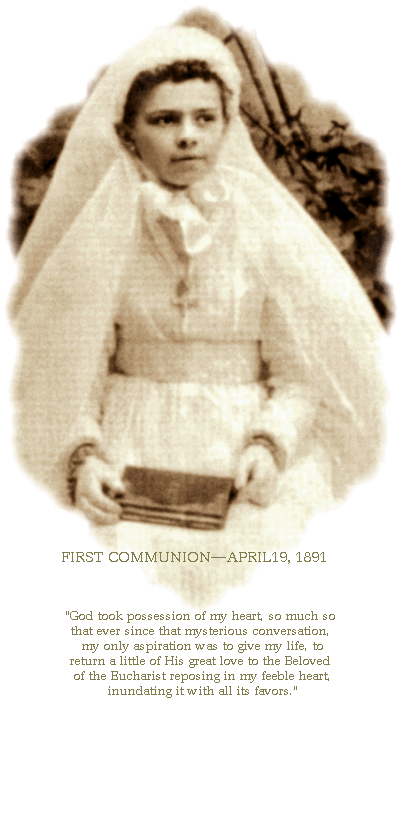
Elizabeth’s first communion and confirmation at age 10 touched her deeply without quelling her rambunctiousness. But from that time she opened up to an interior prayer life that slowly matured into the infused contemplation of a mystic. At 14 she felt drawn to choose Christ as her spouse. Without hesitating she made a private vow of virginity. And having been intrigued by visits to the local Carmelite convent at Dijon, France, since childhood, she was determined to become a Carmelite.
Marie, her mother, was horrified at the thought. She did all she could do to prevent it. She sent Elizabeth to parties in hopes that these might distract her and arranged for suitors to pursue her. But she could not in the end resist her daughter’s strong will. She gave up and allowed Elizabeth to enter the Dijon Carmel in 1901.
Appropriately, she took the name Elizabeth of the Trinity, for the focus of her life became her immersion in the Godhead, or rather the Trinity’s immersion in her. This letter from Elizabeth to a friend typifies her spirituality:
I love to penetrate beyond the veil of the soul to this inner sanctuary where we live alone with God. He wants us entirely to Himself and is making there within us a cherished solitude. Listen to everything that is being sung . . . in His heart. It is Love, the infinite love that envelops us and desires to give us a share . . . in all His blessedness. The whole Blessed Trinity dwells in us, the whole of that mystery which will be our vision in heaven. I am “Elizabeth of the Trinity”—Elizabeth disappearing, losing herself, allowing herself to be invaded by the Three…All day long let us surrender ourselves to Love, by doing the will of God, under His gaze, with Him, in Him, for Him alone. . . . And then, when evening comes, after a dialogue of love that has never stopped in our hearts, let us go to sleep still in love. And if we are aware of any faults, let us simply abandon them to Love, which is a consuming fire and so do our purgatory in His love!
Like St Theresa Margaret of the Sacred Heart, another Carmelite, Elizabeth delighted the other sisters in the cloister with her simple and joyful service. However, in 1903, she contracted Addison’s disease. She suffered intensely and joyfully until she died in 1906. St. Elizabeth of the Trinity was only 26-years-old.
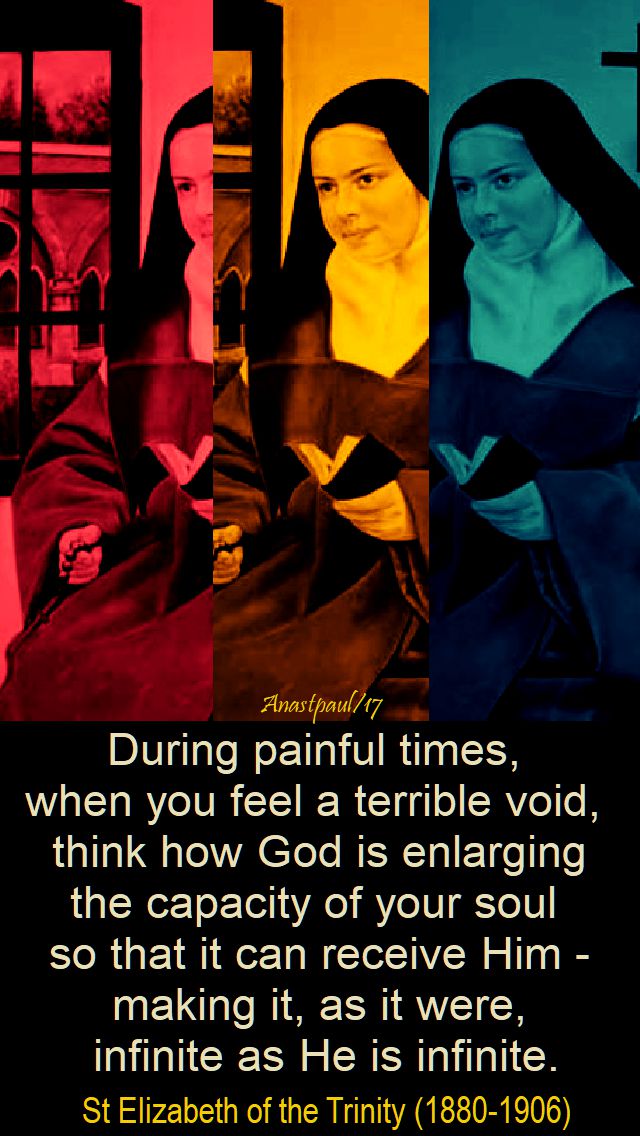
“During painful times, when you feel a terrible void, think how God is enlarging the capacity of your soul, so that it can receive Him – making it, as it were, infinite as He is infinite.” Look upon each pain, as a love token coming to you directly from God, in order to unite you to Him.
One Minute Reflection – 8 November – The Memorial of St Elizabeth of the Trinity (1880-1906)
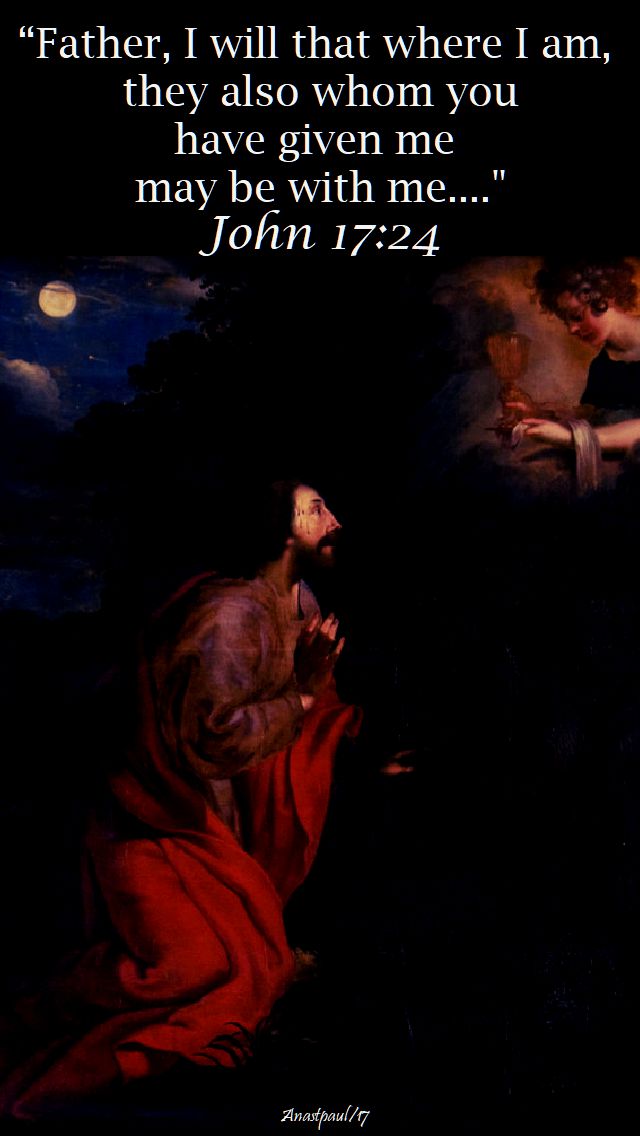
“Father, I will that where I am, they also whom you have given me may be with me….” John 17:24
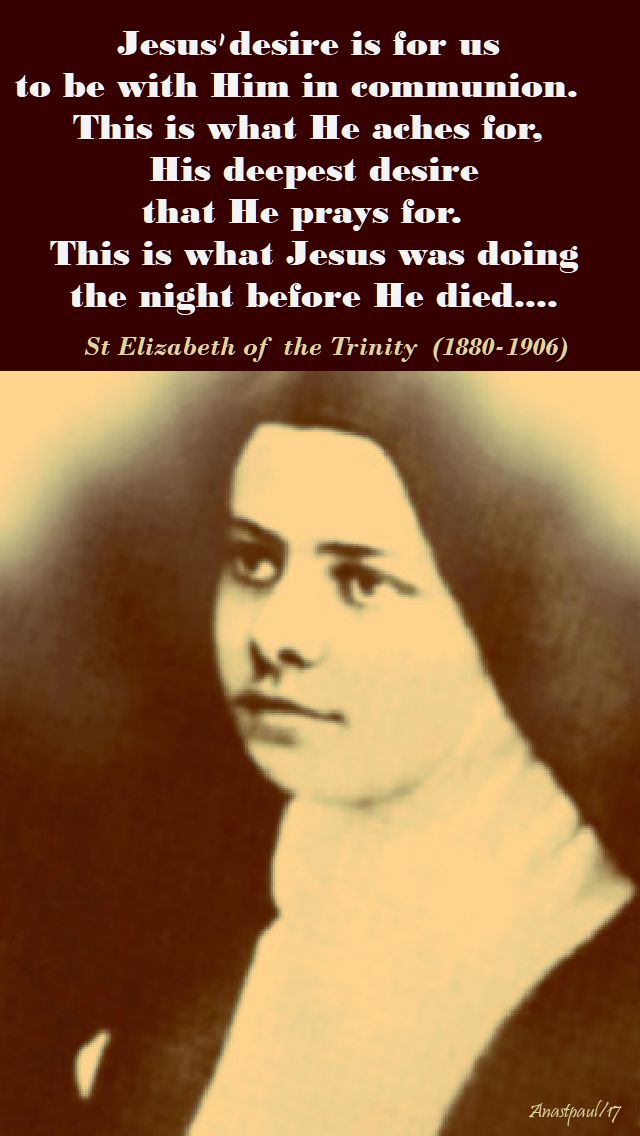
REFLECTION – “Jesus’ desire is for us to be with Him in communion. This is what He aches for, His deepest desire that He prays for. This is what Jesus was doing the night before He died.” …St Elizabeth of the Trinity
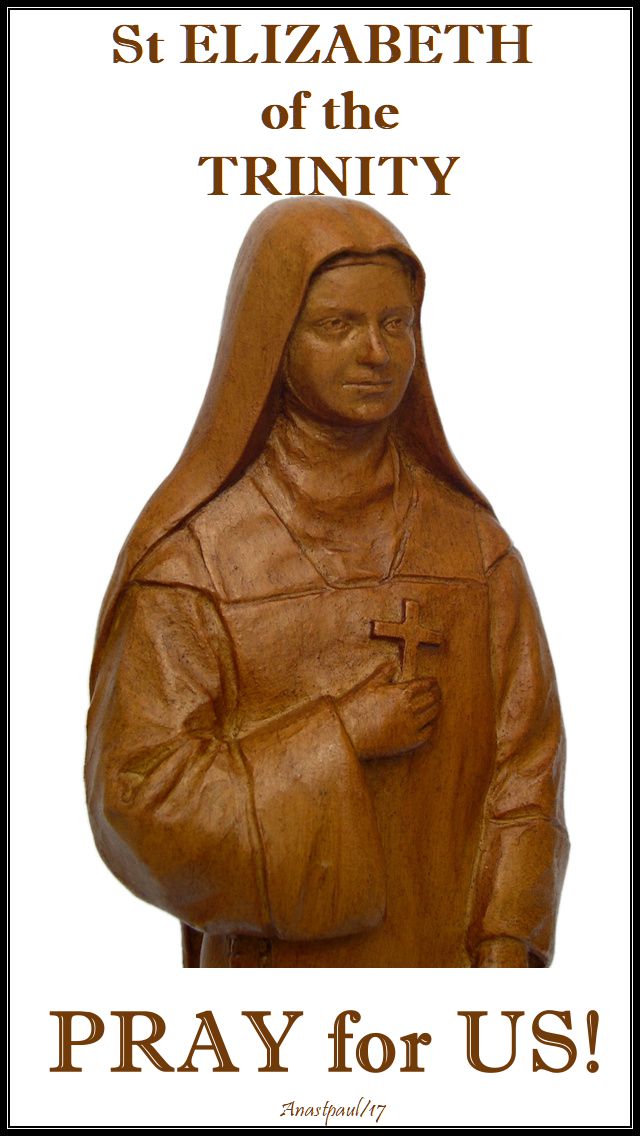
PRAYER – My Lord and my God, You have prayed that I may be in You and You in me. This is the guiding consolation of my life and the source of my prayer. Lead me to Yourself, guide me and teach me that I may never stray from You. Holy St Elizabeth of the Trinity, in your young life you followed the way of the Lord, the way of the Cross, doing all for God by the love of the Holy Spirit. Please pray for us, amen.
Our Morning Offering – 8 November – The Memorial of St Elizabeth of the Trinity (1880-1906)
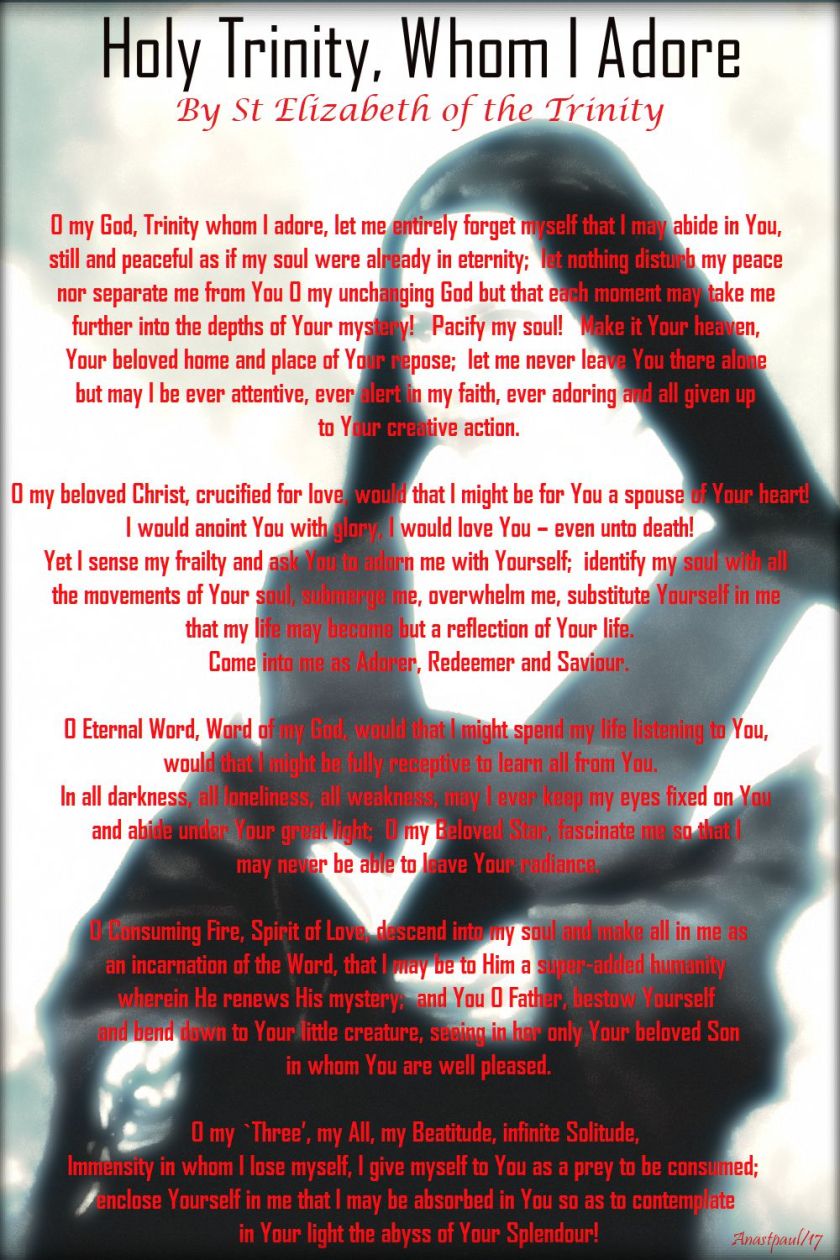
Holy Trinity, Whom I Adore By St Elizabeth of the Trinity
O my God, Trinity whom I adore, let me entirely forget myself that I may abide in You, still and peaceful as if my soul were already in eternity; let nothing disturb my peace nor separate me from You, O my unchanging God but that each moment may take me further into the depths of Your mystery! Pacify my soul! Make it Your heaven, Your beloved home and place of Your repose; let me never leave You there alone but may I be ever attentive, ever alert in my faith, ever adoring and all given up to Your creative action.
O my beloved Christ, crucified for love, would that I might be for You a spouse of Your heart! I would anoint You with glory, I would love You – even unto death! Yet I sense my frailty and ask You to adorn me with Yourself; identify my soul with all the movements of Your soul, submerge me, overwhelm me, substitute Yourself in me that my life may become but a reflection of Your life. Come into me as Adorer, Redeemer and Saviour.
O Eternal Word, Word of my God, would that I might spend my life listening to You, would that I might be fully receptive to learn all from You. In all darkness, all loneliness, all weakness, may I ever keep my eyes fixed on You and abide under Your great light; O my Beloved Star, fascinate me so that I may never be able to leave Your radiance.
O Consuming Fire, Spirit of Love, descend into my soul and make all in me as an incarnation of the Word, that I may be to Him a super-added humanity wherein He renews His mystery; and You O Father, bestow Yourself and bend down to Your little creature, seeing in her only Your beloved Son in whom You are well pleased.
O my `Three’, my All, my Beatitude, infinite Solitude, Immensity in whom I lose myself, I give myself to You as a prey to be consumed; enclose Yourself in me that I may be absorbed in You so as to contemplate in Your light the abyss of Your Splendour!
Saint of the Day – 8 November – St Elizabeth of the Trinity O.C.D. (1880-1906) – professed Religious, Mystic, Writer, gifted Pianist. Born Elizabeth Catez on Sunday 18 July 1880 in a military camp in the diocese of Bourges, France – 9 November 1906 at Dijon, Côte-d’Or, France of Addison’s disease, a hormone disorder whose side effects are painful and exhausting. Pope John Paul II beatified Elizabeth on 24 November 1984 and Pope Francis Canonised her on 16 October 2016. Patronages – • against the death of parents • against bodily ills, illness or sickness • sick people.
Elizabeth was born on 18 July 1880 at the army camp in Avor near Bourges in France, where her father was a captain. She was baptised four days later on the Feast of St. Mary Magdalene, a fact which she treasured. When she was 2½ her sister Marguerite, known as Guite, was born. Elizabeth’s father died when she was only seven years old. By this time the family was living in a camp in Dijon but after the captain died, they moved into a flat. Elizabeth could see the Carmel of Dijon from her bedroom window. She was very high spirited and given to fiery outbursts of anger when things did not go her way. In 1891 Elizabeth received her First Holy Communion and it made a deep impression on her. From this time on the Eucharist became the centre of Elizabeth’s life and it gave her the strength and determination she needed to make a real effort to overcome her rages.
When she was eight Elizabeth’s mother enrolled her in the Conservatoire, probably with the intention of preparing her to teach music. Elizabeth practised the piano for several hours each day; she was an exceptionally gifted pianist. She often played in concerts and when she was thirteen she won first prize for her playing. She could undoubtedly have gone on to become a concert pianist but God had other plans for her.
Around the time of her fourteenth birthday Elizabeth made a vow of virginity, as an act of total self-offering to God. She had already felt the call to religious life and one day after receiving Holy Communion she became convinced God was calling her to Carmel.
Meanwhile she spent happy holidays with her mother and sister. Elizabeth dressed in the latest fashions, enjoyed dances and loved walking in the country, where she appreciated all the beauties of creation. She had a great gift for friendship and was popular with her peers but in everything God was at the centre. She said that when she played the piano she forgot all about the audience and played only for Him.
Elizabeth had a natural gift for contemplative prayer, people remarked on her total stillness and said that she seemed ‘Lost in God’ but she was active in her parish too. She taught catechism and ran a club for the children of workers in a tobacco factory; she visited the sick and sang in the parish choir.
Elizabeth entered the Carmel of Dijon on 2 August 1901 and on 8 December Feast of the Immaculate Conception, she was clothed in the Carmelite habit.
Elizabeth was full of joy as a postulant; she found God everywhere, in her work as well as at prayer. She loved the silence of her cell where she could listen to Him speaking to her in the scriptures. Her novitiate year was not so smooth, as with her great desire for perfection she struggled with scruples. Elizabeth lived in pure faith, during her novitiate; it was a purification which strengthened her and gave her courage. Mother Germaine, at 31 was Elizabeth’s prioress and novice mistress. She understood Elizabeth and emphasised the way of confidence in the merciful love of God, as expressed by Thérèse of Lisieux in her Story of a Soul, which had been sent to the Carmels as Thérèse’s obituary circular about three years before Elizabeth entered.
Elizabeth made her Profession as a Carmelite on J11 January 1903 and on 21 January, theFeast of St. Agnes, she received the black veil in a public ceremony.
Elizabeth shared in her sister’s joy when she married and again later when she had her first two children. Seeing her sister so happy and devoted to her husband, made Elizabeth reflect on her role as spouse of Christ. She wanted to love Him with an undivided heart, to stay with Him all the time in deep communion; to share in His redemptive suffering and prayer and so become fruitful, by nourishing others and drawing them to Him.
Elizabeth’s horizons were expanding; as she pondered the scriptures she felt she was being transformed into another humanity for Christ, an idea which she developed from Paul’s text ‘It is no longer I who live but Christ lives in me’. She had an intuitive grasp of the ‘universal call to holiness’ long before it was named in the Church.
Elizabeth also had a strong awareness of the indwelling of the Trinity. She often called the Trinity ‘My Three’ and had an intimate relationship with Father, Word and Spirit, as she usually called them. Later she discovered her vocation to be a ‘Praise of glory’ and sometimes she even signed herself by this name.
Around the time of her twenty-third birthday it became clear that Elizabeth’s health was failing, she had developed Addison’s disease, at that time incurable. It led to her death at the age of 26 on 9 November 1906. By this time she was fully surrendered to God and died saying, ‘I am going to Light to Love to Life!’
Thought for the Day – – 15 October – The Memorial of St Teresa of Jesus/Avila (1515-1582) Doctor of the Church
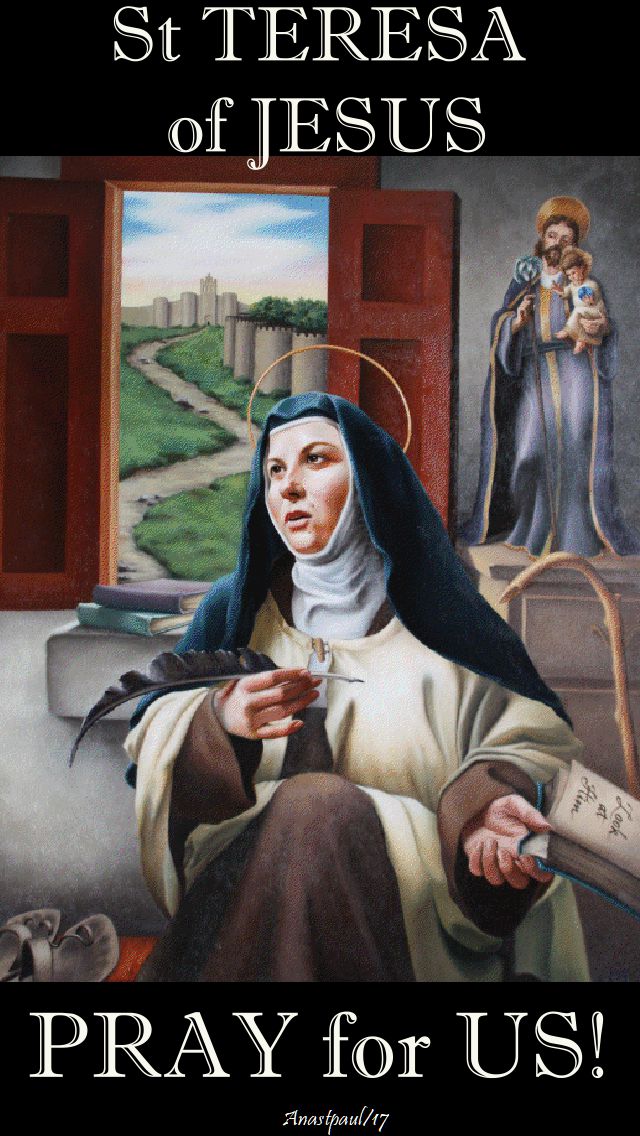
Since her encounter with Jesus, St Teresa lived “another life”; she become a tireless communicator of the Gospel (cf. Life, 23, 1). Eager to serve the Church and in the face of serious problems of her time, she did not limit herself to being a spectator of the reality around her. In her position as a woman and with her health difficulties, she decided, she said, “to do what little depended on me … that is to follow the evangelical counsels as perfectly as possible and to ensure that these few nuns who are here do the same” (The Way, 1, 2). Thus began the Teresian reform, in which she asked her sisters not to lose time negotiating with God “interests of little importance,” while “the world is in flames” (ibid., 1, 5). This missionary and ecclesial dimension has always marked the Carmelites and Discalced Carmelites.
As she did then, even today the saint opens new horizons for us, she calls us to a great undertaking, to see the world with the eyes of Christ, to seek what He seeks and to love what He loves. (Pope Francis in a letter to to Carmelite Father Xavier Cannistrà)
Ours is a time of turmoil, a time of reform, and a time of liberation. Modern women have in Teresa a challenging example. Promoters of renewal, promoters of prayer, all have in Teresa a woman to reckon with, one whom they can admire and imitate.
Quotes of the Day – 15 October – The Memorial of St Teresa of Jesus/Avila (1515-1582) Doctor of the Church
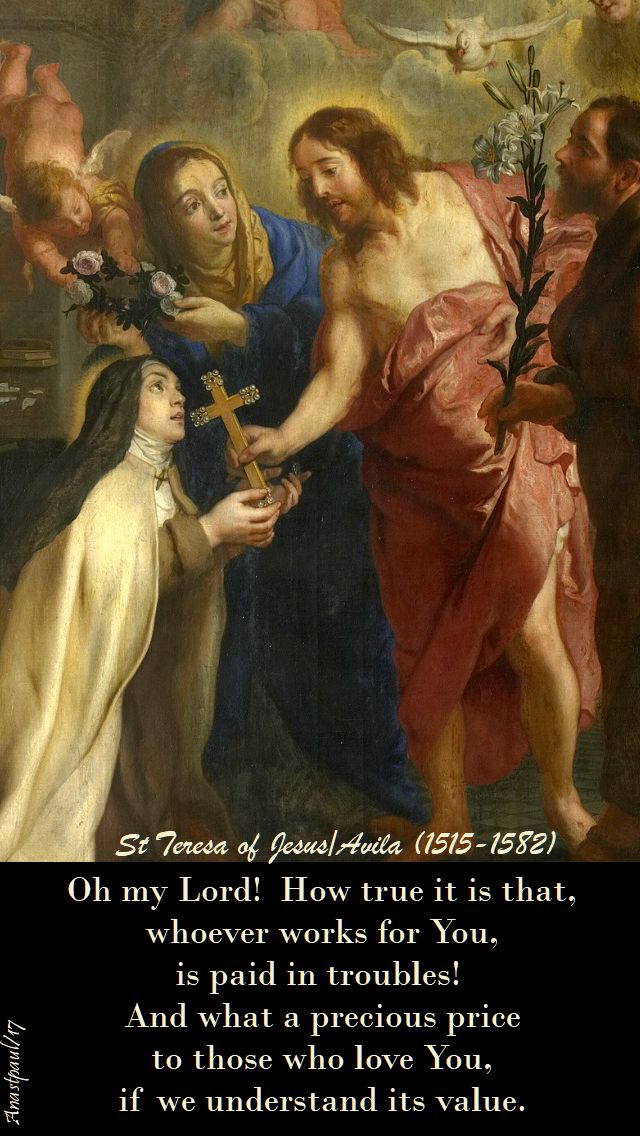
“Oh my Lord! How true it is that, whoever works for You, is paid in troubles! And what a precious price to those who love You, if we understand its value.”
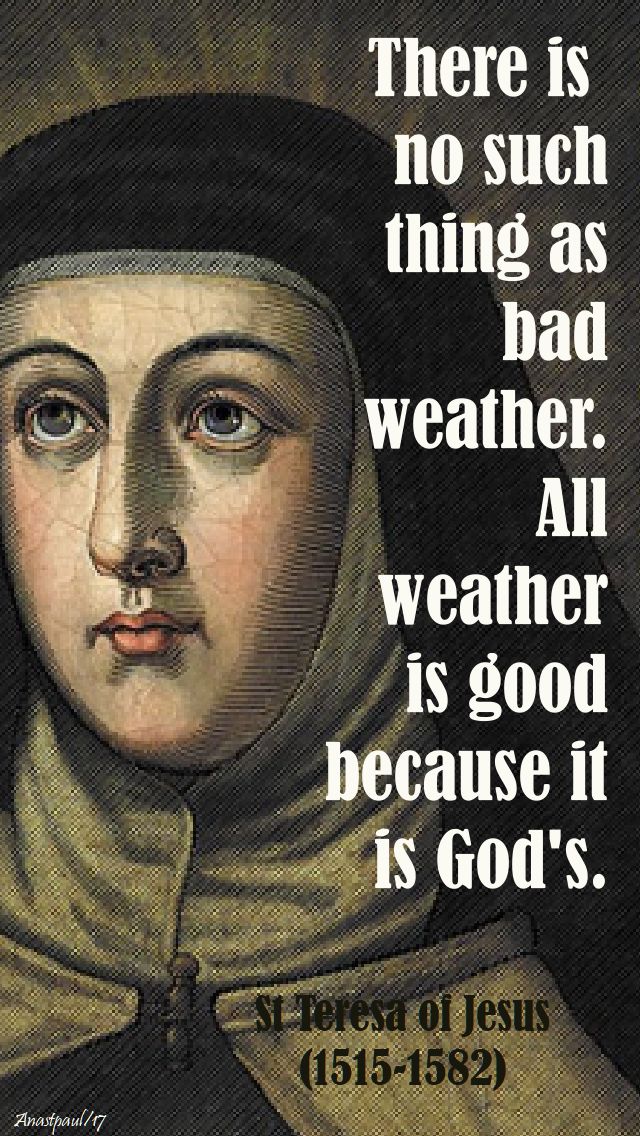
“There is no such thing as bad weather. All weather is good because it is God’s.”
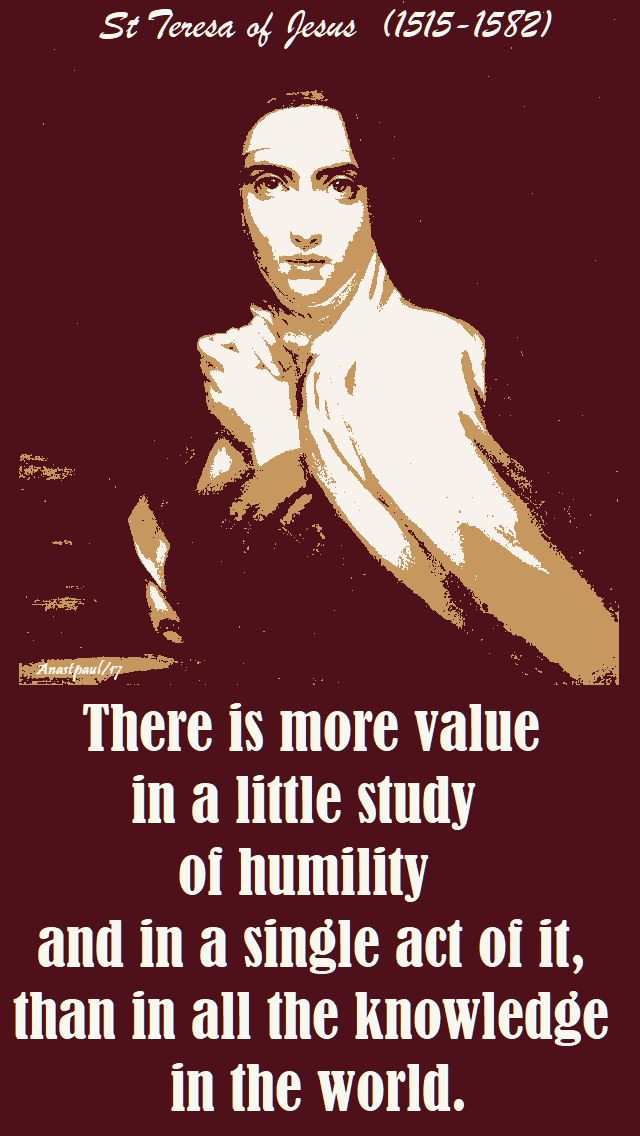
“There is more value in a little study of humility and in a single act of it, than in all the knowledge in the world.”
“We need no wings to go in search of Him but have only to look upon Him, present within us.”
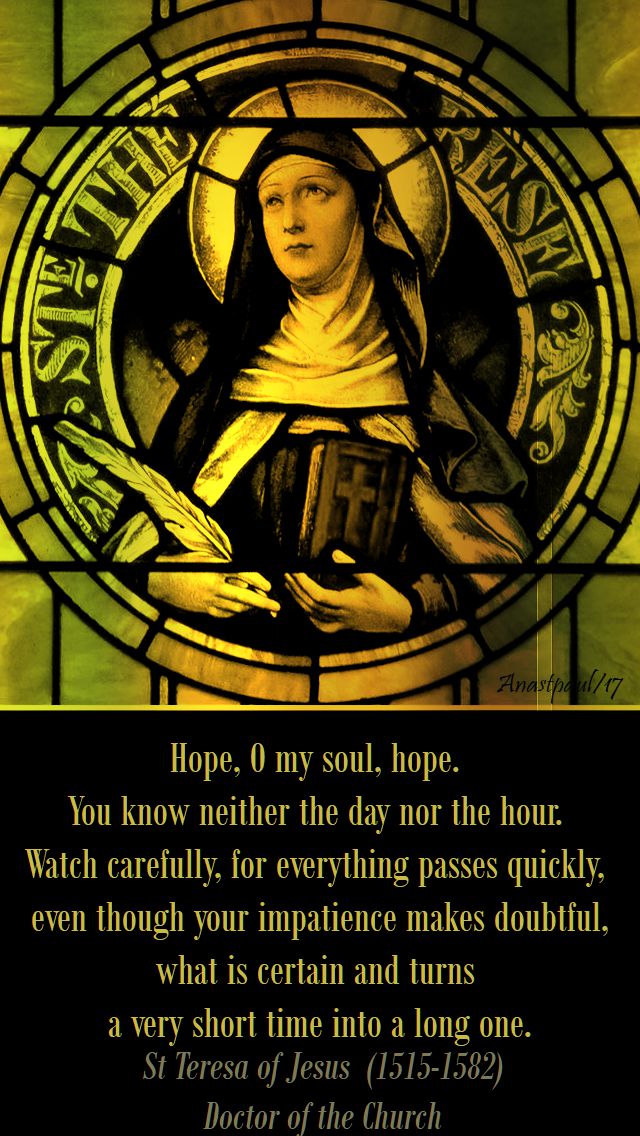
“Hope, O my soul, hope. You know neither the day nor the hour. Watch carefully, for everything passes quickly, even though your impatience makes doubtful, what is certain and turns a very short time into a long one.”
Our Morning Offering – 15 October – The Memorial of St Teresa of Jesus (1515-1582)
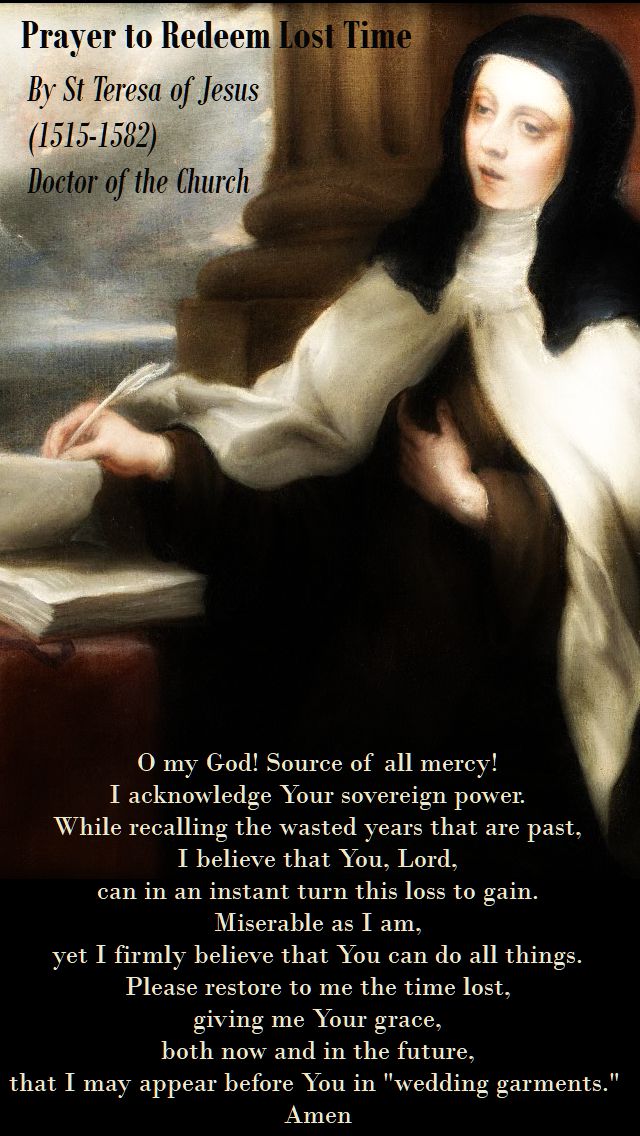
To Redeem Lost Time By St Teresa of Jesus (1515-1582) Doctor of the Church
O my God! Source of all mercy!
I acknowledge Your sovereign power.
While recalling the wasted years that are past,
I believe that You, Lord,
can in an instant turn this loss to gain.
Miserable as I am,
yet I firmly believe that You can do all things.
Please restore to me the time lost,
giving me Your grace,
both now and in the future,
that I may appear before You in “wedding garments.”
Amen
One Minute Reflection – 15 October – The Memorial of St Teresa of Jesus/Avila (1515-1582) Doctor of the Church
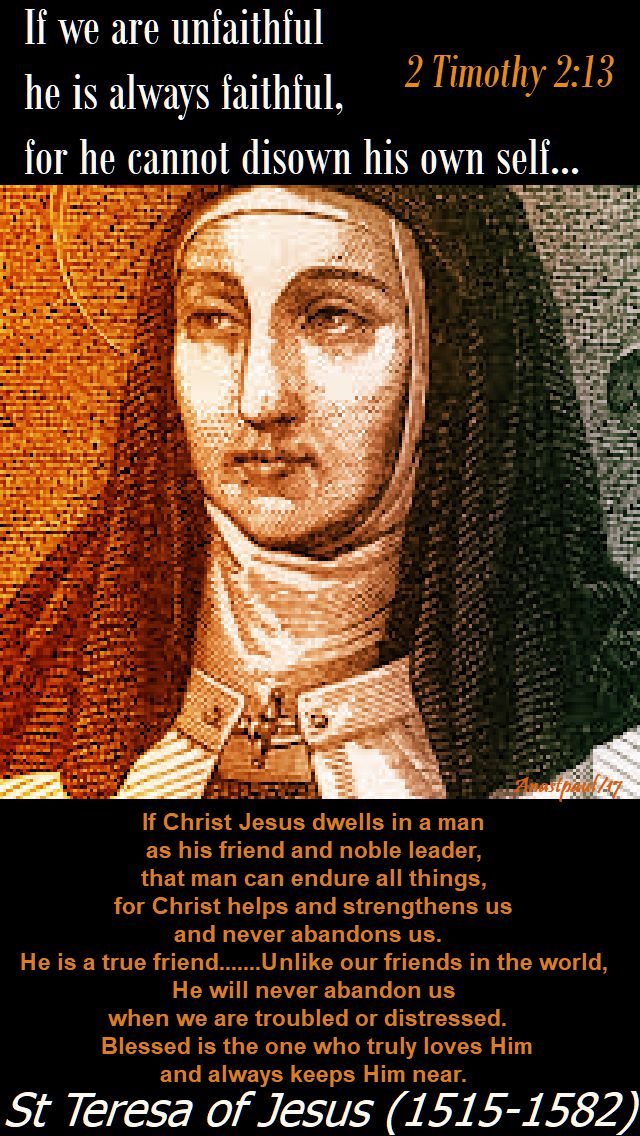
If we have died with him we shall also live with him; if we persevere we shall also reign with him. But if we deny him he will deny us. If we are unfaithful he is always faithful, for he cannot disown his own self..…2 Timothy 2:11-13
REFLECTION – “If Christ Jesus dwells in a man as his friend and noble leader, that man can endure all things, for Christ helps and strengthens us and never abandons us. He is a true friend. And I clearly see that is we expect to please Him and receive an abundance of His graces, God desires that these graces must come to us from the hands of Christ, through His most sacred humanity, in which God takes delight. All blessings come to us through our Lord. He will teach us, for in beholding His life we find that He is the best example. What more do we desire from such a good friend at our side? Unlike our friends in the world, He will never abandon us when we are troubled or distressed. Blessed is the one who truly loves Him and always keeps Him near. Whenever we think of Christ we should recall the love that led Him to bestow on us so many graces and favours and also the great love God showed in giving us in Christ a pledge of His love; for love calls for love in return. Let us strive to keep this always before our eyes and to rouse ourselves to love Him. For if at some time the Lord should grant us the grace of impressing His love on our hearts, all will become easy for us and we shall accomplish great things quickly and without effort.” – Saint Teresa of Jesus
PRAYER – Almighty God, our Father, You sent St Teresa of Jesus to be a witness in the Church to the way of perfection. Sustain us by her spiritual doctrine and kindle in us, the longing for true holiness. Through Christ, our Lord, in union with the Holy Spirit. St Teresa pray for us, amen
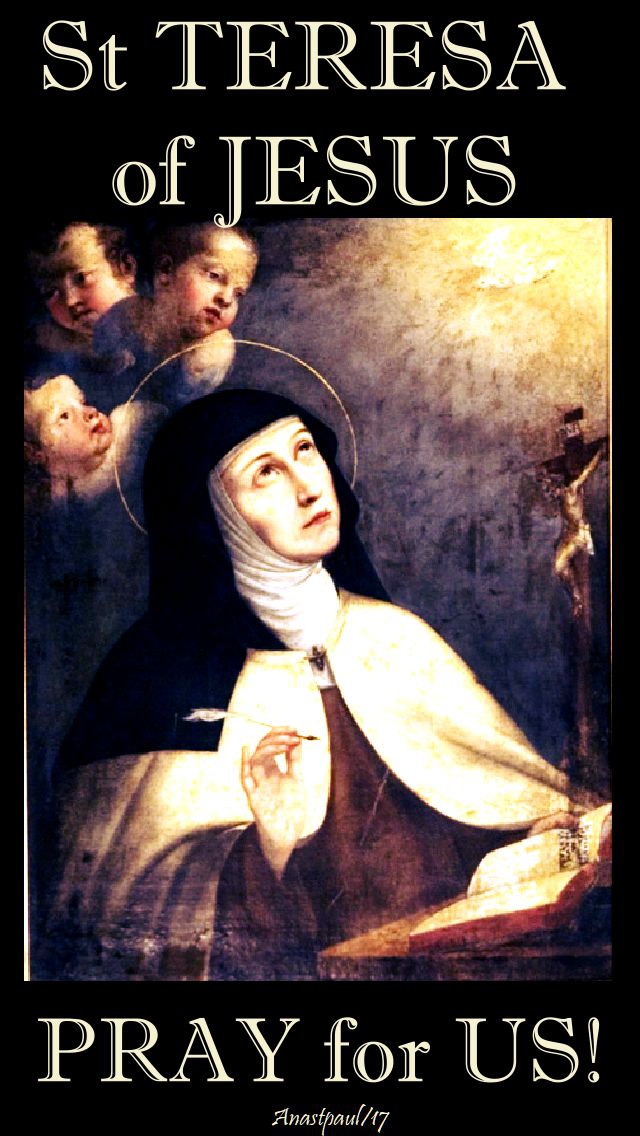
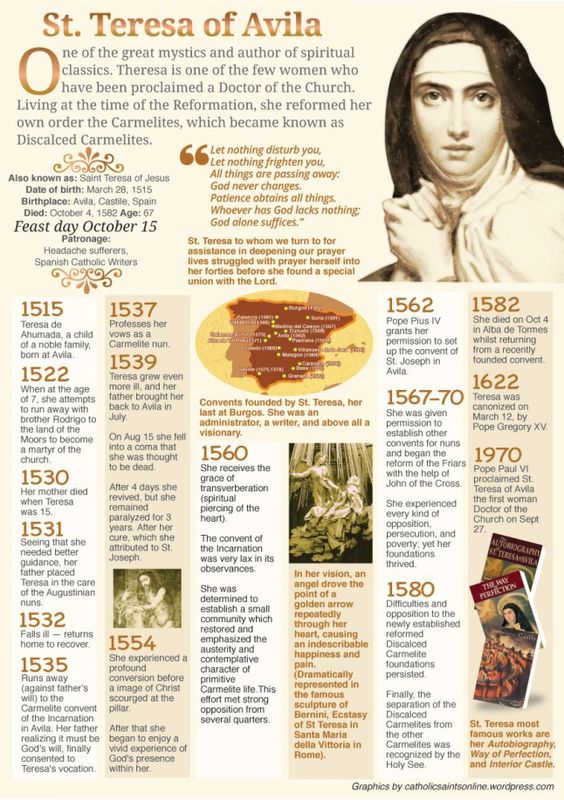
Saint of the Day – 15 October – St Teresa of Jesus/of Avila (1515-1582) Virgin, Mystic, Ecstatic, Reformer, Apostle of Prayer, Writer, Doctor of the Church. Born as Teresa Sanchez Cepeda Davila y Ahumada at Avila, Old Castile, on 28 March 1515 – died at Alba de Tormes, 4 October 1582 of natural causes in the arms of her secretary and close friend Blessed Anne of Saint Bartholomew. Her relics are preserved at Alba – her heart shows signs of Transverberation (piercing of the heart), and is displayed, too. Her Body is incorrupt. Patronages: • sick people; against bodily ills or sickness • against headaches • against the death of parents • lace makers or lace workers • people in need of grace • people in religious orders • people ridiculed for their piety • World Youth Day 2011 • Amos, Canada, diocese of • Avellaneda-Lanús, Argentina, diocese of • Berzano di Tortona, Italy • Pozega, Croatia • Spain. Attributes – Habit of the Discalced Carmelites, Book and Quill, arrow-pierced heart. St Teresa was Beatified on 24 April 1614 by Pope Paul V and Canonised on 12 March 1622, only forty years after her death, by Pope Gregory XV. Tradition associate Saint Teresa with the Infant Jesus of Prague with claims of former ownership and devotion. On 27 September 1970 St Teresa, was named a Doctor of the Church by Pope Paul VI. Her books, which include her autobiography (The Life of Teresa of Jesus) and her seminal work El Castillo Interior (trans.: The Interior Castle), are an integral part of Spanish Renaissance literature as well as Christian mysticism and Christian meditation practices. She also wrote Camino de Perfección (trans.: The Way of Perfection).
Original Portrait by Frei Jual de la Miseria in 1576
The third child of Don Alonso Sanchez de Cepeda by his second wife, Doña Beatriz Davila y Ahumada, who died when the Teresa was in her fourteenth year, Teresa was brought up by her saintly father, a lover of serious books and a tender and pious mother. After her death and the marriage of her eldest sister, Teresa was sent for her to the Augustinian nuns at Avila but owing to illness she left at the end of eighteen months and for some years remained with her father and occasionally with other relatives, notably an uncle who made her acquainted with the Letters of St Jerome, which determined her to adopt the religious life, not so much through any attraction towards it, as through a desire of choosing the safest course. Unable to obtain her father’s consent she left his house unknown to him to enter the Carmelite Convent of the Incarnation at Avila, which then counted 140 nuns. The wrench from her family caused her a pain which she ever afterwards compared to that of death. However, her father at once yielded and Teresa took the habit.
Teresa lived in an age of exploration as well as political, social and religious upheaval. It was the 16th century, a time of turmoil and reform. She was born before the Protestant Reformation and died almost 20 years after the closing of the Council of Trent.
The gift of God to Teresa in and through which she became holy and left her mark on the Church and the world is threefold: she was a woman; she was a contemplative; she was an active reformer.
As a woman, Teresa stood on her own two feet, even in the man’s world of her time. She was “her own woman,” entering the Carmelites despite strong opposition from her father. She is a person wrapped not so much in silence as in mystery. Beautiful, talented, outgoing, adaptable, affectionate, courageous, enthusiastic, she was totally human. Like Jesus, she was a mystery of paradoxes: wise, yet practical; intelligent, yet much in tune with her experience; a mystic, yet an energetic reformer; a holy woman, a womanly woman.
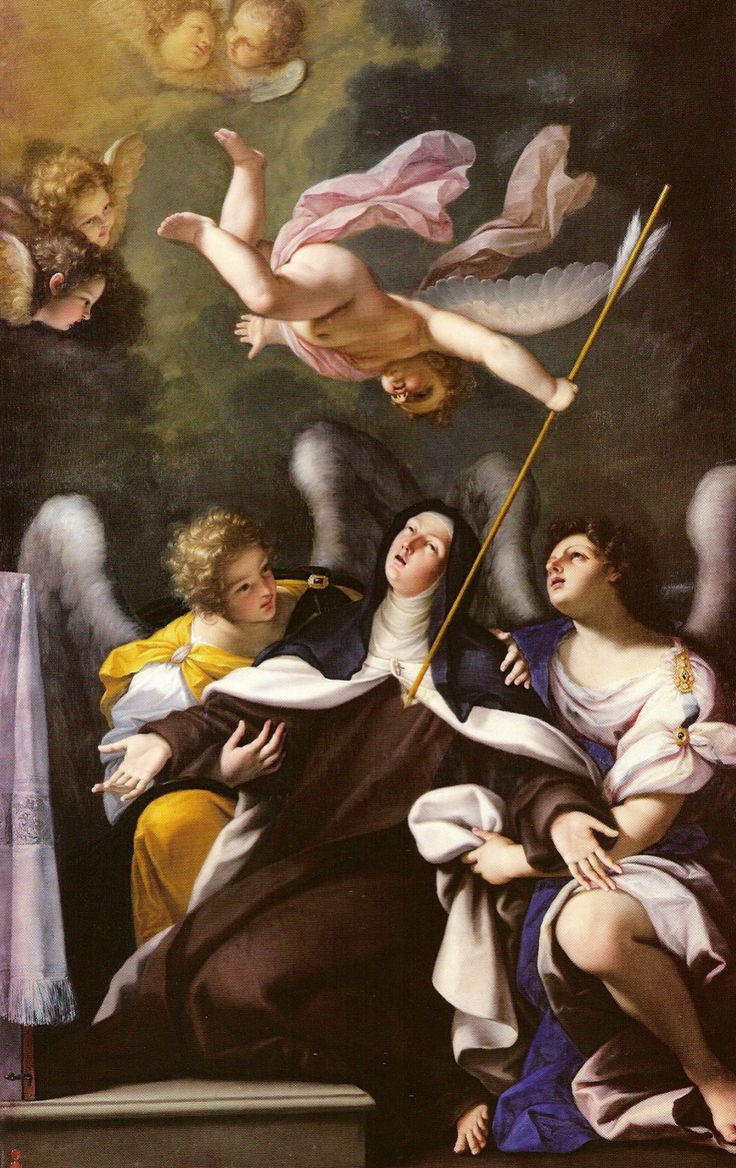
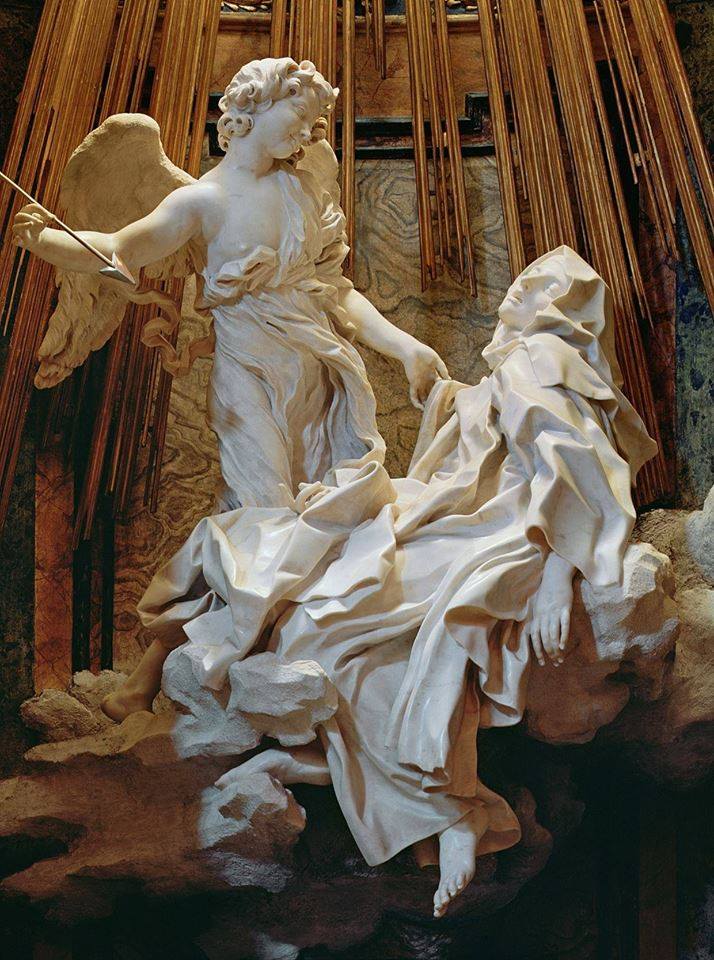
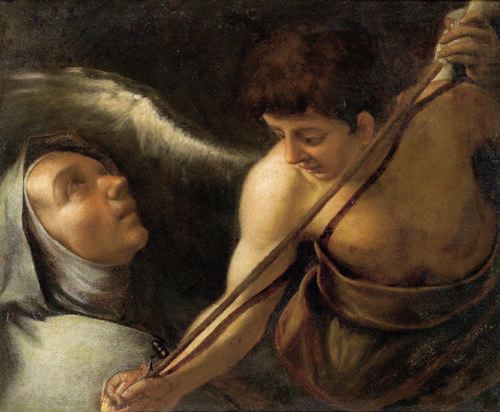
On St Peter’s Day in 1559, Teresa became firmly convinced that Jesus Christ presented Himself to her in bodily form, though invisible. These visions lasted almost uninterrupted for more than two years. In another vision, a seraph drove the fiery point of a golden lance repeatedly through her heart, causing an ineffable spiritual-bodily pain.
I saw in his hand a long spear of gold and at the point there seemed to be a little fire. He appeared to me to be thrusting it at times into my heart and to pierce my very entrails; when he drew it out, he seemed to draw them out also and to leave me all on fire with a great love of God. The pain was so great, that it made me moan; and yet so surpassing was the sweetness of this excessive pain, that I could not wish to be rid of it…
This vision was the inspiration for one of Bernini’s most famous works, the Ecstasy of Saint Teresa at Santa Maria della Vittoria in Rome.
The memory of this episode served as an inspiration throughout the rest of her life and motivated her lifelong imitation of the life and suffering of Jesus, epitomised in the motto usually associated with her: Lord, either let me suffer or let me die.
Teresa was a woman “for God,” a woman of prayer, discipline and compassion. Her heart belonged to God. Her ongoing conversion was an arduous lifelong struggle, involving ongoing purification and suffering. She was misunderstood, misjudged and opposed in her efforts at reform. Yet she struggled on, courageous and faithful; she struggled with her own mediocrity, her illness, her opposition. And in the midst of all this she clung to God in life and in prayer. Her writings on prayer and contemplation are drawn from her experience: powerful, practical and graceful. She was a woman of prayer; a woman for God.
Teresa was a woman “for others.” Though a contemplative, she spent much of her time and energy seeking to reform herself and the Carmelites, to lead them back to the full observance of the primitive Rule. She founded over a half-dozen new monasteries. She traveled, wrote, fought—always to renew, to reform. In her self, in her prayer, in her life, in her efforts to reform, in all the people she touched, she was a woman for others, a woman who inspired and gave life.
Her final illness overtook her on one of her journeys from Burgos to Alba de Tormes. She died in 1582, just as Catholic nations were making the switch from the Julian to the Gregorian calendar, which required the removal of 5–14 October from the calendar. She died either before midnight of 4 October or early in the morning of 15 October which is celebrated as her feast day. Her last words were: “My Lord, it is time to move on. Well then, may your will be done. O my Lord and my Spouse, the hour that I have longed for has come. It is time to meet one another.”
Her writings, especially the Way of Perfection and The Interior Castle, have helped generations of believers. She and St Catherine of Siena were the first women so honoured as Doctors of the Church.
Interesting fact – her Spiritual Director was St Francis Borgia whose Feast Day we celebrated on 10 October.
Our Morning Offering – 1 October – The Memorial of St Thérèse of Lisieux (1873-1897) Doctor of the Church
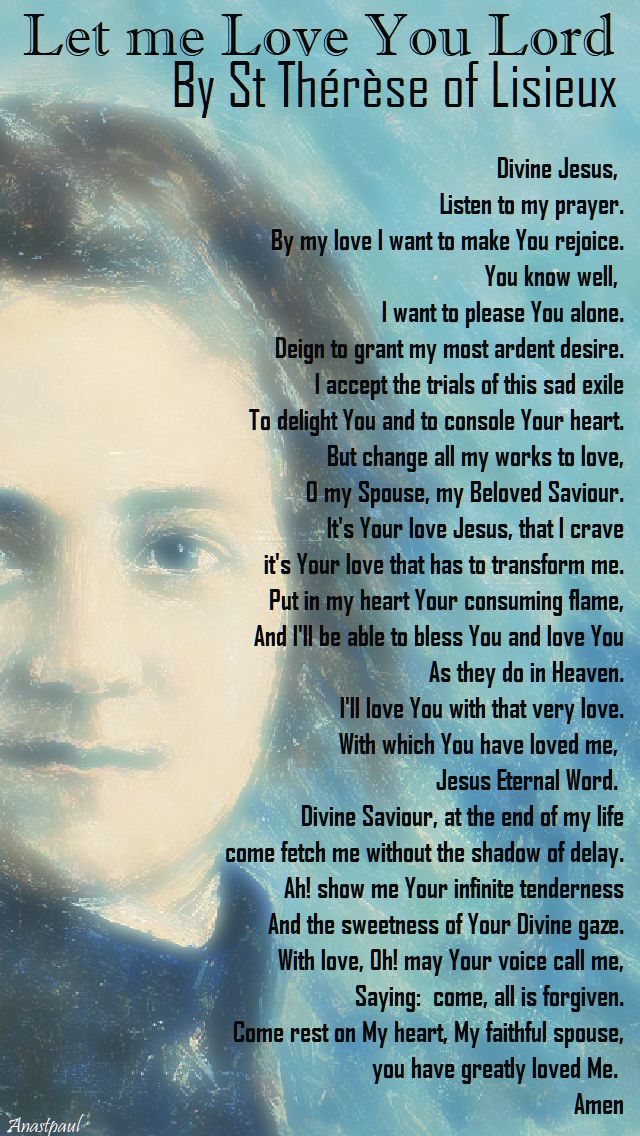
Let me Love You Lord By St Thérèse of Lisieux
Divine Jesus,
Listen to my prayer.
By my love I want to make You rejoice.
You know well,
I want to please You alone.
Deign to grant my most ardent desire.
I accept the trials of this sad exile
To delight You and to console Your heart.
But change all my works to love,
O my Spouse, my Beloved Saviour.
It’s Your love Jesus, that I crave
it’s Your love that has to transform me.
Put in my heart Your consuming flame,
And I’ll be able to bless You and love You
As they do in Heaven.
I’ll love You with that very love.
With which You have loved me,
Jesus Eternal Word.
Divine Saviour, at the end of my life
come fetch me without the shadow of delay.
Ah! show me Your infinite tenderness
And the sweetness of Your Divine gaze.
With love, Oh! may Your voice call me,
Saying: come, all is forgiven.
Come rest on My heart, My faithful spouse,
you have greatly loved Me.
Amen
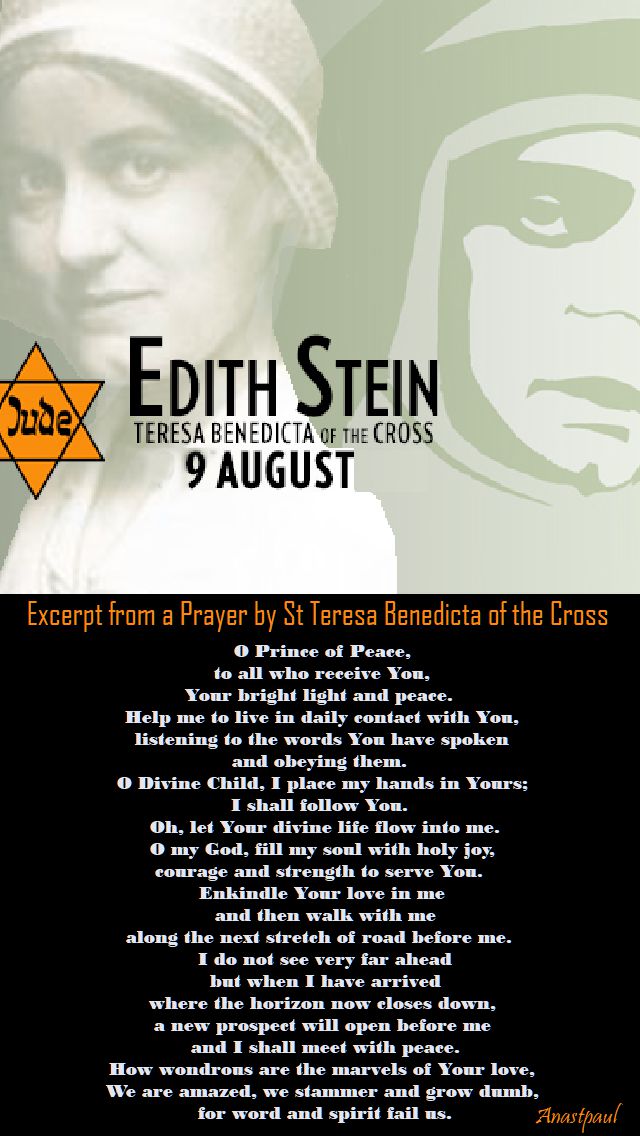
Thought for the Day – 9 August – The Memorial of St Teresa Benedicta of the Cross
“Dear brothers and sisters! The love of Christ was the fire that inflamed the life of St Teresa Benedicta of the Cross. Long before she realised it, she was caught by this fire. At the beginning she devoted herself to freedom. For a long time Edith Stein was a seeker. Her mind never tired of searching and her heart always yearned for hope. She traveled the arduous path of philosophy with passionate enthusiasm. Eventually she was rewarded: she seized the truth. Or better: she was seized by it.Then she discovered that truth had a name: Jesus Christ. From that moment on, the incarnate Word was her One and All. Looking back as a Carmelite on this period of her life, she wrote to a Benedictine nun: “Whoever seeks the truth is seeking God, whether consciously or unconsciously”.
Although Edith Stein had been brought up religiously by her Jewish mother, at the age of 14 she “had consciously and deliberately stopped praying”. She wanted to rely exclusively on herself and was concerned to assert her freedom in making decisions about her life. At the end of a long journey, she came to the surprising realisation: only those who commit themselves to the love of Christ become truly free.
This woman had to face the challenges of such a radically changing century as our own. Her experience is an example to us. The modern world boasts of the enticing door which says: everything is permitted. It ignores the narrow gate of discernment and renunciation……Pay attention! Your life is not an endless series of open doors! Listen to your heart! Do not stay on the surface but go to the heart of things! And when the time is right, have the courage to decide! The Lord is waiting for you to put your freedom in his good hands.
…St Teresa Benedicta of the Cross says to us all: Do not accept anything as the truth if it lacks love. And do not accept anything as love which lacks truth! One without the other becomes a destructive lie. Finally, the new saint teaches us that love for Christ undergoes suffering. Whoever truly loves does not stop at the prospect of suffering: he accepts communion in suffering with the one he loves.”…(Excerpt from the Homily of St Pope John Paul for the Canonisation of St Teresa Benedicta – Sunday, 11 October 1998)
Quote/s of the Day – 9 August – The Memorial of St Teresa Benedicta of the Cross
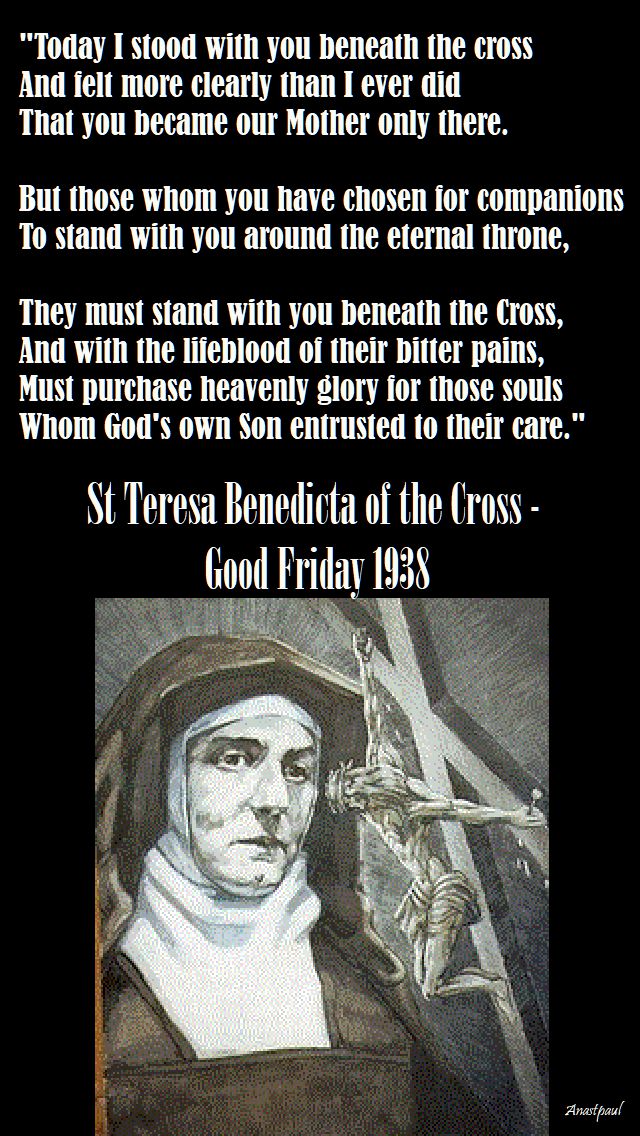
“Today I stood with you beneath the cross And felt more clearly than I ever did That you became our Mother only there.
But those whom you have chosen for companions To stand with you around the eternal throne,
They must stand with you beneath the Cross, And with the lifeblood of their bitter pains, Must purchase heavenly glory for those souls Whom God’s own Son entrusted to their care.”
St Teresa Benedicta of the Cross – Good Friday 1938
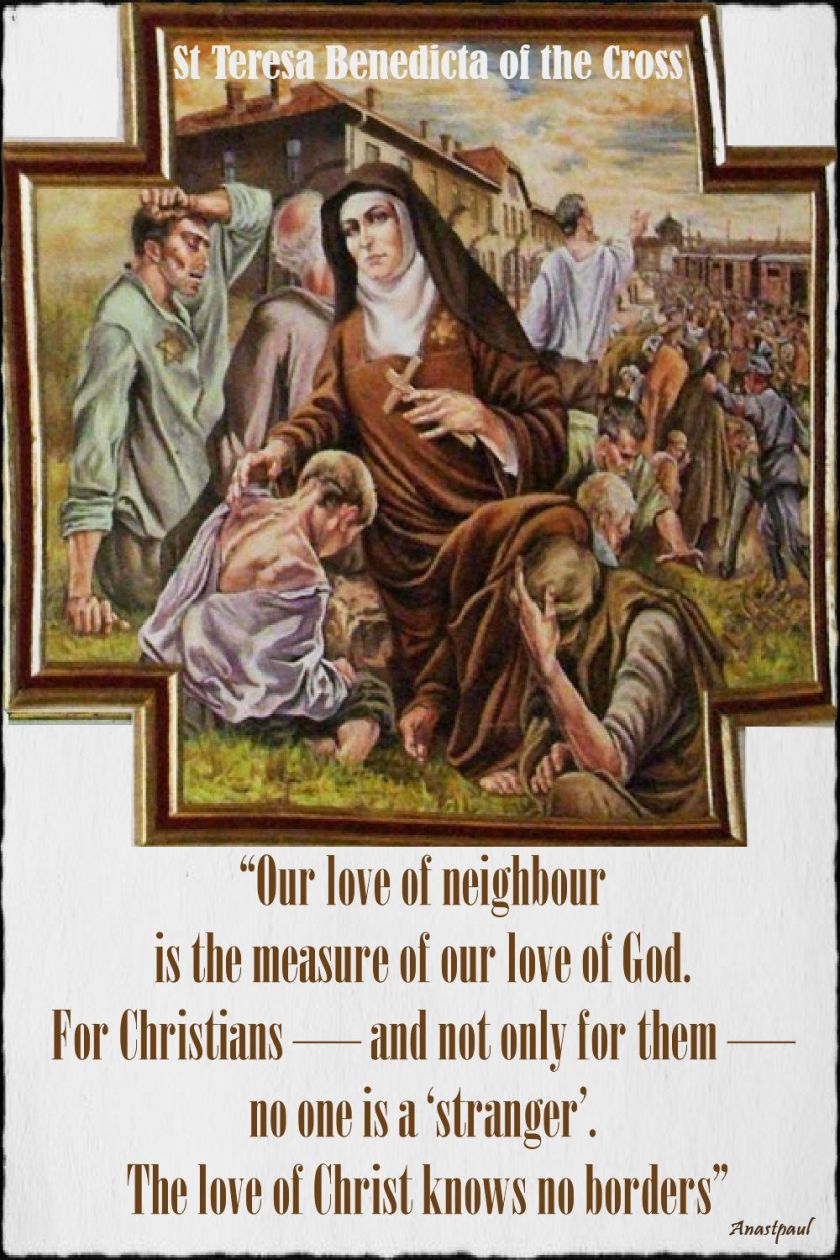
“Our love of neighbour is the measure of our love of God. For Christians — and not only for them — no one is a ‘stranger’. The love of Christ knows no borders”
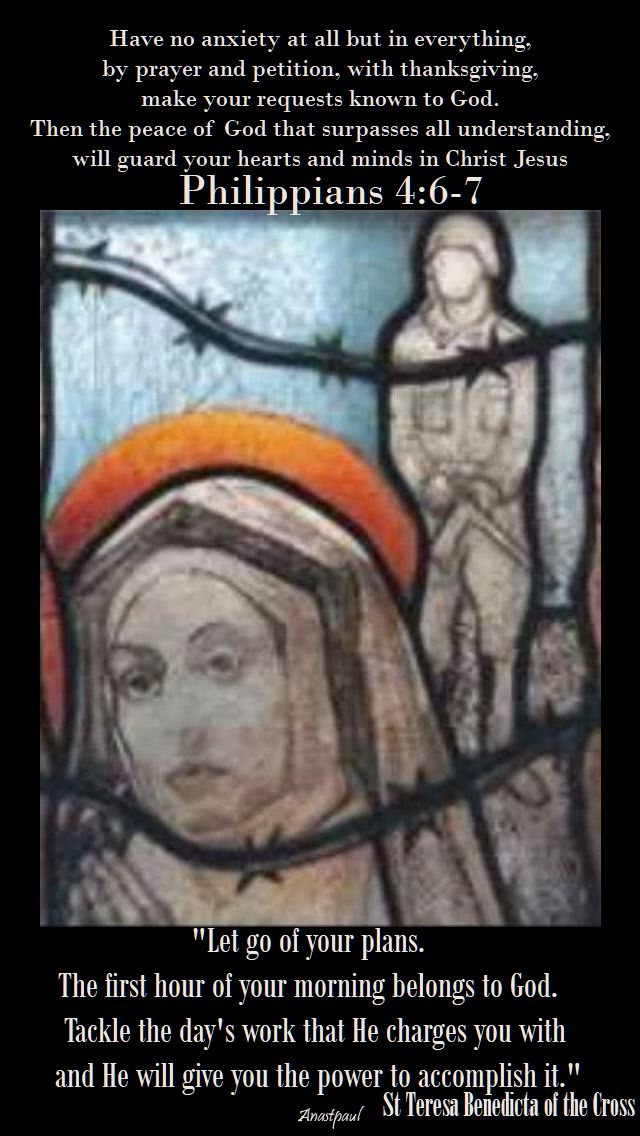
Have no anxiety at all but in everything, by prayer and petition, with thanksgiving, make your requests known to God.
Then the peace of God that surpasses all understanding, will guard your hearts and minds in Christ Jesus…Philippians 4:6-7
REFLECTION – “Let go of your plans. The first hour of your morning belongs to God. Tackle the day’s work that He charges you with and He will give you the power to accomplish it.”…..St Teresa Benedicta of the Cross
PRAYER – May St Teresa Benedicta pray for us Lord, as we celebrate with joy her yearly feast, her purity and strength of soul are precious gifts which light us on our way. Through our Lord Jesus Christ in unity with the Holy Spirit, one God forever and ever. St Teresa Benedicta of the Cross, please pray for us that we may manifest strength and courage with our hand in the hand of the Lord, amen.
Excerpt from a Prayer By St Teresa Benedicta of the Cross
O Prince of Peace,
to all who receive You,
Your bright light and peace.
Help me to live in daily contact with You,
listening to the words You have spoken
and obeying them.
O Divine Child, I place my hands in Yours;
I shall follow You.
Oh, let Your divine life flow into me.
O my God, fill my soul with holy joy,
courage and strength to serve You.
Enkindle Your love in me
and then walk with me
along the next stretch of road before me.
I do not see very far ahead
but when I have arrived
where the horizon now closes down,
a new prospect will open before me
and I shall meet with peace.
How wondrous are the marvels of Your love,
We are amazed, we stammer and grow dumb,
for word and spirit fail us.
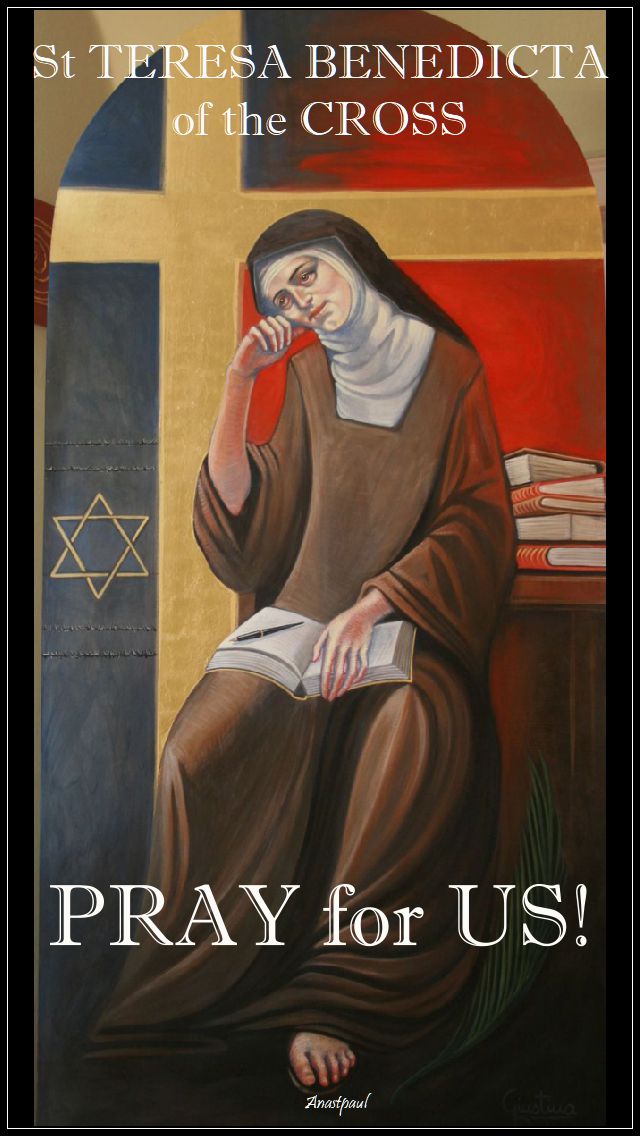
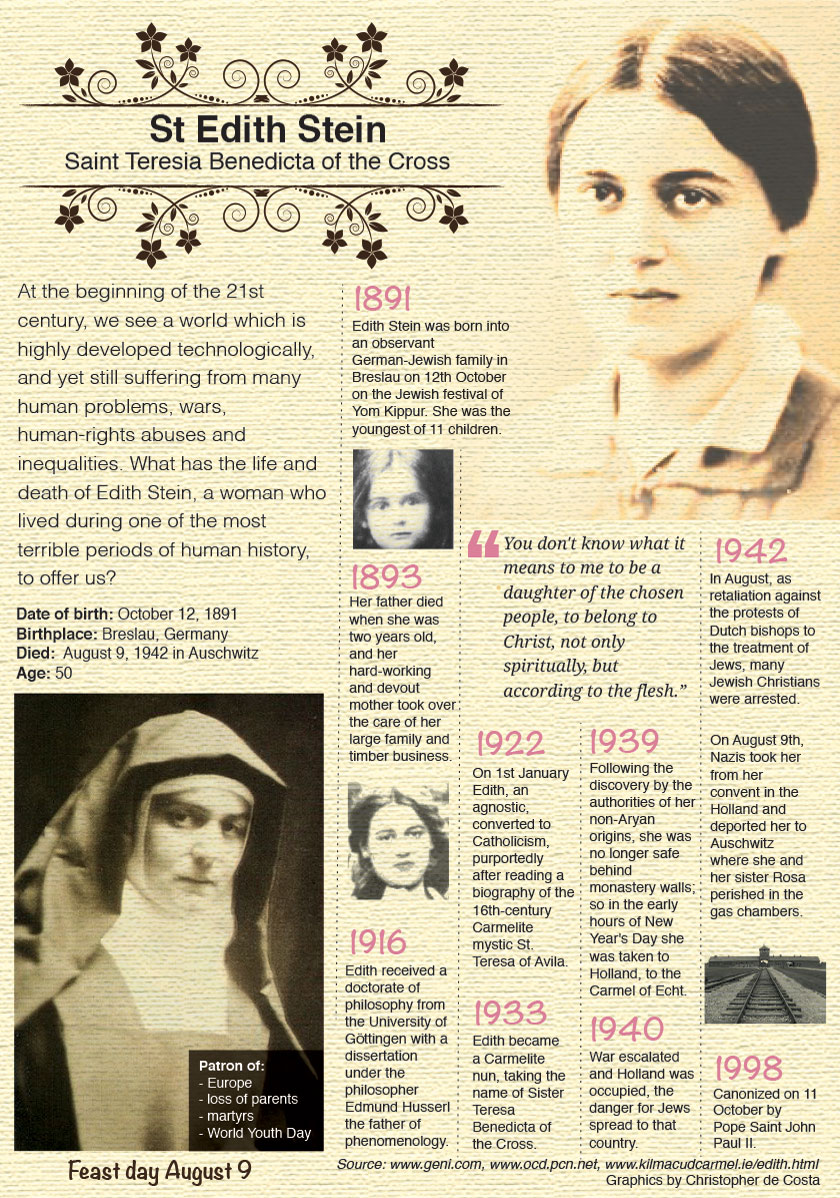
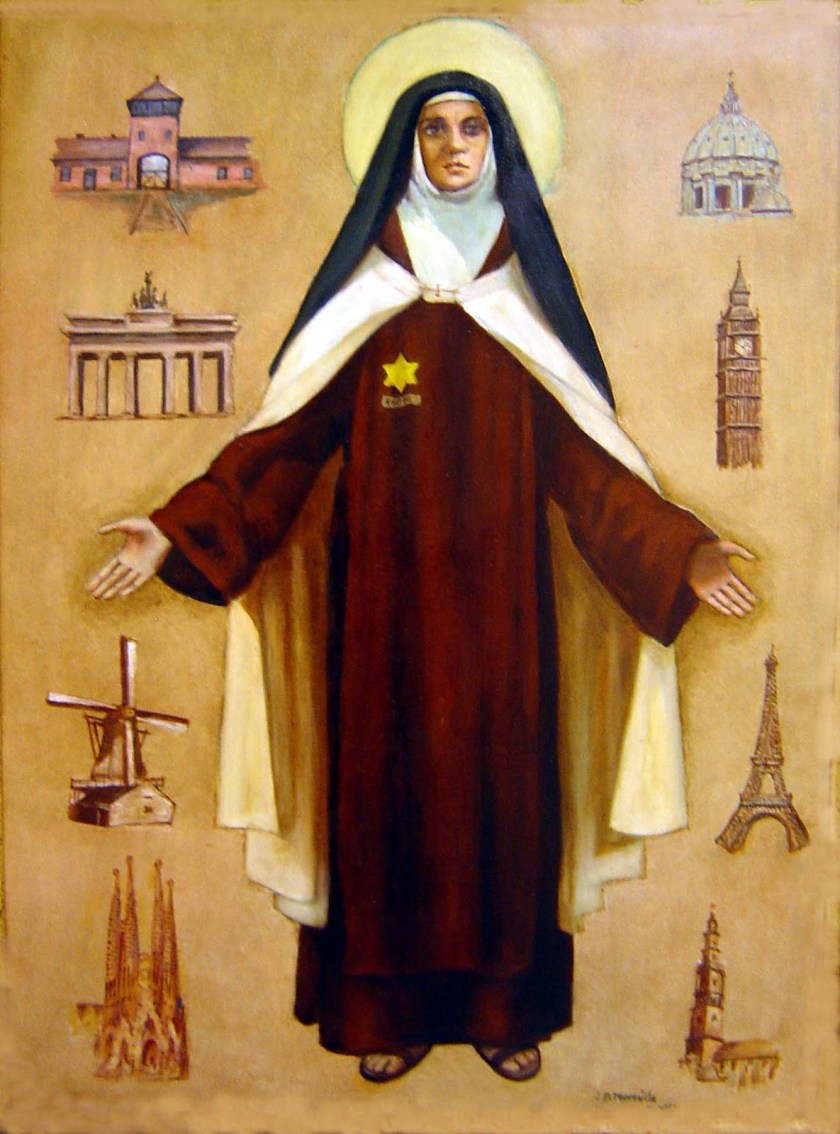
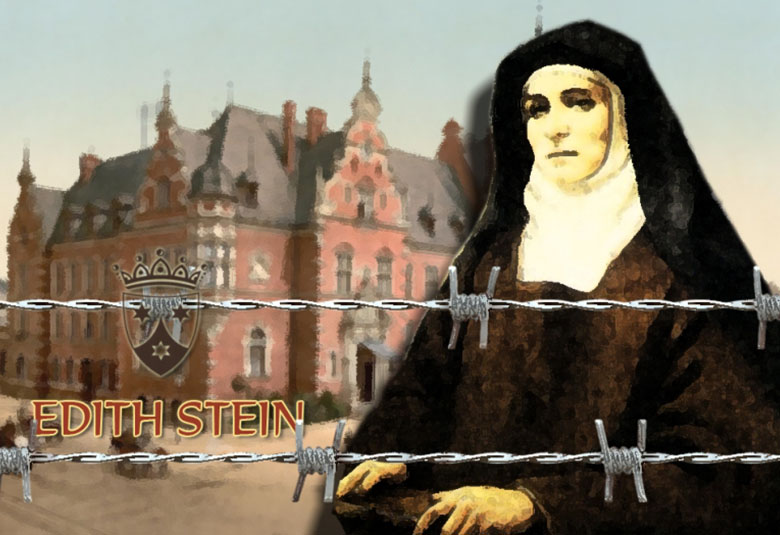
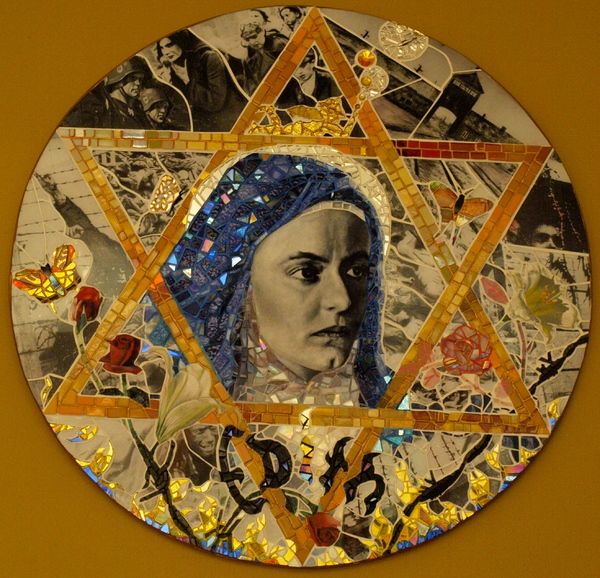
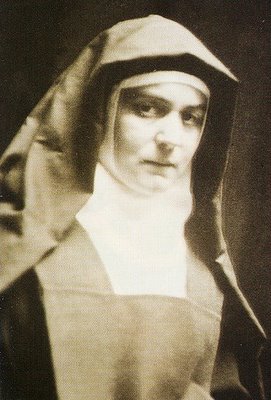
Saint of the Day – 9 August – St Teresa Benedicta of the Cross OCD Martyr, Carmelite Nun, Philosopher, Writer, Teacher and Lecturer – (12 October 1891 at Breslaw, Dolnoslaskie, Germany (now Wroclaw, Poland) as Edith Stein – gassed on 9 August 1942 in the ovens of Oswiecim (a.k.a. Auschwitz), Malopolskie, Poland). Canonised on 11 October 1998 by St Pope John Paul II. Patronages – Europe; loss of parents; converted Jews; Martyrs; World Youth Day. Attributes – Yellow Star of David on a Discalced Carmelite nun’s habit, flames, a book.
Edith Stein was born on October 12, 1891 – a date that coincided with her family’s celebration of Yom Kippur, the Jewish “day of atonement.” Edith’s father died when she was just two years old and she gave up the practice of her Jewish faith as an adolescent.
As a young woman with profound intellectual gifts, Edith gravitated toward the study of philosophy and became a pupil of the renowned professor Edmund Husserl in 1913. Through her studies, the non-religious Edith met several Christians whose intellectual and spiritual lives she admired.
After earning her degree with the highest honours from Gottingen University in 1915, she served as a nurse in an Austrian field hospital during World War I. She returned to academic work in 1916, earning her doctorate after writing a highly-regarded thesis on the phenomenon of empathy. She remained interested in the idea of religious commitment but had not yet made such a commitment herself. In 1921, while visiting friends, Edith spent an entire night reading the autobiography of the 16th century Carmelite nun St. Teresa of Avila. “When I had finished the book,” she later recalled, “I said to myself: This is the truth.” She was baptised into the Catholic Church on the first day of January, 1922.
Edith intended to join the Carmelites immediately after her conversion but would ultimately have to wait another 11 years before taking this step. Instead, she taught at a Dominican school and gave numerous public lectures on women’s issues. She spent 1931 writing a study of St. Thomas Aquinas and took a university teaching position in 1932.
In 1933, the rise of Nazism, combined with Edith’s Jewish ethnicity, put an end to her teaching career. After a painful parting with her mother, who did not understand her Christian conversion, she entered a Carmelite convent in 1934, taking the name “Teresa Benedicta of the Cross” as a symbol of her acceptance of suffering.
“I felt,” she wrote, “that those who understood the Cross of Christ should take upon themselves on everybody’s behalf.” She saw it as her vocation “to intercede with God for everyone” but she prayed especially for the Jews of Germany whose tragic fate was becoming clear.
“I ask the Lord to accept my life and my death,” she wrote in 1939, “so that the Lord will be accepted by His people and that His kingdom may come in glory, for the salvation of Germany and the peace of the world.”
After completing her final work, a study of St. John of the Cross entitled “The Science of the Cross,” Teresa Benedicta was arrested along with her sister Rosa (who had also become a Catholic) and the members of her religious community, on August 7, 1942. The arrests came in retaliation against a protest letter by the Dutch Bishops, decrying the Nazi treatment of Jews. Edith commented, “I never knew that people could be like this, neither did I know that my brothers and sisters would have to suffer like this. … I pray for them every hour. Will God hear my prayers? He will certainly hear them in their distress.”Prof Jan Nota, who was greatly attached to her, wrote later: “She is a witness to God’s presence in a world where God is absent.” On 7 August, early in the morning, 987 Jews were deported to Auschwitz. It was too, on 9 August, that Sister Teresa Benedicta of the Cross, her sister and many other of her people were gassed.
When Edith Stein was beatified in Cologne on 1 May 1987, the Church honoured “a daughter of Israel”, as St Pope John Paul II put it, who, as a Catholic during Nazi persecution, remained faithful to the crucified Lord Jesus Christ and, as a Jew, to her people in loving faithfulness.” St John Paul II canonised her in 1998 and proclaimed her a co-patroness of Europe the next year.
Thought for the day – THE SIXTEEN CARMELITE MARTYRS OF COMPIEGNE
The French Revolution reveals the titanic struggle between good and evil. During the terror, over 40,000 Frenchmen were executed just for holding fast to the Catholic Faith and objecting to the worst excesses of the Committee of Public Safety. The blood lost in the years of 1792-1794 staggers the imagination even in the retelling and the campaign against the Church was as diabolical as it was cruel.
Contemplative religious communities had been among the first targets of the fury of the French Revolution against the Catholic Church. Less than a year from May 1789 when the Revolution began with the meeting of the Estates-General, these communities had been required by law to disband. But many of them continued in being, in hiding. Among these were the community of the Carmelite nuns of Compiegne, in northeastern France not far from Paris – the fifty-third convent in France of the Carmelite sisters who followed the reform of St. Teresa of Avila, founded in 1641, noted throughout its history for fidelity and fervour. Their convent was raided in August 1790, all the property of the sisters was seized by the government and they were forced to discard their habits and leave their house. They divided into four groups which found lodging in four different houses all near the same church in Compiegne and for several years they were to a large extent able to continue their religious life in secret. But the intensified surveillance and searches of the “Great Terror” revealed their secret and in June 1794 most of them were arrested and imprisoned.
They had expected this; indeed, they had prayed for it. At some time during the summer of 1792, very likely just after the events of August 10 of that year that marked the descent into the true deeps of the Revolution, their prioress, Madeleine Lidoine, whose name in religion was Teresa in honour of the founder of their order, by all accounts a charming perceptive and highly intelligent woman, had foreseen much of what was to come. At Easter of 1792, she told her community that, while looking through the archives she had found the account of a dream a Carmelite had in 1693. In that dream, the Sister saw the whole Community, with the exception of 2 or 3 Sisters, in glory and called to follow the Lamb. In the mind of the Prioress, this mean martyrdom and might well be a prophetic announcement of their fate.
Mother Teresa had said to her sisters: “Having meditated much on this subject, I have thought of making an act of consecration by which the Community would offer itself as a sacrifice to appease the anger of God, so that the divine peace of His Dear Son would be brought into the world, returned to the Church and the state.” The sisters discussed her proposal and all agreed to it but the two oldest, who were hesitant. But when the news of the September massacres came, mingling glorious martyrdom with apostasy, these two sisters made their choice, joining their commitment to that of the rest of the community. All made their offering; it was to be accepted.
After their lodgings were invaded again in June, their devotional objects shattered and their tabernacle trampled underfoot by a Revolutionary who told them that their place of worship should be transformed into a dog kennel, the Carmelite sisters were taken to the Conciergerie prison, where so many of the leading victims of the guillotine had been held during their last days on earth. There they composed a canticle for their martyrdom, to be sung to the familiar tune of the Marseillaise. The original still exists, written in pencil and given to one of their fellow prisoners, a lay woman who survived.
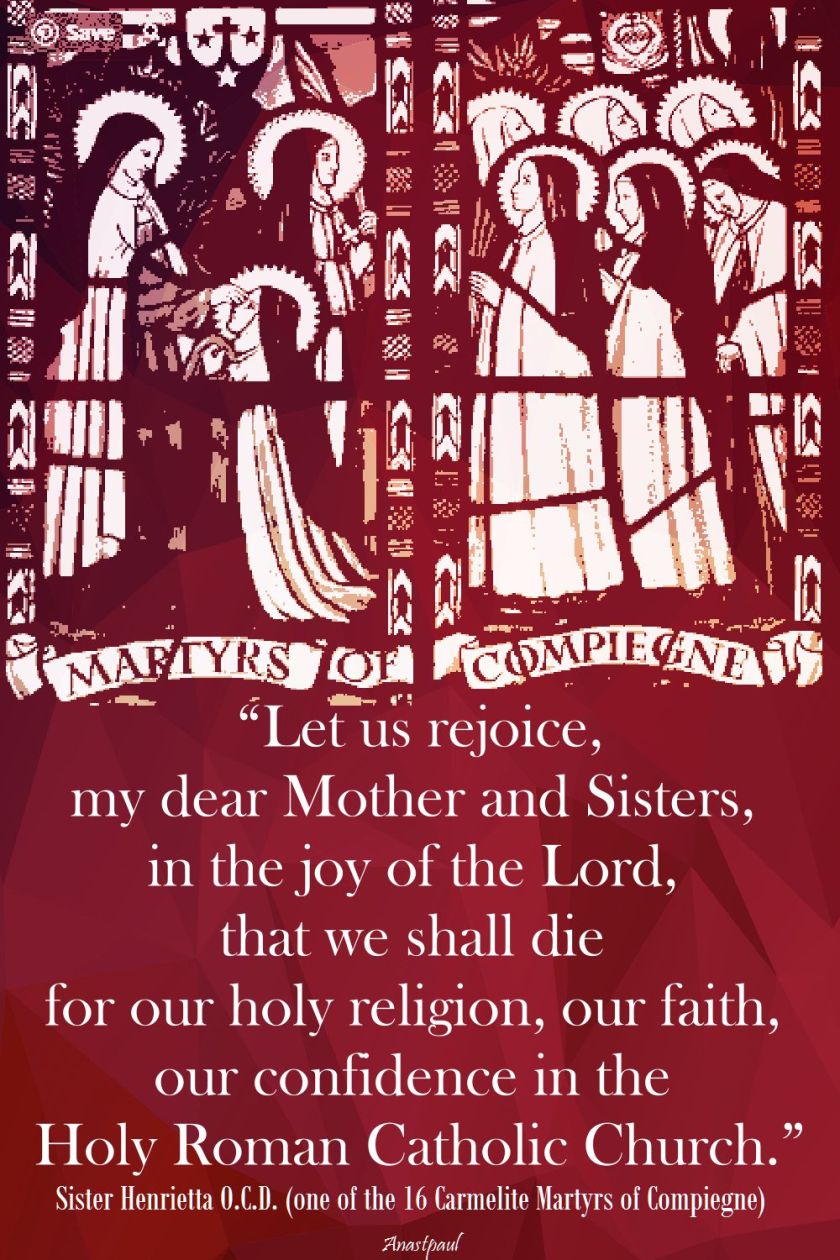
On July 17 the sixteen sisters were brought before Fouquier-Tinville. All cases were now being disposed of within twenty-four hours as Robespierre had wished; theirs was no exception. They were charged with having received arms for the émigrés; their prioress, Sister Teresa, answered by holding up a crucifix. “Here are the only arms that we have ever had in our house.” They were charged with possessing an altar-cloth with designs honouring the old monarchy (perhaps the fleur-de-lis) and were asked to deny any attachment to the royal family. Sister Teresa responded: “If that is a crime, we are all guilty of it; you can never tear out of our hearts the attachment for Louis XVI and his family. Your laws cannot prohibit feeling; they cannot extend their empire to the affections of the soul; God alone has the right to judge them.” They were charged with corresponding with priests forced to leave the country because they would not take the constitutional oath; they freely admitted this. Finally they were charged with the catch–all indictment by which any serious Catholic in France could be guillotined during the Terror: “fanaticism.” Sister Henriette, who had been Gabrielle de Croissy, challenged Fouguier-Tinvile to his face: “Citizen, it is your duty to respond to the request of one condemned; I call upon you to answer us and to tell us just what you mean by the word ‘fanatic.’” “I mean,” snapped the Public Prosecutor of the Terror, “your attachment to your childish beliefs and your silly religious practices.” “Let us rejoice, my dear Mother and Sisters, in the joy of the Lord,” said Sister Henriette, “that we shall die for our holy religion, our faith, our confidence in the Holy Roman Catholic Church.”
Give over our hearts to joy, the day of glory has arrived.
Far from us all weakness, seeing the standard come;
We prepare for the victory, we all march to the true conquest,
Under the flag of the dying God we run, we all seek the glory;
Rekindle our ardour, our bodies are the Lord’s,
We climb, we climb the scaffold and give ourselves back to the Victor.
O happiness ever desired for Catholics of France,
To follow the wondrous road
Already marked out so often by the martyrs toward their suffering,
After Jesus with the King, we show our faith to Christians,
We adore a God of justice; as the fervent priest, the constant faithful,
Seal, seal with all their blood faith in the dying God….
Holy Virgin, our model, August queen of martyrs, deign to strengthen our zeal
And purify our desires, protect France even yet, help; us mount to Heaven,
make us feel even in these places, the effects of your power. Sustain your children,
Submissive, obedient, dying, dying with Jesus and in our King believing.
While in prison, they asked and were granted permission to wash their clothes. As they had only one set of lay clothes, they put on their religious habit and set to the task. Providentially, the revolutionaries picked that “wash day” for their transfer to Paris. As their clothes were soaking wet, the Carmelites left for Paris wearing their “outlawed” religious habit. They celebrated the feast of Our Lady of Mount Carmel in prison, wondering whether they would die that day.
It was only the next day they went to the guillotine. The journey in the carts took more than an hour. All the way the Carmelite sisters sang: the “Miserere,” “Salve Regina,” and “Te Deum.” Beholding them, a total silence fell on the raucous, brutal crowd, most of them cheapened and hardened by day after day of the spectacle of public slaughter. At the foot of the towering killing machine, their eyes raised to Heaven, the sisters sang “Veni Creator Spiritus.” One by one, they renewed their religious vows. They pardoned their executioners. One observer cried out: “Look at them and see if they do not have the air of angels! By my faith, if these women did not all go straight to Paradise, then no one is there!”
Sister Teresa, their prioress, requested and obtained permission to go last under the knife. The youngest, Sister Constance, went first. She climbed the steps of the guillotine “With the air of a queen going to receive her crown,” singing Laudate Dominum omnes gentes, “all peoples praise the Lord.” She placed her head in the position for death without allowing the executioner to touch her. Each sister followed her example, those remaining singing likewise with each, until only the prioress was left, holding in her hand a small figure of the Blessed Virgin Mary. The killing of each martyr required about two minutes. It was about eight o’clock in the evening, still bright at midsummer. During the whole time the profound silence of the crowd about the guillotine endured unbroken.
Two years before when the horror began, the Carmelite community at Compiegne had offered itself as a holocaust, that peace might be restored to France and the Church. The return of full peace was still twenty-one years in the future. But the Reign of Terror had only ten days left to run. Years of war, oppression and persecution were yet to come but the mass official killing in the public squares of Paris was about to end.
The Cross had vanquished the guillotine.
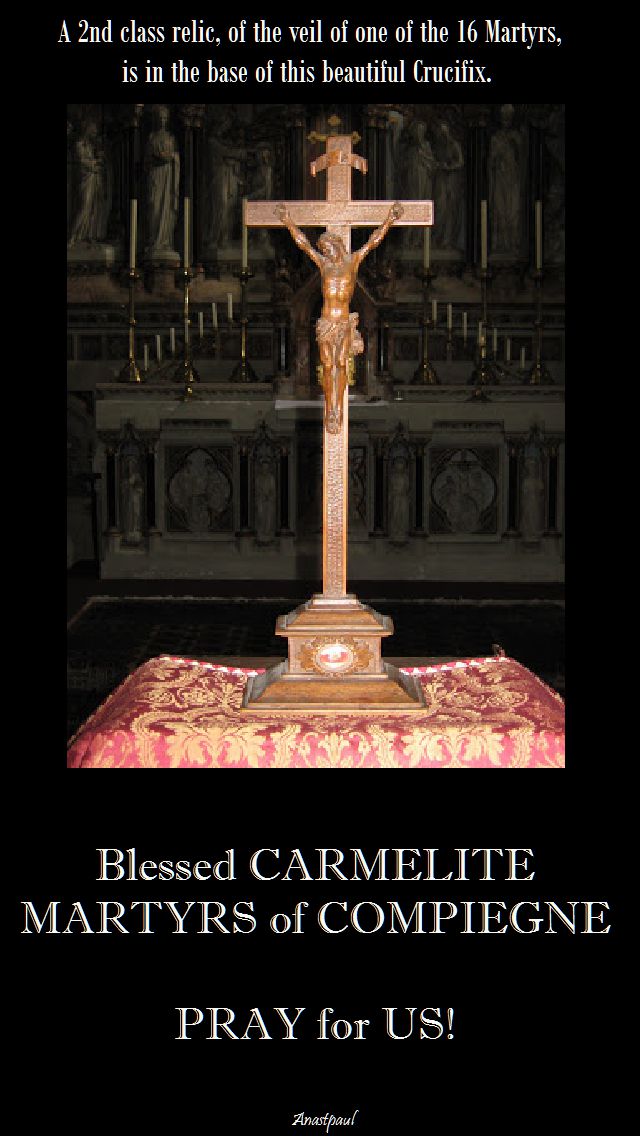
These sixteen holy Carmelite nuns have all been beatified by our Holy Father, the Pope, (Pope St. Pius X, 27 May 1906) which is the last step before canonisation. Blessed Carmelites of Compiegne, pray for us!
Although you have not seen him, you love him; even though you do not see him now yet believe in him, you rejoice with an indescribable and glorious joy, as you attain the goal of [your] faith, the salvation of your souls…..1 Peter 8-9
REFLECTION – “Let us rejoice, my dear Mother and Sisters, in the joy of the Lord, that we shall die for our holy religion, our faith, our confidence in the Holy Roman Catholic Church.”……Sister Henrietta O.C.D. (one of the 16 Carmelite Martyrs of Compiegne)
PRAYER – Holy God and Father, help us to not only love our Holy Faith but to follow Your Divine Son, happily and with complete trust to the Cross. Blessed Martyrs of Compiegne, pray for us that we may be graced with your courage and conviction at every moment of our lives, that we may live and die for Christ our Lord, amen.
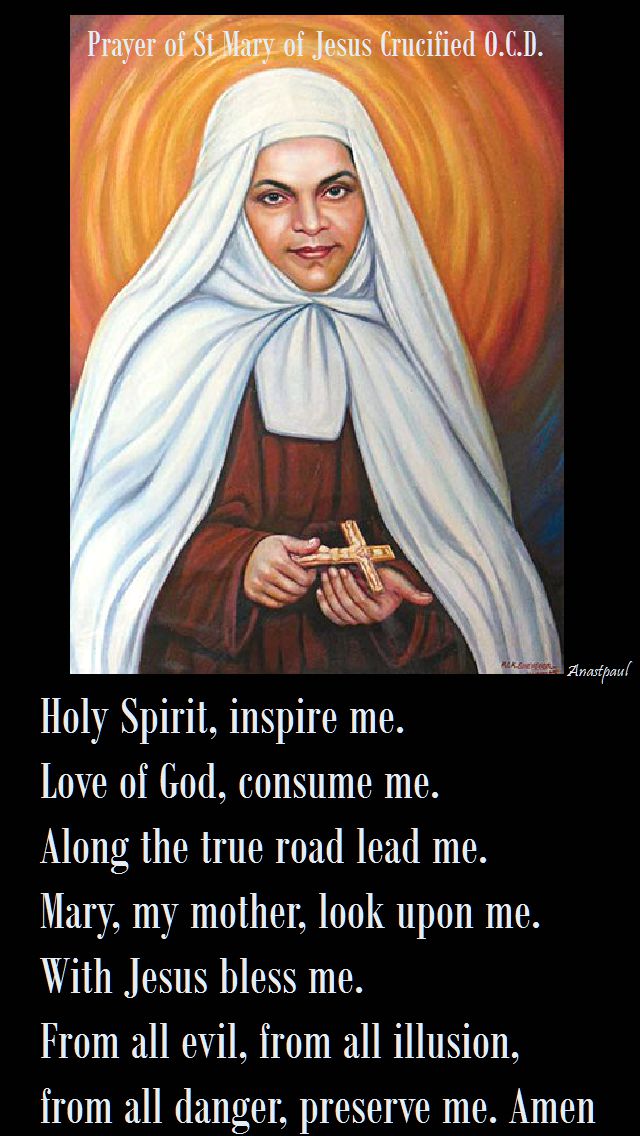
Holy Spirit, inspire me.
Love of God, consume me.
Along the true road lead me.
Mary, my mother, look upon me.
With Jesus bless me.
From all evil, from all illusion,
from all danger, preserve me. Amen




















 AnaStpaul
You must be logged in to post a comment.