Quote/s of the Day – 22 March – Passion Sunday – Hebrews 9:11-15, John 8:46-59 – Scripture search here: https://www.drbo.org/
“Amen, amen, I say to you, if anyone keep My word, he will never see death.”
John 8:51
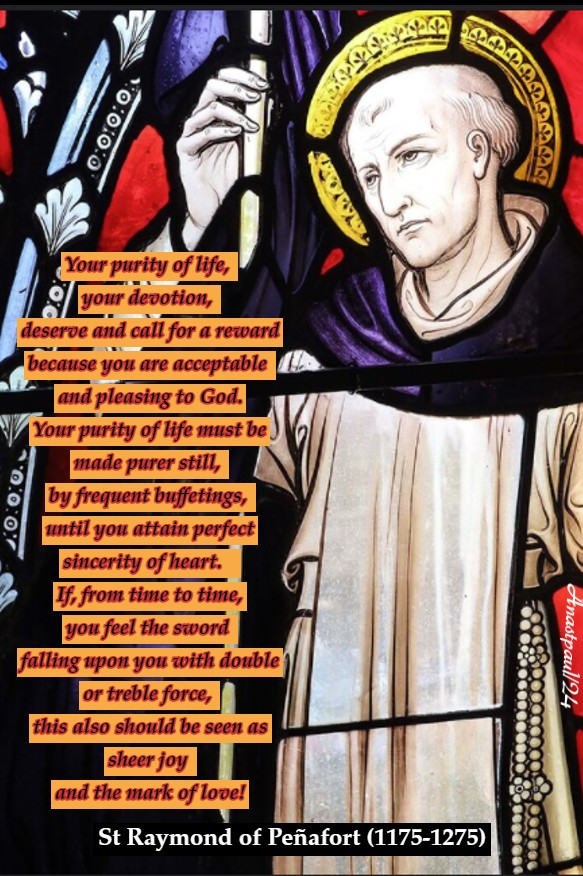
“Your purity of life, your devotion, deserve and call for a reward because you are acceptable and pleasing to God. Your purity of life must be made purer still, by frequent buffetings, until you attain perfect sincerity of heart. If, from time to time, you feel the sword falling upon you with double or treble force, this also should be seen as sheer joy and the mark of love!”
St Raymond of Peñafort (1175-1275)
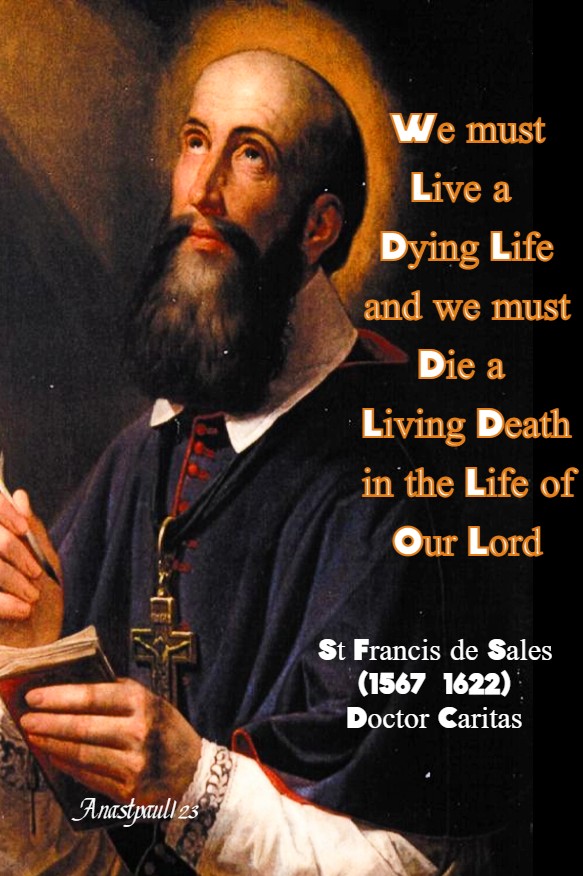
“We must live a dying life and we must die a living death in the life of our Lord.” (The Spirit of St. François de Sales, XV, 6 )
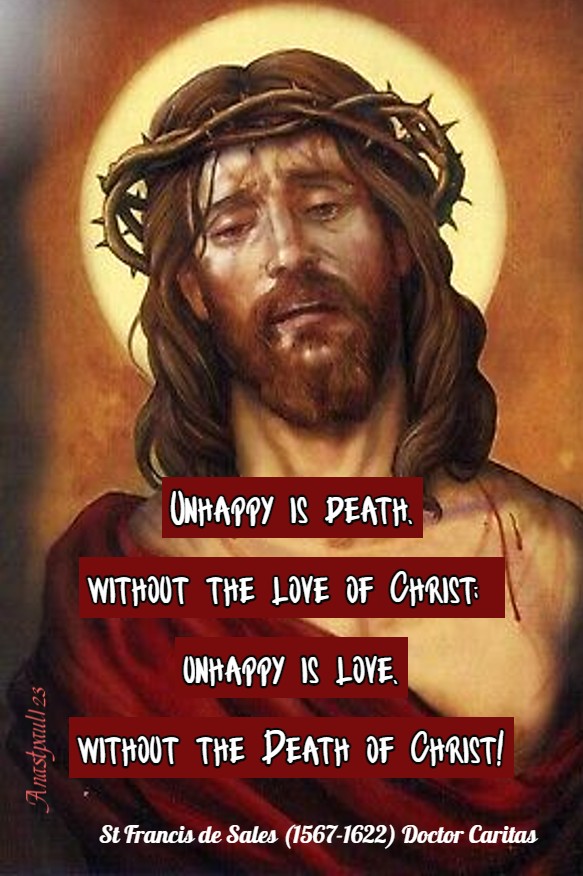
“Unhappy is death, without the love of Christ; unhappy is love, without the Death of Christ!”
(Treatise on the Love of God, Book 12, Chapter 13)
“We are dying, little by little; so, we are to make our imperfections die with us, day by day. ”
Quote/s of the Day – 11 March – Wednesday of the Third Week in Lent – Exodus 20:12-24, Matthew 15:1-20
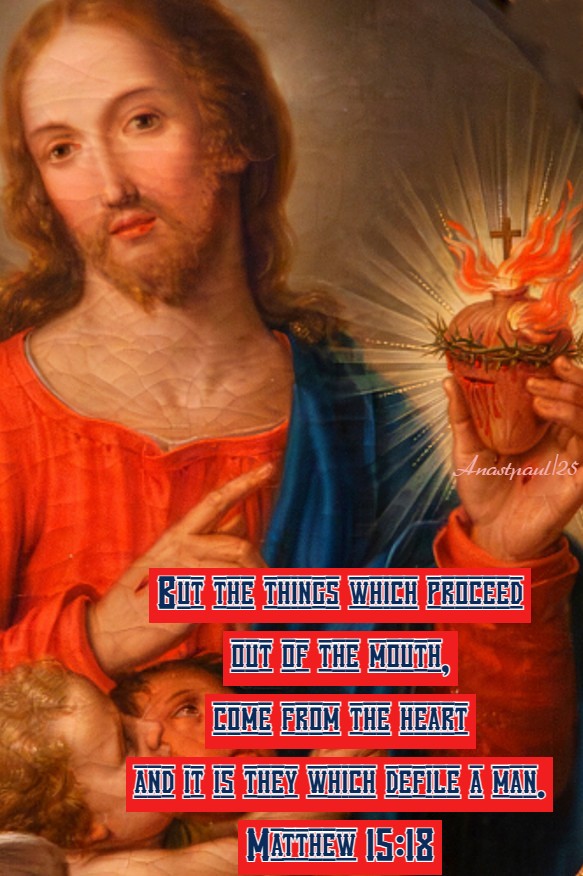
“But the things which proceed out of the mouth, come from the heart and it is they which defile a man.”
Matthew 15:18
“Our hearts were made for Thee, O God And restless must they be Until, O God, this grace accord, Until they rest in Thee!”
St Augustine (354-430) Father and Doctor of the Church
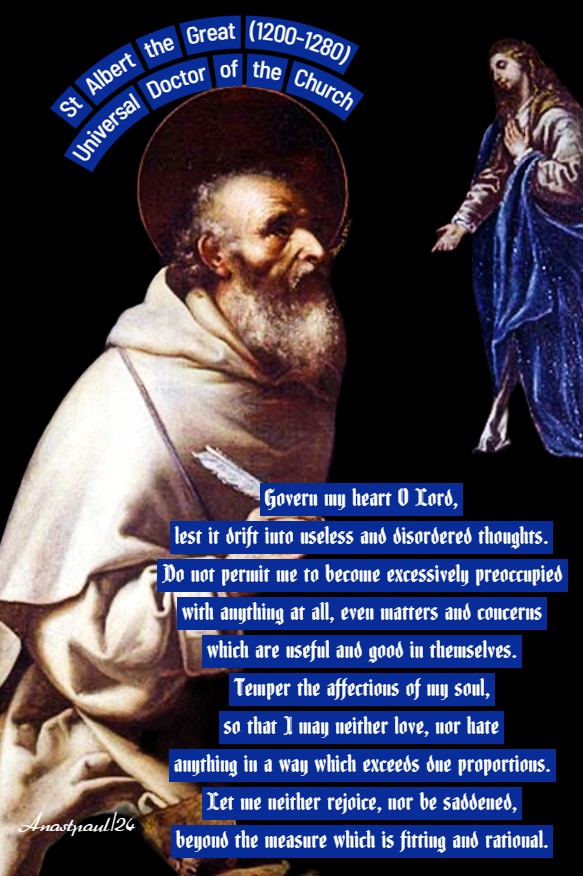
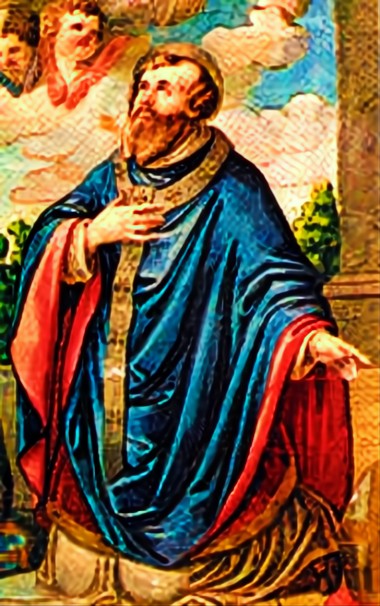
“Govern my heart O Lord, lest it drift into useless and disordered thoughts. Do not permit me to become excessively preoccupied with anything at all, even matters and concerns which are useful and good in themselves. Temper the affections of my soul, so that I may neither love, nor hate anything, in a way which exceeds due proportions. Let me neither rejoice, nor be saddened, beyond the measure which is fitting and rational.”
St Albert the Great (1200-1280) Universal Doctor of the Church
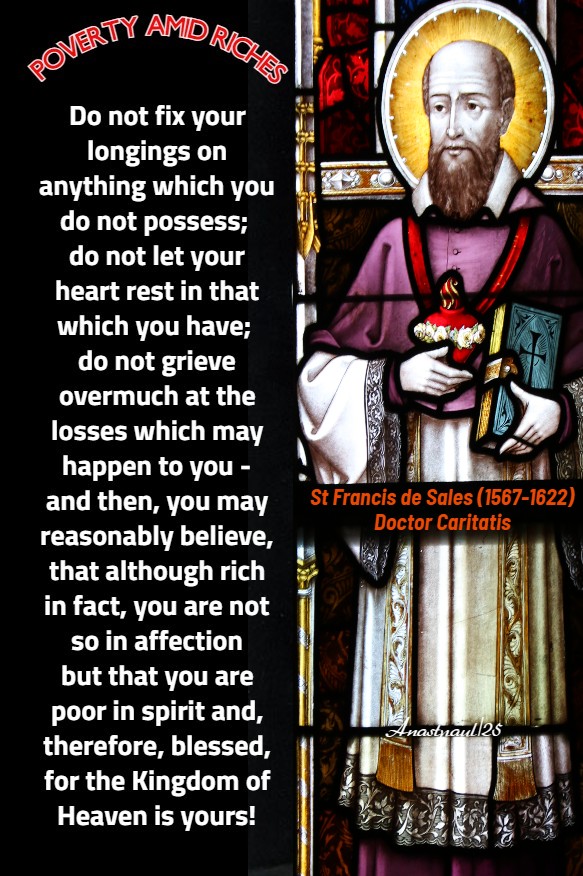
“Do not fix your longings on anything which you do not possess; do not let your heart rest in that which you have; do not grieve overmuch, at the losses which may happen to you – and then, you may reasonably believe that although rich in fact, you are not so in affection but that you are poor in spirit and, therefore, blessed, for the Kingdom of Heaven is yours.”
St Francis de Sales (1567-1622) Doctor Caritatis
“Be brave and try to detach your heart from worldly things. Do your utmost to banish darkness from your mind and come to understand what true, selfless piety is. Through confession, endeavour to purify your heart of anything which may still taint it. Enliven your faith which is essential to understand and achieve piety.”
Our Morning Offering – 26 November – “The Month of The Holy Souls in Purgatory”
A Short Act of Spiritual Communion By St Alphonsus Liguori (1696-1787) Doctor of the Church
My Jesus, I believe that Thou art present in the Blessed Sacrament. I love Thee above all things and I desire Thee in my soul. Since I cannot now receive Thee sacramentally, come at least spiritually, into my heart. As though Thou were already there, I embrace Thee and unite myself wholly to Thee, permit not, that I should ever, be separated from Thee. Amen
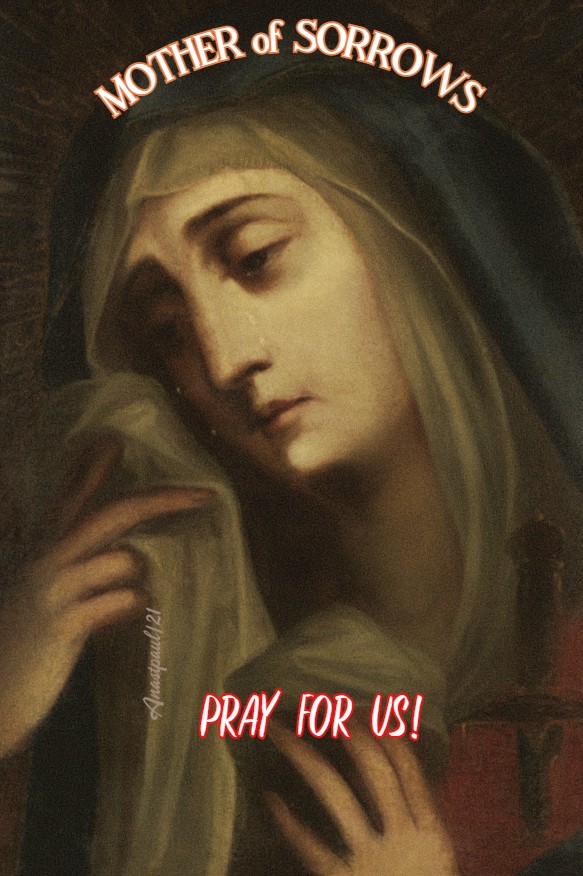
Thought for the Day – 15 September – The Feast of the Seven Sorrows of the Blessed Virgin Mary – Our Lord’s Third Word … – By St Francis de Sales (1567-1622) Doctor Caritas
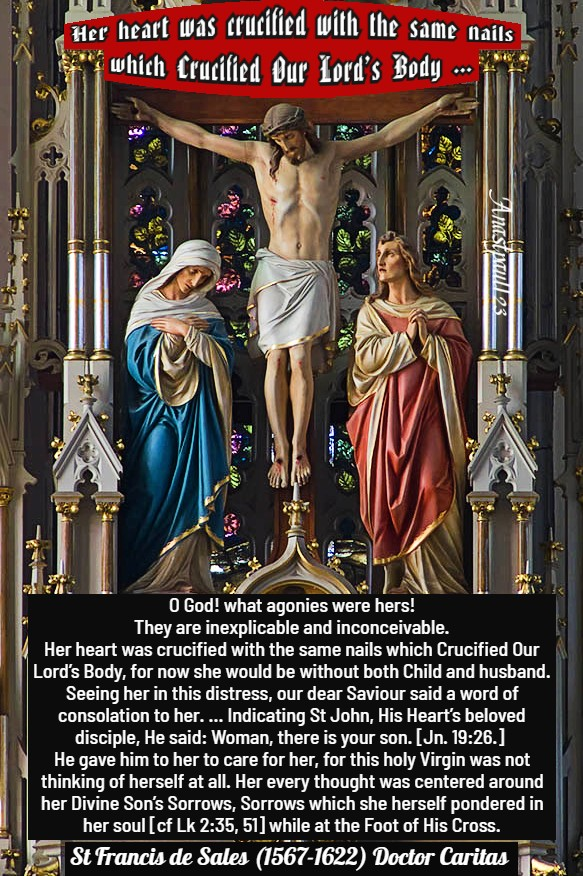
“Her heart was crucified with the same nails which Crucified Our Lord’s Body …”
“OUR LORD’S THIRD WORD was one of consolation. He spoke it to His sacred Mother who was at the foot of the Cross, pierced by a sword of sorrow [Lk 2:35] but certainly not swooning, nor with faint heart, as artists have falsely and impertinently painted her. The Evangelist clearly says the contrary, insisting that she remained standing with an incomparable firmness [Jn.19:25]. That courage did not keep her from the grieving which she endured with the generous and magnanimous heart belonging to her alone. O God! what agonies were hers! They are inexplicable and inconceivable. Her heart was crucified with the same nails which Crucified Our Lord’s Body, for now she would be without both Child and husband.
Seeing her in this distress, our dear Saviour said a word of consolation to her. But this consoling and tender word was not given to lift her heart from such great desolation. The heart of this perfectly submissive and resigned holy Virgin needed to be extremely strong and Our Lord, Who knew her so well, dealt with her accordingly. Indicating St John, His Heart’s beloved disciple, He said: Woman, there is your son. [Jn 19:26.] He gave him to her to care for her, for this holy Virgin was not thinking of herself at all. Her every thought was centered around her Divine Son’s Sorrows, Sorrows which she herself pondered in her soul [cf Lk 2:35, 51] while at the Foot of His Cross.” – (Sermons of St Francis de Sales for or Lent).
Quote/s of the Day – 27 August – “The Month of the Immaculate Heart of Mary” – St Caesarius of Arles (470-543) Bishop, Father of the Church and St Joseph Calasanz (1557-1648) Confessor, Priest– –
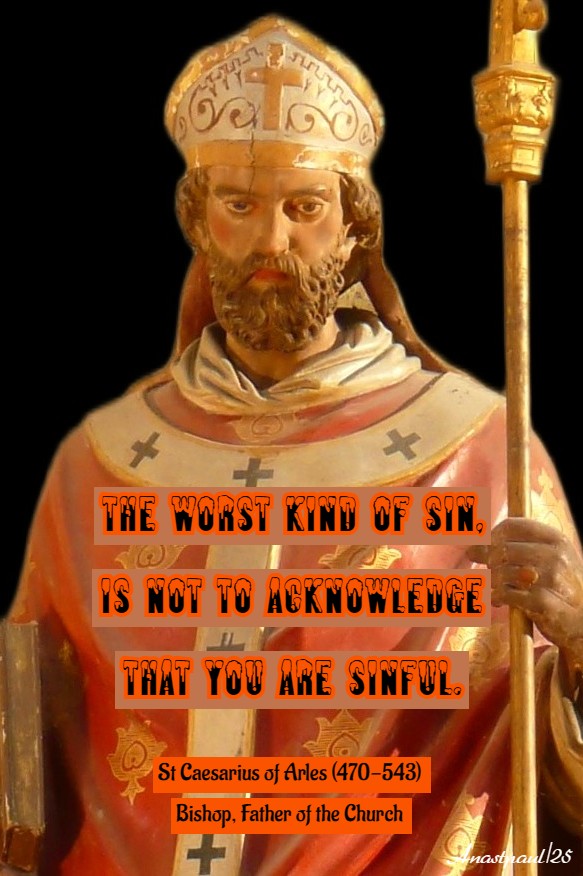
“The worst kind of sin, is not to acknowledge that you are sinful.”
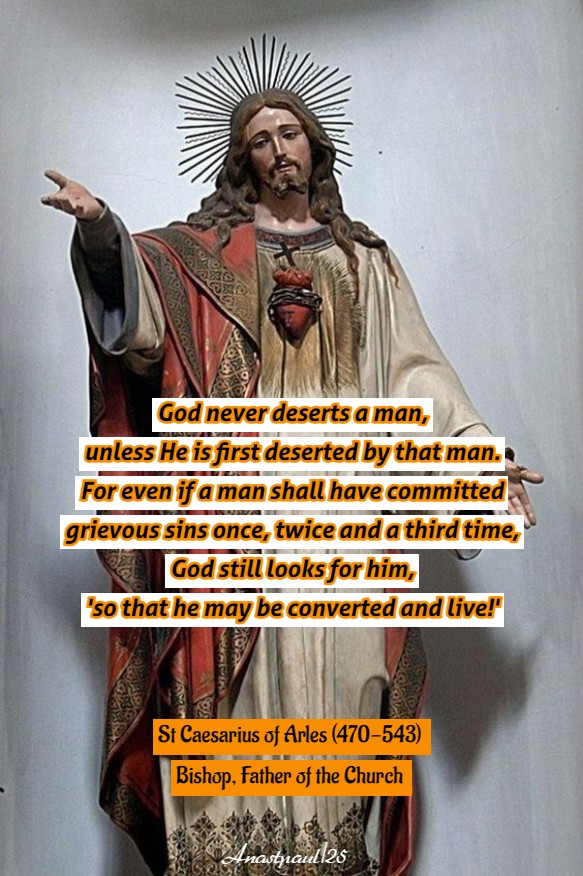
“God never deserts a man, unless He is first deserted by that man. For even if a man shall have committed grievous sins once, twice and a third time, God still looks for him, ‘so that he may be converted and live!‘”
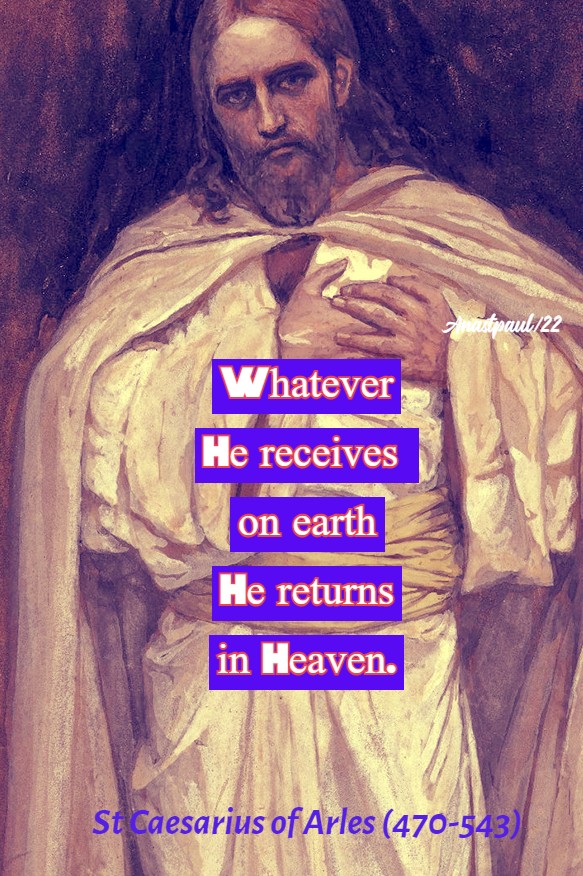
“Whatever He receives on earth, He returns in Heaven.”
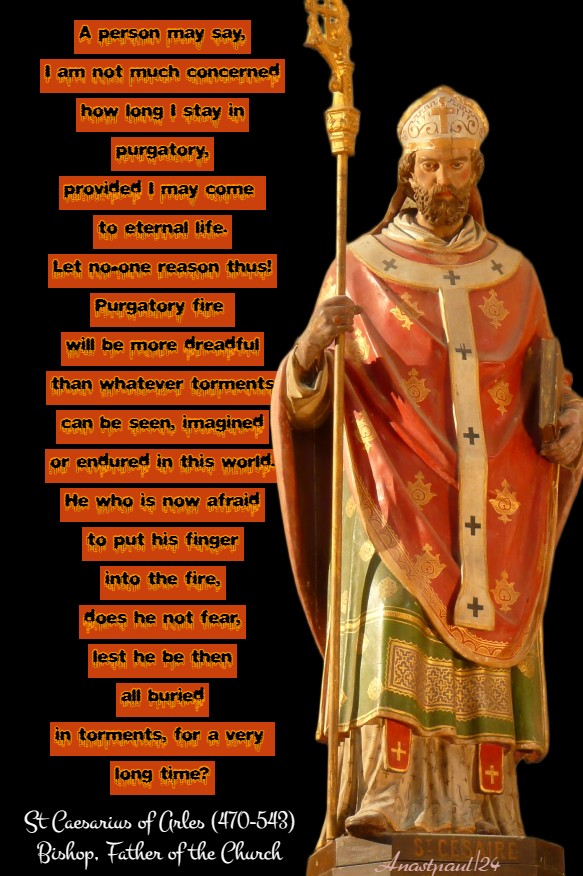
“A person may say, I am not much concerned how long I stay in purgatory, provided I may come to eternal life. Let no-one reason thus! Purgatory fire will be more dreadful than whatever torments can be seen, imagined or endured in this world. He who is now afraid to put his finger into the fire, does he not fear, lest he be then all buried in torments, for a very long time?”
St Caesarius of Arles (470-543) Bishop, Father of the Church
Our Morning Offering – 9 August – “The Month of the Immaculate Heart of Mary” – St Jean-Marie-Baptiste Vianney (1786-1859) Confessor
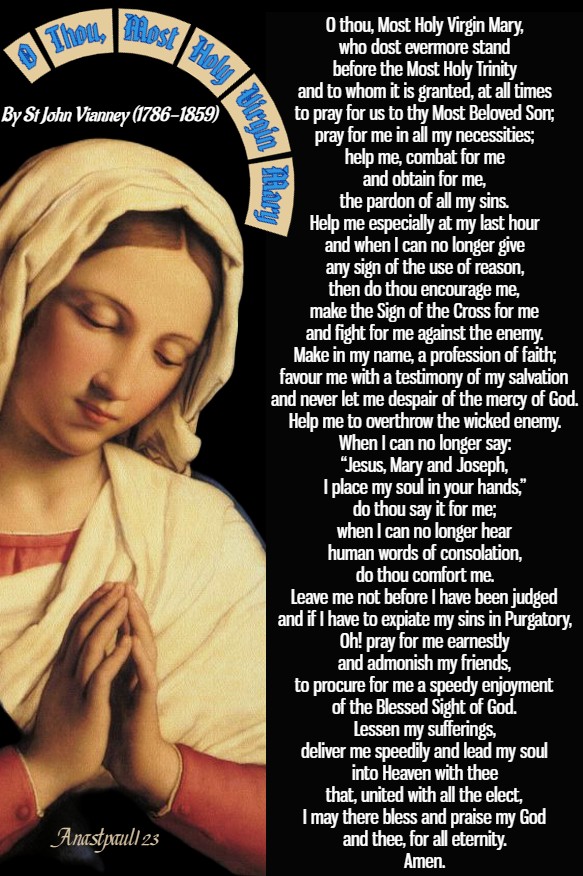
O Thou, Most Holy Virgin Mary (Pray for Me in All My Necessities) By St John Vianney (1786-1859)
O thou, Most Holy Virgin Mary, who dost evermore stand before the Most Holy Trinity and to whom it is granted, at all times to pray for us to thy Most Beloved Son; pray for me in all my necessities; help me, combat for me and obtain for me, the pardon of all my sins. Help me especially at my last hour and when I can no longer give any sign of the use of reason, then do thou encourage me, make the Sign of the Cross for me and fight for me against the enemy. Make in my name, a profession of faith; favour me with a testimony of my salvation and never let me despair of the mercy of God. Help me to overthrow the wicked enemy. When I can no longer say: “Jesus, Mary and Joseph, I place my soul in Thy hands,” do thou say it for me; when I can no longer hear human words of consolation, do thou comfort me. Leave me not before I have been judged and if I have to expiate my sins in Purgatory, Oh! pray for me earnestly and admonish my friends, to procure for me a speedy enjoyment of the Blessed Sight of God. Lessen my sufferings, deliver me speedily and lead my soul into Heaven with thee that, united with all the elect, I may there bless and praise my God and thee, for all eternity. Amen.
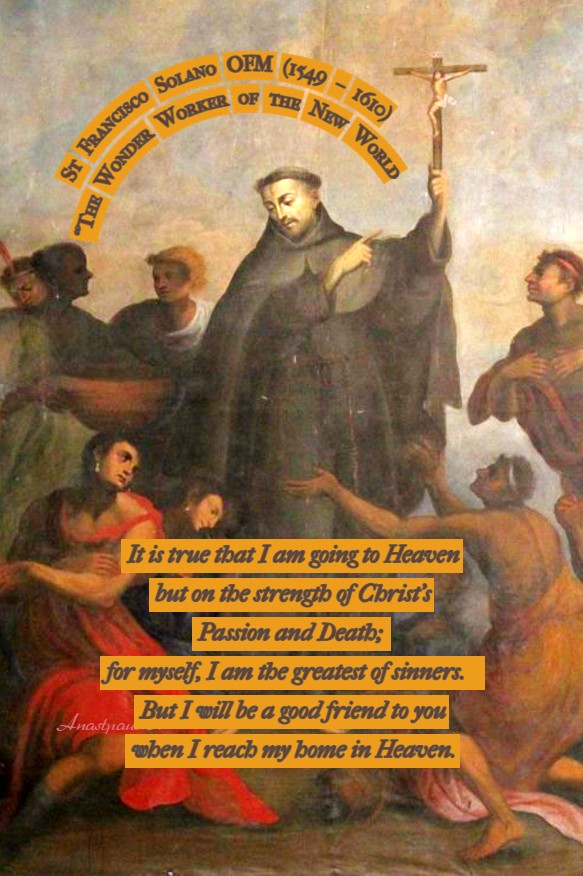
Quote/s of the Day – 24 July – “The Month of the Most Precious Blood” – St Francisco Solano OFM (1549 – 1610) “The Wonder Worker of the New World”
When Francisco Solano was about to die, one of the friars asked him: ‘Faher, when God takes you to Heaven remember me when you enter the everlasting Kingdom.’
With joy Francisco replied:
“It is true that I am going to Heaven but on the strength of Christ’s Passion and Death; for myself, I am the greatest of sinners. But I will be a good friend to you when I reach my home in Heaven.”
(From a contemporary Vita of St SFrancisco Solano)
Quote/s of the Day – 9 July – St John Fisher (1469-1535) Bishop, Martyr, Cardinal – St Thomas More (1478-1535) Martyr, Confessor
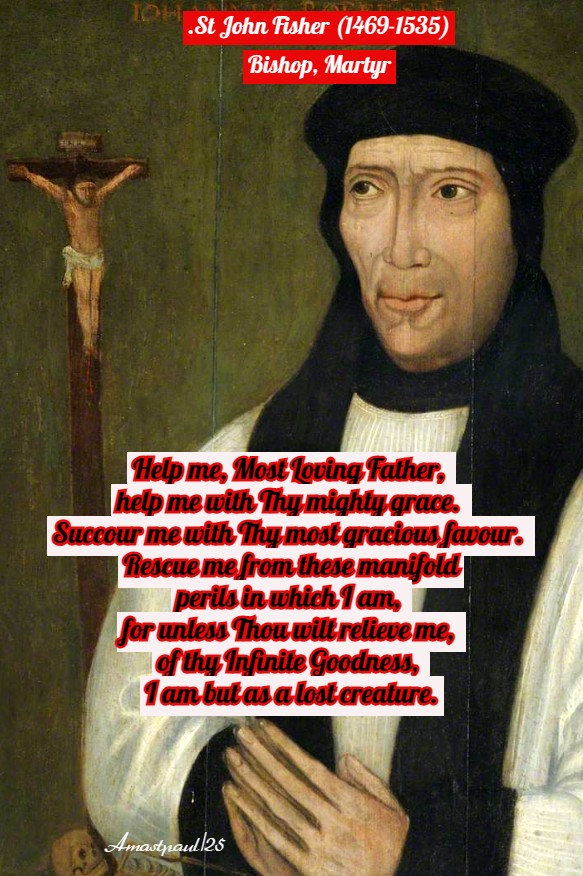
St John Fisher (1469-1535) Bishop, Martyr, Cardinal
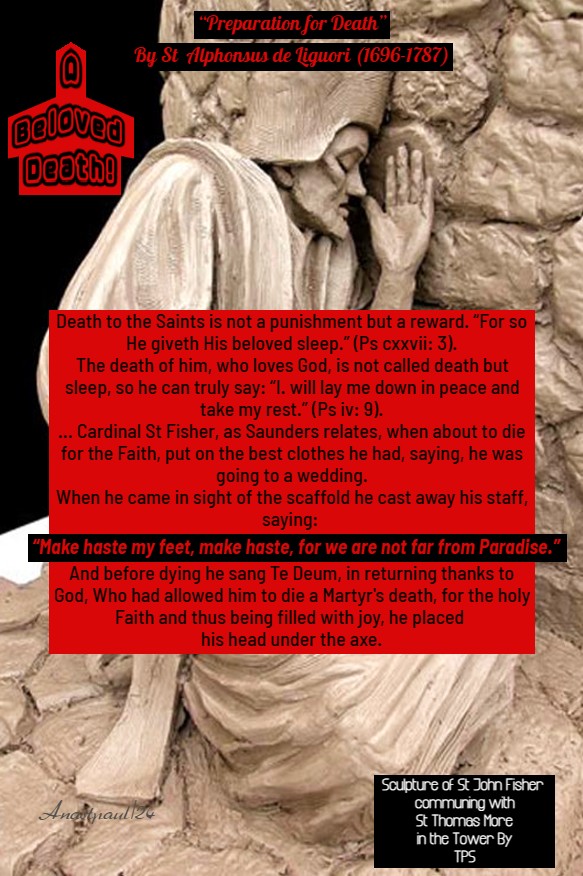
“Death to the Saints is not a punishment but a reward. “For so He giveth His beloved sleep.” (Ps cxxvii: 3). The death of him, who loves God, is not called death but sleep, so he can truly say: “I will lay me down in peace and take my rest.” (Ps iv: 9).
Cardinal St Fisher, as Saunders relates, when about to die for the Faith, put on the best clothes he had, saying, he was going to a wedding. When he came in sight of the scaffold he cast away his staff, saying: “Make haste my feet, make haste, for we are not far from Paradise.” And before dying he sang Te Deum, in returning thanks to God, Who had allowed him to die a Martyr’s death, for the holy Faith and thus being filled with joy, he placed his head under the axe.”
St John Fisher (1469-1535) Bishop, Martyr, Cardinal
“Help me, Most Loving Father, help me with Thy mighty grace. Succour me with Thy most gracious favour. Rescue me from these manifold perils in which I am, for unless Thou wil relieve me, of thy Infinite Goodness, I am but as a lost creature.”
(From the Prayer in the Tower)
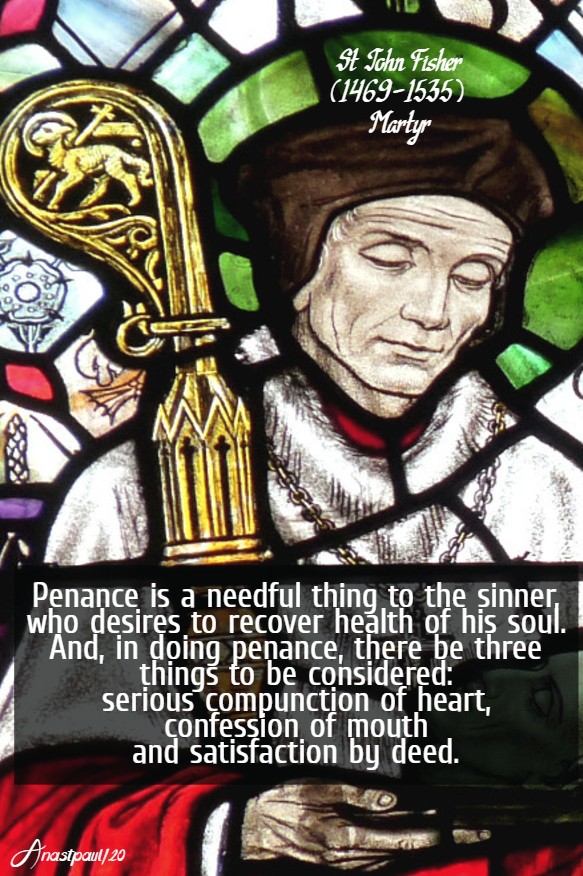
“Penance is a needful thing to the sinner, who desires to recover health of his soul. And, in doing penance, there be three things to be considered: serious compunction of heart, confession of mouth and satisfaction by deed.”
St Thomas More (1478-1535) Martyr, Confessor
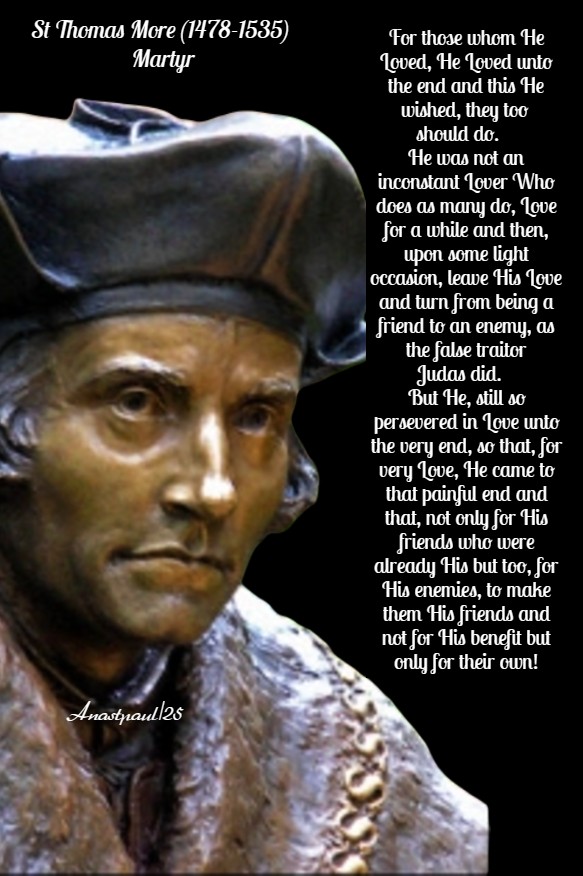
“For those whom He Loved, He Loved unto the end and this He wished, they too should do. He was not an inconstant Lover Who does as many do, Love for a while and then, upon some light occasion, leave His Love and turn from being a friend to an enemy, as the false traitor, Judas did. But He, still so persevered in Love unto the very end, so that, for very Love, He came to that painful end and that, not only for His friends who were already His but too, for His enemies, to make them His friends and not for His benefit but only for their own!”
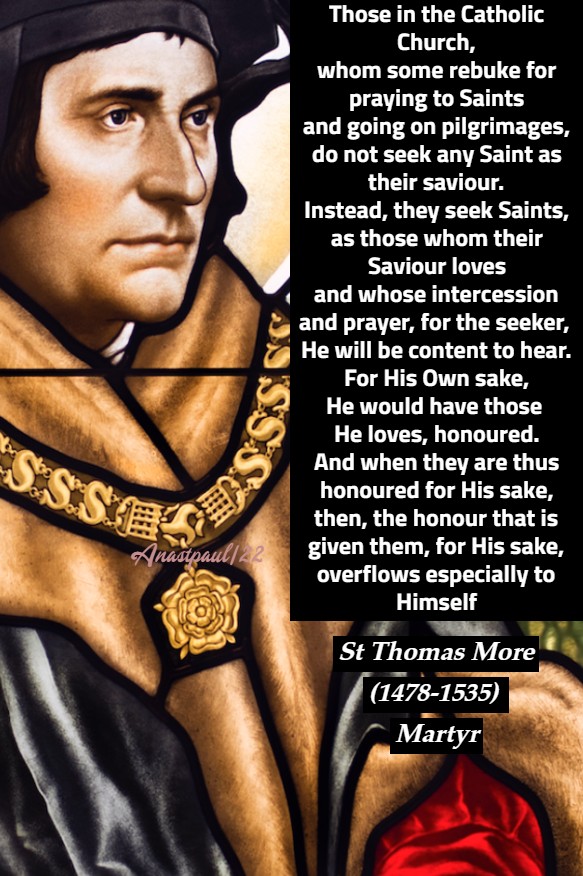
“Those in the Catholic Church, whom some rebuke for praying to Saints and going on pilgrimages, do not seek any Saint as their saviour. Instead, they seek Saints, as those whom their Saviour loves and whose intercession and prayer, for the seeker, He will be content to hear. For His Own sake, He would have those He loves, honoured. And when they are thus honoured for His sake, then, the honour that is given them, for His sake, overflows especially to Himself.”
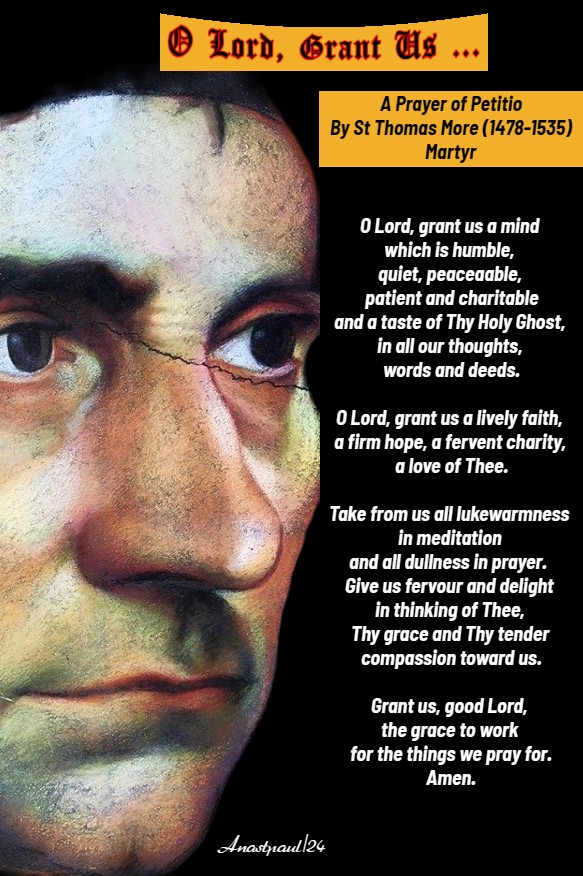
O Lord, Grant Us … A Prayer of Petitio By St Thomas More (1478-1535)
O Lord, grant us a mind which is humble, quiet, peaceaable, patient and charitable and a taste of Thy Holy Ghost, in all our thoughts, words and deeds.
O Lord, grant us a lively faith, a firm hope, a fervent charity, a love of Thee.
Take from us all lukewarmness in meditation and all dullness in prayer. Give us fervour and delight in thinking of Thee, Thy grace and Thy tender compassion toward us.
Grant us, good Lord, the grace to work for the things we pray for. Amen.
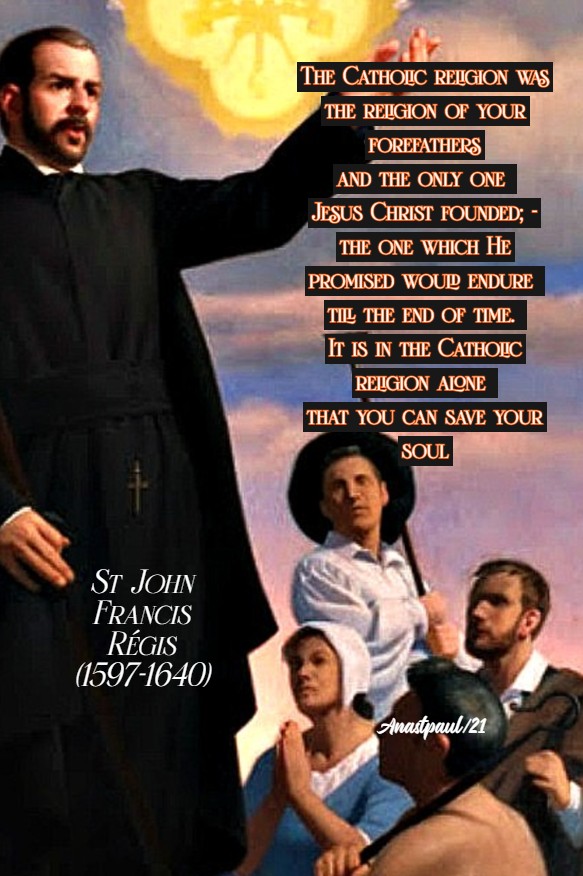
Quote/s of the Day – 16 June – St John Francis Régis SJ (1597-1640) Priest, Confessor, Missionary
“The Catholic religion was the religion of your forefathers and the only one Jesus Christ founded; – the one which He promised would endure till the end of time. It is in the Catholic religion alone that you can save your soul.”
“How long are you going to be deaf to His call? Or are you going to lose your soul, which Jesus Christ bought at the price of His Precious Blood?”
“My child, it is indeed the Voice of God you have heard. He has given you a great grace in thus calling you into His one true Church. While you live, never cease to thank Him and bless Him for it.”
(All the above from – Rev Fr D. Chisholm, The Catechism in Examples (London: R & T Washbourne, Ltd
“Brother, I see our Lord and our Lady opening the gates of Paradise for me. Into Your hands, O Lord, I commend my spirit.” St John Francis Regis on his deathbed
Our Morning Offering – 16 April – “Spy” Wednesday in Holy Week
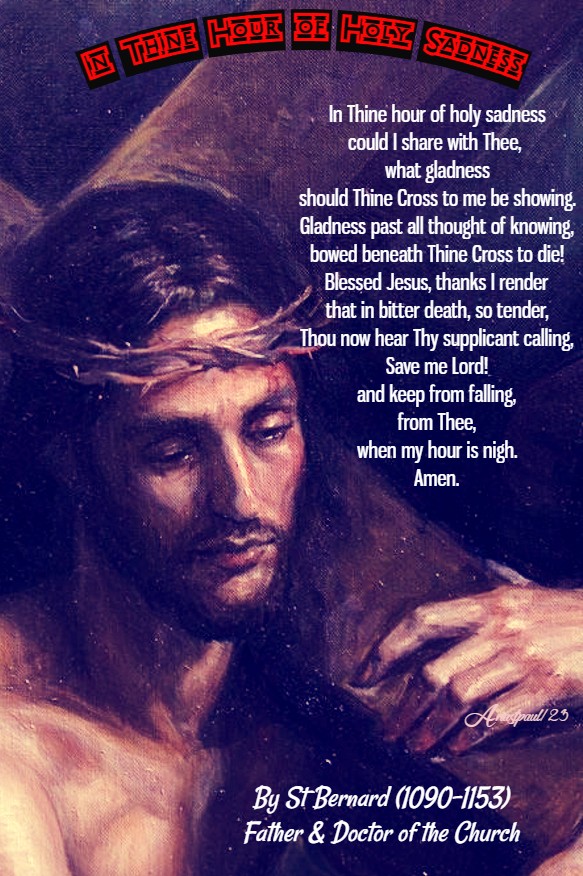
In Thine Hour of Holy Sadness By St Bernard (1090-1153) Father & Doctor of the Church
In Thine hour of holy sadness could I share with Thee, what gladness should Thine Cross to me be showing. Gladness past all thought of knowing, bowed beneath Thine Cross to die! Blessed Jesus, thanks I render that in bitter death, so tender, Thou now hear Thy supplicant calling, Save me Lord! and keep from falling, from Thee, when my hour is nigh. Amen.
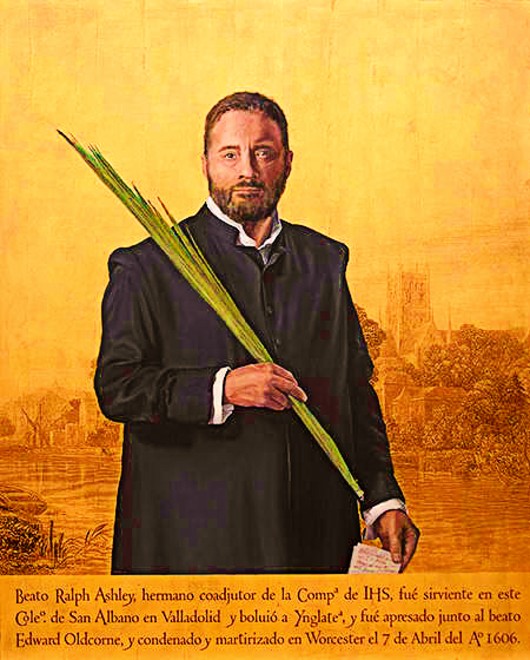
Saint of the Day – 7 April – Blessed Ralph Ashley (Died 1607) SJ Lay Brother, Martyr. Unknown birth date or place but in England and died on 7 April 1607 by being hung, drawn and quartered in Worcester, Worcestershire, England. He was Beatified on 15 December 1929by Pope Pius XI. Also known as – Ralph Sherington, George Chambers.
Ralph Ashley is first recorded working as a cook at the College in Douai in France. On 28 April 1590, he left for the English College, Valladolid, in Spain and became a Jesuit Lay-brother.
In 1598, Ralph returned to England to serve Blessed Father Edward Oldcorne SJ. Eight years later in the aftermath of the Gunpowder Plot, he and Fr Oldcorne were arrested at Hindlip Hall near Worcester and committed to the Tower of London.
Ralph patiently and constantly endured all the tortures inflicted on him without revealing any person or place of his master’s acquaintances. They were both remanded and tried for treasonin Worcester, condemned and executed on 7 April 1606 at Red Hill, Worcester.
When Ashley came to die he prayed and asked for forgiveness and noted that like Oldcorne, he was dying for his religion and not for being a traitor.
Prior to his execution, his last words were: “What a happy man am I, to follow the steps of my Father unto death.” Ralph Ashley was Beatified in 1929 with Fr Oldcorne..
Our Morning Offering – 3 April – The Feastday of St Richard (1197-1253) Bishop of Chichester
Lord Jesus Christ, Have Mercy Upon Me. The Dying Prayer of St Richard of Chichester (1197-1253)
Lord Jesus Christ, I thank Thee for all the blessings Thou hast given me and for all the sufferings and shame, Thou didst endure for me, on which account, that pitiable cry of sorrow was Thine: “Behold and see, if there was any sorrow like unto My sorrow!” Thou knowest Lord, how willing I should be, to bear insult and pain, and death for Thee, therefore, have mercy upon me, for to Thee do I commend my spirit. Amen
St Richard recited this prayer on his deathbed, surrounded by the Clergy of his Diocese. The words were transcribed, in Latin, by his Confessor and friend, Fr Ralph Bocking (who ultimately also became his Biographer), a Dominican Friar. The prayer was eventually published in the Acta Sanctorum, an Encyclopedic text in 68 folio volumes of documents examining the lives of Saints. The British Library copy contains Fr Bocking’s transcription of the prayerin his handwriting as below:
Gratias tibi ago, Domine Jesu Christe, de omnibus beneficiis quae mihi praestitisti; pro poenis et opprobrious, quae pro me pertulisti; propter quae planctus ille lamentabilis vere tibi competebat. Non est dolor similis sicut dolor meus.
However, the first English translation is as above and not the version below, or the one more commonly known as “Day by Day” which words were never in the original and were added and used in the extremely sacrilegious and blasphemous “Godspell” – even though the common version with the rhyming “Triplet” (i.e. clearly, dearly, nearly) – is the one found commonly in Hymn and Prayer Books. Bearing in mind that this was “The Dying Prayer ” of St Richard, it is obviously highly unlikely that he would have requested the grace of daily sanctity, “day by day!”
Thanks be to Thee, my Lord Jesus Christ For all the benefits Thou hast given me, For all the pains and insults Thou hast borne for me. O most merciful Redeemer, Friend and Brother, May I know Thee more clearly, Love Thee more dearly, Follow Thee more nearly. Amen
One Minute Reflection – 17 February – “The Month of the Blessed Trinity” – Ferial Day – Septuagesima – 1 Corinthians 9:24-27; 10:1-5 – Matthew 20:1-16 – Scripture search here: https://www.drbo.org/
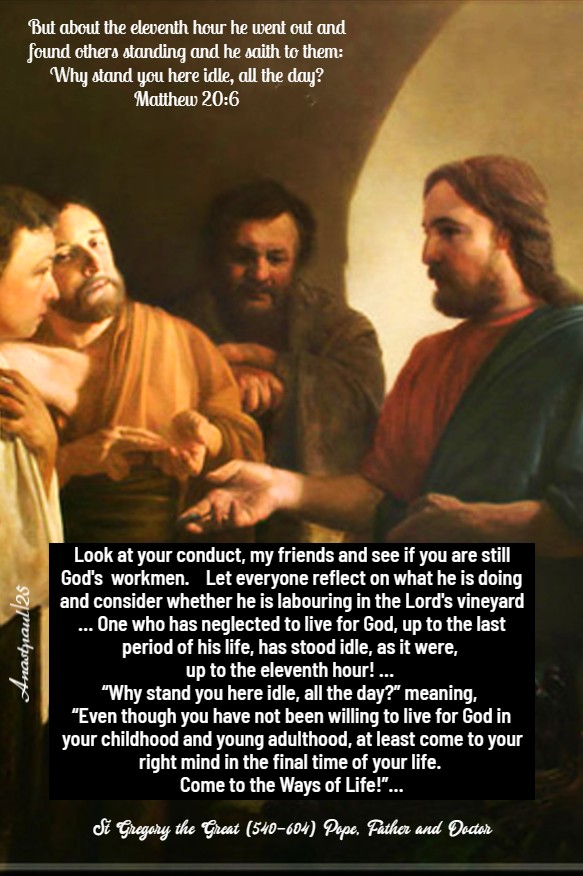
“But about the eleventh hour he went out and found others standing and he saith to them: Why stand you here idle, all the day?” – Matthew 20:6
REFLECTION – “We can apply these hourly periods to each individual person’s life. Morning is the childhood of our understanding. The third hour can be taken as our youth because, the sun is advancing on high, as the impetuosity of age increases. The sixth hour is that of young adulthood because, when we reach our full strength, it is as if the sun is in the centre of the heavens. The ninth hour we take to be old age because, like the sun descending from its zenith, this age lacks the warmth of youth. The eleventh hour is the age which is called infirm, or old … Since then, one person is brought to a good life in childhood, another in youth, another in young adulthood, another in old age, another at the age of infirmity, it is as if workmen are being called to the vineyard at different hours.
Look at your conduct, my friends and see if you are still God’s workmen. Let everyone reflect on what he is doing and consider whether he is labouring in the Lord’s vineyard … One who has neglected to live for God, up to the last period of his life, has stood idle, as it were, up to the eleventh hour! … “Why stand you here idle, all the day?” meaning, “Even though you have not been willing to live for God in your childhood and young adulthood, at least come to your right mind in the final time of your life. Come to the Ways of Life!”…
Did not the thief come at the eleventh hour? (Lk 23:39) He possessed nothing by the length of his life but he had something, coming late … He confessed God on the cross and he gave forth his last breath, almost as he spoke. The Householder began paying the denarius beginning with the last because, He called the thief to the repose of Paradise before he called Peter!” – St Gregory the Great (540-604) Pope, Father and Doctor (Sermons on the Gospel no 11).
PRAYER – O Lord, we beseech You, graciously hear the prayers of Your people, that we who are justly punished for our sins may be mercifully delivered for the glory of Your name. Through Jesus Christ, Thy Son our Lord, Who lives and reigns with Thee, in the unity of the Holy Ghost, God, world without end. Amen (Collect).
Quote/s of the Day – 6 November – “The Month of the Holy Souls in Purgatory” – Within the All Saints Octave – Apocalypse 7:2-12; Matthew 5:1-12 – Scripture search here: https://www.drbo.org/
“Rejoice and be glad, for your reward will be great in Heaven.”
Matthew 5:12
“He seems to demand of us the most entire renunciation … So, if we keep back for ourselves, any earthly goods or any perishable supplies, our minds will remain sunk in them, as though in mud. Then, inevitably, our souls will become unable to contemplate God and will be unmoved by desire for the splendours of Heaven and for the good things promised us. We shall only be able to acquire those good things, if we ask for them unceasingly, with a burning desire that will, besides, make easy the effort needed to gain them.”
St Basil the Great (329-379) Father and Doctor of the Church
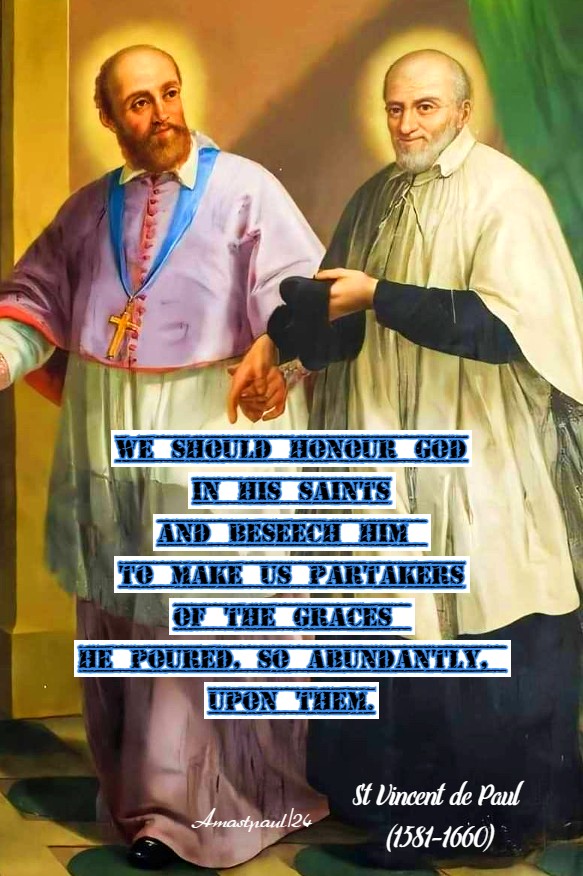
“We should honour God in His Saints and beseech Him to make us partakers of the graces He poured, so abundantly, upon them.”
St Vincent de Paul (1581-1660)
“The patience of the Saints was more severely tried than is ours. Not only were they stoned, racked, torn asunder, not only did they suffer want, distress, afflictions (Hebrews 11 : 37) but, they had to endure what was still more difficult – ingratitude, failure, unkindness, false accusations, desolation, darkness. Yet they willingly endured all for Jesus’ sake, never ceasing to love Him through it all. I have my trials, yet none so dreadful as theirs, yet I complain even under my lighter cross!”
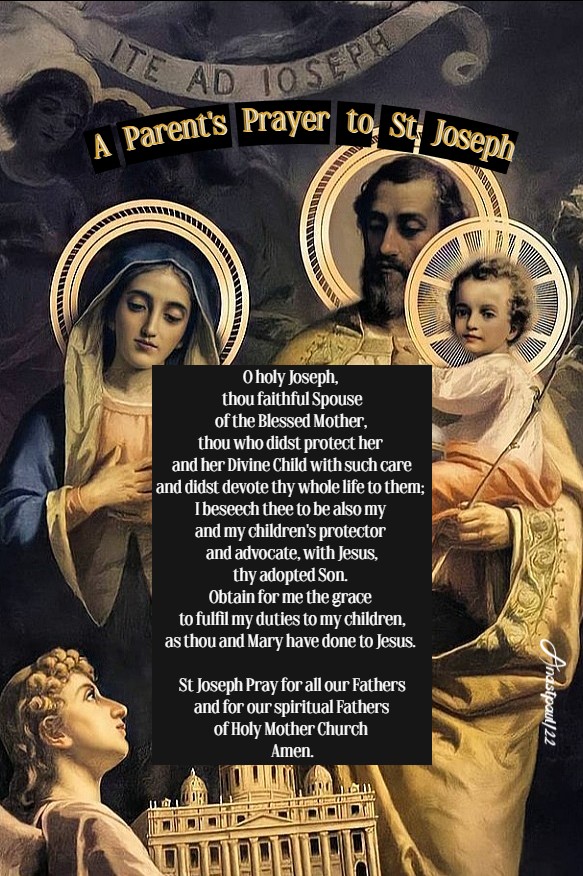
Our Morning Offering – 6 November – “The Month of the Holy Souls in Purgatory” – On Wedmesdays many Catholics make a special devotion to St Joseph by going to Mass on the 1st Wednesdays of 9 consecutive months and offering their Communions in his honour and for the salvation of the dying.
A Parent’s Prayer to St Joseph
O holy Joseph, thou faithful Spouse of the Blessed Mother, thou who didst protect her and her Divine Child with such care and didst devote thy whole life to them; I beseech thee to be also my and my children’s protector and advocate, with Jesus, thy adopted Son. Obtain for me the grace to fulfil my duties to my children, as thou and Mary have done to Jesus.
St Joseph Pray for all our Fathers and for our spiritual Fathers of Holy Mother Church Amen.
Thought for the Day – 22 September – Meditations with Saint Alphonsus Maria de Liguori (1696-1787) Bishop, Confessor, Most Zealous Doctor of the Church
“Preparation for Death” By St Alphonsus Maria de Liguori (1696-1787)
CONSIDERATION IX
The Peace Felt by a Just Man When Dying “The souls of the just are in the Hands of God and the torment of death, shall not touch them. In the sight of the unwise, they seemed to die, …. but they are at peace.” (Wisd iii: 1-3)
SECOND POINT: “The souls of the just are in the Hands of God and the torment of death shall not touch them. In the sight of the unwise, they seemed to die … but they are at peace.” It seems, in the sight of the unwise that the servants of God die with sorrow and unwillingly, even as the worldly do but no, for God knows well how to comfort His children when they are dying and amidst the pains of their death, He makes them feel a certain incomparable sweetness, as a foretaste of Paradise which, within a short time, He will bestow upon them. Like those who die in sin, who even upon their death-bed experience certain foretastes of hell, such as remorse, fear and despair; so, on the contrary, do the Saints, by the acts of love which, at that time they often make to God, by the desire and by the hope which is within them, of very soon enjoying God, begin even before death, to feel that peace which they will afterwards fully enjoy in Heaven.
Death to the Saints is not a punishment but a reward. “For so He giveth His beloved sleep.” (Ps cxxvii: 3). The death of him, who loves God, is not called death but sleep, so he can truly say: “I. will lay me down in peace and take my rest.” (Ps iv: 9). Father Saurez died in such peace that whilst dying he was able to say: “I did not think it was so sweet to die.” Cardinal Baronius having been advised by his physician not to think so much about death, replied: “And why? Is it perchance that I fear it? I do not fear but I love it!”
Cardinal St Fisher, as Saunders relates, when about to die for the Faith, put on the best clothes he had, saying, he was going to a wedding. When he came in sight of the scaffold he cast away his staff, saying: “Make haste my feet, make haste, for we are not far from Paradise.” And before dying he sang Te Deum, in returning thanks to God, Who had allowed him to die a Martyr’s death, for the holy Faith and thus being filled with joy, he placed his head under the axe.
St Francis of Assisi sang while dying and invited the others to sing too. One, Brother Elias, made answer saying: “We ought to weep, Father and not to sing when we are dying.” But the Saint replied: “I cannot do less than sing, seeing that, within so short a time, I am going to enjoy God.”
A Teresian Nun dying when she was young and seeing the other Nuns begin to weep, she said to them: “ O God, wherefore do you weep, I am going to find my Jesus; if you love me rejoice with me!” Father Granada relates that a certain hunter found a solitary leper singing when dying: “Why is it,” said the hunter, “that thou canst sing when, in this condition?” The hermit answered, saying: “Brother, between me and God there is only the wall of this my body, now I can see falling into pieces that which was my prison and I am going to see God and, therefore, I comfort myself and sing.”
This longing to see God, made St Ignatius the Martyr say, that if the wild beasts did not come to take away his life, he would irritate them and thus, provoke them to devour him.
St Catherine of Genoa would not allow anyone to consider death a misfortune, for she said: “O beloved death! how ungraciously art thou welcomed! and why do thou not come to me, when I call upon thee day and night?” St Teresa desired death so much that she considered it death, not to die and accordingly she composed the celebrated Hymn: “I die because 1 do not die” Even such is death to the Saints!
Affections andPrayers
Ah my Sovereign Good, my God! if during the years that are past, I have not loved Thee, now will I be converted to Thee. I bid farewell to every creature and I choose to love Thee alone, my sweetest Saviour. Tell me what Thou wishest me to do that I may do it. I have already committed offences enough against Thee. The life remaining to me, I would wish to spend it all in pleasing Thee. Give me strength, in some way to atone, with my love, for the ingratitude which, until now, I have shown Thee. I have deserved, all these years, to be cast into everlasting punishment. Thou hast sought me so many tunes, now at last, Thou hast drawn me to Thee; let me now burn with the fire of Thy holy love.
I love Thee, O Thou Infinite Good, Thou wishest me to love Thee only and with reason, for Thou hast loved me more than all and Thou alone art worthy to be loved and I will love Thee only, for I would do all I can to please Thee. Do with me as Thou wilt. It is enough that I love Thee and that Thou lovest me.
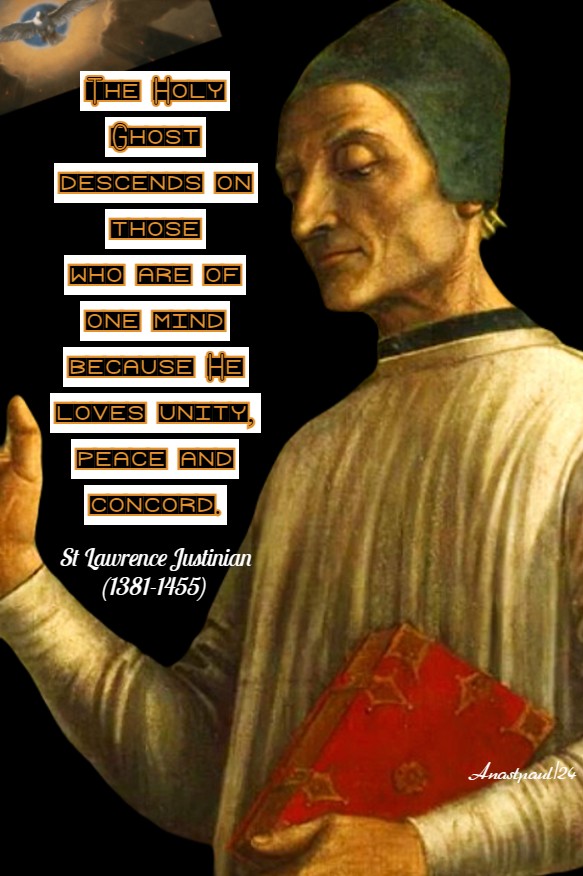
Quote/s of the Day – 5 September – St Lawrence Justinian (1381-1455) Bishop and Patriarch of Venice, Confessor
“The Holy Ghost descends on those who are of one mind because He loves unity, peace and concord.”
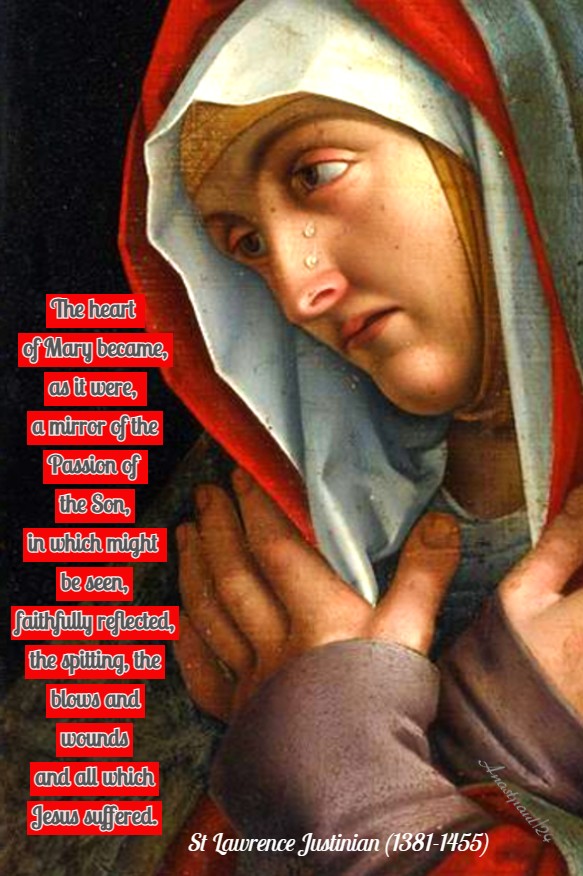
“The heart of Mary became, as it were, a mirror of the Passion of the Son, in which might be seen, faithfully reflected, the spitting, the blows and wounds and all which Jesus suffered.”
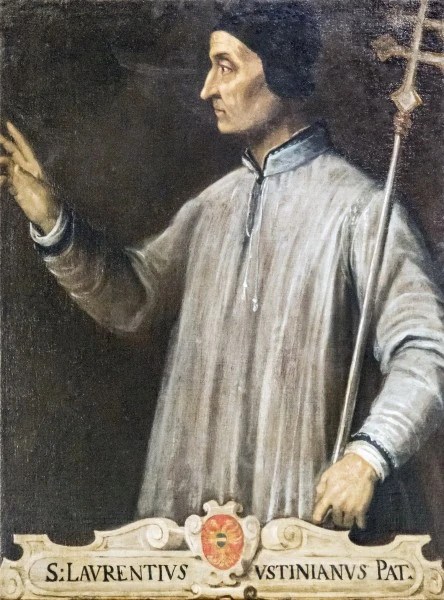
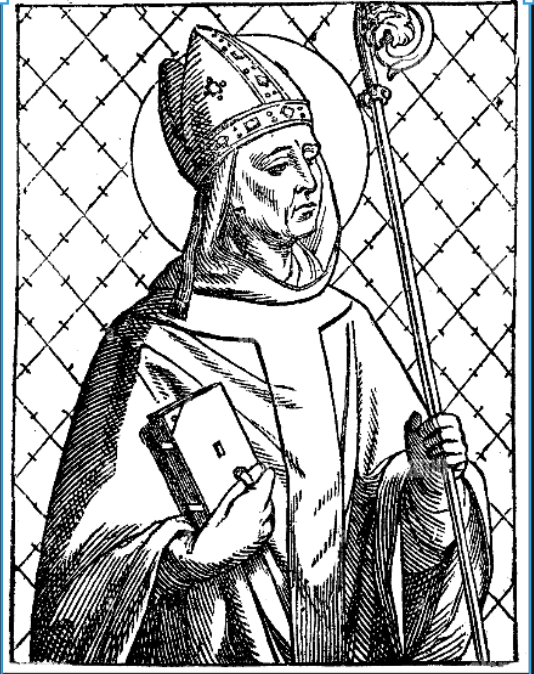
Saint of the Day – 5 September – Saint Lawrence Justinian (1381-1455) Bishop of Venice, Confessor, Patriarch of Venice, Reformer, Spiritual writer. Born on 1 September 1381 at Venice, Italy and died there on 8 January 1455 of natural causes. Also known as – Lorenzo Giustiniani, Laurence…Laurentius…Patriarch of Venice. Patronage – Venice, Italy.
St Lawrence Justinian (1381-1455) Patriarch of Venice By Father Francis Xavier Weninger SJ (1805-1888)
St Lawrence was a descendant of the noble house of Giustiniani, greatly famed in Genoa, Venice and Naples. He was born in 1381, of very pious parents but early lost his father, Bernard. His mother, on whom now devolved the education of her children, redoubled her care but Lawrence gave her very little trouble, as he was naturally inclined to virtue. One day, she made him understand that she feared he harboured ambition or pride secretly in his heart but, he answered: “fear not, mother, I have only one ambition and that is to become a great servant of the Lord and to be more pious than my brothers.” His conduct in youth bore witness to his words, for although he lived at a period when the morals of the whole City were very corrupt, his edifying life was regarded by everyone, with surprise and admiration.
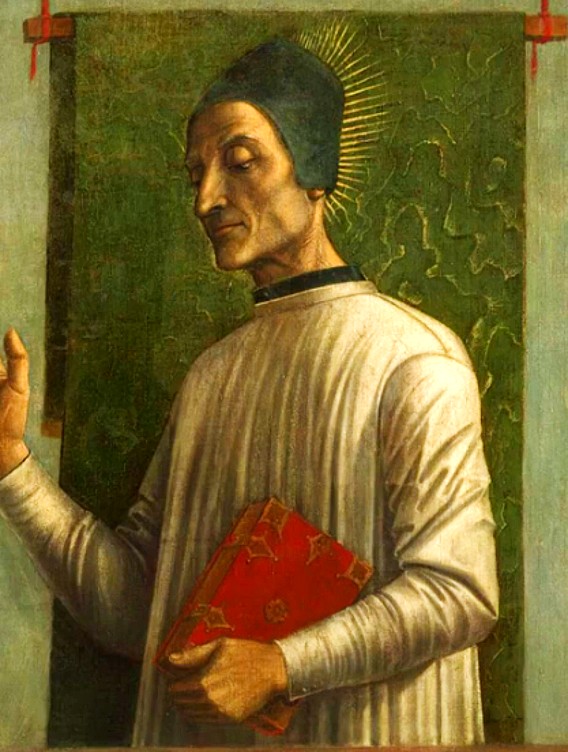
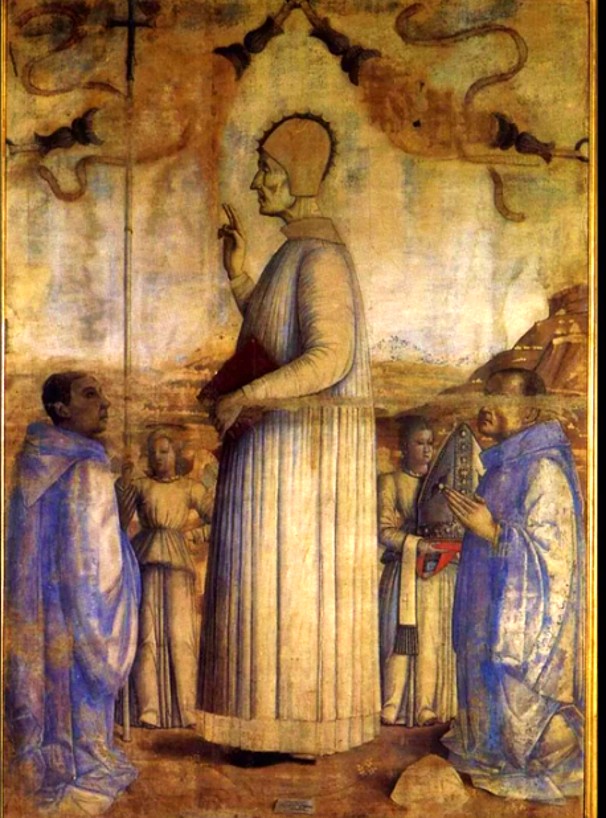
St Lawrence Justinian as a young man by Bellini
To escape the danger which threatened him, he prayed most fervently to God to give him the grace to know the vocation to which he was called. While, one day, kneeling before a Crucifix and an image of the Blessed Virgin, he said his prayers for this intention he experienced a heavenly vision of the Divine Majesty and felt, deep within him, an intense desire to leave the world and to serve God in the Religious state. He obeyed the heavenly Voice, renounced the world and all its allurements, went to the Regular Canons of St George, in Alga, an Island near Venice and requested to be received among their number. His request was granted and he began his Novitiate cheerfully but he soon manifested in his conduct indications that he was no beginner in the science of holiness but a proficient. His Superiors had much more difficulty in moderating his zeal than in animating it.
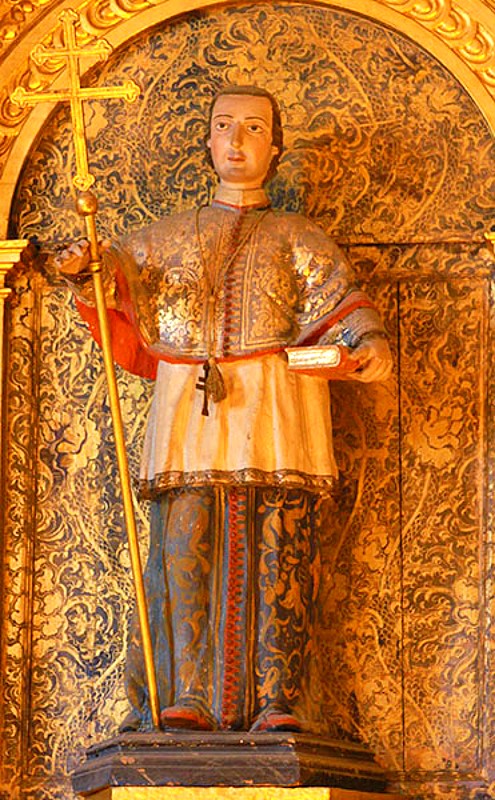
St Lawrence Justinian Statue at the Church of St John the Evangelist, Evora, Portugal.
Amongst other austerities which he practiced to mortify himself, it was specially noticed that, even on the coldest days, he never warmed himself by the fire and that, in summer, he took nothing to allay his thirst, except with his meals at noon and evening. He was never seen taking the air in the Convent garden, or enjoying the beauty and fragrance of the flowers. The only time when he visited his home, was when he was called to see his dying mother. Still more to be admired, is the fortitude with which he bore a very painful and dangerous operation on his throat for the removal of a great tumour. He, himself encouraged the Surgeon to begin fearlessly: “Cannot Christ,” said he, “give me as much fortitude as He gave to the three youths in the furnace?” Not even a sigh escaped him during the operation he repeated only the names of Jesus and Mary. When those present uttered their profound astonishment at his self-control, he said: “How little is my suffering compared with that of the holy Martyrs, who were tortured with burning torches and red hot irons, or roasted over a slow fire!”
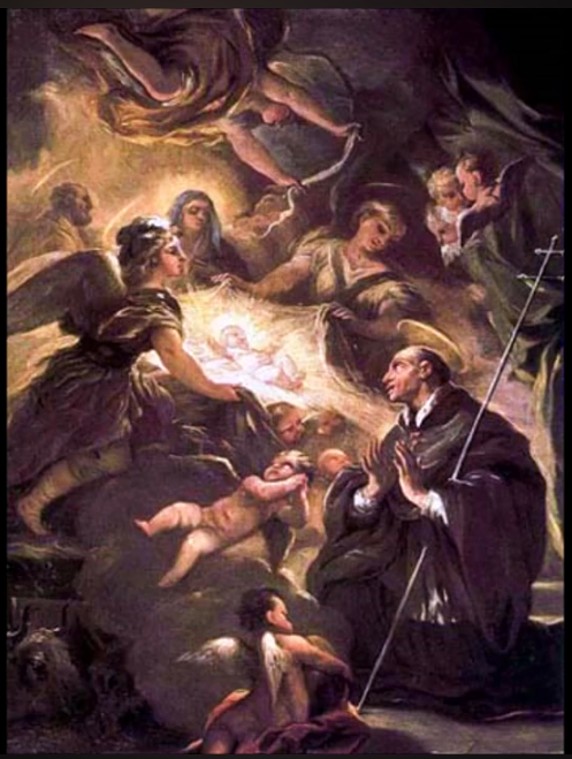
After Lawrence had been Ordained Priest, he daily said Mass with great devotion and seldom without tears. During the Mass on Christmas-night, Heaven bestowed upon him the grace to behold his Saviour in the form of a lovely Child, to the inexpressible comfort of his heart.
St Lawrence Justinian Adoration of the Infant
Although he desired to remain free from all Offices of honour, he was chosen general of his Order and sometime later was nominated as the Bishop of Venice, by Pope Eugenius IV. The humble servant of the Almighty endeavoured, in every possible manner, to escape this dignity but, at last, obliged by obedience, he accepted it.
As the Bishop, he altered nothing of the austerities he had practiced in the Monastery; he visited his whole Diocese and, with Apostolic zeal, animated his flock to observe the Commandments of God and the Church. His income he used for the benefit of the Church and the relief of the poor.
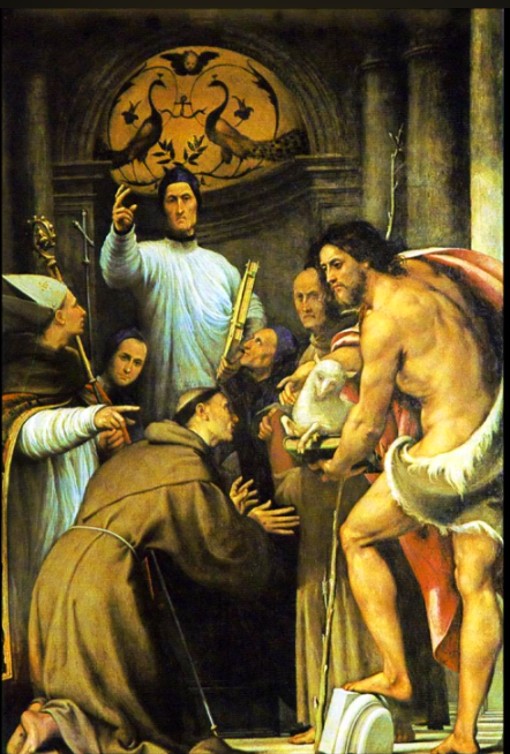
St Lawrence, St John the Baptist, St Franics and ??
Besides several collegiate Churches, he founded fifteen Religious houses and daily fed a great number of poor. The answer he gave to one of his relatives, who requested a contribution out of the Episcopal revenues as a marriage-portion for his daughter, must not be omitted: “It will not satisfy you if I give you but little,” said he “and, if I give you much, you alone will receive it and many others will have nothing. No, the Episcopal revenues must not be used for worldly luxuries but to comfort the needy. Be not offended, therefore, that I cannot fulfil your desire.” Thus spoke the holy Bishop, whom Pope Nicholas V. soon after raised to a still higher dignity.
The Patriarch of Grado died and, as the Pope desired to nominate Lawrence as his own successor but being convinced, at the same time that the Venetians would not consent to part with their Bishop, he transferred the Patriarchal Chair to Venice and declared St Lawrence as the first Patriarch of Venice. This City had indeed great reason to use all possible means not to lose the Saint, as only on his account, God averted a terrible and well-deserved punishment from its walls!
St Lawrence Justinian the First Patriarch of Venice
There lived, at that time, in the Island of Corfu, a Hermit, famous for his holiness, who, one day, said to a Venetian noble, who visited him: “The inhabitants of Venice have provoked God’s wrath, by despising His Words and had not the tears of your Patriarch cried to Him, you would all have long since gone to destruction, like the inhabitants of Sodom!”
While the holy Patriarch was assiduously occupied with the functions of his high station, his strength gradually gave way and he felt his end approaching. On the Feast of the Nativity of Christ, he felt, during Holy Mass, an intense desire to be admitted into the Presence of his God. A fever, which seized him soon after Mass, ended with his death in a very few days.
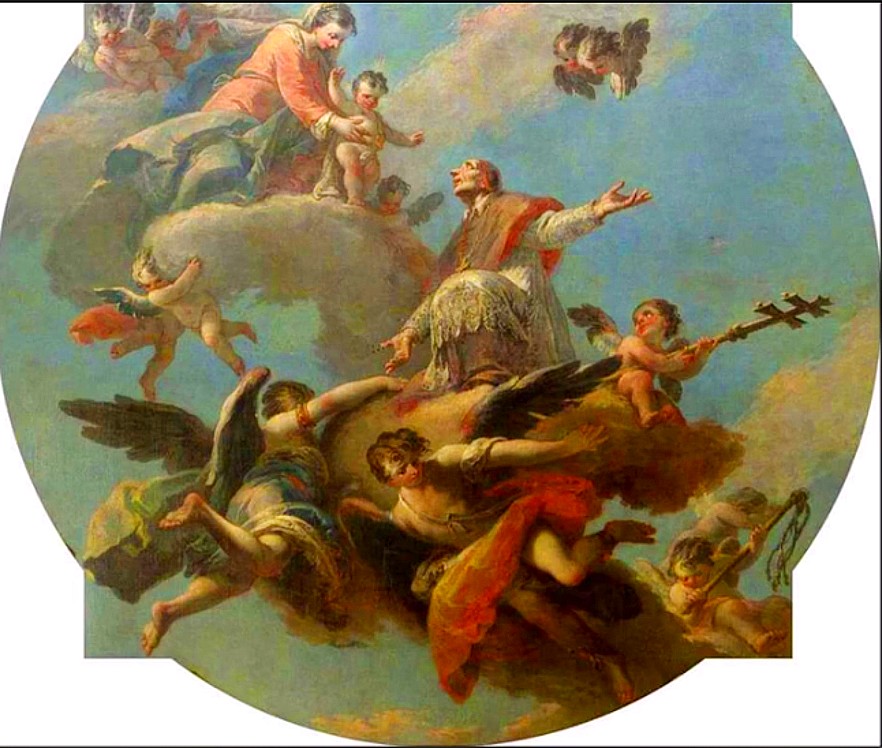
St Lawrence in Glory
He lay on the bare floor and not even in his last day, could he be persuaded to make use of a softer bed:
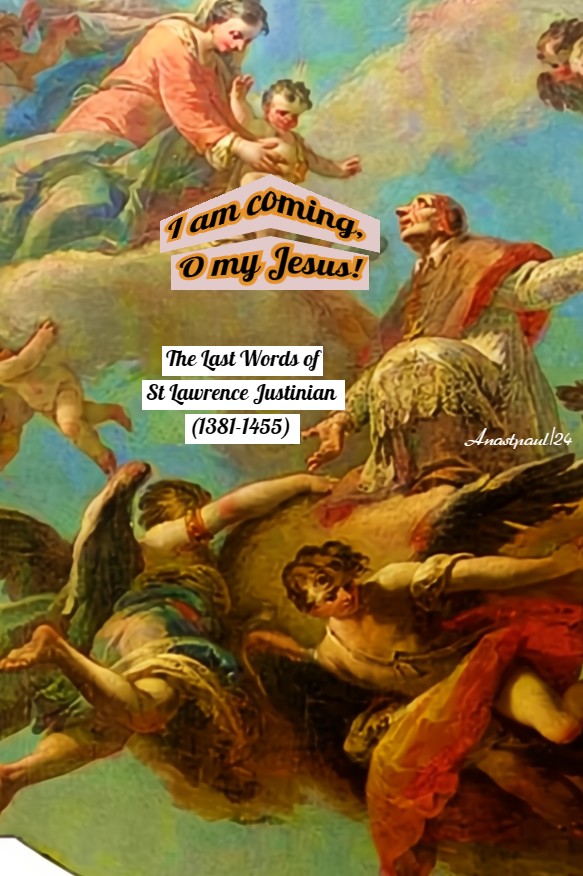
“Jesus Christ,” said he, “died upon the hard wood of the Cross and you desire that a sinner, like me, should lie, soft and comfortable!” After receiving the holy Sacraments, he gave his last instructions to those around him: “Keep the Commandments of the Lord,” said he, “nothing is more noble or excellent than to serve God.” After having finished his discourse, he raised his eyes to Heaven and said: “I am coming, O my Jesus!” and his soul went to God. Thus ended, in the seventy-third year of his age, the earthly career of this great and holy Patriarch. That his life in Heaven had begun, was known by the manner in which the Lord honoured his holy body, from which emanated a heavenly fragrance; as also, by the miracles which, at the intercession of the Saint, took place at his Tomb, in favour of the infirm and the possessed.
Saint/s of the Day – 13 August – Saints Hippolytus and Cassian (Died c235) Martyrs. St Hippolytus is the Patron Saint of – horses, prison guards, officers and workers’ In Austria: Sankt Pölten, Zell am See. In Italy: Bardonecchia, Bibbiena, Cassano Valcuvia, Fogliano di Cascia, Laterina, Rogeno. St Cassian is the Patron Saint of – parish clerks and secretaries, of stenographers (proclaimed on 23 December 1952 by Pope Pius XII), students, teachers, typists. In Italy – Bibbiena, Cassano Valcuvia, Comacchio, Imola, La Salle, Laterina, Macherio, Rogeno, San Casciano dei Bagni, San Casciano in Val di Pesa, San Cassiano a Vico, San Cassiano di Controne, San Cassiano di Moriano, Trecate, the Diocese of Bolzano-Bressanone, the Diocese of Brixenand Imola. Of Mexico City, Mexico, Of Las Galletas, Tenerife, Spain.
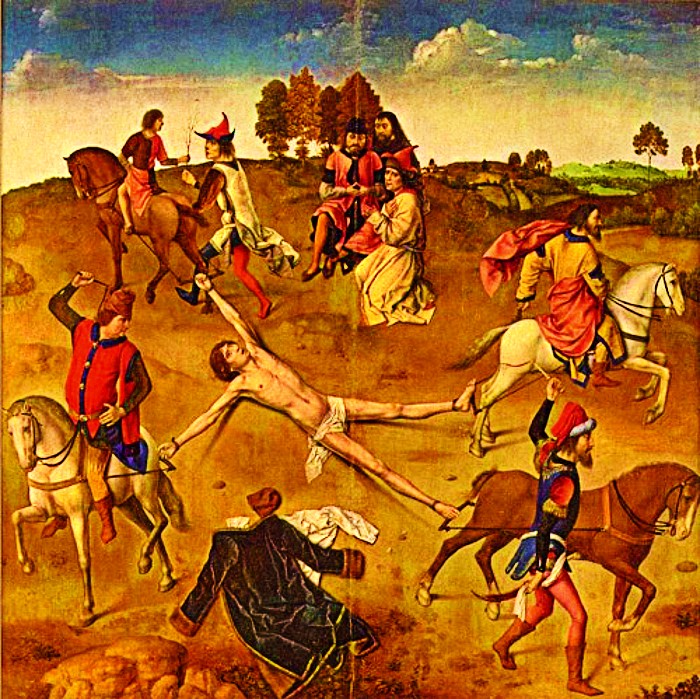
The Roman Martyrology reads today: “At Rome, blessed Hippolytus, Martyr, who gloriously confessed the Faith, under the Emperor Decius {mpt Valerian}. After enduring other torments, he was tied by the feet to the necks of wild horses and being cruelly dragged through briars and brambles and having all his body lacerated, he yielded his spirit.” AND: “At Imola, the birthday of St Cassian, Martyr. As he refused to worship idols, the persecutor called the boys whom the Saint taught and who hated him, giving them leave to kill him. The torment suffered by the Martyr was the more grievious, as the hand which inflicted it by reason of its weakness, rendered death more tardy.”
St Hippolytus and St Cassian, (Died c235) Martyrs By Fr Francis Xavier Weninger SJ (1805-1888)
St Hippolytus, an Officer of the body-guard of the Emperor Decius, had been born in the darkness of idolatry but he had become a Christian, with all his household, in consequence of witnessing the many miracles which St Lawrence performedwhile in the prison under his charge.
The Martyrdom of St Hippolytus
He had also been present when the Saint, lying on the red-hot gridiron, endured the most terrible tortures. At the sight of the heroism of St Lawrence, he was filled with the desire to announce himself a Christian but he was prevented by St Lawrence. But when this Martyr had gloriously ended his combat, Hippolytus, with the assistance of a Priest, named Justinus, buried the sacred remains with great devotion and veneration. The Emperor on being informed of it, had Hippolytus seized and brought before him. He asked him if it was true that he had become a Christian? Hippolytus answered firmly: “Yes, I am a Christian and, moreover, resolved to die such.” The emperor, who had always highly esteemed him, endeavoured, first by promises and then by menaces, to induce him to forsake Christ. As, however, all was unavailing, he caused him to be tortured.
He was accordingly stretched on the ground, whipped with scourges and beaten with clubs so fearfully that it was believed he could not survive. But God, by a visible miracle, prolonged his life. Keeping his eyes fixed upon Heaven, he frequently repeated: “I am a Christian, I suffer for Christ’s sake.”
After having been tormented for a long time, he was cast into prison and the Prefect received the order to behead him. Before executing this order, however, he went to the house of Hippolytus to secure his property. Finding the entire household had become Christians, he took them beyond the gates of the City and had them beheaded. Concordia, an old and holy matron, who had been Hippolytus’ nurse, was scourged until she expired because she encouraged the others to remain firm in their faith.
At last, Hippolytus was taken out of prison and fastened to the necks of two horses and dragged by them until he was torn to pieces and his heroic soul was received into the Presence of Him Whom he had so fearlessly confessed.
On the same day, although at another place, St Cassian suffered a Martyrdom of unprecedented cruelty. This Saint, was the Bishop of Brescia but had been banished from his See on account of his faith.
St Cassian
He intended to go to Rome and offer the Pope his services for the salvation of souls in some other place. On his way, he changed his mind and taking up his residence at Imola, a Town in Italy, he resolved to teach children to read and write, hoping that occasion would not be wanting to do good. In this apparently humble position, he was no less zealous than he had been in the administration of his Diocese. He taught the children with love and gentleness and endeavoured to inspire them with respect for the Christian faith, fear and horror of sin and love of virtue and piety.
He continued in this occupation with great zeal for some years, to the great benefit of young and old. Suddenly a terrible persecution of the Christians arose. Cassian was one of the first who were taken prisoners. The tyrant commanded him to sacrifice to the gods. The holy Bishop and teacher refused, as might have been expected and tried to convince the Judge of his fearful blindness in worshipping dumb idols or making gods of godless men.
The tyrant, furious at his arguments, ordered the executioners to strip him of his clothes and tie his hands behind his back and leave him exposed to the mercy of the children whom he had taken such pains to teach. The children, who had been taught that Cassian was a magician and consequently must die, a most painful death, took their sharp iron pencils with which, in those days, they wrote upon their wax tablets and pierced him with them till the blood ran profusely from his veins. This torture lasted long and was extremely painful. The Saint, however, never complained of the ingratitude of his pupils, nor gave a sign of impatience but praised and thanked the Lord until his soul went to Heaven to receive the Crown of Martyrdom.
Thought for the Day – 31 July – Meditations with Fr Richard Frederick Clarke SJ (1839-1900)
HUMILITY Meditations for a Month Today is the Last Meditation
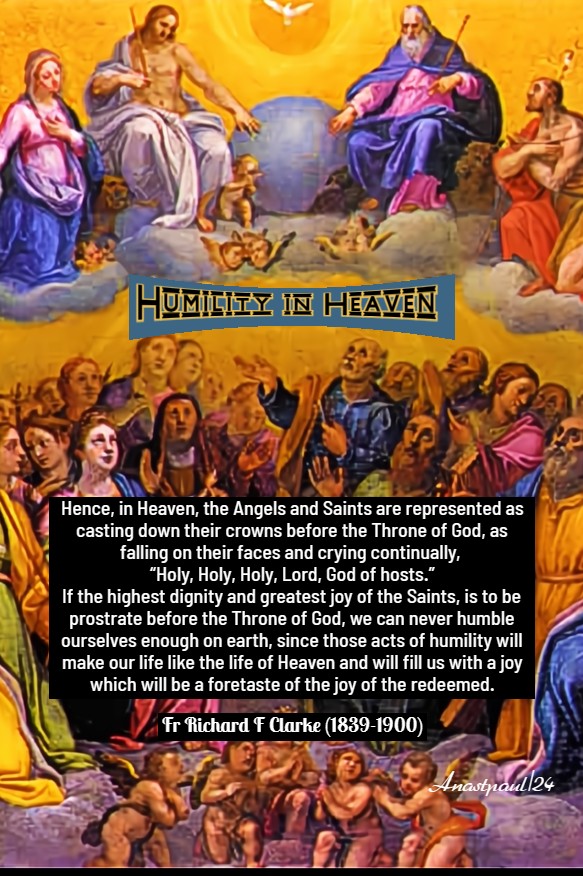
Humility in Heaven
Is there any place for humility among the Saints in Heaven? Or is it, like faith and hope, a virtue limited to this vale of tears? It might seem that in Heaven, there are no motives for humility – no sins, no imperfections, no defects of any kind, for which to humble ourselves. Yet, only in Heaven will our humility be perfected, for only in Heaven shall we have a thorough knowledge of God and a thorough knowledge of ourselves. This knowledge will make us recognise, even more than ever, our own nothingness and God’s Infinite Perfections. Our recognition of this, will make us forget ourselves, as we never can do on earth, therefore, God will be all in all to us.
Will this appreciation of our own nothingness be painful? No, it will be a source of eternal joy! For then we shall be able to rejoice in God. Our happiness will be unclouded by any interfering thought of self. Our admiration of His perfect Beauty will absorb all our faculties. Our absolute dependence upon Him, will be the truest independence. It will make us conformed to the Image of the Son of God, the chief glory, in Whose Sacred Humanity will be the result of its dependence on His Divine Nature.
Hence, in Heaven, the Angels and Saints are represented as casting down their crowns before the Throne of God, as falling on their faces and crying continually, “Holy, Holy, Holy, Lord, God of hosts.” If the highest dignity and greatest joy of the Saints, is to be prostrate before the Throne of God, we can never humble ourselves enough on earth, since those acts of humility will make our life like the life of Heaven and will fill us with a joy which will be a foretaste of the joy of the redeemed.
Our Morning Offering – 29 July – “The Month of the Most Precious Blood”
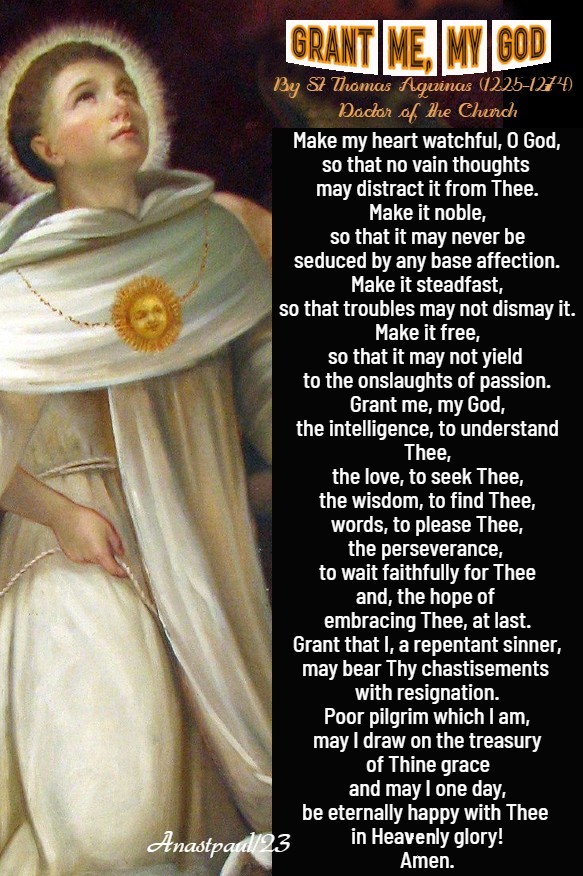
Grant Me, My God By St Thomas Aquinas (1225-1274) Angelic Doctor, Common Doctor
Make my heart watchful, O God, so that no vain thoughts may distract it from Thee. Make it noble, so that it may never be seduced by any base affection. Make it steadfast, so that troubles may not dismay it. Make it free, so that it may not yield to the onslaughts of passion. Grant me, my God, the intelligence, to understand Thee, the love, to seek Thee, the wisdom, to find Thee, words, to please Thee, the perseverance, to wait faithfully for Thee and, the hope of embracing Thee, at last. Grant that I, a repentant sinner, may bear Thy chastisements with resignation. Poor pilgrim which I am, may I draw on the treasury of Thine grace and may I one day, be eternally happy with Thee in Heavenly glory! Amen.
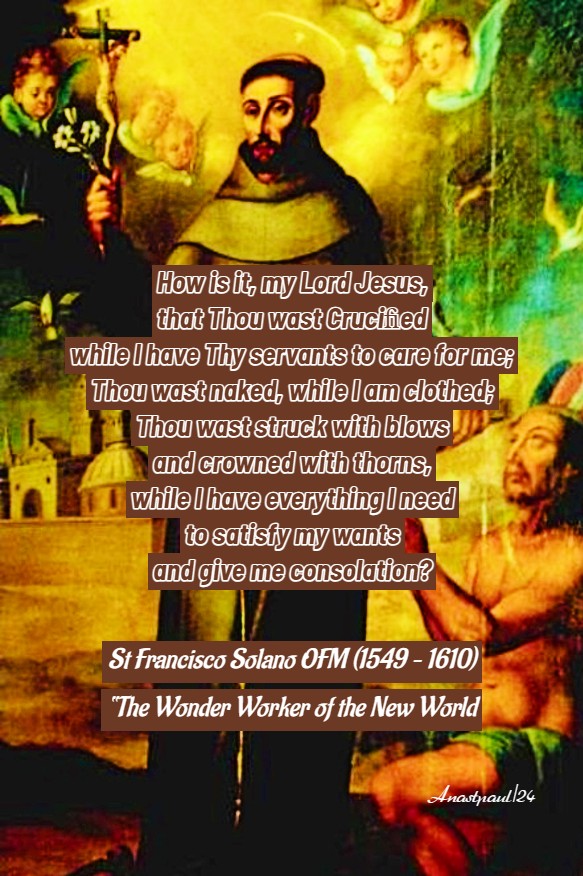
Quote/s of the Day – 24 July – St Francisco Solano OFM (1549 – 1610) “The Wonder Worker of the New World”
“How is it, my Lord Jesus, that Thou wast Crucified while I have Thy servants to care for me; Thou wast naked, while I am clothed; Thou wast struck with blows and crowned with thorns, while I have everything I need to satisfy my wants and give me consolation?”
“It is true that I am going to Heaven but on the strength of Christ’s Passion and Death; for myself, I am the greatest of sinners. But I will be a good friend to you when I reach my home in Heaven.”
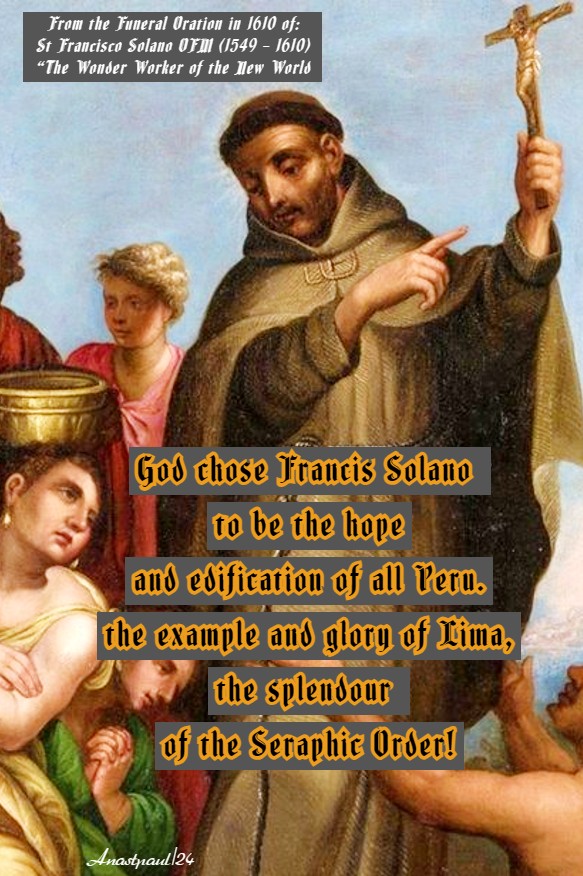
“God chose Francis Solano to be the hope and edification of all Peru. the example and glory of Lima, the splendour of the Seraphic Order!”
From the Funeral Oration in 1610
St Francisco Solano OFM (1549 – 1610) “The Wonder Worker of the New World
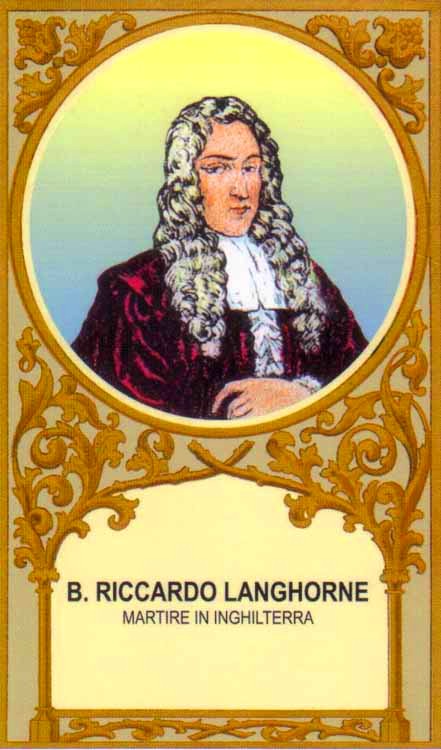
Saint of the Day – 14 July – Blessed Richard Langhorne (c1624-1679) Martyr Layman, Barrister. Born in c1624 in Little Wymondley, Hertfordshire, England and died on 14 July 1679 (aged 54–55) at Tyburn Tree, London, England by being hanged on a false charge of treason as part of the fabricated Popish Plot. He fell under suspicion because he was a Roman Catholic and because, he had acted as legal adviser to the Jesuits at a time of acute anti-Catholic hysteria.
Richard was the third son of William Langhorne, a Barrister and his wife, Lettice Needham, of Little Wymondley in Hertfordshire. He was admitted to the Inner Temple in May 1647 and called to the Bar in November 1654. He was a Catholic and provided legal and financial advice to the Society of Jesus in London. During the wave of anti-Catholic hysteria which followed the Great Fire of London of 1666, he was briefly arrested but quickly released.
His wife, Dorothy Legatt, was a Protestant from Havering in Essex. His sons, Charles and Francis were both Priests. When, in October 1677, Titus Oates was expelled from the English College at St Omer “for serious moral lapses” Charles Langhorne nevertheless, entrusted Oates with a letter to his father. Oates returned to St Omer with a letter from Richard thanking the Jesuits for all they had done for his sons.
When Oates and Israel Tonge, one of his accomplice, in September 1678, unleashed their entirely fictitious Popish Plot, a non-existent Catholic conspiracy to kill King Charles II, three Jesuits and a Benedictine were arrested. Following a detailed search of their papers (which failed to uncover any evidence of treason), Langhorne’s role as legal adviser to the Jesuits was discovered almost at once – he was arrested a week after the four Priests, although there was no evidence in the Priests’ papers that he had committed any crime. He was imprisoned at Newgate and charged with treason. Oates claimed and was corroborated by the notorious informer and confidence trickster, William Bedloe, that Langhorne’s earlier correspondence dealt with the conspiracy to kill the King.
He was tried on 14 June 1679. He was forced to defend himself, as a person charged with treason had no right then to Defence Counsel (this rule was not changed until the passage of the Treason Act in 1695). His main defence consisted of an attack on the character of the Crown’s principal Witnesses, Oates and Bedloe but since the Judges were well aware of the deplorable past lives of both men, this seems to have made little impression.He also called a number of students from St Omer to prove that Oates had been at the College on the crucial dates when he claimed to be in London but the public mood was so hostile to Catholics that the Witnesses were barely able to make themselves heard above the roar of the crowd and some of them were assaulted as they left the Court. Ironically, some of the same Witnesses appeared for the prosecution at Oates’ own trial for perjury in 1685, where the crowd treated them courteously and the Jury was told to weigh their evidence with the greatest seriousness. (Such evil contradicitions and treachery within the Courst of Justic [!] within the space of 6 years!)
William Scroggs, the Lord Chief Justice, although violently prejudiced against Catholic Priests, was relatively tolerant of Catholic laymen. His summary was reasonably fair, by the standards of the time and he did warn the Jury that on no account should an innocent man’s life be taken away. Nonetheles, Langhorne was found guilty of High Treason.
As the result of a petition by his wife, a ‘true Protestant’ he received a month’s reprieve to tidy the affairs of his clients. Some suggest that the Crown was still hoping that he would confess and it seems he was offered a Royal Pardon if he did so. Langhorne was prepared, presumably with the consent of the Jesuit Fathers, to give the Crown a list of all the Jesuit properties in England, (which turned out to be much less extensive than the Crown, misled by Oates’s wild exaggeration of the Jesuits’ wealth, had expected) but, he steadily maintained his innocence.
Richard wrote a lengthy Devotion of Prayers and Meditations in verse, which was later published. He was executed at Tyburn Tree, London, on 14 July 1679.
His last words to his Executioner were:
“I am desirous to be with my Jesus. I am ready and you need stay no longer for me.”
Public opinion was slowly turning against the Plot and Langhorne’s courageous death made a favourable impression on the watching crowd.
The Martyr’s wife, Dorothy, although a militant Protestant, who even sometimes provided information against the Catholics, remained faithful to her husband until the end and perhaps later converted to Catholicism, as suggested by Burnet in his emorandum of the Popish Conspiracy.
Langhorne’s Memorial remains, containing the story of his arrest and imprisonment, written in Newgate and published, by his son, Father Richard, three months after his death, together with the Prayers and Meditations he composed while awaiting the supreme hour, (London 1679). Father Richard later also published , written by his father in defence of Charles II’s declaration of 15 March 1672. We also have some letters of the Martyr preserved by two of his friends, the Protestant Lord Christopher Hatton and the Catholic William Blundell.
Begun in Rome on 9 December 1886 by order of Pope Leo XIII, the cause for Langhorne’s Beatification was concluded under the Pontificate of Pope Pius XI, with his inscription in the catalogue of the Blesseds on 15 December. 1929
Saint of the Day – 28 June –Saint John Southworth (1592-1654) Priest Martyr, Missionary. Known as ‘The Parish Priest of Westminster.’ Born in 1592 at Samlesbury, Lancashire, England and died by being hanged, drawn and quartered on 28 June 1654 at Tyburn Tree, London, England. Patronage – the Clergy of the Westminster Diocese. His remains were purchased by the Spanish Ambassador to England and were sent to the English College in Douai, France. There the Relics were hidden to prevent destruction during the French Revolution and were only rediscovered in 1927 and are now housed at Westminster Cathedral, London. Additional Memorials – 27 and 28 June in the Diocese of Westminster,25 October as one of the Forty Martyrs of England and Wales, 29 October as one of the Martyrs of Douai.
John was born in 1592 at Samlesbury Hall, near Preston in Lancashire, to a recusant Catholic family. He entered the English College in Douai and was Ordained a Priest in 1618.
Upon returning to England, he ministered in London and Lancashire, with a brief period as Chaplain to the Benedictine Nuns in Brussels.
John was first arrested and sentenced to death in 1626 at Lancashire Castle but reprieved through the efforts of Queen Henrietta Maria, the French wife of King Charles I. He was to be arrested three more times, spending much of the rest of his life effectively on parole.
Throughout the 1630’s he attended to the Plague victims in Westminster, administering the Sacraments and helping those in need, thus gaining him selfthe nickname ‘The Parish Priest of Westminster.’
In 1654 John was arrested for the last time, and tried at the Old Bailey in London. By this stage the courts were weary of executing Catholics and a more lenient sentence was likely. However, refusing to deny his Priesthood, John was sentenced to death.
On the 28 June 1654, John Southworth was hanged, drawn and quartered at Tyburn Tree after a long gallows speech.
“This gallows I look on as His Cross which I gladly take to follow my dear Saviour.”
Following his execution, the Spanish Ambassador bought the body for 40 Guineas, had it stitched back together and embalmed before returning it to the English College in Douai for veneration. During the war between England and France in 1793, the lead coffin containing the body of John Southworth was buried in an unmarked grave for safe keeping, where it remained hidden until 1927 when the College was demolished to make way for housing.
In 1929 John Southworth was Beatified and his major Relics were sent to St Edmund’s College, in Ware, Hertfordshire, England the successor of the English College in Douai, before being transferred to Westminster Cathedral in 1930 (pictured below).
The names of the 40 Martyrs of England and Wales which adorn the ceiling in the ‘Chapel of St George and the English Saints’ in Westminster Cathedral, where the body of St John is enshrined.
Our Morning Offering – 10 April – “The Month of the Resurrection and the Blessed Sacrament” – Ferial Day – Wednesday in the Second Week of Easter
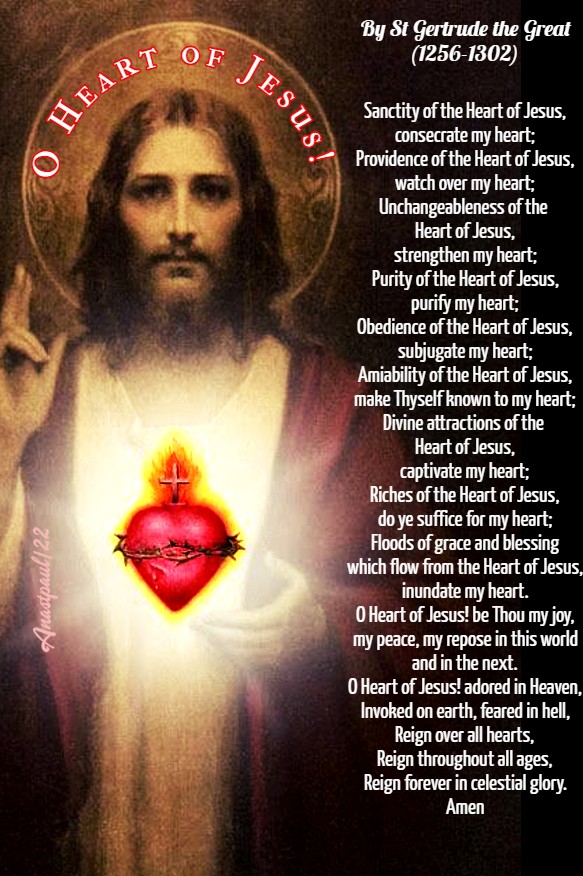
O Heart of Jesus! By St Gertrude the Great (1256-1302)
Sanctity of the Heart of Jesus, consecrate my heart; Providence of the Heart of Jesus, watch over my heart; Unchangeableness of the Heart of Jesus, strengthen my heart; Purity of the Heart of Jesus, purify my heart; Obedience of the Heart of Jesus, subjugate my heart; Amiability of the Heart of Jesus, make Thyself known to my heart; Divine attractions of the Heart of Jesus, captivate my heart; Riches of the Heart of Jesus, do ye suffice for my heart; Floods of grace and blessing which flow from the Heart of Jesus, inundate my heart. O Heart of Jesus! be Thou my joy, my peace, my repose in this world and in the next. O Heart of Jesus! adored in Heaven, Invoked on earth, feared in hell, Reign over all hearts, Reign throughout all ages, Reign forever in celestial glory. Amen
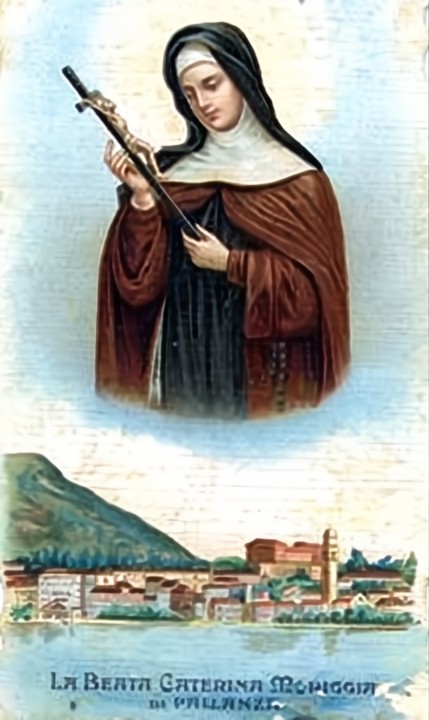
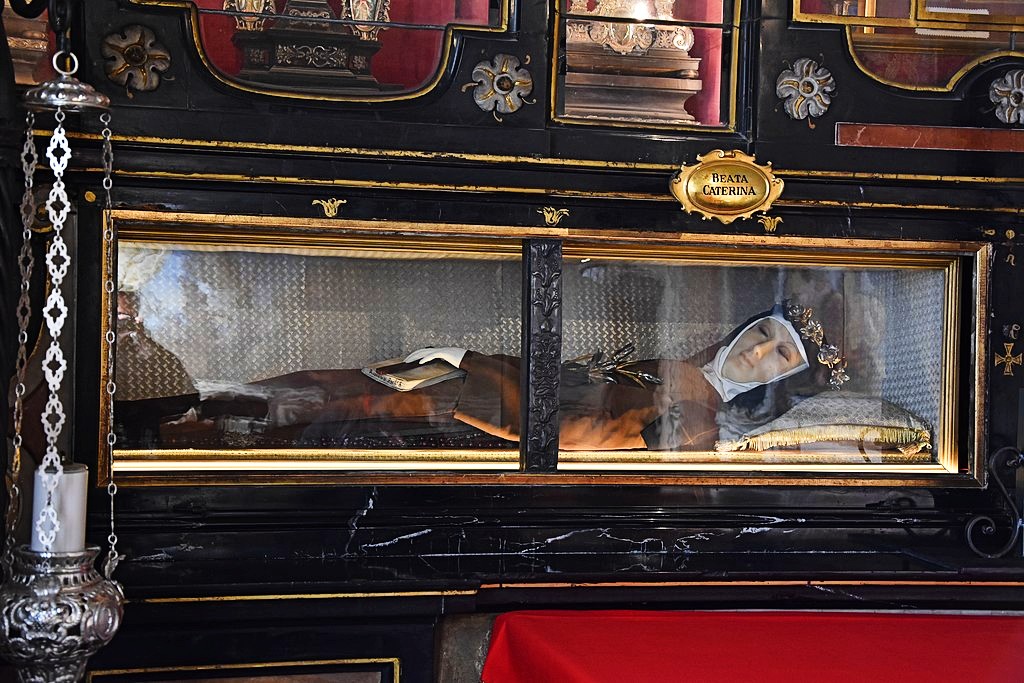
Saint of the Day – 6 April – Blessed Catherine of Pallanza (c1437-1478) Virgin, Hermit, Ascetic, Mystic, Prioress, Spiritual Advisor graced with the charism of prophecy. Born in c1437 in Pallanza, Italy as Catarina Morigi and died on 6 April 1478 at Sacra Monte sopra Varese Monastery, Varese, Italy of natural causes aged 51 years. Also known as – Caterina Morigi di Pallanza, Catherine Morigi, Catarina Morigi Catarina of Pallanza, Katarina … Additional Memorial – 27 April (Ambrosian Rite). Her cult was confirmed on 16 September 1769 by Pope Clement XIV. Her body is incorrupt.
Catarina was born around 1437 in Pallanza, a small village in the Diocese of Novara in the Piedmont region of northern Italy. Her entire family died in a plague epidemic when she was very young and she was adopted by a woman who lived in nearby Milan.
At the age of 20 she was deeply moved after hearing a sermon on the Passion of Christ, prostrating herself before the Crucifix in the Church and consecrating her virginity to God. It was not long after this that she received a vision of the Crucified Jesus Who said to her: “Beloved daughter Catarina … I have selected for you the place called Santa Maria on the Mountain.” Catarina immediately retired to a wild and lonely mountain region above Varese near Milan which had often been used by hermits and, where Saint Ambrose had built an Altar in honour of the Virgin Mary .
She joined a group of female Hermits under the leadership of a Priest in charge of St Ambrose’ Sanctuary. Older sources write that she was the first woman known to have lived there as a Hermit but this is obviously not correct. Catarina lived this life for fifteen years and even in an area famous for the severe penances of its Hermit residents, Catarina’s asceticism was so extreme that it attracted attention. She fasted ten months of the year and was always dependent on gifts of food brought to her at irregular intervals by those who sought her prayers and advice.
Despite her desire to be left alone, a group of five female disciples joined her. The first (in 1454) was Blessed Juliana Puricelli of Busto Arsizio and the others came in 1460. In 1474, Catarina organised them as a duly constituted community with herself as the Prioress, under the Rule of Saint Augustine. Pope Sixtus IV (1471-1484) approved the community. The Monastery was dedicated to Our Lady of the Mountain and the place was called Sacra Monte sopra Varese. The Nuns received permission to wear the Habit of the Poor Clares. Catherine served as Prioress for two years before she died.
Catherine died on 6 April 1478 at Sacra Monte sopra Varese. On her deathbed she was given a Crucifix and she kissed it and said: “I see my beloved Crucified One.” Her Confessor then said to her: “Behold your Crucified One” and she replied: “I have Him engraved upon my heart.”
Even while she was alive, she was graced with prophetic abilities and a local cult developed very quickly. In the 1730s, her mortal remains were translated to a special Chapel built in her honour, where her body is still venerated today. She was Beatified on 16 September 1769 when her cult was confirmed by Pope Clement XIV (1769-1774). At the same time, Blessed Juliana Puricelli’s cult was also confirmed. Catherine’s memorial day is the day of her death 6 April while 27 April is her Feast Day in the Ambrosian Liturgy (together with Juliana).
One Minute Reflection – 29 March – Good Friday – The Passion of Our Lord Jesus Christ according to St John 18:1-40.19,1-42. – Scripture search here: https://www.drbo.org/
“There they crucified Him and with Him two others, one on either side and Jesus between them. ” – John 19:18
REFLECTION – “Truly, you are a hidden God!” (Is 45:15). Why hidden? Because He had neither form nor beauty, yet power was in His Hands. It was there His fortitude was hidden.
Was He not hidden when He submitted His Hands to brutes and His Palms received the nails? The print of the nails gleamed on His Hands and His innocent Side received the wound. They shackled His Feet in fetters, the iron pierced His soles and His Feet were fastened to the tree. These wounds did God suffer on our behalf, at the hands of His own people, in His own home. O how marvellous are His Wounds by which the wounds of the world were healed! How victorious His Wounds, by which He slew death and stung hell! … Therefore, O Church, O dove, You have coverts in the rock and a hollow in the wall in which to rest (cf. Sg 2:14). …
And what will you do … when He comes in the clouds with great power and majesty? (cf Mt 24:30) He will come down with Heaven and earth ablaze and by the terror of His coming, He will dissolve the elements. When He has come, the Sign of the Cross will be seen in the sky and the beloved One will show the scars of His Wounds and the prints of the nails, by which He was transfixed in His own home!” … St Amadeus of Lausanne (1108-1159) – Cistercian Monk, Bishop
PRAYER – Deliver us, we beseech Thee, O Lord, from all evils, past, present and to come and by the intercession of the blessed and glorious ever Virgin Mary, Mother of God and of the Holy Apostles, Peter and Paul and of all the Saints, mercifully grant peace in our days, that through the assistance of Thy mercy we may be always free from sin and secure from all disturbance. Through Jesus Christ, Thy Son our Lord, Who lives and reigns with Thee, in the unity of the Holy Ghost, God, world without end. Amen. Faithful Cross! above all other, One and only noble Tree! None in foliage, none in blossom, None in fruit thy peer may be. Sweetest wood and sweetest iron, Sweetest weight is hung on thee. (Antiphons).
Our Morning Offering – 25 March – Monday in Holy Week
A Prayer of the Passion By St Melito of Sardis (Died 180) Bishop of Sardis, Apologist, Father
Lord Jesus Christ, You were bound as a ram, You were shorn like a lamb, You were led to the slaughter like a sheep, You bore the wood of the Cross on Your shoulders, You were led up the hill of Calvary, You were displayed naked on the Cross, You were nailed to the bitter Cross by three spikes, You delivered Your last Seven Words from the Cross You died on the Cross, with a shout of victory, You were buried in noble Joseph’s rock-hewn tomb, By Your boundless suffering on our behalf, fix our eyes unceasingly on Your broken Body and the Blood that poured from Your Hands, Feet and Side. By the Holy Sacrifice of the Mass that renews each day Your Sacrifice of the Cross on our Altars, apply the merits of the Cross to all humanity and, especially to those who worship it daily and who offer themselves back to You, our great High Priest and perpetually Intercessor, before the Eternal Throne of God. You live and reign, through all the ages of ages. Amen.
One Minute Reflection – 22 March – Friday in Passion Week, the Fifth Friday in Lent, Our Lady of the Seven Sorrows – Judith 13:22, 25, John 19:25-27 – Scripture search here: https://www.drbo.org/
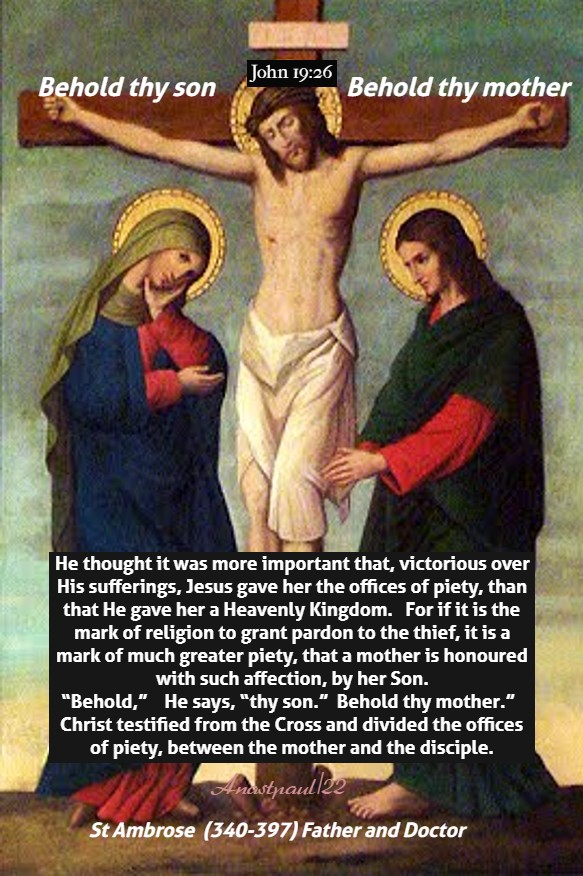
REFLECTION – “Mary, the Mother of the Lord, stood by her Son’s Cross. No-one has taught me this but the holy Evangelist John. Others have related how the earth was shaken at the Lord’s Passion, the sky was covered with darkness, the sun withdrew itself and how, the thief was, after a faithful confession, received into paradise. John tells us what the others have not told, how the Lord, while fixed on the Cross called to His Mother. He thought it was more important that, victorious over His sufferings, Jesus gave her the offices of piety, than that He gave her a Heavenly Kingdom. For if it is the mark of religion to grant pardon to the thief, it is a mark of much greater piety, that a mother is honoured with such affection, by her Son. “Behold,” He says, “thy son.” “Behold thy mother.” Christ testified from the Cross and divided the offices of piety, between the mother and the disciple.
Nor was Mary below what was becoming the Mother of Christ. When the Apostles fled, she stood at the Cross and with pious eyes beheld her Son’s wounds. For she did not look to the death of her offspring but to the salvation of the world. Or perhaps, because that “royal hall” knew, that the redemption of the world would be through the death of her Son, she thought that by her death, she also might add something to that universal gift. But Jesus did not need a helper, for the redemption of all, Who saved all without a helper. This is why He says, “I am counted among those who go down to the pit. I am like those who have no help.” He received indeed, the affection of His Mother but sought not another’s help. Imitate her, holy mothers, who in her only dearly beloved Son, set forth so great an example of maternal virtue. For neither have you sweeter children, nor did the Virgin seek the consolation of being able to bear another son.” – St Ambrose (340-397) Archbishop of Milan, Great Western Father and Doctor (Letter 63)
PRAYER – O God, in Whose Passion the sword, according to the prophecy of blessed Simeon, pierced through the soul of Mary, the glorious Virgin and Mother, mercifully grant that we, who reverently commemorate her piercing through and her suffering, may, by the interceding glorious merits of all the saints faithfully standing by the Cross, obtain the abundant fruit of Thy Passion. Through the same Jesus Christ, Thy Son our Lord, Who lives and reigns with Thee, in the unity of the Holy Ghost, God, world without end. Amen (Collect).
Our Lenten Journey with the Angels and the Saints – 17 March – Passion Sunday and the Feast of St Patrick (c386-461) “The Apostle of Ireland,” Bishop, Confessor, Missionary. – Hebrews 9:11-15, John 8:46-59 – Scripture search here: https://www.drbo.org/
“To execute upon them the judgement which is written, this glory is to all His saints. Alleluia.” Psalm 149:9
“Your father Abraham rejoiced to see My day, he saw it and was glad.” John 8:56
Binding Ourselves
St Patrick (c386-461) “The Apostle of Ireland”
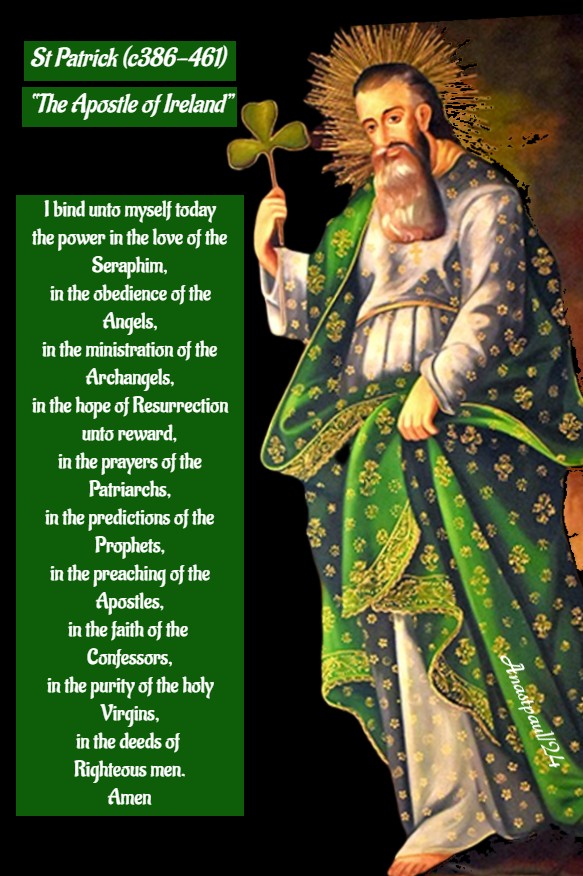
“The man of God, Patrick, was marvellously favoured with heavenly visions and revelations in prayer. ‘When,’ says his biographer, ‘he everyday, in the Mass, sacrificed the Son to the Father, or devoutly recited the Apocalypse of St John, it was granted to him to see the heavens opened and Jesus standing there, surrounded by a multitude of Angels and whilst he meditated on these great visions, his soul was altogether lost in God.’ Three times in the week the Angel Victor, visited and conversed with him, filling his soul with celestial consolations. The labours of the day, amongst men, seem to have been less arduous than those of the night with God.” (The Life of St Patrick, Apostle of Ireland)
Prayer of St Patrick:
I bind unto myself today the power in the love of the Seraphim, in the obedience of the Angels, in the ministration of the Archangels, in the hope of Resurrection unto reward, in the prayers of the Patriarchs, in the predictions of the Prophets, in the preaching of the Apostles, in the faith of the Confessors, in the purity of the holy Virgins, in the deeds of Righteous men. Amen
























 AnaStpaul
You must be logged in to post a comment.