Quote/s of the Day – 18 December – “The Month of the Divine Infancy and the Immaculate Conception of the Blessed Virgin Mary” – The Feast of Our Lady of Expectation
“The Lord is near. Have no anxiety …”
Philippians 4:5-6

“Let your door stand open to receive Him, unlock your soul to Him, offer Him a welcome in your mind and then you will see the riches of simplicity, the treasures of peace, the joy of grace. Throw wide the gate of your heart, stand before the Sun of the Everlasting Light!”
St Ambrose (340-397) Father and Doctor of the Church

“He became small because you were small – understand how great He is and you will become great along with Him. This is how houses are built, how the solid walls of a building are raised. The stones brought to construct the building increase, you too, increase, understanding how great Christ is and how He, Who appeared to be small, is great, very great indeed! …”
St Augustine (354-430) Father & Doctor of the Church
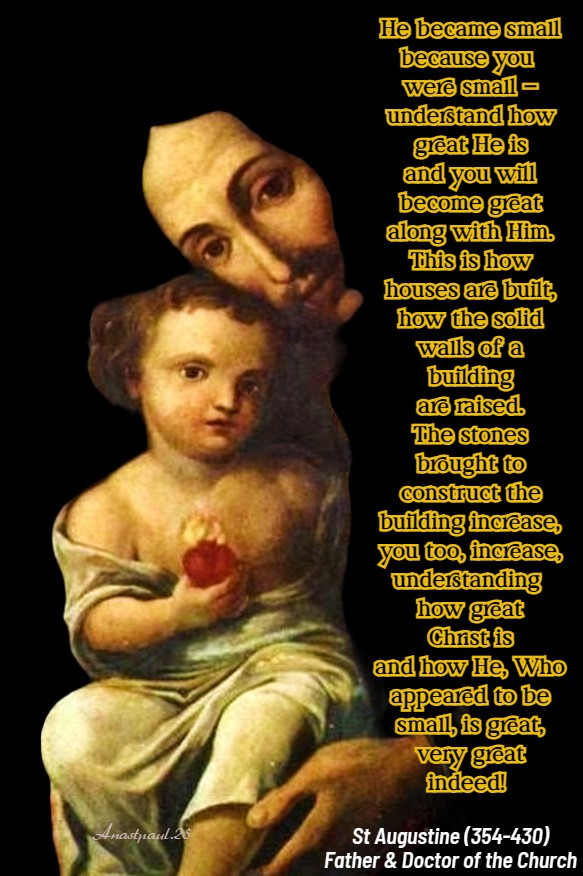
“In adoring our Saviour’s birth, it is our origin we celebrate. Christ’s temporal generation is the source of the Christian people, the birth of His Mystical Body. All of us encounter in this Mystery, a new birth in Christ.”
St Pope Leo the Great (400-461) Father & Doctor of the Church
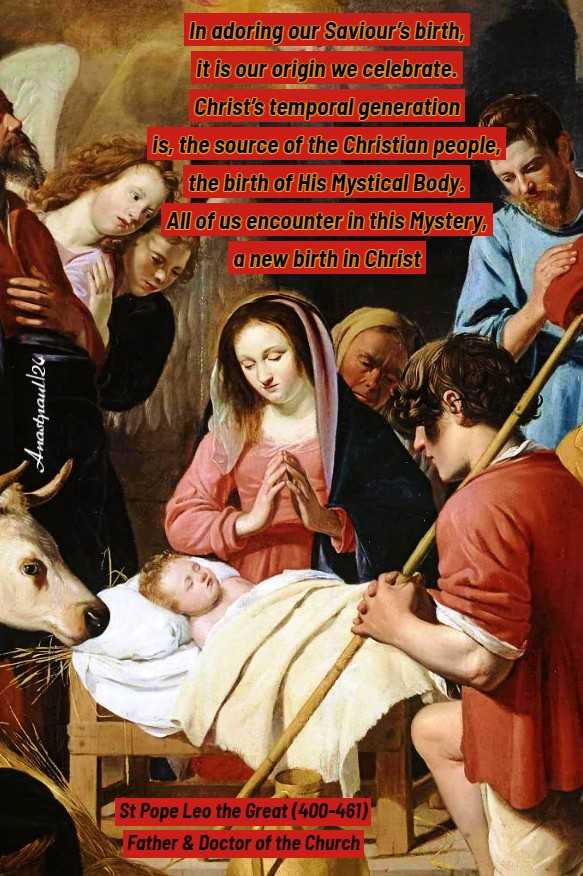
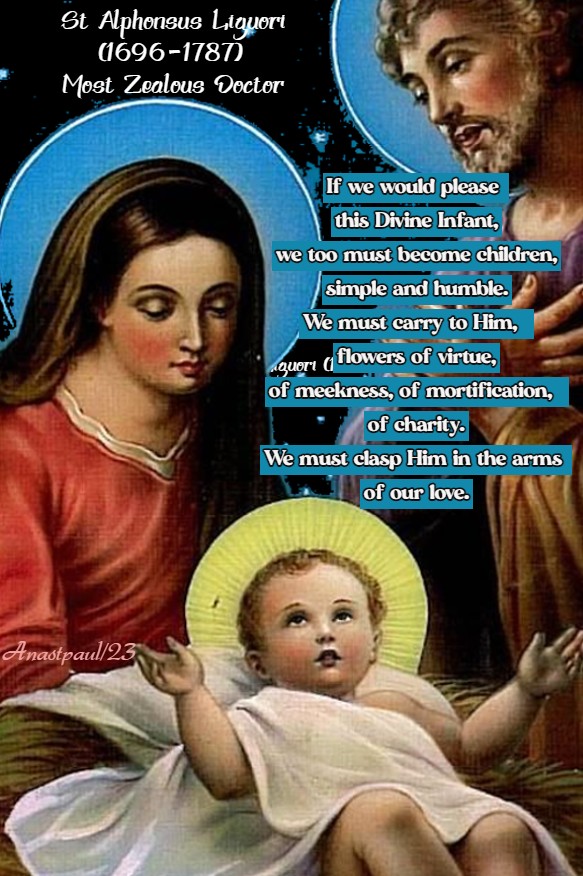
“If we would please this Divine Infant, we too must become children, simple and humble. We must carry to Him, flowers of virtue, of meekness, of mortification, of charity. We must clasp Him in the arms of our love.”
St Alphonsus Liguori (1696-1787) Most Zealous Doctor
Thought for the Day – 30 November – Meditations with Antonio Cardinal Bacci (1881-1971)
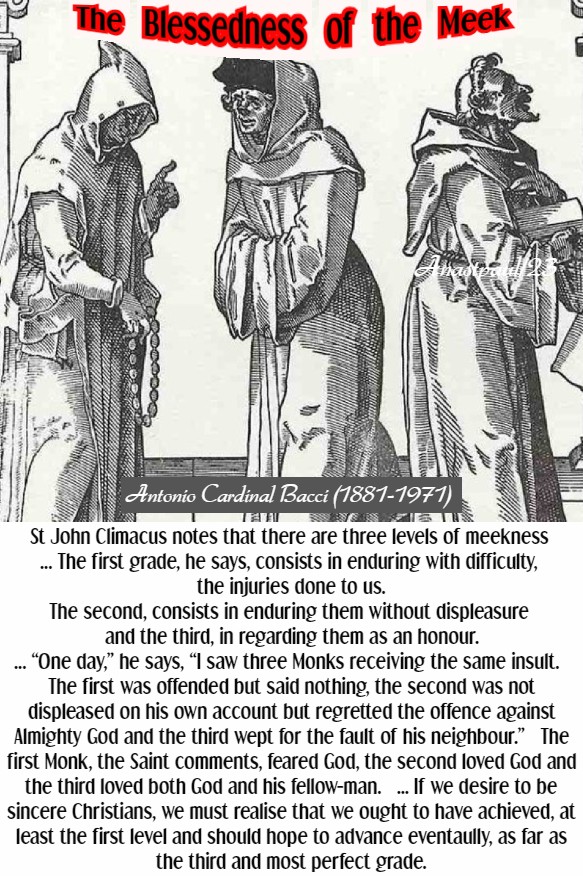
The Blessedness of the Meek
“St John Climacus notes that there are three levels of meekness (Dcala Paradist pp 296-298). The first grade, he says, consists in enduring with difficulty, the injuries done to us. The second, consists in enduring them without displeasure and the third, in regarding them as an honour.
Those who reach the first level are to be congratulated, those who reach the second are to be applauded but, those in the third and highest category, are really blessed by God.
“One day,” he says, “I saw three Monks receiving the same insult. The first was offended but said nothing, the second was not displeased on his own account but regretted the offence against Almighty God and the third wept for the fault of his neighbour.” The first Monk, the Saint comments, feared God, the second loved God and the third loved both God and his fellow-man.
At What stage of perfection in this virtue can we claim to have arrived? If we desire to be sincere Christians, we must realise that we ought to have achieved, at least the first level and should hope to advance eventaully, as far as the third and most perfect grade.”
One Minute Reflection – 31 October – “The Month of The Most Holy Rosary and The Holy Angels” – The Vigil of All Saints – Apocalypse 5:6-12 – Luke 6:17-23 – Scripture search here: https://www.drbo.org/
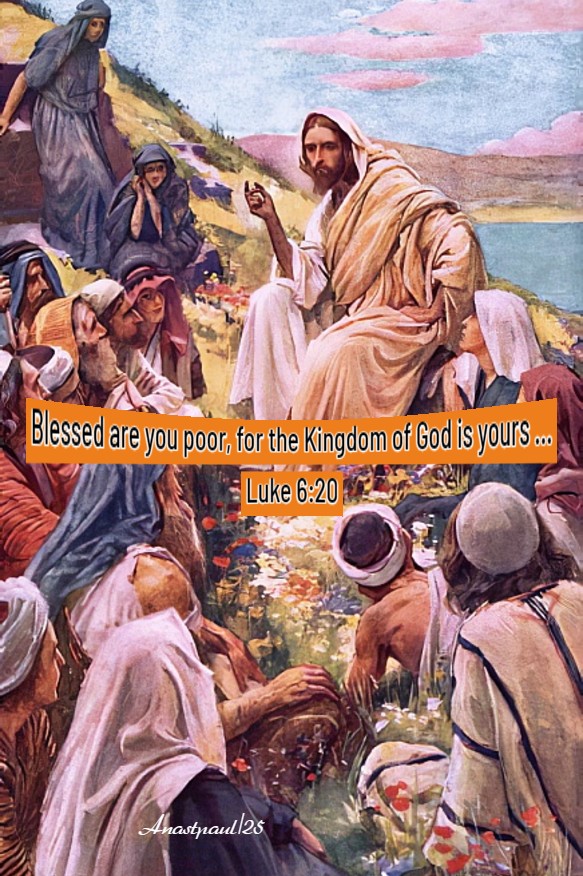
“And He, lifting up His Eyes on His disciples, He said: “Blessed are you poor, for the Kingdom of God is yours …” – Luke 6:20
REFLECTION – “Let us examine how St Luke encompassed the eight blessings into the four. We know, there are four Cardinal Virtues – temperance, justice, prudence and fortitude. One who is poor in spirit, is not greedy. One who weeps is not proud but is submissive and tranquil. One who mourns, is humble. One who is just does not deny that which he knows is given jointly to all. One who is merciful, gives away his own goods. One who bestows his own goods, does not seek another’s, nor does he contrive a trap for his neighbour. These virtues are interwoven and interlinked, so that one who has one, may be seen to have several and a single virtue befits the Saints. Where virtue abounds, the reward too abounds …. Thus temperance ,has purity of heart and spirit, justice has compassion, patience has peace and endurance has gentleness.
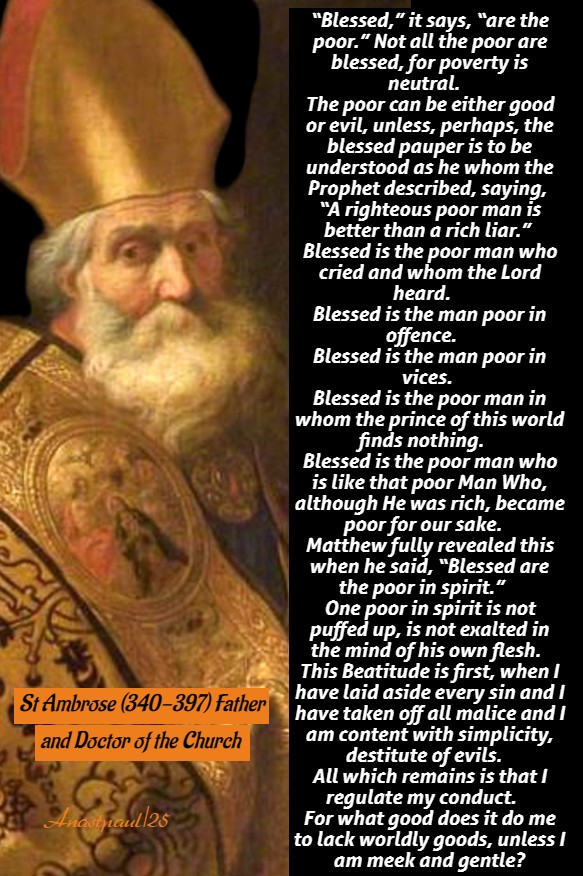
“Blessed,” it says, “are the poor.” Not all the poor are blessed, for poverty is neutral. The poor can be either good or evil, unless, perhaps, the blessed pauper is to be understood as he whom the Prophet described, saying, “A righteous poor man is better than a rich liar.” Blessed is the poor man who cried and whom the Lord heard. Blessed is the man poor in offence. Blessed is the man poor in vices. Blessed is the poor man in whom the prince of this world finds nothing. Blessed is the poor man who is like that poor Man Who, although He was rich, became poor for our sake. Matthew fully revealed this when he said, “Blessed are the poor in spirit.” One poor in spirit is not puffed up, is not exalted in the mind of his own flesh. This beatitude is first, when I have laid aside every sin and I have taken off all malice and I am content with simplicity, destitute of evils. All which remains is that I regulate my conduct. For what good does it do me to lack worldly goods, unless I am meek and gentle?
Although there are many charms of delights in riches, yet there are more incentives to practice virtues. Although virtue does not require assistance and the contribution of the poor person is more commended than the generosity of the rich, yet with the authority of the heavenly saying, He condemns not those who have riches but those who do not, know how to use them. The pauper is more praiseworthy who gives with eager compassion and is not restrained by the bolts of looming scarcity. He thinks that he ,who has enough for nature, does not lack. So the rich person is the more guilty, who does not give thanks to God for what he has received but vainly hides wealth, given for the common use and conceals it in buried treasures. Then the offence consists, not in the wealth but, in the attitude.
Purify yourself with your tears. Wash yourselves with mourning. If you weep for yourself, another will not weep for you… One who is a sinner weeps for himself and rebukes himself that he may become righteous, for just people accuse themselves of sin. Let us pursue order for it is written, “Set in order love in me.” I have laid down sin. I have tempered my conduct. I have wept for my transgressions. I begin to hunger. I hunger for righteousness. The sick, when he is seriously ill, does not hunger, for the pain of the illness excludes hunger. What is the hunger for righteousness? What is the bread of which it is said, “I have been young and am old and I have not seen the righteous man forsaken, nor his seed begging bread?” Surely one who is hungry seeks increase of strength. What greater increase of virtue is there, than the rule of righteousness? – St Ambrose (340-397) Father and Doctor of the Church (Exposition on the Gospel of Luke, #5).
PRAYER – Multiply Thy grace upon us, O Lord our God and grant that by following in holiness of life, those whose glorious festival we anticipate, we may attain to their bliss. Through Jesus Christ, Thy Son our Lord, Who lives and reigns with Thee, in the unity of the Holy Ghost, God, world without end. Amen (Collect).
Thought for the Day – 24 October – Meditations with Antonio Cardinal Bacci (1881-1971)
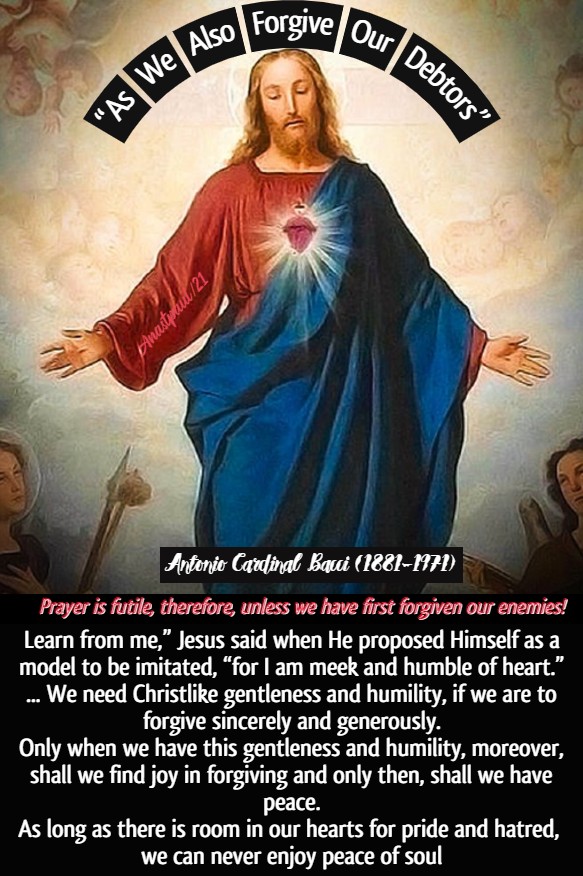
“Month of the Holy Rosary” “As We Also Forgive Our Debtors”
“If thou art offering thy gift at the altar,” Jesus tells us “and thou remember that thy brother has anything against thee, leave thy gift before the altar and go first to be reconciled to thy brother and then come and offer thy gift” (Mt 5:23-24). Prayer is futile, therefore, unless we have first forgiven our enemies!
“Learn from me,” Jesus said when He proposed Himself as a model to be imitated, “for I am meek and humble of heart.” Then He added, “you will find rest for your souls” (Cf Mt 11:29). The foundation of our hatred, anger and resentment, is always our wounded pride. We need Christlike gentleness and humility, if we are to forgive sincerely and generously. Only when we have this gentleness and humility, moreover, shall we find joy in forgiving and only then, shall we have peace. As long as there is room in our hearts for pride and hatred, we can never enjoy peace of soul!”
Thought for the Day – 2 October – Meditations with Antonio Cardinal Bacci (1881-1971)
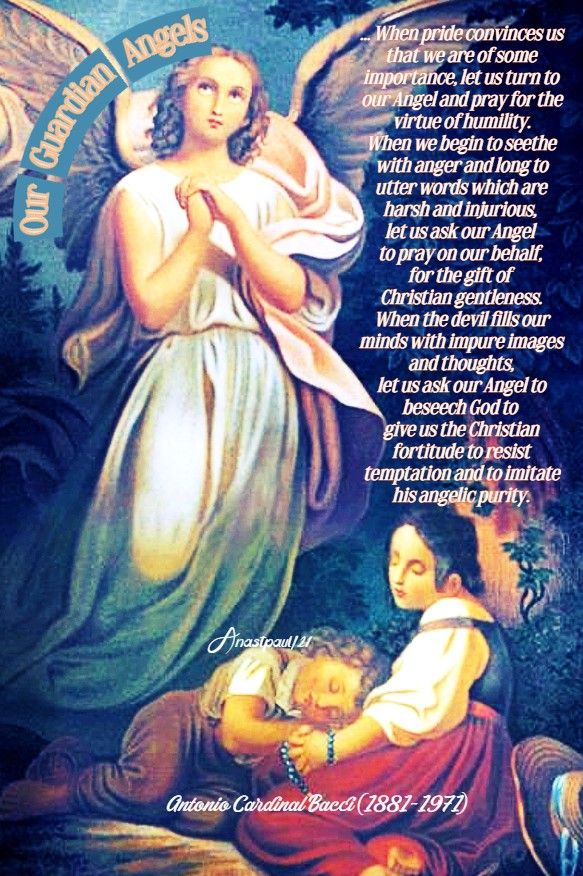
Our Guardian Angels
“The realisation that our Guardian Angel is always close at hand, should be a warning to us. It should prevent us from doing anything displeasing to God. Would we venture to do anything unbecoming in the presence of our Father or Mother, or of anyone for whom we have any regard? Definitely not and still less, should we dare to perform an evil action in the presence of our Angel, to whom we owe such gratitude and in the presence of God, our Creator, Lord and Redeemer, Who could, at any moment, snap the thread which binds us to life and plunge us into eternity.
Furthermore, when pride convinces us that we are of some importance, let us turn to our Angel and pray for the virtue of humility. When we begin to seethe with anger and long to utter words which are harsh and injurious, let us ask our Angel to pray on our behalf, for the gift of Christian gentleness. When the devil fills our minds with impure images and thoughts, let us ask our Angel to beseech God to give us the Christian fortitude to resist temptation and to imitate his angelic purity.
Finally, when tepidity is sapping the vigour of our interior life, let us pray to our Guardian Angel in the hope of obtaining a share in his intimate union with God.
Let us pray the Guardian Angel prayer or at least say: “My Guardian Angel enlighten me. My Guardian Angel help me. My Guardian Angel, protect me.” Amen.”
Thought for the Day – 21 September – Meditations with Antonio Cardinal Bacci (1881-1971)
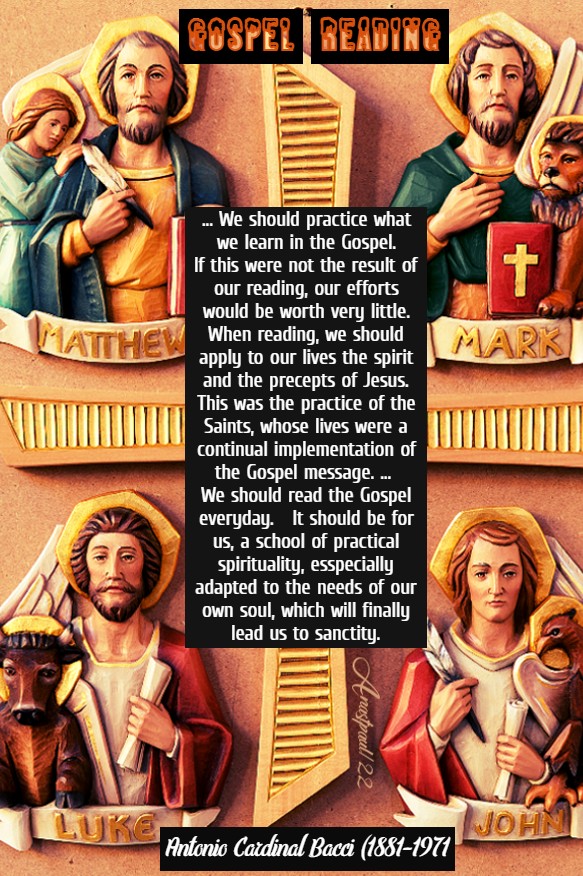
Gospel Reading
“We should practice what we learn in the Gospel. If this were not the result of our reading, our efforts would be worth very little. When reading, we should apply to our lives the spirit and the precepts of Jesus. This was the practice of the Saints, whose lives were a continual implementation of the Gospel message. So, St Aloysius and others, understood and applied to their own lives, the maxim: “Blessed are pure of heart.” St Francis and his followers, applied another maxim: “Blessed are the poor in spirit.” St Francis de Sales applied to himself, in a special way, the words: “Blessed are the meek.” As a result, he was noted for his gentleness of character, this man, known as “The Gentleman Saint” and “The Gentle Christ of Geneva!”
We should read the Gospel everyday. It should be for us, a school of practical spirituality, esspecially adapted to the needs of our own soul, which will finally lead us to sanctity.”
Quote/s of the Day – 17 August – “The Month of the Immaculate Heart of Mary” – St Hyacinth OP (1185-1257) ) Confessor – 1 Corinthians 12:2-11 – Luke 18:9-14 – Scripture search here: https://www.drbo.org/
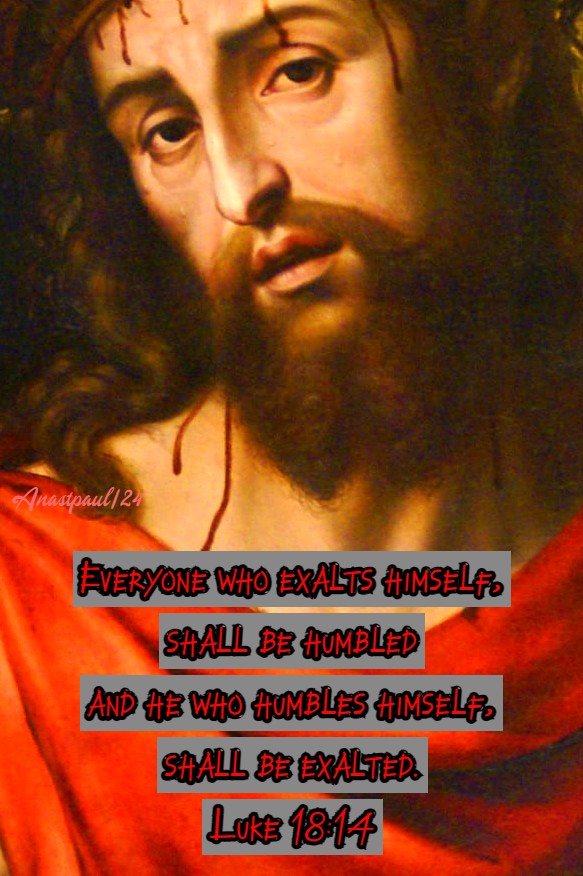
“Everyone who exalts himself shall be humbled and he who humbles himself, shall be exalted.”
Luke 18:14
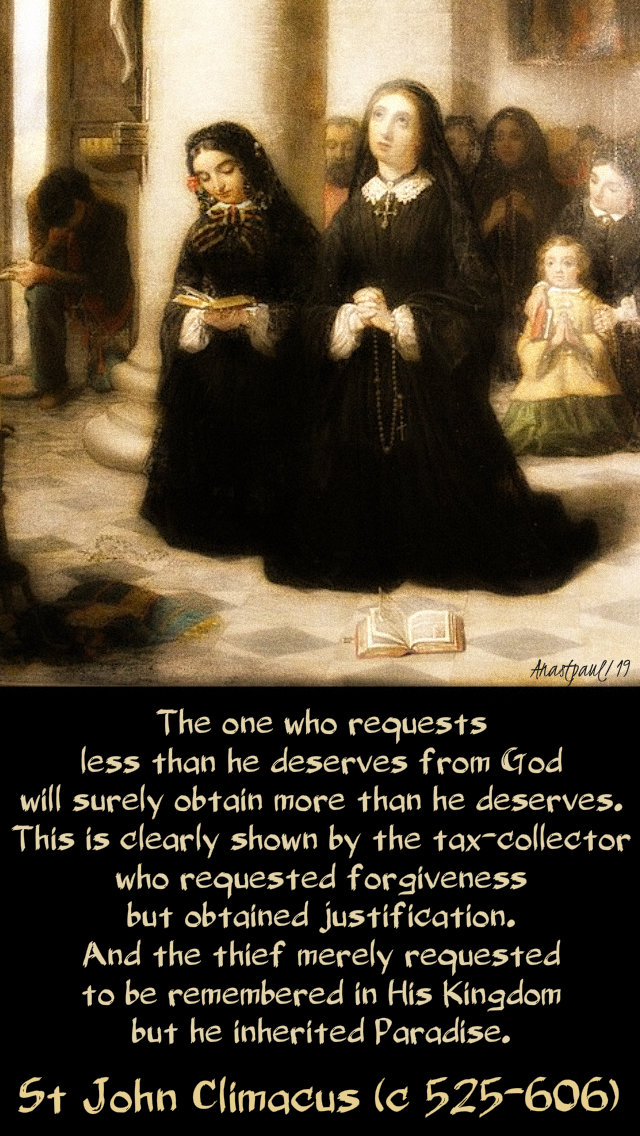
“The one who requests less than he deserves from God will surely obtain more than he deserves. This is clearly shown by the tax-collector who requested forgiveness but obtained justification. And the thief merely requested to be remembered in His Kingdom but he inherited Paradise!”
St John Climacus (c525-606)
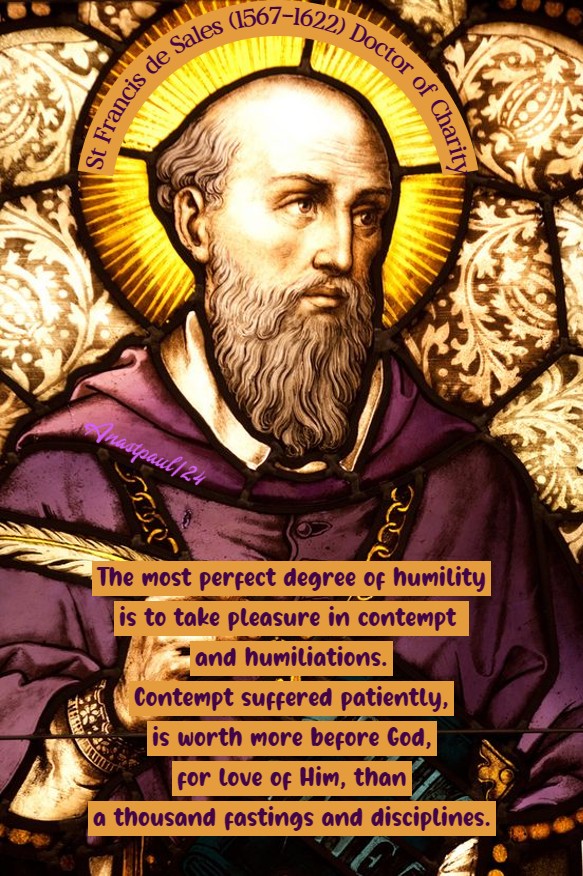
“The most perfect degree of humility is to take pleasure in contempt and humiliations. Contempt suffered patiently, is worth more before God, for love of Him, than a thousand fastings and disciplines.”
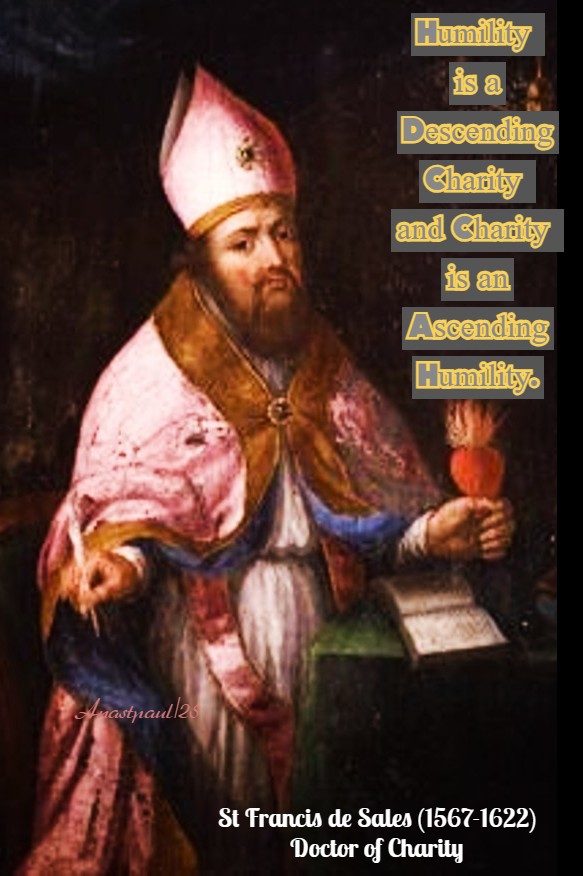
“Humility is a Descending Charity and Charity is an Ascending Humility.”
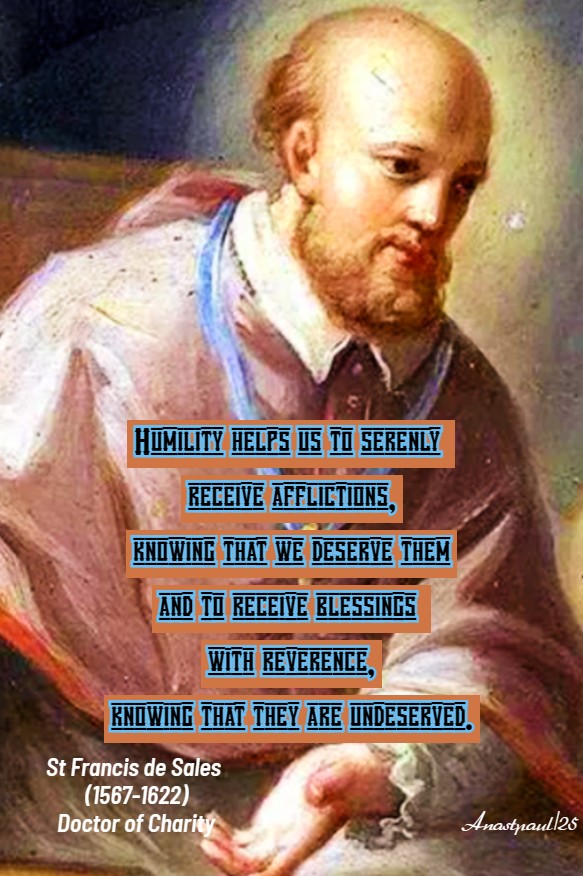
“Humility helps us to serenely receive afflictions, knowing that we deserve them and to receive blessings with reverence, knowing that they are undeserved.”
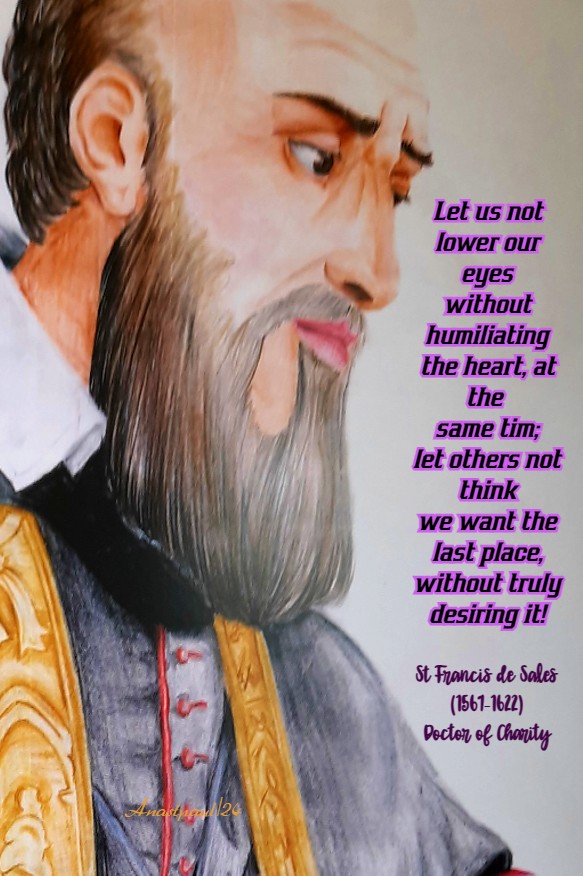
“Let us not lower our eyes without humiliating the heart , at the same time; let others not think we want the last place, without truly desiring it!”
“Humility makes our lives, acceptable to God, meekness, makes us acceptable to men.”
Meditations with Antonio Cardinal Bacci (1881-1971) on the Feast of the Humility of Mary
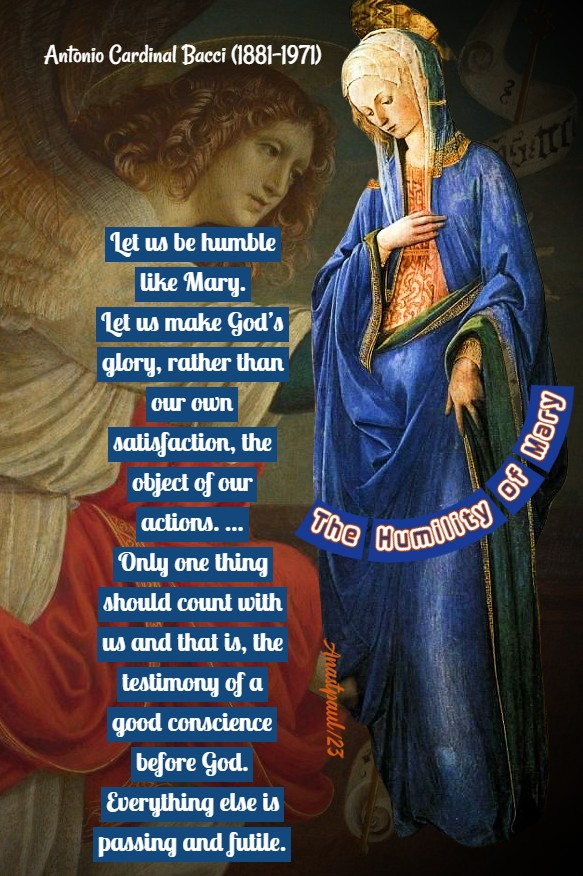
The Humility of Mary
“Unfortunately, we often look for our share of glory on earth. We wish to appear to others, not only at our true value but much more than we are really worth. We imagine that the gifts and qualities which God has given us, belong to ourselves, whereas they are entirely His.
We like to put on a good appearance to win praise and renown – in other words, we wish to have our reward upon this earth. We should remember, however, that if we look for our reward now, we shall not have it in Heaven.
God sees when our motives in doing good are distorted and, when we appear before His Judgement Throne, He will say to us: “You have received your reward” (Cf Mt 6:2).
Let us be humble like Mary. Let us make God’s glory, rather than our own satisfaction, the object of our actions. It will sometimes happen that men will misunderstand us, perhaps even insult us. We are not forbidden to defend ourselves and explain our position. We may not have the heroic virtue of St Francis de Sales, who remained silent when he was caluminated. But we should not be too disturbed by lack of understanding or slander, nor should we be too elated by flattery. Only one thing should count with us and that is, the testimony of a good conscience before God. Everything else is passing and futile.
Our humility will be tested by the inevitable opposition, sometimes jealous and malicious, which we shall experience on the part of other men. On these occasions, we shall see if we are really meek and humble of heart, like Jesus and our Blessed Mother.”
Our Morning Offering – 17 July – “The Month of the Most Precious Blood”
Prayer in Praise of God By St Francis of Assisi (c1181-1226)
Thou art Holy, Lord, the only God and Thine Deeds art wonderful. Thou art Strong. Thou art Great. Thou art the Most High. Thou art Almighty. Thou, Holy Father art King of Heaven and earth. Thou art Three and One, Lord God, all Good. Thou art Good, all Good, Supreme Good, Lord God, Living and True. Thou art Love. Thou art Wisdom. Thou art Humility. Thou art Endurance. Thou art Rest. Thou art Peace. Thou art Joy and Gladness. Thou art Justice and Moderation. Thou art all our Riches and Thou art Suffice for us. Thou art Beauty. Thou art Gentleness. Thou art our Protector. Thou art our Guardian and Defender. Thou art our Courage. Thou art our Haven and our Hope. Thou art our Faith, our great Consolation. Thou art our Eternal Life, Great and Wonderful Lord, God Almighty, Merciful Saviour. Amen
Thought for the Day – 11 May – The Imitation of the Blessed Virgin Mary By Thomas à Kempis (1380-1471)
Extracts from The Imitation of the Blessed Virgin Mary By Thomas à Kempis CRSA (1380-1471) Imprimatur 17 February 1947
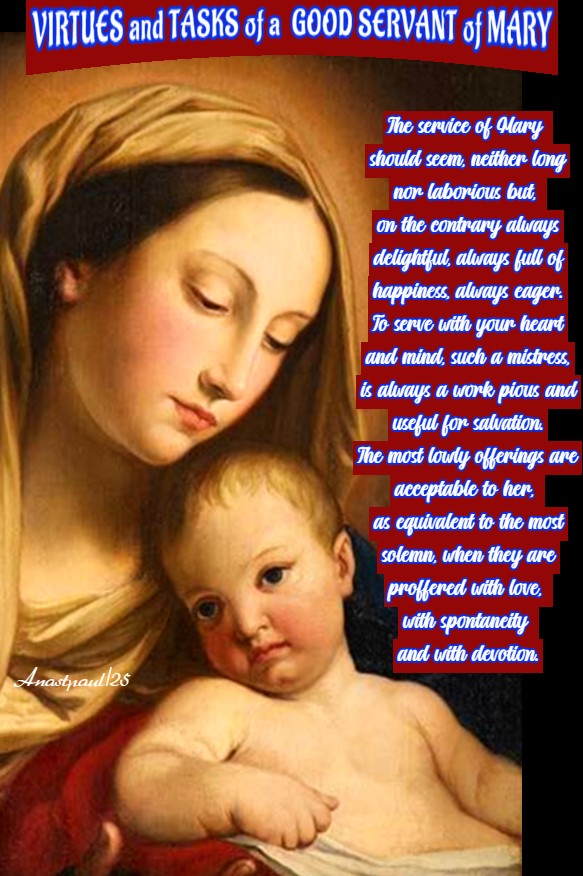
Chapter III VIRTUES AND TASKS OF A GOOD SERVANT OF MARY
i. Do you always wish to do what is pleasing to Mary? Be humble, patient, chaste, reserved in everything, full of mildness, an interior man, filled with zeal, little versed in exterior matters, recollected. Read often, write often but most often, pray. The service of Mary should seem, neither long nor laborious but, on the contrary always delightful, always full of happiness, always eager. To serve with your heart and mind, such a mistress, is always a work pious and useful for salvation. The most lowly offerings are acceptable to her, as equivalent to the most solemn, when they are proffered with love, with spontaneity and with devotion. She knows how little we are able to give and she requires not the impossible from her children. A merciful sovereign and queen of mildness, she is, above all, a mother. As a mother, she knows only how to be compassionate to the little and the poor, she who has given to the world, Mercy in Jesus.
ii. Learn then to call upon Jesus in everything and you will be aided, both in perils of the soul and of the body. Have Jesus always in your heart, in happiness, and you will never be overcome by human distress. Say the Hail Mary often – you will find joy and peace in it – no prayer is more beautiful than the Our Father – none is sweeter and gentler, than the Hail Mary. Pray as the Angel prayed before Mary – work as a faithful servant works and you shall have, your crown and mansion in Heaven. He who knows how to nourish his soul with prayer, he who knows how to pray with the sacred texts, will never know aridity in devotion. Strive thus constantly, to honour the Names of Jesus and Mary in your heart and with your lips.
III. Wherever you may go, or wherever you may be, implore Jesus and call upon Mary. Have, as a rule of life and, as a help in time ot need, this pious invocation – “Guide, O my Lord, always guide my way in Thy presence.” He who bears Jesus and Mary in his heart, always works well, always conducts himself well. Sing these two Names, sing them in your heart, sing them with your lips, sing them with your hands. Let your looks seek them, let your eyes implore them, let your arms embrace them, let your knees adore them.
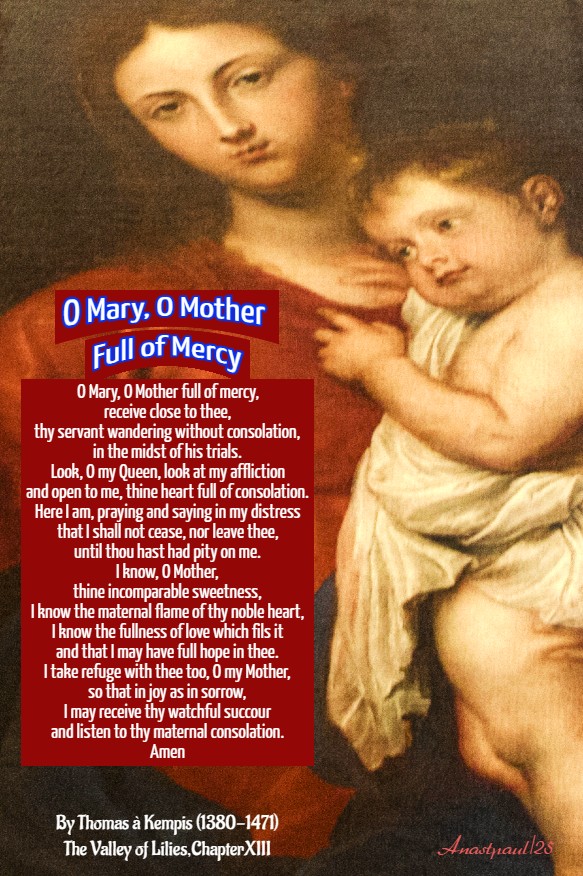
iv. Prayer: O Mary, O Mother Full of Mercy,
O Mary, O Mother full of mercy, receive close to thee, thy servant wandering without consolation, in the midst of his trials. Look, O my Queen, look at my affliction and open to me, thine heart full of consolation. Here I am, praying and saying in my distress that I shall not cease, nor leave thee, until thou hast had pity on me. I know, O Mother, thine incomparable sweetness, I know the maternal flame of thy noble heart, I know the fullness of love which fils it and that I may have full hope in thee. I take refuge with thee too, O my Mother, so that in joy as in sorrow, I may receive thy watchful succour and listen to thy maternal consolation.
(Thomas à Kempis, The Valley of Lilies,ChapterXIII)
One Minute Reflection – 8 May – “The Month of the Blessed Virgin Mary” – The Apparition of St Michael the Archangel at Monte Gargano, Italy (492) – Apocalypse 1:1-5 – Matthew 18:1-10 – Scripture search here: https://www.drbo.org/
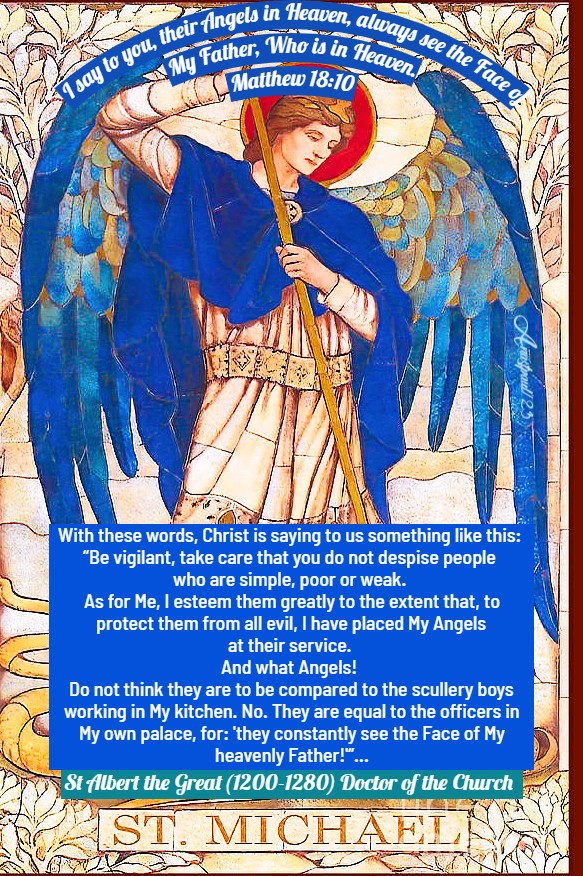
“Watch,that you despise not, one of these little ones, for I say to you, their Angels in Heaven, always see the Face of My Father, Who is in Heaven.” – Matthew 18:10
REFLECTION – “Watch that you do not despise one of these little ones for, I say to you, their Angels in Heaven, always see the Face of My Father, Who is in Heaven.” With these words, Christ is saying to us something like this: « “Be vigilant, take care that you do not despise people who are simple, poor or weak. As for Me, I esteem them greatly to the extent that, to protect them from all evil, I have placed My Angels at their service. And what Angels! Do not think they are to be compared to the scullery boys working in My kitchen. No. They are equal to the officers in My Own palace, for: ‘they constantly see the Face of My heavenly Father’”…
Now, these Angels see the Face of God for several reasons. Firstly, Angels must offer and present our good works to God. To this we have a testimony in the words Raphael addressed to Tobias: “I have presented your prayer before the Lord” (Tb 12:12). In the Book of The Apocalypse, too, we read: “An Angel with a golden censer came and stood before the altar. He was given a great quantity of incense to offer with the prayers, of all the saints on the golden altar that is, before the throne of God,” (8:3). Let us note that this altar is the heart of whoever is truly faithful to God; before this altar, the Angels stand. Their censer represents the feelings of joy, with which they gather up our thoughts, prayers, words and actions, so as to offer them, all aflame with the fire of charity, on the golden altar which stands before the throne of God. And the offering rises up to the Son, Who is in the bosom of the Father. Therefore, it would be good for us always to have some good thing to place in the Angels’ censer.” – St Albert the Great (1200-1280) Dominican, Doctor of the Church (Sermon for the Feast of Saint Michael).
PRAYER – O God, Who has ordained and constituted the services of Angels and men in a wonderful order, mercifully grant that as Thy holy angels always do Thee service in Heaven, so, by Thy appointment, they may succour and defend us on earth. Through Jesus Christ, Thy Son our Lord, Who lives and reigns with Thee, in the unity of the Holy Ghost, God, world without end. Amen (Collect).
Thought for the Day – 19 April – Meditations with Antonio Cardinal Bacci (1881-1971)
The Death of our Saviour
In the midst of His sufferings, Jesus forgets Himself and pray for His executioners. “Father,” He pleaded, “forgive them, for they do not know what they are doing” (Lk 23:34). Who were these people who crucified Him? We know well that they were not only the Jews but all of us. The Prophet Isaiah, had foretold this. “He was wounded for our iniquities, he was bruised for our sins … He was offered because it was his own will…” (Is 53:5-7). We are all the crucifiers of Jesus. Therefore, He willed to suffer and to die for all of us and when He was hanging on the Cross, He begged for forgiveness for us all. This should incite us to trust in God and to do repentance for our sins. We should be sorry for our sins because, they were the real cause of the voluntary death of Jesus. We should have confidence in Him because, He forgave us when He was dying on the Cross and is ready to pardon us again, as long as we are sincerely repentant.
Let us consider how Jesus, even though He was derided and nailed to the Cross, prayed for and forgave His executioners. How do we normally behave? Perhaps we fly into anger at the first word of offence or act of misunderstanding, or perhaps we nourish secret feelings of hatred in our hearts for our brothers in Jesus Christ? Let us kneel before the Cross and tell Our Lord, that we wish to be meek and humble of heart, like Him. We wish to be quick to forgive and to live in peace and, even, if it is necessary, to do good to those who offend us, or at any rate, to pray fervently for them.
Thought for the Day – 15 April – The Spiritual Combat (1589) – Dom Lorenzo Scupoli OSM (c1530-1610)
“None shall be crowned who has not fought well.” 2 Tim 2: 5
XLVI: … On Meditation
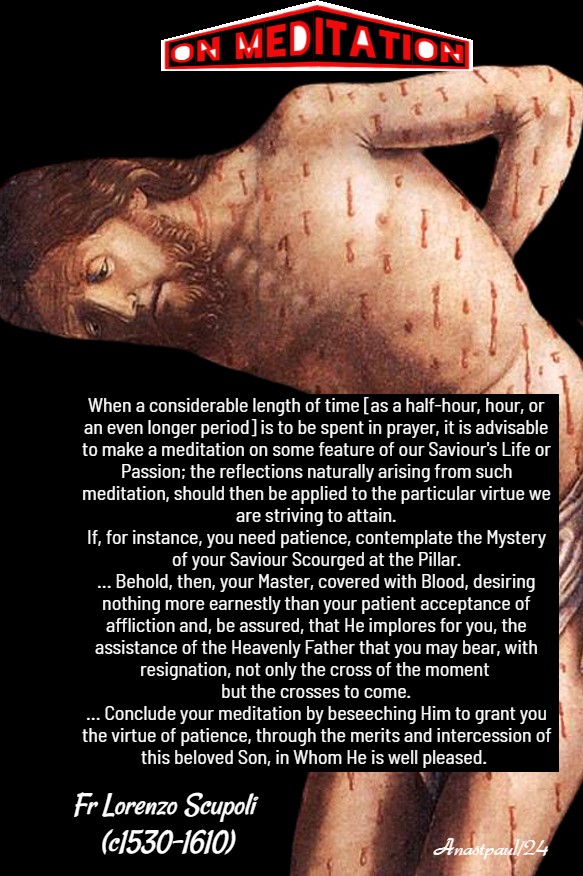
“When a considerable length of time [as a half-hour, hour, or an even longer period] is to be spent in prayer, it is advisable to make a meditation on some feature of our Saviour’s Life or Passion; the reflections naturally arising from such meditation, should then be applied to the particular virtue we are striving to attain.
If, for instance, you need patience, contemplate the Mystery of your Saviour Scourged at the Pillar. Consider firstly, the blows and revilements hurled at Him by the soldiers as they brutally drag their innocent victim to the appointed place as ordered. Secondly, consider Him stripped of His garments, exposed to the piercing cold. Thirdly, picture those innocent hands, bound tightly to the pillar. Fourthly, consider His Body, torn with whips until His Blood moistened the earth. And finally, envision the frequency of the blows, creating new wounds, re-opening others on that Sacred Body.
Dwelling on these or similar details, calculated to inspire in yourself, a love of patience, you should try to feel within your very soul the inexpressible anguish so patiently borne by your Divine Master. Then consider the excruciating agony of His spirit and the patience and mildness with which that agony was endured by Him, Who was ready to suffer even more for God’s glory and your welfare.
Behold, then, your Master, covered with Blood, desiring nothing more earnestly than your patient acceptance of affliction and, be assured, that He implores for you, the assistance of the Heavenly Father that you may bear, with resignation, not only the cross of the moment but the crosses to come.
Strengthen, therefore, by frequent acts, your resolution to suffer, with joy and, raising your mind to Heaven, give thanks to the Father of mercies, Who didst send His Only Son into this world to suffer indescribable torments and, to intercede for you in your necessities.
Conclude your meditation by beseeching Him to grant you the virtue of patience, through the merits and intercession of this beloved Son, in Whom He is well pleased.”
Lenten Meditations – 12 April – With Fr Richard Frederick Clarke SJ (1839-1900) Scripture search here: https://www.drbo.org/
“The Sacred Passion of Our Lord Jesus Christ” “Short Meditations for Lent” From “The Devout Year” By Fr Richard Frederick Clarke SJ (1839-1900)
Saturday after the Fifth Sunday in Lent The Good Thief
Read St Luke xxii:39-43
[39] And one of those robbers, who was hanged, blasphemed Him, saying: If thou be Christ, save Thyself and us. [40] But the other answering, rebuked him, saying: Neither dost thou fear God, seeing thou art condemned under the same condemnation? [41] And we indeed justly, for we receive the due reward of our deeds but this Man hath done no evil. [42] And he said to Jesus: Lord, remember me when Thou shalt come into Thy Kingdom. [43] And Jesus said to him: Amen I say to thee, this day thou shalt be with Me in Paradise. [Luke 23:39-43]
+I. Among those who mocked and derided Jesus were the two thieves crucified with Him. But very soon, His unspeakable gentleness and meekness, touched the heart of one of the two. Firstly. he ceased his words of insult, then, he boldly reproved his companion and bore testimony to the innocence of Jesus and to His authority as King and Lord. What a Divine power there is in weakness! The sight of the uncomplaining patience of Christ, convinced this robber that He was King of all the earth and, He, Who was now dying on the Cross, would soon reign forever and ever. “Lord, remember me when Thou shalt come into Thy Kingdom.”
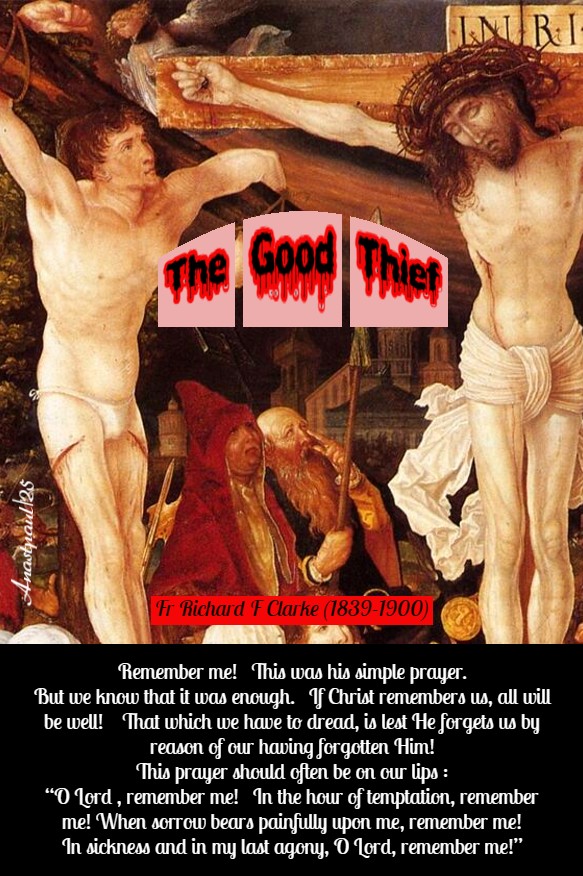
+2. Remember me! This was his simple prayer. But we know that it was enough. If Christ remembers us, all will be well! That which we have to dread, is lest He forgets us by reason of our having forgotten Him! This prayer should often be on our lips : “O Lord , remember me! In the hour of temptation, remember me! When sorrow bears painfully upon me, remember me! In sickness and in my last agony, O Lord, remember me!”
+3. Our Lord answers the gocd thief’s prayer with Divine generosity. All his sins are forgiven him and as soon as his agony is over, he is to be received into the company of the blest and to be with Christ in Paradise. What a rich reward for his confession of Christ! With what a glorious answer to his prayer, will Christ remember him!
One Minute Reflection – 13 March – “The Month of Saint Joseph” – Thursday of the 1st Week in Lent – Ferial Day – Ezechiel 18:1-9 – Matthew 15:21-28 – Scripture search here: https://www.drbo.org/
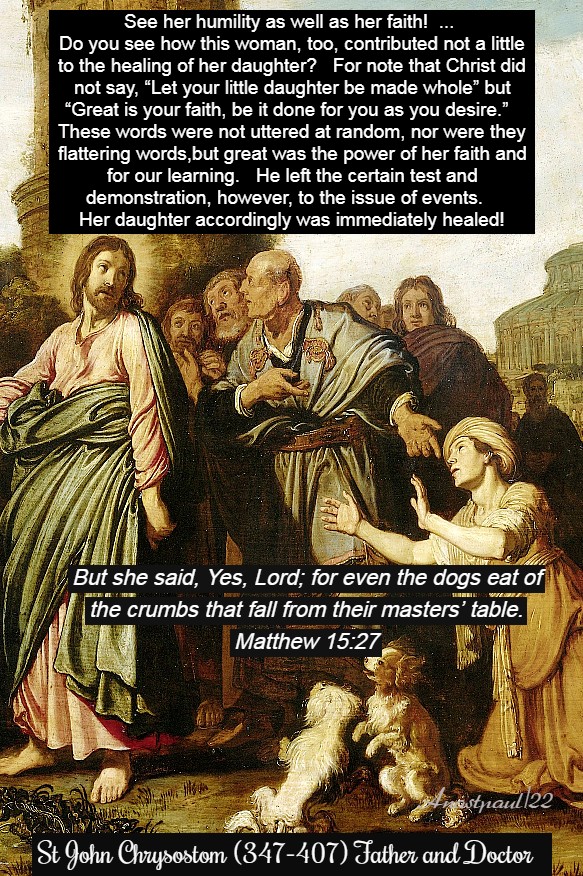
“But she said, Yes, Lord; for even the dogs eat of the crumbs that fall from their masters’ table.” – Matthew 15:27
REFLECTION – “See her humility as well as her faith! For He had called the Jews “children” but she was not satisfied with this. She even called them “masters,” so far was she from grieving at the praises of others. She said, “Yes, Lord, yet even the dogs eat the crumbs that fall from their masters’ table.” Behold the woman’s wisdom! She did not venture so much as to say a word against anyone else. She was not stung to see others praised, nor was she indignant to be reproached. Behold her constancy! When He answered, “It is not fair to take the children’s bread and throw it to the dogs,” she said, “Yes, Lord.” He called them “children” but she called them “masters.” He used the name of a dog but she described the action of the dog. Do you see this woman’s humility?
Then compare her humility with the proud language of the Jews: “We are Abraham’s seed and were never in bondage to any man.” “We are born of God.” But not so this woman. Rather, she calls herself a dog and them masters. So for this reason, she became a child. For what does Christ then say? “O woman, great is your faith!”
So we might surmise that this is the reason He put her off, in order that He might proclaim aloud this saying and that He might crown the woman: “Be it done for you as you desire.” This means “Your faith, indeed, is able to effect even greater things than these. Nevertheless, be it unto you even as you wish.” This Voice was at one with the Voice which said, “Let the heaven be,” and it was. “And her daughter was made whole from that very hour.”
Do you see how this woman, too, contributed, not a little, to the healing of her daughter? For note that Christ did not say, “Let your little daughter be made whole” but “Great is your faith, be it done for you as you desire.” These words were not uttered at random, nor were they flattering words,but great was the power of her faith and for our learning. He left the certain test and demonstration, however, to the issue of events. Her daughter accordingly was immediately healed.” – St John Chrysostom (347-407) Archbishop of Constantinople, Father and Doctor (The Gospel of Matthew – Homily 52).
PRAYER – From all perils of soul and body defend us, O Lord, we beseech Thee and by the intercession of blessed and gloriosus ever Virgin Mary, Mother of God, of blessed Joseph, of Thy blessed apostles Peter and Paul and all the Saints, graciously grant us safety and peace that all adversities and errors, being overcome, Thy Church may serve Thee in security and freedom. Through Jesus Christ, Thy Son our Lord, Who lives and reigns with Thee, in the unity of the Holy Ghost, God, world without end. Amen (Collect).
Lenten Meditations – 10 March – With Fr Richard Frederick Clarke SJ (1839-1900) Scripture search here: https://www.drbo.org/
“The Sacred Passion of Our Lord Jesus Christ” “Short Meditations for Lent” From “The Devout Year” By Fr Richard Frederick Clarke SJ (1839-1900)
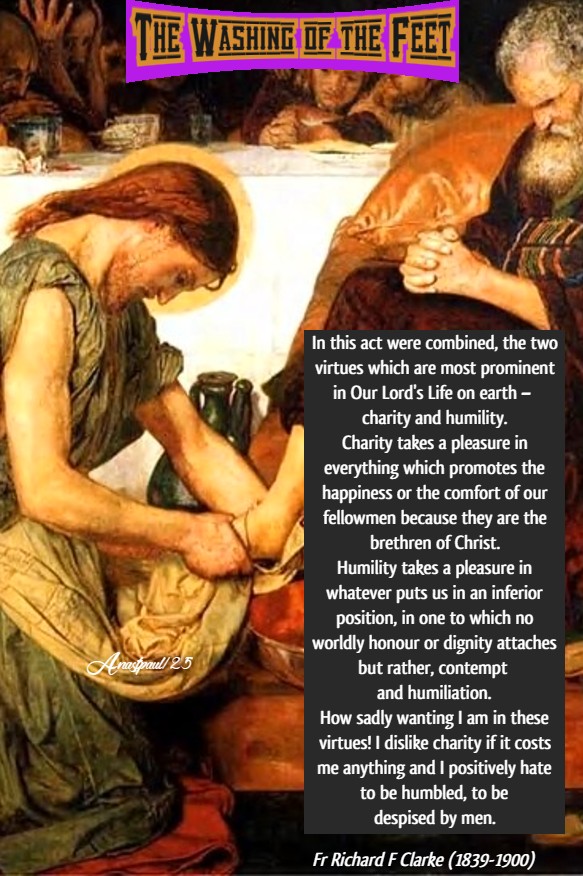
Monday of the First Week in Lent The Washing of the Feet
Read St John xiii:2-20 [Posting at the end]
+1. When the paschal supper was finished, Our Lord rose from table, laid aside His upper garment and girding Himself with a towel, He filled a basin with water and went from one to another of the Apostles, washing with His Ssacred Hands the feet of each. This act was intended to teach us the happiness of performing menial services for those around us. To wait upon others, especially on our inferiors, for Christ’s Sake, is far more honourable, than to be waited upon by them; to make ourselves the servants of others, is far more noble than to be served by them. Is this the principle on which I act?
+2. In this act were combined, the two virtues which are most prominent in Our Lord’s Life on earth – charity and humility. Charity takes a pleasure in everything which promotes the happiness or the comfort of our fellowmen because they are the brethren of Christ. Humility takes a pleasure in whatever puts us in an inferior position, in one to which no worldly honour or dignity attaches but rather, contempt and humiliation. How sadly wanting I am in these virtues! I dislike charity if it costs me anything and I positively hate to be humbled, to be despised by men.
+3. Yet Christ’s words are true the disciple is not greater than His Master. If our Divine Master was glorious in the sight of the Angels as He stooped to wash the Apostles ‘ feet, our road to glory must be, by stooping, by ministering in all humility, to others. We never can be as great as our Master. We must take care lest our selfishness and pride, place us in direct contrast with the Son of God.
John 13:2-20
[2] And when supper was ended, (the devil having now put into the heart of Judas Iscariot, the son of Simon, to betray Him,) [3] Knowing that the Father had given Him all things into His Hands and that, He came from God and goeth to God; [4] He riseth from supper and layeth aside His garments and having taken a towel, girded Himself. [5] After that, He putteth water into a basin and began to wash the feet of the disciples and to wipe them with the towel wherewith He was girded.
[6] He cometh, therefore, to Simon Peter. And Peter saith to Him: Lord, dost thou wash my feet? [7] Jesus answered and said to him: What I do thou knowest not now but thou shalt know hereafter. [8] Peter saith to Him: Thou shalt never wash my feet. Jesus answered him: If I wash thee not, thou shalt have no part with Me. [9] Simon Peter saith to hHm: Lord, not only my feet but also my hands and my head. [10] Jesus saith to him: He that is washed, needeth not but to wash his feet but is clean wholly. And you are clean but not all.
[11] For he knew. who he was that would betray him, therefore. he said: You are not all clean. [12] Then, after He had washed their feet and taken His garments, being sat down again, He said to them: Know you what I have done to you? [13] You call Me Master,and Lord and you say well, for so I Am. [14] If then I, betoo, ought to wash one another’s feet. [15] For I have given you an example, that as I have done to you, so you do also.
[16] Amen, amen I say to you: The servant is not greater than his Lord; neither is the Apostle greater than He Who sent him. [17] If you know these things, you shall be blessed if you do them. [18] I speak not of you all, I know whom I have chosen. But that the scripture may be fulfilled – He who eateth bread with Me, shall lift up his heel against Me. [19] At present I tell you, before it come to pass that, when it shall come to pass, you may believe that I Am He. [20] Amen, amen I say to you, he who receiveth whomsoever I send, receiveth Me and he who receiveth Me, receiveth Him Whp sent Me. [John 13:2-20]
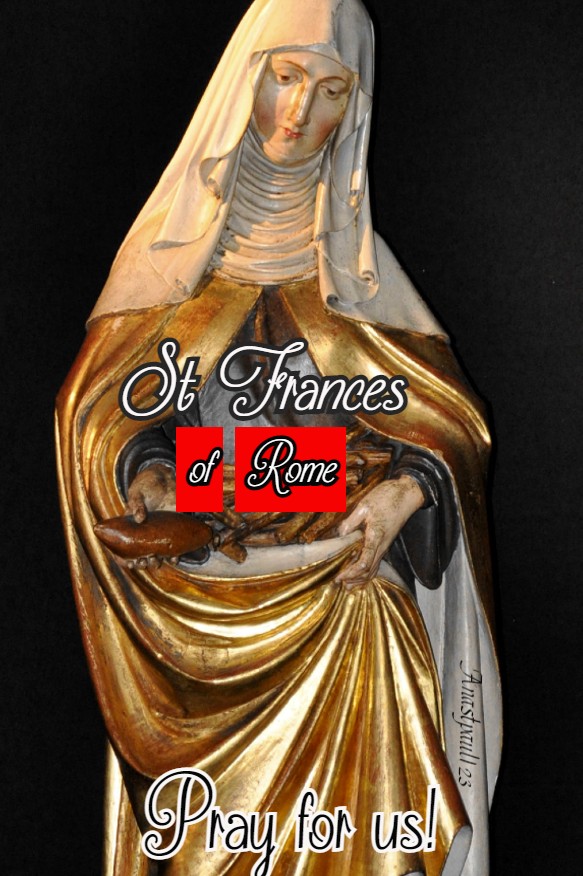
One Minute Reflection – 9 March – “The Month of Saint Joseph” – St Frances of Rome Obl.S.B. (1384-1440) Widow – The First Sunday in Lent – 2 Corinthians 6:1-10 – Matthew 4:1-11 – Scripture search here: https://www.drbo.org/
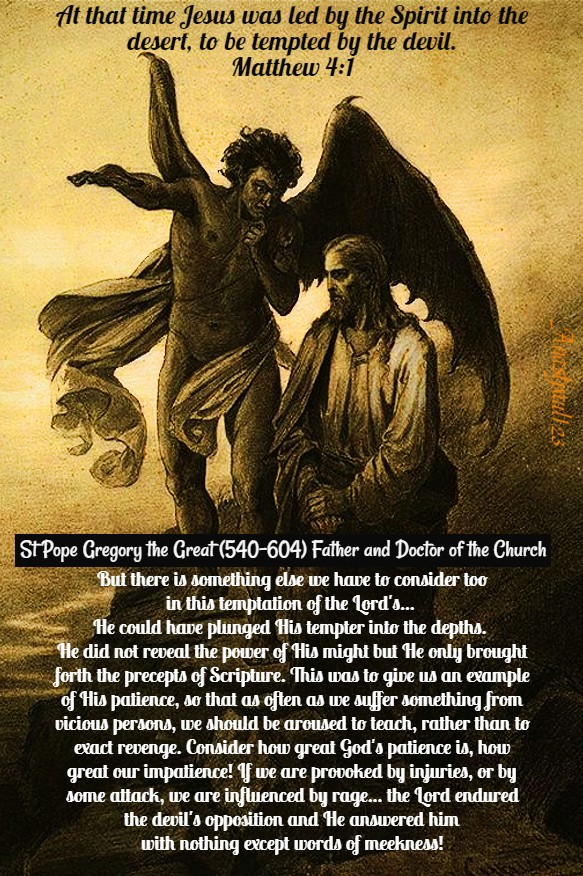
“At that time Jesus was led by the Spirit into the desert, to be tempted by the devil.” – Matthew 4:1
REFLECTION – “If we look at the progress of our Lord’s temptation, we see how great the struggle which set us free. from temptation, was. Our ancient enemy rose up against the first human being, our ancestor, in three temptations. He tempted him by gluttony, by vainglory and by avarice… He tempted him by gluttony, when he showed him the forbidden food of the tree and told him: “Taste it.” He tempted him by vainglory, when he said, “You will be like gods” (Gn 3:5). He tempted him by adding avarice, when he said: “knowing good and evil.” Avarice is concerned, not only with money but too, with high position…
But the means by which the devil overcame the first Adam (1 Cor 15:47) were the same ones which caused him to yield, when he tempted the Second. He tempted Him by gluttony, when he said, “Tell these stones to become bread.” He tempted Him by vainglory, when he said, “If Thou are the Son of God, cast Thyself down.” He tempted him by an avaricious desire for high position, when he showed him all the kingdoms of the world, saying: “I will give Thee all these, if Thou will fall down and worship me”… As a captive, the devil would depart from our hearts by the same avenue which had given him entrance, when he possessed us.
But there is something else we have to consider too in this temptation of the Lord’s … He could have plunged His tempter into the depths. He did not reveal the power of His might but He only brought forth the precepts of Scripture. This was to give us an example of His patience, so that as often as we suffer something from vicious persons, we should be aroused to teach, rather than to exact revenge. Consider how great God’s patience is, how great our impatience! If we are provoked by injuries, or by some attack, we are influenced by rage … the Lord endured the devil’s opposition and He answered him with nothing except words of meekness!” – St Gregory the Great (540-604) Pope, Father and Doctor of the Church (Homilies on the Gospel no 14).
PRAYER – O God, Who along with other gifts of Thy grace honoured blessed Frances, Thy handmaid, with the close companionship of an angel, grant, we beseech Thee, that by the help of her intercession we may be made worthy to attain the companionship of Angels in Heaven. Through Jesus Christ, Thy Son our Lord, Who lives and reigns with Thee, in the unity of the Holy Ghost, God, world without end. Amen (Collect).
Quote/s of the Day – 6 March – Ash Thursday – Isaias 38:1-6 – Matthew 8:5-13
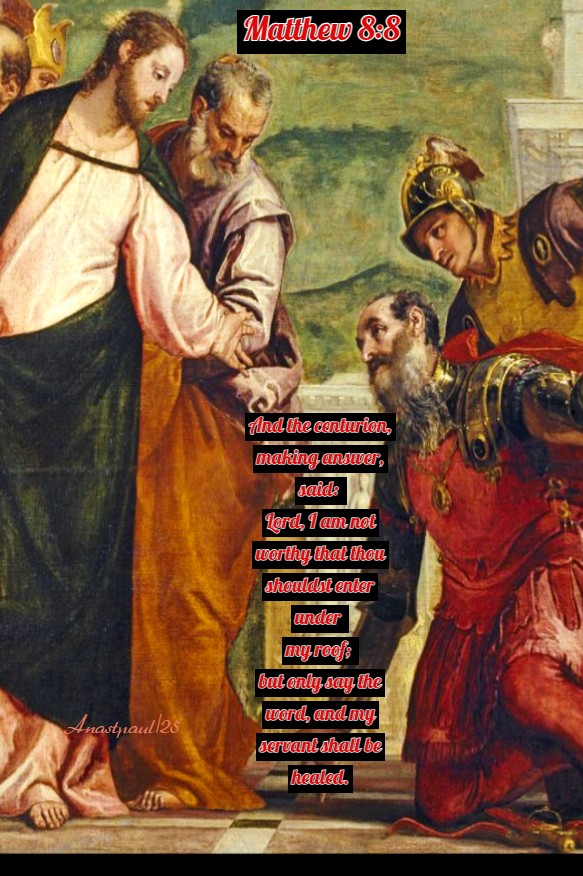
“And the centurion, making answer, said: Lord, I am not worthy that Thou shouldst enter under my roof but only say the word and my servant shall be healed.”
Matthew 8:8
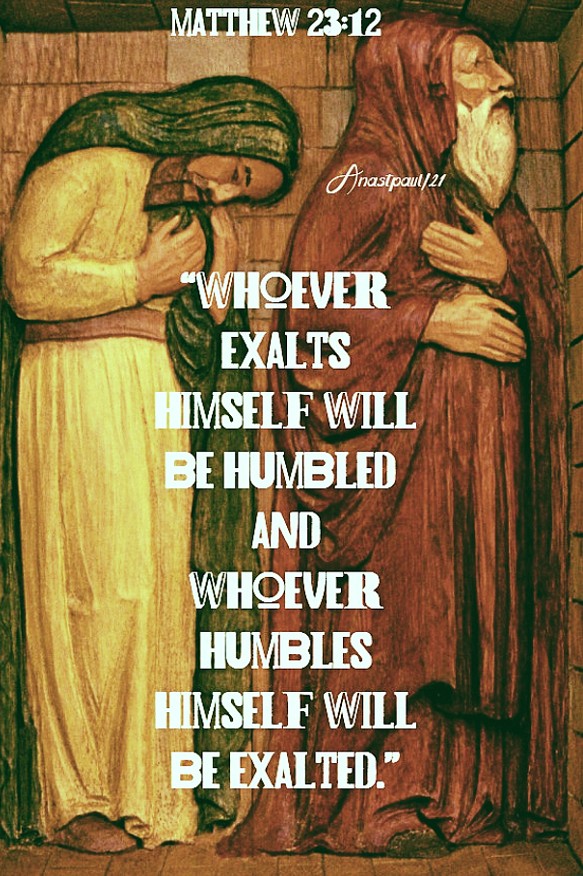
“Whoever exalts himself will be humbled and whoever humbles himself will be exalted.”
Matthew 23:12
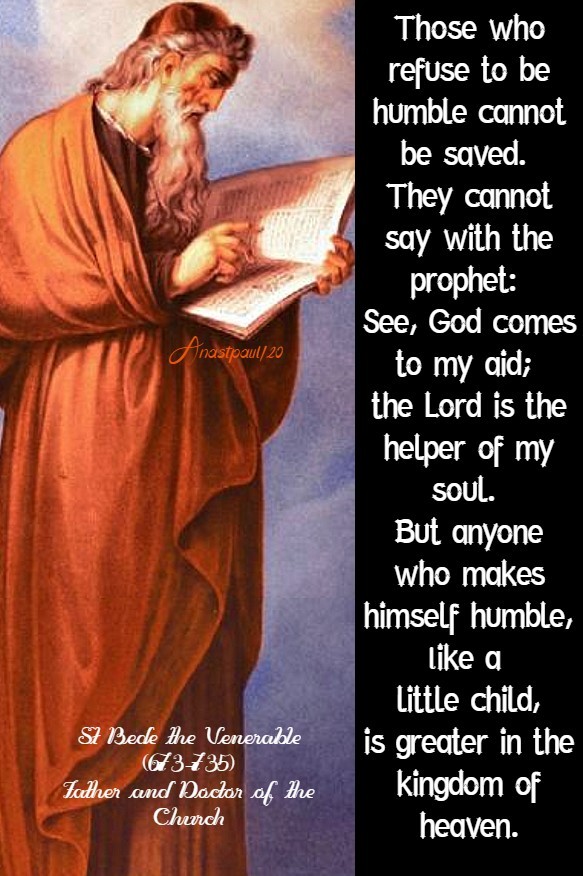
“Those who refuse to be humble cannot be saved. They cannot say with the prophet: See, God comes to my aid; the Lord is the helper of my soul. But anyone who makes himself humble, like a little child, is greater in the Kingdom of Heaven.”
St Bede the Venerable (673-735) Father and Doctor if the Church
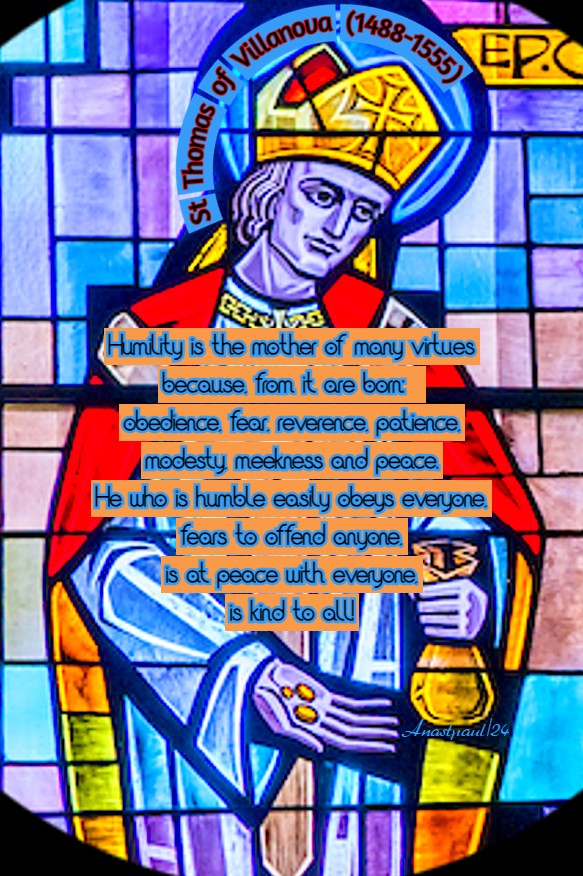
“Humility is the mother of many virtues because, from it are born: obedience, fear, reverence, patience, modesty, meekness and peace. He who is humble easily obeys everyone, fears to offend anyone, is at peace with everyone, is kind to all!”
St Thomas of Villanova OSA (1488-1555)
“Humility is not just about self-mistrust but about the entrusting of ourselves to God. Distrusting ourselves and our own strength produces trust in God and from that trust, generosity of soul is born.”
Thought for the Day – 29 D ecember – Meditations with Antonio Cardinal Bacci (1881-1971)
As Fr Clarke has left us in the lurch for the last 3 days of December, I am revisiting dear Cardinal Bacci to come to our aid. I pray you, like myself, never tire of his wisdom.
The Holy Family – Jesus
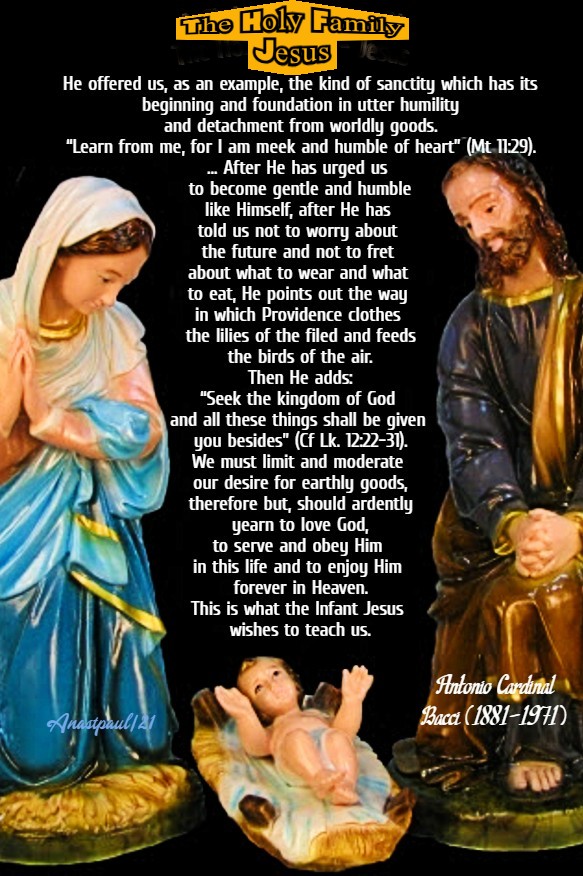
“We have in the Holy Family, the highest possible models of perfection – Jesus, Mary and Joseph. As God, Jesus is essentially holy. By means of the Hypostatic Union, this sanctity is transmitted also to His human nature. The holiness of Jesus was only gradually revealed as He grew older because He wished to be like us in everything, save in sin. As the Gospel says, He “advanced in wisdom and age and grace before God and men” (Lk 2:52). Jesus gave us an example of holiness which we should find easier to imitate because it was eternally increasing all the time. He offered us, as an example, the kind of sanctity which has its beginning and foundation in utter humility and detachment from worldly goods. “Learn from me, for I am meek and humble of heart” (Mt 11:29).
Socrates advised his followers to have few desires and to desire these as little as possible, in order to remain content, for the man who is full of desires is always uneasy and restless. This human counsel is very true but, it is incomplete. It recommends detachment from earthly things but fails to teach the ardent and practical desire for supernatural things. Jesus Christ teaches us both. After He has urged us to become gentle and humble like Himself, after He has told us not to worry about the future and not to fret about what to wear and what to eat, He points out the way in which Providence clothes the lilies of the filed and feeds the birds of the air. Then He adds: “Seek the Kingdom of God and all these things shall be given you besides” (Cf Lk.12:22-31).
We must limit and moderate our desire for earthly goods, therefore but, should ardently yearn to love God, to serve and obey Him in this life and to enjoy Him forever in Heaven. This is what the Infant Jesus wishes to teach us.”
Quote/s of the Day – 19 December – “The Month of the Divine Infancy and the Immaculate Conception of the Blessed Virgin Mary”
“If we would please this Divine Infant, we too must become children, simple and humble. We must carry to Him, flowers of virtue, of meekness, of mortification, of charity. We must clasp Him in the arms of our love.”
St Alphonsus Liguori (1696-1787) Most Zealous Doctor

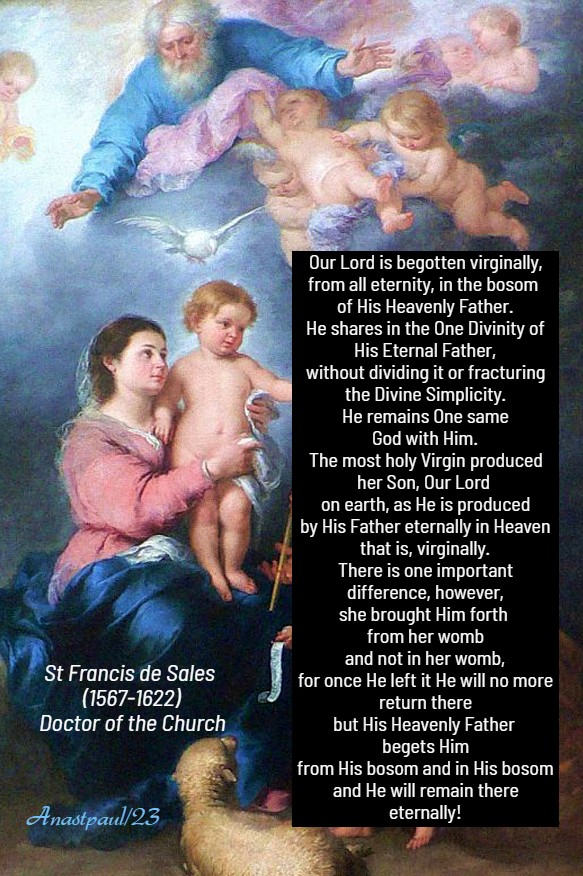
“Our Lord is begotten virginally, from all eternity, in the bosom of His Heavenly Father. He shares in the One Divinity of His Eternal Father, without dividing it or fracturing the Divine Simplicity. He remains One same God with Him. The most holy Virgin produced her Son, Our Lord on earth, as He is produced by His Father eternally in Heaven that is, virginally. There is one important difference, however, she brought Him forth from her womb and not in her womb, for once He left it He will no more return there but His Heavenly Father begets Him from His bosom and in His bosom and He will remain there eternally!”
(The Coming of the Divine Infant 24 December 1613 Sermon for Christmas Eve)
St Francis de Sales (1567-1622) Doctor of the Church
Thought for the Day – 9 August – Meditations with Fr Richard Frederick Clarke SJ (1839-1900)
CHARITY Meditations for a Month
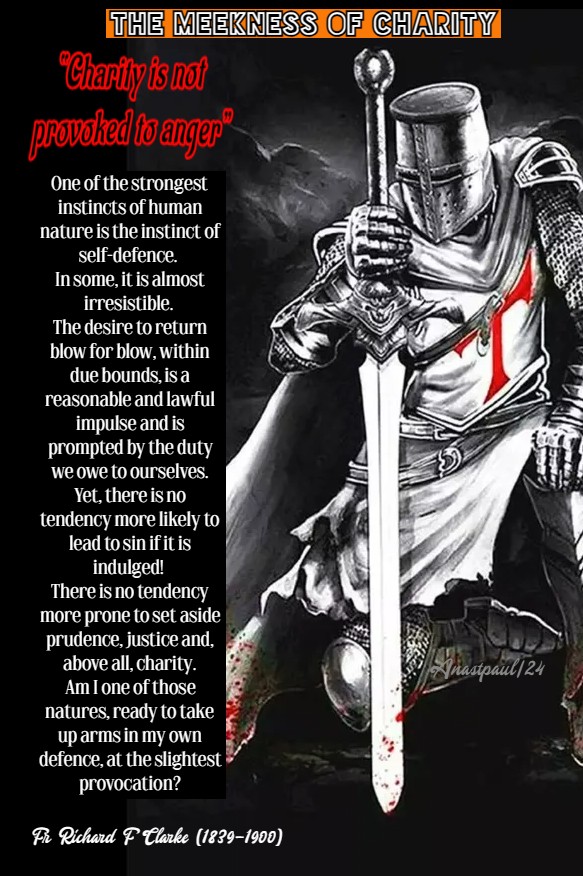
The Meekness of Charity “Charity is not provoked to anger”
One of the strongest instincts of human nature is the instinct of self-defence. In some, it is almost irresistible. The desire to return blow for blow, within due bounds, is a reasonable and lawful impulse and is prompted by the duty we owe to ourselves. Yet, there is no tendency more likely to lead to sin if it is indulged! There is no tendency more prone to set aside prudence, justice and, above all, charity. Am I one of those natures, ready to take up arms in my own defence, at the slightest provocation?
The instinct of self-defence is always prone to mislead us, due to our excessive self-love. We imagine we have been attacked, when in fact, nothing of the sort is the case. We see a slight or insult, when none was intended. We do not keep in mind how simple the true explanation may really be. We become angry, long for revenge and are carried beyond all bounds, by our wounded self-love. We say and do what we bitterly regret afterwards, alienating others from us and offending God by our angry words. How often, alas, I have done this!
How is this evil to be remedied? By charity and nothing else. If God were more prominent in our hearts, if we loved God more and ourselves less, if our ambition were to promote His honour and not our own, we should not indulge in these outbursts of intemperate or bitter words. Instead, we should not be easily provoked or become angry. We should take a gentle view of what has been done or we should accept the injury or unkindness done to us and offer it up for our sins in union with the supreme charity of Christ our Lord!
Thought for the Day – 30 July – Meditations with Fr Richard Frederick Clarke SJ (1839-1900)
HUMILITY Meditations for a Month
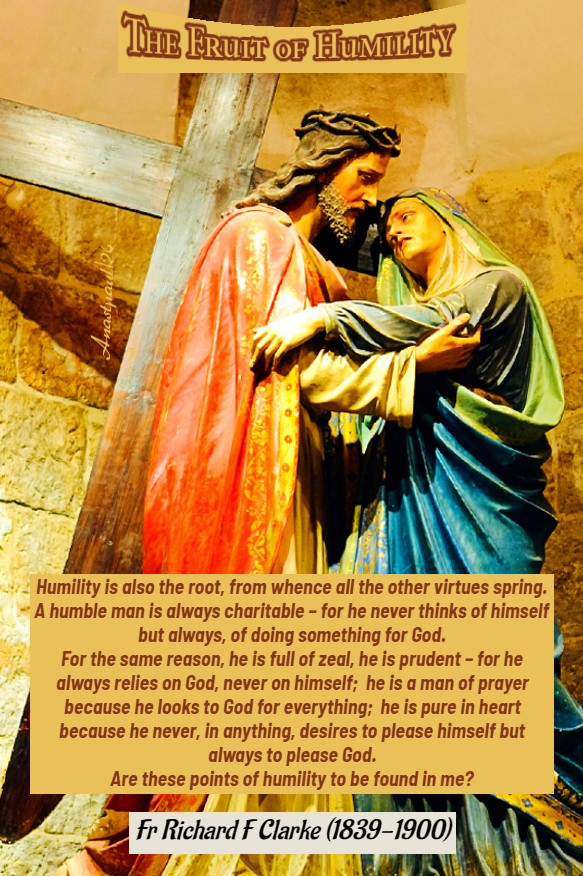
The Fruit of Humility
There is nothing which gives such a solid peace as humility. At the beginning it is difficult and we smart under the wounds which our pride has to suffer before it can be destroyed in ourselves. But a holy perseverance in the practice of humility will spread over the soul such a sweet and calm tranquility that even in this life, the soul begins to taste the joys of the heavenly paradise. Troubles, disappointments, unkindness, injustice, insults, do not disturb the quiet happiness of one, who is really humble. One who is truly humble appreciates, continually, the truth of our Lord’s Words: “Learn of Me, for I Am meek and humble of heart and you shall find rest for your souls. … For My yoke is easy and My burden is light.”
Humility is also the best possible safeguard against the attacks of the devil. The humble man can say, as our Lord did: “The prince of this world cometh and hath nothing in Me.” Or as Saint Martin said when dying: “Why art thou here, O evil one? No malice wilt thou find in me.” Nor has the devil any chance of success in tempting the humble. Their continual disposition is one of dependence on God and, therefore, no temptation has power to lead them astray.
Humility is also the root, from whence all the other virtues spring. A humble man is always charitable – for he never thinks of himself but always, of doing something for God. For the same reason, he is full of zeal, he is prudent – for he always relies on God, never on himself; he is a man of prayer because he looks to God for everything; he is pure in heart because he never, in anything, desires to please himself but always to please God. Are these points of humility to be found in me?
Quote/s of the Day – 28 July – Pentecost X – 1 Corinthians 12:2-11; Luke 18:9-14 – Scripture search here: https://www.drbo.org/
“Everyone who exalts himself, shall be humbled and he who humbles himself, shall be exalted.”
Luke 18:14
“The most perfect degree of humility is to take pleasure in contempt and humiliations. Contempt suffered patiently, is worth more before God, for love of Him, than a thousand fastings and disciplines.”
“Let us not lower our eyes without humiliating the heart , at the same time; let others not think we want the last place, without truly desiring it!”
“Humility makes our lives, acceptable to God, meekness, makes us acceptable to men.”
Quote/s of the Day – 10 April – “The Month of the Resurrection and the Blessed Sacrament” – Ferial Day – Wednesday in the Second Week of Easter – 1 John 5:4-10; John 20:19-31 – Scripture search here: https://www.drbo.org/
“My Lord and my God.”
John 20:28
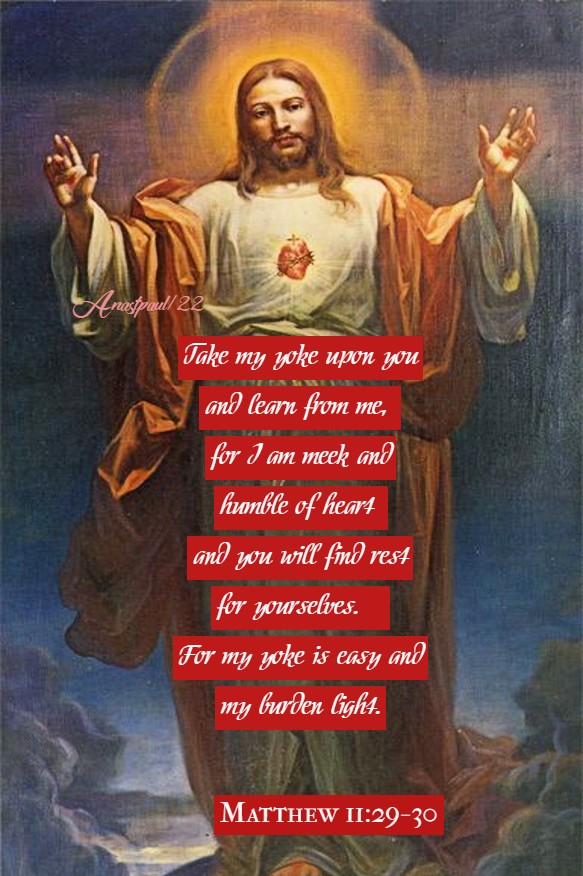
“Take My yoke upon you and learn from Me, for I Am meek and humble of heart and you will find rest for yourselves. For My yoke is easy and My burden light.”
Matthew 11:29-30
“If we wish to make any progress in the service of God, we must begin everyday of our life, with new eagerness. We must keep ourselves, in the presence of God, as much as possible and have no other view or end, in all our actions but the Divine honour.”
St Charles Borromeo (1538-1584)
“Take God for your Spouse and Friend and walk with Him continually and you will not sin and will learn to love and the things you must do will work out prosperously for you.”
St John of the Cross (1542-1591) Doctor of the Church
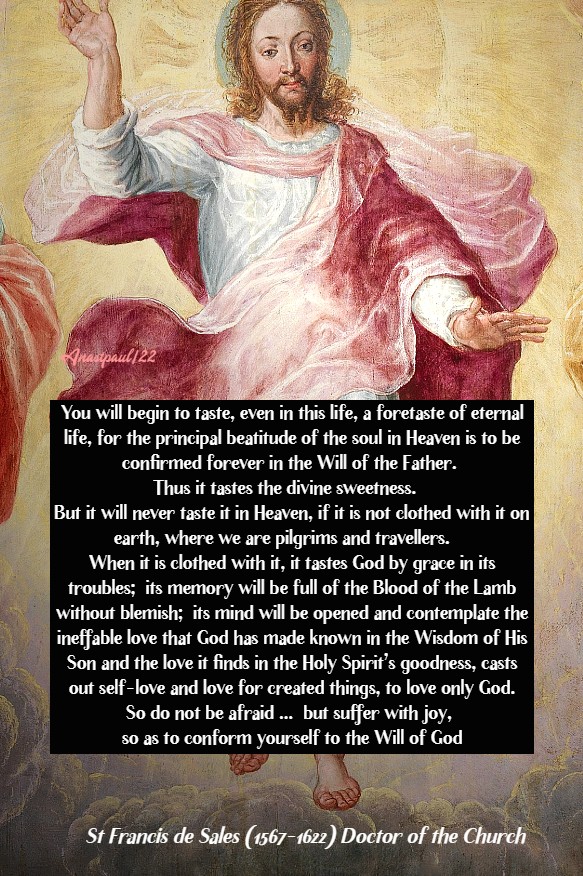
“You will begin to taste, even in this life, a foretaste of eternal life, for the principal beatitude of the soul in Heaven, is to be confirmed forever in the Will of the Father. Thus, it tastes the divine sweetness. But it will never taste it in Heaven, if it is not clothed with it on earth, where we are pilgrims and travellers. When it is clothed with it, it tastes God by grace in its troubles; its memory will be full of the Blood of the Lamb without blemish; its mind will be opened and contemplate the ineffable love that God has made known in the Wisdom of His Son and the love it finds, in the Holy Spirit’s goodness, casts out self-love and love for created things, to love only God. So do not be afraid … but suffer with joy, so as to conform yourself to the Will of God.””
You must be logged in to post a comment.