Thought for the Day – 11 April – Meditations with Antonio Cardinal Bacci (1881-1971)
Jesus is Condemned to Death
“Pilate was neither wicked nor cruel.
He was a weak opportunist who placed his position as Governor of Judea and his own personal interests above everything else in life.
He was prepared, moreover, to adopt the meanest of compromises.
He had acquitted Jesus, because, he believed Him to be innocent.
But he panicked as soon as he heard the crowd shouting and the Jewish priests accusing him of being no friend of the Emperor.
Then, he had recourse to an expedient.
When he saw Jesus covered with blood, crowned with thorns and clothed in purple rags, he showed Him to the crowd, in the hope, that their frenzied hearts would be touched with compassion.
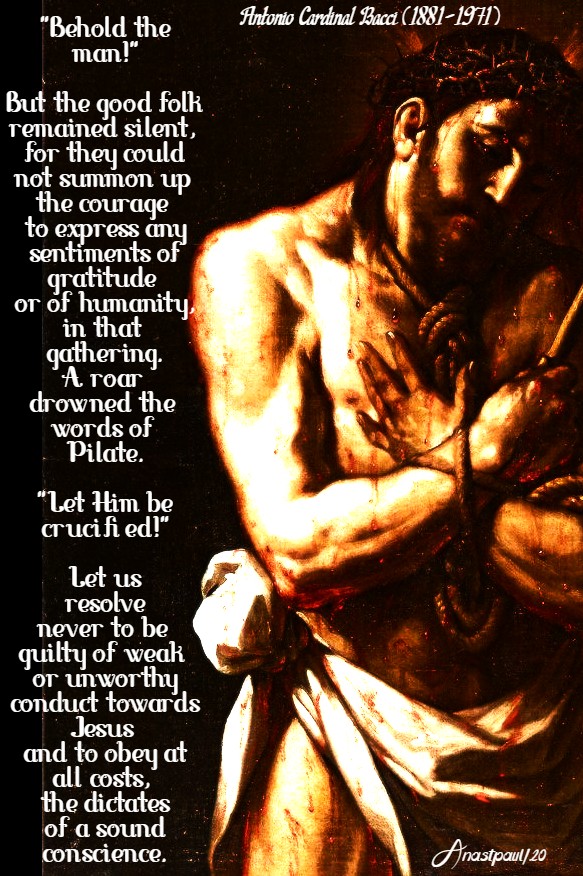
He said only a few simple words. “Behold the man!”
He wished them to see the condition to which this man had been reduced, who had been accused and mocked by them.
Looking like a trampled worm, He would stir up pity in every heart. In the crowd, there were people who had been enchanted by the glory of His heavenly teaching.
Some of them had listened to Him in Jerusalem only a few days previously, when He was greeted by tumults of applause.
Others had received favours and miracles from Him.
But the good folk remained silent, for they could not summon up the courage to express any sentiments of gratitude or of humanity, in that gathering.
A roar drowned the words of Pilate. “Let Him be crucified!”
Sometimes, when we see what is good and just, a rebellious impulse suddenly rises up inside us.
Unfortunately, we may yield to it on occasion and stifle the higher inspirations, which we receive.
Let us resolve never to be guilty of weak or unworthy conduct towards Jesus and to obey at all costs, the dictates of a sound conscience.”
Thought for the Day – 10 March – Meditations with Antonio Cardinal Bacci (1881-1971)
The Hidden Life of Jesus
“It is an amazing thought, that Jesus, the eternal wisdom of the Father, should have chosen to live quietly for thirty years in a carpenter’s workshop, along with his supposed father Joseph. He could have confounded the philosophers of Greece and Rome with His infinite wisdom. He could have attracted crowds by His miracles and drawn the attention of the whole world. But He preferred silence and a busy hidden life. Why? Because men needed to learn one thing before anything else. It was a simple thing but difficult to practise. It was humility they needed to hear, for humility was to be the foundation of the giant structure which He had come to raise up and whose spire, was to reach to Heaven! If this edifice, the Church, was to be so high, it’s foundation would have to be very deep. Let us learn this lesson of humility and silence from the hidden life of Jesus.
The tendency in modern times, even in regard to spiritual projects, is to try and draw attention and admiration. Perhaps this is why these projects are so often unsuccessful. Like the seed, thrown by the sower upon the hard ground, they wither away, because, they have no moisture. (Cf Lk 8:6). Without humility, a great deal of noise can be made but nothing supernatural is achieved. The first lesson we must learn from Jesus, is the silence and recollection of the interior life.”
Our Morning Offering – 24 February – Monday of the Seventh Week of Ordinary Time, Year A
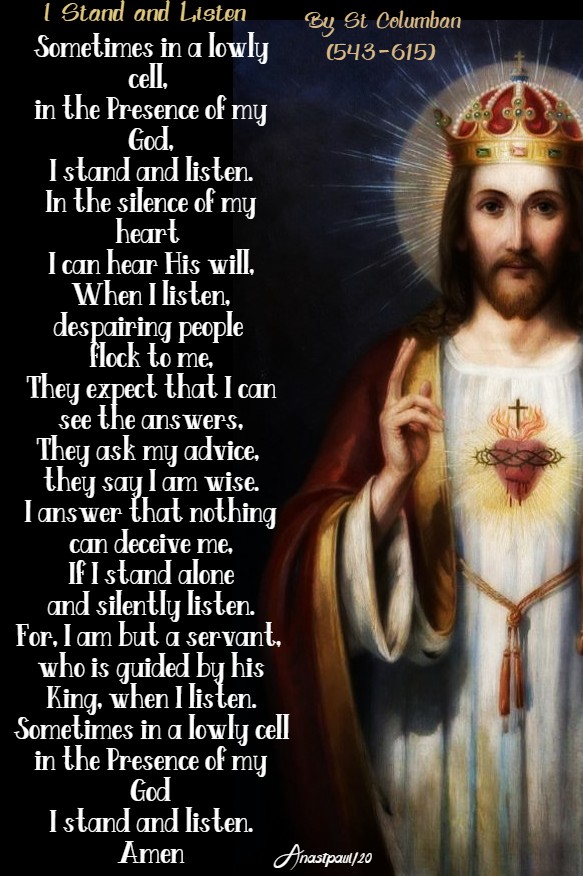
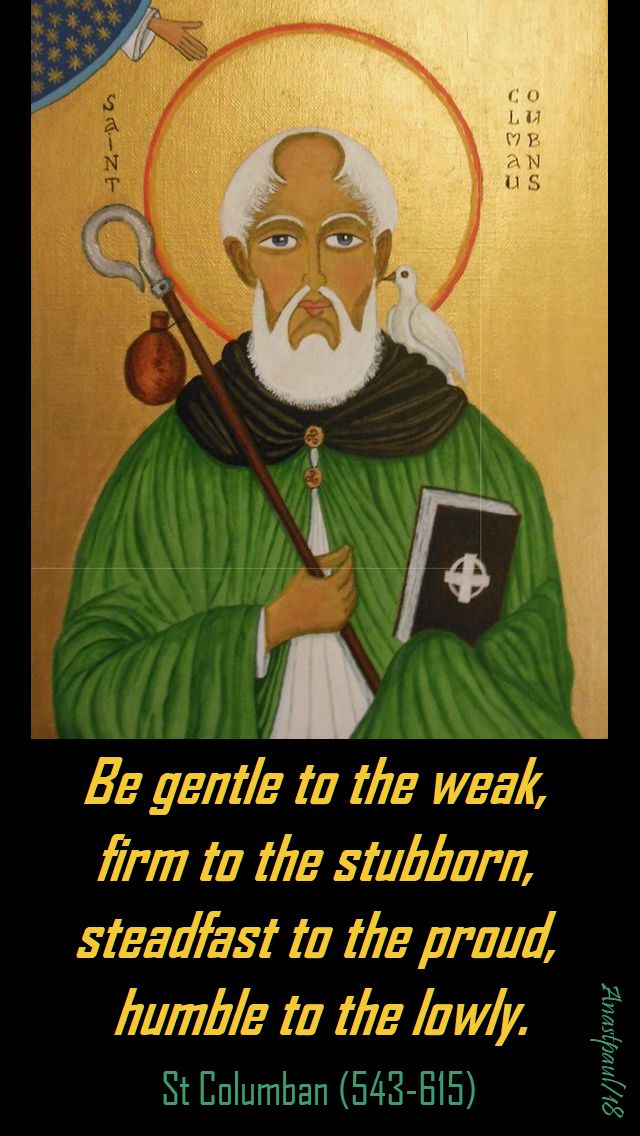
I Stand and Listen By St Columban (543-615)
Sometimes in a lowly cell,
in the presence of my God,
I stand and listen.
In the silence of my heart
I can hear His will,
When I listen,
despairing people flock to me,
They expect that I can see the answers,
They ask my advice,
they say I am wise.
I answer that nothing can deceive me,
If I stand alone and silently listen.
For, I am but a servant
who is guided by his King, when I listen.
Sometimes in a lowly cell
in the presence of my God
I stand and listen.
Amen
Thought for the Day – 18 February – Meditations with Antonio Cardinal Bacci (1881-1971)
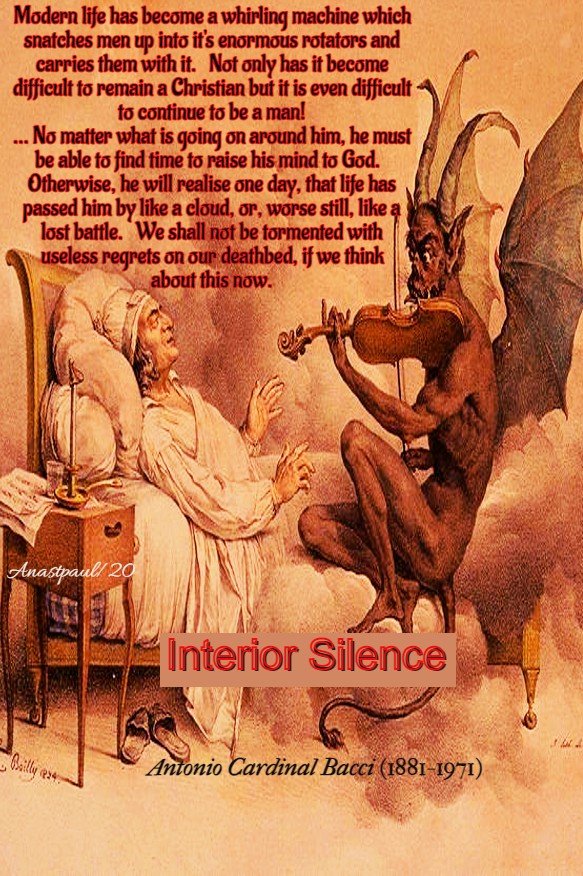
Interior Silence
“Many people allow themselves to be swept away in the confusion of the world around them. Modern life has become a whirling machine which snatches men up into it’s enormous rotators and carries them with it. Not only has it become difficult to remain a Christian but it is even difficult to continue to be a man!
You cannot cast aside the natural gifts of intellect, free will and personal dignity which God has given us. Still less, can we renounce the dignity of being Christians. This dignity can be retained by interior recollection, which will be nourished by divine grace, if we ask for it and, will find it’s external expression in good works. A man must be able to detach himself from the din of modern life and spend an occasional moment in recollection. No matter what is going on around him, he must be able to find time to raise his mind to God. Otherwise, he will realise one day, that life has passed him by like a cloud, or, worse still, like a lost battle. We shall not be tormented with useless regrets on our deathbed, if we think about this now.”
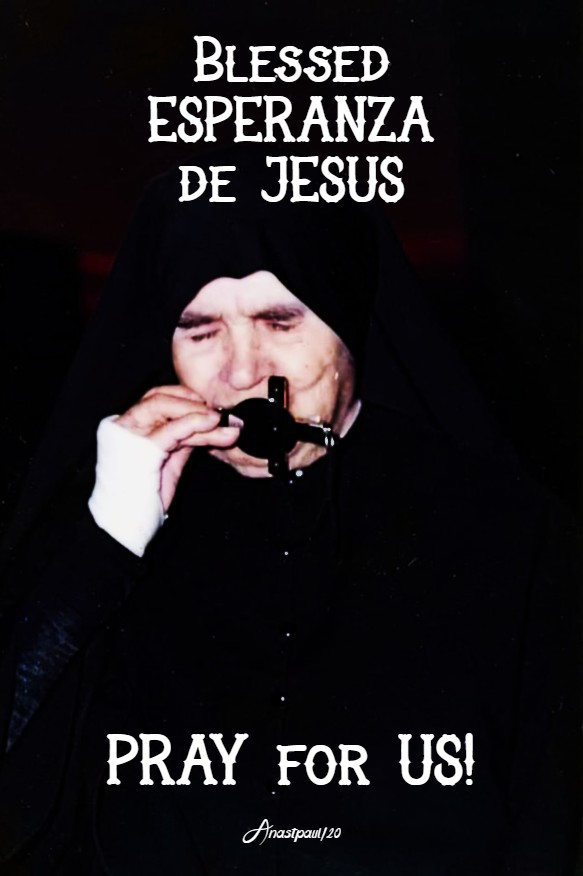
Quote/s of the Day – 8 February – The Memorial of Blessed Maria Esperanza de Jesus (1893-1983)
Speaking of: Prayer
“The means to obtain grace and glory is prayer.”
Blessed Maria Esperanza de Jesus (1893-1983)
“Half an hour’s meditation each day is essential, except, when you are busy. Then a full hour is needed.”
St Francis de Sales (1567-1622)
Doctor of the Church
“Do not neglect prayer, however busy you may be.”
Blessed William Joseph Chaminade (1761-1850)
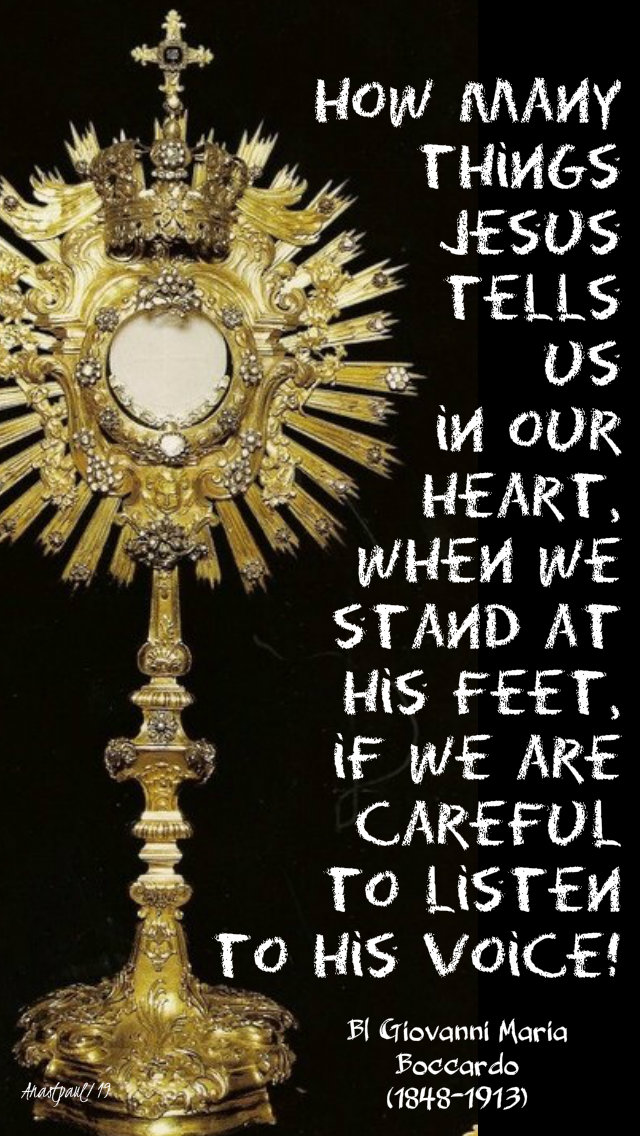
“How many things Jesus tells us in our heart, when we stand at His feet, if we are careful to listen to His Voice!”
Blessed Giovanni Maria Boccardo (1848-1913)
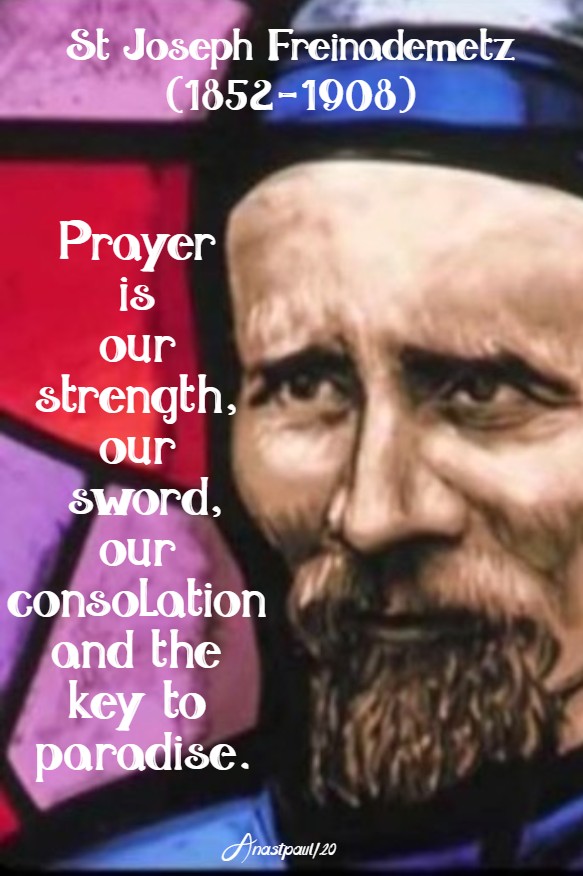
“Prayer is our strength, our sword, our consolation and the key to paradise.”
St Joseph Freinademetz (1852-1908)
“Fu Shenfu” – Lucky Priest
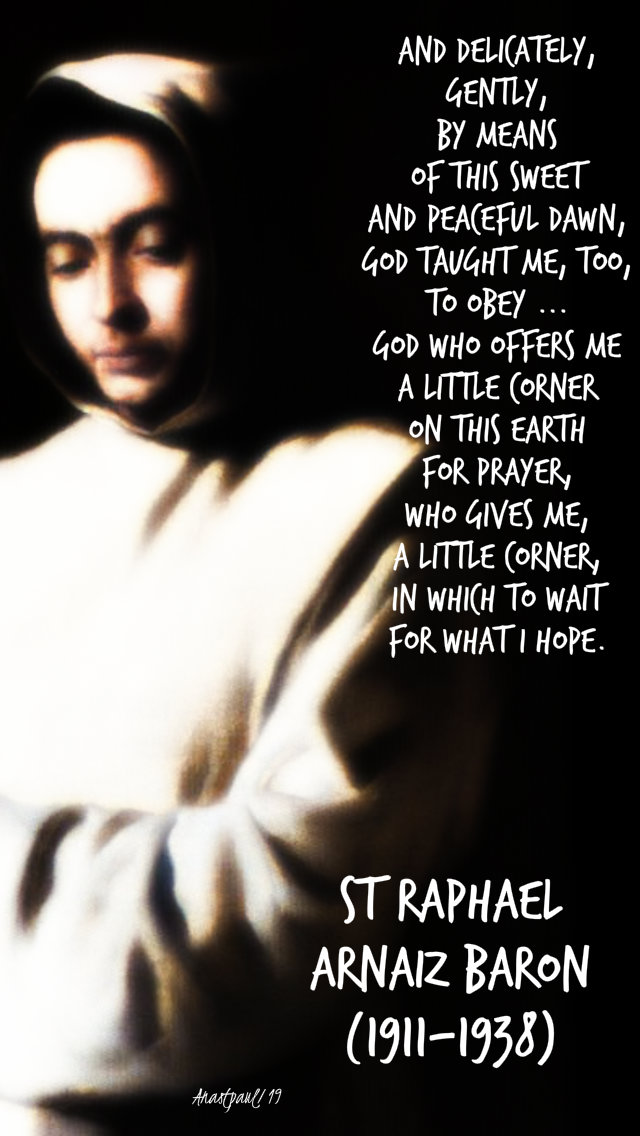
“And delicately, gently, by means of this sweet and peaceful dawn, God taught me, too, to obey … God who offers me a little corner on this earth for prayer, who gives me a little corner in which to wait for what I hope.”
One Minute Reflection – 8 February – Saturday of the Fourth Week of Ordinary Tme, Year A, Readings: 1 Kings 3:4-13, Psalm 119:9-14, Mark 6:30-34 and the Memorial of Blessed Maria Esperanza de Jesus (1893-1983)
“Come away by yourselves to a deserted place and rest awhile” … Mark 6:31
REFLECTION – “If you wish to come and find Me, seek me aside. As Mark says: “Come away by yourselves to a deserted place and rest awhile. People were coming and going in great numbers and they had no opportunity even to eat.” (Mk 6:31).
Alas, such are the passions of the flesh and the turmoil of thoughts coming and going in our hearts that we have no time to eat the food of everlasting sweetness nor perceive the taste of interior contemplation. That is why our Lord says: “Come away” from the noisy crowd “to a deserted place,” to solitude of mind and heart, “and rest awhile.” For truly, as the book of Revelation says: “There will be silence in heaven for about half an hour” (Rv 8:1); and in the Psalm: “Who will give me wings like a dove that I might fly away and find rest” (Ps 54[55]:7 LXX).
But let us listen to what the prophet Hosea says: “I will seduce her and lead her into the wilderness and I will speak to her heart” (cf. Hos 2:16 Vg). These three expressions: seduce, lead into the wilderness, speak to her heart, represent the three stages of the spiritual life – the beginning, development and perfection. The Lord seduces the beginner when He enlightens him with His grace so that he may grow and progress from virtue to virtue. Then he leads him aside from the din of the vices and disordered thoughts into peace of spirit. Finally, once guided to perfection, God speaks to his heart. Then the soul experiences the sweetness of divine inspiration and can surrender totally to joy of spirit.
What depth of devotion, of wonderment and happiness in his heart! By devotion he is raised above himself, through wonder he is led above himself, through happiness he is transported out of himself.” … St Anthony of Padua (1195-1231) Doctor of the Church – Sermon for the feast of Saint John the Evangelist
PRAYER – All-powerful, eternal God, splendour of true light and never-ending day, let our striving for Your kingdom not fall short through selfishness or fear, may the universe be alive with the Spirit and our homes be the pledge of the world redeemed. May our eyes see and our hearts have compassion, to all those who need us. May the intercession of our Holy Mother, Bl Esperanza de Jesus and all the saints, be a strength and a comfort. Through Jesus, our compassionate and loving Redeemer, with the Holy Spirit, one God with You forever, amen.
Quote/s of the Day – 30 January – The Memorial of Blessed Sebastian Valfrè CO (1629-1710)
Some of his advice, given to the novices, suffice for us all:
“Live at peace with everyone and to live thus, at peace, it is necessary to make war against yourself, for annoyance with your neighbour invariably proceeds from attachment to yourself.”
“Give yourself to prayer and try by it, to procure, first the amendment of your fault then the practice of Christian virtues and finally a great love of God.”
“Keep careful guard over your tongue, for remember, that much talking is a sign of little spirituality…”
“He who is wise, holds his tongue in his heart and he, who is foolish, carries his heart on his tongue. He who can keep silence is near to God.”
He was much in demand as a spiritual father and would advise the Fathers of his Congregation:
“A confessor should above all, give a good example to his penitents, especially by practising the virtues he wishes to impress upon them. If he exhorts them to humility, let him first be humble; if to devotion, let him be devout himself; if he is to do this he will more readily be believed and obeyed. Woe to confessors and preachers who teach virtue without practising it. Woe to him who counsels, instructs and directs others, if he be not virtuous himself! Let such a man dread the Judgement!”
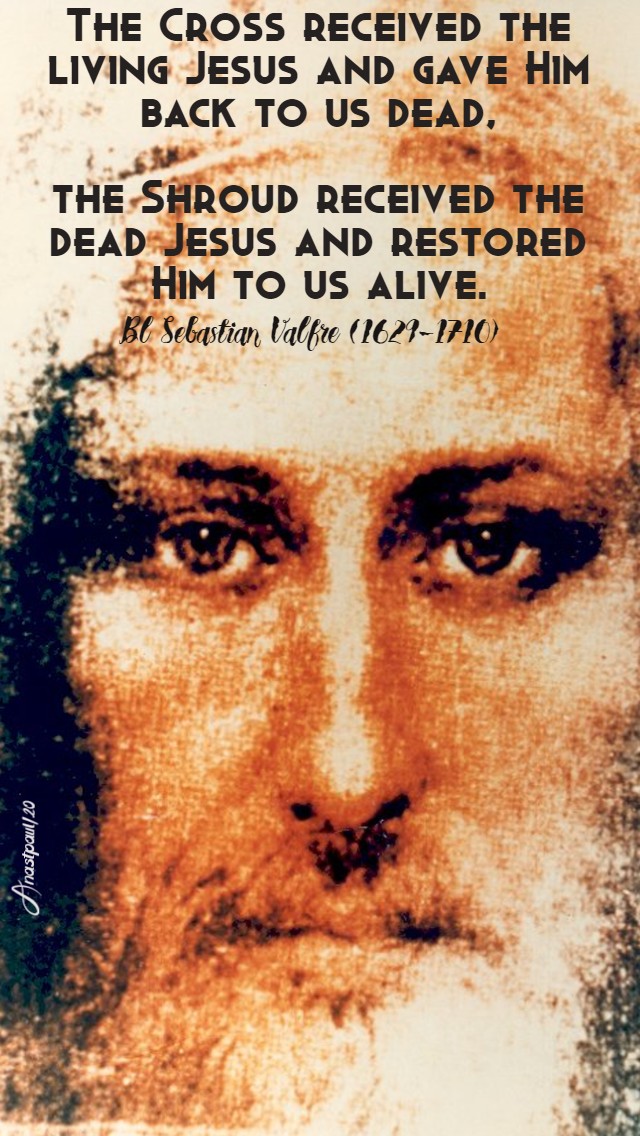
Blessed Sebastian speaking of the Shroud of Turin to which he had a great devotion:
“The Cross received the living Jesus and gave Him back to us dead, the Shroud received the dead Jesus and restored Him to us alive.”
“When it is all over, you will not regret having suffered, rather, you will regret, having suffered so little and suffered that little so badly.”
Thought for the Day – 2 January – Meditations with Antonio Cardinal Bacci (1881-1971)
“Silence”
“Absorbed in the deafening din of the world around us, it is difficult to hear the voice of God.
At least, for a little while each day, we must create within ourselves, a zone of silence, in order to listen to His voice.
Since God speaks readily in the silence of the heart, let us recollect ourselves before Him, in this quiet oasis.
At least a quarter of an hour of daily meditation is essential for the life of a Christian.
This should be the jumping-off board for all the actions of day, if we wish these to be correct and productive of good.
It is very useful, moreover, to recall to mind frequently during the day, the resolutions which have been formed and to accompany these reflections, with short prayers, aspirations and acts of love for God.”
Quote/s of the Day – 30 December – The Sixth Day in the Christmas Octave and the Memorial of Blessed Giovanni Maria Boccardo (1848-1913) “Father of the Poor”
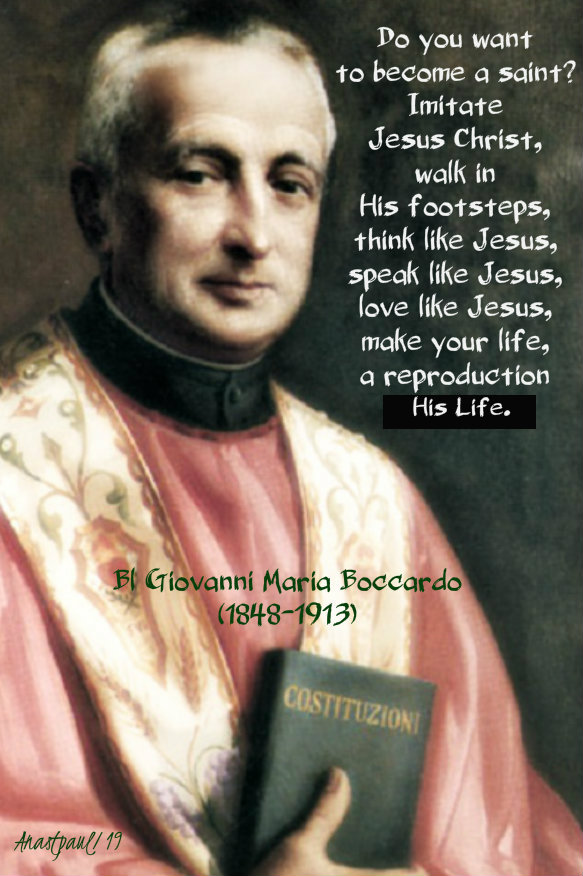
“Do you want to become a saint? Imitate Jesus Christ, walk in His footsteps, think like Jesus, speak like Jesus, love like Jesus, make your life, a reproduction of His Life.”
“How many things Jesus tells us in our heart, when we stand at His feet, if we are careful to listen to His Voice!”
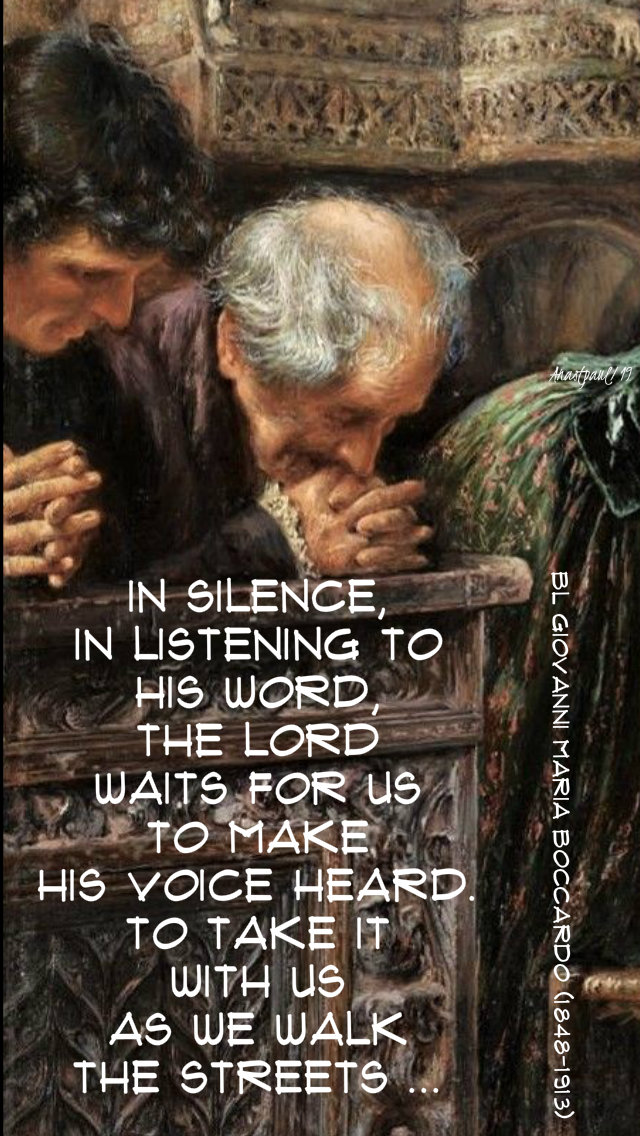
“In silence, in listening to His Word, the Lord waits for us to make His Voice heard. To take it with us as we walk the streets …”
“When you want to pass judgement on your neighbour, act as if it were you, and you were next!”
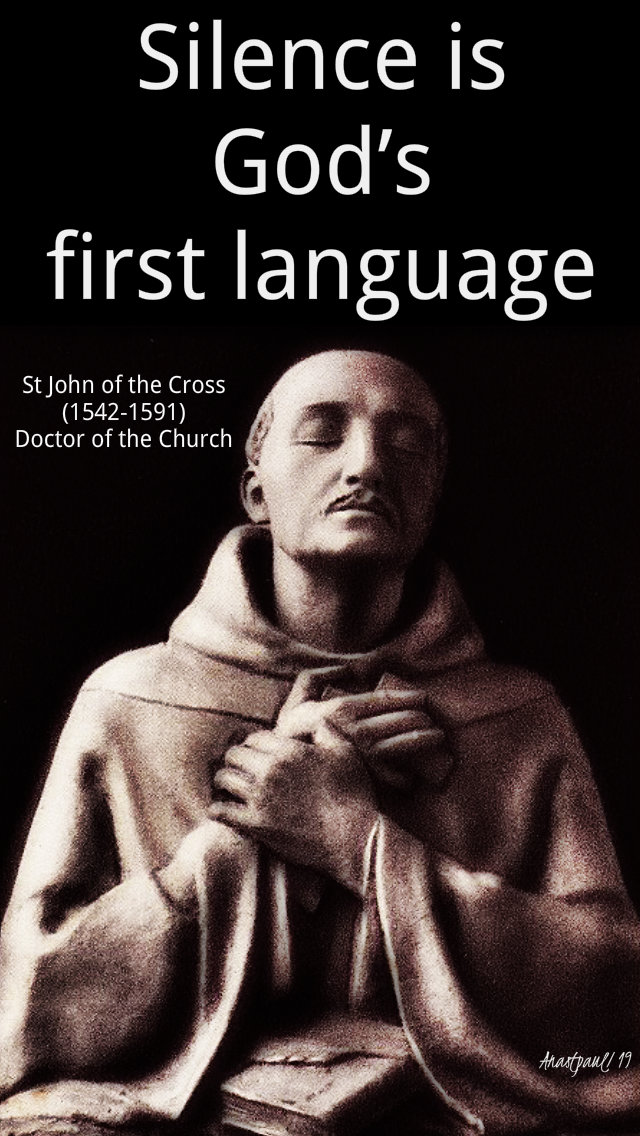
Quote/s of the Day – 14 December – The Memorial of St John of the Cross (1542-1591) Doctor of the Church
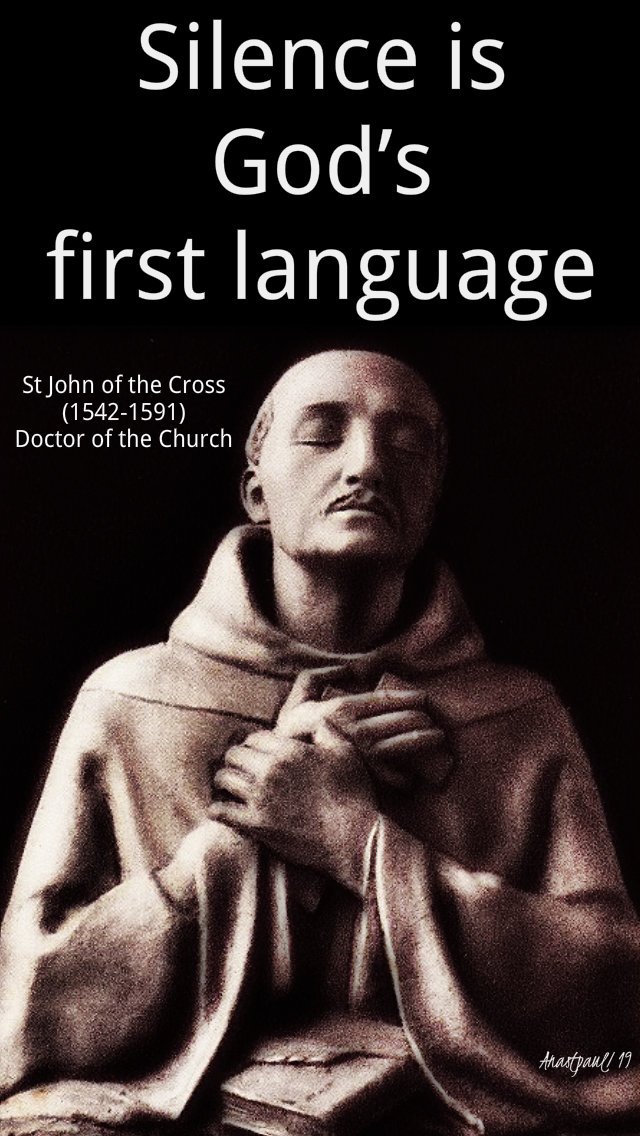
“Silence is God’s first language.”
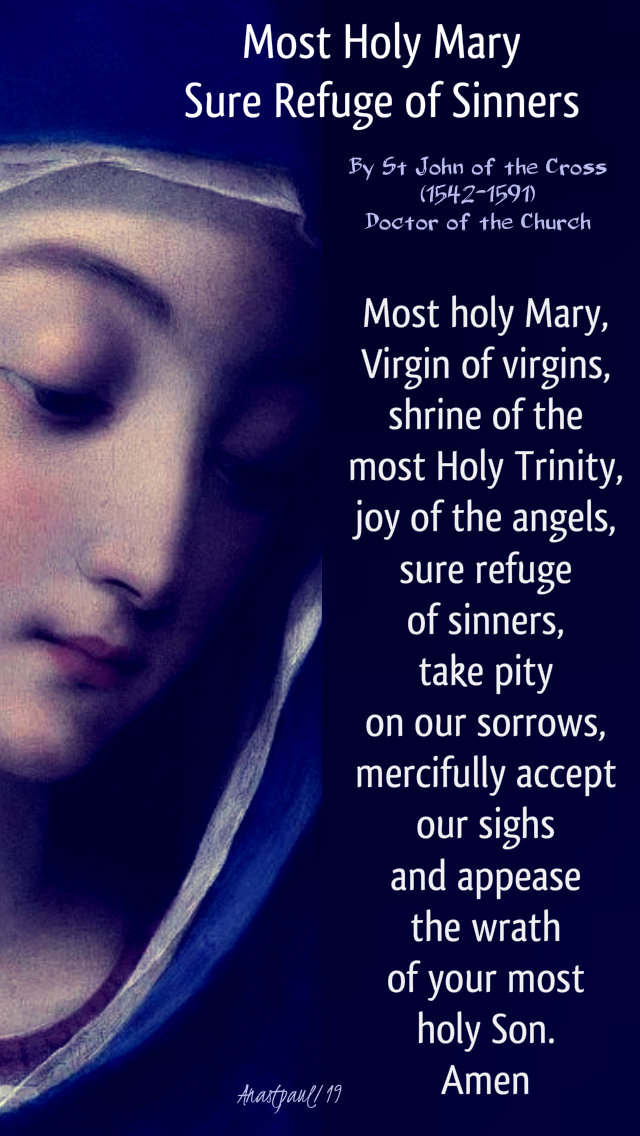
“Most holy Mary, Virgin of virgins, shrine of the most Holy Trinity, joy of the angels, sure refuge of sinners, take pity on our sorrows, mercifully accept our sighs and appease the wrath of your most holy Son. Amen”
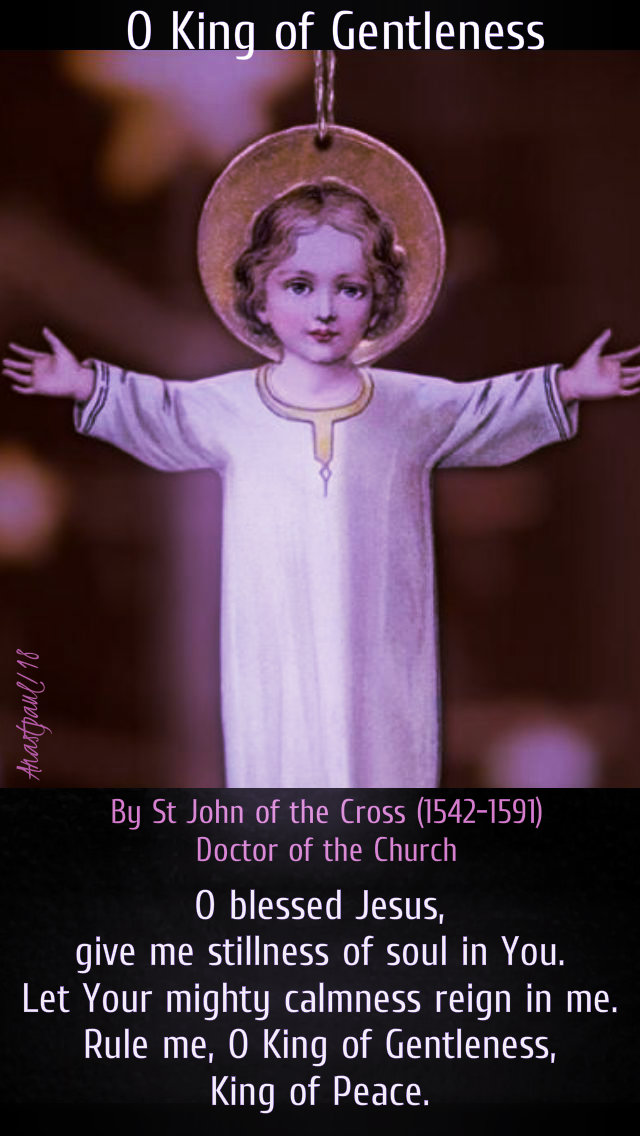
“O blessed Jesus, give me stillness of soul in You. Let Your mighty calmness reign in me. Rule me, O King of Gentleness, King of Peace.”
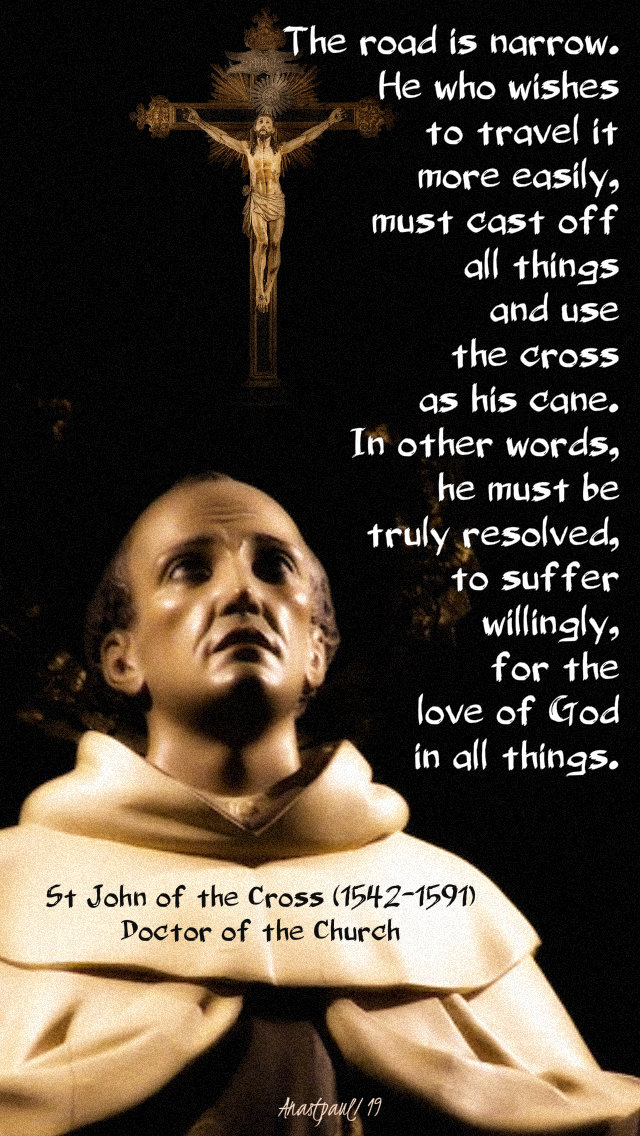
“The road is narrow. He who wishes to travel it more easily must cast off all things and use the cross as his cane. In other words, he must be truly resolved to suffer willingly for the love of God in all things.”
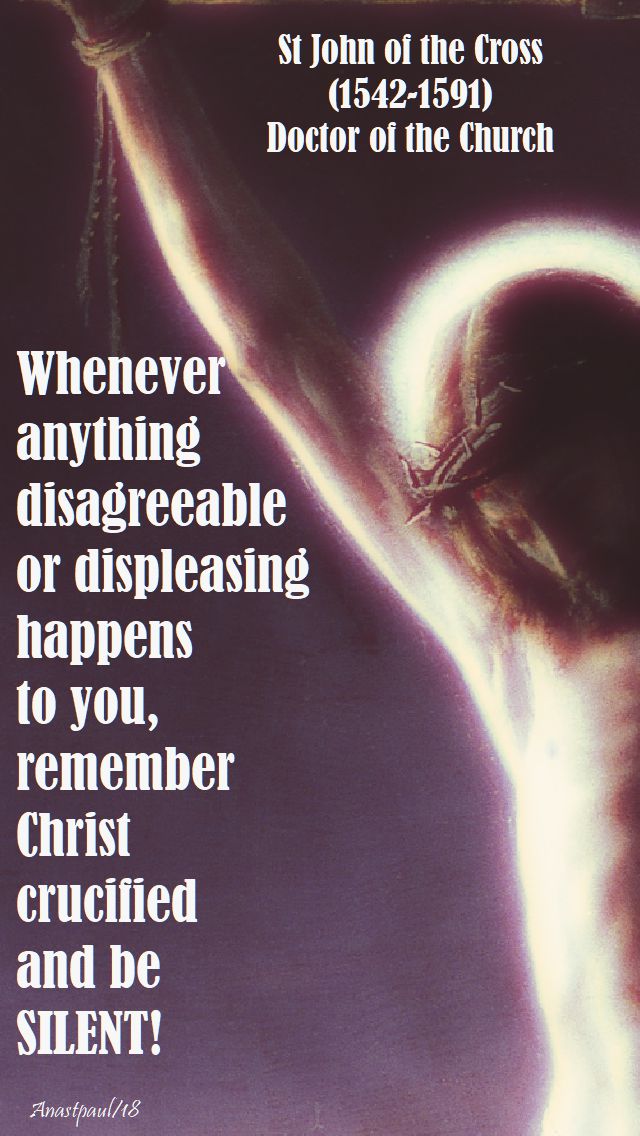
“Whenever anything disagreeable or displeasing happens to you, remember Christ crucified and be silent!”
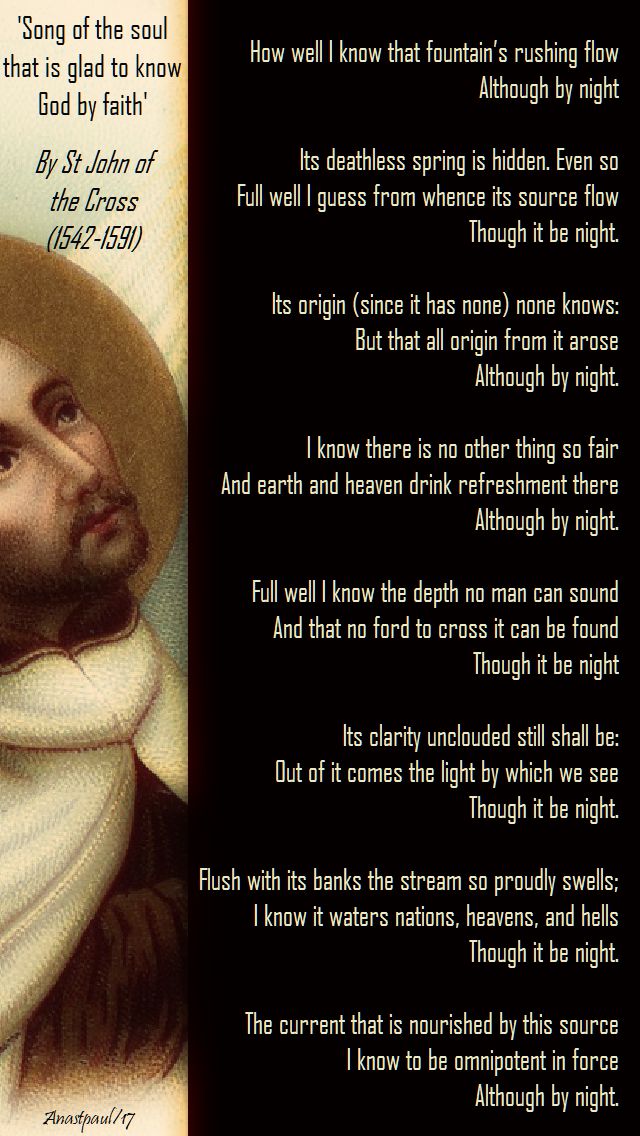
‘Song of the soul that is glad to know God by faith’
How well I know that fountain’s rushing flow Although by night
Its deathless spring is hidden. Even so Full well I guess from whence its source flow Though it be night.
Its origin (since it has none) none knows: But that all origin from it arose Although by night.
I know there is no other thing so fair And earth and heaven drink refreshment there Although by night.
Full well I know the depth no man can sound And that no ford to cross it can be found Though it be night
Its clarity unclouded still shall be: Out of it comes the light by which we see Though it be night.
Flush with its banks the stream so proudly swells; I know it waters nations, heavens, and hells Though it be night.
The current that is nourished by this source I know to be omnipotent in force Although by night.
(Translated by Roy Campbell)
St John of the Cross (1542-1591) Doctor of the Church
Quote/s of the Day – 14 November – Thursday of the Thirty Second week in Ordinary Time, Year C, Gospel: Luke 17:20–25
” … For behold, the kingdom of God, is in the midst of you.”
Luke 17:21
” …[The Kingdom of God] … is within you. That is, it depends on your own wills and is in your own power, whether or not you receive it. Everyone, that has attained to justification, by means of faith in Christ and decorated by every virtue, is counted worthy, of the kingdom of heaven.”
St Cyril of Alexandria (376-444)
(Commentary on Luke, 117) Known as “The Pillar of Faith” Archbishop of Alexandria, Father & Doctor of the Church
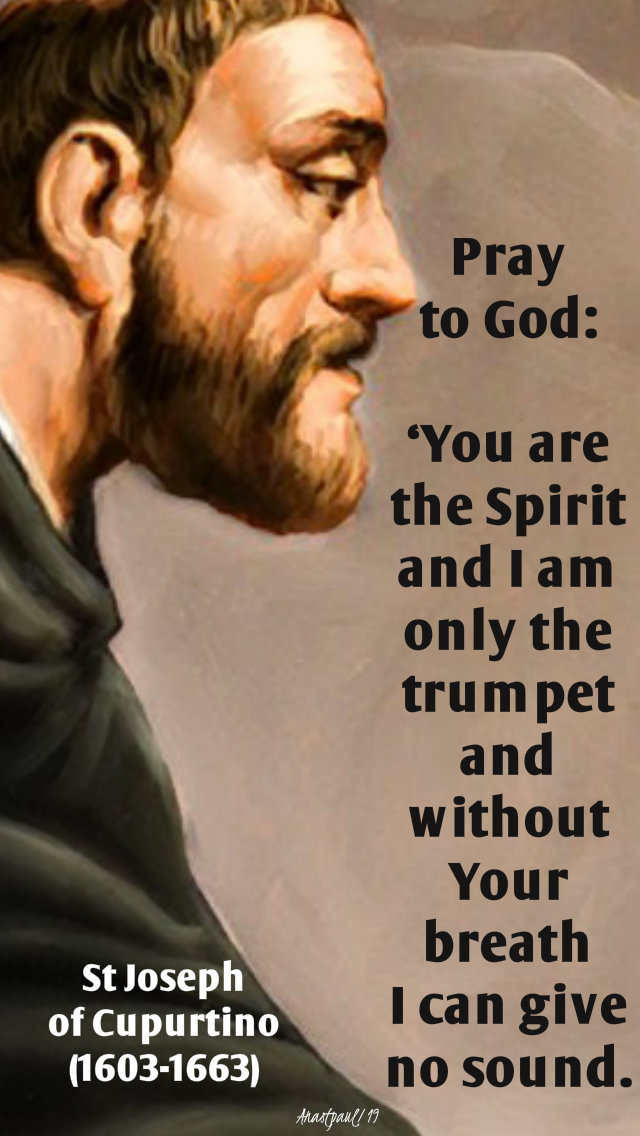
“Pray to God:
‘You are the Spirit and I am only the trumpet and without Your breath I can give no sound.’”
St Joseph of Cupurtino (1603-1663)
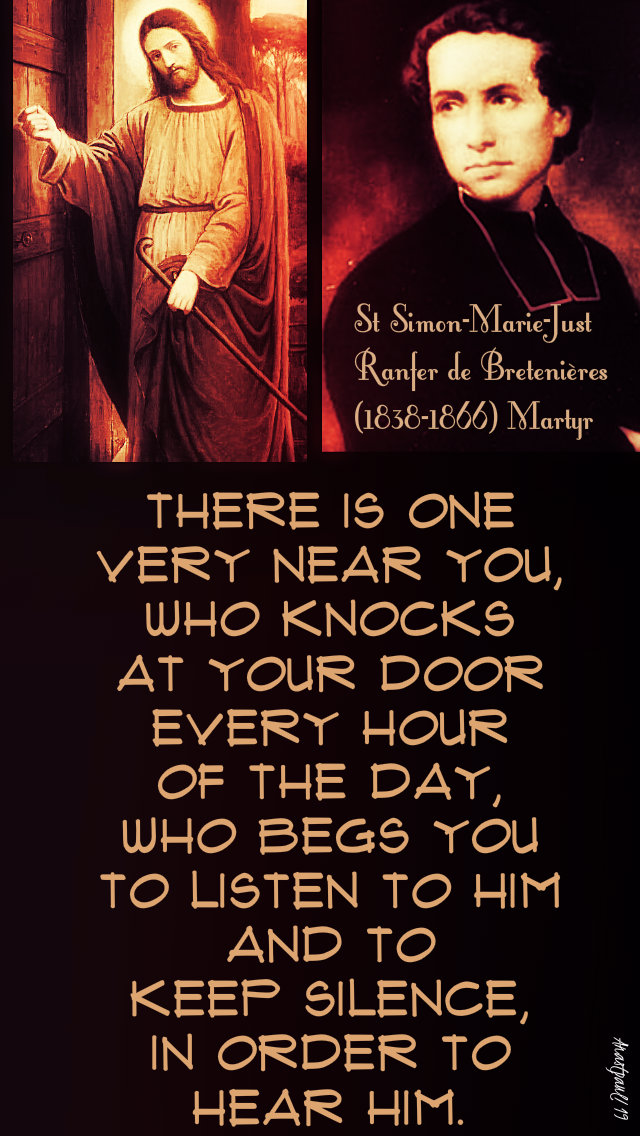
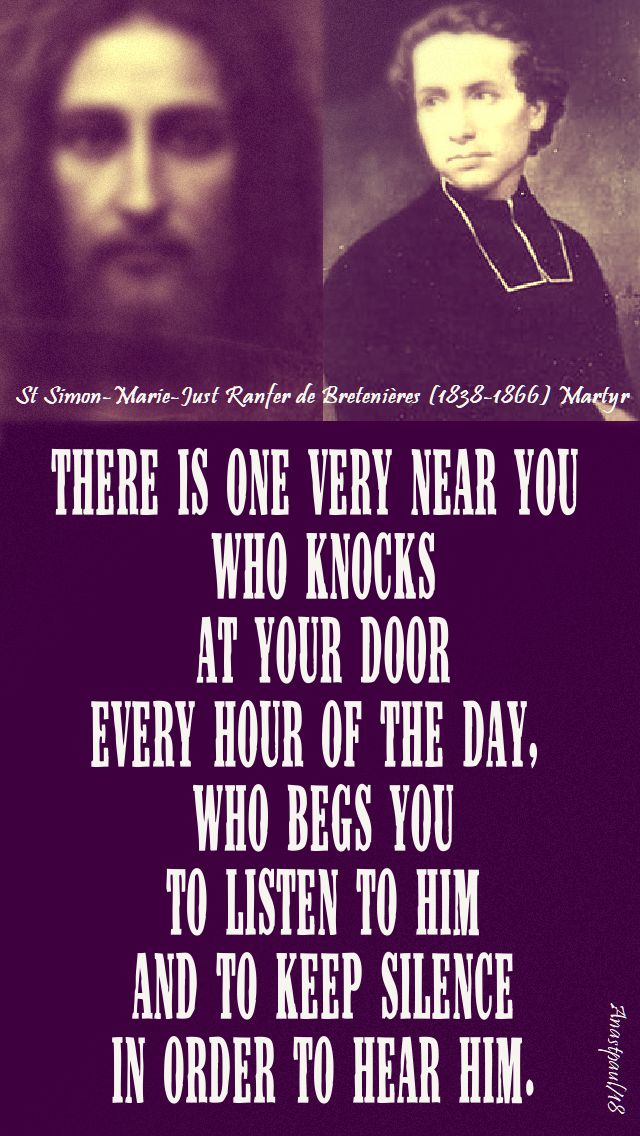
“There is One very near you Who knocks at your door every hour of the day, Who begs you to listen to Him and to keep silence in order to hear Him.”
St Simon-Marie-Just Ranfer de Bretenières (1838-1866) Martyr
Thought for the Day – 6 October – Twenty Seventh Sunday in Ordinary Time, Year C, Gospel: Luke 17:5–10 and the Memorial of St Bruno O.Cart. (c 1030-1101)
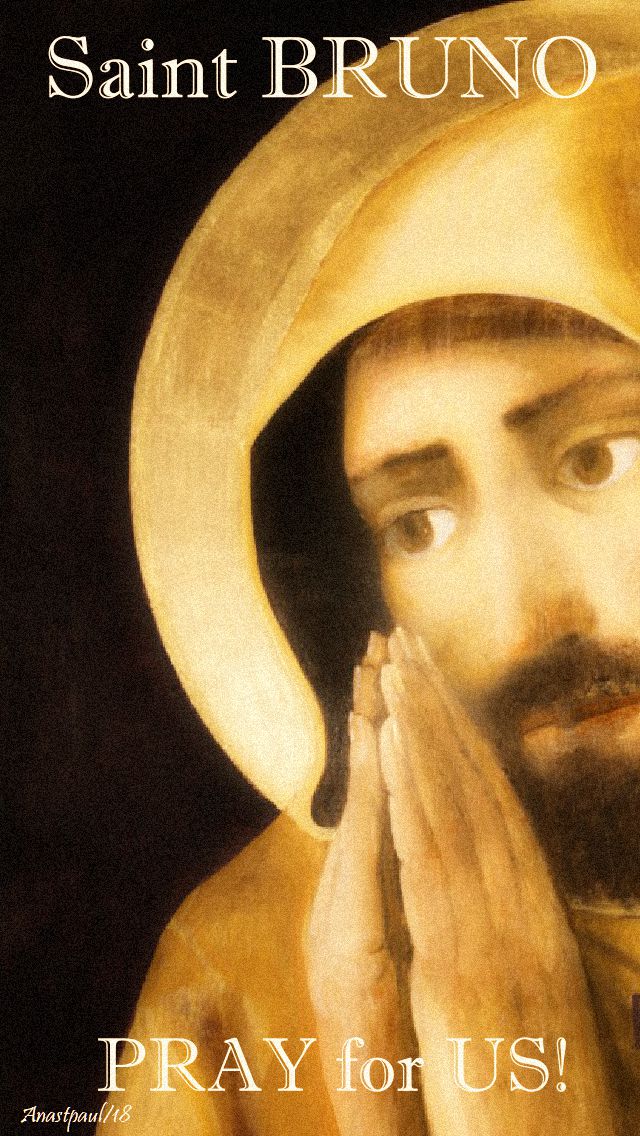
This saint has the honour of having founded a religious order which, as the saying goes, has never had to be reformed because it was never deformed. No doubt, both the founder and the members would reject such high praise but it is an indication of the saint’s intense love of a penitential life in solitude.
Bruno was born in Cologne, Germany, became a famous teacher at Rheims and was appointed Chancellor of the Archdiocese at the age of 45. He supported Pope Gregory VII in his fight against the decadence of the clergy and took part in the removal of his own scandalous Archbishop, Manasses. Bruno suffered the plundering of his house for his pains.
He had a dream of living in solitude and prayer and persuaded a few friends to join him in a hermitage. After a while, he felt the place unsuitable and through a friend, was given some land which was to become famous for his foundation “in the Chartreuse”—from which comes the word Carthusians. The climate, desert, mountainous terrain and inaccessibility guaranteed silence, poverty and small numbers.
Bruno and his friends built an oratory with small individual cells at a distance from each other. They met for Matins and Vespers each day and spent the rest of the time in solitude, eating together only on great feasts. Their chief work was copying manuscripts.
Hearing of Bruno’s holiness, the pope called for his assistance in Rome. When the pope had to flee Rome, Bruno pulled up stakes again and after refusing a bishopric, spent his last years in the wilderness of Calabria.
Bruno was never formally Canonised, because the Carthusians were averse to all occasions of publicity. However, Pope Clement X extended his feast to the whole Church in 1674.
If there is always a certain uneasy questioning of the contemplative life, there is an even greater puzzlement about the extremely penitential combination of community and hermit life lived by the Carthusians, but this ‘into the silence and solitude’ is the perfect environment to touch God.
St Bruno wrote to his Carthusians:
“Rejoice, my dearest brothers, because you are blessed and because of the bountiful hand of God’s grace upon you. Rejoice, because you have escaped the various dangers and shipwrecks of the stormy world. Rejoice, because you have reached the quiet and safe anchorage of a secret harbour. Many wish to come into this port and many make great efforts to do so, yet do not achieve it. Indeed many, after reaching it, have been thrust out, since it was not granted them from above. By your work you show what you love and what you know. When you observe true obedience with prudence and enthusiasm, it is clear, that you wisely pick the most delightful and nourishing fruit of divine Scripture.”
May we mirror Bruno’s quest for holiness and unity with God.
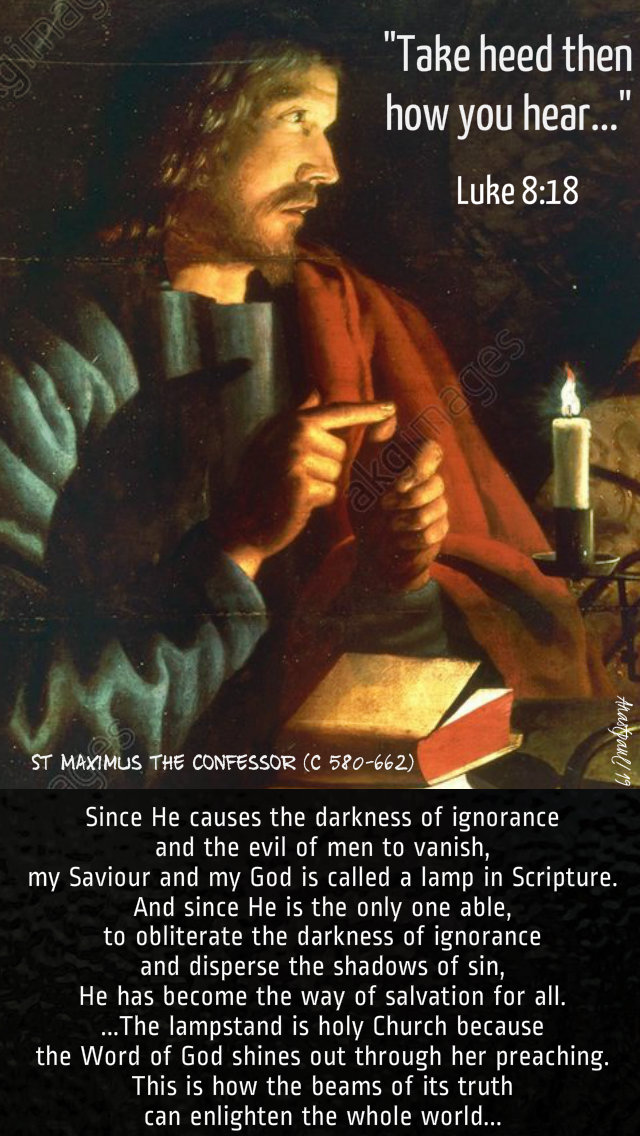
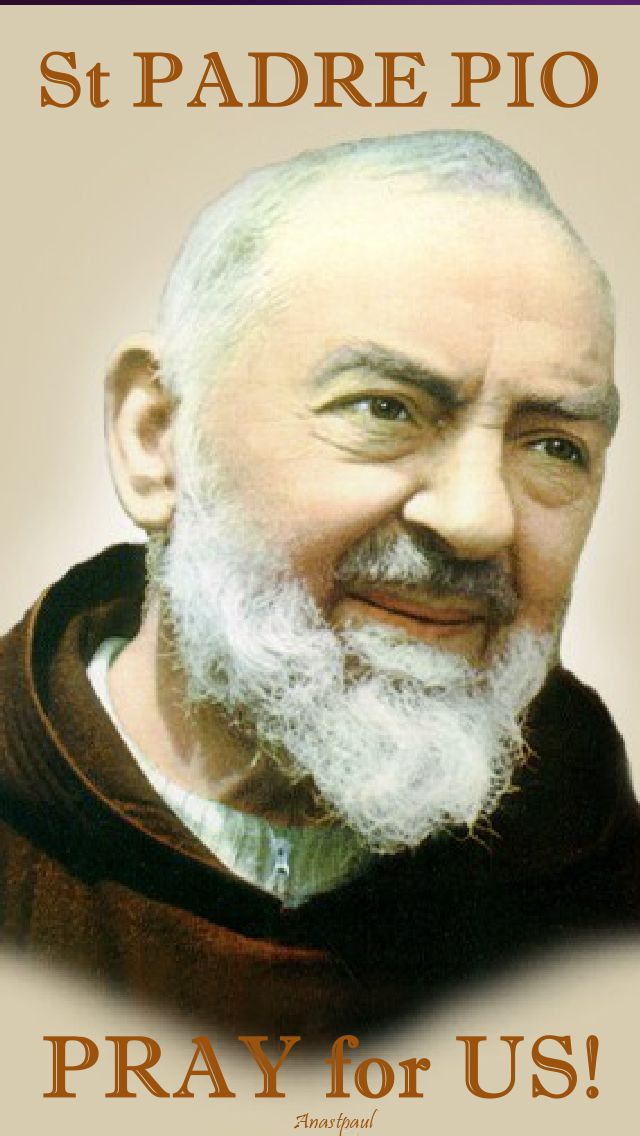
One Minute Reflection – 23 September – Monday of the Twenty Fifth Week in Ordinary Time, Year C, Gospel: Luke 8:16–18 and the Memorial of St Padre Pio (1887-1968)
“Take heed then how you hear…” … Luke 8:18
REFLECTION – “The lamp on the lampstand is our Lord Jesus Christ, who is the Father’s true light “who enlightens everyone coming into the world” (Jn 1:9), in other words, the Father’s Wisdom and Word. having accepted our flesh, He truly became and was called, the “light of the world”. By our faith and devotion He is honoured and exalted in the Church. In this way He is made visible to all nations and shines out for “all the people in the house”, namely the whole world, as He said: “They do not light a lamp and then put it under a bushel basket, it is set on a lampstand , where it gives light to all in the house” (Mt 5:15).
As we have seen, Christ calls Himself a lamp. God by nature, He became flesh according to the plan of salvation, a light held within the flesh as if in a vase… This is what David was thinking when he said: “Your word is a lamp to my feet and a light for my path” (Ps 119[118]:105). Since He causes the darkness of ignorance and the evil of men to vanish, my Saviour and my God is called a lamp in Scripture. And since He is the only one able, to obliterate the darkness of ignorance and disperse the shadows of sin, He has become the way of salvation for all. He leads towards the Father all those who, through understanding and virtue, walk with Him along the path of the commandments as on a road of righteousness.
The lampstand is holy Church because the Word of God shines out through her preaching. This is how the beams of its truth can enlighten the whole world… On one condition, however – so long as it is not hidden under the letter of the Law. Anyone who clings to Scripture according to the letter only is living according to the flesh, he is placing the lamp under a bushel basket. But when, to the contrary, the Church is set on the lampstand, it enlightens everyone.” … Saint Maximus the Confessor (c 580-662) – Abbot and Theologian – Question 63 to Thalassius
PRAYER – Holy God, teach me gratitude for Your love, teach me faithfulness no matter what difficulties I face. Jesus, my Lord, Your Church is my guide and my understanding, help me to always be true to her, my holy mother. St Padre Pio, pray for the Church and all God’s people. We make our prayer through Jesus Christ, our Lord, with the Holy Spirit, God for all eternity, amen.
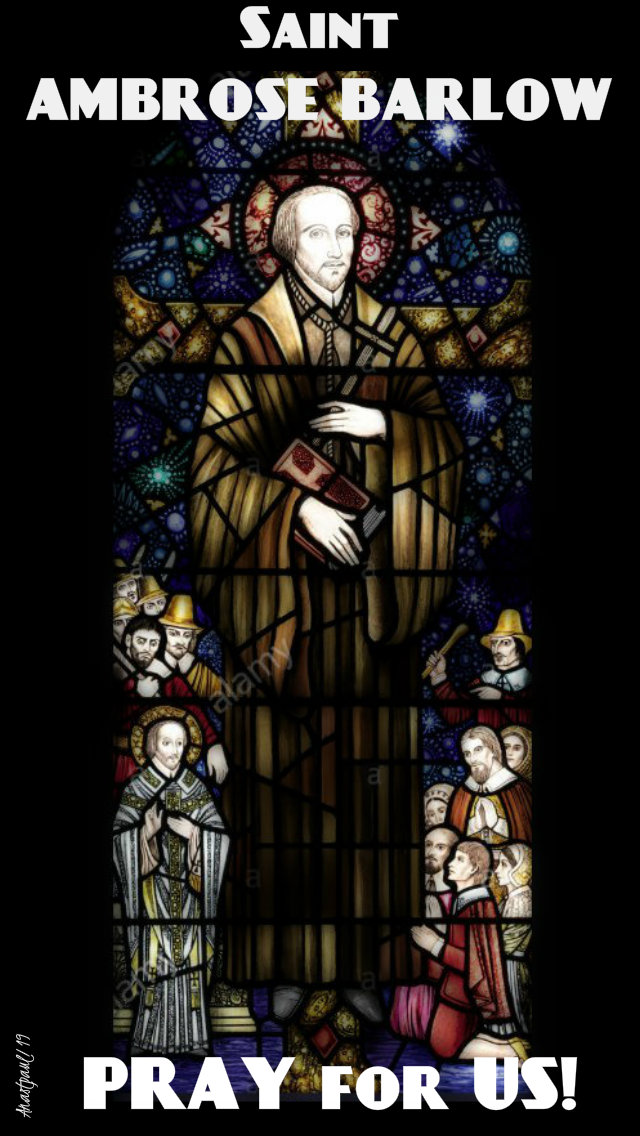
One Minute Reflection – 10 September – Tuesday of the Twenty third week in Ordinary Time, Year C, Gospel: Luke 6:12-19 and the Memorial of St Ambrose Barlow (1585-1641) Martyr
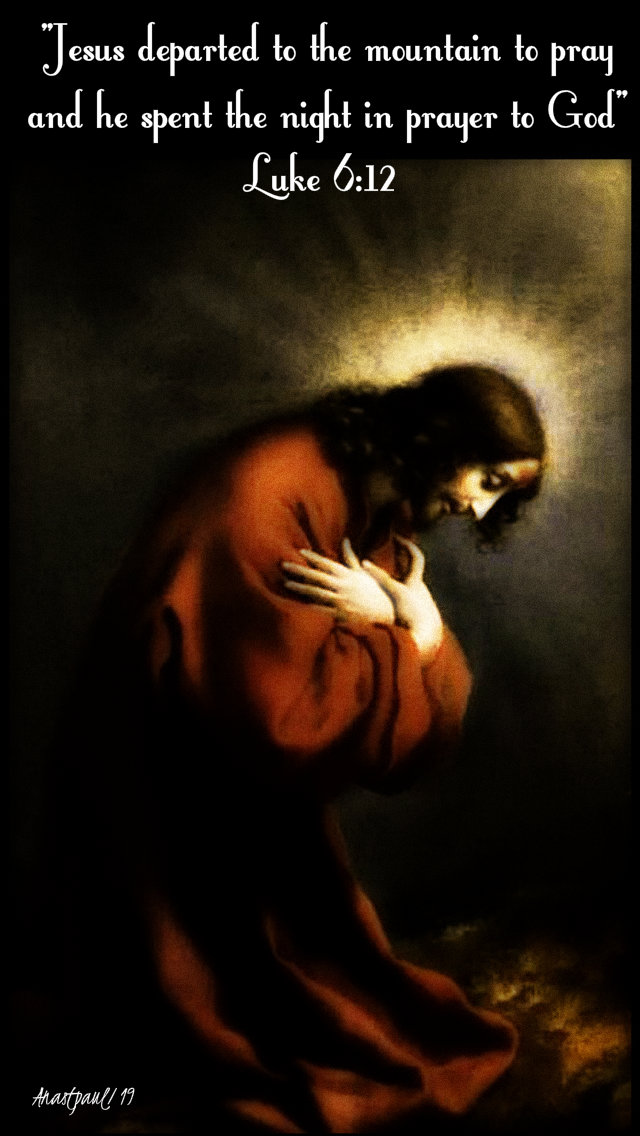
“Jesus departed to the mountain to pray and he spent the night in prayer to God” … Luke 6:12
REFLECTION – “Contemplatives and ascetics of every age and every religion have always sought God in the silence and solitude of deserts, forests and mountains. Jesus Himself lived for forty days in complete solitude, spending long hours in intimate converse with the Father in the silence of the night.
We, too, are called to withdraw into a deeper silence from time to time, alone with God. Being alone with Him – not with our books, our thoughts, our memories but in complete nakedness, remaining in His presence – silent, empty, motionless, waiting.
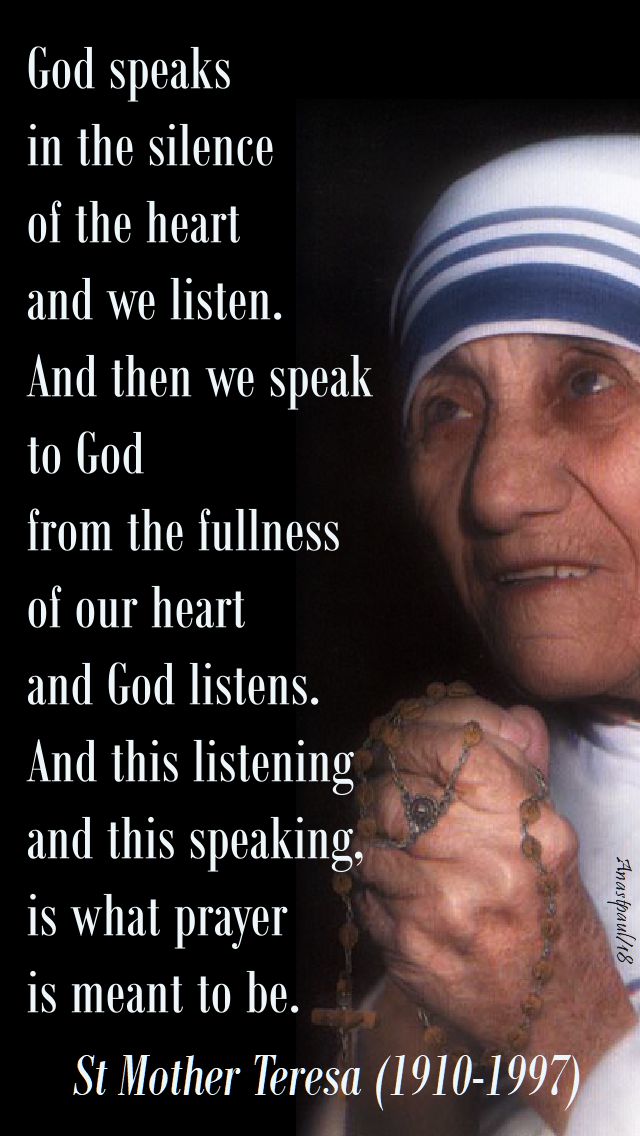
We cannot find God in noise and restlessness. Look at nature, the trees, flowers, grasses all grow in silence; the stars, the moon, the sun all move in silence. The important thing is, not what we are able say but what God says to us and what He speaks to others through us. In silence, He listens to us, in silence He speaks to our souls, in silence we are granted the privilege of hearing His voice –
Silence of the eyes,
Silence of the ears,
Silence of our mouths,
Silence of our minds.
In the silence of the heart
God will speak.
… Saint Mother Teresa of Calcutta (1910-1997) – No Greater Love
PRAYER – Our Father who art in heaven, almighty and eternal God, teach us to pause often during our active lives and recollect ourselves. Let us put away the problems of life and commune with You in prayer and meditation. St Ambrose Barlow, amidst your life of constant threat and charity to all, you renewed your courage and strength in silence. Pray for us that we may be inspired to turn to our God for strength, in this vale of tears. Through Jesus Christ our Lord, with the Holy Spirit,God forever, amen.
Quote/s of the Day – 20 July – The 50th anniversary of Cardinal Robert Sarah, Prefect, Congregation of Divine Worship
“The most important moments in life are the hours of prayer and adoration. They give birth to a human being, fashion our true identity; they root our existence in mystery.”
“True charity is neither almsgiving nor humanistic solidarity nor a form of philanthropy – charity is the expression of God and an extension of Christ’s presence in our world.”
“The foundation of the liturgy must remain the search for God. We can only be dismayed by the fact that this intention of Saints Popes John XXIII and Paul VI, and of the Council Fathers as well, is often obscured and, worse yet, betrayed. . . .”
God or Nothing
“The Father waits for His children in their own hearts.”
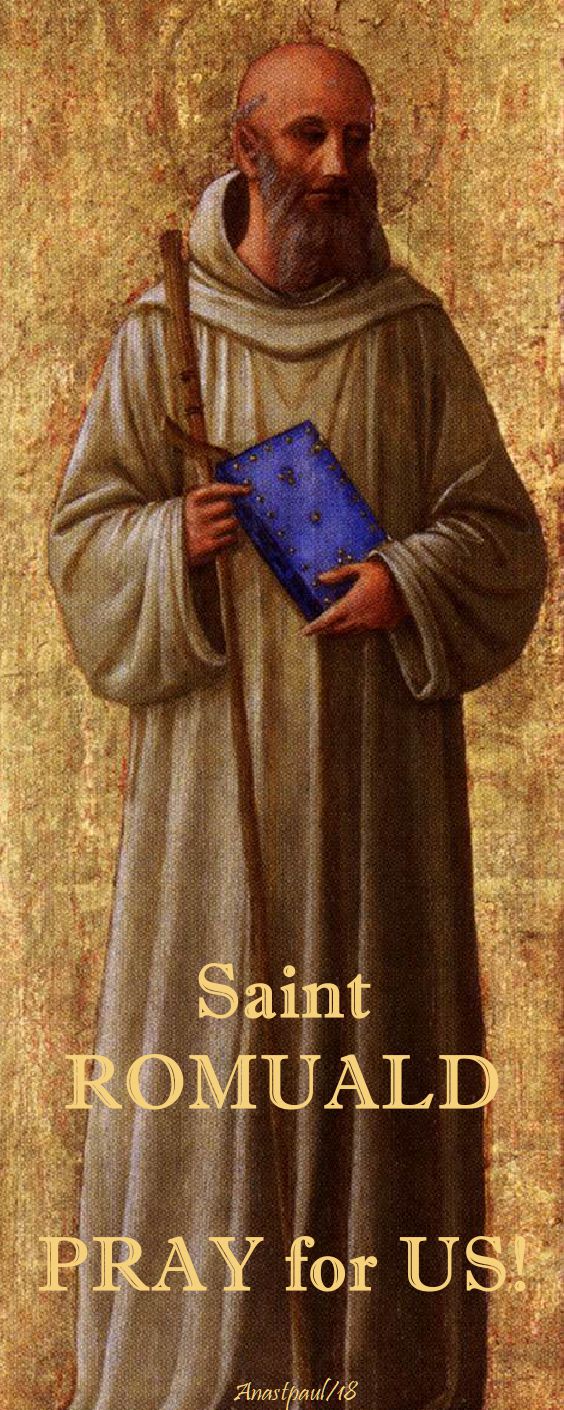
Thought for the Day – 19 June – Wednesday of the Eleventh Week in Ordinary Time, Year C, Gospel: Matthew 6:1–6 and the Memorial of St Romuald (c 951-1027)
“But when you pray, go into your room and shut the door and pray to your Father who is in secret and your Father, who sees in secret, will reward you.”...Matthew 6:6
“When you pray, go to your inner room”
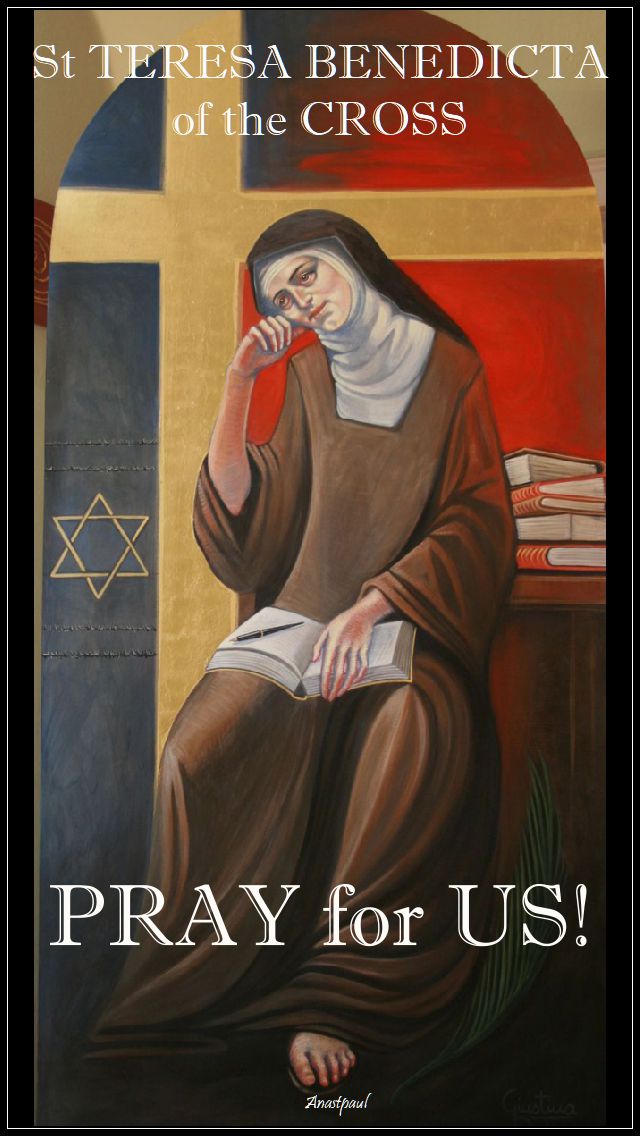
Saint Teresa Benedicta of the Cross [Edith Stein OCD (1891-1942)
Martyr, co-patron of Europe
The Prayer of the Church (trans. Darlington Carmel)
In those who have entered into the unity of the divine inner life, everything is one – rest and activity, contemplation and action, silence and speech, listening and communicating, loving receptiveness, and loving gift of self in thanksgiving and praise… We need hours of silent listening, when we allow the divine Word to work in us, until it craves to become fruitful in the sacrifice of praise and of action.
We need the traditional forms and participation in the set forms of acts of regular worship, so that the inner life can be awakened and guided and find a suitable expression. The solemn divine praise must have its homes on earth, where it is developed, to the greatest perfection possible, to human beings. From these, it ascends to heaven, for the whole Church and becomes effective in the members of the Church, quickening their interior life, inviting their participation. But, it must itself be quickened from within, even in these places, by leaving space for silence and depth. Otherwise it would degenerate into mere lip-service. Contemplative houses where souls stand in solitude and silence before the face of God, are a protection against this danger. They wish to be, in the heart of the Church, the love that vivifies all.
Quote/s of the Day – 29 April – Monday of the Second week of Easter, Year C and the Memorial of St Catherine of Siena (1347-1380) Doctor of the Church
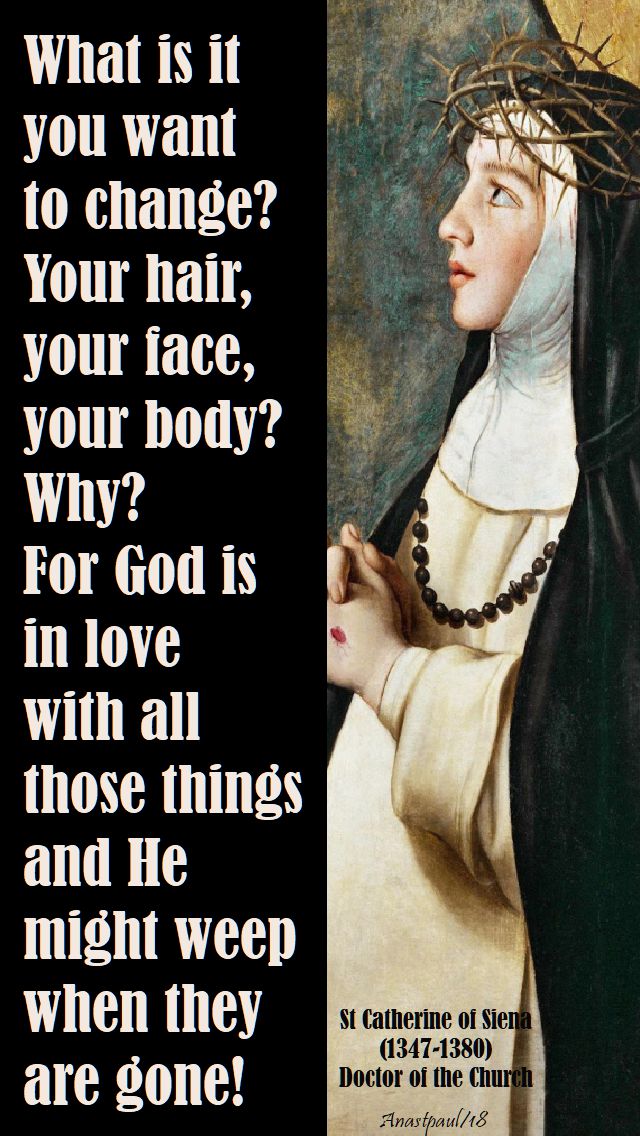
“What is it you want to change? Your hair, your face, your body? Why? For God is in love with all those things and He might weep when they are gone!”
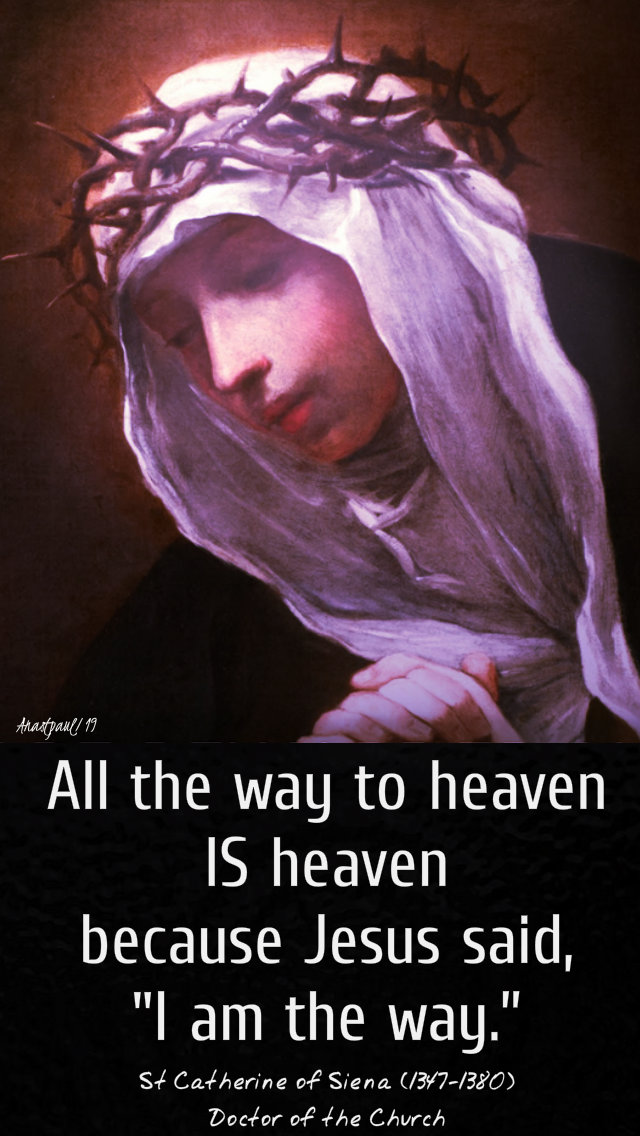
“All the way to heaven IS heaven because Jesus said, “I am the way.”
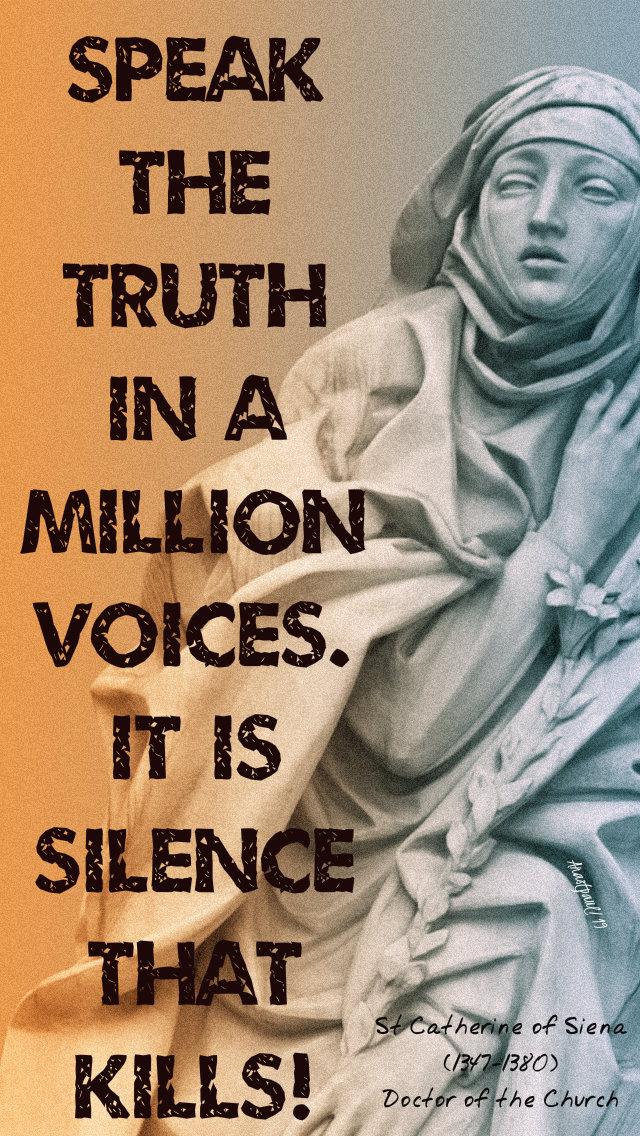
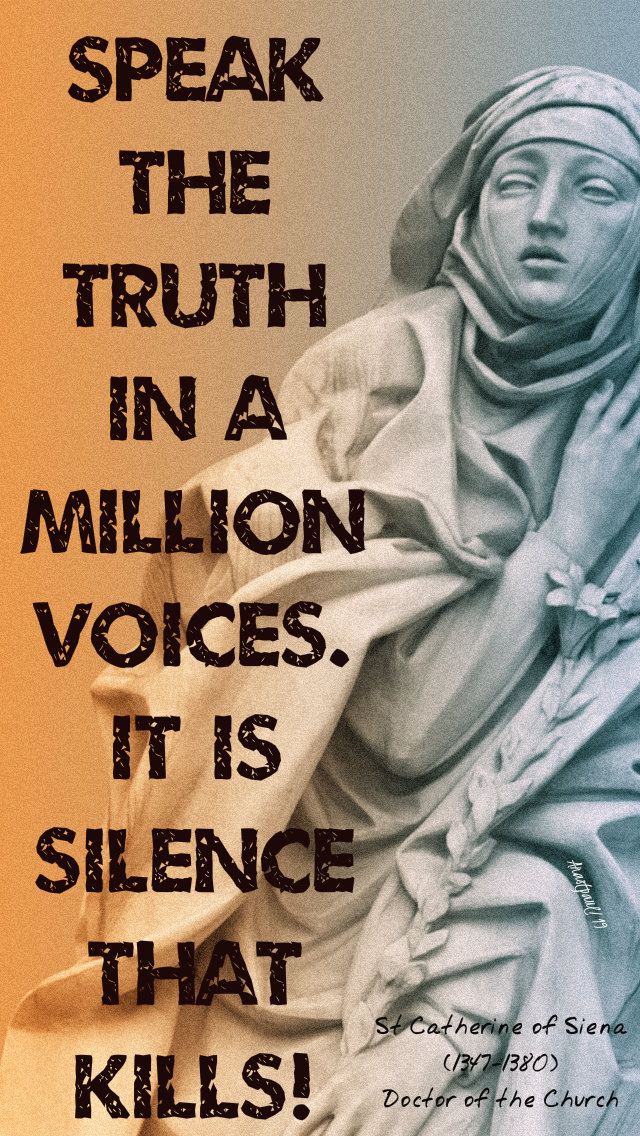
“Speak the truth in a million voices. It is silence that kills!”
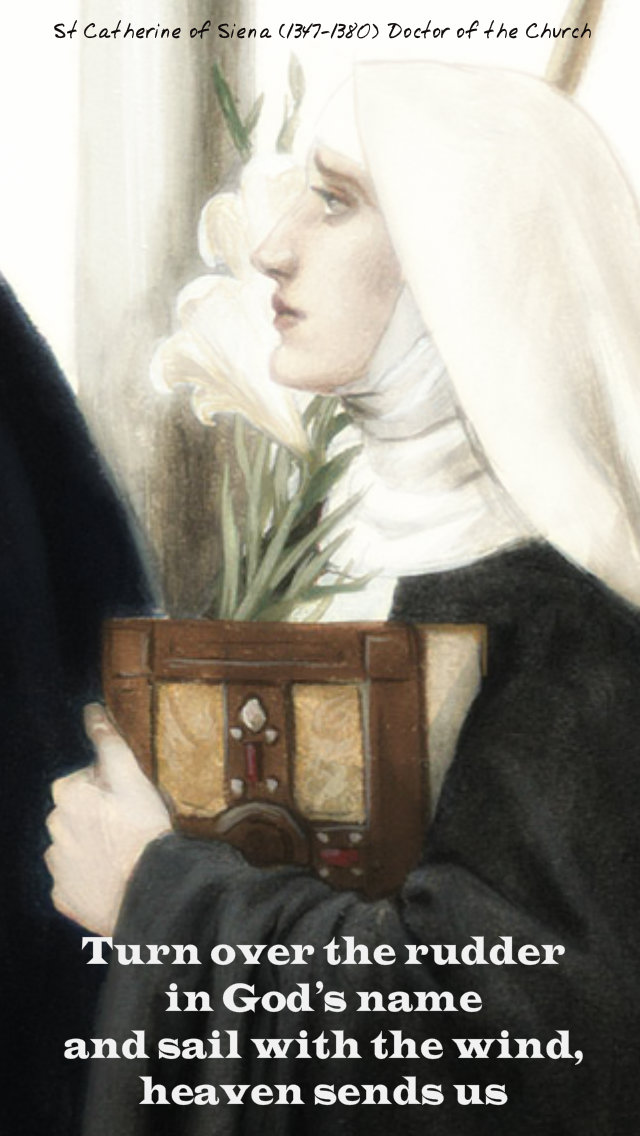
“Turn over the rudder in God’s name and sail with the wind, heaven sends us.”
St Catherine of Siena OP (1347-1380) Doctor of the Church
More St Catherine quotes here: https://anastpaul.wordpress.com/2018/04/29/quote-s-of-the-day-29-april-fifth-sunday-of-eastertide-and-the-memorial-of-st-catherine-of-siena-1347-1380-doctor-of-the-church/
Quote/s of the Day – 25 March – The Solemnity of the Annunciation of the Lord
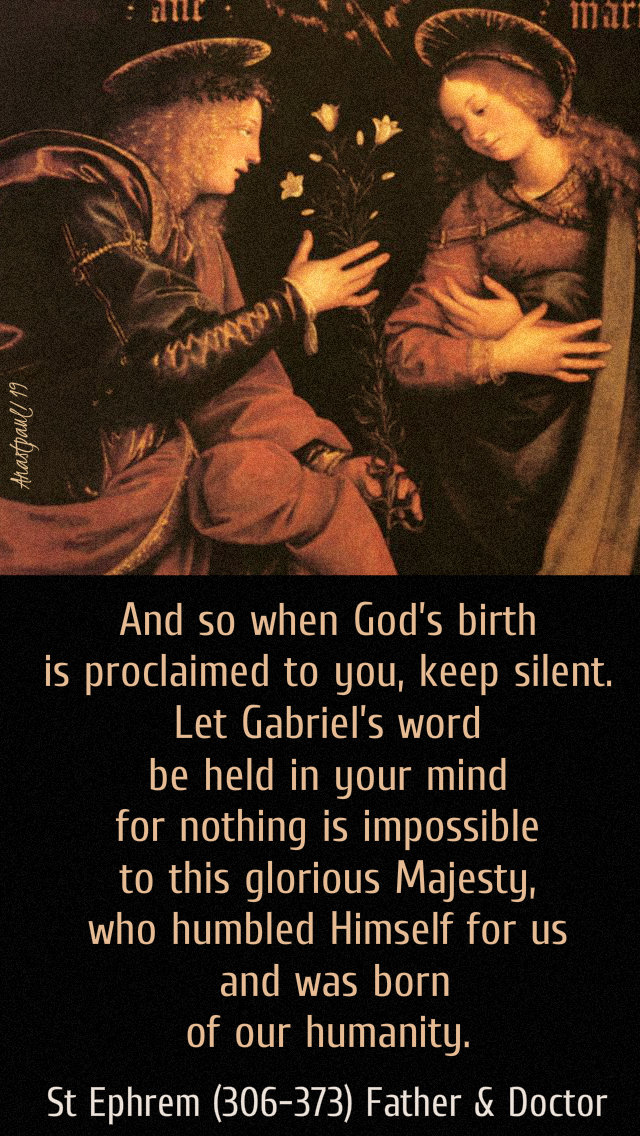
“And so when God’s birth is proclaimed to you, keep silent. Let Gabriel’s word be held in your mind for nothing is impossible to this glorious Majesty, who humbled Himself for us and was born of our humanity.”
“God assumed smallness in her – yet without diminishing His nature – to make us great!”
“In her, God spun a garment with which to save us.”
Saint Ephrem (306-373) Father & Doctor
“Him, whom the heavens cannot contain, the womb of one woman bore. She ruled our Ruler, she carried Him, in whom we are, she gave milk to our Bread.”
St Augustine (354-430)
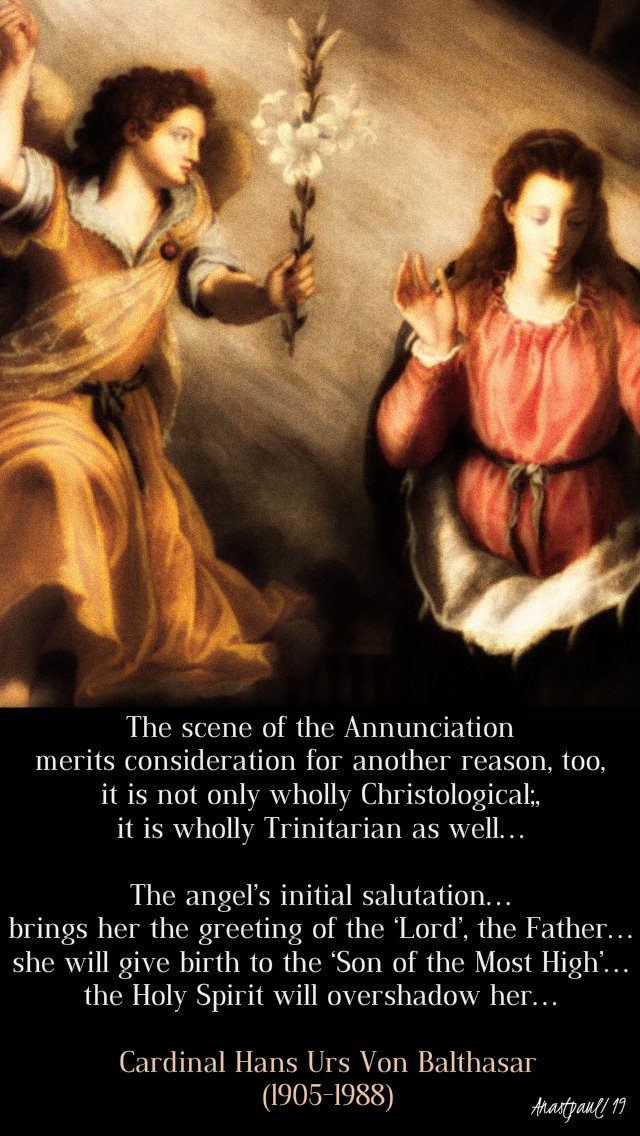
“The scene of the Annunciation merits consideration for another reason, too, it is not only wholly Christological;, it is wholly trinitarian as well… The angel’s initial salutation… brings her the greeting of the ‘Lord’, the Father… she will give birth to the ‘Son of the Most High’… the Holy Spirit will overshadow her…”
Cardinal Hans Urs Von Balthasar (1905-1988)
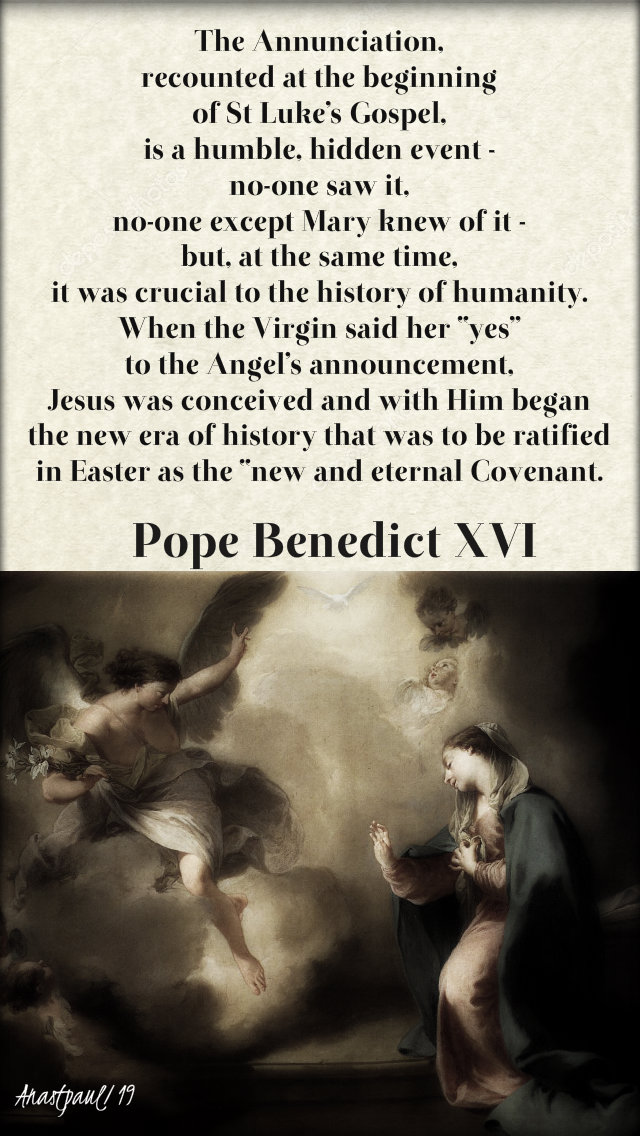
“The Annunciation, recounted at the beginning of St Luke’s Gospel, is a humble, hidden event – no-one saw it, no one except Mary knew of it – but, at the same time, it was crucial to the history of humanity. When the Virgin said her “yes” to the Angel’s announcement, Jesus was conceived and with Him began the new era of history that was to be ratified in Easter as the “new and eternal Covenant”.
Pope Benedict XVI
Angelus St Peter’s Square, Fifth Sunday of Lent, 25 March 2007
Lenten Reflection – 15 March – Friday of the First week of Lent, Year C Gospel: Matthew 5:20–26
Christ, the model of brotherly love
Saint Aelred of Rievaulx (1110-1167)
An excerpt from his The Mirror of Love
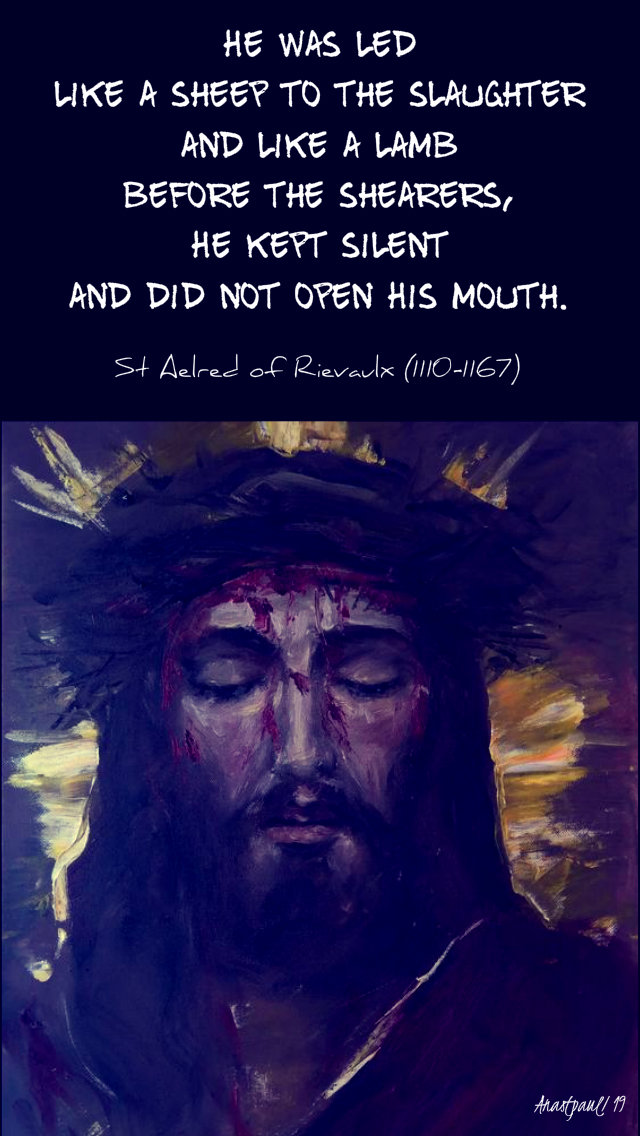
“The perfection of brotherly love lies in the love of one’s enemies. We can find no greater inspiration for this than grateful remembrance of the wonderful patience of Christ. He who is more fair than all the sons of men, offered his fair face to be spat upon by sinful men, He allowed those eyes that rule the universe, to be blindfolded by wicked men, He bared His back to the scourges, He submitted that head which strikes terror in principalities and powers to the sharpness of the thorns, He gave Himself up to be mocked and reviled and at the end endured the cross, the nails, the lance, the gall, the vinegar, remaining always gentle, meek and full of peace.
In short, He was led like a sheep to the slaughter and like a lamb before the shearers He kept silent and did not open His mouth.”
Daily Meditation: Renew us and prepare us.
Our lesson today is about reconciliation
Our Lord forgives us all our sins –
nothing can separate us from the love of God for us in Jesus
And we are called to forgive others
with the same compassion, mercy, patience and love given to us.
Our Lenten practices help us to
experience the renewing love of God
and they prepare us for our journey to Easter
to celebrate the mystery of our death to self
and rebirth in the new life Jesus won for us.
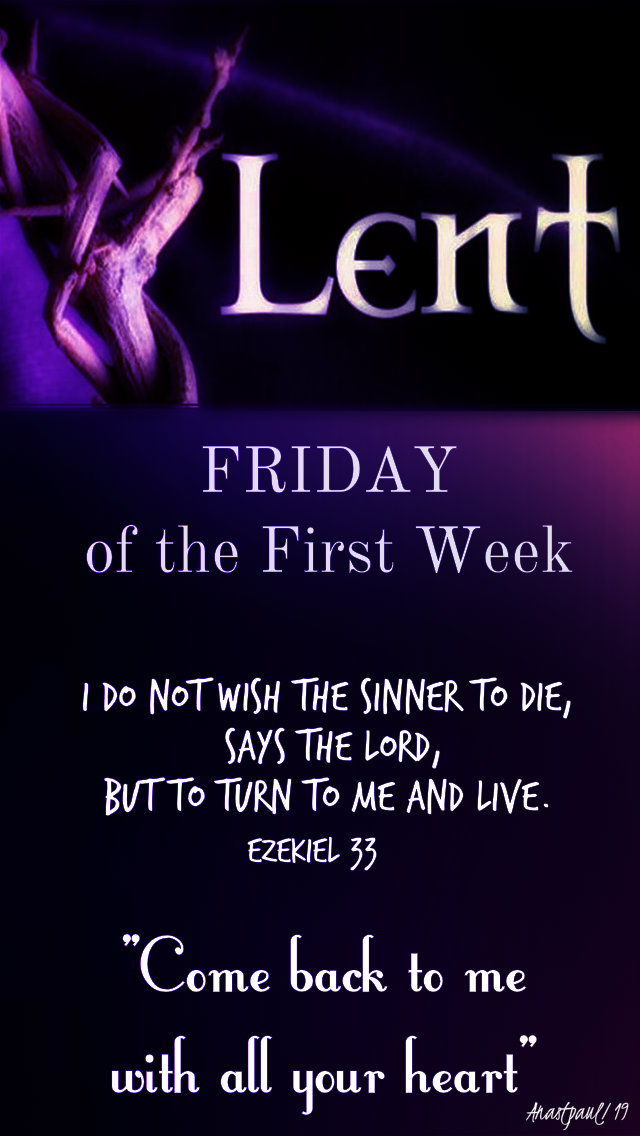
I do not wish the sinner to die, says the Lord, but to turn to me and live.
Ezekiel 33
Closing Prayer:
Creator of my life,
renew me,bring me to new life in You.
Touch me and make me feel whole again.
Help me to see Your love
in the passion, death and resurrection of Your son.
Help me to observe Lent
in a way that allows me to celebrate that love.
Prepare me for these weeks of Lent
as I feel both deep sorrows for my sins
and Your undying love for me.
May the Lord bless us,
protect us from all evil
and bring us to everlasting life.
Amen.
Thought for the Day – 6 October – The Memorial of St Bruno (c 1030-1101)
St. Bruno was one of the most exceptional scholars, teachers, prayer warriors of his time:
“…a prudent man whose word was rich in meaning.” I think the key was the gift of great humility.
The Order founded by Bruno — the Carthusians — is one of the strictest in the Church. Carthusians follow the Rule of St Benedict but accord it a most austere interpretation, there is perpetual silence and complete abstinence from flesh meat (only bread, legumes and water are taken for nourishment). Bruno sought to revive the ancient eremitical (hermit) way of life. His Order enjoys the distinction of never becoming unfaithful to the spirit of its founder, never needing a reform.
Bruno and his friends built an oratory with small individual cells at a distance from each other. They met for Matins and Vespers each day and spent the rest of the time in solitude, eating together only on great feasts. Their chief work was copying manuscripts.
Hearing of Bruno’s holiness, the pope called for his assistance in Rome. When the pope had to flee Rome, Bruno pulled up stakes again and after refusing a bishopric, spent his last years in the wilderness of Calabria.
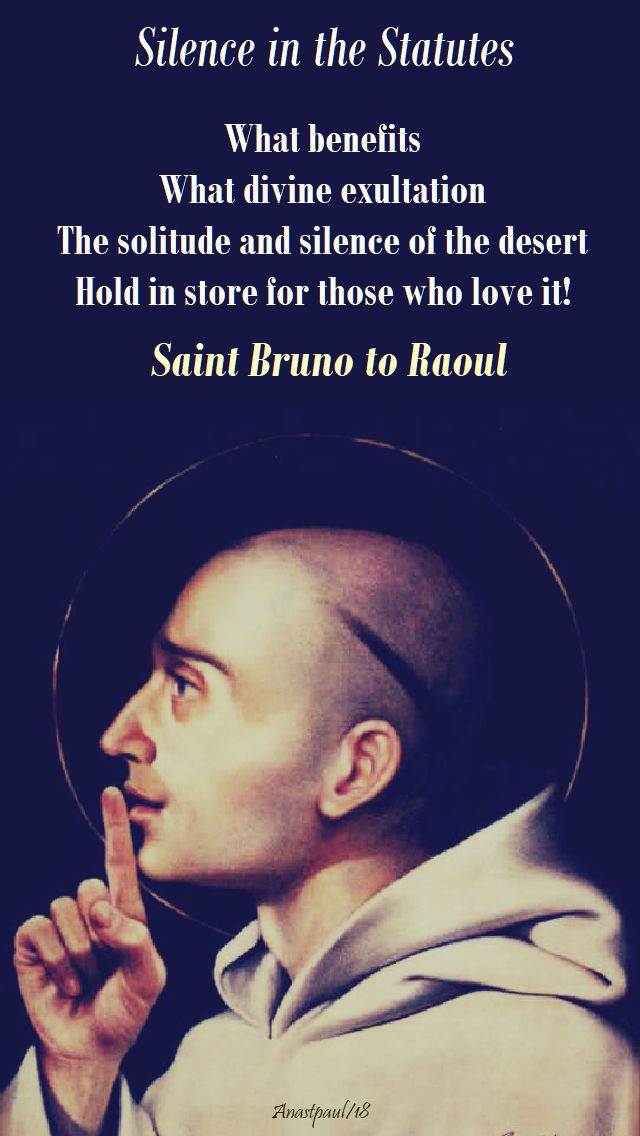
Silence in the Statutes:
What benefits What divine exultation The solitude and silence of the desert Hold in store for those who love it!
(Saint Bruno to Raoul)
Bruno was never formally canonised, because the Carthusians were averse to all occasions of publicity. However, Pope Clement X extended his feast to the whole Church in 1674.
“Rejoice, my dearest brothers, because you are blessed and because of the bountiful hand of God’s grace upon you. Rejoice, because you have escaped the various dangers and shipwrecks of the stormy world. Rejoice because you have reached the quiet and safe anchorage of a secret harbour. Many wish to come into this port and many make great efforts to do so, yet do not achieve it. Indeed many, after reaching it, have been thrust out, since it was not granted them from above. By your work you show what you love and what you know. When you observe true obedience with prudence and enthusiasm, it is clear that you wisely pick the most delightful and nourishing fruit of divine Scripture.”
from a letter by Saint Bruno to the Carthusians
May we mirror Bruno’s quest for holiness and unity with God.
Quote/s of the Day – 17 September – The Memorial of St Robert Bellarmine SJ (1542-1621) and St Hildegard von Bingen OSB (1098-1179) both Doctors of the Church
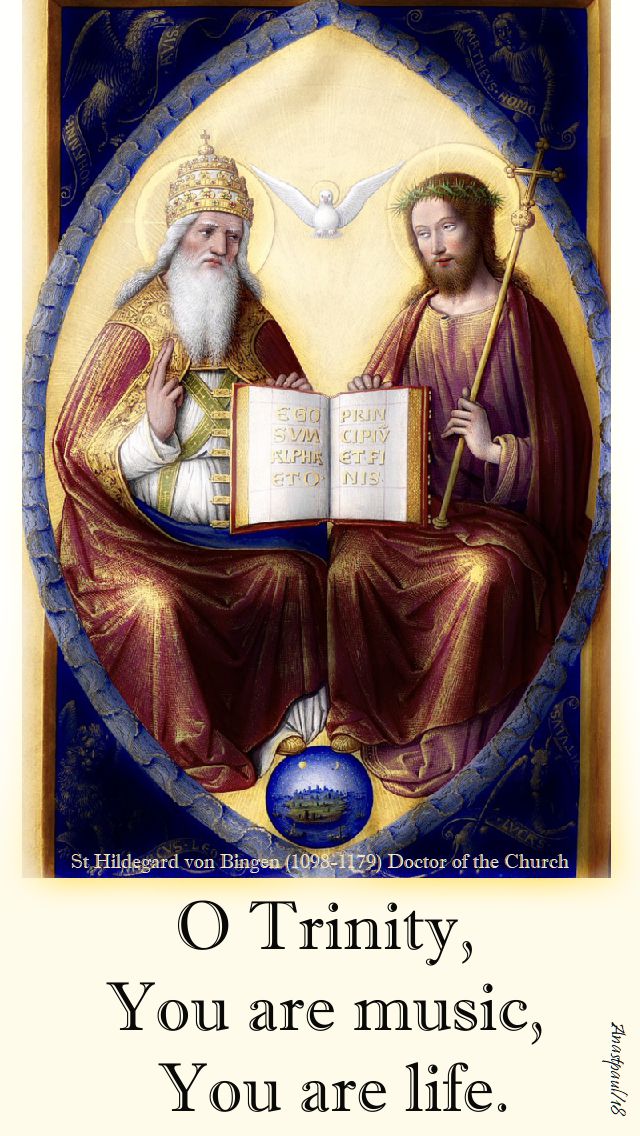
“O Trinity, You are music, You are life.”
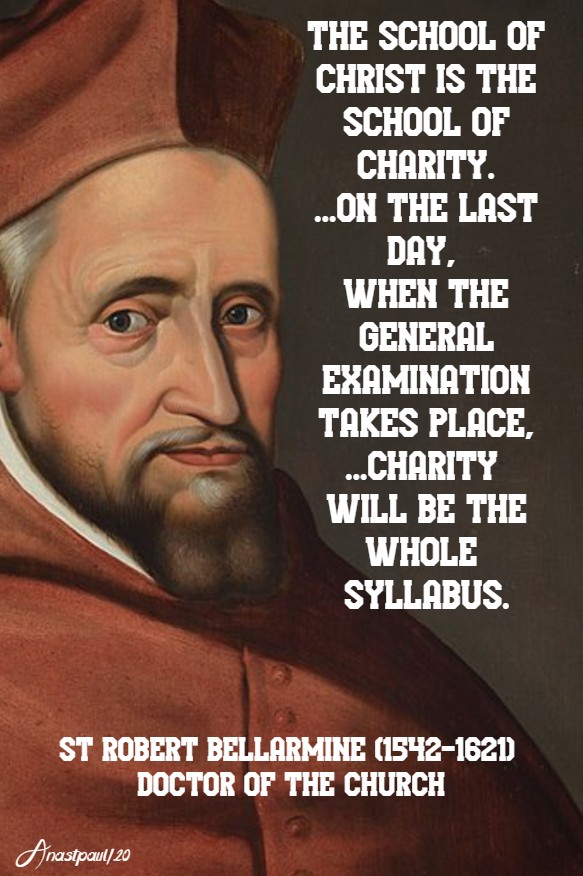
“The school of Christ, is the school of love. In the last day, when the general examination takes place… Love will be the whole syllabus.”
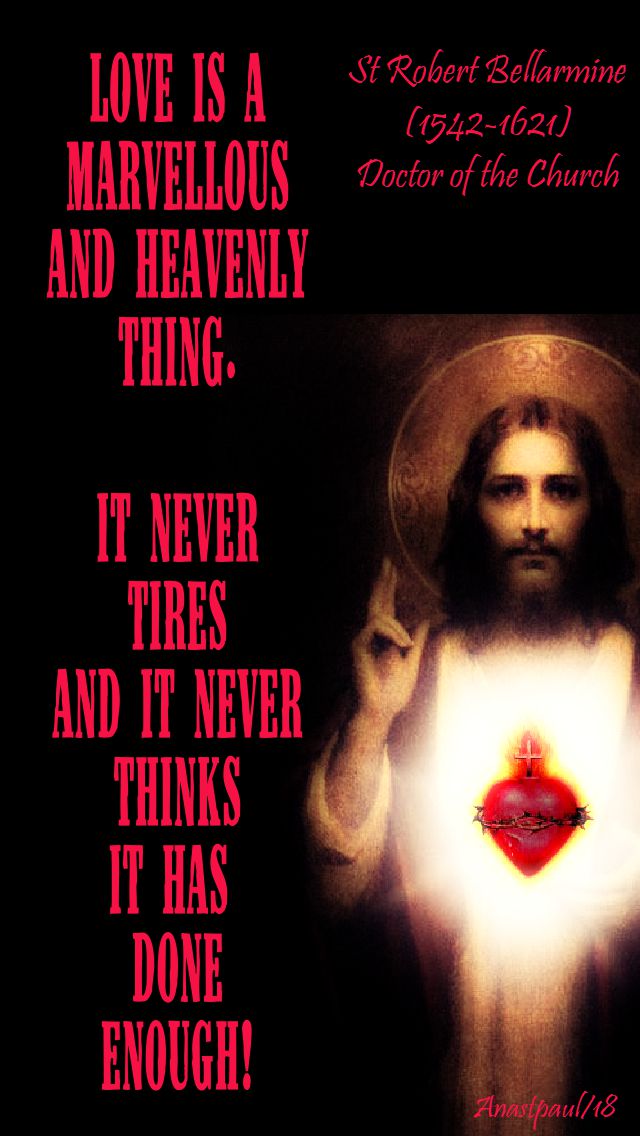
“LOVE is a marvellous and heavenly thing. It never tires and it never thinks it has done enough!”
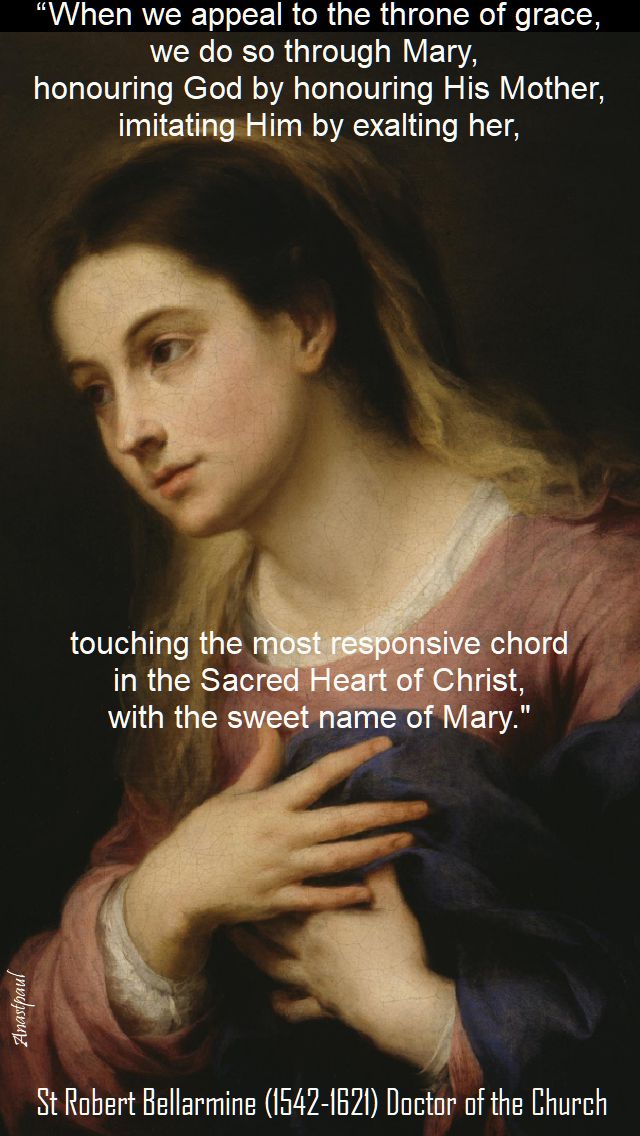
“When we appeal to the throne of grace, we do so through Mary, honouring God by honouring His Mother, imitating Him by exalting her, touching the most responsive chord in the Sacred Heart of Christ, with the sweet name of Mary.”
St Robert Bellarmine (1542-1621) Doctor of the Church
Quote/s of the Day – 13 September – the Memorial of St John Chrysostom (347-407) Father & Doctor of the Church
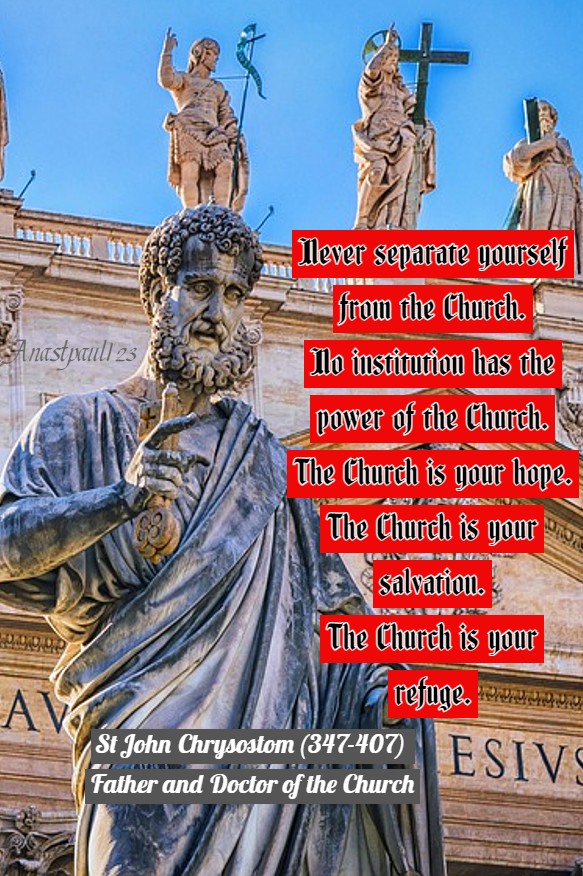
“Never separate yourself from the Church. No institution has the power of the Church. The Church is your hope. The Church is your salvation. The Church is your refuge.”
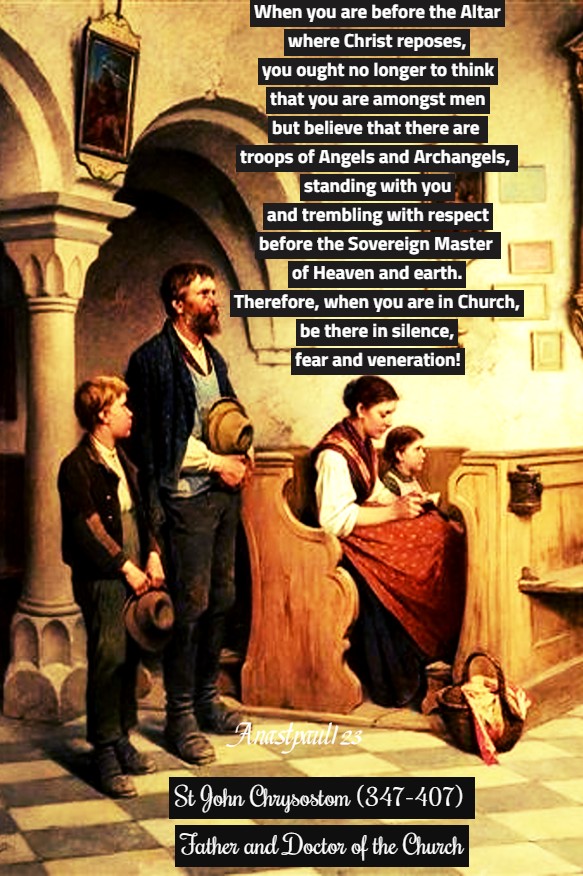
“When you are before the altar where Christ reposes, you ought no longer to think that you are amongst men; but believe that there are troops of Angels and Archangels standing by you and trembling with respect before the Sovereign Master of Heaven and earth. Therefore, when you are in Church, be there in silence, fear and veneration.”
“If we approach with faith, we too will see Jesus… for the Eucharistic table takes the place of the crib. Here, the Body of the Lord is present, wrapped, not in swaddling clothes but in the rays of the Holy Spirit.”
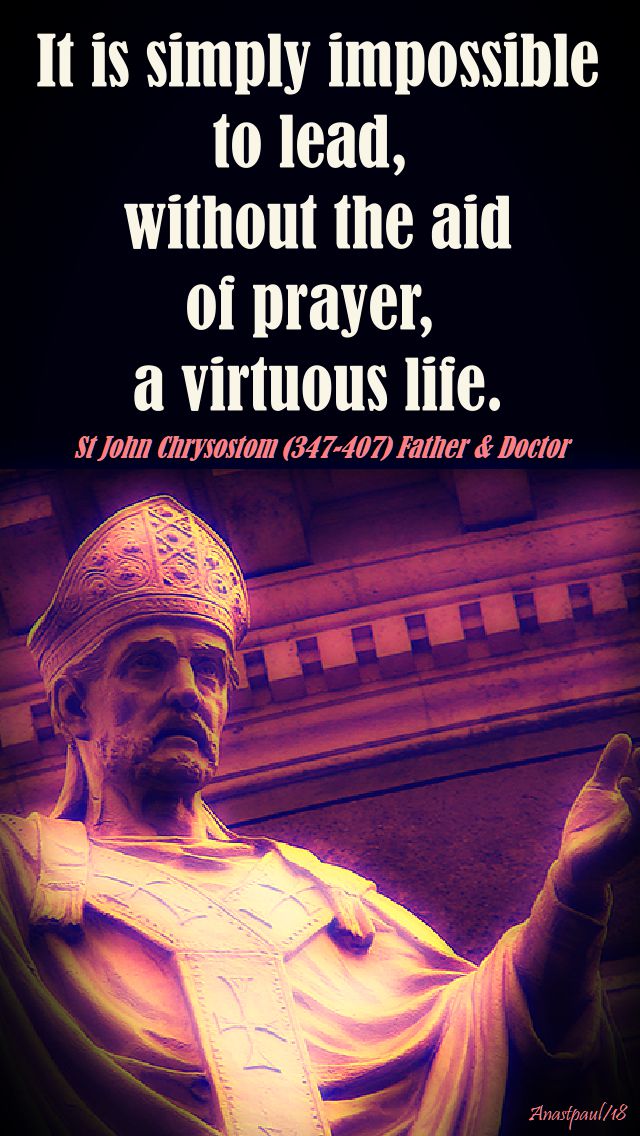
“It is simply impossible to lead, without the aid of prayer, a virtuous life.”
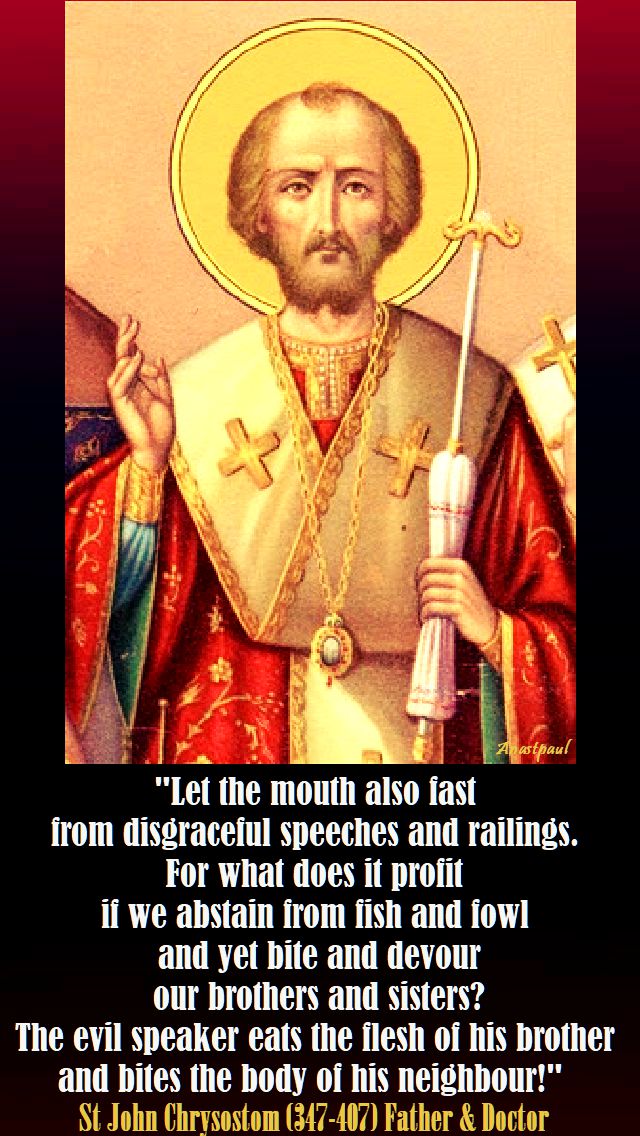
“Let the mouth also fast from disgraceful speeches and railings. For what does it profit if we abstain from fish and fowl and yet bite and devour our brothers and sisters? The evil speaker eats the flesh of his brother and bites the body of his neighbour!”
St John Baptist Mary Vianney was born near Lyon, France, on 8th May 1786. Overcoming many difficulties prior to his ordination on 13th Aug 1815, he was thereafter entrusted with the remote parish of Ars, a village of 230 souls. His Bishop had warned him that he would find religious practice there in a sorry state: “There is little love of God in that parish; you will have to be the one to put it there”. As a result, he was deeply aware that he needed to embody Christ’s presence and bear witness to God’s saving mercy: “Lord, grant me the conversion of my parish. I am willing to suffer whatever you wish, for my entire life!” With that prayer he entered upon his mission.
His first biographer tells us that “upon his arrival, he chose the church as his home. He entered the church daily before dawn and did not leave it until after the evening Angelus. There he was to be sought whenever needed”.
Inside the Old Church where St John Mary Vianney preached and heard confessions
The Curé d’Ars taught his parishioners primarily by the witness of his life. It was from his example that they learned to pray, to visit Jesus frequently in the Tabernacle. “One need not say much to pray well”, he explained to them, “we know that Jesus is there in the Tabernacle. Let us open our hearts to Him, let us rejoice in His sacred presence. That is the best prayer”. And He would urge them: “Come to communion, my brothers and sisters, come to Jesus. Come to live from Him in order to live with Him… Of course you are not worthy of Him but you need Him!”
He regularly visited the sick and families and organised missions and feast day celebrations. He also enlisted lay persons to collaborate in the collection and management of funds for his charitable works, providing also for the education of children. He personally cared for the orphans and teachers of the “Providence”, an institute he founded.
The Curé of Ars was known for his humility, while as a priest he was conscious of being an immense gift to his people. “A good shepherd, a pastor after God’s heart, is the greatest treasure which the good Lord can grant to a parish and one of the most precious gifts of divine mercy”.
Explaining to his parishioners the importance of the Sacraments, he would say: “Without the Sacrament of Holy Orders, we would not have the Lord. Who put him there in that tabernacle? The priest. Who welcomed your soul at the beginning of your life? The priest. Who feeds your soul and gives it strength for its journey? The priest. Who will prepare it to appear before God, bathing it one last time in the blood of Jesus Christ? The priest, always the priest. And if this soul should die as a result of mortal sin, who will raise it up, who will restore its calm and peace? Again, the priest… Only in heaven will he fully realise what he is.”
Those who attended the Masses he celebrated have said that “it was not possible to find a finer example of worship… He gazed upon the Host with immense love”. He was convinced that the fervour of a priest’s life depended entirely upon the Mass, “All good works, taken together, do not equal the sacrifice of the Mass since they are human works, while the Holy Mass is the work of God… The reason why a priest is lax is that he does not pay attention to the Mass! My God, how we ought to pity a priest who celebrates as if he were engaged in something routine!”
“The priest is not a priest for himself, he is a priest for you”
His profound sense of responsibility as a priest was palpable. “Were we to fully realise what a priest is on earth, we would die: not of fright but of love… Without the priest, the passion and death of our Lord would be of no avail. It is the priest who continues the work of redemption on earth… What use would be a house filled with gold, were there no one to open its door? The priest holds the key to the treasures of heaven: it is he who opens the door: he is the steward of the good Lord; the administrator of his goods… Leave a parish for 20 years without a priest and they will end by worshipping the beasts there… The priest is not a priest for himself, he is a priest for you”.
By spending long hours in church before the Tabernacle, he inspired the faithful to imitate him by coming to visit Jesus, knowing that their parish priest would be there, ready to listen and offer forgiveness. Later, the growing numbers of penitents from all over France would keep him in the confessional for up to 16 hours a day. It was said that Ars had become “a great hospital of souls”.
He once explained to a fellow priest his self-imposed mortifications and expiations for those souls whose confessions he heard, “I will tell you my recipe: I give sinners a small penance and the rest I do in their place.” He was moved knowing that souls have been won at the price of Jesus’ own blood and a priest cannot devote himself to their salvation if he refuses to share personally in the precious cost of Christ’s redemption.
A century after his death, the Shrine of Our Lady of Mercy was built in Ars-sur-Formans, where the relic of the heart of the Saint is venerated in the Chapel of the Heart. His incorrupt body lies at the main altar of the Shrine in a glass reliquary. The Curé’s humble cottage is presently a museum.
St John Vianney’s Bedroom in his house which is now the Museum
Current estimates indicate that over 400,000 pilgrims visit the shrine every year.
You must be logged in to post a comment.