Posted in MORNING Prayers, PAPAL SERMONS, QUOTES of the SAINTS, QUOTES on PRAYER, QUOTES on SILENCE, QUOTES on WORK/LABOUR, SAINT of the DAY

Thought for the Day – 11 July – The Memorial of St Benedict of Nursia OSB (c 480-547)

Thought for the Day – 11 July – The Memorial of St Benedict of Nursia OSB (c 480-547)

Excerpt from the Homily of Pope Benedict

General Audience, 9 April 2008

“Today, I would like to speak about Benedict, the Founder of Western Monasticism and also the Patron of my Pontificate.

I begin with words that St Gregory the Great wrote about St Benedict:  “The man of God who shone on this earth among so many miracles was just as brilliant in the eloquent exposition of his teaching” (cf. Dialogues II, 36).   The great Pope wrote these words in 592 AD.   The holy monk, who had died barely 50 years earlier, lived on in people’s memories and especially in the flourishing religious Order he had founded.   St Benedict of Nursia/Norcia, with his life and his work, had a fundamental influence on the development of European civilisation and culture.   The most important source on Benedict’s life is the second book of St Gregory the Great’s Dialogues.   It is not a biography in the classical sense.   In accordance with the ideas of his time, by giving the example of a real man – St Benedict, in this case – Gregory wished to illustrate the ascent to the peak of contemplation which can be achieved by those who abandon themselves to God.   He therefore gives us a model for human life in the climb towards the summit of perfection.   St Gregory the Great also tells in this book of the Dialogues of many miracles worked by the Saint and here too he does not merely wish to recount something curious but rather to show how God, by admonishing, helping and even punishing, intervenes in the practical situations of man’s life.   Gregory’s aim was to demonstrate that God is not a distant hypothesis placed at the origin of the world but is present in the life of man, of every man.

Throughout the second book of his Dialogues, Gregory shows us how St Benedict’s life was steeped in an atmosphere of prayer, the foundation of his existence.   Without prayer there is no experience of God.   Yet Benedict’s spirituality was not an interiority removed from reality.   In the anxiety and confusion of his day, he lived under God’s gaze and in this very way never lost sight of the duties of daily life and of man with his practical needs.   Seeing God, he understood the reality of man and his mission.   In his Rule he describes monastic life as “a school for the service of the Lord” (Prol. 45) and advises his monks, “let nothing be preferred to the Work of God” [that is, the Divine Office or the Liturgy of the Hours] (43, 3).

However, Benedict states that in the first place prayer is an act of listening (Prol. 9-11), which must then be expressed in action.   “The Lord is waiting every day for us to respond to his holy admonitions by our deeds” (Prol. 35).   Thus, the monk’s life becomes a fruitful symbiosis between action and contemplation, “so that God may be glorified in all things” (57, 9).   In contrast with a facile and egocentric self-fulfilment, today often exalted, the first and indispensable commitment of a disciple of St Benedict is the sincere search for God (58, 7) on the path mapped out by the humble and obedient Christ (5, 13), whose love he must put before all else (4, 21; 72, 11) and in this way, in the service of the other, he becomes a man of service and peace  . In the exercise of obedience practised by faith inspired by love (5, 2), the monk achieves humility (5, 1), to which the Rule dedicates an entire chapter (7).   In this way, man conforms ever more to Christ and attains true self-fulfilment as a creature in the image and likeness of God.

Benedict describes the Rule he wrote as “minimal, just an initial outline” (cf. 73, 8);  in fact, however, he offers useful guidelines not only for monks but for all who seek guidance on their journey toward God.   For its moderation, humanity and sober discernment between the essential and the secondary in spiritual life, his Rule has retained its illuminating power even to today.

By proclaiming St Benedict Patron of Europe on 24 October 1964, Paul VI intended to recognise the marvellous work the Saint achieved with his Rule for the formation of the civilisation and culture of Europe.

Having recently emerged from a century that was deeply wounded by two World Wars and the collapse of the great ideologies, now revealed as tragic utopias, Europe today is in search of its own identity.   Of course, in order to create new and lasting unity, political, economic and juridical instruments are important, but it is also necessary to awaken an ethical and spiritual renewal which draws on the Christian roots of the Continent, otherwise a new Europe cannot be built.   Without this vital sap, man is exposed to the danger of succumbing to the ancient temptation of seeking to redeem himself by himself – a utopia which in different ways, in 20th-century Europe, as Pope John Paul II pointed out, has caused “a regression without precedent in the tormented history of humanity” (Address to the Pontifical Council for Culture, 12 January 1990).

Today, in seeking true progress, let us also listen to the Rule of St Benedict as a guiding light on our journey.   The great monk is still a true master at whose school we can learn to become proficient in true humanism.

Here is a PDF of the Rule for downloading:  http://www.documentacatholicaomnia.eu/03d/0480-0547,_Benedictus_Nursinus,_Regola,_EN.pdf

St Benedict, Pray for Europe, Pray for the World,

Pray for the Church, Pray for us all!st-benedict-pray-for-us-11 july 2017 - 3

Posted in DOMINICAN OP, MORNING Prayers, QUOTES of the SAINTS, QUOTES on CHARITY, QUOTES on FAITH, QUOTES on HUMILITY, QUOTES on LOVE, QUOTES on MERCY, QUOTES on PATIENCE, QUOTES on PRAYER, QUOTES on SILENCE, QUOTES on TEMPTATION, QUOTES on TRUST and complete CONFIDENCE in GOD, SAINT of the DAY, The HOLY GHOST

Quote/s of the Day – 9 July – The Memorial of Blessed Adrian Fortescue T.O.S.D. (1476-1539) Martyr

Quote/s of the Day – 9 July – The Memorial of Blessed Adrian Fortescue T.O.S.D. (1476-1539) Martyr

“In Husbands Bosworth Hall, the residence of Miss Fortescue-Turville, the last direct descendant of the blessed martyr, was found some years ago a very precious relic, being nothing less than the Book of Hours which he habitually used.
The manuscript has suffered a good deal from time and careless handling but on the outer leaf can still be read another series of maxims, a kind of rule of life written and signed by the martyr’s own hand.   It will be seen how, while yet in the days of his prosperity, this truly Christian knight was preparing all unconsciously for the martyr’s crown and palm.
The Book of Hours is now reverently preserved as a relic in the beautiful little Catholic church adjoining the old hall of Husbands Bosworth :”

Quotations (slightly updated – from his famous Book of Hours)

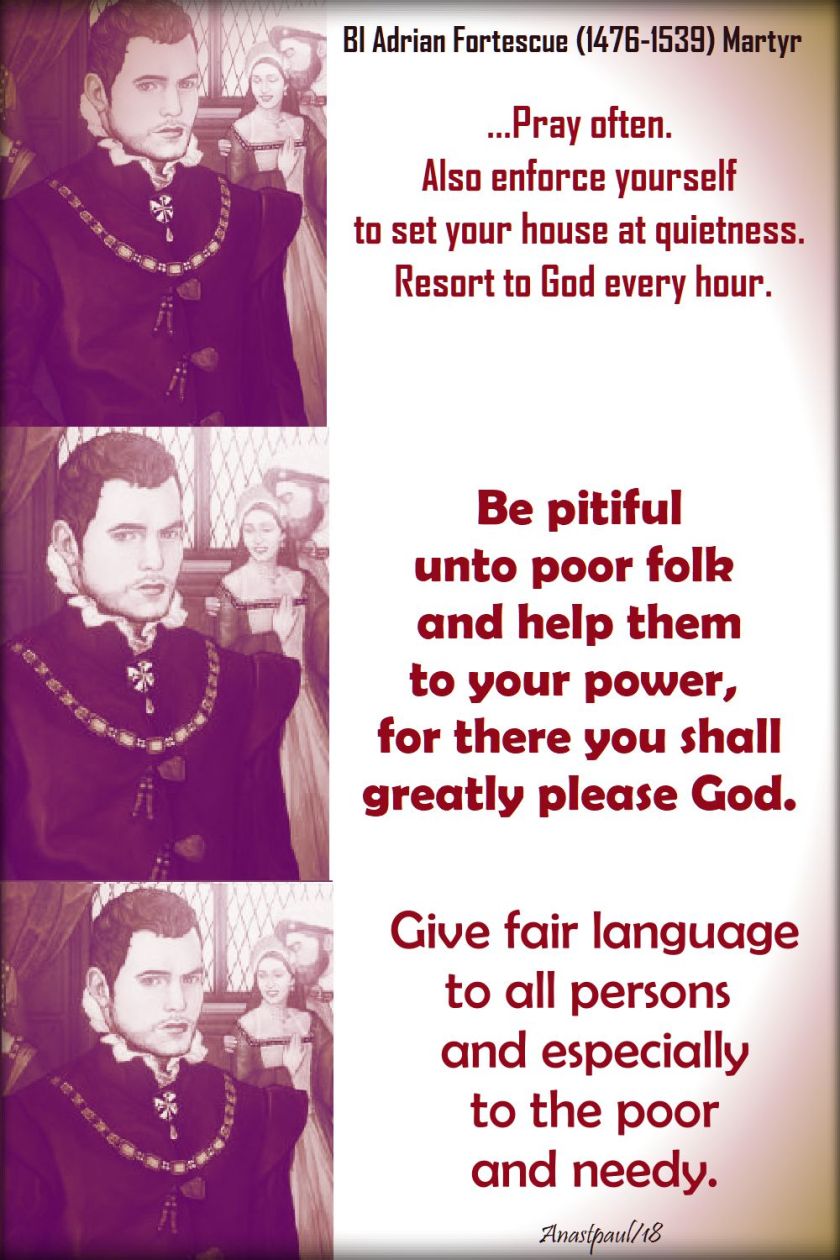
…”Pray often.
Also enforce yourself
to set your house at quietness.
Resort to God every hour.”

“Be pitiful unto poor folk and help them to your power,
for there you shall greatly please God.”

“Give fair language to all persons
and especially to the poor and needy.”pray often - be pitiful unto poor folk - give fair language - bl adrian fortescue - 9 july 2018

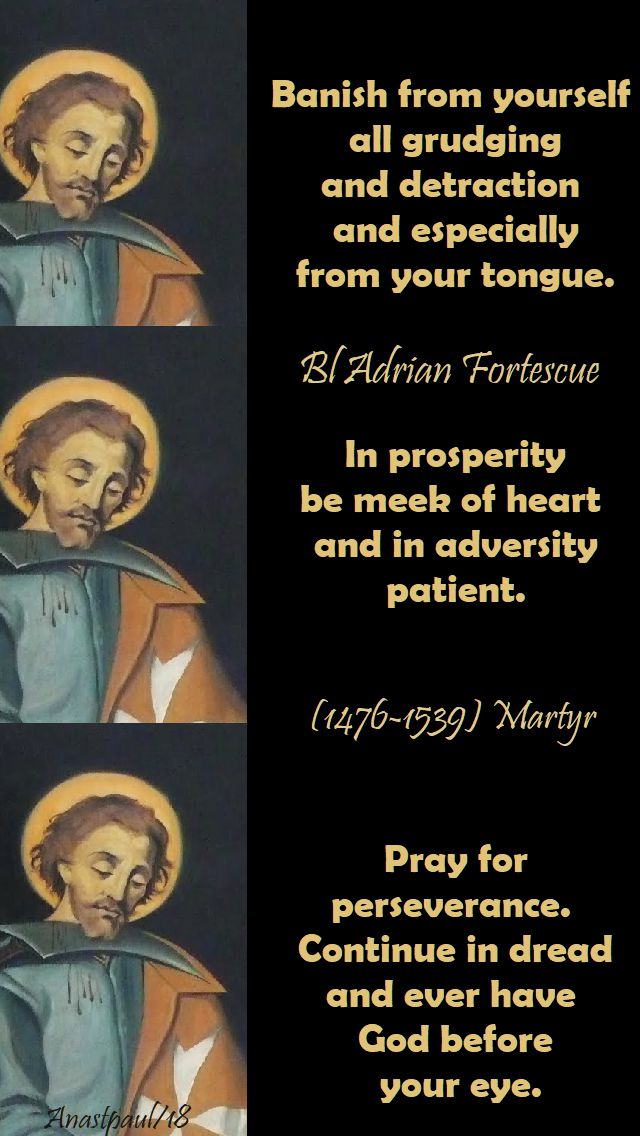
“Banish from yourself all grudging and detraction
and especially from your tongue.”

“In prosperity be meek of heart
and in adversity patient.”

“Pray for perseverance.
Continue in dread
and ever have
God before your eye.”banish from yourself - in prosperity - pray for perseverance - bl adrian fortescue - 9 july 2018

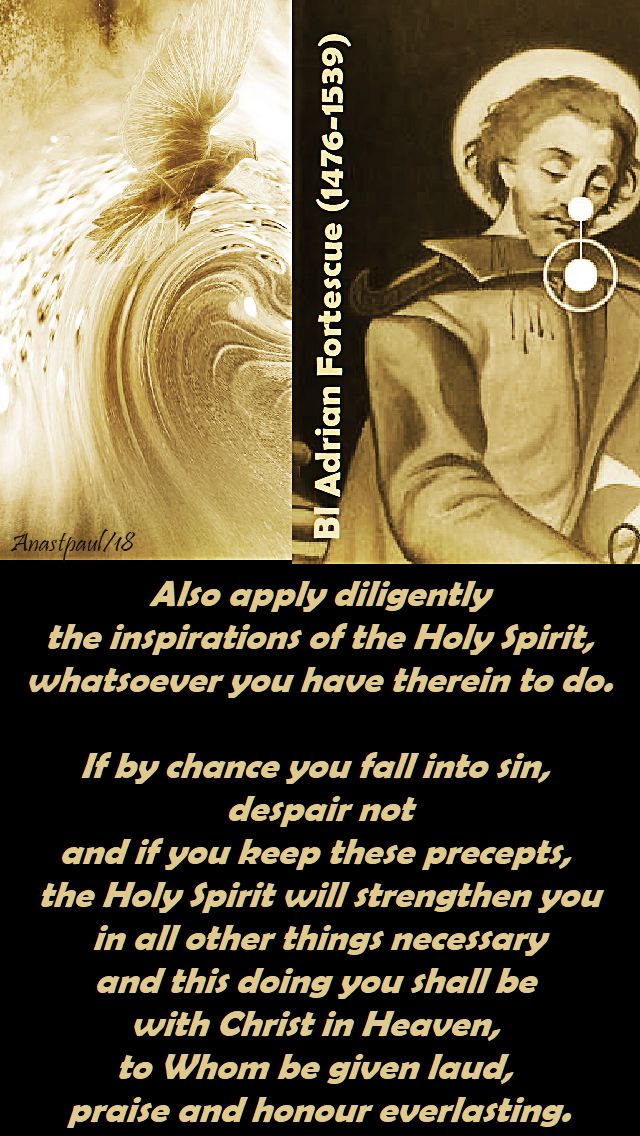
“Also apply diligently
the inspirations of the Holy Spirit,
whatsoever you have therein to do.”

“If by chance you fall into sin,
despair not
and if you keep these precepts,
the Holy Spirit will strengthen you
in all other things necessary
and this doing you shall be
with Christ in Heaven,
to Whom be given laud,
praise and honour everlasting.”

Blessed Adrian Fortescue (1476-1539)also apply diligently - if by chance - bl adrian fortescue - 9 july 2018.jpg

Posted in CATHOLIC DEVOTIONS of the Month, DOCTORS of the Church, MORNING Prayers, QUOTES of the SAINTS, QUOTES on SILENCE, QUOTES on SUFFERING, The MOST PRECIOUS BLOOD

Quote of the Day – 1 July – Month of the Most Precious Blood

Quote of the Day – 1 July – Month of the Most Precious Blood

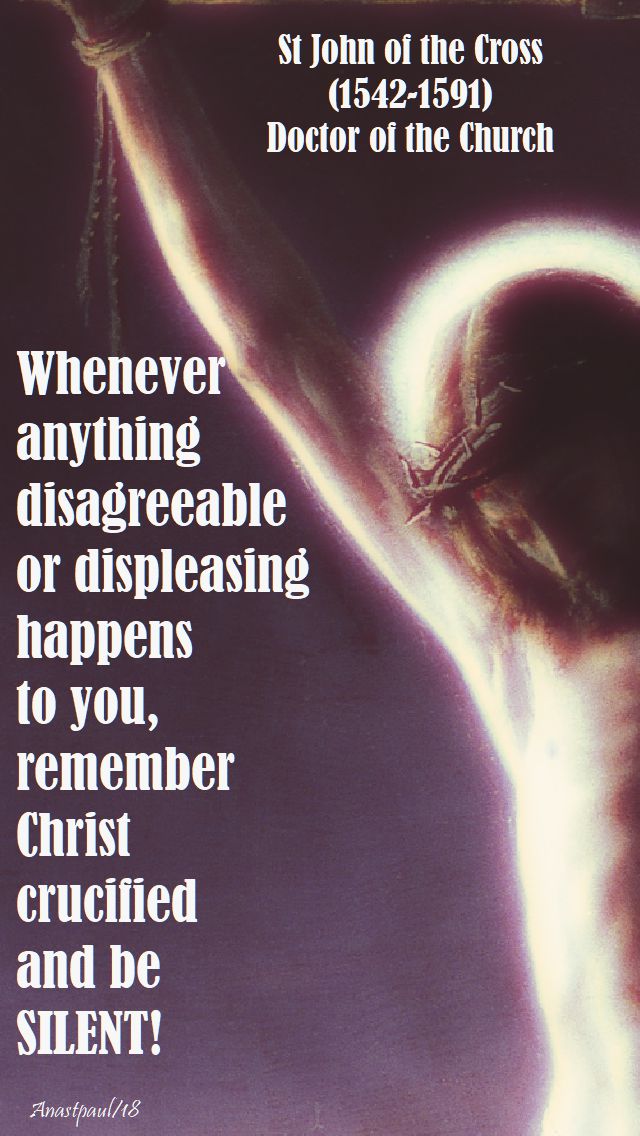
“Whenever anything disagreeable
or displeasing happens to you,
remember Christ crucified
and be silent!”

St John of the Cross (1542-1591) – Doctor of the Churchwhenever anything displeasing - st john of the cross - 1 july 2018

Posted in EUCHARISTIC Adoration, MORNING Prayers, QUOTES of the SAINTS, QUOTES on PRAYER, QUOTES on SANCTITY, QUOTES on SILENCE, The HOLY EUCHARIST / The HOLY MASS

Quote of the Day – 12 May – Saturday of the Sixth Week of Eastertide

Quote of the Day – 12 May – Saturday of the Sixth Week of Eastertide

“My TV is the tabernacle.”

St Mother Teresa (1910-1997)my tv is the tabernacle - st mother teresa - 12 may 2018

Posted in EASTER, QUOTES of the SAINTS, QUOTES on CHARITY, QUOTES on FAITH, QUOTES on HUMILITY, QUOTES on MERCY, QUOTES on PRAYER, QUOTES on SILENCE, QUOTES on SIN, QUOTES on SUFFERING, SAINT of the DAY

Thought for the Day – 26 April – Thursday of the Fourth Week of Eastertide and the Memorial of St Rafael Arnáiz Barón (1911-1938)

Thought for the Day – 26 April – Thursday of the Fourth Week of Eastertide and the Memorial of St Rafael Arnáiz Barón (1911-1938)

“This humble worship that surely is more pleasing to God than many deeds that the world calls charity. . . How much greater in God’s eyes is a heartfelt ‘Hail Mary’ than even the greatest thing done without wholehearted love for God.”

Rafael had only four more years to live.   A few months after entering the monastery, he was diagnosed with a virulent form of diabetes.   The illness brought with it melancholy and perplexity.   Three times the novice’s superiors sent him home to rest and recover his strength.   Drafted into the Nationalist Army at the very height of the Spanish Civil War, Rafael was declared unfit for active duty.   Returning to the monastery for the last time, he was received as a regular oblate, that is, a man living within the cloister without vows and following a personal rule of life approved by the abbot.   Regular oblates were, at that time, somewhat marginalised in monastic communities.   Their peculiar status — monks living without vows and without the security that comes from having made profession — was not without its own challenges.   Rafael entered fully into the vocation of the oblate, understanding that the oblate is destined for the altar, that is, for sacrifice.

St Rafael, in spite of the brevity and discontinuity of his monastic experience, lived it fully.   He remained faithful in the face of bewildering contradictions, uncertainties and apparent failure.   He found the Will of God in weakness, in illness, in war, in the inability to make monastic profession and in the sufferings inherent in community life.

Brother Rafael Maria was humble because he accepted one humiliation after another without ever despairing of the mercy of God.   He died stripped of everything, without having fulfilled even the legitimate human aspirations that so appealed to him. Configured to the poor and crucified Jesus, he died in the splendour of the Resurrection on 26 April 1938 at the age of 27.

St Pope John Paul II proclaimed Rafael a model for today’s youth but for me, he is a model for us all on how to learn to love suffering, how to learn to love the Cross of Christ and thus suffering in our own crosses in total abandonment to Divine Providence.

“The whole community is gathered in adoration
to ask the Lord for peace,
to pray for those who are dying and to make reparation for so many sins . . .
But one mustn’t spread discouragement. . . .
When we ask for mercy and pardon, we are doing as David did . . .
that is, the Lord will blot out all our sins and those of the whole world,
not by any poor merits of ours
but by the multitude and the greatness of His mercy.”

Saint Rafael Arnáiz Barón, Pray for us!st rafael arnaiz baron - pray for us no 2- 26 april 2018

Posted in MORNING Prayers, QUOTES of the SAINTS, QUOTES on CHARITY, QUOTES on FAITH, QUOTES on LOVE, QUOTES on MERCY, QUOTES on PRAYER, QUOTES on SILENCE, SAINT of the DAY, Uncategorized

Thought for the Day – 24 April – Tuesday of the Fourth Week of Eastertide and the Memorial of St Mary Euphrasia Pelletier (1796-1868)

Thought for the Day – 24 April – Tuesday of the Fourth Week of Eastertide and the Memorial of St Mary Euphrasia Pelletier (1796-1868)

Sorrow and joy alternated almost without interruption in Angers and the new houses. There were difficulties connected with each of the foundations, entailing a great deal of hard work.   Throughout these hardships, St Mary Euphrasia endured and embraced them, and said “Great crosses bring great graces.”

Ardent prayer sustained her.   “Pray, be silent and hope” became her motto.   She loved to repeat: “I belong to every country where there are souls to be saved.”   Her work of saving them was going on apace and souls were bought at a great price.

Mary Euphrasia’s last years were very lonely. Labour, enterprises, intense activities, physical and moral sufferings were steadily taking a toll on the Foundress’ strength.   She was almost seventy-two years of age when she breathed her last on 24 April 1868, the Friday after Good Shepherd Sunday.   “Goodbye my daughters, goodbye dear Institute” were her last words.

Mary Euphrasia founded, in her lifetime, 110 houses on every continent.   Today, the Mission Partners of the Good Shepherd (Sisters and Lay) are present in more than 70 countries, embracing the world with their zeal for the salvation of all people.   A year after the death of Mary Euphrasia, the Ceylon (Sri Lanka) mission was founded.   From Ceylon, the Good Shepherd Sisters came to Singapore in 1939 and reached Malaysia in 1956.

It is not easy to sum up the life of Mary Euphrasia.   Perhaps it is best understood in terms of her own wish for her Sisters:  “You will effect no good, my dear Sisters … until you become animated with the thoughts, sentiments and affections of the Good Shepherd” and “Live His way of life!”

St Mary Euphrasia, pray for us!st mary euphrasia pelletier - pray for us - no 2 - 24 april 2018

Posted in DOMINICAN OP, EUCHARISTIC Adoration, MORNING Prayers, QUOTES of the SAINTS, QUOTES on LOVE, QUOTES on SANCTITY, QUOTES on SILENCE, QUOTES on SUFFERING, SAINT of the DAY, The HOLY EUCHARIST / The HOLY MASS

Quote/s of the Day – 25 January – The Memorial of Blessed Henry Suso O.P. (1290-1365)

Quote/s of the Day – 25 January – The Memorial of Blessed Henry Suso O.P. (1290-1365)

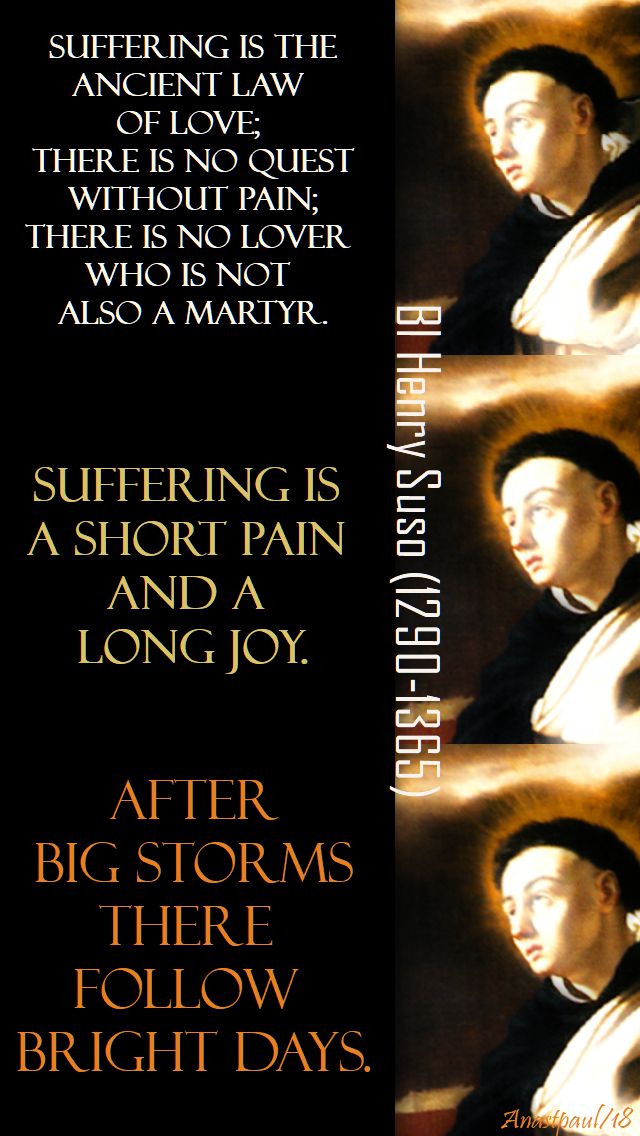
“Suffering is the ancient law of love;
there is no quest without pain;
there is no lover
who is not also a martyr.”

“Suffering is
a short pain
and a long joy.”

“After big storms
there follow
bright days.”suffering is the ancient law of love - bl henry suso - 25 jan 2018

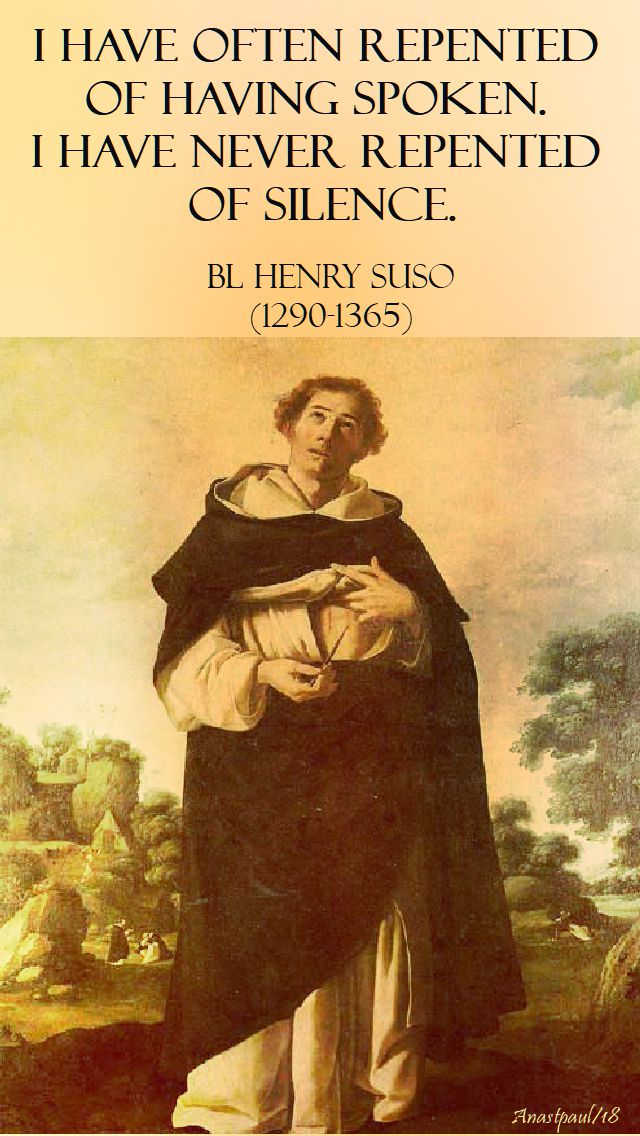
“I have often repented of having spoken.
I have never repented of silence.”i have often repented - bl henry suso - 25 jan 2018

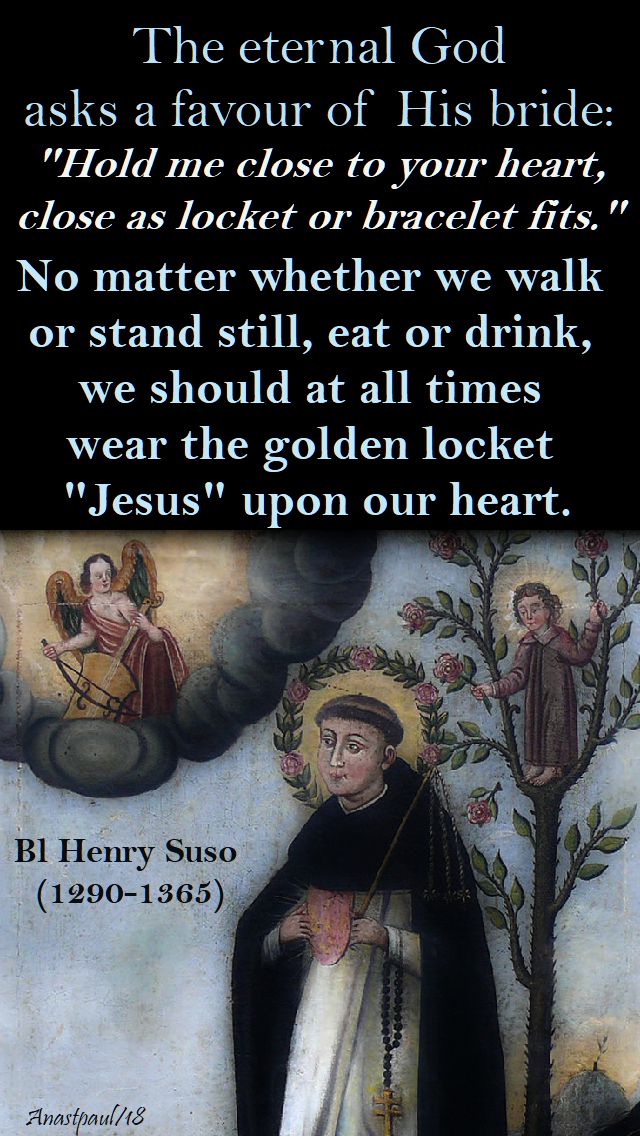
“The eternal God asks a favour of His bride:
“Hold me close to your heart,
close as locket or bracelet fits.”
No matter whether we walk
or stand still, eat or drink,
we should at all times
wear the golden locket
“Jesus” upon our heart.”the eternal god asks a favour - bl henry suso - 25 jan 2018

“Nowhere does Jesus
hear our prayers
more readily than
in the Blessed Sacrament.”

Blessed Henry Suso O.P. (1290-1365)nowhere does jesus hear our prayers - bl henry suso - 25 jan 2018