Quote/s of the Day – 29 December – “The Month of the Divine Infancy and the Immaculate Conception of the Blessed Virgin Mary” – the Feast of St Thomas à Becket (1118-1170) Martyr, Archbishop of Canterbury
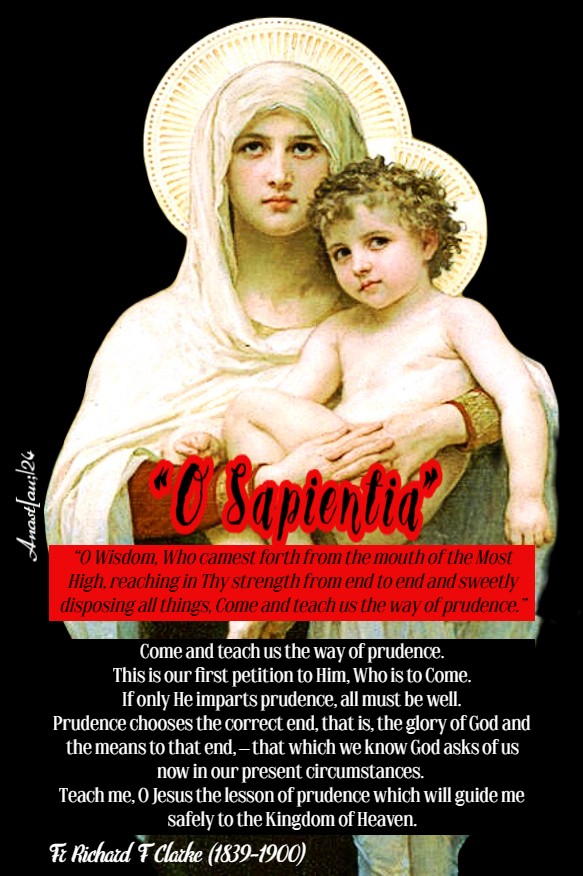
“O Sapientia”
“O Wisdom, Who camest forth from the mouth of the Most High, reaching in Thy strength from end to end and sweetly disposing all things, Come and teach us the way of prudence.”
“ Come and teach us the way of prudence. This is our petition to Him, Who is to Come. If only He imparts prudence, all must be well. Prudence chooses the correct end, that is, the glory of God and the means to that end, – that which we know God asks of us now in our present circumstances.
Teach me, O Jesus the lesson of prudence which will guide me safely to the Kingdom of Heaven.”
Quote/s of the Day – 18 December – “The Month of the Divine Infancy and the Immaculate Conception of the Blessed Virgin Mary” – The Feast of Our Lady of Expectation
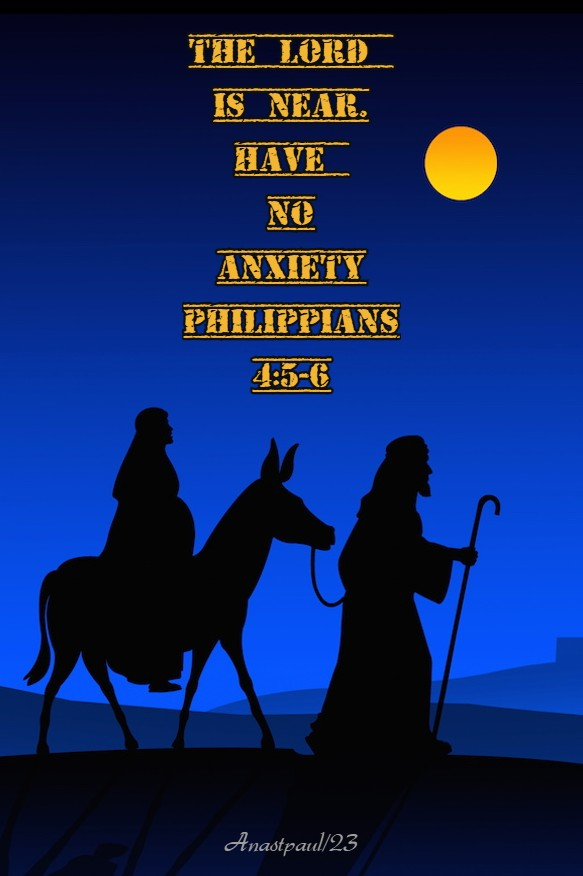
“The Lord is near. Have no anxiety …”
Philippians 4:5-6
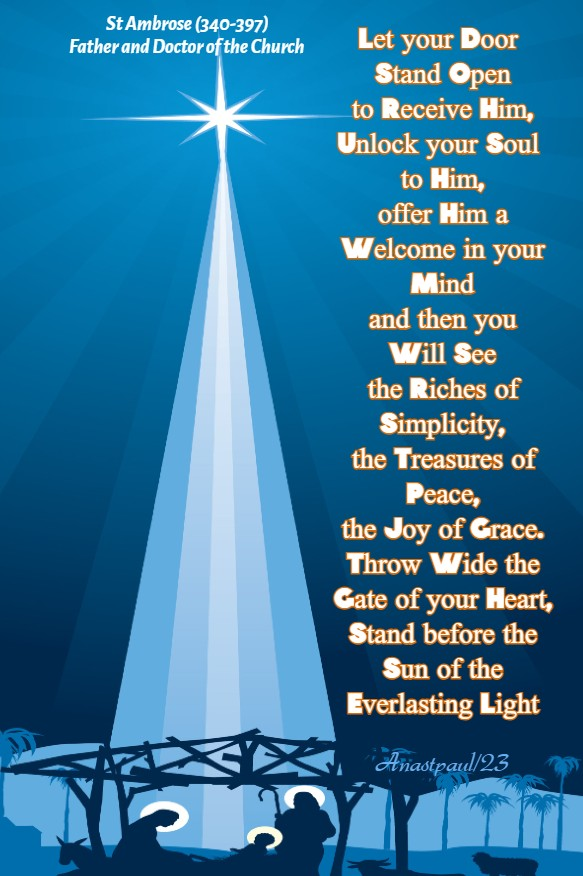
“Let your door stand open to receive Him, unlock your soul to Him, offer Him a welcome in your mind and then you will see the riches of simplicity, the treasures of peace, the joy of grace. Throw wide the gate of your heart, stand before the Sun of the Everlasting Light!”
St Ambrose (340-397) Father and Doctor of the Church
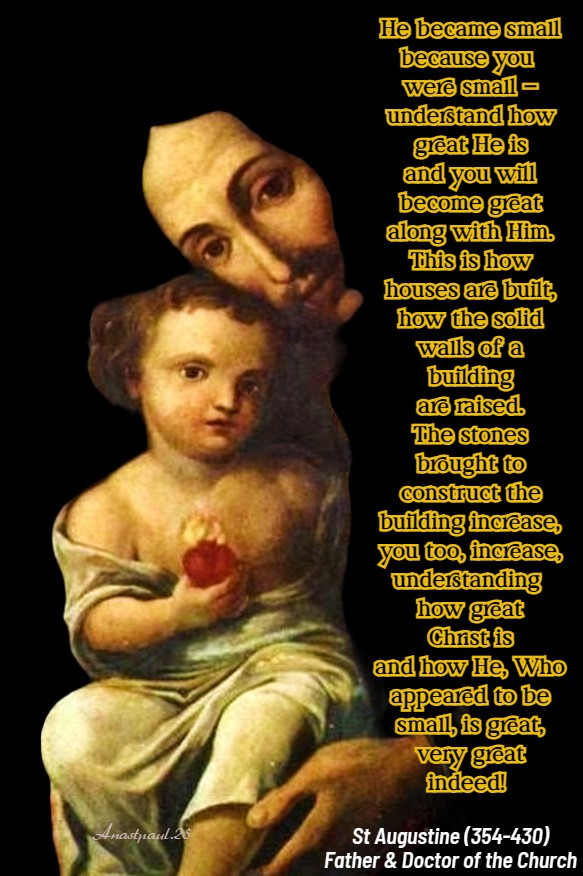
“He became small because you were small – understand how great He is and you will become great along with Him. This is how houses are built, how the solid walls of a building are raised. The stones brought to construct the building increase, you too, increase, understanding how great Christ is and how He, Who appeared to be small, is great, very great indeed! …”
St Augustine (354-430) Father & Doctor of the Church
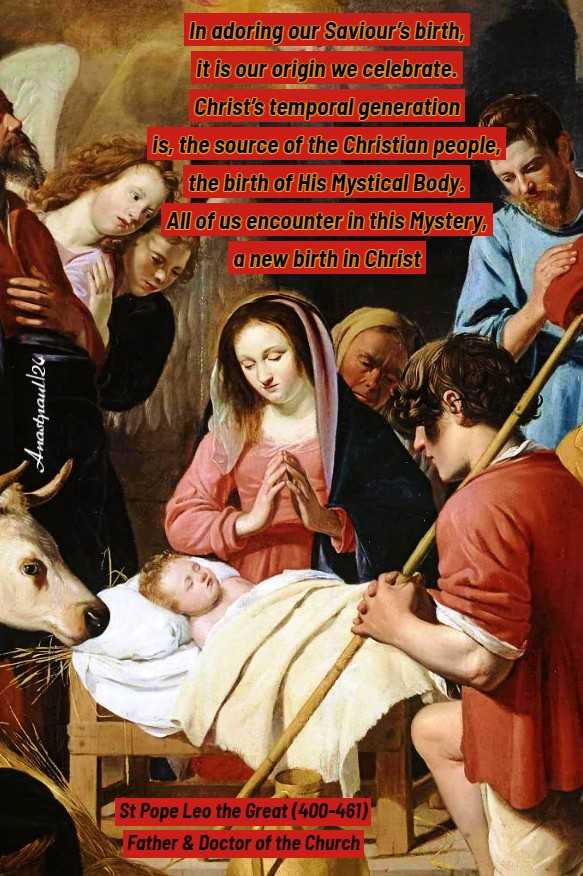
“In adoring our Saviour’s birth, it is our origin we celebrate. Christ’s temporal generation is the source of the Christian people, the birth of His Mystical Body. All of us encounter in this Mystery, a new birth in Christ.”
St Pope Leo the Great (400-461) Father & Doctor of the Church
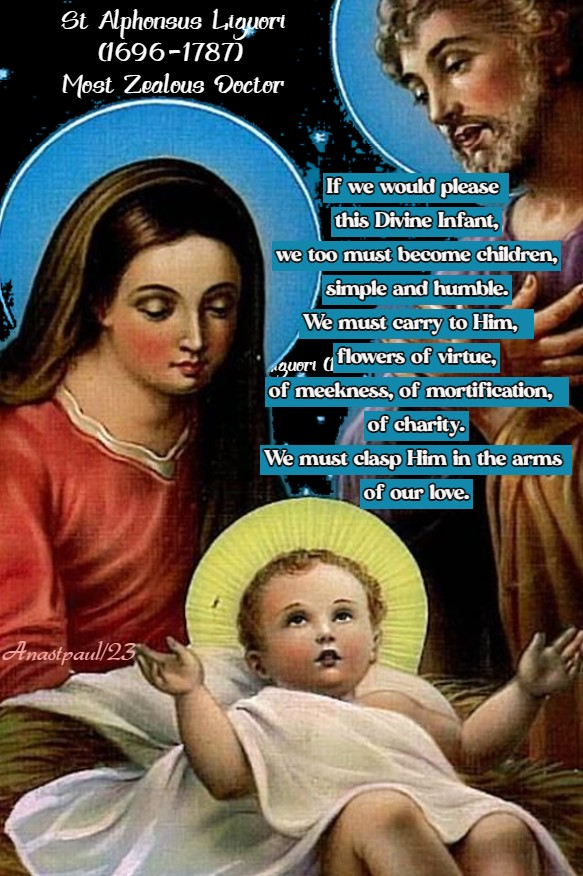
“If we would please this Divine Infant, we too must become children, simple and humble. We must carry to Him, flowers of virtue, of meekness, of mortification, of charity. We must clasp Him in the arms of our love.”
St Alphonsus Liguori (1696-1787) Most Zealous Doctor
Thought for the Day – 30 November – Meditations with Antonio Cardinal Bacci (1881-1971)
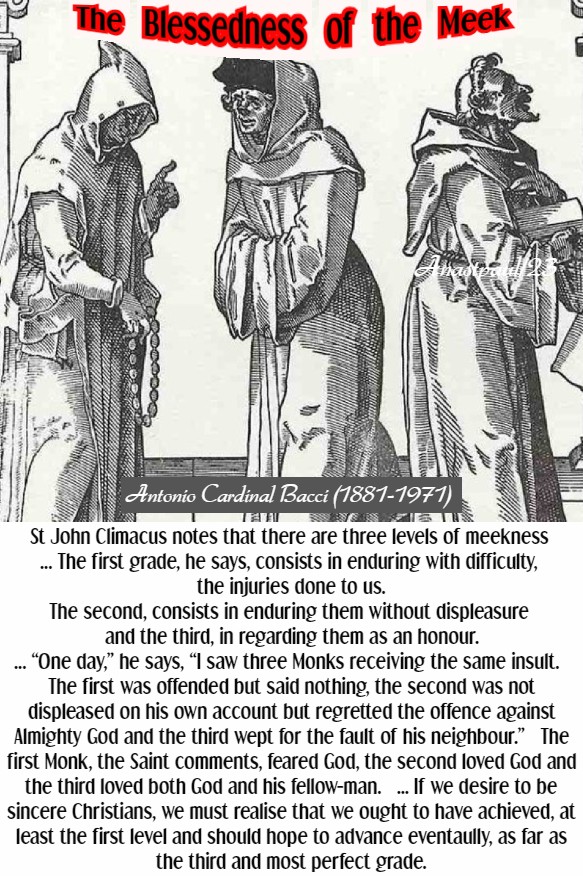
The Blessedness of the Meek
“St John Climacus notes that there are three levels of meekness (Dcala Paradist pp 296-298). The first grade, he says, consists in enduring with difficulty, the injuries done to us. The second, consists in enduring them without displeasure and the third, in regarding them as an honour.
Those who reach the first level are to be congratulated, those who reach the second are to be applauded but, those in the third and highest category, are really blessed by God.
“One day,” he says, “I saw three Monks receiving the same insult. The first was offended but said nothing, the second was not displeased on his own account but regretted the offence against Almighty God and the third wept for the fault of his neighbour.” The first Monk, the Saint comments, feared God, the second loved God and the third loved both God and his fellow-man.
At What stage of perfection in this virtue can we claim to have arrived? If we desire to be sincere Christians, we must realise that we ought to have achieved, at least the first level and should hope to advance eventaully, as far as the third and most perfect grade.”
One Minute Reflection – 31 October – “The Month of The Most Holy Rosary and The Holy Angels” – The Vigil of All Saints – Apocalypse 5:6-12 – Luke 6:17-23 – Scripture search here: https://www.drbo.org/
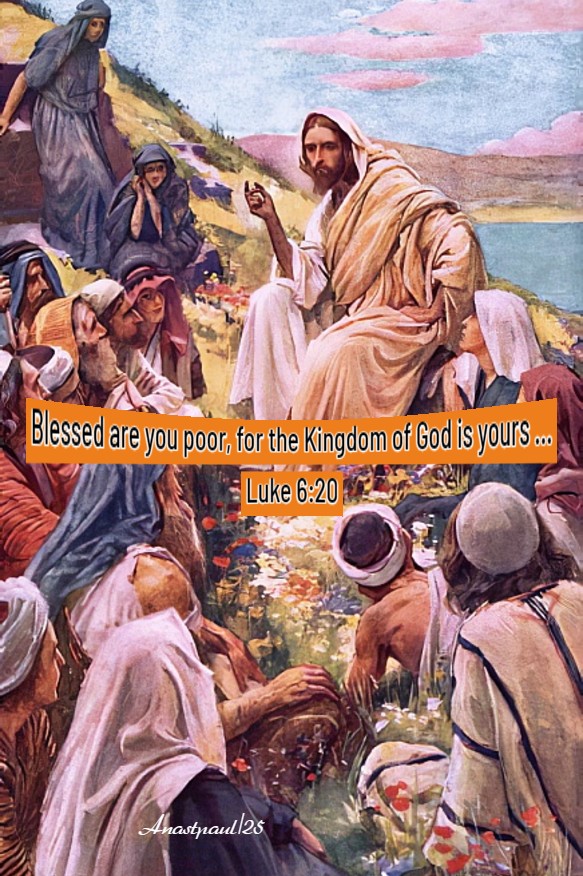
“And He, lifting up His Eyes on His disciples, He said: “Blessed are you poor, for the Kingdom of God is yours …” – Luke 6:20
REFLECTION – “Let us examine how St Luke encompassed the eight blessings into the four. We know, there are four Cardinal Virtues – temperance, justice, prudence and fortitude. One who is poor in spirit, is not greedy. One who weeps is not proud but is submissive and tranquil. One who mourns, is humble. One who is just does not deny that which he knows is given jointly to all. One who is merciful, gives away his own goods. One who bestows his own goods, does not seek another’s, nor does he contrive a trap for his neighbour. These virtues are interwoven and interlinked, so that one who has one, may be seen to have several and a single virtue befits the Saints. Where virtue abounds, the reward too abounds …. Thus temperance ,has purity of heart and spirit, justice has compassion, patience has peace and endurance has gentleness.
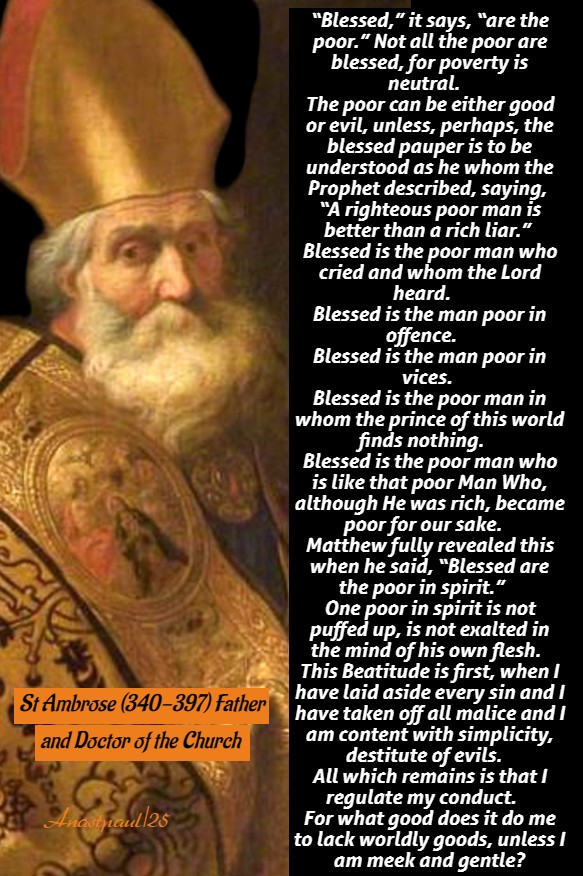
“Blessed,” it says, “are the poor.” Not all the poor are blessed, for poverty is neutral. The poor can be either good or evil, unless, perhaps, the blessed pauper is to be understood as he whom the Prophet described, saying, “A righteous poor man is better than a rich liar.” Blessed is the poor man who cried and whom the Lord heard. Blessed is the man poor in offence. Blessed is the man poor in vices. Blessed is the poor man in whom the prince of this world finds nothing. Blessed is the poor man who is like that poor Man Who, although He was rich, became poor for our sake. Matthew fully revealed this when he said, “Blessed are the poor in spirit.” One poor in spirit is not puffed up, is not exalted in the mind of his own flesh. This beatitude is first, when I have laid aside every sin and I have taken off all malice and I am content with simplicity, destitute of evils. All which remains is that I regulate my conduct. For what good does it do me to lack worldly goods, unless I am meek and gentle?
Although there are many charms of delights in riches, yet there are more incentives to practice virtues. Although virtue does not require assistance and the contribution of the poor person is more commended than the generosity of the rich, yet with the authority of the heavenly saying, He condemns not those who have riches but those who do not, know how to use them. The pauper is more praiseworthy who gives with eager compassion and is not restrained by the bolts of looming scarcity. He thinks that he ,who has enough for nature, does not lack. So the rich person is the more guilty, who does not give thanks to God for what he has received but vainly hides wealth, given for the common use and conceals it in buried treasures. Then the offence consists, not in the wealth but, in the attitude.
Purify yourself with your tears. Wash yourselves with mourning. If you weep for yourself, another will not weep for you… One who is a sinner weeps for himself and rebukes himself that he may become righteous, for just people accuse themselves of sin. Let us pursue order for it is written, “Set in order love in me.” I have laid down sin. I have tempered my conduct. I have wept for my transgressions. I begin to hunger. I hunger for righteousness. The sick, when he is seriously ill, does not hunger, for the pain of the illness excludes hunger. What is the hunger for righteousness? What is the bread of which it is said, “I have been young and am old and I have not seen the righteous man forsaken, nor his seed begging bread?” Surely one who is hungry seeks increase of strength. What greater increase of virtue is there, than the rule of righteousness? – St Ambrose (340-397) Father and Doctor of the Church (Exposition on the Gospel of Luke, #5).
PRAYER – Multiply Thy grace upon us, O Lord our God and grant that by following in holiness of life, those whose glorious festival we anticipate, we may attain to their bliss. Through Jesus Christ, Thy Son our Lord, Who lives and reigns with Thee, in the unity of the Holy Ghost, God, world without end. Amen (Collect).
One Minute Reflection – 27 October – “The Month of The Most Holy Rosary and The Holy Angels” – The Vigil of Saints Simon and Jude – 1 Corinthians 4:9-14 – John 15:1-7 – Scripture search here: https://www.drbo.org/
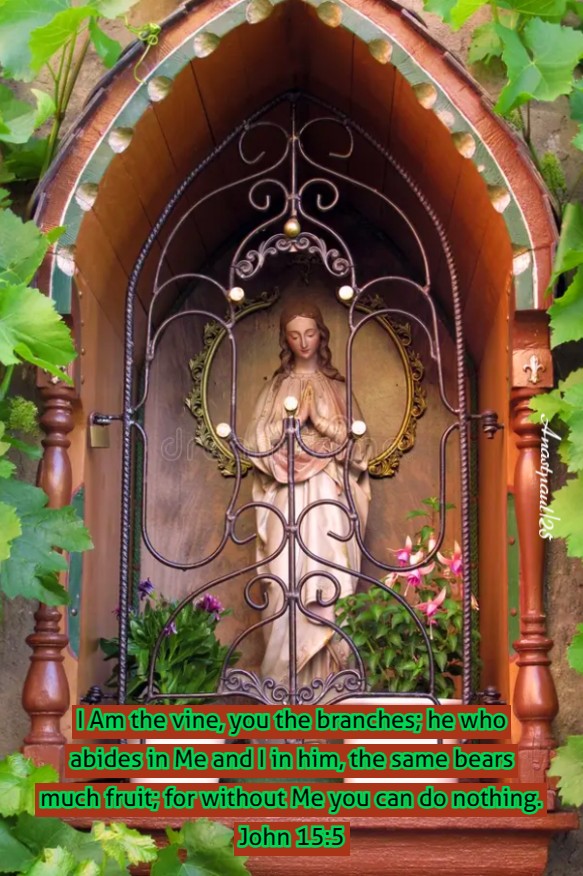
“I Am the vine, you the branches; he who abides in Me and I in him, the same bears much fruit; for without Me you can do nothing.” – John 15:5
REFLECTION – “I have all due respect for the opinion which faithfully and fittingly interprets this vineyard of our text, as the whole Church, Christ being the Vine, Christians the branches, the Father,the Gardener and the Rich Man, the daylight, the whole of time or the life of man, the hours, the ages of the world or of individuals, the marketplace, this world’s grasping and insatiable business.
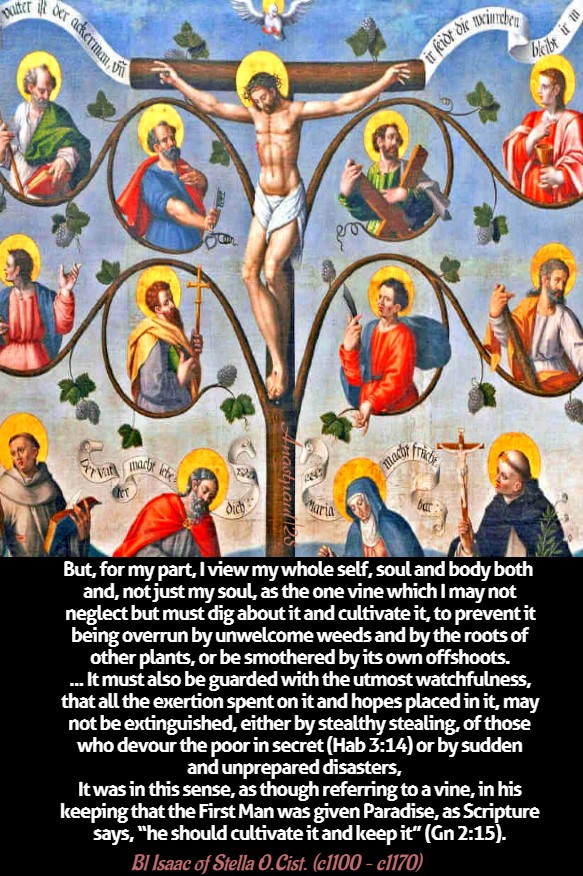
But, for my part, I view my whole self, soul and body both and, not just my soul, as the one vine which I may not neglect but must dig about it and cultivate it, to prevent it being overrun by unwelcome weeds and by the roots of other plants, or be smothered by its own offshoots. Pruned, it must be or it will grow wild: trimmed so that it may yield more fruit. It must be altogether enclosed. fenced-in, or every passer-by will freely plunder it; the greatest danger of all, being that the wild boar from the thickets … may ravage it (cf. Ps 79:14). To sum all this up briefly – it must be cultivated with the greatest care, otherwise the noble shoots of this choice vine, will go to seed, will turn into a worthless vine and, far from delighting both God and man (cf. Ps 103:15), may only succeed in saddening both of them. It must also be guarded with the utmost watchfulness that all the exertion spent on it and hopes placed in it, may not be extinguished, either by stealthy stealing, of those who devour the poor in secret (Hab 3:14) or by sudden and unprepared disasters, It was in this sense, as though referring to a vine, in his keeping that the First Man was given Paradise, as Scripture says, “he should cultivate it and keep it” (Gn 2:15).” – Bl Isaac of Stella O.Cist. (c1100 – c1170) Cistercian Monk, Abbot, Theologian, Philosopher (Sermon 16 – First for Septuagesima Sunday).
PRAYER – Almighty God, grant, we beseech Thee, as we are preparing for Thine Apostles Simon and Jude, their glorious birthday, so the same may beseechThy Majesty to win Thy goodness for us.Through Jesus Christ, Thy Son our Lord, Who lives and reigns with Thee, in the unity of the Holy Ghost, One God, world without end. Amen (Collect).
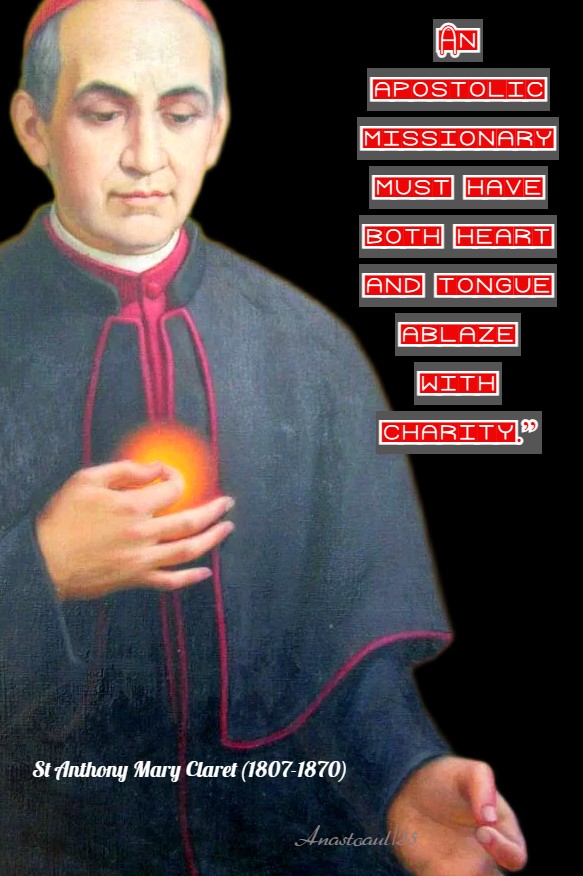
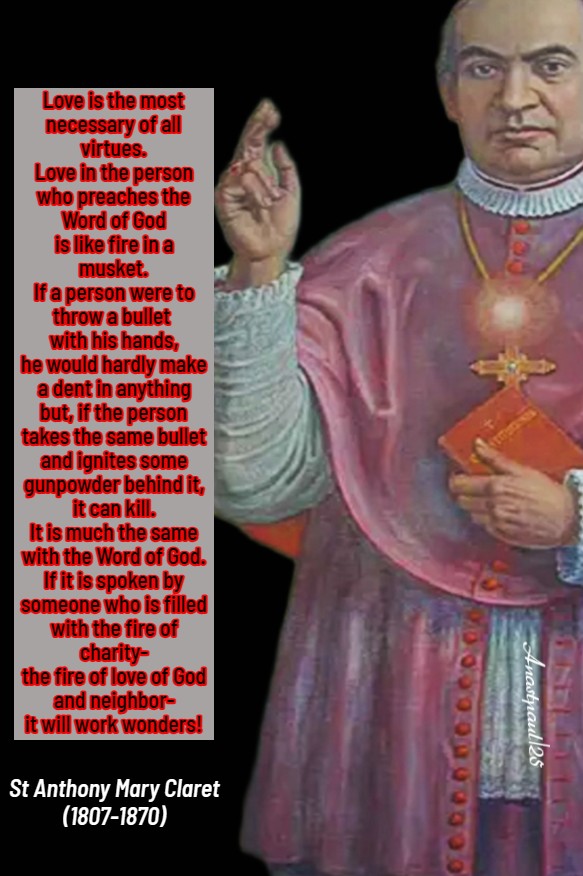
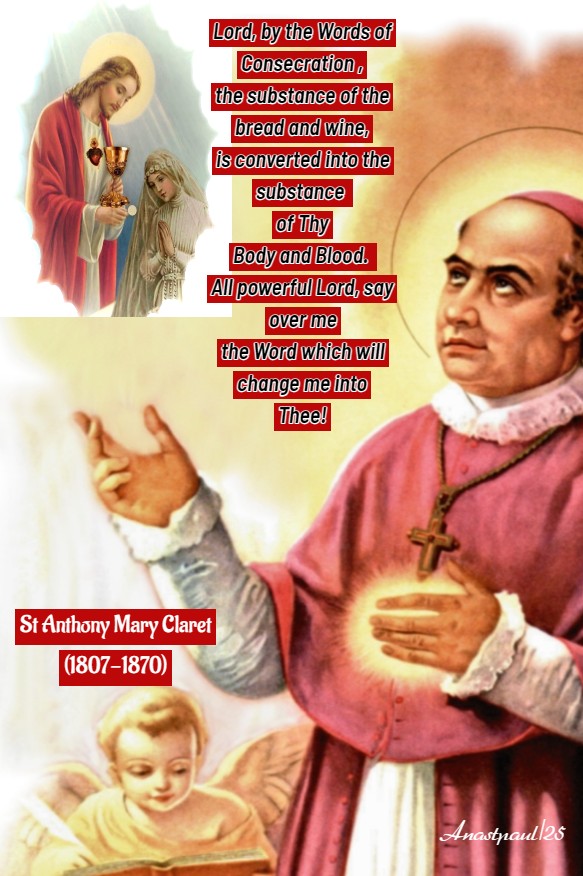
Quote/s of the Day – 23 October – St Anthony Mary Claret CMF (1807-1870) Archbishop and Founder of the Claretians
“An apostolic missionary must have both heart and tongue ablaze with charity.”
“Love is the most necessary of all virtues. Love in the person who preaches the Word of God is like fire in a musket. If a person were to throw a bullet with his hands, he would hardly make a dent in anything but, if the person takes the same bullet and ignites some gunpowder behind it, it can kill. It is much the same with the Word of God. If it is spoken by someone who is filled with the fire of charity- the fire of love of God and neighbor- it will work wonders!”
“Lord, by the Words of Consecration , the substance of the bread and wine, is converted into the substance of Thy Body and Blood. All powerful Lord, say over me the Word which will change me into Thee.”
Thought for the Day – 16 September – Meditations with Antonio Cardinal Bacci (1881-1971)
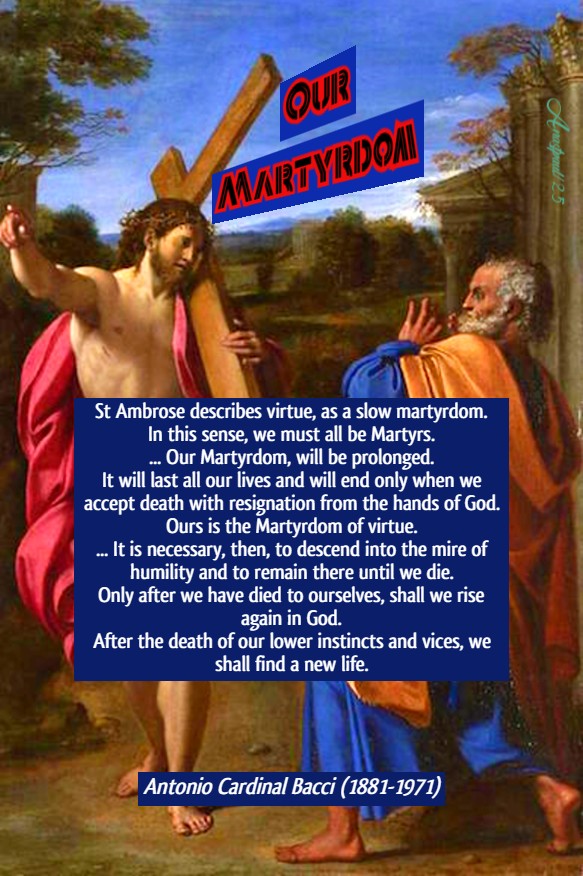
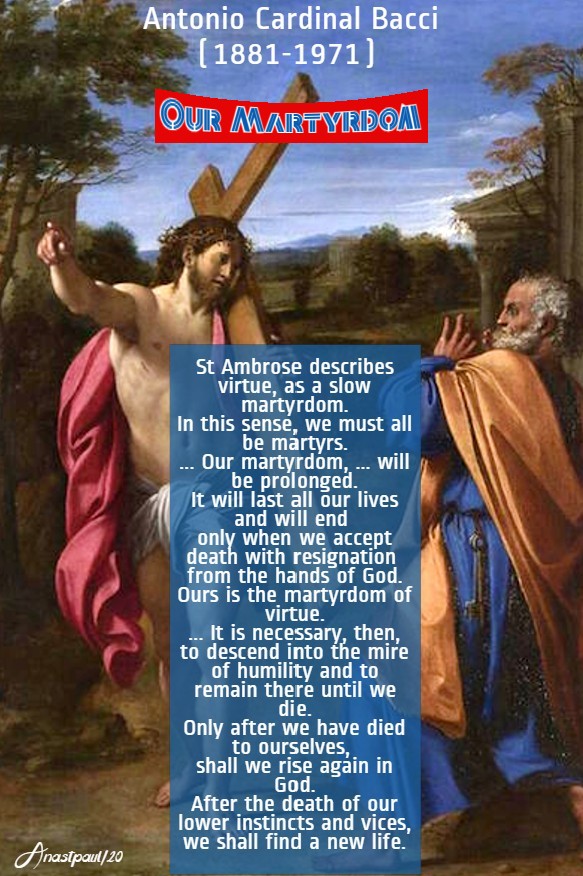
Our Martyrdom
“St Ambrose describes virtue, as a slow martyrdom. In this sense, we must all be Martyrs. There is only one difference. The Martyrs of the Church shed their blood and gave up their lives for Jesus, within one hour or one day and gained their reward immediately. Our Martyrdom, on the other hand, will be prolonged. It will last all our lives and will end only when we accept death with resignation from the hands of God. Ours is the Martyrdom of virtue. Let us clearly understand, that solid Christian virtue is a slow and continual Martyrdom which will only end with death. It is not a flower which springs up spontaneously in the garden of the soul. It is like a seed which is thrown on the damp earth and must die there slowly, so that it can generate young shoots which will produce the ears of corn. “Unless the grain of wheat falls into the ground and dies, it remains alone. But, if it dies, it brings forth much fruit” (Jn 12:24-25). It is necessary, then, to descend into the mire of humility and to remain there until we die. Only after we have died to ourselves, shall we rise again in God (Cf ibid). After the death of our lower instincts and vices, we shall find a new life.”
Thought for the Day – 12 September – Meditations with Antonio Cardinal Bacci (1881-1971)
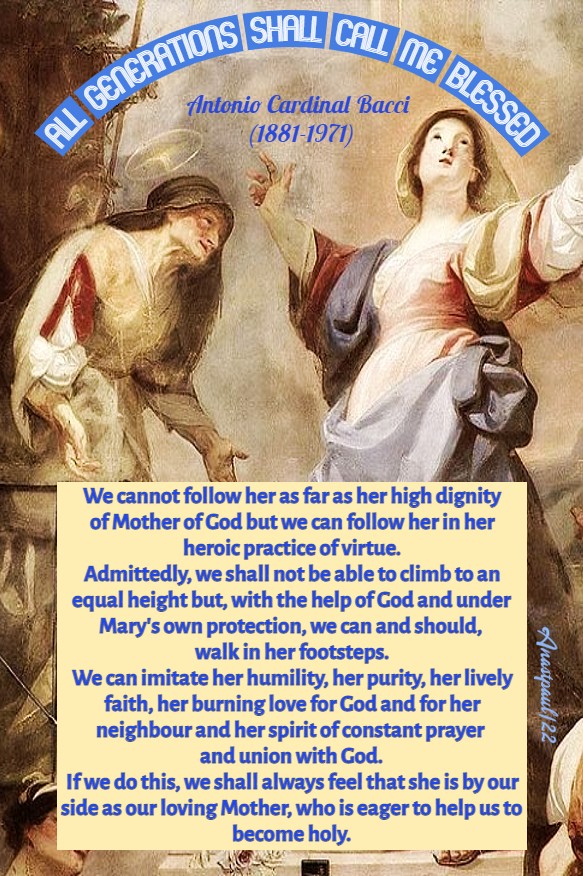
“All Generations Shall Call Me Blessed”
“It is related in the Gospel, that once a certain occasion, a woman in the crowd, was roused by the preaching and miracles of Jesus and cried out: “Blessed is the womb that bore thee and the breasts that nursed thee.” But Jesus replied: “Rather blessed are they who hear the word of God and keep it” (Lk 11:27-28). These words take nothing from the glory of the Mother of God. They were not intended for her but, for us. She was great and holy, not only because she was chosen to be the Mother of the Word Incarnate but also because she perfected herself in virtue by carrying out, in everything, the teaching of her Divine Son, Jesus.
We cannot follow her as far as her high dignity of Mother of God but we can follow her in her heroic practice of virtue. Admittedly, we shall not be able to climb to an equal height but, with the help of God and under Mary’s own protection, we can and should, walk in her footsteps.
We can imitate her humility, her purity, her lively faith, her burning love for God and for her neighbour and her spirit of constant prayer and union with God. If we do this, we shall always feel that she is by our side as our loving Mother, who is eager to help us to become holy.”
Thought for the Day – 2 September – Meditations with Antonio Cardinal Bacci (1881-1971)
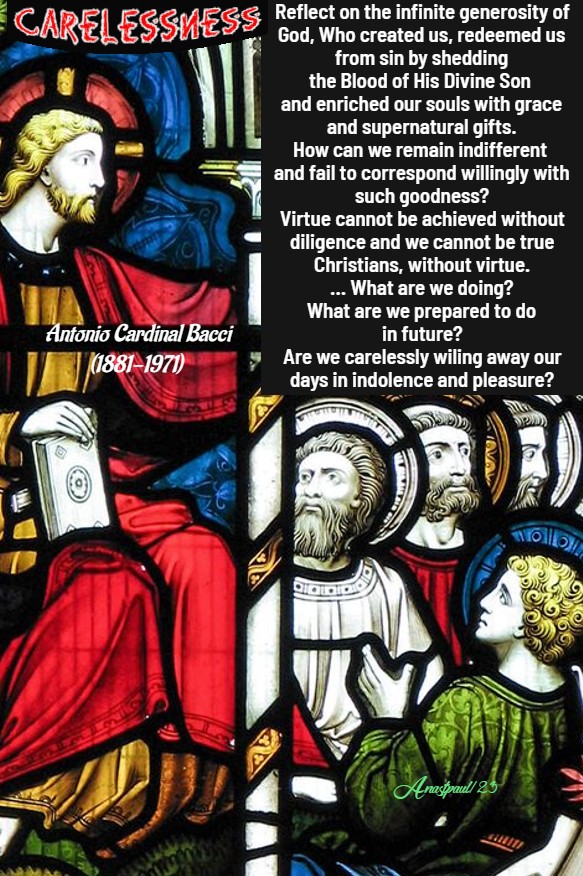
CARELESSNESS
“Reflect on the Infinite generosity of God, Who created us, redeemed us from sin by shedding the Blood of His Divine Son and enriched our souls with grace and supernatural gifts. How can we remain indifferent and fail to correspond willingly with such goodness? Virtue cannot be achieved without diligence and we cannot be true Christians, without virtue. Let us consider the example given us by the Saints. They lived in a continual and prayerful union with God; they never refused any task or any sacrifice, in order to show their love for Jesus and their total dedication to His will; they made every effort to attract others towards holiness and to bring about the triumph of the Kingdom of Christ in the world.
What are we doing? What are we prepared to do in future? Are we carelessly wiling away our days in indolence and pleasure?”
Thought for the Day – 6 August – Meditations with Antonio Cardinal Bacci (1881-1971)
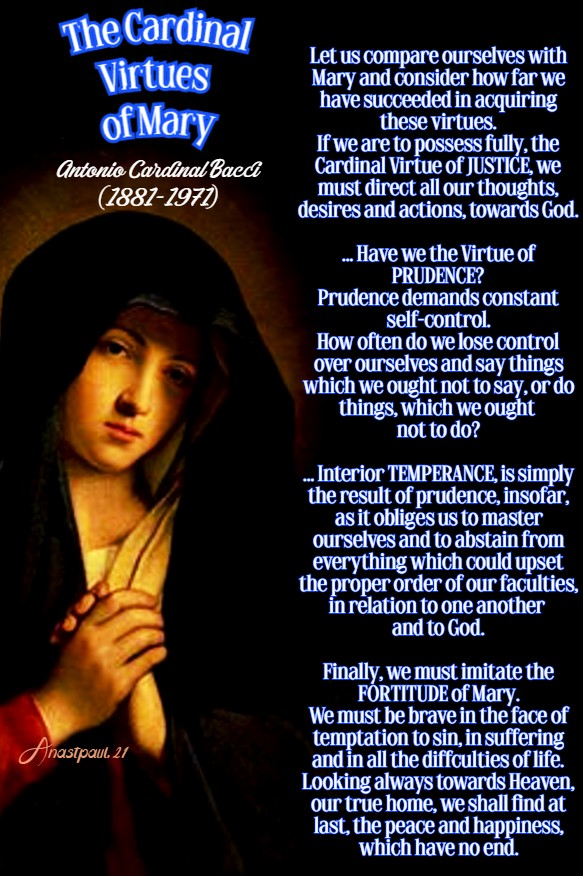
The Cardinal Virtues of Mary
“Let us compare ourselves with Mary and consider how far we have succeeded in acquiring these virtues. If we are to possess fully, the Cardinal virtue of JUSTICE, we must direct all our thoughts, desires and actions, towards God. Since everything comes from God, we should offer everything back to Him. If we fail to do this, we are guilty of injustice towards God. We take something which belongs to Him, for ourselves, We must also be just to our neighbour. It is not enough to be charitable only because there can be no charity, unless, it is founded on justice. This justice should characterise our thoughts and judgements, as well as our words and actions.
Have we the Virtue of PRUDENCE? Prudence demands constant self-control. How often do we lose control over ourselves and say things which we ought not to say, or do things, which we ought not to do? Prudence is a splendid virtue, which can be obtained by the grace of God, by living a life of union with Him. It necessitates constant vigilance over our faculties and passions, in order to ensure, that nothing will interfere with our rational conduct and with our observance of the commandments of God.
Interior TEMPERANCE, is simply the result of prudence, insofar, as it obliges us to master ourselves and to abstain from everything which could upset the proper order of our faculties, in relation to one another and to God. If we are inwardly temperate, we shall show external temperance in our words and deeds. We shall abstain, in other words, from everything suggested by our lower nature, which is contrary to the commandments of God and the precepts of the Church. This means, we shall observe among other things, the Church’s laws of fasting and abstinence. We shall keep away from dangerous amusements and from anything else which could be harmful to ourselves or to our neighbour.
Finally, we must imitate the FORTITUDE of Mary. We must be brave in the face of temptation to sin, in suffering and in all the diffculties of life. Looking always towards Heaven, our true home, we shall find at last, the peace and happiness, which have no end.”
Thought for the Day – 5 August – Meditations with Antonio Cardinal Bacci (1881-1971)
The Theological Virtues of Our Lady
“We also possess the Catholic Faith, or at any rate, believe that we possess it, for we often recite the Creed and were received, at Baptism, into the family of the Catholic Church.
But is our faith alive? When a man is living his faith, he has a constant realisation of the Presence of God, Who has created him, maintains him in existence, has redeemed him, loves him and commands him to do good. Otherwise, our faith is dead, for as St James writes, “faith, without works, is dead” (Js 2:26). If our faith is not living, neither is our hope nor our charity.
Let us examine ourselves thoroughly. Perhaps we do not think about God enough and, as a result our faith is weak. Perhaps we place all our hope in earthly things and look for these passing pleasures, which cannot satisfy or hearts. Perhaps we love ourselves and our possessions too much and have too little love for God, our only real good. It maybe that we are constantly seeking our own interests and ease and are lacking in sincere and active charity towards our neighbour, when he is in need, even though he is our brother in Jesus Christ and we should love him as ourselves. If this is the way matters stand, we are not genuine Catholics, for we have not the three theological virtues, which should form the basis of our lives. Neither are we sincere sons of Mary, who possessed these three virtues in an outstanding manner. Let us examine ourselves with a view to forming a few good and earnest resolutions.”
Thought for the Day – 25 July – Meditations with Antonio Cardinal Bacci (1881-1971)
Our Martyrdom
“St Ambrose describes virtue, as a slow martyrdom. In this sense, we must all be Martyrs. There is only one difference. The Martyrs of the Church shed their blood and gave up their lives for Jesus, within one hour or one day and gained their reward immediately. Our Martyrdom, on the other hand, will be prolonged. It will last all our lives and will end only when we accept death with resignation from the hands of God. Ours is the Martyrdom of virtue. Let us clearly understand, that solid Christian virtue is a slow and continual Martyrdom which will only end with death. It is not a flower which springs up spontaneously in the garden of the soul. It is like a seed which is thrown on the damp earth and must die there slowly, so that it can generate young shoots which will produce the ears of corn. “Unless the grain of wheat falls into the ground and dies, it remains alone. But, if it dies, it brings forth much fruit” (Jn 12:24-25). It is necessary, then, to descend into the mire of humility and to remain there until we die. Only after we have died to ourselves, shall we rise again in God (Cf ibid). After the death of our lower instincts and vices, we shall find a new life.”
Thought for the Day – 8 May – The Imitation of the Blessed Virgin Mary By Thomas à Kempis (1380-1471)
Extracts from The Imitation of the Blessed Virgin Mary By Thomas à Kempis CRSA (1380-1471) Imprimatur 17 February 1947
PART ONE THE JOYFUL MYSTERIES Chapter I
SERMON The Model and Imitation
I. To imitate is to reproduce a model – but, the model can be larger or smaller than the reproduction. Thus, it is in the imitation of Jesus, of Mary and of the Saints. The models in this case are greater than nature. We can, nevertheless, succeed in resembling them by reproducing their life.
II. Life is a complexity of virtues and of faults, of forces and of instincts. Nothing is evil by nature but, according as one rises or falls, one becomes good or bad. It can be said that a middle way does not exist. One must choose vice or virtue. To practice virtue an effort must be made; such is the meaning of the Latin word – “virtus.”
III. The Christian soul, in the face of the Divine model, Mary, exalts itself to the practice of the virtues which it admires in her, who is, at the same time, a sublime model and an admirable mistress, an example and a mother.
MEDITATION The Work of Sanctification
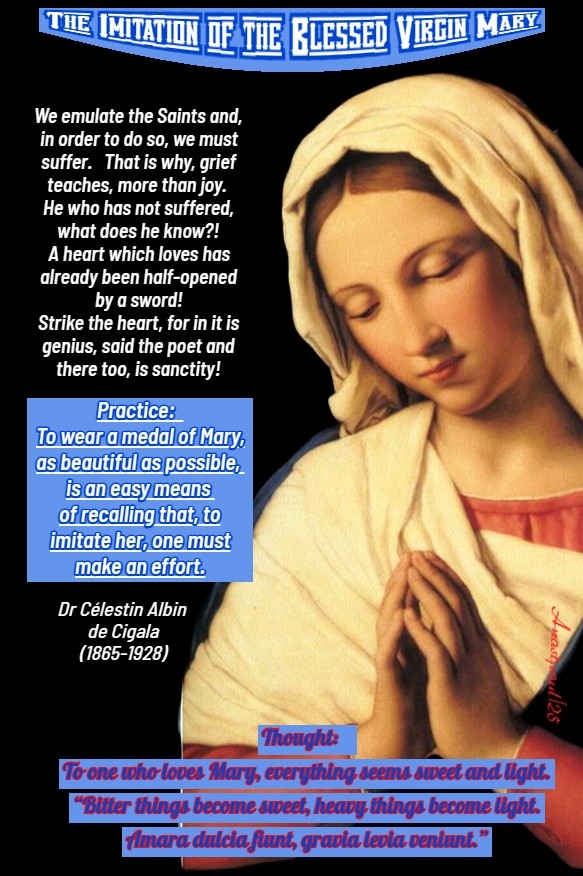
It is a science, to know how to regard a model; it is an art, to be able to reproduce it. This art and this work, contain the whole secret of the spiritual life. Consideration is meditation or contemplation, the study of Divine harmonies. We emulate the Saints and, in order to do so, we must suffer. That is why, grief teaches, more than joy. He who has not suffered, what does he know?! A heart which loves has already been half-opened by a sword! Strike the heart, for in it is genius, said the poet and there too, is sanctity!
Practice: To wear a medal of Mary, as beautiful as possible, is an easy means of recalling that, to imitate her, one must make an effort.
Thought: To one who loves Mary, everything seems sweet and light. “Bitter things become sweet, heavy things become light. Amara dulcia fiunt, gravia levia veniunt.”
Dr Célestin Albin de Cigala (1865-1928) Faculty of Paris Doctor of Theology and Philosophy
Thought for the Day – 2 April – Meditations with Antonio Cardinal Bacci (1881-1971)
Our Martyrdom
“St Ambrose describes virtue, as a slow martyrdom. In this sense, we must all be martyrs. There is only one difference. The Martyrs of the Church shed their blood and gave up their lives for Jesus, within one hour or one day and gained their reward immediately. Our martyrdom, on the other hand, will be prolonged. It will last all our lives and will end only when we accept death with resignation from the Hands of God. Ours is the martyrdom of virtue. Let us clearly understand, that solid Christian virtue is a slow and continual martyrdom, which will end with death. It is not a flower, which springs up spontaneously in the garden of the soul. It is like a seed which is thrown on the damp earth and must die there slowly, so that it will generate young shoots, which will produce the ears of corn. “Unless the grain of wheat falls into the ground and dies, it remains alone. But, if it dies, it brings forth much fruit” (Jn 12:24-25). It is necessary, then, to descend into the mire of humility and to remain there until we die. Only after we have died to ourselves, shall we rise again in God (Cf ibid). After the death of our lower instincts and vices, we shall find a new life.”
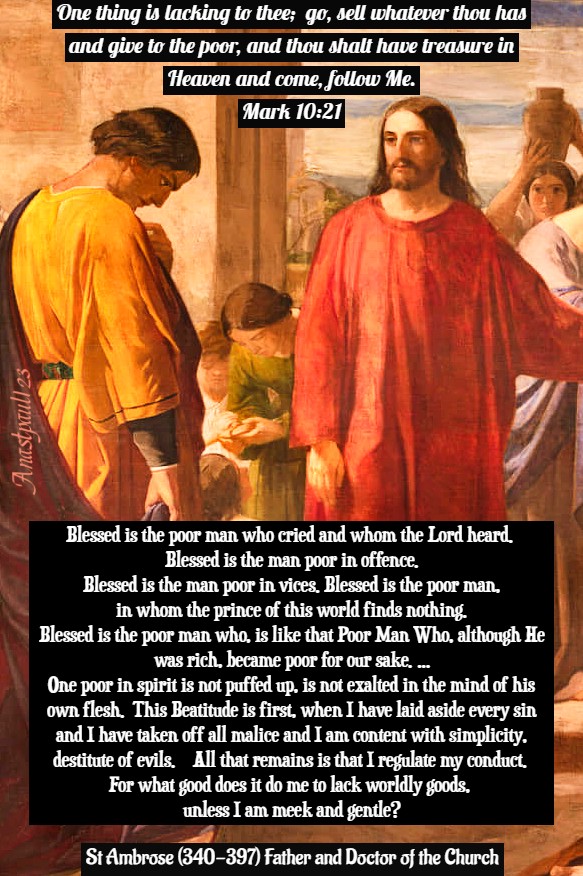
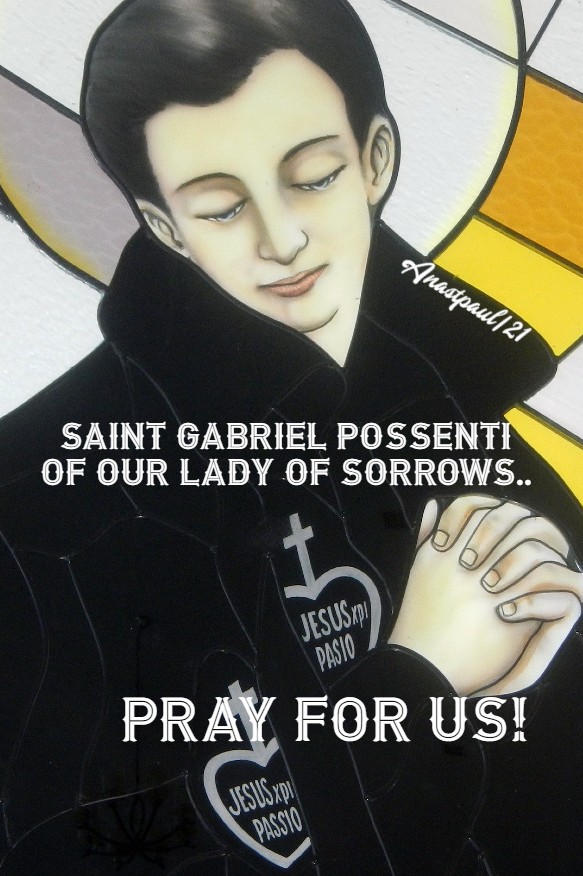
One Minute Reflection – 27 February – “The Month of the Blessed Trinity” – St Gabriel of the Sorrowful Virgin/Gabriel Possenti CP (1838-1862) Confessor – 1 John 2:14-17. – Mark 10:13-21 – Scripture search here: https://www.drbo.org/
“One thing is lacking to thee; go, sell whatever thou has and give to the poor and thou shalt have treasure in Heaven and come, follow Me.” – Mark 10:21
REFLECTION – “Blessed is the poor man who cried and whom the Lord heard. Blessed is the man poor in offence. Blessed is the man poor in vices. Blessed is the poor man, in whom the prince of this world finds nothing. Blessed is the poor man who, is like that Poor Man Who, although He was rich, became poor for our sake. Matthew fully revealed this when he said, “Blessed are the poor in spirit.” One poor in spirit is not puffed up, is not exalted in the mind of his own flesh. This Beatitude is first, when I have laid aside every sin and I have taken off all malice and I am content with simplicity, destitute of evils. All that remains is that I regulate my conduct. For what good does it do me to lack worldly goods, unless I am meek and gentle?
Although there are many charms of delights in riches, yet there are more incentives to practice virtues. Although virtue does not require assistance and the contribution of the poor person, is more commended, than the generosity of the rich, yet with the authority of the heavenly saying, He condemns, not those who have riches but those who do not know how to use them. The pauper is more praiseworthy who gives with eager compassion and is not restrained, by the bolts of looming scarcity. He thinks that he who has enough for nature, does not lack. So the rich person is the more guilty, who does not give thanks to God, for what he has received but vainly hides wealth given for the common use and conceals it, in buried treasures. Then the offence consists, not in the wealth but in the attitude.
Purify yourself with your tears. Wash yourselves with mourning. If you weep for yourself, another will not weep for you . One who is a sinner weeps for himself and rebukes himself, that he may become righteous, for just people accuse themselves of sin. Let us pursue order because, it is written, “Set in order love in me.” I have laid down sin. I have tempered my conduct. I have wept for my transgressions. I begin to hunger. I hunger for righteousness. The sick, when he is seriously ill, does not hunger because, the pain of the illness excludes hunger. What is the hunger for righteousness? What is the bread of which it is said, “I have been young and am old and I have not seen the righteous man forsaken, nor his seed begging bread?” Surely, one who is hungry, seeks increase of strength. What greater increase of virtue is there, than the rule of righteousness?” – St Ambrose (340-397) Bishop of Milan, Father and Doctor of the Church( Exposition on the Gospel of Luke, 5).
PRAYER – O God, Who taught blessed Gabriel to meditate continually on the sorrows of Thy most sweet Mother and Who, through her, exalted him by the glory of a holy life and miracles; grant us, we beseech Thee, through his intercession and example so to share in the sorrows of Thy Mother that her motherly protection may save us. Through Jesus Christ, Thy Son our Lord, Who lives and reigns with Thee, in the unity of the Holy Ghost, God, world without end. Amen (Collect).
Quote/s of the Day – 27 January – St John Chrysostom (347-407) Bishop, Confessor, Father and Doctor of the Church “Golden Mouthed.”
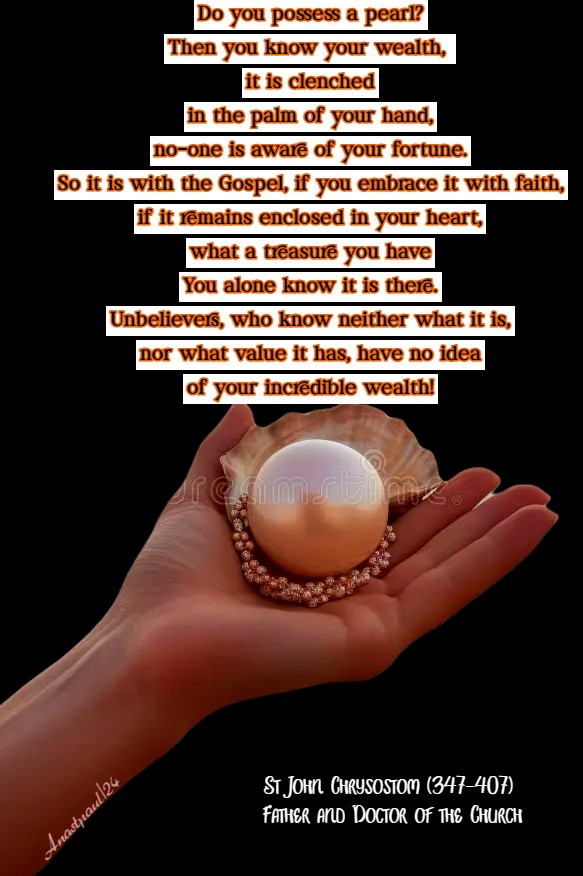
“Do you possess a pearl? Then you know your wealth, it is clenched in the palm of your hand, no-one is aware of your fortune. So it is with the Gospel, if you embrace it with faith, if it remains enclosed in your heart, what a treasure you have You alone know it is there. Unbelievers, who know neither what it is, nor what value it has, have no idea of your incredible wealth!”
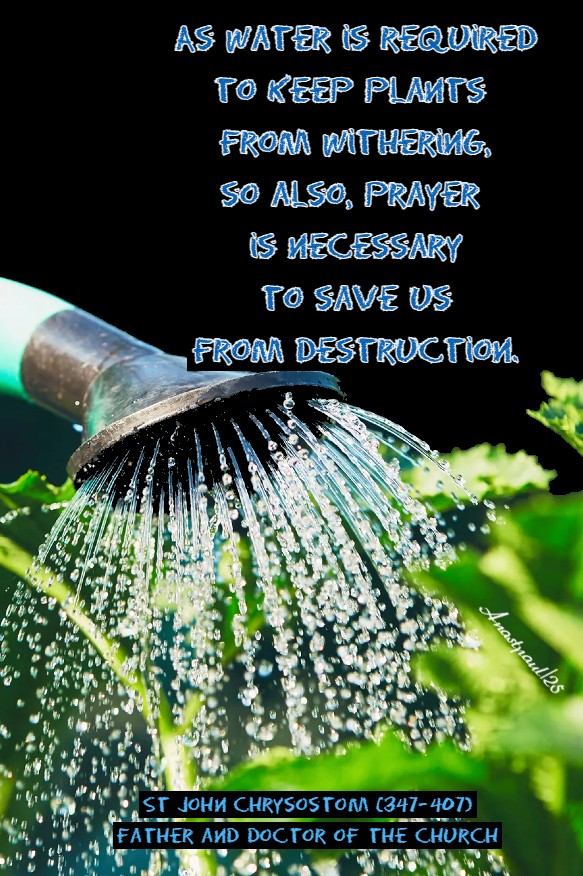
“As water is required to keep plants from withering, so also, prayer is necessary to save us from destruction.”
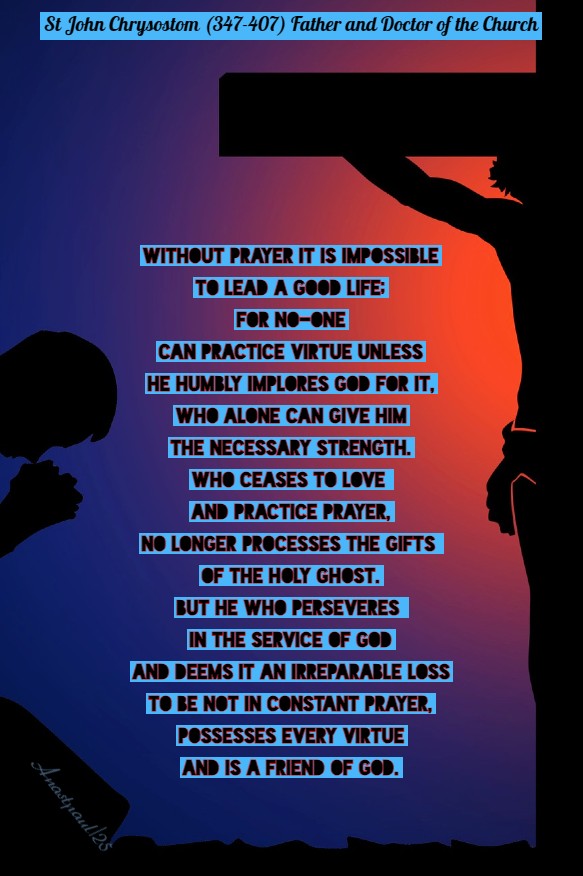
“Without prayer it is impossible to lead a good life; for no-one can practice virtue unless he humbly implores God for it, Who alone can give him the necessary strength. Who ceases to love and practice prayer, no longer processes the gifts of the Holy Ghost. But he who perseveres in the service of God and deems it an irreparable loss to be not in constant prayer, possesses every virtue and is a friend of God.”
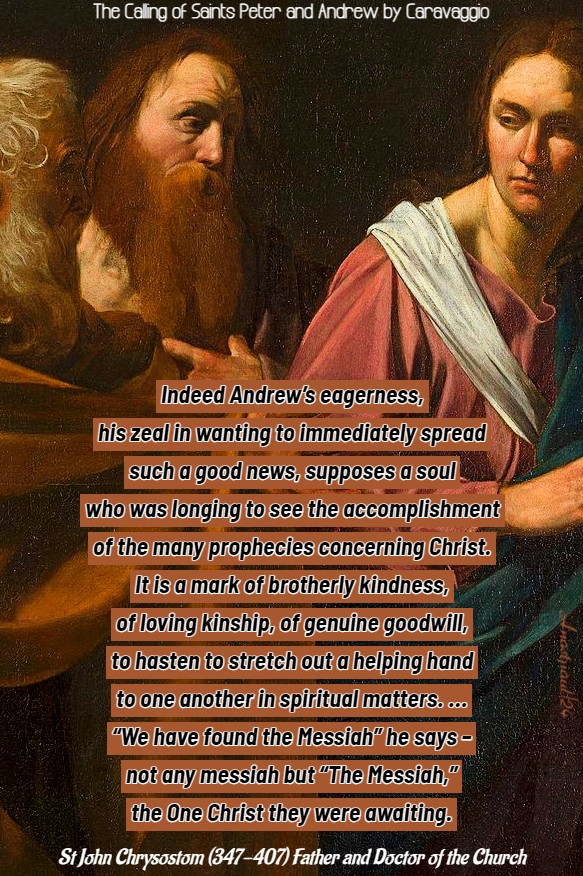
“Indeed Andrew’s eagerness, his zeal in wanting to immediately spread such a good news, supposes a soul who was longing to see the accomplishment of the many prophecies concerning Christ. It is a mark of brotherly kindness, of loving kinship, of genuine goodwill, to hasten to stretch out a helping hand to one another in spiritual matters. … “We have found the Messiah” he says – not any messiah but “The Messiah,” the One Christ they were awaiting.”
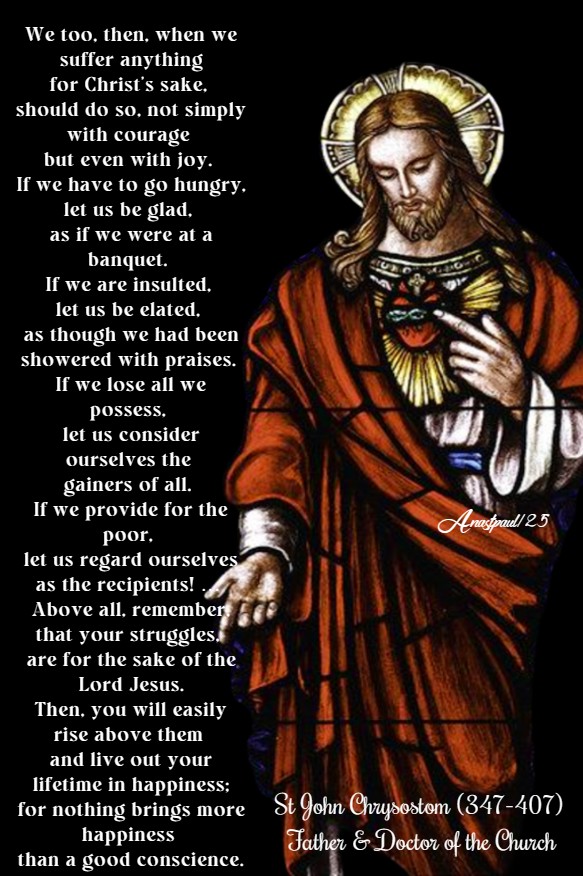
“We too, then, when we suffer anything for Christ’s sake, should do so, not simply with courage but even with joy. If we have to go hungry, let us be glad, as if we were at a banquet. If we are insulted, let us be elated, as though we had been showered with praises. If we lose all we possess, let us consider ourselves the gainers of all. If we provide for the poor, let us regard ourselves as the recipients! … Above all, remember, that your struggles, are for the sake of the Lord Jesus. Then, you will easily rise above them and live out your lifetime in happiness; for nothing brings more happiness than a good conscience.”
“Are we going to neglect our own salvation? Let us show great compassion towards the poor so as to be made worthy of possessing good things to come for all eternity!”
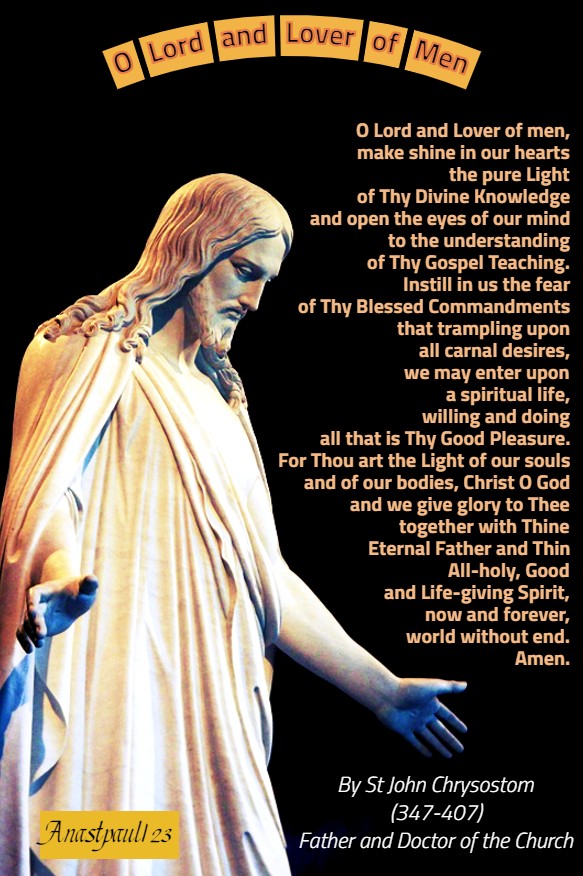
O Lord and Lover of Men By St John Chrysostom (347-407) Father and Doctor of the Church
O Lord and Lover of men, make shine in our hearts the pure Light of Thy Divine Knowledge and open the eyes of our mind to the understanding of Thy Gospel teaching. Instill in us the fear of Thy Blessed Commandments that trampling upon all carnal desires, we may enter upon a spiritual life, willing and doing all that is Thy Good Pleasure. For Thou art the Light of our souls and of our bodies, Christ O God and we give glory to Thee together with Thine Eternal Father and Thine All-holy, Good and Life-giving Spirit, now and forever, world without end. Amen
Our Morning Offering – 17 January – “The Month of the Holy Name of Jesus and the Holy Family”
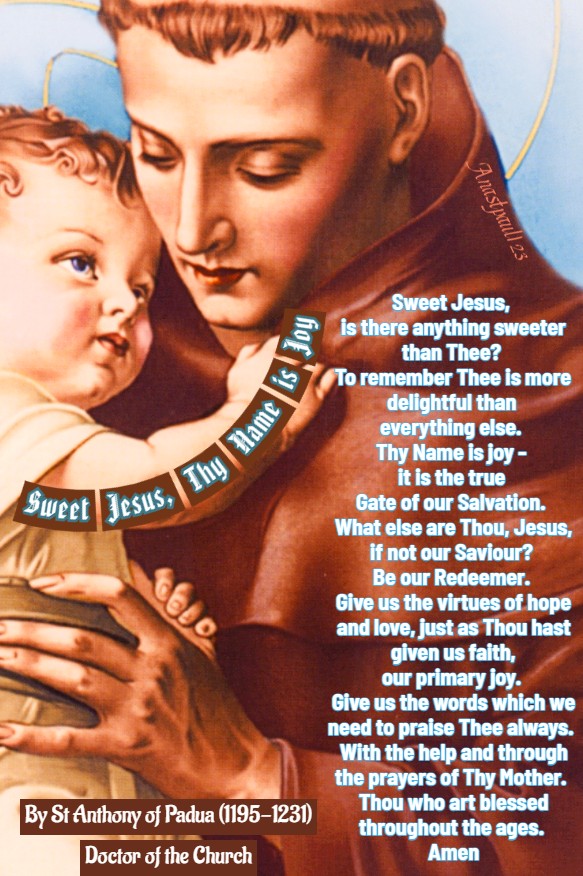
Sweet Jesus, Thy Name is Joy By St Anthony of Padua OFM (1195-1231) Doctor of the Church
Sweet Jesus, is there anything sweeter than Thee? To remember Thee is more delightful than everything else. Thy Name is joy – it is the true Gate of our Salvation. What else are Thou, Jesus, if not our Saviour? Be our Redeemer. Give us the virtues of hope and love, just as Thou hast given us faith, our primary joy. Give us the words which we need to praise Thee always. With the help and through the prayers of Thy Mother. Thou who art blessed throughout the ages. Amen
Thought for the Day – 11 January – Meditations with Fr Richard Frederick Clarke SJ (1839-1900)
Meditations for Christmastide “The Holy Infancy” From “The Devout Year” By Fr Richard Frederick Clarke SJ (1839-1900)
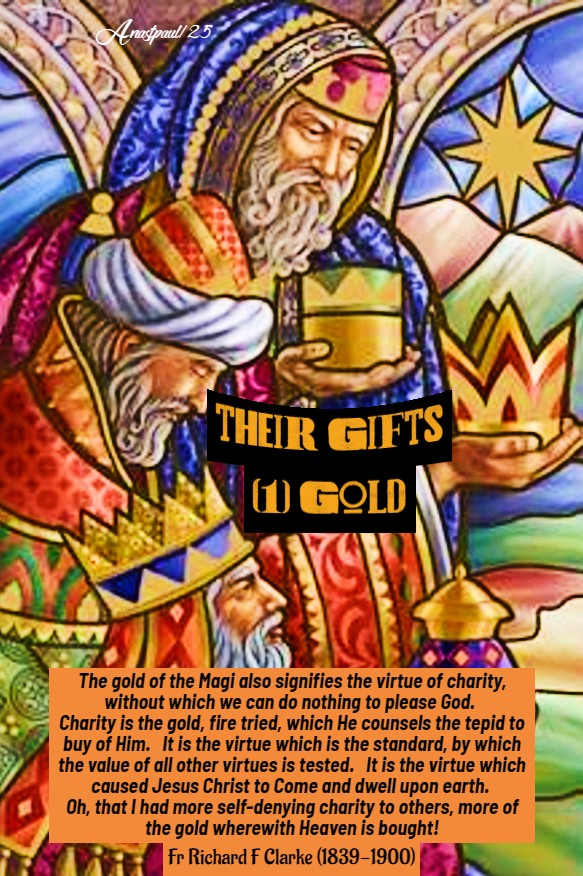
“Their Gifts (1) Gold”
+1. Why did the Magi offer gold to the Babe in Mary’s arms? It was in recognition of Him as their King. It was the tribute by which they declared themselves His vassals professed their loyal submission to His sway. This is the very foundation of all supernatural virtue, not only to acknowledge Christ as our King but, to pay Him the homage which is His due as the Sovereign Lord of Heaven and earth.
+2. The Magi too, by their offering of gold, gave to Him, the most precious gift they had to give. They were the first Christian almsgivers and their almsgiving was a pattern to all who should follow them. They gave liberally; they gave royally; they gave gifts which cost them something. Is this the character of my almsgiving, or do I give sparingly and grudgingly? I must not forget that Christ sees and remembers, not only the amount of the gifts I give to Him but too, the spirit in which they are given.
+3. The gold of the Magi also signifies the virtue of charity, without which we can do nothing to please God. Charity is the gold, fire tried, which He counsels the tepid to buy of Him. It is the virtue which is the standard, by which the value of all other virtues is tested. It is the virtue which caused Jesus Christ to Come and dwell upon earth. Oh, that I had more self-denying charity to others, more of the gold wherewith Heaven is bought!
Thought for the Day – 4 January – Meditations with Fr Richard Frederick Clarke SJ (1839-1900)
Meditations for Christmastide “The Holy Infancy” From “The Devout Year” By Fr Richard Frederick Clarke SJ (1839-1900)
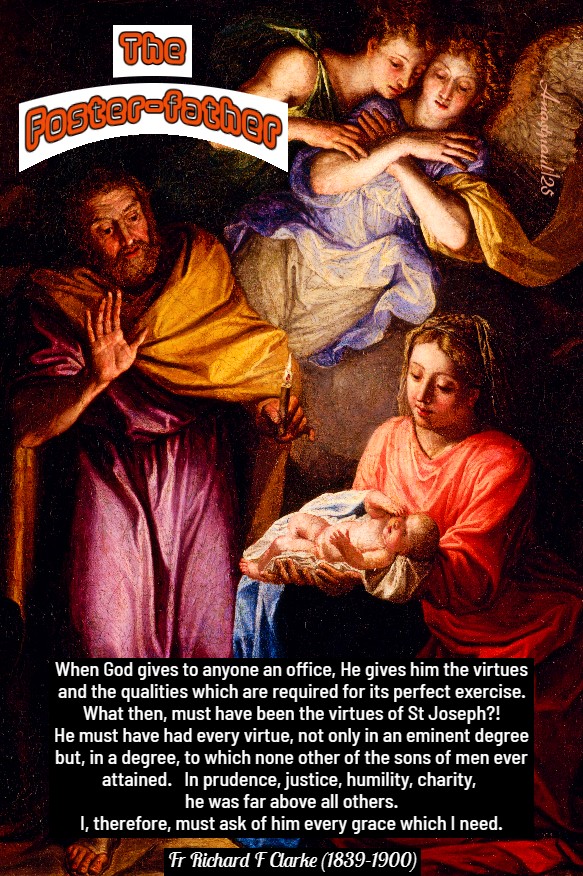
“The Foster-father”
At no great distance from the Mother of God stands His holy Foster-father St Joseph, the third person of that earthly trinity. What can we learn from him?
+1. He is the true husband of Mary, united to her by a closer bond than any on earth save that which exists between the Mother and the Son. He is, moreover, the true earthly father of Jesus in everything except the fact of carnal generation. He has committed to him, the care of God Himself and of her, who is dearer to God than all the world beside. He is, therefore, next to Mary, of all mankind, the most privileged and the most exalted. How then, can we honour him enough?
+2. When God gives to anyone an office, He gives him the virtues and the qualities which are required for its perfect exercise. What then, must have been the virtues of St Joseph?! He must have had every virtue, not only in an eminent degree but ,in a degree, to which none other of the sons of men ever attained. In prudence, justice, humility, charity, he was far above all others. I, therefore, must ask of him every grace which I need.
+3. Above all, St Joseph was eminent for his unspotted purity. Many theologians assert that he was sanctified in his mother’s womb. None save Mary was ever so pure as he This it was which qualified him for his intimate union with Jesus and Mary. If I desire to be united to them, I too must be pure of heart. St Joseph, please obtain for me this grace of purity!
Quote/s of the Day – 19 December – “The Month of the Divine Infancy and the Immaculate Conception of the Blessed Virgin Mary”
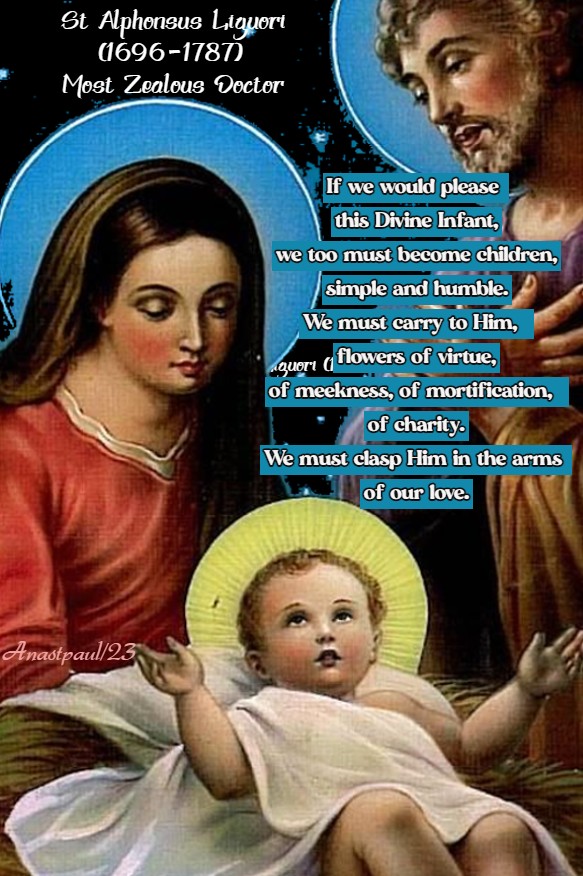
“If we would please this Divine Infant, we too must become children, simple and humble. We must carry to Him, flowers of virtue, of meekness, of mortification, of charity. We must clasp Him in the arms of our love.”
St Alphonsus Liguori (1696-1787) Most Zealous Doctor
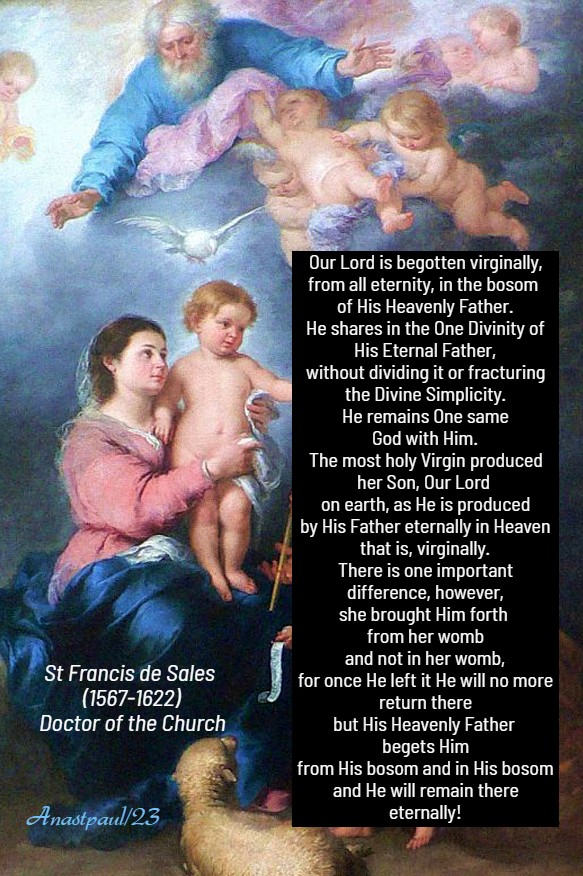
“Our Lord is begotten virginally, from all eternity, in the bosom of His Heavenly Father. He shares in the One Divinity of His Eternal Father, without dividing it or fracturing the Divine Simplicity. He remains One same God with Him. The most holy Virgin produced her Son, Our Lord on earth, as He is produced by His Father eternally in Heaven that is, virginally. There is one important difference, however, she brought Him forth from her womb and not in her womb, for once He left it He will no more return there but His Heavenly Father begets Him from His bosom and in His bosom and He will remain there eternally!”
(The Coming of the Divine Infant 24 December 1613 Sermon for Christmas Eve)
St Francis de Sales (1567-1622) Doctor of the Church
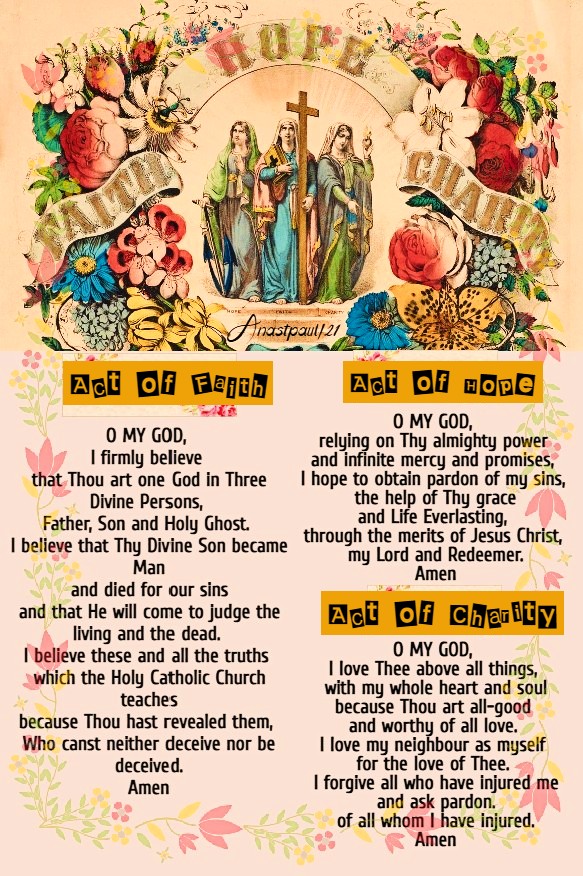
Our Morning Offering – 19 November – Acts of Faith, Hope and Charity
ACT of FAITH
O MY GOD, I firmly believe that Thou art one God in Three Divine Persons, Father, Son and Holy Ghost. I believe that Thy Divine Son became Man and died for our sins and that He will come to judge the living and the dead. I believe these and all the truths which the Holy Catholic Church teaches because Thou hast revealed them, Who canst neither deceive nor be deceived. Amen
ACT of HOPE
O MY GOD, relying on Thy almighty power and infinite mercy and promises, I hope to obtain pardon of my sins, the help of Thy grace and Life Everlasting, through the merits of Jesus Christ, my Lord and Redeemer. Amen
ACT of CHARITY
O MY GOD, I love Thee above all things, with my whole heart and soul because Thou art all-good and worthy of all love. I love my neighbour as myself for the love of Thee. I forgive all who have injured me and ask pardon. of all whom I have injured. Amen
Quote/s of the Day – 12 November – St Theodore the Studite (759-826) Abbot, Confessor, Father of the Church
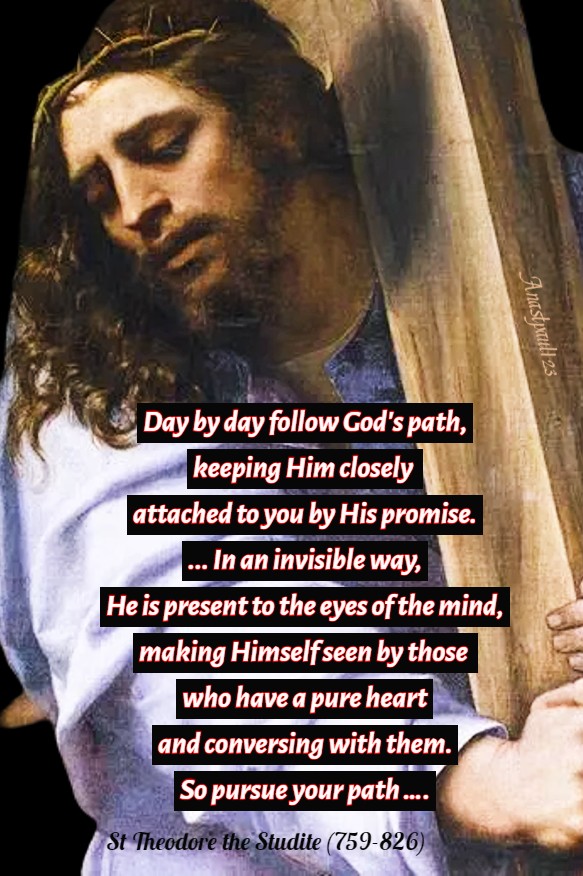
“Day by day follow God’s path, keeping Him closely attached to you by His promise. In fact, He Himself said, through the mediation of His Apostles, to all those who seek His will and His testimonies that He would be with them until the end of the world (Mt 28:20) where paths and footsteps will be unknown (cf Ps 76:20), as the divine David said in his songs. Yet, in an invisible way, He is present to the eyes of the mind, making Himself seen by those who have a pure heart and conversing with them. So pursue your path …. ”
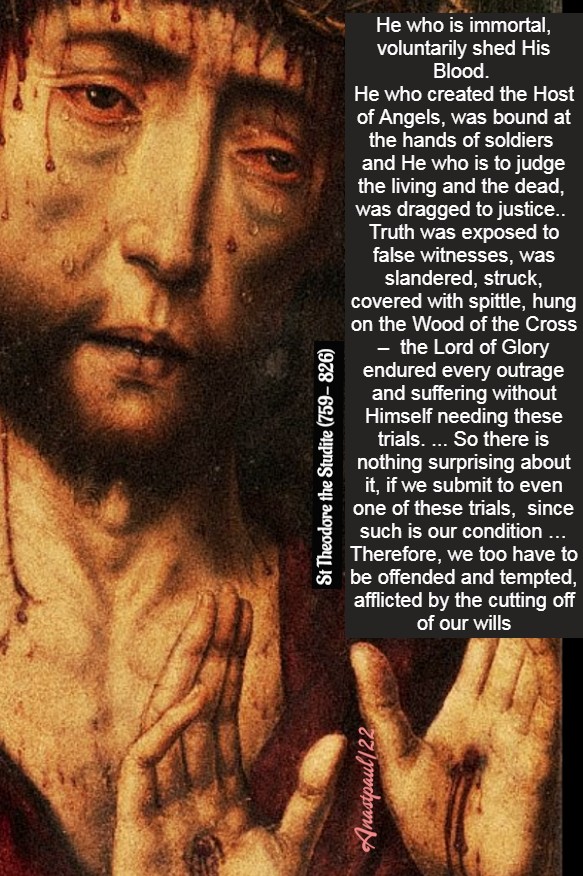
“He who is immortal, voluntarily shed His Blood. He who created the Host of Angels, was bound at the hands of soldiers and He who is to judge the living and the dead, was dragged to justice (cf. Acts 10:42; 2 Tm 4:1). Truth was exposed to false witnesses, was slandered, struck, covered with spittle, hung on the Wood of the Cross – the Lord of Glory (cf. 1 Cor 2:8) endured every outrage and suffering without Himself needing these trials. …
So there is nothing surprising about it, if we submit to even one of these trials, since such is our condition … Therefore, we too have to be offended and tempted, afflicted by the cutting off of our wills.” (Catecheses 1)
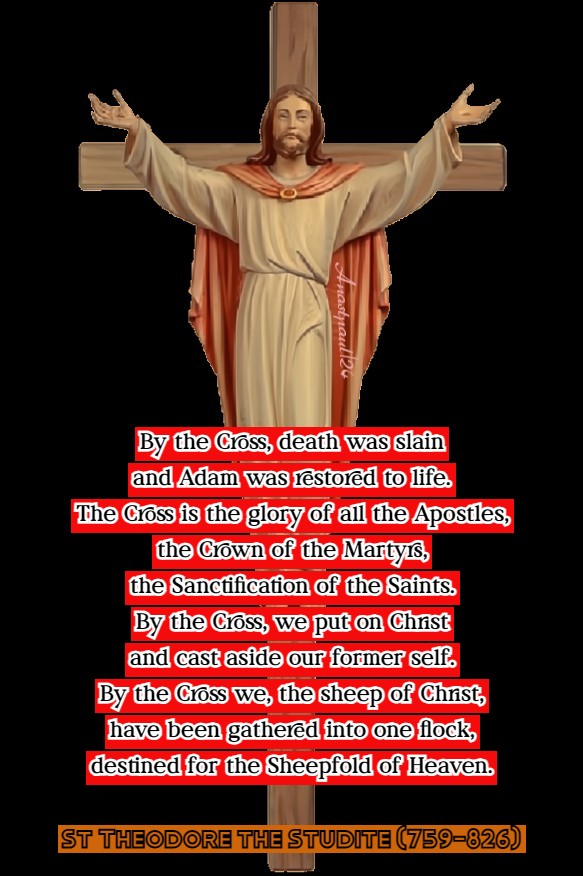
“By the Cross, death was slain and Adam was restored to life. The Cross is the glory of all the Apostles, the Crown of the Martyrs, the Sanctification of the Saints. By the Cross, we put on Christ and cast aside our former self. By the Cross we, the sheep of Christ, have been gathered into one flock, destined for the Sheepfold of Heaven.”
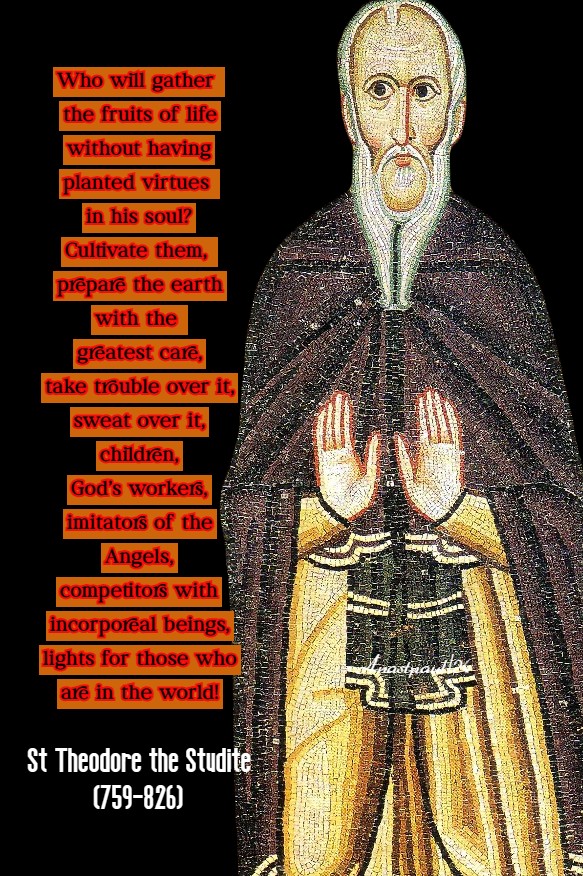
“Who will gather the fruits of life without having planted virtues in his soul? Cultivate them, prepare the earth with the greatest care, take trouble over it, sweat over it, children, God’s workers, imitators of the Angels, competitors with incorporeal beings, lights for those who are in the world!”
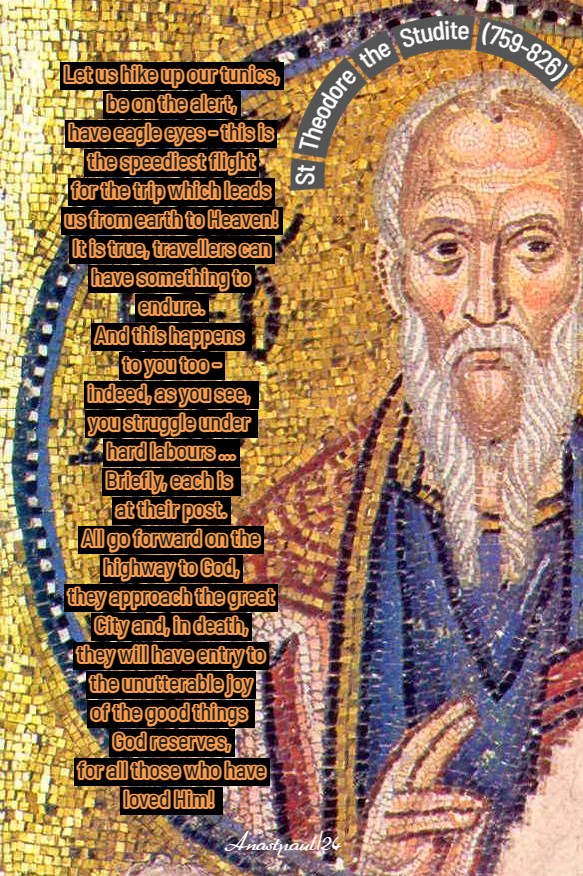
“Let us hike up our tunics, be on the alert, have eagle eyes – this is the speediest flight for the trip which leads us from earth to Heaven! It is true, travellers can have something to endure. And this happens to you too – indeed, as you see, you struggle under hard labours … Briefly, each is at their post. All go forward on the highway to God, they approach the great City and, in death, they will have entry to the unutterable joy of the good things God reserves, for all those who have loved Him! ”
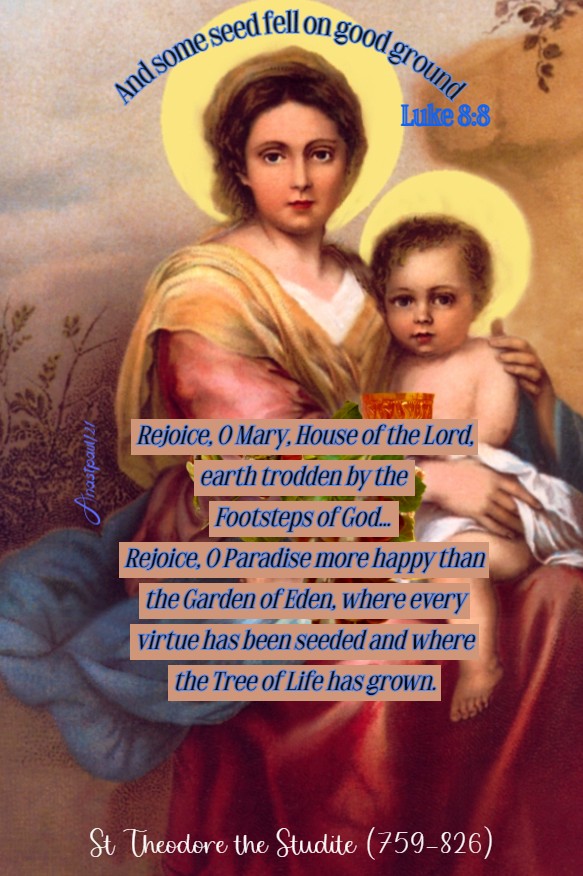
“Rejoice, O Mary, House of the Lord, earth trodden by the Footsteps of God… Rejoice, O Paradise more happy than the Garden of Eden, where every virtue has been seeded and where the Tree of Life has grown.”
St Theodore the Studite (759-826) Abbot, Confessor, Father of the Church
Quote/s of the Day – 23 September – “The Month of The Seven Sorrows of the Blessed Virgin Mary and The Holy Cross” – 1 Peter 5:1-4; 5:10-11; Matthew 16:13-19– Scripture search here: https://www.drbo.org/
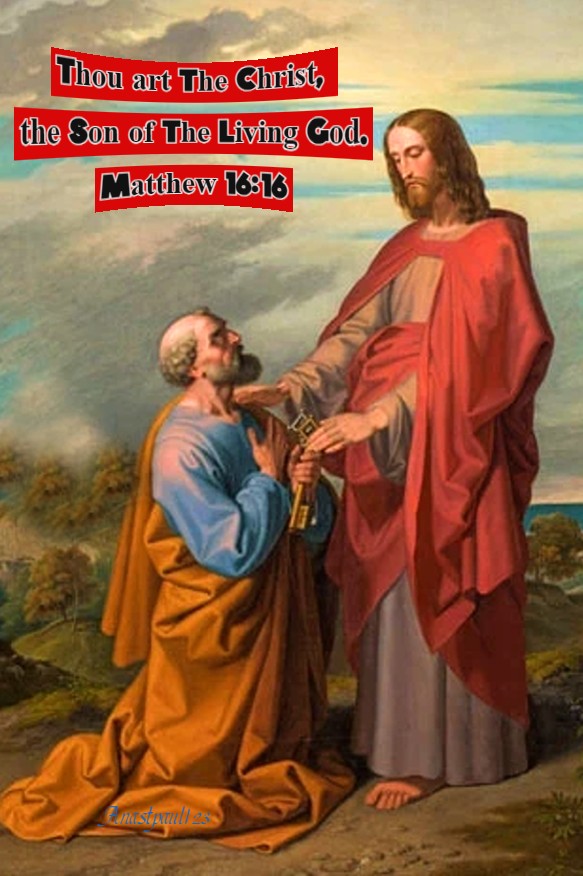
“Thou art the Christ, the Son of the living God!”
Matthew 16:16
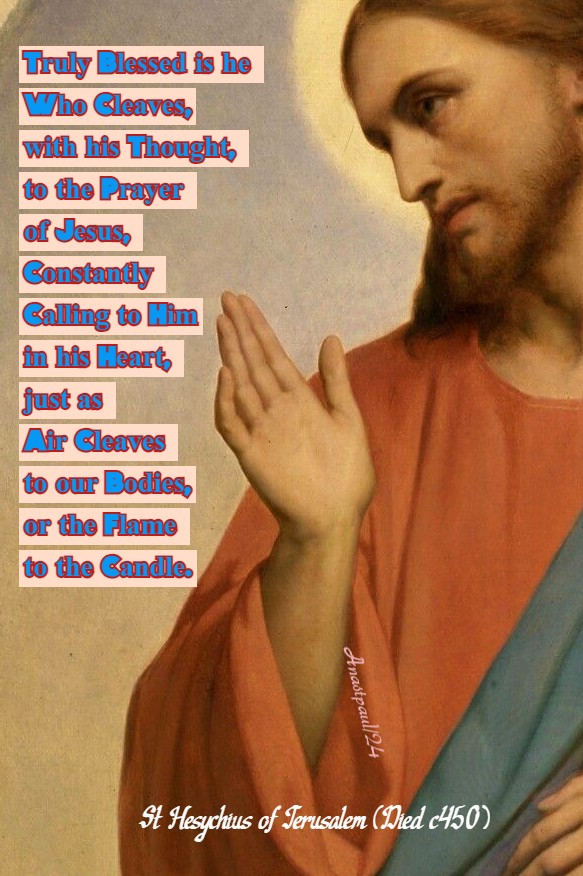
“Truly blessed is he who cleaves, with his thought, to the Prayer of Jesus, constantly calling to Him in his heart, just as air cleaves to our bodies, or the flame to the candle.”
St Hesychius of Jerusalem (Died c450) Priest, Exegete, Father
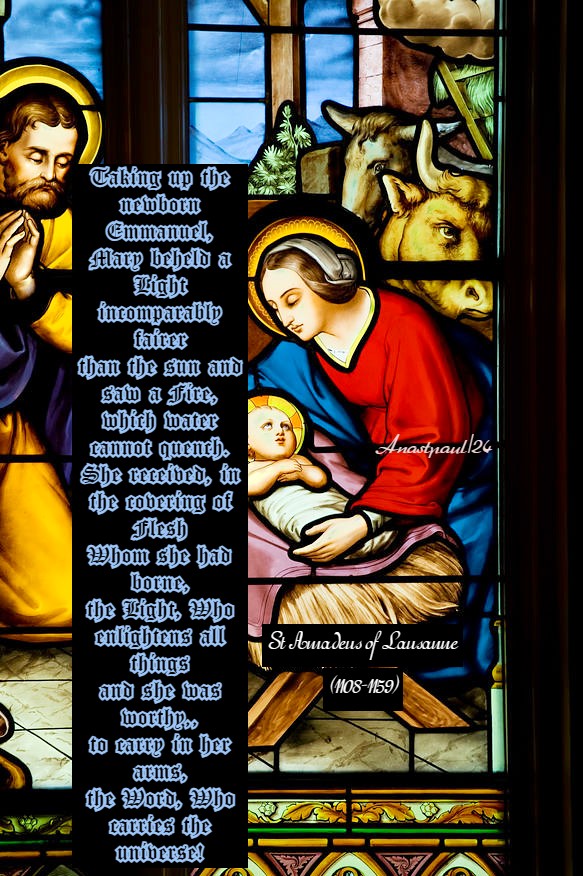
“Taking up the newborn Emmanuel, Mary beheld a Light incomparably fairer than the sun and saw a Fire, which water cannot quench. She received, in the covering of Flesh Whom she had borne, the Light, Who enlightens all things and she was worthy,, to carry in her arms, the Word, Who carries the universe!”
St Amadeus of Lausanne (1108-1159) Bishop, Cistercian Monk
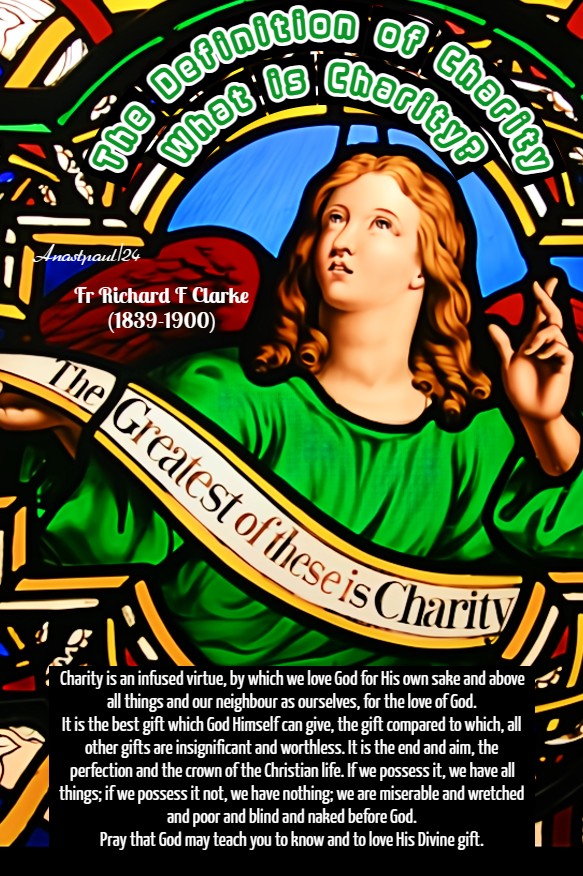
“Charity is an infused virtue, by which we love God for His Own Sake and above all things and our neighbour as ourselves, for the love of God. It is the best gift which God Himself can give, the gift compared to which, all other gifts are insignificant and worthless. It is the end and aim, the perfection and the crown of the Christian life. If we possess it, we have all things; if we possess it not, we have nothing; we are miserable and wretched and poor and blind and naked before God. Pray that God may teach you to know and to love His Divine gift.”
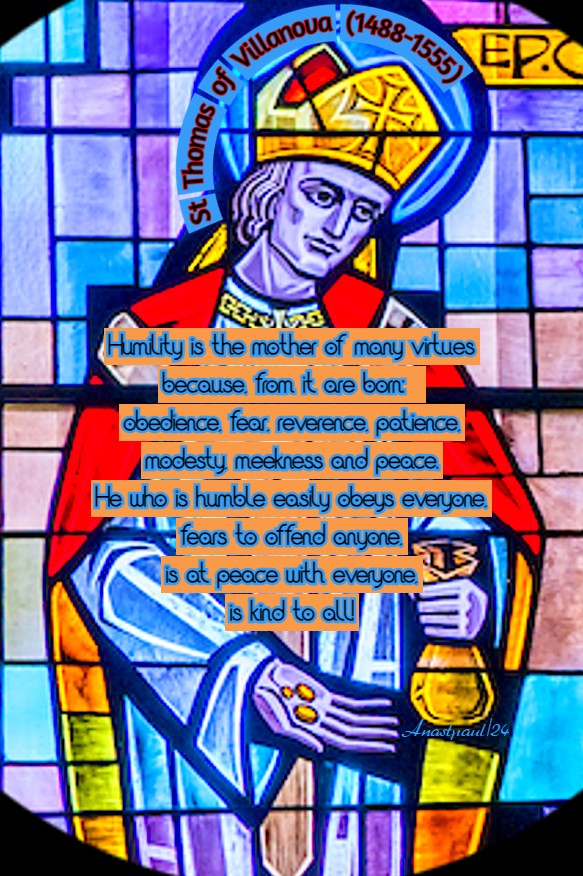
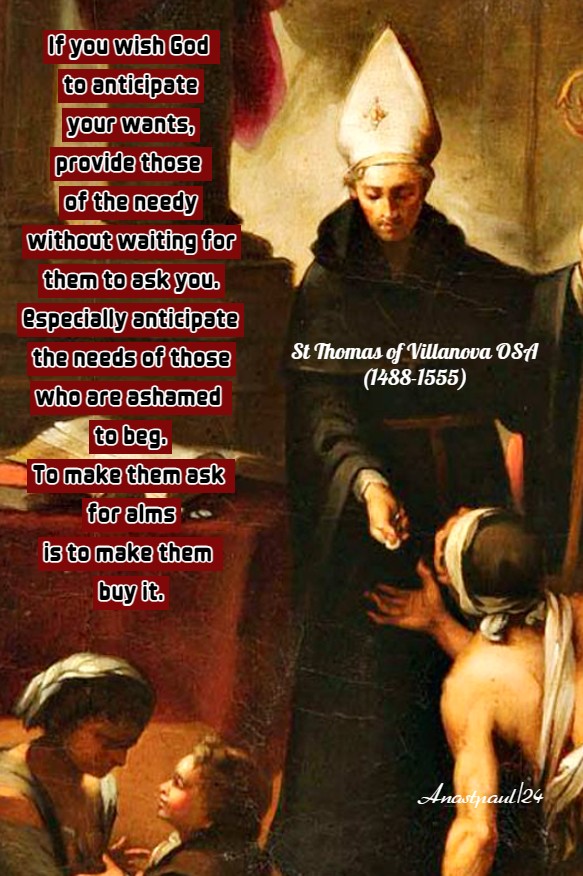
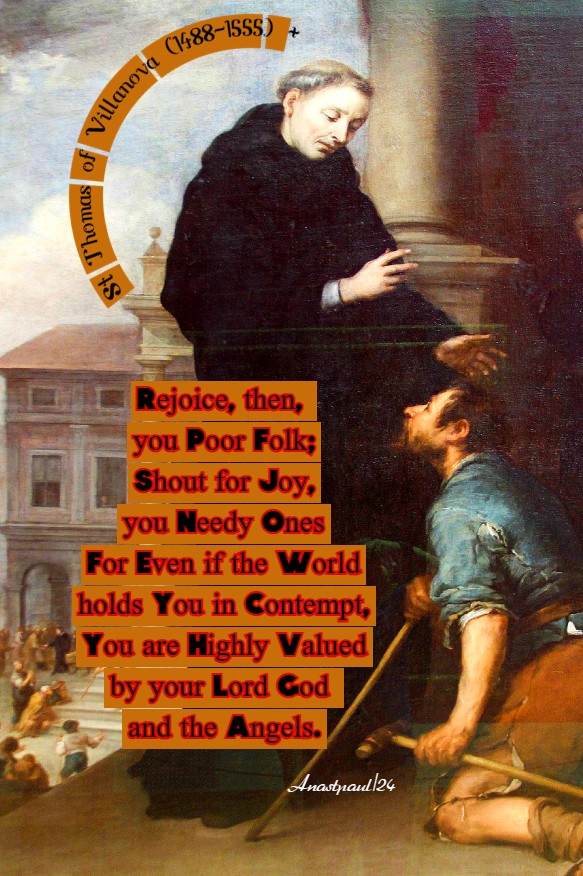
Quote/s of the Day – 22 September – St Thomas of Villanova OSA (1488-1555) Archbishop, Confessor.
“Humility is the mother of many virtues because, from it are born: obedience, fear, reverence, patience, modesty, meekness and peace. He who is humble easily obeys everyone, fears to offend anyone, is at peace with everyone, is kind to all!”
“If you wish God to anticipate your wants, provide those of the needy without waiting for them to ask you. Especially anticipate the needs of those who are ashamed to beg. To make them ask for alms is to make them buy it.”
“Rejoice, then, you poor folks; shout for joy, you needy ones for even if the world holds you in contempt, you are highly valued by your Lord God and the Angels.”
Quote/s of the Day – 14 September – “The Month of The Seven Sorrows of the Blessed Virgin Mary and The Holy Cross” – Exaltation of the Holy Cross
“The Cross gives Light to the whole universe; it casts out darkness and gathers nations together in charity, into One Church, One Faith, One Baptism…”
St Ephrem (306-373) Father & Doctor of the Church
“As they were looking on, so we too gaze on His Wounds as He hangs. We see His Blood as He dies. We see the price offered by the Redeemer, touch the scars of His Resurrection.
He bows His Head, as if to kiss you. His Heart is made bare, open, as it were, in love to you. His arms are extended that He may embrace you. His whole body is displayed for your redemption.
Ponder how great these things are. Let all this be rightly weighed in your mind, as He was once fixed to the Cross in every part of His Body for you, so He may now be fixed in every part of your soul!”
St Augustine (354-430) Father and Doctor of Grace
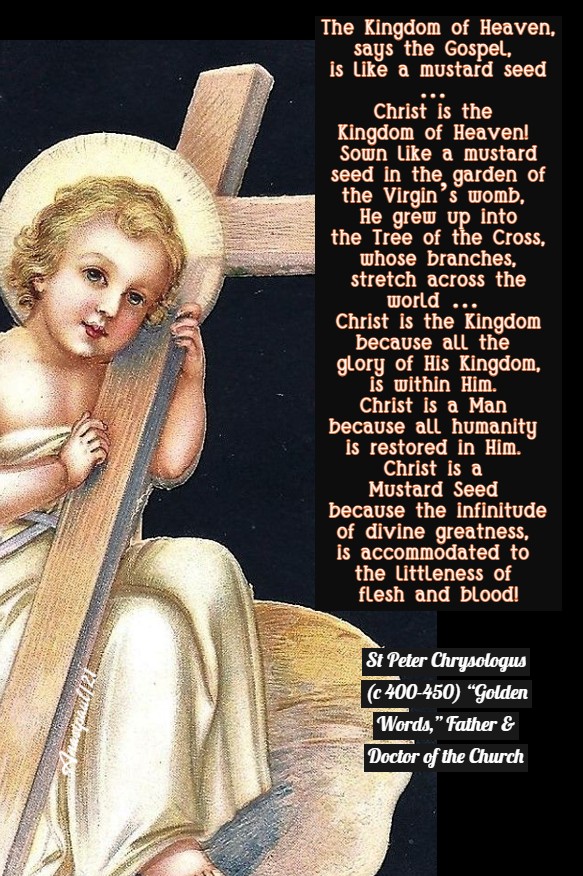
“The Kingdom of Heaven, says the Gospel, is like a mustard seed … Christ is the Kingdom of Heaven! Sown like a mustard seed in the garden of the Virgin’s womb, He grew up into the Tree of the Cross, whose branches, stretch across the world … Christ is the Kingdom because all the glory of His Kingdom, is within Him. Christ is a Man because all humanity is restored in Him. Christ is a Mustard Seed because the infinitude of Divine greatness, is accommodated to the littleness of flesh and blood!”
St Peter Chrysologus (c 400-450) “Golden Words” Father & Doctor of the Church
“No-one, however weak, is denied a share in the victory of the Cross. No-one is beyond the help of the prayer of Christ.”
St Pope Leo the Great (c400-461) Father and Doctor of the Church
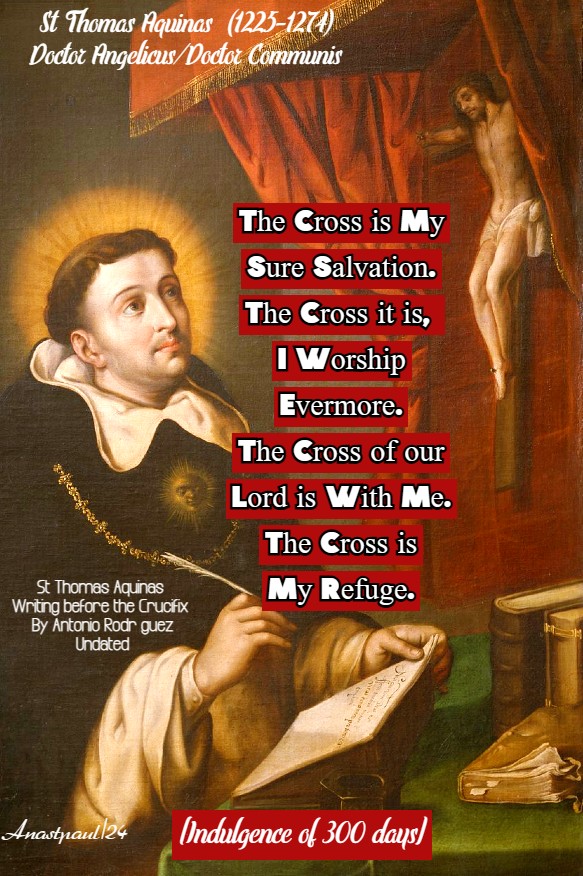
“The Cross is my sure salvation. The Cross it is, I worship evermore. The Cross of our Lord is with me. The Cross is my refuge.” [Indulgence of 300 days]
St Thomas Aquinas (1225-1274) Doctor Angelicus / Doctor Communis
“Consider Jesus on the Cross as you would a devout book, worthy of your unceasing study and, by which you may learn the practice of the most heroic virtues. This is the book which may truly be called the “Book of Life” [Apocalypse, III, 5], which, at once enlightens the mind by its doctrines and inflames the will by its examples. The world is full of books but were it possible for man to read them all, he would never be so well instructed, to hate vice and embrace virtue, as by contemplating a Crucified God!”
Thought for the Day – 19 August – Meditations with Fr Richard Frederick Clarke SJ (1839-1900)
CHARITY Meditations for a Month
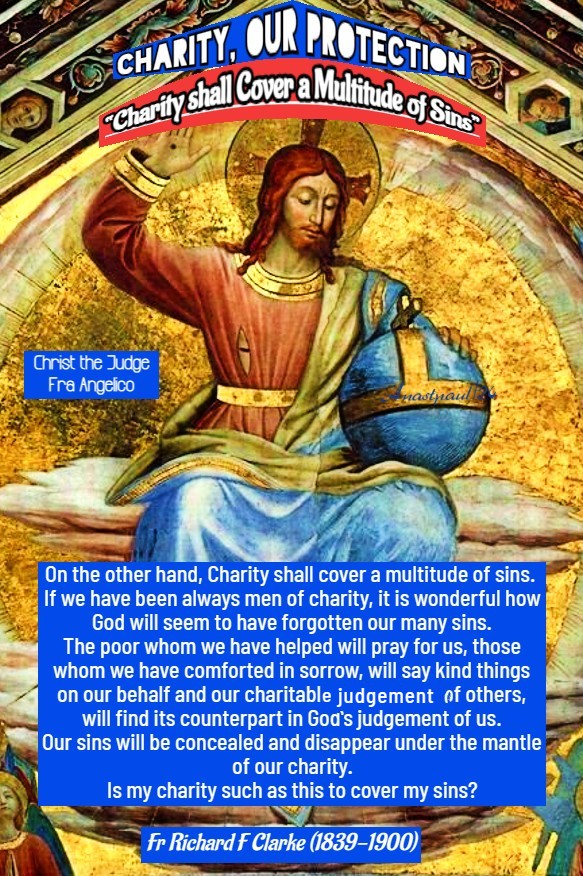
Charity, Our Protection “Charity shall Cover a multitude of Sins”
One of the characteristics of charity is that it always looks to the bright side of things. It seeks to bring out all that is good in others while concealing their sins. It does not notice their sins. It does not allude to their sins unnecessarily, whether they are committed directly against man or against God. It has a happy knack of forgetting their sins or seeming to forget them. It covers their sins from the eyes of men and even seeks to obliterate them before God by the prayers it offers for the offender. Is this my spirit? Do I not rather cover the virtues of others and disclose their faults?!
In this respect, it is especially true that we shall be treated as we treat others. “With what judgement you judge, you shall be judged,” says our Lord. If we pass the severe sentence of harsh criticism onto others, our sentence will be severe. If we make little of their faults and much of their virtues, God will do the same to us. What utter folly to prepare for ourselves a harsh verdict at the tribunal of Christ, by our condemnation of others here below!
On the other hand, Charity shall cover a multitude of sins. If we have been always men of charity, it is wonderful how God will seem to have forgotten our many sins. The poor whom we have helped will pray for us, those whom we have comforted in sorrow, will say kind things on our behalf and our charitable judgeement of others, will find its counterpart in God’s judgement of us. Our sins will be concealed and disappear under the mantle of our charity. Is my charity such as this to cover my sins?
Thought for the Day – 17 August – Meditations with Fr Richard Frederick Clarke SJ (1839-1900)
CHARITY Meditations for a Month
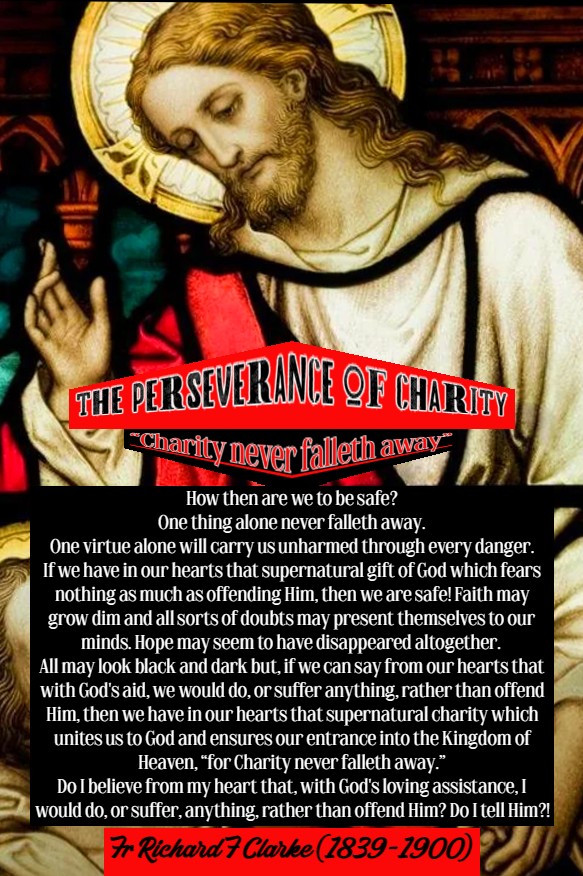
The Perseverance of Charity “Charity never falleth away”
We are all anxious to persevere to the end. We know, without perseverance, all else is of no avail. Of what use was it to the Israelites who perished in the desert for their sins, to have escaped from Egypt, safely crossed the Red Sea and toiled for years over the sandy plains? What use to Solomon to have been dear to God and endowed with supernatural wisdom, if, as some think, he did not persevere to the end? Therefore, all our graces are of no avail but rather, tend to our condemnation, if we, in the end, fall away and are lost.
Yet, who can be certain of perseverance? Who does not tremble at the thought of his own insecurity? We may have great gifts but they will not save us – talent, activity, zeal, courage, prudence, will be useless to us. Even faith will not save us – the devils believe and tremble! – and hope, may degenerate into presumption, or may disappear and leave us at the last, to an eternal despair.
How then are we to be safe? One thing alone never falleth away. One virtue alone will carry us unharmed through every danger. If we have in our hearts that supernatural gift of God which fears nothing as much as offending Him, then we are safe! Faith may grow dim and all sorts of doubts may present themselves to our minds. Hope may seem to have disappeared altogether. All may look black and dark but, if we can say from our hearts that with God’s aid, we would do, or suffer anything, rather than offend Him, then we have in our hearts that supernatural charity which unites us to God and ensures our entrance into the Kingdom of Heaven, “for Charity never falleth away.” Do I believe from my heart that, with God’s loving assistance, I would do, or suffer, anything, rather than offend Him? Do I tell Him?!
Thought for the Day – 14 August – Meditations with Fr Richard Frederick Clarke SJ (1839-1900)
CHARITY Meditations for a Month
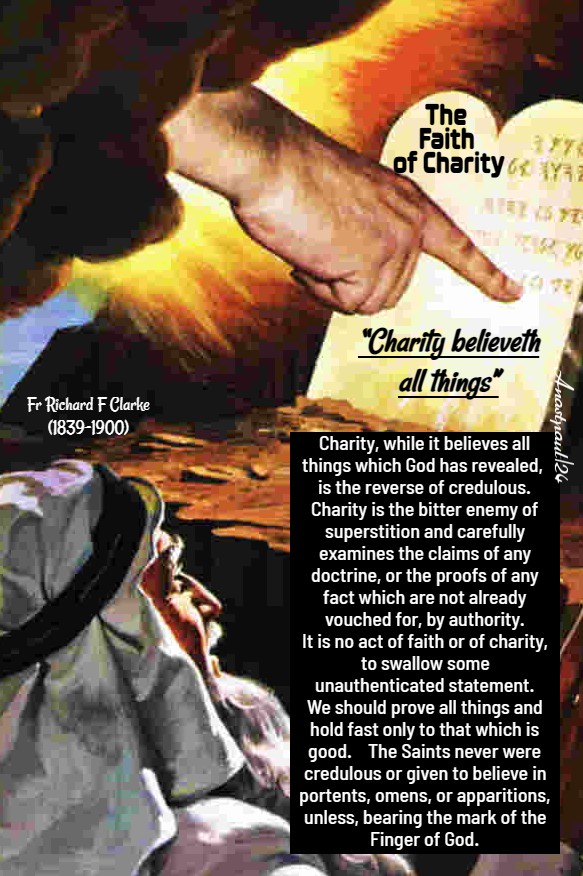
The Faith of Charity “Charity believeth all things”
Faith is a preliminary gift of God, without which, charity is impossible. No-one can do any work which is pleasing in His sight, unless that person believes in God and is ready to accept whatever God has revealed. Works of benevolence are not works of charity, if he who performs them, does not possess this belief. The charity which rests on a feeble faith, will always be itself feeble. He who minimises, in matters of faith, will generally have a minimum of charity. Hence, pray for a loyal readiness to believe, that so you may obtain, an intense charity.
Charity, while it believes all things which God has revealed, is the reverse of credulous. Charity is the bitter enemy of superstition and carefully examines the claims of any doctrine, or the proofs of any fact which are not already vouched for, by authority. It is no act of faith or of charity, to swallow some unauthenticated statement. We should prove all things and hold fast only to that which is good. The Saints never were credulous or given to believe in portents, omens, or apparitions, unless, bearing the mark of the Finger of God.
Charity supplements faith and it strengthens it. The stronger our love of God, the stronger will be our belief in all which He has revealed. When love waxes cold, faith becomes faint. No man ever loses his faith without first wilfully estranging himself from God, by deliberate mortal sin. If I want a strong faith, I must cultivate a fervent charity. My ready acceptance of all God has revealed, will be in proportion, to my love of Him. If I have difficulties in belief, is it because there are gaps and defects in my charity?
Thought for the Day – 3 August – Meditations with Fr Richard Frederick Clarke SJ (1839-1900)
CHARITY Meditations for a Month
The Patience of Charity “Charity is patient”
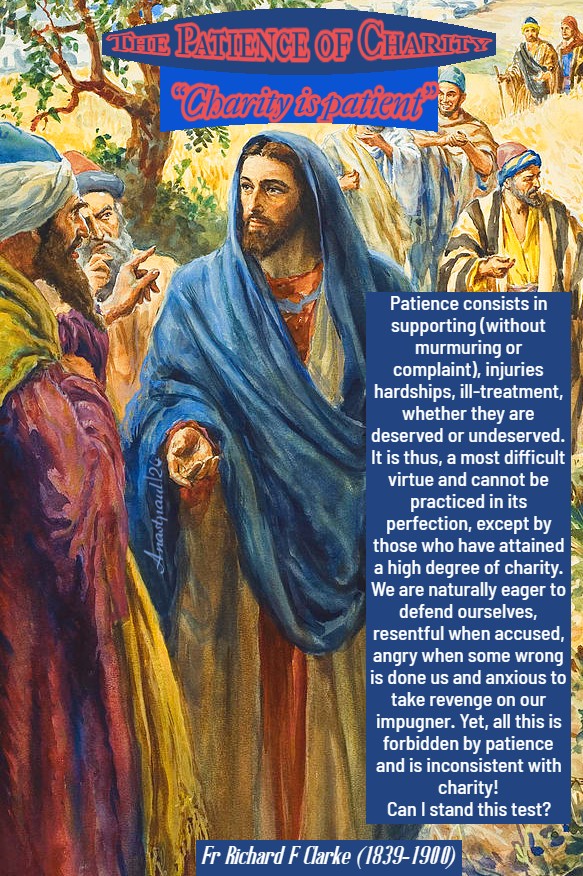
Patience consists in supporting (without murmuring or complaint), injuries hardships, ill-treatment, whether they are deserved or undeserved. It is thus, a most difficult virtue and cannot be practiced in its perfection, except by those who have attained a high degree of charity. We are naturally eager to defend ourselves, resentful when accused, angry when some wrong is done us and anxious to take revenge on our impugner. Yet, all this is forbidden by patience and is inconsistent with charity! Can I stand this test?
Every form of patience is especially difficult for some people. Active, energetic, eager natures, cannot endure to be thwarted or contradicted. Even being kept waiting irritates them. For them, a careful practice of patience is necessary,, if they are to rise high in virtue. They must begin by suppressing the outward expressions. This will help them overcome the internal movement of impatience. They must school themselves carefully in little things with a persevering determination to conquer their natural inclination towards impatience, or they will offend continually against charity.
Patience, like all the virtues, brings its own reward. How much the impatient suffer when corrected! The inward struggle and desire to be rid of the obstacle in their path, or the person who hinders and annoys them, is painful to them. How they chafe under the restraint which hampers their activity! On the contrary, how full of tranquil peace is one, who allows nothing to make him impatient and who, takes everything as coming from God. Do I act that way?
Thought for the Day – 30 July – Meditations with Fr Richard Frederick Clarke SJ (1839-1900)
HUMILITY Meditations for a Month
The Fruit of Humility
There is nothing which gives such a solid peace as humility. At the beginning it is difficult and we smart under the wounds which our pride has to suffer before it can be destroyed in ourselves. But a holy perseverance in the practice of humility will spread over the soul such a sweet and calm tranquility that even in this life, the soul begins to taste the joys of the heavenly paradise. Troubles, disappointments, unkindness, injustice, insults, do not disturb the quiet happiness of one, who is really humble. One who is truly humble appreciates, continually, the truth of our Lord’s Words: “Learn of Me, for I Am meek and humble of heart and you shall find rest for your souls. … For My yoke is easy and My burden is light.”
Humility is also the best possible safeguard against the attacks of the devil. The humble man can say, as our Lord did: “The prince of this world cometh and hath nothing in Me.” Or as Saint Martin said when dying: “Why art thou here, O evil one? No malice wilt thou find in me.” Nor has the devil any chance of success in tempting the humble. Their continual disposition is one of dependence on God and, therefore, no temptation has power to lead them astray.
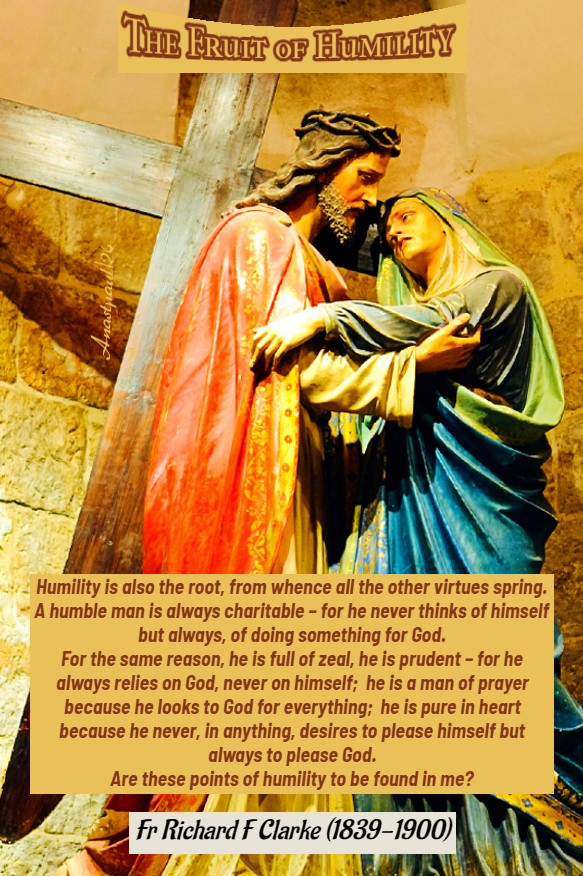
Humility is also the root, from whence all the other virtues spring. A humble man is always charitable – for he never thinks of himself but always, of doing something for God. For the same reason, he is full of zeal, he is prudent – for he always relies on God, never on himself; he is a man of prayer because he looks to God for everything; he is pure in heart because he never, in anything, desires to please himself but always to please God. Are these points of humility to be found in me?





















 AnaStpaul
You must be logged in to post a comment.