Thought for the Day – 5 June – “Month of the Sacred Heart” – Meditations with Antonio Cardinal Bacci (1881-1971)
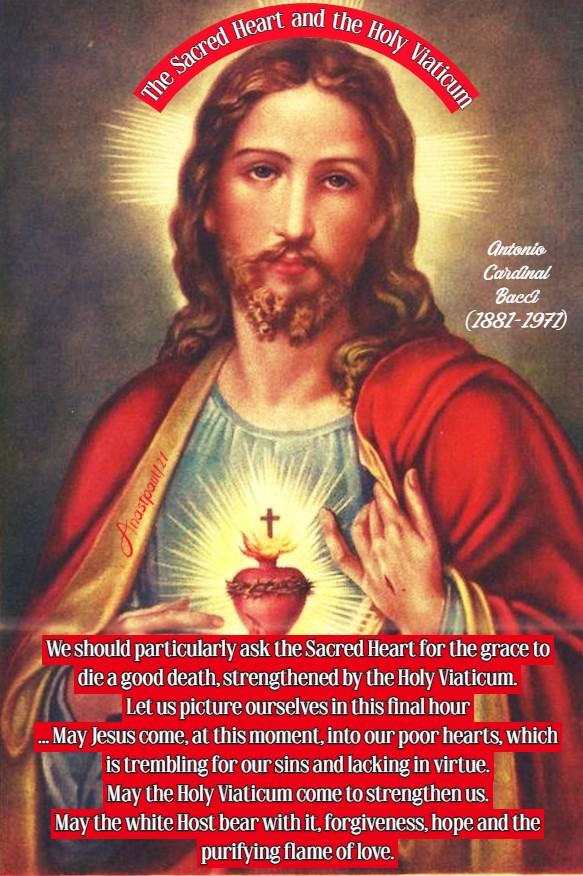
The Sacred Heart and the Holy Viaticum
“We should particularly ask the Sacred Heart for the grace to die a good death, strengthened by the Holy Viaticum. Let us picture ourselves in this final hour. The world is fading away and nothing remains of the honours, successes and pleasures of our passing life. There will remain only two things – on one side, the merits which we have obtained by our prayers, penances and good works; on the other side, the sum total of our sins and ingratitude to God. May Jesus come, at this moment, into our poor hearts, which is trembling for our sins and lacking in virtue. May the Holy Viaticum come to strengthen us. May the white Host bear with it, forgiveness, hope and the purifying flame of love.
Then, the infinite love of the Heart of Jesus will be mingled with th weak limited love of our hearts. It will waft us into a state of everlasting happiness, where, to love, is to possess, the boundless joy of God.
Thought for the Day – 21 May – “Mary’s Month” – Meditations with Antonio Cardinal Bacci (1881-1971)
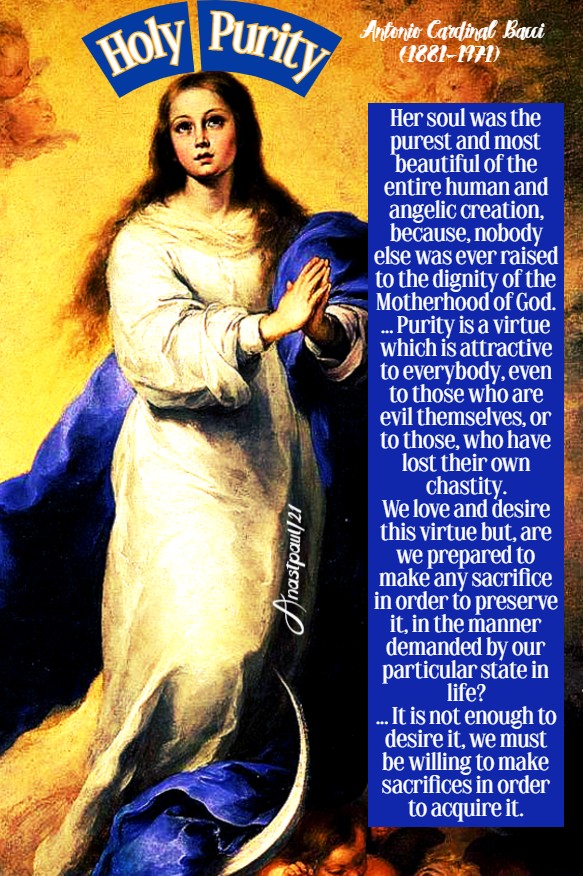
Holy Purity
“Have you ever experienced the sheer delight of climbing the mountains on a summer’s day and coming across one of those little alpine lakes, a tiny mirror, reflecting the still blueness of the sky? Or have you ever watched an infant smiling in it’s angelic slumber and been held spellbound by this vision of innocence? Finally, on some calm, clear night, surely you have studied the star-spangled sky and have been so overwhelmed by the beauty of the scene, that you could have cried out with the Psalmist: “The heavens declare the glory of God and the firmament proclaims His handiwork” (Ps 18:1). These, are only faint images of the beauty and virginal purity of Mary. Her soul was the purest and most beautiful of the entire human and angelic creation, because, nobody else was ever raised to the dignity of the Motherhood of God. She was conceived free from all taint of original sin and enriched with every grace. In her chaste womb, she conceived the Infant Jesus. Later, she held Him close to her heart; she lived for Him and eventually died for love of Him.
Purity is a virtue which is attractive to everybody, even to those who are evil themselves, or to those, who have lost their own chastity. We love and desire this virtue but, are we prepared to make any sacrifice in order to preserve it, in the manner demanded by our particular state in life? “The kingdom of heaven has been enduring violent assault,” Jesus said “and the violent have been seizing it by force” (Mt 11:12). This is especially true in regard to the acquisition of the virtue of purity. It is not enough to desire it, we must be willing to make sacrifices in order to acquire it.”
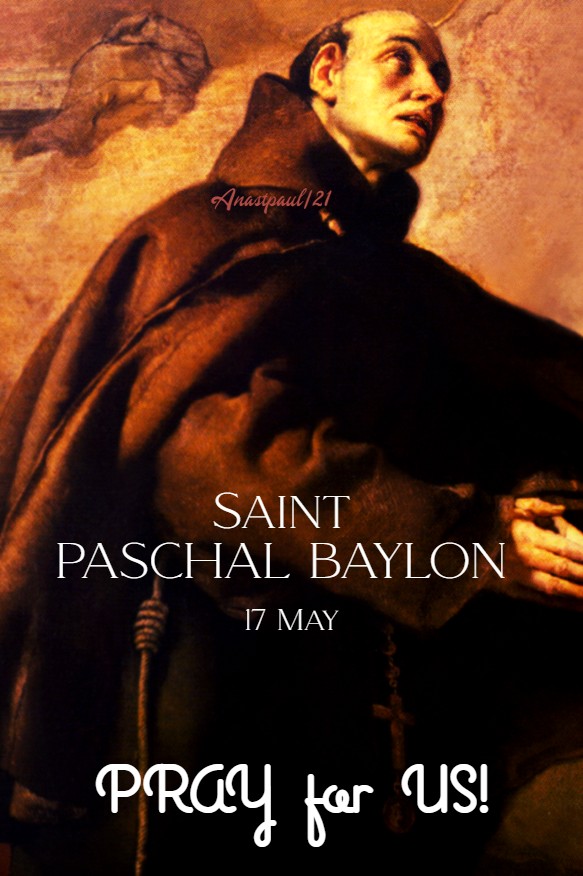
One Minute Reflection – 17 May – “Mary’s Month” – Monday of the Seventh week of Easter, Readings: Acts 19:1-8, Psalm 68:2-7, John 16:29-33 and the Memorial of St Paschal Baylon OFM (1540-1592)
“In the world you will have tribulation. But take heart, I have conquered the world.” ... John 16:33
REFLECTION – “Let nothing intervene to hinder the progress of any who travel alongside each other, in this evangelical life but let us walk with agile step though the road be rough and hard, let us show a brave and manly spirit, overcome obstacles, pass along from pathway to pathway, from hill to hill, until we climb onto the mountain of the Lord and make a home for ourselves in the holy place of His impassibility.
Now, companions assist each other on the way; so then, my brothers, as the Apostle says: “Bear one another’s burdens” (Gal 6:2) and make up for whatever is lacking to others (cf. 2 Cor 8:14 ; Phil 2:30). To the negligence that perhaps holds sway today, noble courage will succeed tomorrow, now one is in gloom and then suddenly one rises to the surface and discovers joy again, at one moment our passions rise up but soon God comes to help us, they are broken and calm returns. For you will only be seen like this yesterday and the day before but, dear friend, you will not always remain the same but the grace of God will draw near you, the Lord will fight for you and perhaps, like the great Antony, you will say: “Where were you just now?” and he will answer: “I wanted to see your combat.”
For now, let us persevere, children, dear children, let us be patient for a little, brothers, dear brothers.… Who will be crowned without having fought? Who will go to rest if he is not tired (cf. 2 Tim 2:5-6)? Who will gather the fruits of life without having planted virtues in his soul? Cultivate them, prepare the earth with the greatest care, take trouble over it, sweat over it, children, God’s workers, imitators of the angels, competitors with incorporeal beings, lights for those who are in the world (cf. Phil 2:15)!” … St Theodore the Studite (759-826) Monk – Catechesis 28
PRAYER – Lord God, let the grace of the Holy Spirit come upon us, so that we may hold fast to Your Will with fidelity and love and show it forth by a holy life. May the Mother of our Lord and our Mother and St Paschal Baylon, Servant of the Blessed Sacrament, pray that we may live in the light of our Saviour. Through Jesus Christ our Lord, in the unity of the Holy Spirit, and the glory of God the Father forever and ever, amen.
Thought for the Day – 12 May – Meditations with Antonio Cardinal Bacci (1881-1971)
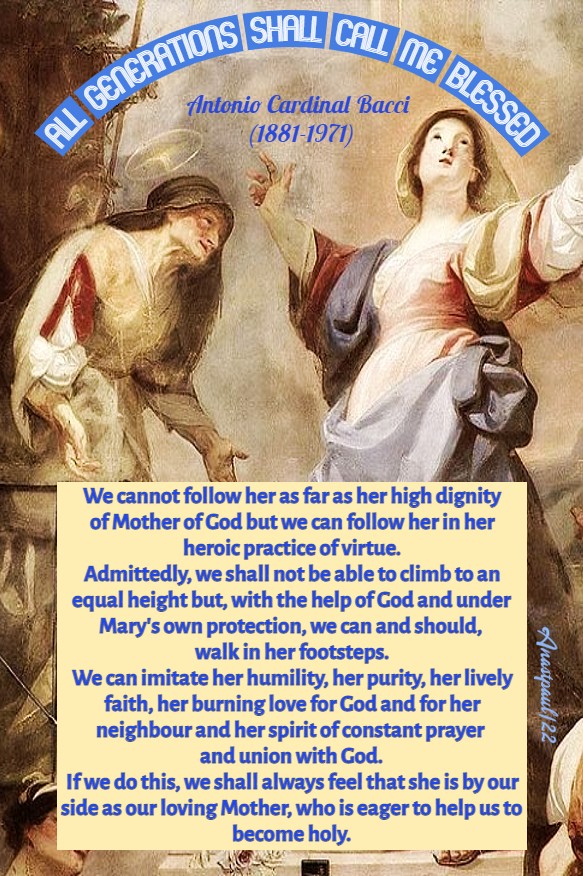
“All Generations Shall Call Me Blessed”
“It is related in the Gospel, that once a certain occasion, a woman in the crowd, was roused by the preaching and miracles of Jesus and cried out: “Blessed is the womb that bore thee and the breasts that nursed thee.” But Jesus replied: “Rather blessed are they who hear the word of God and keep it” (Lk 11:27-28). These words take nothing from the glory of the Mother of God. They were not intended for her but, for us. She was great and holy, not only because she was chosen to be the Mother of the Word Incarnate but also because she perfected herself in virtue by carrying out, in everything, the teaching of her divine Son, Jesus.
We cannot follow her as far as her high dignity of Mother of God but we can follow her in her heroic practice of virtue. Admittedly, we shall not be able to climb to an equal height but, with the help of God and under Mary’s own protection, we can and should, walk in her footsteps.
We can imitate her humility, her purity, her lively faith, her burning love for God and for her neighbour and her spirit of constant prayer and union with God. If we do this, we shall always feel that she is by our side as our loving Mother, who is eager to help us to become holy.”
Thought for the Day – 9 May – “Mary’s Month” Meditations with Antonio Cardinal Bacci (1881-1971)
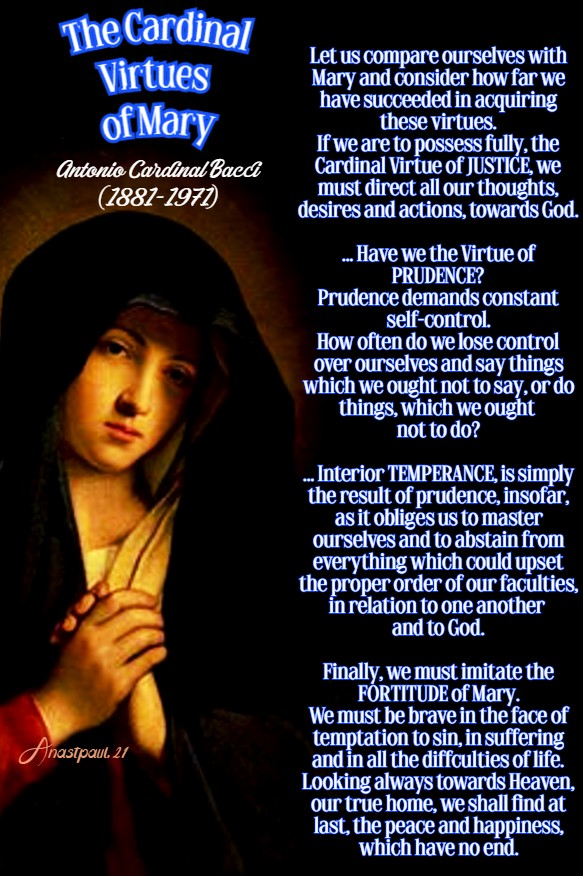
The Cardinal Virtues of Mary
“Let us compare ourselves with Mary and consider how far we have succeeded in acquiring these virtues. If we are to possess fully, the Cardinal virtue of JUSTICE, we must direct all our thoughts, desires and actions, towards God. Since everything comes from God, we should offer everything back to Him. If we fail to do this, we are guilty of injustice towards God. We take for ourselves, something which belongs to Him. We must also be just to our neighbour. It is not enough to be charitable only because there can be no charity, unless, it is founded on justice. This justice should characterise our thoughts and judgements, as well as our words and actions.
Have we the Virtue of PRUDENCE? Prudence demands constant self-control. How often do we lose control over ourselves and say things which we ought not to say, or do things, which we ought not to do? Prudence is a splendid virtue, which can be obtained by the grace of God, by living a life of union with Him. It necessitates constant vigilance over our faculties and passions, in order to ensure, that nothing will interfere with our rational conduct and with our observance of the commandments of God.
Interior TEMPERANCE, is simply the result of prudence, insofar, as it obliges us to master ourselves and to abstain from everything which could upset the proper order of our faculties, in relation to one another and to God. If we are inwardly temperate, we shall show external temperance in our words and deeds. We shall abstain, in other words, from everything suggested by our lower nature, which is contrary to the commandments of God and the precepts of the Church. This means, we shall observe among other things, the Church’s laws of fasting and abstinence. We shall keep away from dangerous amusements and from anything else which could be harmful to ourselves or to our neighbour.
Finally, we must imitate the FORTITUDE of Mary. We must be brave in the face of temptation to sin, in suffering and in all the diffculties of life. Looking always towards Heaven, our true home, we shall find at last, the peace and happiness, which have no end.”
Thought for the Day – 8 May – “Mary’s Month” Meditations with Antonio Cardinal Bacci (1881-1971)
The Theological Virtues of Our Lady
“We also possess the Catholic faith, or at any rate, believe that we possess it, for we often recite the Creed and were received, at Baptism, into the family of the Catholic Church.
But is our faith alive? When a man is living his faith, he has a constant realisation of the presence of God, Who has created him, maintains him in existence, has redeemed him, loves him and commands him to do good. Otherwise, our faith is dead, for as St James writes, “faith, without works, is dead” (Js 2:26). If our faith is not living, neither is our hope nor our charity.
Let us examine ourselves thoroughly. Perhaps we do not think about God enough and, as a result our faith is weak. Perhaps we place all our hope in earthly things and look for these passing pleasures, which cannot satisfy or hearts. Perhaps we love ourselves and our possessions too much and have too little love for God, our only real good. It maybe that we are constantly seeking our own interests and ease and are lacking in sincere and active charity towards our neighbour, when he is in need, even though he is our brother in Jesus Christ and we should love him as ourselves. If this is the way matters stand, we are not genuine Catholics, for we have not the three theological virtues, which should form the basis of our lives. Neither are we sincere sons of Mary, who possessed these three virtues in an outstanding manner. Let us examine ourselves with a view to forming a few good and earnest resolutions.”
Thought for the Day – 7 May – “Mary’s Month” Meditations with Antonio Cardinal Bacci (1881-1971)
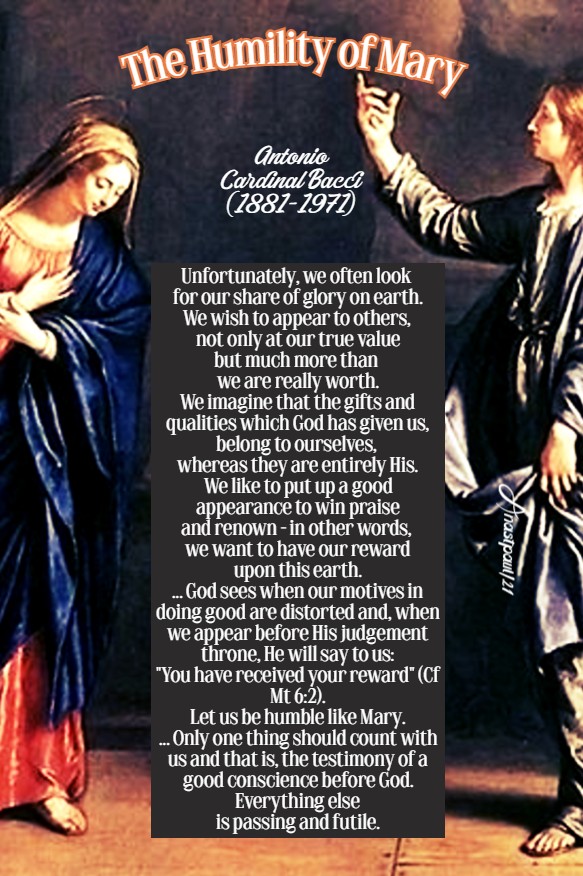
The Humility of Mary
“Unfortunately, we often look for our share of glory on earth. We wish to appear to others, not only at our true value but much more than we are really worth. We imagine that the gifts and qualities which God has given us, belong to ourselves, whereas they are entirely His.
We like to put up a good appearance to win praise and renown – in other words, we want to have our reward upon this earth. We should remember, however, that if we look for our reward now, we shall not have it in Heaven.
God sees when our motives in doing good are distorted and, when we appear before His judgement throne, He will say to us: “You have received your reward” (Cf Mt 6:2).
Let us be humble like Mary. Let us make God’s glory, rather than our own satisfaction, the object of our actions. It will sometimes happen that men will misunderstand us, perhaps even insult us. We are not forbidden to defend ourselves and explain our position. We may not have the heroic virtue of St Francis de Sales, who remained silent when he was caluminated. But we should not be too disturbed by lack of understanding or slander, nor should we be too elated by flattery. Only one thing should count with us and that is, the testimony of a good conscience before God. Everything else is passing and futile.
Our humility will be tested by the inevitable opposition, sometimes jealous and malicious, which we shall experience on the part of other men. On these occasions, we shall see if we are really meek and humble of heart, like Jesus and our Blessed Mother.”
Thought for the Day – 6 May – “Mary’s Month” Meditations with Antonio Cardinal Bacci (1881-1971)
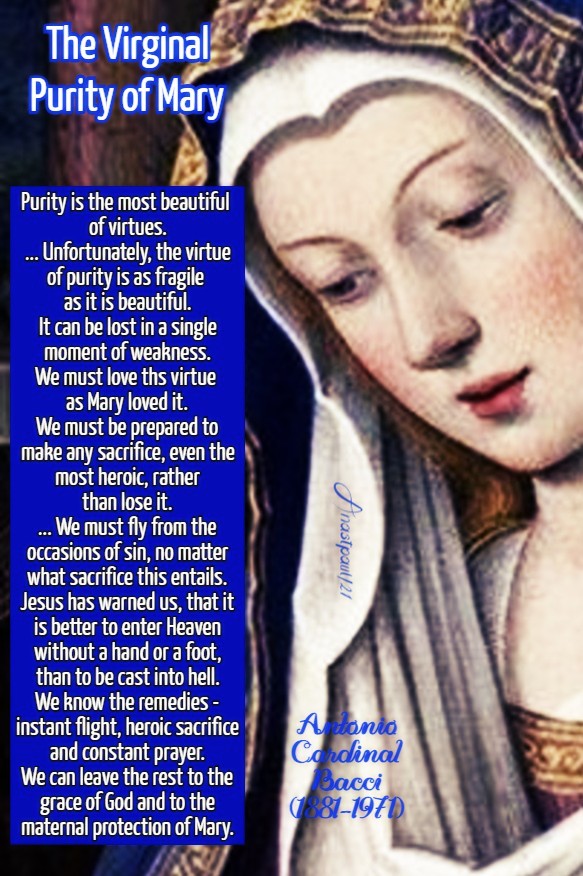
The Virginal Purity of Mary
“Purity is the most beautiful of virtues. It is a virtue which is admired by God and by men, even by the most corrupt. It is often said, that it makes us like the angels but in fact, looking at it in a particular way, it makes us superior to the angels. Since they have no bodies, the angels cannot sin against purity, while we have to fight many battles and overcome many temptations, in order to preserve our chastity. Jesus had a very special love for this virtue. He chose to be born of a virgin and, He showed a particular affection for St John, who was a dedicated celibate. On one occasion, He placed His Hands on the head of a little child and said: “Unless you turn and become like little children, you will not enter into the kingdom of Heaven “(Mt:18.3)
Unfortunately, the virtue of purity is as fragile as it is beautiful. It can be lost in a single moment of weakness. We must love ths virtue as Mary loved it. We must be prepared to make any sacrifice, even the most heroic, rather than lose it. Worldly charm and beauty attract us and the devil works hard to control our imagination and our affections. On account of the disturbance of original sin, the flesh is like a terrible weight retarding our spiritual advancement. Sometimes it seems as if it is irresistibly drawing us towards the abyss of impurity. But we need not be dragged down, if we are prepared to fly from the occasions of sin and to pray to God and to our heavenly Mother for her intercession. We must always act at once, for there is no time to dally. It is fatal to remain inactive and to allow temptation to make its way into our soul. This kind of battle, said St Francis de Sales, is won only by soldiers who flee. We must fly from the occasions of sin, no matter what sacrifice this entails. Jesus has warned us, that it is better to enter Heaven without a hand or a foot, than to be cast into hell.
We know the remedies – instant flight, heroic sacrifice and constant prayer. We can leave the rest to the grace of God and to the maternal protection of Mary.”
Thought for the Day – 1 May – Meditations with Antonio Cardinal Bacci (1881-1971)
The Month of Mary
“This work of eradicating of our faults and replacing them by their opposite virtues, is a difficult task which we cannot carry out on our own. Prayer is necessary if we are to obtan the grace which we need. During Mary’s month, we should beseech our heavenly Mother, with greater earnestness, to obtain for us, from her divine Son, the grace which we need to correct the evil in our nature and to perfect it in goodness.
Mary wants us to pray to her because she wishes to obtain for us, the graces which we require. She loves us very much and is ready to help us to become, like her, living imitations of Jesus, insofar as the weakness of our nature will permit.
Among our other prayers, let us remember to give pride of place to the Holy Rosary, whether we recite it in Church or with the family. Let us include, at least a quarter of an hour meditation; a daily visit, however short, to the Blessed Sacrament and to Our Lady’s Altar; an examination of conscience in the evening and many ejaculatory prayers during the day, which will express our love for Mary and for her divine Son.”
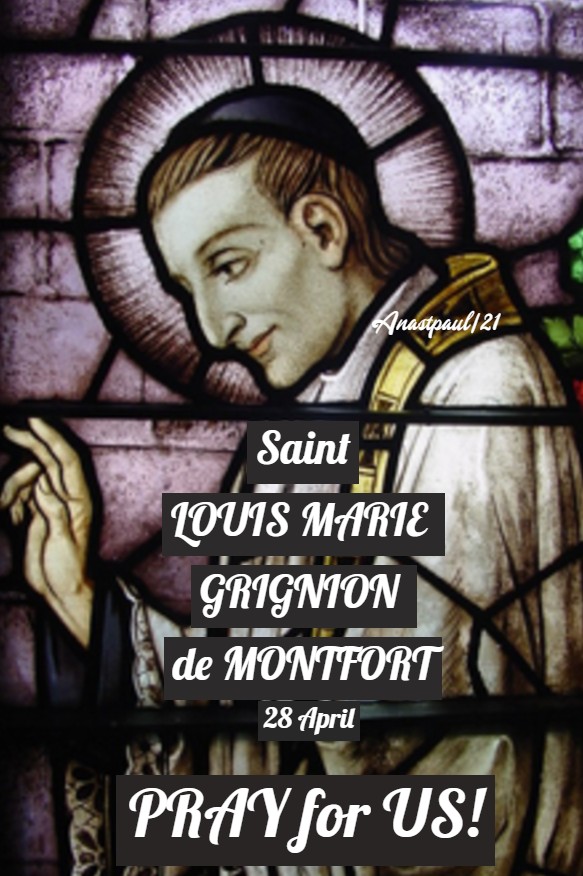
One Minute Reflection – 28 April – Wednesday of the Fourth week of Easter, Readings: Acts 12:24–13:5, Psalm 67:2-3, 5-6, 8, John 12:44-50 and the Memorial of St Louis Marie Grignion de Montfort (1673-1716)
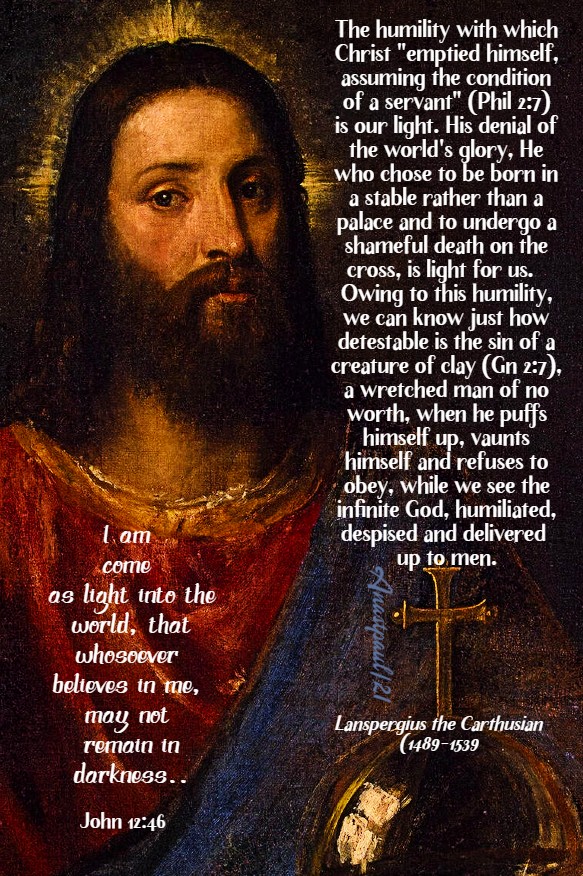
“I am come as light into the world, that whosoever believes in me, may not remain in darkness..” – John 12:46
REFLECTION – “The humility with which Christ “emptied himself, assuming the condition of a servant” (Phil 2:7) is our light. His denial of the world’s glory, He who chose to be born in a stable rather than a palace and to undergo a shameful death on the cross, is light for us. Owing to this humility, we can know just how detestable is the sin of a creature of clay (Gn 2:7), a wretched man of no worth, when he puffs himself up, vaunts himself and refuses to obey, while we see the infinite God, humiliated, despised and delivered up to men.
A light for us, too, is the meekness with which He bore hunger, thirst and cold, insults, blows and wounding, when “like a lamb led to the slaughter and like a sheep before its shearers, he did not open his mouth” (Is 53:7). Indeed, in view of this meekness, we see how pointless anger is, as also threats. Then we consent to suffer and do not serve Christ out of habit. Thanks to this, we learn to pay heed to all that is asked of us, weeping for our sins in submission and silence and patiently bearing the sufferings that come our way. For Christ bore His torments with such great meekness and patience, not for sins He had not committed but for those of others.
From now on, dearest brethren, ponder over all the virtues Christ taught us by the example of His life, that He recommends to us through His preaching and. gives us the strength to imitate, by the aid of His grace.” – Lanspergius the Carthusian (1489-1539) Monk, theologian – Sermon 5
PRAYER – Lord God, life of those who believe in You, glory of the humble and happiness of the Saints, listen kindly to our prayer. We long for what You promises, fill us from Your abundance, give us true faith and obedience. May the Blessed Virgin, Mother of Your Son, be our constant recourse. and may her cliet and Yours, St Louis Marie de Montfort, pray for us all. Through Our Lord, Jesus with the Holy Spirit, God forever, amen.
Acts 12: 24 — 13: 5a 24 But the word of the Lord increased and multiplied. 25 And Barnabas and Saul returned from Jerusalem, having fulfilled their ministry, taking with them John, who was surnamed Mark. 13:1 Now there were in the church which was at Antioch, prophets and doctors, among whom was Barnabas and Simon who was called Niger and Lucius of Cyrene and Manahen, who was the foster brother of Herod the tetrarch, and Saul. 2 And as they were ministering to the Lord and fasting, the Holy Ghost said to them: Separate me Saul and Barnabas, for the work whereunto I have taken them. 3 Then they, fasting and praying and imposing their hands upon them, sent them away. 4 So they being sent by the Holy Ghost, went to Seleucia and from thence they sailed to Cyprus. 5 And when they were come to Salamina, they preached the word of God in the synagogues of the Jews.
Gospel: John 12: 44-50 44 But Jesus cried and said: He that believes in me, does not believe in me but in him that sent me. 45 And he that sees me, sees him that sent me. 46 I am come as light into the worl, that whosoever believes in me, may not remain in darkness. 47 And if any man hears my words and keeps them not, I do not judge him: for I came not to judge the world but to save the world. 48 He that despises me and receives not my words, has one that judges him; the word that I have spoken, the same shall judge him in the last day. 49 For I have not spoken of myself but of the Father who sent me, he gave me commandments what I should say and what I should speak. 50 And I know that his commandment is life everlasting. The things, therefore, that I speak, even as the Father said unto me, so do I speak.
Thought for the Day – 6 April – Meditations with Antonio Cardinal Bacci (1881-1971)
The Meaning of Easter
“Today the Church adorns herself in festival array. Gone are the lengthy lamentations of Holy Saturday and the sorrowful recitations of the Passion and in their place, is the glad cry of Alleluia, the hymn of vitory over death and sin. The true joy of Easter, lies, not merely in external celebration, however but in the spiritual gladness of the soul. As Jesus has conquered death and sin, so we must purify ourselves of every trace of guilt by a good confession and must be sure, that it will result in a practical renovation of our lives. We should approach Jesus in the Blessed Eucharist with greater fervour and humility and with greater trust in His goodness and mercy. When we have received Him into our hearts, we should ask Him to renew and transform us in Himself. He is everything and we are nothing without Him. He is strong, we are weak. We are capable only of feeble desires to do good but He can make them effective by His grace. We should not be satisfied with forming general resolutions when we go to confession and receive Holy Communion at Easter. We should examine the depths of our soul and discover the sin which we are most accustomed to commit and the virtue which we are principally lacking. As a result of our investigation, we should form a particular resolution to combat this sin and to practise this virtue. It is only in this way, that our celebration of Easter can inaugurate the beginning of a genuine self-renewal which will gain momentum daily, until it becomes a true spiritual resurrection. It will be a hard battle, which will necessitate a constant vigilance and a readiness to begin again, everytime we realise, that we have fallen. It will require an unfailing spirit of prayer but, the final victory, will bring us such happiness, that worldly pleasures will seem empty and illusory, by comparison.”
Thought for the Day – 29 March – Meditations with Antonio Cardinal Bacci (1881-1971)
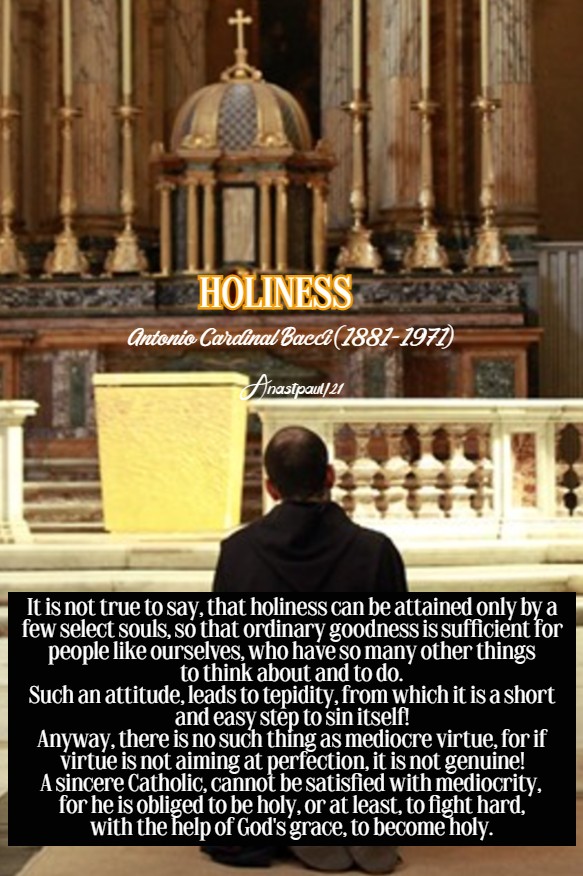
Holiness
“It is not true to say, that holiness can be attained only by a few select souls, so that ordinary goodness is sufficient for people like ourselves, who have so many other things to think about and to do. Such an attitude, leads to tepidity, from which it is a short and easy step to sin itself!
Anyway, there is no such thing as mediocre virtue, for if virtue is not aiming at perfection, it is not genuine! A sincere Catholic, cannot be satisfied with mediocrity, for he is obliged to be holy, or at least, to fight hard, with the help of God’s grace, to become holy.
Even in the Old Testament we read: “I, the Lord, am your God and you shall make and keep yourselves holy because I am holy” (Lev 11:44; 19:2). This exhortation is repeated by St Peter in his first Epistle (1 Pet 1:15-16) and in the Gospel, Jesus Himself commands us to be perfect even as our heavenly Father is perfect (Mt 5:48). Holiness, then, is a goal towards which, all sincere Catholics must strive.”
Day Twenty-eighth of our Lenten Journey – Tuesday of the Fourth Week of Lent, Readings: Ezekiel 47:1-9, 12, Psalms 46:2-3, 5-6,8-9, John 5:1-16
Imitating Christ with Thomas à Kempis (1380-1471)
In You is the source of life and in Your Light Lord, we see light Psalm 35(36)
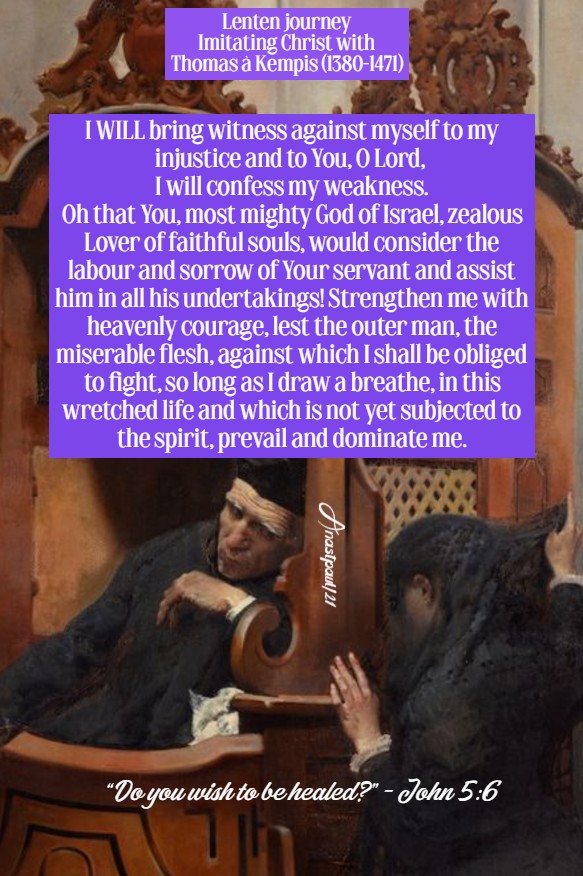
“Do you wish to be healed?” – John 5:6
I WILL bring witness against myself to my injustice and to You, O Lord, I will confess my weakness.
Often it is a small thing that makes me downcast and sad. I propose to act bravely but when even a small temptation comes, I find myself in great straits. Sometimes, it is the merest trifle which gives rise to grievous temptations. When I think myself somewhat safe and when I am not expecting it, I frequently find myself almost overcome by a slight wind. Look, therefore, Lord, at my lowliness and frailty, which You know so well. Have mercy on me and snatch me out of the mire, that I may not be caught in it and may not remain forever utterly despondent.
That I am so prone to fall and so weak in resisting my passions, oppresses me frequently and confounds me, in Your sight. While I do not fully consent to them, still their assault is very troublesome and grievous to me and it wearies me exceedingly, thus to live in daily strife. Yet from the fact that abominable fancies rush in upon me, much more easily than they leave, my weakness becomes clear to me.
Oh that You, most mighty God of Israel, zealous Lover of faithful souls, would consider the labour and sorrow of Your servant and assist him in all his undertakings! Strengthen me with heavenly courage, lest the outer man, the miserable flesh, against which I shall be obliged to fight, so long as I draw a breathw, in this wretched life and which is not yet subjected to the spirit, prevail and dominate me.
Alas! What sort of life is this, from which troubles and miseries are never absent, where all things are full of snares and enemies? For when one trouble or temptation leaves, another comes. Indeed, even while the first conflict is still raging, many others begin unexpectedly. How is it possible to love a life that has such great bitterness, that is subject to so many calamities and miseries? Indeed, how can it even be called life, when it begets so many deaths and plagues? And yet, it is loved and many seek their delight in it.
Many persons often blame the world for being false and vain, yet do not readily give it up because the desires of the flesh have such great power. Some things draw them to love the world, others make them despise it. The lust of the flesh, the desire of the eyes and the pride of life lead to love, while the pains and miseries, which are the just consequences of those things, beget hatred and weariness of the world.
Vicious pleasure overcomes the soul that is given to the world. She thinks that there are delights beneath these thorns because she has never seen or tasted the sweetness of God or the internal delight of virtue. They, on the other hand, who entirely despise the world and seek to live for God, under the rule of holy discipline, are not ignorant of the divine sweetness, promised to those who truly renounce the world. They see clearly how gravely the world errs and in how many ways it deceives. (Book 3 Ch 20)
Thought for the Day – 8 March – Meditations with Antonio Cardinal Bacci (1881-1971)
Our Martyrdom
“St Ambrose describes virtue, as a slow martyrdom. In this sense, we must all be martyrs. There is only one difference. The Martyrs of the Church shed their blood and gave up their lives for Jesus, within one hour or one day and gained their reward immediately. Our martyrdom, on the other hand, will be prolonged. It will last all our lives and will end only when we accept death with resignation from the hands of God. Ours is the martyrdom of virtue. Let us clearly understand, that solid Christian virtue is a slow and continual martyrdom, which will end with death. It is not a flower, which springs up spontaneously in the garden of the soul. It is like a seed which is thrown on the damp earth and must die there slowly, so that it can generate young shoots, which will produce the ears of corn. “Unless the grain of wheat falls into the ground and dies, it remains alone. But, if it dies, it brings forth much fruit” (Jn 12:24-25). It is necessary, then, to descend into the mire of humility and to remain there until we die. Only after we have died to ourselves, shall we rise again in God (Cf ibid). After the death of our lower instincts and vices, we shall find a new life.”
Day Three of our Lenten Journey – 18 February – Friday after Ash Wednesday, Readings: Isaiah 58:1-9, Psalms 51:3-4, 5-6, 18-19, Matthew 9:14-15
Imitating Christ with Thomas à Kempis CRSA (1380-1471)
In Your Light Lord, we see light
“Then they will fast” – Matthew 9:15
Consider the glowing examples of the holy Fathers, in whom shone true religion and perfection; compared with them, we do little or nothing. Alas, how can our life be compared with theirs! The Saints and friends of Christ served Our Lord in hunger and thirst, in cold and nakedness, in toil and weariness: in watching and fasting, in prayer and meditation, in persecutions and insults without number (Heb.9:38, 1 Cor.4:11).
How countless and constant were the trials endured by the Apostles, Martyrs, Confessors, Virgins and all those others, who strove to follow in the footsteps of Christ. These all hated their lives in this world, that they might keep them to life eternal (Jn 12:35). How strict and self-denying was the life of the holy Fathers in the desert! How long and grievous the temptations they endured! How often they were assaulted by the Devil! How frequent and fervent their prayers to God! How strict their fasts! How great their zeal and ardour for spiritual progress! How valiant the battles they fought to overcome their vices! How pure and upright their intention towards God!
All day long they laboured and the night they gave to continuous prayer; even as they worked, they never ceased from mental prayer. They spent all their time with profit, every hour seeming short in the service of God. They often forgot even their bodily needs in the great sweetness of contemplation. They renounced all riches, dignities, honours, friends and kindred; they desired to possess nothing in this world. Scarcely would they take the necessities of life and only with reluctance would they provide for the needs of the body. Thus, though destitute of earthly goods, they were abundantly rich in grace and all virtues. Outwardly they were poor but inwardly they were refreshed with grace and heavenly consolation. They were strangers to the world but to God, they were dear and familiar friends (Ex 33:11). To themselves they were nothing but in the eyes of God, they were precious and beloved. Grounded in true humility, they lived in simple obedience, they walked in charity and patience; (Eph 5:2) and thus daily increased in the Spirit, and received great grace from God.
… Oh, the carelessness and coldness of this present time! Sloth and lukewarmness makes life wearisome for us and we soon lose our early fervour! May the longing to grow in grace not remain dormant in you … (Book 1, Ch 18:1-4a,6)
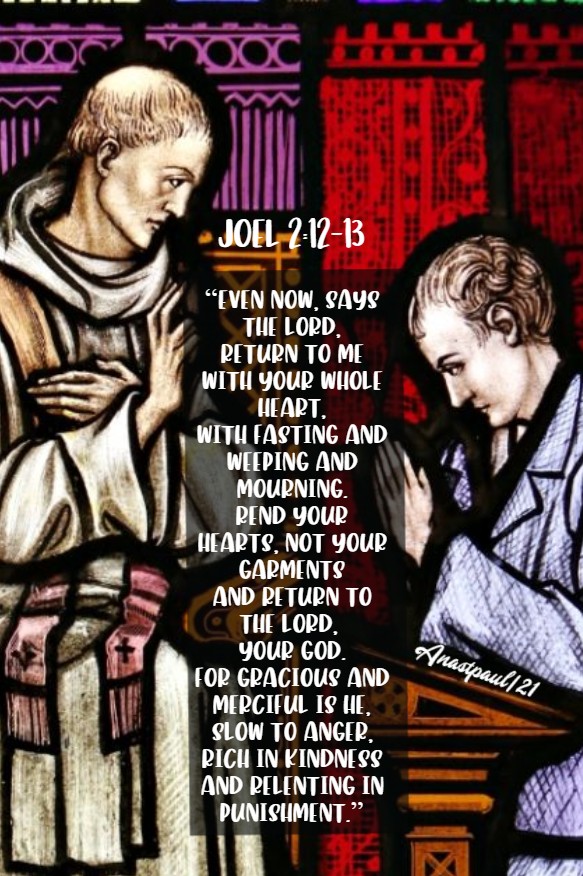
“Even now, says the LORD, return to me with your whole heart, with fasting and weeping and mourning. Rend your hearts, not your garments and return to the LORD, your God. For gracious and merciful is he, slow to anger, rich in kindness and relenting in punishment.”
Joel 2:12-13
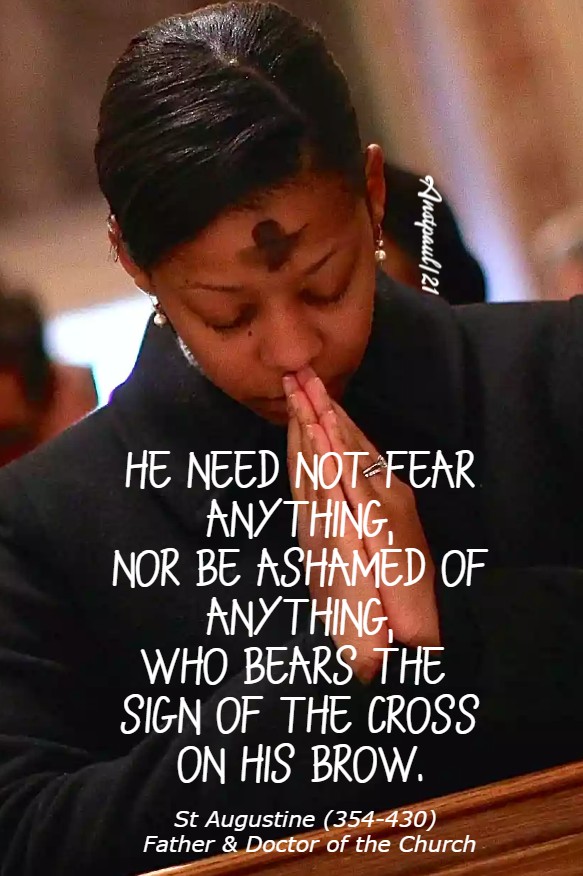
“He need not fear anything, nor be ashamed of anything, who bears the Sign of the Cross on his brow.”
St Augustine (354-430) Father & Doctor of the Church
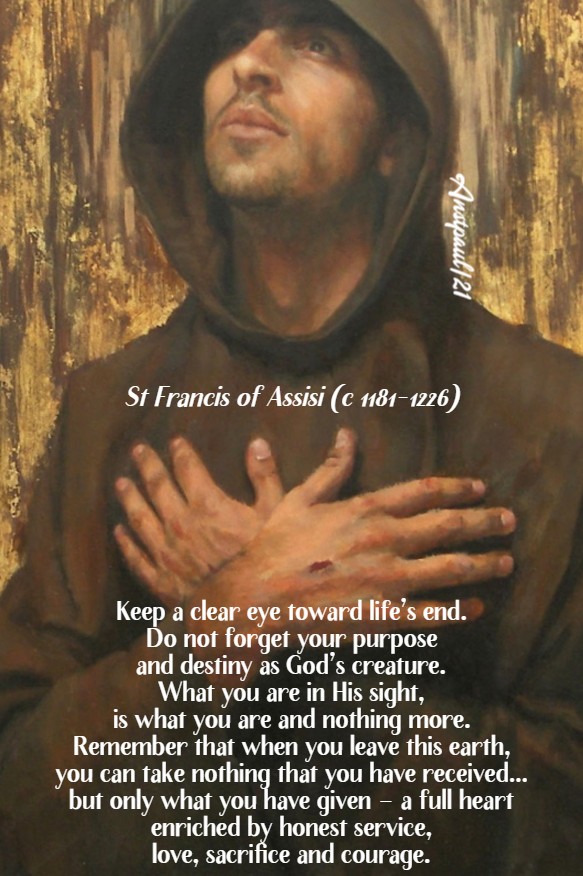
“Keep a clear eye toward life’s end. Do not forget your purpose and destiny as God’s creature. What you are in His sight, is what you are and nothing more. Remember that when you leave this earth, you can take nothing that you have received… but only what you have given – a full heart enriched by honest service, love, sacrifice and courage.”
St Francis of Assisi (c 1181-1226)
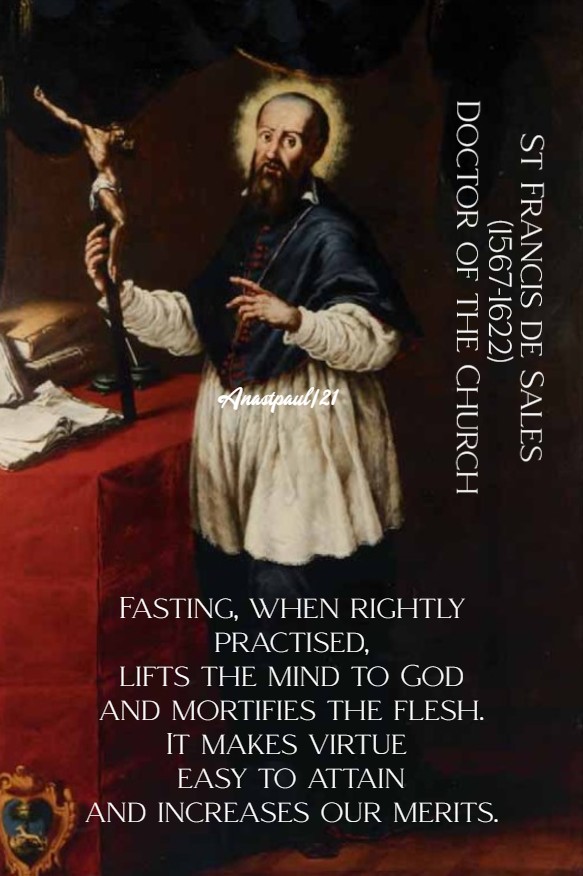
“Fasting, when rightly practised, lifts the mind to God and mortifies the flesh. It makes virtue easy to attain and increases our merits.”
St Francis de Sales (1567-1622) Doctor of the Church
REFLECTION – “You must never fail to trust in God, nor despair of His mercy. I should not like you to doubt, or despair of becoming better. For even if the devil were able to throw you down, from the heights of virtue, to the depths of wickedness, how much more, can God recall you to the summit of goodness. And, not just bring you back to the state you were in before your fall but He can make you much happier, than you seemed to be before. Do not lose heart, I beg you and do not close your eyes to the hope of good, for fear that what happens to people, who don’t love God, should happen to you. For it is not, the great number of one’s sins, that leads the soul to despair but disdain for God. As the Wise man says: “It is the characteristic of the impious to despair of salvation and hold it in contempt since they have fallen into the pit of sin” (cf. Prv 18,3 Vg).
Therefore, every thought that takes our hope away, follows on from a lack of faith, like a heavy stone around our neck, it forces us to be always looking downwards, to the earth and doesn’t allow us to raise our eyes to the Lord. But those with a brave heart and enlightened mind, know how to release their necks from this horrid weight. “Behold, as the eyes of servants are on the hand of their masters, as the eyes of a maid are on the hands of her mistress, so our eyes are on the Lord our God till he have pity on us” (Ps 123,2). – St Rabanus Maurus OSB (776-856) Archbishop, Monk, Abbot,Theologian, Poet – Three books dedicated to Bonosus, Bk 3, 4
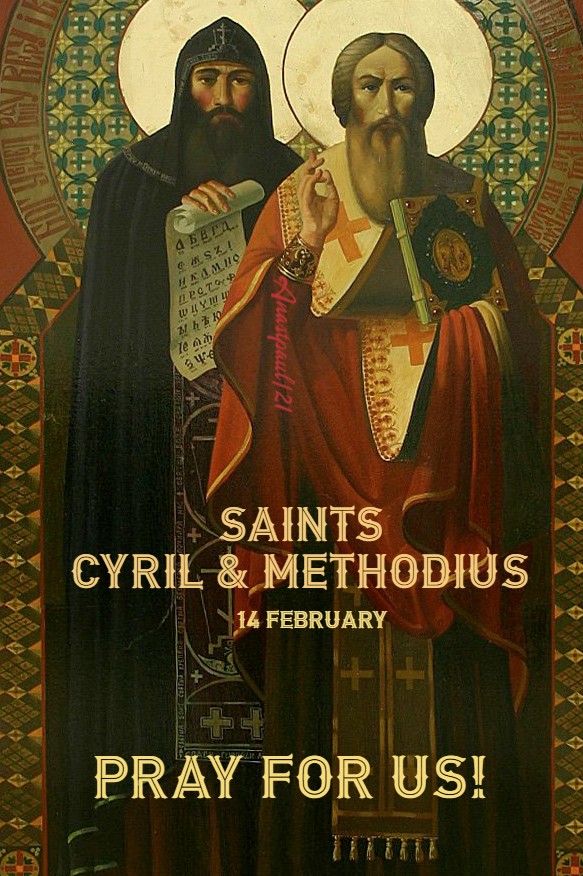
PRAYER – To those who love You, Lord, You promise to come with Your Son and make Your home within them. If You will, You can make us clean, come then with Your purifying grace and make our hearts a place where You can dwell. May the prayers of intercession of Saints Cyril and Methodius, help us to reach our everlasting home with You. Through Christ our Lord, with the Holy Spirit, God now and forever, amen.
Quote/s of the Day – 13 February – The Memorial of Blessed Jordan of Saxony OP (1190-1237)
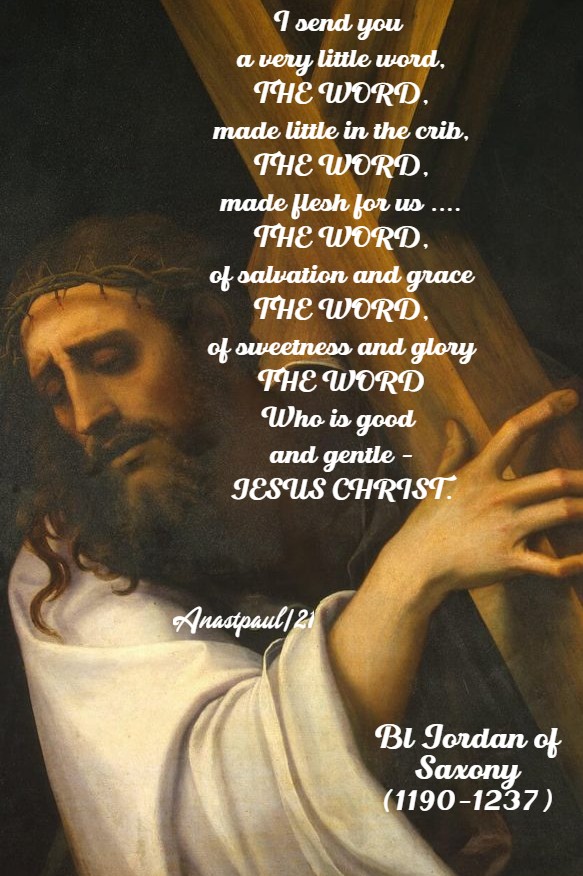
“I send you a you a very little word, THE WORD, made little in the crib, THE WORD, made flesh for us …. THE WORD, of salvation and grace THE WORD, of sweetness and glory THE WORD Who is good and gentle – JESUS CHRIST.”
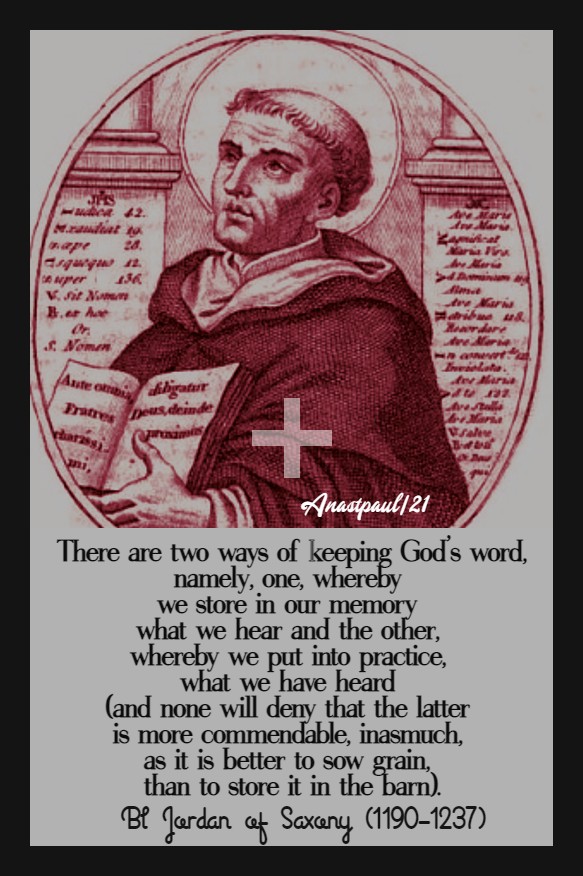
“There are two ways of keeping God’s word, namely, one, whereby we store in our memory what we hear and the other, whereby we put into practice, what we have heard (and none will deny that the latter is more commendable, inasmuch, as it is better to sow grain, than to store it in the barn).”
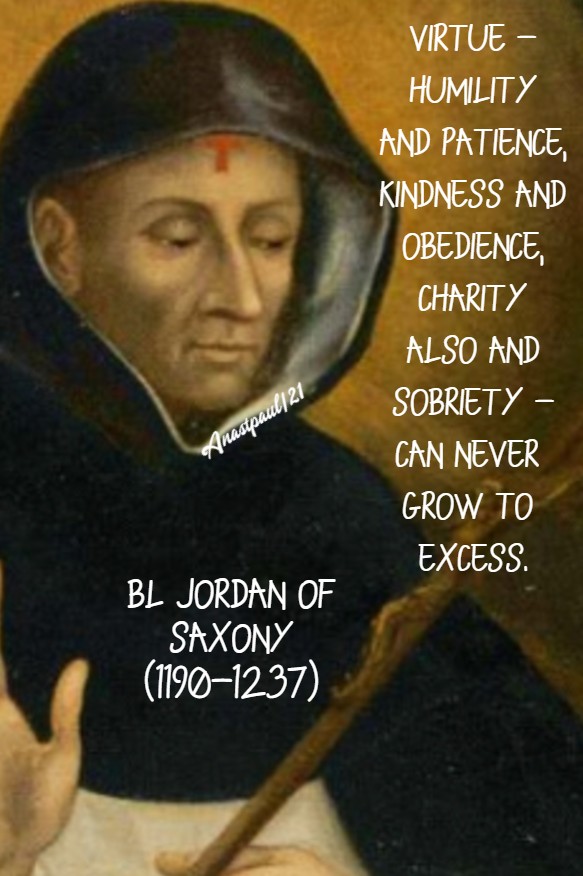
“Virtue – humility and patience, kindness and obedience, charity also and sobriety – can never grow to excess.”
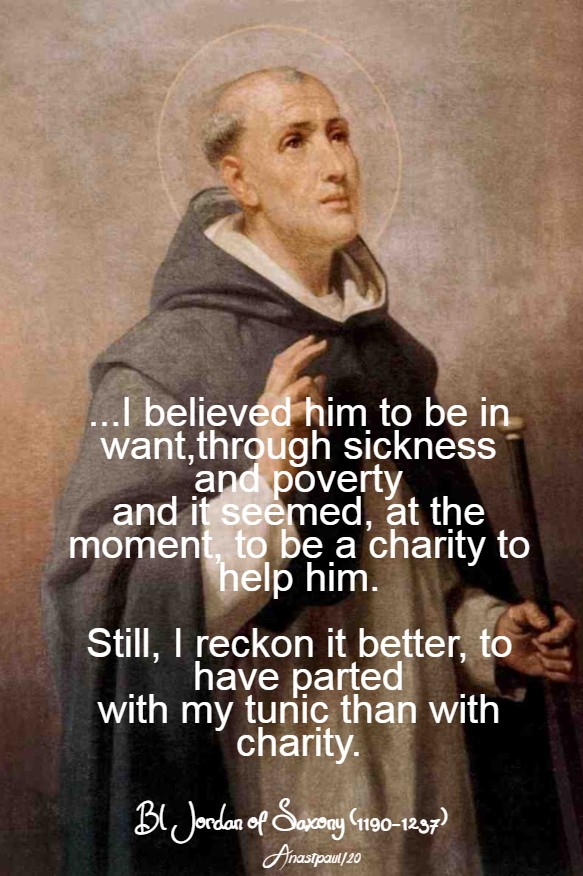
Meeting a vagabond upon the road who feigned sickness and poverty, Blessed Jordan gave him one of his tunics, which the fellow at once carried straight to a tavern for drink. The brethren, seeing this done, taunted him with his simplicity:
‘There now, Master, see how wisely you have bestowed your tunic.’
“I did so,’ said he, ‘because I believed him to be in want, through sickness and poverty and it seemed, at the moment, to be a charity to help him. Still, I reckon it better, to have parted with my tunic than with charity.”
Thought for the Day – 10 February – Meditations with Antonio Cardinal Bacci (1881-1971)
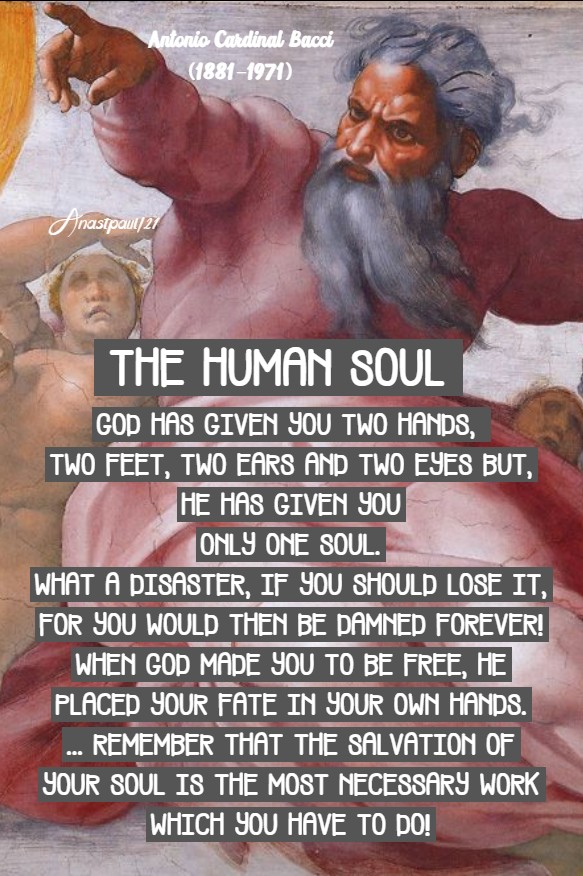
The Human Soul
“Consider that you have only one soul, which belongs entirely to God and has Heaven for its true home. God has given you two hands, two feet, two ears and two eyes but, He has given you only one soul. What a disaster, if you should lose it, for you would then be damned forever! When God made you to be free, He placed your fate in your own hands. “When God, in the beginning, created man, He made him subject to his own free choice” (Ecclus 15:14). Remember that the salvation of your soul is the most necessary work which you have to do! It is more precious to you than gold or silver. “More precious than gold is health and well-being, contentment of spirit, than coral” (Ecclus 30:15). All our attention should be devoted to keeping our soul free from sin and endowing it with every virtue.”
Quote/s of the Day – 8 February – The Memorial of St Jerome Emiliani (1486–1537)
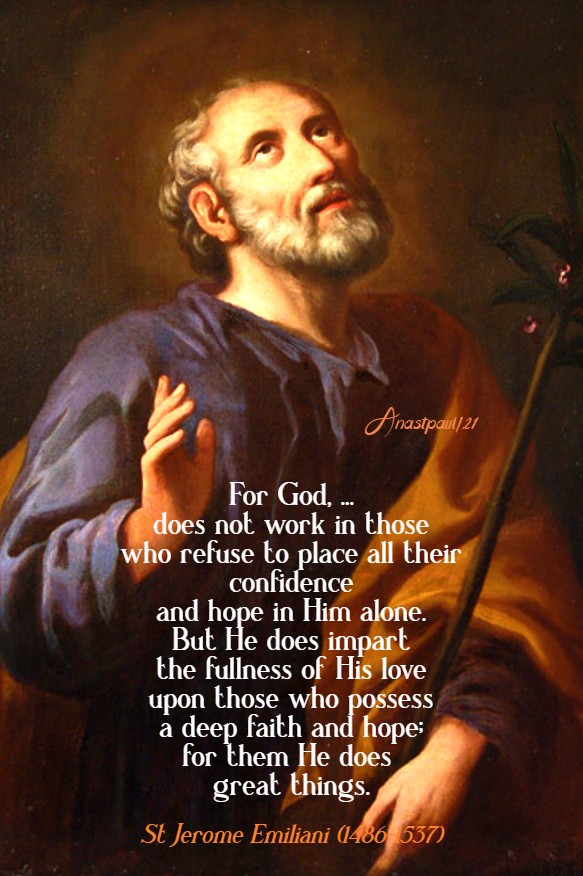
“For God, … does not work in those who refuse to place all their confidence and hope in Him alone. But He does impart the fullness of His love upon those who possess a deep faith and hope; for them He does great things.”
“With your patience you will save your soul.”
(Letter 3 #1)
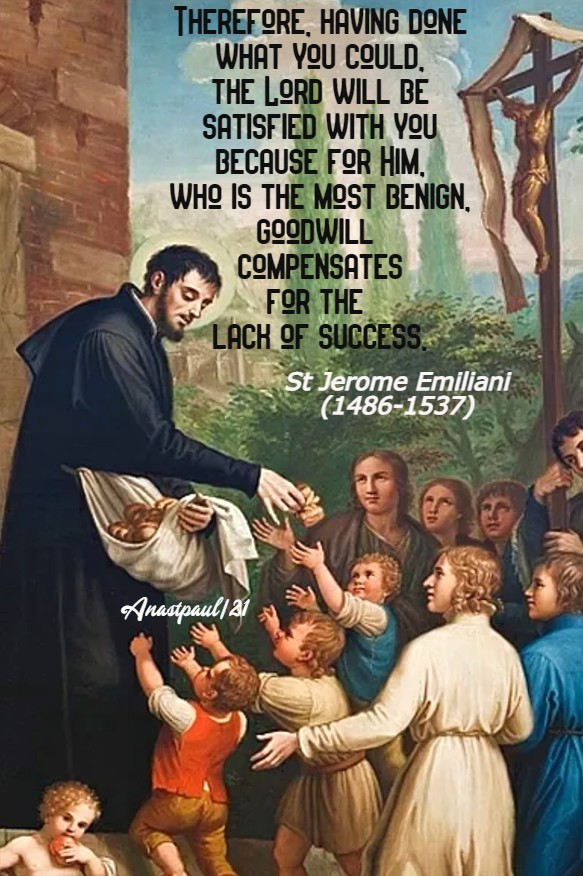
“Therefore, having done what you could, the Lord will be satisfied with you because for Him, who is the most benign, goodwill compensates for the lack of success.”
(Letter 5 #4)
“…If I do not speak the truth, I become a slave of the father of lies and become a member of this father of lies.”
Thought for the Day – 25 January – Meditations with Antonio Cardinal Bacci (1881-1971)
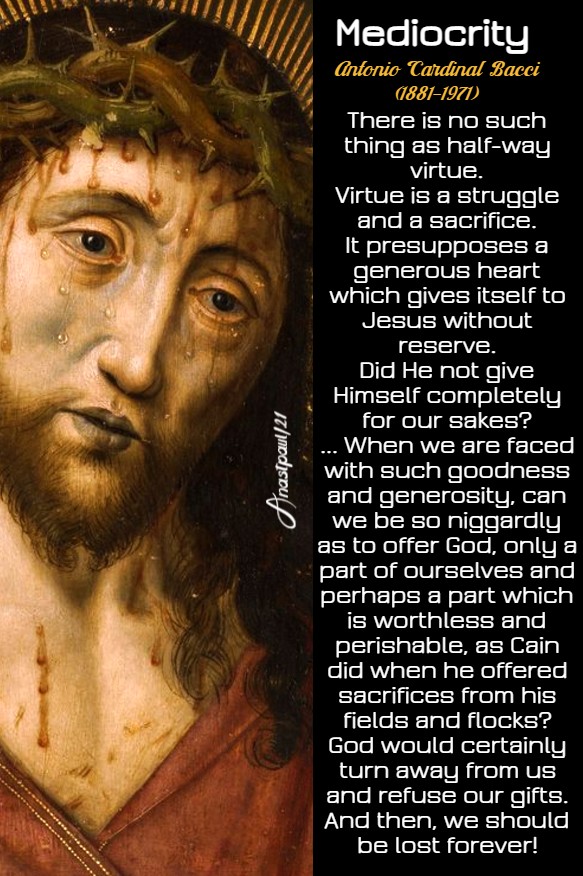
Mediocrity
“There is no such thing as half-way virtue.
Virtue is a struggle and a sacrifice. It presupposes a generous heart which gives itself to Jesus without reserve. Did He not give Himself completely for our sakes? Did He not die upon the Cross for our salvation and reopen Heaven, which had been closed to us by sin? Moreover, did He not remain hidden in our midst under the Eucharistic species in order to become our sustenance and our support?
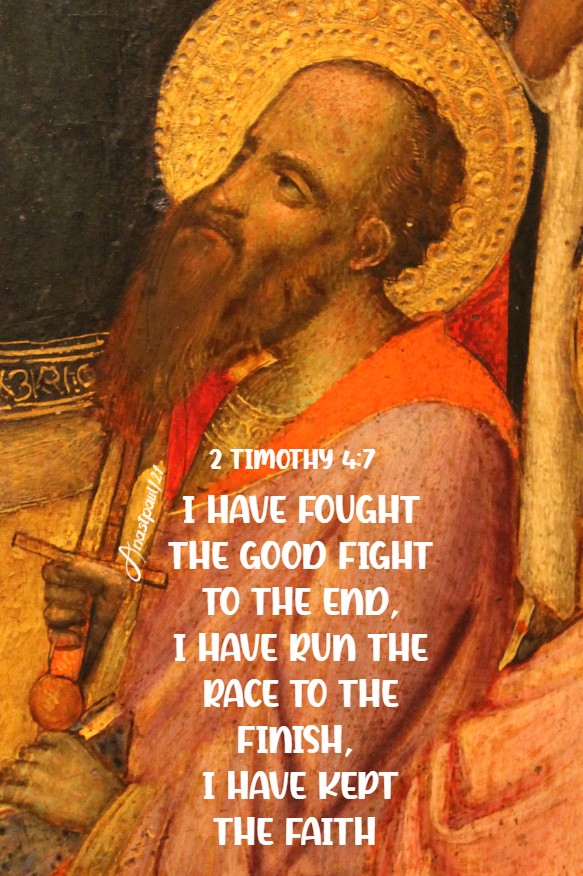
When we are faced with such goodness and generosity, can we be so niggardly as to offer God, only a part of ourselves and perhaps a part which is worthless and perishable, as Cain did when he offered sacrifices from his fields and flocks? God would certainly turn away from us and refuse our gifts. And then, we should be lost forever! Let us give ourselves completely and then be able to say with St Paul “I have fought the good fight to the end, I have run the race to the finish, I have kept the faith … ” (2 Tm 4:7)
“The time is sure to come, when people will not accept sound teaching but their ears will be itching for anything new and they will collect themselves a whole series of teachers according to their own tastes and then they will shut their ears to the truth and will turn to myths. But you must keep steady all the time; put up with suffering, do the work of preaching the gospel, fulfil the service asked of you. As for me, my life is already being poured away as a libation and the time has come for me to depart. I have fought the good fight to the end, I have run the race to the finish, I have kept the faith … ”(2 Tm 4:3-7)
Thought for the Day – 19 January – Meditations with Antonio Cardinal Bacci (1881-1971)
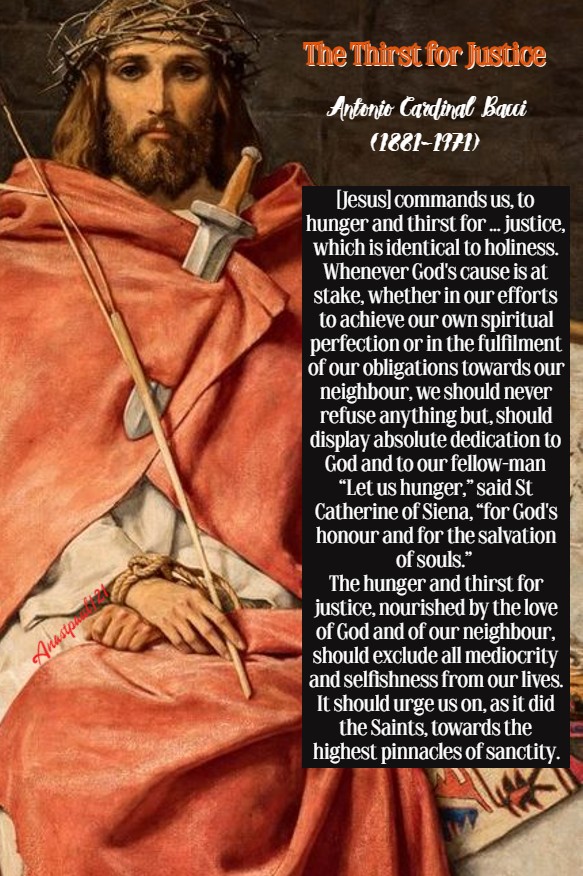
The Thirst for Justice
“Jesus commands us, in the Beatitudes, to seek justice, that is perfection in the fulfilment of our obligations to God, to ourselves and, to our neighbour. He commands us, to hunger and thirst for this justice, which is identical with holiness.
When Christ tells us to hunger and thirst for justice, He imposes on us, the obligation of doing our very best to acquire the virtue of Christian justice, which is the sythesis of all the virtues. We must be aware, therefore, of laziness, apathy, tepidity, or mediocrity, for our advance in spiritual perfection, must be continuous. There must be no hesitation or backsliding. The high target which God has set for us, demands hard work and boundless generosity on our part. Jesus Christ loved us so much that He gave Himself entirely for us and shed His Precious Blood to the last drop, for our Redemption. How can we possibly be niggardly or half-hearted in our relatioas with Him?
Whenever God’s cause is at stake, whether in our efforts to achieve our own spiritual perfection or in the fulfilment of our obliations towards our neighbour, we should never refuse anything but, should display absolute dedication to God and to our fellow-man. “Let us hunger,” said St Catherine of Siena, “for God’s honour and for the salvation of souls” (Vrev di perfezioe, p81). The hunger and thirst for justice, nourished by the love of God and of our neighbour, should exclude all mediocrity and selfishness from our lives. It should urge us on, as it did the Saints, towards the highest pinnacles of sanctity.”
Thought for the Day – 18 January – Meditations with Antonio Cardinal Bacci (1881-1971)
External Mortification
“The interior mortification of self-love and of our sensual inclinations is not enough. Bodily mortifiation is also necessary. St Paul provides the reason. “the flesh lusts against the spirit and the spirit against the flesh” (Gal 5:17)
Original sin disturbed the perfect harmony which existed between man’s body and soul. “I see another law in my members,” said the Apostle Paul, “warring against the law of my mind” (2 Cor 12:7).
There is no such struggle between the flesh and the spirit in brute animals, which are concerned only with the satisfaction of their sensible appetites. It is because he is endowed with reason and an immortal soul, that man experiences this conflict. The result is, that either the soul is conquered and becomes the slave of man’s lower instincts, or, the soul is victorious and uses the body as a instrument of virtue.
We can see from this, how necessary it is to mortify our bodies, so that they will not rebel against the mastery of the soul. Our body will be either the faithful servant, or the relentless tyrant of the soul!
What penances do I perform? When do I fast? Little or never, perhaps? If so, it is not surprising that my body rebels and causes me to fall into sin. We must follow the example of Jesus and the Saints in this matter, if we wish to remain in the state of grace.”
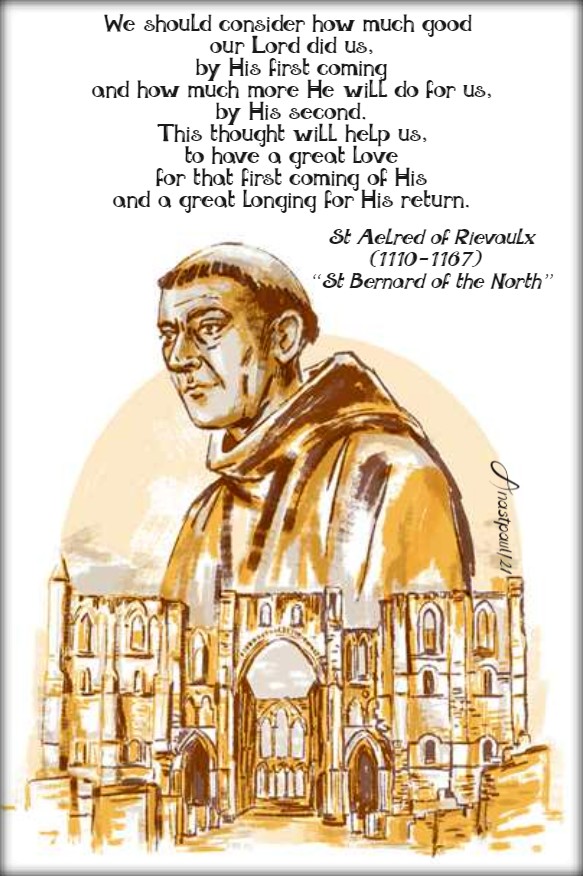
Quote/s of the Day – 12 January – The Memorial of St Aelred of Rievaulx (1110-1167) “St Bernard of the North”
“We should consider how much good our Lord did us, by His first coming and how much more He will do for us, by His second. This thought will help us, to have a great love for that first coming of His and a great longing for His return.”
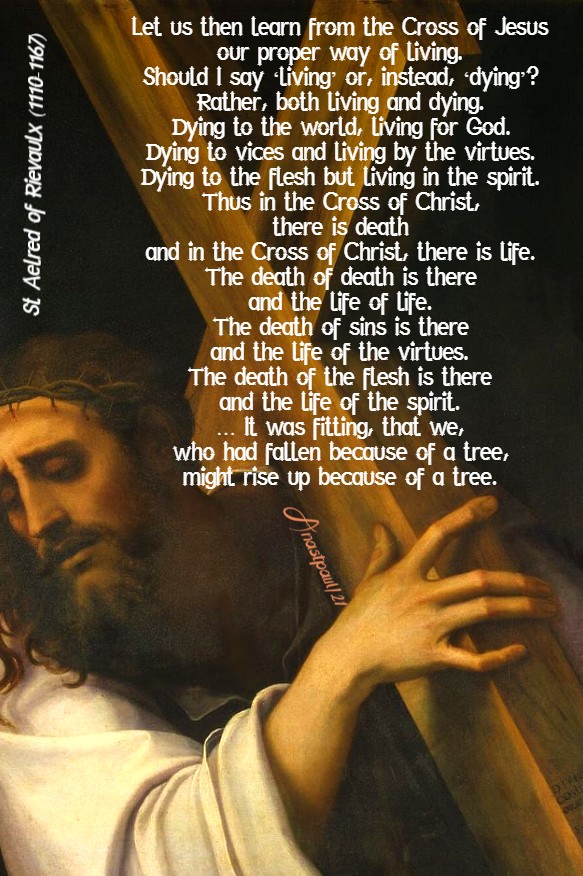
“Let us then learn from the Cross of Jesus our proper way of living. Should I say ‘living’ or, instead, ‘dying’? Rather, both living and dying. Dying to the world, living for God. Dying to vices and living by the virtues. Dying to the flesh but living in the spirit. Thus in the Cross of Christ, there is death and in the Cross of Christ, there is life. The death of death is there and the life of life. The death of sins is there and the life of the virtues. The death of the flesh is there and the life of the spirit. … It was fitting, that we, who had fallen because of a tree, might rise up because of a tree.”
“Faith is not even a virtue, unless it is expressed by love, nor is hope, unless it loves, what it hopes for.”
“When insults have no effect on us, when persecutions and penalties, have no terror for us, when prosperity or adversity, has no influence on us, when friend and foe, are viewed in the same light… do we not come close, to sharing, the serenity of God?”
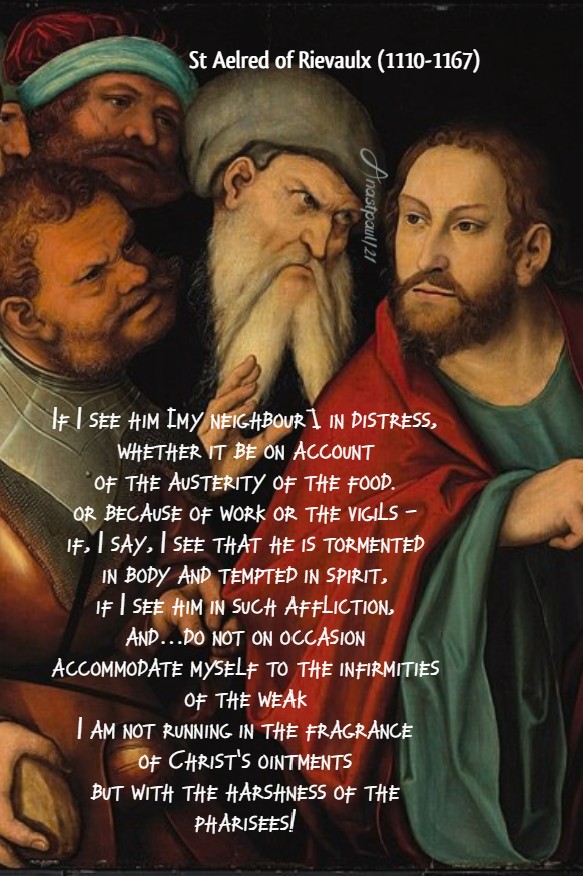
“If I see him [my neighbour] in distress, whether it be on account of the austerity of the food. or because of work or the vigils – if, I say, I see that he is tormented in body and tempted in spirit, if I see him in such affliction, and…do not on occasion accommodate myself to the infirmities of the weak I am not running in the fragrance of Christ’s ointments but with the harshness of the pharisees.”
St Aelred of Rievaulx (1110-1167) “St Bernard of the North”
Thought for the Day – 7 January – Meditations with Antonio Cardinal Bacci (1881-1971) The Solemnity of the Epiphany of the Lord
Merit and the Love of God
“The more we know, writes St Catherine of Siena, the more we love and the more we love, the more we receive. Our merit, she concludes, increases in accordance with the measure of our love (Dialogues, c 131). We tend to judge men on the strength of their achievements and to judge ourselves, according to the degree of success which we have attained. Our standards could hardly be more false. “How much soever each one is in Thy eyes,” the author of The Imitation of Christ cries out to God in the words of St Francis, “so much is he and no more” (Bk III, c 50).
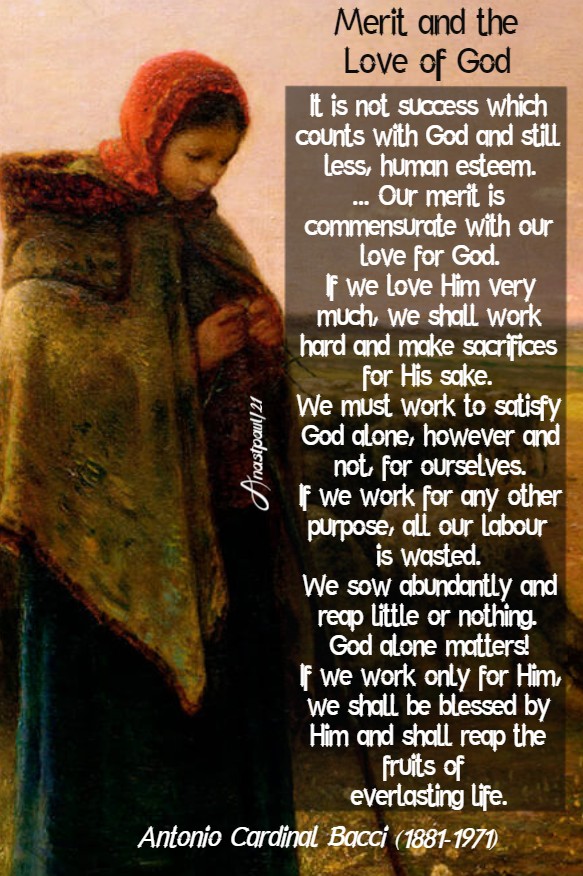
It is not success which counts with God and still less, human esteem. What matters with God, is our intention of pleasing Him and of working for His glory, from the motive of pure love. If we are successful in our work, let us praise God. If we are unsuccessful, let us thank Him, just the same. Our merit is commensurate with our love for God. If we love Him very much, we shall work hard and make sacrifices for His sake. We must work to satisfy God alone, however and not, for ourselves. If we work for any other purpose, all our labour is wasted. We sow abundantly and reap little or nothing. God alone matters. If we work only for Him, we shall be blessed by Him and shall reap the fruits of everlasting life. Amen!”
Quote/s of the Day – 2 January – Christmas Weekday and The Memorial of St Basil the Great (329-379) and St Gregory of Nazianzen (330-390)
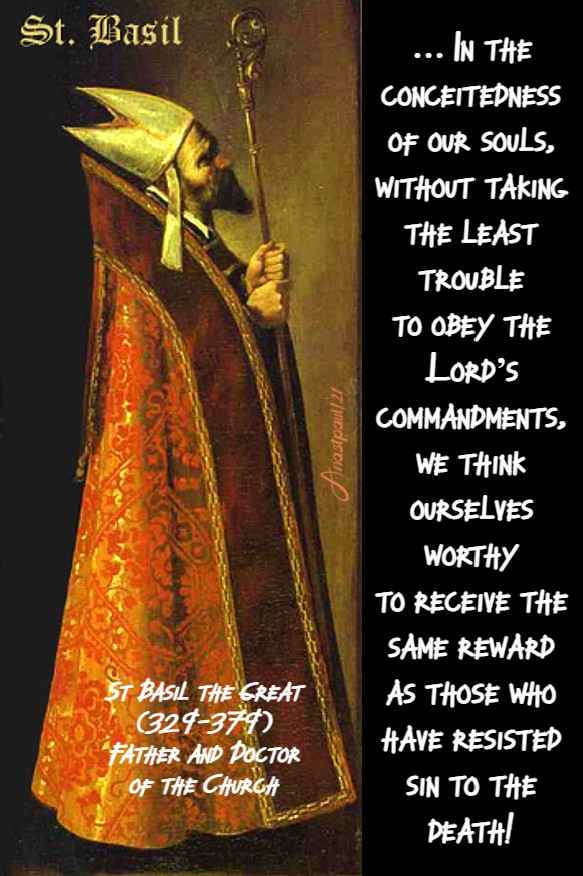
“… In the conceitedness of our souls, without taking the least trouble to obey the Lord’s commandments, we think ourselves worthy to receive the same reward as those who have resisted sin to the death!”
“A tree is known by its fruit, a man by his deeds. A good deed is never lost, he who sows courtesy, reaps friendship and he who plants kindness, gathers love.”
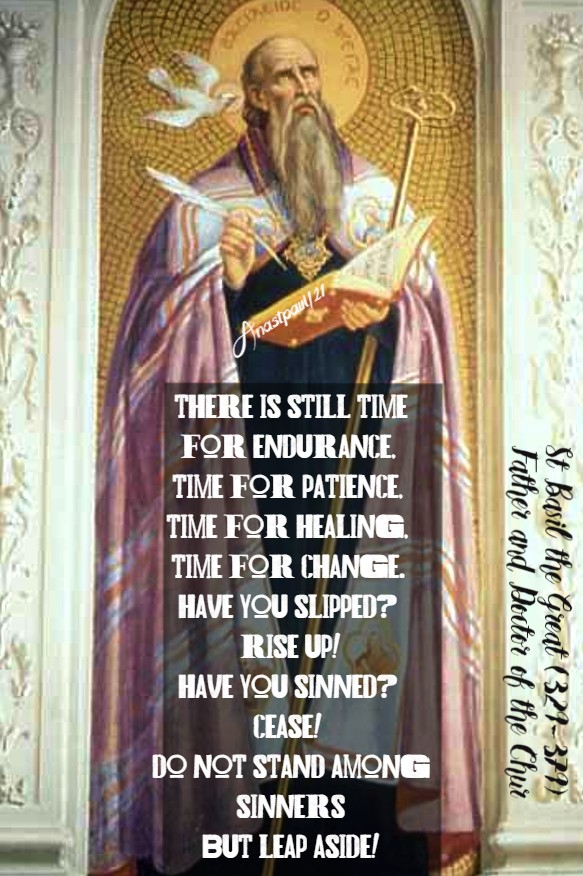
“There is still time for endurance, time for patience, time for healing, time for change. Have you slipped? Rise up! Have you sinned? Cease! Do not stand among sinners but leap aside!”
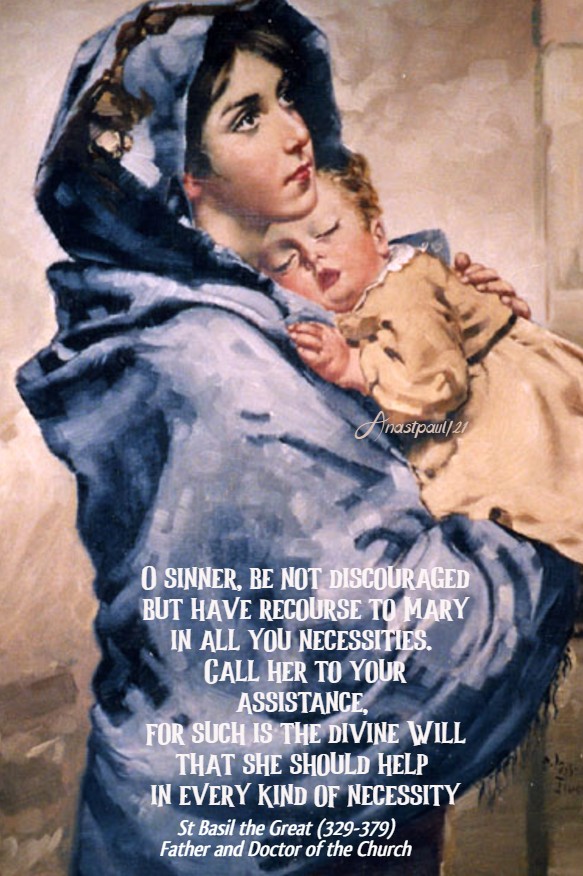
“O sinner, be not discouraged but have recourse to Mary in all you necessities. Call her to your assistance, for such is the divine Will that she should help in every kind of necessity.”
St Basil the Great (329-379) Father and Doctor of the Church
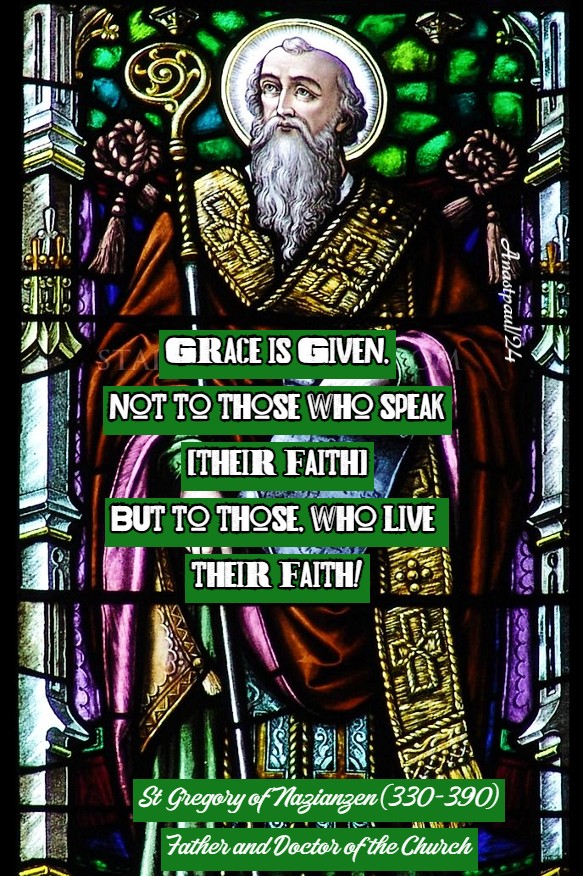
“Grace is given, not to those who speak [their faith] but to those, who live their faith.”
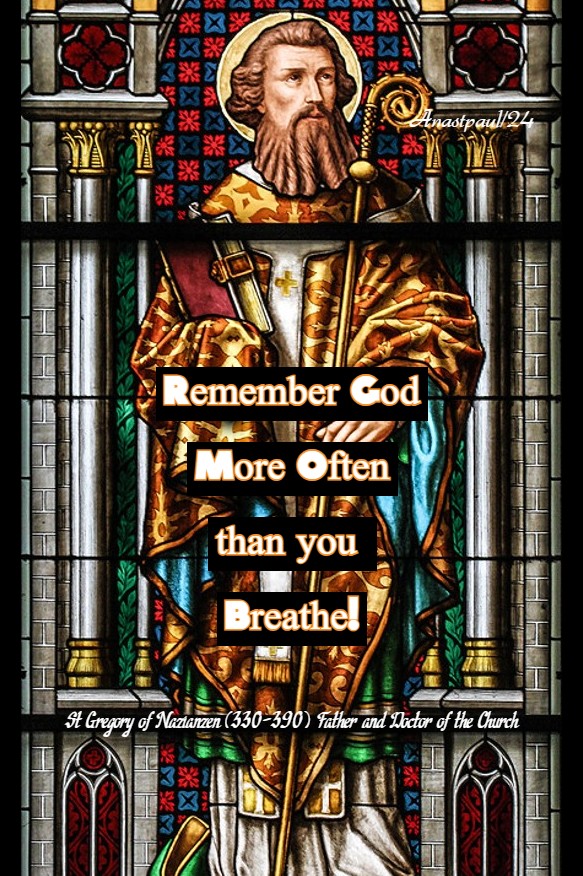
“Remember God more often than you breathe!”
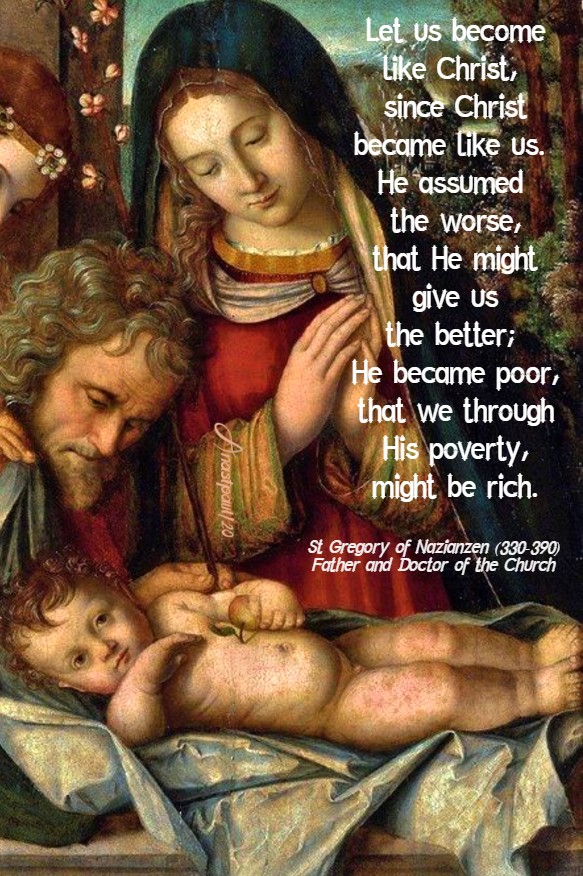
“Let us become like Christ, since Christ became like us. He assumed the worse, that He might give us the better; He became poor, that we through His poverty, might be rich.”
St Gregory of Nazianzen (330-390) Father and Doctor of the Church
Thought for the Day – 12 December – Meditations with Antonio Cardinal Bacci (1881-1971)
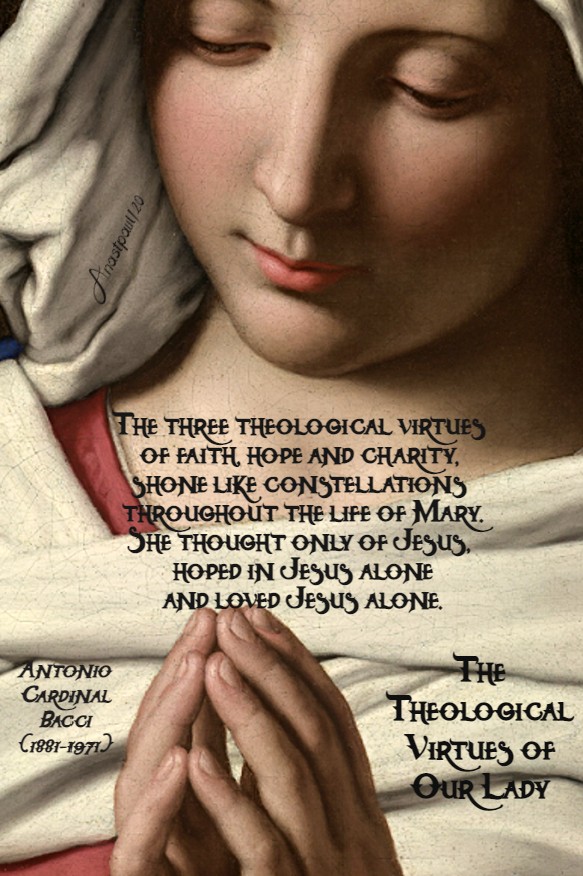
The Theological Virtues of Our Lady
“The three theological virtues of faith, hope and charity, shone like constellations throughout the life of Mary. “Blessed is she who has believed” (Lk 1:45), St Elizabeth said of her. Mary’s life was one long act of faith and of love. She lived continuously in the presence of God, being united to Him by lively sentiments of faith, hope and charity. Her spirit of constant prayer was the result of her intense practice of these theological virtues. When the Archangel Gabriel came down from Heaven, to bring her the tidings of her divine motherhood, he found her absorbed in prayer. When St Elizabeth praised and called her the Mother of her Lord, Mary, from the depths of her faith, attributed everything to God and glorified Him in her Magnificat. When the baby Jesus was born in the cave of Bethlehem, she adored Him with faith, hope and love, as her God and future Saviour. When she realised that Herod was searching for her Son to put Him to death, she placed her confidence in Him. She fled with Him into Egypt and brought Him back later, to their land, always with the same faith, hope and love. Her faith and hope were not weakened by the loss of Jesus in Jerusalem, only her mother’s love was disturbed, on this occasion. When it seemed in that hidden life of Nazareth, that Jesus was leading a life of pointless silence, her faith and hope in Him, did not fade, while her love grew greater from day to day. In the triumphs and sorrows of His public life, she continued to practice, to an extraordinary degree, these three virtues – on the road to Calvary, at the foot of the Cross, at the removal of Our Lord’s body from the Cross, at the tomb, at the glorious Resurrection, Ascension and Pentecost. At last, when she was alone in this world without Jesus, these three virtues seemed to burn more brightly in her soul. She thought only of Jesus, hoped in Jesus alone and loved Jesus alone. Then Jesus rewarded the lively faith, expectant hope and flaming charity of His Mother, for on her assumption into Heaven, these three virtues shared in her triumph and coronation.”
Thought for the Day – 11 December – Meditations with Antonio Cardinal Bacci (1881-1971)
Christ’s Work in Us
“It is not enough that Jesus live in us ; He must increase and act in us continually. The Spiritual life is like natural life. It cannot stop, for to halt would mean death! If Jesus is our life, He should live in us with ever-increasing intensity. Life is like a stairway, we are either going up or coming down.
If we continue to climb energetically towards Jesus, we shall be coming nearer to Christian perfection. If, on the other hand, we halt, the supernatural life of Jesus in us, will begin to weaken. Tepedity will replace fervour and sin will succeed tepidity. It is difficult to remain unchanged because, life involves movement. ‘Jesus Christ,” writes St Augustine, “was born a baby but, He did not remain one. He grew to boyhood, to adolescence and then, to maturity.”
It is necessary for us to grow also. More precisely, it is necessary that Jesus grow continuously in us through faith, charity and good works. “Court the good,” admonishes St Paul, “from a good motive always … until Christ is formed in you” (Gal 4:18-19).
It is not enough that Christ be born in us, it is necessary that He increase to the fullness of perfection (Cf Eph 4:13-16). “Jesus increases daily,” writes Origen, “in the soul of the holy and just man, which mirror His grace, His wisdom and His sanctity. In the soul of the unfortunate sinner, however, Christ decreases and dies.”
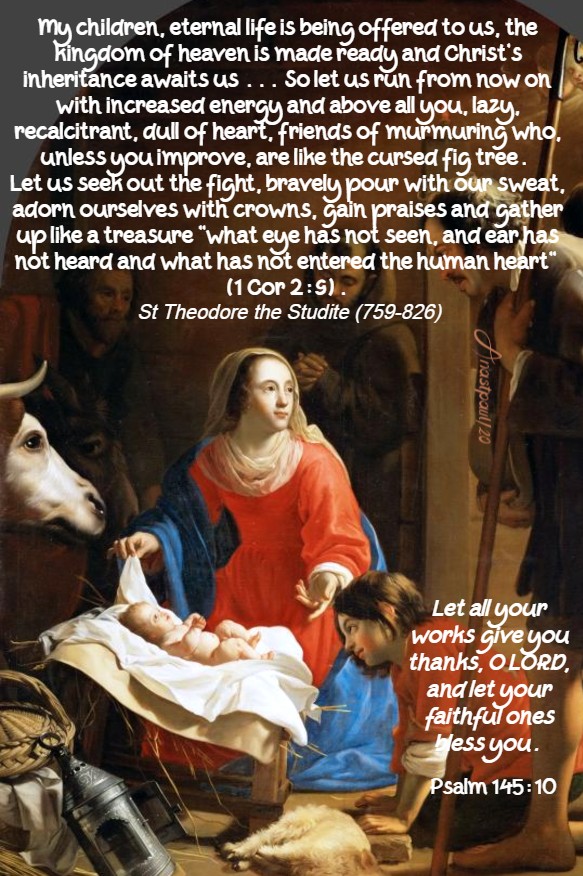
Let all your works give you thanks, O LORD, and let your faithful ones bless you. Let them discourse of the glory of your Kingdom and speak of your might. – Psalm 145:10-11
REFLECTION – “My children, eternal life is being offered to us, the kingdom of heaven is made ready and Christ’s inheritance awaits us – the enjoyment of innumerable and unimaginable blessings, the happiness of a great joy and of immortality, glory and honour without measure and all the other blessings in such great number, that human language is not sufficient to make known its grace and mercy (cf. Wsd. 3:9)! So let us run from now on with increased energy and above all you, lazy, recalcitrant, dull of heart, friends of murmuring who, unless you improve, are like the cursed fig tree. We surround it with manure (cf. Lk 13:8) and it takes no root at all, we water you with words and not a bit of growth results! “Even now the ax lies at the root of the trees” (Lk 3:9) and I will silence the rest. Let us seek out the fight, bravely pour with our sweat, adorn ourselves with crowns, gain praises and gather up like a treasure “what eye has not seen, and ear has not heard and what has not entered the human heart” (1 Cor 2:9).
Let us rule our lives by that of our fathers, that which goes back to the origin, let us follow in the footsteps of their virtues, love their upright deeds, make of our way of life an image of their own. (…) Yes, let us work together with them! Let us act with them! Let us follow in their footsteps! Yes! Let us, too, fulfil what is right and holy! In this way we will share in their glory, we will be crowned and, together with them, exult in the kingdom of heaven, in Christ Jesus our Lord, to whom belongs the glory and the power, with the Father and the Holy Spirit, now and for ever. Amen.” – St Theodore the Studite (759-826) Catechesis 72 (from the Great Cathecheses)
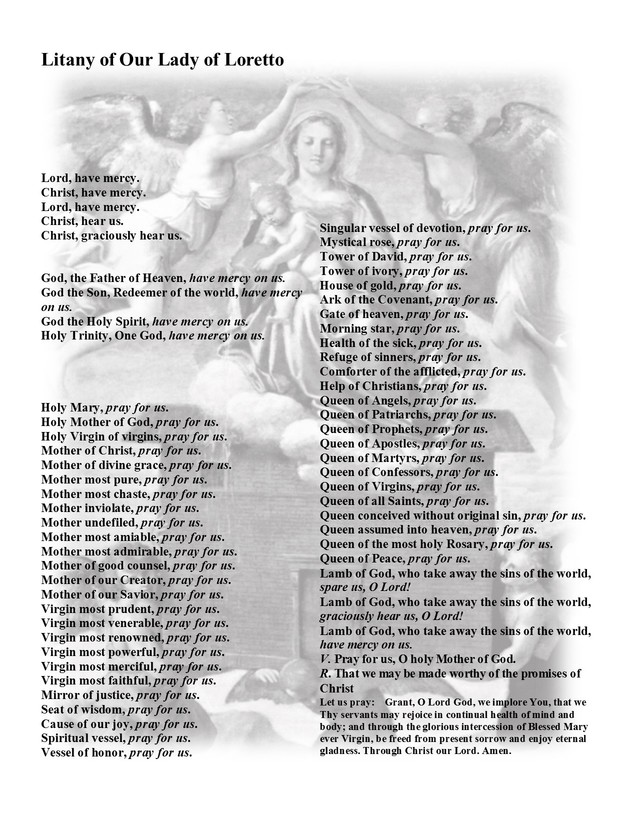
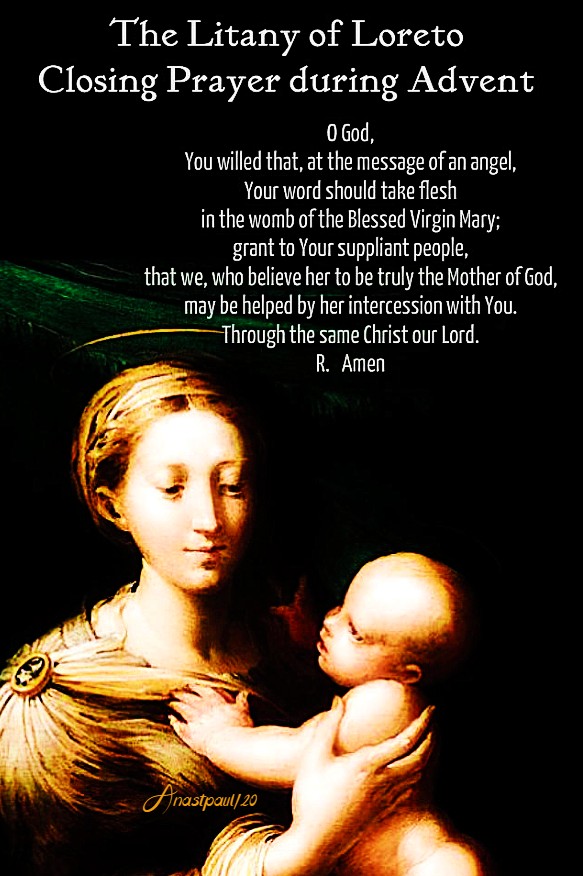
PRAYER – O God, You willed that, at the message of an angel, Your word should take flesh in the womb of the Blessed Virgin Mary; grant to Your suppliant people, that we, who believe her to be truly the Mother of God, may be helped by her intercession with You. Through the same Christ our Lord.
Quote/s of the Day – 7 December – The Memorial of St Ambrose (c 340-397) – Father and Doctor of the Church
“And this Body, which we make present, is the Body born of the Virgin. Why do you expect to find in this case, that nature takes its ordinary course in regard to the Body of Christ, when the Lord Himself was born of the Virgin in a manner above and beyond the order of nature? This is indeed the true flesh of Christ, which was crucified and buried. This is then, in truth, the Sacrament of His Flesh.”
“Rise, you who were lying fast asleep… Rise and hurry to the Church: here is the Father, here is the Son, here is the Holy Spirit.”
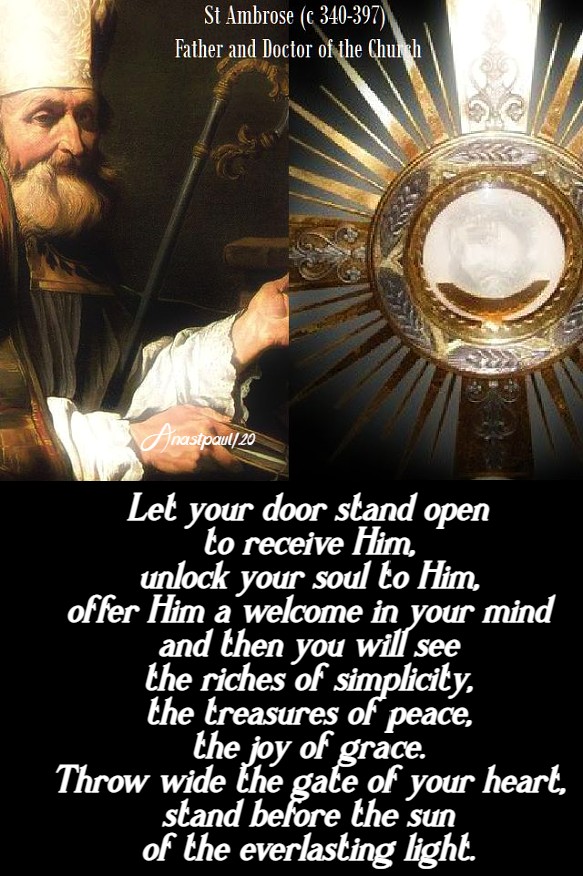
“Let your door stand open to receive Him, unlock your soul to Him, offer Him a welcome in your mind and then you will see the riches of simplicity, the treasures of peace, the joy of grace. Throw wide the gate of your heart, stand before the sun of the everlasting light.”
“Prayer is the wing, wherewith the soul flies to heaven and meditation, the eye, wherewith we see God.”
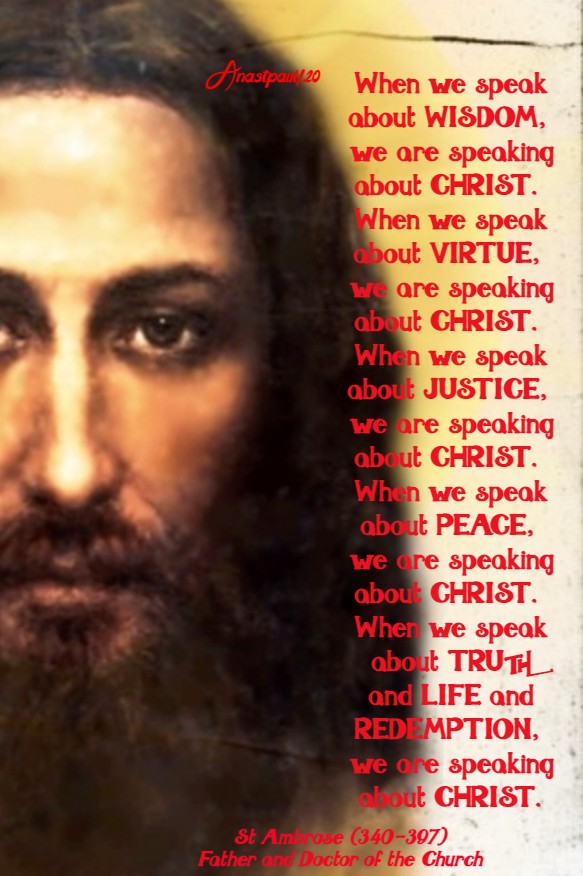
“When we speak about WISDOM, we are speaking about CHRIST. When we speak about VIRTUE, we are speaking about CHRIST. When we speak about JUSTICE, we are speaking about CHRIST. When we speak about PEACE, we are speaking about CHRIST. When we speak about TRUTH and LIFE and REDEMPTION, we are speaking about CHRIST.”
St Ambrose (340-397) Father and Doctor of the Church


















 AnaStpaul
You must be logged in to post a comment.