Thought for the Day – 28 October – Meditations with Antonio Cardinal Bacci (1881-1971)
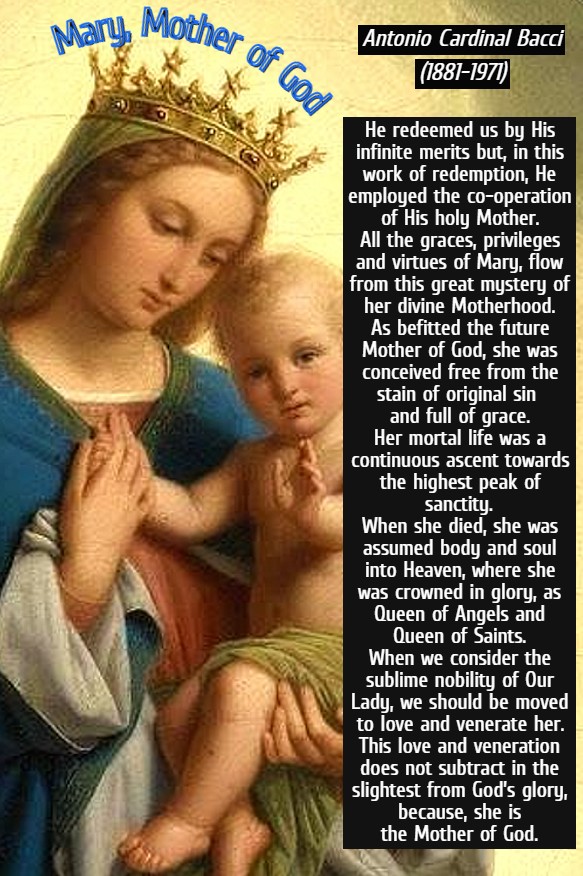
“Month of the Holy Rosary” “Mary, Mother of God”
“The near-infinite greatness of Mary, flows from the fact, that she is the Mother of God. The Eternal Word of the Father, consubstantial with Him in nature and equal to Him in Majesty, willed to become man in order to set us free from the slavery of sin and to regain Heaven for us. He became man in the chaste womb of the Virgin Mary. He took a human body and soul and was born of her, as the God-Man. For this reason, there is attributed to His Divine Person, the title of Son of Mary and to Mary, the title of Mother of God.
There is a relationship between Mary and each of the three Divine Persons, for she is the daughter of God the Father, the spouse of the Holy Spirit by whose power the Word became incarnate in her and the mother of the Word made Man. She is, moreover, in the words of Dante, the “termine fisso di eterno consiglio” (Paradiso 33:1-3). In other words, she is the centre of the eternal plan which God established for the redemption of the human race. It was God’s eternal design to reunite creation to the Uncreated, by means of Mary. She became the mother of the Eternal Word, in whom the divine and human natures were indissolubly united. He redeemed us by His infinite merits but, in this work of redemption, He employed the co-operation of His holy Mother. All the graces, privileges and virtues of Mary, flow from this great mystery of her divine Motherhood. As befitted the future Mother of God, she was conceived free from the stain of original sin and full of grace. Her mortal life was a continuous ascent towards the highest peak of sanctity. When she died, she was assumed body and soul into Heaven, where she was crowned in glory, as Queen of Angels and Queen of Saints. When we consider the sublime nobility of Our Lady, we should be moved to love and venerate her. This love and veneration does not subtract in the slightest from God’s glory, because, she is the Mother of God. In fact, it is a great advantage to us, to imitate her and to call on her to intercede for us.”
Quote/s of the Day – 18 October – The Feast of St Luke, the Evangelist
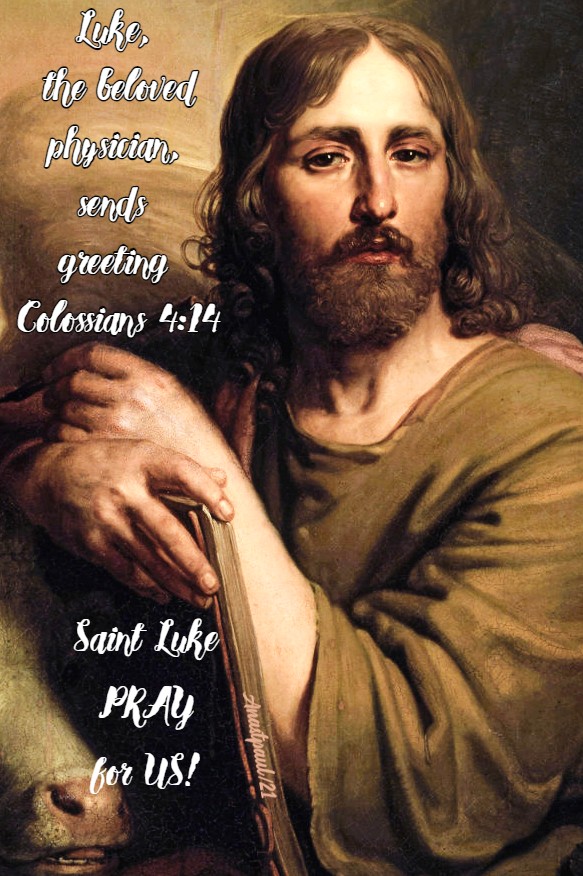
“Luke, the beloved physician, sends greetings … ”
Colossians 4:14
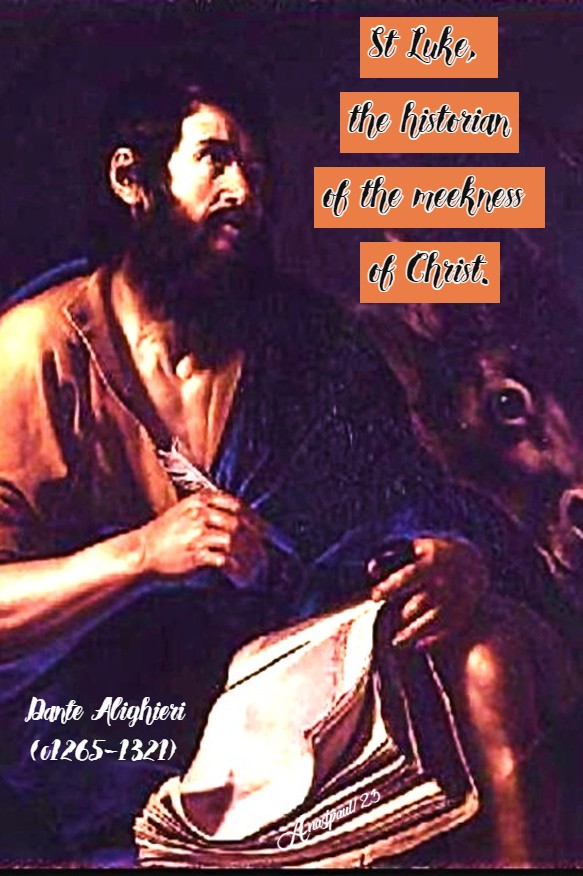
“St Luke, the historian of the meekness of Christ.”
Dante Alighieri (c1265-1321)
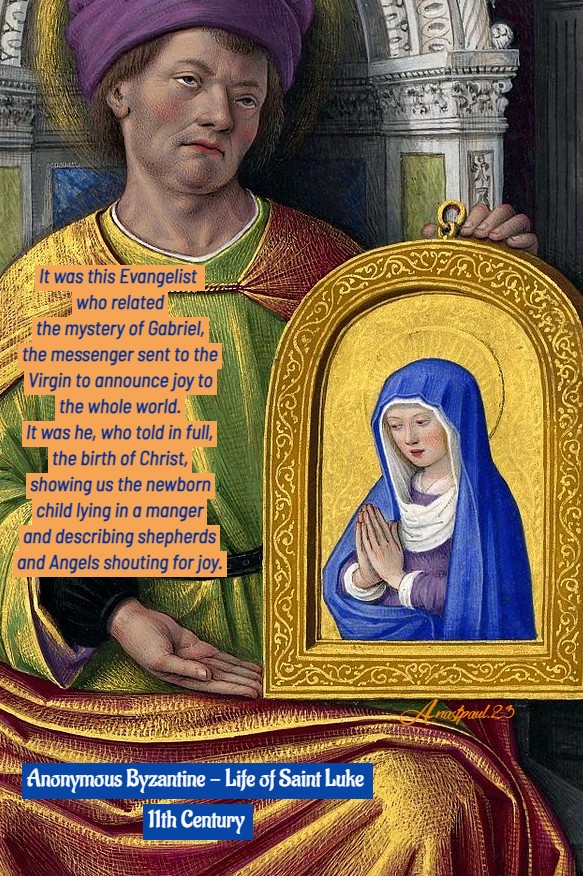
“It was this Evangelist who related the mystery of Gabriel, the messenger sent to the Virgin to announce joy to the whole world. It was he, who told in full, the birth of Christ, showing us the newborn Child lying in a manger and describing shepherds and Angels shouting for joy.”
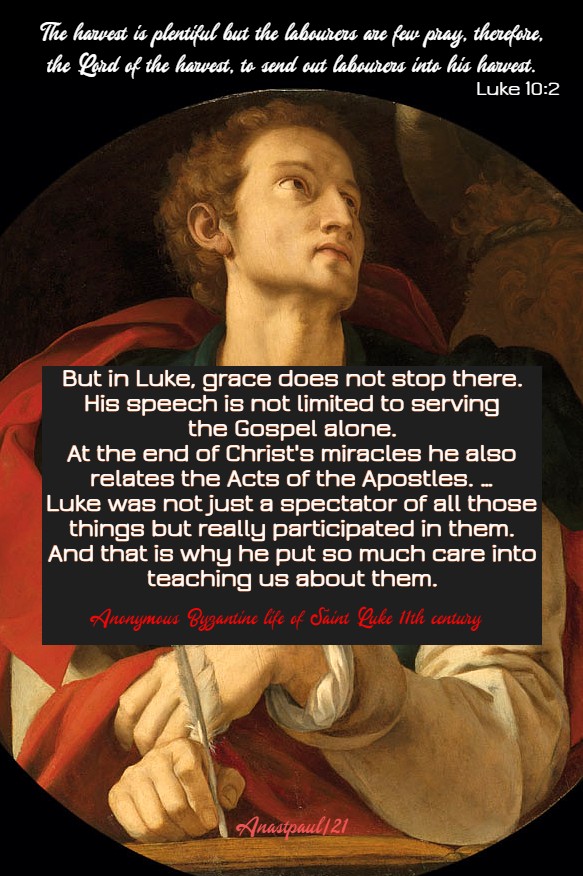
“The harvest indeed is great but the labourers are few. Pray ye, therefore, the Lord of the harvest that He send labourers into His harvest.” Luke 10:2
“But in Luke, grace does not stop there. His speech is not limited to serving the Gospel alone. At the end of Christ’s miracles he also relates the Acts of the Apostles. … Luke was not just a spectator of all those things but really participated in them. And that is why he put so much care into teaching us about them.”
Anonymous Byzantine – Life of Saint Luke 11th Century
Thought for the Day – 28 August – Meditations with Antonio Cardinal Bacci (1881-1971)
The Creation
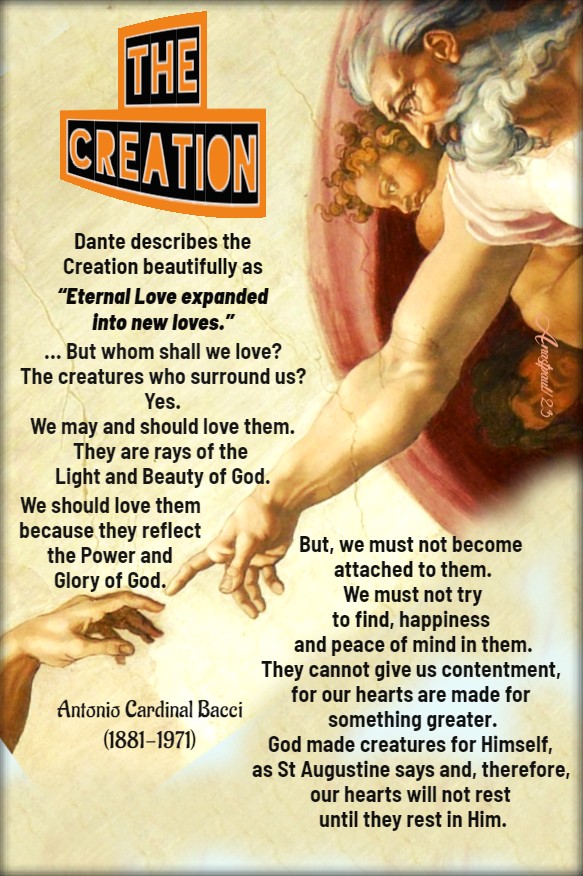
“Dante describes the Creation beautifully as “Eternal Love expanded into new loves.” Heaven and earth, Angels and men and all created beings, are nothing more than an expansion of this Eternal Love, into new loves. Love unites and fills everything. Everywhere in Heaven and on earth, there is love, there is need of love. But whom shall we love? The creatures who surround us? Yes. We may and should love them. They are rays of the Light and Beauty of God. We should love them because they reflect the Power and Glory of God. But, we must not become attached to them. We must not try to find, happiness and peace of mind in them. They cannot give us contentment, for our hearts are made for something greater. God made creatures for Himself, as St Augustine says and, therefore, our hearts will not rest until they rest in Him.”
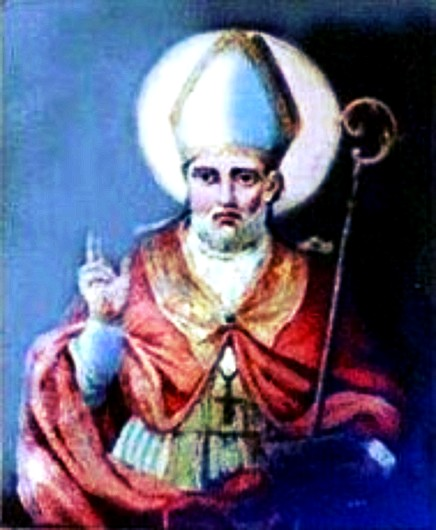
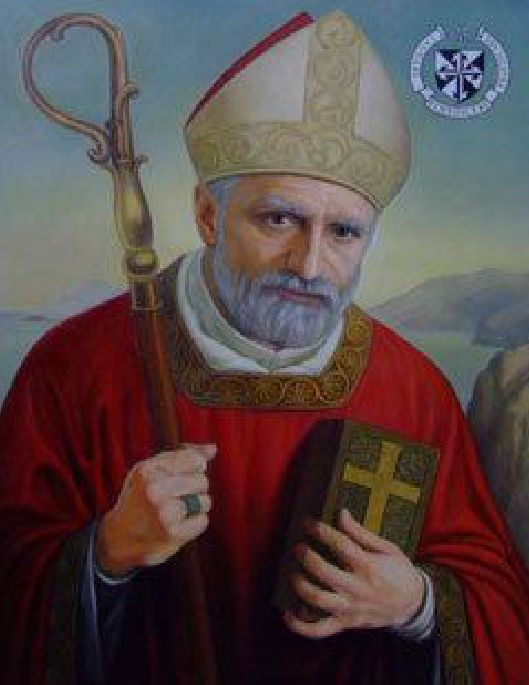
Blessed Augustine Gazotich OP (1262-1323) Bishop of Lucera, Croatia, of the Order of Preachers. He was also noted for being the guide for Dante Alighieri as the poet travelled through Croatia. His reputation for personal holiness remained noted long after his death; this resulted in Pope Innocent XII confirming the late Bishop’s Beatification in 1700. Bl Augustine’s Devout Life: https://anastpaul.com/2018/08/03/saint-of-the-day-3-august-blessed-augustine-gazotich-o-p-1262-1323/
Thought for the Day – 16 May – The Imitation of the Blessed Virgin Mary By Thomas à Kempis (1380-1471)
Extracts from The Imitation of the Blessed Virgin Mary By Thomas à Kempis CRSA (1380-1471) Imprimatur 17 February 1947
SERMON (V) Duty
I. Duty is a harsh word, when it designates the obligation which binds a man to his post. It becomes a word full of sweetness, when it is applied to the voluntary attentions which the heart suggests for a loved one. Our duties to Mary should be of this type. These duties, extremely pleasing, are those of a son to his mother, of a friend to his friend.
The thought of Heaven is a force, as the thought of love is an allurement. To raise one’s thoughts, is to raise oneself completely –Altius cogita (think higher).
II. It is in the life of the soul, as in the present life; to think well, is the beginning of doing well. To have great thoughts is to prepare for great actions. Mary’s example, in this case, is more than a demonstration, it is an attraction and an aid. Mary, says the Gospel, kept all these things in her heart. As Pascal said, great thoughts come from the heart, it is they that create the action. Too often has mysticism been reproached as being only a dream. The mysticism of the Imitation, is an action, for it is perfection!
III. This action is arduous and often discouraging; besides, the soul begs Mary for confidence to be able to attain the goal of the spiritual life which is Heaven.
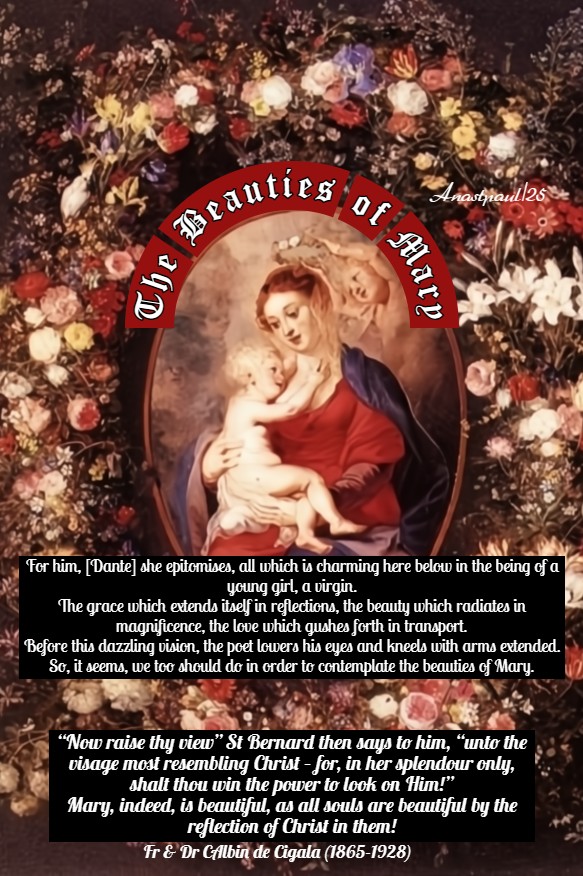
MEDITATION The Beauties of Mary
The dream of every soul would be to see Mary in her heavenly splendour – Dante had this dream and tried to translate it into his Paradise. He represents Mary to us under the symbol of an aureole of pure gold and he refers to her only, by the names of flowers and nature – “blooming rose” “lily full of whiteness”, “perfumed stem” “fragrant tree”, “singing lyre” “sparkling sapphire” “soaring flame” “arc which riseth.” He sees her only in the midst of flowers, surrounded by stars, crowned with splendours. For him, she epitomises, all which is charming here below in the being of a young girl, a virgin. The grace which extends itself in reflections, the beauty which radiates in magnificence, the love which gushes forth in transport. Before this dazzling vision, the poet lowers his eyes and kneels with arms extended. So, it seems, we too should do in order to contemplate the beauties of Mary.
“Now raise thy view” St Bernard then says to him, “unto the visage most resembling Christ – for, in her splendour only, shalt thou win the power to look on Him!” Mary, indeed, is beautiful, as all souls are beautiful by the reflection of Christ in them!
Practice: Imitate the Saints, who wore the shield and insignia of Mary, like the Scapular and the Rosary.
Thought: The remembrance of Mary is an aid and a support – “Adjuvat et sublevat – it aids and consoles.”
Fr & Dr Célestin Albin de Cigala (1865-1928) Faculty of Paris (1947) Doctor of Theology and Philosophy
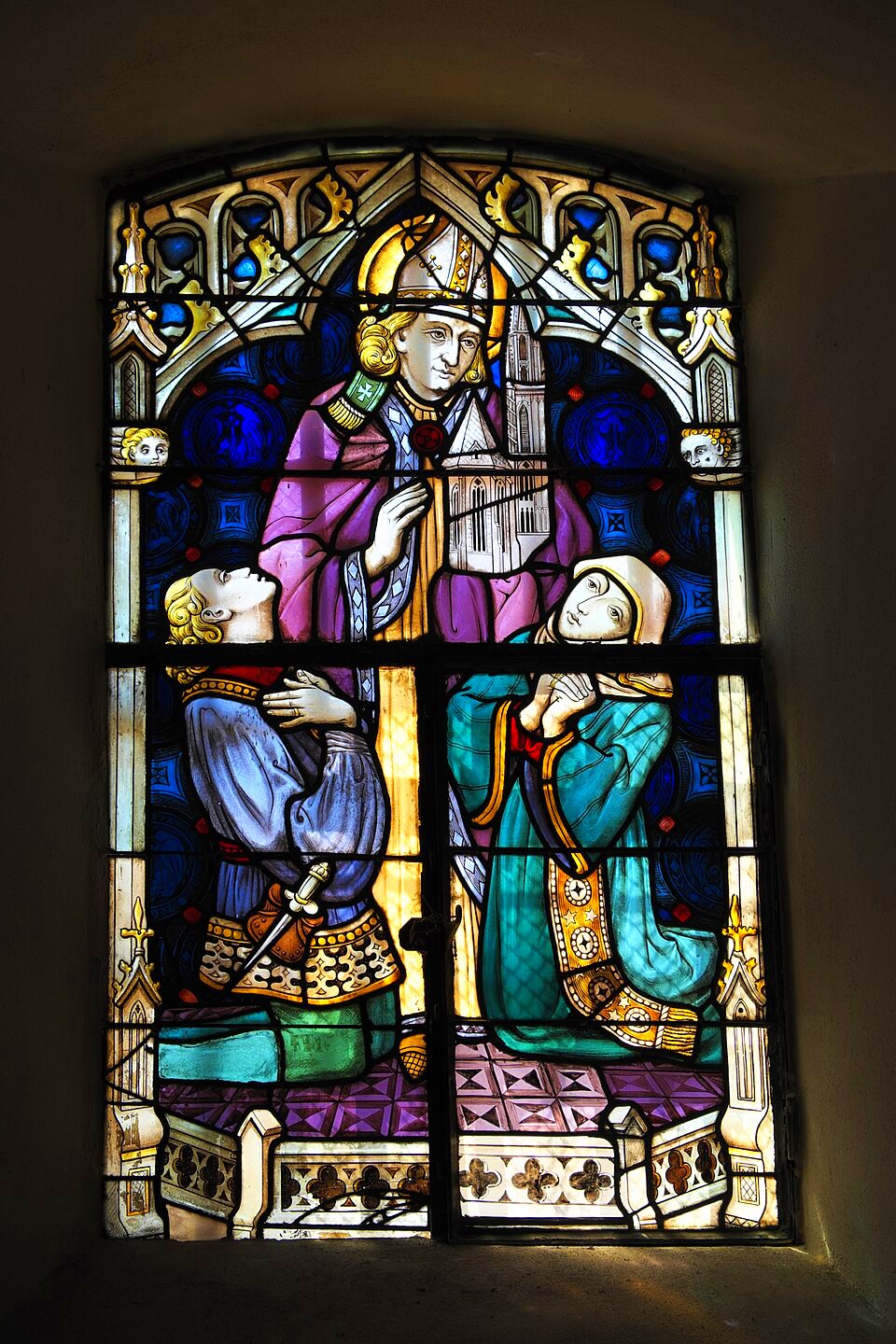
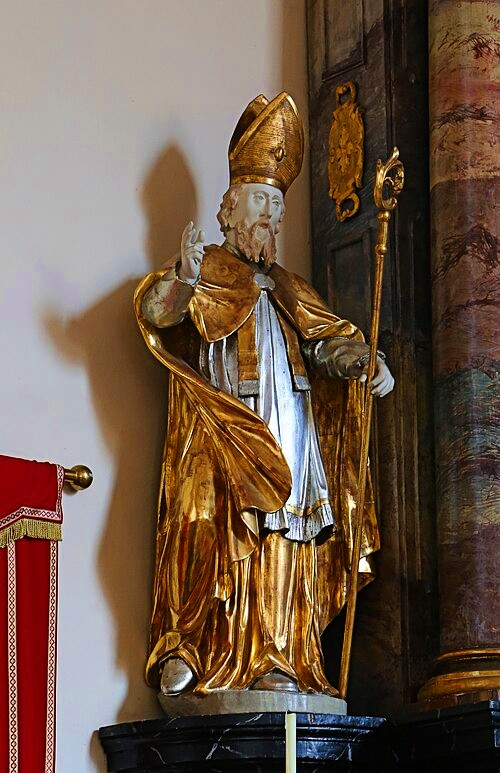
Saint of the Day – 16 May – St Ubaldus Baldassini (c1085-1160) Bishop and Confessor, Reformer, untiring Shepherd and protector of his flock both in spiritual and temporal affairs, Apostle of all the needs of the poor and Defender of his City, Miracle-worker. Born in c1085 in Gubbio near Ancona, Umbria, Italy as Ubaldo Baldassini and died in the same City at around sunrise on Monday 16 May 1160 . Also known as – Ubaldus of Gubbio, Ubaldo… Ubald… Ubalde… Patronages – of Gubbio and Montovi, in Italy, St Ubaldus was Canonised in 1192 by Pope Celestine III.
The Roman Martyrology reads today: “At Gubbio, St Ubaldus, a Bishop renowned for miracles.”
Ubaldus was born into the noble Baldassini family in c1085. His parents died while he was still a child and he was raised by an uncle. He was educated at St Secondus Monastery and then at St Marianus. However, he disapproved of the way of life of the Clergy of San Marianus and, in 1104, he return to St Secondus.
The old Bishop Rusticus died and was succeeded by St John of Lodi. At the request of the new Bishop, St Ubaldus returned to Sant Marianus.
Ubaldus was Ordained in 1114 and was elected Prior of the St Marianus Canonric some four years later He was sympathetic to the cause of Church reform and imposed an ascetic Rule on his community. [He imposed what is known as the Portuense Rule which Pope Paschal II had confirmed in 1116 for a community of Regular Canons at the Church of Santa Maria in Portu on the Island of Corizo near Ravenna. This Rule subsequently became widely diffused in Italy, France, Spain and Germany.]
In 1126, when a fire destroyed much of Gubbio, including the Cathedral and the Monastery, Ubaldus fled to the Eremo di Fonte Avellana, intent on dedicating himself to the monastic life. Ubaldus had donated his inheritance to the poor and to the restoration of Monasteries. Several bishoprics were offered to him,but he refused them all. However, when in 1128, the Episcopal See of Gubbio becoming vacant, he was sent, with some Clerics, by the faithful, to ask Pope Honorius II, for a newBishop. The Pope immediately Consecrated Ubaldus and sent him back to Gubbio. To his people he became a perfect pattern of all Christian virtues and a powerful protector in all their spiritual and temporal needs.
Ubaldus became its Bishop, just a year before the start of the Papal schism. His support Pope Innocent II (perhaps because this was the candidate supported by St Bernard) seems to have been influential in deciding the obedience of the Cities of Umbria.
One of his first acts as the Bishop was to begin the rebuilding of the City. During the years 1135-1140, our Saint Ubaldus, calmed the civil unrest which culminated in the establishment of the government of the region and the election of Consuls. In 1151, exiled nobles from Gubbio seem to have mobilised support from some eleven neighbouring Cities and a force under Perugian leadership attacked Gubbio. However, Ubaldus had rebuilt the walls of the City and the invaders were forced to mount a siege. Fortunately, St Ubaldus was able to dispatch soldiers to the surrounding mountains under cover of darkness. The following day the besieging army found itself surrounded and was forced to withdraw.
His assistance was again needed in 1155, when the Emperor Frederick I, who was camped with a large army after the sack of Spoleto, demanded a huge payment from Gubbio to prevent a similar seige. St Ubaldus pleaded with Frederick I, who was so impressed that he left the City in peace and granted it a number of territorial privileges.
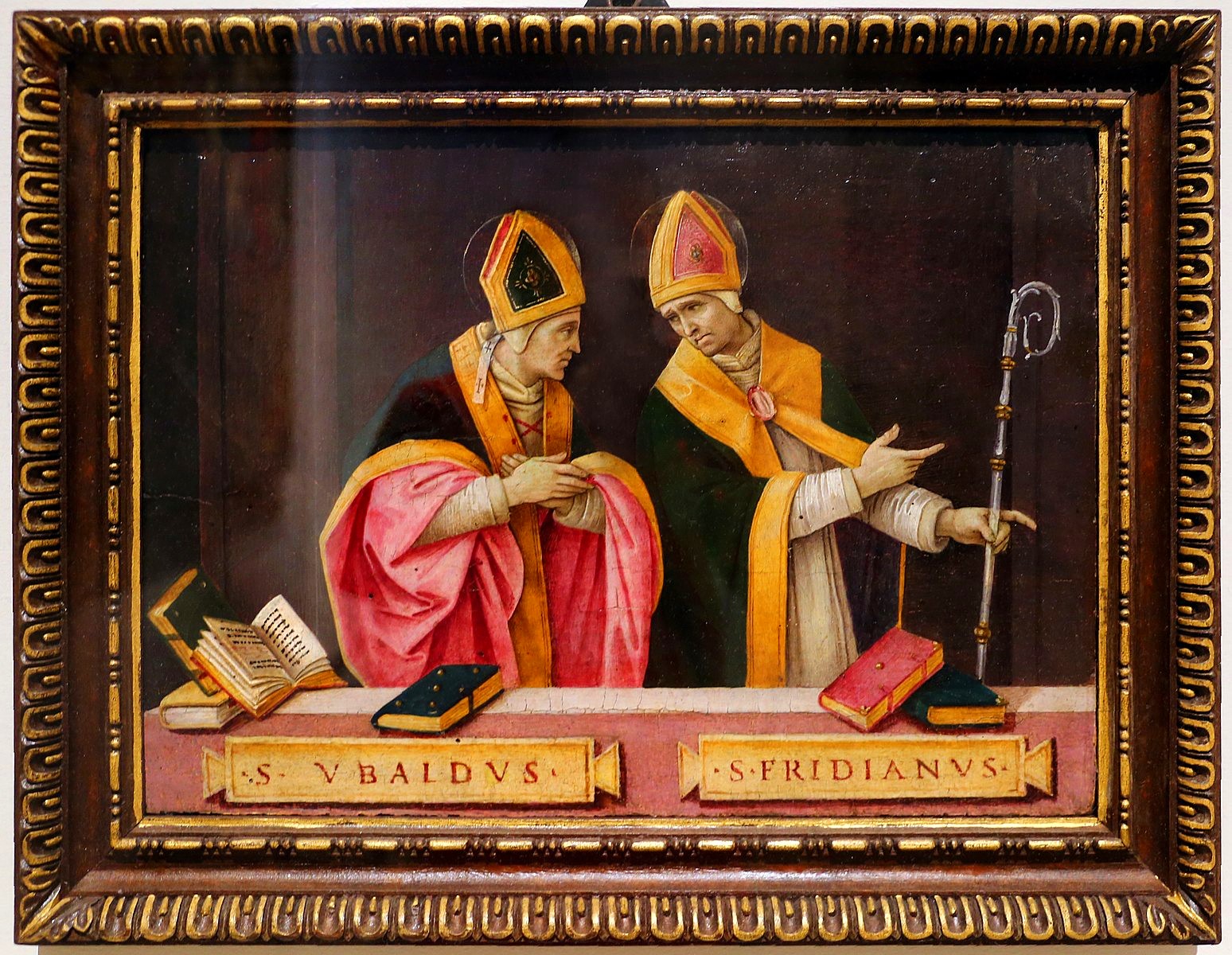
St Ubaldus left and St Fredianus right
Ubaldus was known for his patience and heroic gentleness and was considered to have the gift of healing. Once it happened, that in repairing the wall of the City, the workmen encroached upon his vineyard. The Bishop mildly put them in mind of it, and desired them to forbear. The overseer of the work moved with fury, scornfully pushed him into a great heap of mortar. The good Bishop got up all covered with lime and dirt, without making the least expostulation. The people demanded that the overseer, in punishment for the offence, should be banished and his goods confiscated. The Saint endeavoured to present the incident as an accident but when that did not satisfy the people, who knew how it happened, he, being desirous to deliver the man out of the hands of the magistrates, maintained that the consideration of the misdemeanour belonging to his own jurisdiction, he would take care to render justice himself. Ubaldus then pardoned him.
Numerous miracles were attributed to St Ubaldus during his life and after his death. A number of miraculous cures were attributed to his intercession. The life of St Ubaldus was written by Theobald, his immediate successor in the Episcopal See.
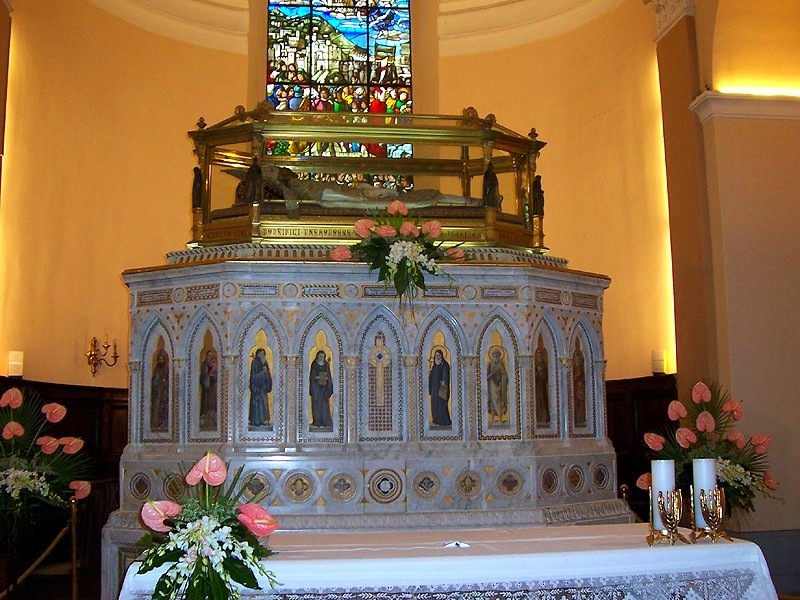
St Ubaldus Shrine
When St Ubaldus died in 1160, he was buried in the old Duomo, beside the Relics of Sts Marianus and James. In 1188, Pope Clement III gave permission to Bishop Benedetto Bentivoglio, for the translation of the Relics of the saints of Gubbio, (presumably including the body of the future St Ubaldus) from the olf City to the site on the mountain, where the new City Cathedral had been constructed. Now known as the Basilica of St Ubaldus, it is frequented by numerous pilgrims.
Dante mentions Ubaldus in the Divine Comedy (Heaven Canto XI): “Between Tupino and the stream which falls from the blest Ubaldus’ chosen hill, the slope is green, a lofty mount below.”
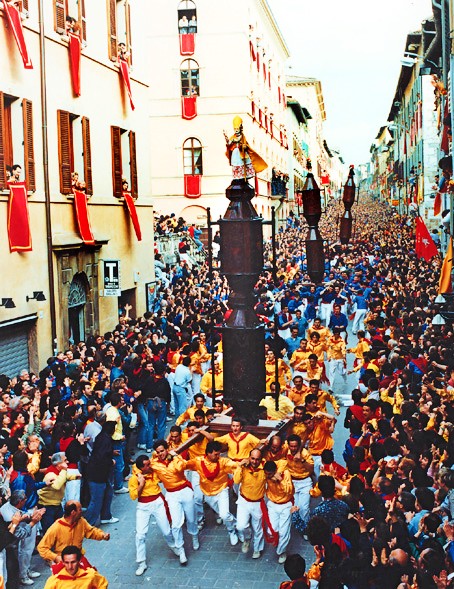
The festival of La Corsa dei Ceri at Gubbio. The statue of Saint Ubaldo leads the procession, followed by ceri topped with the statues of Saint George and Saint Anthony the Great.
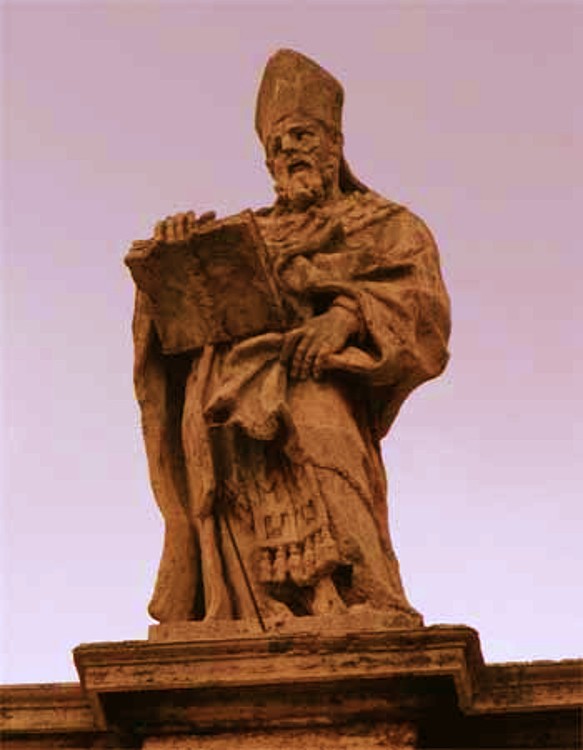
St Ubaldus Statue on the South Colonnade, Curved Arm, at St Peter’s Basilica.
Saint of the Day – 15 August – Saint Arduinus of Rimini (Died 1009) Priest, Hermit, Monk, Apostle of the needy, a shining light of the imitation of his Lord. Born around the middle of the 10th Century in Rimini, in the district of Romagna in Italy and died at the Monastery of St Gaudenzio in the Town of San Godenzo in 1009 of natural causes. Also known as – Arduino.
St Peter Damian OSB (1007-1072) Cardinal Bishop of Ostia, Father and Doctor of the Church, when he found himself having to demonstrate the validity and efficacy of the Sacraments – even when administered by unworthy Priests and Prelates, – used to cite the example of our Saint Arduinus of Rimini, who had died several decades before but whose memory was still very much alive throughout Romagna.
Arduinus, in fact, had received Priestly Ordination from the Bishop of Rimini, Uberto, a well-known simoniac, who had purchased his Office in exchange for gold. Yet, Ordination by this unworthy Prelate did not prevent Arduinus from living in an exemplary manner and dying in the odour of sanctity.
St Peter Damian, a great opponent of simony, could, therefore, draw arguments from this case in favour of his thesis – that is, that the efficacy of the Sacraments does not depend upon the merits of those who actually administer them – but rather, derives from the Infinite Merits of Christ.
Arduinus was born in Rimini towards the middle of the 10th Century and had been a disciple of the Venerius, the Rector of the Church of St Gregory.
Driven by the desire to reach a greater degree of perfection and sanctity, the master and disciple moved to the plain of Ravenna, finding refuge in the solitary Church of St Apollinarus in Classe, today famous for its luminous architecture and even more so for the precious Byzantine mosaics it houses.
The memory of Arduinus which has been handed down depicts him as a zealous Priest, a rare case in that time of daily celebration of the most Sacred and Holy Mass. His wonderful example could thus prove edifying for the clergy and the faithful. He used to teach, admonish and fight corruption, without fear of arousing the wrath of the powerful. He regularly donated alms to the neediest, contenting himself with surviving on the few remaining scraps. Being a man himself, he often found himself in the grip of temptations and, to overcome them, he used to roll in the nettles.
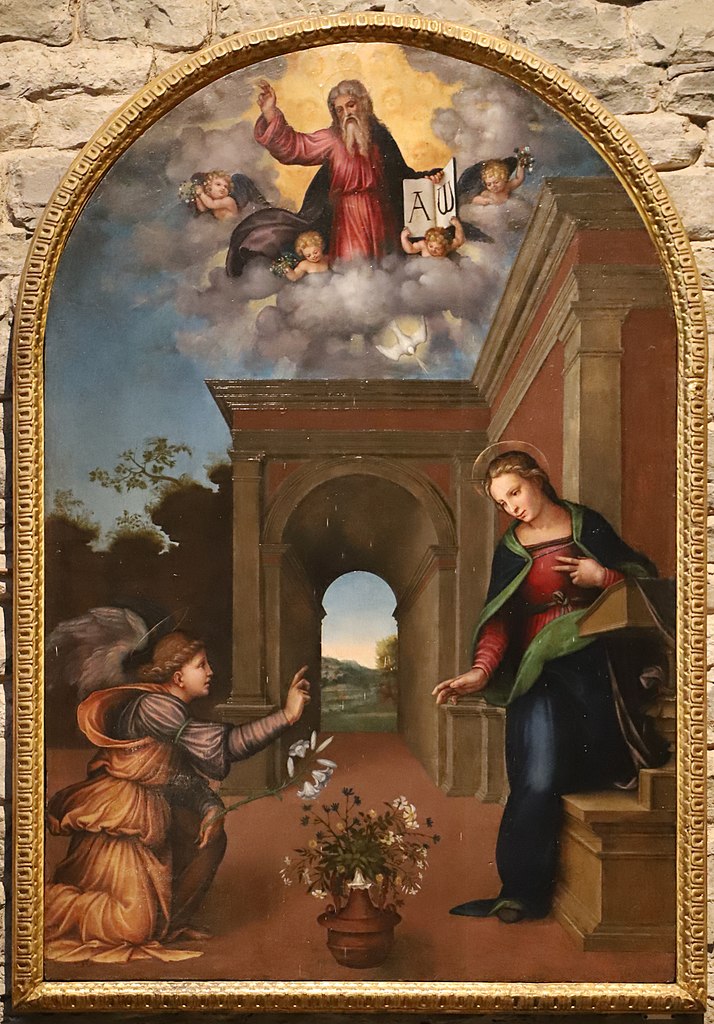
When Venerius was already old, Arduinus advised him to accept the position of Abbot of St Gaudenzio Monastery in the Town of San Godenzo and he, as an inhabitant Monk, thus became a useful and faithful assistant to his teacher. Below is one of the paintings in the Abbey of San Gaudenzio: The Annunciation attributed to in the Franciabigio, 1500s.
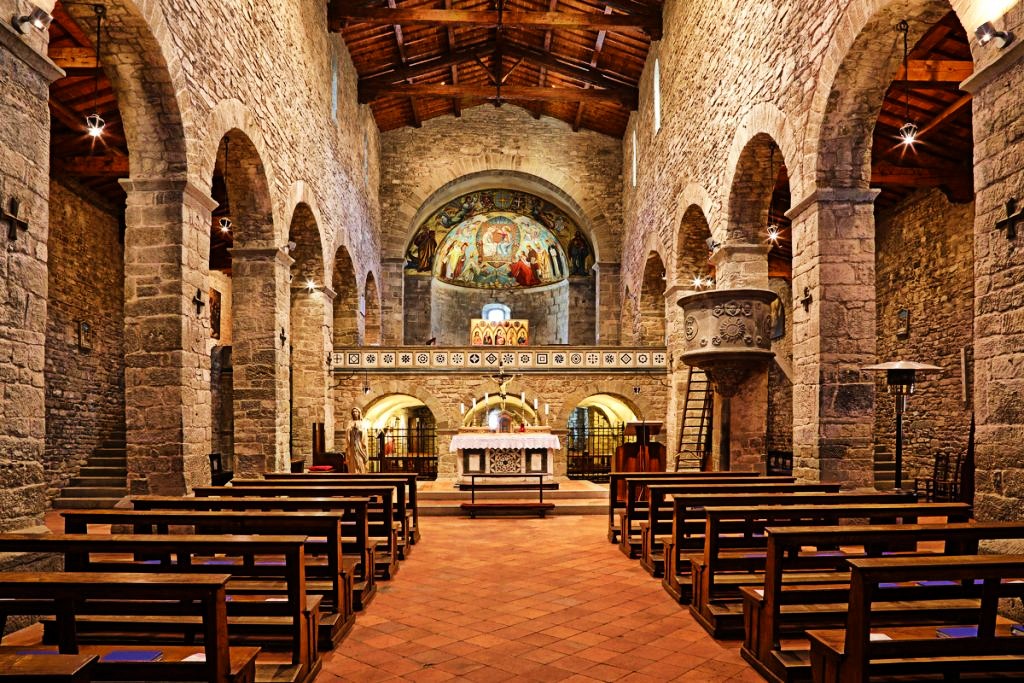
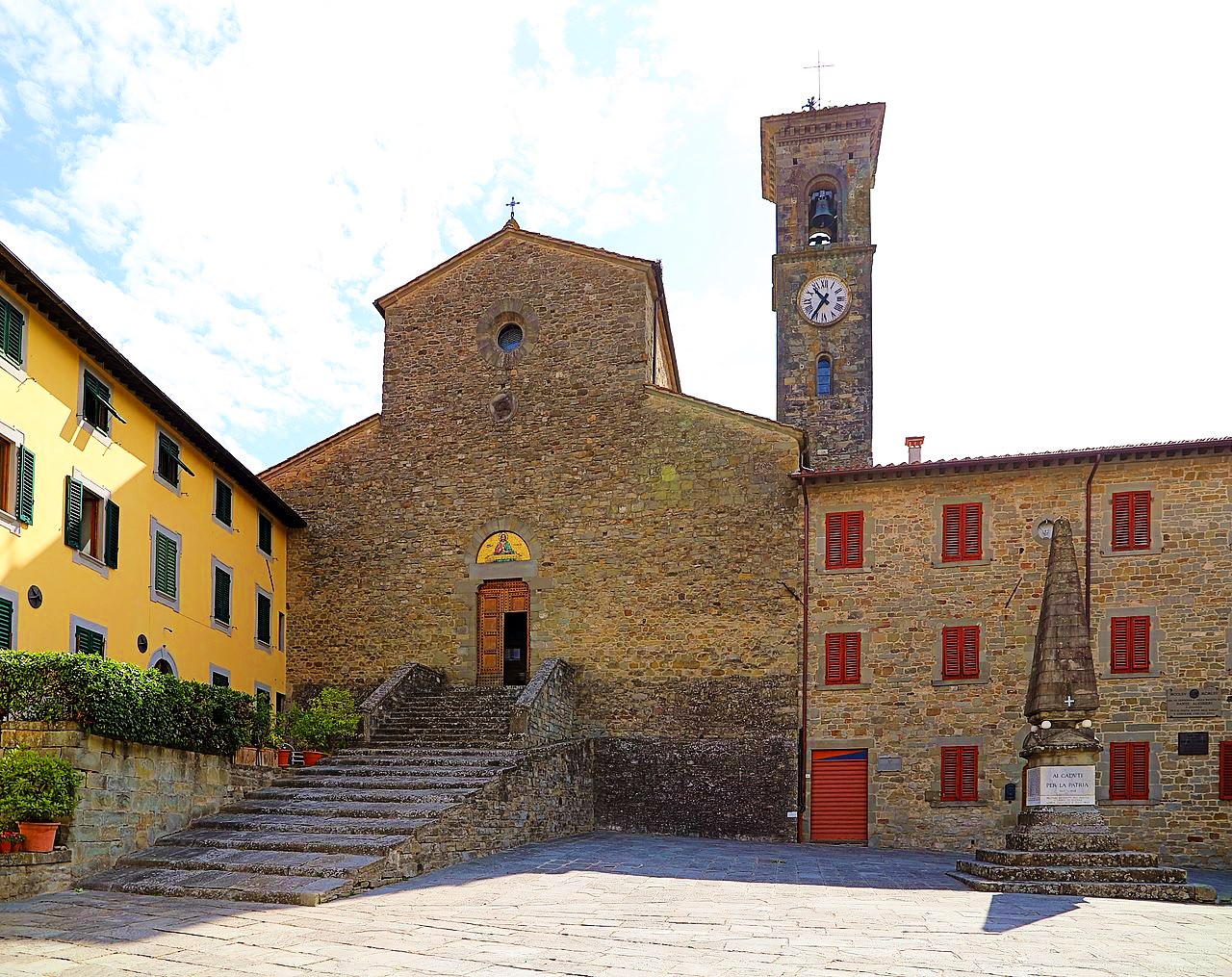
This Abbey had been built in 1028 in honour of Saint Gaudentius, the Hermit Saint who, around the 6th Century, retired to the surrounding mountains to live a life of silence and prayer. Today it is famous for its beautiful Romanesque Church containing wonderful artworks and for Dante’s memories of the first years of his exile.
But, already a thousand years ago, the Abbey of St Gaudentius was an important centre of Benedictine spirituality, active in the manual, spiritual, intellectual and social fields, true to their motto ‘Ora et Labora.’
In this context, in 1009, Saint Arduinus of Rimini died, immediately venerated as a Benedictine Saint, even if it seems he never officially wore the Habit of this Order. (From Italian by Author: Fabio Arduino).
Quote/s of the Day – 18 October – The Feast of St Luke, the Evangelist – 2 Corinthians 8:16-24, Luke 10:1-9 – Scripture search here: https://www.drbo.org/
“St Luke, the historian of the meekness of Christ.”
Dante Alighieri (c1265-1321)
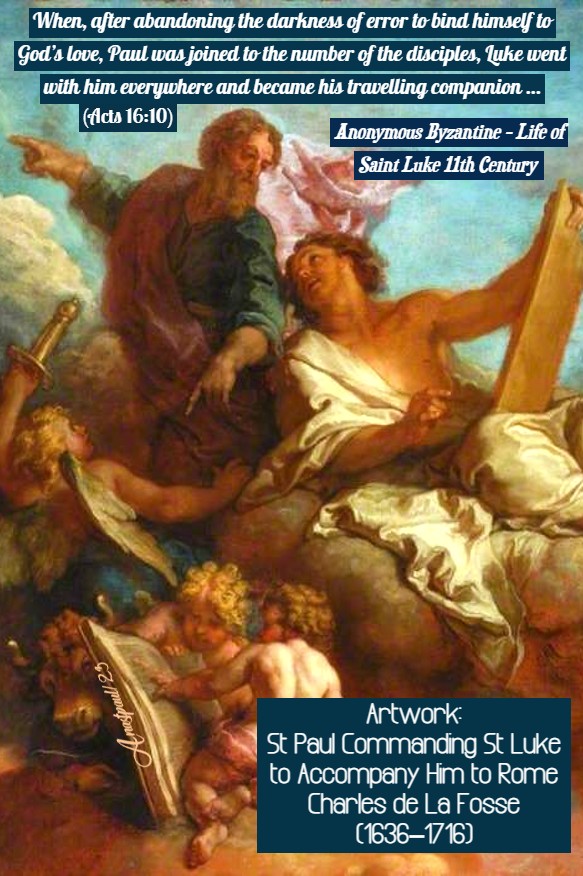
“When, after abandoning the darkness of error to bind himself to God’s love, Paul was joined to the number of the disciples, Luke went with him everywhere and became his travelling companion … ” (Acts 16:10)
“It was this Evangelist who related the mystery of Gabriel, the messenger sent to the Virgin to announce joy to the whole world. It was he, who told in full, the birth of Christ, showing us the newborn child lying in a manger and describing shepherds and Angels shouting for joy.”
“The harvest indeed is great but the labourers are few. Pray ye, therefore, the Lord of the harvest that He send labourers into His harvest.” Luke 10:2
“But in Luke, grace does not stop there. His speech is not limited to serving the Gospel alone. At the end of Christ’s miracles he also relates the Acts of the Apostles. … Luke was not just a spectator of all those things but really participated in them. And that is why he put so much care into teaching us about them.”
Anonymous Byzantine – Life of Saint Luke 11th Century
St Asclepiades of Antioch St Athenodorus (Died c269) Bishop Martyr the brother of St Gregory Thaumaturgus. St Brothen Bl Burchard I St Cadwaladr of Brittany Bl Domenico of Perpignano St Eutychius of Pozzuoli St Gwen St Gwen of Talgarth (463-c492) Widow St Gwendoline
Bl Margherita Tornielli St Monon of Nassogne St Proculus of Pozzuoli Bl Theobald of Narbonna St Tryphonia of Rome
Martyrs of Africa – 9 Saints: A group of Christians Martryed together in Africa. The only details that have survived are the names – Beresus, Dasius, Faustinus, Leucius, Lucius, Martialis, Victoricus, Victrix and Viktor. They were Martyred in c300 in Africa.
Thought for the Day – 10 September – Meditations with Antonio Cardinal Bacci (1881-1971)
The Creation
“Dante describes the Creation beautifully as “Eternal Love expanded into new loves.” Heaven and earth, Angels and men and all created beings, are nothing more than an expansion of this Eternal Love, into new loves. Love unites and fills everything. Everywhere in Heaven and on earth, there is love, there is need of love. But whom shall we love? The creatures who surround us? Yes. We may and should love them. They are rays of the Light and Beauty of God. We should love them because they reflect the Power and Glory of God. But, we must not become attached to them. We must not try to find, happiness and peace of mind in them. They cannot give us contentment, for our hearts are made for something greater. God made creatures for Himself, as St Augustine says and, therefore, our hearts will not rest until they rest in Him.”
Thought for the Day – 15 August – Meditations with Antonio Cardinal Bacci (1881-1971)
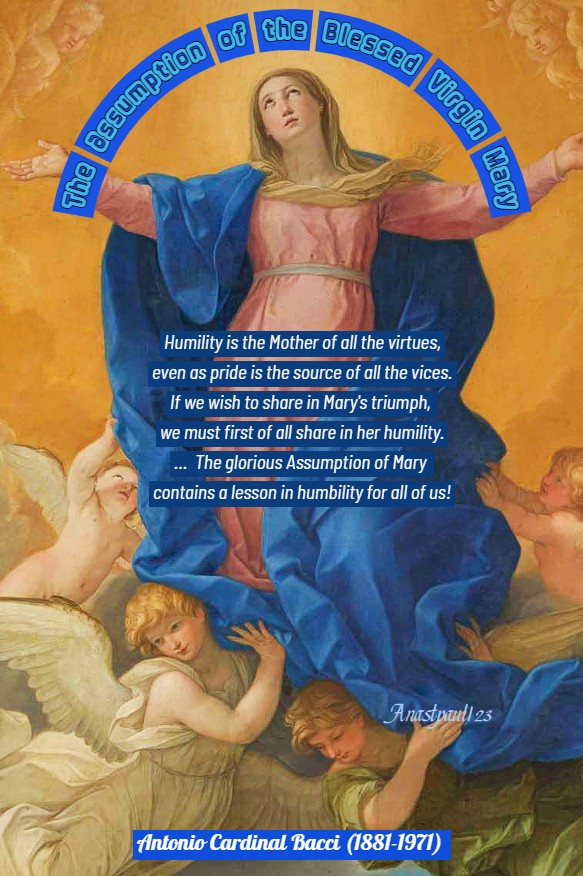
The Assumption of the Blessed Virgin Mary
“After she had risen, Mary was gloriously taken up into Heaven. Jesus has ascended into Heaven by His own power but Mary was borne aloft by the Angels, whose Queen she was soon to be proclaimed. She reigns in Heaven with her Divine Son and looks down in love and mercy on her exiled children, whom she is ever ready to assist.
She was the humblest and most exalted of creatures (Dante, Paradiso XXXIII 2), for, when told that she was to be the Mother of God, she desired to be called His handmaid.
Humility is the Mother of all the virtues, even as pride is the source of all the vices. If we wish to share in Mary’s triumph, we must first of all share in her humility.
“Everyone who exalts himself shall be humbled” Jesus has said “and he who humbles himself shall be exalted” (Lk 14:11). “God resists the proud,” we are reminded by the Apostle James “but gives grace to the humble” (Js 4:6).
The glorious Assumption of Mary contains a lesson in humbility for all of us!”
Thought for the Day – 30 January – Meditations with Antonio Cardinal Bacci (1881-1971)
True Peace
“When He came into the world, Jesus proclaimed peace. The Angels hovering over His humble manger, sang songs of glory to God on high and of peace to men of goodwill on earth. During His earthly pilgrimage, He often spoke of peace. When He forgave sinners their faults, He said to each of them, “Go in peace” and “sin no more” (Lk 7:50; 8:48; Jn 8:11). When He was leaving this earth, He bequeathed His peace to His Apostles, as if it were a sacred heirloom: “Peace I leave with you, My peace, I give to you, not as the world gives do I give to you” (Jn 14:27). We can see, from these words, that the peace of Jesus, is not the same as worldly peace.
The Church, in its liturgy, implores from God, that peace which the world cannot give. When the world speaks of peace, it means, normally, the external public peace which flows from respect for the law and for the established regime. This is peace, there is no doubt about that. It is necessary and is a gift from God. But, it is not enough. We need the inner peace of soul of which we have already spoken, for it is the only true and solid foundation for external peace. Without this peace of soul, external peace is uncertain and fleeting.
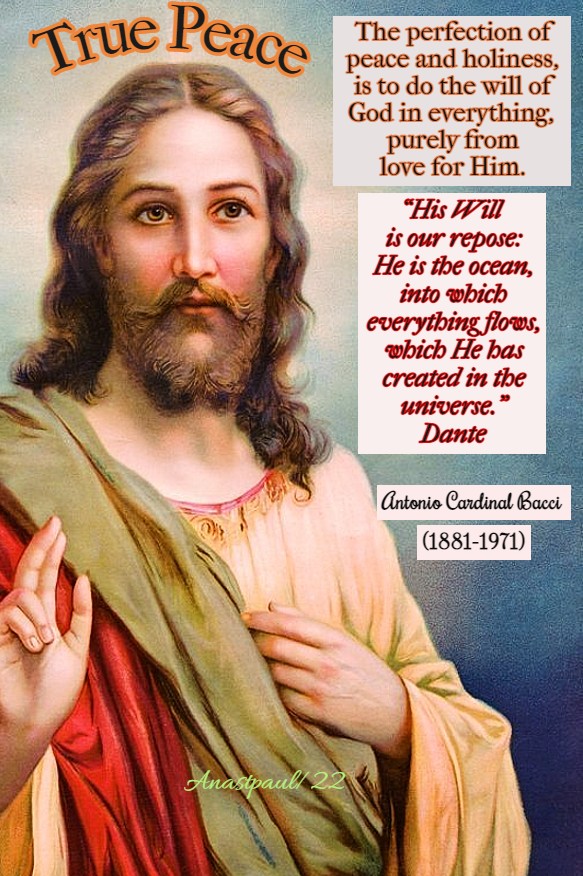
We have said, that true peace is based on three things: Right order, harmony and liberty. But, in order to obtain full and perfect peace, still one more thing is necessary – complete and loving abandonment to the will of God. The beginning of real peace and holiness, lies in doing the will of God in every detail. The perfection of peace and holiness, is to do the will of God in everything, purely from love for Him.
Dante expresses this profound idea when he decries the peace of the blessed in Heaven, now unshakeable in their joyful compliance with the divine will.”
“E la sua volontate e nostra pace: Ella E quel mare, al qual tutto si move cio ch’ella crea E che natura face.”
“His Will is our repose: He is the ocean, into which everything flows, which He has created in the universe.”
Our Morning Offering – 10 December – Friday of the Second Week of Advent and the Memorial of Our Lady of Loreto and the Holy House
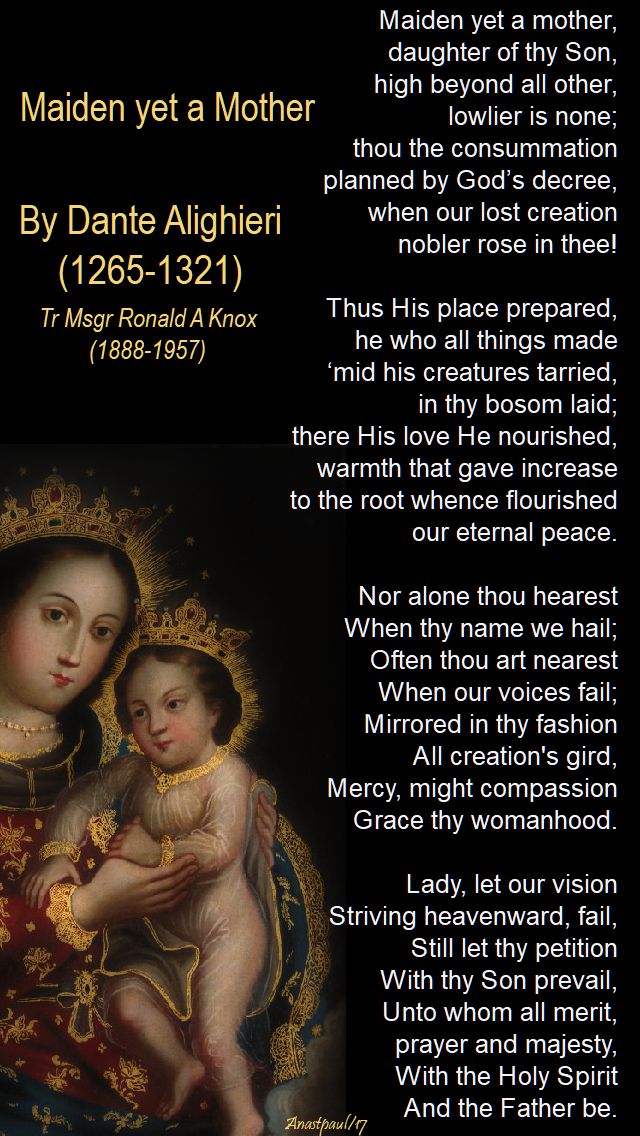
Maiden yet a Mother By Dante Alighieri (1265-1321) Trans. Msgr Ronald A Knox (1888-1957)
Maiden yet a mother, daughter of thy Son, high beyond all other, lowlier is none; thou the consummation planned by God’s decree, when our lost creation nobler rose in thee!
Thus His place prepared, He who all things made ‘mid His creatures tarried, in thy bosom laid; there His love He nourished, warmth that gave increase to the root whence flourished our eternal peace.
Nor alone thou hearest When thy name we hail; Often thou art nearest When our voices fail; Mirrored in thy fashion All creation’s gird, Mercy, might compassion Grace thy womanhood.
Lady, let our vision Striving heavenward, fail, Still let thy petition With thy Son prevail, Unto whom all merit, prayer and majesty, With the Holy Spirit And the Father be.
Maiden Yet A Mother is a translation of a Poem by Durante (Dante) degli Alighieri (c 1265–1321). It is based upon the opening verses of Canto 33 of the Paradiso from his Divine Comedy in which St Bernard of Clairvaux (1090–1153) praises and prays to the Virgin Mother on behalf of Dante. It was translated from the original Italian into English by the Catholic convert, Monsignor Ronald A Knox (1888-1957).
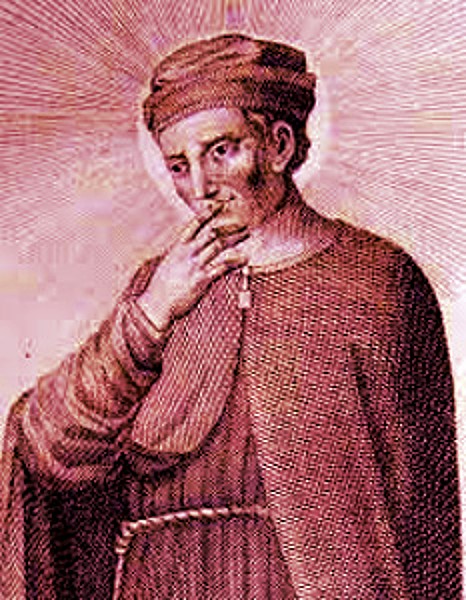
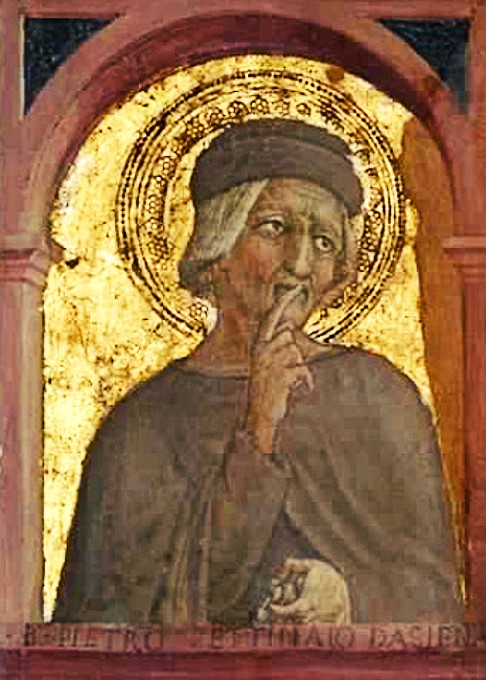
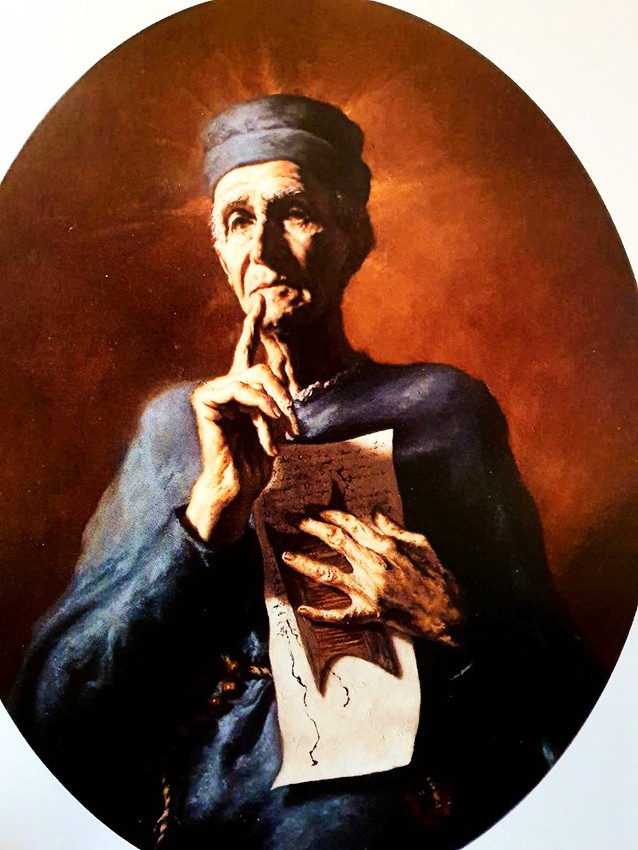
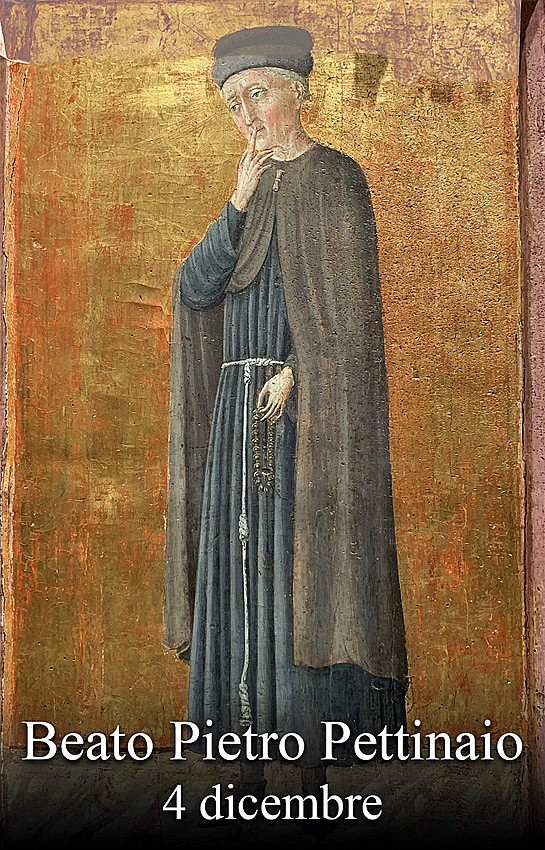
Saint of the Day – 4 December – Blessed Pietro Tecelano TOSF (c 1200 – 1289) Layman, Widower, Franciscan Tertiary, Apostle of the sick and the poor, spiritual and secular adviser, miracle-worker. Born in c 1200 at Campi, Tuscany, Italy and died in early December 1289 in Siena, Italy of natural causes. Patronages – Siena, Italy and Comb-makers. Also known as – Pietro Pettinaio, Peter…. Pier…. Additional Memorials – 16 March, 4 and 11 November, 10 December – Memorials on different Calendars.
The Roman Martyrology states: “In Siena, Blessed Pietro Pettinario, religious of the Third Order of St Francis, distinguished for his particular charity towards the needy and the sick and for his life of humility and silence.”
Pietro was born around 1200 in Campi, a village of Castelnuovo Berardenga near Siena and moved with his parents to Siena at some point during his childhood.
He married but the couple remained childless. In order to provide for his new wife he worked as a comb-maker, that is a merchant of bone and mother-of-pearl combs used in spinning. .. He purchased a house in which vines flourished so as to make wine. Sadly his wife died and Pietro then lived alone and devoted his time to his business and soon became rich and famous.
Perhaps converted thanks to the newly born Franciscan Order, he became famous once more but now for his generosity towards his competitors – on market days he arrived late to sell, so as not to damage them too much. In addition to carrying out his working activity, he also dedicated himself to assisting the sick at the hospital of Santa Maria della Scala where he bound wounds and sores and helps the most needy. In this work he was assisted by eight friends – merchants and lawmen, who he had encouraged to join him in his apostolate.
He lived a simple life, giving excess wealth to the Franciscans and he spent his evenings in meditation and devoting such nights to God in prayer.
Pietro left no writings and is remembered for his silences, we often see him depicted with a finger on his lips. The few things he said and the many he did, were very effective, to the point that some traffickers, after having defrauded the City, returned the money to him, he then returned it to the relevant section of the City administration. The governors, in turn, often called upon him for help and advice – in 1282 , for example, he was asked to choose the five inmates to be amnestied.
When the Franciscans of Siena had doubts about the authentic vocation of their novices , they had them examined by him. His life was inspired by the most rigorous followers of St Francis of Assisi, the spirituals.
The Dominican preacher, Blessed Ambrogio Sansedoni, who went to Pietro for spirtual guidance, renounced his election as a Bishop on Pietro’s advice.
Seeking solitude, he sold his home and business, donating the proceeds to the poor and spent the last few years of his life, as a guest of the Franciscans. There, considered himself far too talkative, Pietro aimed at living amongst them in silence.He undertook several pilgrimages to religious sites including Assisi, where Saint Francis of Assisi worked and lived.
During his lifetime he was hailed as a miracle-worker and was considered a great saint. He became a sought after adviser to Priests as well as to the people of Siena and was considered charismatic.
Pietro died in early December 1289 (possilby the 4th) at an advanced age and was buried at the Franciscan Church in Siena. His grave soon became a pilgrimage site and the scene of miracles. A Shrine was built over his grave in 1326 and an annual local feast in his honour was established in 1329. The Shrine was lost to fire in 1655 and remaining relics were preserved when the Poor Clare nuns took them into their care
The people of Siena adored Pietro and called for his Canonisation. Official recognition of Pietro’s holiness led to Pope Pius VII confirming his “cultus” acting as formal Beatification on 18 August 1802.
Dante Alighieri included Pietro in his work (Divina Comedia) in “Canto XIII” through the character of Pier the Comb-Seller.
Thought for the Day – 26 March – Meditations with Antonio Cardinal Bacci (1881-1971)
True Peace
“When He came into the world, Jesus proclaimed peace. The Angels hovering over His humble manger, sang songs of glory to God on high and of peace to men of goodwill on earth. During His earthly pilgrimage, He often spoke of peace. When He forgave sinners their faults, He said to each of them, “Go in peace” and “sin no more” (Lk 7:50; 8:48; Jn 8:11). When He was leaving this earth, He bequeathed His peace to His Apostles, as if it were a sacred heirloom: “Peace I leave with you, My peace, I give to you, not as the world gives do I give to you” (Jn 14:27). We can see, from these words, that the peace of Jesus, is not the same as worldly peace.
The Church, in its liturgy, implores from God, that peace which the world cannot give. When the world speaks of peace, it means, normally, the external public peace which flows from respect for the law and for the established regime. This is peace, there is no doubt about that. It is necessary and is a gift from God. But, it is not enough. We need the inner peace of soul of which we have already spoken, for it is the only true and solid foundation for external peace. Without this peace of soul, external peace is uncertain and fleeting.
We have said, that true peace is based on three things: Right order, harmony and liberty. But, in order to obtain full and perfect peace, still one more thing is necessary – complete and loving abandonment to the will of God. The beginning of real peace and holiness, lies in doing the will of God in every detail. The perfection of peace and holiness, is to do the will of God in everything, purely from love for Him.
Dante expresses this profound idea when he decries the peace of the blessed in Heaven, now unshakeable in their joyful compliance with the divine will.”
“E la sua volontate e nostra pace: Ella E quel mare, al qual tutto si move cio ch’ella crea E che natura face.”
“His Will is our repose: He is the ocean, into which everything flows, which He has created in the universe.”
Our Morning Offering – 18 December and also the Feast of Our Lady of Expectation
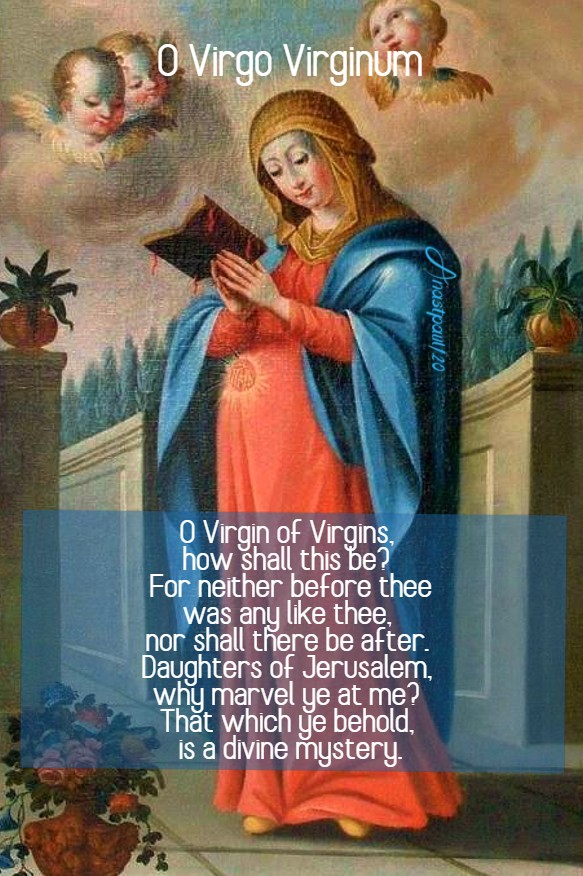
O Virgo Virginum
O Virgin of Virgins, how shall this be? For neither before thee was any like thee, nor shall there be after. Daughters of Jerusalem, why marvel ye at me? That which ye behold, is a divine mystery.
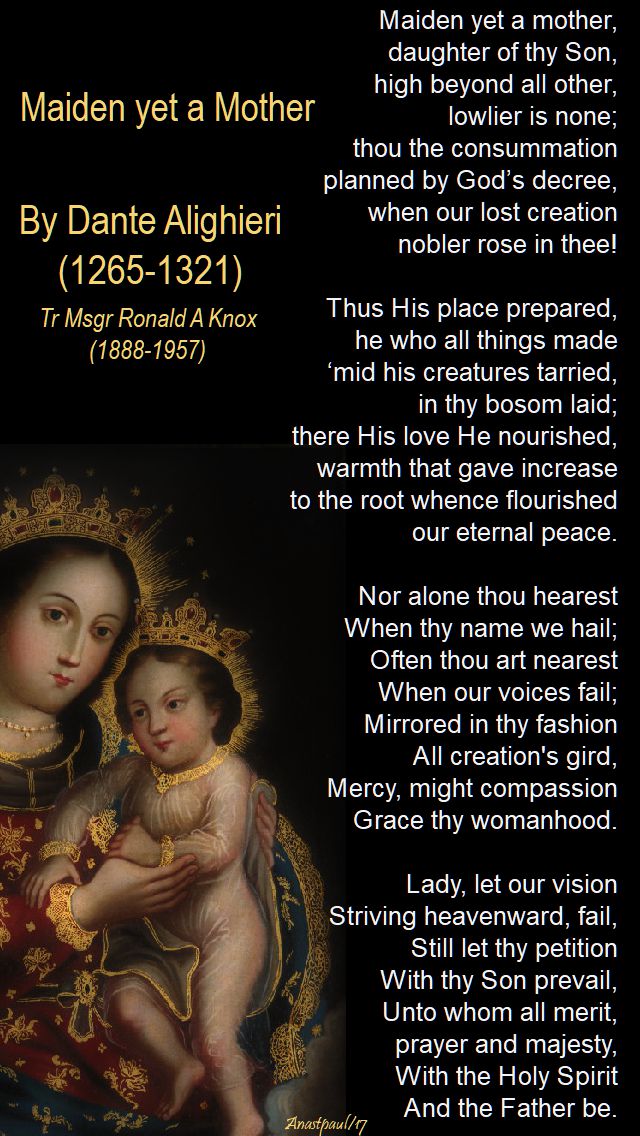
Maiden yet a Mother By Dante Alighieri (1265-1321) Tr Msgr Ronald A Knox (1888-1957)
Maiden yet a mother, daughter of thy Son, high beyond all other, lowlier is none; thou the consummation planned by God’s decree, when our lost creation nobler rose in thee!
Thus His place prepared, he who all things made ‘mid his creatures tarried, in thy bosom laid; there His love He nourished, warmth that gave increase to the root whence flourished our eternal peace.
Nor alone thou hearest When thy name we hail; Often thou art nearest When our voices fail; Mirrored in thy fashion All creation’s gird, Mercy, might compassion Grace thy womanhood.
Lady, let our vision Striving heavenward, fail, Still let thy petition With thy Son prevail, Unto whom all merit, prayer and majesty, With the Holy Spirit And the Father be.
Most authors agree that there were seven original ‘O Antiphons’ and that they are a very ancient expression of Christian Prayer. While their author is unknown, they are cited in at least two works as early as the eighth century. Both Cynewulf, an Anglo-Saxon author and Amalarius, a liturgist and the Archbishop of Trier (died 850), who was a student of the teacher St Alcuin, cite the existence of the ‘O Antiphons’ as early as the seventh/eighth century.
The ‘O Antiphons’ get their name from the fact that they all begin with the interjection ‘O’: O Sapientia (Wisdom); O Adonai (Lord); O Radix Jesse (Root of Jesse); O Clavis David (Key of David); O Oriens (Dawn of the East); O Rex Gentium (King of Gentiles); O Emmanuel.
While the original ‘O Antiphons’ numbered seven, over time a number of others were added to the liturgy of particular regions and sometimes for particular religious feast days which fell during Advent, or even in the liturgy of some medieval religious orders. Some medieval religious churches had as many as twelve O Antiphons which were sung in the Advent Liturgy leading up to Christmas Eve.
Among these, there was an important Marian ‘O Antiphon’ which appears in both the Gallican (France) and Sarum (England) liturgies. Although it is difficult to establish just when this antiphon was first introduced, it was certainly known in the Middle Ages.
This Marian Antiphon is still used today in the liturgy of the Norbertine Order. While the Latin Liturgy begins the O Antiphons on 17 December with ‘O Sapientia,’ and ends on 23 December with ‘O Emmanuel,’ the Liturgy of the Norbertine Order begins their O Antiphons on 16 December with ‘O Sapientia,’ and ends on 23 December with the beautiful Marian Antiphon ‘O Virgo Virginum.’
Our Morning Offering – 10 December – The Second Sunday of Advent and the First Universal Memorial of Our Lady of Loreto
Maiden yet a Mother By Dante Alighieri (1265-1321) Tr Msgr Ronald A Knox (1888-1957)
Maiden yet a mother,
daughter of thy Son,
high beyond all other,
lowlier is none;
thou the consummation
planned by God’s decree,
when our lost creation
nobler rose in thee!
Thus His place prepared,
he who all things made
‘mid his creatures tarried,
in thy bosom laid;
there His love He nourished,
warmth that gave increase
to the root whence flourished
our eternal peace.
Nor alone thou hearest
When thy name we hail;
Often thou art nearest
When our voices fail;
Mirrored in thy fashion
All creation’s gird,
Mercy, might compassion
Grace thy womanhood.
Lady, let our vision
Striving heavenward, fail,
Still let thy petition
With thy Son prevail,
Unto whom all merit,
prayer and majesty,
With the Holy Spirit
And the Father be.
Maiden Yet A Mother is a translation of a poem by Durante (Dante) degli Alighieri (c 1265–1321). It is based upon the opening verses of Canto 33 of the Paradiso from his Divine Comedy in which St Bernard of Clairvaux (1090–1153) praises and prays to the Virgin Mother on behalf of Dante. It was translated from the original Italian into English by the Catholic convert, Monsignior Ronald A Knox (1888-1957).
Our Morning Offering – 5 August – Monday of the Eighteenth week in Ordinary Time, Year C and the Memorial of the Dedication of Mary Major
Maiden yet a Mother By Dante Alighieri (1265-1321) Tr Msgr Ronald A Knox (1888-1957)
Maiden yet a mother,
daughter of thy Son,
high beyond all other,
lowlier is none;
thou the consummation
planned by God’s decree,
when our lost creation
nobler rose in thee!
Thus His place prepared,
he who all things made
‘mid his creatures tarried,
in thy bosom laid;
there His love He nourished,
warmth that gave increase
to the root whence flourished
our eternal peace.
Nor alone thou hearest
When thy name we hail;
Often thou art nearest
When our voices fail;
Mirrored in thy fashion
All creation’s gird,
Mercy, might compassion
Grace thy womanhood.
Lady, let our vision
Striving heavenward, fail,
Still let thy petition
With thy Son prevail,
Unto whom all merit,
prayer and majesty,
With the Holy Spirit
And the Father be.
Maiden Yet A Mother is a translation of a poem by Durante (Dante) degli Alighieri (c 1265–1321). It is based upon the opening verses of Canto 33 of the Paradiso from his Divine Comedy in which St Bernard of Clairvaux (1090–1153) praises and prays to the Virgin Mother on behalf of Dante. It was translated from the original Italian into English by the Catholic convert, Monsignior Ronald A Knox (1888-1957). It is one of the Marian Hymns in the Breviary.
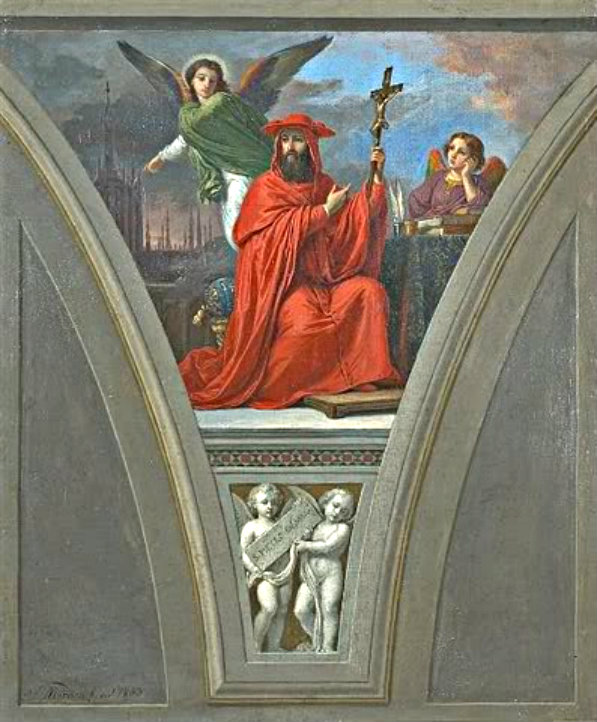
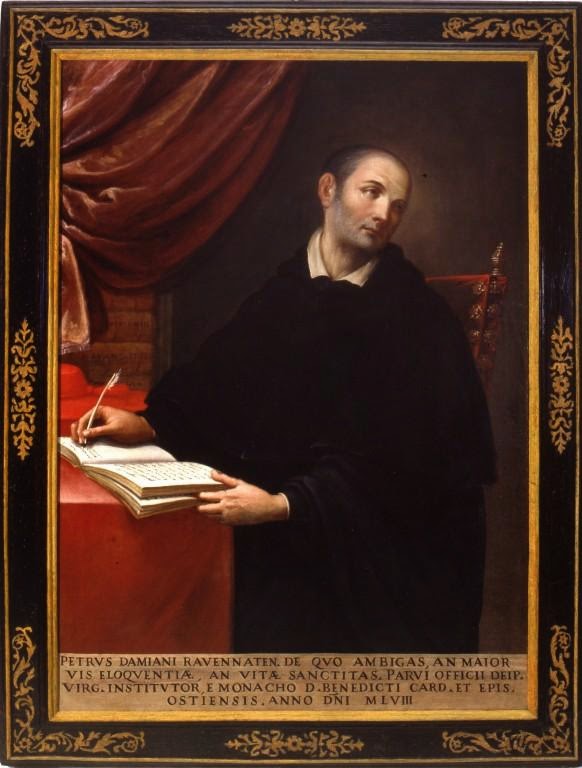
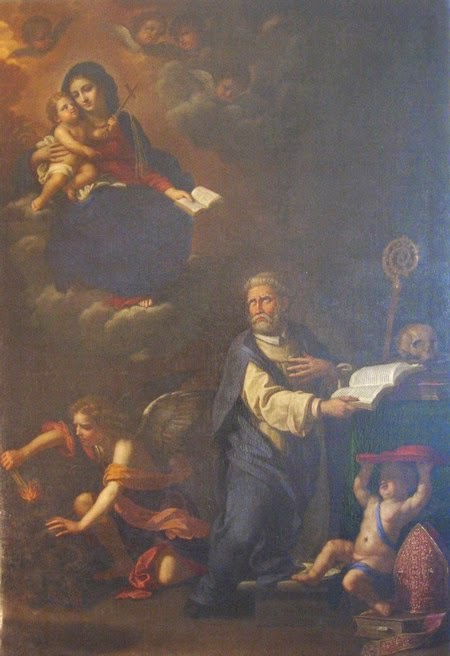
Saint of the Day – 21 February – St Peter Damian OSB (1007-1072) Doctor of the Church, Bishop Cardinal, Benedictine Monk, Confessor, Theologian, Writer, Teacher, Preacher, Poet, Reformer. Patronages – Spiritual warfare, Church Reformers and Faenza, Italy. Partly because he was orphaned and had been treated shabbily by one of his brothers, Peter Damian was very good to the poor. It was the ordinary thing for him to have a poor person or two with him at table and he liked to minister personally to their needs.
Peter escaped poverty and the neglect of his own brother when a second brother, who was Archpriest of Ravenna, took him under his wing. His brother sent him to good schools and Peter became a professor.
Already in those days, Peter was very strict with himself. He wore a hair shirt under his clothes, fasted rigorously and spent many hours in prayer. Soon, he decided to leave his teaching and give himself completely to prayer with the Benedictines of the reform of Saint Romuald at Fonte Avellana. They lived two monks to a hermitage. Peter was so eager to pray and slept so little that he soon suffered from severe insomnia. He found he had to use some prudence in taking care of himself. When he was not praying, he studied the Bible.
Unknown St Peter Damian 1725
The abbot commanded that when he died Peter should succeed him. Abbot Peter founded five other hermitages. He encouraged his brothers in a life of prayer and solitude and wanted nothing more for himself. The Holy See periodically called on him, however, to be a peacemaker or troubleshooter, between two abbeys in dispute or a cleric or government official in some disagreement with Rome.
Finally, Pope Stephen IX made Peter the Cardinal-Bishop of Ostia. He worked hard to wipe out simony—the buying of church offices–and encouraged his priests to observe celibacy and urged even the diocesan clergy to live together and maintain scheduled prayer and religious observance. He wished to restore primitive discipline among religious and priests, warning against needless travel, violations of poverty and too-comfortable living. He even wrote to the Bishop of Besancon complaining that the canons there sat down when they were singing the psalms in the Divine Office.
He wrote many letters. Some 170 are extant. We also have 53 of his sermons and seven lives, or biographies, that he wrote. He preferred examples and stories rather than theory in his writings. The liturgical offices he wrote are evidence of his talent as a stylist in Latin.
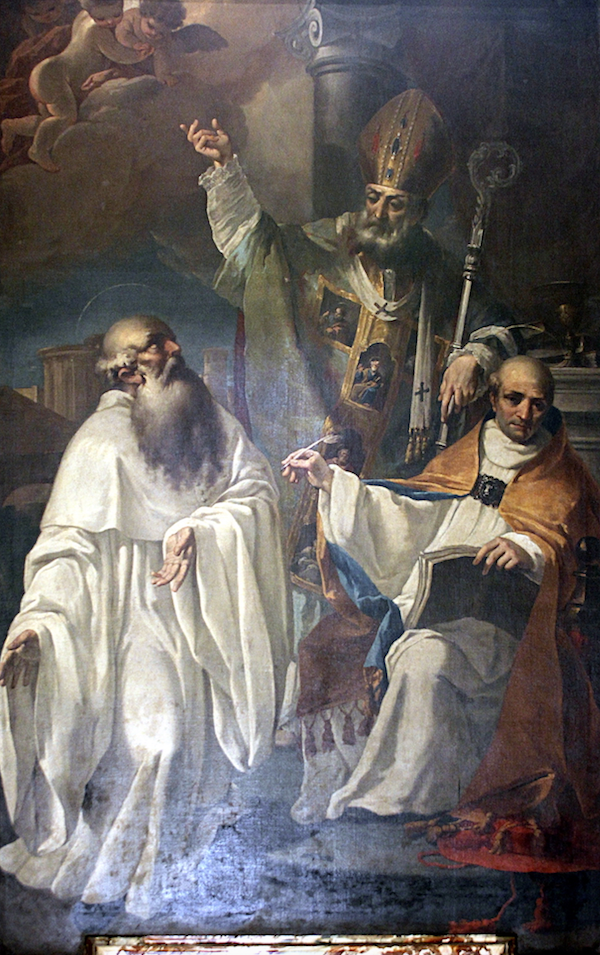
I cannot find out much about this image, it seems to be Saint Romuald on the left (of whom St Peter wrote a biography), St Peter Damian in the centre and an unknown saint, I presume on the right.
He asked often to be allowed to retire as Cardinal-Bishop of Ostia and finally Pope Alexander II consented. Peter was happy to become once again just a monk but he was still called to serve as a papal legate. When returning from such an assignment in Ravenna, he was overcome by a fever. With the monks gathered around him saying the Divine Office, he died on 22 February 1072.
In 1828, he was declared a Doctor of the Church.
In Canto XXI, Dante has the Saint pronounce an invective against the luxury enjoyed by prelates in the Church of his day and in that of Dante`s – the translation below is by Allen Mandelbaum:
113 … There, within that monastery, 114 in serving God, I gained tenacity: 115 with food that only olive juice had seasoned, 116 I could sustain with ease both heat and frost, 117 content within my contemplative thoughts.
118 That cloister used to offer souls to Heaven, 119 a fertile harvest but it now is barren 120 as Heaven’s punishment will soon make plain.
121 There I was known as Peter Damian 122 and, on the Adriatic shore, was Peter 123 the Sinner when I served Our Lady’s House.
124 Not much of mortal life was left to me 125 when I was sought for, dragged to take that hat 126 which always passes down from bad to worse.
127 Once there were Cephas and the Holy Ghost’s 128 great vessel – they were barefoot, they were lean, 129 they took their food at any inn they found.
130 But now the modern pastors are so plump 131 that they have need of one to prop them up 132 on this side, one on that and one in front,
133 and one to hoist them saddleward. Their cloaks 134 cover their steeds, two beasts beneath one skin: 135 o patience, you who must endure so much!”
Amos Nattini (1892-1985) Divina Commedia, Paradiso canto XXI, San Pier Damiani nel cielo di Saturno 1923-1941
Our Morning Offering – 18 December – The Feast of Our Lady of Expectation
Maiden yet a Mother By Dante Alighieri (1265-1321) Tr Msgr Ronald A Knox (1888-1957)
Maiden yet a mother,
daughter of thy Son,
high beyond all other,
lowlier is none;
thou the consummation
planned by God’s decree,
when our lost creation
nobler rose in thee!
Thus His place prepared,
he who all things made
‘mid his creatures tarried,
in thy bosom laid;
there His love He nourished,
warmth that gave increase
to the root whence flourished
our eternal peace.
Nor alone thou hearest
When thy name we hail;
Often thou art nearest
When our voices fail;
Mirrored in thy fashion
All creation’s gird,
Mercy, might compassion
Grace thy womanhood.
Lady, let our vision
Striving heavenward, fail,
Still let thy petition
With thy Son prevail,
Unto whom all merit,
prayer and majesty,
With the Holy Spirit
And the Father be.
Maiden Yet A Mother is a translation of a poem by Durante (Dante) degli Alighieri (c 1265–1321). It is based upon the opening verses of Canto 33 of the Paradiso from his Divine Comedy in which St Bernard of Clairvaux (1090–1153) praises and prays to the Virgin Mother on behalf of Dante. It was translated from the original Italian into English by the Catholic convert, Monsignior Ronald A Knox (1888-1957).















 AnaStpaul
You must be logged in to post a comment.