Quote/s of the Day – 5 October – The Memorial of St Maria Faustina Kowalska (1905-1938)
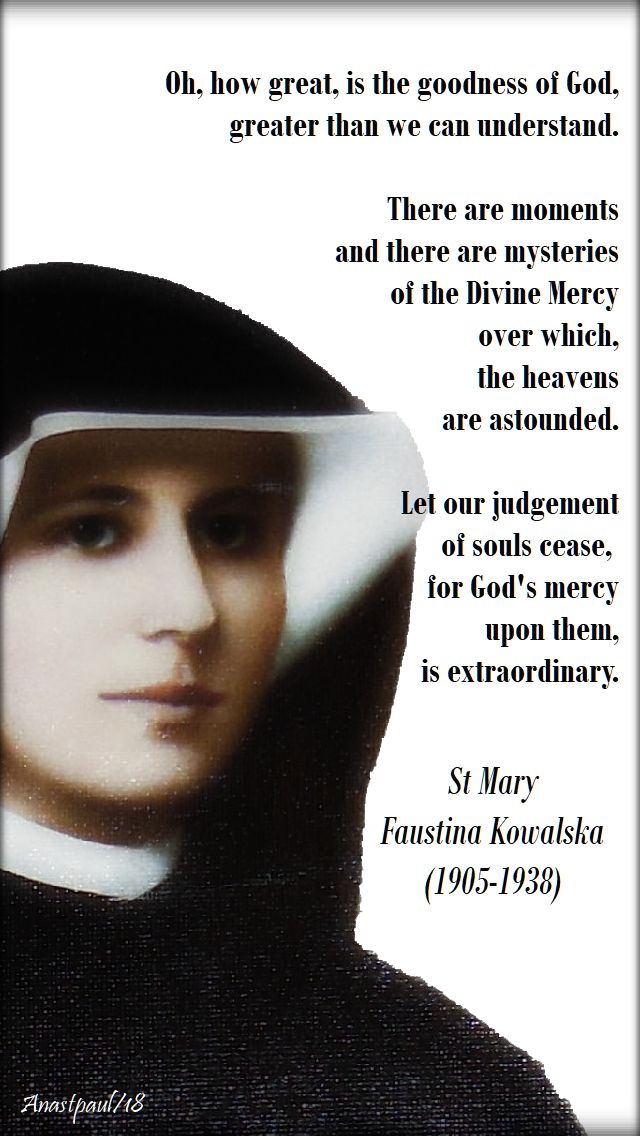
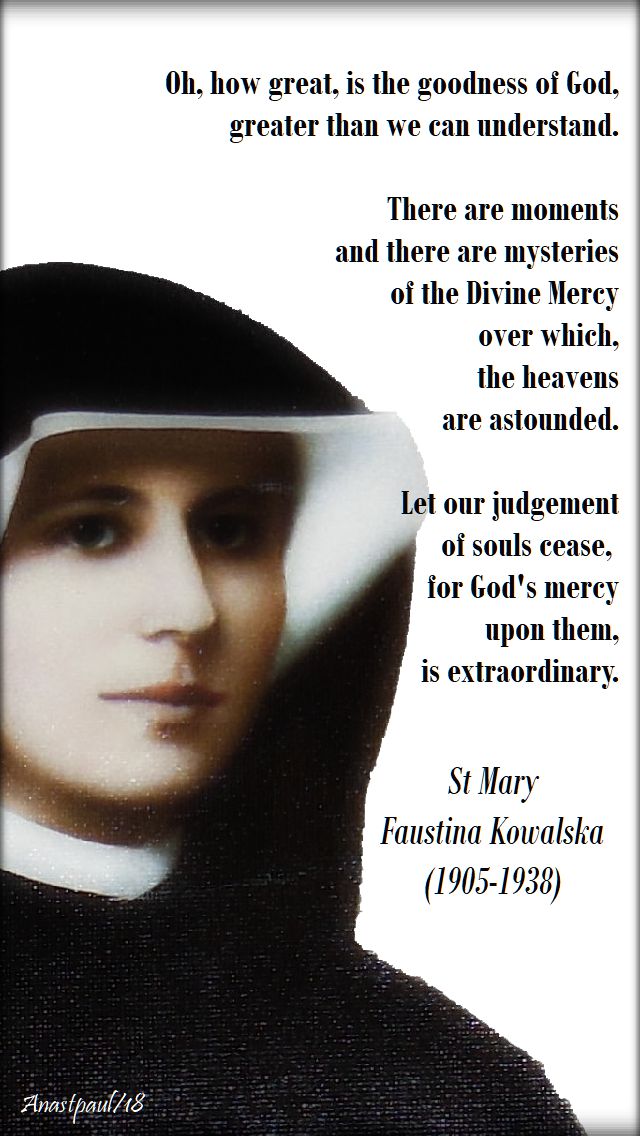
“Oh, how great, is the goodness of God, greater than we can understand. There are moments and there are mysteries, of the Divine Mercy over which, the heavens are astounded. Let our judgement of souls cease, for God’s mercy upon them, is extraordinary.”
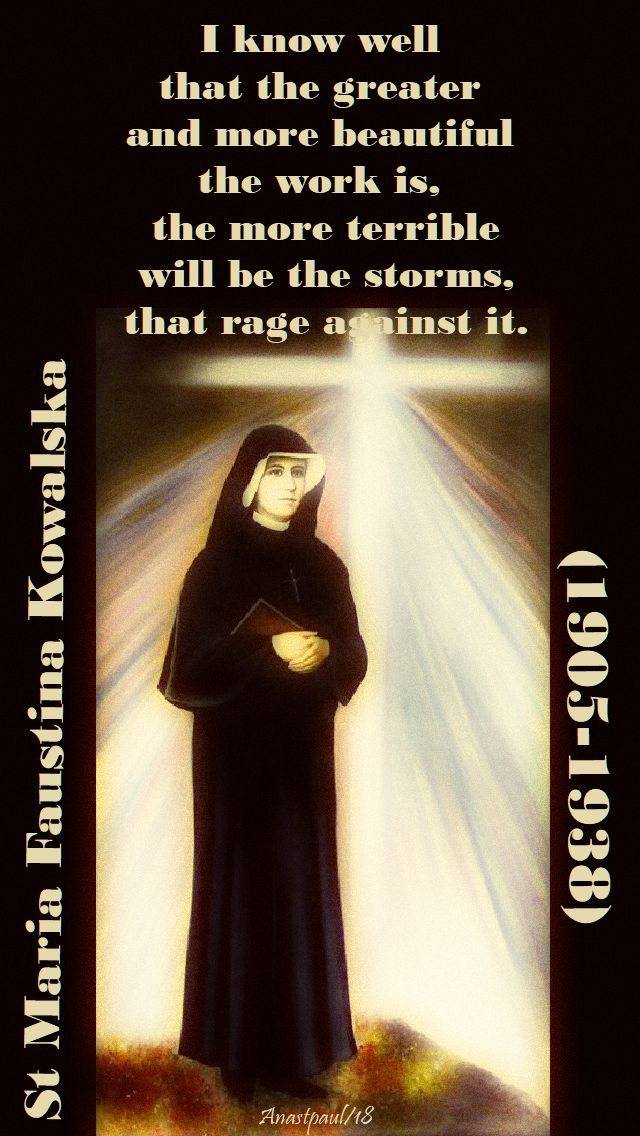
“I know well that the greater and more beautiful the work is, the more terrible will be the storms, that rage against it.”
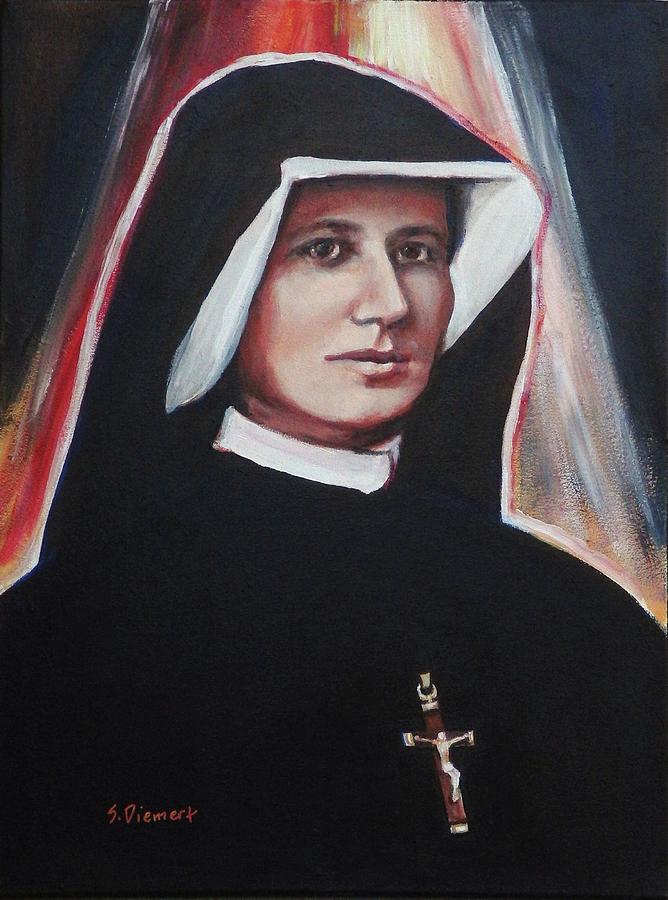
Saint of the Day – 5 October – Saint Faustina Kowalska (1905-1938) Maria Faustyna Kowalska of the Blessed Sacrament “Apostle of Divine Mercy”, “Secretary of Divine Mercy”, Virgin, Religious, Mystic – born “Helena” on 25 August 1905 at Glogowiec, Poland as Elena (Helena) Kowalska and died on 5 October 1938 at Krakow, Poland of tuberculosis.
Sister Mary Faustina, an apostle of the Divine Mercy, belongs today to the group of the most popular and well-known saints of the Church. Through her, the Lord Jesus communicates to the world, the great message of God’s mercy and reveals the pattern of Christian perfection, based on trust in God and on the attitude of mercy toward one’s neighbours.
She was born on 25 August 1905 in Gogowiec in Poland of a poor and religious family of peasants, the third of ten children. She was baptised with the name Helena in the parish Church of Ðwinice Warckie. From a very tender age she stood out because of her love of prayer, work, obedience and also her sensitivity to the poor. At the age of nine she made her first Holy Communion, living this moment very profoundly in her awareness of the presence of the Divine Guest within her soul. She attended school for three years . At the age of sixteen she left home and went to work as a housekeeper in order to find the means of supporting herself and of helping her parents.
At the age of seven she had already felt the first stirrings of a religious vocation. After finishing school, she wanted to enter the convent but her parents would not give her permission. Called during a vision of the Suffering Christ, on 1 August 1925 she entered the Congregation of the Sisters of Our Lady of Mercy and took the name Sister Maria Faustina. She lived in the Congregation for thirteen years and lived in several religious houses. She spent time at Kraków, Pock and Vilnius, where she worked as a cook, gardener and porter.
Externally, nothing revealed her rich mystical interior life. She zealously performed her tasks and faithfully observed the rule of religious life. She was recollected and at the same time very natural, serene and full of kindness and disinterested love for her neighbour. Although her life was apparently insignificant, monotonous and dull, she hid within herself an extraordinary union with God.
It is the mystery of the Mercy of God which she contemplated in the word of God, as well as in the everyday activities of her life, that forms the basis of her spirituality. The process of contemplating and getting to know the mystery of God’s mercy, helped develop within Sr Faustina the attitude of child-like trust in God as well as mercy toward the neighbours. “O my Jesus, each of Your saints reflects one of Your virtues; I desire to reflect Your compassionate heart, full of mercy, I want to glorify it. Let Your mercy, O Jesus, be impressed upon my heart and soul like a seal and this will be my badge in this and the future life” (Diary 1242).
Sister Faustina was a faithful daughter of the Church which she loved like a Mother and a Mystic Body of Jesus Christ. Conscious of her role in the Church, she co-operated with God’s mercy in the task of saving lost souls. At the specific request of and following the example of the Lord Jesus, she made a sacrifice of her own life for this very goal. In her spiritual life she also distinguished herself with a love of the Eucharist and a deep devotion to the Mother of Mercy.
The years she had spent at the convent were filled with extraordinary gifts, such as: revelations, visions, hidden stigmata, participation in the Passion of the Lord, the gift of bilocation, the reading of human souls, the gift of prophecy, or the rare gift of mystical engagement and marriage. The living relationship with God, the Blessed Mother, the Angels, the Saints, the souls in Purgatory — with the entire supernatural world — was as equally real for her, as was the world she perceived with her senses . In spite of being so richly endowed with extraordinary graces, Sr Faustina knew that they do not in fact constitute sanctity. In her Diary she wrote: “Neither graces, nor revelations, nor raptures, nor gifts granted to a soul make it perfect but rather the intimate union of the soul with God. These gifts are merely ornaments of the soul but constitute neither its essence nor its perfection. My sanctity and perfection consist in the close union of my will with the will of God.” (Diary 1107).
The Lord Jesus chose Sr Maria Faustina as the Apostle and “Secretary” of His Mercy, so that she could tell the world about His great message. “In the Old Covenant — He said to her — I sent prophets wielding thunderbolts to My people. Today I am sending you with My mercy to the people of the whole world. I do not want to punish aching mankind, but I desire to heal it, pressing it to My Merciful Heart.” (Diary 1588).
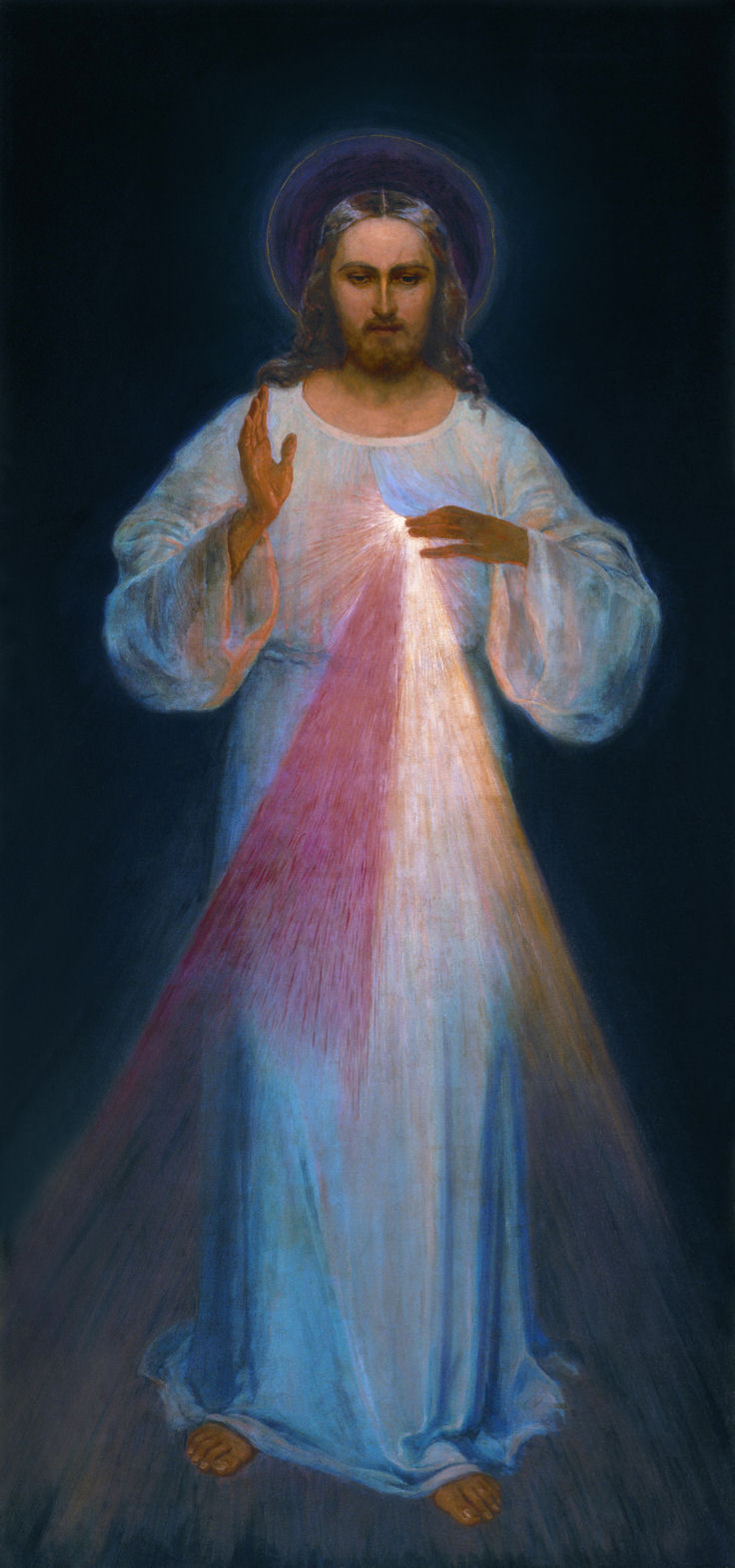
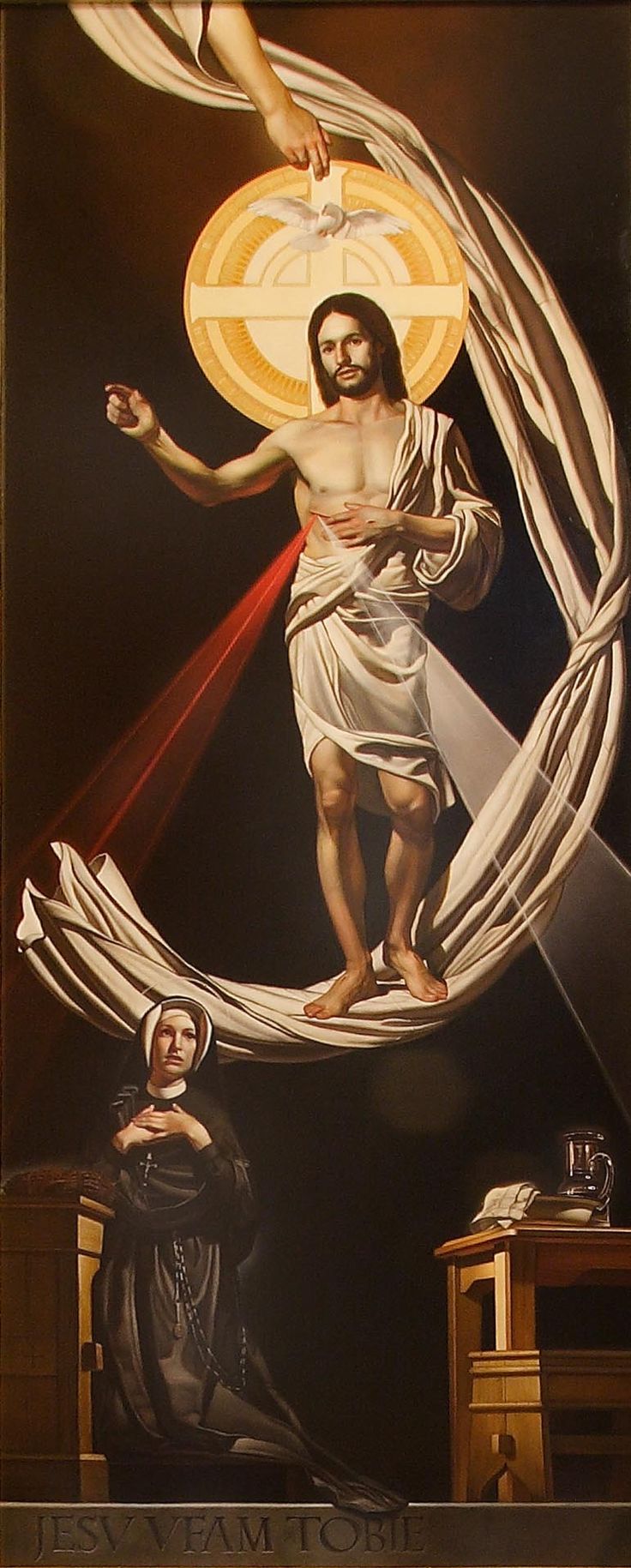
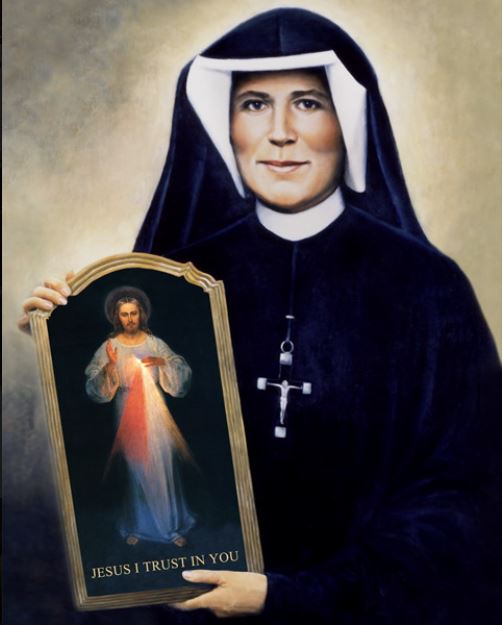
The original Image of the Divine Mercy, painted under the guidance of Saint Faustina by Kazimierowski (1934)
The mission of Sister Mary Faustina consists in 3 tasks:
– reminding the world of the truth of our faith revealed in the Holy Scripture about the merciful love of God toward every human being.
– Entreating God’s mercy for the whole world and particularly for sinners, among others through the practice of new forms of devotion to the Divine Mercy presented by the Lord Jesus, such as – the veneration of the image of the Divine Mercy with the inscription: Jesus, I Trust in You, the feast of the Divine Mercy celebrated on the first Sunday after Easter, chaplet to the Divine Mercy and prayer at the Hour of Mercy (3 p.m.). The Lord Jesus attached great promises to the above forms of devotion, provided one entrusted one’s life to God and practised active love of one’s neighbour.
– The third task in Sr Faustina’s mission consists in initiating the apostolic movement of the Divine Mercy which undertakes the task of proclaiming and entreating God’s mercy for the world and strives for Christian perfection, following the precepts laid down by the Blessed Sr Faustina. The precepts in question require the faithful to display an attitude of child-like trust in God, which expresses itself in fulfilling His will, as well as in the attitude of mercy toward one’s neighbours. Today, this movement within the Church involves millions of people throughout the world, it comprises religious congregations, lay institutes, religious, brotherhoods, associations, various communities of apostles of the Divine Mercy, as well as individual people who take up the tasks which the Lord Jesus communicated to them through Sr Faustina.
The mission of the Blessed Sr Faustina was recorded in her Diary which she kept at the specific request of the Lord Jesus and her confessors. In it, she recorded faithfully all of the Lord Jesus’ wishes and also described the encounters between her soul and Him. “Secretary of My most profound mystery— the Lord Jesus said to Sr Faustina — know that your task is to write down everything that I make known to you about My mercy, for the benefit of those who by reading these things will be comforted in their souls and will have the courage to approach Me.” (Diary 1693).
In an extraordinary way, Sr Faustina’s work sheds light on the mystery of the Divine Mercy. It delights, not only the simple and uneducated people but also scholars, who look upon it as an additional source of theological research. The Diary has been translated into many languages, among others, English, German, Italian, Spanish, French, Portuguese, Arabic, Russian, Hungarian, Czech and Slovak.
Sister Maria Faustina, consumed by tuberculosis and by innumerable sufferings which she accepted as a voluntary sacrifice for sinners, died in Krakow at the age of just thirty three on 5 October 1938 with a reputation for spiritual maturity and a mystical union with God. The reputation of the holiness of her life grew as did the cult to the Divine Mercy and the graces she obtained from God through her intercession. In the years 1965-67, the investigative Process into her life and heroic virtues was undertaken in Krakow and in the year 1968, the Beatification Process was initiated in Rome. The latter came to an end in December 1992. On 18 April 1993 our Holy Father St John Paul II raised Sister Faustina to the glory of the altars. Sr Faustina’s remains rest at the Sanctuary of the Divine Mercy in Kraków-Łagiewniki, where she spent the end of her life and met confessor Józef Andrasz who also supported the message of mercy. . … Vatican.va
St Faustina was Canonised by St Pope John Paul on 30 April 2000.
Our Morning Offering – 30 September – Monday of the Twenty Sixth week in Ordinary Time, Year C and The Memorial of St Jerome (347-419) Father and Doctor of the Church
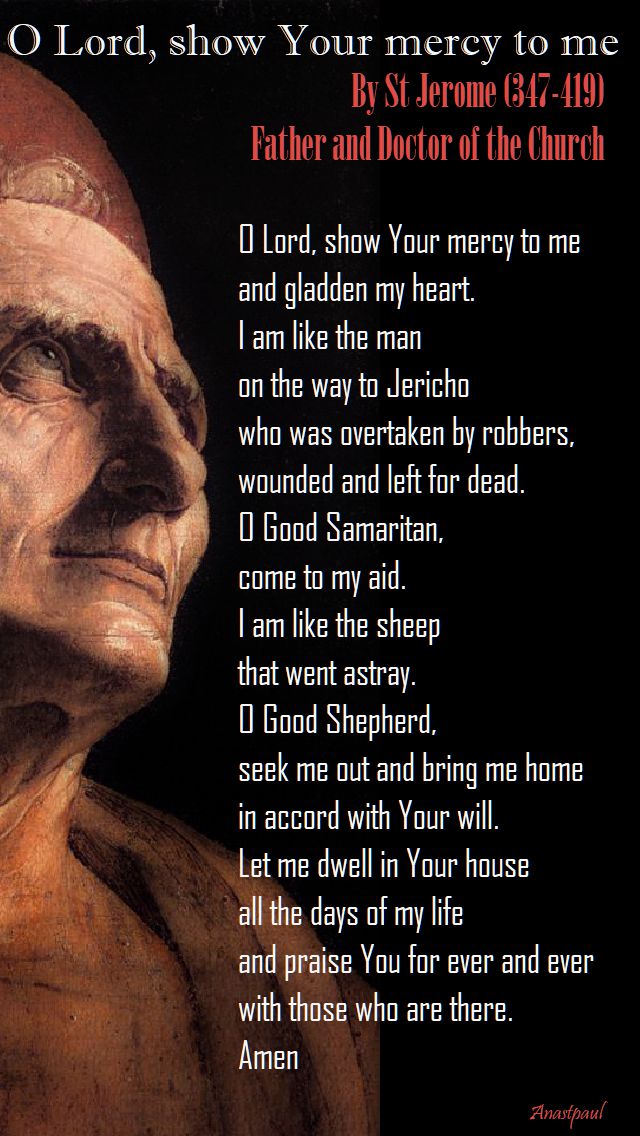
O Lord, show Your mercy to me By St Jerome (347-419)
O Lord, show Your mercy to me
and gladden my heart.
I am like the man on the way to Jericho
who was overtaken by robbers,
wounded and left for dead.
O Good Samaritan,
come to my aid.
I am like the sheep that went astray.
O Good Shepherd,
seek me out and bring me home
in accord with Your will.
Let me dwell in Your house
all the days of my life
and praise You for ever and ever
with those who are there.
Amen
Quote/s of the Day – 23 September – The Memorial of St Padre Pio (1887-1968)
“Keep close to the Catholic Church at all times, for the Church alone can give you true peace, since she alone possesses Jesus, the true Prince of Peace, in the Blessed Sacrament.”
“Every Holy Mass, heard with devotion, produces in our souls marvellous effects, abundant spiritual and material graces which we, ourselves, do not know… It is easier for the earth to exist without the sun than without the Holy Sacrifice of the Mass!”
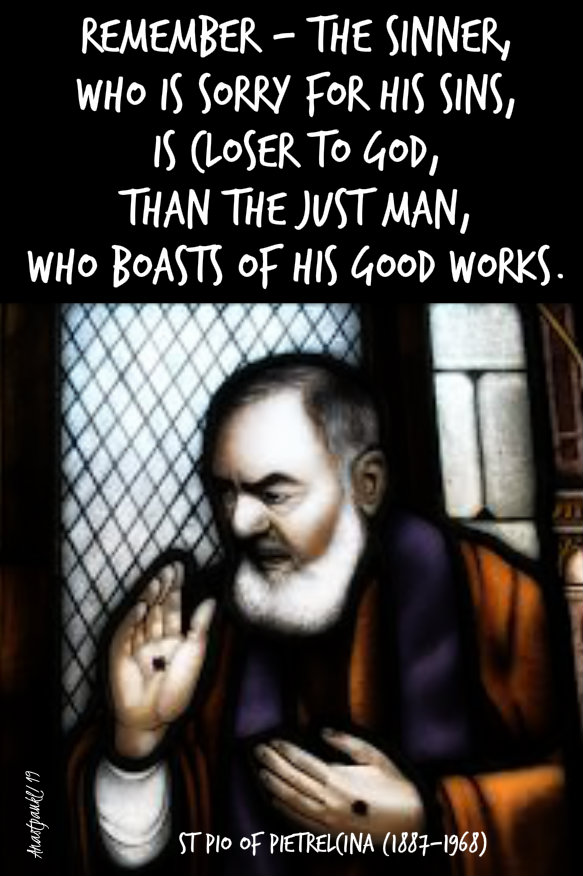
“Remember – the sinner, who is sorry for his sins, is closer to God, than the just man, who boasts of his good works.”
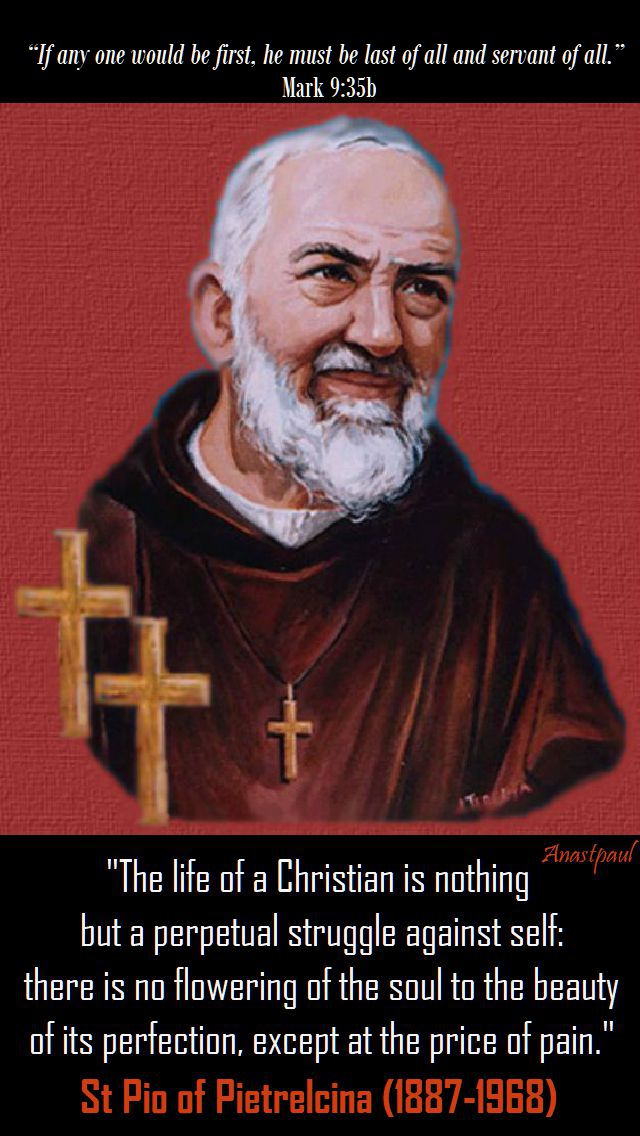
“If any one would be first, he must be last of all and servant of all.”
Mark 9:35b
“The life of a Christian is nothing but a perpetual struggle against self: there is no flowering of the soul to the beauty of its perfection, except at the price of pain.”
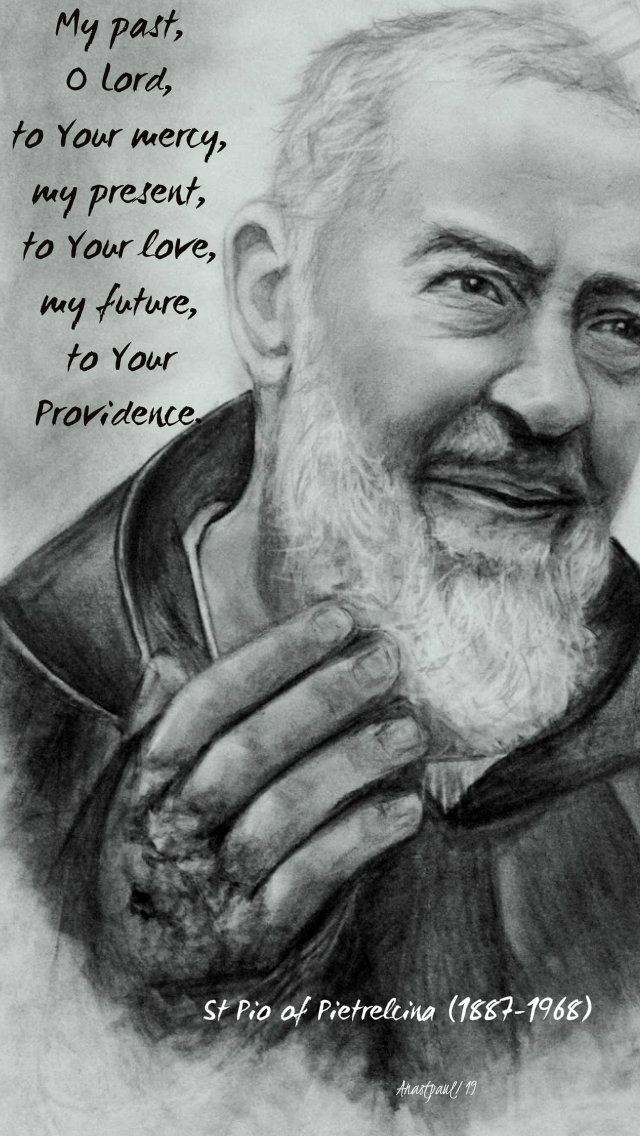
“My past, O Lord, to Your mercy, my present, to Your love, my future, to Your Providence.”
Thought for the Day – 17 September – Tuesday of the Twenty Fourth week in Ordinary Time, Year C and the Memorial of Saint Zygmunt Szcesny Felinski (1822-1895)
From a young age, the life of Zygmunt Szczęsny Feliński was marked by his striving after sanctity. Christ was for him “the Way, the Truth and the Life.” He wanted to achieve such a degree of unity with God so as to say after Saint Paul: I live now not with my own life but with the life of Christ who lives in me.
He was marked by unfaltering faith and utter trust in Providence. He always placed love of God and Church, devotion to his country and respect for all people in the first place. His great integrity, fortitude and justice were characteristic features of his spirituality. Apart from that, he was full of devotion and mercy marked by Franciscan cheerfulness, humility and straightforwardness – work and poverty. He was described as “the pride of the Polish episcopate”, “martyr”, “faithful son of the Church”.
Also nowadays, we can take the refreshing spirit and light from the treasury of his life. The Canonisation of the Shepherd-Exile encourages reflection on one’s own way of life, family and its revival, the building of the common house, the homeland, under God’s providential care and that of His Holy Mothe and ours.
During his Canonisation homily, on 11 October 2009, Pope Benedict said:
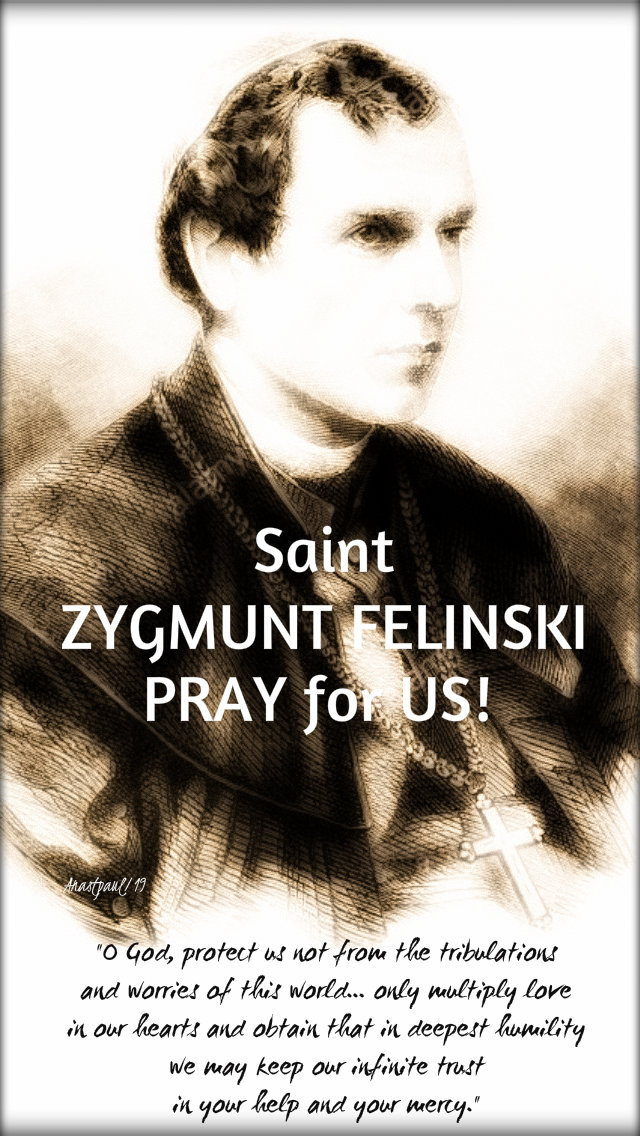
Archbishop of Warsaw, the Founder of the Congregation of the Franciscan Sisters of the Family of Mary, was a great witness of faith and pastoral charity in very troubled times for the nation and for the Church in Poland. He zealously concerned himself with the spiritual development of the faithful, he helped the poor and orphans. At the Ecclesiastical Academy in St Petersburg he saw to the sound formation of priests and as Archbishop of Warsaw he instilled in everyone the desire for inner renewal. Before the January 1863 Uprising against Russian annexation he put the people on guard against useless bloodshed. However, when the rebellion broke out and there were repressions he courageously defended the oppressed. On the Tsar of Russia’s orders he spent 20 years in exile at Jaroslaw on the Volga, without ever being able to return to his diocese. In every situation he retained his steadfast trust in Divine Providence and prayed: “O God, protect us not from the tribulations and worries of this world… only multiply love in our hearts and obtain that in deepest humility, we may keep our infinite trust in Your help and Your mercy”.
Today his gift of himself to God and to humankind, full of trust and love, becomes a luminous example for the whole Church.
One Minute Reflection – 15 September – Twenty Fourth Sunday in Ordinary Time, Year C, Gospel: Luke 15:1–32 and the Memorial of Our Lady of Sorrows
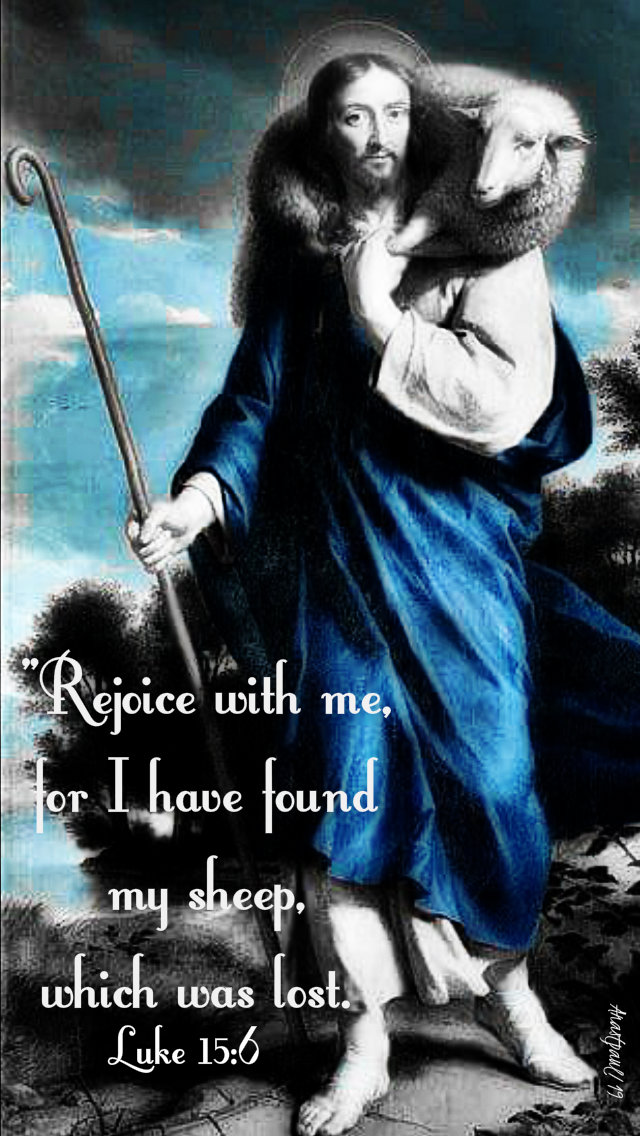
‘Rejoice with me, for I have found my sheep which was lost.’ ... Luke 15:6
REFLECTION – “Since man’s weakness is incapable of maintaining a firm step in this changing world, the good doctor shows you a remedy against going astray and the merciful judge does not withhold hope of forgiveness. It is not without reason that Saint Luke put forward three parables in succession – the sheep who strayed and was found again; the coin that was lost and found; the son who died and came back to life. This is so that this threefold remedy will urge us to take care of our wounds… The weary sheep is brought back by the shepherd, the lost coin is found, the son turns back and returns to his father, repenting of his waywardness…
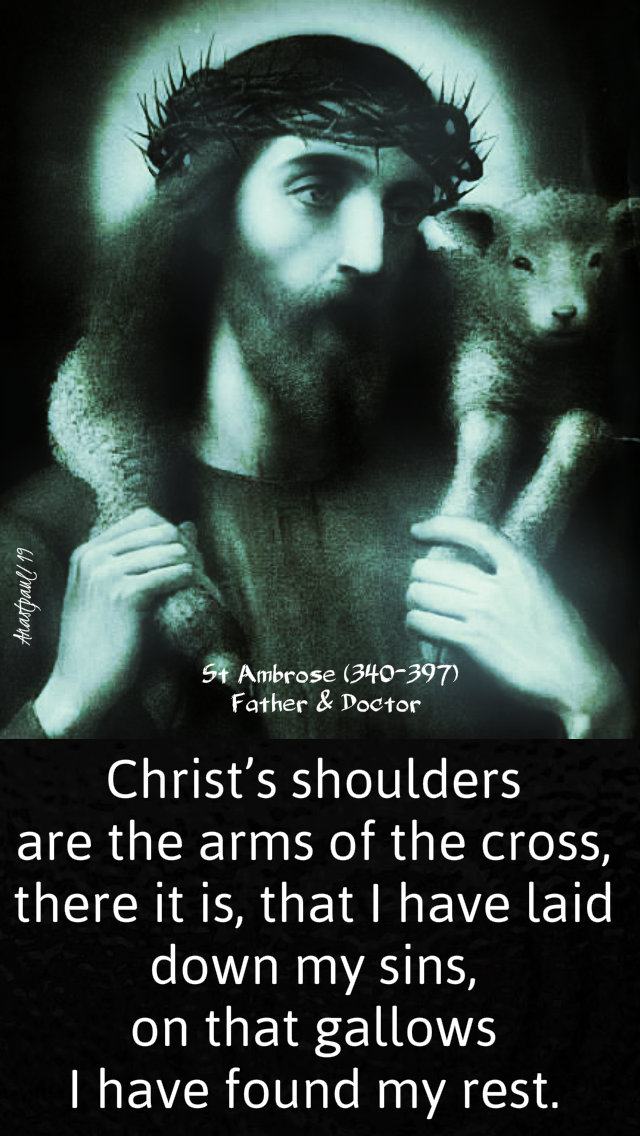
Let us rejoice, then, in that this sheep, which went astray in Adam, has been raised up again in Christ. Christ’s shoulders are the arms of the cross, there it is that I have laid down my sins, on that gallows I have found my rest. This “sheep” is one according to its nature but not in personality, since all form a single body composed of many in members. That is why it is written: “You are Christ’s body and individually parts of it,” (1Cor 12:27). “The Son of Man has come to save what was lost” (Lk 19:10), that is to say everyone, since “just as in Adam all die, so too in Christ shall all be brought to life” (1Cor 15:22)…
Nor, is it irrelevant, that the woman rejoices to have found her coin – it is no small thing, this coin on which is portrayed the image of a prince. In the same way, the good of the Church is the image of the King. We are sheep, let us then pray the Lord to lead us to restful waters (Ps 22[23]:2). We are sheep, let us ask for pasture. We are the coin, let us keep our value. We are sons, let us run to the Father.” … St Ambrose (340-397) – Bishop of Milan, Father & Doctor of the Church – On St Luke’s Gospel, 7, 207 (SC 52)
PRAYER – Look upon us Lord, creator and ruler of the whole world, grant us the grace to serve You with all our heart, that we may come to know, the power of Your forgiveness and love. Our Father, when Jesus Your Son, was raised up on the Cross, it was Your will that Mary, His Mother, should stand there and suffer with Him in her heart. Grant that in union with her, the Church may share in the passion of Christ and so be brought to the glory of His Resurrection. Be our intercessor and our consolation, Our Lady of Sorrows! We make our prayer through Christ our Lord, with the Holy Spirit, one God forever and ever, amen.
Thought for the Day – 31 August – Saturday of the Twenty-first week in Ordinary Time, Year C, Gospel: Matthew 25:14–30
“And cast the worthless servant into the outer darkness,
there men will weep and gnash their teeth.’” ... Matthew 25:30
Christ will Impose a Reckoning on me
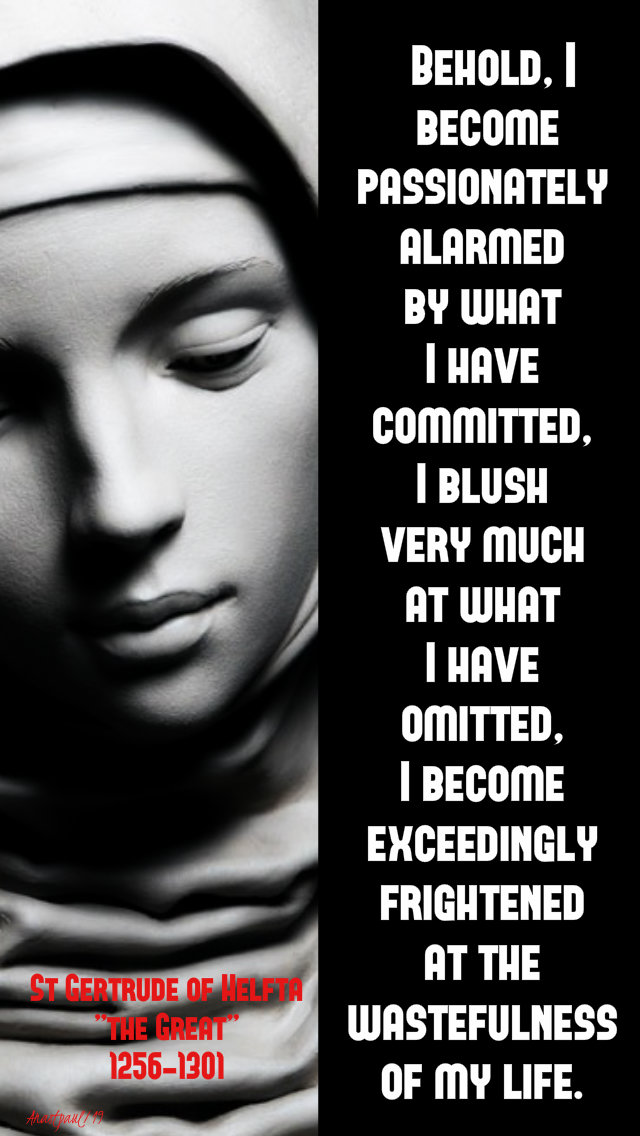
Saint Gertrude of Helfta “the Great” (1256-1301)
Benedictine nun Exercises VII, SC 127
Behold, I become passionately alarmed by what I have committed, I blush very much at what I have omitted, I become exceedingly frightened at the wastefulness of my life. I fear, that future investigation, at which Christ, a noble man, will impose a reckoning on me.
If He wanted to exact a deposit from me for my time and interest from the talent of understanding He conferred on me, I would, in short, not find any worthy answer for Your charity. What will I do? Where will I turn? I lack the strength to dig, I should blush to beg. (Lk 16:3) O Loving-kindness. Loving-kindnes,. speak up now, may Your dulcet counsel, I entreat You, warm my spirit back to life. Ah, answer me – what does it seem to You I should do in this [situation), for according to Your name You have a truly loving and kind heart and You know best what may be expedient for me in all this. Ah, pardon me and bring me help and in this tribulation, do not be detached from me. Let the poverty of my spirit move You and, touched by the compassion of Your heart, say to me with loving-kindness: “May there be one purse for me and You.” (Prv 1:14)
O Loving-kindness, Loving-kindness, You have stored up with Yourself riches so immeasurable, that heaven and earth do not suffice to contain them. You have driven my Jesus to give His soul for my soul, His life for mine, so that You might make everything that was His, mine and thus, out of your abundance, this pauper’s substance might increase. Ah, call my starved soul to Your food supply, so that in this life, I may live from Your riches and, reared by You and nourished by You, may not grow faint under the discipline of the Lord until at length, under Your guidance, I turn back to my God and give my spirit back to Him who gave it. (Eccl 12:7)
Quote of the Day – 16 August – Friday of the Nineteenth week in Ordinary Time, Year C and The Memorial of St Stephen of Hungary (c 975- 1038)
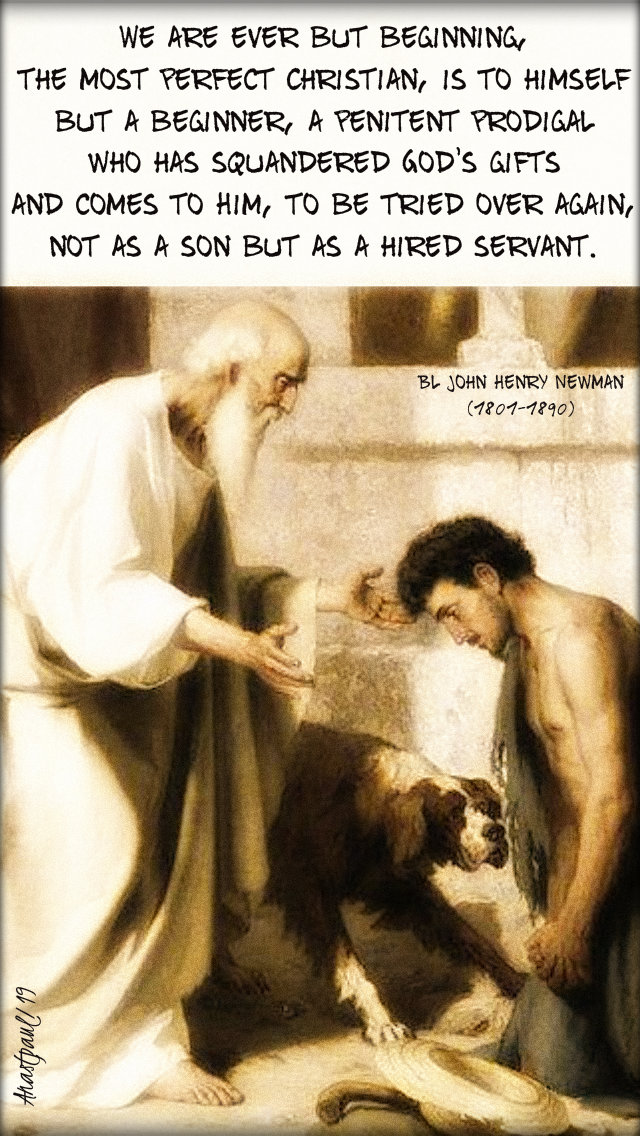
“We are ever but beginning, the most perfect Christian, is to himself but a beginner, a penitent prodigal who has squandered God’s gifts and comes to Him, to be tried over again, not as a son but as a hired servant.”
Sunday Reflection – 7 July – Fourteenth Sunday in Ordinary Time, Year C
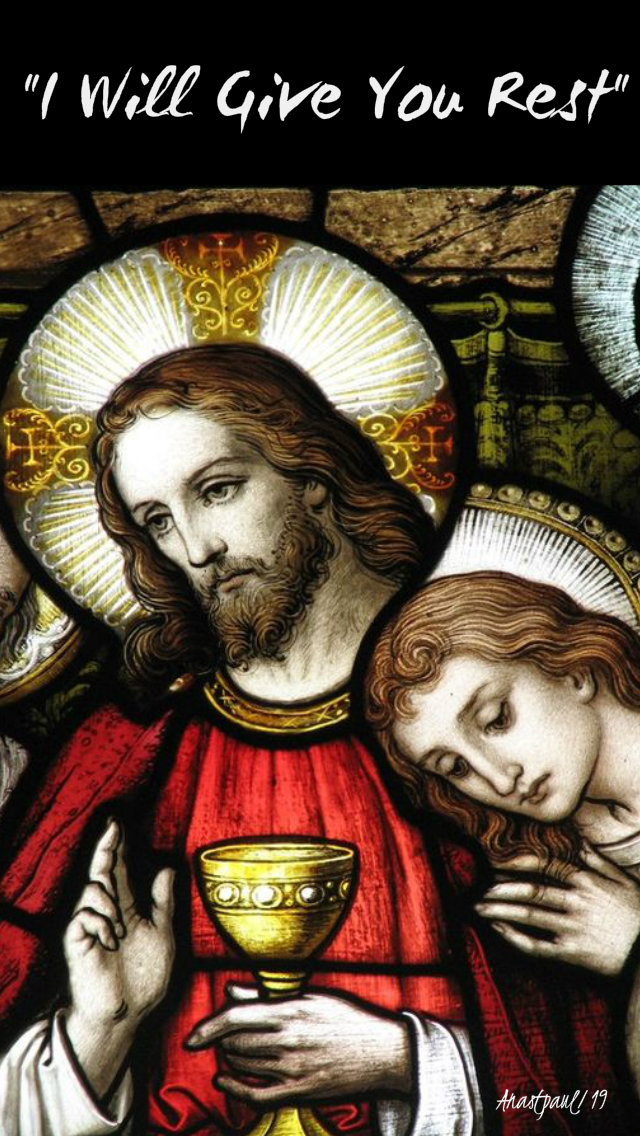
“I Will Give You Rest”
“I will give you rest.
This is what Jesus did during His mortal life and this is what He still does in His continuing life in His Church.
How strongly and gently He received, corrected and raised up Mary of Magdala, Matthew, Peter and Paul!
With what humility and love He continues to receive countless millions of souls in the Eucharistic Communion which marks the highest point of union between the human and the divine!”
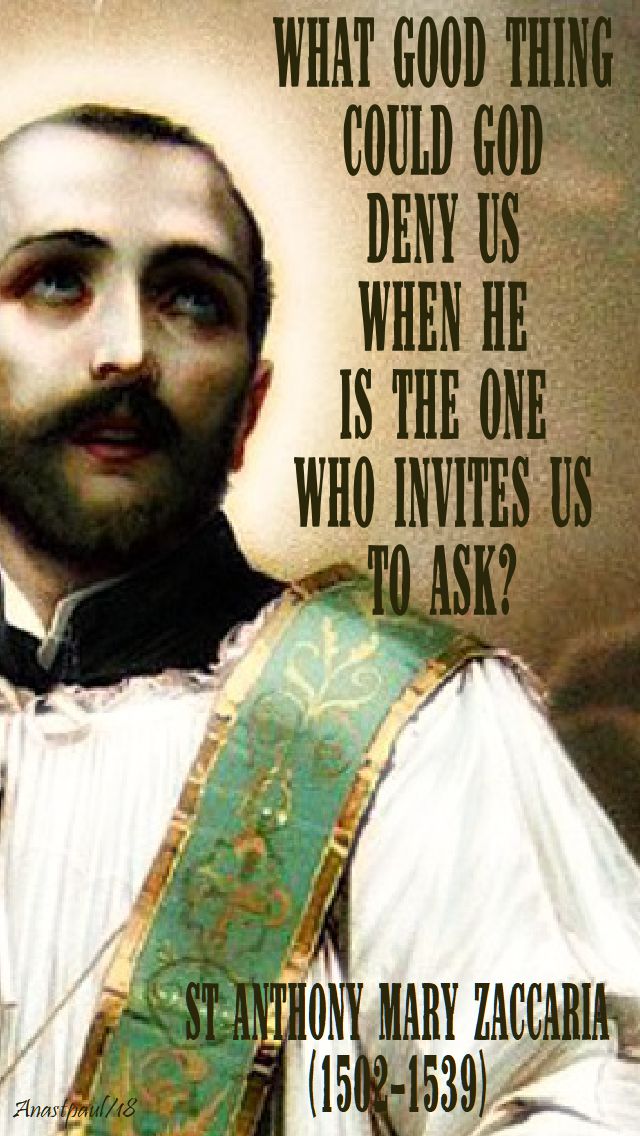
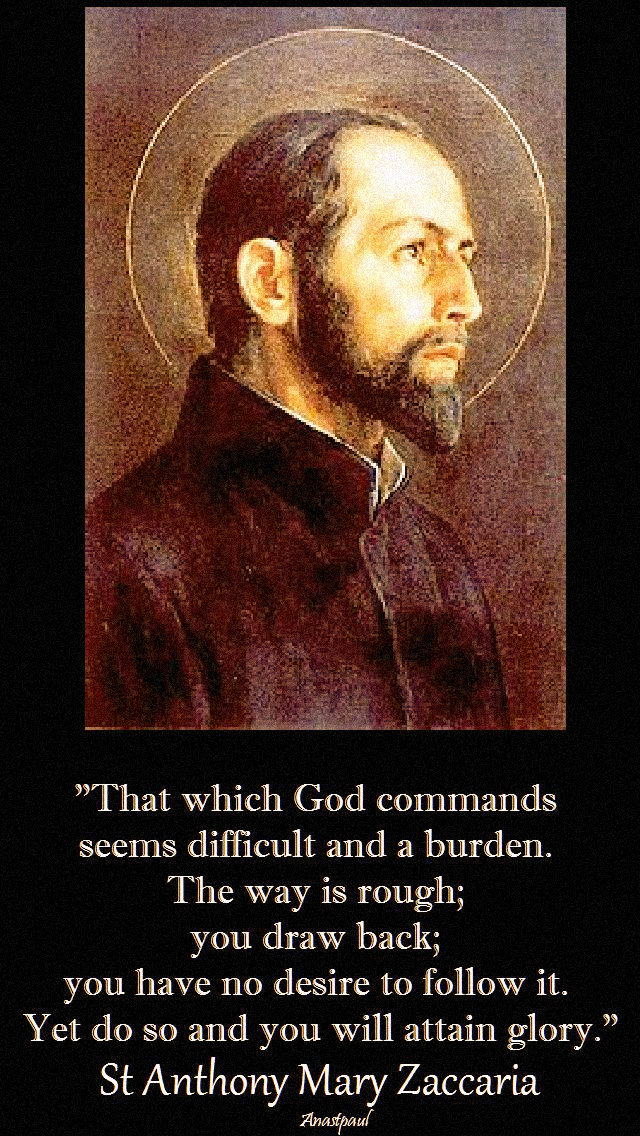
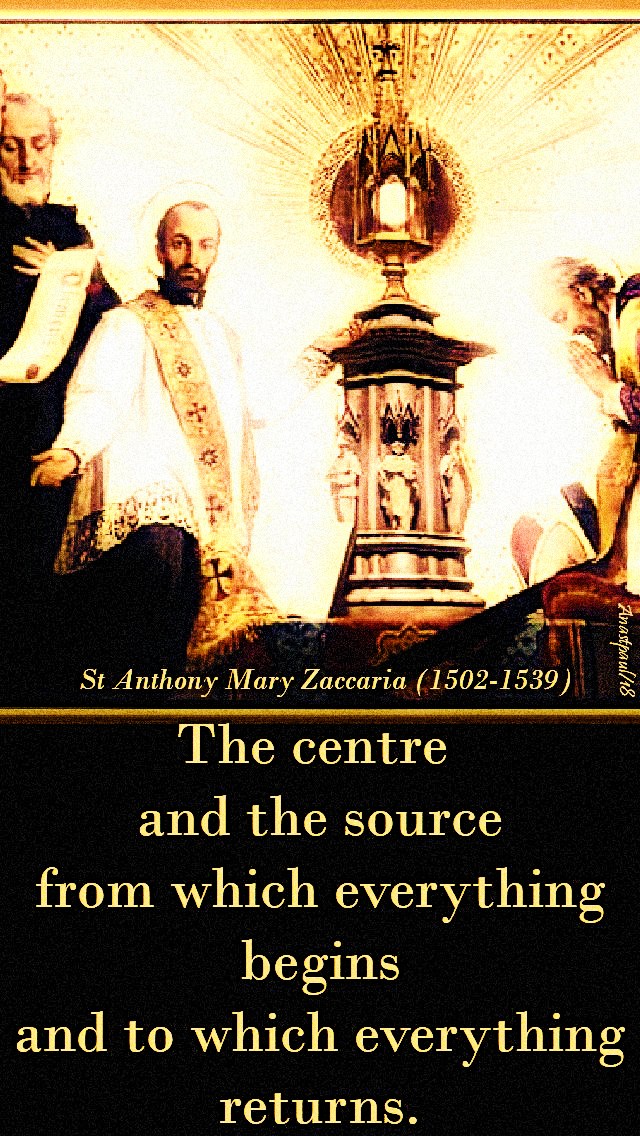
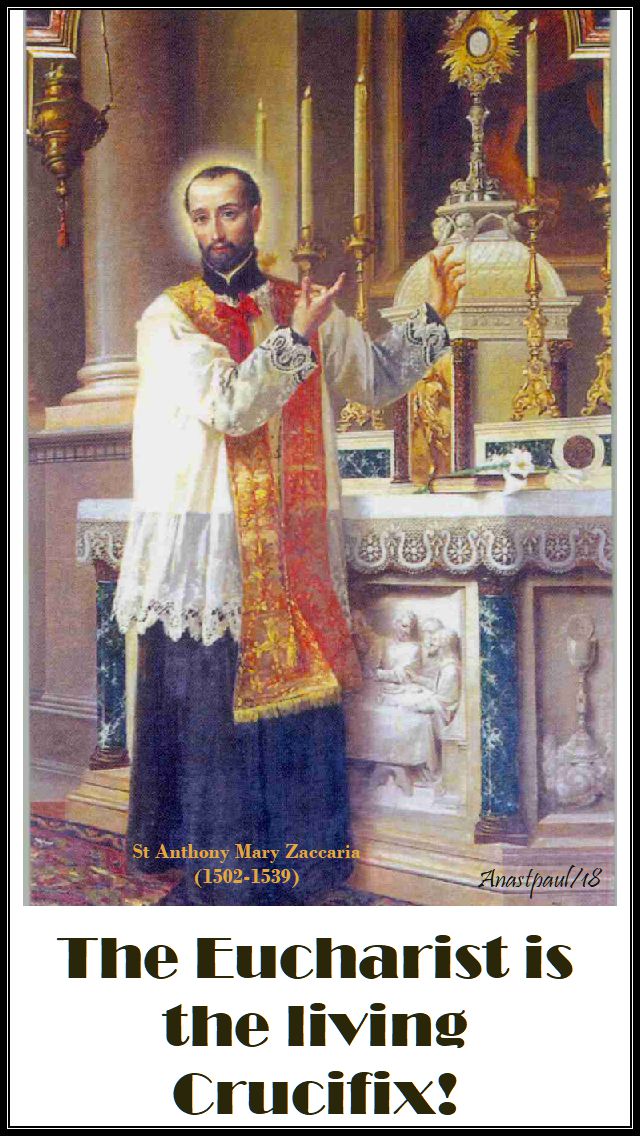
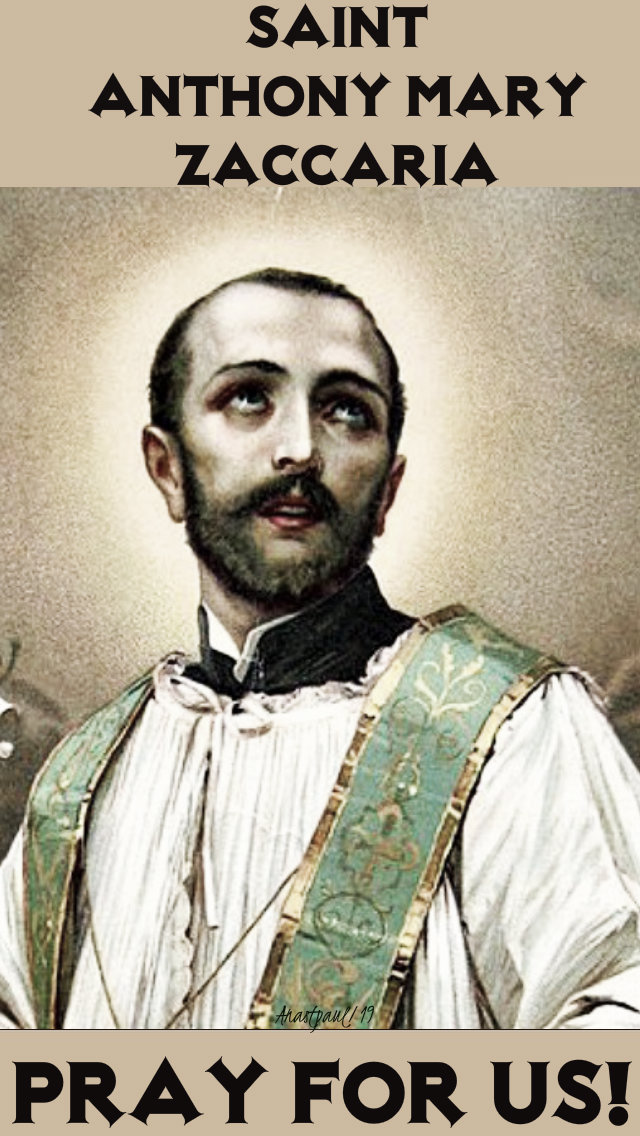
Quote/s of the Day – 5 July – Friday of the Thirteenth week in Ordinary Time, Year Cand the Memorial of St Anthony Mary Zaccaria CRSP (1502-1539)
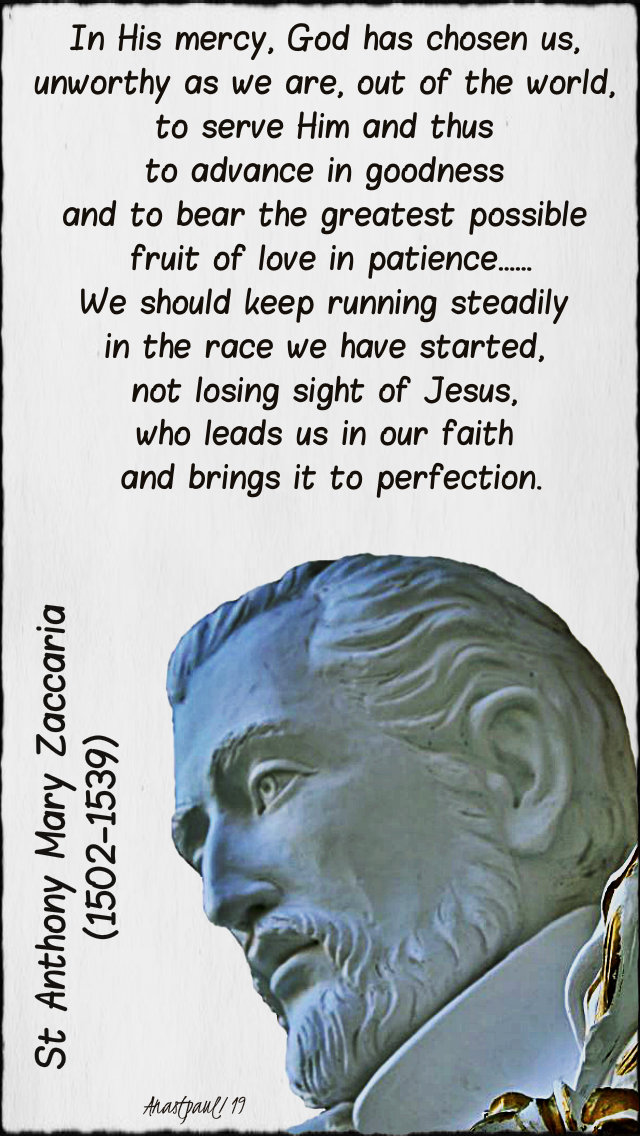
In His mercy God has chosen us, unworthy as we are, out of the world, to serve Him and thus to advance in goodness and to bear the greatest possible fruit of love in patience…… We should keep running steadily in the race we have started, not losing sight of Jesus, who leads us in our faith and brings it to perfection.”
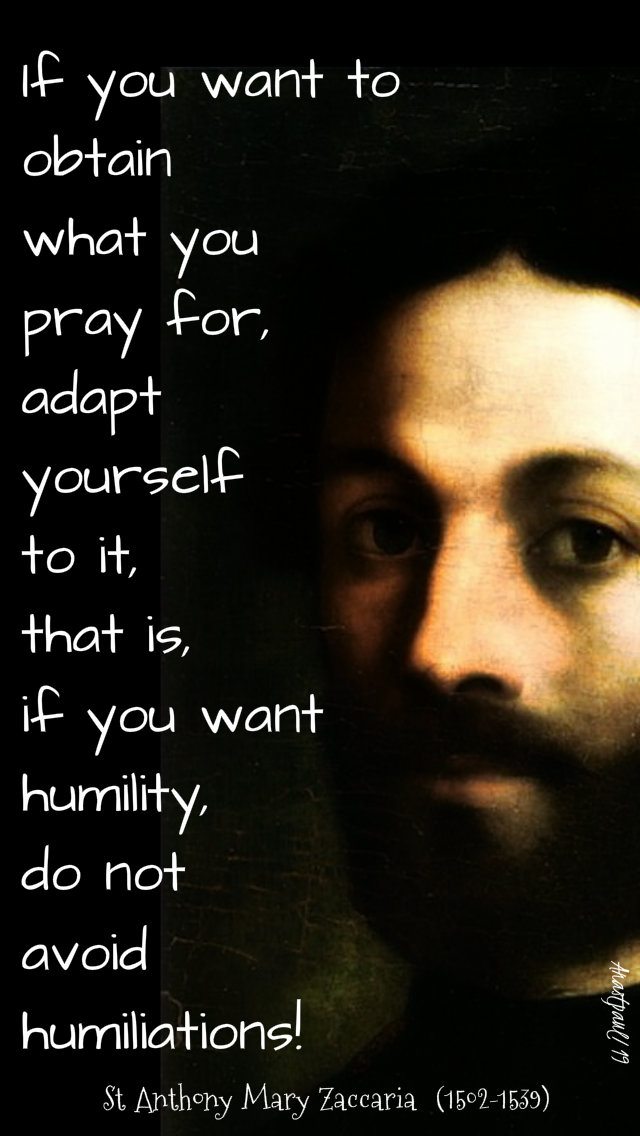
“If you want to obtain what you pray for, adapt yourself to it, that is, if you want humility, do not avoid humiliations.”
“Let them keep in mind, therefore, that there can be no humility without reproaches and mockery and anyone who feels ashamed of them … may as well abandon all hope, of being able to achieve perfection.”
“What good thing could God deny us when He is the one who invites us to ask?”
“That which God commands seems difficult and a burden. The way is rough, you draw back, you have no desire to follow it. Yet DO SO – and you will attain glory.”
“The centre and the source from which everything begins and to which everything returns.”
One Minute Reflection – 5 July – Friday of the Thirteenth week in Ordinary Time, Year C, Gospel: Matthew 9:9–13 and the Memorial of St Anthony Mary Zaccaria CRSP (1502-1539)
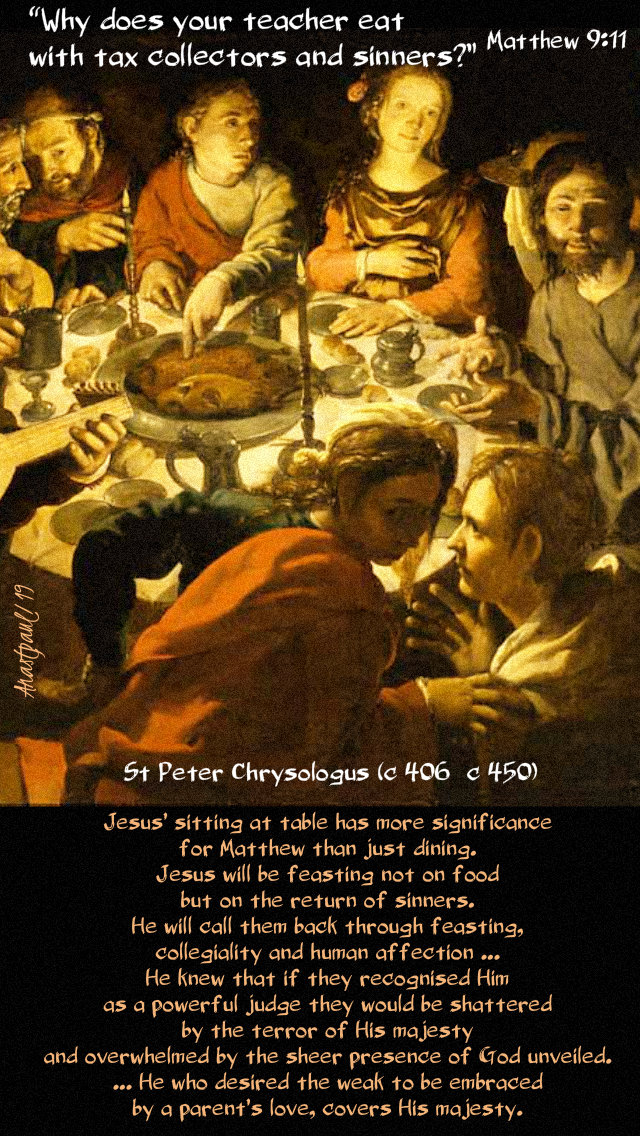
“Why does your teacher eat with tax collectors and sinners?”…Matthew 9:11
REFLECTION – “Jesus’ sitting at table has more significance for Matthew than just dining. Jesus will be feasting not on food but on the return of sinners. He will call them back through feasting, collegiality and human affection, enjoying Himself with their pleasant conversation while reclining at table. He knew that if they recognised Him as a powerful judge they would be shattered by the terror of His majesty and overwhelmed by the sheer presence of God unveiled (nuda). Thus, veiled in a human body, He was able to communicate with humans. He who wanted to assist the guilty and hides the fact that He was a judge. He who did not deny dignity to faithful servants and conceals His lordship. He who desired the weak to be embraced by a parent’s love, covers His majesty.” … St Peter Chrysologus (c 406 – c 450) – Father of the Church (Sermons, 29)
PRAYER – Lord God, You hold out the light of Your Word to those who do not know You. Strengthen in our hearts the faith You have given us, so that no trials may quench the fire Your Spirit has kindled within us. Teach us to show Your love and mercy by our lives and grant that we may extend that love and mercy to all. Freely we have received, may we freely give. Grant us the grace of the wisdom which inspired Saint Anthony Zaccaria to preach the message of salvation in Your church. Grant this, we pray, through our Lord Jesus Christ, Your Son,who lives and reigns with you and the Holy Spirit, one God, forever and ever. St Anthony Mary Zaccaria, pray for us amen.
One Minute Reflection – 28 June – Solemnity of the Most Sacred Heart of Jesus and the World Day of Prayer for the Sanctification of Priests, Gospel: Luke 15:3–7
“Rejoice with me, for I have found my sheep, which was lost.”…Luke 15:6
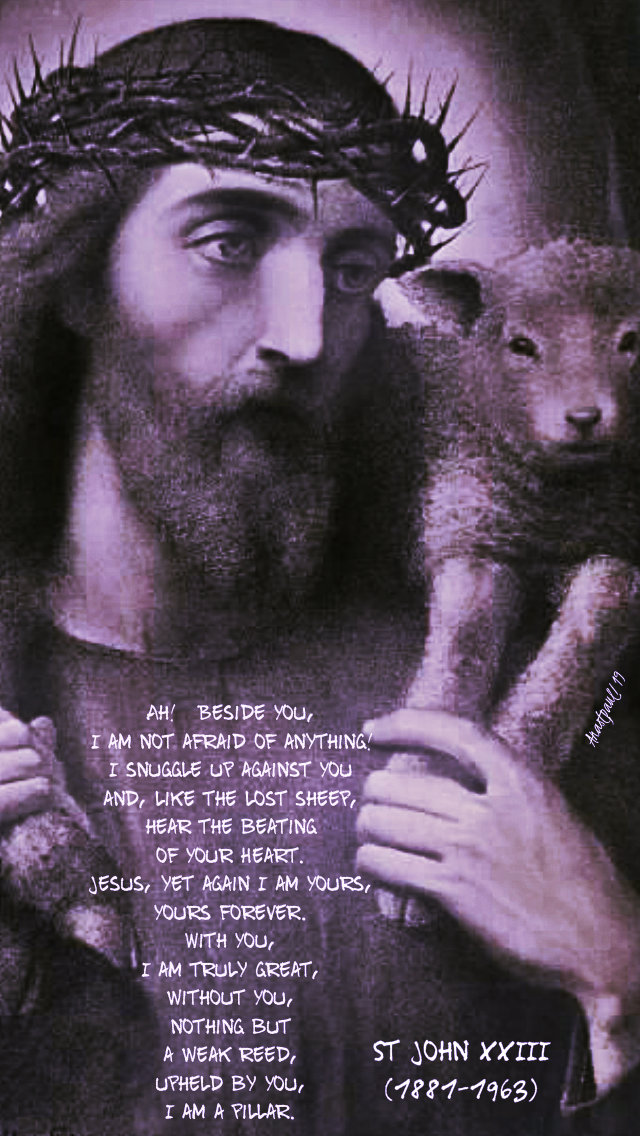
REFLECTION – “I feel that my Jesus is drawing ever closer to me. These last days He has let me fall into the sea and drown in the consideration of my wretchedness and pride, so as to make me understand just how much I need Him. Just as I am on the verge of being overcome, Jesus, walking on the water, comes smiling to meet me, so that I may be saved. With Peter I should like to say to Him: “Depart from me, Lord, for I am a sinful man” (Lk 5:8) but, I am forestalled, by the gentleness of His heart and sweetness of His words: “Fear not” (Lk 5:10).
Ah! Beside You I am not afraid of anything! I snuggle up against You and, like the lost sheep, hear the beating of Your Heart. Jesus, yet again I am Yours, Yours forever. With You, I am truly great, without You, nothing but a weak reed, upheld by You, I am a pillar. I must never forget my wretchedness, not so as to be constantly trembling but so that, regardless of my lowliness and confusion, I may, with ever greater confidence, draw close to Your Heart. For my wretchedness, is the throne of Your mercy and love.”…St John XXIII (1881-1963)Journal of a soul, 1901-1903
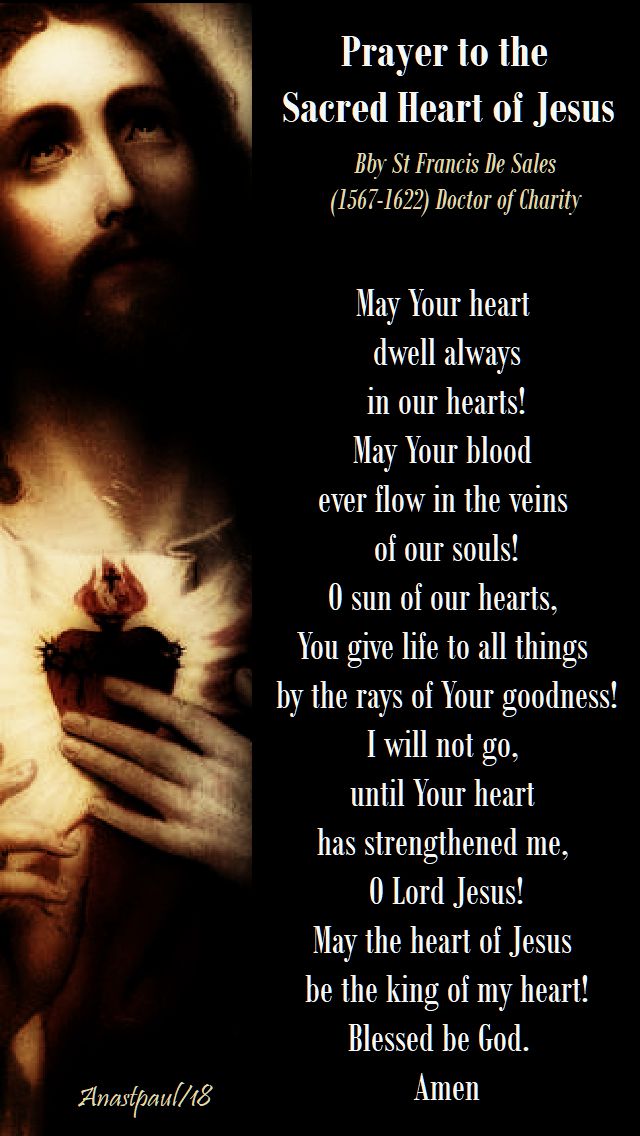
PRAYER – “May Your heart dwell always in our hearts! May Your blood ever flow in the veins of our souls! O sun of our hearts, You give life to all things by the rays of Your goodness! I will not go, until Your heart has strengthened me, O Lord Jesus! May the heart of Jesus be the king of my heart! Blessed be God. Amen.”…St Francis De Sales (1567-1622) Doctor of Charity
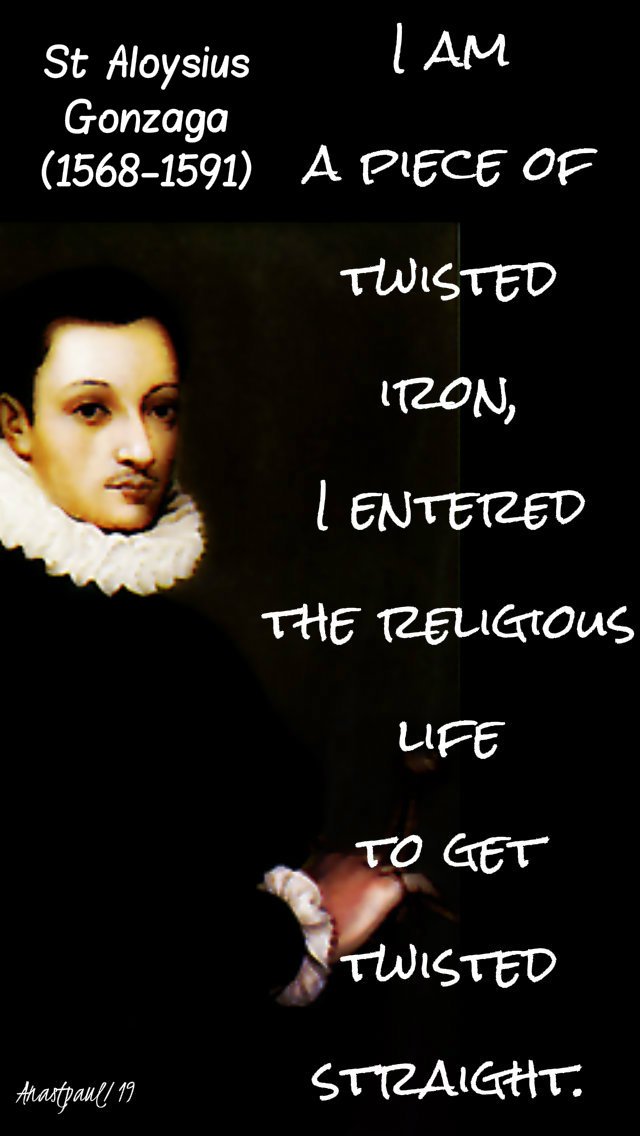
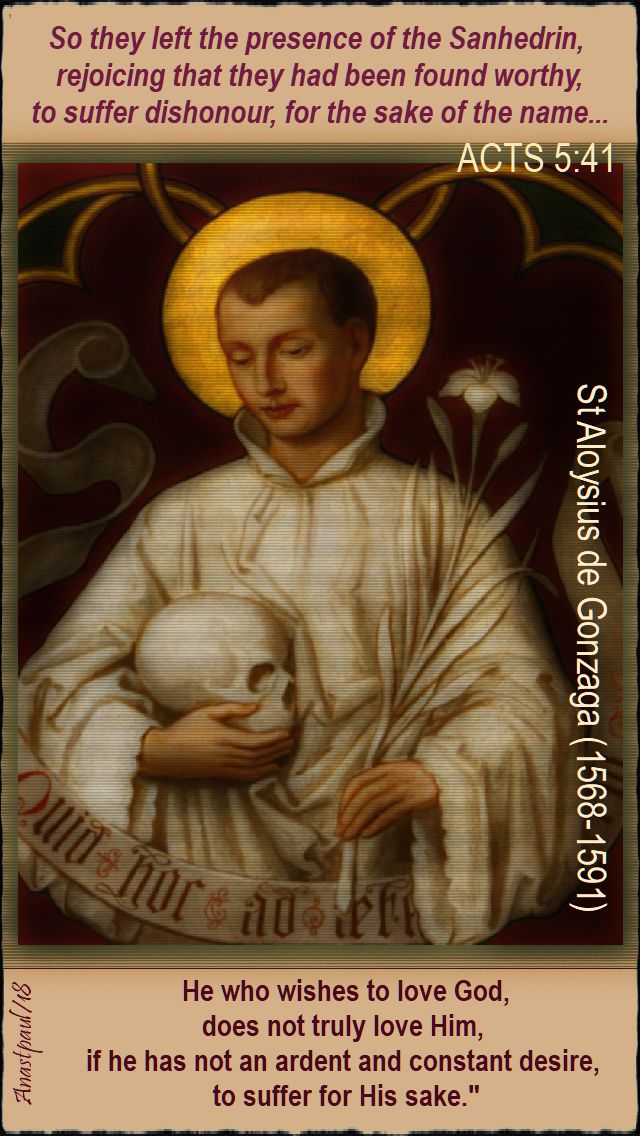
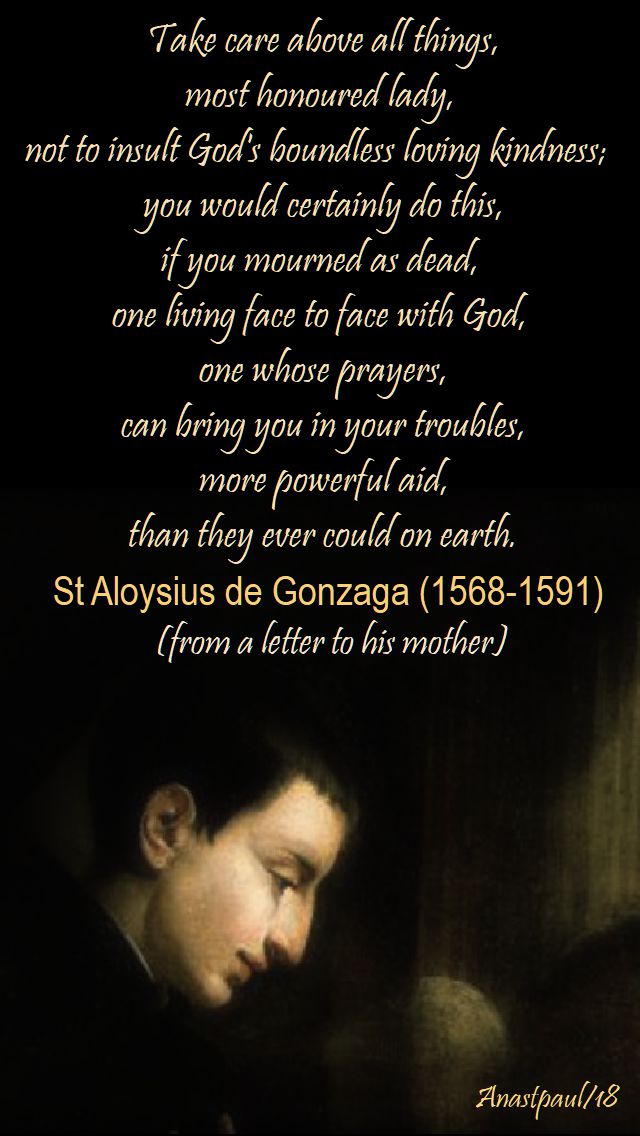
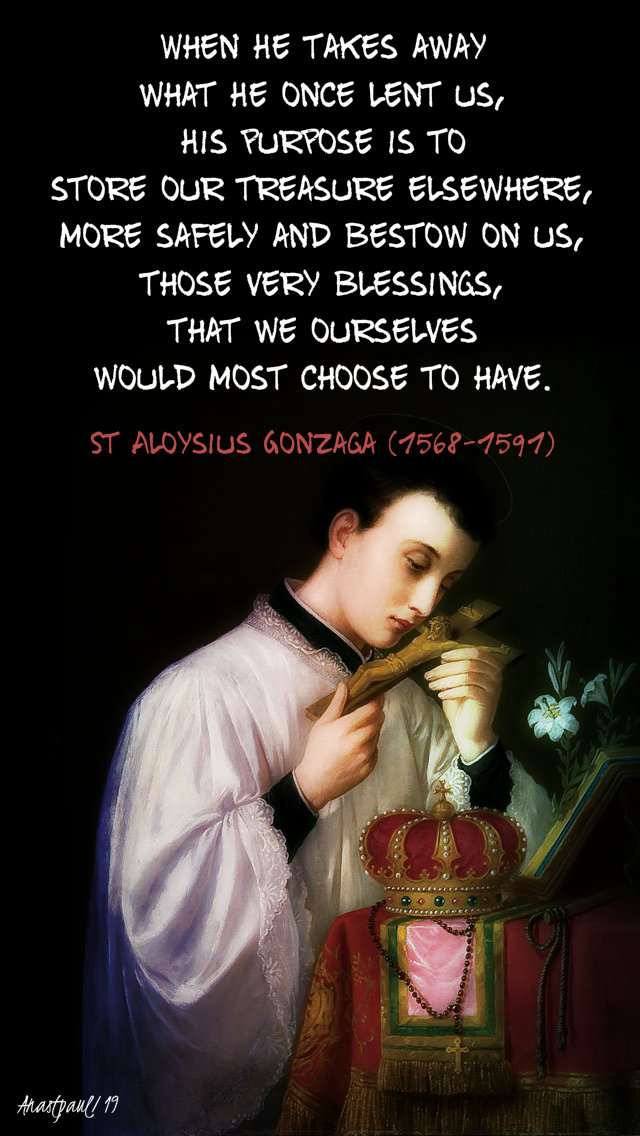
Quote/s of the Day – 21 June – The Memorial of St Aloysius de Gonzaga SJ (1568-1591)
“I am a piece of twisted iron, I entered the religious life to get twisted straight.”
“He who wishes to love God does not truly love Him, if he has not an ardent and constant desire to suffer for His sake.”
“Take care above all things, most honoured lady, not to insult God’s boundless loving kindness, you would certainly do this, if you mourned as dead, one living face-to-face with God, one whose prayers, can bring you in your troubles, more powerful aid, than they ever could on earth.”
“When He takes away what He once lent us, His purpose is to store our treasure elsewhere, more safely and bestow on us, those very blessings, that we ourselves would most choose to have.”
(From A Letter to His Mother)
More of this letter here: https://anastpaul.com/2018/06/21/quote-of-the-day-21-june-the-memorial-of-st-aloysius-de-gonzaga-s-j-1568-1591/
Quote/s of the Day – 13 May – Monday of the Fourth Week of Easter, C and the Memorial of Blessed Julian of Norwich (c 1342-c 1430) – “Revelations of Divine Love”
“He [ Jesus] is our clothing, that for love wraps us and winds us, embraces us and totally encloses us, hanging about us in tender love.”
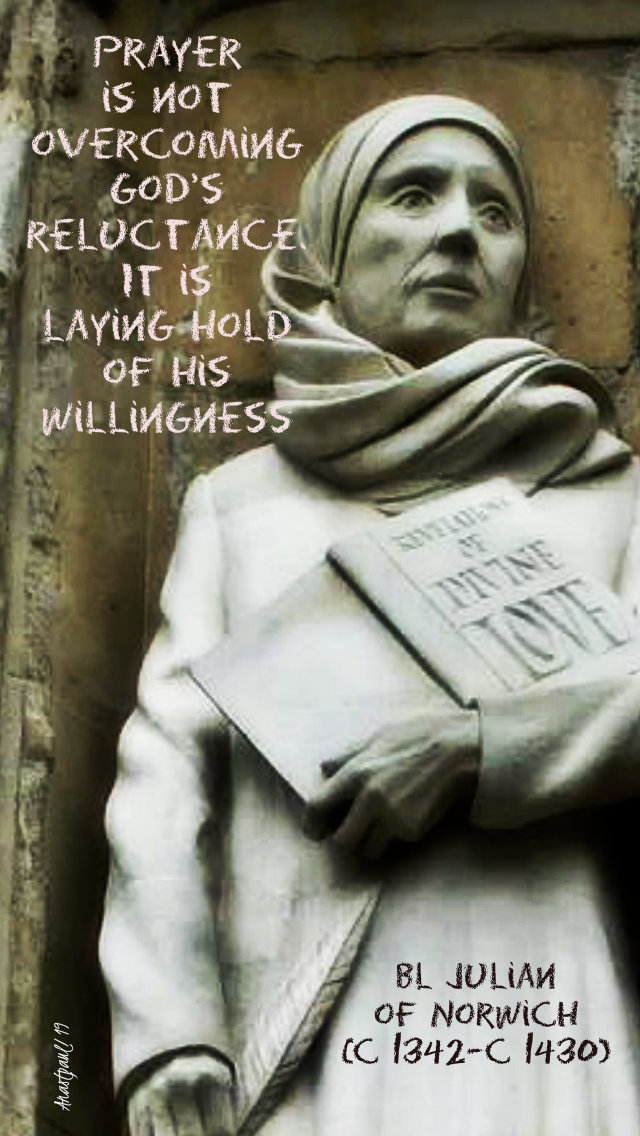
“Prayer is not overcoming God’s reluctance. It is laying hold of His willingness.”
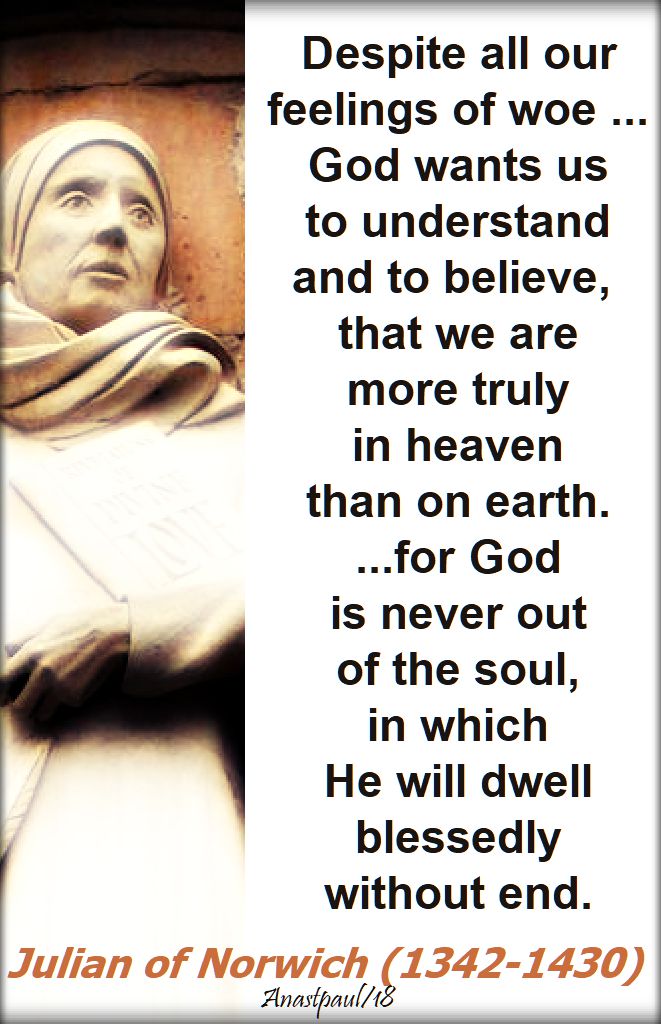
“Despite all our feelings of woe or of well-being, God wants us to understand and to believe, that we are more truly in heaven than on earth. …for God is never out of the soul, in which He will dwell blessedly without end.”
“The fullness of Joy is to behold God in everything.”
“Truth sees God and wisdom contemplates God and from these two comes a third, a holy and wonderful delight in God, who is love.”
“In You, Father almighty, we have our preservation and our bliss. In You, Christ, we have our restoring and our saving. You are our mother, brother and Saviour. In You, our Lord the Holy Spirit, is marvelous and plenteous grace. You are our clothing, for love You wrap us and embrace us. You are our maker, our lover, our keeper. Teach us to believe, that by Your grace all shall be well, and all shall be well, and all manner of things shall be well. Amen”
Our Morning Offering – 30 April – Tuesday of the Second week of Easter
Be Merciful, Be Gracious By Blessed John Henry Newman (1801-1890)
Be merciful, be gracious, Lord, deliver me.
From the sins that are past,
From Your frown and Your ire,
From the perils of dying,
From any complying
With sin or denying
My God, or relying
On self,
at the last,
From the nethermost fire,
From all that is evil,
From the power of the devil,
Your servant deliver,
For once and forever,
By Your Birth and By Your Cross,
Rescue me from endless loss,
By Your death and burial,
Save me from a final fall,
By Your rising from the tomb,
By Your mounting up above,
By the Spirit’s gracious love,
Save me in the day of doom.
Thought for the Day – 28 April – Low Sunday the Octave Day of Easter and Divine Mercy Sunday, Gospel: John 20:19–31
Jesus said to them again, “Peace be with you. As the Father has sent me, even so I send you.” And when he had said this, he breathed on them and said to them, “Receive the Holy Spirit. “...John 20:21-22
Saint Francis de Sales (1567-1622)
Bishop of Geneva and Doctor of the Church
First Sermon for Pentecost
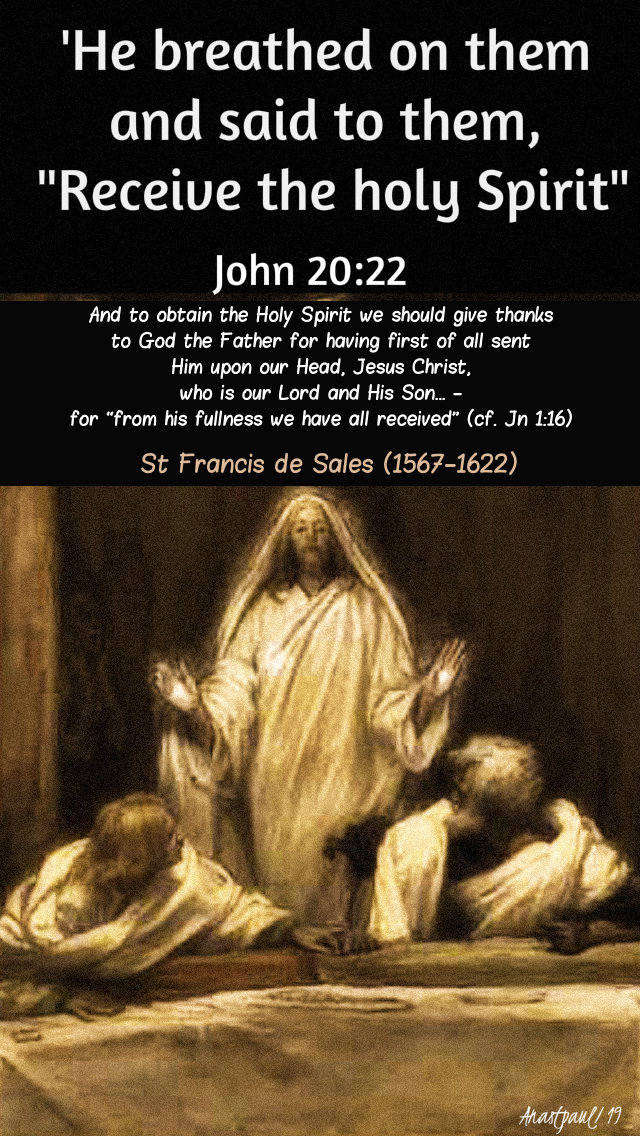
‘He breathed on them and said to them, “Receive the holy Spirit” ‘
Lord Jesus Christ, once again grant that of us, too, there may be but “one heart and mind” (Acts 4:32) for then there will be “a great calm” (Mk 4:39). My dear listeners, I exhort you to good will and kindness to one another and peace with all. For were we to have charity among ourselves, we would have both peace and the Holy Spirit. Let us undertake to become devout and pray to God… since the apostles persevered in prayer… If we set ourselves to fervent prayer then the Holy Spirit will enter us and say: “Peace be with you! It is I; be not afraid” (cf. Mk 6:50)… And what ought we to ask God for, my brethren? For all that is for His honour and the salvation of your souls and, in a word, for the help of the Holy Spirit – “Send forth your Spirit and they will be created” (Ps 104[103]:30) – peace and tranquillity…
We are to ask for this peace so that the Spirit of peace may come down on us. We should give thanks to God, too, for all His blessings if we want Him to grant us those victories that are the beginning of peace. And to obtain the Holy Spirit we should give thanks to God the Father for having first of all sent Him upon our Head, Jesus Christ, who is our Lord and His Son… – for “from his fullness we have all received” (cf. Jn 1:16) – and for having sent Him upon His apostles that through their hands they might pass Him onto us. We should give thanks to the Son – as God, He sends the Spirit upon those who prepare themselves to receive Him. But, most especially, we should thank Him because, as man, He merited for us, the grace of receiving this divine Spirit…
And how has Jesus Christ merited the Holy Spirit’s coming? When “bowing his head, he gave up his spirit” (Jn 19:30), for, when He gave breathed His last and handed over His spirit to the Father, He merited the Father’s sending His Spirit upon His mystical body.
Quote of the Day – 28 April – Low Sunday the Octave Day of Easter and Divine Mercy Sunday
“Oh, how great, is the goodness of God, greater than we can understand. There are moments and there are mysteries, of the Divine Mercy over which, the heavens are astounded. Let our judgement of souls cease, for God’s mercy upon them, is extraordinary.”
One Minute Reflection – 28 April – Low Sunday the Octave Day of Easter and Divine Mercy Sunday, Gospel: John 20:19–31
“Peace be with you. As the Father has sent me, even so I send you.” And when he had said this, he breathed on them, and said to them, “Receive the Holy Spirit. If you forgive the sins of any, they are forgiven; if you retain the sins of any, they are retained.”…John 20:21–23
REFLECTION – “This Sunday, … concludes the week or, more properly, the “Octave” of Easter, which the liturgy considers as a single day: “the day which the Lord has made” (Ps 117[116]: 24). It is not a chronological but a spiritual time, which God opened in the sequence of days when He raised Christ from the dead. The Creator Spirit, infusing new and eternal life in the buried body of Jesus of Nazareth, carried to completion the work of creation, giving origin to a “firstfruits” – the firstfruits of a new humanity, which at the same time is a firstfruits of a new world and a new era.
This world renewal can be summed up in a single phrase, the same one that the Risen Jesus spoke to his disciples as a greeting and even more, as an announcement of his victory: “Peace be with you!” (Lk 24: 36; Jn 20: 19, 21, 26).
Peace is the gift that Christ left his friends (see Jn 14: 27) as a blessing destined for all men and women and all peoples. It is not a peace according to a “worldly” mentality, as an equilibrium of forces but a new reality, fruit of God’s Love, of His Mercy. It is the peace that Jesus Christ earned, by the price of His Blood and communicates to those who trust in Him.
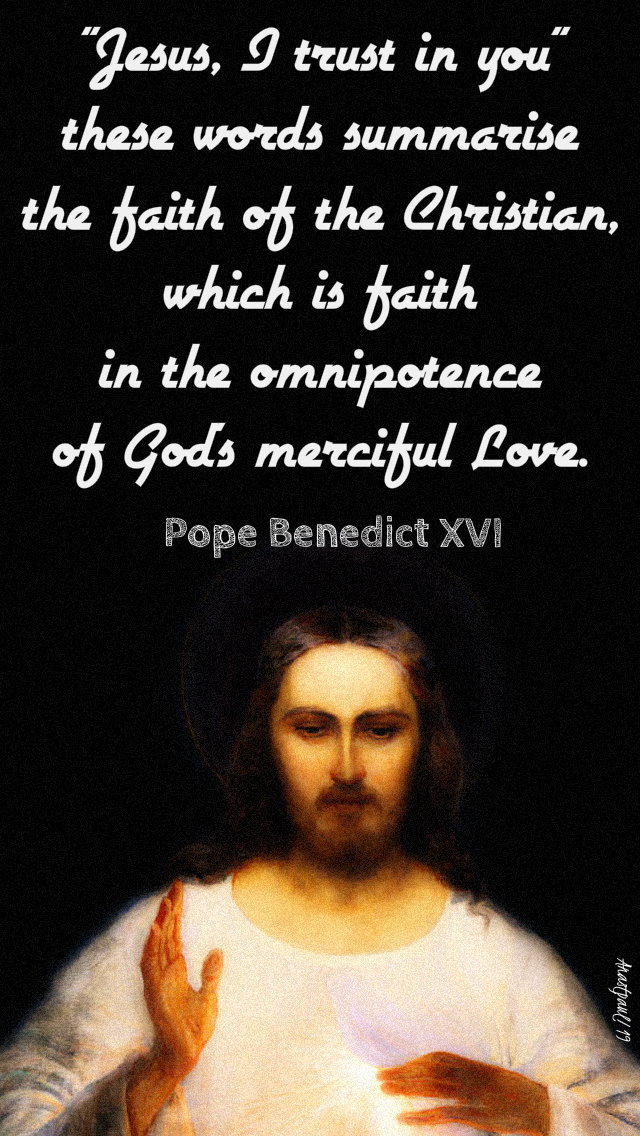
“Jesus, I trust in you” these words summarise the faith of the Christian, which is faith in the omnipotence of God’s merciful Love.”…Pope Benedict XVI – REGINA CÆLI – Second Sunday of Easter, 15 April 2007
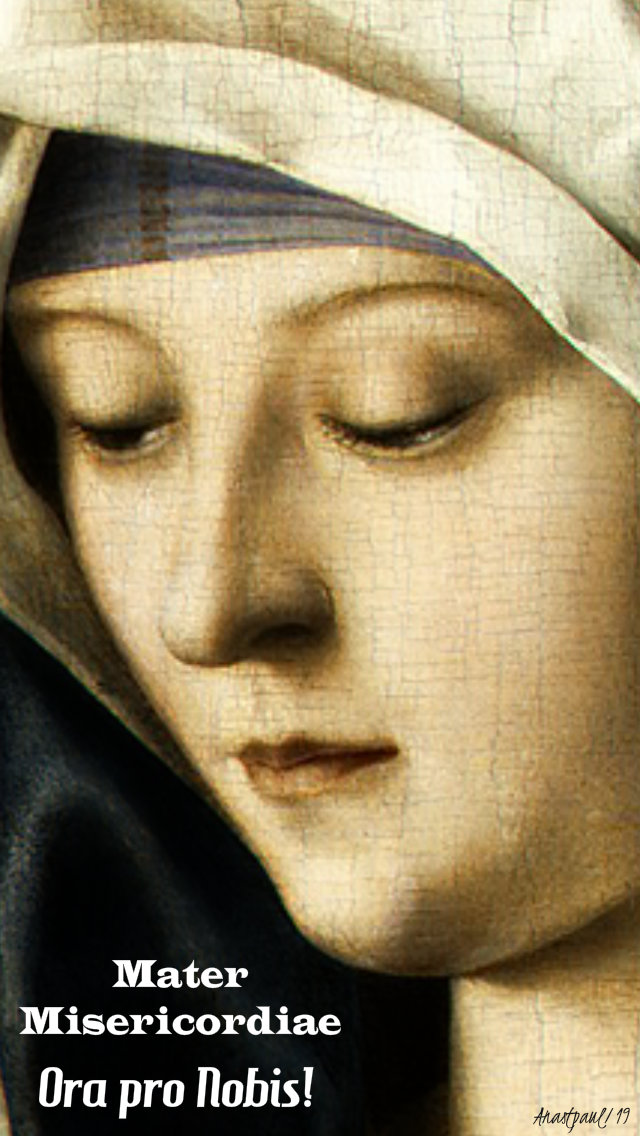
PRAYER – Almighty Father, grant we pray that with Mary’s help, Mater Misericordiae, Mother of Jesus who is the incarnation of Divine Mercy, that we become renewed in the Spirit, in order to cooperate in the work of peace which You are accomplishing in the world and which is not just talk, but which is actualised in the countless gestures of charity by all his sons and daughters. Grant we pray, that we taste the beauty of the encounter with the Risen Lord and draw from the source of His merciful love, to be apostles of His peace. Through Christ, Redeemer and Merciful Lord, with the Holy Spirit, God for always and forever, amen.
Our Morning Offering – 28 April – Low Sunday the Octave Day of Easter and Divine Mercy Sunday
In the Jubilee Year 2000, St Pope John Paul II proclaimed that from that year forward, the Second Sunday of Easter, where we remember the institution of the Sacrament of Penance, would be celebrated as Divine Mercy Sunday. This was proclaimed at the Canonisation Mass of St Faustina Kawalska, who worked throughout her life to make all aware of the merciful love of God. For this is the God who leans in and waits with bated breath for us to whisper through the screen, “Forgive me, Father, for I have sinned.”
St Faustina (1905–1938) was born and raised in Poland. Following a vocation to religious life, she was accepted by the Congregation of the Sisters of Our Lady of Mercy. As a member of the Congregation, she worked as a cook, gardener and porter. In her mystical spiritual life, her contemplation on the Mercy of God led her to develop a childlike trust in God and deep love for her neighbour.
In her years in the convent, St Faustina heard a call from God to make God’s mercy known to the world so that the world may more fully receive God’s healing grace. St Faustina promoted the Chaplet of Divine Mercy which consists of the recitation of prayers to the Eternal Father with the use of the rosary for the sake of Christ’s sorrowful passion.
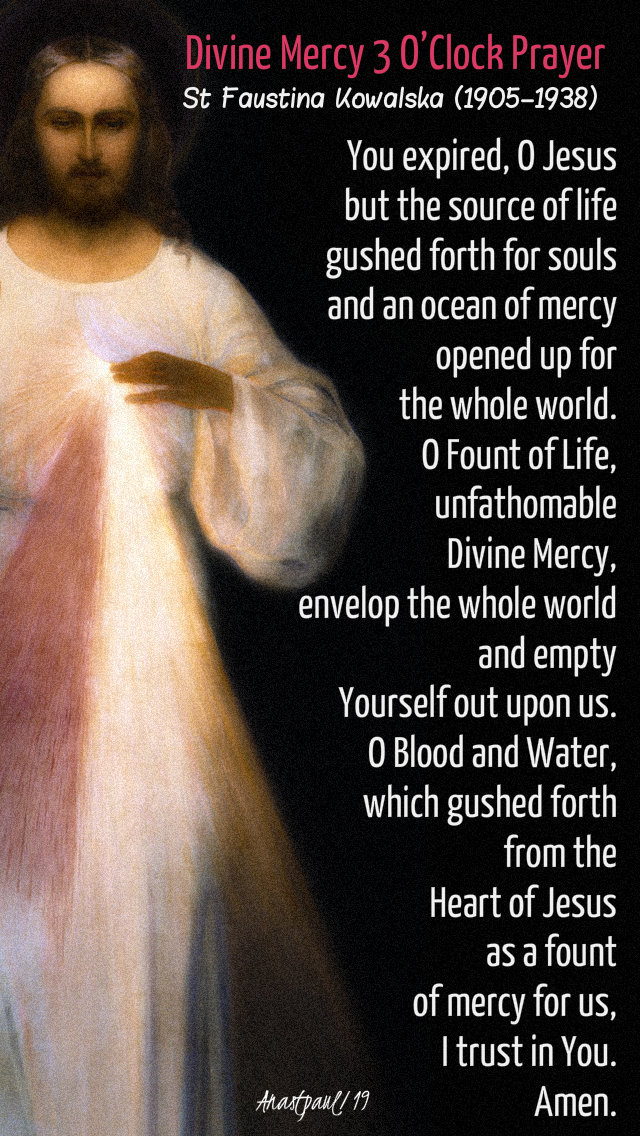
Divine Mercy 3 O’Clock Prayer St Faustina Kowalska (1905–1938)
You expired, O Jesus,
but the source of life
gushed forth for souls
and an ocean of mercy
opened up for the whole world.
O Fount of Life,
unfathomable Divine Mercy,
envelop the whole world
and empty Yourself out upon us.
O Blood and Water,
which gushed forth
from the Heart of Jesus
as a fount of mercy for us,
I trust in You.
Amen
Low Sunday the Octave Day of Easter and Divine Mercy Sunday *2019
St Louis Marie Grignion de Montfort (1673-1716) (Optional Memorial) St Louis’s story: https://anastpaul.wordpress.com/2018/04/28/saint-of-the-day-28-april-st-louis-marie-grignion-de-montfort-1673-1716/
St Peter Chanel SM (1803-1841) Martyred aged 37 (Optional Memorial) Biography: https://anastpaul.wordpress.com/2017/04/28/saint-of-the-day-28-april-st-peter-chanel/
St Adalbero of Augsburg
St Agapio of Cirtha
St Artemius of Sens Bl Itala Mela ObSB (1904–1957)
St Benedict of the Bridge
St Cronan of Roscrea
St Cyril of Turov
Bl Gerard of Bourgogne St Gianna Beretta Molla (1922-1962)
Bl Józef Cebula
Bl Luchesius
St Pamphilus of Sulmona
St Prudentius of Tarazona
—
St Alexander
St Aphrodisius of Beziers
St Berthold
St Buonadonna
Carino Peter of Balsamo
St Firmiano
St Germaine
St Guido Spada
St Luchtighern of Ennistymon
St Marie Louise Trichet Jesus
St Mark of Galilee
St Peter of Bearn
St Primianus
St Probe
St Tellurium
The Stations of the Cross – 12 April – Thursday of the Fifth Week of Lent, Year C
Meditations on the Stations of the Cross
By Blessed John Henry Newman (1801-1890)
Begin with an Act of Contrition, this one by St Alphonsus Liguori (1696-1787).
My Lord Jesus Christ,
You have made this journey
to die for me, with love unutterable
and I have so many times unworthily abandoned You
but now I love You with my whole heart
and because I love You,
I repent sincerely for having ever offended You.
Pardon me, my God
and permit me to accompany You on this journey.
You go to die for love of me,
I wish also, my beloved Redeemer,
to die for love of Thee.
My Jesus, I will live
and die always united to You.
Amen
V. Adoramus te, Christe, et benedicimus tibi.
R. Quia per sanctam Crucem tuam redemisti mundum.
V. We adore You, O Christ and we bless You.
R. Because by Your holy cross, You have redeemed the world.
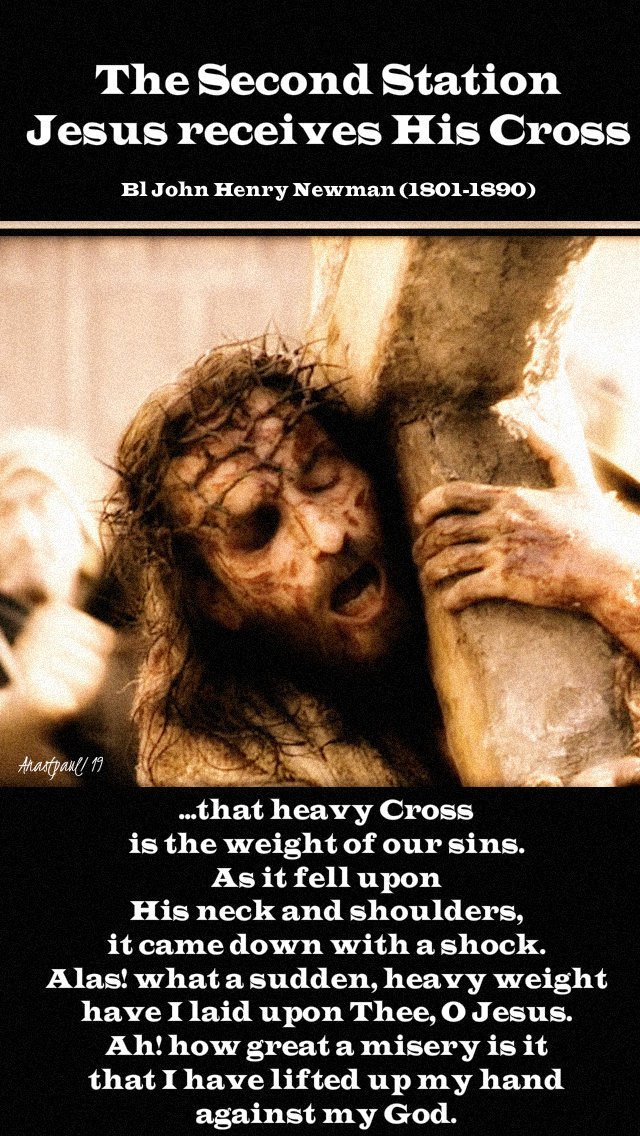
The Second Station
Jesus receives His Cross
A STRONG, and therefore heavy Cross, for it is strong enough to bear Him on it, when He arrives at Calvary, is placed upon His torn shoulders. He receives it gently and meekly, nay, with gladness of heart, for it is to be the salvation of mankind.
True – but recollect, that heavy Cross is the weight of our sins. As it fell upon His neck and shoulders, it came down with a shock. Alas! what a sudden, heavy weight have I laid upon Thee, O Jesus. And, though in the calm and clear foresight of Your mind—for You see all things—You were fully prepared for it, yet Your feeble frame tottered under it when it dropped down upon You. Ah! how great a misery is it that I have lifted up my hand against my God. How could I ever fancy He would forgive me! unless He had Himself told us, that He underwent His bitter passion, in order that He might forgive us. I acknowledge, O Jesus, in the anguish and agony of my heart, that my sins it was that struck You on the face, that bruised Your sacred arms, that tore Your flesh with iron rods, that nailed You to the Cross and let You slowly die upon it.
V. Have mercy on us, O Lord. R. Have mercy on us.
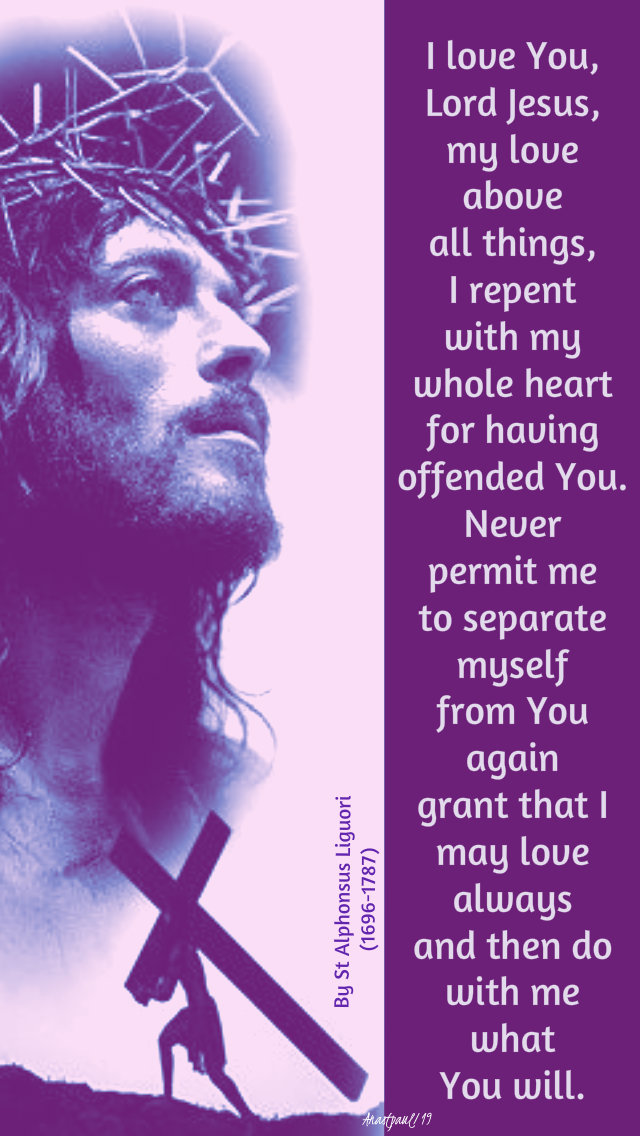
I love You,
Lord Jesus,
my love
above all things,
I repent
with my
whole heart
for having
offended You.
Never permit me
to separate myself
from You again
grant that I
may love always
and then do with me
what You will.
(St Alphonsus Liguori)
Lenten Thoughts – 5 April – Friday of the Fourth Week of Lent, Year C
And now, my heavy laden soul, what will you do? You call with your lips and voice to God most high, God, who cares only for deeds and is not taken in by words. You, my soul, with a heart always turned toward Egypt, how can I describe you?
Am I a Sodom, to be punished likewise with destruction, or the prosecutor of Ninevah, who was struck dumb?
Am I more cowardly and barbarous than the queen of the south, lower than Canaan, more stubborn than Amalek, incurable as the city of idols, a relic left behind from the rebellion of Israel, a reminder of the broken covenant of Judah, more reproachable than Tyre, more shunned than Zidon, more immoral than Galilee, more unpardonable than faithless Capernaum, maligned like Korazin, slandered like Bethsaida?
Or am I immodest as Ephraim as he prayed, or a dove, whose gentleness seems due to feeblemindedness and not to inner calm, or an evil serpent born of lion’s cubs, or the serpent’s egg filled with decay, or like the last blow against Jerusalem?
Or am I in the words of our Lord and the sayings of the prophets, an abandoned tabernacle about to collapse, the unlatched doors of the stronghold, my speaking edifice stained again, having given up my rightful inheritance, my home built by God, as Moses, David and Jeremiah prophesied? My thinking body now consumed by disease, afflicted with carping counsel, rehabilitated by the law, anointed with the clay of mildness, incapable of finding my own salvation, torn away from the maker’s hand, expelled as just punishment by order of the Almighty, to an unholy place, rejected, exiled, greatly shunned, nothing spared, having buried my gift in the ground, like the one chastised in the Gospel by losing his inheritance.
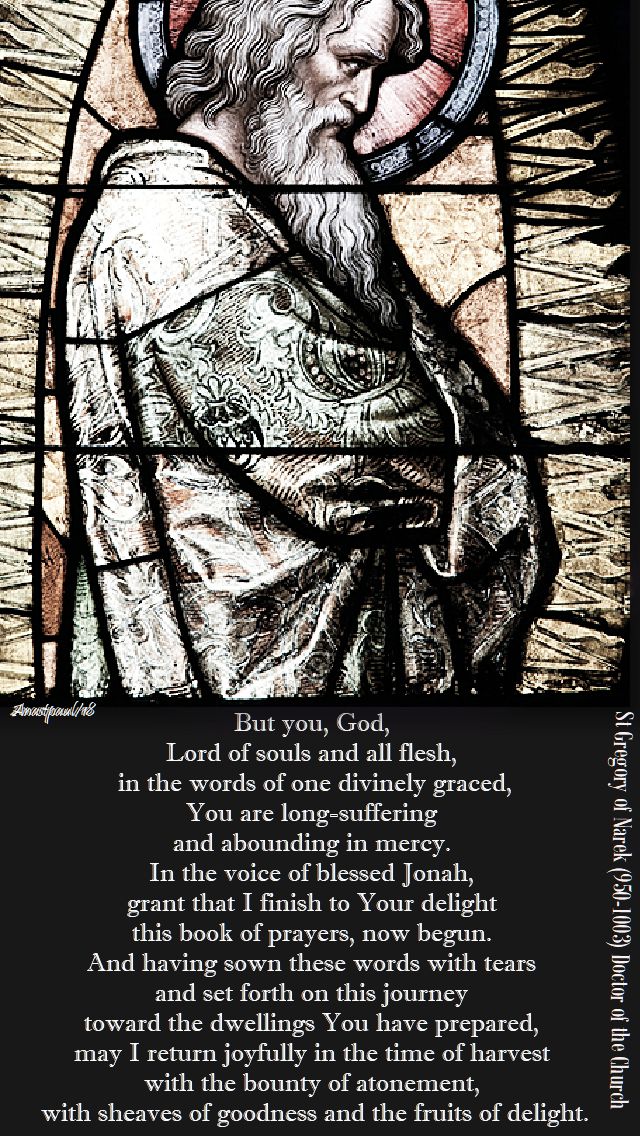
But You, God, Lord of souls and all flesh, in the words of one divinely graced, You are long-suffering and abounding in mercy. In the voice of blessed Jonah, grant that I finish to Your delight this book of prayers, now begun. And having sown these words with tears and set forth on this journey toward the dwellings You have prepared, may I return joyfully in the time of harvest with the bounty of atonement, with sheaves of goodness and the fruits of delight.
St Gregory of Narek (950-1003) – Fathe & Doctor of the Church
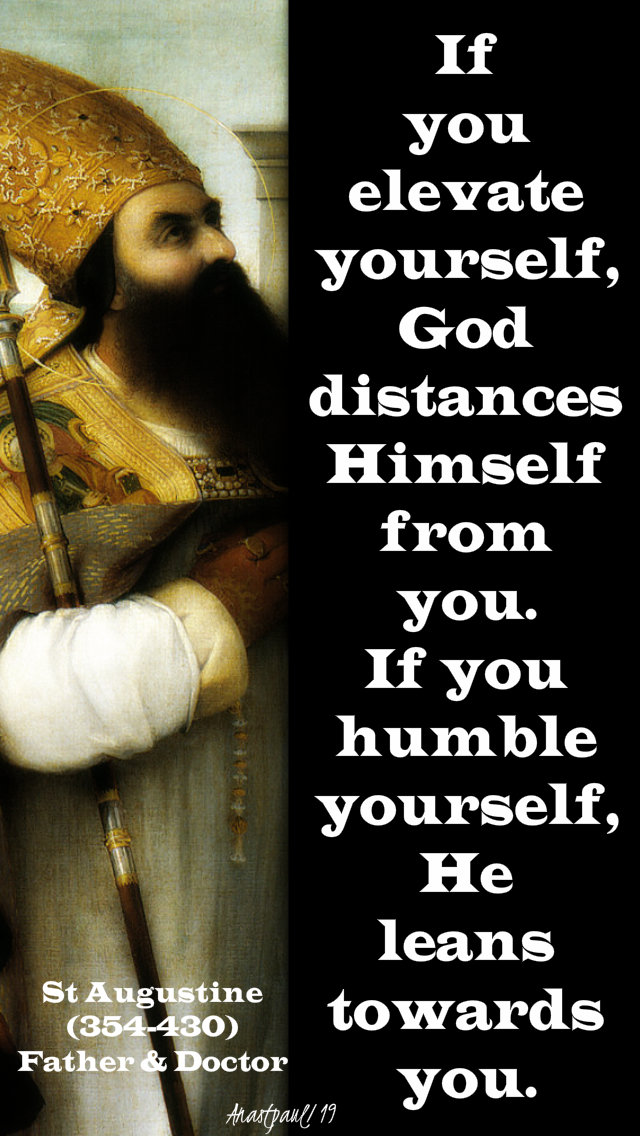
“If you elevate yourself, God distances Himself from you. If you humble yourself, He leans towards you.”
Lenten Reflection – 5 April – Friday of the Fourth Week of Lent, Year C
The Readings:
Wisdom 2:1A, 12-22; Psalm 34:17-18, 19-20, 21 and 23; John 7:1-2, 10, 25-30
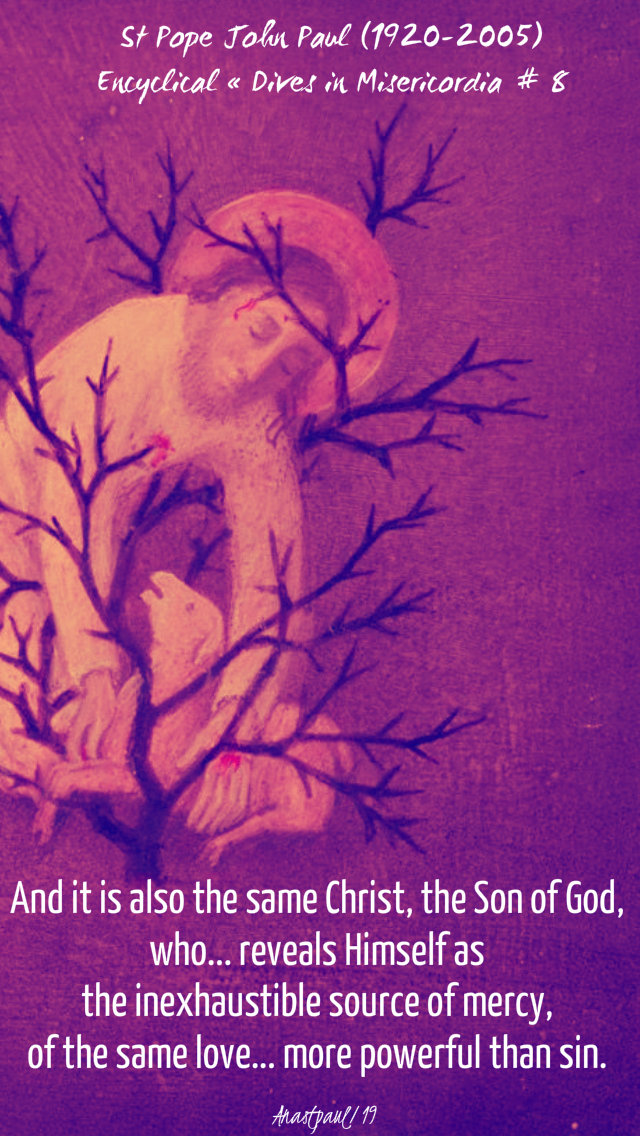
St Pope John Paul (1920-2005)
Encyclical « Dives in Misericordia » # 8
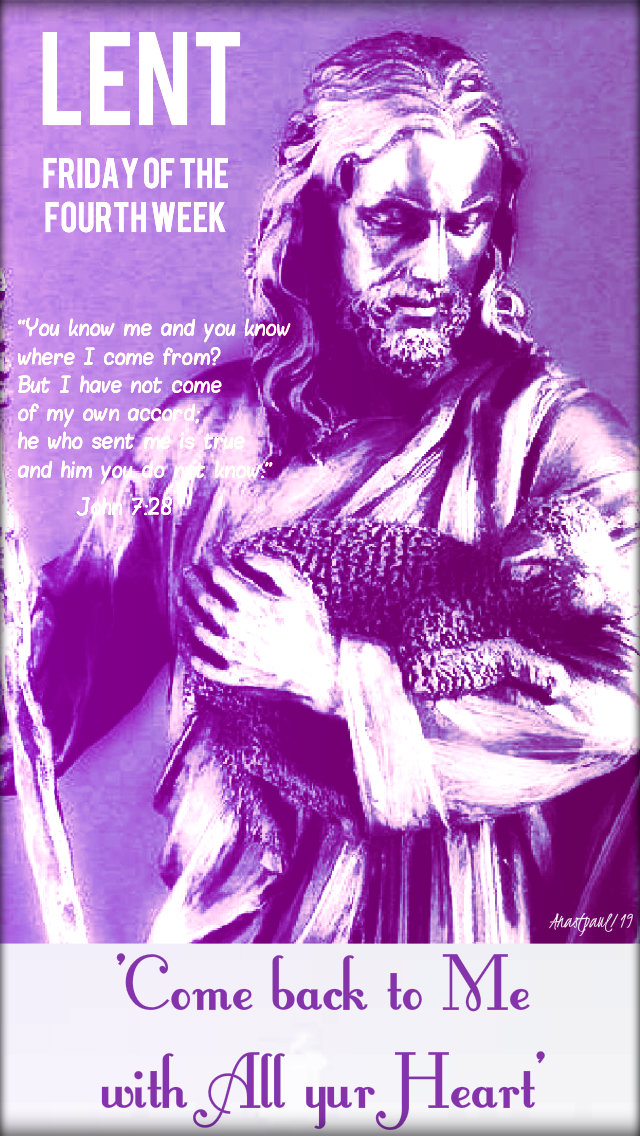
“You know me and you know where I come from? But I have not come of my own accord; he who sent me is true and him you do not know.”…John 7:28
The Paschal Mystery is Christ at the summit of the revelation of the inscrutable mystery of God. It is precisely then that the words pronounced in the Upper Room are completely fulfilled: “He who has seen me has seen the Father” (Jn 14:9). In fact, Christ, whom the Father “did not spare” (Rm 8:32) for the sake of man and who in His passion and in the torment of the cross did not obtain human mercy, has revealed in His resurrection, the fullness of the love that the Father has for Him and, in Him, for all people. “He is not God of the dead, but of the living” (Mk 12:27).
In His resurrection Christ has revealed the God of merciful love, precisely because He accepted the cross as the way to the resurrection. And, it is for this reason, that, when we recall the cross of Christ, His passion and death, our faith and hope are centred on the Risen One – on that Christ who “on the evening of that day, the first day of the week, . . .stood among them” in the upper Room, “where the disciples were, …breathed on them, and said to them: ‘Receive the Holy Spirit. If you forgive the sins of any, they are forgiven; if you retain the sins of any, they are retained’ ” (Jn 20:19).
Here is the Son of God, who in His resurrection, experienced in a radical way, mercy shown to Himself, that is to say the love of the Father which is more powerful than death. And it is also the same Christ, the Son of God, who… reveals Himself as the inexhaustible source of mercy, of the same love… more powerful than sin.
Daily Meditation: May we reach out with joy to grasp Your hand.
We keep acknowledging that God is the source of our life.
We realise that we have been seeking other sources of life.
We recognise our weakness and turn to God for help.
Though our hearts are being opened up to their depths,
though we cry out to God for help, we are not discouraged.
The Lord is near to broken hearts. The Lord is near to the brokenhearted, and saves the crushed in spirit. Many are the afflictions of the righteous but the Lord delivers him out of them all.
Psalm 34:18-19
Closing Prayer:
Loving God of forgiveness,
I come before You humbled and sad
in the face of my own repeated failings.
I hold out my hands as a petitioner would,
asking for mercy.
It is then that I feel You reach out and take my hand
in Your loving grasp.
Thank You for the love You pour out on me so lavishly.
Help me to follow more closely
in the path You have set for me,
the path of Your Son.
May the Lord bless us,
protect us from all evil
and bring us to everlasting life.
Amen
Quote/s of the Day – 4 April – Thursday of the Fourth Week of Lent, Year C and the Memorial of St Isidore of Seville (560-636) Father & Doctor of the Church
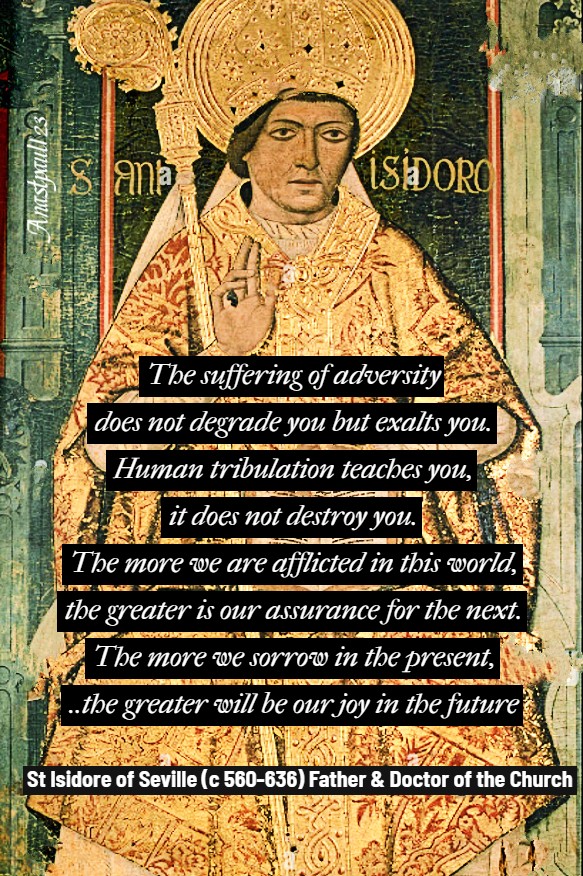
“The suffering of adversity does not degrade you but exalts you. Human tribulation teaches you, it does not destroy you. The more we are afflicted in this world, the greater is our assurance for the next. The more we sorrow in the present, ..the greater will be our joy in the future.”
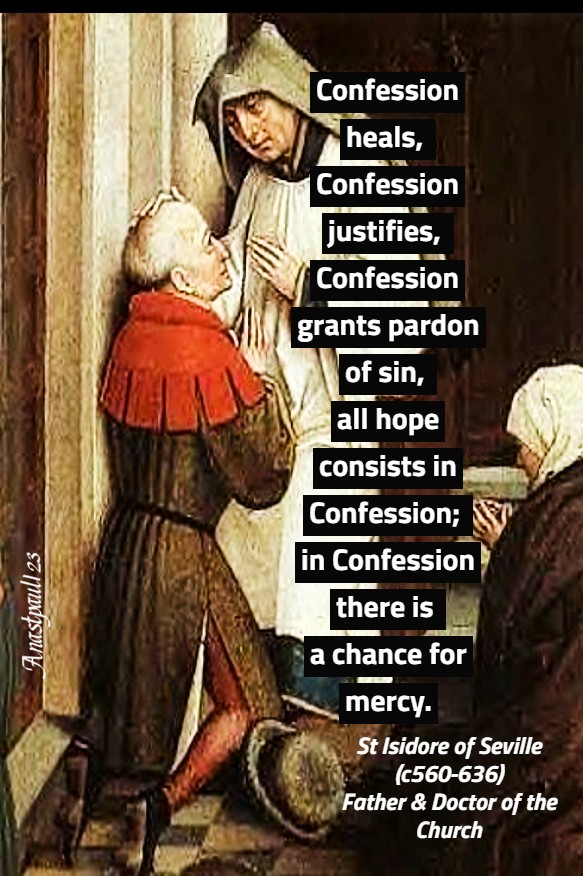
“Confession heals, Confession justifies, Confession grants pardon of sin, all hope consists in Confession; in Confession there is a chance for mercy.”
Lenten Thoughts – 3 April – Wednesday of the Fourth Week of Lent
Imitation of Christ, by Thomas á Kempis (1380-1471): Book 3, Chapter 10
That it is sweet to despise the world and to serve God.
Now, will I speak again, O Lord and will not be silent, I will say in the hearing of my God and my King Who is on high: Oh, how great is the abundance of Your sweetness, O Lord, which You have hidden for those that fear You!
But what are You, for those who love You? What, to those who serve You with their whole heart? Unspeakable indeed, is the sweetness of Your contemplation, which You bestow on those who love You. In this most of all, have You shown me the sweetness of Your love, that when I had no being, You did make me and when I was straying far from You, You brought me back again, that I might serve You and You have commanded me to serve You.
O Fountain of everlasting love, what shall I say of You? How can I forget You, Who have vouchsafed to remember me even after I was corrupted and lost?
Beyond all hope, You show mercy to Your servant and beyond all desert, have You manifested Your grace and friendship. What return shall I make to You for this favour? For it is granted to all who forsake these things, to renounce the world and to assume the monastic life . Is it much that I should serve You, Whom the whole creation is bound to serve? It ought not to seem much to me to serve You but this does rather appear great and wonderful to me, that You vouchsafe to receive one so wretched and unworthy as Your servant. It is a great honour, a great glory, to serve You and to despise all things for You for they who willingly subject themselves to Your holy service, shall have great grace. They shall experience the most sweet consolation of the Holy Spirit, Who for the love of You, have cast aside all carnal delight.
Lenten Reflection – 31 March – “Laetare” Fourth Sunday of Lent, Year C
The Readings:
Joshua 5:9A, 10-12; Psalms 34:2-3, 4-5, 6-7; 2 Corinthians 5:17-21; Luke 15:1-3, 11-32
But while he was yet at a distance, his father saw him and had compassion and ran and embraced him and kissed him...Luke 15:20
“I shall get up and go to my father”
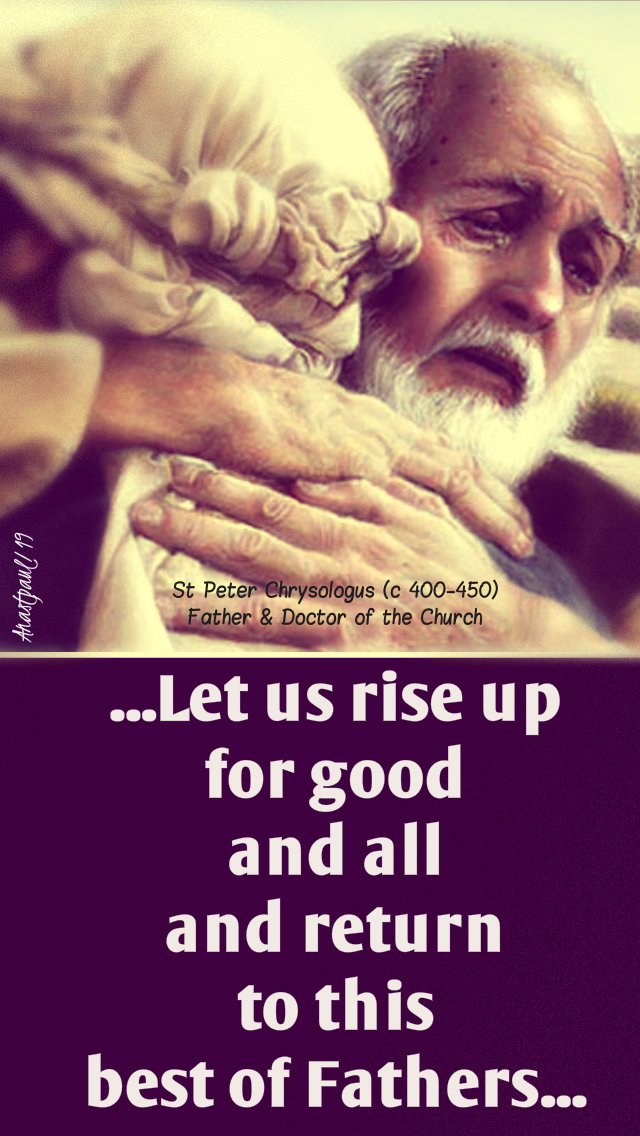
St Peter Chrysologus (c 400-450)
Father & Doctor of the Church
If we do not care for this young man’s conduct, his departure horrifies us. Don’t let us ever abandon such a father! Simply the sight of the father causes sin to flee, banishes our faults, does away with all bad behaviour and temptation. Yet, if we have gone away, if we have wasted all our father’s inheritance in a life of debauchery, if we should happen to have committed some fault or misdeed or fallen into the mire of irreligiousness and complete dissipation, let us rise up for good and all and return to this best of Fathers, summoned by such a beautiful example.
“When the father saw him he ran to embrace him and covered him with kisses.” I ask you, where is there room for despair here? What pretext for excuse? What false reason for fear? Only, perhaps, if we dread meeting the father, if we are afraid of his kisses and embrace, only if we think that the father, when he takes his child by the hand, draws him to his breast and folds his arms around him, wants to seize the opportunity to make good his loss instead of welcoming in order to forgive. Such a thought, however, that destroys life and is contrary to our salvation, is fully overcome, wholly destroyed by what follows: “The father said to his servants: ‘Quickly bring the finest robe and put it on him; put a ring on his finger and sandals on his feet. Take the fattened calf and slaughter it. Then let us celebrate with a feast, because this son of mine was dead and has come to life again, he was lost and has been found.’”
When we have heard that, can we delay any longer? What more could we ask for to return to the Father?
Daily Meditation: Laetare Sunday: Be joyful!
This Sunday has a joy-filled tone.
We enter into the second part of Lent with a spirit of eagerness.
Our celebration of the mercy and life given to us in Jesus is near.
All the readings are profound.
The letter to the Ephesians can be a meditation for the week.
We have been saved by our Lord, Jesus, the Christ.
That is consoling at this part of Lent. It is not the work we do that saves us.
It is God’s love – in the midst of our darkness.
We can ask to be “lifted up” with Jesus in His surrender with the Father,
lifted up on the cross and therefore, lifted up in Glory.
And, we can express our desire to be an instrument of His consoling love,
in the hearts of those to whom He sends us.
Look to him and be radiant, so your faces shall never be ashamed.
Psalm 34:5
Closing Prayer:
Loving Father of mine,
I feel the pace quicken, the time draw near.
I am filled with joy as I move toward Easter
and the promised reconciliation with You.
Teach me to follow the example of Your Son,
to be worthy of being called one His people – a Christ-ian.
Help me to live each day as He did
turning hatred to love and conflict to peace.
I await the new life with eagerness, faith
and a deep gratitude.
May the Lord bless us,
protect us from all evil
and bring us to everlasting life.
Amen
One Minute Reflection – 31 March – “Laetare” Fourth Sunday of Lent, Year C, Gospel: Luke 15:1–32
But while he was yet at a distance, his father saw him and had compassion and ran and embraced him and kissed him...Luke 15:20
REFLECTION –“The Father ran and embraced him and kissed him.” The parable of the prodigal son is, perhaps, the most moving of the parables Jesus tells in the gospels. The experience and life of the two sons serve solely to reveal the heart of the father. Nowhere else, does Jesus portray the Father in heaven, more vitally, more plainly. The impressiveness of the story, begins already, with the fact, that the father grants the son’s request and hands over to him his portion of the inheritance. For us, a portion of God’s inheritance, is our existence, our freedom, our intellect, our accountability – all of these, are the most sublime goods imaginable, goods that only God could give us. That we, waste it all and end up in distress and that the distress brings us to our senses, is not really as significant, as the father’s vigil, compassion, extravagant greeting, refurbishing of the prodigal and the feast announced in his honour.
Not even for the refractory and envious brother, does the father have a harsh word – he is not scolding him when he speaks to him, he merely speaks the full truth- whoever sticks by God, possesses everything in common with God!
The remarkable thing about Jesus’ glorification of the Father, is that Jesus Himself, does not figure in this portrayal of God’s reconciliation with sinful men. He is nothing other than the Word that reports the reconciliation – really, an always-already-reconciledness. He says nothing about the fact, that He is the Word, through which God establishes His eternal reconciliation with the world!”…Cardinal Hans Urs von Bathasar (1905-1988)
PRAYER – Holy Father, we are sinners who stand in Your presence and serve You. Grant us Your mercy and forgiveness, for we are all Your prodigal children. Your Word, our Christ, came to redeem us. May we honour, love and serve You through His example and by following in His steps. Grant we pray, that by the intercession of the Mother of Christ and our Mother, we may rejoice in eternity with You. Through Jesus our Lord, in the unity of the Holy Spirit, one God now and forever, amen.
Lenten Reflection – 23 March – Saturday of the Second Week of Lent, Year C
The Readings
Micah 7:14-15, 18-20; Psalms 103:1-2, 3-4, 9-10, 11-12; Luke 15:1-3,11-32
“Who is a God like you, who removes guilt and pardons sin for the remnant of his inheritance; Who does not persist in anger forever, but instead delights in mercy …” …Micah 7:18
“For what was it Jesus’ detractors said? “No man can forgive sins but God alone.” Inasmuch then, as they themselves laid down this definition, they themselves introduced the rule, they themselves declared the law. He then proceeded to entangle them by means of their own words. “You have confessed,” he says in effect, “that forgiveness of sins is an attribute of God alone; my equality therefore is unquestionable.” And it is not these men only who declare this but also the prophet Micah, who said, “Who is a God like you?” and then indicating his special attribute he adds, “pardoning iniquity and passing over transgression.”
St John Chrysostom (347-407) Father & Doctor
Daily Meditation: We must celebrate and rejoice.
The Saturdays of Lent have a wonderful spirit.
Our lesson today takes us to the parable of the two sons:
– one who is ungrateful and leaves but returns, and
– one who will not accept the forgiveness
the father lavishes on the other.
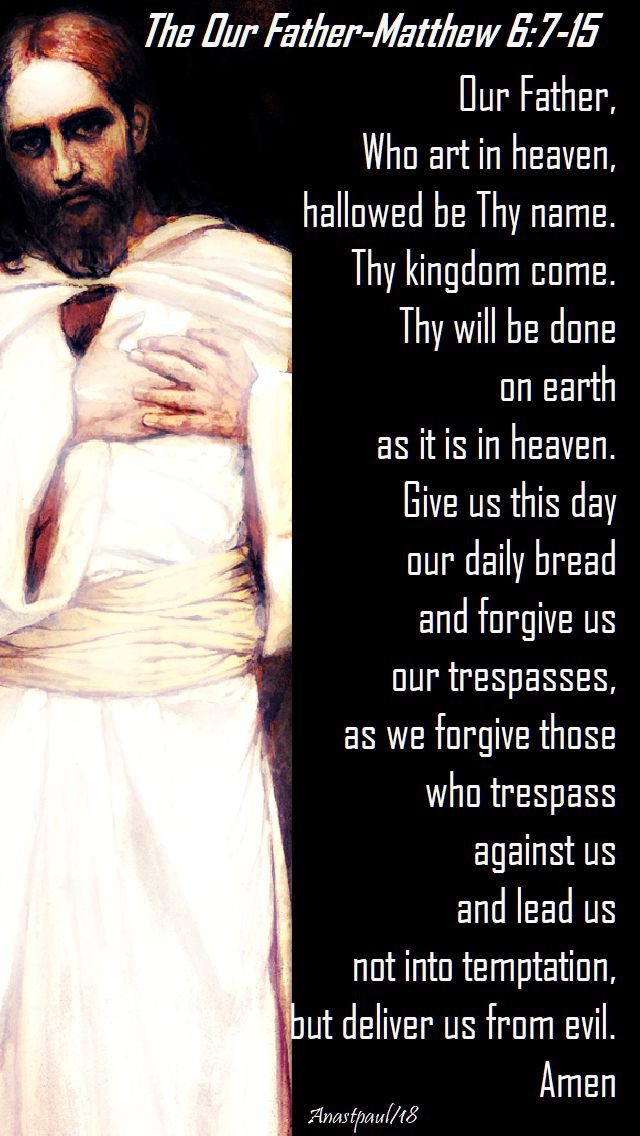
Let us too think of this Father, Our God, who is so taken for granted by all of us! and let us say, Our Father, who art in Heaven…………
And he said, “There was a man who had two sons”...Luke 15:11
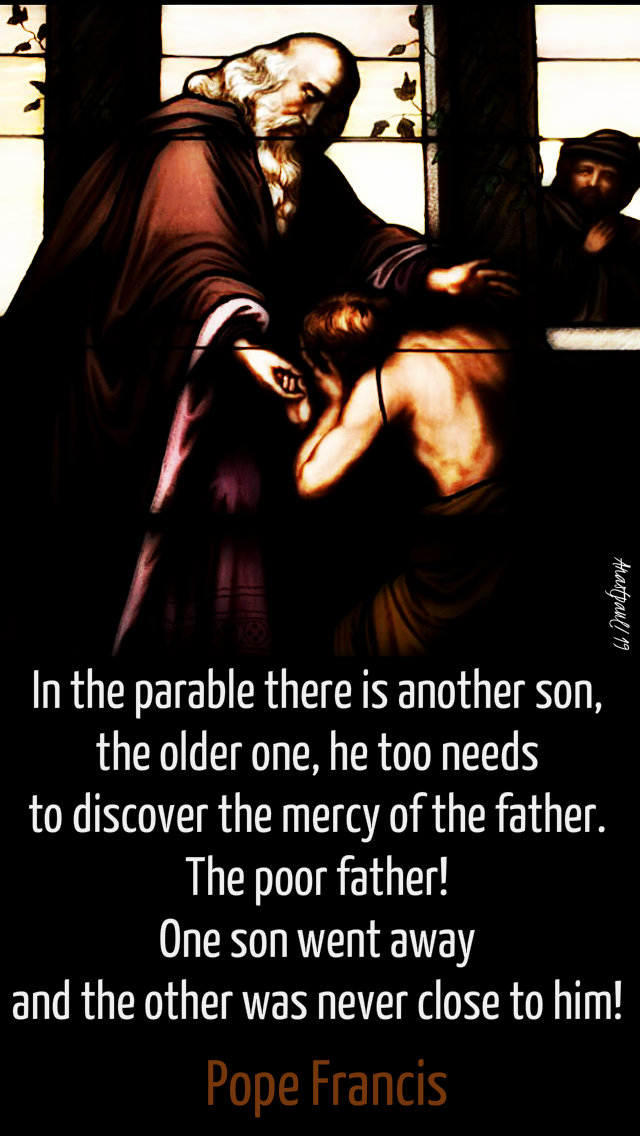
“In the parable there is another son, the older one, he too needs to discover the mercy of the father. The poor father! One son went away and the other was never close to him!”
Pope Francis – General Audience, 11 May 2016
Bless the Lord, O my soul, and all that is within me, bless his holy name! Bless the Lord, O my soul and forget not all his benefits, who forgives all your iniquity, who heals all your diseases, who redeems your life from the Pit, who crowns you with steadfast love and mercy…
Psalm 103:1–4
Closing Prayer:
God of infinite love,
You shower me with limitless gifts in my life.
In my every thought and action today
guide me to the bright and loving light of Your kingdom.
Help me to be aware of
the many ways You allow me
to share in Your life so intimately today.
Thank You for the gifts You have placed in my life.
Let me be grateful every moment of this day.
May the Lord bless us,
protect us from all evil
and bring us to everlasting life.
Amen
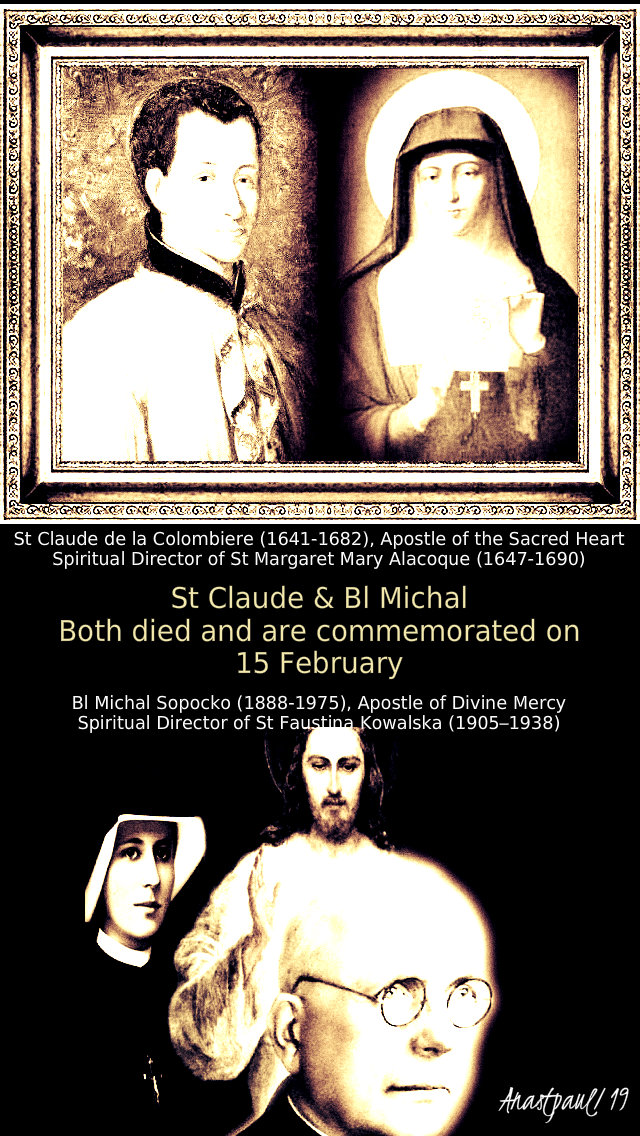
Thought for the Day – 15 February – the Memorial of St Claude de la Colombiere (1641-1682) Apostle of the Sacred Heart and Blessed Michal Sopoćko (1888-1975) Apostle of Divine Mercy
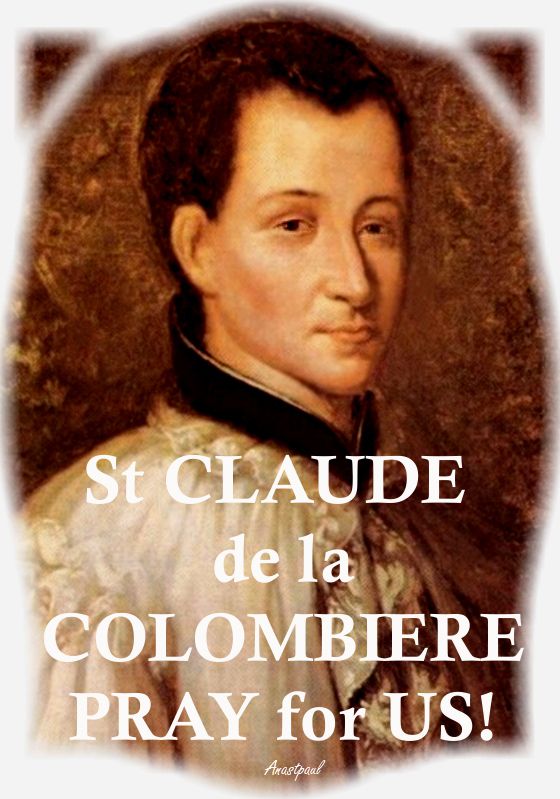
Saint Claude de la Colombiere
and Blessed Michael Sopoćko
share a few things in common
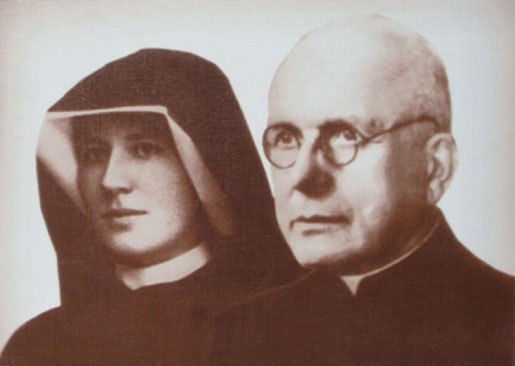
We celebrate the feast day of Blessed Michael Sopoko today, 15 February, which makes for a perfect opportunity to discuss one of the more curious details in the life of St Faustina Kowalska (1905–1938), known today as the Lord’s “secretary” of Divine Mercy.
So what’s so curious?
Amazing parallels can be drawn between St Faustina’s confessor, Blessed Sopoćko and the confessor of another saint — and “secretary” — St. Margaret Mary Alacoque (1647-1690), who received the revelations of the Sacred Heart in the 1670s.
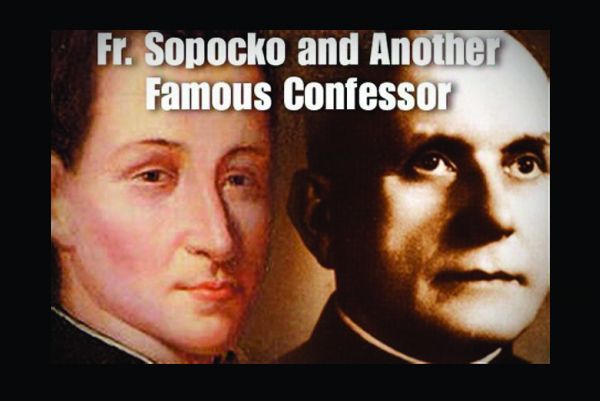
In other words, the similarities between the holy priests Blessed Michael Sopoćko (1888-1975) and St Claude de la Colombiere, SJ (1641-1682), both of whom died today and, therefore, we celebrate their entry into life today.
Blessed Sopoćko , ordained to the priesthood over 100 years ago, served as confessor and spiritual director to St Faustina Kowalska, who received revelations of the Divine Mercy in the 1930s. Saint Claude served as confessor and spiritual director of St Margaret Mary Alacoque, who received the revelations of the Sacred Heart in the 1670s.
So here is where the parallels begin. Saint Margaret Mary Alacoque, like St Faustina, had doubts at first about her revelations. For both young women, it was their confessors who played a large role in alleviating their doubts and encouraging them to embrace the special role the Lord seemed to be placing upon them.
But the parallels get even better. Since St Margaret Mary Alacoque led a cloistered life — quiet and humble — it was her confessor who carried the burden of spreading the Sacred Heart message and devotion to the outside world. This was the same situation with Fr Sopocko, who led the efforts to introduce the public to Faustina’s powerful private revelations and who arranged for the Lord’s requests of Faustina to be accomplished. That includes hiring a painter to paint the image of the Merciful Saviour, now among Christianity’s most recognised images.
Here’s another interesting fact:
Saint Claude Colombiere died today, 15 February, the same day Blessed Sopoćko died. And 15 February, also happens to be St Faustina’s name day — the day of her patron saint, St Faustus.
Of course, when considering how the devotions to Divine Mercy and the Sacred Heart so strongly compliment each other, these details are far more than “curious.” Certainly, they are Divine Providence at work, right?
Dr Robert Stackpole, STD, director of the St John Paul II Institute of Divine Mercy, a lay apostolate of the Marian Fathers of the Immaculate Conception, notes, “Much like the traditional devotion to the Sacred Heart, our Lord gave to St. Faustina new forms in which His Merciful Heart was to be honoured and new vessels for a fresh outpouring of His grace. Namely, the Image of Divine Mercy; the Chaplet of Divine Mercy and, of course, a new feast for the universal Church — the Feast of Divine Mercy, intended for the Sunday after Easter.”
None of these parallels have escaped the attention of Fr Seraphim Michalenko, MIC, a world-renown expert on the life of St Faustina and the message of Divine Mercy.
He notes that it took 300 years for Fr Claude Colombiere to be canonised. “And here, Fr Sopoćko died in 1975 and he’s already beatified [in 2008],” Fr Seraphim says.
So what does his rapid rise to the honours of the altar, mean for us?
“That God is in a hurry to get His message out,” says Fr Seraphim.
Adapted from the Library Archive of The Divine Mercy – (Felix Carroll Feb 13, 2014)
Read Dr Stackpole’s series that explores the relationship between The Sacred Heart and The Divine Mercy. Part 1, Part 2, Part 3, Part 4, and Part 5.
Quote/s of the Day – 15 February – the Memorial of St Claude de la Colombiere (1641-1682) Apostle of the Sacred Heart and Blessed Michal Sopoćko (1888-1975) Apostle of Divine Mercy
“Lord, I am in this world to show Your mercy to others. Other people will glorify You, by making visible the power of Your grace, by their fidelity and constancy to You. For my part I will glorify You, by making known how good You are to sinners, that Your mercy is boundless and that no sinner, no matter how great his offences, should have reason to despair of pardon. If I have grievously offended You, My Redeemer, let me not offend You even more, by thinking that You are not kind enough to pardon me.”
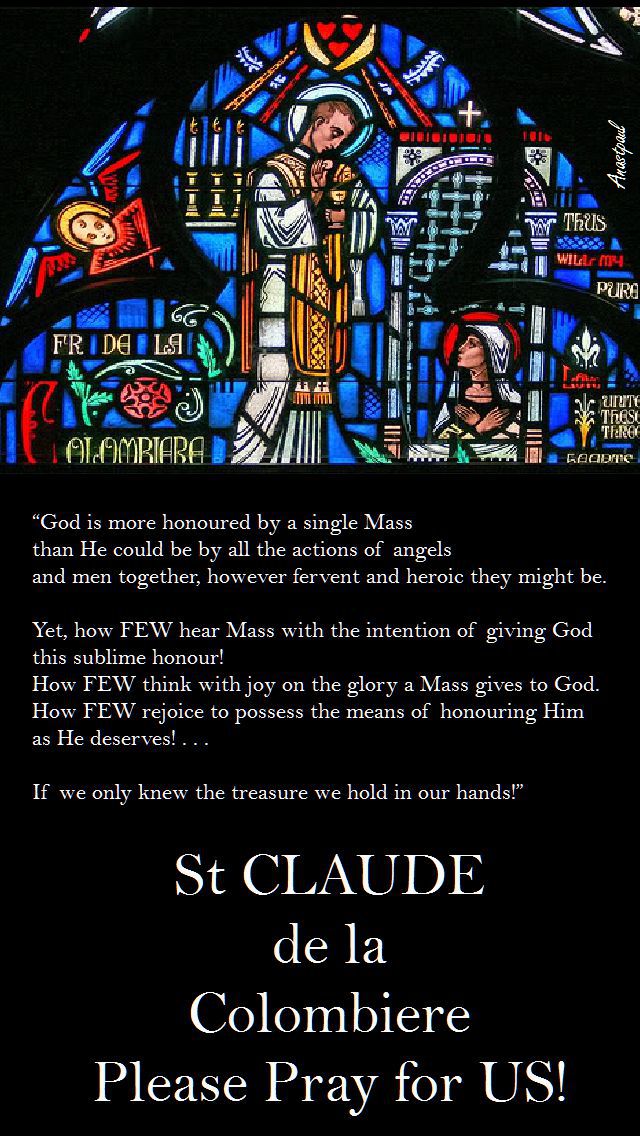
“God is more honoured by a single Mass than He could be by all the actions of angels and men together, however fervent and heroic they might be. Yet, how FEW hear Mass with the intention of giving God this sublime honour! How FEW think with joy on the glory a Mass gives to God. How FEW rejoice to possess the means of honouring Him as He deserves! . . . If we only knew the treasure we hold in our hands!”
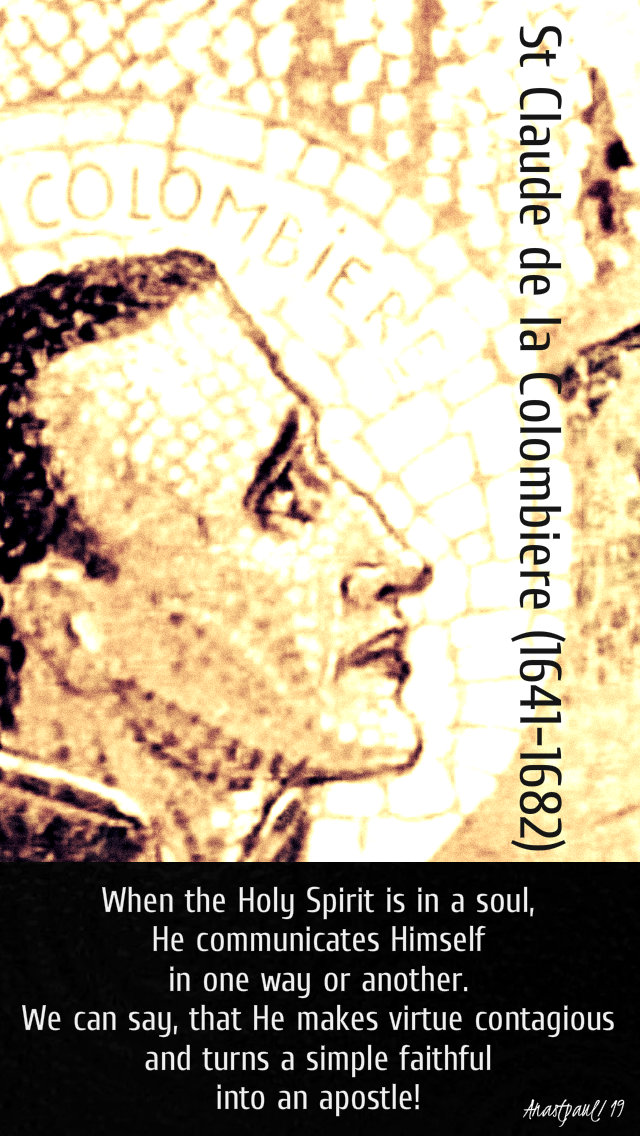
“When the Holy Spirit is in a soul, He communicates Himself in one way or another. We can say, that He makes virtue contagious and turns a simple faithful into an apostle!”
St Claude de la Colombiere (1641-1682)
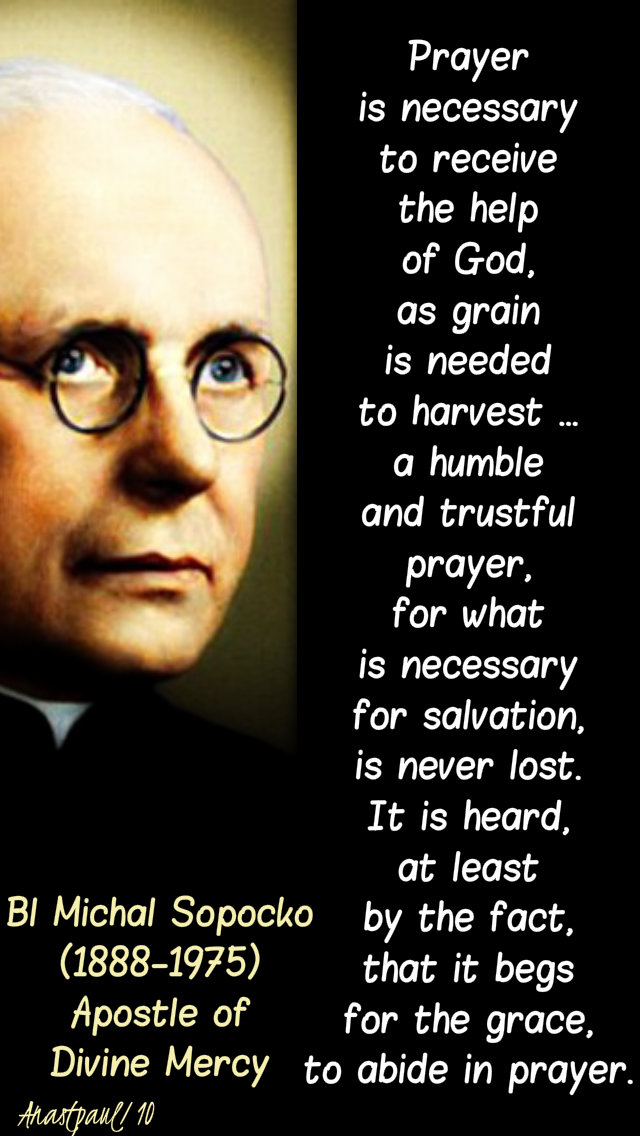
“Prayer is necessary to receive the help of God, as grain is needed to harvest … a humble and trustful prayer, for what is necessary for salvation, is never lost. It is heard at least by the fact, that it begs for the grace, to abide in prayer.”
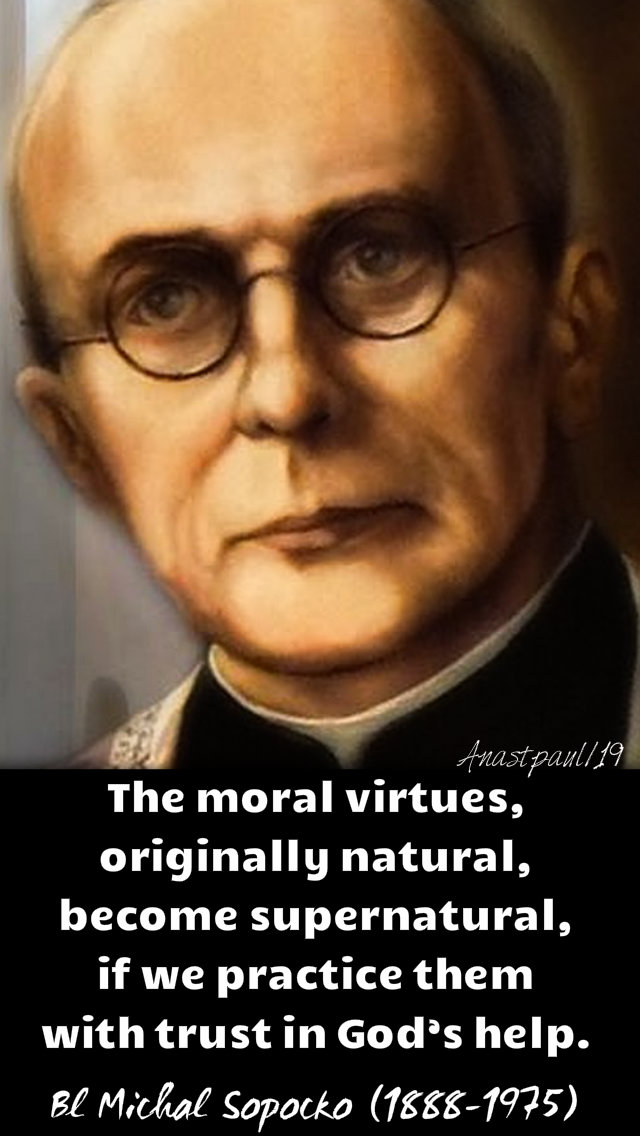
“The decisive factor in obtaining God’s Mercy is trust. Trust is the expectation of someone’s help. It does not constitute a separate virtue but is an essential condition of the virtue of hope and an integral part of the virtues of fortitude and generosity. Because trust springs from faith, it strengthens hope and love and is, moreover, linked up, in one way or another, with the moral virtues. It may, therefore, be called the basis on which, the theological virtues unite with the moral. The moral virtues, originally natural, become supernatural, if we practice them with trust in God’s help.”

















 AnaStpaul
You must be logged in to post a comment.