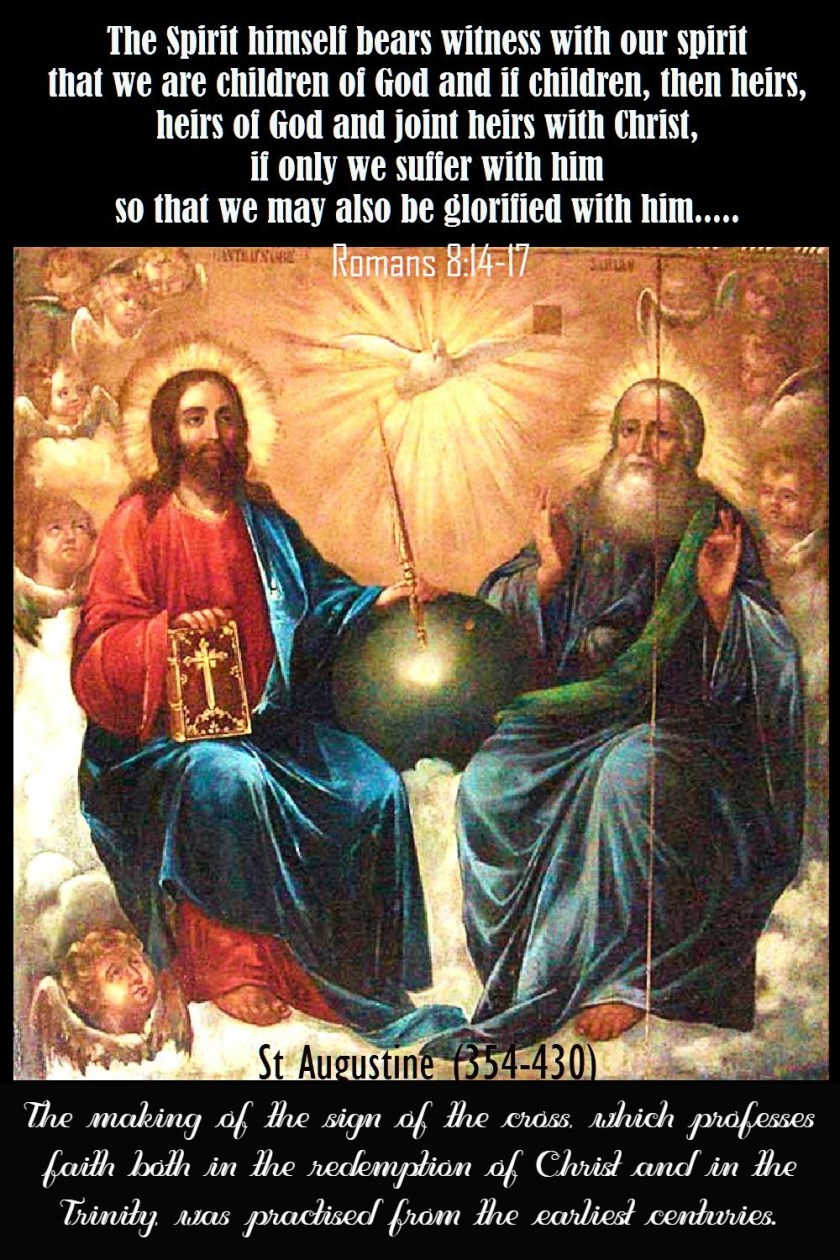
The Spirit himself bears witness with our spirit that we are children of God and if children, then heirs, heirs of God and joint heirs with Christ, if only we suffer with him, so that we may also be glorified with him. …. Romans 8:14-17
REFLECTION – “The making of the sign of the cross, which professes faith both in the redemption of Christ and in the Trinity, was practised from the earliest centuries.”………….. St Augustine (354-430) Father and Doctor of the Church
PRAYER – God our Father, who by sending into the world the Word of truth and the Spirit of sanctification made known to the human race your wondrous mystery, grant us, we pray, that in professing the true faith, we may acknowledge the Trinity of eternal glory and adore your Unity, powerful in majesty. Through our Lord Jesus Christ, your Son, who lives and reigns with you in the unity of the Holy Spirit, one God, for ever and ever. Amen
The writings of Saint Ephrem speak volumes about his passion for the truth of the Gospel and his zeal for spreading the Word of God. We are blessed to have poems, hymns, prayers and writings today, penned nearly 2 centuries ago, reminding us not only of the constancy of the love of the Lord but of the long-standing traditions and teachings of the Church. As we read the writings of Saint Ephrem, we pray for his zeal for the Lord and the future of His Church on earth.
Before his death, Saint Ephrem reflected on his life, writing in his testament: “There grew a vine-shoot on my tongue: and increased and reached unto heaven. And it yielded fruit without measure: leaves likewise without number. It spread, it stretched wide, it bore fruit: all creation drew near. And the more they were that gathered,the more its clusters abounded. These clusters were the Homilies and these leaves the Hymns. God was the giver of them, glory to Him for His grace! For He gave to me of His good pleasure, from the storehouse of His treasures.”
St Ephrem, pray for us that we too may grow a vine-shoot on our tongues by the grace of God!
“Forget not the Holy Spirit at the moment of your enlightenment; He is ready to mark your soul with His seal…. He will give you the heavenly and divine seal which makes the devil tremble; He will arm you for the fight; He will give you strength.”
“Glory be to Him, Who received from us, that He might give to us; that through that which is ours, we might more abundantly receive of that which is His!”
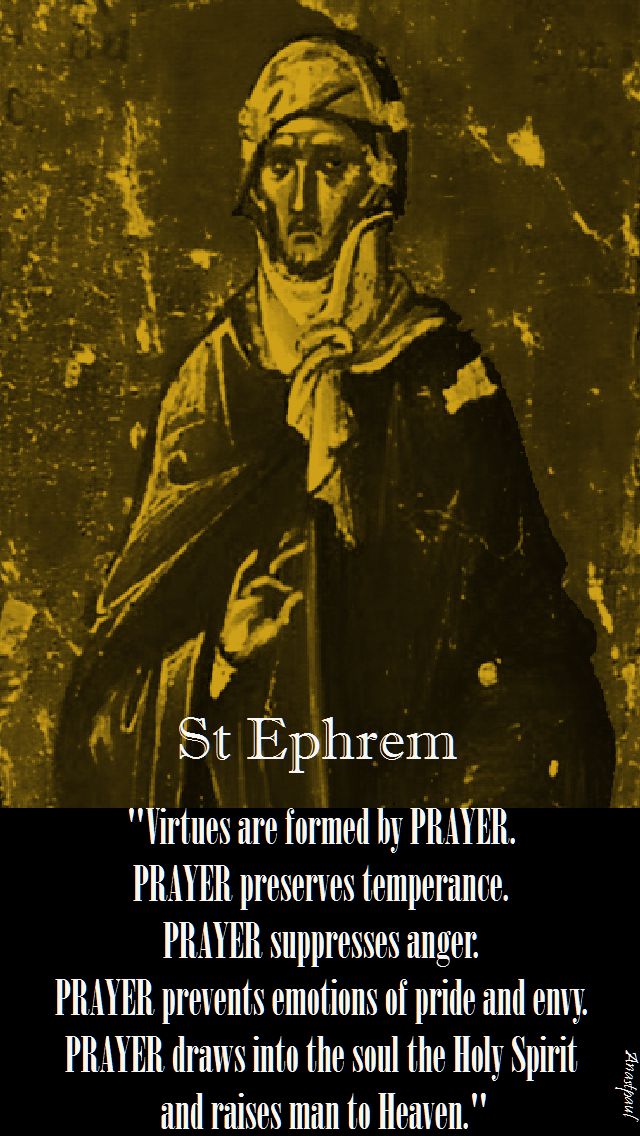
“Virtues are formed by PRAYER. PRAYER preserves temperance. PRAYER suppresses anger. PRAYER prevents emotions of pride and envy. PRAYER draws into the soul the Holy Spirit and raises man to Heaven.”
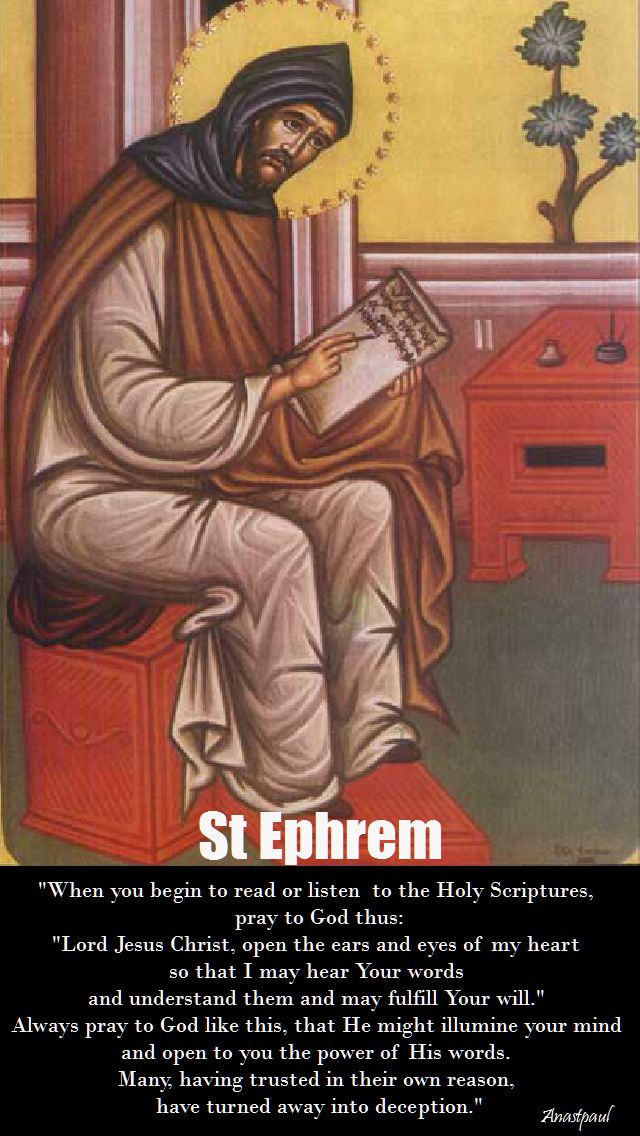
“When you begin to read or listen to the Holy Scriptures, pray to God thus: “Lord Jesus Christ, open the ears and eyes of my heart so that I may hear Your words and understand them and may fulfill Your will.” Always pray to God like this, that He might illumine your mind and open to you the power of His words. Many, having trusted in their own reason, have turned away into deception.”
Be on Guard and pray that you may not undergo the test…………….Matthew 26:41
REFLECTION – “Jesus, who feared nothing, experienced fear and asked to be freed from death – although He knew it was impossible.
How much more must we persevere in prayer before temptation assails us – so that we may be freed when the test has come!”…St Ephrem
PRAYER – Heavenly Father, help me to work out my salvation in fear and trembling. Let me pray daily that I may withstand temptation and carry out Your will in all things. St Ephrem, please pray for us, that we may withstand the evils which surround us! Amen
O Lord and Master of my life
By St Ephrem of Syria (306-373) Doctor of the Church
O Lord and Master of my life,
grant not unto me a spirit of idleness,
of discouragement,
of lust for power
and of vain speaking.
But bestow upon me, Your servant,
the spirit of chastity,
of meekness,
of patience
and of love.
Yea, O Lord and King,
grant that I may perceive
my own transgressions
and judge not my brother,
for blessed are You unto ages of ages. Amen
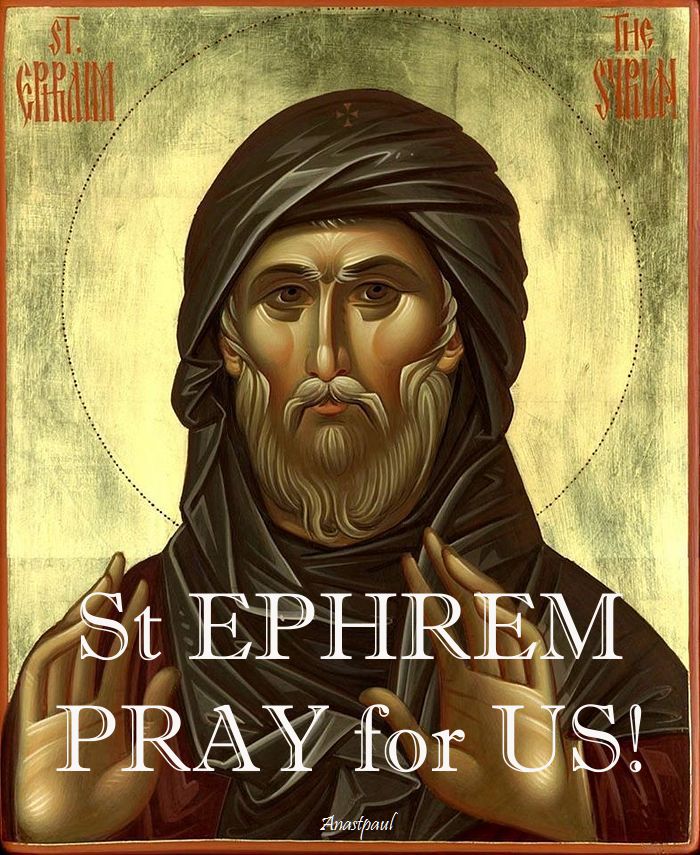
Saint of the Day – 9 June – St Ephrem of Syria (306-373) – Father & Doctor of the Church – Also known as: Ephrem of Edessa, Ephrem the Syrian, Ephraem, Ephraim, Ephraem Syrus, Deacon of Edessa, Harp of the Holy Spirit, Jefrem Sirin, Sun of the Syrians/Venerable Father. Deacon and Confessor, Exegesist, Writer, Poet, Hymnographer, Theologian, Teacher, Orator, Defender of the Faith – declared Doctor of the Church in 1920 by Pope Benedict XV. Born – c 306 at Nisibis, Mesopotamia (in modern Syria) – Died on 9 June 373 at Edessa (in modern Iraq) of natural causes. His tomb is in an Armenian monastery, Der Serkis, west of Edessa. Patron of Spiritual directors and spiritual leaders. Attributes – hermit sitting on a column, deacon’s vestments and thurible, man composing hymns with a lyre, man in a cave with a book, man with a cross on his brow, pointing upwards, vine and scroll.
Born in Nisibis, Mesopotamia, he was baptised as a young man and became famous as a teacher in his native city. When the Christian emperor had to cede Nisibis to the Persians, Ephrem fled as a refugee to Edessa, along with many other Christians. He is credited with attracting great glory to the biblical school there. He was ordained a deacon but declined becoming a priest as he felt he was unworthy.
He had a prolific pen and his writings best illumine his holiness. Although he was not a man of great scholarship, his works reflect deep insight and knowledge of the Scriptures. In writing about the mysteries of humanity’s redemption, Ephrem reveals a realistic and humanly sympathetic spirit and a great devotion to the humanity of Jesus. It is said that his poetic account of the Last Judgment inspired Dante.
Over four hundred hymns composed by Ephrem still exist. Granted that some have been lost, Ephrem’s productivity is not in doubt. Church historians credit Ephrem with having written over three million lines.
The most important of his works are his lyric, teaching hymns. These hymns are full of rich, poetic imagery drawn from biblical sources, folk tradition and other religions and philosophies.
Particularly influential were his Hymns Against Heresies. Ephrem used these to warn his flock of the heresies that threatened to divide the early church. He lamented that the faithful were “tossed to and fro and carried around with every wind of doctrine, by the cunning of men, by their craftiness and deceitful wiles.” He devised hymns laden with doctrinal details to inoculate right-thinking Christians against heresies such as docetism. The Hymns Against Heresies employ colourful metaphors to describe the Incarnation of Christ as fully human and divine. Ephrem asserts that Christ’s unity of humanity and divinity represents peace, perfection and salvation; in contrast, docetism and other heresies sought to divide or reduce Christ’s nature and, in doing so, rend and devalue Christ’s followers with their false teachings.
Ephrem is popularly believed to have taken legendary journeys. In one of these he visits St Basil of Caesarea. This links the Syrian Ephrem with the Cappadocian Fathers and is an important theological bridge between the spiritual view of the two, who held much in common. Ephrem is also supposed to have visited Saint Pishoy in the monasteries of Scetes in Egypt. As with the legendary visit with Basil, this visit is a theological bridge between the origins of monasticism and its spread throughout the church.
St Ephrem eventually settled in Edessa (modern Şanlıurfa) in 363. He was in his late fifties then and in Edessa he applied himself to ministry in his new church and seems to have continued his work as a teacher, perhaps in the School of Edessa. Edessa had always been at the heart of the Syriac-speaking world and the city was full of rival philosophies and religions. Ephrem comments that orthodox Nicene Christians were simply called “Palutians” in Edessa, after a former bishop. Arians, Marcionites, Manichees, Bardaisanites and various gnostic sects proclaimed themselves as the true church. In this confusion, Ephrem wrote a great number of homilies and hymns defending Nicene orthodoxy. After a ten-year residency in Edessa, in his sixties, Ephrem succumbed to the plague as he ministered to its victims. The most reliable date for his death is 9 June 373.
Prayer to the Sacred Heart by Saint Francis De Sales (1567-1622) Doctor of Charity
May Your heart dwell always in our hearts!
May Your blood ever flow in the veins of our souls!
O sun of our hearts, You give life to all things by the rays of Your goodness!
I will not go, until Your heart has strengthened me, O Lord Jesus!
May the heart of Jesus be the king of my heart!
Blessed be God. Amen
“The Spirit of truth…remain with you and will be within you…….John 14:17
REFLECTION – The Holy Spirit does not remain inactive in us: He wipes away sins, purifies hearts, revivifies the tepid and enlightens the ignorant.
His inspirations suggest to us what we ought and what we ought not to do. There exists an infinite variety of His commandments…….St Anthony of Padua
PRAYER – Come, Holy Spirit, fill the heart of Your servant and kindle in me the fire of Your gifts! Be with me, in me and lead me to the light, amen.
We beg the all-merciful Father through You,
His only-begotten Son made man for our sake,
crucified and glorified for us,
to send upon us from His treasure-house,
the Spirit of sevenfold grace,
who rested upon You in all His fullness:
the spirit of wisdom:
enabling us to relish the fruit of the tree of life,
which is indeed Yourself;
the gift of understanding: to enlighten our perceptions;
the gift of prudence, enabling us to follow in Your footsteps;
the gift of strength: to withstand our adversary’s onslaught;
the gift of knowledge: to distinguish good from evil
by the light of thy holy teaching;
the gift of piety: to clothe ourselves with charity and mercy;
the gift of fear: to withdraw from all ill-doing
and live quietly in awe of Your eternal majesty.
These are the things for which petition.
Grant them for the honour of Your Holy Name,
to which, with the Father and the Holy Spirit,
be all honour and glory,
thanksgiving, renown and lordship for ever and ever. Amen
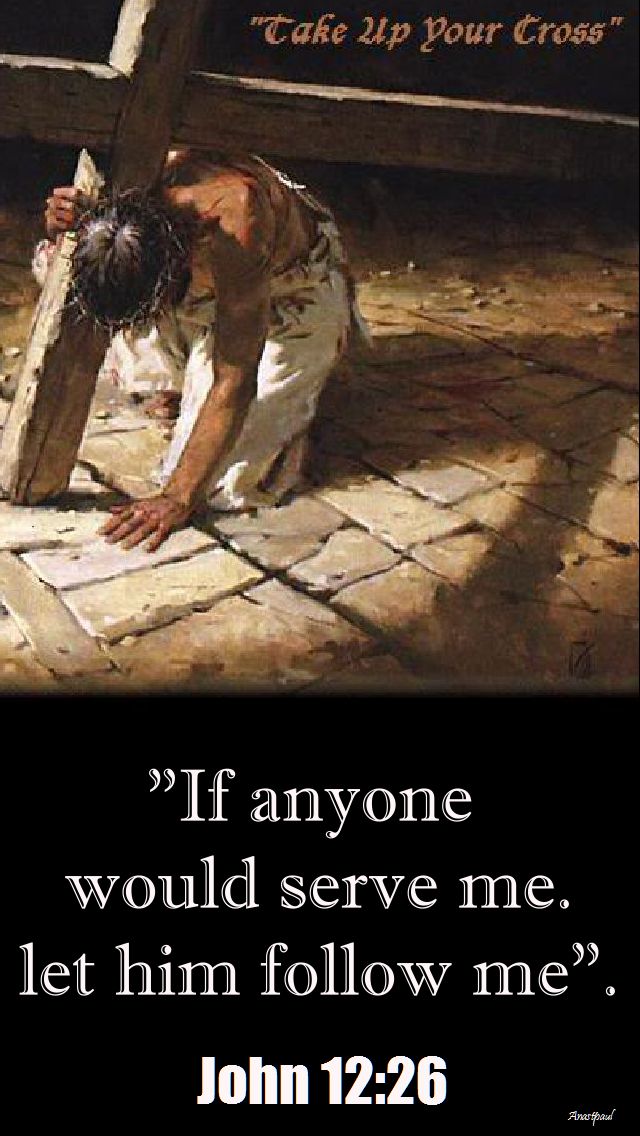
“If anyone would serve me. let him follow me”………John 12:26
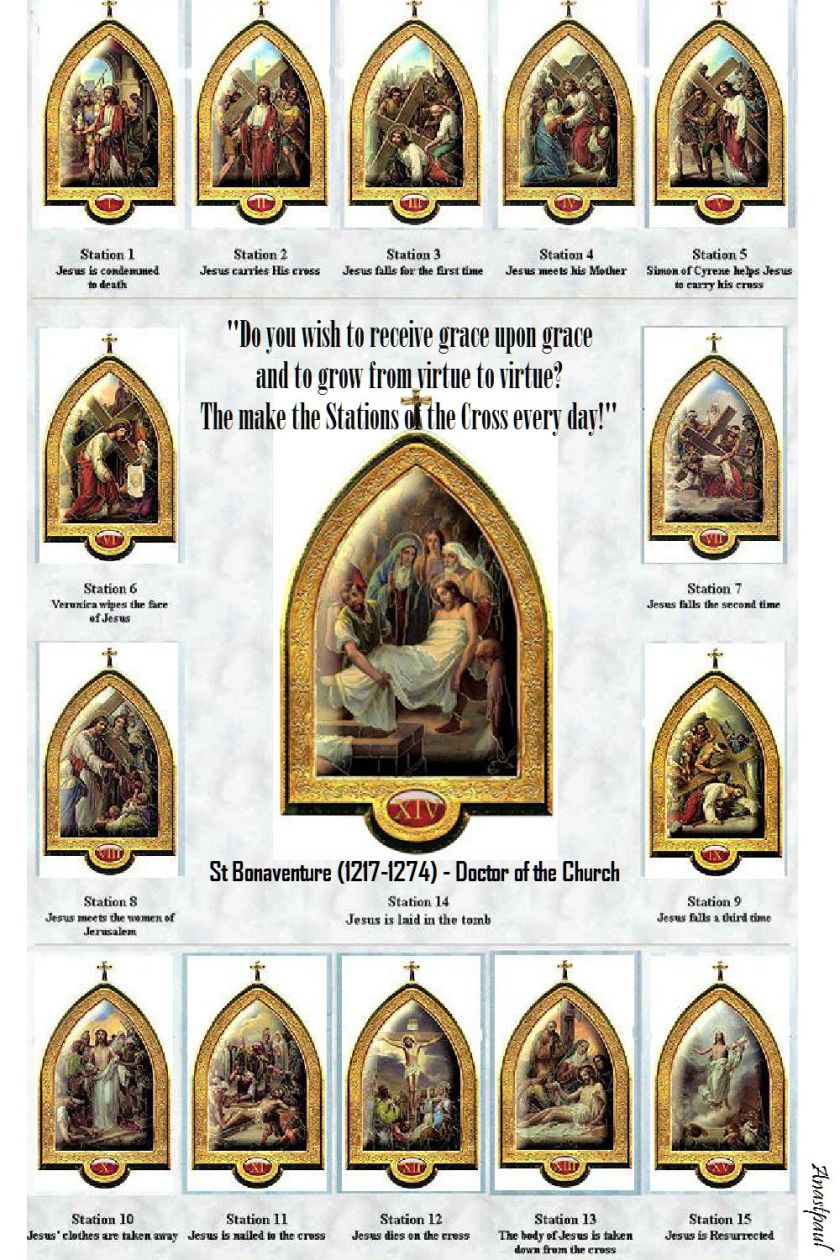
REFLECTION – “Do you wish to receive grace upon grace and to grow from virtue to virtue?
The make the Stations of the Cross every day!”………..St Bonaventure
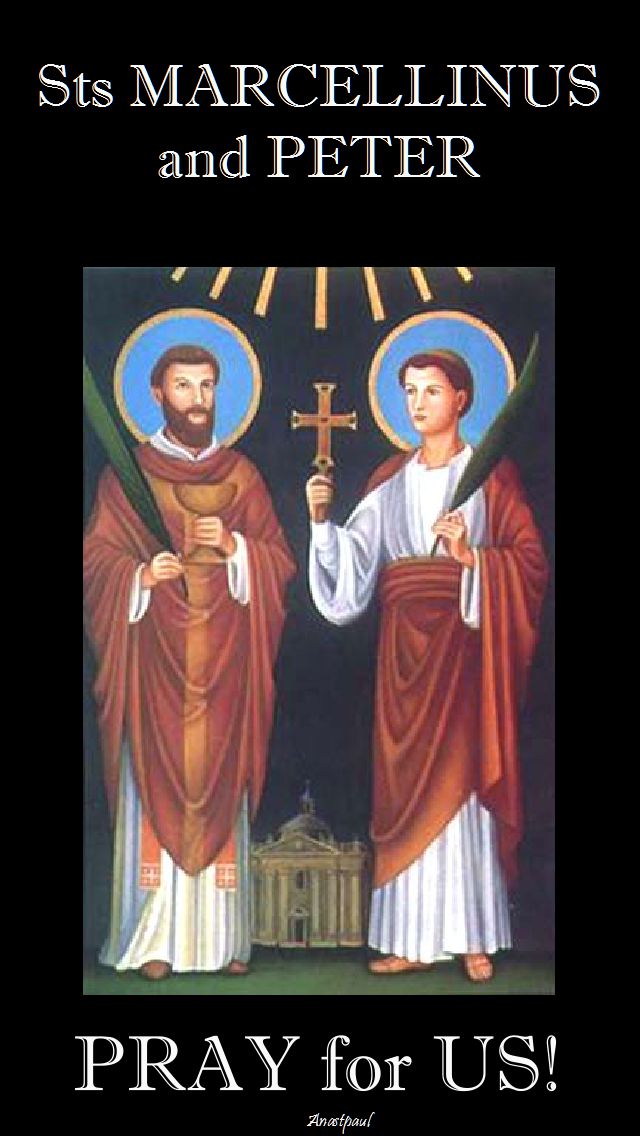
PRAYER – Lord Jesus, help me to make the Stations of the Cross frequently and even everyday if possible. Grant that in following You by this devotion, I may obtain the grace and courage to follow You in all the events of my life. Sts Marcellinus and Peter, you followed Christ in all things, giving your lives for love of Him, please pray for us all, amen!
The spirit of the Lord shall rest upon him:
a spirit of wisdom and understanding……..Is 11:2
REFLECTION – “Those who are led by the Holy Spirit have a right concept of everything.
Hence, many unlettered people enjoy such knowledge more than the wise.”…………St John Vianney
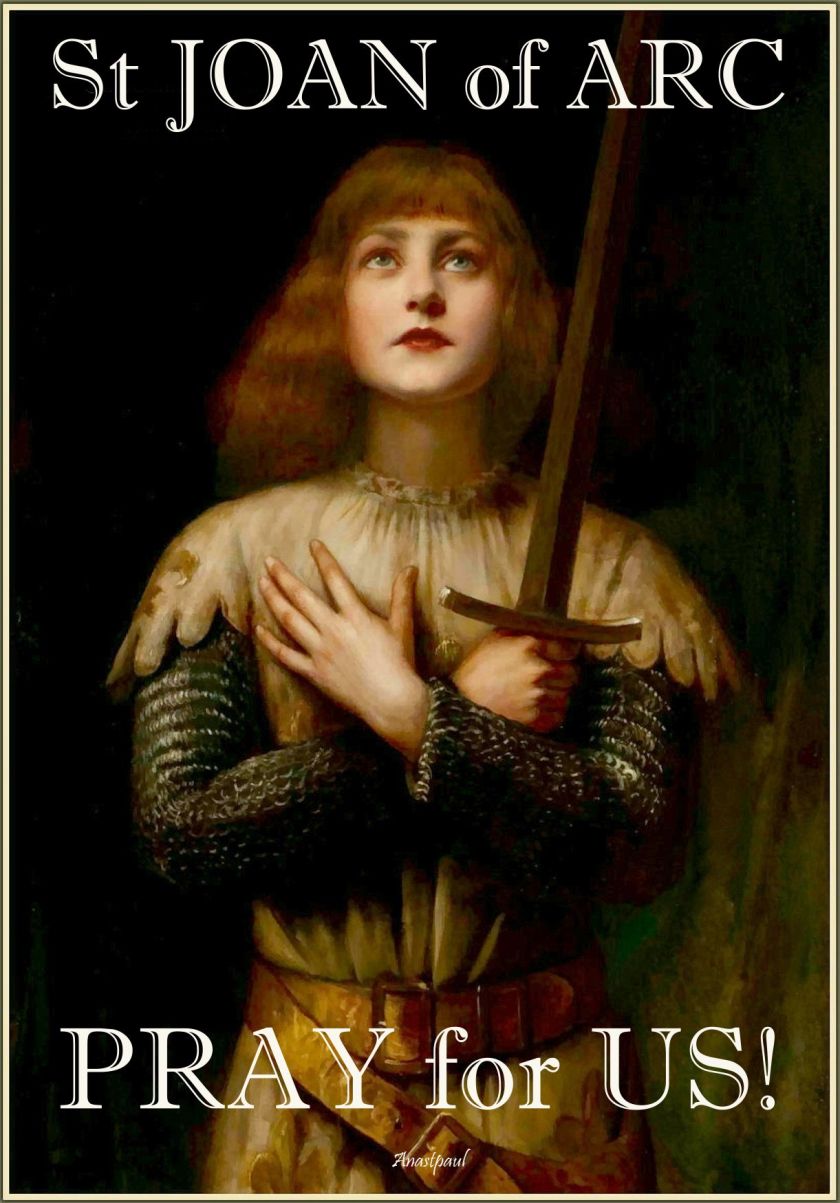
“(St Joan of Arc) our saint lived prayer as a form of continuous dialogue with the Lord, who also enlightened her answers to the judges, giving her peace and security. She prayed with faith: “Sweetest God, in honour of your holy Passion, I ask You, if You love me, to reveal to me how I must answer these men of the Church”. Joan saw Jesus as the “King of Heaven and Earth.” Thus, on her standard, Joan had the image painted of “Our Lord who sustains the world”………..Pope Benedict XVI (2010)
PRAYER – Father if every good gift, send forth Your Spirit upon me with His sevenfold gifts. Grant that through my love for Your Son, I too may like St Joan of Arc, achieve the heights of the Christian life, make prayer the guiding thread of my days; fulfilling the will of God, whatever it is; to live in charity without favouritisms, without limits and have, as she had, in the love of Jesus, a profound love for the Church. St Joan of Arc, pray for us all, amen.
To You we Cry, O Queen of Mercy! By St Bernard of Clairvaux (1090-1153) Doctor mellifluus (Mellifluous Doctor)
To you we cry,
O Queen of Mercy!
Return, that we may
behold you dispensing favours,
bestowing remedies,
giving strength.
Ah, tender Mother!
Tell your all-powerful Son
that we have no more wine.
We are thirsty after the wine of His love,
of that marvelous wine
that fills souls with a holy inebriation,
inflames them,
and gives them the strength to despise
the things of this world
and to seek with ardor heavenly goods.
Amen
Mary, Full of Grace! By St ATHANASIUS (c296-373) Doctor of the Church
It is becoming for you, O Mary,
to be mindful of us,
as you stand near Him
who bestowed upon you all graces,
for you are the Mother of God and our Queen.
Come to our aid for the sake of the King,
the Lord God and Master who was born of you.
For this reason you are called “full of grace.”
Be mindful of us, most holy Virgin,
and bestow on us gifts
from the riches of your graces,
O Virgin full of grace. Amen
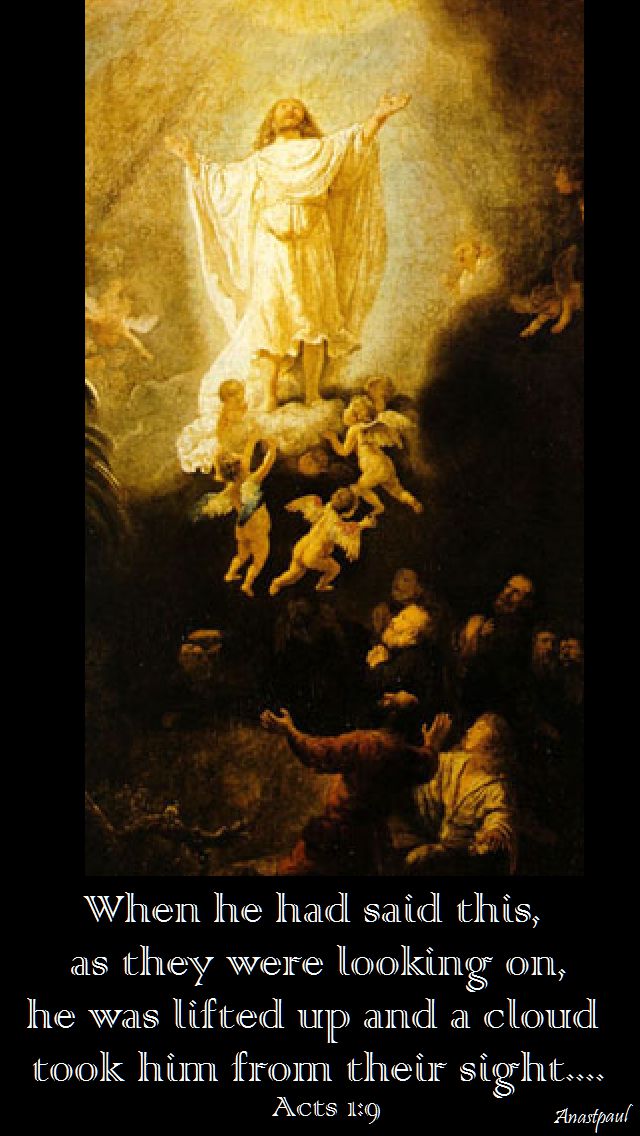
When he had said this, as they were looking on,
he was lifted up and a cloud took him from their sight……….Acts 1:9
REFLECTION – “Today our Lord Jesus Christ ascended into heaven; let our hearts ascend with Him. Listen to the words of the Apostle: If you have risen with Christ, set your hearts on the things that are above where Christ is, seated at the right hand of God; seek the things that are above, not the things that are on earth. For just as He remained with us even after His ascension, so we too are already in heaven with Him, even though what is promised us has not yet been fulfilled in our bodies.”………………………St. Augustine
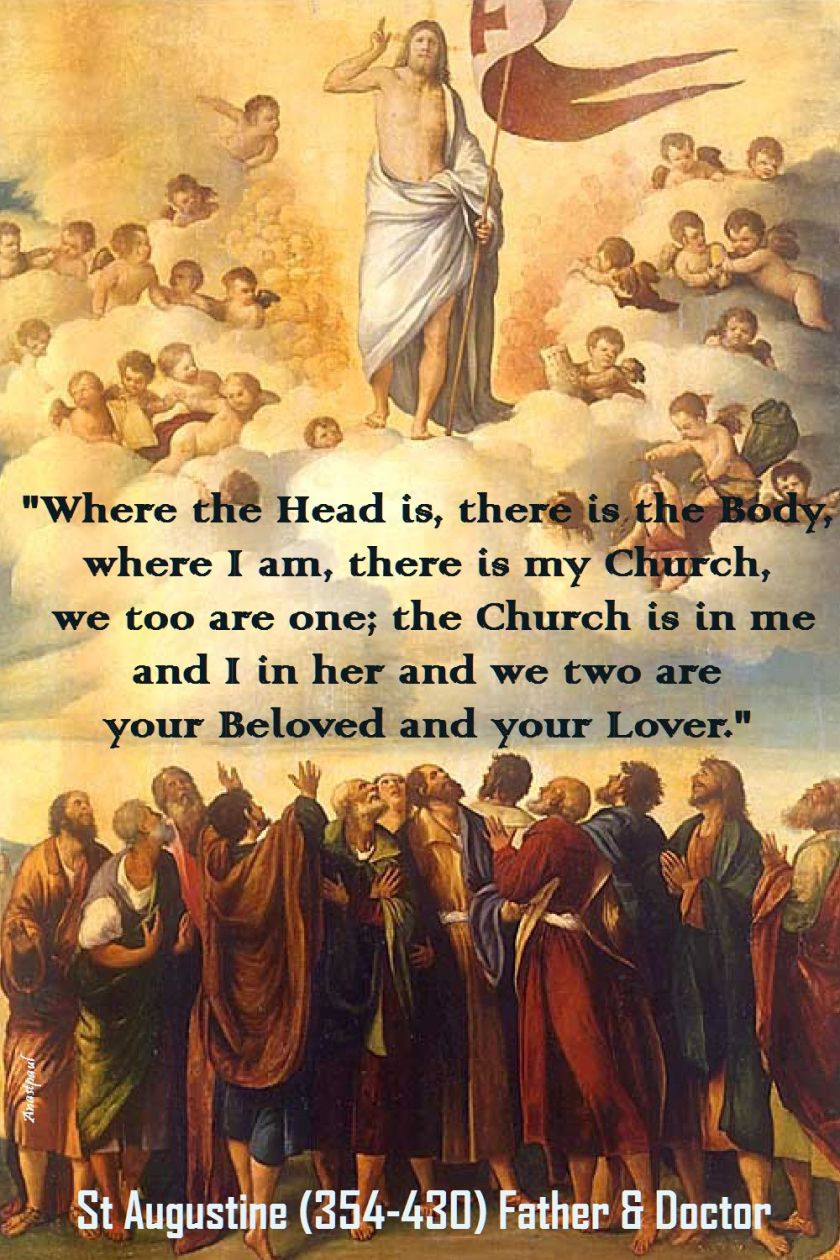
When we went down into the Font of Baptism we were incorporated into Jesus Christ, made members of His Body, the Church. Therefore, as Augustine also wrote, “Where the Head is, there is the Body, where I am, there is my Church, we too are one; the Church is in me and I in her and we two are your Beloved and your Lover.” In other words, we have ascended with the Lord!
PRAYER – Holy Father, teach me and help me to ‘abide’ in Your Son, who by ascending to You, took me too with Him. For He is my root and my foundation and I live only in Him! My Saviour and Redeemer, Jesus Christ my Lord, be with me always and intercede for us all with our Father. Amen
“Think of the Father as a spring of life begetting the Son like a river and the Holy Spirit like a sea, for the spring and the river and sea are all one nature. Think of the Father as a root and of the Son as a branch and the Spirit as a fruit, for the substance in these three is one. The Father is a sun with the Son as rays and the Holy Spirit as heat.”
St John Damascene (675-749) – Doctor of the Church
This St Bede, this is a life of total self-giving in love!
It sounds to our ears to be a boring, closed, narrow existence –
ever occupied with learning, writing and teaching.
Almost from the time of his entry to study in the monastery as a young child,
until he died, he managed to remain in his own monastery,
although eagerly sought by kings and other notables, even Pope Sergius
Only once did he leave for a few months in order to teach in the school
of the Archbishop of York.
And amazingly, here was a saint who worked no miracles,
saw no visions and found no new way to God BUT
he is one of the few saints honoured as such even during his lifetime.
His writings were filled with such faith and learning
that even while he was still alive, a Church council
ordered them to be read publicly in the churches.
And he said of his life, “I have spent the whole of my life . . . devoting all of my pains to the study of the Scriptures and amid the observances of monastic discipline and the daily task of singing in church, it has ever been my delight to learn or teach or write.”
St Bede died in 735 praying his favourite prayer: “Glory be to the Father and to the Son and to the Holy Spirit. As in the beginning, so now, and forever.”
We remember and honour him as a Doctor of the Church,
so many centuries have gone by, the world in which we live is such a different place and still he teaches us from his eternal monastery in heaven!
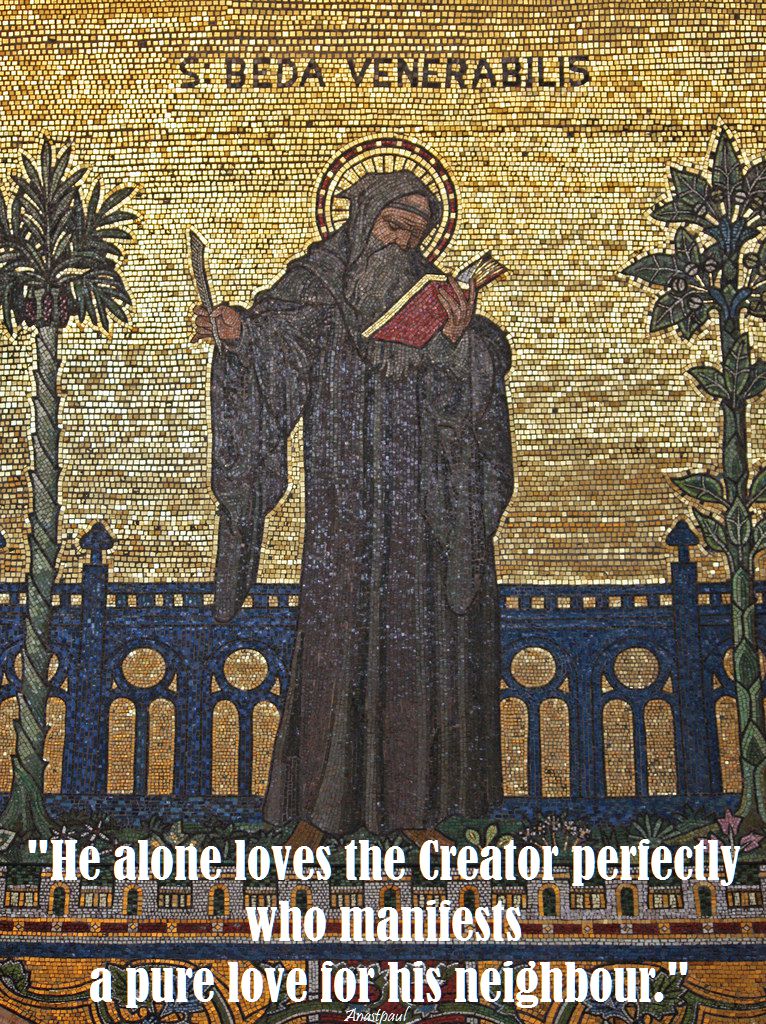
“He alone loves the Creator perfectly who manifests a pure love for his neighbour.”
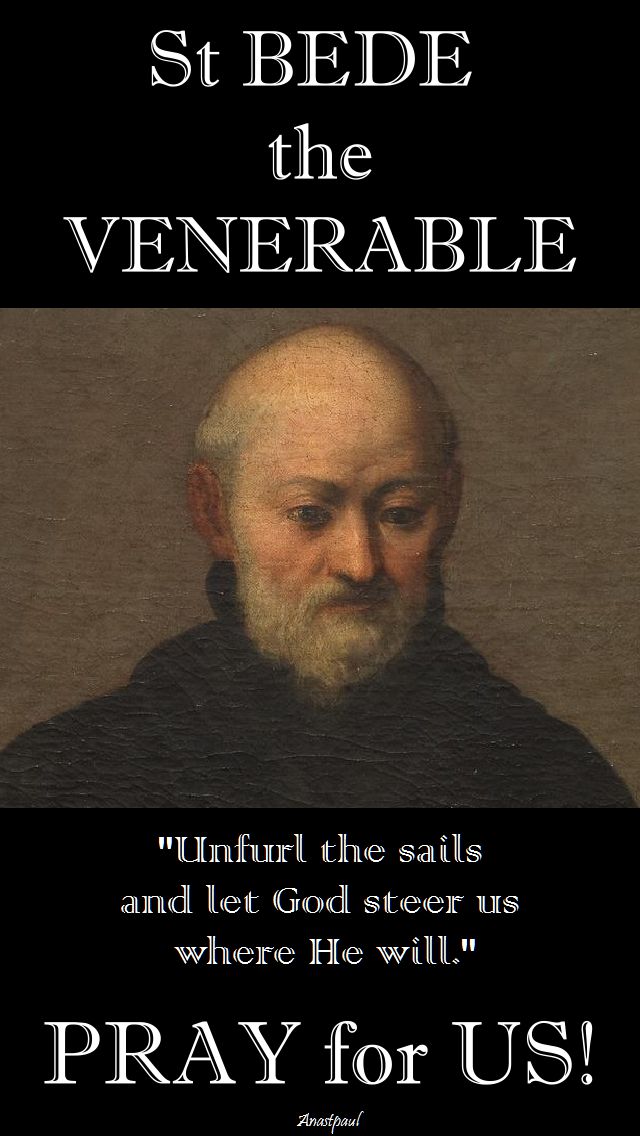
“Unfurl the sails and let God steer us where He will.”
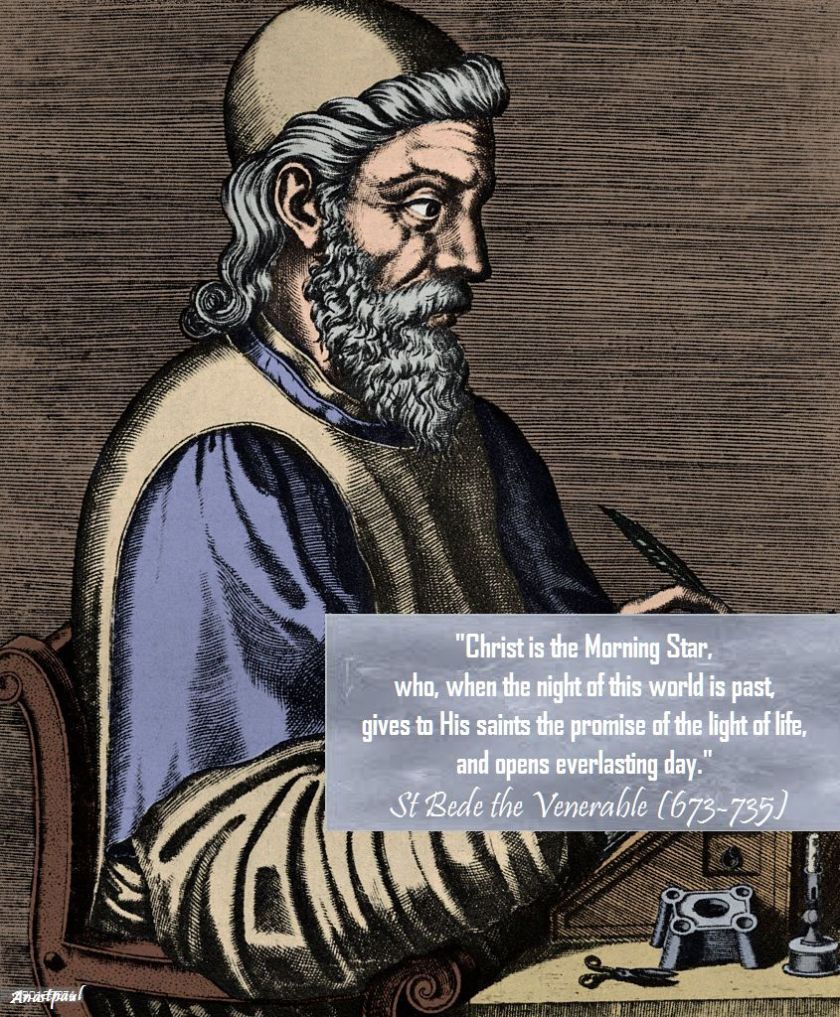
“Christ is the Morning Star, who, when the night of this world is past, gives to his saints the promise of the light of life, and opens everlasting day.”
St Bede the Venerable (673-735) Doctor of the Church
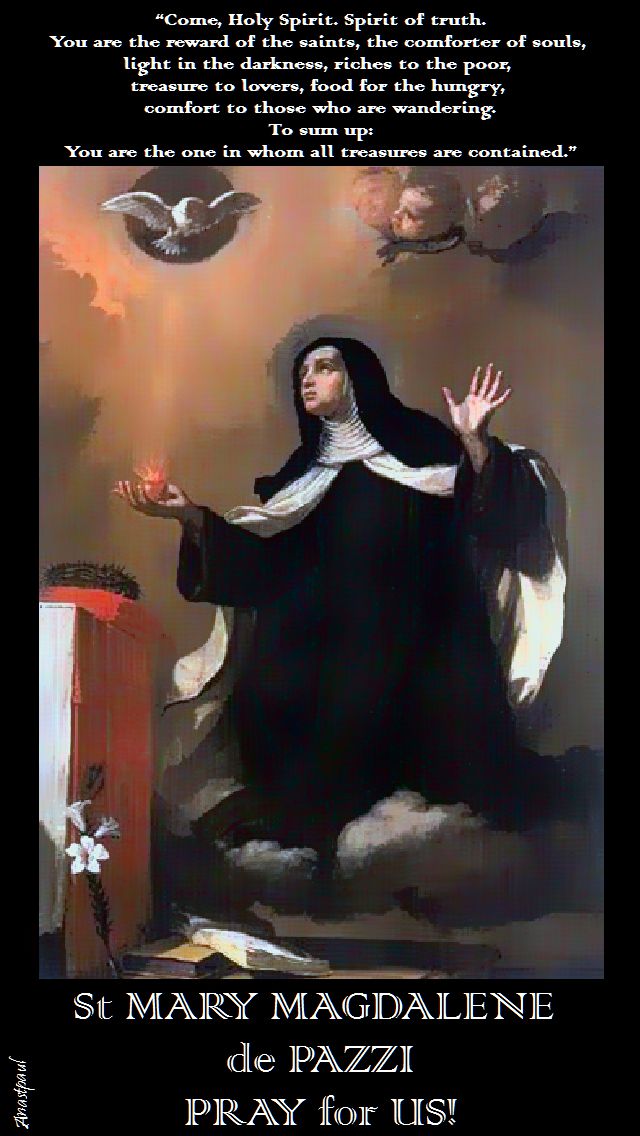
“Come, Holy Spirit. Spirit of truth, You are the reward of the saints, the comforter of souls, light in the darkness, riches to the poor, treasure to lovers, food for the hungry, comfort to those who are wandering. To sum up: You are the one in whom all treasures are contained.”
St Mary Magdalene de Pazzi – Memorial today 25 May
Jesus said to them, “You are badly misled because you fail to understand the Scriptures…….”….Matthew 22:29
REFLECTION – “The whole series of the Divine Scriptures is interpreted in a fourfold way.
We should ascertain what everlasting truths are intimated therein,
what deeds are narrated, what future events are foretold and what commands or counsels are … therein.” …St Bede the Venerable (673-735) Doctor of the Church
PRAYER – Heavenly Father, teach me how to read Your wonderful words in the Scriptures with true understanding. Let me adhere always to the interpretations given by Your Holy Church. Come O Holy Spirit and guide my mind. Lord Jesus Christ,
stand beside me and bless my footsteps. Holy St Bede, intercede for us and pray for us all, amen.
O Christ, our Morning Star By St Bede the Venerable (673-735) Doctor of the Church
O Christ, our Morning Star,
Splendour of Light Eternal,
shining with the glory of the rainbow,
come and waken us
from the greyness of our apathy,
and renew in us Your gift of hope.
Amen
And, as May is still with us, let us greet our Mother!
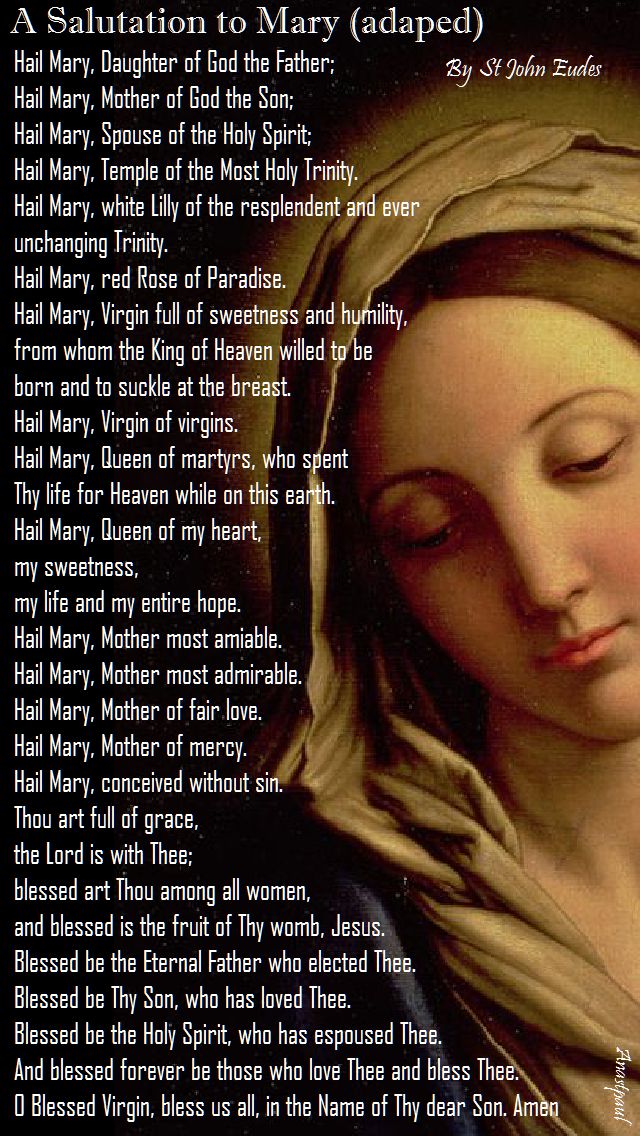
A Salutation to Mary (adaped) By St John Eudes
Hail Mary, Daughter of God the Father;
Hail Mary, Mother of God the Son;
Hail Mary, Spouse of the Holy Spirit;
Hail Mary, Temple of the Most Holy Trinity.
Hail Mary, white Lilly of the resplendent and ever
unchanging Trinity.
Hail Mary, red Rose of Paradise.
Hail Mary, Virgin full of sweetness and humility,
from whom the King of Heaven willed to be
born and to suckle at the breast.
Hail Mary, Virgin of virgins.
Hail Mary, Queen of martyrs, who spent
Thy life for Heaven while on this earth.
Hail Mary, Queen of my heart, my sweetness,
my life and my entire hope.
Hail Mary, Mother most amiable.
Hail Mary, Mother most admirable.
Hail Mary, Mother of fair love.
Hail Mary, Mother of mercy.
Hail Mary, conceived without sin.
Thou art full of grace,
the Lord is with Thee;
blessed art Thou among all women,
and blessed is the fruit of Thy womb, Jesus.
Blessed be the Eternal Father who elected Thee.
Blessed be Thy Son, who has loved Thee.
Blessed be the Holy Spirit, who has espoused Thee.
And blessed forever be those who love Thee and bless Thee.
O Blessed Virgin, bless us all, in the Name of Thy dear Son.\
Amen
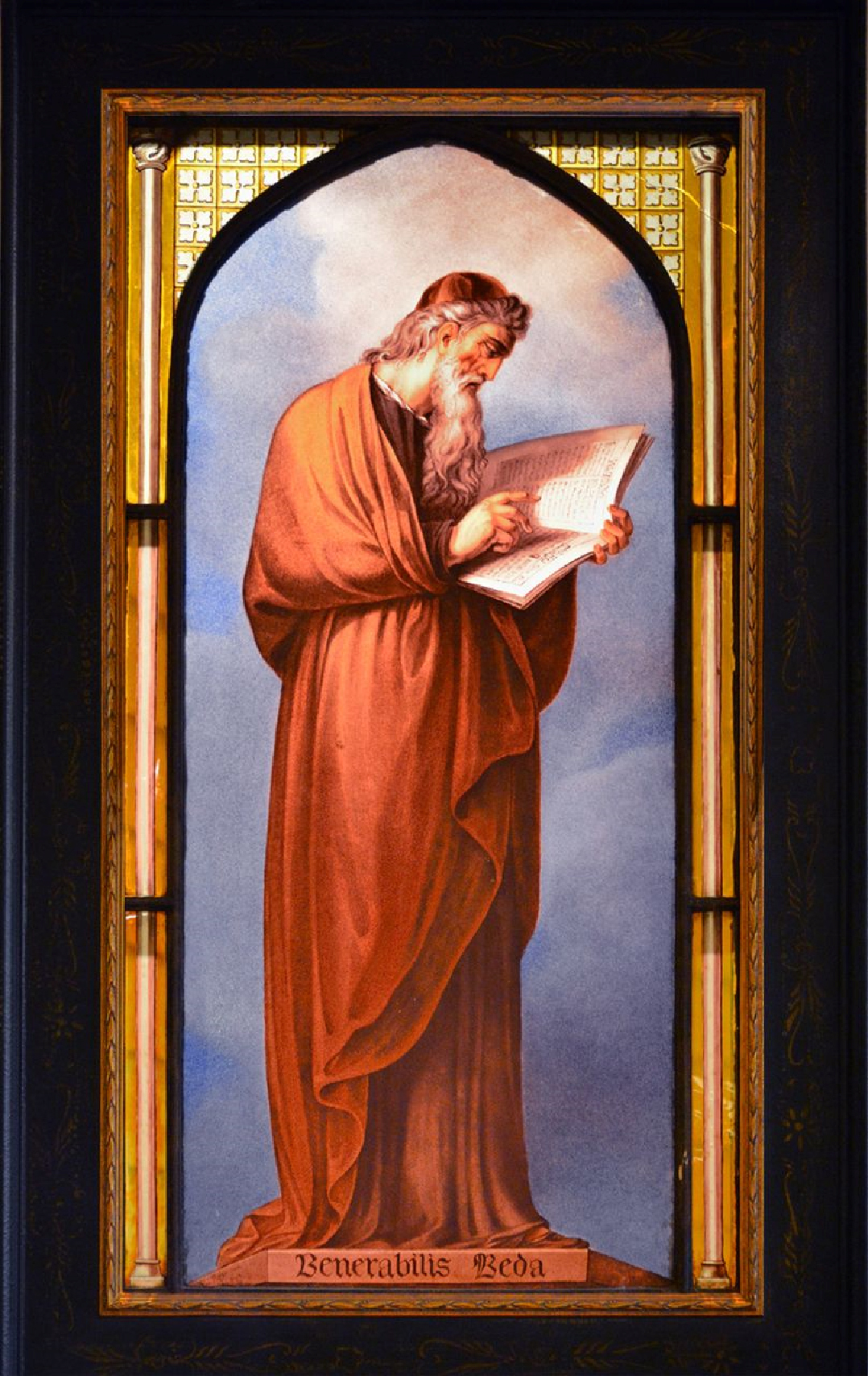
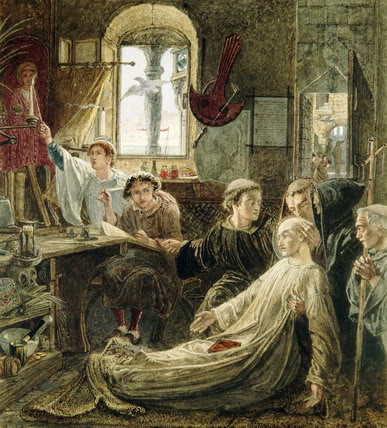
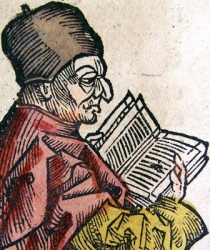
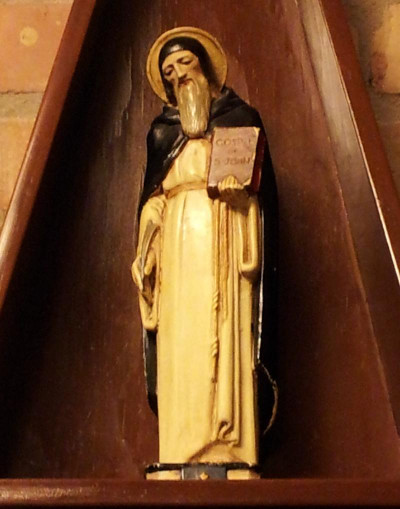
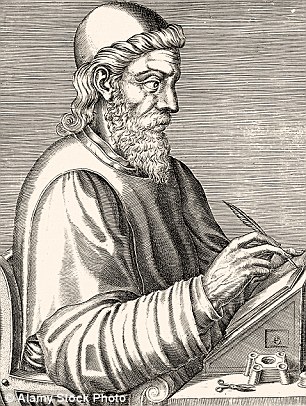
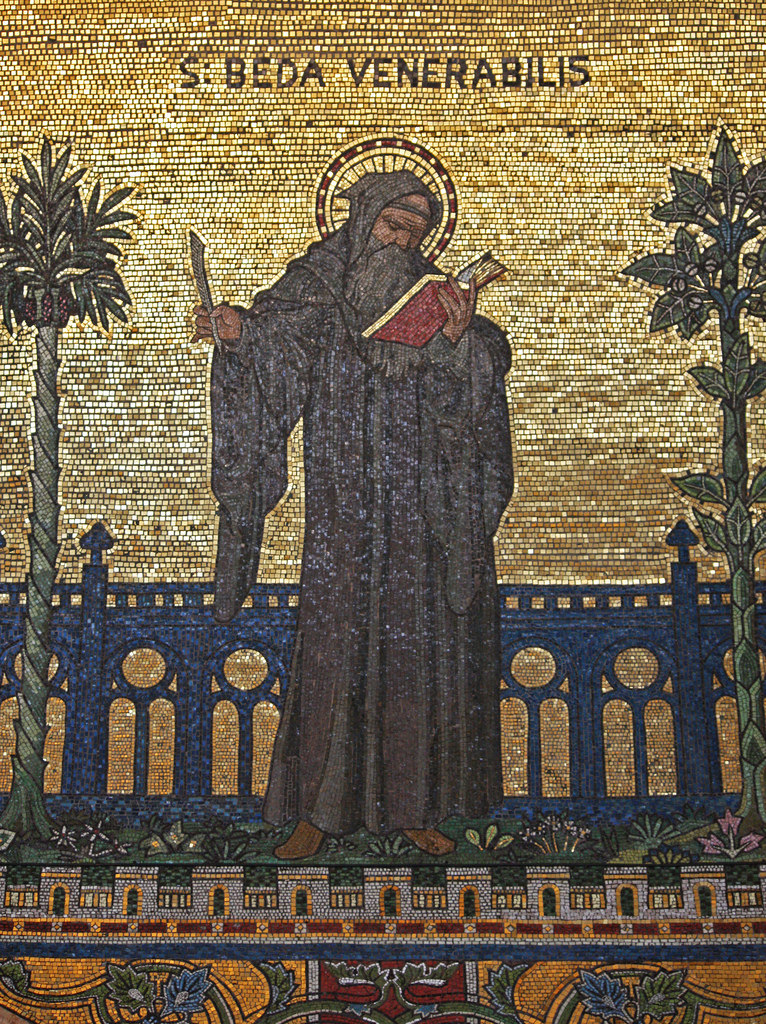
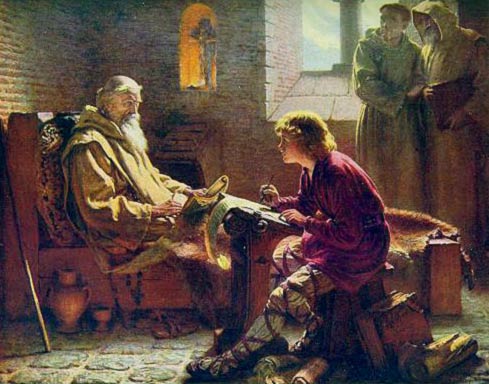
Saint of the Day – 25 May – St Bede the Venerable OSB (673-735) – Confessor, Priest, Monk, Father and Doctor of the Church, Linguist, Translator, Historian – also known as Venerable Bede, Father of English History. Patronages – of Lectors, English writers and historians; Jarrow, Tyne and Wear, England. In 1899, Pope Leo XIII declared him a Doctor of the Church; he is the only native of Great Britain to achieve this designation; Anselm of Canterbury, also a Doctor of the Church, was born in Italy. St Bede was moreover a skilled linguist and translator and his work made the Latin and Greek writings of the early Church Fathers much more accessible to his fellow English, which contributed significantly to English Christianity.
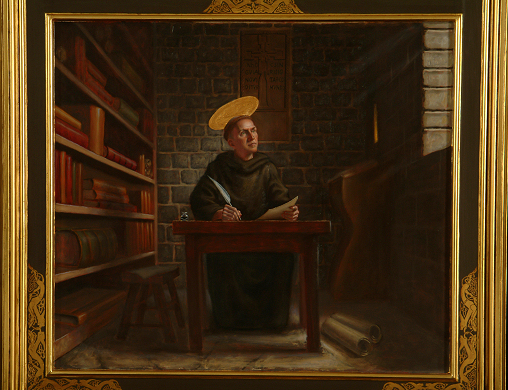
St Bede was born in Wearmoth-Jarrow, England, and at age seven was sent to the nearby monastery of St Peter and St Paul to be educated by the monks. From his writings, it appears that his family was wealthy and noble. Given his name, Bede—a derivative of the English bedtime prayer, it is likely that his parents had planned a religious life for him from birth. Under the holy tutelage of the monks, the natural intellect and spiritual zeal of St Bede magnified into one of the finest minds of his time. He studied all the known sciences: natural philosophy, the philosophical principles of Aristotle, astronomy, arithmetic, grammar, ecclesiastical history, the lives of the saints and, especially, Holy Scripture. St Bede spent his days in scholarly pursuits, prayer and contemplation. St Bede was ordained a deacon at the young age of nineteen and ordained a priest at 30.
He spent his days subsequent to ordination teaching, writing and studying. A prolific writer, he composed 45 texts on varied subjects, including science, literature, philosophy, and spirituality. “Through all the observance of monastic discipline,” Bede wrote, “it has ever been my delight to learn and teach and write.” His best known text, the Ecclesiastical History of the English People, is widely regarded as a decisive historical text which inspired the recording of written history. This text described the history of the English Church, and is a primary source of English history. Thirty of his manuscripts focused on Biblical commentary and theology. Aside from those he wrote, St Bede copied many texts by hand, translating a significant number of them into Latin to aid in teaching those of other languages.
Saint Bede remained in the monastery his entire life, leaving few times, including a brief visit to teach in a school in York and a visit to the monastery at Lindisfarne, where he began correspondence with St Cuthbert. Despite this, his counsel and teaching was sought by royalty and the Pope. His writings and homilies were read throughout the Church.
In his own words, from the Ecclesiastical History of the English People:
“Thus much concerning the ecclesiastical history of Britain and especially of the race of the English, I, Baeda, a servant of Christ and a priest of the monastery of the blessed apostles Saint Peter and Saint Paul, which is at Wearmouth and at Jarrow (in Northumberland), have with the Lord’s help composed so far as I could gather it either from ancient documents or from the traditions of the elders, or from my own knowledge. I was born in the territory of the said monastery and at the age of seven I was, by the care of my relations, given to the most reverend Abbot Benedict and afterwards to Ceolfrid, to be educated. From that time I have spent the whole of my life within that monastery, devoting all my pains to the study of the Scriptures and amid the observance of monastic discipline and the daily charge of singing in the Church, it has been ever my delight to learn or teach or write. In my nineteenth year I was admitted to the deaconate, in my thirtieth to the priesthood, both by the hands of the most reverend Bishop John and at the bidding of Abbot Ceolfrid. From the time of my admission to the priesthood to my present fifty-ninth year, I have endeavoured for my own use and that of my brethren, to make brief notes upon the holy Scripture, either out of the works of the venerable Fathers or in conformity with their meaning and interpretation.”
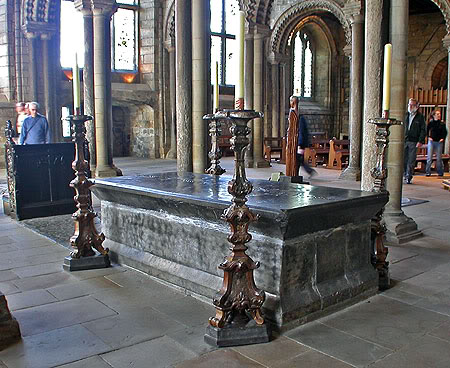
“The Father of English History,” Saint Bede died peacefully at the monastery in Jarrow in 735. He was buried at Jarrow, though his remains now rest in Durham Cathedral.
Saint Cuthbert recorded his final hours, indicating the words of Saint Bede: “If it be the will of my Maker, the time has come when I shall be freed from the body and return to Him Who created me out of nothing when I had no being. I have had a long life, and the merciful Judge has ordered it graciously. The time of my departure is at hand, and my soul longs to see Christ my King in His beauty.”He further wrote of Bede’s life and death, citing a poem that Saint Bede had written in preparation for meeting his Maker: “And he used to repeat that sentence from St Paul, “It is a fearful thing to fall into the hands of the living God,” and many other verses of Scripture, urging us thereby to awake from the slumber of the soul by thinking in good time of our last hour. And in our own language,—for he was familiar with English poetry,—speaking of the soul’s dread departure from the body:
More prudent than he has good call to be, If he consider, before his going hence, What for his spirit of good or of evil After his day of death shall be determined.”
The conclusion of his Ecclesiastical History records his piety, humility, and wisdom: “And I pray thee, loving Jesus, that as Thou hast graciously given me to drink in with delight the words of Thy knowledge, so Thou wouldst mercifully grant me to attain one day to Thee, the fountain of all wisdom and to appear forever before Thy face.”
The life of Saint Bede is highly regarded as instrumental in the recording of written history and the translation of Biblical texts from ancient languages into modern languages. His commentary and theological writings—the goal to explain the teachings of the Church Fathers to all—are highly regarded, like those of Saint Augustine and Saint Ambrose. More than that, the simple monastic life of Saint Bede demonstrates the call of the Lord and the gifts of the Holy Spirit to those who listen and obey.
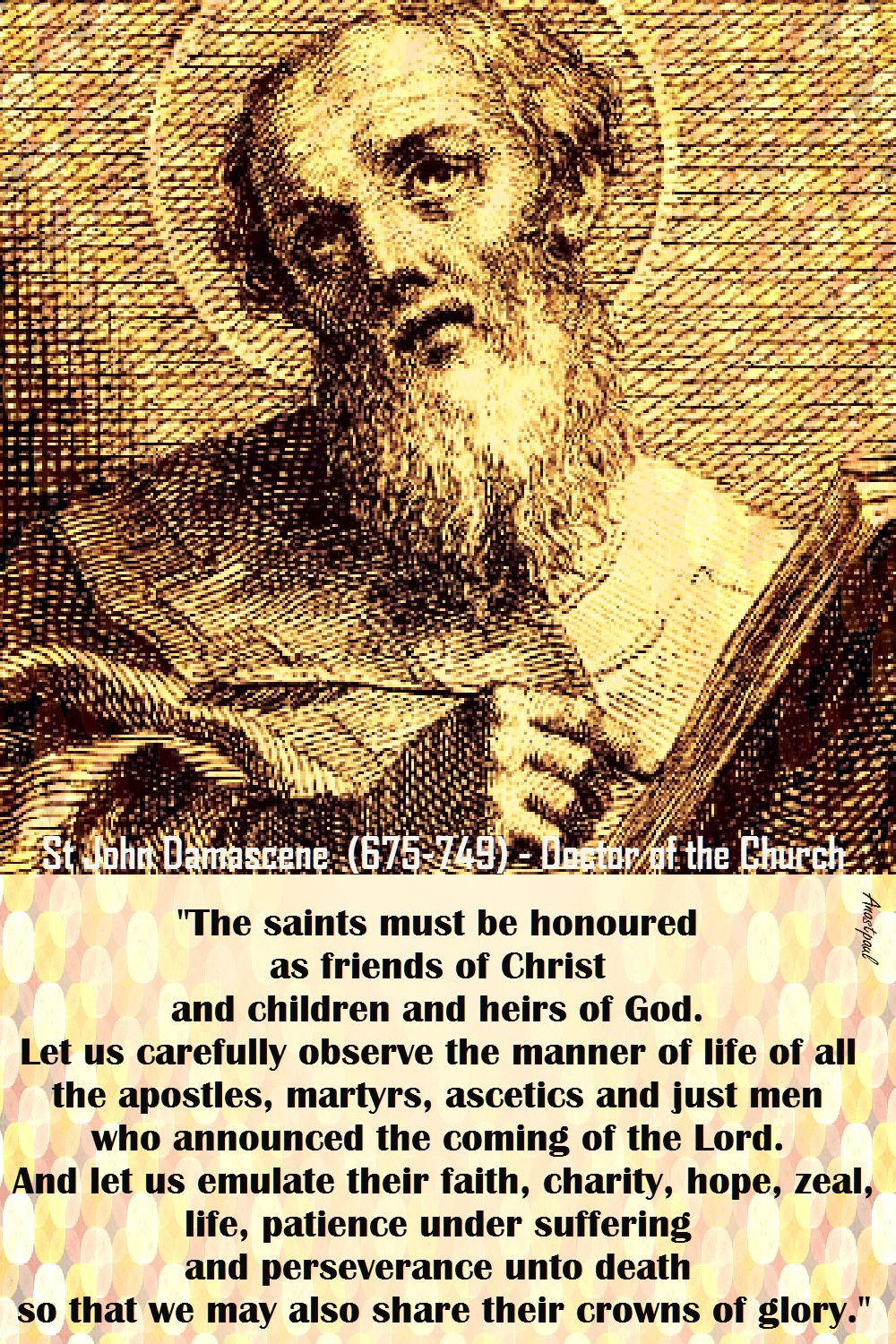
“The saints must be honoured as friends of Christ
and children and heirs of God.
Let us carefully observe the manner of life of all
the apostles, martyrs, ascetics and just men
who announced the coming of the Lord.
And let us emulate their faith, charity, hope, zeal,
life, patience under suffering and perseverance unto death
so that we may also share their crowns of glory.”
St John Damascene (675-749) – Doctor of the Church
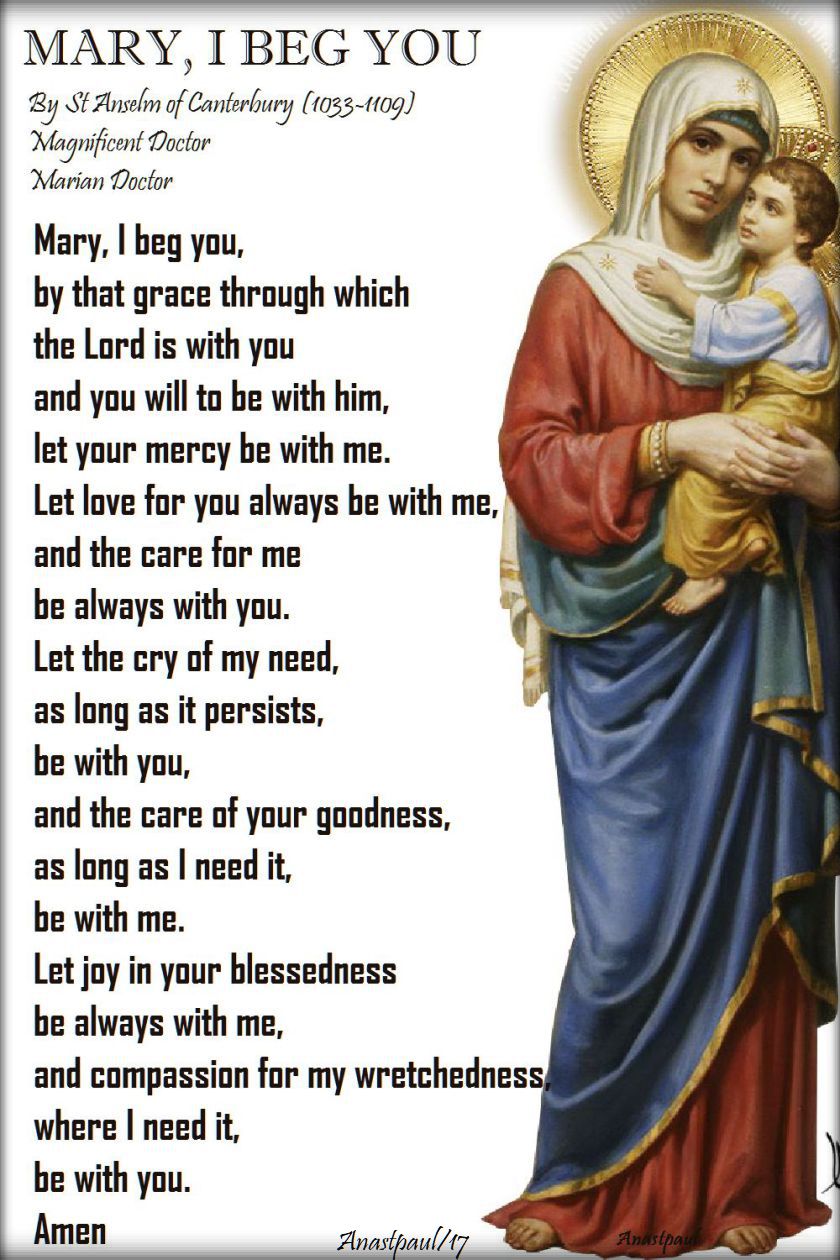
MARY, I BEG YOU By St Anselm of Canterbury (1033-1109) Magnificent Doctor Marian Doctor
Mary, I beg you,
by that grace through which
the Lord is with you
and you will to be with him,
let your mercy be with me.
Let love for you always be with me,
and the care for me be always with you.
Let the cry of my need,
as long as it persists,
be with you,
and the care of your goodness,
as long as I need it,
be with me.
Let joy in your blessedness
be always with me,
and compassion for my wretchedness,
where I need it,
be with you.
Amen
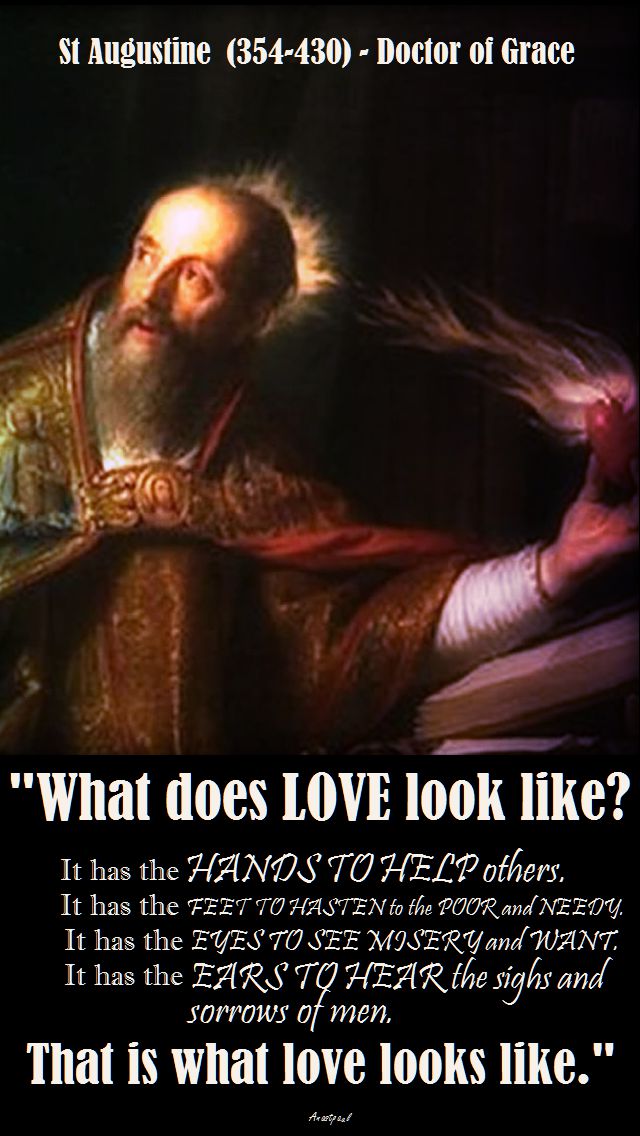
“What does love look like? It has the hands to help others. It has the feet to hasten to the poor and needy. It has eyes to see misery and want. It has the ears to hear the sighs and sorrows of men. That is what love looks like.”
I heard the voice of the Lord saying, ‘Whom shalll I send?….”Here I am.” I said, “send me!”……………Isaiah 6:8
REFLECTION – “You ask what you might offer to God?
Offer yourself!
What does God expect from you – except yourself?”
PRAYER – Help me to discern through prayer and meditation what You truly want of me.
The enable me to offer it to You and indeed, to offer myself and all I have and all I am, to You.
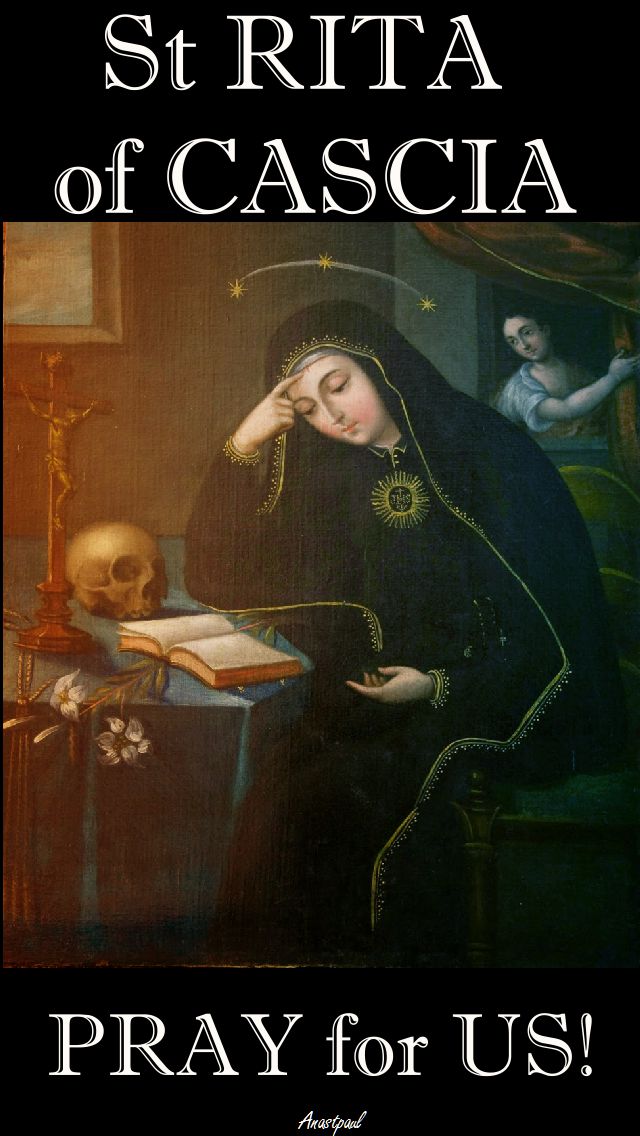
St Rita of Cascia, you prayed so earnestly to give yourself totally to the Lord and suffer for Him, please pray for us, amen.
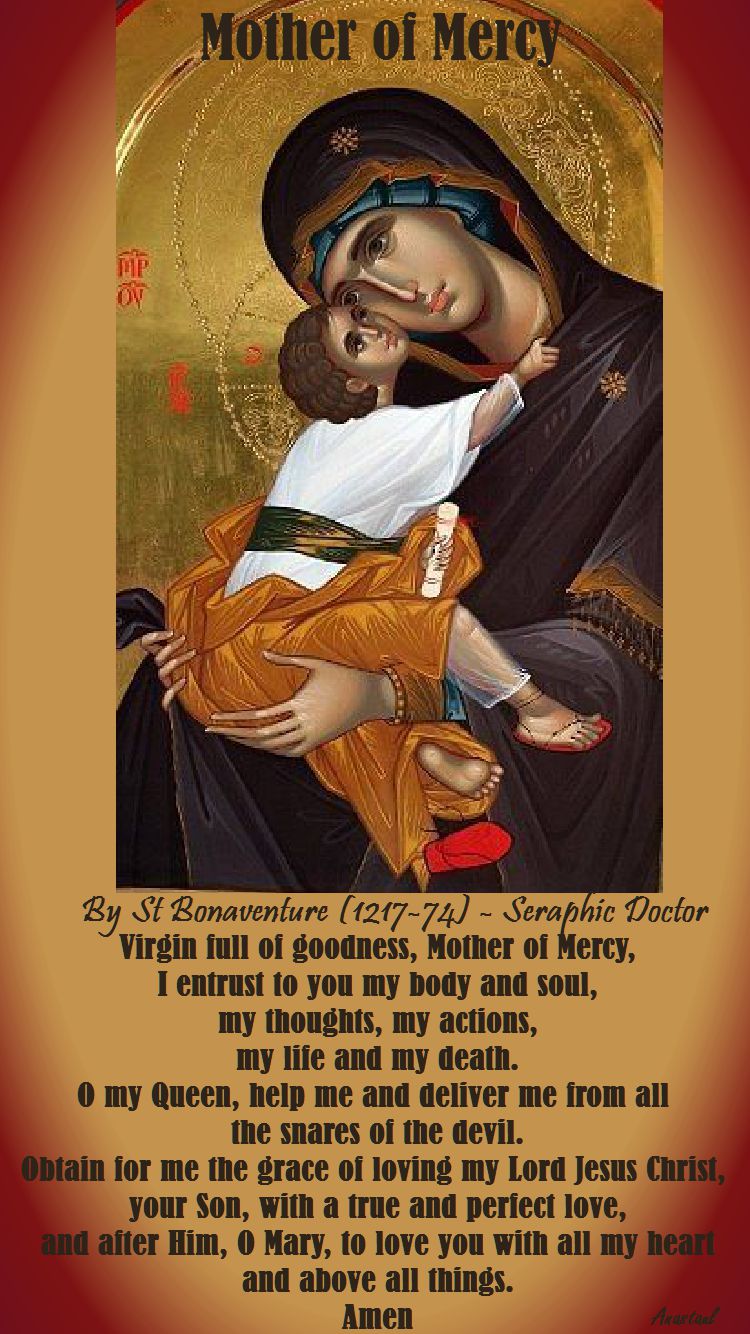
Mother of Mercy
By St Bonaventure (1217-74)
Seraphic Doctor
Virgin full of goodness,
Mother of Mercy,
I entrust to you my body and soul,
my thoughts, my actions,
my life and my death.
O my Queen, help me,
and deliver me from all
the snares of the devil.
Obtain for me the grace
of loving my Lord Jesus Christ,
your Son, with a true and perfect love,
and after Him, O Mary,
to love you with all my heart
and above all things.
Amen
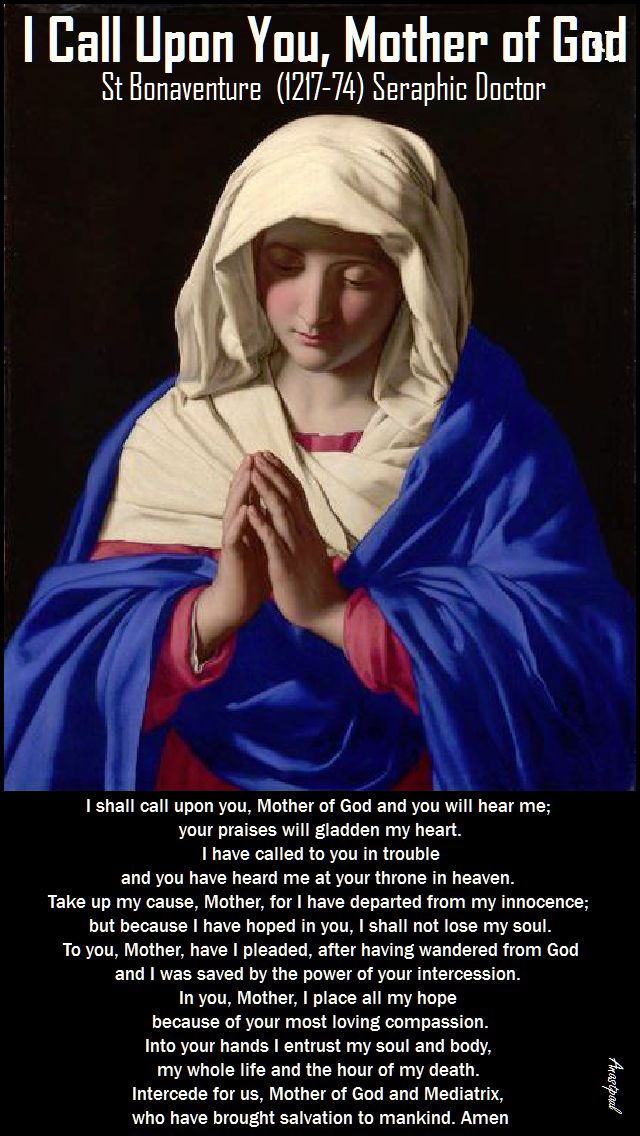
I Call Upon You, Mother of God By St Bonaventure (1217-1274) – Seraphic Doctor
I shall call upon you, Mother of God
and you will hear me;
your praises will gladden my heart.
I have called to you in trouble
and you have heard me at your throne in heaven.
Take up my cause, Mother,
for I have departed from my innocence;
but because I have hoped in you,
I shall not lose my soul.
To you, Mother, have I pleaded,
after having wandered from God
and I was saved by the power of your intercession.
In you, Mother, I place all my hope
because of your most loving compassion.
Into your hands I entrust my soul and body,
my whole life and the hour of my death.
Intercede for us, Mother of God and Mediatrix,
who have brought salvation to mankind. Amen
The Saint Who Influenced Pope St. John Paul II’s Profound Devotion to Mary
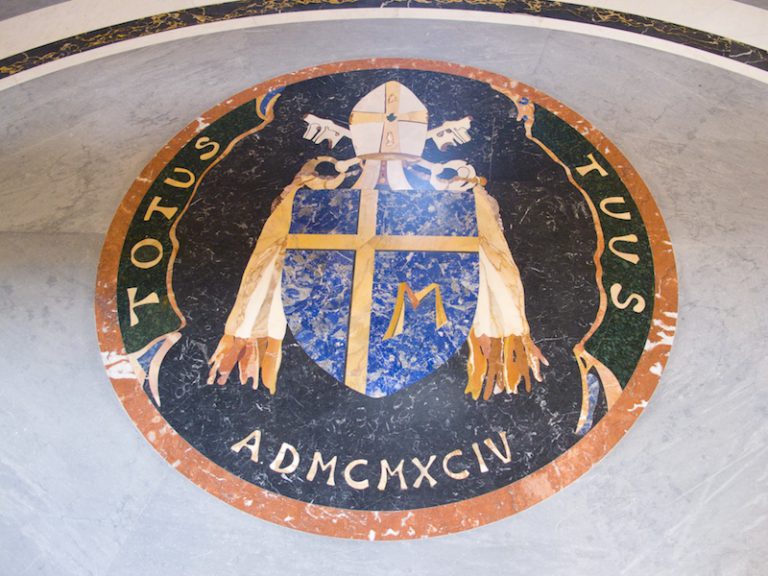
Pope St. John Paul II was well known for having a deep and abiding love for the Blessed Virgin Mary. His devotion to her was evident in all that he did: his teaching, his prayer life, even his papal motto and coat of arms were dedicated to the Blessed Mother.
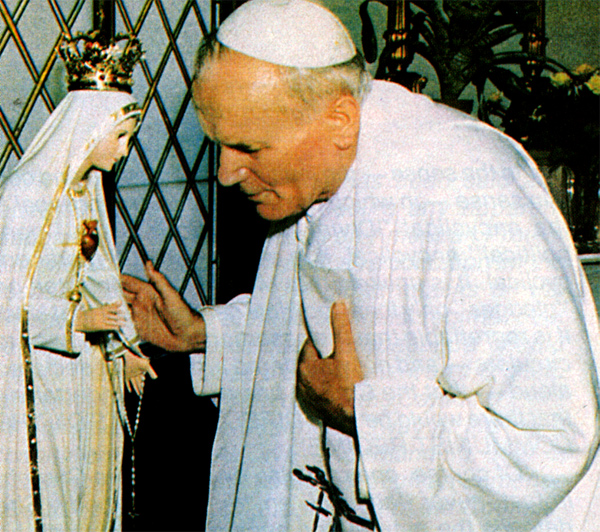
When he was nearly fatally shot during his papacy he credited the intercession of the Virgin Mary, specifically Our Lady of Fatima, with the miraculous save of his life.
Pope St. John Paul II with an Our Lady of Fatima statue after the assasination attempt on his life
But how did he develop this life-long devotion to Mary?
In his book, Gift and Mystery, Blessed Pope John Paul II credits his home parish and the nearby Carmelites for their early influence on him. He also had a very devout father who regularly took him on pilgrimages to local Marian shrines.
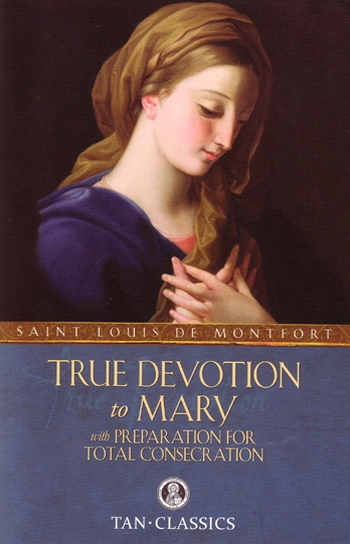
However, as he matured in his faith as a young adult, he singles out one overwhelming influence which changed his life. He gleaned his profound devotion to Mary largely through the writings of one man: St. Louis de Montfort.
The book that changed Karol Wojtyla’s life was True Devotion to Mary. The Pope relates that,
“At one point I began to question my devotion to Mary, believing that, if it became too great, it might end up compromising the supremacy of the worship owed to Christ. At that time, I was greatly helped by a book by Saint Louis Marie Grignion de Montfort…
There I found the answers to my questions, Yes, Mary does bring us closer to Christ; she does lead us to him, provided that we live her mystery in Christ… The author was an outstanding theologian. His Mariological thought is rooted in the mystery of the Trinity and in the truth of the Incarnation of the Word of God”.
Pope John Paul II thought so highly of the writing of St. Louis De Montfort that he spoke about the saint on many occasions. In addition, on December 8, 2003, he wrote a special letter on the occasion of the 160th Anniversary of De Montfort’s publication. In this letter he wrote: “I myself, in the years of my youth, found reading this book a great help.”
True Devotion to Mary had such a lasting influence on him that when he was elected Supreme Pontiff in 1978, he chose his papal motto, Totus Tuus, from words written by St. Louis De Montfort, as he describes below:
“As is well known, (in) my episcopal coat of arms … the motto Totus tuus is inspired by the teaching of St. Louis Marie Grignion de Montfort. These two words express total belonging to Jesus through Mary: “Tuus totus ego sum, et omnia mea tua sunt.” (“I am all Yours, and all that I have is Yours.”) . . . “This Saint’s teaching has had a profound influence on the Marian devotion of many of the faithful and on my own life.”
There is no better way to advance quickly in holiness, no better way to please God, and no better way to guarantee one’s present sanctity and eternal salvation than with a true devotion to Mary. Pope John Paul II learned this and demonstrated this truth in his life, proven now that he has been raised to the altars and numbered with the saints in heaven.
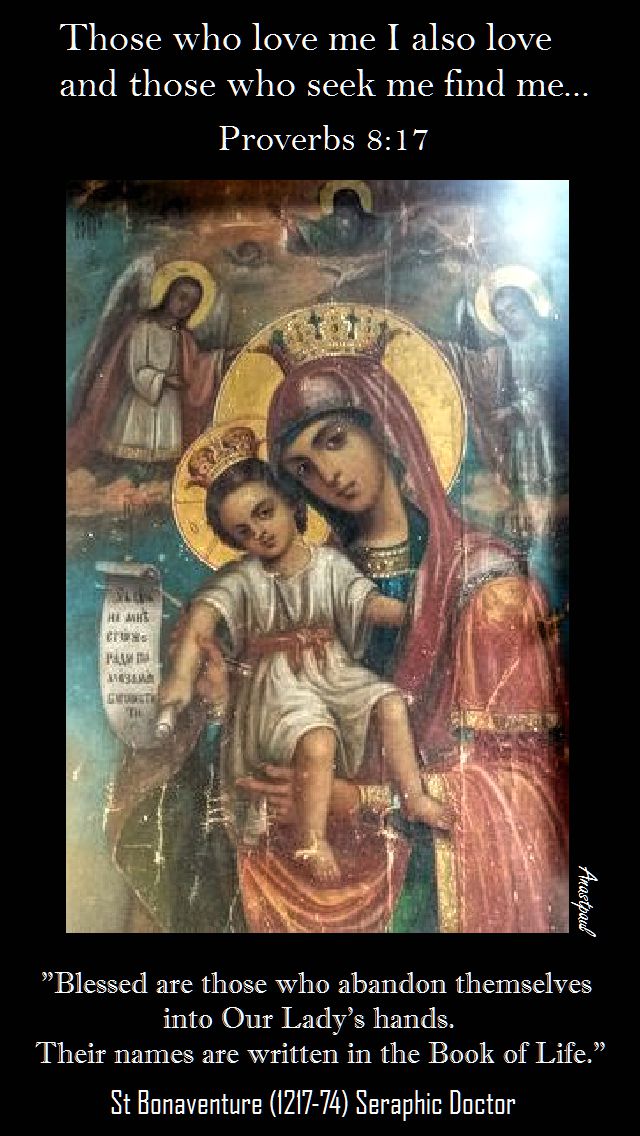
Those who love me I also love and those who seek me find me…….Proverbs 8:17
REFLECTION – “Blessed are those who abandon themselves into Our Lady’s hands. Their names are written in the Book of Life.”………………St Bonaventure (1217-74) Doctor seraphicus (Seraphic Doctor)
PRAYER – Heavenly Father, make a devoted client of Your beloved Daughter, Mary. Let me entrust myself always into her hands so that she may protect me as she took cate of Your Son, Our Lord Jesus Christ, in His infancy, childhood and throughout His life. Make me unto her, Lord my God! Mary, my beloved Mother, give me your spirit and pray for us all amen!



















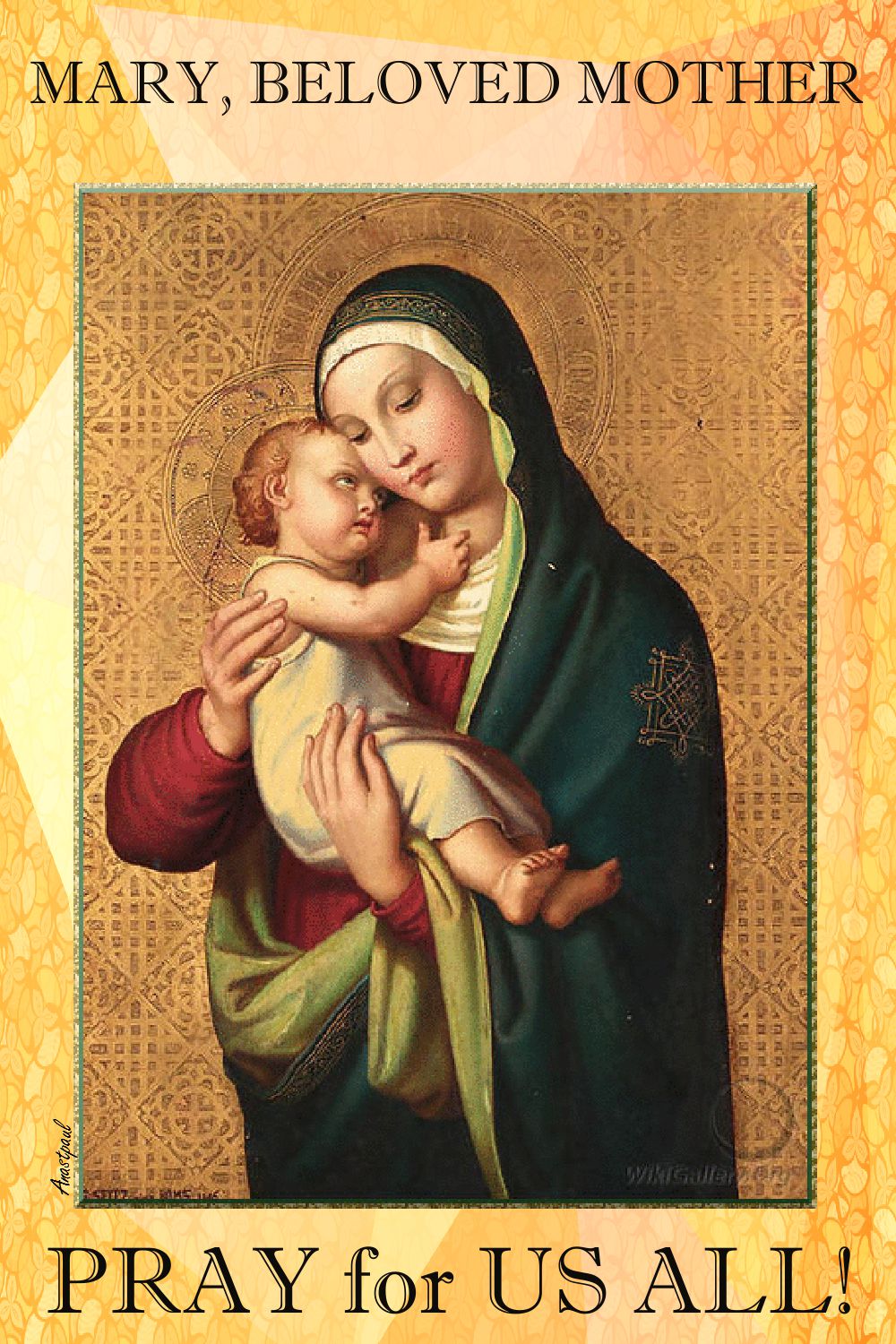
 AnaStpaul
You must be logged in to post a comment.