Our Morning Offering – 8 April – Low Sunday the Octave Day of Easter and Divine Mercy Sunday
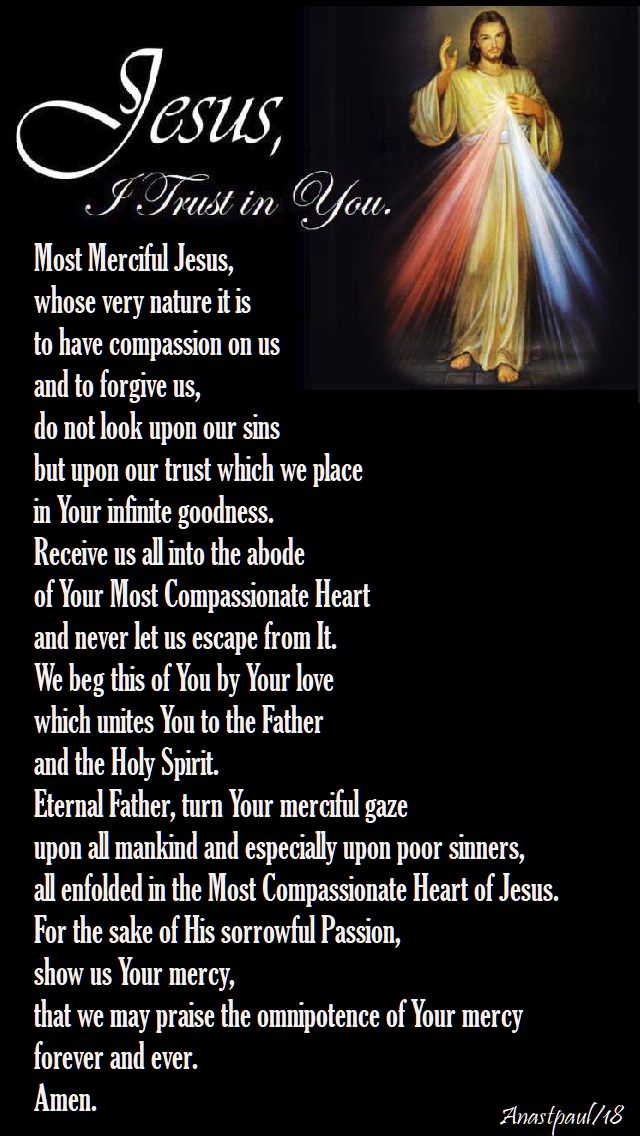
Most Merciful Jesus,
whose very nature it is
to have compassion on us
and to forgive us,
do not look upon our sins
but upon our trust which we place
in Your infinite goodness.
Receive us all into the abode
of Your Most Compassionate Heart
and never let us escape from It.
We beg this of You by Your love
which unites You to the Father
and the Holy Spirit.
Eternal Father, turn Your merciful gaze
upon all mankind and especially upon poor sinners,
all enfolded in the Most Compassionate Heart of Jesus.
For the sake of His sorrowful Passion,
show us Your mercy,
that we may praise the omnipotence of Your mercy
forever and ever.
Amen.
Thought for the Day – 7 April – Easter Saturday, Seventh Day in the Octave of Easter
What is Faith? by Father Richard Frederick Clarke, SJ
Faith is that disposition of our minds which makes us ready to accept all that God has revealed simply because He has revealed it. It is an assent to that which comes to us with God’s authority because it comes with His authority and not because in itself it commends itself to our reason. It is quite satisfied that God has said that this or that is true and it gives its adherence to what He has said without any further question. It thus earns the benediction of those “who have not seen but have believed.” (John 20:29) Have I this simple, unquestioning faith?
Faith is never opposed to reason. It is above and beyond reason but never contrary to it. What God has spoken can never be in contradiction with what our reason tells us is true. It may contradict our ordinary experience, as in the case of miracles; it may seem to set aside the testimony of our senses, as in the case of the Blessed Eucharist; it may require our acceptance of what is beyond the power of reason to grasp, as the doctrine of the Blessed Trinity but it never requires us to believe in an absurdity. Thank God for your faith in the Catholic religion, since all others are ultimately in contradiction with reason.
Yet faith requires us to believe many things that are difficult of belief and that we cannot believe without the help of God. Faith is a gift of God. No amount of searching or inquiry will obtain it. I must humbly pray to God, “Give me a strong faith; increase my faith; make me loyal in my readiness to believe,” if I wish my faith to be that of a true child of the Catholic Church. (Beautiful Pearls of Catholic Truth-1897)
“Of course, this adherence to God is not without content; with it we are aware that God has shown Himself to us in Christ, He has made us see His face and has made Himself really close to each one of us. Indeed, God has revealed thatHhis love for man, for each one of us, is boundless: on the Cross, Jesus of Nazareth, the Son of God made man, shows us in the clearest possible way how far this love reaches, even to the gift of Himself, even to the supreme sacrifice. With the mystery of Christ’s death and Resurrection, God plumbs to the depths of our humanity to bring it back to Him, to uplift it to His heights. Faith is believing in this love of God that is never lacking in the face of human wickedness, in the face of evil and death but is capable of transforming every kind of slavery, giving us the possibility of salvation.
Having faith, then, is meeting this “You”, God, who supports me and grants me the promise of an indestructible love that not only aspires to eternity but gives it; it means entrusting myself to God with the attitude of a child, who knows well that all his difficulties, all his problems are understood in the “you” of his mother. And this possibility of salvation through faith is a gift that God offers all men and women. I think we should meditate more often — in our daily life, marked by problems and at times by dramatic situations — on the fact that believing in a Christian manner means my trusting abandonment to the profound meaning that sustains me and the world, that meaning that we are are unable to give to each other but can only receive as a gift and that is the foundation on which we can live without fear. And we must be able to proclaim this liberating and reassuring certainty of faith with words and show it by living our life as Christians.”
Pope Benedict XVI – General Audience “What is faith?” – 24 October 2012
“We speak, we cast the seed, we scatter the seed. There are those who deride us, those who reproach us, those who mock at us. If we fear them, we have nothing left to sow and on the day of reaping, we will be left without a harvest. Therefore, may the seed in the good soil sprout!”
St Augustine (354-430) Father & Doctor of the Church
Quote/s of the Day – 7 April – Easter Saturday and the Memorial of St John Baptiste de La Salle (1651-1719)
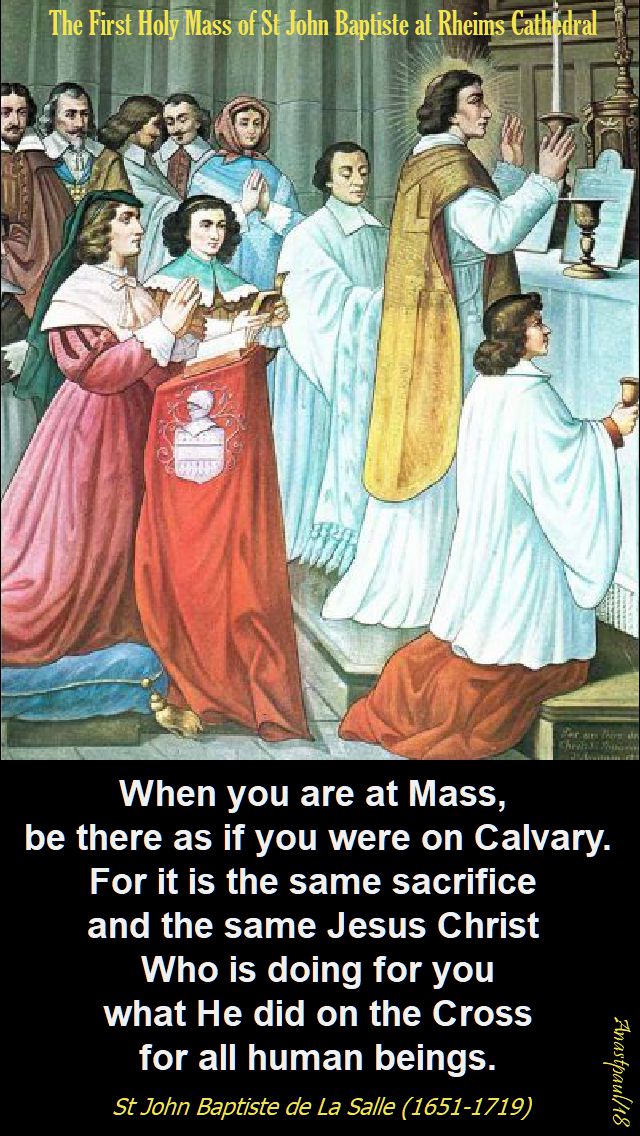
“When you are at Mass, be there as if you were on Calvary. For it is the same sacrifice and the same Jesus Christ Who is doing for you what He did on the Cross for all human beings.”
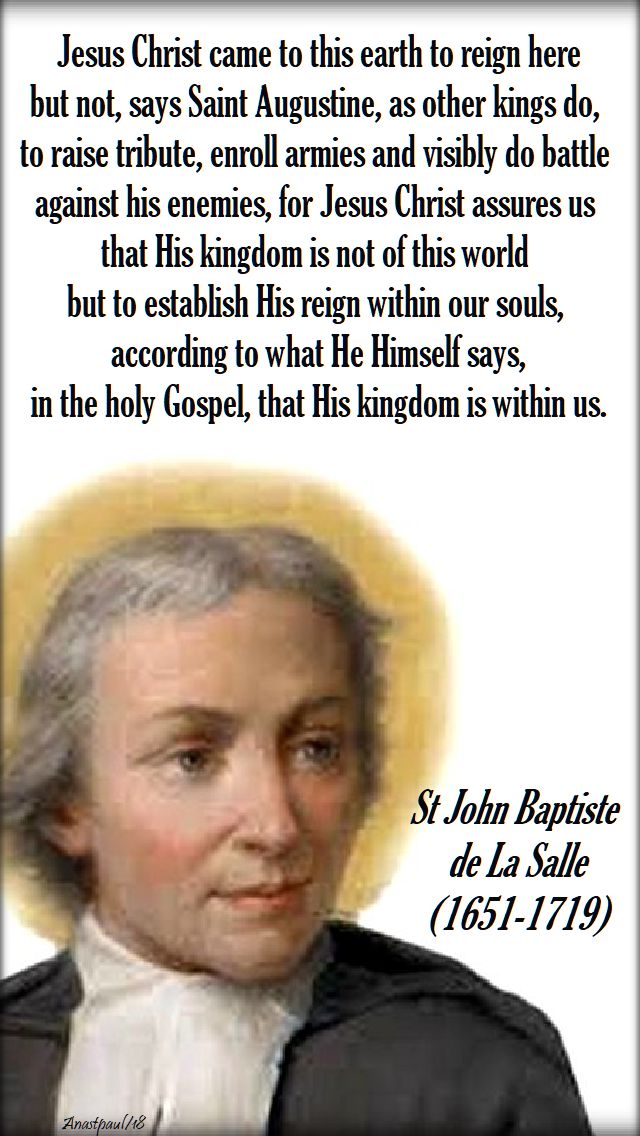
“Jesus Christ came to this earth to reign here but not, says Saint Augustine, as other kings do, to raise tribute, enroll armies and visibly do battle against his enemies, for Jesus Christ assures us that His kingdom is not of this world but to establish His reign within our souls, according to what He Himself says, in the holy Gospel, that His kingdom is within us.”
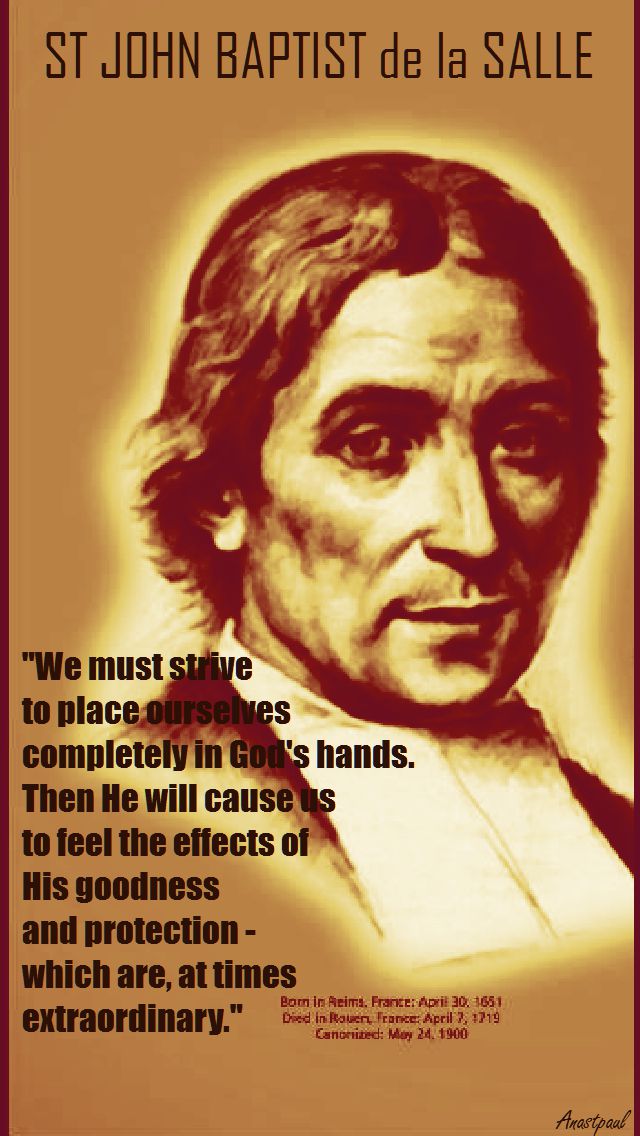
“We must strive to place ourselves completely in God’s hands. Then He will cause us to feel the effects of His goodness and protection – which are, at times extraordinary.”
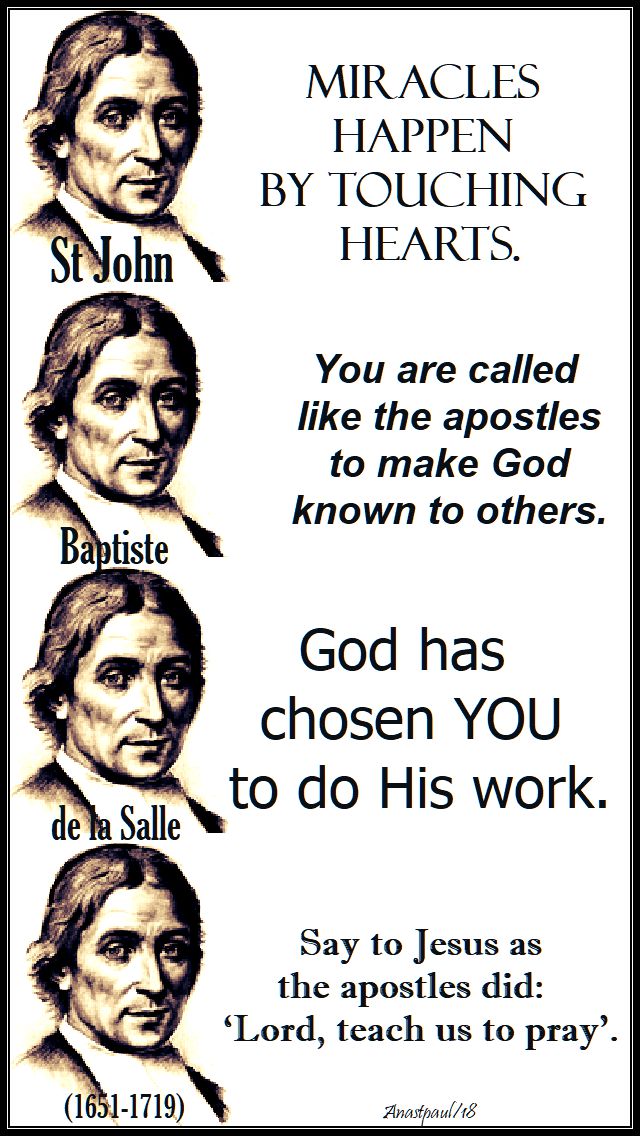
“Miracles happen by touching hearts.”
“You are called like the apostles to make God known to others.”
“God has chosen you to do his work.”
“Say to Jesus as the apostles did: ‘Lord, teach us to pray’.“
One Minute Reflection – 7 April – Easter Saturday and the Memorial of St John Baptiste de La Salle (1651-1719)
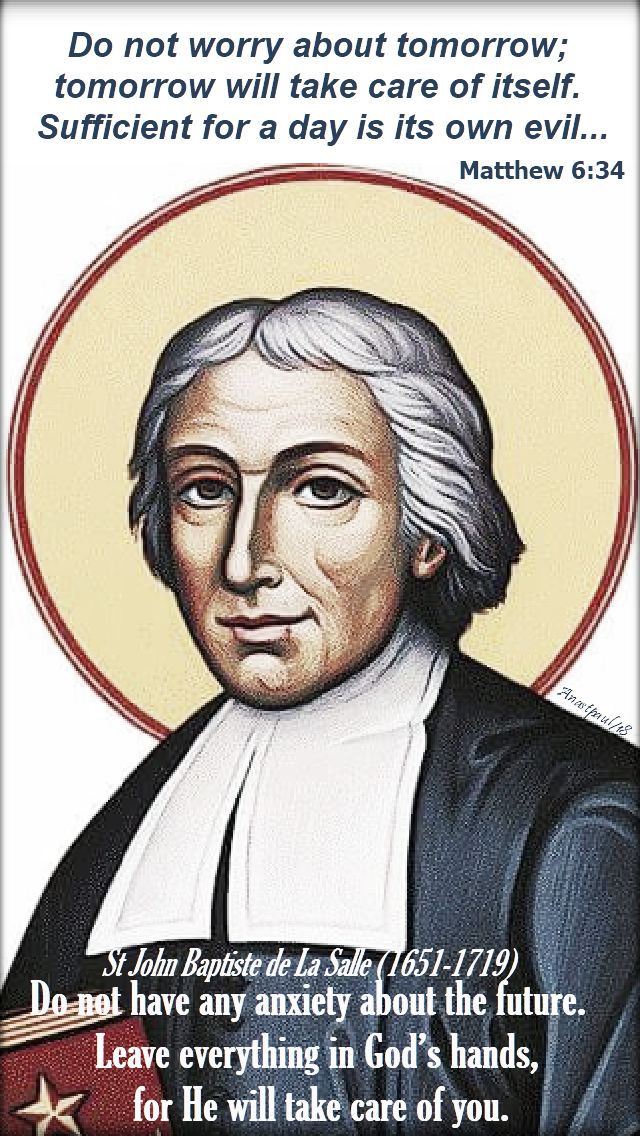
Do not worry about tomorrow; tomorrow will take care of itself. Sufficient for a day is its own evil.…Matthew 6:34
REFLECTION – “Do not have any anxiety about the future. Leave everything in God’s hands, for He will take care of you.” …St John Baptiste de La Salle (1651-1719)
PRAYER – In Your providence, Lord God, You chose St John Baptiste de la Salle, to educate the young in the Christian faith and way of life. Raise up, Lord, in the Church today, teachers who will devote themselves wholeheartedly to the human and Christian education of our youth. May the prayers of St John, help us all to seek and do Your holy will in all things, amen.
Our Morning Offering – 7 April – Easter Saturday and the Memorial of St John Baptiste de La Salle (1651-1719)
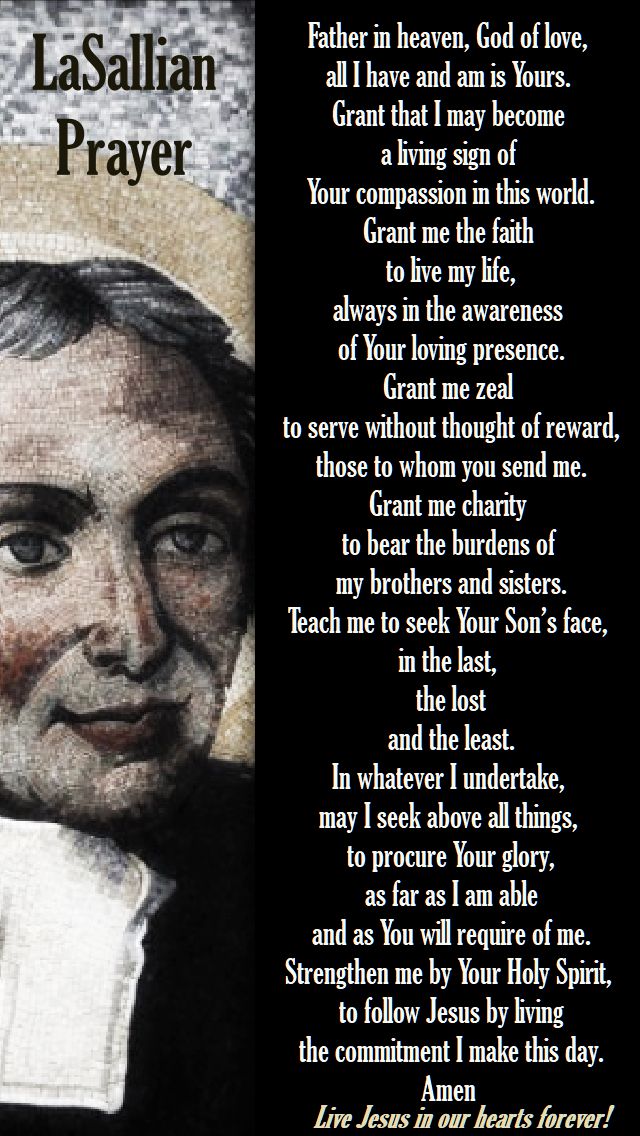
LaSallian Prayer
Father in heaven, God of love,
all I have and am is Yours.
Grant that I may become
a living sign of Your compassion in this world.
Grant me the faith
to live my life,
always in the awareness of Your loving presence.
Grant me zeal
to serve without thought of reward,
those to whom you send me.
Grant me charity
to bear the burdens of my brothers and sisters.
Teach me to seek Your Son’s face,
in the last
the lost
and the least.
In whatever I undertake,
may I seek above all things,
to procure Your glory,
as far as I am able
and as You will require of me.
Strengthen me by Your Holy Spirit,
to follow Jesus by living
the commitment I make this day.
Amen
LaSallian Invocation: Live Jesus in our hearts forever!
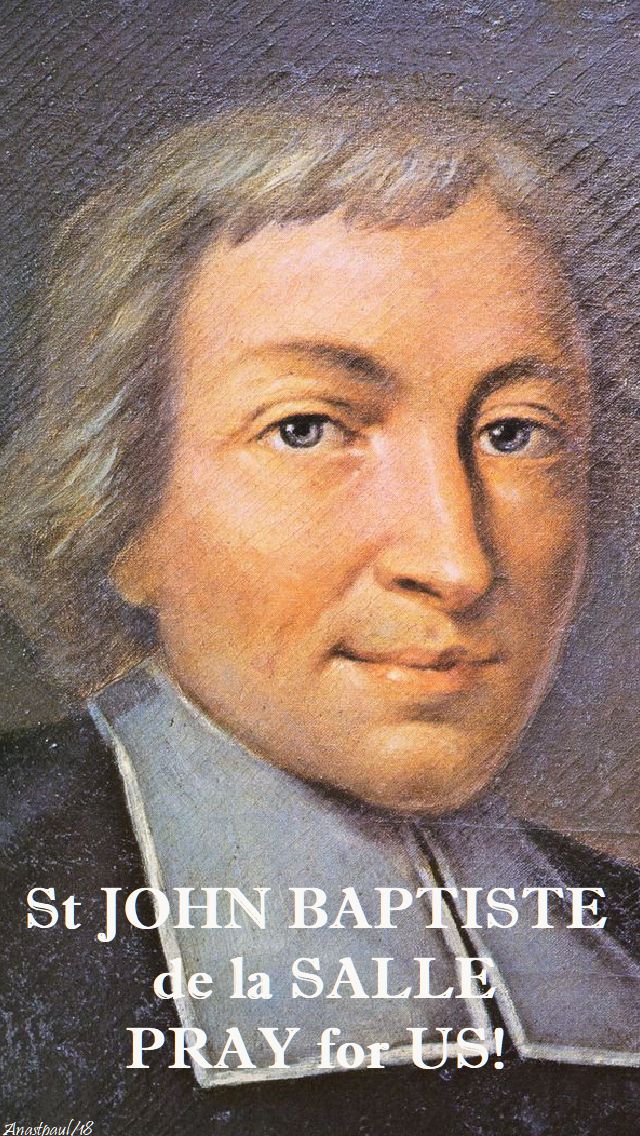
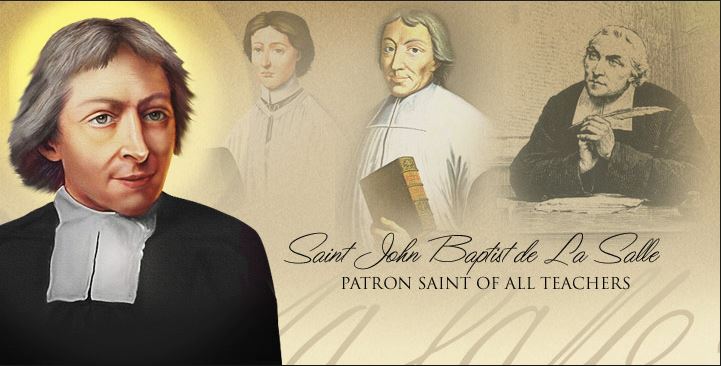
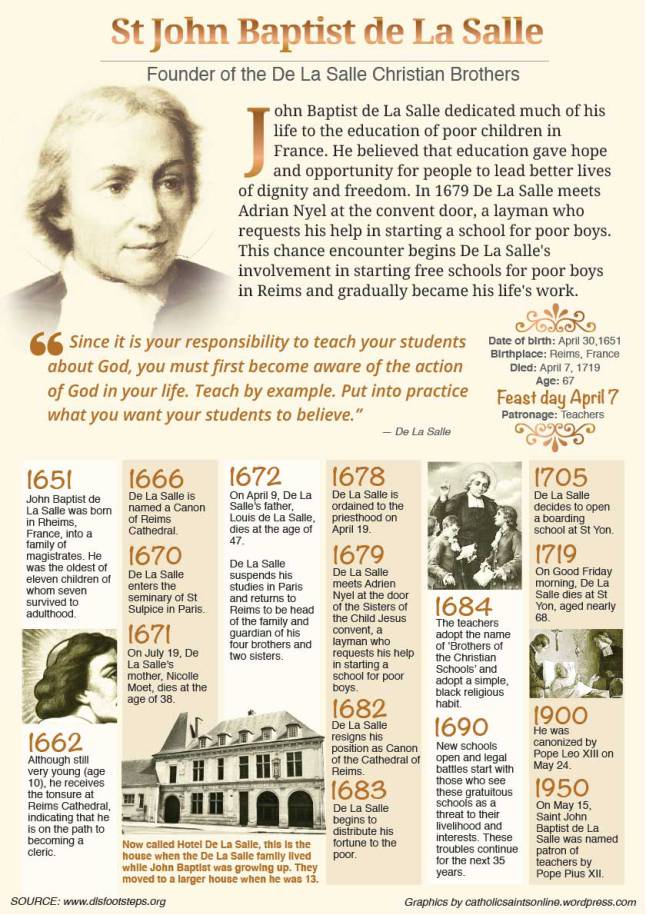
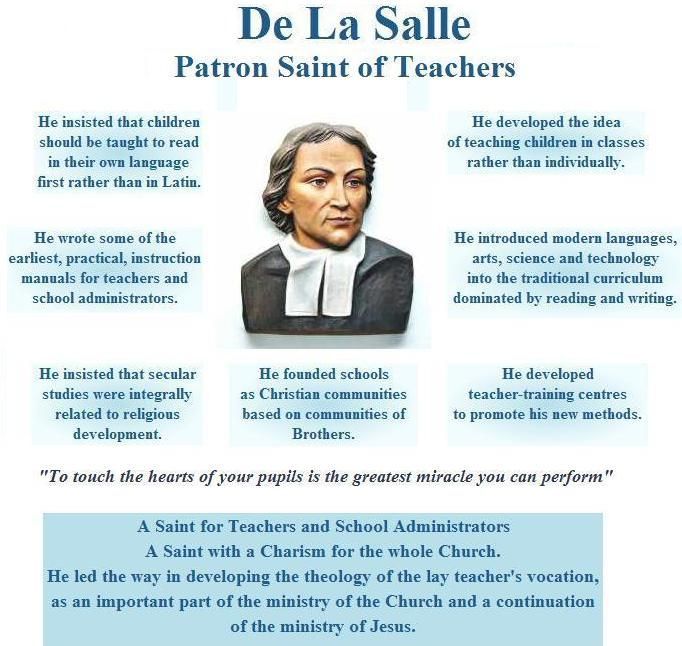
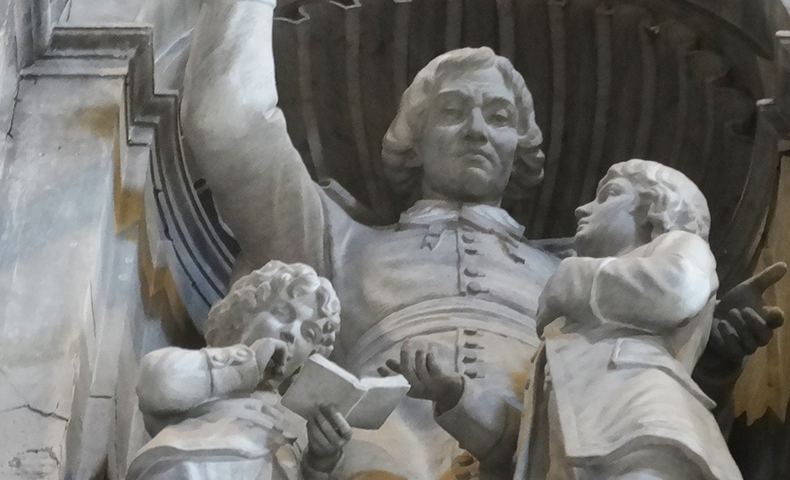
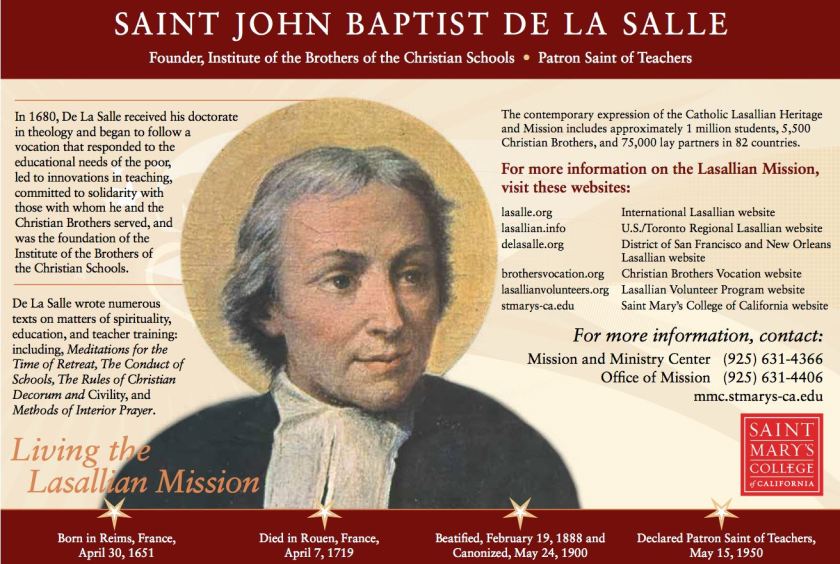
Saint of the Day – 7 April – St John Baptiste de la Salle (1651-1719) Priest, Founder of La Salle Schools and of the Brothers of the Christian Schools or FSC (Fratres Scholarum Christianarum), Educational Reformer, known as the “Father of Modern Education”. St John was born on 30 April 1651 at Rheims, France and died on 7 April 1719 at Saint-Yon, Rouen, France of natural causes. Patronages – Teachers of Youth, (15 May 1950, Pius XII), Institute of the Brothers of the Christian Schools, Lasallian educational institutions, teachers, school principals.
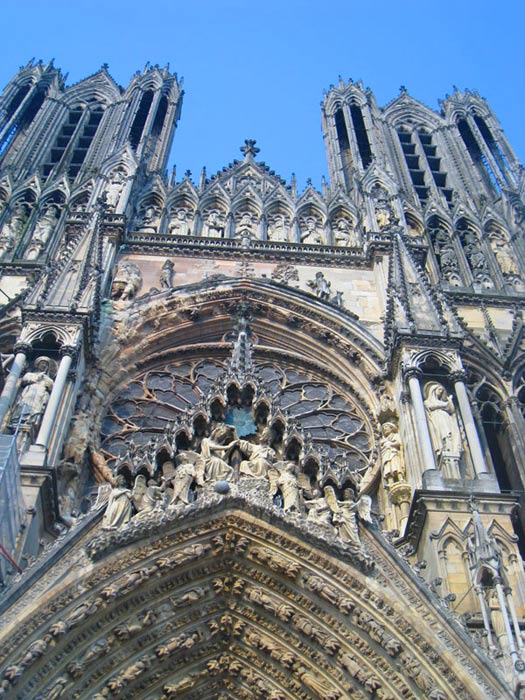
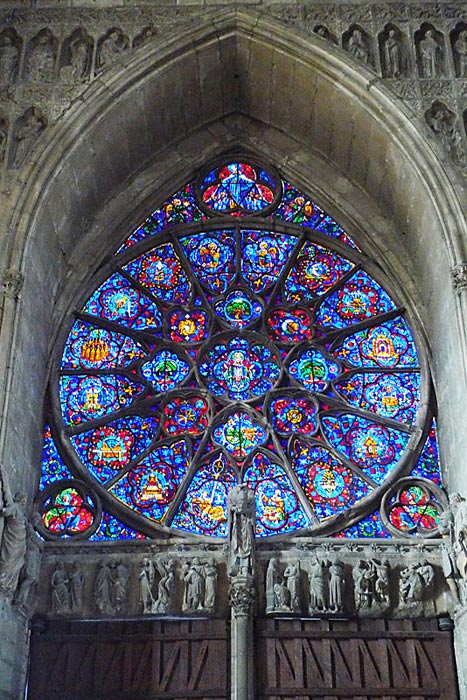
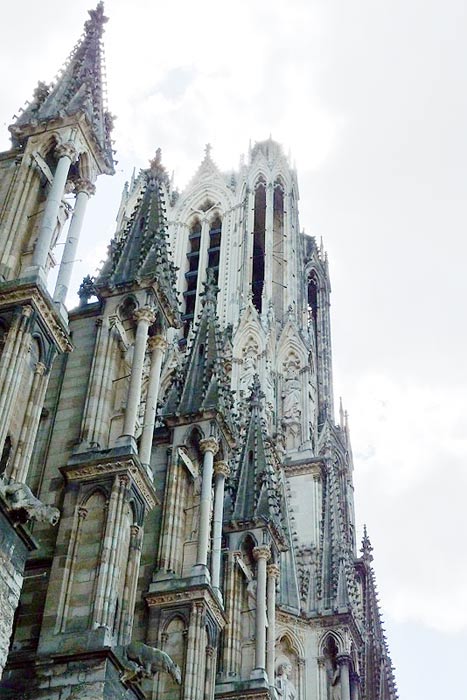
St John’s parents were people of standing, his father holding a judicial post. From childhood he gave evidence of such unusual piety that he was designated for the priesthood. At eleven he received the tonsure and at sixteen became a canon of the cathedral chapter at Rheims. Later he was sent to the seminary of St Sulpice to complete his studies. The young canon, handsome in appearance and scholarly in his tastes, seemed destined for high ecclesiastical preferment. An altar server from the start, De La Salle regularly attended Mass and prayers in Rheims Cathedral and was a Canon for 16 years. This is also where he said his first Mass and around which his liturgical life revolved. Soon after his return to Rheims he was to discover his true life work—the education of the poor. It was to be a long, hard struggle, with few tangible rewards but he unquestionably started a movement which was to result in furthering free elementary instruction.
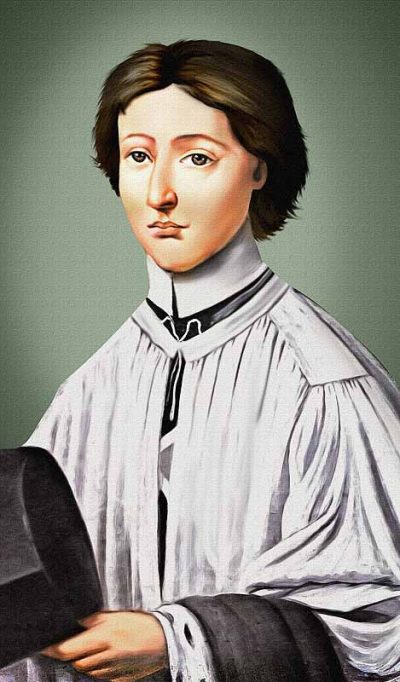
Young De La Salle as canon
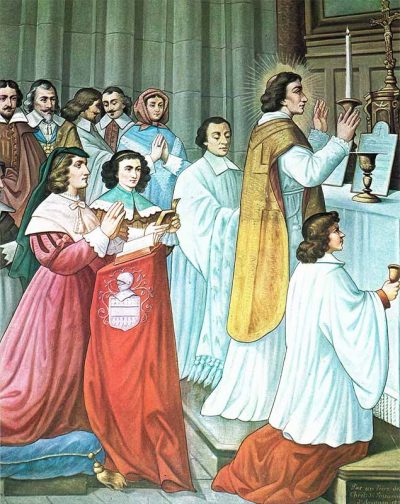
De La Salle says his first Mass at Rheims Cathedral
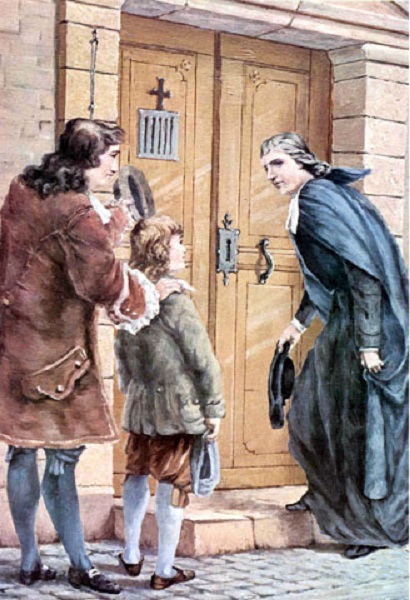
In 17th-century France, education was reserved for those who were rich and only by special providence did John Baptiste de La Salle become interested in schools for boys who were poor. By chance, John met Adrien Nyel, who was establishing some charitable schools for boys in need. John disliked the rough behaviour of those who were poor and the smells and sights of the slums but he sympathised with their poverty. John helped open a school for boys in need. He secured five teachers and rented a building. As John checked on his school, he witnessed shocking conditions. John decided he had to bring order to the school. He planned to upgrade the standards of the teachers and train them to be religious educators. His teachers quit. But soon men of better quality took their places and thrived under John’s training. John began to see that he must identify with his teachers, so he gave away his fortune and dedicated himself to education.
John founded the Brothers of Christian Schools to educate those who were poor. “The more religious a school is, the more successful it is,” was John’s philosophy. His boys attended daily Mass, were taught the catechism and prayers and had religion integrated into other subjects.
John motivated the students to prepare for a career and to live their lives by Christian principles. His schools attracted boys from fee-paying schools. Jealous instructors tried to bring lawsuits to ruin his work but his efforts were praised by the people. John opened boarding schools for boys in need and gave them courses in practical skills.
Although the schools had originally been founded for orphans and the children of the poor, a new departure was made at the request of King James II of England, who was then living in exile. He urged the founding of a college for the sons of his adherents, mainly Irish, who were living in France and Father John opened such a school for fifty young men of gentle birth. At about the same time he started a school for boys of the artisan class. Here technical instruction was combined with religious exercises and this type of school became very popular. There were also schools started for “troublesome boys,” now usually called “juvenile delinquents.” Efforts were thus being made to meet the needs of all types and classes of boys and young men. This constantly expanding work required insight and adaptability in an unusual degree.
Father John Baptist’s later years were spent at the College of St Yon, in Rouen, where the novitiate had been transferred in 1705, after it had functioned for some years in Paris. In 1716 he resigned from the active direction and government of the Institute and from then on would give no orders and lived like the humblest of the brothers, teaching the novices and young boarders. He wrote for them several treatises, including <A Method of Mental Prayer>. Worn out by illness and austerities, he passed away on Good Friday, April 7, 1719, at the age of sixty-seven. Six years after his death, the Christian Brothers’ institute was recognised by Pope Benedict XIII and its rule approved. Father John was canonised in 1900. To his valiant efforts we owe in large part the acceptance of the idea of universal education.
Saint Peter Basilica, Rome
In spite of internal difficulties, chiefly concerning the degree of austerity to be observed by the Brothers, the schools spread and flourished up to the French Revolution. During that period of persecution, the Christian Brothers were at one point reduced to twenty active members. However, when the ban was lifted by Napoleon I in 1799, the community sprang back to life with remarkable resilience. During the nineteenth century the schools expanded steadily; then, from 1904 to 1908, there was another setback: 1285 establishments were closed by legislative decree in France. Meanwhile the Brothers had established themselves in other countries of Europe, in England, Ireland, the Levant, North and South America, the West Indies, South Africa and Australia. Their first school in the United States was founded in 1846, today many of them are on the college level.
St John Baptiste de La Salle (1651-1719) (Memorial)
St Albert of Tournai
Bl Alexander Rawlins
St Brenach of Carn-Engyle
St Calliopus of Pompeiopolis
Bl Cristoforo Amerio
St Cyriaca of Nicomedia
St Donatus of North Africa
Bl Edward Oldcorne
St Epiphanius the Martyr
St Finian of Kinnitty
St George the Younger
St Gibardus of Luxeuil
St Goran
St Guainerth
St Hegesippus of Jerusalem
St Henry Walpole
Bl Herman Joseph
Bl Mary Assunta
St Peleusius of Alexandria
St Peter Nguyen Van Luu
Bl Ralph Ashley
St Rufinus the Martyr
St Saturninus of Verona
Bl Ursuline of Parma
—
Martyrs of Pentapolis – 4 saints: A bishop, deacon and two lectors at Pentapolis, Lybia who for their faith were tortured, had their tongues cut out, and were left for dead. They survived and each died years later of natural causes; however, because they were willing to die and because there were attempts to kill them, they are considered martyrs. We know little else except their names – Ammonius, Irenaeus, Serapion and Theodore c 310 at Pentapolis, Lybia.
Martyrs of Sinope – 200 saints: 200 Christian soldiers martyred together for their faith. We don’t even have their names. They were martyred in Sinope, Pontus, Asia Minor (in modern Turkey).
Thought for the Day – 6 April – Easter Friday the Sixth day in the Easter Octave
“When they got out on land, they saw a charcoal fire there, with fish lying on it, and bread. Jesus said to them, “Bring some of the fish that you have just caught.” So Simon Peter went aboard and hauled the net ashore, full of large fish, a hundred and fifty-three of them; and although there were so many, the net was not torn. Jesus said to them, “Come and have breakfast.” Now none of the disciples dared ask him, “Who are you?” They knew it was the Lord. Jesus came and took the bread and gave it to them, and so with the fish. This was now the third time that Jesus was revealed to the disciples after he was raised from the dead.”…John 21:9-14
“Today …. is bathed in the luminous joy of Easter. In these days, in fact, the Church celebrates the mystery of the Resurrection and experiences the great joy that comes to her from the Good News of Christ’s victory over evil and over death. This joy is not only prolonged in the Octave of Easter but is extended for 50 days until Pentecost.
Christ’s Pasch is the supreme and unequalled act of God’s power. It is an absolutely extraordinary event, the most beautiful, ripe fruit of the “Mystery of God”. It is so extraordinary that it is ineffable in its dimensions that escape our human capacity for knowing and investigating. Yet, it is also a “historical” event, witnessed to and documented. It is the event on which the whole of our faith is founded. It is the central content in which we believe and the main reason why we believe.
There is a glorified Resurrected Saviour now seated at the right hand of the Father, holding the place He has prepared for each of us. His wounds are glorified now, beautiful, streaming the light of grace upon an earth being reborn, revealing the depth of His love and the Hope that springs eternal. Through taking on our very humanity, He did for us what we could never have done for ourselves. He “who knew no sin” walked in the perfect obedience of the Son and bridged the gap between the Father and the sons and daughters who had rejected His invitation to communion, through the offering of His own Body on the altar of the Cross.
Through His passion, obedience unto death, and Resurrection, He welcomed us into the very inner life of the Trinity. In Him we now make our home in God. In His sacred humanity He transforms the entire human experience. He invites us to live differently and shows us the path to a fullness of life now and eternal glory in the new world to come. He opened eternity to all who were bound by the chains of time. He clothed in glorious freedom those once wrapped in the grave clothes of death. He gave purpose to the sheep who had wandered aimlessly in empty self pursuits.
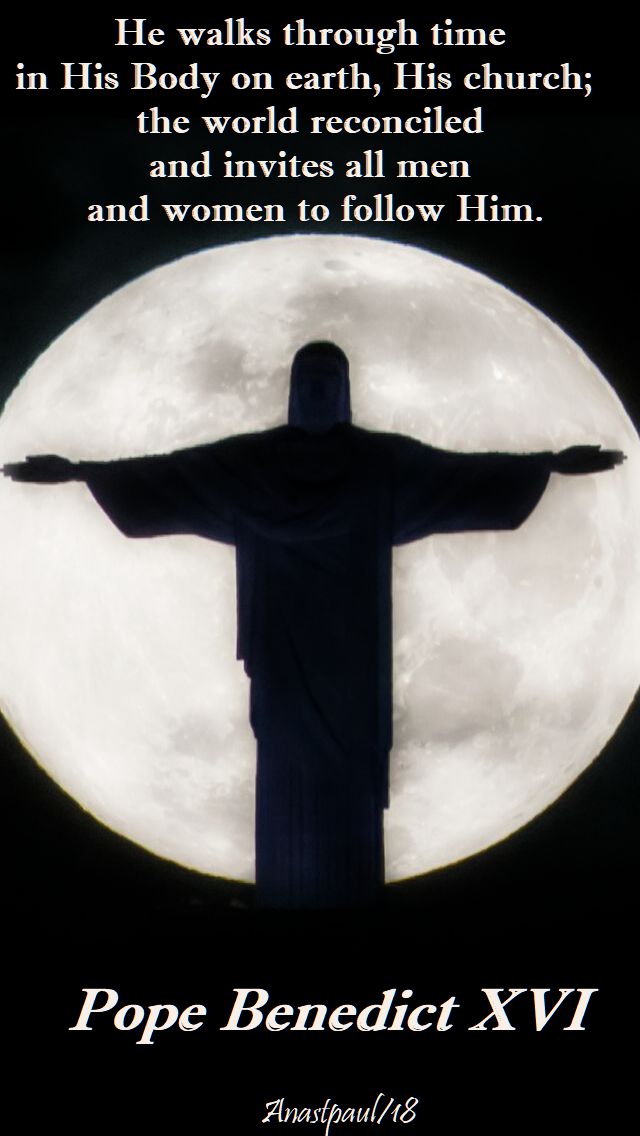
The whole world, created through Him, is now re-created in Him. We can see our lives differently as we open ourselves to His Spirit and allow Him to replace our finite vision with the eyes of eternal perspective. Our feet are now shod with the hope of the Good News. His redemptive mission continues through us to a world waiting to be born anew. He walks through time in His Body on earth, His church; the world reconciled and invites all men and women to follow Him.”
Pope Benedict XVI
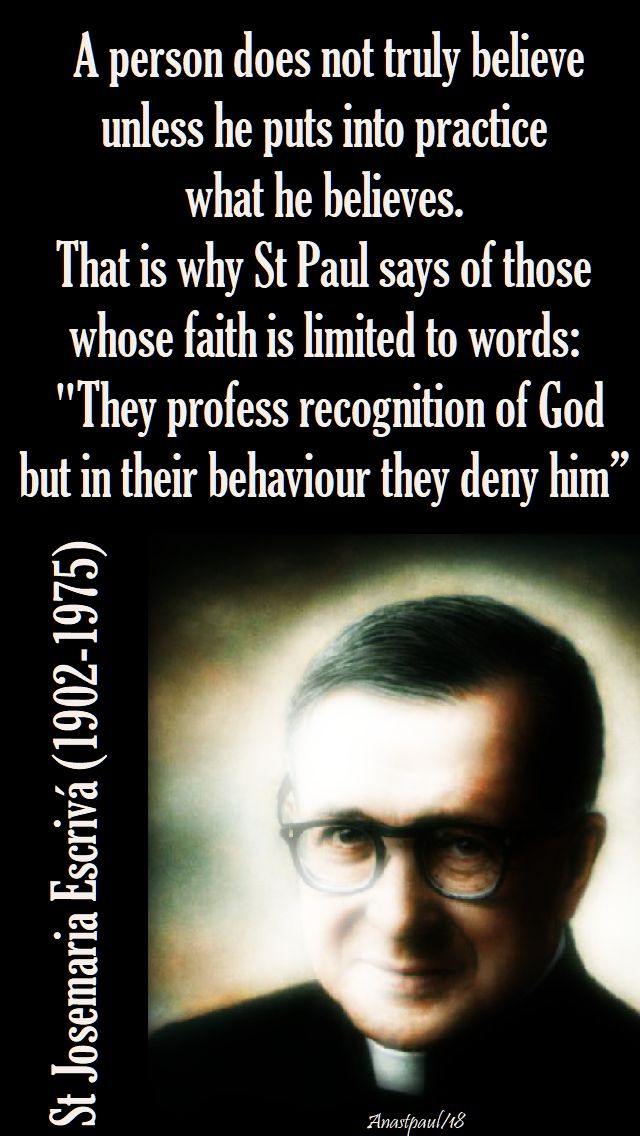
Faith helps us recognise that Christ is God; it shows that He is our saviour; it brings us to identify ourselves with Him and to act as He acted. When the risen Christ frees the apostle Thomas from his doubts, showing him His wounds, Jesus exclaims: “Blessed are they who have not seen, and yet have believed.” And St Gregory the Great comments that “He is referring in particular to us, for we possess spiritually Him whom we have not seen in the body.” He is referring to us, provided our behaviour agrees with our faith. A person does not truly believe unless he puts into practice what he believes. That is why St Paul says of those whose faith is limited to words: “They profess recognition of God, but in their behaviour they deny him”
Quote/s of the Day – 6 April – Easter Friday the Sixth day in the Easter Octave
“Speaking of Love”
“Nothing is sweeter than love, nothing stronger or higher or wider; nothing is more pleasant, nothing fuller and nothing better in heaven or on earth, for love is born of God and cannot rest except in God, Who is above all created things.”
“Love is watchful. Sleeping – it does not slumber. Wearied – it is not tired. Pressed – it is not straitened. Alarmed – it is not confused but like a living flame, a burning torch, it forces its way upward and passes unharmed, through every obstacle.”
Thomas à Kempis (1380-1471) The Imitation of Christ
“What does love look like? It has the hands to help others. It has the feet to hasten to the poor and needy. It has eyes to see misery and want. It has the ears to hear the sighs and sorrows of men. That is what love looks like.”
St Augustine of Hippo (354-430) Father & Doctor
“The proof of love is in the works. Where love exists, it works great things. But when it ceases to act, it ceases to exist.”
St Pope Gregory the Great (540-604) Father & Doctor
“The Eucharist is the Sacrament of Love; It signifies Love, It produces love. The Eucharist is the consummation of the whole spiritual life.”
St Thomas Aquinas (1225-1274) Doctor angelicus / Doctor communis
Love knows no limit to its endurance, no end to its trust, no fading of its hope, it can outlast anything. Love still stands, when all else has fallen.
Blaise Pascal (1623-1662)
“The person who does not decide to love forever will find it very difficult to really love, even for one day.”
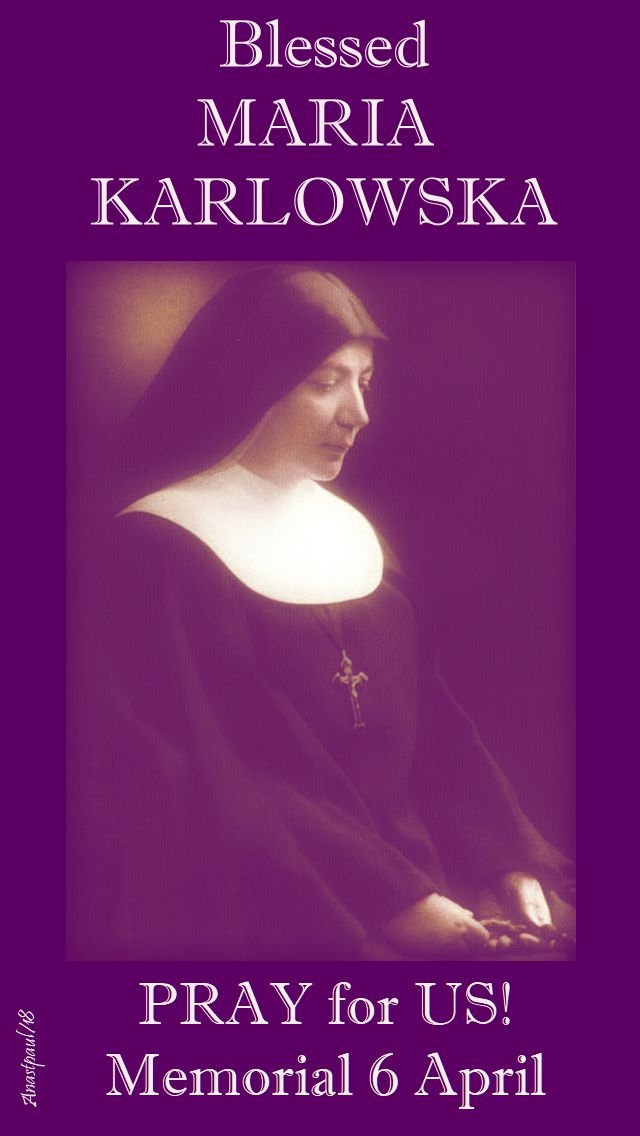
One Minute Reflection – 6 April – Easter Friday & The Memorial of Bl Maria Karlowska (1865-1935)
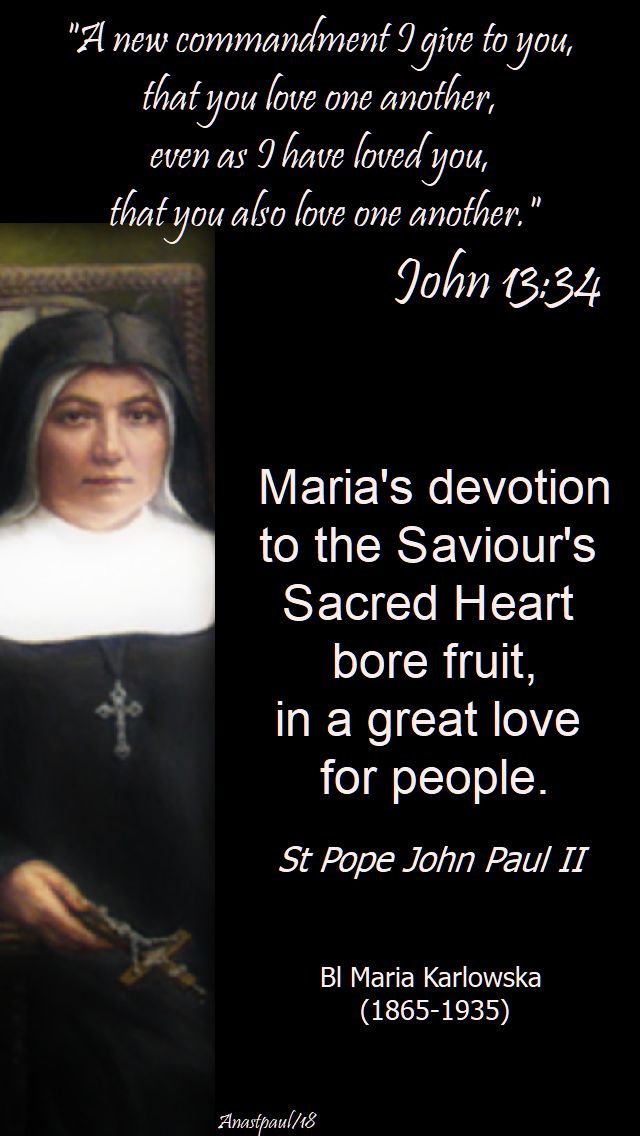
“A new commandment I give to you, that you love one another, even as I have loved you, that you also love one another.”…John 13:34
REFLECTION – “[She] worked as a true Samaritan among women, suffering great material and moral deprivation. Her devotion to the Saviour’s Sacred Heart bore fruit, in a great love for people. Thanks to this love she restored to many souls the light of Christ and helped them to retain their lost dignity.” … St Pope John Paul II at the Beatification on 6 June 1997
PRAYER – Dear Jesus, take away our hearts of stone and replace them with Your loving heart. Help us to radiate You to all we meet. Blessed Maria Karlowska, your heart was the heart of Christ, please pray for us, amen.
Dear Jesus,
help us to spread Your fragrance everywhere we go.
Flood our souls with Your spirit and life.
Penetrate and possess our whole being so utterly
that our lives may only be a radiance of Yours.
Shine through us and be so in us
that every soul we come in contact with
may feel Your presence in our soul.
Let them look up and see no longer us,
but only Jesus.
Stay with us
and then we shall begin to shine as You shine,
so to shine as to be light to others.
The light, O Jesus, will be all from You.
None of it will be ours.
It will be You shining on others through us.
Let us thus praise You in the way You love best,
by shining on those around us.
Let us preach You without preaching,
not by words but by our example;
by the catching force –
the sympathetic influence of what we do,
the evident fullness of the love our hearts bear to You.
Amen
Thought for the Day – 5 April – Easter Thursday Fifth Day in the Easter Octave
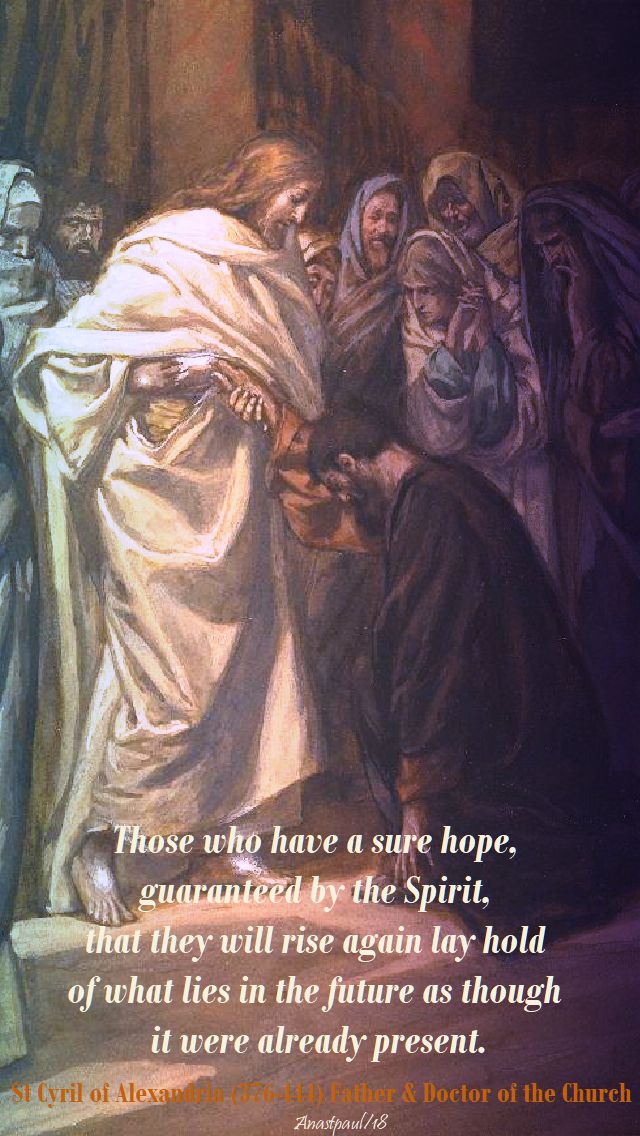
Christ’s Resurrection – Our Sure Hope
St Cyril of Alexandria (376-444) Father & Doctor of the Church
“And he said to them, “Why are you troubled and why do questionings rise in your hearts? See my hands and my feet, that it is I myself; handle me and see; for a spirit has not flesh and bones as you see that I have.” And when he had said this he showed them his hands and his feet. And while they still disbelieved for joy, and wondered, he said to them, “Have you anything here to eat?” They gave him a piece of broiled fish and he took it and ate before them..”..Luke 24:36-43
“Those who have a sure hope, guaranteed by the Spirit, that they will rise again lay hold of what lies in the future as though it were already present.
They say: “Outward appearances will no longer be our standard in judging other men. Our lives are all controlled by the Spirit now and are not confined to this physical world that is subject to corruption. The light of the Only-begotten has shone on us and we have been transformed into the Word, the source of all life. While sin was still our master, the bonds of death had a firm hold on us but now, that the righteousness of Christ has found a place in our hearts, we have freed ourselves from our former condition of corruptibility”.
This means that none of us lives in the flesh anymore, at least not in so far as living in the flesh means being subject to the weaknesses of the flesh, which include corruptibility. Once we thought of Christ as being in the flesh but we do not do so any longer, says Saint Paul [2 Corinthians 5:16]. By this he meant that the Word became flesh and dwelt among us; He suffered death in the flesh in order to give all men life.
It was in this flesh that we knew Him before but we do so no longer. Even though He remains in the flesh, since He came to life again on the third day and is now with His Father in heaven, we know that He has passed beyond the life of the flesh, for having died once, He will never die again, death has no power over Him any more. His death was a death to sin, which He died once for all; His life is life with God [Romans 6:9].
Since Christ has in this way become the source of life for us, we who follow in His footsteps must not think of ourselves as living in the flesh any longer but as having passed beyond it. Saint Paul’s saying is absolutely true that when anyone is in Christ he becomes a completely different person: his old life is over and a new life has begun [2 Cor. 5:17].
We have been justified by our faith in Christ and the power of the curse has been broken. Christ’s coming to life again for our sake has put an end to the sovereignty of death. We have come to know the true God and to worship Him in spirit and in truth, through the Son, our mediator, who sends down upon the world the Father’s blessings.
And so Saint Paul shows deep insight when He says: This is all God’s doing: it is He who has reconciled us to Himself through Christ. For the mystery of the incarnation and the renewal it accomplished could not have taken place without the Father’s will. Through Christ we have gained access to the Father, for as Christ himself says, no one comes to the Father except through Him. This is all God’s doing, then. It is He who has reconciled us to Himself through Christ and who has given us, the ministry of reconciliation.”
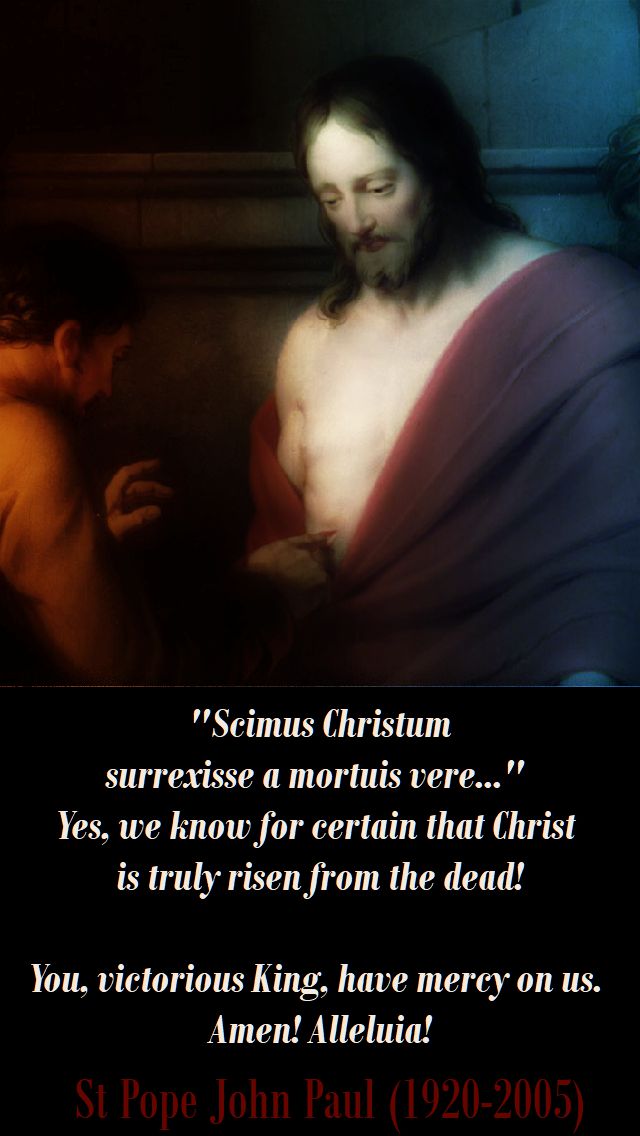
“The One who from nothingness had called the world into existence, only He could break the seals of the tomb, only He could become the source of New Life for us, who are subject to the universal law of death. “Who will roll away the stone for us from the door of the tomb?” (Mk 16:3), the women were asking one another, when very early they were going to the tomb where the Lord had been laid. To this question, asked by the people of every age, of every country, culture and continent, the Bishop of Rome replies, this year too, with the message “Urbi et Orbi”:
“Scimus Christum surrexisse a mortuis vere…” Yes, we know for certain that Christ is truly risen from the dead. You, victorious King, have mercy on us. Amen! Alleluia!”
Quote/s of the Day – 5 April – Easter Thursday Fifth Day in the Easter Octave
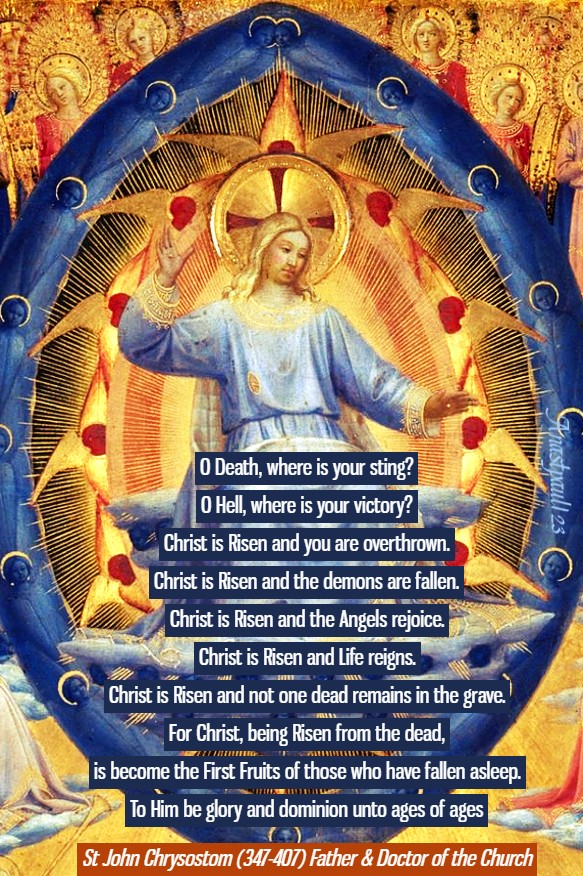
“O Death, where is your sting? O Hell, where is your victory? Christ is Risen and you are overthrown. Christ is Risen and the demons are fallen. Christ is Risen and the Angels rejoice. Christ is Risen and Life reigns. Christ is Risen and not one dead remains in the grave. For Christ, being Risen from the dead, is become the First Fruits of those who have fallen asleep. To Him be glory and dominion unto ages of ages.”
St John Chrysostom (347-407) Father & Doctor of the Church
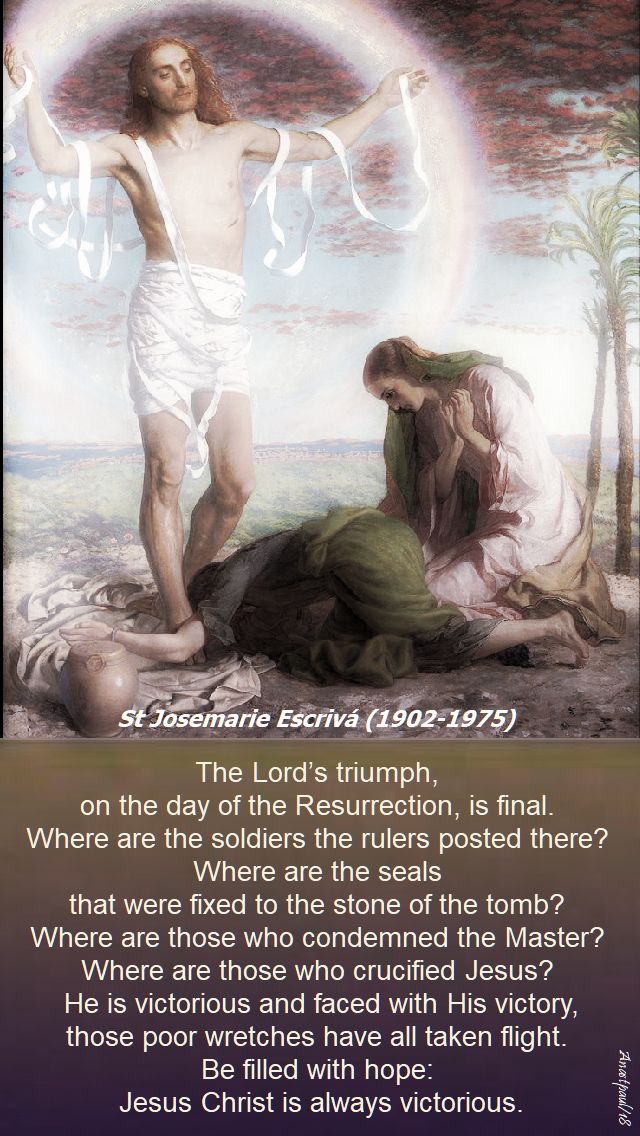
The Lord’s triumph, on the day of the Resurrection, is final. Where are the soldiers the rulers posted there? Where are the seals that were fixed to the stone of the tomb? Where are those who condemned the Master? Where are those who crucified Jesus? He is victorious and faced with His victory, those poor wretches have all taken flight. Be filled with hope: Jesus Christ is always victorious.”
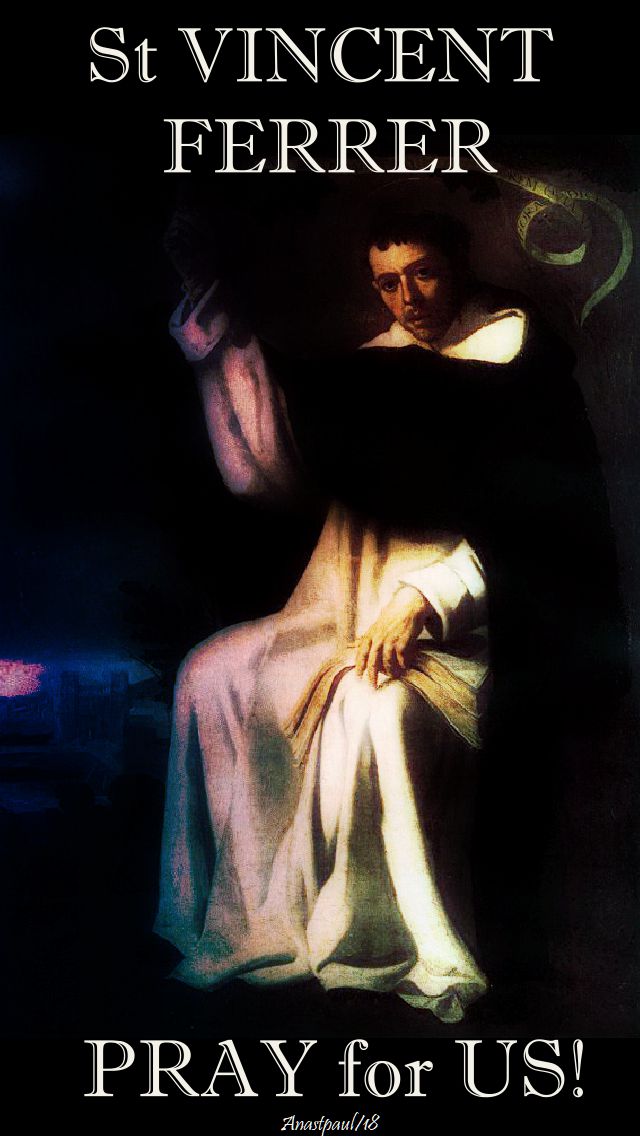
One Minute Reflection – 5 April – Easter Thursday and the Memorial of St Vincent Ferrer (1350-1419)
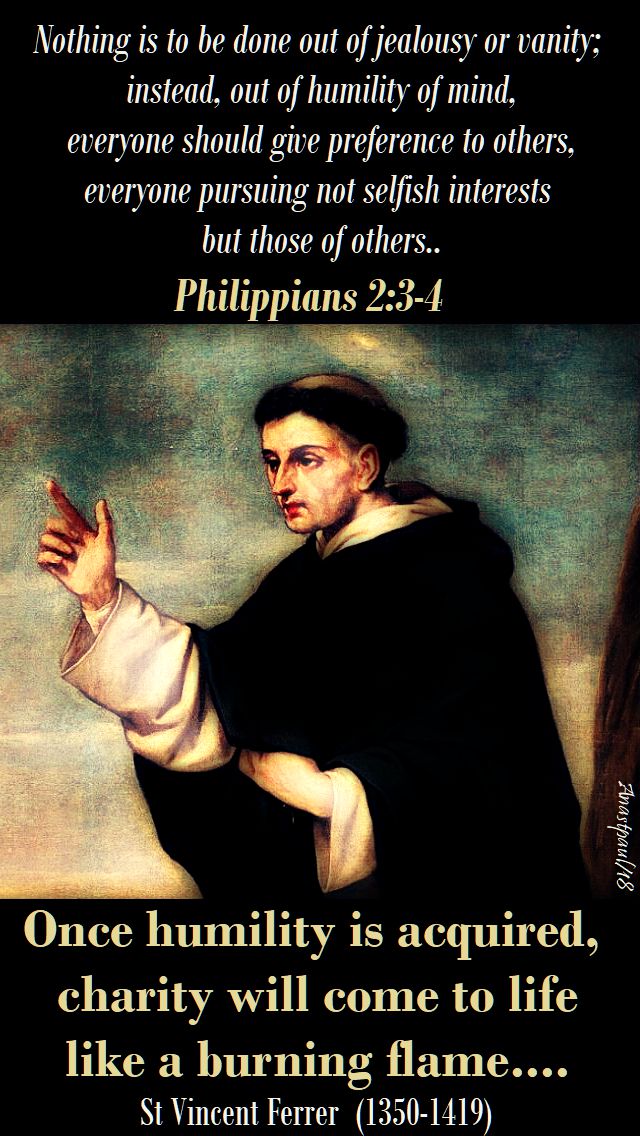
Nothing is to be done out of jealousy or vanity; instead, out of humility of mind everyone should give preference to others, everyone pursuing not selfish interests but those of others...Philippians 2:3-4
REFLECTION – “Once humility is acquired, charity will come to life like a burning flame devouring the corruption of vice and filling the heart so full, that there is no place for vanity.”…
PRAYER – Lord God, who sent St Vincent Ferrer to preach the Gospel of Christ, grant that we may see the Son of Man reigning in heaven, whom he proclaimed as Judge of Mankind. Grant that by the prayers of St Vincent, we may attain true humility and charity to all we meet. We make our prayer through our Lord, Jesus in unity with the Holy Spirit, one God, forever amen.
Our Morning Offering – 5 April – Easter Thursday and the Memorial of St Vincent Ferrer (1350-1419)
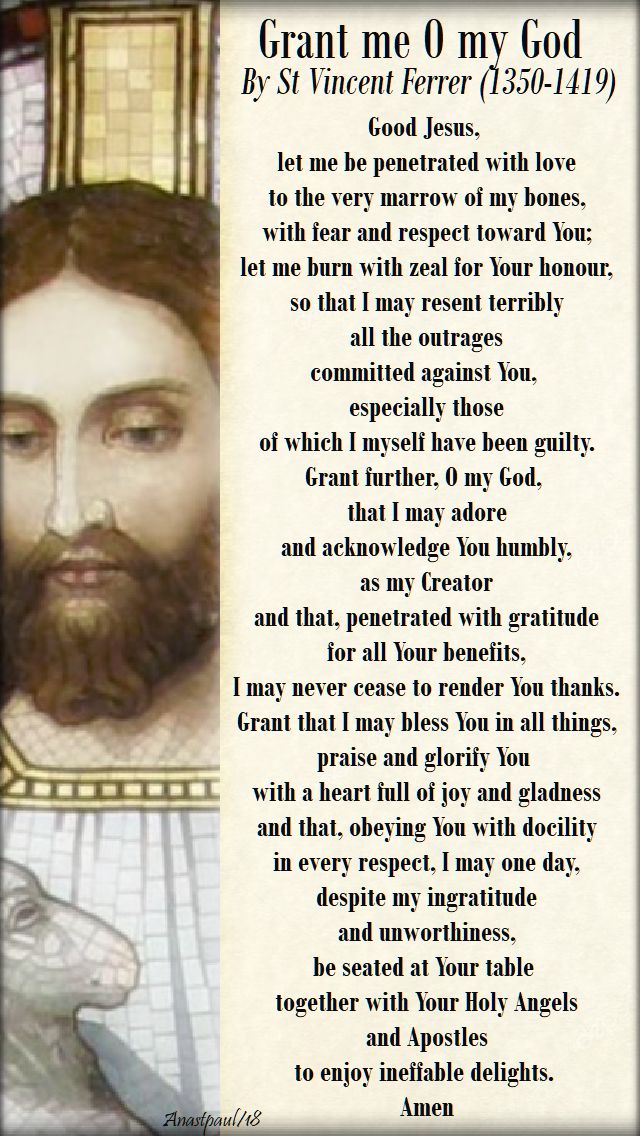
Grant me O my God By St Vincent Ferrer
Good Jesus,
let me be penetrated with love
to the very marrow of my bones,
with fear and respect toward You;
let me burn with zeal for Your honour,
so that I may resent terribly all the outrages
committed against You, especially those
of which I myself have been guilty.
Grant further, O my God,
that I may adore
and acknowledge You humbly, as my Creator
and that, penetrated with gratitude
for all Your benefits,
I may never cease to render You thanks.
Grant that I may bless You in all things,
praise and glorify You
with a heart full of joy and gladness
and that, obeying You with docility
in every respect, I may one day,
despite my ingratitude and unworthiness,
be seated at Your table
together with Your Holy Angels and Apostles
to enjoy ineffable delights.
Amen
Second Thoughts for the Day – 4 April – Easter Wednesday, the Fourth day in the Octave of Easter
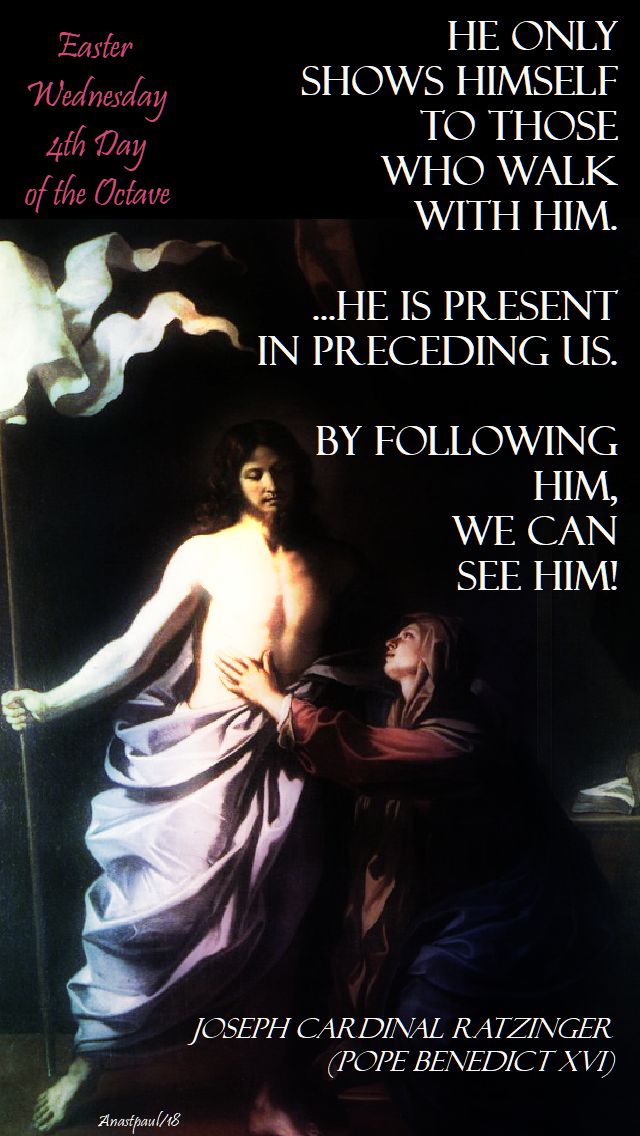
“He is not here, he is going before you to Galilee; there you will see him” (Mk 16:6)
“There is another important aspect (in the Resurrection): Jesus show Himself in the act of departure.
This is clearest in the event of Emmaus and in His meeting with Mary Magdalen. He summons us to go with Him.
Resurrection is not an indulgence of curiosity – it is MISSION. It’s intention is to transform the world! It calls for an active joy, the joy of those who are themselves going along the path of the Risen One.
That is true today too – He only shows Himself to those who walk with Him. The angel’s first word to the women was “He is not here, he is going before you to Galilee; there you will see him” (Mk 16:6). So once and for all, we are told where the Risen One is to be found and how we are to meet Him – HE GOES BEFORE YOU. He is present in preceding us.
By following Him, we can see Him!”
Joseph Cardinal Ratzinger (Pope Benedict XVI)
The Word of the Witnesses – Seek that Which is Above
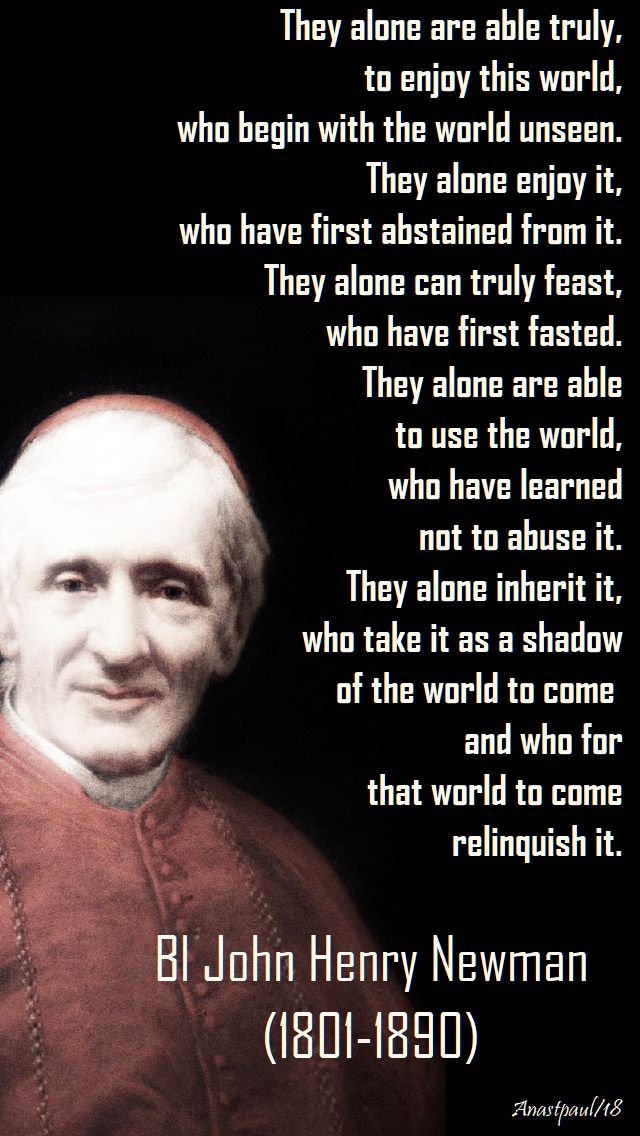
“They alone are able truly, to enjoy this world, who begin with the world unseen. They alone enjoy it, who have first abstained from it. They alone can truly feast, who have first fasted. They alone are able, to use the world, who have learned not to abuse it. They alone inherit it, who take it as a shadow, of the world to come and who for that world to come relinquish it.”
Look at the cross of Christ – Blessed John Henry Newman (1801-1890)
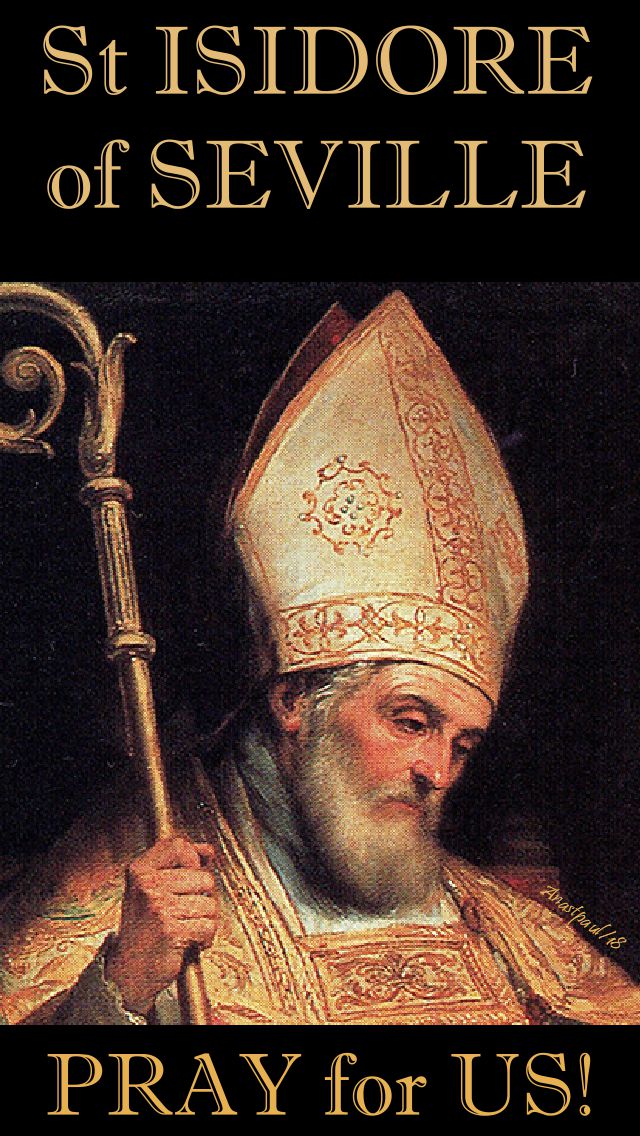
Thought for the Day – 4 April – Easter Wednesday and the Memorial of St Isidore of Seville (560-636) Father & Doctor of the Church
The 76 years of Isidore’s life were a time of conflict and growth for the Church in Spain. The Visigoths had invaded the land a century and a half earlier and shortly before Isidore’s birth they set up their own capital. They were Arians—Christians who said Christ was not God. Thus, Spain was split in two: one people (Catholic Romans) struggled with another (Arian Goths). Isidore reunited Spain, making it a centre of culture and learning. The country served as a teacher and guide for other European countries whose culture was also threatened by barbarian invaders.
In 599, Isidore became bishop of Seville and for thirty-seven years led the Spanish church through a period of intense religious development.. Isidore also organised representative councils that established the structure and discipline of the church in Spain. At the Council of Toledo in 633 he obtained a decree that required the establishment of a school in every diocese. Reflecting the saint’s broad interests, the schools taught every branch of knowledge, including the liberal arts, medicine, law, Hebrew, and Greek. Isidore was an amazingly learned man and is called “The Schoolmaster of the Middle Ages.” The encyclopedia he wrote was used as a textbook for nine centuries in so many schools which he had founded. AND he required seminaries to be built in every diocese, wrote a Rule for religious orders and founded schools that taught every branch of learning. Isidore wrote numerous books, including a dictionary, an encyclopedia, a history of Goths and a history of the world—beginning with creation! He also wrote a dictionary of synonyms, brief biographies of illustrious men, treatises on theological and philosophical subjects. He completed the Mozarabic liturgy, which is still in use in Toledo, Spain. For all these reasons, Isidore has been suggested as patron of the Internet. Several others—including Anthony of Padua—also have been suggested.
Throughout his long life, Isidore lived austerely so that he could give to the poor and he continued his austerities even as he approached age 80. During the last six months of his life, he increased his charities so much that his house was crowded from morning till night with the poor of the countryside. But while Isidore had compassion for needy, he thought they were better off than their oppressors, as he explains in this selection:
“We ought to sorrow for people who do evil rather than for people who suffer it. The wrongdoing of the first leads them further into evil. The others’ suffering corrects them from evil. Through the evil wills of some, God works much good in others. Some people, resisting the will of God, unwittingly do His purpose. Understand then that so truly are all things subject to God that even those who oppose His law nevertheless fulfil His will.
Evil men are necessary so that through them the good may be scourged when they do wrong…Some simple men, not understanding the dispensation of God, are scandalised by the success of evil men. They say with the prophet: “Why does the way of the wicked prosper?” Those who speak thus should not wonder to see the frail temporal happiness of the wicked. Rather they should consider the final end of evil men and the everlasting torments prepared for them. As the prophet says: “They spend their days in wealth and in a moment they go down to hell.”
Shortly before his death, Isidore had two friends clothe him in sackcloth and rub ashes on his head so that he could come before God as a poor penitent. He died peacefully at Seville in 636.
Our society can well use Isidore’s spirit of combining learning and holiness. Loving, understanding and knowledge can heal and bring a broken people back together. We are not barbarians like the invaders of Isidore’s Spain. But people who are swamped by riches and overwhelmed by scientific and technological advances can lose much of their understanding love for one another.
St Isidore, pray for the whole Church, the whole world, for us all, amen!
Quote/s of the Day – 4 April – Easter Wednesday and the Memorial of St Isidore of Seville (560-636) Father & Doctor of the Church
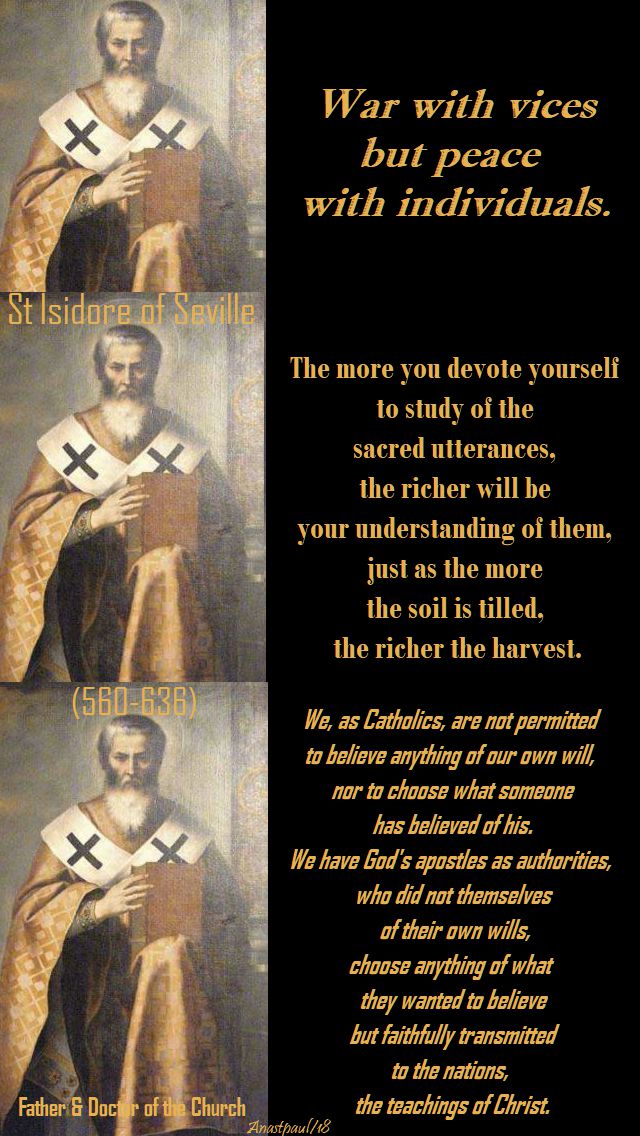
“War with vices but peace with individuals.”
“The more you devote yourself to study of the sacred utterances, the richer will be your understanding of them, just as the more the soil is tilled, the richer the harvest.”
“We, as Catholics, are not permitted to believe anything of our own will, nor to choose what someone has believed of his. We have God’s apostles as authorities, who did not themselves of their own wills, choose anything of what they wanted to believe but faithfully transmitted to the nations, the teachings of Christ.”
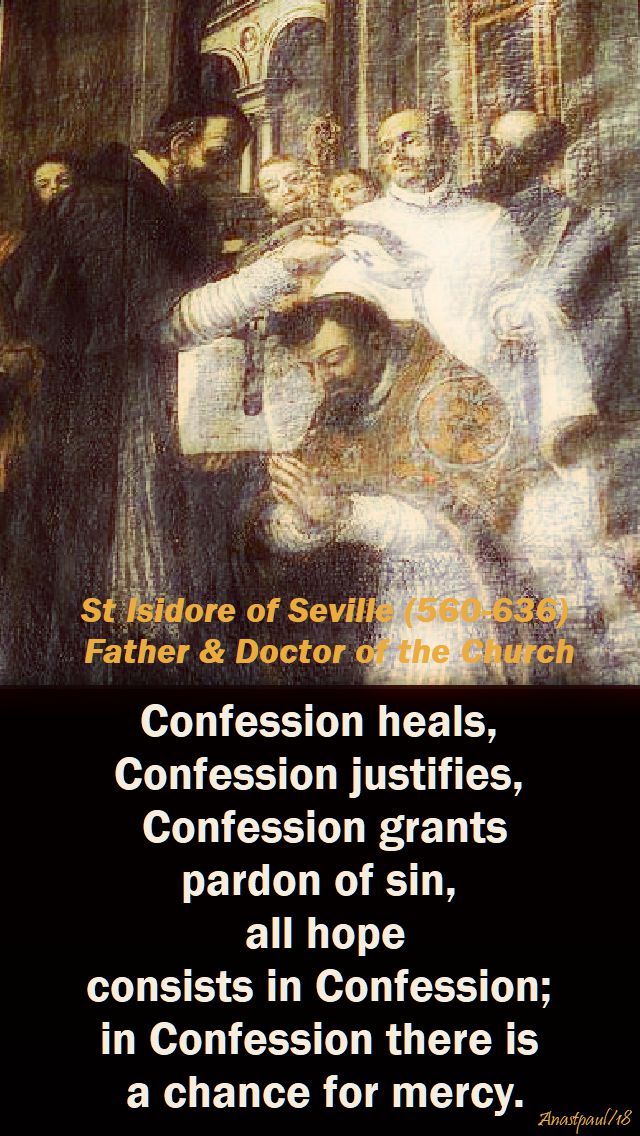
“Confession heals, Confession justifies, Confession grants pardon of sin, all hope consists in Confession; in Confession there is a chance for mercy.”
St Isidore of Seville (560-636) Father & Doctor of the Church
One Minute Reflection – 4 April – Easter Wednesday and the Memorial of St Isidore of Seville (560-636) Father & Doctor of the Church
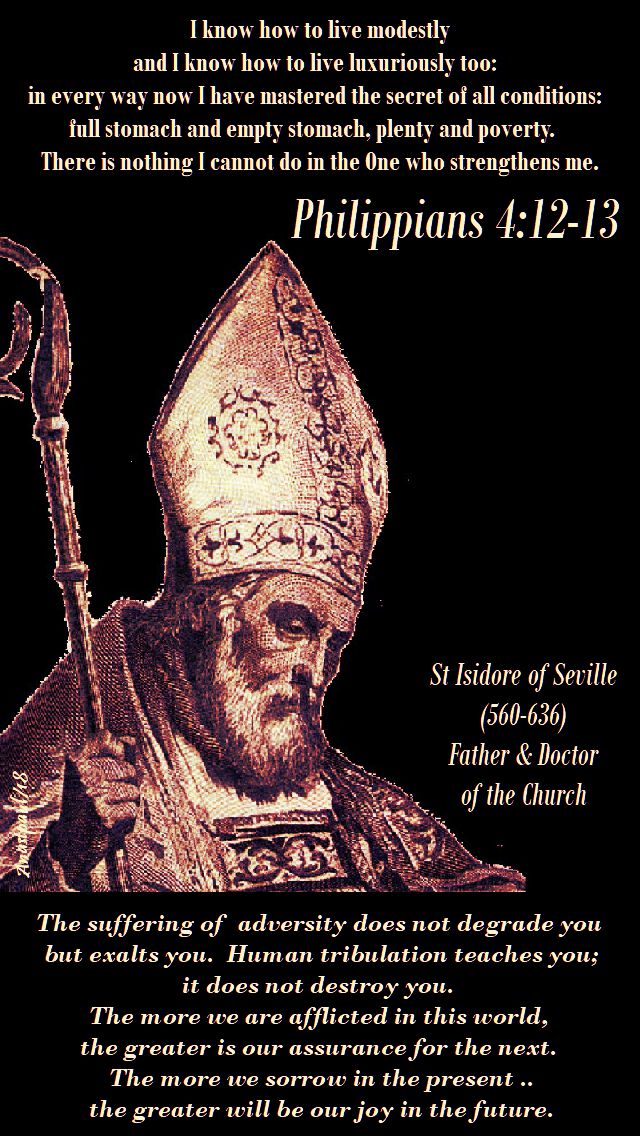
I know how to live modestly and I know how to live luxuriously too: in every way now I have mastered the secret of all conditions: full stomach and empty stomach, plenty and poverty. There is nothing I cannot do in the One who strengthens me…Philippians 4:12-13
REFLECTION – “The suffering of adversity does not degrade you but exalts you. Human tribulation teaches you, it does not destroy you. The more we are afflicted in this world, the greater is our assurance for the next. The more we sorrow in the present, ..the greater will be our joy in the future.”…St Isidore of Seville (560-636) Father & Doctor of the Church
PRAYER – Graciously hear the prayers, O Lord, which we make in commemoration of Saint Isidore, that we and Your Church may be aided by his intercession, just as she has been instructed by his heavenly teaching. Through our Lord Jesus Christ, your Son, who lives and reigns with you in the unity of the Holy Spirit, one God, for ever and ever. Amen.
O God of Our Life St Augustine (354-430) Father & Doctor of the Church
God of our life,
there are days when the burdens we carry
chafe our shoulders and weigh us down;
when the road seems dreary and endless,
the skies gray and threatening;
when our lives have no music in them
and our hearts are lonely
and our souls have lost their courage.
Flood the path with light,
run our eyes to where the skies are full of promise;
tune our hearts to brave music;
give us the sense of comradeship
with heroes and saints of every age;
and so quicken our spirits
that we may be able to encourage the souls of all
who journey with us on the road of life,
to your honour and glory.
Amen
Thought for the Day – 3 April – Easter Tuesday in the Easter Octave
On the Spiritual Resurrection of the Children of God
If you be risen with Christ, mind the things that are above, not the things that are upon the earth. – Colossians 3
Let us represent to ourselves Jesus Christ, rising glorious from the Sepulchre.
“Faith in the Risen One is faith in something that has really taken place. Today, it is still true, that Christianity is neither legend nor fiction, not mere exhortation nor mere solution. Faith stands on the firm basis of reality that has actually taken place. Today too, in the words of Scripture, we can as it were, touch the Lord’s glorified wounds and say, with Thomas, in gratitude and joy – My Lord and my God! (Jn 20:28)
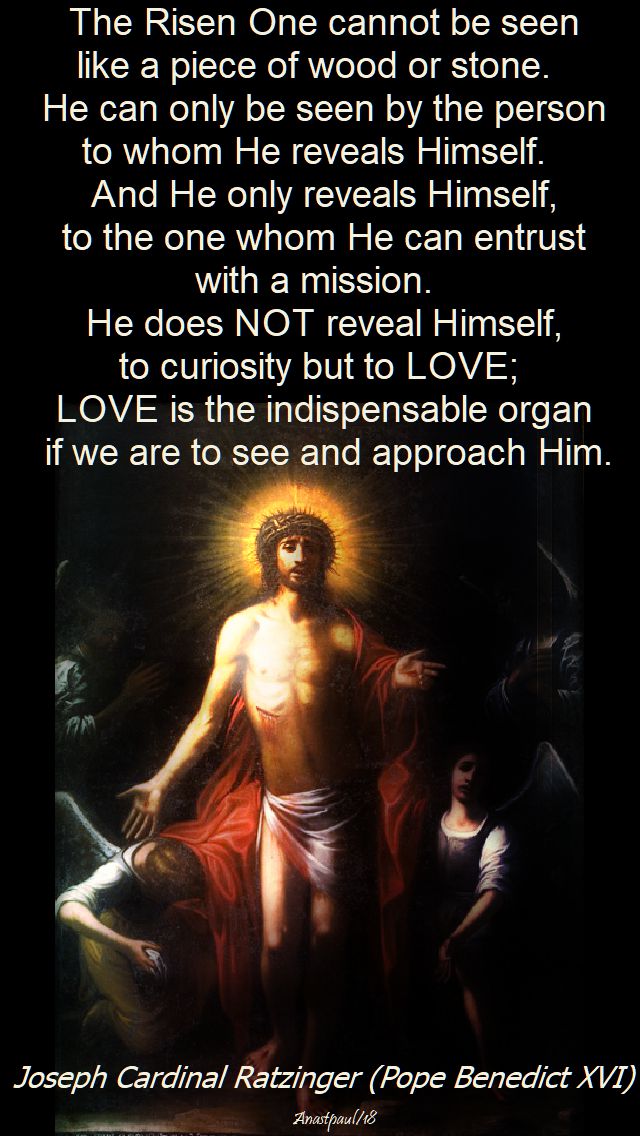
One question, however, continually arises at this point. Not everyone saw the Risen Jesus. Why not? Why did He not go in triumph to the Pharisees and Pilate to show them that He was alive and to let them touch His scars? But in asking such a question, we are forgetting that Jesus was not a resuscitated corpse like Lazarus and the boy of Naim. They were allowed to return once more, to their erstwhile biological life, which sooner or later, would have to end, after all, with death. What happened in Jesus’ case, was quite different – He did not return to the old life but began a new one, a life that is ultimate, no longer subject to nature’s law of death but standing in God’s freedom and hence final and absolute. A life, therefore, that is no longer part of the realm of physics and biology, although it has integrated matter and nature into itself on a higher plane. And that is why it is no longer within the ambit of our senses of touch and sight. The Risen One cannot be seen like a piece of wood or stone. He can only be seen by the person to whom He reveals Himself. And He only reveals Himself, to the one whom He can entrust with a mission. He does NOT reveal Himself, to curiosity but to LOVE; LOVE is the indispensable organ if we are to see and approach Him.”
Joseph Cardinal Ratzinger (Pope Benedict XVI)
The Word of the Witnesses – Seek that Which is Above (1985)
Quote/s of the Day – 3 April – Tuesday in the Easter Octave Speaking of ….. Seeking Sanctity from the Wisdom of St Augustine
Lord, teach me to know You and to know myself.
A Christian is: a mind through which Christ thinks, a heart through which Christ loves, a voice through which Christ speaks and a hand through which Christ helps.
As the soul is the life of the body, so God is the life of the soul. As, therefore, the body perishes when the soul leaves it, so the soul dies when God departs from it.
For grace is given not because we have done good works but in order that, we may be able, to do them.
Since love grows within you, so beauty grows. For love is the beauty of the soul.
St Augustine (354-430) Father & Doctor of the Church
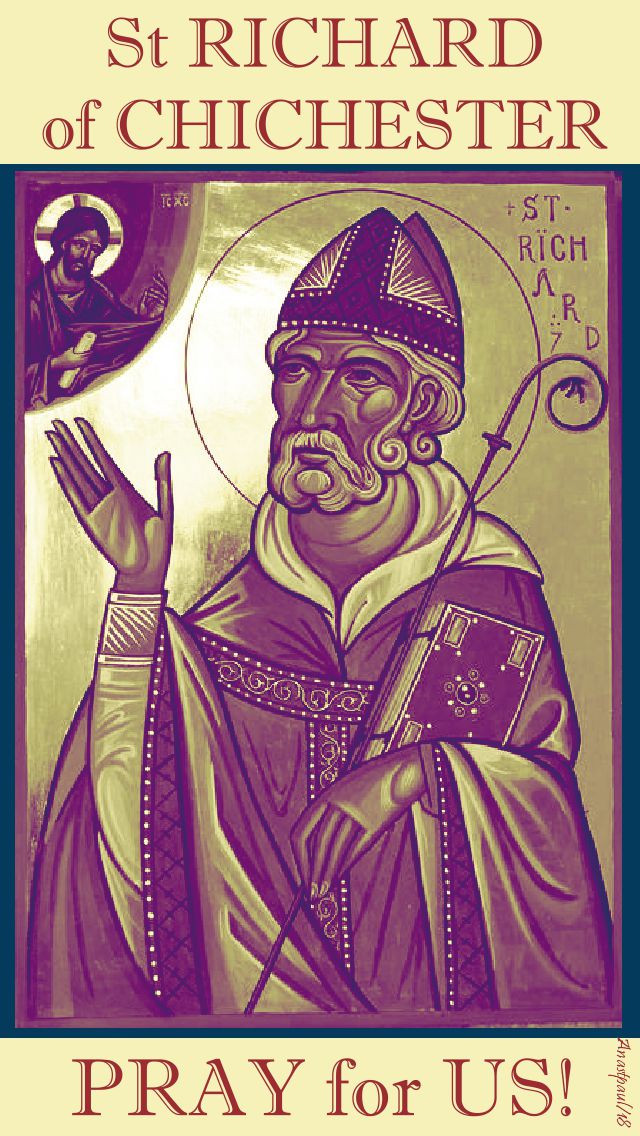
One Minute Reflection – 3 April – Easter Tuesday and The Memorial of St Richard of Chichester (1197-1253)
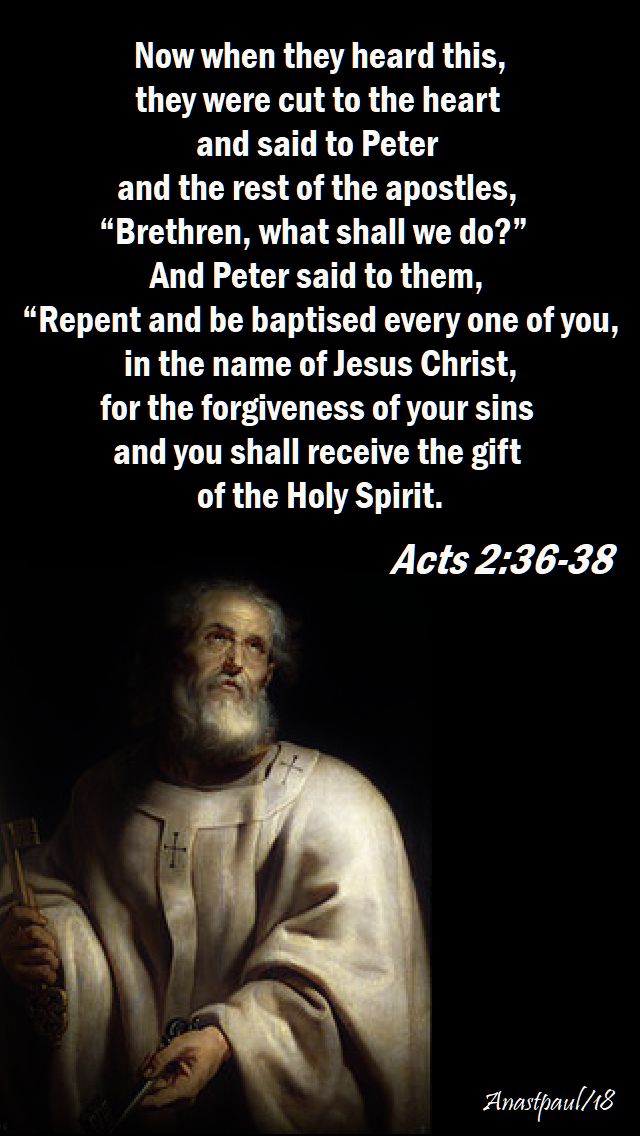
Now when they heard this, they were cut to the heart and said to Peter and the rest of the apostles, “Brethren, what shall we do?” And Peter said to them, “Repent and be baptised every one of you, in the name of Jesus Christ, for the forgiveness of your sins and you shall receive the gift of the Holy Spirit...Acts 2:36-38
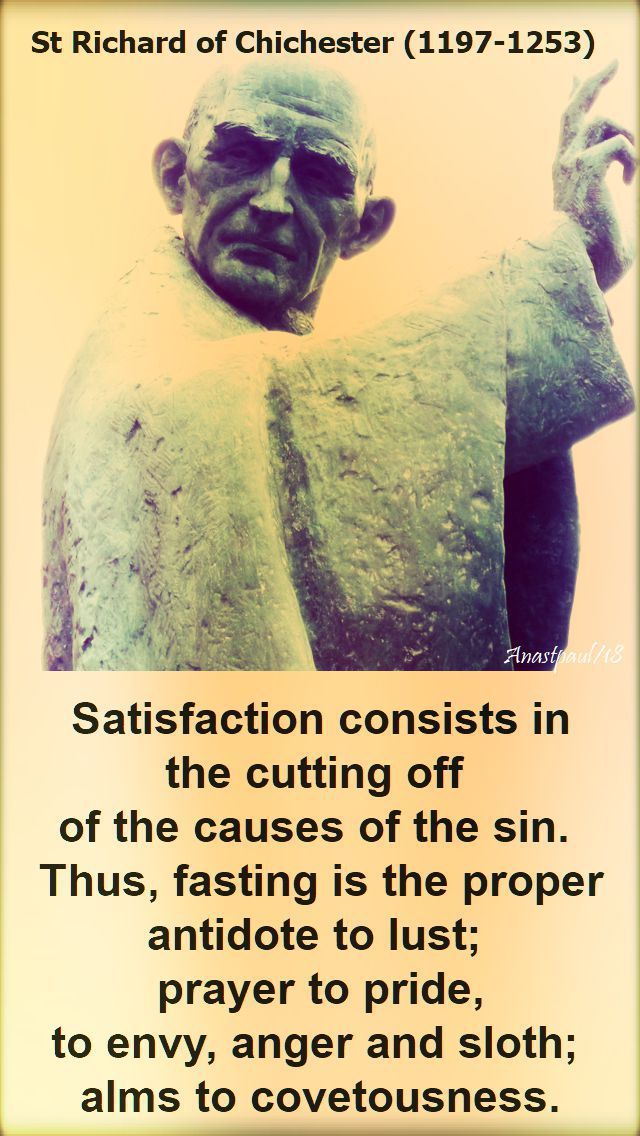
REFLECTION – “Satisfaction consists in the cutting off of the causes of the sin. Thus, fasting is the proper antidote to lust; prayer to pride, to envy, anger and sloth; alms to covetousness.”…St Richard of Chichester
PRAYER – Grant us O God, our Father, Your grace, that we may constantly work to repair the damage caused by our sin that we may seek forgiveness and then go forth to sin no more, always amending what earthly damage we have caused. St Richard of Chichester, may your prayers, assist us on our journey to our heavenly home. We make our prayer through our Lord Jesus Christ, in unity with the Holy Spirit, one God forever and ever, amen.
Thought for the Day – Easter Monday of the Easter Octave – 2 April 2018
The Resurrection of Jesus Christ is the Figure of our spiritual resurrection.
“So they departed quickly from the tomb with fear and great joy, and ran to tell his disciples. And behold, Jesus met them and said, “Hail!” And they came up and took hold of his feet and worshiped him. Then Jesus said to them, “Do not be afraid; go and tell my brethren to go to Galilee, and there they will see me.”… Matthew 28:8-10
Let us represent to ourselves anew, the glory of the Sepulchre of Jesus.
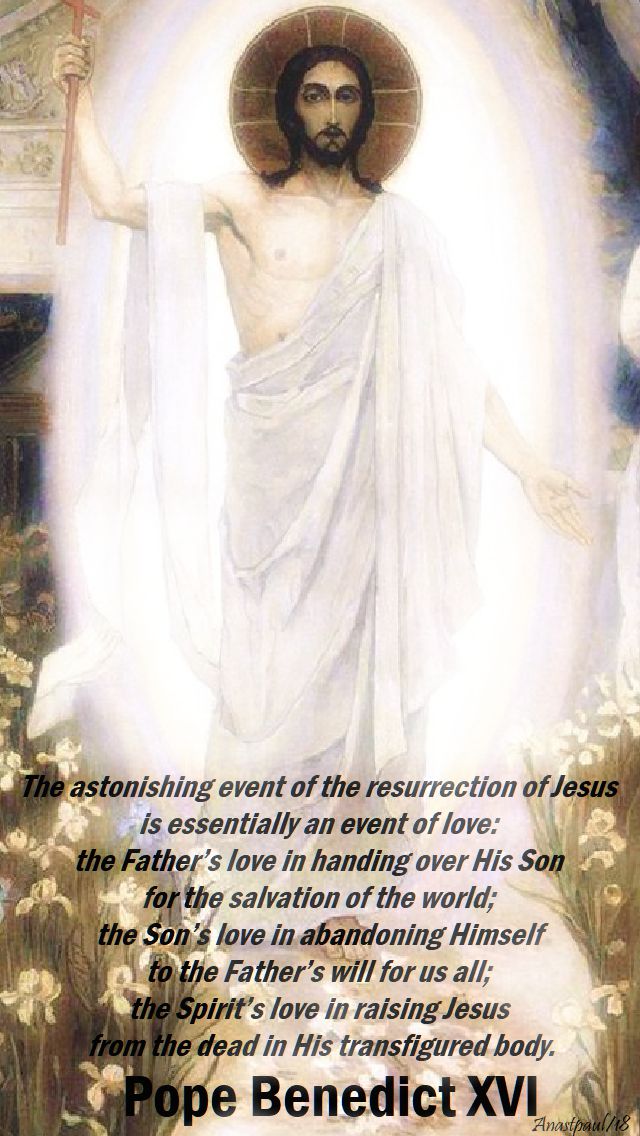
“In this way we enter the depths of the Paschal mystery. The astonishing event of the resurrection of Jesus is essentially an event of love: the Father’s love in handing over His Son for the salvation of the world; the Son’s love in abandoning Himself to the Father’s will for us all; the Spirit’s love in raising Jesus from the dead in His transfigured body. And there is more: the Father’s love which “newly embraces” the Son, enfolding Him in glory; the Son’s love returning to the Father in the power of the Spirit, robed in our transfigured humanity. From today’s solemnity, in which we relive the absolute, once-and-for-all experience of Jesus’s Resurrection, we receive an appeal to be converted to Love; we receive an invitation to live by rejecting hatred and selfishness and to follow with docility in the footsteps of the Lamb that was slain for our salvation, to imitate the Redeemer who is “gentle and lowly in heart”, who is “rest for our souls” (cf. Mt 11:29).”
Pope Benedict 23 March 2008
Adorable Lord, bestow on us grace to rise spiritually, by leaving the tomb of indifference, to lead a life of fervour.
At Easter we recall the words God spoke to Moses concerning the Paschal solemnity: For it is the Phase – that is, the Passage – of the Lord. Now we celebrate the Passage of our Lord from Death to Life and think upon our own passage from a life of tepidity to one of fervour, from an imperfect to a holy life. Jesus, in leaving the Tomb, disengaged Himself from the winding-sheet in which His Sacred Body had been wrapped; this should make us understand that we must extricate ourselves from the imperfections and bad habits, which for so long a time have kept out souls bound and motionless for good. If we rise with Jesus and set ourselves free from the paralysed state in which our evil inclinations have retained us, they will infallibly disappear. Our Risen Lord was clothed with the power of agility to teach us to despise all resistance of nature, to pass quickly out of its reach, to triumph over every obstacle and that our souls should tend upwards to Him alone. If we are indeed risen with Christ we shall seek the things that are above and our whole being will be spiritualised, responding with agility to the promptings not of nature, but of grace. May we be enabled fully to enter into the Mystery of the Resurrection-Life of Jesus and to receive the plenitude of His favours, offered to us at this time especially.
Jesus, in rising from the Sepulchre, clothed in light, wills that we should understand what is the beauty of a soul disengaged from the ties of nature and renewed in the spiritual life. The soul, like Jesus, becomes luminous, the Holy Spirit enlightens it interiorly, by filling it with the knowledge of divine things; it is possessed of a lustrous beauty and its virtues shine visibly, contributing to the edification of others. By the impassibility of the Body of Jesus, we comprehend that grace raises the soul, by means of holy courage, above temptations; it renders it invulnerable against the darts of the enemies of its salvation and gives it the power of mastering its downward tendencies. Such are the happy privileges granted to His faithful ones, who lovingly enter into the spirit of the Mystery of Easter. Sufferings indeed we must still endure, for we are still on this side of the grave but if they serve only to raise us near to Jesus, we may be said to share already in the effects of His impassibility. We range ourselves therefore around Him, to rejoice at the sight of the glory He received in His Resurrection and to honour the marvellous capabilities of His Adorable Body, by rendering ourselves worthy, by our fervour, to participate in them spiritually.
O my Saviour, I thank You for the favour You accord me, permitting me to partake in the glorious privileges of the new life You began. Make me to be entirely renewed in the spirit of my mind so that, freed from the servitude of sense and natural affections, I may rise constantly towards You, with a pure and generous heart.
Aided by the grace Jesus bestows, I will endeavour to reproduce spiritually in myself, the capabilities observable in His Sacred Humanity after the Resurrection.
If by the Spirit, you mortify the deeds of the flesh, you shall live.
Father de Brant, Growth in the Knowledge of Our Lord volume 2, 1882
The beautiful ancient Easter sequence Victimae Paschali Laudes can be said or sung before the Gospel every day during the Octave:
Victimae Paschali Laudes
Christians, to the Paschal Victim
Offer your thankful praises!
A Lamb the sheep redeems;
Christ, who only is sinless,
Reconciles sinners to the Father.
Death and life have contended
in that combat stupendous:
The Prince of Life, who died, reigns immortal.
Speak, Mary, declaring
What you saw, wayfaring.
“The tomb of Christ, who is living,
The glory of Jesus’ resurrection;
Bright angels attesting,
The shroud and napkin resting.
Yes, Christ my hope is arisen;
To Galilee He goes before you.”
Christ indeed from death is risen,
our new life obtaining.
Have mercy, victor King, ever reigning!
Amen. Alleluia!++
Thought for the Day – 1 April 2018 – Easter Sunday
A Blessed and Holy Easter to you all!
“Be Lifted Up, O Ancient Door”
It seems as the human world has no doors opening toward God. It is locked in upon itself. It is a prison, a house of the dead.
People of the Old Testament and of other early civilizations initially applied the idea of the prison only to the world of the dead – the man who dies will not return. They imagined the underworld as a vast dark prison in which death reigns, a ruthless tyrant. It is a place of no return. Gradually, however, the feeling grew that, if all our paths lead to the prison which has entrances but no exit, then we are all prisoners. In that case, even this present world is a house of the dead, the antechamber leading to a dungeon of horrors! And it is a fact, if death has the last world – the world is a waiting room leading to the void (as manifested in many Eastern religions – my note).
Poets of our century have set down this feeling in terrifying visions. The Jewish poet Franz Kafka has probably gone farthest into this abyss of ANGST. His portrayal of a world of totalitarian control is intended as an interpretation of human life as such. In “The Castle”, life appears to be a futile waiting, a doomed attempt to penetrate the maze of bureaucracy and reach some competent authority and hence freedom. In “The Trial”, life itself is present as a trial ending in execution. The story ends with the parable of a man who waits all his life outside a door and cannot get in, in spite of the fact that it was made especially for him.
If Christ is not risen, there is nothing more to be said about man than this – all else, is merely an endeavour to deaden the pain. The cries of despair we hear and the cruel attempts at liberation we see, are the necessary consequences of a world that will not accept Christ, its hope.
“Be lifted up, O ancient doors!” – these words of the psalm (24:7) are not liturgical symbolism, the gate liturgy of a long-past age. They are the cry of man in a world that is far too narrow, even if he can travel in spaceships to the moon and beyond.
Christmas is only the first half of the Christian answer to this cry. Christmas tells us that there is not only the tyrant, Death – there is God, who is Life and this God can and will reach us – He has broken a way into us. He has found the door that was big enough for Him, or rather, He has made such a door for Himself.
But this answer is only complete if there is not only an entrance by which God can reach us but also an exit for us. It is only satisfying, if death is no longer a prison from which no-one returns. AND THIS IS THE CONTENT OF THE MESSAGE OF EASTER. Not only is there a door in, there is also, a door out. Death is no longer a house with no exits, a place of no return.
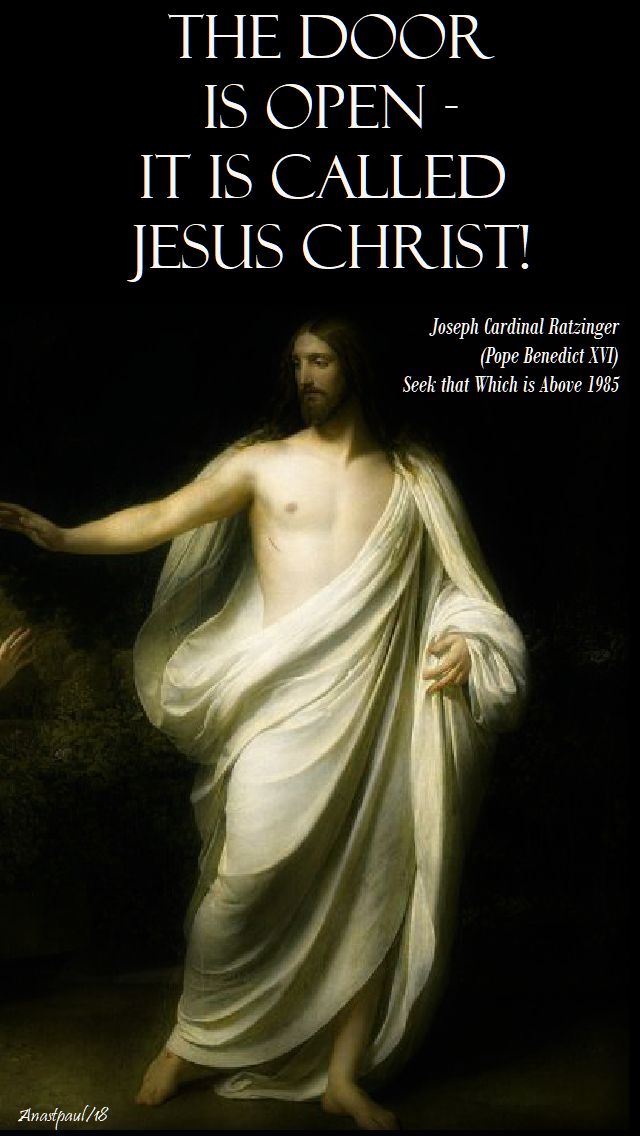
The ancient Church saw in this verse (ps 24:7) an interpretation of the article of faith “descended into hell”, referring particularly to Holy Saturday, not as a word of mourning but as a word of victory. The Church expressed this word in poetic form – the bolts of death’s dungeon, of the world’s dungeon, are wrenched off – the ramparts are thrown down – the gates are torn from their hinges. The one who has done this, Jesus, takes the long-imprisoned Adam and Eve, i.e. humanity, by the hand and leads them to freedom. Life is not a waiting room leading to the void but the beginning of eternity! The world is not the universal concentration camp but the garden of hope! Life is not the futile search for meaning, mirrored in the tangle of bureaucracy. God is not a bureaucrat – He does not live in a distant castle, nor does He hide Himself behind impenetrable anterooms. The door is open – it is called Jesus Christ!
The celebration of Easter is intended to show us the radiant light which streams from this door. It challenges us steadfastly to follow this radiance, which is no will-o’-the-wisp but the brilliance of saving truth….Joseph Cardinal Ratzinger (Pope Benedict XVI) Seek that Which is Above 1985
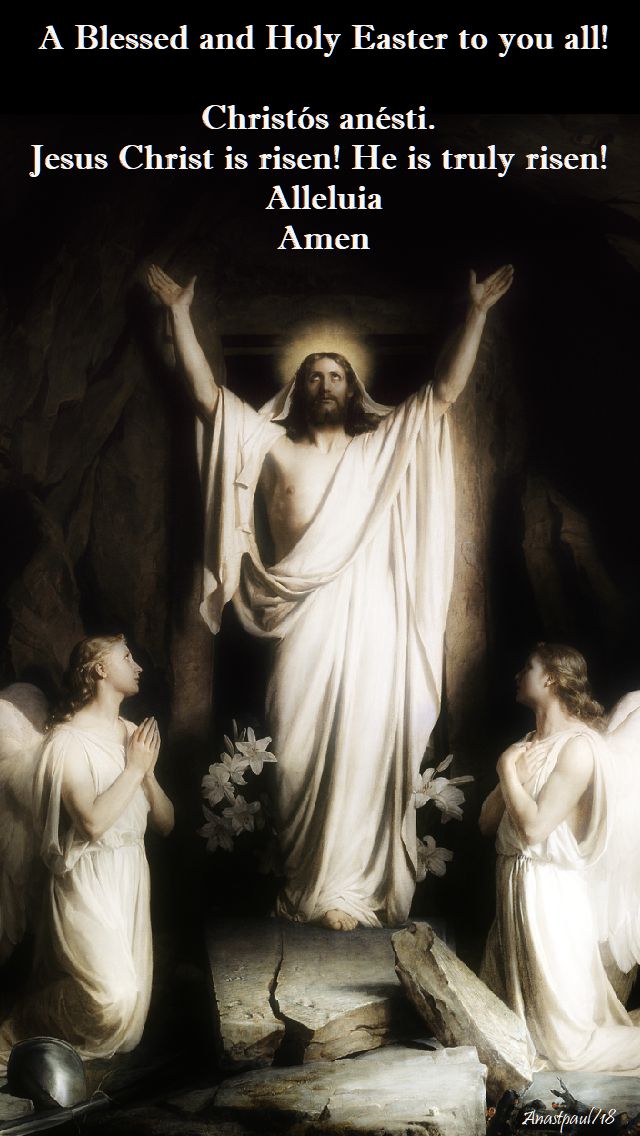
A Blessed and Holy Easter to you all!
Christós anésti.
Jesus Christ is risen! He is truly risen!
Alleluia
Amen
Christós anésti. Jesus Christ is risen! He is truly risen!
In the words of Pope Francis in the Urbi et Orbi Message of Easter 2013, “let us accept the grace of Christ’s Resurrection! Let us be renewed by God’s mercy, let us be loved by Jesus, let us enable the power of His love to transform our lives too and let us become agents of this mercy, channels through which God can water the earth, protect all creation and make justice and peace flourish”.
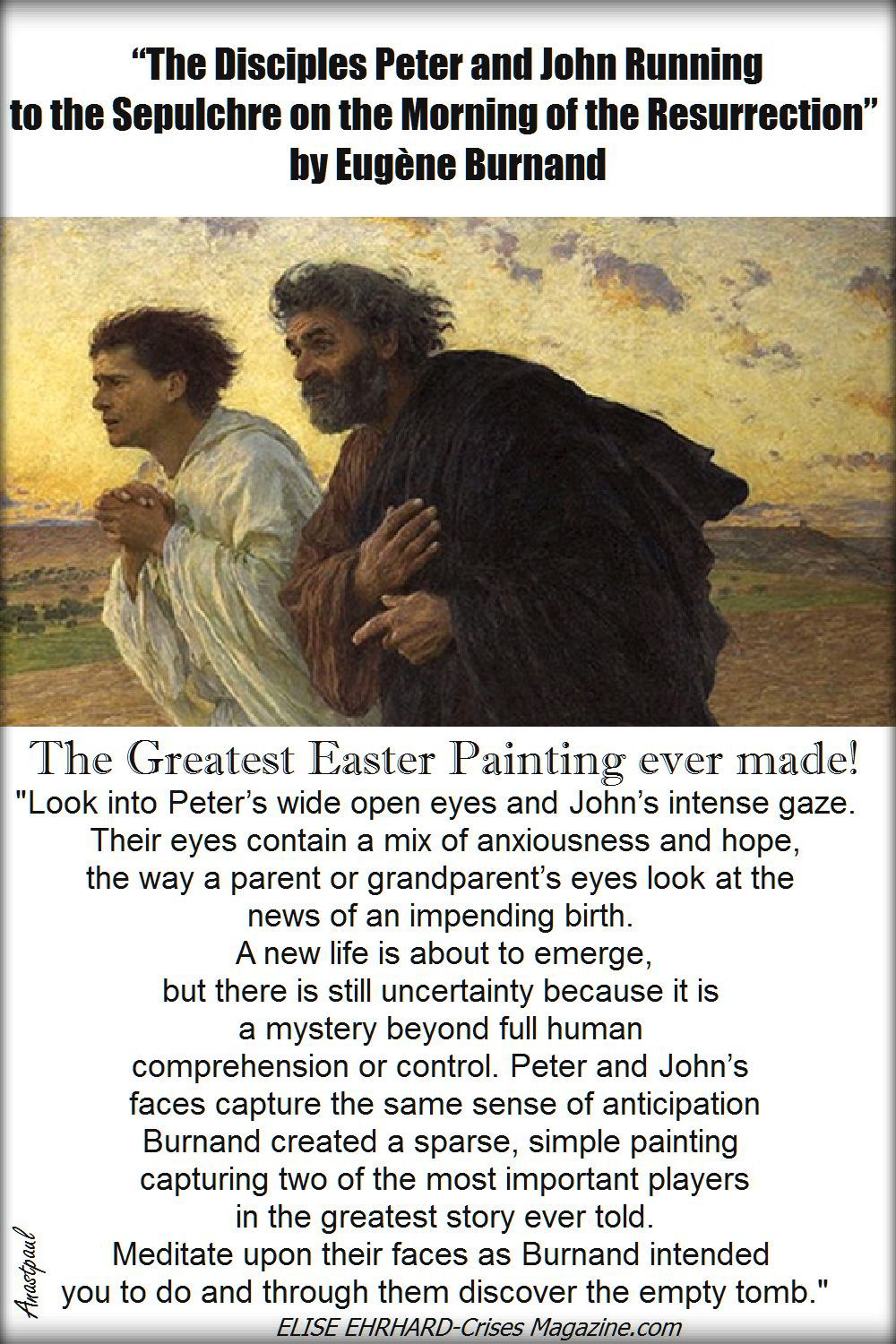
The tomb is empty. It is a silent witness to the central event of human history: the Resurrection of our Lord Jesus Christ. For almost 2,000 years the empty tomb has borne witness to the victory of Life over death. With the Apostles and Evangelists, with the Church of every time and place, we too bear witness and proclaim: “Christ is risen! Raised from the dead he will never die again; death no longer has power over him” (cf. Rom 6:9).
“Mors et vita duello conflixere mirando; dux vitae mortuus, regnat vivus” (Latin Easter Sequence Victimae paschali). The Lord of Life was dead; now He reigns, victorious over death, the source of everlasting life for all who believe.
Resurrection of Christ – Bartolomé Esteban Murillo
“Dear Brothers and Sisters,
These have been days of intense emotion, a time when our soul has been stirred not only by the memory of what God has done but by His very presence, walking with us once again in the land of Christ’s Birth, Death and Resurrection. And at every step of this Jubilee Pilgrimage Mary has been with us, lighting our pilgrim path and sharing the joys and sorrows of her sons and daughters.
With Mary, Mater dolorosa, we stand in the shadow of the Cross and weep with her over the affliction of Jerusalem and over the sins of the world. We stand with her in the silence of Calvary and see the blood and water flowing from the wounded side of her Son. Realising the terrible consequences of sin, we are moved to repentance for our own sins and for the sins of the Church’s children in every age. O Mary, conceived without sin, help us on the path to conversion!
With Mary, Stella matutina, we have been touched by the light of the Resurrection. We rejoice with her that the empty tomb has become the womb of eternal life, where He who rose from the dead now sits at the Father’s right hand. With her we give endless thanks for the grace of the Holy Spirit whom the risen Lord sent upon the Church at Pentecost and whom He continually pours into our hearts, for our salvation and for the good of the human family.
Mary, Regina in caelum assumpta . From the tomb of her Son, we look to the tomb where Mary lay sleeping in peace, awaiting her glorious Assumption. The Divine Liturgy celebrated at her tomb in Jerusalem has Mary say: “Even beyond death, I am not far from you”. And in the Liturgy her children reply: “Seeing your tomb, O holy Mother of God, we seem to contemplate you. O Mary, you are the joy of the angels, the comfort of the afflicted. We proclaim you as the stronghold of all Christians and, most of all, as our Mother”.
In contemplating the Theotókos, almost at this journey’s end, we look upon the true face of the Church, radiant in all her beauty, shining with “the glory of God which is on the face of Christ” (2 Cor 4:6). O Advocate, help the Church to be ever more like you, her exalted model. Help her to grow in faith, hope and love, as she searches out and does the will of God in all things (cf. Lumen gentium, n. 65). O clement, O loving, O sweet Virgin Mary!”
One Minute Reflection – – 31 March – Holy Saturday 2018
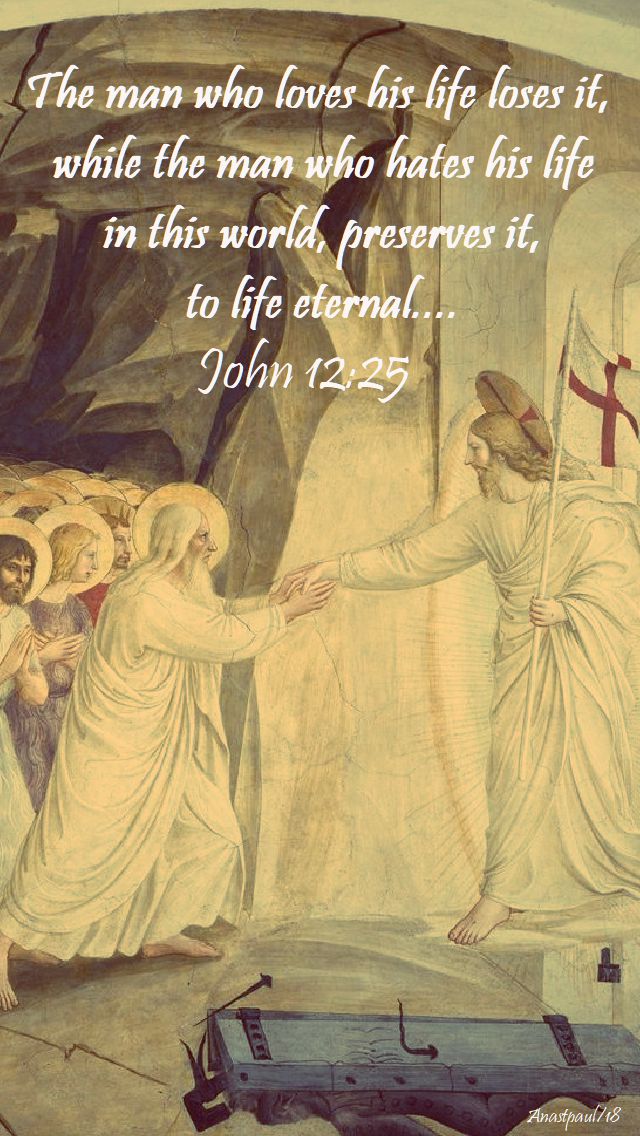
The man who loves his life loses it, while the man who hates his life in this world, preserves it to life eternal...John 12:25
REFLECTION – “Sursum corda”– lift up your hearts, high above the tangled web of our concerns, desires, anxieties and thoughtlessness – “Lift up your hearts, your inner selves!” In both exclamations we are summoned, as it were, to a renewal of our Baptism: “Conversi ad Dominum” – we must distance ourselves ever anew from taking false paths, onto which we stray so often in our thoughts and actions. We must turn ever anew towards Him who is the Way, the Truth and the Life. We must be converted ever anew, turning with our whole life towards the Lord. And ever anew we must allow our hearts to be withdrawn from the force of gravity, which pulls them down and inwardly we must raise them high,in truth and love. At this hour, let us thank the Lord, because through the power of His word and of the holy Sacraments, He points us in the right direction and draws our heart upwards.”…Pope Benedict 22 March 2008
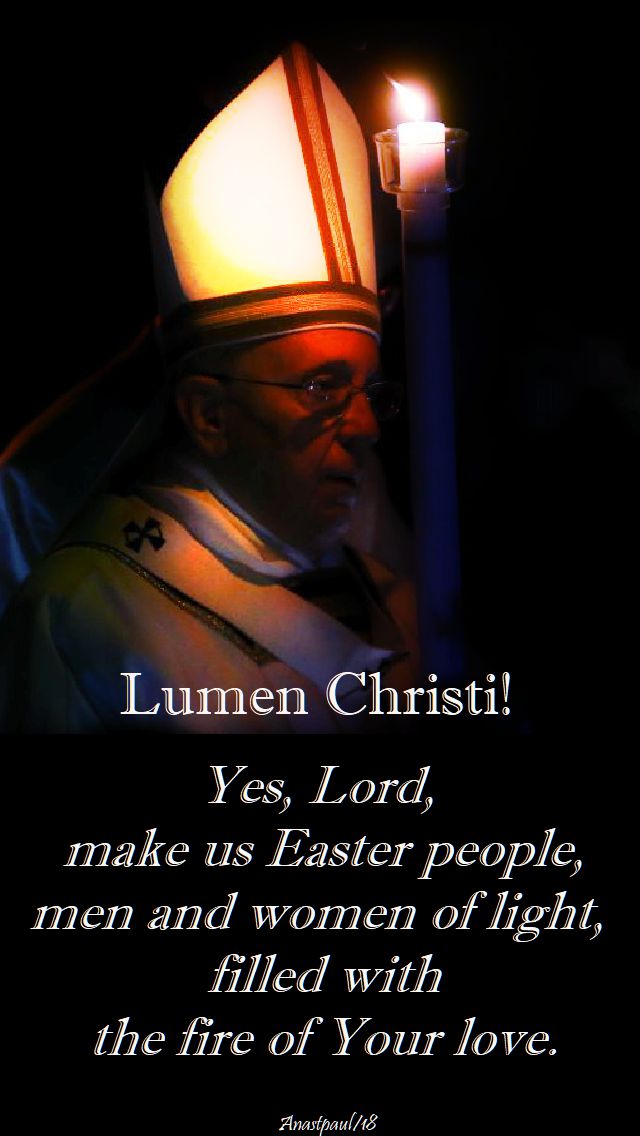
PRAYER – Yes, Lord, make us Easter people, men and women of light, filled with the fire of Your love. Amen.
Quote/s of the Dat – 23 April – Divine Mercy Sunday
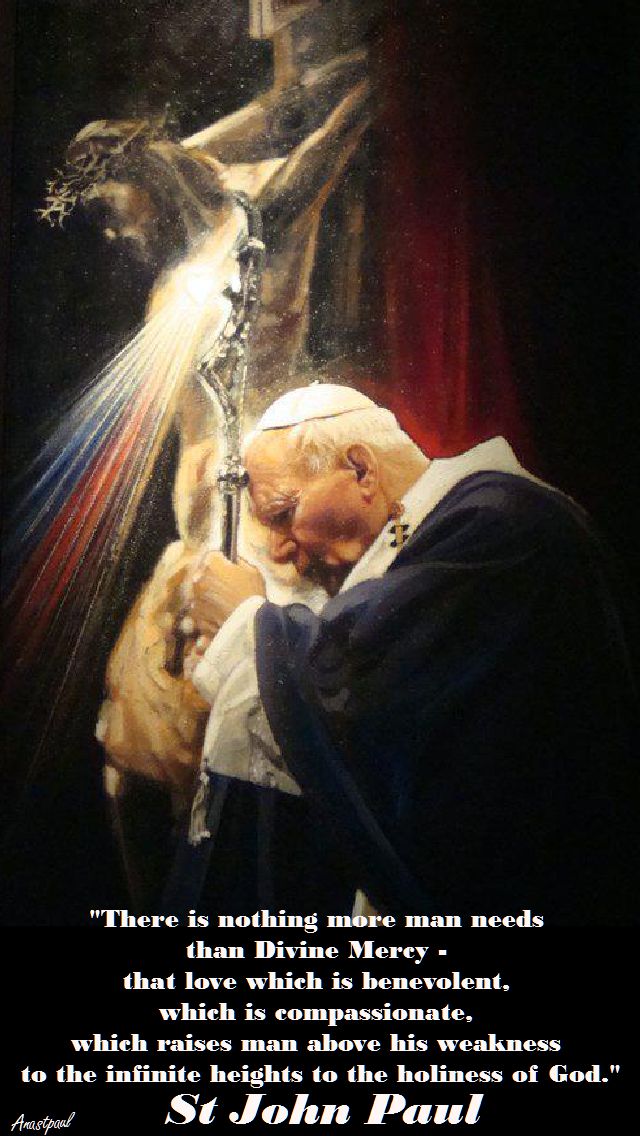
“There is nothing more man needs than Divine Mercy – that love which is benevolent, which is compassionate, which raises man above his weakness to the infinite heights to the holiness of God.”
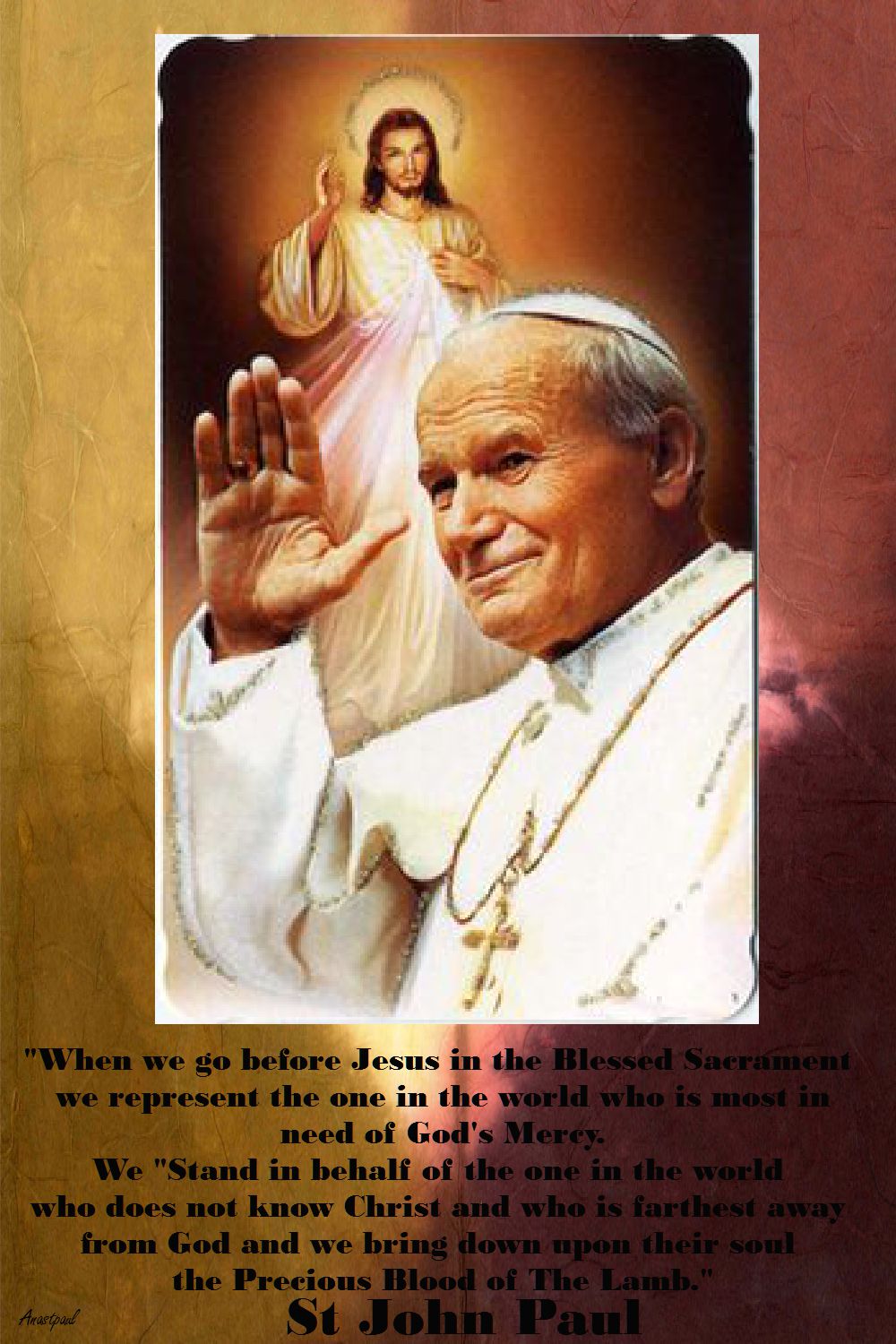
“When we go before Jesus in the Blessed Sacrament we represent the one in the world who is in most need of God’s Mercy.” We “Stand in behalf of the one in the world who does not know Christ and who is farthest away from God and we bring down upon their soul the Precious Blood of The Lamb.”
One Minute Reflection – 23 April
Octave and Divine Mercy Sunday
DAILY MEDITATION: Kindle the faith of your people and show us Your Mercy!
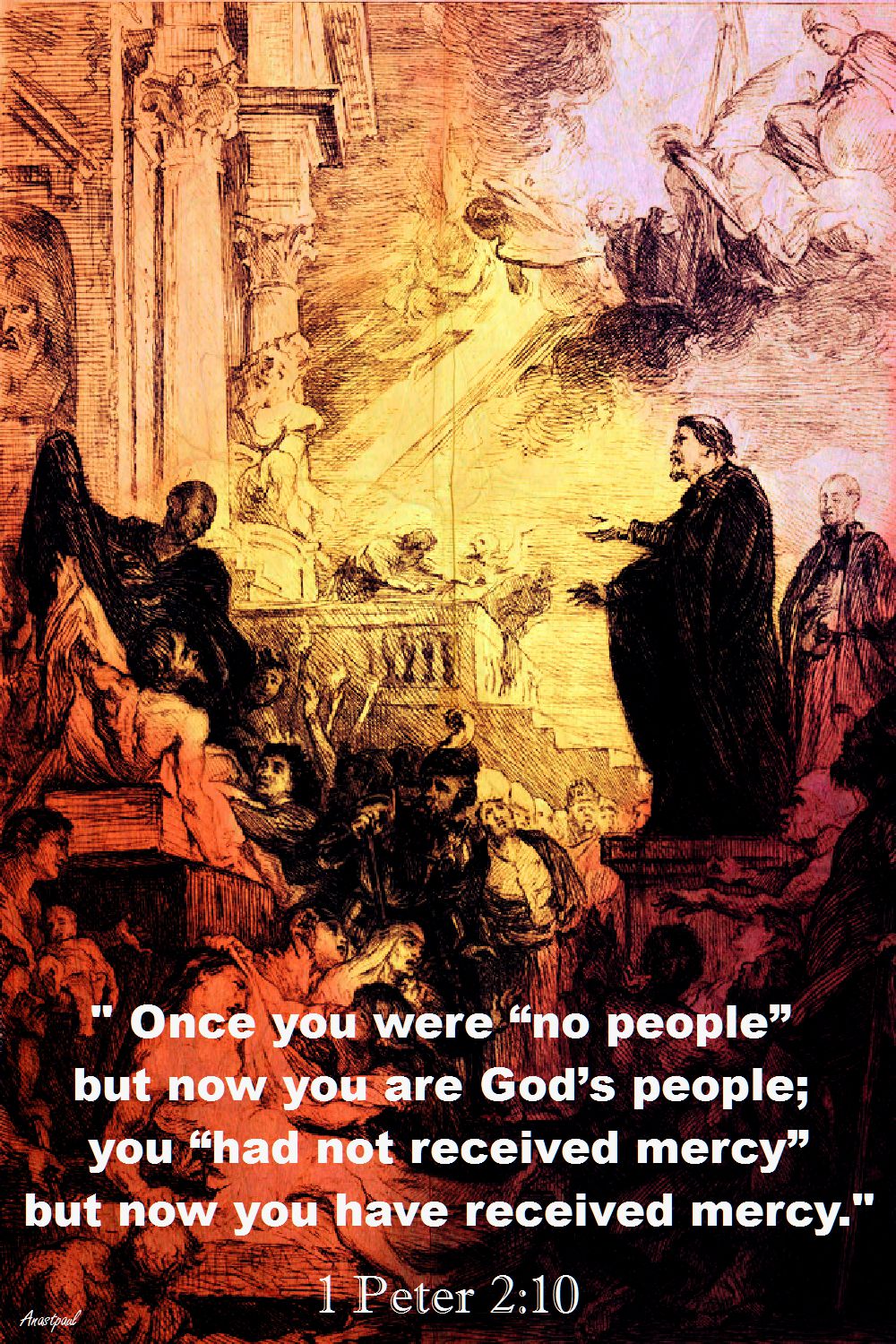
But you are “a chosen race, a royal priesthood, a holy nation, a people of his own, so that you may announce the praises” of him who called you out of darkness into his wonderful light. Once you were “no people” but now you are God’s people; you “had not received mercy” but now you have received mercy………………..1 Peter 2:9-10
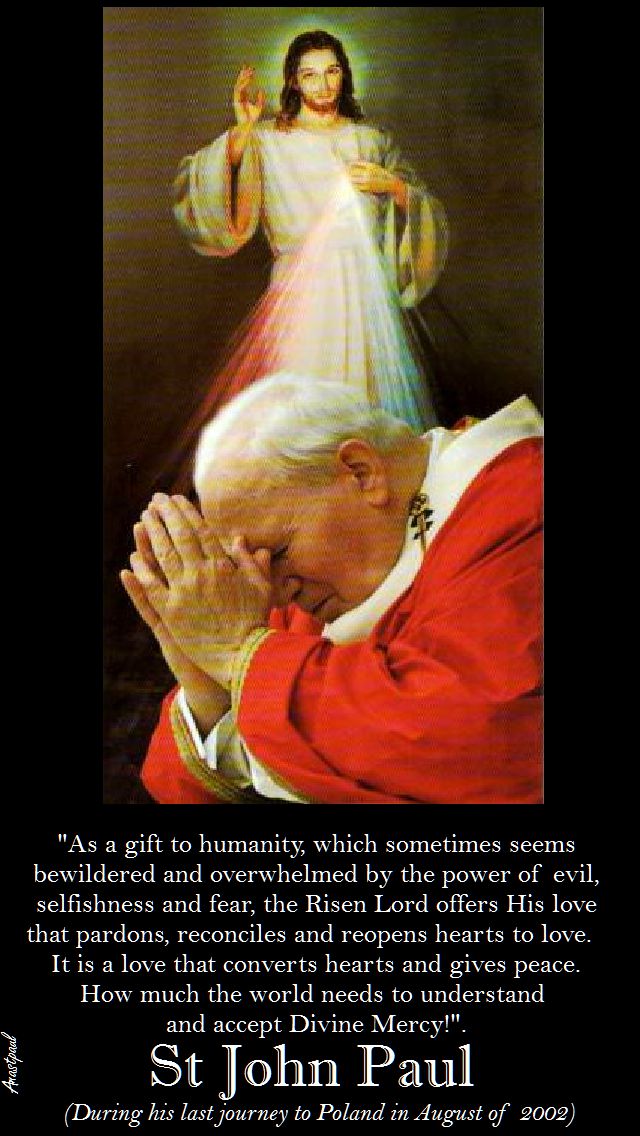
REFLECTION – “How much the world is in need of the mercy of God today! In every continent, from the depths of human suffering, a cry for mercy seems to rise. In those places where hatred and the thirst for revenge are overwhelming, where war brings suffering and the death of innocents, one needs the grace of mercy to pacify the minds and the hearts and make peace spring forth. In those places where there is less respect for life and human dignity, one needs the merciful love of God, in whose light we see the ineffable value of every single human being. Mercy is needed to ensure that every injustice may find its solution in the splendour of truth. …..As a gift to humanity, which sometimes seems bewildered and overwhelmed by the power of evil, selfishness, and fear, the Risen Lord offers His love that pardons, reconciles, and reopens hearts to love. It is a love that converts hearts and gives peace. How much the world needs to understand and accept Divine Mercy!”…………St John Paul
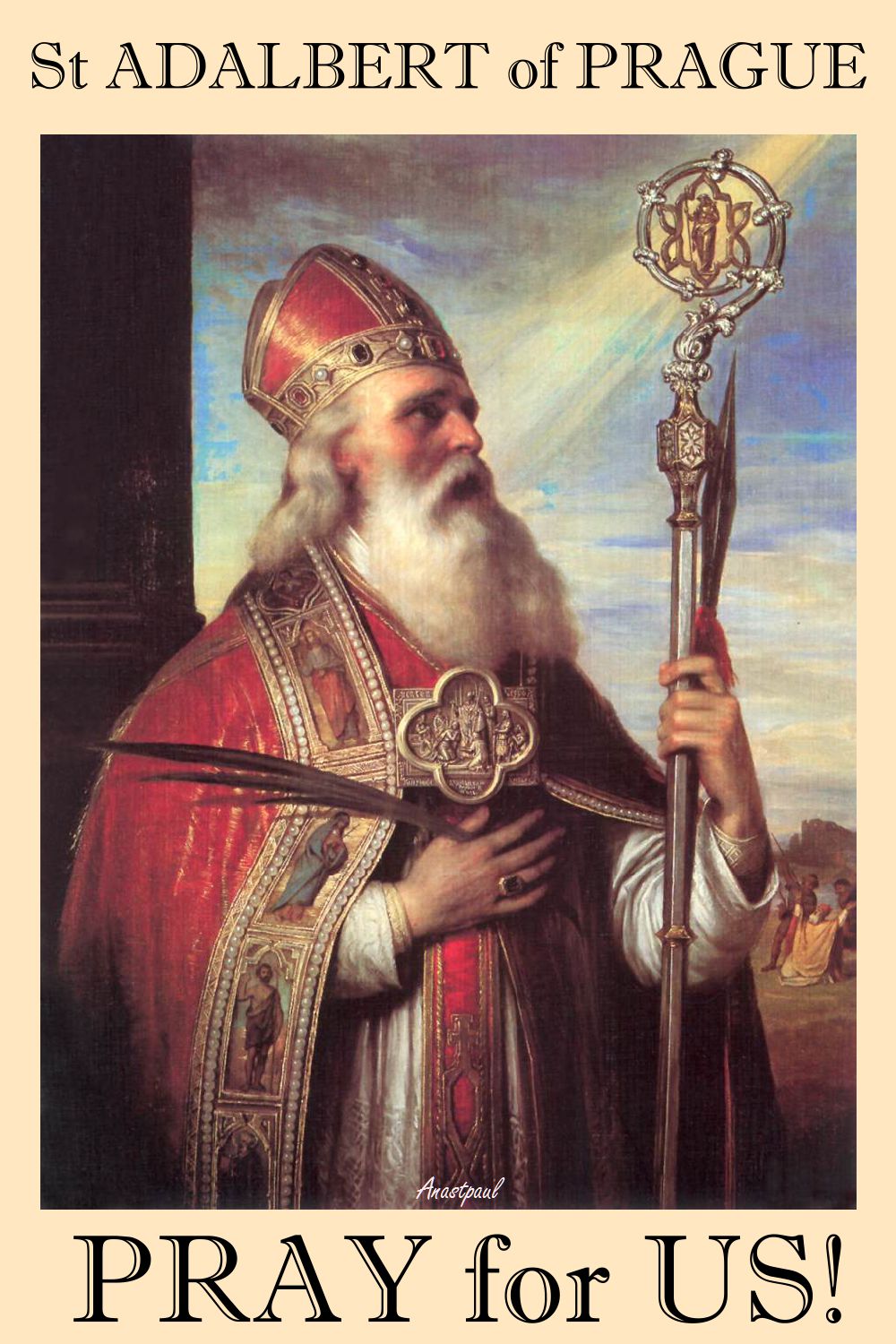
PRAYER – “Lord, who reveal the Father’s love by Your death and Resurrection, we believe in You and confidently repeat to You today: Jesus, I trust in You, have mercy upon us and upon the whole world. Amen.” – St John Paul (During his last journey to Poland in August of 2002) St Adalbert of Prague pray for us!















 AnaStpaul
You must be logged in to post a comment.