Quote/s of the Day – 27 December – “The Month of the Divine Infancy and the Immaculate Conception of the Blessed Virgin Mary”
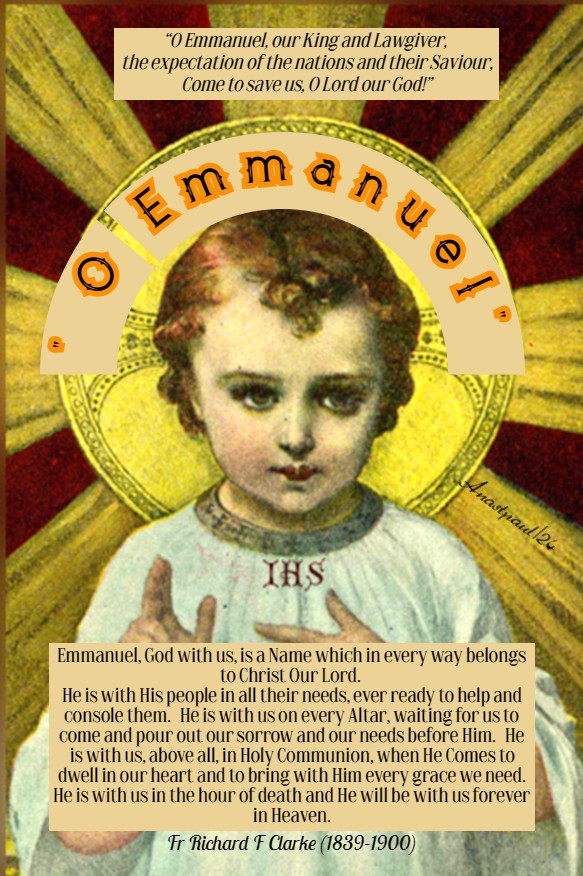
“O Emmanuel”
“O Emmanuel, our King and Lawgiver, the expectation of the nations and their Saviour, Come to save us, O Lord our God!”
“Emmanuel, God with us, is a Name which in every way belongs to Christ Our Lord. He is with His people in all their needs, ever ready to help and console them. He is with us on every Altar, waiting for us to come and pour out our sorrow and our needs before Him. He is with us, above all, in Holy Communion, when He Comes to dwell in our heart and to bring with Him every grace we need. He is with us in the hour of death and He will be with us forever in Heaven.”
Quote/s of the Day – 27 October – Vigil of Saints Simon and Jude – 1 Corinthians 4:9-14, John 15:1-7 – Scripture search here: https://www.drbo.org/
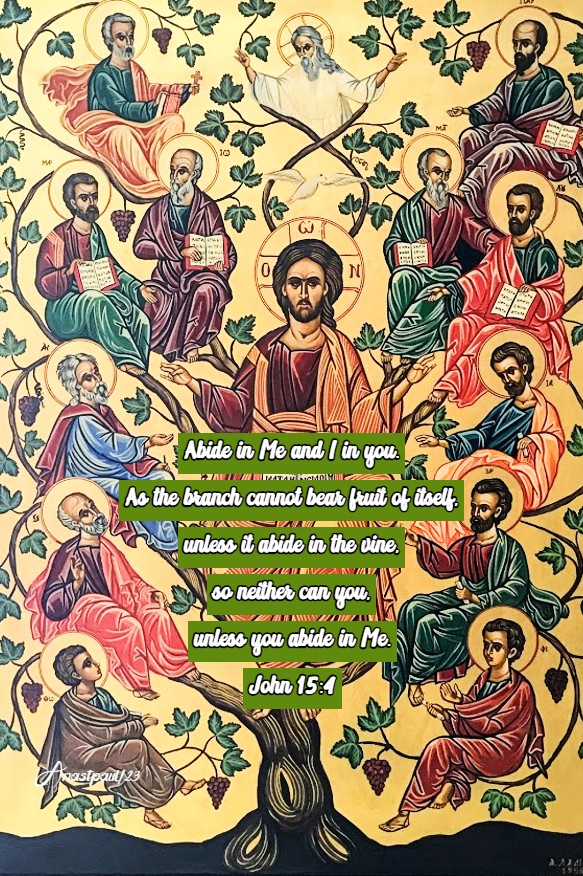
“Abide in Me and I in you. As the branch cannot bear fruit of itself, unless it abide in the vine, so neither can you, unless you abide in Me.”
John 15:4
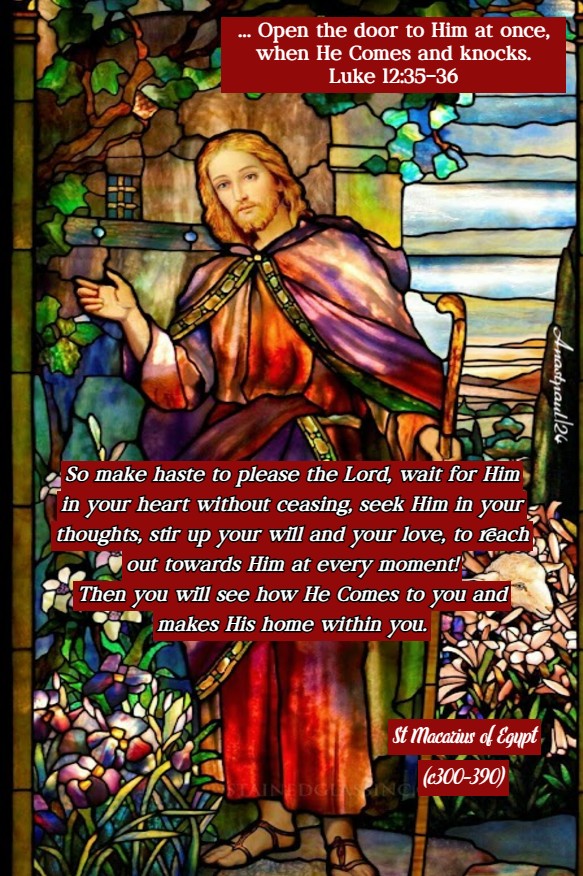
“… Open the door to Him at once, when He Comes and knocks.” Luke 12:35-36
“So make haste to please the Lord, wait for Him in your heart without ceasing, seek Him in your thoughts, stir up your will and your love, to reach out towards Him at every moment! Then you will see how He Comes to you and makes His home within you.”
St Macarius of Egypt (c300-390)
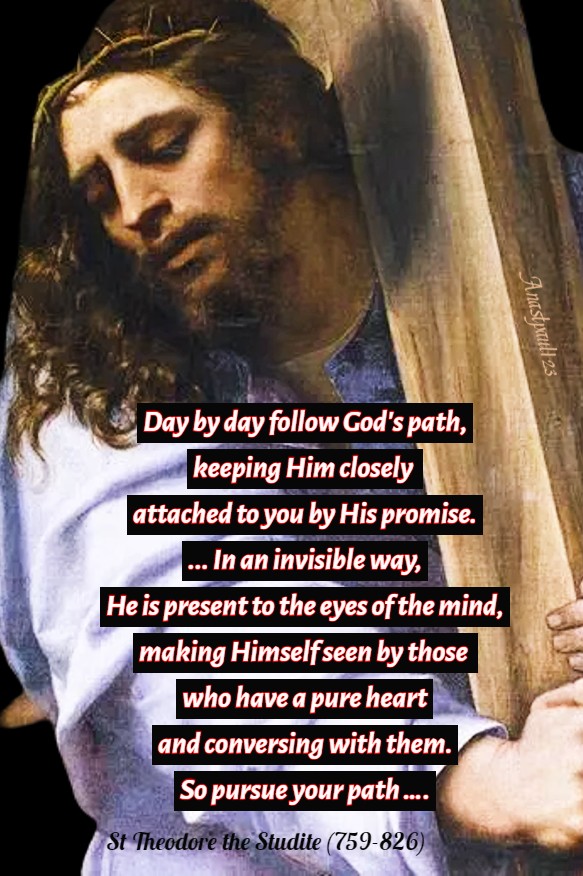
“Day by day follow God’s path, keeping Him closely attached to you by His promise. In fact, He Himself said, through the mediation of His Apostles, to all those who seek His will and His testimonies that He would be with them until the end of the world (Mt 28:20) where paths and footsteps will be unknown (cf Ps 76:20), as the divine David said in his songs. Yet, in an invisible way, He is present to the eyes of the mind, making Himself seen by those who have a pure heart and conversing with them. So pursue your path …. ”
St Theodore the Studite (759-826) Abbot, Confessor, Father of the Church
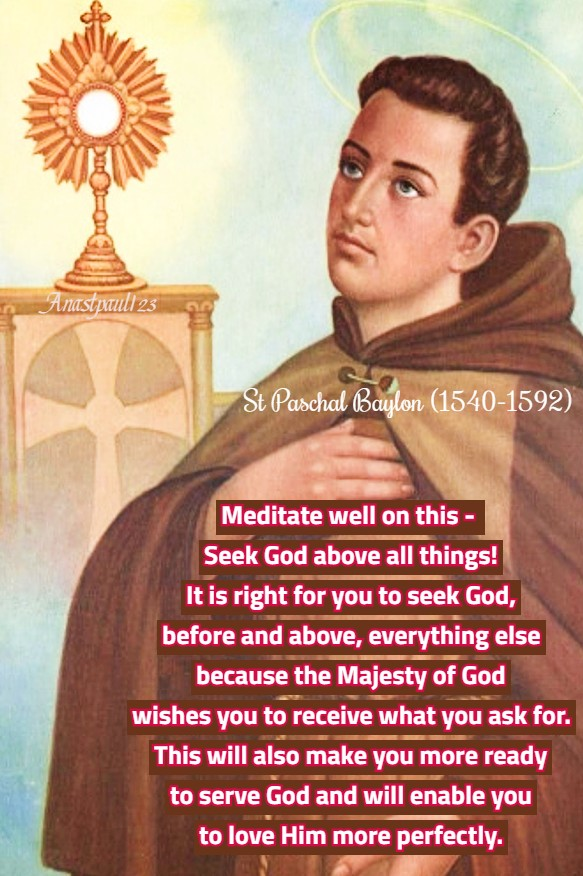
“Meditate well on this – Seek God above all things! It is right for you to seek God, before and above, everything else because the Majesty of God wishes you to receive what you ask for. This will also make you more ready to serve God and will enable you to love Him more perfectly.”
St Paschal Baylon (1540-1592) “Seraph of the Eucharist”
Thought for the Day – 11 August – Meditations with Antonio Cardinal Bacci (1881-1971)
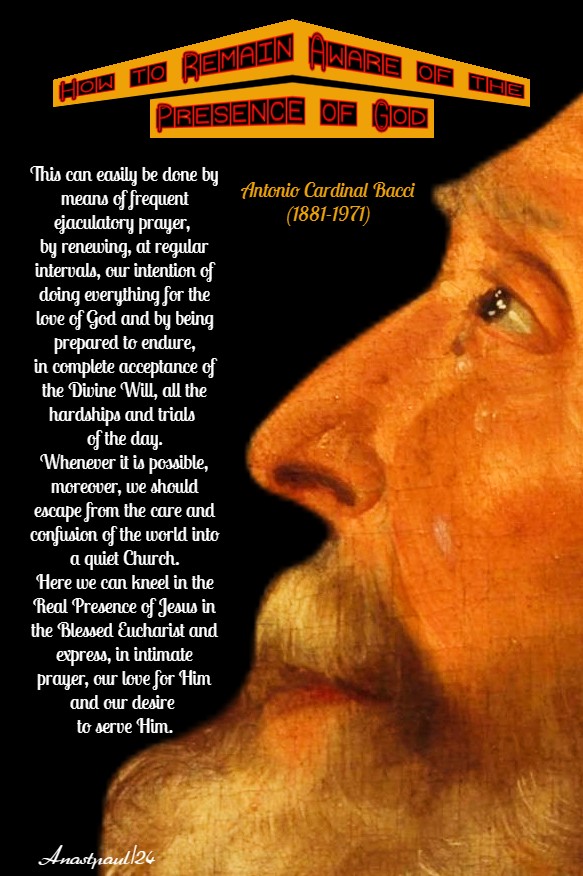
How to Remain Aware of the Presence of God
“It is useful to consider the ways in which we can develop a constant and effective awareness of the Presence of God. The first way in which we can do this, is by cultivating a lively faith, which will help us to see God everywhere. “Do not I fill heaven and earth, saith the Lord?” (Jer 23:24).
This kind of faith should deepen our sense of God’s Presence and inspire in us sentiments of love and gratitude, which will guide us in all our actions. We cannot expect that we shall be able to remain in a state of constant contemplation of God, for this is the privilege enjoyed by the blessed in Heaven, for whom faith has been replaced by the Beatific Vision. We must be satisfied with exciting in ourselves, as often as possible, the active awareness of God’s Presence. This should be a quiet and peaceful process, not involving undue mental effort or anxiety.
We should be able to attend quite naturally to our work and other obligations and, we should be helped and consoled in this, by directing our thoughts to God from time to time, in order to offer ourselves to Him. This can easily be done by means of frequent ejaculatory prayer, by renewing, at regular intervals, our intention of doing everything for the love of God and by being prepared to endure, in complete acceptance of the Divine Will, all the hardships and trials of the day. Whenever it is possible, moreover, we should escape from the care and confusion of the world into a quiet Church. Here we can kneel in the Real Presence of Jesus in the Blessed Eucharist and express, in intimate prayer, our love for Him and our desire to serve Him.”
Thought for the Day – 9 July – The Spiritual Combat (1589) – Dom Lorenzo Scupoli OSM (c1530-1610)
“None shall be crowned who has not fought well.” 2 Tim 2: 5
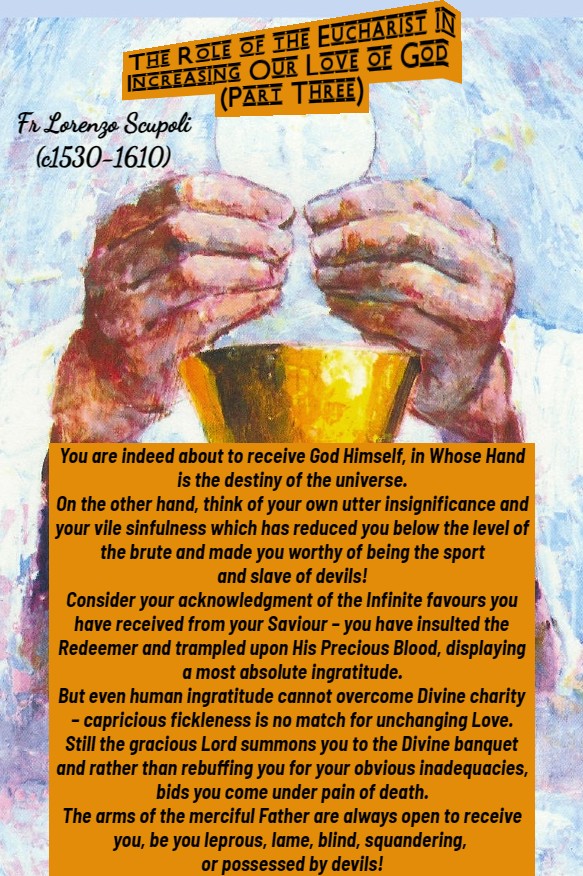
LV: … The Role of the Eucharist in Increasing Our Love of God (Part Three)
“When the time itself draws near, we must consider, attentively, Who it is we are about to receive – for our Guest is to be the Son of the living God, the august Majesty before Whom the heavens and the powers of Heaven tremble in awesome fear!
Our Guest is to be the Saint of Saints, Mirror without blemish, Purity itself, before Whom all is unclean in comparison. This is Divinity become Man – One looked upon as the very outcast of men, Who was pleased to be spat upon, struck, reviled and Crucified out of love for us.
You are indeed about to receive God Himself, in Whose Hand is the destiny of the universe. On the other hand, think of your own utter insignificance and your vile sinfulness which has reduced you below the level of the brute and made you worthy of being the sport and slave of devils! Consider your acknowledgment of the Infinite favours you have received from your Saviour – you have insulted the Redeemer and trampled upon His Precious Blood, displaying a most absolute ingratitude.
But even human ingratitude cannot overcome Divine charity – capricious fickleness is no match for unchanging Love. Still the gracious Lord summons you to the Divine banquet and rather than rebuffing you for your obvious inadequacies, bids you come under pain of death. The arms of the merciful Father are always open to receive you, be you leprous, lame, blind, squandering, or possessed by devils.
He demands of you these few requisites alone:
To be sincerely sorry for having so grievously offended Him. To hate sin of all kinds with an unquenchable vigour. To consecrate yourself to cheerful acceptance of His Divine Will, whatever it may be. To have a firm confidence that He will forgive your sins, cleanse your soul of all taint and defend you against all your enemies.
Encouraged by this ineffable Love of the Lord for you and all penitent sinners, approach the holy table with a prudent fear, tempered by hope and love, saying:
“After so many grievous offences, I am not worthy to receive Thee, not having fully satisfied Thy justice. No, my God, I am unworthy of Thee, sullied as I am by an inordinate attachment to creatures and a reluctance to serve Thee completely, with my whole heart and my whole strength. O my omnipotent Lord, be mindful of Thy goodness and Thy promise; through the Divine alchemy of Love and Faith, make my heart a worthy dwellingplace for Thy Divine Son.”
Thought of the Day – 3 July – Thursday within the Octave of the Sacred Heart and The Feast of the Eucharistic Heart of Jesus
A Forgotten Jewel in the Catholic Crown
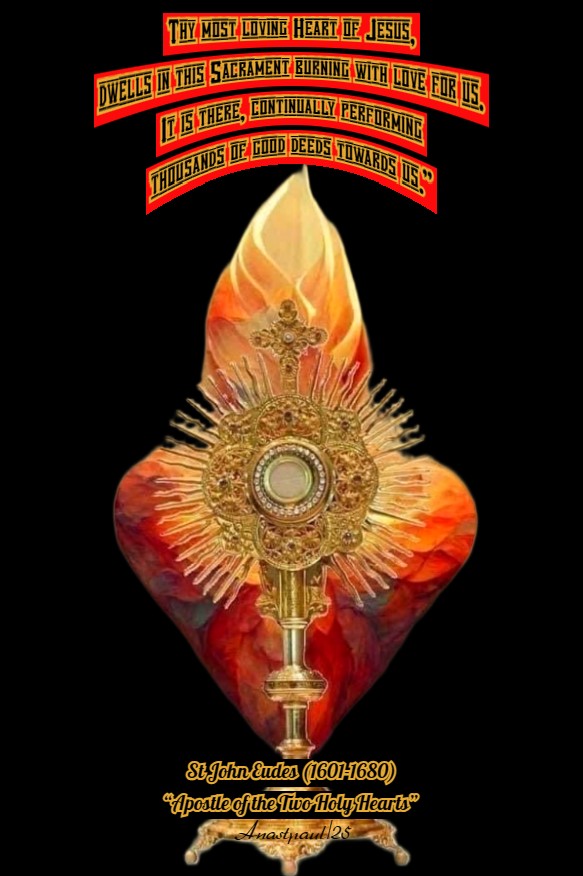
“Thy most loving Heart of Jesus, dwells in this Sacrament burning with love for us. It is there, continually performing thousands of good deeds towards us.”
St John Eudes (1601-1680) “Apostle of the Two Holy Hearts”
On this date, we celebrate the Feast of The Eucharistic Heart of Jesus which occurs on the Thursday within the Octave of the Sacred Heart.
On 9 November 1921, Pope Benedict XV instituted the Feast of the Eucharistic Heart of Jesus to be celebrated on the Thursday within the Octave of the Sacred Heart with a Proper Mass and Office. In instituting the Feast, Pope Benedict XV wrote:
“The chief reason for this Feast, is to commemorate the Love of Our Lord Jesus Christ in the Mystery of the Eucharist. By this means the Church wishes, more and more, to excite the faithful to approach this Sacred Mystery with confidence and, to inflame their hearts with that Divine Charity which consumed the Sacred Heart of Jesus, when, in His Infinite Love, He instituted the Most Holy Eucharist, wherein the Divine Heart guards and loves them by living with them, as they live and abide in Him. For, in the Sacrament of the Holy Eucharist, He offers and gives Himself to us as Victim, Companion, Nourishment, Viaticum and Pledge of our future glory!”
O Most Sacred Heart of Jesus! By Pope Benedict XV (1854-1922)
O Most Sacred Heart of Jesus! O Fount of every good! I adore Thee, I love Thee and sincerely repenting of my sins, I present to Thee my poor heart. Give it back to me humble, patient, pure and in everything, conformed to Thy wishes. Make me, O good Jesus, live in Thee and for Thee. Protect me in dangers, comfort me in afflictions, grant me health of body, succour in my temporal needs, Thy blessing in all my works and the grace of a holy death. Amen
Indulgence – 100 days Once a day Pope Benedict XV 4 December 1916
Quote/s of the Day – 3 July – Within the Octave of the Sacred Heart and the Feast of the Eucharistic Heart of Jesus
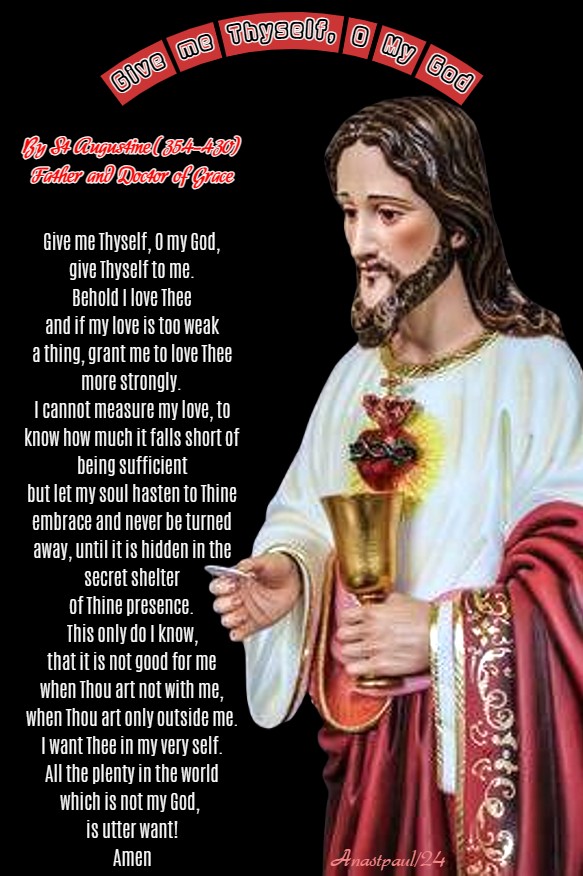
Give me Thyself, O My God By St Augustine (354-430) Father and Doctor of Grace
Give me Thyself, O my God, give Thyself to me. Behold I love Thee and if my love is too weak a thing, grant me to love Thee more strongly. I cannot measure my love, to know how much it falls short of being sufficient but let my soul hasten to Thine embrace and never be turned away, until it is hidden in the secret shelter of Thine presence. This only do I know, that it is not good for me when Thou art not with me, when Thou art only outside me. I want Thee in my very self. All the plenty in the world which is not my God, is utter want! Amen
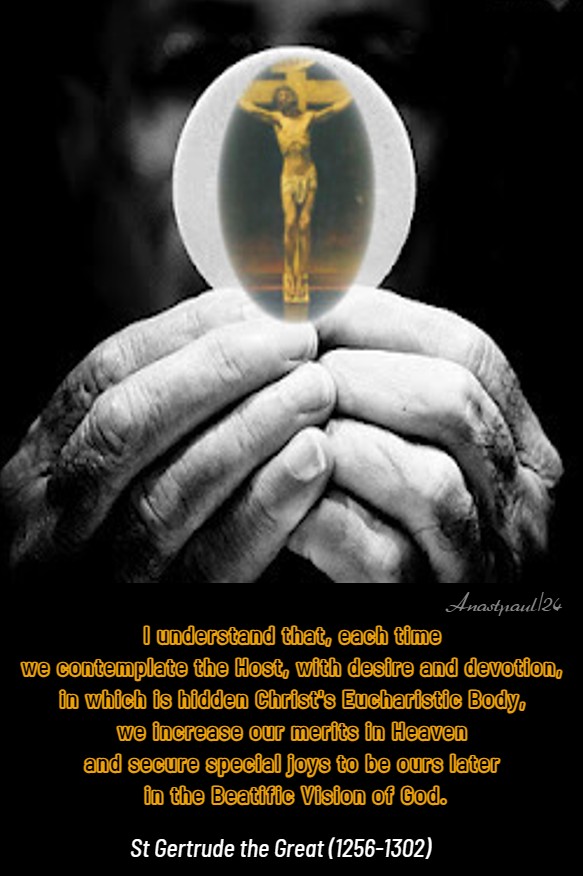
“I understand that, each time we contemplate the Host, with desire and devotion, in which is hidden Christ’s Eucharistic Body, we increase our merits in Heaven and secure special joys to be ours later in the Beatific Vision of God.”
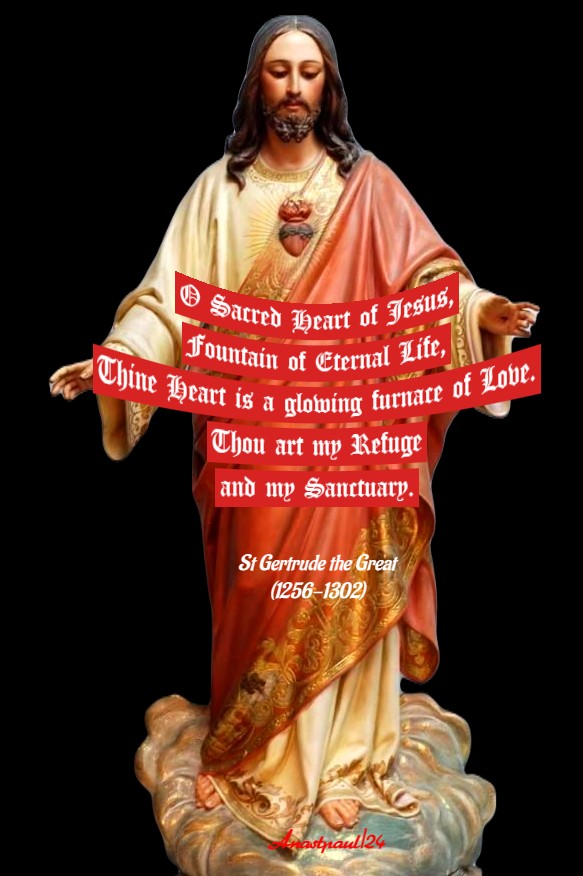
“O Sacred Heart of Jesus, Fountain of Eternal Life, Thine Heart is a glowing furnace of Love. Thou art my Refuge and my Sanctuary.”
St Gertrude the Great (1256-1302)
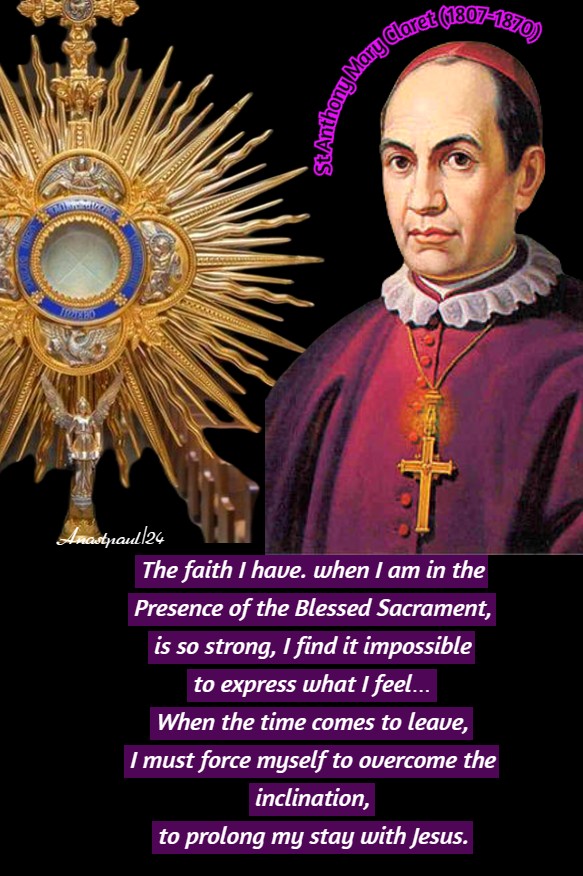
“The faith I have, when I am in the Presence of the Blessed Sacrament, is so strong, I find it impossible to express what I feel… When the time comes to leave, I must force myself to overcome, the inclination to prolong my stay with Jesus.”
Bl Andreas Ebersbach Bl Barbara Jeong Sun-mae St Bladus St Byblig St Cillene St Dathus (Died c190) Bishop and Confessor of Ravenna St Eusebius of Laodicea St Firminus St Firmus Bl Gelduin St Giuse Nguyen Ðình Uyen St Gunthiern St Guthagon
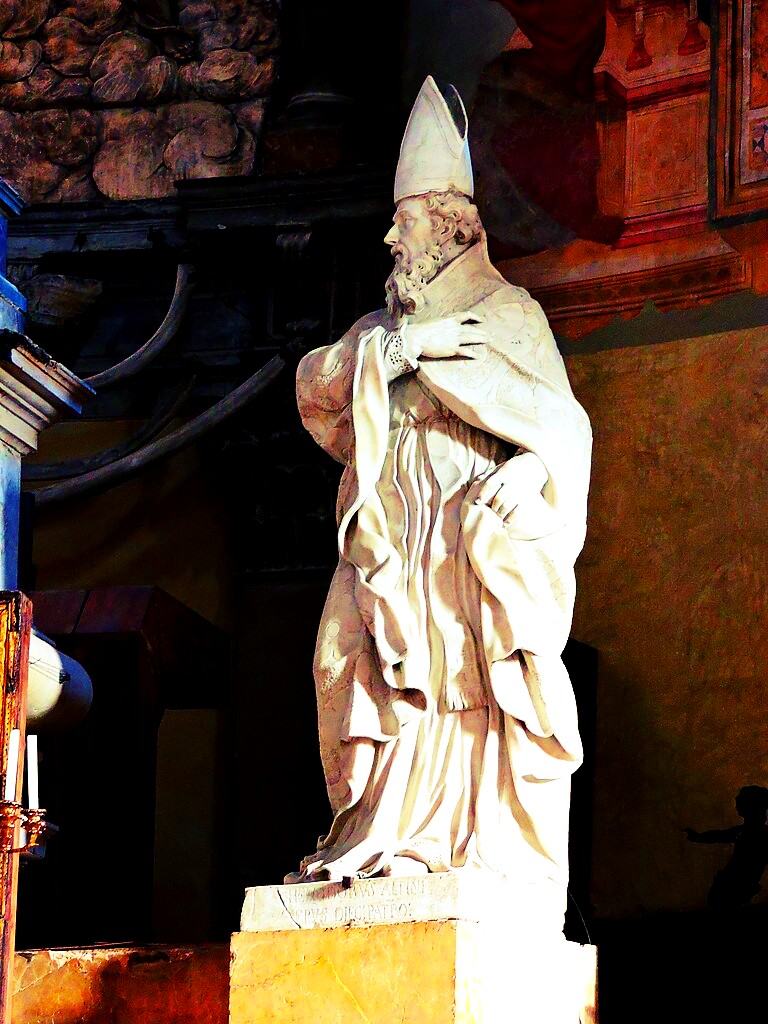
St Heliodorus (c332-c390) the first Bishop of Altino in Italy, disciple, close friend and assistant of St Jerome. Scholar, ex-soldier, The Roman Martyrology reads: “At Altino, St Heliodorus, a Bishop, distinguished for holiness and learning.” Holy Heliodorus: https://anastpaul.com/2024/07/03/saint-of-the-day-3-july-st-heliodorus-332-390-bishop/
St Hyacinth of Caesarea St Irenaeus of Chiusi St Maelmuire O’Gorman St Mark of Mesia St Mennone the Centurian St Mucian of Mesia St Paul of Mesia
St Raymond Gayrard(Died 1118) ArchDeacon, Canon of the Lateran Canons Regular at St Sernin Basilica in Toulouse, France. The Roman Martyrology reads: “In Toulouse on the Garonne in France, Saint Raymond Gayrard, who, as a teacher, remained a widower, passionately devoted himself to works of charity, founded a hospice and was finally admitted among the Canons of the Basilica of St Saturnin.” https://anastpaul.com/2023/07/03/saint-of-the-day-3-july-saint-raymond-of-toulouse-died-1118/
Martyrs of Alexandria – 13 Saints: Thirteen Christian companions Marytred together. No details about them have survived but the names – Apricus, Cyrion (2 of), Eulogius, Hemerion, Julian, Julius, Justus, Menelaus, Orestes, Porfyrios and Tryphon (2 of). They martyred in Alexandria, Egypt, date unknown.
Martyrs of Constantinople – 24 Saints: A group of 24 Christians Martyred in the persecutions of Arian Emperor Valens. We know little more than their names – Acacios, Amedinos, Ammonius, Ammus, Cerealis, Cionia, Cionius, Cyrianus, Demetrius, Eulogius (2), Euphemia, Heliodoros, Heraclios, Horestes, Jocundus, Julian, Martyrios, Menelaeus, Sestratus, Strategos, Thomas, Timotheos and Tryphon. They were martyred in c367 in Constantintinople.
Theodotus and Companions – 6 Saints: Six Christians who were imprisoned, tortured and Martyred together in the persecutions of Trajan. Saint Hyacinth ministered to them in prison. We know nothing else about them but their names – Asclepiodotus, Diomedes, Eulampius, Golinduchus, Theodota and Theodotus. They were beheaded in c110, location unknown.
DISCLAIMER: Please note: I cannot control the content of the Advertisements on this Site, or of pop-ups which may appear, The revenue from the Advertisements, however, does provide a little assistance in the support of the Site. I do apologise for any inappropriate content.
1 July The Feast and the Month of the Most Precious Blood of Our Lord Jesus Christ
In his book, The Precious Blood, Father Frederick William Faber CO (1814-1863), calls St Paul ,the Doctor of the Precious Blood owing to his evident fondness of preaching on Ithis subject in his Epistles (Romans 3:25; Ephesians 1:7; Hebrews 9:12 et al).
He recounts that the lives of the Saints are replete with devotion to the Precious Blood making special mention of St John Chrysostom, St Augustine, St Gertrude and St Catherine of Sienna, the last whom he considered the Prophetess of the Precious Blood for putting emphasis on It as the solution to the ills of her times.
Constant Prayer to the Precious Blood of Jesus By St Catherine of Siena (1347-1380)
Precious Blood, Ocean of Divine Mercy, Flow upon us! Precious Blood, Most Pure Offering, Procure us every grace! Precious Blood, Hope and Refuge of sinners, Atone for us! Precious Blood, Delight of holy souls, Draw us! Amen
Father Faber also remarks that the Precious Blood makes us appreciate more,, Christ’s redemption of mankind, His sacrifice and Passion. It makes us comprehend too, the beautiful doctrine and the august realities of the Blessed Sacrament, as we kneel in front of the Tabernacle, in humble adoration.
Over time, the Church gave Her blessing to the devotion by approving societies like the Missionaries of the Precious Blood; enriching confraternities like that of St Nicholas in Carcere, in Rome and that of the London Oratory; attaching Indulgences to prayers and Scapulars in honour of the Precious Blood and instituting commemorative Feasts of the Precious Blood, Friday after the fourth Sunday in Lent and, since Pius IX, the first Sunday of July. St Pius X assigned the date of 1 July to this Feast.
Quote/s of the Day – 26 June – “The Month of the Most Sacred Heart of Jesus” – The Octave Day of Corpus Christi
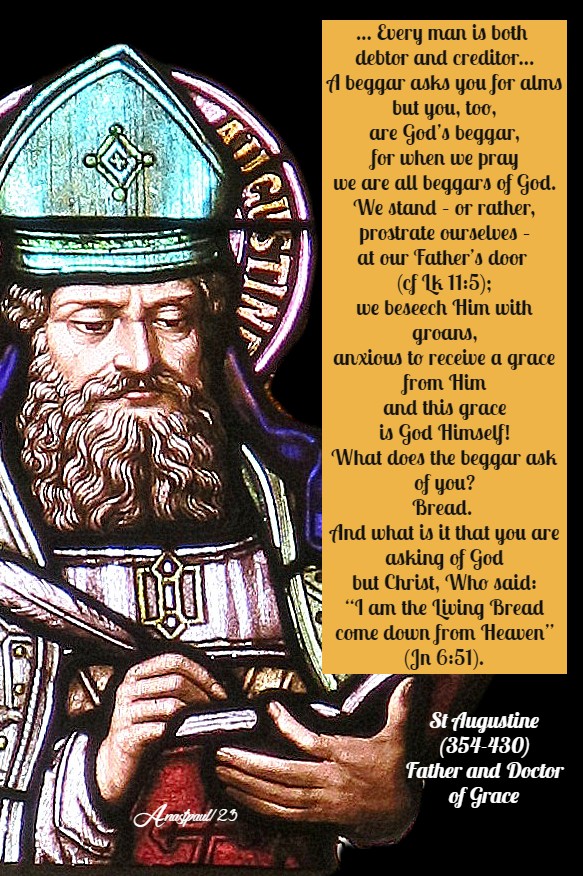
“… Every man is both debtor and creditor… A beggar asks you for alms but you, too, are God’s beggar, for when we pray we are all beggars of God. We stand – or rather, prostrate ourselves – at our Father’s door (cf Lk 11:5); we beseech Him with groans, anxious to receive a grace from Him and this grace is God Himself! What does the beggar ask of you? Bread. And what is it that you are asking of God but Christ, Who said: “I am the Living Bread come down from Heaven” (Jn 6:51).”
St Augustine (354-430) Father and Doctor of Grace
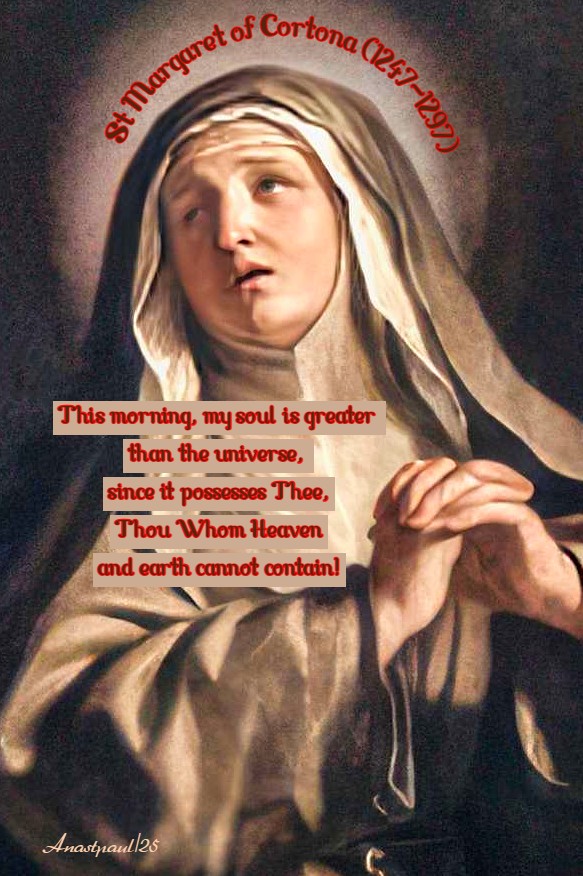
“This morning, my soul is greater than the universe, since it possesses Thee, Thou Whom Heaven and earth cannot contain!”
St Margaret of Cortona (1247–1297) Penitent
“What graces, gifts and virtues the Holy Mass calls down!”
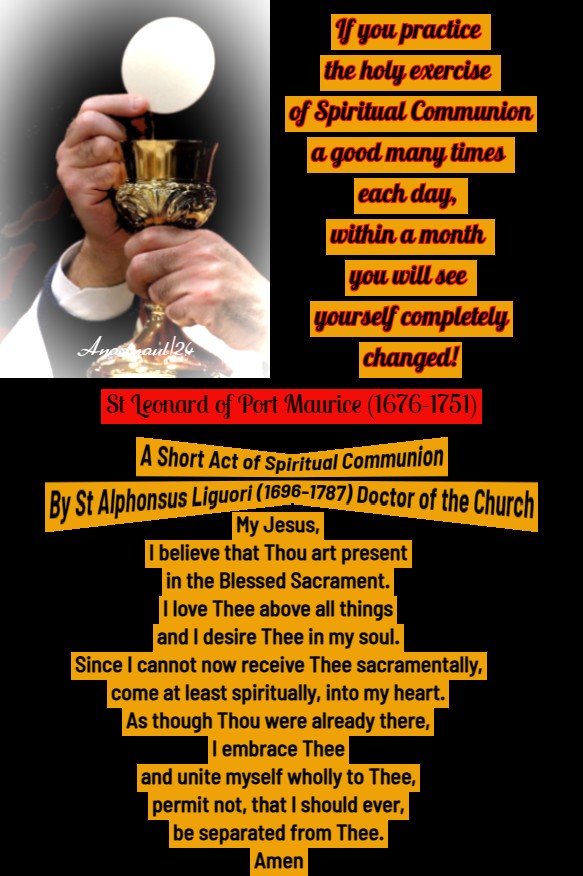
“If you practice the holy exercise of Spiritual Communion a good many times each day, within a month you will see yourself completely changed.”
A Short Act of Spiritual Communion By St Alphonsus Liguori (1696-1787) Doctor of the Church
My Jesus, I believe that Thou art present in the Blessed Sacrament. I love Thee above all things and I desire Thee in my soul. Since I cannot now receive Thee sacramentally, come at least spiritually, into my heart. As though Thou were already there, I embrace Thee and unite myself wholly to Thee, permit not, that I should ever, be separated from Thee. Amen
St Leonard of Port Maurice (1676-1751)
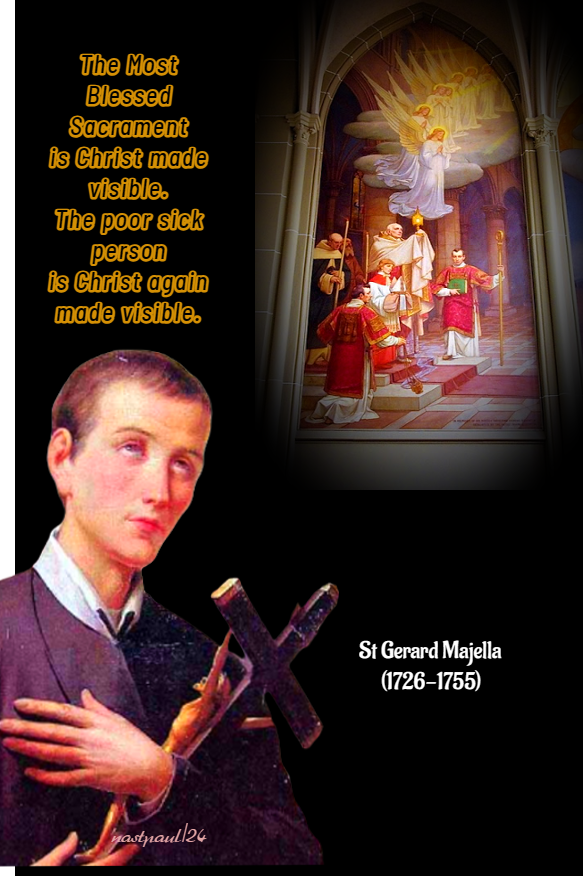
“The Most Blessed Sacrament is Christ made visible. The poor sick person is Christ again made visible.”
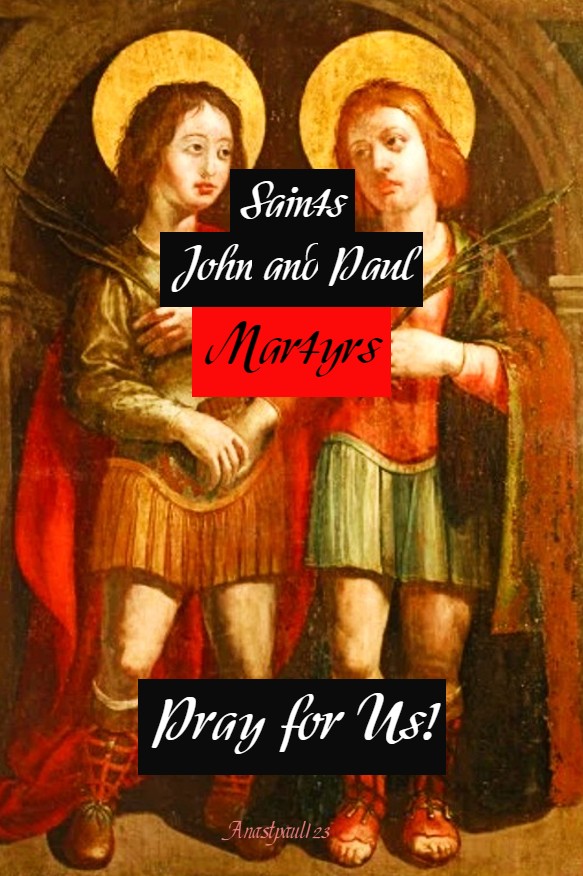
One Minute Reflection – 26 June – “The Month of the Most Sacred Heart of Jesus” – Saint John and Saint Paul of Rome (Died c362) Martyrs – The Octave Day of Corpus Christi – 1 Corinthians 23-29 – John 6:56-59 – Scripture search here: https://www.drbo.org/
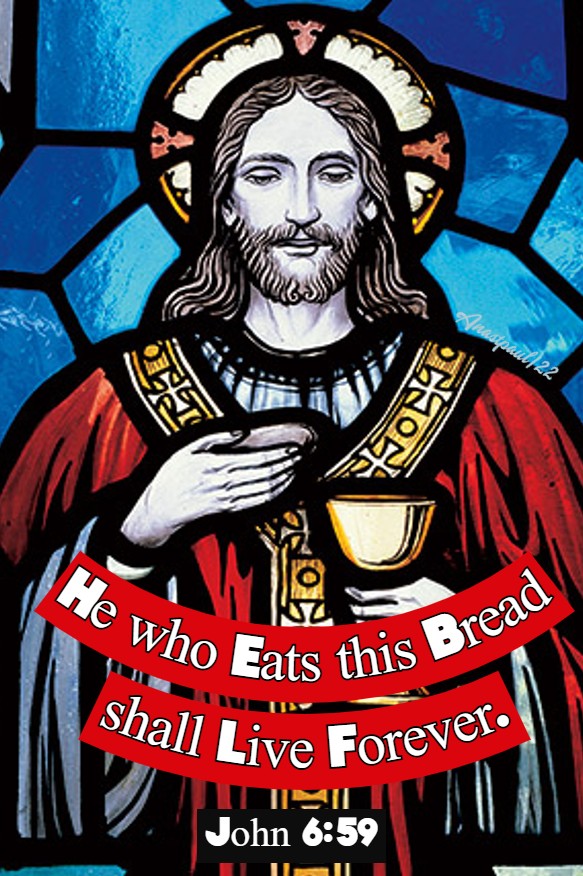
“He who eats this Bread shall live forever.” – John 6:59
REFLECTION – “Since it was the Will of God’s Only-Begotten Son that men should share in His Divinity, He assumed our nature in order that, by becoming Man. He might make men gods . Moreover, when He took our flesh. He dedicated the whole of its substance to our salvation. He offered His Body to God the Father, on the Altar of the Cross, as a sacrifice for our reconciliation. He shed His Blood for our ransom and purification, so that we might be redeemed, from our wretched state of bondage and cleansed from all sin. But to ensure that the memory of so great a gift would abide with us forever, He left His Body as food and His Blood as drink, for the faithful to consume in the form of bread and wine.
O precious and wonderful banquet which brings us salvation and contains all sweetness! Could anything be of more intrinsic value? Under the old law, it was the flesh of calves and goats, which was offered but here, Christ Himself, the True God, is set before us as our food! What could be more wonderful than this? No other Sacrament has greater healing power; through it, sins are purged away, virtues are increased and the soul is enriched with an abundance of every spiritual gift. It is offered in the Church for the living and the dead, so that what was instituted for the salvation of all, may be for the benefit of all. Yet, in the end, no-one can fully express the sweetness of this Sacrament, in which spiritual delight is tasted at its very source, and in which, we renew the memory, of that surpassing love for us, which Christ revealed in His Passion.
It was to impress the vastness of this Love, more firmly upon the hearts of the faithful, that our Lord instituted this Sacrament at the Last Supper. As He was on the point of leaving the world to go to the Father, after celebrating the Passover with His disciples, He left it as a perpetual memorial of His Passion. It was the fulfilment of ancient figures and the greatest of all His Miracles, while, for those who were to experience the sorrow of His departure, it was destined to be a unique and abiding consolation.” – St Thomas Aquinas (1225-1274) Dominican Priest and Theologian, Doctor of the Church (An excerpt from On the Feast of the Body of Christ).
PRAYER – We beseech Thee, Almighty God that on this feast-day, we may have the double joy of celebrating blessed John and Paul, true brothers ,who obtained eternal glory through one Faith and one Martyrdom. Through Jesus Christ, Thy Son our Lord, Who lives and reigns with Thee, in the unity of the Holy Ghost, God, world without end. Amen (Collect).
O HEART of love, I place all my trust in Thee; for though I fear all things from my weakness, I hope all things from Thy mercies. – Ejaculation of Saint Margaret Mary – Indulgence 300 Days, Everytime – Raccolta 180St Pius X, 3 June 1908.
Our Morning Offering – 26 June – “The Month of the Most Sacred Heart of Jesus” – The Octave Day of Corpus Christi
Lauda Sion Salvatorem Sion, Lift Up thy Voice and Sing (Excerpt) By St Thomas Aquinas OP (1225-1274) Doctor Angelicus / Doctor Communis
Sion, lift thy voice and sing, Praise thy Saviour and thy King, Praise with hymns thy Shepherd true, Dare thy most to praise Him well, For He doth all praise excel, None can ever reach His due.
Special theme of praise is Thine, That true living Bread divine, That life-giving flesh adored, Which the brethren twelve received, As most faithfully believed, At the Supper of the Lord.
Let the chant be loud and high, Sweet and tranquil be the joy Felt to-day in every breast; On this festival divine Which recounts the origin Of the glorious Eucharist.
St Thomas Aquinas wrote the Liturgy for Corpus Christi when Pope Urban IV added the Solemnity to the universal Church’s Liturgical Calendar in 1264. He provided a great Sequence, one of the great poems chanted or recited before the proclamation of the Gospel. Lauda Sion is one of only four medieval Sequences which were preserved in the Roman Missal published in 1570 following the Council of Trent (1545–1563)—the others being Victimae Paschali Laudes (Easter), Veni Sancte Spiritus (Pentecost) and Dies irae (requiem masses). (A fifth, Stabat Mater, would later be added in 1727.) Before Trent, many Feasts had their own Sequences. The existing versions were unified in the Roman Missal promulgated in 1570. The Lauda Sion is still sung today as solemn Eucharistic Hymn, although its use is optional in the post-Vatican II Ordinary form. As with St Thomas’s other three Eucharistic Hymns, the last few stanzas of the Lauda Sion are often used alone, in this case, to form the “Ecce Panis Angelorum.”
Our Morning Offering – 22 June – “The Month of the Most Sacred Heart of Jesus” – he Solemnity of Corpus Christi and Within the Corpus Christi Octave
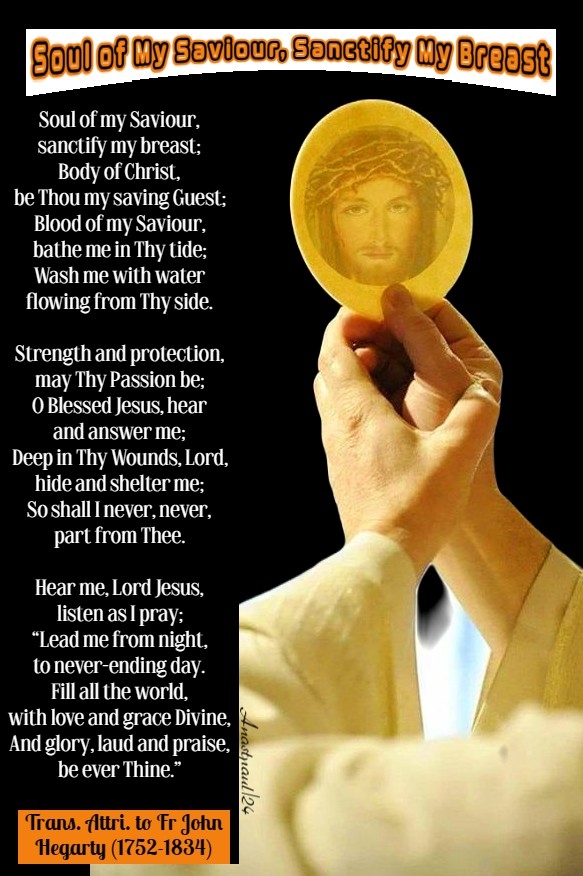
Soul of My Saviour, Sanctify My Breast Trans. Attri. to Fr John Hegarty (1752-1834)
Soul of my Saviour, sanctify my breast; Body of Christ, be Thou my saving Guest; Blood of my Saviour, bathe me in Thy tide; Wash me with water flowing from Thy side.
Strength and protection, may Thy Passion be; O Blessed Jesus, hear and answer me; Deep in Thy Wounds, Lord, hide and shelter me; So shall I never, never, part from Thee.
Hear me, Lord Jesus, listen as I pray; “Lead me from night, to never-ending day. Fill all the world, with love and grace Divine, And glory, laud and praise, be ever Thine.”
This Hymn is based on the original Latin text of the Anima Christi. Fr Hegarty is attributed with its translation and/or arrangement. He was born in County Derry, Ireland, educated at Dublin University and was Ordained in June 1890 and spent most of active apostolic years in Brisbane, Australia. He died aged 82 years.
Thought for the Day – 21 June – Meditations with Antonio Cardinal Bacci (1881-1971)
The Eucharistic Life
“The Eucharistic life which is the life of union with Jesus, especially by means of daily Communion, transforms us and makes us holy. It preserves and increases in us, the grace which is the supernatural life of the soul. The Eucharist, of itself, does not bestow grace because, it is a Sacrament of the living. It is our food and food is not given to the dead but, to the living. For this reason, we should receive Holy Communion free from the stain of sin. The Eucharist, moreover, remits venial sin, strengthens us in our resolution and increases our charity. Venial sin, is a sickness of the soul. Just as natural food banishes listlessness and vulnerability to disease, our Eucharistic nourishment has the same effect on our spiritual life.
It is because the Blessed Eucharist increases our love for Jesus, that it weakens our evil inclinations. The Eucharist and sin, are mutually exclusive of one another because, the Eucharist is Jesus and sin is the devil. Our Eucharistic food, moreover, produces, in our souls, a spiritual consolation which is a foretaste of the happiness of Heaven.
Let us listen to Jesus living within us. He will enable us to forget our worldly cares and will raise us to a higher plane where, by God’s Infinite Goodness, we shall continue to grow in virtue.”
Quote/s of the Day – 20 June – “The Month of the Most Sacred Heart of Jesus” – Within the Corpus Christi Octave
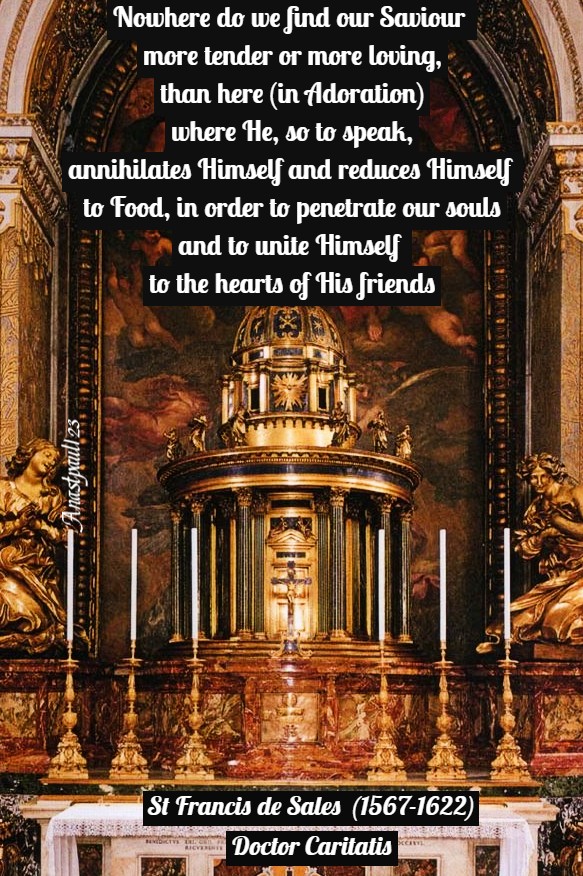
“Nowhere do we find our Saviour more tender or more loving, than here [in Adoration] where He, so to speak, annihilates Himself and reduces Himself to Food, in order to penetrate our souls and to unite Himself to the hearts of His friends.”
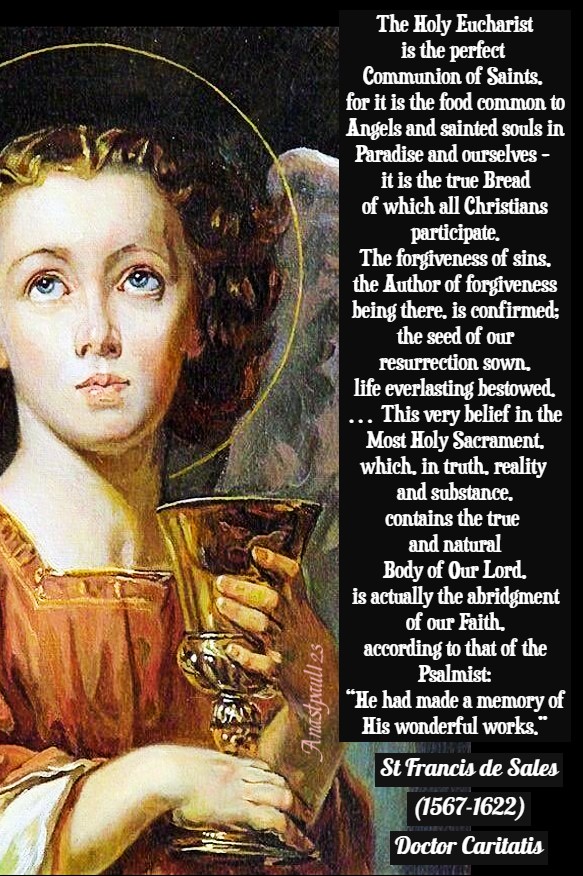
“The Holy Eucharist is the perfect Communion of Saints, for it is the food common to Angels and Sainted souls in Paradise and ourselves – it is the true Bread of which all Christians participate. The forgiveness of sins, the Author of forgiveness being there, is confirmed; the seed of our resurrection sown, life everlasting bestowed. … This very belief in the Most Holy Sacrament, which, in truth, reality and substance, contains the true and natural Body of Our Lord, is actually the abridgment of our Faith, according to that of the Psalmist: “He had made a memory of His wonderful works.”
St Francis de Sales (1567-1622) Doctor Caritatis
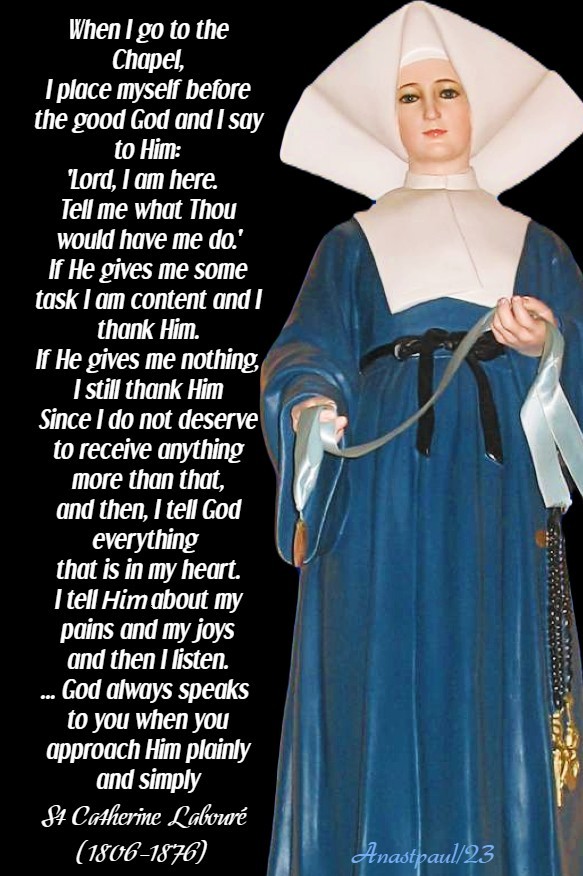
“When I go to the Chapel, I place myself before the good God and I say to Him: ‘Lord, I am here. Tell me what Thou would have me do.’ If He gives me some task I am content and I thank Him. If He gives me nothing, I still thank Him Since I do not deserve to receive anything more than that, and then, I tell God everything that is in my heart. I tell hIm about my pains and my joys and then I listen. … God always speaks to you when you approach Him plainly and simply.”
St Catherine Labouré (1806-1876) The Visionary of the Miraculous Medal
One Minute Reflection – 20 June – “The Month of the Most Sacred Heart of Jesus” – Within the Corpus Christi Octave – St Pope Silverius (Died 538) Martyr – 1 Corinthians 23-29 – John 6:56-59 – Scripture search here: https://www.drbo.org/
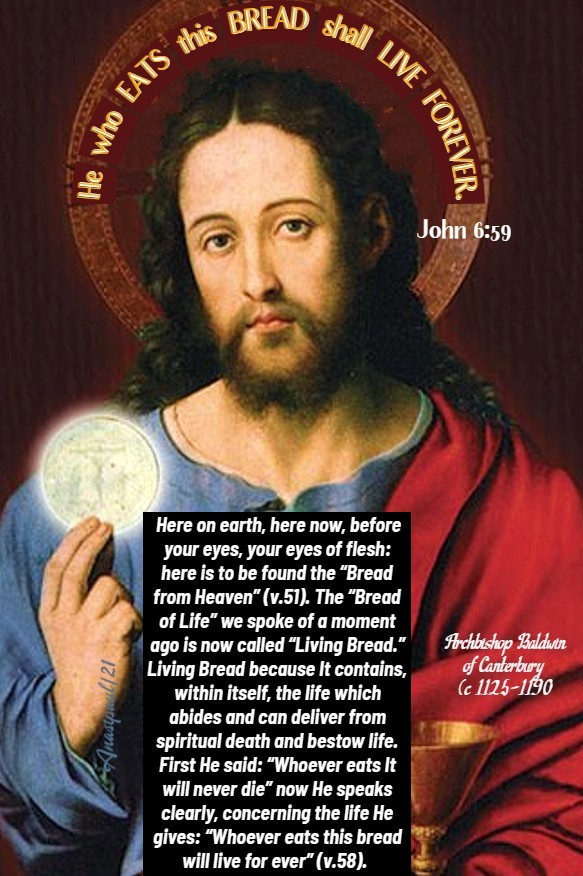
“This is the Bread which has come down from Heaven; not as your fathers ate the manna and died. He who eats this Bread shall live forever.” – John 6:59
REFLECTION – Christ is “the bread of life” for those who believe in Him: to believe in Christ is to eat the bread of life, to possess Christ within one, is to possess eternal life… “I am the bread of life,” He says; “your fathers ate manna in the wilderness and they are dead” (Jn 6,48f). By this is to be understood spiritual death. Why are they dead? Because they believed in what they saw and did not understand what they could not see… Moses ate manna, Aaron ate it and many others, too, who pleased God and are not dead. Why are they not dead? Because they understood, in a spiritual fashion, they were spiritually hungry, they tasted the manna spiritually, so that they might be spiritually satisfied. “This is the bread that came down from heaven: whoever eats it will never die” (v.50). This manna – that is to say, Christ, who Himself spoke like this…, was prefigured by the manna but was able to do more than manna could. For manna could not, of itself, prevent dying spiritually… But the righteous saw Christ in the manna, they believed in His coming and Christ, of whom manna was the symbol, grants to all who believe in Him that they should not spiritually die. Hence He says: “This is the bread come down from heaven; whoever eats it will never see death.” Here on earth, here now, before your eyes, your eyes of flesh: here is to be found the “bread from heaven” (v.51). The “bread of life” we spoke of a moment ago is now called “living bread.” Living bread because it contains, within itself, the life that abides and can deliver from spiritual death and bestow life. First He said: “Whoever eats it will never die” now he speaks clearly, concerning the life He gives: “Whoever eats this bread will live for ever” (v.58). Archbishop Baldwin of Canterbury (c 1125-1190) Cistercian – The Sacrament of the Altar II
PRAYER – Look forgivingly on Thy flock, Eternal Shepherd and keep it in Thy constant protection, by the intercession of blessed Sylverius Thy Martyr and Sovereign Pontiff, whom Thou didst constitute Shepherd of the whole Church. Through Jesus Christ, Thy Son our Lord, Who lives and reigns with Thee, in the unity of the Holy Ghost, God, world without end. Amen (Collect).
ALL PRAISE, honour and glory to the Divine Heart of JESUS.Indulgenced– 50 Days, once a day. 168 Pope Leo XIII, 14 June 1901.
Our Morning Offering – 20 June – “The Month of the Sacred Heart of Jesus” – Within the Corpus Christi Octave
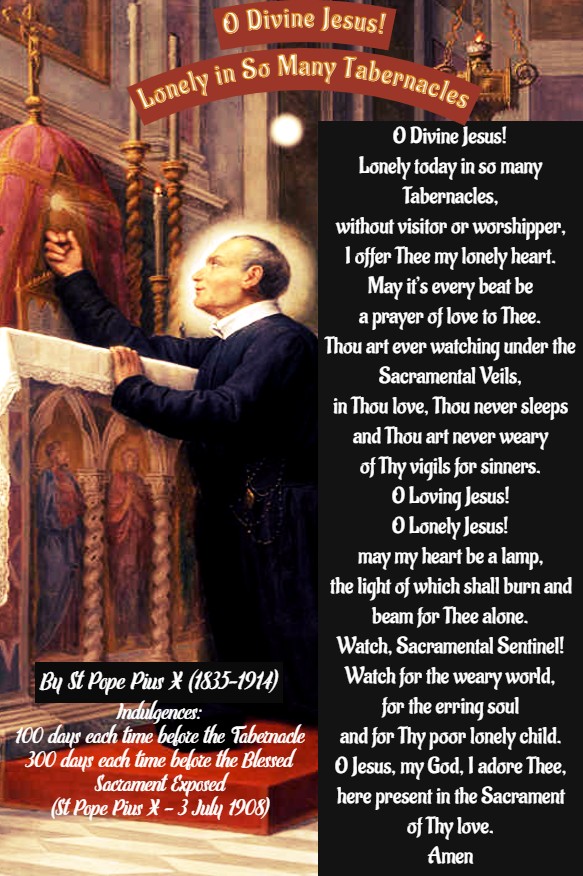
O Divine Jesus! Lonely in So Many Tabernacles By St Pope Pius X (1835-1914) “Pope of the Blessed Sacrament”
O Divine Jesus! Lonely today in so many Tabernacles, without visitor or worshipper, I offer Thee my lonely heart. May it’s every beat be a prayer of love to Thee. Thou are ever watching under the Sacramental Veils, in Thou love, Thou never sleeps and Thou are never weary of Thy vigils for sinners. O Loving Jesus! O Lonely Jesus! may my heart be a lamp, the light of which shall burn and beam for Thee alone. Watch, Sacramental Sentinel! Watch for the weary world, for the erring soul and for Thy poor lonely child.
O Jesus, my God, I adore Thee, here present in the Sacrament of Thy love. Amen
Indulgences: 100 days each time before the Tabernacle 300 days each time before the Blessed Sacrament Exposed (St Pope Pius X – 3 July 1908) Prayers to the Sacred Heart 15th Ed 1936
Quote/s of the Day – 19 June – “The Month of the Most Sacred Heart of Jesus” – Corpus Christi
“He who eats My Flesh and drinks My Blood, abides in Me and I in him. ”
John 6:57
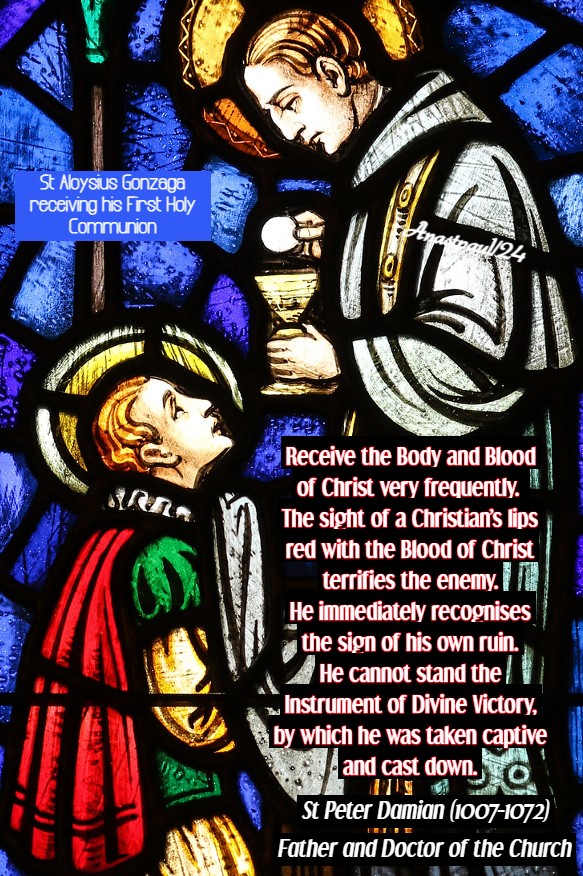
“Receive the Body and Blood of Christ very frequently. The sight of a Christian’s lips red with the Blood of Christ terrifies the enemy. He immediately recognises the sign of his own ruin. He cannot stand the Instrument of Divine Victory, by which he was taken captive and cast down.”
St Peter Damian (1007-1072) Doctor of the Church
“Everything in us which is strong, steadfast, firm, happy and joyful to carry out God’s commands, bear with misfortune, act obediently, stand up for justice – all these things come from this Bread’s strength, this Wine’s gladness. Happy are they whose deeds are strong and joyful! And since no-one can do it of themselves, happy are they who have an eager desire to cleave to what is just and right and to be strengthened in everything and rejoice through Him … ”
Baldwin of Canterbury (c1125-1190) Cistercian Abbot of Forde Monastery and Archbishop of Canterbury
“The Saviour has instituted the most glorious Sacrament of the Eucharist, which truly contains His Body and His Blood, so that, whoever eats it will live forever. Therefore, those who receive it frequently, with devotion, strengthen their spiritual life and well-being, to such an extent, that it is almost impossible for them to be poisoned by any kind of evil attachment.”
(Introduction to the Devout Life, Part II, Chapter 20)
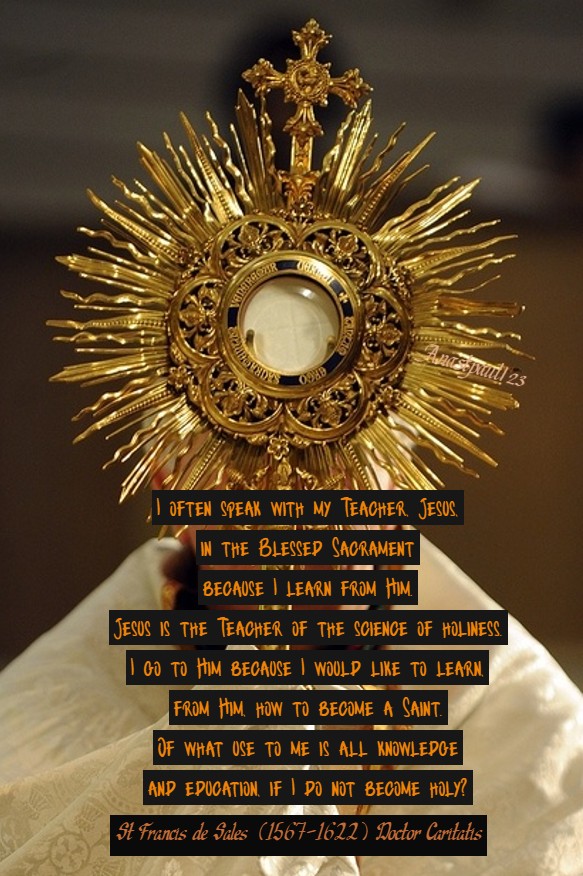
“I often speak with my Teacher, Jesus, in the Blessed Sacrament because I learn from Him. Jesus is the Teacher of the science of holiness. I go to Him because I would like to learn, from Him, how to become a Saint. Of what use to me is all knowledge and education, if I do not become holy?”
St Francis de Sales (1567-1622) Doctor of the Church
Our Morning Offering – 19 June – “The Month of the Most Sacred Heart of Jesus” – Corpus Christi
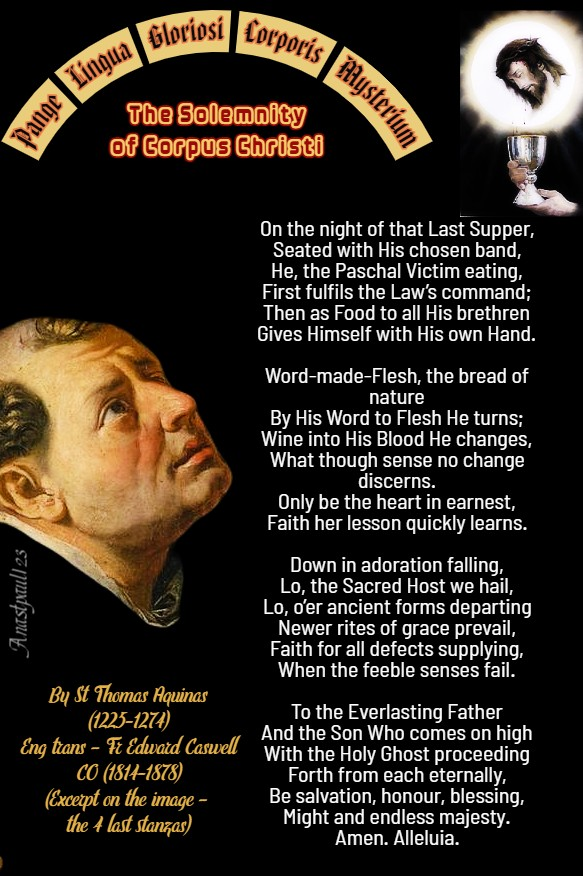
Pange Lingua Gloriosi Corporis Mysterium Sing, My Tongue By St Thomas Aquinas (1225-1274) Eng trans – Fr Edward Caswell CO (1814-1878) (Excerpt on the image – the 4 last stanzas)
Sing, my tongue, the Saviour’s glory, Of His Flesh, the Mystery sing; Of the Blood, all price exceeding, Shed by our Immortal King, Destined, for the world’s redemption, From a noble Womb to spring.
Of a pure and spotless Virgin Born for us on earth below, He, as Man, with man conversing, Stayed, the seeds of truth to sow; Then He closed in solemn order Wondrously His Life of woe.
On the night of that Last Supper, Seated with His chosen band, He, the Paschal Victim eating, First fulfils the Law’s command; Then as Food to all His brethren Gives Himself with His own Hand.
Word-made-Flesh, the bread of nature By His Word to Flesh He turns; Wine into His Blood He changes, What though sense no change discerns. Only be the heart in earnest, Faith her lesson quickly learns.
Down in adoration falling, Lo, the Sacred Host we hail, Lo, o’er ancient forms departing Newer rites of grace prevail, Faith for all defects supplying, When the feeble senses fail.
To the Everlasting Father And the Son Who comes on high With the Holy Ghost proceeding Forth from each eternally, Be salvation, honour, blessing, Might and endless majesty. Amen. Alleluia.
Written by St Thomas Aquinas (1225-1274) the Angelic and Common Doctor of the Church, for the very first Solemnity of Corpus Christi, this Hymn is considered the most beautiful of Aquinas’ Hymns and one of the seven great Hymns of the Church.
The last two stanzas make up the Tantum Ergo (Down in Adoration Falling) which is used at Benediction of the Blessed Sacrament. The Hymn is also used on Maundy Thursday during the procession from the Sanctuary to the Altar of Repose, where the Blessed Sacrament is kept until Good Friday.
Thought for the Day – 18 June – Meditations with Antonio Cardinal Bacci (1881-1971)
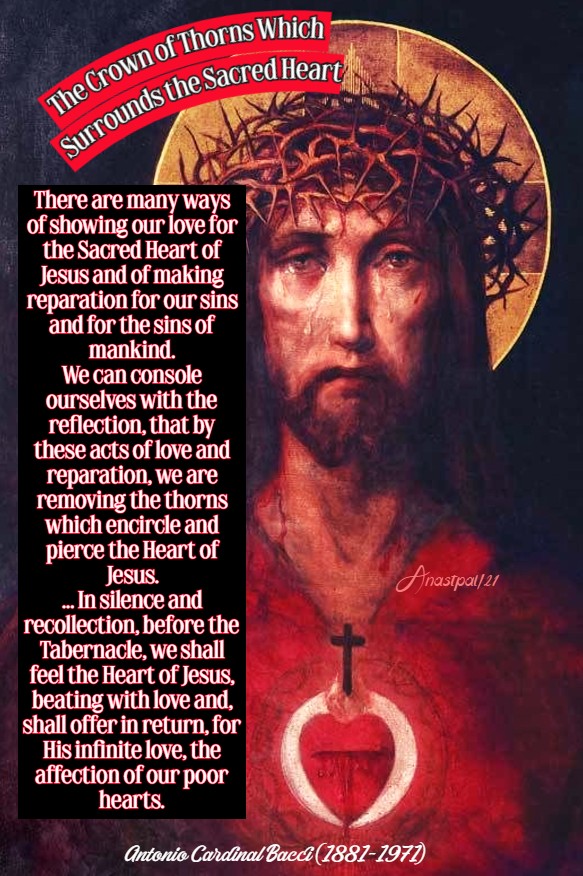
The Crown of Thorns Which Surrounds the Sacred Heart
“There are many ways of showing our love for the Sacred Heart of Jesus and of making reparation for our sins and for the sins of mankind. We can console ourselves with the reflection, that by these acts of love and reparation, we are removing the thorns which encircle and pierce the Heart of Jesus. The simplest ways of doing this, are by prayers, aspirations and expressions of love, directed towards the adorable Heart of our Redeemer and, by visits to Jesus in the Blessed Sacrament. In silence and recollection, before the Tabernacle, we shall feel the Heart of Jesus, beating with love and, shall offer in return, for His infinite love, the affection of our poor hearts.
We can also receive Holy Communion in reparation. When Jesus is in us and we are in Jesus, it will be easier and more pleasant, to offer Him our love and expiation. We can make reparation also, by practising the devotion of the First Fridays of the month. This pious practice, so pleasing to the Heart of Jesus, aims at being a mass offering of love and reparation, for the sins of the entire human race!”
Our Morning Offering – 18 June – “The Month of the Most Sacred Heart of Jesus”
O Heart of Jesus in the Blessed Sacrament By The League of the Sacred Heart 1929 (Ireland)
O Heart of Jesus in the Blessed Sacrament, overflowing with gentleness, tenderness and charity, I bury in the abyss of Thy Mercy, all my iniquities and all my negligence. I offer Thee my labours and my sufferings, my sorrows and my miseries, I recommend to Thee my life and my death. Solace my doubts Sweet Jesus, calm my fears and grant, that day-by-day, I may become more united to Thy Sacred Heart, learning Thy love and Thy holiness. Amen
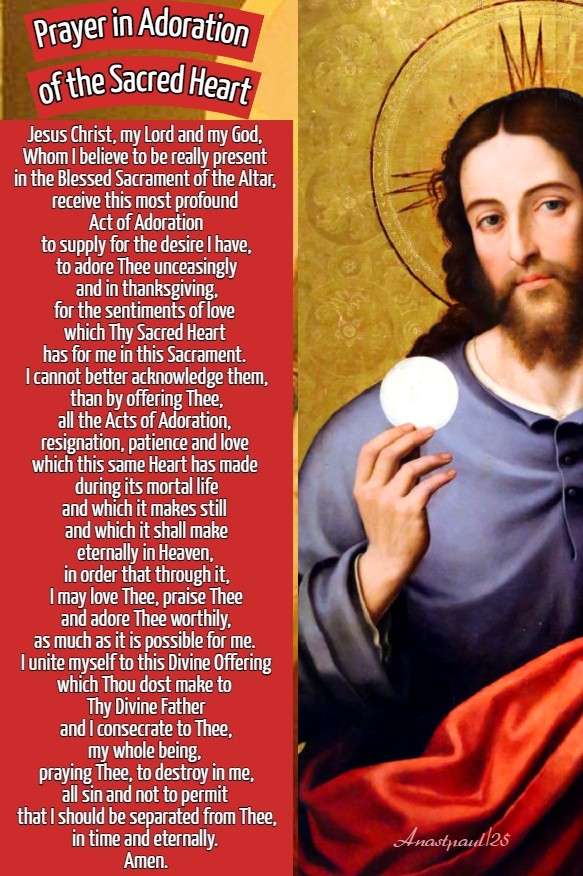
Prayer in Adoration of the Sacred Heart By St Margaret Mary Alacoque (1647-1690) Visionary and Apostle of the Sacred Heart of Jesus
Jesus Christ, my Lord and my God, Whom I believe to be really present in the Blessed Sacrament of the Altar, receive this most profound Act of Adoration to supply for the desire I have, to adore Thee unceasingly and in thanksgiving, for the sentiments of love which Thy Sacred Heart has for me in this Sacrament. I cannot better acknowledge them, than by offering Thee, all the Acts of Adoration, resignation, patience and love which this same Heart has made during its mortal life and which it makes still and which it shall make eternally in Heaven, in order that through it, I may love Thee, praise Thee and adore Thee worthily, as much as it is possible for me. I unite myself to this Divine Offering which Thou dost make to Thy Divine Father and I consecrate to Thee, my whole being, praying Thee, to destroy in me, all sin and not to permit that I should be separated from Thee, in time and eternally. Amen.
Thought for the Day – 14 June – Meditations with Antonio Cardinal Bacci (1881-1971)
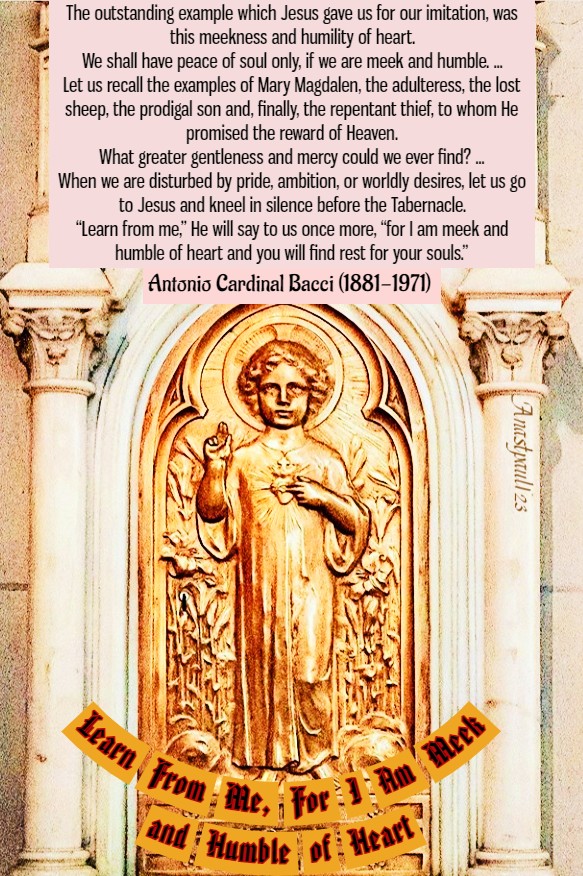
“Learn From Me, For I Am Meek and Humble of Heart”
“Jesus is perfection itself. In Him, therefore, every virtue is to be found. He could truly claim that He fulfilled in Himself the precept: “You are to be perfect, even as your heavenly Father is perfect” (Mt 5:48). Throughout His life, He performed in a perfect manner, the will of His heavenly Father: “I do always the things that are pleasing to Him” (Jn 8:29).
Jesus Christ provided us with an example of every virtue. As the foundation of all the virtues, He insisted on the great precept of loving God above all things and our neighbour as ourselves. In proposing Himself as a model, however, this is what He said: “Learn from me, for I am meek and humble of heart and ou will find rest for your souls” (Mt 11:29). The outstanding example which Jesus gave us for our imitation, was this meekness and humility of heart. We shall have peace of soul only, if we are meek and humble.
In what did the humility of Jesus consist? He was God and He became man. He, Who possessed everything was born poor in a wretched stable and lived as a lowly workman for thirty years. He allowed Himself to be betrayed by one of His Apostles, to be sentenced to death as an evildoer and, finally, to be executed on the Cross.
He combined humility with gentleness. He was happy when He could receive back penitent sinners and grant them forgiveness and peace. Let us recall the examples of Mary Magdalen, the adulteress, the lost sheep, the prodigal son and, finally, the repentant thief, to whom He promised the reward of Heaven. What greater gentleness and mercy could we ever find?
To the present day, moreover, Jesus Christ is hidden in the Blessed Eucharist under the consecrated species and appeals to us to imitate and love Him.
When we are disturbed by pride, ambition, or worldly desires, let us go to Jesus and kneel in silence before the Tabernacle. “Learn from me,” He will say to us once more, “for I am meek and humble of heart and you will find rest for your souls.”
Thought for the Day – 25 March – Meditations with Fr Richard Frederick Clarke SJ (1839-1900)
“Short Meditations for March, St Joseph” From “The Devout Year” By Fr Richard Frederick Clarke SJ (1839-1900)
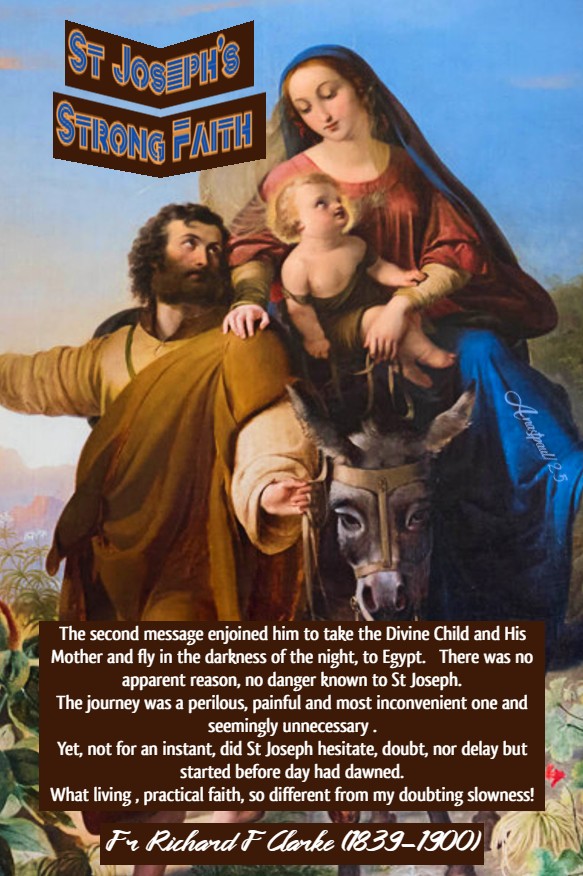
25th Day – St Joseph’s Strong Faith
Faith consists in the ready acceptance of God’s messages to us on His Authority. It is tested by the difficulty of believing and by the painful consequences to ourselves. We will try St Joseph’s faith by these methods.
+1. The first message which is recorded as having been given to St Joseph, was that Mary was about to become a mother through the operation of the Holy Ghost. The news announced, was a miracle of stupendous magnitude, a Mystery inscrutable. Yet, St Joseph never doubted, never hesitated. He accepted it on God’s Authority, as if it were the simplest thing in the world.
+2. The second message enjoined him to take the Divine Child and His Mother and fly in the darkness of the night, to Egypt. There was no apparent reason, no danger known to St Joseph. The journey was a perilous, painful and most inconvenient one and seemingly unnecessary . Yet, not for an instant, did St Joseph hesitate, doubt, nor delay but started before day had dawned. What living , practical faith, so different from my doubting slowness!
+3. It was this habit of faith which earned, for him, the continual society of Jesus Christ. St Joseph never ceased to have present to himself, the Godhead of his Son but at times, he would forget the outward form before him and would adore his God. So we should seek to realise that the Sacred Host, does but veil the same God Incarnate and should make many acts of faith before the Blessed Sacrament and say: “My Lord and my God!”
Quote/s of the Day – 10 March – Monday of the First Week in Lent – Ezechiel 34:11-16 – Matthew 25:31-46 – Scripture search here: https://www.drbo.org/
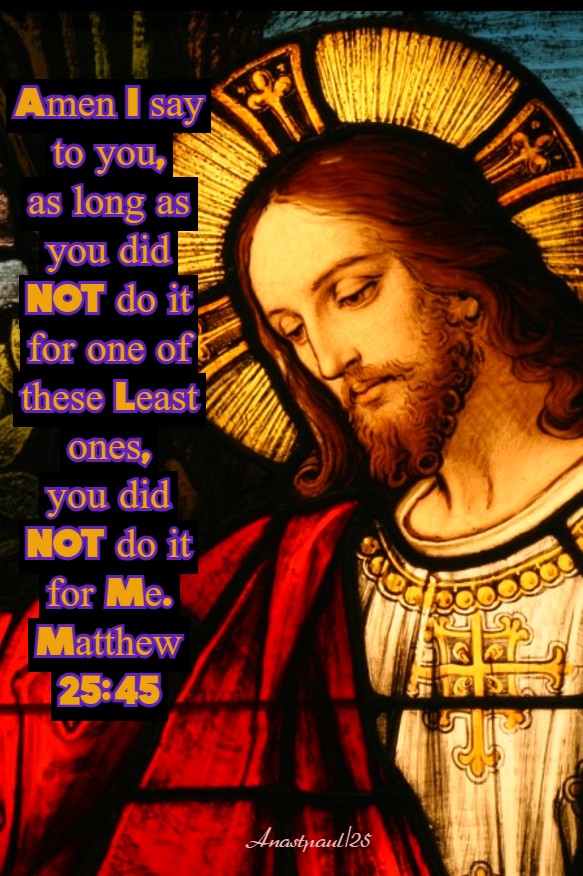
“Amen I say to you, as long as you did NOT do it for one of these least ones, you did NOT do it for Me.”
Matthew 25:45
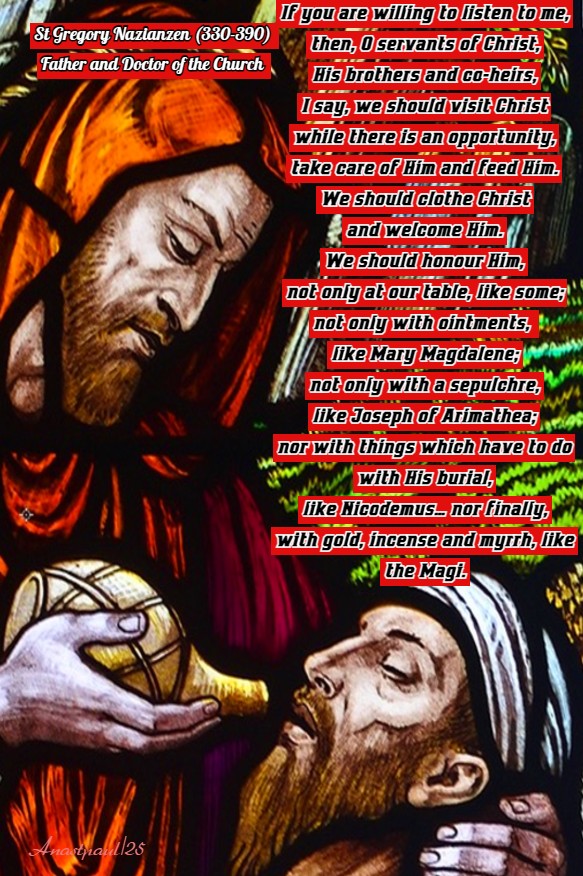
“If you are willing to listen to me, then, O servants of Christ, His brothers and co-heirs, I say, we should visit Christ while there is an opportunity, take care of Him and feed Him. We should clothe Christ and welcome Him. We should honour Him, not only at our table, like some; not only with ointments, like Mary Magdalene; not only with a sepulchre, like Joseph of Arimathea; nor with things which have to do with His burial, like Nicodemus… nor finally, with gold, incense and myrrh, like the Magi.”
St Gregory Nazianzen (330-390) Father and Doctor of the Church
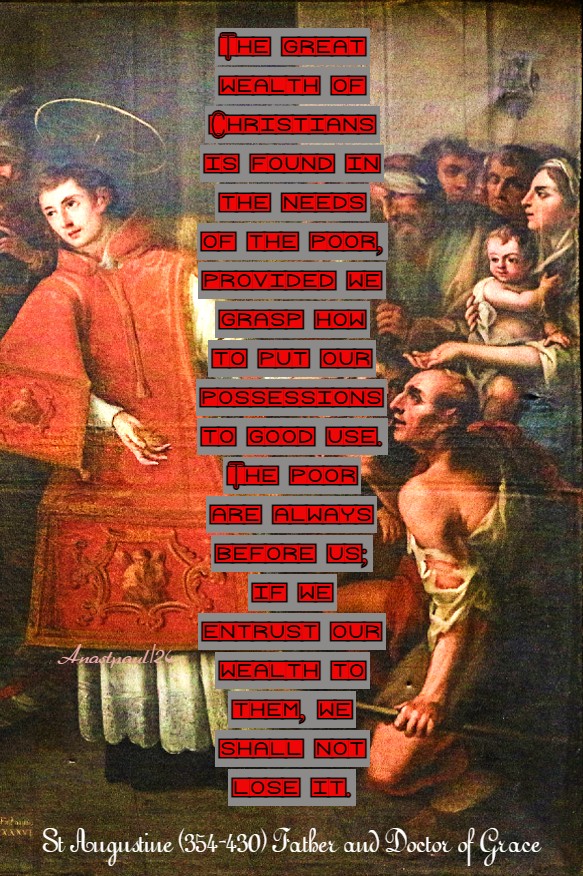
“The great wealth of Christians is found in the needs of the poor, provided we grasp how to put our possessions to good use. The poor are always before us; if we entrust our wealth to them, we shall not lose it.”
St Augustine (354-430) Father and Doctor of Grace
“The Most Blessed Sacrament is Christ made visible. The poor sick person is Christ again made visible.”
Quote/s of the Day – 2 March – Quinquagesima Sunday
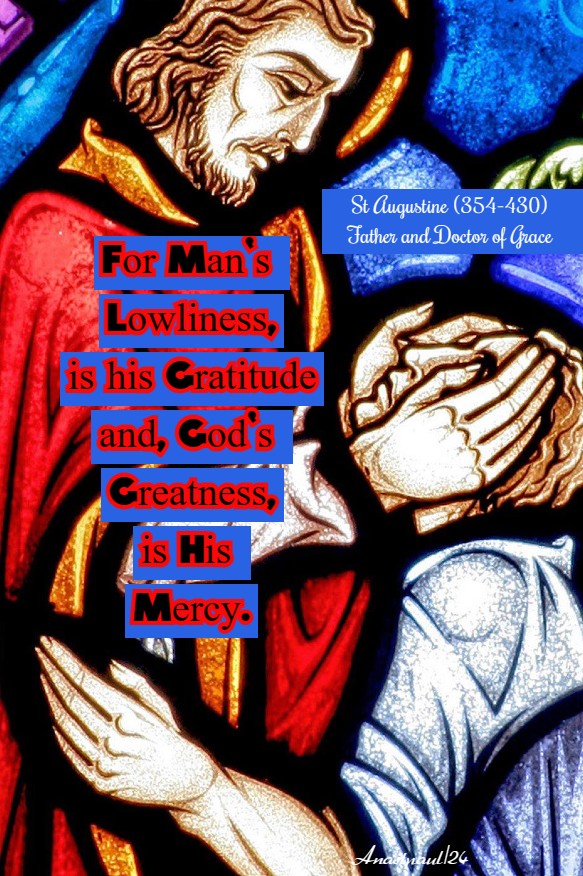
“ For man’s lowliness, is his gratitude and, God’s greatness, is His Mercy.”
St Augustine (354-430) Father and Doctor of Grace
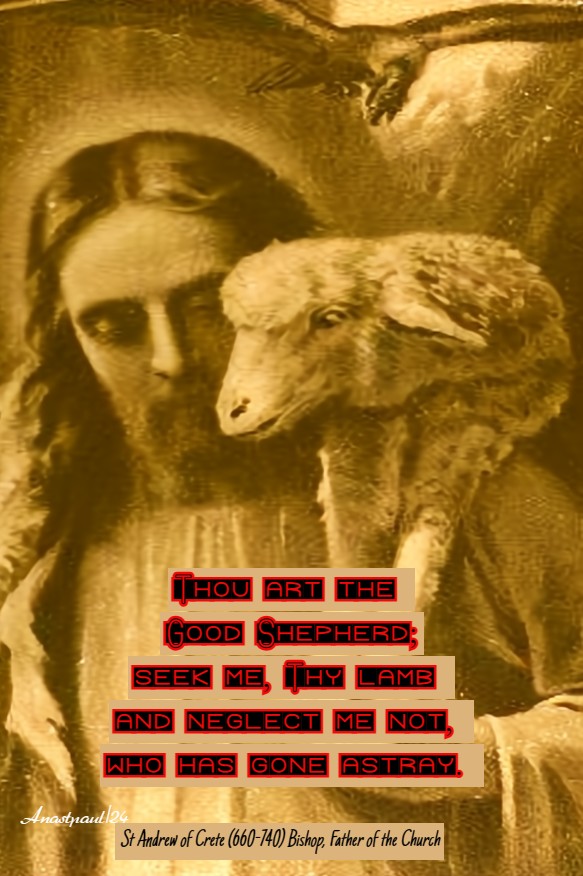
“Thou art the Good Shepherd; seek me, Thy lamb and neglect me not, who has gone astray. [John 10:11-14]”
St Andrew of Crete (660-740) Bishop, Father of the Church
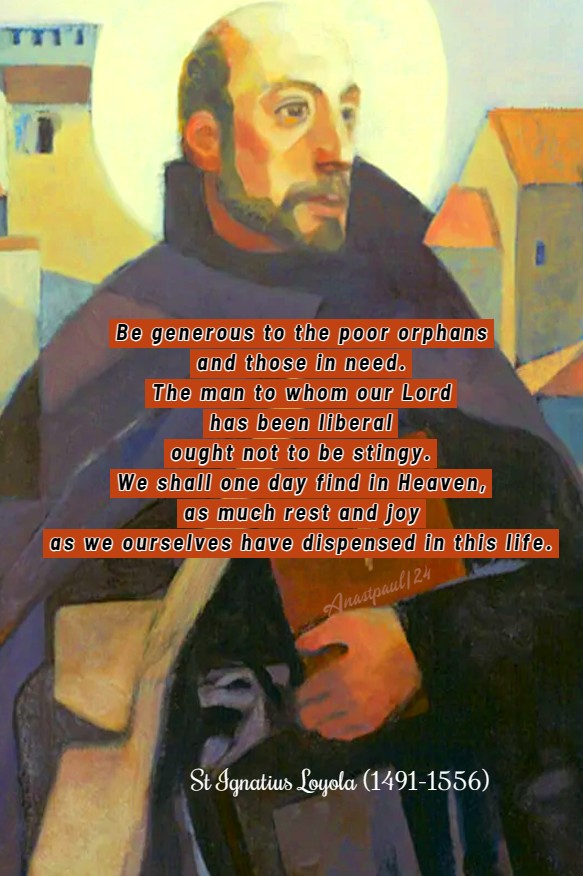
“Be generous to the poor orphans and those in need. The man to whom our Lord has been liberal ought not to be stingy. We shall one day find in Heaven, as much rest and joy as we ourselves have dispensed in this life.”
St Ignatius Loyola (1491-1556)
“I often speak with my Teacher, Jesus, in the Blessed Sacrament because I learn from Him. Jesus is the Teacher of the science of holiness. I go to Him because I would like to learn, from Him, how to become a Saint. Of what use to me is all knowledge and education, if I do not become holy?”
Quote/s of the Day – 9 February – St Cyril of Alexandria (376-444) “The Pillar of Faith” “Doctor of the Incarnation,” Bishop,Confessor, Father and Doctor, of the Church
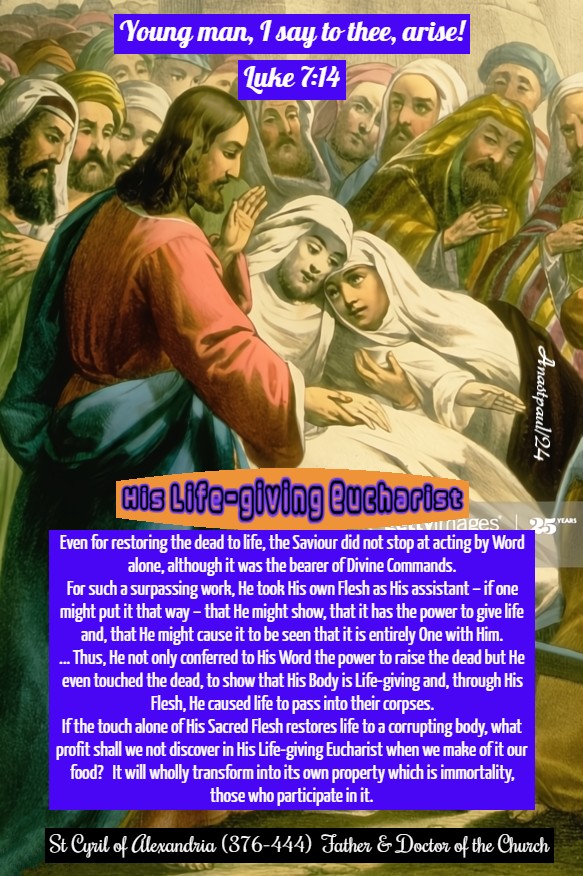
“Young man, I say to thee, arise!” Luke 7:14
“Even for restoring the dead to life, the Saviour did not stop at acting by Word alone, although it was the bearer of Divine Commands. For such a surpassing work, He took His own Flesh as His assistant – if one might put it that way – that He might show, that it has the power to give life and, that He might cause it to be seen that it is entirely One with Him. … Thus, He not only conferred to His Word the power to raise the dead but He even touched the dead, to show that His Body is Life-giving and, through His Flesh, He caused life to pass into their corpses. If the touch alone of His Sacred Flesh restores life to a corrupting body, what profit shall we not discover in His Life-giving Eucharist when we make of it our food? It will wholly transform into its own property which is immortality, those who participate in it.”
“At that time, the Lord appointed seventy-two others and sent them forth …” Luke 10:1
“By saying that He is sending them as the Father has sent Him, therefore, He summarised, in a few words, the character of the Apostles’ mission. In this way, they would know that they were bound to call sinners to repentance, to heal the sick, whether of body or soul and in all their dealings as stewards, not by any means to follow their own will but the will of Him Who sent them and, finally, to save the world, insofar as it received the teachings of the Lord.”
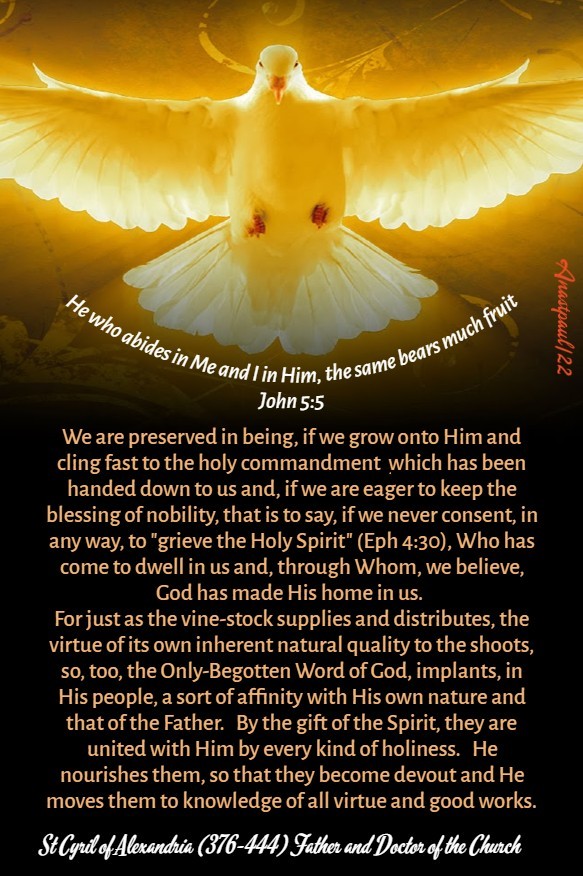
“He who abides in Me and I in Him, the same bears much fruit” John 5:5
“We are preserved in being, if we grow onto Him and cling fast to the holy commandment, which has been handed down to us and, if we are eager to keep the blessing of nobility, that is to say, if we never consent, in any way, to “grieve the Holy Spirit” (Eph 4:30), Who has come to dwell in us and, through Whom, we believe, God has made His home in us. … For just as the vine-stock supplies and distributes, the virtue of its own inherent natural quality to the shoots, so, too, the Only-Begotten Word of God, implants, in His people, a sort of affinity with His own nature and that of the Father. By the gift of the Spirit, they are united with Him by every kind of holiness. He nourishes them, so that they become devout and He moves them to knowledge of all virtue and good works.”
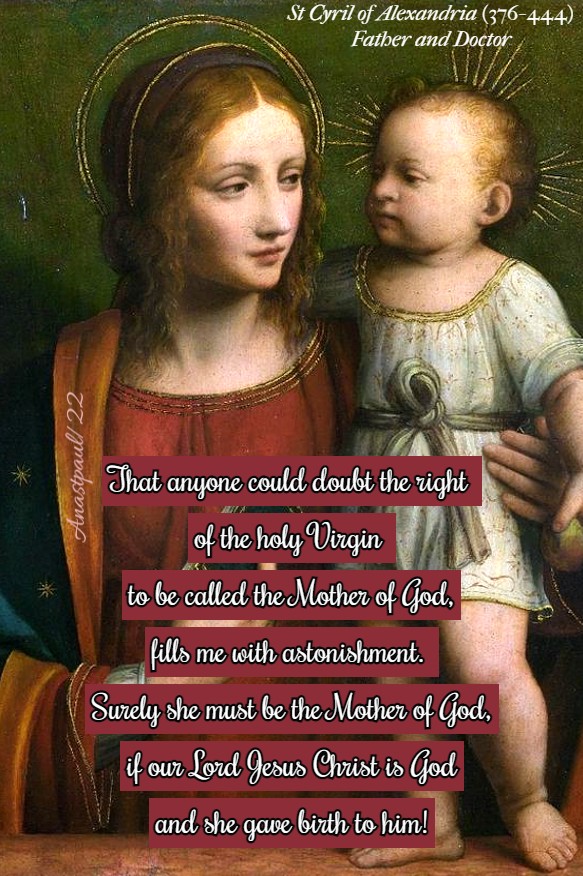
“That anyone could doubt the right of the holy Virgin to be called the Mother of God, fills me with astonishment. Surely she must be the Mother of God, if our Lord Jesus Christ is God and she gave birth to Him!”
Thought for the Day – 10 January – Meditations with Fr Richard Frederick Clarke SJ (1839-1900)
Meditations for Christmastide “The Holy Infancy” From “The Devout Year” By Fr Richard Frederick Clarke SJ (1839-1900)
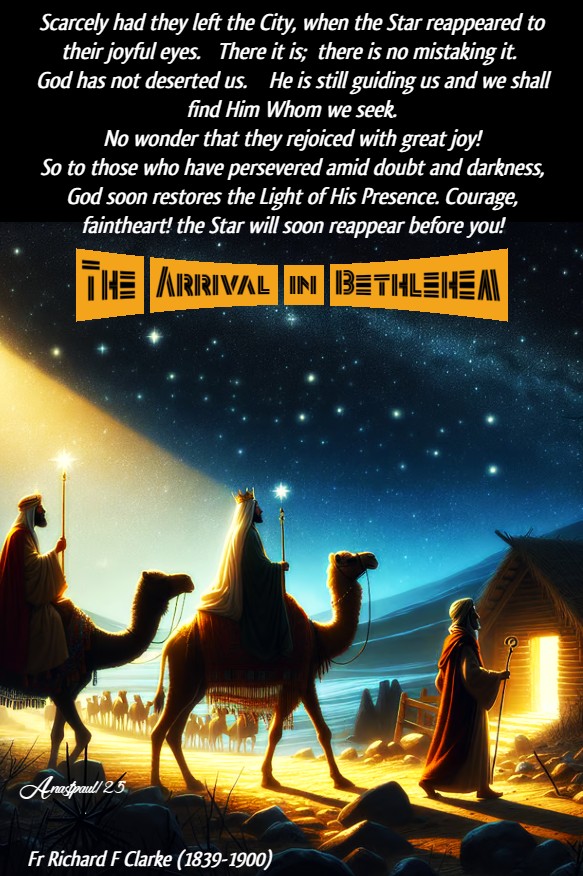
“The Arrival in Bethlehem”
+1. When the Wise Men had obtained the information they needed, they wasted no further time in Jerusalem but turned their steps towards the Village of Bethlehem. Their faith was being very sorely tried. The Star had disappeared and the inhabitants of Jerusalem, instead of sharing their eagerness to find the Newborn King, seemed to be either indifferent or. positively hostile to the idea of His Presence in their midst. So Jesus, in the Blessed Sacrament, lies waiting in the Tabernacle for a visit from those whom He loves. They have no longing for Him, no desire for His Company. Only a few faithful souls go to pay their court to Him. Am I one of them?
+2. Scarcely had they left the City, when the Star reappeared to their joyful eyes. There it is; there is no mistaking it. God has not deserted us. He is still guiding us and we shall find Him Whom we seek. No wonder that they rejoiced with great joy! So to those who have persevered amid doubt and darkness, God soon restores the Light of His Presence. Courage, faintheart! the Star will soon reappear before you!
+3. At length, the Star, instead of moving above them in the heavens, came nearer to earth and settled on the humble dwelling-place where Jesus and His Mother abode. What! the King of the Jews in that poverty-stricken shed? Yes, so it is; Christ scorns the gilded palace and loves the humble hut. There He is at home; thither He invites His friends to come and see how He dwells with the poor and humble of heart.
Thought for the Day – 27 December – Meditations with Fr Richard Frederick Clarke SJ (1839-1900)
Meditations for Advent From “The Devout Year” By Fr Richard Frederick Clarke SJ (1839-1900)
“O Emmanuel”
“O Emmanuel, our King and Lawgiver, the expectation of the nations and their Saviour, Come to save us, O Lord our God!”
+1. Emmanuel, God with us, is a Name which in every way belongs to Christ Our Lord. He is with His people in all their needs, ever ready to help and console them. He is with us on every Altar, waiting for us to come and pour out our sorrow and our needs before Him. He is with us, above all, in Holy Communion, when He Comes to dwell in our heart and to bring with Him every grace we need. He is with us in the hour of death and He will be with us forever in Heaven.
+2. He Who thus Comes to dwell with us in familiar friendship is our King; He Who thus condescends to be our companion, is the God Who has an absolute right to our obedience. He is our Lawgiver and the statutes He enacts for us have but one end and aim and object, to lead His subjects into the ways of happiness and the paths of peace .
+3. Come then, O God, our Lord and our Saviour. Come and save us from all the perils of the Evil One and from our own weakness and frailty. Come and save us in the hour of temptation, for Thou alone art our King and none save Thee shalt rule over us. Come and bring us safely through this vale of tears to Thy Eternal Kingdom, where we shall dwell forever, O sweet Jesus, in the everlasting delights of Thy blissful Company.
Quote/s of the Day – 28 November – St Catherine Labouré DC (1806-1876) Visionary of the Miraculous Medal
“When I go to the Chapel, I place myself before the good God and I say to Him: ‘Lord, I am here. Tell me what Thou would have me do.’ If He gives me some task I am content and I thank Him. If He gives me nothing, I still thank Him Since I do not deserve to receive anything more than that, and then, I tell God everything that is in my heart. I tell hIm about my pains and my joys and then I listen. … God always speaks to you when you approach Him plainly and simply.”
Our Morning Offering – 17 November – Pentecost XXVI
Soul of My Saviour, Sanctify My Breast Trans. Attri. to Fr John Hegarty (1752-1834)
Soul of my Saviour, sanctify my breast; Body of Christ, be Thou my saving Guest; Blood of my Saviour, bathe me in Thy tide; Wash me with water flowing from Thy side.
Strength and protection, may Thy Passion be; O Blessed Jesus, hear and answer me; Deep in Thy Wounds, Lord, hide and shelter me; So shall I never, never, part from Thee.
Hear me, Lord Jesus, listen as I pray; “Lead me from night, to never-ending day. Fill all the world, with love and grace Divine, And glory, laud and praise, be ever Thine.”
This Hymn is based on the original Latin text of the Anima Christi. Fr Hegarty is attributed with its translation and/or arrangement. He was born in County Derry, Ireland, educated at Dublin University and was Ordained in June 1890 and spent most of active apostolic years in Brisbane, Australia. He died aged 82 years.























 AnaStpaul
You must be logged in to post a comment.