Posted in CHRISTMASTIDE!, FEASTS and SOLEMNITIES, SAINT of the DAY

Feast of the Holy Innocents and Memorials of the Saints – 28 December

Holy Innocents (Feast)
About: https://anastpaul.wordpress.com/2017/12/28/saints-of-the-day-feast-of-the-holy-innocents-28-december-4th-day-of-the-christmas-octave/

St Anthony of Lérins
St Caesarius of Armenia
BL Claudia Weinhardt
St Conindrus
St Domitian the Deacon
St Domnio of Rome
St Eutychius
St Gowan of Wales
Bl Gregory of Cahors
Bl Hryhorii Khomyshyn
St Iolande of Rome
Bl Johannes Riedgasser
Bl Nicolas Mello
Bl Otto of Heidelberg
St Romulus
St Simon the Myroblite
St Theonas of Alexandria
St Theodore of Tabenna
St Troadius of Pontus

20,000 Martyrs of Nicomedia: 20,000 Christians who were murdered during in 303 in Nicomedia, Bithynia (modern Izmit, Turkey) during the persecutions of Diocletian. Many of them were killed en masse when they were ordered, during Christmas Mass, to sacrifice to idols; when they refused, they were locked in the churches and the buildings burned around them. We know some details of a few of them, but most are known only to God. The names we have are – Agape, Anthimos, Domna, Domna, Dorotheus, Esmaragdus, Eugene, Euthymius, Glykerios, Gorgonius, Hilary, Indes, Mardonius, Mardonius, Maximus, Migdonius, Migdonus, Peter, Peter, Theophila, Theophilus and Zeno. 303 in Nicomedia, Bithynia (modern Izmit, Turkey).

Martyrs of Africa – (3 saints): Three Christians murdered together in Africa for their faith. The only details to survive are their names – Castor, Rogatian and Victor.

Posted in CHRISTMASTIDE!, EASTER, FEASTS and SOLEMNITIES, ON the SAINTS, SAINT of the DAY, The APOSTLES & EVANGELISTS, The RESURRECTION

Thought for the Day – 27 December – “The Greatest Easter Painting Ever Made”

Thought for the Day – 27 December – the Feast of St John the Apostle and Evangelist “The Disciple whom Jesus Loved” and the 3rd Octave Day – “The Greatest Easter Painting Ever Made”

So she ran and went to Simon Peter and the other disciple, the one whom Jesus loved and said to them, “They have taken the Lord out of the tomb and we do not know where they have laid him.”   Peter then came out, with the other disciple and they went toward the tomb.   They both ran but the other disciple outran Peter and reached the tomb first and stooping to look in, he saw the linen cloths lying there but he did not go in.   Then Simon Peter came, following him and went into the tomb, he saw the linen cloths lying and the napkin, which had been on his head, not lying with the linen cloths but rolled up in a place by itself.   Then the other disciple, who reached the tomb first, also went in and he saw and believed...John 20:2–8

Tucked away in a central Parisian museum that was once a railway station, there hangs an Easter painting quite unlike any Gospel masterpiece created before or after it.   It is not painted by a Rembrandt or a Rubens or the patron saint of artists, Fra Angelico.   The painting is the work of a little-known Swiss painter.   For those who make a trip to see it, viewing the canvas is a special spiritual experience in their lives.

The work does not even show the risen Jesus.   It merely portrays two witnesses, Jesus’ oldest and youngest apostle.   The youngest who was the only man brave enough to stay by Jesus’ cross and the only one who did not die a martyr’s death as a result of it.   The oldest apostle, who first denied Jesus in fear, yet ultimately chose to be crucified upside down by the Roman authorities, rather than deny Christ’s resurrection.

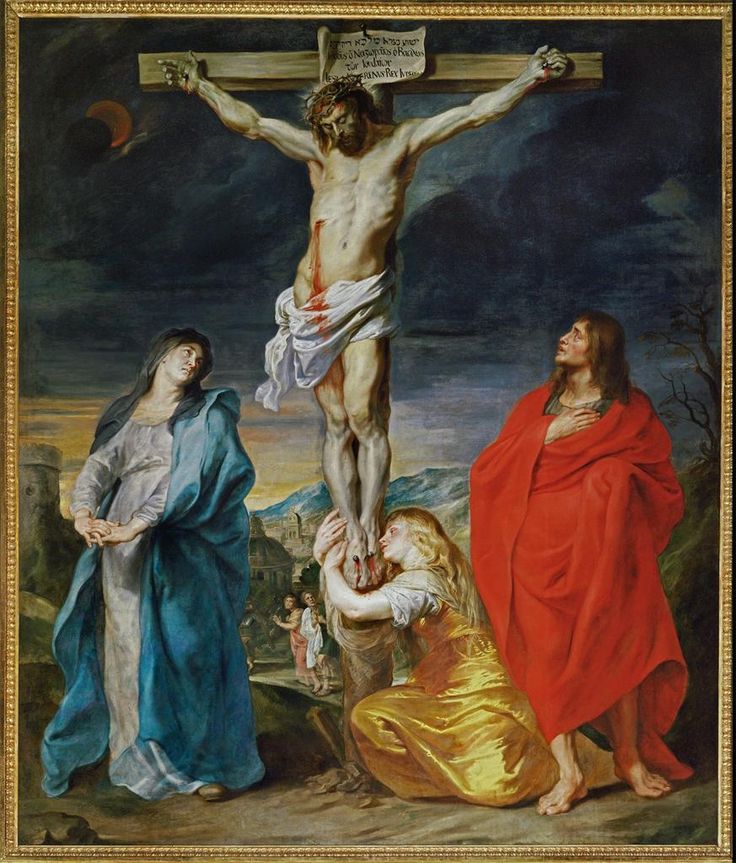
Mary, John & Mary of Magdala at the cross-antoon-van-dyck-follow-jesus
Anton van Dyck

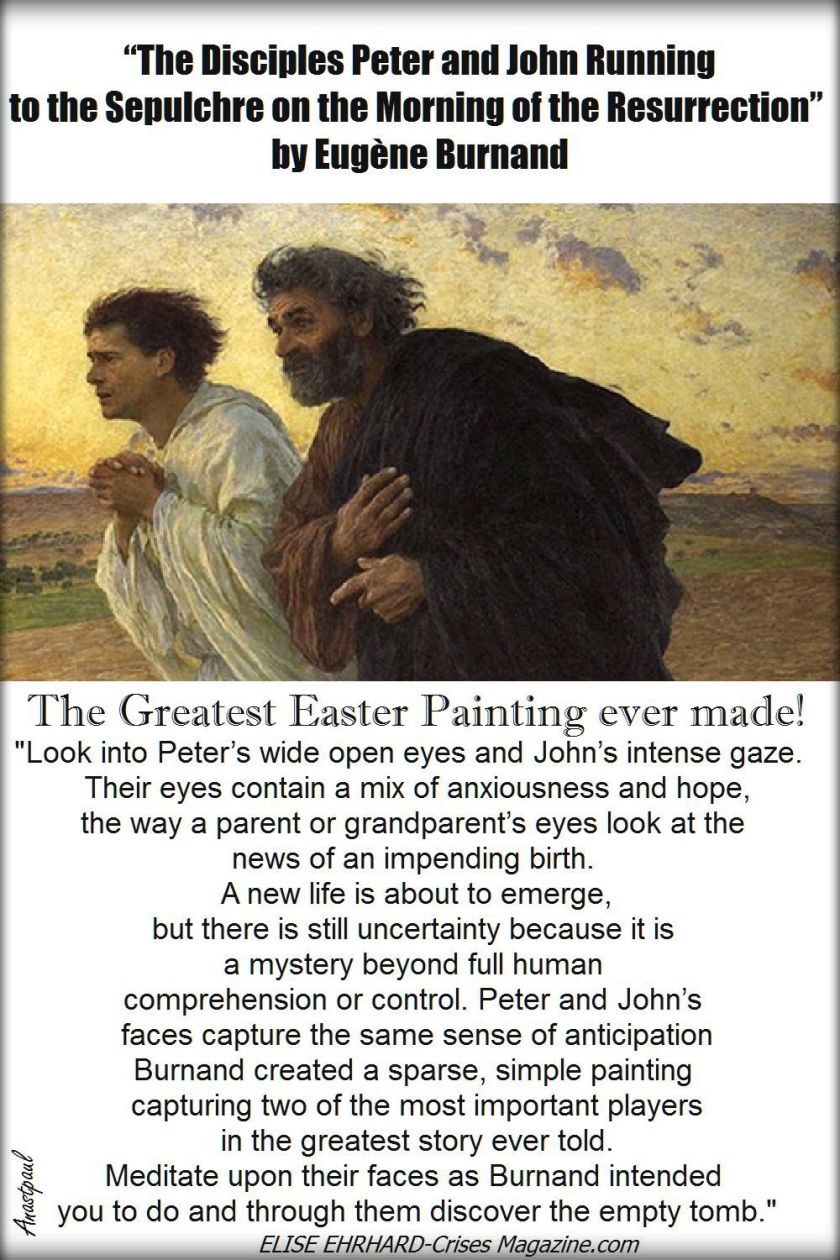
In “The Disciples Peter and John Running to the Sepulchre on the Morning of the Resurrection” by Eugène Burnand, John clasps his hand in prayer while Peter holds his hand over his heart.   The viewer feels the rush as their hair and cloaks fly back with the wind.   They are sprinting towards discovery of the moment that forever altered heaven and earth.   As you look at it, engage for a moment in what the Catholic blogger Bill Donaghy calls “the visual equivalent of Lectio Divina.”   As Donaghy notes, “This Resurrection scene does not put us before still figures near a stagnant stone, or figures standing with stony faces in a contrived, plastic posture, pointing to an empty tomb.   This scene is dynamic; we are in motion.”

During his time, Burnand was fascinated by the possibilities of the emerging art of photography.   Ironically, he would later be dismissed in the twentieth century as too “bourgeois” and anti-modernist when in fact he was merging his love of tradition with his interest in new technological ways of capturing the human person.   His painting feels cinematic long before cinema existed as a major art form.

Through the movement and immediacy of the scene, the preceding minutes with Mary Magdalene are palpable.   In a sense, she is in the painting too.   “You can almost hear her voice in the background, can you not, a few minutes earlier, as she burst into their house…” writes the Episcopal Bishop Dorsey McConnell in an Easter sermon meditating on the painting.

Apart from Jesus’ mother, no other three participants capture the closeness of Jesus’ encounter with humankind quite like John, Peter and Mary of Magdala.   Their interactions with Christ embody a relationship to God previously unimaginable to mankind.   Jesus turning to Peter as they sit by the fire and asking three times, “Do you love me?”, thereby washing away the sin of the three denials past;  Christ turning to John in the midst of his suffering and saying, “Behold, your mother,” giving her to the Church entire.   And, of course, the beautiful moment about to transpire in which Jesus’ merely says Mary’s name and she recognises Him with a cry of “Rabbouni!”   They are the moments which cause one to wonder, how those who truly hate Christianity (not merely disbelief it) can remain so hostile to its narrative beauty.

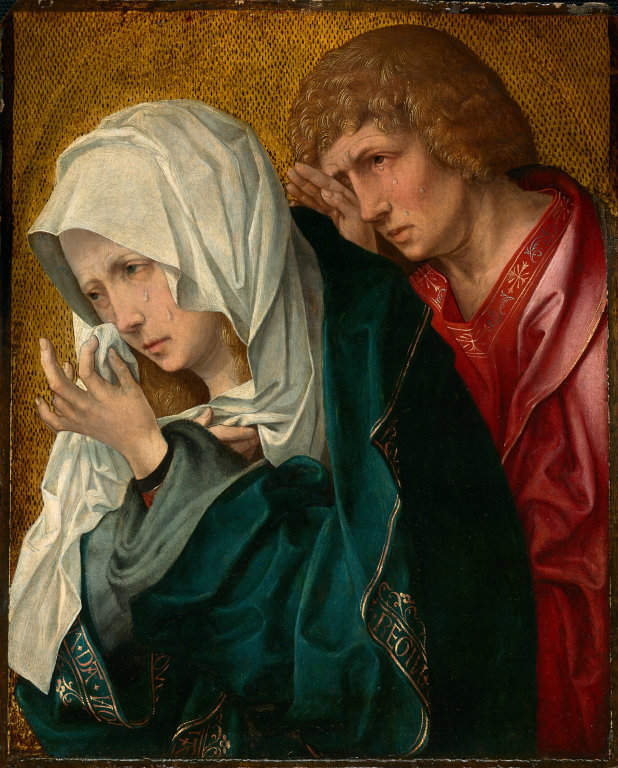
st john and the sorrowful mother - van-weyden-at-the-cross
By Rogier van Weyden (1400-1464)
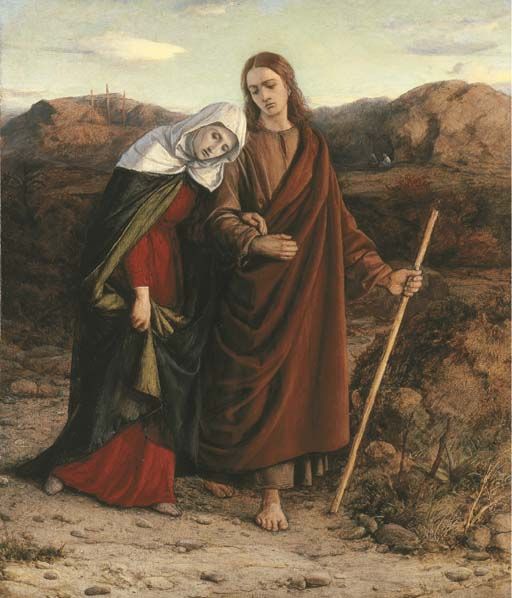
st john and mary - beloved-by-dyce
By William Dyce (1806-1864)

Look into Peter’s wide open eyes and John’s intense gaze.   Their eyes contain a mix of anxiousness and hope, the way a parent or grandparent’s eyes look at the news of an impending birth.   A new life is about to emerge but there is still uncertainty because it is a mystery beyond full human comprehension or control.   Peter and John’s faces capture the same sense of anticipation.

Burnand created a sparse, simple painting capturing two of the most important players in the greatest story ever told.   Meditate upon their faces, as Burnand intended you to do and through them, discover the empty tomb.the-greatest-easter-painting-elise-ehrhard-crises-mag1- used again today 27dec2018

St John, Beloved of the Lord, Pray for us!beloved st john pray for us 27 dec 2018

Posted in DOCTORS of the Church, FATHERS of the Church, FEASTS and SOLEMNITIES, ON the SAINTS, QUOTES of the SAINTS, QUOTES on DIVINE PROVIDENCE, QUOTES on FAITH, QUOTES on GRACE, QUOTES on LOVE, QUOTES on OBEDIENCE, QUOTES on SANCTITY, QUOTES on SUFFERING, SAINT of the DAY, The APOSTLES & EVANGELISTS, The WORD

Quote/s of the Day – 27 December

Quote/s of the Day – 27 December – the Feast of St John the Apostle and Evangelist “The Disciple whom Jesus Loved” and the 3rd Octave Day and the Memorial of Blessed Sára Salkaházi (1899–1944) Martyr

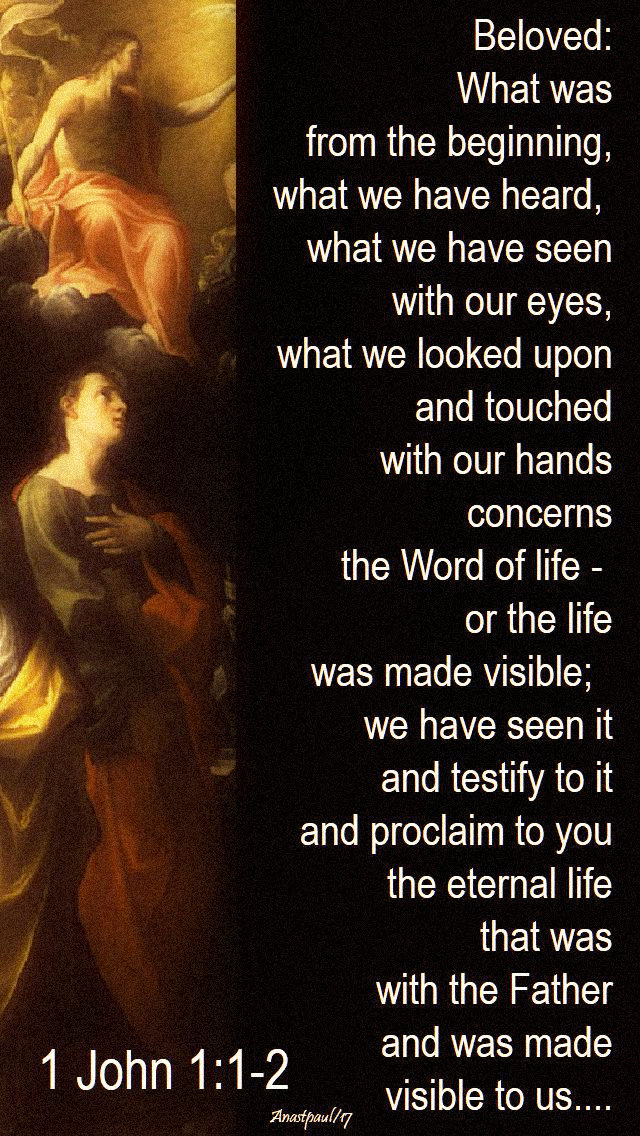
Beloved: 

What was from the beginning, what we have heard, what we have seen with our eyes, what we looked upon and touched with our hands concerns the Word of life (for the life was made visible;  

we have seen it and testify to it and proclaim to you the eternal life that was with the Father and was made visible to us.…

1 John 1:1-2beloved what was from the beginning, what we have heard - 1-john-1-1-to-2-27dec2017

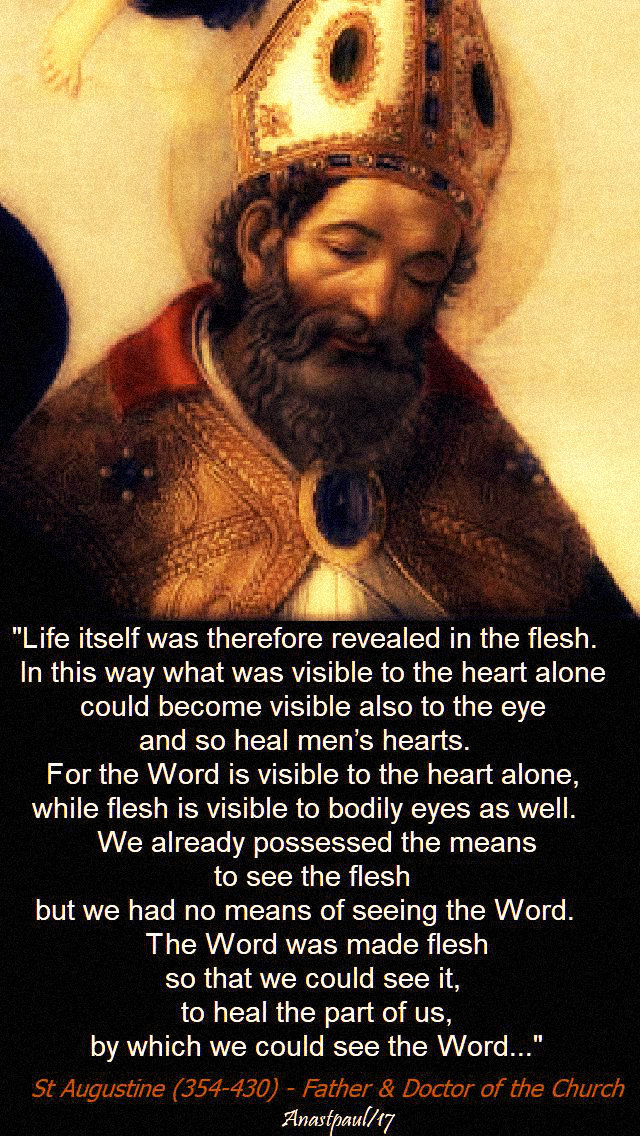
“Life itself was therefore revealed in the flesh.
In this way what was visible to the heart alone,
could become visible also to the eye
and so heal men’s hearts.
For the Word is visible to the heart alone,
while flesh is visible to bodily eyes as well.
We already possessed the means to see the flesh
but we had no means of seeing the Word.
The Word was made flesh so that we could see it,
to heal the part of us,
by which we could see the Word…”

St Augustine (354-430) – Father & Doctor of the Churchlife-itself-was-therefore-revealed-st-augustine-27-dec-2017

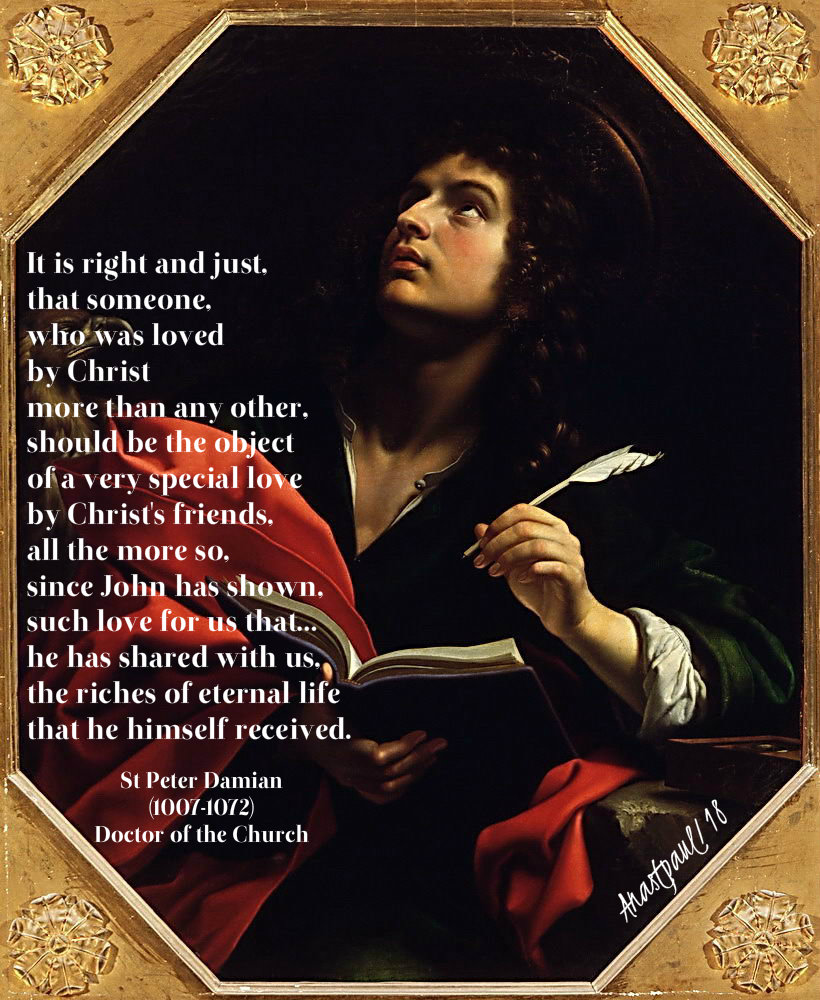
“It is right and just, that someone, who was loved by Christ
more than any other, should be the object
of a very special love, by Christ’s friends,
all the more so, since John has shown such love for us that…
he has shared with us, the riches of eternal life, that he himself received.
Indeed, God gave him, the keys to wisdom and knowledge (cf Lk 11:52)…it is right and just that someone who was loved - st peter damian on st john 27 dec 2018

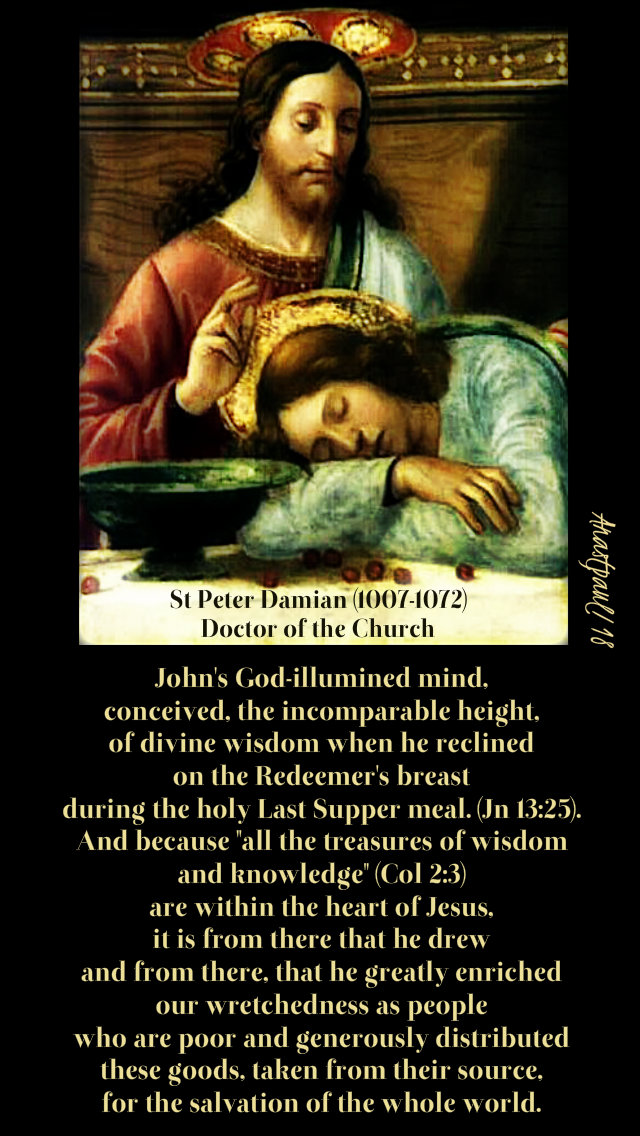
John’s God-illumined mind, conceived the incomparable height of divine wisdom, 
when he reclined on the Redeemer’s breast, during the holy Last Supper meal (Jn 13:25).
And because “all the treasures of wisdom and knowledge” (Col 2:3)
are within the heart of Jesus, it is from there, that he drew
and from there, that he greatly enriched our wretchedness, 
as people who are poor and generously distributed these goods,
taken from their source, for the salvation of the whole world.
And because this blessed John speaks about God
in a marvellous way, that cannot be compared to that of anyone else,
it is only right that the Greeks as well as the Latins
have given him the name of “Theologian”.
Mary is “Theotokos” because she has truly given birth to God;
John is “Theologos” because he saw in an indescribable way,
that the Word of God, was with the Father
before the beginning of time and was God (Jn 1:1)
and because, too, he spoke about this, with extraordinary depth.”

St Peter Damian (1007-1072) Doctor of the Churchjohn's god illumined mind - st peter damian 27 dec 2018

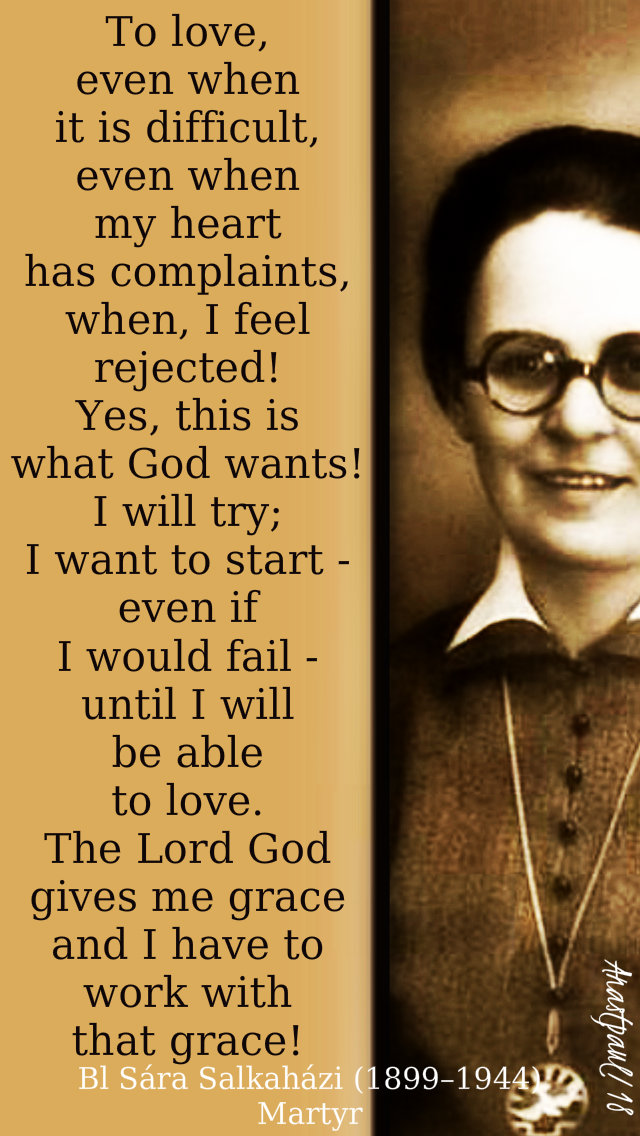
“To love, even when it is difficult,
even when my heart has complaints,
when, I feel rejected!
Yes, this is what God wants!
I will try;  I want to start – even if I would fail –
until I will be able to love.
The Lord God gives me grace
and I have to work with that grace!”to love even when - bl sara salkahazi 27dec2018

“I want to follow You wherever You take me,
freely, willingly, joyfully.
Break my will!
Let Your will reign in me!
I do not want to make my own plans.
Let Your will be done in me and through me.
No matter how hard it might be,
I want to love Your will!
I want to be one with You,
my Beloved, my Spouse.”

Blessed Sára Salkaházi (1899–1944) Martyr

Blessed Sára in her spiritual diaryi want to follow you wherever you take me - bl sara salkahazi 27dec2018

Posted in CHRISTMASTIDE!, DOCTORS of the Church, FEASTS and SOLEMNITIES, MORNING Prayers, QUOTES of the SAINTS, The NATIVITY of JESUS, The PASSION, The WORD

Christmas Wisdom with St Alphonsus Liguori (1696-1787)

Christmas Wisdom with St Alphonsus Liguori (1696-1787)

27 December – The Third Day of the Christmas Octave

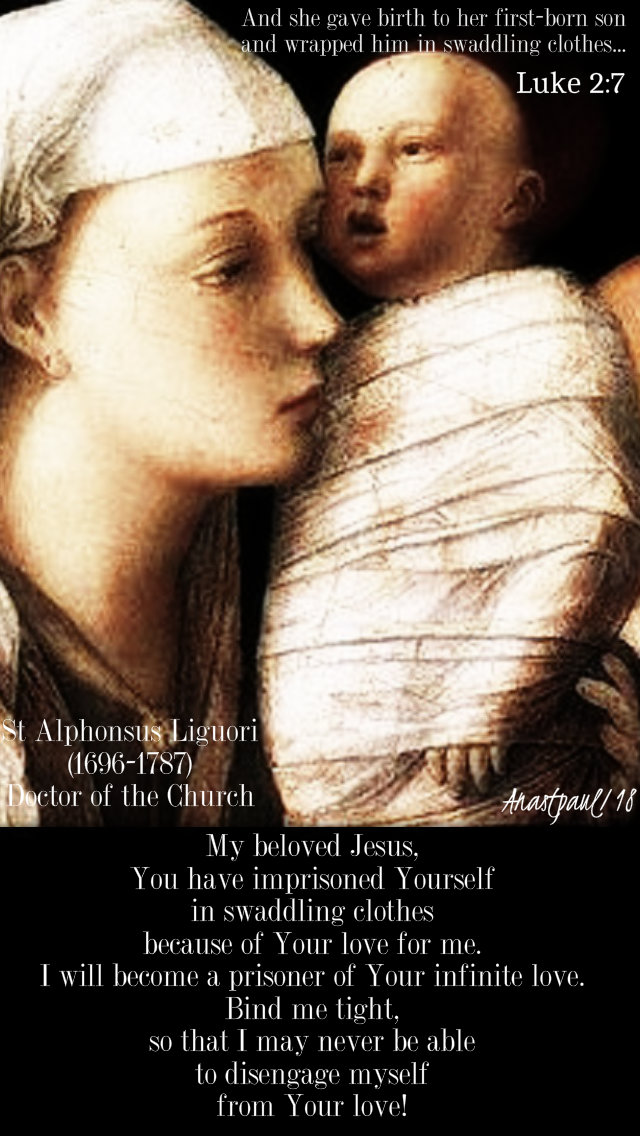
Jesus in swaddling clothes

“Consider the Blessed Mother, having given birth to her Son, now takes Him with reverence in her arms, adoring Him as God and then wrapping Him in swaddling clothes. Behold the infant Jesus, who obediently offers His little hands and feet and allows Himself to be swaddled. Consider, that every time the holy Infant allowed Himself to be swathed, He thought of the cords with which He would one day be bound and led captive from the Garden of Gethsamene. Also, consider the cords which secured Him to the column on which He was whipped and the nails which would secure Him to His Cross. All of this He permitted, in order to deliver our souls from the chains of hell. Bound in these swaddling clothes, Jesus turns to us and invites us to unite ourselves with Him, with the holy bonds of love.”

Scripture

And she gave birth to her first-born son
and wrapped him in swaddling clothes
and laid him in a manger,
because there was no place for them in the inn.

Luke 2:7

Prayer (St Alphonsus)

“My beloved Jesus,
You have imprisoned Yourself
in swaddling clothes
because of Your love for me.
I will become a prisoner
of Your infinite love.
Bind me tight,
so that I may never be able
to disengage myself
from Your love!
Amen”and she wrapped him in swaddling christmas with st alphonsus -luke 2 7 - my beloved jesus 27dec2017

Posted in FEASTS and SOLEMNITIES, SAINT of the DAY, The APOSTLES & EVANGELISTS

27 December – Feast of St John Apostle and Evangelist and Memorials of the Saints

St John the Apostle and Evangelist (Feast)
St John the Beloved: https://anastpaul.wordpress.com/2017/12/27/saint-of-the-day-27-december-st-john-the-apostle-and-evangelist/

Bl Adelheidis of Tennenbach
Bl Alejo Pan López
Bl Alfredo Parte-Saiz
Bl Christina Ebner
St Fabiola of Rome
Bl Francesco Spoto
Bl Hesso of Beinwil
St José María Corbin-Ferrer
St Maximus of Alexandria
St Nicarete of Constantinople
Bl Odoardo Focherini
Bl Raymond de Barellis
Bl Roger of Verdun
Bl Sára Schalkház S.S.S. (1899–1944) Martyr
St Theodore of Apamea
St Theophanes of Nicaea
Bl Walto of Wessobrünn

Posted in CHRISTMASTIDE!, FEASTS and SOLEMNITIES, MORNING Prayers, The NATIVITY of JESUS

Thought for the Day – 25 December – Birth of the Rebel, Jesus

Thought for the Day – 25 December – The Solemnity of the Nativity of the Lord

Birth of the Rebel, Jesus

The sounds are characteristic of the Season.   As soon as the melody of any number of Christmas carols chime, the lyrics fill our minds and once again remind us of the uniqueness of ‘the most wonderful time of the year.’   Occasionally a song comes along that we have not heard and we ask, ‘Is this a Christmas song?’   Back in the 1970’s, composer and musician Jackson Browne wrote “The Rebel Jesus” and it appeared on the Chieftans’ Christmas album, “The Bells of Dublin” a decade later. Consider the following stanzas:

We guard our world with locks and guns
And we guard our fine possessions
And once a year when Christmas comes
We give to our relations
And perhaps we give a little to the poor
If the generosity should seize us
But if any one of us should interfere
In the business of why they are poor
They get the same as the rebel Jesus

But please forgive me if I seem
To take the tone of judgement
For I’ve no wish to come between
This day and your enjoyment
In this life of hardship and of earthly toil
We have need for anything that frees us
So I bid you pleasure
And I bid you cheer
From a heathen and a pagan
On the side of the rebel Jesus.

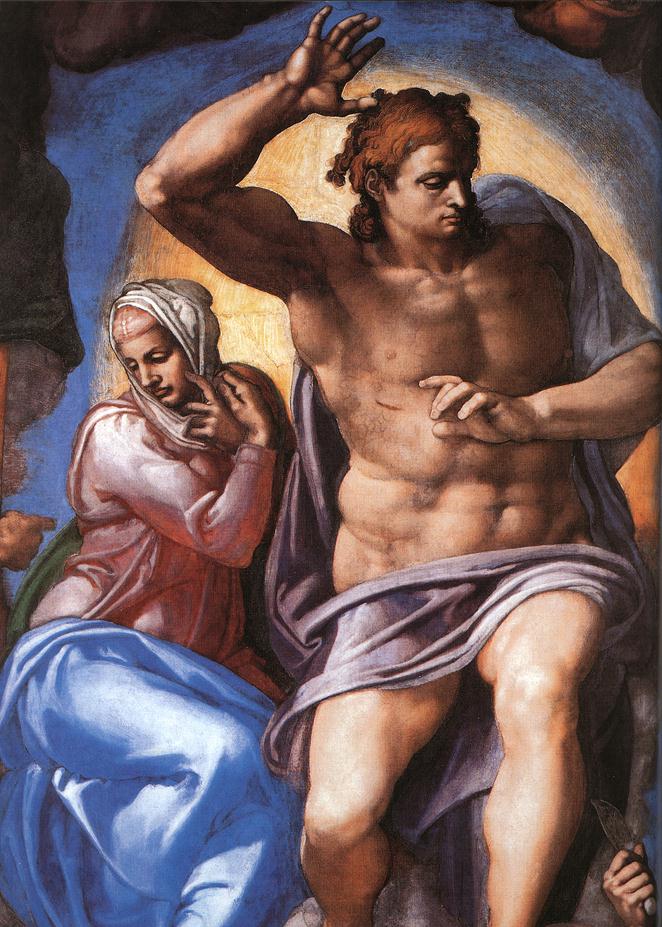
Jesus, a rebel?   Let’s face it, it is not one of the words we typically use to describe the Person and His work, especially at this time of the Year.   Many of our images of Jesus unfortunately have ‘tamed’ or ‘domesticated’ Him into being nothing more than a nice man who looks like one of the Bee Gees and taught people to be nice.   We have lost the ‘sting’ that much of His teaching brought to humanity and as such we have re-fashioned a Jesus Who is comfortable and easy-going.   With a re-fashioned Jesus, even the celebration of His Nativity has been re-written. ‘Christmas is (fill in the blank).   Christmas is for (fill in the blank).’Michelangelo,_JESUS - Giudizio_Universale_03

The reality is that no other person in recorded history has left such a mark on humanity. His birth, while legitimately celebrated with family, friends, gifts, food and good cheer, is actually a most inconvenient event for humanity.   Why is Jesus’ birth an inconvenience? Essentially, His birth challenges the status quo of self-serving entitlement and mediocrity calling us to take a stand as He in fact did throughout His life with and among us.JESUS OF THE SHROUD

Biblically, “to rebel” is not always a bad action.  In the languages of both Testaments, “to rebel” means “to stand for, to stand with” or “to stand against.”   Is this not precisely what Jesus the Rebel did when He walked the Earth?   Throughout His ‘working’ life, He continuously “stood for” doing His Father’s will.   Doing the Father’s will is adoring, worshipping and living in right-relationship with God our Father, each other and all of creation.   It is “standing for” the Father’s will in all things, not just the issues or actions I choose.   It is “standing for” the right actions that reverences life, feeds the hungry, shelters the homeless and consoles the sorrowing, to name only a few (see Matthew 25:31-45 for more on the Corporal Works of Mercy as well as their complement, the Spiritual Works of Mercy).   The Rebel Jesus “stands with” His people, never abandoning them in times of difficulty or adversity.   The Rebel Jesus ‘runs into’ situations to be with the suffering and sorrowing, not running away to seek individual relief and comfort.  The Rebel Jesus most inconveniently “stands against” sin, oppression, selfishness and arrogance expressed in any form that demeans the dignity and sacredness of the human person.   The Rebel Jesus challenges structures of society – both civil and religious – when authority is abused to make one’s life comfortable at the expense of another.carl bloch - jesus

In many of his addresses (most especially at Christmas Mass), Pope Francis has exhorted all of us to permit Jesus to find each of us in the encounter He [Jesus] desires.   As God, Jesus took on a full, complete human nature in all things but sin so that we in turn may be free from sin and live as sons and daughters of our Loving Father.   What a Gift we have been given in His birth, a birth that challenges us to be rebels like Him in standing for His Kingdom and His way of living.

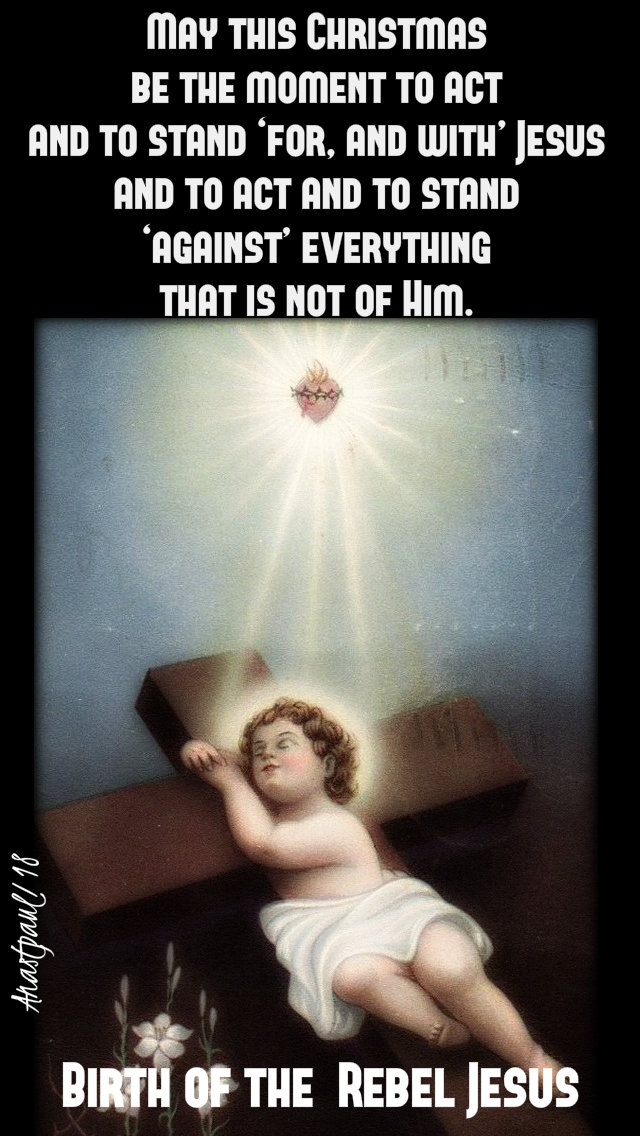
May this Christmas be the moment to act and to stand ‘for, and with’ Jesus and to act and to stand ‘against’ everything that is not of Him.

(Fr Mark J Hunt)

(birth of the rebel jesus - may this christmas - 25 dec 2018

Posted in CHRISTMASTIDE!, DOCTORS of the Church, FATHERS of the Church, FEASTS and SOLEMNITIES, MORNING Prayers, QUOTES of the SAINTS, The CHRIST CHILD, The NATIVITY of JESUS

Quote/s of the Day – 25 December – Christmas Day!

Quote/s of the Day – 25 December – Christmas Day!

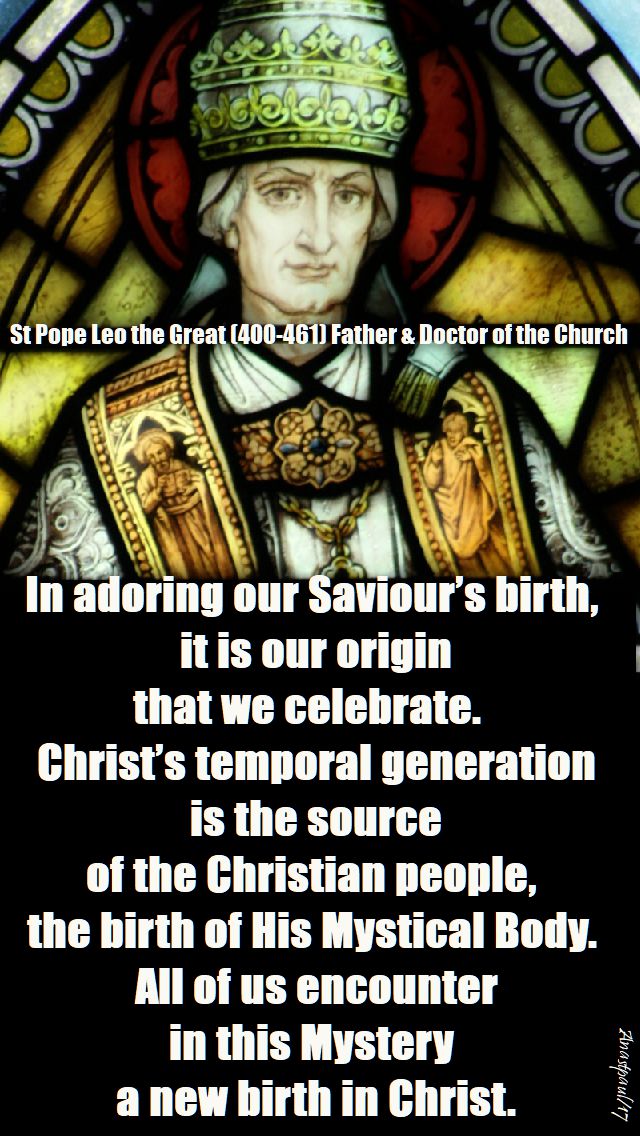
“In adoring our Saviour’s birth,
it is our origin that we celebrate.
Christ’s temporal generation
is the source of the Christian people,
the birth of His Mystical Body.
All of us encounter in this Mystery
a new birth in Christ.”

St Pope Leo the Great (400-461) Father & Doctor of the Churchin-adoring-our-saviours-birth-22-dec-2017 (1)

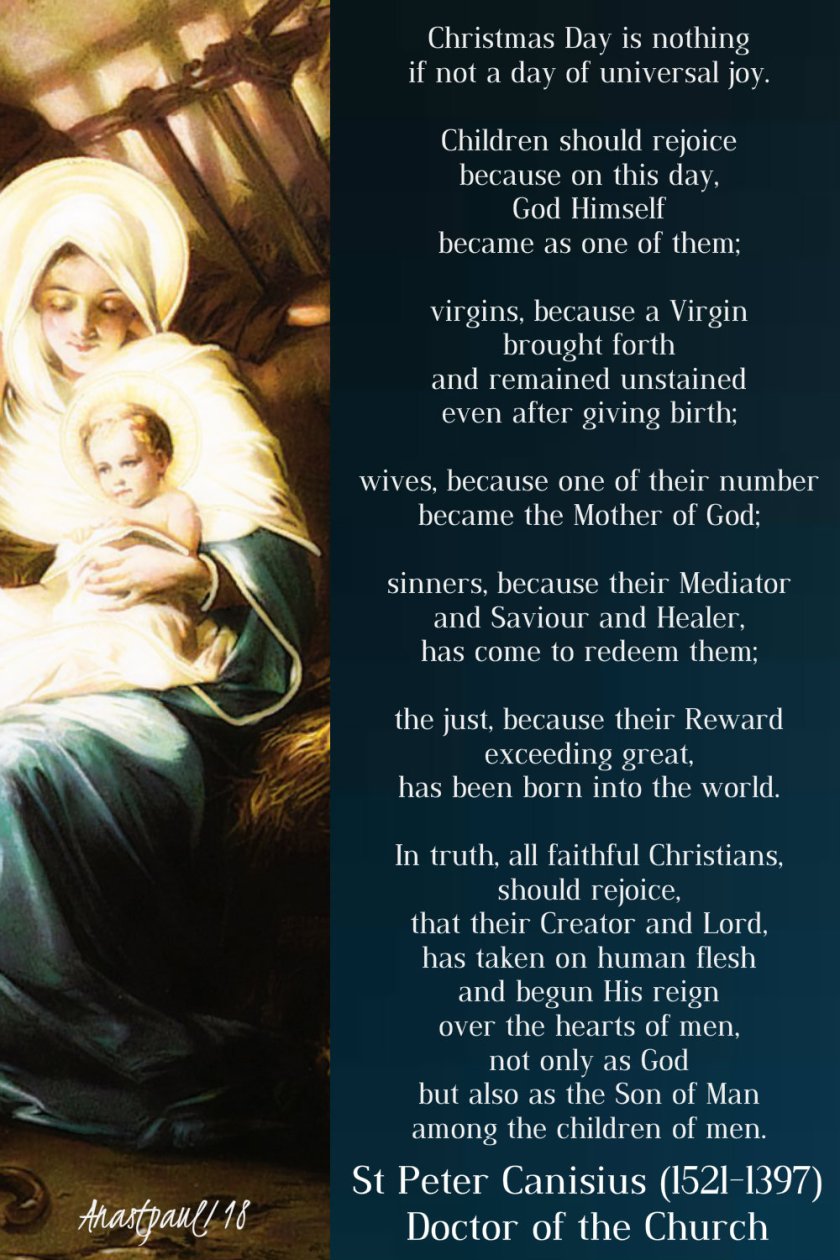
Christmas Day is nothing if not a day of universal joy.
Children should rejoice because on this day, God Himself
became as one of them;
virgins, because a Virgin brought forth and remained unstained, 
even after giving birth;
wives, because one of their number, became the Mother of God;
sinners, because their Mediator and Saviour and Healer,
has come to redeem them;
the just, because their Reward, exceeding great,
has been born into the world.
In truth, all faithful Christians,
should rejoice, that their Creator and Lord,
has taken on human flesh and begun His reign
over the hearts of men,
not only as God
but also as the Son of Man
among the children of men.christmas day is nothing if not - st peter canisius - 25 dec 2018

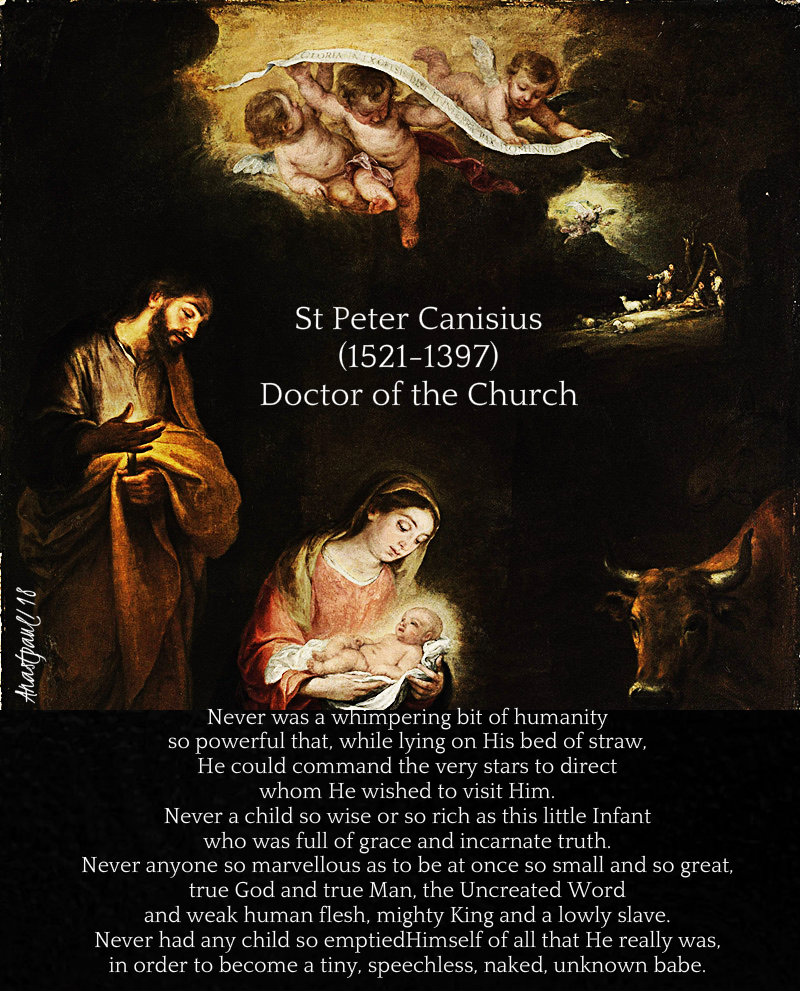
“Never was a whimpering bit of humanity
so powerful that, while lying on His bed of straw, He could command the very stars
to direct whom He wished to visit Him.
Never a child so wise or so rich as this little Infant who was full of grace and incarnate truth.
Never anyone so marvellous as to be at once so small and so great, true God and true Man, the Uncreated Word and weak human flesh, mighty King and a lowly slave.
Never had any child so emptied Himself of all that He really was, in order to become a tiny, speechless, naked, unknown babe.”

St Peter Canisius (1521-1397) Doctor of the Churchnever was a whimpering bit of humanity - st peter canisius - 25 dec 2018

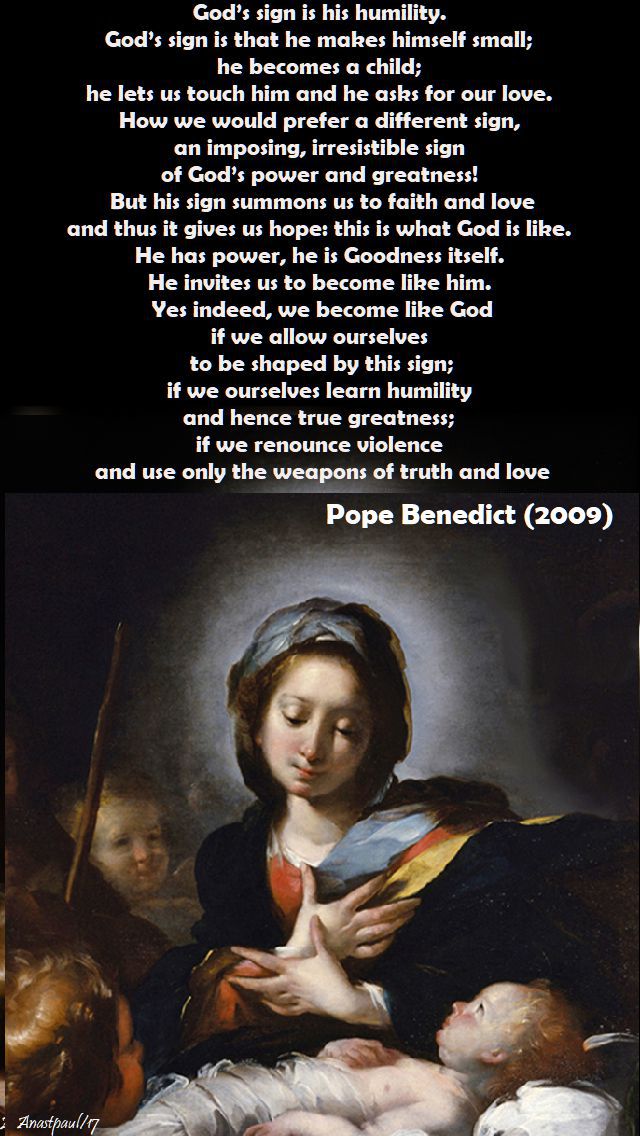
God’s sign is simplicity.
God’s sign is the baby.
God’s sign is that He makes Himself small for us.
This is how He reigns.
He does not come with power and outward splendour.
He comes as a baby – defenceless and in need of our help.
He does not want to overwhelm us with His strength.
He takes away our fear of His greatness.
He asks for our love – so He makes himself a child.
He wants nothing other from us than our love,
through which we spontaneously learn to enter into His feelings, His thoughts and His will – we learn to live with Him
and to practice with Him,
that humility of renunciation,
that belongs to the very essence of love.
God made Himself small,
so that we could understand Him, welcome Him and love Him.
The Fathers of the Church, in their Greek translation of the Old Testament,
found a passage from the prophet Isaiah that Paul also quotes,
in order to show how God’s new ways had already been foretold in the Old Testament.
There we read: “God made his Word short, he abbreviated it” (Is 10:23; Rom 9:28).
The Fathers interpreted this in two ways.
The Son Himself is the Word, the Logos – the eternal Word became small –
small enough to fit into a manger.
He became a child, so that the Word could be grasped by us.
In this way God teaches us to love the little ones.
In this way He teaches us to love the weak.
In this way He teaches us respect for children.
The child of Bethlehem directs our gaze towards all children who suffer
and are abused in the world, the born and the unborn.
Towards children who are placed as soldiers in a violent world;
towards children who have to beg;
towards children who suffer deprivation and hunger;
towards children who are unloved.
In all of these it is the Child of Bethlehem who is crying out to us –
it is the God who has become small who appeals to us.
Let us pray this night that the brightness of God’s love may enfold all these children.
Let us ask God to help us do our part, so that the dignity of children may be respected.
May they all experience the light of love,
which mankind needs so much more,
than the material necessities of life.”

Homily of Pope Benedict XVI on the Solemnity of the Nativity of the Lord, 2006god's sign - pope benedict - 19 dec 2017the son himself is the word, the logos - pope benedict 25dec2018

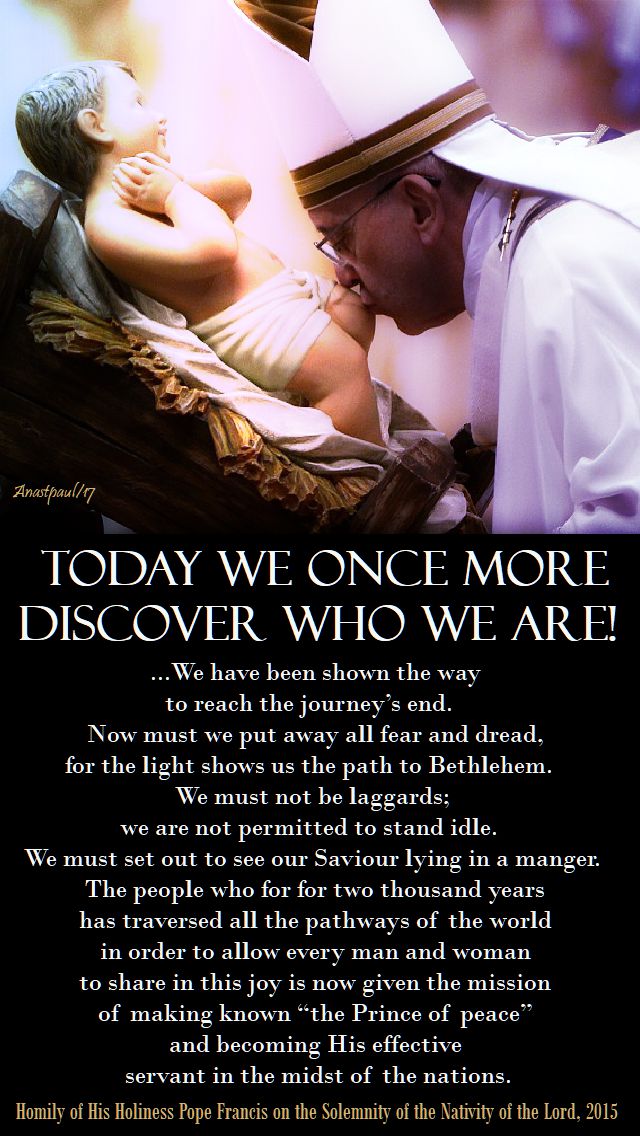
“Today, the Son of God is born and everything changes.
The Saviour of the world comes to partake of our human nature;
no longer are we alone and forsaken.
The Virgin offers us her Son as the beginning of a new life.
The true light has come to illumine our lives so often beset by the darkness of sin.
Today we once more discover who we are!
Tonight we have been shown the way to reach the journey’s end.
Now must we put away all fear and dread, for the light shows us the path to Bethlehem.
We must not be laggards; we are not permitted to stand idle. We must set out to see our Saviour lying in a manger. This is the reason for our joy and gladness: this Child has been “born to us”;
he was “given to us”, as Isaiah proclaims (cf. 9:5).
The people who for for two thousand years has traversed all the pathways of the world,
in order to allow every man and woman to share in this joy,
is now given the mission of making known “the Prince of peace”
and becoming His effective servant in the midst of the nations.”

Homily of Pope Francis on the Solemnity of the Nativity of the Lord, 2015today-we-once-more-discover-who-we-are-pope-francis-christmas-2015

Posted in CHRISTMASTIDE!, DOCTORS of the Church, FEASTS and SOLEMNITIES, MORNING Prayers, The NATIVITY of JESUS, The WORD

Christmas Wisdom with St Alphonsus Liguori – Christmas! Mass During the Day – John 1:1–18

Advent and Christmas Wisdom with St Alphonsus Liguori (1696-1787) – Christmas! Mass During the Day – John 1:1–18

The Birth of Jesus

“Consider that the birth of Jesus Christ, caused universal joy in the whole world. Jesus was the Redeemer who had been desired and awaited for so many years.   He was called ‘the desire of the nations’ and ‘the desire of the eternal hills.’   Today, we behold Him, born in a little cave!   Let us consider, that this day, the angel also announces to us the same great joy announced to the shepherds.   “Behold, I bring you good tidings of great joy, for a saviour has been born.”

What great rejoicing there is in a country when the firstborn son of a king is born.   But surely, there should be even greater rejoicing when we see the Son of God born! We were lost and he came to save us.   He is the shepherd who has come to save His sheep from death.   He is the lamb of God, who has come to sacrifice Himself, to become our deliverer, our life, or light and even our food in the Most Holy Sacrament.

Saint Maximus says that for this reason, among many others, Jesus chose to be laid in the manger, where the animals are fed, to make us understand that He has become human and also our food.   “In the manger, where the food of animals is placed, He allowed Himself to be laid, demonstrating that His own body would be the eternal food of humankind.”

Besides this, He is born every day in the Sacrament of the Altar, the Altar is the crib and we go to the Altar to be fed and nourished.   Some might desire to hold the Infant Jesus in their arms as the prophet Simeon did but faith teaches us, that when we receive Holy Communion, we too, hold the same Jesus, who was in the manger in Bethlehem, not in our arms alone but in our hearts.

My beloved Jesus, if I do not love You, who are my Lord and God, whom shall I love?”

Scripture

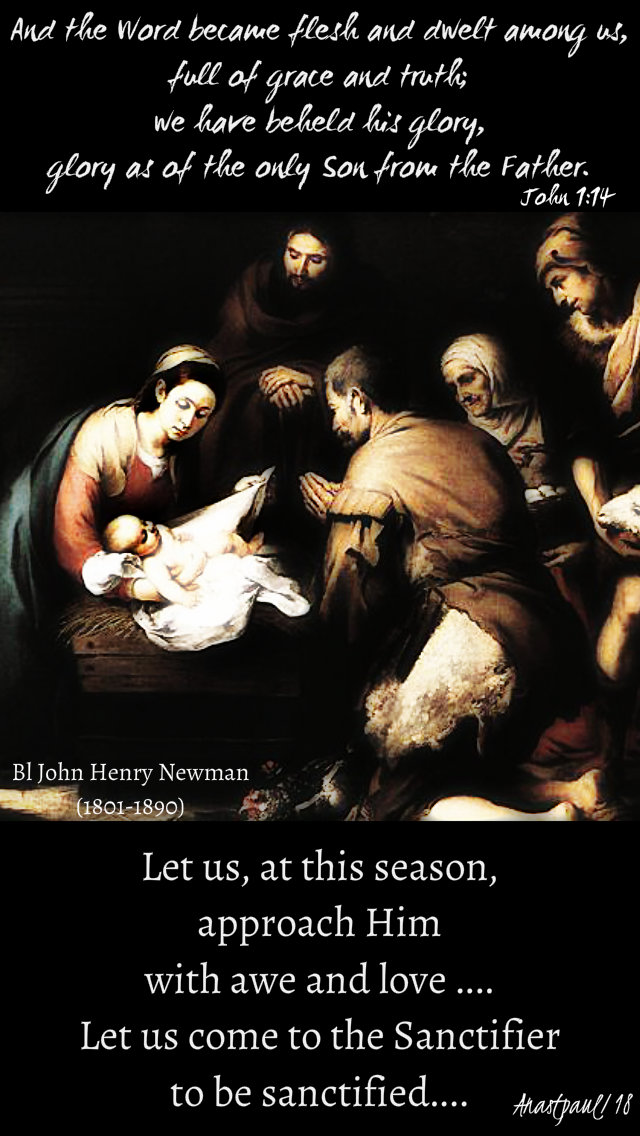
And the Word became flesh and dwelt among us,
full of grace and truth;
we have beheld his glory, glory as of the only Son from the Father.

John 1:14

Prayer

Almighty God, Your incarnate Word fills us with the new light He brought to men.   Let the light of faith in our hearts shine through all the ages, to bring Your light to all nations. Come, come, let us adore our Holy Babe of Bethlehem, through whom we pray, in unity with the Holy Spirit, one God, forever and ever amen.

“Let us, at this season, approach Him with awe and love, in whom resides all perfection and from whom we are allowed to gain it.   Let us come to the Sanctifier to be sanctified….
May each Christmas, as it comes, find us more and more like Him, who as at this time became a little child for our sake, more simple-minded, more humble, more holy, more affectionate, more resigned, more happy, more full of God.”…Blessed John Henry Newman (1801-1890)john 1 14 and the word became flesh - let us approach - bl john henry newman - christms with st alphonsus 25 dec 2018

Posted in CHRISTMASTIDE!, DOCTORS of the Church, FATHERS of the Church, FEASTS and SOLEMNITIES, Our MORNING Offering, PRAYERS for SEASONS, PRAYERS of the SAINTS, The CHRIST CHILD, The HOLY CROSS, The HOLY EUCHARIST / The HOLY MASS, The HOLY NAME, The INCARNATION, The NATIVITY of JESUS, The PASSION, The RESURRECTION, The SIGN of the CROSS

Our Morning Offering – 25 December – Blessed is He

Our Morning Offering – 25 December – The Solemnity of the Nativity of Our Lord, Jesus Christ

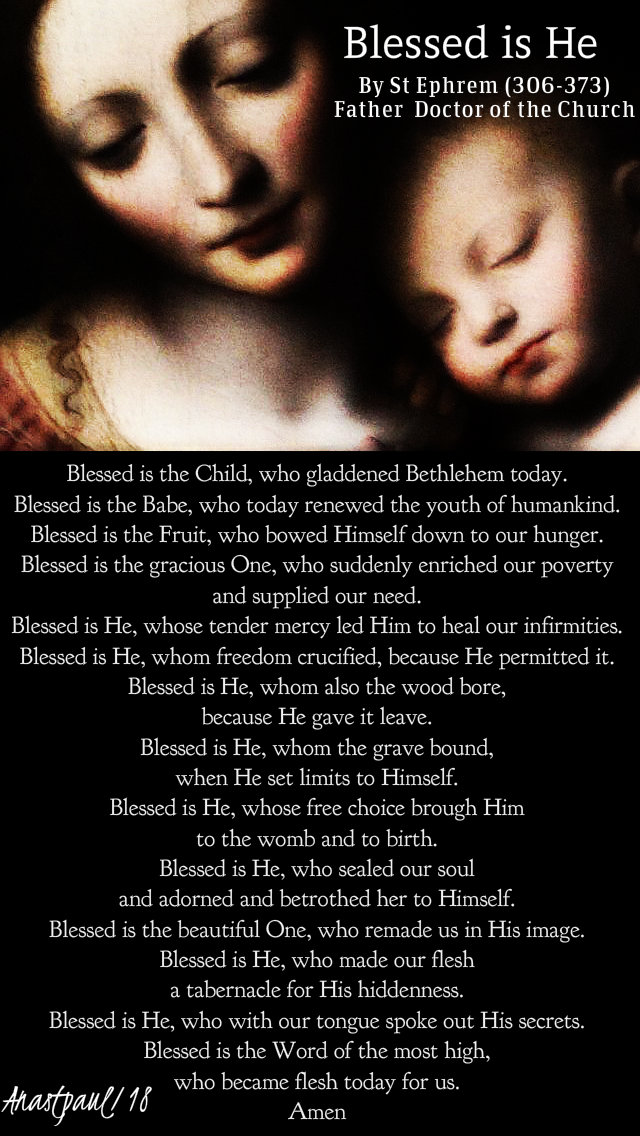
Blessed is He
St Ephrem (306-373) Father & Doctor of the Church

Blessed is the Child, who gladdened Bethlehem today.
Blessed is the Babe, who today renewed the youth of humankind.
Blessed is the Fruit, who bowed Himself down to our hunger.
Blessed is the gracious One, who suddenly enriched our poverty
and supplied our need.
Blessed is He, whose tender mercy led Him to heal our infirmities.
Blessed is He, whom freedom crucified, because He permitted it.
Blessed is He, whom also the wood bore, because He gave it leave.
Blessed is He, whom the grave bound, when He set limits to Himself.
Blessed is He, whose free choice brough Him
to the womb and to birth.
Blessed is He, who sealed our soul and adorned and betrothed her to Himself.
Blessed is the beautiful One, who remade us in His image.
Blessed is He, who made our flesh a tabernacle for His hiddenness.
Blessed is He, who with our tongue spoke out His secrets.
Blessed is the Word of the most high, who became flesh today for us.
Amenblessed is he by st ephrem 25 dec 2018

Posted in CHRISTMASTIDE!, FEASTS and SOLEMNITIES, The NATIVITY of JESUS

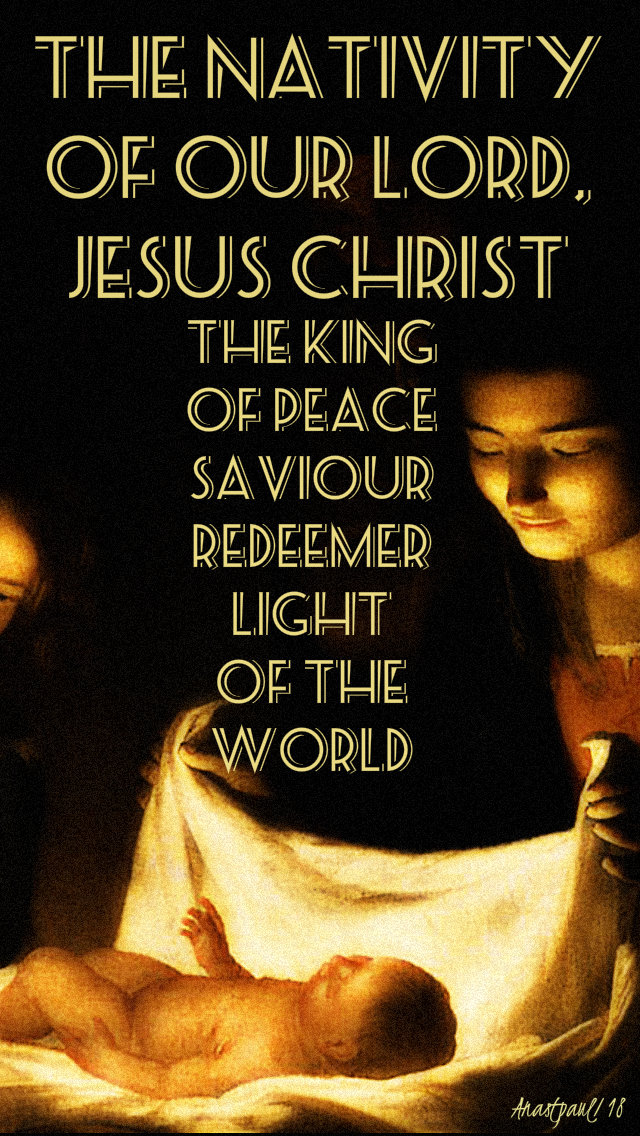
The Solemnity of the Nativity of Our Lord Jesus Christ – 25 December

This traditional translation of the Proclamation of the Birth of Christ comes from the Roman Martyrology, the official listing of the saints celebrated by the Roman Rite of the Catholic Church. the nativity of our lord jesus christ 25dec2018
For centuries, it was read on Christmas Eve, before the celebration of Midnight Mass.
Saint John Paul II, as pope, decided once again to include the Proclamation of the Birth of Christ in the papal celebration of Midnight Mass. Since the papal Midnight Mass at St Peter’s Basilica is broadcast worldwide, interest in the Proclamation revived and many parishes began to include it in their celebrations as well.the nativity of our lord jesus christ - beautiful

The Proclamation of the Birth of Christ situates the Nativity of Christ within the context of human history generally and salvation history specifically, making reference not only to biblical events (the Creation, the Flood, the birth of Abraham, the Exodus) but also to the Greek and Roman worlds (the original Olympics, the founding of Rome).   The coming of Christ at Christmas, then, is seen as the summit of both sacred and secular history.

The Twenty fifth Day of December,
when ages beyond number had run their course
from the creation of the world,
when God in the beginning created heaven and earth
and formed man in his own likeness,
when century upon century had passed
since the Almighty set His bow in the clouds after the Great Flood,
as a sign of covenant and peace,
in the twenty-first century since Abraham, our father in faith,
came out of Ur of the Chaldees;
in the thirteenth century since the People of Israel were led by Moses
in the Exodus from Egypt,
around the thousandth year since David was anointed King,
in the sixty fifth week of the prophecy of Daniel,
in the one hundred and ninety-fourth Olympiad,
in the year seven hundred and fifty two
since the foundation of the City of Rome,
in the forty second year of the reign of Caesar Octavian Augustus,
the whole world being at peace,
Jesus Christ, eternal God and Son of the eternal Father,
desiring to consecrate the world by His most loving presence,
was conceived by the Holy Spirit,
and when nine months had passed since His conception,
was born of the Virgin Mary in Bethlehem of Judah,
and was made man –

The Nativity of Our Lord Jesus Christ according to the flesh.


THE BIRTH OF CHRIST gandolfi

Posted in CHRISTMASTIDE!, FEASTS and SOLEMNITIES, SAINT of the DAY

The Solemnity of the Nativity of the Lord, Jesus Christ and Memorials of the Saints – 25 December

The Nativity of the Lord, Jesus Christ (Solemnity)
Celebration of the anniversary of the birth of Our Lord.   In the earliest days of the Church there was no such feast;  the Saviour’s birth was commemorated with the Epiphany by the Greek and other Eastern Churches.   First mention of the feast, then kept on 20 May, was made by Clement of Alexandria c 200.   The Latin Church began c 300 to observe it on 25 December, though there is no certainty that Our Lord was born on that day.   Priests have the privilege of saying three Masses, at midnight, daybreak and morning.   This was originally reserved to the Holy Father alone – beginning about the 4th century he celebrated a midnight Mass in the Lateran Basilica (in which according to tradition, the manger of Bethlehem is preserved), a second in the church of Saint Anastasia, whose feast comes on 25 December and a third at the Vatican Basilica.   Many peculiar customs of the day are the outcome of the pagan celebrations of the January calender.   The Christmas tree, of which the first known mention was made in 1605 at Strasbourg, was introduced into France and England in 1840.   The feast is a holy day of obligation, preceded by the preparatory season of Advent and by a special vigil – should it fall on a Friday it abrogates the law of abstinence.   Today’s Gospel is the prologue of John (2018 Year C).

My post last year:   https://anastpaul.wordpress.com/2017/12/25/25-december-the-solemnity-of-the-birth-of-our-lord-jesus-christ-2/

St Adalsindis of Hamay
St Alburga of Wilton
St Anastasia of Sirmium
Bl Artale
St Basilée of the Via Latina
Bl Bentivoglio de Bonis
Bl Diego de Aro
St Eugenia of Rome
St Fulk of Toulouse
Bl Jacopone da Todi
St Jovin of the Via Latina
Bl Maria Therese von Wüllenweber
Bl Matthew of Albano
Bl Michael Nakashima Saburoemon
Bl Nera
St Peter Nolasco
St Romulus of Berry

Martyrs of Nicomedia: 20,000 Christians martyred by order of Diocletian. They were reported to have all been in the single basilica to celebrate Christmas. While there unquestionably was an endless series of martyrs under Diocletian, it’s likely the ancient sources exaggerated the numbers of this incident. And as the Christmas holy day was not celebrated in the East in 303, they were probably gathered for another feast. They were burned alive in 303 in the basilica of Nicomedia.

Posted in FEASTS and SOLEMNITIES, MARIAN TITLES, SAINT of the DAY, The BLESSED VIRGIN MARY

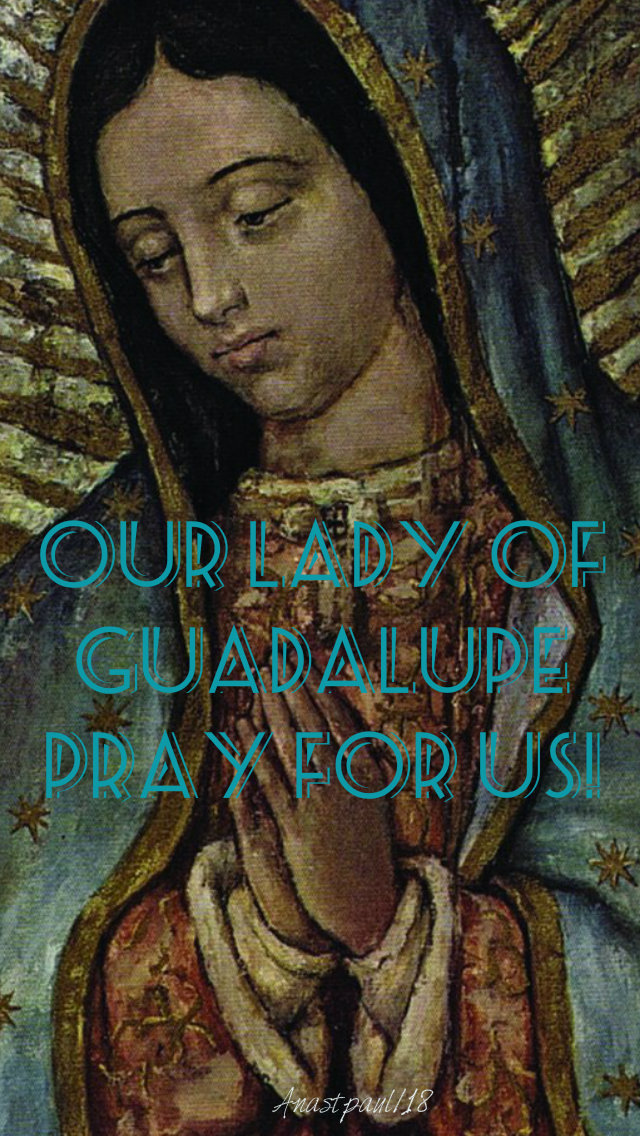
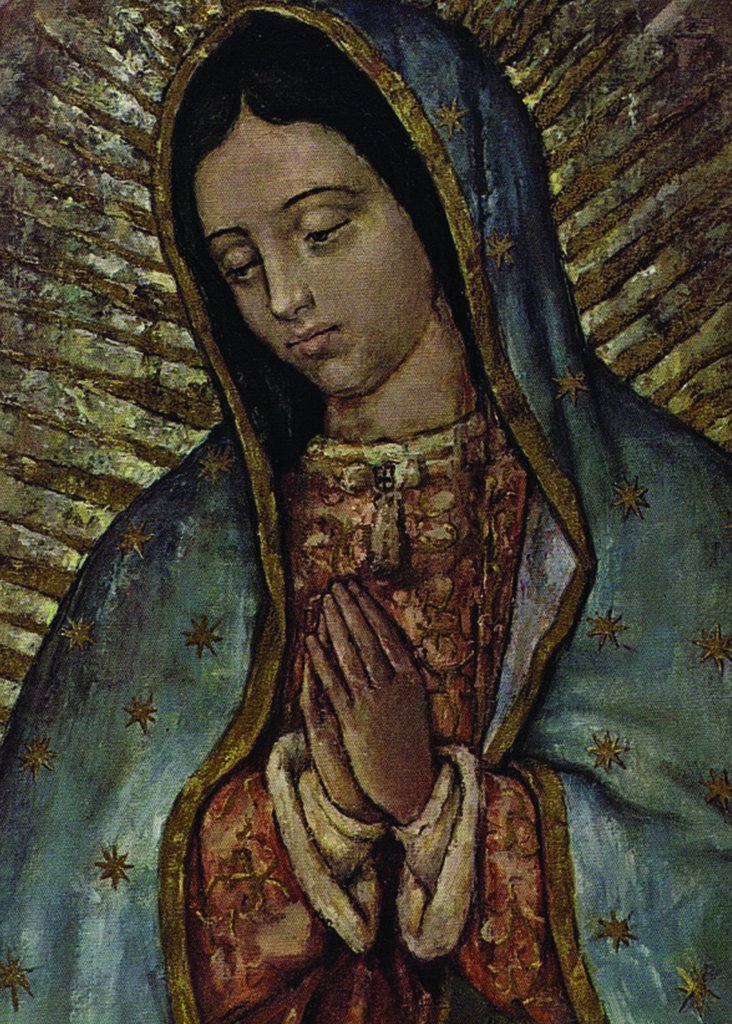
Thought for the Day – 12 December – Feast of Our Lady of Guadalupe

Thought for the Day – 12 December – Feast of Our Lady of Guadalupe

Mary’s appearance to St Juan Diego as one of his people is a powerful reminder that Mary—and the God who sent her—accept all peoples.   In the context of the sometimes rude and cruel treatment of the Indians by the Spaniards, the apparition was a rebuke to the Spaniards and an event of vast significance for the indigenous population.   While a number of them had converted before this incident, they now came in droves.  According to a contemporary chronicler, nine million Indians became Catholic in a very short time.

In these days when we hear so much about God’s preferential option for the poor, Our Lady of Guadalupe cries out to us that God’s love for and identification with the poor is an age-old truth that stems from the Gospel itself.

Our Lady of Guadalupe, Pray for Us!Our lady of guadalupe pray for us 12 dec 2018 no 3

Posted in FEASTS and SOLEMNITIES, MARIAN DEVOTIONS, MARIAN PRAYERS, MARIAN TITLES, Our MORNING Offering, PAPAL PRAYERS, PRAYERS of the SAINTS, SAINT of the DAY, The BLESSED VIRGIN MARY

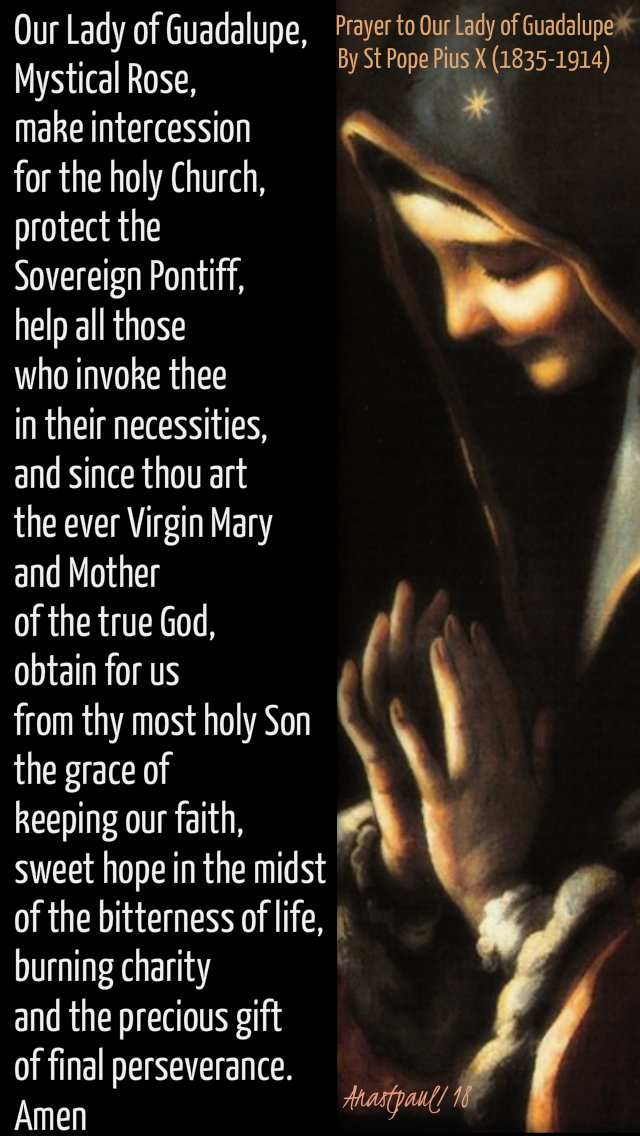
Our Morning Offering – 12 December – Feast of Our Lady of Guadalupe

Our Morning Offering – 12 December – Feast of Our Lady of Guadalupe

St Pope Pius X’s Prayer to Our Lady of Guadalupe

Our Lady of Guadalupe,
Mystical Rose,
make intercession for the holy Church,
protect the Sovereign Pontiff,
help all those who invoke thee in their necessities,
and since thou art the ever Virgin Mary
and Mother of the true God,
obtain for us from thy most holy Son
the grace of keeping our faith,
sweet hope in the midst of the bitterness of life,
burning charity
and the precious gift of final perseverance.
Amen

This prayer was approved and enriched with an indulgence of five hundred days by St Pope Pius X at all audience held on August, 1908 and was included in the official edition of approved indulgenced prayers (1950).
Raccolta number 389, 500 days Indulgence, St Pope Pius X audience, 15 August 1908.Prayer to our lady of guadalupe - by st pope pius X 12 dec 2018

Posted in FEASTS and SOLEMNITIES, MARIAN TITLES, SAINT of the DAY, The BLESSED VIRGIN MARY

Feast of Our Lady of Guadalupe – 12 December

Feast of Our Lady of Guadalupe – 12 December

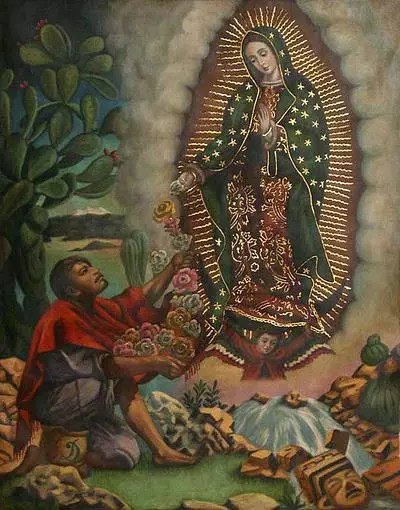
On 9 December 1531, a 57-year-old Aztec, Juan Diego, saw the Blessed Mother on a hill in Mexico City.   She told Juan to have a church built in her honour.   When Juan went to ask Bishop Zumarraga about this, the bishop did not understand the Indian dialect—and he did not believe in the vision Juan described.

our lady of guadalupe lg

Three days later, on 12 December Mary appeared again to Juan Dieg, and this time she gave him a sign for the bishop.   “Take these roses to the bishop,” she said, as she arranged in his cloak beautiful roses she had Juan Diego pick from the hillside although it was winter.   When he was admitted into the bishop’s room, Juan Diego opened his cloak and out dropped the roses.   On the cloak there remained an image of Mary as she had appeared to Juan Diego.

The image of Mary on the cloak is known as Our Lady of Guadalupe for an interesting reason.   On that same day, Mary appeared to Juan’s uncle and cured him, giving him a message for the bishop, saying that she would “crush the serpent’s head.”   The bishop did not understand the Indians’ language.   The Indian word for “crush the serpent” sounded to him like “Guadalupe,” the name of Mary’s shrine in Spain.   Thinking that the Virgin wanted the new shrine to have the same name, the bishop called her Our Lady of Guadalupe.
our lady of guadalupe with st juan diego

Mary appeared to Juan Diego dressed as an Aztec woman to show her love and compassion to an oppressed group of people.   Mary had heard the prayers and pain of these people and she came to give them hope.

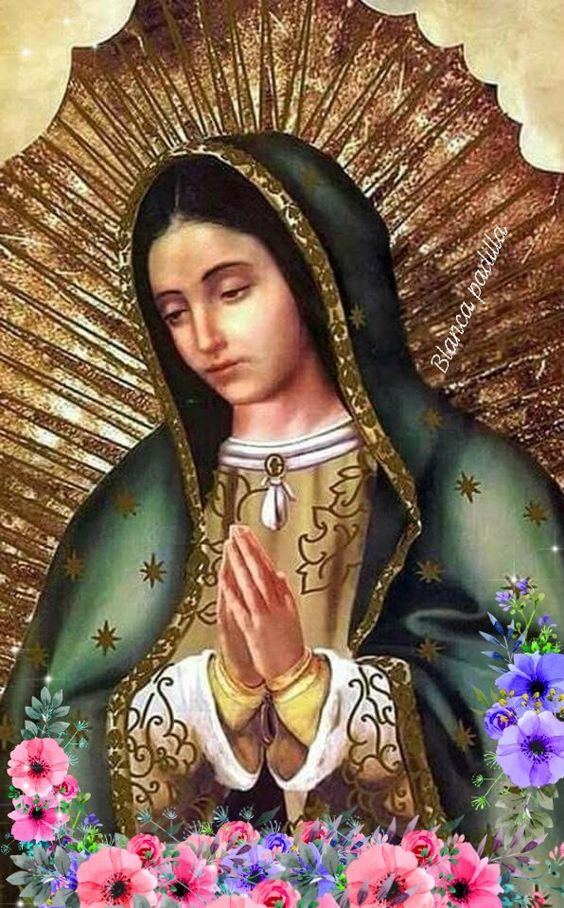
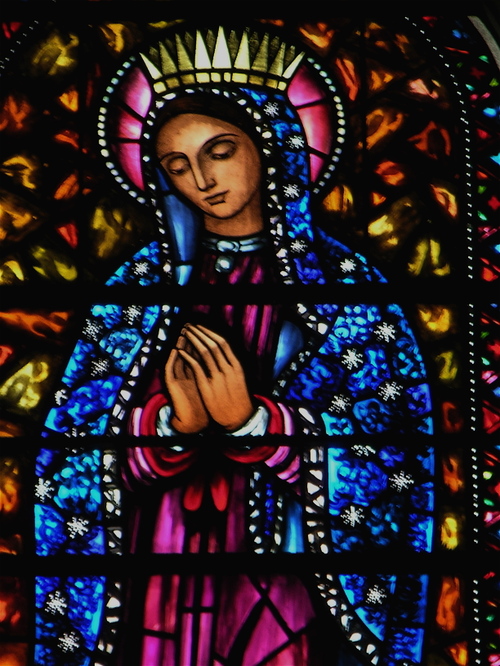
our lady of guadalupe artwork

Mary’s visit to Guadalupe is a reminder that God will remember Hs mercy for all people. In Mary’s song of joy, the Magnificat, she praised God because he has put down the mighty, exalted the lowly, filled the hungry, and sent the rich away empty.

The clergy, secular and regular, has been remarkably faithful to the devotion towards Our Lady of Guadalupe, the bishops especially fostering it, even to the extent of making a protestation of faith in the miracle a matter of occasional obligation.   Pope Benedict XIV decreed that Our Lady of Guadalupe should be the national patron of Mexico and made 12 December a holiday of obligation with an octave and ordered a special Mass and Office.   Pope Leo XIII approved a complete historical second Nocturne, ordered the picture to be crowned in his name and composed a poetical inscription for it.   Pope Pius X permitted Mexican priests to say the Mass of Holy Mary of Guadalupe on the twelfth day of every month and granted indulgences which may be gained in any part of the world for prayer before a copy of the picture.our lady of guadalupe glass detail

The place, called Guadalupe Hidalgo since 1822, is three miles northeast of Mexico City. Pilgrimages have been made to this shrine almost without interruption since 1531-1532. A shrine at the foot of Tepeyac Hill served for ninety years and still forms part of the parochial sacristy.   In 1622 a rich shrine was erected and in 1709 a newer, even richer one.   There are also a parish church, a convent and church for Capuchin nuns, a well chapel and a hill chapel all constructed in the 18th century.   About 1750 the shrine got the title of collegiate, a canonry and choir service being established.   It was aggregated to Saint John Lateran in 1754.   In 1904 it was created a basilica, with the presiding ecclesiastic being called abbot.   The shrine has been renovated in Byzantine style which presents an illustration of Guadalupan history.

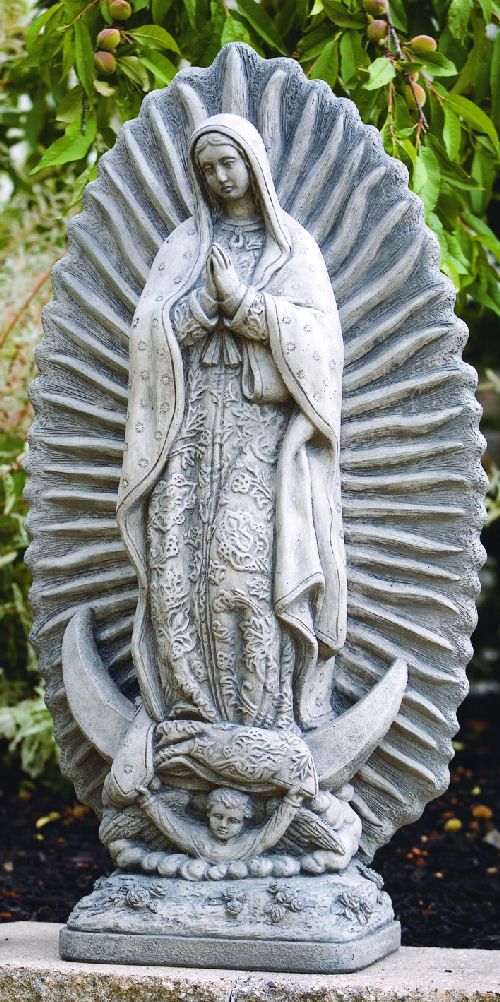
Holy Mother of Guadalupe, Pray for Us!our lady of guadalupe statue

More here:  https://anastpaul.wordpress.com/2017/12/12/saint-of-the-day-the-feast-of-our-lady-of-guadalupe-12-december/

Posted in FEASTS and SOLEMNITIES, MARIAN TITLES, SAINT of the DAY, The BLESSED VIRGIN MARY

Feast of Our Lady of Guadalupe and Memorials of the Saints – 12 December

Our Lady of Guadalupe (Feast) The First Apparition was on 12 December 1531.
All about Our Lady of Guadalupe: https://anastpaul.wordpress.com/2017/12/12/saint-of-the-day-the-feast-of-our-lady-of-guadalupe-12-december/

St Abra
St Agatha of Wimborne
Bl Bartholomew Buonpedoni
St Pope Callistus II
St Colman of Clonard
St Columba of Terryglass
St Conrad of Offida
St Corentius of Quimper
St Cormac
St Cury
St Donatus the Martyr
St Edburga of Thanet
St Finnian of Clonard
St Gregory of Terracina
St Hermogenes
Bl Ida of Nivelles
Bl James of Viterbo
Bl Ludwik Bartosik
Bl Martin Sanz
St Simon Phan Ðac Hòa
St Spyridon of Cyprus
St Synesius
St Vicelin of Oldenburg

Martyrs of Alexandria – (6 saints): A group of six Christians martyred for their faith during the persecutions of Decius. We know little more than five of their names – Alexander, Ammonaria, Dionysia, Epimachus and Mercuria. They were burned to death c 250 in Alexandria, Egypt.

Martyrs of Trier – (4 saints): A group of six Christians martyred for their faith during the persecutions of Decius. We know little more than five of their names – Alexander, Ammonaria, Dionysia, Epimachus and Mercuria. They were burned to death c 250 in Alexandria, Egypt.

Posted in DOCTORS of the Church, DOGMA, FATHERS of the Church, FEASTS and SOLEMNITIES, MARIAN DEVOTIONS, MARIAN QUOTES, MARIAN TITLES, QUOTES of the SAINTS, SAINT of the DAY, The BLESSED VIRGIN MARY

Quote of the Day – 8 December – The Solemnity of the Immaculate Conception

Quote of the Day – 8 December – The Solemnity of the Immaculate Conception

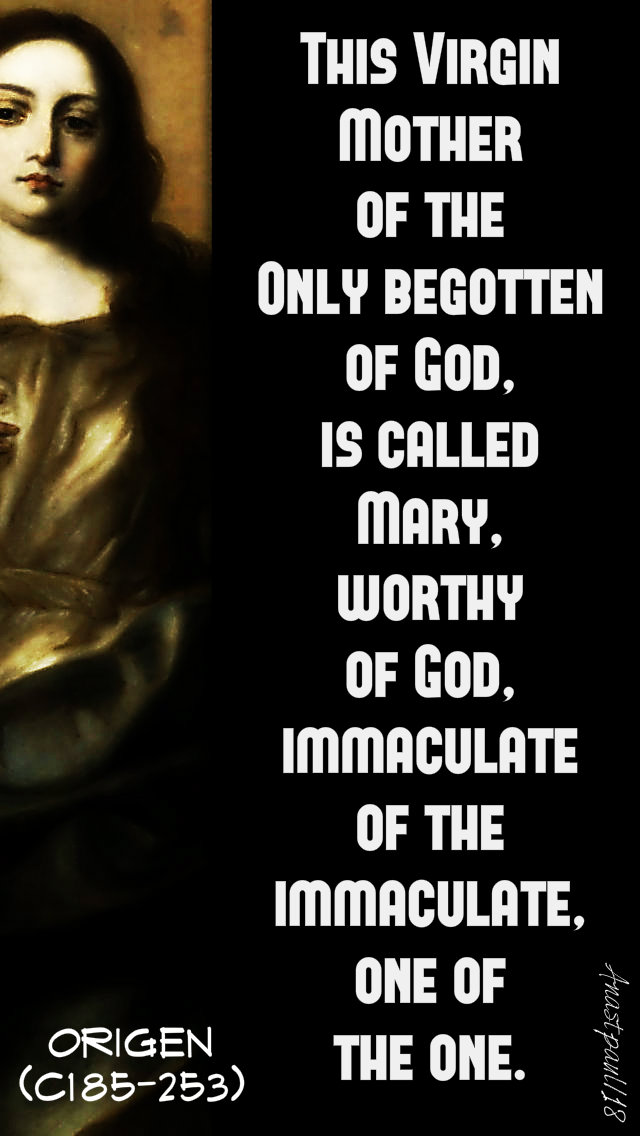
“This Virgin Mother of the Only begotten of God, is called Mary,
worthy of God, immaculate of the immaculate,
one of the one.”

Origen (c185-253)
(244)this virgin mother-origen-8dec2018

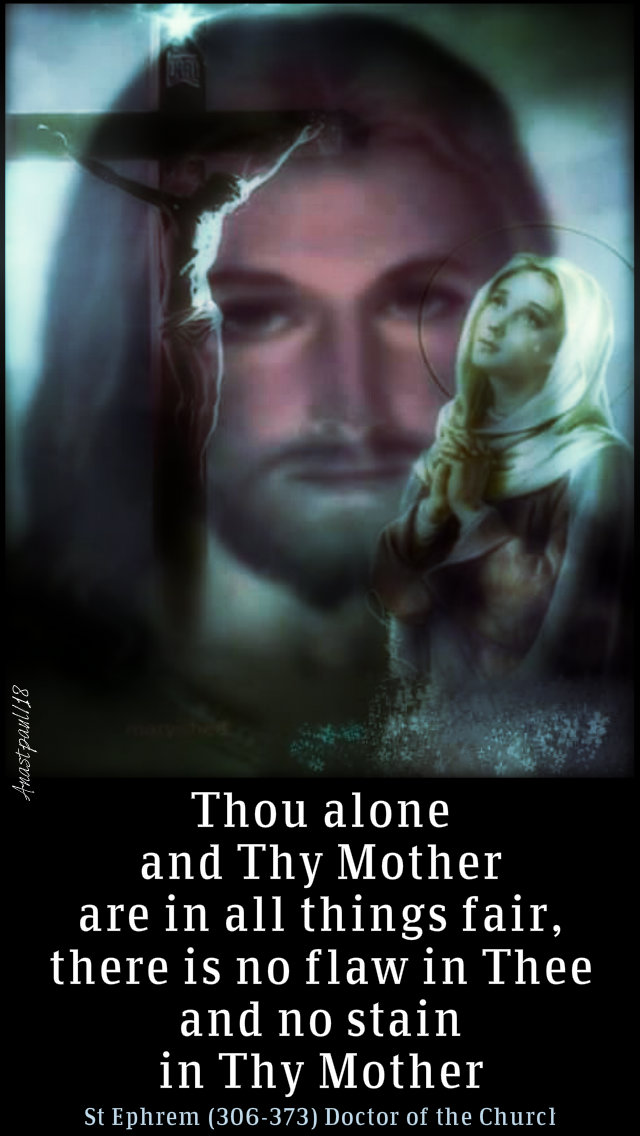
“Thou alone and Thy Mother
are in all things fair;
there is no flaw in Thee
and no stain in Thy Mother.”

St Ephrem (306-373) Doctor of the Church
(270)thou alone and thou mother - st ephrem 8dec2018

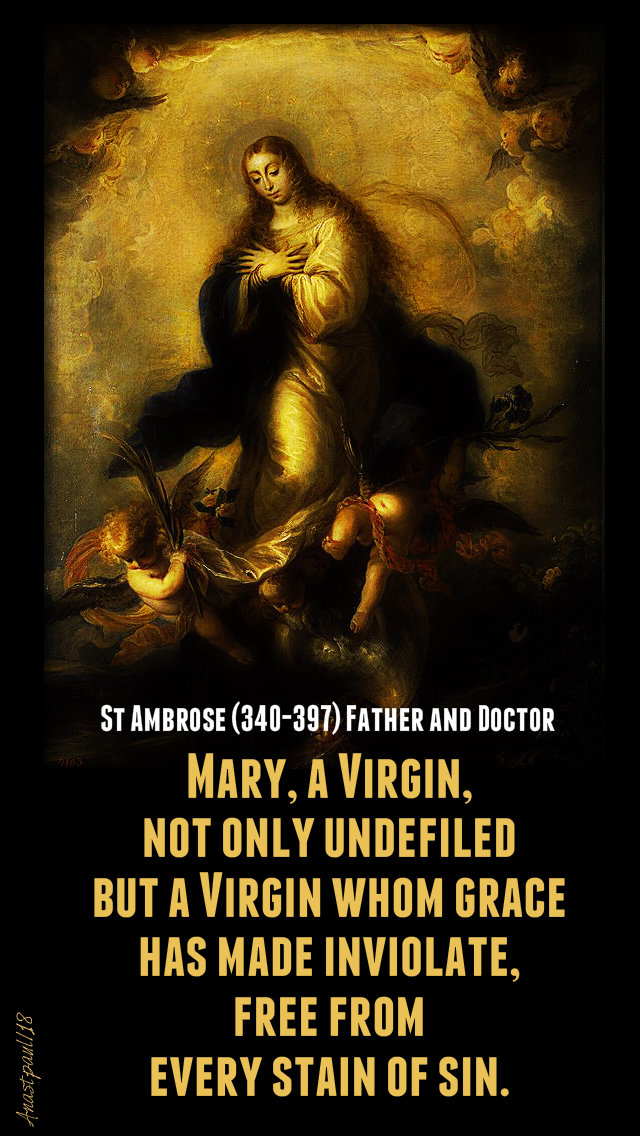
“Mary, a Virgin,
not only not only UNDEFILED
but a Virgin whom grace
has made INVIOLATE,
FREE from EVERY STAIN of SIN.”

St Ambrose (340-397) Father and Doctor
Sermon 22, in the year 338m,ary, a virgin - st ambrose - 8dec2018

Posted in CONSECRATION Prayers, DOGMA, FEASTS and SOLEMNITIES, MARIAN DEVOTIONS, MARIAN PRAYERS, MARIAN TITLES, Our MORNING Offering, PRAYERS of the SAINTS, SAINT of the DAY, The BLESSED VIRGIN MARY

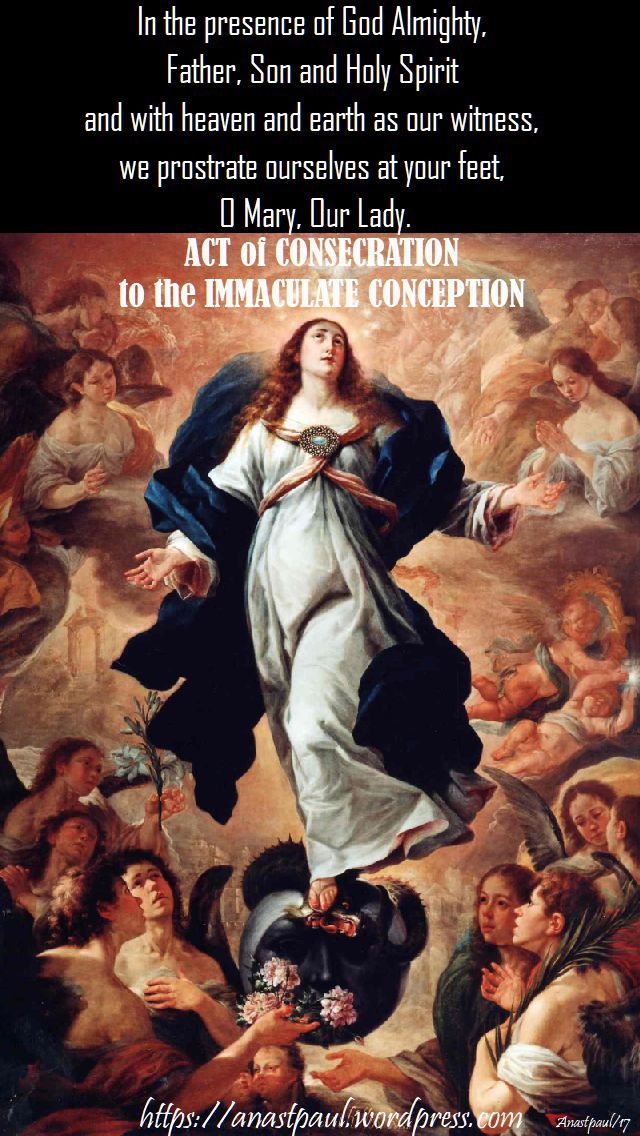
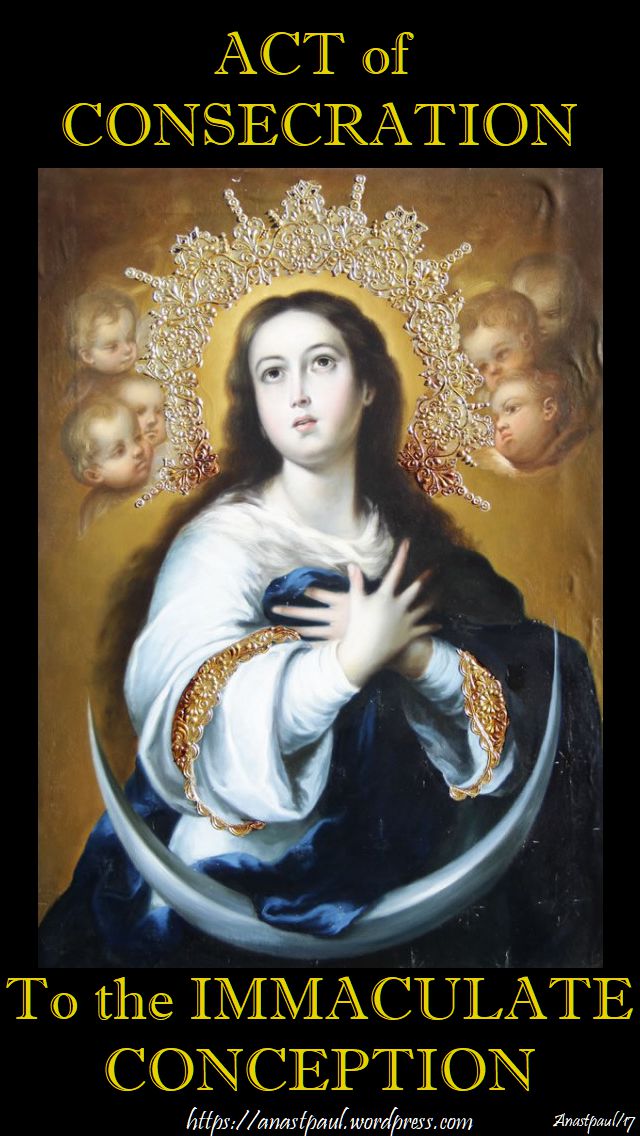
Our Morning Offering – 8 December – Act of Consecration to the Immaculate Conception

Our Morning Offering – 8 December – Act of Consecration to the Immaculate Conceptionin-the-presence-of-god-almight-act-of-consecration-immaculate-conception-8-dec-2017

Act of Consecration
By St Maximillian Kolbe (1894-1941)

O Immaculate, Queen of heaven and earth,
Refuge of sinners and our most loving Mother,
God has willed to entrust the entire order of mercy to You,
I, an unworthy sinner, cast myself at Your feet,
humbly imploring You
to take me with all that I am and have,
wholly to Yourself as Your possession and property.
Please make of me,
of all my powers of soul and body,
of my whole life, death and eternity,
whatever pleases You.
If it pleases You,
use all that I am and have without reserve,
wholly to accomplish what has been said of You:
“She will crush your head”,
and “You alone have destroyed all heresies in the whole world.”
Let me be a fit instrument in Your immaculate
and most merciful hands for introducing and increasing Your glory
to the maximum in all the many strayed and indifferent souls
and thus help extend as far as possible,
the blessed Kingdom of the Most Sacred Heart of Jesus.
For, wherever You enter,
You obtain the grace of conversion and sanctification,
since it is through Your hands,
that all graces come to us.
from the Most Sacred Heart of Jesus.

V.Allow me to praise You, O most holy Virgin.

R. Give me strength against Your enemies.
Amenact-of-consecration-8-dec-2017

Posted in DOGMA, FEASTS and SOLEMNITIES, MARIAN TITLES, SAINT of the DAY

The Solemnity of the Immaculate Conception and Memorials of the Saints – 8 December

Immaculate Conception (Solemnity)
Here: https://anastpaul.wordpress.com/2017/12/08/the-feast-of-the-immaculate-conception-solemnity-8-december/

Bl Alojzy Liguda
St Anastasia of Pomerania
St Anthusa of Africa
St Antonio García Fernández
St Casari of Villeneuve-lès-Avignon
St Eucharius of Trier
St Pope Eutychian
St Gunthildis of Ohrdruf
Bl Jacob Gwon Sang-yeon
Bl Johanna of Cáceres
Bl José María Zabal Blasco
St Macarius of Alexandria
St Marin Shkurti
St Noel Chabanel
St Patapius
Bl Paul Yun Ji-chung
St Rafael Román Donaire
St Romaric of Remiremont
St Sofronius of Cyprus

Posted in ADVENT, CATHOLIC-PRAYERS OF THE CHURCH, CHRISTMASTIDE!, FEASTS and SOLEMNITIES, PRACTISING CATHOLIC, PRAYERS for VARIOUS NEEDS, PRAYERS of the CHURCH, SAINT of the DAY, The APOSTLES & EVANGELISTS

St Andrew’s Christmas Novena – Getting Ready for the arrival of our King!

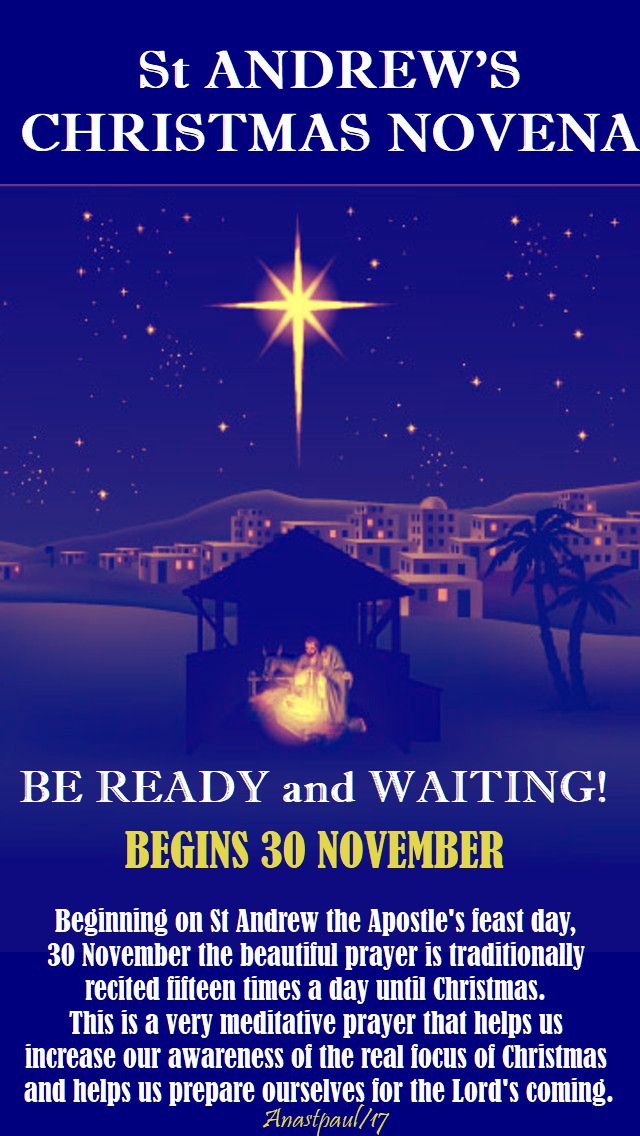
St Andrew’s Christmas Novena – The Christmas Anticipation Prayerbe-ready-and-waiting-st-andrews-christmas-novena-begins-30-nov-2017-pic

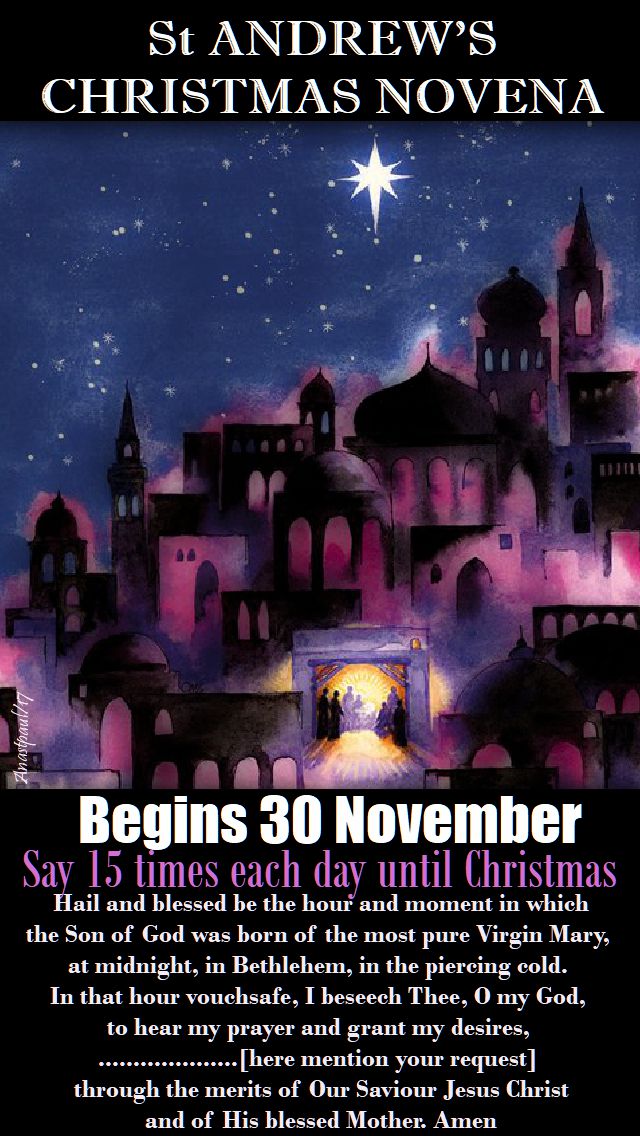
The Saint Andrew Christmas Novena is often called simply the “Christmas Novena” or the “Christmas Anticipation Prayer” because it is prayed 15 times every day from the Feast of Saint Andrew the Apostle today, 30 November, until Christmas.   It is an ideal Advent devotion – the First Sunday of Advent is the Sunday closest to the Feast of Saint Andrew.

While the novena is tied to the Feast of Saint Andrew, it is not actually addressed to Saint Andrew but to God Himself, asking Him to grant our request in honour of the birth of His Son at Christmas.   You can say the prayer all 15 times, all at once, or divide up the recitation as necessary (perhaps five times at each meal).st-andrews-prayer-christmas-novena-no-1 - 30nov2017

Prayed as a family, the Saint Andrew Christmas Novena is a very good way to help focus the attention of your children on the Advent season.   In no time, you will all have memorised it and be able to focus totally on the actual words.   In a family, it is a great idea to allow each member to insert their petitions in rotation.

Let us Pray!

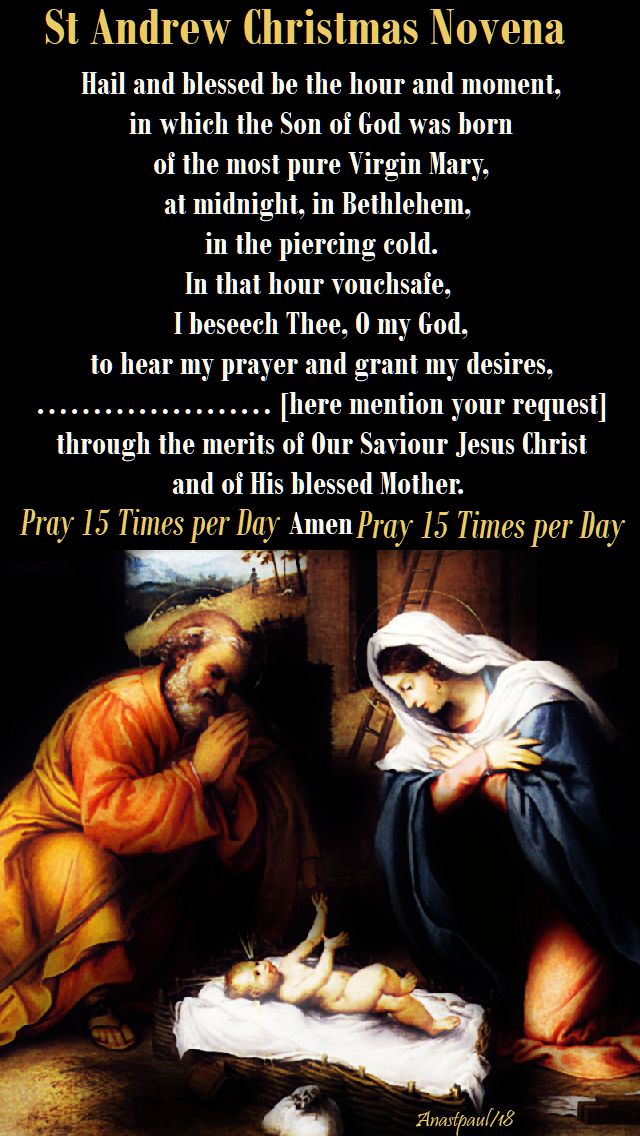
Hail and blessed be the hour and moment,
in which the Son of God was born
of the most pure Virgin Mary,
at midnight, in Bethlehem,
in the piercing cold.
In that hour vouchsafe,
I beseech Thee, O my God,
to hear my prayer and grant my desires,
………………… [here mention your request]
through the merits of Our Saviour Jesus Christ
and of His blessed Mother.
Amenst andrew christmas novena - 30nov2018

Posted in FEASTS and SOLEMNITIES, ON the SAINTS, PAPAL SERMONS, PRAYERS for PRIESTS, SAINT of the DAY, The APOSTLES & EVANGELISTS

Thought for the Day – 30 November – The Feast of St Andrew, Apostle of Christ

Thought for the Day – 30 November – The Feast of St Andrew, Apostle of Christ

Excerpt from Pope Benedict’s Catechesis on St Andrew
Wednesday, 14 June 2006

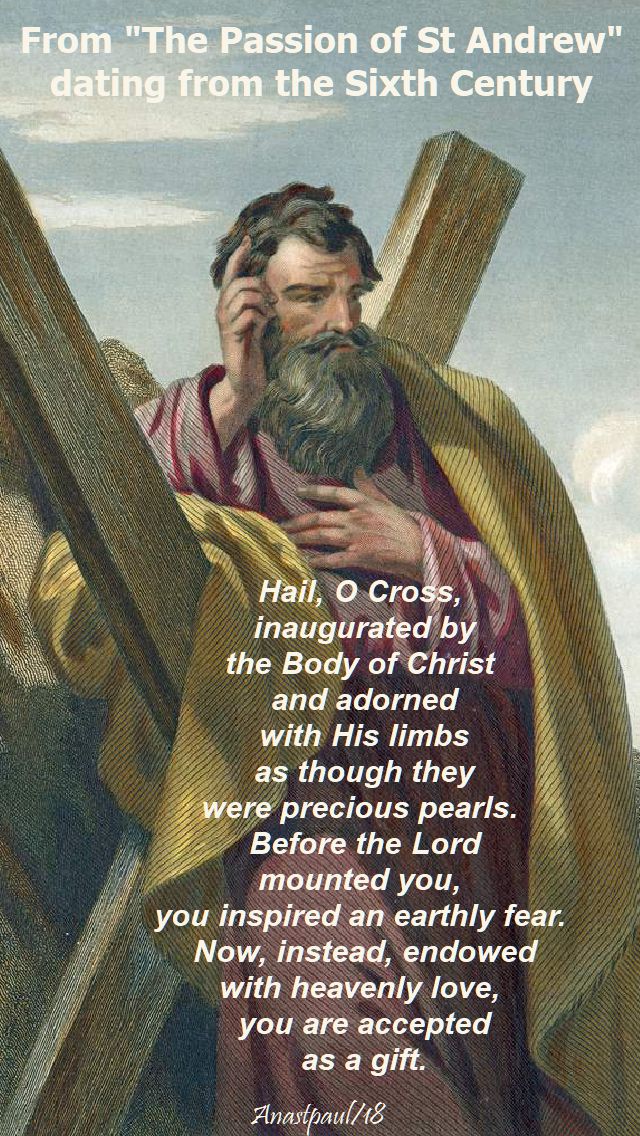
“This is what the Apostle is claimed to have said on that occasion, according to an ancient story (which dates back to the beginning of the sixth century), entitled The Passion of Andrew:

“Hail, O Cross, inaugurated by the Body of Christ and adorned with His limbs as though they were precious pearls.   Before the Lord mounted you, you inspired an earthly fear.   Now, instead, endowed with heavenly love, you are accepted as a gift.

Believers know of the great joy that you possess and of the multitude of gifts you have prepared.   I come to you, therefore, confident and joyful, so that you too may receive me exultant as a disciple of the One who was hung upon you…. O blessed Cross, clothed in the majesty and beauty of the Lord’s limbs!…

Take me, carry me far from men, and restore me to my Teacher, so that, through you, the one who redeemed me by you, may receive me.

Hail, O Cross; yes, hail indeed!”.hail o cross - from the passion of st andrew - 30nov2018

Here, as can be seen, is a very profound Christian spirituality.   It does not view the Cross as an instrument of torture but rather as the incomparable means for perfect configuration to the Redeemer, to the grain of wheat that fell into the earth.

We have a very important lesson to learn, our own crosses acquire value if we consider them and accept them as a part of the Cross of Christ, if a reflection of His light illuminates them.   It is by that Cross alone that our sufferings too are ennobled and acquire their true meaning.

The Apostle Andrew, therefore, teaches us to follow Jesus with promptness (cf. Mt 4: 20; Mk 1: 18), to speak enthusiastically about Him to those we meet and especially, to cultivate a relationship of true familiarity with Him, acutely aware that in Him alone, can we find the ultimate meaning of our life and death.”

St Andrew, Pray for your Church, Pray for Us all!st andrew apostle pray for us-30nov2018

Posted in Against SORE THROATS, COUGHS, WHOOPING COUGH,, FEASTS and SOLEMNITIES, Of FISHERMEN, FISHMONGERS, Of MUSICIANS, Choristors, Of the SICK, the INFIRM, All ILLNESS, ON the SAINTS, PAPAL SERMONS, PREGNANCY, SAINT of the DAY, The APOSTLES & EVANGELISTS

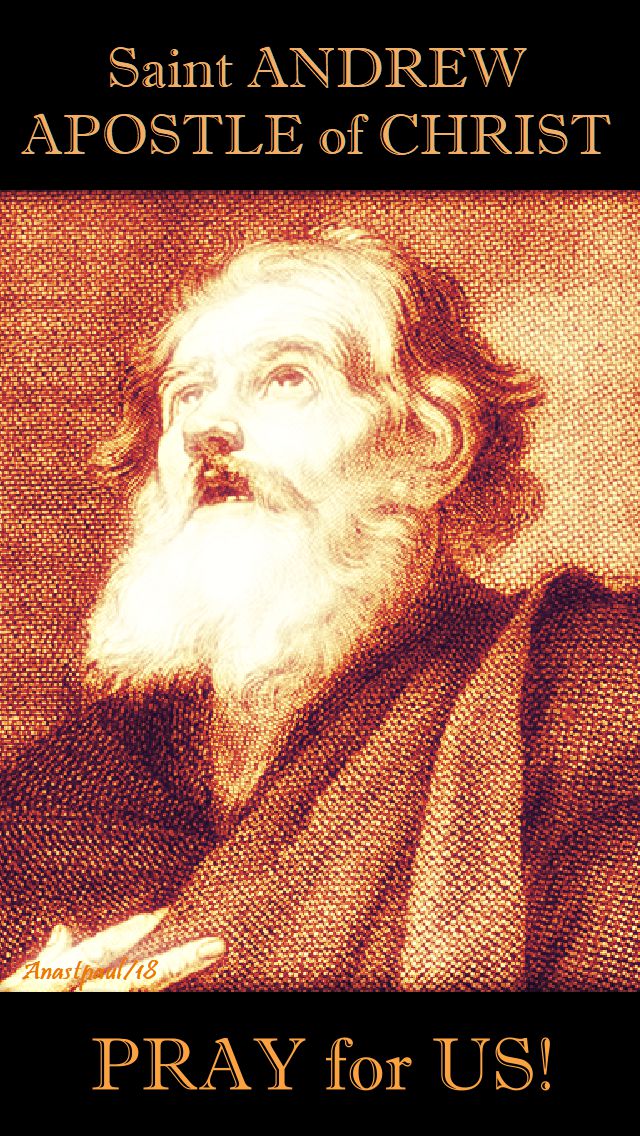
Saint of the Day – 30 November – St Andrew, Apostle of Christ, Martyr

Saint of the Day – 30 November – St Andrew, Apostle of Christ, Martyr – Called the “First Called ” – born at Bethsaida, Galilee and was Martyred by crucifixion on a saltire (x-shaped) cross in Patras Greece (around the year 62) – Patronages:  fishermen, fishmongers and rope-makers, textile workers, singers, miners, pregnant women, butchers, farm workers, protection against sore throats, protection against convulsions, protection against fever, protection against whooping cough, Scotland, Barbados, Georgia, Ukraine, Russia, Sicily, Greece, Cyprus, Romania, Patras, Burgundy, San Andrés (Tenerife), Diocese of Parañaque, Telhado, Amalfi, Luqa (Malta) and Prussia; Diocese of Victoria.ANDREW - GLASS maxresdefault
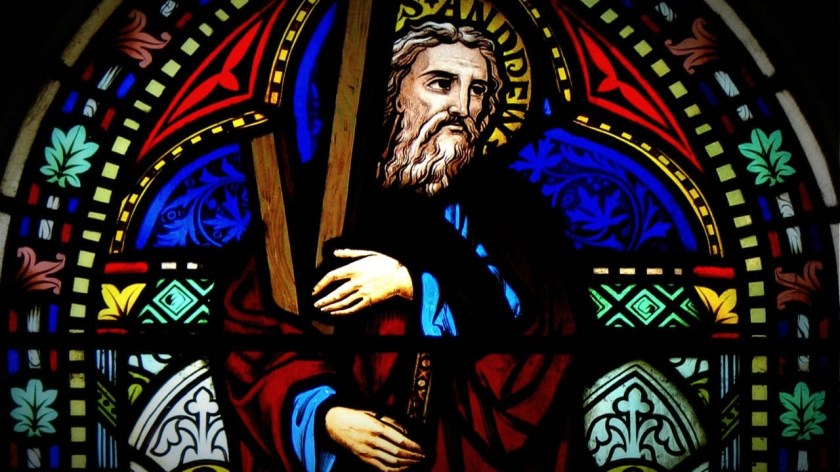
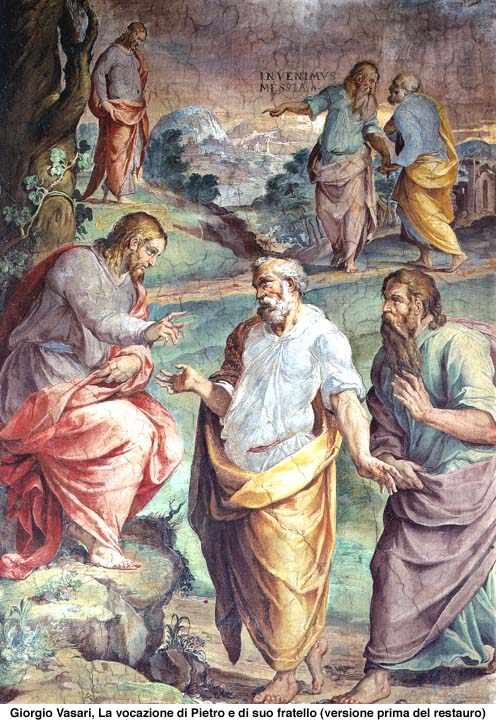
The first striking characteristic of Andrew is his name – it is not Hebrew, as might have been expected but Greek, indicative of a certain cultural openness in his family that cannot be ignored.   We are in Galilee, where the Greek language and culture are quite present.   Andrew comes second in the list of the Twelve, as in Matthew (10: 1-4) and in Luke (6: 13-16); or fourth, as in Mark (3: 13-18) and in the Acts (1: 13-14).   In any case, he certainly enjoyed great prestige within the early Christian communities.   The kinship between Peter and Andrew, as well as the joint call that Jesus addressed to them, are explicitly mentioned in the Gospels.   We read:  “As he walked by the Sea of Galilee, he saw two brothers, Simon who is called Peter and Andrew his brother, casting a net into the sea; for they were fishermen.   And he said to them, “Follow me and I will make you fishers of men'” (Mt 4: 18-19; Mk 1: 16-17).

From the Fourth Gospel we know another important detail:  Andrew had previously been a disciple of John the Baptist and this shows us that he was a man who was searching, who shared in Israel’s hope, who wanted to know better the word of the Lord, the presence of the Lord.   He was truly a man of faith and hope and one day he heard John the Baptist proclaiming Jesus as, “the Lamb of God” (Jn 1: 36), so he was stirred and with another unnamed disciple followed Jesus, the one whom John had called “the Lamb of God”.   The Evangelist says that “they saw where he was staying and they stayed with him that day…” (Jn 1: 37-39).   Thus, Andrew enjoyed precious moments of intimacy with Jesus.   The account continues with one important annotation:  “One of the two who heard John speak and followed him, was Andrew, Simon Peter’s brother.   He first found his brother Simon and said to him, “We have found the Messiah’ (which means Christ). He brought him to Jesus” (Jn 1: 40-43), straightaway showing an unusual apostolic spirit.

Andrew, then, was the first of the Apostles to be called to follow Jesus.   Exactly for this reason the liturgy of the Byzantine Church honours him with the nickname: “Protokletos”, [protoclete] which means, precisely, “the first called”.Sant_Andrea_S
The Gospel traditions mention Andrew’s name in particular on another three occasions that tell us something more about this man.   The first is that of the multiplication of the loaves in Galilee. On that occasion, it was Andrew who pointed out to Jesus the presence of a young boy who had with him five barley loaves and two fish, not much, he remarked, for the multitudes who had gathered in that place (cf. Jn 6: 8-9). In this case, it is worth highlighting Andrew’s realism.   He noticed the boy, that is, he had already asked the question: “but what good is that for so many?” (ibid) and recognised the insufficiency of his minimal resources.   Jesus, however, knew how to make them sufficient for the multitude of people who had come to hear Him.

The second occasion was at Jerusalem.   As He left the city, a disciple drew Jesus’ attention to the sight of the massive walls that supported the Temple.   The Teacher’s response was surprising:  He said that of those walls not one stone would be left upon another.   Then Andrew, together with Peter, James and John, questionedHhim: “Tell us, when will this be, and what will be the sign when these things are all to be accomplished?” (Mk 13: 1-4). In answer to this question Jesus gave an important discourse on the destruction of Jerusalem and on the end of the world, in which He asked His disciples to be wise in interpreting the signs of the times and to be constantly on their guard.   From this event we can deduce that we should not be afraid to ask Jesus questions but at the same time that we must be ready to accept even the surprising and difficult teachings that He offers us.andrew snip
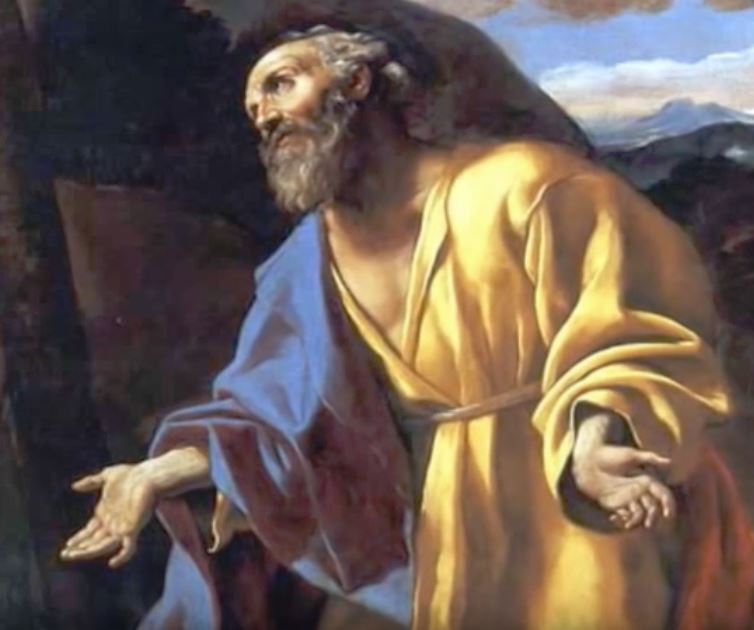
Lastly, a third initiative of Andrew is recorded in the Gospels:  the scene is still Jerusalem, shortly before the Passion.   For the Feast of the Passover, John recounts, some Greeks had come to the city, probably proselytes or God-fearing men who had come up to worship the God of Israel at the Passover Feast.   Andrew and Philip, the two Apostles with Greek names, served as interpreters and mediators of this small group of Greeks with Jesus.   The Lord’s answer to their question – as so often in John’s Gospel – appears enigmatic but precisely in this way proves full of meaning.   Jesus said to the two disciples and, through them, to the Greek world:  “The hour has come for the Son of man to be glorified.   I solemnly assure you, unless a grain of wheat falls to the earth and dies, it remains just a grain of wheat but if it dies, it produces much fruit” (12: 23-24). Jesus wants to say:  Yes, my meeting with the Greeks will take place but not as a simple, brief conversation between myself and a few others, motivated above all by curiosity.   The hour of my glorification will come with my death, which can be compared with the falling into the earth of a grain of wheat.   My death on the Cross will bring forth great fruitfulness, in the Resurrection the “dead grain of wheat” – a symbol of myself crucified – will become the bread of life for the world, it will be a light for the peoples and cultures. Yes, the encounter with the Greek soul, with the Greek world, will be achieved in that profundity to which the grain of wheat refers, which attracts to itself the forces of heaven and earth and becomes bread. In other words, Jesus was prophesying about the Church of the Greeks, the Church of the pagans, the Church of the world, as a fruit of His Pasch.

Some very ancient traditions not only see Andrew, who communicated these words to the Greeks, as the interpreter of some Greeks at the meeting with Jesus recalled here but consider him the Apostle to the Greeks in the years subsequent to Pentecost.   They enable us to know that for the rest of his life he was the preacher and interpreter of Jesus for the Greek world.ANDREW ICON
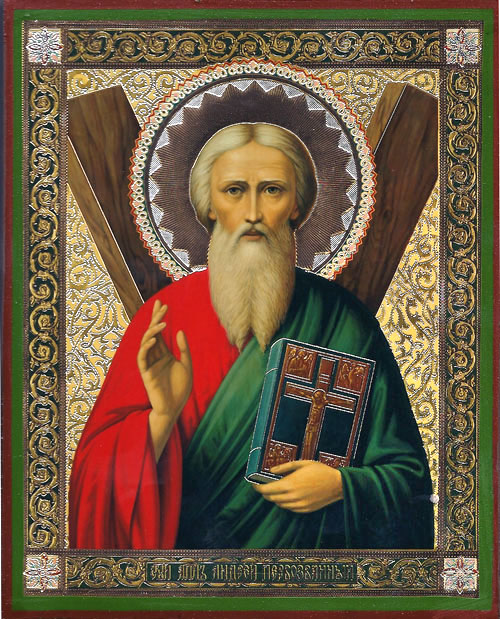
Peter, his brother, travelled from Jerusalem through Antioch and reached Rome to exercise his universal mission, Andrew, instead, was the Apostle of the Greek world.   So it is that in life and in death they appear as true brothers – a brotherhood that is symbolically expressed in the special reciprocal relations of the See of Rome and of Constantinople, which are truly Sister Churches.

A later tradition, as has been mentioned, tells of Andrew’s death at Patras, where he too suffered the torture of crucifixion.   At that supreme moment, however, like his brother Peter, he asked to be nailed to a cross different from the Cross of Jesus.   In his case it was a diagonal or X-shaped cross, which has thus come to be known as “St Andrew’s cross”….Pope Benedict XVI – 14 June 2006
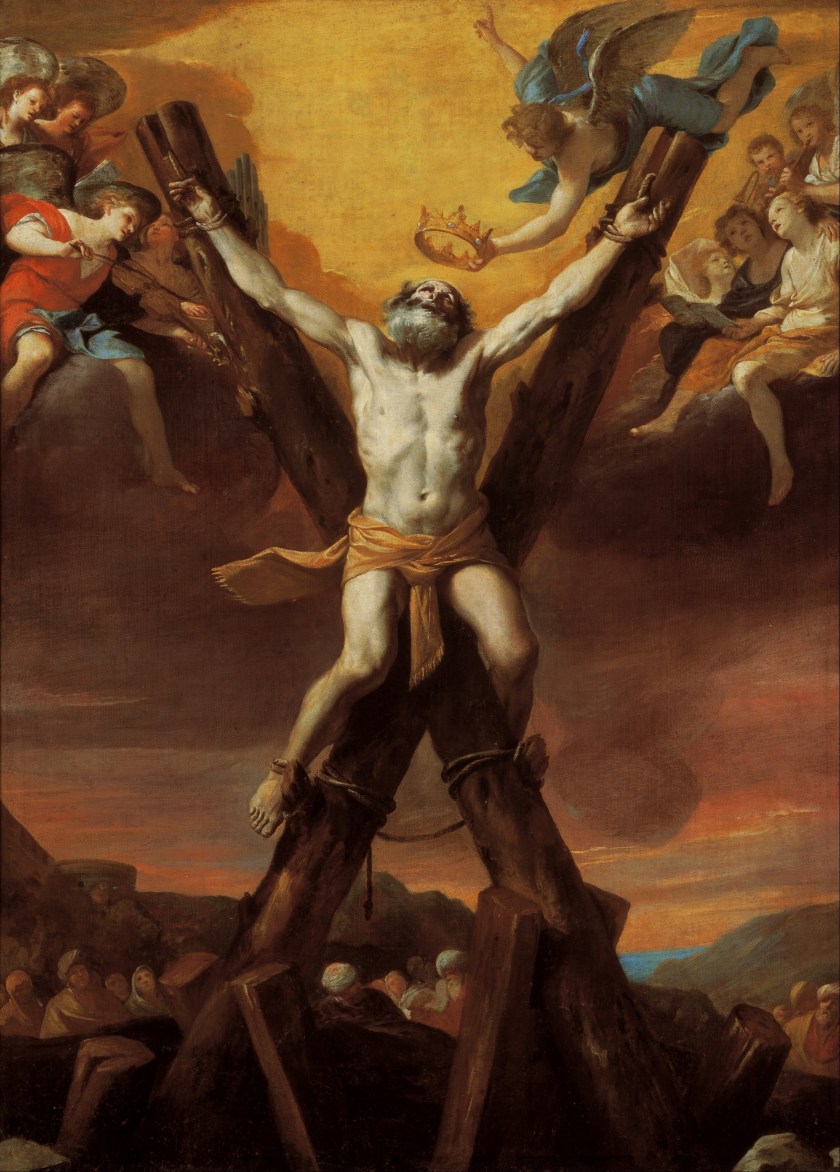
Mattia_Preti_-_The_crucifixion_of_St_Andrew_-_Google_Art_Project-Public-Domain-Image

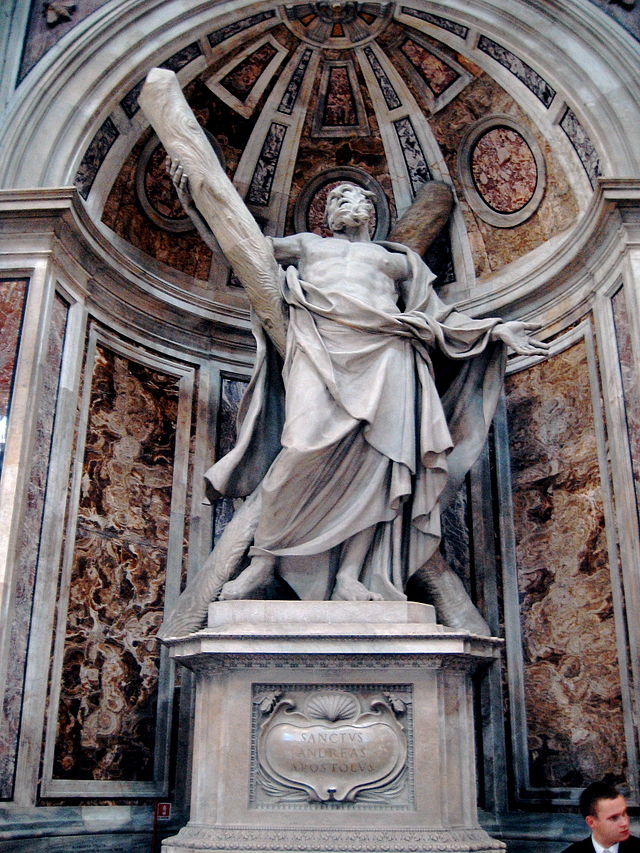
Andrew is the patron saint of several countries and cities and is the patron saint of Prussia and of the Order of the Golden Fleece.  He is considered the founder and the first bishop of the Church of Byzantium and is consequently the patron saint of the Ecumenical Patriarchate of Constantinople.   The flag of Scotland (and consequently the Union Flag and those of some of the former colonies of the British Empire) feature Saint Andrew’s saltire cross. The saltire is also the flag of Tenerife, the former flag of Galicia and the Russian Navy Ensign.

The feast of Andrew is observed on 30 November in both the Eastern and Western churches and is the national day of Scotland.   In the traditional liturgical books of the Catholic Church, the feast of Saint Andrew is the first feast day in the Proper of Saints.VATICAN - ANDREW STATUE -640px-Saint_Andreas
Posted in FEASTS and SOLEMNITIES, SAINT of the DAY, The APOSTLES & EVANGELISTS

Feast of St Andrew the Apostle and Memorials of the Saints – 30 November

St Andrew the Apostle (Feast)

St Abraham of Persia
Bl Alexander Crow
St Anders of Slagelse
Bl Andrew of Antioch
Bl Arnold of Gemblours
St Castulus of Rome
St Constantius of Rome
St Crider of Cornwall
St Cuthbert Mayne
St Domninus of Antioch
St Euprepis of Rome
Bl Everard of Stahleck
Bl Frederick of Regensburg
St Galganus
St Isaac of Beth Seleucia
Bl John of Vercelli
Bl Joscius Roseus
St Joseph Marchand
St Justina of Constantinople
Bl Ludwik Gietyngier
St Mahanes the Persian
St Maura of Constantinople
St Merola of Antioch
St Mirocles of Milan
St Sapor
St Simeon of Persia
St Thaddeus Liu Ruiting
St Trojan
St Tudwal of Tréguier
Bl William de Paulo
Zosimus the Wonder Worker

Martyrs of Saxony – 6 saints: Missionaries who worked with Saint Willehad of Bremen. Martyrs. – Attroban, Benjamin, Emmingen, Folkard, Gerwald and Grisold. They were martyred on 30 November 782 at River Weser, Lawer Saxony, Germany.
Martyred in the Spanish Civil War – Martyred Augustinians of Madrid – 51 beati and Martyred Hospitallers of Madrid – 7 beati – Thousands of people were murdered in the anti-Catholic persecutions of the Spanish Civil War from 1934 to 1939.

Posted in CHRIST the KING, DOCTORS of the Church, FATHERS of the Church, FEASTS and SOLEMNITIES, GOD the FATHER, MARIAN QUOTES, MORNING Prayers, QUOTES of the SAINTS, QUOTES on REPENTANCE, QUOTES on SANCTITY, QUOTES on SIN, SAINT of the DAY, The BLESSED VIRGIN MARY

Quote/s of the Day 25 November – The Solemnity of Our Lord Jesus Christ, King of the Universe

Quote/s of the Day 25 November – The Solemnity of Our Lord Jesus Christ, King of the Universe

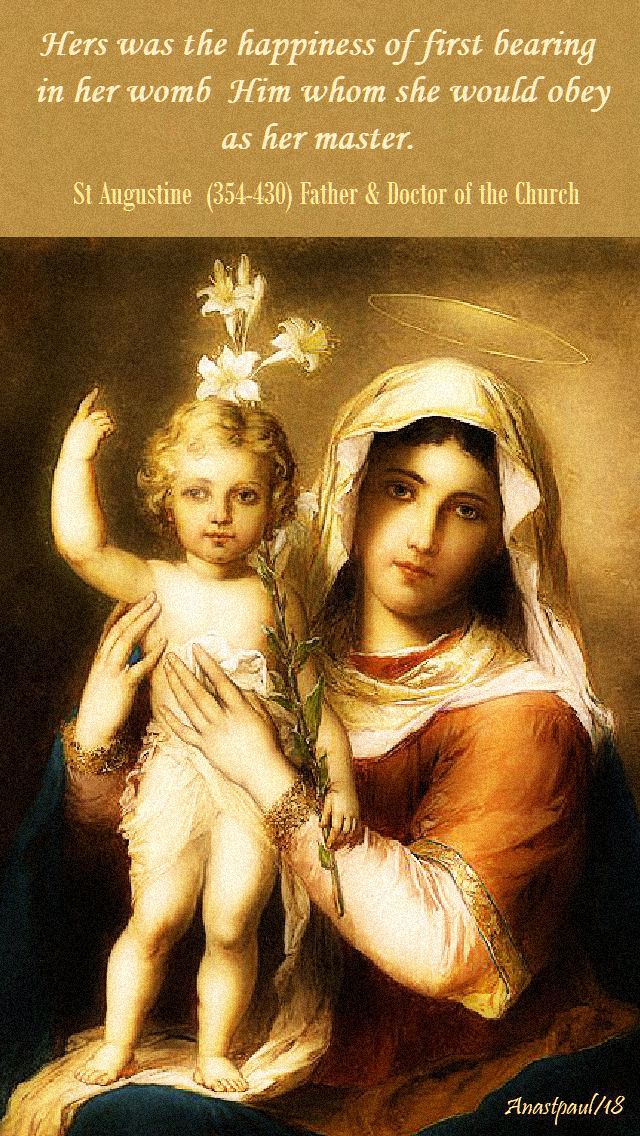
“Hers was the happiness of first bearing in her womb
Him whom she would obey as her master.”

St Augustine (354-430) Father & Doctor of the Churchhers was the happiness - st augustine 25 nov - christ the king 2018

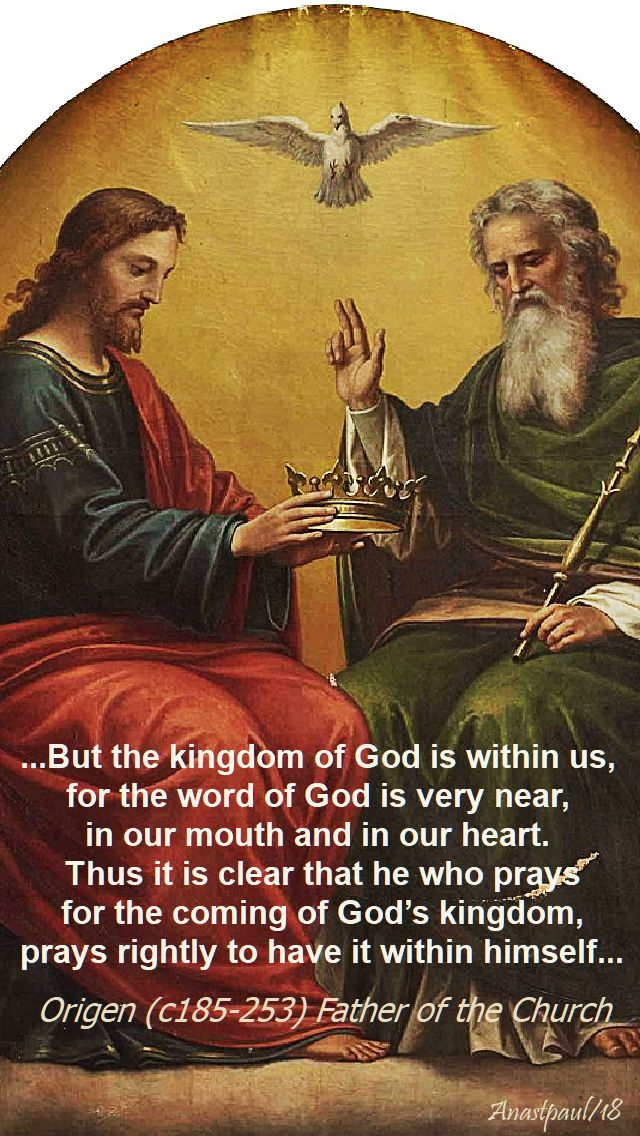
“The kingdom of God, in the words of our Lord and Saviour,
does not come for all to see; nor shall they say:
Behold, here it is, or behold, there it is;
but the kingdom of God is within us,
for the word of God is very near, in our mouth and in our heart.
Thus it is clear that he who prays for the coming of God’s kingdom,
prays rightly to have it within himself,
that there it might grow and bear fruit and become perfect.
For God reigns in each of his holy ones.
Anyone who is holy obeys the spiritual laws of God,
who dwells in Him as in a well-ordered city.
The Father is present in the perfect soul
and with Him Christ reigns, according to the words:
We shall come to him and make our home with him.”but the kingdom of god is within us - origen - 25 nov christ the king 2018

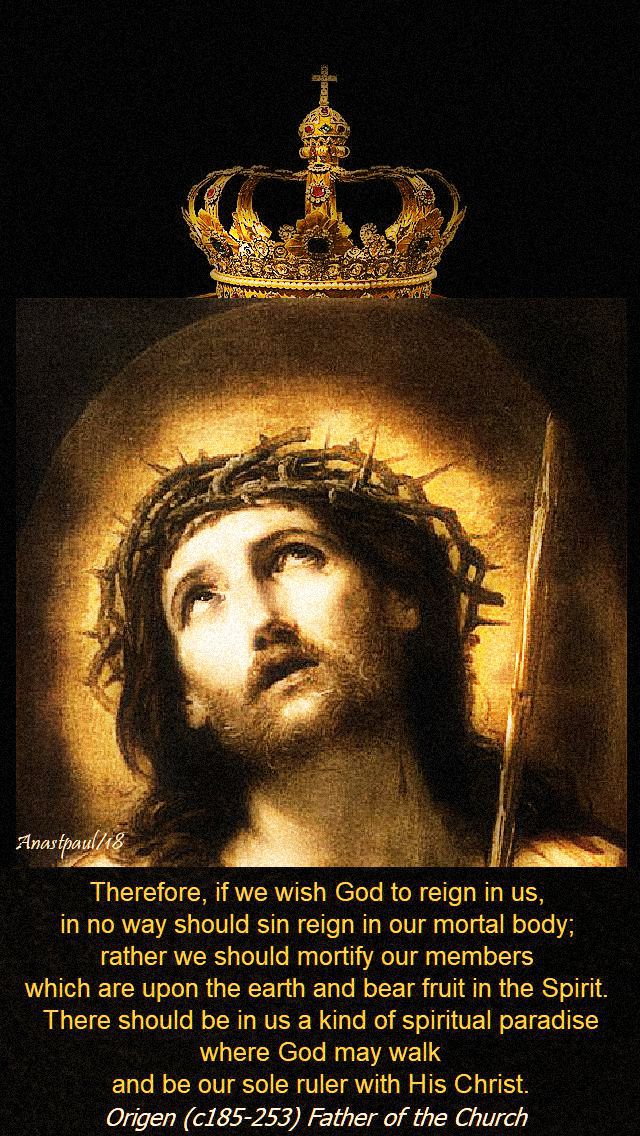
“The kingdom of God cannot exist alongside the reign of sin.
Therefore, if we wish God to reign in us,
in no way should sin reign in our mortal body;
rather we should mortify our members which are upon the earth
and bear fruit in the Spirit.
There should be in us a kind of spiritual paradise where God may walk
and be our sole ruler with His Christ.
In us the Lord will sit at the right hand of that spiritual power
which we wish to receive.
And He will sit there until all His enemies,
who are within u,. become His footstool
and every principality, power and virtue in us is cast out.”

Origen (c185-253) Father of the Churchtherefore if we wish god to reign in us - origen - 25 nov chirst the king 2018

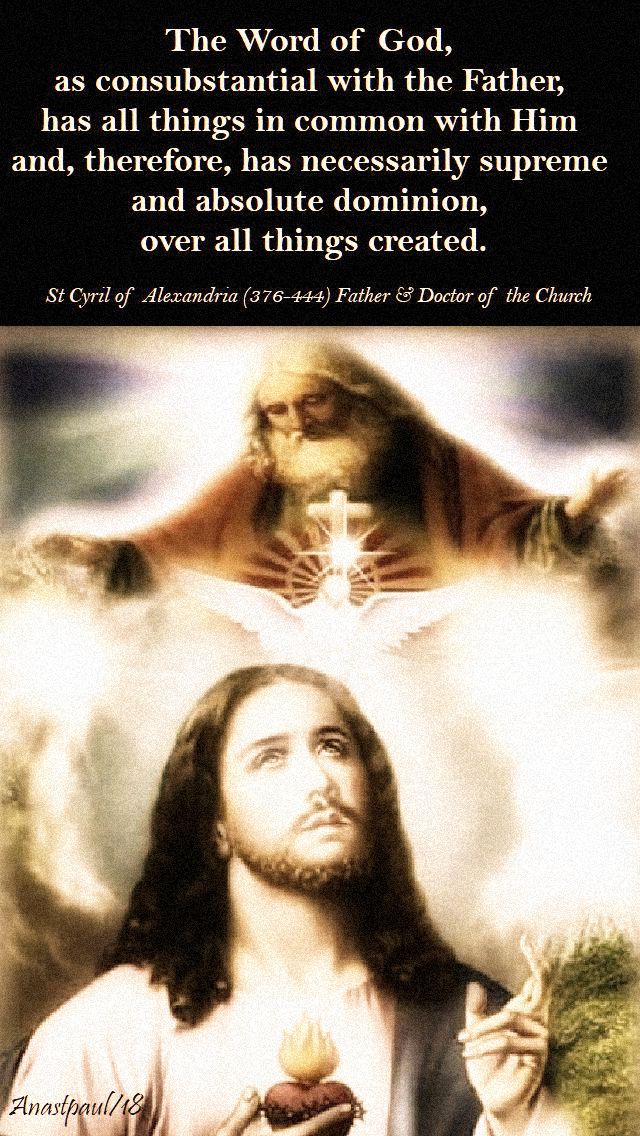
“The Word of God, as consubstantial with the Father,
has all things in common with Him and, therefore,
has necessarily supreme and absolute dominion,
over all things created.”

St Cyril of Alexandria (376-444) Father & Doctor of the Churchthe word of god - st cyril of alexandria - 25 nov christ the king 2018

Posted in CHRIST the KING, FEASTS and SOLEMNITIES, MORNING Prayers, PAPAL SERMONS, SAINT of the DAY, The SIGN of the CROSS

One Minute Reflection – 25 November – The Solemnity of Our Lord Jesus Christ, King of the Universe

One Minute Reflection – 25 November – Today’s Gospel: John 18:33–37 – The Solemnity of Our Lord Jesus Christ, King of the Universe

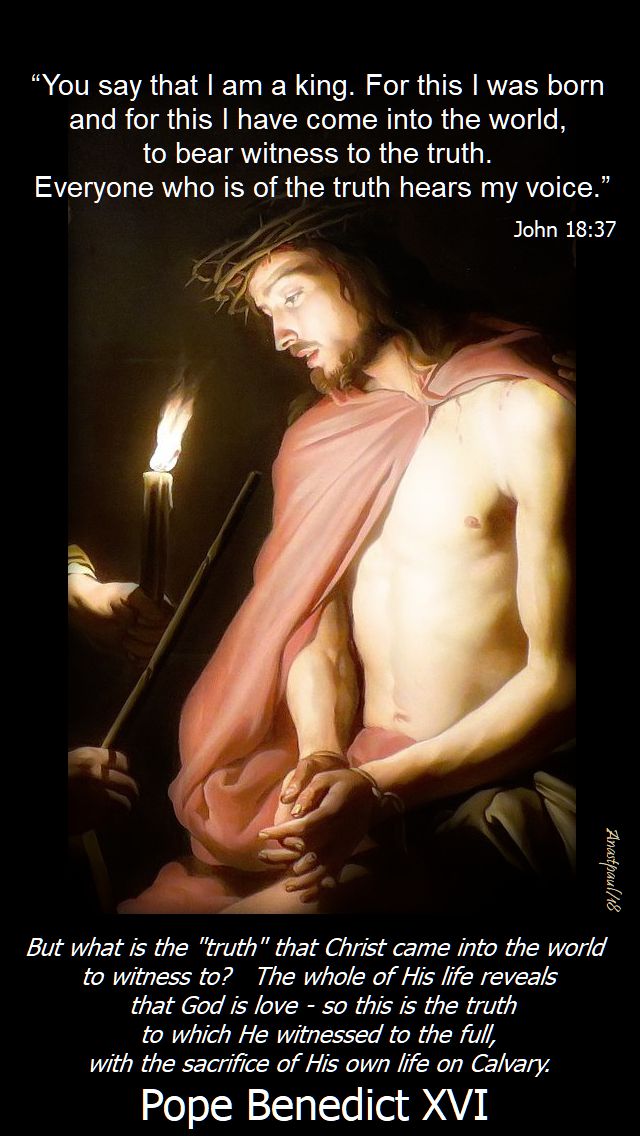
“You say that I am a king.   For this I was born and for this I have come into the world, to bear witness to the truth.   Everyone who is of the truth hears my voice.”...John 18:37

REFLECTION – “But what is the “truth” that Christ came into the world to witness to?   The whole of His life reveals that God is love – so this is the truth to which He witnessed to the full, with the sacrifice of His own life on Calvary.
The Cross is the “throne” where He manifested His sublime kingship as God Love, by offering Himself in expiation for the sin of the world, He defeated the “ruler of this world” (Jn 12: 31) and established the Kingdom of God once and for all.   It is a Kingdom that will be fully revealed at the end of time, after the destruction of every enemy and last of all, death (cf. I Cor 15: 25-26).   The Son will then deliver the Kingdom to the Father and God will finally be “everything to everyone” (I Cor 15: 28).
The way to reach this goal is long and admits of no short cut, indeed, every person must freely accept the truth of God’s love.   He is Love and Truth and neither Love nor Truth are ever imposed, they come knocking at the doors of the heart and the mind and where they can enter they bring peace and joy.   This is how God reigns, this is His project of salvation, a “mystery” in the biblical sense of the word, a plan that is gradually revealed in history.”….Pope Benedict XVI 26 November 2006john 18 37 - for this i was born - but what is this truth - pope benedict - 25 nov 2018 - christ the king

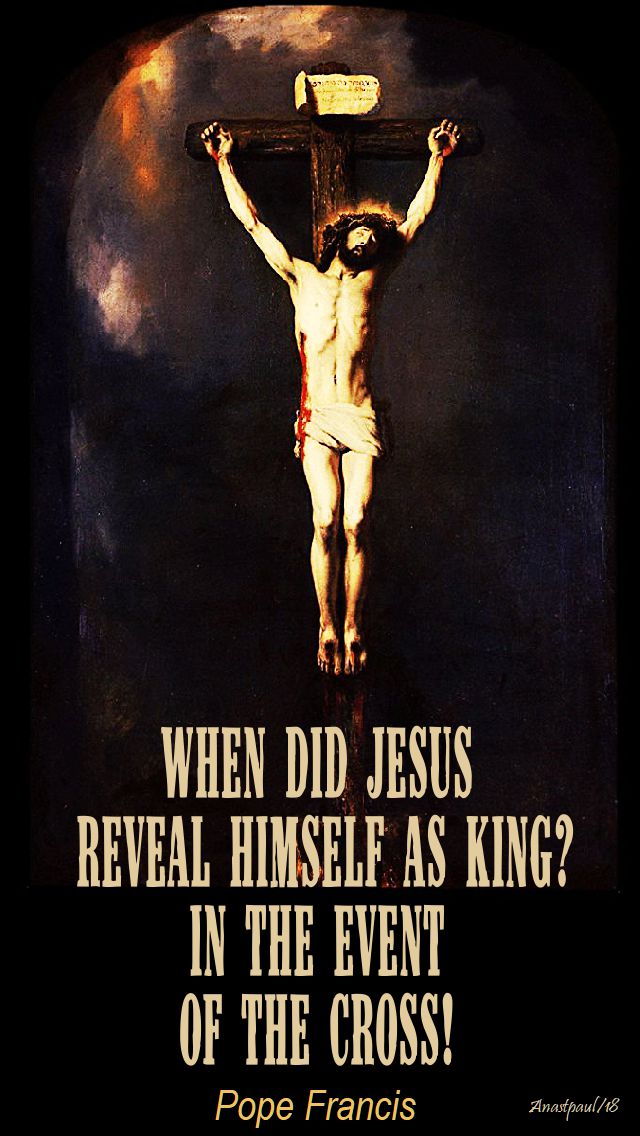
“When did Jesus reveal Himself as king?   In the event of the Cross!   Those who look at the Cross cannot but see the astonishing gratuitousness of love.   One of you could say, “Father, that was a failure!”.   It is precisely in the failure of sin — sin is a failure — in the failure of human ambitions – the triumph of the Cross is there, the gratuitousness of love is there.   In the failure of the Cross, love is seen, a love that is gratuitous, which Jesus gives us.”…Pope Francis – Angelus, 22 November 2015when did jesus reveal himself as king - pope francis - 25 nov 2018 christ the king no 2

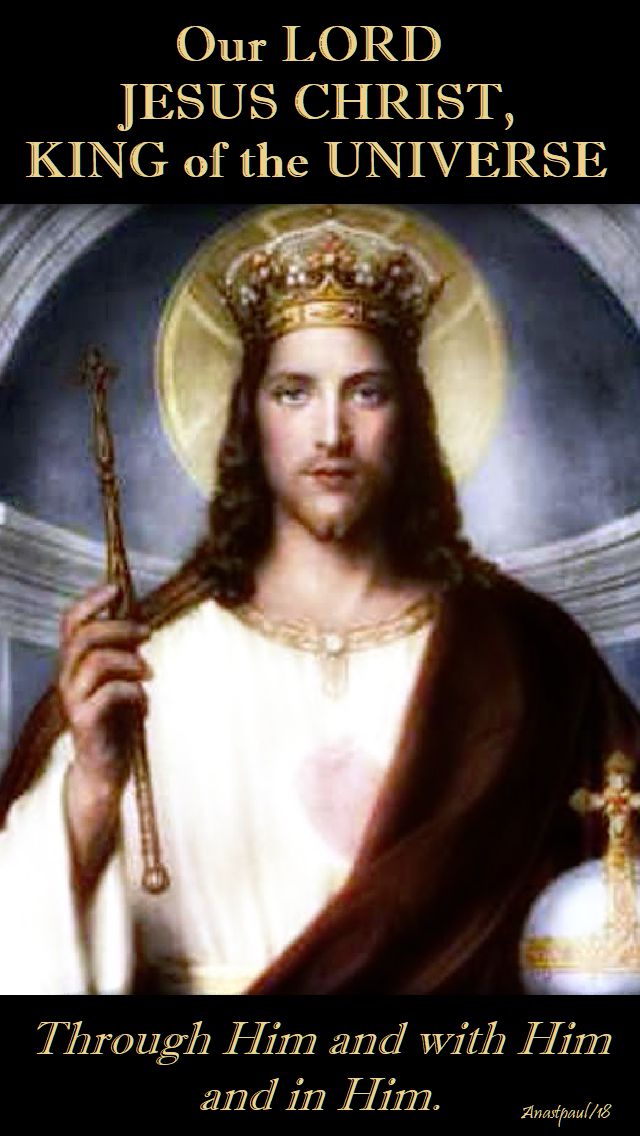
PRAYER – Lord God, You gave the peoples of the world as the inheritance of Your only Son;  You crowned Him as King of Zion, Your holy city and gave Him Your Church to be His Bride.   As He proclaims the law of Your eternal kingdom, may we serve Him faithfully and so share His royal power forever.   We make our prayer, through Him and with Him and in Him, our King and our Redeemer, with the Holy Spirit, God forever, amen.our lord jesus christ king of the universe - 25 nov 2018.no 2

Posted in CATHOLIC-PRAYERS OF THE CHURCH, CHRIST the KING, FEASTS and SOLEMNITIES, Our MORNING Offering, PRAYERS of the CHURCH, SAINT of the DAY

Our Morning Offering – 25 November – The Solemnity of Our Lord Jesus Christ, King of the Universe

Our Morning Offering – 25 November – The Solemnity of Our Lord Jesus Christ, King of the Universe

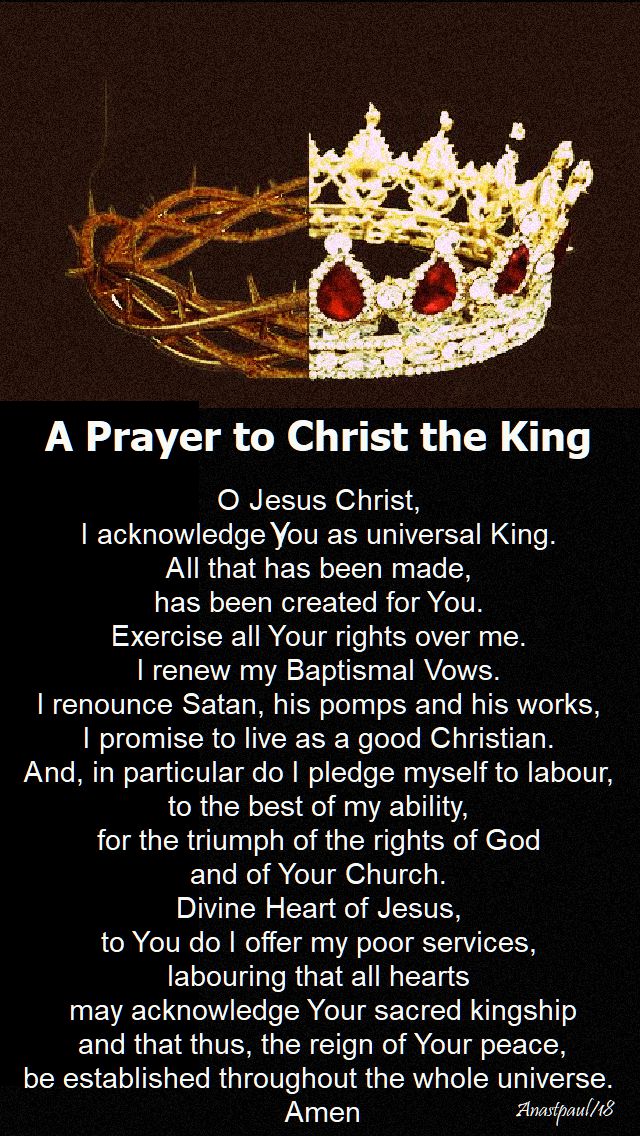
A Prayer to Christ the King

O Jesus Christ,
I acknowledge You as universal King.
All that has been made,
has been created for You.
Exercise all Your rights over me.
I renew my Baptismal Vows.
I renounce Satan, his pomps and his works,
I promise to live as a good Christian.
And, in particular do I pledge myself to labour,
to the best of my ability,
for the triumph of the rights of God
and of Your Church.
Divine Heart of Jesus,
to You do I offer my poor services,
labouring that all hearts
may acknowledge Your sacred kingship
and that thus, the reign of Your peace,
be established throughout the whole universe.
Amena prayer to christ the king - 25 nov 2018 solem of christ the king

Posted in CHRIST the KING, FEASTS and SOLEMNITIES, SAINT of the DAY

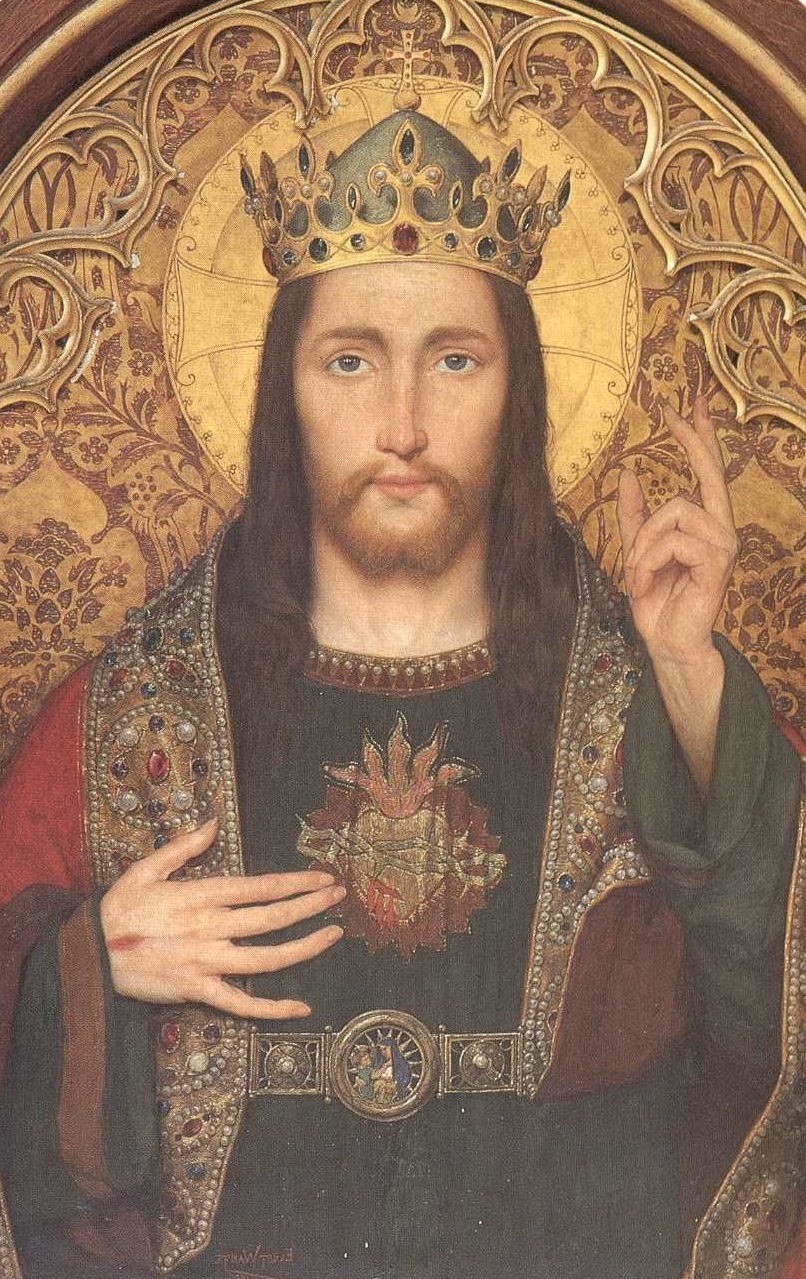
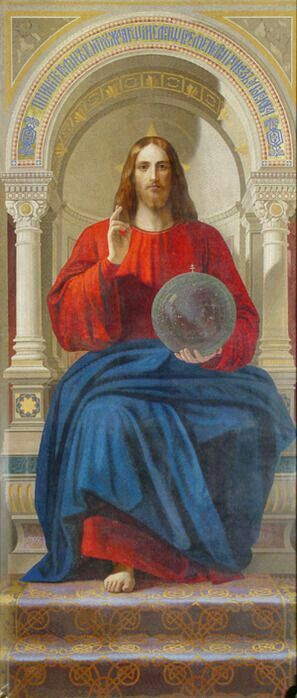
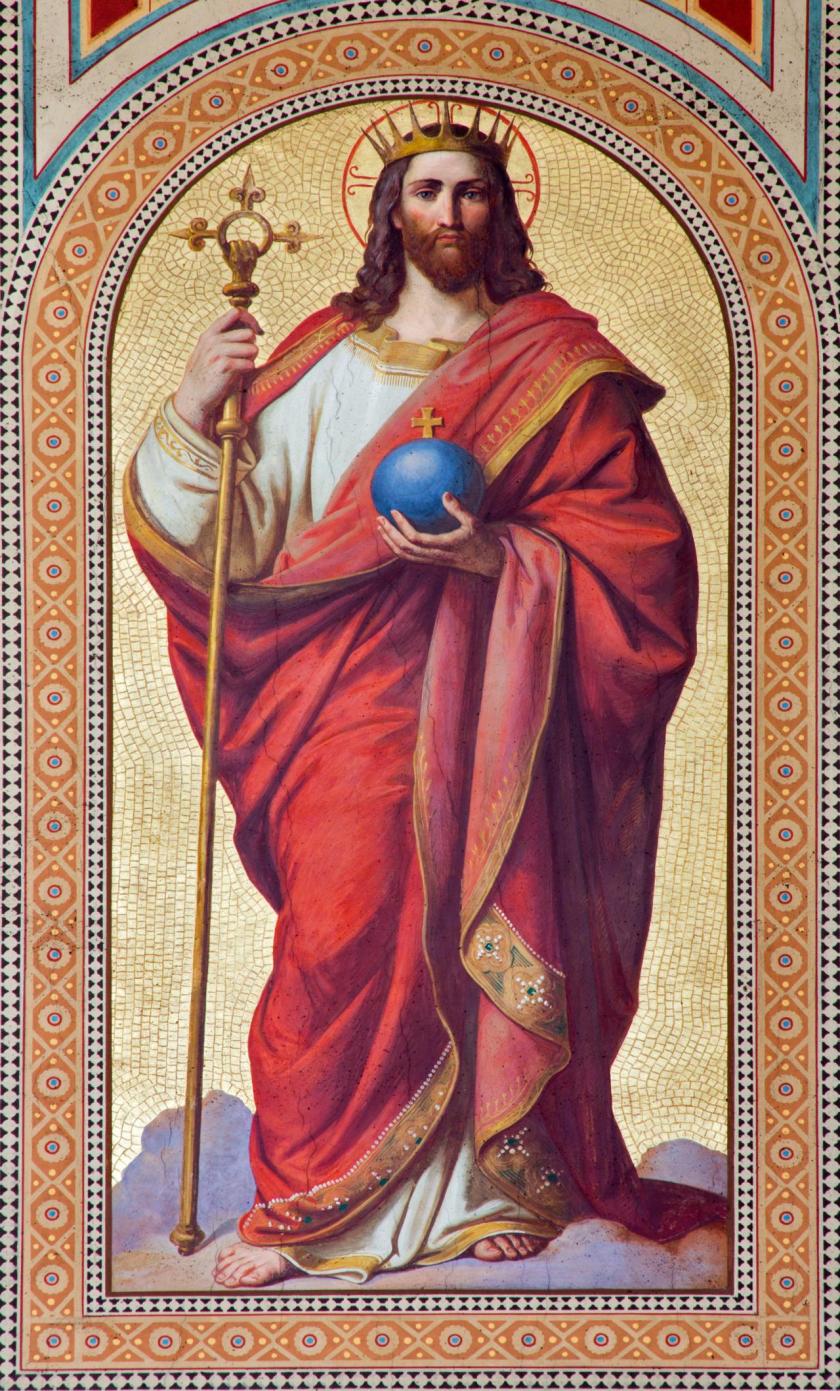
25 November – The Solemnity of Our Lord Jesus Christ, King of the Universe

25 November – The Solemnity of Our Lord Jesus Christ, King of the Universe

The political context in which Pope Pius XI, by the Encyclical Quas Primas, established the feast of Christ the King in 1925, was the still unresolved Roman Question, which concerned the papacy and the kingdom of Italy regarding the temporal authority of the popes and the Papal States.   For those of us who have grown up with the separation of church and state, the Papal States are a distant historical oddity.christ the king 3

Yet even if these political issues no longer resonate for us today, Quas Primas commemorated these same issues and problems by taking the view that marks the Church off as a unique society, one that is eternal, whose King’s authority transcends all political divisions and historical epochs.   The Church exists in the messiness of history and responds to events that emerge from that same messiness but claims a King who transcends it all.

Already in the book of Daniel and in earlier prophetic books, the hope for the true king, the one who would establish God’s kingdom, emerged in the language and imagery of ancient Near Eastern myth, when the prophet sees “I saw in the night visions and behold, with the clouds of heaven there came one like a son of man.”   While scholars dispute the identification of the son of man as the messiah in Daniel, the earliest Christians understood that the one to whom “was given dominion and glory and kingdom, that all peoples, nations and languages should serve him; his dominion is an everlasting dominion, which shall not pass away and his kingdom one that shall not be destroyed.”

When would this King of all peoples, nations and languages arrive?   When would God’s kingdom, the everlasting dominion, be established?   The book of Revelation, written in opposition to the Caesars of Rome and their empire, declared that Jesus was already “the ruler of kings on earth” who “made us a kingdom, priests to his God and Father, to him be glory and dominion for ever and ever.”   And Revelation promised, evoking the language of Daniel, that Jesus’ first coming will be followed by a second coming with the clouds when “every eye will see him, every one who pierced him; and all tribes of the earth will wail on account of him.”Christ King header

Even Jesus’ disciples, though, who followed Him faithfully if unsurely to Jerusalem, must have wondered about the answer when they heard the Roman procurator Pilate, ask their teacher, “Are you the King of the Jews?”   Jesus answered, “My kingship is not of this world; if my kingship were of this world, my servants would fight, that I might not be handed over to the Jews; but my kingship is not from the world.”   It is a true answer, of course but also elusive, for though Jesus’ kingdom is “not from this world” and does not involve peach treaties, concordats, armies and diplomatic corps, it includes all of this world and all that is in it.

It is a point Pope Pius XI makes in Quas Primas (13), citing St Cyril of Alexandria, who wrote that “Christ has dominion over all creatures …by essence and by nature.”   Pope Pius XI also writes that though Jesus’ kingship is founded upon the ineffable hypostatic union, “Christ is also our King by acquired, as well as by natural right, for He is our Redeemer.” Jesus’ kingship is unlike any other by nature and by behaviour.CHRIST THE KING 6

But there is another consideration as to why Jesus declared that His kingdom was ‘not from this world’.   Pope Pius XI states that all people can enter “this kingdom, whoever they are and from wherever they are, since “this kingdom is opposed to none other than to that of Satan and to the power of darkness” (18).   This kingdom welcomes all kingdoms and all peoples.

If we see only the messiness of history and politics, we are missing the true story of eternity and the true King of all, who is already “the ruler of the kings of the earth.” I  f we believe it to be true, we must never despair of the politics of our age, for He came as King, is now King and is coming again in glory as King!christ the king lg

(From ‘King of All’ by John W Martens)

Posted in FEASTS and SOLEMNITIES, SAINT of the DAY

Solemnity of Christ the King and Memorials of the Saints 25 November

Christ the King (Solemnity) – 2018

St Catherine of Alexandria (Died c 305) (Optional Memorial)

Bl Adalbert of Caramaico
St Alanus of Lavaur
St Audentius of Milan
St Bernold of Ottobeuren
Bl Conrad of Heisterbach
Bl Ekbert of Muensterschwarzach
Bl Elisabeth Achler
St Erasmus of Antioch
Bl Garcia of Arlanza
Bl Guido of Casauria
St Imma of Wurzburg
Bl Jacinto Serrano López
St Jucunda of Reggio Aemilia
Bl Maria Corsini Beltrame Quattrocchi
St Mercurius of Caesarea
St Moses of Rome
St Peter of Alexandria
Bl Santiago Meseguer Burillo

Martyrs of Africa – (13 saints): A group of 13 Christians murdered together for their faith in Africa, date unknown. The only details to have survived are their names – Claudian, Cyprian, Donatus, Felix, Januarius, Julian, Lucian, Marcian, Martialis, Peter, Quirianus, Victor and Vitalis.

Posted in CATHOLIC-PRAYERS OF THE CHURCH, FEASTS and SOLEMNITIES, MARIAN DEVOTIONS, MARIAN PRAYERS, MARIAN TITLES, Our MORNING Offering, PRAYERS of the CHURCH, SAINT of the DAY, The BLESSED VIRGIN MARY

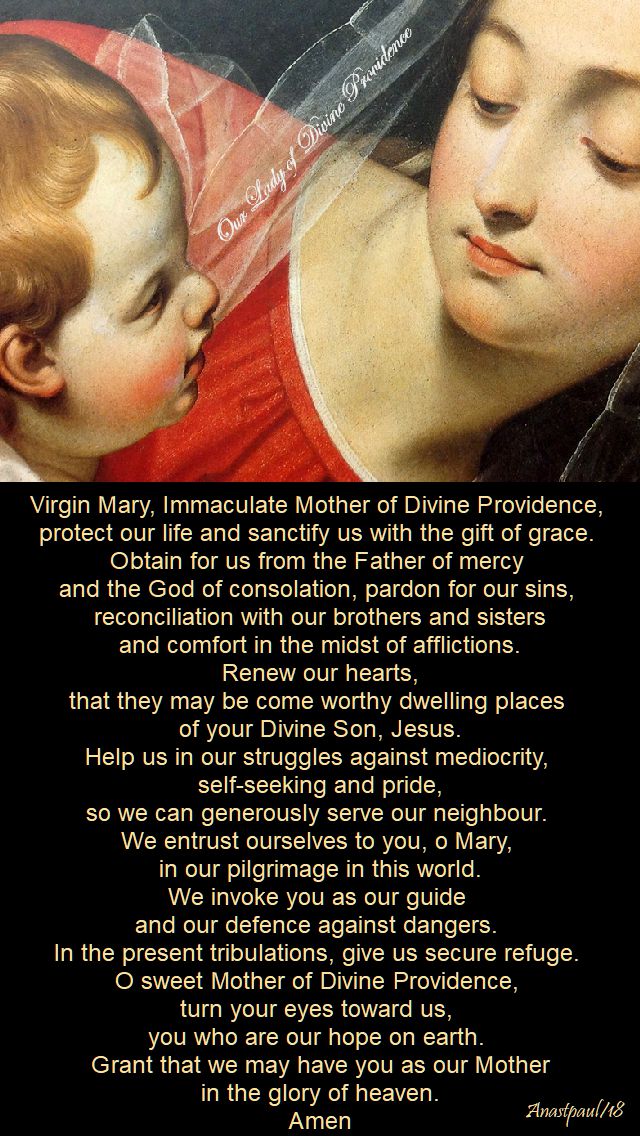
Our Morning Offering – 19 November – Feast of Our Lady of Divine Providence

Our Morning Offering – 19 November – Feast of Our Lady of Divine Providence

Prayer to Mary, Mother of Divine Providence

Virgin Mary, Immaculate Mother of Divine Providence,
protect our life and sanctify us with the gift of grace.
Obtain for us from the Father of mercy
and the God of consolation, pardon for our sins,
reconciliation with our brothers and sisters
and comfort in the midst of afflictions.
Renew our hearts,
that they may be come worthy dwelling places
of your Divine Son, Jesus.
Help us in our struggles against mediocrity,
self-seeking and pride,
so we can generously serve our neighbour.
We entrust ourselves to you, o Mary,
in our pilgrimage in this world.
We invoke you as our guide
and our defence against dangers.
In the present tribulations, give us secure refuge.
O sweet Mother of Divine Providence,
turn your eyes toward us,
you who are our hope on earth.
Grant that we may have you as our Mother
in the glory of heaven.
Amenprayer to mary mother of divine providence - fest day 19 nov 2018

Posted in FEASTS and SOLEMNITIES, MARIAN TITLES, SAINT of the DAY, The BLESSED VIRGIN MARY

Feast of Our Lady of Divine Providence and Memorials of the Saints – 19 November

Our Lady of Divine Providence :    The title of “Mary, Mother of Divine Providence” is often traced to her intervention at the wedding in Cana. Christ’s first public miracle was occasioned in part by the intercession of His Mother.   She assisted,  through her foresight and concern, the  avoidance of an embarrassing situation for the newlywed couple.     Our Lady of Providence is also identified as Queen of the Home.
Devotion to Our Lady of Divine Providence originated in Italy and spread to France and Spain.    The devotion was brought to Puerto Rico in the early 1850s by the Servite Fathers.   According to tradition, Philip Benizi (1233 – 1285) prayed to Mary for aid in providing food for his Friars and subsequently, found several baskets of provisions left at the door of the convent.    Our Lady of Providence was declared the Patroness of Puerto Rico on 19 November 1969.   Her feast day is celebrated in many immigrant Puerto Rican communities.

Around 1580, the Italian Painter Scipione Pulzone created a work titled “Mater Divinae Providentiae” which depicted the Blessed Mother cradling the Infant Jesus.    Devotion to Mary, Mother of Divine Providence in the first house of the Congregation of the Clerics Regular of St Paul (Barnabites) in Rome at San Carlo ai Catinari church began around year 1611, when one of the clerics travelled to Loreto to pray for assistance in finding the financial resources to complete the Church of San Carlo.     Upon his return, they received the necessary assistance and the Barnabites began to promote devotion to Our Lady of Providence.
Pulzone’s painting was given to the Barnabites in 1663.     It was placed on the Altar of a Chapel on the first floor of the Saint Charles rectory behind the main Altar.   In 1732, a copy of the painting was placed in a location adjacent to the main Altar of the Church of San Carlo ai Catinari in Rome, where it drew many faithful visitors.
In 1774, Pope Benedict XIV authorised the Confraternity of Our Lady of Providence, a lay organisation created for the purpose of promoting special works of Christian charity or piety.   Pope Gregory XVI elevated it to an Archconfraternity in 1839. In 1888, Pope Leo XIII ordered the solemn Crowning of the “Miraculous Lady” and approved the Mass and Office of Mary, Mother of Divine Providence.   On 5 August 1896, Superior General of the Barnabites, Father Benedict Nisser decreed that every Barnabite have a copy of the painting in their home.
Patronage:
Our Lady of Providence is the Patroness of the Barnabite Order.
Our Lady of Providence is the Patroness of Indiana and the Roman Catholic Diocese of Providence, Rhode Island. The Chapel of Saint Vincent Hospital in Worcester, Massachusetts is dedicated to Our Lady of Providence.
Our Lady of Divine Providence is the patroness of St Benedict’s Abbey in Atchison, Kansas.
Our Lady of Divine Providence is also the Patroness of the Caribbean island of Puerto Rico.

Our_Lady_of_Providence_Pulzone
Bl Alexandre Planas Saurí
St Atto of Tordino
St Azas of Isauria
St Barlaam of Antioch
St Ebbe of Minster-of-Thanet
Bl Eliseo García y García
Bl James Benefatti
St James of Sasseau
St Maximus of Caesarea
St Maximus of Rome
St Mechtilde of Helfta
St Medana
St Nerses the Great
Obadiah the Prophet
St Pope Pontian
St Raphael Kalinowski, O.C.D. (1835-1907)
St Tuto

Martyrs of Heraclea

Martyrs of Vienne: – 3 saints
St Exuperius
St Felicianus
St Severinus

Posted in FEASTS and SOLEMNITIES, PAPAL SERMONS, SAINT of the DAY, The BLESSED VIRGIN MARY

Thought for the Day – 9 November – Pope Benedict on the Feast of the Dedication of St John Lateran

Thought for the Day – 9 November – Pope Benedict on the Feast of the Dedication of St John Lateran

In a sense, St John Lateran is the parish church of all Catholics, because it is the pope’s cathedral.   This church, is the spiritual home, of the people who are the Church.

Excerpt of Pope Benedict’s

Angelus Address 9 November 2008

“The Word of God during this Solemnity recalls an essential truth – the stone temple is the symbol of the living Church, the Christian community, that the Apostles Peter and Paul had, in their Letters, already understood as a “spiritual building”, constructed by God with the “living stones” that are the Christians, upon the one foundation that is Jesus Christ, who is in turn compared to the “cornerstone” cf. 1 Cor 3: 9-11, 16-17; 1 Pt 2: 4-8; Eph 2: 20-22).   “Brethren,… you are God’s building”, St Paul writes and he adds, “God’s temple is holy, and you are that temple” (1 Cor 3: 9c, 17).

The beauty and the harmony of churches, destined to render praise to God, invites us human beings too, though limited and sinful, to convert ourselves to form a “cosmos”, a well-ordered construction, in close communion with Jesus, who is the true Holy of Holies.   This reaches its culmination in the Eucharistic liturgy, in which the “ecclesia” that is, the community of baptised finds itself again united to listen to the Word of God and nourish itself on the Body and Blood of Christ.   Gathered around this twofold table, the Church of living stones builds herself up in truth and in love and is moulded interiorly by the Holy Spirit, transforming herself into what she receives, conforming herself ever more to her Lord Jesus Christ.   She herself, if she lives in sincere and fraternal unity, thus becomes a spiritual sacrifice pleasing to God.

Dear friends, today’s feast celebrates an ever current mystery – that God desires to build himself a spiritual temple in the world, a community that adores Him in spirit and truth (cf. Jn 4: 23-24).

But this occasion reminds us also of the importance of the concrete buildings in which the community gathers together to celebrate God’s praises.   Every communit,y therefore, has the duty to carefully guard their holy structures, which constitute a precious religious and historical patrimony.   For this we invoke the intercession of Mary Most Holy, so that she might help us to become, like her, a “house of God”, living temple of his love.”

gods-desire-to-build-pope-benedict-9-nov-2017

mary most holy pray for us - 9 nov 2018