Posted in DOCTORS of the Church, FATHERS of the Church, FEASTS and SOLEMNITIES, MORNING Prayers, QUOTES of the SAINTS, SAINT of the DAY, The APOSTLES & EVANGELISTS

Quote/s of the Day – 29 June

Quote/s of the Day – 29 June

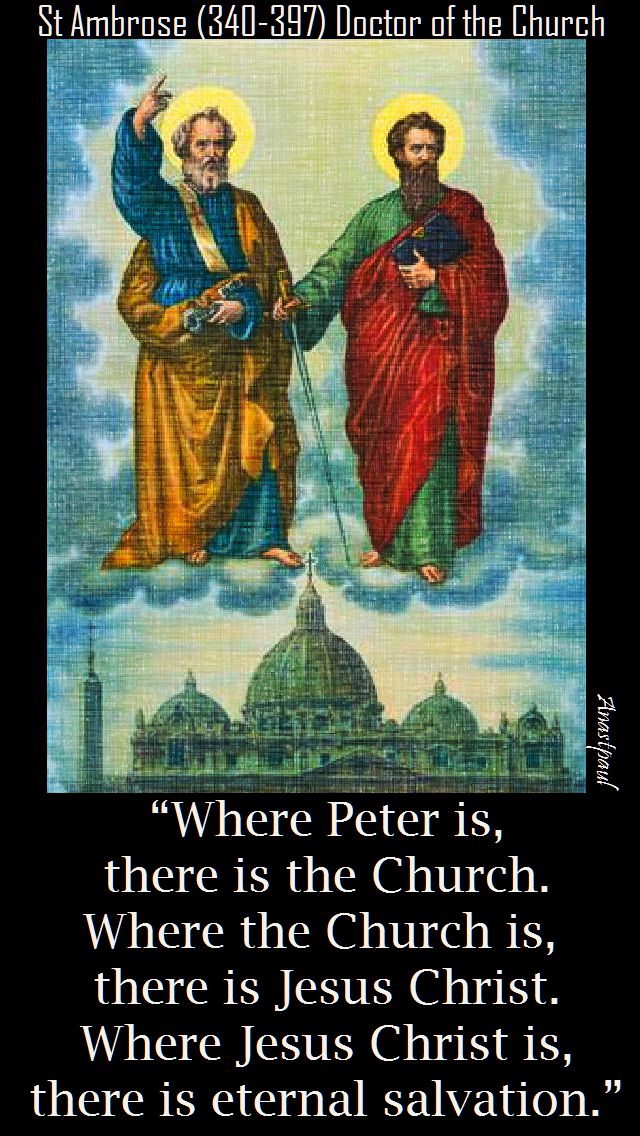
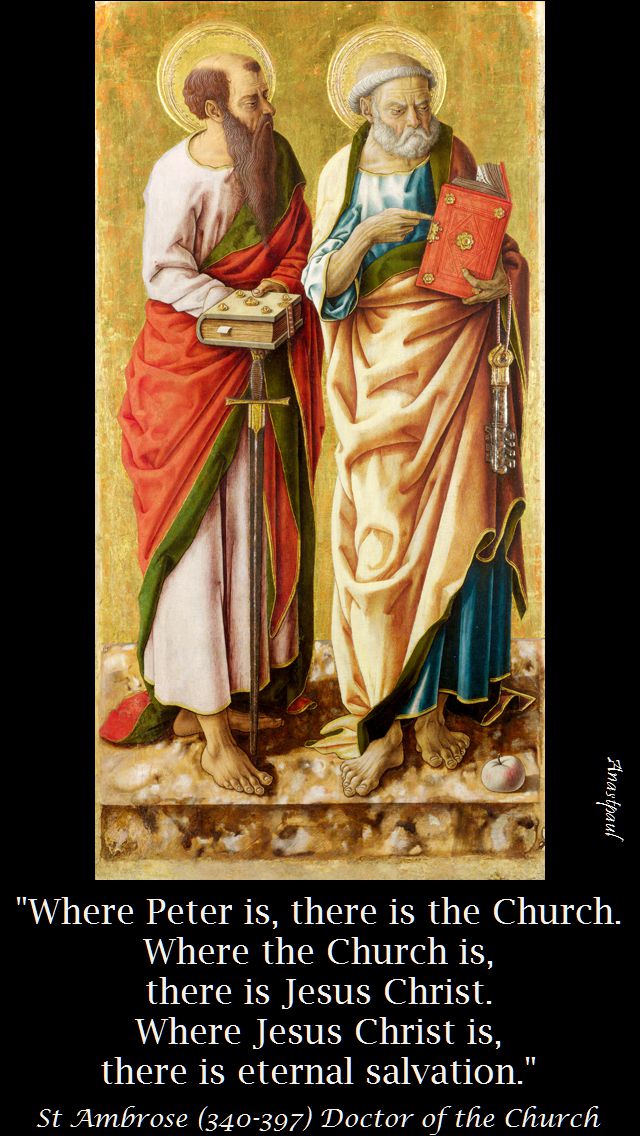
“Where Peter is,
there is the Church.
Where the Church is,
there is Jesus Christ.
Where Jesus Christ is,
there is eternal salvation.”

St Ambrose (340-397)
One of the original four Doctors of the Church

where peter is 2

where peter is, there is the church - st ambrose

“There must be general rejoicing, dearly beloved,
over this holy company whom God has appointed
for our example in patience and for our confirmation in faith.
But we must glory even more in the excellence of their fathers,
Peter and Paul, whom the grace of God has raised
to such a height among all the members of the Church
that He has set them like twin lights
of eyes in that Body whose head is Christ.”

St Pope Leo the Great (400-461) Doctor of the Church’s Unity

he has set them like twinlight - st pope leo the great


Posted in FATHERS of the Church, FEASTS and SOLEMNITIES, MORNING Prayers, QUOTES of the SAINTS, SAINT of the DAY, The APOSTLES & EVANGELISTS, The WORD

One Minute Reflection – 29 June

One Minute Reflection – 29 June

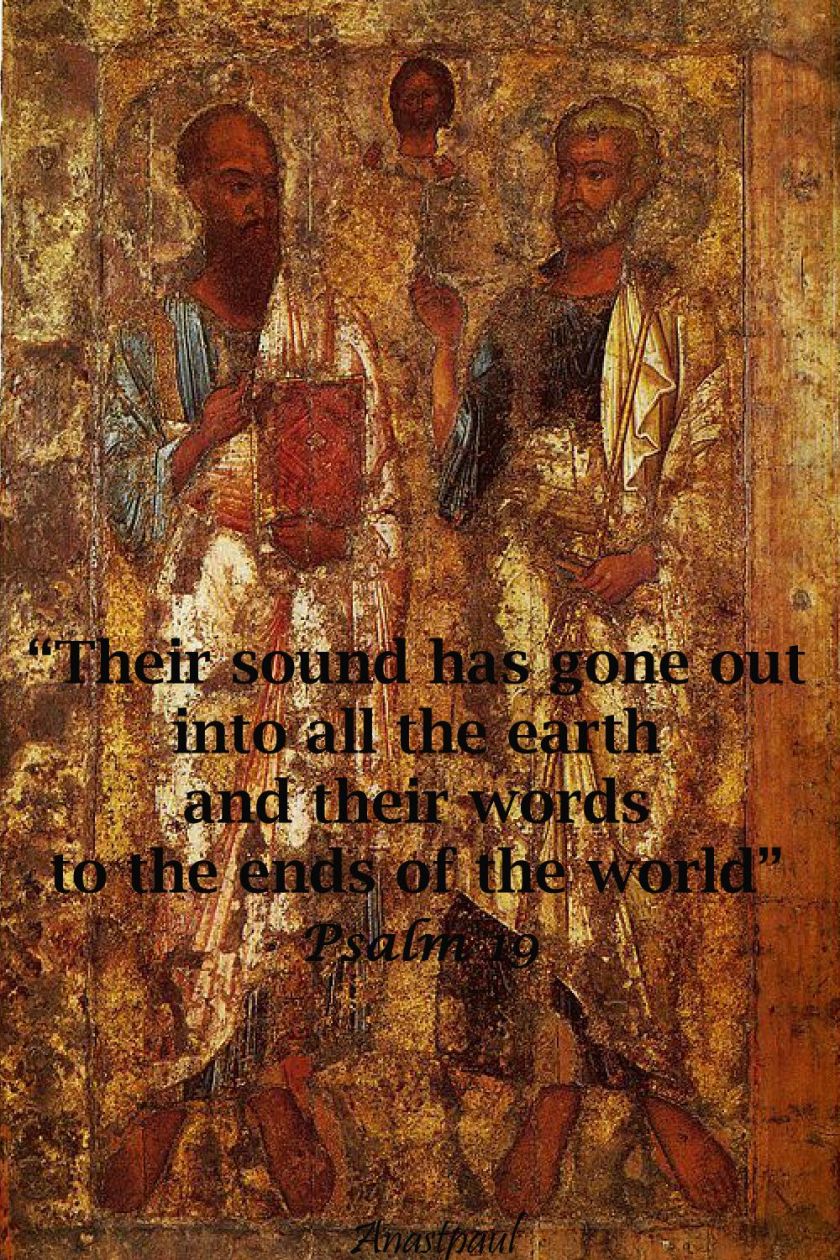
“Their sound has gone out into all the earth and their words to the ends of the world” ……….Psalm 19

psalm 19 - sts peter and paul

REFLECTION – “There is one day for the passion of two apostles. But these two also were as one; although they suffered on different days, they were as one. Peter went first, Paul followed. We are celebrating a feast day, consecrated for us by the blood of the apostles. Let us love their faith, their lives, their labours, their sufferings, their confession of faith, their preaching.”………St Augustine

these two also were as one-staugustine

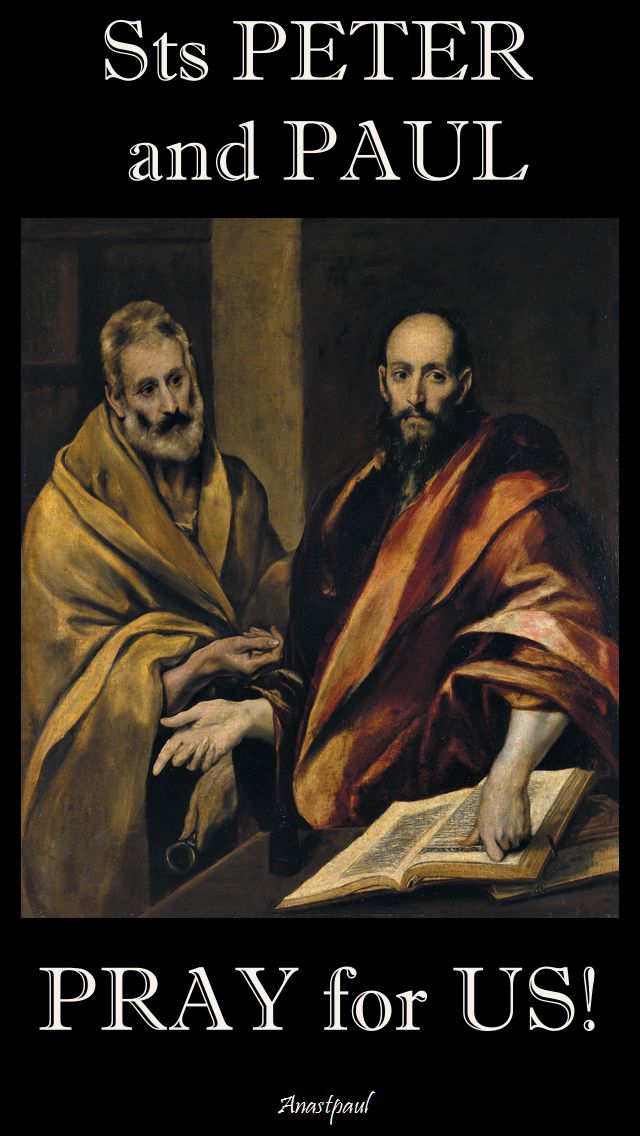
PRAYER – Almighty God, whose blessed Apostles Peter and Paul glorified you by their martyrdom: grant that your Church, instructed by their teaching and example and knit together in unity by your Spirit, may ever stand firm upon the one foundation, which is Jesus Christ our Lord;  who lives and reigns with you, in the unity of the Holy Spirit, one God, for ever and ever. Sts Peter and Paul, pray for us and for the universal Church, amen.

sts peter and paul - pray for us

Posted in FEASTS and SOLEMNITIES, MORNING Prayers, PRAYERS of the CHURCH, SAINT of the DAY

Our Morning Offering – 29 June

Our Morning Offering – 29 June

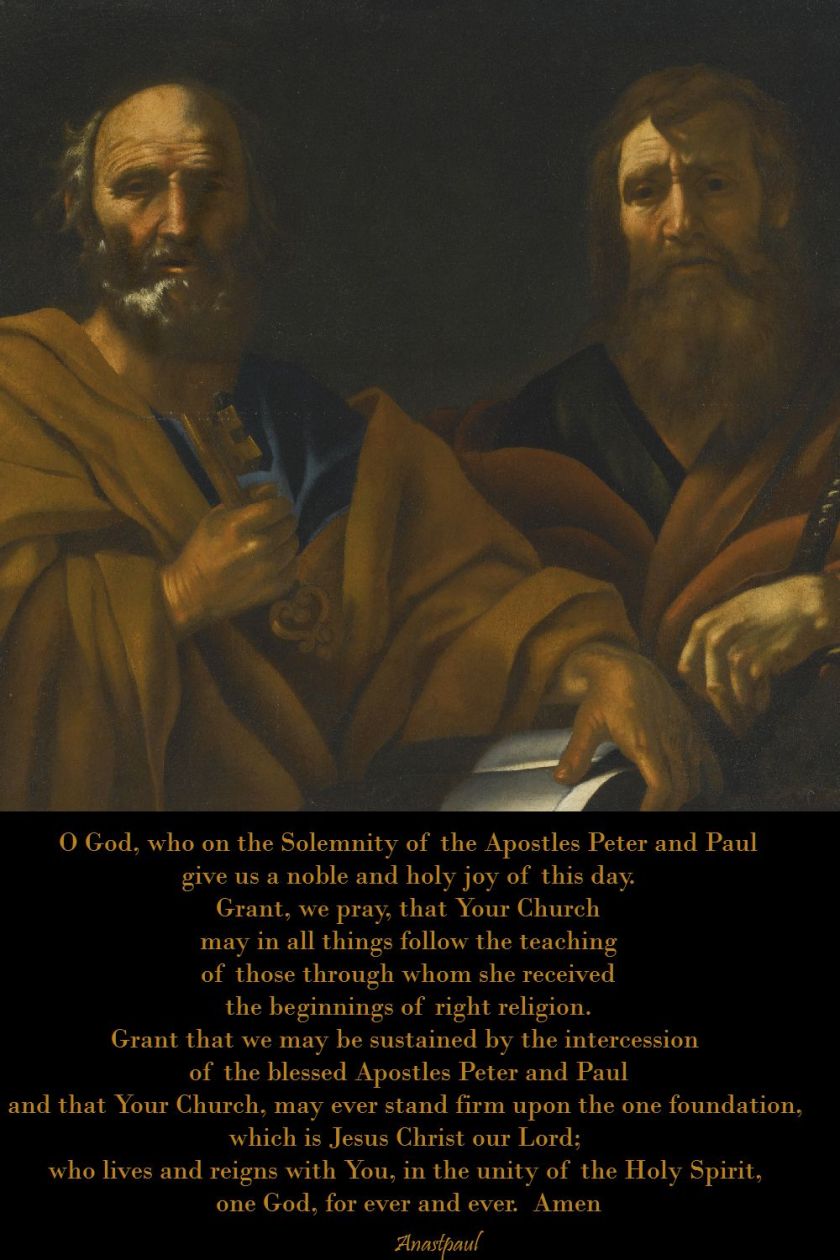
O God,
who on the Solemnity of the Apostles Peter and Paul
give us a noble and holy joy of this day.
Grant, we pray, that Your Church
may in all things follow the teaching
of those through whom she received
the beginnings of right religion.
Grant that we may be sustained
by the intercession
of the blessed Apostles Peter and Paul
and that Your Church,
may ever stand firm upon the one foundation,
which is Jesus Christ our Lord;
who lives and reigns with You,
in the unity of the Holy Spirit,
one God, for ever and ever.
Amen

prayer on the solemnity of the apostles peter and paul

Posted in FEASTS and SOLEMNITIES, SAINT of the DAY, The APOSTLES & EVANGELISTS, The WORD

Blessed and Holy Solemnity of Sts Peter and Paul – 29 June

Blessed and Holy Solemnity of Sts Peter and Paul – 29 June – Today we celebrate St Peter and Paul as co-founders of the Church.   St Peter is also celebrated on 22 February (feast of the Chair of Peter, emblematic of the world unity of the Church), 1 August (Saint Peter in Chains) and 18 November (feast of the dedication of the Basilicas of Peter and Paul). St Paul is also celebrated on 25 January – his conversion and 16 February (Saint Paul Shipwrecked).

St Peter Patronages:  Universal Church, against fever, against foot problems, against frenzy, bakers, bridge builders, butchers, clock makers, cobblers, shoe makers, fishermen, harvesters, locksmiths, longevity, net makers, papacy, popes, ship builders, shipwrights, stone masons, watch makers, Isle of Guernsey, Exeter College, Oxford, England, 17 dioceses, 46 cities, 3 abbeys

St Paul Patronages:  against hailstorms, against snake bites, against snakes, Catholic Action, Cursillo movement, lay people, authors, writers, evangelists, journalists, reporters, missionary bishops, musicians, newspaper editorial staff, public relations personnel and work, publishers, rope braiders and makers, saddle makers; saddlers, tent makers, Malta, Bath Abbey, England, 16 dioceses, 28 cities,

peter and paul HEADER 3Peter-and-Paul-Stroman_school_circa_1620_saints_peter_and_paul.jpg - header

SOLEMNITY OF STS PETER AND PAUL

(Excerpt) HOMILY OF HIS HOLINESS BENEDICT XVI

St Peter’s Basilica
Wednesday, 29 June 2005

Dear Brothers and Sisters,

The Feast of the Holy Apostles Peter and Paul is at the same time a grateful memorial of the great witnesses of Jesus Christ and a solemn confession for the Church: one, holy, catholic and apostolic. It is first and foremost a feast of catholicity. The sign of Pentecost – the new community that speaks all languages and unites all peoples into one people, in one family of God -, this sign has become a reality. Our liturgical assembly, at which Bishops are gathered from all parts of the world, people of many cultures and nations, is an image of the family of the Church distributed throughout the earth.

Strangers have become friends; crossing every border, we recognize one another as brothers and sisters. This brings to fulfilment the mission of St Paul, who knew that he was the “minister of Christ Jesus among the Gentiles, with the priestly duty of preaching the Gospel of God so that the Gentiles [might] be offered up as a pleasing sacrifice, consecrated by the Holy Spirit” (Rom 15: 16).
The purpose of the mission is that humanity itself becomes a living glorification of God, the true worship that God expects: this is the deepest meaning of catholicity – catholicity that has already been given to us, towards which we must constantly start out again. Catholicity does not only express a horizontal dimension, the gathering of many people in unity, but also a vertical dimension: it is only by raising our eyes to God, by opening ourselves to him, that we can truly become one.

Like Paul, Peter also came to Rome, to the city that was a centre where all the nations converged and, for this very reason, could become, before any other, the expression of the universal outreach of the Gospel. As he started out on his journey from Jerusalem to Rome, he must certainly have felt guided by the voices of the prophets, by faith and by the prayer of Israel.magnificent glass sts peter and paul

The mission to the whole world is also part of the proclamation of the Old Covenant: the people of Israel were destined to be a light for the Gentiles. The great Psalm of the Passion, Psalm 22[21], whose first verse Jesus cried out on the Cross: “My God, my God, why have you forsaken me?”, ends with the vision: “All the ends of the earth shall remember and turn to the Lord; all the families of the nations shall bow down before him” (Ps 22[21]: 28). When Peter and Paul came to Rome, the Lord on the Cross who had uttered the first line of that Psalm was risen; God’s victory now had to be proclaimed to all the nations, thereby fulfilling the promise with which the Psalm concludes.

Catholicity means universality – a multiplicity that becomes unity; a unity that nevertheless remains multiplicity. From Paul’s words on the Church’s universality we have already seen that the ability of nations to get the better of themselves in order to look towards the one God, is part of this unity. In the second century, the founder of Catholic theology, St Irenaeus of Lyons, described very beautifully this bond between catholicity and unity and I quote him. He says: “The Church spread across the world diligently safeguards this doctrine and this faith, forming as it were one family: the same faith, with one mind and one heart, the same preaching, teaching and tradition as if she had but one mouth. Languages abound according to the region but the power of our tradition is one and the same. The Churches in Germany do not differ in faith or tradition, neither do those in Spain, Gaul, Egypt, Libya, the Orient, the centre of the earth; just as the sun, God’s creature, is one alone and identical throughout the world, so the light of true preaching shines everywhere and illuminates all who desire to attain knowledge of the truth” (Adv. Haer. I 10, 2). The unity of men and women in their multiplicity has become possible because God, this one God of heaven and earth, has shown himself to us; because the essential truth about our lives, our “where from?” and “where to?” became visible when he revealed himself to us and enabled us to see his face, himself, in Jesus Christ. This truth about the essence of our being, living and dying, a truth that God made visible, unites us and makes us brothers and sisters. Catholicity and unity go hand in hand. And unity has a content: the faith that the Apostles passed on to us in Christ’s name.

… We have said that the catholicity of the Church and the unity of the Church go together. The fact that both dimensions become visible to us in the figures of the holy Apostles already shows us the consequent characteristic of the Church: she is apostolic. What does this mean?sts peter and paul - snip

The Lord established Twelve Apostles just as the sons of Jacob were 12. By so doing he was presenting them as leaders of the People of God which, henceforth universal, from that time has included all the peoples. St Mark tells us that Jesus called the Apostles so “to be with him, and to be sent out” (Mk 3: 14). This seems almost a contradiction in terms. We would say: “Either they stayed with him or they were sent forth and set out on their travels”. Pope St Gregory the Great says a word about angels that helps us resolve this contradiction. He says that angels are always sent out and at the same time are always in God’s presence, and continues, “Wherever they are sent, wherever they go, they always journey on in God’s heart” (Homily, 34, 13). The Book of Revelation described Bishops as “angels” in their Church, so we can state: the Apostles and their successors must always be with the Lord and precisely in this way – wherever they may go – they must always be in communion with him and live by this communion.

… Today’s Gospel tells of the profession of faith of St Peter, on whom the Church was founded: “You are the Messiah… the Son of the living God” (Mt 16: 16). Having spoken today of the Church as one, catholic and apostolic but not yet of the Church as holy, let us now recall another profession of Peter, his response on behalf of the Twelve at the moment when so many abandoned Christ: “We have come to believe; we are convinced that you are God’s holy one” (Jn 6: 69). …

Let us pray to the Lord that the truth of these words may be deeply impressed in our hearts, together with his joy and with his responsibility; let us pray that shining out from the Eucharistic Celebration it will become increasingly the force that shapes our lives.B.Vivarini, Apostel Petrus und Paulus - The Apostles Peter and Paul / Vivarini -


Posted in FEASTS and SOLEMNITIES, SAINT of the DAY, The BLESSED VIRGIN MARY

The Solemnity of Sts Peter and Paul, Saints’ Memorials and Feasts

Sts Peter and Paul Apostles (Solemnity)

Our Lady of Linares

St Anastasius of Bourges
St Benedicta of Sens
St Cassius of Narni
St Ciwg ap Arawn
St Cocha
Bl Hemma of Gurk
St Ilud Ferch Brychan
St Judith of Niederaltaich
St Marcellus of Bourges
St Mary, the Mother of John Mark
Bl Pierre of Tarentaise the Elder
St Salome of Niederaltaich
St Syrus of Genoa
Bl William of Sann

Martyrs of China
Ioannes Baptista Wu Mantang
Magdalena Du Fengju
Maria Du Tianshi
Paulus Wu Anju
Paulus Wu Wanshu

Posted in FEASTS and SOLEMNITIES, SAINT of the DAY, The BLESSED VIRGIN MARY

Saints’ Memorials and Feast Days of The Blessed Virgin Mary – 26 June

Our Lady of Longing: Matka Boża Tęskniąca / Longing Mother of God, Warsaw, Poland – One of the oldest churches in the Archdiocese of Warsaw is St. Elizabeth Powsin. Located on the main altar is a painting of Our Lady of Longing – artist unknown – from the first half of the seventeenth century. At either side, the image is surrounded by statues of Saints Adalbert and Stanislaus – Polish bishops and martyrs. The testimony of miracles and graces relating to the Our Lady of Longing icon have been collected at least since the mid-seventeenth century. On June 28, 1998, the image became the fourth image of Mary in the Archdiocese of Warsaw to be canonically crowned.

OUR LADY OF LONGING 26 JUNE
Our Lady of Longing

Our Lady of Trompone: Italy(1562)

St Acteie of Rome
St Albinus of Rome
Bl Andrea Giacinto Longhin
Bl Andrii Ischak
St Anthelm of Belley
St Babolenus of Stavelot-Malmédy
St Barbolenus of Fossés
Bl Bartholomew of Vir
St Corbican
St David of Thessalonica
St Deodatus of Nola
St Dionysius of Bulgaria
St Edburga of Gloucester
St Hermogius of Tuy
St Iosephus Ma Taishun
St John of Rome
St John of the Goths
St José Maria Robles Hurtado
St Josemaria Escriva
Bl Khalil Al-Haddad
St Maxentius of Poitou
St Medico of Otricoli
Bl Mykola Konrad
St Paul of Rome
St Pelagius of Oviedo
St Perseveranda of Poitiers
Bl Raymond Petiniaud de Jourgnac
St Salvius
Bl Sebastian de Burgherre
St Soadbair
St Superius
St Terence of Rome
St Vigilius of Trent
Bl Volodymyr Ivanovych Pryima

Martyrs of Africa – 4 saints: Four Christians who were martyred together – Agapitus, Emerita, Felix and Gaudentius at an unknown location in Africa, date unknown.

Martyrs of Alexandria – 3 saints: Three Christians who were martyred together, but we really know little more that the names – Agatho, Diogenes and Luceja. They were martyred in Alexandria, Egypt, date unknown.

Martyrs of Cambrai – 4 beati: Four Daughters of Charity of Saint Vincent de Paul nuns at Arras, France. Imprisoned together in 1792 and executed together two years later in the anti-Catholic excesses of the French Revolution. They were:
• Jeanne Gerard
• Marie-Françoise Lanel
• Marie-Madeleine Fontaine
• Thérèse-Madeleine Fantou
They were guillotined on 26 June 1794 at Cambrai, Nord, France and Beatified in June 1920 by Pope Benedict XV.


Posted in FEASTS and SOLEMNITIES, MORNING Prayers, SACRED and IMMACULATE HEARTS, The BLESSED VIRGIN MARY

Thought for the Day – 24 June – Feast of the Immaculate Heart of Mary

Thought for the Day – 24 June – Feast of the Immaculate Heart of Mary

“It was through the body of a young, Jewish girl, living in a tiny village called Nazareth, that Jesus, the divine Word, was made flesh.   Mary belonged to that part of the people of Israel, who awaited the Lord’s coming with expectation and longing.   She had no doubt read about His coming in the Old Testament Scriptures and prayed for it.   But she had no idea how it would come about.   Most Israelites thought the Messiah would manifest Himself gloriously.

When the Archangel Gabriel announced to Mary that she was to be the “door’ through which the long awaited desire of the nations would be fulfilled, she must have been astonished:  “Hail, O favored one, the Lord is with you! … You will conceive in your womb and bear a son, and you shall call His name Jesus” (Lk 1.28-31).   A new life – filled with risks – opened before her.   According to the Church’s tradition, Mary, in an exceptional gesture for a Jewish woman, had decided “not to know man” (Lk 1.34).   She had discerned virginity to be God’s will.   Her Immaculate Heart – the Feast we keep this day – prompted a total giving of herself to God and included the gift of both her body and her heart.   Reassuring her that God had not disdained her vow, Gabriel told Mary that, like the glory of God coming upon the ark, so would the Spirit overshadow her.   The young “handmaid of the Lord” contemplated the Angel’s words.   She treasured them in her heart.   Her response, known as her fiat – “let it be done to me as you say” (Lk 1.38) – shows that she entrusted herself fully to God’s designs.   She chose to forgo her own plans for God’s.   Through her fiat, the Word of God took flesh in the tabernacle of her womb…..

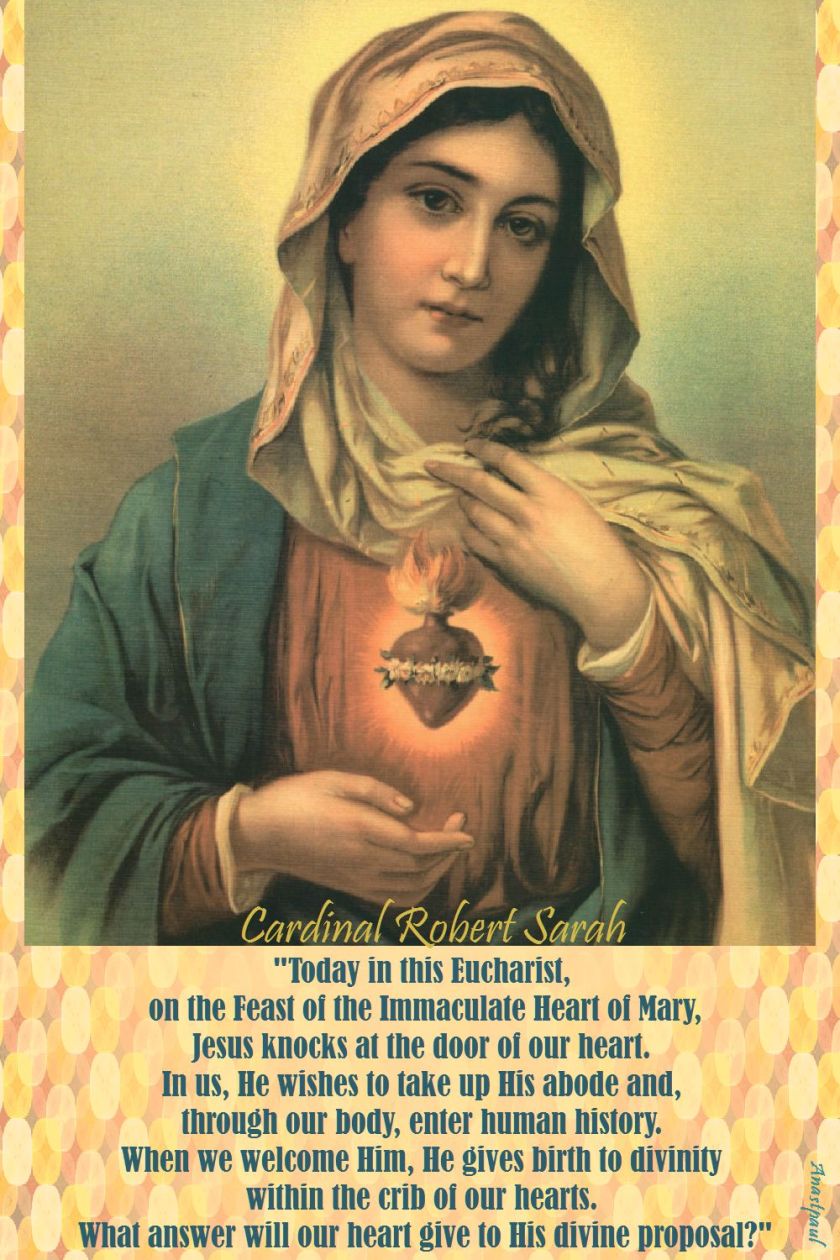
Today in this Eucharist, on the Feast of the Immaculate Heart of Mary, Jesus knocks at the door of our heart.   In us, He wishes to take up His abode and, through our body, enter human history.   When we welcome Him, He gives birth to divinity within the crib of our hearts.   What answer will our heart give to His divine proposal?”…..Cardinal Robert Sarah (16 June 2012)

tday in this eucharist-card robert sarah

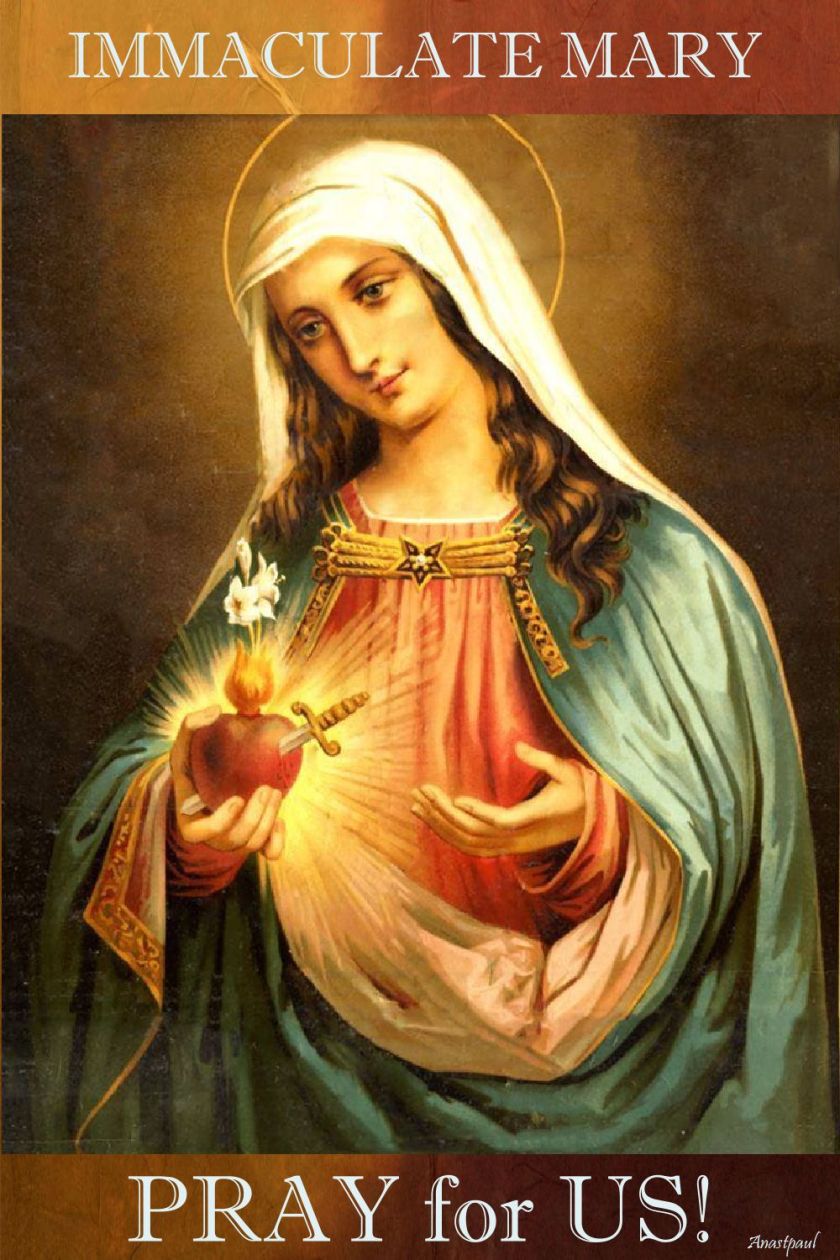
Immaculate Mary, Pray for us!

immaculate mary poray for us

Posted in DOCTORS of the Church, FEASTS and SOLEMNITIES, SACRED and IMMACULATE HEARTS, The BLESSED VIRGIN MARY

Quote/s of the Day – 24 June – The Solemnity of the Birthday of St John the Baptist and the Feast of the Immaculate Heart of Mary

Quote/s of the Day – 24 June 2017 – The Solemnity of the Birthday of St John the Baptist and the Feast of the Immaculate Heart of Mary

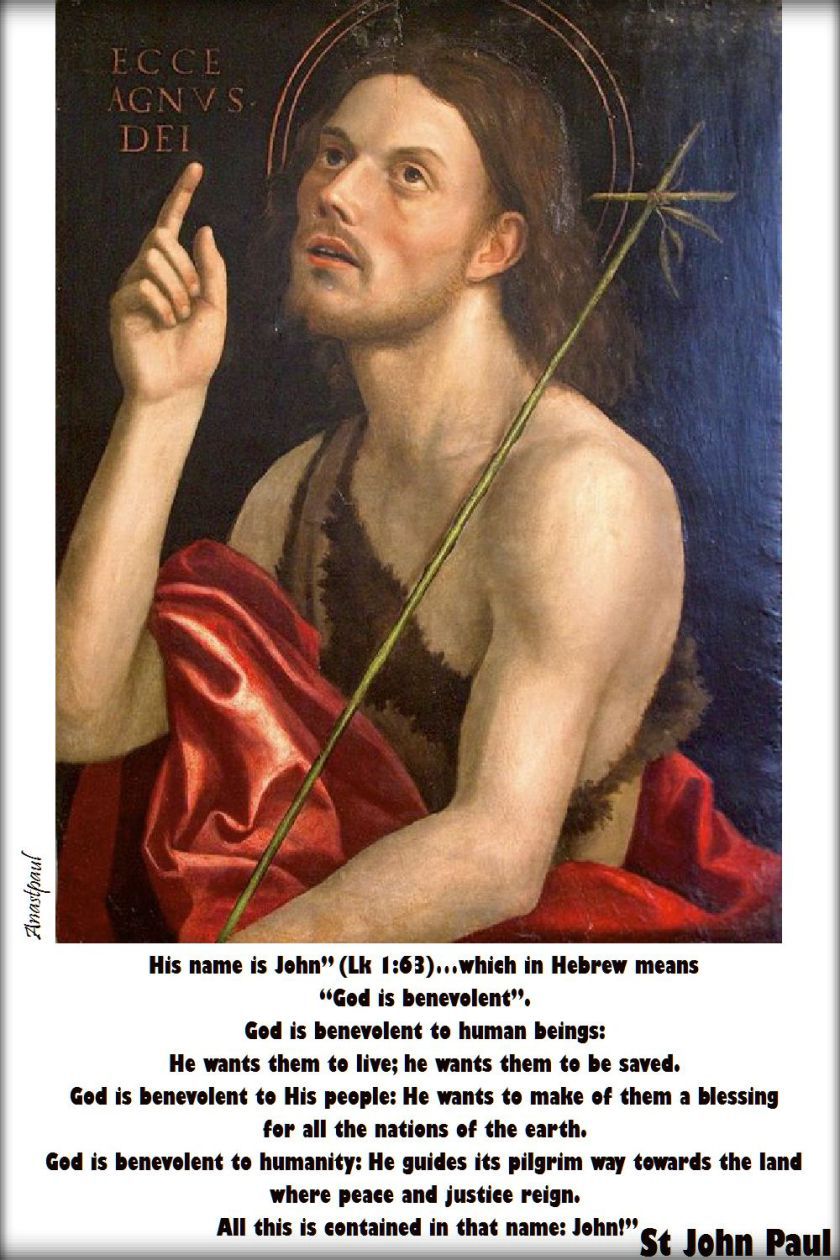
“His name is John” (Lk 1:63)…which in Hebrew means “God is benevolent”. God is benevolent to human beings:  He wants them to live; he wants them to be saved. God is benevolent to His people:  He wants to make of them a blessing for all the nations of the earth.   God is benevolent to humanity:  He guides its pilgrim way towards the land where peace and justice reign.   All this is contained in that name: John!”…St John Paul (24 June 2001)his-name-is-john-st-john-paul - 24 june 2017


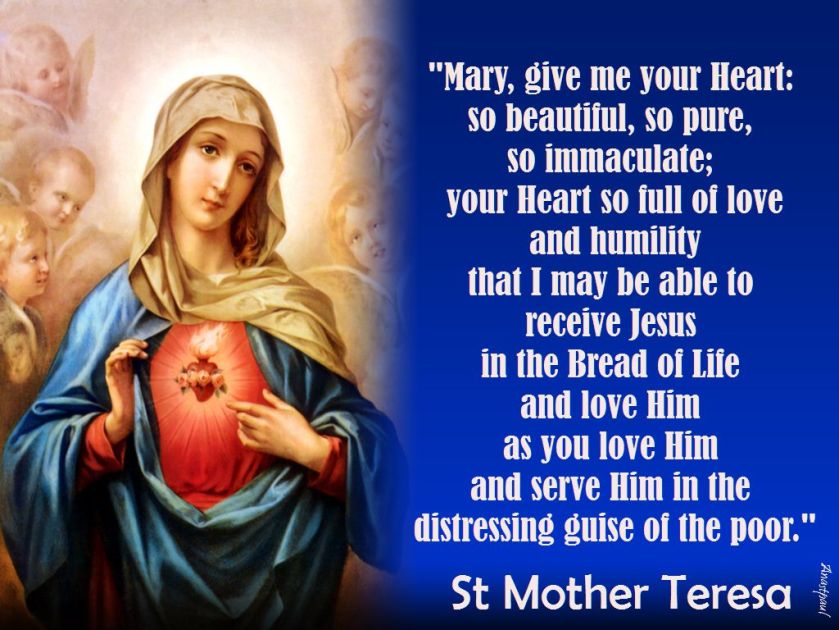
“Mary, give me your Heart: so beautiful, so pure, so immaculate; your Heart so full of love and humility that I may be able to receive Jesus in the Bread of Life and love Him as you love Him and serve Him in the distressing guise of the poor.”
–St Mother Teresa

mary give me your heart-st mother teresa


Posted in CATHOLIC DEVOTIONS of the Month, CATHOLIC-PRAYERS OF THE CHURCH, FEASTS and SOLEMNITIES, MORNING Prayers, SACRED and IMMACULATE HEARTS, The BLESSED VIRGIN MARY

Our Morning Offering – 4 June

Our Morning Offering – 4 June

Prayer to the Two Hearts of Jesus and Mary

O Heart of Jesus pierced for our sins
and giving us Your Mother on Calvary!
O Heart of Mary pierced by sorrow
and sharing in the sufferings of your divine Son
for our redemption!
O sacred union of these Two Hearts!
Praised be the God of Love who united them together!
May we unite our hearts and every heart
so that all hearts may live in unity and in imitation
of that sacred unity which exists in these Two Hearts.
Triumph, O Sorrowful and Immaculate Heart of Mary!
Reign, O Most Sacred Heart of Jesus!
– in our hearts, in our homes and families,
in the hearts of those who as yet do not know You
and in all nations of the world.
Establish in the hearts of all mankind the sovereign triumph
and reign of your Two Hearts so that the earth may resound
from pole to pole with one cry:
Blessed forever be the Most Sacred Heart of Jesus
and the Sorrowful and Immaculate Heart of Mary!
Obtain for me a greater purity of heart
and a fervent love of the spiritual life.
May all my actions be done for the greater glory of God
in unions with the divine heart of Jesus
and the Immaculate Heart of Mary.
Hear and answer our prayers and intentions
according to Your most merciful will. Amen

Prayer to the Two Hearts of Jesus and Mary

Posted in FEASTS and SOLEMNITIES, MORNING Prayers

One Minute Reflection – 24 June

One Minute Reflection – 24 June

He must increase, while I must decrease………John 3:30

24Jun

REFLECTION – “The true secret of love consists in this:
we must forget self like S John the Baptist and exalt and glorify the Lord Jesus.”………..St Peter Julian Eymard

PRAYER – Almighty God, help me to put my self-interests in the background. Let me seek Your interests and do everything for the honour and glory of Your Son Jesus the Christ, amen.

the true secret of love-st peter julian eymard

Posted in FEASTS and SOLEMNITIES, SAINT of the DAY, The BLESSED VIRGIN MARY

The Feast of the Immaculate Heart of Mary – 24 June – the Saturday following the Feast of the Sacred Heart

The Feast of the Immaculate Heart of Mary – 24 June 2017 – the Saturday following the Feast of the Sacred Heart

The Feast of the Immaculate Heart of Mary is a devotional name used to refer to the interior life of the Blessed Virgin Mary, her joys and sorrows, her virtues and hidden perfections and above all, her virginal love for God the Father, her maternal love for her son Jesus and her compassionate love for all persons.    Two elements are essential to the devotion, Mary’s interior life and the beauties of her soul and Mary’s virginal body.  According to Roman Catholic theology, soul and body are necessary to the constitution of man.   It was in 1855, that the Mass of the Most Pure Heart of Mary formally became a part of the Catholic practice.   Traditionally, the heart of Mary in artwork is depicted with seven wounds or swords, in homage to the seven sorrows of Mary.    Also, roses or another type of flower may be wrapped around the heart.

Veneration of the Immaculate Heart of Mary generally coincides with the worship of the Most Sacred Heart of Jesus.    However, there is a difference that explains the Roman Catholic devotion to the Immaculate Heart of Mary.    The devotion to the Sacred Heart of Jesus is especially directed to the “Divine Heart”, as overflowing with love for humanity.  In the devotion to the Immaculate Heart of Mary, on the other hand, the attraction is the love of her Immaculate Heart for Jesus and for God.immaculate-heart-of-mary

A second difference is the nature of the devotion itself.   In devotion to the Most Sacred Heart of Jesus, the Roman Catholic venerates in a sense of love, responding to love.   In devotion to the Immaculate Heart of Mary, love is formed from study and imitation of Mary’s yes to God as the mother of Jesus.    In this devotion, love is more the result, than the “object” of the devotion; the object being rather to love God and Jesus by uniting one’s self to Mary for this purpose and by imitating her virtues, to help one achieve this.

History of the devotion to the Immaculate Heart of Mary is connected in many ways to that of the Sacred Heart of Jesus.   Christians were drawn to the love and virtues of the Immaculate Heart of Mary, and this paved the devotion from the beginning.   Early Christians had compassion for the Virgin Mary and the Gospels recount prophecy delivered to her at Jesus’ presentation in the temple, and that her heart would be pierced with a sword.   The image of the Immaculate Heart of Mary with the pierced heart is the most popular representation.   St. John’s Gospel further invites us to the attention of Mary’s heart with its depiction of Mary at the foot of the cross at Jesus’ crucifixion.  St. Augustine tells us that Mary was more blessed in having born Christ in her heart, than in having conceived him in the flesh.

immacmary

b419cee6970e3b78ec91c071daabff83

The Alliance of the Hearts of Jesus and Mary

The Alliance of the Hearts of Jesus and Mary is based on the historical, theological and spiritual links in Catholic devotions to the Sacred Heart of Jesus and the Immaculate Heart of Mary.   The joint devotion to the hearts was first formalized in the 17th century by St. John Eudes who organized the scriptural, theological and liturgical sources relating to the devotions and obtained the approbation of the Church, prior to the visions of St. Margaret Mary Alacoque.

In the 18th and 19th centuries the devotions grew, both jointly and individually through the efforts of figures such as St. Louis de Montfort who promoted Catholic Mariology and St. Catherine Labouré’s Miraculous Medal depicting the Heart of Jesus thorn-crowned and the Heart of Mary pierced with a sword.   The devotions, and the associated prayers, continued in the 20th century, e.g., in the Immaculata prayer of St. Maximillian Kolbe and in the reported messages of Our Lady of Fátima which stated that the Heart of Jesus wishes to be honored together with the Heart of Mary.

The Popes have supported the individual and joint devotions to the hearts through the centuries;  in 1956 the encyclical Haurietis aquas, Pope Pius XII encouraged the joint devotion to the hearts,   In 1979 the encyclical Redemptor hominis, Pope John Paul II explained the theme of unity of Mary’s Immaculate Heart with the Sacred Heart.   In his Angelus address on 15th September 1985 he coined the term The Alliance of the Hearts of Jesus and Mary and in 1986 addressed the international conference on that topic held at Fátima, Portugal.

sacred-heart

Posted in FEASTS and SOLEMNITIES

Solemnity of The Nativity of Saint John the Baptist – 24 June

Solemnity of The Nativity of Saint John the Baptist – 24 June

Ordinarily the Church observes the day of a saint’s death as his feast, because that day marks his entrance into heaven.  To this rule there are two notable exceptions, the birthdays of Blessed Mary and of St John the Baptist.   All other persons were stained with original sin at birth, hence, were displeasing to God.   But Mary, already in the first moment of her existence, was free from original sin (for which reason even her very conception is commemorated by a special feast) and John was cleansed of original sin in the womb of his mother.   This is the dogmatic justification for today’s feast. In the breviary St. Augustine explains the reason for today’s observance in the following words:

The Church observes the birth of John as in some way sacred;  and you will not find any other of the great men of old whose birth we celebrate officially.   We celebrate John’s, as we celebrate Christ’s.   This point cannot be passed over in silence and if I may not perhaps be able to explain it in the way that such an important matter deserves, it is still worth thinking about it a little more deeply and fruitfully than usual.

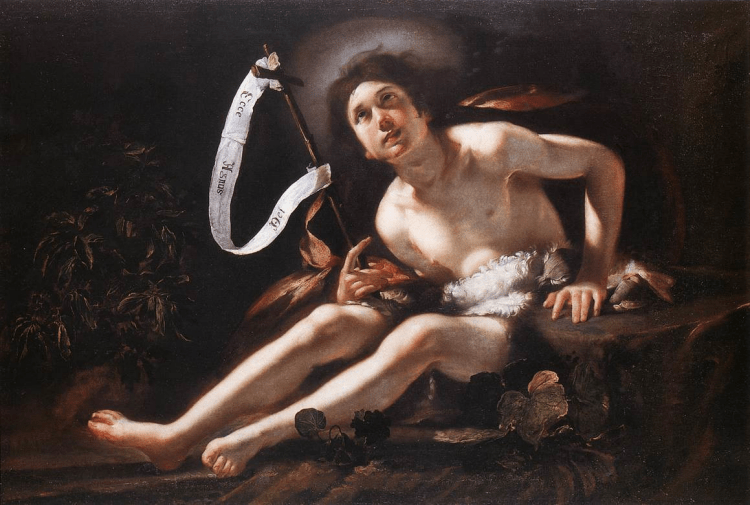
St. John the Baptist - Bernardo Strozzi 1620

John is born of an old woman who is barren;  Christ is born of a young woman who is a virgin.   That John will be born is not believed and his father is struck dumb;  that Christ will be born is believed and he is conceived by faith.

I have proposed some matters for inquiry and listed in advance some things that need to be discussed.   I have introduced these points even if we are not up to examining all the twists and turns of such a great mystery, either for lack of capacity or for lack of time. You will be taught much better by the one who speaks in you even when I am not here; the one about whom you think loving thoughts, the one whom you have taken into your hearts and whose temple you have become.

John, it seems, has been inserted as a kind of boundary between the two Testaments, the Old and the New.   That he is somehow or other a boundary is something that the Lord himself indicates when he says, The Law and the prophets were until John.   So he represents the old and heralds the new.   Because he represents the old, he is born of an elderly couple; because he represents the new, he is revealed as a prophet in his mother’s womb.   You will remember that, before he was born, at Mary’s arrival he leapt in his mother’s womb.   Already he had been marked out there, designated before he was born; it was already shown whose forerunner he would be, even before he saw him.   These are divine matters and exceed the measure of human frailty.   Finally, he is born, he receives a name and his father’s tongue is loosed.

Zachary is struck dumb and loses his voice, until John, the Lord’s forerunner, is born and releases his voice for him.   What does Zachary’s silence mean but that prophecy was obscure and, before the proclamation of Christ, somehow concealed and shut up?   It is released and opened up by his arrival, it becomes clear when the one who was being prophesied is about to come.   The releasing of Zachary’s voice at the birth of John has the same significance as the tearing of the veil of the Temple at the crucifixion of Christ. If John were meant to proclaim himself, he would not be opening Zachary’s mouth.   The tongue is released because a voice is being born – for when John was already heralding the Lord, he was asked, Who are you and he replied I am the voice of one crying in the wilderness.

John is the voice but the Lord in the beginning was the Word.   John is a voice for a time, but Christ is the eternal Word from the beginning.”

This reading on the Birth of John the Baptist is taken by a sermon of St. Augustine (Sermo 293, 1-3; PL 38, 1327-1328) that compares and contrasts Christ, the Word, with John, the voice who is the boundary between New and Old Covenants.   It is used in the Roman Office of Readings for June 24, the Solemnity of the Birth of John the Baptist.

In other words, today’s feast anticipates the feast of Christmas.   Taking an overall view, we keep during the course of the year only two mysteries, that of Christ’s Incarnation and that of His Redemption.   The Redemption mystery is the greater of the two; the Incarnation touches the human heart more directly.   To the Redemption mystery the entire Easter season is devoted, from Septuagesima until Pentecost;  and likewise every Sunday of the year, because Sunday is Easter in miniature.

The Christmas season has for its object the mystery of God-become-Man, to which there is reference only now and then during the remaining part of the year, e.g., on Marian feasts, especially that of the Annunciation (March 25) and today’s feast in honour of the Baptist.   In a sense, then, we are celebrating Christ’s incarnation today.   The birth of Jesus is observed on December 25 at the time of the winter solstice, while the birth of His forerunner is observed six months earlier at the time of the summer solstice.   Christmas is a “light” feast; the same is true today.   The popular custom centering about “St. John’s Fire” stems from soundest Christian dogma and could well be given renewed attention. St. John’s Fire symbolizes Christ the Light; John was a lamp that burned and shone. We Christians should be the light of the world.

Excerpted from The Church’s Year of Grace, Pius Parsch

Posted in FEASTS and SOLEMNITIES, SAINT of the DAY

Saints’ Memorials, Solemnity and Feast – 24 June

The Nativity of Saint John the Baptist (Solemnity) – https://www.youtube.com/watch?v=yXCySmXhue8
Feast of the Immaculate Heart of Mary
Madonna della Navicella

St Aglibert of Créteil
St Agoard of Créteil
St Alena of Brussels
St Amphibalus of Verulam
St Anastasia Guadalupe García Zavala
St Bartholomew of Farne
Bl Christopher de Albarran
St Erembert I of Kremsmünster
St Faustus of Rome and Companions
St Festus of Rome
St Germoc
St Gohardus of Nantes
Bl Henry of Auxerre/the Hagiographer
St Ivan of Bohemia
St John of Rome
St John of Tuy
St Joseph Yuan Zaide
Bl Maksymilian Binkiewicz
St Rumold
St Simplicio of Autun
Bl Theodgar of Vestervig
St Theodulphus of Lobbes

Martyrs of Satala: Seven Christian brothers who were soldiers in the imperial Roman army. They were kicked out of the military, exiled and eventually martyred in the persecutions of Maximian. We know little more about them than their names – Cyriacus, Firminus, Firmus, Longinus, Pharnacius, Heros and Orentius. The martyrdoms occurred in c311 at assorted locations around the Black Sea.

Posted in CATHOLIC DEVOTIONS of the Month, FEASTS and SOLEMNITIES, MORNING Prayers, QUOTES of the SAINTS, SACRED and IMMACULATE HEARTS

Celebrating the Solemnity of the Most Sacred Heart of Jesus – 23 June 2017

Celebrating the Solemnity of the Most Sacred Heart of Jesus – 23 June 2017

Excerpts from “To Be Loved by a Sacred Heart” – St Josemaria Escriva
“Christ is Passing By,” no. 162

“That Christ has come to us with a heart made of flesh tells us a lot about how the Sacred Heart loves us and about the kind of love we need.   We are loved by any number of hearts during our earthly lives but one alone among them we call Sacred.   We know how it feels to be loved by fallen people—by those who try but cannot love perfectly.   But what it is to be loved by a Sacred Heart?

At the outset of the last supper, the Lord gets down on His hands and knees and washes the feet of His disciples.  “Do you understand this?”  He asks them.   Before He tells the Apostles about union with Him, about the great commandment of love, about His joy, Jesus first shows them what it all “looks” like.
“Do you understand this?”   This is perhaps the ultimate question as we reflect on what it means to be loved by the Sacred Heart.   Perhaps the answer will be an honest, “No, Lord, I do not understand your love for me,” and that could be nearer the truth than anything. “I don’t understand what God is doing on His hands and knees wiping the dirt off of my feet.   If I were Jesus, I wouldn’t treat me like He treats me.   I wouldn’t be so tolerant and forgiving.  I wouldn’t keep on loving someone like me.”

But to spend our lives in contemplation of His love for us, as the apostles surely did, is what will bring us ever closer to the source of the Love that constantly reaches into our lives, showing itself to be subtle, selfless and inexhaustible.   If the fire, thorns and blood are the divinely revealed gauge of divine love in a human heart, then the more I welcome His tireless forgiveness, His unflinching friendship in the face of my infidelity, the more I will appreciate the mystery of divine charity which the Sacred Heart reveals.
Now we see imperfectly, in part but the part we do see should teach us why He needed to come to us with a heart of flesh, like ours.”

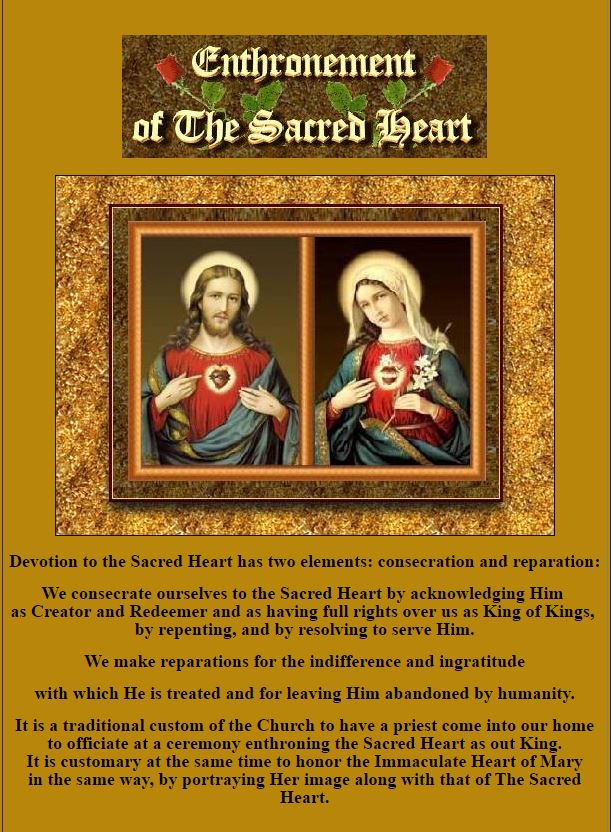
Devotion to the Saced Heart 1litany of the sh 1 - sh 8litany of the sh 2 - sh 8litany of the sh 3 - sh 10

sh3 snip3seven cardinal mysteries - sh 2sh 4 - enthronement


Posted in CATHOLIC DEVOTIONS of the Month, CONSECRATION Prayers, FEASTS and SOLEMNITIES, MORNING Prayers, PRAYERS of the CHURCH, PRAYERS of the SAINTS, SACRED and IMMACULATE HEARTS, SAINT of the DAY

Friday 23 June 2017 Blessed and Holy Solemnity of the Most Sacred Heart of Jesus (Friday after the Second Sunday after Pentecost)

Friday 23 June 2017 Blessed and Holy Solemnity of the Most Sacred Heart of Jesus – (Friday after the Second Sunday after Pentecost)

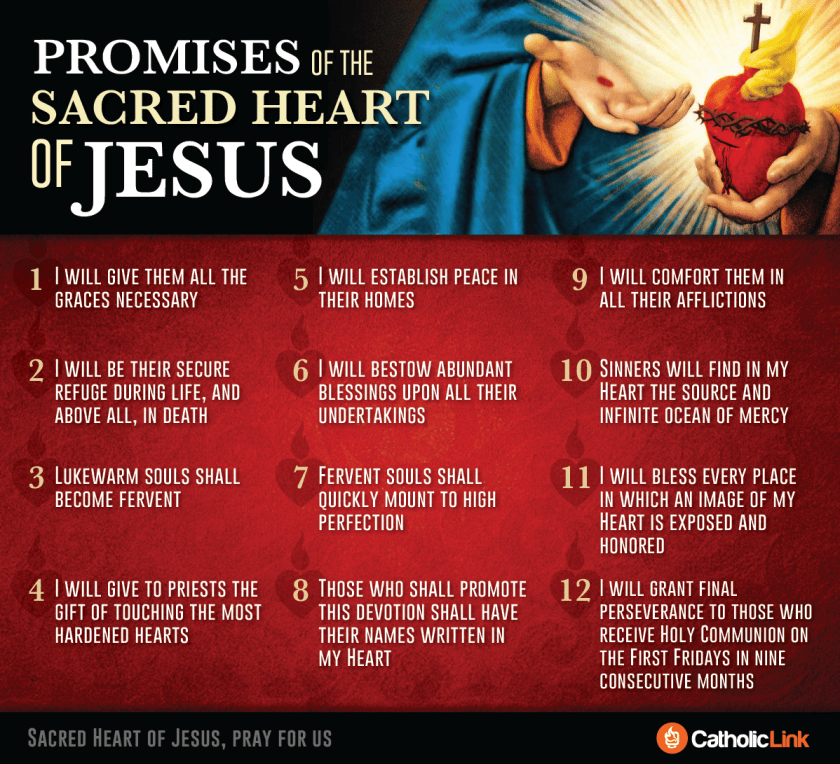
The Twelve Promises of the Sacred Heart – given to St. Margaret Mary Alacoque:
1. I will give them all the graces necessary for their state of life.

2. I will give peace in their families.

3. I will console them in all their troubles.

4. They shall find in My Heart an assured refuge during life and especially at the hour of death.

5. I will pour abundant blessings on all their undertakings.

6. Sinners shall find in My Heart the source and infinite ocean of mercy.

7. Tepid souls shall become fervent.

8. Fervent souls shall speedily rise to great perfection.

9. I will bless the homes in which the image of My Sacred Heart shall be exposed and honoured.

10. I will give to priests the power to touch the most hardened hearts.

11. Those who propagate this devotion shall have their name written in My Heart, and it shall never be effaced.

12. The all-powerful love of My Heart will grant to all those who shall receive Communion on the First Friday of nine consecutive months the grace of final repentance;  they shall not die under My displeasure, nor without receiving their Sacraments; My Heart shall be their assured refuge at that last hour.

12 promises of the sacred heart

“And He showed me that it was His great desire of being loved by men and of withdrawing them from the path of ruin into which Satan hurls such crowds of them, that made Him form the design of manifesting His Heart to men, with all the treasures of love, of mercy, of grace, of sanctification and salvation which It contains, in order that those who desire to render Him and procure for Him all the honour and love possible, might themselves be abundantly enriched with those Divine treasures of which this Heart is the source.   He should be honoured under the figure of this Heart of flesh and Its image should be exposed … He promised me that wherever this image should be exposed with a view to showing It special honour, He would pour forth His blessings and graces.   This devotion was the last effort of His love that He would grant to men in these latter ages, in order to withdraw them from the empire of Satan which He desired to destroy, and thus to introduce them into the sweet liberty of the rule of His love, which He wished to restore in the hearts of all those who should embrace this devotion.”

—St. Margaret Mary

st margaret mary and the sacred heart of jesus

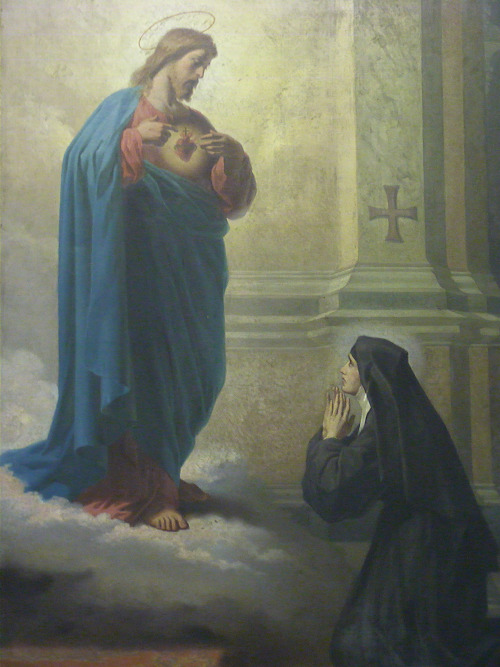
This Act of Consecration to the Sacred Heart of Jesus was composed by St. Margaret Mary Alacoque, a 17th Century French nun and mystic, pictured above, who saw our Lord in numerous visions.   She was instrumental in spreading devotion to His Sacred Heart after He conveyed His wish for her to do so.   In one vision she actually saw Jesus’ Sacred Heart with flames protruding from it to show His great love for us!   The burning love He showed her from His Sacred Heart certainly must have inspired her.

Clearly, our Lord wishes us to join our will to His in love for Him and each other on our earthly pilgrimage to Heaven.   And what better way than to appeal to our hearts, where our most sincere feelings and desires reside.

So too with Jesus, who we must remember, as man as well as God comes to us in Communion at Mass and in Adoration before the Blessed Sacrament with His heart filled with immense love and longing for us!   As our Lord said in the Gospels “I am the vine; you are the branches. Whoever abides in me and I in him, bears much fruit. For without me, you can do nothing” (John 15:5).

Jesus once told St. Margaret Mary something quite similar when He said “Without me you can do nothing, but I will never let you lack help as long as you keep your weakness and nothingness buried in My strength.”

Our Lord wishes us to approach Him for help and love in humility, even when we’re feeling most uncertain or useless.   Don’t be afraid to offer up your own weaknesses and anxieties to Him!   He’ll be more than happy to fill your “nothingness” with His awesomeness!  And the best places are after receiving Him and in Eucharistic Adoration, where His Heart is calling you!

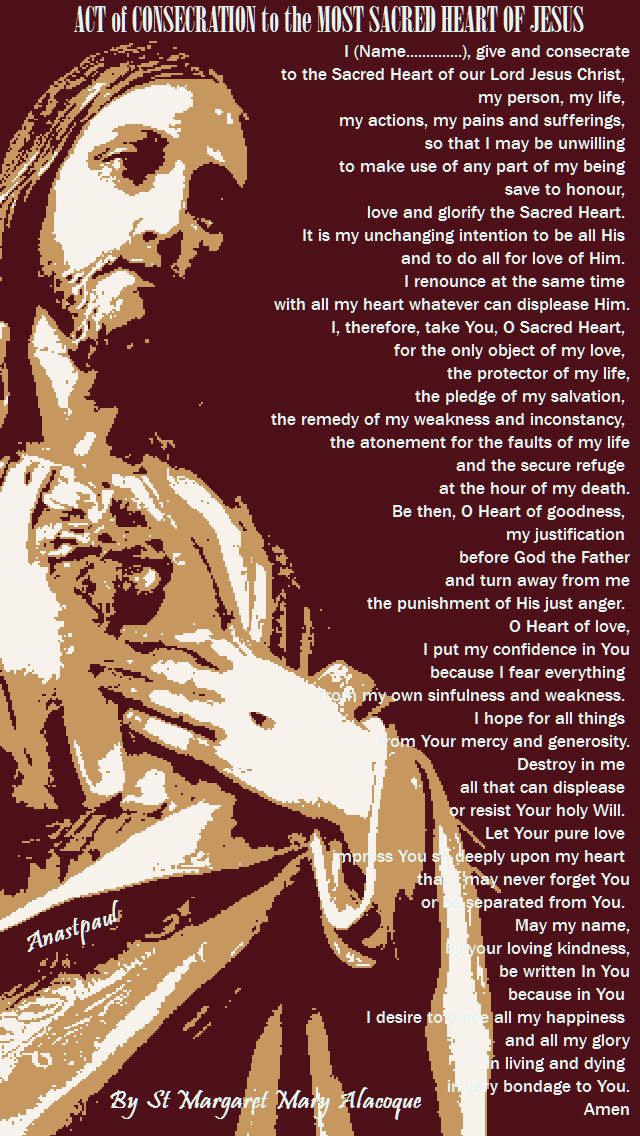
ACT of CONSECRATION to the MOST SACRED HEART OF JESUS
by ST MARGARET MARY ALACOQUE

act of consecration to the sacred heart - st alacoque

I (Name…………..), give and consecrate to the Sacred Heart of our Lord Jesus Christ,
my person, my life, my actions, my pains and sufferings,
so that I may be unwilling to make use of any part of my being
save to honour, love and glorify the Sacred Heart.
It is my unchanging intention to be all His
and to do all for love of Him.
I renounce at the same time with all my heart whatever can displease Him.

I, therefore, take You, O Sacred Heart,
for the only object of my love,
the protector of my life,
the pledge of my salvation,
the remedy of my weakness and inconstancy,
the atonement for the faults of my life
and the secure refuge at the hour of my death.

Be then, O Heart of goodness,
my justification before God the Father
and turn away from me the punishment of His just anger.
O Heart of love, I put my confidence in You
because I fear everything from my own sinfulness and weakness.
I hope for all things from Your mercy and generosity.

Destroy in me all that can displease or resist Your holy Will.
Let Your pure love impress You so deeply upon my heart
that I may never forget You or be separated from You.
May my name, by your loving kindness,
be written In You
because in You I desire to place all my happiness
and all my glory in living and dying in very bondage to You.
Amen

Posted in CATHOLIC DEVOTIONS of the Month, FEASTS and SOLEMNITIES, MORNING Prayers, NOVENAS, PRAYERS of the SAINTS, SACRED and IMMACULATE HEARTS

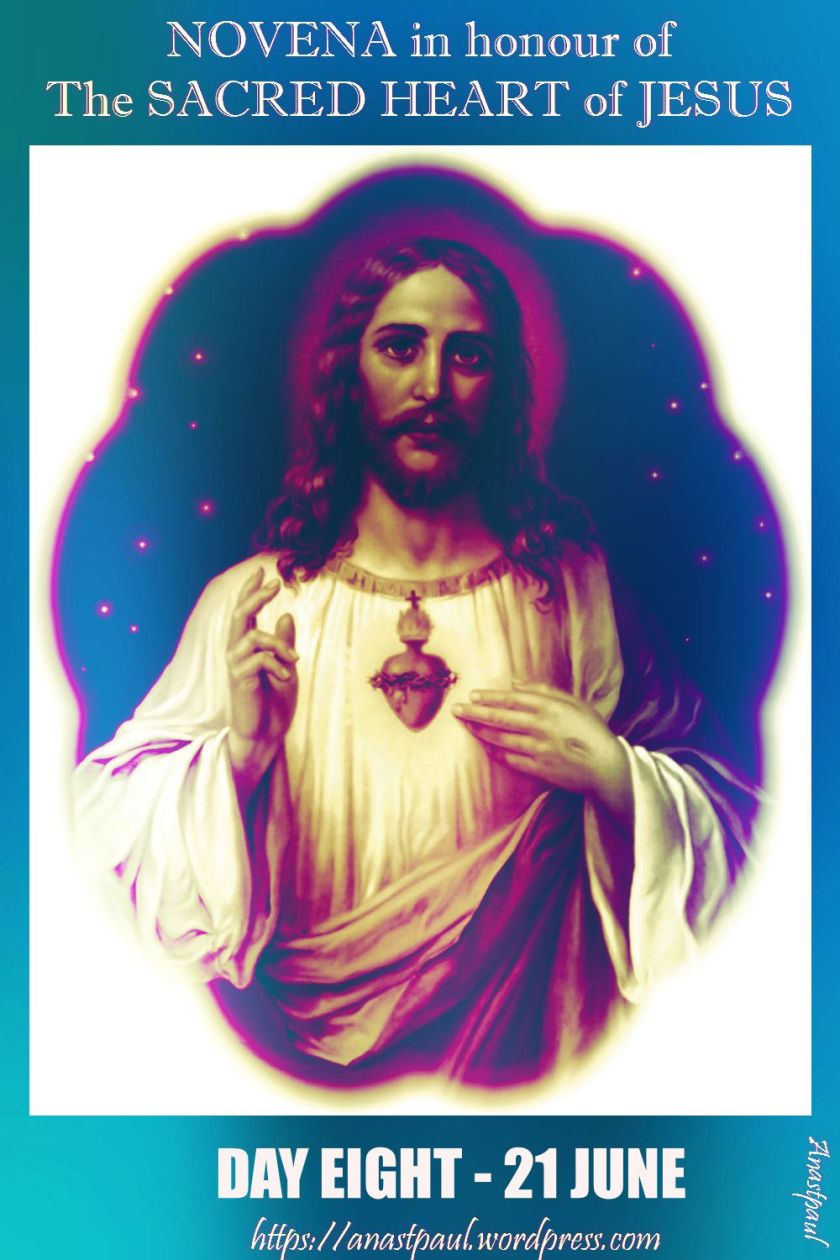
NOVENA in honour of the SACRED HEART of JESUS – DAY EIGHT –21 JUNE

NOVENA in honour of the SACRED HEART of JESUS – DAY EIGHT –21 JUNE

By St Alphonsus Liguori
(1696-1787) Most Zealous Doctor
Published in 1758 from THE HOLY EUCHARIST

MEDITATION VIII.
The Despised Heart of Jesus.

There is not a greater sorrow for a heart that loves, than to see its love despised: and so much the more when the proofs given of this love have been great, and, on the other hand, the ingratitude great.

If every human being were to renounce all his goods and to go and live in the desert, to feed on herbs, to sleep on the bare earth, to macerate himself with penances and at last give himself up to be murdered for Christ’s sake, what recompense could he render for the sufferings, the Blood, the life that this great Son of God has given for his sake?   If we were to sacrifice ourselves every moment unto death, we should certainly not recompense in the smallest degree the love that Jesus Christ has shown us, by giving Himself to us in the most Holy Sacrament.   Only conceive that God should conceal Himself under the species of bread to become the food of one of His creatures!

But, O my God, what recompense and gratitude do men render to Jesus Christ?   What but ill-treatment, contempt of His laws and His maxims, —– injuries such as they would not commit towards their enemy, or their slave, or the greatest villain upon earth.   And can we think of all these injuries which Jesus Christ has received and still receives every day and not feel sorrow for them?   And not endeavour, by our love, to recompense the infinite love of His Divine heart, which remains in the most Holy Sacrament, inflamed with the same love towards us and anxious to communicate every good gift to us and to give Himself entirely to us, ever ready to receive us into His heart whenever we go to Him?   Him that cometh to Me, I will not cast out. [John vi. 37].

We have been accustomed to hear of the Creation, Incarnation, Redemption, of Jesus born in a stable, of Jesus dead on the Cross. O my God, if we knew that another man had conferred on us any of these benefits, we could not help loving him.   It seems that God alone has, to to say, this bad luck with men, that, though He has done His utmost to make them love Him, yet He cannot attain this end, and, instead of being loved, He sees Himself despised and neglected. All this arises from the forgetfulness of men of the love of God.

DAY EIGHT - NOVENA SACRED HEART

LET US PRAY – DAY EIGHT

O Heart of Jesus, abyss of mercy and love,
how is it that, at the sight of the goodness You hast shown me and of my ingratitude, I do not die of sorrow? You, O mv Saviour, after having given me my being,
have given me all Your Blood and Your life, giving Yourself up for my sake, to ignominy and death;
and, not content with this,
You have invented the mode of sacrificing Yourself every day for me in the Holy Eucharist,
not refusing to expose Yourself to the injuries which You receive, and which You foresaw,
in this Sacrament of love.
O my God, how can I see myself so ungrateful to You without dying with contrition!
O Lord, put an end, I pray You, to my ingratitude,
by wounding my heart with Your love and making me entirely Yours.
Remember the Blood and the tears that You shed for me, and forgive me.
Oh, let not all Your sufferings be lost upon me.
But though You have seen how ungrateful and unworthy of Your love I have been,
yet You didst not cease to love me even when I did not love You.
Grant that this day may be the day of my thorough conversion;
so that I may begin to love You and may never cease to love You, my sovereign good.
Make me die in everything to myself,
in order that I may live only for You and that I may always burn with Your love.

O Mary, your heart was the blessed altar
that was always on fire with Divine love:
my dearest Mother, make me like you;
obtain this from your Son,
Who delights in honouring and pleasing you,
by denying you nothing that you ask of Him. Amen

Posted in CATHOLIC DEVOTIONS of the Month, FEASTS and SOLEMNITIES, MORNING Prayers, NOVENAS, PRAYERS of the SAINTS, SACRED and IMMACULATE HEARTS

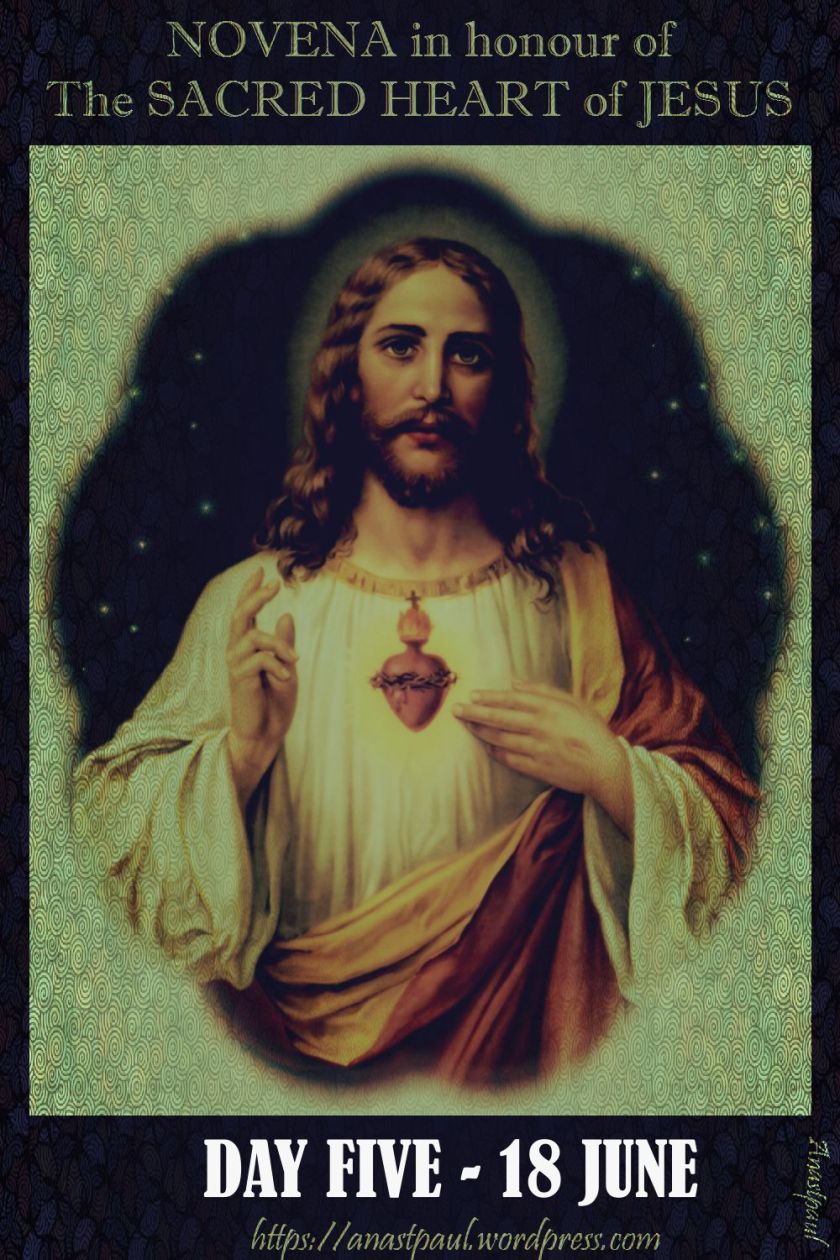
NOVENA in honour of the SACRED HEART of JESUS – DAY FIVE – 18 JUNE

NOVENA in honour of the SACRED HEART of JESUS – DAY FIVE – 18 JUNE

By St Alphonsus Liguo
(1696-1787) Most Zealous Doctor
Published in 1758 in “THE HOLY EUCHARIST

MEDITATION V.
The Compassionate Heart of Jesus.

Where shall we ever find a heart more compassionate or tender than the heart of Jesus, or one that had a greater feeling for our miseries?

This pity induced Him to descend from Heaven to this earth;  it made Him say that He was that good shepherd Who came to give His life to save His sheep.   In order to obtain the pardon of our sins, He would not spare Himself but would sacrifice Himself on the Cross, that by His sufferings He might satisfy for the chastisement that we have deserved. This pity and compassion makes Him say even now:   Why will ye die, O house of Israel? return ye, and live. [Ezek. xviii. 31].  O men, He says, my poor children, why will you damn yourselves by flying from Me?   Do you not see that by separating yourselves from Me you are hastening to eternal death?   I desire not to see you lost;  do not despair; as often as you wish to return, return and you shall recover your life:  Return, and live.

This compassion even makes Him say that He is that loving Father Who, though He sees Himself despised by His son, yet, if that son returns a penitent, He cannot reject him  but embraces him tenderly and forgets all the injuries He has received: I will not remember all his iniquities. [Ibid. 22].  It is not thus that men behave;  for though they may forgive, yet they nevertheless retain the remembrance of the offence received and feel inclined to revenge themselves and even if they do not revenge themselves, because they fear God, at least they always feel a great repugnance against conversing and entertaining themselves with those persons who have vilified them.

O my Jesus, You pardon the penitent sinners and never refuse in this world to give them everything in Holy Communion during their life and everything in the other world, even in Heaven, with eternal glory, without retaining the slightest repugnance towards being united to the soul that has offended You, for all eternity.   Where, then, is there to be found a heart so amiable and compassionate as Yours, O my dearest Saviour?

DAY FIVE NOVENA TO THE SACRED HEART

LET US PRAY – DAY FIVE

O compassionate heart of my Jesus, have pity on me:
“Most sweet Jesus, have mercy on me.”
I say so now and beseech You to give me the grace always to say to You,
“Most sweet Jesus, have mercy on me.”
Even before I offended You, O my Redeemer,
I certainly did not deserve any of the favours You bestowed upon me.
You created me,
You have given me so much light and knowledge
and all without any merit of mine.
But after I had offended You. I not only did not deserve Your favour
but I deserved to be forsaken by You and cast into Hell.
Your compassion has made You wait for me
and preserve my life even when I had offended You.
Your compassion has enlightened me and offered me pardon;
it has given me sorrow for my sins and the desire of loving You
and now I hope from Your mercy to remain always in Your grace.
O my Jesus Your mercy which I implore of You
is that You would grant me light
and strength to be no longer ungrateful towards You.
No, my Jesus; I love You and I will always love You
and this is the mercy which I hope for and seek from You
“Permit me not to be separated from You, permit me not to be separated from You.”

And I beseech you also, O Mary my Mother,
help me not to be ever again separated from my God.
Amen

Posted in DOCTORS of the Church, FEASTS and SOLEMNITIES, MORNING Prayers, PRAYERS for PRIESTS, PRAYERS for VARIOUS NEEDS, Uncategorized

Wishing all Fathers a Blessed and Happy Father’s Day especially all our universal Fathers – our Priests!

Wishing all Fathers a Blessed and Happy Father’s Day
especially all our universal Fathers – our Priests!

Prayer for Priests by Pope Emeritus Benedict XVI

PRAYER FOR PRIESTS-BENEDICT

Lord Jesus Christ, eternal High Priest,
You offered Yourself to the Father
on the altar of the Cross
and through the outpouring of the Holy Spirit
gave Your priestly people a share in Your redeeming sacrifice.
Hear our prayer for the sanctification of our priests.
Grant that all who are ordained to the ministerial priesthood
may be ever more conformed to You, the divine Master.
May they preach the Gospel with pure heart and clear conscience.
Let them be shepherds according to Your own Heart,
single- minded in service to You and to the Church
and shining examples of a holy, simple and joyful life.
Through the prayers of the Blessed Virgin Mary,
Your Mother and ours, draw all priests
and the flocks entrusted to their care to the fullness
of eternal life where You live and reign with the Father
and the Holy Spirit, one God, for ever and ever. Amen

“The Priest must be, first and foremost,
an Adorer who contemplates the Eucharist.”

the priest must be first an adorer - papa b


Posted in CATHOLIC DEVOTIONS of the Month, EUCHARISTIC Adoration, FEASTS and SOLEMNITIES, SACRED and IMMACULATE HEARTS

Thought for the Day – 18 June – The Solemnity of Corpus Christi

Thought for the Day – 18 June – The Solemnity of Corpus Christi

“A word that ought to cover many a Catholic with shame and confusion once came from the lips of a person raised in Protestant tenets and surroundings: “If I believed in the real presence of Jesus in the Eucharist, I should spend all my life before a tabernacle and no power could tear me away from it.”

Does this not suffice to put to shame our little generosity in visiting Jesus in the Blessed Sacrament?

Let us pay Him a visit every day, even when only a short one is possible, particularly if it is our happiness to live with Him under the same roof. Let us not pass by a church where He is kept in the tabernacle, without entering at least for a moment, or without making at least a spiritual visit.

We can multiply spiritual visits at any time, amid our daily occupations and when we awake at night – a practice which growing love will more and more cogently urge upon us. Because after all, who can enchain love? Who can resist the heart? Who can separate what love has joined? Who can prevent, what obstacle can impede our hearts from living in perpetual adoration at the feet of Jesus in the Blessed Sacrament?

“Where thy treasure is,” said Jesus, “there they heart also will be.” If the Holy Eucharist is our treasure, our heart will live in the tabernacle.”Fr Jose Guadalupe Trevino (The Holy Eucharist)

where thy treasure is-fr jose guadalupe trevino

ACT OF SPIRITUAL COMMUNION

My Jesus,
I believe that You
are present in the Most Holy Sacrament.
I love You above all things
and I desire to receive You into my soul.
Since I cannot at this moment
receive You sacramentally,
come at least spiritually into my heart.  I embrace You as if You were already there and unite myself wholly to You.  Never permit me to be separated from You.  
Amen.

spiritual-communion


Posted in CATHOLIC DEVOTIONS of the Month, DOCTORS of the Church, EUCHARISTIC Adoration, FEASTS and SOLEMNITIES, MORNING Prayers, QUOTES of the SAINTS, SACRED and IMMACULATE HEARTS

Quote/s of the Day – The Solemnity of the Body and Blood of Christ

Quote/s of the Day – The Solemnity of the Body and Blood of Christ

“How I loved the feasts!….
I especially loved the processions in honour
of the Blessed Sacrament.   What a joy it was
for me to throw flowers beneath the feet of God!…
I was never so happy as when I saw my roses
touch the sacred Monstrance…”
– from St. Therese’s Autobiography Story of A Soul

how i loved the feast..st t of l

“It is invaluable to converse with Christ
and leaning against Jesus’ breast like His beloved disciple,
we can feel the infinite love of his Heart.
We learn to know more deeply the One who gave Himself totally,
in the different mysteries of His divine and human life,
so that we may become disciples and in turn enter into
this great act of giving, for the glory of God
and the salvation of the world.   Through adoration,
the Christian mysteriously contributes to the
radical transformation of the world and to the sowing of the Gospel.
Anyone who prays to the Saviour draws the whole world with him
and raises it to God.   Those who stand before the Lord
are therefore fulfilling an eminent service.
They are presenting to Christ all those who do not know Him
or are far from Him;  they keep watch in His presence on their behalf!”

– from St Pope John Paul II’s 1996 letter to the Bishop of Liege,
written on the occasion of the 750th anniversary of the first celebration of the Feast of Corpus Christi

those who stand before the lord

“When you have received Him,
stir up your heart to do Him homage, 
speak to Him about your spiritual life,
gazing upon Him in your soul where He is present
for your happiness;  welcome Him as warmly as possible,
and behave outwardly in such a way, that your actions
may give proof to all of His Presence.”
– St. Francis de Sales

when you have received Him - st francis de sales

Posted in CATHOLIC DEVOTIONS of the Month, EUCHARISTIC Adoration, FEASTS and SOLEMNITIES, MORNING Prayers, QUOTES of the SAINTS, SACRED and IMMACULATE HEARTS, The WORD

One Minute Reflection – 18 June – Feast of Corpus Christi

One Minute Reflection – 18 June – Feast of Corpus Christi

He who abides in me and I in him, he it is that bears much fruit, for apart from me you can do nothing……John 15:5

REFLECTION – “Eternal happiness begins now for the Christian who is comforted with the definitive manna of the Eucharist. The old life has gone forever. Let us leave everything behind us so that everything will be new, “our hearts, our words and our actions.” This is the Good News. News, because it speaks to us of a deep love which we never could have dreamed of. Good, because there is nothing better than uniting ourselves to God, the greatest Good of all. It is Good News, because in an inexplicable way it gives us a foretaste of heaven.”……….St Josemaria Escriva (Christ is passing By – On the Feast of Corpus Christ No 153)

eternal happiness begins now - st josemaria

PRAYER – In response to Your Presence, O Lord,
I offer You my presence.
In response to Your silence,
I offer You my silence.
In response to the gaze of Your Eucharistic Face,
I offer You my eyes.
In response to Your Eucharistic Heart,
I offer You every heartbeat of mine.
In response to the mystery of Your Eucharistic poverty,
I offer You my poverty.
My one desire is to remain before You
even as You remain before me
in this the Sacrament of Your Love.
(Benedictines of Perpetual Adoration)

BENEDICTINES OF PERPETUAL ADORATION - in reponse to your presence o Lord

Posted in CATHOLIC DEVOTIONS of the Month, CATHOLIC-PRAYERS OF THE CHURCH, DOCTORS of the Church, EUCHARISTIC Adoration, FEASTS and SOLEMNITIES, HYMNS, JESUIT SJ, MORNING Prayers, POETRY, PRAYERS of the CHURCH, PRAYERS of the SAINTS

Our Morning Offering – 18 June 2017 – The Feast of Copus Christi

Our Morning Offering – 18 June 2017 – The Feast of Copus Christi

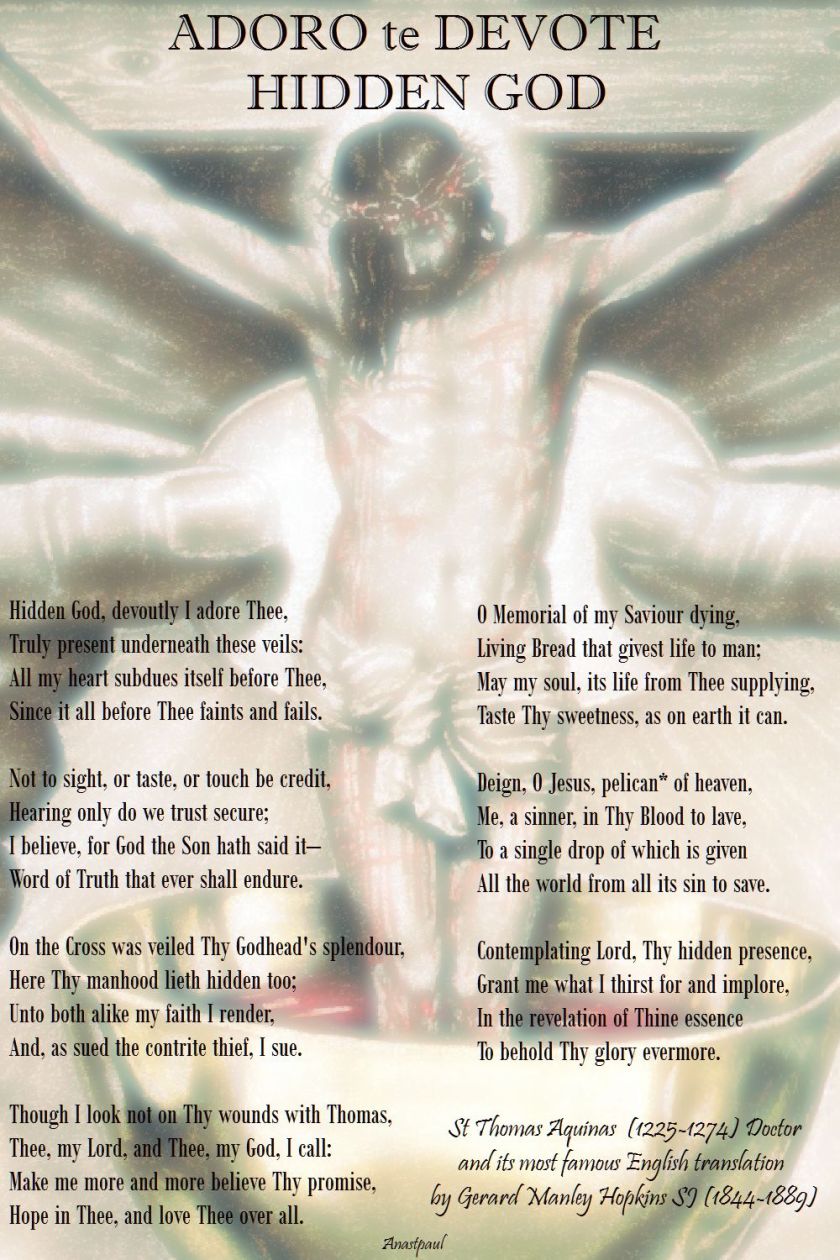
ADORO te DEVOTE – HIDDEN GOD
St Thomas Aquinas (1225-1274) Doctor
and its most famous English translation
by Gerard Manley Hopkins SJ (1844-1889)

Hidden God, devoutly I adore Thee,
Truly present underneath these veils:
All my heart subdues itself before Thee,
Since it all before Thee faints and fails.

Not to sight, or taste, or touch be credit,
Hearing only do we trust secure;
I believe, for God the Son hath said it–
Word of Truth that ever shall endure.

On the Cross was veiled Thy Godhead’s splendour,
Here Thy manhood lieth hidden too;
Unto both alike my faith I render,
And, as sued the contrite thief, I sue.

Though I look not on Thy wounds with Thomas,
Thee, my Lord, and Thee, my God, I call:
Make me more and more believe Thy promise,
Hope in Thee, and love Thee over all.

O Memorial of my Saviour dying,
Living Bread that givest life to man;
May my soul, its life from Thee supplying,
Taste Thy sweetness, as on earth it can.

Deign, O Jesus, pelican* of heaven,
Me, a sinner, in Thy Blood to lave,
To a single drop of which is given
All the world from all its sin to save.

Contemplating Lord, Thy hidden presence,
Grant me what I thirst for and implore,
In the revelation of Thine essence
To behold Thy glory evermore.

ADORO te DEVOTE - ST THOMAS AQUINAS TRANSLATE G M HOPKINS SJ

Posted in DOCTORS of the Church, EUCHARISTIC Adoration, FEASTS and SOLEMNITIES, MORNING Prayers, PAPAL ENCYLICALS, PRAYERS of the CHURCH, PRAYERS of the SAINTS, QUOTES of the SAINTS

Blessed and Holy Feast of Corpus Christi! 18 June 2017

Blessed and Holy Feast of Corpus Christi! 18 June 2017

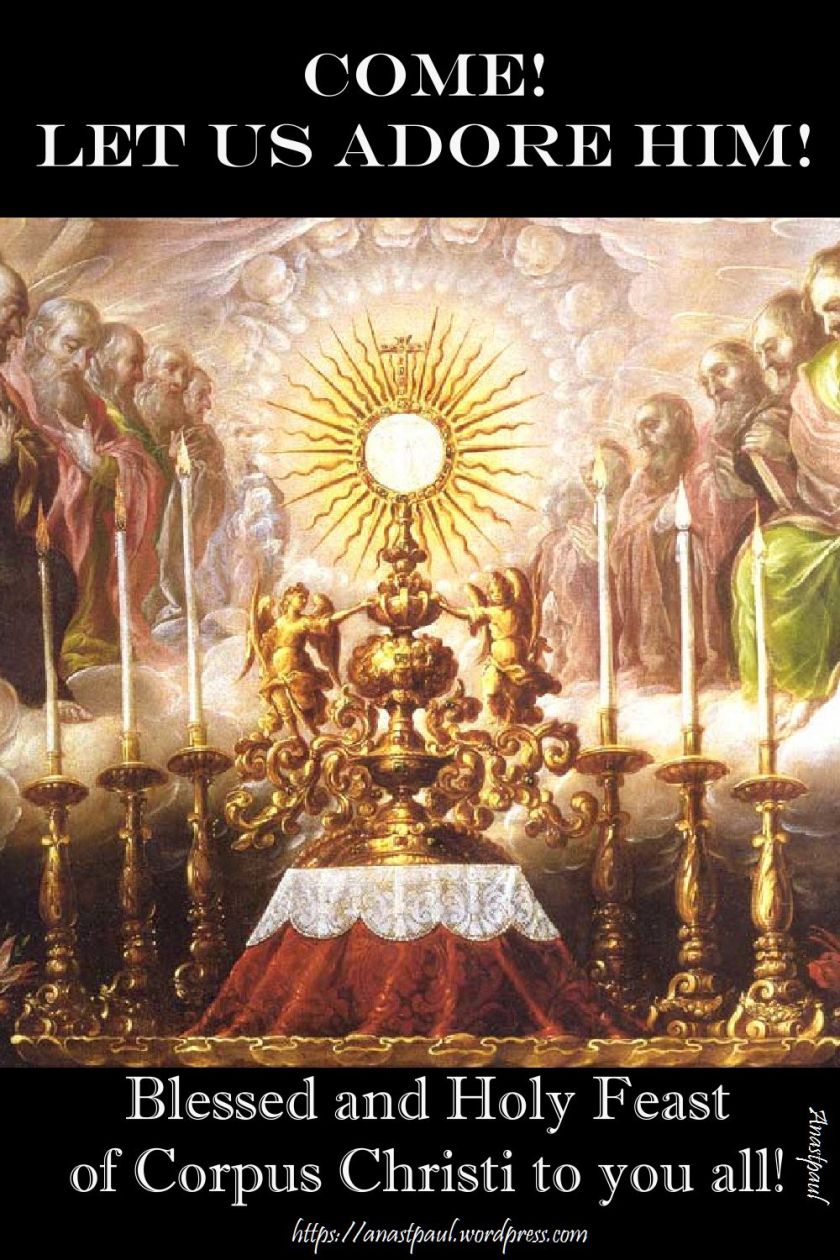
come let us adore him- 18 june 2017

“The solemnity of Corpus Christi originated within a very precise cultural and historical context.   Its aim was to proclaim openly the faith of the People of God in Jesus Christ’s real, living presence in the Blessed Sacrament of the Eucharist.”

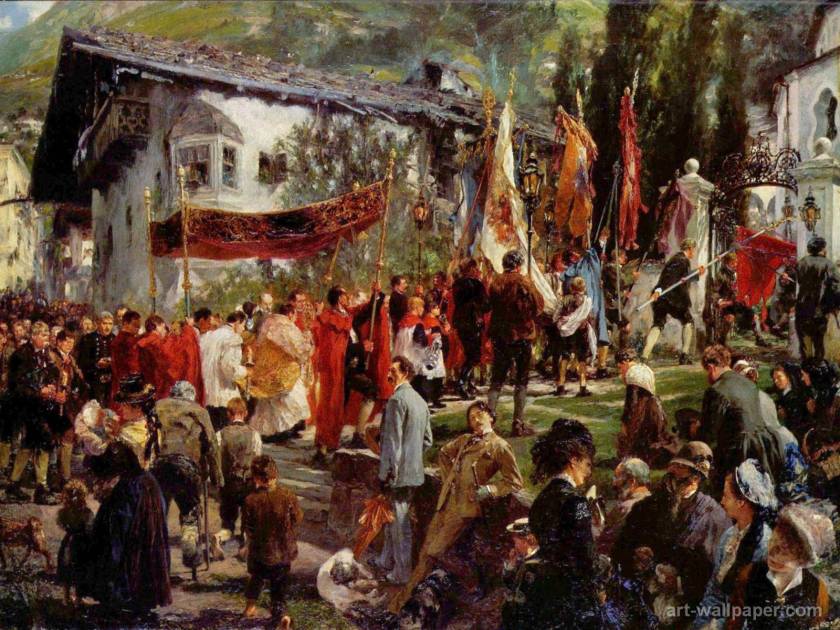
CC_homeCorpusChristiProcession

Pope Benedict XVI explains the history of this feast, which dates back to the 13th century, as follows:

St Juliana of Cornillon had a vision which “presented the moon in its full splendour, crossed diametrically by a dark stripe.   The Lord made her understand the meaning of what had appeared to her.   The moon symbolised the life of the Church on earth, the opaque line, on the other hand, represented the absence of a liturgical feast (…) in which believers would be able to adore the Eucharist so as to increase in faith, to advance in the practice of the virtues and to make reparation for offences to the Most Holy Sacrament. (…)

Jacques Pantaléon of Troyes was also won over to the good cause of the Feast of Corpus Christi during his ministry as Archdeacon in Lièges.   It was he who, having become Pope with the name of Urban IV in 1264, instituted the Solemnity of Corpus Christi on the Thursday after Pentecost as a holiday of obligation for the universal Church.

Until the end of the world

Detail of the reliquary containing the corporal with traces of the Eucharistic miracle that occurred in Bolsena in 1263. It is kept in the Cathedral of Orvieto, Italy.

Detail of the reliquary containing the corporal with traces of the Eucharistic miracle that occurred in Bolsena in 1263. It is kept in the Cathedral of Orvieto, Italy.

In the Bull of its institution, entitled Transiturus de hoc mundo, (11 Aug. 1264), Pope Urban even referred discreetly to Juliana’s mystical experiences, corroborating their authenticity.   He wrote: “Although the Eucharist is celebrated solemnly every day, we deem it fitting that at least once a year it be celebrated with greater honour and a solemn commemoration.

“Indeed we grasp the other things we commemorate with our spirit and our mind but this does not mean that we obtain their real presence.   On the contrary, in this sacramental commemoration of Christ, even though in a different form, Jesus Christ is present with us in his own substance.   While he was about to ascend into Heaven he said ‘And lo, I am with you always, to the close of the age’ (Matthew 28:20).”
The Pontiff made a point of setting an example by celebrating the solemnity of Corpus Christi in Orvieto, the town where he was then residing.   Indeed, he ordered that the famous Corporal with the traces of the Eucharistic miracle which had occurred in Bolsena the previous year, 1263, be kept in Orvieto Cathedral — where it still is today.

While a priest was consecrating the bread and the wine he was overcome by strong doubts about the Real Presence of the Body and Blood of Christ in the sacrament of the Eucharist.   A few drops of blood began miraculously to ooze from the consecrated Host, thereby confirming what our faith professes.

Texts that move the heart

Urban IV asked one of the greatest theologians of history, St Thomas Aquinas — who at that time was accompanying the Pope and was in Orvieto — to compose the texts of the Liturgical Office for this great feast.   They are masterpieces, still in use in the Church today, in which theology and poetry are fused.   These texts pluck at the heartstrings in an expression of praise and gratitude to the Most Holy Sacrament, while the mind, penetrating the mystery with wonder, recognizes in the Eucharist the Living and Real Presence of Jesus, of His Sacrifice of love that reconciles us with the Father and gives us salvation.

In the words of St. Thomas:

“How inestimable a dignity, beloved brethren, divine bounty has bestowed upon us Christians from the treasury of its infinite goodness!   For there neither is nor ever has been a people to whom the gods were so nigh as our Lord and God is nigh unto us.

“Desirous that we be made partakers of His divinity, the only-begotten Son of God has taken to Himself our nature so that having become man, He would be enabled to make men gods.  Whatever He assumed of our nature He wrought unto our salvation. For on the altar of the Cross He immolated to the Father His own Body as victim for our reconciliation and shed His blood both for our ransom and for our regeneration. Moreover, in order that a remembrance of so great benefits may always be with us, He has left us His Body as food and His Blood as drink under appearances of bread and wine.

“O banquet most precious!   O banquet most admirable!   O banquet overflowing with every spiritual delicacy!   Can anything be more excellent than this repast, in which not the flesh of goats and heifers, as of old, but Christ the true God is given us for nourishment?   What more wondrous than this holy sacrament! In it bread and wine are changed substantially, and under the appearance of a little bread and wine is had Christ Jesus, God and perfect Man.   In this sacrament sins are purged away, virtues are increased, the soul is satiated with an abundance of every spiritual gift.   No other sacrament is so beneficial.   Since it was instituted unto the salvation of all, it is offered by Holy Church for the living and for the dead, that all may share in its treasures.

“My dearly beloved, is it not beyond human power to express the ineffable delicacy of this sacrament in which spiritual sweetness is tasted in its very source, in which is brought to mind the remembrance of that all-excelling charity which Christ showed in His sacred passion? Surely it was to impress more profoundly upon the hearts of the faithful the immensity of this charity that our loving Savior instituted this sacrament at the last supper when, having celebrated the Pasch with His disciples.   He was about to leave the world and return to the Father.   It was to serve as an unending remembrance of His passion, as the fulfillment of ancient types — this the greatest of His miracles.   To those who sorrow over His departure He has given a unique solace.”

“Eucharistic springtime”

I would like to affirm with joy that today there is a “Eucharistic springtime” in the Church.   How many people pause in silence before the Tabernacle to engage in a loving conversation with Jesus!   It is comforting to know that many groups of young people have rediscovered the beauty of praying in adoration before the Most Blessed Sacrament.
John Paul II said in his Encyclical Ecclesia de Eucharistia: “In many places, adoration of the Blessed Sacrament is also an important daily practice and becomes an inexhaustible source of holiness. The devout participation of the faithful in the Eucharistic procession on the Solemnity of the Body and Blood of Christ is a grace from the Lord which yearly brings joy to those who take part in it. Other positive signs of Eucharistic faith and love might also be mentioned” (no. 10).

In remembering St Juliana of Cornillon let us also renew our faith in the Real Presence of Christ in the Eucharist.   As we are taught by the Compendium of the Catechism of the Catholic Church, “Jesus Christ is present in the Eucharist in a unique and incomparable way.   He is present in a true, real and substantial way, with his Body and his Blood, with his Soul and his Divinity.   In the Eucharist, therefore, there is present in a sacramental way, that is, under the Eucharistic Species of bread and wine, Christ whole and entire, God and Man” (no. 282).

Dear friends, fidelity to the encounter with Christ in the Eucharist in Holy Mass on Sunday is essential for the journey of faith but let us also seek to pay frequent visits to the Lord present in the Tabernacle!   In gazing in adoration at the consecrated Host, we discover the gift of God’s love, we discover Jesus’ Passion and Cross and likewise his Resurrection.

Source of joy
It is precisely through our gazing in adoration that the Lord draws us towards Him into His mystery in order to transform us as He transforms the bread and the wine.

The Saints never failed to find strength, consolation and joy in the Eucharistic encounter. Let us repeat before the Lord present in the Most Blessed Sacrament the words of the Eucharistic hymn Adoro te devote, “Devoutly I adore Thee: Make me believe ever more in you, Draw me deeply into faith, into Your hope, into Your love”.

BENEDICT XVI, General Audience, November 17, 2010

corpus christi 3

Posted in FEASTS and SOLEMNITIES, SAINT of the DAY

Saints and Feasts – 18 June

The Solemnity of Corpus Christi (Most countries today 2017)

St Abraham of Clermont
St Alena of Dilbeek
St Amandus of Bordeaux
St Arcontius of Brioude
St Athenogenes of Pontus
St Calogero of Sicily
St Calogerus of Fragalata
St Calogerus the Anchorite
St Colman mac Mici
St Cyriacus of Malaga
St Demetrius of Fragalata
St Edith of Aylesbury
St Elizabeth of Schonau
St Elpidius of Brioude
St Equizio of Telese
St Erasmo
St Etherius of Nicomedia
Bl Euphemia of Altenmünster
St Fortunatus the Philosopher
St Gerland of Caltagirone
St Gregory Barbarigo
St Gregory of Fragalata
St Guy of Baume
St Jerome of Vallumbrosa
St Marcellian
St Marina of Alexandria
St Marina of Bithynia
Bl Marina of Spoleto
St Mark
Bl Osanna Andreasi
St Osanna of Northumberland
St Osmanna of Jouarre
St Paula of Malaga
Bl Peter Sanchez

Hermits of Karden: A father (Felicio) and his two sons (Simplicio and Potentino)who became pilgrim to various European holy places and then hermits at Karden (modern Treis-Karden, Germany). (Born in Aquitaine (in modern France) Their relics transferred to places in the Eifel region of western Germany at some point prior to 930. They were canonised on 12 August 1908 by Pope Pius X (cultus confirmation)


Martyrs of Ravenna – 4 saints: A group of four Christians martyred together. We have no details but their names – Crispin, Cruciatus, Emilius and Felix. They were martyred in Ravenna, Italy, date unknown.

Martyrs of Rome – 3 saints: Three Christians martyred together . We have no details but their names – Cyriacus, Paul and Thomas. In Rome, Italy, date unknown.

Martyrs of Tripoli – 3 saints: Three imperial Roman soldiers, at last two of them recent converts, who were imprisoned, tortured and executed for their faith. Martyrs – Hypatius, Leontius and Theodulus. They were Greek born and they died c135 at Tripoli, Phoenicia (in modern Lebanon).

Posted in FEASTS and SOLEMNITIES, SAINT of the DAY

Saints’ Memorials and Feast Days – 13 June

St Anthony of Padua (Memorial)

Our Lady of Tears
Our Lady of the Cave

Bl Achilleo of Alexandria
Bl Alfonso Gomez de Encinas
Bl Anthony of Ilbenstadt
St Aquilina of Syria
St Augustine Phan Viet Huy
St Aventino of Arbusto
St Damhnade
St Diodorus of Emesa
St Eulogius of Alexandria
St Fandilas of Penamelaria
St Felicula of Rome
St Fortunatus of North Africa

Bl Gerard of Clairvaux – was the brother of Saint Bernard of Clairvaux. He was a Soldier. When he was wounded in combat at the siege of Grancy, Gerard resolved to become a monk. Benedictine Cistercian monk at Citeaux.   He worked with Saint Bernard at Clairvaux and became his closest confidant. Cellarer.   He died in 1138 of natural causes.

St Lucian of North Africa
St Mac Nissi of Clonmacnoise
Bl Marianna Biernacka
St Maximus of Cravagliana
St Nicolas Bùi Ðuc The
St Peregrinus of Amiterno
St Rambert
St Salmodio
Bl Servatius Scharff
St Thecla
St Tryphillius of Leucosia
St Victorinus of Assisi
St Wilicarius of Vienne

Posted in FEASTS and SOLEMNITIES, SAINT of the DAY, The BLESSED VIRGIN MARY

Saints & Feasts- 12 June

Our Lady of Montalto

St Amphion of Nicomedia
Bl Antonia Maria Verna
Bl Antonio de Pietra
St Arsenius of Konev
St Christian O’Morgair of Clogher
St Chrodobald of Marchiennes
St Cominus
Bl Conrad of Maleville
St Cunera
St Cuniald
St Cyrinus of Antwerp
St Eskil
St Galen of Armenia
St Gaspar Bertoni
St Gerebald of Châlons-sur-Seine
St Geslar
Bl Guy Vignotelli of Cortona
St John of Sahagun
St Pope Leo III
St Lochinia of Ireland
Bl Lorenzo Maria Salvi
Bl Maria Candida Barba
Bl Mercedes Maria of Jesus
St Odulf of Utrecht
St Olympius of AEnos
St Onuphrius of Egypt
Bl Pelagia Leonti of Milazzo
St Peter of Mount Athos
St Placid of Val d’Ocre
Bl Stefan Kielman
St Ternan of Culross
St Valerius of Armenia

Posted in DOCTORS of the Church, FATHERS of the Church, FEASTS and SOLEMNITIES, MORNING Prayers, QUOTES of the SAINTS, The MOST HOLY & BLESSED TRINITY

St Augustine, the Holy Trinity, the Child and the SeaShell

St Augustine, the Holy Trinity, the Child and the SeaShell

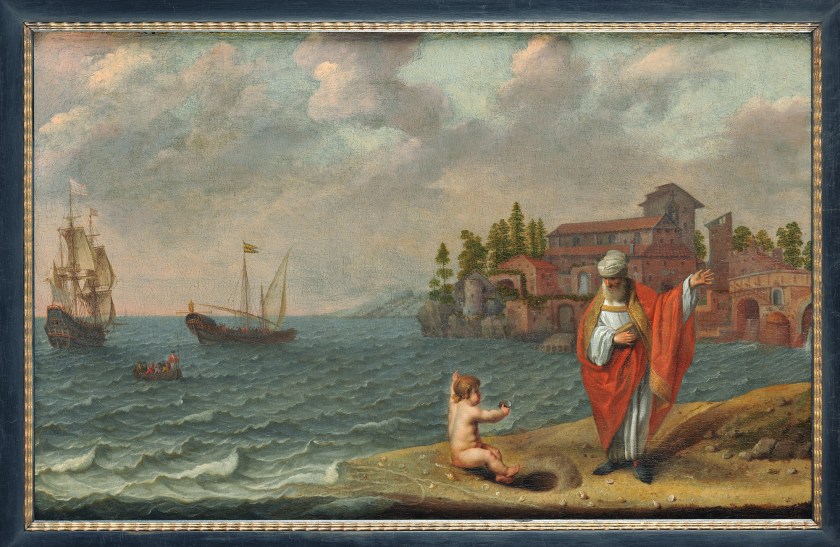
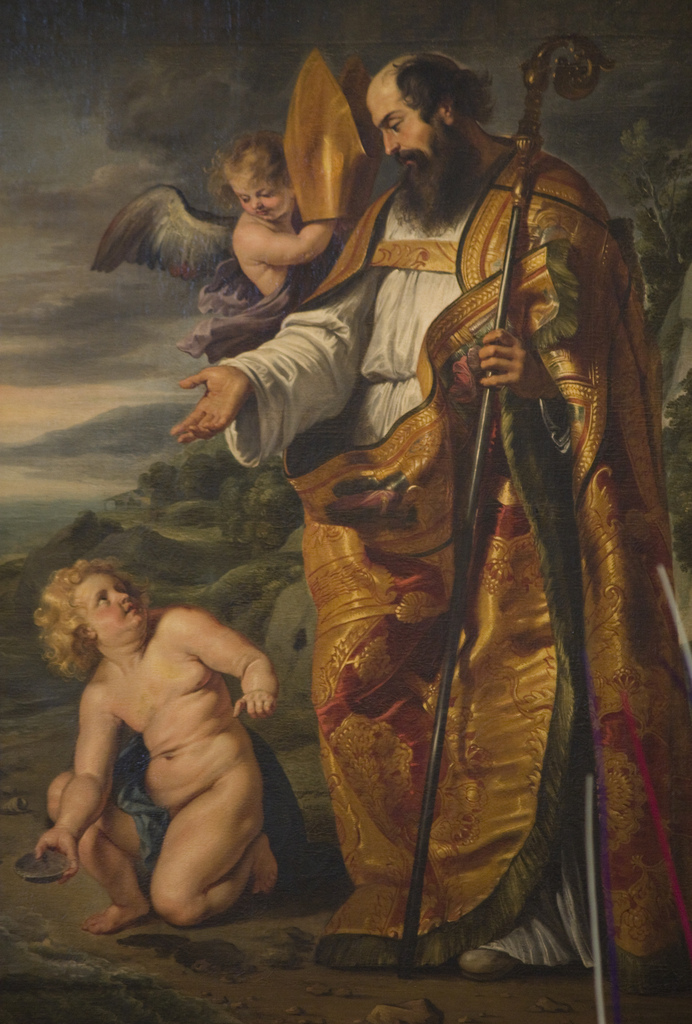
Today, 11 June 2017, on the Solemnity of the Holy Trinity, we remember the legend of St Augustine and the Seashell.

Abraham Willaerts – Saint Augustine and the child
Abraham Willaerts – St Augustine and the Child

The great Doctor of the Church St. Augustine of Hippo spent over 30 years working on his treatise De Trinitate [about the Holy Trinity], endeavouring to conceive an intelligible explanation for the mystery of the Trinity.

He was walking by the seashore one day contemplating and trying to understand the mystery of the Holy Trinity when he saw a small boy running back and forth from the water to a spot on the seashore.   The boy was using a sea shell to carry the water from the ocean and place it into a small hole in the sand.

The Bishop of Hippo approached him and asked, “My boy, what are doing?”

“I am trying to bring all the sea into this hole,” the boy replied with a sweet smile.

“But that is impossible, my dear child, the hole cannot contain all that water” said Augustine.

The boy paused in his work, stood up, looked into the eyes of the Saint, and replied, “It is no more impossible than what you are trying to do – comprehend the immensity of the mystery of the Holy Trinity with your small intelligence.”

The Saint was absorbed by such a keen response from that child, and turned his eyes from him for a short while.   When he glanced down to ask him something else, the boy had vanished.

ST AUGUSTINE AND THE CHILDst augustine and the child 2

Some say that it was an Angel sent by God to teach Augustine a lesson on pride in learning. Others affirm it was the Christ Child Himself who appeared to the Saint to remind him of the limits of human understanding before the great mysteries of our Faith.

Posted in FEASTS and SOLEMNITIES, MORNING Prayers, The MOST HOLY & BLESSED TRINITY

Celebrating the Solemnity of the Holy Trinity – 11 June 2017

Celebrating the Solemnity of the Holy Trinity – 11 June 2017

The fundamental dogma, on which everything in Christianity is based, is that of the Blessed Trinity in whose name all Christians are baptised.   The feast of the Blessed Trinity needs to be understood and celebrated as a prolongation of the mysteries of Christ and as the solemn expression of our faith in this triune life of the Divine Persons, to which we have been given access by Baptism and by the Redemption won for us by Christ.   Only in heaven shall we properly understand what it means, in union with Christ, to share as sons in the very life of God.

The feast of the Blessed Trinity was introduced in the ninth century and was only inserted in the general calendar of the Church in the fourteenth century by Pope John XXII.   But the cultus of the Trinity is, of course, to be found throughout the liturgy. Constantly the Church causes us to praise and adore the thrice-holy God who has so shown His mercy towards us and has given us to share in His life.

The Holy Trinity


Trinity Sunday
The dogma of faith which forms the object of the feast is this:  there is one God and in this one God there are three Divine Persons;  the Father is God, the Son is God, the Holy Spirit is God.   Yet there are not three Gods, but one, eternal, incomprehensible God!   The Father is not more God than the Son, neither is the Son more God than the Holy Spirit. The Father is the first Divine Person; the Son is the second Divine Person, begotten from the nature of the Father from eternity; the Holy Spirit is the third Divine Person, proceeding from the Father and the Son.   No mortal can fully fathom this sublime truth. But I submit humbly and say: Lord, I believe, help my unbelief..

Why is this feast celebrated at this particular time? It may be interpreted as a finale to all the preceding feasts.   All three Persons contributed to and shared in the work of redemption.   The Father sent His Son to earth, for “God so loved the world as to give His only-begotten Son.”   The Father called us to the faith.   The Son, our Saviour Jesus Christ, became man and died for us.   He redeemed us and made us children of God.   He ever remains the liturgist par excellence to whom we are united in all sacred functions.   After Christ’s ascension the Holy Spirit, however, became our Teacher, our Leader, our Guide, our Consoller.   On solemn occasions a thanksgiving Te Deum rises spontaneously from Christian hearts.

The feast of the Most Holy Trinity may well be regarded as the Church’s Te Deum of gratitude over all the blessings of the Christmas and Easter seasons;  for this mystery is a synthesis of Christmas, Epiphany, Easter, Ascension and Pentecost.   This feast, which falls on the first Sunday after Pentecost, should make us mindful that actually every Sunday is devoted to the honour of the Most Holy Trinity, that every Sunday is sanctified and consecrated to the triune God.   Sunday after Sunday we should recall in a spirit of gratitude the gifts which the Blessed Trinity is bestowing upon us.   The Father created and predestined us;  on the first day of the week He began the work of creation.   The Son redeemed us;  Sunday is the “Day of the Lord,” the day of His resurrection.   The Holy Spirit sanctified us, made us His temple;  on Sunday the Holy Spirit descended upon the infant Church. Sunday, therefore, is the day of the Most Holy Trinity.

Excerpted from The Church’s Year of Grace, Pius Parsch

Symbols of the Trinity: Equilateral Triange; Circle of Eternity; Three interwoven Circles; Triangle in Circle; Circle within Triangle; Interwoven Circle and Triangle; Two Triangles interwoven in shape of Star of David; Two Triangles in shape of Star of David interwoven with Circle; Trefoil; Trefoil and Triangle; Trefoil with points; Triquetra; Triquetra and circle; Shield of the Holy Trinity; Three Fishes linked together in shape of a triangle; Cross and Triangle overlapping; Fleur de Lys; St. Patrick’s Shamrock.

Blessed and Holy Solemity of the Holy Trinity to all!

Posted in DOCTORS of the Church, FATHERS of the Church, FEASTS and SOLEMNITIES, MORNING Prayers, QUOTES of the SAINTS, The MOST HOLY & BLESSED TRINITY

Thought for the Day – 11 June 2017 – The Solemnity of the Holy Trinity

Thought for the Day – 11 June 2017 – The Solemnity of the Holy Trinity

The Trinity dogma is not the result of poetic fantasies or of philosophical elucubrations. Nor it is a rational theological formulation that offers the pretext of saying that it is a mystery so detached from our lives that more than one Christian feels quietly authorised to ignore it.   The Mystery of the Trinity is a great mystery which surpasses our minds but speaks deeply to our heart because it is, in its essence, nothing but the explication of the profound expression of Saint John: “God is love” (1 Jn 4: 8,16).   If God is love, he cannot be loneliness in Himself.   In order to have a love affair, it must be at least two.   To love only oneself is not love, it is selfishness.   God Love is, at least, one who always loves and one who has always been loved and reciprocates love:  an eternal Lover, an eternal Beloved and an eternal Love.

The Lover is God, the Father in love, infinitely free and generous in love, motivated to love by no other thing than love.

The eternal Beloved, is the one who always welcomes love:  He is eternal gratitude, grace without beginning and end.  He is the Son in love.

Love is the Holy Spirit, in whom Their love is always open to self-donation and to “go out of their being”.   Therefore, the Spirit is said to be a gift of God, a living source of love, a fire that powers in us the ability to reciprocate Love with love.

This mystery of love is concrete and close to us more than we think and we live it in practice when, above all in the most important or critical times where we most need God, we make the sign of the cross.   By marking this holy sign, almost without being fully aware, we call upon the One and Triune God , saying, “In the name of the Father, of the Son, and of the Holy Ghost”.   Not only do we invoke God Trinity to help us but we praise with the prayer “Glory to the Father, and to the Son and the Holy Ghost … Amen”. St. Teresa of Calcutta often recited as follows: “Glory to the Father-Prayer and to the Son -Poverty and the Holy Spirit- Zeal for souls. Amen-Mary. “   (JUNE 9, 2017 ARCHBISHOP FRANCESCO FOLLO)

Making the Sign of the Cross (1)the sign of the cross

How can we put the sign of the Cross into practice? Here are some ways you can make the sign of the Cross a part of your daily life.

1.   Immediately after waking and before sleeping – making the sign of the Cross immediately after waking and before sleeping is as ancient as Christianity. It is a powerful way to consecrate our day to Our Lord.

2.   When passing a Catholic Church – there is a beautiful Catholic tradition of crossing oneself while passing a Catholic Church in order to recognize Jesus present in the tabernacle and to show Him honour and love.

2.   At the Name of the Holy Trinity – in Catholic prayer, the name of the Holy Trinity is often invoked.   To show honour to the Holy Trinity, it is a good idea to Cross yourself when saying the Glory Be or any other time the Name is invoked.

3.   In reparation for blasphemy – the name of God is abused frequently in daily conversations.   If you want to make an act of reparation to God for this abuse of his Name, you can quietly make the sign of the Cross.

4.   Before entering a room or house – G.K. Chesterton, the famous Catholic convert and all around genius, was said to have made the sign of the cross before entering any room. This Catholic custom also applies to entering a house and many have Holy Water fonts next to the door for blessings oneself when entering or leaving the home.

5.   Blessing people or things – a small sign of the cross can be traced on the forehead of a child or upon an object which you wish to bless.

6.   When afraid – in old movies that involve Catholicism, you will often see people cross themselves when in the presence of death, upon receiving bad news, or when generally afraid.   Sadly, this custom has fallen out of use but it is an excellent way to drive away fear and to inspire courage.

There are countless other ways to employ the powerful sign of the Cross.  The point is, we should use this powerful sign frequently and reverently, paying attention to what we are doing.


be he cross our seal-st cyril of jerusalem

“Let us not then be ashamed to confess the Crucified.   Be the Cross our seal made with boldness by our fingers on our brow and in everything; over the bread we eat and the cups we drink;  in our comings in and goings out; before our sleep, when we lie down and when we awake;  when we are in the way and when we are still.   Great is that preservative;  it is without price, for the poor’s sake;  without toil, for the sick, since also its grace is from God.   It is the Sign of the faithful and the dread of evils;  for He has triumphed over them in it, having made a shew of them openly;  for when they see the Cross, they are reminded of the Crucified;  they are afraid of Him, Who hath bruised the heads of the dragon.   Despise not the Seal, because of the freeness of the Gift; but for this rather honour thy Benefactor.”

– St. Cyril of Jerusalem

Posted in FEASTS and SOLEMNITIES, SAINT of the DAY, The BLESSED VIRGIN MARY

Saints, Feasts and Solemnities – 11 June

The Most Holy Trinity (Solemnity, 2017)
St Barnabas the Apostle (Memorial)
Our Lady of Mantara

St Aleydis of Schaerbeek
St Blitharius of Seganne
St Herebald of Bretagne
Bl Hugh of Marchiennes
Bl Ignazio Choukrallah Maloyan
Bl Jean de Bracq
Bl Kasper of Grimbergen
St Maximus of Naples
St Parisius
St Paula Frasinetti
St Riagail of Bangor
St Tochumra of Kilmore
St Tochumra of Tuam

Martyrs of Tavira – 7 beati: Members of the Knights of Santiago de Castilla. During the re-conquest of the Iberian peninsula from the Muslims by Christian forces, in a period of truce between the armies, the group was allowed to leave the Portuguese camp to hunt. Near Tavira, Portugal, he and his companions were ambushed and killed by a Muslim force. Making a reprisal attack, the Portuguese army took the city of Tavira. The murdered knights were considered to be martyrs as they died in an action defending the faith. They were –
• Blessed Alvarus Garcia
• Blessed Beltrão de Caia
• Blessed Damião Vaz
• Blessed Estêvão Vasques
• Blessed Garcia Roiz
• Blessed Mendus Valle
• Blessed Pedro Rodrigues
They were martyred in 1242 outside Tavira, Faro, Portugal. Their relics are enshrined under the altar of Saint Barnabas in the Church of Our Lady, Queen of the Angels (modern Santa Maria do Castelo) in Tavria

Mercedarian Martyrs of Damietta: Three Mercedarian lay knights who worked to ransom Christians enslaved by Muslims. During the 7th Crusade, a plague swept through the Christian army and these knights volunteered to work with the sick. During this work they were captured by Muslims and ordered to convert to Islam; they refused. They were tortured, taken to Damietta, Egypt where they were murdered for their faith. They were thrown from a tower in the mid-13th century in Damietta, Egypt.