Our Lady of the Grotto
—
Bl Amata of San Sisto
St Amantius of Tivoli
St Asterius of Petra
St Bardo of Mainz
Bl Bogumilus of Gniezno
St Caerealis of Tivoli
St Censurius of Auxerre
St Crispulus of Rome
Bl Edward Johannes Maria Poppe
Bl Elisabeth Hernden
Bl Elizabeth Guillen
St Evermund of Fontenay
St Faustina of Cyzicus
Bl Gerlac of Obermarchtal
St Getulius of Tivoli
Bl Henry of Treviso
St Illadan of Rathlihen
St Ithamar of Rochester
Bl John Dominici de Banchini
Bl José Manuel Claramonte Agut
Bl Joseph Kugler
St Landericus of Novalese
St Landericus of Paris
Bl Mary Magdalene of Carpi
St Maurinus of Cologne
St Primitivus of Tivoli
St Restitutus of Rome
Bl Thomas Green
St Timothy of Prusa
Bl Walter Pierson
St Zachary of Nicomedia
—
Martyrs of North Africa – 17 saints: A group of seventeen Christians martyred together in North Africa; the only surviving details are two of their names – Aresius and Rogatius. Both the precise location in North Africa and the date are unknown.
Martyrs of the Aurelian Way – 23 saints: A group of 23 martyrs who died together in the persecutions of Aurelian. The only details that survive are three of their names – Basilides, Mandal and Tripos. c.270-275 on the Aurelian Way, Rome, Italy.
Martyrs of the Hulks of Rochefort/Martyrs of La Rochelle – 64 beati: In 1790 the French Revolutionary authorities passed a law requiring priests to swear allegience to the civil constitution, which would effectively remove them from the authority of and allegience to, Rome. Many refused and in 1791 the government began deporting them to French Guyana. 827 priests and religious were imprisoned on hulks (old ships no longer sea-worthy and used for storage, jails, hospitals, etc.) at Rochefort, France to await exile, most on the Deux-Associés and the Washington which had previously been used to house slaves or prisoners. There they were basically ignored to death as there was little provision for food and water, less for sanitation and none at all for medical help. 542 of the prisoners died there.
The survivors were freed on 12 February 1795 and allowed to return to their homes. Many of them wrote about their time on the hulks and many of them wrote about the faith and ministry of those who had died. 64 of them have been positively identified and confirmed to have died as martyrs, dying for their faith, they are:
• Antoine Auriel
• Antoine Bannassat
• Augustin-Joseph Desgardin
• Barthélemy Jarrige de La Morelie de Biars
• Charles-Antoine-Nicolas Ancel
• Charles-Arnould Hanus
• Charles-René Collas du Bignon
• Claude Beguignot
• Claude Dumonet
• Claude Laplace
• Claude Richard
• Claude-Barnabé Laurent de Mascloux
• Claude-Joseph Jouffret de Bonnefont
• élie Leymarie de Laroche
• Florent Dumontet de Cardaillac
• François d’Oudinot de la Boissière
• François François
• François Hunot
• François Mayaudon
• Gabriel Pergaud
• Georges-Edme René
• Gervais-Protais Brunel
• Jacques Gagnot
• Jacques Lombardie
• Jacques Retouret
• Jacques-Morelle Dupas
• Jean Baptiste Guillaume
• Jean Bourdon
• Jean Hunot
• Jean Mopinot
• Jean-Baptiste de Bruxelles
• Jean-Baptiste Duverneuil
• Jean-Baptiste Laborie du Vivier
• Jean-Baptiste Menestrel
• Jean-Baptiste Souzy
• Jean-Baptiste-Ignace-Pierre Vernoy de Montjournal
• Jean-Baptiste-Xavier Loir
• Jean-François Jarrige de la Morelie de Breuil
• Jean-Georges Rehm
• Jean-Nicolas Cordier
• Joseph Imbert
• Joseph Juge de Saint-Martin
• Joseph Marchandon
• Lazare Tiersot
• Louis-Armand-Joseph Adam
• Louis-François Lebrun
• Louis-Wulphy Huppy
• Marcel-Gaucher Labiche de Reignefort
• Michel-Bernard Marchand
• Michel-Louis Brulard
• Nicolas Savouret
• Nicolas Tabouillot
• Noël-Hilaire Le Conte
• Paul-Jean Charles
• Philippe Papon
• Pierre Gabilhaud
• Pierre Jarrige de la Morelie de Puyredon
• Pierre-Joseph le Groing de la Romagère
• Pierre-Michel Noël
• Pierre-Sulpice-Christophe Faverge
• Pierre-Yrieix Labrouhe de Laborderie
• Raymond Petiniaud de Jourgnac
• Scipion-Jérôme Brigeat Lambert
• Sébastien-Loup Hunot
They died between 19 May 1794 and 23 February 1795 aboard prison ships docked at Rochefort, Charente-Maritime, France and were beatified on
1 October 1995 by St Pope John Paul II.
St Boniface and Companions (Memorial)
Beata Vergine dell’Aiuto
—
St Adalar of Erfurt
Bl Adalbert Radiouski
Bl Adam Arakawa
St Austrebertus of Vienne
St Claudius of Egypt and Companions
St Ðaminh Huyen
St Ðaminh Toai
St Dorotheus of Tyre
St Elleher
St Eoban of Utrecht
St Eutichius of Como
St Evasius of Africa
St Felix of Fritzlar
Bl Ferdinand of Portugal
St Franco of Assergi
St Genesius, Count of Clermont
St Gregory of Lilybaeum
St Gundekar
St Hadulph
St Luke Loan
Bl Malgorzata Lucja Szewczyk
Bl Meinwerk of Paderborn
St Privatus of Africa
St Sanctius of Córdoba
St Tudno of Caernarvon
St Waccar
“If the damned were asked: Why are you in Hell? they would answer: ‘For having resisted the Holy Spirit.’
And if the saints were asked: Why are you in Heaven? they would answer: ‘For having listened to the Holy Spirit.’
When good thoughts come into our minds, it is the Holy Spirit who is visiting us.
The Holy Spirit is a power.
The Holy Spirit …. sustained the martyrs. Without the Holy Spirit, the martyrs would have fallen like the leaves from the trees. When the fires were lighted under them, the Holy Spirit extinguished the heat of the fire by the heat of divine love.
The good God, in sending us the Holy Spirit, has treated us like a great king who should send his minister to guide one of his subjects, saying, “You will accompany this man everywhere and you will bring him back to me safe and sound.”
How beautiful it is, my children, to be accompanied by the Holy Spirit!
He is indeed a good Guide; and to think that there are some who will not follow Him!
The Holy Spirit is like a man with a carriage and horse, who should want to take us to Pans. We should only have to say “yes,” and to get into it. It is indeed an easy matter to say “yes”!… Well, the Holy Spirit wants to take us to Heaven; we have only to say “yes,” and to let Him take us there.“…St John Vianney
“O Divine Spirit, draw us to the highest heaven where Jesus lives forever, interceding for us. Come, fill our hearts with Your fire, show us the way to the Lord that we may find Him shining with beauty and love. Amen”
We beg the all-merciful Father through You,
His only-begotten Son made man for our sake,
crucified and glorified for us,
to send upon us from His treasure-house,
the Spirit of sevenfold grace,
who rested upon You in all His fullness:
the spirit of wisdom:
enabling us to relish the fruit of the tree of life,
which is indeed Yourself;
the gift of understanding: to enlighten our perceptions;
the gift of prudence, enabling us to follow in Your footsteps;
the gift of strength: to withstand our adversary’s onslaught;
the gift of knowledge: to distinguish good from evil
by the light of thy holy teaching;
the gift of piety: to clothe ourselves with charity and mercy;
the gift of fear: to withdraw from all ill-doing
and live quietly in awe of Your eternal majesty.
These are the things for which petition.
Grant them for the honour of Your Holy Name,
to which, with the Father and the Holy Spirit,
be all honour and glory,
thanksgiving, renown and lordship for ever and ever. Amen
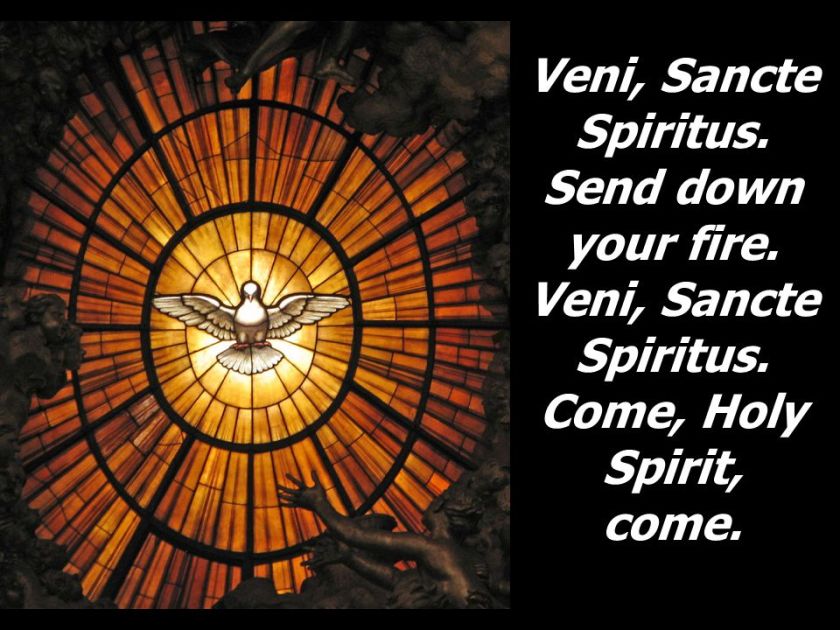
“VENI SANCTE SPIRITUS” (Come, Holy Spirit) – (chant – https://www.youtube.com/watch?v=3pU34vUoO9g)
One of the most widely used hymns in the Church, Veni, Creator Spiritus, is attributed to Blessed Rabanus Maurus (776-856), Archbishop of Mainz. It is commonly sung in the feast of Pentecost liturgy and other occasions when the Holy Spirit is solemnly invoked. The Veni Creator is also the official opening prayer for Church councils and synods. A partial indulgence is granted to the faithful who devoutly recite the hymn and a plenary indulgence if recited publicly in church on the 1st of January and on the feast of Pentecost. There are many translations of this beautiful Hymn which all differ slightly just as the Holy Scriptures do in it’s various translations.
Come, Holy Spirit, Creator blest,
and in our souls take up Thy rest;
come with Thy grace and heavenly aid
to fill the hearts which Thou hast made.
O comforter, to Thee we cry,
O heavenly gift of God Most High,
O fount of life and fire of love,
and sweet anointing from above.
Thou in Thy sevenfold gifts are known;
Thou, finger of God’s hand we own;
Thou, promise of the Father, Thou
Who dost the tongue with power imbue.
Kindle our sense from above,
and make our hearts o’erflow with love;
with patience firm and virtue high
the weakness of our flesh supply.
Far from us drive the foe we dread,
and grant us Thy peace instead;
so shall we not, with Thee for guide,
turn from the path of life aside.
Oh, may Thy grace on us bestow
the Father and the Son to know;
and Thee, through endless times confessed,
of both the eternal Spirit blest.
Now to the Father and the Son,
Who rose from death, be glory given,
with Thou, O Holy Comforter,
henceforth by all in earth and heaven.
Amen
Solemnity of Pentecost – 4 June 2017 – Wishing you all a Holy, Blessed and inspired Pentecost!
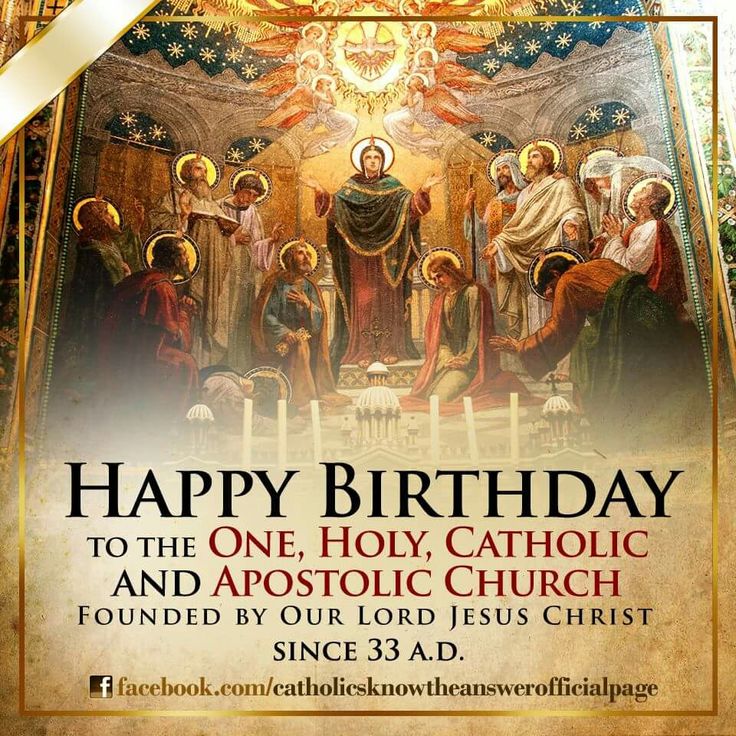
The Solemnity of Pentecost is the birthday of the Church:
The Church was made manifest to the world on the day of Pentecost by the outpouring of the Holy Spirit. The gift of the Spirit ushers in a new era in the “dispensation of the mystery” the age of the Church, during which Christ manifests, makes present, and communicates his work of salvation through the liturgy of His Church, “until he comes.” (CCC, #1076)
Pentecost is not just an isolated feast of the Holy Spirit but an integral feast of the Easter season. Pentecost is also an elementary feast — not as in getting to back to the basics or beginnings of the Catholic Church but can be described elementary as in the four elements of Aristotle: earth, wind, fire and water.
Red Easter: Pentecost closes the Easter season and not in an anticlimactic fashion but in a grand finale. We so often tend to look at this feast as a separate entity for the Holy Spirit but the Church integrates this feast into the Easter season as a whole. there is significance in the number of days and weeks during the Easter season and in the eyes of the Church, the 50 days are viewed as “one feast day.” The Italian name for Pentecost, Pasqua rossa (Red Easter) is a great reminder of this connection.
22. The fifty days from the Sunday of the Resurrection to Pentecost Sunday are celebrated in joy and exultation as one feast day, indeed as one “great Sunday.” These are the days above all others in which the Alleluia is sung.
23. The Sundays of this time of year are considered to be Sundays of Easter and are called, after Easter Sunday itself, the Second, Third, Fourth, Fifth, Sixth, and Seventh Sundays of Easter. This sacred period of fifty days concludes with Pentecost Sunday. (From the General Norms of the Liturgical Year and Calendar).
The Descent of the Holy Spirit at Pentecost is closely linked to the feast of the Resurrection, our Passover Feast:
On the day of Pentecost when the seven weeks of Easter had come to an end, Christ’s Passover is fulfilled in the outpouring of the Holy Spirit, manifested, given and communicated as a divine person: of his fullness, Christ, the Lord, pours out the Spirit in abundance. On that day, the Holy Trinity is fully revealed. (Catechism of the Catholic Church, #731-732)
In reading the account of Pentecost in the Acts of the Apostles, there is very pronounced imagery. It is easy to recognise the wind and fire but all four classic elements of Greek philosopher, Aristotle, are present at Pentecost, earth, wind, fire and water.
Wind
First in the account of Pentecost from Acts 2:1-11 came the wind: “And suddenly there came from the sky a noise like a strong driving wind, and it filled the entire house in which they were.”
Most Biblical renderings of the God or the Holy Spirit is through a gentle breath, such as Jesus breathing on the Apostles in the Resurrection appearance in the Upper Room. At Pentecost it is the same room, but here the Holy Spirit comes as wind of strength and power.
There is nothing subtler than the wind, which manages to penetrate everywhere, even to reach inanimate bodies and give them a life of their own. The rushing wind of the day of Pentecost expresses the new force with which divine love invades the Church and souls (p. 592, In Conversation with God, Volume 2, by Francis Fernandez).
Fire
Next came the fire: “Then there appeared to them tongues as of fire, which parted and came to rest on each one of them.” It is this combination of wind and fire that is the gift of tongues. One of the optional readings for Pentecost is the story of the Tower of Babel. Pius Parsch, as quoted on the Catholic Culture’s Pentecost page, explains that is was the sin of pride that separated and divided those at Babel. The Holy Spirit brings unity and love, which allows those languages to be spoken and understood by all.
The liturgical color for Pentecost is red, the color of fire and blood and the symbol of love. The last time we have seen red vestments outside of the feasts of martyrs or apostles is Palm Sunday and Good Friday. The red for those days recalled the blood of Christ. Today the red recalls the tongues of fire and we ask the Holy Spirit to ignite our hearts, just as we pray:
Come, Holy Spirit, fill the hearts of thy Faithful; and enkindle in them the fire of Thy love….
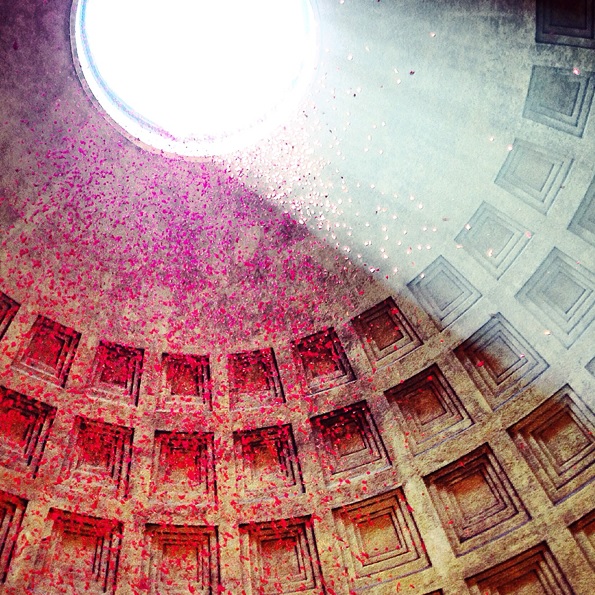
“In medieval times, many churches had a “Holy Ghost Hole”, a small circular opening in the ceiling of the church. The holes would be decorated on Pentecost, with various items symbolising the Holy Spirit lowered through the hole. This practice calls to mind the elements of wind and fire. Father Francis Weiser describes the tradition (emphasis mine):
In medieval times the figure of a dove was widely used to enact in a dramatic way the descent of the Holy Spirit on Pentecost Sunday. When the priest had arrived at the sequence, he sang the first words in a loud and solemn voice: Veni Sancte Spiritus (Come, Holy Ghost). Immediately there arose in the church a sound “as of a violent wind blowing” (Acts 2, 2). This noise was produced in some countries, like France, by the blowing of trumpets; in others by the choir boys, who hissed, hummed, pressed windbags, and rattled the benches. All eyes turned toward the ceiling of the church where from an opening called the “Holy Ghost Hole” there appeared a disc the size of a cart wheel, which slowly descended in horizontal position, swinging in ever-widening circles. Upon a blue background, broken by bundles of golden rays, it bore on its underside the figure of a white dove.
Meanwhile the choir sang the sequence. At its conclusion the dove came to rest, hanging suspended in the middle of the church. There followed a “rain” of flowers indicating the gifts of the Holy Spirit and of water symbolizing baptism. In some towns of central Europe people even went so far as to drop pieces of burning wick or straw from the Holy Ghost Hole, to represent the flaming tongues of Pentecost. This practice, however, was eventually stopped because it tended to put the people on fire externally, instead of internally as the Holy Spirit had done at Jerusalem. In the thirteenth century in many cathedrals of France real white pigeons were released during the singing of the sequence and new around in the church while roses were dropped from the Holy Ghost Hole (Weiser, Holyday Book).
Except for the burning bits, some of these practices have been revived in these older churches. In parts of Italy and Sicily, red rose petals are dropped through the hole. This is an especially spectacular sight in the church in Rome dedicated to St. Mary and the Martyrs that was formerly the Pantheon. There is an opening in the dome and the rose petals are dropped, filling the church and covering the floor.
Rose Petals raining down on Pentecost Sunday in St Mary and the Martyrs (Pantheon), Rome
Red and fire are the dominant images used in Pentecost celebrations. In many places of the Northern Hemisphere, this is height of strawberry season and the red fruits shapes like tongues of fire seem perfect for the feast day that falls in the warmer months.”
Earth
The earth element doesn’t seem to be as obvious with the connection more as it relates to God’s creation. Pentecost, which means “Fiftieth Day” in Greek, was a Jewish festival marking the 7 weeks or 50 days after the Passover. It was a harvest festival, offering the first fruits in thanksgiving to God. Later the feast also commemorated the giving of the Law or Ten Commandments to Moses at Sinai. Our civilization has become less agrarian but this “earth element” should be a universal reminder to us as respect and thanksgiving for creation. Pope Benedict explains and elaborates:
“From its earliest prehistory [Pentecost] has been a feast of harvest. In Palestine the crops were ripe in May; Pentecost was the thanksgiving for the grain harvest. Man sees the fruitfulness which results from the interplay of heaven and earth as the miracle by which he lives and he acknowledges that gratitude is the appropriate response to this miracle….Has this become meaningless today? If we think of “Holy Spirit” only in terms of Christian inwardness and of “harvest” only in terms of technology and commerce, our view of the world has become schizophrenic. At Pentecost the church prays a verse from the psalms which runs: Send forth your Spirit, O Lord, and renew the face of the earth. Initially this refers to the creative Spirit which has called the world into being and maintains it in being. It is important to have a new reality of this at Pentecost: the Holy Spirit who came down upon the apostles is the same Spirit who fashioned the world….”
Against this background we must also understand that, in Israel, Pentecost was the remembrance of the arrival at Sinai and the celebration of the Covenant which had set out a path for Israel to travel in the form of the law. Christians have always seen their Pentecost as a continuation of this idea: the New Law is love, breaking down barriers and uniting people in the New Covenant. Love, too, is not formless or arbitrary; it is a formation from within, a wakefulness of the heart which takes up the rhythm of creation and perfects it. (Seek That Which is Above, 79-81)”
Water
The final element, water, is not an image of the Holy Spirit but a direct result of the coming of the Paraclete upon the Disciples. After they were filled with the Holy Spirit, they left the Upper Room and began to proclaim the Gospel. And on hearing their words, 3000 were baptised that day. The matter of baptism is water.
From the very day of Pentecost the Church has celebrated and administered holy Baptism. Indeed St. Peter declares to the crowd astounded by his preaching: “Repent, and be baptised every one of you in the name of Jesus Christ for the forgiveness of your sins; and you shall receive the gift of the Holy Spirit.”
26. The apostles and their collaborators offer Baptism to anyone who believed in Jesus: Jews, the God-fearing, pagans. 27 Always, Baptism is seen as connected with faith: “Believe in the Lord Jesus and you will be saved, you and your household,” St. Paul declared to his jailer in Philippi. And the narrative continues, the jailer “was baptised at once, with all his family” (CCC, #1226)
With every baptism comes the reminders of the first Pentecost. Today is also a good feast to celebrate our reception of the sacraments of baptism and confirmation. ( Jennifer Gregory Miller)
Pentecost Sunday (2017)
Mary the Planter
—
St Aldegrin of Baume
St Alexander of Verona
St Alonio
Bl Antoni Zawistowski
St Aretius of Rome
Bl Boniface of Villers
St Breaca of Cornwall
St Buriana of Cornwall
St Christa of Sicily
St Clateus of Brescia
St Cornelius McConchailleach
St Croidan
St Cyrinus of Aquileia
St Dacian of Rome
St Degan
St Edfrith of Lindisfarne
St Elsiar of Lavedan
St Ernin of Cluain
St Filippo Smaldone
Bl Francesco Pianzola
St Francis Caracciolo
Bl Francis Ronci
Bl Margaret of Vau-le-Duc
St Medan
Bl Menda Isategui
St Metrophanes of Byzantium
St Nennoc
St Nicolo of Sardinia
St Optatus of Milevis
St Petroc of Cornwall
St Quirinus of Croatia
St Quirinus of Tivoli
St Rutilus of Sabaria
Saturnina of Arras
Bl Stanislaw Kostka Starowieyski
St Trano of Sardinia
St St Walter of Fontenelle
Walter of Serviliano
—
Martyrs of Cilicia – 13 saints: A group of 13 Christians who were martyred together. The only details about them that have survived are their names –
• Cama
• Christa
• Crescentia
• Eiagonus
• Expergentus
• Fortunus
• Italius
• Jucundian
• Julia
• Momna
• Philip
• Rustulus
• Saturnin
They were martyred in in Cilicia, Asia Minor (in modern Turkey), date unknown
Martyrs of Nyon – 41 saints: A group of 41 Christians martyred together for refusing to sacrifice to imperial Roman idols. We know the names of some but no other details.
• Amatus
• Attalus
• Camasus
• Cirinus
• Dinocus
• Ebustus
• Euticus
• Eutychius
• Fortunius
• Galdunus
• Julia
• Quirinus
• Rusticus
• Saturnina
• Saturninus
• Silvius
• Uinnita
• Zoticus
Martyred by being beheaded in Noviodunum (modern Nyon, Switzerland)
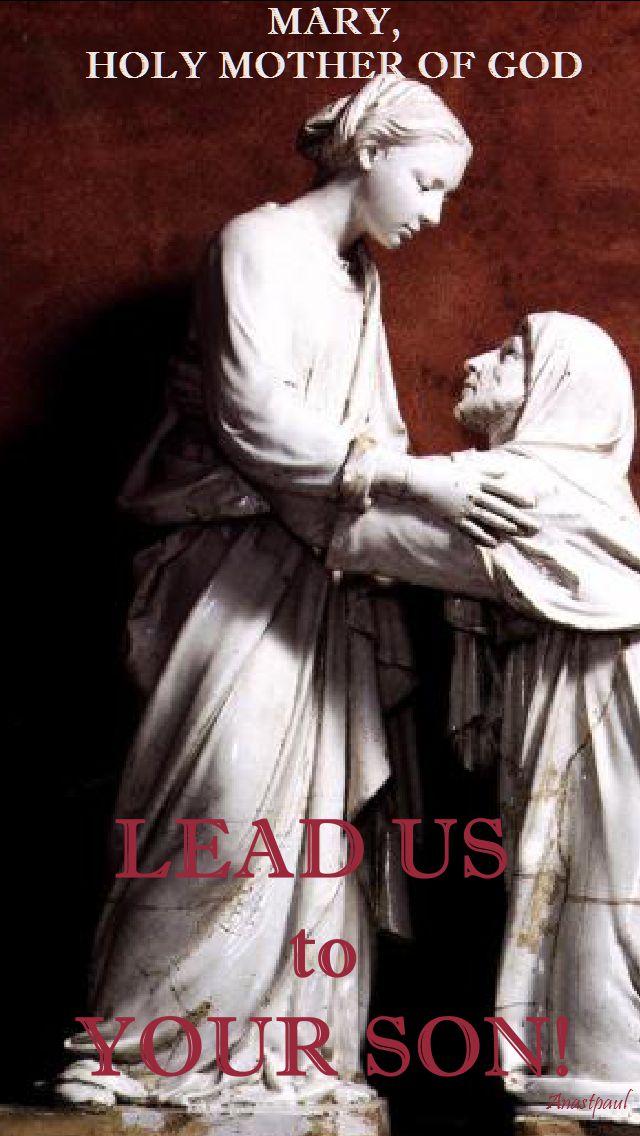
Mary, Mother of God, your love is strikingly shown forth in this beautiful Feast of the Visitation. When you learned from the angel that your cousin Elizabeth was with child and needed your help, you set out to care for her. Neither the long absence from home, nor the inconvenience of a difficult and dangerous journey to the mountain country, kept you from making this mission of love. You thought only of Elizabeth and the assistance you could bring to her. You hastened to be of service. You lovingly served her until you saw her happily delivered of the child of promise with which God had blessed her.
Help me to strive to imitate your wonderful charity by aiding those who are in need, by sympathising with those who are afflicted, by opening my heart and applying my hands to relieve every form of distress.
Give me love like yours!
Teach me that the test of my following of your Divine Son is practical charity!
One of the invocations in Mary’s litany is “Ark of the Covenant.”
Like the Ark of the Covenant of old, Mary brings God’s presence into the lives of other people.
As David danced before the Ark, John the Baptist leaps for joy.
As the Ark helped to unite the 12 tribes of Israel by being placed in David’s capital,
so Mary has the power to unite all Christians in her son.
Like you, teach me too acclaim and seek the glory of God and sing with you:
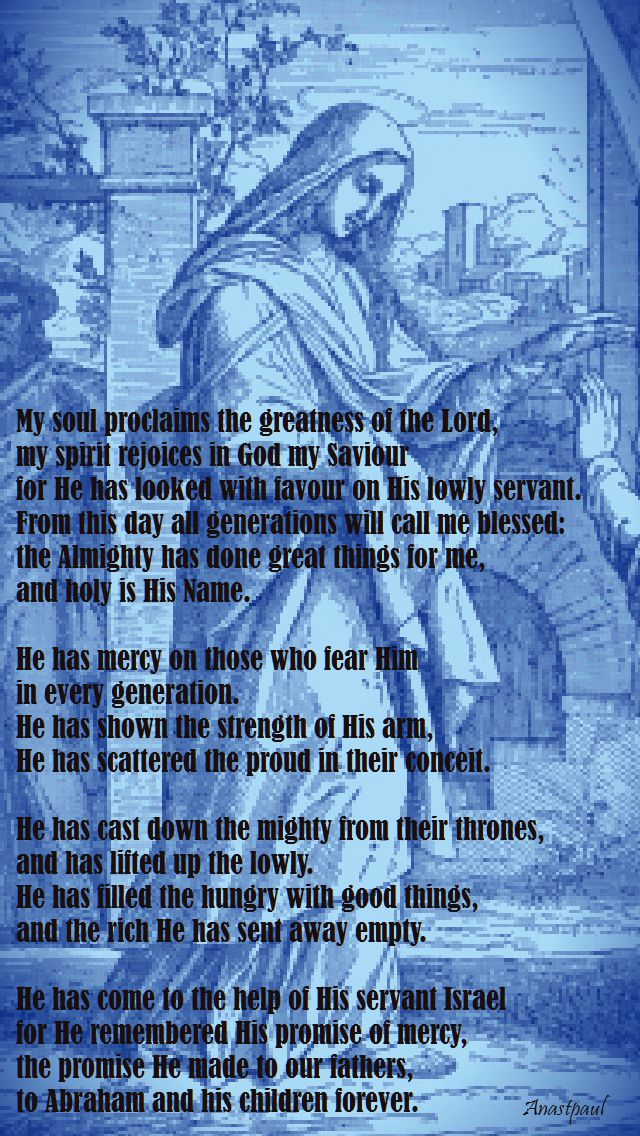
My soul proclaims the greatness of the Lord,
my spirit rejoices in God my Saviour
for He has looked with favour on His lowly servant.
From this day all generations will call me blessed:
the Almighty has done great things for me,
and holy is His Name.
He has mercy on those who fear Him
in every generation.
He has shown the strength of His arm,
He has scattered the proud in their conceit.
He has cast down the mighty from their thrones,
and has lifted up the lowly.
He has filled the hungry with good things,
and the rich He has sent away empty.
He has come to the help of His servant Israel
for He remembered His promise of mercy,
the promise He made to our fathers,
to Abraham and his children forever.
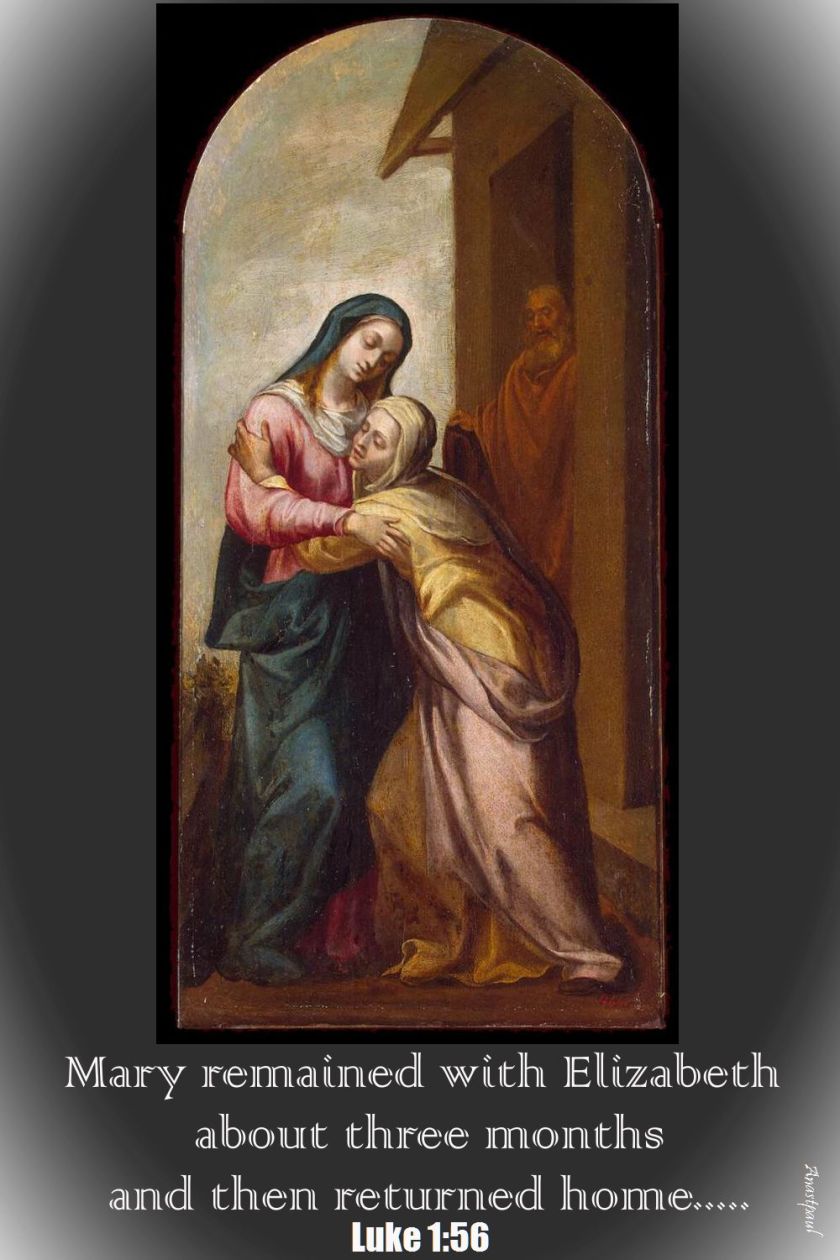
Mary remained with Elizabeth
about three months
and then returned home……….Luke 1:56
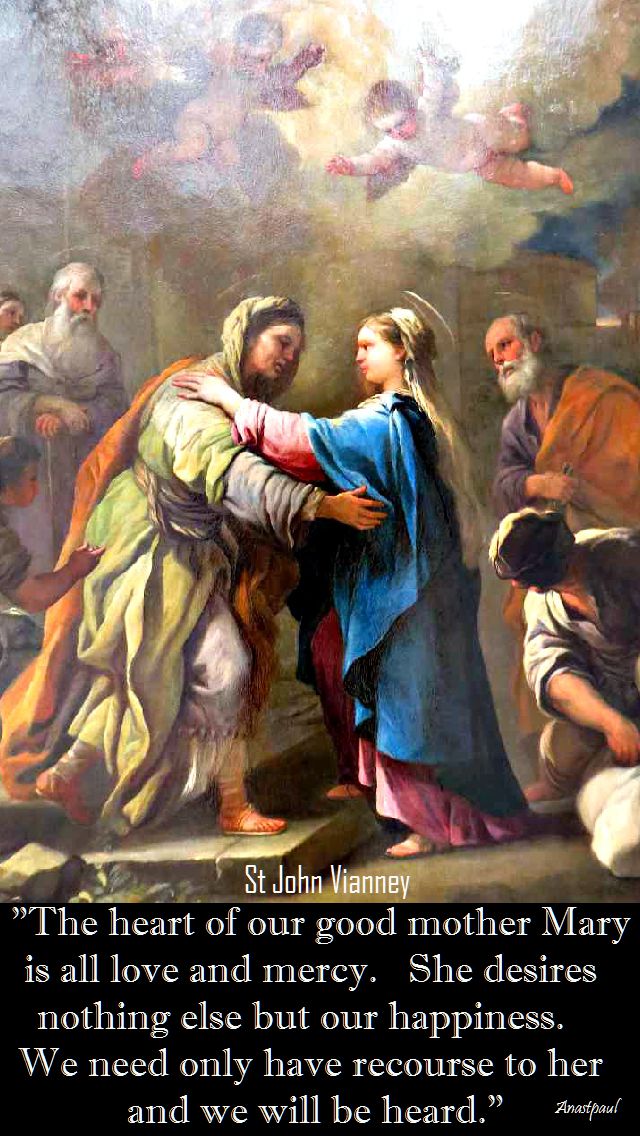
REFLECTION – “The heart of our good mother Mary is all love and mercy. She desires nothing else but our happiness. We need only have recourse to her and we will be heard.”………..
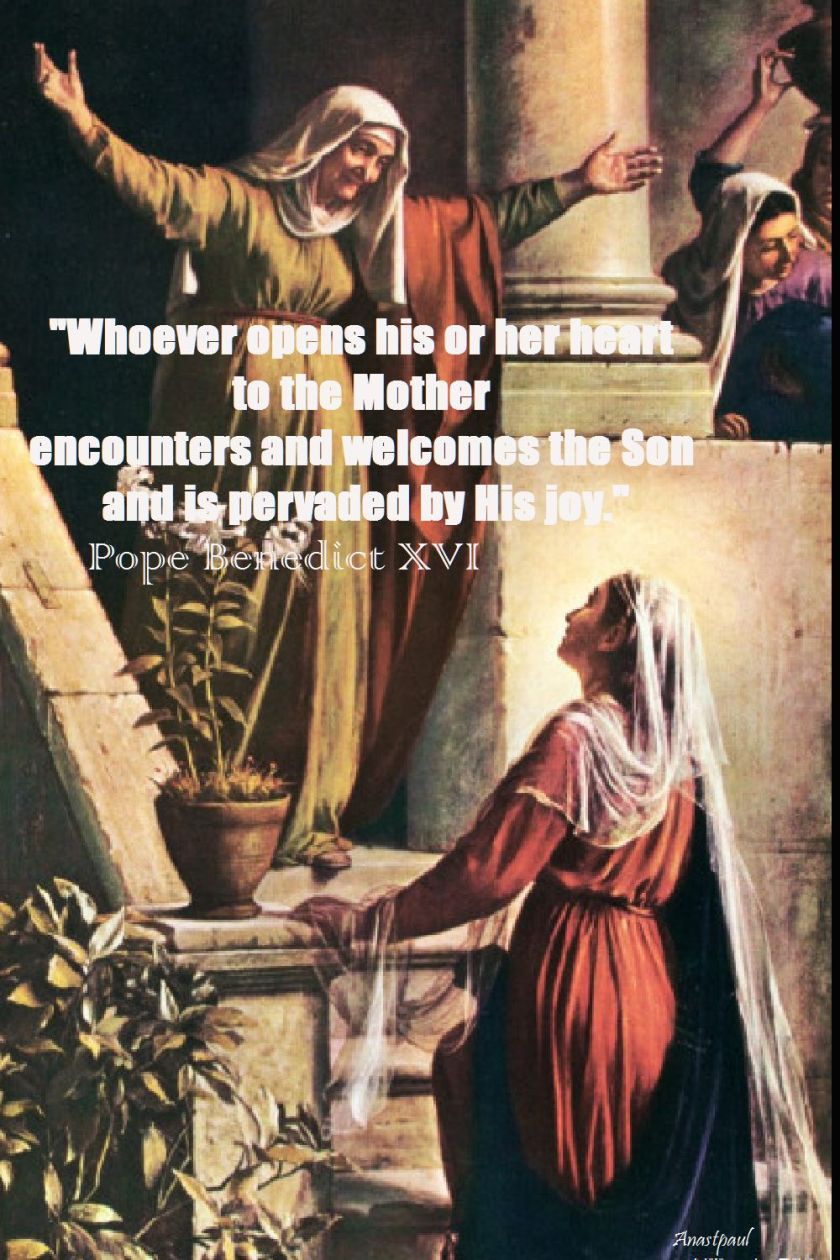
“Whoever opens his or her heart to the Mother encounters and welcomes the Son and is pervaded by His joy. True Marian devotion never obscures or diminishes faith and love for Jesus Christ Our Saviour, the one Mediator between God and humankind. On the contrary, entrustment to Our Lady is a privileged path, tested by numerous saints, for a more faithful following of the Lord. Consequently, let us entrust ourselves to her with filial abandonment!” ……….Pope Benedict XVI (2006)
PRAYER – Heavenly Father, let me constantly have recourse to Mary. May she lead me to the happiness of heavenly glory which You shar with Your Son in the unity of the Holy Spirit. Holy Mary, Mother of God, pray for us, lead us, teach us and care for us, now and at the hour of our death, amen.
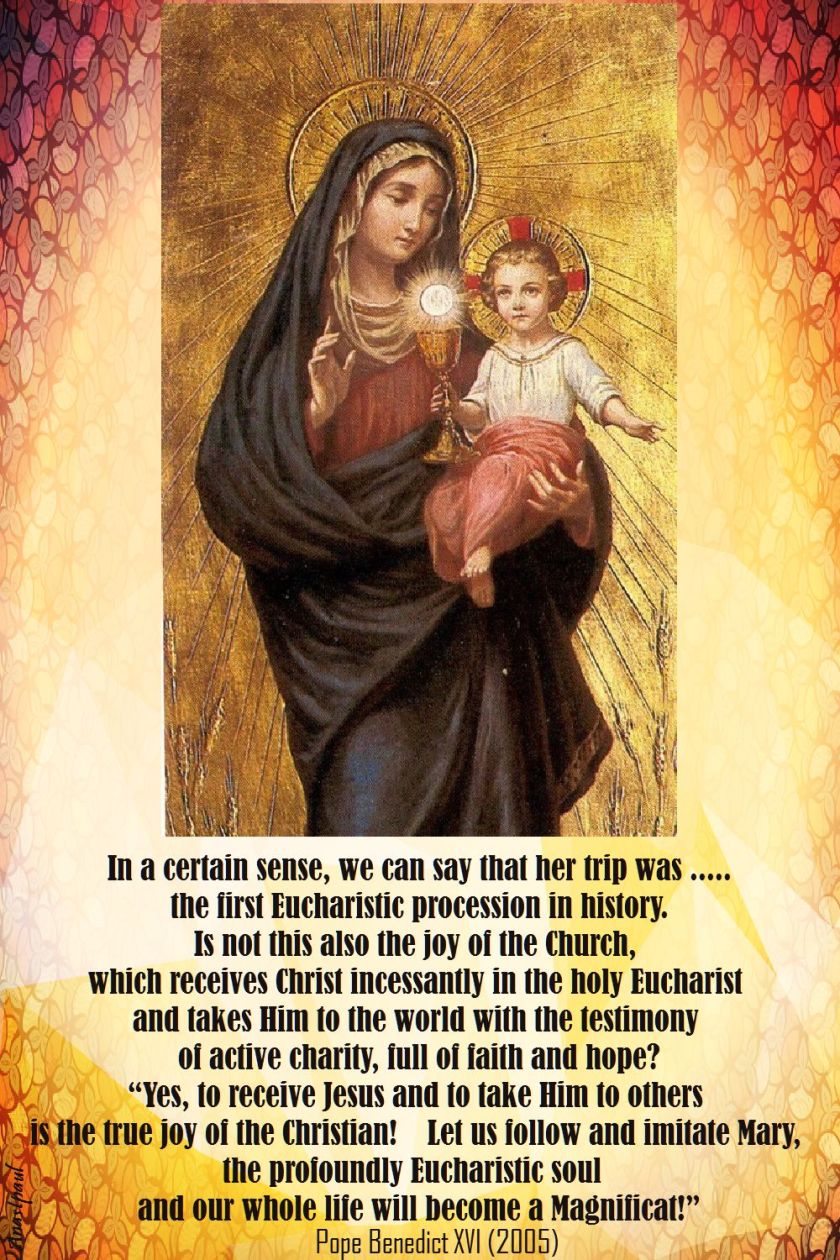
“(Mary) is a young maiden but she is not afraid because God is with her, within her,… In a certain sense, we can say that her trip was ….. the first Eucharistic procession in history. Is not this also the joy of the Church, which receives Christ incessantly in the holy Eucharist and takes Him to the world with the testimony of active charity, full of faith and hope? “Yes, to receive Jesus and to take Him to others is the true joy of the Christian! Let us follow and imitate Mary, the profoundly Eucharistic soul and our whole life will become a Magnificat.”
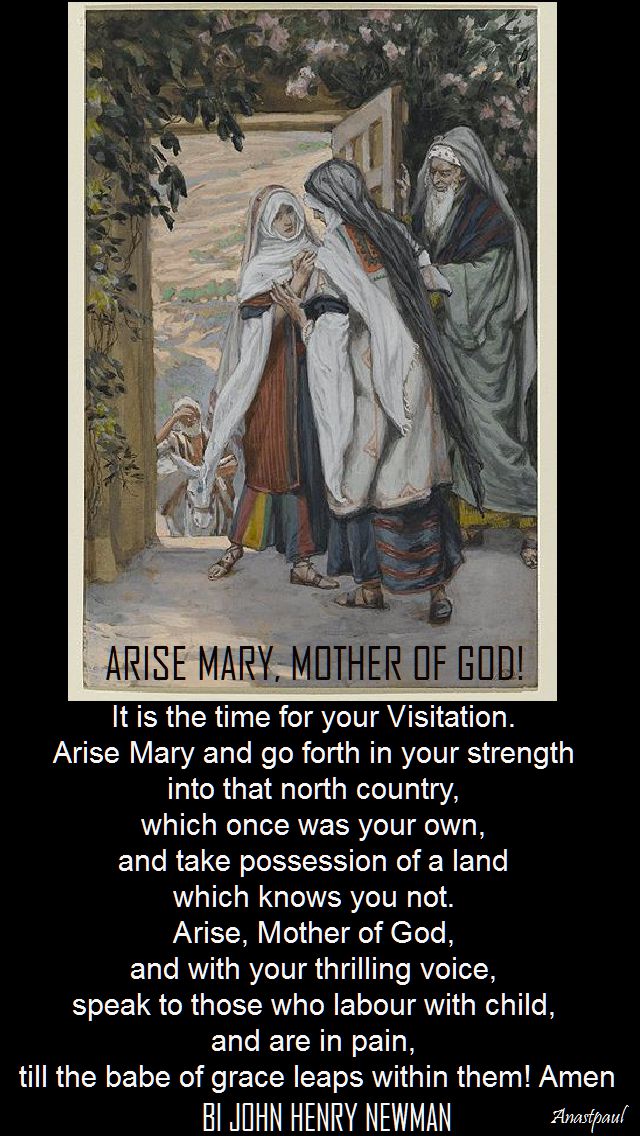
ARISE MARY, MOTHER OF GOD! Blessed Cardinal JOHN HENRY NEWMAN (1801-1890)
It is the time for your Visitation.
Arise Mary, and go forth in your strength
into that north country,
which once was your own,
and take possession of a land
which knows you not.
Arise, Mother of God,
and with your thrilling voice,
speak to those who labour with child,
and are in pain,
till the babe of grace leaps within them!
Amen
Feast of the Visitation of the Blessed Virgin Mary – 31 May
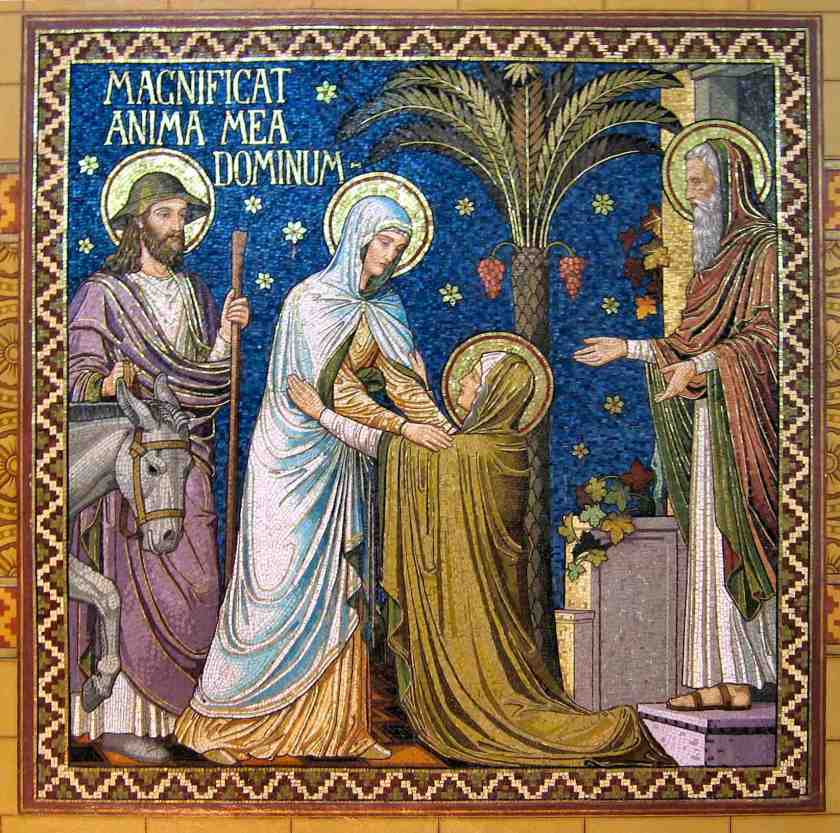
The feast of the Visitation recalls to us the following great truths and events: The visit of the Blessed Virgin Mary to her cousin Elizabeth shortly after the Annunciation; the cleansing of John the Baptist from original sin in the womb of his mother at the words of Our Lady’s greeting; Elizabeth’s proclaiming of Mary—under the inspiration of the Holy Ghost—as Mother of God and “blessed among women”; Mary’s singing of the sublime hymn, Magnificat (“My soul doth magnify the Lord”) which has become a part of the daily official prayer of the Church. The Visitation is frequently depicted in art and was the central mystery of St. Francis de Sales’ devotions.
The Mass of today salutes her who in her womb bore the King of heaven and earth, the Creator of the world, the Son of the Eternal Father, the Sun of Justice. It narrates the cleansing of John from original sin in his mother’s womb. Hearing herself addressed by the most lofty title of “Mother of the Lord” and realizing what grace her visit had conferred on John, Mary broke out in that sublime canticle of praise proclaiming prophetically that henceforth she would be venerated down through the centuries:
“My soul doth magnify the Lord, and my spirit hath rejoiced in God my Savior. Because he that is mighty, hath done great things to me, and holy is His name” (Lk. 1:46).
This feast is of medieval origin, it was kept by the Franciscan Order before 1263 and soon its observance spread throughout the entire Church. Previously it was celebrated on July 2. Now it is celebrated between the solemnity of the Annunciation of the Lord and the birth of St. John the Baptist, in conformity with the Gospel accounts. Some places appropriately observe a celebration of the reality and sanctity of human life in the womb. The liturgical colour is white.
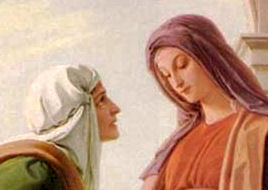
The Visitation And Mary rising up in those days went into the hill country with haste, into a city of Juda. [Lk. 1:39]
How lyrical that is, the opening sentence of St. Luke’s description of the Visitation. We can feel the rush of warmth and kindness, the sudden urgency of love that sent that girl hurrying over the hills. “Those days” in which she rose on that impulse were the days in which Christ was being formed in her, the impulse was His impulse. Many women, if they were expecting a child, would refuse to hurry over the hills on a visit of pure kindness. They would say they had a duty to themselves and to their unborn child which came before anything or anyone else.
The Mother of God considered no such thing. Elizabeth was going to have a child, too and although Mary’s own child was God, she could not forget Elizabeth’s need—almost incredible to us, but characteristic of her. She greeted her cousin Elizabeth and at the sound of her voice, John quickened in his mother’s womb and leapt for joy.
I am come, said Christ, that they may have life and may have it more abundantly. [Jn. 10, 10] Even before He was born His presence gave life.
With what piercing shoots of joy does this story of Christ unfold! First the conception of a child in a child’s heart and then this first salutation, an infant leaping for joy in his mother’s womb, knowing the hidden Christ and leaping into life.
How did Elizabeth herself know what had happened to Our Lady? What made her realize that this little cousin who was so familiar to her was the mother of her God? She knew it by the child within herself, by the quickening into life which was a leap of joy.
If we practice this contemplation taught and shown to us by Our Lady, we will find that our experience is like hers. If Christ is growing in us, if we are at peace, recollected, because we know that however insignificant our life seems to be, from it He is forming Himself; if we go with eager wills, “in haste,” to wherever our circumstances compel us because we believe that He desires to be in that place, we shall find that we are driven more and more to act on the impulse of His love.
And the answer we shall get from others to those impulses will be an awakening into life or the leap into joy of the already wakened life within them. Excerpted from The Reed of God, Caryll Houselander
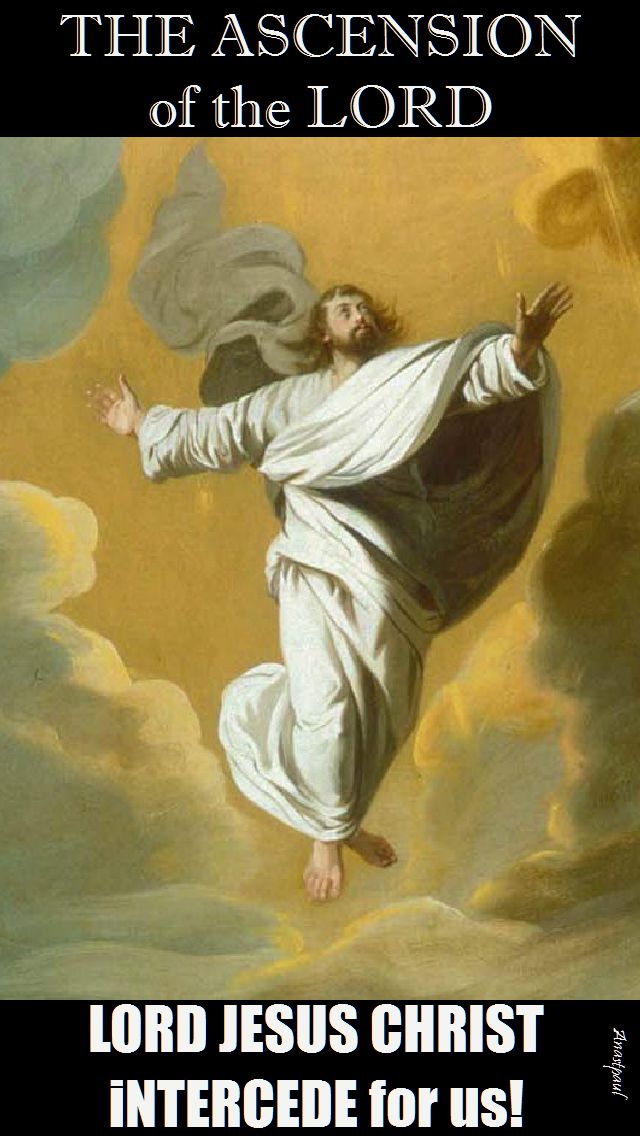
Thought for the Day – 28 May – The Ascension of the Lord
“As a mother who teaches her children to speak and so to understand and communicate, the Church our Mother teaches us the language of faith in order to introduce us to the understanding and the life of faith” (CCC No. 71, excerpt). The life of true faith. It is a stimulating and vigorous Catholic life of love and brightness; one which cannot be shaken nor injured nor destroyed by the appearance of any earthly catastrophe so long as we ourselves remain in the Light, remembering what we have heard from the beginning, never turning from our Beloved who ascended into heaven in order to appear in the presence of God on our behalf!
Lord Jesus Christ, seated at the Right Hand of the Father, intercede for us!
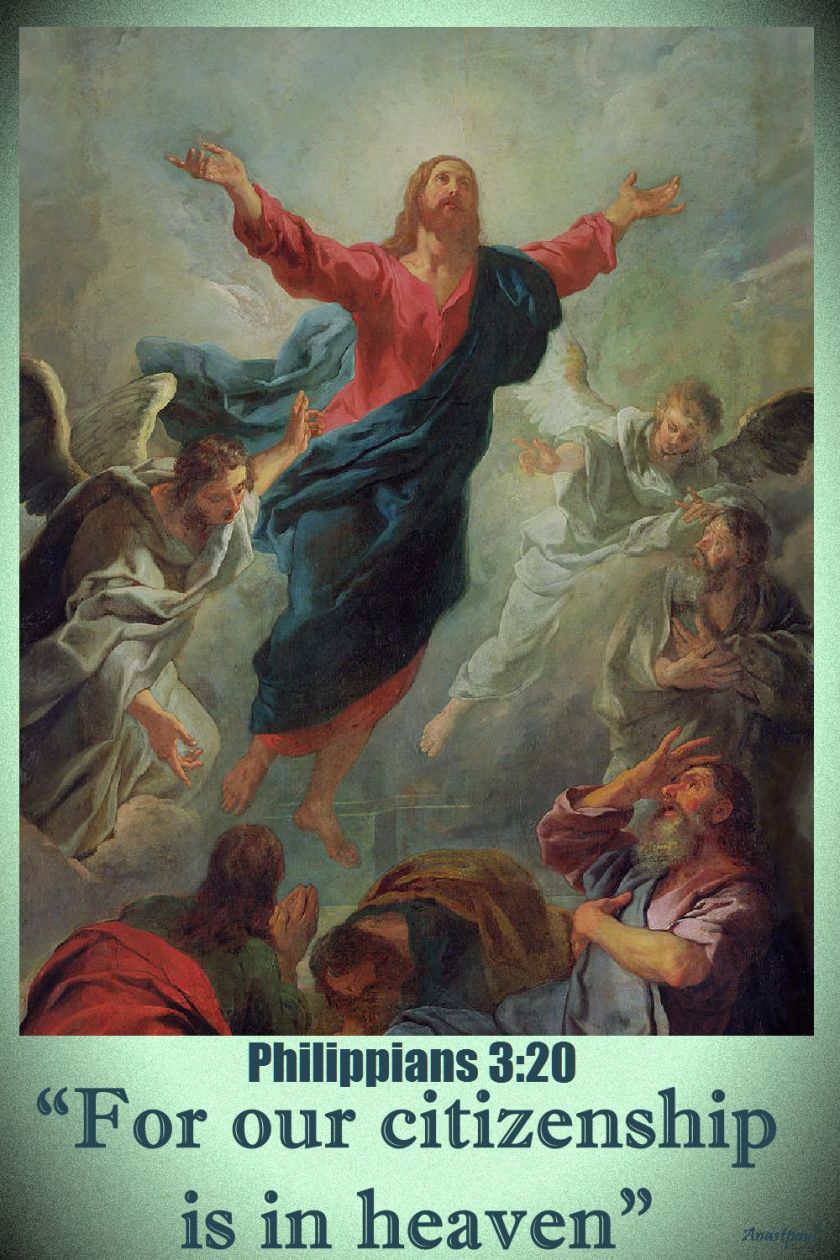
“For our citizenship is in heaven” (Philippians 3:20)
“The Lord opening the way to heaven, gives us a foretaste of divine life, already on this earth.”
“Christ’s Ascension means … that He belongs entirely to God. He, the Eternal Son, led our human existence into God’s presence, taking with Him flesh and blood in a transfigured form. The human being finds room in God; through Christ, the human being was introduced into the very life of God.”
Pope Benedict XVI
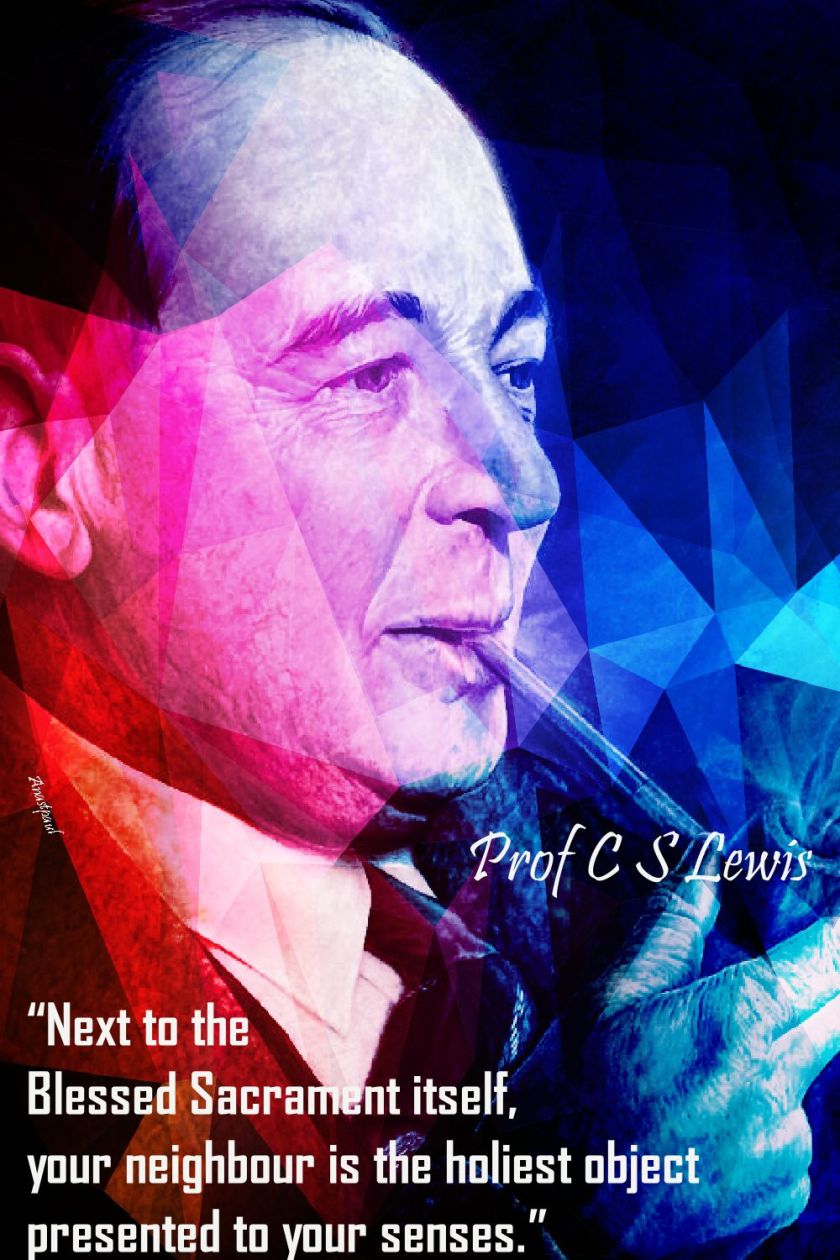
“Next to the Blessed Sacrament itself, your neighbour is the holiest object presented to your senses.”
C S Lewis
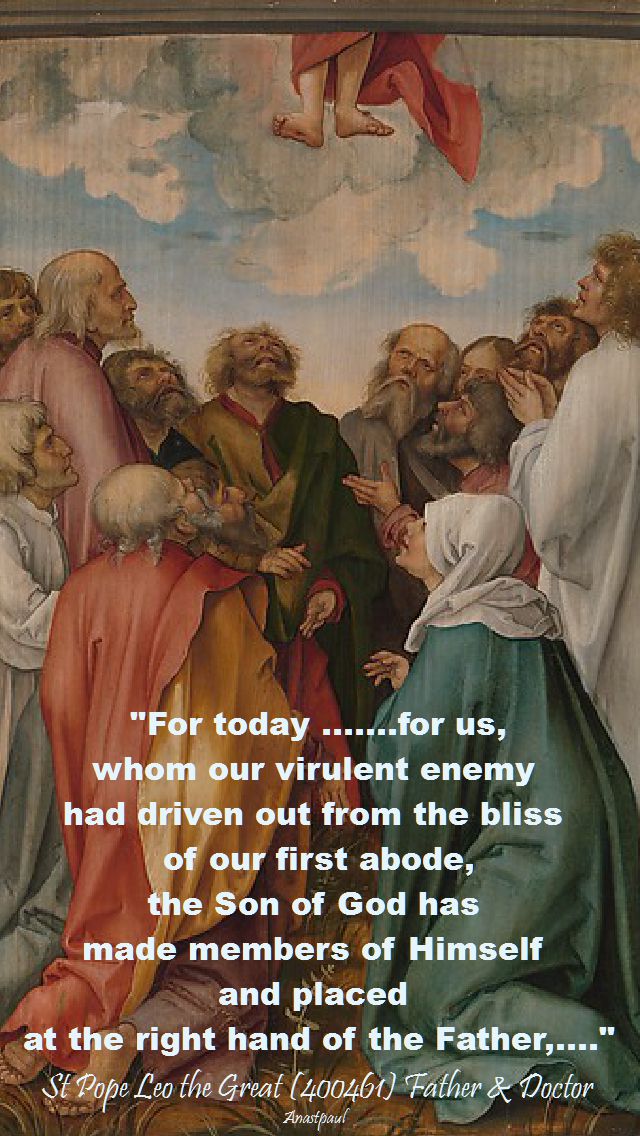
“For today …….for us, whom our virulent enemy had driven out from the bliss of our first abode, the Son of God has made members of Himself and placed at the right hand of the Father, with Whom He lives and reigns in the unity of the Holy Spirit, God for ever and ever. Amen.”
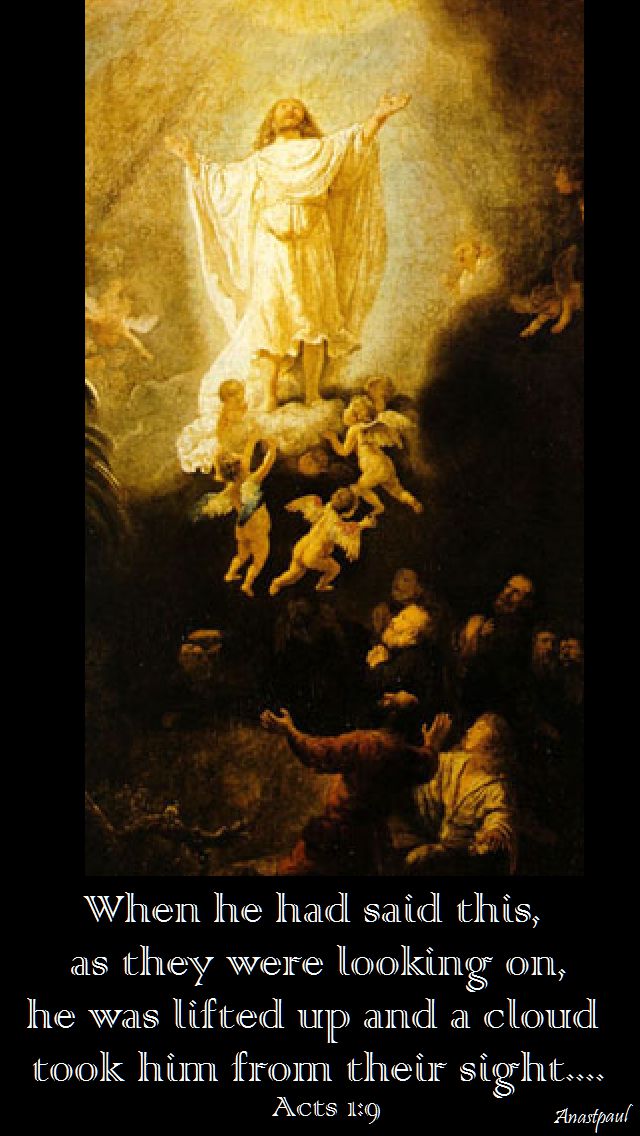
When he had said this, as they were looking on,
he was lifted up and a cloud took him from their sight……….Acts 1:9
REFLECTION – “Today our Lord Jesus Christ ascended into heaven; let our hearts ascend with Him. Listen to the words of the Apostle: If you have risen with Christ, set your hearts on the things that are above where Christ is, seated at the right hand of God; seek the things that are above, not the things that are on earth. For just as He remained with us even after His ascension, so we too are already in heaven with Him, even though what is promised us has not yet been fulfilled in our bodies.”………………………St. Augustine
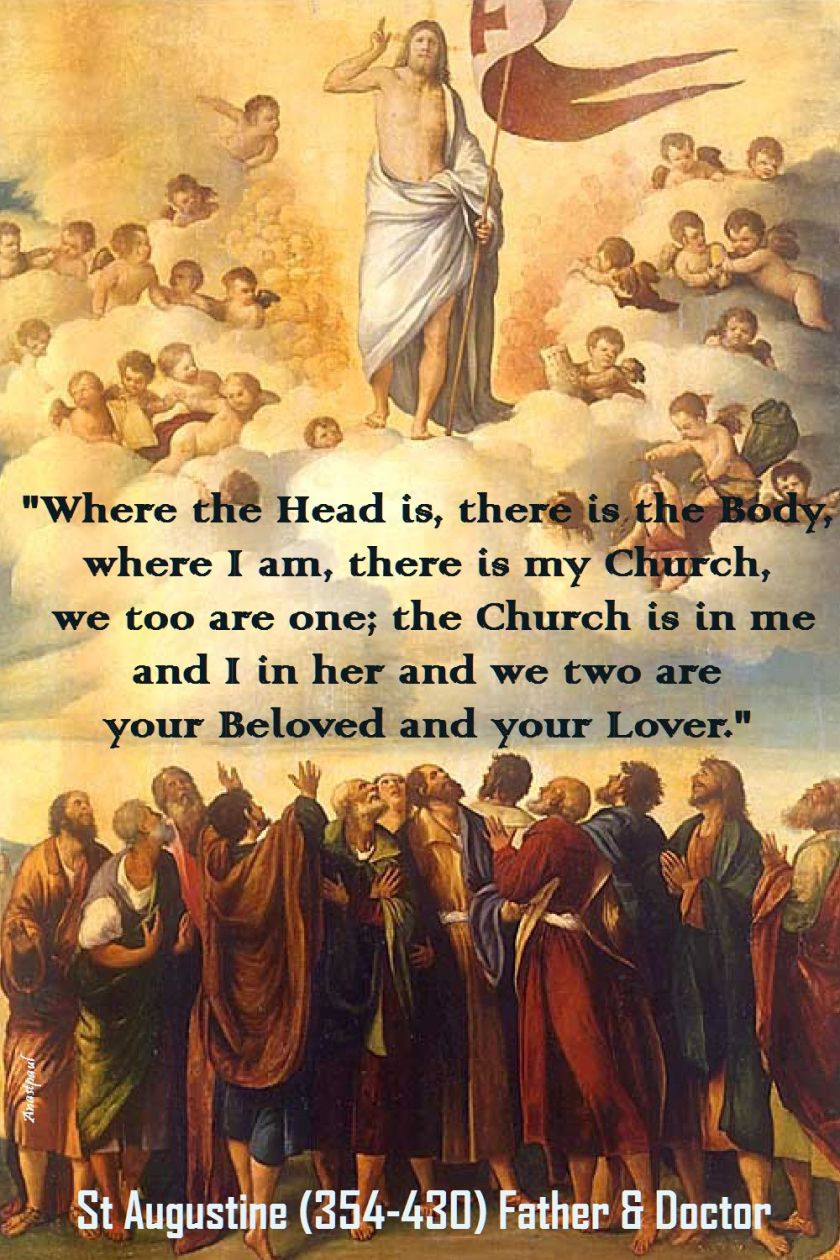
When we went down into the Font of Baptism we were incorporated into Jesus Christ, made members of His Body, the Church. Therefore, as Augustine also wrote, “Where the Head is, there is the Body, where I am, there is my Church, we too are one; the Church is in me and I in her and we two are your Beloved and your Lover.” In other words, we have ascended with the Lord!
PRAYER – Holy Father, teach me and help me to ‘abide’ in Your Son, who by ascending to You, took me too with Him. For He is my root and my foundation and I live only in Him! My Saviour and Redeemer, Jesus Christ my Lord, be with me always and intercede for us all with our Father. Amen
7th Sunday of Easter (2017) or ASCENSION Sunday in many parts of the world where the Solemnity is transferred
—
St Accidia
Bl Albert of Csanád
Bl Antoni Julian Nowowiejski
St Bernard of Menthon
St Caraunus of Chartres
St Caraunus the Deacon
St Crescens of Rome
St Dioscorides of Rome
Eoghan the Sage
Gemiliano of Cagliari
Germanus of Paris
Bl Heliconis of Thessalonica
Helladius of Rome
Herculaneum of Piegaro
Bl John Shert
Justus of Urgell
Bl Lanfranc of Canterbury
Luciano of Cagliari
Bl Luigi Biraghi
Bl Margaret Plantagenet Pole
Bl Maria Bagnesi
Bl Mary of the Nativity
Moel-Odhran of Iona
Paulus of Rome
Phaolô Hanh
Podius of Florence
Bl Robert Johnson
Senator of Milan
Bl Thomas Ford
Ubaldesca Taccini
William of Gellone
Bl Wladyslaw Demski
—
Martyrs of Palestine: A group of early 5th century monks in Palestine who were martyred by invading Arabs.
Martyrs of Sardinia – 6 saints: A group of early Christians for whom a church on Sardinia is dedicated; they were probably martyrs, but no information about them has survived except the names Aemilian, Aemilius, Emilius, Felix, Lucian and Priamus. Patrons of the diocese of Alghero-Bosa, Italy.
Martyred in the Spanish Civil War: Lluís Berenguer Moratona
Ascension of the Lord (Solemnity; 2017)
St Bede the Venerable (Optional Memorial) (673-735) Priest, Monk, O.S.B. DOCTOR of the Church (Added by Pope Leo XIII in 1899)
St Gregory VII, Pope (Optional Memorial)
St Mary Magdalen of Pazzi (Optional Memorial)
—
St Agustin Caloca
St Aldhelm of Sherborne
Bl Antonio Caixal
Bl Bartolomeo Magi di Amghiari
St Canio
St Cristobal Magallanes Jara
St Denis Ssebuggwawo
St Dionysius of Milan
St Dunchadh of Iona
St Egilhard of Cornelimünster
Bl Gerardo Mecatti
St Gerbald
St Injuriosus of Auvergne
St Iosephus Chang Song-Jib
Bl James Bertoni
Bl Juan of Granada
St Leo of Troyes
St Madeline Sophie Barat
St Matthêô Nguyen Van Ðac Phuong
St Maximus of Evreux
Bl Nicholas Tsehelsky
St Pasicrates of Dorostorum
Bl Pedro Malasanch
St Pherô Ðoàn Van Vân
St Scholastica of Auvergne
St Senzio of Bieda
St Urban I, Pope
St Valentio of Dorostorum
St Victorinus of Acquiney
St Winebald of Saint Bertin
St Worad of Saint Bertin
St Zenobius of Florence
“We know nothing else about him (St Matthias), if not that he had been a witness to all Jesus’ earthly events (cf. Acts 1: 21-22), remaining faithful to Him to the end. To the greatness of his fidelity was later added the divine call to take the place of Judas, almost compensating for his betrayal.
We draw from this a final lesson: while there is no lack of unworthy and traitorous Christians in the Church, it is up to each of us to counterbalance the evil done by them with our clear witness to Jesus Christ, our Lord and Saviour.” – Pope Benedict GENERAL AUDIENCE, Saint Peter’s Square, Wednesday, 18 October 2006
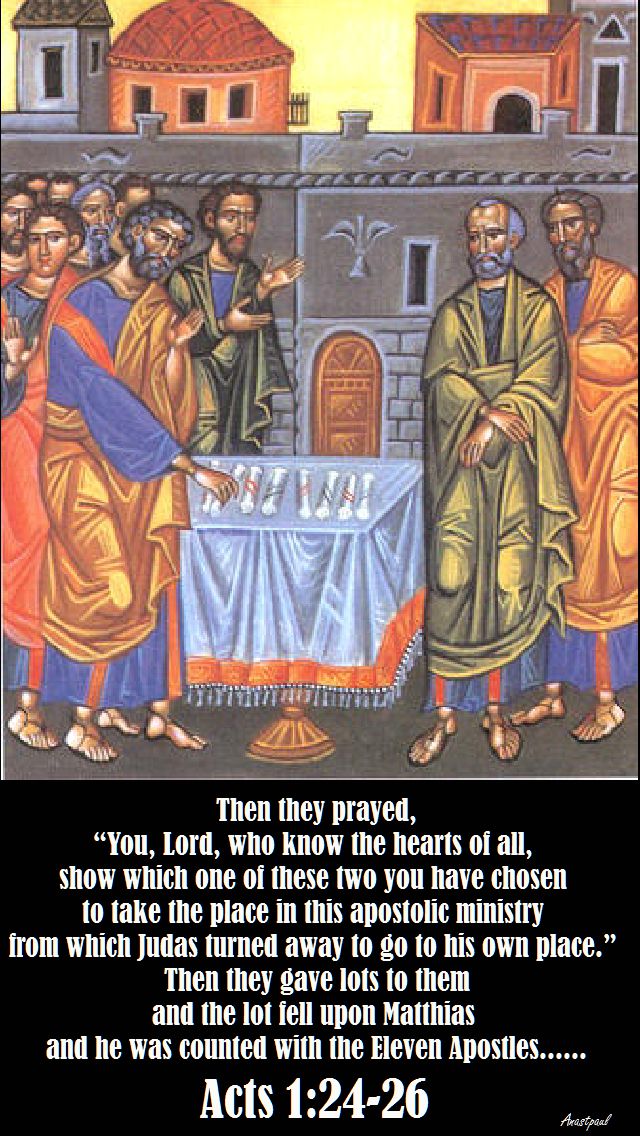
Then they prayed, “You, Lord, who know the hearts of all, show which one of these two you have chosen to take the place in this apostolic ministry from which Judas turned away to go to his own place.” Then they gave lots to them and the lot fell upon Matthias, and he was counted with the Eleven Apostles……. Acts 1:24-26
REFLECTION – “”In those days, Peter stood up in the midst of the disciples and said…” As the fiery spirit to whom the flock was entrusted by Christ and as the leader in the band of the apostles, Peter always took the initiative in speaking: “My brothers, we must choose from among our number.” He left the decision to the whole body, at once augmenting the honour of those elected and avoiding any suspicion of partiality.
Did not Peter then have the right to make the choice himself? Certainly he had the right but he did not want to give the appearance of showing special favour to anyone. “And they nominated two,” we read, “Joseph, who was called Barsabbas and surnamed Justus, and Matthias.” He himself did not nominate them; all present did. But it was he who brought the issue forward, pointing out that it was not his own idea but had been suggested to him by a scriptural prophecy.
And they all prayed together, saying: “You, Lord, know the hearts of men; make your choice known to us. You, not we.” Appropriately they said that he knew the hearts of men, because the choice was to be made by him, not by others.
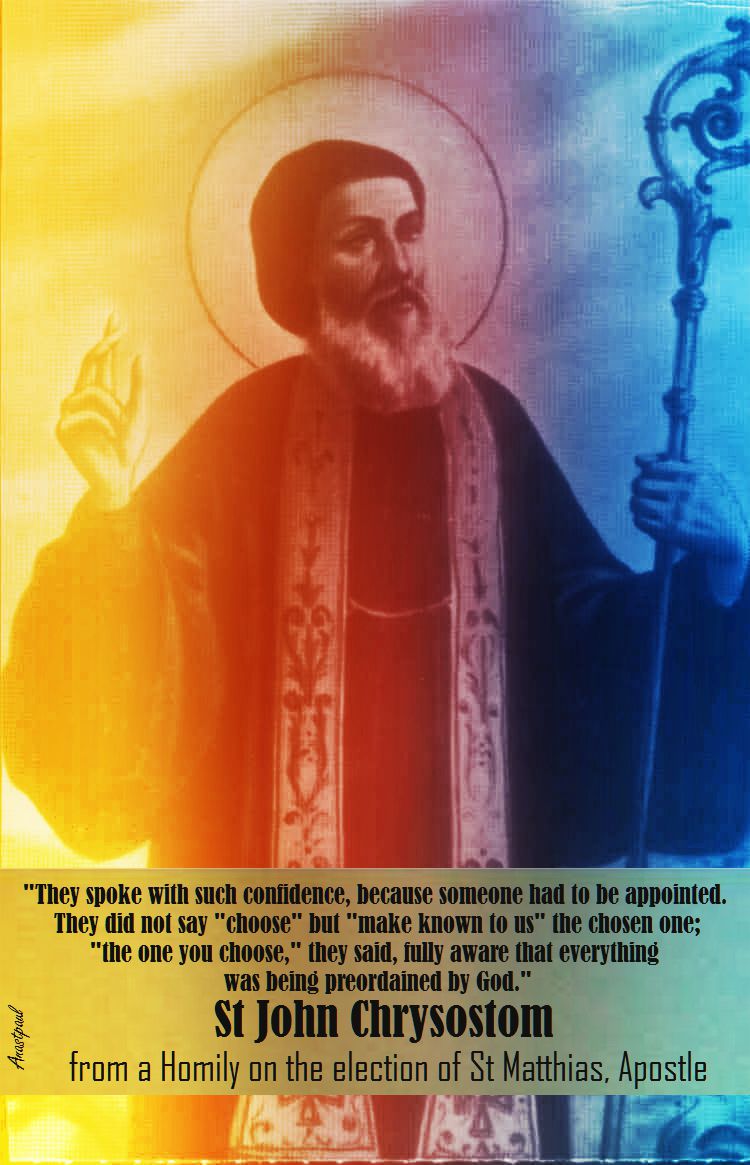
They spoke with such confidence, because someone had to be appointed. They did not say “choose” but “make known to us” the chosen one; “the one you choose,” they said, fully aware that everything was being preordained by God.”…………… from a homily on the Acts of the Apostles by Saint John Chrysostom
PRAYER – Almighty God, who into the place of the traitor Judas chose thy faithful servant Matthias to be of the number of the twelve Apostles; grant that Thy Church, being always preserved from false Apostles, may be ordered and guided by faithful and true pastors; through Jesus Christ our Lord. Amen. – collect from the feast of Saint Matthias – St Matthias Pray for us!
5th Sunday of Easter (2017)
St Matthias the Apostle (Feast)
—
St Ampelio
St Boniface of Ferentino
St Boniface of Tarsus
St Carthage the Younger
St Corona the Martyr
St Costanzo of Capri
St Costanzo of Vercelli
Bl Diego of Narbonne
St Dyfan
St Engelmer
St Erembert of Toulouse
St Felice of Aquileia
St Fortunatus of Aquileia
St Gal of Clermont-Ferrand
Bl Giles of Santarem
St Henedina of Sardinia
St Justa of Sardinia
St Justina of Sardinia
St Maria Domenica Mazzarello
St Maximus
St Michael Garicoïts
St Pons of Pradleves
St Pontius of Cimiez
St Tuto of Regensburg
St Victor the Martyr
—
Martyrs of Seoul – 5 Beata: A group of lay people martyred together in the apostolic vicariate of Korea.
• Petrus Choe Pil-je
• Lucia Yun Un-hye
• Candida Jeong Bok-hye
• Thaddeus Jeong In-hyeok
• Carolus Jeong Cheol-sang
14 May 1801 at the Small West Gate, Seoul, South Korea – Beatified: 15 August 2014 by Pope Francis\
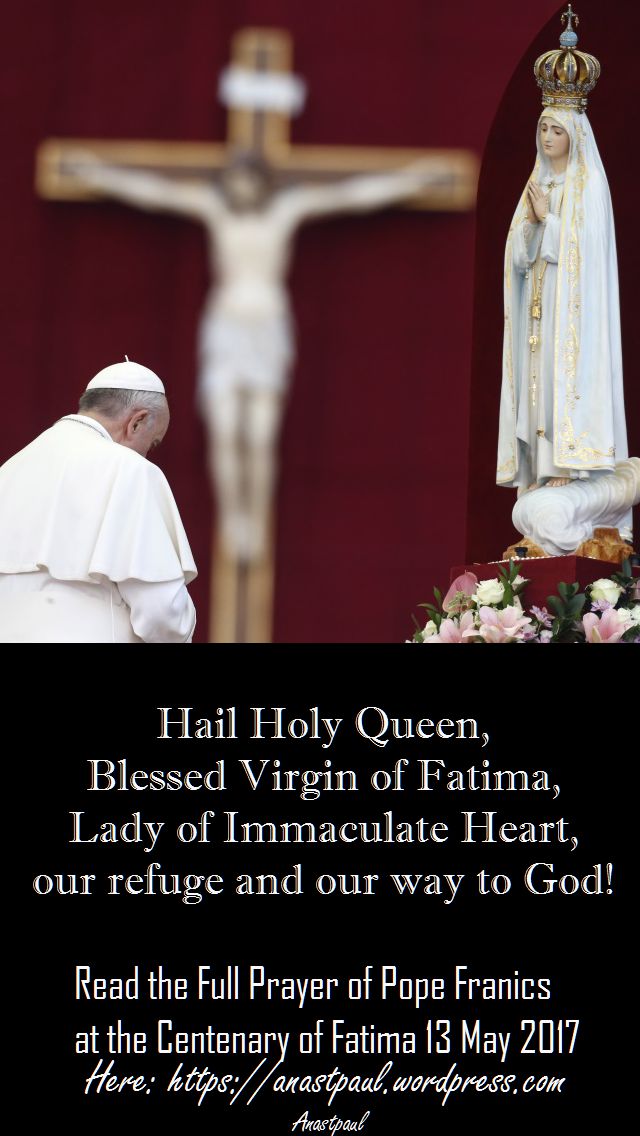
Prayer of Pope Francis on the Centenary of Our Lady of Fatima – 13 May 2017
Hail Holy Queen,
Blessed Virgin of Fatima,
Lady of Immaculate Heart,
our refuge and our way to God!
As a pilgrim of the Light that comes to us from your hands,
I give thanks to God the Father, who in every time and place is at work in human history;
As a pilgrim of the Peace that, in this place, you proclaim,
I give praise to Christ, our peace, and I implore for the world concord among all peoples;
As a pilgrim of the Hope that the Spirit awakens,
I come as a prophet and messenger to wash the feet of all, at the same table that unites us.
Refrain (sung by the assembly):
Ave O Clemens, Ave O pia! Salve Regina Rosarii Fatimae. Ave O clemens, Ave O pia! Ave O dulcis Virgo Maria!
The Holy Father:
Hail, Mother of Mercy,
Lady robed in white!
In this place where, a hundred years ago
you made known to all the purposes of God’s mercy,
I gaze at your robe of light
and, as a bishop robed in white,
I call to mind all those who,
robed in the splendour of their baptism,
desire to live in God
and tell the mysteries of Christ in order to obtain peace.
Refrain…
The Holy Father:
Hail, life and sweetness,
Hail, our hope,
O Pilgrim Virgin, O Universal Queen!
In the depths of your being,
in your Immaculate Heart,
you keep the joys of men and women
as they journey to the Heavenly Homeland.
In the depths of your being,
in your Immaculate Heart,
you keep the sorrows of the human family,
as they mourn and weep in this valley of tears.
In the depths of your being,
in your Immaculate Heart,
adorn us with the radiance of the jewels of your crown
and make us pilgrims, even as you were a pilgrim.
With your virginal smile,
enliven the joy of Christ’s Church.
With your gaze of sweetness,
strengthen the hope of God’s children.
With your hands lifted in prayer to the Lord,
draw all people together into one human family.
Refrain:
The Holy Father:
O clement, O loving,
O sweet Virgin Mary,
Queen of the Rosary of Fatima!
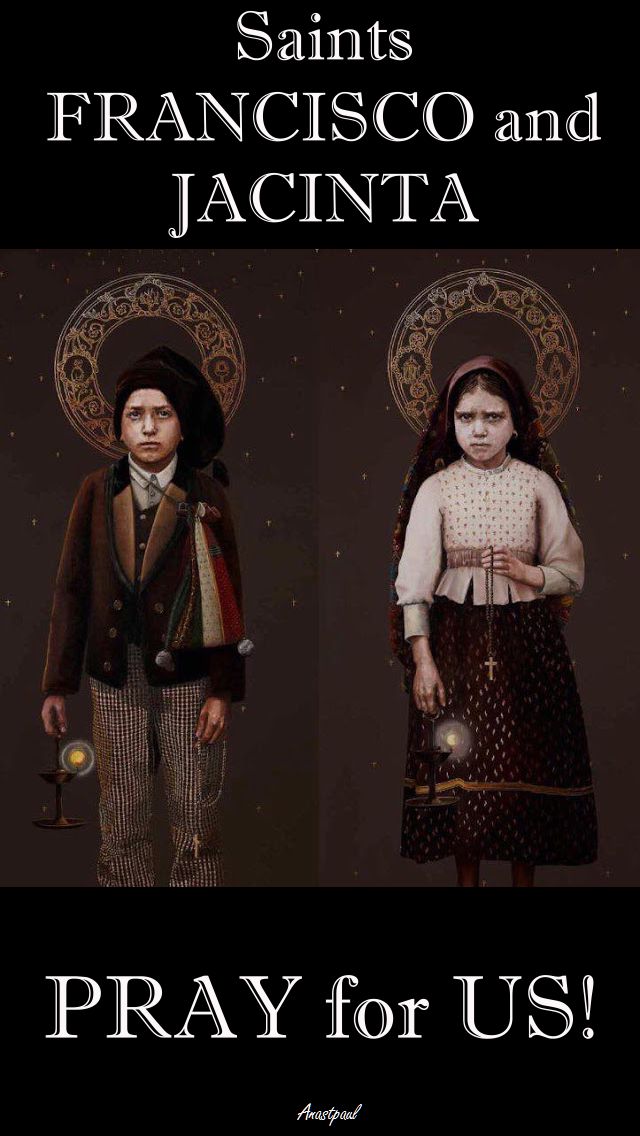
Grant that we may follow the example of Blessed Francisco and Blessed Jacinta,
and of all who devote themselves to proclaiming the Gospel.
Thus we will follow all paths
and everywhere make our pilgrim way;
we will tear down all walls
and cross every frontier,
as we go out to every periphery,
to make known God’s justice and peace.
In the joy of the Gospel, we will be the Church robed in white,
the whiteness washed in the blood of the Lamb,
blood that today too is shed in the wars tearing our world apart.
And so we will be, like you, an image of the column of light
that illumines the ways of the world,
making God known to all,
making known to all that God exists,
that God dwells in the midst of his people,
yesterday, today and for all eternity.
Refrain…
The Holy Father, with all the faithful:
Hail, Mother of the Lord,
Virgin Mary, Queen of the Rosary of Fatima!
Blessed among all women,
you are the image of the Church robed in paschal light,
you are the honour of our people,
you are the victory over every assault of evil.
Prophecy of the merciful love of the Father,
Teacher of the Message of Good News of the Son,
Sign of the burning Fire of the Holy Spirit,
teach us, in this valley of joys and sorrows,
the eternal truths that the Father reveals to the little ones.
Show us the strength of your protective mantle.
In your Immaculate Heart,
be the refuge of sinners
and the way that leads to God.
In union with my brothers and sisters,
in faith, in hope and in love,
I entrust myself to you.
In union with my brothers and sisters, through you, I consecrate myself to God,
O Virgin of the Rosary of Fatima.
And at last, enveloped in the Light that comes from your hands,
I will give glory to the Lord for ever and ever. Amen.
“Yes, Jacinta and Francisco I will take soon but you will stay some time longer. Jesus wants to use you to let others know and love me. He wants to establish devotion to my Immaculate Heart in the world. To whoever embraces it I promise salvation and that their souls will be dear to God like flowers placed by me to adorn his Throne.”– Our Lady to Lucia dos Santos, Fatima Portugal 1917
Saint Pope John Paul II beatified them on 13th May 2000.
PRAYER
Most Holy Trinity, Father, Son and Holy Spirit, I adore Thee profoundly and I thank Thee for the Apparitions of the Most Holy Virgin in Fatima.
By the infinite merits of the Sacred Heart of Jesus and through the intercession of the Immaculate Heart of Mary, I implore Thee if it should be for Thy greater glory and the good of our souls – to glorify in the sight of thy Holy Church Blessed Jacinta and Francisco Marto, granting us through their intercession the grace which we now implore. Amen.
*Francisco Marto (June 11, 1908 – April 4, 1919), his sister Jacinta Marto (March 11, 1910 – February 20, 1920), also known as Blessed Francisco Marto and Blessed Jacinta Marto, and their cousin Lúcia Santos (1907–2005) were children from Aljustrel near Fátima, Portugal who said they witnessed three apparitions of an angel in 1916 and several apparitions of the Blessed Virgin Mary in 1917. Mary was given the title Our Lady of Fátima as a result, and Fátima became a major centre of world Christian pilgrimage.
The youngest children of Manuel and Olimpia Marto, Francisco and Jacinta were typical of Portuguese village children of that time. They were illiterate but had a rich oral tradition.
According to Lúcia’s memoirs, Francisco had a placid disposition, was somewhat musically inclined, and liked to be by himself to think. Jacinta was affectionate if a bit spoiled. She had a sweet singing voice and a gift for dancing. Following their experiences, their fundamental personalities remained the same. Francisco preferred to pray alone, saying that this would “console Jesus for the sins of the world”. Jacinta said she was deeply affected by a terrifying vision of Hell shown to the children at the third apparition and deeply convinced of the need to save sinners through penance and sacrifice as the Virgin had told the children to do. All three children, but particularly Francisco and Jacinta, practised stringent self-mortifications to this end.
The brother and sister, who tended to their families’ sheep with their cousin Lucia in the fields of Fatima, Portugal, are said to have witnessed, on May 13, 1917, the first apparition of Mary. At the time of the apparition, Francisco was 9 years old, and Jacinta was 7.
During the first apparition, Mary is said to have asked the three children to say the Rosary and to make sacrifices, offering them for the conversion of sinners. She also asked them to return to that spot on the thirteenth of each month for the next six months
The siblings were victims of the great 1918 influenza epidemic that swept through Europe that year. In October 1918, Mary supposedly appeared to them and said she would to take them to heaven soon. Both lingered for many months, insisting on walking to church to make Eucharistic devotions and prostrating themselves to pray for hours, kneeling with their heads on the ground as they said the angel had instructed them to do.
Francisco declined hospital treatment on April 3, 1919, and died at home the next day. Jacinta was moved from one hospital to another in an attempt to save her life, which she insisted was futile. She developed purulent pleurisy and endured an operation in which two of her ribs were removed. Because of the condition of her heart, she could not be anesthetized and suffered terrible pain, which she said would help to convert many sinners. On February 19, 1920, Jacinta asked the hospital chaplain who heard her confession to bring her Holy Communion and give her the Anointing of the Sick because she was going to die “the next night”. He told her that her condition was not that serious and that he would return the next day. The next day Jacinta was dead; she had died, as she had often said she would, alone.
In 1920, shortly before her death at age nine, Jacinta Marto reportedly discussed the Alliance of the Hearts of Jesus and Mary with a then 12-year-old Lúcia Santos and said:
“When you are to say this, don’t go and hide. Tell everybody that God grants us graces through the Immaculate Heart of Mary; that people are to ask her for them; and that the Heart of Jesus wants the Immaculate Heart of Mary to be venerated at his side. Tell them also to pray to the Immaculate Heart of Mary for peace, since God entrusted it to her.”
The cause for the siblings’ canonization began in 1946. Exhumed in 1935 and again in 1951, Jacinta’s face was found incorrupt; Francisco’s had decomposed.
On May 13, 2000, they were declared “blessed” in a decree from the Congregation for the Causes of Saints. Jacinta is the youngest non-martyred child ever to be beatified.
In her biography of Jacinta, Lúcia said that Jacinta had told her of having had many personal visions outside of the Marian visitations; one involved a pope who prayed alone in a room while people outside shouted ugly things and threw rocks through the window. At another time, Jacinta said she saw a pope who had gathered a huge number of people together to pray to the Immaculate Heart of Mary.
Jacinta and Francisco are both buried at the Our Lady of Fátima Basilica.
And so we learn from little children – we learn how to be Saints!
‘Pilgrims With Mary… But Which Mary?’ Pope Francis Asks in Fatima
At Vigil Before Reciting Rosary Reminds, ‘To Be Christian, We Must Be Marian’
“Dear Pilgrims to Mary and with Mary!
Thank you for your welcome and for joining me on this pilgrimage of hope and peace. Even now, I want to assure all of you who are united with me, here or elsewhere, that you have a special place in my heart. I feel that Jesus has entrusted you to me (cf. Jn 21:15-17) and I embrace all of you and commend you to Jesus, “especially those most in need” – as Our Lady taught us to pray (Apparition of July, 1917). May she, the loving and solicitous Mother of the needy, obtain for them the Lord’s blessing! On each of the destitute and outcast robbed of the present, on each of the excluded and abandoned denied a future, on each of the orphans and victims of injustice refused a past, may there descend the blessing of God, incarnate in Jesus Christ. “The Lord bless you and keep you. The Lord make his face to shine upon you, and be gracious to you. The Lord lift up his countenance upon you, and give you peace” (Num 6:24-26).
This blessing was fulfilled in the Virgin Mary. No other creature ever basked in the light of God’s face as did Mary; she in turn gave a human face to the Son of the eternal Father. Now we can contemplate her in the succession of joyful, luminous, sorrowful and glorious moments of her life, which we revisit in our recitation of the rosary. With Christ and Mary, we abide in God. Indeed, “if we want to be Christian, we must be Marian; in a word, we have to acknowledge the essential, vital and providential relationship uniting Our Lady to Jesus, a relationship that opens before us the way leading to him” (PAUL VI, Address at the Shine of Our Lady of Bonaria, Cagliari, 24 April 1970). Each time we recite the rosary, in this holy place or anywhere else, the Gospel enters anew into the life of individuals, families, peoples and the entire world.
Pilgrims with Mary… But which Mary? A teacher of the spiritual life, the first to follow Jesus on the “narrow way” of the cross by giving us an example, or a Lady “unapproachable” and impossible to imitate? A woman “blessed because she believed” always and everywhere in God’s words (cf. Lk 1:42.45), or a “plaster statue” from whom we beg favours at little cost? The Virgin Mary of the Gospel, venerated by the Church at prayer, or a Mary of our own making: one who restrains the arm of a vengeful God; one sweeter than Jesus the ruthless judge; one more merciful than the Lamb slain for us?
Great injustice is done to God’s grace whenever we say that sins are punished by his judgment, without first saying – as the Gospel clearly does – that they are forgiven by his mercy! Mercy has to be put before judgment and, in any case, God’s judgment will always be rendered in the light of his mercy. Obviously, God’s mercy does not deny justice, for Jesus took upon himself the consequences of our sin, together with its due punishment. He did not deny sin, but redeemed it on the cross. Hence, in the faith that unites us to the cross of Christ, we are freed of our sins; we put aside all fear and dread, as unbefitting those who are loved (cf. 1 Jn 4:18). “Whenever we look to Mary, we come to believe once again in the revolutionary nature of love and tenderness. In her, we see that humility and tenderness are not virtues of the weak but of the strong, who need not treat others poorly in order to feel important themselves… This interplay of justice and tenderness, of contemplation and concern for others, is what makes the ecclesial community look to Mary as a model of evangelization” (Ap. Exhort. Evangelii Gaudium, 288). With Mary, may each of us become a sign and sacrament of the mercy of God, who pardons always and pardons everything.
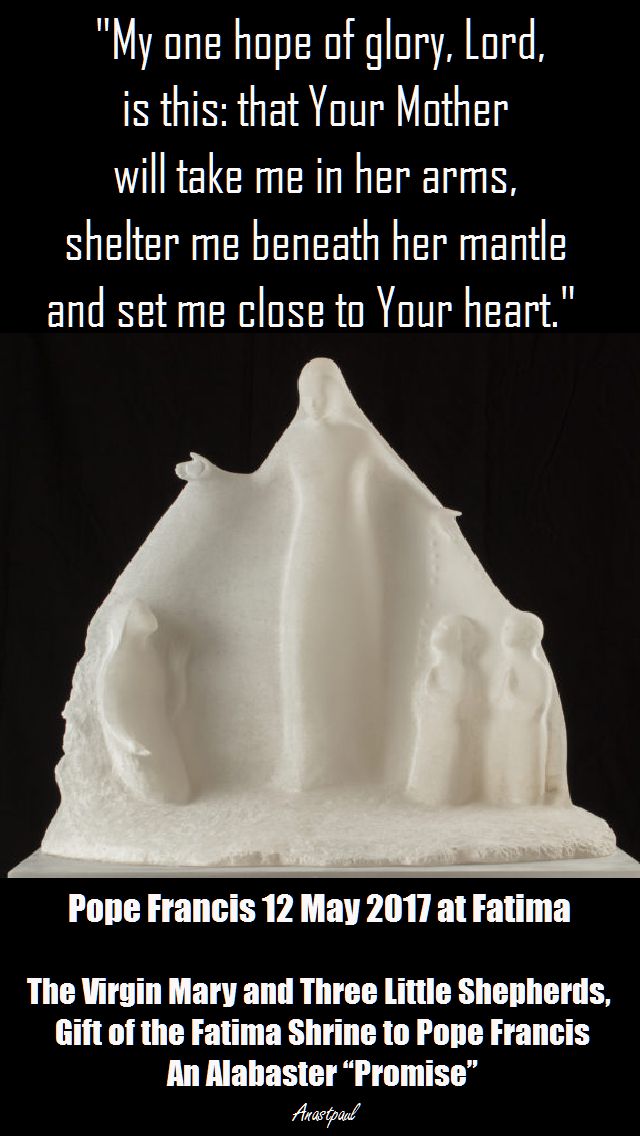
“Hand in hand with the Virgin Mother and under her watchful gaze, may we come to sing with joy the mercies of the Lord, and cry out: “My soul sings to you, Lord!” The mercy you have shown to all your saints and all your faithful people, you have also shown to me. Out of the pride of my heart, I went astray, following my own ambitions and interests, without gaining any crown of glory! My one hope of glory, Lord, is this: that your Mother will take me in her arms, shelter me beneath her mantle and set me close to your heart. Amen.”
Our Lady of Fatima (Optional Memorial)
Today Blesseds Francisco and Jacinta will be Canonised!
Our Lady of Help
Our Lady of the Most Blessed Sacrament
Dedication of Saint Mary of the Martyrs
—
Abban of Abingdon
Agnes of Poitiers
Andrew Fournet
Anno of Verona
Argentea of Cordoba
Euthymius the Illuminator
Bl Fortis Gabrielli
Bl Gerard of Villamagna
Glyceria of Trajanopolis
John the Silent
Bl Julian of Norwich
Lucius of Constantinople
Mael of Bardsey
Merewenna of Rumsey
Mucius of Byzantium
Natalis of Milan
Onesimus of Soissons
Servatus of Tongres
Valerian of Auxerre
—
Martyrs of Alexandria: A group of Catholic Christians martyred in the church of Theonas, Alexandria, Egypt by order of the Arian Emperor Valens. Their names have not come down to us. 372 in Alexandria, Egypt
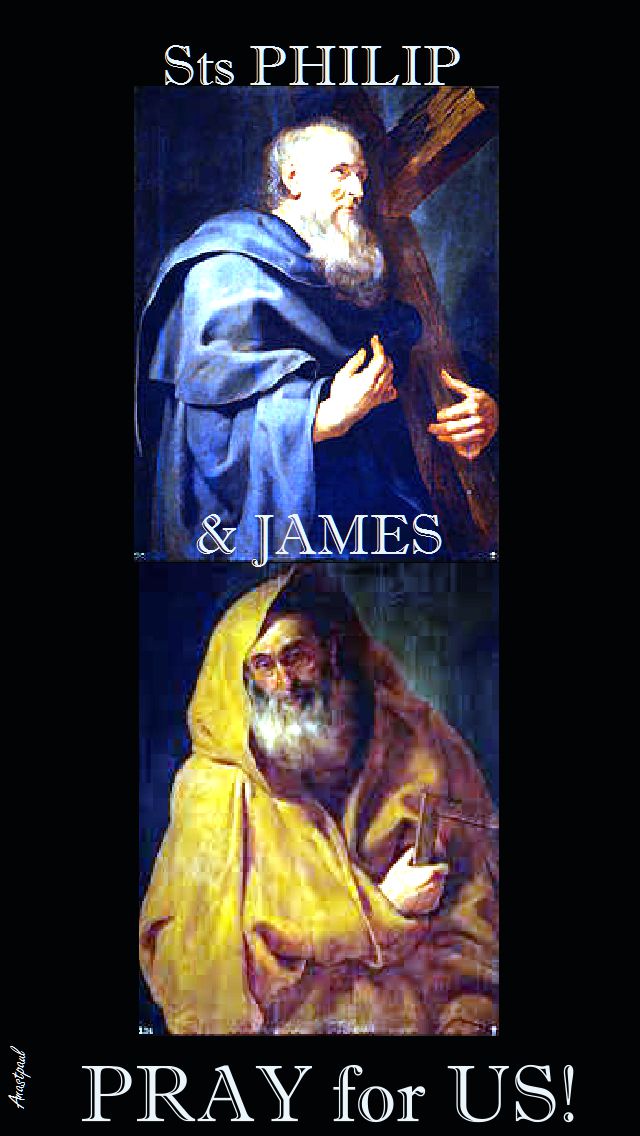
Sts Philip and James left all to follow Jesus, to become His heralds to the whole world. They faced only difficulties, opposition and – finally – death by violence. We cannot avoid the difficulties that come with professing our faith and we are all called to be apostles. Let us pray for the courage to face our task with the same courage with which the Apostles faced theirs. As in the case of the other apostles, we see in James and Philip human men who became foundation stones of the Church and we are reminded again that holiness and its consequent apostolate are entirely the gift of God, not a matter of human achieving. All power is God’s power, even the power of human freedom to accept his gifts. “You will be clothed with power from on high,” Jesus told Philip and the others. Their first commission had been to expel unclean spirits, heal diseases, announce the kingdom. They learned, gradually, that these externals were sacraments of an even greater miracle inside their persons—the divine power to love like God.
What was from the beginning, what we have heard,
what we have seen with our eyes, what we looked upon
and touched with our hands concerns the Word of life
for the life was made visible; we have seen it and testify to it……….1 John 1:1-2
REFLECTION – “Two of the favoured witnesses of our beloved Jesus’ Resurrection come before us today. Sts. Philip and James are here, bearing testimony to us that their Master is truly risen from the dead, that they have seen Him, that they have touched Him, that they have conversed with Him during these forty days. And, that we may have no doubt as to the truth of their testimony, they hold in their hands the instruments of the martyrdom they underwent for asserting that Jesus, after having suffered death, came to life again and rose from the grave.”………………..Abbot/Dom Prosper Guéranger
PRAYER – O God, who gladden us each year with the feast day of the Apostles Philip and James, grant us, through their prayers, a share in the Passion and Resurrection of your Only Begotten Son, so that we may merit to behold You for eternity. Through our Lord Jesus Christ, your Son, who lives and reigns with You in the unity of the Holy Spirit, one God, for ever and ever.
Blessed Feast Day of Sts Philip and James, Apostles of Jesus Christ
ST PHILIP
The Apostle Philip was one of Christ’s first disciples, called soon after his Master’s baptism in the Jordan. The fourth Gospel gives the following detail: “The next day Jesus was about to leave for Galilee and He found Philip. And Jesus said to him: Follow Me. Now Philip was from Bethsaida, the town of Andrew and Peter. Philip found Nathanael, and said to him: We have found Him of whom Moses in the Law and the Prophets wrote, Jesus the Son of Joseph of Nazareth. And Nathanael said to him: Can anything good come out of Nazareth? Philip said to him: Come and see” (John 1:43ff). — The Church’s Year of Grace, Pius Parsch
Patronages: Hatters; Luxembourg; pastry chefs; Uruguay, 37 cities. Attributes: basket; basket and Tau cross or letter Tau; two or three loaves and a cross; patriarchal cross and spear; knotted cross; broken idols; inverted cross; tall column; dragon; carpenter’s square and cross; long staff and spear; tall cross and book.
On Wednesday, 27 July 2011, the Turkish news agency Anadolu reported that archaeologists had unearthed a tomb that the project leader claims to be the Tomb of Saint Philip during excavations in Hierapolis close to the Turkish city Denizli. The Italian archaeologist, Professor Francesco D’Andria stated that scientists had discovered the tomb within a newly revealed church. He stated that the design of the Tomb and writings on its walls, definitively prove it belonged to the martyred Apostle of Jesus.
ST JAMES THE LESSER
Also known as: Jacobus Minor, James the Just, James the Less, James the Younger, James, son of Alphaeus. James, Son of Alphaeus: We know nothing of this man except his name and, of course, the fact that Jesus chose him to be one of the 12 pillars of the New Israel, His Church. He is not the James of Acts, son of Clopas, “brother” of Jesus and later bishop of Jerusalem and the traditional author of the Letter of James. James, son of Alphaeus, is also known as James the Lesser to avoid confusing him with James the son of Zebedee, also an apostle and known as James the Greater.
Patronage: dying people, apothecaries, druggists, pharmacists, fullers, hatmakers, hatters, milliners, Uruguay, 8 cities in Italy. Attributes: fuller’s club, man holding a book, square rule
Today’s Mass tells us that the example of the Apostles is the most certain and direct path to heaven. They suffered and were persecuted but they placed their confidence in God and now they rejoice in heaven. We too must have confidence in God and not be troubled in our adversities. In our Father’s house there are many mansions and if we follow the way indicated by Him, Christ will come at the end of our life and take us to Himself.
St James the Lesser (Feast)
St Philip the Apostle (Feast)
—
St Adalsindis of Bèze
Bl Adam of Cantalupo in Sabina
St Ahmed the Calligrapher
St Aldwine of Peartney
St Pope Alexander I
St Alexander of Constantinople
Bl Alexander of Foigny
St Alexander of Rome
Bl Alexander Vincioli
St Ansfrid of Utrecht
St Antonina of Constantinople
St Diodorus the Deacon
Bl Edoardo Giuseppe Rosaz
St Ethelwin of Lindsey
St Eventius of Rome
St Fumac
St Gabriel Gowdel
St Juvenal of Narni
Bl Maria Leonia Paradis
St Maura of Antinoe
St Peter of Argos
St Philip of Zell
Bl Ramon Oromí Sullà
St Rhodopianus the Deacon
St Scannal of Cell-Coleraine
Bl Sostenaeus
St Stanislas Kazimierczyk
St Theodolus of Rome
St Timothy of Antinoe
Bl Tommaso Acerbis
Bl Uguccio
Bl Zechariah
Our Lady of Montserrat
—
St Adelelmus of Le Mans
St Asicus of Elphin
St Castor of Tarsus
St Enoder
St Floribert of Liege
Bl Hosanna of Cattaro
Bl Jakov Varingez
St John of Kathara
St Joseph Outhay Phongphumi
St Laurensô Nguyen Van Huong
St Liberalis of Treviso
St Maughold
Bl Nicolas Roland
St Noël Tenaud
Bl Peter Armengol
St Pollio of Cybalae
St Simeon of Jerusalem
St Stephen of Tarsus
St Tertullian of Bologna
St Theophilus of Brescia
St Winewald of Beverley
St Zita of Lucca
—
Martyrs of Nicomedia: A group of Christians murdered together for their faith. In most cases all we have are their names – Dioscurus, Evanthia, Felicia, Felix, Germana, Germelina, Johannes, Julius, Laetissima, Nikeforus, Papias, Serapion and Victorinus. They died at Nicomedia, Bithynia, Asia Minor (modern Izmit, Turkey)










 The Mother of God considered no such thing. Elizabeth was going to have a child, too and although Mary’s own child was God, she could not forget Elizabeth’s need—almost incredible to us, but characteristic of her. She greeted her cousin Elizabeth and at the sound of her voice, John quickened in his mother’s womb and leapt for joy.






 AnaStpaul
You must be logged in to post a comment.