Our Morning Offring – 22 August – Celebrating the Queenship of Mary
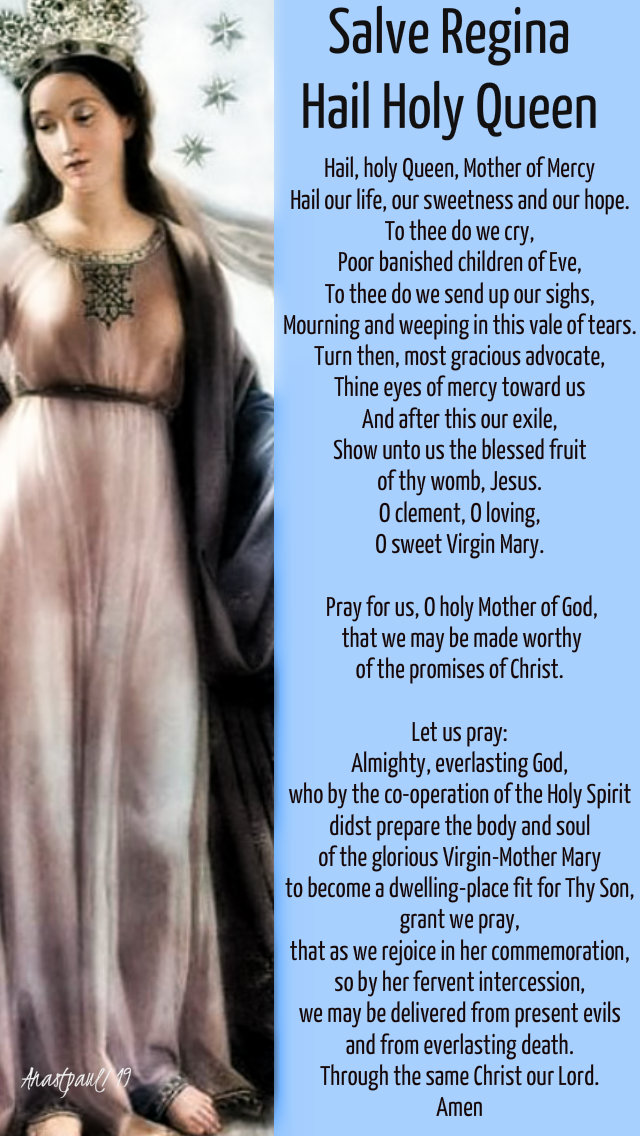
Salve Regina Hail Holy Queen
Hail, holy Queen, Mother of Mercy
Hail our life, our sweetness and our hope.
To thee do we cry,
Poor banished children of Eve,
To thee do we send up our sighs,
Mourning and weeping in this vale of tears.
Turn then, most gracious advocate,
Thine eyes of mercy toward us
And after this our exile,
Show unto us the blessed fruit of thy womb, Jesus.
O clement, O loving, O sweet Virgin Mary.
℣ Pray for us, O holy Mother of God,
℟ that we may be made worthy
of the promises of Christ.
Let us pray:
Almighty, everlasting God,
who by the co-operation of the Holy Spirit
didst prepare the body and soul
of the glorious Virgin-Mother Mary
to become a dwelling-place fit for Thy Son,
grant we pray,
that as we rejoice in her commemoration,
so by her fervent intercession,
we may be delivered from present evils
and from everlasting death.
Through the same Christ our Lord.
Amen
The Hail Holy Queen or Salve Regina is a choral anthem going back to the eleventh century. Since the thirteenth century it is the last evening chant in many religious communities. The authorship is not clearly defined. The Salve is first mentioned in a meditation by Anselm II, Bishop of Lucca, 1073-86 (PL 184, 1078-98) and (erroneously) to Hermannus Contractus (1013-54) of Reichenau.
The “Hail, Holy Queen” is a salutation deprecatonia, a greeting of petition and intercession. Mary is called mother of mercy because Christ her Son, is the incarnation of God’s love and mercy. Giving us Christ, she gave us, sinful humans, the life and hope we need (as baptised children of Eve) to survive in this vale of tears. This antiphon is not part of the rosary but represents the same spirit. It is part of the official prayer of the Church (Liturgy of the Hours: Vespers and/or Compline) and thus is even more precious than the rosary. Sung, it becomes a wonderful expression of our spiritual intimacy with Mary.
It is interesting that it was a Domenican (like today’s Saint Giacomo Bianconi), Blessed Jordan of Saxony OP (1190-1237) who initiated the custom of singing the Salve Regina in procession each night after Compline in the Dominican Order, to ask Our Lady’s protection of the brothers against temptations from the devil. This is a custom still practised by Dominicans throughout the world and by our community each night.
Our Morning Offering – 15 August – Solemnity of the Assumption of the Blessed Virgin Mary into Heaven
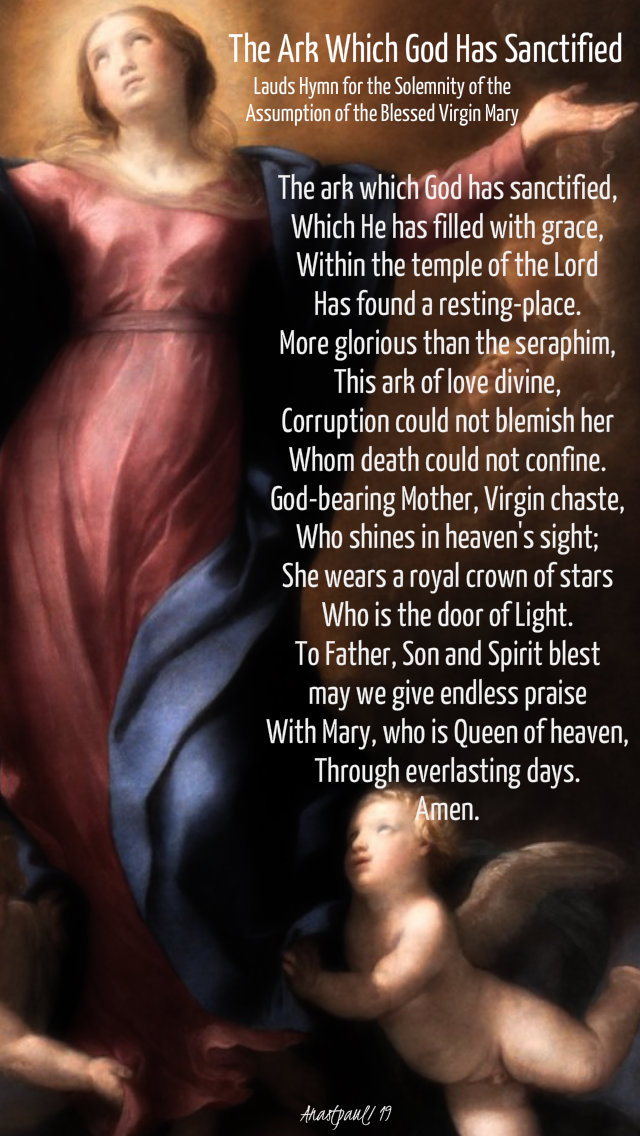
The Ark Which God Has Sanctified
The ark which God has sanctified,
Which He has filled with grace,
Within the temple of the Lord
Has found a resting-place.
More glorious than the seraphim,
This ark of love divine,
Corruption could not blemish her
Whom death could not confine.
God-bearing Mother, Virgin chaste,
Who shines in heaven’s sight;
She wears a royal crown of stars
Who is the door of Light.
To Father, Son and Spirit blest
may we give endless praise
With Mary, who is Queen of heaven,
Through everlasting days.
Amen.
The Ark Which God Has Sanctified is written by the Benedictine Nuns of Stanbrook Abbey. In the Divine Office (1974) it is sung with Morning Prayer on 15 August, the Solemnity of the Assumption of the Blessed Virgin Mary. It is set to the 1836 tune – St Peter (Reinagle) by Alexander Robert Reinagle (1799-1877).
Our Lady of Copacabana: A statue of the Blessed Virgin Mary standing four feet tall, made of plaster and maguey fibre and created by Francisco Tito Yupanqui. Except for the face and hands, it is covered in gold leaf, dressed like an Inca princess, and has jewels on neck, hands and ears. There is no record of what the image looks like under the robes, the carved hair has been covered by a wig, and the image never leaves the basilica. On 21 February 1583 it was enthroned in an adobe church on the peninsula of Copacabana, which juts into Lake Titicaca nearly 3 miles above sea level. In 1669 the viceroy of Peru added a straw basket and baton to the statue, which she still holds today. The present shrine dates from 1805. The image was crowned during the reign of Pope Pius XI, and its sanctuary was promoted to a basilica in 1949. It has been the recipient of many expensive gifts over the years, most of which were looted by civil authorities in need of quick cash.
Patronage – Bolivia, Bolivian navy.
St Abel of Rheims
St Addai
St Aggai of Edessa
Bl Arnaldo Pons
St Cantidianus
St Cantidius
St Cassian of Autun
St Casto of Teano
Bl Corrado of Laodicea
St Emidius of Ascoli Piceno
St Eusignius
St Gormeal of Ardoilen
Bl James Gerius
St Margaret the Barefooted
St Mari
St Memmius of Châlons-sur-Marne
St Nonna St Oswald of Northumbria (604-642) Martyr
St Paris of Teano
Bl Pierre-Michel Noël
St Sobel
St Theodoric of Cambrai-Arras
St Venantius of Viviers
St Viator
—
Martyrs of Fuente la Higuera: A group of Augustinian priests and clerics who were martyred together in the Spanish Civil War. 5 August 1936 in Fuente la Higuera, Valencia, Spain. They were Beatified on 28 October 2007 by Pope Benedict XVI.
10 Beati:
• Anastasio Díez García
• Ángel Pérez Santos
• Cipriano Polo García
• Emilio Camino Noval
• Felipe Barba Chamorro
• Gabino Olaso Zabala
• Luciano Ramos Villafruela
• Luis Blanco Álvarez
• Ubaldo Revilla Rodríguez
• Victor Gaitero González
Martyrs of the Salarian Way: Twenty-three Christians who were martyred together in the persecutions of Diocletian.
303 on the Salarian Way in Rome, Italy.
Martyred in the Spanish Civil War:
Bl Eduardo González Santo Domingo
Bl Jaume Codina Casellas
Bl José Trallero Lou
Bl Lluís Domingo Mariné
Bl Manuel Moreno Martínez
Bl Maximino Fernández Marinas
Bl Victor García Ceballos
Thought for the Day – 3 August – Saturday of the Seventeenth week in Ordinary Time, Year C, Marian Saturdays
Speaking of: Our Lady
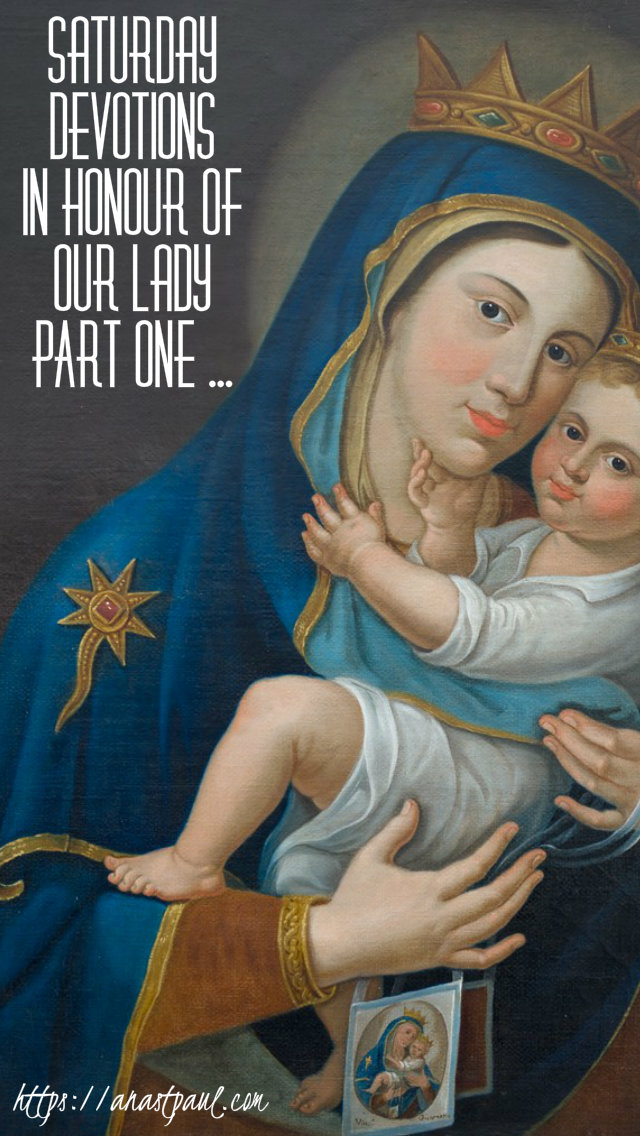
Saturday Devotions in Honour of Our Lady
Part One By Sr M Jean Frisk SSM
Historical Background of the Saturdays in Honour of Mary
To dedicate Saturday in honour of Mary is an ancient custom. It is based on a legendary account that Jesus appeared to Mary on the Saturday, the day after His death. He did so to reward her for her steadfast faith in His divinity, which did not waver under the Cross. Another strain of devotional thought explains that Divine Wisdom, becoming flesh of the Virgin Mary, rested (Saturday=Sabbath=day of rest) in Mary as on a bed.
One of the oldest customs traced to honouring Mary on Saturday in the Church of Rome, took place on the Saturday before “Whitsunday” [White Sunday]. The newly-baptised members of the Church were led from St John’s baptistry of the Lateran to Mary’s great shrine on the Esquilin, St Mary Major [built under Pope Liberius 352-66]. St John of Damascus’ († 754) writings testify to the celebration of Saturdays dedicated to Mary in the Church of the East. The liturgical books of the ninth and tenth centuries contain Masses in honour of Mary on Saturday.
The Dictionary of Mary states:
Hence, Saturday acquired its great Marian tone and the existing fast on that day became associated with Mary. Today, the strongest trace of Mary’s relationship with Saturday occurs in the Liturgy. Saturday is dedicated to Mary by a Mass or Office of the Blessed Virgin Mary. Through these liturgical acts, Christians exalt the person of Mary in the action that renews the sacrifice of Christ and in the action that prolongs His prayer.
This liturgical attribution of Saturday to Mary was largely the work of Alcuin (735-804), the Benedictine monk who was “Minister of Education” at the court of Charlemagne and who contributed in a decisive manner to the Carolingian liturgical reform. Alcuin composed six formularies for Votive (that is, devotional) Masses – one for each day of the week. And he assigned two formularies to Saturday in honour of Our Lady. The practice was quickly and joyously embraced by both clergy and laity. St Cardinal Peter Damian († 1072) fostered the Marian Saturday celebration as well.
The custom was specially furthered during the time of the crusades. Peter of Amiens preached the first crusade and started out with a vanguard for Constantinople on a Saturday, March 8, 1096. Pope Urban II admonished the faithful to pray the hours of the liturgy in honour of the most holy Virgin for the crusaders. At the Synod of Clermont the year before, he had prescribed priests to do so.
The custom of dedicating Saturday Masses to Mary was fostered specially in the cloister churches of the various orders and quickly spread throughout the whole Church. In addition to the liturgical celebrations on Saturdays, other customs kept step – especially works of neighbourly love. For example, King Louis of France († on the last crusade) fed over one hundred of the poor at his palace. He ate with them and sent them away richly-laden with gifts.
The great theologians of the twelfth and thirteenth centuries, Sts Bernard, Thomas and Bonaventure explained the dedication of Saturdays to Mary by pointing to the time of Christ’s rest in the grave. Everyone else had abandoned Christ, only Mary continued to believe. This was her day!
A Dominican missal of the fifteenth century listed additional reasons in a hymn: -Saturday is the day when creation was completed. Therefore it is also celebrated as the day of the fulfilment of the plan of salvation, which found its realisation through Mary. Sunday is the Lord’s Day, so it seemed appropriate to name the day preceding as Mary’s day.
In the centuries to follow, the Marian Saturdays were expressed in several devotions. This was the day the faithful selected to go on pilgrimages. Sodalities held their meetings on Saturdays and called them Fraternity Saturdays or Sodality Saturdays. The seven dolors or sorrows of Mary were commemorated on seven consecutive Saturdays. The fifteen Saturdays before the liturgy in honour of Mary as Queen of the Rosary [October 7] recalled the fifteen decades of the rosary. In some areas this was the day that the crops and harvests were blessed and celebrated. A German manuscript from 1673 states:
‘The people of Hamingen have from ancient times vowed to hold a procession to this church every Saturday from the feast of St Gregory to the feast of St James [to ask] for protection for the fruits of the fields and against the storms and hail. Their descendants failed to do so to their great misfortune because the hail did great damage. After they renewed the practice, no one heard further of great damage.’
The growing devotion in honour of the Immaculate Conception by the Franciscans contributed to furthering the Marian Saturdays. In 1633 the Order’s Chapter determined that a Holy Mass in honour of this mystery was to be celebrated.
Over time, it became customary for Catholics everywhere to consider Saturday as Mary’s day just as Sunday is the Lord’s Day. Many of the faithful commemorated the day by attending Mass, receiving the Eucharist and praying the rosary as a family or attending an evening devotion at the Church, as well as performing works of neighbourly love in many forms.
Vatican II with its liturgical reforms did not abolish the practice of Masses in honour of Our Lady. In fact, it increased them and additions were made to expand the number of the liturgies. In 1986 A new sacramentary and lectionary were published with forty-six options for votive Masses in honour of Our Lady.
August – The Month of the Immaculate Heart of Mary
The Catholic Church dedicates the month of August to the Immaculate Heart of Mary. The Immaculate Heart is often venerated together with the Sacred Heart of Jesus (the devotion we celebrate in June) and, with good reason. Just as the Sacred Heart represents Christ’s love for mankind, the Immaculate Heart represents the desire of the Blessed Virgin to bring all people to her Son.
There is no better example of the Christian life than that offered by Mary. We do not worship Mary or place her above Christ, but we come to Christ through Mary, as Christ came to us through her.
Daily Prayer for August for the Intercession of the Immaculate Heart of Mary
O Most Blessed Mother,
heart of love, heart of mercy,
ever listening, caring, consoling, hear our prayer.
As your children, we implore your intercession,
with Jesus your Son.
Receive with understanding and compassion,
the petitions we place before you today,
especially those so deep in our heart.
We are comforted in knowing your heart is ever open
to those who ask for your prayer.
We trust to your gentle care and intercession,
those whom we love
and who are sick or lonely or hurting.
Help all of us, Holy Mother,
to bear our burdens in this life,
until we may share eternal life and peace
with God, our Father forever.
Amen
Thought for the Day – 16 July – The Memorial of Our Lady of Mount Carmel
The Carmelites were known from early on as “Brothers of Our Lady of Mount Carmel.” The title suggests that they saw Mary, not only as “mother” but also as “sister.” The word sister, is a reminder, that Mary is very close to us. She is the daughter of God and, therefore, can help us be authentic daughters and sons of God. She also can help us grow in appreciation of being sisters and brothers to one another. She leads us to a new realisation, that all human beings, belong to the family of God. When such a conviction grows, there is hope, that the human race can find its way to peace.
Let us Pray:
Litany of Intercession to Our Lady of Mount Carmel
Lord, have mercy. Christ, have mercy. Lord, have mercy. Christ, hear us. Christ, graciously hear us.
God the Father of Heaven, have mercy on us.
God the Son, Redeemer of the world,
God the Holy Spirit,
Holy Trinity, One God, have mercy on us.
Holy Mary, pray for us sinners.
Our Lady of Mount Carmel, Queen of heaven,
Our Lady of Mount Carmel, vanquisher of Satan,
Our Lady of Mount Carmel, most dutiful Daughter,
Our Lady of Mount Carmel, most pure Virgin,
Our Lady of Mount Carmel, most devoted Spouse,
Our Lady of Mount Carmel, most tender Mother,
Our Lady of Mount Carmel, perfect model of virtue,
Our Lady of Mount Carmel, sure anchor of hope,
Our Lady of Mount Carmel, refuge in affliction,
Our Lady of Mount Carmel, dispenser of God’s gifts,
Our Lady of Mount Carmel, tower of strength against our foes,
Our Lady of Mount Carmel, our aid in danger,
Our Lady of Mount Carmel, road leading to Jesus,
Our Lady of Mount Carmel, our light in darkness,
Our Lady of Mount Carmel, our consolation at the hour of death,
Our Lady of Mount Carmel, advocate of the most abandoned sinners, pray for us sinners.
For those hardened in vice, with confidence we come to thee, O Lady of Mount Carmel.
For those who grieve thy Son,
For those who neglect to pray,
For those who are in their agony,
For those who delay their conversion,
For those suffering in Purgatory,
For those who know thee not, with confidence we come to thee, O Lady of Mount Carmel.
Lamb of God, Who takes away the sins of the world, spare us, O Lord.
Lamb of God, Who takes away the sins of the world, graciously hear us, O Lord.
Lamb of God, Who takes away the sins of the world, have mercy on us.
Our Lady of Mount Carmel, Hope of the Despairing, intercede for us with thy Divine Son. Let us pray.
Our Lady of Mount Carmel, glorious Queen of Angels, channel of God’s tenderest mercy to man, refuge and advocate of sinners, with confidence I prostrate myself before thee, beseeching thee to obtain for me
…………………………………….[ insert your request here].
In return, I solemnly promise, to have recourse to thee in all my trials, sufferings and temptations and I shall do all in my power to induce others to love and reverence thee and to invoke thee in all their needs. I thank thee for the numberless blessings which I have received from thy mercy and powerful intercession. Continue to be my shield in danger, my guide in life and my consolation at the hour of death.
Amen
Our Lady of Mount Carmel, O Clement, O Loving, O Sweet Virgin Mary,
Pray for Us, O Holy Mother of God!
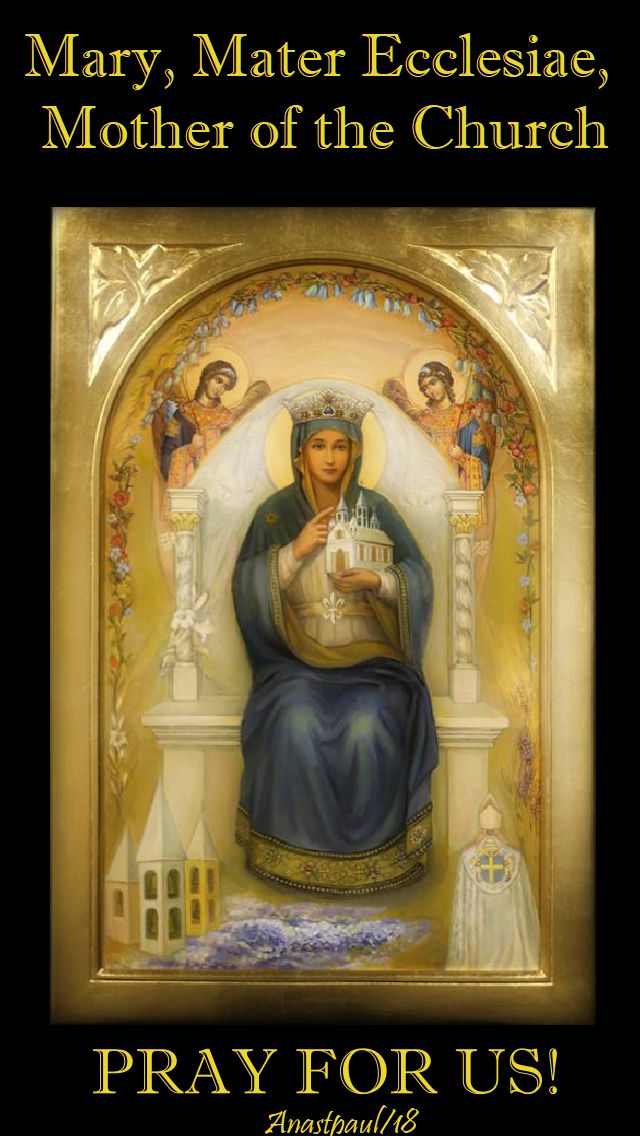
Memorial of the Blessed Virgin Mary, Mother of the Church (The First Monday after Pentecost – today 10 June 2019, is the Second Universal Memorial of Mary, Mater Ecclesiae)
Mary’s Motherhood in the Order of Grace
Second Vatican Council
An excerpt from Lumen Gentium, #61-62
Predestined from eternity by that decree of divine providence which determined the incarnation of the Word to be the Mother of God, the Blessed Virgin was on this earth the virgin Mother of the Redeemer and, above all others and in a singular way, the generous associate and humble handmaid of the Lord. She conceived, brought forth and nourished Christ. She presented Him to the Father in the temple and was united with Him by compassion as He died on the Cross. In this singular way, she cooperated by her obedience, faith, hope and burning charity, in the work of the Saviour in giving back supernatural life to souls. Wherefore, she is our mother in the order of grace.
This maternity of Mary in the order of grace, began with the consent which she gave in faith at the Annunciation and which she sustained without wavering beneath the cross and lasts, until the eternal fulfilment of all the elect. Taken up to heaven she did not lay aside this salvific duty bu,t by her constant intercession, continued to bring us the gifts of eternal salvation. By her maternal charity, she cares for the brethren of her Son, who still journey on earth, surrounded by dangers and cultics, until they are led into the happiness of their true home. Therefore, the Blessed Virgin is invoked by the Church under the titles of Advocate, Auxiliatrix, Adjutrix and Mediatrix. This, however, is to be so understood, that it neither takes away from, nor adds anything to, the dignity and efficaciousness of Christ the one Mediator.
For no creature could ever be counted as equal with the Incarnate Word and Redeemer. Just as the priesthood of Christ, is shared in various ways, both by the ministers and by the faithful and as the one goodness of God, is really communicated in different ways to His creatures, so also, the unique mediation of the Redeemer, does not exclude but rather, gives rise to a manifold cooperation, which is but a sharing in this one source.
The Church does not hesitate to profess this subordinate role of Mary. It knows it through unfailing experience of it and commends it, to the hearts of the faithful, so that, encouraged by this maternal help, they may the more intimately adhere to the Mediator and Redeemer.
Maria, Mater Ecclesiae, Pray for Us!
O Blessed Lady, Mediatrix and Advocate By St Bernard (1090-1153)
Our Mediatrix and Advocate
O blessed Lady,
you found grace,
brought forth the Life,
and became the Mother of Salvation.
May you obtain the grace for us to go to the Son.
By your mediation,
may we be received by the One
who through you, gave Himself to us.
May your integrity compensate with Him
for the fault of our corruption;
and may your humility,
which is pleasing to God,
implore pardon for our vanity.
May your great charity
cover the multitude of our sins;
and may your glorious fecundity
confer on us a fecundity of merits.
Dear Lady,
our Mediatrix and Advocate,
reconcile us to your Son,
recommend us to Him,
and present us to your Son.
By the grace you found,
by the privilege you merited,
by the mercy you brought forth,
obtain for us the following favour,
O blessed Lady.
Amen
“As a caring guide to the emerging Church, Mary had already begun her mission in the Upper Room, praying with the Apostles, while awaiting the coming of the Holy Spirit.”
Cardinal Robert Sarah
Congregation of Divine Worship and the Discipline of the Sacraments, 11 February 2018, the memorial of the Blessed Virgin Mary of Lourdes. DECREE ON THE CELEBRATION OF THE BLESSED VIRGIN MARY, MOTHER OF THE CHURCH IN THE GENERAL ROMAN CALENDAR
“…She is clearly the Mother of his members; that is, of ourselves, because she cooperated by her charity, so that faithful Christians, members of the Head, might be born in the Church. As for the body, she is the Mother of its Head… Mary gave birth to our Head; the Church gave birth to you. Indeed, the Church also, is both virgin and mother, mother, because of her womb of charity, virgin, because of the integrity of her faith and piety.”
St Augustine (354-430) Doctor of Grace
“Who, more than Mary, could be, a star of hope for us? With her “yes”, she opened the door of our world, to God Himself; she became the living Ark of the Covenant, in whom God took flesh, became one of us and pitched His tent among us.”
Spe Salvi 49 – Pope Benedict XVI
Prayer to Mary, Mother of the Church and Mother of our Faith
By our Holy Father, Pope Francis
Mother, help our faith!
Open our ears to hear God’s word
and to recognise His voice and call.
Awaken in us a desire, to follow in His footsteps,
to go forth from our own land
and to receive His promise.
Help us to be touched by His love,
that we may touch Him in faith.
Help us to entrust ourselves fully to Him
and to believe in His love,
especially at times of trial,
beneath the shadow of the cross,
when our faith is called to mature.
Sow in our faith the joy of the Risen One.
Remind us that those who believe are never alone.
Teach us to see all things with the eyes of Jesus,
that He may be light for our path.
And may this light of faith,
always increase in us,
until the dawn of that undying day,
which is Christ Himself, your Son, our Lord!
Amen
Prayer to Mary at the conclusion of the Encyclical Lumen Fidei (29 June 2013) Image of Mary – Our Lady of the Column in St Peter’s Basilica
St Augustine(354-430)
The Image of the Holy Church
Gracious Lady,
you are a mother and virgin,
you are the mother
of the body and soul
of our Head and Redeemer,
you are also truly mother
of all the members of Christ’s Mystical Body.
For through your love,
you have co-operated
in the begetting of the faithful in the Church.
Unique among women,
you are mother and virgin,
mother of Christ and virgin of Christ.
You are the beauty and charm of earth, O Virgin.
You are, forever, the image of the holy Church.
Through a woman came death,
through a woman came life,
yes, through you, O Mother of God.
Marian Thoughts – 24 May – ‘Mary’s Month’ – Friday of the Fifth Week of Easter, C
Mini Series – Pope Francis and the Holy Rosary
“Throughout her life, Mary did everything that the Church is asked to do in perennial memory of Christ. In her faith, we learn to open our hearts to obey God, in her self-denial, we see the importance of tending to the needs of others, in her tears, we find the strength to console those experiencing pain. In each of these moments, Mary expresses the wealth of divine mercy that reaches out to all in their daily needs.”
Pope Francis – 9 October 2016
The Fifth Luminous Mystery: The Institution of the Eucharist
“It is in the Lord, who gave His life for us on the cross, that we will always find that unconditional love which sees our lives as something good and always gives us the chance to start again.
In the Eucharist, Divine Mercy reveals itself in a special way. Celebrating the greatest mysteries of our faith, we touch the source of mercy.
The Eucharist is flavoured with Jesus’ words and deeds, the taste of His Passion, the fragrance of His Spirit. When we receive it, our hearts are overcome with the certainty of Jesus’ love. (18 June 2017)
Let us pray that frequent participation in the Holy Mass would expand our hearts, enrich our strength and enable us to give ourselves to our neighbours.”
Marian Thoughts – 23 May – ‘Mary’s Month’ – Thursday of the fifth Week of Easter, C
Mini Series – Pope Francis and the Holy Rosary
“Mary helps us to understand what it means to be a disciple of Christ. Eternally chosen to be his Mother, she learned to become his disciple. Her first act was to listen to God.”…
Pope Francis 9 October 2016
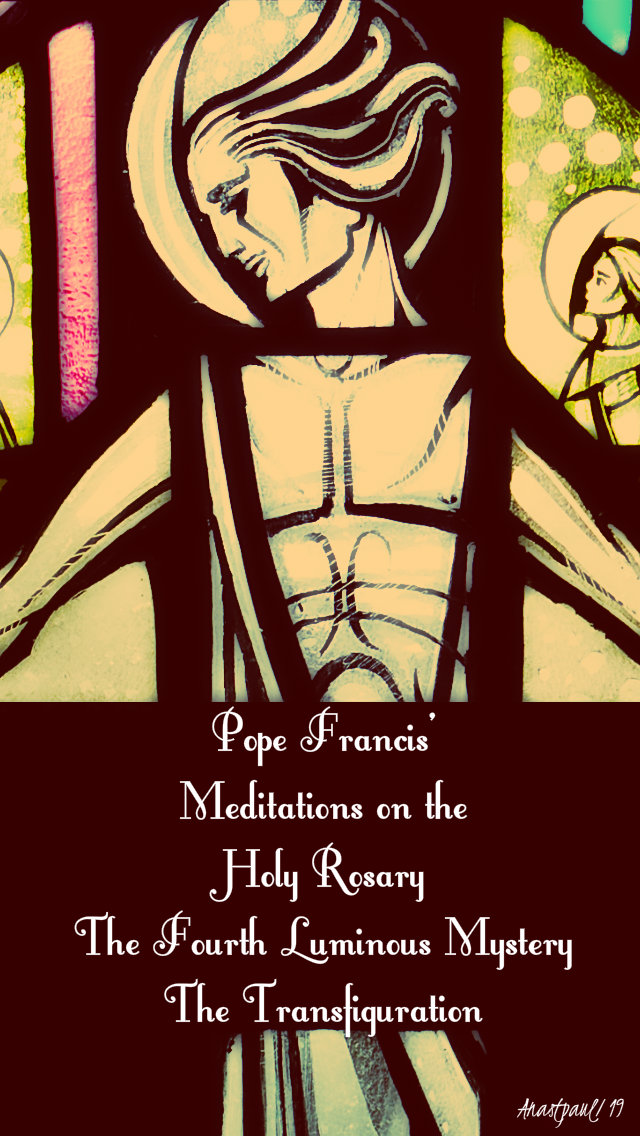
The Fourth Luminous Mystery: The Transfiguration
“The Transfiguration helps the disciples and also us, to understand that Christ’s Passion is a mystery of suffering but it’s especially a gift of infinite love on Jesus’ part. The event of Jesus, who is transfigured on the mountain, makes us also understand better His Resurrection. To understand the mystery of the cross it’s necessary to know in anticipation, that He that that suffers and is glorified, is not only a man but the Son of God, who has saved us, with His faithful love to death. Thus the Father renews His Messianic declaration on the Son, already made on the banks of the Jordan after the Baptism and He exhorts: “listen to Him!” (v. 7).
The disciples are called to follow the Master with confidence and hope, despite His death – Jesus’ divinity must manifest itself precisely on the cross, precisely in His dying “in that way,” so much so that the evangelist Mark puts on the centurion’s mouth the profession of faith: “Truly this man was the Son of God!” (15:39).
We now turn in prayer to the Virgin Mary, the human creature transfigured interiorly by the grace of Christ. We entrust ourselves confidentially to her maternal help, to continue the … journey with faith and generosity.”
Marian Thoughts – 22May – ‘Mary’s Month’ – Wednesday of the fifth Week of Easter, C
Mini Series – Pope Francis and the Holy Rosary
“Through prayer and meditation on the life of Jesus Christ, we see once more his merciful countenance, which he shows to everyone in all the many needs of life. Mary accompanies us along this journey, pointing to her Son who radiates the very mercy of the Father.”...Pope Francis 9 October 2016
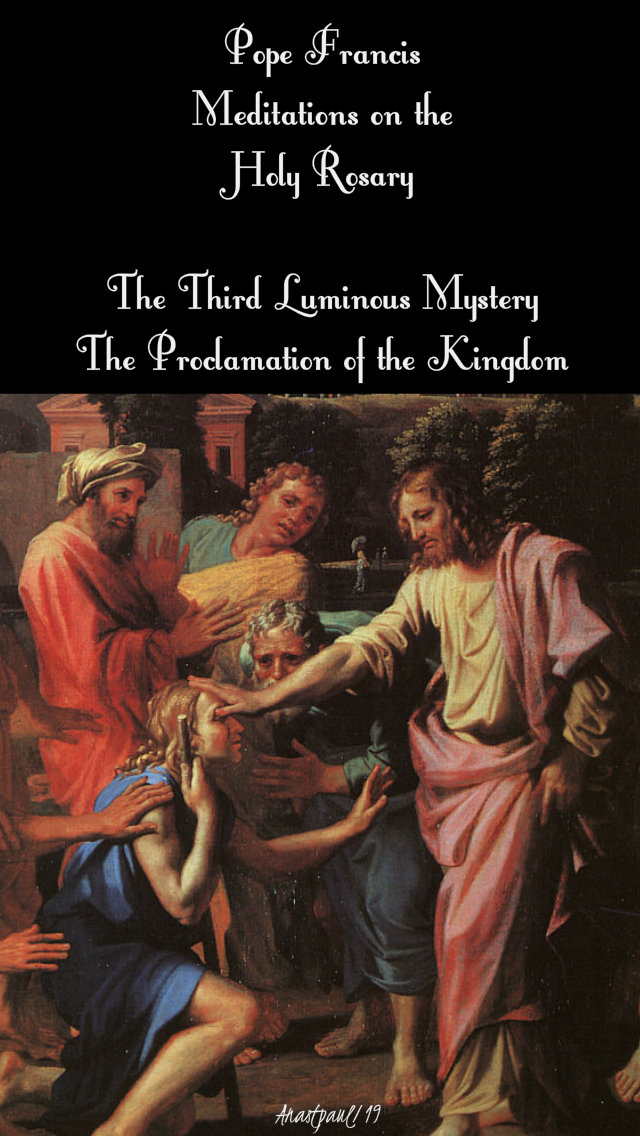
The Third Luminous Mystery:
The Proclamation of the Kingdom
Jesus Christ came to proclaim and bring about the Lord’s everlasting time of grace. He brought good news to the poor, freedom to prisoners, sight to the blind and freedom to the oppressed (cf. Lk 4:18-19).
Proclaiming the Gospel, forgiving, carrying out His will – when we do these things, we are never alone. Jesus walks ahead of us, taking our steps before us, preparing the way.
Marian Thoughts – 21 May – ‘Mary’s Month’ – Tuesday of the fifth Week of Easter, C
Mini Series – Pope Francis and the Holy Rosary
“The prayer of the rosary is, in many ways, the synthesis of the history of God’s mercy, which becomes a history of salvation for all who let themselves be shaped by grace. “…Pope Francis 9 October 2016
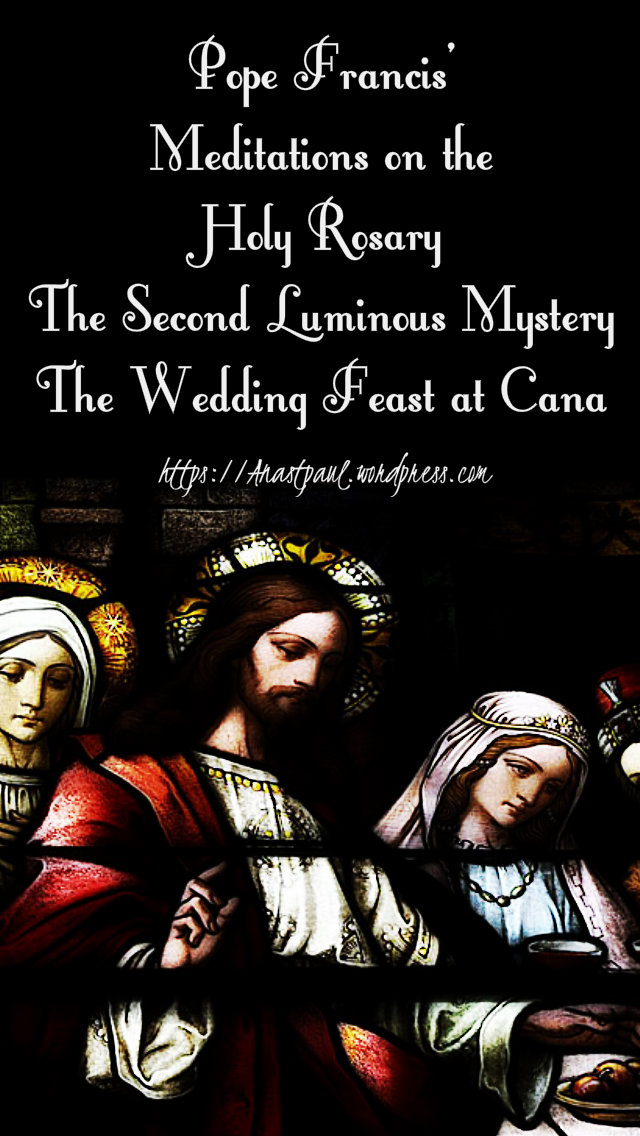
The Second Luminous Mystery
The Wedding Feast at Cana
Jesus did this as the beginning of his signs in Cana in Galilee and so revealed his glory, and his disciples began to believe in him....John 2:11
“In the context of the Covenant, we are also to understand Our Lady’s observation: “They have no wine” (v. 3). How can one celebrate a wedding feast and make merry without what the prophets indicated as a typical element of the messianic banquet? Water is necessary for life but wine expresses the abundance of a banquet and the joy of a feast. This wedding feast was short of wine, the newlyweds are ashamed of this. But just imagine ending a wedding feast drinking tea, it would be a shame. Wine is necessary for a feast. By transforming into wine the water of the jars used “for the Jewish rites of purification” (Jn 2:6), Jesus preforms an eloquent sign – He transforms the Law of Moses into the Gospel, bearer of joy. As John states elsewhere: “For the law was given through Moses; grace and truth came through Jesus Christ” (1:17).
Sometimes, even our best, beautiful dreams, our hard work and troubles – all go to nothing. Great works demand making sacrifices but sometimes we reach a wall. Let us pray that we – like Mary – know how to humbly show this situation to Jesus and that we strongly believe that even out of the greatest failure, He is able to produce the most unexpected good.”
Marian Thoughts – 20 May – ‘Mary’s Month’ – Monday of the fifth Week of Easter, C
Mini Series – Pope Francis and the Holy Rosary
“Mary helps us to understand what it means to be a disciple of Christ. Eternally chosen to be his Mother, she learned to become His disciple. Her first act was to listen to God. She obeyed the message of the Angel and opened her heart to receive the mystery of divine motherhood. She followed Jesus, listening to every word that issued from His lips (cf. Mk 3:31-35). She kept all those things in her heart (cf. Lk 2:19) and became the living memory of the signs worked by God’s Son to awaken our faith. But is not enough simply to listen. That is certainly, the first step but listening, then, needs to be translated into concrete action. The disciple truly puts his life at the service of the Gospel.”…Pope Francis (9 October 2016)
The First Luminous Mystery
The Baptism of the Lord
“We then understand the great humility of Jesus, the One who had not sinned, in lining up with the penitents, mingled among them to be baptised in the waters of the river. In doing so, He manifested what we celebrated at Christmas – the availability of Jesus to immerse Himself in the river of humanity, to take upon Himself the shortcomings and weaknesses of humanity, to share our desire to be free and to overcome everything that separates us from God and makes us strangers to our brothers and sisters. Just like in Bethlehem, along the banks of the River Jordan, God keeps His promise, to take charge of the fate of human beings and Jesus is the tangible and definitive sign.”
Marian Thoughts – 18 May – ‘Mary’s Month’ – Saturday of the Fourth Week of Easter, C
Mini Series – Pope Francis and the Holy Rosary
“Praying the rosary does not remove us from the problems of life. On the contrary, it demands that we immerse ourselves in the history of each day, so as to grasp the signs of Christ’s presence in our midst. Whenever we contemplate an event, a mystery of the life of Christ, we are asked to reflect on how God comes into our own lives, so as to be able to welcome Him and follow Him.” Pope Francis
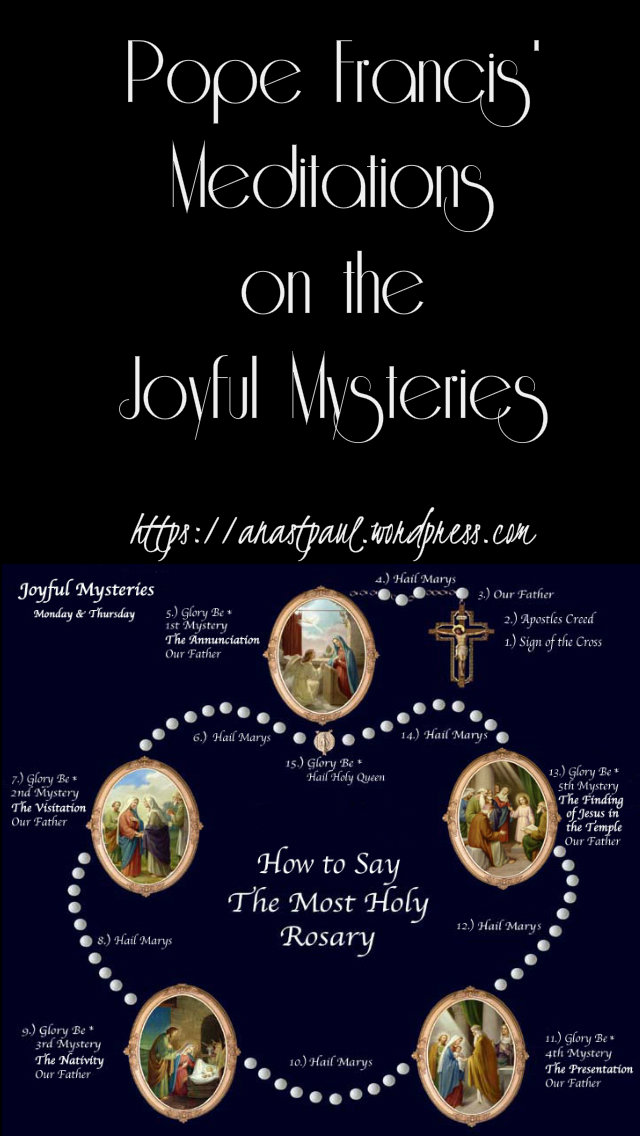
The Fifth Joyful Mystery:
The Finding of Jesus in the Temple
The Holy Family had gone to Jerusalem to celebrate the Passover but on the return voyage, Mary and Joseph discovered that Jesus, who was only twelve years old, was not in the caravan.
They searched for Jesus for three days, finally finding Him in the Temple amid the doctors of the law.
When they found Jesus, the Gospel says, “they were astonished” and Mary expressed her concern to Jesus, saying, “Your father and I have been looking for you with great anxiety.”
In the Holy Family, astonishment never failed!
To feel astonishment is the opposite of taking everything for granted… It means opening ourselves to others.
This attitude is important for mending compromised relationships and curing the open wounds within the family.
The anxiety felt by Mary and Joseph, shows the centrality of Jesus in the Holy Family. And so we see, why the family of Nazareth is holy – because it was centred on Jesus, all the attention and care of Joseph revolved around Him.
The anxiety felt by Mary and Joseph, when Jesus was lost for three days, should also be our anxiety, when we are far from Jesus, when we forget Jesus, going without prayer, without reading the Gospel for several days.
Mary and Joseph found Jesus in the Temple and we too, should seek Jesus in the house of God – and especially, in the Liturgy, where we have the living experience of Jesus, in His Word and in the Eucharist, from which we receive the strength to face the difficulties of each day…. Pope Francis 2018
Marian Thoughts – 17 May – ‘Mary’s Month’ – Thursday of the Fourth Week of Easter, C
Mini Series – Pope Francis and the Holy Rosary
“Praying the Rosary together as a family, s very beautiful and it gives us strength.”
Pope Francis
The Fourth Joyful Mystery: The Presentation
Forty days after Christmas, we celebrate the Lord who enters the temple and comes to encounter His people.
In the Christian East, this feast is called the “Fest of Encounter” – it is the encounter between God, who became a child, to bring newness to the world and an expectant humanity, represented by the elderly man and woman in the Temple.
In the Temple, there is also an encounter between two couples – the young Mary and Joseph and the elderly Simeon and Anna. The old receive from the young, while the young draw upon the old. In the Temple, Mary and Joseph find the roots of their people. This is important, because God’s promise does not come to fulfilment, merely in individuals, once for all but within a community and throughout history. There too, Mary and Joseph find the roots of their faith, for faith is not something learned from a book but the art of living with God, learned from the experience of those who have gone before us. The two young people, in meeting the two older people, thus find themselves. And the two older people, nearing the end of their days, receive Jesus, the meaning of their lives. This event, fulfils the prophecy of Joel: “Your old men shall dream dreams and your young men shall see visions” (2:28).
In this encounter, the young see their mission and the elderly realise their dreams.
All because, at the centre of the encounter, is Jesus … May we never look at the screen of our cell phone more than the eyes of our brothers or sisters or focus more on our software, than on the Lord….Pope Francis 2018
Marian Thoughts – 16 May – ‘Mary’s Month’ – Thursday of the Fourth Week of Easter, C
Mini Series – Pope Francis and the Holy Rosary
“The month of May is dedicated to Our Lady and it is “fitting” to start the habit of a daily rosary now.” Pope Francis
The Third Joyful Mystery – The Nativity
“Mary and Joseph had to leave their people, their home and their land and to undertake a journey in order to be registered in the census. This was no comfortable or easy journey for a young couple about to have a child – they had to leave their land. At heart, they were full of hope and expectation because of the child about to be born, yet their steps were weighed down by the uncertainties and dangers that attend those, who have to leave their home behind. They they found themselves, having to face perhaps, the most difficult thing of all. They arrived in Bethlehem and experienced that, it was a land that was not expecting them. A land, whee there was no place for them. And there, where everything was a challenge, May gave us Emmanuel. The Son of God, had to be born in a stable because His own had no room for Him. “He came to what was his own and his own people did not accept him” (Jn 1:11). That night, the One who had no place to be born, is proclaimed to those who had no place at the table or in the streets of the city. The shepherds are the first to hear this Good News. By reason of their work, they were men and women forced to live on the edges of society. Their state of life and the places they had to stay, prevented them from observing all the ritual prescriptions of religious purification, as a result, they wee considered unclean. Their skin, their clothing, their smell, their way of speaking, their origin, all betrayed them. Everything about them generated mistrust. They were men and women to be kept at a distance, to be feared. They were considered pagans among the believers, sinners among the just, foreigners among the citizens. Yet, to them – pagans, sinners and foreigners – the angel says: “Do not be afraid – for see – I am bringing you good news of great joy for the people, to you is born this day, in the city of David, a Saviour, who is the Messiah, the Lord.” (Lk 2:10-11)”
Marian Thoughts – 14 May – ‘Mary’s Month’ – Tuesday of the Fourth Week of Easter, C
Mini Series – Pope Francis and the Holy Rosary
“I want to recommend some medicine for all of you. It’s a spiritual medicine. Don’t forget to take it. “It’s good for your heart, for your soul, for your whole life.” (17 November 2013)
The First Joyful Mystery: The Annunciation
“The annunciation to Mary can be read alongside the announcement to Zechariah of John the Baptist’s birth. One annunciation happens to a priest in the Temple of God, during a liturgy, where everyone is waiting outside, while the other, happens to a young woman named Mary, in a small town that did not necessarily have a good reputation. This contrast is not insignificant. It serves as a sign that the new Temple of God, the new encounter of God with His people, will happen in places which we normally do not expect, on the margins, on the peripheries. By now, it will no longer be in a place reserved for the few, while the majority wait outside. Nothing and no-one, will be indifferent, no situation will be deprived of His presence, the joy of salvation began in the daily life of the home of a youth in Nazareth.
Even today, God is still searching for hearts like Mary’s that are open to welcoming His invitation and providing hope, even when it’s hard.
God continues to walk our neighbourhoods and our streets, He pushes in each place in search of hearts capable of listening to His invitation and making it become flesh here and now.
In the end, the Lord continues to seek hearts like that of Mary, disposed to believe even in very extraordinary conditions.
Just like He did with Mary, God also takes the initiative in our lives, inserting Himself into our daily struggles, anxieties and desires.
It is precisely in the daily routine of our lives, that we receive the most beautiful announcement we can hear – “Rejoice, the Lord is with you!”
(Pope Francis, 2017)
Marian Thoughts – 10 May – “Mary’s Month” and Friday of the Third Week of Easter, C
From the Constitution on the Church of the Second Vatican Council (Lumen Gentium #61-62)
The Motherhood of Our Lady in God’s Plan of Salvation
From all eternity, together with the Incarnation of the divine Word, the Blessed Virgin was predestined to be the Mother of God. By the will of divine Providence, she was the loving mother of the divine Redeemer, here on earth and, above all others, in a unique way she was the willing partner and the humble handmaid of the Lord. She conceived, brought forth and nourished Christ. She presented Him to the Father in the temple and shared the suffering of His Son as He died on the cross. In an utterly singular way, she co-operated by her obedience, faith, hope and burning charity in the Saviour’s work of restoring supernatural life to souls. For this reason, she is a mother to us in the order of grace.
This motherhood of Mary, in the order of grace, began with the consent which she gave in faith, at the Annunciation and which she sustained without wavering beneath the cross, it will last without interruption, until the eternal fulfilment of all the elect. Once assumed into heaven, she did not set aside this saving role but, with her numerous prayers of intercession, continues to win for us, the gifts of eternal salvation.
By her maternal charity, Mary cares for the brethren of her Son who still wander through this world, in the midst of dangers and difficulties, until they are led to the happiness of their heavenly home.
For this reason the Blessed Virgin is invoked by the Church under the titles of Advocate, Auxiliatrix, Adjustrix and Mediatrix – but they are titles which must be understood, in a way, that neither detracts from, nor adds anything to the dignity and efficacy of Christ the one Mediator.
For no creature could ever be counted as equal with the Incarnate Word and Redeemer. Just as the priesthood of Christ is shared in various ways, both by sacred ministers and by the faithful and, as the one goodness of God, is really communicated in different ways to His creatures, in the same way, the unique mediation of the Redeemer, does not exclude but, rather gives rise among creatures, to a manifold co-operation, which is but a sharing in this one source.
The Church does not hesitate to profess this subordinate role of Mary. She knows it through unfailing experience of it and commends it to the hearts of the faithful, so that, encouraged by this maternal help, they may follow the Mediator and Redeemer more clearly.
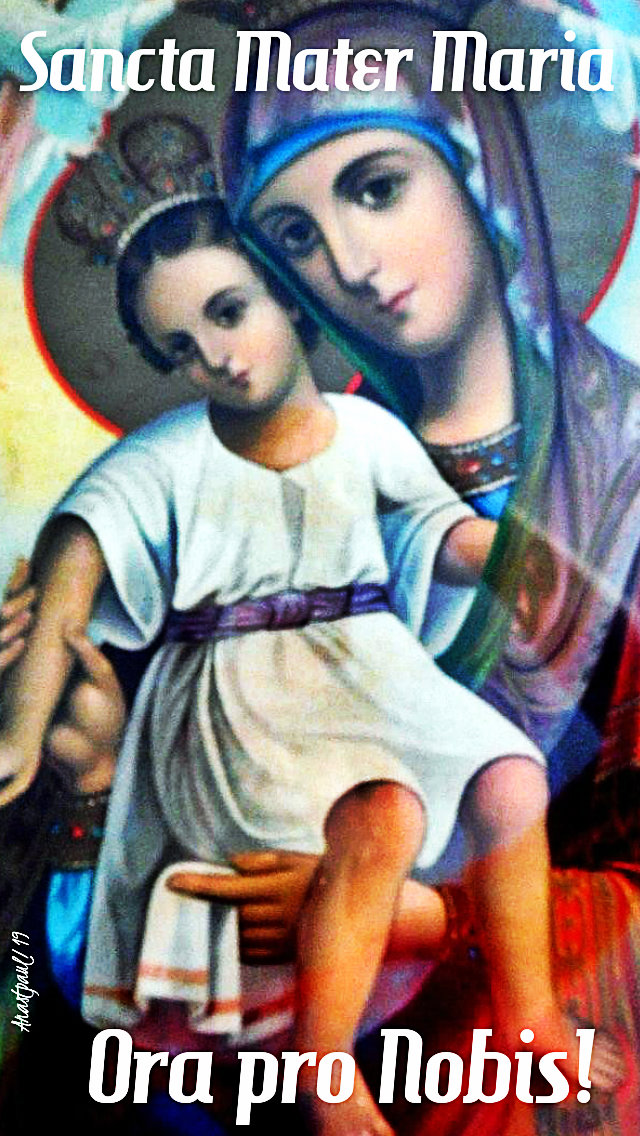
Sancta Mater Maria, Mother of God and our Mother, Pray for us!
Our Morning Offering – 9 May – ‘Mary’s Month’ – Thursday Third Week of Easter, C
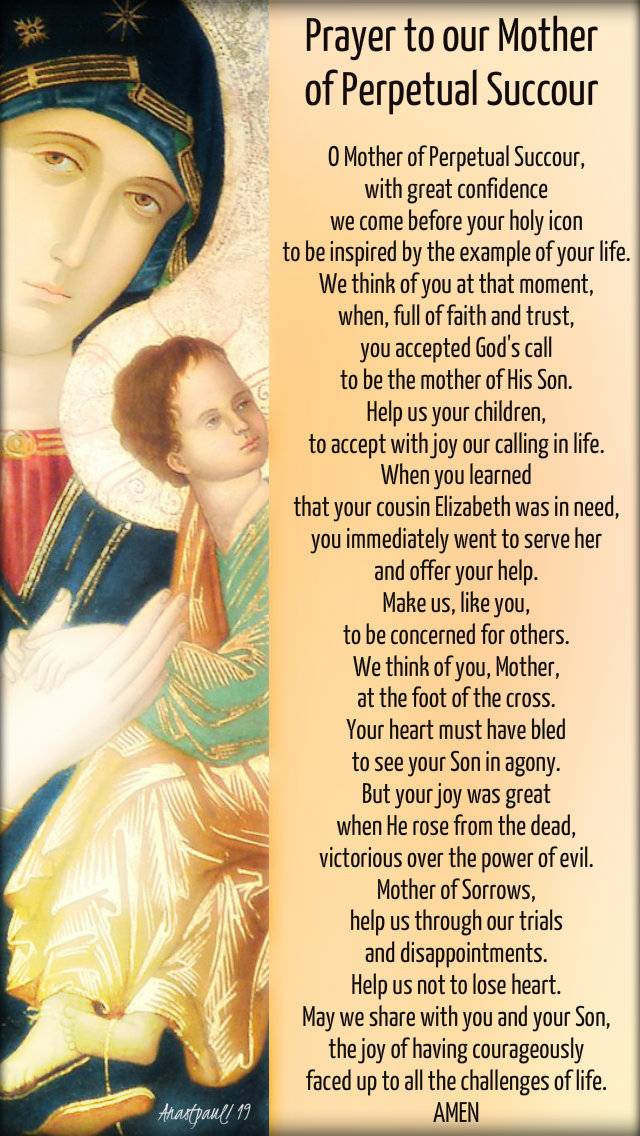
Prayer to our Mother of Perpetual Succour
O Mother of Perpetual Succour,
with great confidence
we come before your holy icon
to be inspired by the example of your life.
We think of you at that moment,
when, full of faith and trust,
you accepted God’s call to be the mother of His Son.
Help us your children, to accept with joy our calling in life.
When you learned that your cousin Elizabeth was in need,
you immediately went to serve her and offer your help.
Make us, like you, to be concerned for others.
We think of you, Mother, at the foot of the cross.
Your heart must have bled to see your Son in agony.
But your joy was great when He rose from the dead,
victorious over the power of evil.
Mother of Sorrows,
help us through our trials and disappointments.
Help us not to lose heart.
May we share with you and your Son,
the joy of having courageously
faced up to all the challenges of life.
AMEN
Marian Thoughts – 6 May – ‘May, the Month of Mary’ – Pope Francis and Mary
Mary, Pope Francis said, “shows us the way home. She brings us to Jesus, who is the Gate of Mercy.”
Francis’s love affair with Our Lady is well documented and it began long before Father Jorge Mario Bergoglio was made a bishop – in 1990, the future pope gave up TV because of a promise he made to the Virgin of Carmel.
After he was appointed archbishop of Buenos Aires, in Argentina, he’d participate in a massive pilgrimage to the shrine of Our Lady of Lujan, patroness of his country.
Before and after every foreign trip today, he visits Rome’s Basilica of St Mary Major to venerate the famous icon of Our Lady known as Salus Populi Romani (protectress of the Roman people) and usually leaves a bouquet of flowers presented to him during the trip.
In early 2016, he made a politically-charged trip to Mexico, visiting Ciudad Juarez on the border with the United States to deliver a strong appeal in favour of immigrants. Yet before and during the trip, he said time and time again he would visit Our Lady of Guadalupe, patroness of the Americas and everything else was decided after. “How could I not come?” Francis asked the Mexican bishops when he met with them. “Could the Successor of Peter, called from the far south of Latin America, deprive himself of seeing la Virgen Morenita?”
Francis has spoken about how his devotion to Mary helped him through his election to the papacy, about praying the Rosary three times a day and that he always makes a point of stopping and even presenting flowers at the feet of Our Lady when she’s in St Peter’s Square or, wherever, he celebrates Mass during his trips abroad.
In 2005, after the death of St John Paul II, then-Cardinal Jorge Mario Beroglio wrote a piece for a special issue of the Italian magazine 30 Giorni, dedicated to the late pontiff. In it, the man who today leads the Church wrote about once praying the rosary with the Polish pope and the impact it had on him.
“I felt that this man, chosen to lead the Church, was following a path back to his Mother in the sky, a path set out from his childhood,” he wrote. “I understood the presence of Mary in the life of the pope, a witness he never ceased to give. From that moment, I recite the 15 mysteries of the Rosary every day.”
Apostolic Exhortation of St Pope Paul VI
Marialis Cultus – 2 February 1974
To Honour Mary
Devotion to the Mother of the Lord becomes for the faithful an opportunity for growing in divine grace and this is the ultimate aim of all pastoral activity. For it is impossible to honour her who is “full of grace” (Lk. 1:28) without thereby honouring, in oneself, the state of grace, which is friendship with God, communion with Him and the indwelling of the Holy Spirit. It is this divine grace which takes possession of the whole man and conforms him to the image of the Son of God (cf. Rom. 8:29; Col. 1:18).
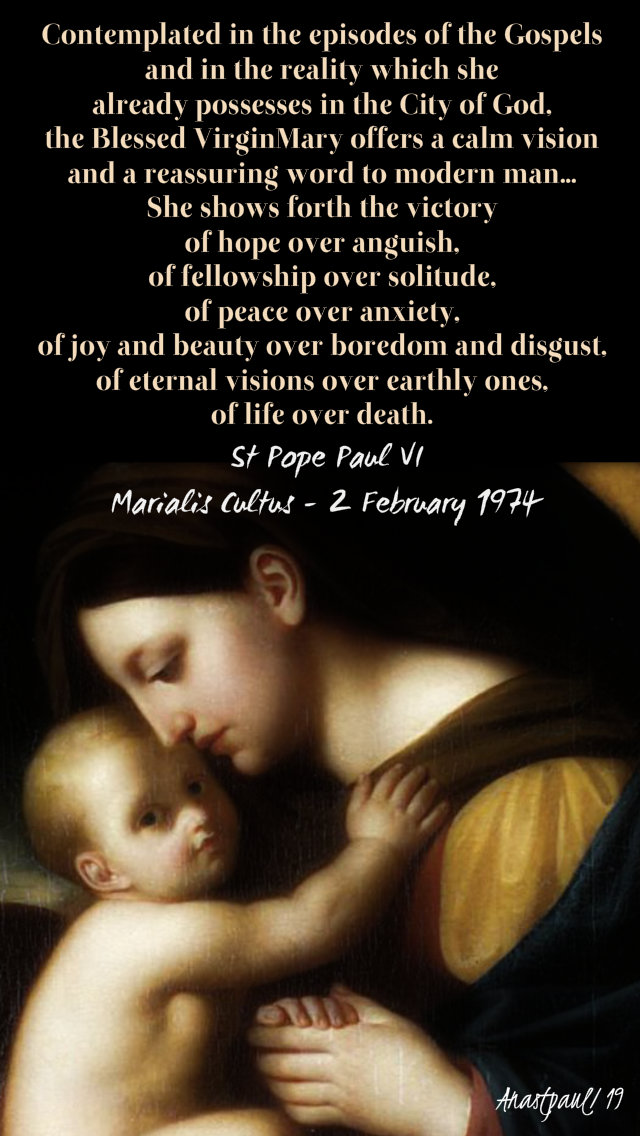
The Catholic Church, endowed with centuries of experience, recognises in devotion to the Blessed Virgin a powerful aid for man as he strives for fulfilment. Mary, the New Woman, stands at the side of Christ, the New Man, within whose mystery the mystery of man(124) alone finds true ligh,; she is given to it as a pledge and guarantee that God’s plan in Christ for the salvation of the whole man has already achieved realisation in a creature – in her. Contemplated in the episodes of the Gospels and in the reality which she already possesses in the City of God, the Blessed Virgin Mary offers a calm vision and a reassuring word to modern man, torn as he often is between anguish and hope, defeated by the sense of his own limitations and assailed by limitless aspirations, troubled in his mind and divided in his heart, uncertain before the riddle of death, oppressed by loneliness while yearning for fellowship, a prey to boredom and disgust. She shows forth the victory of hope over anguish, of fellowship over solitude, of peace over anxiety, of joy and beauty over boredom and disgust, of eternal visions over earthly ones, of life over death.
Let the very words that she spoke to the servants at the marriage feast of Cana, “Do whatever he tells you” (Jn. 2:5), be a seal on our Exhortation and a further reason in favour of the pastoral value of devotion to the Blessed Virgin as a means of leading men to Christ. Those words, which at first sight were limited to the desire to remedy an embarrassment at the feast, are seen in the context of Saint John’s Gospel to re-echo the words used by the people of Israel to give approval to the Covenant at Sinai (cf. Ex. 19:8, 24:3, 7; Dt. 5:27) and to renew their commitments (cf. Jos. 24:24; Ezr. 10:12; Neh. 5:12). And they are words which harmonise wonderfully with those spoken by the Father at the theophany on Mount Tabor – “Listen to him” (Mt. 17:5
Second Reading The Little Office of Mary Saturdays ===============
Marian Thoughts – May, the Month of Mary – 2 May 2019
Apostolic Exhortation of St Pope Paul VI (1897-1978) Marialis Cultus – 2 February 1974
To Honour Mary
Finally, insofar as it may be necessary, we would like to repeat that the ultimate purpose of devotion to the Blessed Virgin is to glorify God and to lead Christians, to commit themselves, to a life which is in absolute conformity with His will. When the children of the Church unite their voices, with the voice of the unknown woman, in the Gospel and glorify the Mother of Jesus, by saying to Him: “Blessed is the womb that bore you and the breasts that you sucked” (Lk. 11:27), they will be led to ponder the Divine Master’s serious reply: “Blessed rather are those who hear the word of God and keep it!” (Lk. 11:28) While it is true, that this reply is, in itself, lively praise of Mary, as various Fathers of the Church interpreted it and the Second Vatican Council has confirmed, it is also an admonition to us, to live our lives in accordance with God’s commandments. It is also an echo of other words of the Saviour: “Not everyone who says to me ‘Lord, Lord,’ will enter the kingdom of heaven but he who does the will of my Father who is in heaven” (Mt. 7:21); and again: “You are my friends if you do what I command you” (Jn. 15:14).
Christ is the only way to the Father (cf. Jn. 14:4-11) and the ultimate example to whom the disciple must conform his own conduct (cf. Jn. 13:15), to the extent of sharing Christ’s sentiments (cf. Phil. 2:5), living His life and possessing His Spirit (cf. Gal. 2:20; Rom. 8:10-11). The Church has always taught this and nothing in pastoral activity should obscure this doctrine. But the Church, taught by the Holy Spirit and benefiting from centuries of experience, recognises, that devotion to the Blessed Virgin, subordinated to worship of the divine Saviour and in connection with it, also has a great pastoral effectiveness and constitutes, a force, for renewing Christian living.
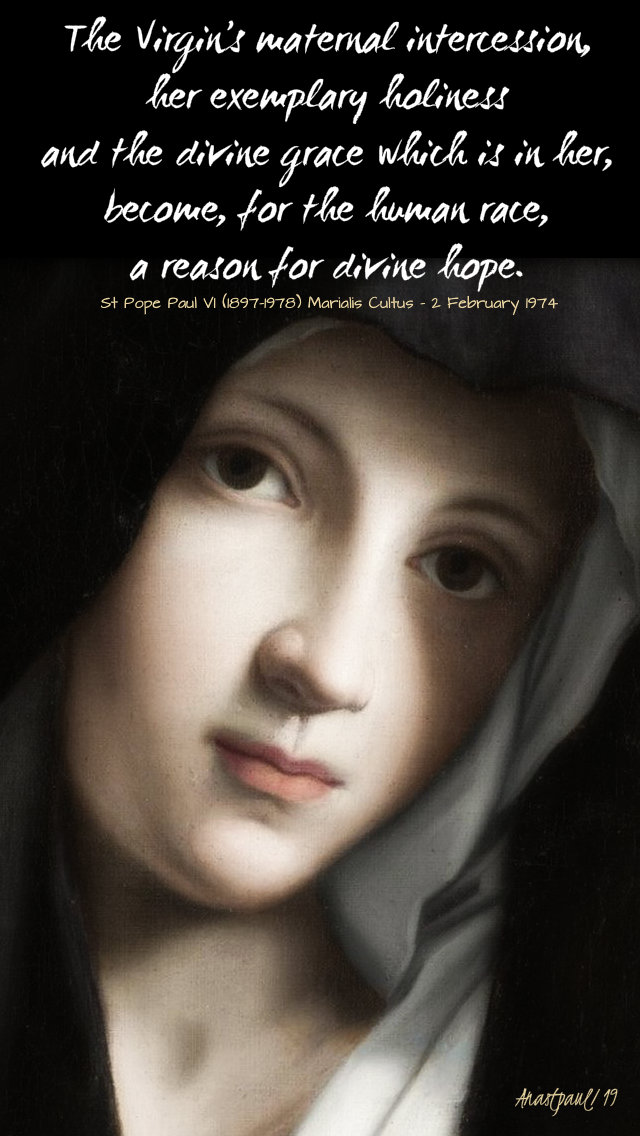
It is easy to see the reason for this effectiveness. Mary’s many-sided mission to the People of God is a supernatural reality which operates and bears fruit within the body of the Church. One finds cause for joy, in considering, the different aspects of this mission and seeing how each of these aspects, with its individual effectiveness, is directed towards the same end, namely, producing in the children the spiritual characteristics of the first-born Son. The Virgin’s maternal intercession, her exemplary holiness and the divine grace which is in her, become, for the human race, a reason for divine hope.
Second Reading The Little Office of Mary Sunday, Tuesday, Thursday
=================
Our Morning Offering – 2 May “Mary’s Month” – Thursday of the Second week of Easter
Opening Hymn from the Little Office of Mary
O Mary of all women,
You are the chosen one,
Who, ancient prophets promised,
Would bear God’s only Son;
All Hebrew generations
Prepared the way to thee,
That in your womb the God-man,
Might come to set us free.
O Mary, you embody
all God taught to our race,
For you are first and foremost
In fullness of His grace;
We praise this wondrous honour
That you gave birth to Him,
Who from you took humanity
And saved us from our sin.
Thought for the Day – 1 May – Devotion for May – the Month of Mary
“God wills that all his gifts should come to us through Mary” (St Bernard)
It was in Rome, towards the end of the eighteenth century, one fine evening in May. A child of the poor gathered his companions around him and led them to a statue of Mary, before which a lamp was burning, as is the custom in that holy city. There, these fresh young voices sang the Litany of our Lady. The next day, the little group, followed by other children, again gathered at the feet of the Mother of God. Next came their mothers, to join the little assembly. Soon, other groups were formed and the devotion rapidly became popular. Holy souls, troubled by the disorderly conduct which always increases and becomes graver at the return of the pleasant springtime, saw in these growing practices the hand of God and they co-operated with the designs of Providence by approving and promoting this new devotion, as a public and solemn act of reparation. The Month of Mary was founded….A Carthusian, A Month with Mary
“This is the month in which, in the churches and individual homes, the most affectionate and fervent homage of prayers and devotions from the hearts of Christians are raised to Mary. It is also the month in which from His throne descend upon us the most generous and abundant gifts of the Divine Mercy.”….St Pope Paul VI, The Month of Mary,1967.
In our own times, we Catholics, wanting to be close to her always, offer her special presents in May – pilgrimages, visits to churches dedicated to her, little sacrifices in her honour, periods of study and well-finished work offered up to her and a more attentive recitation of the rosary….
MARY: THE MOTHER OF GOD
“When the Blessed Virgin said yes, freely, to the plans revealed to her by the Creator, the divine Word assumed a human nature — a rational soul and a body — which was formed in the most pure womb of Mary. The divine nature and the human were united in a single Person – Jesus Christ, true God and, thenceforth, true man, the only begotten and eternal son of the Father and from that moment on, as man, the true son of Mary. This is why our Lady is the mother of the Incarnate Word, of the second person of the Blessed Trinity, who has united our human nature to Himself forever, without any confusion of the two natures. The greatest praise we can give to the Blessed Virgin is to address her loudly and clearly by the name that expresses her very highest dignity: ‘Mother of God’.”
Let us offer to our Mother today:
Brief but frequent prayers of love, such as:
“Mother of God, your petitions are most powerful.”
St Josemaria Escriva – “Mother of God and Our Mother,” Friends of God, 274.
May Magnificat
Poem by Fr Gerard Manley Hopkins SJ (1844-1889)
May is Mary’s month and I Muse at that and wonder why: Her feasts follow reason, Dated due to season—
Candlemas, Lady Day But the Lady Month, May, Why fasten that upon her, With a feasting in her honour?
Is it only its being brighter Than the most are must delight her? Is it opportunest And flowers finds soonest?
Ask of her, the mighty mother: Her reply puts this other Question: What is Spring?— Growth in every thing—
Flesh and fleece, fur and feather, Grass and greenworld all together, Star-eyed strawberry-breasted Throstle above her nested
Cluster of bugle blue eggs thin Forms and warms the life within, And bird and blossom swell In sod or sheath or shell.
All things rising, all things sizing Mary sees, sympathising With that world of good, Nature’s motherhood.
Their magnifying of each its kind With delight calls to mind How she did in her stored Magnify the Lord.
Well but there was more than this: Spring’s universal bliss Much, had much to say To offering Mary May.
When drop-of-blood-and-foam-dapple Bloom lights the orchard-apple And thicket and thorp are merry With silver-surfed cherry
And azuring-over greybell makes Wood banks and brakes wash wet like lakes And magic cuckoocall Caps, clears, and clinches all—
This ecstasy all through mothering earth Tells Mary her mirth till Christ’s birth To remember and exultation In God who was her salvation.
Lenten Thoughts – 25 March – The Solemnity of the Annunciation of the Lord
Mary’s Fiat, must be our Fiat
Mary’s fiat– her faithful “Here am I,” which does not replace her perplexity at her conception of God made human but overcomes it– is an announcement in itself. In fact, her announcement, is the most important one of today’s Gospel reading. Let it be our announcement, too, then, for it is appropriate at all times and at any time. And now, our brief, prayerful, announcement: “Here [are we], the servant[s] of the Lord, let it be done to [us] according to your word.”
I delight to do thy will, O my God, thy law is within my heart.
Psalm 40:8
“God Himself is the one Who takes the initiative and chooses to enter, as He did with Mary, into our homes, our daily struggles, filled with anxiety and with desires. And it is within our cities, in our schools and universities, our squares and hospitals, that the most beautiful announcement we can hear is made: “Rejoice, the Lord is with you”. A joy that generates life, that generates hope, that is made flesh in the way we look to the future, in the attitude with which we look at others. A joy that becomes solidarity, hospitality, mercy towards all.”
Pope Francis – Solemnity of the Annunciation of Our Lord, 25 March 2017
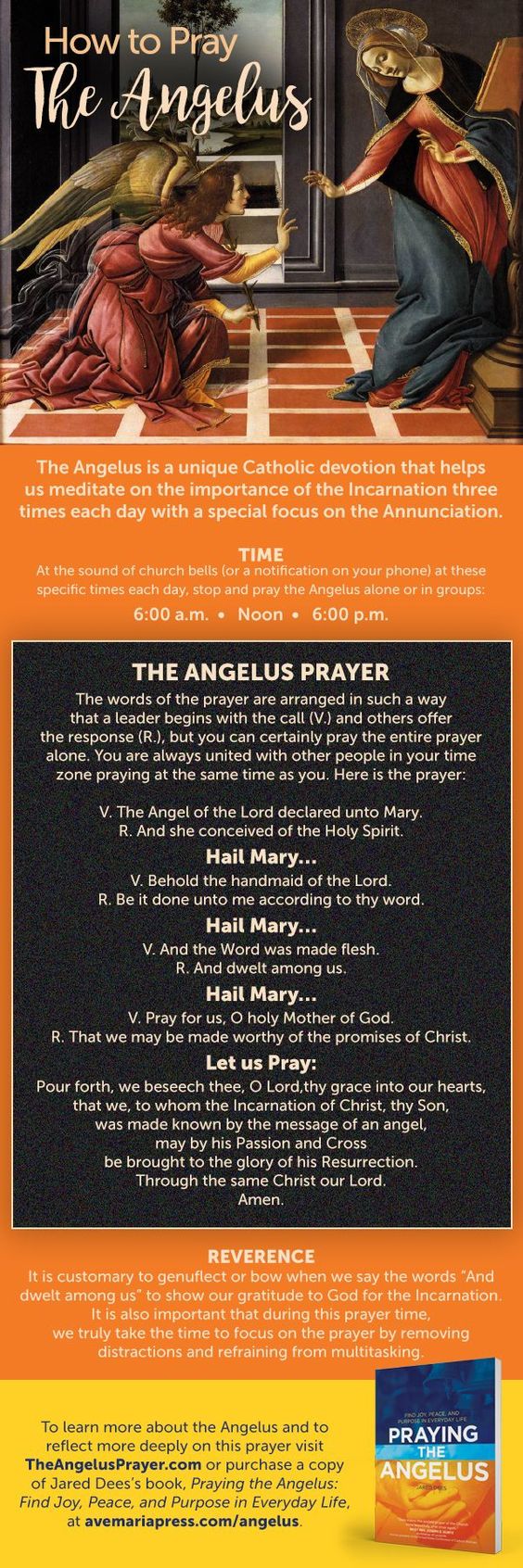
Three times daily, at 6 am, noon and 6 pm, we pray the Angelus. It is still accompanied by the ringing of a bell (the Angelus bell) in some places such as Vatican City and parts of Germany, Belgium, France, Spain and Ireland. The Regina Coeli prayer (which may also be sung as a hymn) replaces the Angelus during the Easter season.
V. The Angel of the Lord declared unto Mary.
R. And she conceived of the Holy Spirit.
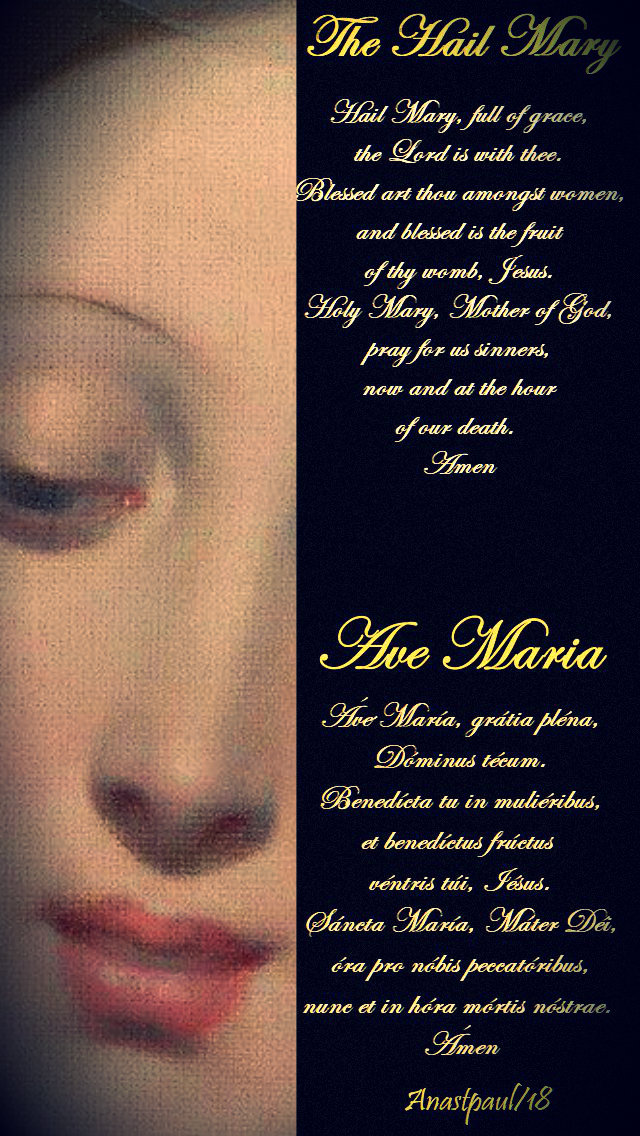
Hail Mary, full of grace,
The Lord is with Thee;
Blessed art thou among women,
And blessed is the fruit of thy womb, Jesus.
Holy Mary, Mother of God,
Pray for us sinners,
Now and at the hour of our death. Amen
V. Behold the handmaid of the Lord.
R. Be it done unto me according to thy word.
Hail Mary, etc.
V. And the Word was made Flesh.
R. And dwelt among us.
Hail Mary, etc.
V. Pray for us, O holy Mother of God.
R. That we may be made worthy of the promises of Christ. LET US PRAY
Pour forth, we beseech Thee, O Lord, Thy grace into our hearts, that we to whom the Incarnation of Christ Thy Son was made known by the message of an angel, may by His Passion and Cross be brought to the glory of His Resurrection. Through the same Christ Our Lord. Amen.
Thought for the Day – 25 March – The Solemnity of the Annunciation of the Lord
Together with Jesus, the privileged and graced Mary is the link between heaven and earth. She is the human being who best, after Jesus, exemplifies the possibilities of human existence. She received into her lowliness the infinite love of God. She shows how, an ordinary human being, can reflect God in the ordinary circumstances of life. She exemplifies what the Church and every member of the Church is meant to become. She is the ultimate product of the creative and redemptive power of God. She manifests what the Incarnation is meant to accomplish for all of us.
Sometimes spiritual writers are accused of putting Mary on a pedestal and thereby, discouraging ordinary humans from imitating her. Perhaps, such an observation is misguided. God did put Mary on a pedestal and has put all human beings on a pedestal. We have scarcely begun to realise the magnificence of divine grace, the wonder of God’s freely given love. The marvel of Mary—even in the midst of her very ordinary life—is God’s shout to us, to wake up, to the marvellous creatures that we all are by divine design.
Quote/s of the Day – 25 March – The Solemnity of the Annunciation of the Lord
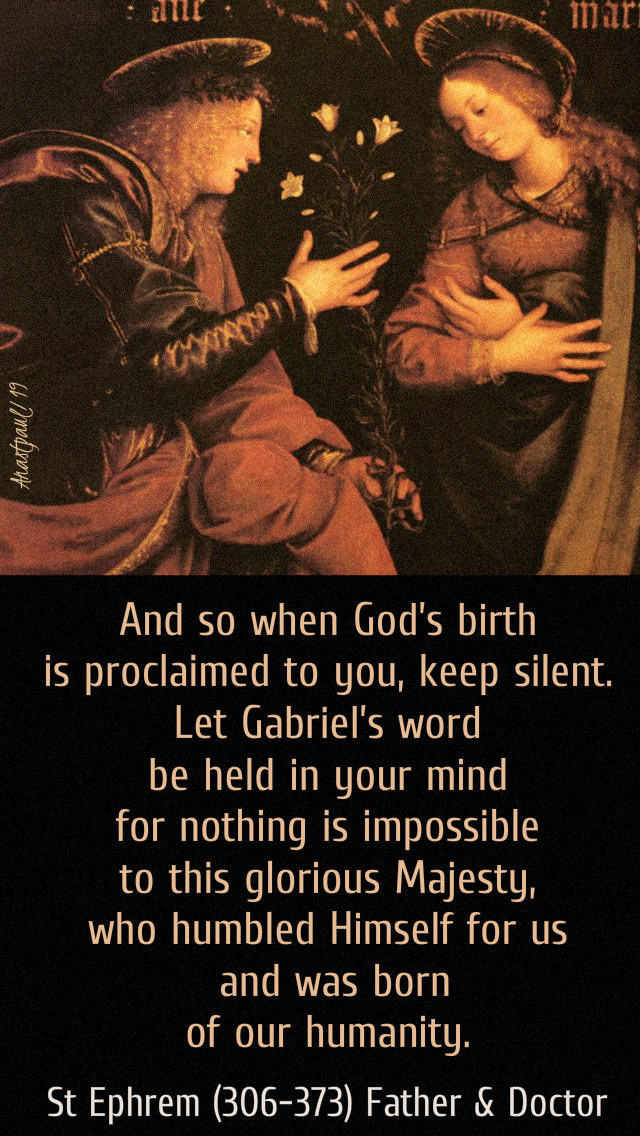
“And so when God’s birth is proclaimed to you, keep silent. Let Gabriel’s word be held in your mind for nothing is impossible to this glorious Majesty, who humbled Himself for us and was born of our humanity.”
“God assumed smallness in her – yet without diminishing His nature – to make us great!”
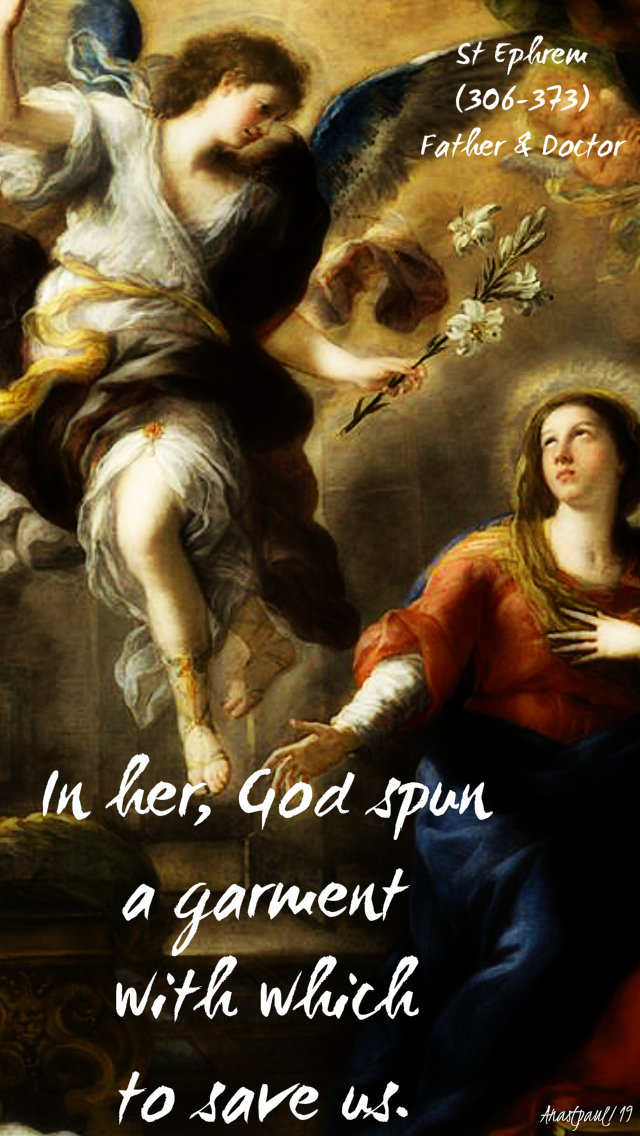
“In her, God spun a garment with which to save us.”
Saint Ephrem (306-373) Father & Doctor
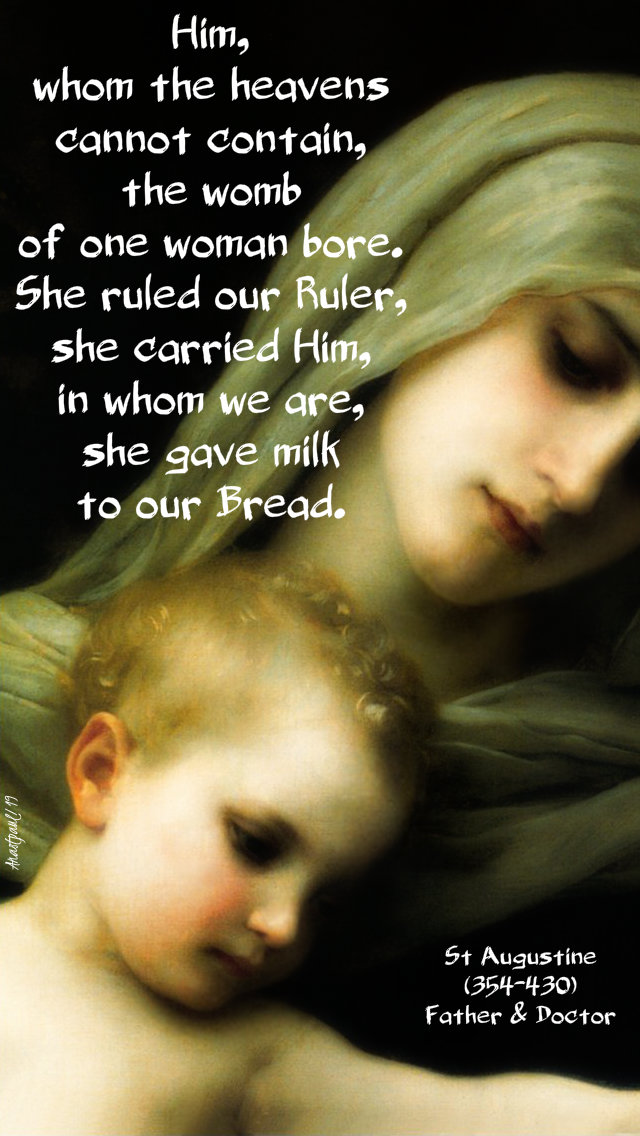
“Him, whom the heavens cannot contain, the womb of one woman bore. She ruled our Ruler, she carried Him, in whom we are, she gave milk to our Bread.”
St Augustine (354-430)
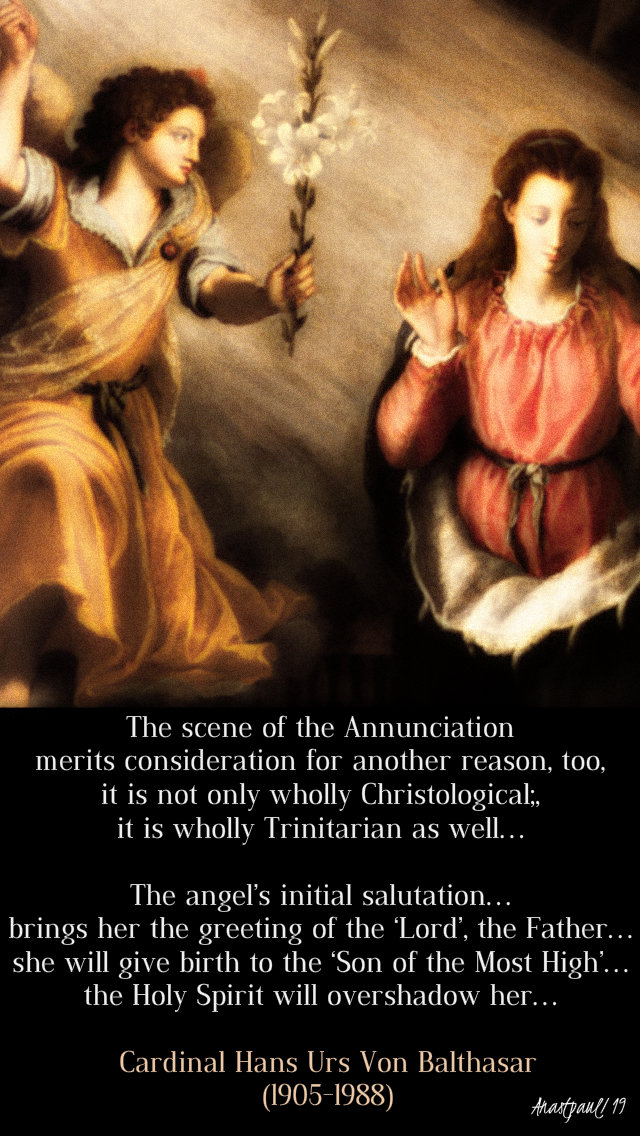
“The scene of the Annunciation merits consideration for another reason, too, it is not only wholly Christological;, it is wholly trinitarian as well… The angel’s initial salutation… brings her the greeting of the ‘Lord’, the Father… she will give birth to the ‘Son of the Most High’… the Holy Spirit will overshadow her…”
Cardinal Hans Urs Von Balthasar (1905-1988)
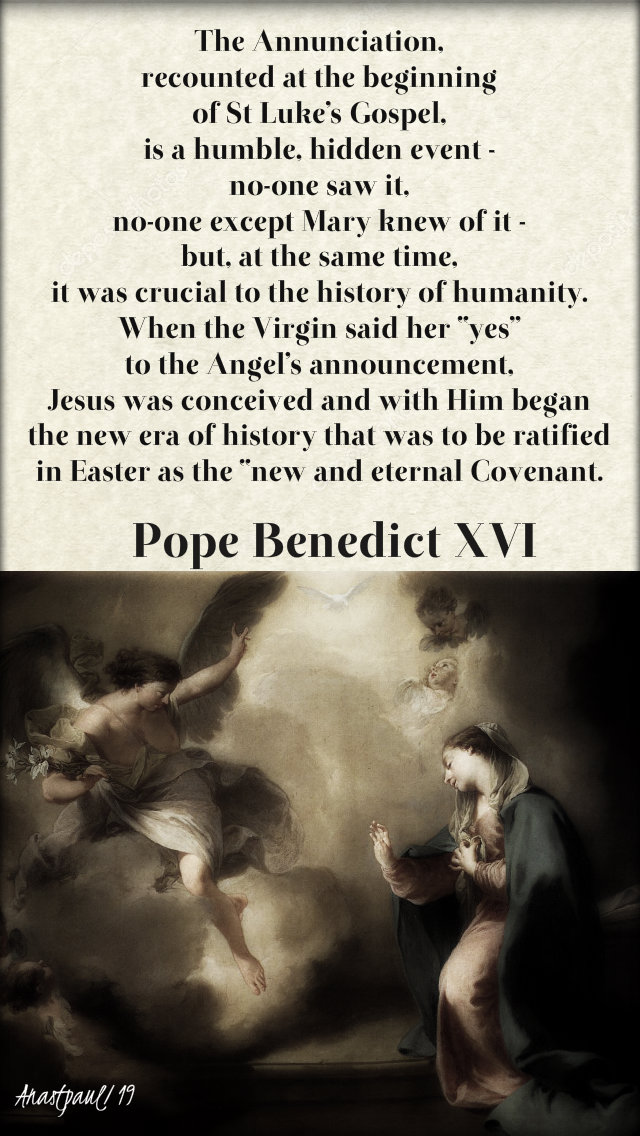
“The Annunciation, recounted at the beginning of St Luke’s Gospel, is a humble, hidden event – no-one saw it, no one except Mary knew of it – but, at the same time, it was crucial to the history of humanity. When the Virgin said her “yes” to the Angel’s announcement, Jesus was conceived and with Him began the new era of history that was to be ratified in Easter as the “new and eternal Covenant”.
Pope Benedict XVI
Angelus St Peter’s Square, Fifth Sunday of Lent, 25 March 2007
One Minute Reflection – 25 March – The Solemnity of the Annunciation of the Lord
And Mary said, “Behold, I am the handmaid of the Lord, let it be to me according to your word.”...Luke 1:38
REFLECTION – “The icon of the Annunciation, more than any other, helps us to see clearly how everything in the Church goes back to that mystery of Mary’s acceptance of the divine Word, by which, through the action of the Holy Spirit, the Covenant between God and humanity was perfectly sealed. Everything in the Church, every institution and ministry, including that of Peter and his Successors, is “included” under the Virgin’s mantle, within the grace-filled horizon of her “yes” to God’s will. This link with Mary naturally evokes a strong affective resonance in all of us but first of all it has an objective value….
Everything in this world will pass away. In eternity only Love will remain. For this reason, … taking the opportunity offered by this favourable time of Lent, let us commit ourselves to ensure that everything in our personal lives and in the ecclesial activity in which we are engaged is inspired by charity and leads to charity. In this respect too, we are enlightened by the mystery that we are celebrating today.
Indeed, the first thing that Mary did after receiving the Angel’s message was to go “in haste” to the house of her cousin Elizabeth in order to be of service to her (cf. Lk 1: 39). The Virgin’s initiative was one of genuine charity, it was humble and courageous, motivated by faith in God’s Word and the inner promptings of the Holy Spirit. Those who love, forget about themselves and place themselves at the service of their neighbour. Here we have the image and model of the Church!”…Pope Benedict XVI – Excerpt- Solemnity of the Annunciation of the Lord, Saint Peter’s Square, Saturday, 25 March 2006
PRAYER – Shape us in the likeness of the Divine nature of our Redeemer, whom we believe to be true God and true man, since it was Your will, Lord God, that He, Your Word, should take to Himself, our human nature in the womb of the Blessed Virgin Mary. We make our prayer through our Lord Jesus, in the unity of the Holy Spirit, God for always and forever, amen.
Lenten Reflection – 25 March – The Solemnity of the Annunciation of the Lord
Daily Meditation: Mary said, “Behold, I am the handmaid of the Lord. May it be done to me according to your word.”
Today we step out of Lent, in one way.
We are nine months away from Christmas.
This is the feast of the Incarnation – the enfleshment of our God for us.
In Jesus, God entered this world, our world.
This day thereby offers wonderful Lenten graces.
Ahaz has his own plans.
He refuses to ask God for help, because he doesn’t want God’s help.
And, of course, he makes it sound pious.
There’s fruit in that for all of us, whenever we refuse to ask for God’s help.
Mary, on the other hand, is God’s servant.
She is humble and she says “yes.”
And God, for whom “nothing is impossible, does the rest.
I delight to do thy will, O my God, thy law is within my heart.
Psalm 40:8
“The Mighty One has done great things for me” (Lk 1:49)
Saint Ephrem (306-373) Doctor of the Church Sermons on the Mother of God, 2, 93-145
Contemplate Mary, my beloved, see how Gabriel went into her house and her questioning: “How can this be?” The Holy Spirit’s servant gave her this answer: “Nothing is impossible for God, for him, all is easy.” Consider how she believed the word she had heard and said: “Behold I am the handmaid of the Lord.” From that moment the Lord descended in a way known to Him alone, He bestirred Himself and came according to His good pleasure, He entered her without her feeling it and she opened herself to Him without experiencing any suffering. She bore within herself, as a child, Him by whom the world was filled. He descended to become the model that would renew Adam’s ancient image.
And so when God’s birth is proclaimed to you, keep silent. Let Gabriel’s word be held in your mind for nothing is impossible to this glorious Majesty, who humbled Himself for us and was born of our humanity. Today, Mary became God’s heaven for us, in that the sublime Divinity came down and placed His dwelling within her. God assumed smallness in her – yet without diminishing His nature – to make us great. In her, God spun a garment with which to save us. All the words of the prophets and just ones were fulfilled in her. From her, arose the light that drove away the shadows of paganism.
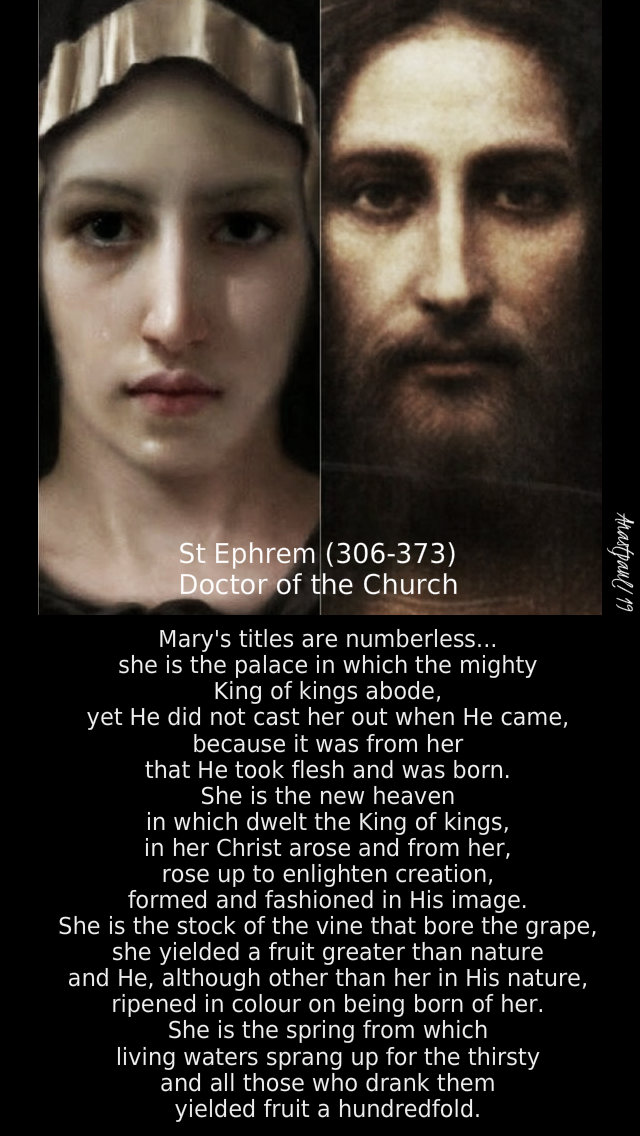
Mary’s titles are numberless… she is the palace in which the mighty King of kings abode, yet He did not cast her out when He came, because it was from her that He took flesh and was born. She is the new heaven in which dwelt the King of kings, in her Christ arose and from her rose up to enlighten creation, formed and fashioned in His image. She is the stock of the vine that bore the grape, she yielded a fruit greater than nature, and He, although other than her in His nature, ripened in colour on being born of her. She is the spring from which living waters sprang up for the thirsty and all those who drank them yielded fruit a hundredfold.
Closing Prayer:
God of infinite love,
I thank You for this feast of our salvation,
right here in the middle of Lent.
I turn to You to beg for Your help.
I need the inspiration and help of Mary on this journey.
Please grant me the grace to be humbly faithful
to what You are calling me to do.
Please give me what I need to be free and to be Your servant.
Please let Mary guide us in the path to peace in our world.
I ask You this, through Jesus our Lord.
May the Lord bless us,
protect us from all evil
and bring us to everlasting life.
Amen
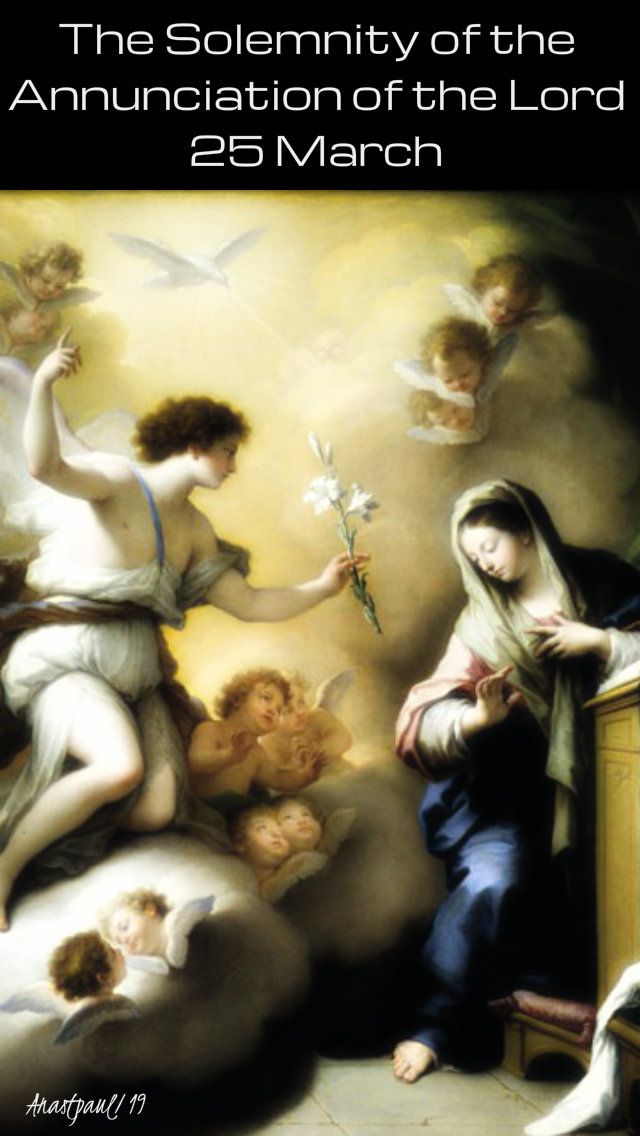
The Solemnity of the Annunciation of the Lord – 25 March
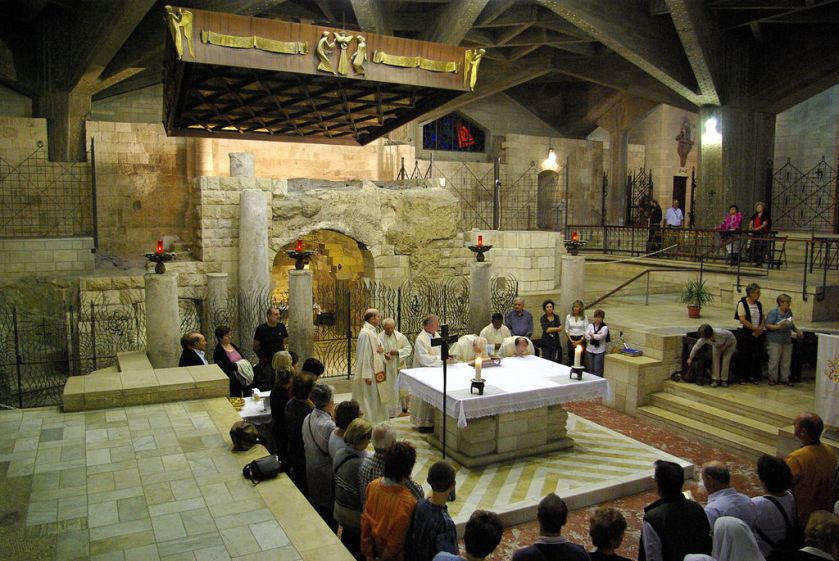
The Grotto of the Annunciation at Nazareth and below Mass being said in front of it
Again Lent’s austerity is interrupted as we solemnly keep a feast in honour of the Annunciation. The Annunciation is a mystery that belongs to the temporal rather than to the sanctoral cycle in the Church’s calendar. For the feast commemorates the most sublime moment in the history of time, the moment when the Second Divine Person of the most Holy Trinity assumed human nature in the womb of the Virgin Mary. Thus it is a feast of our Lord, even as it is of Mary, although the liturgy centres wholly around the Mother of God.
The Church’s Year of Grace, Pius Parsch
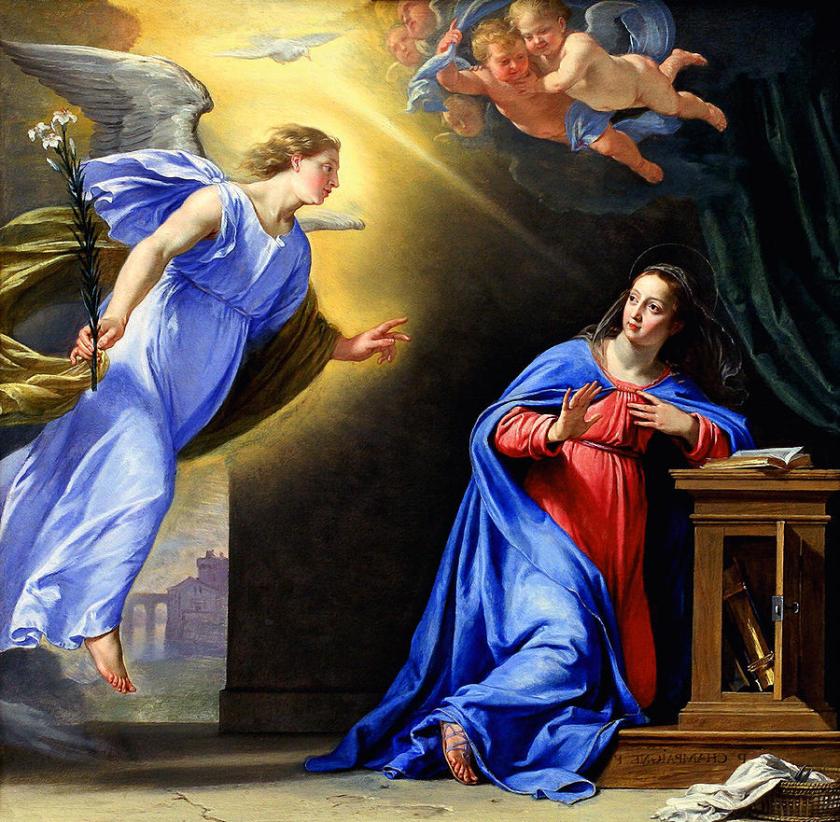
Philippe de Champaigne
The Annunciation, a tradition which has come down from the apostolic ages, tells us that the great mystery of the Incarnation was achieved on the twenty-fifth day of March. It was at the hour of midnight, when the most holy Virgin was alone and absorbed in prayer, that the Archangel Gabriel appeared before her and asked her, in the name of the blessed Trinity, to consent to become the Mother of God. Let us assist, in spirit, at this wonderful interview between the angel and the Virgin and, at the same time, let us think of that other interview which took place between Eve and the serpent. A holy bishop and martyr of the second century, Saint Irenaeus, who had received the tradition from the very disciples of the apostles, shows us that Nazareth is the counterpart of Eden.
In the garden of delights there is a virgin and an angel and a conversation takes place-between them. At Nazareth a virgin is also addressed by an angel and she answers him but the angel of the earthly paradise is a spirit of darkness and he of Nazareth is a spirit of light. In both instances it is the angel that has the first word. ‘Why,’ said the serpent to Eve, ‘hath God commanded you, that you should not eat of every tree of paradise?’ His question implies impatience and a solicitation to evil, he has contempt for the frail creature to whom he addresses it but he hates the image of God, which is upon her.
See, on the other hand, the angel of light, see with what composure and peacefulness he approaches the Virgin of Nazareth, the new Eve and how respectfully he bows himself down before her: ‘Hail, full of grace! The Lord is with thee! Blessed art thou among women!’ Such language is evidently of heaven, none but an angel could speak thus to Mary.
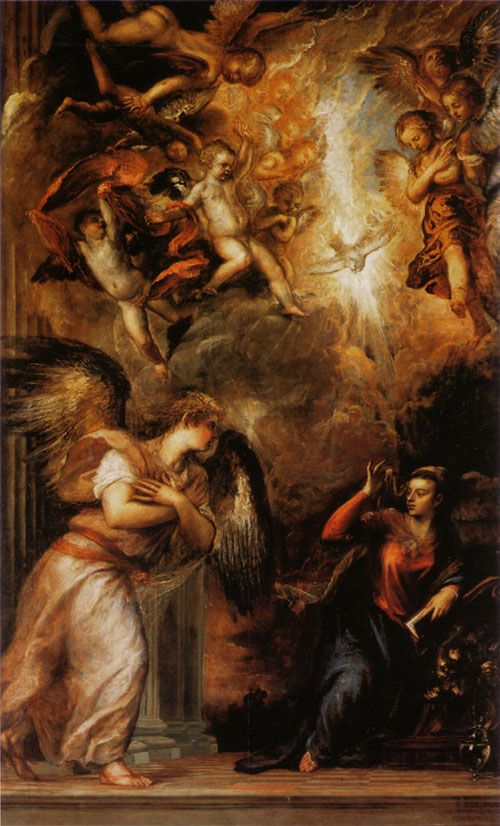
Titian
Scarcely has the wicked spirit finished speaking than Eve casts a longing look at the forbidden fruit, she is impatient to enjoy the independence it is to bring her. She rashly stretches forth her hand, she plucks the fruit, she eats it and death takes possession of her, death of the soul, for sin extinguishes the light of life and death of the body, which being separated from the source of immortality, becomes an object of shame and horror and finally crumbles into dust.
But let us turn away our eyes from this sad spectacle and fix them on Nazareth. Mary has heard the angel’s explanation of the mystery, the will of heaven is made known to her and how grand an honour it is to bring upon her! She, the humble maid of Nazareth, is to have the ineffable happiness of becoming the Mother of God and yet, the treasure of her virginity is to be left to her! Mary bows down before this sovereign will and says to the heavenly messenger: ‘Behold the handmaid of the Lord, be it done to me according to thy word.’
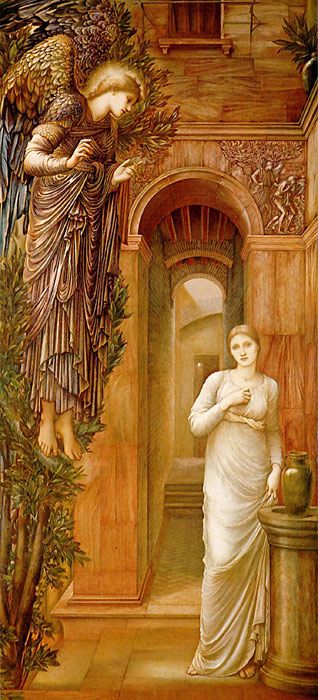
Edward Burne-Jones
Thus, as the great St Irenaeus and so many of the holy fathers remark, the obedience of the second Eve repaired the disobedience of the first, for no sooner does the Virgin of Nazareth speak her fiat, ‘be it done,’ than the eternal Son of God (who, according to the divine decree, awaited this word) is present, by the operation of the Holy Ghost, in the chaste womb of Mary and there, He begins His human life. A Virgin is a Mother and Mother of Go; and it is this Virgin’s consenting to the divine will, that has made her conceive by the power of the Holy Ghost. This sublime mystery puts between the eternal Word and a mere woman the relations of Son and Mother, it gives to the almighty God a means whereby He may, in a manner worthy of His majesty, triumph over satan, who hitherto seemed to have prevailed against the divine plan.
Never was there a more entire or humiliating defeat than that which this day befell satan. The frail creature, over whom he had so easily triumphed at the beginning of the world, now rises and crushes his proud head. Eve conquers in Mary. God would not choose man for the instrument of His vengeance, the humiliation of satan would not have been great enough and, therefore, she who was the first prey of hell, the first victim of the tempter, is selected to give battle to the enemy. The result of so glorious a triumph, is that Mary, is to be superior not only to the rebel angels but to the whole human race, yea, to all the angels of heaven. Seated on her exalted throne, she, the Mother of God, is to be the Queen of all creation. Satan, in the depths of the abyss, will eternally bewail his having dared to direct his first attack against the woman, for God has now so gloriously avenged her and in heaven, the very Cherubim and Seraphim reverently look up to Mary and deem themselves honoured when she smiles upon them, or employs them in the execution of any of her wishes, for she is the Mother of their God.
Therefore, is it that we, the children of Adam, who have been snatched by Mary’s obedience from the power of hell, solemnise this day of the Annunciation. Well may we say of Mary those words of Debbora, when she sang her song of victory over the enemies of God’s people: ‘The valiant men ceased and rested in Israel, until Debbora arose, a mother arose in Israel. The Lord chose new wars, and He Himself overthrew the gates of the enemies.” Let us also refer to the holy Mother of Jesus these words of Judith, who by her victory over the enemy was another type of Mary: ‘Praise ye the Lord our God, who hath not forsaken them that hope in Him. And by me, His handmaid, He hath fulfilled His mercy, which He promised to the house of Israel and He hath killed the enemy of His people by my hand this night. . . . The almighty Lord hath struck him, and hath delivered him into the hands of a woman, and hath slain him.’
–Excerpted from The Liturgical Year, Abbot Gueranger OSB
















You must be logged in to post a comment.