Thought for the Day – 15 September – Meditations with Antonio Cardinal Bacci (1881-1971)
Mary’s Only Treasure
“Jesus had only one consolation in the midst of His terrible sufferings. His Mother, Mary was beside the Cross along with His beloved Apostle and the holy women who had always followed Him. Mary loved her Son with a love greater than that of any mother, which is the greatest love possible on earth. She loved Jesus with the heart of a Mother and of a Virgin – He was her only treasure. Moreover, she loved Him, not only as her Son but, also as her God. Precisely because she loved Him as her God, her love was in perfect harmony with the divine will.
She understood the mystery which led Jesus to accept death on the Cross – the mystery of the Redemption. “He was offered because it was his own will” (Isa 53:7). He was offered on our behalf, as a voluntary victim to His heavenly Father.”
One Minute Reflection – 15 September – “Month of the Seven Sorrows of the Blessed Virgin Mary” and Memorial of the Seven Sorrows of our Mother – Readings: First Timothy 3: 14-16; Psalm 111: 1-6; John 19: 25-27 or Luke 2: 33-35
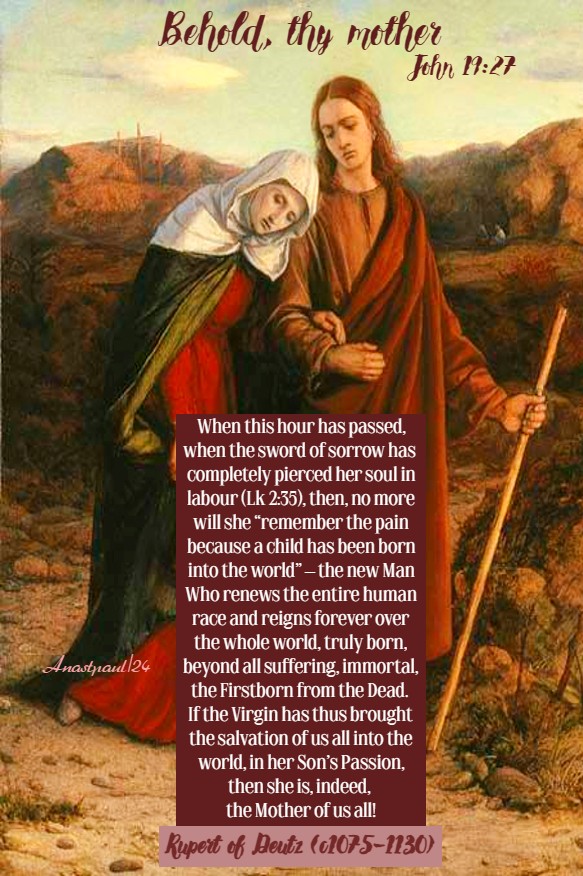
“Behold, thy mother” – John 19:27
REFLECTION – “Woman, this is thy son. This is thy mother.” By what right is the disciple. whom Jesus loved, the son of the Lord’s mother? By what right is she his mother? By the fact that, without pain, she brought into the world the salvation of us all, when she gave birth in the flesh to the God-Man. But now, she is in labour, with great pain as she stands at the foot of the Cross!
At the hour of His Passion, the Lord Himself rightly compared the Apostles to a woman in childbirth, when He said: “When a woman is in labour she is in anguish because a child is born into the world” (cf Jn 16:21). How much more, then, might such a Son compare such a Mother, the Mother standing at the foot of His Cross, to a woman in labour? What am I saying? “Compare?” She is indeed truly a woman and truly a mother and, at this hour, she is truly experiencing the pains of childbirth. When her Son was born she did not experience the anguish of giving birth in pain as other women do; it is now that she is suffering, that she is crucified, that she experiences sorrow; like a woman in labour because her hour has come ( Jn 16:21; cf 13:1; 17:1). …
When this hour has passed, when the sword of sorrow has completely pierced her soul in labour (Lk 2:35), then, no more will she “remember the pain because a child has been born into the world” – the new Man Who renews the entire human race and reigns forever over the whole world, truly born, beyond all suffering, immortal, the Firstborn from the Dead. If the Virgin has thus brought the salvation of us all into the world, in her Son’s Passion, then she is, indeed, the Mother of us all!” – Rupert of Deutz (c1075-1130) Benedictine Monk, Theologian, Exegete and Writer – (Commentary on Saint Johns Gospel, 13).
PRAYER – Our Father, when Jesus Your Son, was raised up on the Cross, it was Your will that Mary, His Mother, should stand there and suffer with Him in her heart. Grant that in union with her, the Church may share in the passion of Christ and so be brought to the glory of His Resurrection. Be our intercessor and our consolation, Our Lady of Sorrows, amen.
Saint of the Day – 15 September – Our Sorrowful Mother Mary –
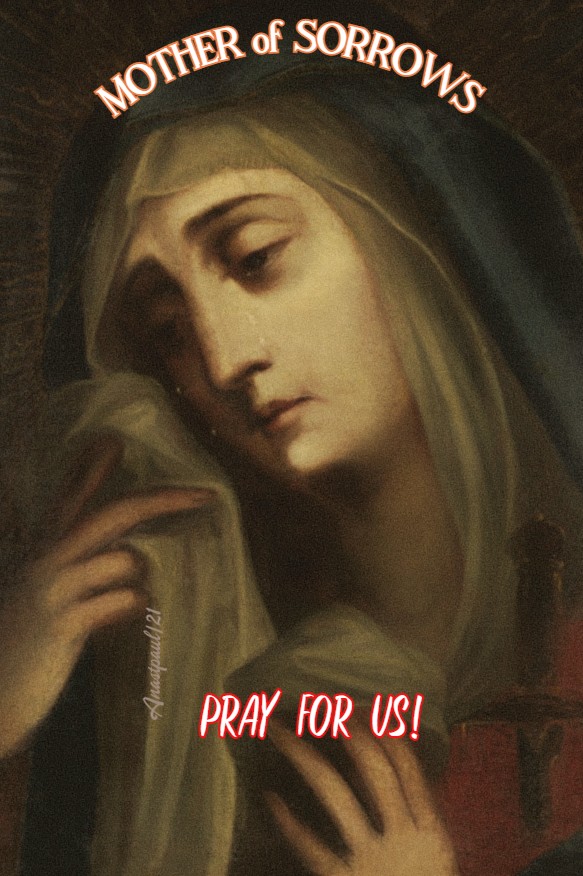
The Seven Sorrows of the Blessed Virgin Mary Also known as: • Septem Dolorum. • Beata Maria Virgo Perdolens • Beata Vergine Addolorata • Dolorosa • Maria Santissima Addolorata • Mater Dolorosa • Mother of Sorrows • Our Lady of the Seven Dolours • Our Lady of the Seven Sorrows • Sorrowful Mother
The Seven Sorrows of Mary
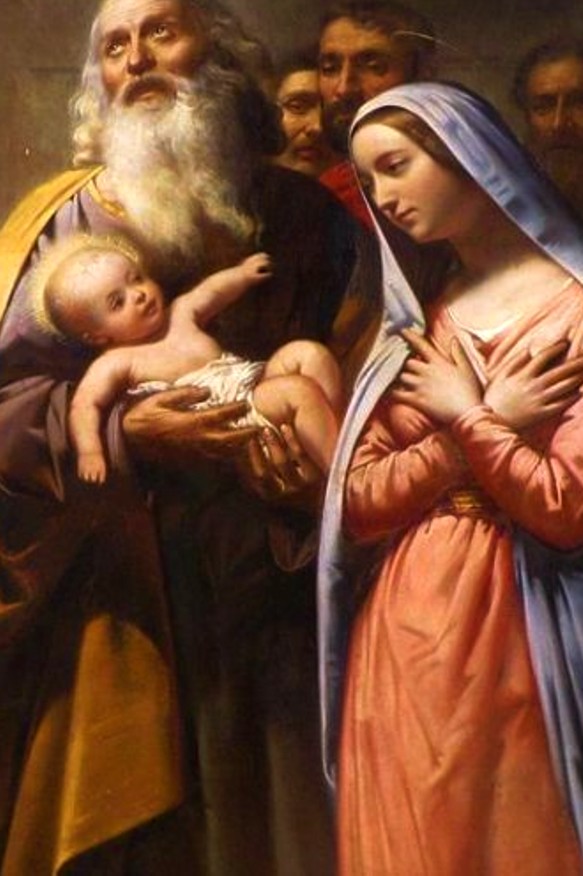
The Prophecy of Simeon at the Presentation of the Lord in the Temple: Forty days after Christ’s birth, Mary presented Him in the temple. The aged Simeon, a just and devout servant of the Lord, took Jesus into his arms and inspired by the Holy Spirit, exclaimed:
“Behold, this child is destined for the fall and for the rise of many in Israel and for a sign that shall be contradicted. And thy own soul a sword shall pierce, that the thoughts of many hearts may be revealed.” Luke 2:34-35
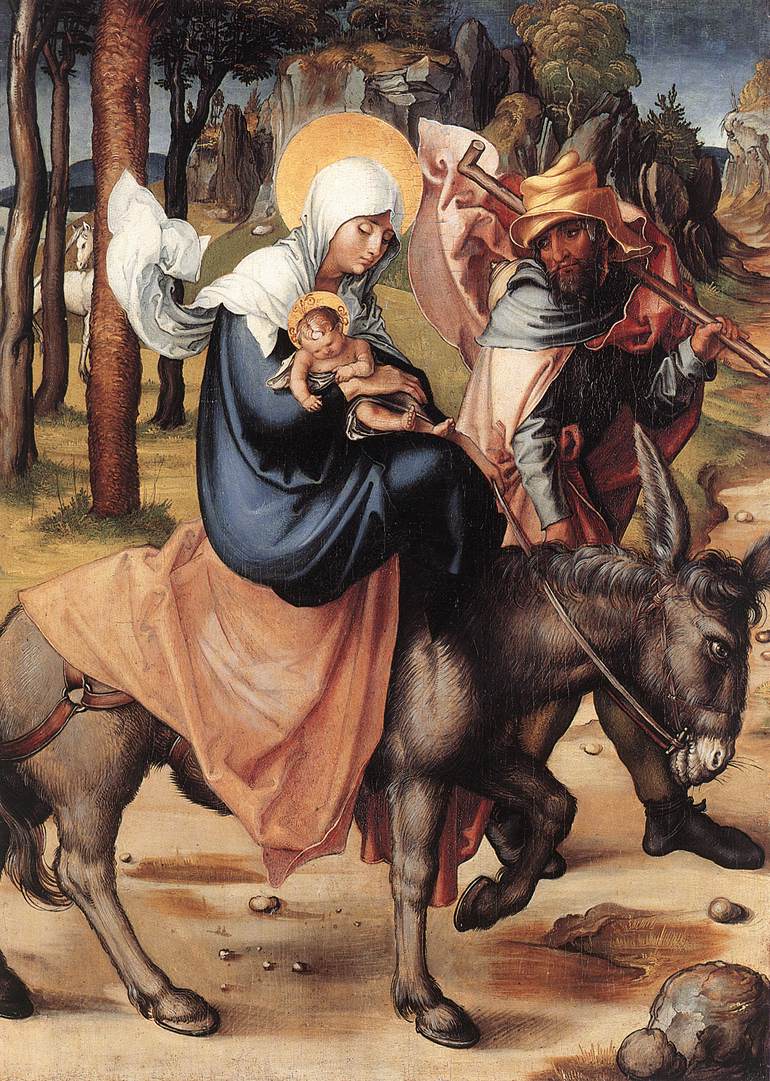
The Flight Into Egypt: No sooner did the heartless Herod hear that Jesus, the Infant King of the Jews, had been born, than he sought His life. But an Angel of the Lord appeared to Saint Joseph in a dream and warned:
“Arise, take the Child and His mother and flee into Egypt and remain there until I tell thee.” – Matthew 2:13
The Loss of Child Jesus for 3 Days: The third sword that pierced Our Lady’s heart was the three-day loss in the temple. At the age of twelve, Jesus went with Mary and Joseph to Jerusalem. Only when Mary and Joseph were travelling home, realise that Jesus was not with them. They hurried back and for three days sought Him among friends and relatives in Jerusalem. Finally, they found Him in the temple, listening and discussing with the teachers there , who were amazed at his knowledge and wisdom.
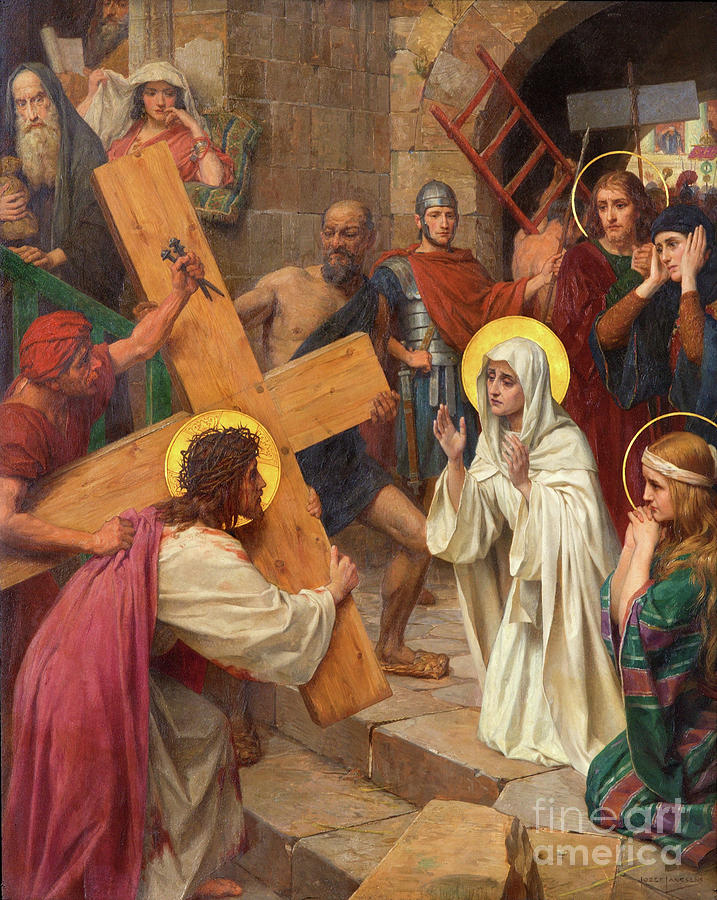
The Meeting of Jesus on the Way of The Cross: Mary’s fourth great sorrow we remember in the fourth Sorrowful Mystery of the Rosary and also the fourth Station of the Cross. Mary meets Jesus carrying His Cross to Calvary. What a mournful meeting. Imagine the pain in Mary’s heart to see her Jesus groaning and staggering under the cruel Cross. What an anguish to see the One she loved so dearly, being tortured by the taunts of the crowd, as well as the weight of the wood. And there is nothing she is able to do to help Him.
The Crucifixion and Death of Jesus: But the sword will plunge still deeper. She must see Him shamefully stripped of His garments, rudely thrown upon the Cross and then hear the sickening strokes of the hammer. Helplessly and heartbroken, she must stand beneath His cross watching Him writhe in torture, listening to His parting words, listening for His parting breath.
The Pieta – Jesus Is Laid In The Arms Of His Mother: And now comes the moment when they take Him down from the Cross. As each nail and each thorn was pulled from His body, it was a new blow to the heart of His Mother. How she must have hugged Him to her heart!
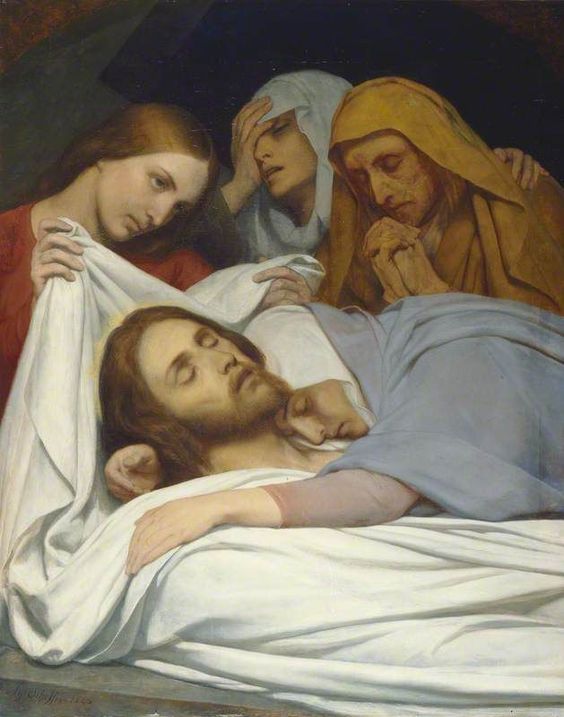
Jesus is Laid in The Tomb: The seventh sword was to witness that broken body laid in the grave. It was a Mother putting her child to bed. What a grief-stricken good-night that was. Mary must have wished that she could bury her heavy heart with Him.
During Passiontide, on the Friday before Palm Sunday, a second feast of Mary’s Dolors is held, which emphasises particularly, the four last mentioned of the seven sorrows above.
Thus the Church reflects on the feast of the Seven Sorrows of the Blessed Virgin Mary. The prayers of the Mass and the Office are indicative of her sorrows.
The first trace of the feast, St Alphonsus Liguori tells us, is found in Germany towards the beginning of the fifteenth century. Archbishop Theodoric’s ordered the keeping of this day at an assembly convened at Cologne in 1413 to wage battle against heresies of the iconoclast “Hussites,” who were very active in destroying images and pictures of Our Lady of Sorrows.
Before the sixteenth century the feast was observed only in the Diocese of North Germany, Scandinavia and Scotland but by the end of the sixteenth century, it extended over the south of Europe. In 1506 the celebration was granted the Friday before Passion Sunday as the feast of the Sorrows of Mary. To the whole German Church this last date was later assigned. On 22 April 1727, Pope Benedict XIII, extended it to the entire Latin Church under the title “Septem dolorum.”
Thought for the Day – 12 September – Meditations with Antonio Cardinal Bacci (1881-1971)
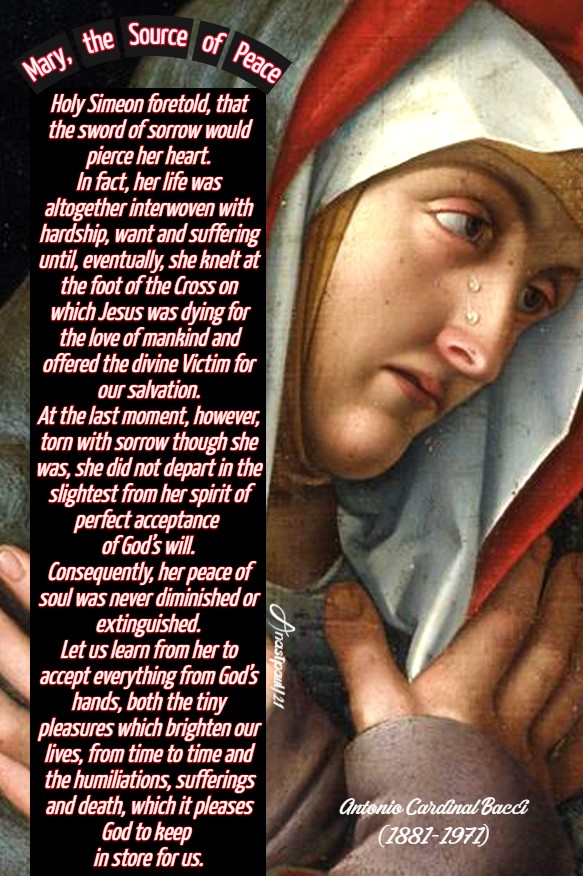
Mary, the Source of Peace
“Mary is surrounded by an atmosphere of peace. The countenance of the Virgin Mother, reflects the serenity of her soul. She was conceived free from original sin and endowed with every grace ad with every supernatural gift. There was no struggle in her, between good and evil, for this conflict is the effect of concupiscence. She never experienced the rule of sin of which St Paul complains. “I see another law in my members,” says St Paul, “warning against the law of my mind and making me prisoner to the law of sin that is in my members. Unhappy man that I am! Who will deliver me from the body of this death? The grace of God, through Jesus Christ our Lord” (Rom 7:23-25). It was quite otherwise with Mary. Her lower inclinations were completely subject to her spiritual faculties, which were, in their turn, perfectly submissive to the commands and inspirations of God. Nevertheless, while she enjoyed complete interior harmony, Mary had to endure external conflict and suffering. Holy Simeon foretold, that the sword of sorrow would pierce her heart. In fact, her life was altogether interwoven with hardship, want and suffering until, eventually, she knelt at the foot of the Cross on which Jesus was dying for the love of mankind and offered the divine Victim for our salvation. At the last moment, however, torn with sorrow though she was, she did not depart in the slightest from her spirit of perfect acceptance of God’s will. Consequently, her peace of soul was never diminished or extinguished. Let us learn from her to accept everything from God’s hands, both the tiny pleasures which brighten our lives, from time to time and the humiliations, sufferings and death, which it pleases God to keep in store for us.”
Thought for the Day – 8 September – Meditations with Antonio Cardinal Bacci (1881-1971)
Mary, Mother of God
“The near-infinite greatness of Mary, flows from the fact, that she is the Mother of God. The Eternal Word of the Father, consubstantial with Him in nature and equal to Him in majesty, willed to become man in order to set us free from the slavery of sin and to regain Heaven for us. He became man in the chaste womb of the Virgin Mary. He took a human body and soul and was born of her, as the God-Man. For this reason, there is attributed to His Divine Person, the title of Son of Mary and to Mary, the title of Mother of God.
There is a relationship between Mary and each of the three Divine Persons, for she is the daughter of God the Father, the spouse of the Holy Spirit by whose power the Word became incarnate in her and the mother of the Word made Man. She is, moreover, in the words of Dante, the “termine fisso di eterno consiglio” (Paradiso 33:1-3). In other words, she is the centre of the eternal plan which God established for the redemption of the human race. It was God’s eternal design to reunite creation to the Uncreated, by means of Mary. She became the mother of the Eternal Word, in whom the divine and human natures were indissolubly united. He redeemed us by His infinite merits but, in this work of redemption, He employed the co-operation of His holy Mother. All the graces, privileges and virtues of Mary, flow from this great mystery of her divine Motherhood. As befitted the future Mother of God, she was conceived free from the stain of original sin and full of grace. Her mortal life was a continuous ascent towards the highest peak of sanctity. When she died, she was assumed body and soul into Heaven, where she was crowned in glory, as Queen of Angels and Queen of Saints. When we consider the sublime nobility of Our Lady, we should be moved to love and venerate her. This love and veneration does not subtract in the slightest from God’s glory, because, she is the Mother of God. In fact, it is a great advantage to us, to imitate her and to call on her to intercede for us.”
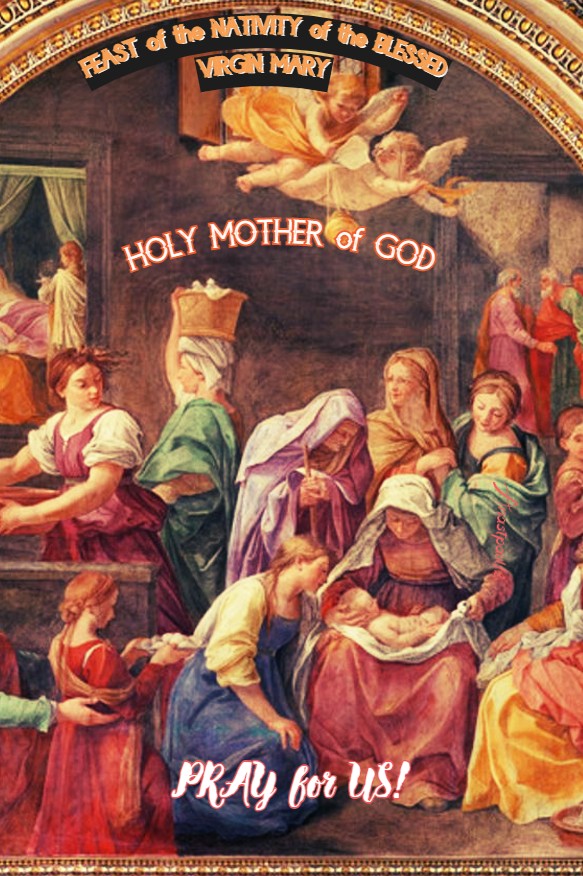
One Minute Reflection –8 September – Feast of theNativity of the Blessed Virgin Mary – Readings: Micah 5:1-4a or Romans 8:28-30, Psalms 13:6, 6, Matthew 1:1-16, 18-23
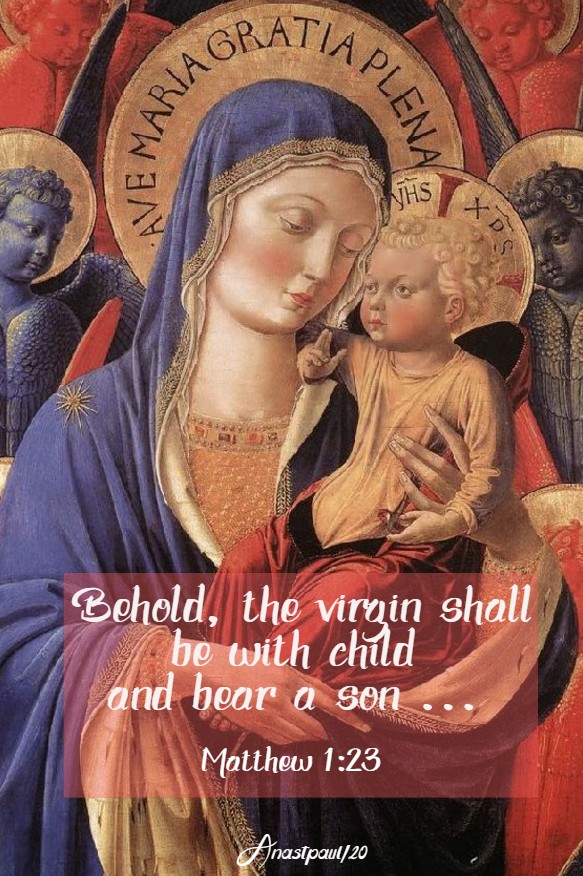
“Behold, the virgin shall be with child and bear a son – Matthew 1:23
REFLECTION – “Come, you nations; come, all peoples of every race and language, every age and rank. Joyfully let us celebrate the nativity of the whole world’s joy! If even the pagans honour the birthday of their king … what ought not we to do to honour that of the Mother of God, through whom all humanity has been transformed and the pain of Eve, our first mother, has been turned to joy? For Eve heard God’s sentence: “You will bring forth children in pain” (Gn 3:16) but Mary: “Rejoice, most highly favoured … the Lord is with you” (Lk 1:28). …
Let all creation celebrate and sing the holy childbirth of a holy woman, for she has brought a lasting treasure into the world. … Through her, the creative Word of God has been united to the whole creation and we celebrate the ending of human barrenness, the ending of the sickness that kept us from possessing all our good. … Nature has given way to grace … As the Virgin Mother of God had to be born of barren Anna, so nature remained without fruit until grace had produced its own. It was to open the womb of its mother, she who would give birth to “The Firstborn of all creation” in whom “all things hold together” (Col 1:15,17).
O blessed couple, Joachim and Anna! All creation owes you thanks; through you it has offered the Creator the best of all His gifts: a Mother worthy of veneration, the only Mother worthy of the One who created her. ”- St John Damascene (675-749) Monk, Theologian, Father and Doctor of the Church – Homily on the Nativity of the Virgin Mary, 1-2 (cf SC 80, p. 48)
PRAYER – Lord God, the day of our salvation dawned when the Blessed Virgin gave birth to Your Son. As we celebrate her nativity, grant us Your grace and Your peace. Through Christ, our Lord, Your Son in union with the Holy Spirit. Mary, Mother of God, pray for us, amen.
Vigil of the Nativity of the Nativity of the Blessed Virgin Mary, instituted by Pope Gregory II (722):
The day destined for the parturition of Saint Anne and for the birth of her, who was consecrated and sanctified to be the Mother of God, had arrived – a day most fortunate for the world. This birth happened on the eighth day of September, fully nine months having elapsed since the Conception of the soul of our most holy Queen and Lady.
Saint Anne was prepared by an interior voice of the Lord, informing Her, that the hour of her parturition had come. Full of the joy of the Holy Spirit at this information, she prostrated herself before the Lord and besought the assistance of his grace and his protection for a happy deliverance.
Presently she felt a movement in her womb similar to that which is proper to creatures being born to the light. The most blessed child Mary was at the same time, by divine providence and power, ravished into a most high ecstasy. Hence Mary was born into the world without perceiving it by her senses, for their operations and faculties were held in suspense. As She had the use of her reason, she would have perceived it by her senses, if they would have been left to operate in their natural manner at that time. However, the Almighty disposed otherwise, in order that the Princess of heaven might be spared the sensible experience, otherwise connected with birth. she was born pure and stainless, beautiful and full of grace, thereby demonstrating, that she was free from the law and the tribute of sin. Although she was born substantially like other daughters of Adam, yet her birth was accompanied by such circumstances and conditions of grace, that it was the most wonderful and miraculous birth in all creation and will eternally redound to the praise of her Maker.
At twelve o-clock in the night this divine child issued forth, dividing the night of the ancient Law and its pristine darknesses from the new day of grace, which now was about to break into dawn. She was clothed, handled and dressed like other infants, through she excelled all mortals and even all the angels in wisdom. Her mother did not allow her to be touched by other hands than her own but she, herself, wrapped her in swaddling clothes: and in this Saint Anne was not hindered by her present state of incapacity, for she was free from the toils and labours, which mothers endure in such circumstances.
So then Saint Anne received in her arms she, who was her Daughter but at the same time, the most exquisite treasure of all the universe, inferior only to God and superior to all other creatures. (The City of God, by Venerable Mary of Jesus of Agreda OIC (1602-1665) [Her body is incorrupt].
St Alcmund of Hexham Bl Alexander of Milan St Augustalus St Balin St Carissima of Albi St Chiaffredo of Saluzzo Bl Claude-Barnabé Laurent de Mascloux
St Desiderio of Benevento St Dinooth Bl Eugenia Picco St Eupsychius of Caesarea St Eustace of Beauvais St Evortius of Orleans St Faciolus St Festo of Benevento Bl François d’Oudinot de la Boissière
St Giovanni of Lodi St Goscelinus of Toul St Gratus of Aosta St Grimonia of Picardy St Hiduard Bl Ignatius Klopotowski Bl John Duckett Bl John Maki Bl John of Nicomedia Bl Ludovicus Maki Soetsu Madalberta Bl Maria of Bourbon St Marko Križevcanin St Melichar Grodecký St Memorius of Troyes St Pamphilus of Capua Bl Ralph Corby
St Sozonte Blessed Thomas Tsuji SJ (1570-1627) Priest of the Society of Jesus, Martyr.
St Tilbert of Hexham — Martyrs of Noli: Four Christians who became soldiers and were martyred together for their faith. A late legend makes them member of the Theban Legend who escaped their mass martyrdom but that’s doubtful – Paragorius, Partenopeus, Parteus and Severinus. They were born in Noli, Italy and martyred in Corsica, France. Attribute – soldiers with a banner of Noli.
Martyred in the Spanish Civil War: • Blessed Antoni Bonet Sero • Blessed Ascensión Lloret Marcos • Blessed Gregorio Sánchez Sancho • Blessed Félix Gómez-Pinto Piñero
September – Month of The Seven Sorrows of the Blessed Virgin Mary
The Seven Sorrows of the Blessed Virgin Mary
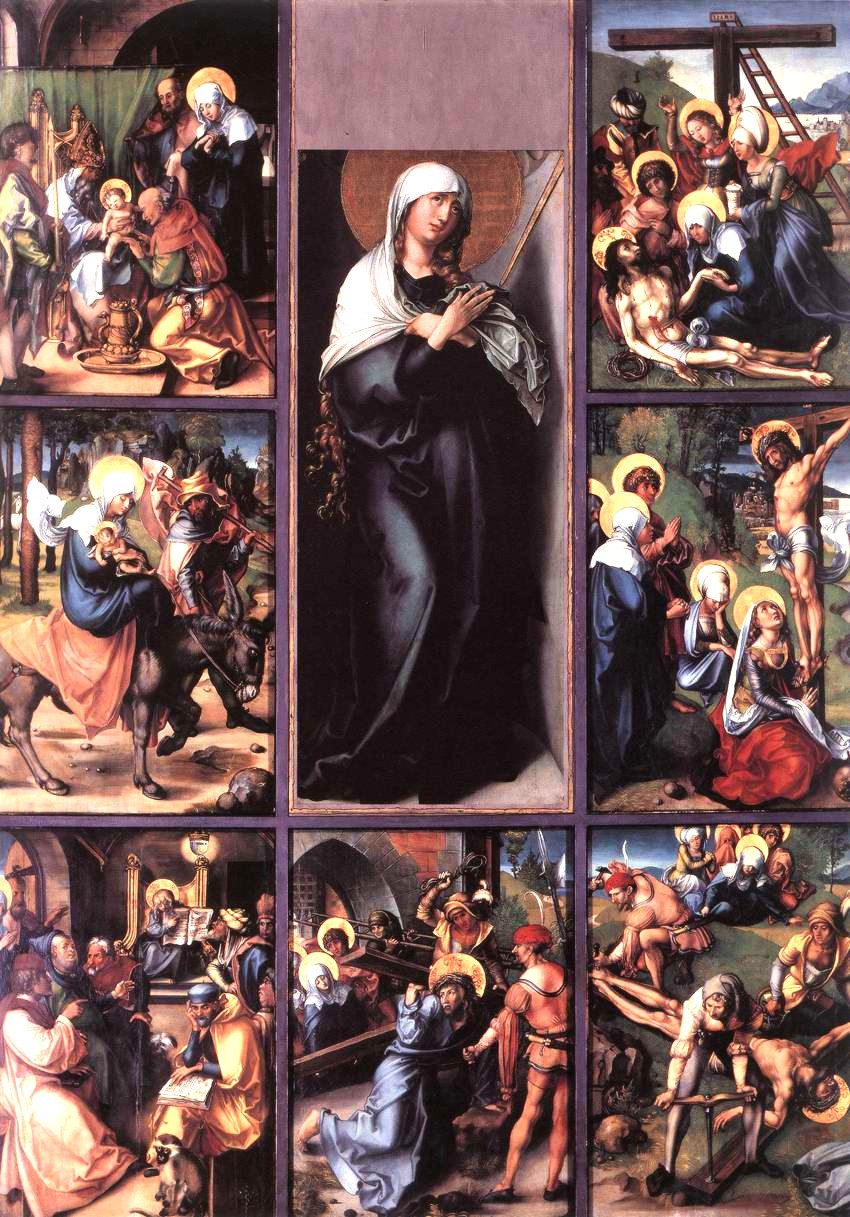
1, The prophecy of Simeon 2. The Flight to Egypt 3. Loss of Child Jesus for 3 days 4. Meeting Jesus carrying His Cross 5. The Crucifixion of Jesus 6. The Pieta – receiving Jesus’ Body The Burial of Jesus
The Seven Sorrows of the Virgin – Altarpiece by Albrecht Dürer.
During this month of September, we are drawn into the spiritual Martyrdom which the Blessed Mother experienced during the physical Martyrdom of Jesus. The evils of sin are manifest but conquered through intense suffering. The Blessed Mother’s tears of anguish reflect God’s washing away of sin.
We see this theme of joy followed by affliction mirrored in the liturgical calendar in two September Feasts – the Exaltation of the Holy Cross on 14 September and the Feast of Our Lady of Sorrows on 15 September. Happy the heart of the blessed Virgin Mary! She, without dying, earned the treasure of Martyrdom beneath the Cross of our Lord for her anguish.
The name of Our Lady of Sorrows centres on the extraordinary and bittersweet suffering the Blessed Mother experienced during Christ’s Passion. As seen in the artwork above, her agony is composed of “The Seven Dolors,” that pierced the Heart of Mary. Dürer’s portrayal of each event encompasses the central figure of Christ’s sorrowful Mother.
Our Morning Offering – 1 September – “Month of the Seven Sorrows of Mary”
As we enter the Month of our Sorrowful Mother, let us unite ourselves to her and offer her our meagre consolation.
What Can I Say? By St Anselm (1033-1109) Magnificent Doctor Marian Doctor
My most merciful Lady, what can I say about the fountains that flowed from your most pure eyes when you saw your only Son before you, bound, beaten and suffering? What do I know of the flood that drenched your matchless face, when you beheld your Son, your Lord and your God, stretched on the Cross without guilt, when the flesh of your flesh was cruelly butchered by wicked men? How can I judge, what sobs, troubled your most pure breast, when you heard, “Woman, behold your son,” and the disciple, “Behold, your Mother,” when you received as a son the disciple in place of the Master, the servant for the Lord? Amen
From “The Prayers and Meditations of Saint Anselm with the Proslogion,” Benedicta Ward, trans,1973, Penguin classics, Penguin Group (UK)
Thought for the Day – 31 August – Meditations with Antonio Cardinal Bacci (1881-1971)
Prayer and Our Lady
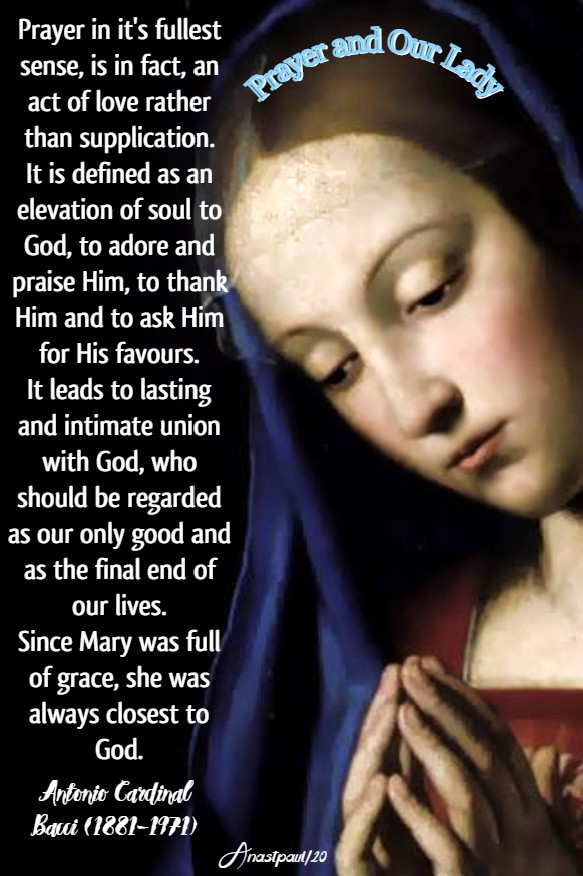
“He told them a parable – that they must always pray and not lose heart” (Lk 18:1). Nobody else on earth ever carried out this command of Our Lord as perfectly as Our Lady. St Albert the Great says that, after Jesus Christ, the spirit of prayer is to be found at it’s most perfect, in Our Lady (Sup Miss 80). It was because of her immense love for her divine Son that Mary was able to put into practice, throughout her life, that Gospel precept of unceasing prayer. Prayer in it’s fullest sense, is in fact, an act of love rather than supplication. It is defined as an elevation of soul to God, to adore and praise Him, to thank Him and to ask Him for His favours. It leads to lasting and intimate union with God, who should be regarded as our only good and as the final end of our lives. Since Mary was full of grace, she was always closest to God. Even before she became His Mother, she constantly enjoyed His intimacy. Despite the many sorrows of her life, this intimacy became still greater and more beautiful, when she became the Mother of Jesus. From that time, she was able to hold Him to her immaculate bosom and to live in close familiarity with Him. She was able, too, to follow Him on His apostolic journeys, until He reached Calvary and the Cross and, finally, to see Him gloriously risen from the dead. After Jesus had ascended into Heaven, her soul expanded with a nostalgic love for her divine Son, until her earthly journey was over and she was taken up into Heaven. There, she reigns supreme among the Saints and Angels and never ceases to pray for us, her exiled children, who need her help so much. Let us learn from Mary, how to pray with love and perseverance. Then, we shall be able to follow her along the difficult way of perfection, which leads towards Heaven.”
Antonio Cardinal Bacci
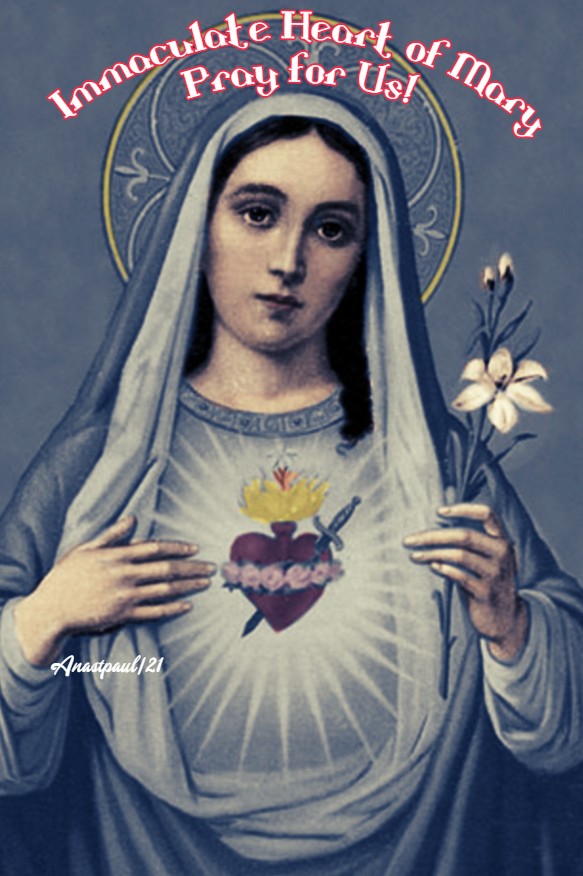
On this last day of the Month of the Immaculate Heart of Mary, let us call upon her in all our great needs.
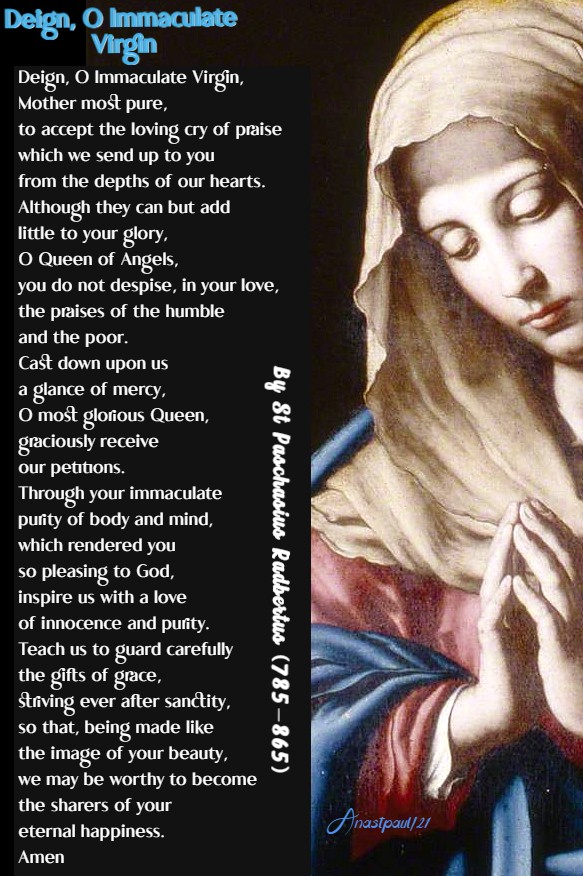
Deign, O Immaculate Virgin By St Paschasius Radbertus (785–865)
Deign, O Immaculate Virgin, Mother most pure, to accept the loving cry of praise which we send up to you from the depths of our hearts. Though they can but add little to your glory, O Queen of Angels, you do not despise, in your love, the praises of the humble and the poor. Cast down upon us a glance of mercy, O most glorious Queen, graciously receive our petitions. Through your immaculate purity of body and mind, which rendered you so pleasing to God, inspire us with a love of innocence and purity. Teach us to guard carefully the gifts of grace, striving ever after sanctity, so that, being made like the image of your beauty, we may be worthy to become the sharers of your eternal happiness. Amen
Thought for the Day – 5 August – Meditations with Antonio Cardinal Bacci (1881-1971)
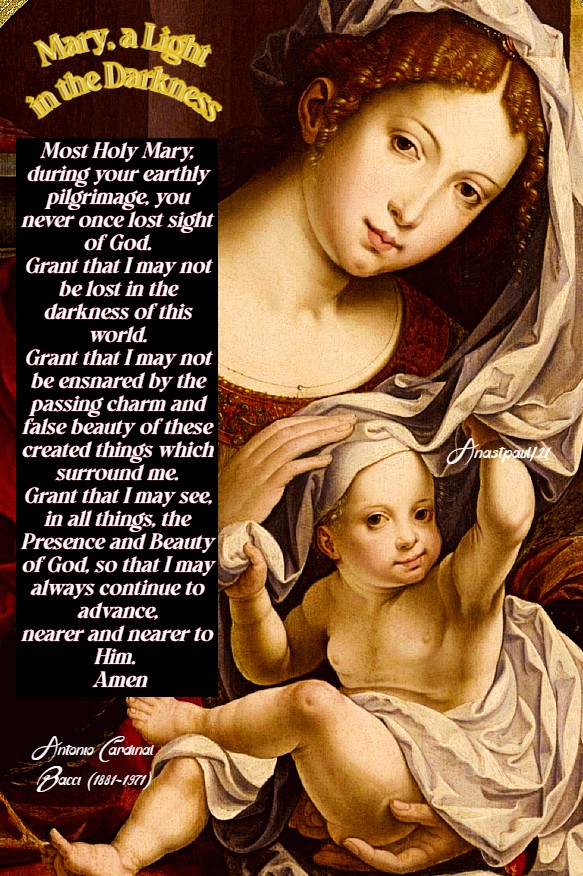
Mary, a Light in the Darkness
“Let us imagine for a moment, that we have grown blind and are forever plunged in darkness. It is an unhappy thought. Never again to see those who are dear to us, never to see the light of the sun nor any of the splendour of the universe. We should feel as if were alone, for we should have to depend only on sounds and on the voices of others for communication with the external world. As St Augustine points out, however, in his commentary on the miracle of the man who had been blind from birth, we are all more or less blind in the supernatural order. The world is the image of God but, do we see His Presence in everything which surrounds us? Is it not more often the case that created things distract us and lead us to forget their Creator because, we regard them as a means of satisfying our own comfort and our own ego? We should look on creatures as go-betweens which help us to ascend to God, the beginning and end of all creation.
Unfortunately, instead of climbing this mystical ladder which leads us to God, we often descend it. We forget God and become excessively wrapped up in worldly affairs. Sometimes matters may be even worse, not only do we forget God through our love of creatures but, we use them, to offend Him. God has given us eyes to admire His works and, as a result, to lead us to praise, thank and love Him. Instead, we often use this wonderful gift in order to commit sin. He has given us the gift of speech, the gift of hearing and other senses. But how do we employ them? The tongue is a marvellous invention but, as St James writes, “if anyone does not offend in the word, he is a perfect man, able also to lead round by the bridle, the whole body … With it we bless God the Father and, with it, we curse men, who have been made after the likeness of God. Out of the same mouth, proceed blessing and cursing. These things, my brethren ought not to be so” (Js 3:2-10). What can be said of vision and of speech can be said of all the senses and faculties of body and soul. They are all God’s gifts and should, therefore, be used as means of bringing ourselves closer to Him. If creatures lead us away from God and cause us to forget Him, or if, worse still, they cause us to offend Him, then we are spiritually blind and far more unfortunate than those who have lost their natural vision.
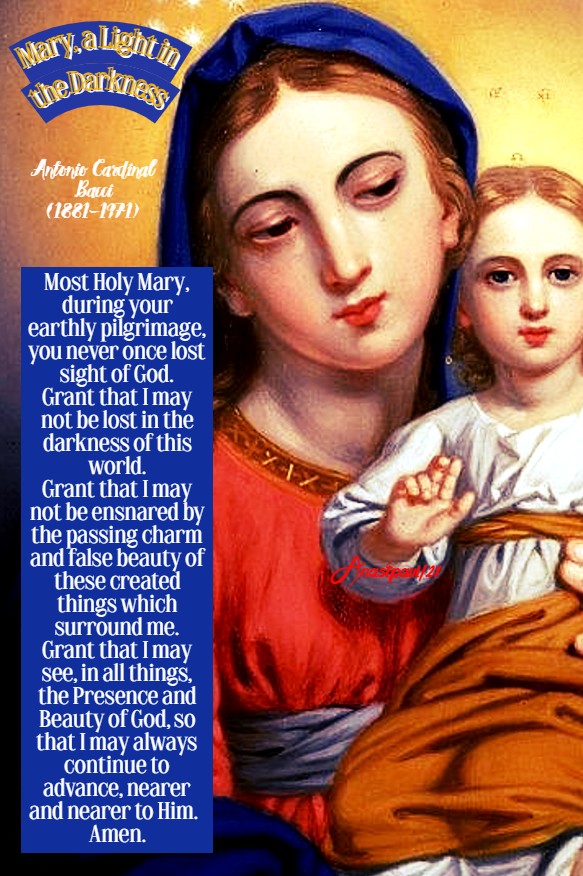
Most Holy Mary, during your earthly pilgrimage, you never once lost sight of God. Grant that I may not be lost in the darkness of this world. Grant that I may not be ensnared by the passing charm and false beauty of these created things which surround me. Grant that I may see, in all things, the Presence and Beauty of God, so that I may always continue to advance, nearer and nearer to Him. Amen.”
Thought for the Day – 12 June – Meditations with Antonio Cardinal Bacci (1881-1971) “Month of the Sacred Heart” – Memorial of the Immaculate Heart of Mary
“All Generations Shall Call Me Blessed”
‘A Jewish girl, poor in this world’s goods but rich in virtue, arrived after a long and difficult journey at a village in the hills of Judea, called Hebron. There, she paid a visit to her cousin, Elizabeth. When Elizabeth saw the girl, she was immediately enlightened by the Holy Spirit with the knowledge, that her visitor, was the Mother of God. “How have I deserved,” she cried out, “that the mother of my Lord, should come to me?” (Lk 1:43). At these words, Mary looked up towards Heaven and gave spontaneous expression to a hymn of humble acknowledgement to God, Who had “regarded the lowliness of His Handmaid” (Lk 1:48). Then she made a solemn prophecy, which would surely have assured the cynical intellectuals and nobles of the land but, which history has wonderfully fulfilled. “Behold” she said, “all generations shall call me blessed” (ibid). We can testify today, that this miracle came to pass. All the nations have paid reverence to the Jewish girl, who became the Mother of God and our Mother, the Queen of Heaven and earth, the comforter of the afflicted, the conqueror of Satan and the invincible Guardian of the Church. From the engravings in the Catacombs, to the celestial Madonnas of the Angelico, from the rudimentary sculpture of Roman art, to the prayerful statues on the pinnacles of more modern Cathedrals, the image of Mary has shone as a beacon of hope for all generations. Men bow before her and ask for light, for comfort and for pardon. “If anyone follows Mary,” says St Bernard, “he will not lose his way; if anyone pray to her, he will not despair; if anyone thinks of her, he will not sin; if anyone reaches out to her, he will not fall; if anyone places himself under her protection, he need have no fear; if anyone places himself under her leadership, he will never give up; if anyone pays homage to her, he is certain to reach his destination safely”(Homil Missus est 2:17).”
One Minute Reflection – 12 June – “Month of the Sacred Heart” Memorial of the Immaculate Heart of Mary, Readings: Second Corinthians 5: 14-21, Psalms 103: 1-2, 3-4, 9-10, 11-12, Gospel: Luke 2: 41-51
“And his mother kept all these words in her heart.” – Luke 2:51
REFLECTION – “Often, it seems to us, Mary forgot to eat and to drink, keeping vigil in order to think about Christ, to see Christ in His flesh. She burned with love of Him and passionately loved to serve Him. She often did what the Song of Songs sings about: “I was sleeping, but my heart kept vigil.” (Song 5:2) Even when she was resting, she continued to dream of Him who filled her thoughts throughout the day. Whether she was keeping vigil or resting in peace, she always lived in Him, was always occupied with Him.
Where her treasure was, there also was her heart (Mt 6:21); where her glory was, there also was her mind. She loved her Lord and her Son with all her heart, with all her mind, with all her strength (Mt 22:37). She saw with her eyes, touched with her hands, the Word of Life (1 Jn 1:1). How blessed was Mary, to whom it was given to embrace Him who embraces and nourishes everything! How happy was she who carried Him, who carries the universe (Heb 1:3), she who nursed a Son, who gives her life, a Son who nourishes her and all beings on earth (Ps 145:15).
The One Who is the wisdom of the Father, put His arms around her neck, the One Who is the strength, that gives movement to everything sat in her arms. He Who is the rest of souls, (Mt 11:29) rested on her motherly breast. How gently He held her in His hands, peacefully looked at her, He Whom the angels wish to contemplate (1 Pet 1:12) and He gently called her, He Whom every being calls upon when in need. Filled with the Holy Spirit, she held Him close to her heart … She never had enough of seeing Him or of hearing Him, Whom “many prophets and kings wished to see … but did not see.” (Lk 10:24) Thus Mary grew evermore in love and her mind was unceasingly attached to divine contemplation.” – St Amadeus of Lausanne (1108-1159) Bishop – Homily on Mary, 4
PRAYER – Lord open our hearts to Your grace. As You brought joy to the world through the incarnation of Your Son, Our Lord Jesus Christ, grant that through the prayer of the Immaculate Heart of His Ever-Virgin Mother, our hearts too may grow in virtue and love by learning to reflect constantly on His commandments and counsels. We make our prayer through our Lord Jesus, with the Holy Spirit, God forever, amen.
Thought for the Day – 22 May – “Mary’s Month” – Meditations with Antonio Cardinal Bacci (1881-1971)
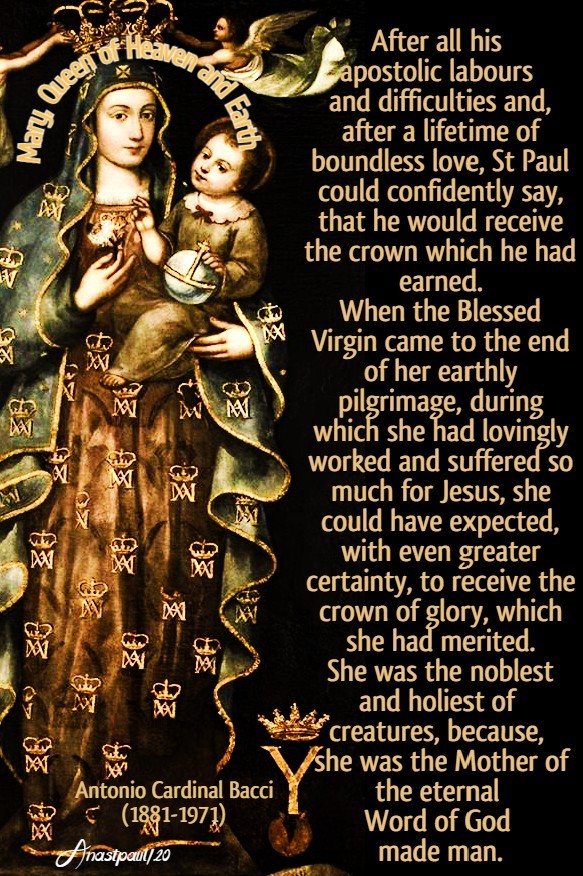
Mary, Queen of Heaven and Earth
“Towards the close of his life, St Paul wrote to his well-beloved disciple, St Timothy: “As for me, I am already being poured out in sacrifice and the time of my deliverance is at hand. I have fought the good fight, I have finished the course, I have kept the faith. For the rest, there is laid up for me a crown of justice, which the Lord, the just judge, will give to me in that day; yet, not to me only but, also to those who love his coming” (2 Tim 4:6-8).
After all his apostolic labours and difficulties and, after a lifetime of boundless love, St Paul could confidently say, that he would receive the crown which he had earned. When the Blessed Virgin came to the end of her earthly pilgrimage, during which she had lovingly worked and suffered so much for Jesus, she could have expected, with even greater certainty, to receive the crown of glory, which she had merited. She was the noblest and holiest of creatures, because, she was the Mother of the eternal Word of God made man. Therefore, her reward had to be greater than that of any other creature. She was the Mother of the King of Angels and of Saints, of Heaven and earth. As such, it was her place to rule over them all. Seated at the right hand of her divine Son, she has glory and power, which none other could possess. The Church, therefore, invokes her under the title of Queen of Angels and of Saints, Queen of Apostles, Queen of Virgins, of Confessors and of Martyrs, Queen of Heaven and of earth. When our Holy Father, Pius XII, solemnly proclaimed her Queenship, in the year 1954, he was only giving voice to the general consensus of tradition, of the Liturgy and of the belief of all the faithful (Cf Encyclical, Ad Coeli Reginum, 11 Oct 1954).
It should be very encouraging to all of us to know that we have so powerful a Queen in Heaven, whose privilege it is, to dispense God’s graces. She has crushed the poisonous head of Satan. Now, she is able and eager to help us, her loyal sons and servants, to resist temptation, to frustrate the schemes of our deadly enemy and to perfect ourselves in virtue. Amen.”
Thought for the Day – 21 May – “Mary’s Month” – Meditations with Antonio Cardinal Bacci (1881-1971)
Holy Purity
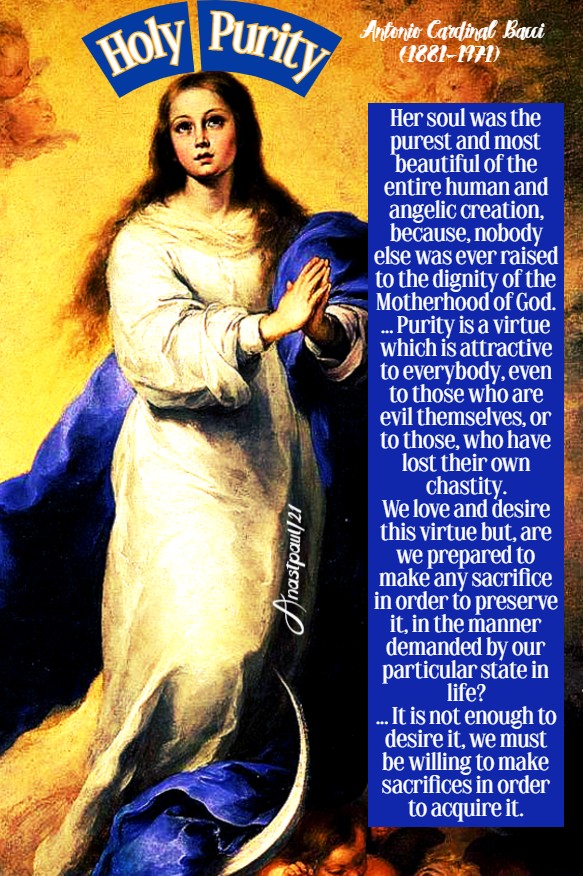
“Have you ever experienced the sheer delight of climbing the mountains on a summer’s day and coming across one of those little alpine lakes, a tiny mirror, reflecting the still blueness of the sky? Or have you ever watched an infant smiling in it’s angelic slumber and been held spellbound by this vision of innocence? Finally, on some calm, clear night, surely you have studied the star-spangled sky and have been so overwhelmed by the beauty of the scene, that you could have cried out with the Psalmist: “The heavens declare the glory of God and the firmament proclaims His handiwork” (Ps 18:1). These, are only faint images of the beauty and virginal purity of Mary. Her soul was the purest and most beautiful of the entire human and angelic creation, because, nobody else was ever raised to the dignity of the Motherhood of God. She was conceived free from all taint of original sin and enriched with every grace. In her chaste womb, she conceived the Infant Jesus. Later, she held Him close to her heart; she lived for Him and eventually died for love of Him.
Purity is a virtue which is attractive to everybody, even to those who are evil themselves, or to those, who have lost their own chastity. We love and desire this virtue but, are we prepared to make any sacrifice in order to preserve it, in the manner demanded by our particular state in life? “The kingdom of heaven has been enduring violent assault,” Jesus said “and the violent have been seizing it by force” (Mt 11:12). This is especially true in regard to the acquisition of the virtue of purity. It is not enough to desire it, we must be willing to make sacrifices in order to acquire it.”
Thought for the Day – 20 May – Meditations with Antonio Cardinal Bacci (1881-1971)
Mary, the Source of Holiness
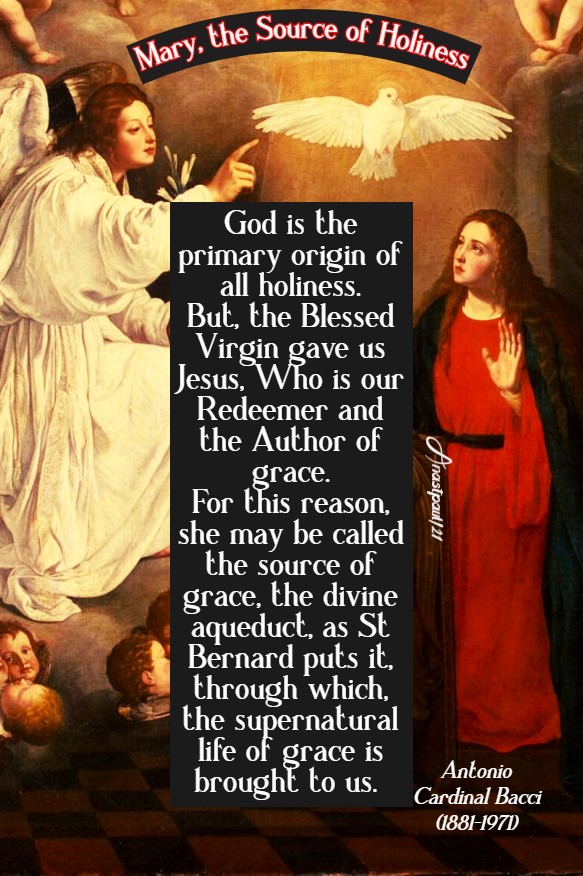
“God is the primary origin of all holiness. But, the Blessed Virgin gave us Jesus, Who is our Redeemer and the author of grace. For this reason, she may be called the source of grace, the divine aqueduct, as St Bernard puts it, through which, the supernatural life of grace is brought to us (In adv Domini, Serm 2, no 5). She was, moreover, full of grace and outstanding in holiness – as the Mother of God, she can obtain anything for us from her divine Son, because “it is the will of God that we receive everything through the hands of Mary” (St Bernard, In Nativ BMV, Serm, no 7). Thirdly, even by her example, she can be the source of sanctity for us. If we study her amazing humility, we shall learn to be humble, for our sinfulness gives us such good reason to humble ourselves. If we meditate on her spotless purity, we shall experience a great desire and love for this beautiful virtue and shall have recourse to her in every danger to save us from impurity. Then, let us reflect on her ardent love for God and for men. Her charity prompted her maternal heart to offer up, as a divine Victim, her Son nailed to the Cross. If we reflect on the nature of her charity, we also shall feel urged to love God above all things and to pray, work and make sacrifices for the salvation of our fellowmen. Let us have, always before our minds, the image of our heavenly Mother and we shall be inspired to seek perfection in all our actions.”
Thought for the Day – 19 May – Meditations with Antonio Cardinal Bacci (1881-1971)
Mary, a Light in the Darkness
“Let us imagine for a moment, that we have grown blind and are forever plunged in darkness. It is an unhappy thought. Never again to see those who are dear to us, never to see the light of the sun nor any of the splendour of the universe. We should feel as if were alone, for we should have to depend only on sounds and on the voices of others for communication with the external world. As St Augustine points out, however, in his commentary on the miracle of the man who had been blind from birth, we are all more or less blind in the supernatural order. The world is the image of God but, do we see His Presence in everything which surrounds us? Is it not more often the case that created things distract us and lead us to forget their Creator, because, we regard them as a means of satisfying our own comfort and our own ego? We should look on creatures as go-betweens which help us to ascend to God, the beginning and end of all creation.
Unfortunately, instead of climbing this mystical ladder which leads us to God, we often descend it. We forget God and become excessively wrapped up in worldly affairs. Sometimes matters may be even worse, not only do we forget God through our love of creatures but, we use them, to offend Him. God has given us eyes to admire His works and, as a result, to lead us to praise, thank and love Him. Instead, we often use this wonderful gift in order to commit sin. He has given us the gift of speech, the gift of hearing and other senses. But how do we employ them? The tongue is a marvellous invention but, as St James writes, “if anyone does not offend in the word, he is a perfect man, able also to lead round by the bridle, the whole body … With it we bless God the Father and, with it, we curse men, who have been made after the likeness of God. Out of the same mouth, proceed blessing and cursing. These things, my brethren ought not to be so” (Js 3:2-10). What can be said of vision and of speech can be said of all the senses and faculties of body and soul. They are all God’s gifts and should, therefore, be used as means of bringing ourselves closer to Him. If creatures lead us away from God and cause us to forget Him, or if, worse still, they cause us to offend Him, then we are spiritually blind and far more unfortunate than those who have lost their natural vision.
Most Holy Mary, during your earthly pilgrimage, you never once lost sight of God. Grant that I may not be lost in the darkness of this world. Grant that I may not be ensnared by the passing charm and false beauty of these created things which surround me. Grant that I may see, in all things, the Presence and Beauty of God, so that I may always continue to advance, nearer and nearer to Him. Amen.”
Thought for the Day – 17 May – Meditations with Antonio Cardinal Bacci (1881-1971)
Contemplation and Our Lady
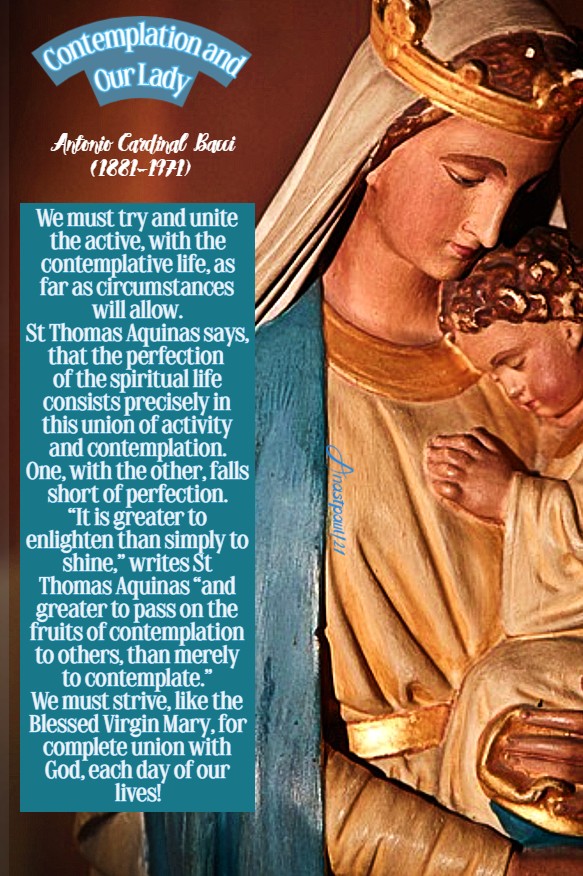
“We must try and unite the active, with the contemplative life, as far as circumstances will allow. St Thomas Aquinas says, that the perfection of the spiritual life consists precisely in this union of activity and contemplation. One, with the other, falls short of perfection. “It is greater to enlighten than simply to shine,” writes St Thomas Aquinas “and greater to pass on the fruits of contemplation to others, than merely to contemplate.” (Summa Theologiae, II-II, q 6, a 3).
Contemplation on its own, can degenerate into useless day dreaming. It is necessary that it should produce a genuine interior transformation, as a result of which, the subject, under the guidance of the Holy Sprit, becomes, in his speech and his conduct, a man of God. Now, the man of God is not satisfied with enjoying spiritual consolations but, is moved by his zeal for the glory of God, to try and extend His Kingdom, by every possible means. It is in this way, that contemplation becomes apostolic action.
We must remember, on the other hand, that neither is action on its own, sufficient. It can become barren when it is not nourished by the interior life of grace, which is the source of prayer and contemplation. It cannot be held, that this last, is the exclusive gift of a few privilege souls. Anyone can have it, as long as he allows himself to be penetrated by the love of God and as long as he succeeds, in securing moments of recollection and silence, at intervals during life. In these moments, he will grow closer to God and will enjoy a foretaste of the happiness of heaven. We must strive, like the Blessed Virgin Mary, for complete union with God, each day of our lives!”
Thought for the Day – 16 May – Meditations with Antonio Cardinal Bacci (1881-1971)
Prayer and Our Lady
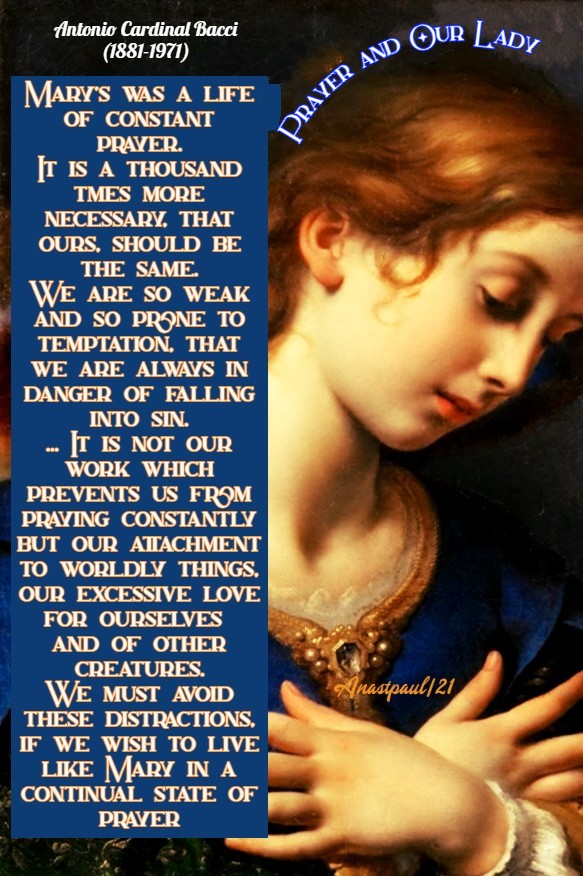
“Mary’s was a life of constant prayer. It is a thousand tmes more necessary, that ours, should be the same. We are so weak and so prone to temptation, that we are always in danger of falling into sin. “Without me, you can do nothing,” (Jn 15:5) Jesus tells us. “I am the vine, you are the branches. If anyone does not abide in me, he shall be cast outside as the branch and wither.” (Ibid). “Ask and it shall be given to you; seek and you shall find; knock and it shall be opened to you ” (Mt 7:7). In short, Jesus asks us to pray. He wants us to pray because He wants to give us His graces.
We cannot object that it is impossible for us to pray all the time because we have to work and fulfil other obligations. The work, which has first claim on us, is the service of God, which is prayer. Secondly, we can pray in tbe course of our daily work and of our different occupations, by offering to God, everything which we do. No matter what we are doing, we can raise our minds to God in an act of love and so remain always, close to Him.
It is not our work which prevents us from praying constantly but our attachment to worldly things, our excessive love for ourselves and of other creatures. We must avoid these distractions, if we wish to live like Mary in a continual state of prayer. ”
Thought for the Day – 15 May – Meditations with Antonio Cardinal Bacci (1881-1971)
The Power of Mary
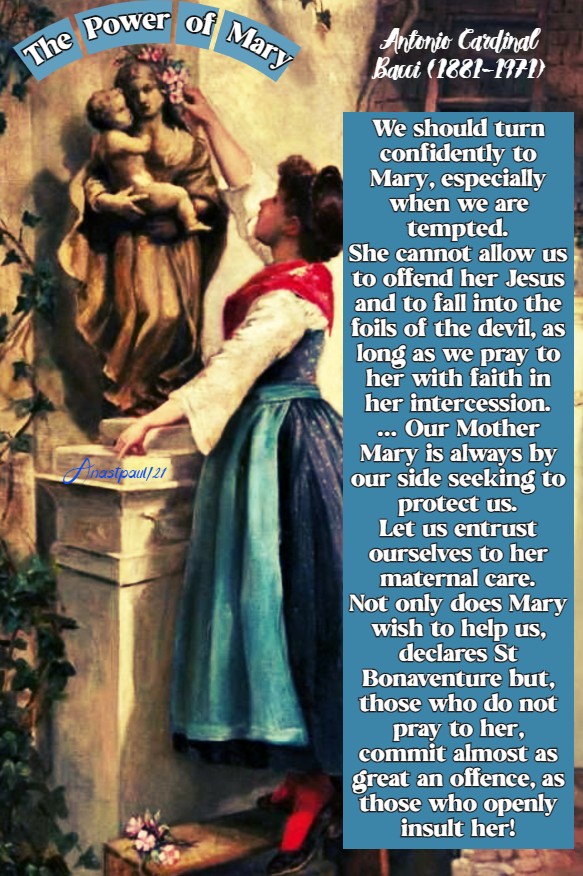
“We should turn confidently to Mary, especially when we are tempted. She cannot allow us to offend her Jesus and to fall into the foils of the devil, as long as we pray to her with faith in her intercession. “The devil, as a roaring lion,” says St Peter, “goes about seeking someone to devour” (1 Peter 5:8). But, our Mother Mary is always by our side seeking to protect us. Let us entrust ourselves to her maternal care. Not only does Mary wish to help us, declares St Bonaventure but, those who do not pray to her, commit almost as great an offence, as those who openly insult her (In Spec Virg)!
Thought for the Day – 14 May – Meditations with Antonio Cardinal Bacci (1881-1971)
The Refuge of Sinners
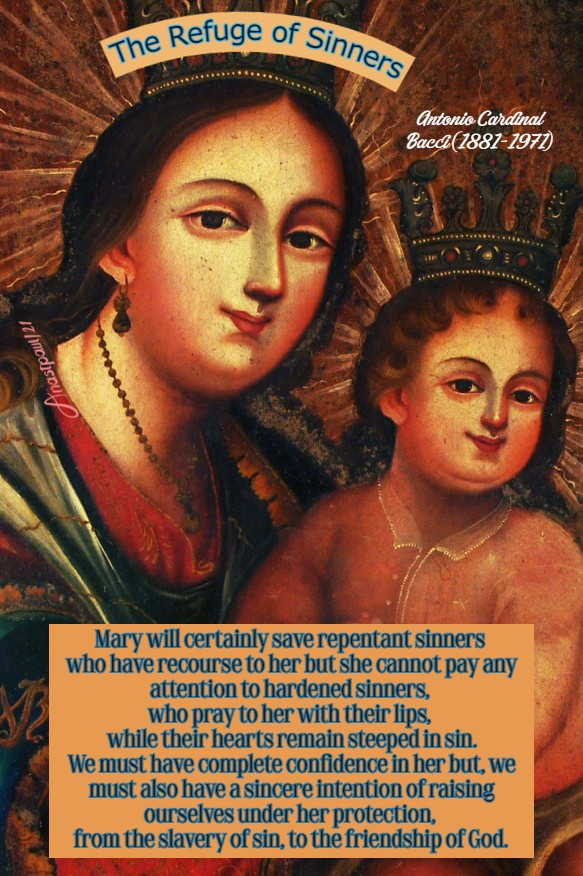
“Mary is called, the Star of Sea because, as St Thomas Aquinas says, “even as sailors are guided into port, by means of a star, so Christians are guided towards Heaven, by means of Mary, .” (Opuse, 7). This absolute guarantee of the protection of our heavenly Mother, should increase our trust in her and lead us to turn towards her in every difficulty and temptation. It should not, however, result in an unhealthy attitude of spiritual inactivity, a passive dependence on Mary’s favours, without any co-operation on our part. Such behaviour would be the height of filial ingratitude. Mary will certainly save repentant sinners who have recourse to her but she cannot pay any attention to hardened sinners, who pray to her with their lips, while their hearts remain steeped in sin. We must have complete confidence in her but, we must also have a sincere intention of raising ourselves under her protection, from the slavery of sin, to the friendship of God.
Thought for the Day – 12 May – Meditations with Antonio Cardinal Bacci (1881-1971)
“All Generations Shall Call Me Blessed”
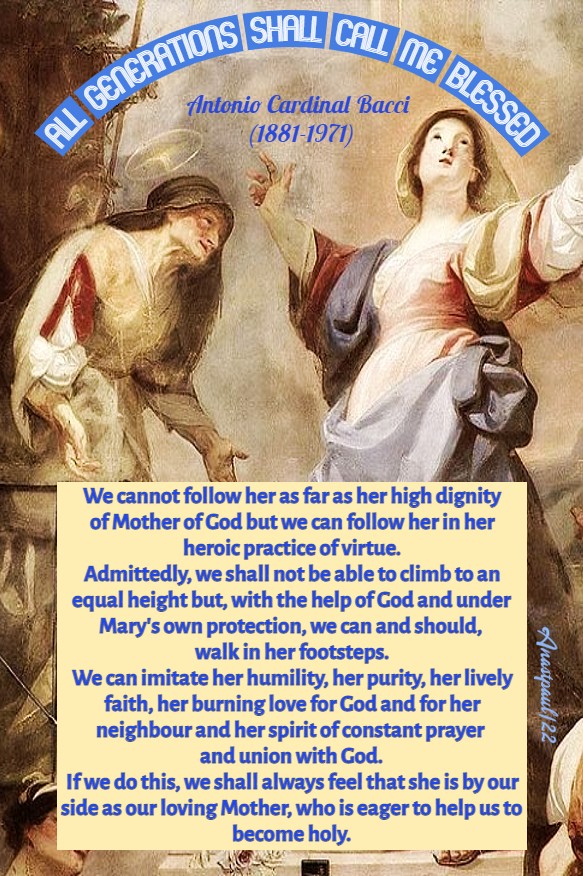
“It is related in the Gospel, that once a certain occasion, a woman in the crowd, was roused by the preaching and miracles of Jesus and cried out: “Blessed is the womb that bore thee and the breasts that nursed thee.” But Jesus replied: “Rather blessed are they who hear the word of God and keep it” (Lk 11:27-28). These words take nothing from the glory of the Mother of God. They were not intended for her but, for us. She was great and holy, not only because she was chosen to be the Mother of the Word Incarnate but also because she perfected herself in virtue by carrying out, in everything, the teaching of her divine Son, Jesus.
We cannot follow her as far as her high dignity of Mother of God but we can follow her in her heroic practice of virtue. Admittedly, we shall not be able to climb to an equal height but, with the help of God and under Mary’s own protection, we can and should, walk in her footsteps.
We can imitate her humility, her purity, her lively faith, her burning love for God and for her neighbour and her spirit of constant prayer and union with God. If we do this, we shall always feel that she is by our side as our loving Mother, who is eager to help us to become holy.”
Thought for the Day – 11 May – Meditations with Antonio Cardinal Bacci (1881-1971)
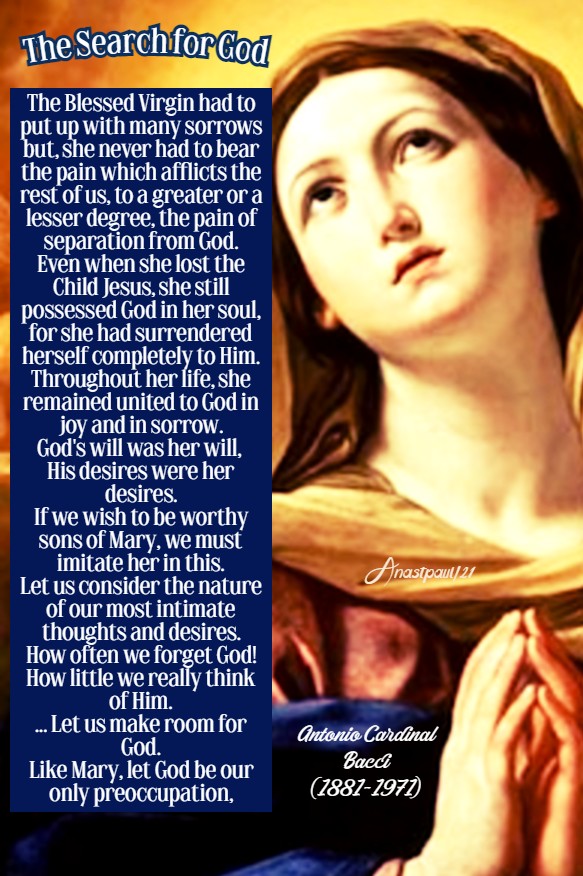
The Search for God
“All men are looking for God, whether they are aware of it or not. They are discontented and cannot understand why. They do not realise, that the real source of their discontent, is that they have not found God and God alone can make men happy. The Blessed Virgin had to put up with many sorrows but, she never had to bear the pain which afflicts the rest of us, to a greater or a lesser degree, the pain of separation from God. Even when she lost the Child Jesus, she still possessed God in her soul, for she had surrendered herself completely to Him. Throughout her life, she remained united to God in joy and in sorrow. God’s will was her will, His desires were her desires.
If we wish to be worthy sons of Mary, we must imitate her in this. Let us consider the nature of our most intimate thoughts and desires. How often we forget God! How little we really think of Him. We are absorbed in so many other affairs, that we forget Him, Who should be the centre of our plans. We are too fond of ourselves and of our own comfort and interests. As a result, we forget Him, to Whom we owe everything and Who should be the final goal of our lives. Our hearts are very small. If we fill them with worldly desires, there is no room for God. But God should be the absolute master of our souls.
Let us empty ourselves of useless worldly preoccupations and make room for spiritual aims. Let us make room for God. Like Mary, let God be our only preoccupation, If we look for Him in everything, we shall find Him.”
Thought for the Day – 10 May – “Mary’s Month” Meditations with Antonio Cardinal Bacci (1881-1971)
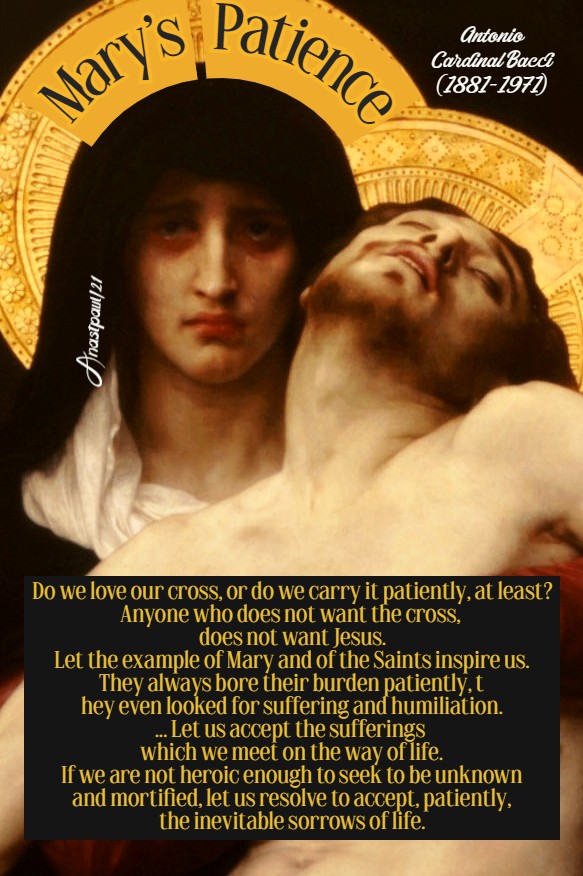
Mary’s Patience
“We also have our share of suffering and humiliation. It is useless to try and escape from it, useless to rebel against it. If we embrace the cross patiently and lovingly, a Jesus and Mary did, it will seem lighter, even welcome. If we attempt to cast it from us, it will weigh more heavily on our shoulders. There are two kinds of men, those who bear their cross, patiently and embrace it because they wish to be like Jesus and, those who do not want to suffer and rebel. The former may stagger beneath their daily burden but, they have peace of soul because they are putting into practice, the great Gospel precept: “By your patience, you will win your souls” (Lk 21:19). They know that they are on the path to Heaven and this thought is consolation, which cannot be taken from them. The second group of men, rebel against the cross and, therefore, suffer doubly, in body and in soul. “The senseless man,” the Holy Spirit says, “loves not to be reproved” (Prov 15:12).
To which of these two categories do we belong? Do we love our cross, or do we carry it patiently, at least? Anyone who does not want the cross, does not want Jesus. Let the example of Mary and of the Saints inspire us. They always bore their burden patiently, they even looked for suffering and humiliation. If we cannot reach such heroic heights, let us at last, accept, from the hands of Our Lord, the cross which He offers us. Let us accept the sufferings which we meet on the way of life. If we are not heroic enough to seek to be unknown and mortified, let us resolve to accept, patiently, the inevitable sorrows of life.”
Thought for the Day – 9 May – “Mary’s Month” Meditations with Antonio Cardinal Bacci (1881-1971)
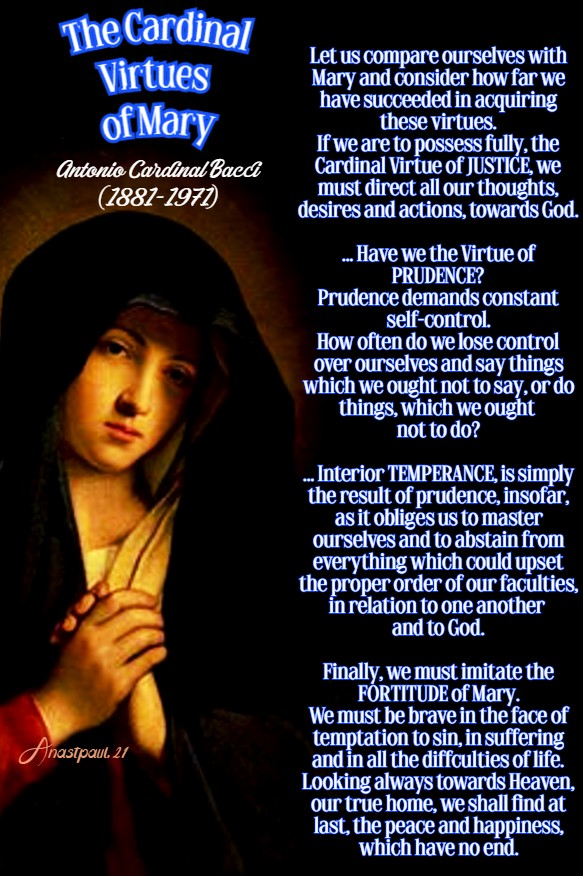
The Cardinal Virtues of Mary
“Let us compare ourselves with Mary and consider how far we have succeeded in acquiring these virtues. If we are to possess fully, the Cardinal virtue of JUSTICE, we must direct all our thoughts, desires and actions, towards God. Since everything comes from God, we should offer everything back to Him. If we fail to do this, we are guilty of injustice towards God. We take for ourselves, something which belongs to Him. We must also be just to our neighbour. It is not enough to be charitable only because there can be no charity, unless, it is founded on justice. This justice should characterise our thoughts and judgements, as well as our words and actions.
Have we the Virtue of PRUDENCE? Prudence demands constant self-control. How often do we lose control over ourselves and say things which we ought not to say, or do things, which we ought not to do? Prudence is a splendid virtue, which can be obtained by the grace of God, by living a life of union with Him. It necessitates constant vigilance over our faculties and passions, in order to ensure, that nothing will interfere with our rational conduct and with our observance of the commandments of God.
Interior TEMPERANCE, is simply the result of prudence, insofar, as it obliges us to master ourselves and to abstain from everything which could upset the proper order of our faculties, in relation to one another and to God. If we are inwardly temperate, we shall show external temperance in our words and deeds. We shall abstain, in other words, from everything suggested by our lower nature, which is contrary to the commandments of God and the precepts of the Church. This means, we shall observe among other things, the Church’s laws of fasting and abstinence. We shall keep away from dangerous amusements and from anything else which could be harmful to ourselves or to our neighbour.
Finally, we must imitate the FORTITUDE of Mary. We must be brave in the face of temptation to sin, in suffering and in all the diffculties of life. Looking always towards Heaven, our true home, we shall find at last, the peace and happiness, which have no end.”
Thought for the Day – 8 May – “Mary’s Month” Meditations with Antonio Cardinal Bacci (1881-1971)
The Theological Virtues of Our Lady
“We also possess the Catholic faith, or at any rate, believe that we possess it, for we often recite the Creed and were received, at Baptism, into the family of the Catholic Church.
But is our faith alive? When a man is living his faith, he has a constant realisation of the presence of God, Who has created him, maintains him in existence, has redeemed him, loves him and commands him to do good. Otherwise, our faith is dead, for as St James writes, “faith, without works, is dead” (Js 2:26). If our faith is not living, neither is our hope nor our charity.
Let us examine ourselves thoroughly. Perhaps we do not think about God enough and, as a result our faith is weak. Perhaps we place all our hope in earthly things and look for these passing pleasures, which cannot satisfy or hearts. Perhaps we love ourselves and our possessions too much and have too little love for God, our only real good. It maybe that we are constantly seeking our own interests and ease and are lacking in sincere and active charity towards our neighbour, when he is in need, even though he is our brother in Jesus Christ and we should love him as ourselves. If this is the way matters stand, we are not genuine Catholics, for we have not the three theological virtues, which should form the basis of our lives. Neither are we sincere sons of Mary, who possessed these three virtues in an outstanding manner. Let us examine ourselves with a view to forming a few good and earnest resolutions.”
Thought for the Day – 7 May – “Mary’s Month” Meditations with Antonio Cardinal Bacci (1881-1971)
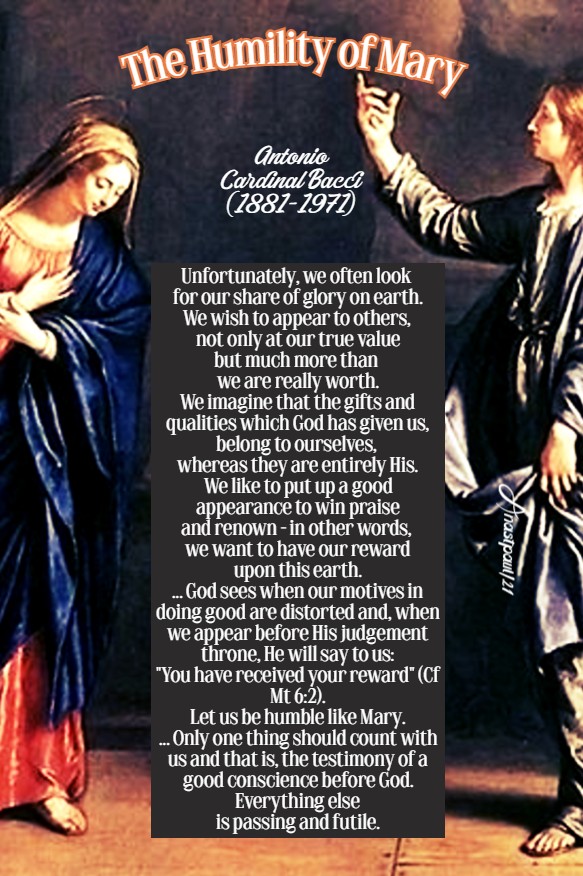
The Humility of Mary
“Unfortunately, we often look for our share of glory on earth. We wish to appear to others, not only at our true value but much more than we are really worth. We imagine that the gifts and qualities which God has given us, belong to ourselves, whereas they are entirely His.
We like to put up a good appearance to win praise and renown – in other words, we want to have our reward upon this earth. We should remember, however, that if we look for our reward now, we shall not have it in Heaven.
God sees when our motives in doing good are distorted and, when we appear before His judgement throne, He will say to us: “You have received your reward” (Cf Mt 6:2).
Let us be humble like Mary. Let us make God’s glory, rather than our own satisfaction, the object of our actions. It will sometimes happen that men will misunderstand us, perhaps even insult us. We are not forbidden to defend ourselves and explain our position. We may not have the heroic virtue of St Francis de Sales, who remained silent when he was caluminated. But we should not be too disturbed by lack of understanding or slander, nor should we be too elated by flattery. Only one thing should count with us and that is, the testimony of a good conscience before God. Everything else is passing and futile.
Our humility will be tested by the inevitable opposition, sometimes jealous and malicious, which we shall experience on the part of other men. On these occasions, we shall see if we are really meek and humble of heart, like Jesus and our Blessed Mother.”
Thought for the Day – 6 May – “Mary’s Month” Meditations with Antonio Cardinal Bacci (1881-1971)
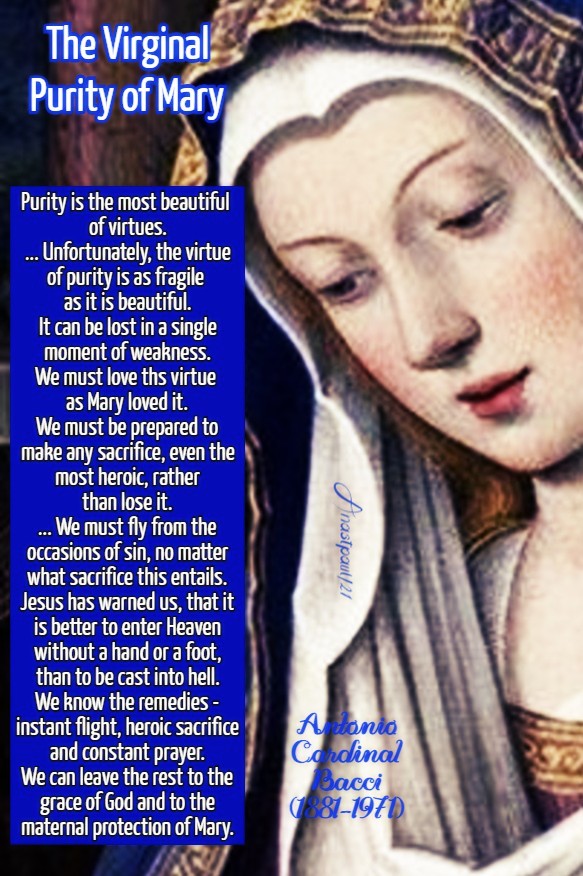
The Virginal Purity of Mary
“Purity is the most beautiful of virtues. It is a virtue which is admired by God and by men, even by the most corrupt. It is often said, that it makes us like the angels but in fact, looking at it in a particular way, it makes us superior to the angels. Since they have no bodies, the angels cannot sin against purity, while we have to fight many battles and overcome many temptations, in order to preserve our chastity. Jesus had a very special love for this virtue. He chose to be born of a virgin and, He showed a particular affection for St John, who was a dedicated celibate. On one occasion, He placed His Hands on the head of a little child and said: “Unless you turn and become like little children, you will not enter into the kingdom of Heaven “(Mt:18.3)
Unfortunately, the virtue of purity is as fragile as it is beautiful. It can be lost in a single moment of weakness. We must love ths virtue as Mary loved it. We must be prepared to make any sacrifice, even the most heroic, rather than lose it. Worldly charm and beauty attract us and the devil works hard to control our imagination and our affections. On account of the disturbance of original sin, the flesh is like a terrible weight retarding our spiritual advancement. Sometimes it seems as if it is irresistibly drawing us towards the abyss of impurity. But we need not be dragged down, if we are prepared to fly from the occasions of sin and to pray to God and to our heavenly Mother for her intercession. We must always act at once, for there is no time to dally. It is fatal to remain inactive and to allow temptation to make its way into our soul. This kind of battle, said St Francis de Sales, is won only by soldiers who flee. We must fly from the occasions of sin, no matter what sacrifice this entails. Jesus has warned us, that it is better to enter Heaven without a hand or a foot, than to be cast into hell.
We know the remedies – instant flight, heroic sacrifice and constant prayer. We can leave the rest to the grace of God and to the maternal protection of Mary.”
Thought for the Day – 5 May – “Mary’s Month” Meditations with Antonio Cardinal Bacci (1881-1971)
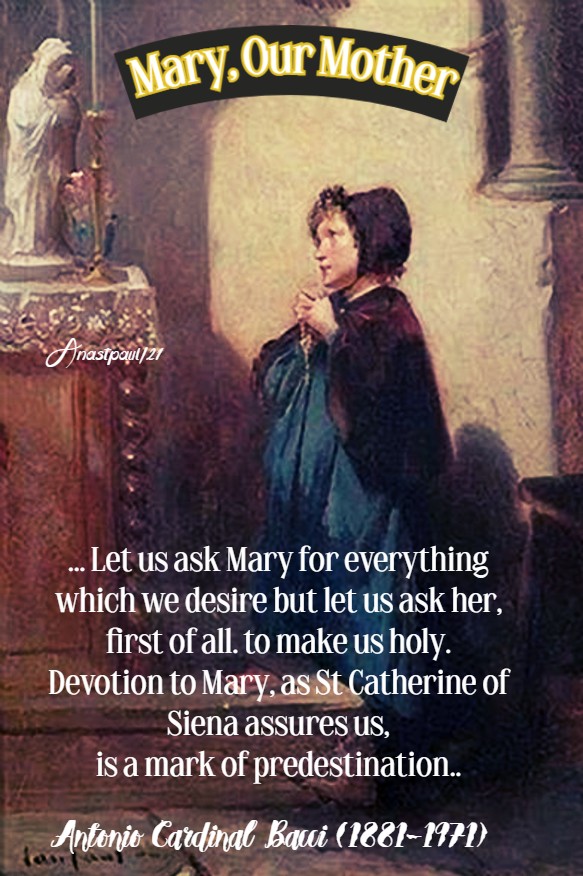
Mary, Our Mother
“Mary is, at the same time, our loving and powerful Mother. No matter how much earthly mothers love their sons and desire to help them, very often they cannot do so because, their love is limited. It is not so with Mary. Not only does she love us but, she also possesses great influence with her divine Son, Jesus. We should have confidence in her, therefore and have recourse to her, in every spiritual or temporal need. We may be certain that she will use her powers of intercession on our behalf. Let us remember, however, to ask, first of all, for the spiritual favours which we need. Later, we may ask, in a spirit of resignation to God’s Will, for temporal benefits and for release from worldly suffering. If we acted otherwise, we should not be worthy sons of Mary, who endured all kinds of suffering for the sake of Jesus.
When we recite the Our Father, we say ‘Thy will be done on earth as it is in Heaven,‘ before we say ‘Deliver us from evil.’ If anyone refuses the cross, he shows that he does not love God because, he does not will what God wills for him. We should remember that there is no affliction which does not come from God and, that nothing comes from God, which is not for our own good.
So let us ask Mary for everything which we desire but let us ask her, first of all to make us holy. Devotion to Mary, as St Catherine of Siena assures us, is a mark of predestination..”
Thought for the Day – 4 May – Meditations with Antonio Cardinal Bacci (1881-1971)
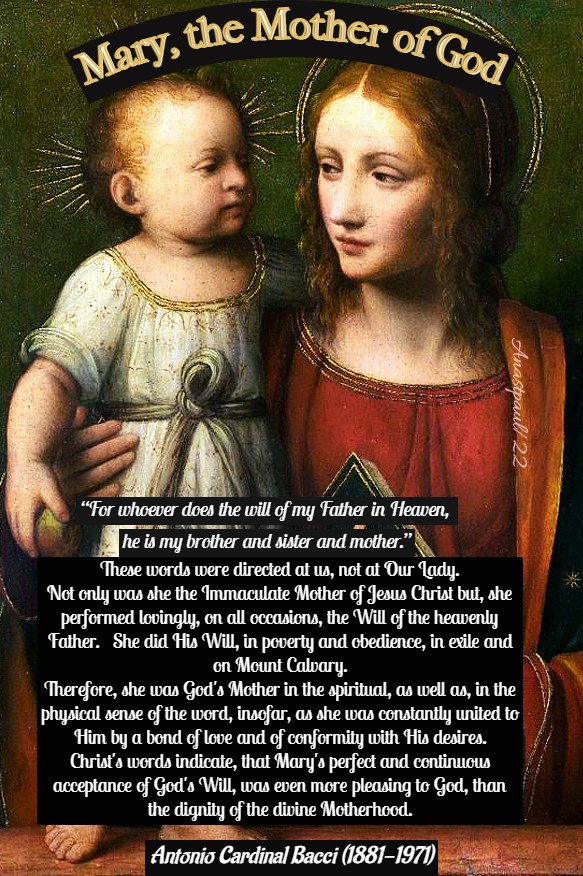
Mary, the Mother of God
“St Matthew (Cf Mt 12:46-50) and St Mark (Cf Mk 3:31-35), relate how Jesus was preaching one day in Galilee, surrounded by His Apostles and by a large crowd, when a man approached and said: “Behold, thy mother and thy brethren are standing outside, seeking thee.” “Who is my mother,” He answered, “and who are my brethren?” Then He extended His hand towards His disciples and said: “Behold, my mother and my brethren! For whoever does the will of my Father in Heaven, he is my brother and sister and mother.”
These words were directed at us, not at Our Lady. Not only was she the Immaculate Mother of Jesus Christ but, she performed lovingly, on all occasions, the Will of the heavenly Father. She did His Will, in poverty and obedience, in exile and on Mount Calvary. Therefore, she was God’s Mother in the spiritual, as well as, in the physical sense of the word, insofar, as she was constantly united to Him by a bond of love and of conformity with His desires.
Christ’s words indicate, that Mary’s perfect and continuous acceptance of God’s Will, was even more pleasing to God, than the dignity of the divine Motherhood.
We cannot equal her in dignity but, we can imitate her in this other respect. Jesus will look on us as His brothers and as worthy sons of Mary, if we carry out His Will in all things. It is not always easy to do this. It is not easy, when we are strongly tempted to commit sins of pride, anger or impurity. It is not easy, when we are overcome by sorrow or by sickness, when we are let down or misunderstood by others, when we are in want and, when we feel that we are collapsing beneath the weght of our cross. At times like these, we should pray for Mary’s spirit of complete acceptance of the Will of God.”




















 AnaStpaul
You must be logged in to post a comment.