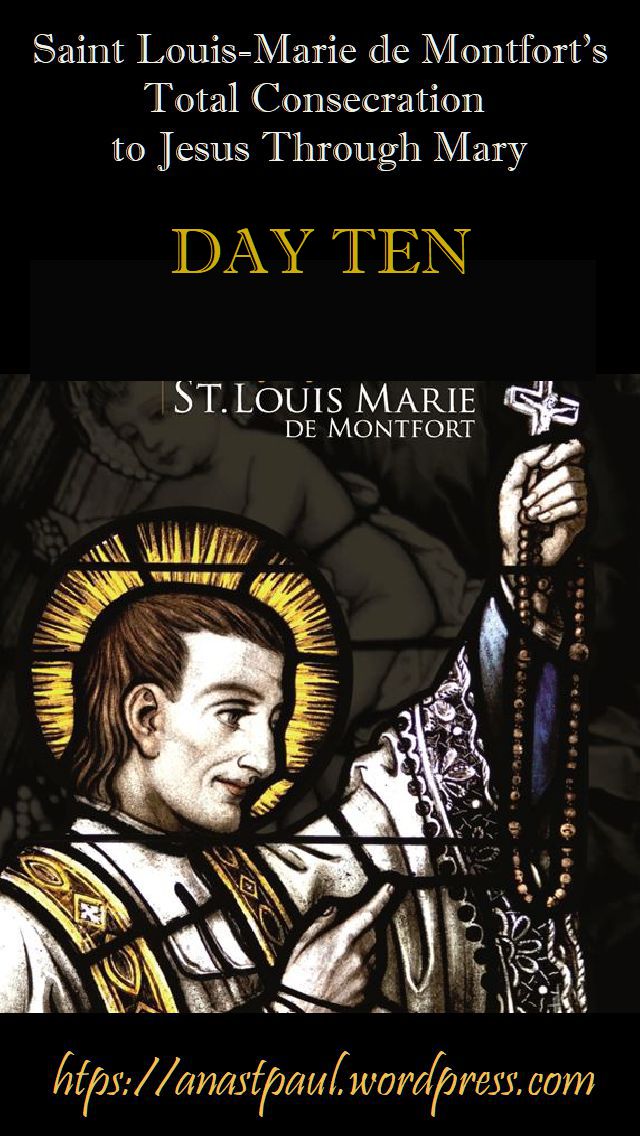
Saint Louis-Marie de Montfort’s Total Consecration to Jesus Through Mary – Day Ten – 26 October
Readings and Prayers
12 Day Preparation
Day 10 of 33
Imitation of Christ, by Thomas á Kempis: Book 3, Chapter 10
That it is sweet to despise the world and to serve God.
Now, will I speak again, O Lord and will not be silent, I will say in the hearing of my God and my King Who is on high: Oh, how great is the abundance of Your sweetness, O Lord, which You have hidden for those that fear You!
But what are You, for those who love You? What, to those who serve You with their whole heart? Unspeakable indeed is the sweetness of Your contemplation, which You bestow on those who love You. In this most of all, have You shown me the sweetness of Your love, that when I had no being, You did make me and when I was straying far from You, You brought me back again, that I might serve You and You have commanded me to serve You.
O Fountain of everlasting love, what shall I say of You? How can I forget You, Who have vouchsafed to remember me even after I was corrupted and lost?
Beyond all hope, You show mercy to Your servant and beyond all desert, have You manifested Your grace and friendship. What return shall I make to You for this favour? For it is granted to all who forsake these things, to renounce the world and to assume the monastic life. Is it much that I should serve You, Whom the whole creation is bound to serve? It ought not to seem much to me to serve You but this does rather appear great and wonderful to me, that You vouchsafe to receive one so wretched and unworthy as Your servant. It is a great honour, a great glory, to serve You and to despise all things for You for they who willingly subject themselves to Your holy service, shall have great grace. They shall experience the most sweet consolation of the Holy Spirit, Who for the love of You, have cast aside all carnal delight.
Saint Louis-Marie de Montfort’s Total Consecration to Jesus Through Mary – Day Nine – 25 October
Readings and Prayers
12 Day Preparation
Day 9 of 33
Imitation of Christ, by Thomas á Kempis: Book 1, Chapter 13, cont.
Fire tries iron and temptation a just man.
We often know not what we are able to do but temptations discover what we are. Still, we must watch, especially in the beginning of temptation, for then the enemy is more easily overcome, if he be not suffered to enter the door of the mind but is withstood upon the threshold the very moment he knocks. Whence a certain one has said “Resist beginnings; all too late the cure.” When ills have gathered strength, by long delay, first there comes from the mind a simple thought, then a strong imagination, afterwards delight and the evil motion and consent and so, little by little the fiend does gain entrance, when he is not resisted in the beginning. The longer anyone has been slothful in resisting, so much the weaker he becomes, daily in himself and the enemy, so much the stronger in him.
Some suffer grievous temptations in the beginning of their conversion, others in the end and others are troubled nearly their whole life. Some are very lightly tempted, according to the wisdom and the equity of the ordinance of God who weighs man’s condition and merits and pre-ordains all things for the salvation of His elect.
We must not, therefore, despair when we are tempted but the more fervently pray to God to help us in every tribulation – Who, of a truth, according to the sayings of St Paul, will make such issue with the temptation, that we are able to sustain it.
Let us then humble our souls under the hand of God in every temptation and tribulation, for the humble in spirit, He will save and exalt. In temptation and tribulations, it is proved, what progress man has made and there also, is great merit and virtue made more manifest.
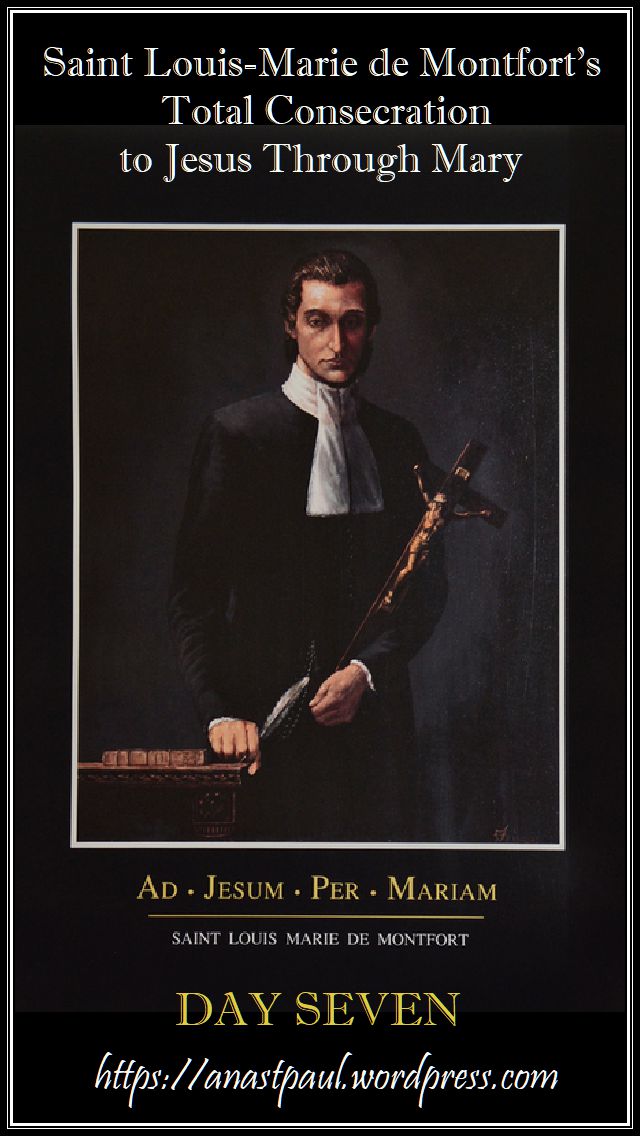
Saint Louis-Marie de Montfort’s Total Consecration to Jesus Through Mary
Readings and Prayers
12 Day Preparation
Day 7 of 33
Imitation of Christ, by Thomas á Kempis: Book 1, Chapter 18, cont.
Outwardly they suffered want but within they were refreshed with grace and Divine consolation. They were aliens to the world, they seemed as nothing and the world despised them but they were precious and beloved in the sight of God.
They persevered in true humility, they lived in simple obedience, they walked in charity and patience and so every day they advanced in spirit and gained great favour with God. They were given for example to all religious and ought more to excite us to advance in good, than the number of lukewarm to induce us to grow remiss.
Oh! how great was the fervour of all religious in the beginning of their holy institute! Oh, how great was their devotion in prayer, how great was their zeal for virtue! How vigorous the discipline that was kept up, what reverence and obedience, under the rule of the superior, flourished in all! Their traces that remain still bear witness, that they were truly holy and perfect men who did battle so stoutly and trampled the world under their feet.
Now, he is thought great who is not a transgressor and who can, with patience, endure what he has undertaken. Ah, the lukewarmness and negligence of our state! that we soon fall away from our first fervour and are even now tired with life, from slothfulness and tepidity.
Oh that advancement in virtue be not quite asleep in thee, who has so often seen the manifold examples of the devout!
Saint Louis-Marie de Montfort’s Total Consecration to Jesus Through Mary – Day Six – 22 October
Readings and Prayers
12 Day Preparation
Day 6 of 33
Imitation of Christ, by Thomas á Kempis: Book 1, Chapter 18
On the examples of the Holy Fathers.
Look upon the lively examples of the holy Fathers in whom shone real perfection and the religious life and you will see how little it is and, almost nothing, that we do. Alas, what is our life when we compare it with theirs? Saints and friends of Christ, they served our Lord in hunger and in thirst, in cold, in nakedness, in labour and in weariness, in watching, in fasting, prayers and holy meditations and in frequent persecutions and reproaches.
Oh, how many grievous tribulations did the Apostles suffer and the Martyrs and Confessors and Virgins and all the rest who resolved to follow the steps of Christ! For they hated their lives in this world, that they might keep them in life everlasting. Oh what a strict and self-renouncing life the holy Fathers of the desert led! What long and grievous temptations did they bear! How often were they harassed by the enemy, what frequent and fervent prayers did they offer up to God, what rigorous abstinence did they practice!
What a valiant contest waged they to subdue their imperfections! What purity and straightforwardness of purpose kept they towards God! By day they laboured and much of the night they spent in prayer, though while they laboured, they were far from leaving off mental prayer. They spent all their time profitably. Every hour seemed short to spend with God and even their necessary bodily refreshment was forgotten in the great sweetness of contemplation. They renounced all riches, dignities, honours and kindreD, they hardly took what was necessary for life. It grieved them to serve the body even in its necessity.
Accordingly, they were poor in earthly things but very rich in grace and virtues.
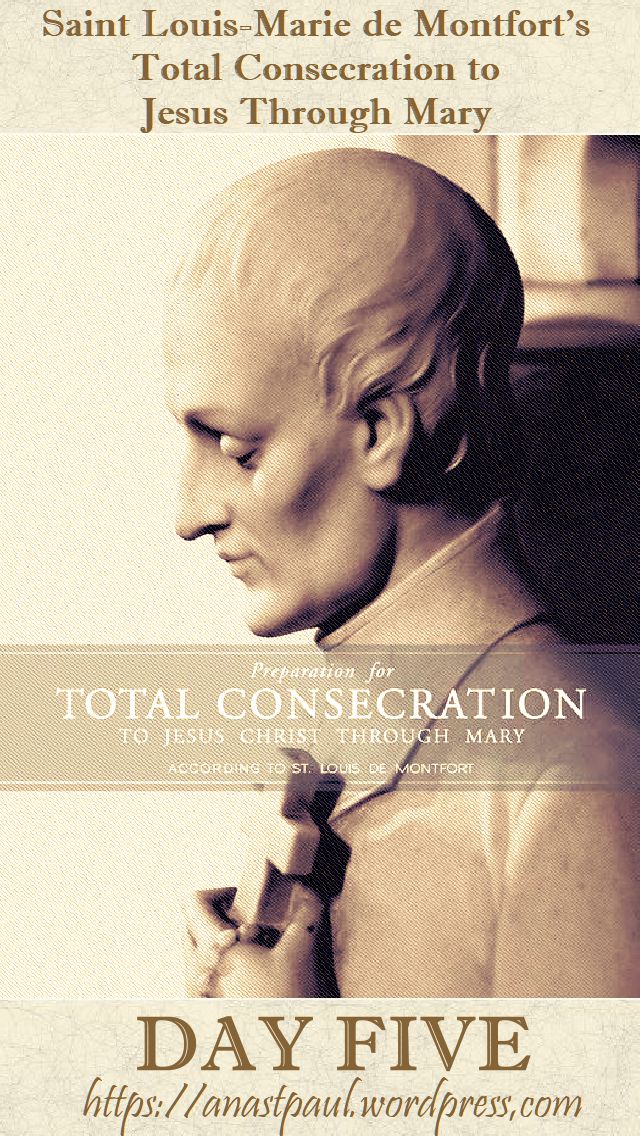
Saint Louis-Marie de Montfort’s Total Consecration to Jesus Through Mary –
Day Five – 21 October
Readings and Prayers
12 Day Preparation
Day 5 of 33
Imitation of Christ, by Thomas á Kempis: Book 3, Chapter 40
Wherefore but I did know well, how to cast from me all human comfort, either for the sake of devotion, or through the necessity by which I am compelled to seek You, because there is no man that can comfort me. Then might I deservedly hope in Your favour and rejoice in the gift of a new consolation. Thanks be to You from Whom all things proceed, as often as it happens to me. I, indeed, am but vanity and nothing in Your sight , an inconstant and weak man. Where, therefore, can I glory, or for what do I desire to be thought of highly?
Because of my very nothingness and this is most vain. Truly pride is an evil plague, because it draws away from true glory and robs us of heavenly grace. For, while a man takes complacency in himself, he displeases You, while he wants for human applause, he is deprived of true virtues. But true, glory and holy exultation is to glory in You and not in one’s self; to rejoice in Your Name but not in one’s own strength. To find pleasure in no creature, save only for Your sake. Let Your Name be praised, not mine, let Your work be magnified, not mine, let Your Holy Name be blessed but let nothing be attributed to me of the praise of men. You are my glory; You are the exultation of my heart; in You, will I glory and rejoice all the day; but for myself, I will glory in nothing but in my infirmities.
Saint Louis-Marie de Montfort’s Total Consecration to Jesus Through Mary – Day Four – 20 October
Readings and Prayers
12 Day Preparation
Day 4 of 33
Imitation of Christ, by Thomas á Kempis: Book 3, Chapters 7, 40
That man has no good of himself and that he cannot glory in anything Lord, what is man, that Thou art mindful of him; or the son of man, that Thou visit him? What has man deserved that Thou should give him grace? Lord, what cause have I to complain, if Thou forsake me, or what can I justly allege, if what I petition Thou shalt not grant?
This most assuredly, I may truly think and say – Lord I am nothing, I can do nothing of myself, that is good but I am in all things defective and ever tend to nothing. And unless I am assisted and interiorly instructed by Thee, I become wholly tepid and relaxed but Thou, O Lord, are always the same and endure unto eternity, ever good, just and holy, doing all things well, justly and holy and disposing them in wisdom.
But I who am more inclined to go back, than to go forward, continue not always in one state, for I am changed, seven different times. But it quickly becomes better when it pleases Thee and Thou stretch out Thy helping hand, for Thou alone, without man’s aid can assist me and so strengthen me, that my countenance shall be more diversely changed but my heart be converted and find its rest in Thee alone.
He who would be too secure in time of peace will often be found too much dejected in time of war. If you could always continue to be humble and little in your own eyes and keep your spirit in due order and subjection, you would not fall so easily into danger and offence. It is good counsel that, when you have conceived the spirit of fervour, you should meditate how it will be when that light shall be withdrawn.
One Minute Reflection – 14 October – Today’s Gospel: Mark 10:17–30 — Twenty-eighth Sunday in Ordinary Time, Year B
“You lack one thing – go, sell what you have and give to the poor and you will have treasure in heaven and come, follow me.”...Mark 10:21
REFLECTION – “Jesus’ reply is clear: “I tell you there is no-one who has given up everything and has not received everything”. If you gave up everything. You will receive everything, in that overflowing measure with which God gives His gifts. You will receive everything. …. Everything!”… The Lord does not know how to give less than everything – when He gives something, He gives Himself, which is everything. …the sign that we are on the ‘everything and nothing’ path, of the forsaken fullness, is joy. It is no surprise that “the rich young man’s countenance darkened and he went away saddened”. …amid the trials and difficulties, the saints had a cheerful face, a generous outlook and joy in their heart. This is the sign”….Pope Francis – Santa Marta, 28 February 2017
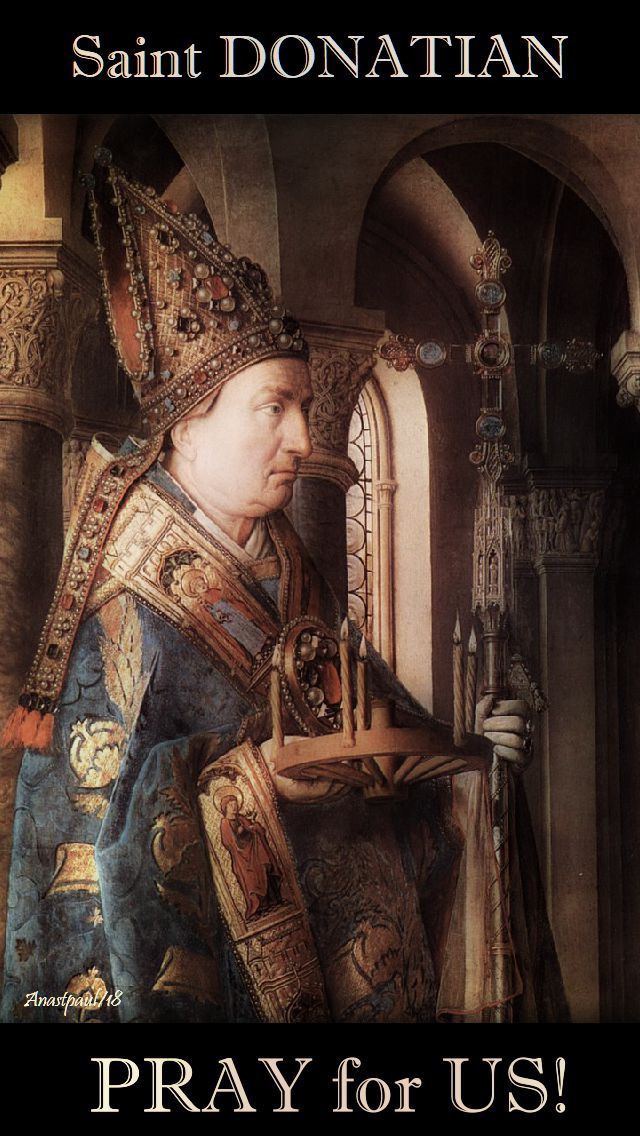
PRAYER – Lord God, open our hearts to Your grace. Teach us Your ways . May we always be intent upon doing Your will. With You, in You and for You! Grant that the prayers of our Blessed Mother Mary, St Donatian and all Your holy saints in heaven, grant us Your gifts and with them true joy. We make our prayer through Jesus Christ with the Holy Spirit, God forever, amen.
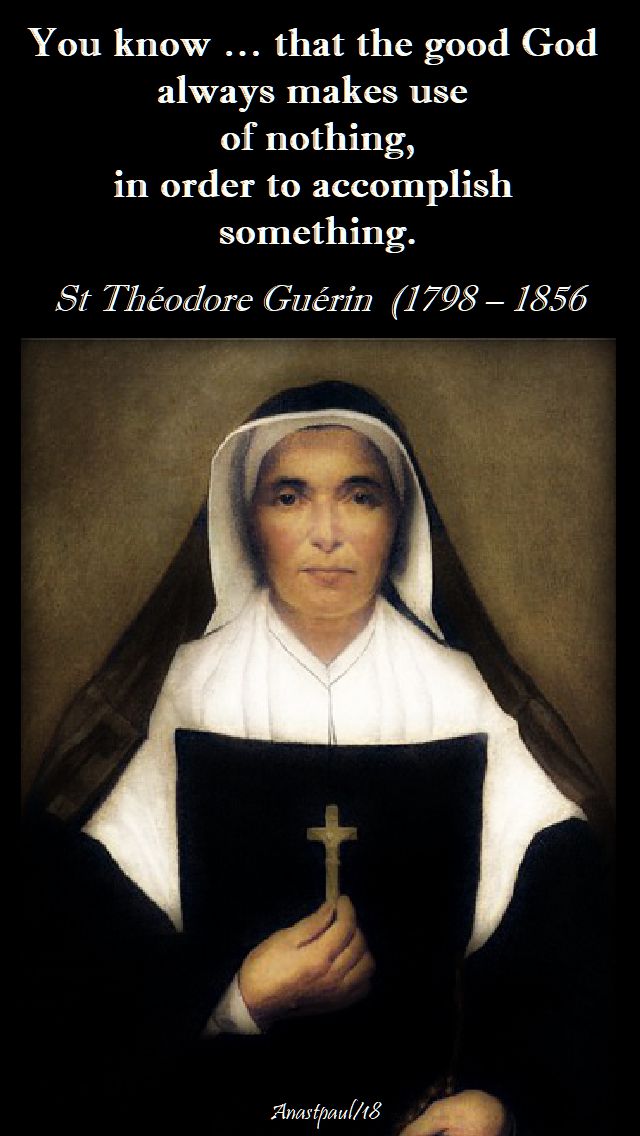
Quote/s of the Day – 3 October – Today’s Gospel: Luke 9:57–62 and The Memorial of St Théodore Guérin SP (1798 – 1856)
“You know … that the good God always makes use of nothing, in order to accomplish something.”
St Théodore Guérin (1798 – 1856)
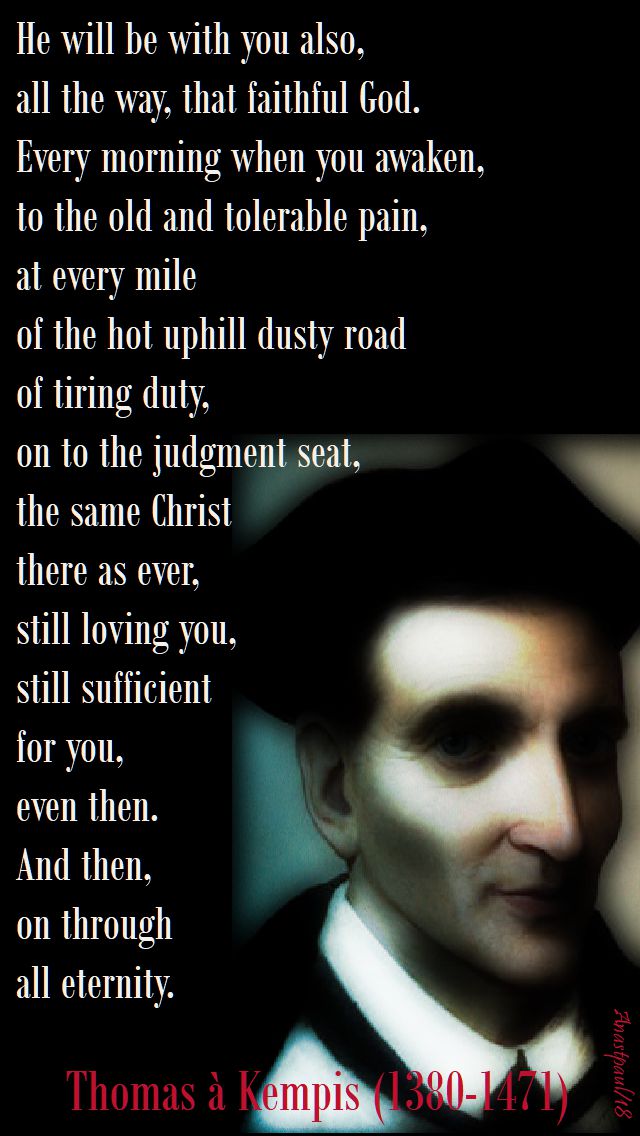
“He will be with you also, all the way, that faithful God. Every morning when you awaken to the old and tolerable pain, at every mile of the hot uphill dusty road of tiring duty, on to the judgement seat, the same Christ there as ever, still loving you, still sufficient for you, even then. And then, on through all eternity.”
Quote/s of the Day – 14 September – Feast of the Exaltation of the Holy Cross
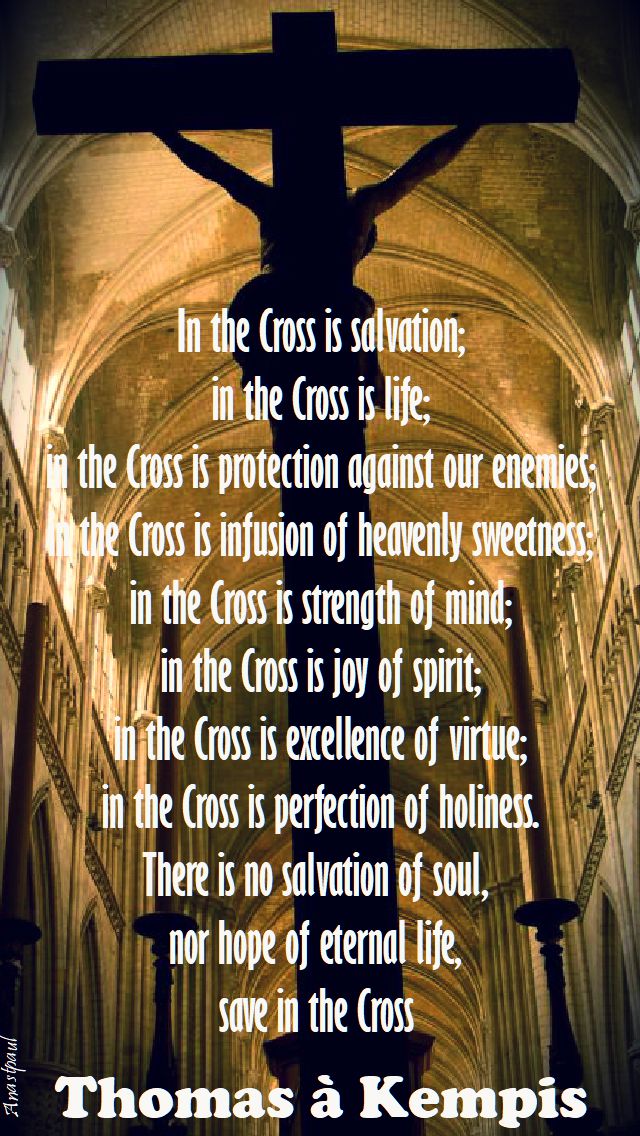
“In the Cross is salvation; in the Cross is life; in the Cross is protection against our enemies; in the Cross is infusion of heavenly sweetness; in the Cross is strength of mind; in the Cross is joy of spirit; in the Cross is excellence of virtue; in the Cross is perfection of holiness. There is no salvation of soul, nor hope of eternal life, save in the Cross.”
Thomas à Kempis (1380-1471) The Inner Life
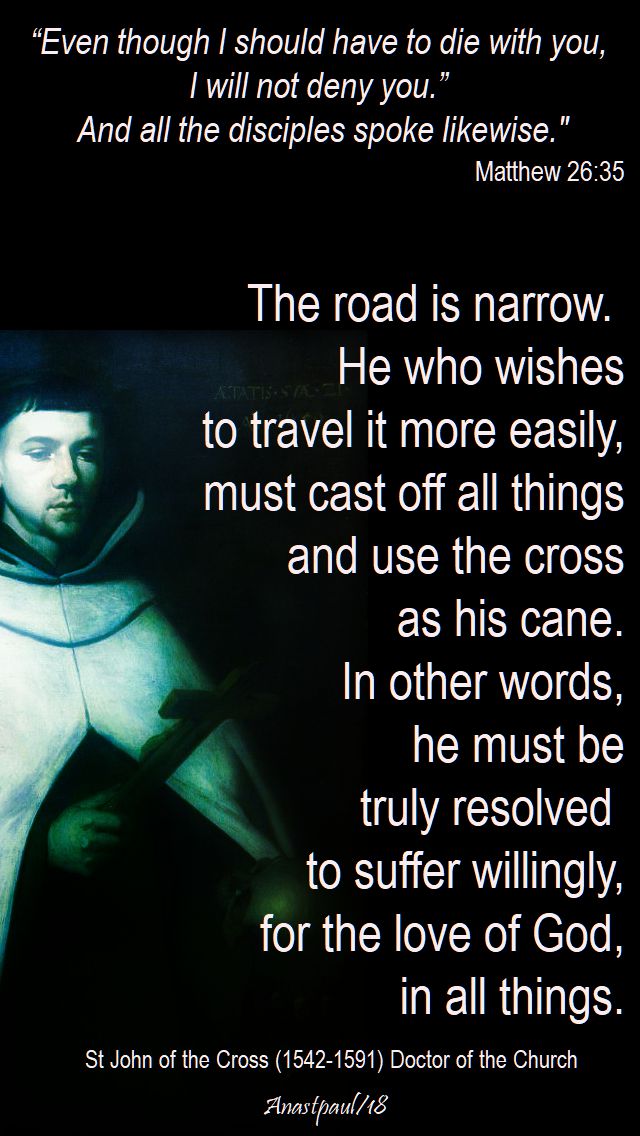
“The road is narrow. He who wishes to travel it more easily must cast off all things and use the cross as his cane. In other words, he must be truly resolved to suffer willingly for the love of God in all things.”
St John of the Cross (1542-1591) Doctor of the Church
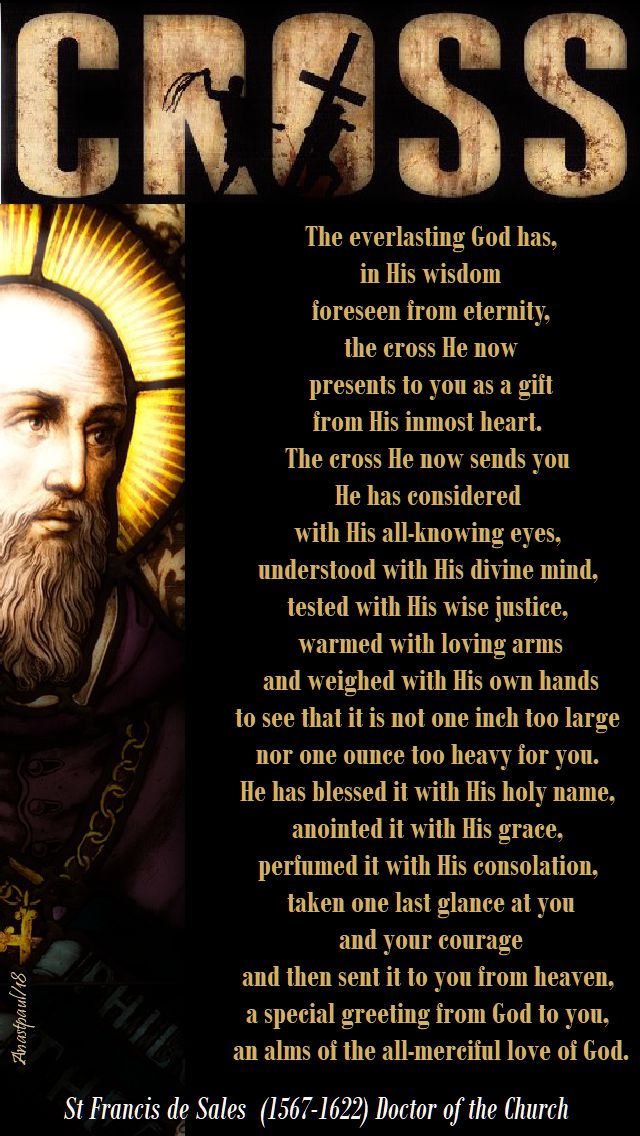
The everlasting God has in His wisdom foreseen from eternity the cross He now presents to you as a gift from His inmost heart. The cross He now sends you He has considered with His all-knowing eyes, understood with His divine mind, tested with His wise justice, warmed with loving arms and weighed with His own hands to see that it is not one inch too large nor one ounce too heavy for you. He has blessed it with His holy name, anointed it with His grace, perfumed it with His consolation, taken one last glance at you and your courage and then sent it to you from heaven, a special greeting from God to you, an alms of the all-merciful love of God.
St Francis de Sales (1567-1622) Doctor of the Church
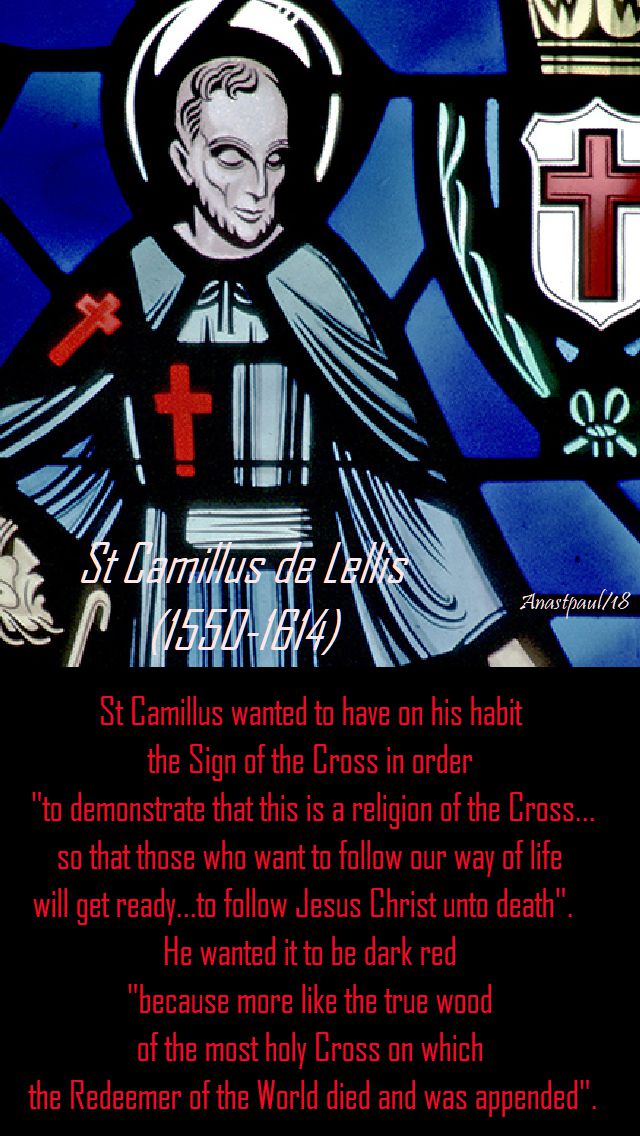
Camillus wanted to have on his habit the Sign of the Cross in order ‘to demonstrate that this is a religion of the Cross… so that those who want to follow our way of life will get ready… to follow Jesus Christ unto death’. He wanted it to be dark red ‘because more like the true wood of the most holy Cross on which the Redeemer of the World died and was appended’.
St Camillus de Lellis (1550-1614)
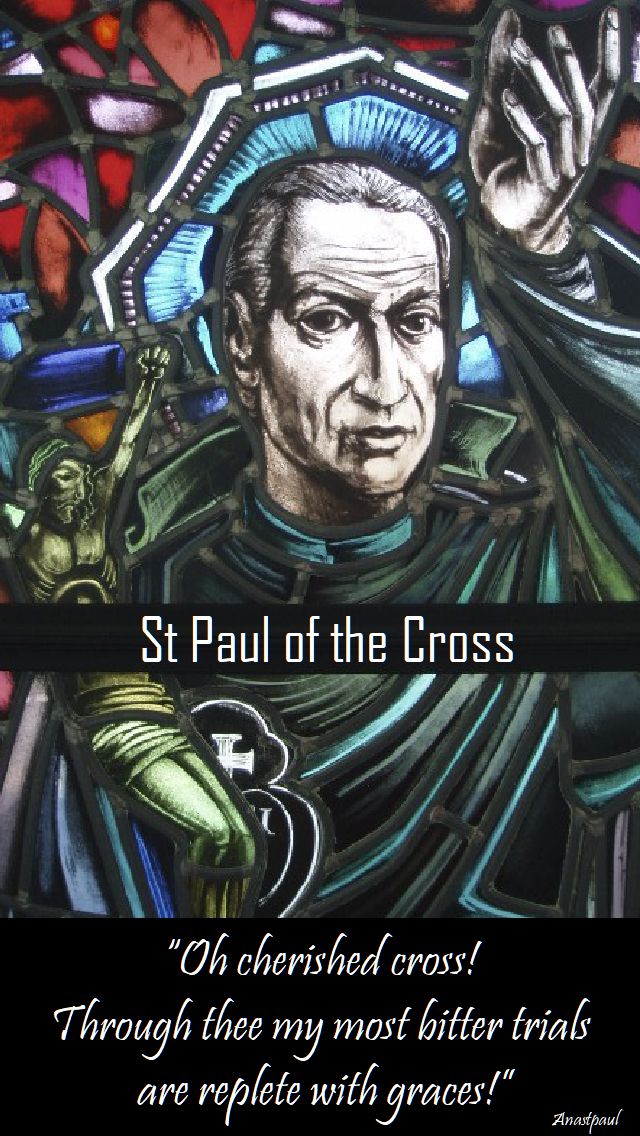
“Oh cherished cross! Through thee my most bitter trials are replete with graces!”
St Paul of the Cross (1694-1775)
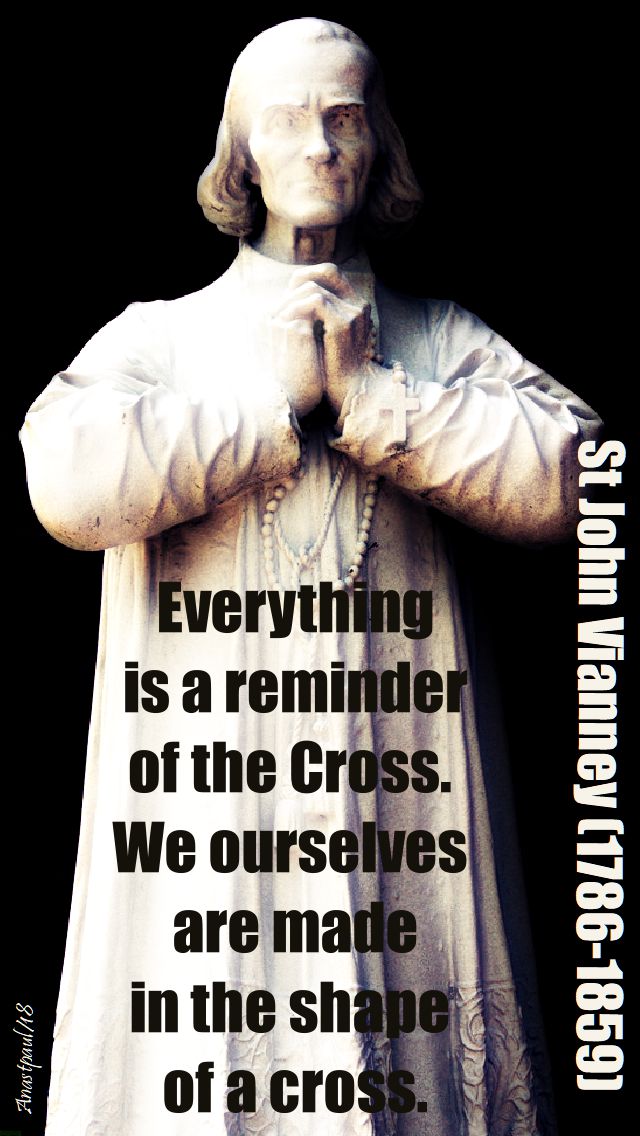
“Everything is a reminder of the Cross. We ourselves are made in the shape of a cross.”
St John Vianney (1786-1859)
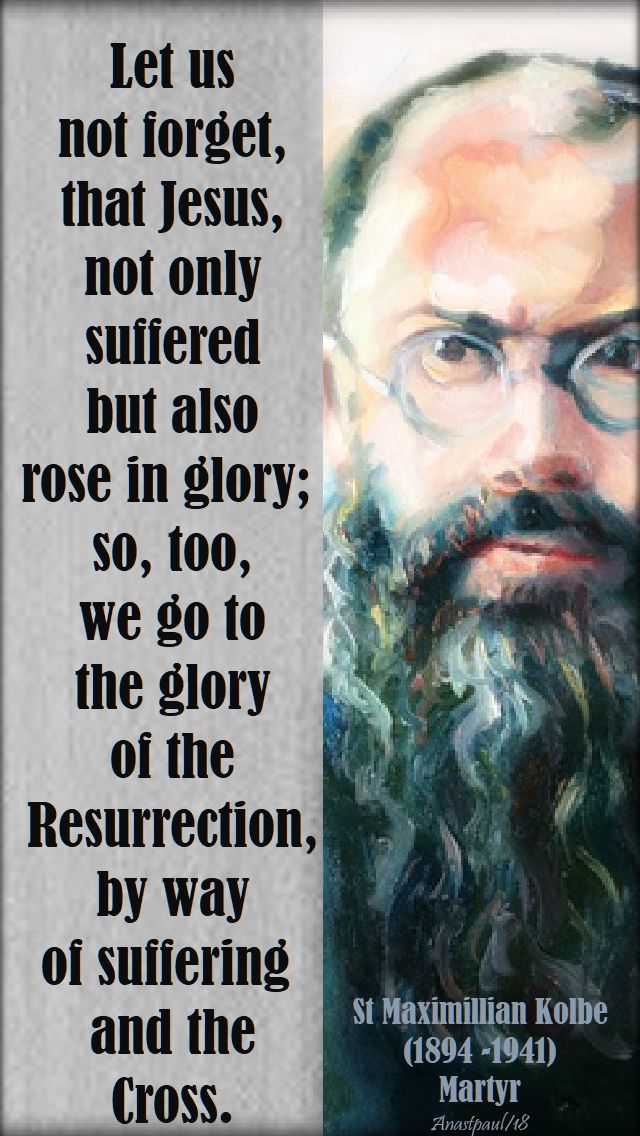
“Let us not forget, that Jesus not only suffered but also rose in glory; so, too, we go to the glory of the Resurrection, by way of suffering and the Cross.”
St Maximillian Kolbe (1894 -1941)
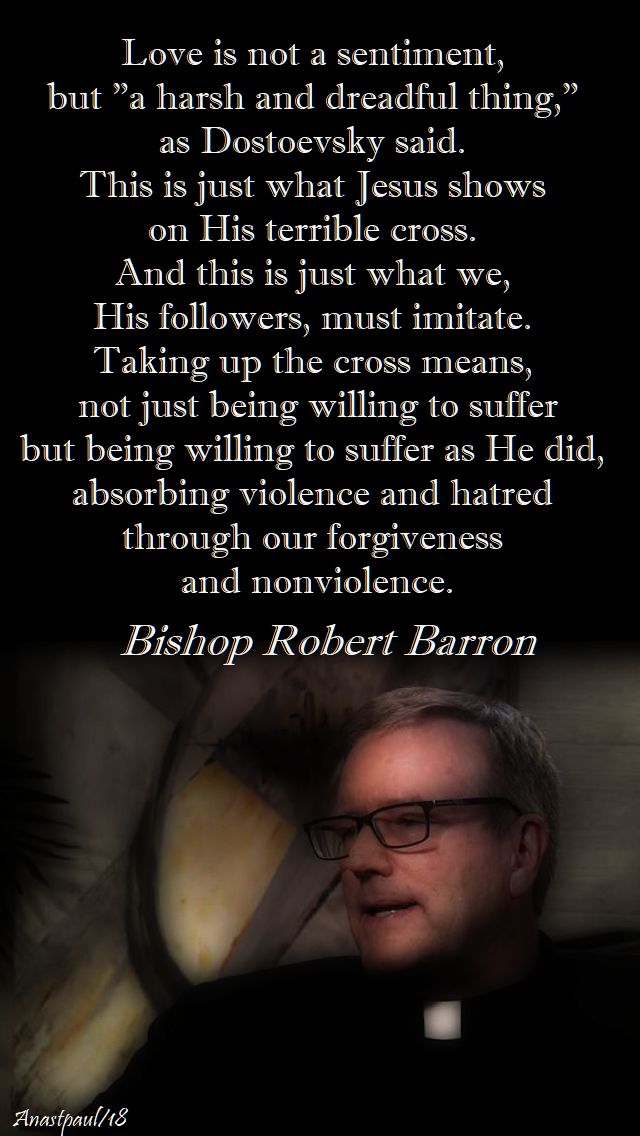
“There is line from the illuminator of the St John’s Bible that states: “We have to love our way out of this.” There is nothing wimpy or namby-pamby or blind about this conviction. When we love extravagantly, we are not purposely blinding ourselves to moral realities— just the contrary.
Love is not a sentiment, but “a harsh and dreadful thing,” as Dostoevsky said.
This is just what Jesus shows on His terrible cross. And this is just what we, His followers, must imitate. Taking up the cross means, not just being willing to suffer but being willing to suffer as He did, absorbing violence and hatred through our forgiveness and nonviolence.”
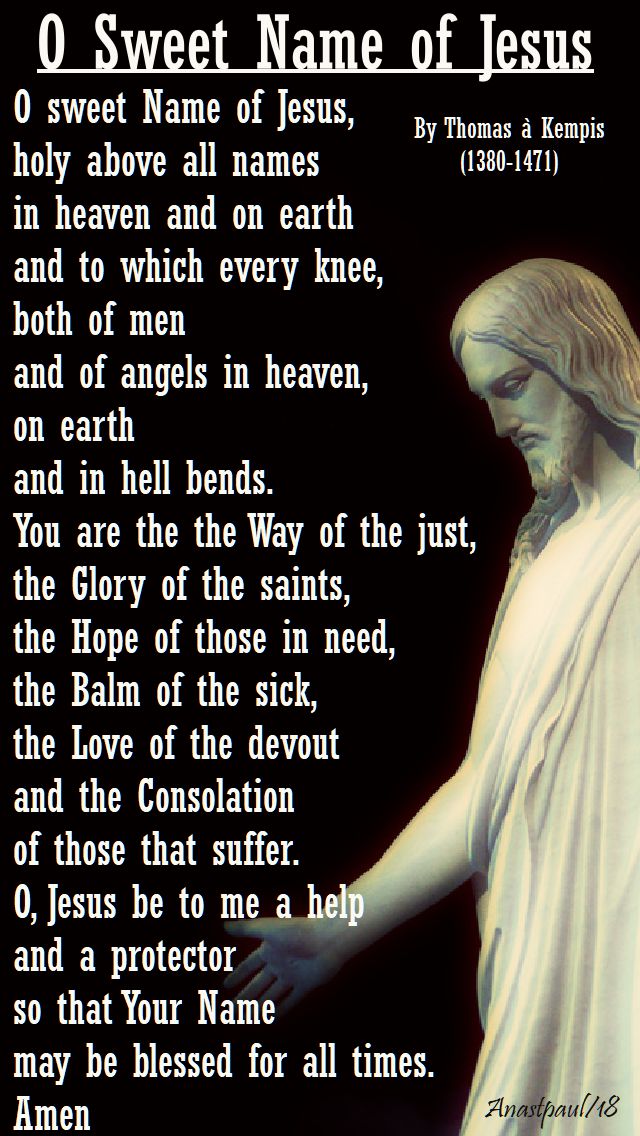
O Sweet Name of Jesus By Thomas à Kempis (1380-1471)
O sweet Name of Jesus,
holy above all names
in heaven and on earth
and to which every knee,
both of men
and of angels in heaven,
on earth and in hell bends.
You are the the Way of the just,
the Glory of the saints,
the Hope of those in need,
the Balm of the sick,
the Love of the devout
and the Consolation
of those that suffer.
O, Jesus be to me a help
and a protector
so that Your Name
may be blessed for all times.
Amen
Thomas à Kempis (1380-1471) CRSA …(Manualis Parvulorum XIII)
Our Morning Offering – 25 August – 21st Sunday of the Year in Ordinary Time, Year B
A Eucharistic Offering By Thomas à Kempis (1380-1471)
Lord, all things in heaven and earth are Yours.
I desire to offer myself to You
in free and perpetual oblation,
so that I may forever be with You.
Lord, in simpliciy of heart,
I offer myself this day to You,
to be Your servant in service
and sacrifice of perpetual praise.
Accept me with the oblation of Your precious Body,
which this day I offer You in the presence
of Your holy angels, here invisibly present,
so that it may be to my salvation
and to the salvation of all people.
Amen
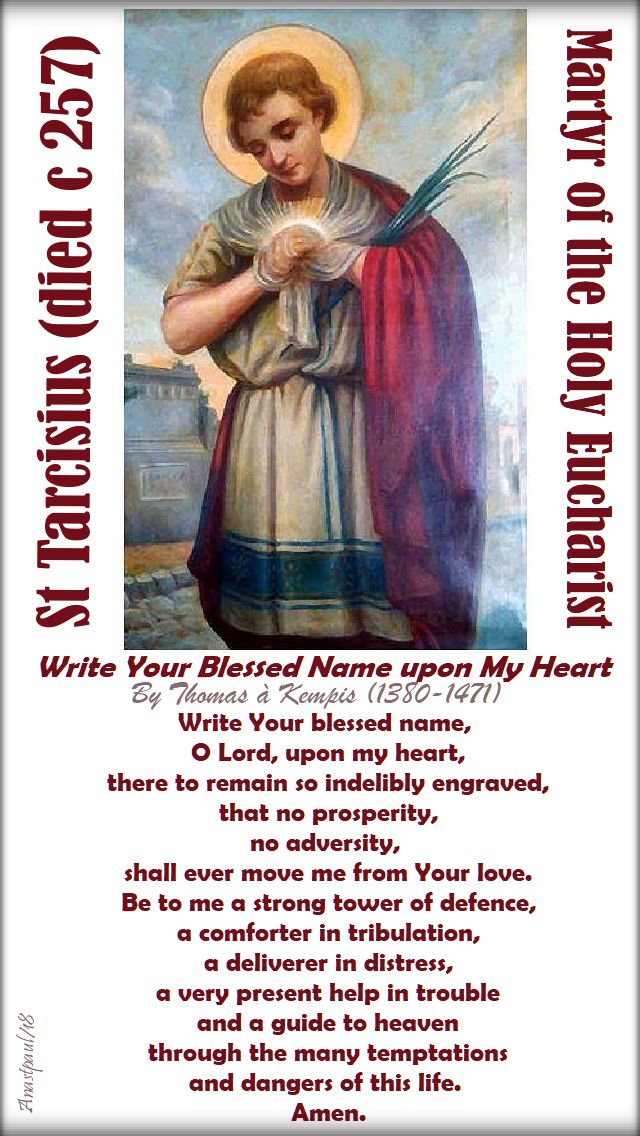
Our Morning Offering – 15 August – The Memorial of St Tarcisius (Died c 257) – Martyr of the Holy Eucharist
Write Your Blessed Name upon My Heart By Thomas à Kempis (1380-1471)
Write Your blessed name,
O Lord, upon my heart,
there to remain so indelibly engraved,
that no prosperity,
no adversity,
shall ever move me from Your love.
Be to me, a strong tower of defence,
a comforter in tribulation,
a deliverer in distress,
a very present help in trouble
and a guide to heaven,
through the many temptations
and dangers of this life.
Amen
Our Morning Offering – 27 July – Friday of the Sixteenth week in Ordinary Time, Year B
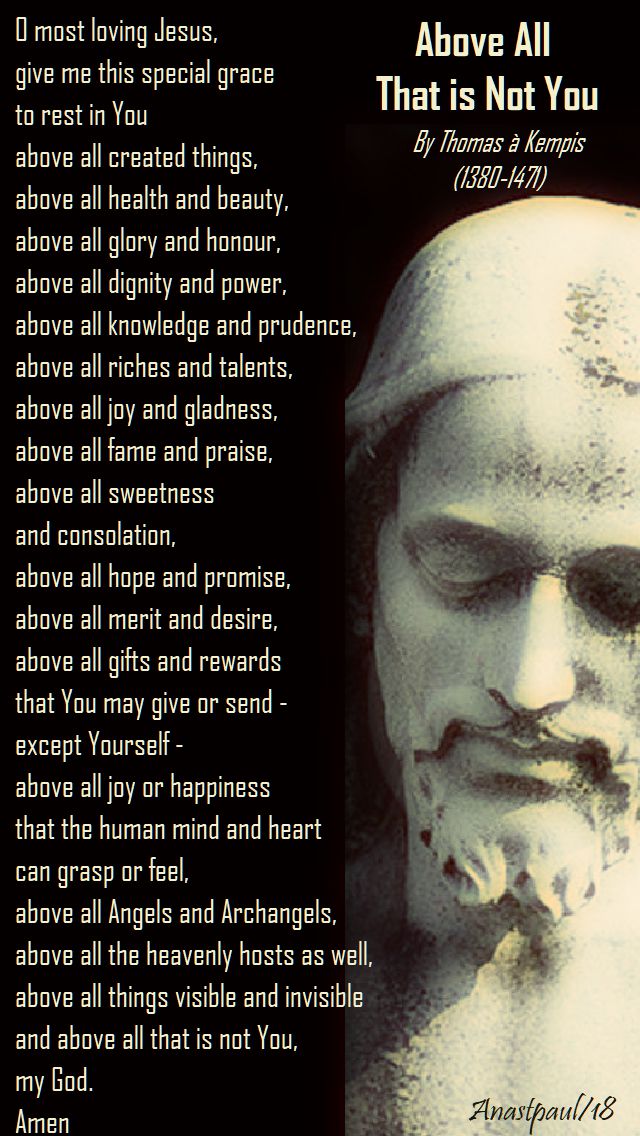
Above All That is Not You Thomas à Kempis (1380-1471)
O most loving Jesus,
give me this special grace to rest in You
above all created things,
above all health and beauty,
above all glory and honour,
above all dignity and power,
above all knowledge and prudence,
above all riches and talents,
above all joy and gladness,
above all fame and praise,
above all sweetness and consolation,
above all hope and promise,
above all merit and desire,
above all gifts and rewards
that You may give or send –
except Yourself –
above all joy or happiness
that the human mind and heart
can grasp or feel,
above all Angels and Archangels,
above all the heavenly hosts as well,
above all things visible and invisible
and above all that is not You,
my God.
Amen
Our Morning Offering – 10 July – Tuesday of the Fourteenth Week of Ordinary Time, Year B
A Prayer for Fulfilling the Will of God Thomas à Kempis (1380-1471)
O most merciful Jesus,
grant me Your grace,
that it may remain with me always
and persevere with me to the end.
Grant me always to will and desire,
what is more pleasing and acceptable to You.
Let Your will be mind
and let my will always follow Yours
in perfect conformity with it.
Let my will and desires always be one with Yours
and let me be unable to will or not to will,
except as You will or do not will.
Grant that I may die to all worldly things
and that I may be despised and unknown
for love of You.
Grant, above all things to be desired,
that I may find rest in You
and that in Your Heart alone may be my peace.
You, O Lord, give true peace to the heart
and perfect rest to body and soul.
Apart from You, all is difficult and never still.
In that peace, in You Who are the one,
supreme and eternal Good,
I will sleep and take my rest.
Amen
Our Morning Offering – 25 June – Monday of the Twelfth Week of Ordinary Time, Year B
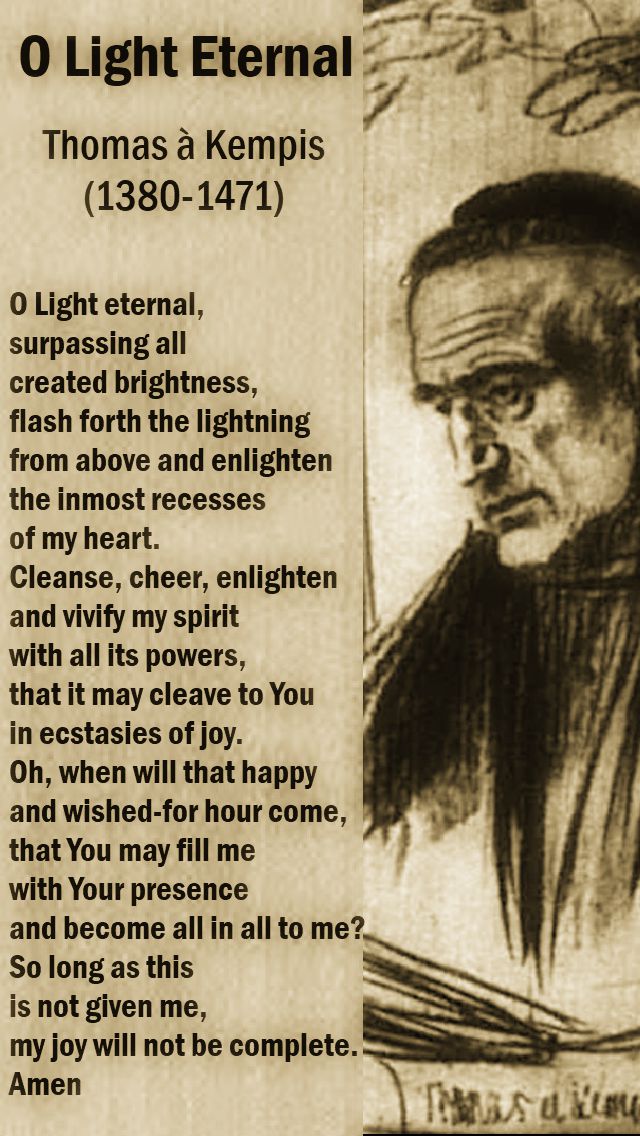
O Light Eternal Thomas à Kempis (1380-1471)
O Light eternal,
surpassing all created brightness,
flash forth the lightning from above
and enlighten the inmost recesses of my heart.
Cleanse, cheer, enlighten
and vivify my spirit with all its powers,
that it may cleave to You in ecstasies of joy.
Oh, when will that happy
and wished-for hour come,
that You may fill me with Your presence
and become all in all to me?
So long as this is not given me,
my joy will not be complete.
Amen
Quote/s of the Day – 14 June – Thursday of the Tenth Week of Ordinary Time, Year B
Speaking of: Seeking Thomas à Kempis
“Man sees your actions but God your motives.”
“What else does anxiety about the future bring you but sorrow upon sorrow?”
“He who loves with purity, considers not, the gift of the lover but the love of the giver.”
“Nothing, how little so ever it be, if it is suffered for God’s sake, can pass without merit in the sight of God.”
“Who has a harder fight, than he who is striving, to overcome himself?”
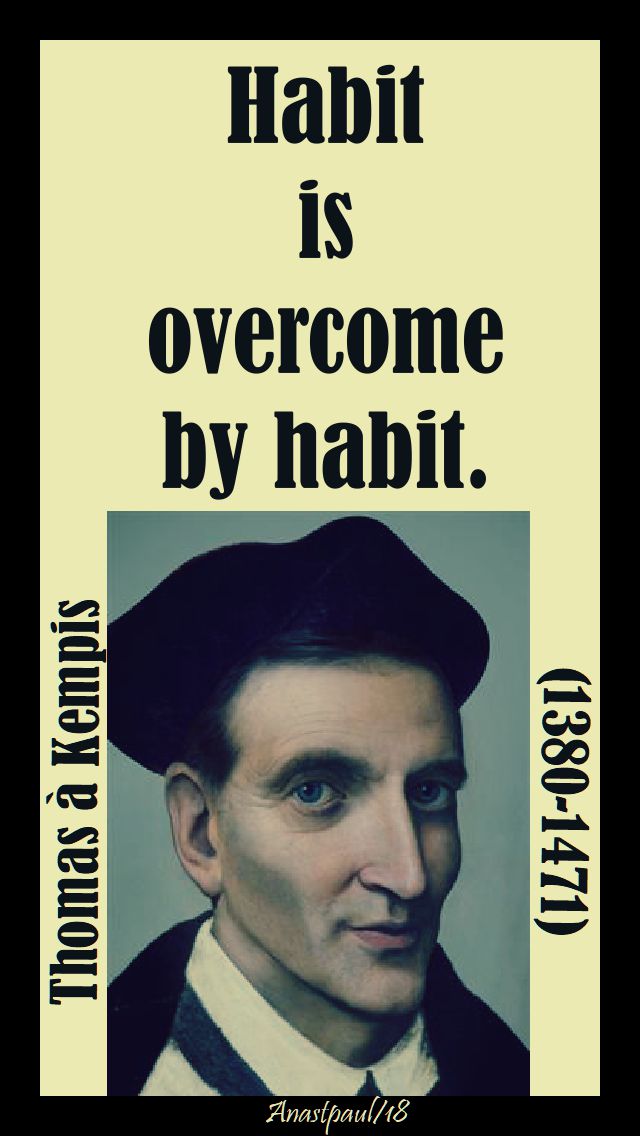
“Habit is overcome by habit.”
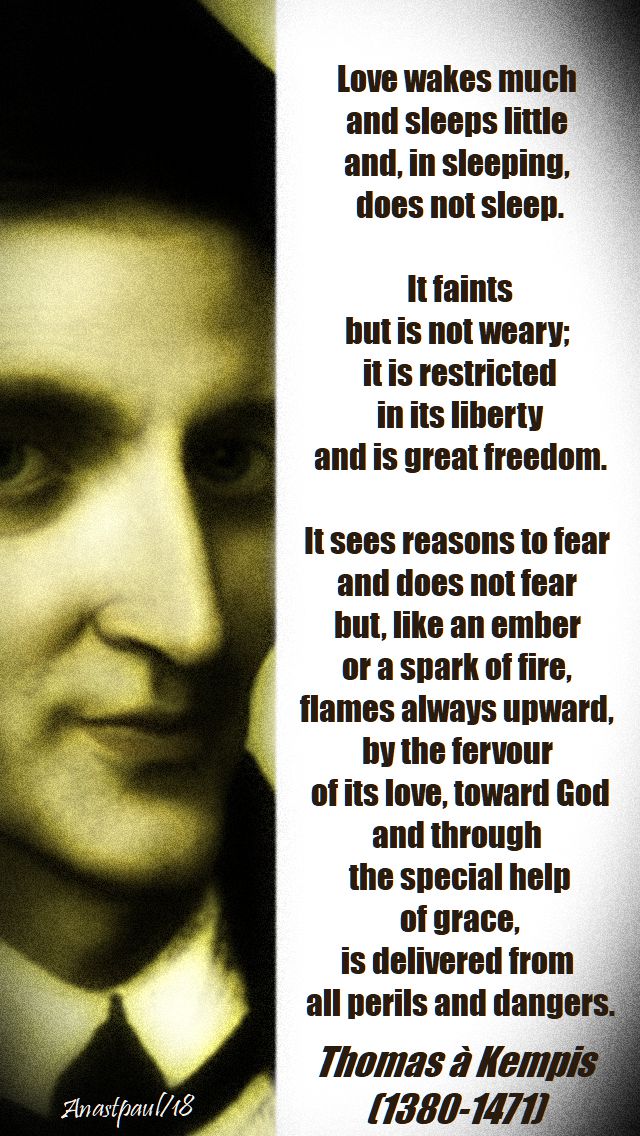
“Love wakes much and sleeps little and, in sleeping, does not sleep. It faints but is not weary; it is restricted in its liberty and is great freedom. It sees reasons to fear and does not fear but, like an ember or a spark of fire, flames always upward, by the fervour of its love, toward God and through the special help of grace, is delivered from all perils and dangers.”
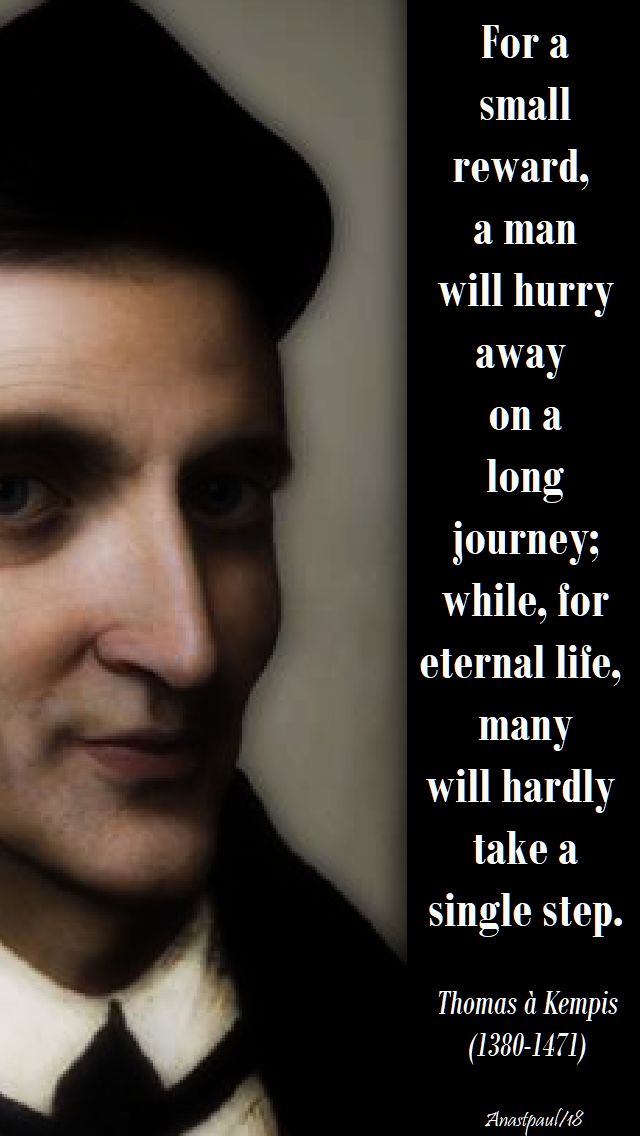
“For a small reward, a man will hurry away on a long journey; while for eternal life, many will hardly take a single step.”
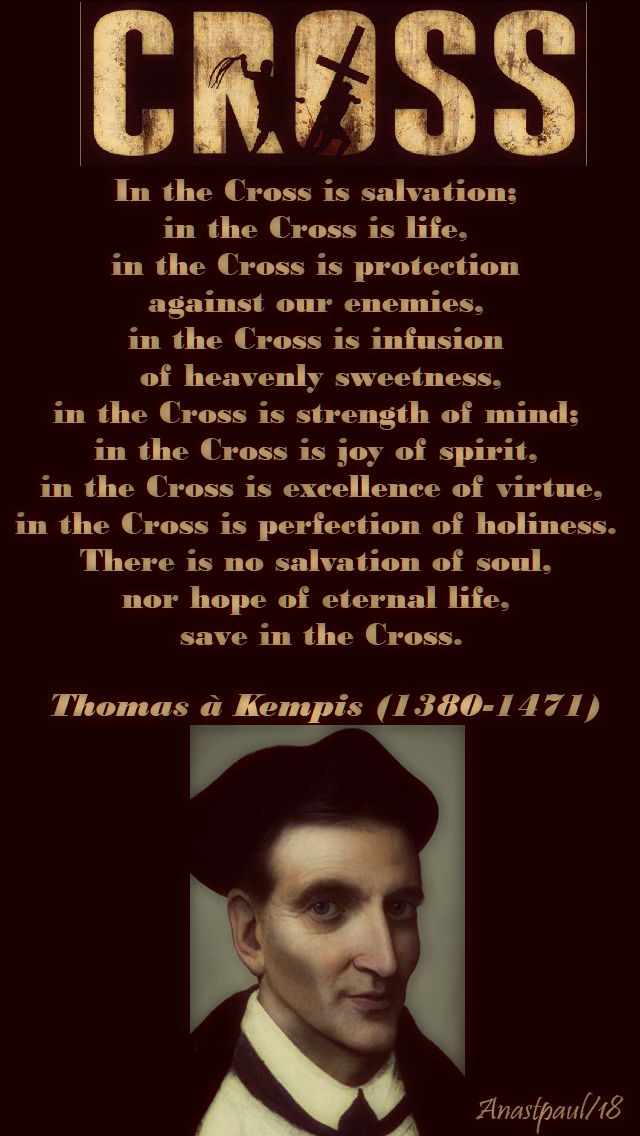
“In the Cross is salvation; in the Cross is life, in the Cross is protection against our enemies, in the Cross is infusion of heavenly sweetness, in the Cross is strength of mind, in the Cross is joy of spirit, in the Cross is excellence of virtue, in the Cross is perfection of holiness. There is no salvation of soul, nor hope of eternal life, save in the Cross.”
“He will be with you also, all the way, that faithful God. Every morning when you awaken, to the old and tolerable pain, at every mile of the hot uphill dusty road of tiring duty, on to the judgment seat, the same Christ there as ever, still loving you, still sufficient for you, even then. And then, on through all eternity.”
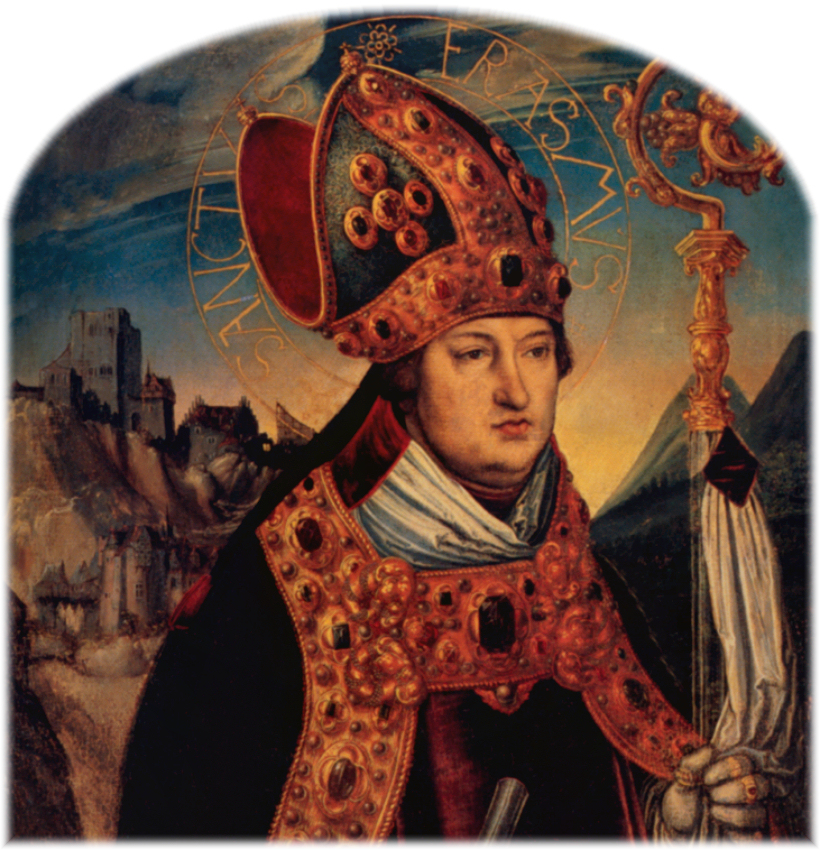
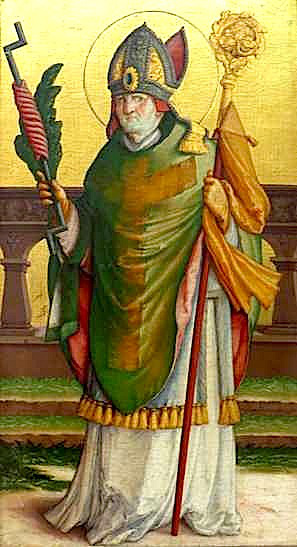
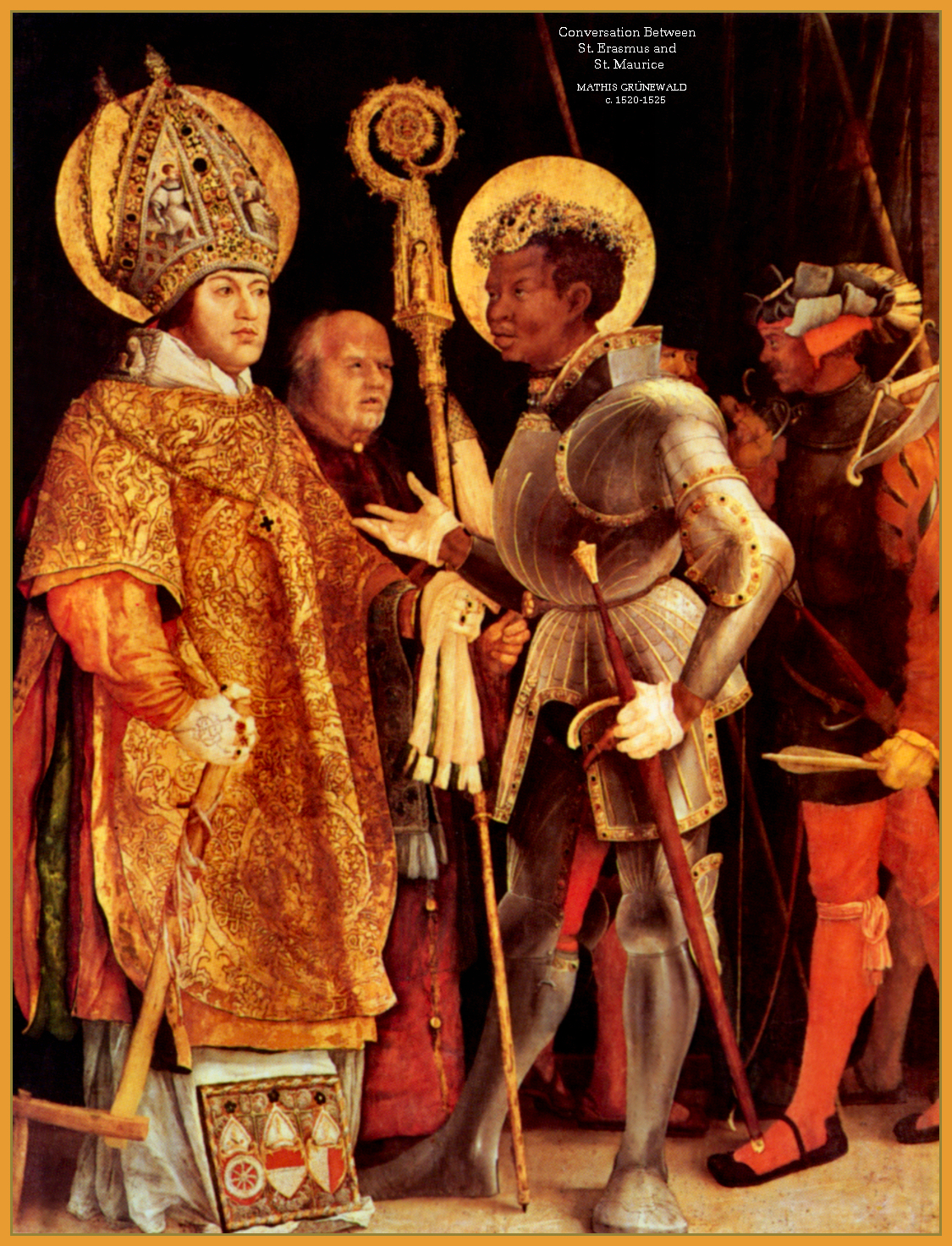
Saint of the Day – 2 June – St Erasmus (Died c 303) Martyr – also known as Saint Elmo (Telmo, Eramo, Erarmo, Ermo, Herasmus, Rasimus, Rasmus), Bishop of Formiae, Campagna, Italy. St Erasmus or Elmo is also one of the Fourteen Holy Helpers, saintly figures of Christian tradition who were venerated especially as intercessors. Patronages – against appendicitis, against birth pains, against abdominal or stomach pains and diseases, against colic, against danger at sea, against seasickness, against storms, ammunition, explosives and ordnance workers, boatmen, mariners, sailors, watermen, childbirth and women in labour, navigators, Gaeta, Italy, Formia, cattle pest, Fort St Elmo, Malta.
As with many Martyrs of the early Church, we know little about their lives and upbringings but much about their pious and courageous deaths, accounts of which were recorded and believed to be more instructive to the faithful than complete biographies.
The childhood and birthplace of Saint Erasmus is lost to history. In the late third century, we do know that he was appointed Bishop of Antioch in Asia Minor, where he led the faithful. When Emperor Diocletian ascended to the throne, widespread persecution of Christians began and Antioch was not overlooked. Saint Erasmus fled into the mountains of Lebanon, where he undertook an austere life of prayer and fasting, going without food for days at a time. Holy legend tells us that a raven brought him food when he deprived himself for too long. Eventually, however, he was discovered by the soldiers of the Emperor and dragged to judgement.
St Erasmus was urged to recant his faith and some respect was offered him. However, when he adamantly stated his belief in Christ and could not be persuaded to make offerings to the gods. He stated, “Almighty God, that made all things, hath wrought heaven and hell and all that is therein, Him will I not forsake for nothing that can or may be done to me, for His goodly grace hath given to me such grace and to other of His chosen friends, that He was made man and hath tasted and suffered the bitter death for me and for all sinners.”Saint Erasmus was viciously tortured. He was at first scourged, had heated hooks jabbed into his intestines and stomach and was finally thrown into a caldron filled with boiling oil. However, despite these horrific tortures, the Lord protected Saint Erasmus from death and many were converted to the faith—including the jailor and his family.
Unable to torture him physically into recanting his faith, the judge ordered him imprisoned in chains, thrown into a pit filled with vipers and worms and forbid the jailor to feed him, insisting that he die of starvation for his crime. However, Erasmus was again delivered, with an angel appearing to him and leading him to freedom. During his escape, the angel proclaimed, ”Erasmus, Follow me! Thou shalt convert a great many.”
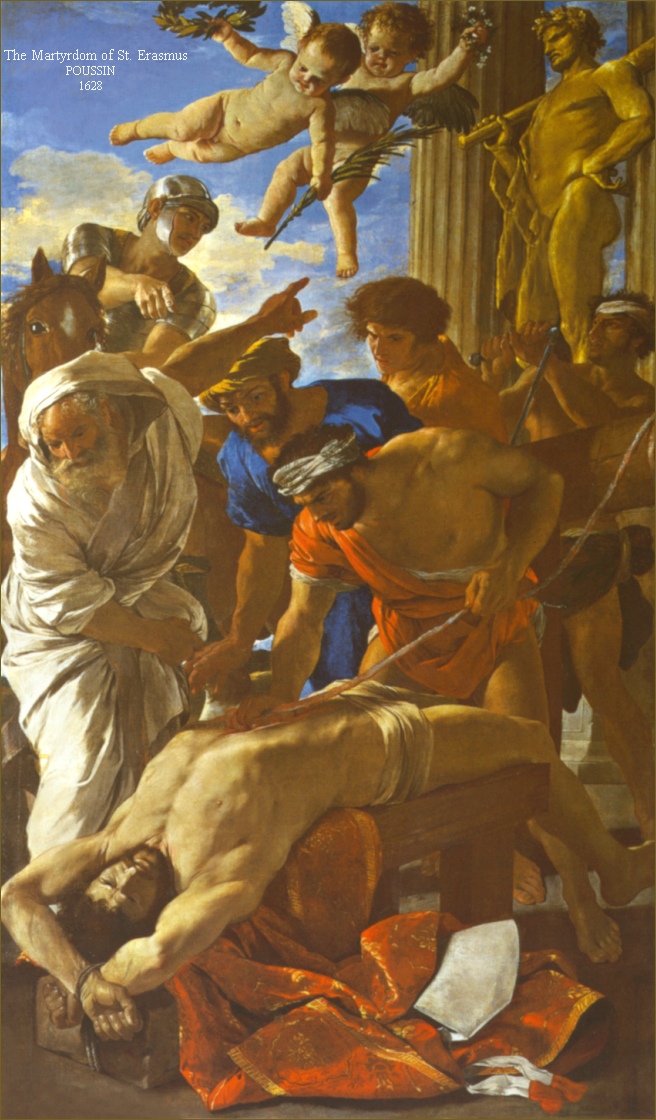
Erasmus fled to Europe, preaching the power of the Lord, performing miracles and converting the multitudes proclaimed by the Angel. Upon his arrival in Italy, however, he was again arrested—this time by Emperor Maximin, who also persecuted Christians. History tells us that the Emperor, enraged by Erasmus’ success in conversions, ordered three hundred of the newly baptised Christians killed as incentive for Erasmus to recant his faith. When he did not, he was cruelly tortured and again imprisoned. During this torture, his intestines were slowly wound around a sailor’s capstan, which is why he is the Patron Saint of sailors today. Eventually, Saint Erasmus died a Martyr’s death due to disembowelling and subsequent beheading, having been summoned by the voice of the Lord.
From the Golden Legend:“And when the hour was come that this holy Bishop and Martyr of God should depart out of this world, then was heard a loud voice perfectly, coming from heaven saying: “Erasmus, my true servant, thou hast done me true service, wherefore come with me and go and enter into the bliss and joy of thy Lord and I promise thee and all people that think upon thy great pain and call upon thy holy name and worship every Sunday, what that they ask of Me in thy name for the wealth of their souls, I shall grant it. Now come, my true and chosen friend, be glad and comforted with Mine ascension . I will that thou arise with Me and come sit upon the right hand of My Father.” Then was this holy man right glad and joyful and he cast his eyes upward to heaven, with lifting up his hands and there he saw, a clear shining crown come from heaven upon his blessed head. Then gave he loving and thanking to Almighty God with bowing his head and kneeling and both his hands upward to heaven, and meekly said: “O Lord in thy hands yield my spirit and this Sunday receive my soul into thy peace and rest.” And with saying these words he yielded up his ghost, which was seen by many men’s eyes, shining clearer than the sun and how that he was received of the holy Angels and was led through the height of heaven into the uppermost plan of heaven – there he standeth with God, with all the holy company and is there a true helper to all them that call truly to Saint Erasmus for ghostly health, which joy and ghostly health let us pray, that he for us, all of our Lord God may obtain.”
Saint Erasmus is one of the 14 Holy Helpers, a group of saints invoked with special confidence because they have proven themselves efficacious helpers in adversity and difficulties . Other saints identified as Holy Helpers are: Saints Blaise, Catherine of Alexandria, George, Christopher and others. Saint Erasmus, due to the manner in which he was tortured, is the Patron Saint of those with stomach or intestinal disorders.
Saint Erasmus, under the name Saint Elmo, is also the patron saint of sailors and the shining lights observed upon his death, continue to be reported by sailors as “Saint Elmo’s fire.” This electrostatic phenomenon has been reported throughout history, from Julius Caesar, to the journals of sailors on Magellan’s voyage around the globe, to the writings of Shakespeare, Melville and Charles Darwin.
A chronicler of Magellan’s voyage to circle the globe, observed: “During those storms the holy body, that is, to say St. Elmo, appeared to us many times in light…on an exceedingly dark night on the maintop where he stayed for about two hours or more for our consolation.” Darwin wrote that one night when the Beagle was anchored in the estuary of the Rio Plata: “Everything was in flames, the sky with lightning, the water with luminous particles, and even the very masts were pointed with a blue flame.” The appearance of St Elmo’s Fire is regarded as a good omen for sailors, as it tends to occur near the end of severe thunderstorms or weather systems, the answer to sailors’ prayers for heavenly intervention. In these moments, the guiding hand of Saint Elmo is present.
The endurance of Saint Erasmus in the face of cruel and horrific torture reminds us that the Lord is always with those who love Him. It is difficult to imagine being in a position of profound physical torture, like that many of the early Church’s Martyrs endured. In our day to day lives, we often find it difficult to withstand the smallest inconveniences and hurts we experience, generally feeling lost and overwhelmed. But the lives of the early Martyrs are not that different from our own. Terminal illnesses, significant financial and vocational struggles, victimisation and trauma fill our lives and the lives of those we love. Our suffering is sometimes great, albeit different from the early Martyrs. Our call is to join that suffering to Christ, to look to the Lord for support and succour, to rely on Our Blessed Mother for grace and intercession. When we are able to do that—when we are able to look beyond our struggles and suffering to see the face of God present within us, we grow closer to the glorious Saints and Martyrs who reflected their faith for all to see, even in the midst of great pain!
Marian Thought for the Day – 13 May – “Mary’s Month” – The Solemnity of the Ascension of the Lord and the Feasts of Our Lady of Fatima, Our Lady of Help, Our Lady of the Most Blessed Sacrament and the Memorial of the Dedication of the Minor Basilica of Saint Mary of the Martyrs (Pantheon)
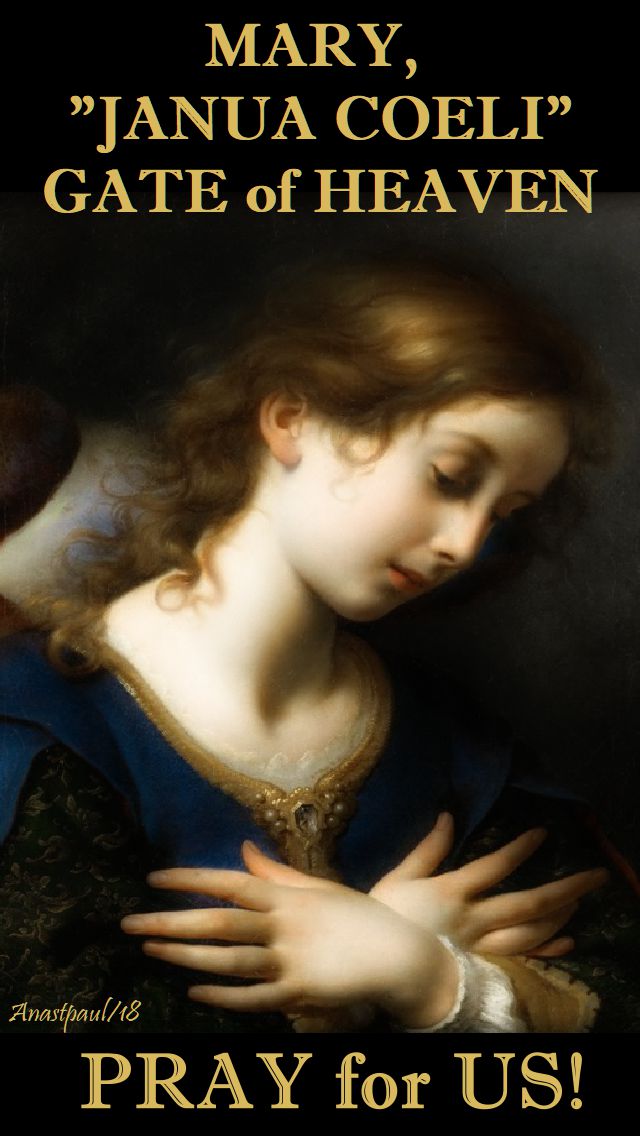
Mary is the “Janua Cœli,” the Gate of Heaven
Blessed John Henry Newman (1801-1890)
MARY is called the Gate of Heaven, because it was through her, that our Lord passed from heaven to earth. The Prophet Ezechiel, prophesying of Mary, says, “the gate shall be closed, it shall not be opened and no man shall pass through it, since the Lord God of Israel has entered through it—and it shall be closed for the Prince, the Prince Himself shall sit in it.”
Now this is fulfilled, not only in our Lord having taken flesh from her and being her Son, but, moreover, in that she had a place in the economy of Redemption; it is fulfilled in her spirit and will, as well as in her body. Eve had a part in the fall of man, though it was Adam who was our representative and whose sin made us sinners. It was Eve who began and who tempted, Adam. Scripture says: “The woman saw that the tree was good to eat, and fair to the eyes, and delightful to behold; and she took of {37} the fruit thereof, and did eat, and gave to her husband, and he did eat.” It was fitting then in God’s mercy that, as the woman began the destruction of the world, so woman should also begin its recovery and that, as Eve opened the way for the fatal deed of the first Adam, so Mary should open the way, for the great achievement of the second Adam, even our Lord Jesus Christ, who came to save the world by dying on the cross for it. Hence Mary is called by the holy Fathers a second and a better Eve, as having taken that first step in the salvation of mankind which Eve took in its ruin.
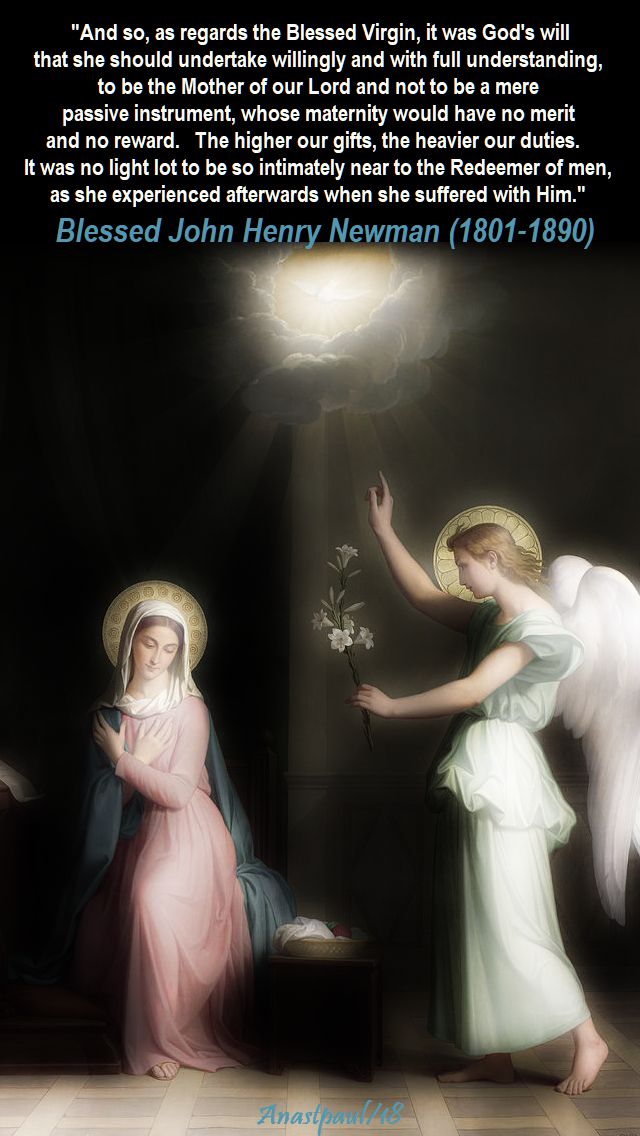
How, and when, did Mary take part and the initial part, in the world’s restoration? It was when the Angel Gabriel came to her to announce to her the great dignity which was to be her portion. St Paul bids us “present our bodies to God as a reasonable service.” We must not only pray with our lips and fast and do outward penance and be chaste in our bodies but we must be obedient and pure in our minds. And so, as regards the Blessed Virgin, it was God’s will that she should undertake willingly and with full understanding, to be the Mother of our Lord and not to be a mere passive instrument, whose maternity would have no merit and no reward. The higher our gifts, the heavier our duties. It was no light lot to be so intimately near to the Redeemer of men, as she experienced afterwards when she suffered with Him. Therefore, weighing well the Angel’s words before giving her answer to them—first she asked whether so great an office would be a forfeiture of that Virginity which she had vowed. When the Angel told her no, then, with the full consent of a full heart, full of God’s love to her and her own lowliness, she said, “Behold the handmaid of the Lord; be it done unto me according to thy word.” It was by this consent that she became the Gate of Heaven.
Marian Thought for the Day – 4 May – Mary’s Month! – Friday of the Fifth Week of Eastertide
Mary is the “Virgo Prædicanda,” the Virgin who is to be Proclaimed
Blessed John Henry Newman (1801-1890)
MARY is the Virgo Prædicanda, that is, the Virgin who to be proclaimed, to be heralded, literally, to be preached.
We are accustomed to preach abroad that which is wonderful, strange, rare, novel, important. Thus, when our Lord was coming, St John the Baptist preached Him; then, the Apostles went into the wide world and preached Christ. What is the highest, the rarest, the choicest prerogative of Mary? It is that she was without sin. When a woman in the crowd cried out to our Lord, “Blessed is the womb that bare Thee!” He answered, “More blessed are they who hear the word of God and keep it.” Those words were fulfilled in Mary. She was filled with grace in order to be the Mother of God. But it was a higher gift than her maternity to be thus sanctified and thus pure. Our Lord indeed would not have become her son unless He had first sanctified her but still, the greater blessedness was to have that perfect sanctification. This then is why she is the Virgo Prædicanda; she is deserving to be preached abroad because she never committed any sin, even the least; because sin had no part in her; because, through the fullness of God’s grace, she never thought a thought, or spoke a word, or did an action, which was displeasing, which was not most pleasing, to Almighty God; because in her was displayed the greatest triumph over the enemy of souls.
Wherefore, when all seemed lost, in order to show what He could do for us all by dying for us; in order to show what human nature, His work, was capable of becoming; to show how utterly He could bring to naught the utmost efforts, the most concentrated malice of the foe and reverse all the consequences of the Fall, our Lord began, even before His coming, to do His most wonderful act of redemption, in the person of her who was to be His Mother. By the merit of that Blood which was to be shed, He interposed to hinder her incurring the sin of Adam, before He had made on the Cross atonement for it. And therefore it is that we preach her who is the subject of this wonderful grace.
But she was the Virgo Prædicanda for another reason. When, why, what things do we preach? We preach what is not known, that it may become known. And hence the Apostles are said in Scripture to “preach Christ.” To whom? To those who knew Him not—to the heathen world. Not to those who knew Him but to those who did not know Him.
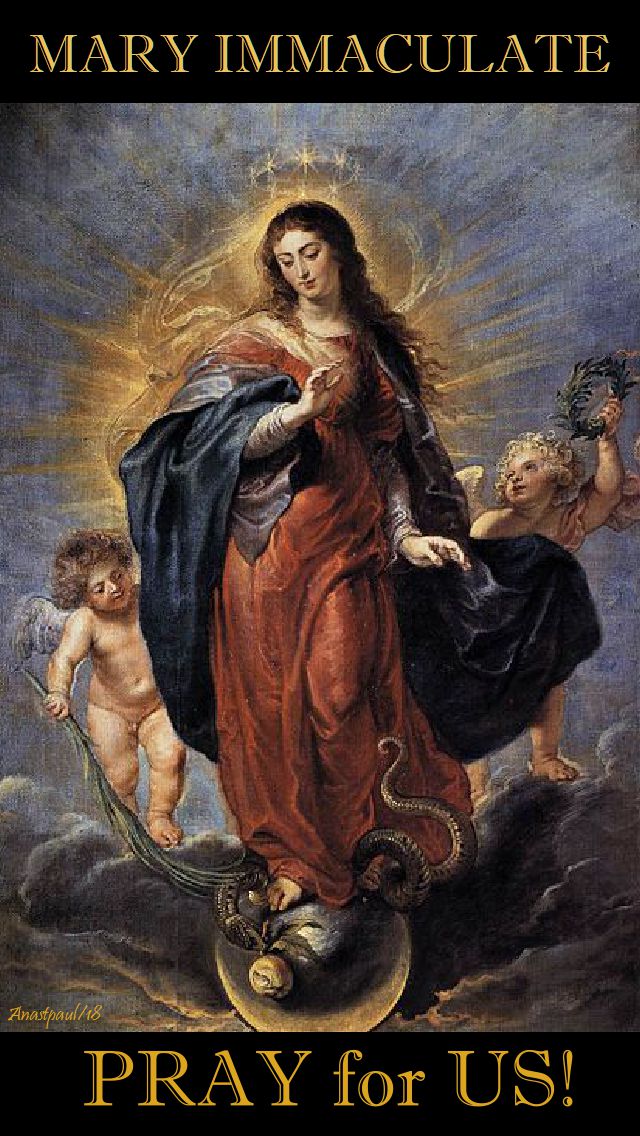
Preaching is a gradual work, first one lesson, then another. Thus were the heathen brought into the Church gradually. And in like manner, the preaching of Mary to the children of the Church and the devotion paid to her by them, has grown, grown gradually, with successive ages. Not so much preached about her in early times as in later. First she was preached as the Virgin of Virgins—then as the Mother of God—then as glorious in her Assumption—then as the Advocate of sinners—then as Immaculate in her Conception. And this last has been the special preaching of the present century and thus that which was earliest in her own history is the latest in the Church’s recognition of her.
Quote/s of the Day – 4 May – Friday of the Fifth Week of Eastertide: Today’s Gospel John 15:12-17
Speaking of: LOVE
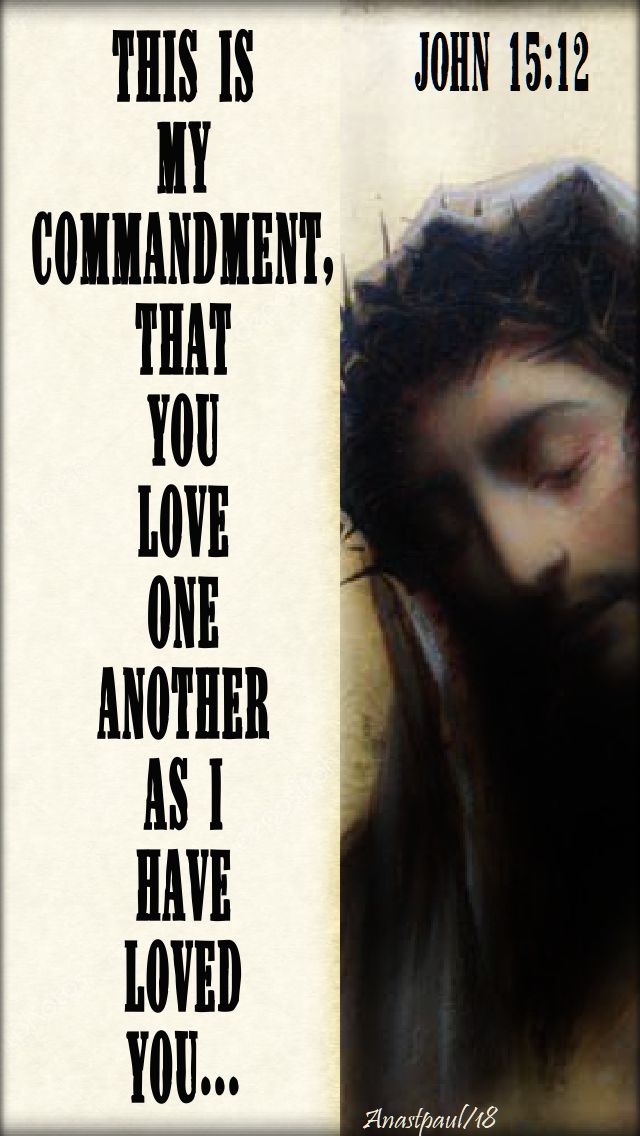
“This is my commandment, that you love one another as I have loved you…
John 15:12
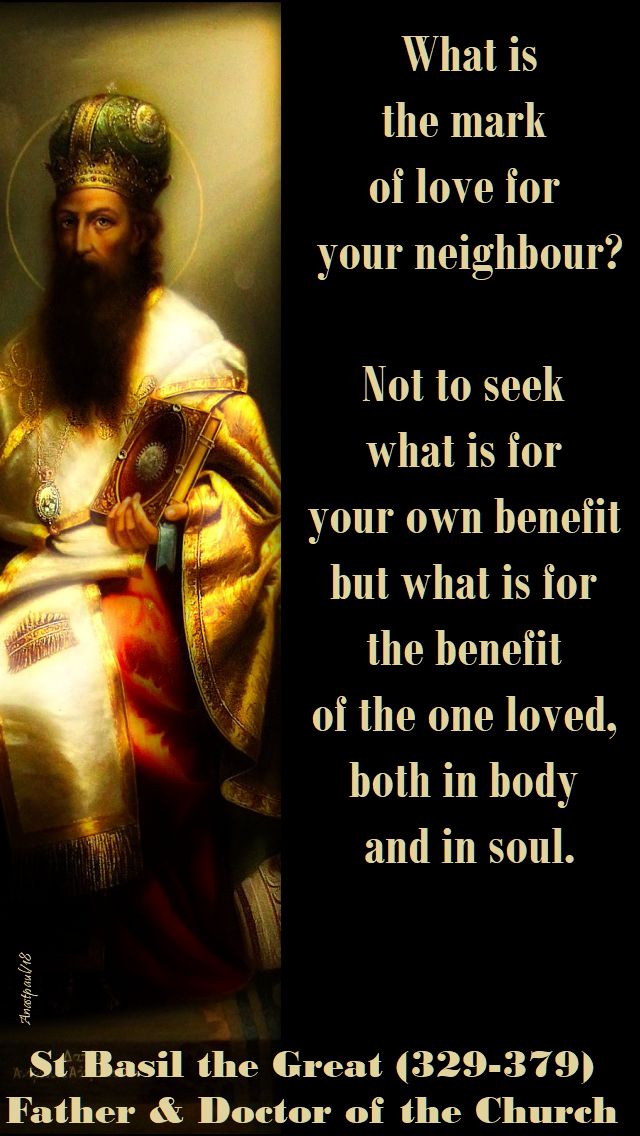
“What is the mark of love for your neighbour? Not to seek what is for your own benefit but what is for the benefit of the one loved, both in body and in soul.”
St Basil the Great (329-379) Father & Doctor of the Church
“Love is watchful. Sleeping, it does not slumber. Wearied, it is not tired. Pressed, it is not straitened. Alarmed, it is not confused but like a living flame, a burning torch, it forces its way upward and passes unharmed through every obstacle.”
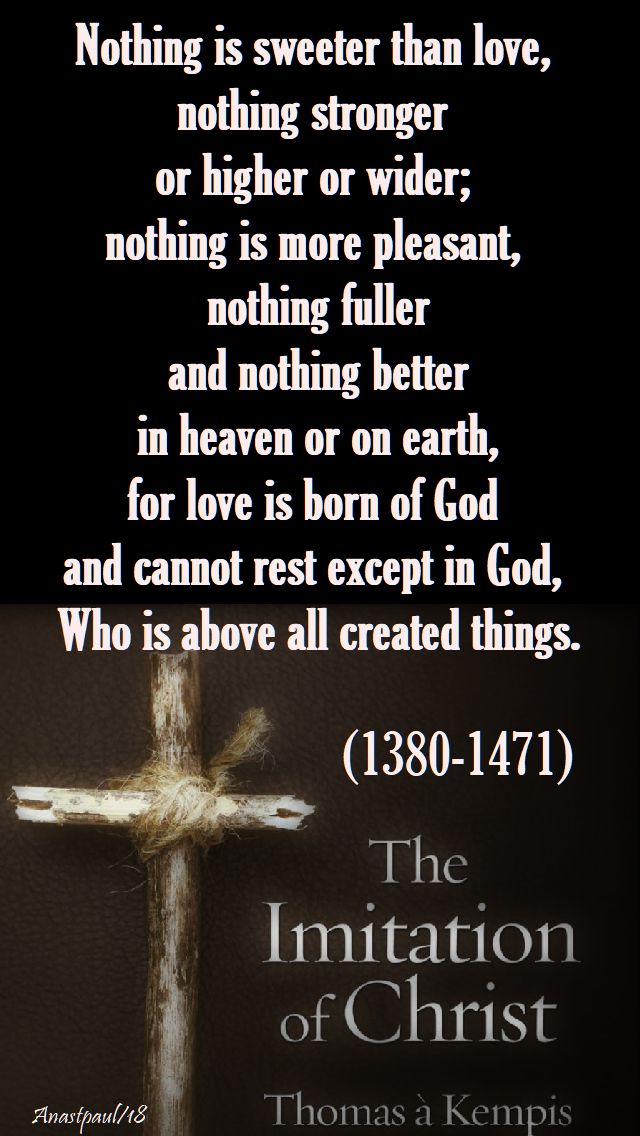
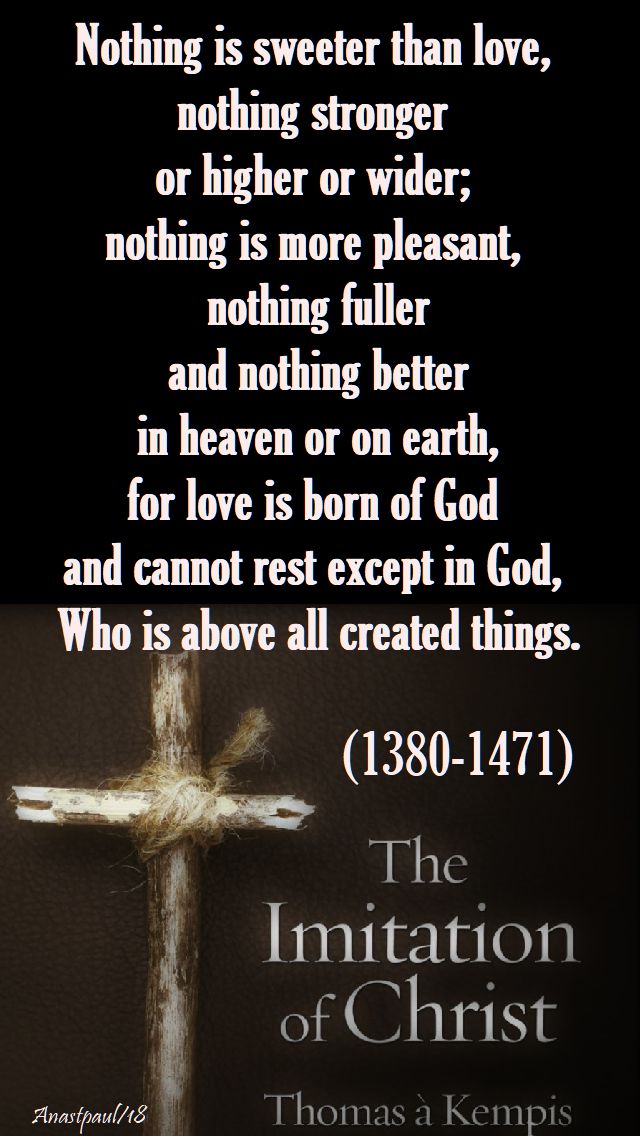
“Nothing is sweeter than love, nothing stronger or higher or wider; nothing is more pleasant, nothing fuller and nothing better in heaven or on earth, for love is born of God and cannot rest except in God, Who is above all created things.”
Thomas a Kempis (1380-1471) – Imitation of Christ
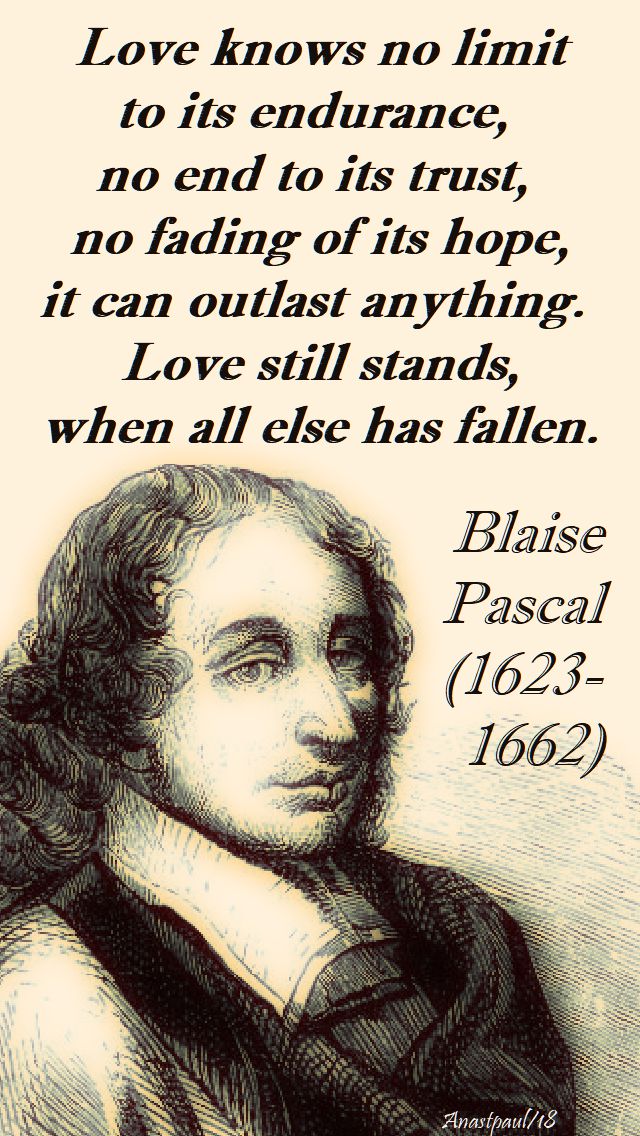
“Love knows no limit to its endurance, no end to its trust, no fading of its hope, it can outlast anything. Love still stands, when all else has fallen.”
Quote/s of the Day – 6 April – Easter Friday the Sixth day in the Easter Octave
“Speaking of Love”
“Nothing is sweeter than love, nothing stronger or higher or wider; nothing is more pleasant, nothing fuller and nothing better in heaven or on earth, for love is born of God and cannot rest except in God, Who is above all created things.”
“Love is watchful. Sleeping – it does not slumber. Wearied – it is not tired. Pressed – it is not straitened. Alarmed – it is not confused but like a living flame, a burning torch, it forces its way upward and passes unharmed, through every obstacle.”
Thomas à Kempis (1380-1471) The Imitation of Christ
“What does love look like? It has the hands to help others. It has the feet to hasten to the poor and needy. It has eyes to see misery and want. It has the ears to hear the sighs and sorrows of men. That is what love looks like.”
St Augustine of Hippo (354-430) Father & Doctor
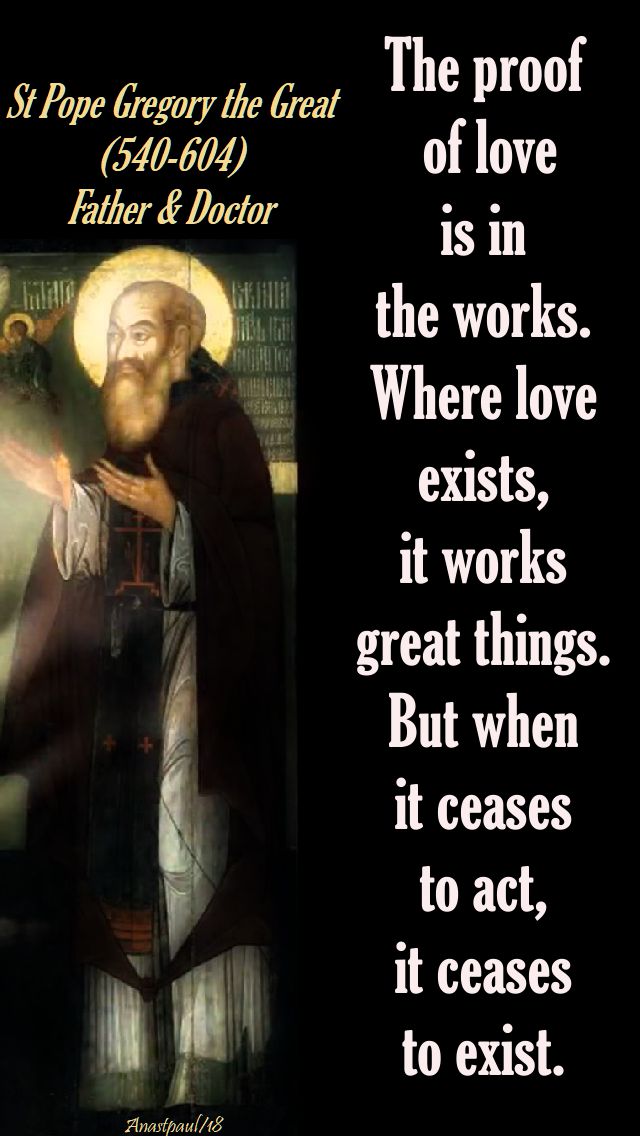
“The proof of love is in the works. Where love exists, it works great things. But when it ceases to act, it ceases to exist.”
St Pope Gregory the Great (540-604) Father & Doctor
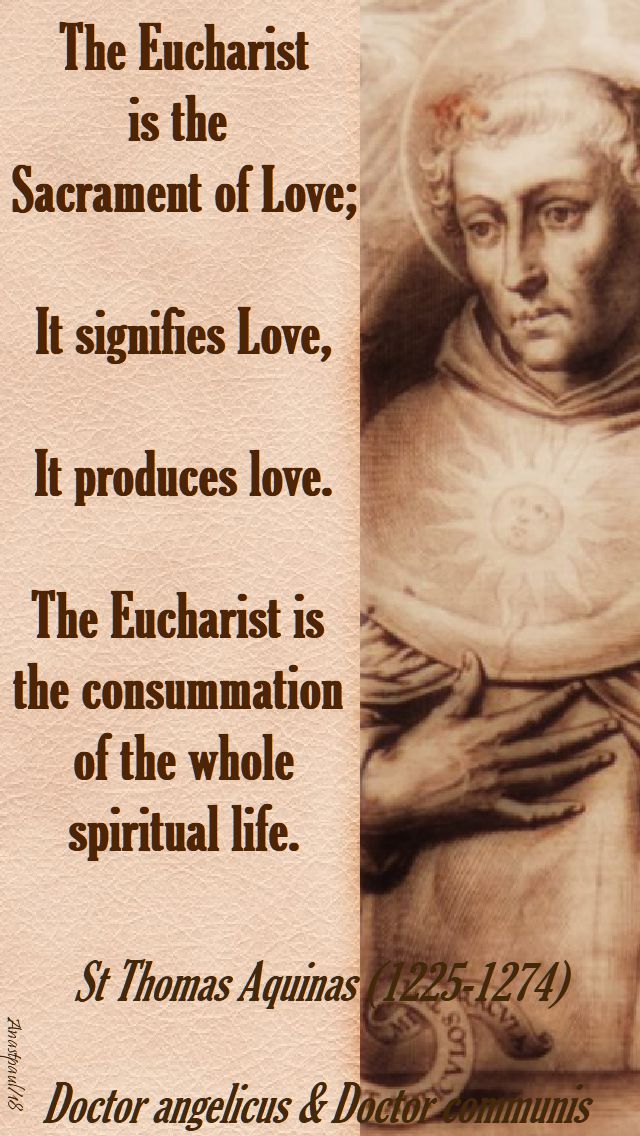
“The Eucharist is the Sacrament of Love; It signifies Love, It produces love. The Eucharist is the consummation of the whole spiritual life.”
St Thomas Aquinas (1225-1274) Doctor angelicus / Doctor communis
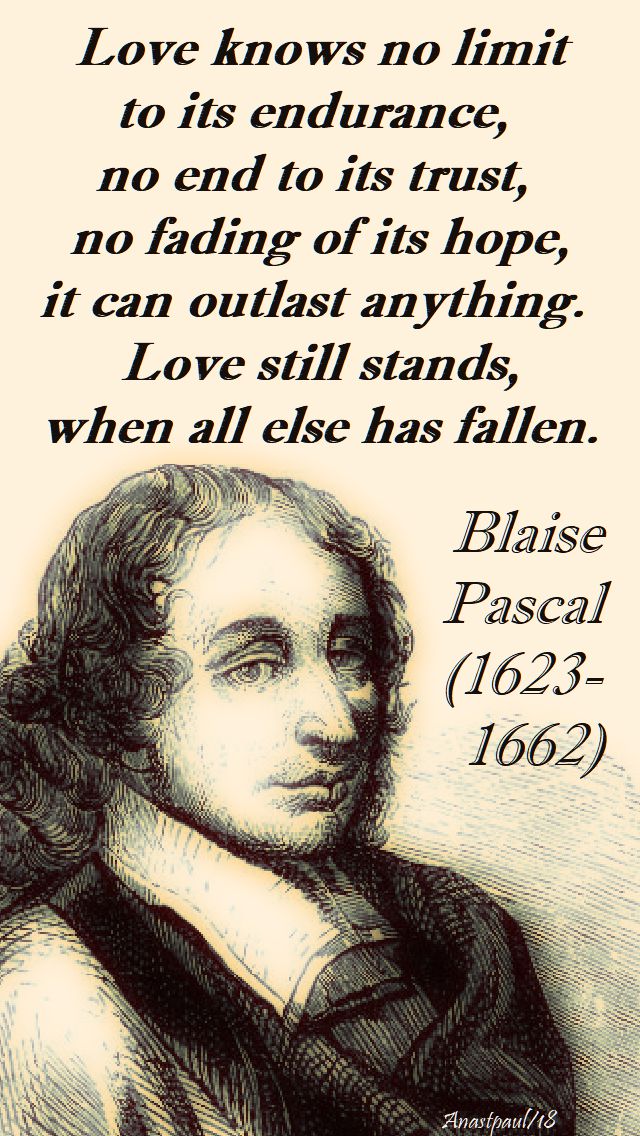
Love knows no limit to its endurance, no end to its trust, no fading of its hope, it can outlast anything. Love still stands, when all else has fallen.
Blaise Pascal (1623-1662)
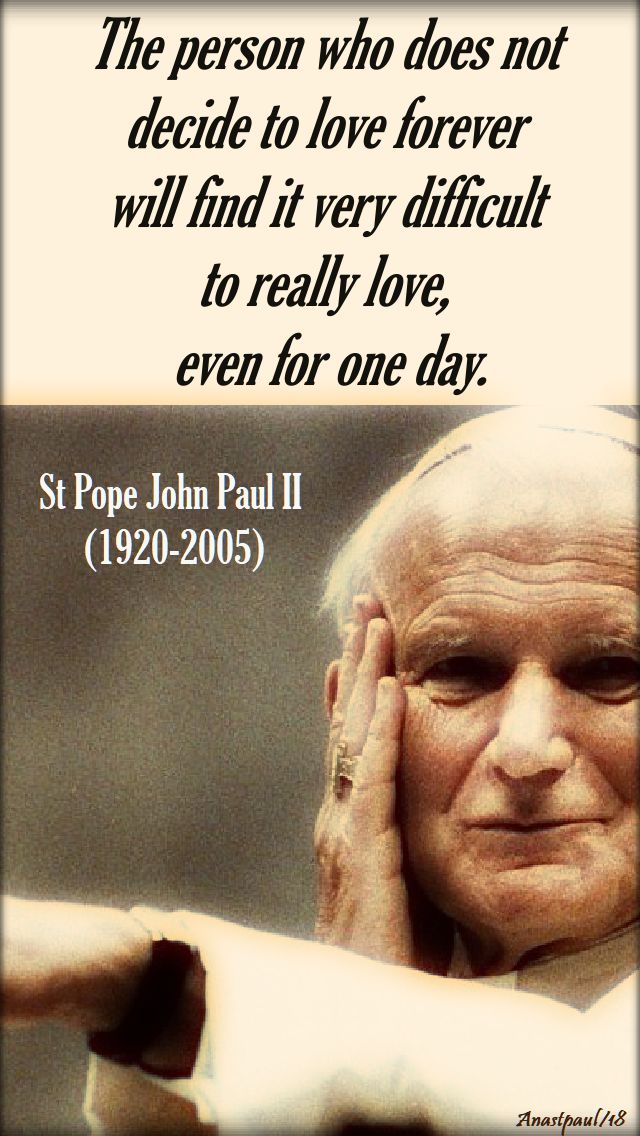
“The person who does not decide to love forever will find it very difficult to really love, even for one day.”
Thought for the Day – Easter Monday of the Easter Octave – 2 April 2018
The Resurrection of Jesus Christ is the Figure of our spiritual resurrection.
“So they departed quickly from the tomb with fear and great joy, and ran to tell his disciples. And behold, Jesus met them and said, “Hail!” And they came up and took hold of his feet and worshiped him. Then Jesus said to them, “Do not be afraid; go and tell my brethren to go to Galilee, and there they will see me.”… Matthew 28:8-10
Let us represent to ourselves anew, the glory of the Sepulchre of Jesus.
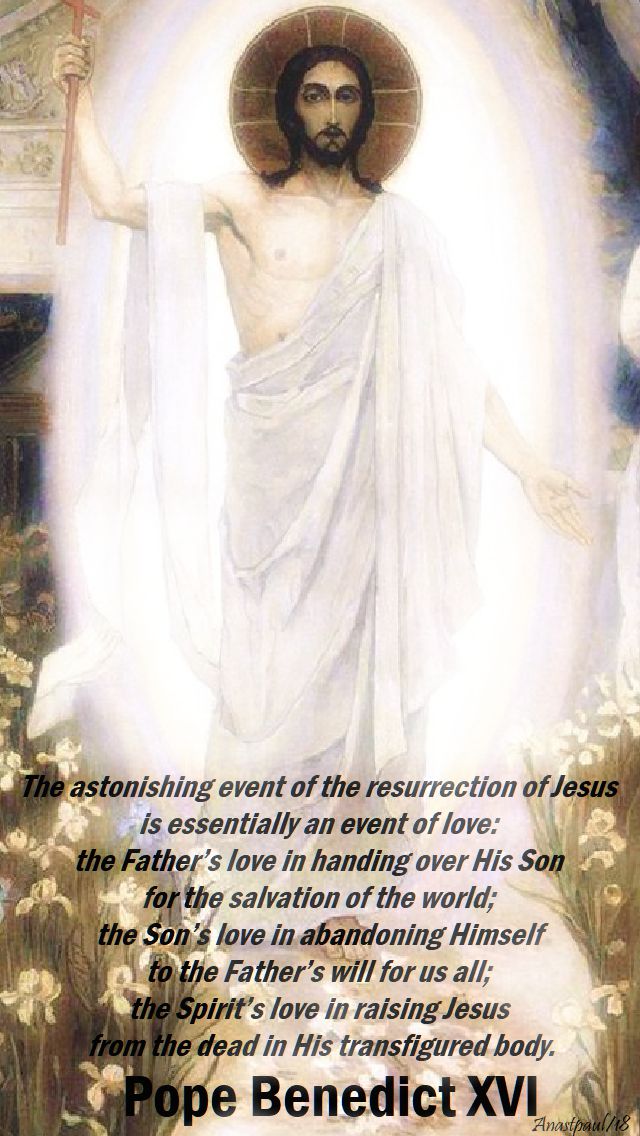
“In this way we enter the depths of the Paschal mystery. The astonishing event of the resurrection of Jesus is essentially an event of love: the Father’s love in handing over His Son for the salvation of the world; the Son’s love in abandoning Himself to the Father’s will for us all; the Spirit’s love in raising Jesus from the dead in His transfigured body. And there is more: the Father’s love which “newly embraces” the Son, enfolding Him in glory; the Son’s love returning to the Father in the power of the Spirit, robed in our transfigured humanity. From today’s solemnity, in which we relive the absolute, once-and-for-all experience of Jesus’s Resurrection, we receive an appeal to be converted to Love; we receive an invitation to live by rejecting hatred and selfishness and to follow with docility in the footsteps of the Lamb that was slain for our salvation, to imitate the Redeemer who is “gentle and lowly in heart”, who is “rest for our souls” (cf. Mt 11:29).”
Pope Benedict 23 March 2008
Adorable Lord, bestow on us grace to rise spiritually, by leaving the tomb of indifference, to lead a life of fervour.
At Easter we recall the words God spoke to Moses concerning the Paschal solemnity: For it is the Phase – that is, the Passage – of the Lord. Now we celebrate the Passage of our Lord from Death to Life and think upon our own passage from a life of tepidity to one of fervour, from an imperfect to a holy life. Jesus, in leaving the Tomb, disengaged Himself from the winding-sheet in which His Sacred Body had been wrapped; this should make us understand that we must extricate ourselves from the imperfections and bad habits, which for so long a time have kept out souls bound and motionless for good. If we rise with Jesus and set ourselves free from the paralysed state in which our evil inclinations have retained us, they will infallibly disappear. Our Risen Lord was clothed with the power of agility to teach us to despise all resistance of nature, to pass quickly out of its reach, to triumph over every obstacle and that our souls should tend upwards to Him alone. If we are indeed risen with Christ we shall seek the things that are above and our whole being will be spiritualised, responding with agility to the promptings not of nature, but of grace. May we be enabled fully to enter into the Mystery of the Resurrection-Life of Jesus and to receive the plenitude of His favours, offered to us at this time especially.
Jesus, in rising from the Sepulchre, clothed in light, wills that we should understand what is the beauty of a soul disengaged from the ties of nature and renewed in the spiritual life. The soul, like Jesus, becomes luminous, the Holy Spirit enlightens it interiorly, by filling it with the knowledge of divine things; it is possessed of a lustrous beauty and its virtues shine visibly, contributing to the edification of others. By the impassibility of the Body of Jesus, we comprehend that grace raises the soul, by means of holy courage, above temptations; it renders it invulnerable against the darts of the enemies of its salvation and gives it the power of mastering its downward tendencies. Such are the happy privileges granted to His faithful ones, who lovingly enter into the spirit of the Mystery of Easter. Sufferings indeed we must still endure, for we are still on this side of the grave but if they serve only to raise us near to Jesus, we may be said to share already in the effects of His impassibility. We range ourselves therefore around Him, to rejoice at the sight of the glory He received in His Resurrection and to honour the marvellous capabilities of His Adorable Body, by rendering ourselves worthy, by our fervour, to participate in them spiritually.
O my Saviour, I thank You for the favour You accord me, permitting me to partake in the glorious privileges of the new life You began. Make me to be entirely renewed in the spirit of my mind so that, freed from the servitude of sense and natural affections, I may rise constantly towards You, with a pure and generous heart.
Aided by the grace Jesus bestows, I will endeavour to reproduce spiritually in myself, the capabilities observable in His Sacred Humanity after the Resurrection.
If by the Spirit, you mortify the deeds of the flesh, you shall live.
Father de Brant, Growth in the Knowledge of Our Lord volume 2, 1882
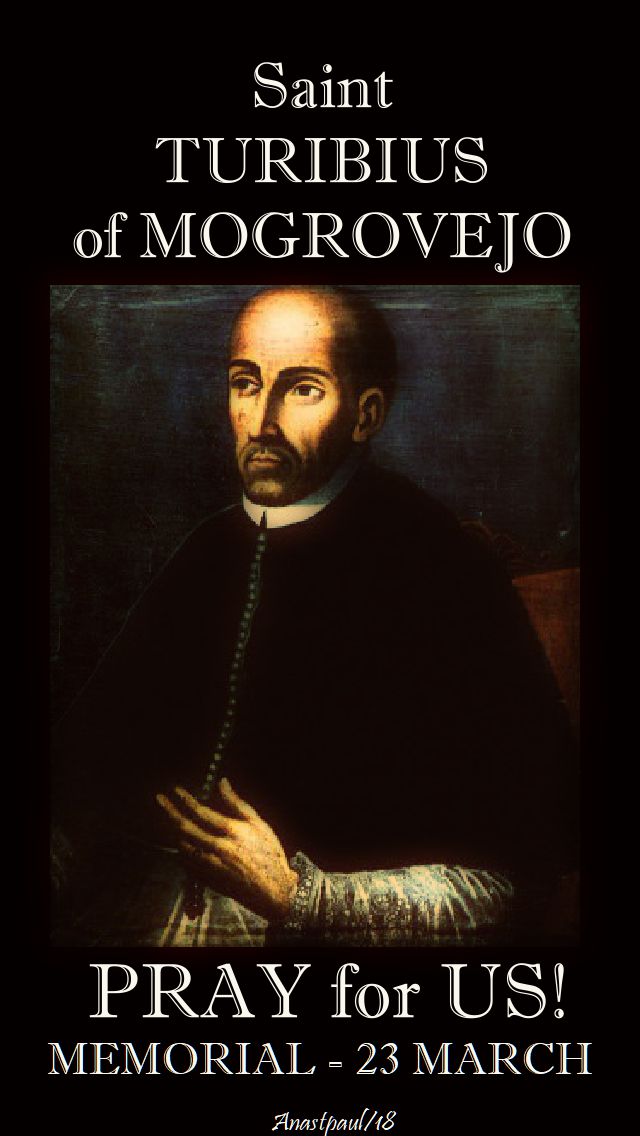
One Minute Reflection – 23 March – Friday of the 5th Week of Lent 2018 and the Memorial of St Turibius of Mogrovejo (1538-1606) – Today’s Gospel John 10:31-42
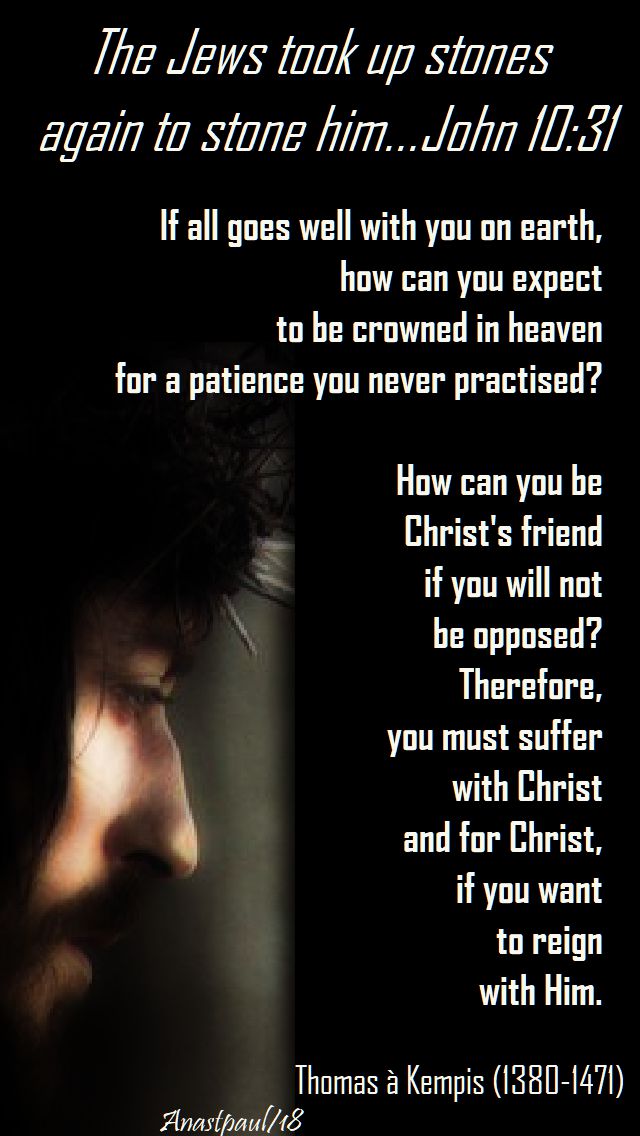
The Jews took up stones again to stone him...John 10:31
REFLECTION – “If all goes well with you on earth, how can you expect to be crowned in heaven for a patience you never practised? How can you be Christ’s friend if you will not be opposed? Therefore, you must suffer with Christ and for Christ, if you want to reign with Him.”…Thomas à Kempis (1380-1471) The Imitation of Christ, Book 2
PRAYER – Lord, through the pastoral care, suffering and zeal of St Turibius, You built up Your Church in Peru. Grant that the people of God may continually grow in faith and holiness. Accept his prayers on our behalf, that we may always be willing to stand at Your Cross. Through our Lord, Jesus Christ, in the unity of the Holy Spirit, one God forever amen.
Thought for the Day – 13 March – Tuesday of the 4th Week of Lent – “Speaking of Confession”
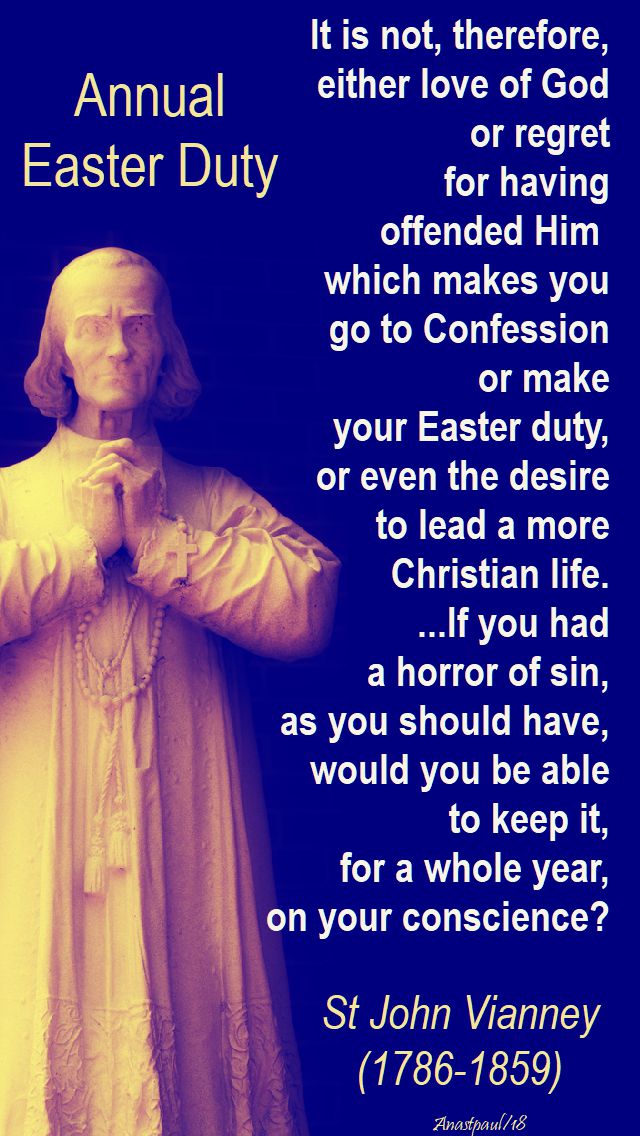
ANNUAL EASTER DUTY CONFESSIONS – St John Vianney (1786-1859)
If Easter were prolonged to Pentecost, you would not go to Confession until Pentecost, or if the latter did not come around for ten years, you would go to Confession only every ten years. Indeed, if the Church did not give you a commandment about it, you would not go to Confession until death. What do you think of that, my dear brethren? Does it not mean that you have neither regret for having offended God, Who requires you to go to Confession, nor love for God, Who requires you to make your Easter Communion?
Ah you will say to me, that’s all very well. We do not make our Easter duty without knowing why.
Ah! You know nothing at all about it! You do it from habit, to be able to say you have made your Easter duty, or, if you would prefer to speak the truth, you would say that you have added a new sin to your old ones. It is not, therefore, either love of God or regret for having offended Him which makes you go to Confession or make your Easter duty, or even the desire to lead a more Christian life. And here is the proof of it: if you loved God, would you consent to commit sin with such ease and even with so much enjoyment? If you had a horror of sin, as you should have, would you be able to keep it,for a whole year, on your conscience? If you had a real desire to live a more Christian life, would we not see at least some little change in your way of living?
No, my dear brethren, I do not wish to talk to you today about those unfortunate people who tell only half their sins through fear of not making their Easter duty or of being refused Absolution — perhaps even for the sake of covering up their shameful lives with the veil of virtue and who, in this state, approach the altar and are going to complete their dreadful work by handing over their God to the Devil and precipitating their sacrilegious souls into Hell.
No, I dare to hope that this does not concern you but I will continue, nevertheless, to tell you that going to Confession only once a year is not something about which you should feel any peace or satisfaction.
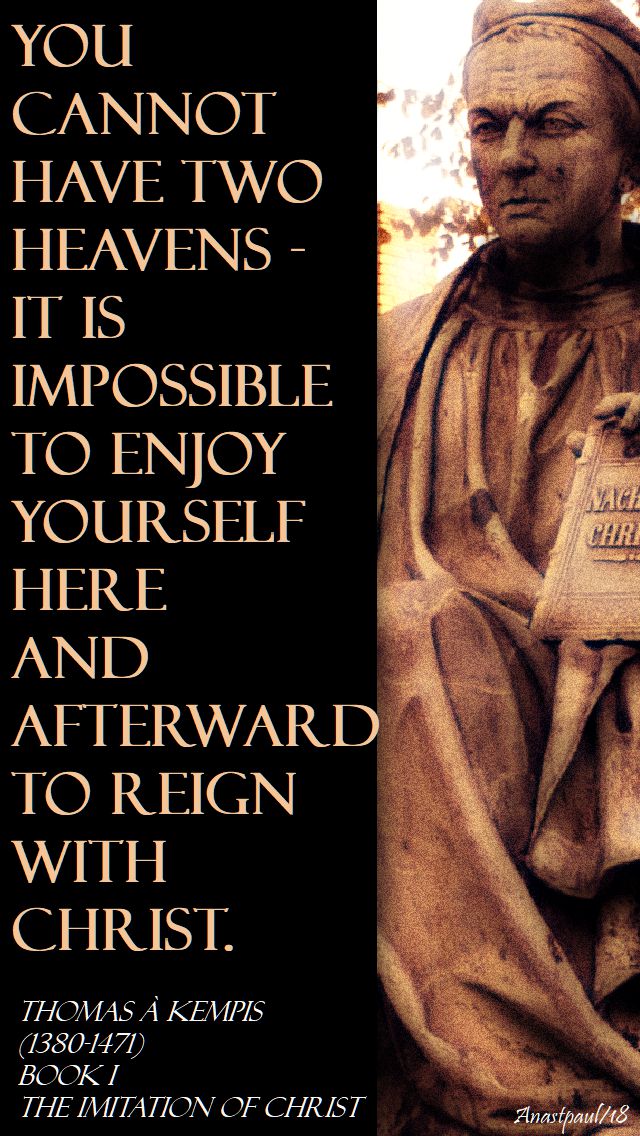
“You cannot have two heavens – it is impossible to enjoy yourself here and afterward to reign with Christ.”…Thomas à Kempis (1380-1471) – Book I The Imitation of Christ
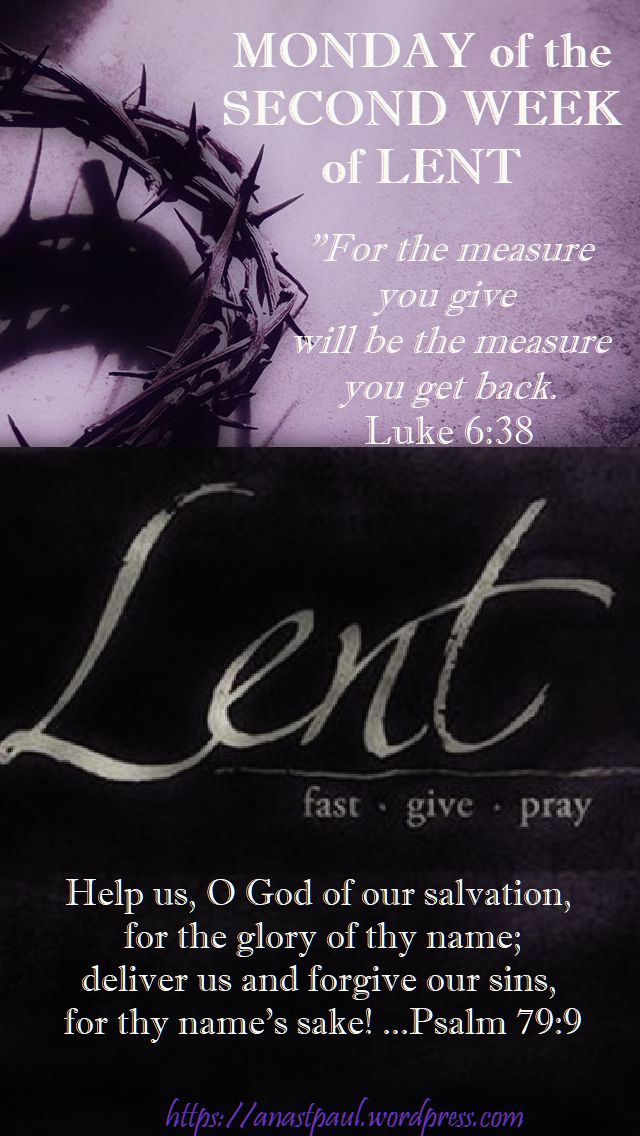
26 February 2018 – Monday of the Second Week of Lent Daniel 9:4-10, Psalms 79:8-9, 11, 13, Luke 6:36-38
Daniel 9:4-5 – “I prayed to the Lord my God and made confession, saying, “O Lord, the great and terrible God, who keepest covenant and steadfast love with those who love him and keep his commandments, we have sinned and done wrong and acted wickedly and rebelled, turning aside from thy commandments and ordinances…”
Luke 6:36-38 – Be merciful, even as your Father is merciful. “Judge not, and you will not be judged; condemn not and you will not be condemned; forgive and you will be forgiven; give and it will be given to you; good measure, pressed down, shaken together, running over, will be put into your lap. For the measure you give will be the measure you get back.”
Daniel confesses that his people’s sufferings in exile are due to their own lack of fodelity to God. This sort of confession is a frank admission that evil has consequences. It is similar to Jesus’ teaching – “one who takes up the sword will perish by the sword.”
The argument may be turned round – good deeds have beneficial consequences. “The measure you give will be the measure you get back” whether it be mercy, forgiveness or sympathetic understanding.
If we keep giving out good things consistently, the blessings we will receive will be beyond measure. Every giving enriches the giver, whether gift be in the form of material assistance, psychologival affirmation or spiritual admonition, giving up an argument, settling a quarrel or going out of our way to help someone who deserves it least!
Be not afraid then to give, for you will receive beyond anything you could ever expect.
Am I generous with my time, material gifts, with my love? Am I patient and willing to be forgiving, even when I was not in error? Am I aware that as part of the Body of Christ, my good and my bad, affect all? Archbishop Thomas Menamparampil SDB – God’sWord
“Desire not the praises of men, seeing they are vain. Be not fearful of their reproach, for instead of doing harm to your soul, humiliations cleanses it and renders it more meet to receive a brighter crown in heaven and none are worthy to be glorified in heaven who are unable to bear reproach on earth for the love of God.”… Thomas a Kempis
Help us, O God of our salvation, for the glory of thy name; deliver us and forgive our sins, for thy name’s sake! …Psalm 79:9
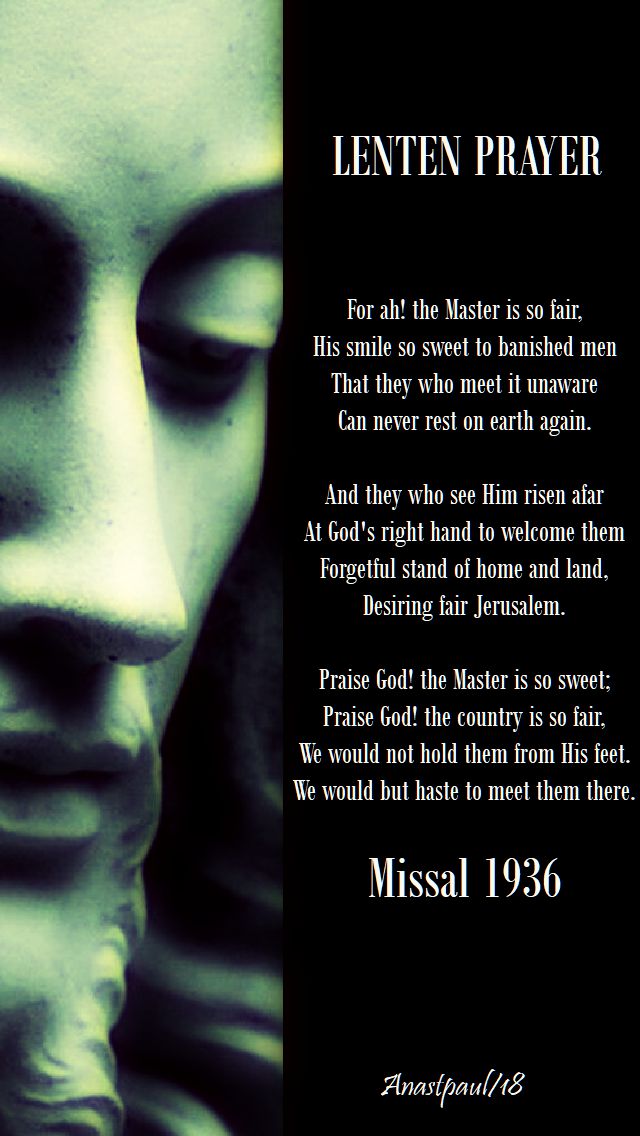
For ah! the Master is so fair, His smile so sweet to banished men That they who meet it unaware Can never rest on earth again.
And they who see Him risen afar At God’s right hand to welcome them Forgetful stand of home and land, Desiring fair Jerusalem.
Praise God! the Master is so sweet; Praise God! the country is so fair, We would not hold them from His feet. We would but haste to meet them there.
Our Morning Offering – 14 February – Ash Wednesday 2018
You alone are my All and Every Good By Thomas à Kempis
O Lord, my God,
You are my all and every good.
And what am I, that I should presume to address You?
I am the poorest of Your servants and a wretched worm,
far more poor and worthless, than I can ever realise or express.
Yet, Lord, remember that I am nothing,
I have nothing
and can do nothing.
You alone are good, just and holy,
You can do all things, fill all things, bestow all things,
leaving only the wicked empty-handed.
Remember Your mercies, Lord
and fill my heart with Your grace,
since it is Your will, that none of Your works, should be worthless.
How can I endure this life of sorrows,
unless You strengthen me with Your mercy and grace?
Do not turn Your face from me;
do not delay Your coming,
nor withdraw Your consolation form me,
lest my soul become like a waterless desert.
Teach me, O Lord, to do Your will;
teach me to live worthily and humbly in Your sight;
for You are my wisdom, who know me truly
and who knew me before the world was made
and before I had my being.
Amen
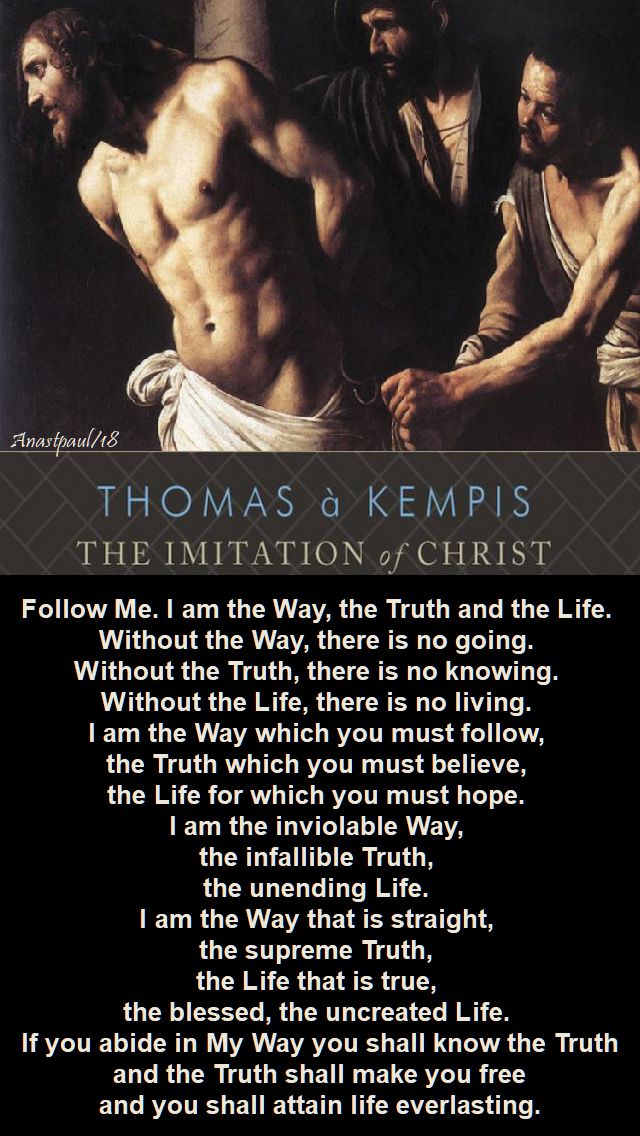
The Imitation of Christ “Without the Way, there is no going, Without the Truth, there is no knowing, Without the Life, there is no living.”
“Follow Me. I am the Way, the Truth and the Life. Without the Way, there is no going. Without the Truth, there is no knowing. Without the Life, there is no living. I am the Way, which you must follow, the Truth, which you must believe, the Life, for which you must hope. I am the inviolable Way, the infallible Truth, the unending Life. I am the Way that is straight, the supreme Truth, the Life that is true, the blessed, the uncreated Life. If you abide in My Way, you shall know the Truth and the Truth shall make you free and you shall attain life everlasting.”
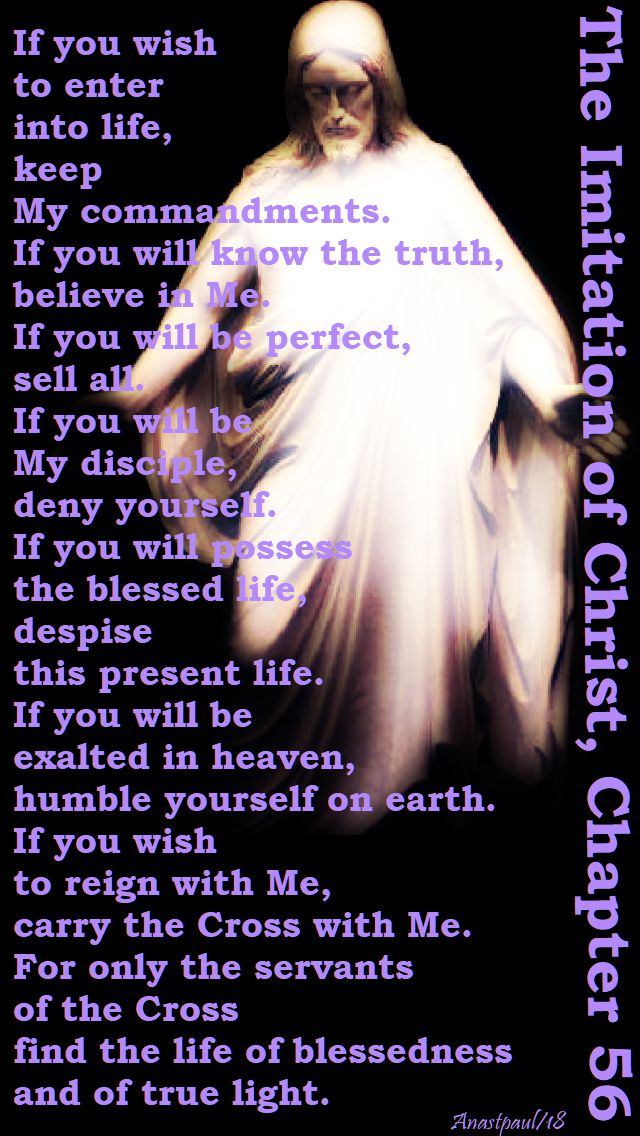
“If you wish to enter into life, keep My commandments. If you will know the truth, believe in Me. If you will be perfect, sell all. If you will be My disciple, deny yourself. If you will possess the blessed life, despise this present life. If you will be exalted in heaven, humble yourself on earth. If you wish to reign with Me, carry the Cross with Me. For only the servants of the Cross find the life of blessedness and of true light.”
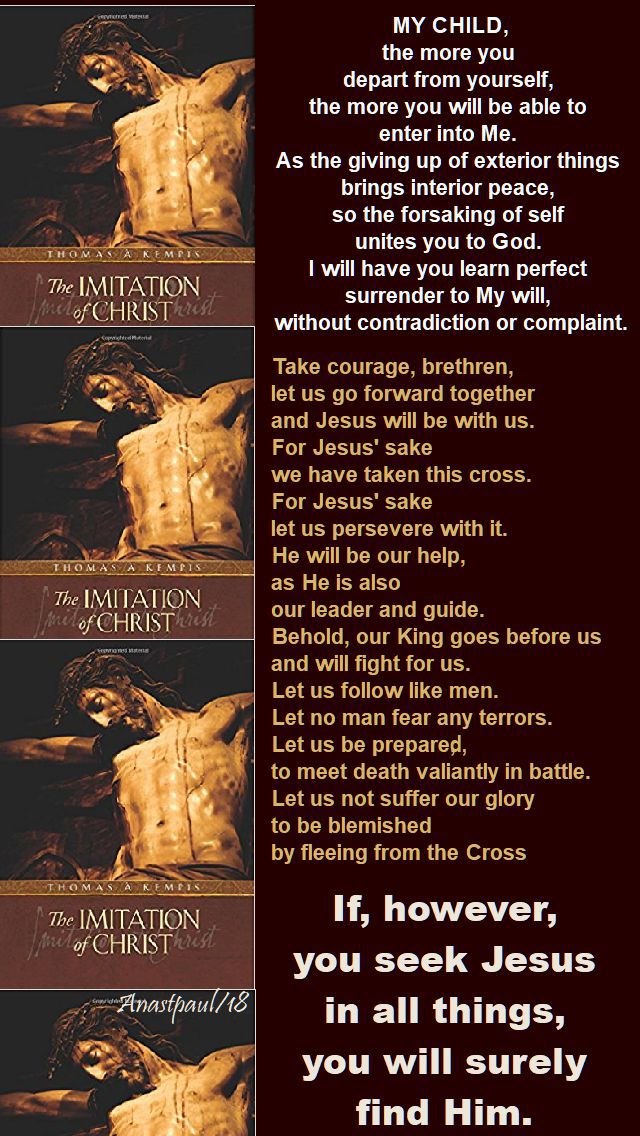
“MY CHILD, the more you depart from yourself, the more you will be able to enter into Me. As the giving up of exterior things, brings interior peace, so the forsaking of self, unites you to God. I will have you learn perfect surrender to My will, without contradiction or complaint.”
“Take courage, brethren, let us go forward together and Jesus will be with us. For Jesus’ sake we have taken this cross. For Jesus’ sake let us persevere with it. He will be our help as He is also our leader and guide. Behold, our King goes before us and will fight for us. Let us follow like men. Let no man fear any terrors. Let us be prepared to meet death valiantly in battle. Let us not suffer our glory to be blemished by fleeing from the Cross.”
The Imitation of Christ Chapter 56
“If, however, you seek Jesus in all things, you will surely find Him. “
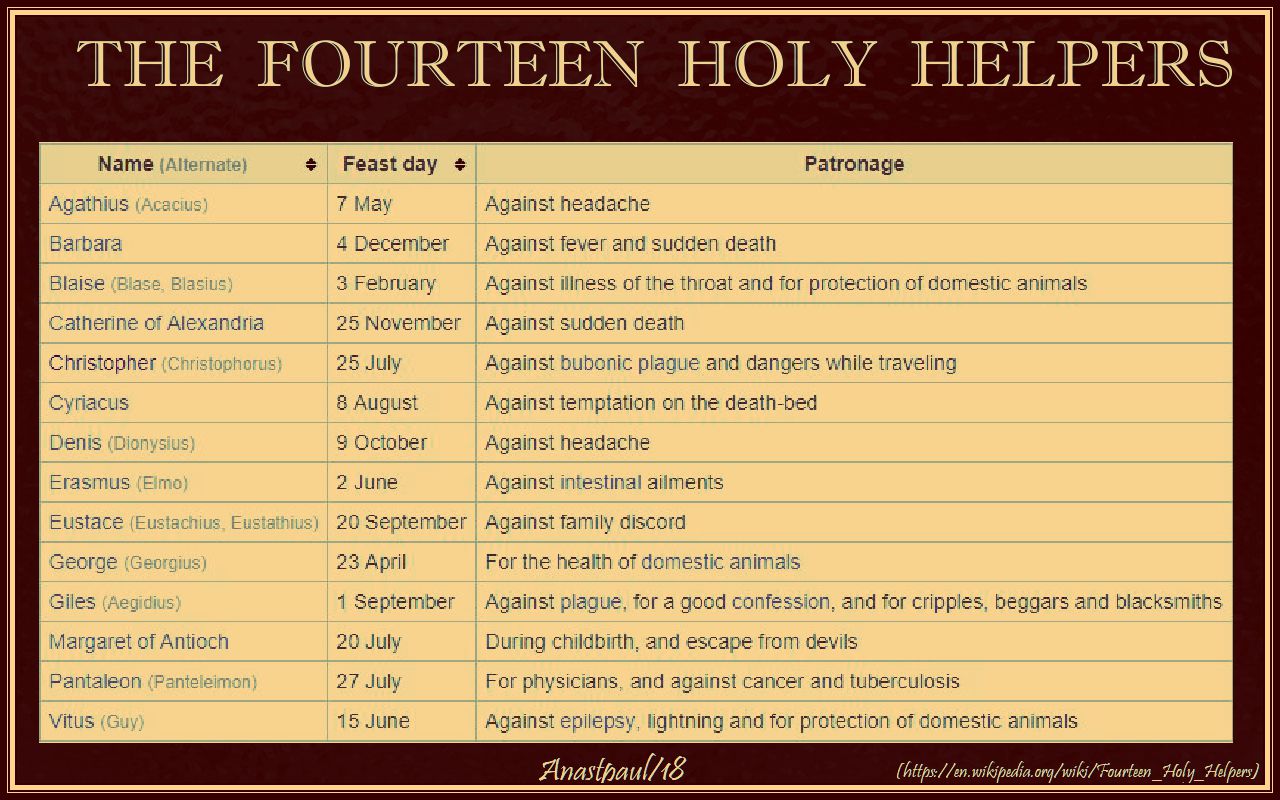
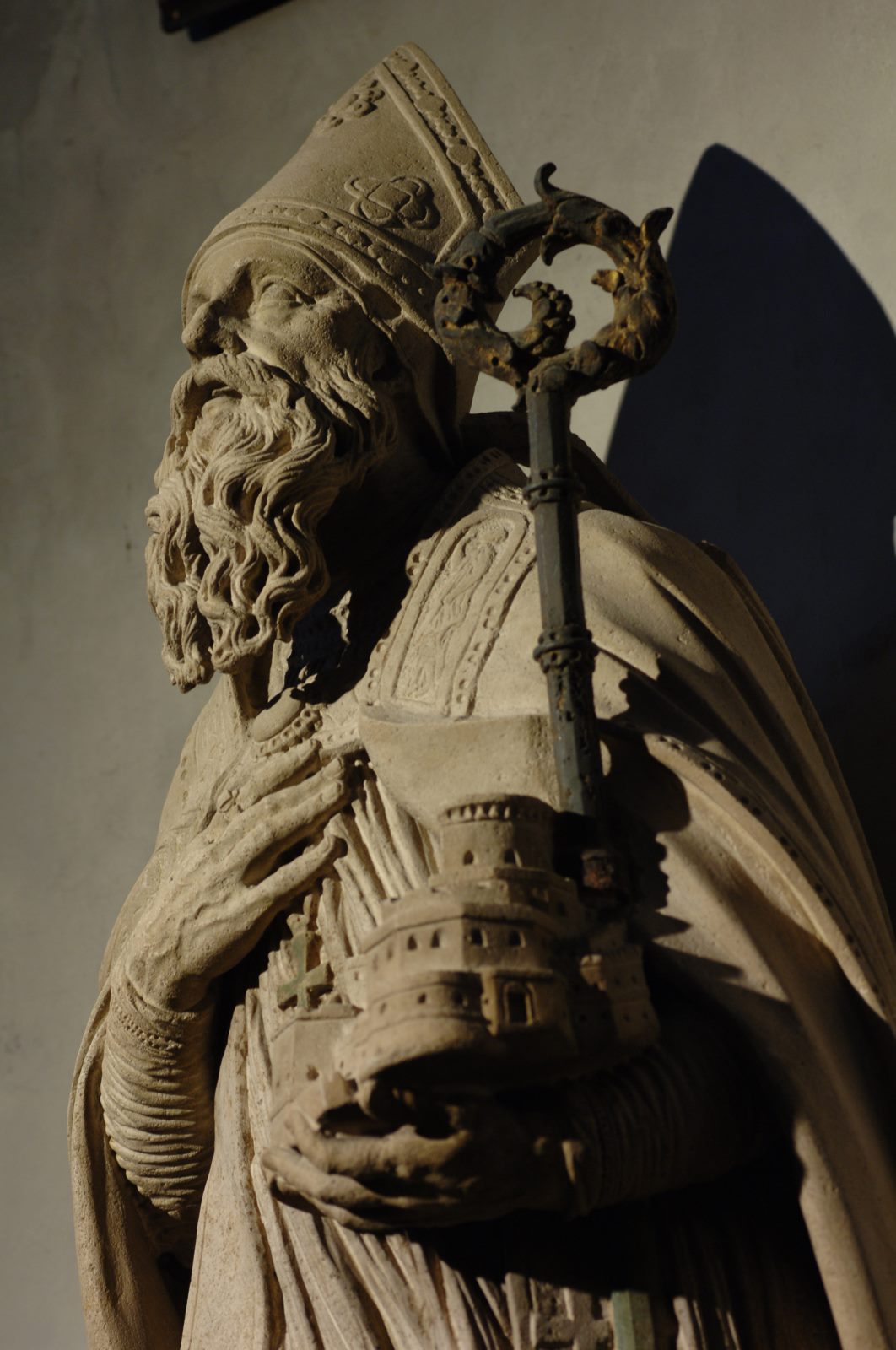
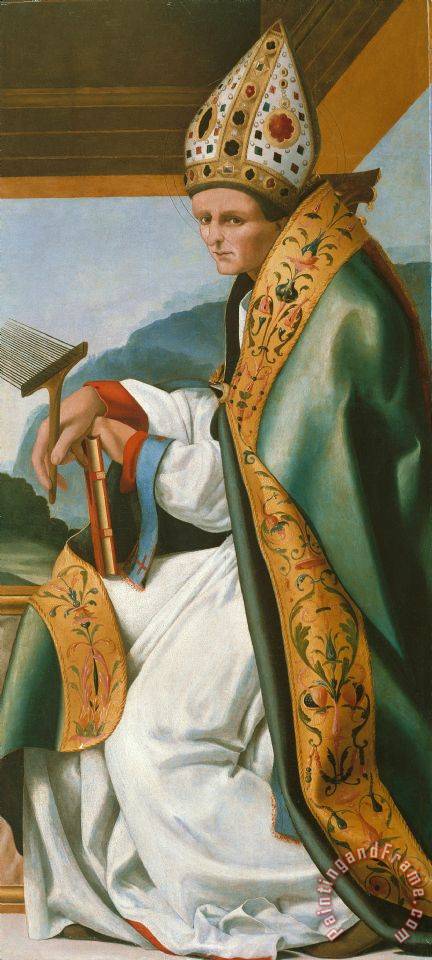
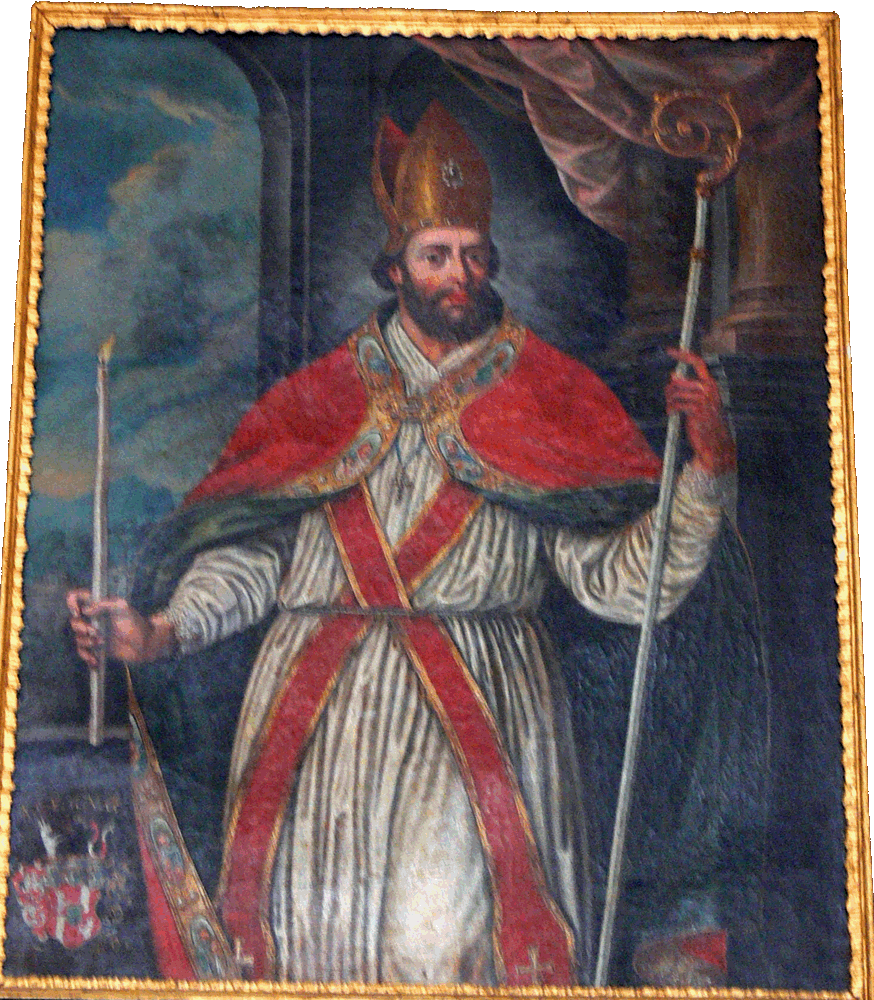
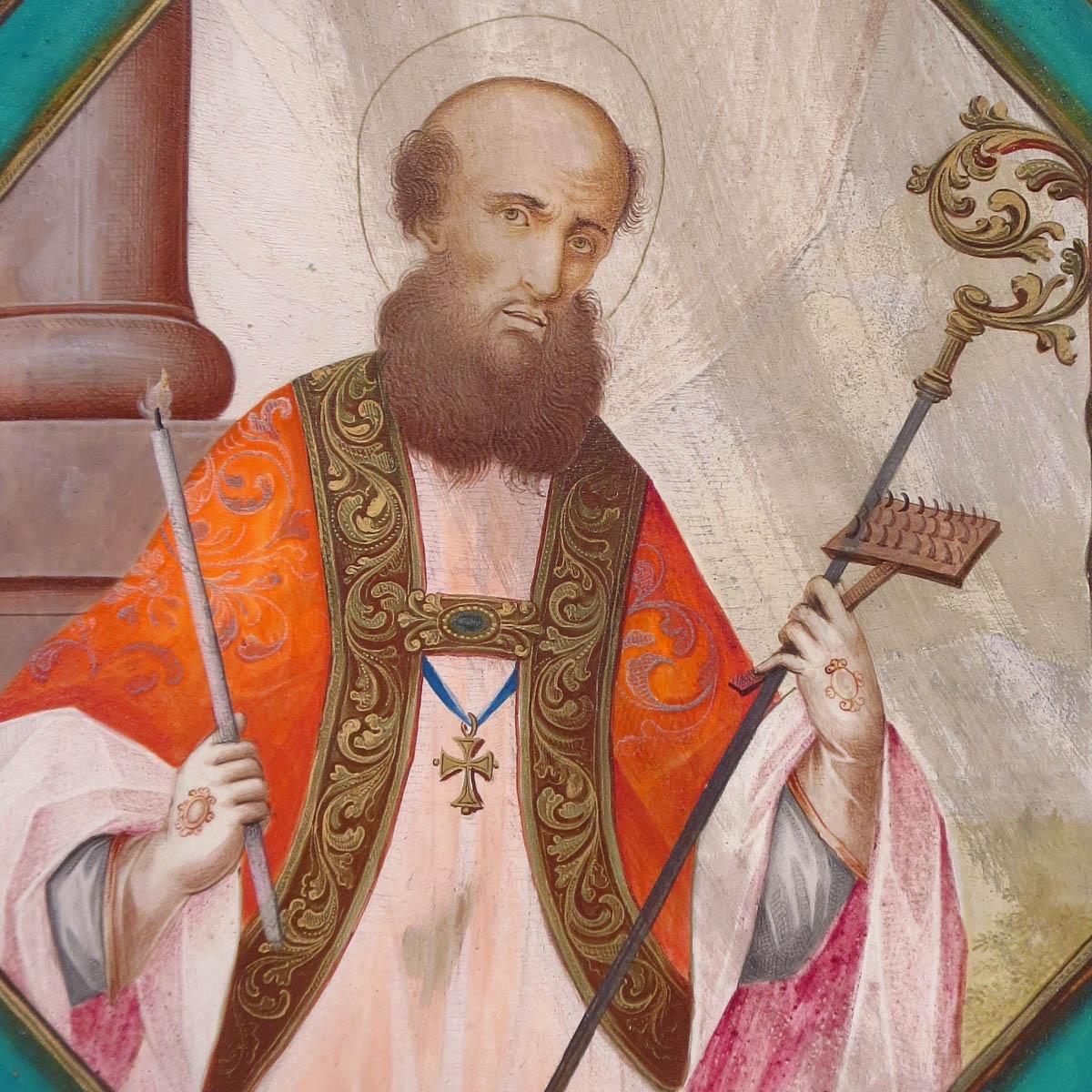
Saint of the Day – 3 February – St Blaise (Died c 316) – Martyr, Bishop of Sebaste, Armenia, Physician, Miracle-worker. Died in c 316 by his flesh being torn off his body by iron wool-combs, then beheaded. Patronages – against angina • against bladder diseases • against blisters • against coughs • against dermatitis • against dropsy • against eczema • against edema • against fever • against goitres • against headaches • against impetigo • against respiratory diseases • against skin diseases • against snake bites • against sore throats • against stomach pain • against storms • against teething pain • against throat diseases • against toothaches • against ulcers • against whooping cough • against wild beasts • angina sufferers of ; of children, animals, builders, drapers, against choking, veterinarians, infants, of 21 Cities, of stonecutters, carvers, wool workers. St Blaise is one of the Fourteen Holy Helpers – https://anastpaul.com/2018/07/25/thought-for-the-day-25-july-the-memorial-of-st-christopher-died-c-251-one-of-the-fourteen-holy-helpers/
Today the Church remembers the life and witness of Saint Blaise, a 3rd century Armenian bishop who endured terrifying torments and surrendered his life rather than repudiate his profession of Faith.
Much of the life of Saint Blaise is history that has passed into legend but even these legendary accounts offer spiritual insight.
Blaise was renowned as a wonderworker, effecting miraculous cures. T his would have been enough to attract attention but he was also not averse to calling out the Roman officials who ruled the region in which he lived, Cappadocia, for their tyranny and intolerance of Christian faith and practice. The combination of a reputation for supernatural power and the courage of his convictions was not welcomed by Rome and the governor ordered Bishop Blaise to be arrested. Blaise was able to elude capture and took refuge in the wilderness. It was there in the caves of Cappadocia that his ministry and his mission continued.
There is an account of Saint Blaise that identifies not only his pastoral care for the Christian faithful but also for the animals of the wilderness.
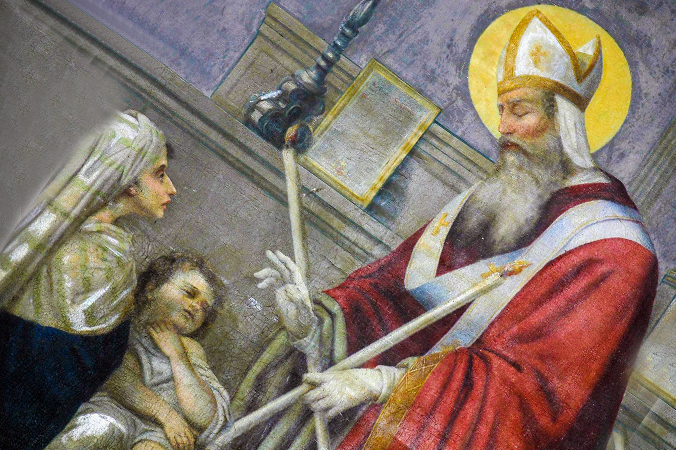
A woman had witnessed her piglet carried off by a wolf and spoke of her plight to the bishop. Saint Blaise called for the wolf, demanded her return the piglet to its rightful owner and reminded the wolf of the grave penalty that awaited a thief. The wolf complied and returned the piglet to its owner- a credit to the bishop’s power of persuasion. The woman would later return the favour to Saint Blaise when he was finally captured and imprisoned. She brought to him candles to illuminate his dank and dreary cell.
This legend hints at how the saints represent, in their holiness, the restoration of a paradise lost and regained in Christ. The ease and familiarity with which the Biblical character of Adam is believed to have communed with nature before the fall is recapitulated in Saint Blaise- he is a sign that anticipates the restoration of all things in Christ where the lion will rest with the lamb and in this case, the wolf will return stolen property to its rightful owner.
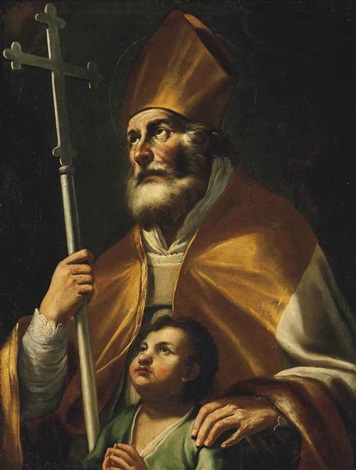
Saint Blaise has been invoked for centuries as a specialist in diseases of the throat. The origin of this practice might be in the story of a child brought to the saint who was either choking or suffering from some other malady of the throat. Saint Blaise blessed the boy and he was restored to health.
The practice of blessing throats on the Feast of Saint Blaise is a commemoration of this miracle, that crossed candles are often used to impart this blessing might also be a recollection of the kindness of the woman who gave candles to the saint as he languished in prison.
Saint Blaise was an extraordinarily popular saint during the Middle Ages in Europe. Presentations of his miraculous and mighty deeds were commonly represented in art and sculpture, and he was included in a listing of saints called the Fourteen Holy Helpers (or Auxiliary Saints), holy men and women who could be counted on as intercessors for all manner of maladies from madness to travelers in distress. During times in which a sore throat could be a signal of an impending epidemic or an early death, the faithful were all too happy to accept the help of a heavenly specialist in such matters like Saint Blaise.
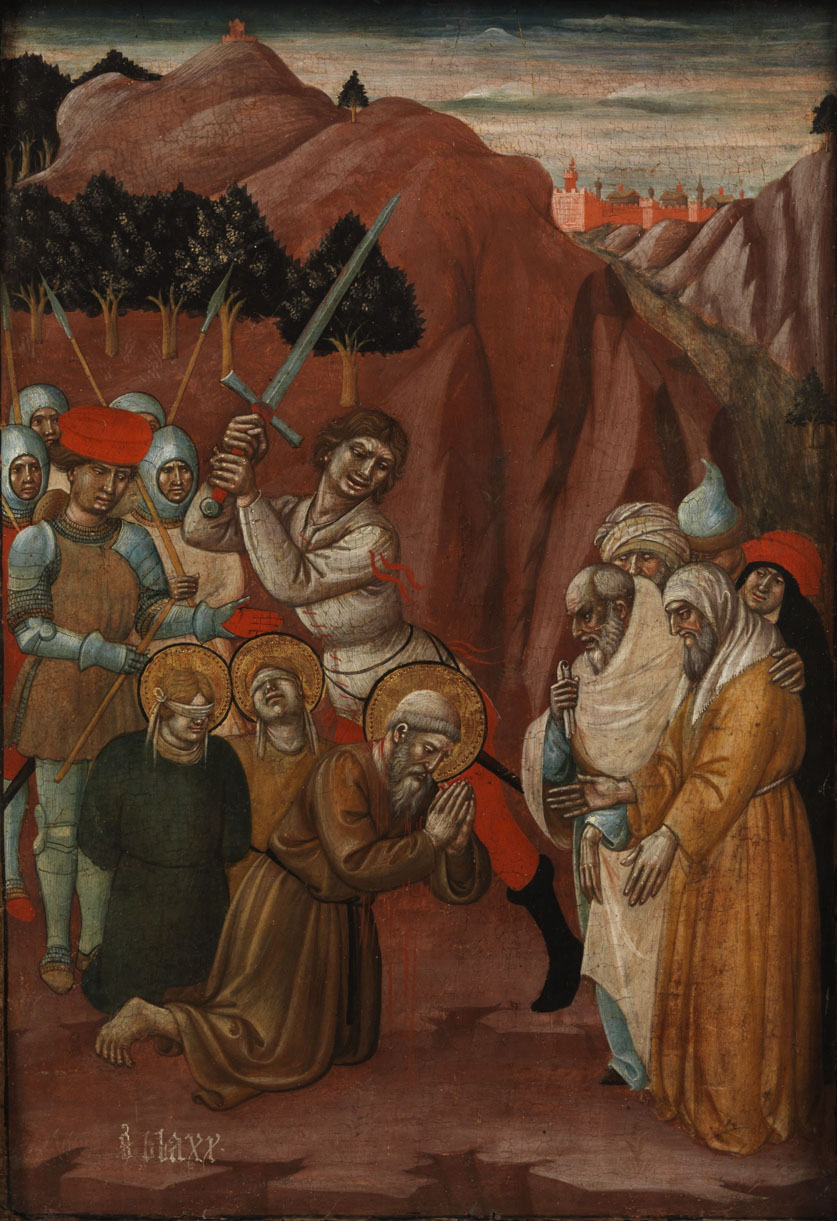
The legends regarding Saint Blaise report that his sojourn in the wilderness did not protect him for very long. He was eventually arrested and brought to trial. The judge advised him that only a pinch of incense offered to the image of Caesar and the gods of Rome could win him his freedom. Blaise refused. He was cruelly tortured and beheaded.
The Church does not mourn Saint Blaise, for we know that in Christ this world is not all that there is. While tyrants like Caesar and his successors can threaten us with death, Christ promises us a life that like his own, is transformed through suffering and death, into resurrection.
The scriptures proclaim, “though they slay me I will trust in you.”
Saint Blaise did precisely this. He trusted that Christ would not abandon him to the power of death nor allow his suffering to be meaningless. Our lives might never be raised to the legendary status of Saint Blaise but we can trust in Christ as he did and live in hope that one day we will join him in communion with all the saints who have gone before us in faith and who, from their place in heaven, guide and protect us still. (Fr Steve Grunow)
Quote/s of the Day – 9 January – “Speaking of Conversion”
“Do not have Jesus Christ on your lips and the world in your heart.”
“We recognise a tree by its fruit and we ought to be able to recognise a Christian by his action. The fruit of faith should be evident in our lives, for being a Christian is more than making sound professions of faith. It should reveal itself in practical and visible ways. Indeed it is better to keep quiet about our beliefs and live them out, than to talk eloquently about what we believe but fail to live by it.”
“It is not that I want merely to be called a Christian but to actually BE ONE. Yes, If I prove to be one, then I can have the name!”
“Wherever the bishop shall appear, there let the multitude also be; even as, wherever Jesus Christ is, there is the Catholic Church.”
St Ignatius of Antioch (37-105) Bishop & Martyr
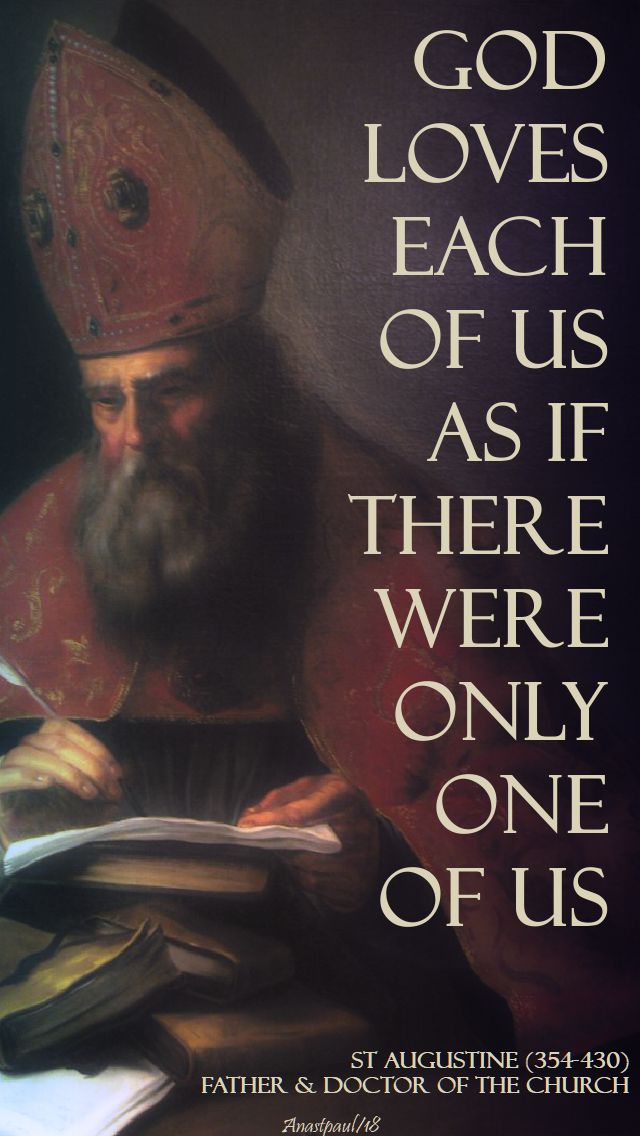
“God loves each of us as if there were only one of us.”
St Augustine (354-430) Father & Doctor of the Church
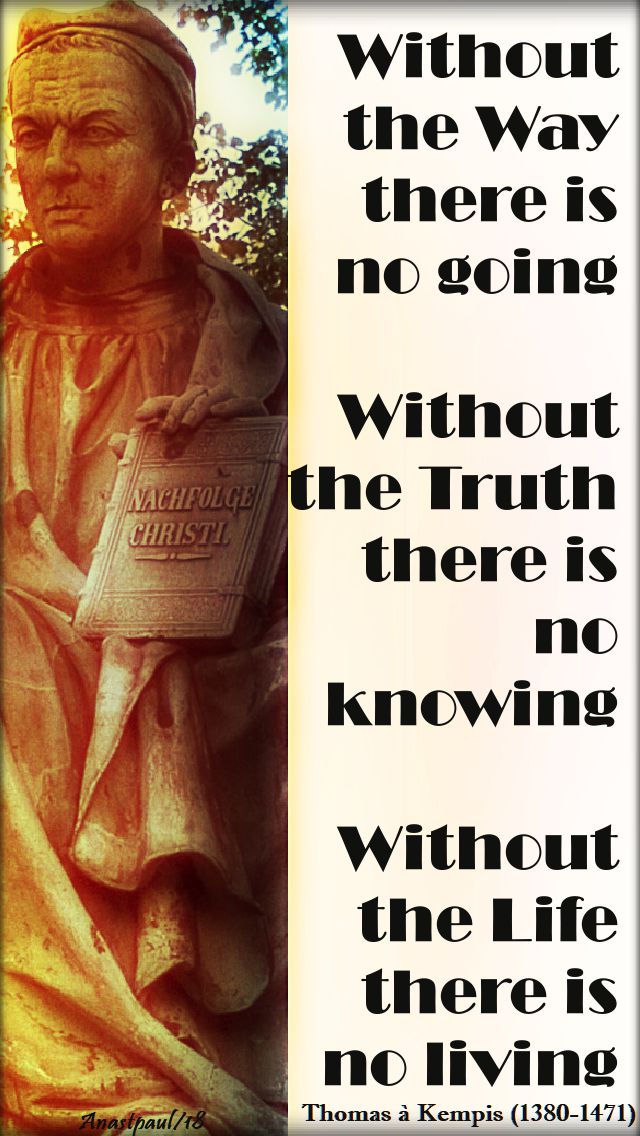
“Without the Way, there is no going, Without the Truth, there is no knowing, Without the Life, there is no living.”
Thomas à Kempis (1380-1471) The Imitation of Christ
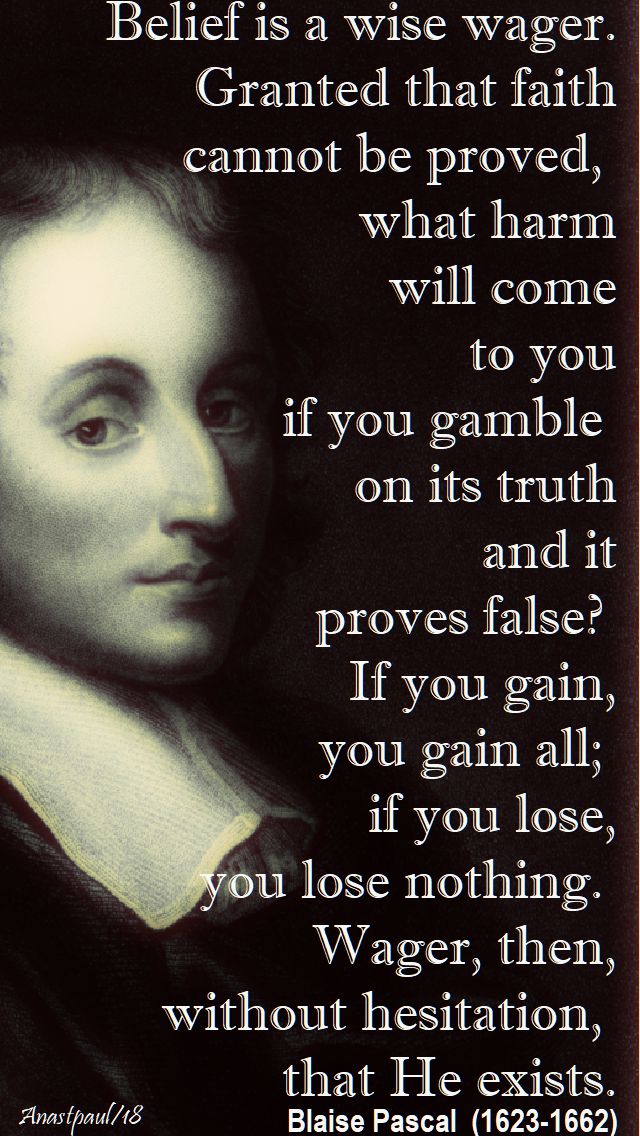
“Belief is a wise wager. Granted that faith cannot be proved, what harm will come to you if you gamble on its truth and it proves false? If you gain, you gain all; if you lose, you lose nothing. Wager, then, without hesitation, that He exists.“
Blaise Pascal (1623-1662)
French mathematician, physicist, inventor, writer and Catholic theologian
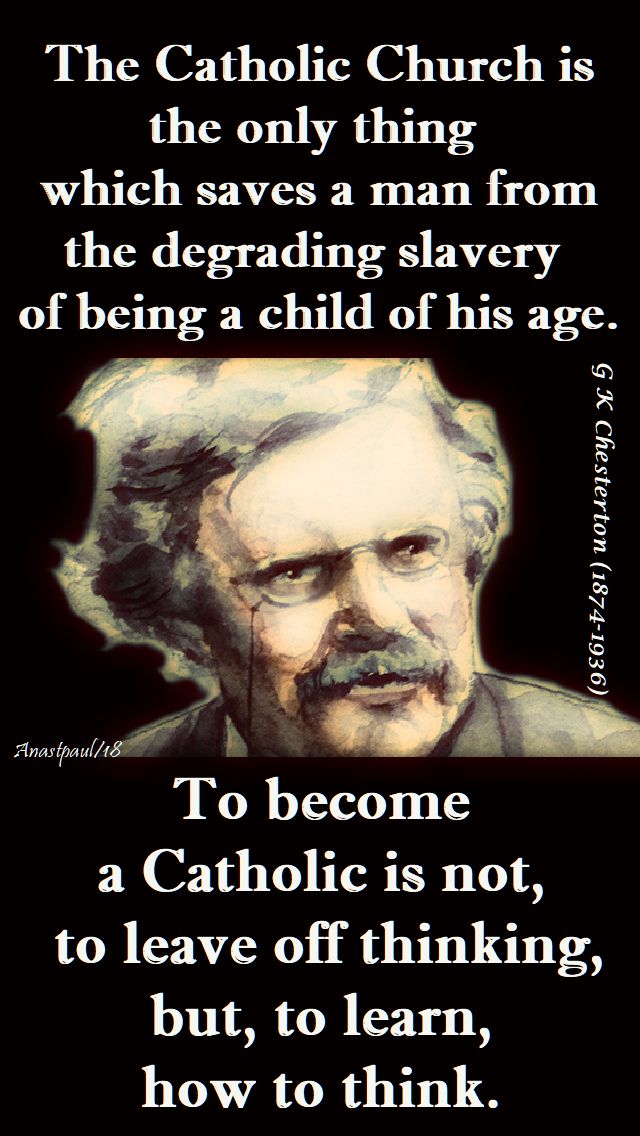
“The Catholic Church is the only thing which saves a man from the degrading slavery of being a child of his age”
“To become a Catholic is not to leave off thinking but to learn how to think.”
G K Chesterton (1874-1936)
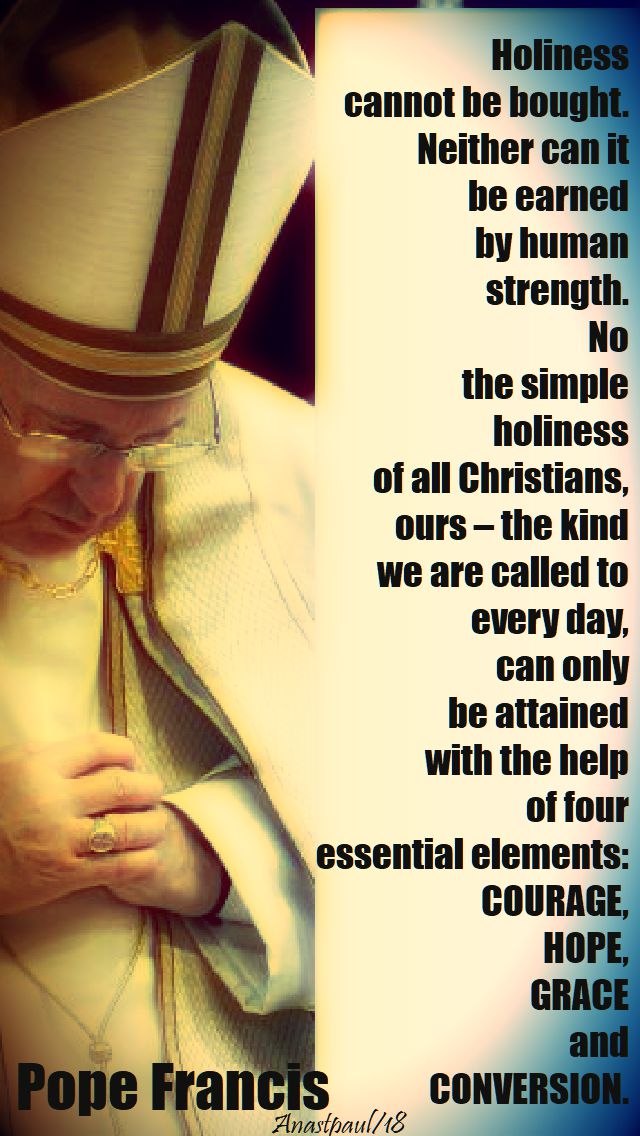
“Holiness cannot be bought. Neither can it be earned by human strength. No, “the simple holiness of all Christians, ours – the kind we are called to every day, can only be attained with the help of four essential elements: courage, hope, grace and conversion.”


















 AnaStpaul
You must be logged in to post a comment.