Posted in MORNING Prayers, PAPAL MESSAGES, PAPAL SERMONS

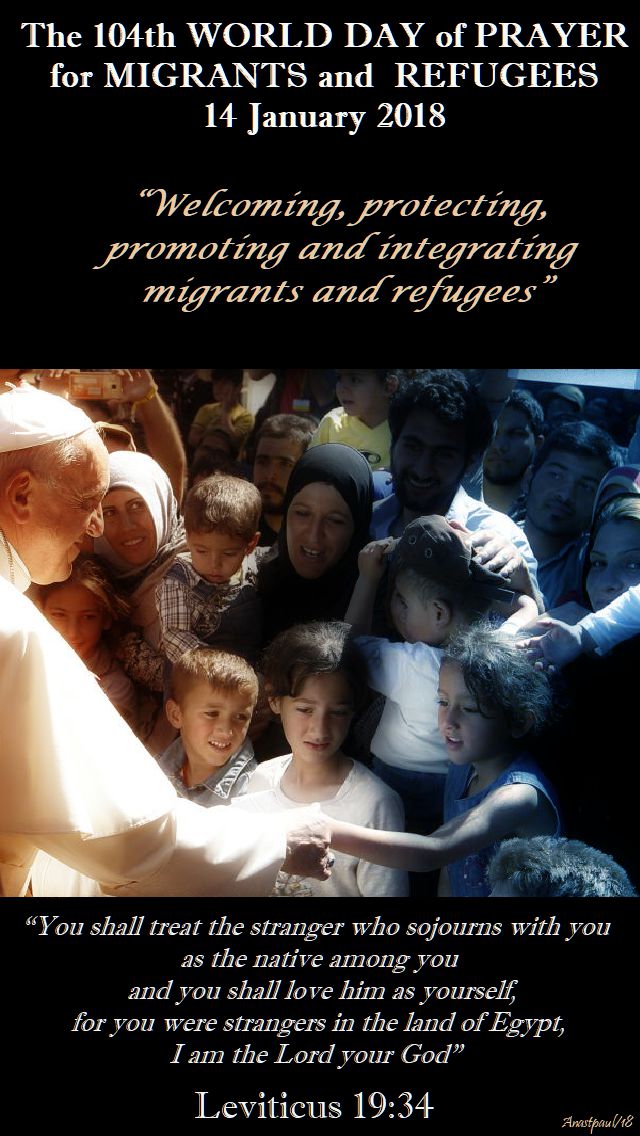
The 104th WORLD DAY of PRAYER for MIGRANTS and REFUGEES – 14 January 2018

The 104th WORLD DAY of PRAYER for MIGRANTS and REFUGEES – 14 January 2018

MESSAGE OF HIS HOLINESS POPE FRANCIS

“Welcoming, protecting, promoting and
integrating migrants and refugees”

Dear brothers and sisters!

“You shall treat the stranger who sojourns with you as the native among you and you shall love him as yourself, for you were strangers in the land of Egypt:  I am the Lord your God” (Leviticus 19:34).the 104th world day of prayer for migrants and refugees - 14 jan 2018
Throughout the first years of my pontificate, I have repeatedly expressed my particular concern for the lamentable situation of many migrants and refugees fleeing from war, persecution, natural disasters and poverty.   This situation is undoubtedly a “sign of the times” which I have tried to interpret, with the help of the Holy Spirit, ever since my visit to Lampedusa on 8 July 2013.  When I instituted the new Dicastery for Promoting Integral Human Development, I wanted a particular section – under my personal direction for the time being – to express the Church’s concern for migrants, displaced people, refugees and victims of human trafficking.

Every stranger who knocks at our door is an opportunity for an encounter with Jesus Christ, who identifies with the welcomed and rejected strangers of every age (Matthew 25:35-43).   The Lord entrusts to the Church’s motherly love every person forced to leave their homeland in search of a better future.   This solidarity must be concretely expressed at every stage of the migratory experience – from departure through journey to arrival and return.   This is a great responsibility, which the Church intends to share with all believers and men and women of good will, who are called to respond to the many challenges of contemporary migration with generosity, promptness, wisdom and foresight, each according to their own abilities.

In this regard, I wish to reaffirm that “our shared response may be articulated by four verbs:   to welcome, to protect, to promote and to integrate”.

Considering the current situation, welcoming means, above all, offering broader options for migrants and refugees to enter destination countries safely and legally.   This calls for a concrete commitment to increase and simplify the process for granting humanitarian visas and for reunifying families.   At the same time, I hope that a greater number of countries will adopt private and community sponsorship programmes, and open humanitarian corridors for particularly vulnerable refugees.   Furthermore, special temporary visas should be granted to people fleeing conflicts in neighbouring countries. Collective and arbitrary expulsions of migrants and refugees are not suitable solutions, particularly where people are returned to countries which cannot guarantee respect for human dignity and fundamental rights.   Once again, I want to emphasise the importance of offering migrants and refugees adequate and dignified initial accommodation.   “More widespread programmes of welcome, already initiated in different places, seem to favour a personal encounter and allow for greater quality of service and increased guarantees of success”.   The principle of the centrality of the human person, firmly stated by my beloved Predecessor, Benedict XVI, obliges us to always prioritise personal safety over national security.   It is necessary, therefore, to ensure that agents in charge of border control are properly trained.   The situation of migrants, asylum seekers and refugees requires that they be guaranteed personal safety and access to basic services.   For the sake of the fundamental dignity of every human person, we must strive to find alternative solutions to detention for those who enter a country without authorisation.

The second verb – protecting – may be understood as a series of steps intended to defend the rights and dignity of migrants and refugees, independent of their legal status.  Such protection begins in the country of origin and consists in offering reliable and verified information before departure, and in providing safety from illegal recruitment practices.   This must be ongoing, as far as possible, in the country of migration, guaranteeing them adequate consular assistance, the right to personally retain their identity documents at all times, fair access to justice, the possibility of opening a personal bank account, and a minimum sufficient to live on.   When duly recognised and valued, the potential and skills of migrants, asylum seekers and refugees are a true resource for the communities that welcome them.   This is why I hope that, in countries of arrival, migrants may be offered freedom of movement, work opportunities and access to means of communication, out of respect for their dignity.   For those who decide to return to their homeland, I want to emphasise the need to develop social and professional reintegration programmes.   The International Convention on the Rights of the Child provides a universal legal basis for the protection of underage migrants.   They must be spared any form of detention related to migratory status, and must be guaranteed regular access to primary and secondary education.   Equally, when they come of age they must be guaranteed the right to remain and to enjoy the possibility of continuing their studies.   Temporary custody or foster programmes should be provided for unaccompanied minors and minors separated from their families.   The universal right to a nationality should be recognised and duly certified for all children at birth.   The statelessness which migrants and refugees sometimes fall into can easily be avoided with the adoption of “nationality legislation that is in conformity with the fundamental principles of international law”.    Migratory status should not limit access to national healthcare and pension plans, nor affect the transfer of their contributions if repatriated.

Promoting essentially means a determined effort to ensure that all migrants and refugees – as well as the communities which welcome them – are empowered to achieve their potential as human beings, in all the dimensions which constitute the humanity intended by the Creator.    Among these, we must recognise the true value of the religious dimension, ensuring to all foreigners in any country the freedom of religious belief and practice.   Many migrants and refugees have abilities which must be appropriately recognised and valued.  Since “work, by its nature, is meant to unite peoples”, I encourage a determined effort to promote the social and professional inclusion of migrants and refugees, guaranteeing for all – including those seeking asylum – the possibility of employment, language instruction and active citizenship, together with sufficient information provided in their mother tongue.   In the case of underage migrants, their involvement in labour must be regulated to prevent exploitation and risks to their normal growth and development.   In 2006, Benedict XVI highlighted how, in the context of migration, the family is “a place and resource of the culture of life and a factor for the integration of values”.   The family’s integrity must always be promoted, supporting family reunifications – including grandparents, grandchildren and siblings – independent of financial requirements.   Migrants, asylum seekers and refugees with disabilities must be granted greater assistance and support.   While I recognise the praiseworthy efforts, thus far, of many countries, in terms of international cooperation and humanitarian aid, I hope that the offering of this assistance will take into account the needs (such as medical and social assistance, as well as education) of developing countries which receive a significant influx of migrants and refugees.  I also hope that local communities which are vulnerable and facing material hardship, will be included among aid beneficiaries.

The final verb – integrating – concerns the opportunities for intercultural enrichment brought about by the presence of migrants and refugees.   Integration is not “an assimilation that leads migrants to suppress or to forget their own cultural identity. Rather, contact with others leads to discovering their ‘secret’, to being open to them in order to welcome their valid aspects and thus contribute to knowing each one better. This is a lengthy process that aims to shape societies and cultures, making them more and more a reflection of the multi-faceted gifts of God to human beings”.    This process can be accelerated by granting citizenship free of financial or linguistic requirements, and by offering the possibility of special legalisation to migrants who can claim a long period of residence in the country of arrival.   I reiterate the need to foster a culture of encounter in every way possible – by increasing opportunities for intercultural exchange, documenting and disseminating best practices of integration, and developing programmes to prepare local communities for integration processes.   I wish to stress the special case of people forced to abandon their country of arrival due to a humanitarian crisis.   These people must be ensured adequate assistance for repatriation and effective reintegration programmes in their home countries.

In line with her pastoral tradition, the Church is ready to commit herself to realising all the initiatives proposed above.   Yet in order to achieve the desired outcome, the contribution of political communities and civil societies is indispensable, each according to their own responsibilities.

At the United Nations Summit held in New York on 19 September 2016, world leaders clearly expressed their desire to take decisive action in support of migrants and refugees to save their lives and protect their rights, sharing this responsibility on a global level.  To this end, the states committed themselves to drafting and approving, before the end of 2018, two Global Compacts, one for refugees and the other for migrants.

Dear brothers and sisters, in light of these processes currently underway, the coming months offer a unique opportunity to advocate and support the concrete actions which I have described with four verbs.   I invite you, therefore, to use every occasion to share this message with all political and social actors involved (or who seek to be involved) in the process which will lead to the approval of the two Global Compacts.

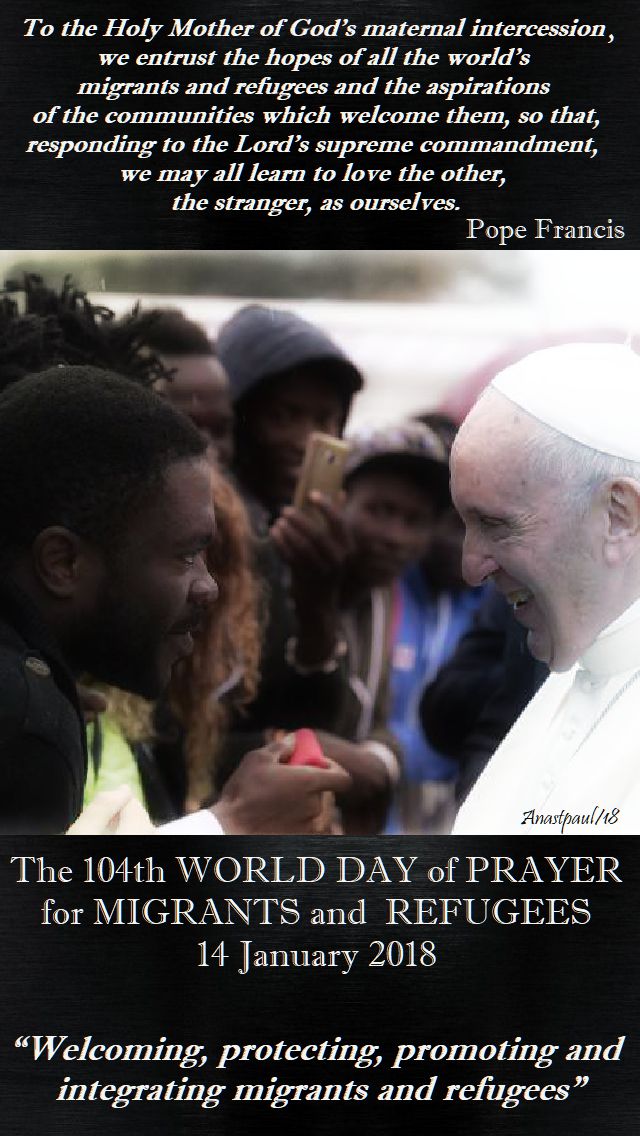
Today, 15 August, we celebrate the Feast of the Assumption of Mary.   The Holy Mother of God herself experienced the hardship of exile (Matthew 2:13-15), lovingly accompanied her Son’s journey to Calvary and now shares eternally His glory.   To her maternal intercession we entrust the hopes of all the world’s migrants and refugees and the aspirations of the communities which welcome them, so that, responding to the Lord’s supreme commandment, we may all learn to love the other, the stranger, as ourselves.

Vatican City, 15 August 2017 – Solemnity of the Assumption of the Blessed Virgin Mary

Francisto the holy mother of god's - pope francis - world day of prayer for migrants and refugees - 14 jan 2018
Posted in CHRISTMASTIDE!, MORNING Prayers, PAPAL MESSAGES, PAPAL SERMONS, SAINT of the DAY

1 January 2018 – The 51st World Day of Prayer for Peace

1 January 2018 – The 51st World Day of Prayer for Peace

The World Day of Prayer for Peace was first observed on 1 January 1968, proclaimed by Pope Paul VI. It was inspired by the encyclical Pacem in Terris by Pope John XXIII and with reference to Paul’s encyclical Populorum Progressio.

Our Holy Fathers, have used this day to make magisterial declarations relevant to the social doctrine of the Church on such topics as the United Nations, human rights, women’s rights, labour unions, economic development, the right to life, international diplomacy, peace in the Holy Land, globalisation, migrants, refugees and terrorism.the 51st world day of peace - 1 jan 2018

MESSAGE OF HIS HOLINESS POPE
FRANCIS
FOR THE CELEBRATION OF THE 
51st WORLD DAY OF PEACE

1 JANUARY 2018

Migrants and refugees: men and women in search of peace

1. Heartfelt good wishes for peace

Peace to all people and to all nations on earth! Peace, which the angels proclaimed to the shepherds on Christmas night,[1]  is a profound aspiration for everyone, for each individual and all peoples, and especially for those who most keenly suffer its absence.   Among these whom I constantly keep in my thoughts and prayers, I would once again mention the over 250 million migrants worldwide, of whom 22.5 million are refugees. Pope Benedict XVI, my beloved predecessor, spoke of them as “men and women, children, young and elderly people, who are searching for somewhere to live in peace.”  [2]  In order to find that peace, they are willing to risk their lives on a journey that is often long and perilous, to endure hardships and suffering, and to encounter fences and walls built to keep them far from their goal.

In a spirit of compassion, let us embrace all those fleeing from war and hunger, or forced by discrimination, persecution, poverty and environmental degradation to leave their homelands.

We know that it is not enough to open our hearts to the suffering of others.   Much more remains to be done before our brothers and sisters can once again live peacefully in a safe home.   Welcoming others requires concrete commitment, a network of assistance and goodwill, vigilant and sympathetic attention, the responsible management of new and complex situations that at times compound numerous existing problems, to say nothing of resources, which are always limited.   By practising the virtue of prudence, government leaders should take practical measures to welcome, promote, protect, integrate and, “within the limits allowed by a correct understanding of the common good, to permit [them] to become part of a new society.”[3]   Leaders have a clear responsibility towards their own communities, whose legitimate rights and harmonious development they must ensure, lest they become like the rash builder who miscalculated and failed to complete the tower he had begun to construct.[4]

2. Why so many refugees and migrants?

As he looked to the Great Jubilee marking the passage of two thousand years since the proclamation of peace by the angels in Bethlehem, Saint John Paul II pointed to the increased numbers of displaced persons as one of the consequences of the “endless and horrifying sequence of wars, conflicts, genocides and ethnic cleansings”[5] that had characterised the twentieth century.   To this date, the new century has registered no real breakthrough: armed conflicts and other forms of organised violence continue to trigger the movement of peoples within national borders and beyond.

Yet people migrate for other reasons as well, principally because they “desire a better life, and not infrequently try to leave behind the ‘hopelessness’ of an unpromising future.”[6]   They set out to join their families or to seek professional or educational opportunities, for those who cannot enjoy these rights do not live in peace.   Furthermore, as I noted in the Encyclical Laudato Si’, there has been “a tragic rise in the number of migrants seeking to flee from the growing poverty caused by environmental degradation”.[7]

Most people migrate through regular channels.   Some, however, take different routes, mainly out of desperation, when their own countries offer neither safety nor opportunity and every legal pathway appears impractical, blocked or too slow.

Many destination countries have seen the spread of rhetoric decrying the risks posed to national security or the high cost of welcoming new arrivals, and thus demeaning the human dignity due to all as sons and daughters of God.   Those who, for what may be political reasons, foment fear of migrants instead of building peace are sowing violence, racial discrimination and xenophobia, which are matters of great concern for all those concerned for the safety of every human being.[8]

All indicators available to the international community suggest that global migration will continue for the future. Some consider this a threat. For my part, I ask you to view it with confidence as an opportunity to build peace.

3. With a contemplative gaze

The wisdom of faith fosters a contemplative gaze that recognizes that all of us “belong to one family, migrants and the local populations that welcome them, and all have the same right to enjoy the goods of the earth, whose destination is universal, as the social doctrine of the Church teaches. It is here that solidarity and sharing are founded.”[9]   These words evoke the biblical image of the new Jerusalem.   The book of the prophet Isaiah (chapter 60) and that of Revelation (chapter 21) describe the city with its gates always open to people of every nation, who marvel at it and fill it with riches. Peace is the sovereign that guides it and justice the principle that governs coexistence within it.

We must also turn this contemplative gaze to the cities where we live, “a gaze of faith which sees God dwelling in their houses, in their streets and squares, […] fostering solidarity, fraternity, and the desire for goodness, truth and justice”[10] – in other words, fulfilling the promise of peace.

When we turn that gaze to migrants and refugees, we discover that they do not arrive empty-handed.   They bring their courage, skills, energy and aspirations, as well as the treasures of their own cultures; and in this way, they enrich the lives of the nations that receive them.   We also come to see the creativity, tenacity and spirit of sacrifice of the countless individuals, families and communities around the world who open their doors and hearts to migrants and refugees, even where resources are scarce.

A contemplative gaze should also guide the discernment of those responsible for the public good, and encourage them to pursue policies of welcome, “within the limits allowed by a correct understanding of the common good”[11] – bearing in mind, that is, the needs of all members of the human family and the welfare of each.

Those who see things in this way will be able to recognize the seeds of peace that are already sprouting and nurture their growth.   Our cities, often divided and polarized by conflicts regarding the presence of migrants and refugees, will thus turn into workshops of peace.

4. Four mileposts for action

Offering asylum seekers, refugees, migrants and victims of human trafficking an opportunity to find the peace they seek requires a strategy combining four actions: welcoming, protecting, promoting and integrating.[12]

“Welcoming” calls for expanding legal pathways for entry and no longer pushing migrants and displaced people towards countries where they face persecution and violence.   It also demands balancing our concerns about national security with concern for fundamental human rights. Scripture reminds us: “Do not forget to show hospitality to strangers, for by so doing some people have shown hospitality to angels without knowing it.”[13]

“Protecting” has to do with our duty to recognize and defend the inviolable dignity of those who flee real dangers in search of asylum and security, and to prevent their being exploited.   I think in particular of women and children who find themselves in situations that expose them to risks and abuses that can even amount to enslavement. God does not discriminate:  “The Lord watches over the foreigner and sustains the orphan and the widow.”[14]

“Promoting” entails supporting the integral human development of migrants and refugees. Among many possible means of doing so, I would stress the importance of ensuring access to all levels of education for children and young people.   This will enable them not only to cultivate and realise their potential but also better equip them to encounter others and to foster a spirit of dialogue rather than rejection or confrontation.   The Bible teaches that God “loves the foreigner residing among you, giving them food and clothing.   And you are to love those who are foreigners, for you yourselves were foreigners in Egypt.”[15]

“Integrating”, lastly, means allowing refugees and migrants to participate fully in the life of the society that welcomes them, as part of a process of mutual enrichment and fruitful cooperation in service of the integral human development of the local community.   Saint Paul expresses it in these words:  “You are no longer foreigners and strangers, but fellow citizens with God’s people.”[16]

5. A proposal for two international compacts

It is my heartfelt hope this spirit will guide the process that in the course of 2018 will lead the United Nations to draft and approve two Global Compacts, one for safe, orderly and regular migration and the other for refugees.   As shared agreements at a global level, these compacts will provide a framework for policy proposals and practical measures.   For this reason, they need to be inspired by compassion, foresight and courage, so as to take advantage of every opportunity to advance the peace-building process.   Only in this way can the realism required of international politics avoid surrendering to cynicism and to the globalisation of indifference.

Dialogue and coordination are a necessity and a specific duty for the international community.   Beyond national borders, higher numbers of refugees may be welcomed – or better welcomed – also by less wealthy countries, if international cooperation guarantees them the necessary funding.

The Migrants and Refugees Section of the Dicastery for Promoting Integral Human Development has published a set of twenty action points that provide concrete leads for implementing these four verbs in public policy and in the attitudes and activities of Christian communities.[17]   The aim of this and other contributions is to express the interest of the Catholic Church in the process leading to the adoption of the two U.N. Global Compacts.    This interest is the sign of a more general pastoral concern that goes back to the very origins of the Church and has continued in her many works up to the present time.

6. For our common home

Let us draw inspiration from the words of Saint John Paul II:  “If the ‘dream’ of a peaceful world is shared by all, if the refugees’ and migrants’ contribution is properly evaluated, then humanity can become more and more a universal family and our earth a true ‘common home’.”[18]   Throughout history, many have believed in this “dream”, and their achievements are a testament to the fact that it is no mere utopia.

Among these, we remember Saint Frances Xavier Cabrini in this year that marks the hundredth anniversary of her death. On this thirteenth day of November, many ecclesial communities celebrate her memory.   This remarkable woman, who devoted her life to the service of migrants and became their patron saint, taught us to welcome, protect, promote and integrate our brothers and sisters.   Through her intercession, may the Lord enable all of us to experience that “a harvest of righteousness is sown in peace by those who make peace.”[19]

From the Vatican, 13 November 2017

Posted in CHRISTMASTIDE!, FEASTS and SOLEMNITIES, MARIAN TITLES, PAPAL MESSAGES, PAPAL SERMONS, SAINT of the DAY

1 January 2018 – The Solemnity of Mary, the Mother of God

1 January 2018 – The Solemnity of Mary, the Mother of God

Start the New Year With Jesus’ Mother—and Our Own

In the early centuries of the Church, once Christmas began to be celebrated as its own feast on 25 December (having originally been celebrated with the Feast of the Epiphany, on 6 January, the Octave (eighth day) of Christmas, 1 January took on a special meaning. In the East, and throughout much of the West, it became common to celebrate a feast of Mary, the Mother of God, on this day. This feast was never established in the universal calendar of the Church, however, and a separate feast, celebrating the Circumcision of Our Lord Jesus Christ (which would have taken place a week after His birth), eventually took hold of 1 January. With the revision of the liturgical calendar the Feast of the Circumcision was set aside, and the ancient practice of dedicating 1 January to the Mother of God was revived—this time, as a universal feast.
One of the earliest titles given by Christians to the Blessed Virgin was Theotokos—”God-bearer.” We celebrate her as the Mother of God, because, in bearing Christ, she bore the fullness of the Godhead within her. As we begin another year, we draw inspiration from the selfless love of the Theotokos, who never hesitated to do the will of God. And we trust in her prayers to God for us, that we might, as the years pass, become more like her. O Mary, Mother of God, pray for us!Mary2017_1100x754

HOMILY OF HIS HOLINESS POPE FRANCIS

Vatican Basilica
Sunday, 1st January 2017

“Mary treasured all these things and pondered them in her heart! (Lk 2:19).   In these words, Luke describes the attitude with which Mary took in all that they had experienced in those days.   Far from trying to understand or master the situation, Mary is the woman who can treasure, that is to say, protect and guard in her heart, the passage of God in the life of his people.   Deep within, she had learned to listen to the heartbeat of her Son, and that in turn taught her, throughout her life, to discover God’s heartbeat in history.   She learned how to be a mother and in that learning process she gave Jesus the beautiful experience of knowing what it is to be a Son.   In Mary, the eternal Word not only became flesh, but also learned to recognise the maternal tenderness of God.   With Mary, the God-Child learned to listen to the yearnings, the troubles, the joys and the hopes of the people of the promise.   With Mary, he discovered himself a Son of God’s faithful people.octave-day.mary mother of god - 2016jpg

In the Gospels, Mary appears as a woman of few words, with no great speeches or deeds but with an attentive gaze capable of guarding the life and mission of her Son and for this reason, of everything that he loves.   She was able to watch over the beginnings of the first Christian community and in this way she learned to be the mother of a multitude.   She drew near to the most diverse situations in order to sow hope.   She accompanied the crosses borne in the silence of her children’s hearts.   How many devotions, shrines and chapels in the most far-off places, how many pictures in our homes, remind us of this great truth.   Mary gave us a mother’s warmth, the warmth that shelters us amid troubles, the maternal warmth that keeps anything or anyone from extinguishing in the heart of the Church the revolution of tenderness inaugurated by her Son.   Where there is a mother, there is tenderness.   By her motherhood, Mary shows us that humility and tenderness are not virtues of the weak but of the strong. She teaches us that we do not have to mistreat others in order to feel important (cf. Evangelii Gaudium, 288).    God’s holy people has always acknowledged and hailed her as the Holy Mother of God.

To celebrate Mary as Mother of God and our mother at the beginning of the new year means recalling a certainty that will accompany our days:   we are a people with a Mother;   we are not orphans.

Mothers are the strongest antidote to our individualistic and egotistic tendencies, to our lack of openness and our indifference.   A society without mothers would not only be a cold society, but a society that has lost its heart, lost the “feel of home”.   A society without mothers would be a merciless society, one that has room only for calculation and speculation.   Because mothers, even at the worst times, are capable of testifying to tenderness, unconditional self-sacrifice and the strength of hope.   I have learned much from those mothers whose children are in prison, or lying in hospital beds, or in bondage to drugs, yet, come cold or heat, rain or draught, never stop fighting for what is best for them.   Or those mothers who in refugee camps, or even the midst of war, unfailingly embrace and support their children’s sufferings.   Mothers who literally give their lives so that none of their children will perish.   Where there is a mother, there is unity, there is belonging, belonging as children.

To begin the year by recalling God’s goodness in the maternal face of Mary, in the maternal face of the Church, in the faces of our own mothers, protects us from the corrosive disease of being “spiritual orphans”.   It is the sense of being orphaned that the soul experiences when it feels motherless and lacking the tenderness of God, when the sense of belonging to a family, a people, a land, to our God, grows dim.   This sense of being orphaned lodges in a narcissistic heart capable of looking only to itself and its own interests.   It grows when what we forget that life is a gift we have received – and owe to others – a gift we are called to share in this common home.

It was such a self-centred orphanhood that led Cain to ask:  “Am I my brother’s keeper?” (Gen 4:9).   It was as if to say:  he doesn’t belong to me;  I do not recognise him.   This attitude of spiritual orphanhood is a cancer that silently eats away at and debases the soul.   We become all the more debased, inasmuch as nobody belongs to us and we belong to no one.   I debase the earth because it does not belong to me;  I debase others because they do not belong to me;  I debase God because I do not belong to him and in the end we debase our very selves, since we forget who we are and the divine “family name” we bear.   The loss of the ties that bind us, so typical of our fragmented and divided culture, increases this sense of orphanhood and, as a result, of great emptiness and loneliness.   The lack of physical (and not virtual) contact is cauterising our hearts (cf. Laudato Si’, 49) and making us lose the capacity for tenderness and wonder, for pity and compassion.   Spiritual orphanhood makes us forget what it means to be children, grandchildren, parents, grandparents, friends and believers.   It makes us forget the importance of playing, of singing, of a smile, of rest, of gratitude.

Celebrating the feast of the Holy Mother of God makes us smile once more as we realise that we are a people, that we belong, that only within a community, within a family, can we as persons find the “climate”, the “warmth” that enables us to grow in humanity and not merely as objects meant to “consume and be consumed”.   To celebrate the feast of the Holy Mother of God reminds us that we are not interchangeable items of merchandise or information processors.   We are children, we are family, we are God’s People.

Celebrating the Holy Mother of God leads us to create and care for common places that can give us a sense of belonging, of being rooted, of feeling at home in our cities, in communities that unite and support us (cf. Laudato Si’, 151).2.2.2.x-collection-detail-sirani_virgin_and_childMother-of-GodVirgin and Child (Luis De Morales)

Jesus, at the moment of his ultimate self-sacrifice, on the cross, sought to keep nothing for himself, and in handing over his life, he also handed over to us his Mother.   He told Mary:   Here is your son; here are your children.   We too want to receive her into our homes, our families, our communities and nations.   We want to meet her maternal gaze. The gaze that frees us from being orphans; the gaze that reminds us that we are brothers and sisters, that I belong to you, that you belong to me, that we are of the same flesh.   The gaze that teaches us that we have to learn how to care for life in the same way and with the same tenderness that she did:  by sowing hope, by sowing a sense of belonging and of fraternity.

Celebrating the Holy Mother of God reminds us that we have a Mother.   We are not orphans.   We have a Mother.   Together let us all confess this truth.   I invite you to acclaim it three times, standing [all stand], like the faithful of Ephesus:  Holy Mother of God, Holy Mother of God, Holy Mother of God.BallymoteChurchoftheImmaculateConceptionNorthAisleMadonnaandChild20100923

Posted in ADVENT, CHRISTMASTIDE!, MORNING Prayers, PAPAL MESSAGES, PAPAL SERMONS, The INCARNATION

Thought for the Day – 24 December – Christmas Eve!

Thought for the Day – 24 December – Christmas Eve!

Christmas is the feast of faith in the Son of God who became man in order to restore us to our filial dignity, lost through sin and disobedience.   Christmas is the feast of faith in hearts that become a manger to receive him and souls that allow God to make a shoot of hope, charity and faith sprout from the stump of their poverty.

Today is once again a moment for exchanging Christmas greetings and for wishing a holy and joyful Christmas and a happy New Year to you … and to all your dear ones. May this Christmas open our eyes so that we can abandon what is superfluous, false, malicious and sham and to see what is essential, true, good and authentic.   My best wishes indeed!

I began our meeting by speaking of Christmas as the Feast of Faith.
I would like to conclude, though, by pointing out that Christmas
reminds us that a faith that does not trouble us is a troubled faith.
A faith that does not make us grow is a faith that needs to grow.
A faith that does not raise questions is a faith that has to be questioned.
A faith that does not rouse us is a faith that needs to be roused.
A faith that does not shake us is a faith that needs to be shaken.
Indeed, a faith which is only intellectual or lukewarm is only a notion of faith.
It can become real once it touches our heart, our soul, our spirit and our whole being.
Once it allows God to be born and reborn in the manger of our heart.
Once we let the star of Bethlehem guide us to the place where the Son of God lies,
not among Kings and riches but among the poor and humble.
As Angelus Silesius wrote in The Cherubinic Wanderer:
“It depends solely on you.
Ah, if only your heart could become a manger,
then God would once again become a child on this earth”

Address of His Holiness, Pope Francis – 21 December 2017christmas message - pope francis 2017

Posted in ADVENT, CHRIST the KING, MORNING Prayers, PAPAL MESSAGES, QUOTES of the SAINTS, SAINT of the DAY, The HOLY NAME

Quote of the Day – 11 December – The Memorial of St Pope Damasus I (c 305-384)

Quote of the Day – 11 December – The Memorial of St Pope Damasus I (c 305-384)

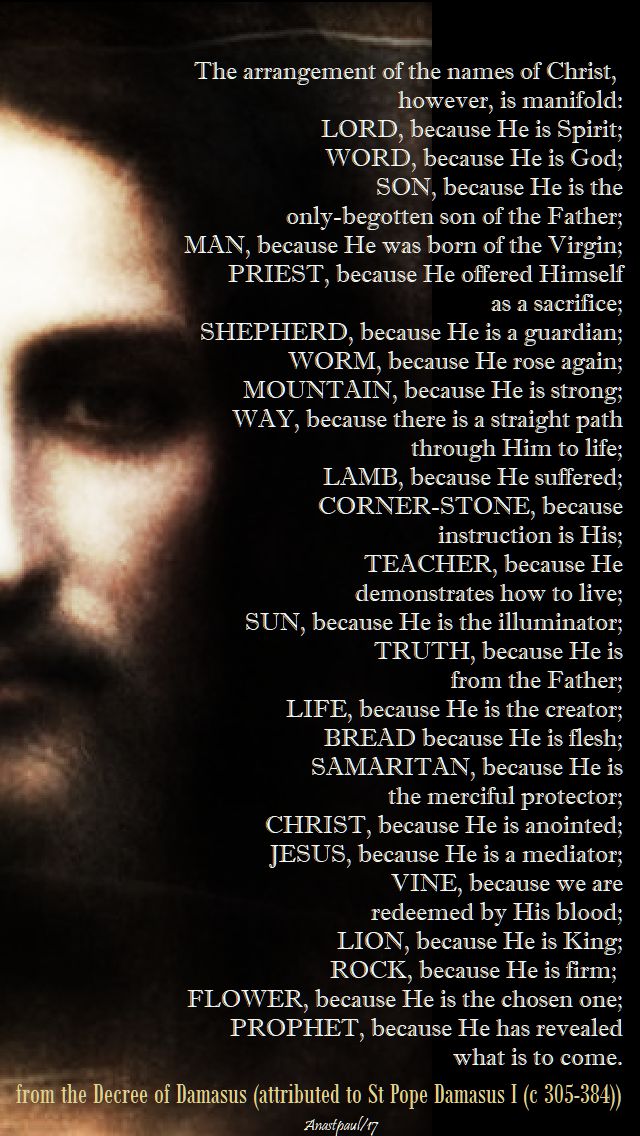
The arrangement of the names of Christ, however, is manifold:
LORD, because He is Spirit;
WORD, because He is God;
SON, because He is the only-begotten son of the Father;
MAN, because He was born of the Virgin;
PRIEST, because He offered Himself as a sacrifice;
SHEPHERD, because He is a guardian;
WORM, because He rose again;
MOUNTAIN, because He is strong;
WAY, because there is a straight path through Him to life;
LAMB, because He suffered;
CORNER-STONE, because instruction is His;
TEACHER, because He demonstrates how to live;
SUN, because He is the illuminator;
TRUTH, because He is from the Father;
LIFE, because He is the creator;
BREAD because He is flesh;
SAMARITAN, because He is the merciful protector;
CHRIST, because He is anointed;
JESUS, because He is a mediator;
VINE, because we are redeemed by His blood;
LION, because He is King;
ROCK, because He is firm;
FLOWER, because He is the chosen one;
PROPHET, because He has revealed what is to come.

from the Decree of Damasus (attributed to St Pope Damasus I)

St Pope Damasus I (c 305-384)the arrangement of the names of christ - st pope damasus I - 11 dec 2017

Posted in CATHOLIC DEVOTIONS of the Month, DOCTORS of the Church, DOGMA, FATHERS of the Church, FEASTS and SOLEMNITIES, MARIAN QUOTES, MARIAN TITLES, PAPAL ENCYLICALS, PAPAL MESSAGES, QUOTES of the SAINTS, SAINT of the DAY, The BLESSED VIRGIN MARY

Quote/s of the Day – 8 December – The Solemnity of the Immaculate Conception

Quote/s of the Day – 8 December – The Solemnity of the Immaculate Conception

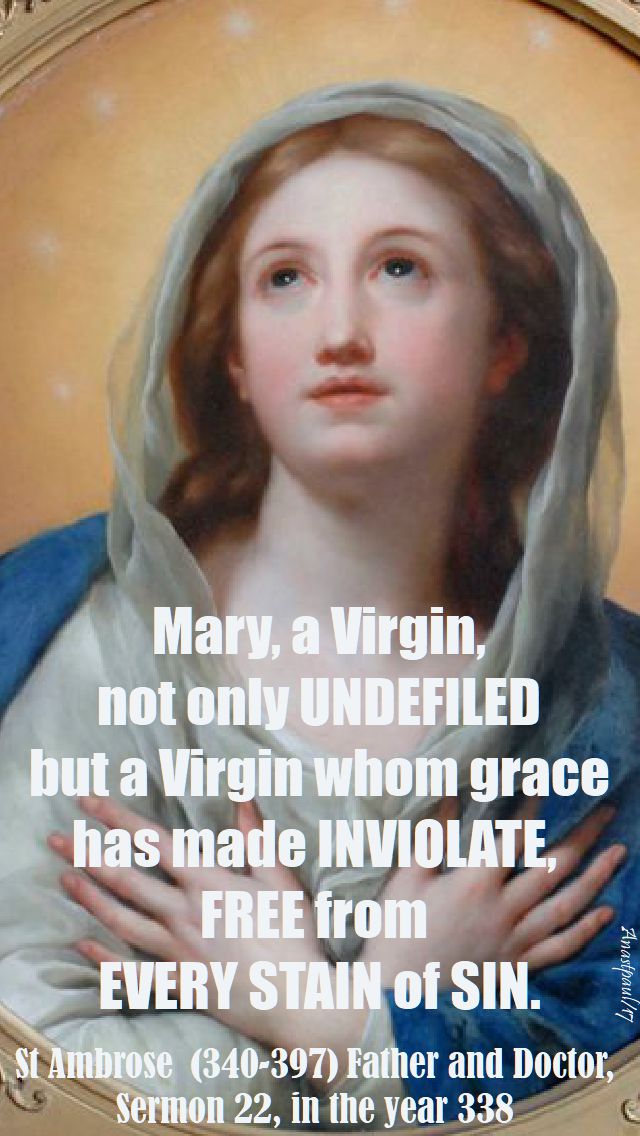
“Mary, a Virgin,
not only not only UNDEFILED
but a Virgin whom grace
has made INVIOLATE,
FREE from EVERY STAIN of SIN.”

St Ambrose (340-397) Father and Doctor, Sermon 22, in the year 338mary a virgin - st ambrose - 8 dec 2017

The Apostolic Constitution «Ineffabilis Deus», published on 8th December 1854, more 150 years ago, by Blessed Pope Pius IX on the theology regarding the privilege of the Immaculate Conception, in the following solemn proclamation of this Dogma of Catholic faith:

“To the honour of the holy and undivided Trinity, to the worthiness and splendid beauty of the Virgin Mother of God, to the upholding of the Catholic faith and to the furthering of the Christian religion, with the authority of Our Lord Jesus Christ, with that of the holy Apostles Peter and Paul and with Our own authority, we declare, we pronounce and we define the doctrine which holds that the most Blessed Virgin Mary, in the very first moments of her Conception, through the singular grace of Almighty God and through the foresight of the merits of Christ Jesus, Saviour of the human race, was preserved immune from all stains of original sin.   We furthermore declare, pronounce and define that this doctrine has been revealed by God and, therefore, has to be strongly and always believed by all the faithful.”  Blessed Pope Pius IX

“As soon as she [Mary] had the use of reason, that is, from the first moment of her Immaculate Conception in the womb of St Anne, from that time she began with all her powers to love her God and thus she continued to do, ever advancing more in perfection and love through her whole life.   All her thoughts, her desires, her affections, were wholly given to God.   Not a word, not a motion, not a glance of the eye, not a breath of hers that was not for God and for His glory, never departing one step, nor separating herself for one moment from the divine love.”…Saint Alphonsus Ligouri  (1696-1787) Doctor of the Church

Posted in ADVENT, MORNING Prayers, PAPAL MESSAGES

Thought for the Day – 3 December “Praying Advent with Pope Francis’ Apostolic Exhortation – “The Joy of the Gospel”

Thought for the Day – 3 December “Praying Advent with Pope Francis’ Apostolic Exhortation – “The Joy of the Gospel”

Pope Francis begins by warning us about how our culture impacts us and robs us of our joy and our compassion:

The great danger in today’s world, pervaded as it is by consumerism, is the desolation and anguish born of a complacent yet covetous heart, the feverish pursuit of frivolous pleasures and a blunted conscience.   Whenever our interior life becomes caught up in its own interests and concerns, there is no longer room for others, no place for the poor.   God’s voice is no longer heard, the quiet joy of His love is no longer felt and the desire to do good fades.   This is a very real danger for believers too.   Many fall prey to it and end up resentful, angry and listless.   That is no way to live a dignified and fulfilled life;   it is not God’s will for us, nor is it the life in the Spirit which has its source in the heart of the risen Christ. 

Then, Pope Francis offers the remedy for this danger – our personal relationship with Jesus:

I invite all Christians, everywhere, at this very moment, to a renewed personal encounter with Jesus Christ, or at least an openness to letting Him encounter them; I ask all of you to do this unfailingly each day.   No one should think that this invitation is not meant for him or her, since “no one is excluded from the joy brought by the Lord”.[ Paul VI, Apostolic Exhortation Gaudete in Domino (9 May 1975)] 

The Holy Father suggests this prayer:

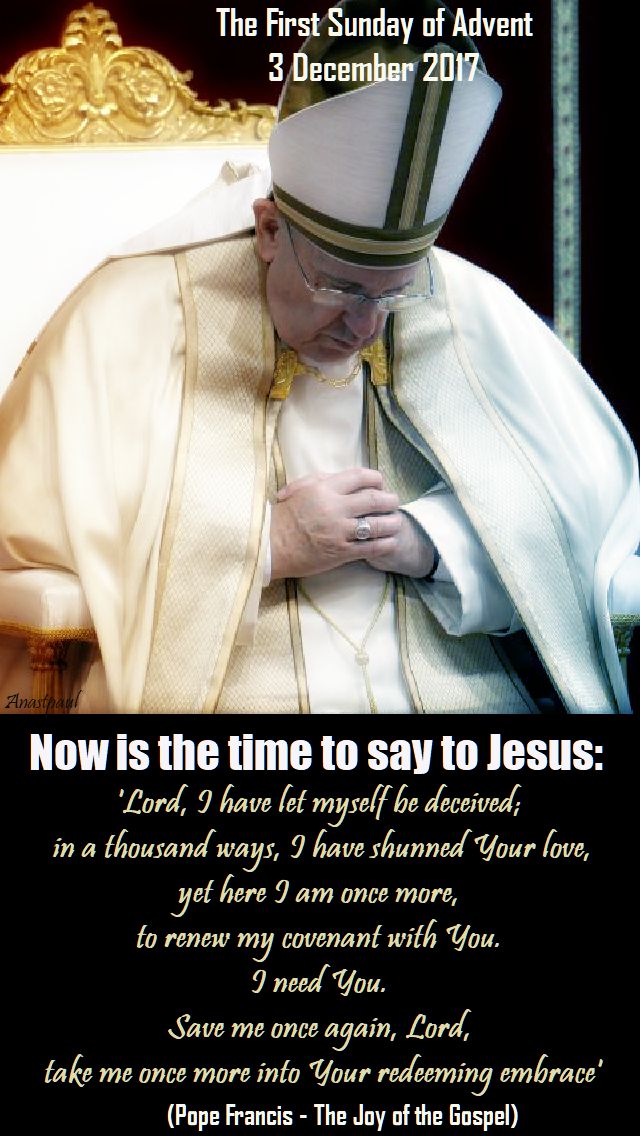
Now is the time to say to Jesus:  “Lord, I have let myself be deceived;  in a thousand ways I have shunned Your love, yet here I am once more, to renew my covenant with You.   I need You.   Save me once again, Lord, take me once more into Your redeeming embrace”.now is the time - pope francis - the joy of the gospel - 3 dec 2017

Posted in CATHOLIC Quotes, MARIAN PRAYERS, MORNING Prayers, PAPAL MESSAGES, PRAYERS for VARIOUS NEEDS, PRAYERS of the CHURCH, QUOTES on CHARITY, QUOTES on MERCY, SAINT of the DAY

Thought for the Day – 19 November – The First World Day of the Poor

Thought for the Day – 19 November – The First World Day of the Poor

When it became clear that Cardinal Jorge Mario Bergoglio, SJ, would succeed Pope Benedict XVI, Cardinal Claudio Hummes of Brazil, seated next to Cardinal Bergoglio in the March 2013 conclave, comforted the Argentine cardinal and told him, “Don’t forget the poor.”
The future Pope Francis took those words to heart.
“That’s always been a characteristic of his spirituality and his ministry,” Bishop da Cunha said the first World Day of the Poor, 19 November, which the pontiff announced in his November 2016 closing letter for the Jubilee Year of Mercy, is an opportunity for the whole Church to reflect, pray and think about how it serves the poor the world over.

“During the Jubilee for Socially Excluded People, as the Holy Doors of Mercy were being closed in all the cathedrals and shrines of the world, I had the idea that, as yet another tangible sign of this Extraordinary Holy Year, the entire Church might celebrate, on the 33rd Sunday of Ordinary Time, the World Day of the Poor.   This would be the worthiest way to prepare for the celebration of the solemnity of our Lord Jesus Christ, King of the Universe, who identified with the little ones and the poor and who will judge us on our works of mercy (cf. Mt 25:31-46).   It would be a day to help communities and each of the baptised to reflect on how poverty is at the very heart of the Gospel and that, as long as Lazarus lies at the door of our homes (cf. Lk 16:19-21), there can be no justice or social peace.   This day will also represent a genuine form of New Evangelisation (cf. Mt 11:5) which can renew the face of the Church as she perseveres in her perennial activity of pastoral conversion and witness to mercy.” …Pope Francis in his November 2016 apostolic letter Misericordia et Misera, closing the Extraordinary Jubilee Year of Mercy.

Prayer of intercession to the Blessed Virgin Mary
for Migrants and Refugees

O Blessed Mary, Mother of Mercy,
you fled into exile in the moonlight,
carrying your son, our Lord Jesus.
You shared His journey to the Cross,
and are now robed in the light of peace.
Mary, Mother of the Poor,
watch over migrants and refugees
holding their families close on fearful journeys.
Comfort and protect them, we pray,
as they walk beneath the shining stars.
Bless our communities, loving Mary,
fill our hearts with compassion,
help us to shelter the stranger,
and share the goodness
of God’s consoling love
with all our neighbours.
Hail Mary…prayer to the blessed virgin for migrants and refugees - 19 nov 2017 - world day of the poor

Posted in DOCTORS of the Church, FATHERS of the Church, MORNING Prayers, PAPAL MESSAGES, PRACTISING CATHOLIC, QUOTES of the SAINTS, QUOTES on CHARITY, QUOTES on MERCY, SAINT of the DAY

Quote/s of the Day – 19 November – The First World Day of the

Quote/s of the Day – 19 November – The First World Day of the Poor

Let us love, not with words but with deeds.”1st annual world day of the poor - 19 nov - let us love not with words but with deeds - 2017.-no2

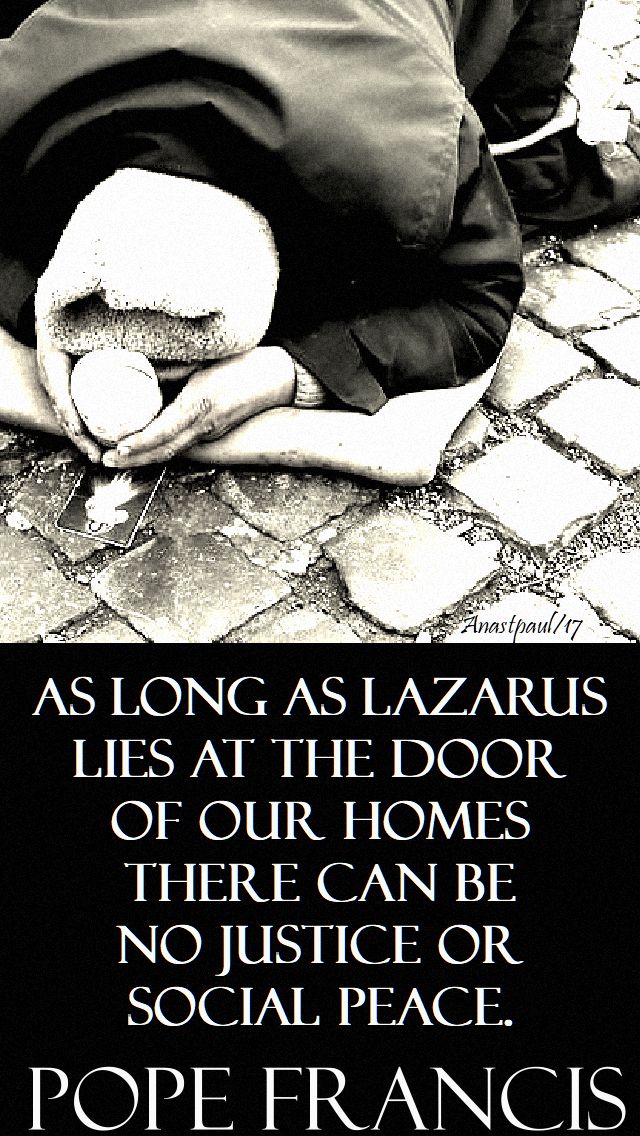
“As long as Lazarus lies at the door of our homes
there can be no justice or social peace.”as long as lazarus - pope francis - 19 nov 2017

“Blessed are the open hands that embrace
the poor and help them – they are hands
that bring hope.
Blessed are the hands that reach beyond
every barrier of culture, religion and nationality
and pour the balm of consolation over
the wounds of humanity.
Blessed are the open hands that ask nothing
in exchange, with no “ifs” or “buts” or “maybes”:
they are hands that call down God’s blessing
upon their brothers and sisters.

Pope Francis

FIRST WORLD DAY OF THE POOR
33rd Sunday in Ordinary Time
19 November 2017blessed are the open hands - pope francis - 19 nov 2017

“If you want to honour the body of Christ,
do not scorn it when it is naked;
do not honour the Eucharistic Christ
with silk vestments and then,
leaving the church, neglect the other Christ
suffering from cold and nakedness”

St John Chrysostom (347-407)

Father and Doctor of the Church – (Hom. in Matthaeum, 50.3: PG 58)if you want to honour the body of christ - st john chrysostom - 19 nov 2017