Posted in DOCTORS of the Church, FATHERS of the Church, HOLY WEEK, MORNING Prayers, PAPAL SERMONS, QUOTES - J R R Tolkien and MORE, QUOTES of the SAINTS, QUOTES on DEATH, QUOTES on ETERNAL LIFE, QUOTES on FAITH, QUOTES on LOVE, QUOTES on SANCTITY, QUOTES on SUFFERING, QUOTES on the CROSS of CHRIST, SAINT of the DAY, St PAUL!, The HOLY CROSS, The PASSION

Quote/s of the Day – 30 March 2018 – Good Friday of the Passion of the Lord

Quote/s of the Day – 30 March 2018 – Good Friday of the Passion of the Lord

“But far be it from me to glory,
except in the Cross of our Lord Jesus Christ,
by which the world has been crucified to me
and I to the world.”

St Paulbut far be it from me - st paul - good friday 30 march 2018

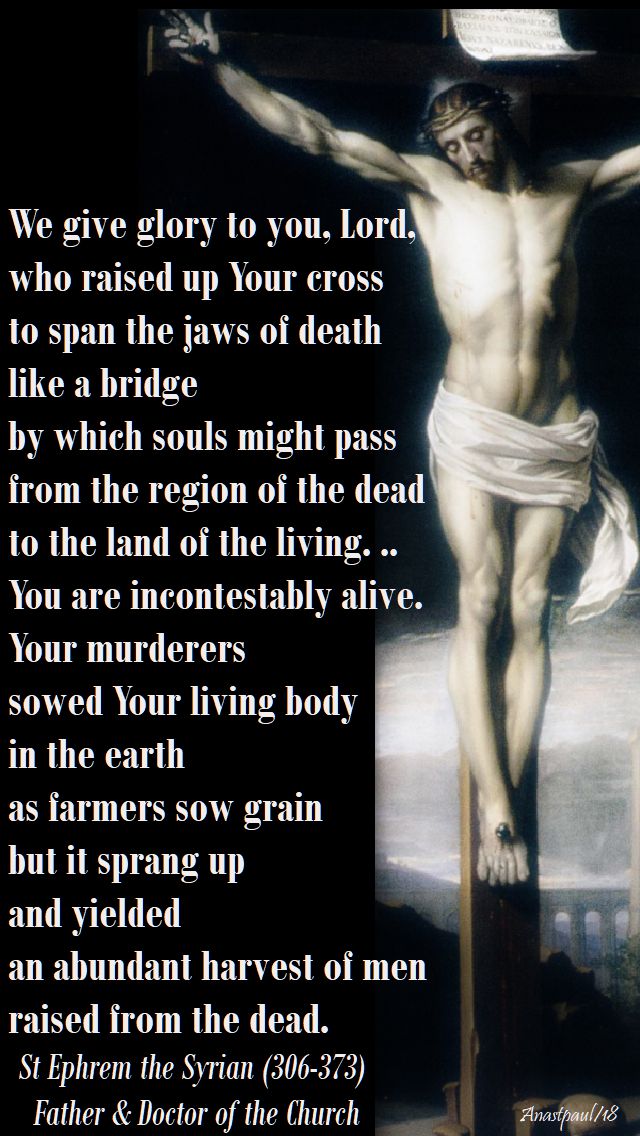
“We give glory to You, Lord,
who raised up Your Cross to span the jaws of death
like a bridge by which souls might pass
from the region of the dead to the land of the living. ..
You are incontestably alive.
Your murderers sowed Your living body in the earth
as farmers sow grain but it sprang up
and yielded an abundant harvest of men
raised from the dead.”

St Ephrem the Syrian (306-373) Father & Doctor of the Churchwe give glory to you lord - st ephrem - 30 march 2018 - good friday

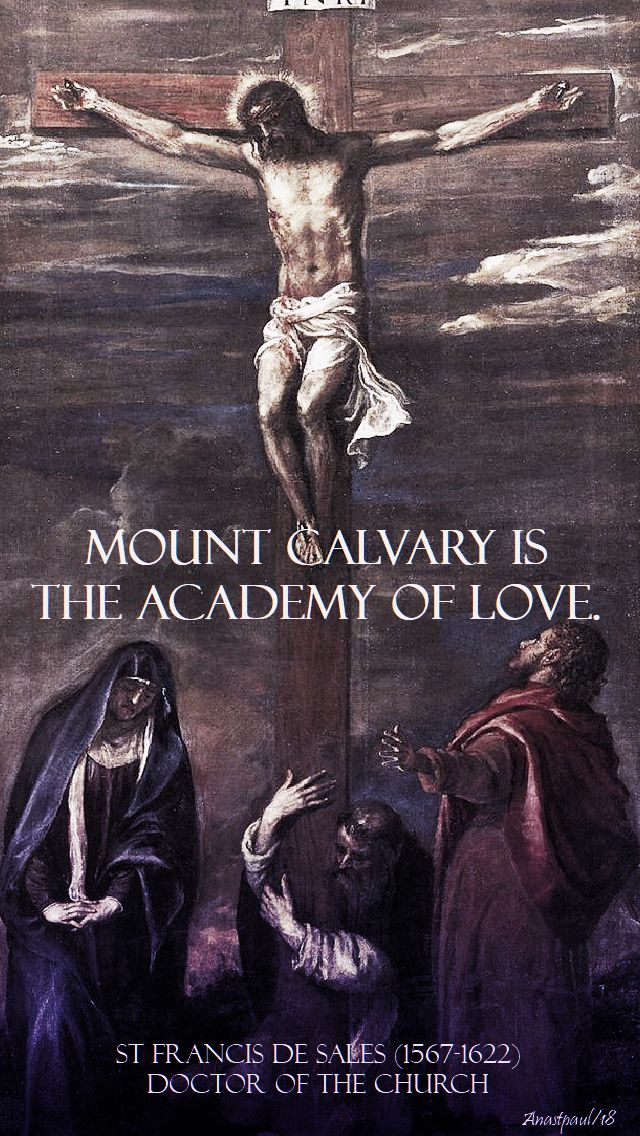
“Mount Calvary is the academy of love.”

St Francis de Sales (1567-1622) Doctor of the Churchmount calvary is the academy of love - st francis de sales - 30 march 2018 - good friday

” …Let us direct today our gaze toward Christ,
a gaze frequently distracted by scattered
and passing earthly interests.
Let us pause to contemplate His Cross.
The cross, fount of life and school of justice and peace,
is the universal patrimony of pardon and mercy.
It is permanent proof of a self-emptying and infinite love
that brought God to become man,
vulnerable like us, unto dying crucified.”

Pope Benedict XVI – 21 March 2008pope benedict - let us direct our gaze - good friday - 30 march 2018

Posted in HOLY WEEK, MORNING Prayers, PAPAL SERMONS, PRAYERS of the CHURCH, QUOTES - J R R Tolkien and MORE, The HOLY CROSS, The PASSION, The SEVEN LAST WORDS of CHRIST

Devotion of The Seven Last Words of Christ – The Fourth Word – 29 March – Holy Thursday 2018

Devotion of The Seven Last Words of Christ – The Fourth Word – 29 March – Holy Thursday 2018

The Seven Last Words of Christ

The Seven Last Words of Christ refer, not to individual words but to the final seven phrases that Our Lord uttered as He hung on the Cross.   These phrases were not recorded in a single Gospel but are taken from the combined accounts of the four Gospels.   Greatly revered, these last words of Jesus have been the subject of many books, sermons and musical settings.   For centuries The Seven Last Words have been built into various forms of devotion for the consideration and consolation of the Christian people.

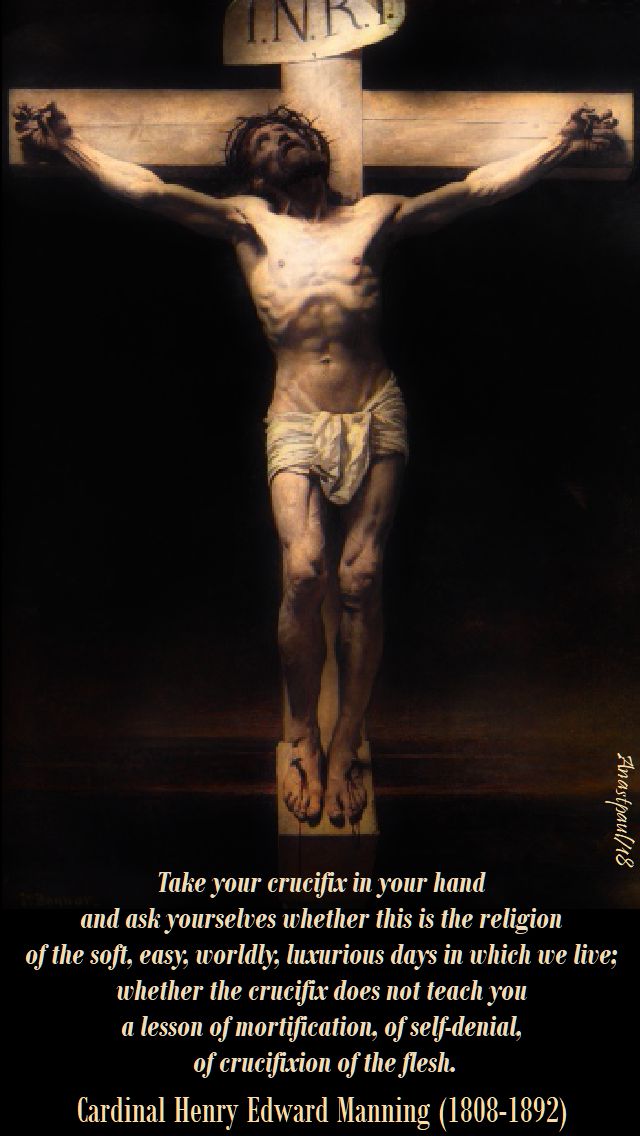
“Take your crucifix in your hand
and ask yourselves whether this is the religion
of the soft, easy, worldly, luxurious days in which we live;
whether the crucifix does not teach you
a lesson of mortification, of self-denial, of crucifixion of the flesh.”

Cardinal Henry Edward Manning (1808-1892)take your crucifix in your hand - card henry edward manning - holy thursday - 29 march 2018

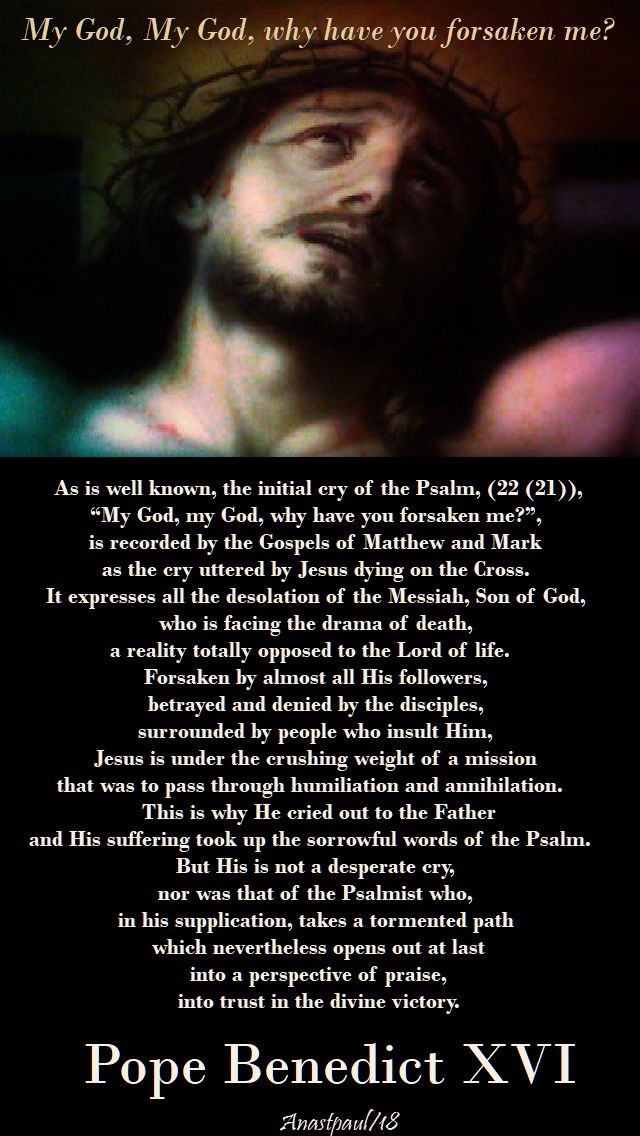
“As is well known, the initial cry of the Psalm 22, “My God, my God, why have you forsaken me?”, is recorded by the Gospels of Matthew and Mark as the cry uttered by Jesus dying on the Cross (cf. Mt 27:46, Mk 15:34).   It expresses all the desolation of the Messiah, Son of God, who is facing the drama of death, a reality totally opposed to the Lord of life. Forsaken by almost all His followers, betrayed and denied by the disciples, surrounded by people who insult Him, Jesus is under the crushing weight of a mission that was to pass through humiliation and annihilation.   This is why He cried out to the Father and His suffering took up the sorrowful words of the Psalm.   But His is not a desperate cry, nor was that of the Psalmist who, in his supplication, takes a tormented path which nevertheless opens out at last into a perspective of praise, into trust in the divine victory.”…Pope Benedict XVI – General Audience 14 September 2011

as is well known - on my god my god why hast thou forsaken me - 29 march 2018 - holy thursday-pope benedict

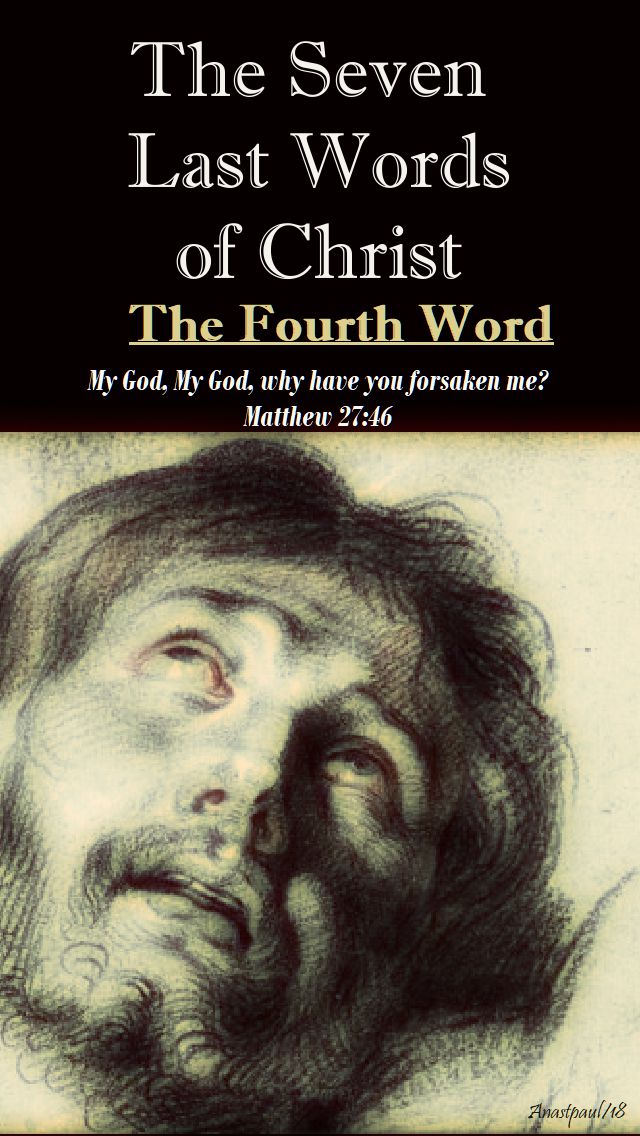
The Fourth Word

“My God, my God, why have you forsaken me?”

Gospel – From noon onward, darkness came over the whole land until three in the afternoon.   And about three o’clock Jesus cried out in a loud voice, “Eli, Eli, lema sabachthani?” which means, “My God, my God, why have you forsaken me?”…Matthew 27:45-46 (Psalm 22(21))

Reflection:  To ensure that He suffered every torment that normal man is prone to, Christ allowed Himself to experience despair. Up to this point, Jesus had suffered mainly physically.   These torments had left His body racked with pain and agony. But now it was time for the ultimate pain, the pain a soul feels when it is separated from God.

The soul is spiritual being in the image of God.   The human soul is like a plant is nourished by the bright sunlight of God.   The human soul needs this light to grow and flourish.   However, unlike a plant, the human soul does not die when it is separated from God because it cannot die. Instead the soul endures great and debilitating agony. It was this kind of agony that Our Lord willingly accepted on the Cross.

O sinful man, how can you claim that Our Lord does not understand the pain you are going through?   He has suffered every imaginable punishment.   He has felt the rejection of His own people.   He has endured the dreadful physical pains of a brutal scourging and ignominious death on a Cross.   He had endured the despair of a soul separated from God.   He understands pain, agony, loss and despair.   And He wishes to console you  . He stands with arms out stretched on the Cross, looking to comfort you in all your distress.

Lord Jesus Christ, You know better than anyone what suffering I am enduring. I beg you to give me the grace and strength to endure these hardships, that I may offer them as penance for my sins.   Help me to never refuse my cross, so that by taking it up daily I may be worthy of You one day. Amen.

Prayer of Abandonment to God’s Providence

My Lord and my God:
into your hands I abandon the past and the present and the future,
what is small and what is great,
what amounts to a little and what amounts to a lot,
things temporal and things eternal.
Amen. Our Father. Hail Mary. Glory Be.THE FOURTH WORD -MATTHEW 27 46 - THE SEVEN LAST WORDS OF CHRIST - THE DEVOTION - 29 MARCH 2018

Posted in CONFESSION/PENANCE, HOLY WEEK, MORNING Prayers, PAPAL SERMONS, PRACTISING CATHOLIC, QUOTES - J R R Tolkien and MORE, QUOTES on CONVERSION, QUOTES on FORGIVENESS, QUOTES on LOVE, QUOTES on REPENTANCE, The PASSION, The WORD

Thought for the Day – 29 March – Holy Thursday – The Mass of the Lord’s Supper 2018

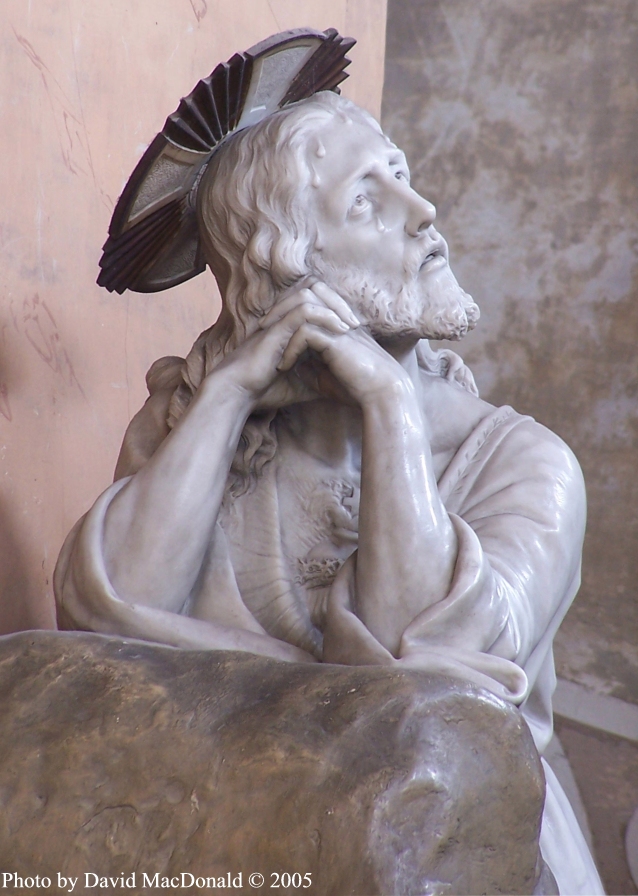
Thought for the Day – 29 March – Holy Thursday – The Mass of the Lord’s Supper 2018vatican - statue at the gethsemane steps in rome

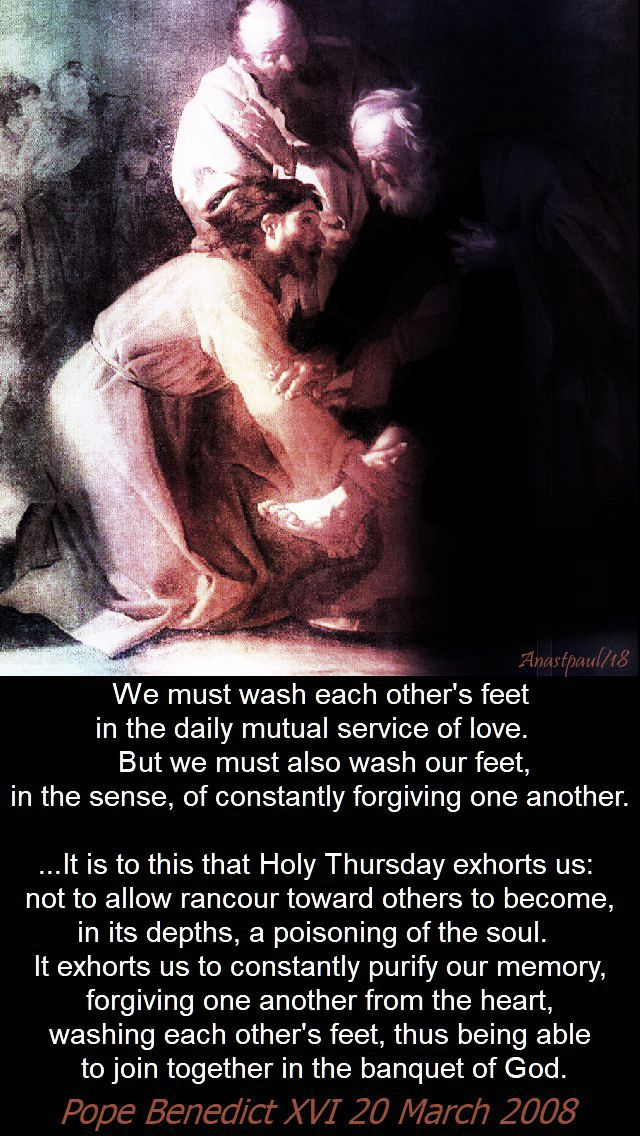
When the Lord tells Peter that without the washing of his feet he would never be able to have any part in Him, Peter immediately and impetuously asks to have his head and hands washed as well.   This is followed by the mysterious words of Jesus:  “Whoever has bathed has no need except to have his feet washed” (John 13:10).   Jesus alludes to a bath that the disciples, according to ritual prescriptions, had already taken; in order to participate in the meal, they now needed only to have their feet washed.   But naturally, a deeper meaning is hidden in this.   To what does it allude?   We do not know for sure.  In any case, we should keep in mind that the washing of the feet, according to the meaning of the entire chapter, does not indicate a single specific Sacrament but the “sacramentum Christi” in its entirety – His service of salvation, His descent even to the cross, His love to the end, which purifies us and makes us capable of God.

Here, with the distinction between the bath and the washing of feet, nevertheless, there also appears an allusion to life in the community of the disciples, to life in the community of the Church – an allusion that John may have intentionally transmitted to the community of his time.   It then seems clear that the bath that purifies us definitively and does not need to be repeated is Baptism – immersion in the death and resurrection of Christ, a fact that changes our lives profoundly, giving us something like a new a identity that endures, if we do not throw it away as Judas did.   But even in the endurance of this new identity, for convivial communion with Jesus we need the “washing of the feet.”   What does this mean?   It seems to me that the first letter of Saint John gives us the key for understanding this.   There we read: “If we say, ‘We are without sin,’ we deceive ourselves, and the truth is not in us.   If we acknowledge our sins, he is faithful and just and will forgive our sins and cleanse us from every wrongdoing” (1:8ff.).

We need the “washing of the feet,” the washing of our everyday sins and for this we need the confession of sins.   We do not know exactly how this was carried out in the Johannine community.   But the direction indicated by the words of Jesus to Peter is obvious:  in order to be capable of participating in the convivial community with Jesus Christ, we must be sincere.   One must recognise that even in our own identity as baptised persons, we sin.   We need confession as this has taken form in the Sacrament of reconciliation.   In it, the Lord continually rewashes our dirty feet and we are able to sit at table with Him.

But in this way, the word takes on yet another meaning, in which the Lord extends the “sacramentum” by making it the “exemplum,” a gift, a service for our brother:   “If I, therefore, the master and teacher, have washed your feet, you ought to wash one another’s feet” (John 13:14).   We must wash each other’s feet in the daily mutual service of love.   But we must also wash our feet, in the sense, of constantly forgiving one another.   The debt that the Lord has forgiven us is always infinitely greater than all of the debts that others could owe to us (cf. Mt. 18:21-35).   It is to this that Holy Thursday exhorts us:  not to allow rancour toward others to become, in its depths, a poisoning of the soul.   It exhorts us to constantly purify our memory, forgiving one another from the heart, washing each other’s feet, thus being able to join together in the banquet of God.

Holy Thursday is a day of gratitude and of joy for the great gift of love to the end that the Lord has given to us.   We want to pray to the Lord at this time, so that gratitude and joy may become in us the power of loving together with His love. Amen.

Pope Benedict XVI 20 March 2008 Holy Thursday – Mass of the Lord’s Supperwe must wash each other's feet in the daily mutual service of love- pope benedict - 29 march 2018 holy thurs

Posted in HOLY WEEK, MORNING Prayers, PAPAL SERMONS, QUOTES - J R R Tolkien and MORE, QUOTES on FAITH, QUOTES on LOVE, The HOLY EUCHARIST / The HOLY MASS, The PASSION, The WORD

Quote/s of the Day – 29 March – Holy Thursday 2018

Quote/s of the Day – 29 March – Holy Thursday 2018

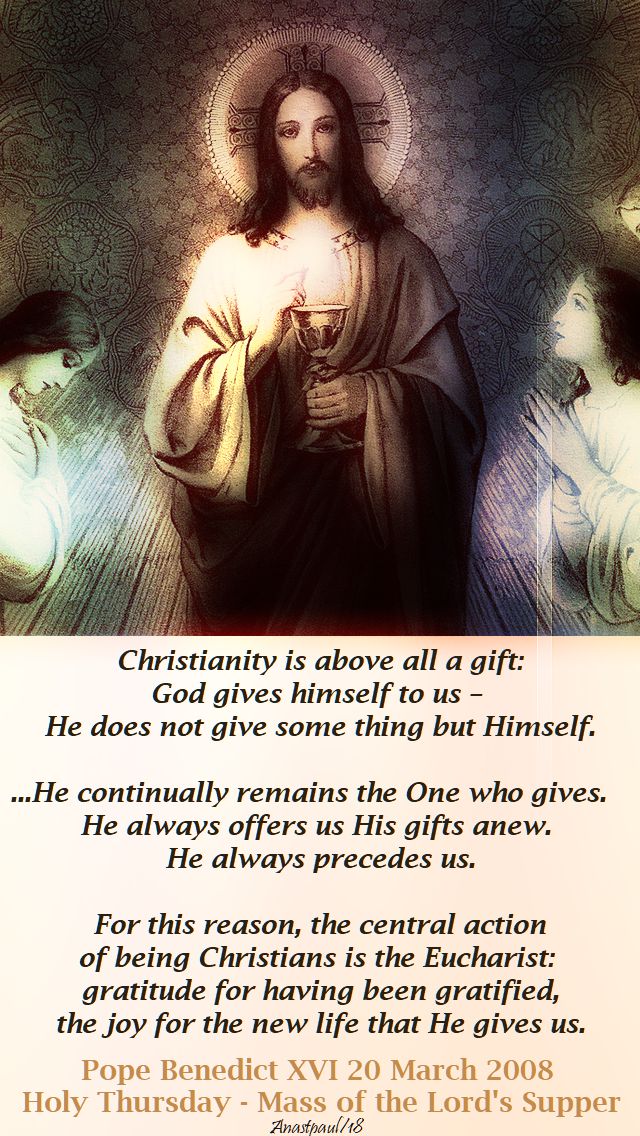
“Christianity is above all a gift:  God gives himself to us – He does not give some thing but Himself.   And this takes place not only at the beginning, at the moment of our conversion.   He continually remains the One who gives.   He always offers us His gifts anew.   He always precedes us.   For this reason, the central action of being Christians is the Eucharist:  gratitude for having been gratified, the joy for the new life that He gives us.christianity is above all a gift - pope benedict - 27 march 2018 - holy thursday

In spite of all this, we do not remain passive recipients of the divine goodness.   God gratifies us as personal and living partners.   The love that is given is the dynamic of “loving together,” it is intended to be a new life within us, beginning from God. We thus understand the words that, at the end of the account of the washing of the feet, Jesus speaks to His disciples and to all of us:  “I give you a new commandment: love one another.   As I have loved you, so you also should love one another” (John 13:34).   The “new commandment” does not consist in a new and difficult norm, one that did not exist before.   The new commandment consists in a loving together with Him who loved us first.”

Pope Benedict XVI – 20 March 2008 Holy Thursday – Mass of the Lord’s Supperi give you a new commandment - pope benedict - holy thursday - 29 march 2008

Posted in HOLY WEEK, MORNING Prayers, PAPAL SERMONS, PRAYERS for PRIESTS, PRAYERS of the CHURCH, SAINT of the DAY

Thought for the Day – 27 March – Tuesday of Holy Week 2018

Thought for the Day – 27 March – Tuesday of Holy Week 2018

In many countries of the world, the Chrism Mass is celebrated separately today or tomorrow, together with the renewal of the local Priests’ vows.   In my particular Diocese, this is so, therefore I hope you will join me in praying for all our priests.

“Dear brothers and sisters, each year the Chrism Mass exhorts us to return to that “yes” to the call of God which we pronounced on the day of our priestly ordination. “Adsum – here I am!”, we said like Isaiah, when he heard the voice of God, who asked him:  “Whom shall I send?   Who will go for us?”  “Here I am, send me!”, Isaiah replied (Isaiah 6:8).   Then the Lord Himself, through the hands of the bishop, laid His hands upon us and we gave ourselves to His mission.   Since then, we have travelled down various roads in following His call.   Can we always claim what Paul, after years of a service of the Gospel that was often labourious and marked by sufferings of all kinds, wrote to the Corinthians: “Therefore, since we have this ministry through the mercy shown us, we are not discouraged” (2 Cor. 4:1)?   “We are not discouraged.”   Let us pray today that our zeal may always be rekindled, so that it is constantly fed by the living flame of the Gospel.”…Pope Benedict 20 March 2008

Let us pray:

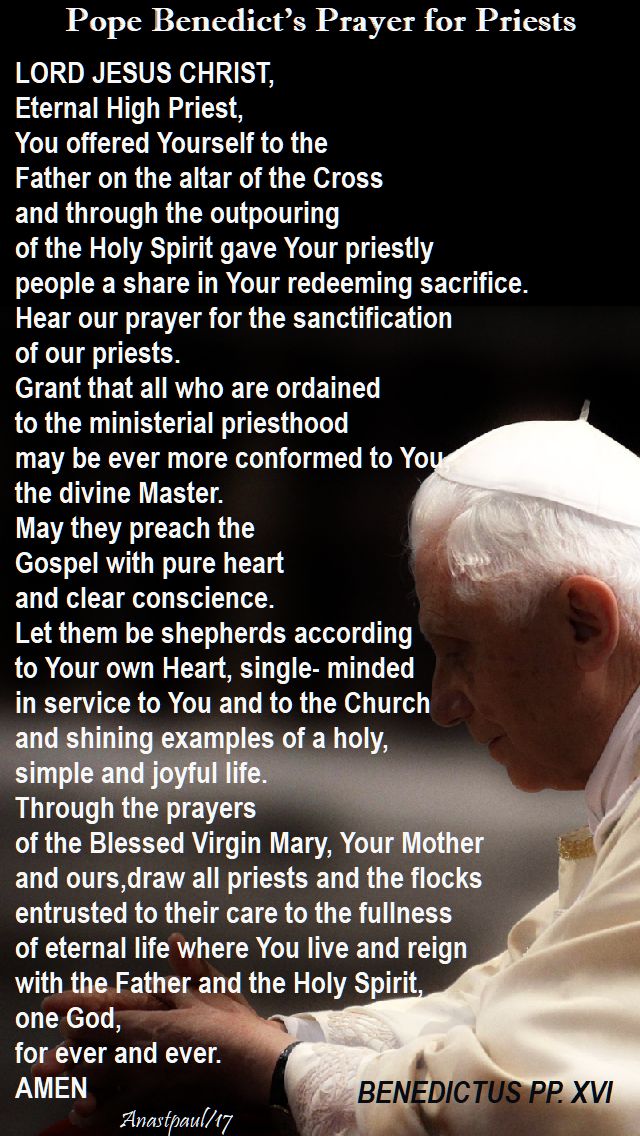
LORD JESUS CHRIST,

Eternal High Priest, you offered yourself to the
Father on the altar of the Cross and through the
outpouring of the Holy Spirit gave your priestly
people a share in your redeeming sacrifice.
Hear our prayer for the sanctification of our priests.
Grant that all who are ordained to the ministerial
priesthood may be ever more conformed to you,
the divine Master. May they preach the
Gospel with pure heart and clear conscience.
Let them be shepherds according to your own Heart,
single- minded in service to you and to the Church
and shining examples of a holy,simple and joyful life.
Through the prayers of the Blessed Virgin Mary,
your Mother and ours,draw all priests and the flocks
entrusted to their care to the fullness of eternal life where
you live and reign with the Father and the Holy Spirit,
one God, for ever and ever.

AMEN

BENEDICTUS PP. XVIpope-benedicts-prayer-for-priests-19-oct-2017

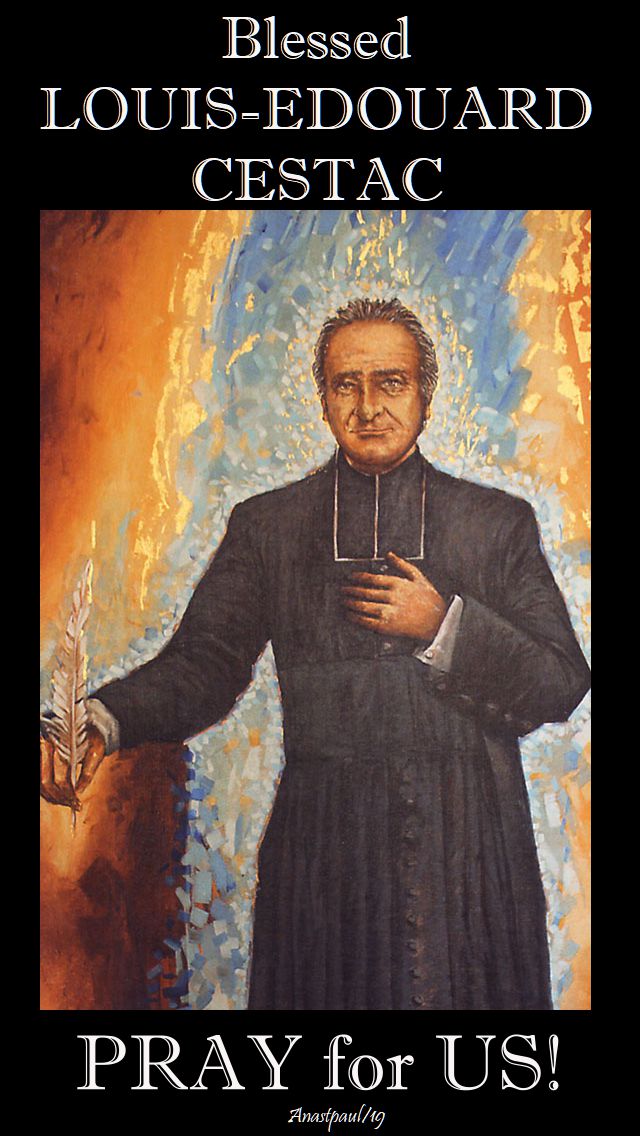
Holy Priest of God, Blessed Louis-Edouard Cestac, please pray for all our priests, amen.blessed louis-edouard cestac - pray for us no 2- 27 march 2018

Posted in CONFESSION/PENANCE, DOCTORS of the Church, FATHERS of the Church, LENT, MORNING Prayers, PAPAL SERMONS, QUOTES of the SAINTS, QUOTES on CONVERSION, QUOTES on REPENTANCE, SPEAKING of .....

Quote/s of the Day – 13 March “Speaking of Confession”

Quote/s of the Day – 13 March – “Speaking of Confession”

“In failing to confess, Lord, I would only hide You from myself, not myself from You.”

St Augustine (354-430) Doctor of the Churchin failing to confess lord - st augustine - 13 march 2018

“Confession is like a bridle that keeps the soul which reflects on it from committing sin but anything left unconfessed we continue to do without fear as if in the dark.”

St John Climacus (579-649)confession is like a bridle - st john climacus - 13 march 2018

“Confession is an act of honesty and courage – an act of entrusting ourselves, beyond sin, to the mercy of a loving and forgiving God.”

St Pope John Paul II (1920-2005)confession is an act of courage - st john paul - 13 march 2018

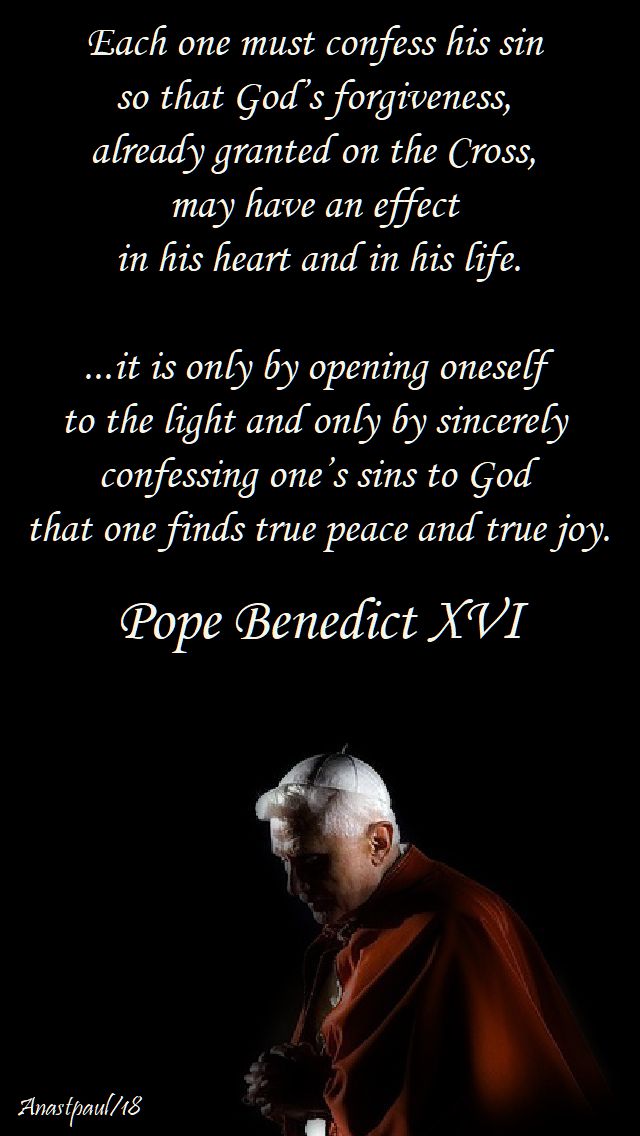
“Each one must confess his sin so that God’s forgiveness, already granted on the Cross, may have an effect in his heart and in his life.

St Augustine writes further: “God accuses your sins and if you also accuse them, you are united to God…. When your own deeds will begin to displease you, from that time your good works begin, as you find fault with your evil works.   The confession of evil works is the beginning of good works” (ibid., 13: PL 35, 1191).

Sometimes men and women prefer the darkness to the light because they are attached to their sins.   Nevertheless it is only by opening oneself to the light and only by sincerely confessing one’s sins to God that one finds true peace and true joy.   It is therefore important to receive the Sacrament of Penance regularly, especially during Lent, in order to receive the Lord’s forgiveness and to intensify our process of conversion.”

Pope Benedict – Angelus Address, 18 March 2012each one must confess his sin = pope benedict - 13 march 2018

Posted in MORNING Prayers, PAPAL SERMONS, QUOTES of the SAINTS, QUOTES on FAITH, SAINT of the DAY

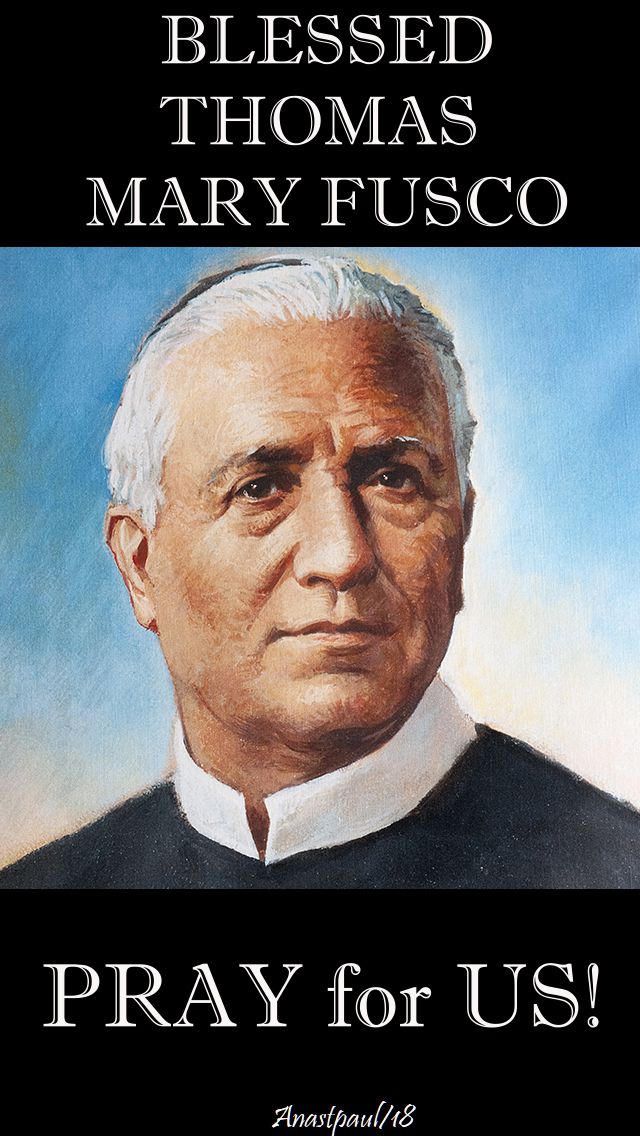
Thought for the Day – 24 February – The Memorial of Blessed Thomas Mary Fusco (1831-1891)

Thought for the Day – 24 February – The Memorial of Blessed Thomas Mary Fusco (1831-1891)

The outstanding vitality of faith, …. emerges in the life and activity of Tommaso Maria Fusco, founder of the Institute of the Daughters of Charity of the Precious Blood.   By virtue of the faith he knew how to live in the world the reality of the Kingdom of God in a very special way.   Among his aspirations, there was one which was his favourite:  “I believe in you, my God, increase my faith”.   It is this prayer that the Apostles direct to the Lord in the Gospel reading today (cf. Lk 17,6).   Bl Tommaso understood that faith is first of all a gift and a grace.   No one can conquer it or obtain it by himself.   One can only ask for it, implore it from on high.   For that reason, enlightened by the teaching of the new Blessed, we never tire of asking the gift of faith because “the just man will live by faith” (Hb 1,4)

“God is wonderful in his saints!”.   With the communities in which the Blessed lived and for which they spent their best human and spiritual energies, we want to thank God, who is “wonderful in his saints”.   At the same time, we ask Him through their intercession, to help us respond with renewed eagerness to the universal call to holiness. Amen….St Pope John Paul on the Beatification of Blessed Thomas Mary Fusco – 7 October 2001

Blessed Thomas, pray for us!bl thomas mary fusco - pray for us - 24 feb 2018

Posted in FEASTS and SOLEMNITIES, MORNING Prayers, PAPAL SERMONS, QUOTES on the CHURCH, SAINT of the DAY, The BLESSED VIRGIN MARY

Thought for the Day – 22 February – The Feast of the Chair of Saint Peter

Thought for the Day – 22 February – The Feast of the Chair of Saint Peter

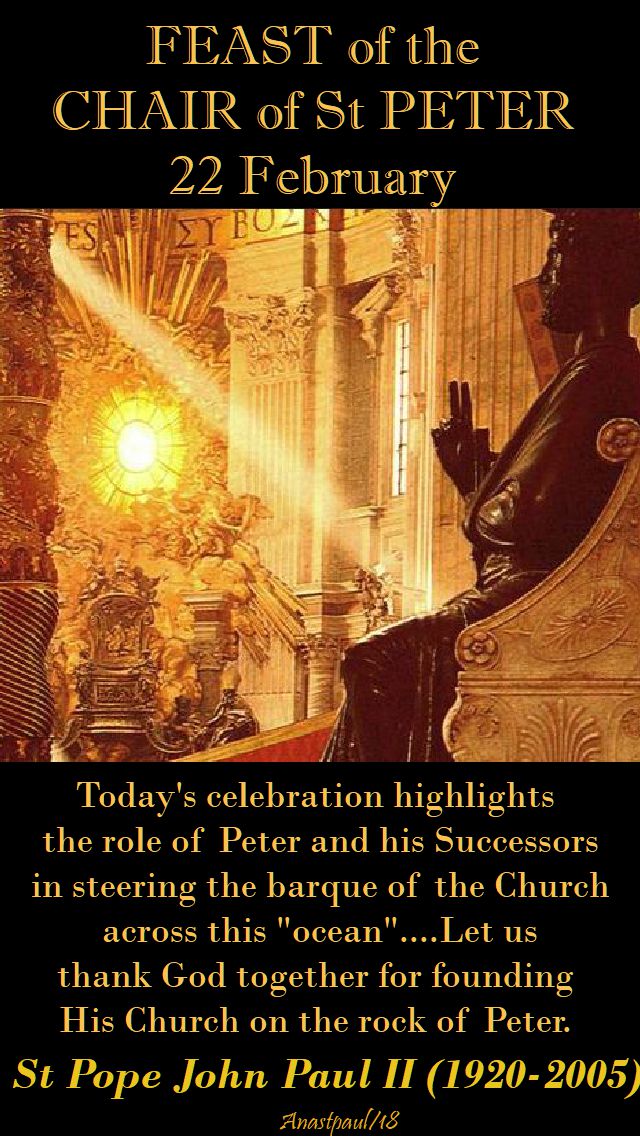
Today’s celebration highlights the role of Peter and his Successors in steering the barque of the Church across this “ocean”….  Let us thank God together for founding His Church on the rock of Peter.   As the opening prayer suggests, let us pray intensely that amid the upheavals of the world, she may not be shaken but advance with courage and trust.

By virtue of the transforming experience of the Good Shepherd, Peter described himself, in his Letter to the Churches of Asia Minor, as “a witness of the sufferings of Christ as well as a partaker in the glory that is to be revealed” (1 Pt 5: 1).   He urges “the elders” to tend the flock of God and become examples to it (cf. 1 Pt 5: 2-3).   Today, dear friends, this exhortation is addressed particularly to you, whom the Good Shepherd has wished to associate in the most eminent way with the ministry of Peter’s Successor.   Be faithful to your mission and ready to lay down your lives for the Gospel.   The Lord is asking this of you, and the Christian people who have gathered around you today with joy and affection expect it of you.

“I have prayed for you that your faith may not fail” (Lk 22: 32).   This is what the Lord said to Simon Peter at the Last Supper.   Jesus’ words, fundamental for Peter and his Successors, also spread light and comfort to those who cooperate more closely in their ministry.   Today, …Christ is repeating to each of you:  “I have prayed for you” that your faith will not fail in the situations in which your fidelity to Christ, to the Church, to the Pope, may be put to the greatest test.

May this prayer, which never ceases to flow from the Good Shepherd’s heart, always be your strength!   Have no doubt that just as it was for Christ and for Peter, so it will be for you:  your most effective witness will always be one that is marked by the Cross.   The Cross is God’s chair in the world.   On it Christ has offered humanity the most important lesson, that of loving one another as He has loved us (cf. Jn 13: 34): even to the ultimate gift of oneself.feast of the chair of st peter - 22 feb 2018 - today's celebration highlights - st john paul

The Mother of Christ and of the disciples, Mary Most Holy, always stands beneath the Cross.   The Lord entrusted us to her when He said:  “Woman, behold, your son!” (Jn 19: 26).   Since the Blessed Virgin, Mother of the Church, protected Peter and the Apostles in a special way, she will not fail to protect the Successor of Peter and his collaborators.  May this consoling certainty encourage you not to be afraid of trials and difficulties.  But, reassured by God’s constant protection, let us obey together the command of Christ, who vigorously asked Peter, and with him the Church, to put out into the deep: “Duc in altum” (Lk 5: 4).   Yes, dear Brothers, let us put out into the deep, let us cast our nets for the catch and let us “go forward in hope!”  (Novo millennio ineunte, n. 58).

Christ, the Son of the living God, is the same yesterday and today and forever. Amen!…Excerpt from the Homily of St John Paul on Thursday, 22 February 2001, Feast of Saint Peter’s Chair

St Peter Pray for Holy Mother Church, Pray for us all!st peter - pray for us - 22 feb 2018

Posted in MARIAN QUOTES, MARIAN TITLES, MORNING Prayers, ON the SAINTS, PAPAL SERMONS, QUOTES of the SAINTS, QUOTES on CHARITY, QUOTES on CONVERSION, QUOTES on LOVE, SAINT of the DAY, The BLESSED VIRGIN MARY

Quote/s of the Day – 20 February 2018 -The First Memorial of Saints Francisco (1908-1919) and Jacinta (1910-1920) – “The Shepherds of Fatima”

Quote/s of the Day – 20 February 2018 -The First Memorial of Saints Francisco (1908-1919) and Jacinta (1910-1920) – “The Shepherds of Fatima”

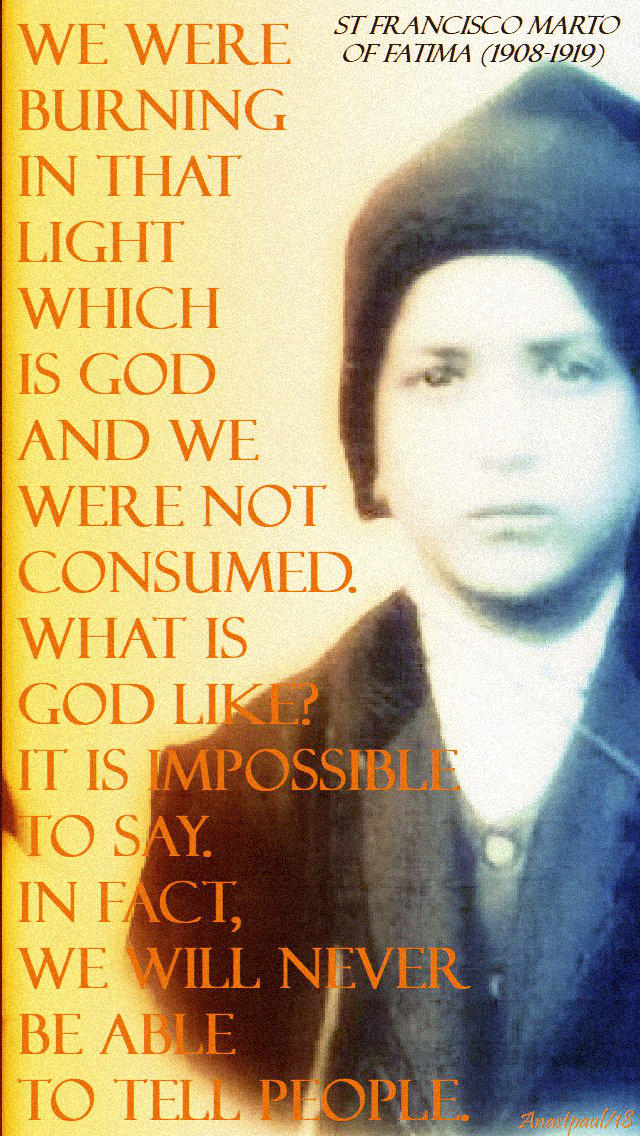
“We were burning in that light
which is God and we were not consumed.
What is God like?
It is impossible to say.
In fact, we will never be able to tell people”

St Francisco Marto of Fatima (1908-1919)we-were-burning-in-that-light-st-francisco-marto-20-feb-2018

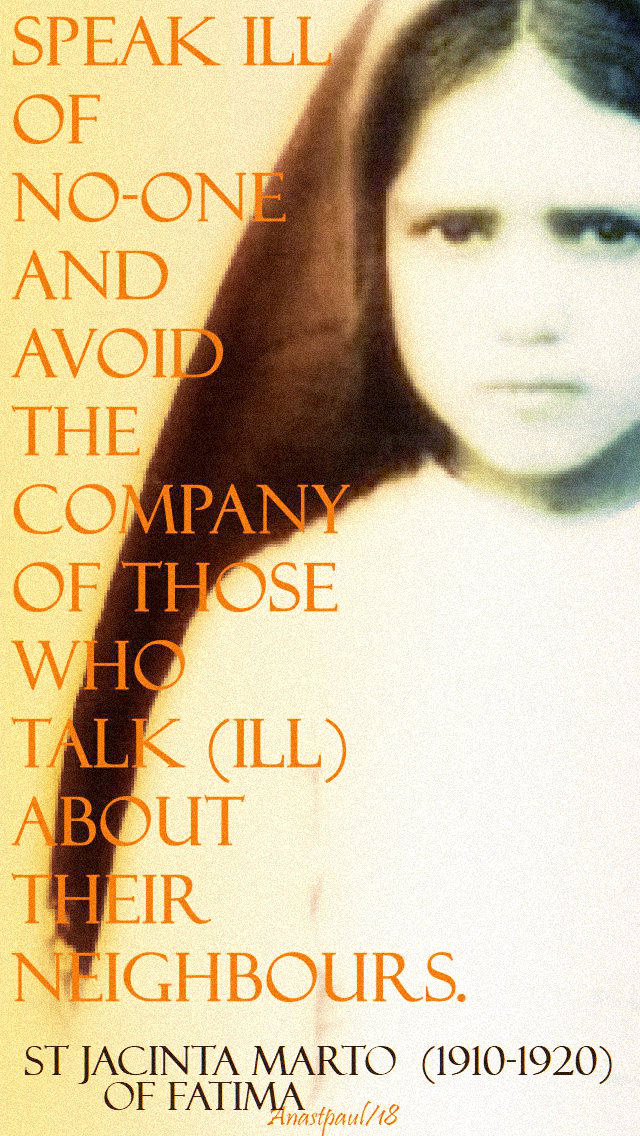
“Speak ill of no-one and avoid the company
of those who talk (ill) about their neighbours.

St Jacinta Marto of Fatima (1910-1920)speak-ill-of-no-one-st-jacinta-20-feb-2018.jpg

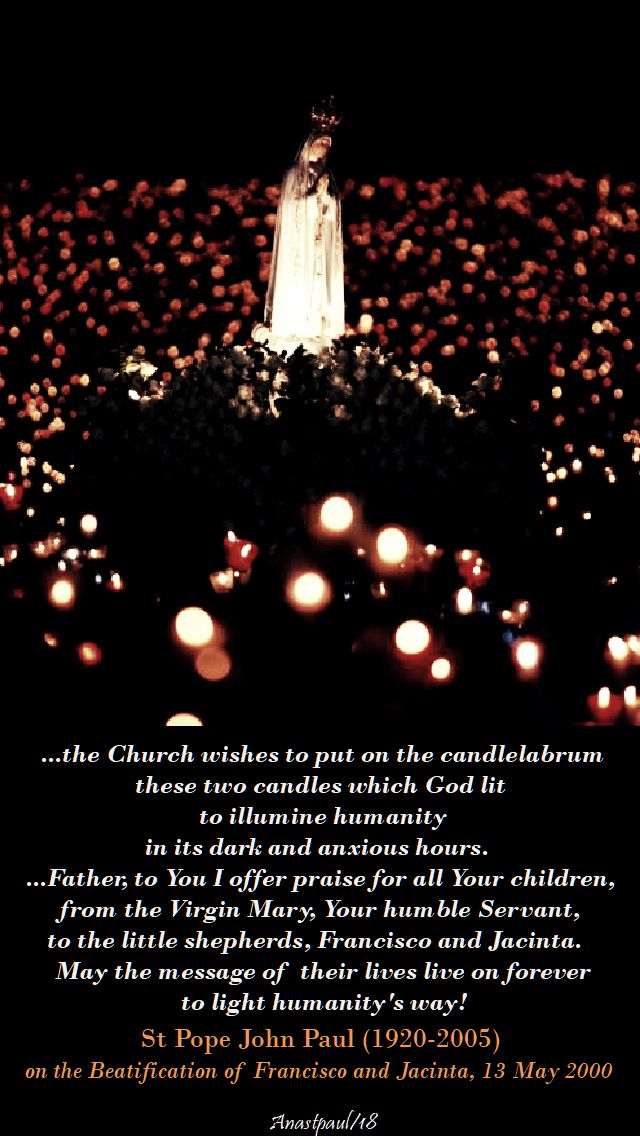
“Father, to You I offer praise, for you have revealed these things to the merest children”. Today Jesus’ praise takes the solemn form of the beatification of the little shepherds, Francisco and Jacinta.   With this rite the Church wishes to put on the candlelabrum these two candles which God lit to illumine humanity in its dark and anxious hours. …Father, to You I offer praise for all Your children, from the Virgin Mary, Your humble Servant, to the little shepherds, Francisco and Jacinta. May the message of their lives live on forever to light humanity’s way!”

St Pope John Paul (1920-2005) on the Beatification of Francisco and Jacinta, 13 May 2000the church wishes to put on the candlelabrum - st john paul - 20 feb 2018

Posted in LENT, MARIAN PRAYERS, MARIAN QUOTES, MARIAN TITLES, MORNING Prayers, PAPAL SERMONS, QUOTES - J R R Tolkien and MORE, QUOTES on REPENTANCE, QUOTES on SANCTITY, QUOTES on SUFFERING, SAINT of the DAY, The BLESSED VIRGIN MARY, The HOLY CROSS, The PASSION, The WORD

One Minute Reflection – 20 February 2018 – Tuesday of the First Week of Lent and The First Memorial of Saints Francisco (1908-1919) and Jacinta (1910-1920)

One Minute Reflection – 20 February 2018 – Tuesday of the First Week of Lent and The First Memorial of Saints Francisco (1908-1919) and Jacinta (1910-1920)

“Unless a grain of wheat falls into the earth and dies, it remains just a single grain; but if it dies, it bears much fruit..” …John 12:24

REFLECTION – “In Lucia’s account, the three chosen children found themselves surrounded by God’s light as it radiated from Our Lady.   She enveloped them in the mantle of Light that God had given her.   According to the belief and experience of many pilgrims, if not of all, Fatima is more than anything this mantle of Light that protects us, here, as in almost no other place on earth.   We need but take refuge under the protection of the Virgin Mary and to ask her, as the Salve Regina teaches: “show unto us… Jesus”.the three chosen children - pope francis canonisation homily - 20 feb 2018
“The Lord, who always goes before us, said this and did this (Jn 12:24).   Whenever we experience the cross, He has already experienced it before us.   We do not mount the cross to find Jesus.   Instead it was He who, in His self-abasement, descended even to the cross, in order to find us, to dispel the darkness of evil within us and to bring us back to the light.”…Pope Francis at the Canonisation of Saints Francisco and Jacinta on 14 May 2017

the lord, who always goes before us - pope francis - 20 feb 2017 - sts francisco and jacinta

PRAYER – Heavenly Father, just as the little children, Francisco and Jacinta, were chosen to be bearers of Your message, grant we pray, that by their prayers on our behalf, we too may Your bearers of light.   Be with us, holy Mother, during our Lenten journey to the Resurrection of your Son, help us to become like little children and in that new purity, shine with His Light.   Through Jesus our Lord, with the Holy Spirit, one God forever, amen.sts francisco & jacinta - 20 feb 2018

Posted in JESUIT SJ, MORNING Prayers, PAPAL SERMONS, QUOTES of the SAINTS, QUOTES on MERCY, SACRED and IMMACULATE HEARTS, SAINT of the DAY

Thought for the Day – 15 February – The Memorial of St Claude de la Colombiere S.J. (1641-1682)

Thought for the Day – 15 February – The Memorial of St Claude de la Colombiere S.J. (1641-1682)

This is a special day for the Jesuits, who claim today’s saint as one of their own.   It’s also a special day for people who have a special devotion to the Sacred Heart of Jesus—a devotion Claude de la Colombière promoted, along with his friend and spiritual companion, St Margaret Mary Alacoque.   The emphasis on God’s love for all was an antidote to the rigorous moralism of the Jansenists, who were popular at the time.

Claude showed remarkable preaching skills long before his ordination in 1675.   Two months later, he was made superior of a small Jesuit residence in Burgundy.   It was there he first encountered Margaret Mary Alacoque.   For many years after he served as her confessor.

As a fellow Jesuit and as a promoter of the devotion to the Sacred Heart of Jesus, Saint Claude must be very special to Pope Francis who has so beautifully emphasised the mercy of Jesus.   The emphasis on God’s love and mercy are characteristic of both men.

“The past three centuries allow us to evalutate the importance of the message which was entrusted to Claude.   In a period of contrasts between the fervour of some and the indifference or impiety of many, here is a devotion centred on the humility of Christ, on His presence, on His love of mercy and on forgiveness.   Devotion to the Heart of Christ would be a source of balance and spiritual strengthening for Christian communities so often faced with increasing unbelief over the coming centuries.
May the canonisation of Claude La Colombiere be for the whole Church an appeal to live the consecration to the Heart of Christ, a consecration which is a self-giving that allows the charity and mercy of Christ to inspire us, pardon us and lead us in His ardent desire to open the ways of truth and life to all our brothers and sisters!”…St Pope John Paul II, during the canonisation of Saint Claude (31 May 1992)

St Claude de la Colombiere, pray for us!st claude - pray for us - 15 feb 2018

Posted in PAPAL SERMONS, QUOTES of the SAINTS, SAINT of the DAY

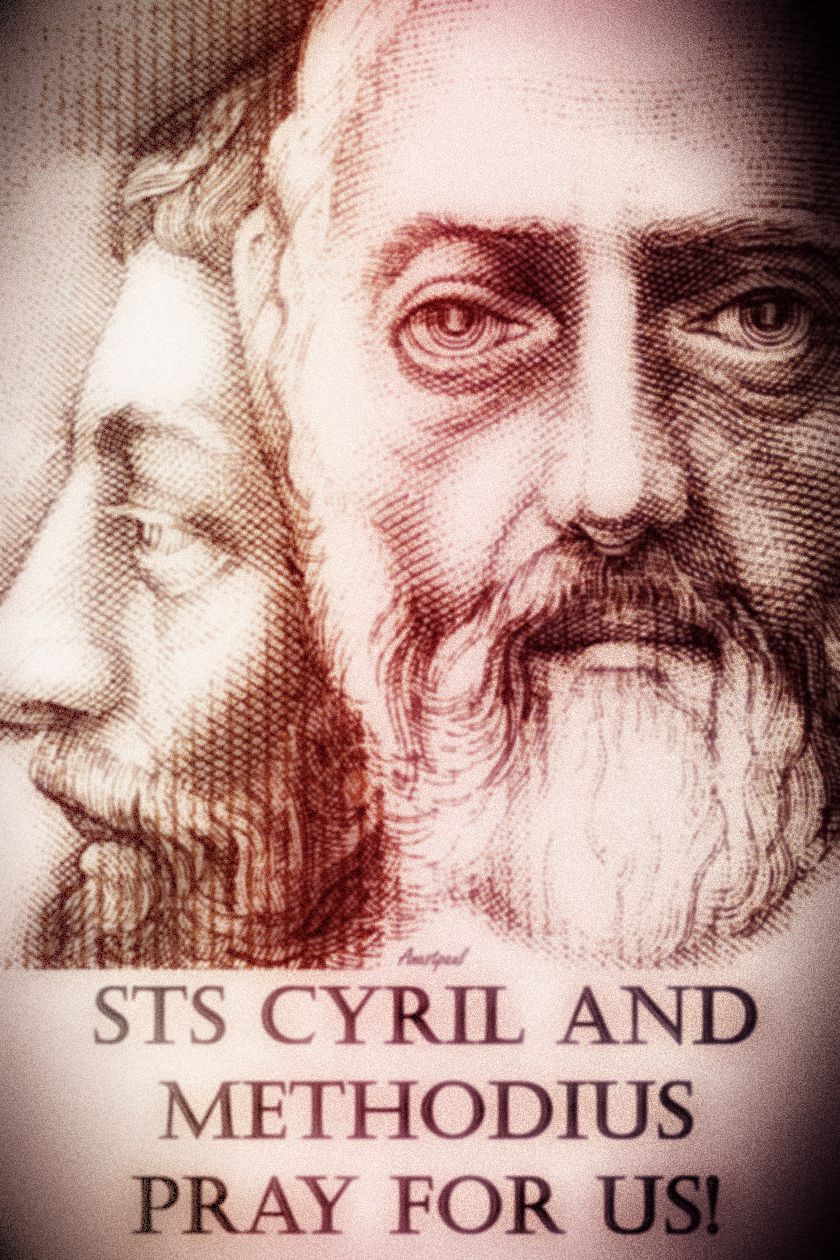
Thought for the Day – 14 February – The Memorial of Sts Cyril (827-869) & Methodius (826-885)

Thought for the Day – 14 February – The Memorial of Sts Cyril (827-869) & Methodius (826-885)

Wishing now to sum up concisely the profile of the two Brothers, we should first recall the enthusiasm with which Cyril approached the writings of St Gregory of Nazianzus, learning from him the value of language in the transmission of the Revelation.   St Gregory had expressed the wish that Christ would speak through him:  “I am a servant of the Word, so I put myself at the service of the Word”.   Desirous of imitating Gregory in this service, Cyril asked Christ to deign to speak in Slavonic through him.   He introduced his work of translation with the solemn invocation:  “Listen, O all of you Slav Peoples, listen to the word that comes from God, the word that nourishes souls, the word that leads to the knowledge of God”.   In fact, a few years before the Prince of Moravia had asked the Emperor Michael III to send missionaries to his country, it seems that Cyril and his brother Methodius, surrounded by a group of disciples, were already working on the project of collecting the Christian dogmas in books written in Slavonic.   The need for new graphic characters closer to the language spoken was therefore clearly apparent:  so it was that the Glagolitic alphabet came into being.   Subsequently modified, it was later designated by the name “Cyrillic”, in honour of the man who inspired it.   It was a crucial event for the development of the Slav civilisation in general.   Cyril and Methodius were convinced that the individual peoples could not claim to have received the Revelation fully, unless they had heard it in their own language and read it in the characters proper to their own alphabet.

Methodius had the merit of ensuring that the work begun by his brother was not suddenly interrupted.   While Cyril, the “Philosopher”, was more inclined to contemplation, Methodius on the other hand had a leaning for the active life.   Thanks to this he was able to lay the foundations of the successive affirmation of what we might call the “Cyrillian-Methodian idea”:   it accompanied the Slav peoples in the different periods of their history, encouraging their cultural, national and religious development. This was already recognised by Pope Pius XI in his Apostolic Letter Quod Sanctum Cyrillum, in which he described the two Brothers:  “Sons of the East, with a Byzantine homeland, of Greek origin, for the Roman missions to reap Slav apostolic fruit” (AAS 19 [1927] 93-96).   The historic role they played was later officially proclaimed by St Pope John Paul II who, with his Apostolic Letter Egregiae Virtutis, declared them Co-Patrons of Europe, together with St Benedict (31 December 1980; L’Osservatore Romano English edition, 19 January 1981, p. 3).

Cyril and Methodius are in fact a classic example of what today is meant by the term “inculturation”:  every people must integrate the message revealed into its own culture and express its saving truth in its own language.   This implies a very demanding effort of “translation” because it requires the identification of the appropriate words to present anew, without distortion, the riches of the revealed word.   The two holy Brothers have left us a most important testimony of this, to which the Church also looks today in order to draw from it inspiration and guidelines.   Pope Benedict XVI, Wednesday, 17 June 2009

The work of Saints Cyril and Methodius are a powerful reminder of our role in the celebration of the Liturgy.   God speaks to us—to each of us—in a language that we can understand and based upon that understanding we are called to live the Gospel.   We pray today for more active participation, greater comprehension and the ability to successfully live the Word of God for all to see!

Almighty and everlasting God, who by the power of the Holy Spirit moved your servant Cyril and his brother Methodius to bring the light of the Gospel to a hostile and divided people, overcome all bitterness and strife among us by the love of Christ and make us one united family under the banner of the Prince of Peace, who lives and reigns with You and the Holy Spirit, one God, now and for ever, amen.

Sts Cyril and Methodius, pray for us!sts-cyril-and-methodius-pray-for-us-14 feb 2018-no 2


Posted in CATHOLIC Quotes, DEVOTIO, MORNING Prayers, PAPAL ENCYLICALS, PAPAL MESSAGES, PAPAL SERMONS, QUOTES - J R R Tolkien and MORE, QUOTES of the SAINTS, QUOTES on PRAYER, QUOTES on the CHURCH, SUNDAY REFLECTIONS, The HOLY EUCHARIST / The HOLY MASS

Sunday Reflection – 11 February 2018 – 6th Sunday of Year B

Sunday Reflection – 11 February 2018 – 6th Sunday of Year B – Pope Benedict and St John Paul

In liturgical prayer, especially the Eucharist and – formats of the liturgy – in every prayer, we do not speak as single individuals, rather we enter into the “we” of the Church that prays.   And we need to transform our “I” entering into this “we”.   Pope Benedict XVI is one of the great liturgists of our age.   His seminal book, “The Spirit of the Liturgy”, written when he was still Joseph Cardinal Ratzinger, is required reading in most seminaries and should be read by every Catholic.

“It is not the individual – priest or layman – or the group that celebrates the liturgy but it is primarily God’s action through the Church, which has its own history, its rich tradition and creativity.   This universality and fundamental openness, which is characteristic of the entire liturgy is one of the reasons why it can not be created or amended by the individual community or by experts but must be faithful to the forms of the universal Church.

The entire Church is always present, even in the liturgy of the smallest community.   For this reason there are no “foreigners” in the liturgical community.   The entire Church participates in every liturgical celebration, heaven and earth, God and man.   The Christian liturgy, even if it is celebrated in a concrete place and space and expresses the “yes” of a particular community, it is inherently Catholic, it comes from everything and leads to everything, in union with the Pope, the Bishops , with believers of all times and all places.   The more a celebration is animated by this consciousness, the more fruitful the true sense of the liturgy is realised in it.

Dear friends, the Church is made visible in many ways:  in its charitable work, in mission projects, in the personal apostolate that every Christian must realise in his or her own environment.   But the place where it is fully experienced as a Church is in the liturgy : it is the act in which we believe that God enters into our reality and we can meet Him, we can touch Him.   It is the act in which we come into contact with God, He comes to us and we are enlightened by Him.

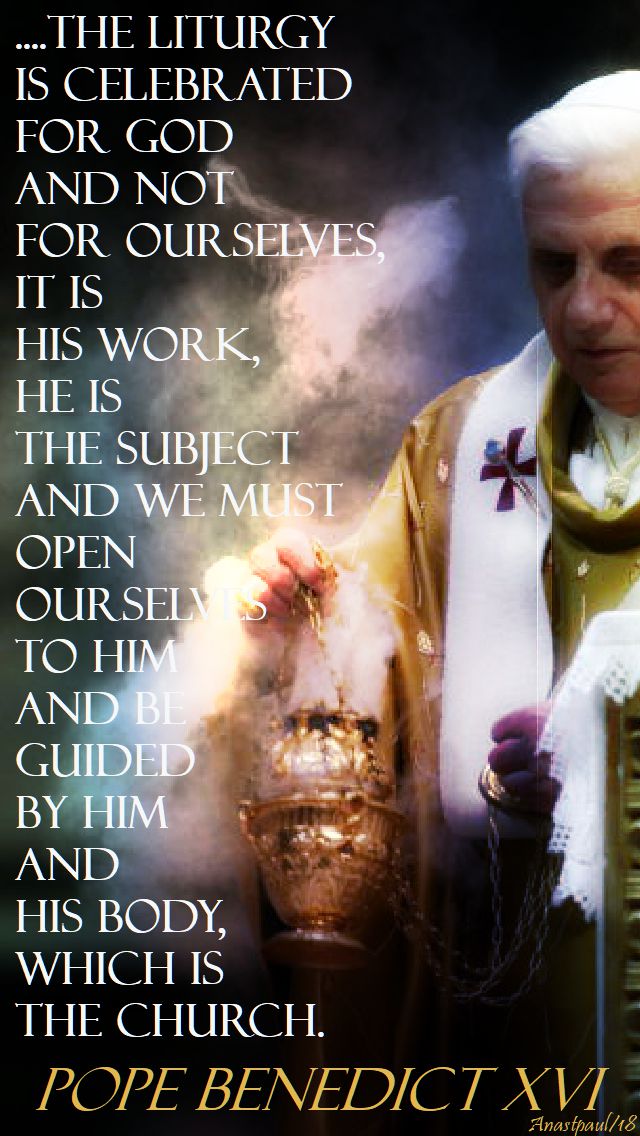
So when in the reflections on the liturgy we concentrate all our attention on how to make it attractive, interesting and beautiful, we risk forgetting the essential:  the liturgy is celebrated for God and not for ourselves, it is His work, He is the subject and we must open ourselves to Him and be guided by Him and His Body, which is the Church.

Let us ask the Lord to learn every day to live the sacred liturgy, especially the Eucharistic celebration, praying in the “we” of the Church, that directs its gaze not in on itself but to God and feeling part of the living Church, of all places and of all time.”…Pope Benedict XVI – Wednesday Audience 3 Oct 2012

“I have been able to celebrate Holy Mass in chapels built along mountain paths, on lakeshores and seacoasts.   I have celebrated it on altars built in stadiums and in city squares….This varied scenario of celebrations of the Eucharist, has given me, a powerful experience of its universal and, so to speak, cosmic character – YES, cosmic!   Because even when it is celebrated on the humble altar of a country church, the Eucharist is always, in some way, celebrated on the altar of the world.  It unites heaven and earth.   It embraces and permeates all creation!” St Pope John Paul “Ecclesia de Eucharista no 8”the liturgy is celebrated - pope benedict = 11 feb 2018 sunday reflection

Posted in MARIAN PRAYERS, MARIAN QUOTES, MARIAN TITLES, MORNING Prayers, PAPAL MESSAGES, PAPAL SERMONS, QUOTES on MERCY, QUOTES on the CHURCH, The APOSTLES & EVANGELISTS, The BLESSED VIRGIN MARY, The HOLY CROSS, The WORD

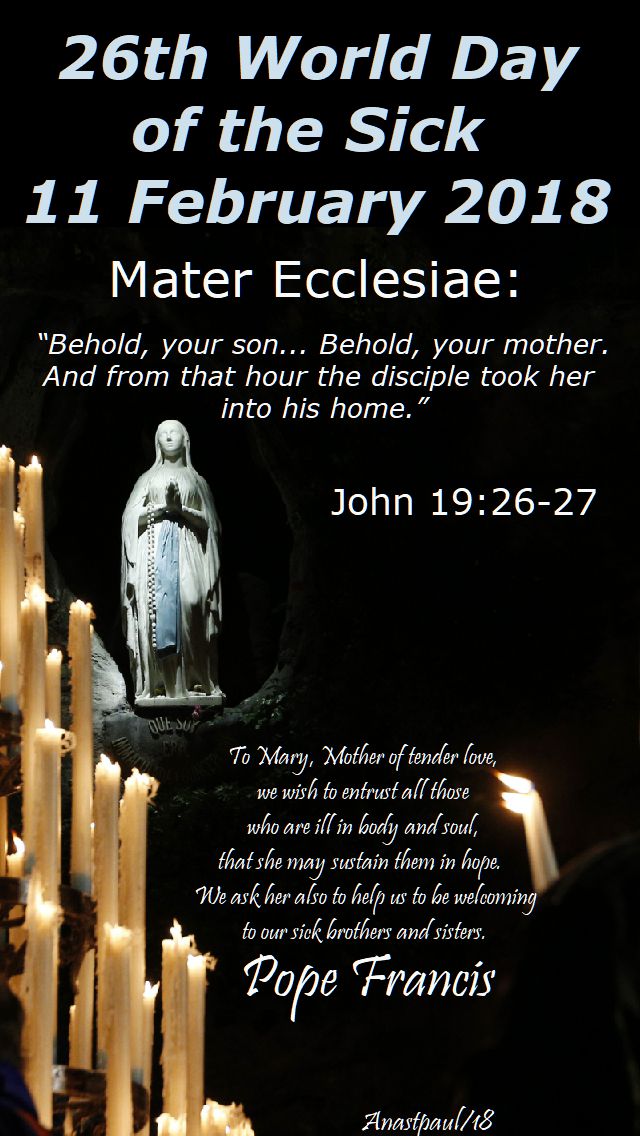
Message of the Holy Father for the 26th World Day of the Sick – 11 February 2018

Message of the Holy Father

Mater Ecclesiae: “Behold, your son… Behold, your mother.
And from that hour the disciple took her into his home.”
(John 19:26-27)

Dear Brothers and Sisters,

The Church’s service to the sick and those who care for them must continue with renewed vigour, in fidelity to the Lord’s command (cf. Lk 9:2-6; Mt 10:1-8; Mk 6:7-13) and following the eloquent example of her Founder and Master.

The theme for this year’s Day of the Sick is provided by the words that Jesus spoke from the Cross to Mary, His Mother, and to John: “Woman, behold your son … Behold your mother. And from that hour the disciple took her into his home” (Jn 19:26-27).

1. The Lord’s words brilliantly illuminate the mystery of the Cross, which does not represent a hopeless tragedy, but rather the place where Jesus manifests his glory and shows his love to the end.   That love in turn was to become the basis and rule for the Christian community and the life of each disciple.

Before all else, Jesus’ words are the source of Mary’s maternal vocation for all humanity. Mary was to be, in particular, the Mother of her Son’s disciples, caring for them and their journey through life.   As we know, a mother’s care for her son or daughter includes both the material and spiritual dimensions of their upbringing.

The unspeakable pain of the Cross pierces Mary’s soul (cf. Lk 2:35) but does not paralyse her.   Quite the opposite.   As the Lord’s Mother, a new path of self-giving opens up before her.   On the Cross, Jesus showed His concern for the Church and all humanity and Mary is called to share in that same concern.   In describing the outpouring of the Holy Spirit at Pentecost, the Acts of the Apostles show that Mary began to carry out this role in the earliest community of the Church.   A role that never ceases.

2. John, the beloved disciple, is a figure of the Church, the messianic people.   He must acknowledge Mary as his Mother.   In doing so, he is called to take her into his home, to see in her the model of all discipleship and to contemplate the maternal vocation that Jesus entrusted to her, with all that it entails:  a loving Mother who gives birth to children capable of loving as Jesus commands.   That is why Mary’s maternal vocation to care for her children is entrusted to John and to the Church as a whole.   The entire community of disciples is included in Mary’s maternal vocation.

3. John, as a disciple who shared everything with Jesus, knows that the Master wants to lead all people to an encounter with the Father. He can testify to the fact that Jesus met many people suffering from spiritual sickness due to pride (cf. Jn 8:31-39) and from physical ailments (cf. Jn 5:6). He bestowed mercy and forgiveness upon all, and healed the sick as a sign of the abundant life of the Kingdom, where every tear will be wiped away. Like Mary, the disciples are called to care for one another, but not only that. They know that Jesus’ heart is open to all and excludes no one. The Gospel of the Kingdom must be proclaimed to all, and the charity of Christians must be directed to all, simply because they are persons, children of God.

4. The Church’s maternal vocation to the needy and to the sick has found concrete expression throughout the two thousand years of her history in an impressive series of initiatives on behalf of the sick.   This history of dedication must not be forgotten.   It continues to the present day throughout the world.   In countries where adequate public health care systems exist, the work of Catholic religious congregations and dioceses and their hospitals is aimed not only at providing quality medical care but also at putting the human person at the centre of the healing process, while carrying out scientific research with full respect for life and for Christian moral values.   In countries where health care systems are inadequate or non-existent, the Church seeks to do what she can to improve health, eliminate infant mortality and combat widespread disease.   Everywhere she tries to provide care, even when she is not in a position to offer a cure.   The image of the Church as a “field hospital” that welcomes all those wounded by life is a very concrete reality, for in some parts of the world, missionary and diocesan hospitals are the only institutions providing necessary care to the population.

5. The memory of this long history of service to the sick is cause for rejoicing on the part of the Christian community and especially those presently engaged in this ministry.   Yet we must look to the past above all to let it enrich us.   We should learn the lesson it teaches us about the self-sacrificing generosity of many founders of institutes in the service of the infirm, the creativity, prompted by charity, of many initiatives undertaken over the centuries, and the commitment to scientific research as a means of offering innovative and reliable treatments to the sick.   This legacy of the past helps us to build a better future, for example, by shielding Catholic hospitals from the business mentality that is seeking worldwide to turn health care into a profit-making enterprise, which ends up discarding the poor.   Wise organisation and charity demand that the sick person be respected in his or her dignity and constantly kept at the centre of the therapeutic process.   This should likewise be the approach of Christians who work in public structures;  through their service, they too are called to bear convincing witness to the Gospel.

6. Jesus bestowed upon the Church his healing power:  “These signs will accompany those who believe… they will lay hands on the sick, and they will recover (Mk 16:17-18). In the Acts of the Apostles, we read accounts of the healings worked by Peter (cf. Acts 3:4-8) and Paul (cf. Acts 14:8-11).   The Church’s mission is a response to Jesus’ gift, for she knows that she must bring to the sick the Lord’s own gaze, full of tenderness and compassion. Health care ministry will always be a necessary and fundamental task, to be carried out with renewed enthusiasm by all, from parish communities to the most largest healthcare institutions.   We cannot forget the tender love and perseverance of many families in caring for their chronically sick or severely disabled children, parents and relatives.   The care given within families is an extraordinary witness of love for the human person, it needs to be fittingly acknowledged and supported by suitable policies.   Doctors and nurses, priests, consecrated men and women, volunteers, families and all those who care for the sick, take part in this ecclesial mission.   It is a shared responsibility that enriches the value of the daily service given by each.

7. To Mary, Mother of tender love, we wish to entrust all those who are ill in body and soul, that she may sustain them in hope.   We ask her also to help us to be welcoming to our sick brothers and sisters.   The Church knows that she requires a special grace to live up to her evangelical task of serving the sick.   May our prayers to the Mother of God see us united in an incessant plea that every member of the Church may live with love the vocation to serve life and health.   May the Virgin Mary intercede for this Twenty-sixth World Day of the Sick; may she help the sick to experience their suffering in communion with the Lord Jesus and may she support all those who care for them.   To all, the sick, to healthcare workers and to volunteers, I cordially impart my Apostolic Blessing.

From the Vatican, 26 November 2017
Solemnity of Our Lord Jesus Christ, King of the Universe

FRANCIS26th world day of the sick - 11 feb 2018 = pope francis message and theme

Posted in MORNING Prayers, ON the SAINTS, PAPAL SERMONS, QUOTES of the SAINTS, QUOTES on PRAYER, SAINT of the DAY, The HOLY EUCHARIST / The HOLY MASS, The HOLY SOULS

Quote/s of the Day – 9 February – The Memorial of Bl Anne Catherine Emmerich (1774-1824)

Quote/s of the Day – 9 February – The Memorial of Bl Anne Catherine Emmerich (1774-1824)

“The prayer most pleasing to God is that
made for others and particularly for the poor souls.
Pray for them, if you want your prayers to bring high interest.”

Bl Anne Catherine Emmerich (1774-1824)the prayer most pleasing - bl anne c emmerich - 9 feb 2018

“As much as by her patience to endure her physical weaknesses, we are impressed by the strength of character of the new blessed and her firmness in the faith.   She received this strength from the Holy Eucharist.   In this way, her example opened the hearts of poor and rich men, educated and humble people, to complete loving passion toward Jesus Christ.   Still today she communicates to all the salvific message: ‘By his wounds you have been healed’ (see 1 Peter 2:24).”

St Pope John Paul II, homily at the beatification of Blessed Anne, 3 October 2004as much as by her - st john paul - 9 feb 2018

Posted in MORNING Prayers, ON the SAINTS, PAPAL SERMONS, SAINT of the DAY

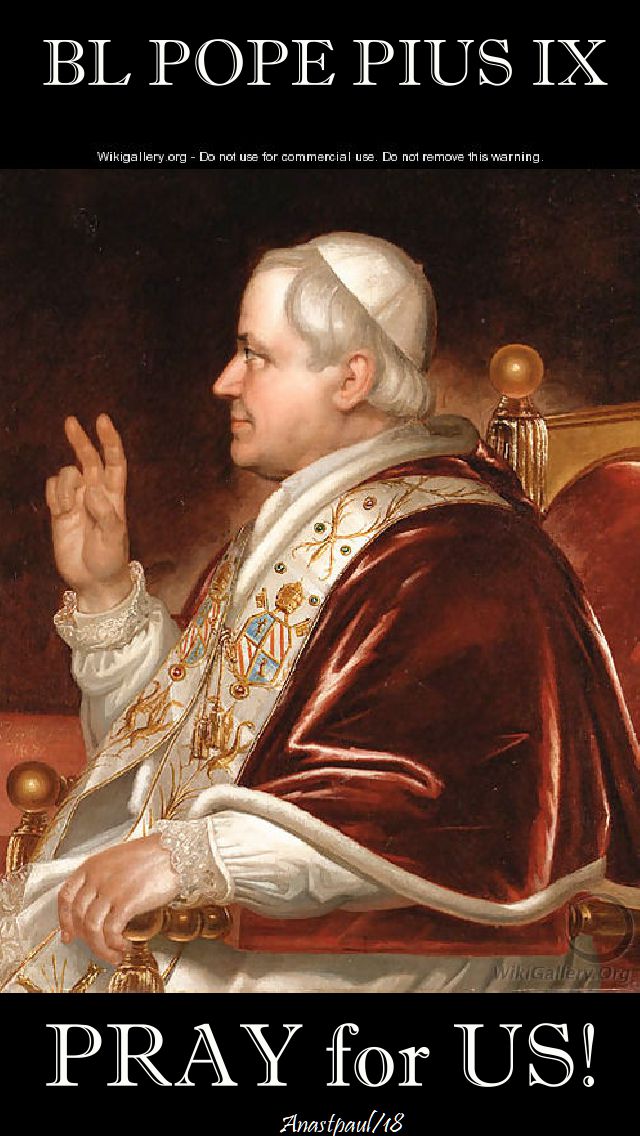
Thought for the Day – 7 February – The Memorial of Blessed Pope Pius IX (1792-1878)

Thought for the Day – 7 February – The Memorial of Blessed Pope Pius IX (1792-1878)

“In the context of the Jubilee Year, it is with deep joy that I have declared blessed two Popes, Pius IX and John XXIII and three other servants of the Gospel in the ministry and the consecrated life:   Archbishop Tommaso Reggio of Genoa, the diocesan priest William Joseph Chaminade and the Benedictine monk Columba Marmion.

Five different personalities, each with his own features and his own mission, all linked by a longing for holiness.   It is precisely their holiness that we recognise today:  holiness that is a profound and transforming relationship with God, built up and lived in the daily effort to fulfil his will.   Holiness lives in history and no saint has escaped the limits and conditioning which are part of our human nature.   In beatifying one of her sons, the Church does not celebrate the specific historical decisions he may have made but rather points to him as someone to be imitated and venerated because of his virtues, in praise of the divine grace which shines resplendently in him.

Listening to the words of the Gospel acclamation:  “Lord, lead me on a straight road”, our thoughts naturally turn to the human and religious life of Pope Pius IX, Giovanni Maria Mastai Ferretti.   Amid the turbulent events of his time, he was an example of unconditional fidelity to the immutable deposit of revealed truths.   Faithful to the duties of his ministry in every circumstance, he always knew how to give absolute primacy to God and to spiritual values.   His lengthy pontificate was not at all easy and he had much to suffer in fulfilling his mission of service to the Gospel.   He was much loved but also hated and slandered.

However, it was precisely in these conflicts that the light of his virtues shone most brightly:   these prolonged sufferings tempered his trust in divine Providence, whose sovereign lordship over human events he never doubted.   This was the source of Pius IX’s deep serenity, even amid the misunderstandings and attacks of so many hostile people.   He liked to say to those close to him:  “In human affairs we must be content to do the best we can and then abandon ourselves to Providence, which will heal our human faults and shortcomings”.

Sustained by this deep conviction, he called the First Vatican Ecumenical Council, which clarified with magisterial authority certain questions disputed at the time, and confirmed the harmony of faith and reason.   During his moments of trial Pius IX found support in Mary, to whom he was very devoted. In proclaiming the dogma of the Immaculate Conception, he reminded everyone that in the storms of human life the light of Christ shines brightly in the Blessed Virgin and is more powerful than sin and death.

Let us confidently ask the new blesseds, Pius IX, John XXIII, Tommaso Reggio, William Joseph Chaminade and Columba Marmion, to help us live in ever greater conformity to the Spirit of Christ. May their love of God and neighbour illumine our steps at this dawn of the third millennium!” – St Pope John Paul II – Beatification Homily, Sunday 3 September 2000

Meanwhile, although “prisoner” he may now have been, Pius IX’s popularity nevertheless soared, abetted by technological innovations that carried the words and images of the pope to Catholics around the world, while also carrying a growing number of pilgrims to Rome to see and pray with him in person.   By the time of his death this helped make him what historian Eamon Duffy calls “a popular icon.”
But so, above all, did the goodness and charm of the man himself.   Even his critics, Duffy writes, “admitted that it was impossible to dislike him.”

“He was genial, unpretentious, wreathed in clouds of snuff, always laughing.   His sense of the absurd sometimes got the better of him, as when some earnest Anglican clergymen begged his blessing and he teasingly pronounced over them the prayer for the blessing of incense, ‘May you be blessed by him in whose honour you are to be burned.’”

People aren’t beatified for having a sense of humour, but with Pius IX it surely didn’t hurt.

Today we ask, Blessed Pope Pius IX, please pray for us!bl pope pius IX - pray for us no 2 - 7 feb 2018

Posted in MARIAN QUOTES, MORNING Prayers, PAPAL ENCYLICALS, PAPAL MESSAGES, PAPAL SERMONS, QUOTES of the SAINTS, QUOTES on SUFFERING, QUOTES on the PRIESTHOOD, SAINT of the DAY, The BLESSED VIRGIN MARY, The HOLY EUCHARIST / The HOLY MASS

Quote/s of the Day – 7 February – The Memorial of Blessed Pope Pius IX (1792-1878)

Quote/s of the Day – 7 February – The Memorial of Blessed Pope Pius IX (1792-1878)

“The chisel is the pen of the sculptor.”the chisel is the pen - bvl pope pius IX - 5 feb 2018

“If we are the heirs of Christ,
let us remain in the peace of Christ.
If we are the sons of God,
we must be peacemakers….”
INTER MULTIPLICES – PLEADING FOR UNITY OF SPIRIT:   21 March 1853if we are the heirs of christ - bl pope pius IX - 7 feb 2018

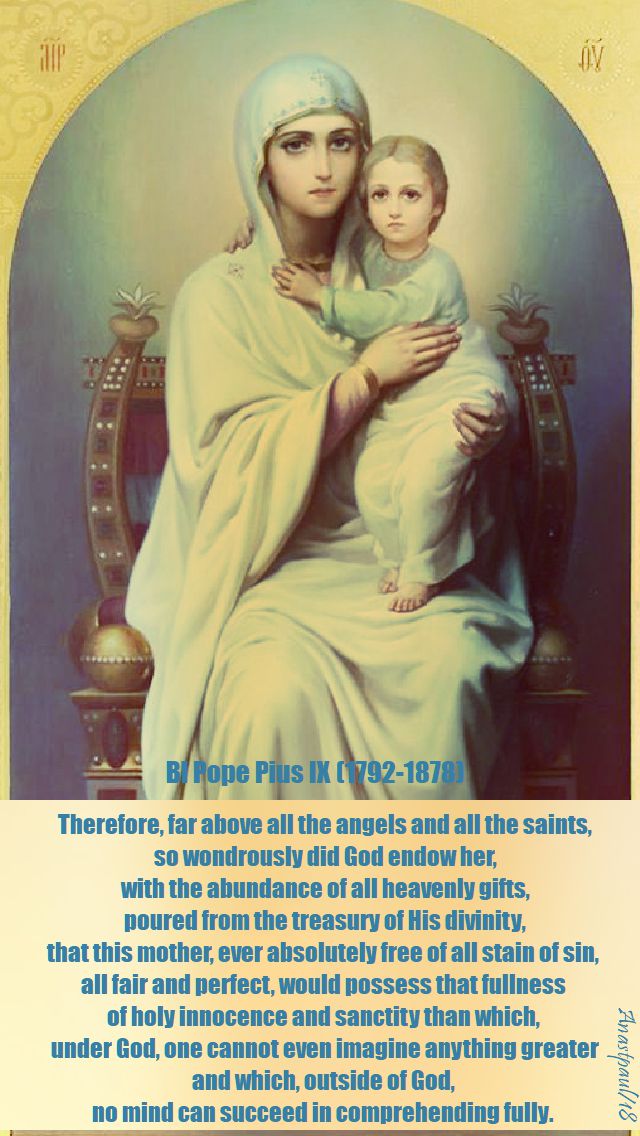
” From the very beginning and before time began, the eternal Father chose and prepared for His only-begotten Son, a Mother, in whom the Son of God would become incarnate and from whom, in the blessed fullness of time, He would be born into this world.   Above all creatures did God so love her, that truly in her, was the Father well pleased, with singular delight.   Therefore, far above all the angels and all the saints, so wondrously did God endow her, with the abundance of all heavenly gifts, poured from the treasury of His divinity, that this mother, ever absolutely free of all stain of sin, all fair and perfect, would possess that fullness of holy innocence and sanctity than which, under God, one cannot even imagine anything greater and which, outside of God, no mind can succeed in comprehending fully.”- INEFFABILIS DEUS – THE IMMACULATE CONCEPTION:  8 December 1854therefore, far above - bl pope pius IX - 7 feb 2018

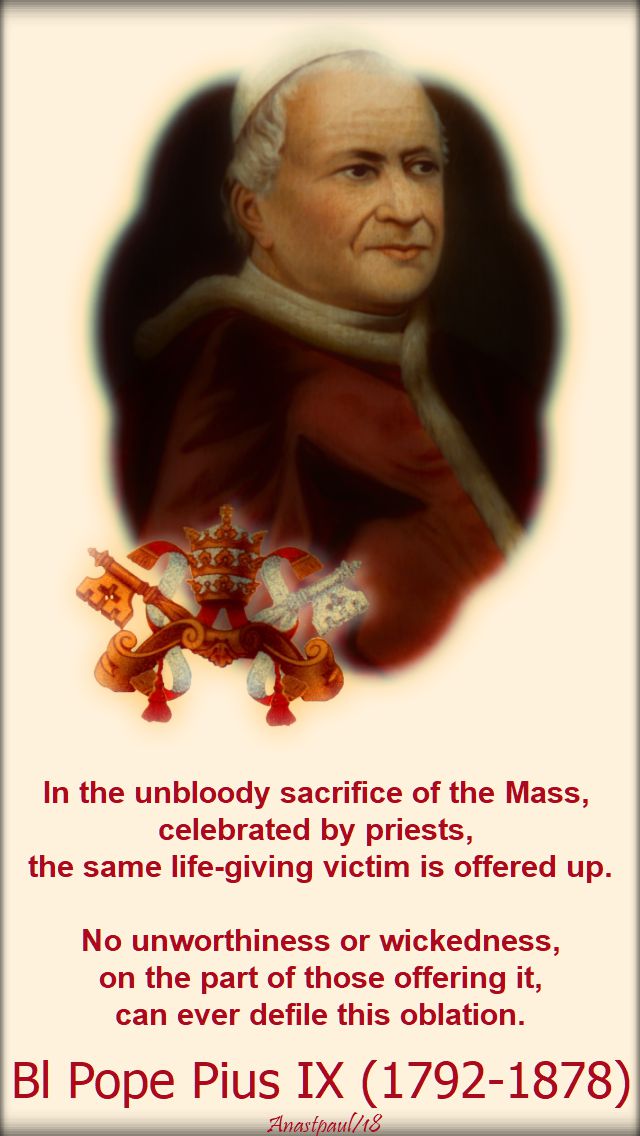
“In the unbloody sacrifice of the Mass, celebrated by priests, the same life-giving victim is offered up.   This entreaty reconciles us to God the Father.   It “renews in a mysterious way the death of Christ, who having risen from the dead dies no longer. Death no longer has domination over Him.”   Still, He is sacrificed for us in the mystery of this sacred oblation.   No unworthiness or wickedness on the part of those offering it can ever defile this oblation.”- AMANTISSIMI REDEMPTORIS – ON PRIESTS AND THE CARE OF SOULS: 3 May 1858

Blessed Pope Pius IX (1792-1878)in the unbloody - bl pope pius IX - 7 feb 2018

Posted in MORNING Prayers, ON the SAINTS, PAPAL PRAYERS, PAPAL SERMONS, QUOTES on PRAYER, SAINT of the DAY

Second Thought for the Day – 6 February – The Memorial of St Alfonso Maria Fusco (1839-1910)

Second Thought for the Day – 6 February – The Memorial of St Alfonso Maria Fusco (1839-1910)

“At the start of today’s celebration, we addressed this prayer to the Lord: “Create in us a generous and steadfast heart, so that we may always serve you with fidelity and purity of spirit” (Collect).

By our own efforts, we cannot give ourselves such a heart. Only God can do this and so in the prayer we ask him to give it to us as his “creation”.   In this way, we come to the theme of prayer, which is central to this Sunday’s scriptural readings and challenges all of us who are gathered here for the canonisation of new Saints.   The Saints attained the goal.   Thanks to prayer, they had a generous and steadfast heart.   They prayed mightily, they fought and they were victorious.

The saints are men and women who enter fully into the mystery of prayer.  Men and women who struggle with prayer, letting the Holy Spirit pray and struggle in them.   They struggle to the very end, with all their strength and they triumph but not by their own efforts:  the Lord triumphs in them and with them.   The seven witnesses who were canonised today also fought the good fight of faith and love by their prayers.   That is why they remained firm in faith, with a generous and steadfast heart.   Through their example and their intercession, may God also enable us to be men and women of prayer. May we cry out day and night to God, without losing heart.   May we let the Holy Spirit pray in us and may we support one another in prayer, in order to keep our arms raised, until Divine Mercy wins the victory.”

Homily of HH Pope Francis – St Peter’s Square – Sunday 16 October 2016 – HOLY MASS AND CANONISATION OF THE BLESSEDS:  Salomon Leclercq, José Sánchez del Río, Manuel González García, Lodovico Pavoni, Alfonso Maria Fusco, José Gabriel del Rosario Brochero, Elisabeth of the Holy Trinity Catez

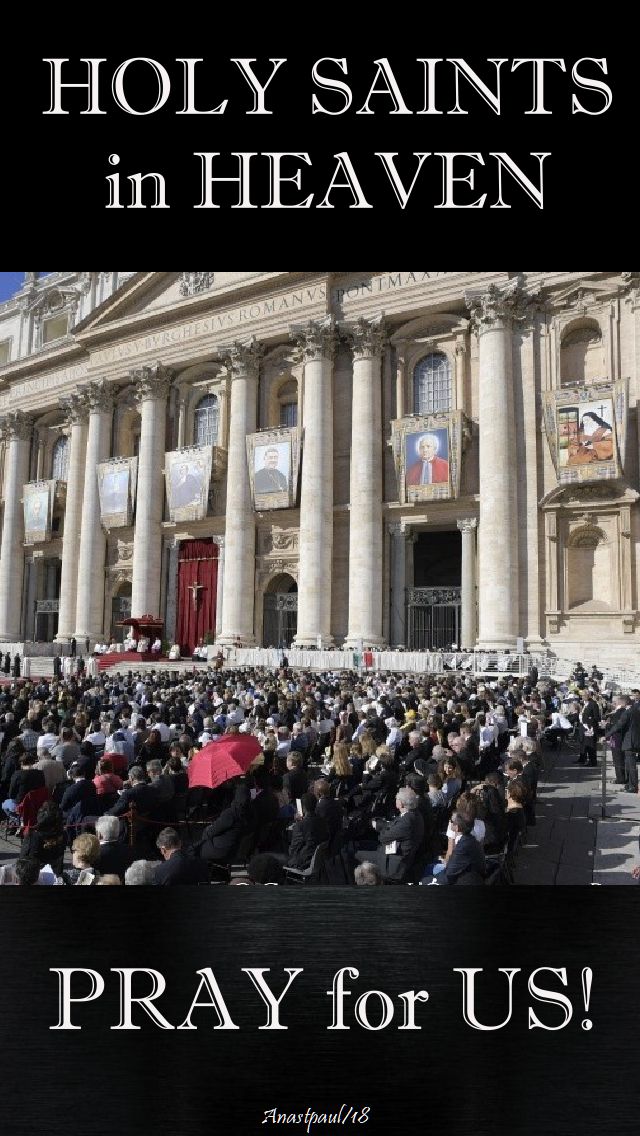
Holy Saints in Heaven, Pray for us!holy saints pray for us - 6 FEB 2018

Posted in MORNING Prayers, PAPAL SERMONS, QUOTES - J R R Tolkien and MORE, The WORD

One Minute Reflection – 30 January – Gospel of the Day Mark 5:21-43 Year B

One Minute Reflection – 30 January – Gospel of the Day Mark 5:21-43 Year B

She had heard about Jesus and came up behind him in the crowd and touched his cloak. She said, “If I but touch his clothes, I shall be cured.”…Mark 5:27-28mark 5 27-28 - 30 jan 2018

REFLECTION – “The second episode, that of the woman with the haemorrhage, again manifests how Jesus came to liberate human beings in their totality.   In fact, the miracle takes place in two stages:  first there is the physical healing but this is closely linked to the deeper healing, that which grants God’s grace to those who welcome Him in faith. Jesus says to the woman:  ‘Daughter, your faith has saved you.   Go in peace and be healed of the evil that afflicts you!’ (Mark 5:34).   These two stories of healing are an invitation for us to overcome the purely horizontal and materialistic vision of life.   We rightly ask God for so many healings from our problems, from concrete necessities.   But what we must ask for insistently, is a more solid faith, so that the Lord might renew our life and a firm trust in His love, in His providence that does not abandon us.”…Pope Benedict XVI July 2012we rightly ask God - 30 jan 2018 - pope benedict

PRAYER – Almighty Father, grant that our trust and faith may grow each day.   Help us to be secure in Your unfailing love and help.   Even in our times of fear, pain and distress, give us the trust to know that You are always with us and that Your healing grace does indeed work miracles in our lives.   Grant us strength, O Lord, to overcome all our fears with confidence in Your loving care.   Through Jesus Christ in union with the Holy Spirit, one God forever, amen.

Posted in CATECHESIS, DOCTORS of the Church, ON the SAINTS, PAPAL SERMONS, QUOTES of the SAINTS, SAINT of the DAY

Thought for the Day – 28 January – The Memorial of St Thomas Aquinas (1225-1274) Doctor angelicus (Angelic Doctor) and Doctor communis (Common Doctor)

Thought for the Day – 28 January – The Memorial of St Thomas Aquinas (1225-1274) Doctor angelicus (Angelic Doctor) and Doctor communis (Common Doctor)

Pope John Paul II, recalled that “the Church has been justified in consistently proposing St Thomas as a master of thought and a model of the right way to do theology” (n. 43).   It is not surprising that, after St Augustine, among the ecclesiastical writers mentioned in the Catechism of the Catholic Church, St Thomas is cited more than any other, at least 61 times!   He was also called the Doctor Angelicus, perhaps because of his virtues and, in particular, the sublimity of his thought and the purity of his life.

The last months of Thomas’ earthly life remain surrounded by a particular, I would say, mysterious atmosphere.   In December 1273, he summoned his friend and secretary Reginald to inform him of his decision to discontinue all work because he had realised, during the celebration of Mass subsequent to a supernatural revelation, that everything he had written until then “was worthless”.   This is a mysterious episode that helps us to understand not only Thomas’ personal humility but also the fact that, however lofty and pure it may be, all we manage to think and say about the faith is infinitely exceeded by God’s greatness and beauty which will be fully revealed to us in Heaven.

The life and teaching of St Thomas Aquinas could be summed up in an episode passed down by his ancient biographers.   While, as was his wont, the Saint was praying before the Crucifix in the early morning in the chapel of St Nicholas in Naples, Domenico da Caserta, the church sacristan, overheard a conversation.   Thomas was anxiously asking whether what he had written on the mysteries of the Christian faith was correct.   And the Crucified One answered him:  “You have spoken well of me, Thomas. What is your reward to be?”.   And the answer Thomas gave him was what we too, friends and disciples of Jesus, always want to tell him:  “Nothing but Yourself, Lord!”…Pope Benedict XVI – First in the series of Catechesis on St Thomas Aquinas – 2 June 2010

 “Nothing but Yourself, Lord!”

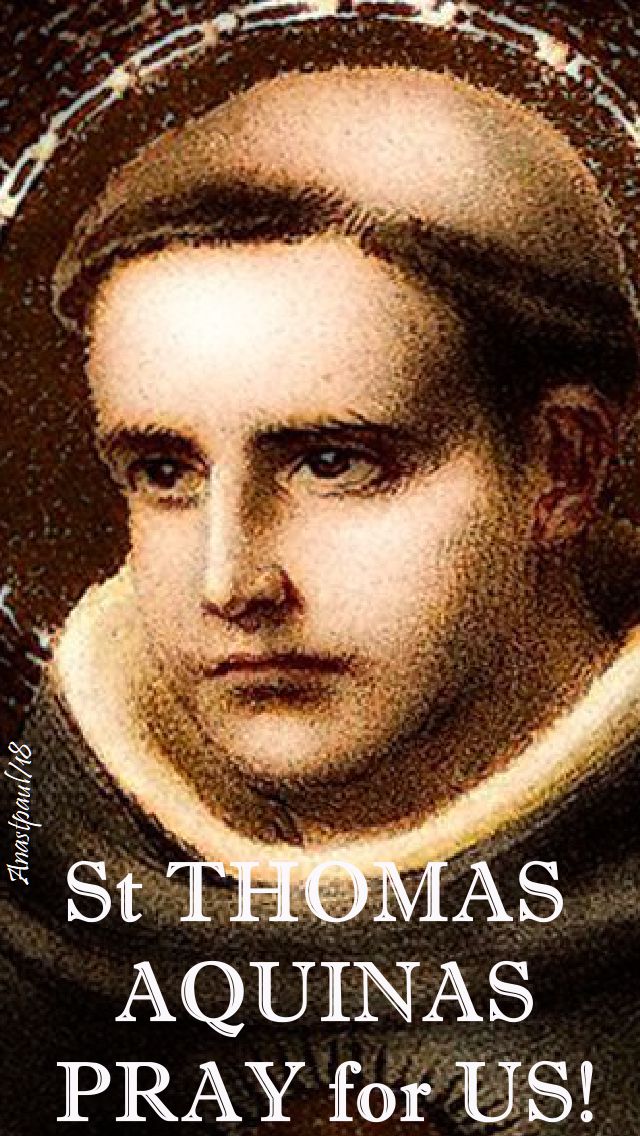
St Thomas Aquinas, pray for us!st thomas aquinas - pray for us - 28 jan 2018


Posted in MORNING Prayers, ON the SAINTS, PAPAL SERMONS, SAINT of the DAY, SPEAKING of ....., St PAUL!, The APOSTLES & EVANGELISTS, VATICAN Resources

Series on the Catechesis of Pope BENEDICT XVI “Speaking of St Paul” – No 1 – Religious and Cultural Environment

Series on the Catechesis of Pope BENEDICT XVI on St Paul

“Speaking of St Paul ” No 1 – Wednesday, 2 July 2008

Religious and Cultural Environment

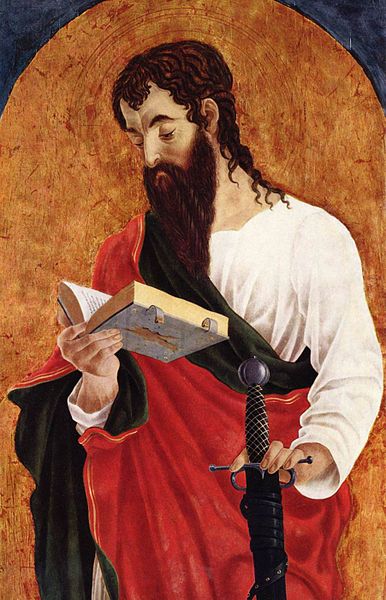
386px-Marco_Zoppo_-_St_Paul_-_WGA26005
Marco Zoppo (1433–1478) – Italian painter (1433-1478) St Paul circa 1468

Dear Brothers and Sisters,

Today I would like to begin a new cycle of Catechesis focusing on the great Apostle St Paul. As you know, this year is dedicated to him, from the liturgical Feast of Sts Peter and Paul on 29 June 2008 to the same Feast day in 2009.   The Apostle Paul, an outstanding and almost inimitable yet stimulating figure, stands before us as an example of total dedication to the Lord and to his Church, as well as of great openness to humanity and its cultures.   It is right, therefore, that we reserve a special place for him in not only our veneration but also in our effort to understand what he has to say to us as well, Christians of today.   In this first meeting let us pause to consider the environment in which St Paul lived and worked.   A theme such as this would seem to bring us far from our time, given that we must identify with the world of 2,000 years ago.   Yet this is only apparently and, in any case, only partly true for we can see that various aspects of today’s social and cultural context are not very different from what they were then.

A primary and fundamental fact to bear in mind is the relationship between the milieu in which Paul was born and raised and the global context to which he later belonged.   He came from a very precise and circumscribed culture, indisputably a minority, which is that of the People of Israel and its tradition.   In the ancient world and especially in the Roman Empire, as scholars in the subject teach us, Jews must have accounted for about 10 percent of the total population.   Later, here in Rome, towards the middle of the first century, this percentage was even lower, amounting to three percent of the city’s inhabitants at most.   Their beliefs and way of life, is still the case today, distinguished them clearly from the surrounding environment and this could have two results:  either derision, that could lead to intolerance, or admiration which was expressed in various forms of sympathy, as in the case of the “God-fearing” or “proselytes”, pagans who became members of the Synagogue and who shared the faith in the God of Israel.   As concrete examples of this dual attitude we can mention on the one hand the cutting opinion of an orator such as Cicero who despised their religion and even the city of Jerusalem (cf. Pro Flacco, 66-69) and, on the other, the attitude of Nero’s wife, Poppea, who is remembered by Flavius Josephus as a “sympathiser” of the Jews (cf. Antichità giudaiche 20, 195, 252); Vita 16), not to mention that Julius Caesar had already officially recognised specific rights of the Jews which have been recorded by the above-mentioned Jewish historian Flavius Josephus (cf. ibid., 14,200-216).   It is certain that the number of Jews, as, moreover, is still the case today, was far greater outside the land of Israel, that is, in the Diaspora, than in the territory that others called Palestine.

It is not surprising, therefore, that Paul himself was the object of the dual contradictory assessment that I mentioned.   One thing is certain: the particularism of the Judaic culture and religion easily found room in an institution as far-reaching as the Roman Empire.   Those who would adhere with faith to the Person of Jesus of Nazareth, Jew or Gentile, were in the more difficult and troubled position, to the extent to which they were to distinguish themselves from both Judaism and the prevalent paganism.   In any case, two factors were in Paul’s favour.   The first was the Greek, or rather Hellenistic, culture which after Alexander the Great had become a common heritage, at least of the Eastern Mediterranean and of the Middle East and had even absorbed many elements of peoples traditionally considered barbarian.   One writer of the time says in this regard that Alexander “ordered that all should consider the entire oecumene as their homeland… and that a distinction should no longer be made between Greek and barbarian” (Plutarch, De Alexandri Magni fortuna aut virtute, 6, 8).   The second factor was the political and administrative structure of the Roman Empire which guaranteed peace and stability from Britain as far as southern Egypt, unifying a territory of previously unheard of dimensions.   It was possible to move with sufficient freedom and safety in this space, making use, among other things, of an extraordinary network of roads and finding at every point of arrival basic cultural characteristics which, without affecting local values, nonetheless represented a common fabric of unification super partes, so that the Jewish philosopher, Philo of Alexandria, a contemporary of Paul himself, praised the Emperor Augustus for “composing in harmony all the savage peoples, making himself the guardian of peace” (Legatio ad Caium, 146-147).

There is no doubt that the universalist vision characteristic of St Paul’s personality, at least of the Christian Paul after the event on the road to Damascus, owes its basic impact to faith in Jesus Christ, since the figure of the Risen One was by this time situated beyond any particularistic narrowness.   Indeed, for the Apostle “there is neither Jew nor Greek, there is neither slave nor free, there is neither male nor female; for you are all one in Christ Jesus” (Gal 3: 28).   Yet, even the historical and cultural situation of his time and milieu could not but have had an influence on his decisions and his work.   Some have defined Paul as “a man of three cultures”, taking into account his Jewish background, his Greek tongue and his prerogative as a “civis romanus [Roman citizen], as the name of Latin origin suggests.   Particularly the Stoic philosophy dominant in Paul’s time which influenced Christianity, even if only marginally, should be recalled.   Concerning this, we cannot gloss over certain names of Stoic philosophers such as those of its founders, Zeno and Cleanthes and then those closer to Paul in time such as Seneca, Musonius and Epictetus: in them the loftiest values of humanity and wisdom are found which were naturally to be absorbed by Christianity.   As one student of the subject splendidly wrote, “Stoicism… announced a new ideal, which imposed upon man obligations to his peersbut at the same time set him free from all physical and national ties and made of him a purely spiritual being” (M. Pohlenz, La Stoa, I, Florence, 2, 1978, pp. 565 f.).   One thinks, for example, of the doctrine of the universe understood as a single great harmonious body and consequently of the doctrine of equality among all people without social distinctions, of the equivalence, at least in principle, of men and women and then of the ideal of frugality, of the just measure and self-control to avoid all excesses.   When Paul wrote to the Philippians, “Whatever is true, whatever is honourable, whatever is just, whatever is pure, whatever is lovely, whatever is gracious, if there is any excellence, if there is anything worthy of praise, think about these things” (Phil 4: 8), he was only taking up a purely humanistic concept proper to that philosophical wisdom.

In St Paul’s time a crisis of traditional religion was taking place, at least in its mythological and even civil aspects.   After Lucretius had already ruled polemically a century earlier that “religion has led to many misdeeds” (De rerum natura, 1, 101, On the Nature of Things), a philosopher such as Seneca, going far beyond any external ritualism, taught that “God is close to you, he is with you, he is within you” (Epistulae morales to Lucilius, 41, 1).   Similarly, when Paul addresses an audience of Epicurean philosophers and Stoics in the Areopagus of Athens, he literally says: “God does not live in shrines made by man,… for in him we live and move and have our being” (Acts 17: 24, 28).   In saying this he certainly re-echoes the Judaic faith in a God who cannot be represented in anthropomorphic terms and even places himself on a religious wavelength that his listeners knew well.   We must also take into account the fact that many pagan cults dispensed with the official temples of the town and made use of private places that favoured the initiation of their followers.   It is, therefore, not surprising that Christian gatherings (ekklesiai) as Paul’s Letters attest, also took place in private homes.   At that time, moreover, there were not yet any public buildings.   Therefore, Christian assemblies must have appeared to Paul’s contemporaries as a simple variation of their most intimate religious practice.   Yet the differences between pagan cults and Christian worship are not negligible and regard the participants’ awareness of their identity as well as the participation in common of men and women, the celebration of the “Lord’s Supper”, and the reading of the Scriptures.

In conclusion, from this brief over-view of the cultural context of the first century of the Christian era, it is clear that it is impossible to understand St Paul properly without placing him against both the Judaic and pagan background of his time.   Thus he grows in historical and spiritual stature, revealing both sharing and originality in comparison with the surrounding environment.   However, this applies likewise to Christianity in general, of which the Apostle Paul, precisely, is a paradigm of the highest order from whom we all, always, still have much to learn.   And this is the goal of the Pauline Year:  to learn from St Paul, to learn faith, to learn Christ, and finally to learn the way of upright living.

St Paul Pray for us!st paul pray for us - 25 jan2018 - catechesis of pope benedict no 1

Posted in MORNING Prayers, PAPAL SERMONS, SAINT of the DAY

Thought for the Day – 16 January – The Memorial of St Joseph Vaz (1651-1711) Apostle of Sri Lanka

Thought for the Day – 16 January – The Memorial of St Joseph Vaz (1651-1711) Apostle of Sri Lanka

“Saint Joseph shows us the importance of transcending religious divisions in the service of peace.   His undivided love for God opened him to love for his neighbour;  he ministered to those in need, whoever and wherever they were.   His example continues to inspire the Church in Sri Lanka today.   She gladly and generously serves all members of society.   She makes no distinction of race, creed, tribe, status or religion in the service she provides through her schools, hospitals, clinics and many other charitable works.  All she asks in return is the freedom to carry out this mission.

Religious freedom is a fundamental human right.   Each individual must be free, alone or in association with others, to seek the truth and to openly express his or her religious convictions, free from intimidation and external compulsion.

As the life of Saint Joseph Vaz teaches us, genuine worship of God bears fruit not in discrimination, hatred and violence but in respect for the sacredness of life, respect for the dignity and freedom of others and loving commitment to the welfare of all.”   (From the Homily of Pope Francis on the Canonisation of St Joseoph Vaz – 14 January 2015)

“Joseph Vaz was on fire with faith.   Guided by the example of his Divine Master, he travelled the whole Island, going everywhere, often barefoot, with a rosary round his neck as a sign of his Catholic faith.   As a true disciple of Jesus, he endured innumerable sufferings with joy and confidence, knowing that in those sufferings too God’s plans were being fulfilled. His heroic charity, shown in a particular way in his selfless devotion to the victims of the epidemic in 1697, earned him the respect of everyone.
May the example of Father Joseph Vaz speak to your hearts…He welcomed everyone as a child of God.   And because of this love his name is now invoked as a blessing, here in Sri Lanka and throughout the world. “Blessed are the peacemakers” (Mt. 5: 9).   When lasting peace comes, all Sri Lankans will be blessed and your country will be restored in its full dignity and greatness.   May Almighty God achieve this through you. Amen.

May Almighty God through the intercession of Our Lady and of blessed Joseph Vaz achieve this through you.”   (St Pope John Paul on the Beatification of St Joseph Vaz – 21 January 1995)

st joseph vaz pray for us no 2 - 16 jan 2018

Posted in MORNING Prayers, PAPAL SERMONS, SAINT of the DAY, The WORD

One Minute Reflection – 16 January – The Memorial of St Joseph Vaz (1651-1711) Apostle of Sri Lanka

One Minute Reflection – 16 January – The Memorial of St Joseph Vaz (1651-1711) Apostle of Sri Lanka

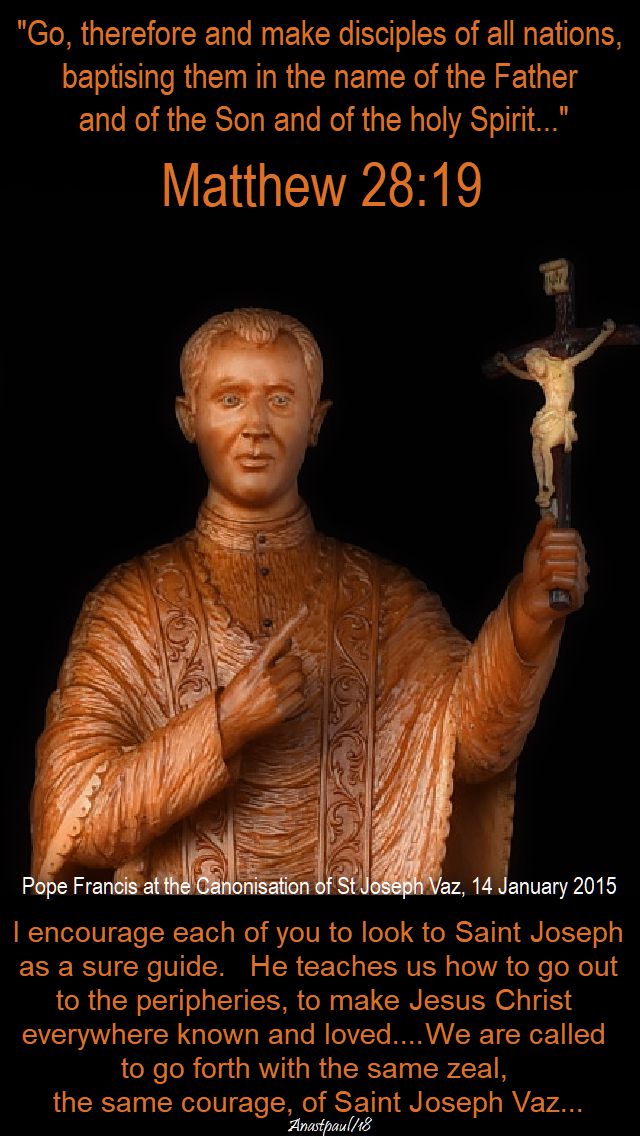
“Go, therefore and make disciples of all nations, baptising them in the name of the Father and of the Son and of the holy Spirit”…Matthew 28:19

REFLECTION – “I encourage each of you to look to Saint Joseph as a sure guide. He teaches us how to go out to the peripheries, to make Jesus Christ everywhere known and loved…. Saint Joseph gives us an example of missionary zeal…. Leaving behind his home, his family, the comfort of his familiar surroundings, he responded to the call to go forth, to speak of Christ wherever he was led. Saint Joseph knew how to offer the truth and the beauty of the Gospel in a multi-religious context, with respect, dedication, perseverance and humility.   This is also the way for the followers of Jesus today.   We are called to go forth with the same zeal, the same courage, of Saint Joseph…” Pope Francis at the Canonisation of St Joseph Vaz, 14 January 2015i encourage each of you - pope francis - 16 jan 2018

PRAYER – Lord God, may we too glorify You by our lives as St Joseph Vaz did!   Grant us, we pray, Your grace, that we may, in union with the Church throughout the world, sing a new song to the You and declare Your glory to all the ends of the earth.   May the prayer of St Joseph Vaz, intercede on our behalf, to assist us to imitate his zeal and love. Amenst joseph vaz - pray for us - 18 jan 2018

Posted in MORNING Prayers, PAPAL MESSAGES, PAPAL SERMONS

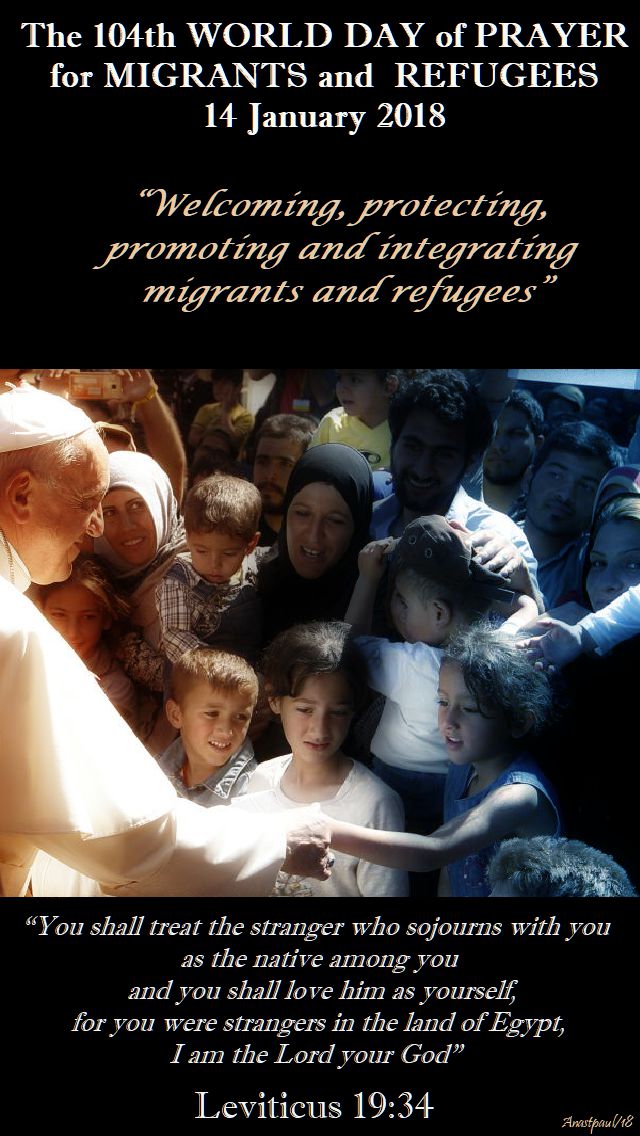
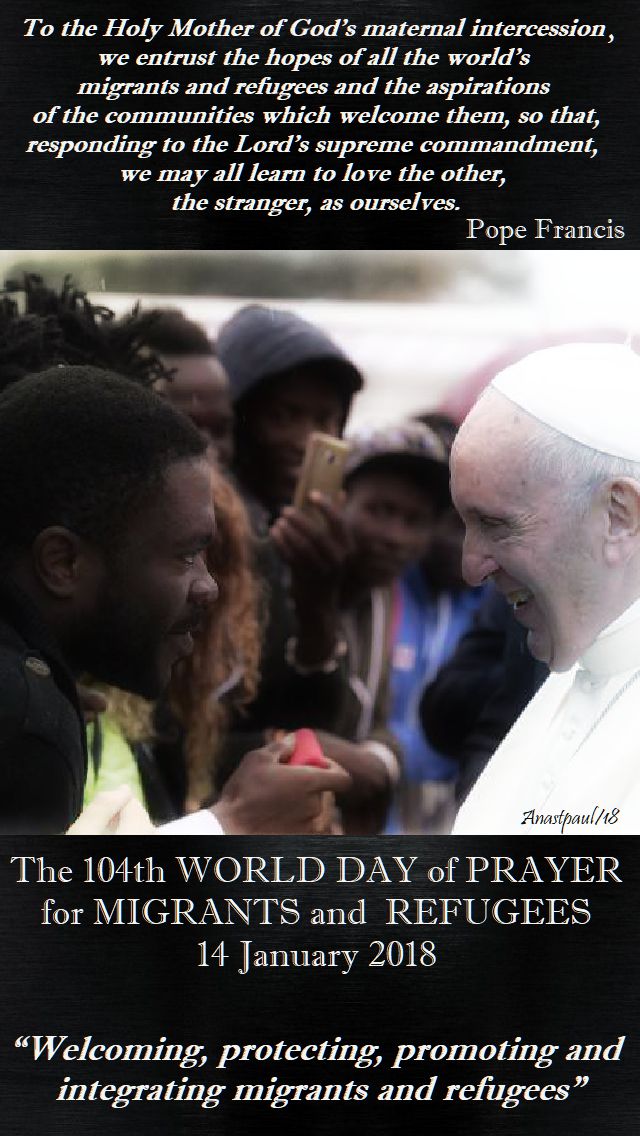
The 104th WORLD DAY of PRAYER for MIGRANTS and REFUGEES – 14 January 2018

The 104th WORLD DAY of PRAYER for MIGRANTS and REFUGEES – 14 January 2018

MESSAGE OF HIS HOLINESS POPE FRANCIS

“Welcoming, protecting, promoting and
integrating migrants and refugees”

Dear brothers and sisters!

“You shall treat the stranger who sojourns with you as the native among you and you shall love him as yourself, for you were strangers in the land of Egypt:  I am the Lord your God” (Leviticus 19:34).the 104th world day of prayer for migrants and refugees - 14 jan 2018

Throughout the first years of my pontificate, I have repeatedly expressed my particular concern for the lamentable situation of many migrants and refugees fleeing from war, persecution, natural disasters and poverty.   This situation is undoubtedly a “sign of the times” which I have tried to interpret, with the help of the Holy Spirit, ever since my visit to Lampedusa on 8 July 2013.  When I instituted the new Dicastery for Promoting Integral Human Development, I wanted a particular section – under my personal direction for the time being – to express the Church’s concern for migrants, displaced people, refugees and victims of human trafficking.

Every stranger who knocks at our door is an opportunity for an encounter with Jesus Christ, who identifies with the welcomed and rejected strangers of every age (Matthew 25:35-43).   The Lord entrusts to the Church’s motherly love every person forced to leave their homeland in search of a better future.   This solidarity must be concretely expressed at every stage of the migratory experience – from departure through journey to arrival and return.   This is a great responsibility, which the Church intends to share with all believers and men and women of good will, who are called to respond to the many challenges of contemporary migration with generosity, promptness, wisdom and foresight, each according to their own abilities.

In this regard, I wish to reaffirm that “our shared response may be articulated by four verbs:   to welcome, to protect, to promote and to integrate”.

Considering the current situation, welcoming means, above all, offering broader options for migrants and refugees to enter destination countries safely and legally.   This calls for a concrete commitment to increase and simplify the process for granting humanitarian visas and for reunifying families.   At the same time, I hope that a greater number of countries will adopt private and community sponsorship programmes, and open humanitarian corridors for particularly vulnerable refugees.   Furthermore, special temporary visas should be granted to people fleeing conflicts in neighbouring countries. Collective and arbitrary expulsions of migrants and refugees are not suitable solutions, particularly where people are returned to countries which cannot guarantee respect for human dignity and fundamental rights.   Once again, I want to emphasise the importance of offering migrants and refugees adequate and dignified initial accommodation.   “More widespread programmes of welcome, already initiated in different places, seem to favour a personal encounter and allow for greater quality of service and increased guarantees of success”.   The principle of the centrality of the human person, firmly stated by my beloved Predecessor, Benedict XVI, obliges us to always prioritise personal safety over national security.   It is necessary, therefore, to ensure that agents in charge of border control are properly trained.   The situation of migrants, asylum seekers and refugees requires that they be guaranteed personal safety and access to basic services.   For the sake of the fundamental dignity of every human person, we must strive to find alternative solutions to detention for those who enter a country without authorisation.

The second verb – protecting – may be understood as a series of steps intended to defend the rights and dignity of migrants and refugees, independent of their legal status.  Such protection begins in the country of origin and consists in offering reliable and verified information before departure, and in providing safety from illegal recruitment practices.   This must be ongoing, as far as possible, in the country of migration, guaranteeing them adequate consular assistance, the right to personally retain their identity documents at all times, fair access to justice, the possibility of opening a personal bank account, and a minimum sufficient to live on.   When duly recognised and valued, the potential and skills of migrants, asylum seekers and refugees are a true resource for the communities that welcome them.   This is why I hope that, in countries of arrival, migrants may be offered freedom of movement, work opportunities and access to means of communication, out of respect for their dignity.   For those who decide to return to their homeland, I want to emphasise the need to develop social and professional reintegration programmes.   The International Convention on the Rights of the Child provides a universal legal basis for the protection of underage migrants.   They must be spared any form of detention related to migratory status, and must be guaranteed regular access to primary and secondary education.   Equally, when they come of age they must be guaranteed the right to remain and to enjoy the possibility of continuing their studies.   Temporary custody or foster programmes should be provided for unaccompanied minors and minors separated from their families.   The universal right to a nationality should be recognised and duly certified for all children at birth.   The statelessness which migrants and refugees sometimes fall into can easily be avoided with the adoption of “nationality legislation that is in conformity with the fundamental principles of international law”.    Migratory status should not limit access to national healthcare and pension plans, nor affect the transfer of their contributions if repatriated.

Promoting essentially means a determined effort to ensure that all migrants and refugees – as well as the communities which welcome them – are empowered to achieve their potential as human beings, in all the dimensions which constitute the humanity intended by the Creator.    Among these, we must recognise the true value of the religious dimension, ensuring to all foreigners in any country the freedom of religious belief and practice.   Many migrants and refugees have abilities which must be appropriately recognised and valued.  Since “work, by its nature, is meant to unite peoples”, I encourage a determined effort to promote the social and professional inclusion of migrants and refugees, guaranteeing for all – including those seeking asylum – the possibility of employment, language instruction and active citizenship, together with sufficient information provided in their mother tongue.   In the case of underage migrants, their involvement in labour must be regulated to prevent exploitation and risks to their normal growth and development.   In 2006, Benedict XVI highlighted how, in the context of migration, the family is “a place and resource of the culture of life and a factor for the integration of values”.   The family’s integrity must always be promoted, supporting family reunifications – including grandparents, grandchildren and siblings – independent of financial requirements.   Migrants, asylum seekers and refugees with disabilities must be granted greater assistance and support.   While I recognise the praiseworthy efforts, thus far, of many countries, in terms of international cooperation and humanitarian aid, I hope that the offering of this assistance will take into account the needs (such as medical and social assistance, as well as education) of developing countries which receive a significant influx of migrants and refugees.  I also hope that local communities which are vulnerable and facing material hardship, will be included among aid beneficiaries.

The final verb – integrating – concerns the opportunities for intercultural enrichment brought about by the presence of migrants and refugees.   Integration is not “an assimilation that leads migrants to suppress or to forget their own cultural identity. Rather, contact with others leads to discovering their ‘secret’, to being open to them in order to welcome their valid aspects and thus contribute to knowing each one better. This is a lengthy process that aims to shape societies and cultures, making them more and more a reflection of the multi-faceted gifts of God to human beings”.    This process can be accelerated by granting citizenship free of financial or linguistic requirements, and by offering the possibility of special legalisation to migrants who can claim a long period of residence in the country of arrival.   I reiterate the need to foster a culture of encounter in every way possible – by increasing opportunities for intercultural exchange, documenting and disseminating best practices of integration, and developing programmes to prepare local communities for integration processes.   I wish to stress the special case of people forced to abandon their country of arrival due to a humanitarian crisis.   These people must be ensured adequate assistance for repatriation and effective reintegration programmes in their home countries.

In line with her pastoral tradition, the Church is ready to commit herself to realising all the initiatives proposed above.   Yet in order to achieve the desired outcome, the contribution of political communities and civil societies is indispensable, each according to their own responsibilities.

At the United Nations Summit held in New York on 19 September 2016, world leaders clearly expressed their desire to take decisive action in support of migrants and refugees to save their lives and protect their rights, sharing this responsibility on a global level.  To this end, the states committed themselves to drafting and approving, before the end of 2018, two Global Compacts, one for refugees and the other for migrants.

Dear brothers and sisters, in light of these processes currently underway, the coming months offer a unique opportunity to advocate and support the concrete actions which I have described with four verbs.   I invite you, therefore, to use every occasion to share this message with all political and social actors involved (or who seek to be involved) in the process which will lead to the approval of the two Global Compacts.

Today, 15 August, we celebrate the Feast of the Assumption of Mary.   The Holy Mother of God herself experienced the hardship of exile (Matthew 2:13-15), lovingly accompanied her Son’s journey to Calvary and now shares eternally His glory.   To her maternal intercession we entrust the hopes of all the world’s migrants and refugees and the aspirations of the communities which welcome them, so that, responding to the Lord’s supreme commandment, we may all learn to love the other, the stranger, as ourselves.

Vatican City, 15 August 2017 – Solemnity of the Assumption of the Blessed Virgin Mary

Francisto the holy mother of god's - pope francis - world day of prayer for migrants and refugees - 14 jan 2018

Posted in CHRISTMASTIDE!, FEASTS and SOLEMNITIES, MORNING Prayers, PAPAL SERMONS, SAINT of the DAY, The CHRIST CHILD

Thought for the Day – 7 January – The Solemnity of the Epiphany of Our Lord Jesus Christ Excerpt from Pope Francis Homily for Epiphany 2017

Thought for the Day – 7 January – The Solemnity of the Epiphany of Our Lord Jesus Christ

Excerpt from Pope Francis Homily for Epiphany 2017

The Magi thus personify all those who believe, those who long for God, who yearn for their home, their heavenly homeland.   They reflect the image of all those who in their lives have not let their hearts be anaesthetised.
A holy longing for God wells up in the heart of believers because they know that the Gospel is not an event of the past but of the present.   A holy longing for God helps us keep alert in the face of every attempt to reduce and impoverish our life.   A holy longing for God is the memory of faith, which rebels before all prophets of doom.   That longing keeps hope alive in the community of believers, which from week to week continues to plead: “Come, Lord Jesus”.
We want to worship.   Those men came from the East to worship and they came to do so in the place befitting a king:  a palace.   This is significant.   Their quest led them there, for it was fitting that a king should be born in a palace, amid a court and all his subjects. For that is a sign of power, success, a life of achievement.   One might well expect a king to be venerated, feared and adulated.   True, but not necessarily loved.   For those are worldly categories, the paltry idols to which we pay homage:   he cult of power, outward appearances and superiority.   Idols that promise only sorrow, enslavement, fear.

It was there, in that place, that those men, come from afar, would embark upon their longest journey.   There they set out boldly on a more arduous and complicated journey. They had to discover that what they sought was not in a palace but elsewhere, both existentially and geographically.   There, in the palace, they did not see the star guiding them to discover a God who wants to be loved.   For only under the banner of freedom, not tyranny, is it possible to realise that the gaze of this unknown but desired king does not abase, enslave, or imprison us.   To realise that the gaze of God lifts up, forgives and heals.   To realise that God wanted to be born where we least expected, or perhaps desired, in a place where we so often refuse him.   To realise that in God’s eyes there is always room for those who are wounded, weary, mistreated, abandoned.   That His strength and His power are called MERCY.   For some of us, how far Jerusalem is from Bethlehem!for only under the banner of freedom - pope francis 2017 - 7 jan 2018

Herod is unable to worship because he could not or would not change his own way of looking at things.   He did not want to stop worshipping himself, believing that everything revolved around him.   He was unable to worship, because his aim was to make others worship him.   Nor could the priests worship, because although they had great knowledge, and knew the prophecies, they were not ready to make the journey or to change their ways.

The Magi experienced longing, they were tired of the usual fare.   They were all too familiar with, and weary of, the Herods of their own day.   But there, in Bethlehem, was a promise of newness, of gratuitousness.   There something new was taking place.   The Magi were able to worship because they had the courage to set out.   And as they fell to their knees before the small, poor and vulnerable Infant, the unexpected and unknown Child of Bethlehem, they discovered the glory of God.and as they fell - pope francis - epiphany 2017 - 7 jan 2018

Posted in MORNING Prayers, ON the SAINTS, PAPAL SERMONS, QUOTES of the SAINTS, QUOTES on SANCTITY, SAINT of the DAY

Thought for the Day – 4 January – The Memorial of St Elizabeth Ann Seton (1774-1821) – “What is a Saint?”

Thought for the Day – 4 January – The Memorial of St Elizabeth Ann Seton (1774-1821)  “What is a Saint?”

Excerpt from HOMILY OF THE HOLY FATHER BLESSED PAUL VI – 14 September 1975, on the Canonisation of St Elizabeth Ann Setonst e a seton- pray for us no 2 - 4 jan 2018

Elizabeth Ann Seton is a Saint!   We rejoice and we are deeply moved that our apostolic ministry authorises us to make this solemn declaration before all of you here present, before the holy Catholic Church, before our other Christian brethren in the world, before the entire American people and before all humanity. Elizabeth Ann Bayley Seton is a Saint!

She is the first daughter of the United States of America to be glorified with this incomparable attribute!    But what do we mean when we say:   «She is a Saint»?   We all have some idea of the meaning of this highest title;  but it is still difficult for us to make an exact analysis of it.   Being a Saint means being perfect, with a perfection that attains the highest level that a human being can reach.   A Saint is a human creature fully conformed to the will of God.   A Saint is a person in whom all sin-the principle of death-is cancelled out and replaced by the living splendour of divine grace.   The analysis of the concept of sanctity brings us to recognise in a soul the mingling of two elements that are entirely different but which come together to produce a single effect:  SANCTITY.   One of these elements is the human and moral element, raised to the degree of heroism:  heroic virtues are always required by the Church for the recognition of a person’s sanctity.   The second element is the mystical element, which express the measure and form of divine action in the person chosen by God to realise in herself-always in an original way-the image of Christ (Cfr. Rom. 8, 29).

The Church has made this study of the life, that is, the interior and exterior history, of Elizabeth Ann Seton.   And the Church has exulted with admiration and jo, and has today heard her own charism of truth poured out in the exclamation that we send up to God and announce to the world:  she is a Saint!

May the dynamism and authenticity of her life be an example in our day-and for generations to come-of what women can and must accomplish, in the fulfilment of their role, for the good of humanity.

St Elizabeth Ann Seton – Pray for us that we may all travel safely this path of sanctity and join you in Heaven in the halls of Sanctity!st e a seton- pray for us no 3 - 4 jan 2018

Posted in CHRISTMASTIDE!, MORNING Prayers, PAPAL MESSAGES, PAPAL SERMONS, SAINT of the DAY

1 January 2018 – The 51st World Day of Prayer for Peace

1 January 2018 – The 51st World Day of Prayer for Peace

The World Day of Prayer for Peace was first observed on 1 January 1968, proclaimed by Pope Paul VI. It was inspired by the encyclical Pacem in Terris by Pope John XXIII and with reference to Paul’s encyclical Populorum Progressio.

Our Holy Fathers, have used this day to make magisterial declarations relevant to the social doctrine of the Church on such topics as the United Nations, human rights, women’s rights, labour unions, economic development, the right to life, international diplomacy, peace in the Holy Land, globalisation, migrants, refugees and terrorism.the 51st world day of peace - 1 jan 2018

MESSAGE OF HIS HOLINESS POPE
FRANCIS
FOR THE CELEBRATION OF THE 
51st WORLD DAY OF PEACE

1 JANUARY 2018

Migrants and refugees: men and women in search of peace

1. Heartfelt good wishes for peace

Peace to all people and to all nations on earth! Peace, which the angels proclaimed to the shepherds on Christmas night,[1]  is a profound aspiration for everyone, for each individual and all peoples, and especially for those who most keenly suffer its absence.   Among these whom I constantly keep in my thoughts and prayers, I would once again mention the over 250 million migrants worldwide, of whom 22.5 million are refugees. Pope Benedict XVI, my beloved predecessor, spoke of them as “men and women, children, young and elderly people, who are searching for somewhere to live in peace.”  [2]  In order to find that peace, they are willing to risk their lives on a journey that is often long and perilous, to endure hardships and suffering, and to encounter fences and walls built to keep them far from their goal.

In a spirit of compassion, let us embrace all those fleeing from war and hunger, or forced by discrimination, persecution, poverty and environmental degradation to leave their homelands.

We know that it is not enough to open our hearts to the suffering of others.   Much more remains to be done before our brothers and sisters can once again live peacefully in a safe home.   Welcoming others requires concrete commitment, a network of assistance and goodwill, vigilant and sympathetic attention, the responsible management of new and complex situations that at times compound numerous existing problems, to say nothing of resources, which are always limited.   By practising the virtue of prudence, government leaders should take practical measures to welcome, promote, protect, integrate and, “within the limits allowed by a correct understanding of the common good, to permit [them] to become part of a new society.”[3]   Leaders have a clear responsibility towards their own communities, whose legitimate rights and harmonious development they must ensure, lest they become like the rash builder who miscalculated and failed to complete the tower he had begun to construct.[4]

2. Why so many refugees and migrants?

As he looked to the Great Jubilee marking the passage of two thousand years since the proclamation of peace by the angels in Bethlehem, Saint John Paul II pointed to the increased numbers of displaced persons as one of the consequences of the “endless and horrifying sequence of wars, conflicts, genocides and ethnic cleansings”[5] that had characterised the twentieth century.   To this date, the new century has registered no real breakthrough: armed conflicts and other forms of organised violence continue to trigger the movement of peoples within national borders and beyond.

Yet people migrate for other reasons as well, principally because they “desire a better life, and not infrequently try to leave behind the ‘hopelessness’ of an unpromising future.”[6]   They set out to join their families or to seek professional or educational opportunities, for those who cannot enjoy these rights do not live in peace.   Furthermore, as I noted in the Encyclical Laudato Si’, there has been “a tragic rise in the number of migrants seeking to flee from the growing poverty caused by environmental degradation”.[7]

Most people migrate through regular channels.   Some, however, take different routes, mainly out of desperation, when their own countries offer neither safety nor opportunity and every legal pathway appears impractical, blocked or too slow.

Many destination countries have seen the spread of rhetoric decrying the risks posed to national security or the high cost of welcoming new arrivals, and thus demeaning the human dignity due to all as sons and daughters of God.   Those who, for what may be political reasons, foment fear of migrants instead of building peace are sowing violence, racial discrimination and xenophobia, which are matters of great concern for all those concerned for the safety of every human being.[8]

All indicators available to the international community suggest that global migration will continue for the future. Some consider this a threat. For my part, I ask you to view it with confidence as an opportunity to build peace.

3. With a contemplative gaze

The wisdom of faith fosters a contemplative gaze that recognizes that all of us “belong to one family, migrants and the local populations that welcome them, and all have the same right to enjoy the goods of the earth, whose destination is universal, as the social doctrine of the Church teaches. It is here that solidarity and sharing are founded.”[9]   These words evoke the biblical image of the new Jerusalem.   The book of the prophet Isaiah (chapter 60) and that of Revelation (chapter 21) describe the city with its gates always open to people of every nation, who marvel at it and fill it with riches. Peace is the sovereign that guides it and justice the principle that governs coexistence within it.

We must also turn this contemplative gaze to the cities where we live, “a gaze of faith which sees God dwelling in their houses, in their streets and squares, […] fostering solidarity, fraternity, and the desire for goodness, truth and justice”[10] – in other words, fulfilling the promise of peace.

When we turn that gaze to migrants and refugees, we discover that they do not arrive empty-handed.   They bring their courage, skills, energy and aspirations, as well as the treasures of their own cultures; and in this way, they enrich the lives of the nations that receive them.   We also come to see the creativity, tenacity and spirit of sacrifice of the countless individuals, families and communities around the world who open their doors and hearts to migrants and refugees, even where resources are scarce.

A contemplative gaze should also guide the discernment of those responsible for the public good, and encourage them to pursue policies of welcome, “within the limits allowed by a correct understanding of the common good”[11] – bearing in mind, that is, the needs of all members of the human family and the welfare of each.

Those who see things in this way will be able to recognize the seeds of peace that are already sprouting and nurture their growth.   Our cities, often divided and polarized by conflicts regarding the presence of migrants and refugees, will thus turn into workshops of peace.

4. Four mileposts for action

Offering asylum seekers, refugees, migrants and victims of human trafficking an opportunity to find the peace they seek requires a strategy combining four actions: welcoming, protecting, promoting and integrating.[12]

“Welcoming” calls for expanding legal pathways for entry and no longer pushing migrants and displaced people towards countries where they face persecution and violence.   It also demands balancing our concerns about national security with concern for fundamental human rights. Scripture reminds us: “Do not forget to show hospitality to strangers, for by so doing some people have shown hospitality to angels without knowing it.”[13]

“Protecting” has to do with our duty to recognize and defend the inviolable dignity of those who flee real dangers in search of asylum and security, and to prevent their being exploited.   I think in particular of women and children who find themselves in situations that expose them to risks and abuses that can even amount to enslavement. God does not discriminate:  “The Lord watches over the foreigner and sustains the orphan and the widow.”[14]

“Promoting” entails supporting the integral human development of migrants and refugees. Among many possible means of doing so, I would stress the importance of ensuring access to all levels of education for children and young people.   This will enable them not only to cultivate and realise their potential but also better equip them to encounter others and to foster a spirit of dialogue rather than rejection or confrontation.   The Bible teaches that God “loves the foreigner residing among you, giving them food and clothing.   And you are to love those who are foreigners, for you yourselves were foreigners in Egypt.”[15]

“Integrating”, lastly, means allowing refugees and migrants to participate fully in the life of the society that welcomes them, as part of a process of mutual enrichment and fruitful cooperation in service of the integral human development of the local community.   Saint Paul expresses it in these words:  “You are no longer foreigners and strangers, but fellow citizens with God’s people.”[16]

5. A proposal for two international compacts

It is my heartfelt hope this spirit will guide the process that in the course of 2018 will lead the United Nations to draft and approve two Global Compacts, one for safe, orderly and regular migration and the other for refugees.   As shared agreements at a global level, these compacts will provide a framework for policy proposals and practical measures.   For this reason, they need to be inspired by compassion, foresight and courage, so as to take advantage of every opportunity to advance the peace-building process.   Only in this way can the realism required of international politics avoid surrendering to cynicism and to the globalisation of indifference.

Dialogue and coordination are a necessity and a specific duty for the international community.   Beyond national borders, higher numbers of refugees may be welcomed – or better welcomed – also by less wealthy countries, if international cooperation guarantees them the necessary funding.

The Migrants and Refugees Section of the Dicastery for Promoting Integral Human Development has published a set of twenty action points that provide concrete leads for implementing these four verbs in public policy and in the attitudes and activities of Christian communities.[17]   The aim of this and other contributions is to express the interest of the Catholic Church in the process leading to the adoption of the two U.N. Global Compacts.    This interest is the sign of a more general pastoral concern that goes back to the very origins of the Church and has continued in her many works up to the present time.

6. For our common home

Let us draw inspiration from the words of Saint John Paul II:  “If the ‘dream’ of a peaceful world is shared by all, if the refugees’ and migrants’ contribution is properly evaluated, then humanity can become more and more a universal family and our earth a true ‘common home’.”[18]   Throughout history, many have believed in this “dream”, and their achievements are a testament to the fact that it is no mere utopia.

Among these, we remember Saint Frances Xavier Cabrini in this year that marks the hundredth anniversary of her death. On this thirteenth day of November, many ecclesial communities celebrate her memory.   This remarkable woman, who devoted her life to the service of migrants and became their patron saint, taught us to welcome, protect, promote and integrate our brothers and sisters.   Through her intercession, may the Lord enable all of us to experience that “a harvest of righteousness is sown in peace by those who make peace.”[19]

From the Vatican, 13 November 2017

Posted in CHRISTMASTIDE!, FEASTS and SOLEMNITIES, MARIAN TITLES, PAPAL MESSAGES, PAPAL SERMONS, SAINT of the DAY

1 January 2018 – The Solemnity of Mary, the Mother of God

1 January 2018 – The Solemnity of Mary, the Mother of God

Start the New Year With Jesus’ Mother—and Our Own

In the early centuries of the Church, once Christmas began to be celebrated as its own feast on 25 December (having originally been celebrated with the Feast of the Epiphany, on 6 January, the Octave (eighth day) of Christmas, 1 January took on a special meaning. In the East, and throughout much of the West, it became common to celebrate a feast of Mary, the Mother of God, on this day. This feast was never established in the universal calendar of the Church, however, and a separate feast, celebrating the Circumcision of Our Lord Jesus Christ (which would have taken place a week after His birth), eventually took hold of 1 January. With the revision of the liturgical calendar the Feast of the Circumcision was set aside, and the ancient practice of dedicating 1 January to the Mother of God was revived—this time, as a universal feast.
One of the earliest titles given by Christians to the Blessed Virgin was Theotokos—”God-bearer.” We celebrate her as the Mother of God, because, in bearing Christ, she bore the fullness of the Godhead within her. As we begin another year, we draw inspiration from the selfless love of the Theotokos, who never hesitated to do the will of God. And we trust in her prayers to God for us, that we might, as the years pass, become more like her. O Mary, Mother of God, pray for us!Mary2017_1100x754

HOMILY OF HIS HOLINESS POPE FRANCIS

Vatican Basilica
Sunday, 1st January 2017

“Mary treasured all these things and pondered them in her heart! (Lk 2:19).   In these words, Luke describes the attitude with which Mary took in all that they had experienced in those days.   Far from trying to understand or master the situation, Mary is the woman who can treasure, that is to say, protect and guard in her heart, the passage of God in the life of his people.   Deep within, she had learned to listen to the heartbeat of her Son, and that in turn taught her, throughout her life, to discover God’s heartbeat in history.   She learned how to be a mother and in that learning process she gave Jesus the beautiful experience of knowing what it is to be a Son.   In Mary, the eternal Word not only became flesh, but also learned to recognise the maternal tenderness of God.   With Mary, the God-Child learned to listen to the yearnings, the troubles, the joys and the hopes of the people of the promise.   With Mary, he discovered himself a Son of God’s faithful people.octave-day.mary mother of god - 2016jpg

In the Gospels, Mary appears as a woman of few words, with no great speeches or deeds but with an attentive gaze capable of guarding the life and mission of her Son and for this reason, of everything that he loves.   She was able to watch over the beginnings of the first Christian community and in this way she learned to be the mother of a multitude.   She drew near to the most diverse situations in order to sow hope.   She accompanied the crosses borne in the silence of her children’s hearts.   How many devotions, shrines and chapels in the most far-off places, how many pictures in our homes, remind us of this great truth.   Mary gave us a mother’s warmth, the warmth that shelters us amid troubles, the maternal warmth that keeps anything or anyone from extinguishing in the heart of the Church the revolution of tenderness inaugurated by her Son.   Where there is a mother, there is tenderness.   By her motherhood, Mary shows us that humility and tenderness are not virtues of the weak but of the strong. She teaches us that we do not have to mistreat others in order to feel important (cf. Evangelii Gaudium, 288).    God’s holy people has always acknowledged and hailed her as the Holy Mother of God.

To celebrate Mary as Mother of God and our mother at the beginning of the new year means recalling a certainty that will accompany our days:   we are a people with a Mother;   we are not orphans.

Mothers are the strongest antidote to our individualistic and egotistic tendencies, to our lack of openness and our indifference.   A society without mothers would not only be a cold society, but a society that has lost its heart, lost the “feel of home”.   A society without mothers would be a merciless society, one that has room only for calculation and speculation.   Because mothers, even at the worst times, are capable of testifying to tenderness, unconditional self-sacrifice and the strength of hope.   I have learned much from those mothers whose children are in prison, or lying in hospital beds, or in bondage to drugs, yet, come cold or heat, rain or draught, never stop fighting for what is best for them.   Or those mothers who in refugee camps, or even the midst of war, unfailingly embrace and support their children’s sufferings.   Mothers who literally give their lives so that none of their children will perish.   Where there is a mother, there is unity, there is belonging, belonging as children.

To begin the year by recalling God’s goodness in the maternal face of Mary, in the maternal face of the Church, in the faces of our own mothers, protects us from the corrosive disease of being “spiritual orphans”.   It is the sense of being orphaned that the soul experiences when it feels motherless and lacking the tenderness of God, when the sense of belonging to a family, a people, a land, to our God, grows dim.   This sense of being orphaned lodges in a narcissistic heart capable of looking only to itself and its own interests.   It grows when what we forget that life is a gift we have received – and owe to others – a gift we are called to share in this common home.

It was such a self-centred orphanhood that led Cain to ask:  “Am I my brother’s keeper?” (Gen 4:9).   It was as if to say:  he doesn’t belong to me;  I do not recognise him.   This attitude of spiritual orphanhood is a cancer that silently eats away at and debases the soul.   We become all the more debased, inasmuch as nobody belongs to us and we belong to no one.   I debase the earth because it does not belong to me;  I debase others because they do not belong to me;  I debase God because I do not belong to him and in the end we debase our very selves, since we forget who we are and the divine “family name” we bear.   The loss of the ties that bind us, so typical of our fragmented and divided culture, increases this sense of orphanhood and, as a result, of great emptiness and loneliness.   The lack of physical (and not virtual) contact is cauterising our hearts (cf. Laudato Si’, 49) and making us lose the capacity for tenderness and wonder, for pity and compassion.   Spiritual orphanhood makes us forget what it means to be children, grandchildren, parents, grandparents, friends and believers.   It makes us forget the importance of playing, of singing, of a smile, of rest, of gratitude.

Celebrating the feast of the Holy Mother of God makes us smile once more as we realise that we are a people, that we belong, that only within a community, within a family, can we as persons find the “climate”, the “warmth” that enables us to grow in humanity and not merely as objects meant to “consume and be consumed”.   To celebrate the feast of the Holy Mother of God reminds us that we are not interchangeable items of merchandise or information processors.   We are children, we are family, we are God’s People.

Celebrating the Holy Mother of God leads us to create and care for common places that can give us a sense of belonging, of being rooted, of feeling at home in our cities, in communities that unite and support us (cf. Laudato Si’, 151).2.2.2.x-collection-detail-sirani_virgin_and_childMother-of-GodVirgin and Child (Luis De Morales)

Jesus, at the moment of his ultimate self-sacrifice, on the cross, sought to keep nothing for himself, and in handing over his life, he also handed over to us his Mother.   He told Mary:   Here is your son; here are your children.   We too want to receive her into our homes, our families, our communities and nations.   We want to meet her maternal gaze. The gaze that frees us from being orphans; the gaze that reminds us that we are brothers and sisters, that I belong to you, that you belong to me, that we are of the same flesh.   The gaze that teaches us that we have to learn how to care for life in the same way and with the same tenderness that she did:  by sowing hope, by sowing a sense of belonging and of fraternity.

Celebrating the Holy Mother of God reminds us that we have a Mother.   We are not orphans.   We have a Mother.   Together let us all confess this truth.   I invite you to acclaim it three times, standing [all stand], like the faithful of Ephesus:  Holy Mother of God, Holy Mother of God, Holy Mother of God.BallymoteChurchoftheImmaculateConceptionNorthAisleMadonnaandChild20100923

Posted in CHRISTMASTIDE!, MORNING Prayers, PAPAL SERMONS, QUOTES - J R R Tolkien and MORE, QUOTES of the SAINTS, QUOTES on FAITH, QUOTES on LOVE, SAINT of the DAY

Quote/s of the Day – 26 December – The Memorial of St Stephen the First Martyr and the Second Day in the Octave of Christmas

Quote/s of the Day – 26 December – The Memorial of St Stephen the First Martyr and the Second Day in the Octave of Christmas

“The deep bond which links Christ
to His first martyr Stephen, is divine Charity –
the very Love which impelled the Son of God
to empty Himself and make Himself obedient
unto death on a Cross …It is always necessary
to notice this distinctive feature of Christian martyrdom,
it is exclusively an act of love for God and for man,
including persecutors.”

Pope Benedict XVI – 26 December 2007

” …Like his Master, St Stephen died forgiving his persecutors
and thus makes us realise that the entry into the world
of the Son of God gives rise to a new civilisation,
the civilisation of love that does not yield to evil
and violence and pulls down the barriers
between men and women, making them brothers and sisters
in the great family of God’s children.”

Pope Benedict XVI – 26 December 2009the deep bond - pope benedict - 26 dec 2017
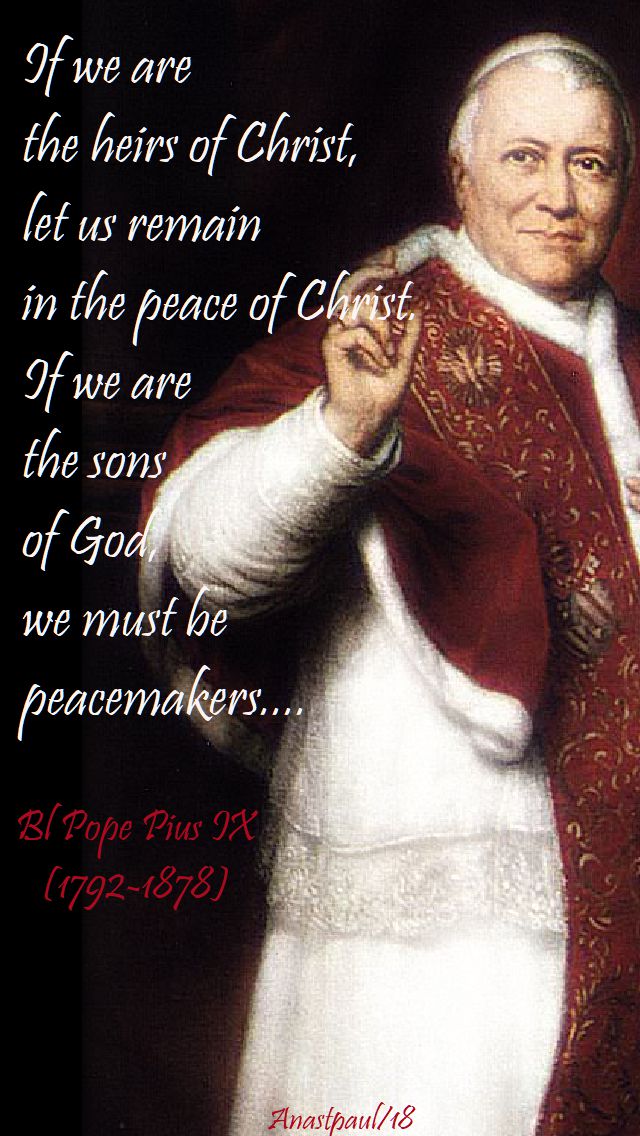
Posted in CHRISTMASTIDE!, MORNING Prayers, PAPAL SERMONS, QUOTES - J R R Tolkien and MORE, SAINT of the DAY, The CHRIST CHILD, The WORD

One Minute Reflection – 25 December – The Solemnity of the Nativity of the Lord

One Minute Reflection – 25 December – The Solemnity of the Nativity of the Lord

The Lord has bared his holy arm before the eyes of all the nations;
and all the ends of the earth shall see the salvation of our God…Isaiah 52:10isaiah 52 10

REFLECTION – “Today, the Son of God is born and everything changes.   The Saviour of the world comes to partake of our human nature;  no longer are we alone and forsaken. The Virgin offers us her Son as the beginning of a new life.   The true light has come to illumine our lives so often beset by the darkness of sin.   Today we once more discover who we are!   Tonight we have been shown the way to reach the journey’s end.   Now must we put away all fear and dread, for the light shows us the path to Bethlehem.   We must not be laggards;  we are not permitted to stand idle.   We must set out to see our Saviour lying in a manger.   This is the reason for our joy and gladness:  this Child has been “born to us”;  he was “given to us”, as Isaiah proclaims (cf. 9:5).   The people who for for two thousand years has traversed all the pathways of the world in order to allow every man and woman to share in this joy is now given the mission of making known “the Prince of peace” and becoming His effective servant in the midst of the nations.”…HOMILY OF HIS HOLINESS POPE FRANCIS on the Solemnity of the Nativity of the Lord, 2015today we once more discover who we are!-pope francis christmas 2015

PRAYER – Almighty God, Your incarnate Word fills us with the new light He brought to men.   Let the light of faith in our hearts shine through all the ages, to bring Your light to all nations.   Come, come, let us adore our Holy Babe of Bethlehem, through whom we pray, in unity with the Holy Spirit, one God, forever and ever amen.o come let us adore him - dec 2016