Saint of the Day – 18 December – Bl Giulia Nemesia Valle (1847-1916) – Religious – 26 June 1847 at Aosta, Italy – 18 December 1916 at Borgaro Torinese, Turin, Italy of natural causes. She was beatified on 25 April 2004 by St Pope John Paul II. Patronage – teachers. Blessed Giulia was an Italian Roman Catholic nun and a professed member of the Sisters of Charity of Saint Joan Antida Thouret; she later assumed the religious name of “Nemesia” upon becoming a professed nun. Following her profession she became an educator in Turin and the surrounding areas and was known for her careful attention to people’s individual educational needs.
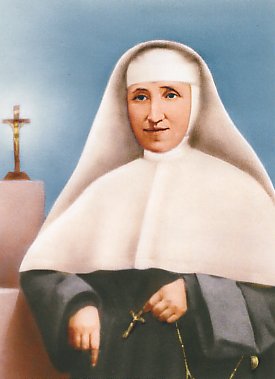
(Direct translation from the Vatican Italian – please excuse some ‘strange’ phraseology.)
Giulia is the name chosen by her parents Anselmo Valle and Cristina Dalbar. She was born in Aosta on the 26th June 1847 and was baptised on the same day in the ancient collegiate church of Saint Orso.
She spends the first years of her life within a happy family who rejoiced at the birth of another child, a sister for Vincent. But the mother died when Giulia was only four. The two orphans are thus entrusted first to the care of the paternal relatives in Aosta and later to the maternal ones in Donnas. Here they find a calm environment. The school, catechism and the preparation for the sacraments take place at home under the guide of a priest who was a family friend.
When Giulia is eleven, she is sent to France in Besançon, in a boarding school run by the Sisters of Charity where she could continue her schooling. Her separation from the family caused her a new suffering, a new experience of solitude directing her towards a deep friendship with “the Lord who keeps her mother with Him”.
In Besançon she learned French thoroughly, enriched her culture and becomes skilful in housework. Her delicate goodness matured and it rendered her loveable and attentive towards the others. Five years later, Giulia returned to her valley but her house at Donnas is no longer there. Her father got married again and moved to Pont Saint Martin. Here the familiar situation is strained and living together is not so easy. Her brother Vincent cannot stand her: he goes away….Giulia remains and out of her solitude crops up the stimulus to seek what her family couldn’t provide for her, to look after those who experiment her same sorrowful event and find out ways and means that express friendship, understanding, kindness and goodness for everyone.
In that period, the sisters of Charity came to settle at Pont Saint Martin. In them, Giulia rediscovered her teachers of Besançon, the daughters of Saint Jeanne-Antide Thouret who give her help and encouragement. She observes the life-style that they offer to God and to the others and chooses to become one of them. When her fathers presents her the suggestion of a prosperous marriage, Giulia doesn’t hesitate: she has promised her life totally to God : she only desires to become a Sister of Charity.
On the 8th September 1866 her father accompanies her to the Monastery of Santa Margherita in Vercelli where the Sisters of Charity run a noviciate.
A new, peaceful and joyful life starts for her in spite of the suffering separation. It’s now a matter of building a deeper relationship with God, of knowing herself and the mission of the community in order to accomplish God’s will. Giulia starts joyfully her new journey. Every day she discovers what she must lose or acquire: “Jesus strip me of myself, let me be wrapped in you. Jesus I live for you, and I die for you…” is the prayer that already accompanies and will continue to accompany her during her lifetime.
At the end of the noviciate, together with the new habit she receives a new name: r. Nemesia. It’s the name of one of the earliest martyrs of the church. She is happy with the name and makes out of it a life’s program : to witness at all costs, totally and for ever her love for Jesus.
She is sent to Tortona, in St Vincent’s Institute where she finds several activities: an elementary school, cultural courses, a boarding school and an orphanage. She teaches both in the elementary school and French in the higher classes. That’s the favourable ground where she can sow kindness. Sr Nemesia is present where humble work is to be done, where there is pain to be relieved, where apprehension hinders good relationships, where fatigue, pain and poverty put limits to life. A voice immediately spreads within the institute and in the city: “Oh, the heart of Sr. Nemesia!”
Everyone is convinced to have a particular place in this heart that knew no boundaries: Sisters, orphans, pupils, families, poor, the clergy of the nearby seminary, young soldiers of the numerous barracks of Tortona turn to her and seek her as if she were the only Sister present in the house.
When she is nominated superior of the community at the age of forty, Sr Nemesia feels perplexed but she remembers that: to be a superior means “to serve” and therefore she can give herself without any limits. Thus she humbly faces the ascent. The traces the main contents of her programme:
“Keep a quick pace, without looking behind and concentrate on the one goal: God Alone ! To Him the glory, to the others joy, for me to pay the price, never make others suffer. I shall be very strict with myself and full of charity towards the others: love gratuitously offered is the only thing that remains.”
Her charity knew no limits. In Tortona she is called “our angel”.
In the morning of the 10th of May 1903, the orphans and the boarders find a message addressed to them from Sr Nemesia: “I am leaving happily, I entrust to our Lady… I shall follow you in every moment of the day”. She left alone at 4 o’clock in the morning, after 36 years… In Borgaro, a small country in the vicinity of Turin, there is a small group of young girls waiting to be accompanied along a new path, towards the total self-gift to God and to serve him later in the poor… They are the novices of the new province of the Sisters of Charity… The method of her formation remains always the same: that of kindness, understanding that educates to renouncement out of love, patience that knows how to wait and how to find the correct way that is convenient to everyone.
Her novices recall : “She knew each one of us, she understood our needs, she treated us according to our characters.”
The character of the Provincial Superior which “was perfectly opposite to hers”, disagreed with her method. She was in favour of a rigid, strong and immediate method. Such a difference in their points of view caused relevant contrasts which found their expression in reproaches and humiliations. Sister Nemesia accepted everything in silence, smiling as she went ahead, without hurrying and without neglecting her responsibilities: “From one station to the other, let us continue our way in the desert…and if the desert is deaf, your Creator is always listening…”
Sr Nemesia’s path nears the end. Already thirteen years have passed since her arrival in Borgaro. About five hundred novices have learnt from her how to walk on the paths traced by God. She has given everything now the Lord asks her to “hand over” to others even “her noviciate”.
The prayer that has become hers since the beginning: “Jesus strip me of myself, let me be wrapped in You” has accompanied her throughout her life. Now she can say “I don’t exist any more”. She has given up everything. It’s the perfect offering of an existence fully offered to Love.
Sr. Nemesia dies on the 18th December 1916.



 AnaStpaul
You must be logged in to post a comment.