Posted in Against SORE THROATS, COUGHS, WHOOPING COUGH,, SAINT of the DAY

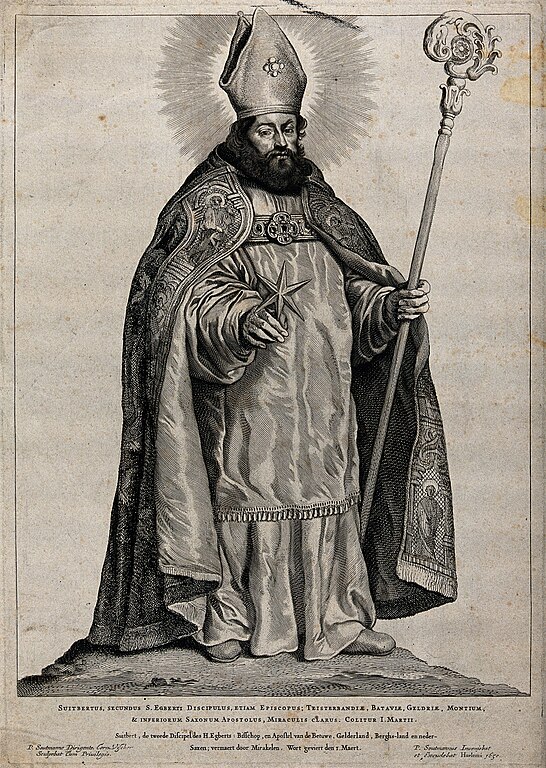
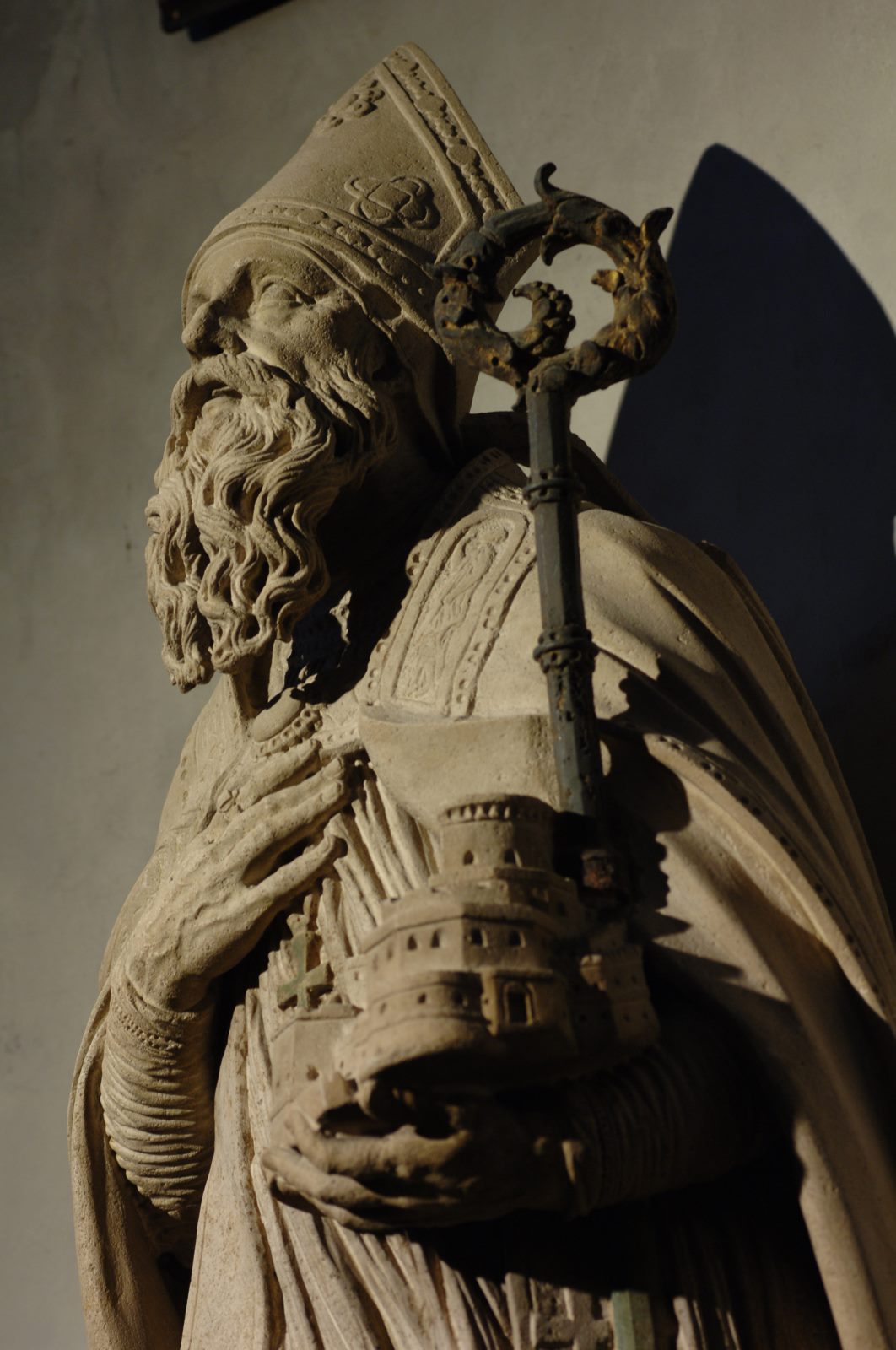
Saint of the Day – 1 March – Saint Swidbert (Died 713) Bishop, The Apostle of Friesland,

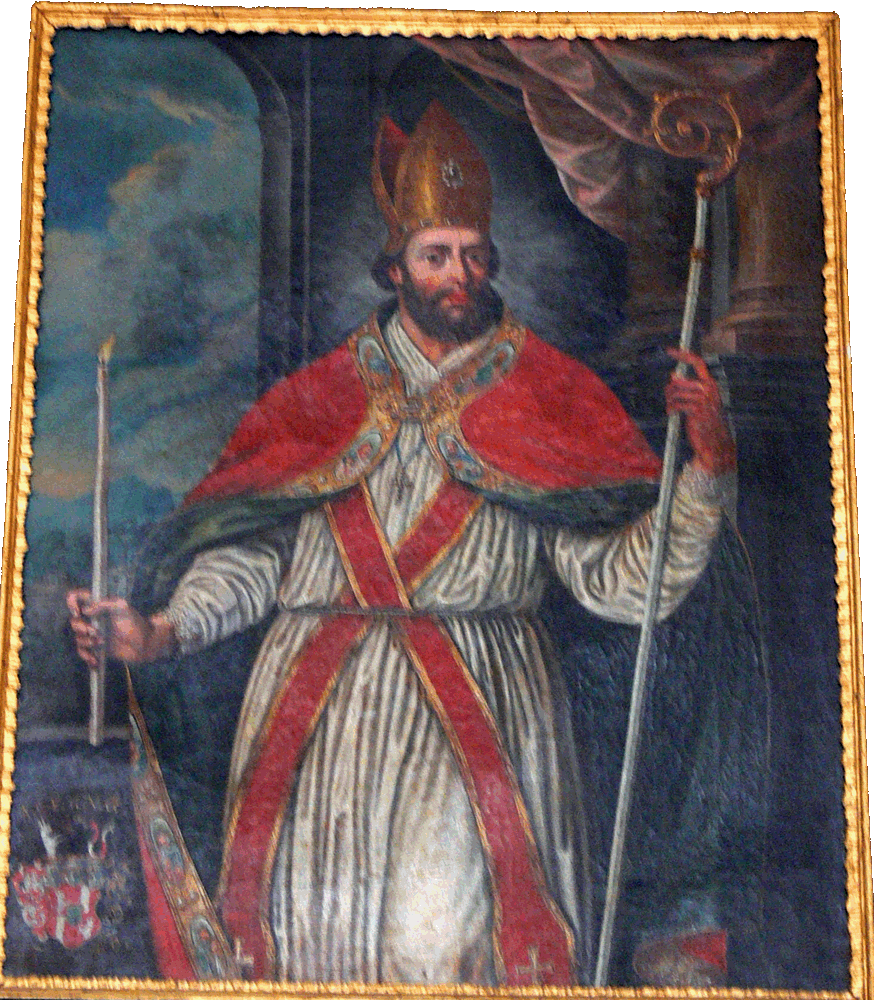
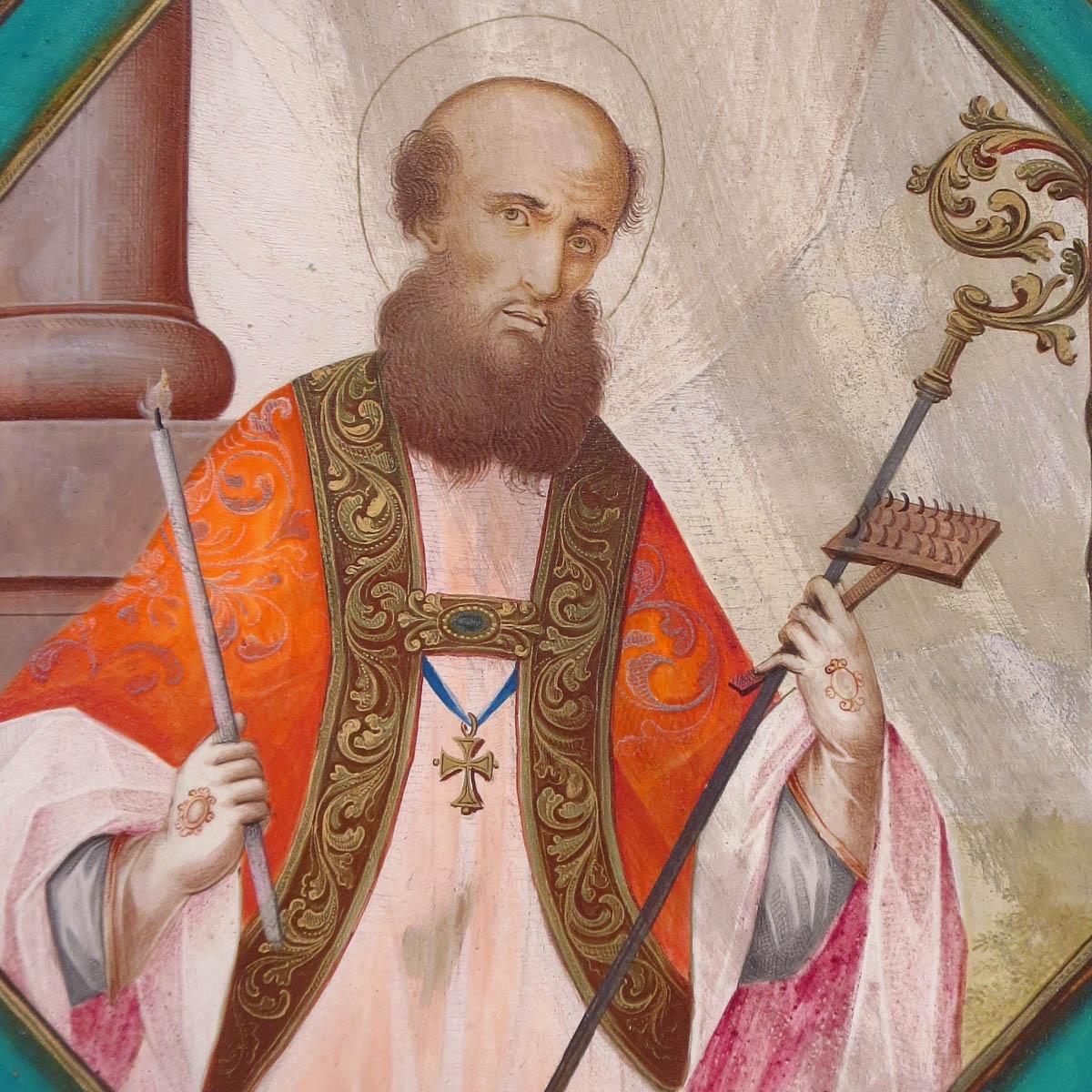
Saint of the Day – 1 March – Saint Swidbert (Died 713) Bishop, Missionary, Founder and Abbot of Kaiserswerth Monastery. Born in Northumbria, England and died on 1 March 713 in today’s Kaiserswerth near Düsseldorf in North Rhine-Westphalia. Patronages – of Germany, against sore throats, of Drevenack, Germany, of Friesland, Netherland, of Ripon, England. Also known as – … the Elder, Suitbert, Suidbert, Suitbertus, Swithbert, Apostle of Friesland, Apostle of the Bructeri. The Name from old High German means: “the strong shining one.

The Roman Martyrology reads today: “At Kaiserswerth, the Bishop, St Swidbert, who, in the time of Pope Sergius, preached the Gospel to the inhabitants of Friesland, Holland and to other Germanic peoples.

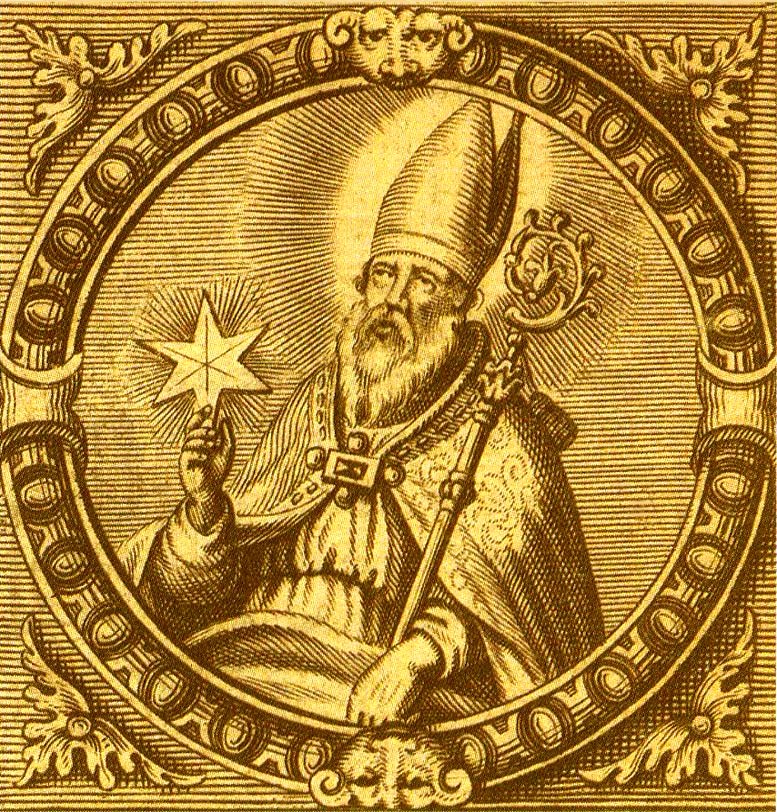
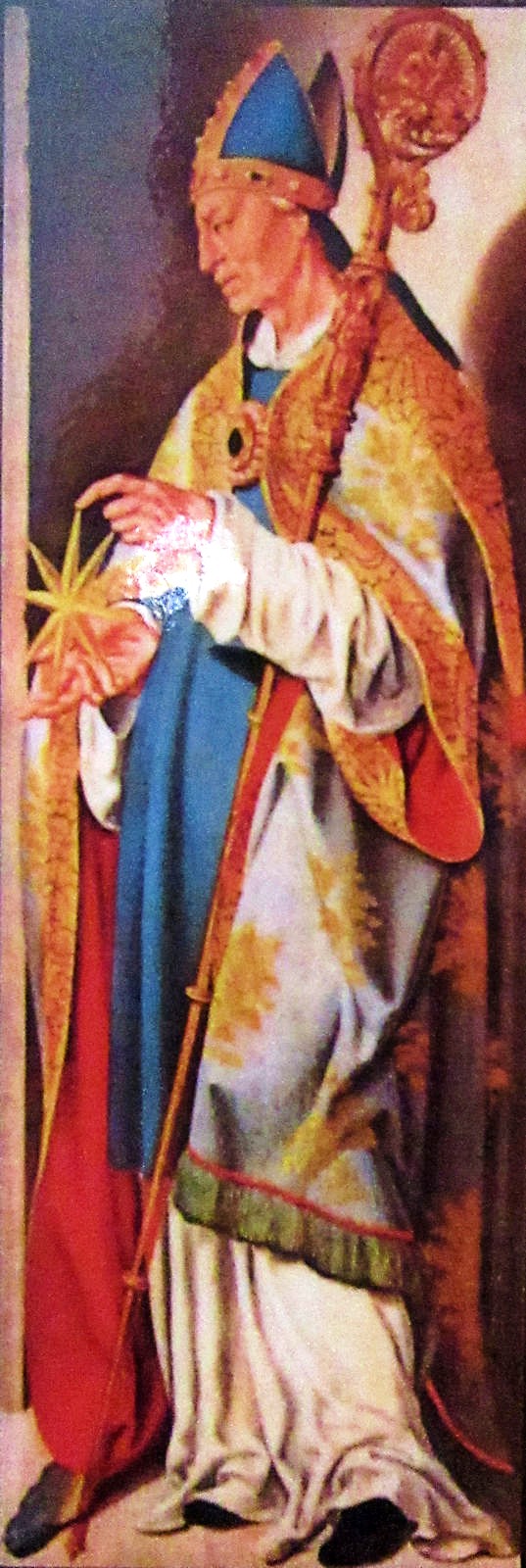
The tale of Swidbert’s birth which arose around 1500, tells how a star, sending out two rays, fell on his mother’s bed before his birth. Bishop St Aidan of Lindisfarne, interpreted her dream – the boy who was born would be called to work in two countries – Gaul and Germania.
Some traditions call Swidbert the son of Count Sigebert of Nottingham but he was most likely a Monk in the Monastery in Ripon under St Wilfrid of York. When St Wilfrid travelled to Rome in 678, Swidbert accompanied him and remained behind in Friesland on their return journey, as a missionary.

Another tradition reports that Swidbert left Ripon in 678 after Wilfrid’s departure and went to St Egbert in Rathmelsighe – today’s Mellifont – from wher, in 690, he was sent to southern Friesland together with twelve companions – including St Willibrord – as a Missionaries. In 692/693 his companions elected him as the Bishop, whereafter Swidbert returned to his homeland and was Ordained as a Missionary Bishop by St Wilfrid of York.

After another stay in Friesland, however, he then turned – as our wonderful Church Historian, the Venerable St Bede tells us – to missionary work in the area settled by the Bructeri on the Ruhr and Lippe. Swidbert’s work was unsuccessful – also because the invading Saxons destroyed his facilities. He now moved his activities to Frankish territory and in 695 founded the Benedictine Monastery of Swidbertswerth which was later named after him and later still, called Kaiserswerth and which, he headed as Abbot, on the Rhine island which had been given to him by the Mayor of the Merovingians, Pippin the Middle and his wife, Plektrudis

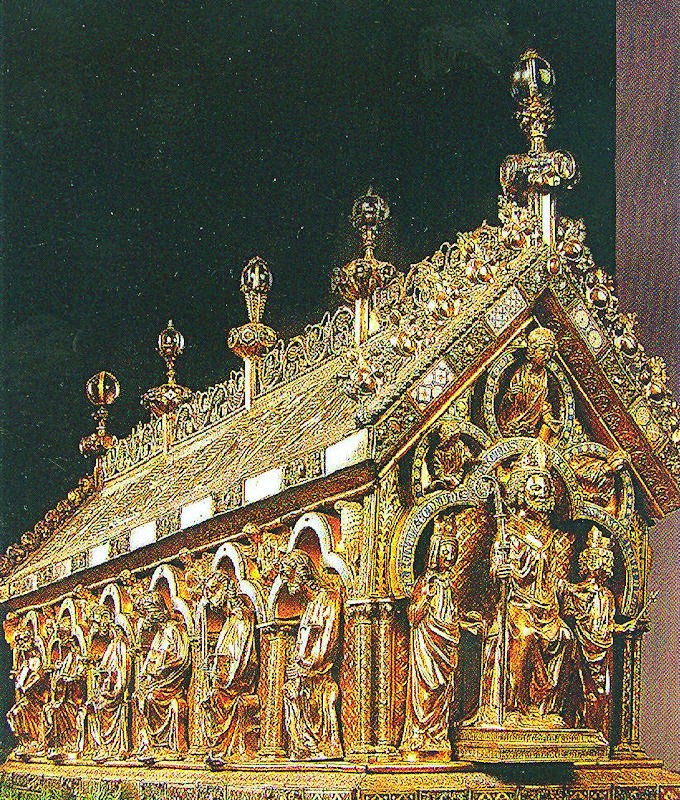
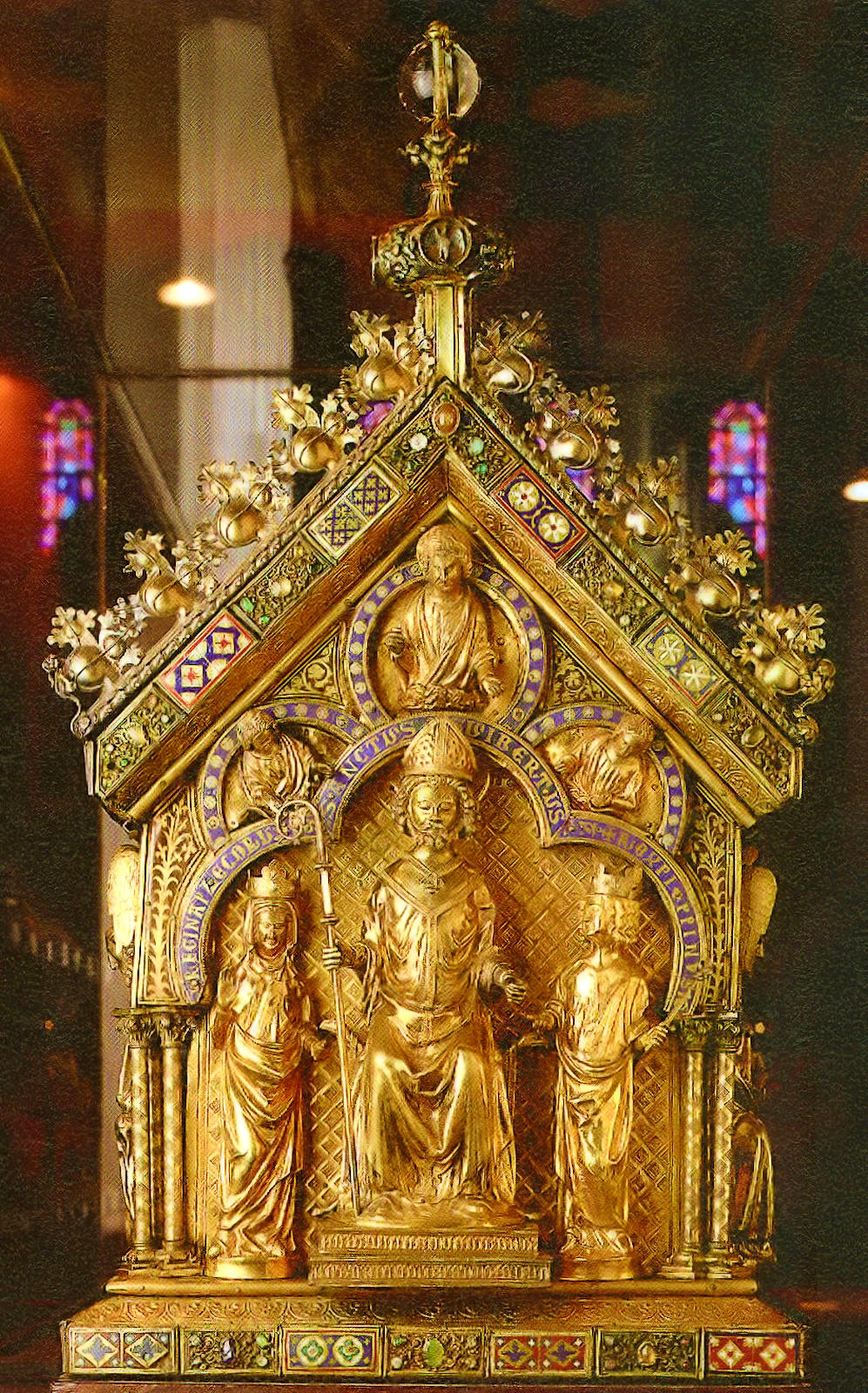
After his death, Swidbert was soon venerated as a Saint. In 877, the Church of his Monastery was dedicated, not only to Peter, as it had been from the beginning ,ut also to Swidbert. In 904, Swidbert was named as its sole Patron. His bones lie in a precious Shrine made between 1193 and 1332, in the collegiate Church in Kaiserswerth, where they were transferred in 1264, together with those of Abbot Wileich . Other Relics are kept in the Church of Peter and Paul in Duisburg-Süd.

The precious Shrine in the Church in Kaiserswerth,

Swidbert’s Benedictine Monastery was apparently destroyed during the Saxon invasions at the end of the 8th Century, but was soon rebuilt. In the 12th Century, the Rhine Island previously named after Swidbert, was given its new name Kaiserswerth because of the importance of the imperial palace built in 1045. After secularisation, the Church became a Parish Church.

The Rear gable wall of the Swidbertus Shrine with Swidbert (centre), Plektrudis (Pippin’s wife)(left) and Pippin the Middle (right), 1264, in the Collegiate Church in Kaiserswerth
Posted in Against SORE THROATS, COUGHS, WHOOPING COUGH,, DOCTORS, / SURGEONS / MIDWIVES., PATRONAGE - LUNG and RESPIRATORY illness, PATRONAGE - OEDEMA/DROPSY, PATRONAGE - POLICE, SOLDIERS, PRIESTS, all CLERGY, SAINT of the DAY

Saint of the Day – 31 October – Saint Quentin (Died c287) Martyr,

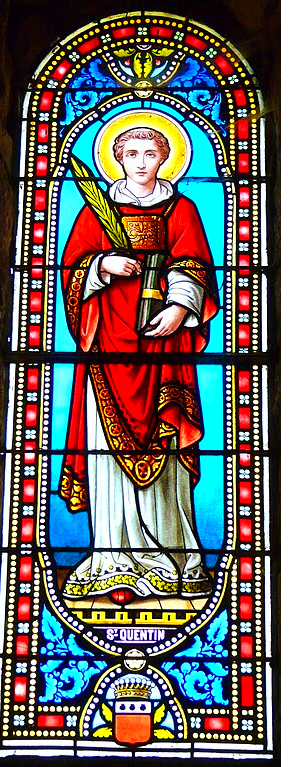
Saint of the Day – 31 October – Saint Quentin (Died c287) Martyr, Roman Senator, Missionary. Died in c287 after horrible torments he was finally beheaded. Patronages – against coughs, whooping courgh, colds, against dropsy, against sneezing, of bombardiers, of Chaplains, locksmiths, porters, surgeons, tailors, of Amiens in France, of Monticelli Terme in Italy. Also known as – Quentin of Vermand, Quentin of Amiens, Quinten… Quintin…Quintino… Quintinus… Additional Memorials – 24 June on some calendars, 3 January (discovery of his body), 25 October (translation of the body). In art Quentin is often depicted as a Deacon.

The Roman Martyrology reads today: “At Saint Quentin, in France, St Quintinus, a Roman citizen and Senator, who endured Martyrdom under the Emperor Maximian. By the revelation of an Angel, his body was found incorrupt after the lapse of 55 years.

Quentin belonged to a Roman senatorial family and came to Gaul under the Emperor Maximian to work with St Lucian who was later also Martyred near Beauvais in c290, as a missionary of faith in the area around Amiens.

The Life os St Quentin Unknown Dutch Master

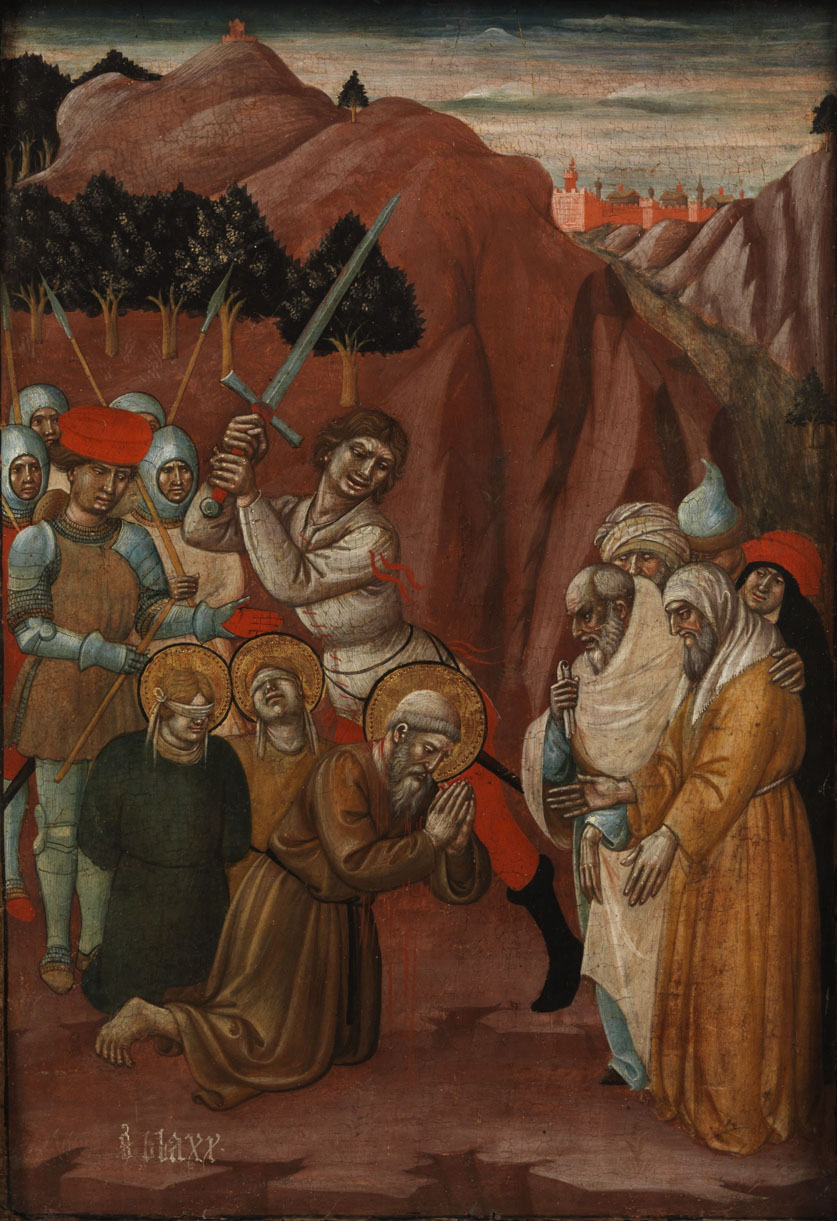
He was arrested in Vermand and finally beheaded near what is now St-Quentin. According to later tradition, he was pricked with nails, doused with hot pitch and his body thrown into the River Somme. Around 55 years later, the blind Roman noblewoman, Matron Eusebia had the body recovered from the Somme following a vision and buried in a Chapel she had built.

The Martyrdom of St Quentin – Unknown artist

According to St Gregory of Tours, Quentin was already being venerated in the 6th Century. Around 641, St Eligius of Noyon found the Relics and made a richly decorated Tomb (St Eligius being a renowned craftsman and goldsmith) – the first recorded story of the Passion of St Quentin dates from that time.

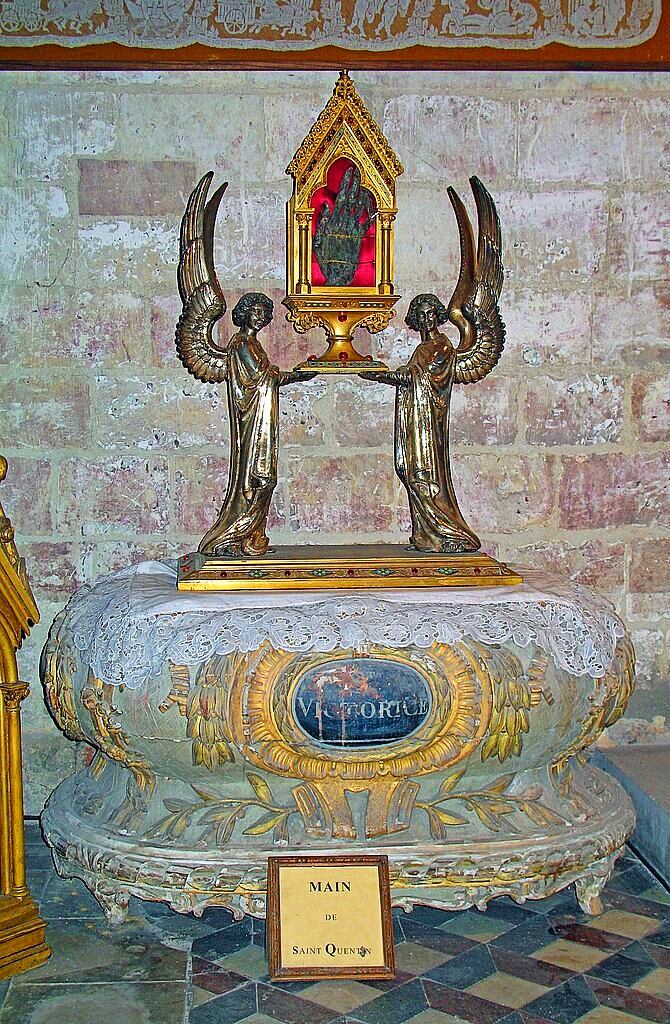
Due to the large stream of pilgrims to the Church dedicated to the Martyr , the Town of St-Quentin developed on this site. The Church, which was renovated between 813 and 826 and again in the 13th Century, contains Quentin’s Tomb and today is a very large Basilica and is still a place of pilgrimage and miracles, so much so, that a new Church, the current Basilica, had to be erected to accommodate the faithful. The Processional Bust and Reliquary below might be that crafted by St Eligius (?).

St Quentin’s Relics in the Basilica at St Quentin

In 881, because of the Norman invasions, the Relics were taken to Laon. In Parma, the Church of San Quintino is dedicated to our Saint which dates to an old Oratory which was built outside the City walls.

the processional Religuary of St Quentin kept in the Basilica

The Martyrs Sts Victoricus and Fuscian were St Quentin’s followers.

 
Basilica of St-Quentin in St-Quentin
Posted in Against SORE THROATS, COUGHS, WHOOPING COUGH,, Of the SICK, the INFIRM, All ILLNESS, SAINT of the DAY

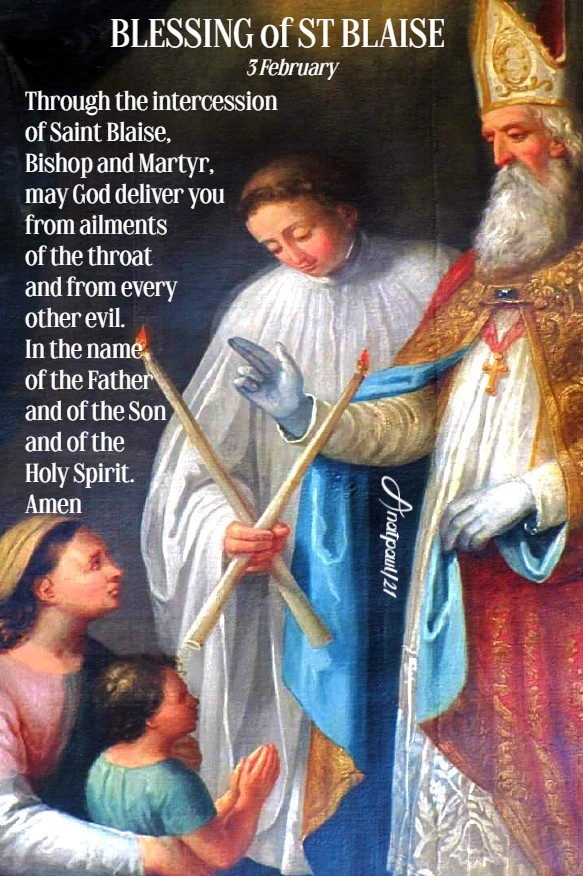
Quote of the Day – 3 February – The Blessing of St Blaise

Quote of the Day – 3 February – St Blaise (Died c316) Martyr Bishop, Physician, Miracle-worker

The Blessing of the Throats is a Sacramental of the Church, ordinarily celebrated today, the Feast day of Saint Blaise.

THE BLESSING of ST BLAISE
Through the intercession
of Saint Blaise,
Bishop and Martyr,
may God deliver you
from ailments of the throat
and from every other evil.
In the name of the Father
and of the Son
and of the Holy Spirit.
Amen

Posted in Against SORE THROATS, COUGHS, WHOOPING COUGH,, FEASTS and SOLEMNITIES, Of FISHERMEN, FISHMONGERS, Of MUSICIANS, Choristors, Of the SICK, the INFIRM, All ILLNESS, PREGNANCY, SAINT of the DAY, The APOSTLES & EVANGELISTS

Feast of St Andrew, Apostle of Christ, Martyr – 30 November

Feast of St Andrew, Apostle of Christ, Martyr – 30 November

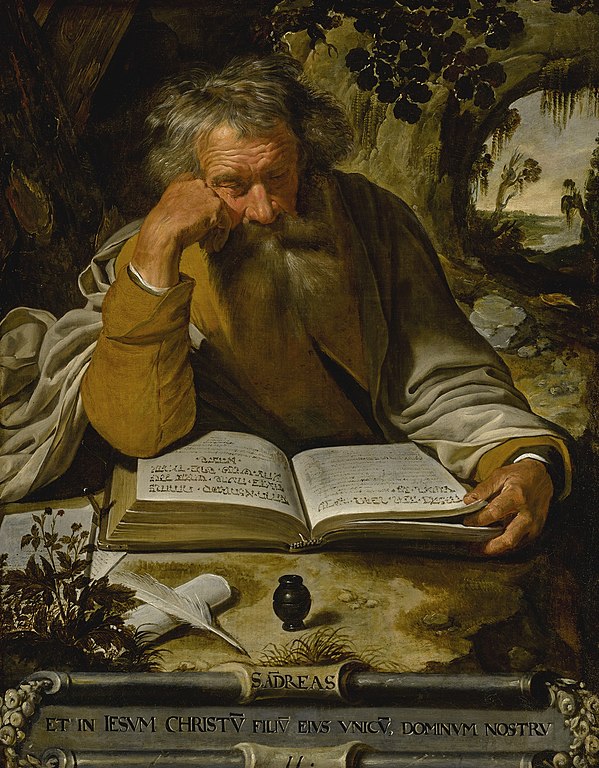
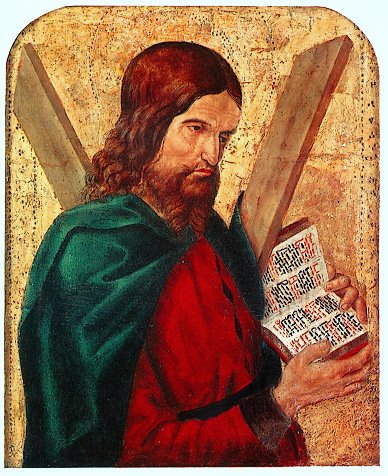
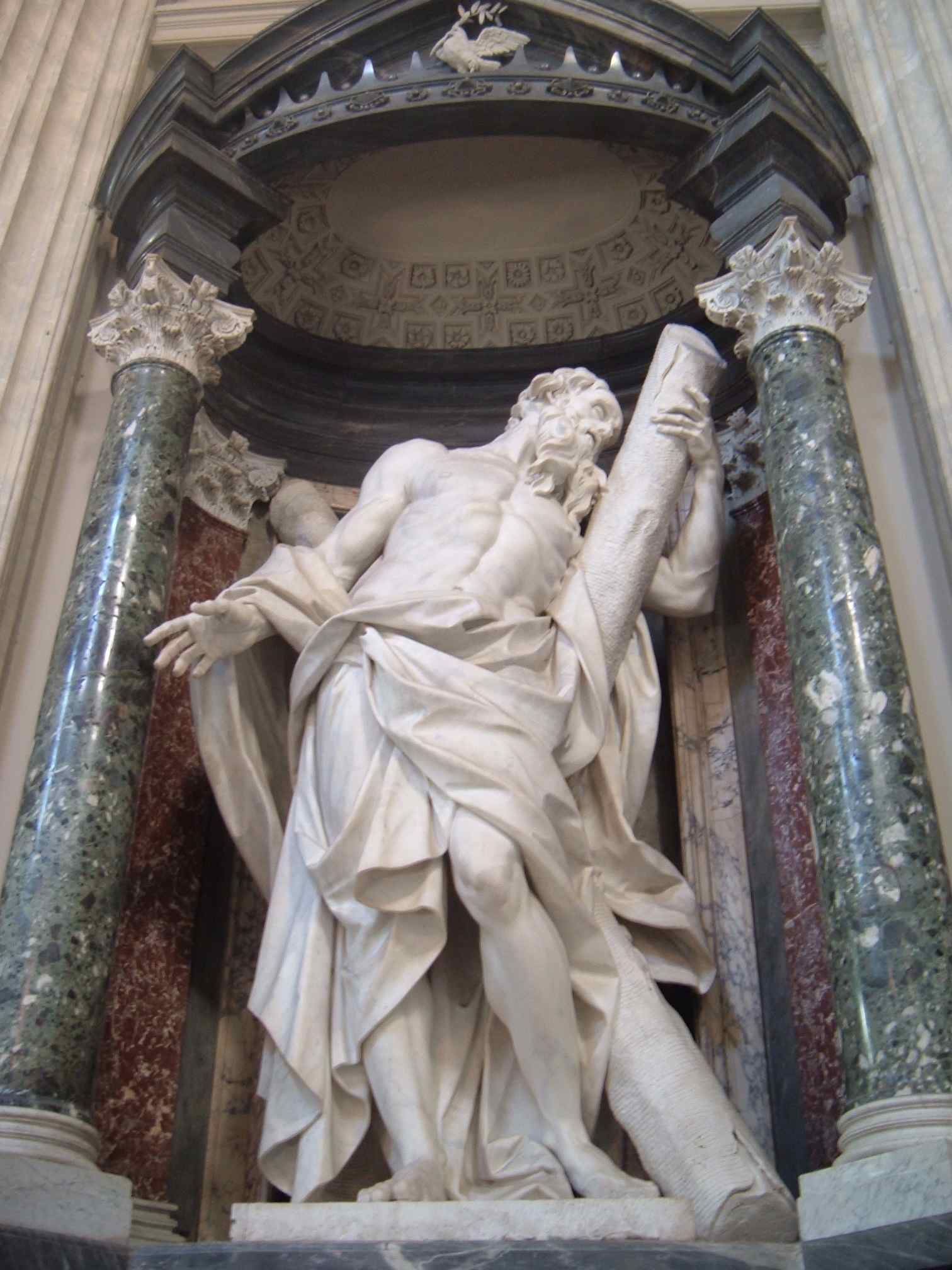
Saint Andrew was the brother of the Apostle Peter and like his brother was born in Bethsaida of Galilee (where the Apostle Philip was also born).   While his brother would eventually overshadow him as the first among the apostles, it was Saint Andrew, a fisherman like Peter, who (according to the Gospel of John) introduced Saint Peter to Christ.saint-andrew-the-apostle-nicolas-tournier (1).jpg

St Andrew was a fisherman who lived in Galilee during the time of Jesus.   He followed John the Baptist and listened to his teachings.   One day, John saw Jesus walking along the road.   John said to his followers, “Behold the Lamb of God.”   He told his followers to go and talk to Jesus.   He wanted them to know that Jesus was the One for whom they had been waiting.   Andrew and another disciple followed Jesus and spent an afternoon with him.   Early the next day Andrew found Simon Peter, his brother and told him, “We have found the Messiah.”

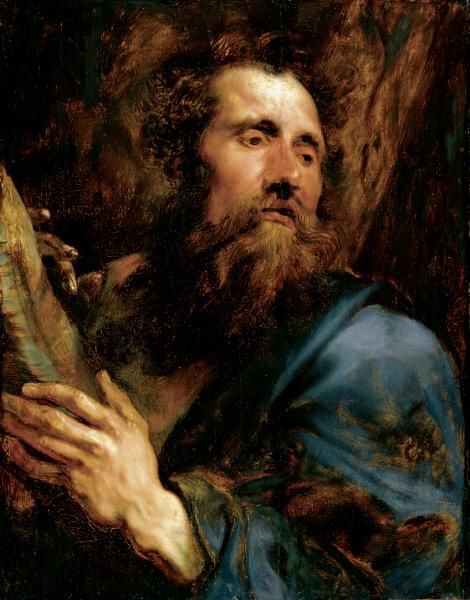
Both men gave up their work as fishermen to become apostles of Jesus.   Andrew was one of the first to be called.   He seemed to take delight in bringing others to Jesus. Saint-Andrew-Anthony-van-Dyck-Oil-Painting.jpg

Andrew was the one who told Jesus about the little boy who had the loaves of bread and the fish, the beginning of a meal that fed more than five thousand people.

It was Andrew and Philip whom the Greeks approached when they wanted to see Jesus. These events indicate that Andrew was a man who was easy to approach, a man you could trust.599px-Artus_Wolffort_-_St_Andrew_-_WGA25857.jpg

Like the other apostles, Andrew became a missionary.   He preached about Jesus in the area around the Black Sea.   Tradition tells us he preached in northern Greece, Turkey and Scythia (now the southern part of Russia).

Tradition places Saint Andrew’s martyrdom on 30 November of the year 60 (during the persecution of Nero) in the Greek city of Patras.   A medieval traditional also holds that, like his brother Peter, he did not regard himself as worthy of being crucified in the same manner as Christ and so he was placed on an X-shaped cross, now known (especially in heraldry and flags) as a Saint Andrew’s Cross.   The Roman governor ordered him bound to the cross rather than nailed, to make the crucifixion and thus Andrew’s agony, last longer.576px-The_Crucifixion_of_Saint_Andrew-Caravaggio_(1607)

Because of his patronage of Constantinople, Saint Andrew’s relics were transferred there around the year 357.   Tradition holds that some relics of Saint Andrew were taken to Scotland in the eighth century, to the place where the town of S. Andrews stands today.  In the wake of the Sack of Constantinople during the Fourth Crusade, the remaining relics were brought to the Cathedral of Saint Andrew in Amalfi, Italy.  In 1964, in an attempt to strengthen relations with the Ecumenical Patriarch in Constantinople, Pope Paul VI returned all relics of Saint Andrew that were then in Rome to the Greek Orthodox Church.

Every year since then, the Pope has sent delegates to Constantinople for the feast of Saint Andrew (and, in November 2007, Pope Benedict himself went), just as the Ecumenical Patriarch sends representatives to Rome for the 29 June feast of Saints Peter and Paul (and, in 2008, went himself).   Thus, like his brother Saint Peter, Saint Andrew is in a way a symbol of the striving for Christian unity.st andrew apostle interesting

St Andrew’s Feast takes pride of place in the Liturgical Calendar, for in the Roman Catholic calendar, the liturgical year begins with Advent and the First Sunday of Advent is always the Sunday closest to the Feast of Saint Andrew.  Though Advent can begin as late as 3 December, Saint Andrew’s feast, today is traditionally listed as the first Saint’s day of the liturgical year, even when the First Sunday of Advent falls after it—an honour commensurate with Saint Andrew’s place among the apostles   The tradition of praying the Saint Andrew Christmas Novena 15 times each day from the Feast of Saint Andrew until Christmas flows from this arrangement of the calendar.

This slideshow requires JavaScript.

The name “Andrew” is a Greek name meaning “courageous” or “manly.”   St Andrew lived up to his name.

St Andrew, pray that we live up to the name “Christian”!

St Andrew’s Patronages are here:
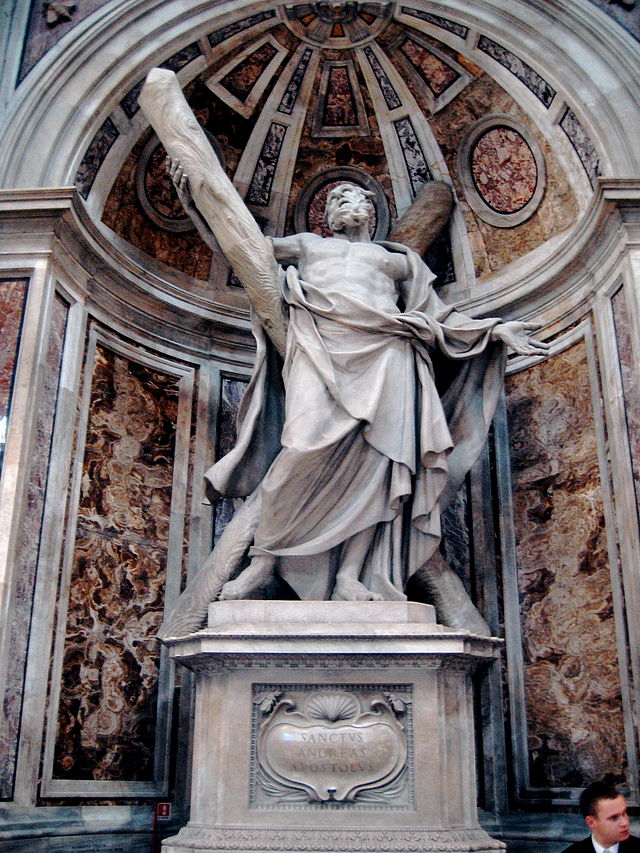
https://anastpaul.com/2018/11/30/saint-of-the-day-30-november-st-andrew-apostle-of-christ-martyr/St-Andrew vatican statuest andrew apostle statue snip

Posted in Against SORE THROATS, COUGHS, WHOOPING COUGH,, FEASTS and SOLEMNITIES, Of FISHERMEN, FISHMONGERS, Of MUSICIANS, Choristors, Of the SICK, the INFIRM, All ILLNESS, ON the SAINTS, PAPAL SERMONS, PREGNANCY, SAINT of the DAY, The APOSTLES & EVANGELISTS

Saint of the Day – 30 November – St Andrew, Apostle of Christ, Martyr

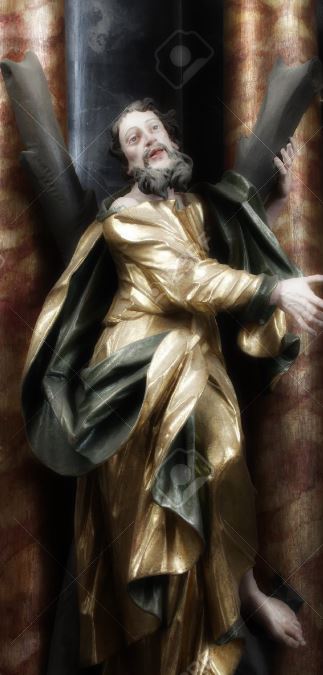
Saint of the Day – 30 November – St Andrew, Apostle of Christ, Martyr – Called the “First Called ” – born at Bethsaida, Galilee and was Martyred by crucifixion on a saltire (x-shaped) cross in Patras Greece (around the year 62) – Patronages:  fishermen, fishmongers and rope-makers, textile workers, singers, miners, pregnant women, butchers, farm workers, protection against sore throats, protection against convulsions, protection against fever, protection against whooping cough, Scotland, Barbados, Georgia, Ukraine, Russia, Sicily, Greece, Cyprus, Romania, Patras, Burgundy, San Andrés (Tenerife), Diocese of Parañaque, Telhado, Amalfi, Luqa (Malta) and Prussia; Diocese of Victoria.ANDREW - GLASS maxresdefault
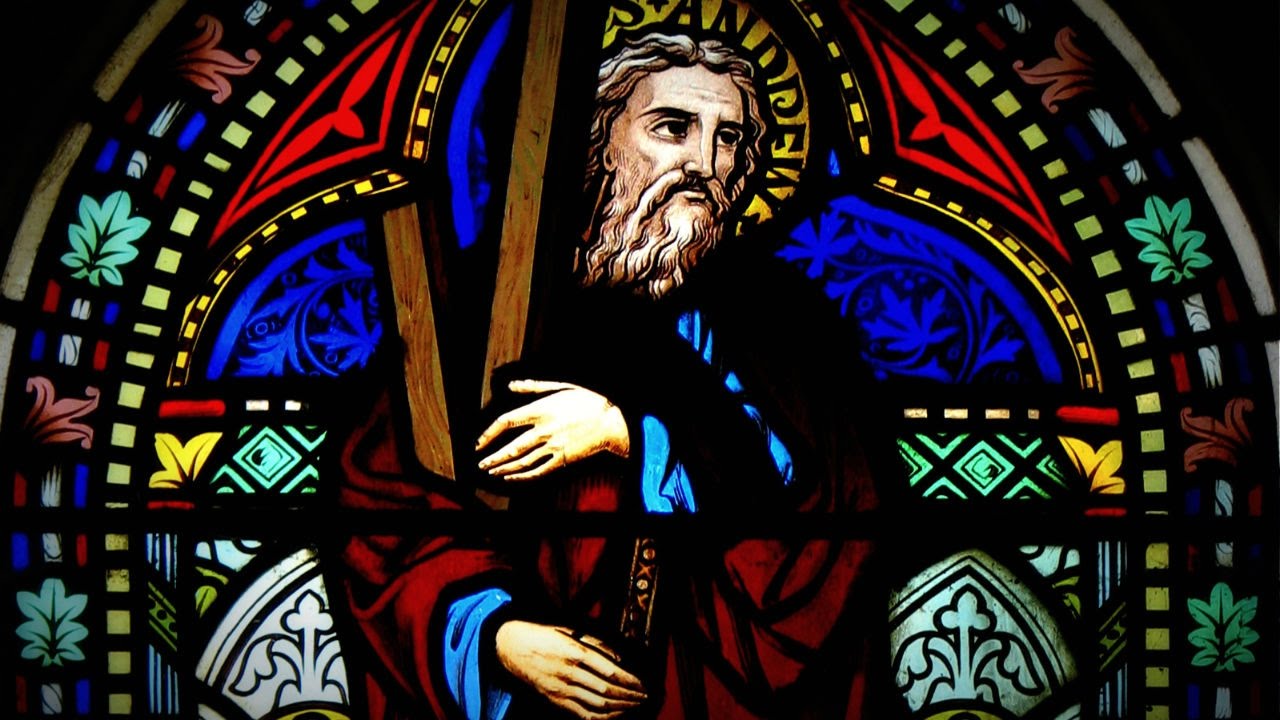
The first striking characteristic of Andrew is his name – it is not Hebrew, as might have been expected but Greek, indicative of a certain cultural openness in his family that cannot be ignored.   We are in Galilee, where the Greek language and culture are quite present.   Andrew comes second in the list of the Twelve, as in Matthew (10: 1-4) and in Luke (6: 13-16); or fourth, as in Mark (3: 13-18) and in the Acts (1: 13-14).   In any case, he certainly enjoyed great prestige within the early Christian communities.   The kinship between Peter and Andrew, as well as the joint call that Jesus addressed to them, are explicitly mentioned in the Gospels.   We read:  “As he walked by the Sea of Galilee, he saw two brothers, Simon who is called Peter and Andrew his brother, casting a net into the sea; for they were fishermen.   And he said to them, “Follow me and I will make you fishers of men'” (Mt 4: 18-19; Mk 1: 16-17).

From the Fourth Gospel we know another important detail:  Andrew had previously been a disciple of John the Baptist and this shows us that he was a man who was searching, who shared in Israel’s hope, who wanted to know better the word of the Lord, the presence of the Lord.   He was truly a man of faith and hope and one day he heard John the Baptist proclaiming Jesus as, “the Lamb of God” (Jn 1: 36), so he was stirred and with another unnamed disciple followed Jesus, the one whom John had called “the Lamb of God”.   The Evangelist says that “they saw where he was staying and they stayed with him that day…” (Jn 1: 37-39).   Thus, Andrew enjoyed precious moments of intimacy with Jesus.   The account continues with one important annotation:  “One of the two who heard John speak and followed him, was Andrew, Simon Peter’s brother.   He first found his brother Simon and said to him, “We have found the Messiah’ (which means Christ). He brought him to Jesus” (Jn 1: 40-43), straightaway showing an unusual apostolic spirit.

Andrew, then, was the first of the Apostles to be called to follow Jesus.   Exactly for this reason the liturgy of the Byzantine Church honours him with the nickname: “Protokletos”, [protoclete] which means, precisely, “the first called”.Sant_Andrea_S
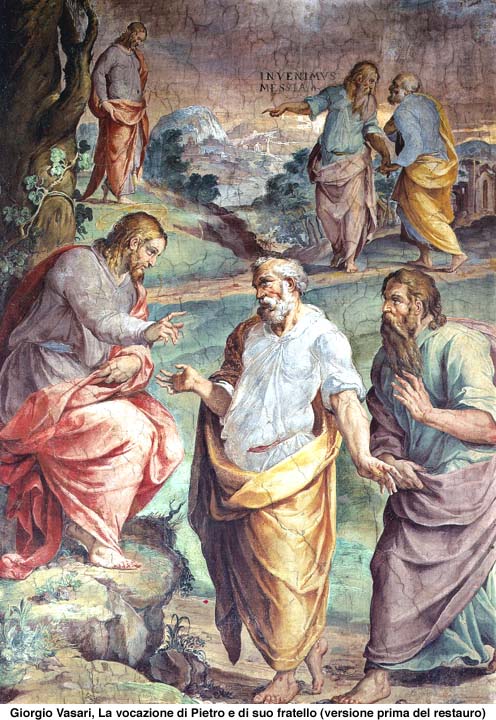
The Gospel traditions mention Andrew’s name in particular on another three occasions that tell us something more about this man.   The first is that of the multiplication of the loaves in Galilee. On that occasion, it was Andrew who pointed out to Jesus the presence of a young boy who had with him five barley loaves and two fish, not much, he remarked, for the multitudes who had gathered in that place (cf. Jn 6: 8-9). In this case, it is worth highlighting Andrew’s realism.   He noticed the boy, that is, he had already asked the question: “but what good is that for so many?” (ibid) and recognised the insufficiency of his minimal resources.   Jesus, however, knew how to make them sufficient for the multitude of people who had come to hear Him.

The second occasion was at Jerusalem.   As He left the city, a disciple drew Jesus’ attention to the sight of the massive walls that supported the Temple.   The Teacher’s response was surprising:  He said that of those walls not one stone would be left upon another.   Then Andrew, together with Peter, James and John, questionedHhim: “Tell us, when will this be, and what will be the sign when these things are all to be accomplished?” (Mk 13: 1-4). In answer to this question Jesus gave an important discourse on the destruction of Jerusalem and on the end of the world, in which He asked His disciples to be wise in interpreting the signs of the times and to be constantly on their guard.   From this event we can deduce that we should not be afraid to ask Jesus questions but at the same time that we must be ready to accept even the surprising and difficult teachings that He offers us.andrew snip
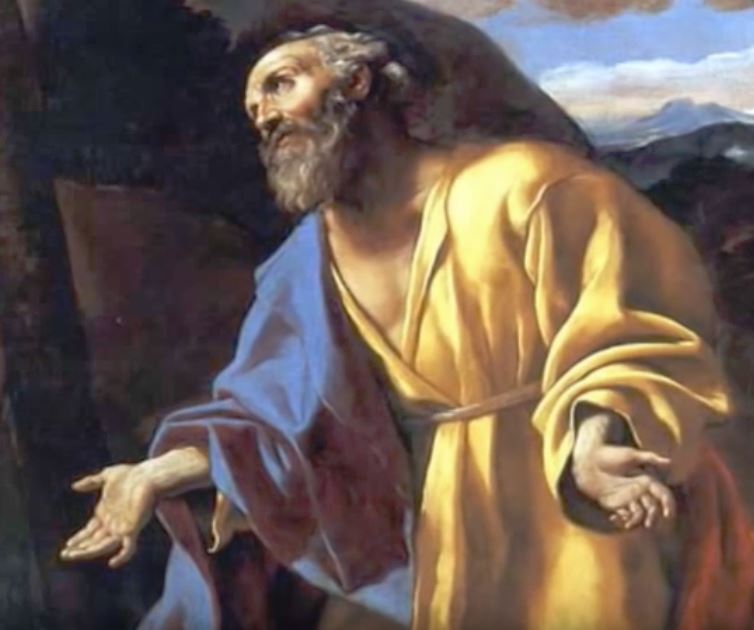
Lastly, a third initiative of Andrew is recorded in the Gospels:  the scene is still Jerusalem, shortly before the Passion.   For the Feast of the Passover, John recounts, some Greeks had come to the city, probably proselytes or God-fearing men who had come up to worship the God of Israel at the Passover Feast.   Andrew and Philip, the two Apostles with Greek names, served as interpreters and mediators of this small group of Greeks with Jesus.   The Lord’s answer to their question – as so often in John’s Gospel – appears enigmatic but precisely in this way proves full of meaning.   Jesus said to the two disciples and, through them, to the Greek world:  “The hour has come for the Son of man to be glorified.   I solemnly assure you, unless a grain of wheat falls to the earth and dies, it remains just a grain of wheat but if it dies, it produces much fruit” (12: 23-24). Jesus wants to say:  Yes, my meeting with the Greeks will take place but not as a simple, brief conversation between myself and a few others, motivated above all by curiosity.   The hour of my glorification will come with my death, which can be compared with the falling into the earth of a grain of wheat.   My death on the Cross will bring forth great fruitfulness, in the Resurrection the “dead grain of wheat” – a symbol of myself crucified – will become the bread of life for the world, it will be a light for the peoples and cultures. Yes, the encounter with the Greek soul, with the Greek world, will be achieved in that profundity to which the grain of wheat refers, which attracts to itself the forces of heaven and earth and becomes bread. In other words, Jesus was prophesying about the Church of the Greeks, the Church of the pagans, the Church of the world, as a fruit of His Pasch.

Some very ancient traditions not only see Andrew, who communicated these words to the Greeks, as the interpreter of some Greeks at the meeting with Jesus recalled here but consider him the Apostle to the Greeks in the years subsequent to Pentecost.   They enable us to know that for the rest of his life he was the preacher and interpreter of Jesus for the Greek world.ANDREW ICON
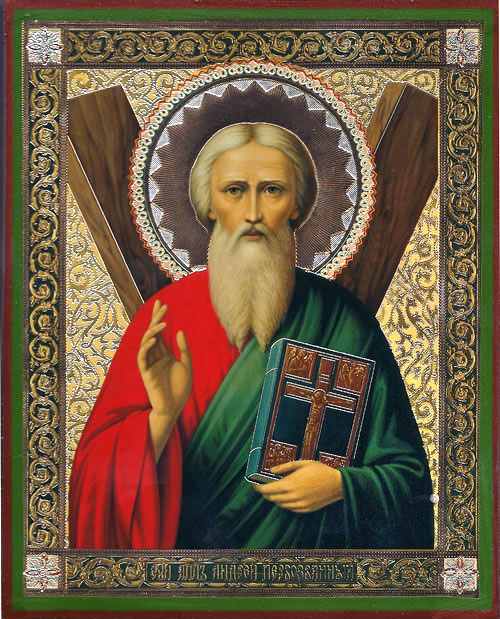
Peter, his brother, travelled from Jerusalem through Antioch and reached Rome to exercise his universal mission, Andrew, instead, was the Apostle of the Greek world.   So it is that in life and in death they appear as true brothers – a brotherhood that is symbolically expressed in the special reciprocal relations of the See of Rome and of Constantinople, which are truly Sister Churches.

A later tradition, as has been mentioned, tells of Andrew’s death at Patras, where he too suffered the torture of crucifixion.   At that supreme moment, however, like his brother Peter, he asked to be nailed to a cross different from the Cross of Jesus.   In his case it was a diagonal or X-shaped cross, which has thus come to be known as “St Andrew’s cross”….Pope Benedict XVI – 14 June 2006

Mattia_Preti_-_The_crucifixion_of_St_Andrew_-_Google_Art_Project-Public-Domain-Image

Andrew is the patron saint of several countries and cities and is the patron saint of Prussia and of the Order of the Golden Fleece.  He is considered the founder and the first bishop of the Church of Byzantium and is consequently the patron saint of the Ecumenical Patriarchate of Constantinople.   The flag of Scotland (and consequently the Union Flag and those of some of the former colonies of the British Empire) feature Saint Andrew’s saltire cross. The saltire is also the flag of Tenerife, the former flag of Galicia and the Russian Navy Ensign.

The feast of Andrew is observed on 30 November in both the Eastern and Western churches and is the national day of Scotland.   In the traditional liturgical books of the Catholic Church, the feast of Saint Andrew is the first feast day in the Proper of Saints.VATICAN - ANDREW STATUE -640px-Saint_Andreas
Posted in Against SNAKE BITES / POISON, Against SORE THROATS, COUGHS, WHOOPING COUGH,, Against STORMS, EARTHQUAKES, THUNDER & LIGHTENING, FIRES, DROUGHT / NATURAL DISASTERS, Of BUILDERS, CONSTRUCTION WORKERS, Of the SICK, the INFIRM, All ILLNESS, PATRONAGE - HEADACHES, PATRONAGE - ORPHANS,ABANDONED CHILDREN, PATRONAGE - TOOTHACHE and Diseases of the TEETH,, of DENTISTS, SAINT of the DAY, SKIN DISEASES, RASHES, STOMACH DISEASES and PAIN, INTESTINAL DISORDERS, Thomas a Kempis, Uncategorized

Saint of the Day – 3 February – St Blaise (Died c 316) – Martyr

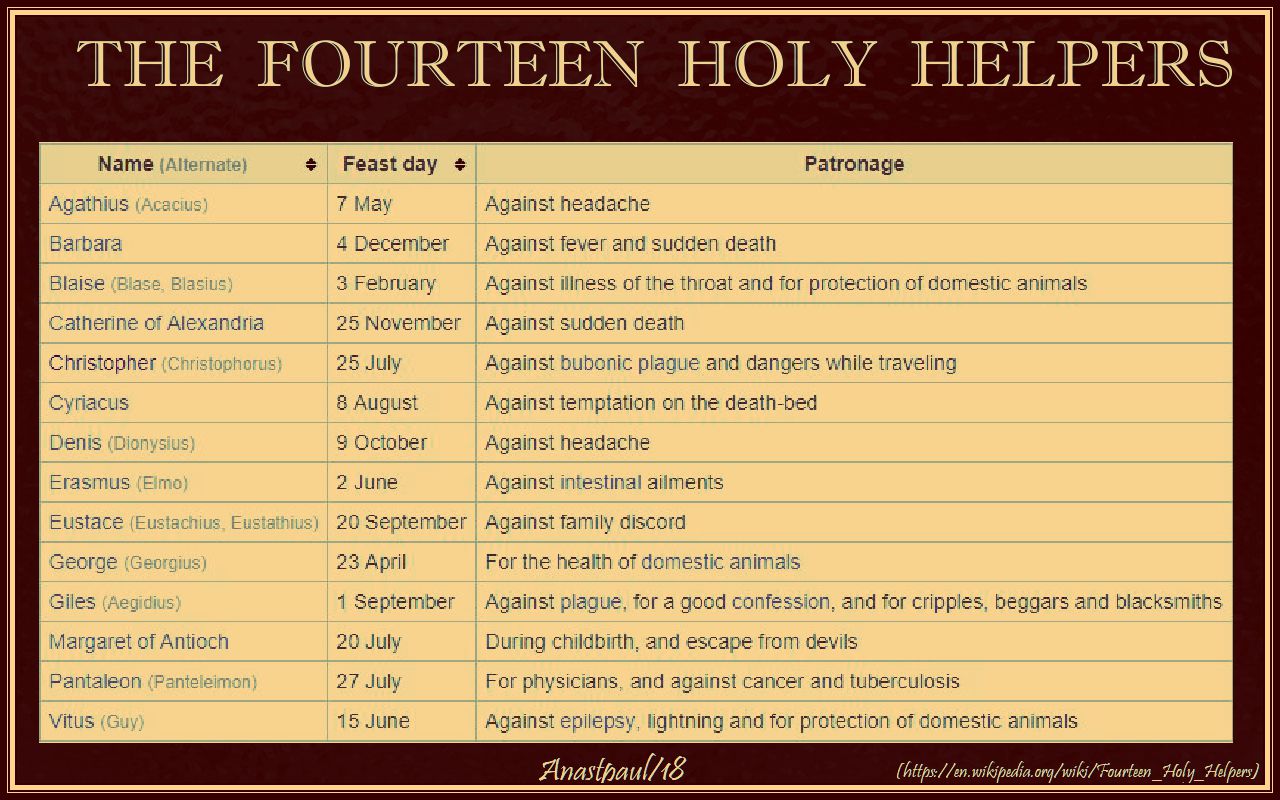
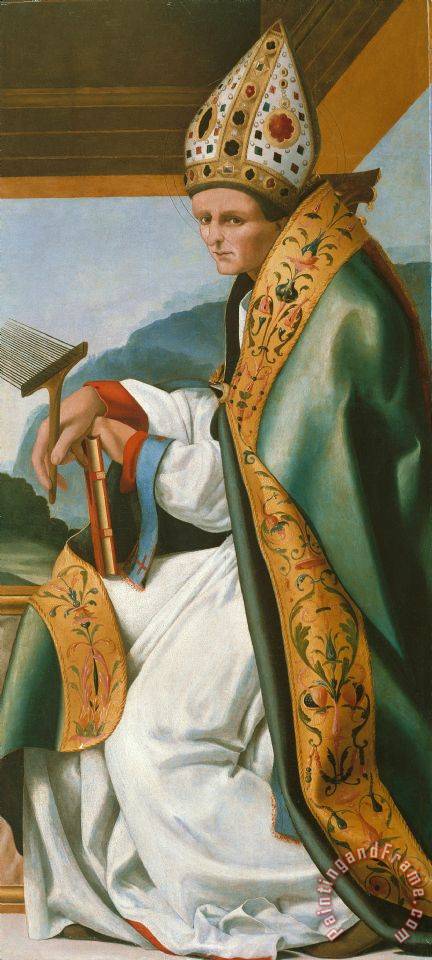
Saint of the Day – 3 February – St Blaise (Died c 316) – Martyr, Bishop of Sebaste, Armenia, Physician, Miracle-worker.   Died in c 316 by his flesh being torn off his body by iron wool-combs, then beheaded.  Patronages – against angina • against bladder diseases • against blisters • against coughs • against dermatitis • against dropsy • against eczema • against edema • against fever • against goitres • against headaches • against impetigo • against respiratory diseases • against skin diseases • against snake bites • against sore throats • against stomach pain • against storms • against teething pain • against throat diseases • against toothaches • against ulcers • against whooping cough • against wild beasts • angina sufferers of ; of children, animals, builders, drapers, against choking, veterinarians, infants, of 21 Cities, of stonecutters, carvers, wool workers. St Blaise is one of the Fourteen Holy Helpers – https://anastpaul.com/2018/07/25/thought-for-the-day-25-july-the-memorial-of-st-christopher-died-c-251-one-of-the-fourteen-holy-helpers/
Today the Church remembers the life and witness of Saint Blaise, a 3rd century Armenian bishop who endured terrifying torments and surrendered his life rather than repudiate his profession of Faith.st blaise statue - large

Much of the life of Saint Blaise is history that has passed into legend but even these legendary accounts offer spiritual insight.
Blaise was renowned as a wonderworker, effecting miraculous cures. T  his would have been enough to attract attention but he was also not averse to calling out the Roman officials who ruled the region in which he lived, Cappadocia, for their tyranny and intolerance of Christian faith and practice.   The combination of a reputation for supernatural power and the courage of his convictions was not welcomed by Rome and the governor ordered Bishop Blaise to be arrested.   Blaise was able to elude capture and took refuge in the wilderness.   It was there in the caves of Cappadocia that his ministry and his mission continued.

There is an account of Saint Blaise that identifies not only his pastoral care for the Christian faithful but also for the animals of the wilderness.

A woman had witnessed her piglet carried off by a wolf and spoke of her plight to the bishop.   Saint Blaise called for the wolf, demanded her return the piglet to its rightful owner and reminded the wolf of the grave penalty that awaited a thief.   The wolf complied and returned the piglet to its owner- a credit to the bishop’s power of persuasion.   The woman would later return the favour to Saint Blaise when he was finally captured and imprisoned.   She brought to him candles to illuminate his dank and dreary cell.

This legend hints at how the saints represent, in their holiness, the restoration of a paradise lost and regained in Christ.   The ease and familiarity with which the Biblical character of Adam is believed to have communed with nature before the fall is recapitulated in Saint Blaise- he is a sign that anticipates the restoration of all things in Christ where the lion will rest with the lamb and in this case, the wolf will return stolen property to its rightful owner.

Saint Blaise Painting by Pere Fernandez; Saint Blaise Art Print for sale

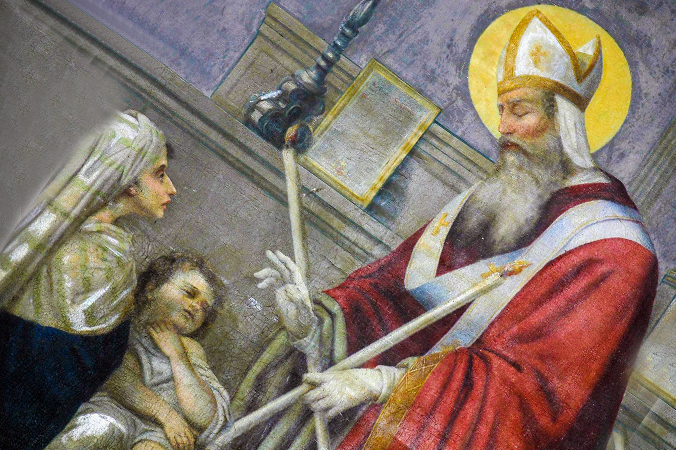
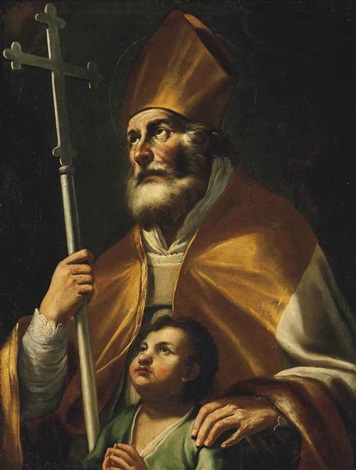
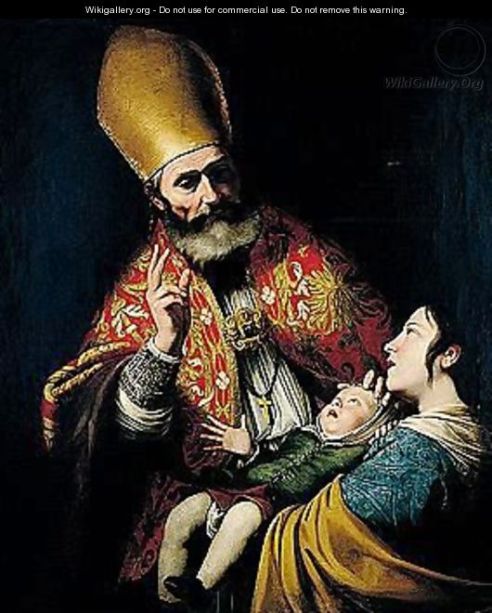
Saint Blaise has been invoked for centuries as a specialist in diseases of the throat.   The origin of this practice might be in the story of a child brought to the saint who was either choking or suffering from some other malady of the throat.   Saint Blaise blessed the boy and he was restored to health.

The practice of blessing throats on the Feast of Saint Blaise is a commemoration of this miracle, that crossed candles are often used to impart this blessing might also be a recollection of the kindness of the woman who gave candles to the saint as he languished in prison.

Saint Blaise was an extraordinarily popular saint during the Middle Ages in Europe. Presentations of his miraculous and mighty deeds were commonly represented in art and sculpture, and he was included in a listing of saints called the Fourteen Holy Helpers (or Auxiliary Saints), holy men and women who could be counted on as intercessors for all manner of maladies from madness to travelers in distress.   During times in which a sore throat could be a signal of an impending epidemic or an early death, the faithful were all too happy to accept the help of a heavenly specialist in such matters like Saint Blaise.

The legends regarding Saint Blaise report that his sojourn in the wilderness did not protect him for very long.   He was eventually arrested and brought to trial.   The judge advised him that only a pinch of incense offered to the image of Caesar and the gods of Rome could win him his freedom.   Blaise refused.   He was cruelly tortured and beheaded. Giovanni Antonio da Pesaro, St. Blaise Martyrdom, 15th cent.

The Church does not mourn Saint Blaise, for we know that in Christ this world is not all that there is.   While tyrants like Caesar and his successors can threaten us with death, Christ promises us a life that like his own, is transformed through suffering and death, into resurrection.

The scriptures proclaim, “though they slay me I will trust in you.”

Saint Blaise did precisely this.   He trusted that Christ would not abandon him to the power of death nor allow his suffering to be meaningless.   Our lives might never be raised to the legendary status of Saint Blaise but we can trust in Christ as he did and live in hope that one day we will join him in communion with all the saints who have gone before us in faith and who, from their place in heaven, guide and protect us still. (Fr Steve Grunow)blaiseCandlelarge - st blaise

Posted in Against SORE THROATS, COUGHS, WHOOPING COUGH,, FATHERS of the Church, SAINT of the DAY

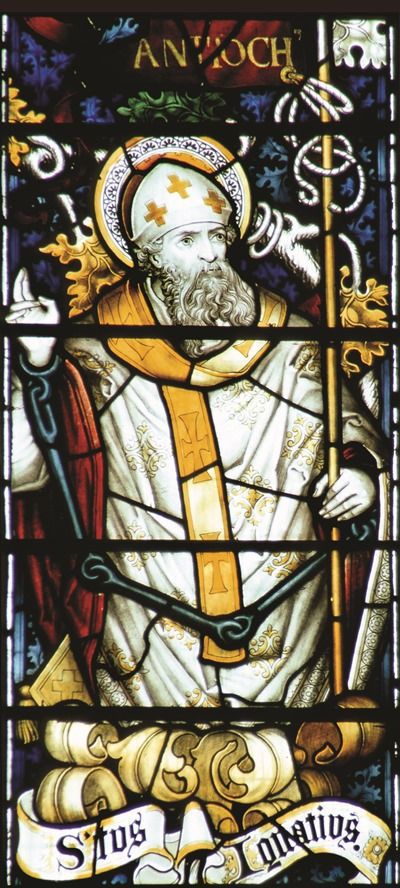
Saint of the Day – 17 October – St Ignatius of Antioch (c 35 – c 108) Martyr,Bishop, Martyr, Apostolic Father of the Church

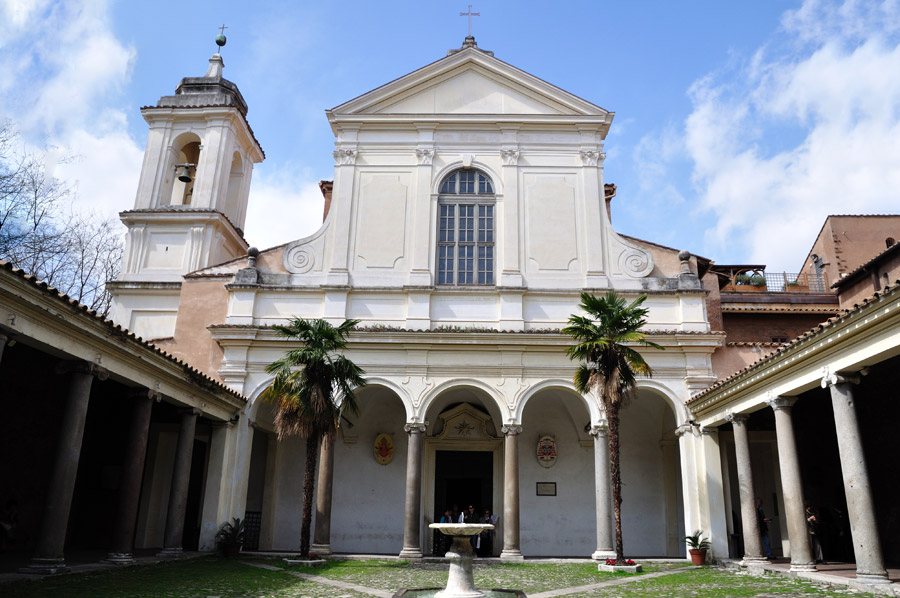
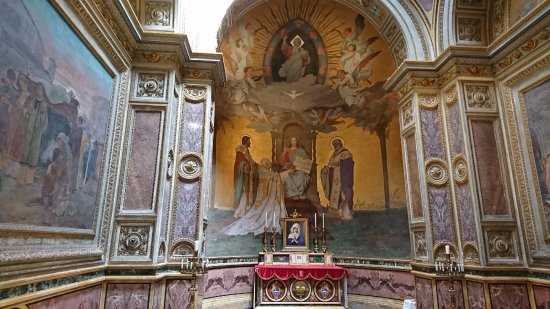
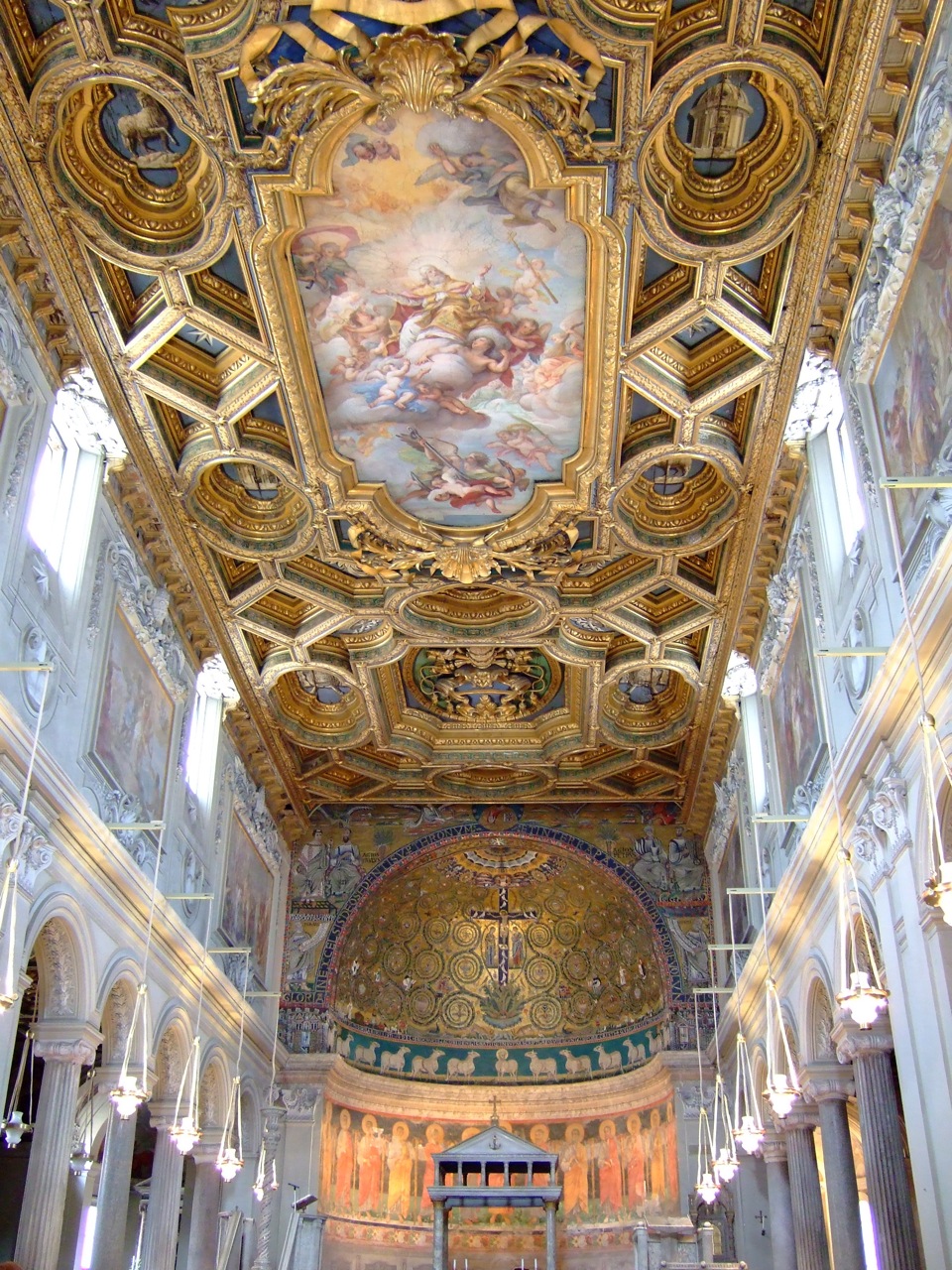
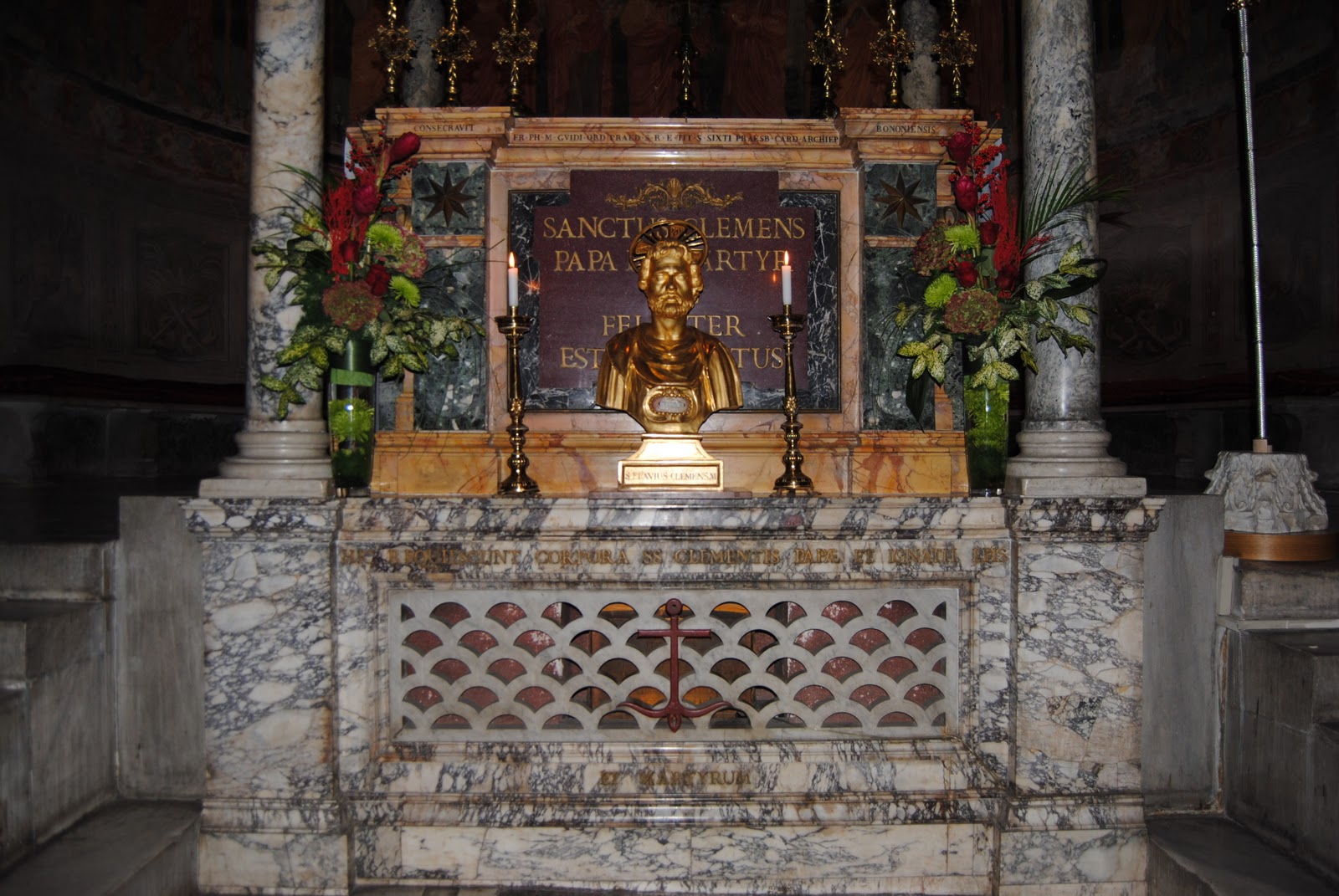
Saint of the Day – 17 October – St Ignatius of Antioch (c 35 – c 108) Bishop, Martyr, Apostolic  Father of the Church – Bishop of Antioch, Theologian, Teacher, Writer.  He was Martyred by being thrown to wild animals c 108 at Rome, Italy.   His Relics are at Saint Peter’s Basilica, Rome with his major Shrine being at the Basilica of San Clemente in Rome.   Patronages -• against throat diseases• the Church in eastern Mediterranean• the Church in North Africa.   Canonised pre-congregation by John The Apostle (mentioned in later writings of the Church.)   En route to Rome, where he met his Martyrdom, Ignatius wrote a series of letters. (Read them here: https://www.catholicculture.org/culture/library/view.cfm?id=3836).HEADER - ST IGNATIUS

This correspondence now forms a central part of the later collection known as the Apostolic Fathers.   His letters also serve as an example of early Christian theology. Important topics they address include ecclesiology, the sacraments and the role of bishops.   In speaking of the authority of the church, he was the first to use the phrase “catholic church” in writing.   He wrote in this regard:  See that you all follow the bishop, even as Jesus Christ does the Father, and the presbytery as you would the apostles;   and reverence the deacons, as being the institution of God.   Let no man do anything connected with the Church without the bishop.   Let that be deemed a proper Eucharist, which is administered either by the bishop, or by one to whom he has entrusted it.   Wherever the bishop shall appear, there let the multitude of the people also be;   even as wherever Jesus Christ is, there is the Catholic Church. —Letter to the Smyrnaeans, Ch 8

His sentiments before his approaching martyrdom are summed in his word in the Communion antiphon,  “I am the wheat of Christ, ground by the teeth of beasts to become pure bread.”   

The sixth letter was to Polycarp, bishop of Smyrna, who was later martyred for the faith. The final letter begs the Christians in Rome not to try to stop his martyrdom. “The only thing I ask of you is to allow me to offer the libation of my blood to God. I am the wheat of the Lord; may I be ground by the teeth of the beasts to become the immaculate bread of Christ.”

SOD-1017-SaintIgnatiusofAntioch-790x480
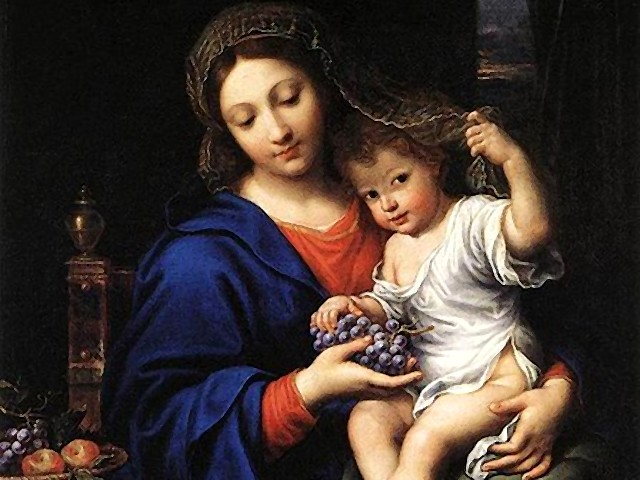
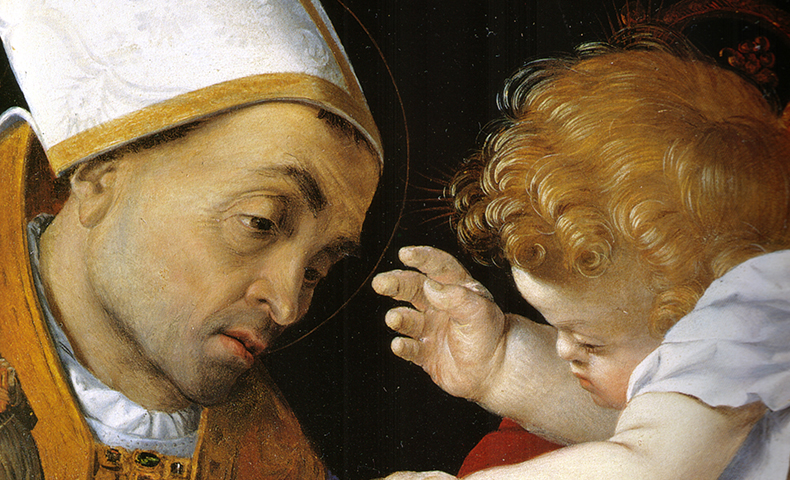
Detail | Saint Ignatius with Madonna and Child | Lorenzo Lotto

Ignatius bravely met the lions in the Circus Maximus.

basilica-san-clementebasilica-di-san-clementebasilica-san-clemente-ceilingpope st. clement tomb i

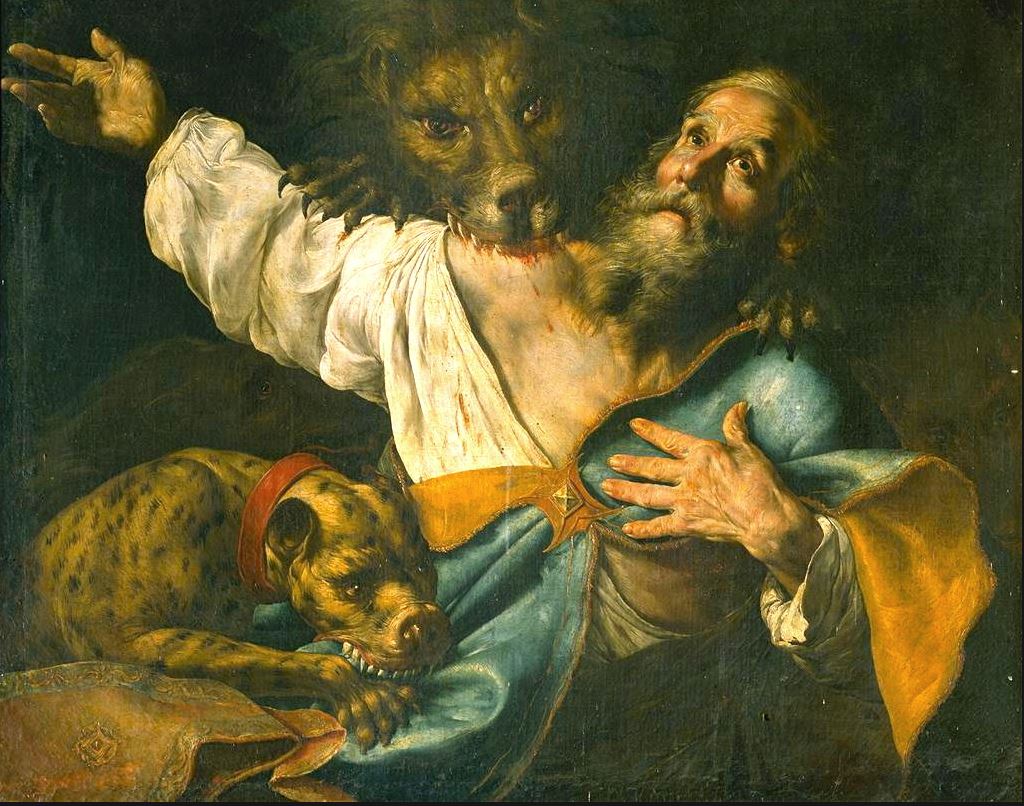
In the Martyrology we read: “At Rome, the holy bishop and martyr Ignatius. He was the second successor to the apostle Peter in the see of Antioch. In the persecution of Trajan he was condemned to the wild beasts and sent in chains to Rome.   There, by the emperor’s order, he was subjected to most cruel tortures in the presence of the Senate and then thrown to the lions.   Torn to pieces by their teeth, he became a victim for Christ.”

The bishop and martyr Ignatius occupies a foremost place among the heroes of Christian antiquity.   His final journey from Antioch to Rome was like a nuptial procession and a Way of the Cross.   For the letters he wrote along the way resemble seven stations of the Cross;   they may also be called seven nuptial hymns overflowing with the saint’s intense love for Christ Jesus and his longing to be united with Him.   These letters are seven most precious jewels in the heirloom bequeathed to us by the Church of sub-apostolic times.

The year of St Ignatius’ death is unknown but scholars place it at c 108;   perhaps it occurred during the victory festivities in which the Emperor Trajan sacrificed the lives of 10,000 gladiators and 11,000 wild beasts for the amusement of the bloodthirsty populace. The scene of his glorious triumph and martyrdom was most likely the Circus Maximus;   that mammoth structure, glittering with gold and marble, had then been just completed.

“From Syria to Rome I must do battle with beasts on land and sea. For day and night I am chained to ten leopards, that is, the soldiers who guard me and grow more ferocious the better they are treated. Their mistreatment is good instruction for me, yet am I still far from justified. Oh, that I may meet the wild beasts now kept in readiness for me. I shall implore them to give me death promptly and to hasten my departure. I shall invite them to devour me so that they will not leave my body unharmed as already has happened to other witnesses. If they refuse to pounce upon me, I shall impel them to eat me. My little children, forgive me these words. Surely I know what is good for me. From things visible I no longer desire anything; I want to find Jesus. Fire and cross, wild beasts, broken bones, lacerated members, a body wholly crushed, and Satan’s every torment, let them all overwhelm me, if only I reach Christ.”

ignatius-of-antioch

The saint, now condemned to fight the wild beasts, burned with desire for martyrdom. On hearing the roar of the lions he cried out:   “I am a kernel of wheat for Christ. I must be ground by the teeth of beasts to be found bread (of Christ) wholly pure”.

St Ignatius is also the first Father of the Church who wrote about Mary.   He defended the veracity of the humanity of Christ against the docetists by affirming that Jesus pertained to the line of David because he was born of Mary.   Jesus was conceived by Mary – He came from her – and this conception was virginal and pertains to the most hidden mysteries in the silence of God.   mary and jesus with raisins

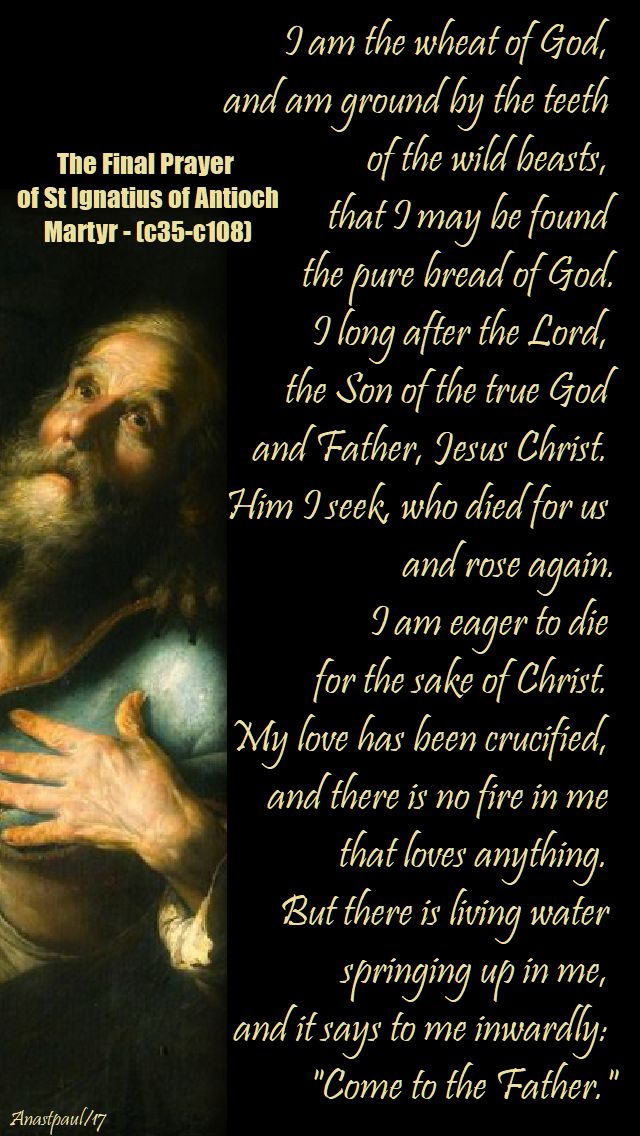
The Final Prayer of St Ignatius of Antioch

I am the wheat of God,
and am ground by the teeth of the wild beasts,
that I may be found the pure bread of God.
I long after the Lord,
the Son of the true God and Father, Jesus Christ.
Him I seek, who died for us and rose again.
I am eager to die for the sake of Christ.
My love has been crucified,
and there is no fire in me that loves anything.
But there is living water springing up in me,
and it says to me inwardly:
“Come to the Father.”the final prayer of st ignatius of antioch - 17 oct 2017

Posted in Against EPIDEMICS, Against FAMINE, Against SORE THROATS, COUGHS, WHOOPING COUGH,, Against STORMS, EARTHQUAKES, THUNDER & LIGHTENING, FIRES, DROUGHT / NATURAL DISASTERS, Of GARDENERS, Horticulturists, Farmers, PATRONAGE - OF DOGS and against DOG BITES and/or RABIES, SAILORS, MARINERS, NAVIGATORS, SAINT of the DAY

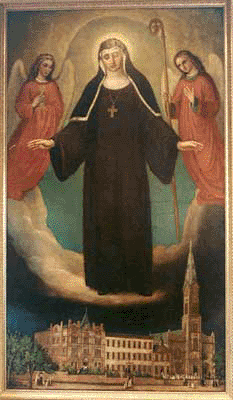
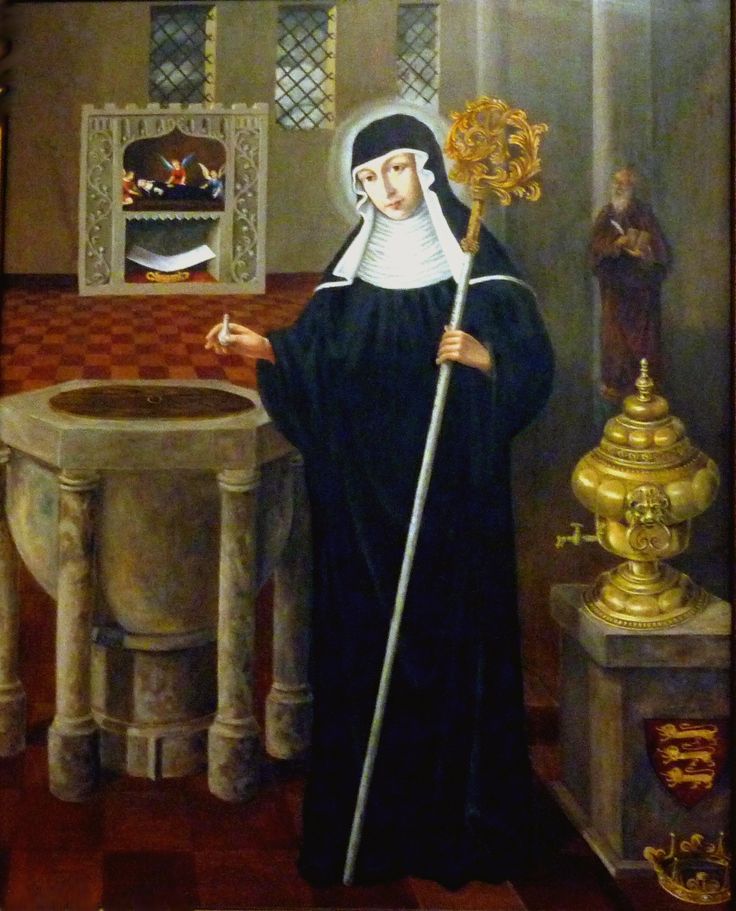
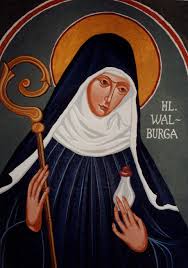
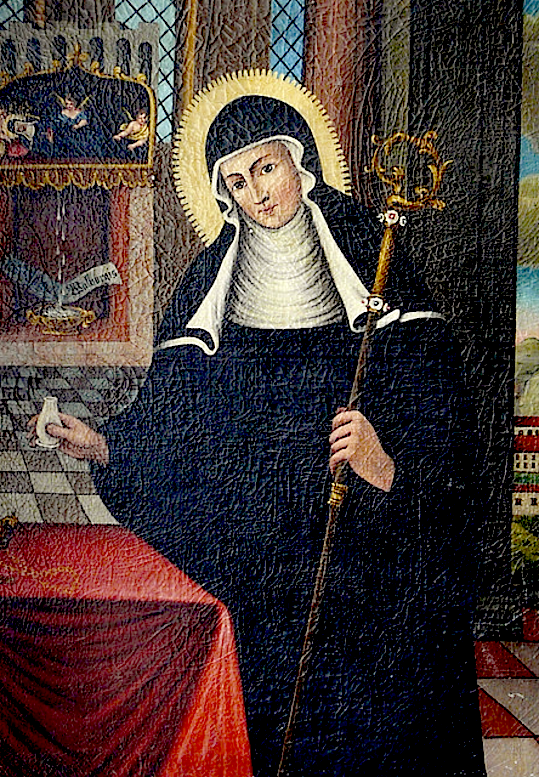
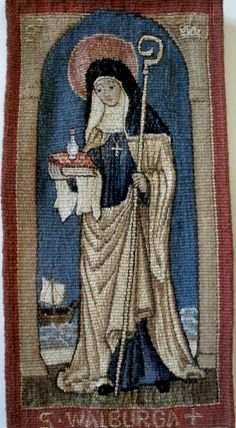
Saint of the Day – 25 February – St Walburga (c 710-779)

Saint of the Day – 25 February – St Walburga (c 710-779) Nun and Missionary. Daughter of St Richard the King. Sister of St Willibald and St Winebald, niece of St Boniface.  Also known as:-Auboué, Avangour, Avongourg, Bugga, Falbourg, Gaubourg, Gauburge, Gaudurge, Gualbourg, Valborg, Valburg, Valpurge, Valpuri, Vaubouer, Vaubourg, Walbourg, Walburg, Walburge, Walpurd, Walpurga, Walpurgis, Waltpurde, Warpurg – Religious/Missionary – Patronages – against coughs,,against dog bites, against famine, against hydrophobia (as a symptom of) rabies, against mad dogs, against plague/epidemics, against storms, sailors, farmers, harvests, Eichstätt, Germany, Diocese of, Plymouth, England, Diocese of and  4 Cities. Additional Memorials – 12 October (translation of relics to Eichstätt), 24 September (translation of relics to Zutphen).

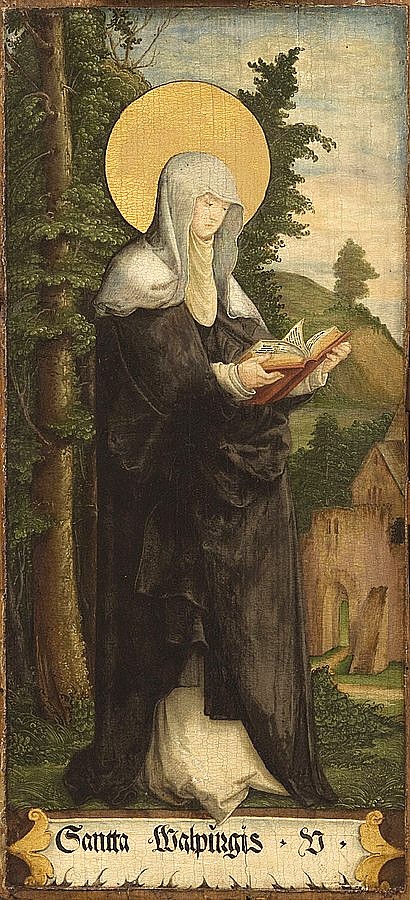
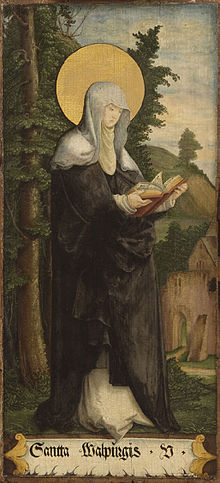
Painting by the Master of Meßkirch, c 1535–1540.

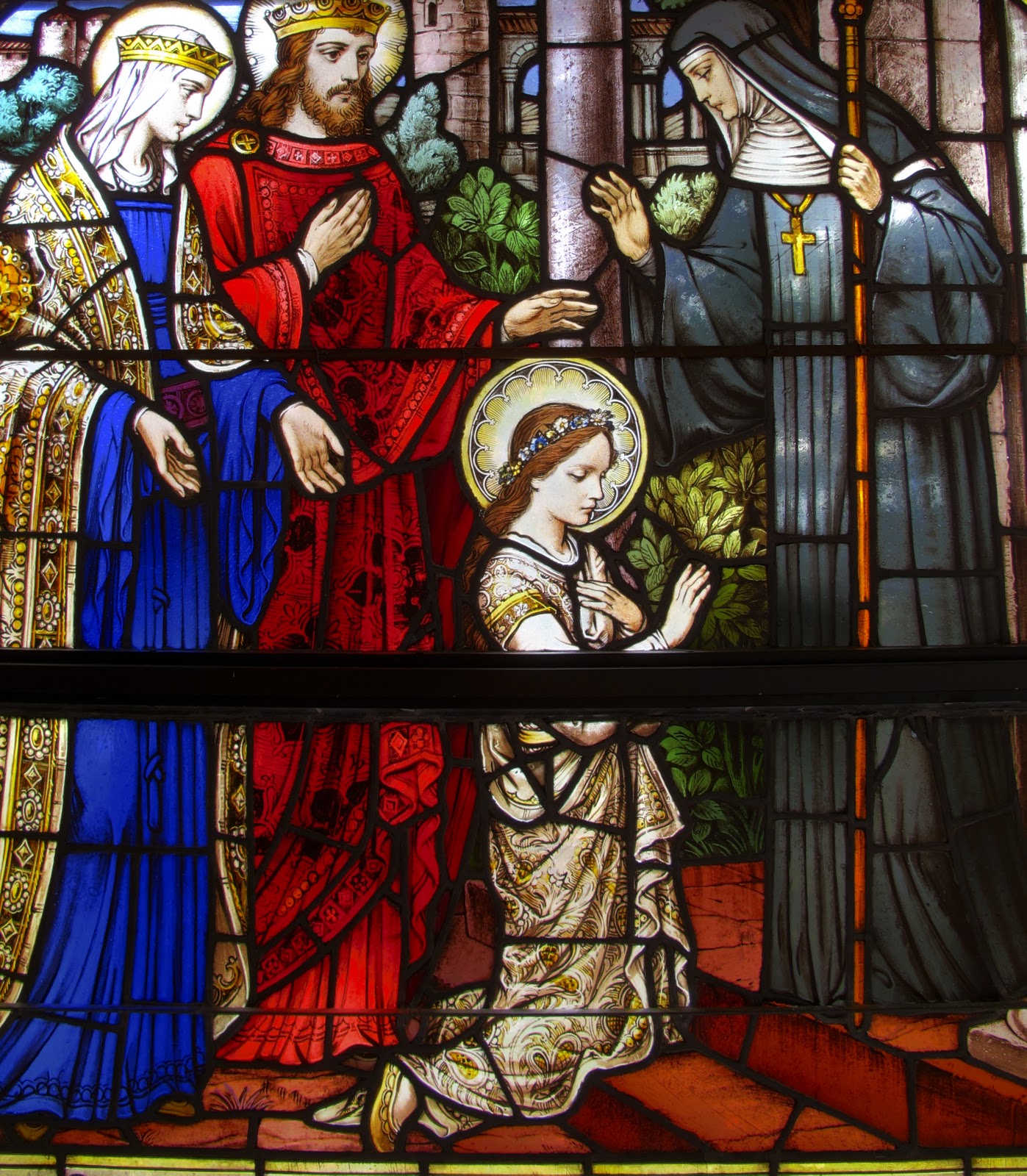
St Walburga was English, the sister of two associates of St Boniface in evangelising Germany and the Lowlands.  She was the daughter of St.Richard the Pilgrim, a West Saxon chieftain and Winna, sister of St. Boniface, Apostle to Germany. She had at least three siblings; two of her brothers are known by name, St Willibald and St Winibald.

In 720 her father and two older brothers went on a pilgrimage to Rome. Her father died at Lucca, Italy, but the brothers reached Rome where St. Winibald (c.701-761) became a monk, while St. Willibald (c.700-787) went on to the Holy Land.

Walburga was educated at Wimborne Monastery in Dorset, where she became a nun. In 748, she was sent with St. Lioba to Germany to help St. Boniface in his missionary work. She spent two years at Bishofsheim, after which she became Abbess of the monastery at Heidenheim founded by her brother St. Winebald.    At her brother’s death in 761, St. Walburga was appointed Abbess of both monasteries by her other brother St. Willibald, who was then Bishop of Eichstadt.    She remained superior of both men and women until her death on February 25, 779.

She was buried first at Heidenheim but her body was tranferred next to that of her brother, St. Winebald, at Eichstadt. n the 870s, Walpurga’s remains were transferred to Eichstätt. In Finland, Sweden, and Bavaria, her feast day commemorates the transfer of her relics on May 1.   At present the most famous of the oils of saints is the Oil of Saint Walburga (Walburgis oleum).   It flows from the stone slab and the surrounding metal plate on which rest the relics of Saint Walburga in her church in Eichstädt in Bavaria.   The fluid is caught in a silver cup, placed beneath the slab for that purpose, and is distributed among the faithful in small vials by the Sisters of Saint Benedict, to whom the church belongs.   A chemical analysis has shown that the fluid contains nothing but the ingredients of water. Though the origin of the fluid is probably due to natural causes, the fact that it came in contact with the relics of the saint justifies the practice of using it as a remedy against diseases of the body and the soul.   Mention of the oil of Saint Walburga is made as early as the ninth century by her biographer Wolfhard of Herrieden. – from the Catholic Encyclopedia article Oil of Saints

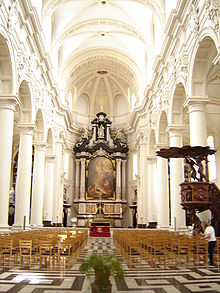
Second-last – Painting by the Master of Meßkirch, c. 1535–40.   Last image – The St. Walburga Church in Bruges was originally a Jesuit church