Posted in CATHOLIC DEVOTIONS of the Month, EUCHARISTIC Adoration, PRACTISING CATHOLIC, PRAYERS of the SAINTS, QUOTES of the SAINTS, The HOLY EUCHARIST / The HOLY MASS

Devotion for the Month of April – The Holy Eucharist

Devotion for the Month of April – The Holy Eucharist

The Church has historically encouraged the month of April for increased devotion to Jesus in the Holy Eucharist.  “The Church in the course of the centuries has introduced various forms of this Eucharistic worship which are ever increasing in beauty and helpfulness;  as, for example, visits of devotion to the tabernacles, even every day;  Benediction of the Blessed Sacrament; solemn processions, especially at the time of Eucharistic Congresses, which pass through cities and villages;  and adoration of the Blessed Sacrament publicly exposed . . . These exercises of piety have brought a wonderful increase in faith and supernatural life to the Church militant upon earth and they are re-echoed to a certain extent by the Church triumphant in heaven, which sings continually a hymn of praise to God and to the Lamb ‘Who was slain.'” -Venerable Pope Pius XII (1876-1958) Pope from 1939 to his death in 1958.april devotion - the blessed sacrament - 2 april 2018

Prayer before Holy Communion
By St Peter Julian Eymard (1811-1868)

Oh! Yes, Lord Jesus, come and reign!
Let my body be Your temple,
my heart Your throne,
my will Your devoted servant;
let me be Yours forever,
living only in You and for You!
AmenPrayer before Holy Comm - st peter julian eymard - 2 april 2018
Eucharistic Adoration By:  St Pope John Paul II

“I encourage Christians regularly to visit Christ present in the Blessed Sacrament, for we are all called to abide in the presence of God.   In contemplation, Christians will perceive ever more profoundly the mystery at the heart of Christian life.
I urge priests, religious and lay people to continue and redouble their efforts to teach the younger generations the meaning and value of Eucharistic adoration and devotion.   How will young people be able to know the Lord if they are not introduced to the mystery of His presence?   Like the young Samuel, by learning the words of the prayer of the heart, they will be closer to the Lord, who will accompany them in their spiritual and human growth.   The Eucharistic mystery is in fact the “summit of evangelisation” (Lumen Gentium) for it is the most eminent testimony to Christ’s resurrection.”

Private Eucharistic Adoration
Venerable Fr Benedict Groeschel points out in the book, “In the Presence of Our Lord : The History, Theology and Psychology of Eucharistic Devotion” that there are “four kinds of prayer most appropriate in the presence of the Eucharist, namely adoration and praise, thanksgiving, repentance and trusting intercession.”   Accordingly, here are suggestions for what to do during private Eucharistic adoration.

1. Pray the Psalms or the Liturgy of the Hours
Whether you are praising, giving thanks, asking for forgiveness or seeking an answer, you’ll find an appropriate psalm.   The ancient prayer of the Church called the Liturgy of the Hours presents an excellent way to pray through the Book of Psalms throughout the year.

2. Recite the “Jesus Prayer”
Say “Lord Jesus, have mercy on me, a sinner”, repeatedly as you quiet your heart and mind.

3. Meditate using Scripture
Choose a passage from the Bible. read the words and ask God to let the passage speak to you.   Pay special attention to anything that strikes you and ask God what He wishes for you to draw from that message.

4. Read the life of a saint and pray with him or her
Most holy men and women have had a great devotion to Our Lord in the Eucharist. Therese of Lisieux, Catherine of Siena, Francis of Assisi, Thomas Aquinas, Peter Julian Eymard, Dorothy Day. Mother Teresa of Calcutta and Baroness Catherine de Hueck are just a few.   Read about them and pray their prayers before the Blessed Sacrament.

5. Pour out your heart to Christ and adore Him
Speak to Jesus, aware that you are in His presence and tell Him all that comes to your mind.   Listen for His response.   Pray the prayer that St Francis instructed his brothers to pray whenever they were before the Blessed Sacrament:  “I adore You, O Christ, present here and in all the churches of the world, for by Your holy cross You have redeemed the world.”

6. Ask for forgiveness and intercede for others
Think of those who have hurt you and request a special blessing for them.   Ask God to forgive you for all the times you have neglected or hurt someone else.   Bring before the Blessed Sacrament all those who have asked you to pray for them.   Ask the Lord to address their concerns.

7. Pray the Rosary
St Pope John Paul II reminds us, “…is not the enraptured gaze of Mary as she contemplated the face of the newborn Chris and cradled him in her arms that unparalleled model of love which should inspire us every time we receive Eucharistic communion?” (The Church and the Eucharist, 55)   Ask Mary to join you as you gaze on Christ in the Eucharist and as you pray the Rosary.

8. Sit quietly and just “be” in the presence of God
Think of a visit to the Blessed Sacrament as coming to see your best friend.   Sit quietly and enjoy being in each other’s company.   Instead of talking to the Lord, try listening to what He wants to tell you.

Prayer before the Eucharistic Presence
By Bl John Henry Newman (1801-1890)

I place myself in the presence of Him,
in whose Incarnate Presence I am,
before I place myself there.
I adore You, O my Saviour,
present here as God and man,
in soul and body,
in true flesh and blood.
I acknowledge and confess,
that I kneel before the Sacred Humanity,
which was conceived in Mary’s womb
and lay in Mary’s bosom;
which grew up to man’s estate
and by the Sea of Galilee, called the Twelve,
wrought miracles and spoke words of wisdom and peace;
Who in due season hung on the cross,
lay in the tomb, rose from the dead
and now reigns in heaven.
I praise and bless
and give myself wholly to Him,
Who is the true Bread of my soul
and my everlasting joy. AmenI place myself in the presence - bl john henry - 2 april 2018
Posted in EASTER, HOLY WEEK, PAPAL SERMONS, PRACTISING CATHOLIC, QUOTES - J R R Tolkien and MORE, QUOTES on CONVERSION, QUOTES on FAITH, QUOTES on SANCTITY, QUOTES on TEMPTATION, QUOTES on TRUST and complete CONFIDENCE in GOD, The WORD

One Minute Reflection – – 31 March – Holy Saturday 2018

One Minute Reflection – – 31 March – Holy Saturday 2018

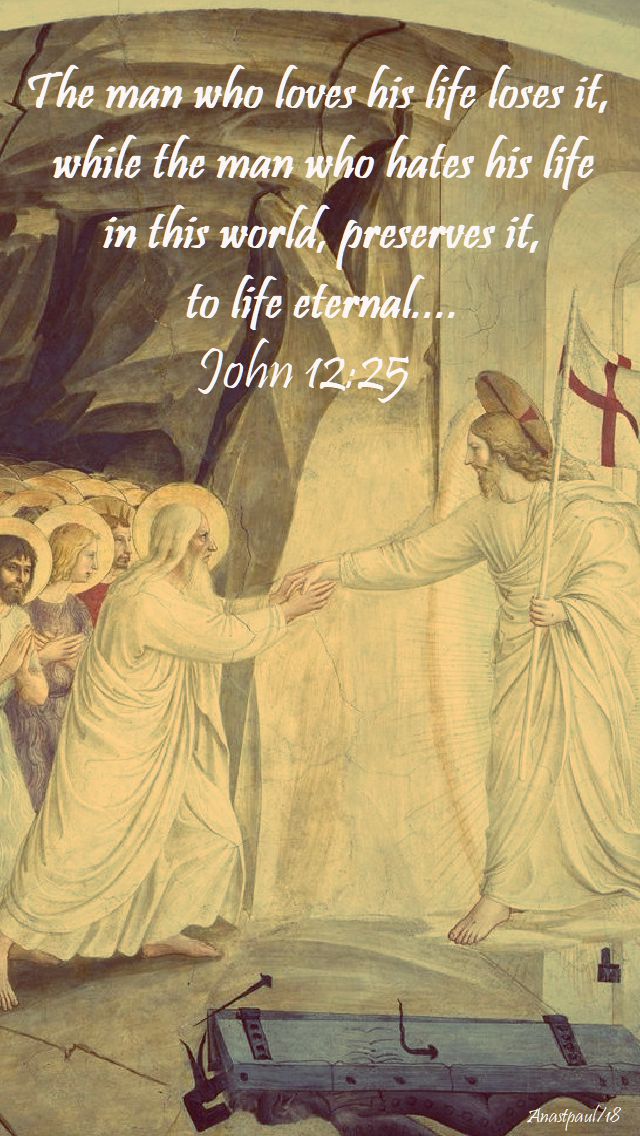
The man who loves his life loses it, while the man who hates his life in this world, preserves it to life eternal...John 12:25john 12 25

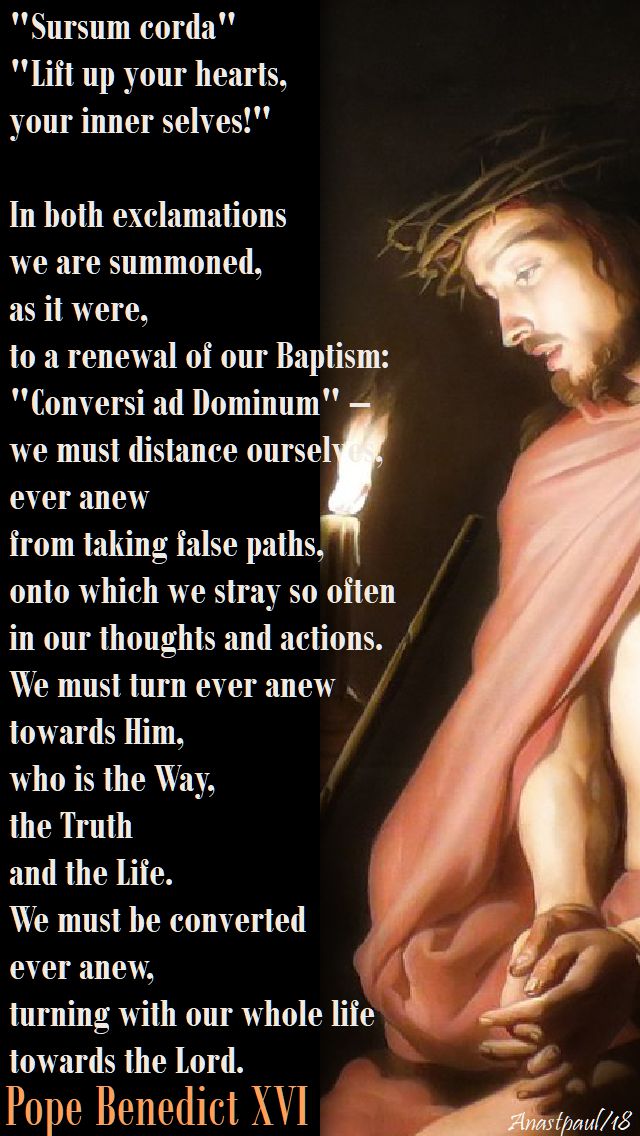
REFLECTION“Sursum corda” – lift up your hearts, high above the tangled web of our concerns, desires, anxieties and thoughtlessness – “Lift up your hearts, your inner selves!”   In both exclamations we are summoned, as it were, to a renewal of our Baptism: “Conversi ad Dominum” – we must distance ourselves ever anew from taking false paths, onto which we stray so often in our thoughts and actions.   We must turn ever anew towards Him who is the Way, the Truth and the Life.   We must be converted ever anew, turning with our whole life towards the Lord.   And ever anew we must allow our hearts to be withdrawn from the force of gravity, which pulls them down and inwardly we must raise them high,in truth and love.   At this hour, let us thank the Lord, because through the power of His word and of the holy Sacraments, He points us in the right direction and draws our heart upwards.”…Pope Benedict 22 March 2008susum corda - lift up your hearts - pope benedict - easter vigil holy sat 31 march 2018

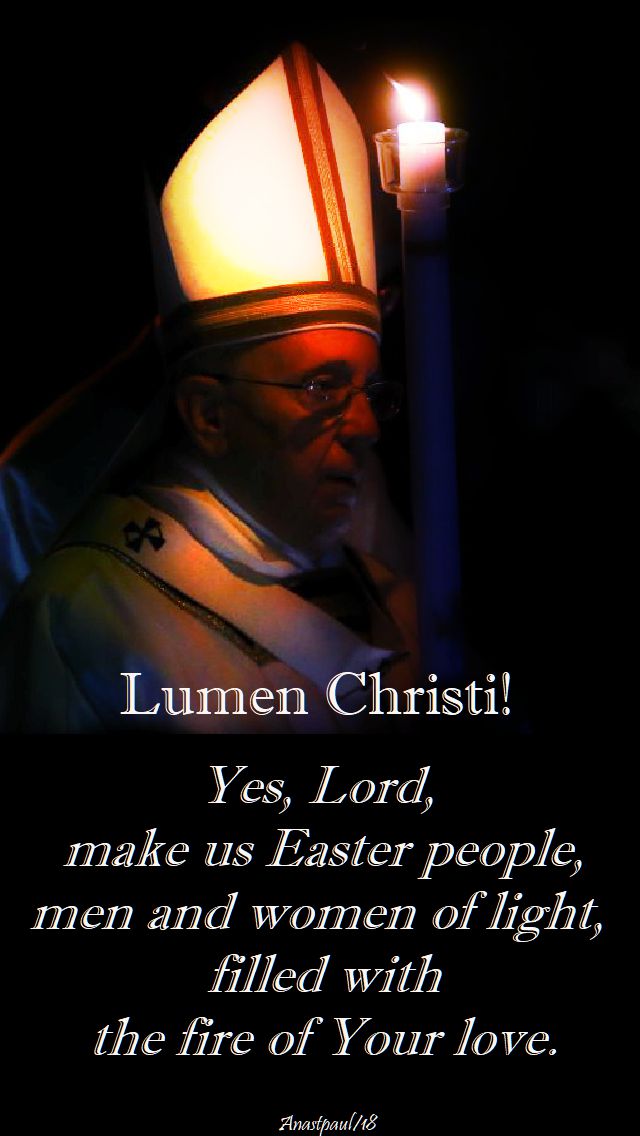
PRAYER – Yes, Lord, make us Easter people, men and women of light, filled with the fire of Your love. Amen.yes lord, make us easter people - 31 march 2018 - holy sat

Posted in DEVOTIO, HOLY WEEK, MARIAN TITLES, MORNING Prayers, PAPAL SERMONS, PRACTISING CATHOLIC, The BLESSED VIRGIN MARY

Sabbatum Sanctum – Holy Saturday: “Watching” and The Easter Vigil of the Holy Night

Sabbatum Sanctum – Holy Saturday:  “Watching” and The Easter Vigil of the Holy Night

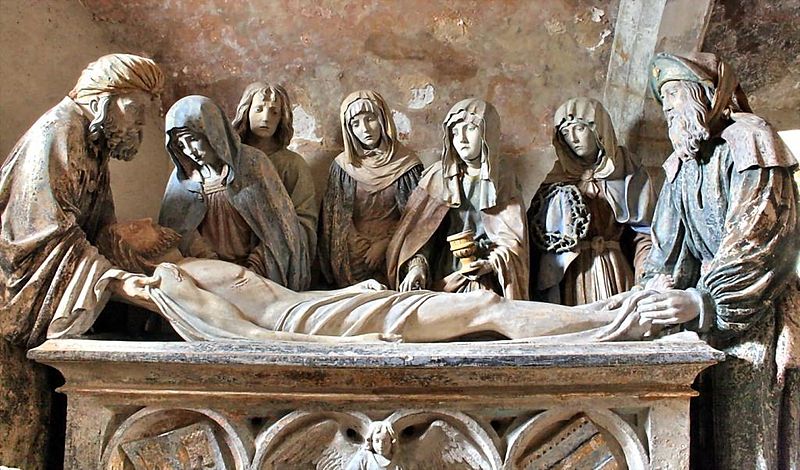
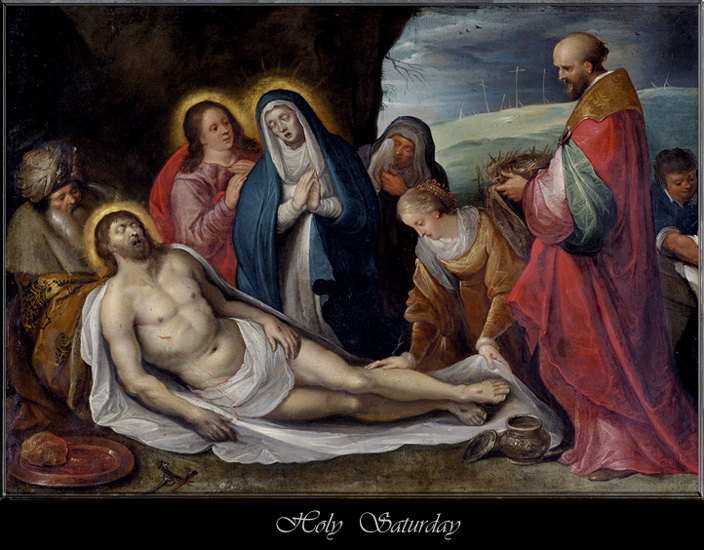
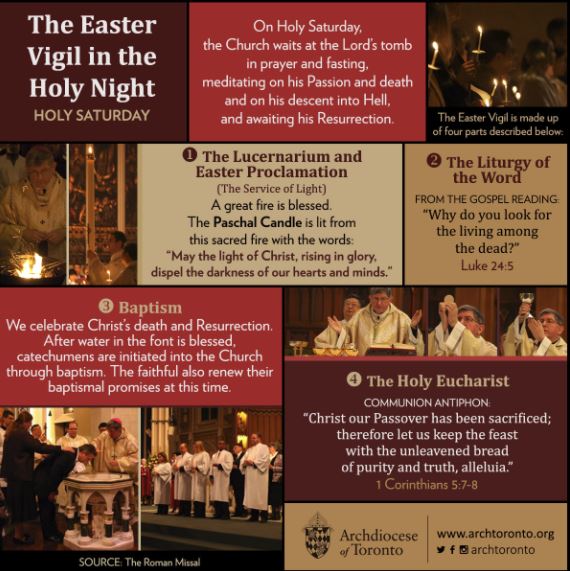
On Holy Saturday the Church waits at the Lord’s tomb, meditating on His suffering and death.   The altar is left bare and the sacrifice of the Mass is not celebrated.   Only after the solemn vigil during the night, held in anticipation of the resurrection, does the Easter celebration begin, with a spirit of joy that overflows into the following period of fifty days.The Entombment by the Maitre du Chaorce. “HOLY SAT 2

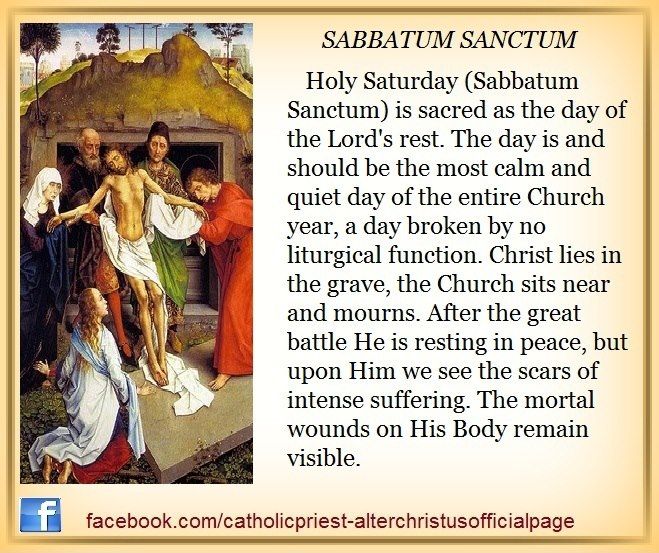
Holy Saturday (from Sabbatum Sanctum, its official liturgical name) is sacred as the day of the Lord’s rest; it has been called the “Second Sabbath” after creation.   The day is and should be the most calm and quiet day of the entire Church year, a day broken by no liturgical function.   Christ lies in the grave, the Church sits near and mourns.   After the great battle He is resting in peace but upon Him we see the scars of intense suffering…The mortal wounds on His Body remain visible…Jesus’ enemies are still furious, attempting to obliterate the very memory of the Lord by lies and slander.

HOLY SAT INFOHOLY SAT INFO 2HOLY SAT INFO 3

Mary and the disciples are grief-stricken, while the Church must mournfully admit that too many of her children return home from Calvary cold and hard of heart.   When Mother Church reflects upon all of this, it seems as if the wounds of her dearly Beloved were again beginning to bleed.

According to tradition, the entire body of the Church is represented in Mary:  she is the “credentium collectio universa” (Congregation for Divine Worship, Lettera circolare sulla preparazione e celebrazione delle feste pasquali, 73).   Thus, the Blessed Virgin Mary, as she waits near the Lord’s tomb, as she is represented in Christian tradition, is an icon of the Virgin Church keeping vigil at the tomb of her Spouse while awaiting the celebration of His resurrection.


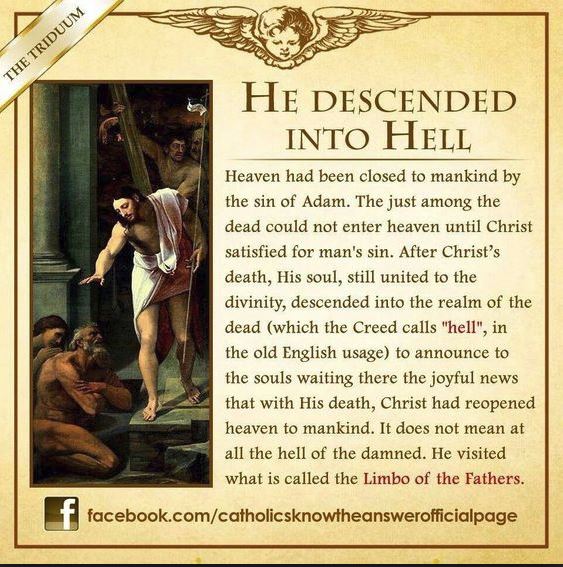
The pious exercise of the Ora di Maria is inspired by this intuition of the relationship between the Virgin Mary and the Church:  while the body of her Son lays in the tomb and His soul has descended to the dead to announce liberation from the shadow of darkness to His ancestors, the Blessed Virgin Mary, foreshadowing and representing the Church, awaits, in faith, the victorious triumph of her Son over death. — Directory on Popular Piety and the Liturgy

“This same night is a night of watching kept to the Lord . . . throughout every generation” (cf. Ex 12:42)lumen christi - 31 march 2018

On this holy night we celebrate the Easter Vigil, the first — indeed the “mother” — of all vigils of the liturgical year.   On this night, as is sung over and over again in the Preconio, we walk once more the path of humanity from creation to the culminating event of salvation, the death and resurrection of Christ.

The light of Him who “has been raised from the dead, the first fruits of those who have fallen asleep” (1 Cor 15:20) makes this memorable night, which is rightly considered the “heart” of the liturgical year, “bright as the day” (Ps 139:12).   On this night the entire Church keeps watch and recalls, in meditation, the significant stages of God’s saving intervention in the universe.

“A night of watching kept to the Lord”.   There is a twofold significance to this solemn Easter Vigil, so rich with symbols accompanied by an extraordinary abundance of biblical texts.   On the one hand, it is the prayerful memory of the mirabilia Dei, in the re-presentation of key texts from the Sacred Scriptures, from creation to the sacrifice of Isaac, to the passage through the Red Sea, to the promise of the New Covenant.

On the other hand, this evocative vigil is the trusting expectation of the complete fulfilment of the ancient promises.   The memory of God’s work reaches its climax in the resurrection of Christ and is projected onto the eschatological event of the parusia.   We thus catch a glimpse, on this night of Passover, of the dawning of that day that never ends, the day of the Risen Christ, which inaugurates the new life, the “new heavens and a new earth” (2 Pet 3:13; cf. Is 65:17; 66:22; Rev 21:1).

From its very beginnings, the Christian community placed the celebration of Baptism within the context of the Easter Vigil.   Here too, on this night, some catechumens will be immersed with Jesus into his death to rise with Him to immortal life.   Thus the wonder of the mysterious spiritual rebirth, wrought by the Holy Spirit, is renewed; the rebirth that incorporates the newly baptised into the people of the new and final Covenant, sealed by the death and resurrection of Christ.

Together with those who will shortly receive Baptism, the liturgy invites all of us here present to renew the promises of our own Baptism.   The Lord asks us to renew the expression of our full obedience to Him and of our total dedication to the service of his Gospel.

Beloved Brothers and Sisters! If this mission may sometimes seem difficult, call to mind the words of the Risen Lord:  “I am with you always, to the close of the age” (Mt 28:20). Certain of His presence, you shall fear no difficulty and no obstacle.   His word will enlighten you;   His Body and His Blood will nourish you and sustain you on your daily journey to eternity.

At the side of each of you there will always be Mary, as she was present among the Apostles, frightened and confused at the time of trial.   And with her faith she will show you, beyond the night of the world, the glorious dawn of the resurrection. Amen

Lumen Christi!

St Pope John Paul II easter vigil in the holy night - 31 march 2018

Posted in CONFESSION/PENANCE, HOLY WEEK, MORNING Prayers, PAPAL SERMONS, PRACTISING CATHOLIC, QUOTES - J R R Tolkien and MORE, QUOTES on CONVERSION, QUOTES on FORGIVENESS, QUOTES on LOVE, QUOTES on REPENTANCE, The PASSION, The WORD

Thought for the Day – 29 March – Holy Thursday – The Mass of the Lord’s Supper 2018

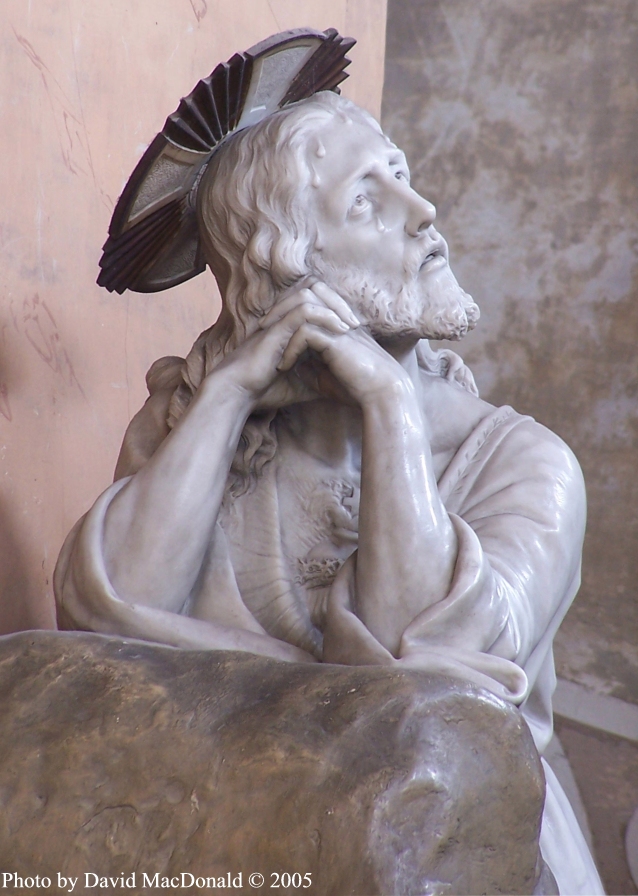
Thought for the Day – 29 March – Holy Thursday – The Mass of the Lord’s Supper 2018vatican - statue at the gethsemane steps in rome

When the Lord tells Peter that without the washing of his feet he would never be able to have any part in Him, Peter immediately and impetuously asks to have his head and hands washed as well.   This is followed by the mysterious words of Jesus:  “Whoever has bathed has no need except to have his feet washed” (John 13:10).   Jesus alludes to a bath that the disciples, according to ritual prescriptions, had already taken; in order to participate in the meal, they now needed only to have their feet washed.   But naturally, a deeper meaning is hidden in this.   To what does it allude?   We do not know for sure.  In any case, we should keep in mind that the washing of the feet, according to the meaning of the entire chapter, does not indicate a single specific Sacrament but the “sacramentum Christi” in its entirety – His service of salvation, His descent even to the cross, His love to the end, which purifies us and makes us capable of God.

Here, with the distinction between the bath and the washing of feet, nevertheless, there also appears an allusion to life in the community of the disciples, to life in the community of the Church – an allusion that John may have intentionally transmitted to the community of his time.   It then seems clear that the bath that purifies us definitively and does not need to be repeated is Baptism – immersion in the death and resurrection of Christ, a fact that changes our lives profoundly, giving us something like a new a identity that endures, if we do not throw it away as Judas did.   But even in the endurance of this new identity, for convivial communion with Jesus we need the “washing of the feet.”   What does this mean?   It seems to me that the first letter of Saint John gives us the key for understanding this.   There we read: “If we say, ‘We are without sin,’ we deceive ourselves, and the truth is not in us.   If we acknowledge our sins, he is faithful and just and will forgive our sins and cleanse us from every wrongdoing” (1:8ff.).

We need the “washing of the feet,” the washing of our everyday sins and for this we need the confession of sins.   We do not know exactly how this was carried out in the Johannine community.   But the direction indicated by the words of Jesus to Peter is obvious:  in order to be capable of participating in the convivial community with Jesus Christ, we must be sincere.   One must recognise that even in our own identity as baptised persons, we sin.   We need confession as this has taken form in the Sacrament of reconciliation.   In it, the Lord continually rewashes our dirty feet and we are able to sit at table with Him.

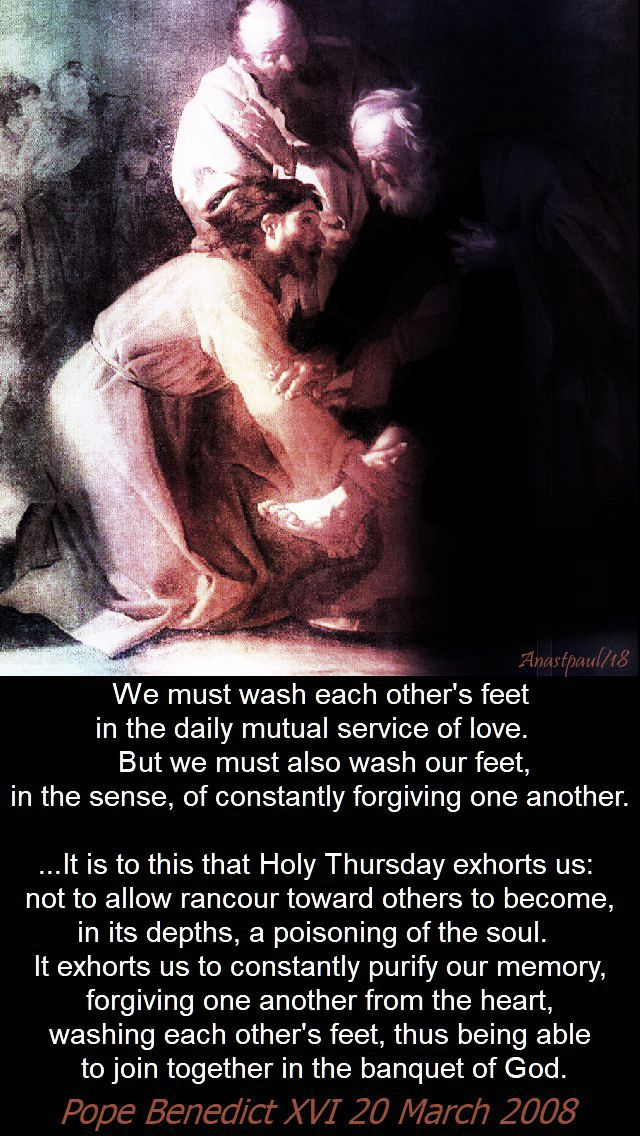
But in this way, the word takes on yet another meaning, in which the Lord extends the “sacramentum” by making it the “exemplum,” a gift, a service for our brother:   “If I, therefore, the master and teacher, have washed your feet, you ought to wash one another’s feet” (John 13:14).   We must wash each other’s feet in the daily mutual service of love.   But we must also wash our feet, in the sense, of constantly forgiving one another.   The debt that the Lord has forgiven us is always infinitely greater than all of the debts that others could owe to us (cf. Mt. 18:21-35).   It is to this that Holy Thursday exhorts us:  not to allow rancour toward others to become, in its depths, a poisoning of the soul.   It exhorts us to constantly purify our memory, forgiving one another from the heart, washing each other’s feet, thus being able to join together in the banquet of God.

Holy Thursday is a day of gratitude and of joy for the great gift of love to the end that the Lord has given to us.   We want to pray to the Lord at this time, so that gratitude and joy may become in us the power of loving together with His love. Amen.

Pope Benedict XVI 20 March 2008 Holy Thursday – Mass of the Lord’s Supperwe must wash each other's feet in the daily mutual service of love- pope benedict - 29 march 2018 holy thurs

Posted in DOCTORS of the Church, JESUIT SJ, MORNING Prayers, PRACTISING CATHOLIC, QUOTES of the SAINTS, QUOTES on SANCTITY, SPEAKING of .....

Quote/s of the Day – 21 March “Speaking of Sanctity”

Quote/s of the Day – 21 March
“Speaking of Sanctity”

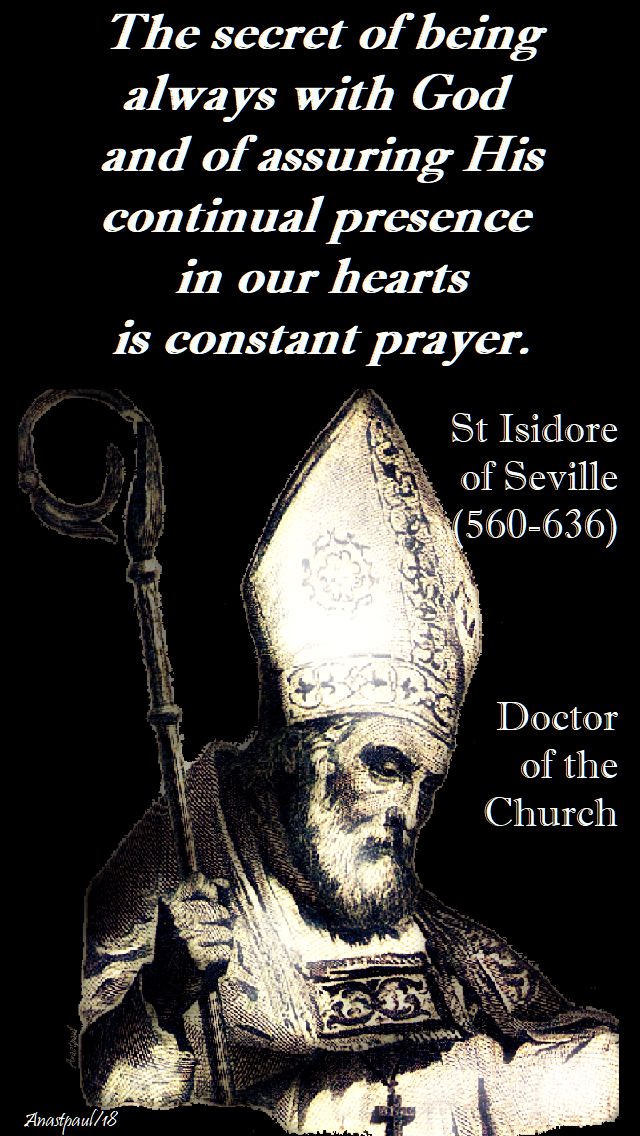
“The secret of being always with God
and of assuring His continual presence
in our hearts is constant prayer.”

St Isidore of Seville (560-636) Doctor of the Churchthe secret of being always with god - st isidore - 21 march 2018 - speaking of sanctity

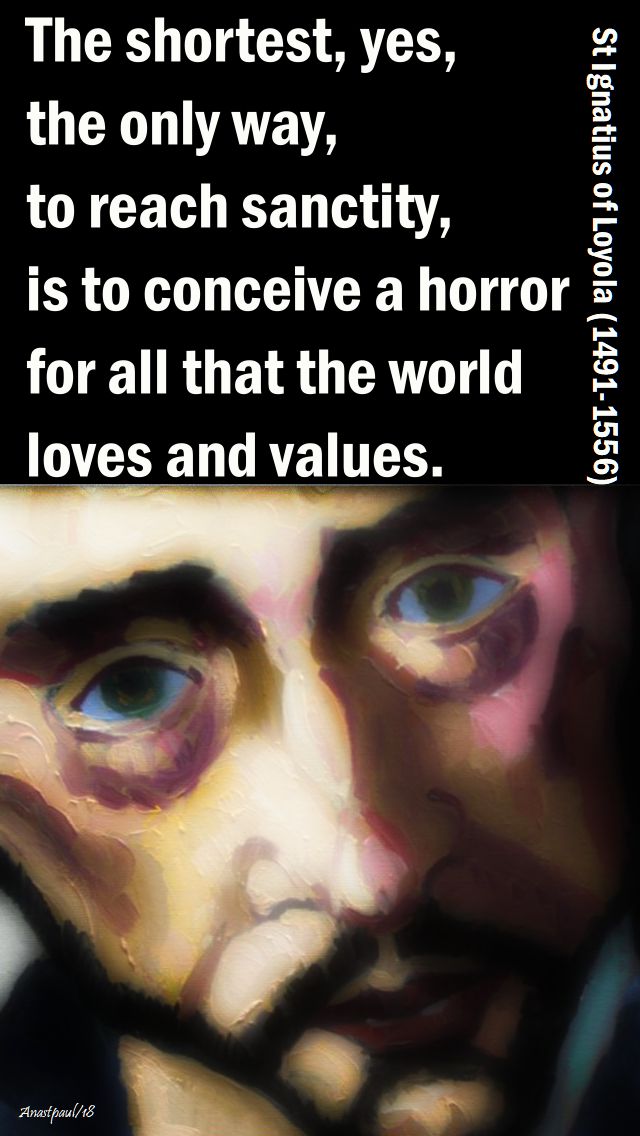
“The shortest, yes, the only way,
to reach sanctity, is to conceive a horror
for all that the world loves and values.”

St Ignatius of Loyola (1491-1556)the shortest, yes, - st ignatius - speaking of sanctity - 21 march 2018

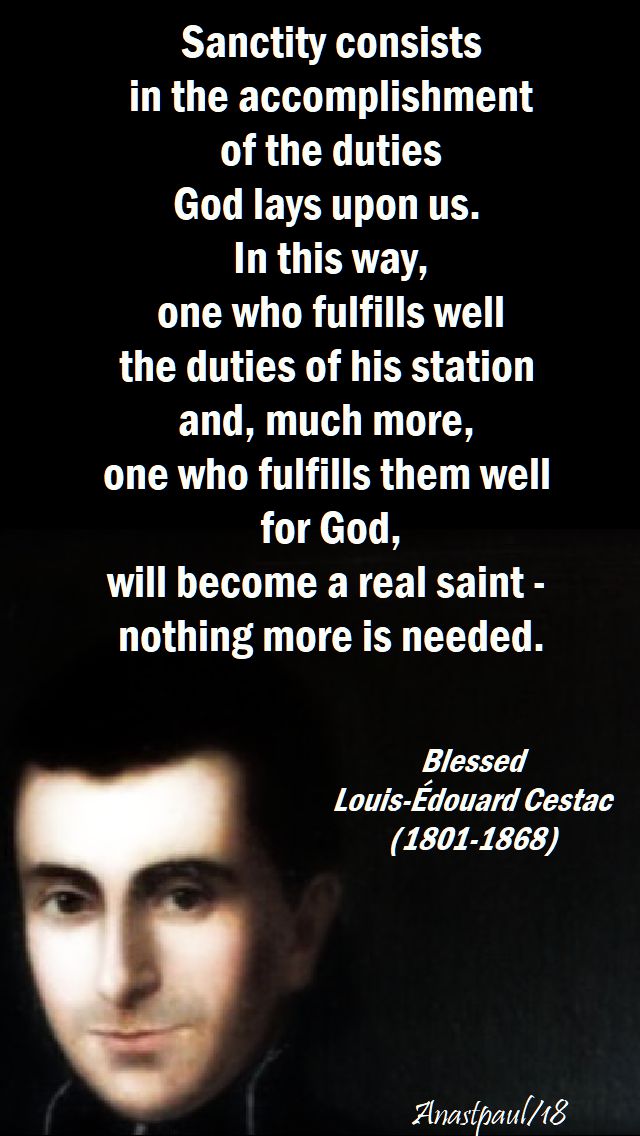
“Sanctity consists in the accomplishment
of the duties God lays upon us.
In this way, one who fulfills well the duties of his station
and, much more, one who fulfills them well for God,
will become a real saint – nothing more is needed.”

Blessed Louis-Édouard Cestac (1801-1868)sanctity consists in the accomplishment - bl louis-edouard cestac - 21 march 2018 speaking of sanctity

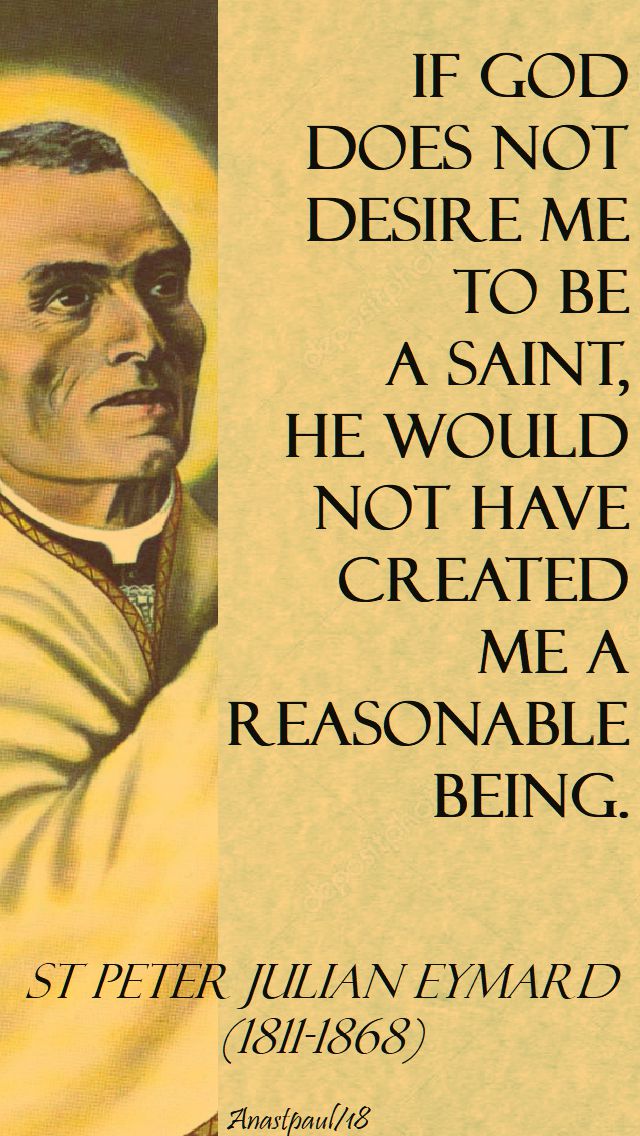
“If God does not desire me to be a saint,
He would not have created me a reasonable being.”

St Peter Julian Eymard (1811-1868)if god does not - st peter julian eymard - speaking of sanctity - 21 march 2018

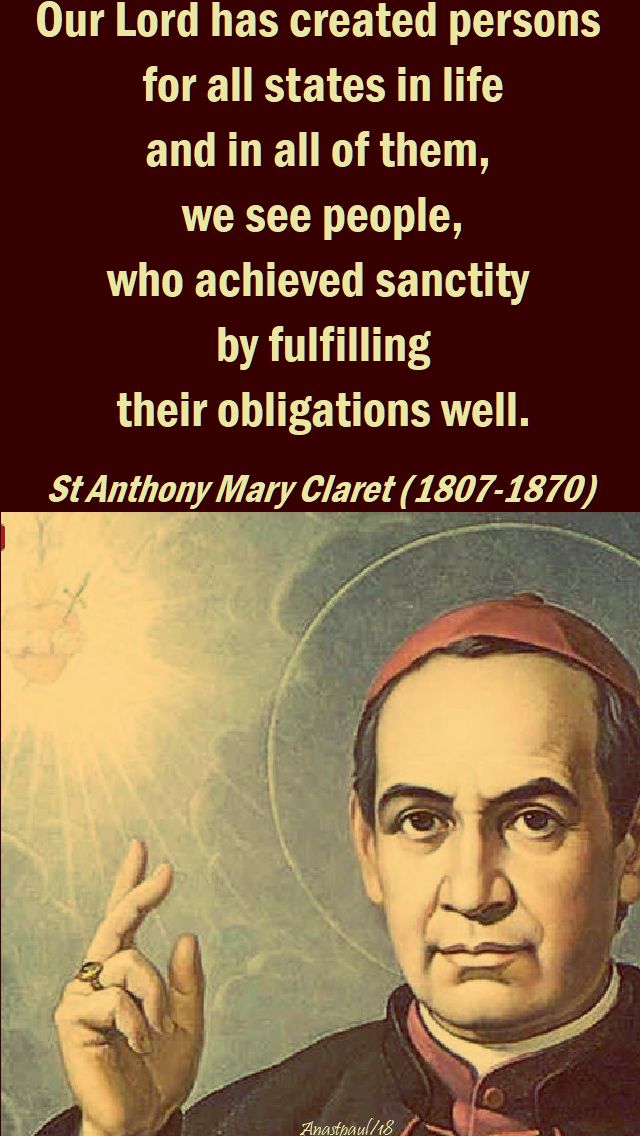
“Our Lord has created persons for all states in life
and in all of them, we see people,
who achieved sanctity
by fulfilling their obligations well.”

St Anthony Mary Claret (1807-1870)our lord has created - sdt anthony mary claret - speaking of sanctity - 21 march 2018

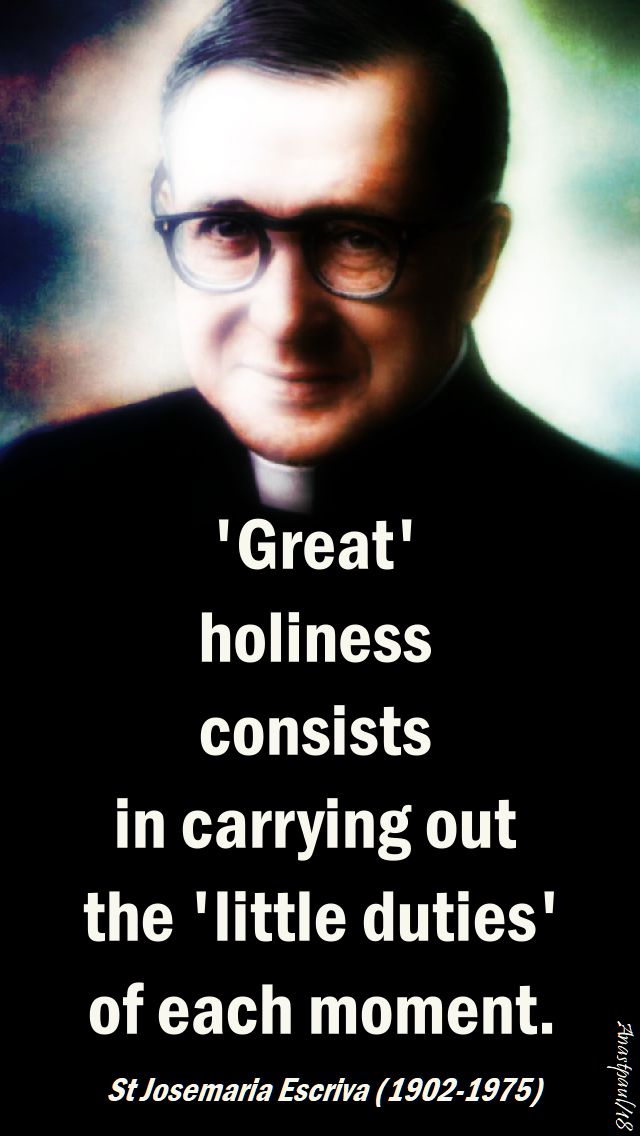
“Great’ holiness consists in carrying out
the ‘little duties’ of each moment.”

St Josemaria Escriva, (1902-1975) The Way, 81great holiness - st josemaria - speaking of sanctity - 21 march 2018

“We must have a real living determination to reach holiness.
I will be a saint means, I will despoil myself of all, that is not God;
I will strip my heart of all created things;
I will live in poverty and detachment;
I will renounce my will, my inclinations, my whims and fancies
and make myself a willing slave to the will of God.”

St Mother Teresa (1910-1997)we must have a ral living - st mother teresa - speaking of sanctity - 21 march 2018

Posted in MORNING Prayers, PRACTISING CATHOLIC, QUOTES of the SAINTS, QUOTES on the CHURCH, SAINT of the DAY

Thought for the Day – 15 March – The Memorial of St Clement Mary Hofbauer C.Ss.R.(1751-1820)

Thought for the Day – 15 March – The Memorial of St Clement Mary Hofbauer C.Ss.R.(1751-1820)

Drastic maladies, Clement reasoned, require drastic remedies.   If in Warsaw evil and moral perversity abounded in the extreme, then dosages of Catholicity in the extreme — if indeed there can be such a thing — were needed to correct them.   A powerful antidote invented by Clement Hofbauer was what he called the “Perpetual Mission.” He outlined it in the following manner:

“On all Sundays and holy days there is a sermon at five o’clock in the morning for servants, who . . . cannot attend the divine service at a later hour.   For their convenience Holy Mass is said immediately after the sermon. . . . Every day at six o’clock there is a Mass of Exposition, during which the people chant hymns.   After the Mass an instruction is given in Polish.   During these instructions and sermons Masses are constantly being said, so that those who do not understand Polish or German, or who have not the time to remain for a sermon, may not be deprived of the Holy Sacrifice.   Every day at eight o’clock there is a High Mass with Plain Chant, after which there are two sermons — the first in Polish and the second in German.   Then the school children come to the church and the Solemn High Mass with musical accompaniment is celebrated. . . . In the afternoon at three o’clock the confraternities chant the Office of the Blessed Virgin.   At four o’clock there is a German sermon, followed by Vespers solemnly chanted and followed in turn by a Polish sermon.   Finally there is a visit to the Blessed Sacrament and to the Blessed Virgin publicly made with the faithful . . . . Every day at five o’clock there is a German sermon.   Then follow in order, a Visit to the Blessed Sacrament, a sermon in Polish, the Way of the Cross and congregational singing of hymns in honour of the Passion of Our Lord and of the Blessed Virgin Mary.   Lastly there is an Examination of Conscience for the people, the Acts of Faith, Hope and Charity are made, a short sketch of the life of the saint whose feast is celebrated on the morrow is read and then the Litany of the Blessed Virgin Mary is recited, after which the people are dismissed and the church is closed.”

This was the daily routine at St Benno’s for years!   Besides these were the many other pastoral, charitable and educational labours carried out by the religious community.   And its holy Superior assumed the lion’s share of these tasks.

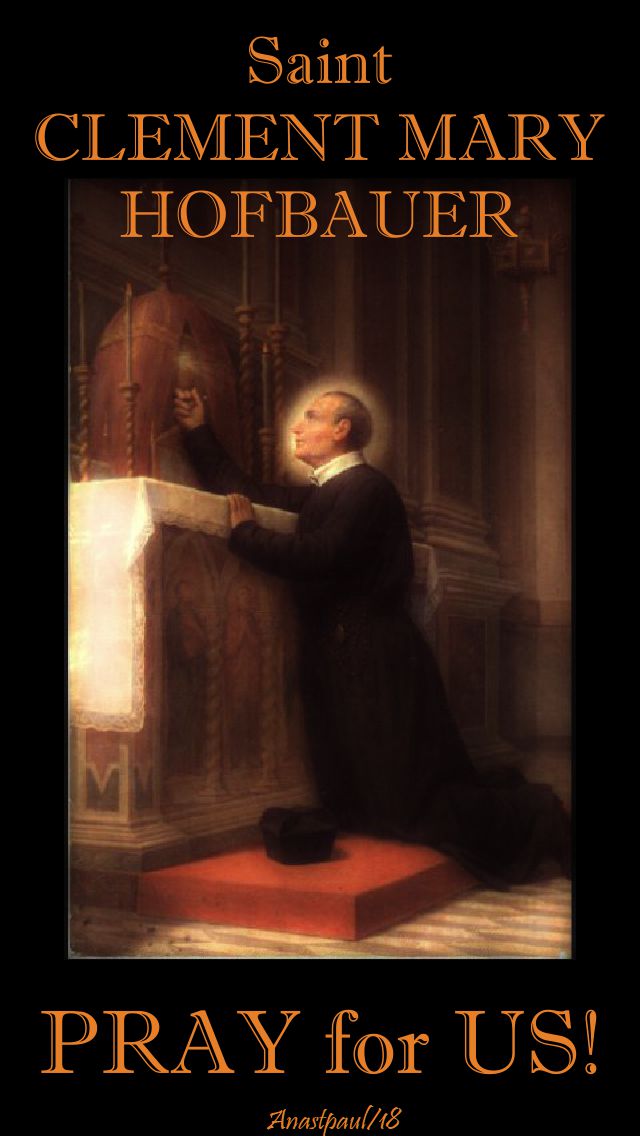
O St Clement, pray for our world, pray for the Church, pray for us all!st clement mary hofbauer - pray for us - 15 march 2018-no 2

Posted in LENT, MORNING Prayers, PRACTISING CATHOLIC, QUOTES - J R R Tolkien and MORE, SUNDAY REFLECTIONS, The HOLY EUCHARIST / The HOLY MASS

Sunday Reflection – 18 February – The First Sunday of Lent Year B

Sunday Reflection – 18 February – The First Sunday of Lent Year B

Beyond the daily life of the believer, the Eucharist extends its action to the whole cosmos.
As Teilhard de Chardin wrote:
“When He (Christ) says through the priest “This is my body”, His words go well beyond the piece of bread over which they are pronounced:  they effect the birth of the whole Mystical Body.
Beyond the transubstantiated Host, the priestly action extends to the cosmos itself.”

Every Eucharist is a “Mass on the world.”

This vision inspired a prayer of Teilhard de Chardin that we can make our own, each time we participate in the Mass and even when we cannot participate:

“On the altar of the whole earth
I offer You, Lord,
the work and the toil of the world….
All that will grow in the world
in the course of this day,
all that will decline in it
and all that will die in it…
Receive, Lord,
this total Host that Creation
presents to You,
drawn and moved by You,
at the dawn of a new day.”

Fr Raneiro Cantalamessa OFM (Preacher to the Papal Household) “This is My Body”beyond the daily life of the - fr raneiro cantalamessa - 18 feb 2018 sunday reflection

Posted in DOCTORS of the Church, FATHERS of the Church, JESUIT SJ, LENT, LENTEN PRAYERS & NOVENAS, MORNING Prayers, PRACTISING CATHOLIC, PRAYERS for VARIOUS NEEDS, QUOTES - J R R Tolkien and MORE, QUOTES on REPENTANCE, The WORD

Saturday after Ash Wednesday – 17 February 2018

Saturday after Ash Wednesday – 17 February 2018
Isaiah 58:9-14, Psalms 86:1-6, Luke 5:27-32

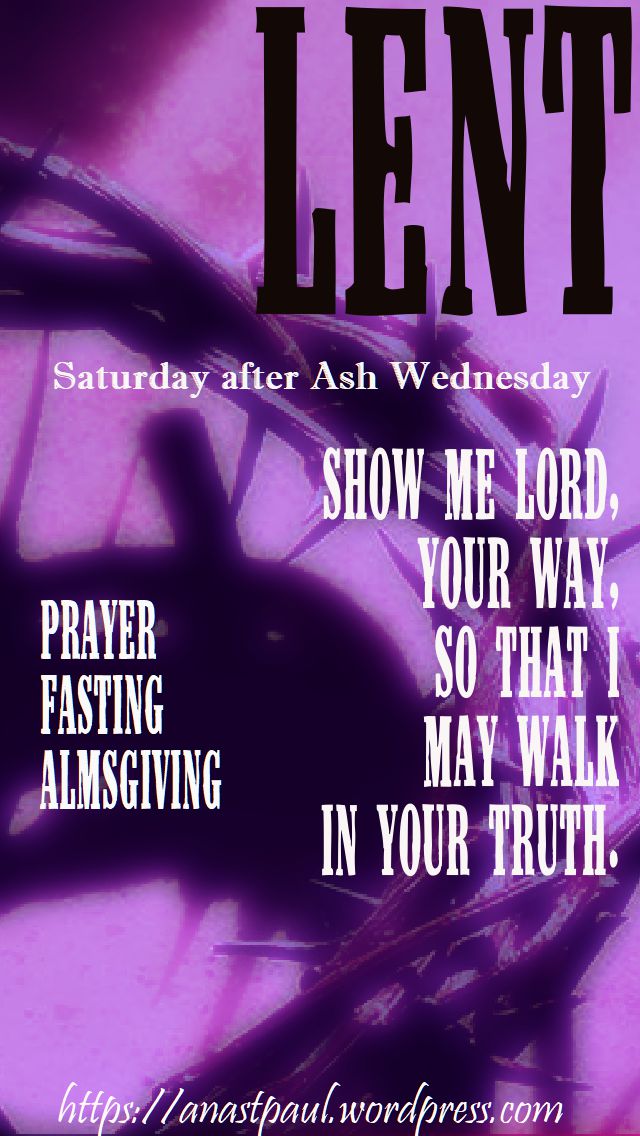
Show me Lord, your way, so that I may walk in your truth.

Isaiah 58:9-10: “If you take away from the midst of you the yoke,
the pointing of the finger and speaking wickedness,
if you pour yourself out for the hungry
and satisfy the desire of the afflicted,
then shall your light rise in the darkness
and your darkest hour will be like noon.
Luke 5:32: “I have come to call not the upright but sinners to repentance.”saturday after ash wed - 17 feb 2018

Isaiah makes it abundantly clear that it is our service to the poor and the weak that wins God’s favour, not lifeless religious practices.   The message becomes most meaningful in modern society, marked by unfair distribution of resources, hatred, violence, abuse and mutual accusations.   It is only when we strive against such evils that we win God’s approval.   “You shall be like the watered garden” the prophet says.   The image stands for the possession of every good thing that we desire.

The Gospel speaks of the call of Levi.   His joy was so great that he could hardly contain it.
He organised a party for his fellow tax-collectors, which unfailingly earned the criticism of the Pharisees.   Jesus’ answer was that His mission was precisely to wrongdoers, to the least and the lost.   These words indeed offer us hope when we stray and urge us to reach out to others as Jesus did.
That is the Christian calling, that is the Christian ‘job’!
(Archbishop Thomas Menamparanpil SDB – Gods Word)

Don’t you wonder what it was about Levi that moved Jesus to call him?   And what was it that caused Levi to respond?
He must have been a pretty successful man in economic terms but as a tax collector, he was undoubtedly not popular in his own community and was seen as a collaborator with Rome.   Perhaps he had a nagging sense of “there must be something more to life”. perhaps a sense of emptiness and sadness.   Something touched him so deeply at Jesus call, that he let go of a previous way of life and opened himself instantly to the gift being offered.   He was overjoyed, he was filled with joy, he was joyous, he bubbled over and threw a big party in order to share his joy!   And Jesus attended the party!   He was at the party!   He is at our party too when we allow Him entrance to our hearts.

When asked who he is, Pope Francis responded “I am a sinner, whom the Lord has looked upon.”   When we are able to see ourselves as Pope Francis does, as loved sinners, we are open to receive the forgiveness and help God longs to give us.   When we are aware of ourselves as sinners, loved and called by God, we respond with a deep sense of repentance, gratitude and joy, we throw that party and invite other sinners to join us.   We simply have to share the joy!

Where do I experience my own sinfulness?
How is this awareness a gift?
Spend some time with Jesus today sharing with Him your struggles and Your need of His help.
Have a party with Him!
(excerpt Fr Nicholas King S.J. ‘The Long Journey to the Resurrection’)

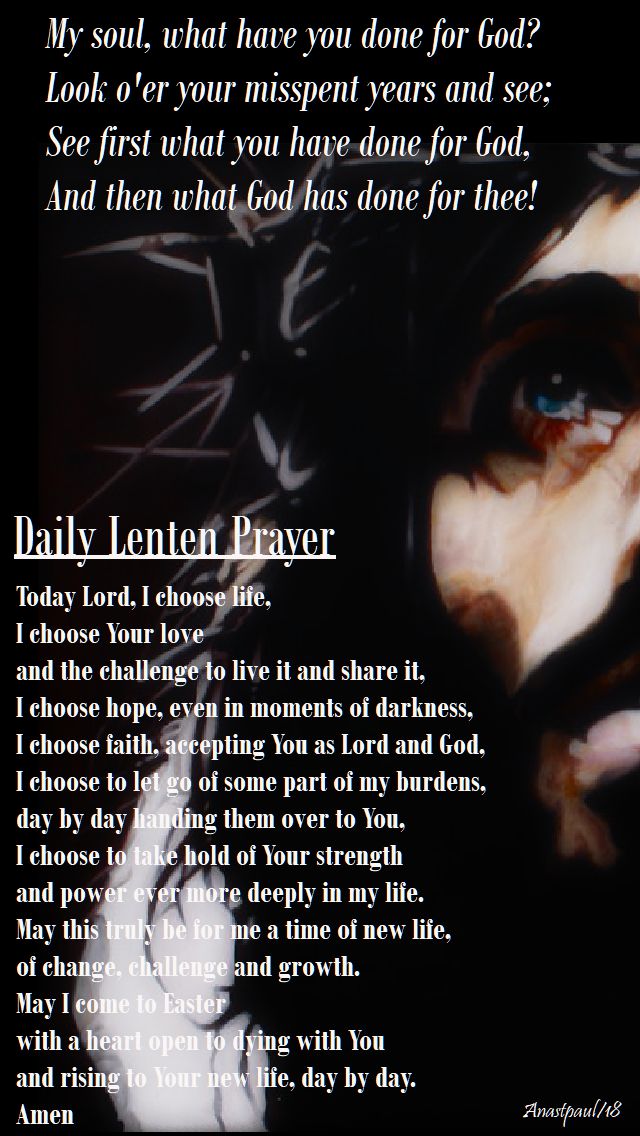
My soul, what have you done for God?
Look o’er your misspent years and see;
See first what you have done for God,
And then what God has done for thee!

Daily Lenten Prayer

Today Lord, I choose life,
I choose Your love
and the challenge to live it and share it,
I choose hope, even in moments of darkness,
I choose faith, accepting You as Lord and God,
I choose to let go of some part of my burdens,
day by day handing them over to You,
I choose to take hold of Your strength
and power ever more deeply in my life.
May this truly be for me a time of new life,
of change, challenge and growth.
May I come to Easter with a heart open to dying with You
and rising to Your new life, day by day.
Amen
my soul what have you done for god - daily lenten prayer 17 feb 2018

Posted in CONFESSION/PENANCE, DEVOTIO, FATHERS of the Church, LENT, MORNING Prayers, PRACTISING CATHOLIC, PRAYERS for VARIOUS NEEDS, PRAYERS of the CHURCH, QUOTES - J R R Tolkien and MORE, QUOTES on REPENTANCE, The WORD

Ash Wednesday – 14 February 2018

Ash Wednesday – 14 February 2018

Joel 2:12-18, 2 Corinthians 5:20 — 6:2, Matthew 6:1-6, 16-18

At the beginning of Lent, on Ash Wednesday, ashes are blessed during Mass, after the homily.   The blessed ashes are then “imposed” on the faithful as a sign of conversion, penance, fasting and human mortality.   The ashes are blessed at least during the first Mass of the day but they may also be imposed during all the Masses of the day, after the homily and even outside the time of Mass to meet the needs of the faithful.   Priests or deacons normally impart this sacramental but instituted acolytes, other extraordinary ministers or designated lay people may be delegated to impart ashes, if the bishop judges that this is necessary.   The ashes are made from the palms used at the previous Passion Sunday ceremonies. …— Ceremonies of the Liturgical Year, Msgr. Peter J Elliott

The act of putting on ashes symbolises fragility and mortality and the need to be redeemed by the mercy of God.   Far from being a merely external act, the Church has retained the use of ashes to symbolise that attitude of internal penance to which all the baptised are called during Lent. — Directory on Popular Piety and the Liturgy

From the very early times the commemoration of the approach of Christ’s passion and death was observed by a period of self-denial.   St Athanasius in the year 339 enjoined upon the people of Alexandria the 40 days’ fast he saw practised in Rome and elsewhere, “to the end that while all the world is fasting, we who are in Egypt should not become a laughing stock as the only people who do not fast but take our pleasure in those days.” On Ash Wednesday in the early days, the Pope went barefoot to St Sabina’s in Rome “to begin with holy fasts the exercises of Christian warfare, that as we do battle with the spirits of evil, we may be protected by the help of self-denial.

“In the course of this trial of forty days, which our weakness only finds long, we shall not be deprived of our Saviour’s presence.   He has preceded and outpaced us on the royal road.   He has tried it and accomplished its course before us, in order to answer, by His example, the excuses and arguments our self-indulgence or pride may urge.   Let us accept the lesson fully and so arrive at an understanding of the law of expiation.   “Do penance, for the kingdom of heaven is drawing near.”   Let us open our heart to this appeal, that the Saviour may not be compelled to awake us from our lethargy by the terrible threat He employed on another occasion:  “If you do not repent you shall all perish.”...Abbot Dom Prosper Gueranger

“The enormity of the fact that Christ has, on our behalf, already taken the most extreme punishment upon Himself, should move us, not to leave Him isolated.   It should also inspire us to rejoice that another has taken our place in representing sin before God – for not to rejoice at that, would be a further enormity.   Instead of leaving Him alone, we should be moved to enter into His suffering for us, doing together with Him, what little we can do, to atone for the world’s sin!”…Hans Urs von Balthasar “Light of the World”instead of leaving him alone - hans urs - 14 feb 2018 ash wed

ACT OF CONTRITION

Forgive my sins, O my God, forgive my sins:
the sins of youth,
the sins of age;
the sins of my soul
and the sins of my body;
the sins which, through frailty, I have committed;
my deliberate and grievous sins,
the sins I know and the sins I do not know,
the sins I have laboured so long to hide from others,
that now they are hidden from my own memory;
let me be absolved from all these iniquities
and delivered from the bond of all these evils,
by the Life, Passion, and Death
of my Lord and Saviour, Jesus Christ.
Amenact of contrition - ash wed - 14 feb 2018

Posted in CONFESSION/PENANCE, LENT, MORNING Prayers, NOTES to Followers, PRACTISING CATHOLIC

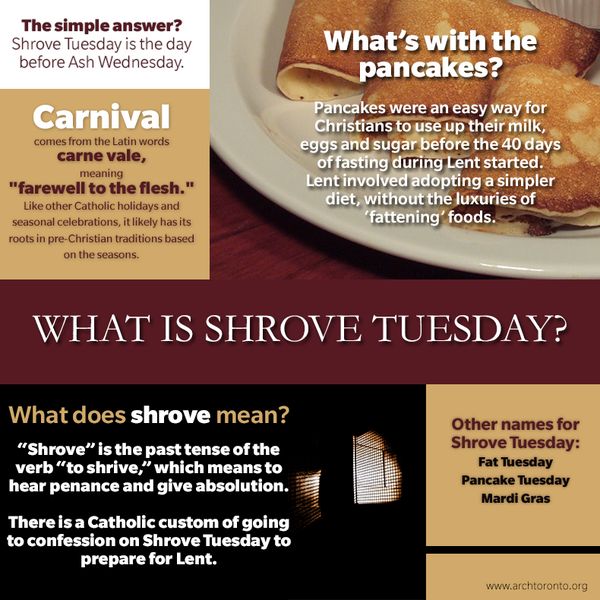
The meaning of Shrove Tuesday – 13 February 2018

The meaning of Shrove Tuesday – 13 February 2018

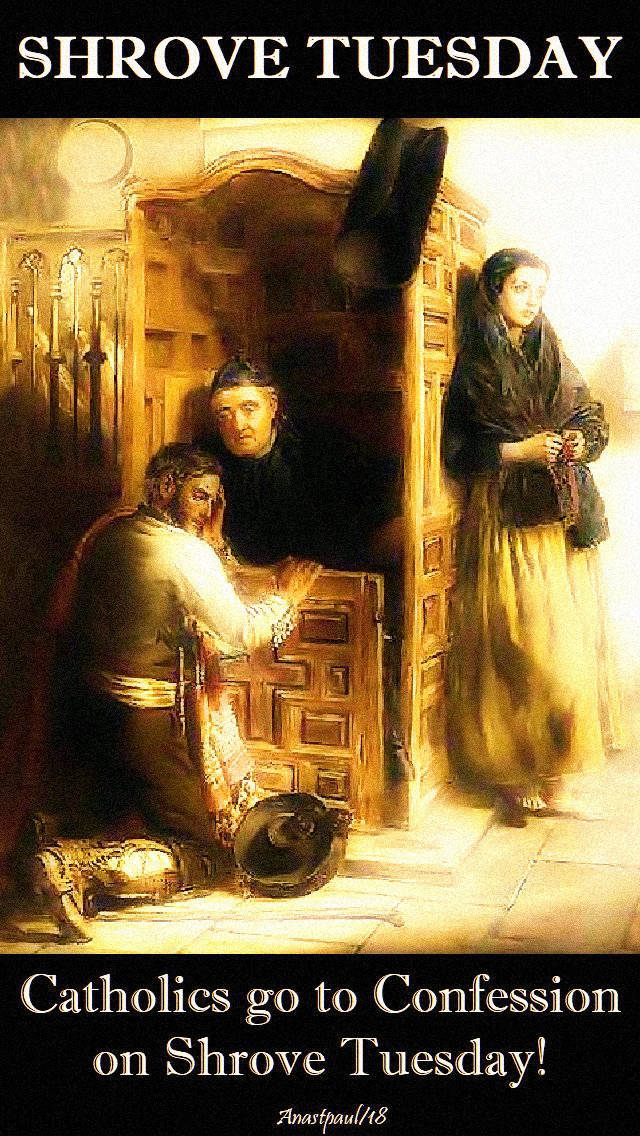
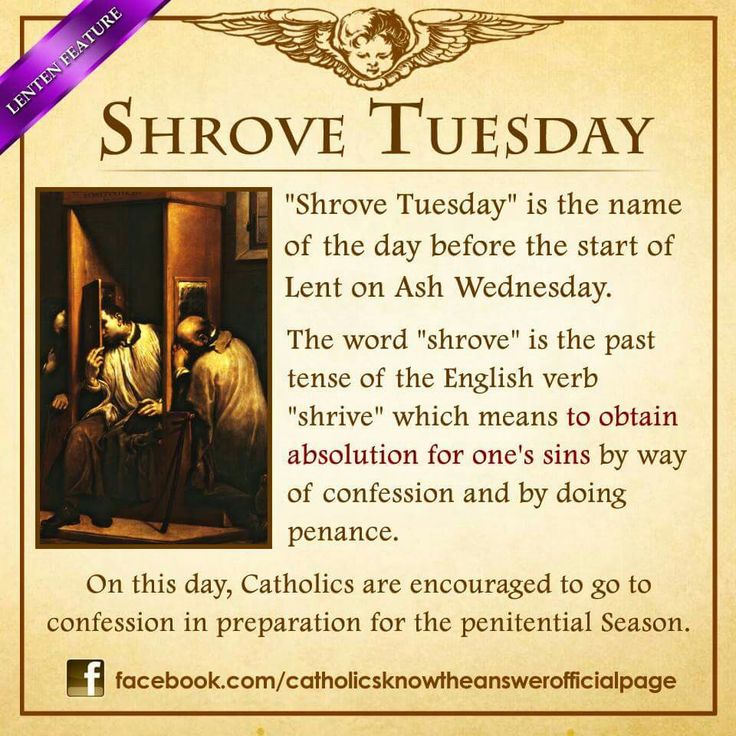
Shrove is the past tense of the word shrive, which means to hear a confession, assign penance and absolve from sin.   In the Middle Ages, especially in Northern Europe and England, it became the custom to confess one’s sins on the day before Lent began in order to enter the penitential season in the right spirit.   How I wish the Church would bring this practice back NOW and not concentrate on flipping pancakes – entendre intended!   Though we, as the “Church” can re-institute this practice ourselves.catholics-go-to-confession-on-shrove-tues-13-feb-2018.jpg

shrove tuesday 2( same words as no 1)shrove tuesday 3

From the earliest days of Christianity, Lent, the penitential period before Easter, has always been a time of fasting and abstinence.

While the Lenten fast today is confined to Ash Wednesday and Good Friday and abstinence from meat is required only on Ash Wednesday, Good Friday and the other Fridays of Lent, in previous times (and not so long away either, ask anyone over 60) the fast was quite severe.   Christians abstained from all meat and items that came from animals, including butter, eggs, cheese and fat.

That is why Shrove Tuesday became known as Mardi Gras, the French term for Fat Tuesday.   Over time, Mardi Gras extended from a single day to the entire period of Shrovetide, the days from the last Sunday before Lent through Shrove Tuesday.

In the countries that speak Romance language (languages derived primarily from Latin), Shrovetide is also known as Carnivale—literally, “farewell to meat.”   In the English-speaking countries, Shrove Tuesday became known as Pancake Day, because Christians used up their eggs, butter and milk to make pancakes and other pastries.

Posted in CATHOLIC-PRAYERS OF THE CHURCH, MORNING Prayers, PRACTISING CATHOLIC, PRAYERS for VARIOUS NEEDS, PRAYERS of the CHURCH, SAINT of the DAY

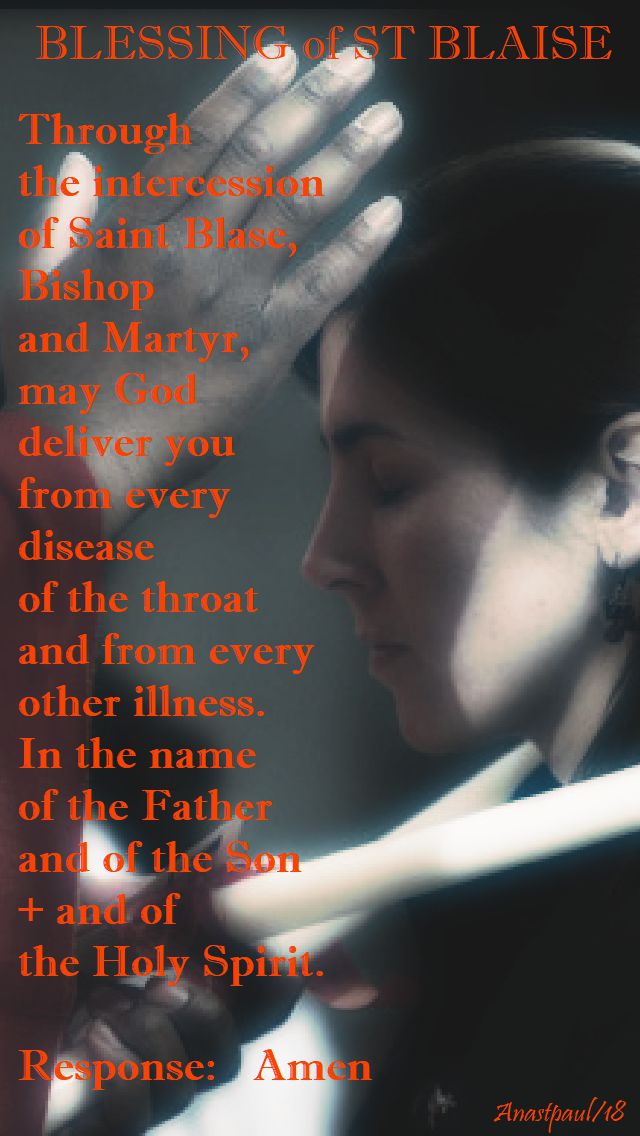
BLESSING of ST BLAISE

3 February – The Memorial of St Blaise – Martyr (Died c 316)

THROAT BLESSING of ST BLAISE

Although separated by customs, language, politics and more, Catholics around the world celebrate many of the same God-inspired devotional acts, practices and rituals handed down through the centuries by Holy Mother Church.   Such a devotion is the optional memorial celebrating St Blaise and the blessing of throats today, every 3 February.

Throat blessings
The candles used in the blessing of throats may be those blessed yesterday, on Candlemas, or when blessed during the St. Blaise memorial.

With the crossed candles touched to the throat of each person, the celebrant says immediately:

Through the intercession of Saint Blase, bishop and martyr, may God deliver you from every disease of the throat and from every other illness.    In the name of the Father and of the Son + and of the Holy Spirit.

Each person responds:  Amen.blessing of st blaise - 3 feb 2018

Posted in CATHOLIC-PRAYERS OF THE CHURCH, CONSECRATION Prayers, FEASTS and SOLEMNITIES, MORNING Prayers, PRACTISING CATHOLIC, PRAYERS for VARIOUS NEEDS, PRAYERS of the CHURCH, The BLESSED VIRGIN MARY, The CHRIST CHILD, VOCATIONS

Thought for the Day – 2 February – Feast of the Presentation of the Lord and the World Day of Prayer for Consecrated Life

Thought for the Day – 2 February – Feast of the Presentation of the Lord and the World Day of Prayer for Consecrated Life

On this holy feast-day we each have an opportunity to consecrate our lives anew to the Lord.    How do we do this?    We can simply make a prayer of re-dedication to God which can take many forms.    It can be a simple heartfelt prayer reaffirming our baptismal promises or a re-visiting of our religious or marriage vows.    Or it can be a prayer which asks the Holy Spirit to renew our sense of vocation as a priest or religious or as a lay person in our chosen job, trade or profession.
We gave our life to the Lord when we were baptised but the call to conversion continues to resound throughout our lives and ‘this second conversion is an uninterrupted task for the whole church’ (Catechism of the Catholic Church 1428).    A re-dedication or renewal of vows or promises is a movement of conversion within our heart and is always a work of the Holy Spirit.
Today, step out in faith, whatever your vocation, whatever your calling and give your life to the Lord, in the assurance of God’s grace, blessing and renewal in the power of the Holy Spirit.

LET US PRAY FOR ALL CONSECRATED MEN & WOMEN AND FOR VOCATIONS:

Loving God, You call all who believe in You
to grow perfect in love
by following in the footsteps
of Christ Your Son.
Call from among us more men and women
who will serve You as religious.
Open the hearts of many, raise up
faithful servants of the Gospel, dedicated,
holy priests, sisters, brothers and deacons,
who will spend themselves for Your people
and their needs.
Bless those who are serving now
with courage and perseverance.
Grant that many will be inspired by their
example and faith.
By their way of life, may they provide a convincing sign
of Your Kingdom for the Church and the whole world.
We ask this through our Lord Jesus Christ. Amen.prayer for the consecrated and vocations - 2018

Posted in CATHOLIC DEVOTIONS of the Month, CATHOLIC-PRAYERS OF THE CHURCH, MORNING Prayers, PRACTISING CATHOLIC, PRAYERS of the CHURCH, THE HOLY FAMILY - FAMILIAE SANCTAE, Uncategorized

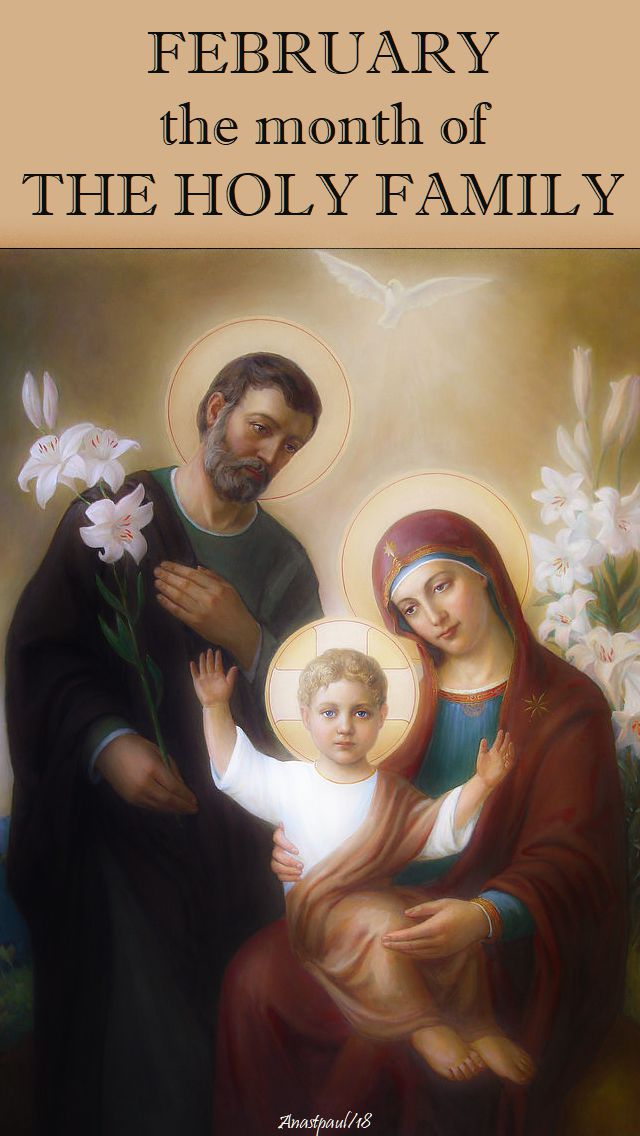
Monthly Catholic Devotions: FEBRUARY is the Month of THE HOLY FAMILY

FEBRUARY – THE MONTH OF THE HOLY FAMILY

In January, the Catholic Church celebrated the Month of the Holy Name of Jesus and in February, we turn to the entire Holy Family—Jesus, Mary and Joseph.feb the month of the holy family - 1 feb 2018

In sending His Son to earth as a Baby, born into a family, God elevated the family beyond a mere natural institution.   Our own family life reflects that lived by Christ, in obedience to His mother and foster father.   Both as children and as parents, we can take comfort in the fact that we have the perfect model of the family before us in the Holy Family.

One commendable practice for the month of February is a Consecration to the Holy Family – I will post this pray during this month.   If you have a prayer corner or a home altar, you can gather the entire family and recite the consecration prayer, which reminds us that we aren’t saved individually. We all work out our salvation in conjunction with others—first and foremost, together with the other members of our family.

There’s no need to wait until next February to repeat the consecration, it’s a good prayer for your family to pray every month.

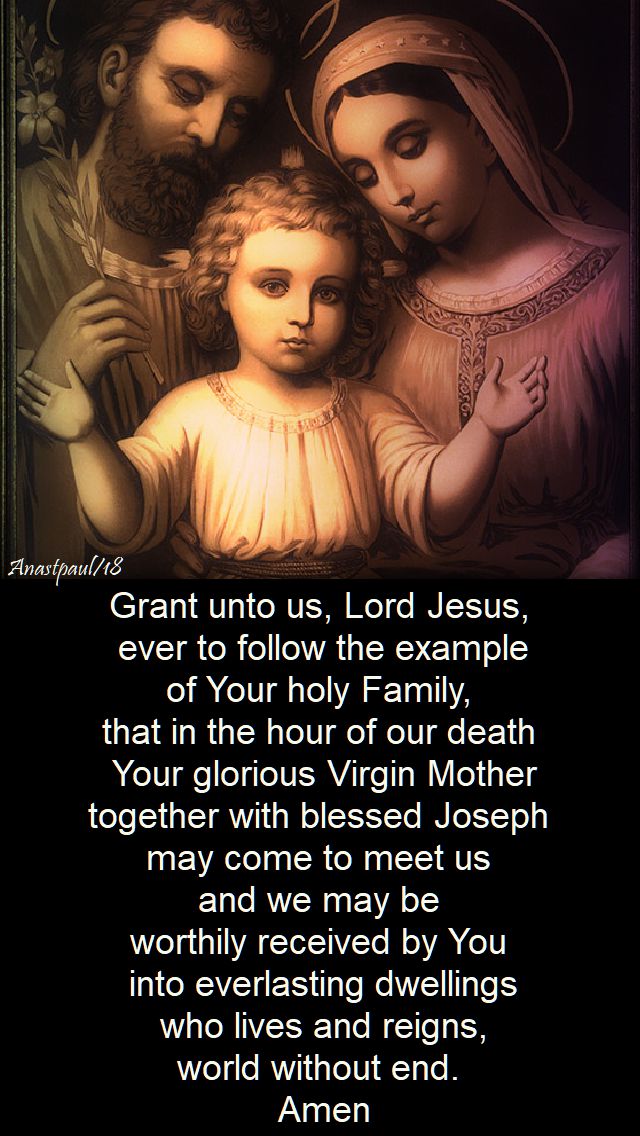
Grant unto us, Lord Jesus,
ever to follow the example of Your holy Family,
that in the hour of our death
Your glorious Virgin Mother
together with blessed Joseph
may come to meet us
and we may be worthily received by You
into everlasting dwellings
who lives and reigns, world without end.
Amenprayer for the help of the holy family - 1 feb 2018


Posted in LENT, MORNING Prayers, PRACTISING CATHOLIC

Thought for the Day -30 January – Lent is Coming!

Thought for the Day -30 January – Lent is Coming!

Ash Wednesday is on Valentine’s Day!

On a day typically reserved for chocolates, candies and delicious meals shared with a loved one, the Church asks you to fast, pray and abstain from meat!   Take it as an opportunity to pray with each other and grow deeper in a true and abiding love of God.

Lent lasts 40 days and ends on April 1 (no fools!)

In imitation of Jesus fasting in the desert, the Church instituted a special season of fasting that lasts 40 days.   However, the six Sundays in Lent are not considered part of the official “Lenten fast” (every Sunday is a special remembrance of the Resurrection of Christ).   For this reason, Easter is “technically” 46 days after Ash Wednesday.   This year Easter lands on April 1, but is no joke!

The three pillars of Lent are prayer, fasting and almsgiving

According to the Catechism of the Catholic Church, “The interior penance of the Christian can be expressed in many and various ways. Scripture and the Fathers insist above all on three forms, fasting, prayer and almsgiving, which express conversion in relation to oneself, to God, and to others.   Alongside the radical purification brought about by Baptism or martyrdom they cite as means of obtaining forgiveness of sins:  effort at reconciliation with one’s neighbour, tears of repentance, concern for the salvation of one’s neighbour, the intercession of the saints and the practice of charity ‘which covers a multitude of sins.’”

Lent is a time to practice these essential spiritual practices and clean out our interior house.

Ash Wednesday and Good Friday are days of fasting

Ash Wednesday and Good Friday are obligatory days of fasting and abstinence for Catholics … For members of the Latin Catholic Church, the norms on fasting are obligatory from age 18 until age 59.   When fasting, a person is permitted to eat one full meal, as well as two smaller meals that together are not equal to a full meal.   The norms concerning abstinence from meat are binding upon members of the Latin Catholic Church from age 14 onwards.

All Fridays in Lent are days of abstinence from meat (unless superseded by a solemnity)

Fridays have always been special days of prayer and penitence in the Church.   Catholic peoples from time immemorial have set apart Friday for special penitential observance by which they gladly suffer with Christ that they may one day be glorified with Him.  This is the heart of the tradition of abstinence from meat on Friday where that tradition has been observed in the holy Catholic Church.

Go Forth – may this be our best Lent ever!lent - preparing our hearts - 30 jan 2018

https://aleteia.org/2018/01/26/lent-is-almost-here-heres-what-you-need-to-know/

Posted in MORNING Prayers, PRACTISING CATHOLIC, QUOTES - J R R Tolkien and MORE, SUNDAY REFLECTIONS, The HOLY EUCHARIST / The HOLY MASS, The WORD

Sunday Reflection – 14 January – The Shepherd Gathers Us

Sunday Reflection – 14 January – The Shepherd Gathers Us

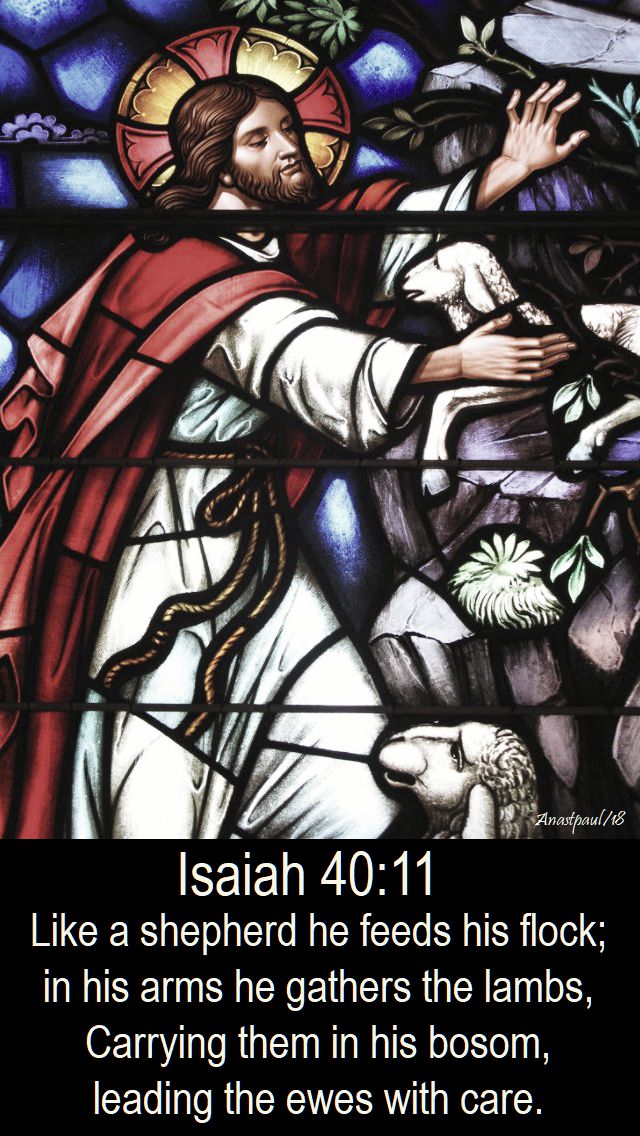
Like a shepherd he feeds his flock;
in his arms he gathers the lambs,
Carrying them in his bosom,
leading the ewes with care….Isaiah 40:11

Jesus promised that whenever a group of people gather in prayer, He will be there with them. The early church took that promise literally. The first disciples had been used to having Jesus physically among them and then, after His Ascension, they often struggled to know what Jesus would want them to do. However, they had a simple formula for every occasion and difficulty – Jesus’ invitation to gather in His Name. They would gather around the Word and the breaking of the bread and, there, let Jesus make His presence felt and effect through them what they could not otherwise accomplish themselves.

As Christians today, we still need to take that same promise literally. Christian life is not sustained only by private acts of prayer, justice and virtue. It is sustained in a community, by gathering ritually around the Word of God and through the breaking of the bread. However, it is important to understand, that this kind of gathering is not simply a social one capable only of doing what social gatherings can do. To gather around the Word of God and the breaking of the bread is a ritual gathering and ritual brings something that normal social gatherings does not – namely, transformative power beyond what can be understood and explained through the physical, psychological and social dynamics that are present.

Lord, You invite me to be part of Your flock.
Remind me of that when I am tempted to go off on my own.

Fr Ron Rolheiser – Light for the Worldisaiah 40 11

Posted in CHRISTMASTIDE!, MORNING Prayers, PRACTISING CATHOLIC, QUOTES of the SAINTS, SUNDAY REFLECTIONS, The CHRIST CHILD

Sunday Reflection – 7 January 2018 – The Feast of Epiphany

Sunday Reflection – 7 January 2018 – The Feast of Epiphany

Each Sunday towards the end of Mass, we come to the altar rail, receive Holy Communion, return to our seats and sit or kneel quietly for a while in contemplation.   But in these quiet moments after we have received Communion, what prayers do we offer up?  Perhaps we don’t pray at all but in those quiet moments our thoughts turn to other things, like Sunday lunch or a planned visit to visit the grandchildren after Mass.

I recently came across this wonderful article, written by a priest.  He writes:

“A few years ago it became evident to me that my prayers after distributing Holy Communion to my congregation were wholly inadequate.   As I sat on my seat on the altar I was finding it extremely difficult to express into words, what this moment meant to me.   Looking through my book collection I read all the prayers I could get my hands on but none seemed to be what I was looking for, so I gave up in frustration.   However, each day I would pray to Mary our Blessed Mother asking her to teach me how to express my innermost feelings to the Lord.   Sometime later I was preaching a retreat to a group of nuns when one of the elderly nuns came to visit me and said she felt she had a problem concerning her prayers after receiving Holy Communion.   Feeling I had at last found a kindred spirit, I asked her what she usually prayed and she replied, ‘I don’t pray anything, I just sit in silence and allow Him to love me and to teach me to love Him.’   At that moment I realised that Mary had indeed answered my prayers.

“I just sit in silence and allow Him to love me and to teach me to love Him.”

What a simple, but moving description of what this moment means to us all.

“Above all, let us pray Him to draw us to Him and to give us faith.   When we feel that His mysteries are too severe for us and occasion us to doubt, let us earnestly wait on Him for the gift of humility and love.    Those who love and who are humble will apprehend them, carnal minds do not seek the and proud minds are offended at them but while love desires them, humility sustains them.

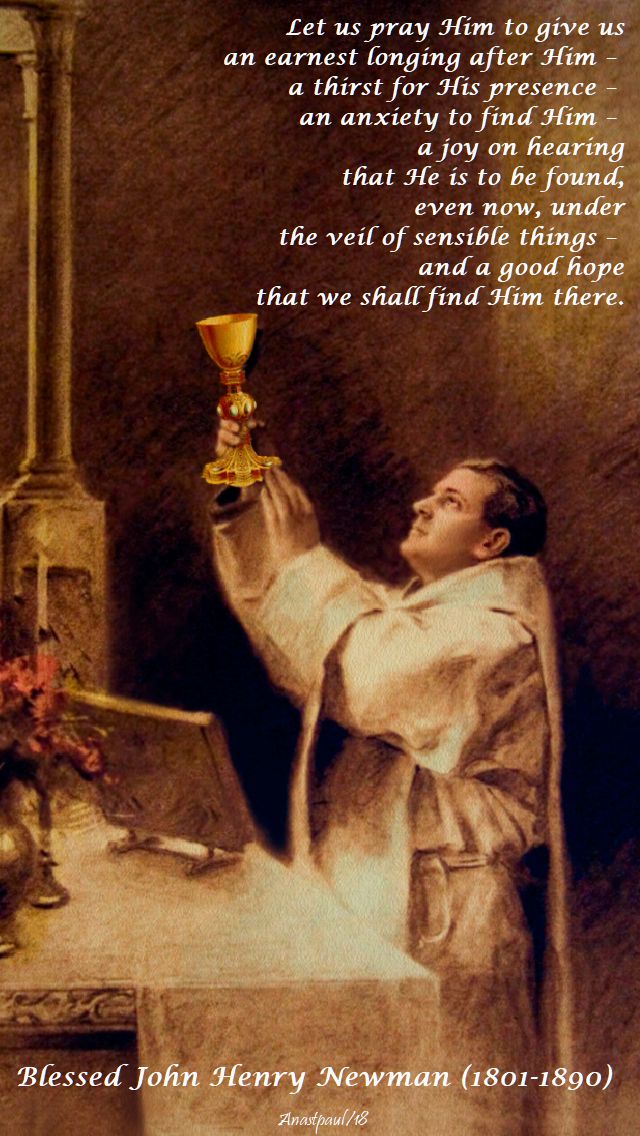
Let us pray Him to give us an earnest longing after Him – a thirst for His presence – an anxiety to find Him – a joy on hearing that He is to be found, even now, under the veil of sensible things – and a good hope that we shall find Him there.

Blessed indeed are they who have not seen and yet have believed.   They have their reward in believing, they enjoy the contemplation of a mysterious blessing, which does not even enter into the thoughts of other men and while they are more blessed than others, in the gift vouchsafed to them, they have the additional privilege of knowing that they are vouchsafed it.”….Blessed John Henry Newman  (1801-1890) – Parochial & Plain Sermons, Vol. VI, no. 11let us pray him to give us - bl john henry newman - 7 jan 2018

Posted in CATHOLIC-PRAYERS OF THE CHURCH, FEASTS and SOLEMNITIES, MORNING Prayers, PRACTISING CATHOLIC, SAINT of the DAY

Blessing of a Home at Epiphany – 7 January – The Solemnity of the Epiphany of Our Lord Jesus Christ

Blessing of a Home at Epiphany – 7 January – The Solemnity of the Epiphany of Our Lord Jesus Christ

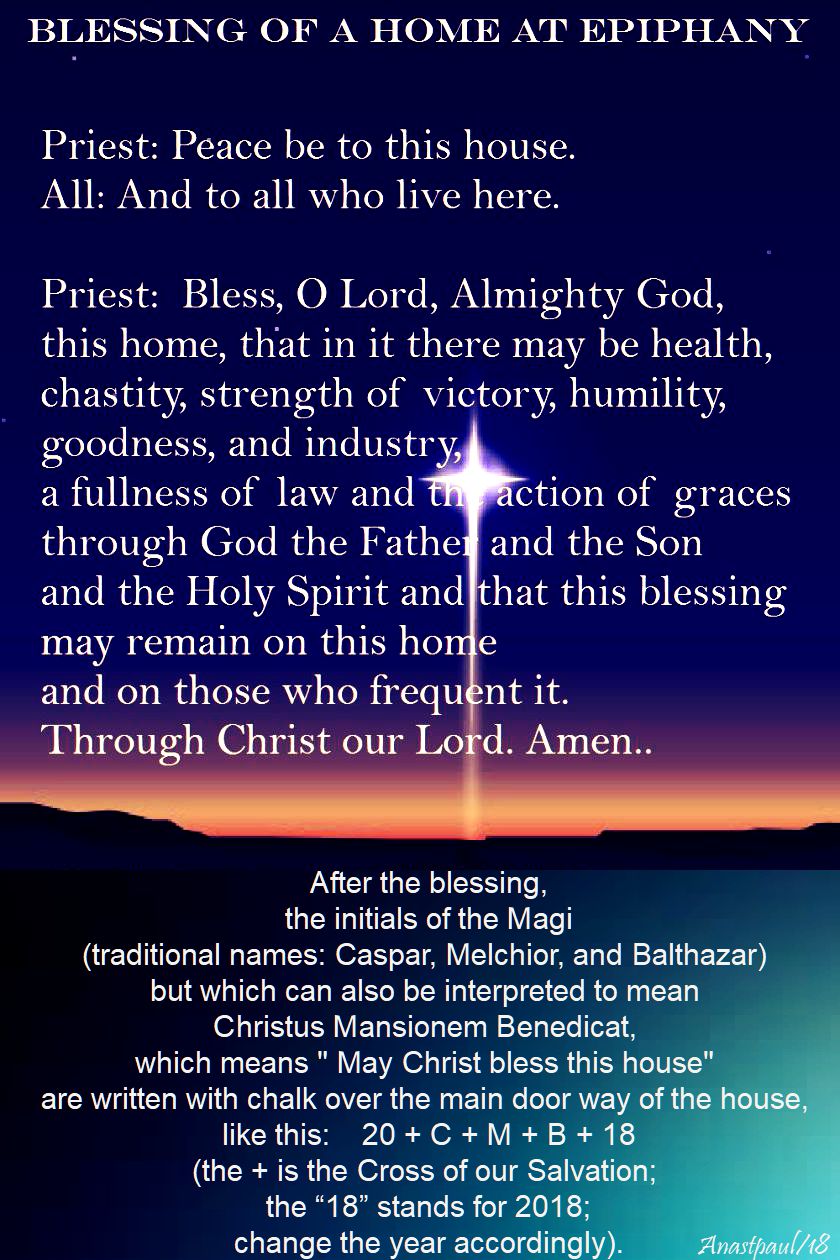
Priest:  Peace be to this house.
All:  And to all who live here.

Priest:  Bless, O Lord, Almighty God,
this home, that in it there may be health,
chastity, strength of victory, humility,
goodness, and industry,
a fullness of law and the action of graces
through God the Father and the Son
and the Holy Spirit and that this blessing
may remain on this home
and on those who frequent it.
Through Christ our Lord. Amen..

After the blessing,
the initials of the Magi
(traditional names: Caspar, Melchior and Balthazar) but which can also be interpreted to mean Christus Mansionem Benedicat, which means ” May Christ bless this house
are written with chalk over the main door way of the house, like this:
20 + C + M + B + 18
(the + is the Cross of our Salvation; the “18” stands for 2018;
change the year accordingly).house-blessing-7 jan 2018

Posted in FEASTS and SOLEMNITIES, MORNING Prayers, PRACTISING CATHOLIC, SAINT of the DAY

The Solemnity of the Epiphany of Our Lord Jesus Christ – 7 January: God reveals Himself to us

The Epiphany of Our Lord Jesus Christ
God reveals Himself to us04_Adoration_of_the_Magi_by Botticelli.jpg-800x500640px-Adoration_of_the_Magi_Tapestry_detailsolemnity of epiphany

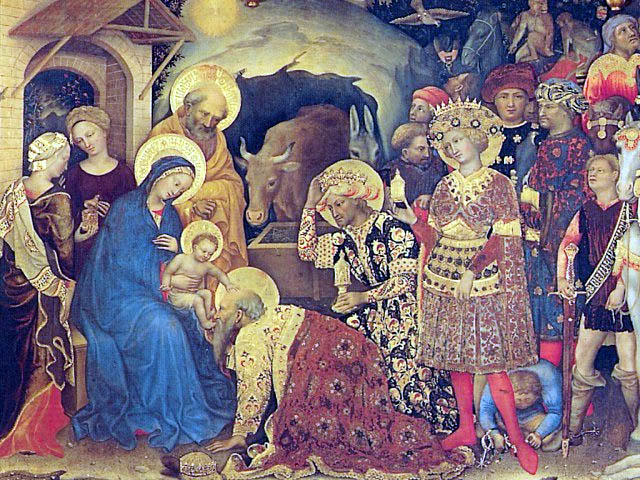
The Feast of the Epiphany of Our Lord Jesus Christ is one of the oldest Christian feasts, though, throughout the centuries, it has celebrated a variety of things.   Epiphany comes from a Greek verb meaning “to reveal” and all of the various events celebrated by the Feast of the Epiphany are revelations of Christ to man.
Like many of the most ancient Christian feasts, Epiphany was first celebrated in the East, where it has been held from the beginning almost universally on 6 January.   Today, among Eastern Catholics, the feast is known as Theophany—the revelation of God to man.
Epiphany originally celebrated four different events, in the following order of importance- the Baptism of the Lord, Christ’s first miracle, the changing of water into wine at the wedding in Cana, the Nativity of Christ and the visitation of the Wise Men or Magi.   Each of these is a revelation of God to man – at Christ’s Baptism, the Holy Spirit descends and the voice of God the Father is heard, declaring that Jesus is His Son,  at the wedding in Cana, the miracle reveals Christ’s divinity,  at the Nativity, the angels bear witness to Christ and the shepherds, representing the people of Israel, bow down before Him and at the visitation of the Magi, Christ’s divinity is revealed to the Gentiles—the other nations of the earth.
Eventually, the celebration of the Nativity was separated out, in the West, into Christmas and shortly thereafter, Western Christians adopted the Eastern feast of the Epiphany, still celebrating the Baptism, the first miracle and the visit from the Wise Men.   Thus, Epiphany came to mark the end of Christmastide—the Twelve Days of Christmas (celebrated in the song), which began with the revelation of Christ to Israel in His Birth and ended with the revelation of Christ to the Gentiles at Epiphany.
Over the centuries, the various celebrations were further separated in the West and now the Baptism of the Lord is celebrated on the Sunday after today and the wedding at Cana is commemorated on the Sunday after the Baptism of the Lord.

EPIPHANY CUSTOMS:
Giving of Gifts:  In many parts of Europe, the celebration of Epiphany is at least as important as the celebration of Christmas. While in England and her historical colonies, the custom has long been to give gifts on Christmas Day itself, in Italy and other Mediterranean countries, Christians exchange gifts on Epiphany—the day on which the Wise Men brought their gifts to the Christ Child.

Blessing of our Homes:  the blessing of homes, on whose lintels are inscribed the Cross of salvation, together with the indication of the year and the initials of the three wise men (C+M+B), which stands for Caspar, Melchior and Balthassar (the traditional names of the 3 Magi) but which can also be interpreted to mean Christus Mansionem Benedicat, which means ” May Christ bless this house” written in blessed chalk.   We put 20 + C + M + B + 18, using the initials of the Magi and the year, so that our coming and going would be in search of the Truth.   We are called to remember, each time we enter and leave our homes, that we are in search of Christ, that our mission is to find Him and follow Him.
In the absence of a priest the family gathers around the crib with lighted candles and prays:
Leader: “Peace be to this house and to all who dwell here, in the name of the Lord.
All: Thanks be to God.
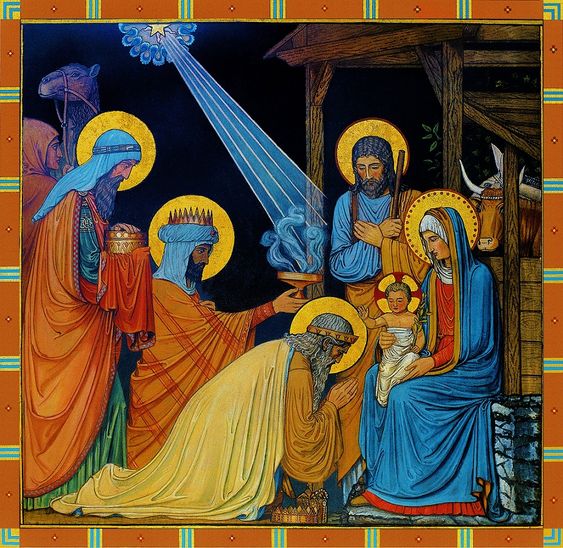
Reader: When Jesus was born in Bethlehem of Judea,
in the days of King Herod,
behold, magi from the east arrived in Jerusalem, saying,
“Where is the newborn king of the Jews?
We saw his star at its rising
and have come to do him homage.”
After their audience with the king they set out.
And behold, the star that they had seen at its rising preceded them,
until it came and stopped over the place where the child was.
They were overjoyed at seeing the star,
and on entering the house
they saw the child with Mary his mother.
They prostrated themselves and did him homage.
Then they opened their treasures
and offered him gifts of gold, frankincense, and myrrh.
And having been warned in a dream not to return to Herod,
they departed for their country by another way.
The word of the Lord.
ALL: Thanks be to God
All: Lord God of heaven and earth, You revealed Your only begotten Son to every nation by the guidance of a star.
Bless this house and all who live here and all who visit.
May we be blessed with health, kindness of heart, gentleness and the keeping of your law.
Fill us with the light of Christ, that our love for each other may go out to all.
Grant that we may always remain true to our mission of seeking and preaching
the most Holy Name of Jesus, our Lord.
We ask this through Christ our Lord. Amen.Three Kingsepiphany trad imageepiphany 2.EPIPHANY

Posted in CATHOLIC DEVOTIONS of the Month, DEVOTIO, MORNING Prayers, PAPAL PRAYERS, PRACTISING CATHOLIC, PRAYERS of the CHURCH

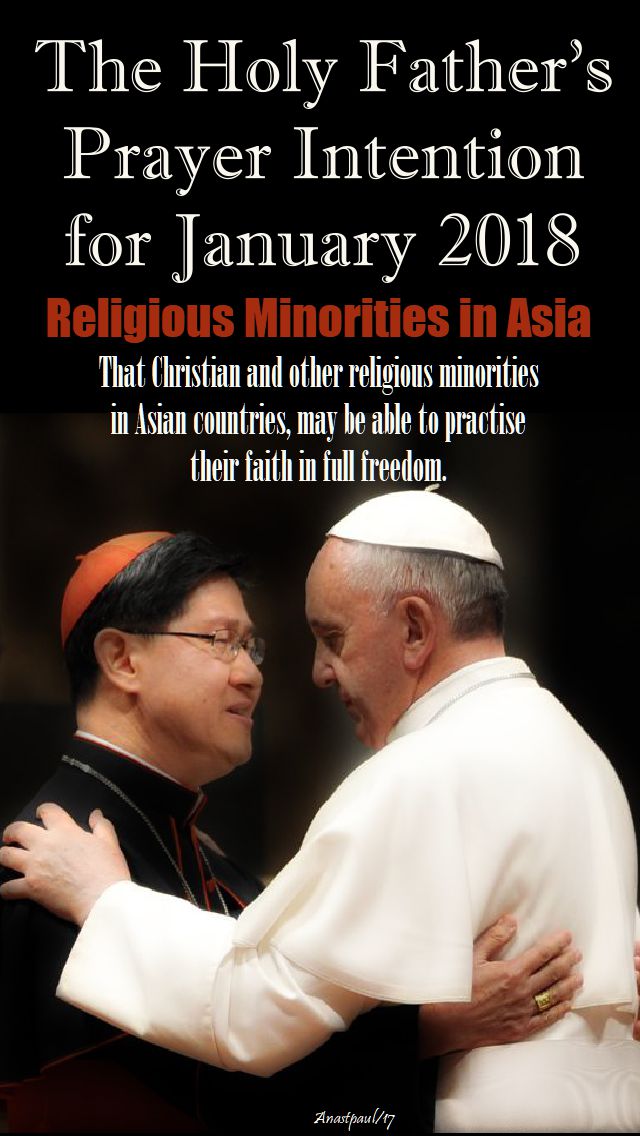
The Holy Father’s Prayer Intention for January 2018

The Holy Father’s Prayer Intention
for January 2018

Religious Minorities in Asia

That Christian and other religious minorities
in Asian countries, may be able to practise
their faith in full freedom.

the holy father's prayer intention january 2018

Posted in ADVENT, MORNING Prayers, PRACTISING CATHOLIC, QUOTES - J R R Tolkien and MORE, The WORD

Thought for the Day – 16 December – Saturday of the Second Week of Advent – The Roots of Faith

Thought for the Day – 16 December – Saturday of the Second Week of Advent

The Roots of Faith

Once again, O Lord of hosts;
look down from heaven and see;
Take care of this vine
and protect what your right hand has planted
the son of man, whom you yourself made strong.
Psalm 80:15-16

What does it mean to be a CATHOLIC?
Jesus gave the best definition of the term when He said:
“In my Father’s house there are many rooms.”
This is not a description of a certain geography of heaven
but a revelation of the breadth of God’s heart….

To belong to a Church is to be loyal to many things, not just one thing.
A healthy member of a church community does not pick, in an “either/or fashion”
between having boundaries or emphasising freedom,
between believing in defined doctrines or emphasising individual conscience,
between the gift of legitimate institutionalised authority or the importance of individual charisma,
between the role of ordained ministers and the priesthood of all people,
between the needs of the local community and the needs of the larger universal Church,
between what the gifted artist brings to the community and what the poorest of the poor brings,
between liberal and conservative,
between old and new,
or even between what is being said by those church members who are still alive
and those who have died but with whom we are still in communion.

To be a member of the Church, is not to choose among these.
It is to CHOOSE THEM ALL!
Like our God in heaven, we too need a heart with many rooms.

Lord Jesus, give Your people hearts to embrace one another,
to embrace Your Holy Church and all its teachings, its works and its words
and to invite everyone in. Amen.

(Excerpted from Fr Ronald Rolheiser’s “Light for the World”)the roots of faith - sat of second week advent - 16 dec 2017


Posted in DOCTORS of the Church, FATHERS of the Church, MORNING Prayers, PAPAL MESSAGES, PRACTISING CATHOLIC, QUOTES of the SAINTS, QUOTES on CHARITY, QUOTES on MERCY, SAINT of the DAY

Quote/s of the Day – 19 November – The First World Day of the

Quote/s of the Day – 19 November – The First World Day of the Poor

Let us love, not with words but with deeds.”1st annual world day of the poor - 19 nov - let us love not with words but with deeds - 2017.-no2

“As long as Lazarus lies at the door of our homes
there can be no justice or social peace.”as long as lazarus - pope francis - 19 nov 2017

“Blessed are the open hands that embrace
the poor and help them – they are hands
that bring hope.
Blessed are the hands that reach beyond
every barrier of culture, religion and nationality
and pour the balm of consolation over
the wounds of humanity.
Blessed are the open hands that ask nothing
in exchange, with no “ifs” or “buts” or “maybes”:
they are hands that call down God’s blessing
upon their brothers and sisters.

Pope Francis

FIRST WORLD DAY OF THE POOR
33rd Sunday in Ordinary Time
19 November 2017blessed are the open hands - pope francis - 19 nov 2017

“If you want to honour the body of Christ,
do not scorn it when it is naked;
do not honour the Eucharistic Christ
with silk vestments and then,
leaving the church, neglect the other Christ
suffering from cold and nakedness”

St John Chrysostom (347-407)

Father and Doctor of the Church – (Hom. in Matthaeum, 50.3: PG 58)if you want to honour the body of christ - st john chrysostom - 19 nov 2017

Posted in CATHOLIC DEVOTIONS of the Month, DEVOTIO, MORNING Prayers, PRACTISING CATHOLIC, PRAYERS for VARIOUS NEEDS, PRAYERS of the CHURCH, PURGATORY, The HOLY SOULS

Devotion for the Month of November – The Holy Souls/The Faithful Departed

Devotion for the Month of November – The Holy Souls/The Faithful Departednovember - the month of the holy souls

As Christmas approaches, it is natural that our thoughts turn to those whom we have loved who are no longer with us.

How appropriate, then, that the Catholic Church offers us November, which begins with All Saints Day and All Souls Day, as the Month of the Holy Souls in Purgatory—those who have died in grace, yet who failed in this life to make satisfaction for all of their sins.

In recent years, perhaps no Catholic doctrine has been more misunderstood by Catholics themselves than the doctrine of Purgatory.   Consequently, we tend to downplay it, even seem a little embarrassed by it and it is the Holy Souls who suffer because of our discomfort with the doctrine.

Purgatory is not, as many people think, one last trial.   All of those who make it to Purgatory will one day be in Heaven.   Purgatory is where those who have died in grace but who have not fully atoned for the temporal punishments resulting from their sins, go to finish their atonement before entering Heaven.   A soul in Purgatory may suffer but he has the assurance that he will ultimately enter Heaven when his punishment is complete.   Catholics believe Purgatory is an expression of God’s love, His desire to cleanse our souls of all that might keep us from experiencing the fullness of joy in Heaven.

As Christians, we don’t travel through this world alone.   Our salvation is wrapped up with the salvation of others and charity requires us to come to their aid.   The same is true of the Holy Souls.   In their time in Purgatory, they can pray for usand we should pray for the faithful departed that they may be freed from the punishment for their sins and enter into Heaven.

We should pray for the dead throughout the year, especially on the anniversary of their death but in this Month of the Holy Souls, we should devote some time every day to prayer for the dead.   We should start with those closest to us—our mother and father, for instance—but we should also offer prayers for all the souls,and especially for those most forsaken.

We believe that those Holy Souls for whom we pray will continue to pray for us after they have been released from Purgatory.   If we live Christian lives, we too will likely find ourselves in Purgatory someday and our acts of charity toward the Holy Souls there now will ensure that they remember us before the throne of God when we are most in need of prayers.   It’s a comforting thought and one that should encourage us, especially in this month of November, to offer our prayers for the Holy Souls.

Let us Pray:

Incline Your ear, O Lord, unto our prayers,
wherein we humbly pray to You.
to show Your mercy upon the souls of Your servants,
whom You have commanded to pass out of this world,
that You would place them in the region of peace and light
and bid them be partakers with Your Saints.
Through Christ our Lord.   Amen incline your ear o lord - nov month of the holy souls
Posted in CONFESSION/PENANCE, DOCTORS of the Church, FATHERS of the Church, MORNING Prayers, PRACTISING CATHOLIC, QUOTES of the SAINTS

Quote/s of the Day on Confession – 25 October

Quote/s of the Day on Confession – 25 October

“The confession of evil works, 
is the first beginning of good works.
You do the truth
and come to the light.”

St Augustine (354-430) Doctor & Father of the Churchthe confession of evil - st augustine - 25 oct 2017

“A man is repaired in an instant by Divine grace.”

“One who has confessed and received absolution,
will be less punished in Purgatory than one
who has gone no further than contrition.”

St Thomas Aquinas (1225-1274) Doctor of the Churcha man is repaired - st thomas aquinas - 25 oct 2017

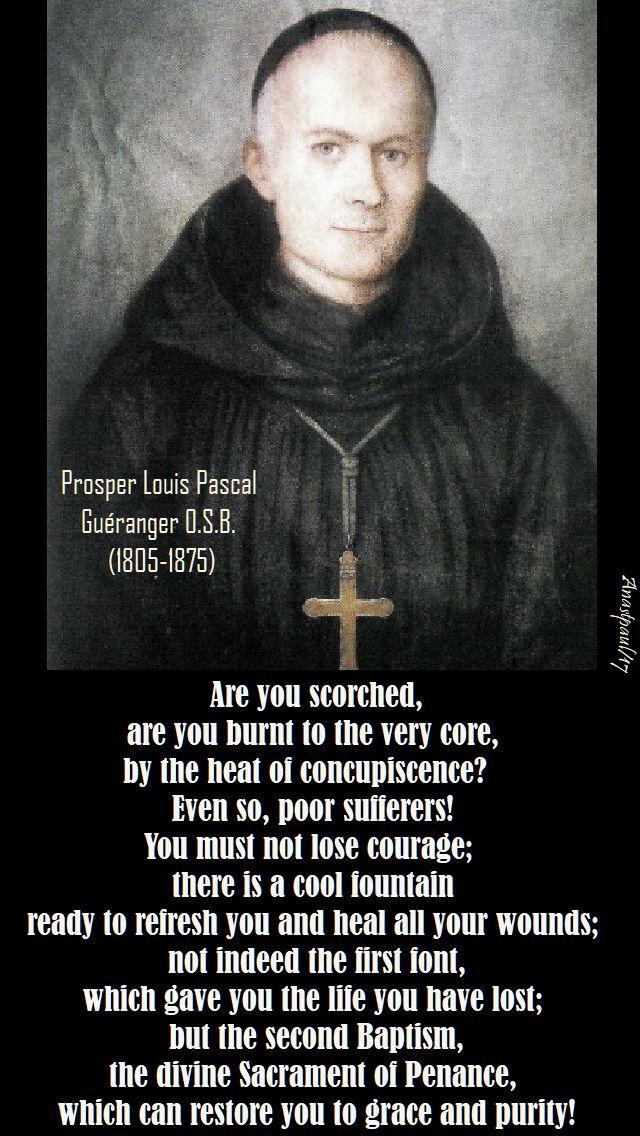
“Are you scorched, are you burnt to the very core,
by the heat of concupiscence? Even so, poor sufferers!
You must not lose courage; there is a cool fountain
ready to refresh you and heal all your wounds;
not indeed the first font, which gave you the life you have lost;
but the second Baptism, the divine Sacrament of Penance,
which can restore you to grace and purity!”

Prosper Louis Pascal Guéranger O.S.B. (1805-1875)are you scorched - abbot gueranger - 25 oct 2017

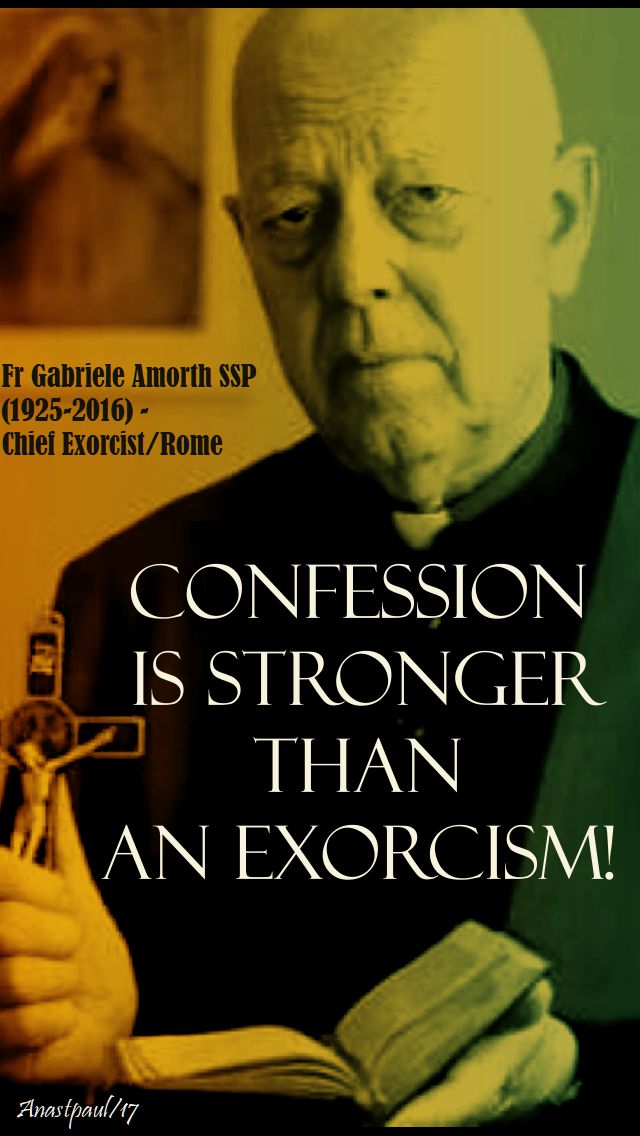
“Confession is stronger than an exorcism!”

Fr Gabriele Amorth, SSP (1925-2016) – Chief Exorcist/Romeconfession is stronger - fr armorth - 25 oct 2017


Posted in CATHOLIC DEVOTIONS of the Month, MARIAN PRAYERS, MARIAN QUOTES, MARIAN TITLES, MORNING Prayers, PRACTISING CATHOLIC, QUOTES of the SAINTS, SAINT of the DAY, The BLESSED VIRGIN MARY, The HOLY ROSARY/ROSARY CRUSADE

Quote/s of the Day – 7 October – The Memorial of Our Lady of the Most Holy Rosary

Quote/s of the Day – 7 October – The Memorial of Our Lady of the Most Holy Rosary

THE SEVEN BLESSINGS OF THE ROSARY

“The Rosary, recited with meditation on the mysteries, brings about the following marvelous results:

1. It gradually gives us a perfect knowledge of Jesus Christ;
2. It purifies our souls, washing away sin;
3. It gives us victory over all our enemies;
4. It makes it easy for us to practice virtue;
5. It sets us on fire with love of Our Blessed Lord;
6. It enriches us with graces and merits;
7. It supplies us with what is needed to pay,
all our debts to God and to our fellow men
and finally, it obtains all kinds of graces for us from Almighty God.”

St Louis Marie Grignion De Montfort (1673-1716)the seven blessings of the rosary - st louis de montfort - 2017

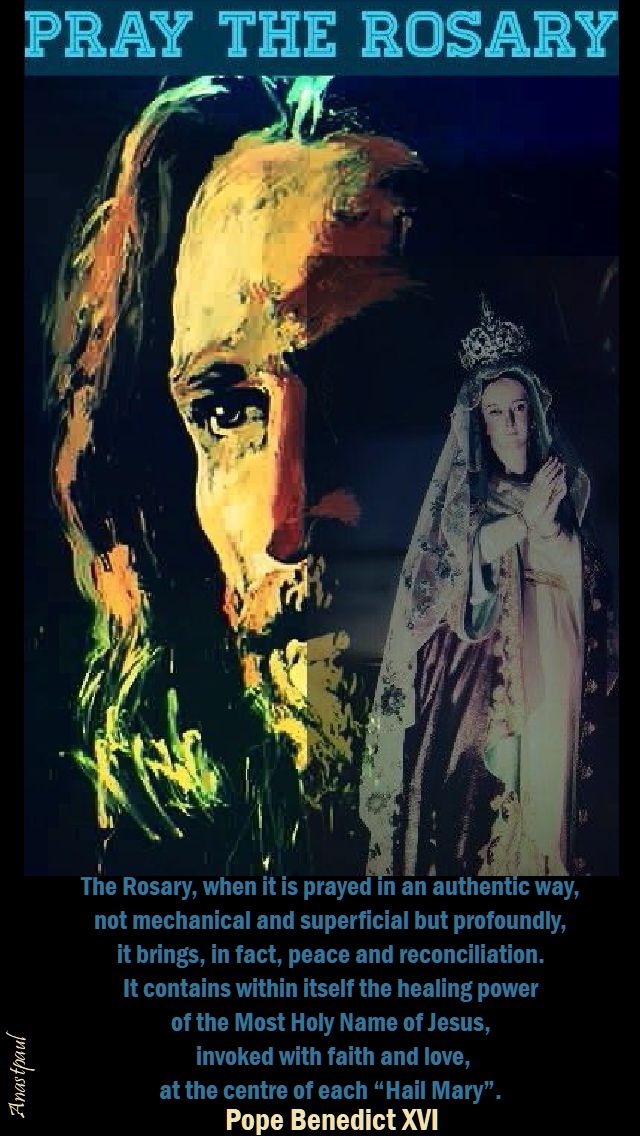
The Rosary, when it is prayed in an authentic way,
not mechanical and superficial but profoundly,
it brings, in fact, peace and reconciliation.
It contains within itself the healing power
of the Most Holy Name of Jesus,
invoked with faith and love,
at the centre of each “Hail Mary”.

Pope Benedict XVIthe rosary when it is prayed - pope benedict - 7 oct 2017

Posted in DEVOTIO, PRACTISING CATHOLIC, QUOTES of the SAINTS, SAINT of the DAY

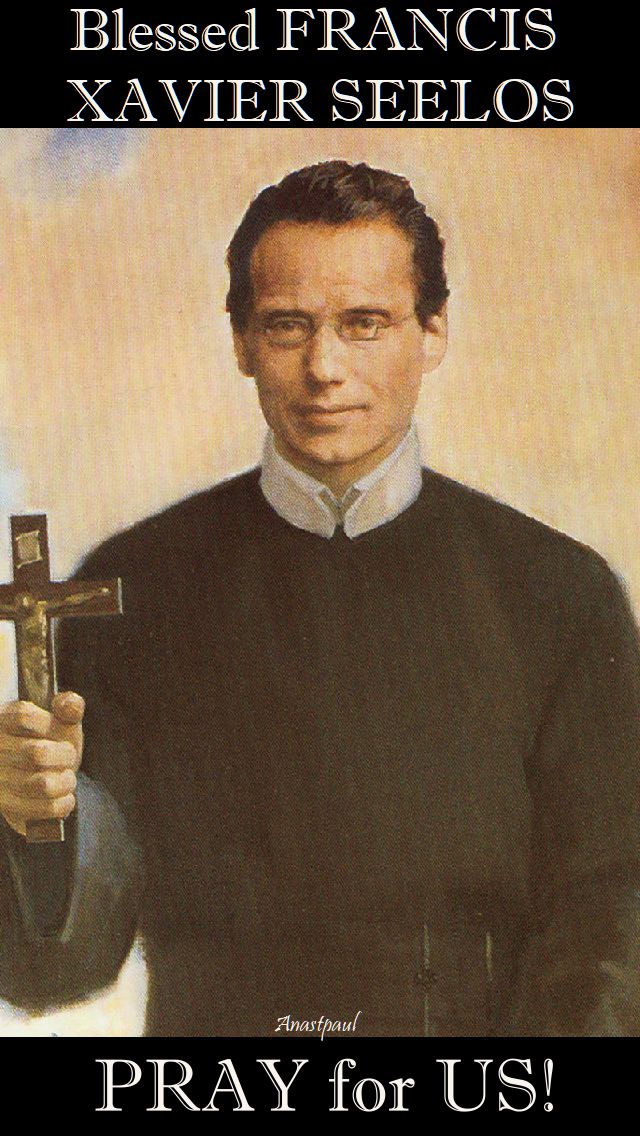
Celebrating and Learning from Blessed Francis Xavier Seelos – Memorial 5 October – TOP 10 Practical Guide to Holiness


Celebrating and Learning from Blessed Francis Xavier Seelos – Memorial 5 October

TOP 10 Practical Guide to Holiness

1. Go to Mass with deepest devotion.
2. Spend a half hour to reflect upon your main failing & make resolutions to avoid it.
3. Do daily spiritual reading for at least 15 minutes, if a half hour is not possible.
4. Say the rosary every day.
5. Also daily, if at all possible, visit the Blessed Sacrament and toward evening, meditate on the Passion of Christ for a half hour.
6. Conclude the day with evening prayer & an examination of conscience over all the faults & sins of the day.
7. Every month make a review of the month in confession.
8. Choose a special patron every month & imitate that patron in some special virtue.
9. Precede every great feast with a novena, that is, nine days of devotion.
10. Try to begin & end every activity with a “Hail Mary.”bl francis xavier seelos - 5 oct

Bl Francis Xavier Seelos PRAY FOR US!bl francis xavier seelos - pray for us

Posted in DOCTORS of the Church, MORNING Prayers, PRACTISING CATHOLIC, PRAYERS of the SAINTS, QUOTES of the SAINTS, SAINT of the DAY, The PASSION

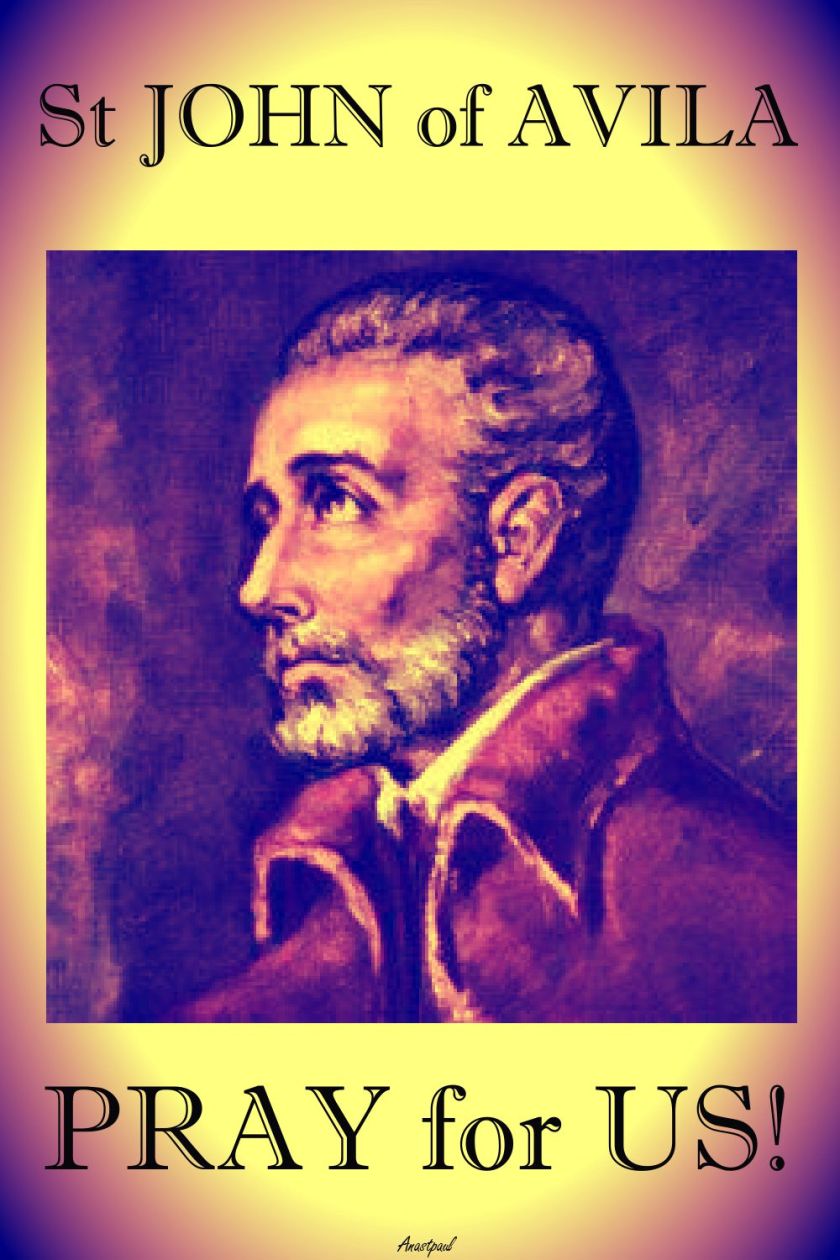
Thought for the Day – 10 May – the Memorial of St John of Avila (1499-1569) Doctor of the Church

Thought for the Day – 10 May – the Memorial of St John of Avila (1499-1569) Doctor of the Church

St Teresa of Ávila, herself a Doctor of the Church, praised John of Ávila for his mastery of elements of the spiritual life.    While he remains a little known and quoted figure, one saint celebrated among many, Master Ávila stands before us today as a witness to the need for continual reform, a commitment to reflection and renewal within the Church and for each one of us as followers of Jesus.

He understood that it is only through a spirit-filled engagement with the Word of God and a steadfast commitment to the pursuit of virtue that individual Christians would be able to fulfil the demands of the Gospel.    In one of his sermons for Pentecost, John of Ávila asked his hearers,  “What effect did the coming of the Holy Ghost have on the Church?   What did the Holy Ghost accomplish in the hearts of those believers to whom He came?   He gave them life, gave them gifts of infinite value, strengthened them and brought them near perfection.”    St John of Ávila, in his life, his teachings and in his legacy, reveals that the Holy Spirit remains at work in the Church and, in this lesser known saint (sadly one who needs to be studied by all) of more than four centuries ago we discover a man, a saint, whose heart burned so purely with the fire of this same Spirit that he remains a light for us today.    (BROTHER HENDERSON, O.S.B., is a Benedictine monk of Saint Meinrad Archabbey.)

And to help us along the way, that is the only way, the way of the Cross of Christ, perhaps this practical bit of advice left us by St John of Avila, will be of assistance in our spiritual growth.   St John of Avila, please pray for us for we all wish to join you as Saint in heaven!

This Doctor and Teacher of our Faith, St John of Avila divides the week into stages of the Passion of Christ:

• Monday think of our Lord’s agony in the garden and what passed in the house of Annas and Caiphas

• Tuesday, of the accusations, the removal from judge to judge, and the flagellation

• Wednesday, of the crowning with thorns and the mockery

• Thursday, of the washing of the feet, and the Blessed Eucharist

• Friday, of the sentence, the carrying of the cross, the crucifixion and death

• Saturday, of the piercing of the side, the taking down from the cross, the burial, and the grief of the Blessed Virgin

• Sunday, of the resurrection and the state of future glory.

st JOHN OF AVILA PRAY FOR US.jpg no 2