Quote/s of the Day – 2 April – Good Friday of the Passion of the Lord
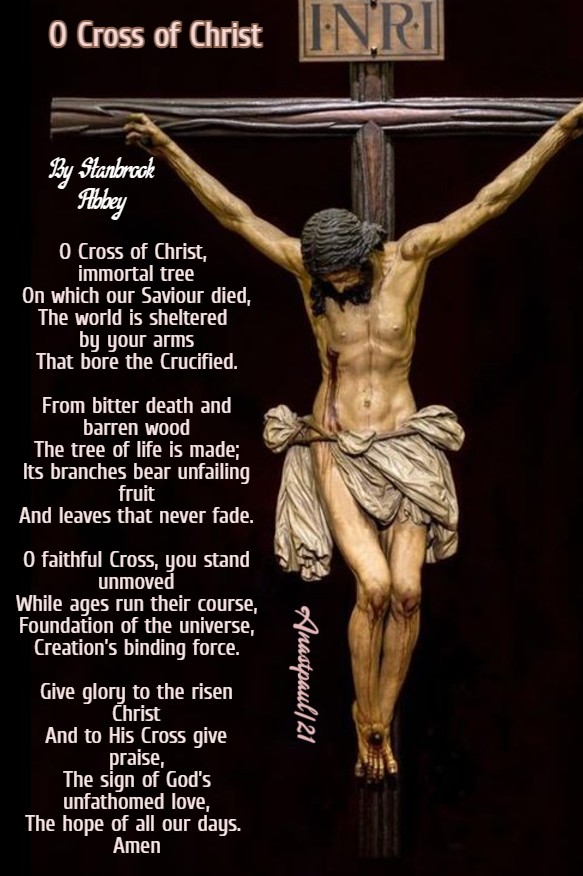
“O SACRED HEAD” By St Bernard (1090-1153) Mellifluous Doctor
O Sacred Head surrounded By a crown of piercing thorn! O bleeding Head, so wounded, Reviled and put to scorn! Death’s pallid hue comes o’er Thee, The glow of life decays, Yet angel hosts adore Thee And tremble as they gaze.
I see Thy strength and vigour All fading in the strife, And death, with cruel vigour, Bereaving Thee of life; O agony and dying! O love to sinners free! Jesus, all grace supplying, O turn Thy face on me!
In this Thy bitter Passion, Good Shepherd, think of me, With Thy most sweet compassion, Unworthy though I be. Beneath Thy Cross abiding, ‘Forever would I rest, In Thy dear love confiding, And will Thy presence blest.
“Do not pass one day without devoting a half hour, or at least a quarter of an hour, to meditation on the sorrowful Passion of your Saviour. Have a continual remembrance of the agonies of your crucified Love and know, that the greatest saints, who now, in heaven, triumph in holy love, arrived at perfection in this way.”
Our Morning Offering – 25 March – The Solemnity of the Annunciation of the Lord
The Angelus
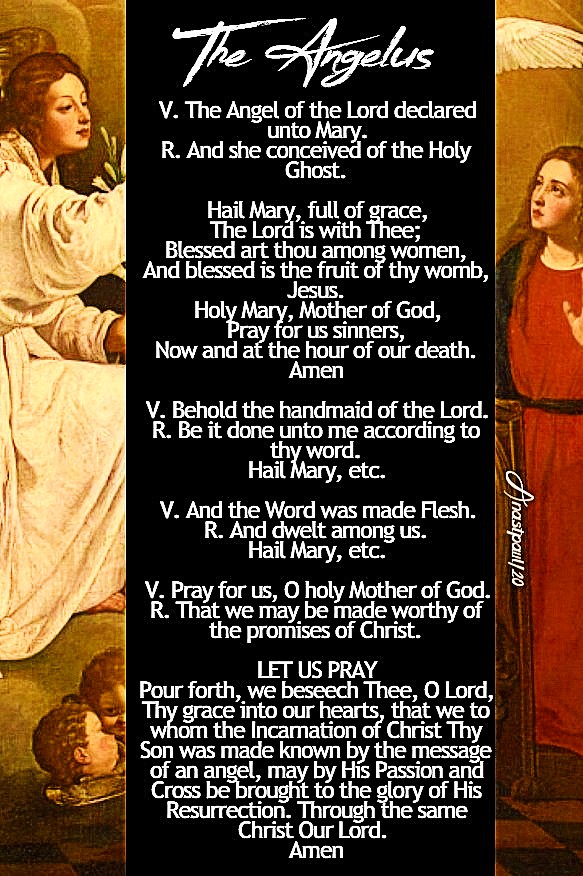
V. The Angel of the Lord declared unto Mary. R. And she conceived of the Holy Spirit. Hail Mary, full of grace, The Lord is with Thee; Blessed art thou among women, And blessed is the fruit of thy womb, Jesus. Holy Mary, Mother of God, Pray for us sinners, Now and at the hour of our death. Amen V. Behold the handmaid of the Lord. R. Be it done unto me according to thy word. Hail Mary, etc. V. And the Word was made Flesh. R. And dwelt among us. Hail Mary, etc. V. Pray for us, O holy Mother of God. R. That we may be made worthy of the promises of Christ. LET US PRAY Pour forth, we beseech Thee, O Lord, Thy grace into our hearts, that we to whom the Incarnation of Christ Thy Son was made known by the message of an angel, may by His Passion and Cross be brought to the glory of His Resurrection. Through the same Christ Our Lord. Amen
“Do you want to be healed?” The sick man answered him, “Sir, I have no one to put me into the pool….” Jesus said to him, “Get up, take up your bed, and walk.” John 5:6-8
REFLECTION – “We read in the Old Testament that in the times of Noah, since all humankind had been won over by sin, heaven’s floodgates opened and rain poured down for forty days… This was a symbol – it was less about a flood, than about a baptism. For it was indeed a baptism that bore away the misdeeds of the sinners and spared the uprightness of Noah. And so today, just as it was then, our Lord has given Lent to us so that the skies can open for the same number of days to inundate us with the floods of divine mercy. Once washed in the saving waters of baptism, this Sacrament enlightens us and, just as formerly, its waters bear away the evil of our sins and confirm the uprightness of our virtues.
Today’s situation is just the same as in Noah’s time. Baptism is flood to sinners and consecration for the faithful. In Baptism the Lord rescues justice and destroys injustice. We can see this in the example of one and the same man – before he was cleansed by the spiritual commands, the Apostle Paul, was a persecutor and blasphemer (1Tm 1,13). But once he had been bathed with the heavenly rain of Baptism, the blasphemer died, the persecutor died, Saul died. Then the Apostle, the just man, Paul, came to life… Anyone who lives Lent in a religious manner and observes the Lord’s decre,es will see sin die in him and grace come to life… such as these die as sinners and live as righteous persons.” – St Maximus of Turin (?-c 420), Bishop – Sermon for Lent 50
PRAYER – Forgive my sins, O my God, forgive my sins: the sins of youth, the sins of age, the sins of my soul and the sins of my body, the sins which, through frailty, I have committed, my deliberate and grievous sins, the sins I know and the sins I do not know, the sins I have laboured so long to hide from others, that now they are hidden from my own memory. Let me be absolved from all these iniquities and delivered from the bond of all these evils, by the Life, Passion and Death of my Lord and Saviour, Jesus Christ. Amen
Our Morning Offering – 16 March – Tuesday of the Fourth Week of Lent
God of Mercy and Compassion By Giovanni Battista Pergolesi (1710-1736) Composer
God of mercy and compassion, Look with pity upon me, Father, let me call Thee Father, ‘Tis Thy child returns to Thee.
Refrain: Jesus, Lord, I ask for mercy. Let me not implore in vain, All my sins, I now detest them, Never will I sin again.
By my sins I have deserved Death and endless misery, Hell with all its pains and torments, And for all eternity. (Refrain)
By my sins I have abandoned Right and claim to heav’n above. Where the saints rejoice forever In a boundless sea of love. (Refrain)
See our Saviour, bleeding, dying, On the cross of Calvary; To that cross my sins have nail’d Him, Yet He bleeds and dies for me. (Refrain)
Giovanni Battista Pergolesi 4 January 1710 – 16 or 17 March 1736 was an Italian Baroque composer, violinist and organist. His best-known works include his Stabat Mater and the opera La serva padrona (The Maid Turned Mistress). His compositions include operas and sacred Masses and music. He died of tuberculosis at the age of 26.
My Lord and my God By St Nicholas of Flue (1417-1487)
My Lord and my God, take from me everything which distances me from Thee. My Lord and my God, give me everything which brings me closer to Thee. My Lord and my God, detach me from myself, to give my all to Thee. Amen
Quote of the Day – 13 March – Saturday of the Third Week of Lent and The Memorial of St Leander (c 534-c 600)
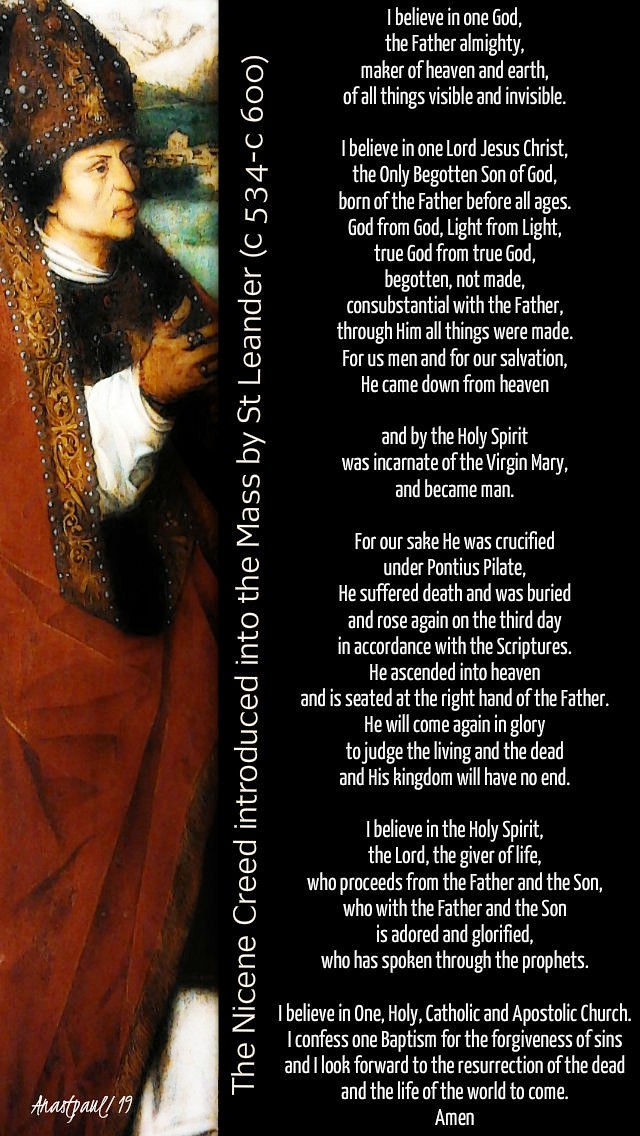
As we pray the Nicene Creed every Sunday, we might reflect on the fact that, this same prayer is being prayed by every Catholic during Mass, throughout the world. Saint Leander introduced its recitation as a means of uniting the faithful. Let’s pray that the recitation, may enhance that unity among Catholics today- each time you pray it, pray in your heart “let them be one.”
The Nicene Creed
I believe in one God, the Father almighty, maker of heaven and earth, of all things visible and invisible.
I believe in one Lord Jesus Christ, the Only Begotten Son of God, born of the Father before all ages. God from God, Light from Light, true God from true God, begotten, not made, consubstantial with the Father, through Him all things were made. For us men and for our salvation, He came down from heaven
and by the Holy Spirit was incarnate of the Virgin Mary, and became man.
For our sake He was crucified under Pontius Pilate, He suffered death and was buried and rose again on the third day in accordance with the Scriptures. He ascended into heaven and is seated at the right hand of the Father. He will come again in glory to judge the living and the dead and His kingdom will have no end.
I believe in the Holy Spirit, the Lord, the giver of life, who proceeds from the Father and the Son, who with the Father and the Son is adored and glorified, who has spoken through the prophets.
I believe in One, Holy, Catholic and Apostolic Church. I confess one Baptism for the forgiveness of sins and I look forward to the resurrection of the dead and the life of the world to come. Amen
Thought for the Day – 23 February– Meditations with (1881-1971)
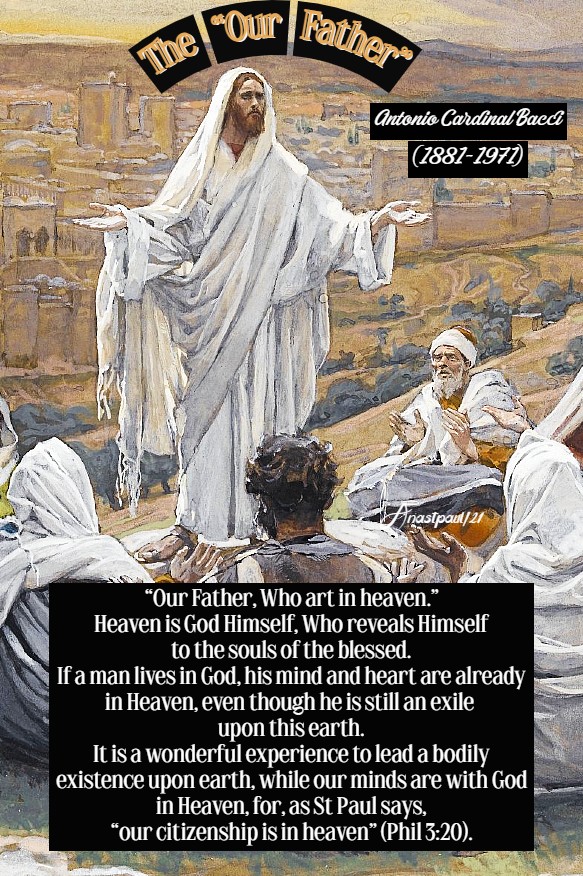
The “Our Father”
“Our Father, Who art in heaven.” Heaven is God Himself, Who reveals Himself to the souls of the blessed. If a man lives in God, his mind and heart are already in Heaven, even though he is still an exile upon this earth. It is a wonderful experience to lead a bodily existence upon earth, while our minds are with God in Heaven, for, as St Paul says, “our citizenship is in heaven” (Phil 3:20). As we are aware, God is everywhere, in Heaven and on earth. When we invoke our Father, Who is in Heaven, however, we manifest our faith in Him and in His generosity, whereby, He reveals Himself in all His glory to the blessed and shows His mercy to us poor exiles, when we come to Him. In the first words of the Pater Noster, we express, not only our faith but, also our hope of being happy with God for all eternity.”
Our Morning Offering -23 February – Tuesday of the First week of Lent
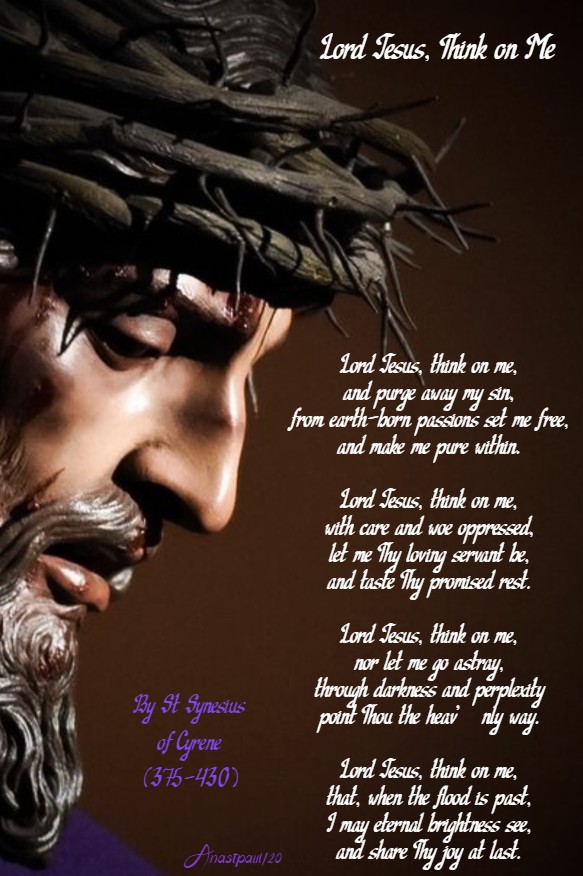
Lord Jesus, Think on Me By St Synesius of Cyrene (375-430) Bishop of Ptolemais
Lord Jesus, think on me, and purge away my sin, from earth-born passions set me free, and make me pure within. Lord Jesus, think on me, With care and woe oppressed, let me Thy loving servant be, and taste Thy promised rest. Lord Jesus, think on me, nor let me go astray, through darkness and perplexity point Thou the heav’nly way. Lord Jesus, think on me, that, when the flood is past, I may eternal brightness see, and share Thy joy at last.
St Synesius, a native of Cyrene, born circa 375. His descent was illustrious. His pedigree extended through seventeen centuries and in the words of Gibbon, “could not be equaled in the history of mankind.” He became distinguished for his eloquence and philosophy and as a statesman and patriot he took a noble stand. When the Goths were threatening his country he went to the court of Arcadius and for three years, tried to rouse it to the dangers that were coming on the empire. But Gibbon says, ”The court of Arcadius indulged the zeal, applauded the eloquence and neglected the advice of Synesius.” In 410 he was made Bishop of Ptolemaïs (modern Libya) but much against his will. He died in 430.We have extant one hundred and fifty-five epistles and ten hymns written at different periods of his life.
Our Morning Offering – 21 February – First Sunday of Lent
Anima Christi
Soul of Christ, sanctify me Body of Christ, save me Blood of Christ, inebriate me Water from the side of Christ, wash me Passion of Christ, strengthen me Good Jesus, hear me Within Your wounds, shelter me from turning away, keep me From the evil one, protect me At the hour of my death, call me Into Your presence lead me to praise You with all Your saints Forever and ever, Amen
For many years the Anima Christi was popularly believed to have been composed by Saint Ignatius Loyola (1491-1556) , as he puts it at the beginning of his Spiritual Exercises and often refers to it. In the first edition of the Spiritual Exercises Ignatius merely mentions it, evidently supposing that the reader would know it. In later editions, it was printed in full. It was by assuming that everything in the book was written by Ignatius that it came to be looked upon as his composition. On this account the prayer is sometimes referred to as the Aspirations of St. Ignatius Loyola and so my image shows St Ignatius at prayer.
However, the prayer actually dates to the early fourteenth century and was possibly written by Pope John XXII but its authorship remains uncertain. It has been found in a number of prayer books printed during the youth of Ignatius and is in manuscripts which were written a hundred years before his birth. The English hymnologist James Mearns found it in a manuscript of the British Museum which dates back to about 1370. In the library of Avignon there is preserved a prayer book of Cardinal Pierre de Luxembourg (died 1387), which contains the prayer in practically the same form as we have it today. It has also been found inscribed on one of the gates of the Alcázar of Seville, which dates back to the time of Pedro the Cruel (1350–1369).
The invocations in the prayer have rich associations with Catholic concepts that relate to the Eucharist (Body and Blood of Christ), Baptism (water) and the Passion of Jesus (Holy Wounds).
Our Morning Offering – 20 February – Saturday after Ash Wednesday and always a Marian Saturday
Most Holy Mary, Virgin Mother of God Act of Consecration By St Francis de Sales (1567-1622) Indulgence of 300 days, for each recitation St Pius X, 17 November 1906
Most Holy Mary, Virgin Mother of God, I ………., most unworthy though I am to be thy servant, yet touched by thy motherly care for me and longng to serve thee, do, in the presence of my Guardian Angel and all the court of heaven, choose thee this day to be my Queen, my Advocate and my Mother and I firmly purpose to serve thee evermore myself and, to do what I can, that all may render faithful service to thee. Therefore, most devoted Mother, through the Precious Blood thy Son poured out for me, I beg thee and beseech thee, deign to take me among thy clients and receive me as thy servant forever. Aid me in my every action and beg for me the grace never, by word or deed or thought, to be displeasing in thy sight and that of thy most holy Son. Think of me, my dearest Mother and desert me not at the hour of death. Amen
Our Morning Offering – 13 February – The Memorial of Blessed Jordan of Saxony OP (1190-1237) and a blessed Marian Saturday
It was Jordan who initiated the custom of singing the Salve Regina in procession each night after Compline, to ask Our Lady’s protection of the brothers against temptations from the devil. This is a custom still practised by Dominicans throughout the world and by our community each night.
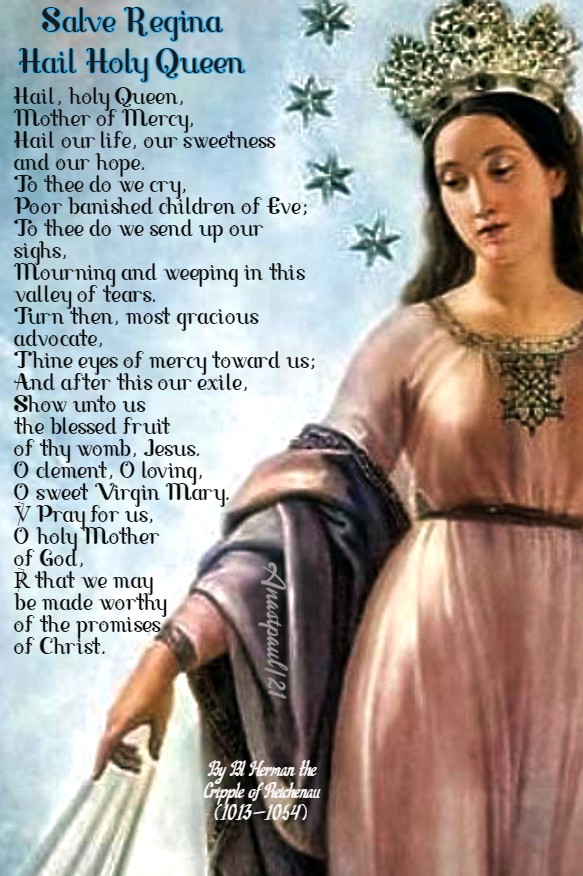
Salve Regina Hail Holy Queen By Blessed Herman the Cripple of Reichenau(1013–1054)
Hail, holy Queen, Mother of Mercy, Hail our life, our sweetness and our hope. To thee do we cry, Poor banished children of Eve; To thee do we send up our sighs, Mourning and weeping in this valley of tears. Turn then, most gracious advocate, Thine eyes of mercy toward us; And after this our exile, Show unto us the blessed fruit of thy womb, Jesus.
This line, below, by St Bernard of Clairvaux (1090-1153) Doctor of the Church
O clement, O loving, O sweet Virgin Mary.
℣ Pray for us, O holy Mother of God, ℟ that we may be made worthy of the promises of Christ.
Let us pray: Almighty, everlasting God, who by the co-operation of the Holy Spirit didst prepare the body and soul of the glorious Virgin-Mother Mary to become a dwelling-place fit for Thy Son, grant that as we rejoice in her commemoration, so by her fervent intercession, we may be delivered from present evils and from everlasting death. Through the same Christ our Lord. Amen
Our Morning Offering – 11 February – The Memorial of Our Lady of Lourdes
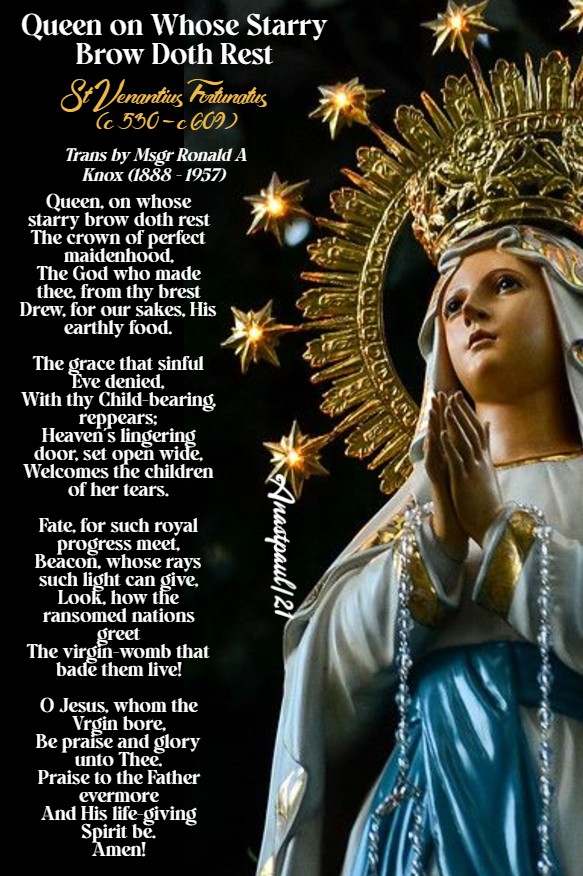
Queen on Whose Starry Brow Doth Rest St Venantius Fortunatus (c 530-c 609) Translation by Monsignor Ronald A Knox (1888 – 1957)
Queen, on whose starry brow doth rest The crown of perfect maidenhood, The God who made thee, from thy brest Drew, for our sakes, His earthly food.
The grace that sinful Eve denied, With thy Child-bearing, reppears; Heaven’s lingering door, set open wide, Welcomes the children of her tears.
Fate, for such royal progress meet, Beacon, whose rays such light can give, Look, how the ransomed nations greet The virgin-womb that bade them live!
O Jesus, whom the Vrgin bore, Be praise and glory unto Thee. Praise to the Father evermore And His life-givine Spirit be. Amen!
Saint Venantius Fortunatus (c 530 – c 609) Bishop, Poet, Hymnist, Writer – born c 530 at Rreviso, Italy and died c 609 at Poitiers, modern France of natural causes. St Venantius was unique, first a travelling lay poet, he later became a Priest and then a Bishop. But he always remained a professional author of poetry, a “troubadour” of Christ. He is the author of the Ave Maris Stella, amongst many others.
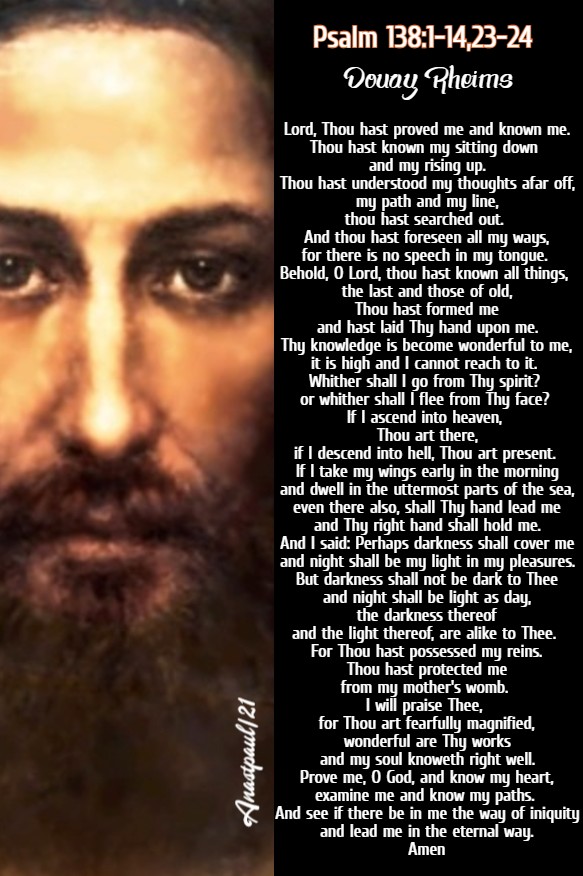
Lord, Thou hast proved me and known me. Thou hast known my sitting down and my rising up. Thou hast understood my thoughts afar off, my path and my line, thou hast searched out. And thou hast foreseen all my ways, for there is no speech in my tongue. Behold, O Lord, thou hast known all things, the last and those of old, Thou hast formed me and hast laid Thy hand upon me. Thy knowledge is become wonderful to me, it is high and I cannot reach to it. Whither shall I go from Thy spirit? or whither shall I flee from Thy face? If I ascend into heaven, Thou art there, if I descend into hell, Thou art present. If I take my wings early in the morning and dwell in the uttermost parts of the sea, even there also, shall Thy hand lead me and Thy right hand shall hold me. And I said: Perhaps darkness shall cover me and night shall be my light in my pleasures. But darkness shall not be dark to Thee and night shall be light as day, the darkness thereof and the light thereof, are alike to Thee. For Thou hast possessed my reins. Thou hast protected me from my mother’s womb. I will praise Thee, for Thou art fearfully magnified, wonderful are Thy works and my soul knoweth right well. Prove me, O God, and know my heart, examine me and know my paths. And see if there be in me the way of iniquity and lead me in the eternal way. Amen
Our Morning Offering – 4 February – The Memorial of Blessed Rabanus Maurus (776-856)
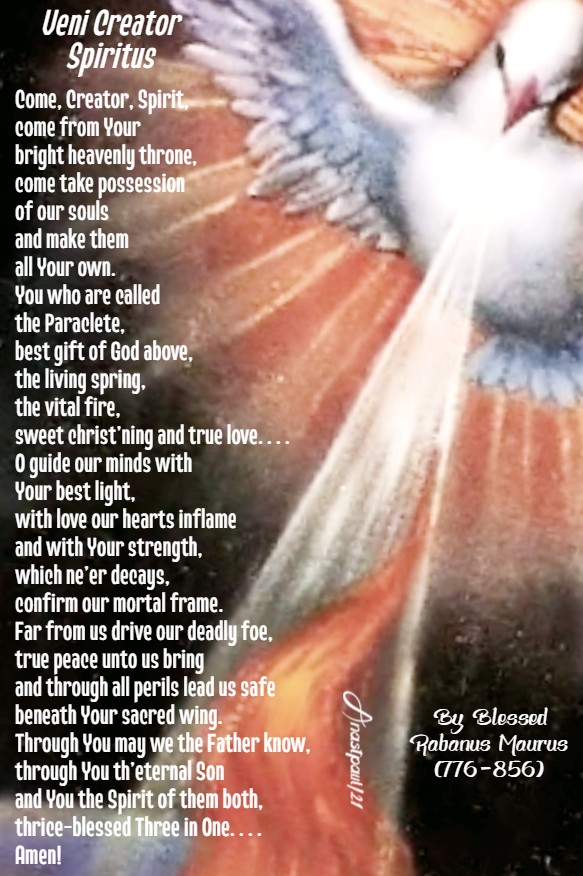
Veni Creator Spiritus The Golden Sequence By Blessed Rabanus Maurus (776-856)
Come, Creator, Spirit, come from Your bright heavenly throne, come take possession of our souls and make them all Your own. You who are called the Paraclete, best gift of God above, the living spring, the vital fire, sweet christ’ning and true love. . . . O guide our minds with Your best light, with love our hearts inflame and with Your strength, which ne’er decays, confirm our mortal frame. Far from us drive our deadly foe, true peace unto us bring and through all perils lead us safe, beneath Your sacred wing. Through You, may we the Father know, through You, th’eternal Son and You, the Spirit of them both, thrice-blessed Three in One. . . . Amen!
Quote of the Day – 3 February – The Memorial of St Blaise Bishop Martyr (Died c 316)
The Blessing of the Throats is a Sacramental of the Church, ordinarily celebrated today, the Feast day of Saint Blaise.
Saint Blase was, according to various accounts, a Physician before becoming a Bishop. His cult spread throughout the entire Church in the Middle Ages because he miraculously cured a little boy who nearly died due to a fishbone in his throat. From the eighth century he has been invoked on behalf of the sick, especially those afflicted with illnesses of the throat.
If the Blessing is conferred during Mass, the Blessing follows the homily and general intercessions, or, for pastoral reasons, the Prayer of Blessing may take the place of the final Blessing of the Mass. When the Blessing is given outside Mass, it is preceded by a brief celebration of the Word of God. If the Blessing is to be celebrated at Morning Prayer or Evening Prayer, it is given after the Reading and Responsory (and homily) and before the Gospel Canticle.
The Blessing may be given by touching the throat of each person with two candles which have been Blessed yesterday, on the Feast of the Purification of the Blessed Virgin. The candles are held together in the form of a Cross.
THE BLESSING of ST BLAISE
Through the intercession of Saint Blaise, Bishop and Martyr, may God deliver you from ailments of the throat and from every other evil. In the name of the Father and of the Son and of the Holy Spirit. Amen
Lord, for Tomorrow and its Needs By Sister Mary Xavier (1877)
Lord, for tomorrow and its needs I do not pray; keep me, my God, from stain of sin, just for today. Let me both diligently work and duly pray; let me be kind in word and deed, just for today. Let me no wrong or idle word unthinking say; set thou a seal upon my lips, just for today. And if today my tide of life should ebb away, give me Thy sacraments divine, sweet Lord, today. So, for tomorrow and its needs I do not pray but keep me, guide me, love me, Lord, just for today.
Our Morning Offering – 31 January – Septuagesima Sunday or The Fourth Sunday in Ordinary Time
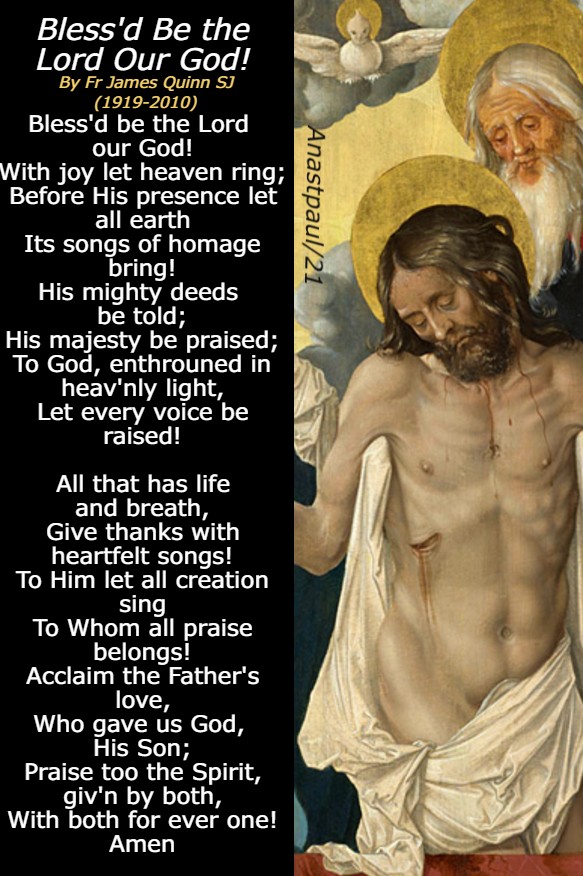
Bless’d Be the Lord Our God! By Fr James Quinn SJ (1919-2010)
Bless’d be the Lord our God! With joy let heaven ring; Before His presence let all earth Its songs of homage bring! His mighty deeds be told; His majesty be praised; To God, enthrouned in heav’nly light, Let every voice be raised!
All that has life and breath, Give thanks with heartfelt songs! To Him let all creation sing To Whom all praise belongs! Acclaim the Father’s love, Who gave us God, His Son; Praise too the Spirit, giv’n by both, With both for ever one!
In the Divine Office (1974) it is sung with Sunday Evening Prayer I (Week 2)
Quote/s of the Day – 28 January – The Memorial of St Thomas Aquinas (1225-1274) Doctor of the Church
St Thomas speaks on the Holy Eucharist
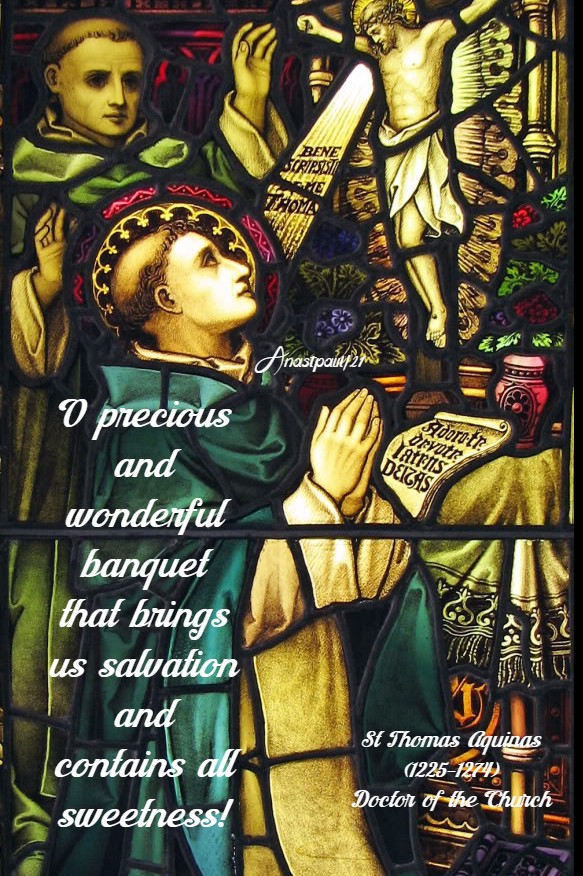
“O precious and wonderful banquet that brings us salvation and contains all sweetness!”
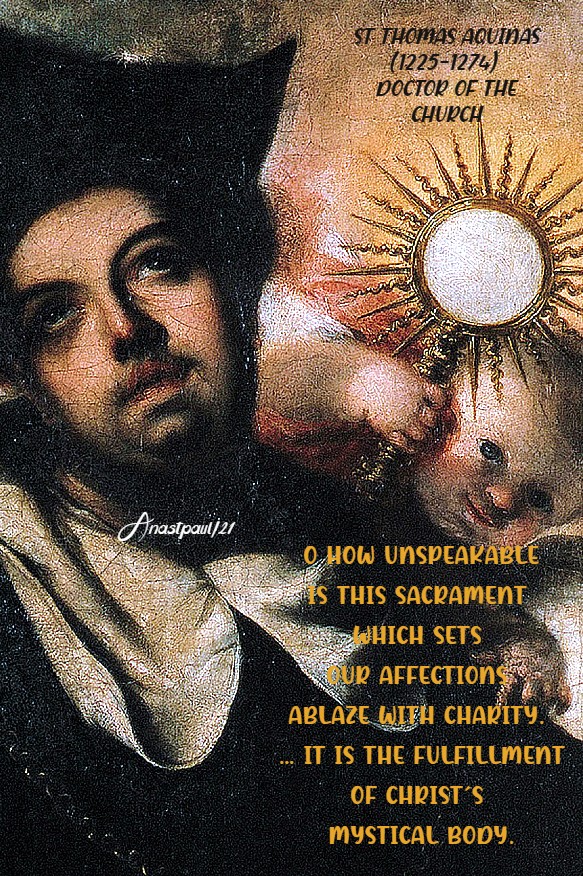
“O how unspeakable is this Sacrament which sets our affections ablaze with charity. … It is the fulfillment of Christ’s Mystical Body.”
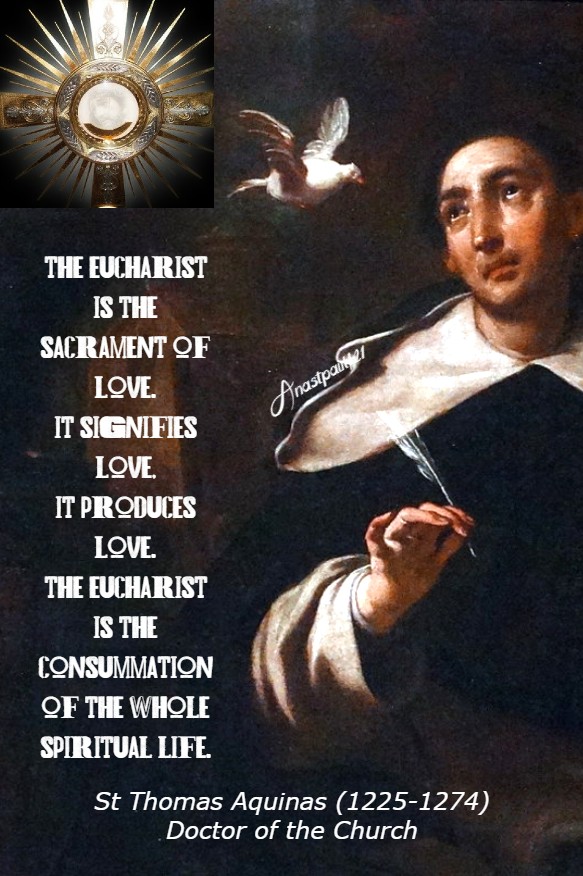
“The Eucharist is the Sacrament of Love. It signifies Love, It produces love. The Eucharist is the consummation of the whole spiritual life.”
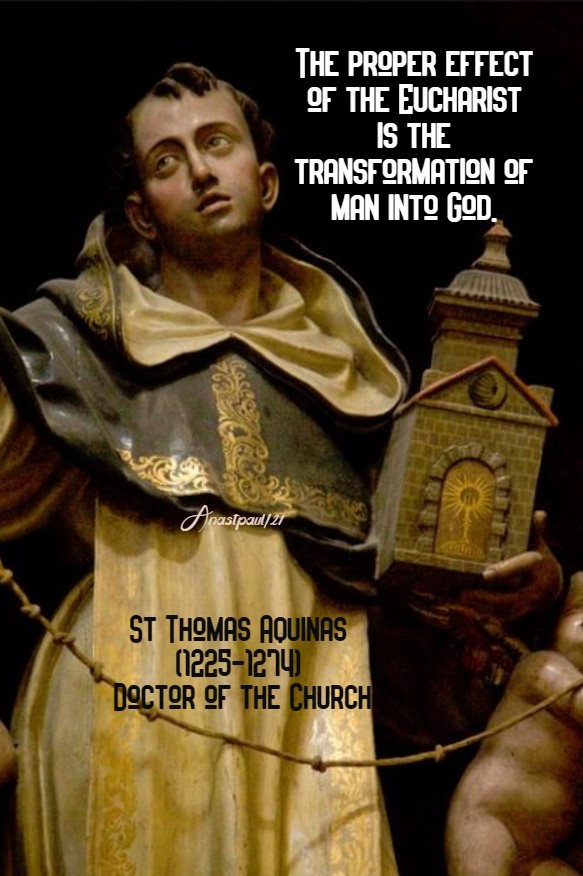
“The proper effect of the Eucharist is the transformation of man into God.”
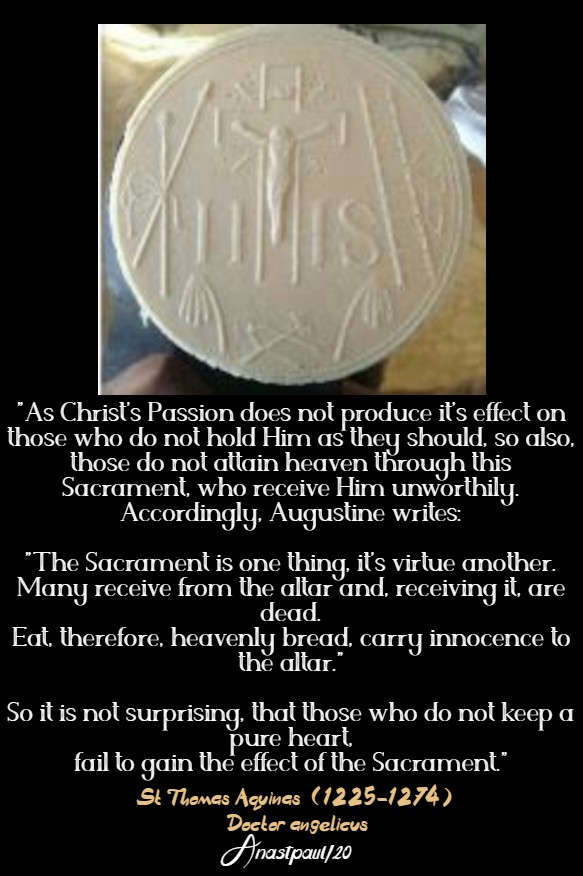
“As Christ’s Passion does not produce it’s effect on those who do not hold Him as they should, so also, those do not attain heaven through this Sacrament, who receive Him unworthily. Accordingly, Augustine writes: “The Sacrament is one thing, it’s virtue another. Many receive from the altar and, receiving it, are dead. Eat, therefore, heavenly bread, carry innocence to the altar.” So it is not surprising, that those who do not keep a pure heart, fail to gain the effect of the Sacrament.”
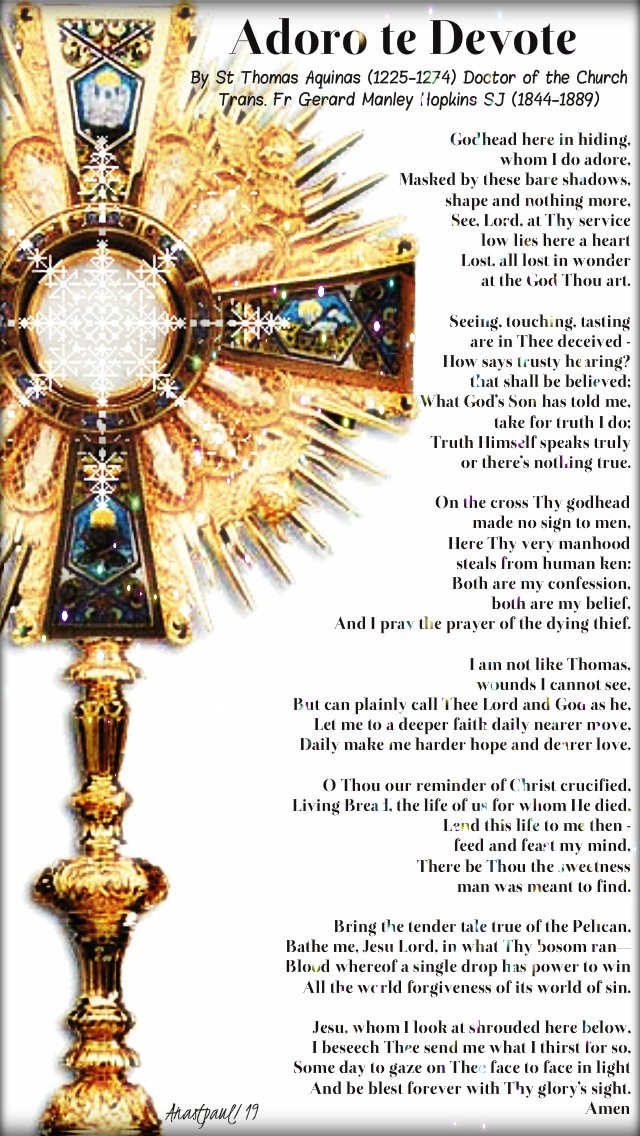
Adoro te Devote Trans. Fr Gerard Manley Hopkins SJ (1844-1889)
Godhead here in hiding, whom I do adore, Masked by these bare shadows, shape and nothing more, See, Lord, at Thy service low lies here a heart Lost, all lost in wonder at the God Thou art.
Seeing, touching, tasting are in Thee deceived – How says trusty hearing? that shall be believed, What God’s Son has told me, take for truth I do, Truth Himself speaks truly or there’s nothing true.
On the cross Thy godhead made no sign to men, Here Thy very manhood steals from human ken – Both are my confession, both are my belief, And I pray the prayer of the dying thief.
I am not like Thomas, wounds I cannot see, But can plainly call Thee Lord and God as he, Let me to a deeper faith daily nearer move, Daily make me harder hope and dearer love.
O Thou our reminder of Christ crucified, Living Bread, the life of us for whom He died, Lend this life to me then – feed and feast my mind, There be Thou the sweetness man was meant to find.
Bring the tender tale true of the Pelican, Bathe me, Jesu Lord, in what Thy bosom ran— Blood whereof a single drop has power to win All the world forgiveness of its world of sin.
Jesu, whom I look at shrouded here below, I beseech Thee send me what I thirst for so, Some day to gaze on Thee face to face in light And be blest forever with Thy glory’s sight. Amen
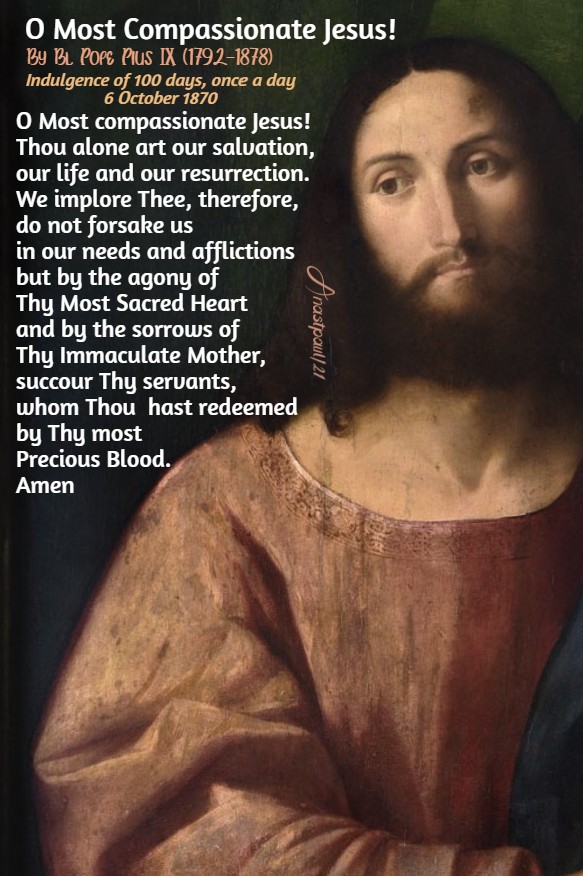
O Most Compassionate Jesus! By Bl Pope Pius IX(1792-1878) Indulgence of 100 days, once a day 6 October 1870
O Most compassionate Jesus! Thou alone art our salvation, our life and our resurrection. We implore Thee, therefore, do not forsake us in our needs and afflictions but by the agony of Thy Most Sacred Heart and by the sorrows of Thy Immaculate Mother, succour Thy servants, whom Thou hast redeemed by Thy most Precious Blood. Amen
Our Morning Offering – 20 January – Acts of Faith, Hope and Charity
ACT of FAITH
O MY GOD, I firmly believe that Thou art one God in Three Divine Persons, Father, Son and Holy Ghost. I believe that Thy Divine Son became Man and died for our sins and that He will come to judge the living and the dead. I believe these and all the truths which the Holy Catholic Church teaches because Thou hast revealed them, Who canst neither deceive nor be deceived. Amen
ACT of HOPE
O MY GOD, relying on Thy almighty power and infinite mercy and promises, I hope to obtain pardon of my sins, the help of Thy grace and Life Everlasting, through the merits of Jesus Christ, my Lord and Redeemer. Amen
ACT of CHARITY
O MY GOD, I love Thee above all things, with my whole heart and soul because Thou art all-good and worthy of all love. I love my neighbour as myself for the love of Thee. I forgive all who have injured me and ask pardon. of all whom I have injured. Amen
Our Morning Offering – 19 January – Tuesday of the Second week in Ordinary Time
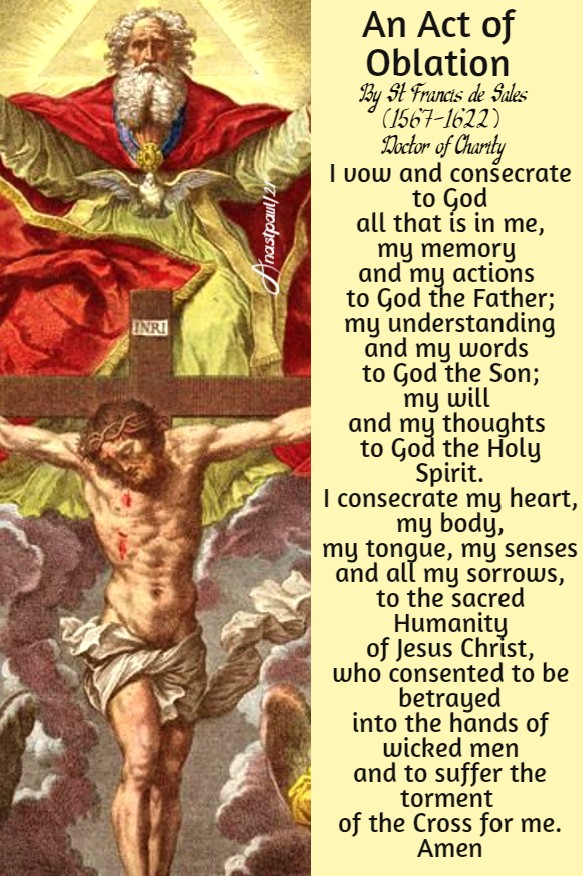
An Act of Oblation By St Francis de Sales (1567-1622) Doctor of Charity
I vow and consecrate to God all that is in me, my memory and my actions, to God the Father; my understanding and my words, to God the Son; my will and my thoughts, to God the Holy Spirit. I consecrate my heart, my body, my tongue, my senses and all my sorrows, to the sacred Humanity of Jesus Christ, Who consented to be betrayed into the hands of wicked men and to suffer the torment of the Cross for me. Amen
Our Morning Offering – 11 January – Month of the Most Holy Name of Jesus
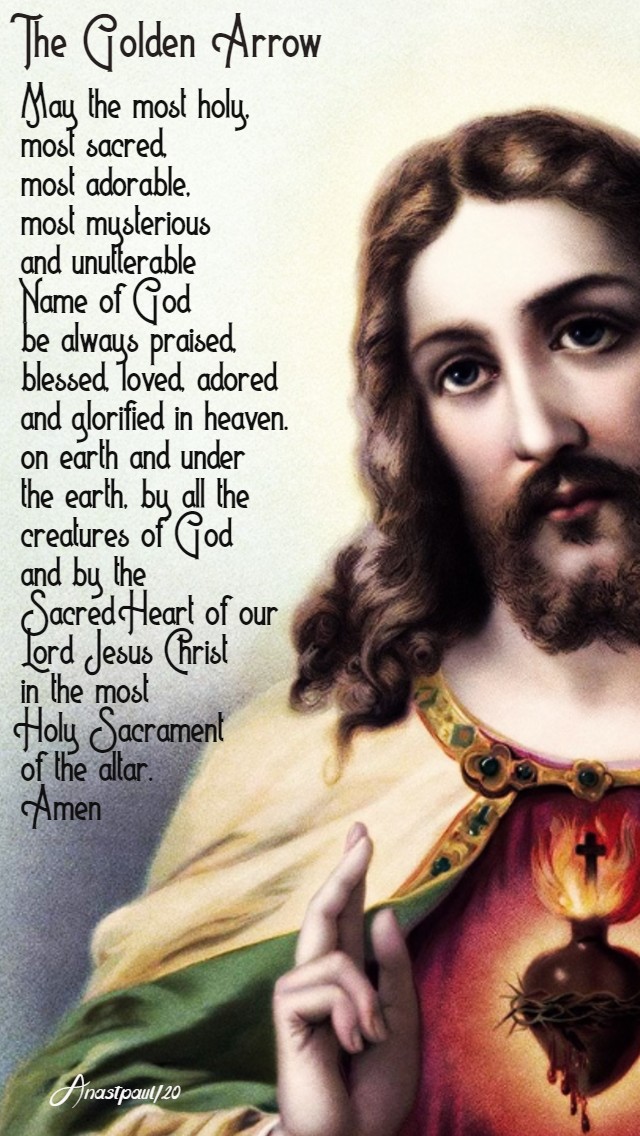
The Golden Arrow
May the most holy, most sacred, most adorable, most mysterious and unutterable Name of God be always praised, blessed, loved, adored and glorified in heaven. on earth and under the earth, by all the creatures of God and by the Sacred Heart of our Lord Jesus Christ in the most Holy Sacrament of the altar. Amen
This prayer was revealed by Jesus Himself to a Carmelite Nun of Tours in 1843 as a reparation for blasphemy. “This Golden Arrow will wound My Heart delightfully” He said “and heal the wounds, inflicted by blasphemy.”
One Minute Reflection – 10 January – Feast of the Baptism of the Lord , Readings: Isaiah 55:1-11, Isaiah 12:2-3,4,5-6, 1 John 5:1-9, Mark 1:7-11
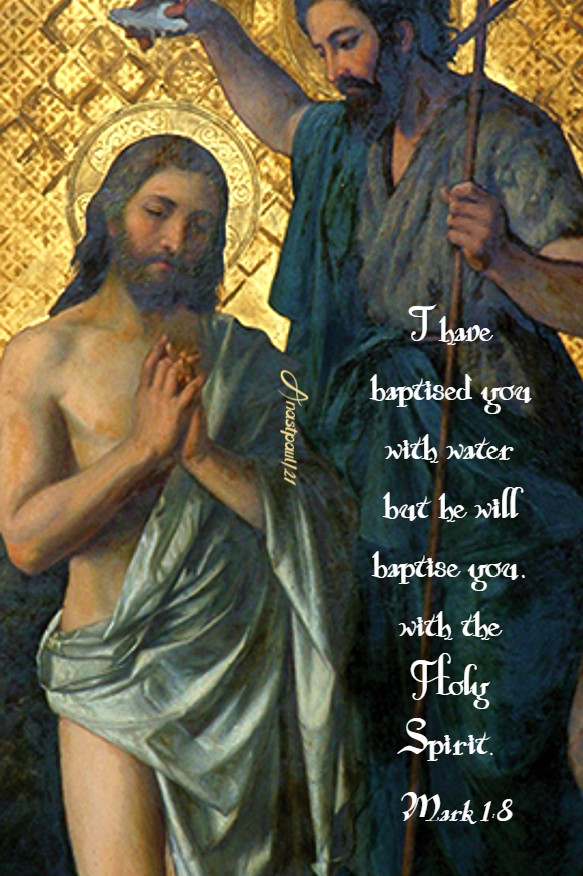
“I have baptised you with water but he will baptise you, with the Holy Spirit.” – Mark 1:8
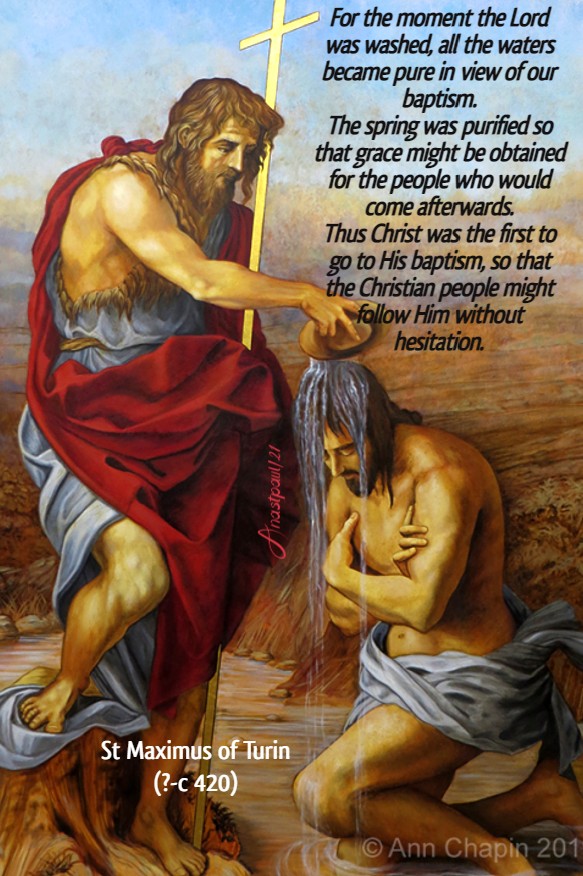
REFLECTION – “Today, the Lord Jesus has come to be baptised. He wanted to wash His body in the water of the Jordan. Someone might say: “Why did He who was the Holy One want to be baptised?” So listen. Christ was baptised, not in order to be sanctified by the water but so that He, Himself would sanctify the water and would purify the waves, that He touched by His personal action. Thus, we have to do with the consecration of the water much more than with that of Christ. For the moment the Lord was washed, all the waters became pure in view of our baptism. The spring was purified so that grace might be obtained for the people who would come afterwards. Thus Christ was the first to go to His baptism, so that the Christian people might follow Him without hesitation. And in this I perceive a mystery. Did not the column of fire go ahead into the Red Sea in this way, so as to encourage the children of Israel to walk behind it? It crossed the water first so as to break a path for those who would follow. According to the testimony of the Apostle Paul, this event was a symbol of baptism (1 Cor 10:1f.). Without any doubt, when the people were covered by the cloud and carried by the water, it was a kind of baptism. And all that was fulfilled by the same Christ our Lord, who in the column of His body now precedes the Christian people to baptism, just as He preceded the children of Israel across the sea, in the column of fire. The same column, which in times past enlightened the eyes of those who were walking, now gives light to the hearts of the believers. Then it marked a solid path in the waves, now in this bath, it strengthens the steps of faith.” – St Maximus of Turin (?-c 420) Bishop – Sermon for the feast of the Epiphany
PRAYER– By the Benedictines of Stanbrook When Jesus comes to be baptised, He leaves the hidden years behind, The years of safety and of peace, To bear the sins of all mankind.
The Spirit of the Lord comes down Anoints the Christ to suffering, To preach the word, to free the bound And to the mourner comfort bring.
Our everlasting Father, praise, With Christ, His well-beloved Son, Who with the Soirit reigns serene, Untroubled Trinity in One. Amen
Our Morning Offering – 31 December – The Seventh Day of the Octave of Christmas
The Angelus
V. The Angel of the Lord declared unto Mary. R. And she conceived of the Holy Spirit. Hail Mary, full of grace, The Lord is with Thee; Blessed art thou among women, And blessed is the fruit of thy womb, Jesus. Holy Mary, Mother of God, Pray for us sinners, Now and at the hour of our death. Amen V. Behold the handmaid of the Lord. R. Be it done unto me according to thy word. Hail Mary, etc. V. And the Word was made Flesh. R. And dwelt among us. Hail Mary, etc. V. Pray for us, O holy Mother of God. R. That we may be made worthy of the promises of Christ. LET US PRAY Pour forth, we beseech Thee, O Lord, Thy grace into our hearts, that we to whom the Incarnation of Christ Thy Son was made known by the message of an angel, may by His Passion and Cross be brought to the glory of His Resurrection. Through the same Christ Our Lord. Amen
The Angelus (/ˈændʒələs/; Latin for “angel”) is a Catholic devotion commemorating the Incarnation. As with many Catholic prayers, the name Angelus is derived from its incipit—the first few words of the text: Angelus Domini nuntiavit Mariæ (“The Angel of the Lord declared unto Mary”). The devotion is practised by reciting as versicle and response three Biblical verses narrating the mystery, alternating with the prayer “Hail Mary.” The Angelus exemplifies a species of prayers called the “prayer of the devotee.”
The devotion is traditionally recited three times daily: 06:00, 12:00 and 18:00. The Angelus is usually accompanied by the ringing of the Angelus bell, which is a call to prayer and to spread goodwill to everyone. The angel referred to in the prayer is Gabriel, a messenger of God who revealed to the Virgin Mary that she would conceive a child to be born, the Son of God (Luke 1:26–38) so honouring the Incarnation of the Saviour, Redeemer – our Messiah, Jesus the Christ.
The words of the prayer are arranged above for leader and community but, of course, most of us pray the prayer alone 3 times each day, for we are always united with each other in faith.
One Minute Reflection – 28 December – The Feast of the Holy Innocents – The Fourth Day of the Christmas Octave, Readings: 1 John 1:5-2:2, Psalm 124:2-5, 7-8, Matthew 2:13-18
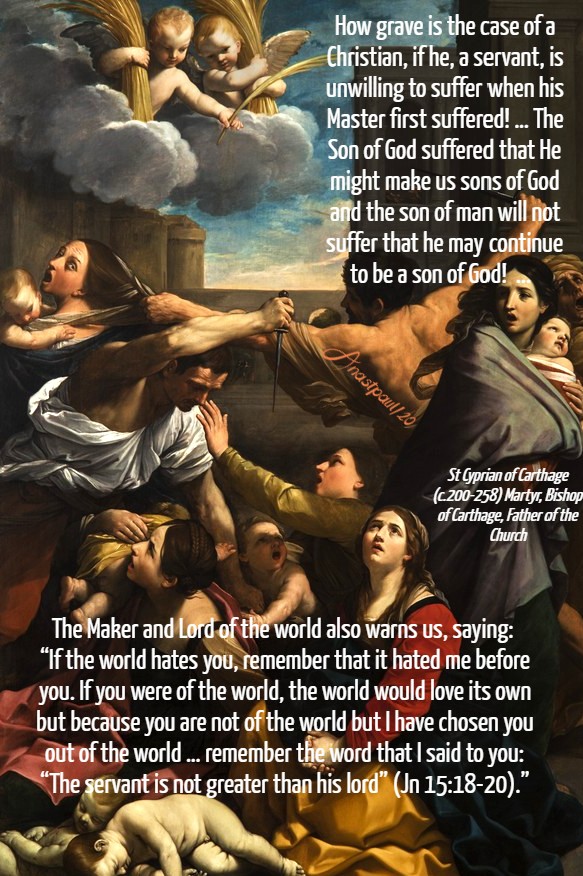
When Herod realised that he had been deceived by the magi, he became furious. He ordered the massacre of all the boys in Bethlehem and its vicinity, two years old and under, in accordance with the time he had ascertained from the magi. – Matthew 2:16
REFLECTION – “The Apostle John said: “Whoever says he abides in Christ, ought to walk even as Christ walked” (1 Jn 2:6). Moreover, the blessed Apostle Paul exhorts and teaches us, saying: “We are God’s children but if children, then heirs of God and joint-heirs with Christ; if so be that we suffer with him that we may also be glorified together” (Rm 8:16f.) … Let us, beloved brethren, imitate righteous Abel, who initiated martyrdom, he being the first to be slain for righteousness’s sake (Gn 4:8) …; let us imitate the three children Ananias, Azarias and Misael, who … overcame the king by the power of faith (Dn 3) … What of the prophets whom the Holy Spirit quickened to a foreknowledge of future events? What of the Apostles whom the Lord chose? Since these righteous men were slain for righteousness’ sake, have they not taught us also to die?
The nativity of Christ at once witnessed the martyrdom of infants, so that they who were two years old and under were slain for His name’s sake. An age, not yet fitted for the battle, appeared fit for the crown. That it might be manifest that they who are slain for Christ’s sake are innocent, innocent infancy was put to death for His name’s sake … How grave is the case of a Christian, if he, a servant, is unwilling to suffer when his Master first suffered! … The Son of God suffered that He might make us sons of God and the son of man will not suffer that he may continue to be a son of God! … The Maker and Lord of the world also warns us, saying: “If the world hates you, remember that it hated me before you. If you were of the world, the world would love its own but because you are not of the world but I have chosen you out of the world … remember the word that I said to you: “The servant is not greater than his lord” (Jn 15:18-20).” – St Cyprian of Carthage (c.200-258) Martyr, Bishop of Carthage, Father of the Church – Letter 55
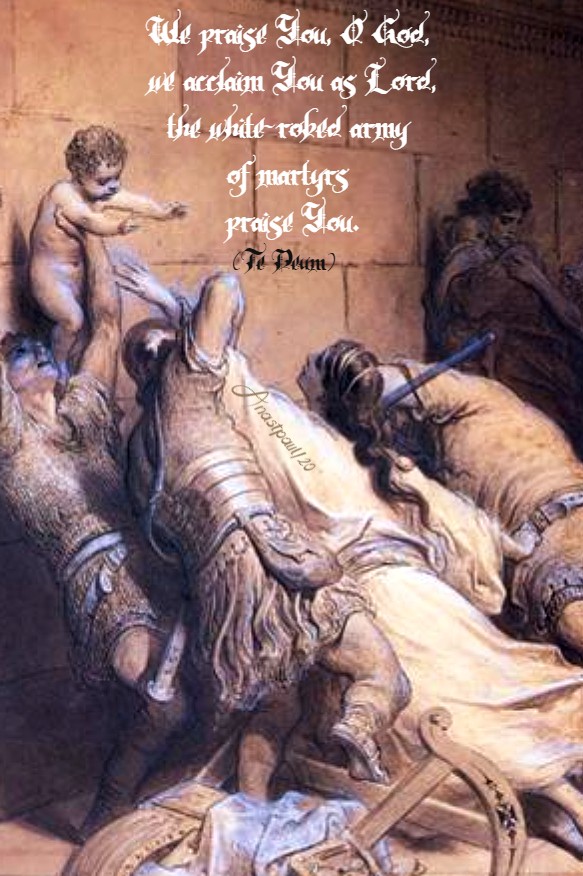
PRAYER – We praise You, O God, we acclaim You as Lord, the white-robed army of martyrs praise You. (from the Te Deum).
Our Morning Offering – 25 December – The Solemnity of the Nativity of Our Lord, Jesus Christ
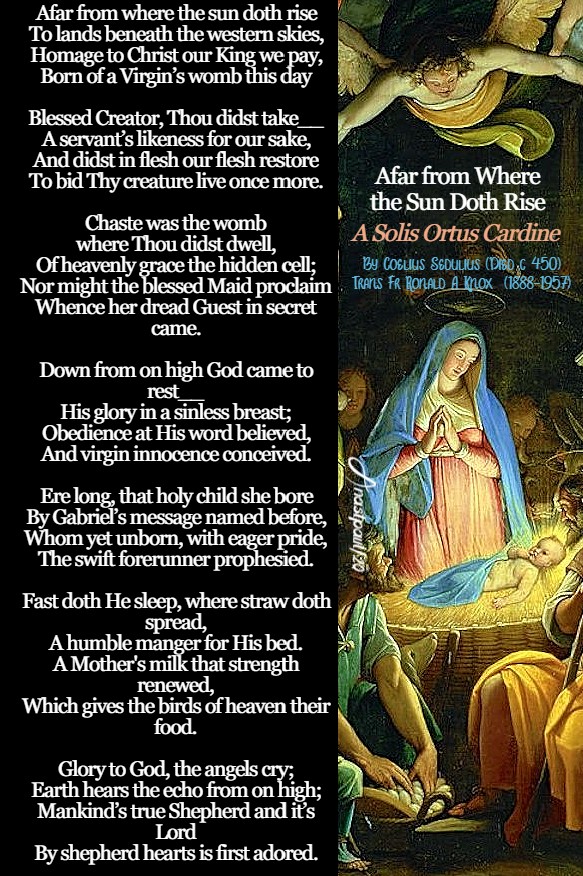
Afar from Where the Sun Doth Rise A Solis Ortus Cardine By Coelius Sedulius (Died c 450) Trans Fr Ronald A Knox (1888-1957)
Afar from where the sun doth rise To lands beneath the western skies, Homage to Christ our King we pay, Born of a Virgin’s womb this day
Blessed Creator, Thou didst take__ A servant’s likeness for our sake, And didst in flesh our flesh restore To bid Thy creature live once more.
Chaste was the womb where Thou didst dwell, Of heavenly grace the hidden cell; Nor might the blessed Maid proclaim Whence her dread Guest in secret came.
Down from on high God came to rest__ His glory in a sinless breast; Obedience at His word believed, And virgin innocence conceived.
Ere long, that holy child she bore By Gabriel’s message named before, Whom yet unborn, with eager pride, The swift forerunner prophesied.
Fast doth He sleep, where straw doth spread, A humble manger for His bed. A Mother’s milk that strength renewed, Which gives the birds of heaven their food.
Glory to God, the angels cry; Earth hears the echo from on high; Mankind’s true Shepherd and it’s Lord By shepherd hearts is first adored.
“A Solis Ortus Cardine…” (Latin for “From the Pivot of the Sun’s Rising”) is a poem by Christian Poet, Coelius Sedulius (Died c 450), recounting Christ’s life from His birth to His resurrection. Its 23 verses each begin with a consecutive letter of the Latin alphabet, making the poem an abecedarius. It is one of the oldest parts of the Roman Catholic liturgy, with two hymns formed from the first seven and four later verses. There have been monastic translations into Anglo-Saxon and later translations into other languages..
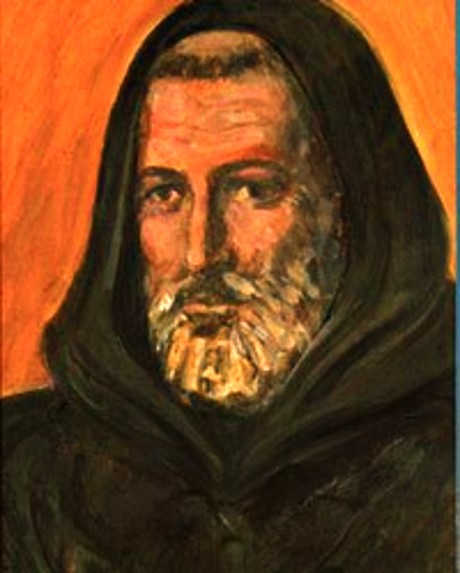
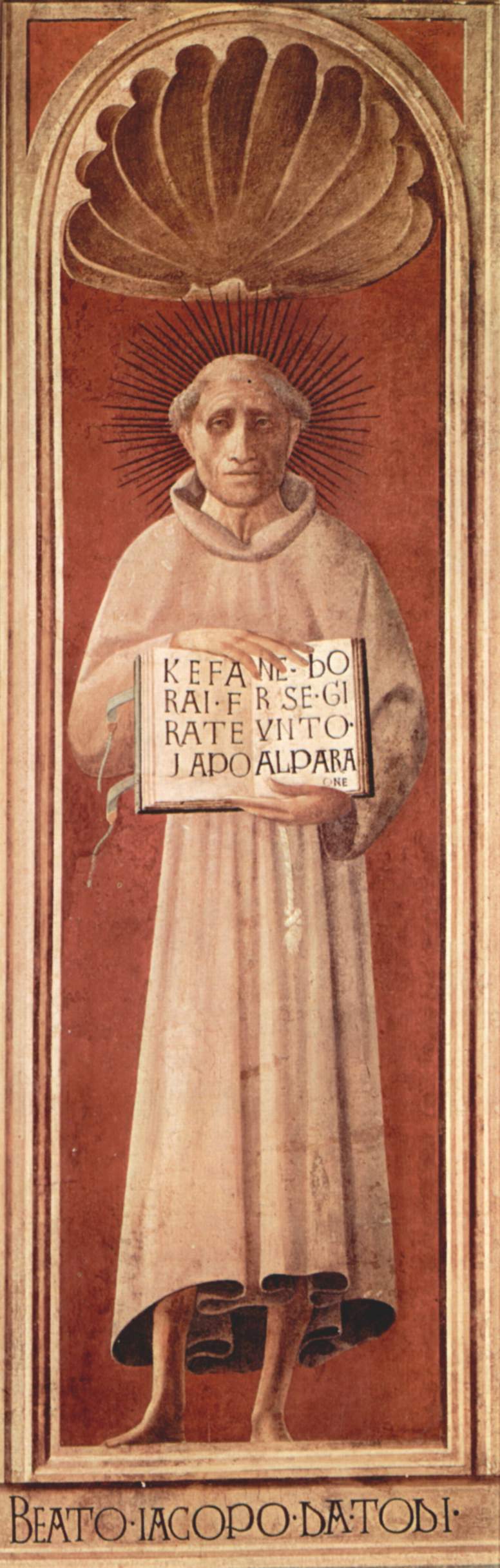
Saint of the Day – 25 December – Blessed Jacopone da Todi OFM (1230-1306) Franciscan Friar, Confessor, Hymnist, Poet, Mystic, Lawyer, – an Italian from Umbria in the 13th century. He wrote several laude (songs in praise of the Lord) in the local vernacular. He was an early pioneer in Italian theatre, being one of the earliest scholars who dramatised Gospel subjects. Born in c 1230 at Todi, Italy as Jacopo Benedetti and died on 25 December 1306 at Collazzone, Italy of natural causes, as the Priest intoned the Gloria from midnight Mass. He is also known as Jacomo da Todi, Jacopo Benedetti, Jacopo Benedicti, Jacopone Benedetti da Todi, Jacopone of Todi, James da Todi.
Jacomo, was born a noble member of the Benedetti family in the northern Italian city of Todi. He became a successful lawyer and married a pious, generous lady named Vanna.
His young wife took it upon herself to do penance for the worldly excesses of her husband. One day Vanna, at the insistence of Jacomo, attended a public tournament. She was sitting in the stands with the other noble ladies when the stands collapsed. Vanna was killed. Her shaken husband was even more disturbed when he realised that the penitential girdle she wore was for his sinfulness. On the spot, he vowed to radically change his life.
Jacomo divided his possessions among the poor and entered the Secular Franciscan Order. Often dressed in penitential rags, he was mocked as a fool and called Jacopone, or “Crazy Jim,” by his former associates. The name became dear to him.
After 10 years of such humiliation, Jacopone asked to be received into the Order of Friars Minor. Because of his reputation, his request was initially refused. He composed a beautiful poem on the vanities of the world, an act that eventually led to his admission into the Order in 1278. He continued to lead a life of strict penance, declining to be ordained a priest. Meanwhile, he was writing popular hymns in the vernacular.
Jacopone suddenly found himself a leader in a disturbing religious movement among the Franciscans. The Spirituals, as they were called, wanted a return to the strict poverty of Francis. They had on their side two cardinals of the Church and Pope Celestine V. These two cardinals though, opposed Celestine’s successor, Boniface VIII. At the age of 68, Jacopone was excommunicated and imprisoned. Although he acknowledged his mistake, Jacopone was not absolved and released until Benedict XI became Pope five years later. He had accepted his imprisonment as penance. He spent the final three years of his life more spiritual than ever, weeping “because Love is not loved.”During this time he wrote the famous Latin hymn, Stabat Mater.
On Christmas Eve in 1306 Jacopone felt that his end was near. He was in a convent of the Poor Clares with his friend, Blessed John of La Verna. Like Francis, Jacopone welcomed “Sister Death” with one of his favorite songs. It is said that he finished the song and died as the Priest intoned the “Gloria” from the midnight Mass at Christmas. From the time of his death, Brother Jacopone has been venerated as a saint, both within and outside of the Franciscan Order, although never formally Canonised.
Here lie the bones of Blessed Jacopone dei Benedetti da Todi, Friar Minor, who, having gone mad with love of Christ, by a new artifice deceived the world and took Heaven by violence. – from the tomb of Blessed Jacopone
Stabat Mater Dolorosa is a fine example of religious lyric in the Franciscan tradition. It was inserted into the Roman Missal and Breviary in 1727 for the Feast of the Seven Sorrows of the Blessed Virgin Mary, celebrated on the Friday before Good Friday. Following changes by Pope Pius XII, it now appears on the Feast of Our Lady’s Sorrows celebrated on 15 September. Many composers have set it to music
His contemporaries called Jacopone, “Crazy Jim.” We might well echo their taunt, for what else can you say about a man who broke into song in the midst of all his troubles? We still sing Jacopone’s saddest song, the Stabat Mater, but we Christians claim another song as our own, even when the daily headlines resound with discordant notes. Jacopone’s whole life rang out our song: “Alleluia!” May he inspire us to keep singing.















 AnaStpaul
You must be logged in to post a comment.