Posted in franciscan OFM, INCORRUPTIBLES, SAINT of the DAY

Saint of the Day – 23 September – St Pio of Pietrelcina O.F.M.Cap.

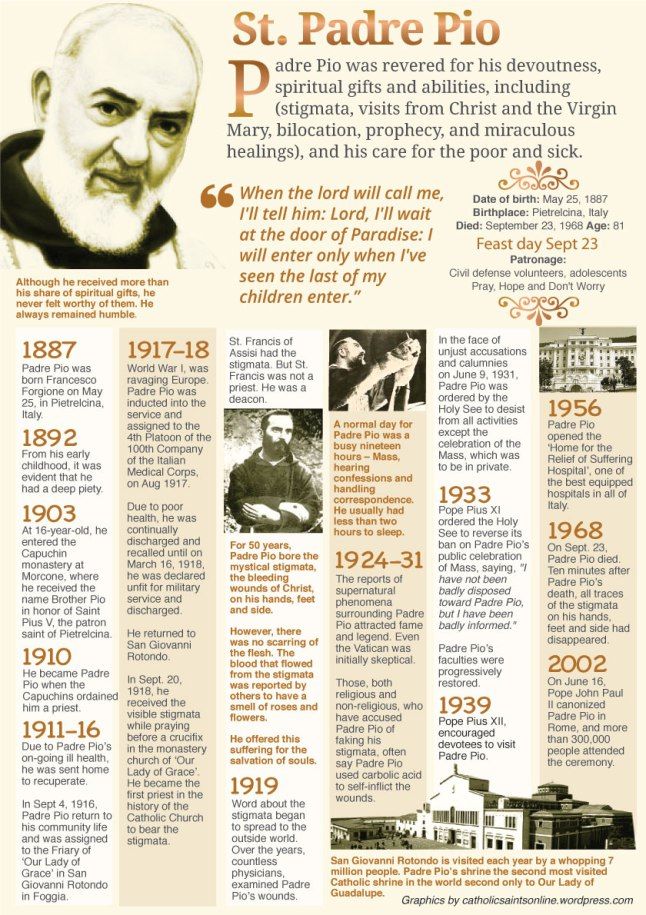
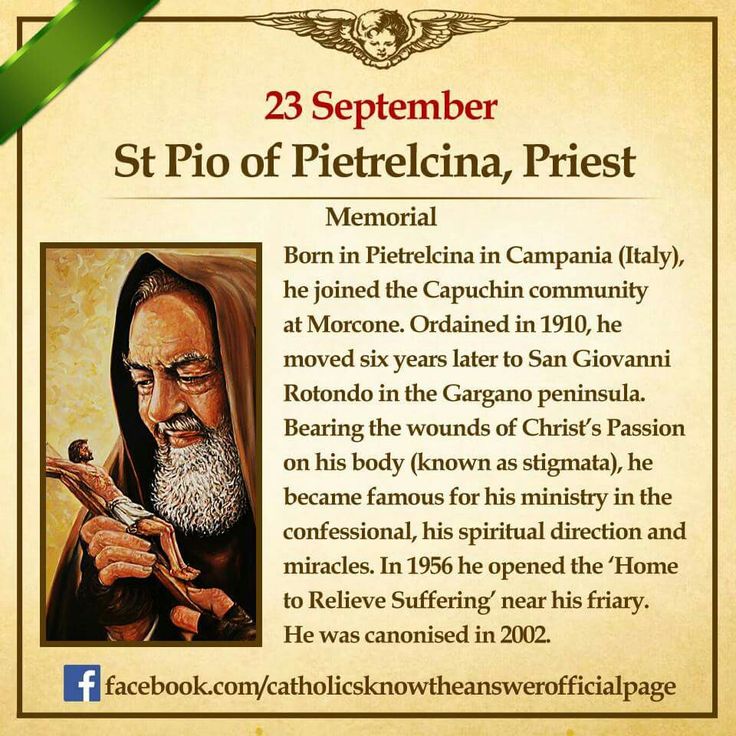
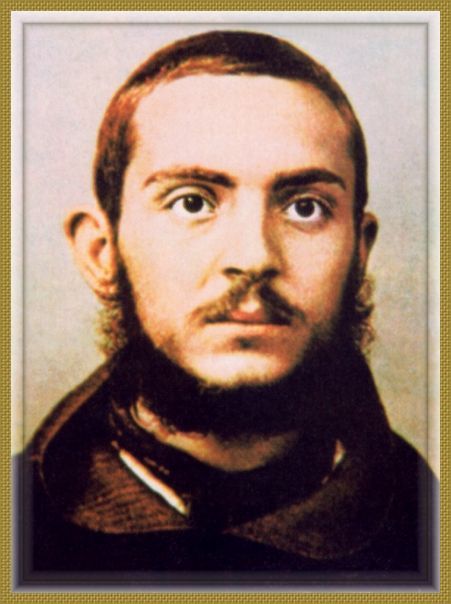
Saint of the Day – 23 September – St Pio of Pietrelcina O.F.M.Cap. – Priest,Franciscan Capuchin Friar, Stigmatist, Mystic, Confessor.  Born Francesco Forgione, he was given the name of Pius (Italian: Pio) when he joined the Order of Friars Minor Capuchin.  (25 May 1887 at Pietrelcina, Benevento, Italy – 23 September 1968 in San Giovanni Rotondo, Foggia, Italy of natural causes).  Beatified 2 May 1999 and Canonised on 16 June 2002 by Pope John Paul II at Rome, Italy.   Patronages – Civil defense volunteers, Adolescents, Pietrelcina, Stress relief, Italy and Malta.   Attributes  – Stigmata, Capuchin habit.   His Incorrupt Relics lie at home in San Giovanni Rotondo.

HEADER ST PIO 2st pio header 1st pio info

pope francis and st pio

Francesco was born to Mamma Peppa and Grazio Forgione in the little town called Pietrelcina, in Southern Italy, during the month of flowers, 25 May 1887.   He was fifth of eight children.   His Mamma Peppa confided he was different from other boys:  “he was never impolite or misbehaved”.   He had celestial visions and diabolical oppressions from the age of five years and he saw and spoke with Jesus and Our Lady and with his Guardian Angel but unfortunately this heavenly life was interwoven with hell and with the devil.

In 1903, discipline and ill health had been woven together to crown the youth of Pio. Doctors diagnosed him as consumptive and were sure he would die.   Strong in spirit Pio received the Capuchin Franciscan garb initialling religious life and therefore;  Novitiate twith its intense study, prayer, austerity, penance and finally vows of Poverty, Chastity and Obedience.

In 1909, St Pio is back at home at Pietrelcina because of his illness, at his mother’s side.   Now another intense chapter of extraordinary life opens with mystical afflictions an invisible stigmata and terrible battles with devils that wanted to destroy him began.   Yet, “It all happened here”, he said, his whole future was prepared here.   On August 10, 1910, he was ordained a Priest in the Cathedral of Benevento.st pio young
In 1916 in the church of San Giovanni Rotondo, soon to become his Jerusalem, with the mystical and historical calvary of Gargano, where he was soon recognised as the “saintly friar” by the locals.   Here he became a “victim of love”, by the reparation for sin, of the many crowds who flocked to him, to venerate his bleeding wounds of his hands and feet. This very important event occurred in Father Pio’s life on 20 September 1918, while he was praying in front of a Crucifix located in the choir in the little old church, when a strange personage like an angel, gave him the stigmata.   Those stigmata have been remained opened and bleeding for fifty years.   This was one of the reasons for which doctors, scientists, journalists and common people have gone to San Giovanni Rotondo for years, in order to meet the “Saintly friar “.

In a letter dated 22 October 1918, Padre Pio told his experience of crucifixion:  “… What I can tell you about my crucifixion?   My God!   What a confusion and what humiliation I feel when I try to show somebody else what you have done in me your unworthy creature!   It was the morning of the 20th. (September) and I was in choir, after the celebration of the Holy Mass, when a rest, similar to a sweet sleep surprised me.   All the inside and external senses, as well as the same faculties of the soul were in an indescribable quiet.   There was a deep silence around me and inside me;  a peace overcame me and then it all happened in a flash I felt abandonment with the complete loss of all senses.   While all this was taking place, I saw before me a mysterious appearance, similar to the one I had seen on 5 August, differing only because His hands, feet and side were dripping blood.   The sight of Him frightened me:  what I felt at that moment is indescribable.   I thought I would die and would have died if the Lord hadn’t intervened and strengthened my heart, which was about to burst out of my chest!  The appearance disappeared and I became aware that my hands, feet and side were pierced and were dripping with blood.   You can imagine the torment that I experienced then and that I am almost experiencing every day.   The wound of the heart bleeds profusely, particularly from the evening of Thursday until Saturday.   My God, I die of pain, torment and confusion that I feel in the intimate depths of the soul.   I am afraid I’ll bleed to death!   I hope that God listens to my moans and withdraws this humiliation from me… “

He usually woke up in the early morning (we could say at night) in order to get himself ready for the Holy Mass.   In fact, every morning, at 4 a.m. there were always hundreds and sometimes even a thousand people waiting for the door of the church to open.   After the Mass he used to spend most time of his day in prayer and confessions.   After fifty years of stigmata he died 23 September 1968, thus he closed his mission of the Heart’s desire, with the real cross and the real crucifixion of his body.

From every part of the world, the believers went to this stigmatised priest, to get his powerful intercession from God.   Fifty years lived in the prayer, in the humility, in the suffering and in the sacrifice, he lived his love, the Cross of Christ.   Padre Pio had two initiatives in two directions:   the vertical one toward God, with the constitution of the “Groups of prayer”, the horizontal one toward his suffering community, with the construction of a modern hospital: “House for the Relief of the Suffering.”

In September 1968, thousands of devotees and Padre Pio’s spiritual children were assembled in conference at St Giovanni Rotondo to commemorate together the 50 anniversary of the stigmata and to celebrate the fourth international conference of the Prayer Groups.   Nobody would have imagined that at 2:30 a.m., 23 September, 1968 we the earthly life of Father Pio of Pietrelcina would end.

Focusing too much on Padre Pio’s marvels and mystical phenomena gives the false impression that he led an abnormal life, more angelic than human.   While he opened our eyes to heavenly realities, he kept his feet firmly planted on the earth, enduring and enjoying ordinary things, as other human beings did.   Today we mainly imagine him as a wonder-working stigmatic with miracles flowing from his wounded hands.   But the people who knew him, while they appreciated his marvels, loved him more for his earthiness, his compassion, his gentleness, his humour and his common sense.   For instance, when he was asked his opinion of a thief who had stolen valuable gems from a church’s painting of the Virgin, he responded, “What do you want me to say? That poor young man was probably hungry and went to Our Lady to say: ‘Of what use are these jewels to you?’   And probably Our Lady gave them to him.   Silly him to get caught with the goods in his pocket.”

Padre Pio embraced his own great suffering as his personal share in the suffering of Christ.   But he could not endure the suffering of others.   Hundreds came to Our Lady of Grace hoping for a healing and he knew that only some of them would receive a miraculous cure.   His compassion for the many who would not be healed led him to work for the establishment of a world-class hospital at San Giovanni Rotondo that would serve the poor.   From the outset he planned to name it “House for the Relief of Suffering.”

Padre Pio worked against all odds to achieve his goal of creating a medical center.  He faced obstacles that would have deflated the enthusiasm of lesser men.   How does a monk vowed to poverty build a hospital without any money in an impoverished town situated on an inaccessible mountain?   Padre Pio did it by faith and with a small army of friends.   His associates helped him raise money, design and construct the buildings and assemble a top-shelf medical staff.   When the House for the Relief of Suffering opened in 1956, many observers believed it could not survive because of its location on a desolate mountain.   However, Padre Pio believed otherwise.   When he inaugurated the first building, he said, “Now House for the Relief of Suffering is a small seed,but it will become a mighty oak, a hospital that is a small city and a center for clinical studies of international importance.”   That prophecy has come true. Today the hospital is a thriving centre whose expanding complex resembles a little city.

Casa-Sollievo-della-Sofferenza-seleziona-laureati-medicina-chirurgia

Padre Pio’s practical compassion and entrepreneurial genius defy those who might be tempted to dismiss him as a medieval weirdo.  Instead he stands for all as a modern icon of God’s inexhaustible love for human beings and his determination to rescue us at all costs.

Posted in EYES - Diseases, of the BLIND, franciscan OFM, INCORRUPTIBLES, MORNING Prayers, PATRONAGE - TELEVISION

Saint of the Day – 11 August – St Clare of Assisi (1194-1253)

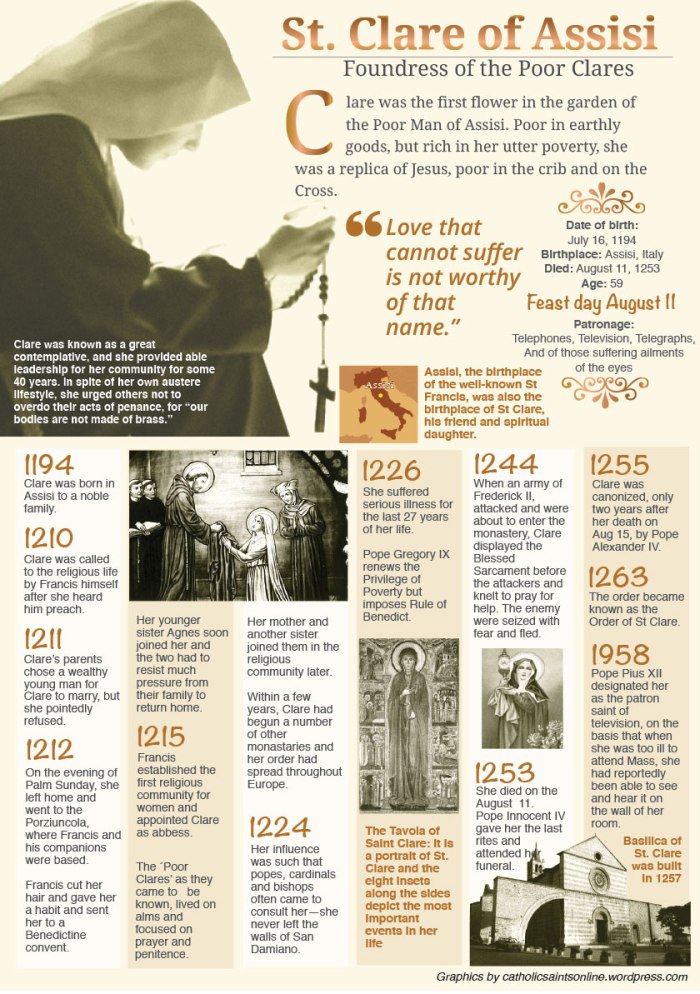
Saint of the Day – 11 August – St Clare of Assisi (1194-1253) – Virgin, Religious, Founder, Mystic, Friend and Follower of St Francis, Miracle-Worker – (16 July 1194 at Assisi, Italy – 11 August 1253 of natural causes).   St Clare was Canonised on 26 September 1255 by Pope Alexander IV.   St Clare was born Chiara Offreduccio (sometimes spelled Clair, Claire, etc.) is an Italian saint and one of the first followers of Saint Francis of Assisi.   She founded the Order of Poor Ladies, a monastic religious order for women in the Franciscan tradition and wrote their Rule of Life, the first set of monastic guidelines known to have been written by a woman.    Following her death, the Order she founded was renamed in her honour as the Order of Saint Clare, commonly referred to today as the Poor Clares.   Patronages – embroiderers, needle workers, eyes, against eye disease, for good weather, gilders, gold workers, goldsmiths, laundry workers, television (proclaimed on 14 February 1958 by Pope Pius XII because when St Clare was too ill to attend the Holy Mass, she had been able to see and hear it, on the wall of her room.), television writers, Poor Clares, Assisi, Italy, Santa Clara Indian Pueblo.  st-clare-of-assisi-header-info 2jpg

st-clare-of-assisi-header

St Clare was born in Assisi, the eldest daughter of Favorino Sciffi, Count of Sasso-Rosso and his wife Ortolana.   Traditional accounts say that Clare’s father was a wealthy representative of an ancient Roman family, who owned a large palace in Assisi and a castle on the slope of Mount Subasio. Ortolana belonged to the noble family of Fiumi and was a very devout woman who had undertaken pilgrimages to Rome, Santiago de Compostela and the Holy Land.   Later in life, Ortolana entered Clare’s monastery, as did Clare’s sisters, Beatrix and Catarina (who took the name Agnes).

As a child, Clare was devoted to prayer.   Although there is no mention of this in any historical record, it is assumed that Clare was to be married in line with the family tradition.   However, at the age of 18 she heard Francis preach during a Lenten service in the church of San Giorgio at Assisi and asked him to help her to live after the manner of the Gospel.   On the evening of Palm Sunday, 20 March 1212, she left her father’s house and accompanied by her aunt Bianca and another companion proceeded to the chapel of the Porziuncula to meet Francis.  There, her hair was cut and she exchanged her rich gown for a plain robe and veil.

Francis placed Clare in the convent of the Benedictine nuns of San Paulo, near Bastia. Her father attempted to force her to return home.   She clung to the altar of the church and threw aside her veil to show her cropped hair.   She resisted any attempt, professing that she would have no other husband but Jesus Christ.   In order to provide the greater solitude Clare desired, a few days later Francis sent her to Sant’ Angelo in Panzo, another monastery of the Benedictine nuns on one of the flanks of Subasio.   Clare was soon joined by her sister Catarina, who took the name Agnes.   They remained with the Benedictines until a small dwelling was built for them next to the church of San Damiano, which Francis had repaired some years earlier.

Other women joined them and they were known as the “Poor Ladies of San Damiano”. They lived a simple life of poverty, austerity and seclusion from the world, according to a Rule which Francis gave them as a Second Order (Poor Clares).

San Damiano became the centre of Clare’s new religious order, which was known in her lifetime as the “Order of Poor Ladies of San Damiano.”   San Damiano was long thought to be the first house of this order, however, recent scholarship strongly suggests that San Damiano actually joined an existing network of women’s religious houses organised by Hugolino (who later became Pope Gregory IX).   Hugolino wanted San Damiano as part of the order he founded because of the prestige of Clare’s monastery.   San Damiano emerged as the most important house in the order and Clare became its undisputed leader.   By 1263, just ten years after Clare’s death, the order had become known as the Order of Saint Clare.   In 1228, when Gregory IX offered Clare a dispensation from the vow of strict poverty, she replied:  “ I need to be absolved from my sins but not from the obligation of following Christ.”   Accordingly, the Pope granted them the Privilegium Pauperitatis — that nobody could oblige them to accept any possession.

Unlike the Franciscan friars, whose members moved around the country to preach, Saint Clare’s sisters lived in enclosure, since an itinerant life was hardly conceivable at the time for women.   Their life consisted of manual labour and prayer. The nuns went barefoot, slept on the ground, ate no meat and observed almost complete silence.

For a short period, the order was directed by Francis himself.    Then in 1216, Clare accepted the role of abbess of San Damiano.   As abbess, Clare had more authority to lead the order than when she was the prioress and required to follow the orders of a priest heading the community.   Clare defended her order from the attempts of prelates to impose a rule on them that more closely resembled the Rule of Saint Benedict than Francis’ stricter vows.   Clare sought to imitate Francis’ virtues and way of life so much so that she was sometimes titled alter Franciscus, another Francis.   She also played a significant role in encouraging and aiding Francis, whom she saw as a spiritual father figure and she took care of him during his final illness.

After Francis’s death, Clare continued to promote the growth of her order, writing letters to abbesses in other parts of Europe and thwarting every attempt by each successive pope to impose a rule on her order which weakened the radical commitment to corporate poverty she had originally embraced.   She did this despite enduring a long period of poor health until her death.   Clare’s Franciscan theology of joyous poverty in imitation of Christ is evident in the rule she wrote for her community and in her four letters to Agnes of Prague.

In 1224, the army of Frederick II came to plunder Assisi.   Clare went out to meet them with the Blessed Sacrament in her hands.   Suddenly a mysterious terror seized the enemies, who fled without harming anybody in the city.

Before breathing her last in 1253, Clare said:  “ Blessed be You, O God, for having created me.”

On 9 August 1253, the papal bull Solet annuere of Pope Innocent IV confirmed that Clare’s rule would serve as the governing rule for Clare’s Order of Poor Ladies.   Two days later, on 11 August Clare died at the age of 59.   Her remains were interred at the chapel of San Giorgio while a church to hold her remains was being constructed.   At her funeral, Pope Innocent IV insisted the friars perform the Office for the Virgin Saints as opposed to the Office for the Dead (Bartoli, 1993).   This move by Pope Innocent ensured that the Canonisation process for Clare would begin shortly after her funeral.   Pope Innocent was cautioned by multiple advisers against having the Office for the Virgin Saints performed at Clare’s funeral (Bartoli, 1993).   The most vocal of these advisers was Cardinal Raynaldus who would later become Pope Alexander IV, who in two years time would canonise Clare (Pattenden, 2008).   At Pope Innocent’s request the canonisation process for Clare began immediately.   While the whole process took two years, the examination of Clare’s miracles took just six days.   On 26 September 1255, Pope Alexander IV Canonised Clare as Saint Clare of Assisi.   Construction of the Basilica of Saint Clare was completed in 1260, and on October 3 of that year Clare’s remains were transferred to the newly completed basilica where they were buried beneath the high altar.   In further recognition of the saint, Pope Urban IV officially changed the name of the Order of Poor Ladies to the Order of Saint Clare in 1263.

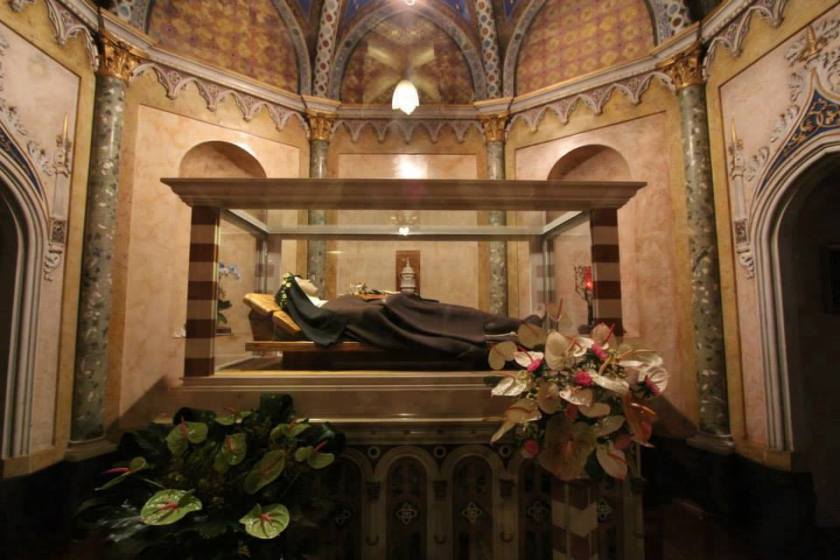
Some 600 years later in 1872, Saint Clare’s relics were transferred to a newly constructed shrine in the crypt of the Basilica of Saint Clare, where her relics can still be venerated today.    Her body is incorrupt.

OLYMPUS DIGITAL CAMERA

20100813-assisi-santa-chiara-10
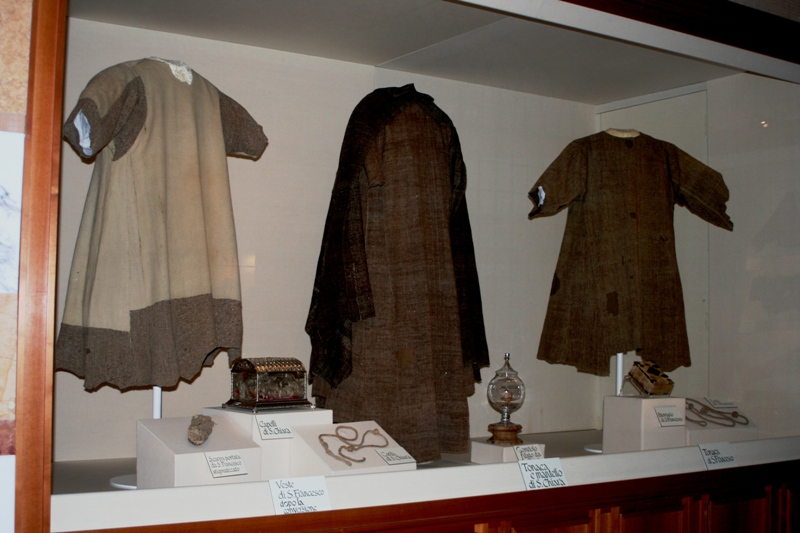
St Clare’s Garment in the Centre with St Francis’ on each side

St-Clare-of-Assisi-relic

st clare relics

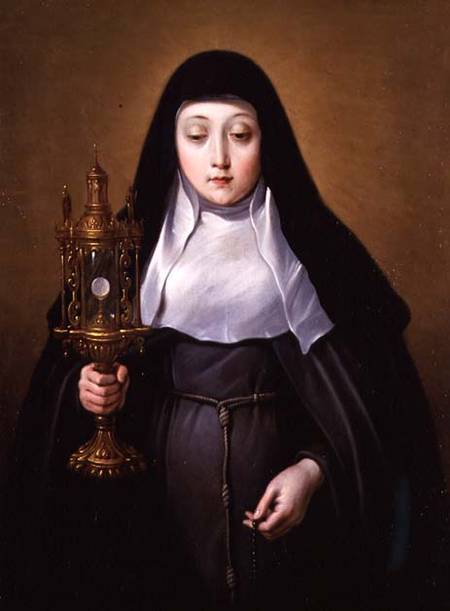
In art, Clare is often shown carrying a monstrance or pyx, in commemoration of the occasion when she warded away the soldiers of Frederick II at the gates of her convent by displaying the Blessed Sacrament and kneeling in prayer.

Pope Pius XII designated Clare as the Patron Saint of television in 1958 because when St Clare was too ill to attend the Holy Mass, she had been able to see and hear it, on the wall of her room.

There are traditions of bringing offerings of eggs to the Poor Clares for their intercessions for good weather, particularly for weddings.  This tradition remains popular in the Philippines, particularly at the Real Monasterio de Santa Clara in Quezon City.   According to the Filipino essayist Alejandro Roces, the practice arose because of Clare’s name. In Castilian clara refers to an interval of fair weather and in Spanish, it also refers to the white or albumen of the egg.

Posted in CONFESSORS, franciscan OFM, INCORRUPTIBLES, PRIESTS, all CLERGY, QUOTES - J R R Tolkien and MORE, SAINT of the DAY

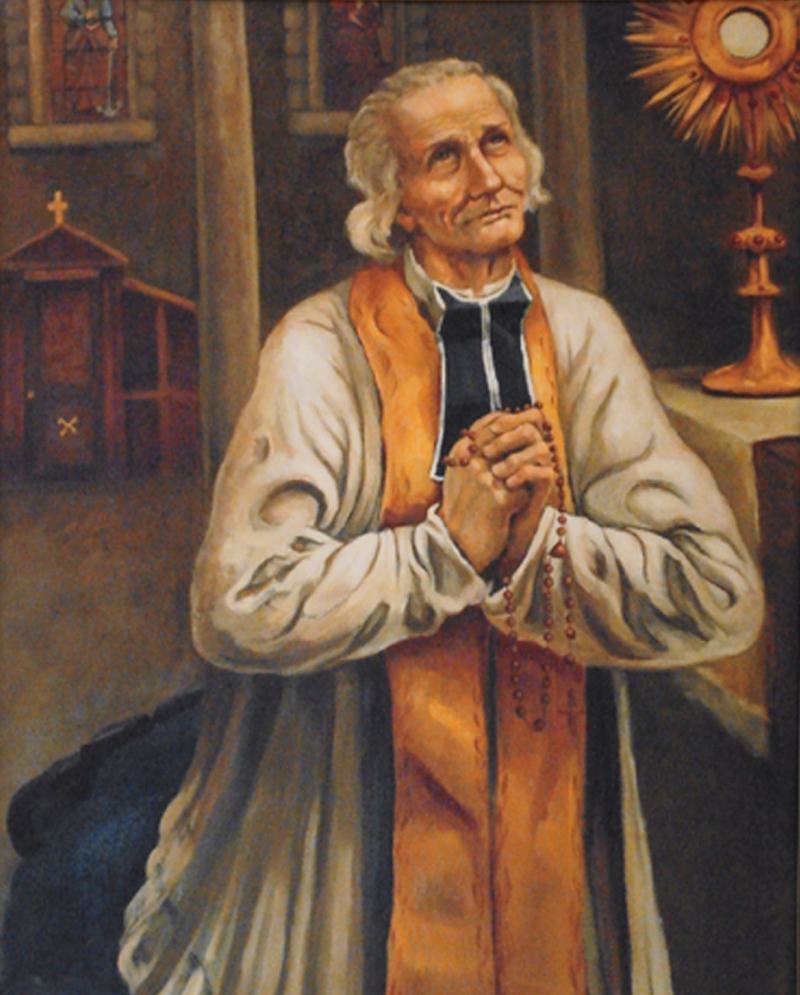
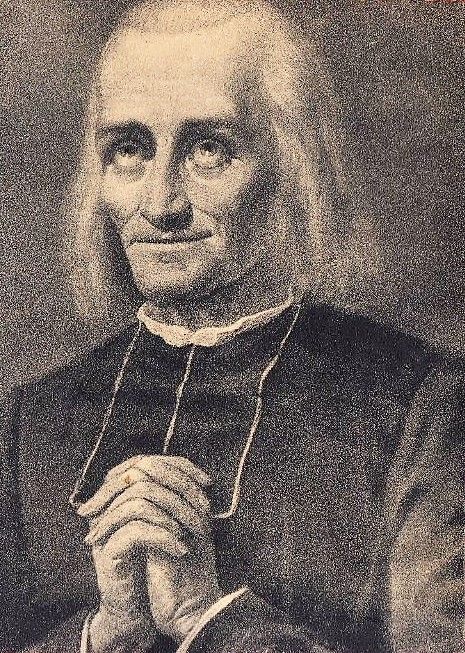
Saint of the Day – 9 August – St Jean-Baptiste Marie Vianney TOSF (1786-1859)- The Curé of Ars, Confessor

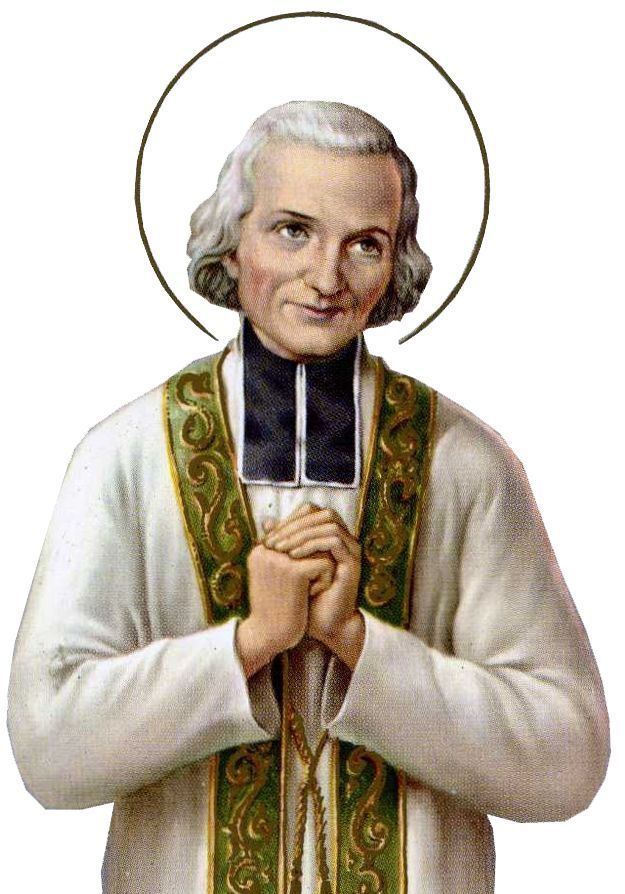
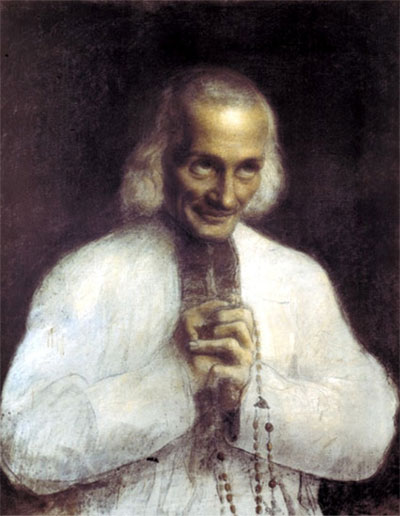
Saint of the Day – 9 August – St Jean-Baptiste Marie Vianney TOSF (1786-1859) – The Curé of Ars (Parish Priest of Ars) – Confessor Priest and Tertiary – (8 May 1786 at Dardilly, Lyons, France – 4 August 1859 at Ars, France of natural causes)   His body is interred in the Basilica of Ars.   He was Canonised on 31 May 1925 by Pope Pius XI.   Patronages – Confessors, Priests (proclaimed on 23 April 1929 by Pope Pius XI), Personal Apostolic Administration of Saint John Mary Vianney, Dubuque, Iowa, Archdiocese of, Kamloops, British Columbia, Diocese of, Kansas City, Kansas, Archdiocese of, Lafayette, Louisiana, Diocese of, Saint Paul and Minneapolis, Minnesota, Archdiocese of.  St John Vianney’s body is incorrupt.

St-John-Vianney

St John Vianney was born on 8 May 1786, in the French town of Dardilly, France (near Lyon) and was baptised the same day.   His parents, Matthieu Vianney and his wife Marie (Belize), had six children, of whom John was the fourth.   The Vianneys were devout Catholics, who helped the poor and gave hospitality to St Benedict Joseph Labre, the patron saint of tramps, who passed through Dardilly on his pilgrimage to Rome.

St Benedict Joseph Labre detail Icon and Jesus Crowns
St Benedict Joseph Labre

By 1790, the anticlerical Terror phase of the French Revolution forced many loyal priests to hide from the regime in order to carry out the sacraments in their parish.   Even though to do so had been declared illegal, the Vianneys traveled to distant farms to attend Masses celebrated by priests on the run.   Realising that such priests risked their lives day by day, Vianney began to look upon them as heroes.   He received his First Communion catechism instructions in a private home by two nuns whose communities had been dissolved during the Revolution.   He made his first communion at the age of 13 (normal in those times).   During the Mass, the windows were covered so that the light of the candles could not be seen from the outside.   His practice of the Faith continued in secret, especially during his preparation for confirmation.

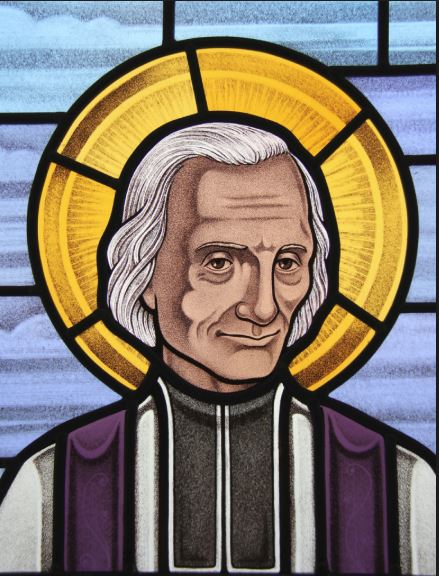
The Catholic Church was re-established in France in 1802 by Napoleon Bonaparte, resulting in religious peace throughout the country, culminating in a Concordat.   By this time, Vianney was concerned about his future vocation and longed for an education.   He was 20 when his father allowed him to leave the farm to be taught at a “presbytery-school” in the neighbouring village of Écully, conducted by the Abbé Balley.   The school taught arithmetic, history, geography and Latin.   Vianney struggled with school, especially with Latin, since his past education had been interrupted by the French Revolution.   Only because of Vianney’s deepest desire to be a priest—and Balley’s patience—did he persevere.lovely - st john vianney glass

St Vianney’s studies were interrupted in 1809 when he was drafted into Napoleon’s armies. He would have been exempt, as an ecclesiastical student but Napoleon had withdrawn the exemption in certain dioceses because of his need for soldiers in his fight against Spain.   Two days after he had to report at Lyons, he became ill and was hospitalised, during which time his draft left without him.   Once released from the hospital, on 5 January, he was sent to Roanne for another draft.   He went into a church to pray and fell behind the group.   He met a young man who volunteered to guide him back to his group but instead led him deep into the mountains of Le Forez, to the village of Les Noes, where deserters had gathered.   St Vianney lived there for fourteen months, hidden in the byre attached to a farmhouse and under the care of Claudine Fayot, a widow with four children.   He assumed the name Jerome Vincent and under that name, he opened a school for village children.   Since the harsh weather isolated the town during the winter, the deserters were safe from gendarmes.   However, after the snow melted, gendarmes came to the town constantly, searching for deserters.   During these searches, Vianney hid inside stacks of fermenting hay in Fayot’s barn.

An imperial decree proclaimed in March 1810 granted amnesty to all deserters, which enabled Vianney to go back legally to Ecully, where he resumed his studies.   He was tonsured in 1811 and in 1812 he went to the minor seminary at Verrières-en-Forez.   In autumn of 1813, he was sent to the major seminary at Lyons.   Considered too slow, he was returned to Abbe Balley.   However, Balley persuaded the Vicar general that Vianney’s piety was great enough to compensate for his ignorance and the seminarian received minor orders and the subdiaconate on 2 July 1814, was ordained a deacon in June 1815 and was ordained priest on 12 August 1815 in the Couvent des Minimes de Grenoble.   He said his first Mass the next day and was appointed the assistant to Balley in Écully.

St-John-Vianney.5

Curé of Ars
In 1818, shortly after the death of Balley, Jean-Marie Vianney was appointed parish priest of the parish of Ars, a town of 230 inhabitants.    As parish priest, he realised that the Revolution’s aftermath had resulted in religious ignorance and indifference, due to the devastation wrought on the Catholic Church in France.   At the time, Sundays in rural areas were spent working in the fields, or dancing and drinking in taverns.  He spent time in the confessional and gave homilies against blasphemy and paganic dancing.   If his parishioners did not give up this dancing, he refused them absolution.   Abbe Balley had been St Vianney’s greatest inspiration, since he was a priest who remained loyal to his faith, despite the Revolution.   He felt compelled to fulfill the duties of a curé, just as did Balley, even when it was illegal.   With Catherine Lassagne and Benedicta Lardet, he established La Providence, a home for girls.   Only a man of vision could have such trust that God would provide for the spiritual and material needs of all those who came to make La Providence their home.french - st john vianney

Later years
Fr Vianney came to be known internationally and people from distant places began travelling to consult him as early as 1827.   “By 1855, the number of pilgrims had reached 20,000 a year.   During the last ten years of his life, he spent 16 to 18 hours a day in the confessional.   Even the bishop forbade him to attend the annual retreats of the diocesan clergy because of the souls awaiting him yonder”.  His work as a confessor is John Vianney’s most remarkable accomplishment.   In the winter months he was to spend 11 to 12 hours daily reconciling people with God.   In the summer months this time was increased to 16 hours.   Unless a man was dedicated to his vision of a priestly vocation, he could not have endured this giving of self day after day.st john vianney lg

Many people look forward to retirement and taking it easy, doing the things they always wanted to do but never had the time. But John Vianney had no thoughts of retirement.   As his fame spread, more hours were consumed in serving God’s people.   Even the few hours he would allow himself for sleep were disturbed frequently by the devil, who physically attacked and tormented St John and kept him from sleeping.

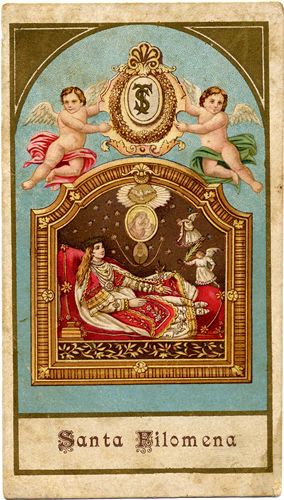
St Vianney had a great devotion to St. Philomena.   He regarded her as his guardian and erected a chapel and shrine in honor of the saint.   During May 1843, he fell so ill he thought that his life was coming to its end.   St John Vianney attributed his cure to her intercession.

st philomena

He yearned for the contemplative life of a monk and four times ran away from Ars, the last time in 1853.  St John Vianney read much and often the lives of the saints, and became so impressed by their holy lives that he wanted for himself and others to follow their wonderful examples.   The ideal of holiness enchanted him.   This was the theme which underlay his sermons.  “We must practice mortification. For this is the path which all the Saints have followed,” he said from the pulpit.   He placed himself in that great tradition which leads the way to holiness through personal sacrifice. “If we are not now saints, it is a great misfortune for us:  therefore we must be so.   As long as we have no love in our hearts, we shall never be Saints.”   The Saint, to him, was not an exceptional man before whom we should marvel but a possibility which was open to all Catholics.   Unmistakably did he declare in his sermons that “to be a Christian and to live in sin is a monstrous contradiction. A Christian must be holy.”   With his Christian simplicity he had clearly thought much on these things and understood them by divine inspiration, while they are usually denied to the understanding of educated men.   He was a champion of the poor as a Franciscan tertiary and was a recipient of the coveted French Legion of Honour.St.-John-Vianney.8

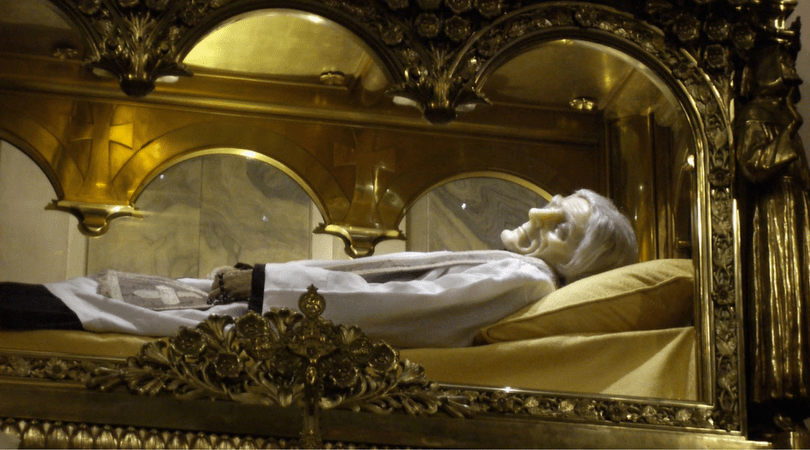
On 4 August 1859, Vianney died at the age of 73.   The bishop presided over his funeral with 300 priests and more than 6,000 people in attendance.   Before he was buried, Vianney’s body was fitted with a wax mask.

On 3 October 1874 Pope Pius IX proclaimed him “venerable”;  on 8 January 1905, Pope Pius X declared him Blessed and proposed him as a model to the parochial clergy.   In 1925 John Mary Vianney was canonized by Pope Pius XI, who in 1929 made him patron saint of parish priests.
In 1959, to commemorate the centenary of John Vianney’s death, Pope John XXIII issued the encyclical letter Sacerdotii nostri primordia.   St Pope John Paul II visited Ars in person in 1986 in connection with the anniversary of Vianney’s birth and referred to the great saint as a “rare example of a pastor acutely aware of his responsibilities … and a sign of courage for those who today experience the grace of being called to the priesthood.”snip - st john vianney

In honour of the 150th anniversary of Vianney’s death, Pope Benedict XVI declared a Year of the Priest, running from the Feast of the Sacred Heart 2009–2010.   The Vatican Postal Service issued a set of stamps to commemorate the 150th Anniversary.   With the following words on 16 June 2009, Benedict XVI officially marked the beginning of the year dedicated to priests, “…On the forthcoming Solemnity of the Most Sacred Heart of Jesus, Friday 19 June 2009 – a day traditionally devoted to prayer for the sanctification of the clergy –, I have decided to inaugurate a ‘Year of the Priest’ in celebration of the 150th anniversary of the dies natalis of John Mary Vianney, the Patron Saint of parish priests worldwide…” In the Holy Father’s words the Curé d’Ars is “a true example of a pastor at the service of Christ’s flock.”

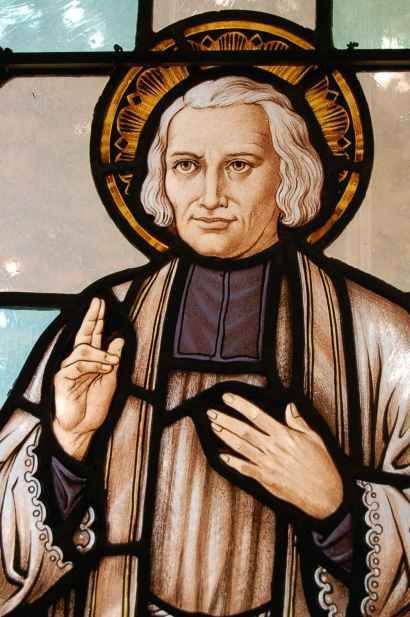
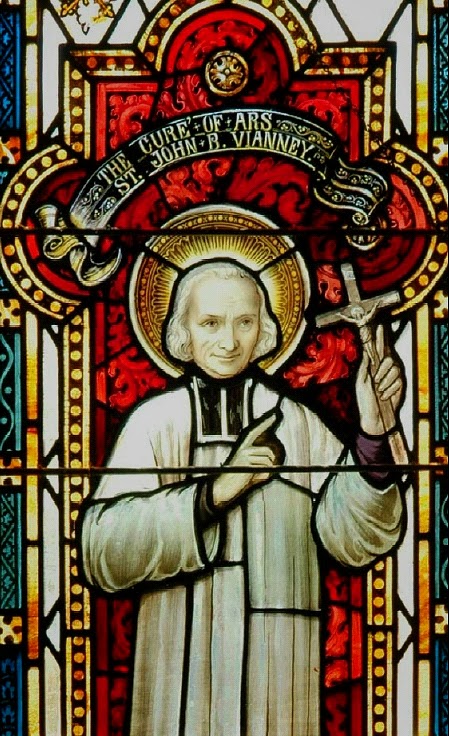
There are statues and stained glass windows of St John Vianney in many French churches and in Catholic churches throughout the world.   Also, many parishes founded in the twentieth and twenty-first centuries are named after him.   Some relics are kept in the Church of Notre-Dame de la Salette in Paris.st john vianney relics

Posted in INCORRUPTIBLES

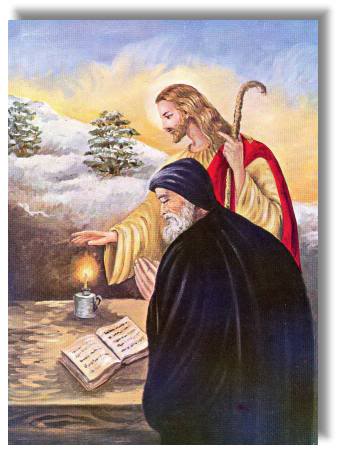
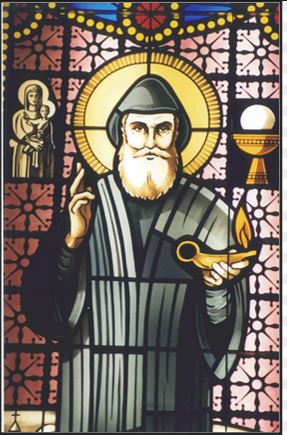
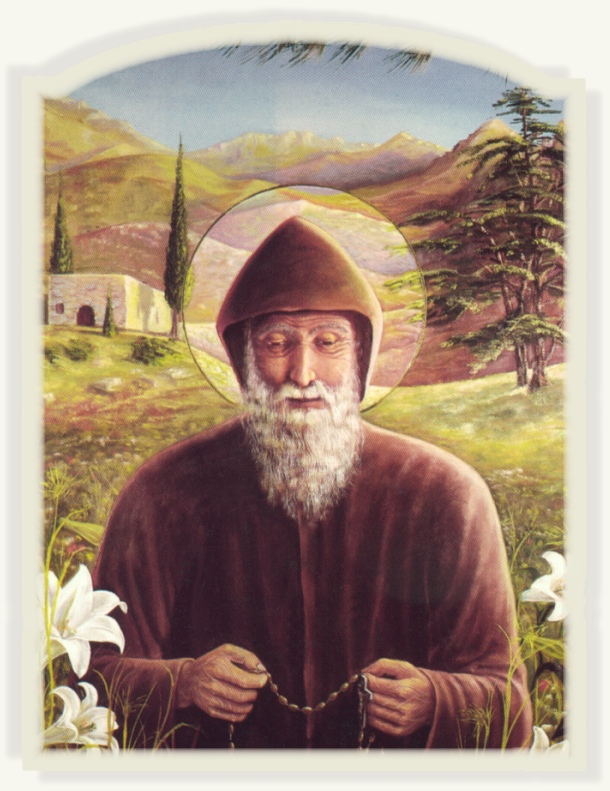
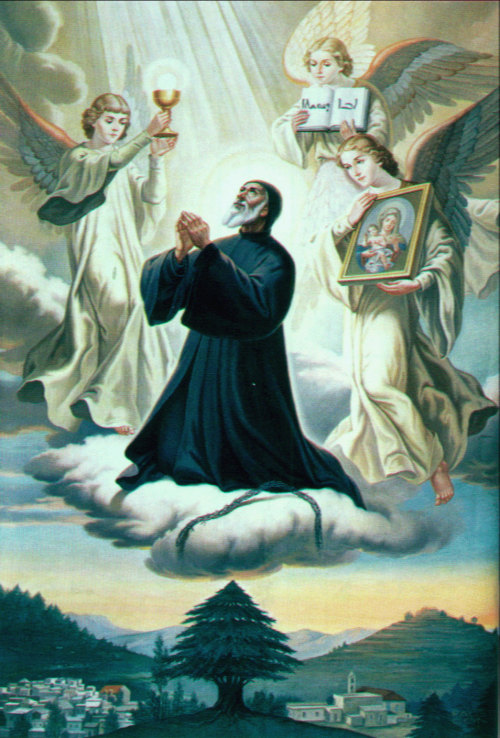
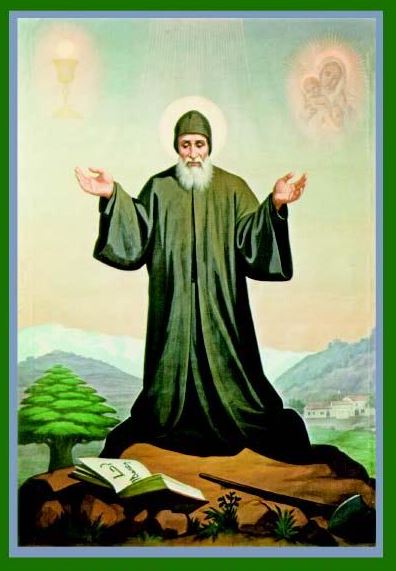
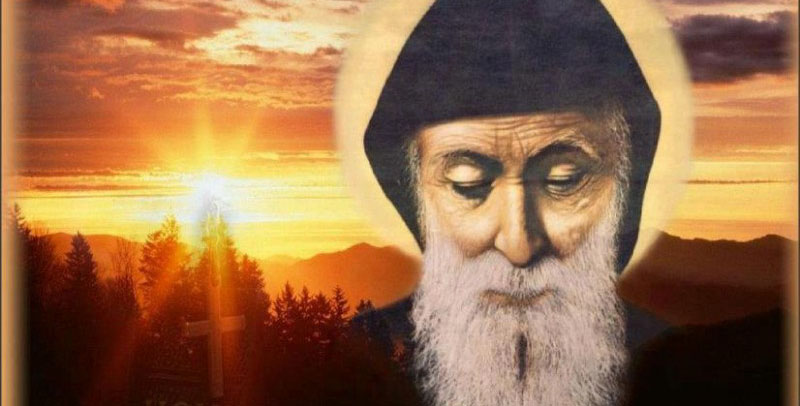
Saint of the Day – 24 July – St Charbel Makhluf O.L.M. – The holy monk whose dead body radiated white light

Saint of the Day – 24 July – St Charbel Makhluf O.L.M. Monk, Priest, Hermit, Miracle Worker  – The holy monk whose dead body radiated white light – (8 May 1828 at Beka-Kafra, Lebanon as Joseph Zaroun Makhlouf – 24 December 1898 at Annaya of natural causes).   St Charbel was Beatified in 1965, at the close of Vatican II and Canonised on 9 October 1977 by Pope Paul VI.   Patron of Lebanon.

st charbel header 2

st charbel makhluf.infopgraphics

Youssef Antoun Makhlouf, the fifth child of a mule driver and his wife, he was born at Biqa-Kafra in the mountains of north Lebanon.   Orphaned at an early age, he was brought up by an uncle who showed little sympathy for his charge’s devotion to prayer and solitude.   Undeterred, in 1851, at the age of 23, Makhlouf entered the monastery of St Maroun at Annaya, taking the name in religion of Charbel, a second-century martyr at Antioch.

For 16 years, he worked hard in the monastery’s vineyards and sang the office at Mass.  If Charbel was in any way distinguished from his fellow monks it was in his greater fervour for mortification, his rapt attention at Mass and his constant perusal of Thomas à Kempis’s Imitation of Christ.   Although ordained a priest in 1859, Charbel increasingly felt the call to become a hermit.   For some years his superiors resisted this ambition.   In 1875, however, he removed to a hermitage attached to the monastery.   At 4,600 feet above sea level his cell was often freezing;  it was clear, however, that suffering and self-obliteration were precisely the graces which he sought.   Following his death, the monks who trembled with cold during the night when they kept vigil at his coffin before his funeral, said:  “See how we find ourselves unable to endure for a single night, the rude cold of this chapel!   How could this priest live here for twenty-three years, on his knees, like a statue before the altar, every night from midnight until eleven in the morning, when he rose to say his Mass?   Blessed is he, for he undoubtedly receives at present his reward with God!”   

st charbel's cell
St Charbel’s Cell

Saint Charbel also gained a reputation for holiness and despite his wish to live in isolation, was much sought for counsel and blessing.   He had a great personal devotion to the Blessed Sacrament and the Blessed Virgin and was known to levitate during his prayers.   He reportedly never raised his eyes from the ground, his face shrouded by his cloak, unless his gaze was fixed on the tabernacle during the Eucharist.

724charbel12st charbel makhluf with holy eucharist

The week before Christmas, while Saint Charbel was offering Mass, paralysis struck him suddenly as he elevated the Eucharist during the consecration.   For one week, he suffered in agony, repeating the prayer he was unable to complete during the Mass:  “O Father of truth, behold Your Son, victim to please You;  condescend to approve [this offering], because for me He endured death, to give me life…”

st charbel makhluf 2.st charbel makhluf.5st charbel makhluf. BEAUTIFUL BIG JPGst charbel makhluf

When Charbel died, aged 70, he was interred in the monastery cemetery, without a coffin, as was customary. On the evening of his funeral, his superior wrote:  “Because of what he will do after his death, I need not talk about his behavior.”  Over the next 45 days, however, it seemed to many observers that the place where his body lay was irradiated by white light.   After four months it was decided to open the grave. Charbel’s cadaver was found to be perfectly preserved notwithstanding floods which had turned the area into a sea of mud.

The corpse was re-clothed and installed in the monastery chapel.   Now, a strange liquid was secreted from the pores of the dead man’s skin, making it necessary regularly to change his garments.   An examination conducted in 1927 by doctors of the local French medical institute found that the body was still incorrupt.   At this stage it was transferred to a new zinc-lined coffin, which was placed inside the wall of an oratory.
In 1950 a liquid was observed to be oozing from a corner of the tomb.   Another examination discovered a viscous fluid in the bottom of the coffin.   And while subsequent investigations have revealed a body no longer incorrupt, the bones have mysteriously turned red.

Hundreds of cures have been, and still are, reported by those who visited Charbel’s tomb. He was canonised in 1977.

Posted in INCORRUPTIBLES

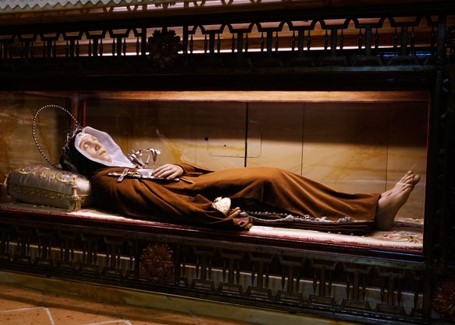
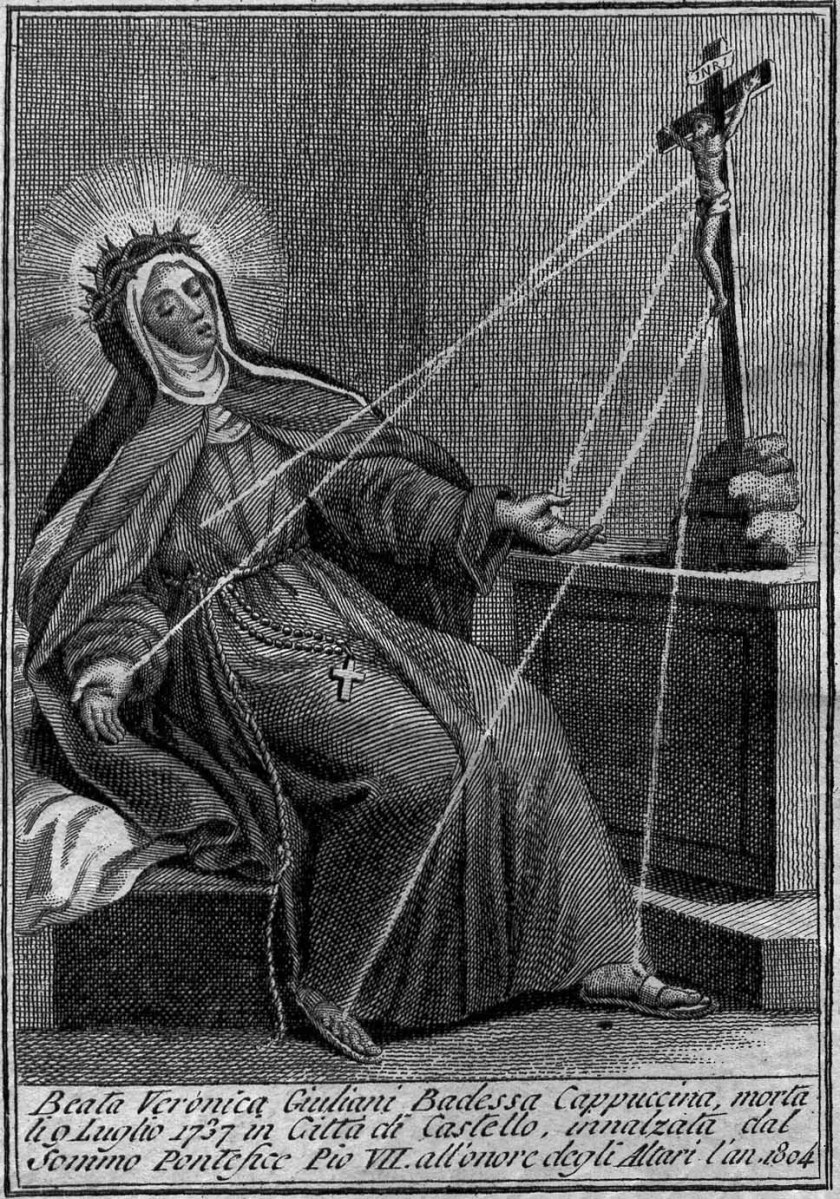
Saint of the Day – 9 July – St Veronica Giuliani

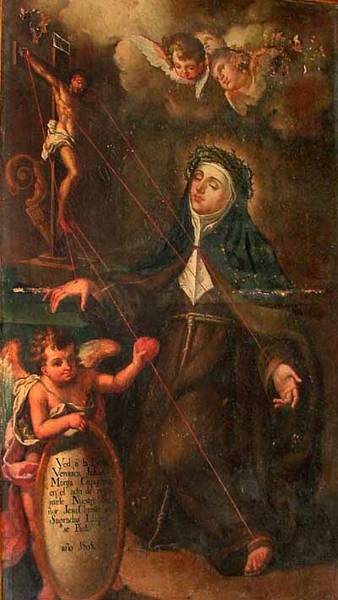
Saint of the Day – 9 July – St Veronica Giuliani – Italian Capuchin Poor Clares nun, Abbot, Mystic, Stigmatist.  (1660 at Mercatello, Duchy of Urbino (part of modern Italy) as Ursula Giuliani – 9 July 1727 at Città di Castello, Italy of natural causes).   The figure of the cross was found impressed upon her heart.   Her body is incorrupt.   She was beatified on 17 June 1804 by Pope Pius VII and canonised on 26 May 1839 by Pope Gregory XVI.  Attributes – crowned with thorns and embracing the Cross, holding a heart marked with a cross, embracing a Crucifix.

The wax image of St. Veronica that encloses her skull and bones; enshrined and venerated in the Capuchin Monastery of Citta-di-Castello, Italy.

She was born Orsola [Ursula] Giuliani at Mercatello in the Duchy of Urbino on December 27, 1660.   Her parents were Francesco and Benedetta Mancini Giuliani.   She was the youngest of seven sisters, three of whom embraced the monastic life.

It is told that at the age of three years Ursula supposedly began to show great compassion for the poor.   She would set apart a portion of her food for them and even part with her clothes when she met a poor child scantily clad.   Her mother died when Ursula was seven years of age.

When others did not readily join in her religious practices she was inclined to be dictatorial.   At the age of 16, she experienced a vision which corrected this imperfection of character:   she saw her own heart as a “heart of steel”.   In her writings she confesses that she took a certain pleasure in the more stately circumstances which her family adopted when her father was appointed superintendent of finance at Piacenza.   When Veronica came of age, her father believed she should marry and so he desired her to take part in the social activities of the young people.   But she pleaded so earnestly with her father that, after much resistance, he finally permitted her to choose her own state in life.

For fifty years Ursula Giuliani lived as Sister Veronica in the Capuchin convent of Città di Castello in Umbria, Italy.   With gritty determination tempered by humility, she led her sisters as novice mistress for thirty-four years and as abbess for eleven.   St. Veronica governed the convent with obvious common sense.   For example, so that her young novices would not get puffed up with pride, she forbade them to read the elevated works of the great spiritual masters.   Instead she required them to study books on Christian basics.   And as a most practical woman, she improved her sisters’ comfort by enlarging the convent rooms and having water piped inside.

Like Teresa of Ávila, another very down-to-earth saint, Veronica enjoyed an unusually profound communion with God.   In the following excerpt from her Diary, she struggled to put into words her experience of the divine presence:

“While I was about to go to Holy Communion, I seemed to be thrown wide open like a door flung open to welcome a close friend and then shut tight after his entry.   So my heart was alone with Him—alone with God.   It seems impossible to relate all the effects, feelings, leaping delight and festivity my soul experienced.   If I were to speak, for example, of all the happy and pleasant times shared with dear friends . . . , I would be saying nothing comparable to this joy.   And if I were to add up all the occasions of rejoicing in the universe, I would be saying that all this amounts to little or nothing beside what, in an instant, my heart experiences in the presence of God.   Or rather what God does to my heart, because all these other things flow from Him and are His works.

Love makes the heart leap and dance. Love makes it exult and be
festive.   Love makes it sing and be silent as it pleases.   Love grants it rest
and enables it to act.   Love possesses it and gives it everything.   Loves
takes it over completely and dwells in it.   But I am unable to say more
because if I wished to relate all the effects that my heart experiences in
the act of going to Holy Communion and also at other times, I would
never finish saying everything.   It is sufficient to say that communion is
a . . . mansion of love itself.”

Veronica GiulianiST VERONICA GIULIANI.3.ST VERONICA GIULIANI.2.Saint Veronica Giuliani

Veronica had a lifelong devotion to Christ crucified that eventually became manifested in physical signs.   The marks of the crown of thorns appeared on her forehead in 1694 and the five wounds on her body in 1697. Veronica was humiliated by the stigmata itself and by her bishop’s rigorous testing of her experience.   He removed the saint from ordinary community life and put her under constant observation.   When he decided that the phenomena were authentic, he allowed her to return to normal convent life and continue her service to her sisters.   In 1727, Veronica died of apoplexy at the age of sixty- seven.


Posted in INCORRUPTIBLES

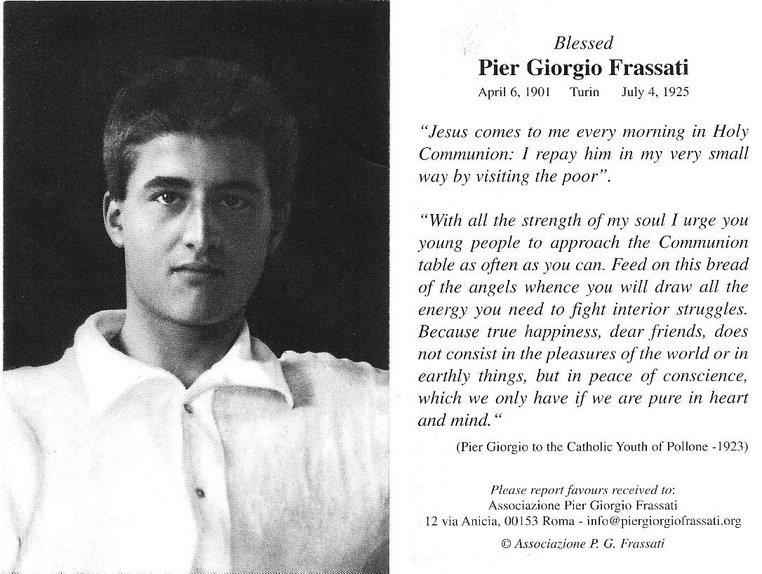
Saint of the Day – 4 July – Blessed Pier Georgio Frassati T.O.S.D. “The Man of the Eight Beatitudes”

Saint of the Day – 4 July – Blessed Pier Georgio Frassati T.O.S.D. “The Man of the Eight Beatitudes”, Apostle of Charity and Love, layman, Apostle of the Holy Eucharist and Eucharist Adoration, also known as Girolamo (6 April 1901 in Turin, Italy – 4 July 1925 in Turin, Italy of poliomylelitis.)   His remains were buried in the family cemetery of Pollone, Italy
His body was found incorrupt when moved to the Cathedral of Turin in 1981.  He was beatified on 20 May 1990 by Pope John Paul II.

Pier Giorgio Michelangelo Frassati was born in Turin, Italy on April 6, 1901.   His mother, Adelaide Ametis, was a painter.   His father Alfredo, was the founder and director of the newspaper, “La Stampa,” and was influential in Italian politics, holding positions as an Italian Senator and Ambassador to Germany.

At an early age, Pier Giorgio joined the Marian Sodality and the Apostleship of Prayer, and obtained permission to receive daily Communion (which was rare at that time).

He developed a deep spiritual life which he never hesitated to share with his friends.   The Holy Eucharist and the Blessed Virgin were the two poles of his world of prayer.   At the age of 17, he joined the St. Vincent de Paul Society and dedicated much of his spare time to serving the sick and the needy, caring for orphans and assisting the demobilized servicemen returning from World War I.
He decided to become a mining engineer, studying at the Royal Polytechnic University of Turin, so he could “serve Christ better among the miners,” as he told a friend.
Although he considered his studies his first duty, they did not keep him from social and political activism.   In 1919, he joined the Catholic Student Foundation and the organization known as Catholic Action.   He became a very active member of the People’s Party, which promoted the Catholic Church’s social teaching based on the principles of Pope Leo XIII’s encyclical letter, Rerum Novarum.

What little he did have, Pier Giorgio gave to help the poor, even using his bus fare for charity and then running home to be on time for meals.   The poor and the suffering were his masters and he was literally their servant, which he considered a privilege.   His charity did not simply involve giving something to others but giving completely of himself.   This was fed by daily communion with Christ in the Holy Eucharist and by frequent nocturnal adoration, by meditation on St. Paul’s “Hymn of Charity” (I Corinthians 13), and by the writings of St. Catherine of Siena.   He often sacrificed vacations at the Frassati summer home in Pollone (outside of Turin) because, as he said, “If everybody leaves Turin, who will take care of the poor?”

BlessedPierGiorgioFrassati3- quote on holy comm

In 1921, he was a central figure in Ravenna, enthusiastically helping to organize the first convention of Pax Romana, an association which had as its purpose the unification of all Catholic students throughout the world for the purpose of working together for universal peace.

Mountain climbing was one of his favorite sports. Outings in the mountains, which he organized with his friends, also served as opportunities for his apostolic work.   He never lost the chance to lead his friends to Mass, to the reading of Scripture, and to praying the rosary.

He often went to the theater, to the opera, and to museums. He loved art and music, and could quote whole passages of the poet Dante.

Fondness for the epistles of St. Paul sparked his zeal for fraternal charity and the fiery sermons of the Renaissance preacher and reformer Girolamo Savonarola and the writings of St. Catherine impelled him in 1922 to join the Lay Dominicans (Third Order of St. Dominic).   He chose the name Girolamo after his personal hero, Savonarola.  “I am a fervent admirer of this friar, who died as a saint at the stake,” he wrote to a friend.

Like his father, he was strongly anti-Fascist and did nothing to hide his political views.   He physically defended the faith at times involved in fights, first with anticlerical Communists and later with Fascists.Participating in a Church-organised demonstration in Rome on one occasion, he stood up to police violence and rallied the other young people by grabbing the group’s banner, which the royal guards had knocked out of another student’s hands.   Pier Giorgio held it even higher, while using the banner’s pole to fend off the blows of the guards.

Just before receiving his university degree, Pier Giorgio contracted poliomyelitis, which doctors later speculated he caught from the sick whom he tended.   Neglecting his own health because his grandmother was dying, after six days of terrible suffering Pier Giorgio died at the age of 24 on July 4, 1925.

His last preoccupation was for the poor.   On the eve of his death, with a paralyzed hand he scribbled a message to a friend, asking him to take the medicine needed for injections to be given to Converso, a poor sick man he had been visiting.

Pier Giorgio’s funeral was a triumph.   The streets of the city were lined with a multitude of mourners who were unknown to his family — the poor and the needy whom he had served so unselfishly for seven years. Many of these people, in turn, were surprised to learn that the saintly young man they knew had actually been the heir of the influential Frassati family.

frassati_funeral

Pope John Paul II, after visiting his original tomb in the family plot in Pollone, said in 1989:  “I wanted to pay homage to a young man who was able to witness to Christ with singular effectiveness in this century of ours.   When I was a young man, I, too, felt the beneficial influence of his example and, as a student, I was impressed by the force of his testimony.”

On May 20, 1990, in St. Peter’s Square which was filled with thousands of people, the Pope beatified Pier Giorgio Frassati, calling him the “Man of the Eight Beatitudes.”

His mortal remains, found completely intact and incorrupt upon their exhumation on March 31, 1981, were transferred from the family tomb in Pollone to the cathedral in Turin.   Many pilgrims, especially students and the young, come to the tomb of Blessed Frassati to seek favours and the courage to follow his example.

Posted in INCORRUPTIBLES, JESUIT SJ, SAINT of the DAY, The BLESSED VIRGIN MARY

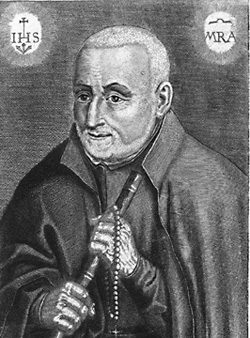
Saint of the Day – 2 July – St St Bernadino Realino SJ

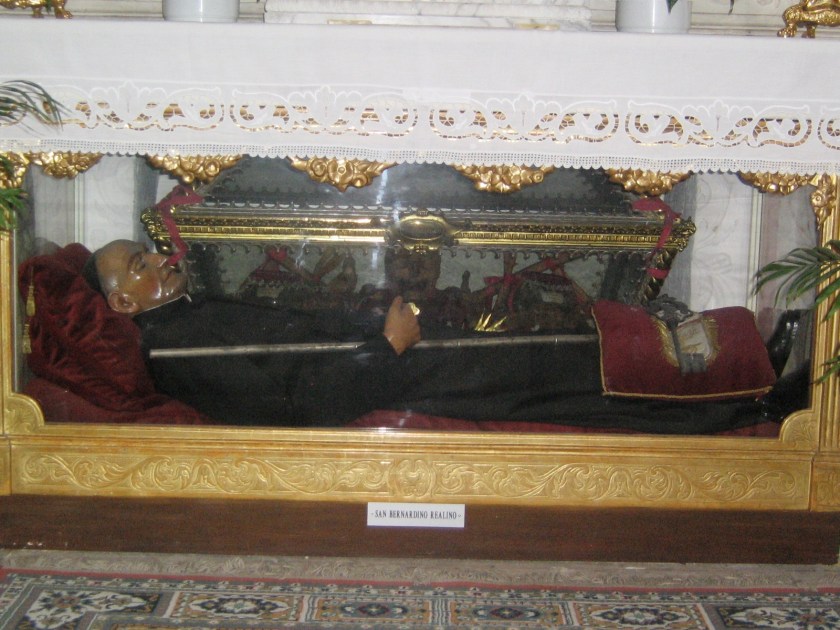
Saint of the Day – 2 July – St St Bernadino Realino SJ – Priest, Lawyer, Teacher, Apostle of Charity -(1 December 1530 in Carpi, Modena, Italy -2 July 1616 in Lecce, Italy of natural causes).   Canonised on 22 June 1947 by Pope Pius XII.  Patronage -Lecce, Italy (proclaimed on 15 December 1947 by Pope Pius XII).  His body is incorrupt and emits a perfumed fragrance.

bernardinrealino

Bernardino Realino was born near Modena, Italy, on 1 December 1530.   At university he began studying philosophy and medicine but switched to law which he thought would open greater chances for advancement and wealth.   Family connections helped him become mayor of Felizzano at age 26, which also involved being a judge.   He was regarded as honest by the people and was reappointed to the post.   Other posts followed until he was made mayor of Castelleone.
Despite his successful career, Realino began losing interest in worldly advancement and began giving away his money to the poor.   In August 1564 he met two Jesuit novices and learned that the Jesuits had only recently come to Naples.   Further encounters strengthened his vocation and then he had a vision of Our Lady, who told him to enter the Jesuits.   He was accepted as a novice on 13 October 1564 at the age of 34.
Realino wanted to be a brother but was told he should be ordained a priest.   Only seven months after taking first vows he was ordained on 24 May 1567.   It was a tribute to his maturity that the Jesuit General (St) Francis Borgia made him master of novices in Naples, although still studying theology.   He also began the pastoral work which would occupy the rest of his active life.   He preached and taught catechism, visited slaves on the galleys in Naples harbour and heard confessions.
In 1574 he was sent to Lecce in Apulia, where there was a plan to set up a Jesuit house and college.   The local response was enthusiastic and Realino began the pastoral work which would last for 42 years:  preaching, hearing confessions, counselling clergy, visiting the sick and those in prison and giving conferences to men and women religious. Several times he was instructed to move to Naples or Rome but each every time he was about to leave the city, he was prevented by some unexpected occurrence – a sudden fever or bad weather.   Eventually his superiors allowed him to stay on in Lecce doing his pastoral work.   In 1583 he set up a sodality for diocesan priests to nurture their spiritual life and improve their competence to hear confessions.   The people showed their love for their pastor, especially during his final illness in June 1616.   Crowds gathered outside the Jesuit residence and only men were allowed in to kiss his hand and devoutly touch religious objects to his body.   On his death-bed, the city mayor and magistrates formally requested Fr Realino to be Lecce’s defender and protector in heaven.   Unable to speak, he nodded.   The distinguished lawyer who spent most of his life as a parish priest in relative seclusion died at the age of 86 with his eyes fixed on a crucifix.   His last words were: “O Madonna, mia santissima” (O my Lady, my most holy one).

72bernardino2bernardino.realino01stbernardinerealino (1)Reliquie_di_San_Bernardino_Realino_Lecce_1205

Posted in INCORRUPTIBLES, SAINT of the DAY, Uncategorized

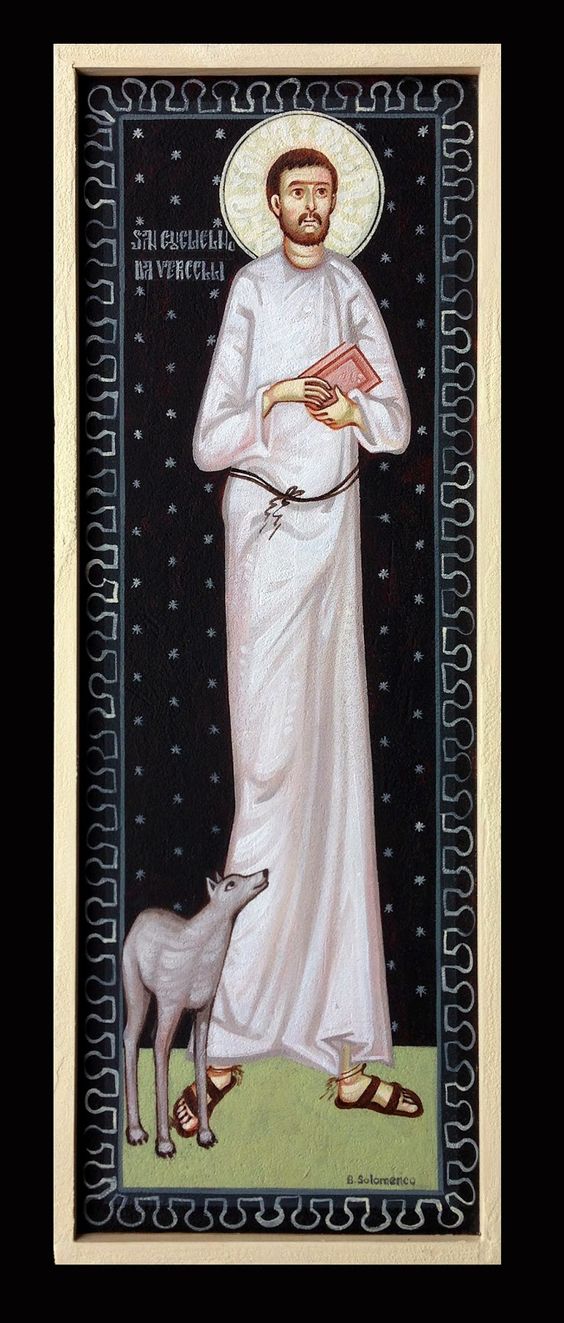
Saint of the day – 25 June – St William of Vercelli (1085-1142)

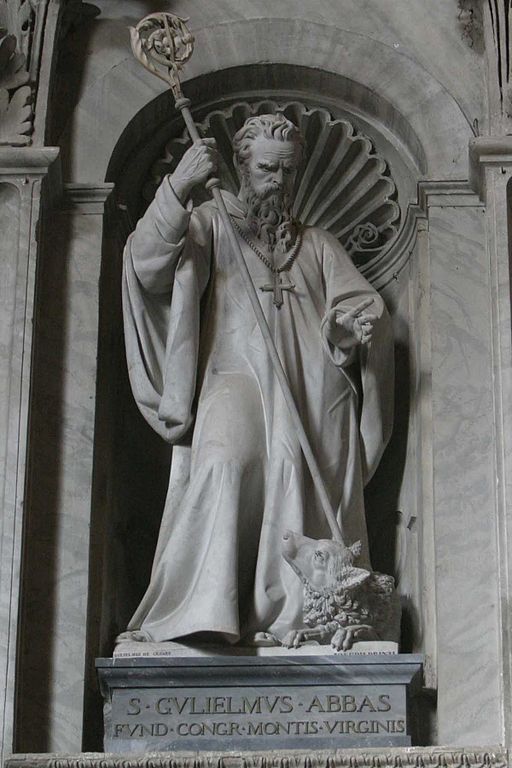
Saint of the day – 25 June – St William of Vercelli OSB (1085 at Vercelli, Italy – 25 June 1142 at Guglietto, Italy of natural causes)  Hermit, Abbot, Founder of the Congregation of Monte Vergine, or “Williamites,” miracle-worker, Marian devotee.   Also known as William of Monte Vergine.   Patronage – Irpinia, Italy.   Attributes –  pilgrim, usually near Santiago de Compostela, Spain, abbot near a wolf wearing a saddle, receiving an appearance by Christ, saddling a wolf that killed his donkey, wolf.   His Body is incorrupt.   The Statue below is the Founder Statue at St Peter’s Basilica.512px-StWilliam of Vercelli -FounderSaint

St William was born to nobility in Vercelli, Italy and was orphaned at a young age when both his parents were killed.   Subsequently raised by a pious family member, William matured into a contemplative young man with only one desire—to devote his life to the Lord.   At the young age of 15, William left home, setting out on pilgrimage to Santiago de Compostela, Spain.   As the journey was not difficult enough for him, he encircled his legs with tight iron bands, causing pain and making walking difficult, his suffering bringing him closer to God.   Upon arrival, he worked many miracles including the healing of a blind man through prayer and, subsequently, felt called to journey to the Holy Land.   However, soon after departing, he was set upon by thieves and following that encounter, felt the Will of God calling him to Italy.ST WILLIAM OF VERCELLI


Saint William retired to Monte Vergiliano (today known as Monte Vergine, named for Our Blessed Mother) and became a hermit.   There, he spent his days in prayer, fasting and contemplation of the Lord.   Especially devoted to the Blessed Virgin Mary, he began construction of a Church in her honour, mining the rocks from the mountain by hand with the assistance of a lone donkey. st-william-of-vercelli-OUR LADY OF MONTE VERGINE pray-for-us-2

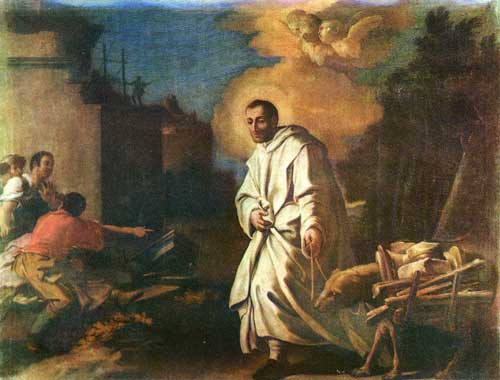
As holy legend tells us, one evening, the donkey was killed and eaten by a wolf.   Saint William called the wolf to him, ordering it to take the donkey’s place.   The wolf, bowing in respect and realising that it had interrupted the work of God, immediately took up the task of dragging rocks from the quarry.   The faithful who continue to travel on pilgrimage to Monte Vergine report that the wolf is still spotted today, visible to those who call upon the name of the Blessed Virgin.St-william of vercelli Guillaume

ST WILLIAM OF VERCELLI

Eventually, due to his working of more miraculous cures (none of which he sought credit for), the faithful began seeking William out on his mountain.   His reputation for holiness attracted many disciples, both men and women, and he founded the Order of Mount Vergine—a religious community with strict rules of austerity.   William and the nuns and monks of his order lived in peace and contemplation for some time, until the members of the order began complaining that William’s rules of poverty, fasting and penance were too extreme.  There is evidence of heavenly support for the austerities of William’s rule.   For example, William did not permit the order to eat meat, eggs, milk or cheese.   If someone tried to violate this regulation, storm clouds would appear in the sky and the lightning would destroy the illicit foodstuff that had been brought into the monastery.san-william guglielmo-di-montevergine-da-vercelli-e-1

With the members of the Order growing more disgruntled, William humbly removed himself from the situation to remove controversy and ensure the future of the order.    He travelled to Naples, where he served as adviser to the King Roger I and established several more monasteries.

Saint William died of natural causes at the Guglielmo monastery near Nusco, Italy, where he was buried.   Church tradition holds that William predicted the date and time of his death and went to meet his Maker with peace and joy.   At the time of his death, he had not yet written a Rule for his religious to govern their affairs.   His successor, fearing the dissolution of a community without constitutions, placed them under the Rule of Saint Benedict.   The community, which continues to exist today, now belongs to the Benedictine congregation of Subiaco and has a much venerated picture of our Lady of Constantinople, to which pilgrimages are frequently made by the faithful.   While Benedictine monks generally wear black robes, the Monks who reside at Monte Vergine today continue to wear the white robes of the Williamites.

williamofvercelli


Posted in INCORRUPTIBLES, MYSTICS, SAINT of the DAY

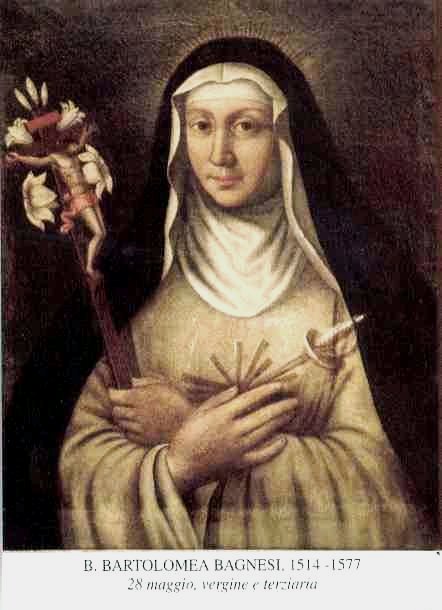
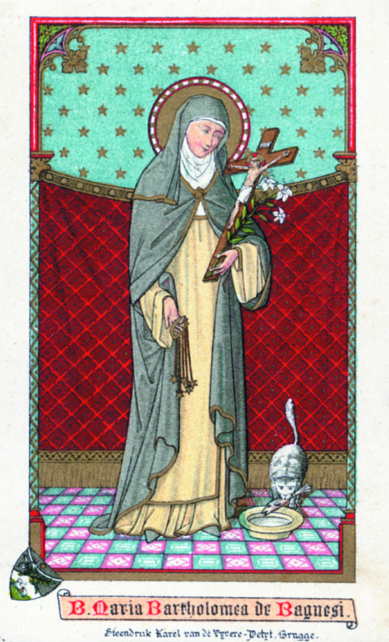
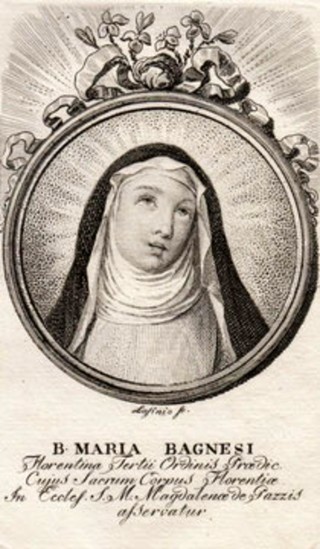
Saint of the Day – 28 May – Blessed Maria Bartholomew Bagnesi OP

Saint of the Day – 28 May – Blessed Maria Bartolomea Bagnesi OP (1514-1577) Virgin, Third Order Dominican, Mystic, Ecstatic, with the gift of levitation – born as Maria Bagnesi but always called “Marietta” because of her tiny frame, on 15 August 1514 at Florence, Italy and died on 28 May 1577 at Florence, Italy of natural causes, agd 62.   Patronages – abuse victims, ill people, against the death of parents, Dominican tertiaries. Her body is incorrupt.

Bl Mary Bartholomew Bagnesi

Maria Bagnesi was born in Florence on 15 August 1514 – the Feast of the Assumption – to Carlo Bagnesi and Alessandra Orlandini.   Bagnesi was a neglected child and her mother often left her in the care of others which included one of Bagnesi’s sisters who was a nun from the Order of Preachers so she spent most of her childhood in her sister’s convent. Four of her sisters would end up in the religious life.

Her father organised a marriage for her when she turned seventeen and she fainted in horror upon learning this.   The thought made Bagnesi so ill she could not walk and was thus confined to her bed.   Her father turned to con men and charlatans – for he could be manipulated with ease – and put his daughter through over three decades of non-stop “treatment”.   Being bedridden meant that she could not follow her sisters into the religious life but she nevertheless became a member of the Third Order of Saint Dominic in 1544 and made her profession in 1545.   She made her profession into the hands of and received the habit from Vittorio di Mattheo who allowed for this to take place in Bagnesi’s room.   Bl Maria developed a deep devotion to Saint Bartholomew the Apostle and she assumed the name of “Bartolomea” as part of her actual name as a sort of middle name when she made her profession.   After she professed she found that she could get out of her bed for brief periods of time.   The combination of asthma and these quack treatments immobilised her just as she began to heal and she started to have visions and converse with angels and demons alike.   Neighbours began to believe she was under demonic possession and summoned a local priest – who became her spiritual advisor who assured the locals she was not possessed or in need of an exorcism.   People also claim to have seen her levitate. She was also granted the special privilege of having Mass celebrated in her room at times.b-maria-bartholomea bagnesi

Her room soon became a place for pilgrims to go to in order to seek her wisdom and counsel and her room became a place for cats to roam – some remained with her and even slept on her bed while guarding her pet songbirds.   She also came to know Saint Maria Maddalena de’ Pazzi and shared her visions with her;  the saint would herself be cured due to Bagnesi’s intercession on 16 June 1584.   Bagnesi received the Eucharist three to six times a week and prepared beforehand with docile care and spent the time following her reception of it in deep reflection.   Her confessors were the Priests Alessandro Capocchi and Agostino Campi.bl maria bagesis

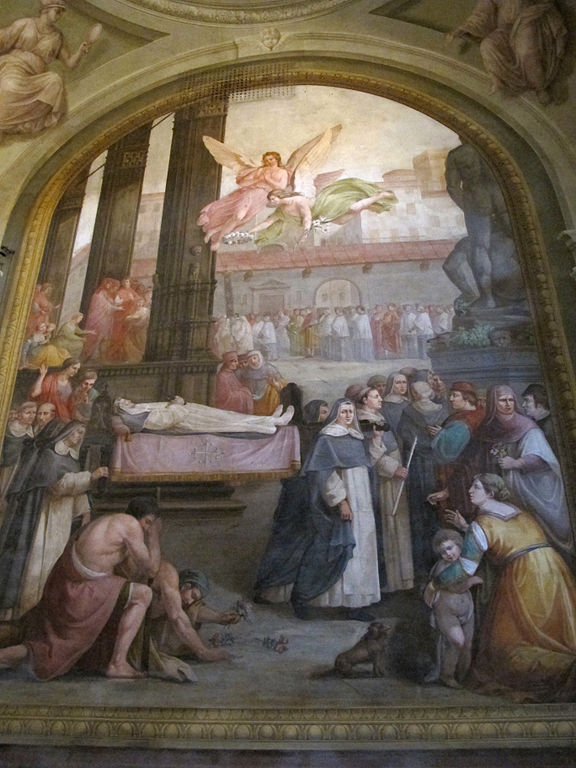
Bagnesi died in Florence in 1577 and at the end of her life, five Priests were present at her deathbed and one of them read to her one of the Gospel accounts of the Passion of Jesus Christ.   Her remains were taken in procession for her funeral from Santa Maria Novella to Santa Maria degli Angeli where she was interred.

S.m._maddalena_de'_pazzi,_cappella_della_beata_bagnesi,_affreschi_di_giuseppe_servolini_02
Painting depicting her funeral.

Let us Pray:   O God, the lover of souls, who in Blessed Mary Bartholomew, Thy Virgin, didst unite wonderful endurance of illness with equal innocence of mind, grant , that we who are afflicted according to our deserts may be refreshed with the comfort of Thy grace.   Through Christ our Lord. Amen.

Posted in INCORRUPTIBLES, MYSTICS, Of the SICK, the INFIRM, All ILLNESS, PATRONAGE - IMPOSSIBLE CAUSES, PATRONAGE - SPOUSAL ABUSE / DIFFICULT MARRIAGES / VICTIMS OF ABUSE, PATRONAGE-INFERTILITY & SAFE CHILDBIRTH, SAINT of the DAY, WIDOWS and WIDOWERS

Saint of the Day – 22 May – St Rita of Cascia – Patron of Impossible Causes, Abused Wives and Widows

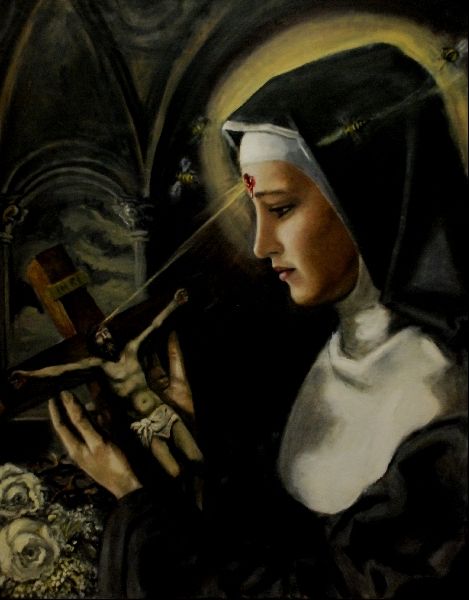
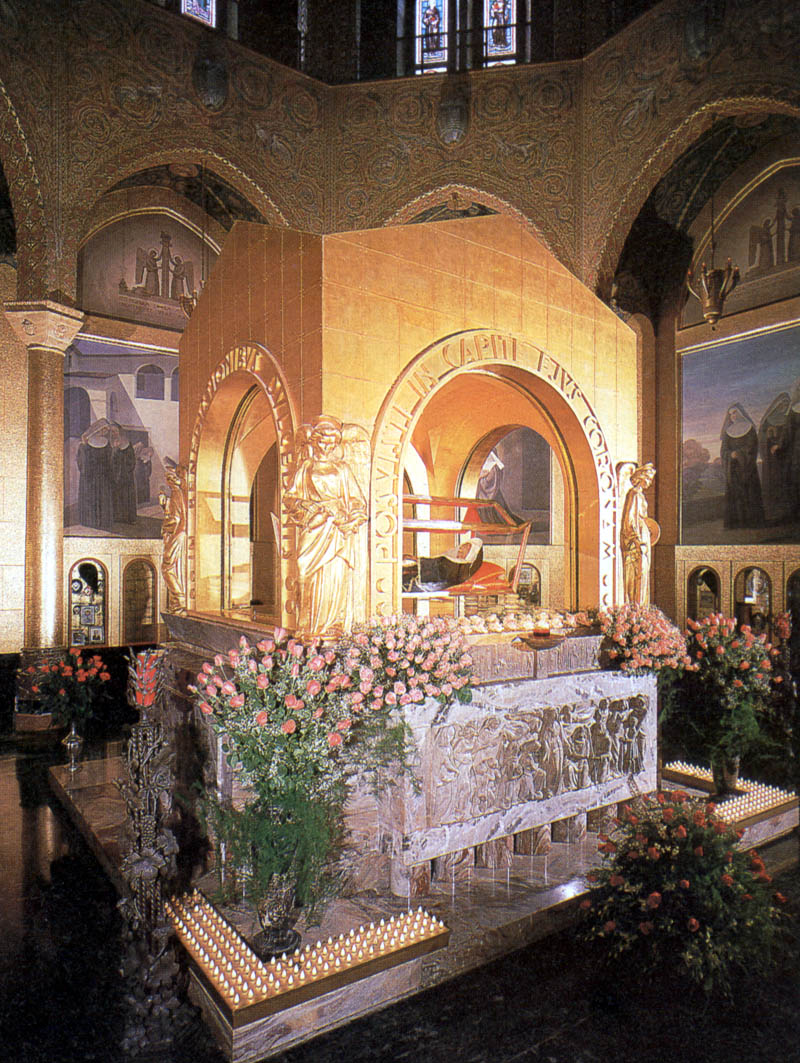
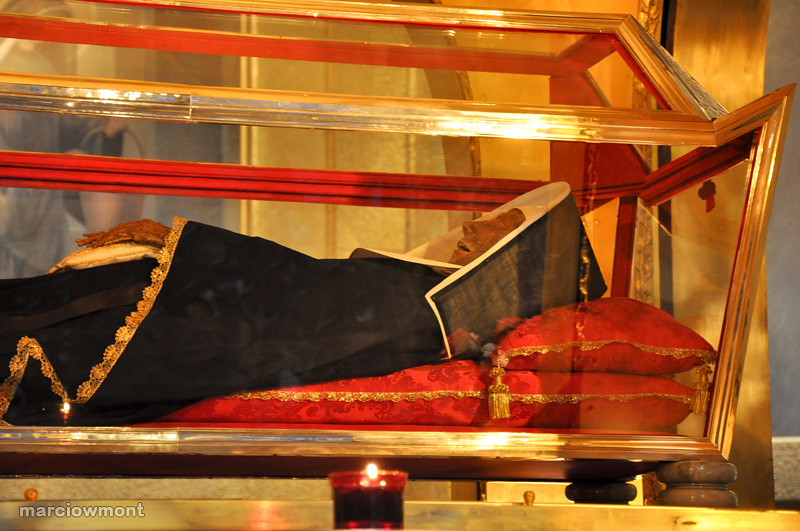
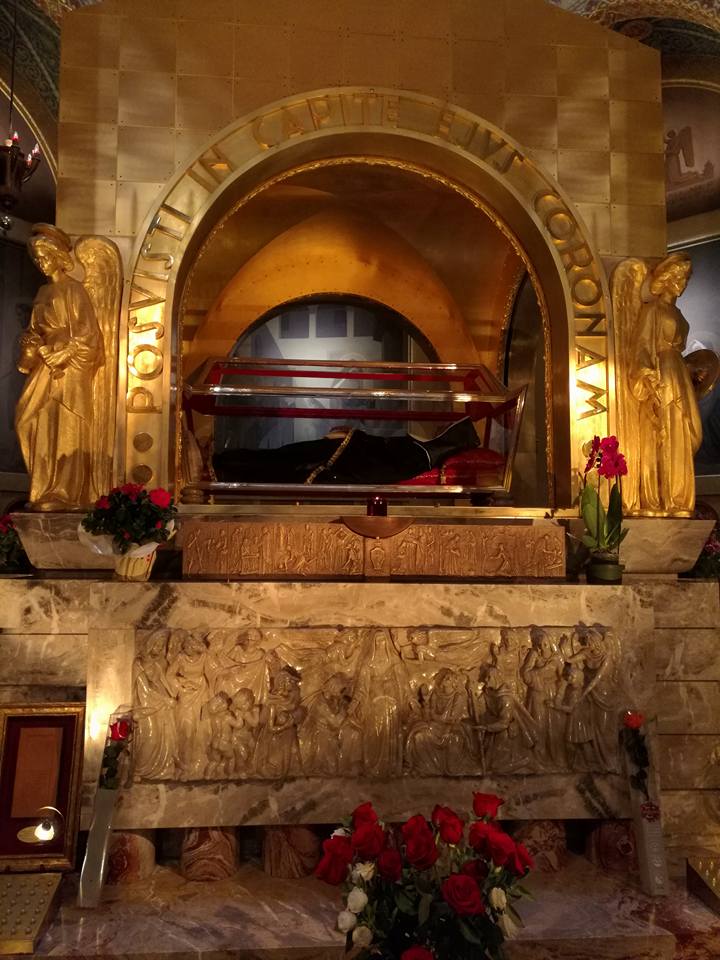
Saint of the Day – 22 May – St Rita of Cascia – (born Margherita Lotti) IN  1386 at Roccaparena, Umbria, Italy and died on  22 May 1457 at the Augustinian Convent at Cascia, Italy of tuberculosis)- Mother, Widow, Stigmatist, Consecrated Religious, Mystic, – Patron of Lost and impossible causes, sickness, wounds, marital problems, abuse, mothers,  against infertility or sterility, infertile people, against loneliness, against sickness or bodily ill, sick people, wounds, wounded people, desperate people, forgotten people,  difficult marriages, parenthood, Cascia, Italy, Dalayap, Philippines, Igbaras, Iloilo, Philippines.   Attributes –  nun holding a crown of thorns, holding roses, holding roses and figs, with a wound on her forehead.  Her Body is Incorrupt and lies in the Basilica of Cascia.   Pope Leo XIII canonised Rita on 24 May 1900.

RITA 5

Blessed by God,
you were a light in darkness
through your steadfast courage
when you had to suffer such agony
upon your cross. You turned aside from this vale of tears
to seek wholeness for your hidden wounds
in the great passion of Christ. . . .
You were not content with less than perfect healing,
and so endured the thorn for fifteen years
before you entered into the joy
of your Lord.st rita of cascia incorrupt body

This poem was engraved on the casket of St Rita of Cascia and is one of the few contemporary sources that tell us about her.   St Rita received her “hidden wounds” in an unfortunate marriage.   She was born in 1381 in the city of Roccaporena (near Spoleto, Umbria, Italy) where various sites connected with her are the focus of pilgrimages.   Her parents, Antonio and Amata Ferri Lotti, were known to be noble, charitable persons, who gained the epithet Conciliatore di Cristo “Peacemakers of Christ.”   She was married at age twelve to a nobleman named Paolo Mancini.   Her parents arranged her marriage, a common practice at the time, despite her repeated requests to be allowed to enter a convent of religious sisters.   Her husband, Paolo Mancini, was known to be a rich, quick-tempered, immoral man, who had many enemies in the region of Cascia.   Rita had her first child at the age of twelve.  For eighteen years she endured the abuses and infidelities of a violent husband.   She also suffered the unruly behaviour of two sons who were strongly influenced by their father.   She was delivered from these miserable circumstances in a horrific way –  one day her husband was brought home dead, brutally slashed by his enemies.   Her rambunctious sons planned to get revenge but died before they could obtain it.

Rita was then free to pursue her lifelong dream of becoming a nun.   She applied to enter the Augustinian convent at Cascia of Italy, in 1407.   But her suffering was not over.   Even though orders customarily received widows, the Augustinians three times refused Rita because she had been married.   Only after six years did they acquiesce and install her as a nun.

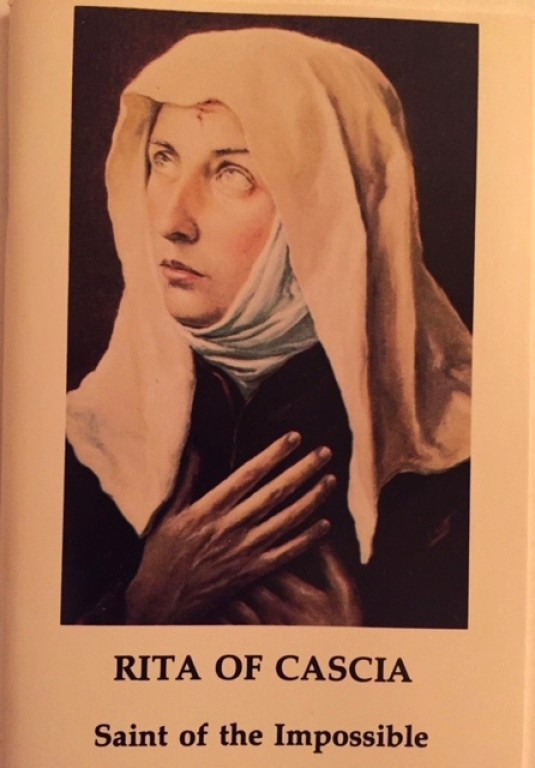
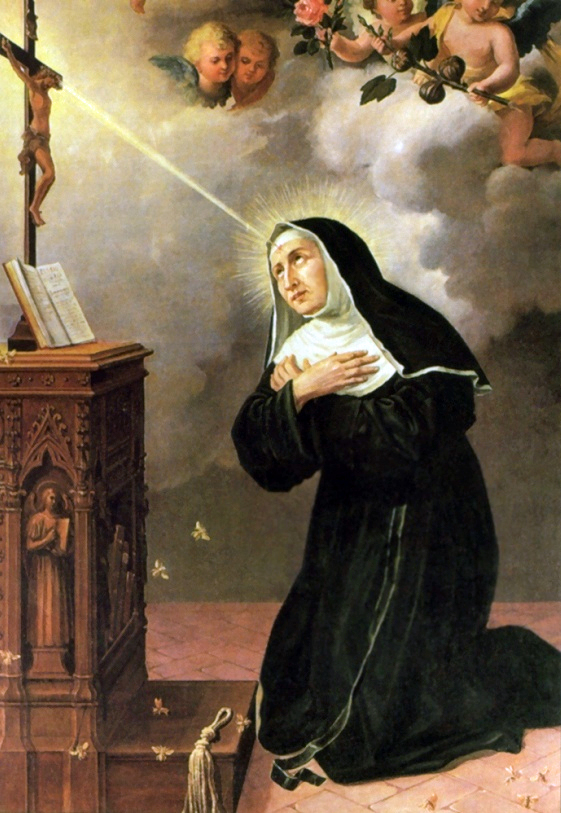
The poem said Rita “sought wholeness” in the passion of Christ.   In her meditations she preoccupied her imagination with his agony.   On Good Friday, 1441, she prostrated herself before a Crucifix and begged Christ for some small share of his suffering.   As though punctured by a crown of thorns, a single wound opened on Rita’s forehead.   For fifteen years it caused her daily pain and embarrassed her, as its putrid odour frequently offended her sisters.   In 1450, when she was preparing to visit Rome for the jubilee year, the wound temporarily healed.   But it reappeared when she returned to Cascia and remained until her death.st rita of cascia saint of the mpossible

Rita died of tuberculosis on 22 May 1457.   Three days later, Domenico Angeli, a notary of Cascia, recorded eleven miracles that occurred upon the saint’s death.   He left us this brief profile of her religious life:

“A very honourable nun, Lady Rita, having spent forty years as a nun in the cloister of the Church of Saint Mary Magdalene of Cascia by living with charity in the service of God, followed the destiny of every human being.   God, in whose service she persevered for the aforementioned time—desiring to show all the faithful a model of life, so that as she had lived serving God with love by fasting and prayer, they too, all faithful Christians, would live also—worked many wonderful miracles and through the merits of Saint Rita, especially on 25 May 1457.”

The Miracle of the Rose

It is said that near the end of her life Rita was bedridden at the convent.   While visiting her, a cousin asked if she desired anything from her old home.   Rita responded by asking for a rose from the garden.   It was January and her cousin did not expect to find one due to the season.   However, when her relative went to the house, a single blooming rose was found in the garden and her cousin brought it back to Rita at the convent.   St Rita is often depicted holding roses or with roses nearby.   On her feast day churches and shrines of St Rita provide roses to the congregation that are blessed by the priest during Mass.S.Rita_da_Cascia

The Miracle of the Bees

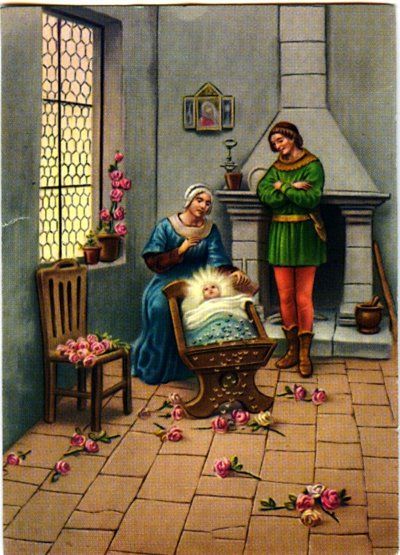
In the Parish Church of Laarne, near Ghent, Belgium, there is a statue of St Rita in which several bees are featured.   This depiction originates from the story of her Baptism as an infant.   On the day after her Baptism, her family noticed a swarm of white bees flying around her as she slept in her crib.   However, the bees peacefully entered and exited her mouth without causing her any harm or injury.   Instead of being alarmed for her safety, her family was mystified by this sight.   According to Butler, this was taken to indicate that the career of the child was to be marked by industry, virtue and devotion.miracles-bees-of-saint-rita-of-cascia

Legacy

A large sanctuary of St Rita was built in the early 20th century in Cascia. The sanctuary and the house where she was born are among the most active pilgrimage sites of Umbria.st rita of cascia incorrupt body 2

st rita shrine

French singer Mireille Mathieu adopted St Rita as her patron saint on the advice of her paternal grandmother.   In her autobiography, Mathieu describes buying a candle for St Rita using her last franc.   Though Mathieu claims that her prayers did not always come true, she testifies that they inspired her to become a strong and determined woman.

Posted in INCORRUPTIBLES, PATRONAGE - HOUSEWIVES, PATRONAGE - LOST KEYS/LOST ARTICLES

Saint of the Day – 27 April – St Zita of Lucca

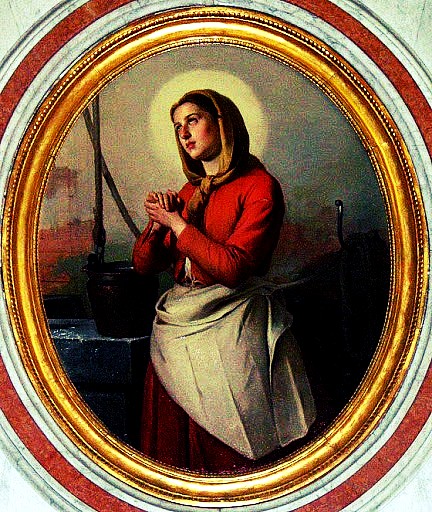
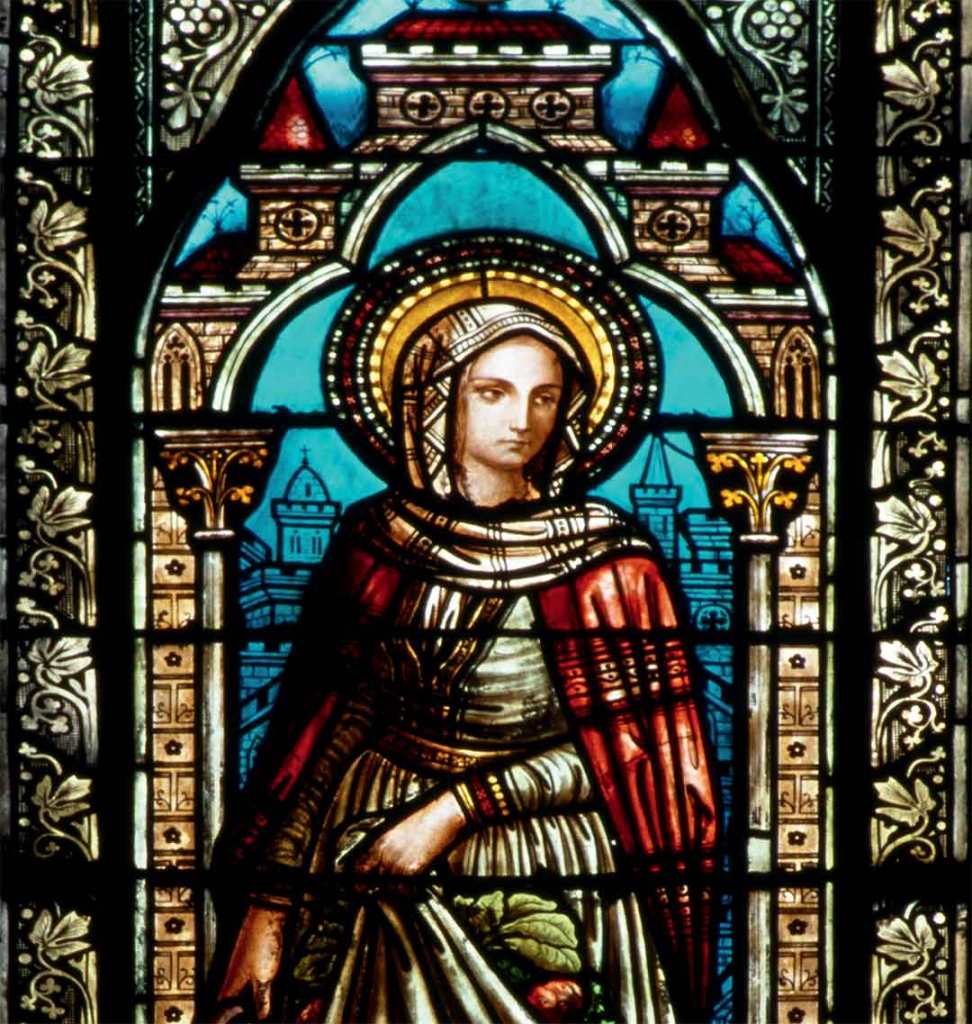
Saint of the Day – 27 April – St Zita of Lucca (1212-1272) Virgin, Apostle of the needy and poor. Also know as Cita, Sita, Citha, Sitha. P atronages – housewives, butlers, housemaid, domestic servants (proclaimed by Pope Pius XII), housemaid, lost keys, maids, manservants, people ridiculed for their piety,rape victims, servants, servers, single laywomen, waiters, Lucca, Italy. Her body is incorrupt.

Saint Zita was born in Tuscany in the village of Monsagrati, not far from Lucca where, at the age of 12 she became a servant in the Fatinelli household.    For a long time, she was unjustly despised, overburdened, reviled and often beaten by her employers and fellow servants for her hard work and obvious goodness.    The incessant ill-usage, however, was powerless to deprive her of her inward peace, her love of those who wronged her, and her respect for her employers.    By this meek and humble self-restraint, Zita at last succeeded in overcoming the malice of her fellow-servants and her employers, so much so that she was placed in charge of all the affairs of the house.    Her faith had enabled her to persevere against their abuse and her constant piety gradually moved the family to a religious awakening.

Zita often said to others that devotion is false if slothful.    She considered her work as an employment assigned to her by God and as part of her penance and obeyed her master and mistress in all things as being placed over her by God.    She always rose several hours before the rest of the family and employed in prayer a considerable part of the time which others gave to sleep.    She took care to hear Mass every morning with great devotion before she was called upon by the duties of her station, in which she employed the whole day, with such diligence and fidelity that she seemed to be carried to them on wings and studied when possible to anticipate them.

One anecdote relates a story of Zita giving her own food or that of her master to the poor. On one morning, Zita left her chore of baking bread to tend to someone in need.    Some of the other servants ensured the Fatinelli family was aware of what happened; when they went to investigate, they claimed to have found angels in the Fatinelli kitchen, baking the bread for her.
St. Benita Zita died peacefully in the Fatinelli house on April 27, 1272.    It is said that a star appeared above the attic where she slept at the moment of her death.    She was 60 years old and had served and edified the family for 48 years.   By her death, she was practically venerated by the family.    After one hundred and fifty miracles wrought in the behalf of such as had recourse to her intercession were juridically proven, she was canonised in 1696.

Her body was exhumed in 1580, discovered to be incorrupt   St Zita’s body is currently on display for public veneration in the Basilica di San Frediano in Lucca.

To this day, families bake a loaf of bread in celebration of St. Zita’s feast day.    Soon after Zita’s death a popular cult grew up around her, centring on the church of St Frigidian in Lucca.    This was also joined by prominent members of the city.    Pope Leo X sanctioned a liturgical cult within the church in the early 16th century, and was confirmed upon her canonisation.    In 1748, Pope Benedict XIV added her name to the Roman Martyrology.

During the late medieval era, her popular cult had grown throughout Europe.    In England she was known under the name Sitha and was popularly invoked by maidservants and housewives, particularly in event of having lost one’s keys, or when crossing rivers or bridges.    Images of St. Zita may be seen in churches across the south of England.    The church of St Benet Sherehog in London had a chapel dedicated to her,and was locally known as St. Sithes.

Posted in INCORRUPTIBLES, SAINT of the DAY

Saint of the Day – 19 April – St Alphege

Saint of the Day – 19 April – St Alphege (c953-1012) also known as St Alphege of Winchester/Canterbury/Bath – MARTYR and Bishop, Monk, Hermit, Abbot, Teacher, Apostle of charity. His body is incorrupt.    Patronages – of  Greenwich, England,  kidnap victims,  Solihull, England.   Attributes –  bishop holding an axe,  bishop with an axe in his head,  carrying stones in his chasuble.

alphege
Alphege on the Chichele tomb in Canterbury Cathedral
st-alphege-greenwich-the-parish-church_a-g-6835023-14258389
299602_st.-alphege-church-solihull-print

Alphege was born in 953 and became a monk at the Deerhurst Monastery of Gloucester, England. After a few years, he asked to become a hermit, received permission and retired to a small hut near Somerset, England. In 984, Alphege moved to Bath and became abbot at abbey founded by St. Dunstan. Many of Alpege’s companions from Somerset joined him at Bath. In that same year, Alphege was appointed bishop of Winchester and served there for two decades.

He was famed for his care of the poor and for his own austere life. King Aethelred the Unready used his abilities in 994, sending him to mediate with invading Danes.  The Danish chieftain Anlaf converted to Christianity as a result of his meetings with Alphege, although he and the other chief, Swein, demanded tribute from the Anglo-Saxons of the region. Anlaf vowed never to lead his troops against Britain again.   In 1005 Alphege became the successor to Aleric as the archbishop of Canterbury, receiving the pallium in Rome from Pope John XVIII.   He returned to England in time to be captured by the Danes pillaging the southern regions. The Danes besieged Canterbury and took Alphege captive.   The ransom for his release was about three thousand pounds and went unpaid. Alphege refused to give the Danes that much, an act which infuriated them.   He was hit with an ax and then beaten to death.  

MARTYRDOM OF ST ALPHEGE

Revered as a martyr, Alphege’s remains were placed in St. Paul’s Church in London.   The body, moved to Canterbury in 1023, was discovered to be incorrupt in 1105. Relics of St. Alphege are also in Bath, Glastonbury, Ramsey, Reading, Durham, Yorkminster and in Westminster Abbey.   He was canonised by St Pope Gregory VII in 1078.

St Thomas a Becket himself endorsed a parallel between himself and the Anglo-Saxon martyr, when he spoke about Alphege in the sermon he preached on Christmas Day 1170, four days before his own martyrdom:  “You already have a martyr here,” he said, “Alphege, beloved of God, a true saint. The Divine Mercy will provide another for you; it will not delay.”

Posted in Against EPIDEMICS, CHILDREN / YOUTH, INCORRUPTIBLES, Of BACHELORS, SAINT of the DAY

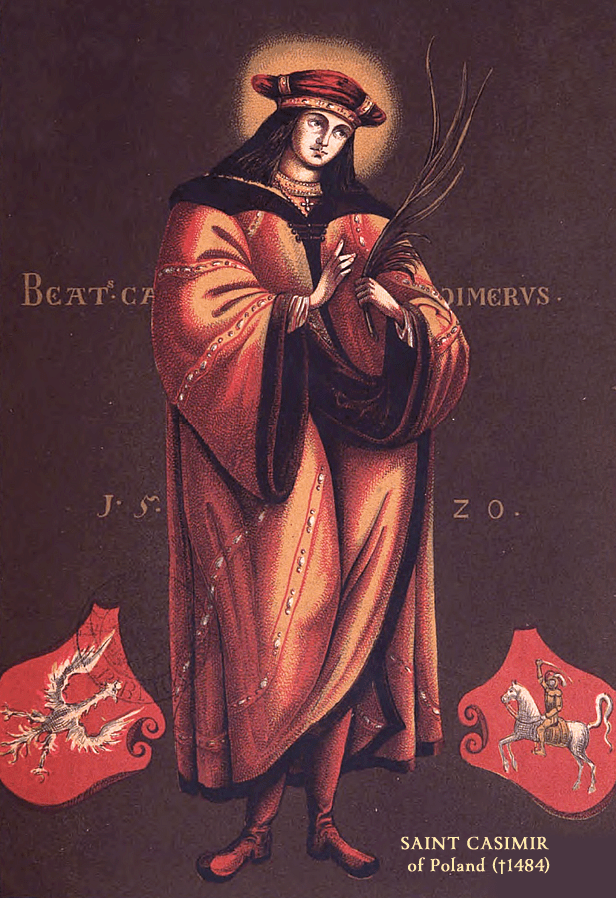
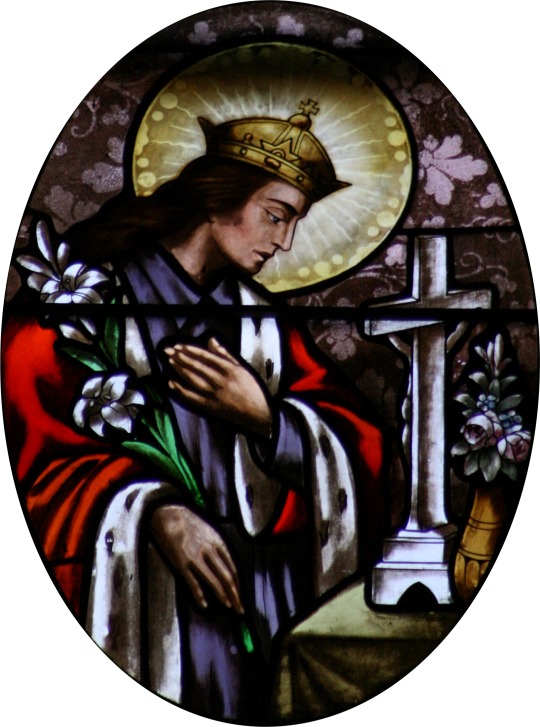
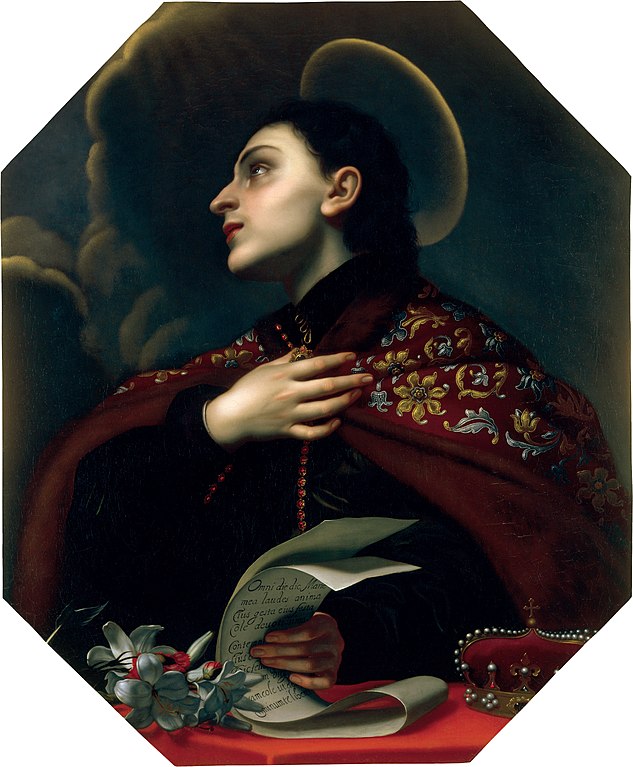
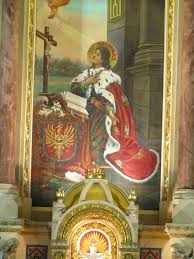
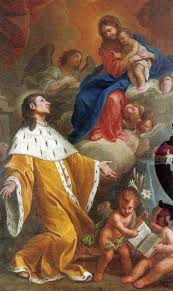
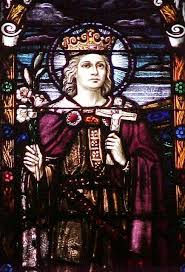
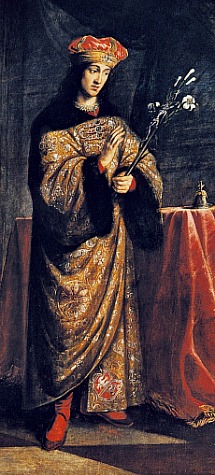
Saint of the Day – 4 March – St Casimir (1458-1484) Confessor

Saint of the Day – 4 March – St Casimir- (1458-148) aged 25 Confessor, Prince, Celibate, Ascetic, Apostle of Prayer, Apostle of Charity and Mercy, Marian Devotee, Eucharistic Adorer, Confessor – Patronages – against plagues/epidemics, of bachelors, kings, princes, Lithuania (proclaimed by Pope Urban VIII in 1636, Poland, Grodno, Belarus, Diocese of, youth. His body is incorrupt.

Casimir Jagiellon was born in 1458, the third of thirteen children born to Poland’s King Casimir IV and his wife Elizabeth of Austria.   He and several of his brothers studied with the Priest and Historian, John Dlugosz, whose deep piety and political expertise influenced Casimir in his education.

The young Prince had a distaste for the luxury of courtly life and instead chose the way of asceticism and devotion.   He wore plain clothes with a hair shirt beneath them, slept frequently on the ground and would spend much of the night in prayer and meditation on the suffering and death of Christ.

Casimir showed his love for God through these exercises of devotion and also through his material charity to the poor.   He was known as a deeply compassionate young man who felt others’ pains acutely.

The young Prince was only 13 years old when his father was asked by the Hungarians to offer his son as their new King. Casimir was eager to aid the Hungarians in their defence against the Turks and went to be crowned.   This plan was unsuccessful, however and he was forced to return to Poland.

After his return Casimir resumed his studies with Fr Dlugosz, while developing a canny grasp of politics by observing his father’s rule.   In 1479 the King left Poland to attend to state business in Lithuania, leaving Prince Casimir in charge of the realm .between 1481 and 1483.

Advisers to the p=Prince joined his father in trying to convince Casimir to marry.   But he preferred to remain single, focusing his life on the service of God and the good of his people.

After experiencing symptoms of tuberculosis, Casimir foresaw his death and prepared for it by deepening his devotion to God.   He died en route to Lithuania on 4 March 1484 and was buried with a copy of the Marian Hymn he sang daily “Daily, Daily Sing to Mary.” Pope Adrian VI Canonised him in 1522.   After a lapse of one hundred and twenty years, his body was taken up, and found without the slightest sign of corruption.

Five centuries after his death, John Paul II recalled how St Casimir “embraced a life of celibacy, submitted himself humbly to God’s will in all things, devoted himself with tender love to the Blessed Virgin Mary and developed a fervent practice of adoring Christ present in the Blessed Sacrament.