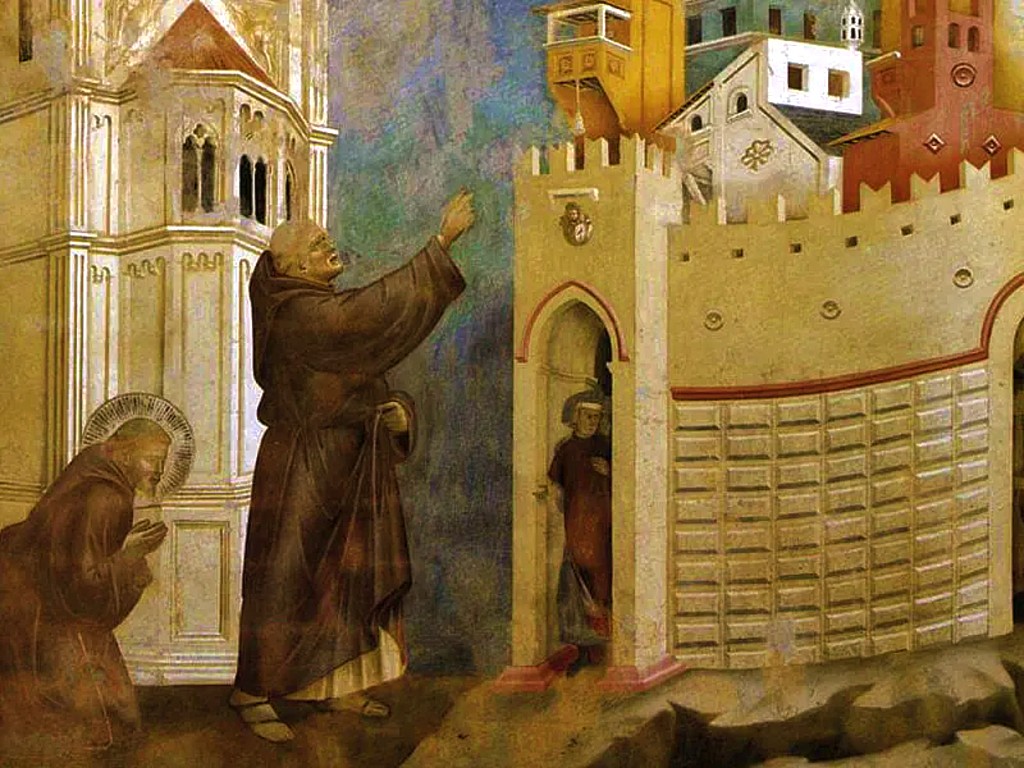
Saint of the Day – 26 February – Saint Victor the Hermit (Died 6th Century) Priest, Monk, Hermit, miracle-worker. Born in the 6th century at Troyes, France and died in the 6th-century at Saturniac (modern Saint-Vittre), Diocese of Troyes, France of natural causes. Patronage – Arcis-sur-Aube, France. Also known as Victor of Arcis, Vittre, Vitre.
Victor was born in Troyes, Champagne, France, of noble parents. He was educated under strict discipline in learning and piety. He was one of those rare creatures that was a saint from his cradle. In his youth, prayer, fasting and alms-giving were his chief delights.
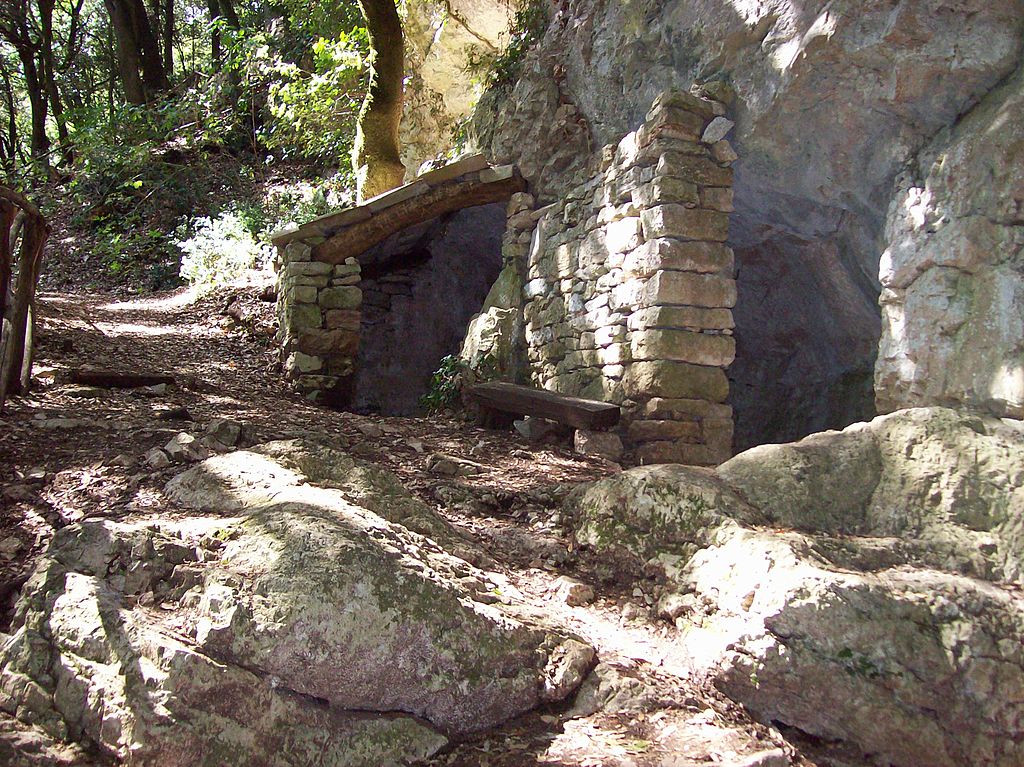
After embracing the Priesthood, the love of heavenly contemplation was so alluring, that he preferred retirement to the care of souls and he dwelt as a hermit for many years in the region around Montiramy. This appears to have been God’s will for him. He lived in continual communion with God and God glorified him by many miracles but the greatest appears to be the powerful example of his life.
Saint Victor died at Saturniac, now called Saint-Vittre, in the Diocese of Troyes. ACchurch was built over his tomb but in 837 his relics were translated to the neighbouring Monastery of Montier-Ramoy, or Montirame.
Victor’s feast was celebrated by the Benedictines of Montiramy at whose request Saint Bernard wrote two pious panegyrics about Victor.
Saint Bernard wrote of him: “Now placed in heaven, he beholds God clearly, revealed to him, swallowed up in joy but not forgetting us. It is not the land of oblivion in which Victor dwells. Heaven does not harden or straiten hearts but makes them more tender and compassionate; it does not distract minds, nor alienate them from us; it does not diminish but it increases affection and charity; it augments bowels of pity. The angels, although they behold the face of their Father, visit, run and continually assist us and shall they now forget u,s who were once among us and who once suffered themselves, what they see us at present labour under? No! ‘I know the just expect me till you render to me my reward.'”
“Victor is not like that cup-bearer of Pharaoh, who could forget his fellow-captive. He has not so put on the stole of glory himself, as to lay aside his pity, or the remembrance of our misery” (Sermon, 2)
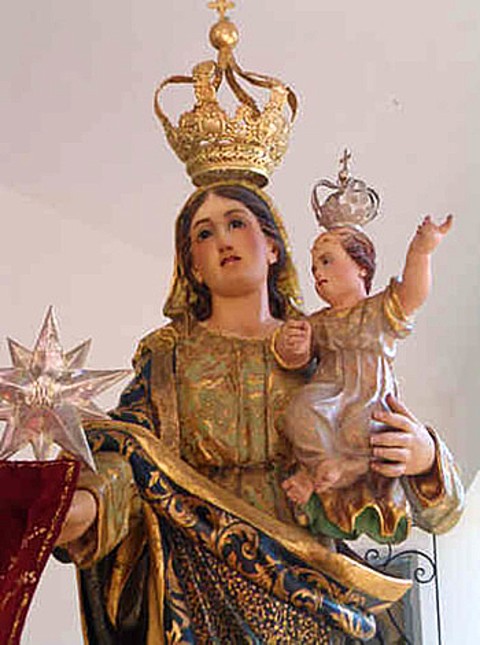
Notre-Dame des Champs / Our Lady of the Fields, Paris, France, consecrated by St Denis (250) – 26 February:
The title of Our Lady of the Fields, or Notre-Dame des Champ and the devotion to Mary as such, takes us back to the earliest days of Catholic life in France. Our Lady des Champs, at Paris, was dedicated in ancient times to Ceres. Saint Denis, to whom we owe a great deal of our traditional devotion to Mary, was the first Bishop of Paris. According to tradition he drove the demons from the Temple of Ceres, the pagan goddess of agriculture and placed therein, an image of the Madonna modelled after Saint Lukeโs famous painting. The Temple was henceforth dedicated to the Blessed Virgin, whom Parisians have honoured for centuries under the title of Our Lady of the Fields. It is said that a picture of the Blessed Virgin is still to be seen there, on a small stone, a foot square, which was made after that which Saint Denis brought to France.
This house, which is a Benedictine priory, was afterwards occupied by the Carmelites, who were received there in the year 604 and founded by Catherine, Princess of Longueville. It was the first occupied by those nuns in France; the mother Ann of Jesus, the companion of Saint Teresa, was its first superior. If the Blessed Virgin were a goddess she would be a very human goddess โ simple and approachable, forgetful of her privileges and of her beauty. Her constant humility adds to her charm. Saint Denis knew this well. He found her so gloriously beautiful that he gave to her the place in the temple โ and in the hearts of the people โ formerly held by the pagan goddess. โI am the Flower of the Fields,โ the Holy Ghost has the Blessed Virgin say. A flower of the fields has a simple beauty that charms us even more because it blossoms by itself without care or cultivation. Our Saviour Himself marvelled at such a flower and of it He spoke these words of praise that have been repeated through the centuries: โSee how the lilies of the field grow; they neither toil nor spin, yet I say to you that not even Solomon in all his glory was arrayed like one of these.โ But lilies soon fade and roses are hardly open, before they begin to shed their petals before the wind. The beauty of Mary is less perishable; it remains ever fresh and unchanged in the valley of our exile.
Bl Adalbert of Tegernsee St Agricola of Nevers St Alexander of Alexandria St Andrew of Florence St Dionysius of Augsburg St Faustinian of Bologna St Felix St Fortunatus St Irene St Isabelle of France Bl Ottokar of Tegernsee St Paula Montal Fornรฉs of Saint Joseph of Calasanz (1799-1889) Biography: https://anastpaul.com/2018/02/26/saint-of-the-day-26-february-st-paula-montal-fornes-de-san-jose-de-calasanz-1799-1889/ Bl Piedad de la Cruz Ortiz St Porphyrius of Gaza Bl Robert Drury St Victor the Hermit (Died 6th Century) Priest
Saint of the Day – 25 February – Blessed Sebastian of Aparicio OFM (1502-1600) โThe Angel of Mexico,โ Franciscan Lay brother, Confessor, Ascetic, apostle of the poor, builder of roads and bridges in Mexico and thus is honoured as the Founder of the transport and road system in Mexico. Born as Sebastiano de Aparicio y del Pardo on 20 January 1502 in La Gudiรฑa, Orense, Spain and died on 25 February 1600 of natural causes, aged 98. Sebastian was a Spanish colonist in Mexico shortly after its conquest by Spain, who after a lifetime as a rancher and road builder, entered the Order of Friars Minor as a lay brother. He spent the next 26 years of his long life, as a beggar for the Order and died with a great reputation for holiness. Patronages – motorists, travellers, road builders and the Transport industry in Mexico. His body is incorrupt.
Sebastian was born in Spain into a peasant family in 1502,. He was a good looking young man with a reserved personality that attracted the interest of quite a few women. He was deeply religious and changed employment several times, before the age of 30, to avoid the temptations opened to him. He worked as a household servant and as a hired field hand.
Despite his illiteracy, he had absorbed the discourse on how to lead a pious and holy life that he could emulate models in hagiographic texts. According to his own account, his life was saved in a miraculous way during an outbreak of the bubonic plague in his town in 1514. Forced to isolate him from the community, his parents built a hidden shelter for him in the woods, where they left him. While lying there helpless, due to his illness, a she-wolf found the hiding spot and, poking her head into his hiding spot, sniffed and then bit and licked an infected site on his body, before running off. He began to heal from that moment.
At the age of 31, Sebastian left Spain for Mexico. He settled in the town of Puebla de los Angeles where he took employment as a field hand. However, he soon noticed a business opportunity for Puebla was an important crossroads and he noted, that the goods transported, were carried on the backs of pack animals or on the backs of the native people.
At first, Sebastian made and sold wheeled carts for the transport of goods. He then expanded into the improvement and building of roads and bridges to improve transport for goods and people. He was responsible for the building of a 460 mile road from Mexico City to Zacatecas, which took 10 years to build and was of enormous benefit to the local economy.
By the age of 50, Sebastian was a wealthy man. He lived very simply and gave his earnings to others, he bought food for the poor, made loans that he never reclaimed to poor farmers too proud to accept charity, he paid the dowries for poor brides and gave free training to Indians in skills that would assist them in earning a living. In addition, people brought him their problems and he had a reputation for his wisdom.
Sebastian became known as โThe Angel of Mexico.โ He retired at the age of 50 to a hacienda to raise cattle. He married at age 60 at the request of his brideโs parents. His bride was a poor girl and he agreed to the match, on condition that the couple lived as brother and sister, which they did. His wife died and he married again on the same condition. When he was 70, Sebastianโs second wife died and he himself contracted a serious illness.
Upon recovering, he decided to give everything he had to the poor and became a lay Franciscan brother. He undertook many responsibilities, including cook, sacristan, gardener and porter. He was then assigned to the large community of friars in the city of Puebla, at that time consisting of about 100 friars, most of whom, were doing their studies or were retired or recovering from illness. He was appointed to be the quaestor of the community, the one assigned to travel throughout the local community, seeking food and alms for the upkeep of the friars and those who came to them for help. The builder of Mexico’s highway system had become a beggar on it. Despite his advanced age, he felt the vigour needed for the task. This formerly rich man, loved his job and was loved by his fellow Franciscans, the townspeople and the poor that the Brothers helped. He also lovedโand was lovedโby animals, even the most stubborn mules and oxen would obey the Blessed, much like Saint Francis.
Though he had long suffered from a hernia, Aparicio marked his 98th birthday on the road, apparently in good health. On the following 20 February, he developed what was to be his final illness, as the hernia became entangled. He began to feel pain and nausea and, upon arrival at the friary, was immediately sent to the infirmary. It was the first time he had slept in a bed in 25 years. As his condition worsened, he became unable to swallow. His only regret was that, due to this, he was unable to receive Holy Communion. As he lay dying, he was consoled by the friars’ fulfilling his request that they bring the Blessed Sacrament to his cell.
On the evening of 25 February, Aparicio asked to be laid on the ground to meet his death, in imitation of St. Francis. He soon died in the arms of a fellow Galician, Friar Juan de San Buenaventura, with his last word being “Jesus.” When his body lay in state, the crowds that gathered were large and the miracles wrought were so numerous, that he could not be buried for several days. His habit had to be replaced repeatedly, as mourners would snip a piece of it off to keep as the relic of a saint.
The Blessedโs remains were never buried but at the request of the local people, exposed in a prominent place for veneration. His body, although darkened, has remained incorrupt and can be viewed in the Church of Saint Francis in Puebla.
Nearly 1,000 miracles were reported at his intercession, even before his death and such claims continue to this day. Pope Pius VI Beatified him on 17 May 1789.
A statue of the Blessed Sebastian outside the Franciscan Church of Puebla where his incorrupt body is preserved for veneration.
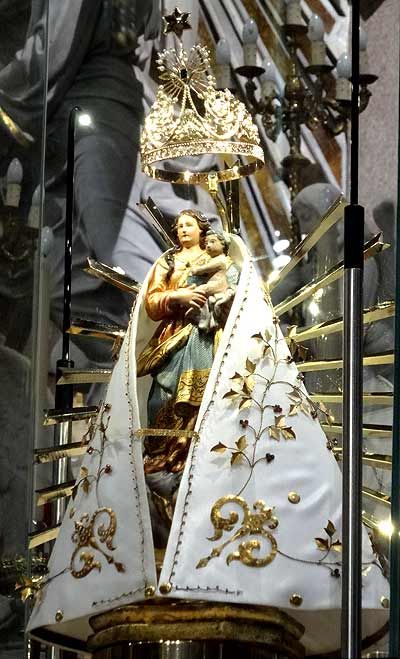
Notre-Dame-de-Grande-Puissance / Our Lady of Great Power, Quebec, Canada, (1673) – 25 February:
Our Lady of Great Power is little known in America, unless among the pupils of the Ursulines in Quebec. Generations of these, however, have dwelt within the walls of the Old Monastery during two centuries and more, since the arrival of the statue in the last years of the 17th century. In the annals of the Ursulines of the Sacred Heart at Perigueux, France, where the statue was solemnly crowned, we find the origin of the devotion. The devotion to Our Lady of Great Power began in the monastery of Issoudun. There a holy Ursuline nun, Mother Saint Peter, was inspired during her prayer to invoke Our Lady under this title. She spoke of her inspiration to her Sisters and her Superiors. The devotion was adopted with enthusiasm and very soon it was decided, that a statue be sculptured and a Chapel built, dedicated to Our Lady of Great Power; she would henceforth be chosen, as first and principal Superior of the Monastery. The feast of the dedication took place 25 February 1673 and was celebrated with great pomp, as the chronicle testifies:
โAfter High Mass two ecclesiastics carried the statue to the entry of the monastery where the nuns, in solemn procession, received it. It was placed on a richly decorated litter and, to the chanting of hymns, psalms and canticles, it was brought to the prepared Chapel. When the same statue was raised on its pedestal, the Superior laid the keys of the monastery, the seals and constitutions at Our Ladyโs feet, begging her, in the name of the community, to accept the gift of all hearts and of the entire monastery and to allow them, to look on her as their Superior forever. Each rendered homage while hymns and canticles of thanksgiving were sung in Maryโs honour.โ
Ever after, when a Superior was elected, the ceremony was renewed and is still renewed in each Ursuline community every year on a principal feast of the Blessed Virgin; though homage is rendered only every three years, after the election or nomination of Superiors. The statue of Our Lady of Great Power was carried off and profaned during the dark days of the French Revolution. It was found and returned to the monastery at Perigueux and the devotion continued fervently until 1892, when the Bishop of Perigueux, in the name of the Soverign Pontiff, placed a richly jewelled crown on the head of the Mother and the Child and ratified the numberless and signal favours obtained through Our Lady of Great Power. Through the Ursulines in Quebec, the devotion soon spread through the New World. Before the Altar in Quebec hangs the famous votive light promised to be kept burning as a token of thanks for favours granted to Mother Saint Agatha (Madeleine de Repentigny). Relatives and descendants of this holy nun have kept the lamp burning. One relative, Miss Anthon, had a new lamp made, an artistic gem, the work of the celebrated ecclesiastical goldsmith Calliat of Lyon, France.
St Adelelmo of Engelberg St Aldetrudis St Ananias of Phoenicia Bl Avertano of Lucca St Caesarius of Nanzianzen St Callistus Caravario Bl Ciriaco Maria Sancha Hervas Bl Didacus Yuki Ryosetsu St Domenico Lentini St Donatus the Martyr Saint Felix III, Pope St Gerland the Bishop St Gothard the Hermit St Herena the Martyr St Justus the Martyr St Laurentius Bai Xiaoman St Luigi Versiglia Blessed Maria Adeodata Pisani (1806-1855) Biography: https://anastpaul.com/2018/02/25/saint-of-the-day-25-february-blessed-maria-adeodata-pisani-osb-1806-1855/ St Nestor of Side St Riginos Bl Robert of Arbrissel Blessed Sebastian of Aparicio OFM (1502-1600) Franciscan Lay Brother St Tharasius St Toribio Romo Gonzรกlez St Victor of Saint Gall St Walburga โ Martyrs of Egypt โ A group of Christian men who were exiled to Egypt for their faith and were eventually martyred for their faith in the persecutions of Numerian. We know little more than their names: Claudianus Dioscurus Nicephorus Papias Serapion Victor Victorinus
Saint of the Day – 24 February – Saint Ethelbert of Kent (552-616) King of Kent and Confessor. Born in 552 and died on 24 February 616 at Canterbury, England of natural causes. St Ethelbert of Kent is not to be confused with St Ethelbert, King of East Anglia, who died in 794 as a Martyr โ also known as Albert or Albrigh. Also known as รdilberct, รthelberht, Aedilberct, Aethelberht, Aibert, Albert, Edilbertus.
Ethelbert, son of Eormenric, great-grandson of Hengist, Saxon conqueror of Britain. He was raised as a pagan worshipper of the pagan god Odin. He was the first English king to be converted to Christianity, which proved to be a crucial event in the development of English national identity. In 597, a Roman Monk St Augustine of Canterbury, arrived in Kent as leader of a group of Missionaries sent by St Pope Gregory the Great. There were Christians in Britain already and had been ever since Roman and early Celtic times, before the country was invaded from the mid-fifth century onwards by pagan English of various Germanic tribes, who in time set up small kingdoms.
Ethelbertโs wife, Bertha, was a daughter of the Merovingian Frankish king in what is now France. She was a Christian and it was a condition of the marriage that she would be free to practise her religion. Ethelbert evidently considered that an acceptable price for a close connection with the most powerful ruler in western Europe. The two had three children, including Saint Ethelburgh of Kent.
The details and dates are often uncertain but Bertha brought a Bishop with her from France as her Chaplain and presumably she had her own Christian retinue as well. For worship, she restored the ancient Church of St Martin of Tours, which dated back to Roman times.
Ethelbert had consequently been in close touch with Christianity and he soon accepted it for himself and was Baptised by St Augustine.
St Augustine instructing Ethelbert
His example led to the Baptism of 10,000 of his countrymen within a few months and he supported Augustine in his missionary work with land, finances and influence.
St Augustine baptises Ethelbert
Ethelbert now presided over the creation of a law code which gave the Roman Church a secure place in the Kingdom. St Augustine was made Archbishop of the English on the Popeโs orders and he appointed Bishops of London and Rochester before his death in 604. London was in the Kingdom of Essex, which was ruled by Ethelbertโs nephew Sebert, who had also became a Christian convert.
Bertha died in or soon after 601, it seems. Ethelbert apparently took a second wife. He was succeeded by his son Eadbald, who had reverted to paganism. He horrified the Roman clerics by marrying his fatherโs second wife, which was strictly against the rules, but he afterwards reverted to Christianity. In time, other pagan English Kings were impressed by the Roman Churchโs positive support for strong regimes, which in turn made religious control easier. These Kings accepted the Roman Church and carried their people with them. Over centuries the process would lead to the creation of a single unified English nation.
When he died in 616, St Ethelbert was buried in the side chapel of Saint Martin in the Abbey Church of Saints Peter and Paul. His relics were later translated to Canterbury.
St Ethelbert at Canterbury Cathedral
In the Roman Martyrology, he is listed under his date of death, 24 February, with the citation: ‘King of Kent, converted by St Augustine, Bishop, the first leader of the English people to do so.’
Plague in Rome ends after Saint Pope Gregory the Great leads a procession with a painting of Our Lady by Saint Luke (591): – 24 February
The Abbot Orsini wrote: โOn this day, in the year 591, St Gregory the Great, having had the picture of Our Lady, which was painted by St Luke, carried in procession, the plague ceased at Rome.โ
The miseries that afflicted Rome in the year 591 were substantial. The Gothic War between the Byzantine Empire and the Goths had substantially depopulated Italy, so much so that a Germanic tribe of Lombards had entered the peninsula and established their own kingdom. They were pagans and Arians who did not respect Catholics, burning the famous Benedictine Monastery of Monte Cassino and pillaging the land at will. The instability and warfare caused famine in large regions, though Rome was still able to obtain grain by sea. Then came earthquakes and flooding to further the suffering, and from this plague Rome was not immune. The banks of the Tiber overflowed and when the waters did not recede, all of the low-lying lands became swamps that brought death and the plague. The disease struck with such rapidity that the victim would often die shortly after realising he had contracted the disease, although there were some who sickened but recovered. Our custom of saying, โGod Bless you,โ to someone who sneezes came about at this time, for sneezing was one of the signs that someone had contracted the disease. Even the Roman Pontiff died of the plague on 7 February 590. His successor, was Pope Saint Gregory the Great, who was both a humble and pious man. It would be an understatement to say he did not want the honour of being the next Pope but once in that position, he did everything in his power to try to save his people. He understood that the plague was a chastisement from God and encouraged the faithful to repent of their sins and pray for deliverance while he and the religious cared for the people of Rome. Finally, Saint Gregory called for a procession to take place at dawn on 24 April. On that day, the faithful first assembled in their groups throughout Rome and then walked through the streets of the City praying and singing as they approached the Church of Saint Mary Major. The plague was so potent at that time, that eighty people collapsed and died as they walked toward the meeting place. Pope Saint Gregory met them upon their arrival, joining them in prayer as he took his place with them holding aloft the miraculous image of Our Lady painted by Saint Luke the Evangelist. This image is the very famous, Salus Populi Romani (the health or salvation, of the Roman People) As the procession neared the Vatican the participants all saw Saint Michael the archangel standing upon the cupola of Hadrianโs mausoleum as he sheathed his flaming sword. It was a sign that the chastisement had come to an end and, at once, the heaviness in the air abated and the air itself seemed to freshen and clear. Indeed, at that moment the plague ended, as the faithful rejoiced and lifted up their voices to thank the Mother of God.
Regina Coeli laetare, Alleluia! (Queen of heaven, rejoice, Alleluia!)
Quia quem meruisti portare, Alleluia! (Son whom you merited to bear, Alleluia!)
Resurrexit sicut dixit, Alleluia! (He has risen as He said, Alleluia!)
One Minute Reflection – 23 February โ Tuesday of the First week of Lent, Readings: Isaiah 55:10-11,ย Psalms 34:4-5,ย 6-7,16-17,ย 18-19,ย Matthew 6:7-15 and the Memorial of St Polycarp Apostolic Father, Bishop and Martyr (c 69 โ c 155)and St Willigis of Mainz (940-1011)
โThis is how you are to pray.โ – Matthew 6:9
REFLECTION– โRegarding other ceremonies in vocal prayers and other devotions, one should not become attached to any ceremonies or modes of prayer, other than those Christ taught us. When His disciples asked Him to teach them to pray [Lk 11:1], Christ obviously, as one Who knew so well His Father’s will, would have told them, all that was necessary, in order to obtain an answer from the Eternal Father and, in fact, He only taught them those seven petitions of the Our Father, which include all our spiritual and temporal necessities and He did not teach numerous other kinds of prayers and ceremonies. At another time, rather, He told them, that in praying, they should not desire much speaking because our heavenly Father clearly knows our needs.
He only charged us with great insistence to persevere in prayer – that is, in the Our Father – teaching, in another place, that one should pray and never cease. [Lk.18:1] He did not teach us a quantity of petitions but that these seven be repeated often and with fervour and care. For in these, as I say, are embodied everything that is God’s will and all that is fitting for us. Accordingly, when His Majesty had recourse three times to the Eternal Father, all three times He prayed with the same petition of the Our Father, as the evangelists recount: โFather, if it cannot be but that I drink this chalice, may your will be done.โ [Mt. 26:42]
And He taught us only two ceremonies for use in our prayers. Our prayer should be made either in the concealment of our secret chamber [Mt 6:6] where without noise and without telling anyone we can pray with a more perfect and pure heart โฆ Or, if not in one’s chamber, in the solitary wilderness and at the best and most quiet time of night, as He did..โ [Lk. 6:12] – St John of the Cross (1542-1591) – Carmelite, Doctor of the Church – The Ascent of Mount Carmel Bk.III, ch.44
PRAYER โ Our Father Who art in heaven, Hallowed be Thy name. Thy kingdom come. Thy will be done, On earth as it is in heaven. Give us this day our daily bread And forgive us our trespasses As we forgive those who trespass against us And lead us not into temptation but deliver us from evil. Amen
Saint of the Day – 23 February – Saint Willigis of Mainz (c 940-1011) Archbishop of Mainz, Reformer, builder of the Cathedral of Mainz and many Churches, bridges and roads throughout his Diocese, de facto Regent of Germany during the minority of Otto III, to whom he was Guardian. Born in c 940 at Schoningen, Germany and died on 23 February 1011 of natural causes. Patronage – Wheelwrights. Also known as Willigisus, Willigus, Willegis.
Willigis was born in the Duchy of Saxony, possibly at Schรถningen, the son of simple, free and pious peasants. His father worked as a wheelwright, hence his patronage and attribute – the wheel also occured in his emblem as Bishop. The able and intelligent young man received a good education and was recommended by Bishop Volkold of Meissen to the service of Emperor Otto the Great. Willigis was appointed Chancellor, an office formerly held by the Emperor’s brother Archbishop Bruno of Cologne. He served Otto throughout the last years of his reign and at the height of his power.
In 975 Emperor Otto II appointed him Archbishop of Mainz and Archchancellor for Germany. Being of humble origin, Willigis had to cope with many objections but he immediately received Pope Benedict VII confirmation of his supremacy as metropolitan Bishop.
Soon he started to build the great Cathedral of Mainz. Willigis demanded solid learning in his clergy too. He was known as a good and fluent and zealous Precher. In March 975 he received the Pallium from Pope Benedict VII. In January 976 Willigis Consecrated the first Bishop of Prague, Thietmar (Dฤtmar) at Brumath in Alsace, whose Diocese was put under his jurisdiction.
In his Diocese, he laboured by building bridges, constructing roads and fostering commerce. In Mainz, he initiated the construction of Cathedral and consecrated it on 29 August 1009, dedicating it in honour of St Martin of Tours but on the same day, disastrously, it was destroyed by fire. Willigis immediately gave orders for reconstruction.
Mainz Cathedral
Willigis greatly helped the restoration of the old collegiateCchurch of St Victor and built that of St Stephan. He also built Churches at Brunnen in Nassau and Seesbach. He showed great solicitude for the religious and substantially aided the Monasteries of St Ferrutius at Bleidenstadt, of Disibodenberg and of Jechaburg in Thuringia.
At the 983 Reichstag of Verona, Otto II vested him with large territories in the Rheingau region, thereby laying the foundations for the Prince-Bishopric of Mainz. Upon the Emperor’s death, Willigis as Primas Germaniae (an historical title for the the most important Bishop in the German lands).
On Christmas day in 983 he assisted at the crowning of Otto II’s his three-year-old son Otto III at Aachen. After the Dowager Empress Theophanu died in 991, Willigis became the Guardian of the minor, thus making him, together with Otto’s Grandmother, Adelaide of Italy, de facto Regent of the Empire until Otto III reached his majority in 994.
In 996 he was in the retinue of the King on his journey to Italy. Together with Otto III he pushed the election of Pope Gregory V against the resistance of the Roman nobility led by Crescentius the Younger and was present at the Consecration and at the Synod convened a few days later. In this counsel Willigis strongly urged the return of Bishop Adalbert of Prague, who, unable to bear the conflicts with the Vrลกovci noble family and the ruling Pลemyslid dynasty, had left his Diocese for a second time, to which, after much correspondence between the Holy See and Willigis, he had once already been forced to return in 993. In 997 Pope Gregory V sent the Decrees of a synod at Pavia to Willigis, “his vicar,” for publication.
He was on friendly terms with Rome, though the Papacy was going through a difficult time. These relations were somewhat disturbed by the dispute of Willigis with Bishop Bernward of Hildesheim, about jurisdiction in the house of secular canonesses at Gandersheim Abbey. The immediate monastery established in 852 was originally situated at Brunshausen in the Diocese of Hildesheim but was transferred to nearby Gandersheim within the territorial limits of the Archdiocese of Mainz. Both Bishops claimed jurisdiction, until Pope Sylvester II finally declared in favour of Hildesheim, against Willigis’ initial resistance.
His protรฉgรฉ was the scholarly and just Burchard, who was appointed Bishop of Worms by Emperor Otto III in 1000. Upon the Emperor’s early death, Archbishop Willigis, on 7 June 1002, crowned the Duke of Bavaria Henry IV as King of the Romans at Mainz, after the assassination of his rival Margrave Eckard I of Meissen. Willigis presided at the 1007 Synod at Frankfurt am Main, where thirty-five Bishops signed the bull of Pope John XVIII for the erection of the Diocese of Bamberg.
Though Willigis has never been formally Canonised, Roman Catholics celebrate his feast on 23 February, the day of his death in 1011. Because the rebuilding of the Cathedral had not yet been completed, he was buried in the Church of St Stephan, which he had also built.
Nuestra Seรฑora de la Peรฑaย / Our Lady of the Rock, Pena de Francia, near Salamanca, Spain (1434) – 23 February: The Abbot Orsini wrote: โOur Lady of Roches, near Salamanca, in Spain; an image is there venerated, which was found miraculously, in the year 434, by Simon Vela, who caused a Church to be built there.โ
The Simon mentioned above by the Abbot Orsini, was actually born in the year 1401 in Paris, France. The incident that he states had occurred in the year 434 actually occurred in 1434 but that is getting ahead of our story. Simon was born on4 September 1401, in the City of Paris, France, to pious and wealthy parents. Growing up a good Catholic, Simon despised money and luxury, so that when he grew up and inherited his parentsโ money and property, he recognised it for the threat to his eternal welfare that it was and gave all that he owned to the Church and to relieve the poor. Once the money was gone, he went to a Franciscan Monastery and took a position as a chamber boy. Simon naturally spent a great deal of time in prayer and was especially devoted to the Blessed Virgin Mary. Sometimes when he prayed he asked the Mother of God if there was anything he might do, that would be especially pleasing to her. On one of these occasions, he fell asleep while praying. He was suddenly awakened when he heard a voice speak to him from the empty Church: โSimon, wake up; be on the watchโฆFrom now on, your name will be Simon Vela. Go to Pena de Francia, for there you will find the Shrine of the Blessed Virgin Mary.โ Simon travelled for five years over fields and mountains, searching through lonely valleys and gloomy caves, in his quest for this place called Pena de Francia but he could not even find anyone who had ever heard of the place. On the verge of giving up in frustration, he had already begun working his way back home from Spain, when the voice spoke to him from the darkness once again: โSimon, do not give up the search, do not give up what you have begun. Persevere and your labours will be recompensed.โ Feeling that it was still the will of God, Simon was determined to continue the search. Simon was passing through the market square in Salamanca on his way to the Church of Santiago, when he observed two men who began shouting in a serious disagreement. Weapons flashed and one of the pair fell wounded at Simonโs feet. The other was restrained from finishing the man, by the crowd, who held him back. Unable to reach his adversary, he shouted: โHad I killed my enemy, I would have escaped to Pena de Francia where no-one, not even the king, could find me!โ Simonโs heart leapt for joy when he heard this, for it was the first time he had heard the place spoken of, and now he was certain that his search would not be in vain.
THE STORY OF SIMON’S SEARCH SURROUNDS THE IMAGE OF OUR LADY OF THE ROCK
It was a short time later when Simon received a second bit of good news. He was on his way to the Church of Saint Martin when he happened upon a travelling merchant. Simon asked the man where he had come from and he answered, Pena de Francia. Thrilled to hear the name, he felt his search was nearly over but when he asked the man to take him there, he refused. He did not want to go back the way he had come, no matter how much Simon begged him. All he would do was point out the general direction. Simon went down the road from which he had seen the merchant approach, hoping he was not too far from his destination. The road led him to a villa named San Martin de Castanar, which he reached on 14 May 1434. He found a Church there and after Mass, he asked if anyone knew of a place called Pena de Francis. One man knew of it and when Simon kindly asked him to show him where it was, the man walked with him a good distance from the Church and then pointed out a hill in the far distance. That, he said, was Pena de Francia. Simon was elated, thanking God and the man for revealing to him the place that meant the end of his quest.
The place was far off but Simon went off at once, thinking the years he had spent in seeking, were nearly at an end. He gave no thought to his provisions and as the journey was long and arduous, he was far from any help when he realised how weakened his fast had made him. Suffering intense pangs of hunger, Simon did not despair, for he felt certain that God would not forsake him. He continued on his way and soon came across an abandoned pack that contained a loaf of bread and a piece of meat. Refreshed, he turned his attention to finding shelter as the night approached. Finding a suitable cave, he went inside and prayed for guidance until he dropped off into welcome slumber. Waking early in the morning, Simon began to search the area for the Shrine and quickly found that there were caves all over the hill where he had slept. He naturally became discouraged when it became apparent that it could take him weeks or even months to find what he sought and so, feeling that it was almost as if his quest had started all over again, he fell to his knees and prayed for the grace of perseverance. His prayer was quickly answered, as the now familiar voice said: โSimon, be awake: do not sleep.โ Simon got up at once and continued his search, awakening with renewed enthusiasm the following morning. As he prepared to leave his cave a brilliant light struck his eyes, the source of which was a spot some distance away on a rocky hill. Trembling with joy, Simon approached the source of that light and found the Blessed Virgin Mary sitting on a golden throne with the Child Jesus in her arms. His heart overflowing with inexpressible joy, he knelt and said: โOh, Lady, dream of my soul and inspiration of men and women! My labours are now ended. Many years have I travelled far and wide to seek you and to drink in the beauty of your eyes! Do not forsake me but be my protection.โ
Our Lady answered sympathetically: โSimon, rejoice! Your constancy will be rewarded. Your dream will be realised. Your labours are now ended. Take heed and keep in your heart what I wish you to do. Dig in this spot and take what you can see and place it on the summit of this rocky hill. Build on this hill a beautiful Shrine. You are to begin it and others will come to finish it. This must come to pass as it has been the wish of my Child.โ When the vision ended, Simon remained alone for some time, filled with wonder and awe. On the spot where the apparition of the Holy Virgin had appeared, Simon began the work of excavating. He had barely begun digging when he heard the same voice once again saying: โSimon, do not attempt to undertake this large of a task alone. Undertake it in the presence and with the help of two, three, or more persons.โ Evidently this demand was made to ward off any suspicion about the veracity of the coming miracle, as well as Simonโs credibility. So Simon went back to San Martin de Castanar and asked five men to help him, and all of them agreed. Even though Simon told them the truth, these men believed that they were digging for hidden treasure. Simon repeated that they were after an objective worthier than merely worldly goods and that it was something their hearts would forever cherish. They dug for some time, until finally, on 19 May 1434, they removing a huge stone that was barring their way. They found beneath it, sheltered among several smaller rocks, the most coveted image of the Blessed Virgin Mary with the Divine Child in her arms, now known as Our Lady of Rocks.
THE IMAGE OF PENA DE FRANCIA,FOUND BY SIMON VELA AND HIS COMPANIONS IN 19 MAY 1434
St Alexander Akimetes St Boswell St Dositheus of Egypt St Felix of Brescia St Florentius of Seville St Giovanni Theristi (1049โ1129) Monk Bl Giovannina Franchi Bl John of Hungary St Josephine Vannini (1859-1911) Bl Juan Lucas Manzanares Bl Ludwik Mzyk St Martha of Astorga St Medrald St Milburga Bl Nicolas Tabouillot St Ordonius St Polycarp of Rome Bl Rafaela Ybarra de Villalongo St Romana St Serenus the Gardener (Died 307) Martyr His story: https://anastpaul.com/2019/02/23/saint-of-the-day-23-february-st-serenus-the-gardener-died-307-martyr/ Bl Stefan Wincenty Frelichowski St Willigis of Mainz (c 940-1011) Bishop St Zebinus of Syria โ Martyrs of Syrmium โ 73 Christians who were martyred together in the persecutions of Diocletian. We know no details about them, and only six of their names โ Antigonus, Libius, Rogatianus, Rutilus, Senerotas and Syncrotas.
Saint of the Day – 22 February – Blessed Diego Carvalho SJ (1578-1624) Jesuit Priest and Martyr, Missionary to Japan. Born in 1578 in Coimbra, Portugal and died by exposure on 22 February 1624 at Sendai, Miyagi, Japan. Patronage Japanese miners.
Diego was born in Coimbra, Portugal, in 1578. After entering the Society of Jesus in his hometown in 1594, late in 1600 he arrived, after a long voyage with sixteen other Jesuits, in Goa, India.
The following year, 1608, he set out for Macau, where he was Ordained as Priest. In 1609, he arrived in Japan, where, after learning Japanese, he was a Missionary in the Amakusa Islands, before relocating to Kyลto around 1612. After the edict of proscription of 1614, in November that year, with seventy-two other Jesuits on three Chinese junks, he was deported to Macau.
Diogo’s heart remained in Japan, however and he secretly returned in 1616. Later he relocated in the north to serve refugees fleeing persecution in the south.
Carvalho’s ministry centred on the silver miners in the districts of Oshu and Dewa. Living conditions were difficult but conversions were abundant. In December 1623 he was working in Miwake when the local prince began to persecute the Christians and ordered soldiers to kill all who refused to apostatise. When the governor of Sendai learned of Father Carvalho, he went searching for him but the Jesuit and about 60 Christians fled into a deep valley seeking to escape. Unfortunately, their tracks in the snow led the soldiers to them and Carvalho gave himself up, in an attempt to allow his people to get away. He was able to save all but 12 of his companions. Then the Christians had to march for seven days through the cold to Sendai. Two who could not keep up, were killed on the spot and the rest were barely given enough food to eat to survive their month-long imprisonment once they reached the City.
Martyrdom came for Carvalho and his companions through the cold. The Hirose River flowed near the fortress where they had been imprisoned; on its bank the soldiers dug a hole and filled it with icy water from the river. The prisoners were forced first to sit naked in the freezing water and then stand up to let the wind hit them. Their captors promised to end the torture if they would renounce Christianity. None did and the cold slowly took away their life. Carvalho was the last to die, enduring the torture long into the night before he also finally perished. The names of his companions are sadly unknown, so they could not be Beatified with him but with God they are Blessed in His Heavenly Kingdom.
The decree of Martyrdom and Beatificztion, was confirmed on 7 May 1867 by Pope Blessed Pius IX.
Notre-Dame de Rennes / Our Lady of Miracles and Virtues, Rennes, France (1357) – 22 February:
The Statue of Our Lady of Miracles and Virtues in the Lady Chapel at Saint Sauveur at Rennes
Our Lady of Rennes, in Britanny. The English, having made a mine to blow up the town, it is said that the candles in theCchapel were found miraculously lighted; the bells rung of themselves and the image of the Blessed Virgin was seen to stretch out its arms towards the middle of the Church, where the mine was, which, by that means was discovered. The people rushed to the spot and so, the plot was discovered and the entire town saved through the intervention of Our Lady of Rennes. Great was the rejoicing and deep the gratitude of the people. Known today as the Basilica of Saint Sauveur in Rennes, it is located in the heart of historic Rennes, which was once the capital of Brittany. It is situated at the termination of Saint-Sauveur Street on which its faรงade faces. As the original Gothic Church partially collapsed in the year 1682, the Classical style Church that can currently be seen, was constructed beginning in 1703 and consecrated in August of 1719. In the year 1793, during the French Revolution, the Church was made into a Temple of Reason and the miraculous statue of Our Lady was destroyed. It was not until 1802, after the end of the Terror, that the Church was opened again to worship. The Church was made into a minor Basilica in 1916 by Pope Benedict XV.
The Altar of Our Lady in the main body of the Basilica of Saint Sauveur at Rennes
According to popular tradition there was a famous miracle attributed to Our Lady at Rennes during the War of Succession at Brittany. As Rennes was being besieged by the invading English army under the Duke of Lancaster, the people of the city expected the English forces to mine their way under the walls into the City. On the night of 8 February 1357, the Church bells began to ring of their own accord and the candles were spontaneously lit. The Statue of Our Lady, known as Our Lady of Miracles and Virtues, pointed out a particular slab in the Church. The inhabitants of the city thus were alerted to the mine and the point of the English attack, and were able to repulse the invasion. The miracle was a popular subject for ballads, especially the troubadour Cavalier. In 1634 the miracle was officially recognised by the Bishop of Rennes, Pierre Cornulier. There are many miracles attributed to Our Lady, including the miraculous healing of Magdalene Morice in the year 1761. She had gangrene in her right foot which was instantly healed on Easter Sunday. The Statue of Our Lady of Miracles and Virtues currently displayed at the Basilica was placed there in February of 1876. In 1684 a boy of eleven left home for the City of Rennes, in hopes of enrolling at the Jesuit College of Thomas a Becket. The young Louis-Marie was an intelligent boy who was taken under the guidance of the Jesuit Priests and it was at Rennes that he began to consider a possible vocation to the Priesthood. It was here, at the Shrine of Our Lady at Rennes, that Saint Louis de Montfort made the final decision to become a Priest. Amen! We thank our Lady for giving us St Louis-Marie Grignion de Montfort!
St Maximian of Ravenna St Miguel Facerรญas Garcรฉs St Mohammed Abdalla St Papias of Heirapolis St Paschasius of Vienne St Raynerius of Beaulieu St Thalassius โ Martyrs of Arabia โ A memorial for all the unnamed Christians martyred in the desert and mountainous areas south of the Dead Sea during the persecutions of Emperor Valerius Maximianus Galerius.
Quote/s of the Day โ 21 February โ First Sunday of Lent, Readings: Genesis 9:8-15, Psalms 25:4-5, 6-7,8-9, 1 Peter 3:18-22, Mark 1:12-15 and the Memorial of St Peter Damian OSB (1007-1072) Doctor of the Church and St Robert Southwell SJ (1561-1595) Priest and Martyr
โWe โฆ are under an obligation to be the light of the world by the modesty of our behaviour, the fervour of our charity, the innocence of our lives and the example of our virtues. Thus shall we be able to raise the lowered prestige of the Catholic Church and, to build up again, the ruins that others by their vices have caused. Others, by their wickedness, have branded the Catholic Faith with a mark of shame, we must strive, with all our strength, to cleanse it from its ignominy and to restore it to its pristine glory!โ
St Robert Southwell SJ (1561-1595) Priest and Martyr
โThis is the time of fulfilment. The kingdom of God is at handโ – Mark 1:14
REFLECTION – โAfter John had been arrested, Jesus came into Galileeโฆโ According to our interpretation, John stands for the Law and Jesus the Gospel. Indeed, John says: โOne mightier than I is coming after meโฆโ (Mk 1,7) and elsewhere: โHe must increase, I must decreaseโ (Jn 3,30): in this way he compares the Law with the Gospel. And afterwards he says: โI โ that is, the Law โ baptise you with water; he โ that is the Gospel โ will baptise you in the Holy Spiritโ (Mk 1,8). And so Jesus comes because John had been put in prison. In effect, the Law is finished, it has been brought to an end, it no longer has its former freedom. But we have passed from the Law to the Gospelโฆ
โJesus came into Galilee preaching the gospel, the Good News of the Kingdom of Godโโฆ When I read the Law, prophets and psalms, I never heard them speak of the Kingdom of heaven – only in the gospel. For only when He came, of whom it is said โthe Kingdom of God is in your midstโ (Lk 17,21) that Godโs Kingdom was thrown openโฆ In fact, before the Saviourโs coming and the Light of the Gospel, before Christ opened the gate of paradise with the thief (Lk 23,43), all holy souls descended to the place of the dead. Jacob himself said: โI will go down weeping and mourning to the nether worldโ (Gn 37,35)โฆ In the Law, Abraham rests with the dead; in the gospel, the thief is in paradise. We are not denigrating Abraham, we all want to rest in his bosom (Lk 16,23 but we prefer Christ to Abraham, the Gospel to the Law.
We read that after Christโs Resurrection many saints appeared in the holy city (Mt 27,53). Our Lord and Saviour preached on earth and preached, too, to the underworld. He died and descended to hell to free the souls held captive there (1Pt 3,18f.).โ – St Jerome (347-420), Priest, Translator of the Bible, Father and Doctor of the Church – Homilies on Saint Markโs Gospel, no.2A ; SC 494
PRAYER – Through our annual Lenten observance Lord, deepen our understanding of the mystery of Christ and make it a reality in the conduct of our lives,. Teach us by the example and doctrine of St Peter Damian to prefer nothing whatever to Christ and to make the service of Your Church our chief concern and so, come to the joy of Your eternal Kingdom. We make our prayer through our Lord Jesus, in unity with the Holy Spirit, one God forever, amen.
Saint of the Day – 21 February – Blessed Caterina Dominici/Maria Enrichetta (1829โ1894) Nun of the Sisters of St Anne – whose main charism is the care and education of street children, Mystic with an extraordinary devotion to the Blessed Sacrament, close friend and adviser to St John Bosco in establishing the Rule of the Daughters of Mary Help of Christians, also “lending” two nuns to the new Congregation. During the 1854 Broad Street cholera outbreak, she cared for and ministered to countless people. She then went on to serve for over three decades as the Superior General of her Congregation. Born on 10 October 1829 in Borgo Salsasio, Carmagnola, Turin, Italy and died on 21 February 1894, aged 64, in Turin, Italy of natural causes. Also known as Mother Maria Enrichetta (her religious name), Anna Caterina, Maria Henrich Dominici, Mother Maria Enrica Dominici.
Caterina Dominici was born on 10 October 1829 near Turin, as the fourth daughter. One brother would become a Priest. She was four when her parents separated and she went with her mother and siblings to live with her Priest uncle.
As a child she grew into the habit of regular Confession and Holy Communion. She moved in 1848 and in November 1850 became a non-cloistered religious of the Sisters of Saint Anne. She assumed the name of “Maria Enrichetta.” Pope Pius IX visited Loreto in 1857 and Sr Maria was present along with St Madeleine Sophie Barat when the Pope met with the professed religious.
Sr Maria Enrichetta was appointed as the Superior General of her Congregation and she at first attempted to discourage her fellow sisters from the appointment.
Now Mother Maria, she founded about thirty houses, reaching Rome and Sicily. With each term of office confirmed, it did not seem possible to have another mother general. As a girl she had dreamed of becoming a missionary to India, now, she could fulfill the vow indirectly, sending her nuns. In February 1871 six of them left, which the Mother entrusted to the Holy Trinity of which she was very devoted. Her new foundation in India opened a path that would bear great fruit. In October 1879 she went in person to distant India, to Secunderabad, to visit the Institute’s first Missionary home.
On 14 July 1884 she was received at an audience by Pope Leo XIII.
Her health started to decline from November 1893 and Caterina was confined to bed. She continued to lead the institute, despite suffering and pain. She spent her last week in drowsiness and despite this, she continued to speak in a weak voice to those around her bedside.
Affable and kind, however, she was reserved and of a few words. She meditated for hours before the Tabernacle and she obtained permission from the Holy See, for her nuns to make daily communion.
Her writings, autobiography and copious letters, speak her total abandonment to God. She wrote: “Oh how happy lives the soul that lives totally abandoned in God. Oh if everyone knew this happiness …”
Sr Maria Enrichetta died in 1894 and her remains were transferred in 1926 to the chapel of the mother house.
The investigation for a miracle attributed to her intercession, spanned from 1949 to 1950 and was validated in 1952. Paul VI approved it in 1977 and Beatified her on 7 May 1978.
There are currently Houses of St Anne in Italy, Switzerland, Cameroon, Argentina, Peru, Philippines, Mexico, Brazil, USA. In India there are eighty houses, more than in Italy.
Notre-Dame de Bon-Port / Our Lady of Bon Port/Good Haven, Paimpol, France (1838) – 21 February:
In 1838, the crew of a vessel which had just arrived at Paimpol, in France, forty-eight in number, accomplished a vow they had made in a most perilous voyage from Newfoundland. A terrific tempest had arisen, their sails were tor, and for three days they were in continual danger of finding a watery grave. The ship began to fill with water and all hope of safety seemed lost, when the crew, by common consent, turned their eyes to Mary, Star of the Sea and asked for good haven. They promised if she saved them, they would visit in the most supplicant manner, the Church at Paimpol, where there is an image of Our Lady much venerated by the people. They had scarcely ended their prayer, when the weather became more calm and the waves began to subside. Profiting by this providential change, they repaired their sails and had a favourable wind, until they reached the coasts of Brittany. They landed in safety at Knod, toward the decline of day and their first act was to prostrate themselves on the ground and give God thanks for their safe return. They then intoned the Litany of the Blessed Virgin and advanced barefooted and bare-headed along the banks and through the streets of Paimpol, to the Church of the Good Haven. The people attracted in crowds by the novelty of the sight, followed them. There were parents who went to give thanks to Our Lady of Good Haven for the return of their sons and wives, to thank Mary for restoring their husbands to them. Tears streamed down from every eye, and the immense multitude knelt down before the Altar of that powerful Virgin, who had received from her Son, the power to command wind and wave. The torches shed a dim light on the recessed of the sanctuary, where stood the image of the Blessed Virgin, Our Lady of Good Haven, whose inclined head and exteneded arms seemed to say to all, โCome to me, I am your Mother.โ These pious mariners with the most touching expression of sentiment, chanted the hymn, โAve Maria Stellaโ in which they were joined in gratitude by the people.
โBright Mother of our Maker, hail! Thou Virgin ever blest, The oceanโs star, by which we sail, And gain the port of rest.โ
St Avitus II of Clermont Blessed Caterina Dominici/Maria Enrichetta SSA (1829โ1894) Nun Bl Claudio di Portaceli St Daniel of Persia Bl Eleanora St Ercongotha St Eustathius of Antioch St Felix of Metz St George of Amastris St Germanus of Granfield St Gundebert of Sens Blessed Noel Pinot (1747-1794) Priest and Martyr His Life and Death: https://anastpaul.com/2020/02/21/saint-of-the-day-21-february-blessed-noel-pinot-1747-1794-priest-and-martyr/ St Paterius of Brescia (Died 606) Bishop St Pepin of Landen St Peter Mavimenus St Randoald of Granfield
St Severian of Scythopolis St Severus of Syrmium Bl Thomas Pormort St Valerius of San Pedro de Montes St Verda of Persia โ Martyrs of Sicily โ 79 saints โ Seventy-nine Christians martyred together in the persecutions of Diocletian. They were martyred in c 303 on Sicily.
Martyrs of Hadrumetum โ A group of 26 Christians martyred together by Vandals. We know little more than eight of their names โ Alexander, Felix, Fortunatus, Saturninus, Secundinus, Servulus, Siricius and Verulus. c 434 at Hadrumetum (modern Sousse, Tunisia)
Martyrs Uchibori โ Three Japanese laymen, all brothers, all sons of Paulus Uchibori Sakuemon, one a teenager, one only five years old and all martyred for their faith in the persecutions in Japan. 21 February 1627 in Shimabara, Nagasaki, Japan. Beatified 24 November 2008 by Pope Benedict XVI. Antonius Balthasar Ignatius
One Minute Reflection โ 20 February โ Saturday after Ash Wednesday, Readings Isaiah 58: 9-14,ย Psalms 86:1-2,ย 3-4,ย 5-6,ย Luke 5:27-32 and the Memorial of St Elutherius of Tournai (c 456-532) Bishop and Martyr and Saints Francisco (1908-1919) and Jacinta (1910-1920)
โThose who are well, have no need of a physician but those who are sick. I have not come to call the righteous but sinners to repentance.โ – Luke 5:31-32
REFLECTION – โThe Apostle Paul said: โTake off the old self with its practices and put on the new selfโ (Col 3,9-10)โฆ This was the work Christ accomplished when He called Levi; He refashioned him into a new man. Similarly, it is as a new person, that the former publican prepares a banquet for Christ since Christ takes pleasure in him and he himself, merits to have a share in happiness with Christโฆ He followed him now, happy, light-hearted and overflowing with joy.
โI have the aspect of a publican no more,โ he said, โI donโt carry around the old Levi any longer; I put off Levi when I put on Christ. I flee from my earlier life; my Lord Jesus, you alone, who heal my wounds, I desire to follow. Who shall separate me from the love of God … ? tribulation? anguish? hunger? (Cf Rom 8,35). I am bound to You by faith as by nails, I am held fast by the worthy bonds of love. All Your commandments will be like a cautery that I will apply firmly to my wound; the remedy stings but it takes away the ulcerous infection. Lord Jesus, with Your powerful sword, cut away the corruption of my sins: come quickly, lance my hidden and varied passions. Purge away all infection in the new bath.
โListen to me, you people who are fixed to the earth, you whose thoughts are intoxicated by your sins. I, Levi, was also wounded by similar passions. But I found a doctor who dwells in heaven and pours out His remedies on earth. He alone can cure my wounds since He Himself has none. He alone can remove the heartโs pain and the soulโs lethargy, for He knows everything that lies hidden.โ – St Ambrose (340-397) Bishop of Milan and Doctor of the Church – Commentary on Saint Lukeโs Gospel, 5, 23.27
PRAYER โ Come my all-powerful, ever-living God, look with compassion on our frailty and for our protection, stretch out to us Your strong right hand. Grant that by the prayers of Mary, our Mother and all your angels and saints we may change our ways, leave everything behind, proclaim the glory of Your kingdom and come safely home to You. St Eleutherius and Sts Jacinta and Francisco, pray for us. Through our Lord Jesus Christ, in the unity of the Holy Spirit, God forever, amen.
Saint of the Day – 20 February – Saint Eleutherius of Tournai (c 456-532) the first Bishop of Tournai, Martyr. Confessor. Born in c 456 at Tournai, western Belgium and died by being murdered by Arian heretics in 532 while leaving his Church in Tournai. Additional Memorial – 25 August (translation of relics). He was a lifelong friend of St. Medard (c 456-545) and the two saints had been courtiers before becoming Bishops. (St Medard’s life here: https://anastpaul.com/2020/06/08/saint-of-the-day-8-june-saint-medard-c-456-545-bishop/).
Eleutherius is venerated as a Martyr although this legend is considered an invention of the Canon Priest Henri of Tournai, who wrote a Vita of Eleutherius in 1141. At the end of the 11th century the Church of Tournai had been trying to become independent from the Diocese of Noyon and Henri had been motivated by the need to prove the antiquity of the Church of Tournai.
Henri’s account states that Eleutherius was a native of Tournai who was born during the reign of Childeric I. Eleutherius’ parents were Christians and were named Terenus and Blanda; Terenus was a descendant in the family of Irenaeus of Lyons. Persecutions of Christians forced the family to flee to a village named Blandain but after the conversion of Clovis to Christianity, the family built a Church at Blandain.
Church of Saint Eleuthรจre at Blandain
Eleutherius eventually became Bishop of Tournai and was consulted by Pope Hormisdas on the matter of eradicating Arianism. Eleutherius convened a Church Council and argued effectively against the Arians, who were angered by this.
The Cathedral of Tournai
One day, as he was going to his Cathedral Church, he was beaten by a group of Arians and left for dead. He subsequently died from the wounds he received, on his death-bed confiding, his flock to St Medard. โ There exists a testimony recording the recovery of his relics during the episcopate of Bishop Hedilo of Tournai, in 897 or 898. Bishop Baudoin translated Eleutherius’ relics in 1064 or 1065. Eleutherius’ relics were translated again in 1247, when the great reliquary shrine was commissioned by Bishop Walter de Marvis. In its gable end. St Eleutherius appears, holding his crozier in one hand and in the other a model of the Cathedral with its five spires.
The Reliquary Shrine of Saint Eleutherius, 1247, in the Cathedral of Tournai
The Monastery of St. Martin at Tours and the Cathedral of Bruges, also claimed some of the saint’s relics.
Notre-Dame de Bolougne-sur-Mer / Our Lady of Bolougne-sur-Mer, France (633) – 20 February:
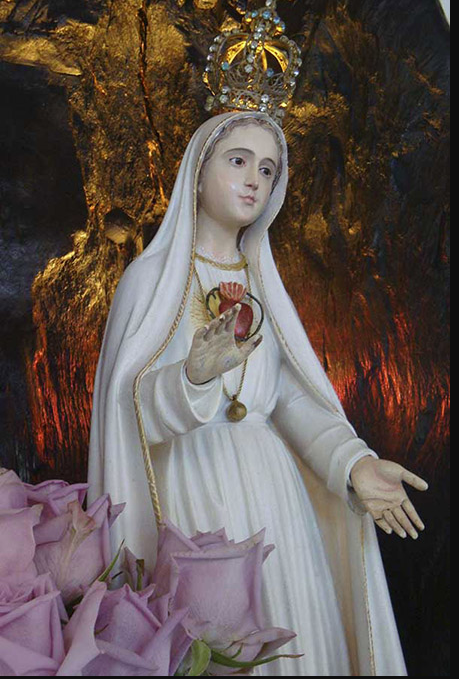
In the year 636, a small group of people standing on the seashore witnessed a ship without oars or sails came into the harbour of Boulogne. It finally came to rest in the estuary, seemingly of its own accord. One of the witnesses boarded the boat and confirmed that there was no-one aboard and that the vessel had no rudder, oars or sails. The ship, however, bore a luminous statue of Our Lady. Taking hold of it to bring it to land, a voice was heard saying, “I choose your City as a place of grace.” The citizens welcomed Mary to their city by erecting a Shrine to her, which reached its height of glory in the 12th Century.
King Henry VIII is reported to have stolen the Statue of Our Lady of Boulogne and taken it to England. After many negotiations, the French managed to get it back. The image had been stolen and hidden many other times but always saved and returned. World War II almost completely destroyed the Statue. In modern times, four exact replicas of Our Lady of Boulogne toured France for more than seven years, as a symbol of French devotion to Mary. One of these was taken to Walsingham, England in 1948 and carried in procession by the โCross-bearing pilgrimateโ when many other Statues and images of the Virgin visited England. Bologne was one of the most important Lady shrines of medieval France; among its noted pilgrims have been: Henry III, Edward II, the Black Prince, John of Gaunt. Marian Feast Day, 10 July: The dedication of a new Church built in honour of Our Lady of Boulogne was consecrated in the year 1469 by Bishop Chartier of Paris. The confraternity of Our Lady of Boulogne was so celebrated, that six French kings have chosen to belong to it.
At the French Revolution, the Statue was burnt to ashes and the Church pulled down. A new Shrine and Statue was made in 1803 and pilgrimages began again. The image represents the Mother with the Child in her arms, standing in a boat, with an angel on either side. At the Marian Congress in Bolougne in 1938, a custom began to take replicas of this Statue โin turnโ in France and abroad. A branch of the Confraternity of Our Lady of Compassion at Bolougne has been established for the reconciliation of the Church of England. The Sanctuary Church at Bolougne was badly damaged during World War II and Maryโs image smashed but the return, the โGreat Returnโ of one of the copies of the Statue which had been sheltered at Lourdes, took place in 1943 and the occasion will long be remembered by lovers of the Blessed Virgin Mary.
The shrine of Our Lady of Boulogne-sur-Mer, built in 1866.
Most remarkable about the Grand Return was the unprecedented avalanche of graces, especially of conversions and penance. Thousands upon thousands of atheists, communists, freemasons and fallen-away Catholics converted on the spot when they saw Our Lady enter their village. One bishop described the effect on the faithful:
โThe passing of Our Lady in my Diocese is the most extraordinary contemporary religious event of our times and the most significant. Crowds of people rose up, motivated and enthusiastic. In fact, the confessionals and communion rails were besieged during the holy vigils, while the recitation of the mysteries of the Rosary kept the faithful praying in the Churches. In some Parishes, there were tremendous conversions like never seen before on the missions.โ
Young men of the French Boy Scouts, barefoot in the spirit of penance, carry Our Lady of the Grand Return in February 1946.
One Minute Reflection โ 19 February โ Friday after Ash Wednesday, Readings: Isaiah 58:1-9,ย Psalms 51:3-4,ย 5-6,ย 18-19,ย Matthew 9:14-15 and the Memorial of Blessed Alvarez of Cordova OP (c 1350โc 1430)
โThen they will fastโ – Matthew 9:15
REFLECTION – โAlthough it is true, that the washing of regeneration is what chiefly makes โpeople newโ (cf. Eph 4,24 โ Col 3,10) nevertheless, because there is still for all of us, a daily renewal against the rust of mortality and in the path of progress, there is no-one, who ought not always to be better. In general, we still have to struggle, so that in the Day of Redemption, no-one may be found in sins of long standing.
What, therefore, dearly beloved, any Christian ought, at all times to do, should now be pursued more carefully and more devotedly, to fulfil the apostolic institution of forty days of fast, not only by scant food but especially by fasting from sinsโฆTo these reasonable and holy fasts, nothing is joined more carefully, than the works of almsgiving, which under the one name of mercy, includes many praiseworthy acts of devotion, so that the spirits of all the faithful can be equal in merit, even with unequal means.โ – St Pope Leo the Great (400-461) Father and Doctor – 6th Sermon for Lent, 1-2; SC 49
PRAYER โ Lord God, bestow a full measure of Your grace upon us, who seek to make our lenten journey fruitful. Confirm us in Your service and help us to bear witness to You in the society in which we live by our lives, our fasting and prayer, our gift of self. Listen kindly we pray, to the prayers of Bl Alvarez who so avidly followed in the footsteps of our Saviour, Lord Jesus Christ, in whose name, with the Holy Spirit, we pray, one God forever, amen.
Saint of the Day – 19 February – Blessed Alvarez of Cordova OP (c 1350โc 1430) Priest of the Order of Preachers, Confessor, Ascetic, Royal Advisor and Tutor, founder of many Churches and Convents, miracle-worker – born in c 1350 in either Lisbon, Portugal or Cordova, Spain (sources vary) and died in c1430 at Escalaceli near Cordova, Spain of natural causes, aged around 80 and is buried there. By his preaching and contemplation of the Lord’s Passion he spread the practice of the Way of the Cross, throughout the West.
Blessed Alvarez is claimed by both Spain and Portugal. He received the habit in the Convent of Saint Paul in Cordova in 1368 and had been preaching there for some time in Castile and Andalusia, when Saint Vincent Ferrer began preaching in Catalonia. Having gone to Italy and the Holy Land on a pilgrimage, Alvarez returned to Castile and preached the crusade against the infidels. He was spiritual advisor to the Queen-mother of Spain, Catherine daughter of John of Gaunt and tutor to her son who would become King John II. Alvarez had the work of preparing the people spiritually, for the desperate effort to banish the Moors from Spain. He also opposed the Avignon Pope Peter de Luna nd encouraged all to resist him.
Blessed Alvarez is remembered and honoured as a builder of Churches and Convents, an activity which was symbolic of the work he did in the souls of those among whom he preached. He founded, in one place, a Convent to shelter a famous image of Our Lady, which had been discovered in a miraculous manner. Near Cordova he built the famous Convent of Scala Coeli, a haven of regular observance. It had great influence for many years. His building enterprises were often aided by the angels, who, during the night, carried wood and stones to spots convenient for the workmen.
The austerities of Alvarez were all the more remarkable in that they were not performed by a hermit but by a man of action. He spent the night in prayer, as Saint Dominic had done; he wore a hairshirt and a penitential chain and he begged alms in the streets of Cordova, for the building of his churches, despite the fact, that he had great favour at court and could have obtained all the money he needed from the Queen. He had a deep devotion to the Passion and had scenes of the Lordโs sufferings made into small oratories in the garden of Scala Coeli.
On one occasion, when there was no food for the community but one head of lettuce, left from the night before, Blessed Alvarez called the community together in the refectory, said the customary prayers and sent the porter to the gate. There, the astonished brother found a stranger, leading a mule; the mule was loaded with bread, fish, wine and all things needed for a good meal. The porter turned to thank the benefactor and found that he had disappeared.
At another time, Blessed Alvarez was overcome with pity, at the sight of a dying man who lay untended in the street. Wrapping the man in his mantle, he started home with the sufferer and one of the brothers asked what he was carrying. โA poor sick man,โ replied Alvarez. But when they opened the mantle, there was only a large Crucifix in his arms. This Crucifix is still preserved at Scala Coeli.
Blessed Alvarez died and was buried at Scala Coeli. An attempt wads made later to remove the relics to Cordova, but it could not be done because violent storms began each time the journey was resumed and stopped when the body was returned to its original resting place.
Blessed Alvarez founded Escalaceli (Ladder of Heaven), a Dominican house of strict observance in the mountains around Cordova. It became a well known centre of piety and learning. Alvarez spent his days there preaching, teaching, begging alms in the streets and spending his nights in prayer. In the gardens of the house, he set up a series of oratories with images of the Holy Lands and Passion, similar to modern Stations of the Cross.
A bell in the Chapel of Blessed Alvarez, in the Convent of Cordova, rings of itself when anyone in the Convent, or of special note in the Order, is about to die (Benedictines, Dorcy).
Alvarez was Beatified on 22 September 1741 At St Peter’s by Pope Benedict XIV.
Notre Dame-de-Bonne Nouvelle / Our Lady of Good Tidings, Lempdes, France (1500โs) – 18 February:
The Abbot Orsini wrote: โOur Lady of Good Tidings, near Rouen, where a great number of people are seen, particularly on Saturdays.โ
It was on 23 December 1563, when the Bishop of Lucon, Jean-Baptiste Tiercelin, consecrated the Church under the patronage of the Blessed Virgin, Notre-Dame-de-Bonne-Nouvelle. This first Chapel came into the world in the midst of religious convulsions that were then taking place in Switzerland, Germany and England, by the leaders of the โReformationโ and must necessarily be seen, as an action bravely going against the tide. The religious wars that began raging in France ten years after its erection, began to be another reason for some concern for faithful Catholics but the pilgrimages to the Church of Notre-Dame-de-Bonne-Nouvelle continued undisturbed. From time immemorial, there had been venerated at Notre Dame a Statue of the Blessed Virgin, holding in her arm the Infant Jesus. Many went to her in procession, especially children, who came each year to ask Mary for perseverance after their first Communion. The revolutionary turmoil in France, which was to take the throne and the altar, could not leave behind the parish of Our Lady of Good Tidings. In 1790 the National Assembly decreed a new law in which the Church of Our Lady of Good Tidings was dissolved. As the Priest, Fr M Fabre, had the courage to refuse the oath of the Civil Constitution of the Clergy, he was thrown into the street. A short time later, on 22 May 1791, the Abbot Fourquet de Damalis, convened in the Church an assembly of the faithful and there were very many who responded. This occurred under the noses of twelve national guardsmen and so the Police Commissioner, a man named Cafin, responded there quickly. He asked the Abbot why there was such a meeting and the Abbot answered him, that he was explaining to the faithful the decrees of the National Assembly for the public good. The Police Commissioner accepted the explanation and the meeting, having been perfectly peaceful, the police commissioner was obliged to agree to the monthly meetings and record it in his minutes. One might think that the worship would be suspended at Notre-Dame-de-Bonne-Nouvelle during the Terror but we have evidence to the contrary. As at Chartres, a great number of the faithful remained active and opposed the removal of the sacred ornaments of the Church and defended their Priests and eager to fulfil their religious duties, they were not to be intimidated by the fear of imprisonment and even death. From the registry of marriages and baptisms, including a few that date back to 1793, we know that there were religious ceremonies such as baptisms and weddings held there secretly, sometimes in an oratory, sometimes in the Church. In the year 1818, a severe epidemic was ravaging the country. The faithful vowed, with the agreement of their Bishop, to go in procession to Our Lady of Good Tidings and celebrate in perpetuity the feast of the Visitation, which was the feast of the Chapel. The procession took place and God quickly put an end to the scourge of the plague. At about that time, a young boy began making regular visits to the Church of Our Lady of Good Tidings, who was the patroness of the village. He was a poor boy materially, for Lempdes was one of the poorer villages in France and he had been born into a peasant family, that was struggling to eke out a living in the wreck of post-revolutionary France. He kept the faith and when he grew up, Jean Baptiste Lamy was Ordained a Priest, eventually becoming the first Archbishop of Sana Fe, New Mexico.
Bl Jรณzef Zaplata St Lucia Yi Zhenmei St Mansuetus of Milan St Odran St Proclus of Bisignano St Quodvultdeus St Valerius of Antibes St Zambdas of Jerusalem
One Minute Reflection โ 18 February – Thursday after Ash Wednesday, Readings Deuteronomy 30:15-20,ย Psalms 1:1-2,ย 3,ย 4, andย 6,ย Luke 9:22-25 and the Memorial of St Theotinius (1082-1162) The First Saint of Portugal
โWhoever wishes to come after me must deny himself, take up his cross and follow meโ – Luke 9:23
REFLECTION – โWhat joy to live in the Cross of Christ! Who could complain of suffering? Only the insensate man who does not adore the Passion of Christ, the Cross of Christ, the Heart of Christ, can in his own griefs, give way to despairโฆ How good it is to live united with the Cross of Christ. Christ Jesusโฆ teach me that truth, which consists in rejoicing in scorn, injury, degradation; teach me to suffer with that humble, silent joy of the saints; teach me to be gentle towards those who donโt love me or who despise me; teach me that truth, which from the mound of Calvary You reveal to the whole world. But I know: a very gentle voice within me explains it all; I feel something in me which comes from You and which I donโt know how to put into words; so much mystery is revealed that man cannot apprehend it. I, Lord, in my way, do understand it. It is love. In that is everything. I know it, Lord, nothing more is needed, nothing more, it is love! Who shall describe the love of Christ? Let men, creatures and all things, keep silent, so that we may hear in the stillness, the whisperings of love, meek, patient, immense, infinite, which from the Cross, Jesus offers us with His arms open. The world, mad, doesnโt listen.โ – St Raphael Arnaiz Baron (1911-1938) a Spanish Trappist Monk – Spiritual writings 07/04/1938
PRAYER โ God of mercy, teach us to live as You have ordained. Help us to follow Your commandments with courage and steadfast devotion. Let our Saviour be our Master, help us to learn from Him, the ways of prayer in silence, the ways of love. Fill us with the fire of the Holy Spirit, that we may learn. Grant blessed Trinity, that by the prayers of St Theotonius, we may grow in holiness. Through Jesus our Lord, in unity with the Holy Spirit, one God forever. Amen
Saint of the Day – 18 February – Saint Theotinius OSC (1082-1162) Priest of the Canons Regular, Reformer of religious life in Portugal, Royal Counsellor, Apostle of the poor, Founder of the Canons Regular of the Holy Cross, now known as โThe Crosiers,โ abbreviation OSC..Theotinius had a great devotion to the Passion, the Blessed Virgin and to Holy Souls in Purgatory and instituted a regular Friday devotion. He is the first Portuguese Saint. Born in 1086 at Gonfeo, Spain and died in 1162 of natural causes. Patronages – the Cities of Viseu and Valenรงa, Portugal.
Born in 1082 into a wealthy and pious family in northern Portugal. His parents, Oveco and Eugenia were both wealthy and pious. He was called “Theotonius,” a Greek name meaning ‘godly.’ His uncle Dom Crescรณnio, Abbot of the Benedictine Monastery near Tuy, was his first teacher. When Dom Crescรณnio became Bishop of Coimbra in 1092, he brought the ten-year-old Theotonius with him and entrusted his further education to the care of a young seminarian, Tello.
After the death of Bishop Crescรณnio in 1098, Theotonius went to Viseu, where his Uncle named Teodorico was Prior of the Cathedral Chapter of Santa Maria. During his time of preparation for the priesthood, Theotonius progressed through the minor ecclesiastic orders with great diligence and piety. The first of these was that of porter, with the responsibility to open the Church and Sacristy and ring the bell. After serving a period of time as a Lector, he became an Exorcist. One of the chief duties of Exorcists was to take part in the Baptismal Exorcism of Catechumens. Completing his term as an Acolyte, Theotonius was ordained a Sub-deacon. Holy Orders were conferred upon him sometime before the year 1109, by the Bishop of Coimbra. The young Priest was appointed a Canon of the Cathedral Chapter of Viseu โ though not without reluctance โ which was a college of clerics who served as Advisors to the Bishop.
The Countess Teresa of Portugal (referred to by Pope Paschal II in 1116 as “Queen,” a title that remained from that time onwards) and her husband, Henry of Burgundy, with the consent of the clergy and at the urging of the people, often sought to appoint Theotonius as Bishop of Coimbra but he always refused.
In an effort to dissuade the Queen from her intentions, Theotonius resigned his office as Prior of the Cathedral Chapter and made a pilgrimage to the Holy Land. After he returned to Portugal, he resumed his work as a Priest and Chapter member in Viseu but refused to take up again the office of Prior.
Theotonius was a trusted advisor of Portugalโs first King, Afonso Henriques (ruled 1139-85). The King attributed his success at the Battle of Ourique to the prayers of Theotonius, who was thus able to persuade the King to release Mozarabic Christians captured during forays into land held by the Moors.
Although his counsel was sought by Afonso Henriques, Theotonius did not hesitate to reprove the King or Queen if he thought them in the wrong. Theotonius was fearless in rebuking sinful behaviour, in public or in private. In one instance, the now widowed Queen was attending Holy Mass celebrated by Theotonius. She was accompanied by the Galician nobleman Fernando Pรฉrez de Traba and the nature of their scandalous relationship had become well-known. Theotonius’ sermon, though not naming them, was clearly directed at their conduct.
On another occasion, Theotonius was about to begin Holy Mass when the Queen had a message sent asking him to say the Mass quickly. He replied simply that there was another Queen in heaven, far more noble, for whom he ought to say the Mass with the greatest reverence and devotion. If the Queen did not wish to stay, she was free to leave but he would not rush โ Theotonius was ever insistent on the exact and reverent recitation of holy prayers.
Theotonius left his Parish with a large number of pilgrims and set out once more to Jerusalem. His experience in the Holy Land resulted in both an increased devotion to the Passion and an intention to found a religious order following the Augustinian Rule. Theotonius helped to found the Canons Regular of the Holy Cross in Coimbra. Archdeacon Tello (his former tutor), purchased the site of the Monastery. The construction gained the backing of the Infante and Bernardo, Bishop of Coimbra. Work began on the Monastery of the Holy Cross and of the Blessed Mary Mother of God, on 28 June 1131. On 22 February 1132, the Monastery was completed and the community took the habit and rule of Saint Augustine. It opened with 72 members, with Theotonius as Prior.
Theotoniusโs priestly life was distinguished by a great love for the poor and for the Holy Souls in Purgatory, for whom he offered Mass every Friday. The Mass was followed by a procession to the cemetery and large sums were donated to the Priest but Theotonius distributed the money to the poor.
Theotonius retired from his pastoral office of Prior, after 30 years of service. He then became a Hermit in solitude. He kept with him through his old age a shepherd’s staff which St Bernard, the first Abbot of Clairvaux, had sent to him as a present when he heard of his sanctity. On Saturday, 18 February 1162, Theotonius died at the age of 80. The entire city of Coimbra showed their admiration and grief for him. King Afonso I of Portugal, Queen Teresa’s son and the first King of Portugal, who was a good friend of Theotoniusโ was taken by such grief, that he said of him, “His soul will be in Heaven before his body is in the tomb.”
During his life, St Theotonius was known for his humility and piety. His cultus was approved and he was Canonised by Pope Benedict XIV. His feast day is 18 February. Portugal issued postal stamps with the image of St. Theotonius that circulated from July 1958 to October 1961.
The Royal Confraternity of Saint Theotonius, founded on 2 November 2000, under the Royal protection of Dom Miguel de Braganรงa, Duke of Viseu, Infante of Portugal, is a secular organisation of the faithful with common ends, a group of men willingly desiring to defend the origins and Christian values, maintain and honour the spirit of and remember and promote, devotion to Saint Theotonius.
Notre-Dame de Laon / Our Lady of Laon, Rheims, France (500), founded by St Remigius – 18 February:
Our Lady with St Gabriel at the Annunciation on the North-west Entrance
The Abbot Orsini wrote: โThe Shrine or Chapel of Our Lady of Laon was erected into a Cathedral and founded by Saint Remigius, Archbishop of Rheims, about the year 500, where he consecrated as his first Bishop Saint Geneband, his nephew. Miracles were wrought there and, among others, we read that in the year 1395, there was seen on the steeple, the picture of a Crucifix, the wounds of which bled.โ The present Cathedral located in Laon, Picardy, France, the Laon Cathedral, or Notre-Dame de Laon, was begun in about 1155 and completed in 1235. It was built on the foundation of an earlier Cathedral that was consecrated in the year 800 but burned to the ground in the year 1111 during an uprising, and was, therefore, not the same Cathedral founded by Saint Remigius. The people of Laon took pride in their Cathedral and tried to make it rival the great shrine of Chartres. They did not succeed but the result is the sum of an emotion, clear and strong as love and much stronger than logic and clearer; the charm of the Laon cathedral lies in its unstable balance; which without doubt Our Lady accepted in love as it was meant by her devoted children. It was one of the first Cathedrals constructed in the new Gothic style.
One other unusual aspect of the Cathedral, is that there are sixteen carved bullocks carved in stone like gargoyles. There is a tradition that once when some of the stone was being hauled up the slope for use in the construction of the Church, at one point, the animals hauling the wagon could go no further under the strain of the load. A huge ox appeared at that moment and assisted them in moving the load up into position but then disappeared as quickly as it had appeared.
Much of the stained-glass is original and, as at Notre Dame Cathedral in Paris, there is a beautiful rose window dating from the 13th century. It depicts the Blessed Virgin seated on a throne with her Divine Child between Saint John the Baptist and the prophet Isaiah. The interior of the Cathedral was finished with white stone, it is considerably brighter than Notre Dame Cathedral in Paris.
St Gertrude Caterina Comensoli St Helladius of Toledo St Ioannes Chen Xianheng St Ioannes Zhang Tianshen St Jean-Franรงois-Rรฉgis Clet St Jean-Pierre Nรฉel Bl Jerzy Kaszyra Bl John Pibush โ one of the Martyrs of Douai St Leo of Patera St Martinus Wu Xuesheng Bl Matthew Malaventino St Paregorius of Patara St Sadoth of Seleucia St Simeon St Tarasius of Constantinople St Theotonius (1082-1162) Priest Bl William Harrington โ Martyrs of North Africa โ 7 saints: Group of Christians who were martyred together, date unknown. We know nothing else but seven of their names โ Classicus, Fructulus, Lucius, Maximus, Rutulus, Secundinus and Silvanus. They were born and martyred in North Africa.
Martyrs of Rome โ 5 saints: A group of Christians martyred together in the persecutions of Diocletian. We know nothing else but their names โ Alexander, Claudius, Cutias, Maximus and Praepedigna. They were martyred in 295 in Rome, Italy.
โBut when you pray, go into your room and shut the door and pray to your Father who is in secret.โ – Matthew 6:6
REFLECTION – โGoing to your room, is returning to your heart. Blest are they who rejoice at returning to their heart and who find nothing bad thereโฆ
They are greatly to be pitied who, returning home, have to fear they will be chased away because of bitter fights with their family. But how much unhappier are they, who do not dare return to their own conscience, for fear of being chased away by remorse for their sins. If you want to return to your heart with pleasure, purify it. โBlest are the pure of heart for they shall see God.โ (Mt 5,8) Remove from your heart the stains of covetousness, the spots of miserliness, the ulcer of superstition, remove the sacrilege, the evil thoughts, the hatred. Iโm not only speaking of those things against your friends but even of those against your enemies. Remove them all, then return to your heart and you will be happy.โ – St Augustine (354-430) Bishop of Hippo, Father & Doctor of the Church – 2nd Discourse on Psalm 33, <8; PL 36,312
PRAYER โ Heavenly Father, just as the Seven Holy Founders, were chosen to be messengers of Your love and forgiveness, grant we pray, that by their prayers, we too may bcome bearers of Your gracious love. Holy Father, You have given Yourself to us in the Face of Your Divine Son. You have given Him to us to be our food and our portion. You have consoled us with His presence on the Altar of Offering and washed us with His blood, day by day, You have sacrificed Him to save us. We pray for the assistance of our holy Mother, during our journey to the eternal glory of the kingdom. Through Jesus our Lord, with the Holy Spirit, one God forever, amen.
Saint of the Day – 17 February – Saint Fintan of Clonenagh (c 524 – 603) Abbot, disciple of St Columba of Iona (521-597), Hermit in Clonenagh, Leix, Ireland. When disciples gathered around his hermitage he became their Abbot. A miracle-worker, Fintan was granted the gifts of prophecy and miracles. He also performed very austere penances. Known as the โFather of the Irish Monks.โ Patronage – County Laois.
Saint Fintan was born in Leinster about 52, the son of Christians. He received his religious formation in Terryglass, Co Tipperary under the Abbot Columba and was deeply influenced by his penitential practices and the severity of the Rule. Fintan spent his early years in Carlow before making his own foundation in Clonenagh, Co Laois. His disciples included St Colmรกn of Oughaval, St Comgall of Bangor, and St Aengus the Culdee. He has been compared by the Irish annalists to St Benedict and is styled โFather of the Irish Monks.โ Though he is sometimes confused with Saint Fintรกn or Munnu, Abbot of Taghmon, they are distinct.
Fintan gave his Monks very strict rules not to consume any animal products. The community did not have even one cow and so they had neither milk nor butter. The Monks complained they couldnโt do hard work on so meagre a diet. A deputation of local clergy headed by Canice of Aghaboe came to urge him to improve it. He agreed for his Monks but he elected to keep to the strict diet himself. Fintan was reported to have lived on only “bread of woody barley and clayey water of clay.”
An ancient biography of St Fintan is extant, as well as that of his brother St Finlugh and it was published by Fr Colgan, the great hagiographer. It is thought that they were brought up in Co Limerick but little is known of their early lives. There are different accounts of their father, some naming him Pippan, others calling him Diman, who was a descendant of an Ulster King. Their mother was called, Aliuna (or Ailgend, daughter of Lenin) and was also of noble birth.
There is an account of an irreligious King who ordered his men to bar St Fintan from visiting him. However, a mighty tempest arose immediately and mature crops blazed with fire, thus blinding the men, who, thereafter, asked forgiveness of the saint. St Fintan blessed some water and after applying it to their eyes, their sight was restored and they bound themselves and their people to his service, including that King. This is one of several instances in the Lives of the Irish Saints, whereby individuals, families and even whole clans bound themselves and their posterity, to the service and support of a particular Saint. These services are not always defined precisely but would appear to include giving tribute in money or kind, for building and maintenance of Churches, Monasteries and Schools.
St Fintan is said to have been trained under St Comgal at Bangor, Co Down. While there, he is credited with many miracles: e.g. he miraculously gained a copy of the Gospels, which were extremely valuable in those days, when attacking pirates were overcome as a sudden storm uprooted a large tree and destroyed their ships with it. St Fintan recovered the Gospels from the pirates who had stolen them elsewhere.
During Springtime a leper asked for bread but the Monastery did not have any flour. St Fintan caused the corn seed to grow fully immediately, so that the bread could be made. He also exorcised demons. He caused a mill to grind for three days without the use of the usual water power.
St Fintan left Bangor and attempted to settle near a hill called Cabhair but an angel appeared to him and instructed him otherwise. However, in order that St Fintan should be honoured in that place, a bell miraculously came there through the air. It was called Dubh-labhar, meaning Black-toller and it and St Fintan, were venerated there, ever since.
St Fintan was known for his extraordinary sanctity. Peace, compassion and piety were enthroned in his heart. He maintained a heavenly serenity and equanimity of temper. He ministered to his guests and his brethren. He had no guile, no condemnation for anyone and was never angry or disturbed, he returned no evil for evil and he had no grief in any calamity.
He flourished in the second half of the 6th century and that most of his missionary work was confined to the Southern half of the country. He founded his Monastery and School at Dunbleisque, now Doon, Co Limerick, which the Lord had designated for his habitation. There is a Holy Well to his memory, where pilgrims still arrive and where miracles are still attested to but the exact site of his Monastery in nowadays uncertain.
Knowing his end awas pproaching, St Fintan assembled his Monks and named Fintan Maeldubh as his successor. He died on 17 February 603.
St Fintan’s Tree, Clonenagh – This tree, an acer pseudoplatanus, was planted in the late 18th or early 19th century at the site of the Early Christian monastic site of Clonenagh. The tree is dedicated to St Fintan and it became custom to insert coins into the tree, from which the tree suffered and was believed to be dead until the tree started to recover with some new shoots.
Our Lady of Constantinople, Bari, Turkey (566) – 17 February:
The Abbot Orsini wrote: โOur Lady of Constantinople, formerly the synagogue of the Jews, which was converted into a Church of the Blessed Virgin by the Emperor Justin the Younger, in the year 566.โ The remains of the great Byzantine Church of Sainte-Marie-du-Rosaire, called Notre-Dame de Constantinople, which is encumbered by later wild constructions and debris of all kinds, are scarcely representative of what this important sanctuary had once been. In the 1930โs, Paul Schatzmann, a Swiss archaeologist, had made important discoveries here, supplemented by another archaeologist, Stephan Westphalen, a German, in the 1990โs. We do not know much about the Byzantine past of the building, we only know for certain, that the Church was transferred to the Dominicans in 1475 and it took the name of Our Lady of Constantinople and later, that of Saint Mary of the Rosary. In 1640 Our Lady of Constantinople was converted into a mosque in the name of Kemankes, then Odalar camii. Much of the substructure had been rebuilt before the fire of 1919, which led to its eventual abandonment. Despite the painstaking searches conducted by the two archaeologists, it is not easy to have a very clear idea of the scale of the building and its dependencies. However, the proximity of the mosque Kasim Aga, which also has Byzantine structures and the Aetius (Ipek Bodrumu) suggest that the Church belonged to a large monastery, whose name remains unknown. From the point of view of the two archaeologists, the foundations of the Church date from the seventh century but the final form of the Church was given after the fire of 1203. After the reconstruction and expansion of the Church in the thirteenth century, the foundations of the old Church were used as a mausoleum, while two slightly asymmetrical chapels were added in the apse. Part of the old Church was filled to construct the new Church with the Greek cross plan. Nothing suggests that the substructure of the second building was originally a funerary chapel, as its primary function was to provide a basis for a monumental Church. It appears the sub-structure was gradually used for tombs of the faithful. In the upper part, there are paintings of the life of the Blessed Virgin dating from the eleventh and twelfth centuries. Fragments of frescoes have been discovered on several walls. In the small central chamber of the crypt, a crowned Virgin surrounded by angels suggests that a Marian relic may have once been enshrined here.
__ Seven Founders of Servants of Mary (Optional Memorial) โข St Alexis Falconieri (c (1200โ1310) One of the Seven Founders of the Servites โข St Bartholomew degli Amidei โข St Benedict dellโAntella โข St Buonfiglio Monaldi โข St Gherardino Sostegni โข St Hugh dei Lippi-Uguccioni โข St John Buonagiunta Monetti
St Alexis Falconieri โ SEVEN HOLY FOUNDERS (13th century โ1310) His Life: https://anastpaul.com/2020/02/17/saint-of-the-day-17-february-saint-alexis-falconieri-13th-century-1310/ St Antoni Leszczewicz St Bartholomew degli Amidei โ SEVEN HOLY FOUNDERS St Benedict dellโAntella โ SEVEN HOLY FOUNDERS St Benedict of Cagliari St Buonfiglio Monaldi โ SEVEN HOLY FOUNDERS St Bonosus of Trier Bl Constabilis of Cava St Donatus the Martyr Bl Elisabetta Sanna St Evermod of Ratzeburg St Faustinus the Martyr St Finan of Iona St Fintan of Clonenagh (c 524 – 603) Abbot, โFather of the Irish Monksโ St Flavian of Constantinople St Fortchern of Trim St Gherardino Sostegni โ SEVEN HOLY FOUNDERS St Guevrock St Habet-Deus St Hugh dei Lippi-Uguccioni โ SEVEN HOLY FOUNDERS St John Buonagiunta Monetti โ SEVEN HOLY FOUNDERS St Julian of Caesarea St Loman of Trim Blessed Luke Belludi (c 1200- c 1285) Biography: https://anastpaul.com/2019/02/17/saint-of-the-day-17-february-blessed-luke-belludi-ofm-c-1200-c-1285/ St Lupiano Bl Martรญ Tarrรฉs Puigpelat St Mesrop the Teacher St Petrus Yu Chong-nyul St Polychronius of Babylon St Romulus the Martyr St Secundian the Martyr St Silvinus of Auchy St Theodulus of Caesarea Bl William Richardson
โDo you not yet understand or comprehend? Are your hearts hardened?โ – Mark 8:17
REFLECTION – โI know, O Lord God Almighty, that I owe You, as the chief duty of my life, the devotion of all my words and thoughts, to Yourselfโฆ In our want we shall pray for the things we need. We shall bring an untiring energy to the study of Your prophets and apostles and we shall knock for entrance at every gate of hidden knowledge. But it is Yours to answer the prayer, to grant the thing we seek, to open the door on which we beat (Lk 11,9). Our minds are born with dull and clouded vision, our feeble intellect is penned within the barriers of an impassable ignorance concerning Your mysteries. But the study of Your revelation, elevates our soul to the comprehension of sacred truth and submission to the faith, is the path to a certainty beyond the reach of unassisted reason. And, therefore, we look to Your support for the first trembling steps of this undertaking, to Your aid, that it may gain strength and prosper. We look to You, to give us the fellowship of that Spirit who guided the prophets and apostles, that we may take their words in the sense in which they spoke and assign its right shade of meaning, to every utteranceโฆ Grant us, therefore, precision of language, soundness of argument, grace of style, loyalty to truth. Enable us to utter the things that we believe.โ – St Hilary (315-368) Bishop of Poitiers, Father and Doctor of the Church – The Trinity, I, 37-38
PRAYER โ God of mercy, teach us to live as You have ordained. Help us to follow Your commandments with courage and steadfast devotion. Let our Saviour, true Light of the world, be our master. Fill us with the fire of the Holy Spirit, that we grow in holiness. Grant blessed Trinity, that by the prayers of Bl Philippa Mareri, we may strive towards our heavenly home. Through Jesus our Lord, in unity with the Holy Spirit, one God forever. Amen
Saint of the Day – 16 February – Blessed Philippa Mareri OSC (c 1195-1236) Religious Nun of the Poor Clares, foundress of the monastery of Franciscan Sisters of Saint Philippa Mareri of the Poor Clares, Penitent and disciple of the teachings of St Francis of Assisi. Born in c 1195 in Mareri, Rieti, Italy and died on 16 February 1236 in Borgo San Pietro, Rieti, Italy of natural causes aged 41. Also known as Filippa Mareria. Patronage – Sulmona, Italy. Her heart is incorrupt.
Blessed Philippa Mareri, who belonged to the illustrious family of the Mareri, saw the light of day at the castle of her parents near Rieti in Italy, toward the close of the twelfth century. At a very early age she was the favourite of all who knew her, not only because of her natural gifts but principally because of her steady advancement in perfection. As a young woman she lived quietly at home, devoted to prayer and the cultivation of her high mental endowments. She took particular pleasure in reading the Holy Scriptures and studying the Latin language, in which she became very proficient.
About this time, St Francis often visited the valley of Rieti, where he established several convents and sometimes called at the home of the devout Mareri. His forceful admonitions, filled with holy simplicity and unction and his severe life of penance, made a deep impression on Philippa.
It was not long before Blessed Philippa Mareri resolved to imitate our holy Father, foregoing wealth and consecrating herself entirely to God. She rejected a proposal to marry with the words:
โI already have a spouse, the noblest and the greatest, Our Lord Jesus Christ.โ
Neither the remonstrances of her parents, nor the ridicule of her brother Thomas, had any effect in changing her mind. She cut off her hair, donned a very coarse garmen, and with several companions withdrew to a cave in the rocks of a nearby mountain.
Her austere life of penance and intimate union with God changed the resentment and mockery of her family into admiration. Thomas visited the mountain recess to ask Philippaโs forgiveness and placed at her disposal, the Church of St Peter and an adjacent convent once occupied by the Benedictines, over which he was the patron. Full of joy, the young community took up its abode there, accepting the place as a gift from heaven. They lived according to the rule of St Clare under the direction of Blessed Roger of Todi, to whom St Francis had entrusted the care of their souls.
The new foundation flourished remarkably and many of the noblest young women joined their ranks. Philippaโs excellent example and loving manner were particularly instrumental in bringing about these results. Although she filled the capacity of Superior, she was the humblest member of the community. She had no equal in zeal for prayer and mortification, and, like St Francis and Blessed Roger, she held poverty in the highest esteem. Blessed Philippa Mareri exhorted her sisters to have no care for the morrow and more than once, in times of need, her trust in God was signally rewarded with miraculous assistance.
Blessed Philippa Mareri had lived and laboured and made sacrifices for God for many a year, when it was revealed to her that the time of her death was at hand. She was seized with a fatal illness. Gathering her sisters around her deathbed, she bade them farewell and exhorted them to persevere in their efforts toward perfection and to remain united in sisterly love. Having received the last sacraments at the hands of Blessed Roger, she addressed to her sisters the words of the Apostle:
โThe peace of God which surpasses all understanding keep your hearts and minds in Christ Jesus.โ
She then expired quietly and went home, on 16 February 1236.
Striking miracles occurred on the very day of her burial and many more have occurred since then throughout the years. Shortly after her death Pope Innocent IV approved the veneration paid to her and on 30 April 1806 by Pope Pius VII (cultus confirmation; decree of heroic virtues) -renewed the approbation. Blessed Philippa’s incorrupt heart is preserved today in a silver reliquary, while her other remains are preserved in the Monastery of Borgo San Pietro in the Valle del Salto. Today, nearly eight centuries after her death, the devotion to the Saint and the Pilgrimage Site has kept on growing, not only in her homeland but also in many other countries and other continents.
The Sanctuary and Statue of Blessed Philippa
The Grotta di Santa Philippa is the place where the noble woman, belonging to the important Mareri family, took refuge, when she abandoned luxury and comfort to follow her faith. Located near Petrella Salto, it is immersed in the green nature of the Valley. Here Philippa Mareri took refuge in the thirteenth century with some companions, to escape the pressures of family members who opposed her choice of religious life. Today the cave has been transformed into a graceful and simple rock church, the destination of many faithful and reachable via the pilgrim’s path. Inside there is a statue of the saint and a marble altar covered by a wooden canopy.
Notre-Dame de lโ Epine / Our Lady of the Thorn, Chalons-sur-Marne, France (1400) – 16 February:
On the night of the Feast of the Annunciation, 24 March in the year 1400, some shepherds tending their flocks were attracted by a bright light coming from the Chapel of Saint John the Baptist near Chalons, France. As they approached the light, they saw that it was actually a thorn bush fully engulfed in flames and they discovered a statue of the Blessed Virgin standing unharmed in the midst of the flames. In fact, though the fire burned brightly, the branches and leaves of the thorn bush were unaffected by the flames. The miracle continued all that night and into the next day and news of the miracle spread quickly. Mobs of people crowded around the burning bush that was so reminiscent of the one witnessed by Moses on Mount Horeb. The Bishop of Chalons, Charles of Poiters, also witnessed the burning bush and the miraculous statue โ both still unaffected by the fire. When the flames finally did die down, the bishop reverently took the statue and carried it in his own hands to the nearby Chapel of Saint John. On the very site of the miracle, construction of a Church was begun for the enshrinement of the miraculous statue. Since the Church was built so rapidly โ in a little over 24 years โ a charming local legend claims that angels continued the work at night after the labourers had left for home. Our Lady of the Thorn (Notre Dame de lโ Epine) became a place of pilgrimage very rapidly. Today, a minor Basilica, the Shrine proved to be so beautiful that the people considered it a worthy place to venerate the Blessed Virgin. The flamboyant Gothic church boasts majestic great doors, a splendid rosette decorating the principle entrance and two chiselled stone spires, rise high and imposing on the plain in Champagne. During the terrible French Revolution, the statue of Our Lady of Thorns was removed from the main altar and hidden for safekeeping. After it had ended, the statue was brought back out for veneration. Many miracles have also been reported at the Shrine, many verified by physicians. The beautiful Basilica of Our Lady of the Thorn has been recognised by several Popes, including Pope Calixtis III, Pius II and Gregory XV. Pope Leo XIII ordered the solemn coronation of the miraculous statue, saying, โYes, Our Lady of the Thorn will be crowned in my name. Prepare for her a diadem worthy of the Mother of God and the people whom she protectsโฆโ
It is a place of grandeur where Christian souls can expand in adoration of the Son of God and many are the pilgrims of all descriptions, who have visited the Shrine over the years, including Saint Joan of Arc in 1429.
Martyrs of Cilicia โ 12 saints: A group of Christians who ministered to other Christians who were condemned to work the mines of Cilicia in the persecutions of Maximus. They were arrested, tortured and martryed by order of the governor Firmilian. โข Daniel โข Elias โข Isaias โข Jeremy โข Samuel The group also includes the three known have been sentenced to the mines โ โข Pamphilus โข Paul of Jamnia โข Valens of Jerusalem and those who were exposed as Christians as a result of these murders โ โข Julian of Cappadocia โข Porphyrius of Caesarea โข Seleucius of Caesarea โข Theodule the Servant They were martyred in 309 in Cilicia, Asia Minor (in modern Turkey).
You must be logged in to post a comment.