Posted in QUOTES of the SAINTS, QUOTES on FEAR, QUOTES on JOY, QUOTES on SUFFERING, QUOTES on TRUST and complete CONFIDENCE in GOD, SAINT of the DAY

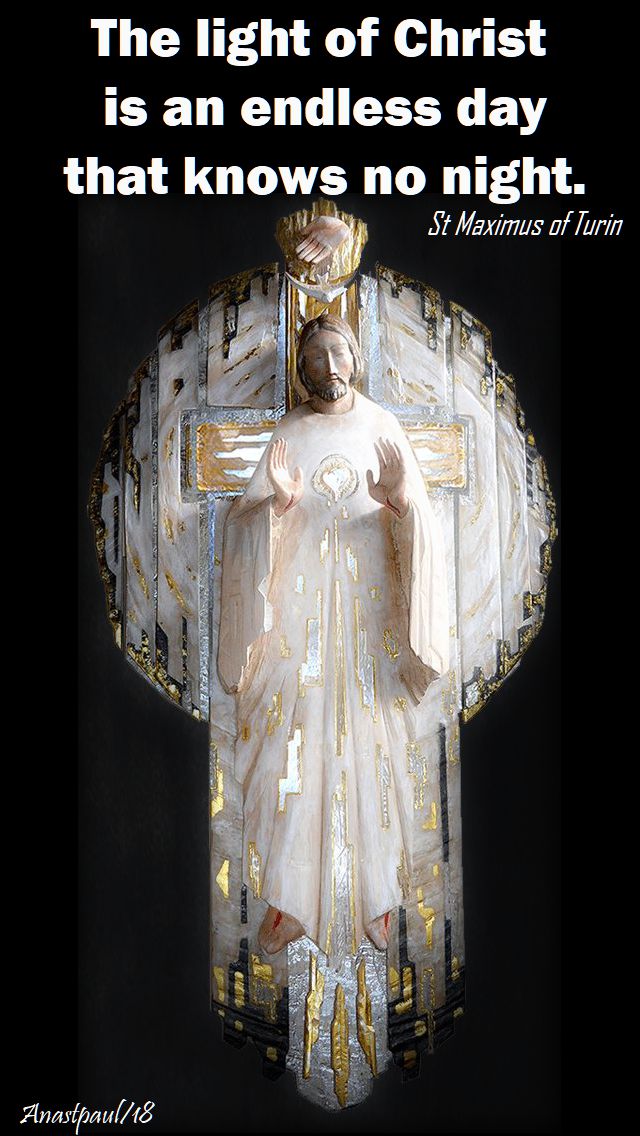
Quote of the Day – 14 May – ‘Always be brave and trust’

Quote of the Day – 14 May – Tuesday of the Fourth Week of Easter, C and the Memorial of Saint Michel Garicoïts SCJ (1797-1863)

“…Therefore, never allow yourself to start brooding again
but always be brave and trust.
Serve your good Master with an open heart full of joy.
The right way is to see all events and all obstacles
in the spirit of faith as being in the hands of Our Lord
and to hear Him say to you, on every occasion,
as He did to the disciples
‘It is I. Do not fear. Have faith.'”

St Michael Garicoïts (1797-1863)therefore never allow yourself to start brooding - st michel garicoits 14 may 2019.jpg

Posted in DOCTORS of the Church, FATHERS of the Church, FEASTS and SOLEMNITIES, MORNING Prayers, QUOTES of the SAINTS, SAINT of the DAY, The APOSTLES & EVANGELISTS, The WORD

One Minute Reflection – 14 May – Saint Matthias, the witness to the resurrection chosen by God

One Minute Reflection – 14 May – Tuesday of the Fourth Week of Easter, C, First Reading: Acts of the Apostles 1:15-17.20-26. and the Feast of St Matthias, Apostle of Christ

“During those days Peter stood up in the midst of the brothers and spoke.”…Acts 1:15

REFLECTION – “Because he is fervent and is the senior member of the group, he is always the first to speak:   “My brothers, it is necessary we choose one of the men who accompanied us.”   Note how he wants these new apostles to be eyewitnesses.   No doubt, the Holy Spirit would come and yet Peter placed a great deal of importance on this point – “One of the men who accompanied us the whole time the Lord Jesus came and went among us” (v.21).   He indicates that they must have lived with Him and not just been disciples.   For in fact, in the beginning, many people followed Him… “Until the day when he was taken up from us.   He must become with us a witness to his resurrection.” (v.22)

Peter did not say: “a witness to everything else” but only – “a witness to his resurrection.” For a disciple who could say, “Someone who ate and drank and was crucified was the same who was raised” would be more worthy of credence.   Therefore,it was not necessary that he should be a witness to the times beforehand, nor to those that followed, nor to the miracles.   What was required of him was that he should be a witness to the resurrection. Everything else had been manifest and proclaimed, whereas the resurrection took place in secret.   It was manifested only to a few.”…St John Chrysostom (345-407) Bishop of Constantinople, Doctor of the Church3rd sermon on the Acts of the apostles ; PG 60, 33 (trans. breviary 14/05)acts 1 15 peter stood up and spoke - what was required - st john chrysostom on matthias 14 may 2019.jpg

PRAYER – Lord God, You chose St Matthias to complete the number of the twelve. By his prayer, include us among Your chosen ones, since we rejoice to see that the lot marked out for us, is in Your Love. Through Jesus the Christ, our Lord, with the Holy Spirit, God now and forever, amen.st-matthias-pray-for-us-14-may-2019.jpg

Posted in SAINT of the DAY

Saint of the Day – 14 May – Saint Michel Garicoïts (1797-1863)

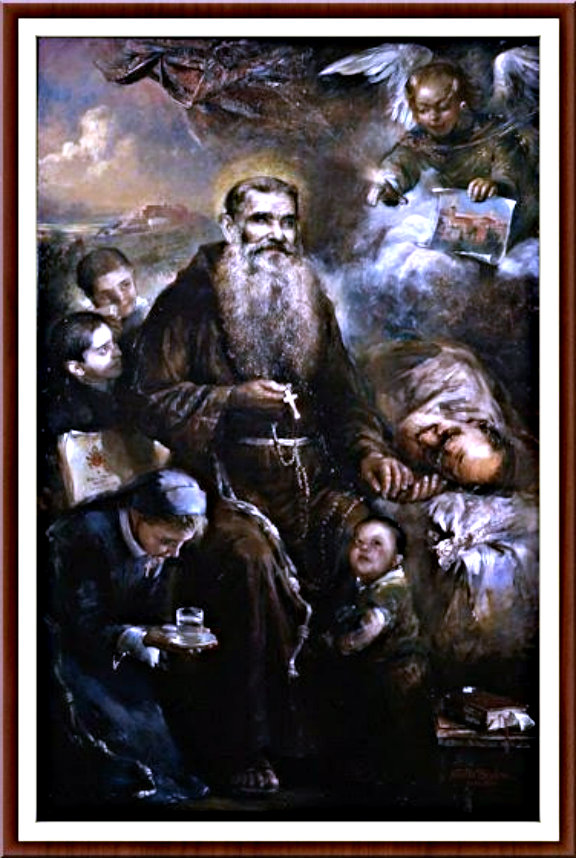
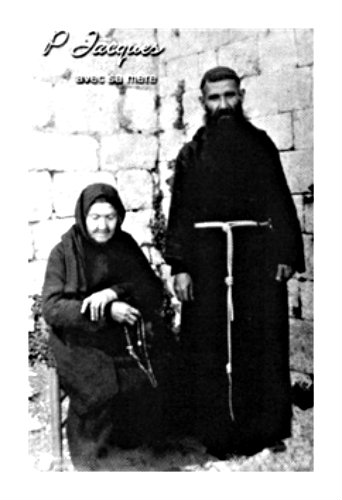
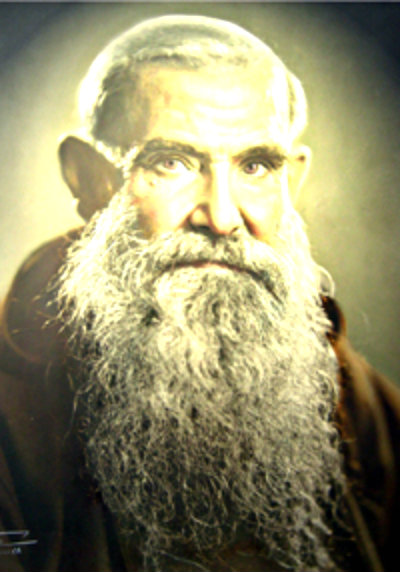
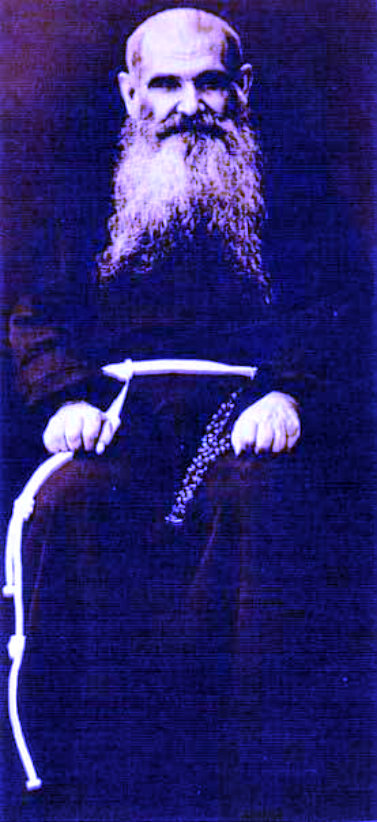
Saint of the Day – 14 May – Saint Michel Garicoïts (1797-1863) “An Apostle of the Love of God” Priest, Founder of the Congregation of the Sacred Heart of Jesus of Bétharram, Defender of the Faith, Confessor, Teacher, Preacher, ardent devotee of the Holy Eucharist and the Sacred Heart.  Patronages – the Congregation of the Sacred Heart of Jesus of Bétharram and Teachers.beautiful engraving st michel garicoits.jpg

Born on the 15th April 1797, Michel Garicoits was the eldest of six children.   He spent his youth in an isolated house at the foot of the Pyrenees, not far from the Spanish frontier with France.   He grew up in a Catholic family, remained faithful to the Church of Rome during the persecution of the Revolutionary period.   His parents and grandparents made a deep impression on him by their piety and example.   He received a very strict up- bringing from his mother principally and later, he would say that after God, he owed her everything.

The young lad knew his catechism by heart and would sing hymns and canticles while guarding the cattle.   At the age of 13 he was sent as a servant to the farm belonging to the Anghelu family at Oneix.   It is here that he made his First Communion on Sunday 9 June 1811, feast of the Holy Trinity.   He was 14 years of age.   This powerful experience of the Presence and Love of God was to accompany his whole life through.

His First Communion triggered his vocation. On returning to his native village he announced to his father “I want to be a priest.”   It was an impossible dream for lack of money in the household.   But his grandmother had no hesitation in doing the 25 kilometres on foot which separated them from Saint-Palais.   She convinced the Parish Priest to enrol Michael at the school in exchange for a few services.   A very hard worker by nature, our little Basque friend would study by candlelight late into the night and quickly became the best pupil in Latin and French.

A promising young cleric:
Both at the Junior Seminary in Aire-sur-Adour and the Major Seminary in Dax, Michel made a very good impression.   By his success in his studies, together with personal piety, he came to be compared with St Aloysius Gonzagua.   While still a student he was called by Father Claverie to help out in the Junior Seminary in Laressore.   Thanks to his kindness and seriousness, our young cleric soon became the favourite teacher both in the classroom and during recreation.   On 20 December 1823 he was Ordained a priest by Mgr d’Astros in Bayonne Cathedral.st michel garicoits young art.jpg
He was appointed to Cambo where he quickly won the hearts of his parishioners while at the same time promoting devotion to the Sacred Heart of Jesus.   Little by little, he placed the Heart of Christ at the centre of his life and spirituality.
After two years, Father Garicoits swapped his role of curate to become a teacher in Betharram.   In 1825 the seminary was in a deplorable state.   Mgr d’Astros, who had originally thought of founding a group of missionaries there, soon found in Michael Garicoits a visionary rather than a reformer.
Not far from there, he got to know Jeanne Elizabeth Bichier des Ages and the Daughters of the Cross which she had founded.   The meeting was decisive.   Thanks to their lack of the essential and the dedication of this new community, he discovered the Religious Life. At the same time, the Superior of the Seminary, was fully aware ,of the helplessness of the hierarchy, in the face of the carelessness and the lack of discipline of some of the clergy.   His decision was made:  “I shall train priests who, by their obedience, will be a consolation for their Bishops.”

The Priests of the Sacred Heart:
Right from the start, Michel Garicoits intended to found a real religious congregation (with vows and a superior who would be elected).   His dream was a body of soldiers for Christ, ever ready to answer the Church’s call.   In 1832, a thirty day retreat in a Jesuit centre, helped him to accept God’s will.   His spiritual director, Father Le Blanc, explained it thus: “God wants you to be more than a Jesuit, follow your inspiration which is from Heaven and you will become the father of a family which will be our sister.” 

As soon as he got back to Betharram, Michel threw himself down in prayer before the Blessed Sacrament.   From this experience, he was confirmed in a project which was to occupy the rest of his life.   There would be no shortage of problems. – “How difficult it is to give birth to a Congregation!” he once exclaimed on his return from a visit to Bayonne. There was no shortage of graces either..st michel-garicots-38753bc5-2030-4c41-9b81-962b18bb5b3-resize-750
The Betharramites first assembled in 1835 and in 1841 took the name of Priests of the Sacred Heart of Jesus.   Father Garicoits guided his little family by word and example.   He suggested to his companions to live according to the rules of the Jesuits and in the spirit of St Ignatius.   He threw his little society far and wide, sending the first Betharramites to the Argentine.   He accompanied the religious of the diocese, beginning with the Daughters of the Cross in Igon.   He gave weekly conferences and guided the retreats of his religious.   His concern was that everyone  – teacher, missionary, pastor, manual worker- should receive the right formation for his ministry.   In community, he was close to his brethren, in society he was attentive to all human needs.

St Michel of Betharram and of the whole wide world:
In 1853 Father Garicoits was victim of severe illness.   “Don’t be afraid” he said to those who were worried by his partial paralysis, “we shall carry on as long as God wants.”  One Ascension Thursday Michel reached the heavens which as a child he vainly tried to touch as he skipped over the hills.  On Thursday, 14 May 1863, at about 3:00 am, he died without having seen his work completed.  His final words were:  “Have pity on me, Lord, in Your great mercy”.   It would take a further fourteen years for his dream to be realised.   The Constitutions of the Congregation of Betharram were approved by Pope Leo XIII in 1877.  st michel-garicots-baa6f473-c489-440d-b913-6dcc015fafe-resize-750

Today the spirit of St Michel Garicoits is very much alive in different parts of the world. Although few in number, the Betharramites are imbued by his charism  “Here I am to do your will”.   It is this same energy which drives them to answer the Bishops’ call, especially for places, where no-one is able, or willing to go.

Following in the footsteps of their Father, St Michel, the Betharramites too try to share with others the happiness which is theirs.   They entrust themselves to God and His Divine Providence, to continue the mission of the Sacred Heart and with the same conviction, as that of their Founder, they strive “to see that God as the author and guardian of our Society.   He governs it and will protect it.”   As Christians and members of the Congregation of the Sacred Heart, they answer God’s love in their different missions.st michel garicoits at prayer

The sainthood cause commenced under Pope Leo XIII in mid-1899 while Pope Benedict XV later named Michel as Venerable on 10 December 1916 upon the confirmation of his heroic virtue.    Pope Pius XI Beatified him in 1923 while Pope Pius XII Canonised him on 6 July 1947.shrine - st michel-garicots-3f5286d7-ec2c-4573-a383-b1d5a39d772-resize-750

Posted in FEASTS and SOLEMNITIES, SAINT of the DAY

Feast of St Matthias, the Apostle and Memorials of the Saints – 14 May

St Matthias the Apostle (Feast)
St Matthias!
https://anastpaul.wordpress.com/2018/05/14/saint-of-the-day-feast-of-st-matthias-apostle/

St Ampelio
St Boniface of Ferentino
St Boniface of Tarsus
St Carthage the Younger
St Corona the Martyr
St Costanzo of Capri
St Costanzo of Vercelli
Bl Diego of Narbonne
St Dyfan
St Engelmer
St Erembert of Toulouse
St Felice of Aquileia
St Fortunatus of Aquileia
St Gal of Clermont-Ferrand
Bl Giles of Santarem
St Henedina of Sardinia
St Justa of Sardinia
St Justina of Sardinia
St Maria Domenica Mazzarello
St Maximus
St Michel Garicoïts (1797-1863)
St Pons of Pradleves
St Pontius of Cimiez
St Tuto of Regensburg
St Victor the Martyr

Martyrs of Seoul – 5 Beata: A group of lay people martyred together in the apostolic vicariate of Korea.
• Petrus Choe Pil-je
• Lucia Yun Un-hye
• Candida Jeong Bok-hye
• Thaddeus Jeong In-hyeok
• Carolus Jeong Cheol-sang
14 May 1801 at the Small West Gate, Seoul, South Korea – Beatified: 15 August 2014 by Pope Francis

Posted in CATECHESIS, ON the SAINTS, QUOTES of the SAINTS, QUOTES on TRUST and complete CONFIDENCE in GOD, SAINT of the DAY

Second Thoughts for the Day – 13 May – And all will be well, all manner of things shall be well!

Second Thoughts for the Day – 13 May – Monday of the Fourth Week of Easter, C and the Memorial of Blessed Julian of Norwich (c 1342-c 1430)all will be well - bl julian of norwich ccc 13 may 2019.jpg

Excerpt from Pope Benedict’s Catechesis on Julian of Norwich

Wednesday, 1st December 2010

Dear Brothers and Sisters,

I still remember with great joy the Apostolic Journey I made in the United Kingdom last September.   England is a land that has given birth to a great many distinguished figures who enhanced Church history with their testimony and their teaching.   One of them, venerated both in the Catholic Church and in the Anglican Communion, is the mystic Julian of Norwich, of whom I wish to speak this morning.

The — very scant — information on her life in our possession comes mainly from her Revelations of Divine Love in Sixteen Showings, the book in which this kindly and devout woman set down the content of her visions.

It is known that she lived from 1342 until about 1430, turbulent years both for the Church, torn by the schism that followed the Pope’s return to Rome from Avignon and for the life of the people who were suffering the consequences of a long drawn-out war between the Kingdoms of England and of France.   God, however, even in periods of tribulation, does not cease to inspire figures such as Julian of Norwich, to recall people to peace, love and joy.

As Julian herself recounts, in May 1373, most likely on the 13th of that month, she was suddenly stricken with a very serious illness that in three days seemed to be carrying her to the grave.   After the priest, who hastened to her bedside, had shown her the Crucified One not only did Julian rapidly recover her health but she received the 16 revelations that she subsequently wrote down and commented on in her book, Revelations of Divine Love.

And it was the Lord himself, 15 years after these extraordinary events, who revealed to her the meaning of those visions.

“‘Would you learn to see clearly your Lord’s meaning in this thing?   Learn it well – Love was His meaning.   Who showed it to you?   Love…. Why did He show it to you?   For Love’…. Thus I was taught that Love was our Lord’s meaning” (Julian of Norwich, Revelations of Divine Love, Chapter 86).

Inspired by divine love, Julian made a radical decision.   Like an ancient anchoress, she decided to live in a cell located near the church called after St Julian, in the city of Norwich — in her time an important urban centre not far from London.   She may have taken the name of Julian, precisely from that Saint, to whom was dedicated the church, in whose vicinity she lived for so many years, until her death.

This decision to live as a “recluse”, the term in her day, might surprise or even perplex us.   But she was not the only one to make such a choice.   In those centuries a considerable number of women opted for this form of life, adopting rules specially drawn up, for them, such as the rule compiled by St Aelred of Rievaulx (1110-1167).

The anchoresses or “recluses”, in their cells, devoted themselves to prayer, meditation and study.   In this way they developed a highly refined human and religious sensitivity which earned them the veneration of the people.   Men and women of every age and condition, in need of advice and comfort, would devoutly seek them.   It was not, therefore, an individualistic choice, precisely with this closeness to the Lord, Julian developed the ability to be a counsellor to a great many people and to help those who were going through difficulties in this life.

We also know that Julian too received frequent visitors, as is attested by the autobiography of another fervent Christian of her time, Margery Kempe, who went to Norwich in 1413 to receive advice on her spiritual life.   This is why, in her lifetime, Julian was called “Dame Julian”, as is engraved on the funeral monument that contains her remains.   She had become a mother to many.

Men and women who withdraw to live in God’s company acquire by making this decision a great sense of compassion for the suffering and weakness of others.   As friends of God, they have at their disposal a wisdom that the world — from which they have distanced themselves — does not possess and they amiably share it with those who knock at their door.

It was precisely in the solitude infused with God that Julian of Norwich wrote her Revelations of Divine Love.   Two versions have come down to us, one that is shorter, probably the older and one that is longer.   This book contains a message of optimism based on the certainty of being loved by God and of being protected by his Providence.

In this book we read the following wonderful words:  “And I saw full surely that ere God made us He loved us, which love was never lacking nor ever shall be.   And in this love He has made all His works and in this love He has made all things profitable to us and in this love our life is everlasting… in which love we have our beginning.   And all this shall we see in God, without end” (Revelations of Divine Love, Chapter 86).

The theme of divine love recurs frequently in the visions of Julian of Norwich who, with a certain daring, did not hesitate to compare them also to motherly love.   This is one of the most characteristic messages of her mystical theology.   The tenderness, concern and gentleness of God’s kindness to us are so great that they remind us, pilgrims on earth, of a mother’s love for her children.   In fact, the biblical prophets also sometimes used this language that calls to mind the tenderness, intensity and totality of God’s love, which is manifested in creation and in the whole history of salvation that is crowned by the Incarnation of the Son.

God, however, always excels all human love, as the Prophet Isaiah says:  “Can a woman forget her sucking child, that she should have no compassion on the son of her womb? Even these may forget, yet I will never forget you” (Is 49:15).

Julian of Norwich understood the central message for spiritual life – God is love and it is only if one opens oneself to this love, totally and with total trust and lets it become one’s sole guide in life, that all things are transfigured, true peace and true joy found and one is able to radiate it.

I would like to emphasise another point.   The Catechism of the Catholic Church cites the words of Julian of Norwich when it explains the viewpoint of the Catholic faith on an argument that never ceases to be a provocation to all believers (cf. nn. 304-313, 314).

If God is supremely good and wise, why do evil and the suffering of innocents exist?   And the Saints themselves asked this very question.   Illumined by faith, they give an answer that opens our hearts to trust and hope: in the mysterious designs of Providence, God can draw a greater good even from evil, as Julian of Norwich wrote:   “Here I was taught by the grace of God that I should steadfastly hold me in the Faith … and that … I should take my stand on and earnestly believe in … that ‘all manner of thing shall be well”’ (The Revelations of Divine Love, Chapter 32).

Yes, dear brothers and sisters, God’s promises are ever greater than our expectations.   If we are present to God, to His immense love, the purest and deepest desires of our heart, we shall never be disappointed.   “And all will be well”, “all manner of things shall be well” – this is the final message that Julian of Norwich transmits to us and that I am also proposing to you today.   Many thanks…Vatican.va

Blessed Julian, Pray for us!bl julian of norwich pray for us 13 may 2019.jpg

Posted in CATHOLIC DEVOTIONS of the Month, MARIAN TITLES, SAINT of the DAY, The BLESSED VIRGIN MARY

Marian Thoughts for the Day – 13 May – The message of Fatima is simple

Marian Thoughts for the Day – 13 May -Monday of the Fourth Week of Easter, C and the 102nd Memorial of Our Lady of Fatima

The message of Fatima is simple – Pray!

Unfortunately, some people—not Sister Lucia—have distorted these revelations, making them into an apocalyptic event for which, they are now the only reliable interpreters. They have, for example, claimed that Mary’s request that the world be consecrated to her has been ignored.   Sister Lucia agreed that Pope John Paul II’s public consecration in St Peter’s Square on 25 March 1984, fulfilled Mary’s request.   The Congregation for the Doctrine of the Faith prepared a June 26, 2000, document explaining the “third secret.”

Mary is perfectly honoured when people generously imitate her response “Let it be done to me as you say” (Luke 1:38).   Mary can never be seen as a rival to Jesus or to the Church’s teaching authority, as exercised by the college of bishops united with the bishop of Rome, for she is the protector of and the perfect type of the Church.   She and the Church are one!

Holy Mother, Our Lady of Fatima, please pray for us!our lady of fatima pray for us no 2 - 13 MAY 2019 adjusted from 13oct2018.jpg

Posted in DIVINE Mercy, Goodness, Patience, GOD is LOVE, MYSTICS, QUOTES of the SAINTS, QUOTES on DIVINE PROVIDENCE, QUOTES on ETERNAL LIFE, QUOTES on FAITH, QUOTES on GRACE, QUOTES on GRATITUDE, QUOTES on HAPPINESS, QUOTES on JOY, QUOTES on LOVE, QUOTES on PRAYER, QUOTES on TRUTH, SAINT of the DAY, The MOST HOLY & BLESSED TRINITY

Quote/s of the Day – 13 May – Revelations of Divine Love

Quote/s of the Day – 13 May – Monday of the Fourth Week of Easter, C and the Memorial of Blessed Julian of Norwich (c 1342-c 1430) – “Revelations of Divine Love”

“He [ Jesus] is our clothing,
that for love wraps us and winds us,
embraces us and totally encloses us,
hanging about us in tender love.”he-jesus-is-our-clothing-julian-of-norwich-2-july-2018.jpg

“Prayer is not
overcoming
God’s reluctance.
It is laying hold
of His willingness.”prayer is not overcoming god's reluctance - bl julian of norwicb 13 may 2019.jpg

“Despite all our feelings of woe or of well-being,
God wants us to understand and to believe,
that we are more truly in heaven than on earth.
…for God is never out of the soul,
in which He will dwell blessedly without end.”despite-all-our-feelings-of-woe-julian-of-norwich-21-aug-20181.jpg

“The fullness of Joy
is to behold God
in everything.”the fullness of joy - bl julian of norwich 13 may 2019.jpg

“Truth sees God
and wisdom contemplates God
and from these two comes a third,
a holy and wonderful delight in God,
who is love.”truth sees god - bl julian of norwich 13 may 2019.jpg

“In You, Father almighty, we have
our preservation and our bliss.
In You, Christ,
we have our restoring and our saving.
You are our mother, brother and Saviour.
In You, our Lord the Holy Spirit,
is marvelous and plenteous grace.
You are our clothing,
for love You wrap us and embrace us.
You are our maker, our lover, our keeper.
Teach us to believe,
that by Your grace
all shall be well,
and all shall be well,
and all manner of things
shall be well.
Amen”

Blessed Julian of Norwich (c 1342-c 1430)all-shall-be-well-julian-of-norwich-2-july-2018.jpg

Posted in CHRIST, the WAY,TRUTH,LIFE, DOCTORS of the Church, EASTER, FATHERS of the Church, MORNING Prayers, QUOTES of the SAINTS, QUOTES on OBEDIENCE, SAINT of the DAY, The BLESSED VIRGIN MARY, The GOOD SHEPHERD

One Minute Reflection – 13 May – “…The sheep hear his voice”

One Minute Reflection – 13 May – Monday of the Fourth Week of Easter, C – Gospel: John 10:1-10 and the 102nd Memorial of Our Lady of Fatima

“… the sheep hear his voice and he calls his own sheep by name and leads them out.”…John 10:3

REFLECTION – “The mark of Christ’s sheep is their willingness to hear and obey, just as disobedience is the mark of those who are not His.

We take the word ‘hear’ to imply obedience to what has been said.   People who hear God are known by Him.   No-one is entirely unknown by God but to be known in this way, is to become part of His family.

Therefore, when Christ says, “I know mine,” He means I will receive them and give them a permanent mystical relationship with Myself.

It might be said that inasmuch as He has become man, He has made all human beings His relatives, since all are members of the same race.  We are all united to Christ in a mystical relationship because of His incarnation.    Yet those who do not preserve the likeness of His holiness are alienated from Him.   “My sheep follow me,” says Christ.  By a certain God-given grace, believers follow in the footsteps of Christ.   No longer subject to the shadows of the law, they obey the commands of Christ and guided by His words, rise through grace, to His own dignity, for they are called “children of God.

When Christ ascends into heaven, they also follow Him.”… St Cyril of Alexandria (376-444) Father & Doctor of the Church (Commentary on the Gospel of John)john 10 3 he calls his own sheep - the mark of christ's sheep is their willingness to hear - st cyril of alex 13 may 2019.jpg

PRAYER – Almighty God and Father, You have rescued Your faithful from enslavement to sin, by Your Son’s self-abasement.   You have raised up the world through His suffering. Fill us now with holy joy at His rising and triumph.   Let us hear His voice and follow Him to everlasting life.   Our Lady of Fatima, pray for us!   Through Christ our Lord, with the Holy Spirit, God now and forever, amen.pray-for-us-mother-of-god-13-may-2017

Posted in CATHOLIC DEVOTIONS of the Month, CATHOLIC-PRAYERS OF THE CHURCH, MARIAN PRAYERS, MARIAN TITLES, Our MORNING Offering, PRAYERS of the CHURCH, SAINT of the DAY, The BLESSED VIRGIN MARY

Our Morning Offering – 13 May – Act of Entrustment to Our Lady of Fatima

Our Morning Offering – 13 May – The 102nd Anniversary of the Apparitions of Our Lady of Fatima

Act of Entrustment to Our Lady of Fatima
By Pope Francis

Blessed Virgin Mary of Fatima,
with renewed gratitude for your motherly presence
we join in the voice of all generations that call you blessed.
We celebrate in you the great works of God,
who never tires of lowering Himself
in mercy over humanity,
afflicted by evil and wounded by sin,
to heal and to save it.
Accept with the benevolence of a Mother
this act of entrustment that we make in faith today,
before this your image, beloved to us.
We are certain that each one of us is precious in your eyes
and that nothing in our hearts has estranged you.
May that we allow your sweet gaze
to reach us and the perpetual warmth of your smile.
Guard our life with your embrace,
bless and strengthen every desire for good,
give new life and nourishment to faith,
sustain and enlighten hope,
awaken and animate charity,
guide us all on the path to holiness.
Teach us your own special love for the little and the poor,
for the excluded and the suffering,
for sinners and the wounded of heart,
gather all people under your protection
and give us all to your beloved Son, our Lord Jesus.
Amen.

*Act of entrustment to Mary, Virgin of Fátima, at the conclusion of Mass on the occasion of the Marian Day (Saint Peter’s Square, 13 October 2013)act of entrustment to our lady of fatima by pope francis 13 may 2019 102nd anniversary.jpg

Posted in MYSTICS, SAINT of the DAY

Saint of the Day – 13 May – Blessed Julian of Norwich (c 1342-c 1416)

Saint of the Day – 13 May – Blessed Julian of Norwich (c 1342-c 1416) (aged 73–74) Anchorite, Mystic, Writer, Ascetic, Spiritual director – also known as Dame Julian or Mother Julian – born late 1342 and died after 1416) was the greatest of all the English anchorites of the Middle Ages.   She wrote the earliest surviving book in the English language to be written by a woman, Revelations of Divine Love.header bl julian.png

It was popular in the 14th century for a number of English men and women to withdraw from the world as hermits, they were known as anchorites.   Their hermitage, was a small room attached to a local church.   Each room had two windows.   One through the church wall permitting the anchorite to receive communion.   Through the second window, the anchorite received food brought to him or her by village people.   Thus they at all times had the window of their heart open to Christ and open to the world.

As a young woman, Julian, who was born about 1342, became an anchorite at the Church of St Edmund and St Julian in Norwich.  309px-Julian_of_Norwich.jpgWhen she was 30 Julian suffered from a severe illness.   Whilst apparently on her deathbed, Julian had a series of intense visions of Jesus Christ, which ended by the time she recovered from her illness on 13 May 1373.   Julian wrote about her visions immediately after they had happened (although the text may not have been finished for some years), entitled Revelations of Divine Love.    Twenty to thirty years later, perhaps in the early 1390s, Julian began to write a theological exploration of the meaning of the visions, known as The Long Text.   This work seems to have gone through many revisions before it was finished, perhaps in the first or even second decade of the fifteenth century.   Until her death in about 1416, Julian stayed in her simple room.   Like most anchorites, she prayed, fasted, did penance, studied, sewed clothing for the poor and advised the village people.

In her book, she described her 16 visions of Jesus.   As she wrote this book about God’s great compassion for us, Julian developed a special vocabulary.   She called the Creator, our mother and our father.   She called Jesus the Redeemer, our brother.  bl julian snipRevelations is a celebrated work in Catholicism because of the clarity and depth of Julian’s visions of God.   Julian of Norwich is now recognised as one of England’s most important mystics.

Julian of Norwich lived in a time of turmoil but her theology was optimistic and spoke of God’s love in terms of joy and compassion, as opposed to law and duty.   For Julian, suffering was not a punishment that God inflicted, as was the common understanding. She believed that God loved everyone and wanted to save them all.   Popular theology, magnified by catastrophic contemporary events such as the Black Death and a series of peasant revolts, asserted that God punished the wicked  . Julian suggested a more merciful theology, she believed that behind the reality of hell is a greater mystery of God’s love.   In modern times, she has been classified as a proto-universalist, although she did not claim more than hope, that all might be saved.

At the time of Julian’s death, people from all over Europe travelled to her room, or cell, to ask her advice.   Everyone recognised that she was close to God.   The Church never formally declared her a saint but through the ages, people have called her “Blessed.”

“If there is anywhere on earth a lover of God who is always kept safe, I know nothing of it, for it was not shown to me.   But this was shown – that in falling and rising again we are always kept in that same precious love.”
Julian of Norwich

This slideshow requires JavaScript.

Posted in MARIAN TITLES, SAINT of the DAY

Our Lady of Fatima, 102nd Anniversary, Our Lady of Help and Our Lady of the Most Blessed Sacrament – 13 May and Memorials of the Saints

Our Lady of Fatima 102nd Anniversary of the First Apparition (Optional Memorial)
All about Our Lady of Fatima: https://anastpaul.wordpress.com/2017/05/13/the-centenary-of-the-apparitions-of-our-lady-of-fatima-our-lady-of-the-holy-rosary-13-may-2017/FATIMA 2.jpg

Our Lady of Help:  Devotion to the Blessed Virgin Mary under this title began in Palermo, Sicily in the 14th century and has since spread throughout the Augustinians. It began when Father Nicola Bruno, who suffered from severe and long-term pains in his side, prayed to Our Lady for healing while meditating on a painting of Mary in which she used a stick or club to chase away the dragon and protect the infant Jesus, the artist was making reference to passages in Genesis and Revelations that referred to the eternal enmity between The Woman and the serpent.  That night, Father Nicola received a vision of Mary and was healed.   The painting received the title “Our Lady of Help” and the devotion began.   Since 1804 the celebration has had its own liturgy.

Our Lady of the Most Blessed Sacrament:  st peter julian eymard and our lady of the blessed sacrament The title of Our Lady of the Blessed Sacrament was first given to Mary by St Peter Julian Eymard in May 1868, while speaking to his novices.   A few years later he described what her statue should look like:  “The Blessed Virgin holds the Infant in her arms and He holds a chalice in one hand and a Host in the other.”   He exhorted them to invoke Mary:   “Our Lady of the Blessed Sacrament, pray for us who have recourse to thee!”

The Story:  https://anastpaul.wordpress.com/2018/05/13/feast-of-our-lady-of-the-most-blessed-sacrament-13-may/

St Abban of Abingdon
St Agnes of Poitiers
St André-Hubert Fournet
St Anno of Verona
St Argentea of Cordoba
St Euthymius the Illuminator
Bl Fortis Gabrielli
Bl Gerard of Villamagna
Bl Gemma of Goriano
St Glyceria of Trajanopolis
St John the Silent
Bl Julian of Norwich (c 1342-c 1416)

St Lucius of Constantinople
St Mael of Bardsey
Bl Magdalen Albrizzi
St Merewenna of Rumsey
St Mucius of Byzantium
St Natalis of Milan
St Onesimus of Soissons
St Servatus of Tongres
St Valerian of Auxerre

Martyrs of Alexandria: A group of Catholic Christians martyred in the church of Theonas, Alexandria, Egypt by order of the Arian Emperor Valens. Their names have not come down to us. 372 in Alexandria, Egypt.

Posted in SAINT of the DAY

Saint of the Day – Saint Epiphanius (c 315 – 403) – “The Oracle of Palestine”

Saint of the Day – Saint Epiphanius (c 315 – 403) Bishop of Salamis (Cyprus) known as the Oracle of Palestine, Church Father, Theologian, Confessor, Writer, Defender of the Faith, Monk and Ascetic, Apostle of charity and poor, Spiritual adviser, founder of monasteries – he gained a reputation as a strong defender of orthodoxy.st epiphanius pub dom.JPG

St Epiphanius was born about the year 310, in Palestine.   In his youth he began the study of the Holy Scriptures, embraced a monastic life and went into Egypt to perfect himself in the exercises of that state, in the deserts of that country.   He returned to Palestine about the year 333 and built a monastery near the place of his birth.

He was ordained a priest and lived and studied as superior of the monastery in Ad that he founded for thirty years and gained much skill and knowledge in that position.   There he gained the ability to speak in several tongues, including Hebrew, Syriac, Egyptian, Greek and Latin and was called by St Jerome on that account, Pentaglossis (“Five tongued”).st epiphanius at prayer engraving.JPG

His labours in the exercise of virtue seemed, to some, to surpass his strength but his apology always was – “God gives not the kingdom of heaven but on condition that we labour and all we can do, bears no proportion, to such a crown.”   To his corporal austerities he added an indefatigable application to prayer and study.   Most books then in vogue passed through his hands and he improved himself very much in learning, by his travels into many parts.

Although the skilful director of many others, St Epiphanius took the great St Hilarion as his master in a spiritual life and enjoyed the happiness of his direction and intimate acquaintance from the year 333 to 356.

The reputation of his virtue made St Epiphanius known to distant countries and about the year 367 he was chosen Bishop of Salamis in Cyprus.   But he still wore the monastic habit and continued to govern his monastery in Palestine, which he visited from time to time.   He sometimes relaxed his austerities in favour of hospitality, preferring charity to abstinence.   No one surpassed him in tenderness and charity to the poor.   The veneration which all men had for his sanctity exempted him from the persecution of the Arian Emperor Valens.Saint_Epiphanius.jpg

In 376, he undertook a journey to Antioch, in the hope of converting Vitalis, the Apollinarist bishop and in 382 he accompanied St Paulinus from that city to Rome, where they lodged at the house of St Paula.   Our Saint in return entertained her afterward ten days in Cyprus in 385.   The very name of an error in faith, or the shadow of danger of evil, frightened him and the Saint fell into some mistakes on certain occasions, which proceeded from zeal and simplicity.st epiphanius engraving 3.JPG

He was on his way back to Salamis, after a short absence, when he died in 403, having been bishop thirty-six years.

He is best known for composing the Panarion – which means “medicine-chest” (also known as Adversus Haereses, “Against Heresies”), presented as a book of antidotes for those bitten by the serpent of heresy.   Written between 374 and 377, it forms a handbook for dealing with the arguments of heretics.st epiphanius statue engraving

Posted in SAINT of the DAY

Memorials of the Saints – 12 May

St Achilleus of Terracina (Optional Memorial)
St Nereus of Terracina (Optional Memorial)
About:  https://anastpaul.wordpress.com/2018/05/12/saints-of-the-day-12-may-sts-nereus-and-achilleus/

St Pancras of Rome (Optional Memorial)

St Crispoldus
St Cyril of Galatz
St Dedë Malaj
St Diomma of Kildimo
St Dionysius of Asia
St Dominic de la Calzada
St Ejëll Deda
St Ephrem of Jerusalem
St Epiphanius (c 315 – 403)
St Erc Nasca of Tullylish
St Ethelhard of Canterbury
St Euphrosyna of Terracina
Bl Francis Patrizzi of Siena
Bl Gemma of Goriano
St Germanus of Constantinople
Bl Jane of Portugal
Bl Juan de Segalars
St Lucien Galan
St Modoald of Trier
St Palladius of Rome
St Philip of Agira
St Richrudis of Marchiennes
St Theodora of Terracina
St Thomas Khampheuane Inthirath

Posted in ROGATION DAYS, SAINT of the DAY

Saint of the Day – 11 May – St Mamertus (Died c 475)

Saint of the Day – 11 May – St Mamertus (Died c 475) also known as Mamertius, Mammertus – Archbishop of Vienne in Gaul – present day France, Theologian, Writer, Founder of the introduction of the praying of Litanies prior to Ascension Day, called “Rogation Days.”   Rogation days are days of prayer and fasting in the Church.   They are observed with processions and the pra\ying of the Litany of the Saints.   The major Rogation is held on 25 April, the minor Rogations are held on Monday to Wednesday, preceding Ascension Thursday.   The word Rogation comes from the Latin verb rogare, meaning “to ask,” which reflects the beseeching of God, for the appeasement of His anger and for protection from calamities.

433px-Mammertus
An engraving of Saint Mamertus from an 1878 

His feast day is the first of the Ice Saint, who are St Mamertus (or, in some countries, St Boniface of Tarsus), St Pancras and St Servatius.  They are so named because their feast days fall on the days of 11 May, 12 May and 13 May respectively, known as “the black-thorn winter” in Austrian, Belgian, Croatian, Czech, Dutch, French, German, Hungarian, North-Italian, Polish, Slovene and Swiss folklore.

Prior to his elevation to the see of Vienne, little has been recorded about Mamertus’ life. The fact that his brother, Claudianus Mamertus, the theological writer, received in his youth a sound training in rhetoric and enjoyed the personal acquaintance of Bishop Eucherius of Lyons (434-50), suggests that the brothers belonged to a wealthy Gallic family from the neighbourhood of Lyons.   Like his brother, St Mamertus was distinguished for his secular learning as well as theology and, before his elevation to the episcopate, appears to have been married.

His election and consecration took place shortly before 462. As bishop he enlisted the services of his brother, who had withdrawn to a cloister and ordained him priest of Vienne. The activity of the brothers is described in one letter of Sidonius Apollinaris, while another is addressed to Bishop Mamertus.

Saint_Mamertus right wutg sts avutys abd apollinaris.
Saint Mamertus (right), pictured with
Saints Avitus and Apollinaris (details)

St Mamertus was the founder of the Rogation Processions, according to Sidonius Apollinaris and his second successor, Avitus.   In connexion with these intercessory processions, Mamertus summoned a synod at Vienne between 471 and 475.

Amidst the scourges of the time, wars, famines and natural disasters, which were seen as divine anger against the sinful lives of the people, which threatened their entire destruction, St Mammertus received a token of the divine mercy. A terrible fire happened in the city of Vienne, which baffled the efforts of men but by the prayers of the good bishop the fire on a sudden went out. This miracle strongly affected the minds of the people. The holy prelate took this opportunity to make them sensible of the necessity and efficacy of devout prayer and formed a pious design of instituting an annual fast and supplication of three days, in which all the faithful should join, with sincere compunction of heart, to appease the divine indignation by fasting, prayer, tears and the confession of sins.

st mamertus

The Church of Auvergne, of which St Sidonius was bishop, adopted this pious institution before the year 475 and it became in a very short time a universal practice.

During his episcopate, the remains of St Ferreolus were discovered and were translated by Mamertus to a church in Vienne, he built in honour of that martyr.

About 475 he attended a synod at Arles, which dealt with the predestination teaching of Lucidus, a Gallic priest. As this is the latest information we possess concerning him, we may assume that he died shortly afterwards.mamertus

Posted in SAINT of the DAY

Memorials of the Saints – 11 May

St Anastasius of Lérida
St Anthimus of Rome
St Bassus of Sabina
St Bertilla
St Criotan of MacReddin
Bl Diego of Saldaña
St Evellius of Pisa
St Fabius of Sabina
St Fremund of Dunstable
St Gengulphus of Burgundy
St Gualberto
St Ignatius of Laconi OFM Cap. (1701-1781)
Biography:   https://anastpaul.wordpress.com/2018/05/11/saint-of-the-day-11-may-st-ignatius-of-laconi-o-f-m-cap-1701-1781/

Bl Illuminatus
St Illuminatus of San Severino
Bl James Walworth
Bl John Rochester
St Maiulo of Hadrumetum
St Majolus of Cluny
St Mamertus (Died c 475)
St Maximus of Sabina
St Mayeul
St Mozio of Constantinople
St Possessor of Verdun
St Principia of Rome
St Tudy
St Vincent L’Hénoret
Bl Vivaldus
St Walbert of Hainault

Martyrs of Camerino: An imperial Roman official, his wife, their children and servants, all of whom were converts and martyrs: Anastasius, Aradius, Callisto, Eufemia, Evodius, Felice, Primitiva, Theopista.

Posted in QUOTES of the SAINTS, SAINT of the DAY

Thought for the Day – 10 May – “.. desire always to be one with Him”

Thought for the Day – 10 May – Friday of the Third Week of Easter, C and the Memorial of Blessed Ivan Merz (1896-1928)

Excerpt from the Beatification Homily
St John Paul II (1920-2005)
Sunday, 22 June 2003

Dear brothers and sisters, the just man, surrounded by divine light, becomes in turn a lamp which radiates light and gives warmth.   This is what we learn today from the figure of Ivan Merz.

A gifted young man, he made a good return on his rich natural talents and obtained great human success – it can be said that he had a very successful life.   But that is not the reason why he is today declared Blessed.   What makes him one of the choir of the Beati is his success in God’s eyes.  The great aspiration of his whole life was “never to forget God, to desire always to be one with Him”.   In all his activities Ivan Merz sought “the surpassing worth of knowing Christ Jesus” and he allowed Christ to make him his own (cf. Phil 3:8,12).

At the school of the liturgy, the source and summit of the Church’s life (cf. Sacrosanctum Concilium, 10), Ivan Merz grew to the fullness of Christian maturity and became one of the principal promoters of the liturgical renewal in his country.

Taking part in Mass and drawing nourishment from the Body of Christ and the Word of God, he drew the inspiration to become an apostle of young people.   It was not by chance that he chose as his motto “Sacrifice – Eucharist – Apostolate”.   Conscious of the vocation he had received in Baptism, he made his whole life a “race” towards holiness, the “high standard” of Christian life (cf. Novo Millennio Ineunte, 31).   For this reason, as the First Reading says, “his memory will not disappear and his name will live through all generations” (Sir 39:9).

The name of Ivan Merz, has meant in the past, a programme of life and of activity, for an entire generation of young Catholics.   Today too, it must do the same!

…Do not seek a more comfortable life elsewhere, do not flee from your responsibilities and expect others to resolve problems but resolutely counter evil with the power of good.

Like Blessed Ivan, strive for a personal encounter with Christ which sheds new light on life.   May the Gospel be the great ideal guiding your approaches and your decisions! Thus you will become missionaries in word and deed, signs of God’s love and credible witnesses of the merciful presence of Christ.   Never forget: “one does not light a lamp and put it under a bushel” (cf. Mt 5:15).

Dear brothers and sisters, who take part with such fervour in this celebration, may the peace of God, which transcends all understanding, keep your heart and your spirit in the knowledge and love of God and of His Son, our Lord Jesus Christ!

Blessed Ivan Merz, Pray for Us!bl ivan merz pray for us 10 may 2019 no 2.jpg

Posted in QUOTES of the SAINTS, QUOTES on the CHURCH, SAINT of the DAY

Quote of the Day – 10 May – My Vocation

Quote of the Day – 10 May – Friday of the Third Week of Easter, C and the Memorial of Blessed Ivan Merz (1896-1928)

“The Catholic faith
is my life vocation.”

Blessed Ivan Merz (1896-1928)the catholic faith is my life vocation - bl ivan merz 10 may 2019.jpg

Posted in CHRIST, the WAY,TRUTH,LIFE, DOCTORS of the Church, FATHERS of the Church, MORNING Prayers, QUOTES of the SAINTS, SAINT of the DAY, The WORD

One Minute Reflection – 10 May – “He is there and He is also here..”

One Minute Reflection – 10 May – and Friday of the Third Week of Easter, C, First Reading: Acts 9:1-20 and the Memorial of Blessed Ivan Merz (1896-1928)

“He fell to the ground and heard a voice saying to him, “Saul, Saul, why are you persecuting me?”…Acts 9:4

REFLECTION – “How can we show that He is there and that He is also here?   Let Paul answer for us, who was previously Saul.   First of all, the Lord’s own voice from heaven shows this: “Saul, Saul, why are you persecuting me?”   Had Paul climbed up to heaven then?   Had Paul even thrown a stone at heaven?   It was Christians he was persecuting, them he was tying up, them he was dragging off to be put to death, them he was everywhere hunting out of their hiding places and never sparing when he found them. To him the Lord said, “Saul, Saul.”   Where is He crying out from? Heaven.   So He’s up above.   “Why are you persecuting me?” So He’s down below.”…St Augustine (354-430) Bishop of Hippo, Father & Doctor (Sermon 122)acts 9 4 - saul saul - he is there and he is also here - st augustine - 10 may 2019.jpg

PRAYER – Almighty God, You sent Your Son and we have now come to know the grace of His Resurrection.   Through Him we live and move and have our being.   As we follow Him, He walks with us and leads us to You.   Grant we pray, that His mother and ours, may guide our way to Him and may the prayers of Blessed Ivan Merz, who always followed closely behind the Lord, be a solace in our trials.   Through Christ our Lord, with the Holy Spirit, God now and forever, amen.sancta-maria-mary-most-holy-pray-for-us-10-may-2018bl ivan merz pray for us 10 may 2019


Posted in SAINT of the DAY, VATICAN Resources

Saint of the Day – 10 May – Blessed Ivan Merz (1896-1928)

Saint of the Day – 10 May – Blessed Ivan Merz (1896-1928) aged 32 – Layman, Teacher, Professor, Apostle of the Blessed Sacrament and of prayer, Founder of Youth Movements in Croatia – Patronages – Croatian youth, youth as a whole, World Youth Day celebrations.bl Ivan

Ivan Merz was born in Banja Luka, Bosnia, on 16 December 1896 and was baptised on 2 February 1897.   He attended elementary and middle school in Banja Luka and, after a brief period of education at the military academy of Wiener Noustadt, he enrolled in 1915 at the University of Vienna, with the dream of teaching young people in Bosnia, thus, he would be following the example of his professor, Ljubomir Marakovic, who helped Ivan to discover the richness of the Catholic faith.ivan-merz-as a boy.jpeg

In March 1916, Ivan was enlisted in the army and shipped to the Italian battle front, where he spent the greater part of two years beginning in 1917.   The war experience and its horrors marked a turning point in Ivan’s young life and contributed greatly to his spiritual growth, prompting him to abandon his future into God’s hands and to strive with all his might towards the goal of Christian perfection.

On 5 February 1918, he wrote in his diary:  “Never forget God!   Always desire to be united with Him.   Begin each day in the first place with meditation and prayer, possibly close to the Blessed Sacrament or during Mass.   During this time, plans for the day are made, one’s defects are put under examination and grace is implored for the strength to overcome all weakness.   It would be something terrible if this war had no meaning for me!…   I must begin a life regenerated in the spirit of this new understanding of Catholicism.   The Lord alone can help me, as man can do nothing on his own”.   At this time, Ivan also made a private vow of perpetual chastity.bl ivan merz 3.jpg

After the war, he continued his studies at Vienna (1919-20) and then in Paris (1920-22).   In 1923 he obtained a degree in philosophy.   His thesis was entitled “The influence of the Liturgy on the French authors”.   He then became a professor of language and French literature and was exemplary in his dedication to the students and to his responsibilities as a teacher.

In his spare time he studied philosophy and theology and deepened his knowledge of the documents of the Magisterium of the Church.

Ivan was especially noted for his interest in young people and concern for their growth in faith and holiness.   He started the “League of Young Croatian Catholics” and the “Croatian League of Eagles” within the Croatian Catholic Action Movement.   Their motto was: “Sacrifice Eucharist Apostolate”.

For Ivan, the purpose of this organisation was to form a group of front-line apostles whose goal was holiness.   The scope of this goal also flowed over into liturgical renewal, of which Ivan was one of the first promoters in Croatia.

As a Catholic intellectual, Ivan was able to guide young people and adults to Christ and His Church, through his writings and organised gatherings.   He also sought to teach them love and obedience to the Vicar of Christ and the Church of Rome.bl ivan 4.jpg

In the face of any misunderstandings and difficulties, Ivan always had an admirable patience and calm, the fruit of his continual union with God in prayer.   Those who knew him well described him as a person who had his “mind and heart immersed in the supernatural”.   Convinced that the most effective way to save souls was through efficacious suffering, he offered to God all his physical and moral sufferings, particularly for the intention of the success of his apostolic endeavours.

Shortly before his death, he offered his life for the youth of Croatia.   In short, the young man believed that his vocation was very simply “the Catholic faith”.Bl_Ivan_Merz_u_Bazilici_Srca_Isusova_13_rujna_2008

Ivan Merz died on 10 May 1928 in Zagreb.   He was 32 years old….Vatican.va

Blessed Ivan left an example of how a man can live, fight and suffer for God’s cause. Merz tried hard to give his life the “full meaning”, heading for sanctity and all his pedagogical task was devoted to the formation of apostles of sanctity.   He died with a reputation of a saint.   His shrine is located in the Basilica of the Heart of Jesus in Zagreb, Croatia.   The canonisation cause started in 1958.

He was Beatified by St Pope John Paul on Sunday, 22 June 2003 in Bosnia Herzegovina.

bl ivan merz 576px-Sacred_Heart_Basilica,_Zagreb_3
Blessed Ivan Merz’s tomb in the Basilica of the Heart of Jesus in Zagreb, Croatia

On 3 March 2018, His Excellency Francisco Mendoza De Leon, DD, bishop of the Diocese of Antipolo and local Ordinary of the Blessed Ivan Merz Centre and Reliquarium, formally opened and blessed the Blessed Ivan Merz Reliquarium.

The Blessed Ivan Merz Reliquarium (Home of the Sacred Relics) was established to house the sacred relics of Blessed Ivan Merz and of other sacred relics belonging to Our Lord, the Blessed Mother and beatified and canonised Servants of God.   It serves as spiritual oasis for pilgrims, devotees and disciples in faith of the Apostle of the Youth.

We pray that those who will visit Blessed Ivan Merz Reliquarium will experience the Lord’s kind assistance.

May those who venerate the remains of the Saints, especially of Blessed Ivan Merz, with their prayers and merits, obtain pardon for sin and protection from every adversity. blivan reliquariumbl ivan relics

Beautiful images on their website here:  https://ivanmerz.org/the-reliquarium-and-relics/

Posted in SAINT of the DAY

Memorials of the Saints – 10 May

St John of Avila (1499-1569) “Apostle of Andalusia”– Doctor of the Church
About St John:   https://anastpaul.wordpress.com/2018/05/10/saint-of-the-day-10-may-st-john-of-avila-1499-1569-apostle-of-andalusia-known-as-father-master-avila-doctor-of-the-church/

St Joseph de Veuster (1840-1889) – St Damian of Molokai “The Martyr of Molokai”(Optional Memorial)
St Damian’s life:   https://anastpaul.wordpress.com/2017/05/10/10-may-the-memorial-of-st-damian-de-veuster-de-molokai/

Robert Louis Stevenson and St Damian: https://anastpaul.wordpress.com/2017/05/10/blessed-memorial-of-s-damian-de-veuster-de-molokai/

St Alphius of Lentini
Bl Amalarius of Metz
Bl Antonio of Norcia
St Aurelian of Limoges
Bl Beatrix d’Este the Elder
St Blanda of Rome
St Calepodius of Rome
St Catald of Taranto
St Comgall of Bangor
St Cyrinus of Lentini
St Dioscorides of Smyrna
Bl Enrico Rebuschini
St Epimachus of Rome
St Felix of Rome
Bl Giusto Santgelp
St Gordian the Judge
Bl Ivan Merz (1896-1928)
Bl Nicholas Albergati
St Palmatius of Rome
St Philadelphus of Lentini
St Quartus of Capua
St Quintus of Capua
St Simplicius of Rome
St Solange of Bourges
St Thecla
Bl William of Pontnoise

Posted in DOCTORS of the Church, FATHERS of the Church, MORNING Prayers, PRACTISING CATHOLIC, QUOTES of the SAINTS, SAINT of the DAY, The WORD

One Minute Reflection – 9 May – “..Reading the Scriptures”

One Minute Reflection – 9 May – Thursday Third Week of Easter, C, First Reading: Acts 8:26–40

“… and was returning home.   Seated in his chariot, he was reading the prophet Isaiah.”…Acts 8:28

REFLECTION – “Consider, I ask you, what a great effort it was not to neglect reading even while on a journey and, especially, while seated in a chariot.   Let this be heeded by those people who do not even deign to do it at home but rather think reading the Scriptures is a waste of time, claiming as an excuse their living with a wife, conscription in military service, caring for children, attending to domestics and looking after other concerns, they do not think it necessary for them to show any interest in reading the holy Scriptures.” … St John Chrysostom (347-407)  Father & Doctor (Homilies on Genesis, 35.)acts 8 28 seated in the chariot - considr what great effort - st john chrysostom 9 may 2019.jpg

PRAYER – Almighty, ever-living God, in Your Word, You shed the light of Your glory on the peoples who are living in the shadow of death.   By Your Word, You teach us all things and lead us in the way of hope and love.   For Your Word is Truth and Your Word became flesh and filled our world with the Sun of Justice, Your Son, He who is the Sun and the Truth.   May our steps be guided by His Mother, as we follow in the footsteps of Your Word and may the prayers of Blessed Maria Carmen Rendiles, be a help in our trials.   Through Christ, our Lord Jesus, with You in union with the Holy Spirit, now and forever, amen.mary refuge of sinners pray for us 28 march 2019 ora pro nobis.jpg

bl maria carmen rendiles pray for us 9 may 2019.jpg

Posted in SAINT of the DAY

Saint of the Day – 9 May – Blessed Maria Carmen Rendiles (1903-1977)

Saint of the Day – 9 May – Blessed Carmen Elena Rendiles Martínez more commonly known as Blessed Maria Carmen Rendiles (1903-1977) – in religion María Carmen – was a Venezuelan professed religious of the Servants of the Eucharist and the founder of the Servants of Jesus of Caracas, Apostle of Charity, Catechist, Administrator and founder of many schools and convents.   She served in a leadership position for her order in France where she spent her time of religious formation and returned to Venezuela to found her order in 1965 and assume control as Superior-General of her new order.  Patronage – Servants of Jesus of Caracas.header bl maria carmen.jpg

Blessed Maria Carmen was born on 11 August 1903 in Caracas, Venezuela.   She was the third of eight children and her family was wealthy and respected in the capital city.   Her baptism was celebrated in the church of Santa Anna on 24 September 1903 and she received her Confirmation on 28 October 1905, she made her First Communion on 11 March 1911.   Carmen was born with a rare physical deformation and was missing her left arm.   She lived her whole life with a prosthetic arm but this physical setback never affected her joyful spirit.   She was admired and impressed many people with how she lived her life, not letting her handicap hold her back.

When she was fifteen, she become a Catechist at her parish and would go on missions to nearby towns to teach.   She did this for many years and began to feel the calling to be a religious nun and serve God.   In 1927 she joined the Congregation of the Servants of the Blessed Sacrament, which was based in France but had convents in Venezuela.   She studied in Toulouse, France.   When her studies were completed, she went back to Caracas and worked there in the convent for about 10 years.

She served in many different jobs and positions during her time as a nun and in 1951 she was named the Provincial Superior for her region.   During this time, she started new convents and several schools in both Venezuela and Columbia.   She even started a school for poor children in her old childhood home, which she inherited.bl maria carmen rendiles

Blessed Maria Carmen founded the Servants of Jesus on 25 March 1965.  The order received diocesan approval and support on 14 August 1969 from the Cardinal Archbishop of Caracas José Humberto Quintero Parra.   She was the Superior General of her new order from 1969 when she was appointed until her death on 9 May 1977 due to influenza.   In 2015 there were 94 religious in a total of 19 communities in both Venezuela and in Colombia.

In 5 July 2013, Pope Francis declared her a venerable (decree of heroic virtues) and on 16 June 2018 she was Beatified.   The beatification miracle involved the healing of Trinette Durán de Branger on 18 July 2003 and the ceremony was celebrated in Caracas, Venezuela, by Cardinal Angelo Amato.    Her process of sainthood continues.

“It brings immense joy to the entire Catholic Church of Venezuela, and especially for the Archdiocese of Caracas, to announce that Pope Francis has signed the decree approving the beatification of Mother Carmen Rendiles Martínez” announced Archbishop of Caracas Cardinal Jorge Urosa Savino.

“On 21 November, a miracle presented to the Congregation for the Causes of Saints was approved, for which it will be beatified next year.”

Urosa explained that Martinez will become the third Venezuelan beatified by the Vatican. The blessing comes after the Vatican studied and approved, an “instantaneous, perfect, stable and lasting” miraculous healing on Trinette Durán de Branger, on 18 July 2003.img-Blessed-Maria-del-Carmen-Rendiles-Martinez

Urosa extended his congratulations to the Congregation Servants of Jesus, founded by Mother Rendiles Martinez, for her tireless and laborious work performed through the commission that leads to the process of beatification and canonisation.

“It has been arduous work carried out by Dr Silvia Correale, postulator of the cause, Sister Rosa María Ríos, vice postulator and the general superiors of the Congregation,” the Cardinal pointed out. “The current head of the religious order is Mother Maria Eugenia Noreña.”

Posted in SAINT of the DAY

Memorials of the Saints – 9 May

St Banban the Wise
St Beatus of Laon
St Beatus of Lungern
Bl Benincasa of Montepulciano
St Brynoth of Scara
St Dionysius of Vienne
Bl Fortis Gabrielli
St Gerontius of Cervia
St Giuse Hien
St Gorfor of Llanover
St Gregory of Ostia
St Hermas of Rome
Isaiah the Prophet
St John of Châlon
Bl Theresa of Jesus/Karolina Gerhardinger (1797-1879)
Biography:   https://anastpaul.wordpress.com/2018/05/09/saint-of-the-day-9-may-blessed-theresa-of-jesus-karolina-gerhardinger-1797-1879/

St Maria del Carmen Rendiles Martinez
St Pachomius of Tabenna
St Sanctan of Kill-da-Les
Bl Stefan Grelewski
Bl Thomas Pickering
St Vincent of Montes

Martyrs of Persia: 310 Christians murdered together for their faith in Persia. No details about them have survived.

20 Mercedarian Martyrs of Riscala: 20 Mercedarian friars who were murdered by Huguenot heretics for refusing to denounce their faith. 16th century at the Santa Maria convent at Riscala, France.

Posted in SAINT of the DAY

Saint of the Day – 8 May – Blessed Clara Fey (1815-1894)

Saint of the Day – 8 May – Blessed Clara Fey (1815-1894) – Religious Nun and Founder of the Sisters of the Poor Child Jesus.   Her life was dedicated to providing aid to the poor, with particular emphasis on education, first in Aachen, Germany and later in the Netherlands.bl clara fey4.jpg

Clara Fey was born on 11 April 1815 in Aachen, the fourth of five children of wealthy textile industrialist Louis and his wife Katherine  . Louis was to die following a stroke in 1820, when Clara was aged five years.

She studied under noted teacher, Luise Hensel and became acquainted with the future Blesseds Pauline von Mallinckrodt and Franziska Schevier.   In her childhood she observed the poor conditions in her town and was resolved to aid the poor in their suffering more so because of the importance her mother placed on helping those less fortunate than herself.

To that end she would later set up a school with some like-minded friends in Aachen in 1837 in order to cater to the educational needs of poor children.   Fey’s brother, Andreas would go on to become a priest, later serving as the vicar of the Saint Paul parish in Aachen.

On 2 February 1844, Bl Clara established the Sisters of the Poor Child Jesus in Aachen, as a means of leading children to Jesus Christ and educating children in a religious environment.bl clara fey.JPG

Around 1835 she started to read the works of Saint Teresa of Ávila and professed a desire to become a Carmelite nun.   In 1841, however, her spiritual adviser, Father Wilhelm Sartorius, motivated her to instead read the works of Saint Francis de Sales for greater theological inspiration.

Blessed Clara made her vows as a nun in 1850.   Her order received diocesan approval on 28 January 1848 from the Archbishop of Cologne and a papal decree of praise from Pope Pius IX on 11 July 1862, with full papal approval for the order issued by Pope Leo XIII on 15 June 1888.   The Rule of her order would be based on the teachings of Saint Augustine.-Blessed-Clara-Fey.jpg

She served as the order’s first superior general from its founding until her death despite her frail health and frequent bouts of illness.   In 1875, the Kulturkampf forced her and the order, to relocate to the Netherlands where she remained until her death in May 1894.   After her death a devotional cult began at the site of her grave in Simpelveld.

The decree introducing her cause for beatification was issued in 1958 by Pope Pius XII, at which time she became titled a Servant of God.   In 1991, following confirmation of her heroic virtue by Pope John Paul II, she was titled Venerable.   Pope Francis confirmed a miraculous healing attributed to her intercession on 4 May 2017.   Her beatification was celebrated in Aachen on 5 May 2018.Clara_fey.jpg

Posted in MARIAN TITLES, SAINT of the DAY

Memorial of Our Lady of Luján and of the Saints – 8 May

Apparition of Michael the Archangel at Monte Gargano, Italy (492)
About this Apparition: https://anastpaul.wordpress.com/2018/05/08/saint-of-the-day-8-may-apparition-of-michael-the-archangel-at-monte-gargano-italy-492/

Our Lady of Luján:  The Virgin is a two feet tall terracotta statue of Our Lady. It was made in Brazil and sent to Argentina in May 1630. Its original appearance seemed inspired by Murillo’s Immaculates. In 1887, to preserve and protect it, the image was given a solid silver covering. It is usually clothed with a white robe and sky blue cloak, the colours of the Argentinian flag. Only the dark oval face with big blue eyes and the hands folded in prayer are now visible.

St Acacius of Byzantium
Bl Aloysius Luis Rabata
St Amatus Ronconi
Bl Angelo of Massaccio
St Arsenio of Mount Scete
St Benedict II, Pope
St Boniface IV, Pope
Bl Clara Fey (1815-1894)

St Desideratus of Bourges
Bl Domenico di San Pietro
St Gibrian
St Helladius of Auxerre
St Ida of Nivelles
St Martin of Saujon
St Metrone of Verona
St Odrian of Waterford
St Otger of Utrecht
St Peter of Besançon
Bl Pietro de Alos
Bl Raymond of Toulouse
Bl Teresa Demjanovich
Bl Ulrika Fransiska Nisch
St Victor Maurus
St Wiro of Utrecht

Posted in ON the SAINTS, SAINT of the DAY

Saint of the Day – 7 May – St Agostino Roscelli ( 1818–1902)

Saint of the Day – 7 May – St Agostino Roscelli ( 1818–1902) aged 83, Priest, Founder of the Institute of Sisters of the Immaculata, Spiritual director, Apostle of prayer and charity, Social reformer, founder of training schools and programmes for young adults, both girls and boys, Chaplain to Prisoners and Orphanages – also known as Augustine Roscelli, Augustin Roscelli – born on 27 July 1818 at Bargone di Casarza Ligure, Italy and died on 7 May 1902 at Genoa, Italy of natural causes.   St Agostino inspired social change in Genoa, Italy for children and disadvantaged women.ST AGOSTINO ROSCELLI.jpg

On 27 July 1818, Agostino was born in northern Italy.   His parents, Domenico Roscelli and Maria Gianelli, had him baptised the same day out of fear that he may not survive. Despite his early health problems, Agostino would grow into a quiet intellectual, receiving his basic education from the parish priest, Fr Andrea Garibaldi.   These times were brief however, as he would spend a large part of his childhood caring for his poor farming family’s sheep in the mountains.   During these solitary times, he would fill his hours with prayer.

In May 1835, at the age of 17, Agostino attended a parish mission given by a visiting priest, Fr Antonio Maria Gianelli (1789– 1846) (parish priest of Chiavari and later bishop of Bobbio) and now a Saint and the founder of the Missionaries of St Alphonsus.    (About St Anthony here: https://anastpaul.wordpress.com/2018/06/07/saint-of-the-day-7-june-st-anthony-mary-gianelli-1789-1846/)

This mission thoroughly convinced him he had a call to the priesthood, a calling that would not be easily achieved, considering the poor financial state his family was in. Despite this, he attacked the situation with prayer, which led to financial aid that allowed him to study in Genoa, Italy.   One of his benefactors was Fr Gianelli who found him a post as a sacristan and guardian of a church attached to a girls school.   He was ordained on 19 September 1846.agostino roscelli1-young main .jpg

Agostino was shortly thereafter, appointed to a working class parish, San Martino d’Albaro, in 1846.   He would later move to the Church of Consolation in Genoa in 1854. As a parish priest he soon made a positive impression with his obvious zeal and austerity of life.   He spent long hours in the confessional, which developed his deep concern for the youth of the area.   The boys of the parish were often tempted into a life of crime, having little to no education or hope of finding work.   The girls were even worse off, having less education than the boys and were liable to seek menial work in the city, often being seduced or enticed into a life of prostitution.

Seeing a great need for change, Agostino set about forming a new type of job training for girls.   He gathered together a group of young women and with them founded a “sewing workshop”, in which girls could receive practical and professional training as well as Christian instruction.  STATUE ST AGOSTINO ROSCELLINot wanting to neglect the boys, he would also found a “young craftsman” institute for them in 1858.   He would later go on to establish a residential school to train young women who were in danger of starvation or falling into prostitution because they had no support.

In 1872, Agostino began a ministry to prisoners, working especially with those condemned to death.   Two years later, in 1874, he was appointed Warden and Chaplain of the new provincial orphanage, Monte dei Fieschine, a post he held for 22 years. During that time he would baptise over 8,000 children, as well as providing care for young single mothers, not condemning them but seeing them as simple souls led astray on account of lack of rewarding work.

He lived in an atmosphere of intense prayer, something that would inspire those around him, especially his helpers.   The women who ran the sewing workshop, known as “Roscelli’s Collaborators”, decided their mission would be greatly helped if they were to consecrate themselves to Christ in a more formal way.   Agostino was reluctant to start a religious congregation but was encouraged to seek the advice and approval of Pope Pius IX.

Pope Pius IX’s reply was simple, “May God bless you and your good works”.  ST AGOSTINO Roscelli 3This was what Agostino needed however and he would go on to found the Institute of Sisters of the Immaculata on 15 October 1876.   Agostino would induct the first of the nuns a week later, going on to act as their spiritual director.   He would oversee the early growth of the order beyond Genoa and eventually beyond Italy.

Until the very end of his life, St Agostino would describe himself simply as a “poor priest”, ever humble as to his accomplishments.   On 7 May 1902, he died of natural causes in Genoa, Italy.   He was 83 years old.

On 17 May 1995, Agostino was officially declared Blessed by St Pope John Paul II.   He said:

“A spiritual feature characteristic of Blessed Agostino Roscelli…was to work at the service of his brothers and sisters without ever neglecting his interior union with the Lord.   The true contemplative is the one who is able to work with greater force and incisiveness for the salvation of souls and the good of the Church.   The new blessed’s apostolic activity was truly fruitful because it flowed from a genuine mystical and contemplative life.   His ardent love for God, enriched by the gift of wisdom, enabled him to give himself as far as possible to serving his neighbour without ever being separated from the Lord.”… St John Paul at the Beatification ceremony.”

99 years after his death, Agostino was officially declared a Saint by St Pope John Paul II on 10 June 2001.444px-Bargone-dipinto_Agostino_Roscelli

“‘Great is his love for us.’   The love of God for men is manifested with particular clarity in the life of St Augustine Roscelli, whom we contemplate today in the splendour of holiness.  Its existence, imbued with deep faith, can be considered a gift offered to the glory of God and for the good of souls.   It was faith which made him always obedient to the Church and its teachings, in docile adherence to the Pope and to their own bishop.   By faith he knew how to draw comfort in sad and harsh difficulty and in painful events.   Faith was the solid rock to which he held on tightly to not give in to discouragement.  This same faith led him to feel it his duty to communicate it to others, especially to those who approached the ministry of confession.   He became a master of the spiritual life, especially for the sisters that he founded, which saw him serene even in the most trying situations.   St Augustine Roscelli exhorts us always to trust in God, immersing us in the mystery of His love.”… St John Paul’s homily at the Canonization of Agostino Roscelli, 10 June 2001.

Below is his birthplace and the plaque outside.

Posted in SAINT of the DAY

Apparition of the Holy Cross over Jerusalem and Memorials of the Saints – 7 May

Apparition of the Holy Cross over Jerusalem:  Commemorates the appearance on 7 May 351, Pentecost that year, of a luminous image of the Holy Cross in Jerusalem. It stretched from Mount Golgotha to the Mount of Olives (about two miles / three kilometers), was brighter than the sun, lasted several hours and was seen by the entire city. It led to many conversions and was reported in a letter attribued to Saint Cyril of Jerusalem.

St Abba
St Agostino Roscelli ( 1818–1902)
Bl Albert of Bergamo
Bl Antonio de Agramunt
St Augustine of Nicomedia
St Augustus of Nicomedia
St Cerenico of Spoleto
St Domitian of Huy
St Duje
St Flavia Domitilla of Terracina
St Flavius of Nicomedia
Bl Francesco Paleari
Bl Gisela of Ungarn
Bl Jan Eugeniusz Bajewski
St John of Beverley
St Juvenal of Benevento
St Maurelius of Voghenza-Ferrara
Bl Miqael of Ulompo
St Peter of Pavia
St Placid of Autun
St Quadratus of Herbipolis
St Quadratus of Nicomedia
St Rose Venerini (1656-1728)
About St Rose:   https://anastpaul.wordpress.com/2018/05/07/saint-of-the-day-7-may-st-rose-venerini-1656-1728/

St Serenicus of Hyesmes
St Serenus of Hyesmes
Bl Villanus of Gubbio

Posted in FATHERS of the Church, PRACTISING CATHOLIC, QUOTES of the SAINTS, QUOTES on COURAGE, QUOTES on FAITH, QUOTES on SACRIFICE, QUOTES on SANCTITY, QUOTES on TEMPTATION, QUOTES on the DEVIL/EVIL, SAINT of the DAY, SOLDIERS/ARMOUR of CHRIST

Thought for the Day – 6 May – The Contest of Faith

Thought for the Day – 6 May – Monday of the Third week of Easter, Gospel: John 6:22–29 and the Memorial of St Francois Laval (1623-1708)

The Contest of Faith

Saint Cyprian of Carthage (200-258)
Bishop, Martyr, Father of the Church and Martyr

An excerpt from his Letter 58

Dear brothers, the commands of the Gospel are nothing else than God’s lessons, the foundations on which to build up hope, the supports for strengthening faith, the food that nourishes the heart.   They are the rudder for keeping us on the right course, the protection that keeps our salvation secure.   As they instruct the receptive minds of believers on earth, they lead safely to the kingdom of heaven.

As we do battle and fight, in the contest of faith, God, His angels and Christ Himself, watch us.   How exalted is the glory, how great the joy of engaging in a contest with God presiding, of receiving a crown, with Christ as judge.as we do battle and fight - st cyoprian of carthage - 6 may 2019 the contest of faith

Dear brethren, let us arm ourselves with all our might, let us prepare ourselves for the struggle with uncorrupted minds, with a whole faith and with devoted courage.

The blessed Apostle teaches us how to arm and prepare ourselves – Put round you the belt of truth, put on the breastplate of righteousness, for shoes wear zeal for the Gospel of peace, take up the shield of faith to extinguish all the burning arrows of the evil one, take the helmet of salvation and the sword of the spirit, which is the word of God.

Let us take this armour and defend ourselves with these spiritual defences from heaven, so that when the evil day comes we may be able to resist the threats of the devil and fight back against him.

Let us put on the breastplate of righteousness so that our breasts may be protected and kept safe from the arrows of the enemy.   Let our feet be shod in the teaching of the Gospel and armoured so that when we begin to trample on the serpent and crush it, it will not be able to bite us or trip us up.

Let us with fortitude bear the shield of faith to protect us by extinguishing all the burning arrows that the enemy may launch against us.

Let us wear on our head the helmet of the Spirit, to defend our ears against the proclamations of death, to defend our eyes against the sight of accursed idols, to defend our foreheads so that God’s sign may be kept intact and to defend our mouths, so that our tongues may proclaim victoriously the name of Christ their Lord.

Let us arm our right hand with the sword of the Spirit so that it may courageously refuse the daily sacrifices and let the hand—mindful of the Eucharist—that took hold of the body of the Lord, embrace the Lord Himself and so gain from the Lord the future prize of a heavenly crown.

Dear brethren, have all this firmly fixed in your hearts.   If the day of persecution finds us thinking on these things and meditating upon them, the soldier of Christ, trained by Christ’s commands and instructions, will not tremble at the thought of battle but will be ready to receive the crown of victory.   Amen!

St Francois Laval, who have received the Crown, please pray for us!st francois laval pray for us no 2  6 may 2019.jpg

Posted in CHRIST, the WAY,TRUTH,LIFE, MORNING Prayers, QUOTES of the SAINTS, QUOTES on CONVERSION, QUOTES on DEATH, QUOTES on ETERNAL LIFE, QUOTES on OBEDIENCE, SAINT of the DAY, The WORD

One Minute Reflection – 6 May – “Our first aim is to go to God…”

One Minute Reflection – 6 May – Monday of the Third week of Easter, Gospel: John 6:22–29

“Do not labour for the food which perishes but for the food which endures to eternal life, which the Son of man will give to you...”John 6:27do not labour for the food which perishes - john 6 27 - 6 may 2019.jpg

REFLECTION – “Someone who works frenziedly on Sundays, thinking he is going to earn more money or get more done, is making a mistake in his calculations!   Can two or three dollars ever compensate for the harm he does himself by violating the law of God?   You imagine everything depends on your work, but then an illness, an accident…!   It takes so little: a storm, hail, frost…  Do not work for food that perishes but for that which dwells in eternal life.   What will you gain by having worked on Sunday?   You leave the land just as it is when you depart; you do not carry anything away.   Our first aim is to go to God, we are not on earth for anything but this!   My brethren, we should die on Sundays and come back to life again on Mondays.   Sunday belongs to God – it is His day, the Day of the Lord.   He made all the days of the week and could have kept them all.   He has given you six of them and has only held back the seventh for himself!”…St John Vianney (1786-1859)you leave the land just as it is-stjohn vianney 6 may 2019.jpg

PRAYER – King of heaven and earth, Lord God, rule over our hearts and bodies this day. Sanctify us and guide our every thought, word and deed, according to the commandments of Your law, so that now and forever, Your grace may free and save us. Let us walk in Your ways and be your lights and thus by our lives, help others to follow You.  Grant that the prayers of our blessed Mother, the Mother of Jesus Your Son and St Francois Laval, who always lived for You alone, may help us, as we work through each day to reach our heavenly home. Through Jesus the Lord, with the Holy Spirit, God now and forever, amen.holy-mary-mother-of-god-pray-for-us.jpg

st francois laval pray for us 6 may 2019.jpg

Posted in SAINT of the DAY

Saint of the Day – 6 May – St Francis-Xavier de Montmorency Laval (Francois Laval) (1623-1708)

Saint of the Day – 6 May – St Francis-Xavier de Montmorency Laval (1623-1708) Bishop, Missionary, Apostle of Prayer, of the Poor and the sick, of great Charity, Reformer,founder of schools, hospitals, churches, the first Seminary in Canada, he took took a great interest in practical education for craftsmen and farmers, founding a school of arts and crafts, Social reformer, administrator, commonly known as St Francois Laval, was the first Bishop of Quebec, appointed when he was 36 years old by Pope Alexander VII.ST 800px-Portrait_of_Monseigneur_François_de_Laval,_Québec_city,_1700.jpg

Born of a noble background in France’s Perce province in 1623, St François Laval was trained and educated by Jesuits.   During those formative years the young Laval grew in awareness of the order’s missionaries in North America.   He was impressed by their missionary zeal to such a degree that he wanted to join their work, following in the footsteps of his missionary namesake St Francis Xavier.   Ordained a diocesan priest in 1647, it seemed that Father Laval would be unable to fulfil his missionary dreams because of obligations with several ecclesiastical appointments in France within the first years following his ordination.   However, the dream seemed closer to a reality after spending more than a year in Rome training to become an apostolic vicar to missionary regions in Asia.   Father Laval was disappointed to learn that the mission ceased to develop after a variety of political problems arose.

He returned to his native France and spent three years living in a retreat house called the Hermitage at Caen.   In his time there, his reputation grew as a man dedicated to prayer and works of charity.   He also helped in reforming monasteries.   Bishop François de Servien of Bayeaux described the zealous priest to be of “great piety, prudent and of unusually great competence in business matters (and) fine examples of virtue.”   Taking into consideration these qualities and his earlier experience in Rome, Father Laval’s appointment as apostolic vicar to New France in 1659 made good sense.sT 474px-Portrait_de_Mgr_François_de_Laval

French exploration and colonisation in the New World having begun some 50 years earlier, the ministry of a bishop became a necessity in 1646.   Ecclesiastical authority of New France initially was given to the archbishop of Rouen, France and Father Laval was appointed his delegate in the New World in 1658.   He was then ordained a bishop the next year in Paris by France’s apostolic nuncio and arrived in Quebec by mid-June.   From the very beginning of his time in the New World, Bishop Laval was regarded as a consummate pastor.   His first day was marked by baptising a young Huron and administering the last sacraments to a dying man.   A funeral orator remembered the newly arrived bishop as even helping the sick “make their beds every day and performing all of the most demeaning services for the sick.”   His life as bishop also was marked by simplicity and poverty and he was generous with the poor.   “He gives away everything and lives in poverty,” St Marie Guyart (1599-1672) said of Bishop Laval.   “His home, his life, his furnishings, his servants are all a reflection of how he lives his live in poverty.”santo-st-françois-de-laval-de-montmorency-mep-agustus-2018-hidup-katolik.jpg

In 1674, Bishop Laval successfully requested that the Holy See erect a separate diocese — the first in the New World north of Mexico — encompassing most of North America.   In his tenure as bishop of the vast diocese, he was responsible for building an ecclesiastical infrastructure.   Parishes and hospitals were constructed at his direction.   He was a great proponent of building a strong educational system for all, not just the elite.   The project of which he was proudest was the Grand Seminaire, founded in 1663 to support the Church of New France by training future priests and leaders.   It housed an academy and a home for priests.   Bishop Laval shared a large part of the administration of the Seminary but he was met with great resistance when he levied an ecclesiastical tax on parishes and farms in order to provide for the upkeep of the seminary.   The seminary eventually evolved into Laval University, the oldest institution of higher education in Canada.ST François_de_Laval

His ecclesiastical position required that he be involved in a certain amount of colonial politics and he was never afraid to disregard civil authority when needed.   He boldly defended civil rights in the New World, especially among the natives.   Recognising the destructive behaviour among Native Americans when introduced to alcohol, he excommunicated those who sold it to the natives.   His decision was supported by a royal decree in 1679.

As his health began to show signs of deterioration in 1688, he resigned his office.   He spent several years in retirement caring for the poor and living a life of prayer.   He experienced great sorrow in his declining years as he witnessed two raging fires at his beloved seminary, which was rebuilt with his assistance.

Bishop Laval died in 1708 after developing a stomach ulcer, though he never missed a Mass or a day of fasting.  ST FRANCOIS DE MONTMORECY LAVAL ICONAn observer of his funeral noted, “Immediately after his death the people canonised him, as it were, having had the same veneration for his body as for those of the saints … they even cut off pieces of his robe, which several have had enshrined in silver and they treat them as relics.”

His body was placed in the Cathedral-Basilica of Notre-Dame de Québec (“Our Lady of Quebec City”) he had built, however, his heart was kept in the chapel of the seminary to which he had dedicated a large part of his life and love.

He was Beatified on 22 June 1980, in Vatican City, by St Pope John Paul II and was granted equipollent Canonisation by Pope Francis on 3 April 2014.  The city of Laval, Quebec, north of Montreal, is named after him.

This slideshow requires JavaScript.