Posted in CHILDREN / YOUTH, EYES - Diseases, of the BLIND, Of FISHERMEN, FISHMONGERS, Of HOSPITALS, NURSES, NURSING ASSOCIATIONS, PATRONAGE - HOUSEWIVES, SAILORS, MARINERS, NAVIGATORS, SAINT of the DAY, SERVANTS, MAIDS, BUTLERS, CHAMBERMAIDS

Saint of the Day – 1 September – St Verena (c260-c320) Virgin

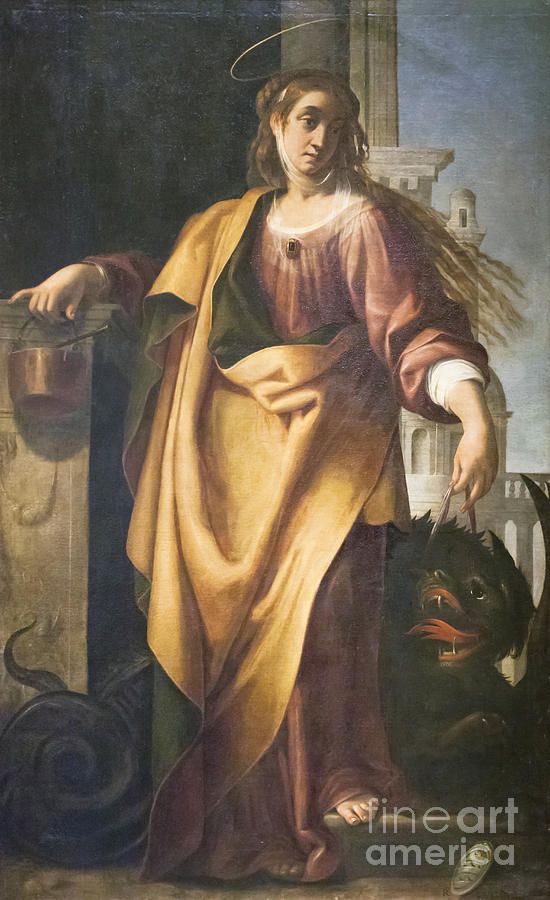
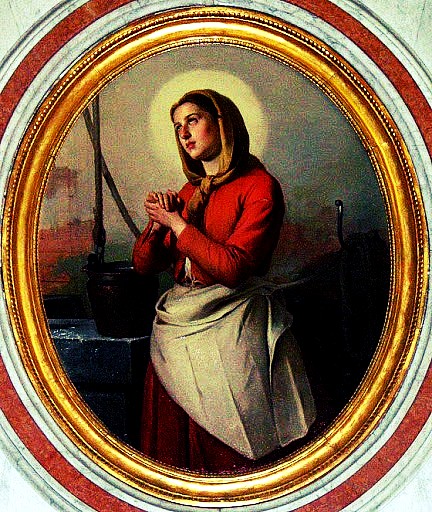
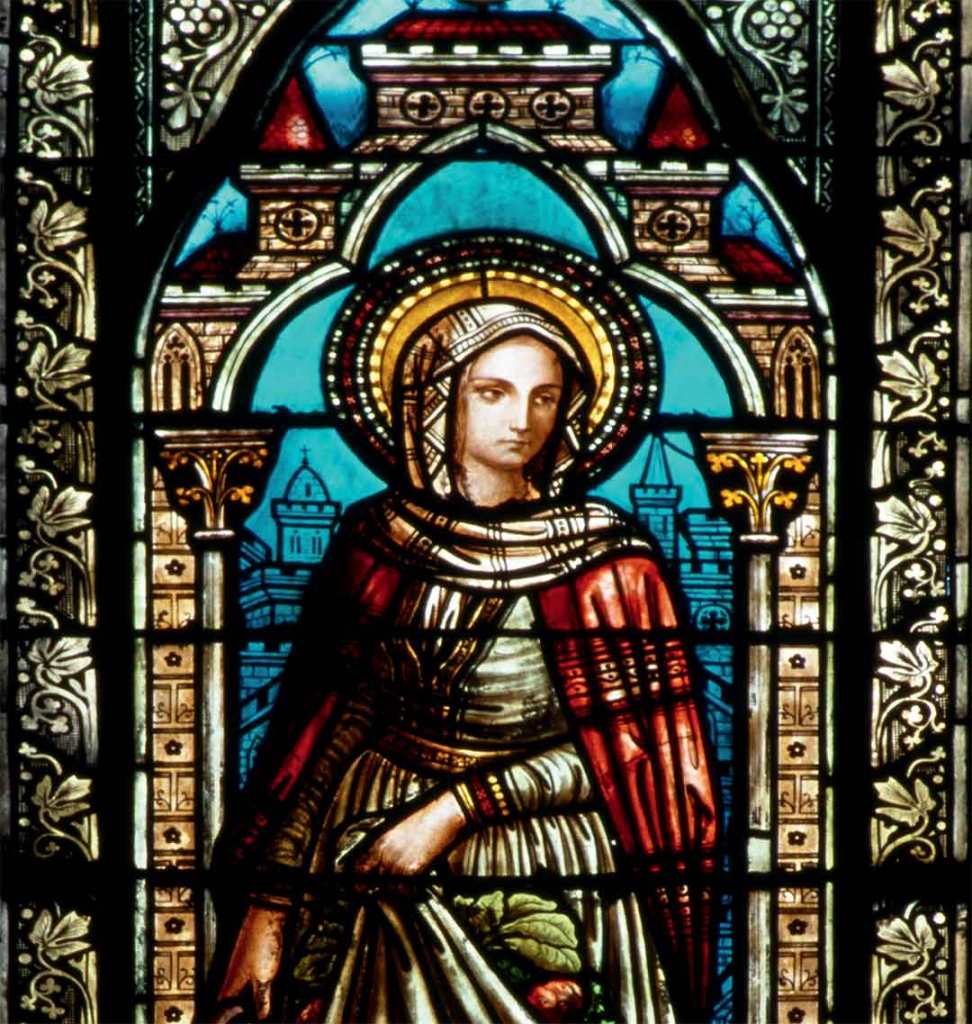
Saint of the Day – 1 September – St Verena (c260-c320) Virgin, Recluse, Ascetic, Apostle of the sick, gifted with the charism of curing illness and by her prayers, healing the sick, Miracle-worker. Born in Egypt in c260 and died in Tenedo, today (Bad) Zurzach, in Switzerland. Also known as – Verena of Zurzach, Verena of Thebes. Patronage – against eye ailments, children, fishermen, for male offspring, housewives, especially those serving in a presbitory, mariners, sailors, millers, nurses, poor people, ship captains, – in Switzerland: Basel, Diocese of Zurich.

The Roman Martyrology reads today: “In Baden, in the Diocese of Constance, St Verena, virgin.

Verena was born to wealthy parents and Baptised in her hometown by Bishop Chaeremon of Nilopolis. She fell in love with a young Christian who was a member of the Theban Legion of St Maurice who was her cousin. When the Legion was ordered to Gaul by Emperor Maximilian around 300, Verena joined the entourage which travelled with the soldiers as far as Milan . There she lived in the house of the holy man St Maximus and fed and buried fellow Christian. When she heard of the beheading of St Maurice and his followers in Agaunum, she went there to bury them.

Then she travelled on to Solothurn, where Victor – according to some versions of the legend, her fiancé – and Ursus had also been Martyred. She settled there in a hermitage, a cave in the Verena Gorge near Solothurn which was later named after her and lived there as an ascetic.
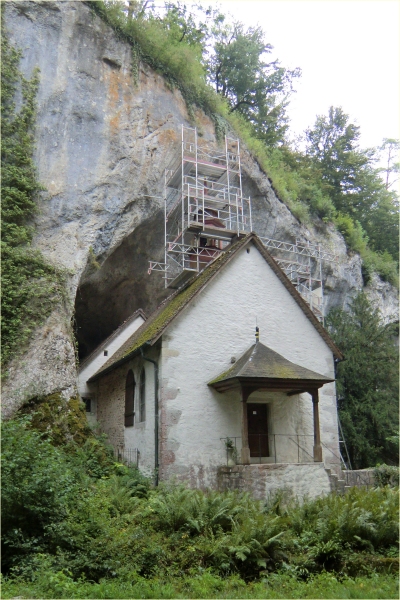
Martins Chapel, behind it the cave in which Verena is said to have lived, at the Hermitage
in the St Verena Gorge near Solothurn

Verena often sought out lepers outside the gates of the City of Solothurn to wash them. Because of her healing powers, Verena was considered a Saint by the people; the sick sought her assistance and prayers in her hermitage through her miracles. Soon many young women joined her and formed a community. Verena supported herself and the these young women by selling handicrafts and converted many Alemanni to the Faith in Christ but was eventually imprisoned by the anti-Christian City Commander, Hirtacus. In prison, St Maurice appeared to her , radiant with heavenly light and strengthened her faith. When Hirtacus fell ill and was healed by Verena, he released her but expelled her from the City.

Verena is said to have then floated down the Aare River on a flat stone—or a millstone. In Koblenz, then a small Roman settlement, she made a long stop on an island in the Rhine, freed it of snakes and once again devoted herself to nursing the ill.

Island near Koblenz at the mouth of the Aare (right) into the Rhine (left)

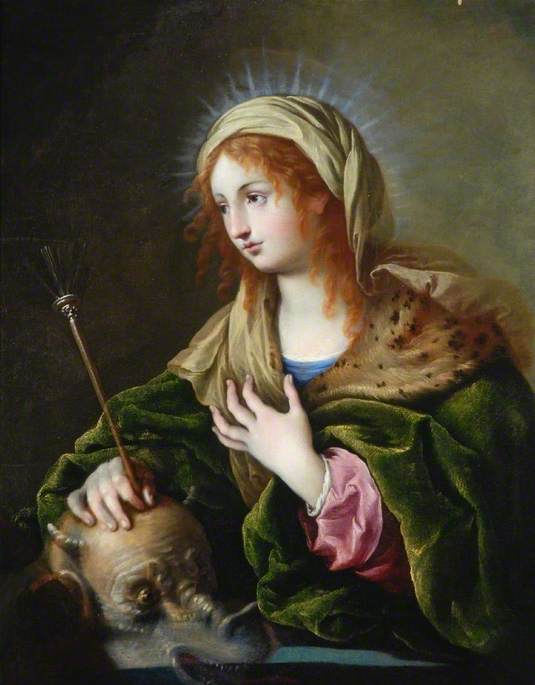
Then she came to the nearby Roman Fort of Tenedo – present-day Zurzach (Bad) – where she became the Priest’s domestic servant. Everyday, carrying a jug and comb, she went outside the City walls to wash the lepers. When she was accused of unlawfully carrying wine and bread to the poor, the wine turned into water. The Priest’s ring, which he refused to wear during Lent, was given to her for safekeeping. A servant, fearing discovery, stole it and threw it into the Rhine. A fisherman brought a large fish as a gift, and Verena cut it up and found the ring.

The Priest then had a cell built for her in Zurzach where, until her death, she washed the heads of the sick with the healing waters of a spring, combed their hair, healed them and anointed them. In her hour of death, Our Lady Mary appeared to Verena with many holy women who guided her to Heaven.
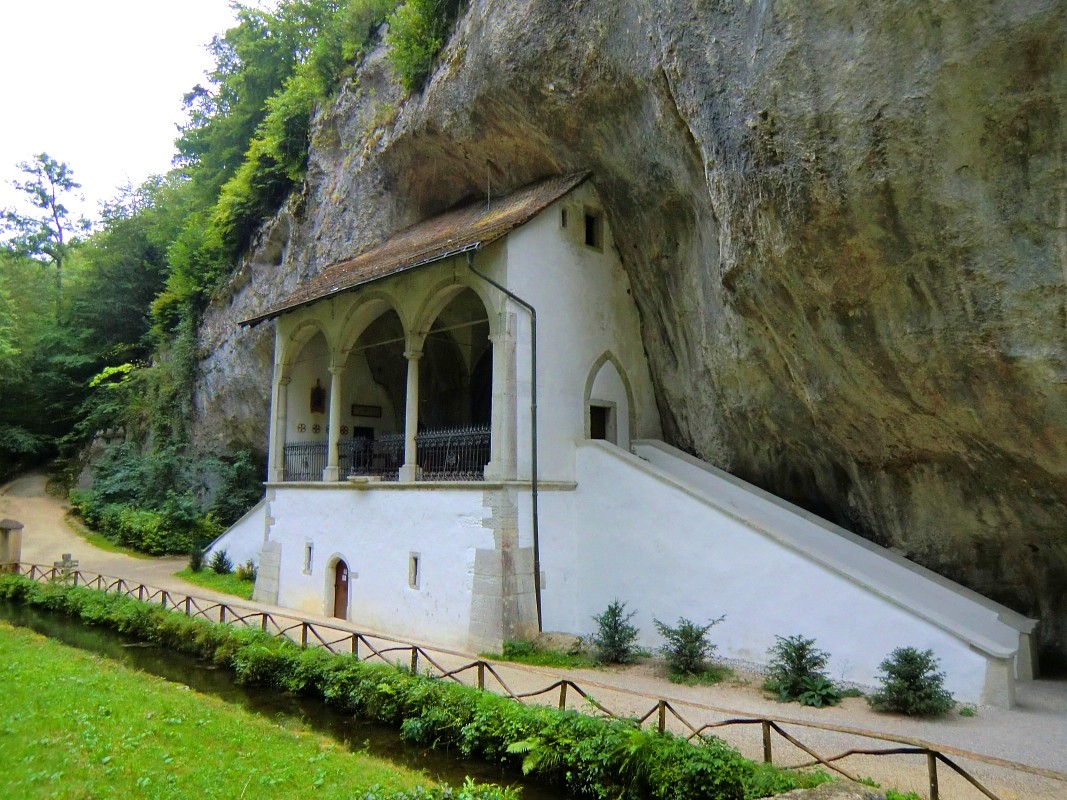
St Verena Chapel at the Hermitage in the St. Verena Gorge near Solothurn

Probably in the 5th Century – proven by archaeological finds – a Church was built over Verena’s grave which lay in a burial ground near an old Roman Fort on the Roman road – on the site of the Cathedral in Bad Zurzach which is now named after St Verena In around 745, a Benedictine Monastery was opened there. This Monastery was converted into a Canonry in the 13th Century and dissolved in 1876.

The first biography was written in 888 in Reichenau Monastery by the Benedictine Abbot Hatto, later Archbishop of Mainz; a further Vita with additions about her work in Koblenz and Zurzach was probably written in the Zurzach Monastery in the 10th Century and a collection of her miracles followed around 1000. Although heavily interspersed with legendary elements, they probably contain a historical core. The gravestone of her Sarcophagus was erected in 1613.
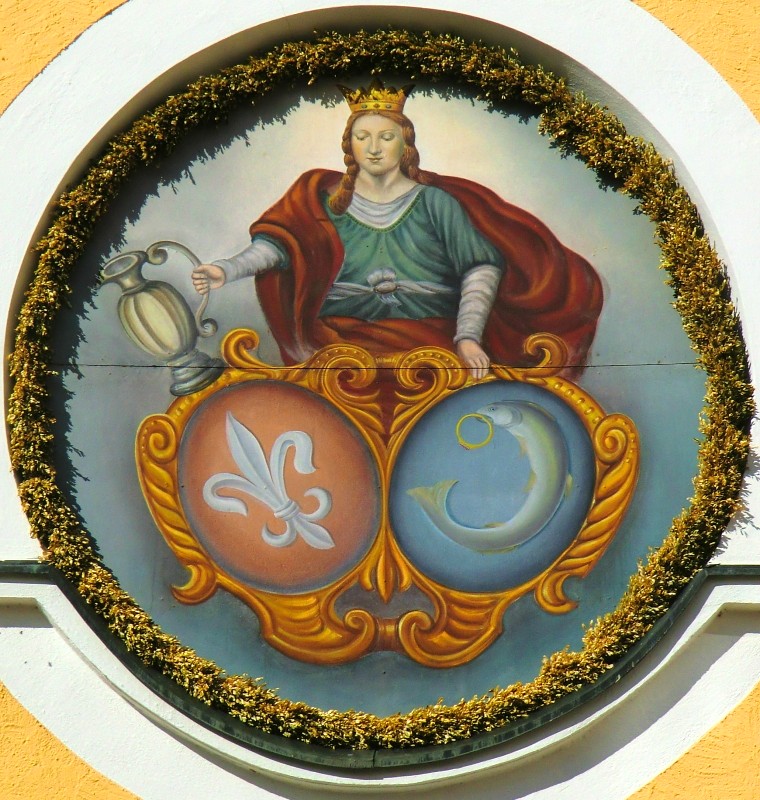
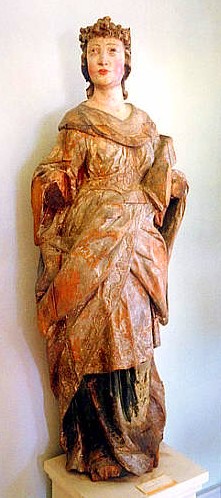
St Verena depicted at the Monastery Church in Rot an der Rot

The St Verena Minster in Bad Zurzach houses the arm Relic a valuable piece of gold from the 14th Century. Relics are also kept in the Minster in Radolfzell . The Church of the Monastery in Rot an der Rot, is dedicated to her. The small Church of St Verena in Rotholz near Lengstein/Longostagno – a district of Ritten near Bolzano – first mentioned in documents in 1256, is also named after her.
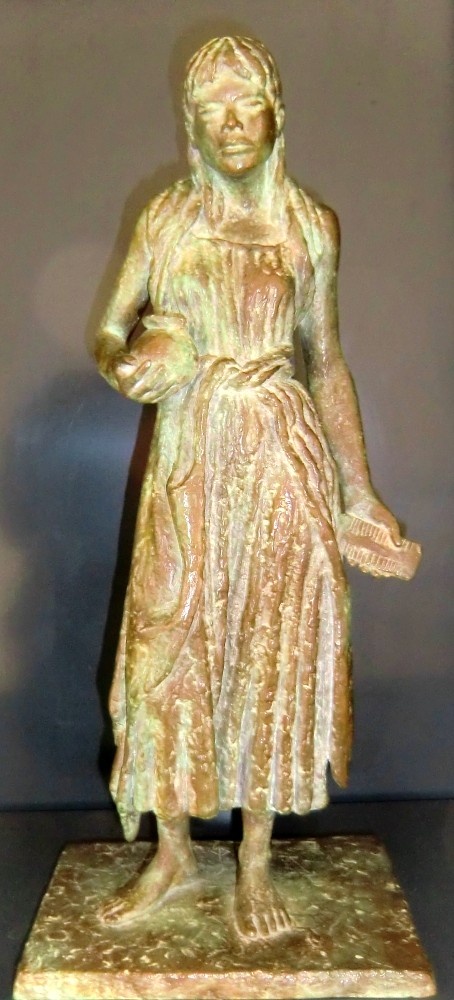

Gold figure at the Fountain in the Cathedral in Bad Zurzach
Posted in PATRONAGE - HOUSEWIVES, PATRONAGE - LOST KEYS/LOST ARTICLES, PATRONAGE-INFERTILITY & SAFE CHILDBIRTH, SAINT of the DAY

Saint of the Day – 26 July – St Anne, Mother of the Blessed Virgin Mary,

Saint of the Day – 26 July – St Anne, Mother of the Blessed Virgin Mary, Grandmother of Jesus. The name Anne from the Hebrew commonly believed to mean “grace” but St Augustine says (City of God) that it in fact means ,“by the grace of God.”
Patronages – against poverty, against sterility or infertility, broommakers, cabinetmakers, carpenters,of childless couples, equestrians, expectant mothers and mothers, childbirth, grandmothers, grandparents, housewives, lace makers, lost articles, miners, old-clothes dealers, the poor,, seamstresses, stablemen, turners, Canada, France, Micmaqs, 4 Diocese, 18 Cities.

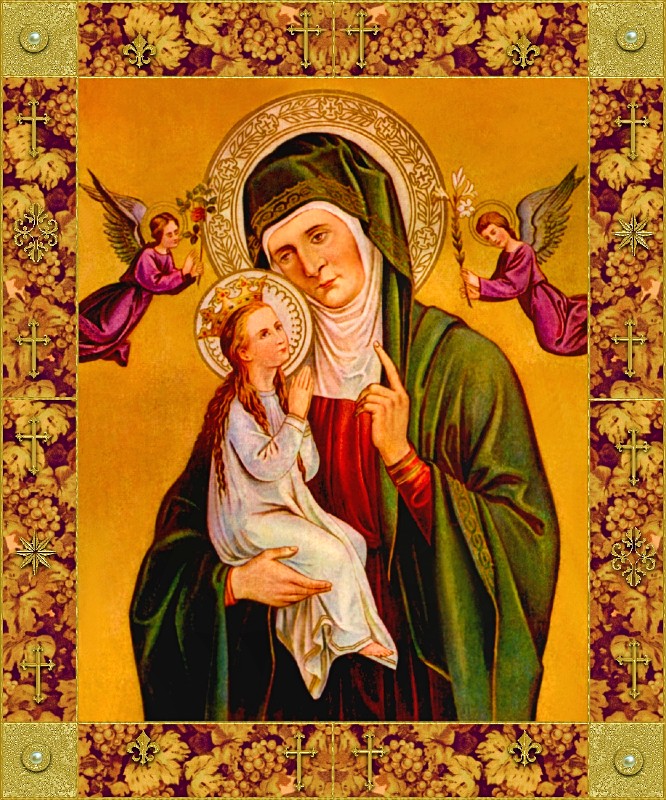
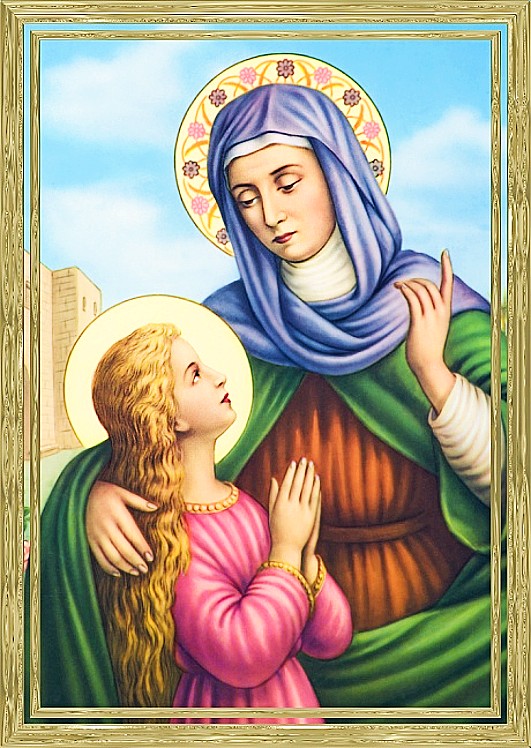
St. Anne, Mother of the Blessed Virgin Mary
By Fr Francis Xavier Weninger SJ (1805-1888)

St Anne, the mother of the Blessed Virgin, was a native of Bethlehem, a City two miles distant from Jerusalem, frequently mentioned in Holy Writ. Having passed her youth in unstained purity, she was married to a man named Joachim, who was born at Nazareth in Galilee, with whom she lived in such love and harmony and, at the same time, so piously, that one could justly say of them, what St. Luke writes of Zachary and Elizabeth: “They were both just before God, walking in all the commandments and justifications of the Lord without blame.” They divided their income into three parts, the first of which was used for the honour of God and to adorn the Temple, the second to assist the poor and the third, for their own subsistence. They employed the day in prayer, work suitable to their station in life and charitable deeds.

Their only grief was, that, although so long married, they had no issue and a barren marriage was, at that time, considered a disgrace, nay almost a sign of a Divine curse. Saddened by this sorrow, St Anne, as well as her spouse, prayed with many sighs and tears, that God would take pity on them and remove the disgrace that was weighing them down. But when, after having prayed long and earnestly, they were not heard, they determined to bear patiently the will of the Almighty. As, however, St Anne knew that God required continual prayer and ,that He had not given to men a certain time to ask for grace, she ceased not to implore eaven with great confidence, for all that she believed was for His honour and her own salvation .

Being one day in the Temple, she felt her distress so deeply, that she wept bitterly,but she remembered, at the same time, that there had been another Anne, spouse of Elcana, who had been afflicted as she was but whose prayers, God at last had answered, making her the mother of the great prophet Samuel. While thinking of this, she perceived in herself, an invincible desire to beg the Lord for a like grace. Hence, she repeated her prayer with earnest fervour, promising, at the same time, that if God would grant her a child, she would consecrate it in the Temple, to His Divine service, as the above-mentioned Anne had done.

God answered the trusting, tearful prayer of His servant,and sent her, according to the opinion of the Holy Fathers, an Angel, who announced to her that she would give birth to a child who blessed among women, would become the Mother of the long expected Saviour of the world. It is also believed, that the Angel told St Anne the name which she should give to the blessed fruit of her womb. The same revelation was made to St Joachim and the happiness of both and their gratitude to the Almighty, can be easily imagined. Their happiness was crowned when St Anne gave birth to her, who was elected by God from all eternity, to become the Mother of His Only Son.

Who can describe the joy with which Anne pressed her newborn child to her heart, or the solicitude and love with which she brought it up? The knowledge that her blessed daughter was chosen by God to so great a dignity, was incentive enough, to leave nothing undone for her welfare. The mind of the blessed child was so far beyond her years and her whole being, so angelically innocent, that her education was an easy task and St Anne deemed herself, the happiest mother in the world because God had entrusted to her, so priceless a child. The graces which, through the presence of the Blessed Virgin, she received from Heaven, cannot but have been innumerable . For if, in after times, the house of Elizabeth and Zachary was, by a visit from Mary, filled with Heavenly blessings, who can doubt, that St Anne, who was the mother of the Blessed Virgin, was gifted with extraordinary graces?

Knowing, however, that Mary was not only a precious treasure lent her by Heaven but also, had consecrated herself to the service of the Almighty, St Anne did not fail to return to God, what she had received from Him and to offer willingly, what she had so willingly promised. Hardly had Mary reached the age of three years, when Anne and Joachim went with her to the temple at Jerusalem and presenting her to the Priest, consecrated her through him to the Almighty. Nothing could have been more painful to the pious parents than to separate from so perfect a child but, as they were more zealous for the glory of God, than for their own joy, even though it was so pious, they made this sacrifice without complaining. Thus Mary was received among the number of those who, under the direction of the priests, served God in the Temple and were led in the path of virtue.

After they had piously offered this agreeable sacrifice, the parents of the Blessed Virgin returned home and spent the remainder of their days in good works, which were continued by St Anne, when she became a widow by the death of her holy spouse. As she had been an example to the virgins, before her marriage, as well as a perfect model of a wife, so also was she, in her widowhood, a shining light, for all those qualities which St Paul,afterwards required of a Christian widow, in his first Epistle to Timothy. She went frequently to Jerusalem to see her holy daughter and died, according to several authors, in the 79th year of her age. Mary, who at that time still lived in the temple, closed her eyes.

As one cannot give to the Blessed Virgin a higher title than to call her, Mother of God, thus St Anne, cannot be more exalted, than when she is called the mother of her, who bore the Son of God. And for the very reason, that she was chosen to be her mother, we must believe, that the Almighty favoured her here upon earth, with grace above all the Saints and raised her to high glory in Heaven. Hence we may rightly suppose, that her intercession with God, is most powerful and this is also testified by many examples.

Posted in Of TRAVELLERS / MOTORISTS, PATRONAGE - HOUSEWIVES, SAINT of the DAY

Saint of the Day – 29 July – St Martha Virgin (1st century) 

Saint of the Day – 29 July – St Martha Virgin (1st century) – Sister of Saint Lazarus and Saint Mary of Bethany. Friend of Jesus and hostess to him in her house.ACCS-Martha-e1469752916611Christ_in_the_House_of_Mary_and_Martha

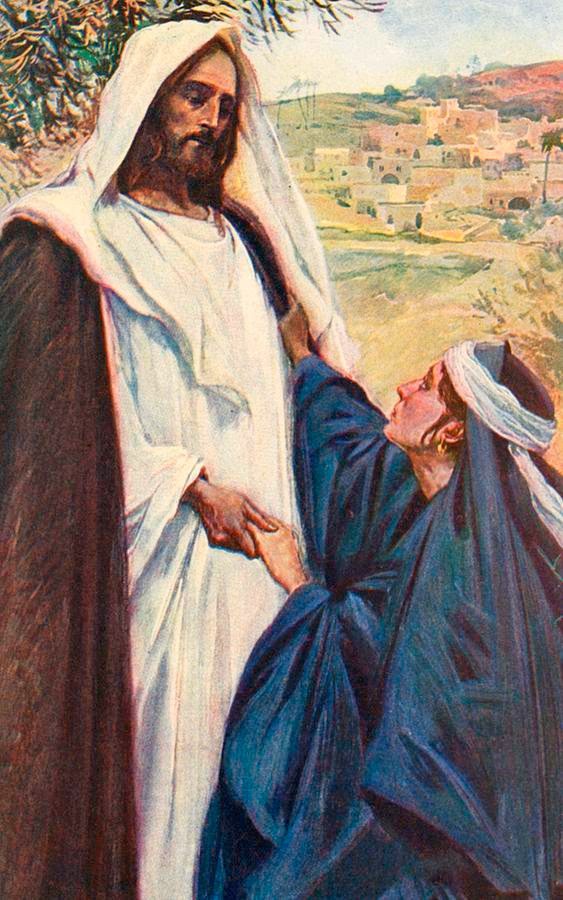
St John tells us that “Jesus loved Martha and Mary and Lazarus” and yet but few glimpses are vouchsafed us of them.   First, the sisters are set before us with a word.   Martha received Jesus into her house and was busy in outward, loving, lavish service, while Mary sat in silence at the feet she had bathed with her tears.   Then, their brother is ill, and they send to Jesus, “Lord, he whom Thou lovest is sick.”   And in His own time the Lord came and they go out to meet Him and then follows that scene of unutterable tenderness and of sublimity unsurpassed:  the silent waiting of Mary, Martha strong in faith but realising so vividly, with her practical turn of mind, the fact of death and hesitating:  “Canst Thou show Thy wonders in the grave?”   And then once again, on the eve of His Passion, we see Jesus at Bethany.   Martha, true to her character, is serving; Mary, as at first, pours the precious ointment, in adoration and love, on His divine head.meeting-of-jesus-and-martha-corwin-knapp-linson

According the tradition we find the tomb of St Martha, at Tarascon, in Provence.   When the storm of persecution came, the family of Bethany, with a few companions, were put into a boat, without oars or sail and borne to the coast of France.    St Mary’s tomb is at S. Baume;  St Lazarus is venerated as the founder of the Church of Marseilles;  and the memory of the virtues and labours of St Martha is still fragrant at Avignon and Tarascon.

Reflection:  -When Martha received Jesus into her house, she was naturally busy in preparations for such a Guest.   Mary sat at His feet, intent alone on listening to His gracious words.   Her sister thought that the time required other service than this and asked our Lord to bid Mary help in serving.   Once again Jesus spoke in defence of Mary. “Martha, Martha,” He said, “thou art lovingly anxious about many things, be not over-eager, do thy chosen work with recollectedness.   Judge not Mary.   Hers is the good part, the one only thing really necessary.   Thine will be taken away, that something better be given thee.”   The life of action ceases when the body is laid down but the life of contemplation endures and is perfected in heaven.Cignaroli, Giambettino, 1706-1770; St Martha

Posted in Of TRAVELLERS / MOTORISTS, PATRONAGE - HOUSEWIVES, SAINT of the DAY, Spinsters - Single LAYWOMEN

Saint of the Day – 29 July – St Martha (1st Century) Virgin Martyr

Saint of the Day – 29 July – St Martha  (1st century), Virgin Martyr – sister of St Lazarus and St Mary of Bethany. Friend of Jesus, and hostess to him in her house.    May have been part of an early mission to France.   Died – c.80 of natural causes.   Patronages –  butlers• Congregation of Martha and Mary (founded in 1979)• cooks (proclaimed on 1 July 1963 by Pope Paul VI)• dieticians • domestic servants• homemakers • hotel-keepers• housemaids• housewives• innkeepers (proclaimed on 1 July 1963 by Pope Paul VI) • laundry workers • maids• manservants • servants• servers• single laywomen• travellers• Villajoyosa, Spain (chosen after a flash flood saved the village from Moorish invaders on her feast day in 1538).  

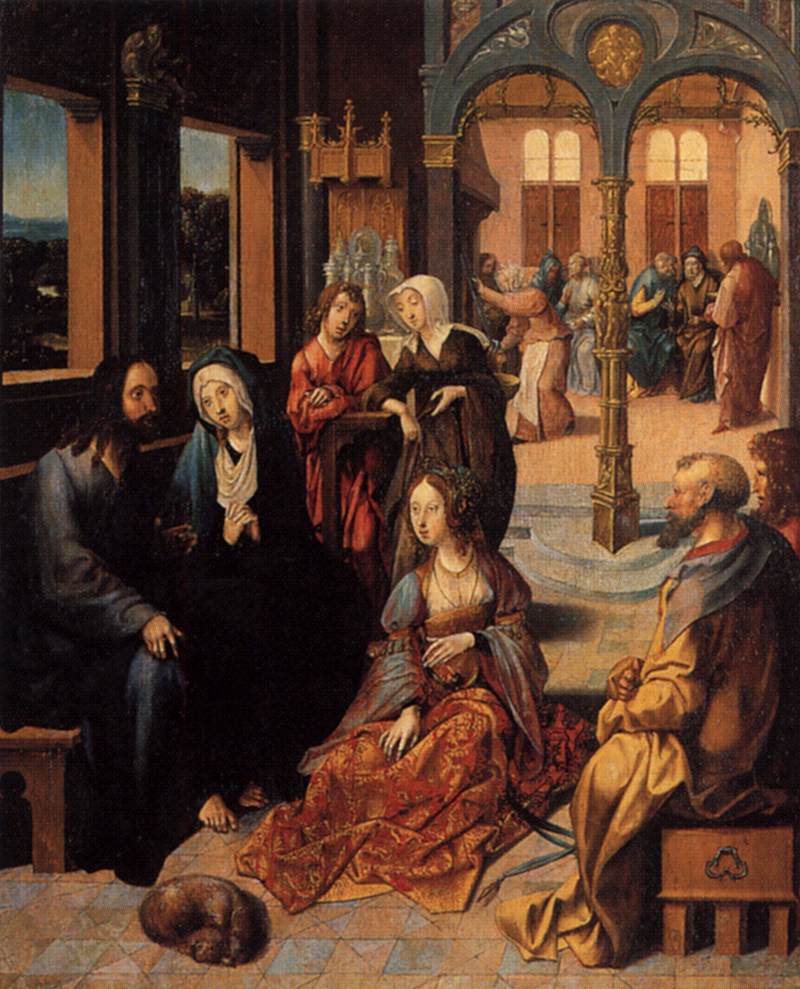
Christ at the House of Martha and Mary of Bethany, Jacob Jordaens

One of the most precious things in life is to have a home where you can go at any time and find people who accept, love, and understand you.   Jesus found such a home in Bethany, at the house of a woman named Martha.   She welcomed Him and served Him and they developed a special bond of friendship.   One of these visits has ever remained dear to Christian memory.   On that occasion Martha, busily serving the Master, asked Him to persuade Mary to help her.   Without in any way reproaching Martha, Jesus explained to her that certain souls, called by God, should choose a better part still — the primary duty of listening to Him and contemplating Him.

Martha lived with her sister Mary.   Like many other pairs of sisters, these two women were different in personality.   Martha was energetic and outspoken, while Mary was quiet and reflective.   Jesus loved both of them and appreciated the gifts that each one had.

The Gospel of Luke records that once, when Jesus was visiting, Martha prepared the meal while Mary sat talking to their visitor.   Martha complained that Jesus should tell Mary to help her.   Jesus said that because Martha was worrying so much about the work, she did not have time to enjoy being with Him and listening to His words.

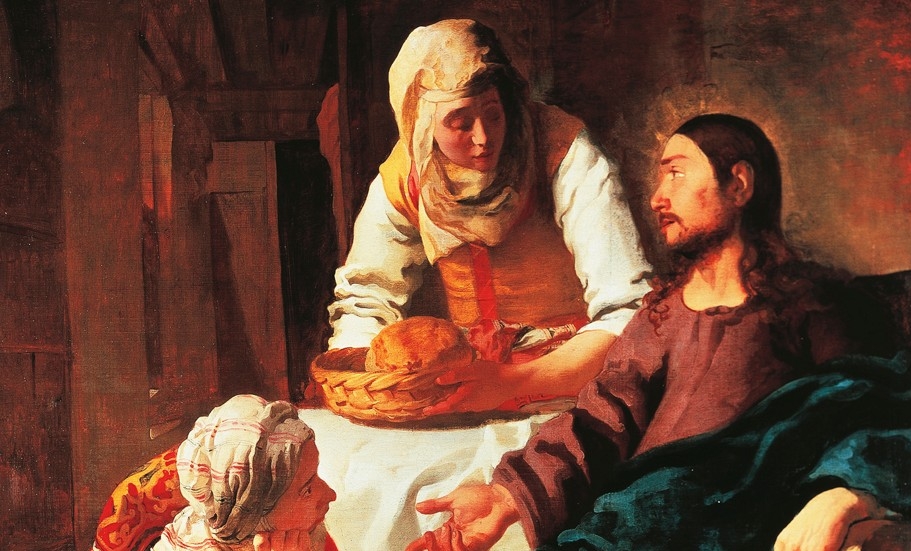
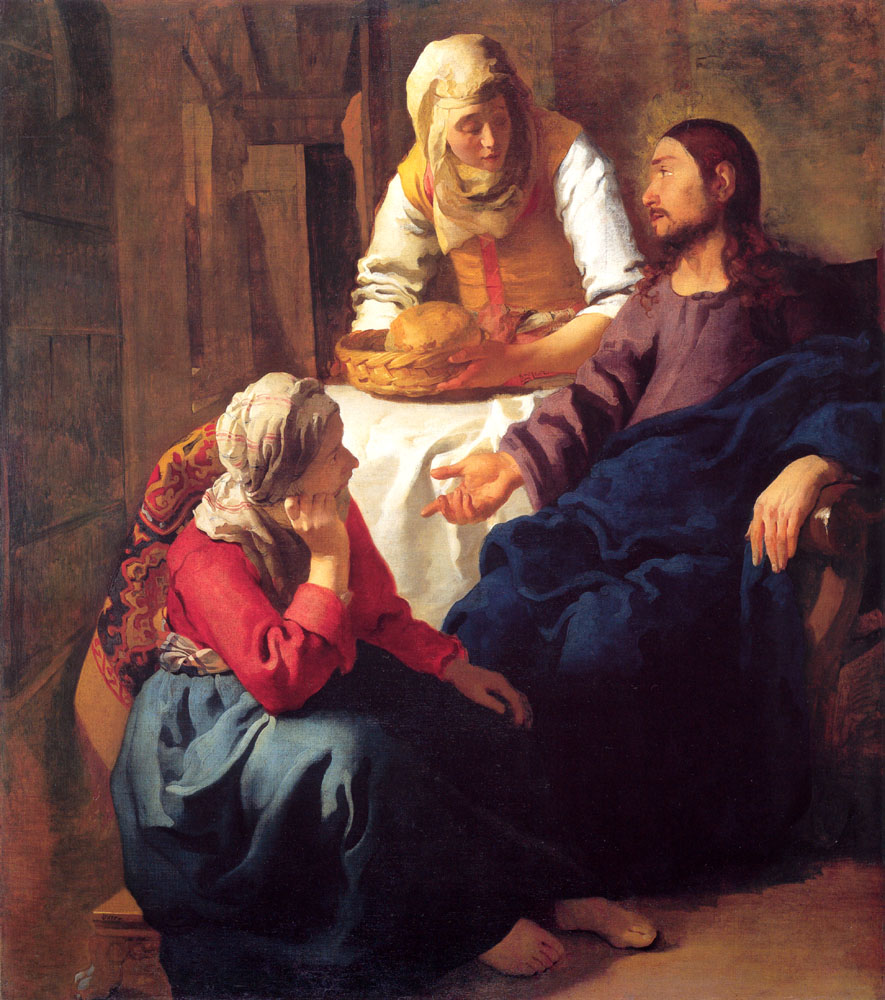
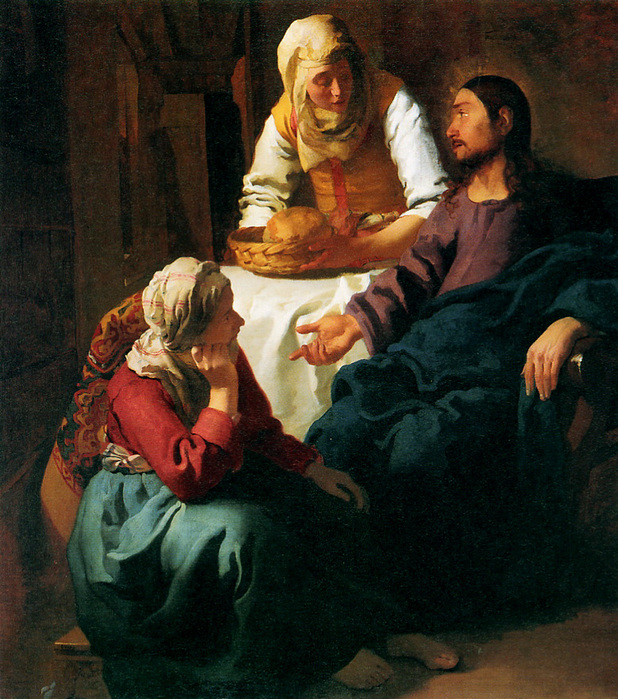
Christ in the House of Martha and Mary, by Jan Vermeer Van Delft, 1654
Christ with Martha and Mary
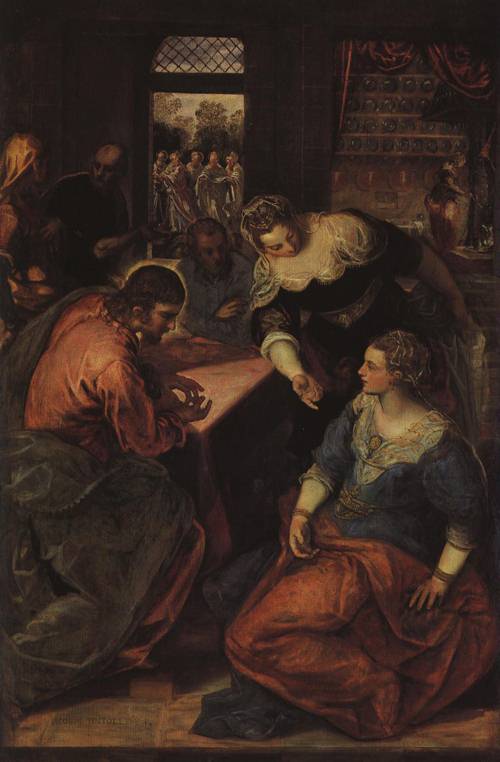
Tintoretto_1580_XX_Christ_in_the_House_of_Mary_and_Martha_(St._Martha)

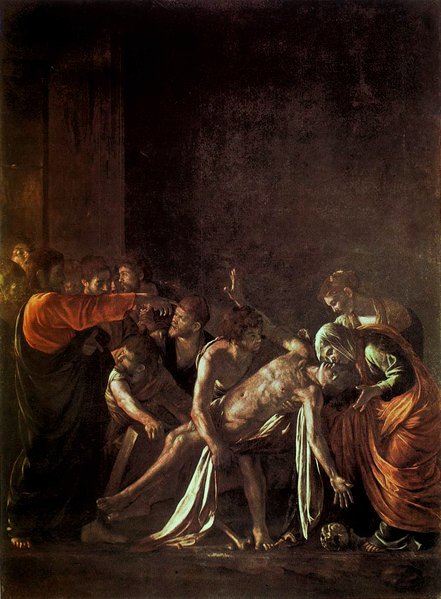
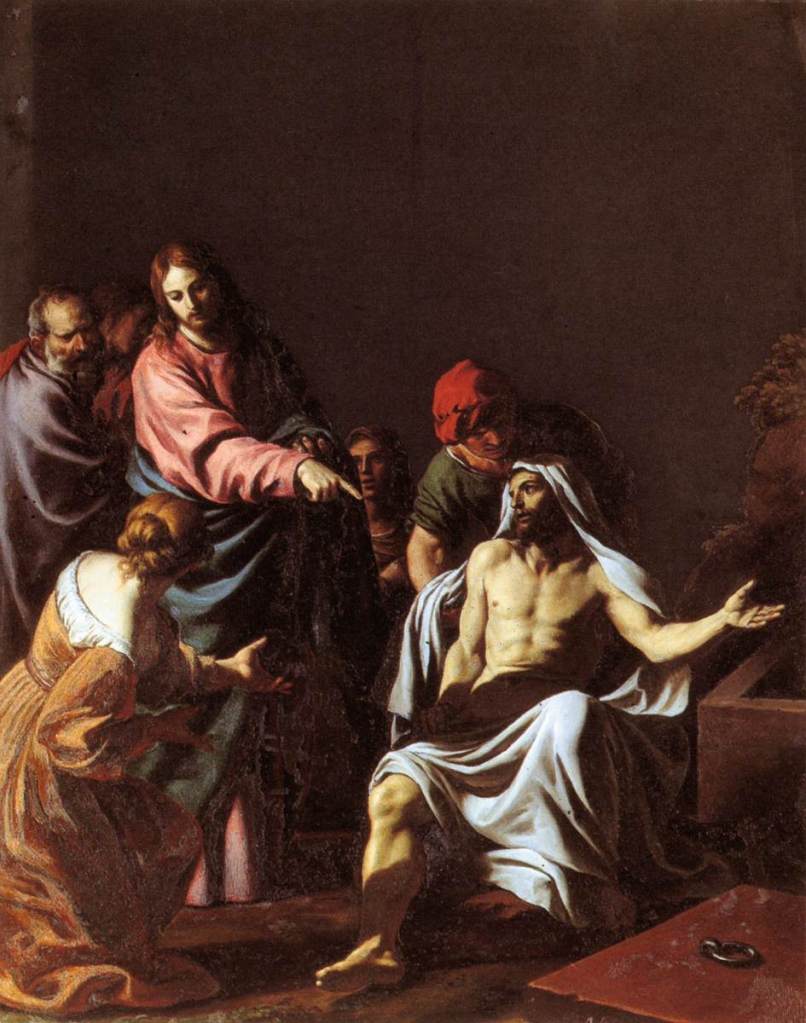
Another time recorded in John’s Gospel, the sisters sent a message to Jesus that their brother, Lazarus, was ill.   They knew Jesus would come and cure him; they trusted in His loving care for them.   When Jesus finally came, Lazarus had already been dead for four days.   As soon as she heard that Jesus was nearby, Martha, a woman of action, went out to meet Him, while Mary stayed in the house.   In her grief, Martha told Jesus honestly what she had expected from Him.   Jesus asked her to believe that He was the resurrection and that He had power to give eternal life to all who believe in Him. Without really understanding this mystery, Martha trusted Jesus totally and said,  “I believe that you are the Christ, the Son of God, the one who was to come into this world” (John 11:27).   That day Jesus raised her brother Lazarus from the dead, showing that He has power over life and death and power to give eternal life.

The home Jesus found in Bethany was not only in the house but in the faithful heart of a woman named Martha.

Giovanni Bagliione - St. Martha
st martha
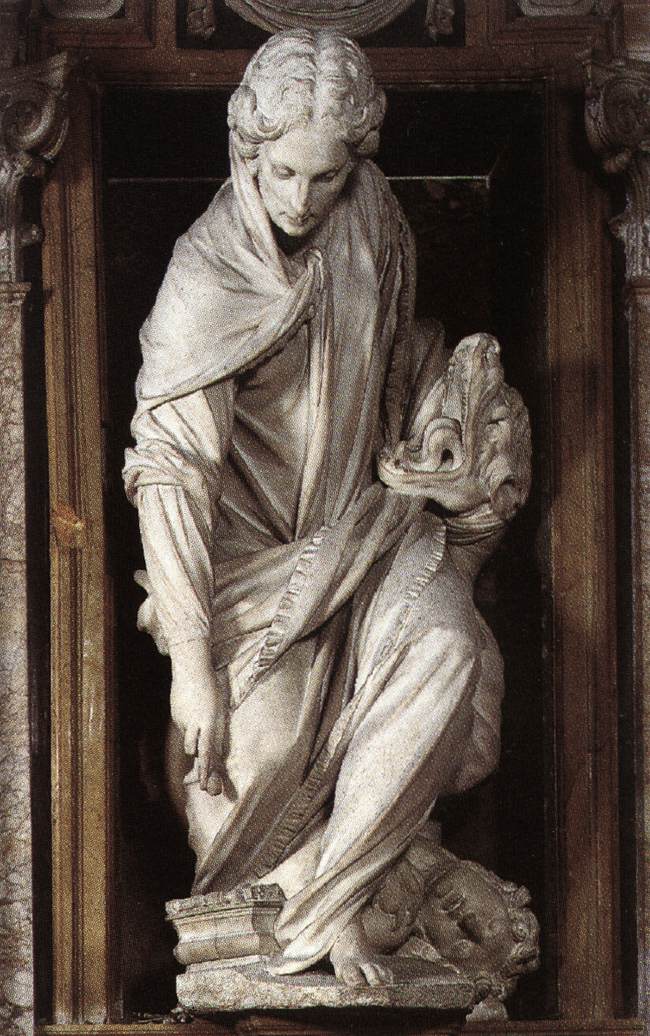
St. Martha by Francesco Mochi
St. Martha [Large]
Posted in INCORRUPTIBLES, PATRONAGE - HOUSEWIVES, PATRONAGE - LOST KEYS/LOST ARTICLES

Saint of the Day – 27 April – St Zita of Lucca

Saint of the Day – 27 April – St Zita of Lucca (1212-1272) Virgin, Apostle of the needy and poor. Also know as Cita, Sita, Citha, Sitha. P atronages – housewives, butlers, housemaid, domestic servants (proclaimed by Pope Pius XII), housemaid, lost keys, maids, manservants, people ridiculed for their piety,rape victims, servants, servers, single laywomen, waiters, Lucca, Italy. Her body is incorrupt.

Saint Zita was born in Tuscany in the village of Monsagrati, not far from Lucca where, at the age of 12 she became a servant in the Fatinelli household.    For a long time, she was unjustly despised, overburdened, reviled and often beaten by her employers and fellow servants for her hard work and obvious goodness.    The incessant ill-usage, however, was powerless to deprive her of her inward peace, her love of those who wronged her, and her respect for her employers.    By this meek and humble self-restraint, Zita at last succeeded in overcoming the malice of her fellow-servants and her employers, so much so that she was placed in charge of all the affairs of the house.    Her faith had enabled her to persevere against their abuse and her constant piety gradually moved the family to a religious awakening.

Zita often said to others that devotion is false if slothful.    She considered her work as an employment assigned to her by God and as part of her penance and obeyed her master and mistress in all things as being placed over her by God.    She always rose several hours before the rest of the family and employed in prayer a considerable part of the time which others gave to sleep.    She took care to hear Mass every morning with great devotion before she was called upon by the duties of her station, in which she employed the whole day, with such diligence and fidelity that she seemed to be carried to them on wings and studied when possible to anticipate them.

One anecdote relates a story of Zita giving her own food or that of her master to the poor. On one morning, Zita left her chore of baking bread to tend to someone in need.    Some of the other servants ensured the Fatinelli family was aware of what happened; when they went to investigate, they claimed to have found angels in the Fatinelli kitchen, baking the bread for her.
St. Benita Zita died peacefully in the Fatinelli house on April 27, 1272.    It is said that a star appeared above the attic where she slept at the moment of her death.    She was 60 years old and had served and edified the family for 48 years.   By her death, she was practically venerated by the family.    After one hundred and fifty miracles wrought in the behalf of such as had recourse to her intercession were juridically proven, she was canonised in 1696.

Her body was exhumed in 1580, discovered to be incorrupt   St Zita’s body is currently on display for public veneration in the Basilica di San Frediano in Lucca.

To this day, families bake a loaf of bread in celebration of St. Zita’s feast day.    Soon after Zita’s death a popular cult grew up around her, centring on the church of St Frigidian in Lucca.    This was also joined by prominent members of the city.    Pope Leo X sanctioned a liturgical cult within the church in the early 16th century, and was confirmed upon her canonisation.    In 1748, Pope Benedict XIV added her name to the Roman Martyrology.

During the late medieval era, her popular cult had grown throughout Europe.    In England she was known under the name Sitha and was popularly invoked by maidservants and housewives, particularly in event of having lost one’s keys, or when crossing rivers or bridges.    Images of St. Zita may be seen in churches across the south of England.    The church of St Benet Sherehog in London had a chapel dedicated to her,and was locally known as St. Sithes.