Posted in AUGUSTINIANS OSA, DOMESTIC ANIMALS, Of a Holy DEATH & AGAINST A SUDDEN DEATH, of the DYING, FINAL PERSEVERANCE, DEATH of CHILDREN, DEATH of PARENTS, Of the Holy Souls in PURGATORY, PATRONAGE - NEWBORN BABIES, YOUNG CHILDREN l, SAILORS, MARINERS, NAVIGATORS, SAINT of the DAY

Saint of the Day – 10 September – Saint Nicholas of Tolentino OSA (1245-1305) Confessor,

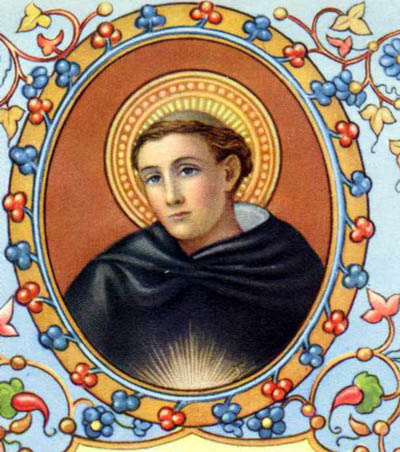
Saint of the Day – 10 September – Saint Nicholas of Tolentino OSA (1245-1305) Confessor, “The Patron of Holy Souls” Priest, Augustinian Friar Monk, Mystic, Preacher, Miralce-worker and Apostle of the poor, the sick, the needy. Patronages – animals, babies (reported to have raised more than 100 children from the dead), sailors, dying people, sick animals, the Holy Souls in Purgatory, 4 Cities, 3 Diocese. The Name Nicholas from the Greek means means: “the victor over the people.”

The Roman Martyrology reads today: “At Tolentino, in the March of Ancona, the departure from this life of St Nicholas, Confessor of the Order of Augustinians.

Nicholas was born in the angelic town of Sant’ Angelo in Pontano, Italy. An angel had advised his previously childless parents, to make a pilgrimage to the Tomb of St Nicholas of Myra and out of gratitude, they gave their son the name of the Saint.

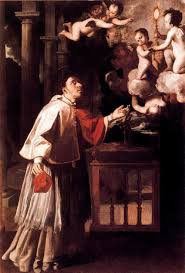
Nicholas was admitted into the Augustinian Hermits’ Order in 1255 , was Ordained a Priest in 1270 and initially, worked as a Preacher and Confessor. In 1275 he was sent to Tolentino , where he experienced miraculous confirmations from Angels whom he saw standing around the Altar.
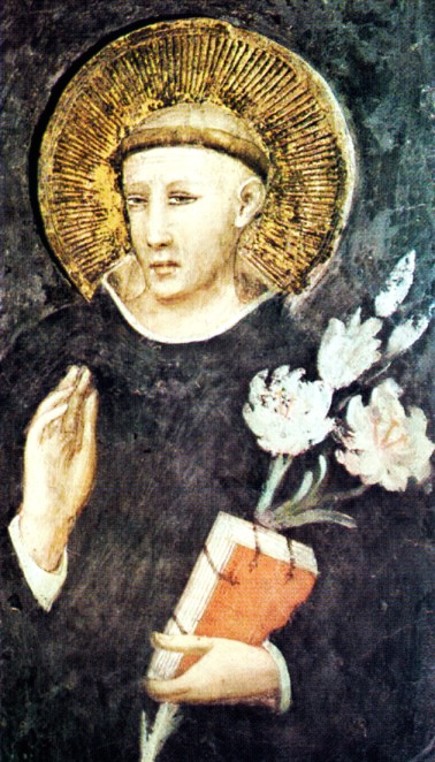
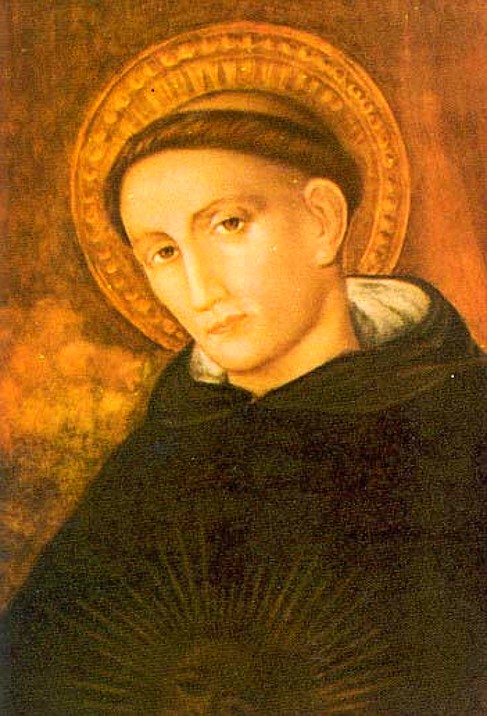
14th Century, painting now in the Basilica named after St Nicholas in Tolentino

Nicholas became a very popular Preacher and Shepherd of the sick and led a life of strict asceticism and active charity. He worked tirelessly as a pastor of the common people and cared for the poor and sick. It is said that miracles occurred through his intercession during his lifetime; his prayers had a healing effect, he overcame the devil who broke the lamp on the Altar and tried to harm others. Even when he was seriously ill, he refused to eat two roasted birds because of the mortification he had vowed but when he obediently obeyed the Prior’s command to take a bite, the partridges – alive – flew away.
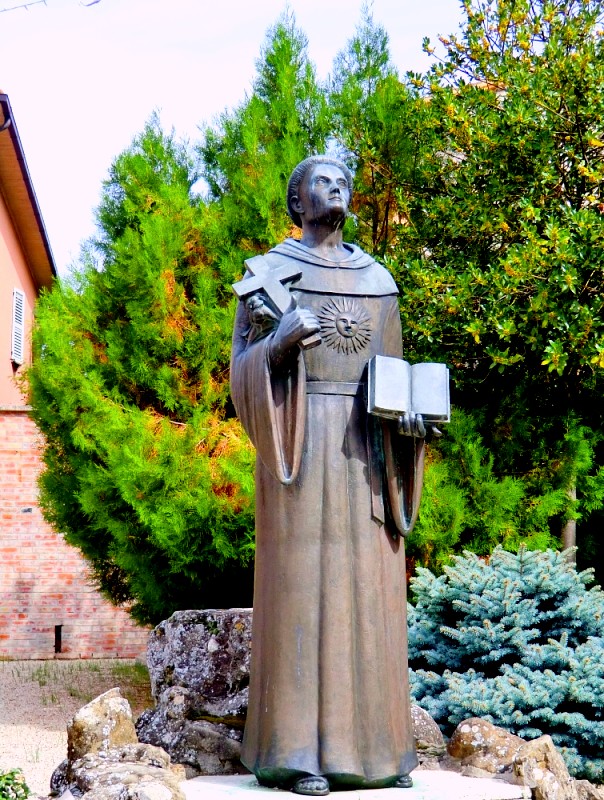
Statue at the site of Nicholas’ birthplace in Sant’ Angelo in Pontano, erected by the Municipality and population, on the 650th Anniversary of his death – 10 September 1955.

Nicholas’ Grave is in the Basilica in Tolentino which was built above it and named after him. He was not buried in the coffin originally intended for him which is in the large Chapel built for his veneration but under the floor, after his arms were taken as Relics. Numerous miracles occurred there and more than 300 were officially confirmed in the twenty years after his death alone. In 1926, his bones were rediscovered during excavations and were placed in a glass shrine and brought to the newly equipped Crypt. His Grave remains an important place of pilgrimage to this day.
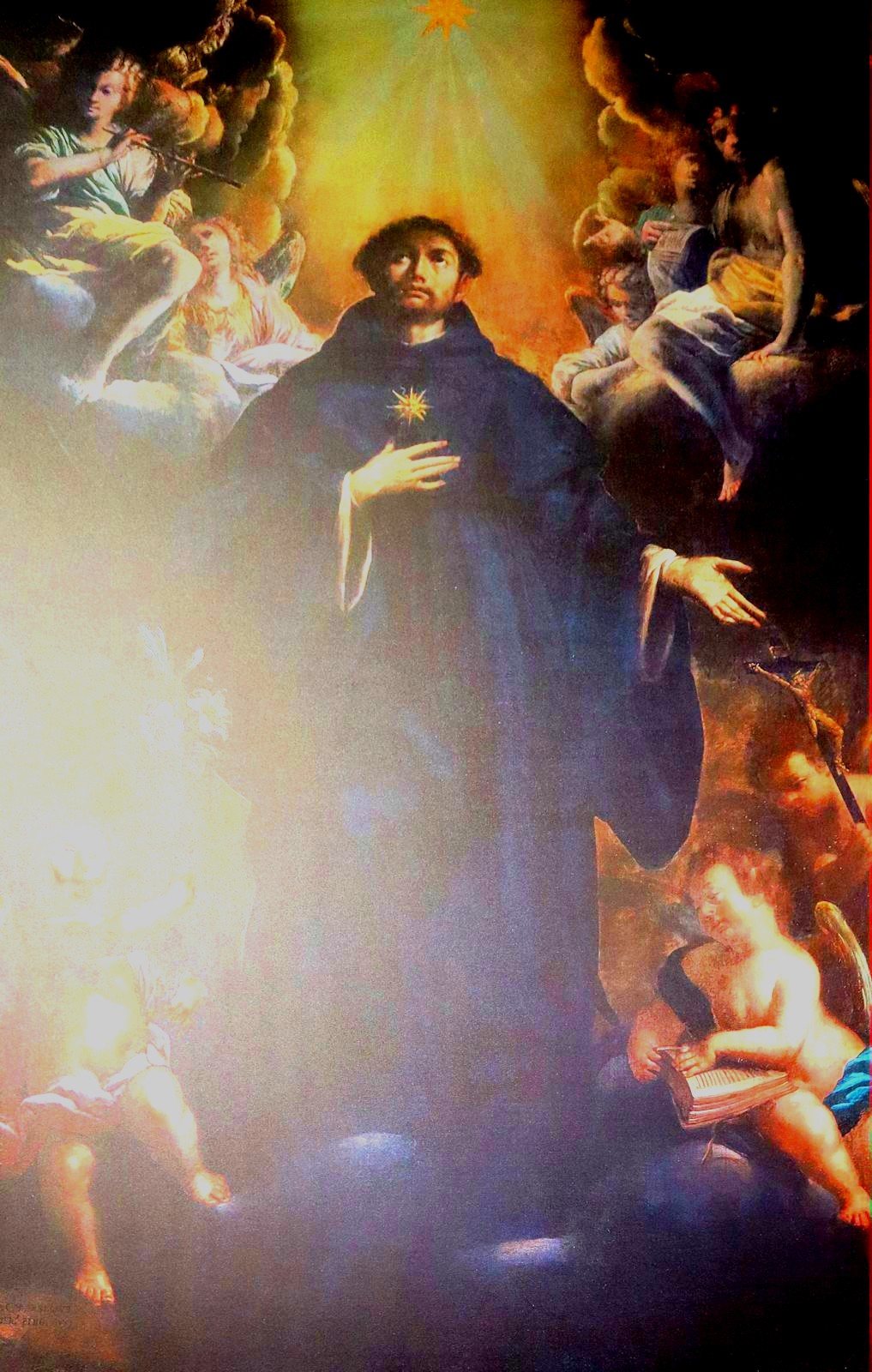
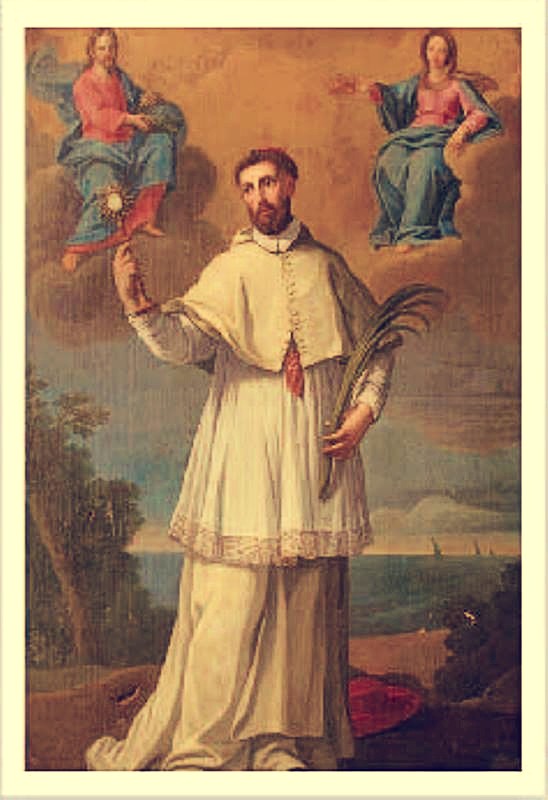
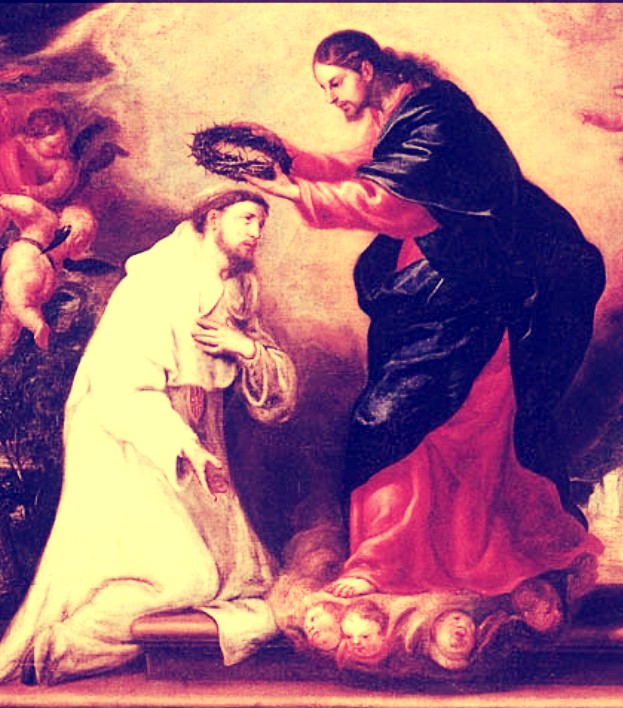
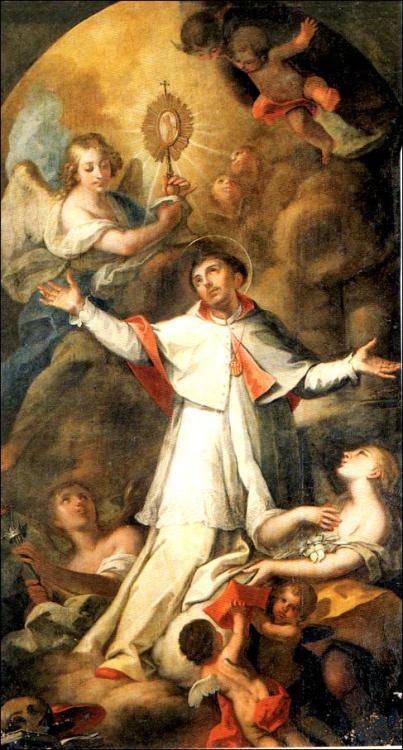
Gian Giacomo Barbelli: “Glorification of St Nicholas” 1653, in the Church of Sant’Andrea in Bergamo

From the 16th to the 18th Centuries, Nicholas was one of the most venerated Saints in Europe. In many Countries he is considered a helper in times of need. In Cordoba he became the Patron Saint of the City because his intercession ended a plague epidemic. In Venice the Church of San Nicola da Tolentino was dedicated to him for the same reason and there too, he became the Patron of the City. On his Feast Day, according to old custom, bread is blessed which is said to help against gout or is thrown into the flames of fires to contain them – the background is the story of how Nicholas was cured of a fever after asking an old woman for bread at the behest of the Blessed Virgin Mary.
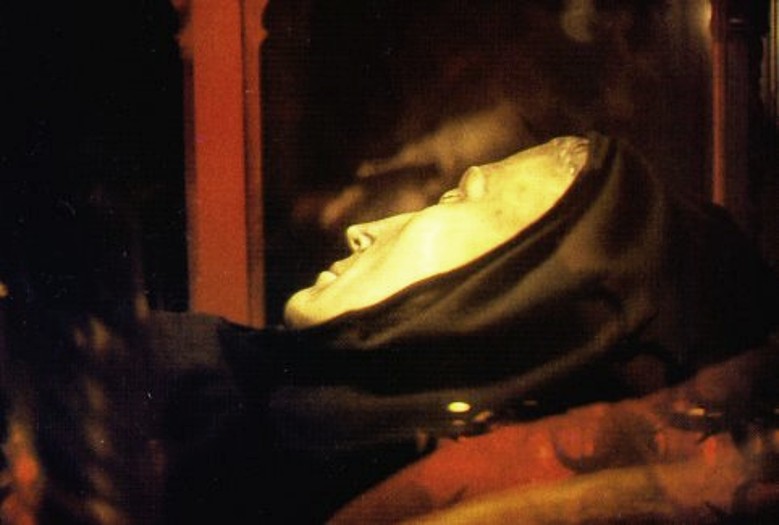
St Nicholas in a glass coffin in the Basilica di San Nicola in Tolentino

MORE on St Nicholas:
https://anastpaul.com/2017/09/10/saint-of-the-day-10-september-st-nicholas-of-tolentino-patron-of-holy-souls/

Posted in Against Unexplained FEVER or HIGH Temperatures, PATRONAGE - NEWBORN BABIES, YOUNG CHILDREN l, PATRONAGE-INFERTILITY & SAFE CHILDBIRTH, PREGNANCY, SAINT of the DAY

Saint of the Day – 31 August – St Raymond Nonnatus (1204-1240) Priest, Confessor

Saint of the Day – 31 August – St Raymond Nonnatus (1204-1240) Priest, Confessor, Cardinal, Friar of the Mercedarian Order.
Patronages – against gossip, of silence, against fever, of babies, infants, childbirth, children, pregnant women, falsely accused people, midwives, obstetricians, Baltoa, Dominican Republic, San Ramon, Costa Rica.  
Raymond was delivered by Caesarean operation when his mother died during childbirth – hence the name: non natus = not born.

Saint Raymond Nonnatus, Confessor
By Fr Francis Xavier Weninger SJ (1805-1888)

Catalonia, Spain, was the native country of St Raymund who, to the astonishment of the Physicians, was born after his mother’s death! As soon as he was old enough to comprehend how early he had become an orphan, he chose the Queen of Heaven as his mother and, to his last day, called her by no other name. When he had studied for some time with great success, his father, fearing the youth would enter a Religious Order, sent him into the too, opportunities to serve God. He became very fond of solitude and, therefore, chose for his occupation, the care of the sheep, in order to gain more time for prayer and meditation.

At the foot of the mountain to which he generally led his flock, was a small deserted hermitage, with a Chapel, in which an extremely lovely picture of the Blessed Virgin was kept, which was a source of great joy to him. There, he spent several hours daily, in devout exercises. Other shepherds, who observed this and to whom the piety of Raymund was a reproach of their own negligence, reported to his father that he was doing nothing but praying and, thereby neglected his flock. The father came to convince himself of the fact but, although he found his son praying in the Chapel, he saw that the flock was, meanwhile attended to by a youth of uncommon beauty of form and features. Asking his son who this young shepherd was and why he had engaged him, Raymund, to whom it was unknown that Providence had worked a miracle on his behalf, fell on his knees before his father and begging forgiveness, earnestly promised not to commit the fault again.

The Divine Mother, of Whom he begged the grace of knowing his vocation, appeared to him, saying that she desired him to take the habit of the newly established Order for the Redemption of Captives. He did so,and was sent to Algiers where he found a great many Christians in slavery and, as the money he had brought for their ransom was not sufficient, he offered himself as a hostage to redeem the others. He was induced to this by the danger in which the prisoners were of losing their faith and with it eternal life. This great and heroic charity gave him occasion to suffer much for the sake of Christ. At first, he was treated very harshly by his masters but when they began to fear that he would die before the ransom was paid, they allowed him more liberty which the holy man used, only for the salvation of the captive Christians. He strengthened them in their faith and, at the same time, endeavoured to convert the infidels.

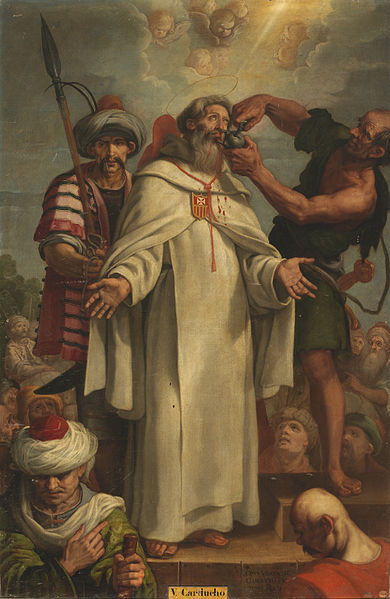
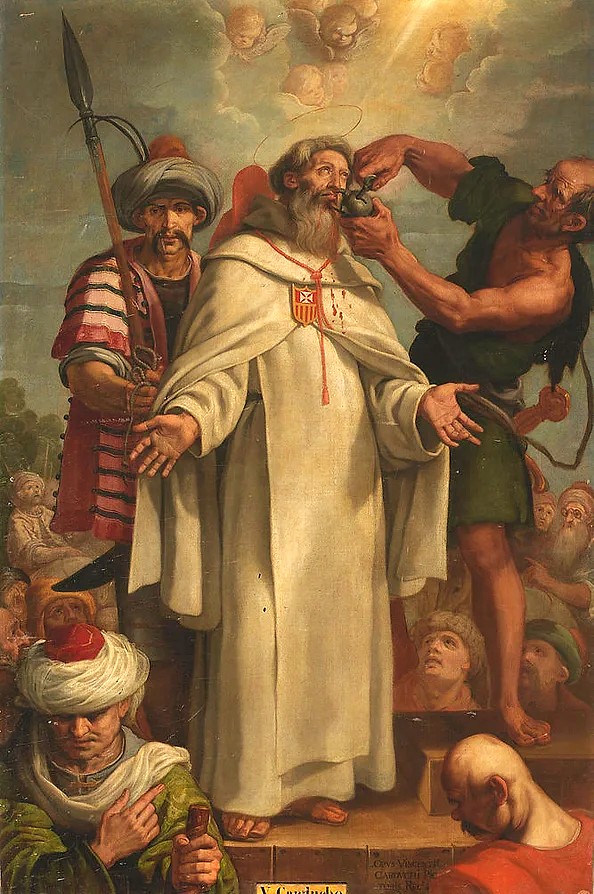
Accused of this before the Judge, he was condemned to be impaled alive and nothing but the hope of a large ransom prevented the execution of this barbarous sentence and caused it to be changed into a cruel bastinado (a form of torture which involves the caning of the soles of the feet). Raymund, who desired nothing more fervently than to die for Christ’s sake, was not intimidated by what he had undergone but wherever an opportunity offered itself, he explained to the infidels, the word of God. The Judge, informed of it, ordered him to be whipped through all the streets of the city and then to be brought to the marketplace, where the executioner, with a red hot iron, pierced his lips, through which a small chain was drawn and closed with a padlock, in order that the holy man might no more use his tongue to instruct others. Every three days the lock was opened and he received just enough food to keep him from starvation. Besides this, he was loaded with chains and cast into a dungeon, where he lay for eight months, until his ransom arrived. Although it was the desire of the Saint to remain among the infidels, as he would there have an opportunity to gain the Crown of Martyrdom, obedience recalled him to his Monastery.

When the Pope was informed of all that Raymund had suffered during his captivity, he appointed him as a Cardinal but the humble Saint returned to his Convent and lived like all the other brothers of the Order, without making the least change in his dress, food, or dwelling, nor accepting any honour due to him as so high a dignitary of the Church.

Pope Gregory IX, desired to have so holy a man near him and called him to Rome. The Saint obeyed and set out on his journey. He had,, however, scarcely reached Cardona, six miles from Barcelona, when he was seized with a malignant fever which soon became fatal. He desired most fervently to receive the holy Sacraments but, as the Priest called to administer them to him, delayed to come, God sent an Angel, who brought him the Divine food. After receiving it, he returned thanks to God for all the graces he had received from Him during his life and peacefully gave up his soul, in the 37th year of his age.

After his death, the inhabitants of Cardona, the Clergy of Barcelona and the religious of his Order, contended as to where the holy body should be buried. Each party thought they had the greatest claim to possess his tomb. At last they resolved to leave the decision to Providence. They placed the coffin, in which the holy body reposed, upon a blind mule, determined that the treasure should be deposited in the place to which this animal should carry it. The mule, accompanied by a large concourse of people, went on until it had reached the hermitage and Chapel where the holy Cardinal, as a shepherd boy, had spent so many hours in prayer and had received so many graces from God. There the Saint was buried and St Peter Nolasco, Founder of the Order in the course of time, founded there a Convent, with a Church in which the holy remains are still preserved and greatly honoUred by the people of Catalonia.

Posted in Of FISHERMEN, FISHMONGERS, PATRONAGE - NEWBORN BABIES, YOUNG CHILDREN l, SAINT of the DAY

Saint of the Day – 12 April – St Zeno of Verona (c 300 – 371)

Saint of the Day – 12 April – St Zeno of Verona (c 300 – 371)  Bishop of Verona, Monk, Confessor, Reformer, believed to be a Martyr  the persecutions of  Constantius II and  Julian the Apostate – Born c 300 at Mauretania near Algiers, North Africa and died on 12 April 371.   Patronages  – anglers, children learning to speak, children learning to walk, fishermen, newborn babies, Diocese of Verona, Italy, 41 Cities.

Verona_Italy_San_Zeno_DSC07766 (1)
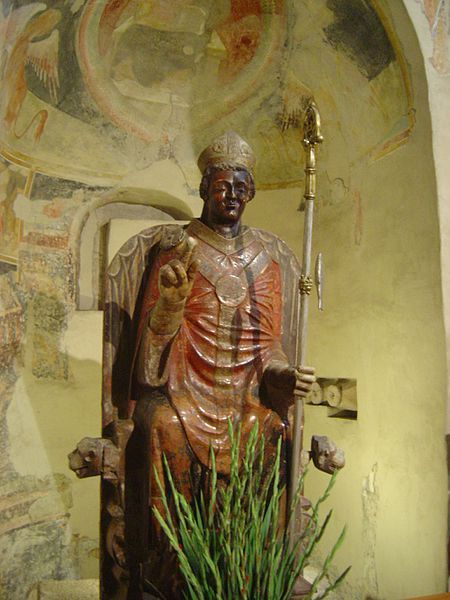
Statue of Saint Zeno from the Basilica of San Zeno

St Zeno of Verona came from Mauretania (Algeria and  Morocco) in North Africa, born in the year c 300.   He may have been a follower of St Athanasius of Alexandria who followed his master to Verona in about 340.  The  ancient Sermones texts on Old Testament exegesis have been attributed to St Zeno due to the style of the 90 or so Sermones attributed to Zeno has been considered evidence of his African origins.

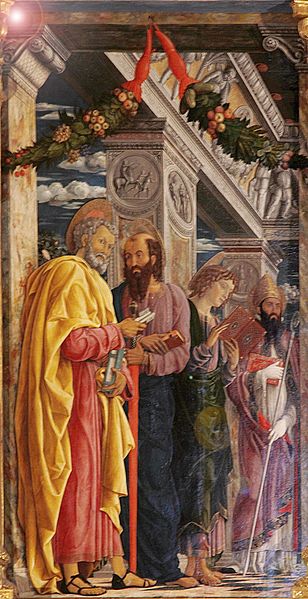
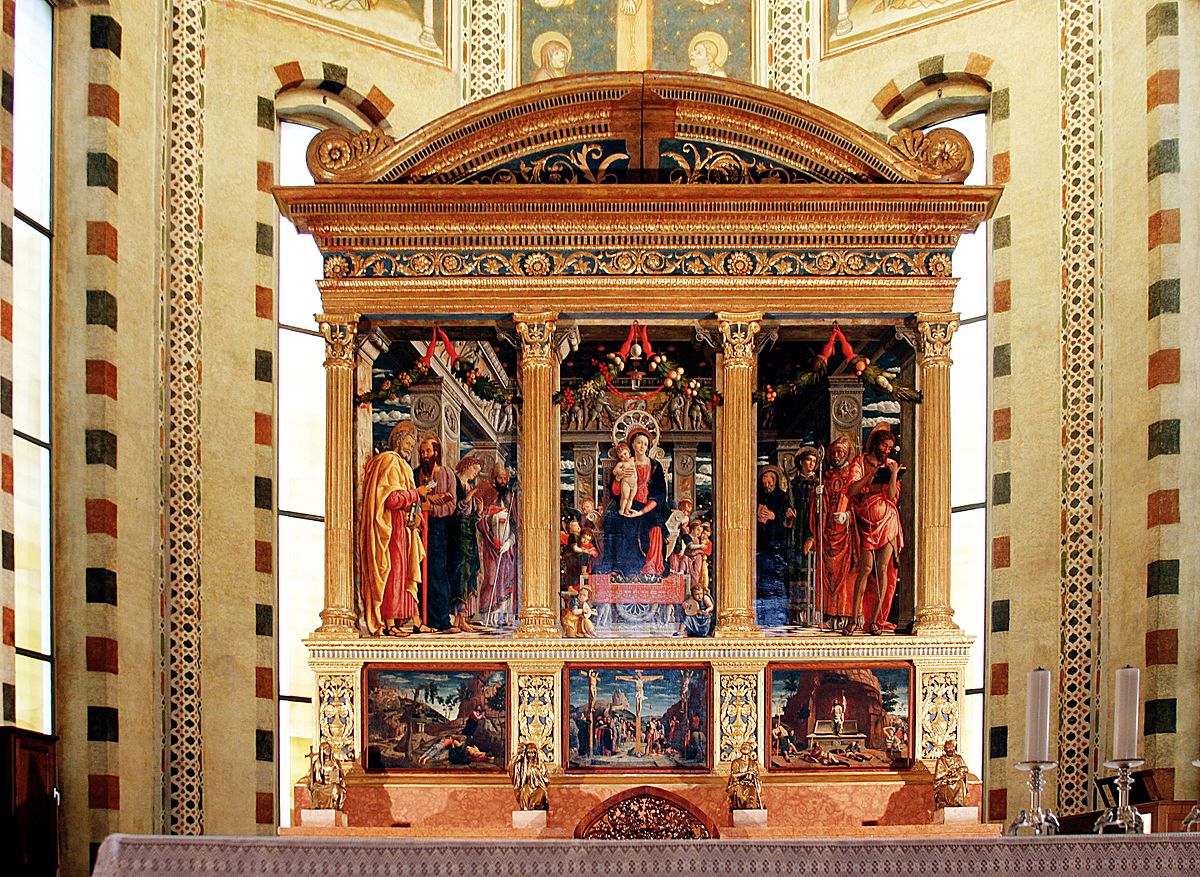
San Zeno Altarpiece. Zeno is on the far right.

He entered monastic life and would be appointed a bishop, winning converts back from Arianism, setting up a convent for  women, living a life of poverty, training priests to work in the diocese and reforming how the Agape feast was celebrated.  (The term Agape or Love feast was used for certain religious meals among early Christians that seem to have been originally closely related to the Eucharist.)   He would not allow loud groaning and wailing at funerals, supported adult  baptism  by complete immersion and  established a practice of giving medals to  the newly baptised.

He was the eighth bishops of Verona for a decade or so and is described as a ‘confessor of the faith’ in early martyrologies, may have suffered persecution under Constantius II and  Julian the Apostate  — a reference to his ‘happy death’ on 12 April, 371, indicates he may have been martyred.   Saint Gregory the Great calls him a martyr in his Dialogues.   A contemporary letter from St Ambrose of Milan refers  to Zeno’s holiness.   He is known to have lived in great poverty.

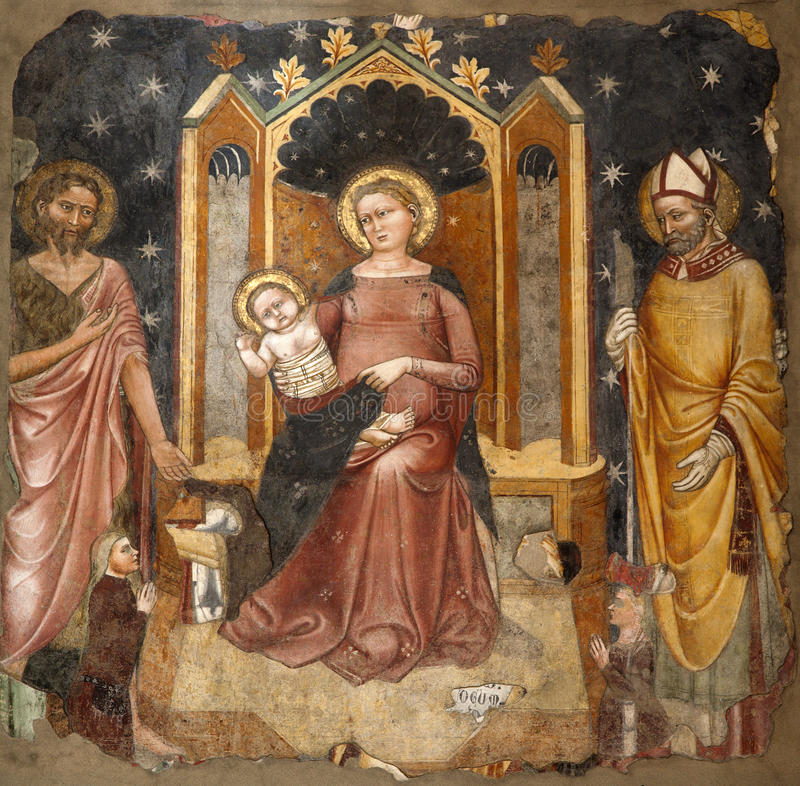
verona-fresco-holy-mary-st-john-baptist-st-zeno-29304912 (1)

St Zeno is the patron saint of fishermen and anglers, of the city of Verona, of newborn babies as well as children learning to speak and walk.   A saint for spiritual toddlers.   At least 30 churches and chapels bear his name.  He may have been fond of fishing in the River Adige  but the  depictions of  him with a fishing rod  are thought to refer to his  success in ‘catching converts’ for  the faith.   A fisher of men and women for Christ.Pala_di_San_Zeno_by_Andrea_Mantegna_-_San_Zeno_-_Verona_2016_(3)

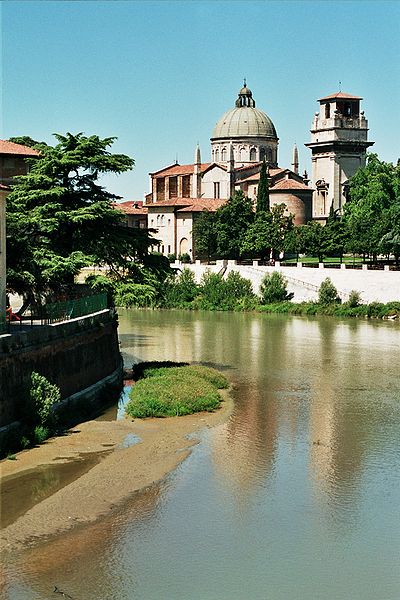
In the year 589, at the same time that the Tiber overflowed a considerable quarter of Rome, and the flood over-topped the walls, the waters of the Adige, which fails from the mountains with excessive rapidity, threatened to drown or submerge a great part of the city of Verona.   The people flocked in crowds to the church of their holy patron Zeno:  the waters seemed to respect its doors, they gradually swelled as high as the windows, yet the flood never broke into the church but stood like a firm wall, as when the Israelites passed the Jordan;  and the people remained there twenty-foul hours in prayer, till the water subsided within the banks of the channel.  This miracle had as many witnesses as there were inhabitants of Verona.   The devotion of the people to St Zeno was much increased by this and other miracles.

400px-Adige_Verona
The Adige flowing through Verona

St Zeno’s liturgical feast day is celebrated today, 12 April but in the diocese of Verona, it is also celebrated on 21 May, in honor of the translation of his relics on 21 May 807.

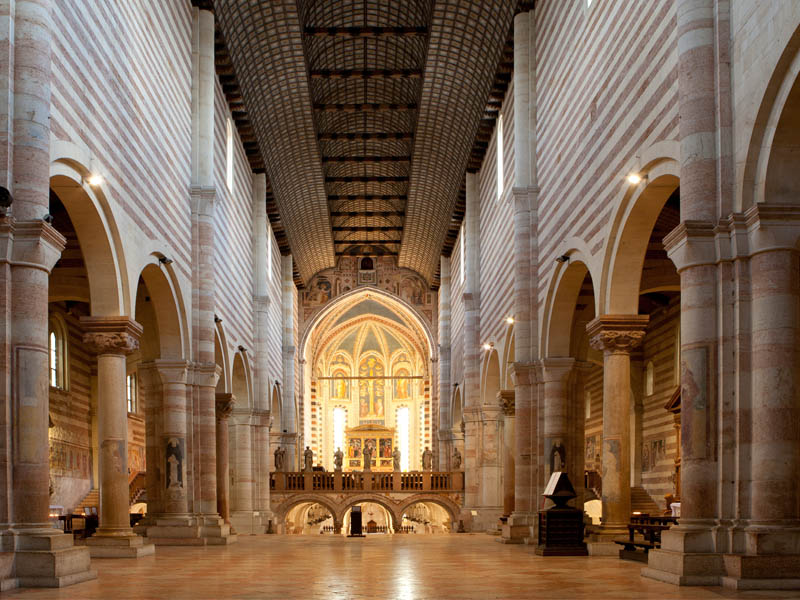
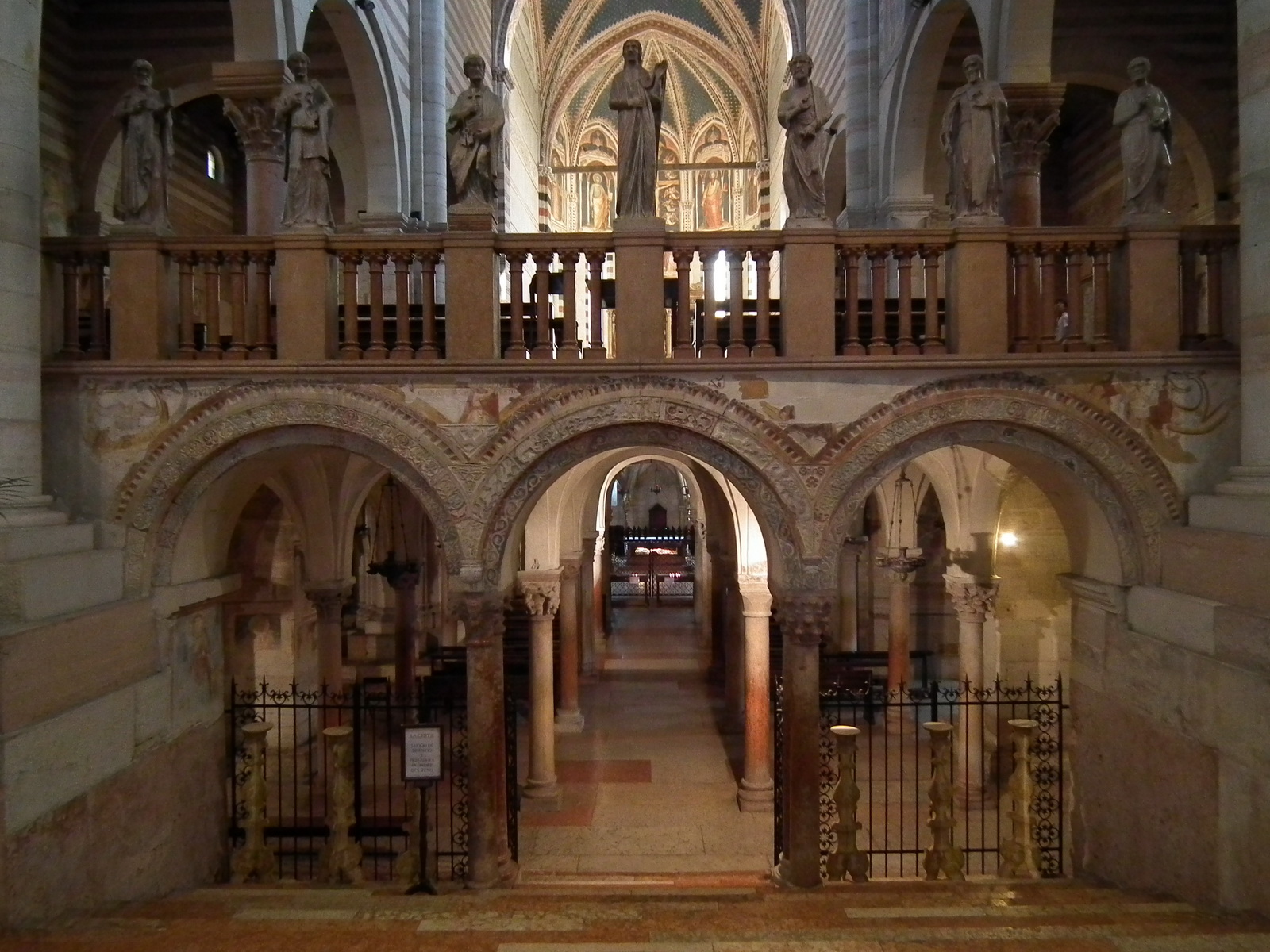
Tradition states that Zeno built the first basilica in Verona, situated in the area probably occupied by the present-day cathedral.   His eponymous church in its present location dates to the early ninth century, when it was endowed by Charlemagne and his son Pepin, King of Italy.   It was consecrated on 8 December 806; two local hermits, Benignus and Carus, were assigned the task of translating Zeno’s relics to a new marble crypt.   King Pepin was present at the ceremony, as were the Bishops of Cremona and Salzburg, as well as an immense crowd of townspeople.   The church was damaged at the beginning of the tenth century by Hungarians, though the relics of Zeno remained safe. The basilica was rebuilt again, and made much larger and stronger. Financial support was provided by Otto I, and it was re-consecrated in 967, at a ceremony presided over by the Bishop Ratherius of Verona.

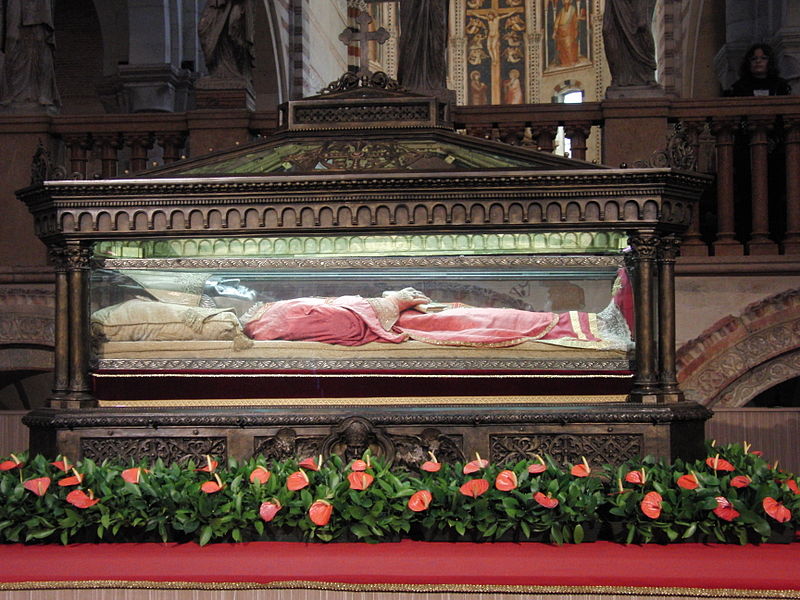
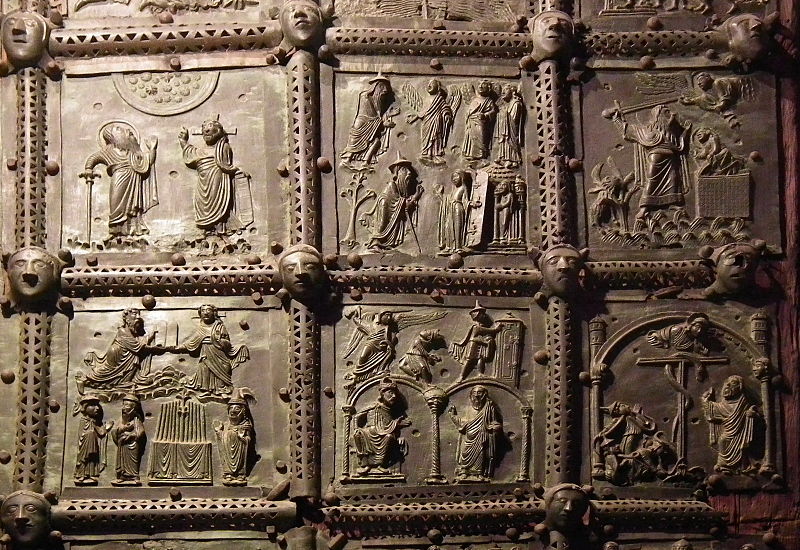
The present church of San Zeno in Verona is a work of the twelfth, thirteenth and early fifteenth centuries for the most part.  It is well known for its bronze doors (c 1100 – c 1200) which depict, besides stories from the Bible, the miracles of Saint Zeno, images drawn from stories, including those recorded by the notary Coronato, the facade sculpture signed by Nicholaus and an associate Guglielmus and the rose window (c 1200), which is the work of Brioloto.800px-St_Zeno's_body_(close_up)San-Zeno-1-GalleryVerona,_Basilica_di_San_Zeno,_crypt_001800px-Verona,_Basilica_di_San_Zeno,_bronze_door_004

Posted in Of a Holy DEATH & AGAINST A SUDDEN DEATH, of the DYING, FINAL PERSEVERANCE, DEATH of CHILDREN, DEATH of PARENTS, Of ANIMALS / ANIMAL WELFARE, Of the Holy Souls in PURGATORY, PATRONAGE - NEWBORN BABIES, YOUNG CHILDREN l, SAILORS, MARINERS, NAVIGATORS, SAINT of the DAY

Saint of the Day – 10 September – St Nicholas of Tolentino OSA (1245-1305)- Patron of The Holy Souls

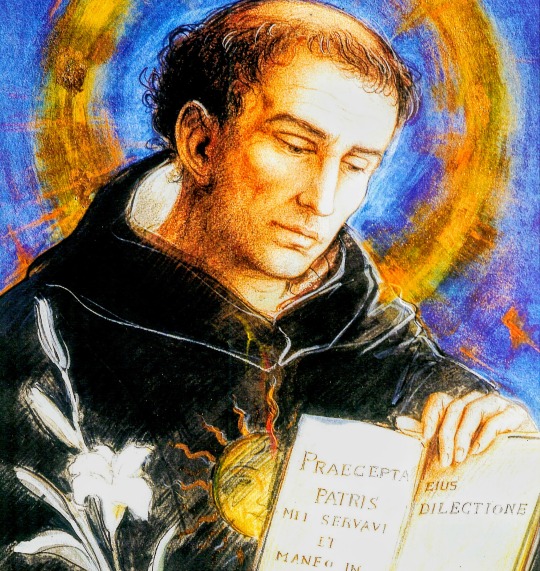
Saint of the Day – 10 September – St Nicholas of Tolentino OSA (1245-1305)- known as The Patron of Holy Souls, Priest, Augustinian Friar Monk, Confessor, Mystic, Preacher.   Born in 1245 at Sant’Angelo, March of Ancona, Diocese of Fermo, Italy and died on  10 September 1305 at Tolentino, Italy following a long illness.   His Relics were re-discovered at Tolentino in 1926.   In previous times his Relics were known to exude blood when the Church was in danger.   He was Canonised on 5 June (Pentecost) 1446 by Pope Eugene IV – over 300 miracles were recognised by the Congregation.   Patronages – animals, babies (reported to have raised more than 100 children from the dead), sailors,  dying people, sick animals, the Holy Souls in Purgatory, 4 Cities, 3 Diocese.   Attributes – Augustinian holding a bird on a plate in the right hand and a crucifix on the other hand;   holding a basket of bread, giving bread to a sick person;   holding a lily or a crucifix garlanded with lilies; with a star above him or on his breast.

St.-Nicholas-of-Tolentino

St Nicholas was born in 1245 in Sant’Angelo.   He was named after St Nicholas of Myra, at whose Shrine his parents prayed to have a child.   Nicholas became a Monk at 18 and seven years later, he was Ordained a Priest.   He gained a reputation as a Preacher and a Confessor.   In c 1274, he was sent to Tolentino, near his birthplace where he lived the rest of his lif.   Nicholas was primarily a shepherd to his flock.   He ministered to the poor and the criminal.   He is said to have cured the sick with bread over which he had prayed to Mary, the mother of God.   He gained a reputation as a wonder-worker.

On account of his kind and gentle manner his superiors entrusted him with the daily feeding of the poor at the monastery gates but at times he was so free with the friary’s provisions that the procurator begged the superior to check his generosity.  Once, when weak after a long fast, he received a vision of the Blessed Virgin Mary and Saint Augustine who told him to eat some bread marked with cross and dipped in water.   Upon doing so he was immediately stronger.   He started distributing these rolls to the ailing, while praying to Mary, often curing the sufferers;  this is the origin of the Augustinian custom of blessing and distributing Saint Nicholas Bread.   When working wonders or healing people, he always asked those he helped to “Say nothing of this”, explaining that he was just God’s instrument.

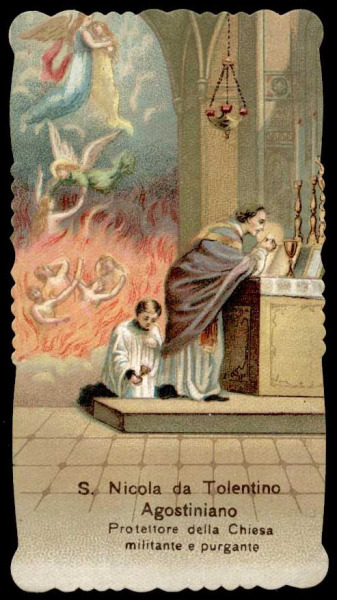
During his life, Nicholas is said to have received visions, including images of Purgatory, which friends ascribed to his lengthy fasts.  Prayer for the souls in purgatory was the outstanding characteristic of his spirituality.   Because of this Nicholas was proclaimed patron of the souls in Purgatory in 1884 by Leo XIII.  Towards the end of his life he became ill, suffering greatly, but still continued the mortifications that had been part of his holy life.   Nicholas died on 10 September 1305.St.-Nicholas-of-Tolentino-Purgatory-2.jpg

Miracles:
There are many tales and legends which relate to Nicholas.   One says the devil once beat him with a stick, which was then displayed for years in his church.   In another, Nicholas, a vegetarian, was served a roasted fowl, for which he made the sign of the cross and it flew out a window.   Nine passengers on a ship going down at sea once asked Nicholas’ aid and he appeared in the sky, wearing the black Augustinian habit, radiating golden light, holding a lily in his left hand, and with his right hand, he quelled the storm.   An apparition of the saint, it is said, once saved the burning palace of the Doge of Venice by throwing a piece of blessed bread on the flames.  He was also reported to have resurrected over one hundred dead children, including several who had drowned together.

According to the Peruvian chronicler Antonio de la Calancha, it was St. Nicholas of Tolentino who made possible a permanent Spanish settlement in the rigorous, high-altitude climate of Potosí, Bolivia.   e reported that all children born to Spanish colonists there died in childbirth or soon thereafter, until a father dedicated his unborn child to St Nicholas of Tolentino (whose own parents, after all, had required saintly intervention to have a child).   The colonist’s son, born on Christmas Eve, 1598, survived to healthy adulthood and many later parents followed the example of naming their sons Nicolás.st nicholas of tolentino

Veneration:
Nicholas was Canonised by Pope Eugene IV (also an Augustinian) in 1446.   He was the first Augustinian to be Canonised.   At his Canonisation, Nicholas was credited with three hundred miracles, including three resurrections.

The remains of St Nicholas are preserved at the Shrine of Saint Nicholas in the Basilica di San Nicola da Tolentino in the city of Tolentino, province of Macerata in Marche, Italy.

He is particularly invoked as an advocate for the souls in Purgatory, especially during Lent and the month of November.  In many Augustinian churches, there are weekly devotions to St Nicholas on behalf of the suffering souls.  November 2, All Souls’ Day, holds special significance for the devotees of St. Nicholas of Tolentino.

Posted in Against Unexplained FEVER or HIGH Temperatures, DOCTORS, / SURGEONS / MIDWIVES., PATRONAGE - NEWBORN BABIES, YOUNG CHILDREN l, PATRONAGE-INFERTILITY & SAFE CHILDBIRTH, PREGNANCY, SAINT of the DAY

Saint of the Day – 31 August – St Raymond Nonnatus O.deM. (1204-1240)

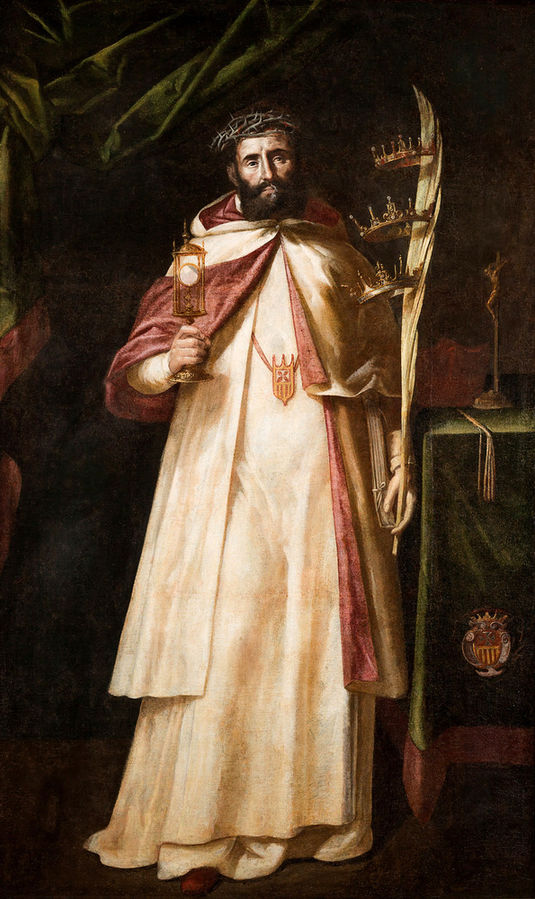
Saint of the Day – 31 August – St Raymond Nonnatus O.deM (1204-1240). Priest, Confessor, Cardinal, Friar of the Mercedarian Order.  He was delivered by Caesarean operation when his mother died in childbirth; hence the name non natus = not born. Born in  1204 at Portella, diocese of Urgel, Catalonia, Spain and died on 31 August 1240 at Cardona, Spain of a fever.   He was buried at the Chapel of Saint Nicholas near his family farm he was supposed to have managed.   He was Beatified on 5 November 1625 by Pope Urban VIII (cultus confirmed) and Canonised on 1657 by Pope Alexander VII.   Patronages  against gossip, of silence, against fever, of babies, infants, childbirth, children, pregnant women, falsely accused people, midwives, obstetricians, Baltoa, Dominican Republic, San Ramon, Costa Rica.  

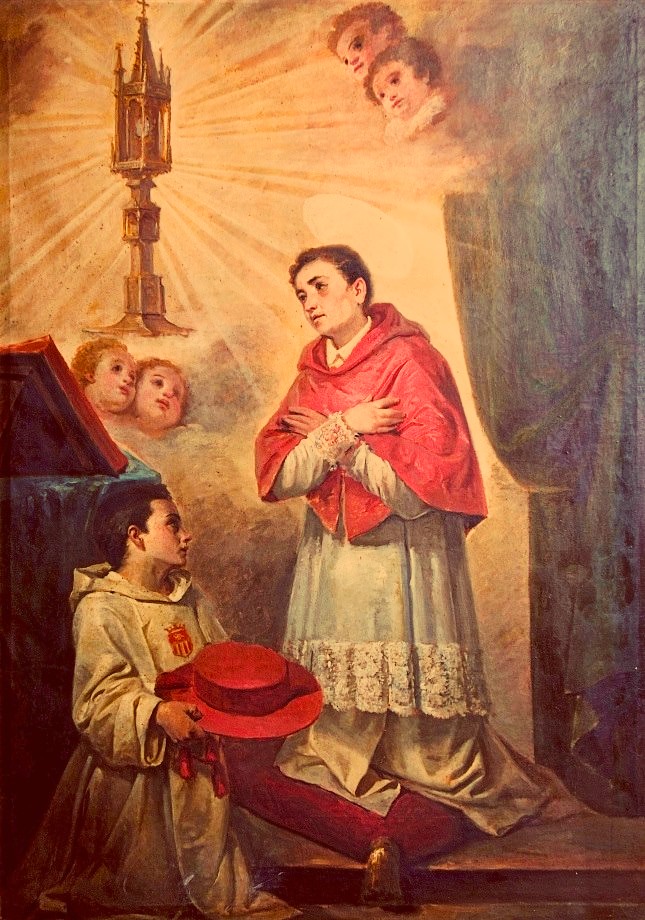
st raymond nonnatus.4.

From the time he was very young, he manifested a great devotion to the Most Holy Virgin.   He prayed the Rosary every day in the hermitage of St. Nicholas of Mira  . Once Our Lady appeared to him and promised him her protection.   Afterward he was strongly tempted to sin against chastity but did not fall.   He went to thank his Patroness and consecrated his virginity to her.   Mary appeared to him again, showing her satisfaction and advising him to enter the Order of the Mercedarians (Order of Mercy), whose foundation she had inspired St. Peter Nolasco to make only shortly before, in 1218.

He was ordained a Priest and dedicated himself to the redemption of captives until 1231. He liberated 140 captives in Valencia, 250 in Argel and 28 in Tunis.   It was in this last city that he had the occasion to fulfill the special fourth vow of the Mercedarians to offer themselves to remain in captivity in the place of Catholic prisoners.   Since he was unable to pay the ransom demanded by the slave dealers in Tunis, Raymond offered himself to take the place of some prisoners.

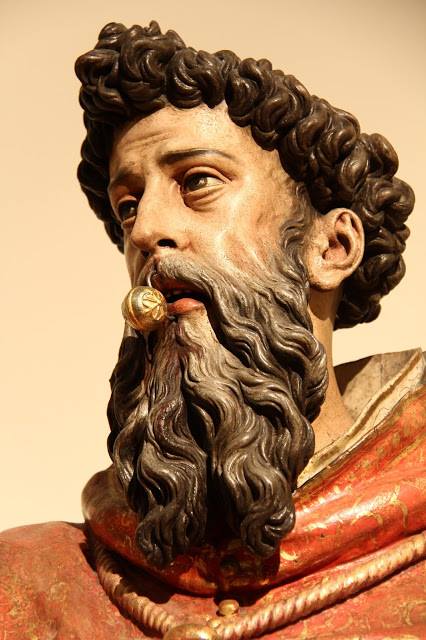
The trade was made and he began a hard captivity.   To prevent him from speaking about Our Lord, for his engaging words were converting numerous Muslims, the Arabian slave masters pierced his lips with a red-hot iron and closed them with a padlock.   This padlock was only opened for him to eat.   After eight months of this torment, other Mercedarians arrived from Spain bringing the demanded ransom.

The last ten years of his life were spent in Rome, where he became the representative of his Order and in traveling throughout different countries to preach the Crusade.   As a cardinal representative of Pope Gregory IX he was sent to meet with St Louis of France and encourage him to go on the Crusade, which actually took place 10 years later.

St. Raymond Nonnatus died in Cardona, a Spanish village close to Barcelona, on August 31, 1240. He was only 37-years-old.

One particular devotion is centered around the padlock that is part of his martyrdom. Locks are placed at his altar representing a prayer request to end gossip, rumours, false testimonies and other sins of the tongue.   The locks are used as a visible sign of such prayer request, which first and foremost must take place interiorly, a prayer to God through St. Raymond’s intercession.

The Mercedarians – Order of the Blessed Virgin Mary of Mercy:

The Order of the Blessed Virgin Mary of Mercy is an international community of priests and brothers who live a life of prayer and communal fraternity.   In addition to the vows of poverty, chastity and obedience, their members take a special fourth vow to give up their own selves for others whose faith is in danger.

The Order, also called the Mercedarians, or Order of Mercy, was founded in 1218 in Spain by St Peter Nolasco to redeem Christian captives from their Muslim captors.   The Order exists today in 17 countries, including Spain, Italy, Brazil, India and the United States.

St. Peter Nolasco 01
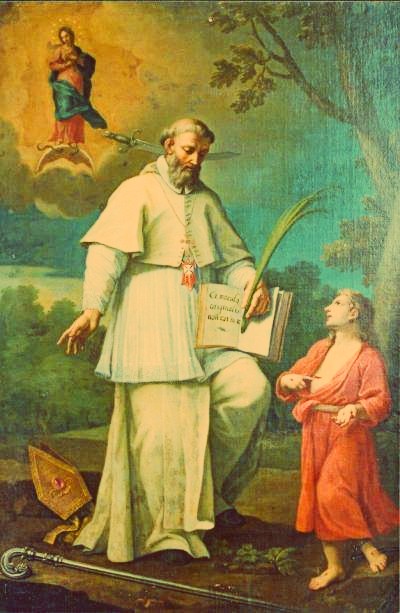
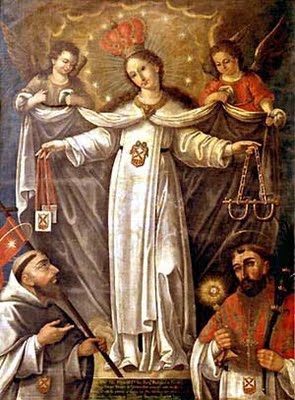
St Peter Nolasco & St Raymond Nonnatus and the Blessed Virgin Mary

Today, friars of the Order of Mercy continue to rescue others from modern types of captivity, such as social, political, and psychological forms.   They work in jails, marginal neighborhoods, among addicts and in hospitals.

The spiritual and communal life of the friars include prayer, meditation, Holy Mass, recreation and apostolate.   Their life is based on the Rule of St. Augustine and the Constitutions of the Order.

Overall, the Order of Mercy commits itself to give testimony to the same Good News of love and redemption that it has shown since the beginning of its history.