Quote/s of the Day – 14 March 2018 – Wednesday of the 4th Week of Lent
“Speaking of Death & Eternity”
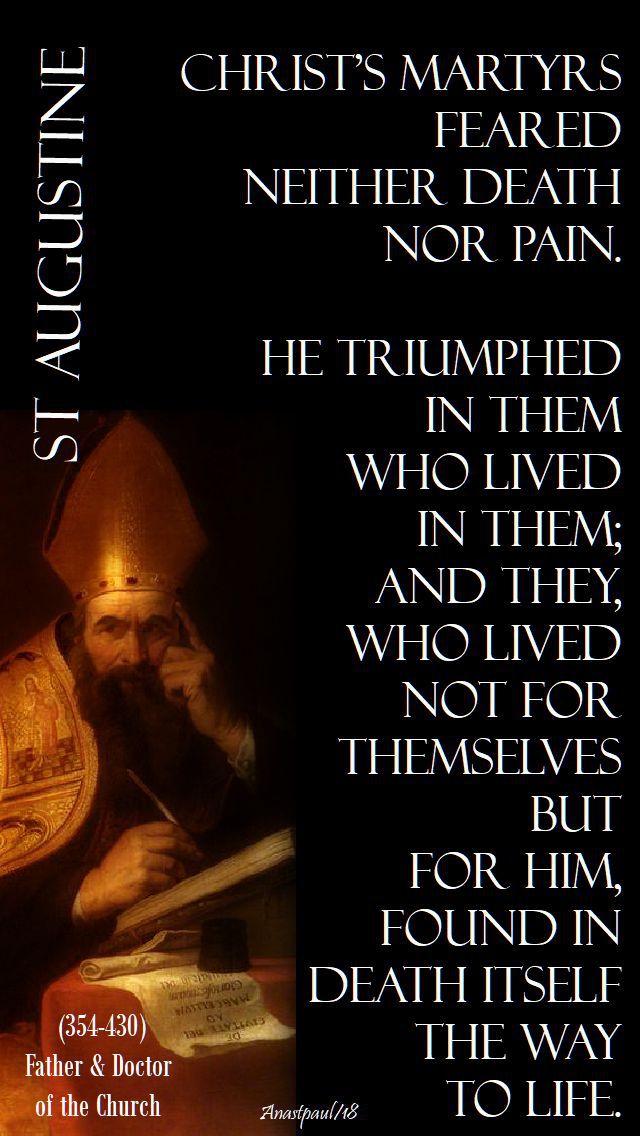
“Christ’s martyrs feared neither death nor pain. He triumphed in them who lived in them; and they, who lived not for themselves but for Him, found in death itself the way to life.”
St Augustine – (354-430) – Father & Doctor of the Church
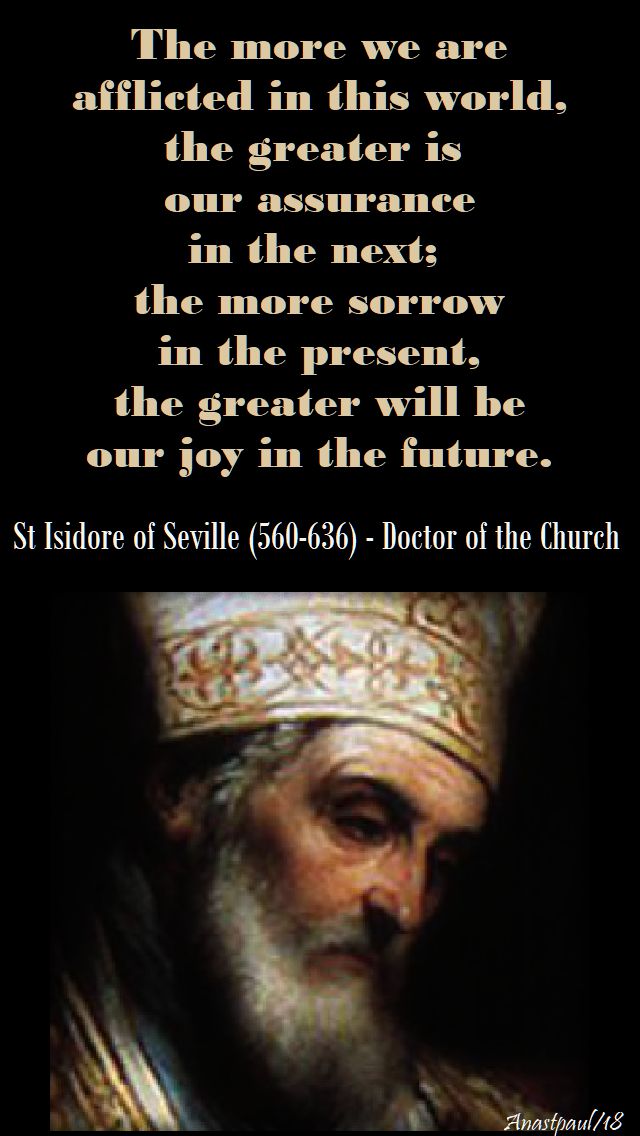
“The more we are afflicted in this world, the greater is our assurance in the next; the more sorrow in the present, the greater will be our joy in the future.”
St Isidore of Seville (560-636) – Doctor of the Church
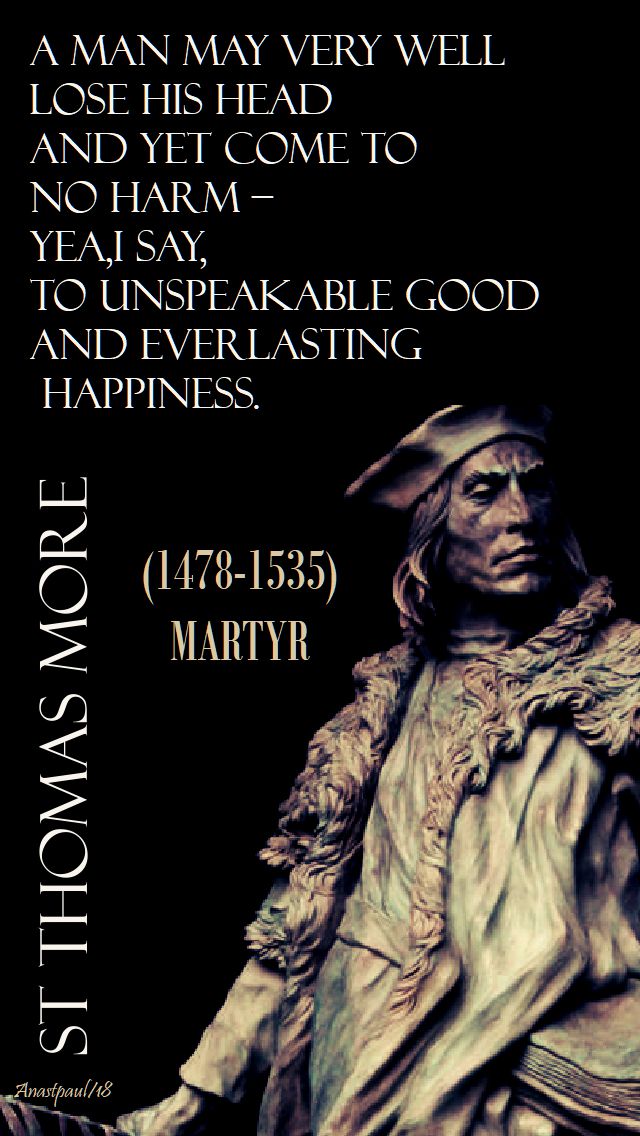
“A man may very well lose his head and yet come to no harm – yea, I say, to unspeakable good and everlasting happiness.”
St Thomas More (1478-1535)
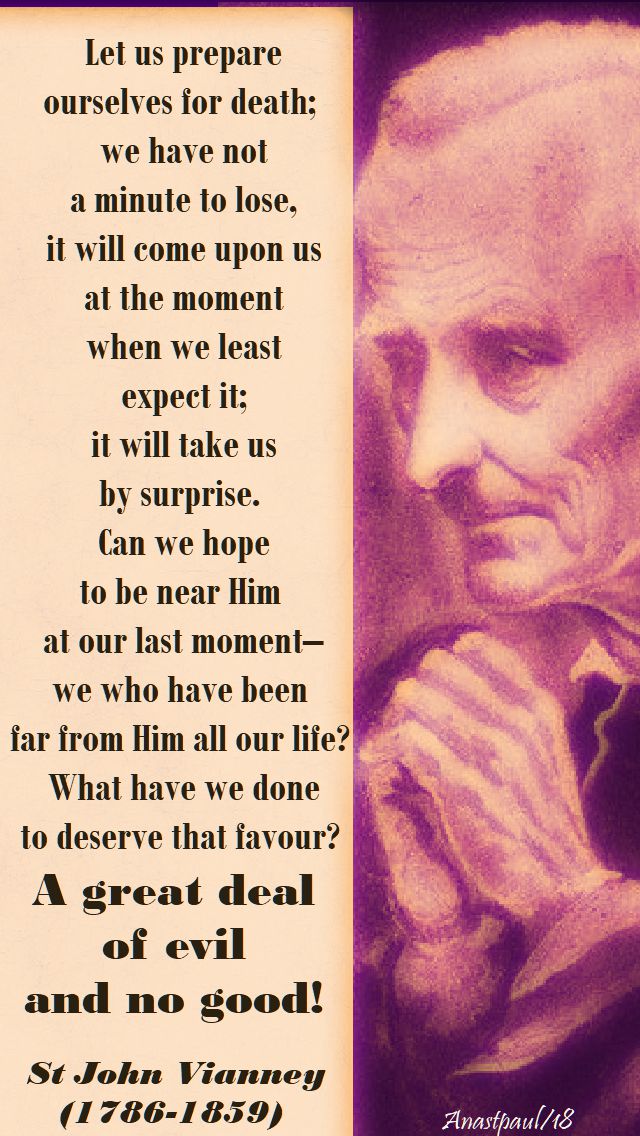
“Let us prepare ourselves for death; we have not a minute to lose: it will come upon us at the moment when we least expect it; it will take us by surprise. Look at the saints, my children, who were pure; they were always trembling, they pined away with fear and we, who so often offend the good God–we have no fears. Life is given us that we may learn to die well and we never think of it. We occupy ourselves with everything else. The idea of it often occurs to us and we always reject it; we put it off to the last moment. O my children! this last moment, how much it is to be feared! Yet the good God does not wish us to despair; He shows us the good thief, touched with repentance, dying near Him on the cross; but he is the only one and then see, he dies near the good God. Can we hope to be near Him at our last moment–we who have been far from Him all our life? What have we done to deserve that favour? A great deal of evil and no good.”
Thought for the Day – 13 March – Tuesday of the 4th Week of Lent – “Speaking of Confession”
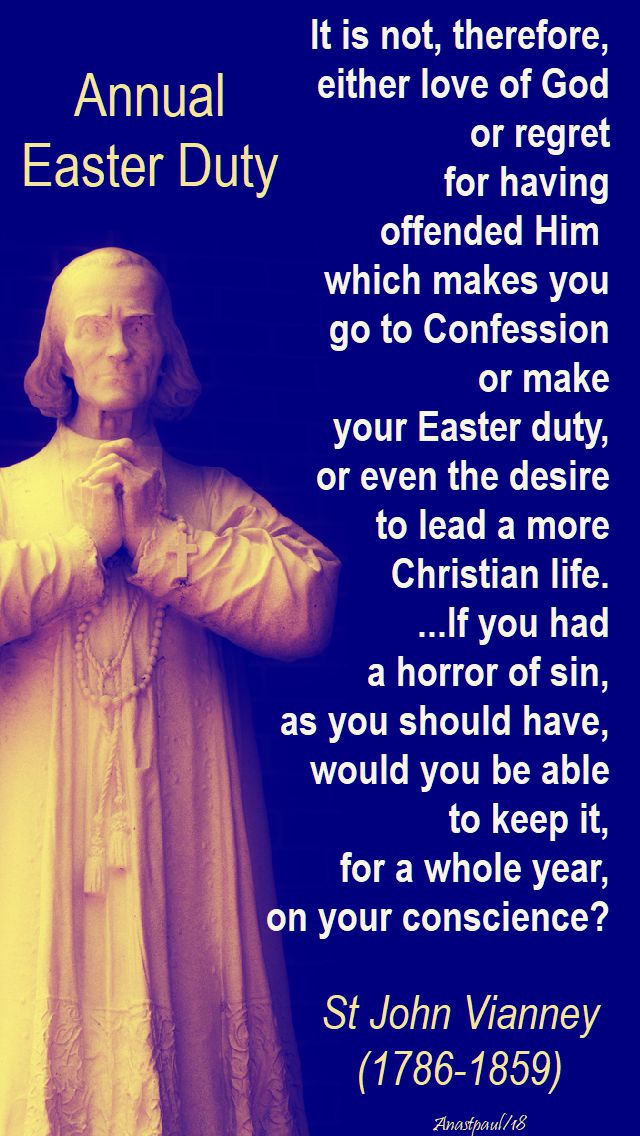
ANNUAL EASTER DUTY CONFESSIONS – St John Vianney (1786-1859)
If Easter were prolonged to Pentecost, you would not go to Confession until Pentecost, or if the latter did not come around for ten years, you would go to Confession only every ten years. Indeed, if the Church did not give you a commandment about it, you would not go to Confession until death. What do you think of that, my dear brethren? Does it not mean that you have neither regret for having offended God, Who requires you to go to Confession, nor love for God, Who requires you to make your Easter Communion?
Ah you will say to me, that’s all very well. We do not make our Easter duty without knowing why.
Ah! You know nothing at all about it! You do it from habit, to be able to say you have made your Easter duty, or, if you would prefer to speak the truth, you would say that you have added a new sin to your old ones. It is not, therefore, either love of God or regret for having offended Him which makes you go to Confession or make your Easter duty, or even the desire to lead a more Christian life. And here is the proof of it: if you loved God, would you consent to commit sin with such ease and even with so much enjoyment? If you had a horror of sin, as you should have, would you be able to keep it,for a whole year, on your conscience? If you had a real desire to live a more Christian life, would we not see at least some little change in your way of living?
No, my dear brethren, I do not wish to talk to you today about those unfortunate people who tell only half their sins through fear of not making their Easter duty or of being refused Absolution — perhaps even for the sake of covering up their shameful lives with the veil of virtue and who, in this state, approach the altar and are going to complete their dreadful work by handing over their God to the Devil and precipitating their sacrilegious souls into Hell.
No, I dare to hope that this does not concern you but I will continue, nevertheless, to tell you that going to Confession only once a year is not something about which you should feel any peace or satisfaction.
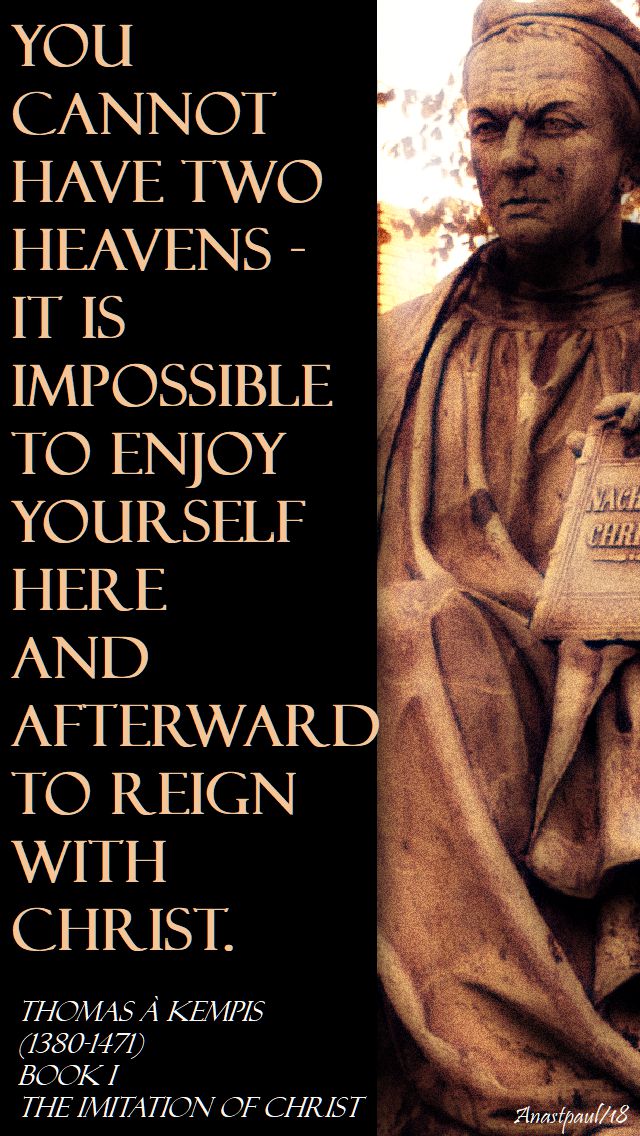
“You cannot have two heavens – it is impossible to enjoy yourself here and afterward to reign with Christ.”…Thomas à Kempis (1380-1471) – Book I The Imitation of Christ
Quote/s of the Day – 13 March – “Speaking of Confession”
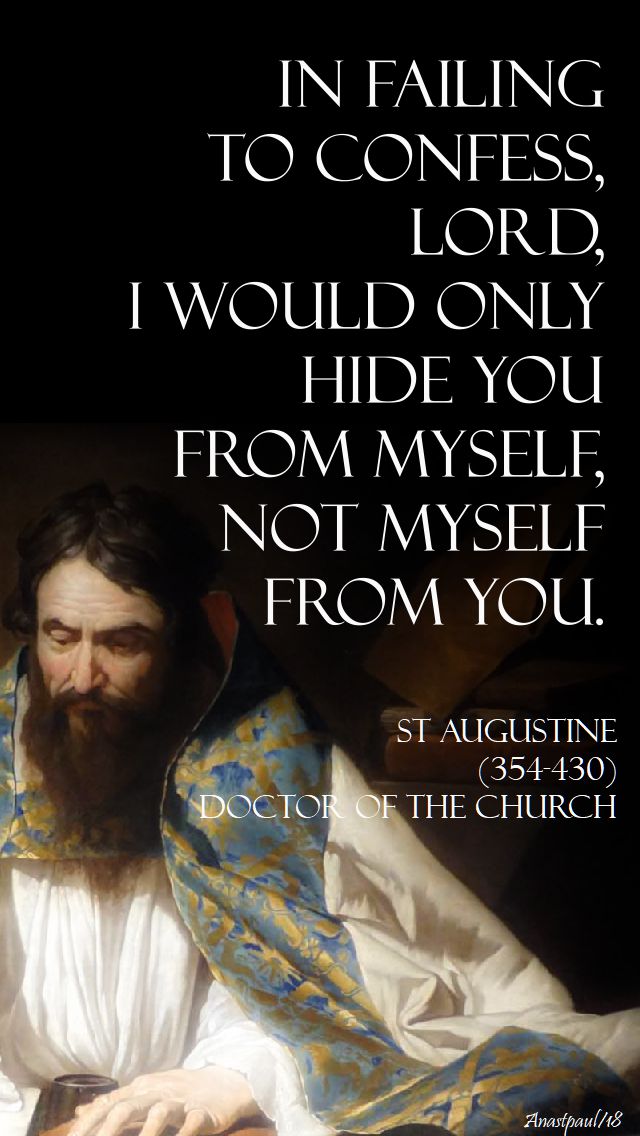
“In failing to confess, Lord, I would only hide You from myself, not myself from You.”
St Augustine (354-430) Doctor of the Church
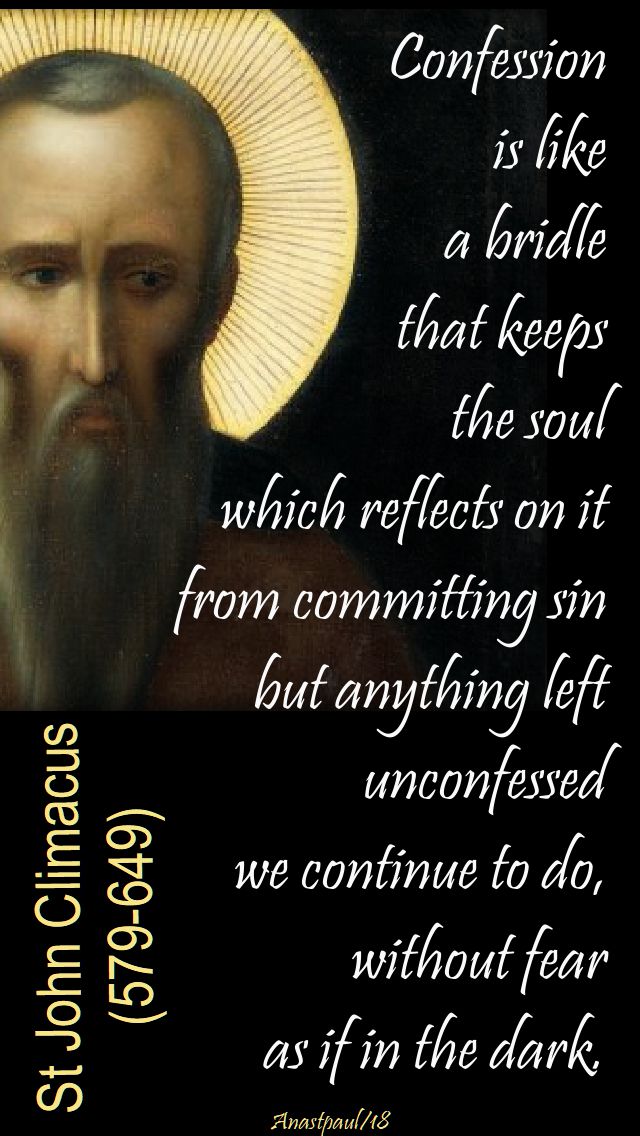
“Confession is like a bridle that keeps the soul which reflects on it from committing sin but anything left unconfessed we continue to do without fear as if in the dark.”
St John Climacus (579-649)
“Confession is an act of honesty and courage – an act of entrusting ourselves, beyond sin, to the mercy of a loving and forgiving God.”
St Pope John Paul II (1920-2005)
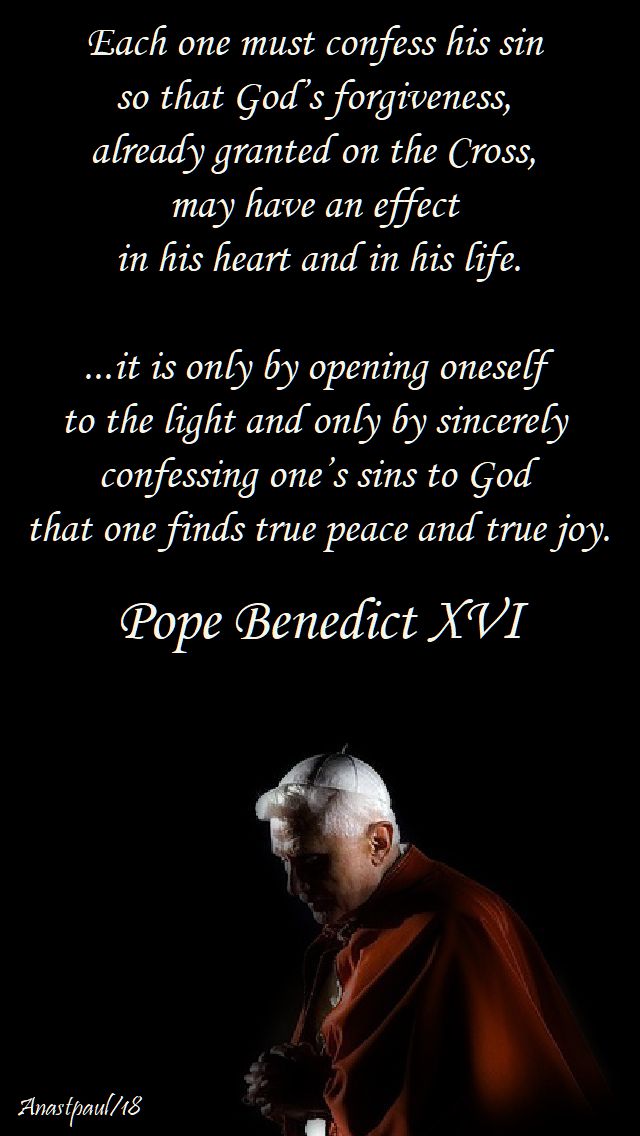
“Each one must confess his sin so that God’s forgiveness, already granted on the Cross, may have an effect in his heart and in his life.
St Augustine writes further: “God accuses your sins and if you also accuse them, you are united to God…. When your own deeds will begin to displease you, from that time your good works begin, as you find fault with your evil works. The confession of evil works is the beginning of good works” (ibid., 13: PL 35, 1191).
Sometimes men and women prefer the darkness to the light because they are attached to their sins. Nevertheless it is only by opening oneself to the light and only by sincerely confessing one’s sins to God that one finds true peace and true joy. It is therefore important to receive the Sacrament of Penance regularly, especially during Lent, in order to receive the Lord’s forgiveness and to intensify our process of conversion.”
Thought for the Day – 12 February – Preparing for Lent – 2 days to go!
Lent is a season of grace. The joy of the Risen Lord Jesus depends on how we live out the holy season of Lent. God’s generosity has no limits but we often fall short in giving God our whole hearts so that He can fill them with His love.
Why not strive to live out this Lent as if it were to be the Last Lent in your lives!
Decide on your Lenten sacrifice. Lent is a season of solemnity and sacrifice commemorating Jesus’ exodus into the desert; our sacrifice is a reminder of the sacrifice of self Jesus made to save us from our sins. Because of this, it is a Lenten tradition to sacrifice something for these 40 days.
Think about all the trivial things in your life that shift your focus away from God. Do you find that you dedicate more time to sending text messages and posting status updates than to prayer and time with God? Do you have a habit of eating junk food excessively? What is something your life could do without?
In addition to sacrificing something, include something special in your Lenten routine. Giving up chocolate or Facebook for 40 days is great but why not do something positive, too, instead of just removing the negative? Resolve to be more mindful of others’ needs, spend more time with your family, pray more and forgive old grudges.
Attend Holy Mass as often as possible. In addition to weekly Sunday service, it’s good to go to Mass and receive the Holy Eucharist frequently, especially during Lent. Lent begins on Ash Wednesday when we remember that we come from dust and to dust we shall return.
Go to Confession, is a wonderful way to turn away from sin and reunite yourself with Christ. If you don’t already, try getting into the habit of going to Confession on a regular basis. The Catholic Church has made it obligatory that all the faithful receive the sacrament of Penance at least once a year and once during the season of Lent, though it’s recommended that you attend Confession at least once a month if possible.
Spend time on prayer and devotions. Though not required, devotions are a great way to put yourself in the right mindset for Lent. The Church highly encourages Adoration of God or the veneration of the Blessed Virgin and the saints. Your local parish probably has regular Eucharistic Adoration, where you can go to sit and engage in deep prayer, in the presence of the Blessed Sacrament. To practice veneration, you could say a decade of the Rosary daily, or pray to your patron saint.
Any prayer, so long as it means something to you, is a step in the direction God intended. If you have a prayer you’ve grown up with that speaks to you, resolve to spend more time focusing on what it truly means and how you can embody that prayer in your everyday life. Perhaps start the Liturgy of the Hours, there are many sites online offering this devotion.
Take time for self-examination and reflection. Christmas and Easter are times of happiness and joy; while the preceding and succeeding seasons are cheery and bright, the same cannot be said about Lent. It is a time of simplicity and solemnity. It is a time to reflect on your dependence on God’s mercy and your understanding of faith. Take moments during this time to think about how you embody Christ’s love.
Get ready to Fast and Abstain – think about how you will incorporate these practises into your life. All Catholics aged fourteen and older are asked to abstain from meat on Lenten Fridays, though fish is allowed to be eaten. Additionally, Catholics aged 18-59 are obliged to fast on Ash Wednesday, Good Friday and all Lenten Fridays, meaning that only one full meal may be eaten in the day. Of course, do this however you feel is safe and effective. Some people should definitely not fast (the pregnant or the elderly, for example). If fasting isn’t a reasonable option for you, fast from something other than food. Make sure it’s something that’s a challenge — like your phone or email — so you can feel the sacrifice you’re making.
Promote your Parish almsgiving project – perhaps think about volunteering your help. Ensure that you find a way to fulfil this vital Lenten requirement – it could be as simple as saving your spare change for your Parish charity or to have Masses said for the holy souls!
Make a Lenten calendar. Such a calendar will help you to focus on the progression of the Lenten season and is a great reminder to see the days ticking away, leaving Sundays out. It ends the Friday before Easter (the last day being Holy Thursday); count backwards from there.
Hang the calendar in a common area in your home. Every day, tick off a box. As you get closer and closer to Easter, how do you find yourself feeling? Are your sacrifices becoming more or less difficult to maintain?
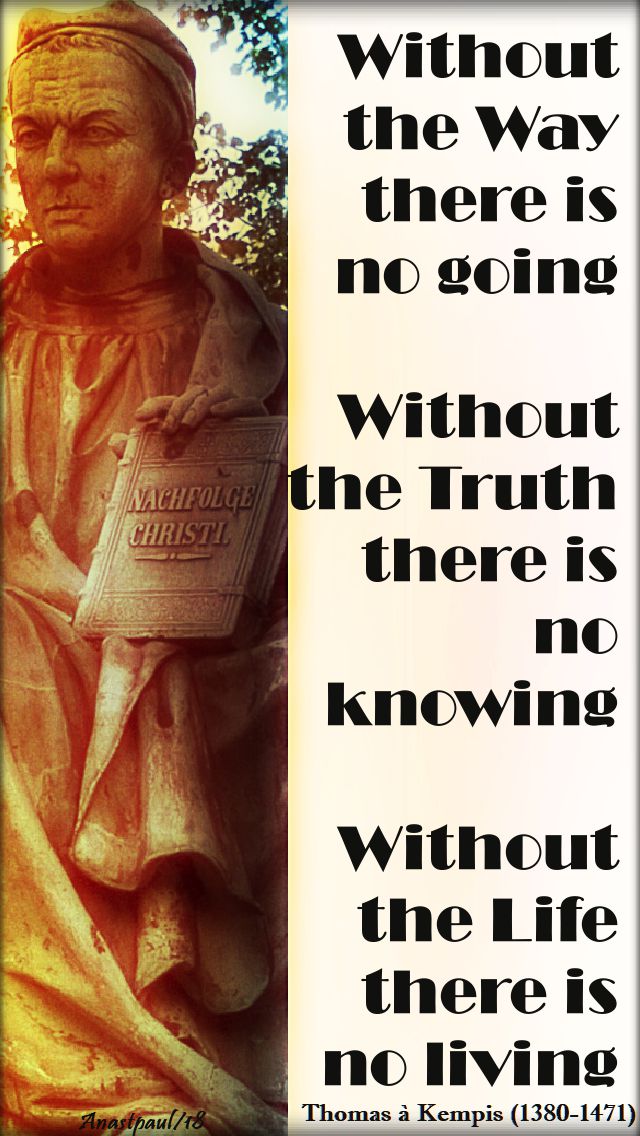
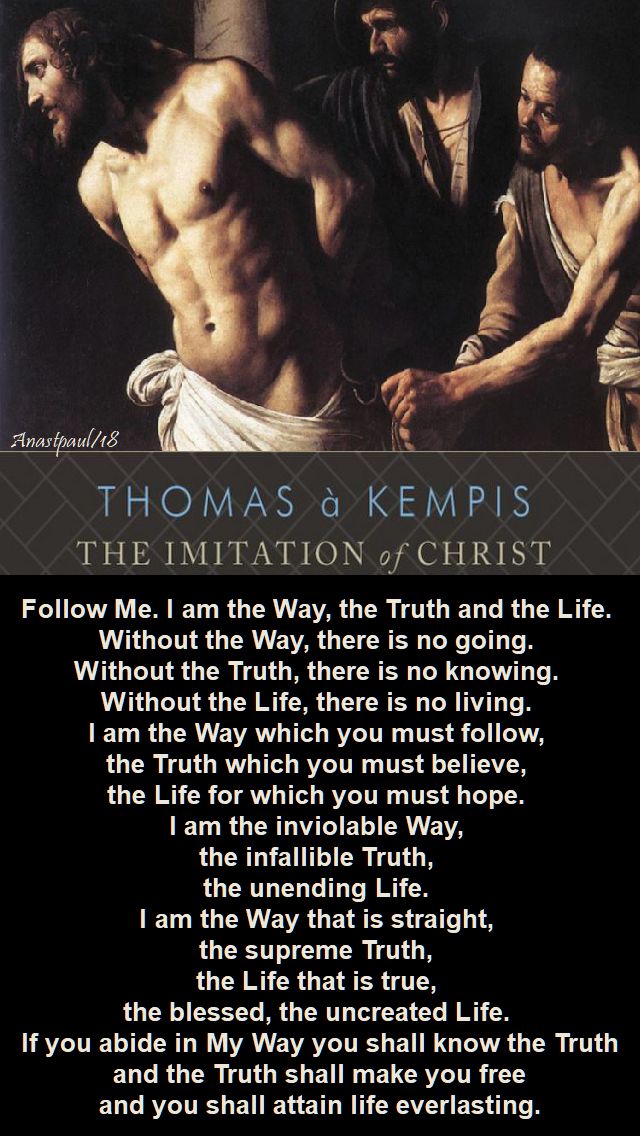
The Imitation of Christ “Without the Way, there is no going, Without the Truth, there is no knowing, Without the Life, there is no living.”
“Follow Me. I am the Way, the Truth and the Life. Without the Way, there is no going. Without the Truth, there is no knowing. Without the Life, there is no living. I am the Way, which you must follow, the Truth, which you must believe, the Life, for which you must hope. I am the inviolable Way, the infallible Truth, the unending Life. I am the Way that is straight, the supreme Truth, the Life that is true, the blessed, the uncreated Life. If you abide in My Way, you shall know the Truth and the Truth shall make you free and you shall attain life everlasting.”
“If you wish to enter into life, keep My commandments. If you will know the truth, believe in Me. If you will be perfect, sell all. If you will be My disciple, deny yourself. If you will possess the blessed life, despise this present life. If you will be exalted in heaven, humble yourself on earth. If you wish to reign with Me, carry the Cross with Me. For only the servants of the Cross find the life of blessedness and of true light.”
“MY CHILD, the more you depart from yourself, the more you will be able to enter into Me. As the giving up of exterior things, brings interior peace, so the forsaking of self, unites you to God. I will have you learn perfect surrender to My will, without contradiction or complaint.”
“Take courage, brethren, let us go forward together and Jesus will be with us. For Jesus’ sake we have taken this cross. For Jesus’ sake let us persevere with it. He will be our help as He is also our leader and guide. Behold, our King goes before us and will fight for us. Let us follow like men. Let no man fear any terrors. Let us be prepared to meet death valiantly in battle. Let us not suffer our glory to be blemished by fleeing from the Cross.”
The Imitation of Christ Chapter 56
“If, however, you seek Jesus in all things, you will surely find Him. “
Quote/s of the Day – 4 February – 5th Sunday of Year B
“Speaking of the Eucharist/the Holy Mass”
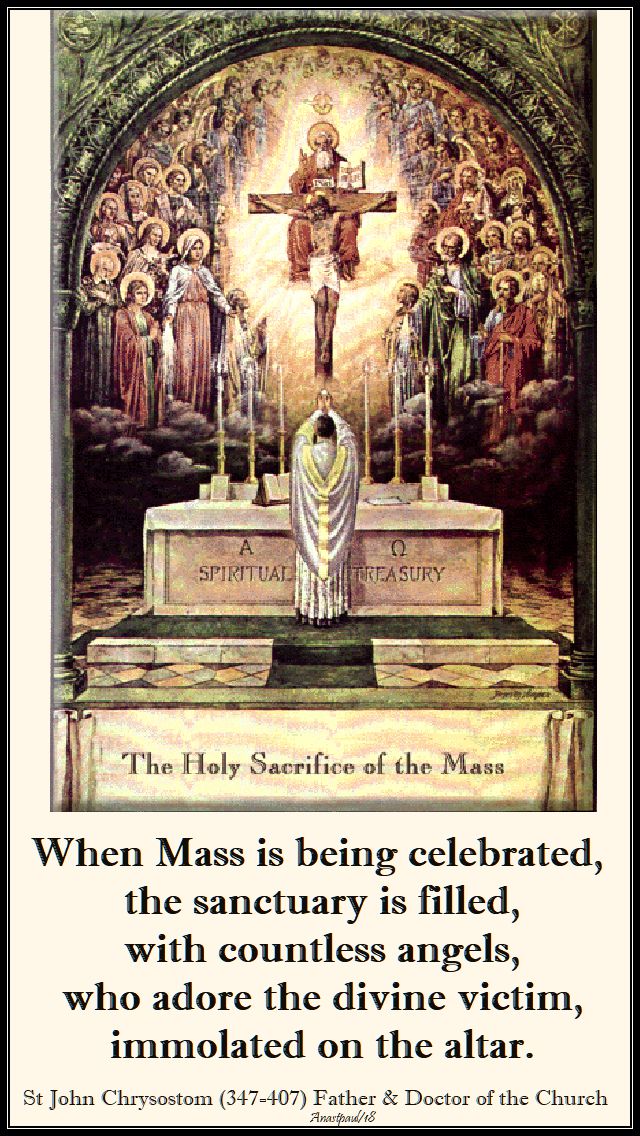
“When Mass is being celebrated, the sanctuary is filled, with countless angels, who adore the divine victim, immolated on the altar.”
St John Chrysostom (347-407) Father & Doctor of the Church
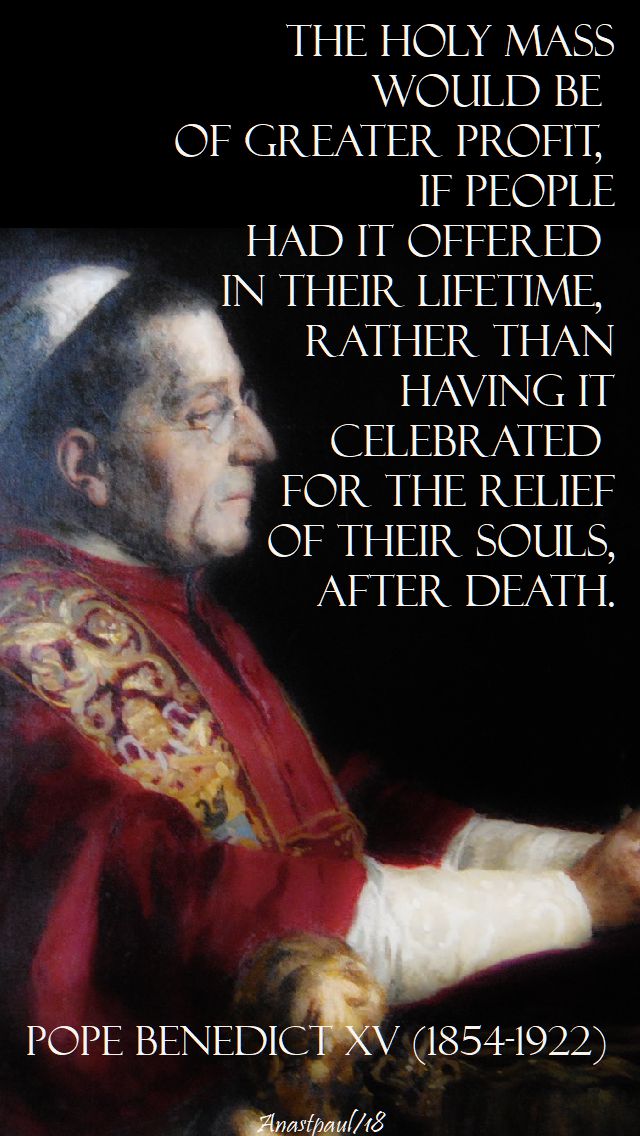
“The Holy Mass would be of greater profit, if people had it offered in their lifetime, rather than having it celebrated for the relief of their souls, after death.”
Pope Benedict XV (1854-1922)
“One merits more, by devoutly assisting at a Holy Mass, than by distributing, all of his goods to the poor and travelling, all over the world, on pilgrimage.”
St Bernard if Clairvaux (1090-1153) Doctor of the Church
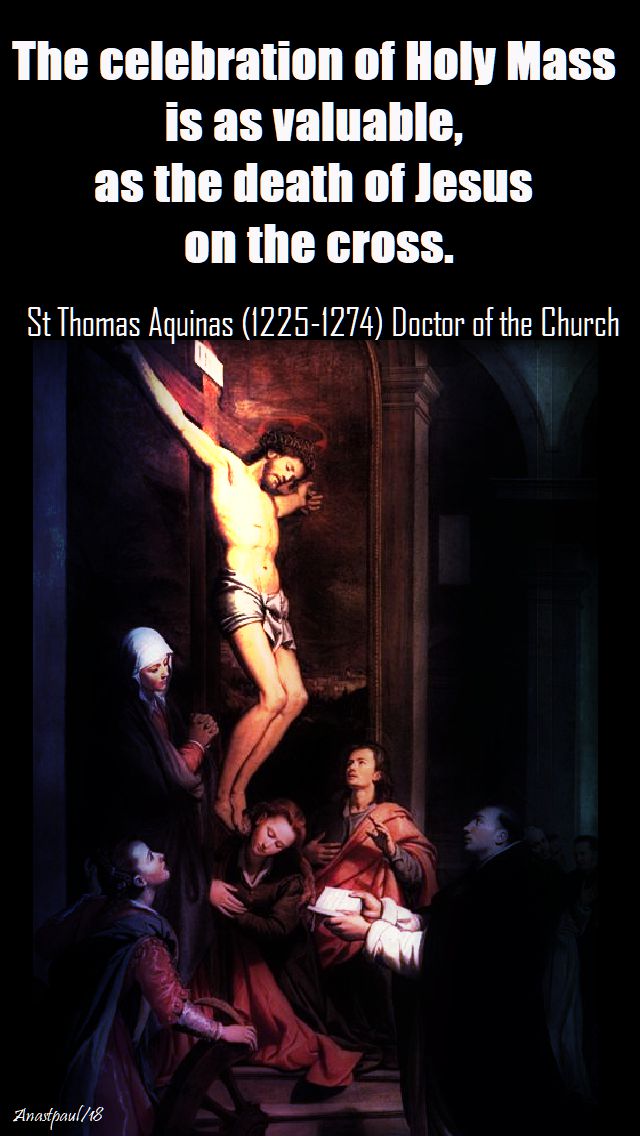
“The celebration of Holy Mass has the same value as the Death of Jesus on the Cross.”
St Thomas Aquinas (1225-1274) Doctor of the Church
“When you have received Him, stir up your heart to do Him homage, speak to Him about your spiritual life, gazing upon Him in your soul, where He is present, for your happiness, welcome Him as warmly as possible and behave outwardly, in such a way, that your actions, may give proof to all, of His Presence.”
St Francis de Sales (1567-1622) Doctor of the Church
“If someone said to us, “At such an hour a dead person is to be raised to life, ” we should run very quickly to see it. But is not the Consecration, which changes bread and wine into the Body and Blood of God, a much greater miracle than to raise a dead person to life? We ought always to devote at least a quarter of an hour to preparing ourselves to hear Mass well. We ought to annihilate ourselves before God, after the example of His profound annihilation in the Sacrament of the Eucharist and we should make our examination of conscience, for we must be in a state of grace. to be able to assist properly at Mass. If we knew the value of the holy Sacrifice of the Mass, or rather, if we had faith, we should be much more zealous to assist at it.”
Quote/s for the Day – 1 February – The Memorial of Bl Benedict Daswa (1946-1990) Martyr – The First South African-born to be Beatified.
Would it not have been so simple for Blessed Benedict to pay his share of the required amount to hire the Sangona (Witch Doctor) to “sniff out” the witch who caused the storms? It was not a huge amount of money required by each resident. The temptation to do so must have been quite appealing but he refused and tried to explain that the storms were a natural phenomenon. He did, however, pay the ultimate price for his fidelity, with his blood.
“Speaking of Temptation”
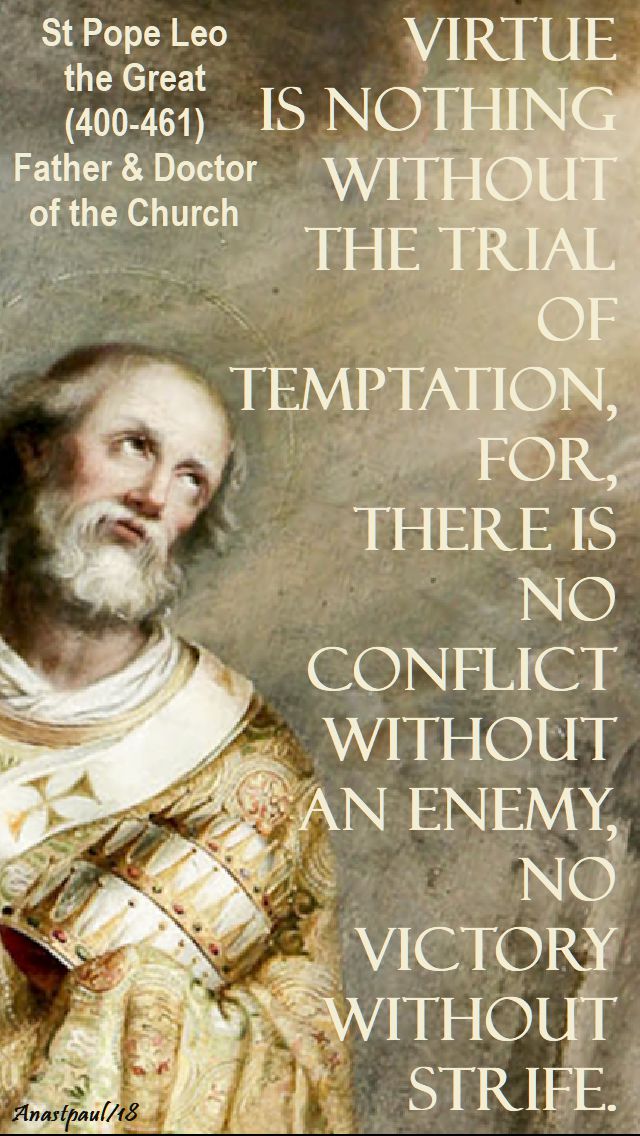
“Virtue is nothing, without the trial of temptation, for there is no conflict, without an enemy, no victory, without strife.”
St Pope Leo the Great (400-461) Father & Doctor of the Church
“There are in truth, three states of the converted, the beginning, the middle and the perfection. In the beginning, they experience the charms of sweetness; in the middle, the contests of temptation; and in the end, the fullness of perfection.”
St Pope Gregory the Great (540-604) Father & Doctor of the Church
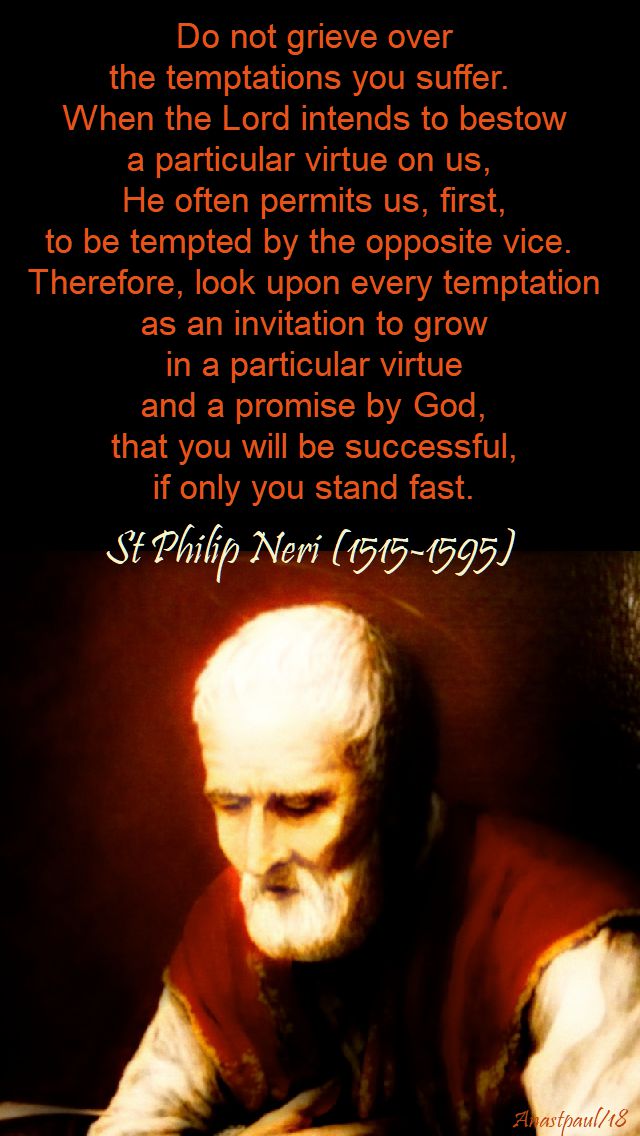
“Do not grieve over the temptations you suffer. When the Lord intends to bestow a particular virtue on us, He often permits us first to be tempted by the opposite vice. Therefore, look upon every temptation as an invitation to grow in a particular virtue and a promise by God, that you will be successful, if only you stand fast.”
St Philip Neri (1515-1595)
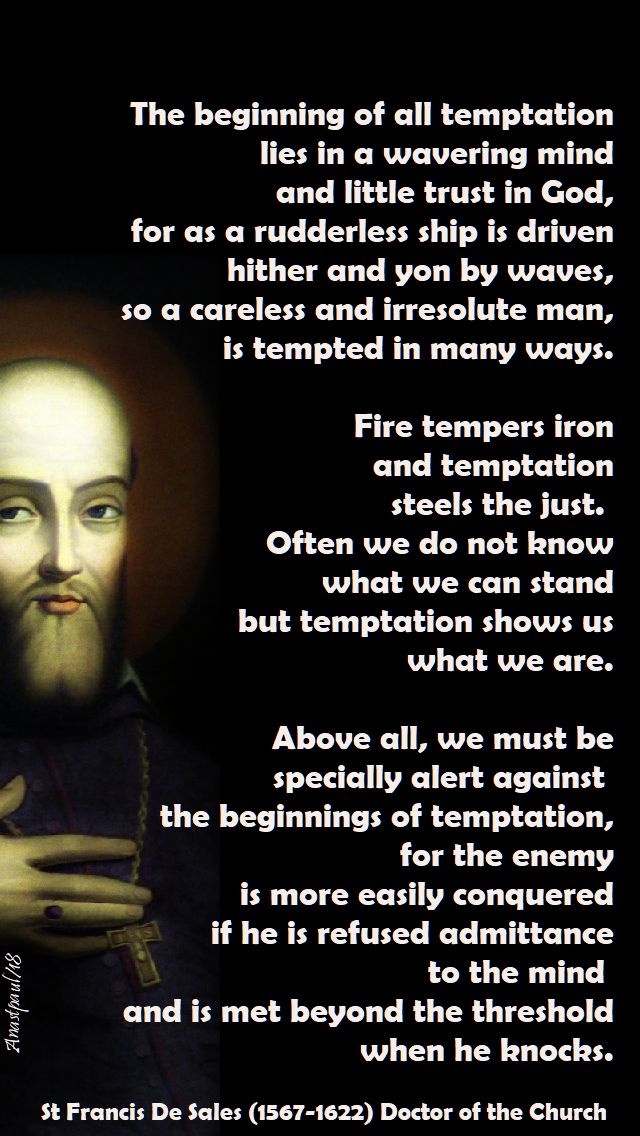
“The beginning of all temptation lies in a wavering mind and little trust in God, for as a rudderless ship is driven hither and yon by waves, so a careless and irresolute man, is tempted in many ways. Fire tempers iron and temptation steels the just. Often we do not know what we can stand but temptation shows us what we are. Above all, we must be especially alert against the beginnings of temptation, for the enemy is more easily conquered if he is refused admittance to the mind and is met beyond the threshold when he knocks.”
St Francis De Sales (1567-1622) Doctor of the Church
“It often happens that we pray God to deliver us from some dangerous temptation and yet, God does not hear us but permits the temptation to continue troubling us. In such a case, let us understand, that God permits even this for our greater good. When a soul in temptation recommends itself to God and by His aid resists, O how it then advances in perfection.”
“He who trusts himself is lost. He who trusts in God can do all things.
St Alphonsus Liguori (1696-1787) Doctor of the Church
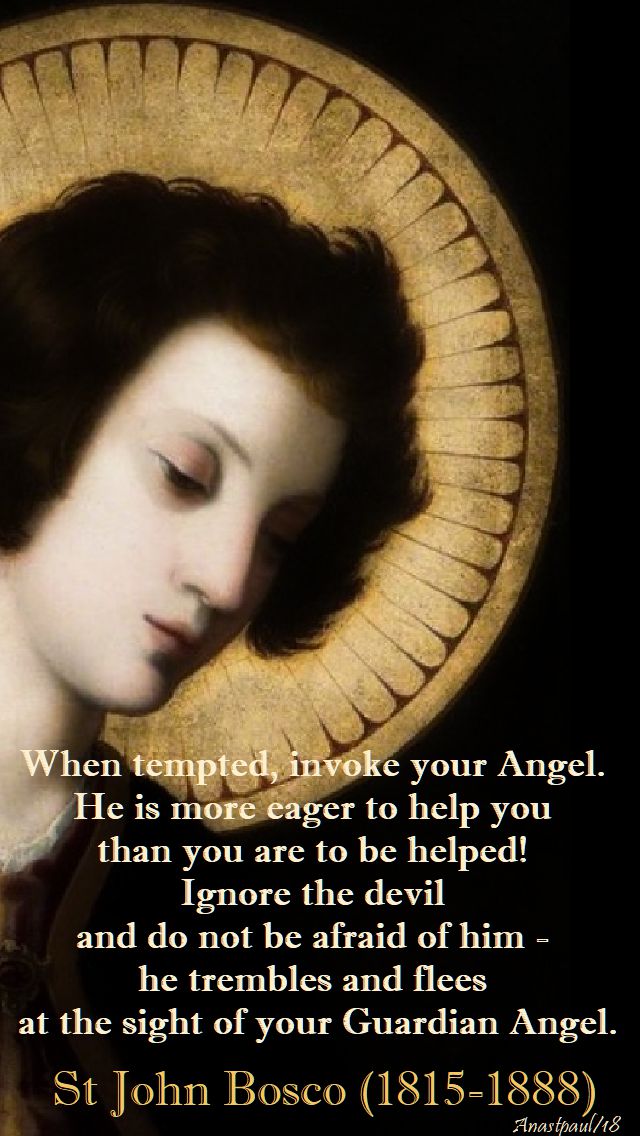
“When tempted, invoke your Angel. He is more eager to help you, than you are to be helped! Ignore the devil and do not be afraid of him – he trembles and flees, at the sight of your Guardian Angel.”
One Minute Reflection – 29 January – Speaking of Repentance
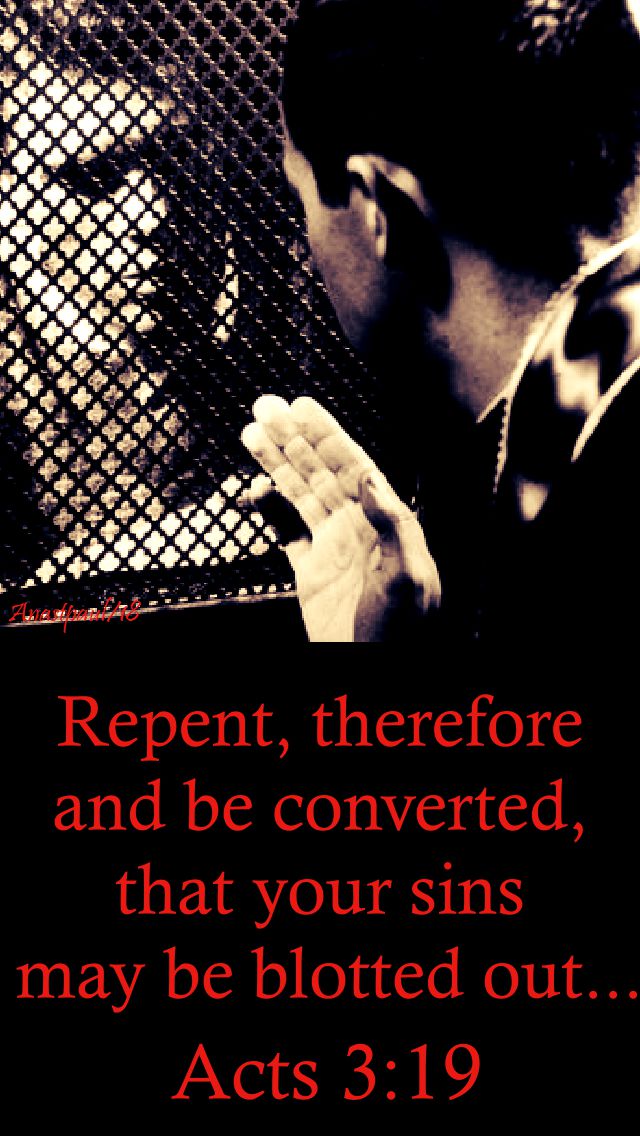
Repent, therefore and be converted, that your sins may be blotted out...Acts 3:19
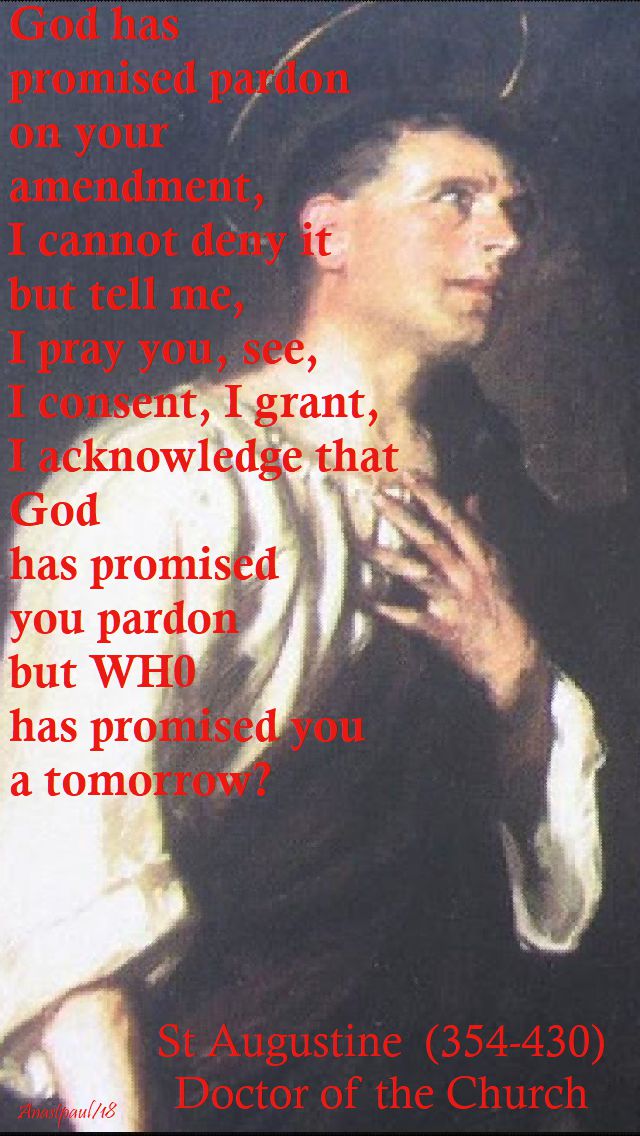
REFLECTION – “I know and as I do every one knows, who has used a little more than ordinary consideration, that no man who has any fear of God omits to reform himself in obedience to His words but he who thinks that he has longer time to live. This it is which kills so many, while they are saying, Tomorrow, Tomorrow and suddenly the door is shut. He remains outside…You speak well and truly; God has promised pardon on your amendment, I cannot deny it but tell me, I pray you, see, I consent, I grant, I acknowledge that God has promised you pardon but who has promised you a tomorrow?”…St Augustine (354-430) Doctor of the Church, Sermon 32
PRAYER – Lord, my holy God, grant that I may always seek Your forgiveness and strive each moment to live Your will. I am weak and a sinful creature but long to see Your face and reach my heavenly home. Fill me with Your grace that I may live in the Light and footsteps of Your divine Son. Lord, Jesus Christ, son of God, my father, have mercy on me, a sinner. Amen
Quote/s of the Day – 26 January – Memorial of Sts Timothy and Titus, Disciples and Companions of the Apostle Paul and Bishops of the Catholic Church
“Speaking of Obedience”
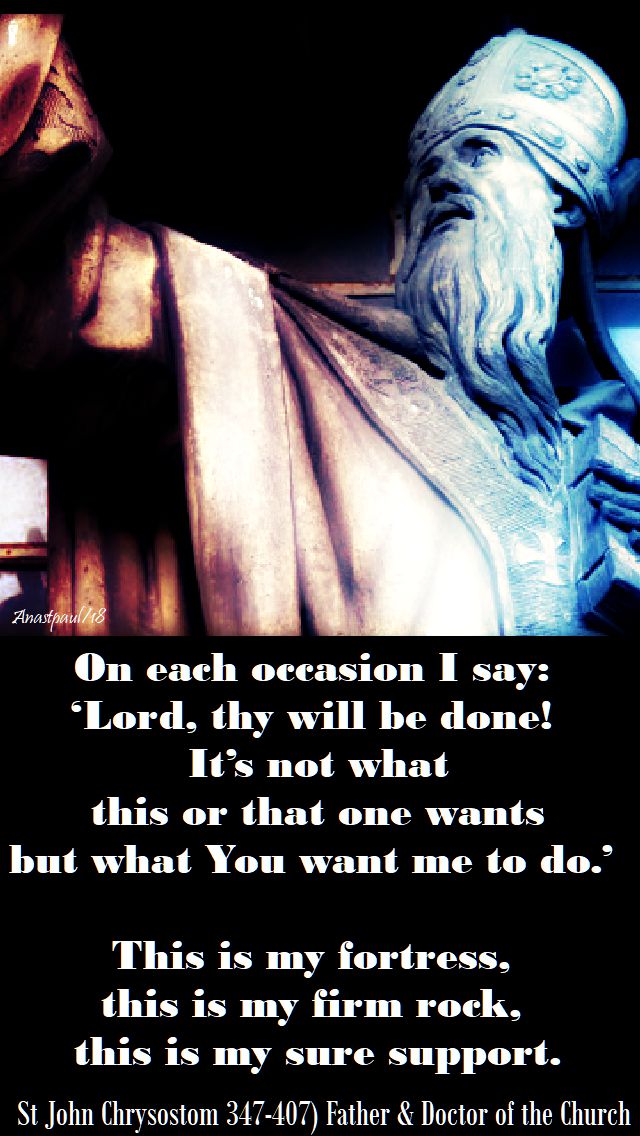
“On each occasion I say: ‘Lord, thy will be done! It’s not what this or that one wants but what You want me to do.’ This is my fortress, this is my firm rock, this is my sure support.”
St John Chrysostom 347-407) Father & Doctor of the Church
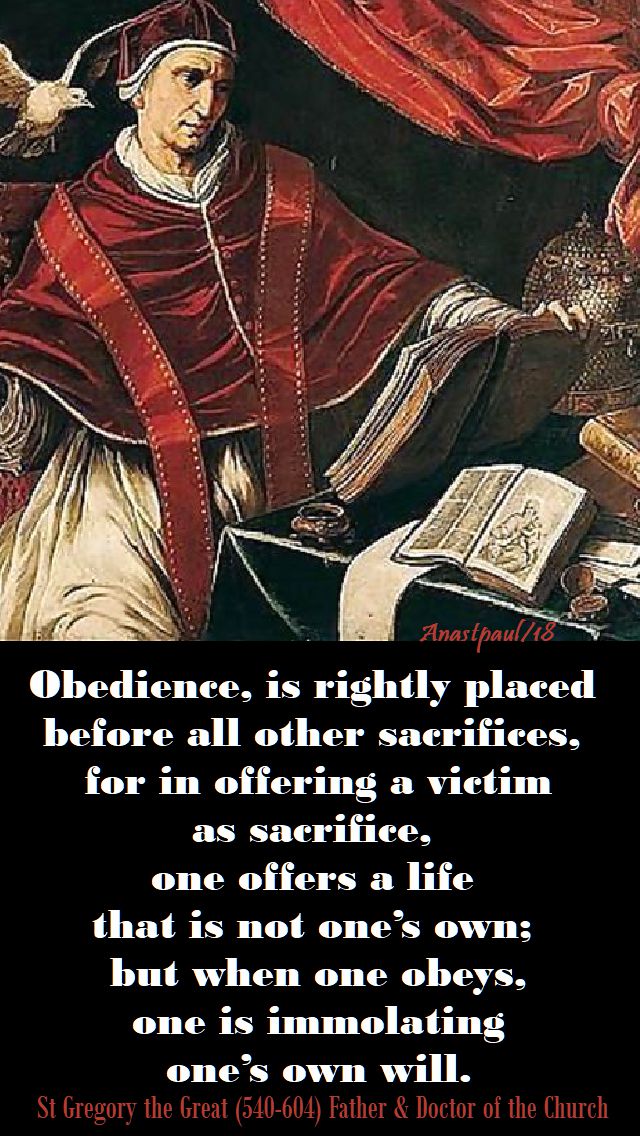
“Obedience, is rightly placed before all other sacrifices, for in offering a victim as sacrifice, one offers a life that is not one’s own; but when one obeys, one is immolating one’s own will.”
St Gregory the Great (540-604) Father & Doctor of the Church
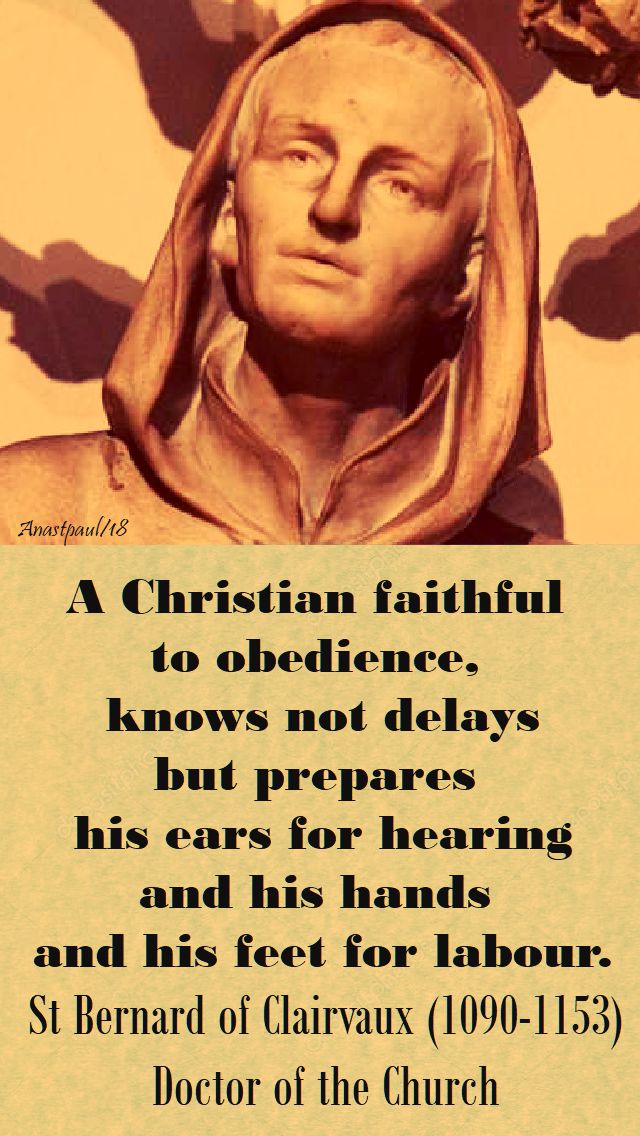
“A Christian faithful to obedience, knows not delays but prepares his ears for hearing and his hands and his feet for labour.”
St Bernard of Clairvaux (1090-1153) Doctor of the Church
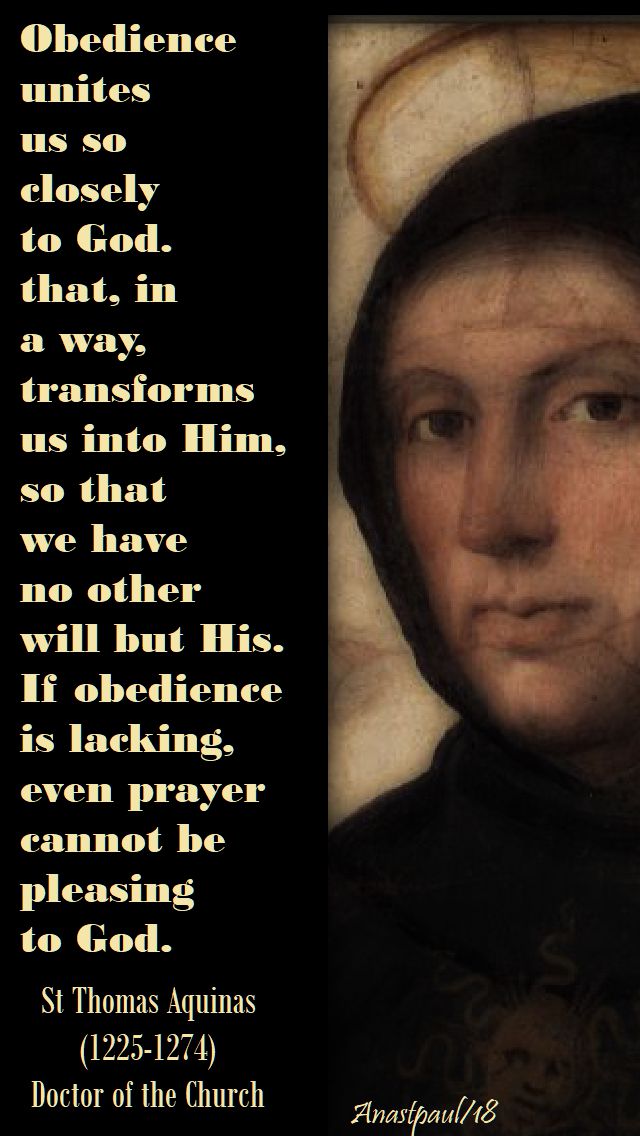
“Obedience unites us so closely to God. that in a way transforms us into Him, so that we have no other will but His. If obedience is lacking, even prayer cannot be pleasing to God.”
St Thomas Aquinas (1225-1274) Doctor of the Church
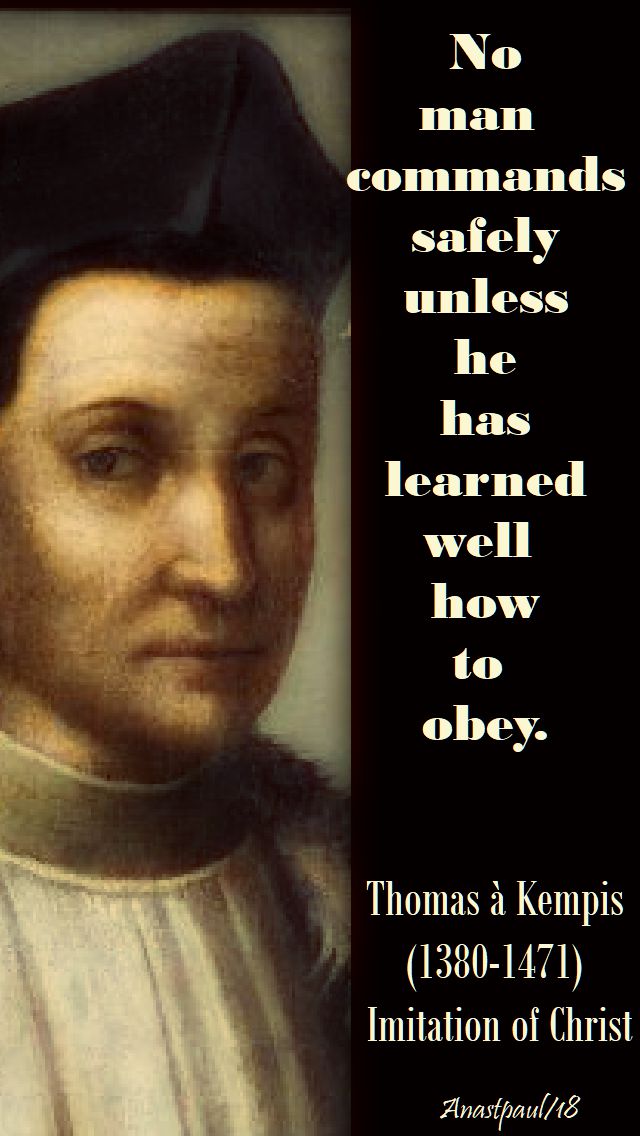
“No man commands safely unless he has learned well how to obey.”
Thomas à Kempis (1380-1471) – Imitation of Christ
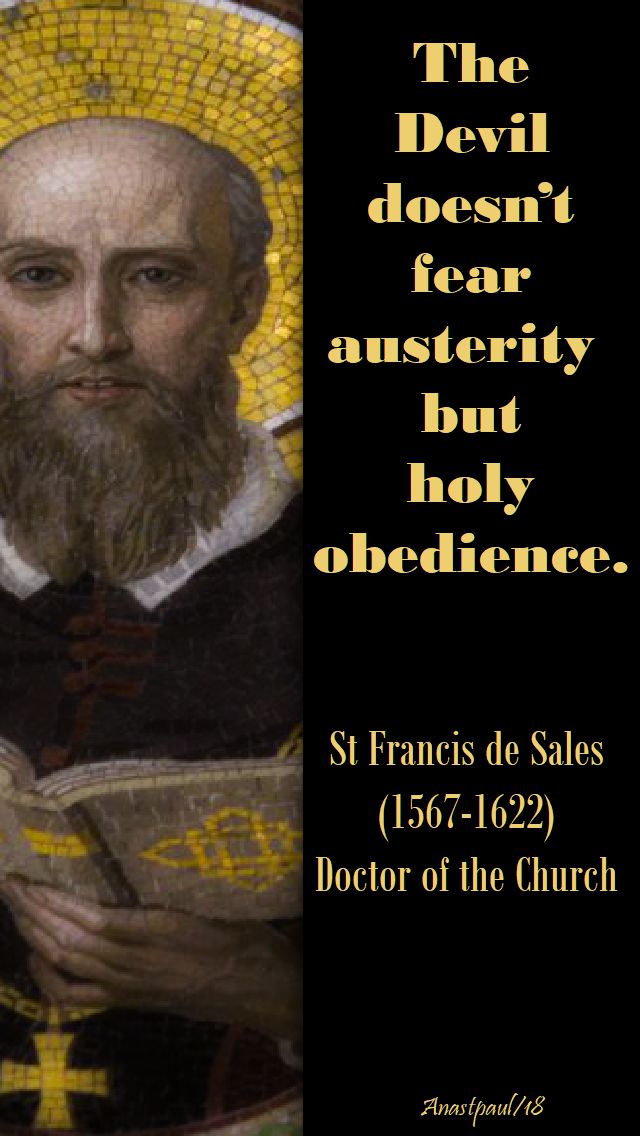
“The Devil doesn’t fear austerity but holy obedience.”
St Francis de Sales (1567-1622) Doctor of the Church
Series on the Catechesis of Pope BENEDICT XVI on St Paul
“Speaking of St Paul ” No 1 – Wednesday, 2 July 2008
Religious and Cultural Environment
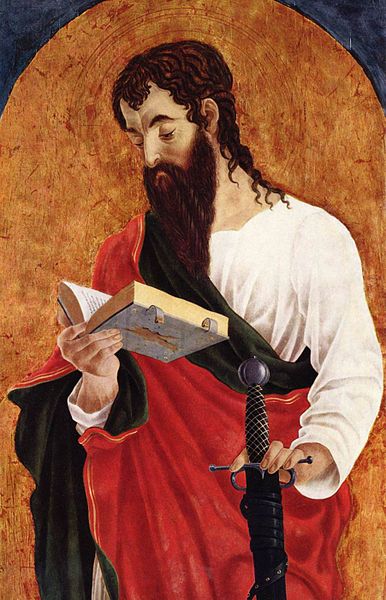
Marco Zoppo (1433–1478) – Italian painter (1433-1478) St Paul circa 1468
Dear Brothers and Sisters,
Today I would like to begin a new cycle of Catechesis focusing on the great Apostle St Paul. As you know, this year is dedicated to him, from the liturgical Feast of Sts Peter and Paul on 29 June 2008 to the same Feast day in 2009. The Apostle Paul, an outstanding and almost inimitable yet stimulating figure, stands before us as an example of total dedication to the Lord and to his Church, as well as of great openness to humanity and its cultures. It is right, therefore, that we reserve a special place for him in not only our veneration but also in our effort to understand what he has to say to us as well, Christians of today. In this first meeting let us pause to consider the environment in which St Paul lived and worked. A theme such as this would seem to bring us far from our time, given that we must identify with the world of 2,000 years ago. Yet this is only apparently and, in any case, only partly true for we can see that various aspects of today’s social and cultural context are not very different from what they were then.
A primary and fundamental fact to bear in mind is the relationship between the milieu in which Paul was born and raised and the global context to which he later belonged. He came from a very precise and circumscribed culture, indisputably a minority, which is that of the People of Israel and its tradition. In the ancient world and especially in the Roman Empire, as scholars in the subject teach us, Jews must have accounted for about 10 percent of the total population. Later, here in Rome, towards the middle of the first century, this percentage was even lower, amounting to three percent of the city’s inhabitants at most. Their beliefs and way of life, is still the case today, distinguished them clearly from the surrounding environment and this could have two results: either derision, that could lead to intolerance, or admiration which was expressed in various forms of sympathy, as in the case of the “God-fearing” or “proselytes”, pagans who became members of the Synagogue and who shared the faith in the God of Israel. As concrete examples of this dual attitude we can mention on the one hand the cutting opinion of an orator such as Cicero who despised their religion and even the city of Jerusalem (cf. Pro Flacco, 66-69) and, on the other, the attitude of Nero’s wife, Poppea, who is remembered by Flavius Josephus as a “sympathiser” of the Jews (cf. Antichità giudaiche 20, 195, 252); Vita 16), not to mention that Julius Caesar had already officially recognised specific rights of the Jews which have been recorded by the above-mentioned Jewish historian Flavius Josephus (cf. ibid., 14,200-216). It is certain that the number of Jews, as, moreover, is still the case today, was far greater outside the land of Israel, that is, in the Diaspora, than in the territory that others called Palestine.
It is not surprising, therefore, that Paul himself was the object of the dual contradictory assessment that I mentioned. One thing is certain: the particularism of the Judaic culture and religion easily found room in an institution as far-reaching as the Roman Empire. Those who would adhere with faith to the Person of Jesus of Nazareth, Jew or Gentile, were in the more difficult and troubled position, to the extent to which they were to distinguish themselves from both Judaism and the prevalent paganism. In any case, two factors were in Paul’s favour. The first was the Greek, or rather Hellenistic, culture which after Alexander the Great had become a common heritage, at least of the Eastern Mediterranean and of the Middle East and had even absorbed many elements of peoples traditionally considered barbarian. One writer of the time says in this regard that Alexander “ordered that all should consider the entire oecumene as their homeland… and that a distinction should no longer be made between Greek and barbarian” (Plutarch, De Alexandri Magni fortuna aut virtute, 6, 8). The second factor was the political and administrative structure of the Roman Empire which guaranteed peace and stability from Britain as far as southern Egypt, unifying a territory of previously unheard of dimensions. It was possible to move with sufficient freedom and safety in this space, making use, among other things, of an extraordinary network of roads and finding at every point of arrival basic cultural characteristics which, without affecting local values, nonetheless represented a common fabric of unification super partes, so that the Jewish philosopher, Philo of Alexandria, a contemporary of Paul himself, praised the Emperor Augustus for “composing in harmony all the savage peoples, making himself the guardian of peace” (Legatio ad Caium, 146-147).
There is no doubt that the universalist vision characteristic of St Paul’s personality, at least of the Christian Paul after the event on the road to Damascus, owes its basic impact to faith in Jesus Christ, since the figure of the Risen One was by this time situated beyond any particularistic narrowness. Indeed, for the Apostle “there is neither Jew nor Greek, there is neither slave nor free, there is neither male nor female; for you are all one in Christ Jesus” (Gal 3: 28). Yet, even the historical and cultural situation of his time and milieu could not but have had an influence on his decisions and his work. Some have defined Paul as “a man of three cultures”, taking into account his Jewish background, his Greek tongue and his prerogative as a “civis romanus [Roman citizen], as the name of Latin origin suggests. Particularly the Stoic philosophy dominant in Paul’s time which influenced Christianity, even if only marginally, should be recalled. Concerning this, we cannot gloss over certain names of Stoic philosophers such as those of its founders, Zeno and Cleanthes and then those closer to Paul in time such as Seneca, Musonius and Epictetus: in them the loftiest values of humanity and wisdom are found which were naturally to be absorbed by Christianity. As one student of the subject splendidly wrote, “Stoicism… announced a new ideal, which imposed upon man obligations to his peersbut at the same time set him free from all physical and national ties and made of him a purely spiritual being” (M. Pohlenz, La Stoa, I, Florence, 2, 1978, pp. 565 f.). One thinks, for example, of the doctrine of the universe understood as a single great harmonious body and consequently of the doctrine of equality among all people without social distinctions, of the equivalence, at least in principle, of men and women and then of the ideal of frugality, of the just measure and self-control to avoid all excesses. When Paul wrote to the Philippians, “Whatever is true, whatever is honourable, whatever is just, whatever is pure, whatever is lovely, whatever is gracious, if there is any excellence, if there is anything worthy of praise, think about these things” (Phil 4: 8), he was only taking up a purely humanistic concept proper to that philosophical wisdom.
In St Paul’s time a crisis of traditional religion was taking place, at least in its mythological and even civil aspects. After Lucretius had already ruled polemically a century earlier that “religion has led to many misdeeds” (De rerum natura, 1, 101, On the Nature of Things), a philosopher such as Seneca, going far beyond any external ritualism, taught that “God is close to you, he is with you, he is within you” (Epistulae morales to Lucilius, 41, 1). Similarly, when Paul addresses an audience of Epicurean philosophers and Stoics in the Areopagus of Athens, he literally says: “God does not live in shrines made by man,… for in him we live and move and have our being” (Acts 17: 24, 28). In saying this he certainly re-echoes the Judaic faith in a God who cannot be represented in anthropomorphic terms and even places himself on a religious wavelength that his listeners knew well. We must also take into account the fact that many pagan cults dispensed with the official temples of the town and made use of private places that favoured the initiation of their followers. It is, therefore, not surprising that Christian gatherings (ekklesiai) as Paul’s Letters attest, also took place in private homes. At that time, moreover, there were not yet any public buildings. Therefore, Christian assemblies must have appeared to Paul’s contemporaries as a simple variation of their most intimate religious practice. Yet the differences between pagan cults and Christian worship are not negligible and regard the participants’ awareness of their identity as well as the participation in common of men and women, the celebration of the “Lord’s Supper”, and the reading of the Scriptures.
In conclusion, from this brief over-view of the cultural context of the first century of the Christian era, it is clear that it is impossible to understand St Paul properly without placing him against both the Judaic and pagan background of his time. Thus he grows in historical and spiritual stature, revealing both sharing and originality in comparison with the surrounding environment. However, this applies likewise to Christianity in general, of which the Apostle Paul, precisely, is a paradigm of the highest order from whom we all, always, still have much to learn. And this is the goal of the Pauline Year: to learn from St Paul, to learn faith, to learn Christ, and finally to learn the way of upright living.
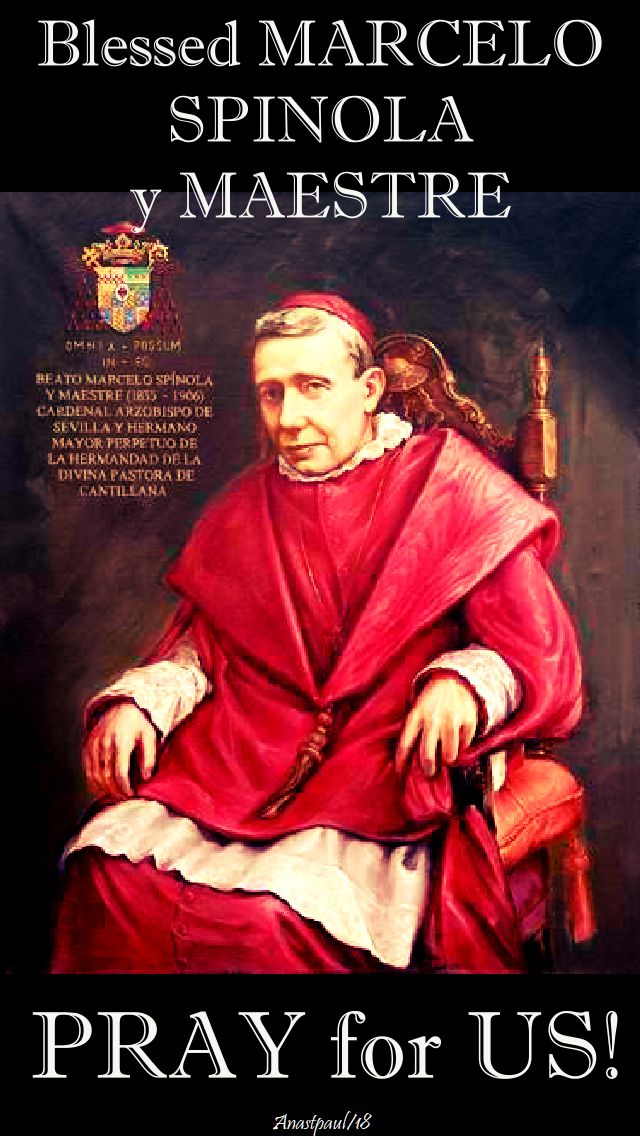
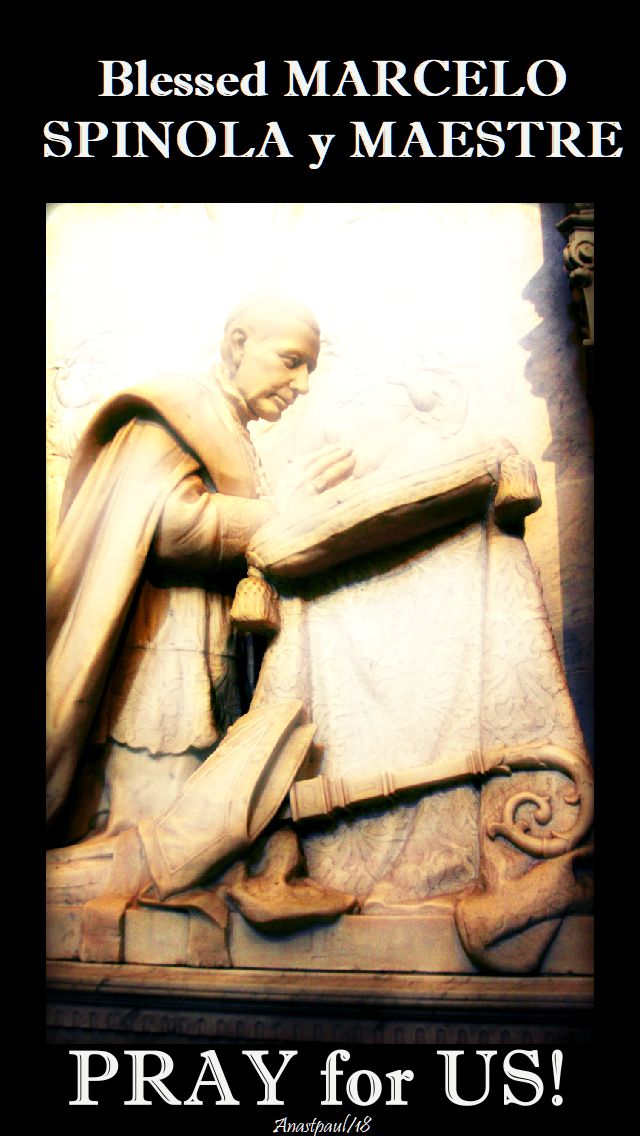
On the Memorial of Blessed Marcelo Spínola y Maestre, Cardinal-Priest (1835-1906) – 19 January
As today we have been thinking of all our Priests, let us pray:
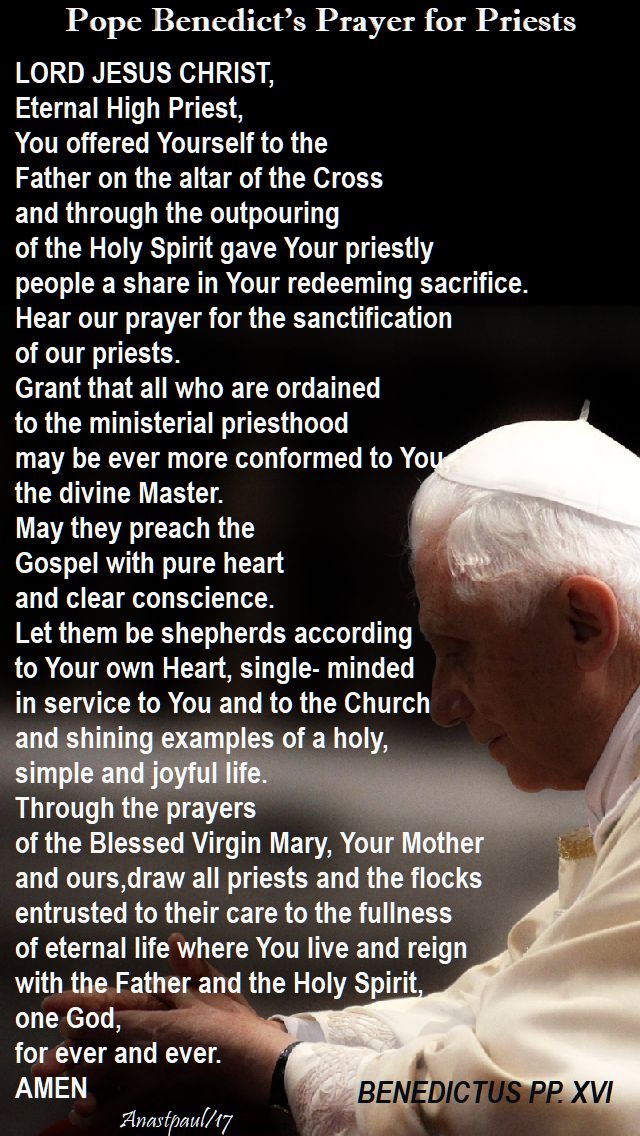
Pope Benedict’s Prayer for Priests
LORD JESUS CHRIST,
Eternal High Priest, You offered Yourself to the
Father on the altar of the Cross and through the
outpouring of the Holy Spirit gave Your priestly
people a share in Your redeeming sacrifice.
Hear our prayer for the sanctification of our priests.
Grant that all who are ordained to the ministerial
priesthood may be ever more conformed to You,
the divine Master.
May they preach the
Gospel with pure heart and clear conscience.
Let them be shepherds according to Your own Heart,
single- minded in service to You and to the Church
and shining examples of a holy,simple and joyful life.
Through the prayers of the Blessed Virgin Mary,
Your Mother and ours,draw all priests and the flocks
entrusted to their care to the fullness of eternal life where
You live and reign with the Father and the Holy Spirit,
one God, for ever and ever.
AMEN
BENEDICTUS PP. XVI
Thought for the day – 19 January – The Memorial of Blessed Marcelo Spínola y Maestre, Cardinal-Priest (1835-1906)
Speaking of Saints and Lawyers?
A lawyer was visited by Satan who promised that if he sold his soul to him, he would be wealthy, have a beautiful wife who would never leave him and all his cases would be successes.
The lawyer said “Yeh, but what’ the catch?”
So many ‘official’ saints were Lawyers – I have been trying to work this out, what is the connection between holiness and the mind of the lawyer? Especially in the light of the general opinion we all have of lawyers, something akin to the second-hand car salesman! In other words, a bit of a lier and a cheat, at the very least, someone who shines and polishes the little bit of truth available to him. Perhaps it is just this – this ability to grab the bit of truth available and make it grow, make it shine, make it the reason why we must have that car or why the judge must release the prisoner?
So the saintly lawyers, grab the bit of truth and delve deeper and further until they find the whole truth – this must be it! And in that digging they, of course, find the ONLY truth – Jesus the Christ and His Church! Then, if they were good lawyers, that natural instinct, to delve, to dig, will continue and in that effort, sanctity is achieved.
Here are some, I could find on a quick search, who kept their eye on heaven:
Blessed Anacleto González Flores
Blessed Angelo Carletti
Blessed Antoine-Frédéric Ozanam
Blessed Antonio Franco
Blessed Augustine Novello
Blessed Bartholomew Longo
Blessed Bernardine of Fossa
Blessed Charles Steeb
Blessed Contardo Ferrini
Blessed Demosthenes Ranzi
Blessed Dermot O’Hurley
Blessed Gennaro Maria Sarnelli
Blessed Giacomo Villa
Blessed Giuseppe Antonio Tovini
Blessed Henry of Segusio
Blessed Humbert of Romans
Blessed Jacopone da Todi
Blessed James the Almsgiver
Blessed Jean of Hainaut
Blessed John of Vercelli
Blessed John Storey
Blessed José Perpiñá Nácher
Blessed Luigi Beltrame Quattrocchi
Blessed Manuel Basulto Jiménez
Blessed Marcelo Spínola y Maestre
Blessed Mark Fantucci
Blessed Nazju Falzon
Blessed Paul Burali d’Arezzo
Blessed Paul of Wallachia
Blessed Peter de Geremia
Blessed Pierre de Barellis
Blessed Pietro of Gubbio
Blessed Pope Innocent XI
Blessed William Scott
Saint Alphonsus Maria de Liguori
Saint Amphilochius of Iconium
Saint Andrew Avellino
Saint Aprus of Toul
Saint Bernadine Realino
Saint Bertrand of Aquileia
Saint Charles Borromeo
Saint Fidelis of Sigmaringen
Saint Francis de Sales
Saint Germanus of Auxerre
Saint Gregory Barbarigo
Saint Ivo of Kermartin
Saint James of the Marches
Saint Jerome
Saint John Houghton
Saint John of Avila
Saint John of Capistrano
Saint Josemaria Escriva
Saint Liphardus of Orleans
Saint Paulinus of Nola
Saint Philogonius of Antioch
Saint Raymond of Penyafort
Saint Richard of Chichester
Saint Salvius of Albi
Saint Satyrus of Milan
Saint Sylvester Gozzolini
Saint Theophilus the Lawyer
Saint Thomas a Becket
Saint Thomas More
Saint Tryphillius of Leucosia
Saint Turibius of Mogroveio
Venerable Cesare Baronio
Venerable Luis de Trelles y Nogerol
Blessed Marcelo Spínola y Maestre, pray for us that we too shine and polish the truth until we meet you in heaven as saints!
Quote/s of the Day – 19 January – The Memorial of Blessed Marcelo Spínola y Maestre, Cardinal-Priest (1835-1906)
“Speaking of Priests”
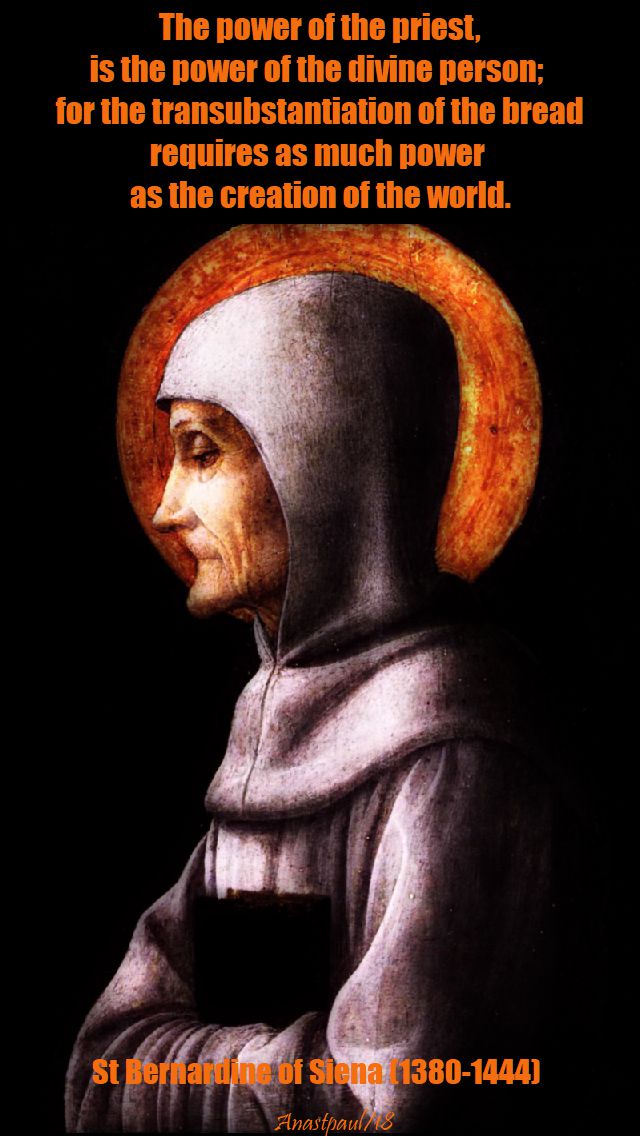
“The power of the priest, is the power of the divine person; for the transubstantiation of the bread requires as much power as the creation of the world.”
St Bernardine of Siena (1380-1444)
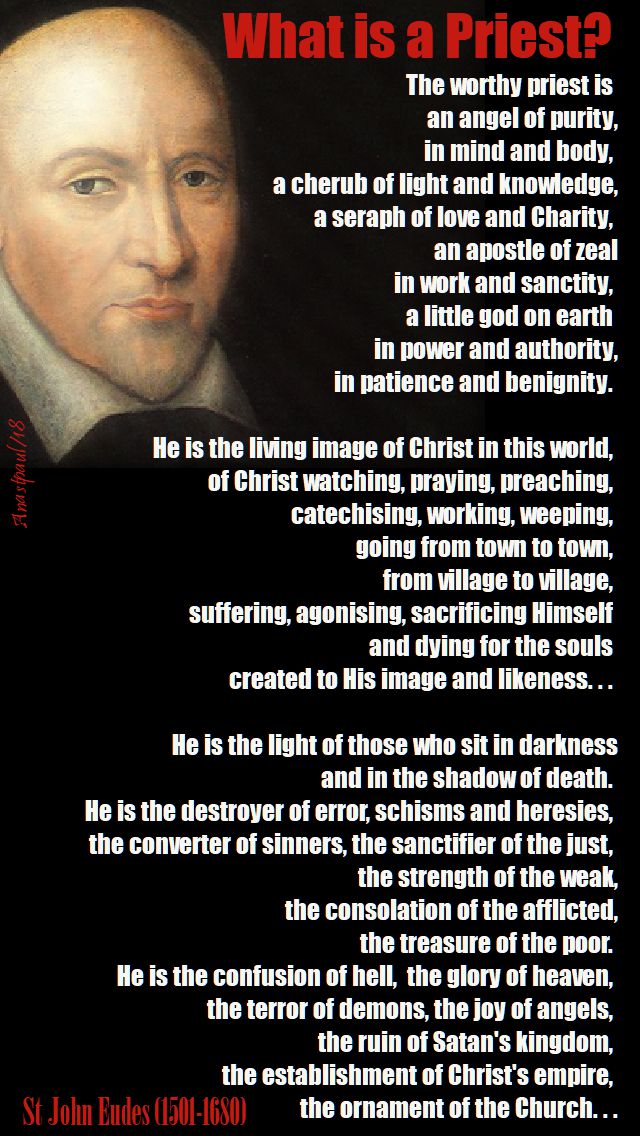
“The worthy priest is an angel of purity, in mind and body, a cherub of light and knowledge, a seraph of love and Charity, an apostle of zeal in work and sanctity, a little god on earth in power and authority, in patience and benignity. He is the living image of Christ in this world, of Christ watching, praying, preaching, catechising, working, weeping, going from town to town, from village to village, suffering, agonising, sacrificing Himself and dying for the souls created to His image and likeness. . . He is the light of those who sit in darkness and in the shadow of death. He is the destroyer of error, schisms and heresies, the converter of sinners, the sanctifier of the just, the strength of the weak, the consolation of the afflicted, the treasure of the poor. He is the confusion of hell, the glory of heaven, the terror of demons, the joy of angels, the ruin of Satan’s kingdom, the establishment of Christ’s empire, the ornament of the Church. . .”
St John Eudes (1501-1680)
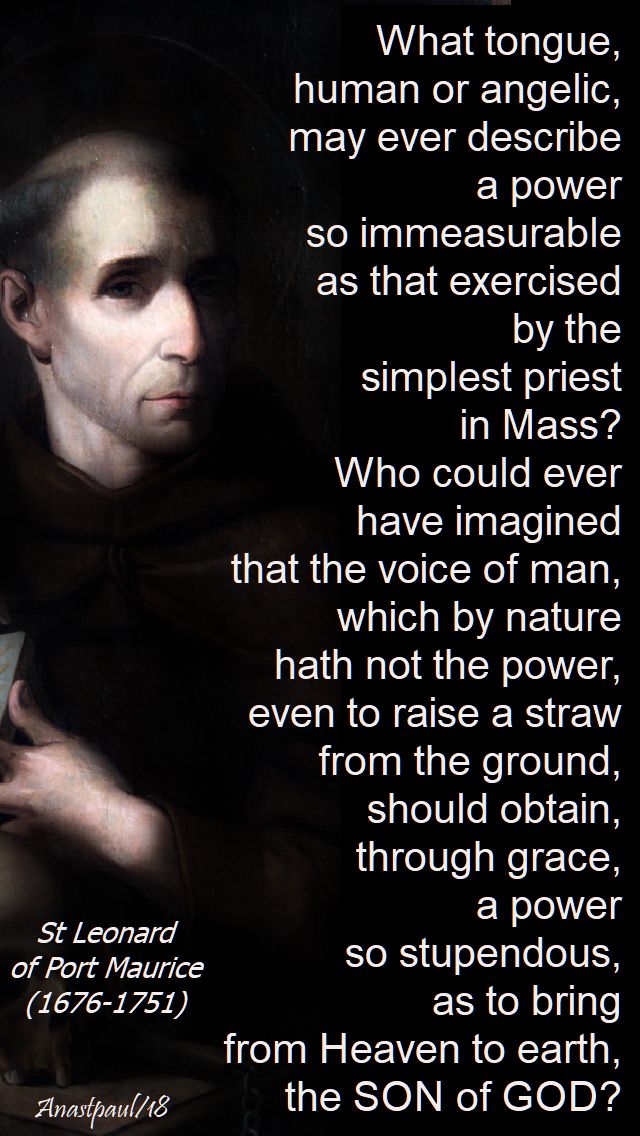
“What tongue, human or angelic, may ever describe a power so immeasurable as that exercised by the simplest priest in Mass? Who could ever have imagined that the voice of man, which by nature hath not the power, even to raise a straw from the ground, should obtain through grace, a power so stupendous, as to bring from Heaven to earth, the SON of GOD?”
St Leonard of Port Maurice OFM (1676-1751)
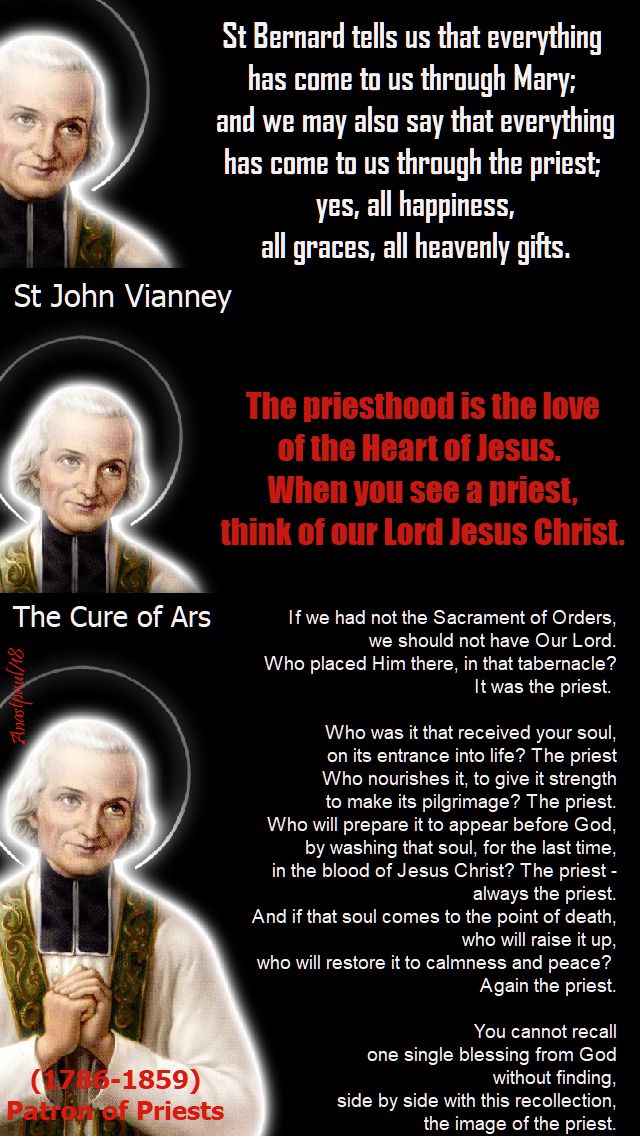
“St Bernard tells us that everything has come to us through Mary; and we may also say that everything has come to us through the priest; yes, all happiness, all graces, all heavenly gifts.”
“The priesthood is the love of the Heart of Jesus. When you see a priest, think of our Lord Jesus Christ.”
“If we had not the Sacrament of Orders, we should not have Our Lord. Who placed Him there, in that tabernacle? It was the priest. Who was it that received your soul, on its entrance into life? The priest. Who nourishes it, to give it strength to make its pilgrimage? The priest. Who will prepare it to appear before God, by washing that soul, for the last time, in the blood of Jesus Christ? The priest – always the priest. And if that soul comes to the point of death, who will raise it up, who will restore it to calmness and peace? Again the priest. You cannot recall one single blessing from God without finding, side by side with this recollection, the image of the priest.”
St Jean Marie Baptiste Vianney, the Cure of Ars (1786-1859) – Patron of Priests
One Minute Reflection – 19 January – The Memorial of Blessed Marcelo Spínola y Maestre (1835-1906)
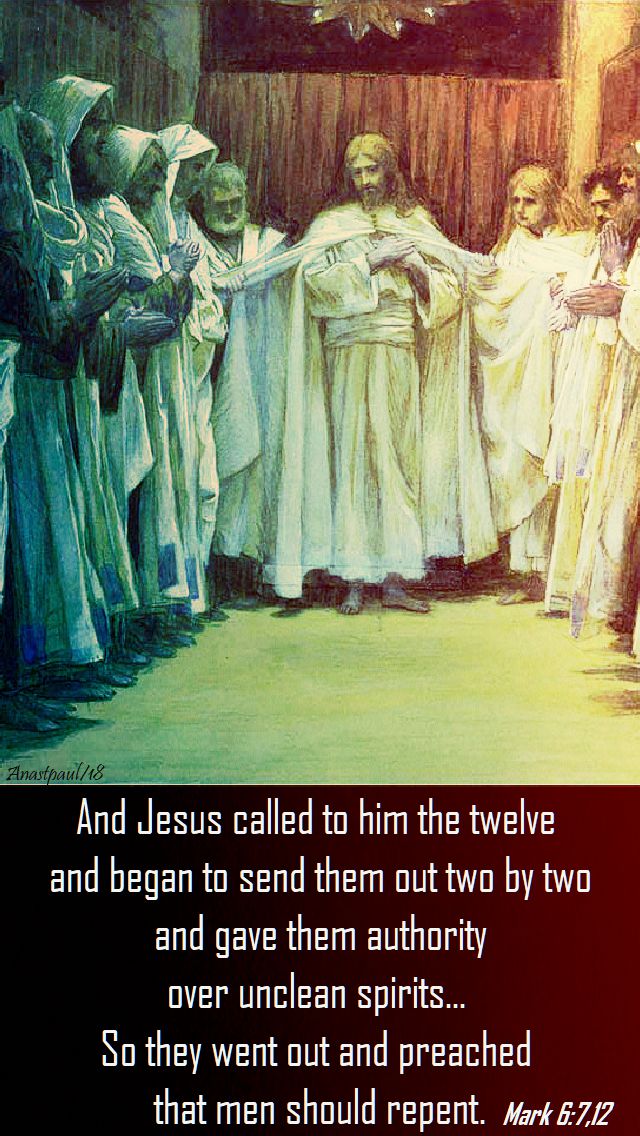
And Jesus called to him the twelve and began to send them out two by two, and gave them authority over unclean spirits… So they went out and preached that men should repent...Mark 6:7,12
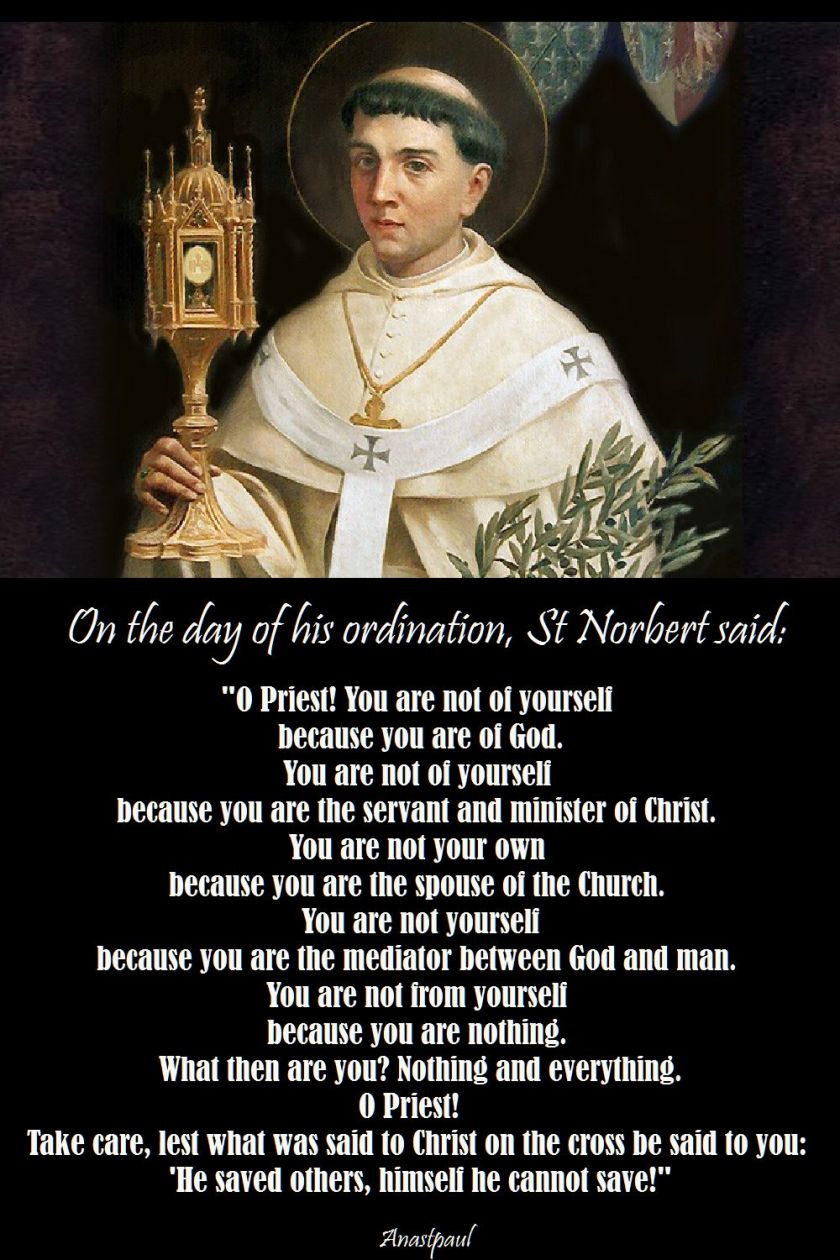
REFLECTION – “‘O Priest! You are not yourself because you are of God. You are not of yourself because you are the servant and minister of Christ. You are not you own because you are the spouse of the Church. You are not yourself because you are the mediator between God and man. You are not from yourself because you are nothing. What then are you? Nothing and everything. O Priest! Take care lest what was said to Christ on the cross be said to you: “He saved others, himself he cannot save!”‘ ...St Norbert
PRAYER – O Lord of all, today we pray for our priests. All our priests from the Holy Father to our the newly ordained. Keep them holy and for yourself O Lord. Keep them in the image of Your Son, our High Priest, Jesus Christ. Keep them pure in heart, loving in spirit, filled with charity for all and most of all, with the greatest of love for You. Bless their hearts and their hands, that administer Your Eucharistic Son to your faithful. Grant that the prayers of Blessed Marcelo Spínola, may intercede for all our priests and ourselves. Amen








 AnaStpaul
You must be logged in to post a comment.