Quote/s of the Day – 7 January – St Raymond of Peñafort (1175-1275) “Father of Canon Law”
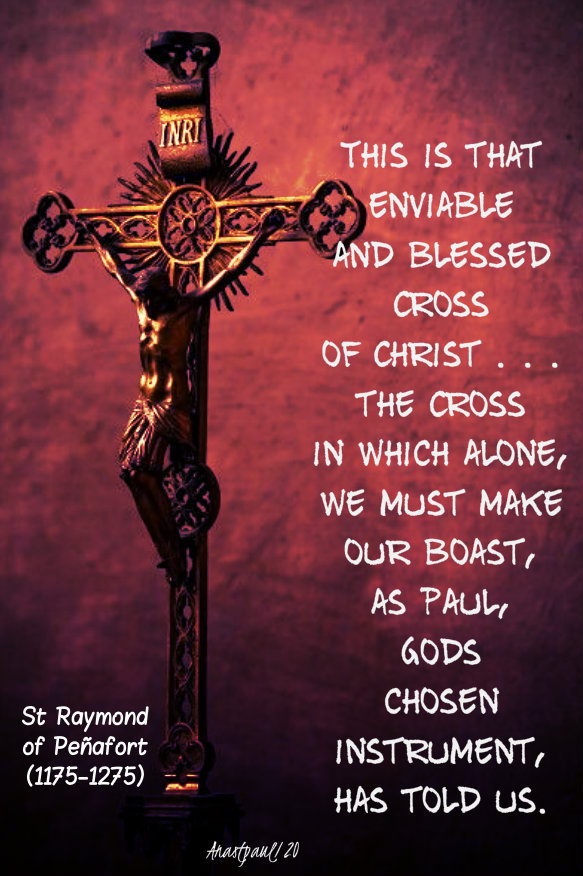
“This is that enviable and blessed Cross of Christ . . . the Cross in which alone, we must make our boast, as Paul, God’s chosen instrument, has told us.”
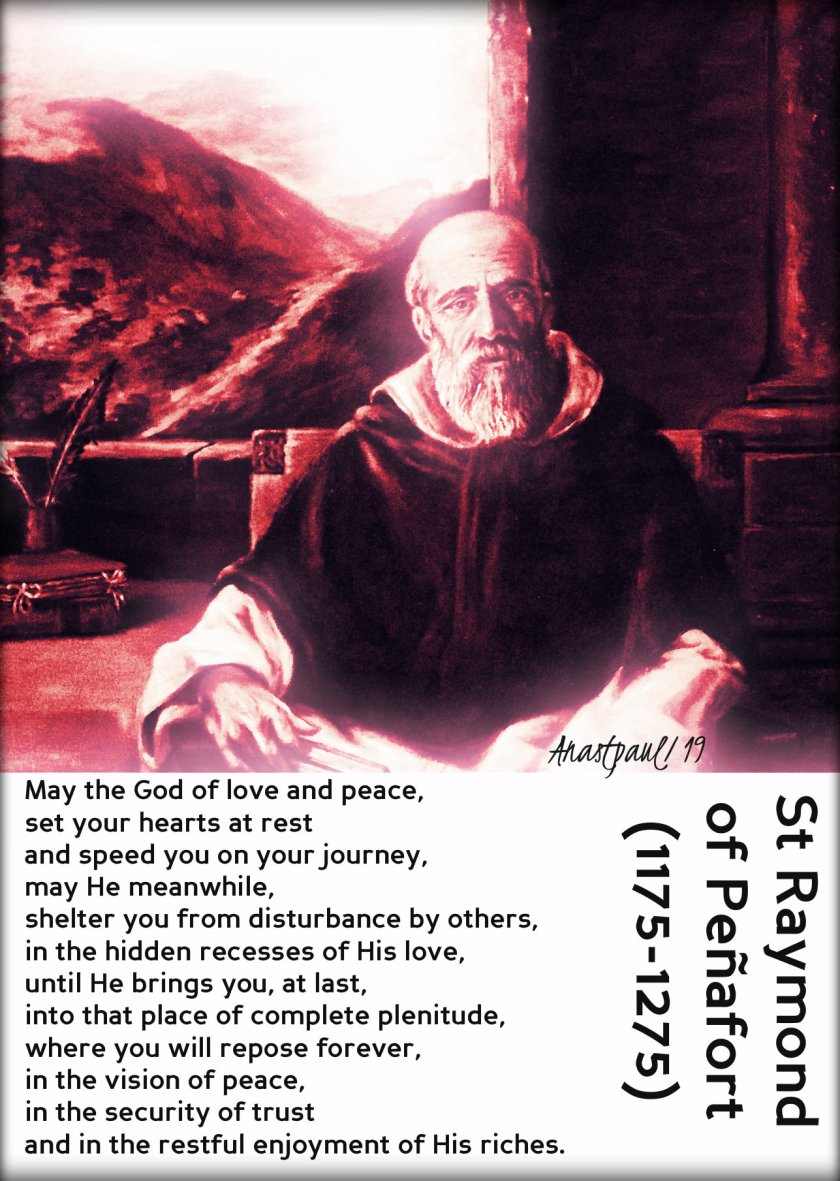
“May the God of love and peace, set your hearts at rest and speed you on your journey, may He meanwhile, shelter you from disturbance by others, in the hidden recesses of His love, until He brings you, at last, into that place of complete plenitude, where you will repose forever, in the vision of peace, in the security of trust and in the restful enjoyment of His riches.”
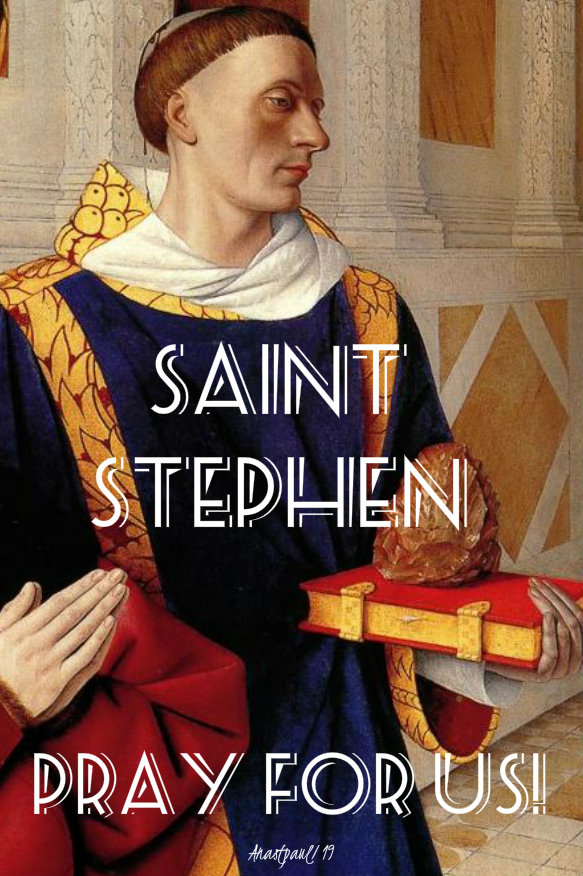
Thought for the Day – 26 December – Feast of St Stephen the ProtoMartyr and The Second Day in the Christmas Octave
The Armament of Love
Saint Fulgentius of Ruspe (460-533)
Bishop
An excerpt from his Sermon 3
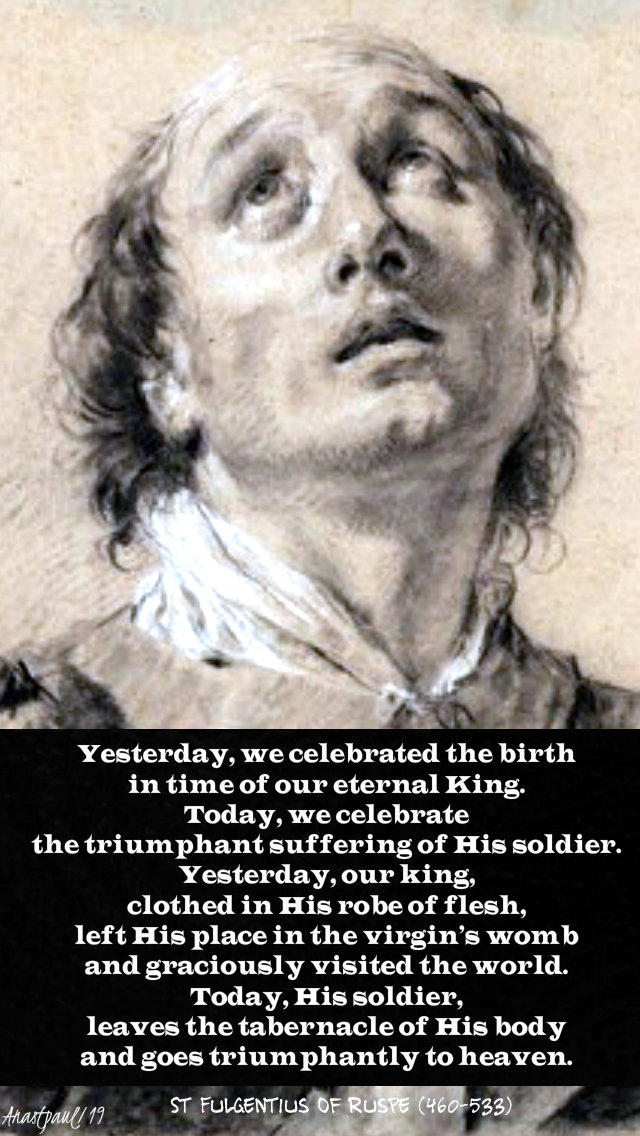
Yesterday, we celebrated the birth in time of our eternal King. Today, we celebrate the triumphant suffering of His soldier. Yesterday, our king, clothed in His robe of flesh, left His place in the virgin’s womb and graciously visited the world. Today, His soldier, leaves the tabernacle of His body and goes triumphantly to heaven.
Our king, despite His exalted majesty, came in humility for our sake, yet, He did not come empty-handed. He brought His soldiers a great gift, that not only enriched them but also made them unconquerable in battle, for it was the gift of love, which was to bring men to share in His divinity. He gave of His bounty, yet without any loss to Himself. In a marvellous way He changed into wealth, the poverty of His faithful follower,s while remaining in full possession of His own inexhaustible riches.
And so, the love that brought Christ from heaven to earth, raised Stephen from earth to heaven – shown first in the king, it later shone forth in His soldier. Love was Stephen’s weapon by which he gained every battle and so won the crown signified by his name. His love of God kept him from yielding to the ferocious mob, his love for his neighbour made him pray for those who were stoning him. Love inspired him to reprove those who erred, to make them amend, love led him to pray for those who stoned him, to save them from punishment. Strengthened by the power of his love, he overcame the raging cruelty of Saul and won his persecutor on earth as his companion in heaven. In his holy and tireless love, he longed to gain by prayer, those whom he could not convert by admonition.
Now at last, Paul rejoices with Stephen, with Stephen he delights in the glory of Christ, with Stephen he exalts, with Stephen he reigns. Stephen went first, slain by the stones thrown by Paul but Paul followed after, helped by the prayer of Stephen. This, surely, is the true life, my brothers, a life in which Paul feels no shame because of Stephen’s death and Stephen delights in Paul’s companionship, for love fills them both with joy. It was Stephen’s love that prevailed over the cruelty of the mob and it was Paul’s love, that covered the multitude of his sins, it was love that won for both of them the kingdom of heaven.
Love, indeed, is the source of all good things, it is an impregnable defence and the way that leads to heaven. He who walks in love can neither go astray, nor be afraid, love guides him, protects him and brings him to his journey’s end.
My brothers, Christ made love the stairway that would enable all Christians to climb to heaven. Hold fast to it, therefore, in all sincerity, give one another practical proof of it and by your progress in it, make your ascent together.
One Minute Reflection – 26 December – Feast of St Stephen the ProtoMartyr and The Second Day in the Christmas Octave, Readings: Acts 6:8-10; 7:54-59, Psalm31:3-4, 6, 8, 16-17, Matthew 10:17-22
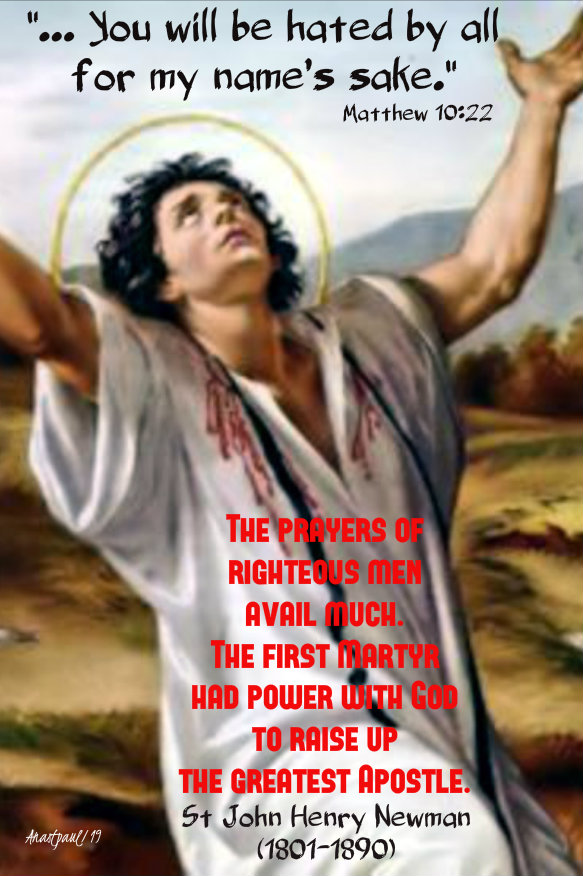
“… You will be hated by all for my name’s sake.” … Matthew 10:22
REFLECTION – “When the blood of Stephen was shed, Saul, then a young man, was standing by “consenting unto his death” and “kept the raiment of them that slew him” (Acts 22:20). Two speeches are recorded of the Martyr in his last moments one, in which he prayed that God would pardon his murderers – the other, his witness, that he saw the heavens opened and Jesus on God’s right hand. His prayer was wonderfully answered. Stephen saw his Saviour, the next vision of that Saviour to mortal man was vouchsafed to that very young man, even Saul, who share in his murder and his intercession.
Strange indeed it was and what would have been St Stephen’s thoughts could he have known it! The prayers of righteous men avail much. The first Martyr had power with God to raise up the greatest Apostle. Such was the honour put upon the first-fruits of those sufferings, upon which the Church was entering. Thus, from the beginning, the blood of the Martyrs was the seed of the Church.” … St John Henry Newman (1801-1890) Cardinal, Theologian, Apologist – Parochial and Plain Sermons II #9
PRAYER –
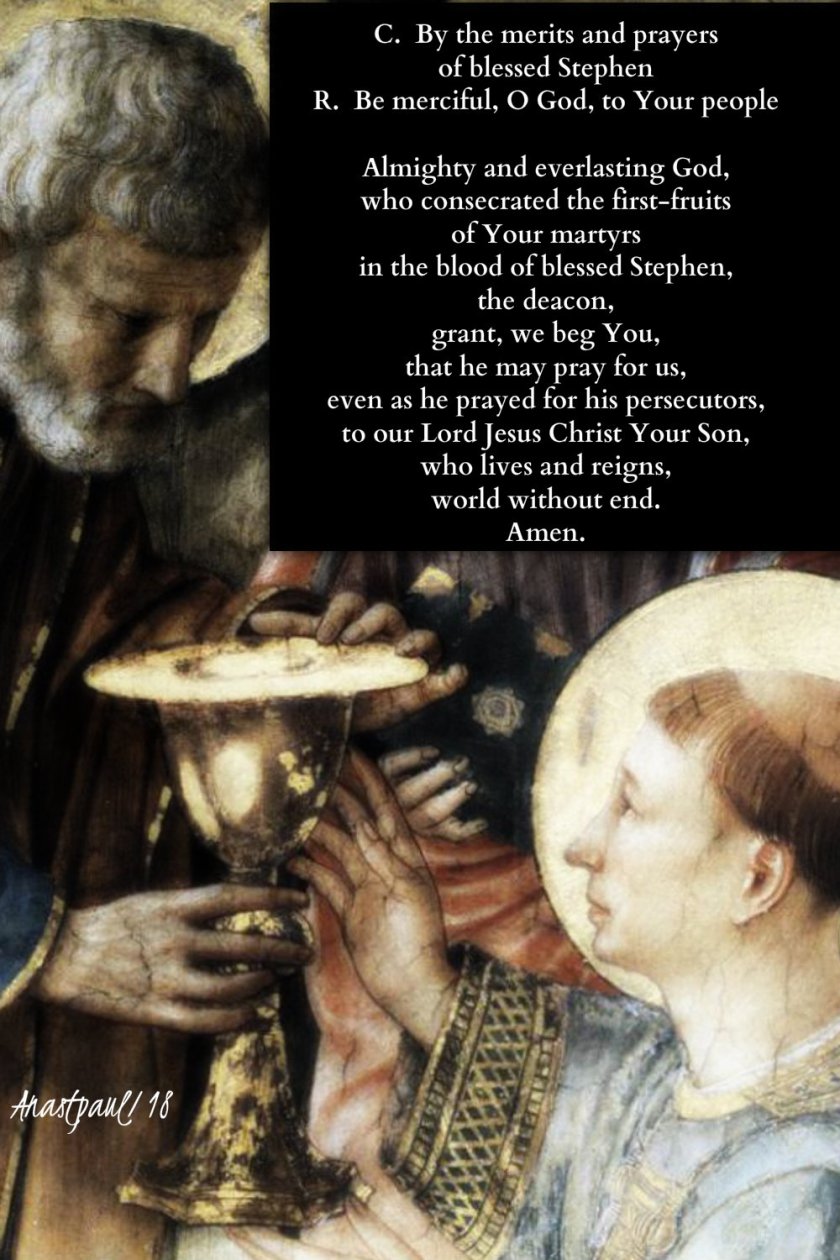
C. By the merits and prayers of blessed Stephen
R. Be merciful, O God, to Your people
Almighty and everlasting God, who consecrated the first-fruits of Your martyrs in the blood of blessed Stephen the deacon, grant, we beg You, that he may pray for us, even as he prayed for his persecutors, to our Lord Jesus Christ Your Son, who lives and reigns, world without end. Amen
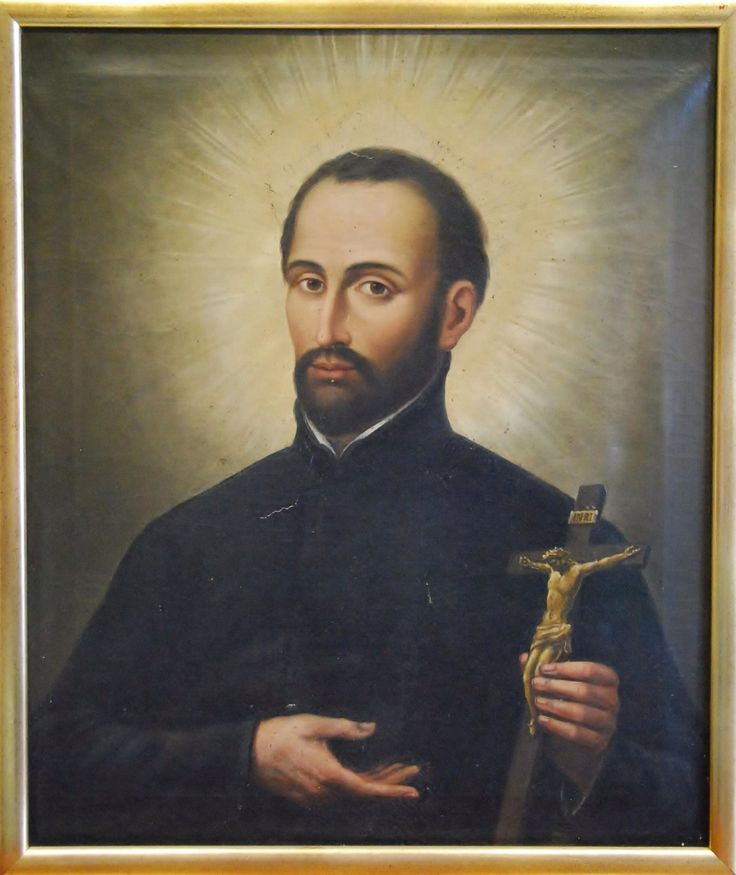
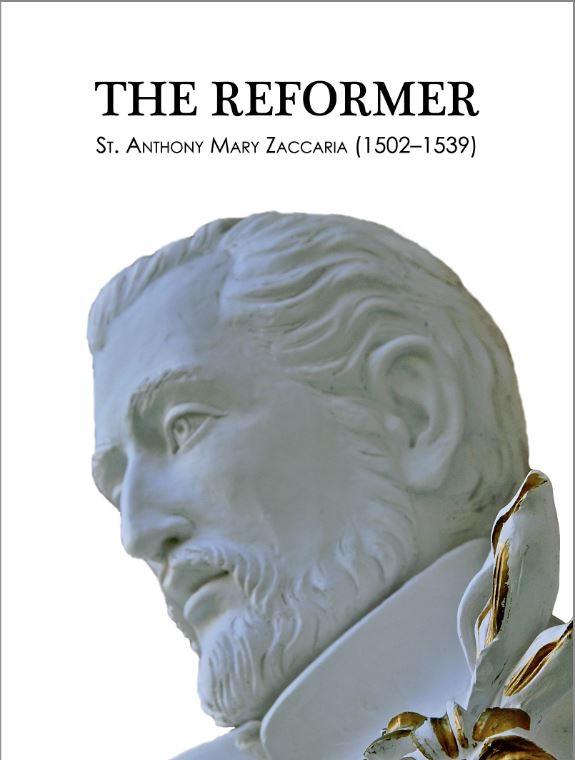
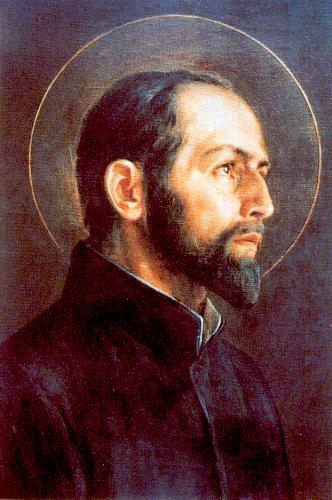
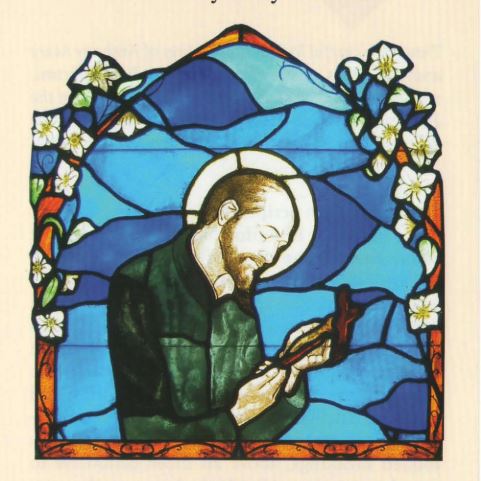
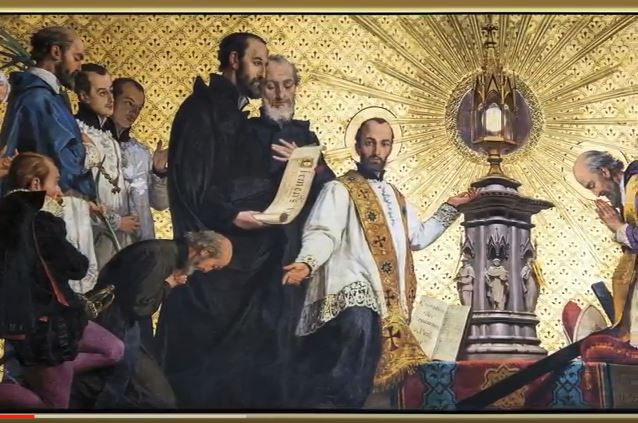
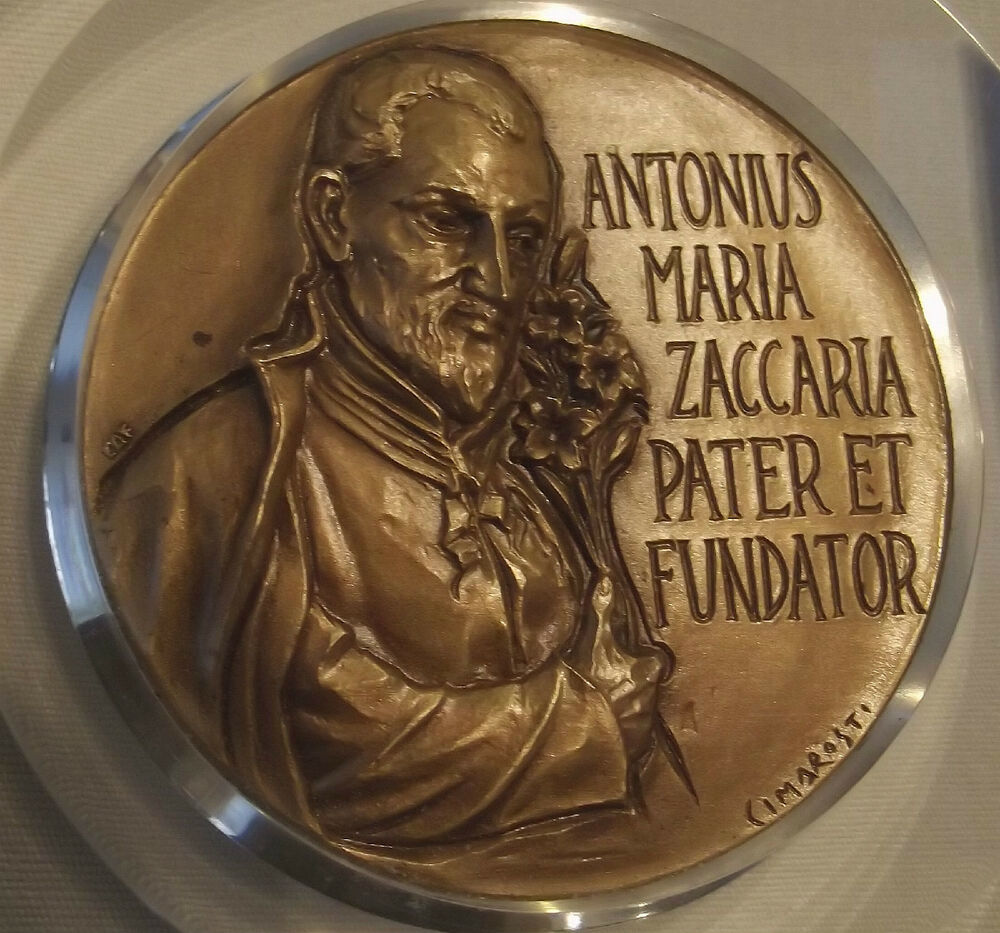
Saint of the Day – 5 July – St Anthony Mary Zaccaria CRSP (1502-1539) Confessor, Founder of the Barnabites, The Clerics Regular of Saint Paul – The First Order Named after St Paul Apostle. He was an early leader of the Counter Reformation and a promoter of the devotion to the Passion of Christ, the Holy Eucharist, Eucharistic Adoration and the renewal of the religious life among the lay people. Patron of The Clerics Regular of St Paul (the Barnabites) and the Angelic Sisters of St Paul., and of Doctors/Physicians. His body is incorrupt.
He also founded a congregation of nuns which now no longer exists. He was a great admirer of St Paul and was himself imbued with the teaching of the great Apostle, whom he gave to his followers as a model and a patron. He was a zealous and untiring preacher and completely wore himself out at this work – he died at the age of thirty six on 5 July 1539.
Anthony Mary Zaccaria was born of a noble family at Cremona in Lombardy and even in childhood gave signs of his future sanctity. Very early he was distinguished for his virtues, piety towards God, devotion to the Blessed Virgin and especially mercy towards the poor, who he more than once gave his own rich clothing for their relief. He studied the humanities at home and then went to Pavia for philosophy and Padua for medicine and easily surpassed his contemporaries both in purity of life and in mental ability. After gaining his degree in medicine, he returned home, where he understood that God had called him to the healing rather of souls than of bodies. He immediately gave himself to sacred studies. Meanwhile, he never ceased to visit the sick, instruct children in Christian doctrine and exhort the young to piety and the elders to reformation of their lives.
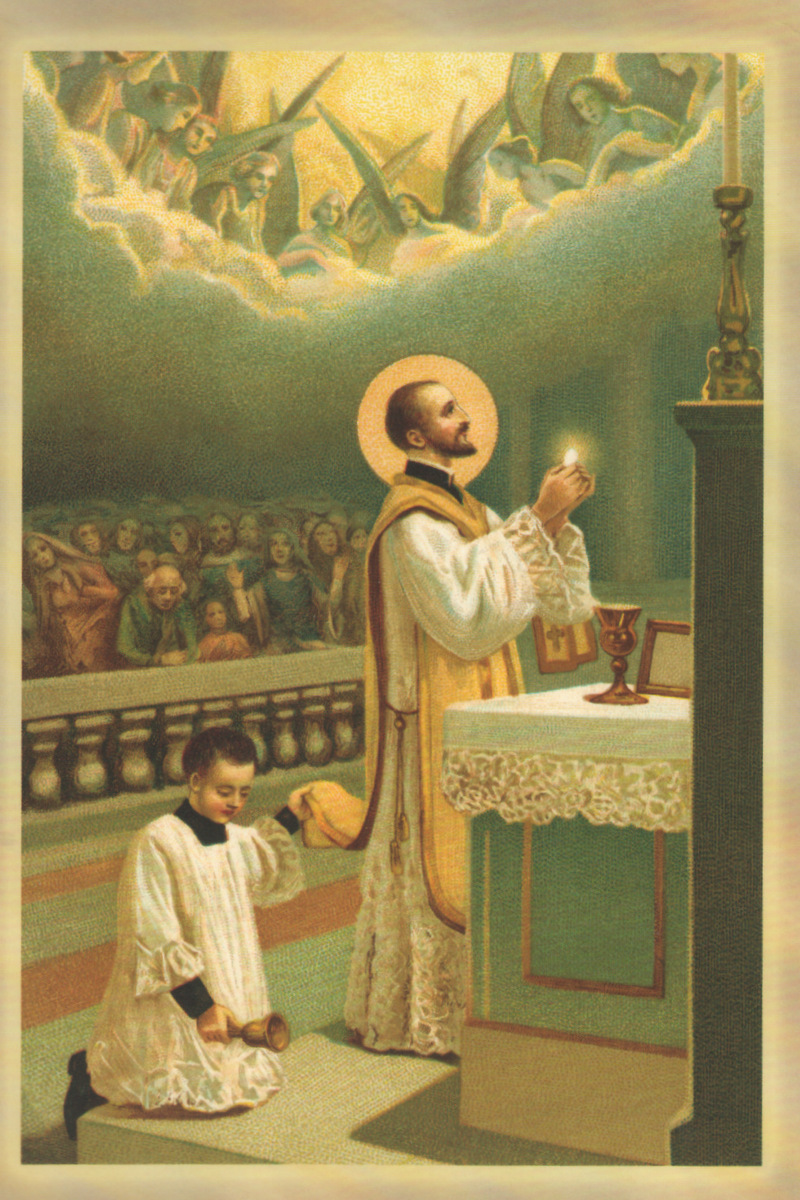
While saying his first Mass after his ordination, he is said to have been seen by the amazed congregation in a blaze of heavenly light and surrounded by angels. He then made it his chief care to labour for the salvation of souls and the reformation of manners. He received strangers, the poor and afflicted, with paternal charity and consoled them with holy words and material assistance, so that his house was known as the refuge of the afflicted and he himself was called by his fellow-citizens an angel and the father of his country.
Thinking that he would be able to do more for the Christian religion if he had fellow labourers in the Lord’s vineyard, he communicated his thoughts to two noble and saintly men, Bartholomew Ferrari and James Morigia and together with them founded at Milan a society of Clerks Regular, which from his great love for the apostle of the Gentiles, he called after St Paul. It was approved by Clement VII, confirmed by Paul III and soon spread through many lands. He was also the founder and father of the Angelic Sisters. But he thought so humbly of himself that he would never be Superior of his own Order. So great was his patience that he endured with steadfastness the most terrible opposition to his religious.
Such was his charity that he never ceased to exhort religious men to love God and priests to live after the manner of the apostles and he organised many confraternities of married men. He often carried the cross through the streets and public squares, together with his religious and by his fervent prayers and exhortations brought wicked men back to the way of salvation.
It is noteworthy that out of love for Jesus crucified he would have the mystery of the cross brought to the mind of all by the ringing of a bell on Friday afternoons about vesper time. The holy name of Christ was ever on his lips and in his writings and as a true disciple of St Paul, he ever bore the mortification of Christ in his body. He had a singular devotion to the Holy Eucharist, restored the custom of frequent communions and introduced that of the public adoration of Forty Hours.
Such was his love of purity that it seemed to restore life even to his lifeless body. He was also enriched with the heavenly gifts of ecstasy, tears, knowledge of future things and the secrets of hearts and power over the enemy of mankind.
At length, after many labours, he fell grievously sick at Guastalla, whither he had been summoned as arbitrator in the cause of peace. He was taken to Cremona and died there amid the tears of his religious and in the embrace of his pious mother, whose approaching death he foretold. At the hour of his death he was consoled by a vision of the apostles and prophesied the future growth of his Society. The people began immediately to show their devotion to this saint on account of his great holiness and of his numerous miracles. The cult was approved by Leo XIII, who solemnly Canonised him on Ascension Day, 1897.
Excerpted from The Liturgical Year, Abbot Gueranger OSB
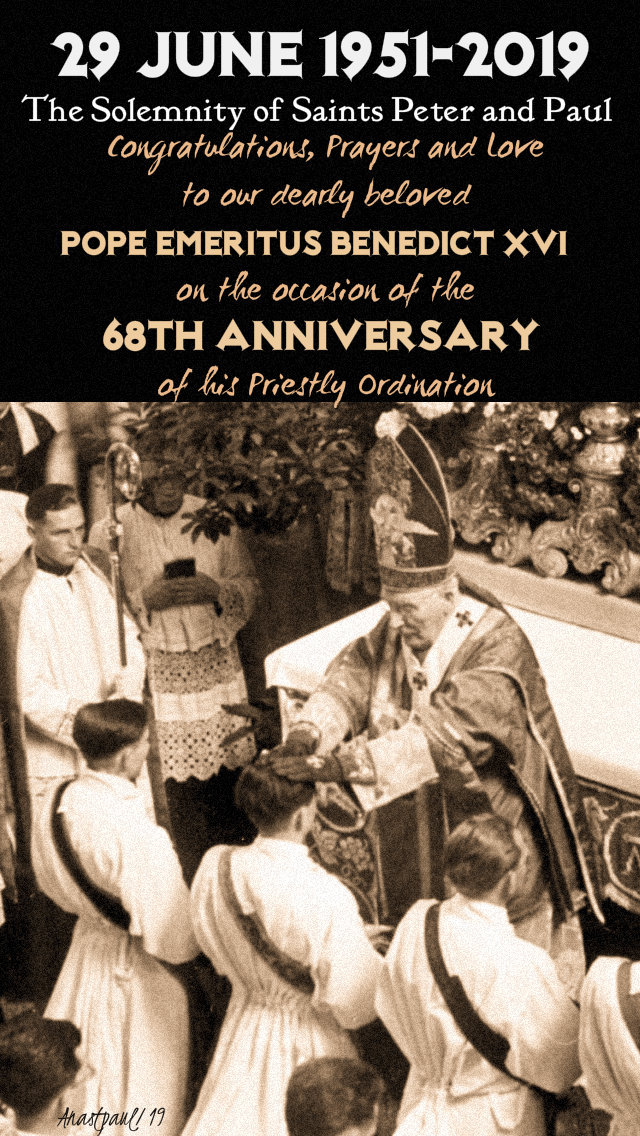
29 JUNE 1951-2019
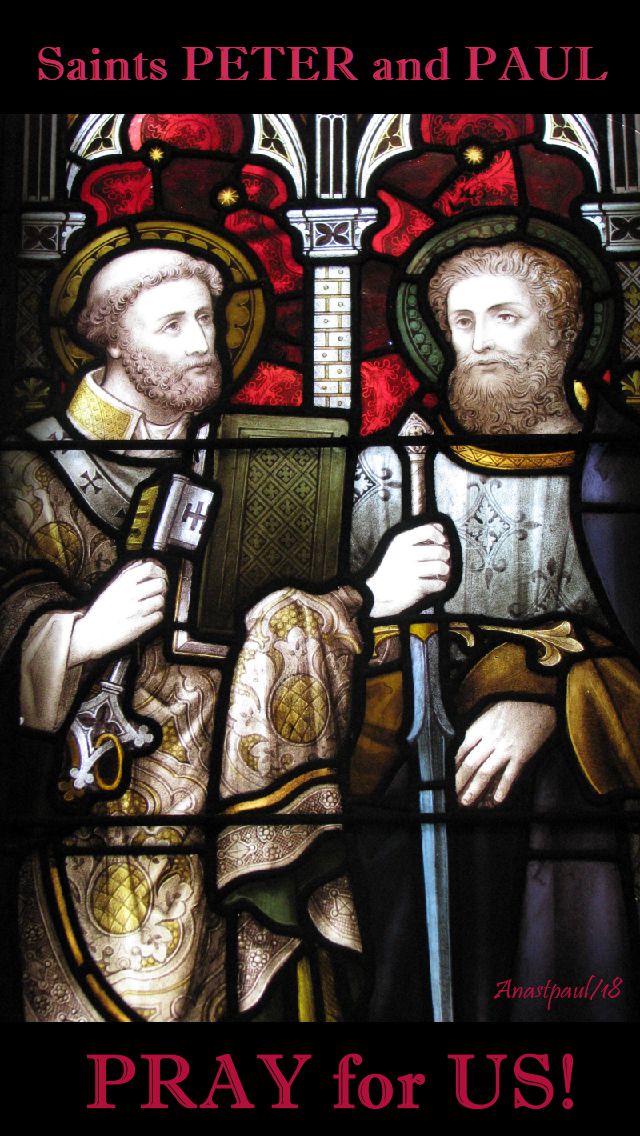
The Solemnity of Saints Peter and Paul
Congratulations, Prayers and Love
to our dearly beloved
Pope Emeritus Benedict XVI
on the occasion of the
68th Anniversary
of his Priestly Ordination
“Domineering over your faith is not my purpose. I prefer to work with you for your happiness”. It is what the Apostle Paul (II Cor 1,24) wrote and his quote was used 65 years ago on the celebration day of Peter and Paul Patron Saints – 29th June 1951 – during the priestly ordination of Joseph Ratzinger. It was held in the Cathedral of Freising and celebrated by Michael von Faulhaber, archbishop of Munich. Paul’s quote was written on the holy card in order to celebrate the event. This important anniversary will be marked by a solemn celebration in the Clementine Hall of the Apostolic Palace on 28th June. Pope Francis and the emeritus Pope Benedict XVI will attend the celebration. Joseph Ratzinger will receive a book on priesthood as a present.
“We were more than forty candidates and we all answered Adsum – that is “Here I am” – Ratzinger wrote in his Autobiography . It was a beautiful and unforgettable summer day, the most important moment in my life.” I shouldn’t be superstitious but while the old archbishop was laying his hands on me, a little bird – maybe a lark – raised from the high altar of the Cathedral and sang a short joyful song – I thought it was a voice from above saying: you are in the right way.” Ratzinger said.
His elder brother Georg was ordained with him. “The day of the first Mass the church of Saint Oswald was in its splendour and people showed us their joy and involvement. We had been asked t o bring the blessing of the first Mass to the town and we were welcomed everywhere. Everybody showed friendliness, even the people we didn’t know at all. I became aware of the expectations men and women have with a priest – they trust in his blessing and the power of the sacrament. It was not because of me or my brother = what did we mean to the people we met? They saw us as the men to whom Christ had given a task, that was to show His presence.”
“Priesthood is not “a job, but a sacrament. God asks a poor man to be like Him, to be with all men and women and to act on their behalf” said Benedict XVI on 11th June 2010, during the homily at the end of the Year for Priests, that he established on the 150th anniversary of the death of St. John Mary Vianney, Saint Patron of Priests.
Thought for the Day – 29 June – The Solemnity of Saints Peter and Paul
Blessed Isaac of Stella O.Cist. (c 1100 – c 1170) Cistercian Monk
Sermon 49, 1st for the Feast of Saints Peter and Paul
“These were men of mercy whose good deeds shall not be forgotten; the wealth they have left their inheritance will last for ever” (Latin liturgy; cf. Sir 44:10-11).”
Today, beloved, we are celebrating the birthday of the apostles Peter and Paul and it is altogether fitting that… such a death should be called ‘birth’ since it gave birth to life… See to what the saints have come – through the death that bestows life, they leave this life that leads to death, so as to come to that life-giving life, which is in the hands of Him who, as Christ said: “has life in Himself” – the Father (Jn 5:26)…
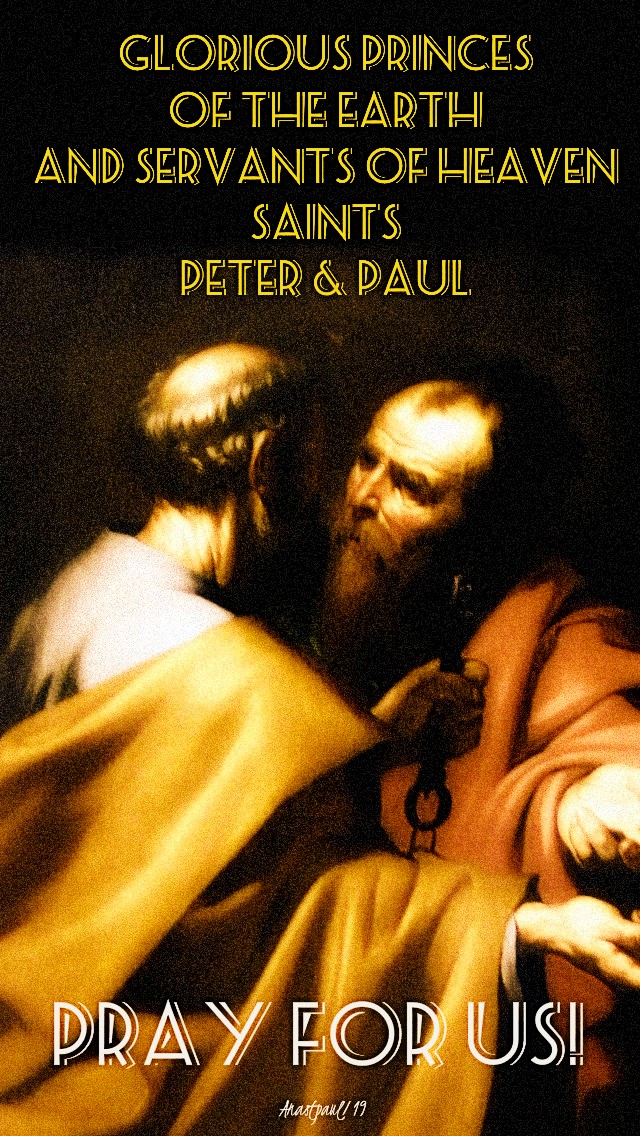
There are three kinds of people who are merciful. The first give of their goods… so as to contribute out of their superfluity to the penury of their neighbour… The second give all their goods away and, for them… everything is held in common with others from then on… But as for the third, they not only expend all they have but are “themselves utterly spent” (2 Cor 12:15) and give themselves up in person to the dangers of prison, exile and death so that they may rescue others from the dangers in which their souls are lying. They pour themselves out because they are so full of ardent desire for others. They will receive the reward of that love of which “there is no greater – to lay down one’s life for one’s friends” (Jn 15:13)… Such are those glorious princes of the earth and servants of heaven of whom today – after long privations “from hunger and thirst, cold and nakedness”, exhaustion and danger, “from their own race, from Gentiles, from false brethren” (2 Cor 11:26-27) – we celebrate the death that was so magnificently victorious. To such as these, the saying well applie – “Their good deeds shall never be forgotten” because they have not forgotten mercy… Yes, to the merciful, “their lot has fallen in a pleasant land, their inheritance is without compare” (Ps 16[15]:6).
Quote/s of the Day – 29 June – The Solemnity of Saints Peter and Paul
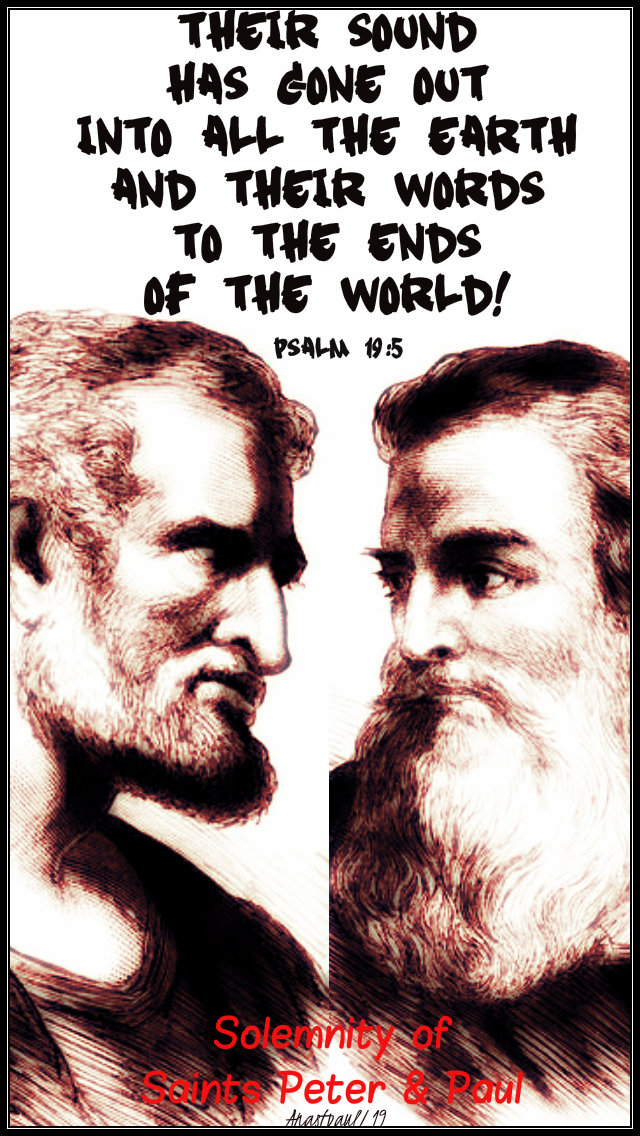
“Their sound has gone out into all the earth and their words to the ends of the world”
Psalm 19:5
“There must be general rejoicing, dearly beloved, over this holy company whom God has appointed for our example in patience and for our confirmation in faith. But we must glory even more in the excellence of their fathers, Peter and Paul, whom the grace of God has raised to such a height among all the members of the Church that He has set them like twin lights of eyes in that Body whose head is Christ.”
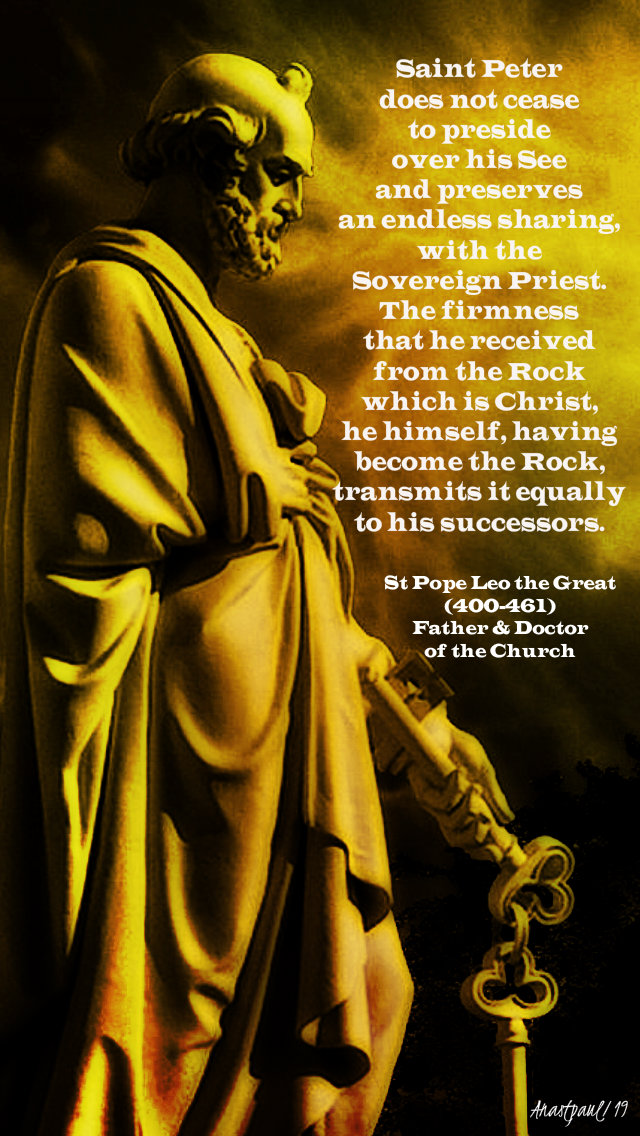
“Saint Peter does not cease to preside over his See and preserves an endless sharing, with the Sovereign Priest. The firmness that he received from the Rock which is Christ, he himself, having become the Rock, transmits it equally to his successors.”
St Pope Leo the Great (400-461)
Doctor of the Church’s Unity
“And so it is with Rome, where the holy Apostles Peter and Paul, gave with their blood their final witness. The vocation of Rome is of apostolic origin and the ministry which it is our lot to exercise here, is a service for the benefit of the entire Church and of mankind. But it is an irreplaceable service, because it has pleased the Wisdom of God to place the Rome of Peter and Paul, so to speak, on the road that leads to the eternal City, by the fact that Wisdom chose to confide to Peter—who unifies in himself the College of Bishops—the keys of the kingdom of heaven.”
One Minute Reflection – 29 June – The Solemnity of Saints Peter and Paul – Today’s Gospel: Matthew 16:13–19
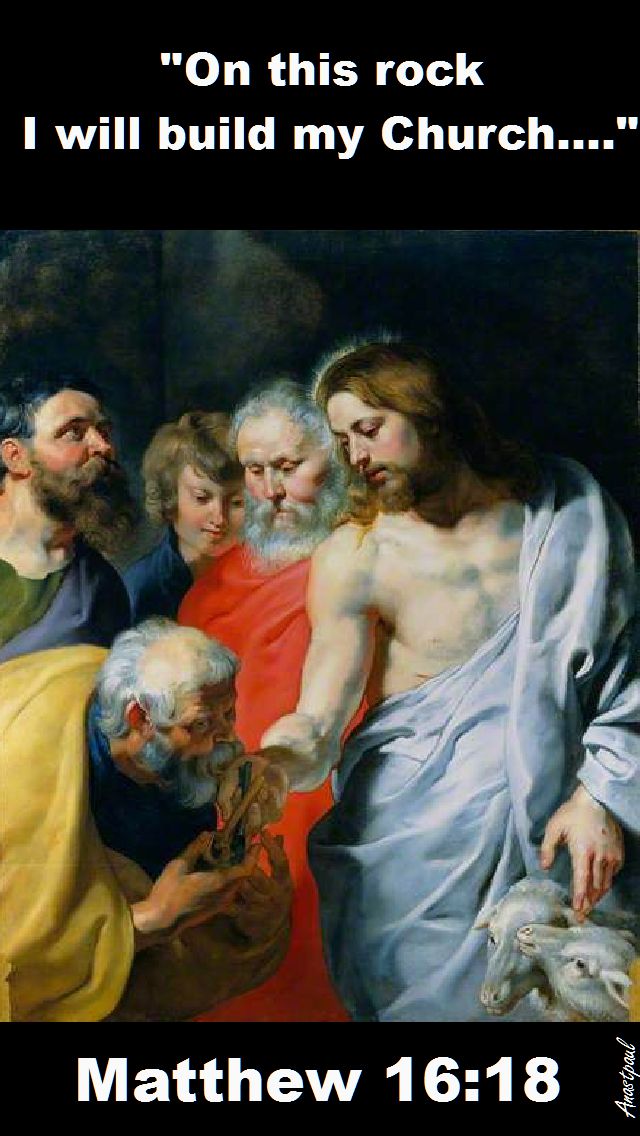
“And I tell you, you are Peter and on this rock I will build my church and the powers of death shall not prevail against it. I will give you the keys of the kingdom of heaven and whatever you bind on earth shall be bound in heaven, and whatever you loose on earth shall be loosed in heaven.” …Matthew 16:18-19
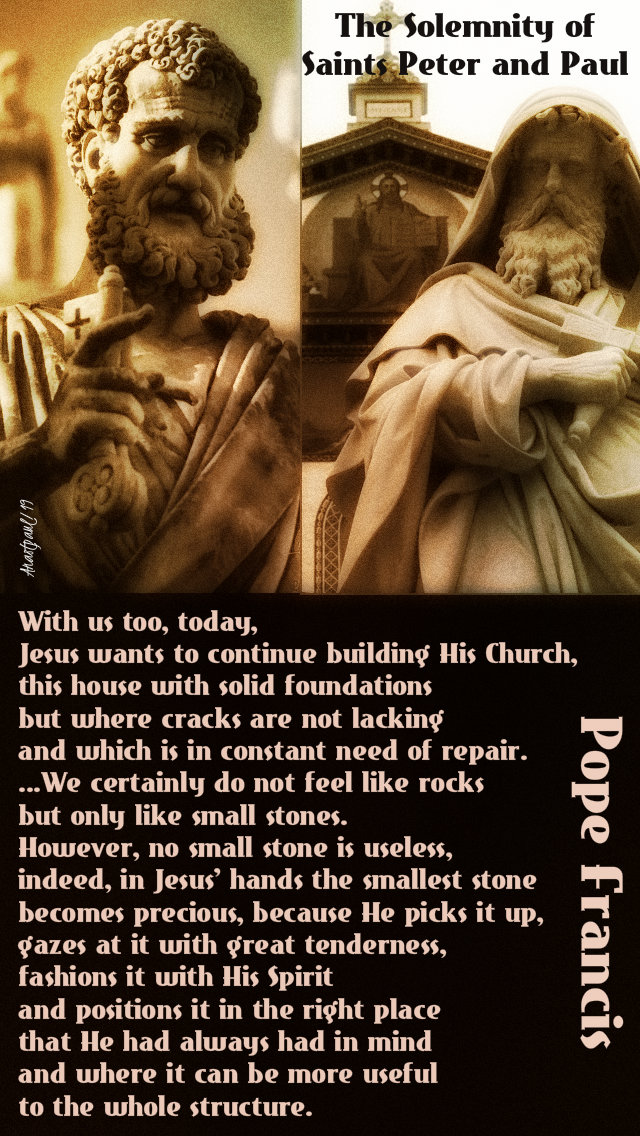
REFLECTION – “With us too, today, Jesus wants to continue building His Church, this house with solid foundations but where cracks are not lacking and which is in constant need of repair. Always. The Church always needs to be reformed, repaired. We certainly do not feel like rocks but only like small stones. However, no small stone is useless, indeed, in Jesus’ hands the smallest stone becomes precious, because He picks it up, gazes at it with great tenderness, fashions it with His Spirit and positions it in the right place that He had always had in mind and where it can be more useful to the whole structure.”…Pope Francis (Angelus, 27 August 2017)
PRAYER – O God, who on the Solemnity of the Apostles Peter and Paul give us the noble and holy joy of this day, grant, we pray, that your Church may in all things follow the teaching of those through whom she received the beginnings of right religion.
Through our Lord Jesus Christ, your Son,who lives and reigns with you in the unity of the Holy Spirit, one God, forever and ever. Amen
Our Morning Offering – 29 June – The Solemnity of Saints Peter and Paul
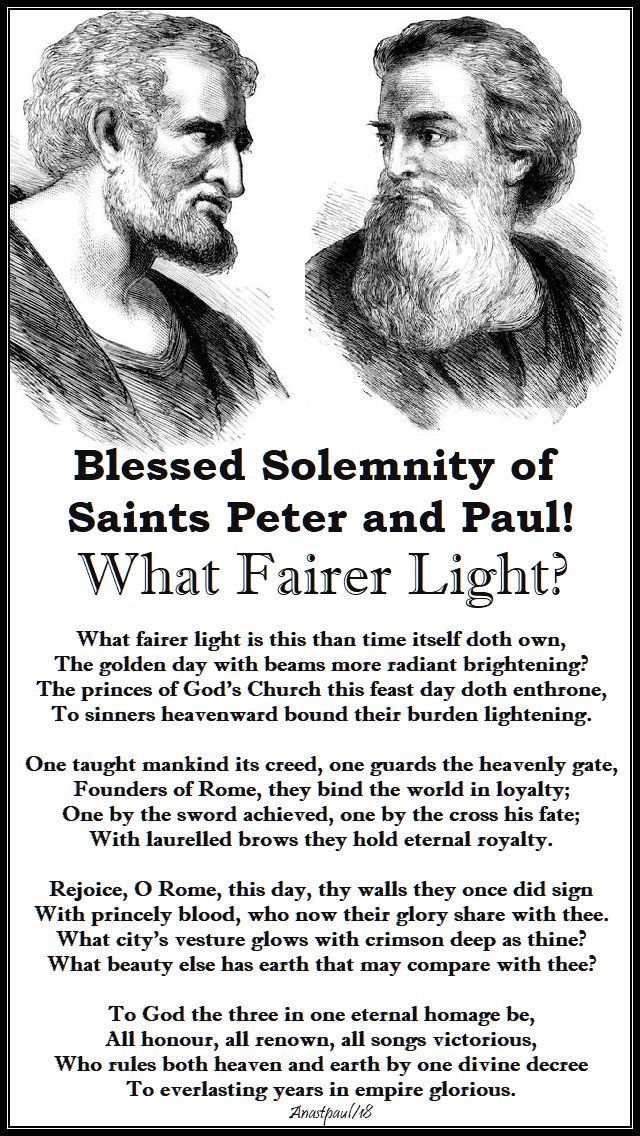
What Fairer Light?
Hymn for the Solemnity of Sts Peter and Paul Elphis, c 493, wife of Boethius c 477– 524 Translation: R A Knox, 1888-1957
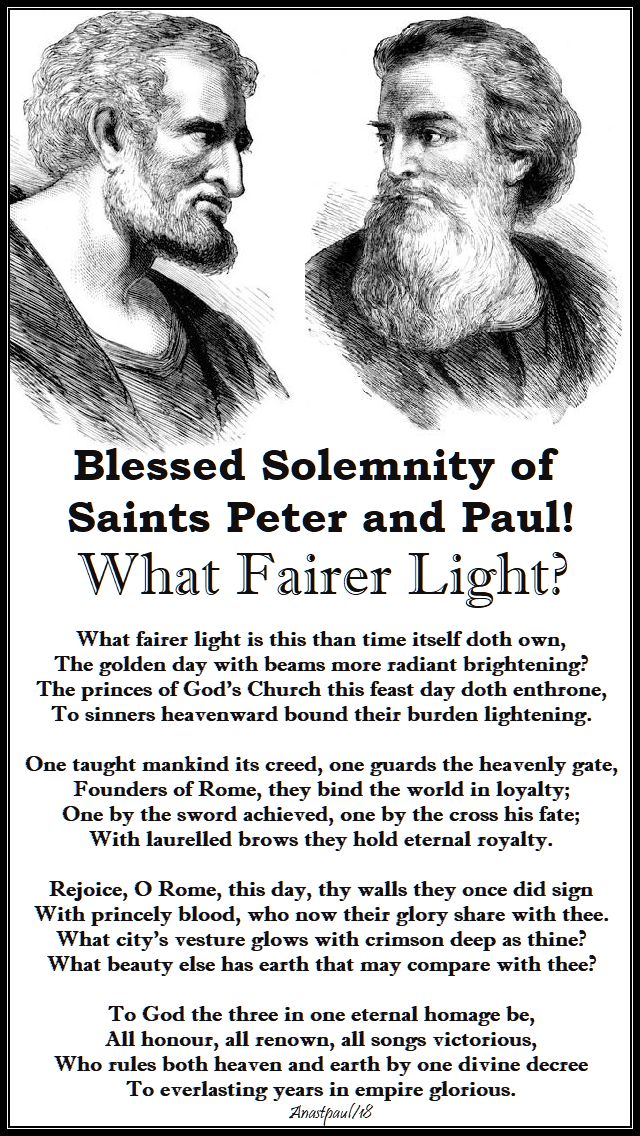
What fairer light is this than time itself doth own,
The golden day with beams more radiant brightening?
The princes of God’s Church this feast day doth enthrone,
To sinners heavenward bound their burden lightening.
One taught mankind its creed, one guards the heavenly gate,
Founders of Rome, they bind the world in loyalty;
One by the sword achieved, one by the cross his fate;
With laurelled brows they hold eternal royalty.
Rejoice, O Rome, this day, thy walls they once did sign
With princely blood, who now their glory share with thee.
What city’s vesture glows with crimson deep as thine?
What beauty else has earth that may compare with thee?
To God the three in one eternal homage be,
All honour, all renown, all songs victorious,
Who rules both heaven and earth by one divine decree
To everlasting years in empire glorious.
Solemnity of Saints Peter and Paul, Apostles and Martyrs – 29 June
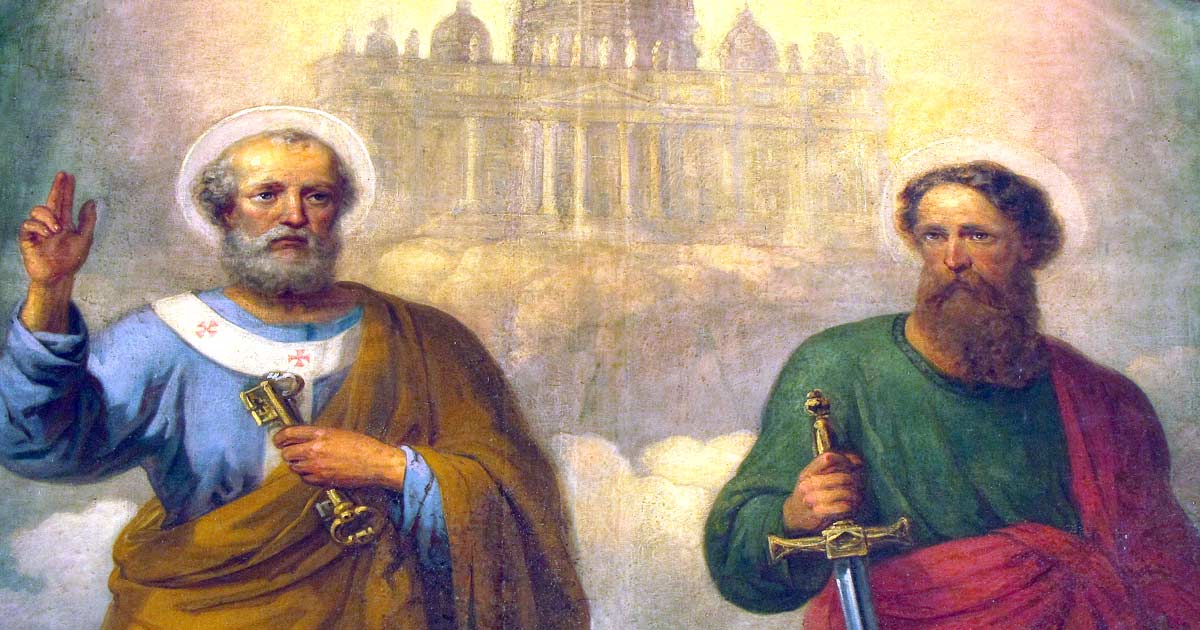
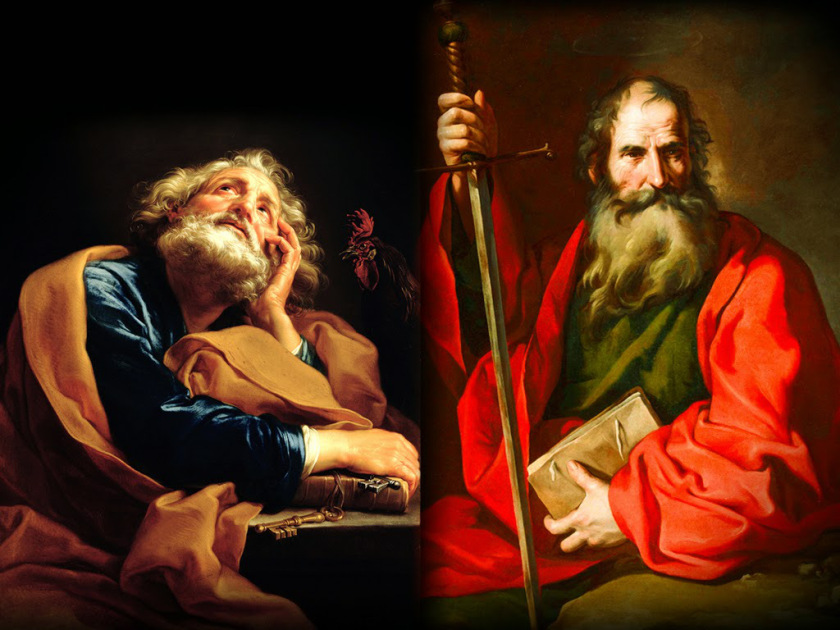
Today the Church celebrates the feast day of Sts Peter & Paul. As early as the year 258, there is evidence of an already lengthy tradition of celebrating the solemnities of both Saint Peter and Saint Paul on the same day. Together, the two saints are the founders of the See of Rome, through their preaching, ministry and martyrdom there. St Peter is also celebrated on 22 February (feast of the Chair of Peter, emblematic of the world unity of the Church) on 1 August (Saint Peter in Chains), St Paul’s Conversion is celebrated on 25 January and both are once again celebrated on 18 November (feast of the dedication of the Basilicas of Peter and Paul – the two major Basilicas in Rome).
In a sermon in the year 395, St Augustine (354-430) Father & Doctor of the Church, said of Sts Peter and Paul:
“Both apostles share the same feast day, for these two were one and even though they suffered on different days, they were as one.
Peter went first and Paul followed.
And so we celebrate this day made holy for us, by the apostles’ blood. Let us embrace what they believed, their life, their labours, their sufferings, their preaching and their confession of faith.”
Peter (d. 64?) Saint Mark ends the first half of his Gospel with a triumphant climax. He has recorded doubt, misunderstanding and the opposition of many to Jesus. Now Peter makes his great confession of faith – “You are the Messiah” (Mark 8:29b). It was one of the many glorious moments in Peter’s life, beginning with the day he was called from his nets along the Sea of Galilee to become a fisher of men for Jesus.
The New Testament clearly shows Peter as the leader of the apostles, chosen by Jesus to have a special relationship with Him. With James and John he was privileged to witness the Transfiguration, the raising of a dead child to life and the agony in Gethsemane. His mother-in-law was cured by Jesus. He was sent with John to prepare for the last Passover before Jesus’ death. His name is first on every list of apostles.
And to Peter only did Jesus say, “Blessed are you, Simon son of Jonah. For flesh and blood has not revealed this to you, but my heavenly Father. And so I say to you, you are Peter, and upon this rock I will build my church and the gates of the netherworld shall not prevail against it. I will give you the keys to the kingdom of heaven. Whatever you bind on earth shall be bound in heaven; and whatever you loose on earth shall be loosed in heaven” (Matthew 16:17b-19).
But the Gospels prove their own trustworthiness by the unflattering details they include about Peter. He clearly had no public relations person. It is a great comfort for ordinary mortals to know that Peter also has his human weakness, even in the presence of Jesus.
He generously gave up all things, yet he can ask in childish self-regard, “What are we going to get for all this?” (see Matthew 19:27). He receives the full force of Christ’s anger when he objects to the idea of a suffering Messiah –“Get behind me, Satan! You are an obstacle to me. You are thinking not as God does, but as human beings do” (Matthew 16:23b).
Peter is willing to accept Jesus’ doctrine of forgiveness but suggests a limit of seven times. He walks on the water in faith but sinks in doubt. He refuses to let Jesus wash his feet, then wants his whole body cleansed. He swears at the Last Supper that he will never deny Jesus and then swears to a servant maid that he has never known the man . He loyally resists the first attempt to arrest Jesus by cutting off Malchus’ ear but in the end, he runs away with the others. In the depth of his sorrow, Jesus looks on him and forgives him and he goes out and sheds bitter tears. The Risen Jesus told Peter to feed his lambs and his sheep (John 21:15-17).
Paul (d. 64?) If the most well-known preacher today suddenly began preaching that your country should adopt Marxism and not rely on the democracy, the angry reaction would help us understand Paul’s life when he started preaching that Christ alone can save us. He had been the most pharisaic of Pharisees, the most legalistic of Mosaic lawyers. Now he suddenly appears to other Jews as a heretical welcomer of Gentiles, a traitor and apostate.
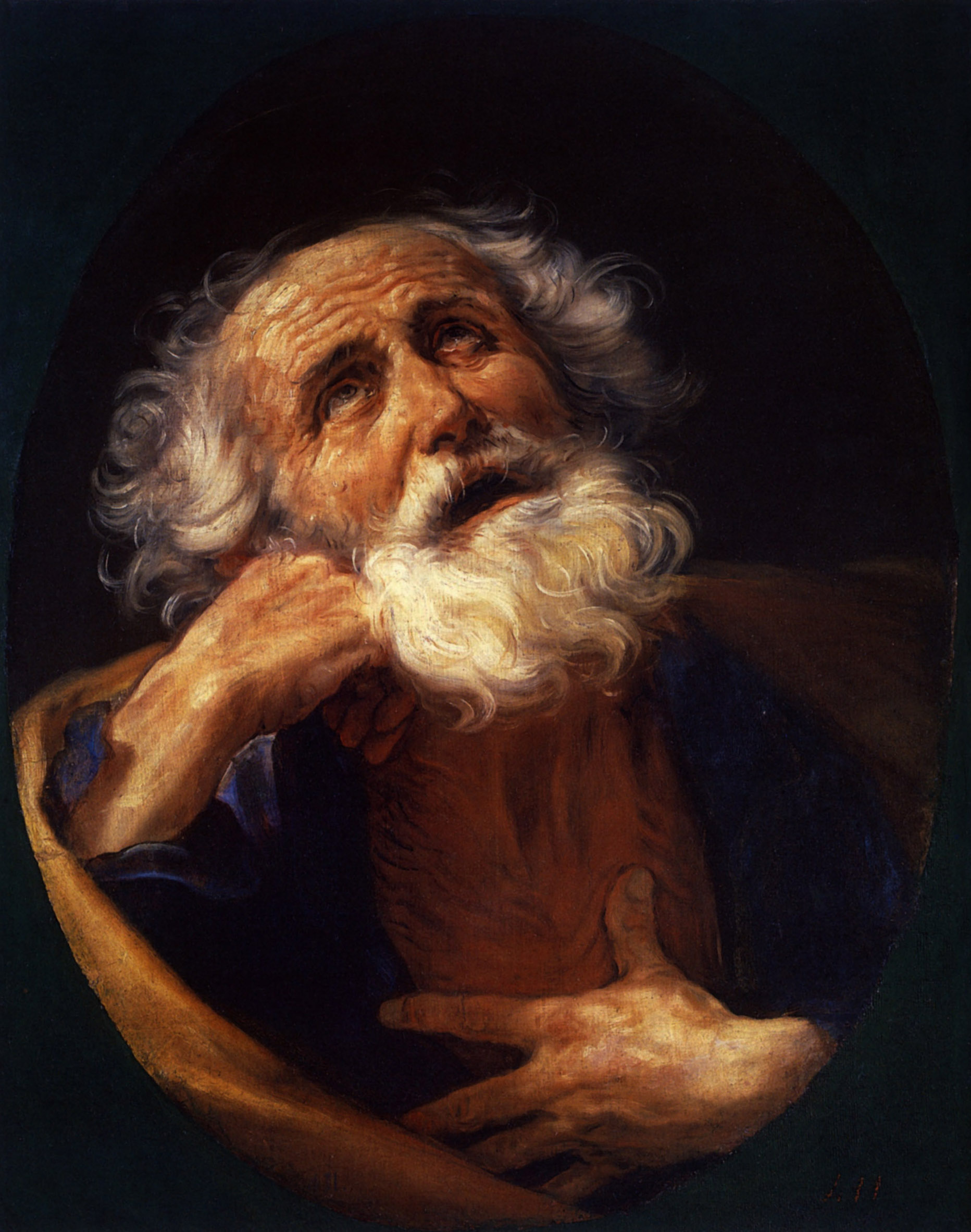
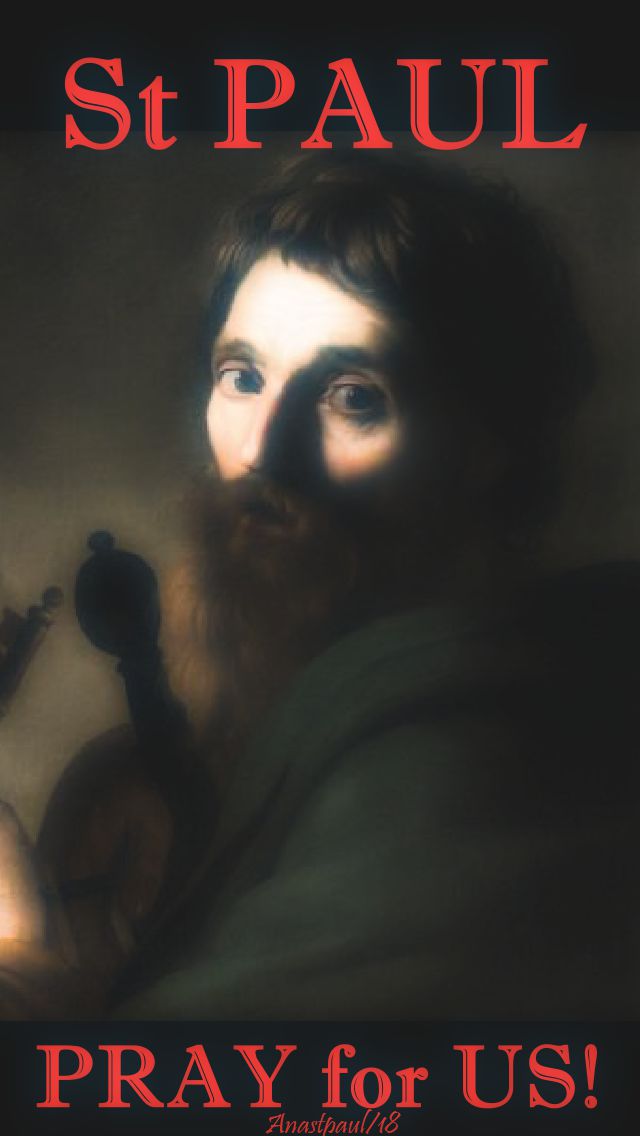
St Paul – Antony van Dyck
Paul’s central conviction was simple and absolute – Only God can save humanity. No human effort—even the most scrupulous observance of law—can create a human good which we can bring to God, as reparation for sin and payment for grace. To be saved from itself, from sin, from the devil and from death, humanity must open itself completely to the saving power of Jesus.
Paul never lost his love for his Jewish family, though he carried on a lifelong debate with them about the uselessness of the Law without Christ. He reminded the Gentiles that they were grafted on the parent stock of the Jews, who were still God’s chosen people, the children of the promise.
Thought for the Day – 25 January – For love of Christ, Paul bore every burden
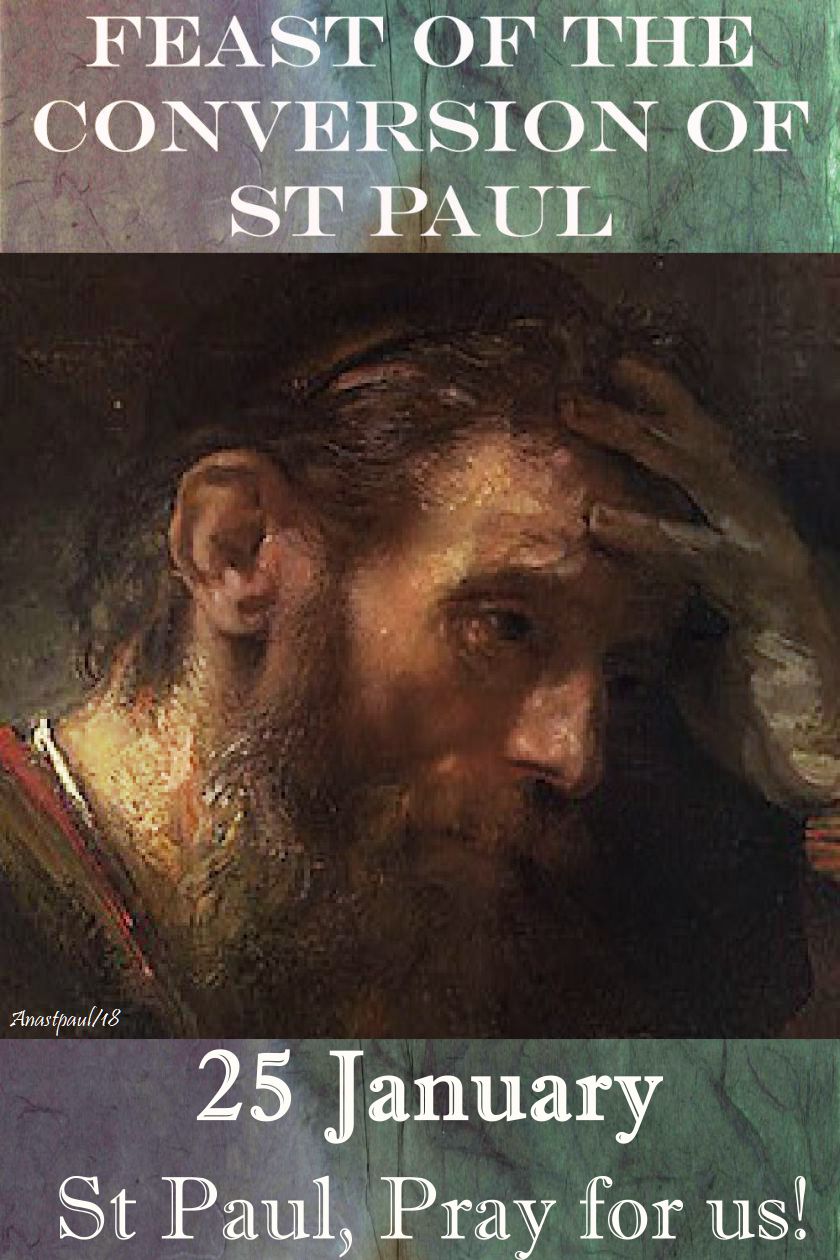
Feast of the Conversion of St Paul, Apostle of Christ
Saint John Chrysostom (347-407)
Father and Doctor of the Church
An excerpt from his Homily 2: In Praise of Saint Paul
Paul, more than anyone else, has shown us what man really is and in what our nobility consists and of what virtue this particular animal is capable. Each day he aimed ever higher, each day he rose up with greater ardour and faced with new eagerness the dangers that threatened him. He summed up his attitude in the words: I forget what is behind me and push on to what lies ahead. When he saw death imminent, he bade others share his joy: Rejoice and be glad with me! And when danger, injustice and abuse threatened, he said: I am content with weakness, mistreatment and persecution. These he called the weapons of righteousness, thus telling us that he derived immense profit from them.
Thus, amid the traps set for him by his enemies, with exultant heart he turned their every attack into a victory for himself – constantly beaten, abused and cursed, he boasted of it as though he were celebrating a triumphal procession and taking trophies home, and offered thanks to God for it all: Thanks be to God who is always victorious in us! This is why he was far more eager for the shameful abuse that his zeal in preaching brought upon him than we are for the most pleasing honours, more eager for death than we are for life, for poverty than we are for wealth, he yearned for toil far more than others yearn for rest after toil. The one thing he feared, indeed dreaded, was to offend God, nothing else could sway him. Therefore, the only thing he really wanted was always to please God.
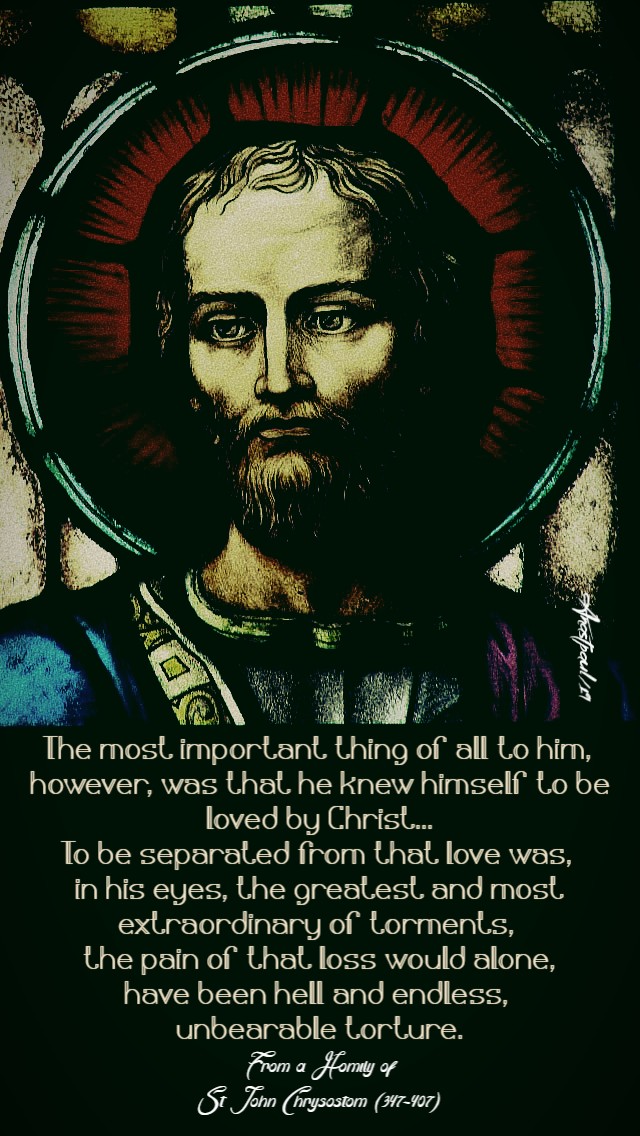
The most important thing of all to him, however, was that he knew himself to be loved by Christ. Enjoying this love, he considered himself happier than anyone else, were he without it, it would be no satisfaction to be the friend of principalities and powers. He preferred to be thus loved and be the least of all, or even to be among the damned, than to be without that love and be among the great and honoured.
To be separated from that love was, in his eyes, the greatest and most extraordinary of torments, the pain of that loss would alone, have been hell and endless, unbearable torture.
So too, in being loved by Christ he thought of himself as possessing life, the world, the angels, present and future, the kingdom, the promise and countless blessings. Apart from that love nothing saddened or delighted him, for nothing earthly did he regard as bitter or sweet.
Paul set no store by the things that fill our visible world, any more than a man sets value on the withered grass of the field. As for tyrannical rulers or the people enraged against him, he paid them no more heed than gnats. Death itself and pain and whatever torments might come were but child’s play to him, provided that thereby he might bear some burden for the sake of Christ.
Quote/s of the Day – 25 January – Feast of the Conversion of St Paul the Apostle
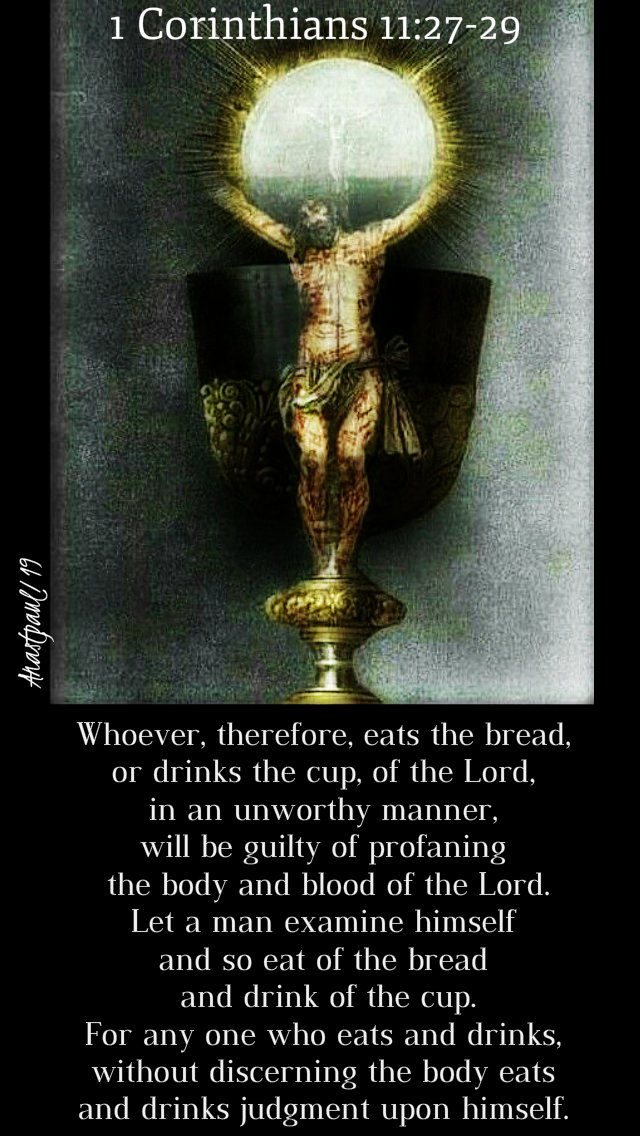
“Whoever, therefore, eats the bread, or drinks the cup, of the Lord, in an unworthy manner, will be guilty of profaning the body and blood of the Lord. Let a man examine himself and so eat of the bread and drink of the cup. For any one who eats and drinks, without discerning the body eats and drinks judgement upon himself.”
1 Corinthians 11:27-29
“Let love be genuine, hate what is evil, hold fast to what is good, love one another with brotherly affection, outdo one another in showing honour. Never flag in zeal, be aglow with the Spirit, serve the Lord. Rejoice in your hope, be patient in tribulation, be constant in prayer. Contribute to the needs of the saints, practice hospitality.”
Romans 12:9-13
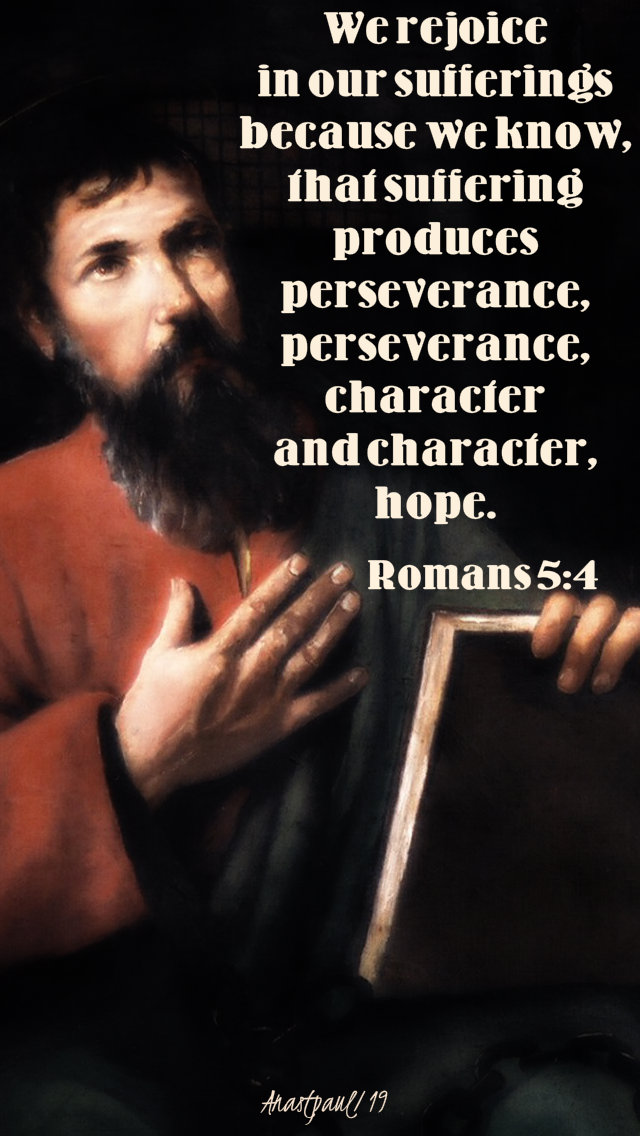
“….but we rejoice in our sufferings because we know, that suffering produces perseverance, perseverance, character and character, hope.”
Romans 5:4
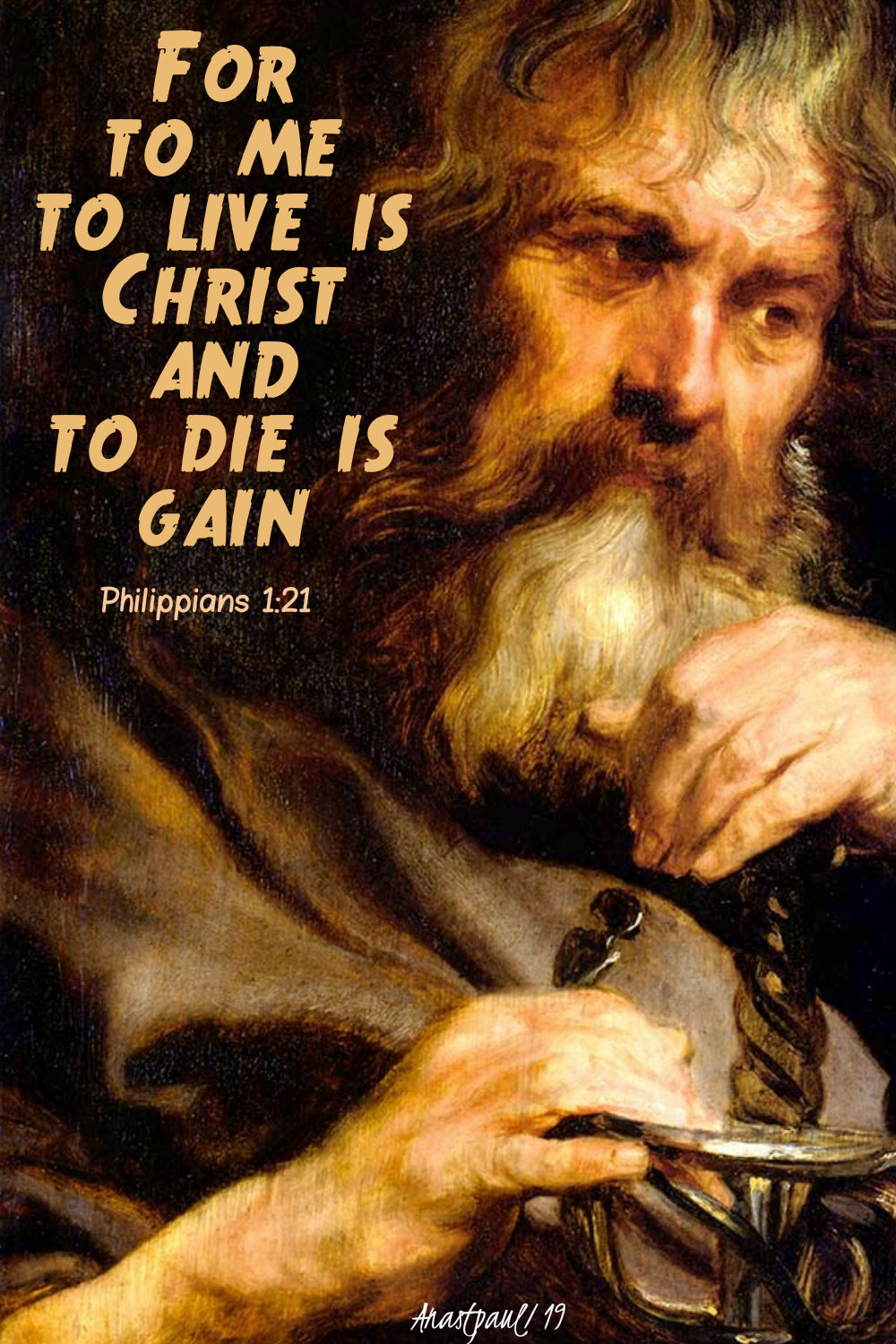
“For to me, to live is Christ and to die is gain.”
Philippians 1:21
Pope Benedict XVI reflects on the significance of Paul’s conversion for the whole Christian people:
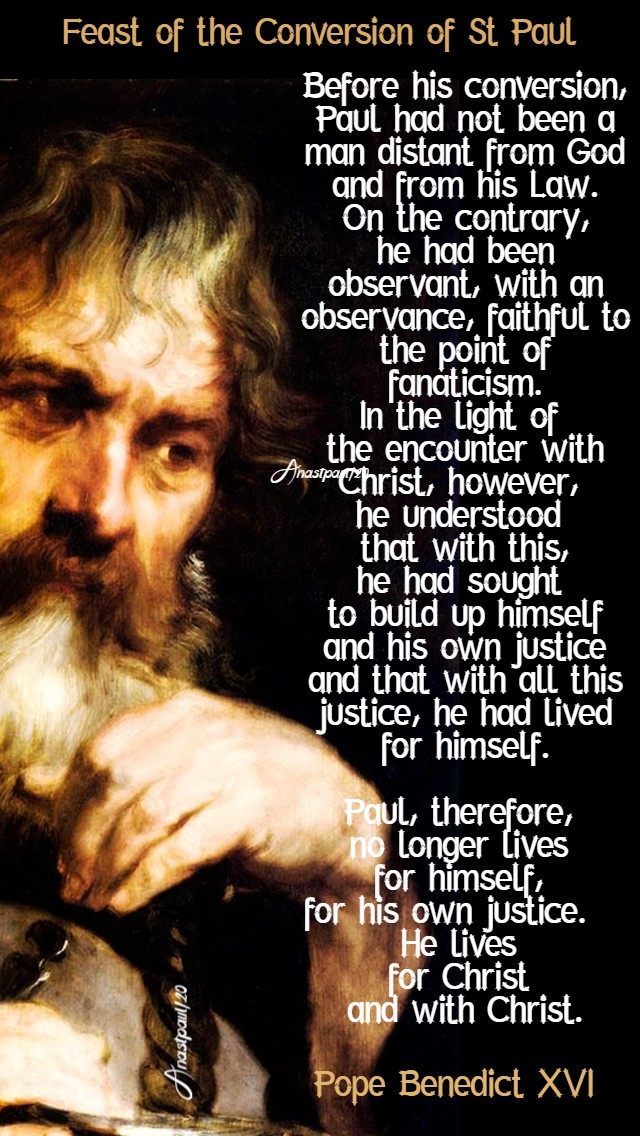
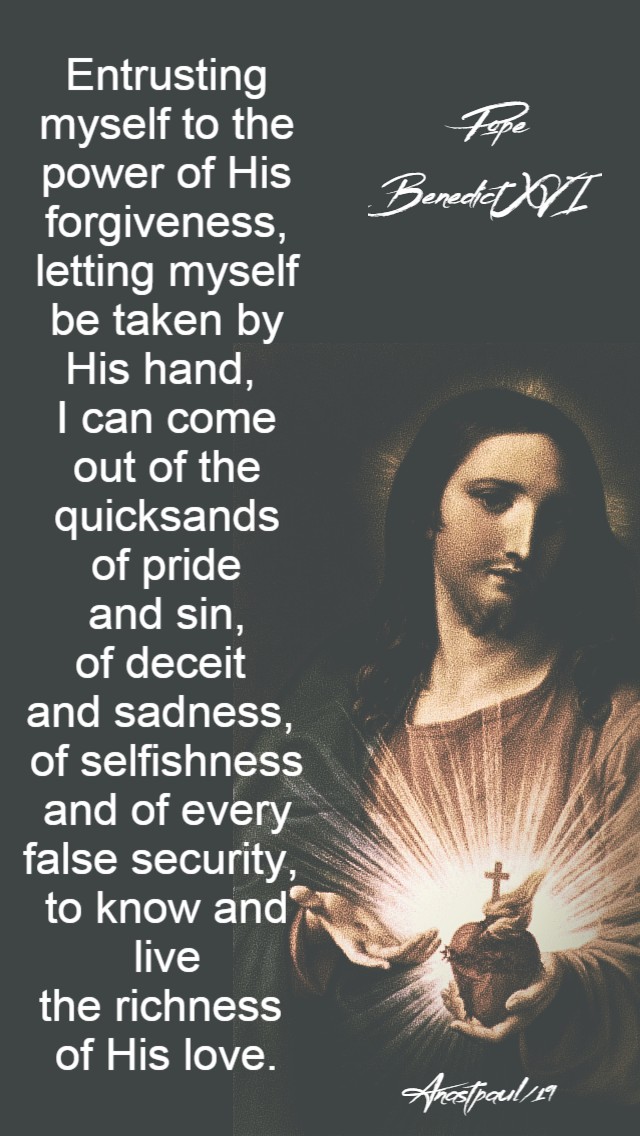
“Paul’s conversion matured in his encounter with the Risen Christ, it was this encounter that radically changed his life. What happened to him on the road to Damascus is what Jesus asks in today’s Gospel, Saul is converted because, thanks to the divine light, “he has believed in the Gospel.” In this consists his and our conversion – in believing in Jesus dead and risen and in opening to the illumination of His divine grace. In that moment Saul understood, that his salvation, did not depend on good works fulfilled according to the law but, on the fact, that Jesus died also for him the persecutor and has risen. This truth by which every Christian life is enlightened thanks to Baptism completely overturns our way of life. To be converted means, also for each one of us, to believe that Jesus “has given himself for me”, dying on the Cross (cf. Galatians 2: 20) and, risen, lives with me and in me. Entrusting myself to the power of His forgiveness, letting myself be taken by His hand, I can come out of the quicksands of pride and sin, of deceit and sadness, of selfishness and of every false security, to know and live the richness of His love.”
One Minute Reflection – 25 January – Feast of the Conversion of St Paul – Acts 9:1-22
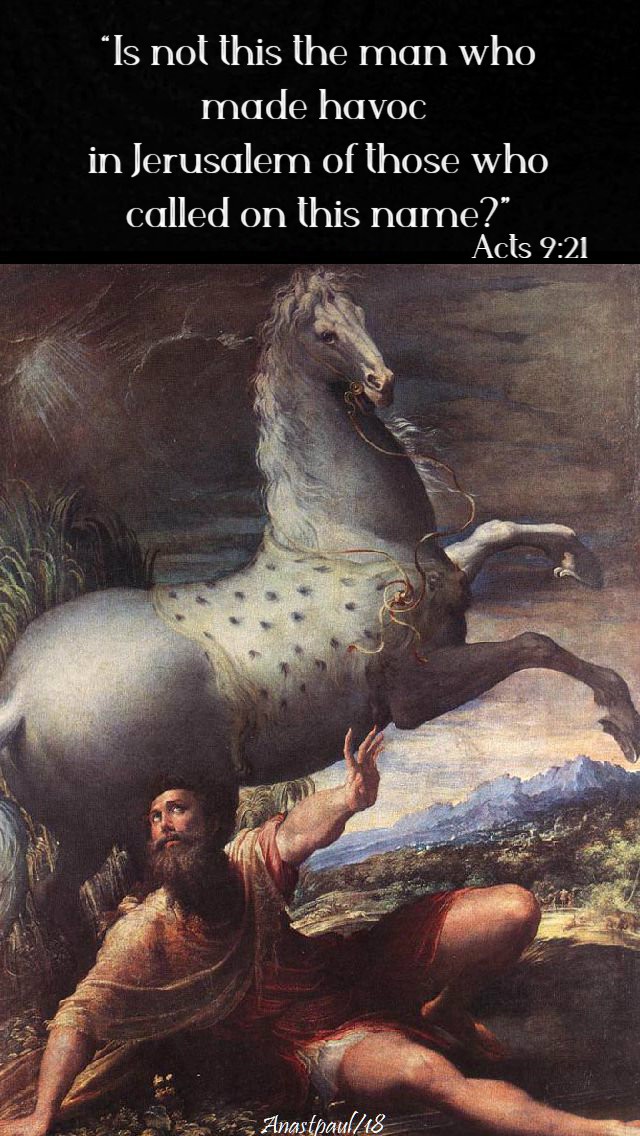
And all who heard him were amazed, and said, “Is not this the man who made havoc in Jerusalem of those who called on this name?”…Acts 9:21
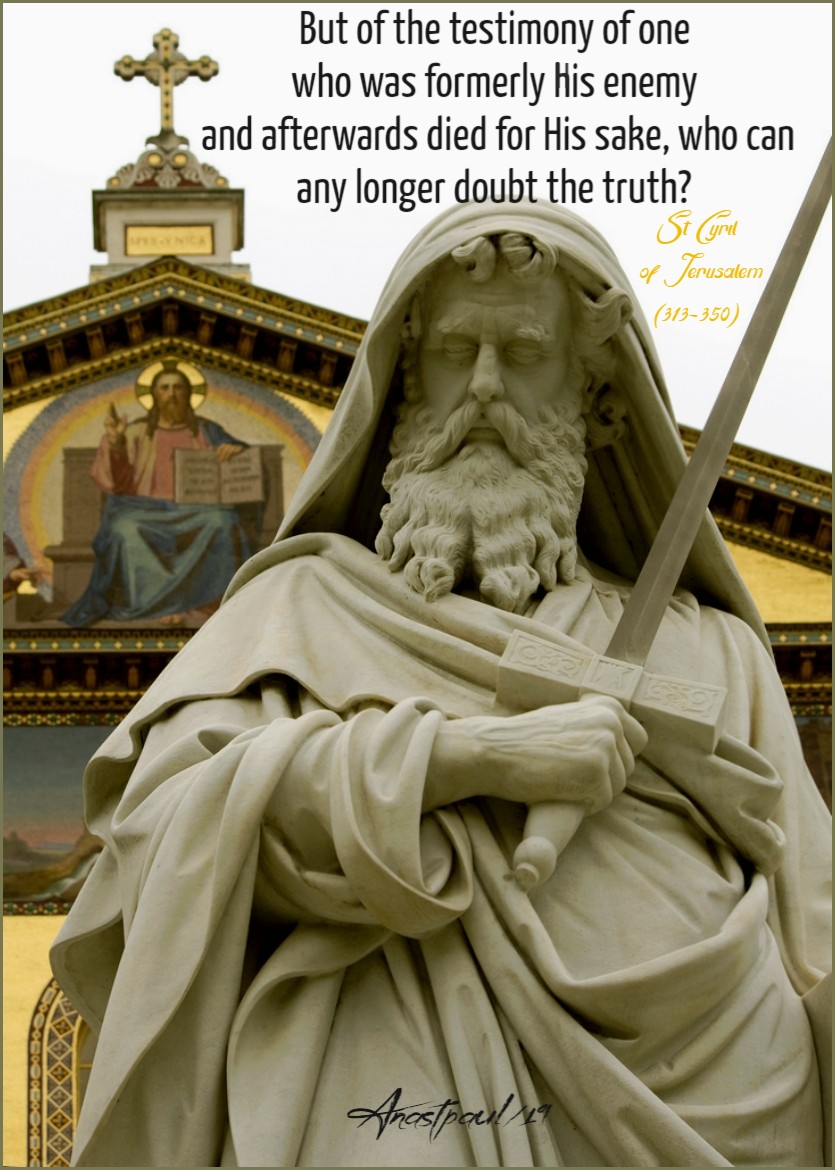
REFLECTION – “We preach not ourselves but Christ Jesus as Lord and ourselves as your servants for Jesus’ sake” (2 Cor 4:5). Who then is this? The former persecutor. O mighty wonder! The former persecutor himself preaches Christ. But why? Was he bribed? No, there was no one who could have persuaded him in that way. Was it the sight of Christ on earth that blinded him? But Jesus had already been taken up into heaven. Saul set out from Jerusalem to persecute Christ’s church and after three days the persecutor had become a preacher in Damascus. By what power? Other people call on friends as witnesses for their friends but I have presented to you as a witness the former enemy.
Do you still doubt? The testimony of Peter and John is weighty… but they were istcyrilofjerusalemndeed His friends. But of the testimony of one who was formerly His enemy and afterwards died for His sake, who can any longer doubt the truth? I am amazed at the wise dispensation of the Holy Spirit;… to Paul, the former persecutor, He gave the privilege of writing fourteen letters… In order that his teaching might be beyond question, He granted the former enemy and persecutor the privilege of writing more letters than Peter and John so that we might all be thus made believers. For “all were amazed at Paul and said: ‘Isn’t this the man who was formerly a persecutor? Didn’t he come here to take us away bound to Jerusalem?’” (Acts 9:21) “Do not be not amazed,” said Paul, I know how “it is hard for me to kick against the pricks” (Acts 26:14); I know that “I am not worthy to be called an apostle, because I persecuted the Church of God” (1 Cor 15:9); yet “mercy was shown to me because I did it in ignorance”… “the grace of God was exceedingly abundant in me” (1 Tm 1:13-14).”…St Cyril of Jerusalem (313-350) Father & Doctor of the Church
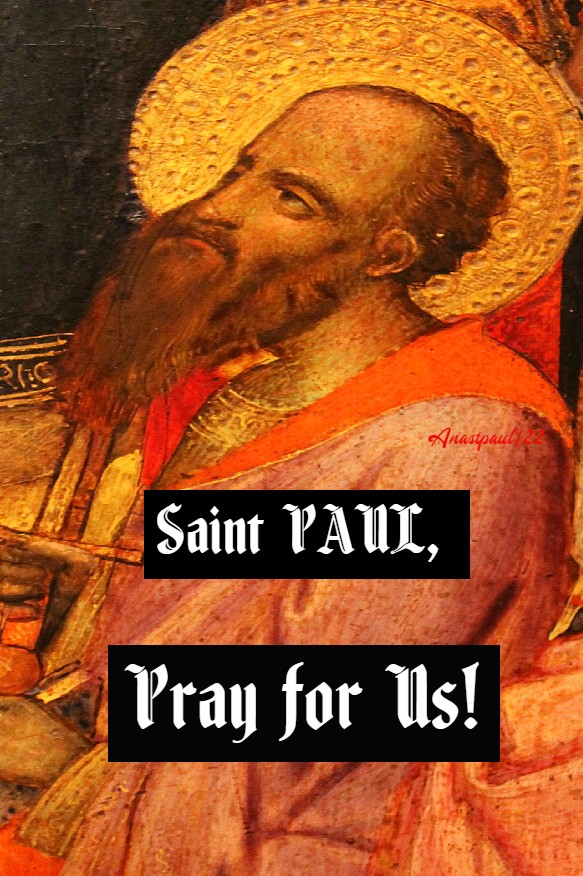
PRAYER – Today Lord, we celebrate the conversion of St Paul, Your chosen vessel for carrying Your name to the whole world. Help us to make our way towards You by following in his footsteps and by being Your disciples before the men and women of our day. Grant that by the prayers of St Paul, we too may say, “Yet I live, no longer I, but Christ lives in me; insofar as I now live in the flesh, I live by faith in the Son of God who has loved me and given himself up for me.” (Galatians 2:20) Through Jesus Christ, our Lord, in union with the Holy Spirit, one God forever and ever, amen.
Our Morning Offering – 25 January – The Feast of the Conversion of St Paul
Lead, Kindly Light By Blessed John Henry Newman (1801-1890)
Lead, kindly Light, amid the encircling gloom,
Lead Thou me on;
The night is dark and I am far from home,
Lead Thou me on.
Keep Thou my feet, I do not ask to see
The distant scene, one step enough for me.
I was not ever thus, nor prayed that Thou
Should lead me on.
I loved to choose and see my path but now
Lead Thou me on.
I loved the garish day and, spite of fears,
Pride ruled my wil, remember not past years.
So long Thy power has blest me, sure it still
Will lead me on
O’er moor and fen, o’er crag and torrent, till
The night is gone
And with the morn those Angel faces smile,
Which I have loved long since and lost awhile.
Lead, Kindly Light is a hymn with words written in 1833 by Blessed John Henry Newman (1801-1890) as a poem titled “the Pillar and the Cloud” – it consists of 3 verses, anything after that is not by John Henry.
As a young priest, Newman became sick while in Italy and was unable to travel for almost three weeks. In his own words: “Before starting from my inn, I sat down on my bed and began to sob bitterly. My servant, who had acted as my nurse, asked what ailed me. I could only answer, “I have a work to do in England.” I was aching to get home, yet for want of a vessel I was kept at Palermo for three weeks. I began to visit the churches and they calmed my impatience, though I did not attend any services. At last I got off in an orange boat, bound for Marseilles. We were becalmed for whole week in the Straits of Bonifacio and it was there that I wrote the lines, Lead, Kindly Light, which have since become so well known.”
Why this for St Paul? – this time in Bl John Henry’s life was a time of internal “conversion’ – after, his well-known “Sicily providential illness”, he started to turn towards “Rome” – although first the Oxford Movement had to happen and then some more difficult years before his final conversion but once he had put his hand to the plough, there was no turning back in his journey towards Truth.
I am sure you will agree with me that the words of this most beautiful prayer/poem/hymn, fit the Feast of the Conversion of St Paul perfectly.
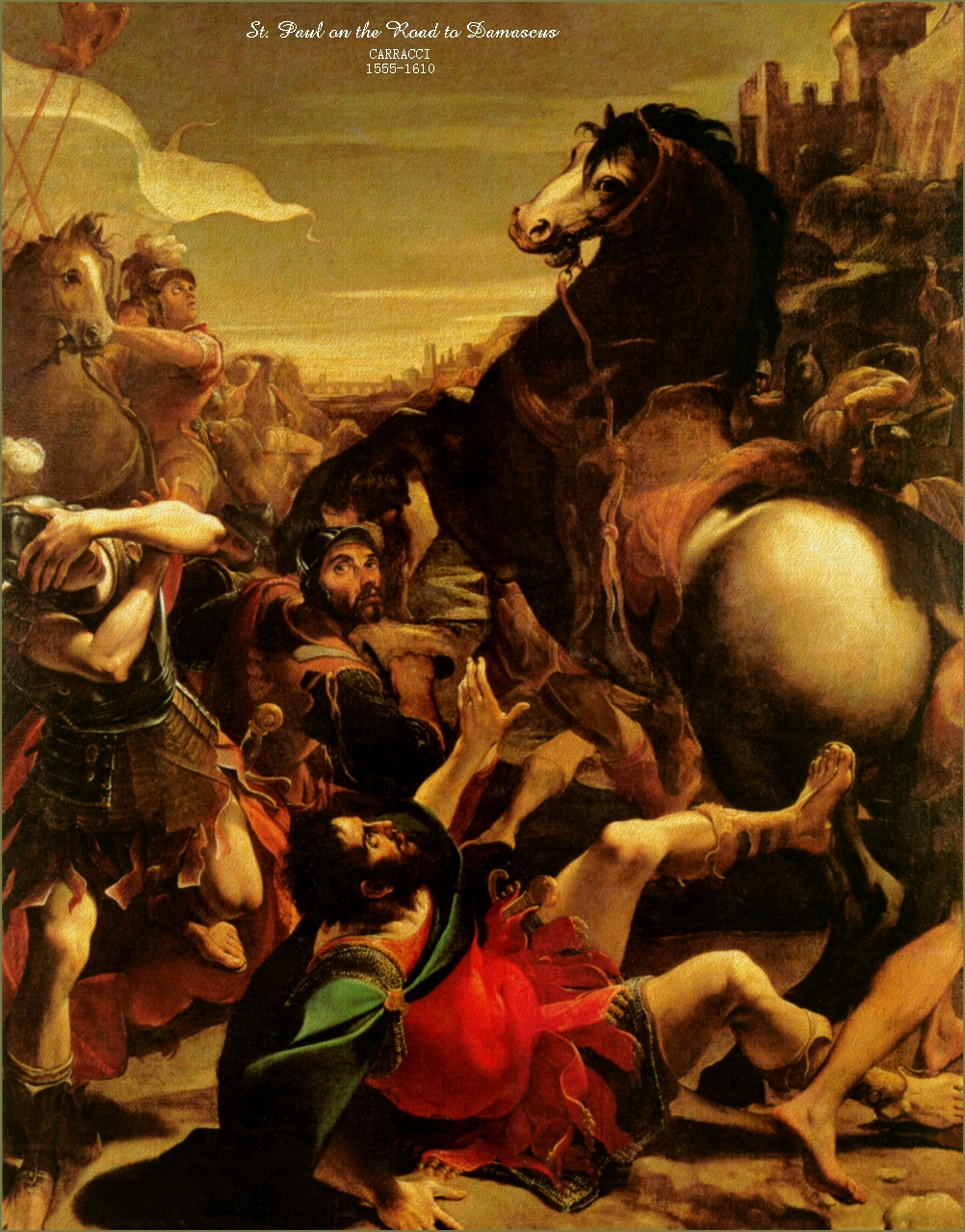
Saint Paul’s entire life can be explained in terms of one experience—his meeting with Jesus on the road to Damascus. In an instant, he saw that all the zeal of his dynamic personality was being wasted, like the strength of a boxer swinging wildly. Perhaps he had never seen Jesus, who was only a few years older. But he had acquired a zealot’s hatred of all Jesus stood for, as he began to harass the Church: “…entering house after house and dragging out men and women, he handed them over for imprisonment” (Acts 8:3b). Now he himself was “entered,” possessed, all his energy harnessed to one goal—being a slave of Christ in the ministry of reconciliation, an instrument to help others experience the one Saviour.
One sentence determined his theology: “I am Jesus, whom you are persecuting” (Acts 9:5b). Jesus was mysteriously identified with people—the loving group of people Saul had been running down like criminals. Jesus, he saw, was the mysterious fulfilment of all he had been blindly pursuing.
From then on, his only work was to “present everyone perfect in Christ. For this I labour and struggle, in accord with the exercise of his power working within me” (Colossians 1:28b-29). “For our gospel did not come to you in word alone but also in power and in the Holy Spirit and [with] much conviction” (1 Thessalonians 1:5a).
Paul’s life became a tireless proclaiming and living out of the message of the cross: Christians die baptismally to sin and are buried with Christ; they are dead to all that is sinful and unredeemed in the world. They are made into a new creation, already sharing Christ’s victory and someday to rise from the dead like Him. Through this risen Christ the Father pours out the Spirit on them, making them completely new.
So Paul’s great message to the world was – You are saved entirely by God, not by anything you can do. Saving faith is the gift of total, free, personal and loving commitment to Christ, a commitment that then bears fruit in more “works” than the Law could ever contemplate.
Conversion of Paul the Apostle (Feast)
Details: https://anastpaul.wordpress.com/2018/01/25/feast-of-the-conversion-of-st-paul-25-january/
St Agape the Martyr
St Agileus of Carthage
St Amarinus of Clermont
St Ananias of Damascus
Bl Antoni Swiadek
Bl Antonio Migliorati
St Apollo of Heliopolis
Bl Archangela Girlani
St Artemas of Pozzuoli
St Auxentius of Epirus
St Bretannion of Tomi
St Donatus the Martyr
St Dwynwen
St Emilia Fernández Rodríguez de Cortés
St Eochod of Galloway
Bl Francesco Zirano
Bl Henry Suso
St Joel of Pulsano
St Juventinus of Antioch
Bl Manuel Domingo y Sol
St Maximinus of Antioch
St Palaemon
St Poppo
St Praejectus of Clermont
St Publius of Zeugma
St Racho of Autun
St Sabinus the Martyr
Bl Teresa Grillo Michel
Novena to St Paul in preparation for the Feast of The Conversion of St Paul on 25 January
Day Nine – 24 January
The key to conversion? Keeping our focus on the Cross of Jesus Christ, for “the human heart is converted by looking upon (the Crucified) whom our sins have pierced” (CCC 1432 cf. Jn 19:37; Zech 12:10)
LET US PRAY:
Glorious St Paul,
your conversion is a powerful witness to the world
that God loves us and does not give up on us,
no matter how far we stray.
Help me to cling to Christ Crucified
help me to fully participate at every SACRIFICE of the Holy Mass
help me to understand, that this IS He
who showed us the way
gave us the light to follow it in Holy Mother Church
who is His bride and shows us the only truth.
May every circumstance of my life be an occasion
to change my way of thinking,
to renounce self-will and
to surrender myself to the wisdom and tenderness of Jesus Christ
who is acting to make me His saint.
Pray that I may love God’s will and providence for me.
In this confidence, I entrust to you, St Paul,
these, my intentions
…………………………………….
(mention your request)
Novena to St Paul in preparation for the Feast of The Conversion of St Paul on 25 January
Day Eight – 23 January
“In the ancient Church, Baptism was also called “illumination” because this Sacrament gives light; it truly makes one see. In Paul what is pointed out theologically was also brought about physically – healed of his inner blindness, he sees clearly. Thus St Paul was not transformed by a thought but by an event, by the irresistible presence of the Risen One whom subsequently he would never be able to doubt, so powerful had been the evidence of the event, of this encounter…………….This encounter is a real renewal that changed all his parameters. Now he could say that what had been essential and fundamental for him earlier had become “refuse” for him; it was no longer “gain” but loss, because henceforth the only thing that counted for him was life in Christ.” … Pope Benedict XVI 2008
LET US PRAY:
Glorious St Paul,
your conversion is a powerful witness to the world
that God loves us and does not give up on us,
no matter how far we stray.
May every circumstante of my life be an occasion
to change my way of thinking,
to renounce self-will and
to surrender myself to the wisdom and tenderness of Jesus Christ
who is acting to make me His saint.
Pray St Paul, that I too may be able to acclaim
“It is not I who live, but Christ who lives in me.”
Pray that I may love God’s will and providence for me.
In this confidence, I entrust to you, St Paul,
these, my intentions
…………………………………….
(mention your request)
Novena to St Paul in preparation for the Feast of The Conversion of St Paul on 25 January
Day Seven – 22 January
“Make no mistake, my brothers, if anyone joins a schismatic he will not inherit God’s Kingdom. If anyone walks in the way of heresy, he is out of sympathy with the Passion. Be careful, then, to observe a single Eucharist. For there is one flesh of our Lord, Jesus Christ and one cup of His blood that makes us one and one altar, just as there is one bishop along with the presbytery and the deacons, my fellow slaves. In that way whatever you do is in line with God’s will.”………………St Ignatius of Antioch
LET US PRAY:
Glorious St Paul,
your conversion is a powerful witness to the world
that God loves us and does not give up on us,
no matter how far we stray.
Help me to cling to Christ in the Blessed Sacrament
help me to fully participate at every Holy Mass
help me to understand, that this IS He
who showed us the way
gave us the light to follow it in Holy Mother Church
who is His bride and shows us the only truth.
May every circumstante of my life be an occasion
to change my way of thinking,
to renounce self-will and
to surrender myself to the wisdom and tenderness of Jesus Christ
who is acting to make me His saint.
Pray that I may love God’s will and providence for me.
In this confidence, I entrust to you, St Paul,
these, my intentions
……………………………..
(mention your request)
Novena to St Paul in preparation for the Feast of The Conversion of St Paul on 25 January
Day SIX – 21 January
Various daily acts cause our conversion and ultimately our sanctification to grow: examining our conscience and admitting our faults; undertaking works of penance and reconciliation; receiving the correction others give us with an open and humble heart; reaching out to the poor; standing up for what is right and just; accepting the suffering and persecution that come our way; desiring to better our life (see CCC1435).
LET US PRAY:
Glorious St Paul,
your conversion is a powerful witness to the world
that God loves us and does not give up on us,
no matter how far we stray.
Help me to live a life of ongoing conversion.
True conversion means converting my life to the
design of God, the plan He has for me right now.
Pray for me, that I may be filled with passion
for the evangelisation of all those around me,
that my life may be a beacon of the light of Christ.
May the witness of my life inspire other sinners to conversion.
May faith move me to believe that God can
and will change the things in me that seem impossible to rectify.
In this confidence, I entrust to you, St Paul,
these, my intentions
…………………………..
(mention your request)
Novena to St Paul in preparation for the Feast of The Conversion of St Paul on 25 January
Day FIVE – 20 January
“Conversion to Christ,” says Pope Benedict XVI, “ultimately means this: to exit the illusion of self-sufficiency in order to discover and accept one’s own need – the need of others and of God, the need of His forgiveness and His friendship.”
LET US PRAY:
Glorious St Paul,
your conversion is a powerful witness to the world
that God loves us and does not give up on us,
no matter how far we stray.
May every circumstante of my life be an occasion
to change my way of thinking,
to renounce self-will and
to surrender myself to the wisdom and tenderness of Jesus Christ
who is acting to make me His saint.
Pray that I may love God’s will and providence for me.
In this confidence, I entrust to you, St Paul,
these, my intentions
………………………………
(mention your request)
Novena to St Paul in preparation for the Feast of The Conversion of St Paul on 25 January
Day FOUR – 19 January
For St John Paul, conversion means returning to God “through evaluating earthly realities in the unfailing light of His truth.” The proof of St Paul’s conversion is his profession: “For me to live is Christ” (Phil 1:21). Conversion is a conversion to the will and design of God: “It is no longer I who live but Christ who lives in me” (Gal 2:20).
Let us Pray:
Glorious St Paul,
your conversion is a powerful witness to the world
that God loves us and does not give up on us,
no matter how far we stray.
Help me to live a life of ongoing conversion.
True conversion means converting my life to the
design of God, the plan He has for me right now.
Pray that I will love God’s will and providence for me.
May I learn to truly surrender myself to wisdom and tenderness of God.
In this confidence, I entrust to you, St Paul,
these, my intentions ………………..
(mention your request)
Novena to St Paul in preparation for the Feast of The Conversion of St Paul on 25 January
Day THREE – 18 January
“Suddenly a light from heaven flashed about him…. (he) heard a voice saying to him, ‘Saul, Saul, why do you persecute me?…I am Jesus….” They led (Saul) by the hand” (Acts 9:3,4,5,8)
Pope Emeritus Benedict XVI speaks of conversion as an act of obedience toward a reality that does not originate from us, that precedes us – the concrete God. (Joseph Ratzinger – The Nature and Mission of Theology {Ignatius, 1995 p 58})
Let us Pray:
Glorious St Paul,
your conversion is a powerful witness to the world
that God loves us and does not give up on us,
no matter how far we stray.
Help me to live a life of ongoing obedience to God
and conversion of my wilful heart.
Pray that I may renounce self-will
and surrender myself to my Creator
who has a plan to make me a saint.
May faith move me to believe that God can and will,
change the things in me that seem insurmountable.
Pray that I may love God’s will and providence for me.
In this confidence, I entrust to you, St Paul,
these, my intentions
………………………………….
(mention your request)
Novena to St Paul in preparation for the Feast of The Conversion of St Paul on 25 January
Day TWO – 17 January
Saul of Tarsus, the “Pharisee, a son of Pharisees” (Acts 23:6) had often prayed in the Psalms “You have said, ‘seek my face.’ My heart says to you, ‘Your face, Lord, do I seek’…Bow your heavens, O Lord and come down!….Flash forth the lightening …Stretch forth your hand from on high, rescue me and deliver me.” (Ps 27:8-9; 144:5,6,7).
And that is EXACTLY what happened when Saul encountered Christ on the road to Damascus!
LET US PRAY:
Glorious St Paul,
your conversion is a powerful witness to the world
that God loves us and does not give up on us,
no matter how far we stray.
May every circumstance of my life be an occasion
to change my way of thinking,
to renounce self-will and
to surrender myself to the wisdom
and tenderness of Jesus Christ
who is acting to make me His saint.
Pray that I may love God’s will and providence for me.
In this confidence, I entrust to you, St Paul,
these, my intentions
………………………………………..
(mention your request)
Novena to St Paul in preparation for the Feast of The Conversion of St Paul on 25 January
Blessed John Henry Newman (1801-1890) looked upon conversion as nothing more than a deeper discovery of what we already truly desire. Conversion happens at the level of desire. It is the restoration of what makes us truly human.
Novena to St Paul DAY ONE – 16 January
Glorious St Paul,
your conversion is a powerful witness to the world
that God loves us and does not give up on us,
no matter how far we stray.
Help me to live a life of ongoing conversion.
True conversion means converting my life to the
design of God, the plan He has for me right now.
Pray that I may love God’s will and providence for me.
In this confidence, I entrust to you, St Paul,
these, my intentions,
………………………………..
(mention your request)
Thought for the Day – 5 July – The Memorial of St Anthony Mary Zaccaria (1502-1539)
Compassion for the sick and the poor led Dr Anthony Mary Zaccaria to see beyond the sick bodies of his patients and recognise the need for a different kind of healing. After becoming “Fr” Zaccaria, he tried to fill that need and dedicated the rest of his life to doing so. …….the Pauline ardour of his preaching would probably “turn off” many people today. When even some psychiatrists complain at the lack of a sense of sin, it may be time to tell ourselves that not all evil is explained by emotional disorder, subconscious and unconscious drives, parental influence and so on. The old-time “hell and damnation” mission sermons have given way to positive, encouraging, biblical homilies. We do indeed need assurance of forgiveness, relief from existential anxiety and future shock. But we still need prophets to stand up and tell us, “If we say ‘We are without sin,’ we deceive ourselves and the truth is not in us” (1 John 1:8). (Fr Don Miller OFM). St Anthony was such a prophet, he let God step in and lead him to a whole new set of plans. May we too allow God room in our boat to navigate us to a new way of life!
“We are fools for Christ’s sake:
our holy guide and most revered patron, was speaking about himself and the rest of the apostles and about the other people who profess the Christian and apostolic way of life.
But there is no reason, dear brothers, that we should be surprised or afraid; for the disciple is not superior to his teacher, nor the slave to his master. We should love and feel compassion for those who oppose us, rather than abhor and despise them, since they harm themselves and do us good and adorn us with crowns of everlasting glory while they incite God’s anger against themselves. And even more than this, we should pray for them and not be overcome by evil but overcome evil by goodness.
We should heap good works like red-hot coals of burning love upon their heads, as our Apostle urges us to do, so that when they become aware of our tolerance and gentleness they may undergo a change of heart and be prompted to turn in love to God.”
Thought for the Day – 29 June – The Solemnity of Saints Peter and Paul
We would probably go to confession to Peter, sooner than to any of the other apostles. He is perhaps a more striking example of the simple fact of holiness. Jesus says to us as he said, in effect, to Peter: “It is not you who have chosen me but I who have chosen you. Peter, it is not human wisdom that makes it possible for you to believe but my Father’s revelation. I, not you, build my Church.”
Paul’s experience of the risen Jesus on the road to Damascus was the driving force that made him one of the most zealous, dynamic and courageous ambassadors of Christ the Church has ever had. But persecution, humiliation and weakness became his day-by-day carrying of the cross, material for further transformation. The dying Christ was in him; the living Christ was his life.
We owe our faith to these two great Apostles and like Jesus, Himself, their death was our life!
St Peter, the foundation of our home on earth, incomparable St Paul, “the chosen vessel”, you were partners in death and share the glorious crown. You are both lamps to guide our feet, lights and jewels of the Universal Church, please Pray for us!
Our Morning Offering – 29 June – The Solemnity of Saints Peter and Paul
What Fairer Light?
Hymn for the Solemnity of Sts Peter and Paul Elphis, c 493, wife of Boethius c 477– 524 Translation: R A Knox, 1888-1957
What fairer light is this than time itself doth own,
The golden day with beams more radiant brightening?
The princes of God’s Church this feast day doth enthrone,
To sinners heavenward bound their burden lightening.
One taught mankind its creed, one guards the heavenly gate,
Founders of Rome, they bind the world in loyalty;
One by the sword achieved, one by the cross his fate;
With laurelled brows they hold eternal royalty.
Rejoice, O Rome, this day, thy walls they once did sign
With princely blood, who now their glory share with thee.
What city’s vesture glows with crimson deep as thine?
What beauty else has earth that may compare with thee?
To God the three in one eternal homage be,
All honour, all renown, all songs victorious,
Who rules both heaven and earth by one divine decree
To everlasting years in empire glorious.
Wishing you all a Holy and Blessed Solemnity of Saints Peter and Paul
The Solemnity of Saints Peter and Paul
St Augustine (354-430)
This day has been consecrated for us by the Martyrdom of the blessed apostles Peter and Paul. It is not some obscure martyrs we are talking about. “Their sound has gone out into all the earth and their words to the ends of the world” (Psalm 19). These martyrs had seen what they proclaimed, they pursued justice by confessing the truth, by dying for the truth.
The blessed Peter, the first of the Apostles, the ardent lover of Christ, who was found worthy to hear, “And I say to you, that you are Peter” (Matthew 16:13-20). He himself, you see, had just said, “You are the Christ, the Son of the living God.” Christ said to him, “And I say to you that you are Peter, and upon this rock I will build my Church.” Upon this rock I will build the faith you have just confessed. Upon your words, “You are the Christ, the Son of the living God,” I will build My Church, because you are Peter. Peter comes from petra, meaning a rock. Peter, “Rocky”, from “rock” not “rock” from “Rocky”. Peter comes from the word for a rock in exactly the same way as the name Christian comes from Christ.
Before His passion the Lord Jesus, as you know, chose those disciples of His whom He called apostles. Among these it was only Peter who almost everywhere, was given the privilege of representing the whole Church. It was in the person of the whole Church, which he alone represented, that he was privileged to hear, “To you will I give the keys of the kingdom of heaven.” After all, it is not just one man that received these keys but the Church in its unity. So this is the reason for Peter’s acknowledged pre-eminence, that he stood for the Church’s universality and unity, when he was told, “To you I am entrusting,” what has in fact been entrusted to all. To show you that it is the Church which has received the keys of the kingdom of heaven, listen to what the Lord says in another place to all His apostles: “Receive the Holy Spirit” and immediately afterwards, “Whose sins you forgive, they will be forgiven them; whose sins you retain, they will be retained” (John 20:22-23).
Quite rightly, too, did the Lord after His resurrection entrust His sheep to Peter to be fed (Jn. 21: 15-19). It is not, you see, that he alone among the disciples was fit to feed the Lord’s sheep but when Christ speaks to one man, unity is being commended to us. And He first speaks to Peter, because Peter is the first among the apostles. Do not be sad, Apostle. Answer once, answer again, answer a third time. Let confession conquer three times with love, because self-assurance was conquered three times by fear. What you had bound three times must be loosed three times. Loose through love what you had bound through fear. And for all that, the Lord once and again, and a third time, entrusted His sheep to Peter.
There is one day for the passion of two apostles. But these two also were as one; although they suffered on different days, they were as one. Peter went first, Paul followed.
We are celebrating a feast day, consecrated for us by the blood of the apostles. Let us love their faith, their lives, their labours, their sufferings, their confession of faith, their preaching.
O God, who on the Solemnity of the Apostles Peter and Paul
give us the noble and holy joy of this day,
grant, we pray, that Your Church
may in all things follow the teaching
of those through whom she received
the beginnings of right religion.
Through our Lord Jesus Christ, Your Son,
who lives and reigns with You in the unity of the Holy Spirit,
one God, forever and ever.
Amen
Quote of the Day – 16 May – Wednesday of the Seventh Week of Eastertide
“The Spirit comes to the aid of our weakness; when we do not know what prayer to offer, to pray as we ought, the Spirit Himself intercedes for us, with groans beyond all utterance and God, who can read our hearts, knows well what the Spirit’s intent is; for indeed, it is according to the mind of God that He makes intercession for the saints.”
You must be logged in to post a comment.