Posted in DOCTORS of the Church, MORNING Prayers, PRAYERS of the SAINTS, QUOTES of the SAINTS, SACRAMENTS, SUNDAY REFLECTIONS, The HOLY EUCHARIST / The HOLY MASS

Sunday Reflection – 1 July – By St Alphonsus Liguori (1696-1787)

Sunday Reflection – 1 July – By St Alphonsus Liguori (1696-1787)

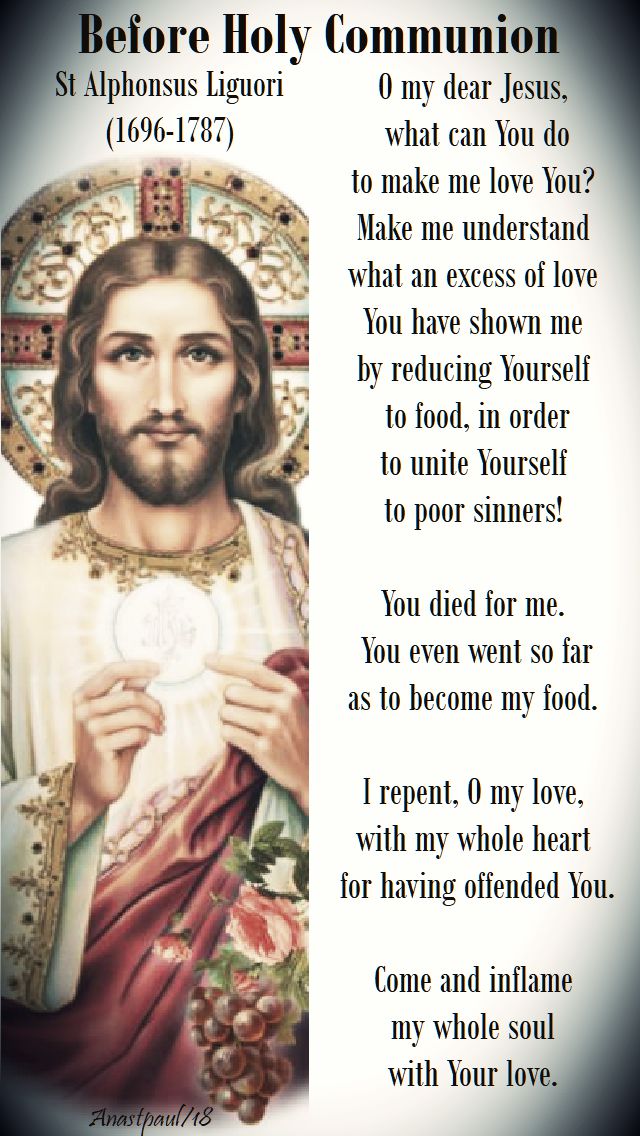
O my dear Jesus, what can You do to make me love You?
Make me understand, what an excess of love You have shown me, by reducing Yourself to food,
in order to unite Yourself to poor sinners!
You, my dear Redeemer, have so much affection for me,
that You have not refused to give Yourself, again and again, entirely to me in Holy Communion.
And yet, I have had the courage to drive You away from my soul on so many occasions!
You do not despise a humble and contrite heart.
You became human for my sake.
You died for me.
You even went so far as to become my food.
What more can there remain for You to do in order to gain my love?
Oh, that I could die with grief, every time that I remember, that I have despised Your grace.
I repent, O my love, with my whole heart for having offended You.
I love You, O infinite goodness! I love You, O infinite love!
I desire nothing but to love You and I fear nothing but to live without Your love.
My beloved Jesus, do not refuse to come to me.
Come, because I would rather die a thousand times than drive You away again.
I will do all that I can to please You.
Come and inflame my whole soul with Your love.
Grant that I may forget everything, to think only of You,
and to desire You alone,
my sovereign and my only good.prayer before holy communion - o my dear jesus - 1 july 2018

Posted in DOCTORS of the Church, MORNING Prayers, QUOTES of the SAINTS, QUOTES on SANCTITY, QUOTES on the CROSS of CHRIST, QUOTES on the DEVIL/EVIL, QUOTES on TRUST and complete CONFIDENCE in GOD, SUNDAY REFLECTIONS

Sunday Reflection – 24 June – Help to Holiness by St Alphonsus Liquori

Sunday Reflection – 24 June – Help to Holiness by St Alphonsus Liquori  (1696-1787)         Most Zealous Doctor

St Alphonsus helps us, with:
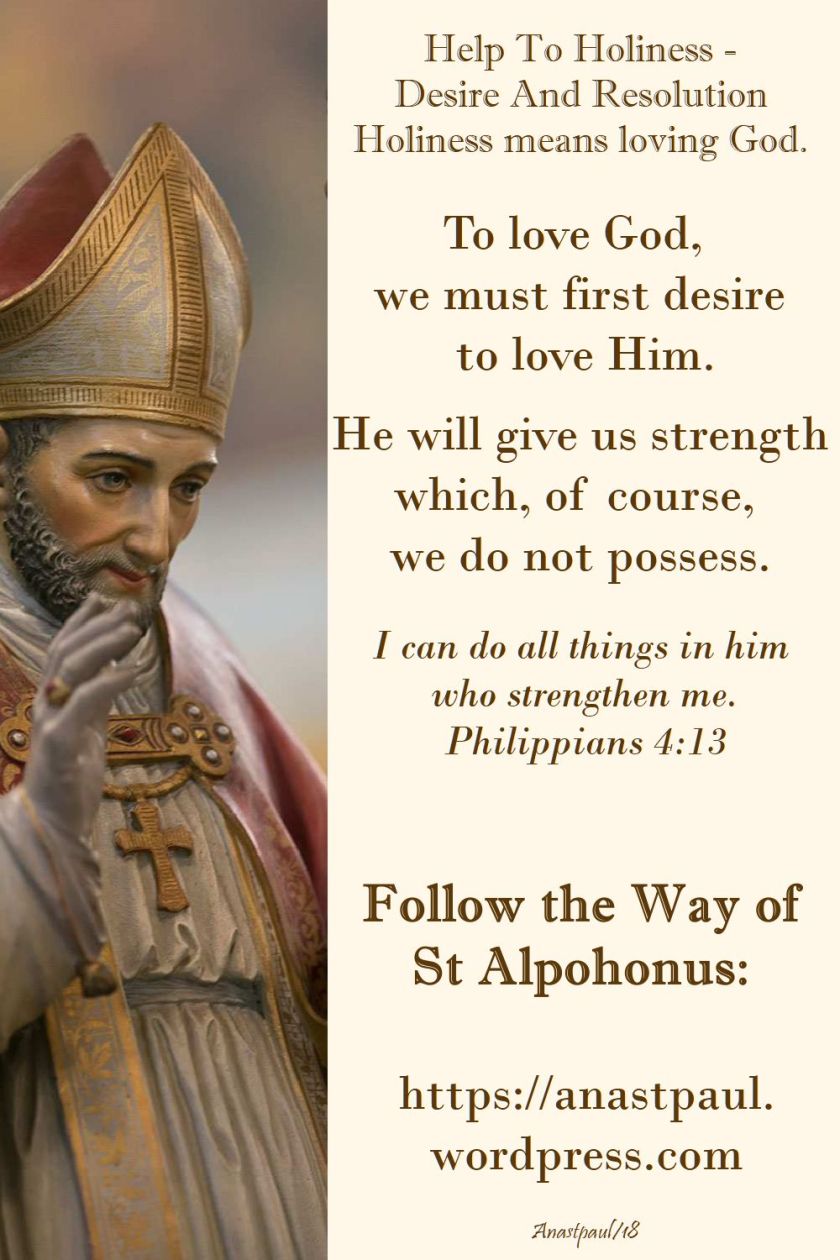
Help To Holiness – Desire And Resolution
Holiness means loving God.

To love God, we must first desire to love Him.
If we do not want something, we will, certainly go to little trouble to obtain it!
So it is with the love of God.
He that has a small wish to advance in divine love will become lukewarm and, continuing this tepidity,
will soon fall totally away from God.
On the other hand whoever aspires after holines, and makes daily efforts to advance, will, little by little, attain it.
Saint Teresa assures us:
God leaves no deisre without its reward.
But let us not trust to our own efforts, to advance in holiness but hope for all, from and through God.
He will give us strength which, of course, we do not possess.
I can do all things in him who strengthen me.
Philippians 4:13
Many desire holiness but never take the means to gain it!
They want to do great penance and practice great prayer,
but such desires are mere fancies.
Saint Teresa often said:
The devil has no dread of irresolute souls.

RESOLUTIONS

Let us then fix our minds in the ways of God.
Let us resolve to meditate each day on the passion of our Lord Jesus Christ.
Let us resign ourselves in peace to God’s plan for us.
Let us endeavour, in the time remaining to us, to give all to God.
Jesus has given Himself to us,
may God help us to give ourselves to Him.help to holiness - desire and resolution - 24 june 2018

Posted in CATECHESIS, MORNING Prayers, PAPAL SERMONS, SUNDAY REFLECTIONS, The HOLY EUCHARIST / The HOLY MASS

Sunday Reflection – 17 June – Eleventh Sunday in Ordinary Time Year B

Sunday Reflection – 17 June – Eleventh Sunday in Ordinary Time Year B

….What happens in Spring?   Plants blossom, trees flower.   I will ask you some questions. Can a sick tree or plant fully blossom if it is sick?   No!   Can a tree, a plant which is not watered by rain or artificially, blossom nicely?   No.   And can a tree and a plant whose roots have been removed or which have no roots flower?   No.   Without roots, can they flower?   No!   And this is a message:  Christian life has to be a life that must blossom in works of charity, in doing what is good.   But if you have no roots, you cannot blossom, and who is the root?   Jesus  ! If you are not with Jesus, there in the roots, you will not blossom.   If you do not water your life with prayer and the sacraments, will you bear Christian flowers?   No!   Because prayer and the sacraments water the roots and our life blossoms.   I hope that your Spring may be bloom beautifully, as blooming as Easter will be;  blossoming with good works, virtue and doing good to others.   Remember this, this is a very beautiful verse from my country:   “What blossoms a tree bears come from what lies underneath it”.   Never cut off Jesus’ roots.

During Mass, after breaking the consecrated Bread, that is the Body of Christ, the priest shows it to the faithful, inviting them to participate in the Eucharistic banquet.   We know the words that ring out from the sacred altar:  “Happy are those who are called to his Supper.   This is the Lamb of God who takes away the sin of the world”.   Inspired by a passage in the Book of Revelation — “Blessed are those who are invited to the marriage supper of the Lamb” (Rev 19:9): it says “marriage” because Jesus is the Spouse of the Church — this invitation calls us to experience intimate union with Christ, the source of joy and holiness.   It is an invitation which brings happiness and at the same time spurs us to an examination of conscience enlightened by faith.

Although we are the ones who stand in procession to receive Communion;  we approach the altar in a procession to receive communion, in reality it is Christ who comes towards us to assimilate us in Him.   There is an encounter with Jesus!   To nourish oneself of the Eucharist means to allow oneself to be changed by what we receive.   Saint Augustine helps us understand this when he talks about the light he received when he heard Christ say to him:   “I am the food of strong men;  grow and you shall feed upon me;  nor shall you convert me, like the food of your flesh, into you but you shall be converted into me” (Confessions VII, 10, 16: pl 32, 742).

Each time we receive Communion, we resemble Jesus more;  we transform ourselves more fully into Jesus.   As the Bread and the Wine are converted into the Body and Blood of the Lord, so too those who receive it with faith, are transformed into a living Eucharist.

You reply “Amen” to the priest who distributes the Eucharist saying “the Body of Christ”; that is, you recognise the grace and the commitment involved in becoming the Body of Christ.   Because when you receive the Eucharist, you become the Body of Christ.  This is beautiful;  it is very beautiful.   As it unites us to Christ, tearing us away from our selfishness, Communion opens us and unites us to all those who are a single thing in Him.   This is the wonder of Communion:  we become what we receive!

Let us approach the Eucharist:  receiving Jesus who transforms us into Him makes us stronger.   The Lord is so good and so great!

Pope Francis, General Audience, 21 March 2018each time we receive communion - pope francis - 17 june 2018

Posted in EUCHARISTIC Adoration, MORNING Prayers, QUOTES - J R R Tolkien and MORE, QUOTES of the SAINTS, QUOTES on GRATITUDE, SUNDAY REFLECTIONS, The HOLY EUCHARIST / The HOLY MASS

Sunday Reflection – 10 June -Tenth Sunday of the Year B

Sunday Reflection – 10 June -Tenth Sunday of the Year B

“The Holy Sacrifice of the Mass gives boundless honour to the Most Blessed Trinity because it represents the passion of Jesus Christ and because, through the Mass, we offer God the merits of Our Lord’s obedience, of His sufferings and of His Precious Blood.   The whole of the heavenly court also receives an accidental joy from the Mass.

Several doctors of the Church—together with St Thomas Aquinas—tell us that, for the same reason, all the blessed in Heaven rejoice in the communion of the faithful because the Blessed Sacrament, is a memorial of the passion and death of Jesus Chris and that by means of it, men share in its fruits and work out their salvation”

St Louis de Montfort (1673-1716)

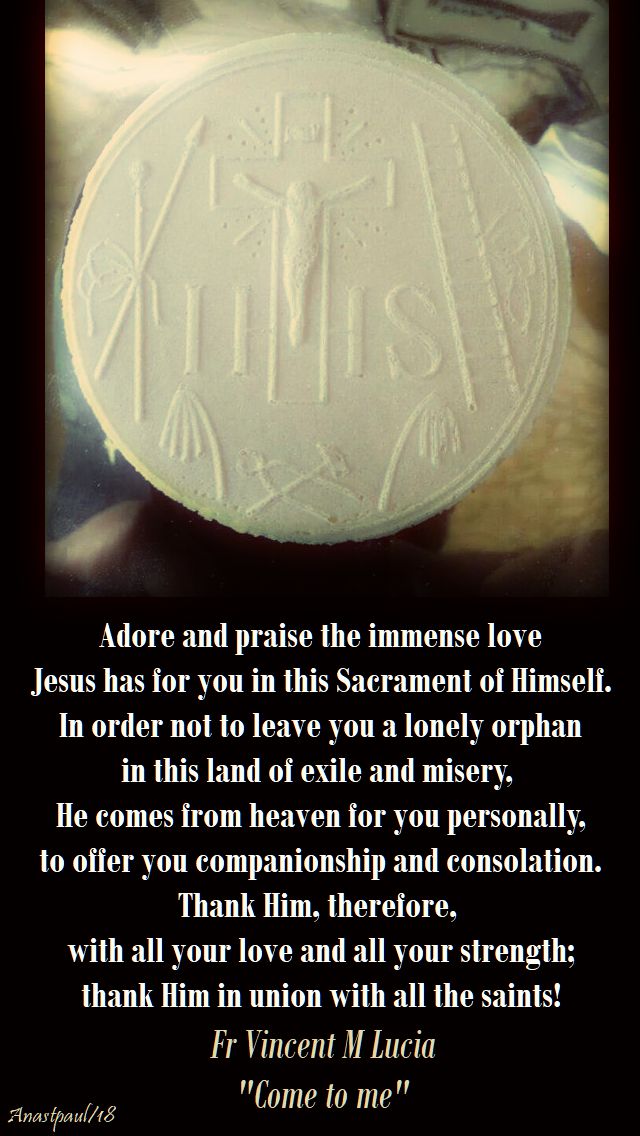
“Adore and praise the immense love Jesus has for you in this Sacrament of Himself.
In order not to leave you a lonely orphan in this land of exile and misery, He comes from heaven for you personally, to offer you companionship and consolation.
Thank Him, therefore, with all your love and all your strength;
thank Him in union with all the saints!”…Fr Vincent M Lucia “Come to me”

adore and praise the immense love - for lucia - 10 june 2018 - sunday reflection

Posted in EUCHARISTIC Adoration, MORNING Prayers, PRACTISING CATHOLIC, QUOTES of the SAINTS, SUNDAY REFLECTIONS, The HOLY EUCHARIST / The HOLY MASS

Sunday Reflection – 27 May – The Solemnity of the Most Holy Trinity

Sunday Reflection – 27 May – The Solemnity of the Most Holy Trinity

Holy Communion
Bl John Henry Newman (1801-1890)

O my God, holiness becomes Your House and yet You dost made Your abode in my breast. My Lord, my Saviour, to me You come, hidden under the semblance of earthly things, yet in that very flesh and blood which You took from Mary. You, who did first inhabit Mary’s breast, come to me.

My God, You see me; I cannot see myself.   Were I ever so good a judge about myself, ever so unbiased and with ever so correct a rule of judging, still, from my very nature, I cannot look at myself and view myself truly and wholly.   But You, as You come to me, contemplates me.

When I say, Domine, non sum dignus—”Lord, I am not worthy”—You whom I am addressing, alone understands in their fullness the words which I use.   You see how unworthy so great a sinner is to receive the One Holy God, whom the Seraphim adore with trembling.   You see, not only the stains and scars of past sins but the mutilations, the deep cavities, the chronic disorders which they have left in my soul.   You see the innumerable living sins, though they be not mortal, living in their power and presence, their guilt and their penalties, which clothe me.   You see all my bad habits, all my mean principles, all wayward lawless thoughts, my multitude of infirmities and miseries, yet You come.   You see most perfectly how little I really feel what I am now saying, yet You come.

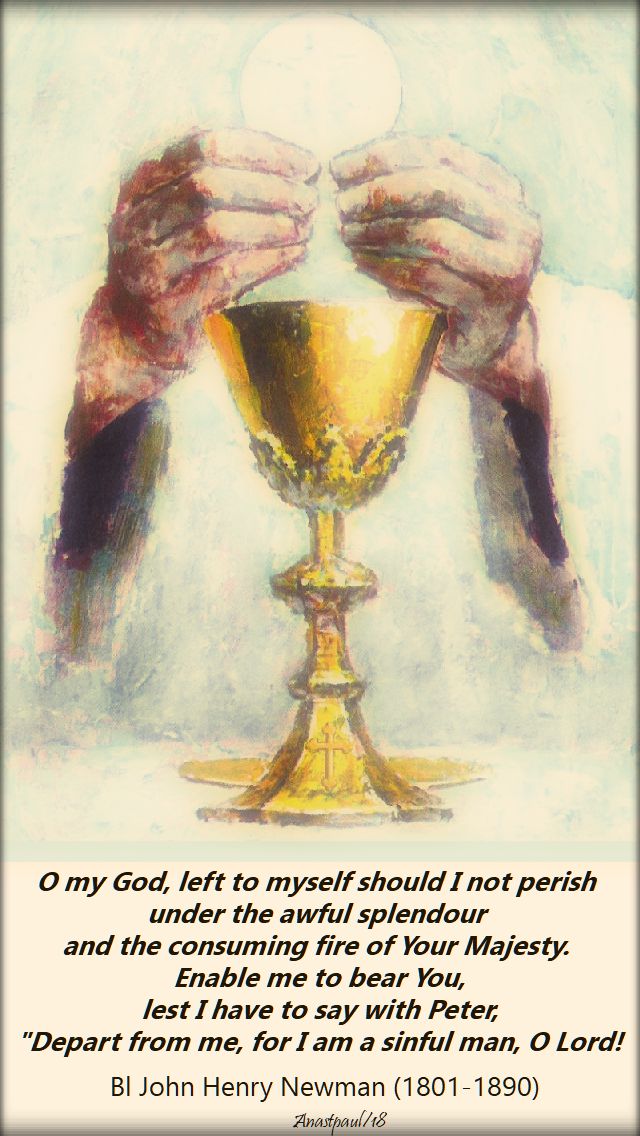
O my God, left to myself should I not perish under the awful splendour and the consuming fire of Your Majesty.   Enable me to bear You, lest I have to say with Peter, “Depart from me, for I am a sinful man, O Lord!”o my god, left to myself - bl john henry newman - 27 may 2018

Posted in EUCHARISTIC Adoration, MORNING Prayers, PRAYERS of the SAINTS, SUNDAY REFLECTIONS, The HOLY EUCHARIST / The HOLY MASS, Uncategorized

Sunday Reflection – 13 May – The Solemnity of the Ascension of the Lord – “O Blessed Host”

Sunday Reflection – 13 May – The Solemnity of the Ascension of the Lord “O Blessed Host”

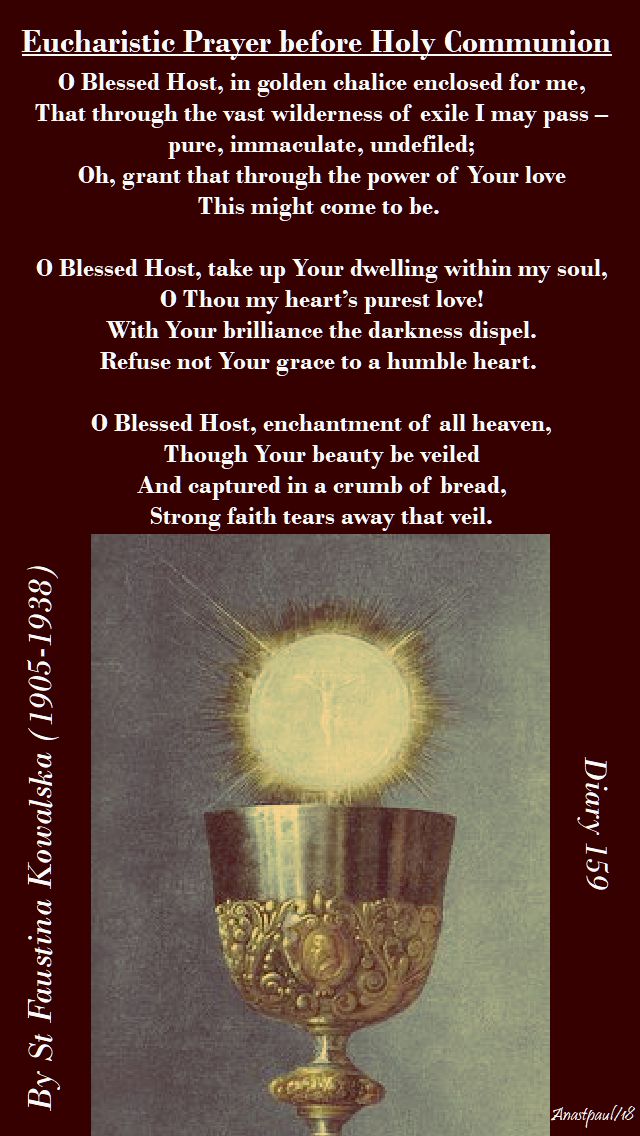
” Blessed Host” Eucharistic Prayer before Holy Communion
By St Faustina Kowalska (1905-1938)
Diary 159

O Blessed Host, in golden chalice enclosed for me,
That through the vast wilderness of exile I may pass –
pure, immaculate, undefiled;
Oh, grant that through the power of Your love
This might come to be.

O Blessed Host, take up Your dwelling within my soul,
O Thou my heart’s purest love!
With Your brilliance the darkness dispel.
Refuse not Your grace to a humble heart.

O Blessed Host, enchantment of all heaven,
Though Your beauty be veiled
And captured in a crumb of bread,
Strong faith tears away that veil.eucharistic prayer before holy comm - st faustina - o blessed host - 13 may 2018 - sunday reflection.jpg

Posted in EUCHARISTIC Adoration, MORNING Prayers, SUNDAY REFLECTIONS, The HOLY EUCHARIST / The HOLY MASS

Sunday Reflection – 6 May – Sixth Sunday of Eastertide B

Sunday Reflection – 6 May – Sixth Sunday of Eastertide B

We Offer to Jesus the Adoration of our Whole Being
By Fr Vincent Martin Luca

Lay your whle being, your faculties and all your works in homage at the foot of the Eucharistic Altar and Throne and say to the Lord:
“To You alone be love and glory!”

Offer Him the homage of your thoughts, desiring the Divine Eucharist to be the dominant thought of your life;
the homage of your affections, calling Jesus, the King and God of your heart;
the homage of your will, desiring henceforth to have no other law,
no other end than His service,
His love
and His glory;
the homage of your memory, in order to remember Him alone and thus to live
in Him,
by Him
and for Him alone.

Then contemplate the greatness of the love of Jesus as He institutes, multiplies and perpetuates His Divine Eucharist, to the end of time.
Marvel at His wisdom in the Divine invention which excites the wonder of the angels themselves.
Praise His power which has triumphed over every obstacle and exalt His goodness,
which has determined the gifts of that power.

On realising that you are the very end of the greatest and the holiest of Sacraments,
break forth into a transport of joy and love,
for you alone,
what He has done for all!
What LOVE!sunday reflection - 6 may - fr vincent luca page 242 come to me

Posted in MORNING Prayers, PAPAL ENCYLICALS, QUOTES of the SAINTS, QUOTES on SANCTITY, SUNDAY REFLECTIONS, The WORD

Sunday Reflection -– 29 April – Fifth Sunday of Eastertide: Holy Gospel of Jesus Christ according to Saint John 15:1-8.

Sunday Reflection -– 29 April – Fifth Sunday of Eastertide:  Holy Gospel of Jesus Christ according to Saint John 15:1-8.john 15 5 - 29 april 2018

“Without Me you can do nothing”  John 15:5

“In Christ it hath well pleased the Father that all fulness should dwell.” (Col 1:19)   He is gifted with those supernatural powers that accompany the hypostatic union, since the Holy Spirit dwells in Him with a fullness of grace than which no greater can be imagined. To Him has been given “power over all flesh”; (Jn 17:2)… . From Him streams into the body of the Church all the light with which those who believe are divinely illumined, and all the grace by which they are made holy as He is holy…

It is He who imparts the light of faith to believers;  it is He who enriches pastors and teachers and above all His Vicar on earth with the supernatural gifts of knowledge, understanding and wisdom, so that they may loyally preserve the treasury of faith, defend it vigorously and explain it and confirm it with reverence and devotion.   Finally, it is He who, though unseen, presides at the Councils of the Church and guides them…

Holiness begins from Christ and Christ is its cause.   For no act conducive to salvation can be performed unless it proceeds from Him as from its supernatural source.   “Without me,” He says, “you can do nothing.”(Jn 15:5)   If we grieve and do penance for our sins if, with filial fear and hope, we turn again to God, it is because He is leading us.   Grace and glory flow from His inexhaustible fullness…

When the Sacraments of the Church are administered by external rite, it is He who produces their effect in souls.   He nourishes the redeemed with His own flesh and blood and thus calms the turbulent passions of the soul;  He gives increase of grace and prepares future glory for souls and bodies.

Christ our Lord wills the Church to live His own supernatural life and by His divine power permeates His whole Body and nourishes and sustains each of the members according to the place which they occupy in the body, in the same way as the vine nourishes and makes fruitful the branches which are joined to it. (cf. Jn 15:4-6).

Venerable Pius XII (1976-1958)  Pope from 1939 to 1958
Encyclical “Mystici Corporis”holiness begins from christ - pope pius XII - 29 april 2018 - 5th sun of easter

Posted in DOCTORS of the Church, FATHERS of the Church, MORNING Prayers, QUOTES of the SAINTS, QUOTES on the CHURCH, SUNDAY REFLECTIONS, The HOLY EUCHARIST / The HOLY MASS

Sunday Reflection – 22 April – The Fourth Sunday of Easter – Good Shepherd/Vocations Sunday – Year B

Sunday Reflection – 22 April – The Fourth Sunday of Easter – Good Shepherd/Vocations Sunday – Year B

“There flowed from His side water and blood.   Beloved, do not pass over this mystery without thought; it has yet another hidden meaning, which I will explain to you. I said that water and blood symbolised Baptism and the Holy Eucharist.   From these two sacraments the Church is born:- from baptism, the cleansing water that gives rebirth and renewal through the Holy Spirit and from the holy Eucharist.

Since the symbols of baptism and the Eucharist flowed from His side, it was from His side that Christ fashioned the Church, as He had fashioned Eve from the side of Adam. Moses gives a hint of this when he tells the story of the first man and makes him exclaim:- Bone from my bones and flesh from my flesh!   As God then took a rib from Adam’s side to fashion a woman, so Christ has given us blood and water from His side to fashion the Church.   God took the rib when Adam was in a deep sleep and in the same way Christ gave us the blood and the water after His own death.

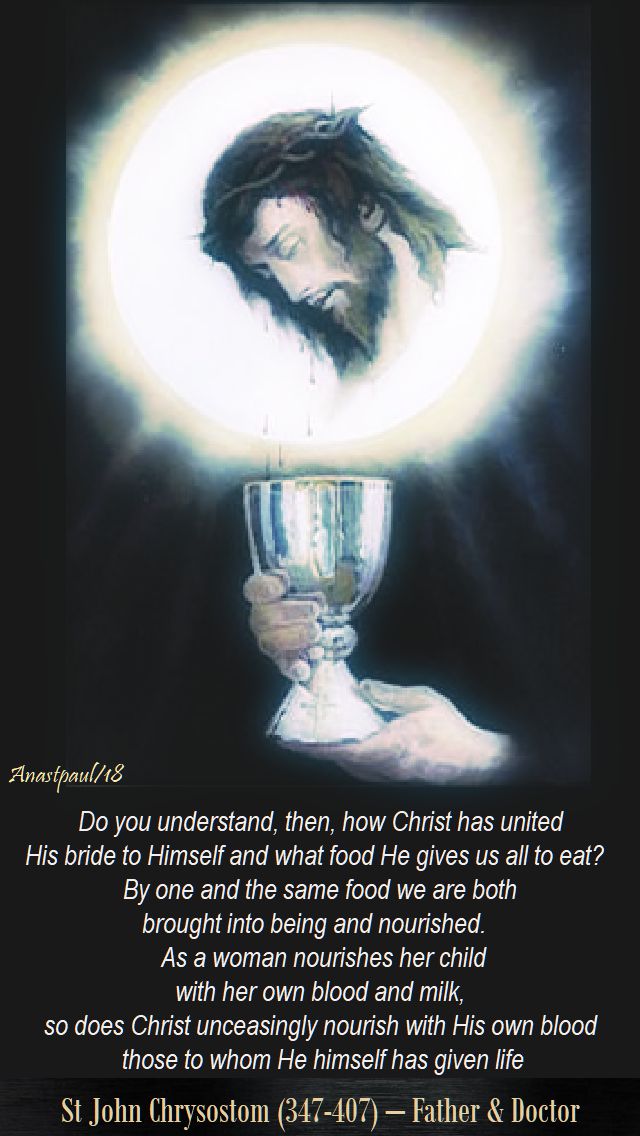
Do you understand, then, how Christ has united His bride to Himself and what food He gives us all to eat?   By one and the same food we are both brought into being and nourished.   As a woman nourishes her child with her own blood and milk, so does Christ unceasingly nourish with His own blood those to whom He himself has given life.’”

St John Chrysostom (347-407) – Father & Doctordo you understand then, how christ has united His bride to Himself - st john chrysostom - 22 april 2018 - sunday reflection

Posted in CATECHESIS, EASTER, MORNING Prayers, QUOTES of the SAINTS, SUNDAY REFLECTIONS, The HOLY EUCHARIST / The HOLY MASS

Sunday Reflection – 15 April – The Third Sunday of Easter Year B

Sunday Reflection – 15 April – The Third Sunday of Easter Year B

“Christ wished to choose this sacred symbol of human life, which bread is, to make an even more sacred symbol of Himself.   He has transubstantitated it but has not taken away its expressive power – rather, He has elevated this expressive power to a new meaning, a higher meaning, a mystical, religious, divine meaning.   He has made of it a ladder for an ascent that transcends the natural level.
As a sound becomes a voice and as the voice becomes word, thought, truth – so that sign of the bread has passed from its humble and pious being to signify a mystery, it has become a Sacrament, it has acquired the power to demonstrate the Body of Christ present.”

Blessed Pope Paul VI (1897-1978) – when Archbishop of Milan from a homily on the Solemnity of Corpus Christias a sound becomes a voice - paul VI - 15 april 2018 - sunday reflection

Posted in EASTER, EUCHARISTIC Adoration, FEASTS and SOLEMNITIES, MORNING Prayers, QUOTES - J R R Tolkien and MORE, QUOTES of the SAINTS, SUNDAY REFLECTIONS, The HOLY EUCHARIST / The HOLY MASS

Sunday Reflection – 8 April – Low Sunday the Octave Day of Easter and Divine Mercy Sunday

Sunday Reflection – 8 April – Low Sunday the Octave Day of Easter and Divine Mercy Sunday

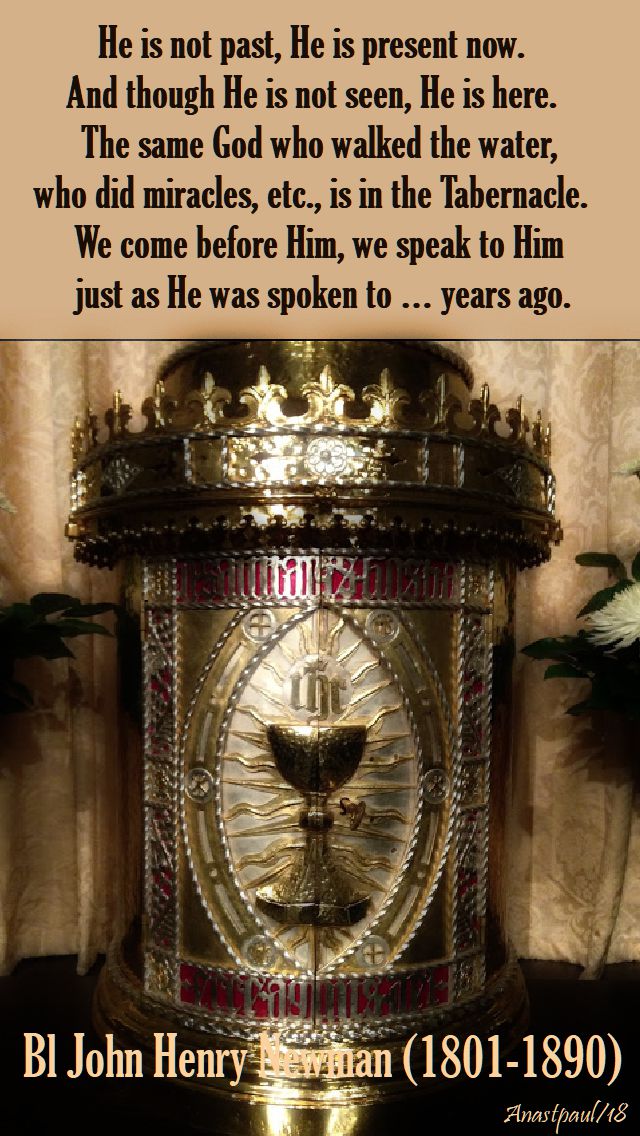
“He is not past, He is present now.” – Bl John Henry Newman (1801-1890) on the Eucharist

In every Mass Christ comes to us, in the Blessed Eucharist, Christ remains with us – Christ counteracts Time and the World

What makes Christianity in its fullness, much more than a historical religion – though Protestants claim their religion to be just that, and, indeed, Christ died long ago – is the fact that He is “living among us with a continual presence”.

In every Holy Mass we are touched by Christ’s spiritual presence when the Gospel is proclaimed.   We are touched by His real, full and personal presence in the Eucharist. When we walk up to receive the Eucharist, Christ Jesus comes to us.   He remains with us in the Blessed Sacrament, whether in the tabernacle or exposed for our adoration.   With Newman’s words from a sermon of 25th May 1858:

He is not past, He is present now.   And though He is not seen, He is here.   The same God who walked the water, who did miracles, etc., is in the Tabernacle. We come before Him, we speak to Him just as He was spoken to … years ago.”

We receive Christ Jesus, when we receive the consecrated host.   We adore Him, we listen to Him and we dare to speak to Him.   When we receive Holy Communion, He wants to grow in us and wants us to grow towards Him:

“In every holy mass and especially in communion but also whenever we adore Christ Jesus, kneeling before the tabernacle or before the exposed Blessed Sacrament, our fleeting lives touch eternity as the living God touches us.   God, does not merely present Himself before us as the Object of worship but God actually gives Himself to us to be received into our breasts. wonderful communion”!

The Eucharist brings Christians of all times, whether in the action of holy Mass or in the stillness of the Blessed Sacrament into the presence of Christ and is the living reminder that we live at all times in the presence of God and have the presence of God within us and before us in a passing world.   It makes us realise that although every day and hour passes and will never come back, we are held and find our stay in the presence and love of God.   The real presence of God in the Holy Eucharist makes us realise that eternal life, our life with God, has begun for us with baptism and cannot be lost to us by any outward force, only by severe sin.   Therefore Newman can say that by the Holy Eucharist “We are brought into the unseen world.” (Excerpted Sr Brigitte Maria Hoegemann FSO)he is not past, he is present now - bl john henry newman - sunday reflection - 8 april 2018 - div mercy sunday

Posted in DOCTORS of the Church, FATHERS of the Church, FEASTS and SOLEMNITIES, HOLY WEEK, LENT, MORNING Prayers, QUOTES of the SAINTS, QUOTES on SANCTITY, SUNDAY REFLECTIONS

Sunday Reflection – 25 March 2018 – Palm Sunday

Sunday Reflection – 25 March 2018 – Palm Sunday

LET US SING TO THE LORD A SONG OF LOVE
St Augustine (354-430) Father & Doctor of the Church

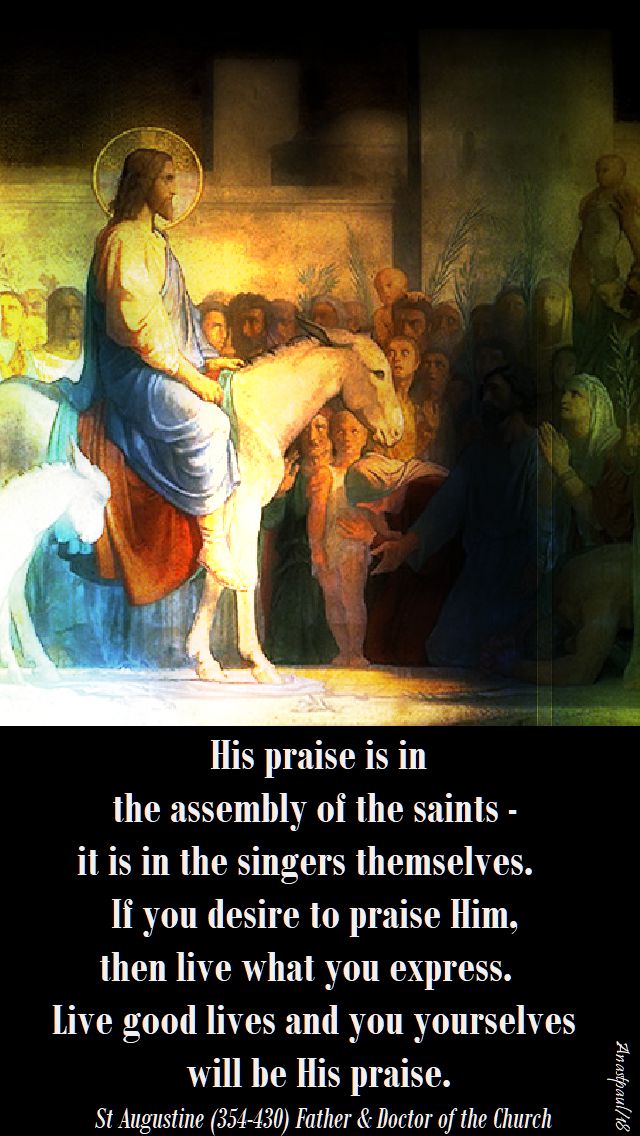
Sing to the Lord a new song;  His praise is in the assembly of the saints.   We are urged to sing a new song to the Lord, as new men who have learned a new song.   A song is a thing of joy, more profoundly, it is a thing of love.   Anyone, therefore, who has learned to love the new life has learned to sing a new song and the new song reminds us of our new life.   The new man, the new song, the new covenant, all belong to the one kingdom of God and so the new man will sing a new song and will belong to the new covenant.

There is not one who does not love something but the question is, what to love.   The psalms do not tell us not to love but to choose the object of our love.   But how can we choose unless we are first chosen?   We cannot love unless someone has loved us first. Listen to the apostle John:  We love him, because he first loved us.   The source of man’s love for God can only be found in the fact that God loved him first.   He has given us Himself as the object of our love and He has also given us its source.   What this source is you may learn more clearly from the apostle Paul who tells us:  The love of God has been poured into our hearts.   This love is not something we generate ourselves;  it comes to us through the Holy Spirit who has been given to us.

Since we have such an assurance, then, let us love God with the love He has given us.   As John tells us more fully:  God is love and whoever dwells in love dwells in God and God in him.   It is not enough to say:  Love is from God.   Which of us would dare to pronounce the words of Scripture:  God is love?   He alone could say it who knew what it was to have God dwelling within him.   God offers us a short route to the possession of Himself.   He cries out:  Love me and you will have me for you would be unable to love me if you did not possess me already.

My dear brothers and sons, fruit of the true faith and holy seed of heaven, all you who have been born again in Christ and whose life is from above, listen to me, or rather, listen to the Holy Spirit saying through me:   Sing to the Lord a new song.   Look, you tell me, I am singing.   Yes indeed, you are singing, you are singing clearly, I can hear you. But make sure that your life does not contradict your words.   Sing with your voices, your hearts, your lips and your lives:   Sing to the Lord a new song’.

Now it is your unquestioned desire to sing of Him whom you love but you ask me how to sing His praises.   You have heard the words:  Sing to the Lord a new song and you wish to know what praises to sing.   The answer is:   His praise is in the assembly of the saints – it is in the singers themselves.   If you desire to praise Him, then live what you express.   Live good lives and you yourselves will be His praise.his praise is in the assembly of saints - st augustine - 25 march 2018 palm sunday

Posted in MORNING Prayers, QUOTES of the SAINTS, SUNDAY REFLECTIONS, The HOLY EUCHARIST / The HOLY MASS

Sunday Reflection – 25 February 2018 – Second Sunday of Lent, Year B

Sunday Reflection – 25 February 2018 – Second Sunday of Lent, Year B

Referring to the Emmaus event, Blessed John Henry Newman (1801-1890) reminded his congregation:

“Only by faith is He known to be present;  He is not recognised by sight.   When He opened his disciples’ eyes, He at once vanished.   He removed his visible presence and left but a memorial of Himself.   He vanished from sight that He might be present in a sacrament;  and in order to connect His visible presence to His presence invisible, He for one instant manifested Himself to their open eyes;  manifested Himself, if I may so speak, while He passed from His hiding place of sight without knowledge, to that of knowledge without sight.”

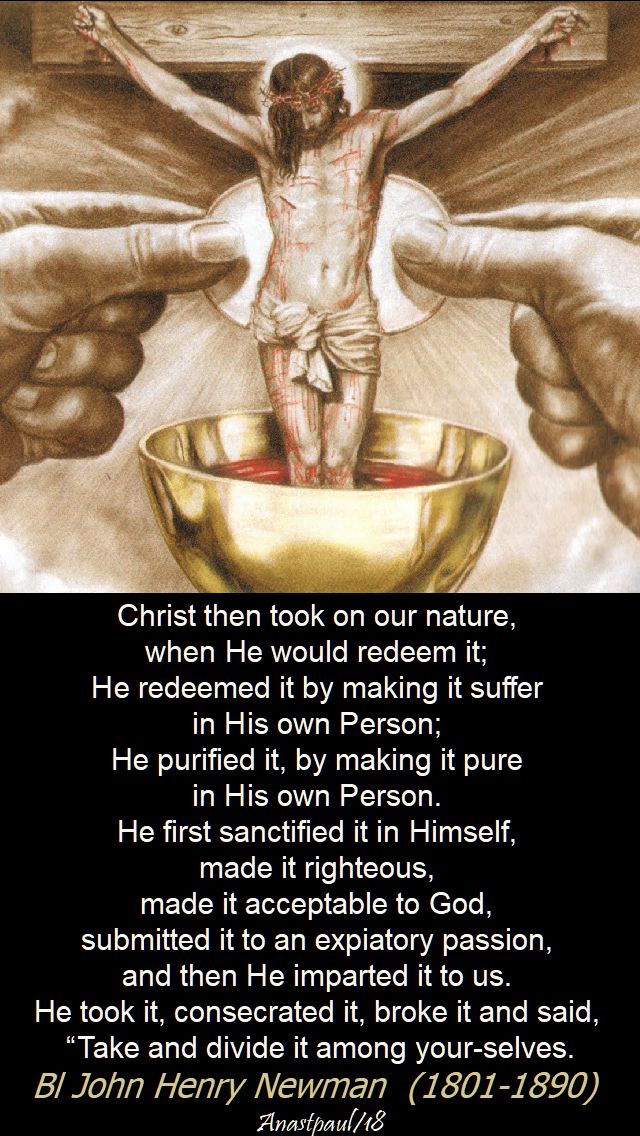
What He left to the disciples in Emmaus is what He left to us:  His memorial and more than that:  His living presence spiritually in the Church and – through the Holy Spirit – in each of its members through baptism and His Real Presence, communion with Himself, the living God and man in the Blessed Eucharist and in the Christians who have just received Him in the Blessed Eucharist and adore Him in this Most Blessed Sacrament of the Altar.   Christ’s real presence is given to each communicant in a most personal and if accepted with a sincere and humble heart, transforming way.   With Newman’s own words:

“Christ then took on our nature, when He would redeem it;  He redeemed it by making it suffer in His own Person;  He purified it, by making it pure in His own Person.   He first sanctified it in Himself, made it righteous, made it acceptable to God, submitted it to an expiatory passion and then He imparted it to us.   He took it, consecrated it, broke it and said, “Take, and divide it among your-selves.”

Newman was convinced that no one “realises the mystery of the Incarnation but must feel disposed towards that of the Holy Communion.”   Both are mysteries of the coming of Christ, longed for as the hope of mankind for salvation.   If we accept that God unites Himself, His divinity and His spirit, to humanity, nature and matter in His birth as man, then we can also accept that He binds His presence to the species of bread and wine.   When Jesus says, “This is my body, this is my blood”, this remains a mystery but our faith in it is not against our reason.

Years later this Catholic priest wrote:

“O wisest love! That flesh and blood
Which did in Adam fail,
Should strive afresh against the foe,
Should strive and should prevail.”
“And that a higher gift than grace
Should flesh and blood refine,
God’s presence and His very Self,
And Essence all-divine.”christ then took on our nature - bl john henry newman - no 2 25 feb 2018 - sunday reflection

Posted in LENT, MORNING Prayers, PRACTISING CATHOLIC, QUOTES - J R R Tolkien and MORE, SUNDAY REFLECTIONS, The HOLY EUCHARIST / The HOLY MASS

Sunday Reflection – 18 February – The First Sunday of Lent Year B

Sunday Reflection – 18 February – The First Sunday of Lent Year B

Beyond the daily life of the believer, the Eucharist extends its action to the whole cosmos.
As Teilhard de Chardin wrote:
“When He (Christ) says through the priest “This is my body”, His words go well beyond the piece of bread over which they are pronounced:  they effect the birth of the whole Mystical Body.
Beyond the transubstantiated Host, the priestly action extends to the cosmos itself.”

Every Eucharist is a “Mass on the world.”

This vision inspired a prayer of Teilhard de Chardin that we can make our own, each time we participate in the Mass and even when we cannot participate:

“On the altar of the whole earth
I offer You, Lord,
the work and the toil of the world….
All that will grow in the world
in the course of this day,
all that will decline in it
and all that will die in it…
Receive, Lord,
this total Host that Creation
presents to You,
drawn and moved by You,
at the dawn of a new day.”

Fr Raneiro Cantalamessa OFM (Preacher to the Papal Household) “This is My Body”beyond the daily life of the - fr raneiro cantalamessa - 18 feb 2018 sunday reflection

Posted in CATHOLIC Quotes, DEVOTIO, MORNING Prayers, PAPAL ENCYLICALS, PAPAL MESSAGES, PAPAL SERMONS, QUOTES - J R R Tolkien and MORE, QUOTES of the SAINTS, QUOTES on PRAYER, QUOTES on the CHURCH, SUNDAY REFLECTIONS, The HOLY EUCHARIST / The HOLY MASS

Sunday Reflection – 11 February 2018 – 6th Sunday of Year B

Sunday Reflection – 11 February 2018 – 6th Sunday of Year B – Pope Benedict and St John Paul

In liturgical prayer, especially the Eucharist and – formats of the liturgy – in every prayer, we do not speak as single individuals, rather we enter into the “we” of the Church that prays.   And we need to transform our “I” entering into this “we”.   Pope Benedict XVI is one of the great liturgists of our age.   His seminal book, “The Spirit of the Liturgy”, written when he was still Joseph Cardinal Ratzinger, is required reading in most seminaries and should be read by every Catholic.

“It is not the individual – priest or layman – or the group that celebrates the liturgy but it is primarily God’s action through the Church, which has its own history, its rich tradition and creativity.   This universality and fundamental openness, which is characteristic of the entire liturgy is one of the reasons why it can not be created or amended by the individual community or by experts but must be faithful to the forms of the universal Church.

The entire Church is always present, even in the liturgy of the smallest community.   For this reason there are no “foreigners” in the liturgical community.   The entire Church participates in every liturgical celebration, heaven and earth, God and man.   The Christian liturgy, even if it is celebrated in a concrete place and space and expresses the “yes” of a particular community, it is inherently Catholic, it comes from everything and leads to everything, in union with the Pope, the Bishops , with believers of all times and all places.   The more a celebration is animated by this consciousness, the more fruitful the true sense of the liturgy is realised in it.

Dear friends, the Church is made visible in many ways:  in its charitable work, in mission projects, in the personal apostolate that every Christian must realise in his or her own environment.   But the place where it is fully experienced as a Church is in the liturgy : it is the act in which we believe that God enters into our reality and we can meet Him, we can touch Him.   It is the act in which we come into contact with God, He comes to us and we are enlightened by Him.

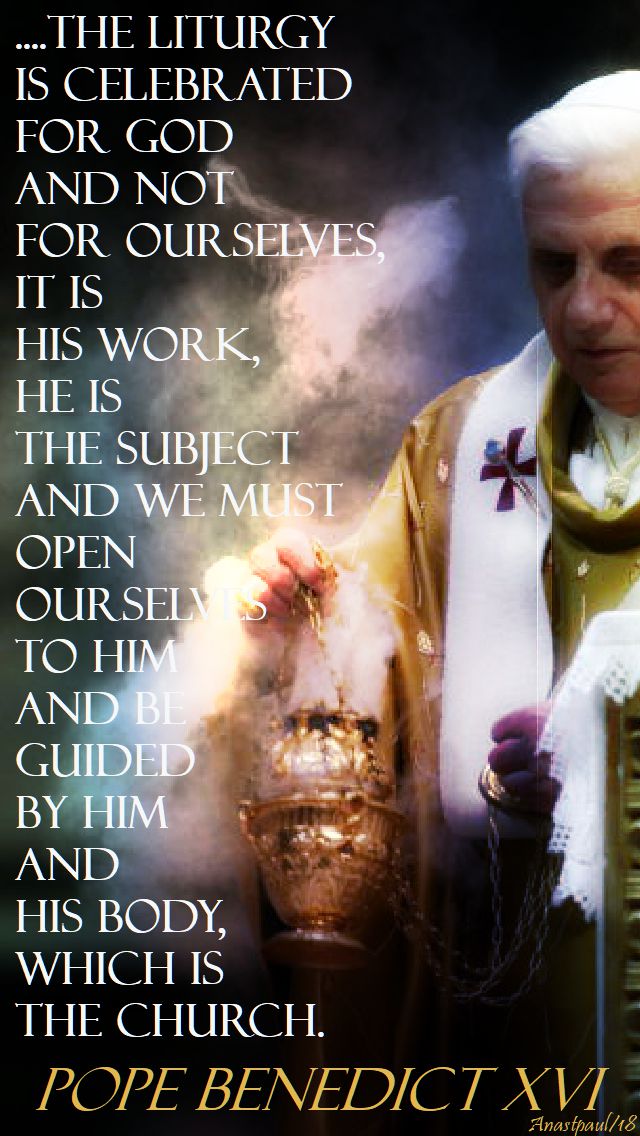
So when in the reflections on the liturgy we concentrate all our attention on how to make it attractive, interesting and beautiful, we risk forgetting the essential:  the liturgy is celebrated for God and not for ourselves, it is His work, He is the subject and we must open ourselves to Him and be guided by Him and His Body, which is the Church.

Let us ask the Lord to learn every day to live the sacred liturgy, especially the Eucharistic celebration, praying in the “we” of the Church, that directs its gaze not in on itself but to God and feeling part of the living Church, of all places and of all time.”…Pope Benedict XVI – Wednesday Audience 3 Oct 2012

“I have been able to celebrate Holy Mass in chapels built along mountain paths, on lakeshores and seacoasts.   I have celebrated it on altars built in stadiums and in city squares….This varied scenario of celebrations of the Eucharist, has given me, a powerful experience of its universal and, so to speak, cosmic character – YES, cosmic!   Because even when it is celebrated on the humble altar of a country church, the Eucharist is always, in some way, celebrated on the altar of the world.  It unites heaven and earth.   It embraces and permeates all creation!” St Pope John Paul “Ecclesia de Eucharista no 8”the liturgy is celebrated - pope benedict = 11 feb 2018 sunday reflection

Posted in MORNING Prayers, SUNDAY REFLECTIONS, The HOLY EUCHARIST / The HOLY MASS

Sunday Reflection – 4 February – 5th Sunday of Year B

Sunday Reflection – 4 February – 5th Sunday of Year B

The Action of God on Calvary is a continuous action throughout Creation
Fr Gerard W Hughes S.J. – “God of Surprises”

The same God who manifested Godself in the historical Jesus, once-for-all, is still giving Godself to us in love through the signs and symbols of bread and wine.   God is not time-and-space-conditioned.   The once-for-all action of God on Calvary is a continuous action throughout creation.   In celebrating the Eucharist, we are celebrating our awareness of this tremendous truth.
As our sinfulness can infect and deform our image of God and our understanding of Christ’s passion, death and resurrection, so too, it can distort our understanding of the Eucharist.   Instead of a celebration which fills us with joy and wonder, broadening our vision and uniting us with ourselves and with all creation, the Eucharist can become a code and formal ritual, performed mechanically with more attention to rubrics and money-raising, than to God or to one another and, attended by many because they are afraid that their absence might cause their eternal damnation.
Christian communities can be divided into hostile factions over the choice of hymns, the place of tabernacle in the Church, the manner of distributing and receiving Holy Communion, who should and should not be allowed to receive it, what one wears or should wear or not wear, whether women cover their heads, the language used for the liturgy, or whether the Peace of Christ should be given to one another by the congregation!
I am not saying that these questions do not have their importance somewhere, nor am I advocating abolition of all rubrics, rules and regulations but I am saying that many of the questions which absorb our attention, are very secondary.   They preoccupy and divide us within the Catholic Church because our vision and understanding of the Eucharist is too limited – we turn this reality of God’s love for all His creation into a sacred object, a thing and we do not allow God to be God to us, even this most wonderful and mysterious event!
The Eucharist is given to us so that Christ’s presence may be real in the lives of His people, a living presence.the eucharist is given to us - fr gerard hughes - god of surprises - 4 feb 2018

Posted in EUCHARISTIC Adoration, franciscan OFM, MORNING Prayers, QUOTES - J R R Tolkien and MORE, SAINT of the DAY, SUNDAY REFLECTIONS, The HOLY EUCHARIST / The HOLY MASS

Sunday Reflection – – 28 January – The Memorial of St Thomas Aquinas (1225-1274) Doctor angelicus (Angelic Doctor) and Doctor communis (Common Doctor)

Sunday Reflection – – 28 January – The Memorial of St Thomas Aquinas (1225-1274) Doctor angelicus (Angelic Doctor) and Doctor communis (Common Doctor)

Fr Raneiro Cantalamessa OFM – Preacher to the Papal Household – “This is My Body”

The Eucharist is the Father’s gift to the world.   The mystery contained in the words: “God so loved the world that he gave his only Son” (John 3:16) is made present in every Mass.   In the priest who offers us the body and blood of Christ at the moment of Communion, we can see, with the eyes of faith, the Father in person, who comes to give us “the bread of heaven, the true bread” and says: “Take, this is the body of my Only Begotten Son, which I have given for you.”

Not only does the Father give us the Eucharist, He also gives Himself in the Eucharist because there is only one indivisible divine nature, in receiving the divinity of the Son, we also receive the Father.   “Whoever sees me sees the Father,” also means “whoever receives me, receives the Father.”

One day (it was the Saturday of the Second Week of Lent) after listening to the Gospel passage of the parable of the Prodigal Son, I understood clearly that Communion offered me, there and then, the incredible opportunity of receiving the Father’s forgiving embrace – and not only mentally!

Fr Raneiro Cantalamessa OFM – Preacher to the Papal Household – “This is My Body” (out of interest, this entire book is a series of lectures to the Holy Father and his household, who was St John Paul at the time, (during the Year of the Eucharist 2004-2005) on St Thomas Aquinas, Adore Te Devote.the eucharist is god's gift to the world - fr raneiro - 28 jan 2018

Posted in DEVOTIO, MORNING Prayers, QUOTES of the SAINTS, SUNDAY REFLECTIONS, The HOLY EUCHARIST / The HOLY MASS

Sunday Reflection – 21 January 2018 – 3rd Sunday in Ordinary Time Year B

Sunday Reflection – 21 January 2018 – 3rd Sunday in Ordinary Time Year B

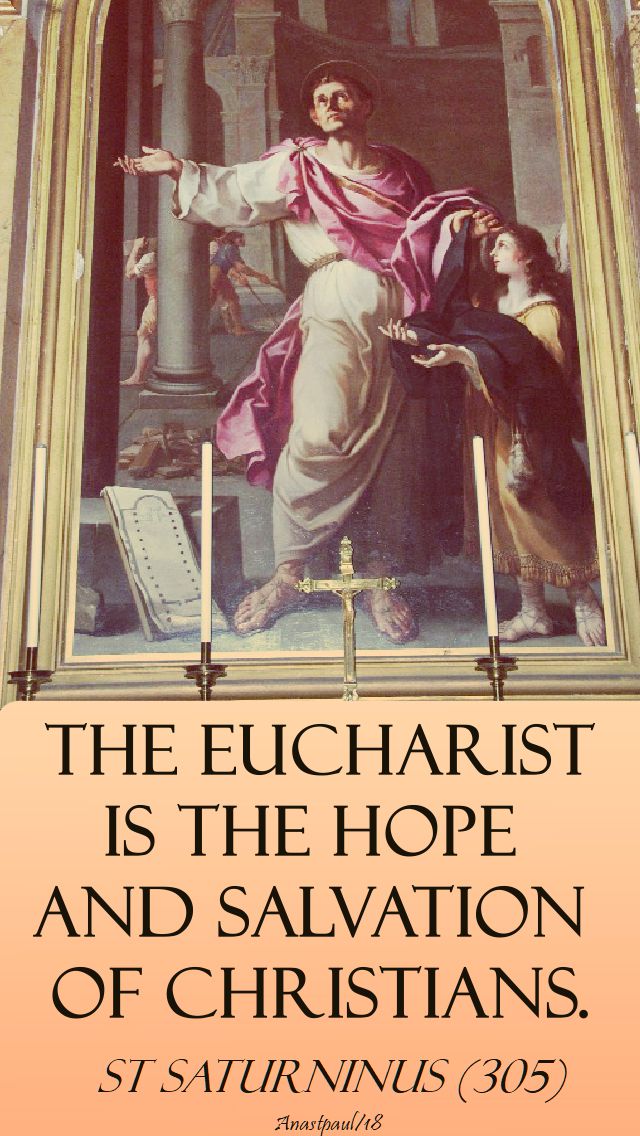
Fr Raneiro Cantalamessa OFM “This is My Body”the eucharist is the hope - st saturninus - 21 jan 2018

“What the Sunday celebrations of the Eucharist represented for Christians at the time of the persecutions is shown in a moving way in the acts of the North African Martyrs, Saturninus and companions, who died under the Diocletian persecution in 305.*
They were the first martyrs of the Eucharist. Their words and example might constitute a strong call and the starting point for an examination of conscience for us modern Christians.
To the Roman judge who accused them of having transgressed the emperor’s order not to hold meetings and hand out the Scriptures, the martyrs responded one after the other:

” A Christian cannot live without the Eucharist and the Eucharist without the Christians.   Don’t you know that the Christian exists for the Eucharist and the Eucharist for the Christian?”
“Yes, I participated with the brothers in the meeting, I celebrated the mysteries of the Lord and I have with me, written in my heart, the divine Scriptures… The Eucharist is the hope and salvation of Christians.”**

* Acta ss. Saturnini et sociorum martyrum (ca.304), 9, 11 (ed PT Ruinart, Acta martyrum 1959). A phrase of these acts: “Sine dominico non possumus” is sometimes translated: ‘We cannot live without Sunday.’ A suggestive translation but unfortunately inexact. The neuter noun dominicum indicates the ‘celebration of the Lord’s Mysteries’, ‘the Lord’s Banquet’, namely ‘the Lord’s Supper’ of 1 Cor 11:20.
The term recurs with such meaning in the African writers of the time – Tertullian, Ad Uxorem, 2,4; Cyprian, De opere et eleemosynis, 15.
The accent is therefore on the Eucharist, not on Sunday, the latter is included indirectly, inasmuch as the Lord’s Supper, was celebrated as a rule and for a certain period exclusively, on Sunday. The complete meaning of dominicum is, therefore, that of “Sunday celebration of the Lord’s supper.”
** Acta, 10-13.

Posted in MORNING Prayers, PRACTISING CATHOLIC, QUOTES - J R R Tolkien and MORE, SUNDAY REFLECTIONS, The HOLY EUCHARIST / The HOLY MASS, The WORD

Sunday Reflection – 14 January – The Shepherd Gathers Us

Sunday Reflection – 14 January – The Shepherd Gathers Us

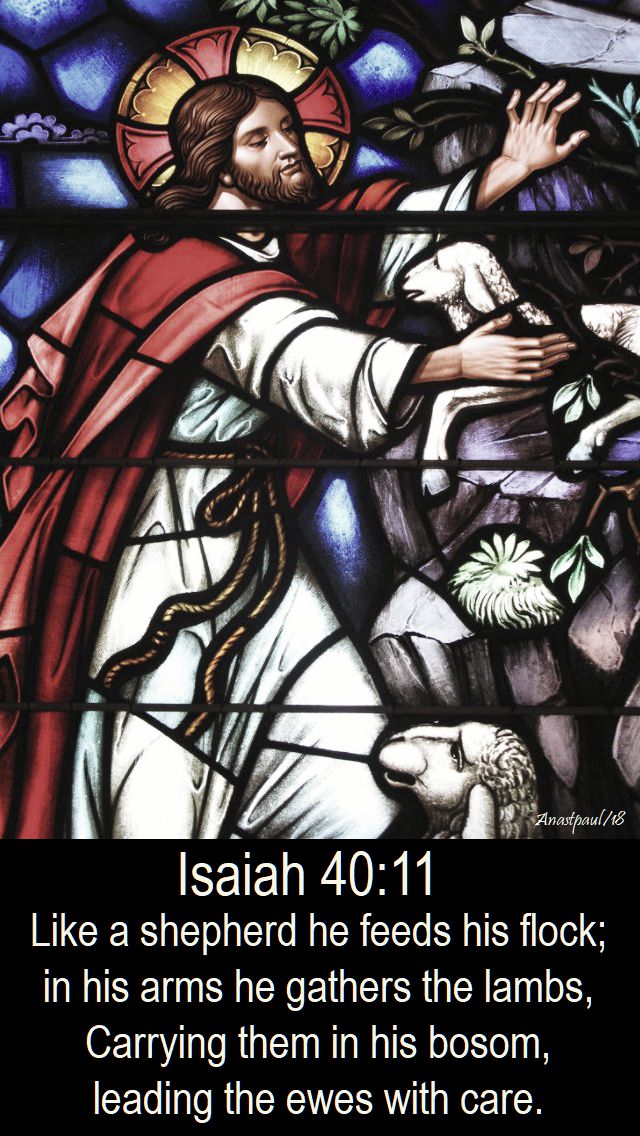
Like a shepherd he feeds his flock;
in his arms he gathers the lambs,
Carrying them in his bosom,
leading the ewes with care….Isaiah 40:11

Jesus promised that whenever a group of people gather in prayer, He will be there with them. The early church took that promise literally. The first disciples had been used to having Jesus physically among them and then, after His Ascension, they often struggled to know what Jesus would want them to do. However, they had a simple formula for every occasion and difficulty – Jesus’ invitation to gather in His Name. They would gather around the Word and the breaking of the bread and, there, let Jesus make His presence felt and effect through them what they could not otherwise accomplish themselves.

As Christians today, we still need to take that same promise literally. Christian life is not sustained only by private acts of prayer, justice and virtue. It is sustained in a community, by gathering ritually around the Word of God and through the breaking of the bread. However, it is important to understand, that this kind of gathering is not simply a social one capable only of doing what social gatherings can do. To gather around the Word of God and the breaking of the bread is a ritual gathering and ritual brings something that normal social gatherings does not – namely, transformative power beyond what can be understood and explained through the physical, psychological and social dynamics that are present.

Lord, You invite me to be part of Your flock.
Remind me of that when I am tempted to go off on my own.

Fr Ron Rolheiser – Light for the Worldisaiah 40 11

Posted in CHRISTMASTIDE!, MORNING Prayers, PRACTISING CATHOLIC, QUOTES of the SAINTS, SUNDAY REFLECTIONS, The CHRIST CHILD

Sunday Reflection – 7 January 2018 – The Feast of Epiphany

Sunday Reflection – 7 January 2018 – The Feast of Epiphany

Each Sunday towards the end of Mass, we come to the altar rail, receive Holy Communion, return to our seats and sit or kneel quietly for a while in contemplation.   But in these quiet moments after we have received Communion, what prayers do we offer up?  Perhaps we don’t pray at all but in those quiet moments our thoughts turn to other things, like Sunday lunch or a planned visit to visit the grandchildren after Mass.

I recently came across this wonderful article, written by a priest.  He writes:

“A few years ago it became evident to me that my prayers after distributing Holy Communion to my congregation were wholly inadequate.   As I sat on my seat on the altar I was finding it extremely difficult to express into words, what this moment meant to me.   Looking through my book collection I read all the prayers I could get my hands on but none seemed to be what I was looking for, so I gave up in frustration.   However, each day I would pray to Mary our Blessed Mother asking her to teach me how to express my innermost feelings to the Lord.   Sometime later I was preaching a retreat to a group of nuns when one of the elderly nuns came to visit me and said she felt she had a problem concerning her prayers after receiving Holy Communion.   Feeling I had at last found a kindred spirit, I asked her what she usually prayed and she replied, ‘I don’t pray anything, I just sit in silence and allow Him to love me and to teach me to love Him.’   At that moment I realised that Mary had indeed answered my prayers.

“I just sit in silence and allow Him to love me and to teach me to love Him.”

What a simple, but moving description of what this moment means to us all.

“Above all, let us pray Him to draw us to Him and to give us faith.   When we feel that His mysteries are too severe for us and occasion us to doubt, let us earnestly wait on Him for the gift of humility and love.    Those who love and who are humble will apprehend them, carnal minds do not seek the and proud minds are offended at them but while love desires them, humility sustains them.

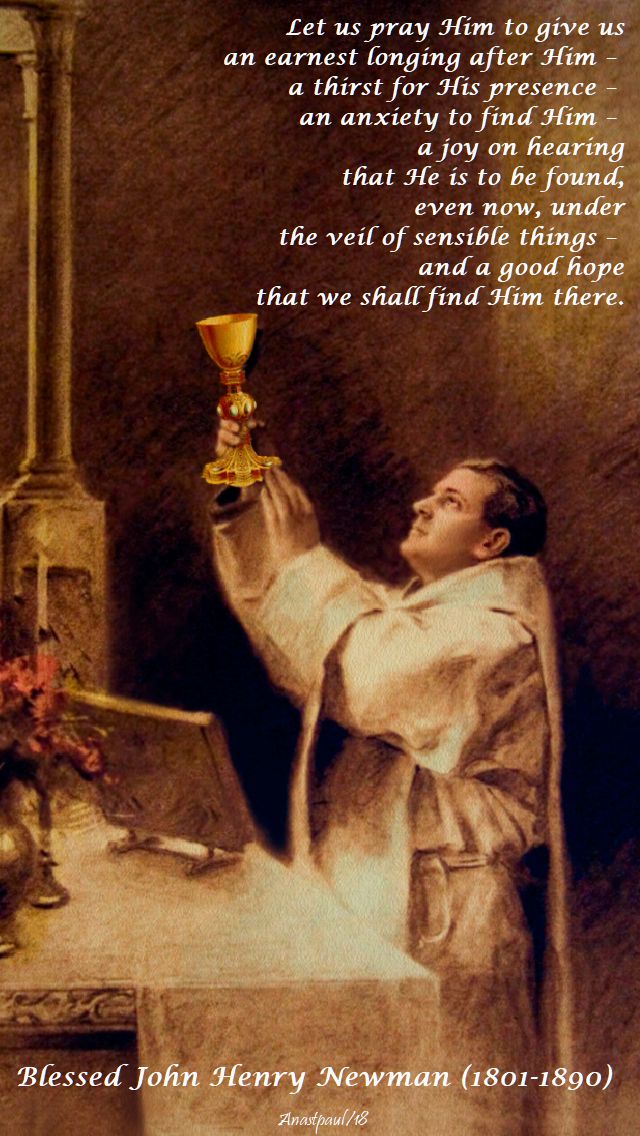
Let us pray Him to give us an earnest longing after Him – a thirst for His presence – an anxiety to find Him – a joy on hearing that He is to be found, even now, under the veil of sensible things – and a good hope that we shall find Him there.

Blessed indeed are they who have not seen and yet have believed.   They have their reward in believing, they enjoy the contemplation of a mysterious blessing, which does not even enter into the thoughts of other men and while they are more blessed than others, in the gift vouchsafed to them, they have the additional privilege of knowing that they are vouchsafed it.”….Blessed John Henry Newman  (1801-1890) – Parochial & Plain Sermons, Vol. VI, no. 11let us pray him to give us - bl john henry newman - 7 jan 2018

Posted in DEVOTIO, EUCHARISTIC Adoration, MORNING Prayers, QUOTES - J R R Tolkien and MORE, SUNDAY REFLECTIONS, The HOLY EUCHARIST / The HOLY MASS

Sunday Reflection – 31 December – Feast of the Holy Family and the Seventh Day of the Octave

Sunday Reflection – 31 December – Feast of the Holy Family and the Seventh Day of the Octave

While they were eating, He took some bread, and after a blessing He broke it, and gave it to them, and said, “Take it; this is My body.”   And when He had taken a cup and given thanks, He gave it to them and they all drank from it.   And He said to them, “This is My blood of the covenant, which is poured out for many..…Mark 14:22-24

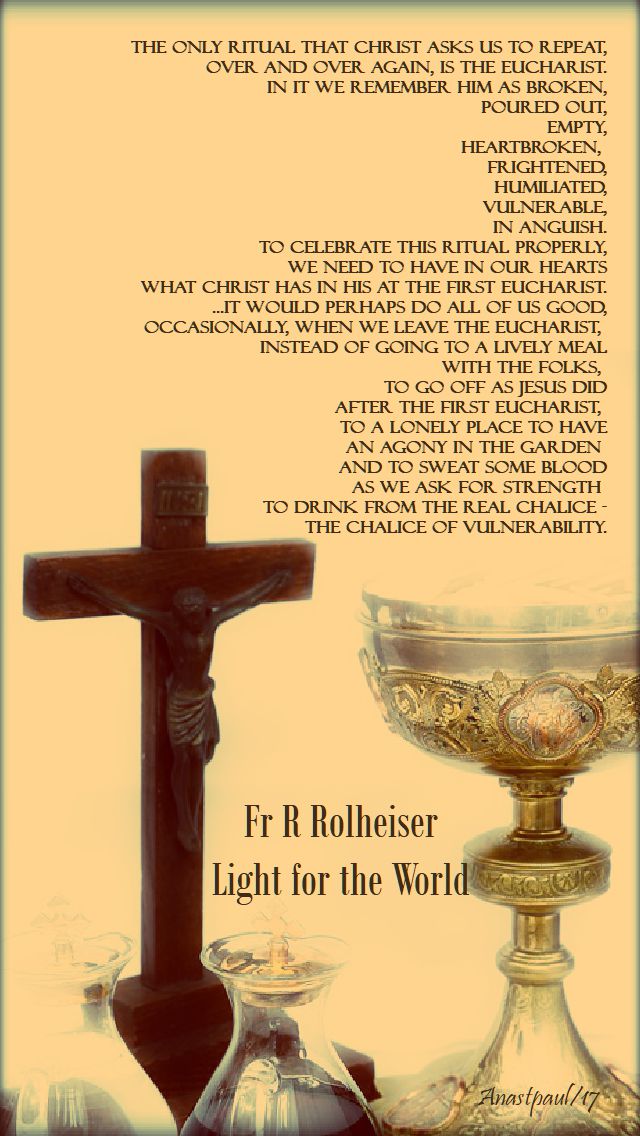
The only ritual that Christ asks us to repeat, over and over again, is the Eucharist.
In it we remember Him as broken,
poured out,
empty,
heartbroken,
frightened,
humiliated,
vulnerable,
in anguish.
To celebrate this ritual properly, we need to have in our hearts what Christ has in His at the first Eucharist.
What was He feeling then?

Joy and thanksgiving.   Yes.   LOVE for those at the table with Him.   Surely.  But beyond this, His heart felt anguish, deep longing and fear at the prospect of the pain that was now a certainty before intimacy and community could be achieved.

It would perhaps do all of us good, occasionally when we leave the Eucharist, instead of going to a lively meal with the folks, to go off as Jesus did after the first Eucharist, to a lonely place to have an agony in the garden and to sweat some blood as we ask for strength to drink from the real chalice – the chalice of vulnerability.

Occasionally, when St Augustine handed the Eucharist to a communicant, instead of saying, “the Body of Christ”, he would say, “Receive what you are.”

Augustine had perceived, for whatever reason, that the words of consecration, “this is my body, this is my blood”, are intended more to change the people present, than to change bread and wine.
(Fr R Rolheiser – Light for the World)

Lord Jesus Christ we pray…thank You for abiding with us.
May we always reverence the Holy Eucharist, as Your Real Presence amongst us. Amenthe only ritual - the eucharist - rolheiser - 31 dec 2017