One Minute Reflection – 21 September – The Feast of St Matthew, Apostle and Evangelist- Today’s Gospel: Matthew 9:9–13
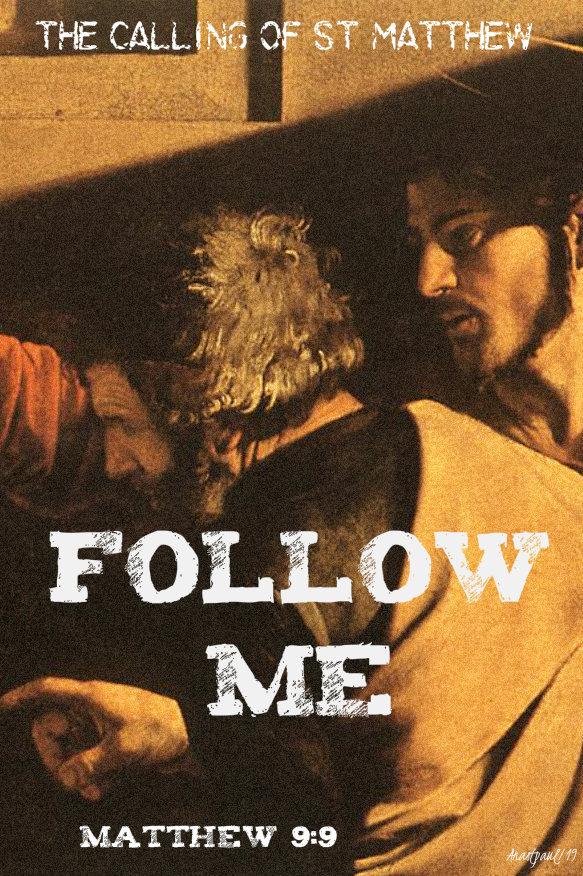
“Follow me”.. Matthew 9:9
REFLECTIONS – “Jesus saw a man called Matthew sitting at the tax office and he said to him: “Follow me.” He looked at him not with the eyes of the body but rather with the eye of interior pity. He saw a tax collector, and since He looked at him in pity and choosing him as a disciple, He said: “Follow me.” ‘Follow’ meant ‘imitate’ – not by the movement of his feet but rather by a change of life. For whoever says he is following Christ “ought himself to walk as Christ walked” (cf 1Jn ).
“Matthew rose and followed him.” It is not to be wondered at that the tax collector should leave the earthly gains he was looking after at the first command of the Lord and that, abandoning riches, he should join the company of Him who, he saw, had no wealth. For the Lord, who outwardly called him with words, through a hidden instinct secretly taught him to follow Him. By the gift of divine grace the Lord enlightened his mind to understand that He who on earth called him away from temporal interests, could in heaven give incorruptible treasures (cf Mt 6,20).
“And as Jesus sat at table in the house, behold, many tax collectors and sinners came and sat down with Jesus and his disciples.” The conversion of one tax collector provided an example of penance and forgiveness to many tax collectors and sinners. In a wonderful and true sign of the future, he who was to become the apostle and teacher of the gentiles, brought with him to salvation, a multitude of sinners in the first moments of his conversion!” ... Saint Bede the Venerable (673-735) Father & Doctor of the Church – Homilies on the gospels I, 21 ; CCL 122, 149
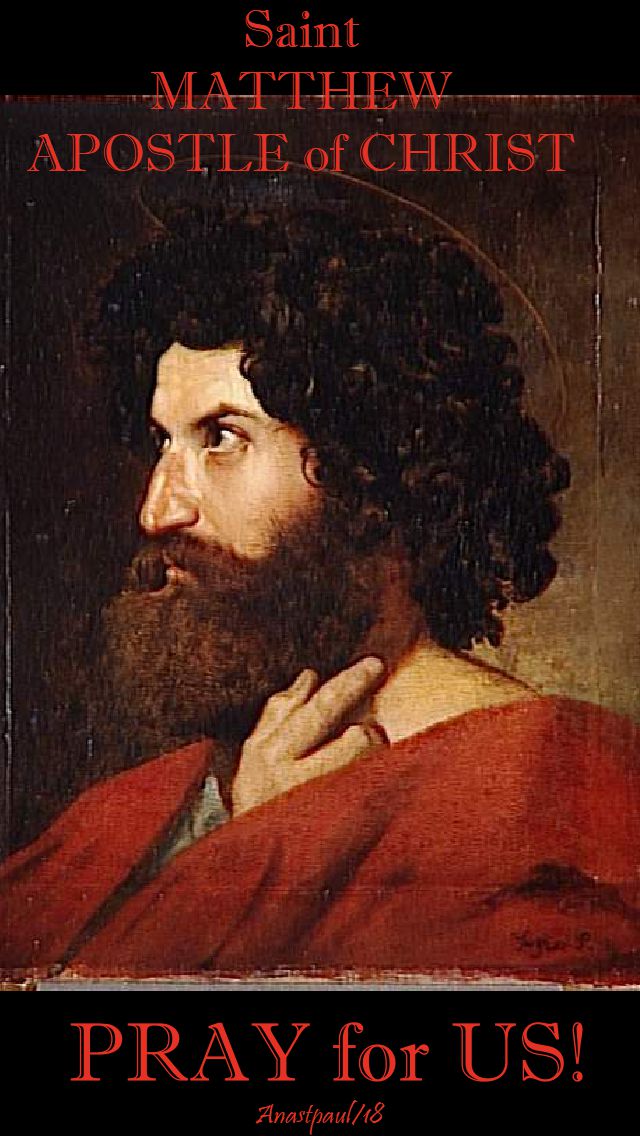
PRAYER – Lord, You showed Your great mercy to Matthew the tax-gatherer by calling him to become Your Apostle. Supported by his prayer and example, may we always answer Your call and live in close union with You. We make our prayer, in union with God our Father and the Holy Spirit, one God forever and ever. St Matthew, Apostle of Christ, pray for us, amen.
Saint of the Day – 21 September – Feast of St Matthew, Apostle and Evangelist
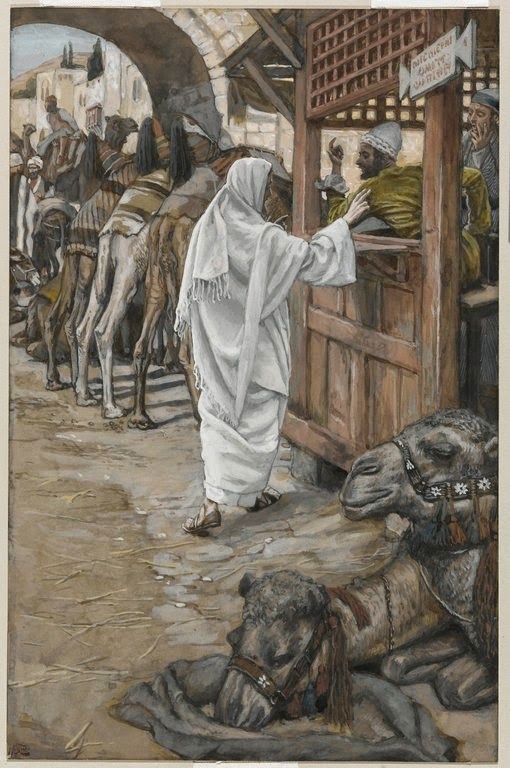
One day, as our Lord was walking by the Sea of Galilee, He saw, sitting at the receipt of custom, Matthew the publican, whose business it was to collect the taxes from the people for their Roman masters. Jesus said to him, “Follow Me” and leaving all, Matthew arose and followed Him.
Now the publicans were abhorred by the Jews as enemies of their country, outcasts and notorious sinners, who enriched themselves by extortion and fraud. No Pharisee would sit with one at table. Our Saviour alone had compassion for them. So St Matthew made a great feast, to which he invited Jesus and His disciples, with a number of these publicans, who henceforth began eagerly to listen to Him. It was then, in answer to the murmurs of the Pharisees, that He said, “They that are in health need not the physician. I have not come to call the just, but sinners to penance.”
The Calling of Matthew – James Tissot
After the Ascension, St Matthew remained some years in Judæa and there wrote his Gospel, to teach his countrymen that Jesus was their true Lord and King, foretold by the prophets. St Matthew afterward preached the Faith far and wide and is said to have finished his course in Parthia.
Obey all inspirations of Our Lord as promptly as St Matthew, who, at a single word, “laid down,” says St Bridget, “the heavy burden of the world to put on the light and sweet yoke of Christ.”
St Alexander of the Via Claudia
Bl Diego Hompanera París
St Eusebius of Phoenicia
St Francisco Pastor Garrido
St François Jaccard
St Gerulph
St Herminio García Pampliega
St Iphigenia
St Isaac of Cyprus
Bl Jacinto Martínez Ayuela
St Jacques Honoré Chastán
St Johannes Ri
St Jonah the Prophet
Bl José María Azurmendi Mugarza
Bl Josep Vila Barri
Bl Manuel Torró García
Bl Mark Scalabrini
St Maura of Troyes
St Meletius of Cyprus
Bl Nicolás de Mier Francisco
St Pamphilus of Rome
St Pierre Philibert Maubant
St Tôma Tran Van Thien
Bl Vicente Galbis Gironés
Bl Vicente Pelufo Orts
—
Martyrs of Gaza – 3 saints: Three brothers, Eusebius, Nestulus and Zeno, who were seized, dragged through the street, beaten and murdered by a pagan mob celebrating the renunciation of Christianity by Julian the Apostate. They were burned to death in 362 on a village garbage heap in Gaza, Palestine.
Martyred in the Spanish Civil War:
• Blessed Diego Hompanera París
• Blessed Jacinto Martínez Ayuela
• Blessed José María Azurmendi Mugarza
• Blessed Josep Vila Barri
• Blessed Manuel Torró García
• Blessed Nicolás de Mier Francisco
• Blessed Vicente Galbis Gironés
• Blessed Vicente Pelufo Orts
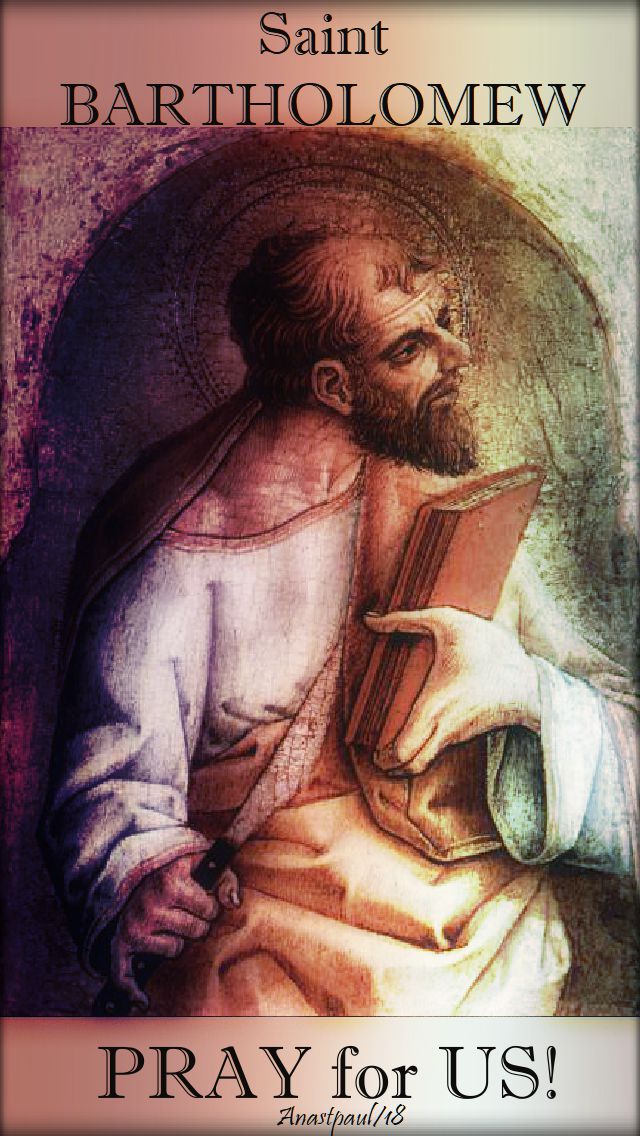
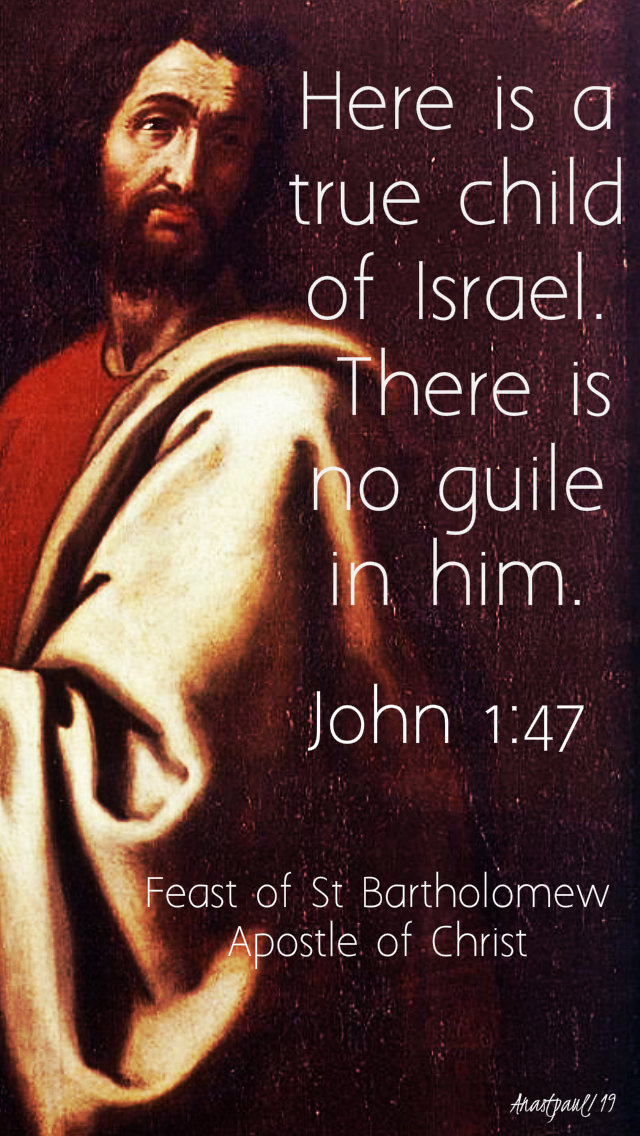
Thought for the Day – 24 August – The Feast of St Bartholomew, Apostle of Christ – Today’s Gospel: John 1:45–51
The name “Nathanael” means “God has given”
“The apostles’ glory is so indistinguishable and so bonded together by the cement of so many graces that in celebrating the feast of one of them the common greatness of all is called to our interior attention. For they share together the same authority of supreme judge, the same honourable rank and they hold the same power to bind and loose (Mt 19:28; 18:18). They are those precious pearls that Saint John tells us he beheld in the Book of Revelation out of which are constructed the gates of the heavenly Jerusalem (Rv 21:21.14)… And indeed, whenever the apostles beam divine light through their signs or miracles, they open up the heavenly glory of Jerusalem, to all those peoples who have been converted to the christian faith…
Of them, too, the prophet says: “Who are these who fly along like clouds?” (Is 60:8)… God raises the minds of His preachers to contemplation of truths on high… so that they can abundantly pour down the rain of God’s word into our hearts. Thus they drink water from the spring, so as to give drink to us too.
Saint Bartholomew drew from the fullness of this spring, when the Holy Spirit came upon him, as on the other apostles, in the form of tongues of fire (Acts 2:3).”
St Peter Damian (1007-1072) – Bishop, Doctor of the Church (Sermon 42, 2nd for Saint Bartholomew, PL 144, 726)
One Minute Reflection – 24 August – The Feast of St Bartholomew, Apostle of Christ – Today’s Gospel: John 1:45–51
Philip said to him, “Come and see.” … John 1:46
REFLECTION – “Nathanael’s reaction suggests another thought to us – in our relationship with Jesus we must not be satisfied with words alone. In his answer, Philip offers Nathanael a meaningful invitation: “Come and see!” (Jn 1: 46). Our knowledge of Jesus needs above all a first-hand experience – someone else’s testimony is, of course important, for normally the whole of our Christian life begins with the proclamation handed down to us by one or more witnesse, but afterwards, we, ourselves, have to become personally committed, in a deep and intimate relationship with Jesus.” … Pope Benedict XVI – General Audience, 4 November 2006
PRAYER – Almighty Lord and Father, strengthen in us that faith with which St Bartholomew gave himself wholeheartedly to Christ Your Son. Grant, at his intercession, that Your Church may become the Sacrament of salvation, for all the nations of the earth. We make our prayer through Jesus, our Lord and Christ, in the unity of the Holy Spirit, one God, forever, amen.
=========================
St Eutychius of Troas
St George Limniotes
St Irchard
St Jeanne-Antide Thouret (1765-1826)
Bl Miroslav Bulesic
St Ouen of Rouen
St Patrick the Elder
St Ptolemy of Nepi
St Romanus of Nepi
St Sandratus
St Taziano of Claudiopolis
—
Martyred in the Spanish Civil War:
• Blessed Fortunato Velasco Tobar
• Blessed Isidre Torres Balsells
• Blessed Rigoberto Aquilino de Anta Barrio
Martyred in World War II: 6 Beati
Czeslaw Jozwiak
Edward Kazmierski
Edward Klinik
Franciszek Kesy
Jarogniew Wojciechowski
Luis Almécija Lázaro
Quote of the Day – 25 July – Feast of St James, Apostle
“…we can learn much from St James – promptness in accepting the Lord’s call even when He asks us to leave the “boat” of our human securities, enthusiasm in following Him on the paths that He indicates to us over and above any deceptive presumption of our own, readiness to witness to Him with courage, if necessary to the point of making the supreme sacrifice of life.
Thus James the Greater stands before us as an eloquent example of generous adherence to Christ. He, who initially had requested, through his mother, to be seated with his brother next to the Master in His Kingdom, was precisely the first to drink the chalice of the passion and to share martyrdom with the Apostles.
And, in the end, summarising everything, we can say that the journey, not only exterior but above all interior, from the mount of the Transfiguration to the mount of the Agony, symbolises the entire pilgrimage of Christian life, among the persecutions of the world and the consolations of God, as the Second Vatican Council says. In following Jesus, like St James, we know that even in difficulties we are on the right path.”
One Minute Reflection – 25 July – Feast of St James, Apostle, Gospel: Matthew 20:20–28
Jesus said in reply, “You do not know what you are asking. Can you drink the cup that I am going to drink?” They said to him, “We can.”……Matthew 20:28
REFLECTION – “Christ laid down His life for us, so we ought to lay down our lives for our brothers” (1Jn 3,16)… Jesus said to Peter: “When you were younger, you used to dress yourself and go where you wanted but when you grow old … someone else will dress you and lead you where you do not want to go…” (Jn 21,18). It was the Cross, the Passion, He promised him. “Go even so far as to pasture my sheep, suffer for my sheep.” This is what a good bishop is to be like. If he is not, he is no bishop…
Now listen to this other testimony. Two of His disciples, the brothers John and James who were sons of Zebedee, were ambitious for the first place without consideration for the others… Our Lord answered them: “You do not know what you are asking”, for he added: “Can you drink the cup that I am going to drink?” What cup is this if not that… of the Passion?… And they, forgetting their weakness, immediately said: “We can”. Then He said to them: “My cup you will indeed drink. But to sit at my right or at my left is not mine to give but is for those for whom it has been prepared by my Father”… In this way He gave proof of His humility for, in fact, everything the Father prepares is prepared, too, for the Son… He came in humility – He, the Creator, was created amongst us, He made us but He was made for us. God before time began, man in time, He delivered man from time. This great physician has come to heal our cancer… by His example, He has come to heal pride itself.
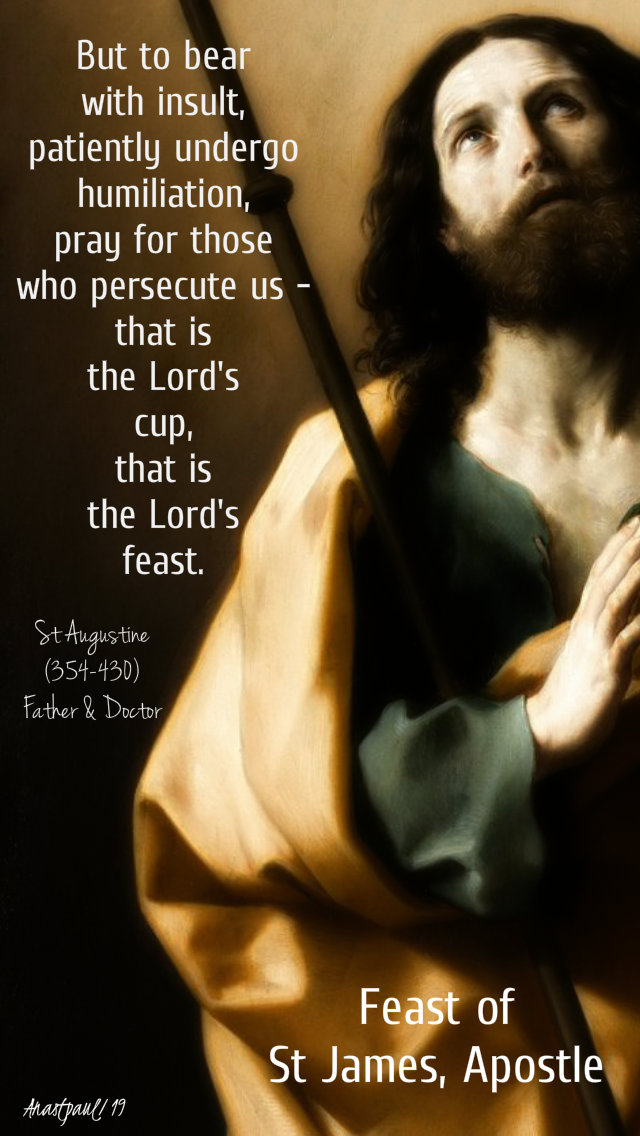
This is what we must give our attention to, in the Lord – let us consider His humility, drink the cup of His humility, clasp Him, contemplate Him. How easy it is to have elevated thoughts, easy to take pleasure in honours, easy to give one’s ear to flatterers and people who praise us. But to bear with insult, patiently undergo humiliation, pray for those who persecute us (Mt 5,39.44) – that is the Lord’s cup, that is the Lord’s feast.“… Saint Augustine (354-430) FathEr & Doctor of the Church – Sermon for the ordination of a bishop, Guelferbytanus no.32
PRAYER – Almighty ever-living God, who consecrated the first fruits of Your Apostles by the blood of Saint James, grant, we pray, that Your Church may be strengthened by his confession of faith and constantly sustained by his protection. Through our Lord Jesus Christ, your Son, who lives and reigns with you in the unity of the Holy Spirit, one God, forever and ever. St James the Greater, Apostle of Christ, Pray for us! Amen
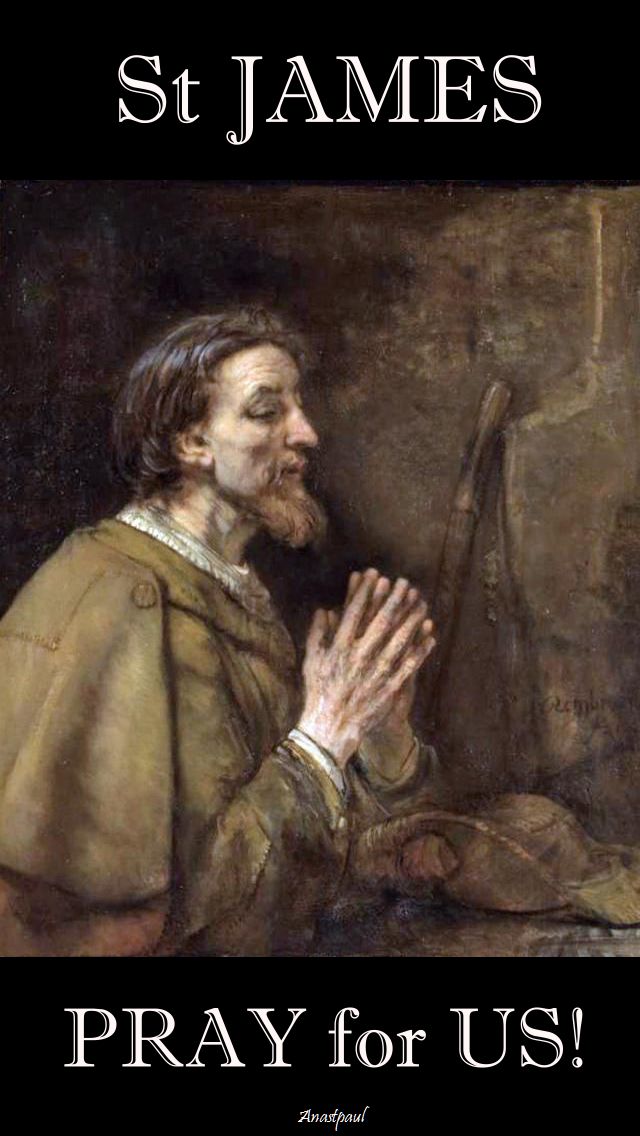
St James the Greater (Feast) – Son of Zebedee and Salome, brother of Saint John the Apostle. He is called “the Greater” simply because he became an Apostle before Saint James the Lesser.
St Cugat del Valles
Bl Darío Acosta Zurita
St Ebrulfus
St Euphrasia
St Fagildo of Santiago
St Felix of Furcona
St Florentius of Furcona
St Glodesind of Metz
St Magnericus of Trier
Bl Michel-Louis Brulard
Bl Mieczyslawa Kowalska
St Mordeyren
St Nissen of Wexford
St Olympiad of Constantinople
St Paul of Palestine
Bl Pietro Corradini of Mogliano
St Theodemir of Cordoba
—
Martyrs of Caesarea – 3 saints: Three Christians martyred together in the pesecutions of emperor Maximilian and governor Firmilian – Paul, Tea and Valentina. 309 in Caesarea, Palestine.
Martyrs of Cuncolim – 20 saints: On 15 July 1583 the group met at the church of Orlim, and hiked to Cuncolim to erect a cross and choose land for a new church. Local anti-Christian pagans, seeing the unarmed Christians, gathered their weapons and marched on them. One of the parishioners, a Portuguese emigre named Gonçalo Rodrigues, carried a firearm, but Father Alphonsus Pacheco stopped him from using it. The pagans then fell upon them, and killed them all without mercy. They were –
• Alphonsus Pacheco
• Alphonsus the altar boy
• Anthony Francis
• Dominic of Cuncolim
• Francis Aranha
• Francis Rodrigues
• Gonçalo Rodrigues
• Paul da Costa
• Peter Berno
• Rudolph Acquaviva
• ten other native Christian converts whose names have not come down to us
They were martyred on Monday 25 July 1583 at the village of Cuncolim, district of Salcete, territory of Goa, India. Beatified on 30 April 1893 by Pope Leo XIII.
Martyrs of Motril – 5 beati: Four priests and a brother, all members of the Augustinian Recollects, who were martyred together in the Spanish Civil War:
• Deogracias Palacios del Río
• José Rada Royo
• José Ricardo Díez Rodríguez
• Julián Benigno Moreno y Moreno
• León Inchausti Minteguía
They were shot on 25 July 1936 in Motril, Granada, Spain and Beatified on 7 March 1999 by Pope John Paul II.
Martyrs of Toledo – 4 beati: Four brothers and a priest, all members of the Hospitallers of Saint John of God, and all martyred together in the Spanish Civil War.
• Carlos Rubio álvarez
• Eloy Francisco Felipe Delgado Pastor
• Jerónimo Ochoa Urdangarín
• Primo Martínez De San Vicente Castillo
25 July 1936 in Talavera de la Reina, Toledo, Spain. They were Beatified on 25 October 1992 by Pope John Paul II.
Martyrs of Urda – 3 beati: Three members of the Passionists who were martyred together in the Spanish Civil War.
• Benito Solana Ruiz
• Felix Ugalde Irurzun
• Pedro Largo Redondo
They were shot on 25 July 1936 in Urdá, Toledo, Spain and Beatified on 1 October 1989 by Pope John Paul II.
One Minute Reflection – 10 July – Wednesday of the Fourteenth week in Ordinary Time, Year C, Gospel: Matthew 10:1–7
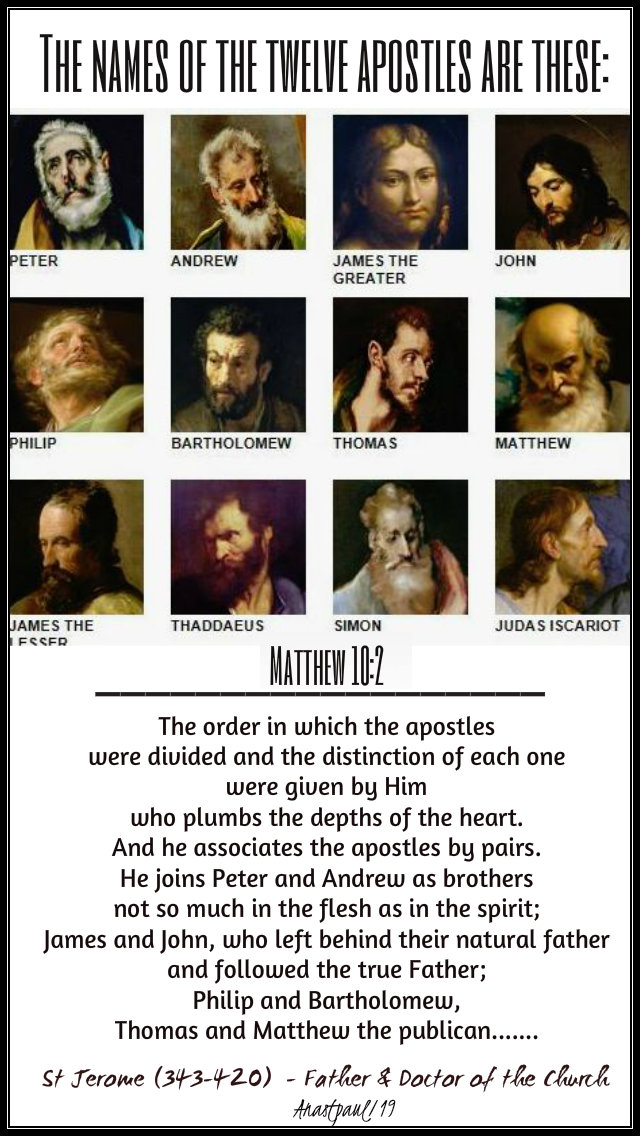
The names of the twelve apostles are these: first, Simon, who is called Peter and Andrew his brother; James the son of Zebedee and John his brother; …Matthew 10:2
REFLECTION – “The order in which the apostles were divided and the distinction of each one were given by him who plumbs the depths of the heart. The first to be recorded is Simon called Peter (to distinguish him from the other Simon, who is called the Cananaean from the village of Cana in Galilee, where the Lord turned the water into wine). He also calls James the son of Zebedee because he is followed by another James, the son of Alphaeus. And he associates the apostles by pairs. He joins Peter and Andrew as brothers not so much in the flesh as in the spirit; James and John, who left behind their natural father and followed the true Father; Philip and Bartholomew, Thomas and Matthew the publican. The other Evangelists, in listing the names, put Matthew first and then Thomas, nor do they mention the name publican, lest in recalling his former way of life they seem to insult the Evangelist. But Matthew, as we said before, places himself after Thomas and calls himself a publican so that “where sin abounded, grace has abounded even more.”
Simon the Cananaean is the one whom another Evangelist calls the Zealot. In fact, Cana interpreted means “zeal.” Church history relates that the apostle Thaddaeus was sent to Edessa, Abgarum in the region of Osroene. The person whom Luke the Evangelist calls Jude the brother of James, elsewhere called Lebbaeus, which interpreted means “little heart,” is believed to have been referred to by three names. Simon Peter and the sons of Zebedee (called sons of thunder) were named for their strength of mind and great faith. Judas Iscariot took his name either from his hometown or from the tribe of Issachar. By a certain prophecy he was born in condemnation of himself, for Issachar interpreted means “reward,” as to signify the price of the traitor.” … St Jerome (343-420) – Father & Doctor of the Church (Commentary on Matthew, 1.)
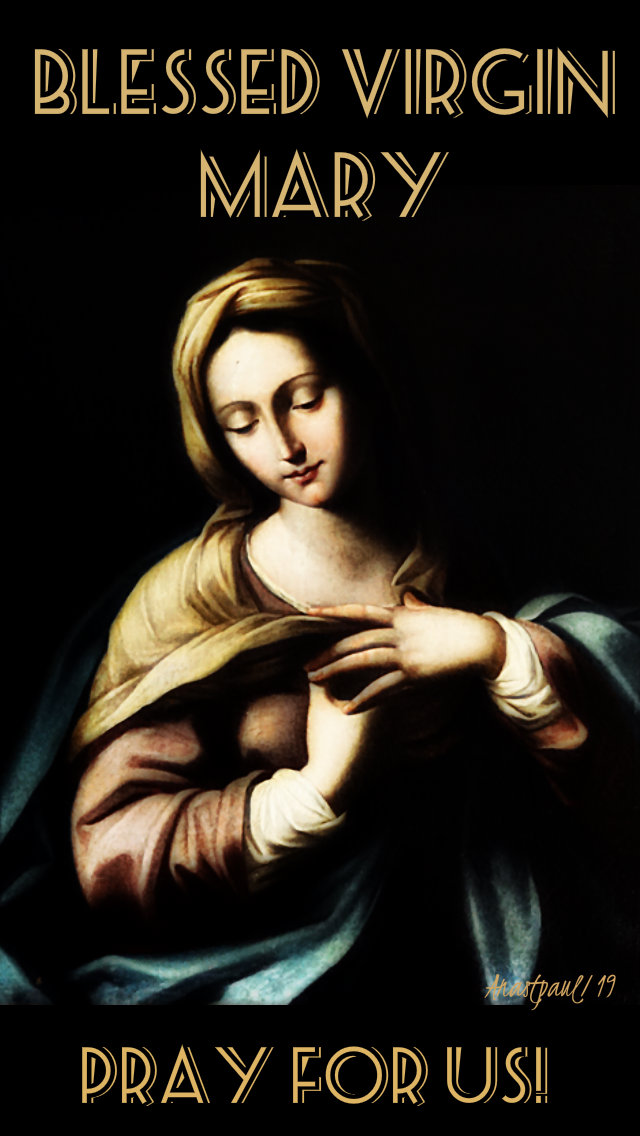
PRAYER – Holy God and Almighty Father, we are the disciples of Your Son as we follow Him home to You, grant us we pray, the strength and love to imitate Him in all things and to daily, pick up our cross with joy and commitment. May the Blessed Virgin, be a constant protection and assistance in our times of struggle and may all your angels and saints and martyrs, pray for us, through our Lord Jesus Christ, with the Holy Spirit, God for always and forever, amen.
Thought for the Day – 3 July – Feast of St Thomas Apostle
“My Lord and My God”
Saint Pope Gregory the Great (540-604)
Bishop of Rome and Great Western Father and Doctor of the Church
An excerpt from his Homily 26
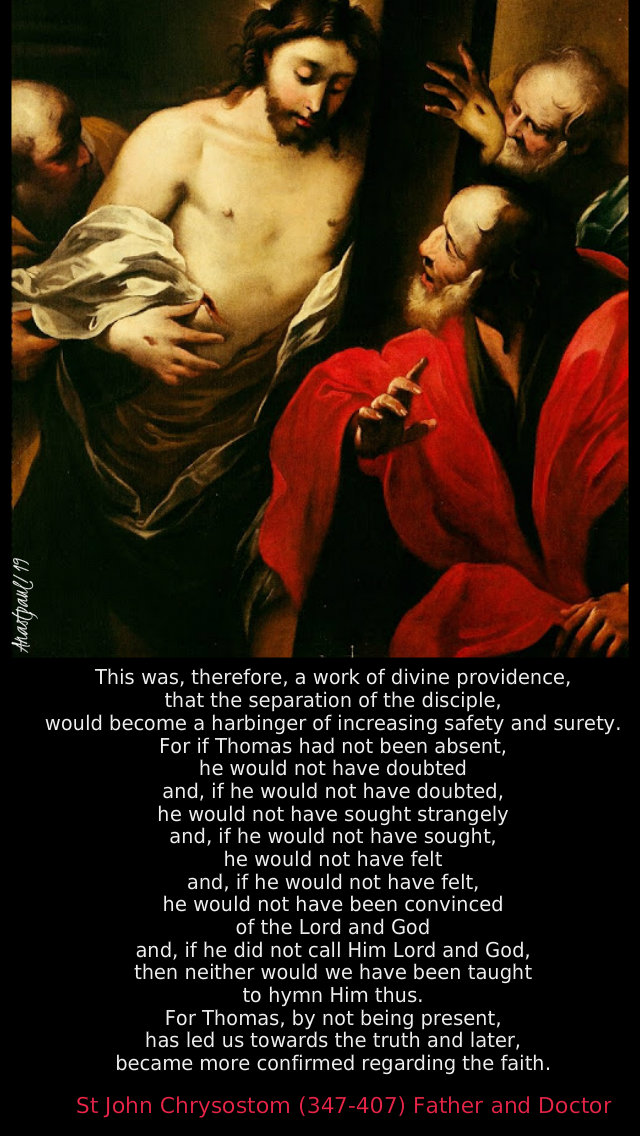
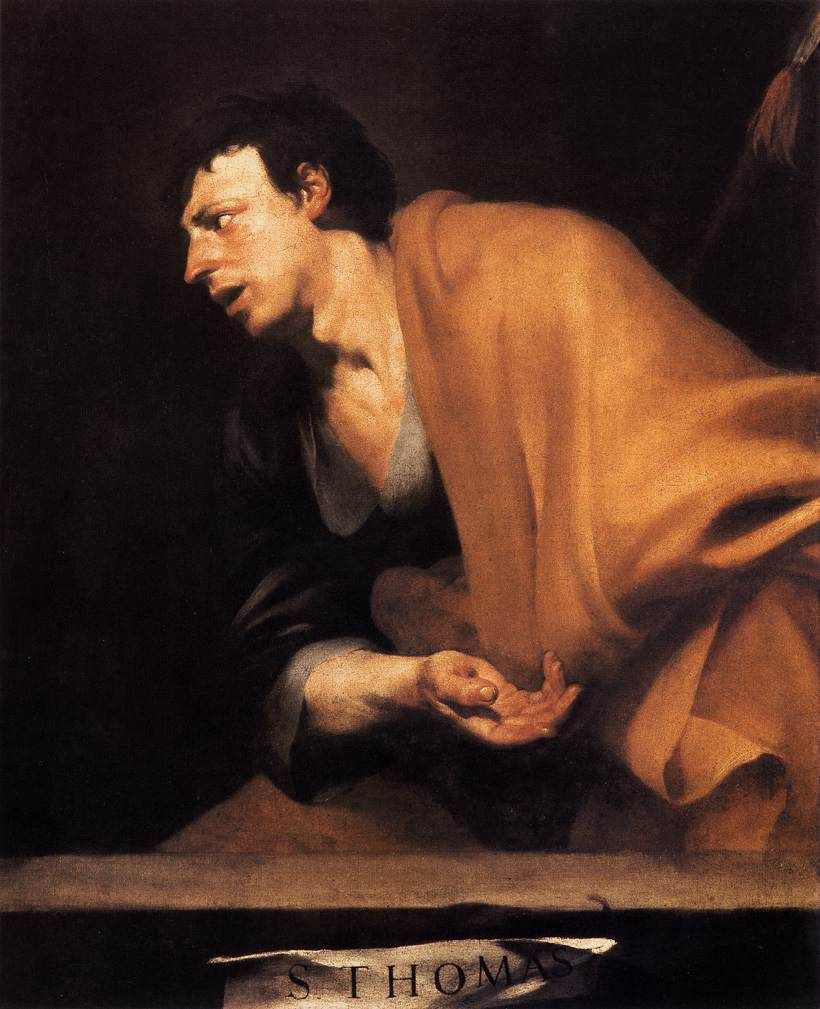
Thomas, one of the twelve, called the Twin, was not with them when Jesus came. He was the only disciple absent, on his return he heard what had happened but refused to believe it. The Lord came a second time, He offered His side for the disbelieving disciple to touch, held out His hands and, showing the scars of His wounds, healed the wound of his disbelief.
Dearly beloved, what do you see in these events? Do you really believe that it was by chance that this chosen disciple was absent, then came and heard, heard and doubted, doubted and touched, touched and believed? It was not by chance but in God’s providence. In a marvellous way, God’s mercy arranged, that the disbelieving disciple, in touching the wounds of his master’s body, should heal our wounds of disbelief. The disbelief of Thomas has done more for our faith than the faith of the other disciples. As he touches Christ and is won over to belief, every doubt is cast aside and our faith is strengthened. So the disciple who doubted, then felt Christ’s wounds, becomes a witness to the reality of the Resurrection.
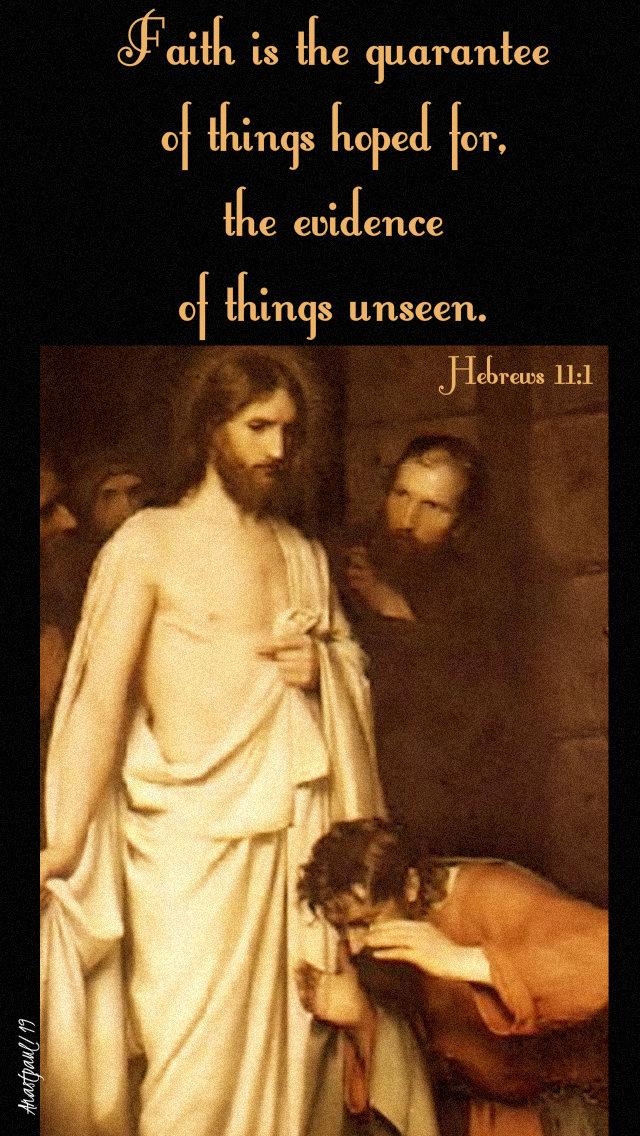
Touching Christ, he cried out – My Lord and my God. Jesus said to him – Because you have seen me, Thomas, you have believed. Paul said: Faith is the guarantee of things hoped for, the evidence of things unseen. It is clear, then, that faith is the proof of what cannot be seen. What is seen gives knowledge, not faith. When Thomas saw and touched, why was he told – You have believed because you have seen me? Because what he saw and what he believed were different things. God cannot be seen by mortal man. Thomas saw a human being, whom he acknowledged to be God and said: -My Lord and my God. Seeing, he believed, looking at one who was true man, he cried out that this was God, the God he could not see.
What follows is reason for great joy – Blessed are those who have not seen and have believed. There is here a particular reference to ourselves, we hold in our hearts one we have not seen in the flesh. We are included in these words but only if we follow up our faith with good works.The true believer practices what he believes. But of those who pay only lip service to faith, Paul has this to say – They profess to know God but they deny him in their works. Therefore James says – Faith without works is dead.
Quote/s of the Day – 3 July – Feast of St Thomas Apostle, Gospel John 20:24–29
“Faith is the guarantee of things hoped for, the evidence of things unseen.”
Hebrews 11:1
“This was, therefore, a work of divine providence, that the separation of the disciple, would become a harbinger of increasing safety and surety. For if Thomas had not been absent, he would not have doubted and, if he would not have doubted, he would not have sought strangely and, if he would not have sought, he would not have felt and, if he would not have felt, he would not have been convinced of the Lord and God and, if he did not call Him Lord and God, then neither would we have been taught to hymn Him thus. For Thomas, by not being present, has led us towards the truth and later, became more confirmed regarding the faith.”
One Minute Reflection – 3 July – Feast of St Thomas Apostle, Gospel John 20:24–29
Thomas answered him, “My Lord and my God!”…John 20:28
REFLECTION – “Put your finger into the marks of the nails”. You looked for Me when I wasn’t there, now take advantage of it. I understand your desire despite your silence. Before you tell Me them I already know your thoughts. I heard you speak and, even though unseen, I was beside you, beside your doubts. Without revealing Myself I made you wait, so as better to consider your eagerness. “Put your finger into the marks of the nails. Put your hand into my side, do not be unbelieving any longer, but believe.”
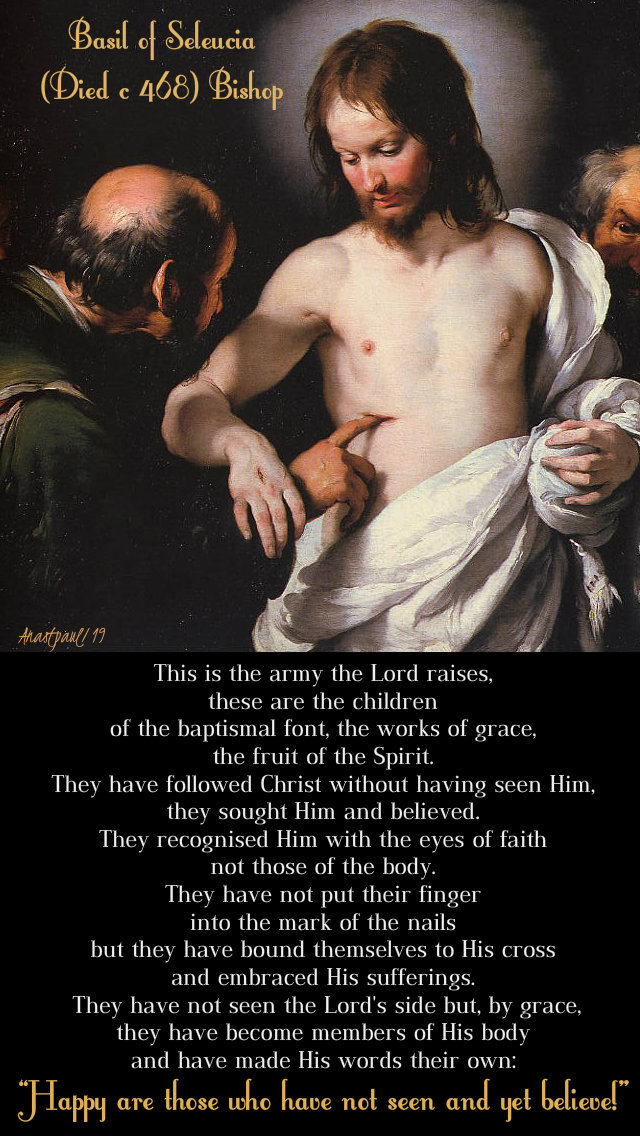
Then Thomas touched Him and all his mistrust fell away. Full of genuine faith and all the love owing to God, he cried out: “My Lord and my God!”And the Lord said to him – “You believe because you have seen me; happy are those who have not seen and yet believe!” Thomas took the news of the Resurrection to those who had not seen. Draw the whole earth to believe, not by its own sight but at your word. Go through peoples and cities far away. Teach them to carry the cross rather than weapons on their shoulders. Only proclaim me – they will believe and worship. They will demand no other proof. Tell them they are called by grace and, with your own eyes, behold their faith. Truly, blessed are those who did not see and yet believed! This is the army the Lord raises, these are the children of the baptismal font, the works of grace, the fruit of the Spirit. They have followed Christ without having seen Him, they sought Him and believed. They recognised Him with the eyes of faith not those of the body. They have not put their finger into the mark of the nails but they have bound themselves to His cross and embraced His sufferings. They have not seen the Lord’s side but, by grace, they have become members of His body and have made His words their own: “Happy are those who have not seen and yet believe!”… Basil of Seleucia (Died c 468) Bishop – Sermon for the Resurrection, 1-4
PRAYER – Almighty Father,as we honour Thomas the Apostle, let us always experience the help of his prayers. May we have eternal life by believing in Jesus,
whom Thomas acknowledged as Lord, for He lives and reigns with You and the Holy Spirit, one God, forever and ever. Amen
Our Morning Offering – 3 July – Feast of St Thomas Apostle
O Fathers of Our Ancient Faith
O Fathers of our ancient faith,
With all the heav’n, we sing your fame
Whose sound went forth in all the earth
To tell of Christ and bless His name.
You took the gospel to the poor,
The Word of God alight in you,
Which in our day is told again,
That timeless Word, forever new.
You told of God, who died for us
And out of death triumphant rose,
Who gave the truth that made us free
and changeless through the ages goes.
Praise Father, Son and Holy Spirit,
Whos gift is faith that never dies,
A light in darkness now, until
The day-star in our hearts arise.
O Fathers of Our Ancient Faith is written by the Benedictine Nuns of Stanbrook Abbey. In the Divine Office (1974) it is sung at Morning Prayer in the Common of Apostles. It is set to the anonymous tune associated with the 7th century Latin hymn, Creator Alme Siderum.
Feast of St Thomas, Apostle of Christ, Martyr – 3 July
There is very little about the Apostle Thomas in the Gospels, one text calls him the “twin.” Rarely during Jesus’ lifetime does he stand out among his colleagues. There is the instance before the raising of Lazarus, when Jesus was still in Perea and Thomas exclaimed: “Let us also go and die with Him.”
Best-known is his expression of unbelief after the Saviour’s death, giving rise to the phrase “doubting Thomas.” Nevertheless, the passage describing the incident, had as today’s Gospel, must be numbered among the most touching in Sacred Scripture, “My Lord and my God!”
In the Breviary lessons St Pope Gregory the Great makes the following reflections: “Thomas’ unbelief has benefited our faith more than the belief of the other disciples, it is because he attained faith, through physical touch, that we are confirmed in the faith beyond all doubt. Indeed, the Lord permitted the Apostle to doubt after the resurrection but He did not abandon him in doubt. By his doubt and by his touching the sacred wounds, the Apostle became a witness to the truth of the Resurrection. Thomas touched and cried out – My Lord and my God! And Jesus said to him – Because you have seen Me, Thomas, you have believed. Now if Thomas saw and touched the Saviour, why did Jesus say: Because you have seen Me, Thomas, you have believed? Because he saw something other than what he believed. For no mortal man can see divinity. Thomas saw the Man Christ and acknowledged His divinity with the words – My Lord and my God. Faith, therefore, followed upon seeing.”
This slideshow requires JavaScript.
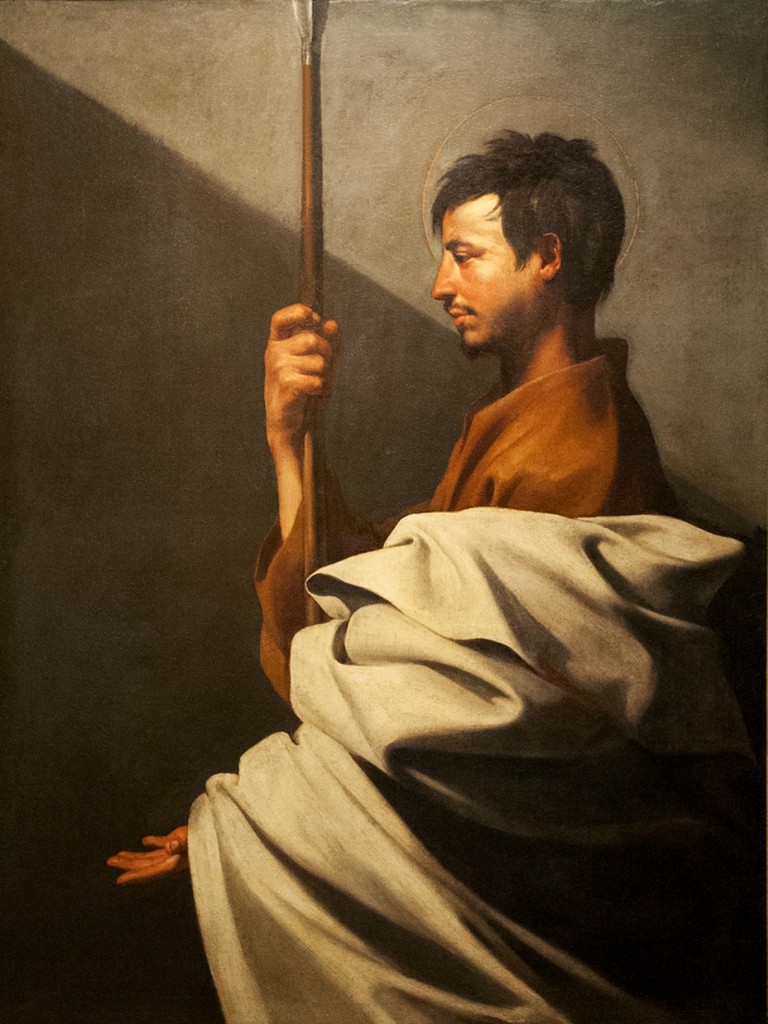
Concerning later events in the Apostle’s life, very meagre information exists. The Martyrology has this: “At Calamina (near Madras in India) the Martyrdom of the Apostle Thomas – he announced the Gospel to the Parthians and, finally, came to India. After he had converted numerous tribes to Christianity, he was pierced with lances at the king’s command.”
Excerpted from The Church’s Year of Grace, Pius Parsch
St Thomas: https://anastpaul.com/2018/07/03/saint-of-the-day-feast-of-st-thomas-apostle-of-christ/
St Anatolius of Alexandria
St Anatolius of Constantinople
Bl Andreas Ebersbach
Bl Barbara Jeong Sun-mae
St Bladus
St Byblig
St Cillene
St Dathus of Ravenna
St Eusebius of Laodicea
St Firminus
St Firmus
Bl Gelduin
St Germanus of Man
St Giuse Nguyen Ðình Uyen
St Gunthiern
St Guthagon
St Heliodorus of Altinum
St Hyacinth of Caesarea
St Ioannes Baptista Zhao Mingxi
St Irenaeus of Chiusi St Pope Leo II (611–683)
St Maelmuire O’Gorman
St Mark of Mesia
St Mennone the Centurian
St Mucian of Mesia
St Paul of Mesia
St Petrus Zhao Mingzhen
St Philiphê Phan Van Minh
St Raymond of Toulouse
—
Martyrs of Alexandria – 13 saints: Thirteen Christian companions marytred together. No details about them have survived but the names – Apricus, Cyrion (2 of), Eulogius, Hemerion, Julian, Julius, Justus, Menelaus, Orestes, Porfyrios and Tryphon (2 of). They martyred in Alexandria, Egypt, date unknown.
Martyrs of Constantinople – 24 saints: A group of 24 Christians martyred in the persecutions of Arian emperor Valens. We know little more than their names – Acacios, Amedinos, Ammonius, Ammus, Cerealis, Cionia, Cionius, Cyrianus, Demetrius, Eulogius (2), Euphemia, Heliodoros, Heraclios, Horestes, Jocundus, Julian, Martyrios, Menelaeus, Sestratus, Strategos, Thomas, Timotheos and Tryphon. They were martyred in c367 in Constantintinople.
Theodotus and Companions – 6 saints: Six Christians who were imprisoned, tortured and martyred together in the persecutions of Trajan. Saint Hyacinth ministered to them in prison. We know nothing else about them but their names – Asclepiodotus, Diomedes, Eulampius, Golinduchus, Theodota and Theodotus. They were beheaded in c110, location unknown.
29 JUNE 1951-2019
The Solemnity of Saints Peter and Paul
Congratulations, Prayers and Love
to our dearly beloved
Pope Emeritus Benedict XVI
on the occasion of the
68th Anniversary
of his Priestly Ordination
“Domineering over your faith is not my purpose. I prefer to work with you for your happiness”. It is what the Apostle Paul (II Cor 1,24) wrote and his quote was used 65 years ago on the celebration day of Peter and Paul Patron Saints – 29th June 1951 – during the priestly ordination of Joseph Ratzinger. It was held in the Cathedral of Freising and celebrated by Michael von Faulhaber, archbishop of Munich. Paul’s quote was written on the holy card in order to celebrate the event. This important anniversary will be marked by a solemn celebration in the Clementine Hall of the Apostolic Palace on 28th June. Pope Francis and the emeritus Pope Benedict XVI will attend the celebration. Joseph Ratzinger will receive a book on priesthood as a present.
“We were more than forty candidates and we all answered Adsum – that is “Here I am” – Ratzinger wrote in his Autobiography . It was a beautiful and unforgettable summer day, the most important moment in my life.” I shouldn’t be superstitious but while the old archbishop was laying his hands on me, a little bird – maybe a lark – raised from the high altar of the Cathedral and sang a short joyful song – I thought it was a voice from above saying: you are in the right way.” Ratzinger said.
His elder brother Georg was ordained with him. “The day of the first Mass the church of Saint Oswald was in its splendour and people showed us their joy and involvement. We had been asked t o bring the blessing of the first Mass to the town and we were welcomed everywhere. Everybody showed friendliness, even the people we didn’t know at all. I became aware of the expectations men and women have with a priest – they trust in his blessing and the power of the sacrament. It was not because of me or my brother = what did we mean to the people we met? They saw us as the men to whom Christ had given a task, that was to show His presence.”
“Priesthood is not “a job, but a sacrament. God asks a poor man to be like Him, to be with all men and women and to act on their behalf” said Benedict XVI on 11th June 2010, during the homily at the end of the Year for Priests, that he established on the 150th anniversary of the death of St. John Mary Vianney, Saint Patron of Priests.
Thought for the Day – 29 June – The Solemnity of Saints Peter and Paul
Blessed Isaac of Stella O.Cist. (c 1100 – c 1170) Cistercian Monk
Sermon 49, 1st for the Feast of Saints Peter and Paul
“These were men of mercy whose good deeds shall not be forgotten; the wealth they have left their inheritance will last for ever” (Latin liturgy; cf. Sir 44:10-11).”
Today, beloved, we are celebrating the birthday of the apostles Peter and Paul and it is altogether fitting that… such a death should be called ‘birth’ since it gave birth to life… See to what the saints have come – through the death that bestows life, they leave this life that leads to death, so as to come to that life-giving life, which is in the hands of Him who, as Christ said: “has life in Himself” – the Father (Jn 5:26)…
There are three kinds of people who are merciful. The first give of their goods… so as to contribute out of their superfluity to the penury of their neighbour… The second give all their goods away and, for them… everything is held in common with others from then on… But as for the third, they not only expend all they have but are “themselves utterly spent” (2 Cor 12:15) and give themselves up in person to the dangers of prison, exile and death so that they may rescue others from the dangers in which their souls are lying. They pour themselves out because they are so full of ardent desire for others. They will receive the reward of that love of which “there is no greater – to lay down one’s life for one’s friends” (Jn 15:13)… Such are those glorious princes of the earth and servants of heaven of whom today – after long privations “from hunger and thirst, cold and nakedness”, exhaustion and danger, “from their own race, from Gentiles, from false brethren” (2 Cor 11:26-27) – we celebrate the death that was so magnificently victorious. To such as these, the saying well applie – “Their good deeds shall never be forgotten” because they have not forgotten mercy… Yes, to the merciful, “their lot has fallen in a pleasant land, their inheritance is without compare” (Ps 16[15]:6).
Quote/s of the Day – 29 June – The Solemnity of Saints Peter and Paul
“Their sound has gone out into all the earth and their words to the ends of the world”
Psalm 19:5
“There must be general rejoicing, dearly beloved, over this holy company whom God has appointed for our example in patience and for our confirmation in faith. But we must glory even more in the excellence of their fathers, Peter and Paul, whom the grace of God has raised to such a height among all the members of the Church that He has set them like twin lights of eyes in that Body whose head is Christ.”
“Saint Peter does not cease to preside over his See and preserves an endless sharing, with the Sovereign Priest. The firmness that he received from the Rock which is Christ, he himself, having become the Rock, transmits it equally to his successors.”
St Pope Leo the Great (400-461)
Doctor of the Church’s Unity
“And so it is with Rome, where the holy Apostles Peter and Paul, gave with their blood their final witness. The vocation of Rome is of apostolic origin and the ministry which it is our lot to exercise here, is a service for the benefit of the entire Church and of mankind. But it is an irreplaceable service, because it has pleased the Wisdom of God to place the Rome of Peter and Paul, so to speak, on the road that leads to the eternal City, by the fact that Wisdom chose to confide to Peter—who unifies in himself the College of Bishops—the keys of the kingdom of heaven.”
One Minute Reflection – 29 June – The Solemnity of Saints Peter and Paul – Today’s Gospel: Matthew 16:13–19
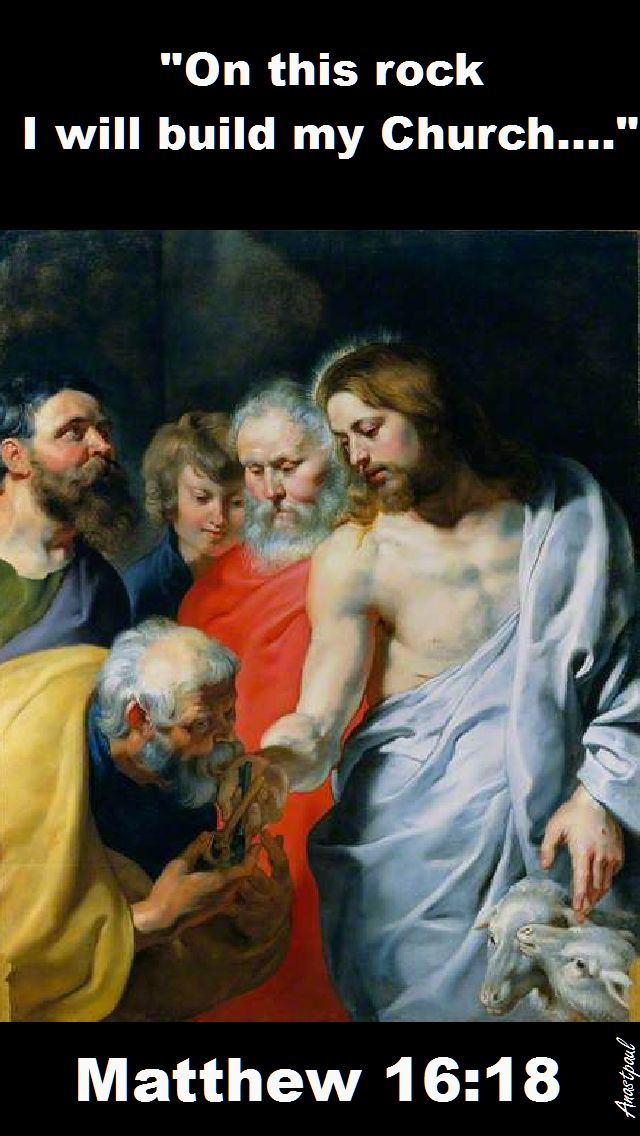
“And I tell you, you are Peter and on this rock I will build my church and the powers of death shall not prevail against it. I will give you the keys of the kingdom of heaven and whatever you bind on earth shall be bound in heaven, and whatever you loose on earth shall be loosed in heaven.” …Matthew 16:18-19
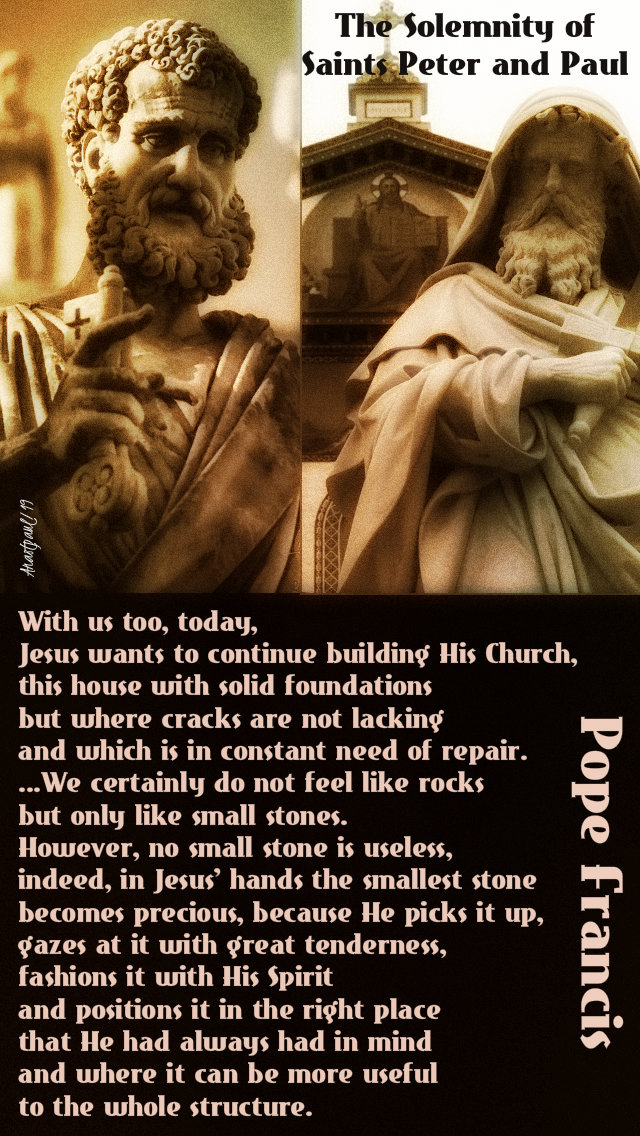
REFLECTION – “With us too, today, Jesus wants to continue building His Church, this house with solid foundations but where cracks are not lacking and which is in constant need of repair. Always. The Church always needs to be reformed, repaired. We certainly do not feel like rocks but only like small stones. However, no small stone is useless, indeed, in Jesus’ hands the smallest stone becomes precious, because He picks it up, gazes at it with great tenderness, fashions it with His Spirit and positions it in the right place that He had always had in mind and where it can be more useful to the whole structure.”…Pope Francis (Angelus, 27 August 2017)
PRAYER – O God, who on the Solemnity of the Apostles Peter and Paul give us the noble and holy joy of this day, grant, we pray, that your Church may in all things follow the teaching of those through whom she received the beginnings of right religion.
Through our Lord Jesus Christ, your Son,who lives and reigns with you in the unity of the Holy Spirit, one God, forever and ever. Amen
Our Morning Offering – 29 June – The Solemnity of Saints Peter and Paul
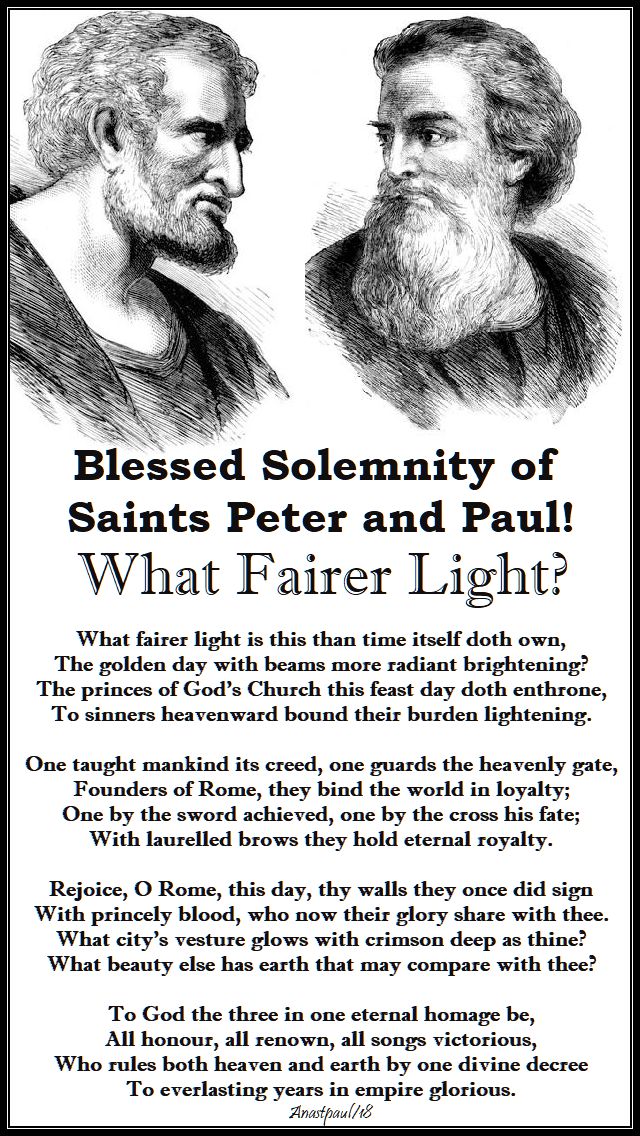
What Fairer Light?
Hymn for the Solemnity of Sts Peter and Paul Elphis, c 493, wife of Boethius c 477– 524 Translation: R A Knox, 1888-1957
What fairer light is this than time itself doth own,
The golden day with beams more radiant brightening?
The princes of God’s Church this feast day doth enthrone,
To sinners heavenward bound their burden lightening.
One taught mankind its creed, one guards the heavenly gate,
Founders of Rome, they bind the world in loyalty;
One by the sword achieved, one by the cross his fate;
With laurelled brows they hold eternal royalty.
Rejoice, O Rome, this day, thy walls they once did sign
With princely blood, who now their glory share with thee.
What city’s vesture glows with crimson deep as thine?
What beauty else has earth that may compare with thee?
To God the three in one eternal homage be,
All honour, all renown, all songs victorious,
Who rules both heaven and earth by one divine decree
To everlasting years in empire glorious.
Solemnity of Saints Peter and Paul, Apostles and Martyrs – 29 June
Today the Church celebrates the feast day of Sts Peter & Paul. As early as the year 258, there is evidence of an already lengthy tradition of celebrating the solemnities of both Saint Peter and Saint Paul on the same day. Together, the two saints are the founders of the See of Rome, through their preaching, ministry and martyrdom there. St Peter is also celebrated on 22 February (feast of the Chair of Peter, emblematic of the world unity of the Church) on 1 August (Saint Peter in Chains), St Paul’s Conversion is celebrated on 25 January and both are once again celebrated on 18 November (feast of the dedication of the Basilicas of Peter and Paul – the two major Basilicas in Rome).
In a sermon in the year 395, St Augustine (354-430) Father & Doctor of the Church, said of Sts Peter and Paul:
“Both apostles share the same feast day, for these two were one and even though they suffered on different days, they were as one.
Peter went first and Paul followed.
And so we celebrate this day made holy for us, by the apostles’ blood. Let us embrace what they believed, their life, their labours, their sufferings, their preaching and their confession of faith.”
Peter (d. 64?) Saint Mark ends the first half of his Gospel with a triumphant climax. He has recorded doubt, misunderstanding and the opposition of many to Jesus. Now Peter makes his great confession of faith – “You are the Messiah” (Mark 8:29b). It was one of the many glorious moments in Peter’s life, beginning with the day he was called from his nets along the Sea of Galilee to become a fisher of men for Jesus.
The New Testament clearly shows Peter as the leader of the apostles, chosen by Jesus to have a special relationship with Him. With James and John he was privileged to witness the Transfiguration, the raising of a dead child to life and the agony in Gethsemane. His mother-in-law was cured by Jesus. He was sent with John to prepare for the last Passover before Jesus’ death. His name is first on every list of apostles.
And to Peter only did Jesus say, “Blessed are you, Simon son of Jonah. For flesh and blood has not revealed this to you, but my heavenly Father. And so I say to you, you are Peter, and upon this rock I will build my church and the gates of the netherworld shall not prevail against it. I will give you the keys to the kingdom of heaven. Whatever you bind on earth shall be bound in heaven; and whatever you loose on earth shall be loosed in heaven” (Matthew 16:17b-19).
But the Gospels prove their own trustworthiness by the unflattering details they include about Peter. He clearly had no public relations person. It is a great comfort for ordinary mortals to know that Peter also has his human weakness, even in the presence of Jesus.
He generously gave up all things, yet he can ask in childish self-regard, “What are we going to get for all this?” (see Matthew 19:27). He receives the full force of Christ’s anger when he objects to the idea of a suffering Messiah –“Get behind me, Satan! You are an obstacle to me. You are thinking not as God does, but as human beings do” (Matthew 16:23b).
Peter is willing to accept Jesus’ doctrine of forgiveness but suggests a limit of seven times. He walks on the water in faith but sinks in doubt. He refuses to let Jesus wash his feet, then wants his whole body cleansed. He swears at the Last Supper that he will never deny Jesus and then swears to a servant maid that he has never known the man . He loyally resists the first attempt to arrest Jesus by cutting off Malchus’ ear but in the end, he runs away with the others. In the depth of his sorrow, Jesus looks on him and forgives him and he goes out and sheds bitter tears. The Risen Jesus told Peter to feed his lambs and his sheep (John 21:15-17).
Paul (d. 64?) If the most well-known preacher today suddenly began preaching that your country should adopt Marxism and not rely on the democracy, the angry reaction would help us understand Paul’s life when he started preaching that Christ alone can save us. He had been the most pharisaic of Pharisees, the most legalistic of Mosaic lawyers. Now he suddenly appears to other Jews as a heretical welcomer of Gentiles, a traitor and apostate.
St Paul – Antony van Dyck
Paul’s central conviction was simple and absolute – Only God can save humanity. No human effort—even the most scrupulous observance of law—can create a human good which we can bring to God, as reparation for sin and payment for grace. To be saved from itself, from sin, from the devil and from death, humanity must open itself completely to the saving power of Jesus.
Paul never lost his love for his Jewish family, though he carried on a lifelong debate with them about the uselessness of the Law without Christ. He reminded the Gentiles that they were grafted on the parent stock of the Jews, who were still God’s chosen people, the children of the promise.
St Anastasius of Bourges
St Benedicta of Sens
St Cassius of Narni
St Ciwg ap Arawn
St Cocha
St Ilud Ferch Brychan
St Judith of Niederaltaich
St Marcellus of Bourges
St Mary, the Mother of John Mark
Bl Pierre of Tarentaise the Elder
St Salome of Niederaltaich
St Syrus of Genoa
Bl William of Sann
—
Martyrs of China
Ioannes Baptista Wu Mantang
Magdalena Du Fengju
Maria Du Tianshi
Paulus Wu Anju
Paulus Wu Wanshu
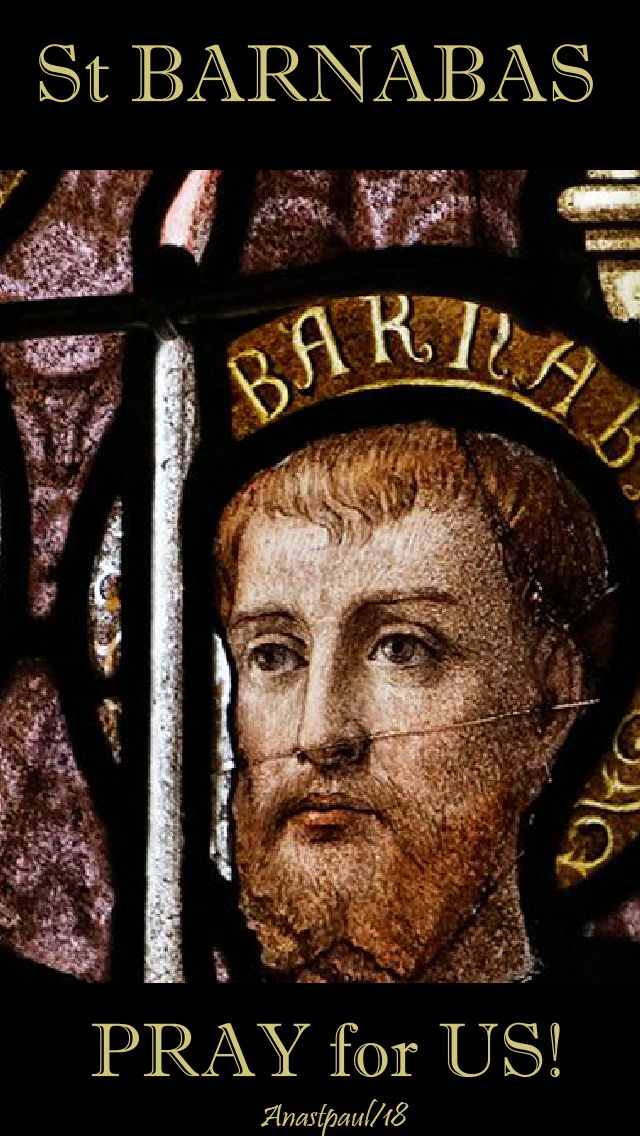
News of this came to the ears of the church in Jerusalem and they sent Barnabas to Antioch. When he came and saw the grace of God, he was glad and he exhorted them all, to remain faithful to the Lord, with steadfast purpose; for he was a good man, full of the Holy Spirit and of faith. And a large company was added to the Lord...Acts 11:22-24
“While we cannot see God, there is something we can do, to open a way, for the eye of our understanding to come to Him. It is certain that we can see now in His servants, one whom we can in no way see in Himself. When we see them doing astonishing things, we can be sure that God dwells in their hearts… None of us can look directly at the rising sun by gazing at its orb. Our eyes are repelled as they strain to see its rays. But we look at mountains bathed in sunlight and see that it has risen. Because we cannot see the Sun of righteousness (Mal 3,20) Himself, let us see the mountains bathed in His brightness, I mean the holy apostles. They shine with virtues and gleam with miracles… The power of His divinity, is in itself, like the sun in the sky; in human beings it is like the sun shining on earth…”
St Pope Gregory the Great (c 540-604), Father & Doctor of the Church
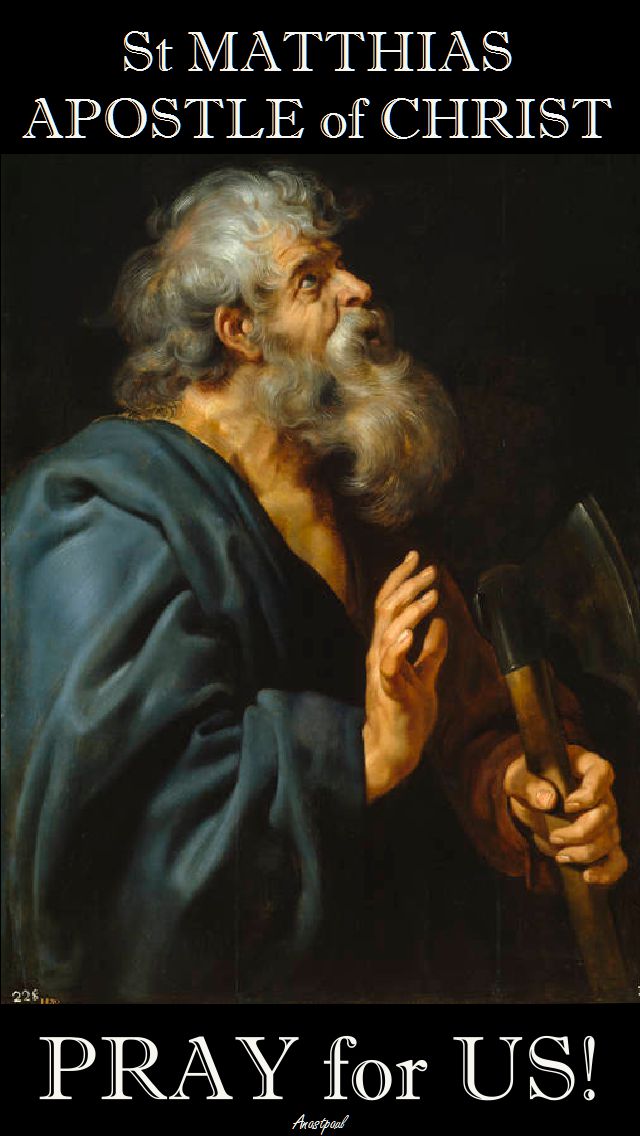
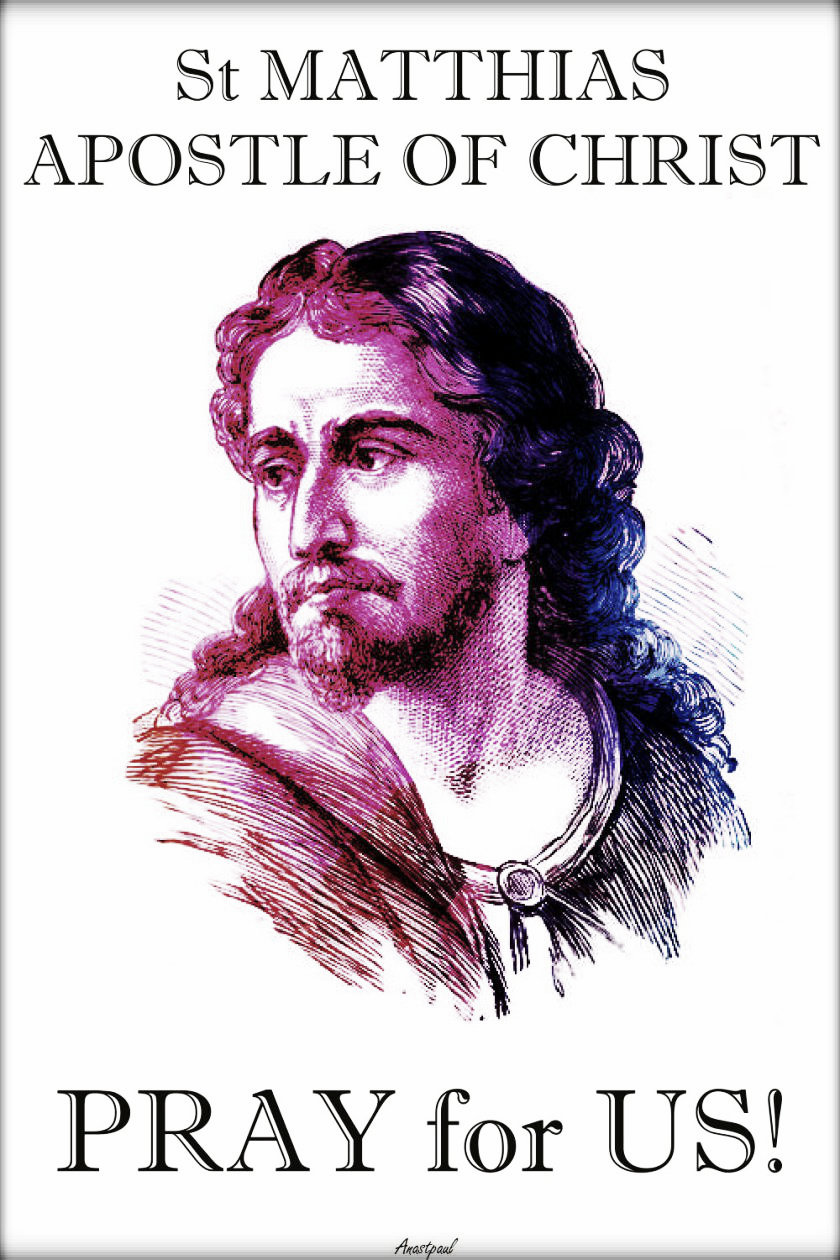
Thought for the Day – 14 May – Tuesday of the Fourth Week of Easter, C and the Feast of St Matthias, Apostle of Christ
The virtues, labour and sufferings of St Mathias have not been handed down to us, this explains the lack of proper lessons on his life, such as we have for the feasts of the rest of the apostles.
St Clement of Alexandria (150-215) records in his writings several sayings of our holy apostle. One of these is so very appropriate to the spirit of the present season, that we consider it a duty to quote it. ‘It behooves us to combat the flesh and make use of it, without pampering it by unlawful gratifications. As to the soul, we must develop her power by faith and knowledge.’
How profound is the teaching contained in these few words! Sin has deranged the order which the Creator had established. It gave the outward man such a tendency to grovel in things which degrade him, that the only means left us for the restoration of the image and likeness of God unto which we were created, is the forcible subjection of the body to the spirit. But the spirit itself, that is, the soul, was also impaired by original sin and her inclinations were made prone to evil, what is to be her protection? Faith and knowledge. Faith humbles her and then exalts and rewards her and the reward is knowledge.
— Excerpted from The Liturgical Year, Abbot Gueranger OSB
One Minute Reflection – 14 May – Tuesday of the Fourth Week of Easter, C, First Reading: Acts of the Apostles 1:15-17.20-26. and the Feast of St Matthias, Apostle of Christ
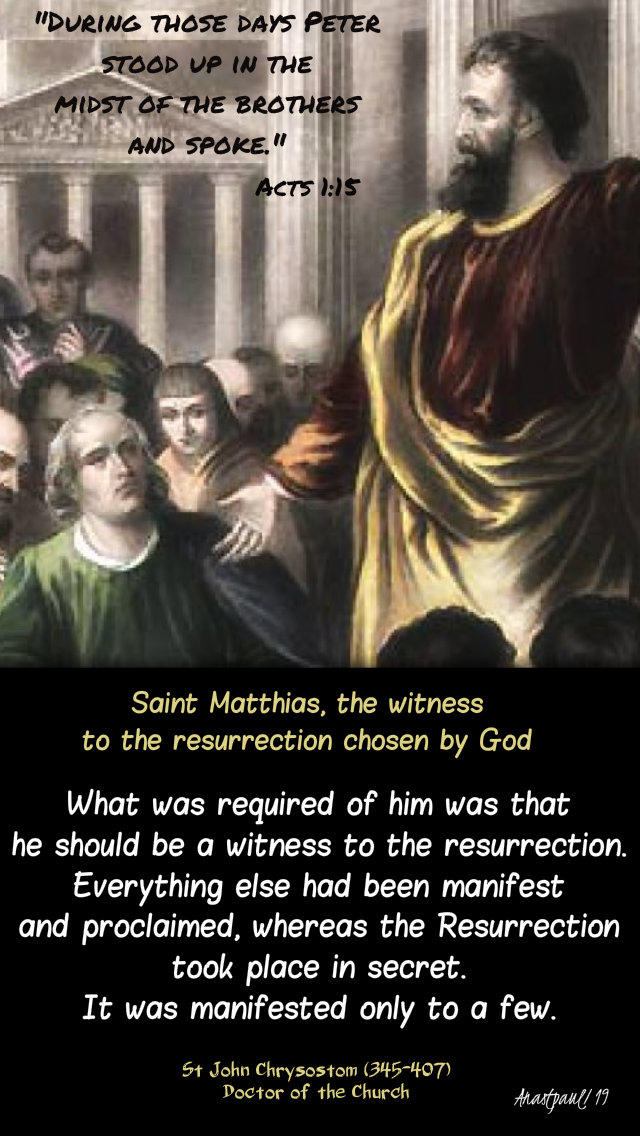
“During those days Peter stood up in the midst of the brothers and spoke.”…Acts 1:15
REFLECTION – “Because he is fervent and is the senior member of the group, he is always the first to speak: “My brothers, it is necessary we choose one of the men who accompanied us.” Note how he wants these new apostles to be eyewitnesses. No doubt, the Holy Spirit would come and yet Peter placed a great deal of importance on this point – “One of the men who accompanied us the whole time the Lord Jesus came and went among us” (v.21). He indicates that they must have lived with Him and not just been disciples. For in fact, in the beginning, many people followed Him… “Until the day when he was taken up from us. He must become with us a witness to his resurrection.” (v.22)
Peter did not say: “a witness to everything else” but only – “a witness to his resurrection.” For a disciple who could say, “Someone who ate and drank and was crucified was the same who was raised” would be more worthy of credence. Therefore,it was not necessary that he should be a witness to the times beforehand, nor to those that followed, nor to the miracles. What was required of him was that he should be a witness to the resurrection. Everything else had been manifest and proclaimed, whereas the resurrection took place in secret. It was manifested only to a few.”…St John Chrysostom (345-407) Bishop of Constantinople, Doctor of the Church – 3rd sermon on the Acts of the apostles ; PG 60, 33 (trans. breviary 14/05)
PRAYER – Lord God, You chose St Matthias to complete the number of the twelve. By his prayer, include us among Your chosen ones, since we rejoice to see that the lot marked out for us, is in Your Love. Through Jesus the Christ, our Lord, with the Holy Spirit, God now and forever, amen.
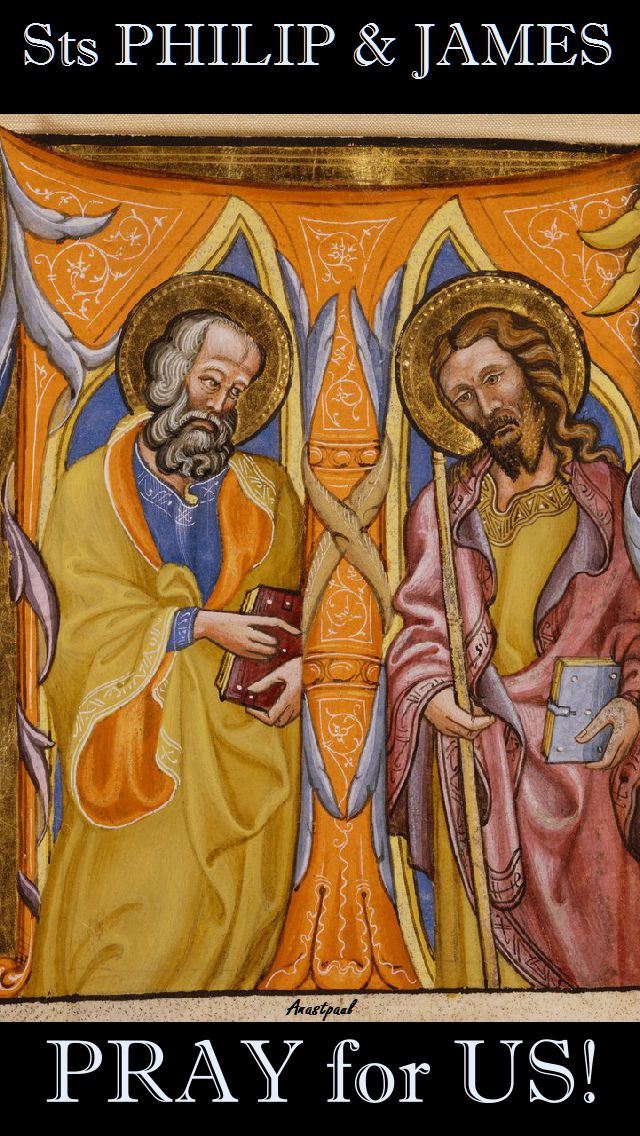
Thought for the Day – 3 May – The Feast of Saints Philip and James, Apostles
The Preaching of the Apostles
Tertullian (c 155- c 240)
Priest, Father and Ancient Christian Writer
An excerpt from his On the Prescription of Heretics
Our Lord Jesus Christ Himself declared what He was, what He had been, how He was carrying out His Father’s will, what obligations He demanded of men. This He did during His earthly life, either publicly to the crowds, or privately to His disciples. Twelve of these He picked out, to be His special companions, appointed to teach the nations.
One of them fell from His place. The remaining eleven were commanded by Christ, as He was leaving the earth to return to the Father after His resurrection, to go and teach the nations and to baptise them into the Father, the Son and the Holy Spirit.
The apostles cast lots and added Matthias to their number, in place of Judas, as the twelfth apostle. The authority for this action is to be found in a prophetic psalm of David. After receiving the power of the Holy Spirit which had been promised to them, so that they could work miracles and proclaim the truth, they first bore witness to their faith in Jesus Christ and established churches throughout Judea. They then went out into the whole world and proclaimed to the nations the same doctrinal faith.
They set up churches in every city. Other churches received from them a living transplant of faith and the seed of doctrine and through this daily process of transplanting they became churches. They therefore qualify as apostolic churches by being the offspring of churches that are apostolic.
Every family has to be traced back to its origins. That is why we can say that all these great churches constitute that one original Church of the apostles, for it is from them that they all come. They are all primitive, all apostolic, because they are all one. They bear witness to this unity by the peace in which they all live, the brotherhood which is their name, the fellowship to which they are pledged. The principle on which these associations are based is common tradition by which they share the same sacramental bond.
The only way in which we can prove what the apostles taught—that is to say, what Christ revealed to them — is through those same churches. They were founded by the apostles themselves, who first preached to them by what is called the living voice and later by means of letters.
The Lord had said clearly in former times – I have many more things to tell you but you cannot endure them now. But He went on to say – When the Spirit of truth comes, He will lead you into the whole truth. Thus Christ shows us that the apostles had full knowledge of the truth, for He had promised that they would receive the whole truth through the Spirit of truth. His promise was certainly fulfilled, since the Acts of the Apostles prove, that the Holy Spirit came down on them.
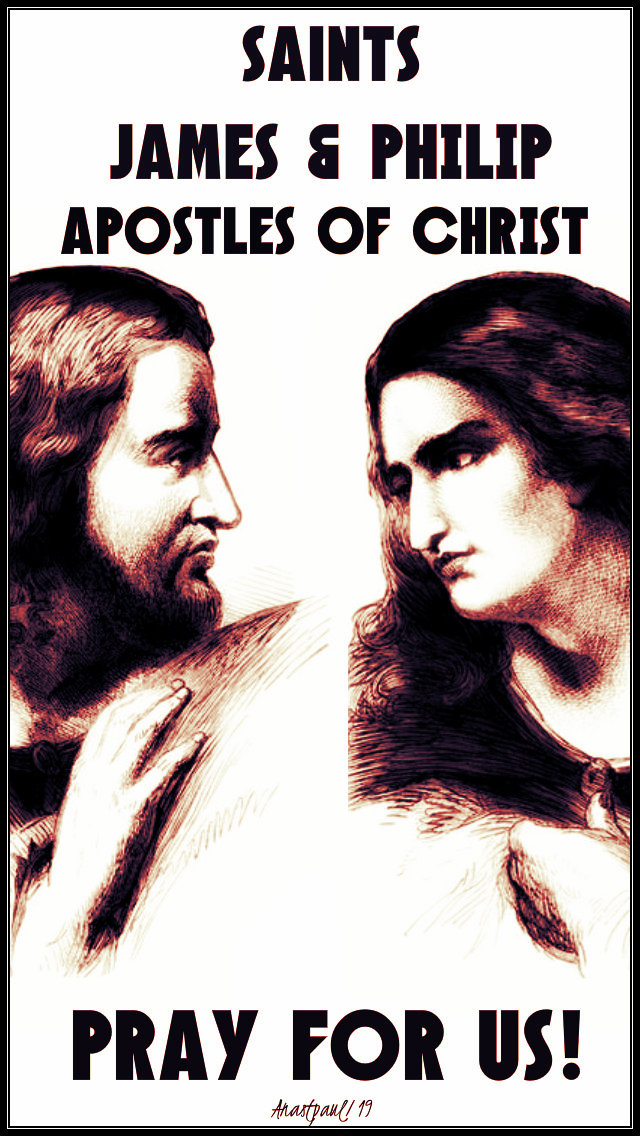
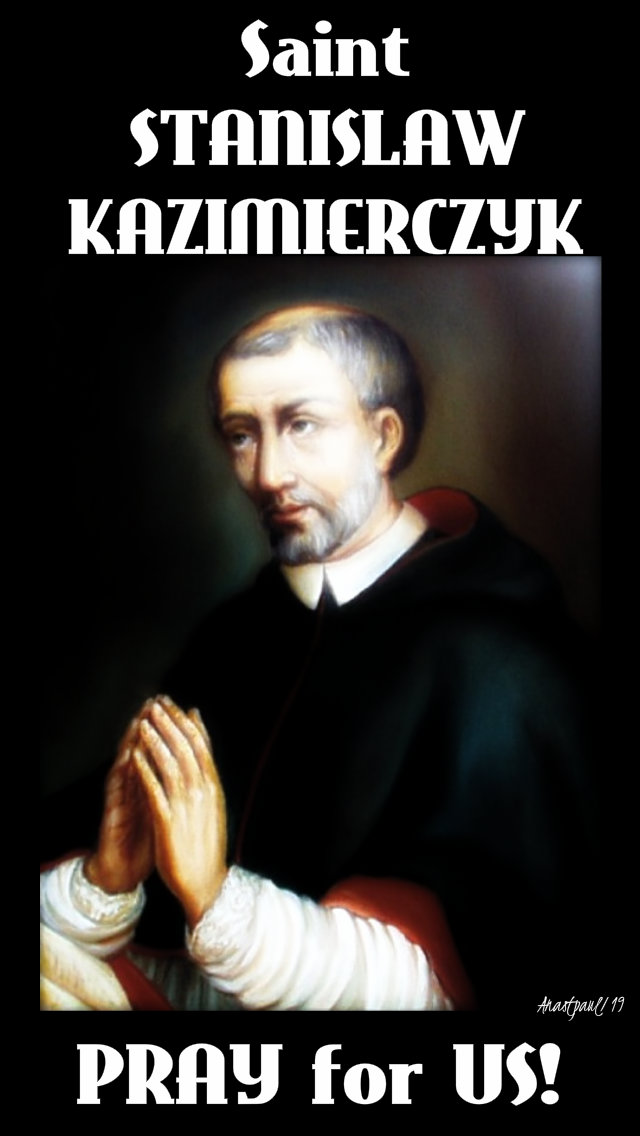
One Minute Reflection – 3 May – Friday of the Second Week of Easter, Gospel: John 14:6–14 and the Feast of Sts James and Philip and the Memorial of Saint Stanislaw Kazimierczyk CRL (1433–1489)
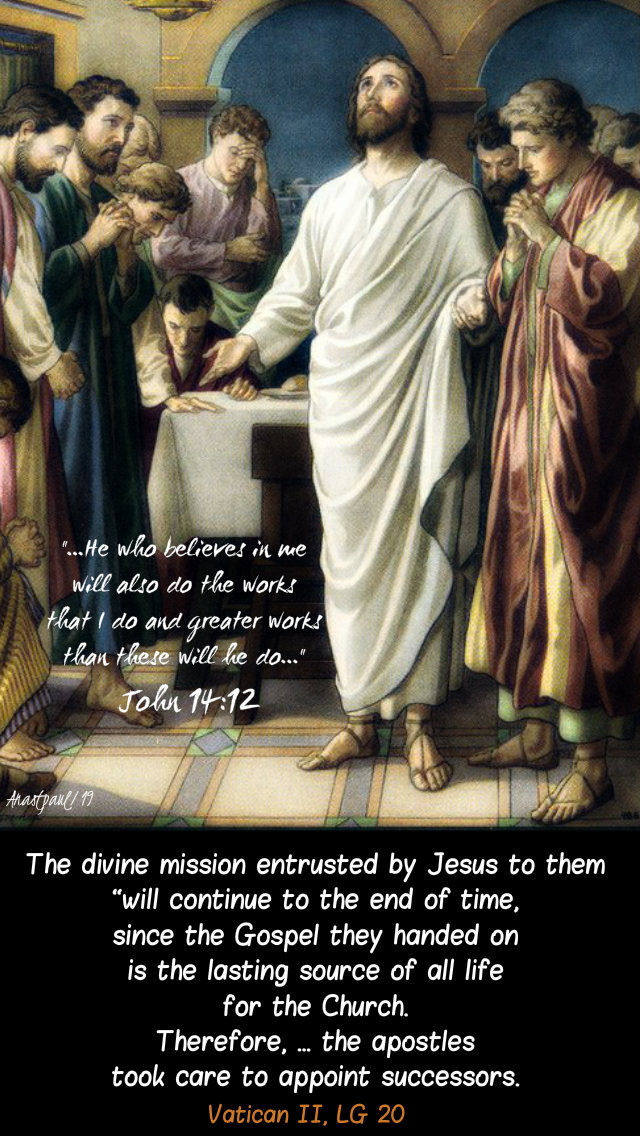
“Truly, truly, I say to you, he who believes in me will also do the works that I do and greater works than these will he do, because I go to the Father…”...John 14:12
REFLECTION – “Jesus is the Father’s Emissary. From the beginning of His ministry, He “called to him those whom he desired … And he appointed twelve, whom also He named apostles, to be with Him and to be sent out to preach.” (Mk 3:13-14) From then on, they would also be His “emissaries” (Greek apostoloi). In them, Christ continues His own mission = “As the Father has sent me, even so I send you.” (Jn 20:21) The apostles’ ministry is the continuation of His mission, Jesus said to the Twelve: “he who receives you receives me.” (Mt 10:40)
Jesus unites them to the mission He received from the Father. As “the Son can do nothing of his own accord” but receives everything from the Father who sent Him, so those whom Jesus sends can do nothing apart from Him (Jn 5:19.30), from whom they received both the mandate for their mission and the power to carry it out. Christ’s apostles knew that they were called by God as “ministers of a new covenant,” “servants of God,” “ambassadors for Christ,” “servants of Christ and stewards of the mysteries of God” (1 Cor 4:1).
In the office of the apostles, there is one aspect that cannot be transmitted – to be the chosen witnesses of the Lord’s Resurrection and so the foundation stones of the Church. But their office also has a permanent aspect. Christ promised to remain with them always. The divine mission entrusted by Jesus to them “will continue to the end of time, since the Gospel they handed on is the lasting source of all life for the Church. Therefore, … the apostles took care to appoint successors.” (Vatican II, LG 20) Catechism of the Catholic Church- #858-860
PRAYER – Almighty Father, we believe, strengthen our faith. Divine Son, we follow You, remain with us. Holy Spirit, come, guide our steps. Glory be to the Father and to the So and to the Holy Spirit, as it was in the beginning is now and ever shall be, amen. Saints James and Philip, Saint Stanislaw, pray for us!
St James the Lesser Apostle (Feast) St Philip the Apostle (Feast) Sts James and Philip: https://anastpaul.wordpress.com/2018/05/03/3-may-feast-of-sts-philip-and-james-apostles-and-martyrs/
St Adalsindis of Bèze
Bl Adam of Cantalupo in Sabina
St Ahmed the Calligrapher
St Aldwine of Peartney
St Pope Alexander I
St Alexander of Constantinople
Bl Alexander of Foigny
St Alexander of Rome
Bl Alexander Vincioli
St Ansfrid of Utrecht
St Antonina of Constantinople
St Diodorus the Deacon
Bl Edoardo Giuseppe Rosaz
St Ethelwin of Lindsey
St Eventius of Rome
St Fumac
St Gabriel Gowdel
St Juvenal of Narni
Bl Maria Leonia Paradis
St Maura of Antinoe
St Peter of Argos
St Philip of Zell
Bl Ramon Oromí Sullà
St Rhodopianus the Deacon
St Scannal of Cell-Coleraine
Bl Sostenaeus St Stanislas Kazimierczyk CRL (1433–1489)
St Theodolus of Rome
St Timothy of Antinoe
Bl Uguccio
Bl Zechariah


















You must be logged in to post a comment.