Our Morning Offering – 27 March – Saturday of Passion Week or the Fifth Week of Lent
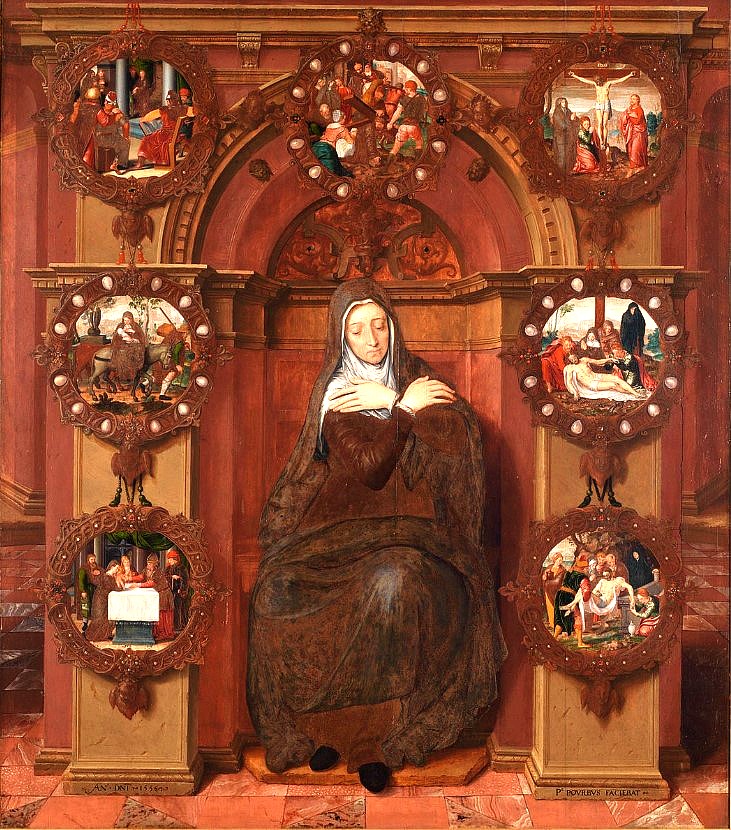
Mother of Love, of Sorrow and of Mercy By St Bridget of Sweden (1303-1373)
O Blessed Virgin Mary, Immaculate Mother of God, who endured a martyrdom of love and grief, beholding the sufferings and sorrows of Jesus! Thou didst co-operate in the benefit of my redemption by thy innumerable afflictions and by offering to the Eternal Father, His only-begotten Son, as a holocaust and victim of propitiation for my sins. I thank thee for the unspeakable love which led thee to deprive thyself of the Fruit of thy womb, Jesus, true God and true Man, to save me, a sinner. Oh! make use of the unfailing intercession of thy sorrows with the Father and the Son, that I may steadfastly amend my life and never again crucify my loving Redeemer by my sins and that, persevering till death in His grace, I may obtain eternal life through the merits of His Cross and Passion. Amen
Mother of Love, of Sorrows and of Mercy, pray for us!
Thought for the Day – 25 March – Meditations with Antonio Cardinal Bacci (1881-1971)
The Recollection of Mary
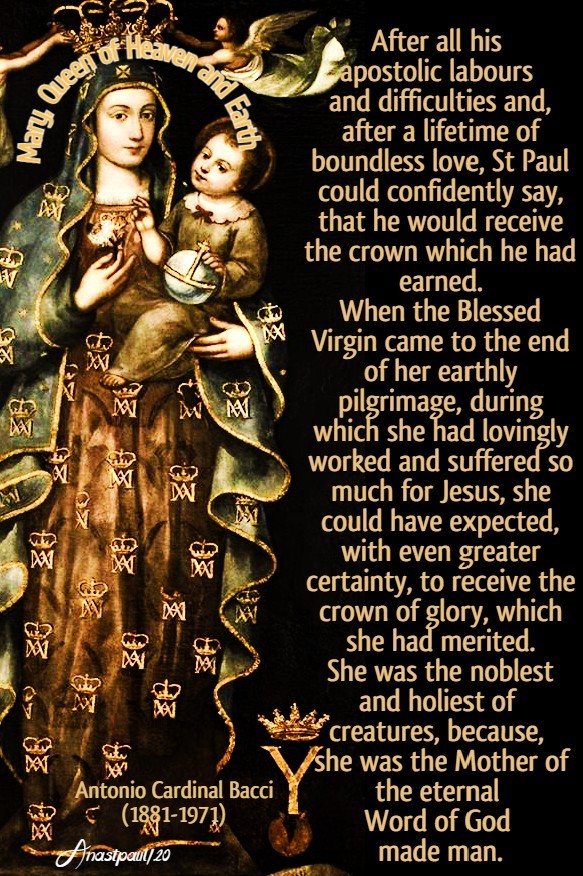
“It is believed that when the Angel Gabriel visited the Blessed Virgin in order to tell her that she was to be the Mother of God, she was in a quiet corner of her home, absorbed in prayer. She had no love for the noise and confusion of the world but preferred to be recollected in the company of God. This was to be the pattern of her whole life. In the midst of her domestic duties, on her journey to St Elizabeth and on her travels in Galilee and Judea, in the wake of her divine Son, her mind and heart were always concentrated on God.
Interior recollection is a wonderful thing. It helps us to hear God’s voice more clearly. It keeps us removed from the temptations of the world and assists us in sanctifying every moment of our lives.
“The cell continually dwelt in growth sweet,” (Bk 1, C 20:5) says The Imitation of Christ and goes onto ask: “What can thou see elsewhere that thou does not see here? Behold the heavens and the earth and all the elements, for out of these are all things made” (Ibid C 20:8). “As often as I have been amongst men,” it exclaims, “I have returned less a man” (Ibid C 20:2). When we move around chattering with different people, we have lost something of ourselves by the time we return home. Perhaps we have wasted a good deal of time in useless conversation or, worse still, have seen or heard unpleasant or disturbing things. When we go about in the world, we do not often see much that is edifying or instructive and rarely meet people whose conversation does us good. For this reason, even when we cannot remain apart, we should carry in ourselves, as Mary did, a spirit of interior recollection and communication with God.”
Lenten Journey Day thirty five – 25 March – The Solemnity of the Annunciation of the Lord, Readings: Isaiah 7:10-14; 8: 10, Psalms 40:7-8,8-9, 10, 11, Hebrews 10:4-10, Luke 1:26-38
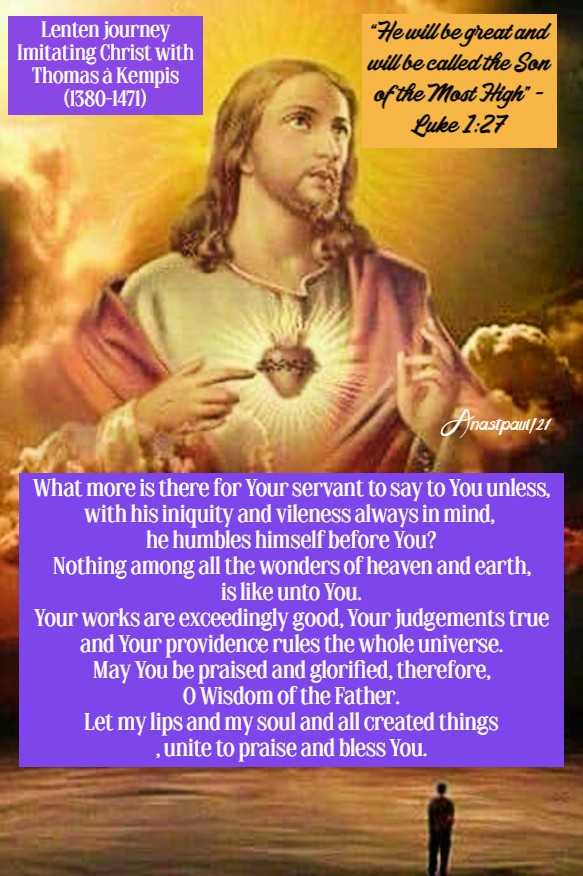
Imitating Christ with Thomas à Kempis (1380-1471)
In You is the source of life and in Your Light Lord, we see light Psalm 35(36)
“He will be great and will be called the Son of the Most High” – Luke 1:27
ABOVE all things and in all things, O my soul, rest always in the Lord my God, for He is the everlasting rest and joy of the angels and the saints.
O Jesus, Splendour of eternal glory, Consolation of the pilgrim soul, who labour in this sinful world, with You my lips utter no sound and to You my silence speaks. How long will my Lord delay His coming? Let Him come to His poor servant and make him happy. Let Him put forth His hand and take this miserable creature from his anguish. Come, O come, for without You there will be no happy day or hour because You are my happiness and without You my table is empty. I am wretched, as it were imprisoned and weighted down with fetters, until You fill me with the light of Your presence, restore me to liberty and show me a friendly countenance. Let others seek, instead of You, whatever they will but nothing pleases me, or will please me but You, my God, my Hope, my everlasting Salvation. I will not be silent, I will not cease praying, until Your grace returns to me and You speak inwardly to me, saying: “Behold, I am here. Lo, I have come to you because you have called Me. Your tears and the desire of your soul, your humility and contrition of heart, have inclined Me and brought Me to you.”
Lord, I have called You and have desired You and have been ready to spurn all things for Your sake. For You first spurred me on, to seek You. May You be blessed, therefore, O Lord, for having shown this goodness to Your servant according to the multitude of Your mercies.
What more is there for Your servant to say to You unless, with his iniquity and vileness always in mind, he humbles himself before You? Nothing among all the wonders of heaven and earth, is like unto You. Your works are exceedingly good, Your judgements true and Your providence rules the whole universe. May You be praised and glorified, therefore, O Wisdom of the Father. Let my lips and my soul and all created things, unite to praise and bless You. (Book 3 Ch 21:1,4-6)
Quote/s of the Day – 25 March – The Solemnity of the Annunciation of the Lord, Readings: Isaiah 7:10-14; 8: 10, Psalms 40:7-8,8-9, 10, 11, Hebrews 10:4-10, Luke 1:26-38
“Behold, I am the handmaid of the Lord; let it be to me according to your word.”
Luke 1:38
“And so, when God’s birth is proclaimed to you, keep silent. Let Gabriel’s word be held in your mind for nothing is impossible to this glorious Majesty, who humbled Himself for us and was born of our humanity.”
“In her, God spun a garment with which to save us.”
St Ephrem (306-373) Father & Doctor
“He came from Him, from whom He did not depart, going forth from Him, with whom He stayed, so that without intermission, He was wholly in eternity, wholly in time, wholly was He found in the Father when wholly in the Virgin, wholly in His own majesty and in His Father’s, at the time when He was wholly in our humanity. ”
“Has anyone ever come away from Mary, troubled or saddened or ignorant of the heavenly Mysteries? Who has not returned to everyday life gladdened and joyful because a request has been granted by the Mother of God?”
St Amadeus of Lausanne (1110-1159)
“The Father bending down to this beautiful creature, who was so unaware of her own beauty, willed that she be the Mother, in time, of Him, Whose Father He is, in eternity. Then the Spirit of love, Who presides over all of God’s works, came upon her; the Virgin said her fiat: “Behold the handmaid of the Lord, be it done to me according to thy word” and the greatest of mysteries, was accomplished!”
One Minute Reflection – 25 March – The Solemnity of the Annunciation of the Lord, Readings: Isaiah 7:10-14; 8: 10, Psalms 40:7-8,8-9, 10, 11, Hebrews 10:4-10, Luke 1:26-38
“Hail, full of grace!” – Luke 1:28
REFLECTION – “This woman will be the Mother of God, the door to light, source of life; she will reduce to oblivion the judgement that weighed on Eve. “The rich among the people seek the face” of this woman, “the kings of the nations shall pay her homage,” they shall “offer gifts”… yet the glory of the Mother of God is an interior glory – the fruit of her womb.
O woman, so worthy of love, thrice happy, “blessed are you among women and blessed is the fruit of your womb.” Daughter of David the king and Mother of God, King of the universe, masterpiece in whom the Creator rejoices… you are to be nature’s full achievement. For you, life is not yours; you were not born for yourself alone but your life is to be God’s. You came into the world for Him, you will serve for the salvation of all people, fulfilling God’s design established from the beginning – the incarnation of the Word and our own divinisation. Your whole desire is to feed on the words of God, to be strengthened by their sap, like “a green olive tree in the house of God,” “like a tree planted by running water,” you are the “tree of life” who “yielded its fruit in due season”…
He who is infinite, limitless, came to dwell in your womb, God, the Child Jesus, was nourished by your milk. You are the ever virginal doorway of God; your hands hold your God; your lap is a throne raised up above the cherubim… You are the wedding chamber of the Spirit, the “city of the living God, gladdened by the runlets of the stream,” that is to say, the waves of the Spirit’s gifts. You are “all fair, the Beloved” of God.” – St John Damascene (675-749) Monk, Theologian, Father and Doctor of the Church – Homily on the Nativity of the Virgin, § 9 ; SC 80 ( Biblical references : Ps 44[45],13; 71[72],11.10; Mt 2,11; Lk 1,42; Is 62,5; Ps 51[52],10; 1,3; cf Gn 2,9, Rv 22,2; cf Ez 44,2; Ps 79[80],2; cf Sg 1,4; Ps 45[46],5; Sg 4,7)
PRAYER – Shape us in the likeness of the Divine nature of our Redeemer, whom we believe to be true God and true man, since it was Your will, Lord God, that He, Your Word, should take to Himself, our human nature in the womb of the Blessed Virgin Mary. We make our prayer through our Lord Jesus, in the unity of the Holy Spirit, God for always and forever, amen.
Our Morning Offering – 25 March – The Solemnity of the Annunciation of the Lord
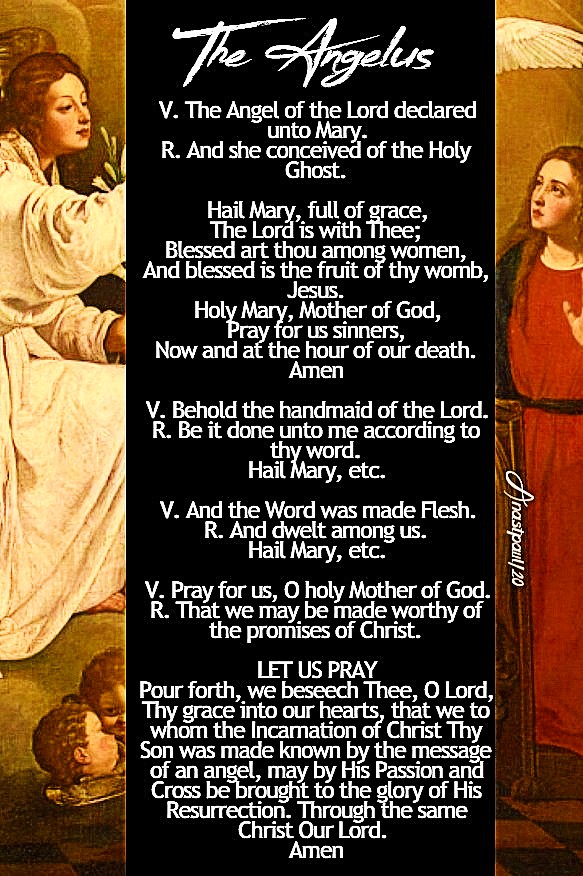
The Angelus
V. The Angel of the Lord declared unto Mary. R. And she conceived of the Holy Spirit. Hail Mary, full of grace, The Lord is with Thee; Blessed art thou among women, And blessed is the fruit of thy womb, Jesus. Holy Mary, Mother of God, Pray for us sinners, Now and at the hour of our death. Amen V. Behold the handmaid of the Lord. R. Be it done unto me according to thy word. Hail Mary, etc. V. And the Word was made Flesh. R. And dwelt among us. Hail Mary, etc. V. Pray for us, O holy Mother of God. R. That we may be made worthy of the promises of Christ. LET US PRAY Pour forth, we beseech Thee, O Lord, Thy grace into our hearts, that we to whom the Incarnation of Christ Thy Son was made known by the message of an angel, may by His Passion and Cross be brought to the glory of His Resurrection. Through the same Christ Our Lord. Amen
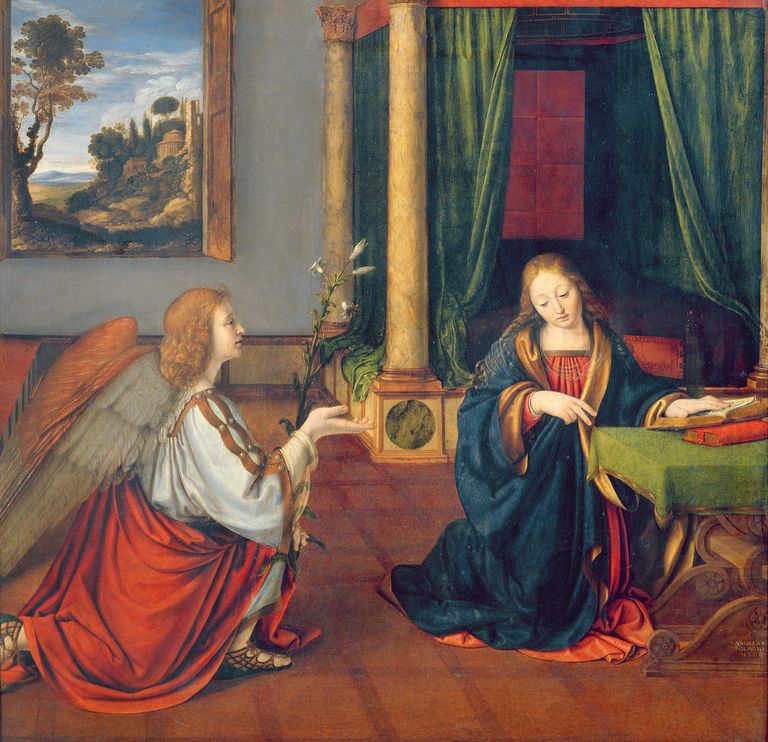
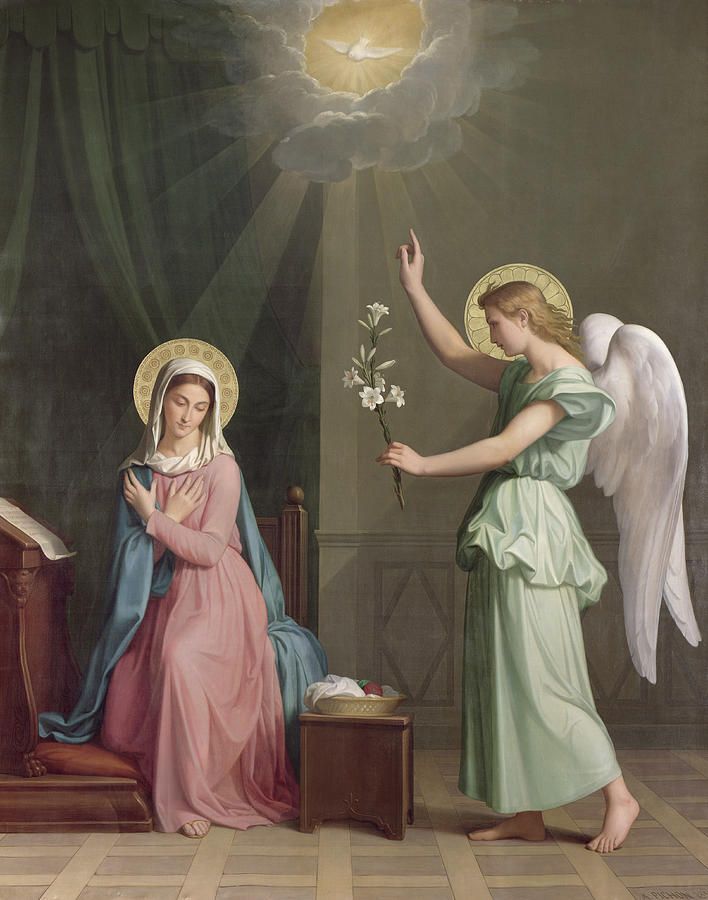
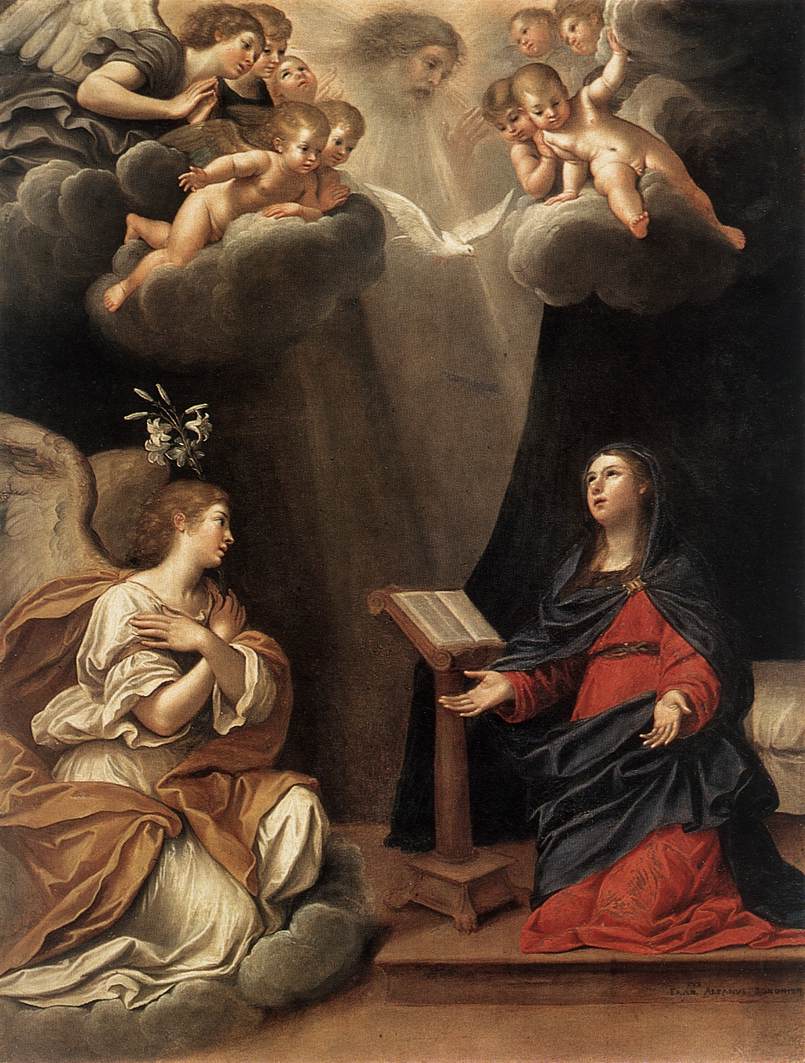
A tradition, which has come down from the apostolic ages, tells us that the great mystery of the Incarnation, was achieved on the twenty-fifth day of March. It was at the hour of midnight, when the most holy Virgin was alone and absorbed in prayer, that the Archangel Gabriel appeared before her and asked her, in the name of the Blessed Trinity, to consent to become the Mother of God. Let us assist, in spirit, at this wonderful interview between the angel and the Virgin: and, at the same time, let us think of that other interview which took place between Eve and the serpent. A holy Bishop and Martyr of the second century, Saint Irenaeus, who had received the tradition from the very disciples of the Apostles, shows us that Nazareth, is the counterpart of Eden.
In the garden of delights there is a virgin and an angel and a conversation takes place-between them. At Nazareth a virgin is also addressed by an angel and she answers him but the angel of the earthly paradise, is a spirit of darkness and he of Nazareth, is a spirit of light. In both instances, it is the angel that has the first word. ‘Why,’ said the serpent to Eve, ‘hath God commanded you, that you should not eat of every tree of paradise?’ His question implies impatience and a solicitation to evil, he has contempt for the frail creature to whom he addresses it but he hates the image of God, which is upon her.
See, on the other hand, the angel of light; see with what composure and peacefulness he approaches the Virgin of Nazareth, the new Eve and how respectfully he bows himself down before her: ‘Hail, full of grace! The Lord is with thee! Blessed art thou among women!’ Such language is evidently of heaven, none but an angel could speak thus to Mary.
Scarcely has the wicked spirit finished speaking than Eve casts a longing look at the forbidden fruit, she is impatient to enjoy the independence it is to bring her. She rashly stretches forth her hand, she plucks the fruit, she eats it and death takes possession of her: death of the soul, for sin extinguishes the light of life; and death of the body, which being separated from the source of immortality, becomes an object of shame and horror and finally, crumbles into dust.
But let us turn away our eyes from this sad spectacle and fix them on Nazareth. Mary has heard the angel’s explanation of the mystery, the will of heaven is made known to her and how grand an honour it is to bring upon her! She, the humble maid of Nazareth, is to have the ineffable happiness of becoming the Mother of God and yet, the treasure of her virginity is to be left to her! Mary bows down before this sovereign will and says to the heavenly messenger: ‘Behold the handmaid of the Lord, be it done unto me, according to thy word.’
Thus, as the great St Irenaeus and so many of the holy fathers remark, the obedience of the second Eve, repaired the disobedience of the first, for no sooner does the Virgin of Nazareth speak her fiat, ‘be it done,’ than the eternal Son of God (who, according to the divine decree, awaited this word) is present, by the operation of the Holy Ghost, in the chaste womb of Mary and there, He begins His human life. A Virgin is a Mother and Mother of God and it is this Virgin’s consenting to the divine will, that has made her conceive by the power of the Holy Ghost. This sublime mystery puts between the eternal Word and a mere woman, the relations of Son and Mother, it gives to the almighty God, a means whereby He may, in a manner worthy of His majesty, triumph over satan, who hitherto seemed to have prevailed against the divine plan.
Never was there a more entire or humiliating defeat than that which this day befell satan. The frail creature, over whom he had so easily triumphed at the beginning of the world, now rises and crushes his proud head. Eve conquers in Mary. God would not choose man for the instrument of His vengeance, the humiliation of satan would not have been great enough and, therefore, she who was the first prey of hell, the first victim of the tempter, is selected to give battle to the enemy. The result of so glorious a triumph is, that Mary is to be superior not only to the rebel angels but to the whole human race, yea, to all the angels of heaven. Seated on her exalted throne, she, the Mother of God, is to be the Queen of all creation. Satan, in the depths of the abyss, will eternally bewail his having dared to direct his first attack against the woman, for God has now so gloriously avenged her and, in heaven, the very Cherubim and Seraphim reverently look up to Mary and deem themselves honoured, when she smiles upon them, or employs them in the execution of any of her wishes, for she is the Mother of their God.
Therefore is it that we, the children of Adam, who have been snatched by Mary’s obedience from the power of hell, solemnise this day of the Annunciation. Well may we say of Mary, those words of Debbora, when she sang her song of victory over the enemies of God’s people: ‘The valiant men ceased and rested in Israel, until Debbora arose, a mother arose in Israel. The Lord chose new wars and He Himself, overthrew the gates of the enemies.’ Let us also refer to the holy Mother of Jesus, these words of Judith, who by her victory over the enemy was another type of Mary: ‘Praise ye the Lord our God, who hath not forsaken them that hope in Him. And by me, His handmaid, He hath fulfilled His mercy, which He promised to the house of Israel and He hath killed the enemy of His people, by my hand this night. . . . The almighty Lord hath struck him and hath delivered him into the hands of a woman and hath slain him.’
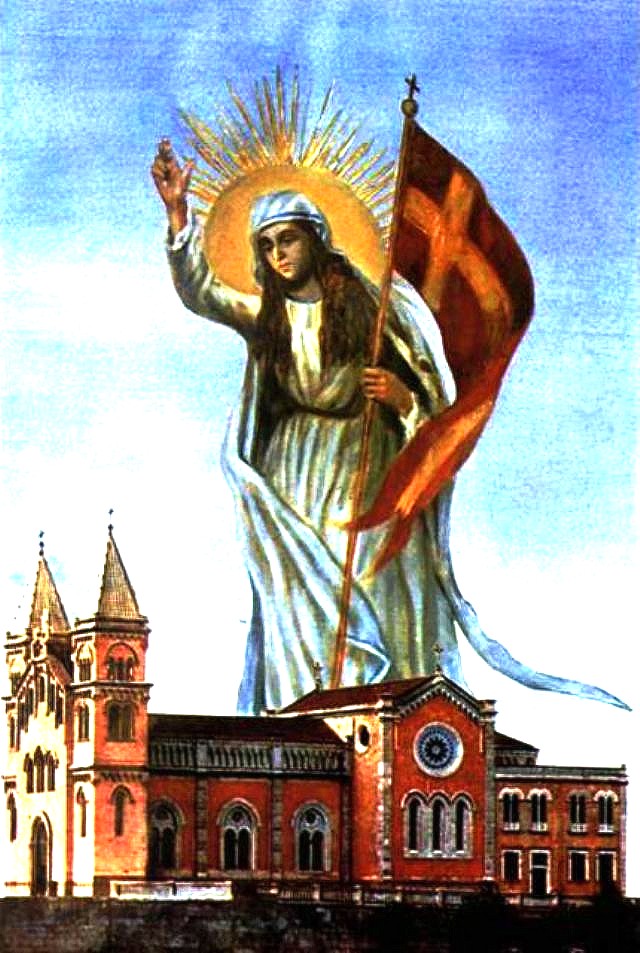
Our Lady of Betania: The name Betania means Bethany in Spanish. It was originally given this name by Maria Esperanza and was the site of their farm, in Venezuela. Apparitions of the Blessed Virgin Mary were reported and eventually a small Chapel was built there and the faithful began to gather, especially on Feast Days but throughout the year.
St Alfwold of Sherborne St Barontius of Pistoia St Desiderius of Pistoia St Dismas (Crucified with Jesus) “The Good Thief”
Bl Everard of Nellenburg Bl Herman of Zahringen St Hermenland St Humbert of Pelagius Bl James Bird Bl Josaphata Mykhailyna Hordashevska St Kennocha of Fife St Lucia Filippini St Marie-Alphonsine/Mariam Sultaneh Danil Ghattas (1843-1927) About St Marie-Alphonusine: https://anastpaul.com/2020/03/25/saint-of-the-day-25-march-st-marie-alphonsine-danil-ghattas-1843-1927/ St Matrona of Barcelona St Matrona of Thessaloniki St Mona of Milan St Ndre Zadeja Bl Pawel Januszewski St Pelagius of Laodicea Bl Placido Riccardi St Procopius St Quirinus of Rome Bl Tommaso of Costacciaro — 262 Martyrs of Rome: A group 262 Christians martyred together in Rome. We know nothing else about them, not even their names.
“When you lift up the Son of Man, then you will realise that I AM” – John 8:28
REFLECTION – “Isaiah the prophet describes an exalted vision for us: “I saw the Lord seated on a throne” (Is 6:1). What a wonderful sight, my brethren! Happy the eyes that saw it! Who would not want with all their heart, to behold the splendour of so great a glory? … Yet here, I am listening to that same prophet give us an account of a very different vision of the same Lord: “We saw Him; He had no beauty, no splendour – we took Him for a leper” (Is 53:2f. Vg.) (…)
And so, if you desire to see Jesus in His glory, try, first of all, to contemplate Him in His humiliation. Begin by gazing on the serpent raised up in the desert, (cf. Jn 3:14) if you wish to see the King seated on His throne. Let the first vision fill you with humility, so that the second, may raise you from your humiliation. Let the former, reprove and heal your pride, before the latter fulfils and satisfies, your desire. Do you see the Lord “emptied?” (Phil 2:7). Do not let this vision leave you untouched, or you will not be able to behold Him later on, in the glory of His exaltation, without anxiety.
“You will be like Him,” indeed, when you see Him “as He is” (1 Jn 3:2); so, be like Him now, as you see what He became for your sake. If you do not refuse to become like Him in His humiliation, He will certainly give you, the likeness of His glory in return. He will never allow someone who has shared His Passion, to be excluded from communion in His glory. So little does He refuse, to admit someone who has shared His Passion, into the Kingdom with Him, that the thief found himself in paradise that very day with Him because he confessed Him on the cross (Lk 23:42) … Yes indeed, “if we suffer with Him, we shall reign with Him” (Rm 8:17). – St Bernard (1091-1153) Cistercian Monk and Mellifluous Doctor of the Church – Sermon 1 for the first Sunday of November.
PRAYER – Holy Father, we have sinned against You and beg for Your forgiveness and mercy. Through the merits of the saving Cross of Your Son, help Your people O Lord, to persevere in obedience to Your will, so that through this obedience, we may reach our eternal home. May the eyes of our hearts, never cease contemplating the Holy Cross and following the way of its humiliation. We hope for the intercession of your angels and saints and our most loving Mother Mary. Through Christ, our Lord with the Holy Spirit, God forever, amen.
Our Morning Offering – 20 March – Saturday of the Fourth Week of Lent, Mary’s Saturday
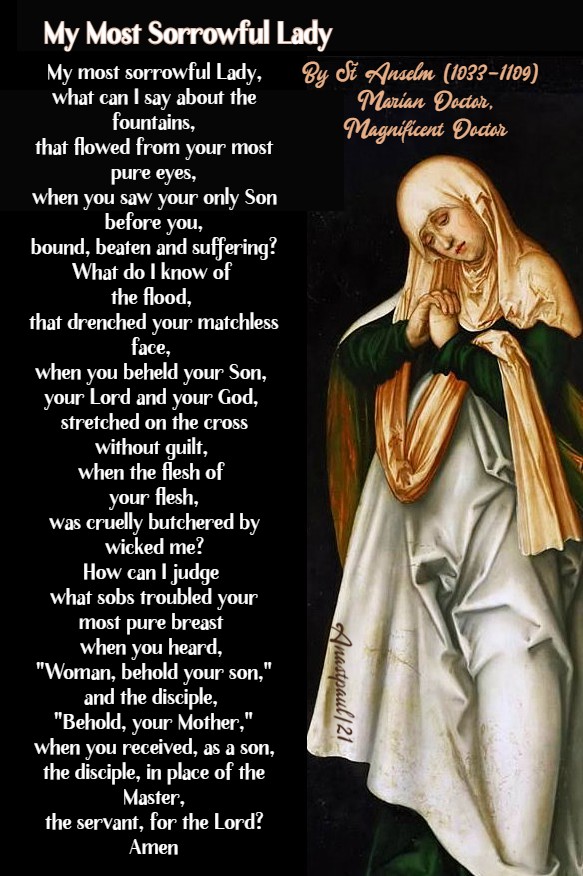
My Most Sorrowful Lady By St Anselm (1033-1109) Marian Doctor Magnificent Doctor
My most sorrowful Lady, what can I say about the fountains, that flowed from your most pure eyes, when you saw your only Son before you, bound, beaten and suffering? What do I know of the flood, that drenched your matchless face, when you beheld your Son, your Lord and your God, stretched on the cross without guilt, when the flesh of your flesh, was cruelly butchered by wicked me? How can I judge what sobs troubled your most pure breast when you heard, “Woman, behold your son,” and the disciple, “Behold, your Mother,” when you received, as a son, the disciple, in place of the Master, the servant, for the Lord? Amen
Solemnity of St Joseph, Spouse of the Blessed Virgin Mary – 19 March:
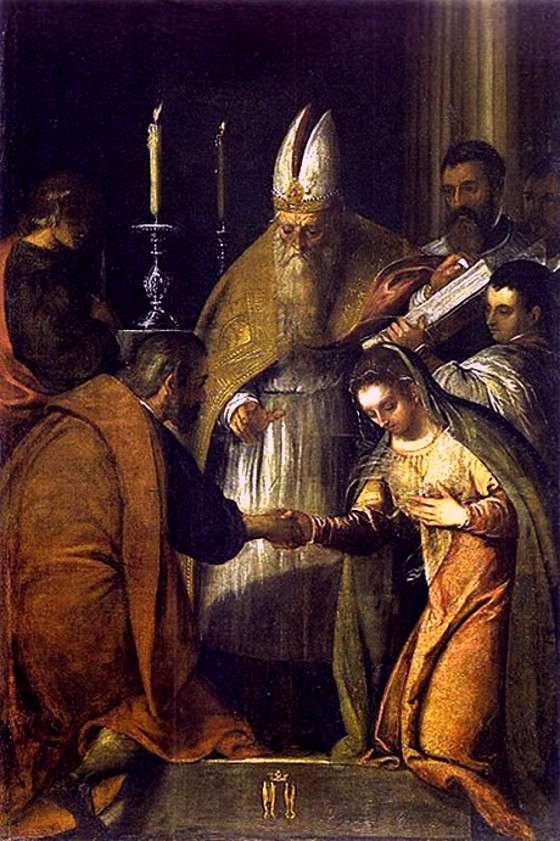
“All the unmarried men gathered in the temple and prayed to the Lord conjointly with the Priests, in order to be governed by the Holy Spirit in what they were about to do. The Most High spoke to the heart of the High Priest, inspiring him to place into the hands of each one of the young men, a dry stick, with the command that each ask his Majesty with a lively faith, to single out the one, whom He had chosen as the spouse of Mary. And as the sweet odour of her virtue and nobility, the fame of her beauty, her possessions and her modesty and her position as being the firstborn in her family, was known to all of them, each one coveted the happiness of meriting her as a spouse. Among them all, only the humble and most upright Joseph, thought himself unworthy of such a great blessing and remembering the vow of chastity, which he had made and resolving anew its perpetual observance, he resigned himself to God’s will, leaving it all to His disposal and being filled at the same time, with a veneration and esteem greater than that of any of the others, for the most noble maiden Mary. While they were thus engaged in prayer, the staff which Joseph held was seen to blossom and at the same time, a dove of purest white and resplendent with admirable light, was seen to descend and rest upon the head of the saint, while, in the interior of his heart, God spoke:
“Joseph, my servant, Mary shall be thy Spouse; accept Her with attentive reverence, for She is acceptable in my eyes, just and most pure in soul and body and thou, shalt do all that She shall say to Thee.”
At this manifestation and token from heaven, the Priests declared Saint Joseph as the Spouse selected by God Himself for the maiden Mary. Calling Her forth for her espousal, the chosen one issued forth like the sun, more resplendent than the moon, and She entered into the presence of all, with a countenance more beautiful than that of an angel, incomparable in the charm of her beauty, nobility and grace and the Priests espoused Her to the most chaste and holy of man, Saint Joseph.”
*From The City of God by Ven. Mary of Jesus of Agreda OIC (1602-1665) (a Franciscan abbess and spiritual writer, known especially for her extensive correspondence with King Philip IV of Spain and reports of her bilocation between Spain and its colonies in New Spain. She was a noted mystic of her era. A member of the Order of the Immaculate Conception, also known as Conceptionists, Mary of Jesus wrote 14 books, including a series of revelations about the life of the Blessed Virgin Mary. Ven Mary of Jesus’ body is incorrupt. Less than ten years after her death, Mary of Jesus was declared Venerable by Pope Clement X, in honour of her “heroic life of virtue.” Although the process of beatification was opened in 1673, it has not as yet been completed.)
St Adrian of Maastricht St Alkmund of Northumbria St Amantius of Wintershoven Bl Andrea Gallerani St Apollonius of Braga St Auxilius of Ireland Bl Clement of Dunblane St Colocer of Saint-Brieuc St Corbasius of Quimperlé St Cuthbert of Brittany St Gemus Blessed Isnard de Chiampo OP (Died 1244) Priest, known as the “Apostle of Pavia” Bl Jan Turchan St John the Syrian of Pinna St Lactali of Freshford St Landoald of Maastricht St Leontinus of Braga St Leontinus of Saintes Blessed Marcel Callo (1921-1945) Martyr Biography: https://anastpaul.com/2019/03/19/saint-of-the-day-19-march-blessed-marcel-callo-1921-1945-aged-23-martyr/
Bl Mark of Montegallo St Pancharius of Nicomedia Blessed Sibyllina Biscossi OP (1287-1367) Her Life: https://anastpaul.com/2020/03/19/saint-of-the-day-19-march-blessed-sibyllina-biscossi-op-1287-1367/ — Martyrs of Sorrento: A group of three sisters and a brother who were martyred together. We have little more than their names – Mark, Quartilla, Quintilla and Quintius. They were martyred in Sorrento, Italy, date unknown. Mark Quartilla Quintilla Quintius
Martyred in the Spanish Civil War • Blessed Alberto Linares de La Pinta • Blessed Jaume Trilla Lastra
Our Morning Offering – 13 March – Saturday of the Third week of Lent
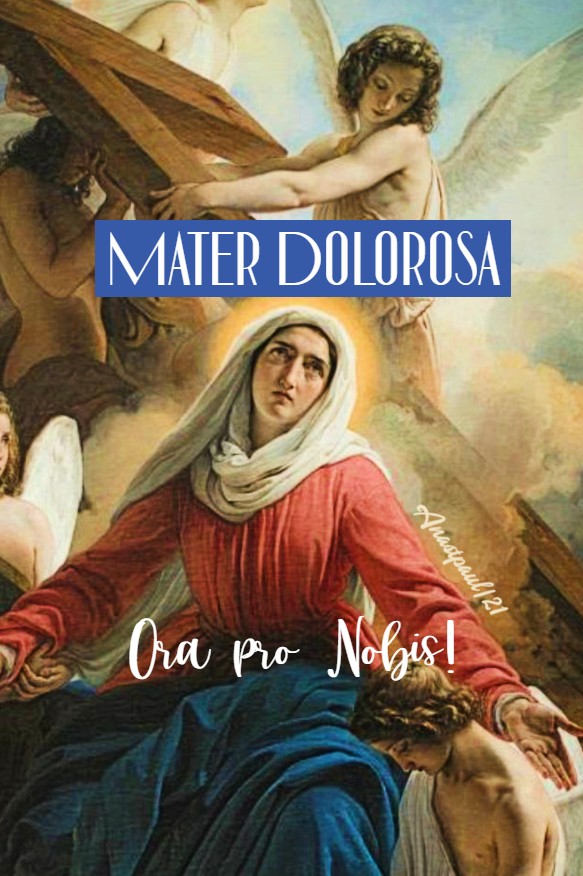
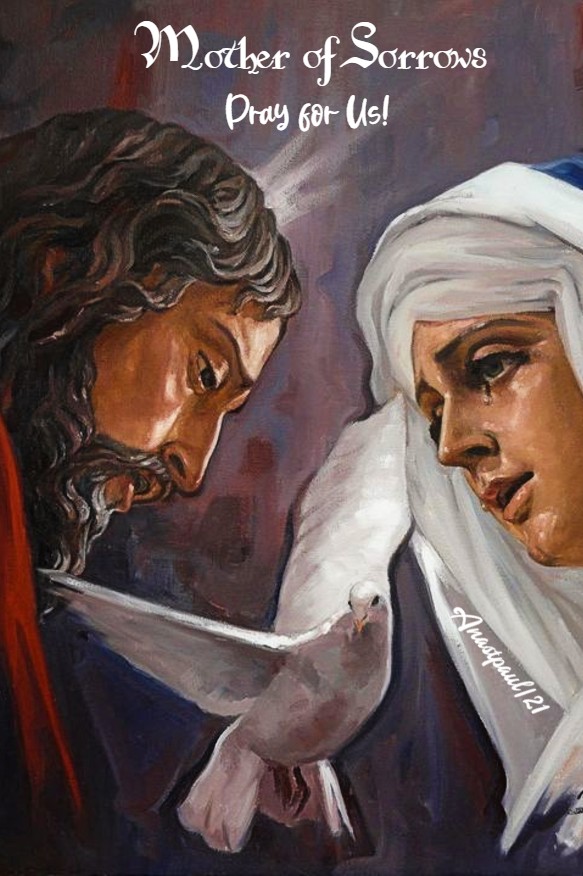
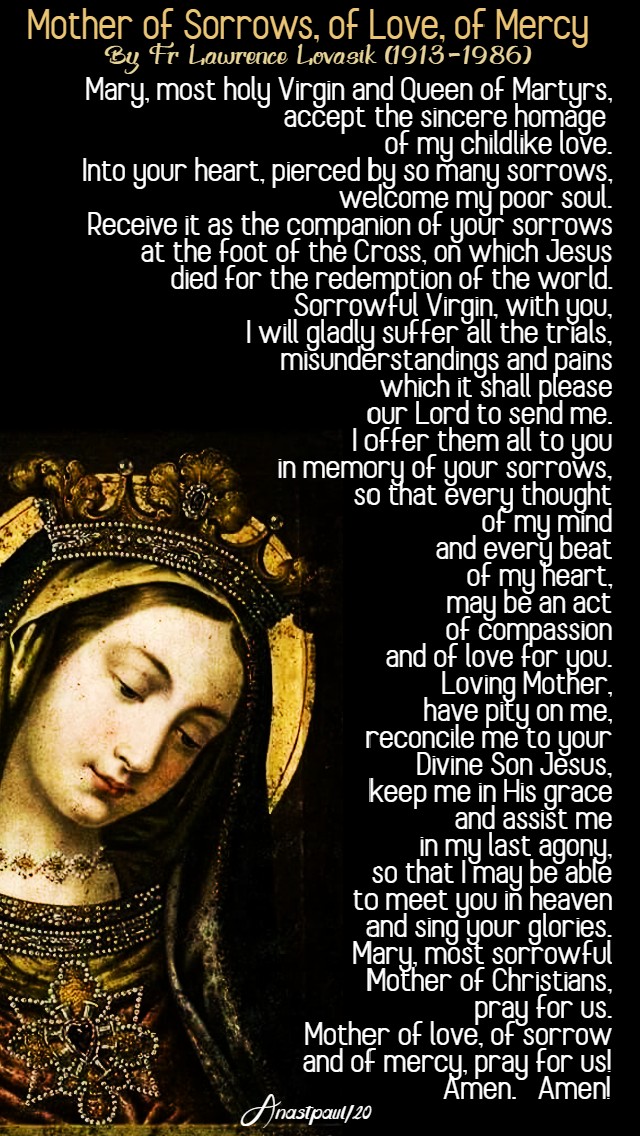
Mother of Sorrows, of Love, of Mercy By Fr Lawrence Lovasik SVD (1913-1986)
Mary, most holy Virgin and Queen of Martyrs, accept the sincere homage of my childlike love. Into your heart, pierced by so many sorrows, welcome my poor soul. Receive it as the companion of your sorrows at the foot of the Cross, on which Jesus died for the redemption of the world. Sorrowful Virgin, with you, I will gladly suffer all the trials, misunderstandings and pains which it shall please our Lord to send me. I offer them all to you in memory of your sorrows, so that every thought of my mind and every beat of my heart, may be an act of compassion and of love for you. Loving Mother, have pity on me, reconcile me to your Divine Son Jesus, keep me in His grace and assist me in my last agony, so that I may be able to meet you in heaven and sing your glories. Mary, most sorrowful Mother of Christians, pray for us. Mother of love, of sorrow and of mercy, pray for us! Amen. Amen!
Our Morning Offering – 27 February – Saturday of the First week of Lent, the Memorial of St Gabriel Francis Possenti of Our Lady of Sorrows (1838-1862) and a Marian Saturday
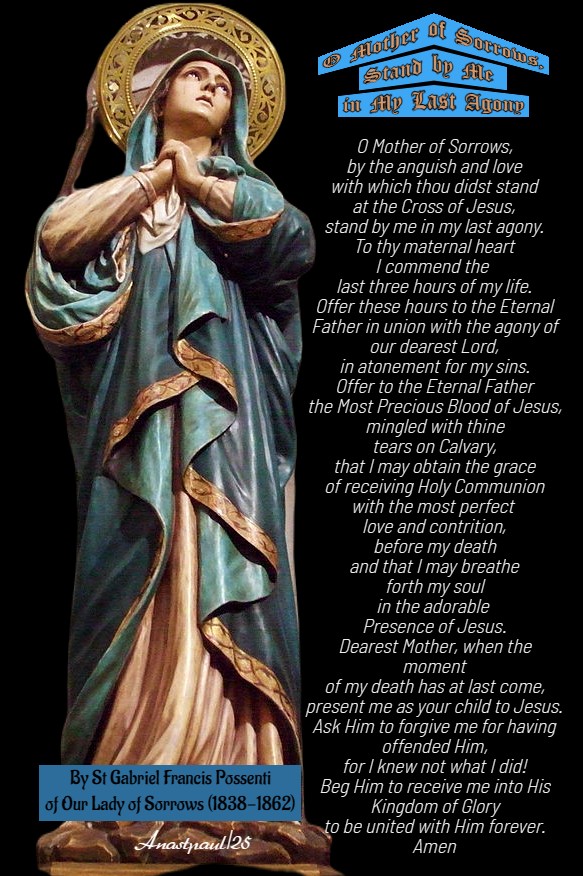
O Mother of Sorrows, Stand by Me in My Last Agony By St Gabriel Francis Possenti of Our Lady of Sorrows (1838-1862)
O Mother of Sorrows, by the anguish and love with which thou didst stand at the Cross of Jesus, stand by me in my last agony. To thy maternal heart I commend the last three hours of my life. Offer these hours to the Eternal Father in union with the agony of our dearest Lord, in atonement for my sins. Offer to the Eternal Father the Most Precious Blood of Jesus, mingled with your tears on Calvary, that I may obtain the grace of receiving Holy Communion with the most perfect love and contrition, before my death and that I may breathe forth my soul in the adorable Presence of Jesus. Dearest Mother, when the moment of my death has at last come, present me as your child to Jesus. Ask Him to forgive me for having offended Him, for I knew not what I did! Beg Him to receive me into His Kingdom of Glory to be united with Him forever. Amen
Thought for the Day – 11 February – Meditations with Antonio Cardinal Bacci (1881-1971)
The Power of Mary
“We should turn confidently to Mary, especially when we are tempted. She cannot allow us to offend her Jesus and to fall into the foils of the devil, as long as we pray to her with faith in her intercession. “The devil, as a roaring lion,” says St Peter, “goes about seeking someone to devour” (1 Peter 5:8). But, our Mother Mary is always by our side seeking to protect us. Let us entrust ourselves to her maternal care. Not only does Mary wish to help us, declares St Bonaventure but, those who do not pray to her, commit almost as great an offence, as those who openly insult her (In Spec Virg)!
Thought for the Day – 2 February – Meditations with Antonio Cardinal Bacci (1881-1971)
The Purification of Our Lady
“Today, the Church commemorates the Presentatio of the Child Jesus in the temple ad the Purification of the Blessed Virgin Mary. These ceremonies were carried out, in order to comply with a twofold Mosaic law. One part of this law referred to women who had become mothers; the other pat was concerned with first-born male children. According to the first law, a mother was officially regarded as impure for forty days after she had given birth to a child. When this period was over, she had to present herself in the temple and make an offering of a lamb and a turtledove. If she were poor, she could substitute a second young pigeon for the lamb (Cf Lev 12). The second law (Cf Es 13:2, 34:19; Num 8:16; Lev 27:26) commanded the mother to offer and consecrate to God, her first-born son. She was to do this in memory of the miracle in Egypt when the Angel of God destroyed all the first-born sons of the people of the country and spared those of the Israelites. In later times, when the ritual worship of God became the special obligation of the tribe of Levi, the first-born sons of the other tribes, had to be presented in the temple and bought back by an offering.
It is quite clear, that Jesus and Mary were not bound by this twofold law. But they voluntarily subjected themselves to it, in order to give an example of humility and obedience.”
Quote/s of the Day – 2 February – The Feast of the Purification of the Blessed Virgin and the Presentation of the Lord
“And inspired by the Spirit he came into the temple and when the parents brought in the child Jesus, to do for him according to the custom of the law, he took him up in his arms and blessed God ..…”
Luke 2:27-28
“We must be burning with love and radiant with good deeds and so take up Christ in our hands with Simeon. Could anyone hold up a lighted candle in his hands on this day, without at once remembering that old man, who on this same day, took up in his arms Jesus, God’s Word, clothed in flesh like a candle-flame clothed in wax and affirmed Him to be “the Light which would be a beacon for the Gentiles.”
Bl Guerric of Igny O.Cist (c 1080-1157)
“She, the holy Mother of God, must go to the Temple like other Hebrew mothers, as though she had lost something, which needed restoring by a legal sacrifice. He, that is the Son of God and Son of Man, must be treated in all things, as though He were a servant and be ransomed in common. with the poorest Jewish boy. Mary adores the will of God and embraces it with her whole heart. … She was in the Temple of Jerusalem, what she was in the house of Nazareth, when she received the Archangel’s visit; she was the Handmaid of the Lord.”
Servant of God Abbot Prosper Guéranger (1805-1875)
Thought for the Day – 1 February – Meditations with Antonio Cardinal Bacci (1881-1971)
The Holy Family – The Blessed Virgin Mary
“The Blessed Vigin Mary is the second model proposed for our imitation in the Holy Family. She is the purest and most beautiful creature ever fashioned by the Hand of God. As Mother of the Word Incarnate, her dignity touches the divine. Peserved from all stain of sin from the moment of her conception, she is full of grace. Except in God Himself, no greater beauty and holiness can be found elsewhere, than in Mary.
We do not read that Mary worked miracles, had ecstasies, or possessed any extraordinary external gifts. Her sanctity was completely internal. She trod the ordinary way of perfection, therefore, the way most easily imitated by us and, nevertheless, reached the highest peak of holiness. Since we are her devoted and affectionate children, let us ask her for the grace to follow her in the way of perfection and of complete resignation to the Will of God. Although, we may have to follow her from afar, let us follow with enthusiasm. As parents, let us imitate her holy, loving and obedient hand in the growth of our Saviour.”
Our Morning Offering – 30 January – Mary’s Saturday, as always
Into the Arms of Your Mercy By St Louis-Marie Grignion de Montfort (1673-1716)
Into the Arms of Your Mercy, O Mary, my Queen, I cast myself, into the arms of your mercy. I place my soul and body, in your blessed care and under your special protection from this world. I entrust to you, all my hopes and consolations, all my anguish and misery, my life and the end of my life. Through your most holy intercession and through your merits, grant that all my works may be directed and carried out, in accordance with your will and the will of your Divine Son. Amen
Our Morning Offering – 16 January – Saturday of the First week in Ordinary Time and the Feast of Our Lady, Refuge of Sinners (Spain)
Shelter Me Under Your Mantle Refuge of Sinners By St Alphonsus Liguori (1696-1787) Most Zealous Doctor
Most holy Virgin Immaculate, my Mother Mary, to you who are the Mother of my Lord, the Queen of the Universe, the Advocate, the hope, the refuge of sinners, I, who am the most miserable of all sinners, have recourse this day. I venerate you, great Queen and I thank you for the many graces you have bestowed upon me even unto this day, in particular for having delivered me from the hell which I have so often served by my sins. I love you, my dearest Lady and because of that love, I promise to serve you willingly forever and to do what I can, to make you loved by others also. I place in you all my hopes for salvation, accept me as your servant and shelter me under your mantle, you who are the Mother of Mercy. And since you are so powerful with God, deliver me from all temptations, or at least obtain for me the strength to overcome them until death. From you I implore a true love for Jesus Christ. Through you I hope to die a holy death. My dear Mother, by your love for Almighty God, I pray you to assist me always but most of all, at the last moment of my life. Forsake me not then, until you shall see me safe in heaven, there to bless you and sing of your mercies through all eternity. Such is my hope. Amen
Our Morning Offering – 15 January – The Feast of Our Lady of Banneux/Our Lady of the Poor (1933)
O Virgin of the Poor, Our Lady of Banneux Prayer of Monsignor Louis-Joseph Kerkhofs (1878-1962) Bishop of Liège at the time of the apparitions
O Virgin of the Poor, May you ever be blessed! And blessed be He Who deigned to send you to us. What you have been and are to us now, you will always be to those who, like us and better than us, offer their faith and their prayer. You will be all for us, as you revealed yourself at Banneux: Mediatrix of all graces, the Mother of the Saviour, Mother of God. A compassionate and powerful Mother who loves the poor and all people, who alleviates suffering, who saves individuals and all humanity, Queen and Mother of all Nations, who came to lead all those who allow themselves to be guided by you, to Jesus, the true and only Source of eternal life. Amen
“This is the time of fulfilment. The kingdom of God is at hand ”– Mark 1:15
REFLECTION – “After John had been arrested, Jesus came into Galilee ” According to our interpretation, John stands for the Law and Jesus the Gospel. Indeed, John says: “One mightier than I is coming after me …” (Mk 1:7) and elsewhere: “He must increase, I must decrease” (Jn 3:30): in this way he compares the Law with the Gospel. And afterwards he says: “I – that is, the Law – baptise you with water; he – that is the Gospel – will baptise you in the Holy Spirit” (Mk 1:8). And so, Jesus comes because John had been put in prison. In effect, the Law is finished, it has been brought to an end, it no longer has its former freedom. But we have passed from the Law to the Gospel …
“Jesus came to Galilee preaching the Gospel, the Good News of the Kingdom of God” … When I read the Law, prophets and psalms, I never heard them speak of the Kingdom of heaven, only in the gospel. For only when He came, of whom it is said “the Kingdom of God is in your midst” (Lk 17:21) that God’s Kingdom was thrown open … In fact, before the Saviour’s coming and the light of the Gospel, before Christ opened the gates of paradise with the thief (Lk 23:43), all holy souls descended to the place of the dead. Jacob himself said: “I will go down weeping and mourning to the nether world” (Gn 37:35) … In the Law, Abraham rests with the dead; in the Gospel, the thief is in paradise. We are not denigrating Abraham; we all want to rest in his bosom (Lk 16:23) but we prefer Christ to Abraham, the Gospel to the Law.
We read that after Christ’s Resurrection many saints appeared in the holy city (Mt 27:53). Our Lord and Saviour preached on earth and preached, too, to the underworld. He died and descended to hell to free the souls held captive there (1 Pt 3:18f.).” – St Jerome (347-420) Priest, Translator of Sacred Scripture, Father and Doctor of the Church – Homilies on Saint Mark’s Gospel, no.2A ; SC 494
PRAYER – Lord, be the beginning ad the end of all that we are and do and say. Prompty our actions with Your grace and complete them with Your all-powerful help. Let our hearts belong to You alone and make us Your obedient servants. By the intercession of the Blessed Mary our Hope and all the Saints and Angels, we make our prayer through Christ our Lord, amen.
Our Morning Offering – 5 January – Christmas Weekday and the Memorial of St Charles of Mount Argus CP (1821-1893)
Most Holy Virgin Mary, Oh, my Mother! By St Charles of Mount Argus (1821-1893)
Most Holy Virgin Mary, Oh, my Mother! How sweet it is to come to thy feet, imploring thy perpetual help! If earthly mothers cease not to remember their children, how can thou, the most loving of all mothers, forget me? Grant then, to me, I implore thee, thy perpetual help in all my necessities, in every sorrow and especially in all my temptations. As we are all thy children, I ask for thy unceasing help for all who are now suffering. Help the weak, cure the sick, convert sinners and console all earthly mothers who are now weeping over their children. Open the gates of heaven to those we loved upon earth and who are now suffering in purgatory. Obtain for us, dear Mother, that having earnestly invoked thee on earth, we may see thee, love thee and eternally thank thee, hereafter in heaven. Amen
St Charles of Mount Argus and St Gerlach, our Saint today, are both from the same Province in the Netherlands.
Thought for the Day – 1 January – Meditations with Antonio Cardinal Bacci (1881-1971)
Mary, Mother of God
“The near-infinite greatness of Mary, flows from the fact, that she is the Mother of God. The Eternal Word of the Father, consubstantial with Him in nature and equal to Him in majesty, willed to become man in order to set us free from the slavery of sin and to regain Heaven for us. He became man in the chaste womb of the Virgin Mary. He took a human body and soul and was born of her, as the God-Man. For this reason, there is attributed to His Divine Person, the title of Son of Mary and to Mary, the title of Mother of God.
There is a relationship between Mary and each of the three Divine Persons, for she is the daughter of God the Father, the spouse of the Holy Spirit by whose power the Word became incarnate in her and the mother of the Word made Man. She is, moreover, in the words of Dante, the “termine fisso di eterno consiglio” (Paradiso 33:1-3). In other words, she is the centre of the eternal plan which God established for the redemption of the human race. It was God’s eternal design to reunite creation to the Uncreated, by means of Mary. She became the mother of the Eternal Word, in whom the divine and human natures were indissolubly united. He redeemed us by His infinite merits but, in this work of redemption, He employed the co-operation of His holy Mother. All the graces, privileges and virtues of Mary, flow from this great mystery of her divine Motherhood. As befitted the future Mother of God, she was conceived free from the stain of original sin and full of grace. Her mortal life was a continuous ascent towards the highest peak of sanctity. When she died, she was assumed body and soul into Heaven, where she was crowned in glory, as Queen of Angels and Queen of Saints. When we consider the sublime nobility of Our Lady, we should be moved to love and venerate her. This love and veneration does not subtract in the slightest from God’s glory, because, she is the Mother of God. In fact, it is a great advantage to us, to imitate her and to call on her to intercede for us.”
Quote/s of the Day – 1 January – The Solemnity of Mary, Mother of God and the Octave Day of the Nativity of the Lord
“If anyone does not believe that Holy Mary is the Mother of God, such a one is a stranger to the Godhead.”
St Gregory of Nazianzen (330-390) Father & Doctor of the Church
“That anyone could doubt, the right of the holy Virgin to be called the Mother of God, fills me with astonishment. Surely, she must be the Mother of God, if our Lord Jesus Christ is God and she gave birth to Him!”
St Cyril of Alexandria (376-444) Father and Doctor
“Having confidence in you, O Mother of God, I shall be saved. Being under you protection, I shall fear nothing. With your help, I shall give battle to my enemies and put them to flight, for devotion to you, is an arm of Salvation.”
St John Damascene (676-749) Father and Doctor of the Church
“What shall we say, brethren? Is she not our mother? Certainly, brethren, she is in truth our mother. Through her we are born, not to the world but to God.”
But Mary kept all these things, pondering them in her heart. … Luke 2:19
REFLECTION – “Is not Mary the Mother of Christ? Then she is our Mother also. And we must in truth hold that Christ, the Word made Flesh, is also the Saviour of mankind. He had a physical body like that of any other man and again, as Saviour of the human family, He had a spiritual and mystical body, the society, namely, of those who believe in Christ. “We are many, but one sole body in Christ” (Rom. xii., 5). Now the Blessed Virgin did not conceive the Eternal Son of God, merely in order, that He might be made man taking His human nature from her but, also in order, that by means of the nature assumed from her, He might be the Redeemer of men. For which reason, the Angel said to the Shepherds: “To-day there is born to you a Saviour who is Christ the Lord” (Luke 2:11). Wherefore, in the same holy bosom of His most chaste Mother, Christ took to Himself flesh and united to Himself, the spiritual body formed by those who were to believe in Him. Hence Mary, carrying the Saviour within her, may be said to have also carried, all those whose life was contained in the life of the Saviour. Therefore, all we who are united to Christ and, as the Apostle says, are members of His body, of His flesh and of His bones (Eph 5:30), have issued from the womb of Mary, like a body united to it’s head. Hence, though in a spiritual and mystical fashion, we are all children of Mary and she is Mother of us all. … If then, the most Blessed Virgin is the Mother at once of God and men, who can doubt that she will work with all diligence to procure that Christ, Head of the Body of the Church (Col 1:18), may transfuse His gifts into us, His members and above all, that of knowing Him and living through Him (I John 4:9)?” – Saint Pius X (1835-1914) – Pope from 1903 to 1914 – Encyclical “Ad diem illum laetissimum” §10-11
PRAYER – God, our Father, since You gave mankind a Saviour through the blessed Mary, virgin and mother and a heavenly mother through our Saviour, grant that we may feel the power of her intercession, when she pleads for us with Jesus Christ, Your Son, the author of life, who lives and reigns with You and the Holy Spirit, God, forever and ever, amen.
Our Morning Offering – 1 January – The Solemnity of Mary, Mother of God and the Octave Day of the Nativity of the Lord
HailO Mary, Mother of God By St Cyril of Alexander (376-444) Doctor of the Incarnation Known as ‘The Pillar of Faith”
Hail, O Mary, Mother of God, Virgin and Mother! Morning Star, perfect vessel. Hail, O Mary, Mother of God, Holy Temple in which god Himself was conceived. Hail, O Mary, Mother of God, Chaste and pure dove. Hail, O Mary, Mother of God, Who enclosed the One who cannot be encompassed in your sacred womb. Hail, O Mary, Mother of God, From you flowed the true light, Jesus Christ, our Lord. Hail, O Mary, Mother of God, Through you the Conqueror and triumphant Vanquisher of hell came to us. Hail, O Mary, Mother of God, Through you, the glory of the Resurrection blossoms. Hail, O Mary, Mother of God, You have saved every faithful Christian. Hail, O Mary, Mother of God, Pray for us sinners now and at the hour of our death. Amen
Our Morning Offering – 31 December – The Seventh Day of the Octave of Christmas
The Angelus
V. The Angel of the Lord declared unto Mary. R. And she conceived of the Holy Spirit. Hail Mary, full of grace, The Lord is with Thee; Blessed art thou among women, And blessed is the fruit of thy womb, Jesus. Holy Mary, Mother of God, Pray for us sinners, Now and at the hour of our death. Amen V. Behold the handmaid of the Lord. R. Be it done unto me according to thy word. Hail Mary, etc. V. And the Word was made Flesh. R. And dwelt among us. Hail Mary, etc. V. Pray for us, O holy Mother of God. R. That we may be made worthy of the promises of Christ. LET US PRAY Pour forth, we beseech Thee, O Lord, Thy grace into our hearts, that we to whom the Incarnation of Christ Thy Son was made known by the message of an angel, may by His Passion and Cross be brought to the glory of His Resurrection. Through the same Christ Our Lord. Amen
The Angelus (/ˈændʒələs/; Latin for “angel”) is a Catholic devotion commemorating the Incarnation. As with many Catholic prayers, the name Angelus is derived from its incipit—the first few words of the text: Angelus Domini nuntiavit Mariæ (“The Angel of the Lord declared unto Mary”). The devotion is practised by reciting as versicle and response three Biblical verses narrating the mystery, alternating with the prayer “Hail Mary.” The Angelus exemplifies a species of prayers called the “prayer of the devotee.”
The devotion is traditionally recited three times daily: 06:00, 12:00 and 18:00. The Angelus is usually accompanied by the ringing of the Angelus bell, which is a call to prayer and to spread goodwill to everyone. The angel referred to in the prayer is Gabriel, a messenger of God who revealed to the Virgin Mary that she would conceive a child to be born, the Son of God (Luke 1:26–38) so honouring the Incarnation of the Saviour, Redeemer – our Messiah, Jesus the Christ.
The words of the prayer are arranged above for leader and community but, of course, most of us pray the prayer alone 3 times each day, for we are always united with each other in faith.
Saint of the Day – 27 December – St John the Apostle and Evangelist. Patronages – • against burns; burn victims• against epilepsy• against foot problems• against hailstorms• against poisoning• art dealers• authors, writers• basket makers• bookbinders• booksellers• butchers• compositors• editors• engravers• friendships• glaziers• government officials• harvests• lithographers• notaries• painters• papermakers• publishers• saddle makers• scholars• sculptors• tanners• theologians• typesetters• vintners• Asia Minor (proclaimed on 26 October 1914 by Pope Benedict XV)• 6 Diocese• 7 Cities.
The days following Christmas are full of symbolic meaning, as on 26 December we honour the first Martyr, St Stephen, who shed his blood for Jesus. 27 December, honours St John the Evangelist, the Disciple of Jesus who wrote the Gospel of John and the book of Revelation. Interestingly enough, he is the only Gospel writer to omit a narrative of Jesus’ birth. Based on this fact alone, it seems strange to include him during the Octave of Christmas. What is the Church’s reason behind this choice? Servant of God, Dom Prosper Guéranger in his Liturgical Year, points to St John’s pure chastity and his focus on the Divinity of Christ, as the reasons why he is honoured now at the Crib of Christ.
Dom Prosper Guéranger OSB (1805-1875)
The Disciple Whom Jesus Loved, the Eagle
“Nearest to Jesus’ Crib, after Stephen, stands John, the Apostle and Evangelist. It was only right, that the first place should be assigned to him, who so loved his God, that he shed his blood in his service; for, as this God Himself declares, greater love than this hath no man, that he lay down his life for his friends [1 John, 15:13] and Martyrdom has ever been counted, by the Church, as the greatest act of love and as having, consequently, the power of remitting sins, like a second Baptism. But, next to the sacrifice of Blood, the noblest, the bravest and, which most wins the heart of Him, who is the Spouse of souls, is the sacrifice of Virginity. Now, just as St Stephen is looked upon as the type of Martyrs, St John is honoured as the Prince of Virgins. Martyrdom won for Stephen the Crown and palm; Virginity merited for John most singular prerogatives, which, while they show how dear to God, is holy Chastity, put this Disciple among those, who, by their dignity and influence, are above the rest of men.
St. John was of the family of David, as was our Blessed Lady. He was, consequently, a relation of Jesus. This same honour belonged to St James the Greater, his Brother; as also to St James the Less and St Jude, both Sons of Alpheus. When our Saint was in the prime of his youth, he left, not only his boat and nets, not only has lather Zebedee but, even his betrothed, when everything was prepared for the marriage. He followed Jesus and never once looked back. Hence, the special love which our Lord bore him. Others were Disciples or Apostles, John was the Friend, of Jesus. The cause of this our Lord’s partiality, was, as the Church tells us in the Liturgy, that John had offered his Virginity to the Man-God. Let us, on this his Feast, enumerate the graces and privileges that came to St John from his being The Disciple whom Jesus loved.
This very expression of the Gospel, which the Evangelist repeats several times — The Disciple whom Jesus loved [John, 13:23, 19:26, 21:7, 21:20] — says more than any commentary could do. St Peter, it is true, was chosen by our Divine Lord, to be the Head of the Apostolic College and the Rock whereon the Church was to be built – he, then, was honoured most but St John was loved most. Peter was bid to love more than the rest loved and he was able to say, in answer to Jesus’ thrice repeated question, that he did love Him in this highest way and yet, notwithstanding, John was more loved by Jesus than was Peter himself, because his Virginity deserved this special mark of honour.
Chastity of soul and body brings him, who possesses i,t into a sacred nearness and intimacy with God. Hence it was, that at the Last Supper – that Supper, which was to be renewed on our Altars, to the end of the world, in order to cure our spiritual infirmities and give life to our souls – John was placed near to Jesus, nay, was permitted, as the tenderly loved Disciple, to lean his head upon the Breast of the Man-God. Then it was, that he was filled and from their very Fountain, with Light and Love, it was both a recompense and a favour and became the source of two signal graces, which make St John an object of special reverence to the whole Church.
Divine wisdom, wishing to make known to the world, the Mystery of the Word and commit to Scripture, those profound secrets, which, so far, no pen of mortal had been permitted to write — the task was put upon John. Peter had been crucified, Paul had been beheaded and the rest of the Apostles had laid down their lives in testimony of the Truths they had been sent to preach to the world; John was the only one left in the Church. Heresy had already begun its blasphemies against the Apostolic Teachings; it refused to admit the Incarnate Word as the Son of God, Consubstantial to the Father. John was asked by the Churches to speak and he did so in language heavenly above measure. His Divine Master had reserved to this, his Virgin-Disciple, the honour of writing those sublime Mysteries, which the other Apostles had been commissioned only to teach — THE WORD WAS GOD, and this WORD WAS MADE FLESH for the salvation of mankind.
Thus did our Evangelist soar, like the Eagle, up to the Divine Sun and gaze upon Him with undazzled eye, because his heart and senses were pure and, therefore, fitted for such vision of the uncreated Light. If Moses, after having conversed with God in the cloud, came from the divine interview with rays of miraculous light encircling his head – how radiant must have been the face of St John, which had rested on the very Heart of Jesus, in whom are hid all the treasures of wisdom and knowledge! [Col. 2:3] how sublime his writings! how divine his teaching! Hence, the symbol of the Eagle, shown to the Prophet Ezechiel, [Ezechiel 1:10, 10:14] and to St John himself in his Revelations, [Apoc. 4:7] has been assigned to him by the Church and, to this title of The Eagle has been added, by universal tradition, the other beautiful name of Theologian. This was the first recompense given by Jesus to his Beloved John, a profound penetration into divine Mysteries. The second was the imparting to him a most ardent charity, which was equally a grace consequent upon his angelic purity, for purity unburdens the soul from grovelling egotistic affections and raises it to a chaste and generous love. John had treasured up in his heart the Discourses of his Master, he made them known to the Church and, especially, that divine one of the Last Supper, wherein Jesus had poured forth His whole Soul to His own, whom he had always tenderly loved but most so, at the end [John, 13:1]. He wrote his Epistles and Charity is his subject – God is Charity — he that loveth not, knoweth not God — perfect Charity casteth out fear — and so on throughout, always on Love. During the rest of his life, even when so enfeebled by old age as not to be able to walk, he was forever insisting upon all men loving each other, after the example of God, who had loved them and so loved them! Thus, he that had announced more clearly than the rest of the Apostles the divinity of the Incarnate Word, was by excellence, the Apostle of that divine Charity, which Jesus came to enkindle upon the earth.
But, our Lord had a further gift to bestow and it was sweetly appropriate to the Virgin-Disciple. When dying on His cross, Jesus left Mary upon this earth. Joseph had been dead now some years. Who, then, shall watch over His Mother? who is there worthy of the charge? Will Jesus send His Angels to protect and console her? — for, surely, what man could ever merit to be to her as a second Joseph? Looking down, he sees the Virgin-Disciple standing at the foot of the Cross – we know the rest, John is to be Mary’s Son — Mary is to be John’s Mother. Oh! wonderful Chastity, that wins from Jesus such an inheritance as this! Peter, says St Peter Damian, shall have left to him the Church, the Mother of men; but John, shall receive Mary, the Mother of God, whom he will love as his own dearest Treasure and to whom, he will stand in Jesus’ stead; whilst Mary will tenderly love John, her Jesus’ Friend, as her Son.
The Blessed Virgin in the House of St John by Dante Gabriel Rossetti, 1859
Can we be surprised after this, that St John is looked upon by the Church as one of her greatest glories? He is a Relative of Jesus in the flesh; he is an Apostle, a Virgin, the Friend of the Divine Spouse, the Eagle, the Theologian, the Son of Mary; he is an Evangelist, by the history he has given of the Life of his Divine Master and Friend; he is a Sacred Writer, by the three Epistles he wrote under the inspiration of the Holy Ghost; he is a Prophet, by his mysterious Apocalypse, wherein are treasured the secrets of time and eternity. But, is he a Martyr? Yes, for if he did not complete his sacrifice, he drank the Chalice of Jesus [Matt. 20:22], when, after being cruelly scourged, he was thrown into a caldron of boiling oil, before the Latin Gate, at Rome. He was, therefore, a Martyr in desire and intention, though not in fact. If our Lord, wishing to prolong a life so dear to the Church, as well as to show how he loves and honours Virginity, — miraculously stayed the effects of the frightful punishment, St John had, on his part, unreservedly accepted Martyrdom.
Such is the companion of Stephen at the Crib, wherein lies our Infant Jesus. If the Protomartyr dazzles us with the robes he wears of the bright scarlet of his own blood — is not the virginal whiteness of John’s vestment fairer than the untrod snow? The spotless beauty of the Lilies of Mary’s adopted Son and the bright vermilion of Stephen’s Roses — what is there more lovely than their union? Glory, then, be to our New-Born King, whose court is tapestried with such heaven-made colours as these! Yes, Bethlehem’s Stable is a very heaven on earth and we have seen its transformation. First, we saw Mary and Joseph alone there — they were adoring Jesus in his Crib; then, immediately, there descended a heavenly host of Angels singing the wonderful Hymn; the Shepherds soon followed, the humble simple-hearted Shepherds; after these, entered Stephen the Crowned and John the Beloved Disciple; and, even before there enters the pageant of the devout Magi, we shall have others coming in and there will be, each day, grander glory in the Cave and gladder joy in our hearts. Oh! this Birth of our Jesus! Humble as it seems, yet, how divine! What King or Emperor ever received, in his gilded cradle, honours like these shown to the Babe of Bethlehem? Let us unite our homage with that given him by these the favoured inmates of his court. Yesterday, the sight of the Palm in Stephen’s hand animated us and we offered to our Jesus the promise of a stronger Faith: to-day, the Wreath, that decks the brow of the Beloved Disciple, breathes upon the Church the heavenly fragrance of Virginity — an intenser love of Purity must be our resolution and our tribute to the Lamb.
Know today that the Lord will come – in the morning you will see His glory.
“She will bear a son and you shall call his name Jesus, for he will save his people from their sins.” … Matthew 1:21
REFLECTION – “The heavens were glad, earth exulted when Mary gave birth and hell was troubled and aghast. The heavens in their joy produced a shining star and a glorious army of angels, uttering praise and saying: “Glory to God in the highest and on earth peace to people of good will.” (Lk 2:14) The earth, exulting, brought shepherds giving glory and magi adoring and offering gifts, gold, frankincense and myrrh. … Reflect how that night poured forth light in the darkness and instead of blackness, it offered radiance. It gave light before the sun arose and a brightness which, from its exceeding brilliance, obscured the splendour of the sun. Concerning this night the psalmist says: “Night is my light in my delights” and turning to the Lord he says: “The darkness will not be dark for you and the night will be as bright as the day, for the darkness is as light for him” (cf Ps 38[139]:11-12 LXX). … Taking up the newborn Emmanuel, Mary beheld a Light incomparably fairer than the sun and saw a Fire that water cannot quench. She received, in the covering of flesh Whom she had borne, the Light Who enlightens all things and she was worthy, to carry in her arms, the Word Who carries the universe!– St Amadeus of Lausanne (1108-1159) Bishop, Cistercian Monk – Homilies in praise of the Blessed Virgin Mary, IV, SC 72
PRAYER – Rejoice! Rejoice! Emmanuel Shall come to thee, O Israel! May the Lord bless us, protect us from all evil and bring us to everlasting life. Amen
Thought for the Day – 22 December – Meditations with Antonio Cardinal Bacci (1881-1971)
The Humility of Mary
“The profound humility of Mary was commensurate with her high dignity. As Dante put it, she was the humblest and noblest of creatures. “Umile ed altra piu che creatura” (Paradiso 33:2) None of the saints was humbler than Mary, just as none of them was greater. It was an Archangel who came down from Heaven and bowed before her as he praised her in the highest terms as “full of grace” and announced the unique dignity she was to receive as Mother of God. She bowed her head in turn and declared herself to be the handmaid of the Lord, ready to do His will in all things. Then she went to visit and congratulate her cousin, Elizabeth, because she had heard from the Angel that she was to be the mother of the Precursor. When she arrived at the house, she was greeted by Elizabeth with the words: “How have I deserved that the mother of my Lord should come to me?” Far from being flattered, however, Mary attributed all her glory to God and replied with the Magnificat, a hymn of praise and gratitude in God’s honour. It was the same when Jesus was born in the manger at Bethlehem. There was a sudden brightness in the sky and the angels sang “Glory to God in the highest and on earth, peace among men of goodwill.” But even though she held the Lord of Heaven and earth, in her arms, the Blessed Virgin asked for nothing for herself. Her only desire was to do the will of God. The love of Jesus was enough for her. She did not seek her own glory but the glory of God. Likewise, on the weary journey into Egypt, she was content because, she was with Jesus and in the obscure life of Nazareth, she desired no other treasure but Her divine Son. During His public life, she followed Him in silence. Once only she spoke in a submissive tone, in order to ask a favour for others but not for herself. It was at the wedding celebrations in Cana, when she asked for the first miracle, in such a way, that it was not even apparent that it was she who had wrung the favour from the filial heart of Jesus. It was always like that, up to the time of Calvary and the Resurrection, the Ascension and Pentecost. She remained humbly in the background all the time. Now, after her departure from this earth, her humility has been gloriously crowned in the dogma of the Assumption and in her Coronation as Queen of Angels and of Saints.”
Quote/s of the Day – 22 December – Tuesday of the Fourth Week of Advent, O Rex Gentium/O King of all Nations, Readings: 1 Samuel 1:24-28, 1 Samuel 2:1, 4-5, 6-7, 8, Luke 1:46-56
“Mary said: My soul proclaims the greatness of the Lord, my spirit rejoices in God my Saviour.” – Luke 1:46-47
“The Lord has exalted me by a gift so great, so unheard of, that language is useless to describe it and the depths of love in my heart can scarcely grasp it. I offer then all the powers of my soul in praise and thanksgiving. As I contemplate His greatness, which knows no limits, I joyfully surrender my whole life, my senses, my judgment, for my spirit rejoices in the eternal Godhead of that Jesus, that Saviour, whom I have conceived in this world of time.”
“Those who refuse to be humble cannot be saved. They cannot say with the prophet: See, God comes to my aid; the Lord is the helper of my soul. But anyone who makes himself humble, like a little child, is greater in the kingdom of heaven.”
St Bede the Venerable (673-735) Father and Doctor of the Church
You must be logged in to post a comment.