Quote/s of the Day – 15 July – Fifteenth Sunday of the Year – the Memorial of St Bonaventure (1221-1274) – Seraphic Doctor
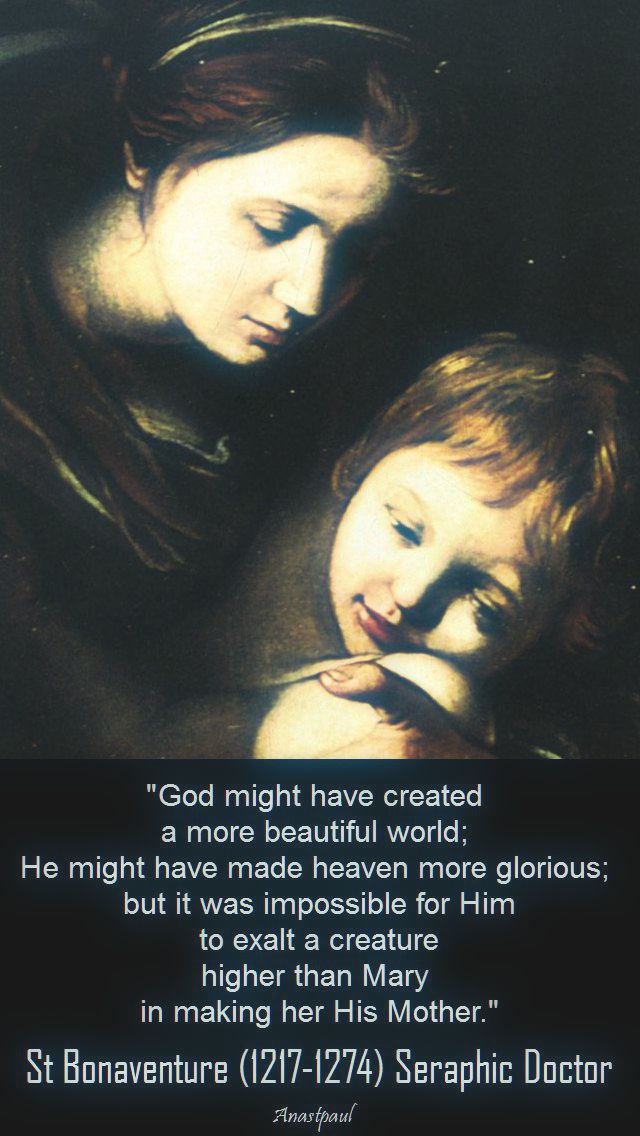
“God might have created a more beautiful world; He might have made heaven more glorious; but it was impossible for Him to exalt a creature higher than Mary in making her His Mother.”
“When we pray, the voice of the heart must be heard, more than that, proceeding from the mouth.”
“Although you feel tepid, approach with confidence, for the greater your infirmity, the more you stand in need of a physician.”
“Every creature is a divine word because it proclaims God.”
“Christ has something in common with all creatures. With the stone He shares existence, with the plants He shares life, with the animals He shares sensation and with the angels He shares intelligence. Thus all things are transformed in Christ since in the fullness of His nature, He embraces some part of every creature.”
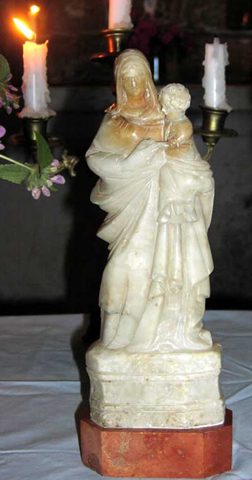
Our Lady of Dromon: Saint-Geniez, Alpes de Haute-Provence, Provence-Alpes-Côte d’Azur, France
In 1656, about 2.5 miles from the alpine village of Saint-Geniez, as 12-year-old herder Honoré was praying before a wooden cross on a stone mound, he heard the voice of the Blessed Virgin asking him to dig there to uncover chapels dedicated to her long ago. Excavations on the mountain located a crypt chapel dating back to around 1000, on the site of the ancient city of Theopolis. The upper chapel holds an alabaster statue of the Virgin and Child from the 1600s. The annual pilgrimage takes place on Bastille Day, 14 July.
Bl Angelina di Marsciano
Bl Boniface of Canterbury
St Colman of Killeroran
St Cyrus of Carthage
St Deusdedit of Canterbury
St Donatus of Africa
Bl Dorotea Llamanzares Fernández
St Francis Solano
Bl Giorgio of Lauria
Bl Hroznata of Bohemia
Bl Humbert of Romans
St Idus of Ath Fadha
St Ioannes Wang Kuixin
St Just
St Justus of Rome
St Kateri Tekakwitha (Optional Memorial USA)
St Liebert
St Marchelm
Bl Michael Ghebre
St Optatian of Brescia
St Papias of Africa
Bl Toscana of Verona
St Ulric of Zell
Bl Anne-Andrée Minutte
St Arno of Würzburg
Bl Barthélemy Jarrige de la Morelie de Biars
Bl Berthold of Scheide
St Clelia Barbieri (1847-1870)
St Dogfan
Bl Élisabeth Verchière
St Emanuele Lê Van Phung
St Esdras the Prophet
St Eugene of Carthage
Bl Ferdinand Mary Baccilleri
St Iosephus Wang Kuiju
Bl James of Voragine
Bl Jean of France
St Joel the Prophet
Bl Louis-Armand-Joseph Adam
Bl Mariano de Jesus Euse Hoyos (1845-1926)
Bl Marie-Anastasie de Roquard
Bl Marie-Anne Depeyre
Bl Marie-Anne Lambert
St Mildred of Thanet
St Muritta of Carthage
St Myrope
St Paulus Liu Jinde
St Salutaris of Carthage
St Sarra of Egypt
St Serapion of Alexandria
Serapion of Macedonia
Bl Thérèse-Henriette Faurie
Bl Thomas Tunstal
St Turiaf
—
Martyrs of Cyprus – 300 saints: 300 Christians who retired to Cyprus to live as cave hermits, devoting themselves to prayer and an ascetic life devoted to God. Tortured and martyred for their faith and their bodies dumped in the various caves in which they had lived. We know the names of five of them but no other details even about them – Ammon, Choulélaios, Epaphroditus, Eusthénios and Héliophotos. They were beheaded in the 12th century on Cyprus and their bodies dumped in the cave where they had lived and only rediscovered long afterwards.
Martyrs of Philomelio – 31 saints: 31 soldiers martyred for their faith in the persecutions of prefect Magno, date unknown. The only name that has come down to us is Alexander. In Philomelio, Phrygia (in modern Turkey).
Our Morning Offering – 7 July – The Memorial of Maria Romero Meneses F.M.A. (1902-1977)
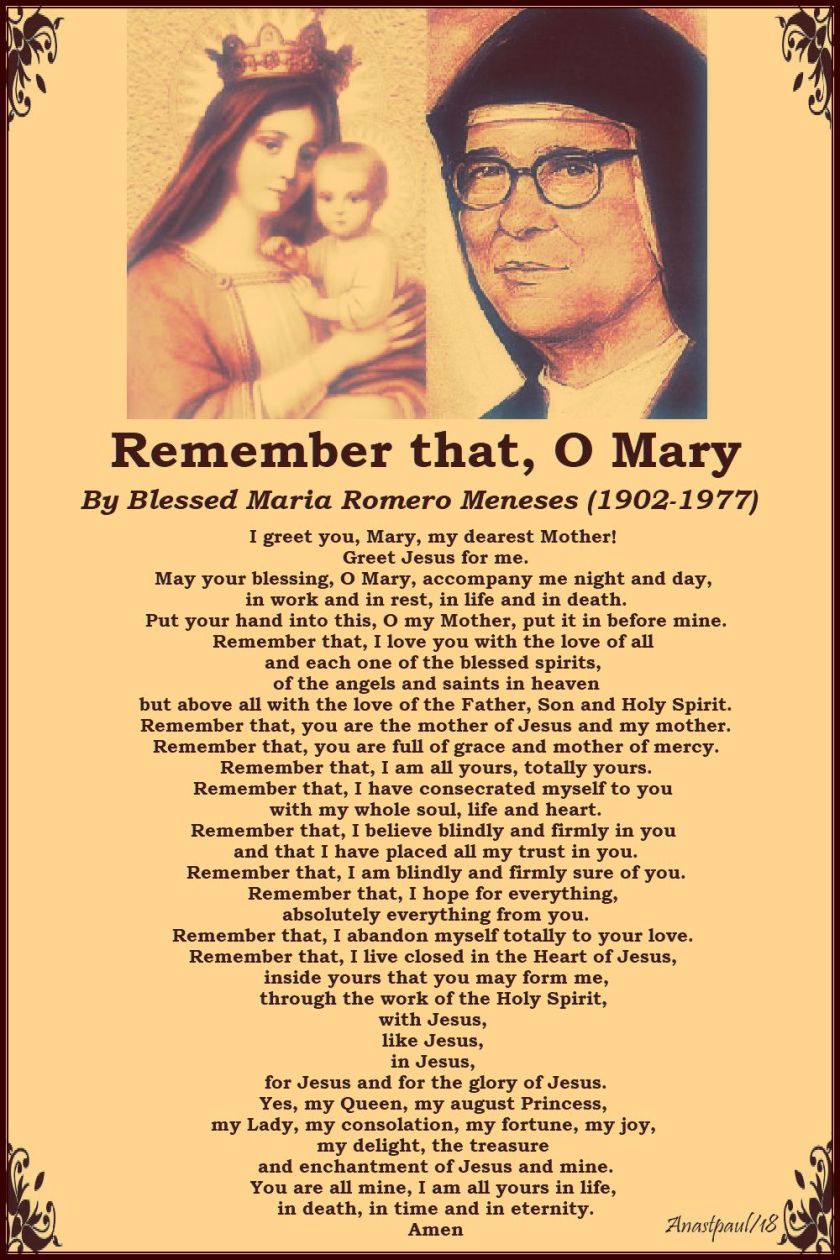
Remember that, O Mary By Blessed Maria Romero Meneses (1902-1977)
I greet you, Mary, my dearest Mother!
Greet Jesus for me.
May your blessing, O Mary, accompany me night and day,
in work and in rest, in life and in death.
Put your hand into this, O my Mother, put it in before mine.
Remember that, I love you with the love of all
and each one of the blessed spirits,
of the angels and saints in heaven
but above all with the love of the Father, Son and Holy Spirit.
Remember that, you are the mother of Jesus and my mother.
Remember that, you are full of grace and mother of mercy.
Remember that, I am all yours, totally yours.
Remember that, I have consecrated myself to you
with my whole soul, life and heart.
Remember that, I believe blindly and firmly in you
and that I have placed all my trust in you.
Remember that, I am blindly and firmly sure of you.
Remember that, I hope for everything,
absolutely everything from you.
Remember that, I abandon myself totally to your love.
Remember that, I live closed in the Heart of Jesus,
inside yours that you may form me,
through the work of the Holy Spirit,
with Jesus,
like Jesus,
in Jesus,
for Jesus and for the glory of Jesus.
Yes, my Queen, my august Princess,
my Lady, my consolation, my fortune, my joy,
my delight, the treasure
and enchantment of Jesus and mine.
You are all mine, I am all yours in life,
in death, in time and in eternity.
Amen
Quote/s of the Day – 28 June – The Memorial of St Irenaeus of Lyons (c 135 – c 202) Father of the Church
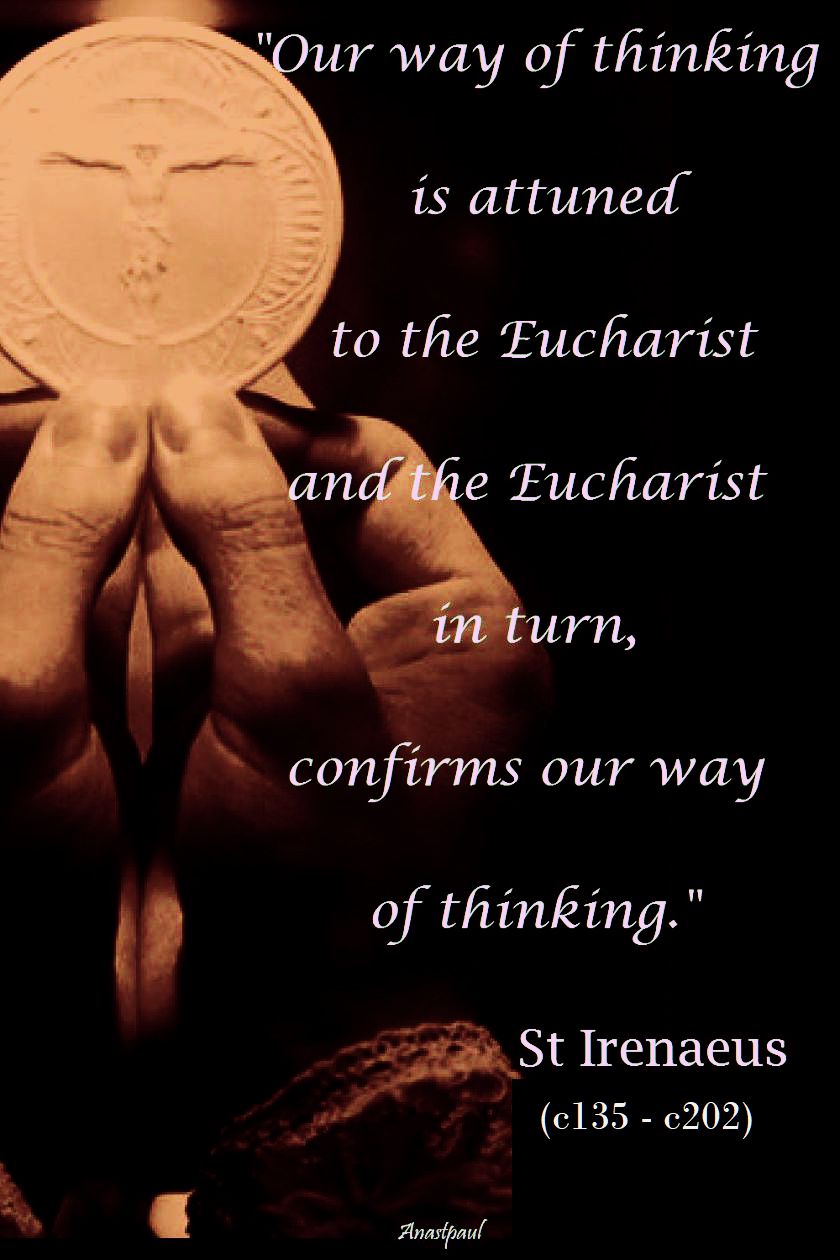
“Our way of thinking, is attuned to the Eucharist and the Eucharist in turn, confirms our way of thinking.”
“Jesus Christ, in His infinite love, has become what we are, in order that He may make us entirely what He is.”
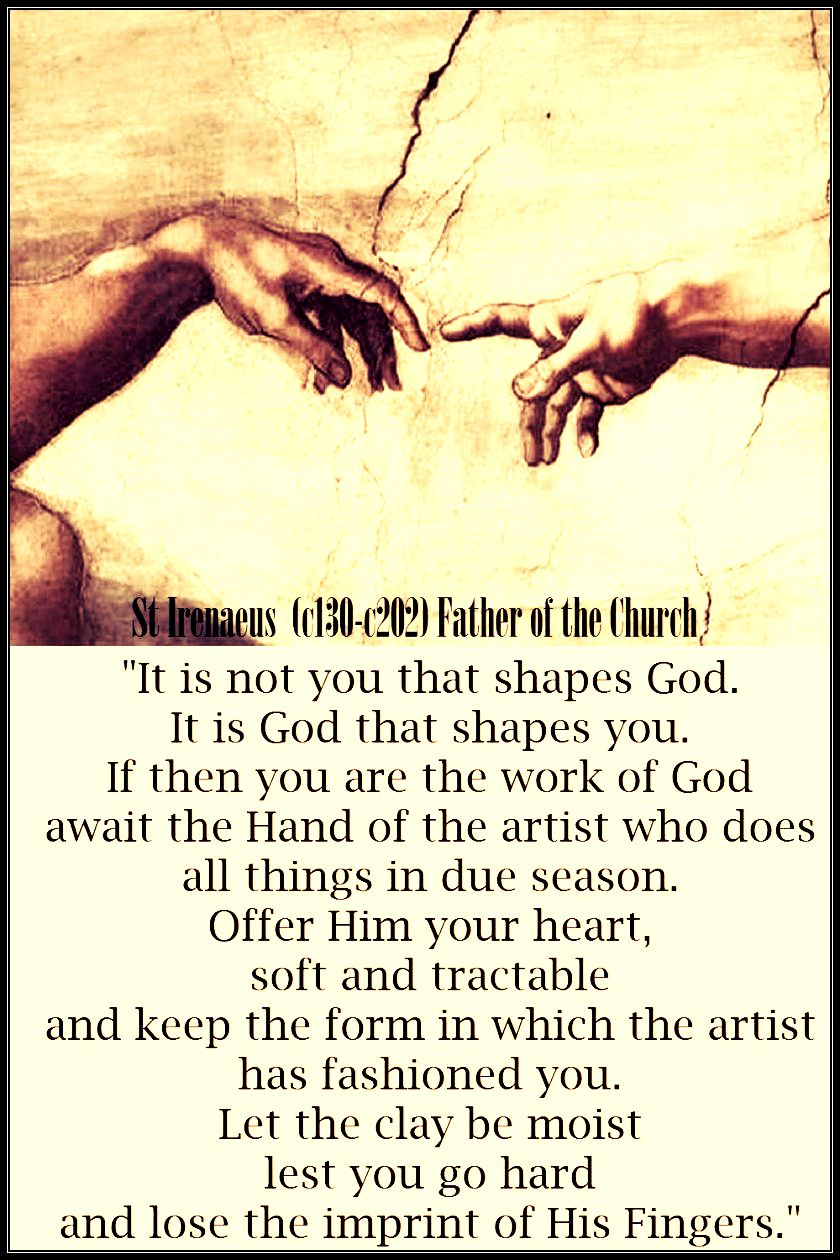
“It is not you that shapes God. It is God that shapes you. If then you are the work of God await the Hand of the artist who does all things in due season. Offer Him your heart, soft and tractable and keep the form in which the artist has fashioned you. Let the clay be moist lest you go hard and lose the imprint of His Fingers.”
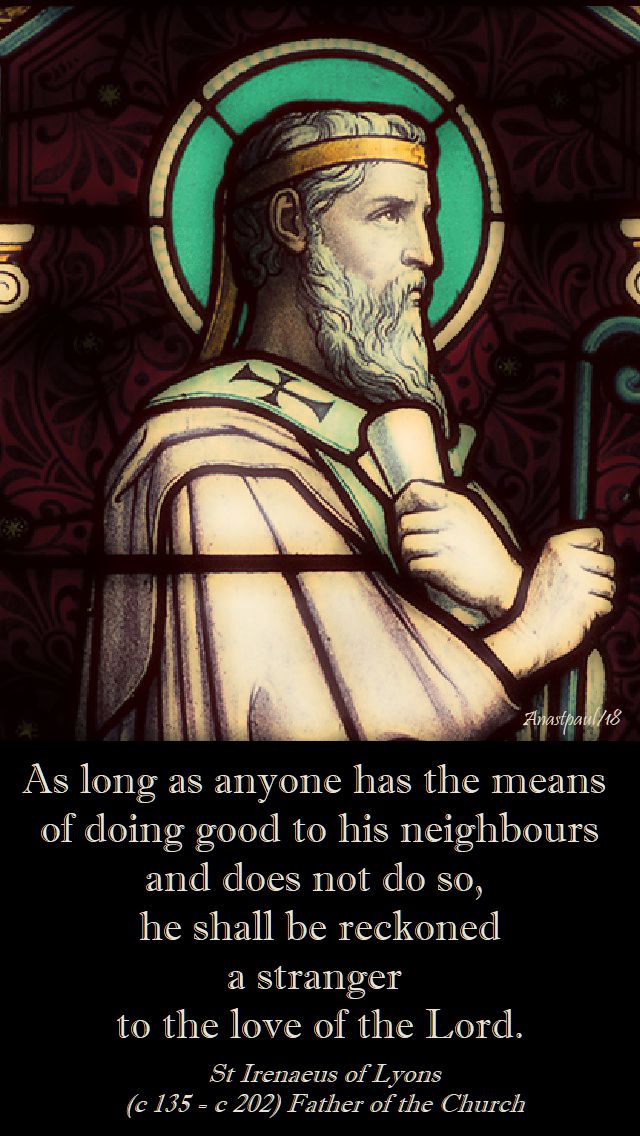
“As long as anyone has the means of doing good to his neighbours and does not do so, he shall be reckoned a stranger to the love of the Lord.”
The business of the Christian is nothing else but to be ever preparing for death.
“The universal Church, that is, the faithful everywhere, must be in agreement with this Church because of her outstanding superiority.”
“Being obedient she (Mary) became the cause of salvation for herself and for the whole human race. The knot of Eve’s disobedience was untied by Mary’s obedience: what the virgin Eve bound through her disbelief, Mary loosened by her faith.”
Thought for the Day – 27 June – The Feast of Our Lady of Perpetual Succour ( Under the Protection of the Redemptiorists – CSsr)
An artist about to paint an icon prepares himself spiritually by prayer, confession, Holy Communion and sometimes fasting. He prays even while painting, for he sees himself as an instrument of the Holy Spirit, the principal artist, Who will use the icon as an instrument to channel graces to those who reverence it and pray before it. In most cases, the artist does not even sign his name to his work.
In Western art, there is little difference in the styles used in sacred art as compared to secular art; only the subject matter is different. Icons, however, are not meant to be realistic as far as physical representation, but rather to portray eternal truths in a way that immediately transports the viewer to a spiritual plane. Perhaps the simplest way to describe it is as theology in line and colour. The images are rendered in an extremely stylised, non-naturalistic way. The folds of garments appear as simple geometric forms, while faces and bodies show portray human nature transformed by grace into the divine.
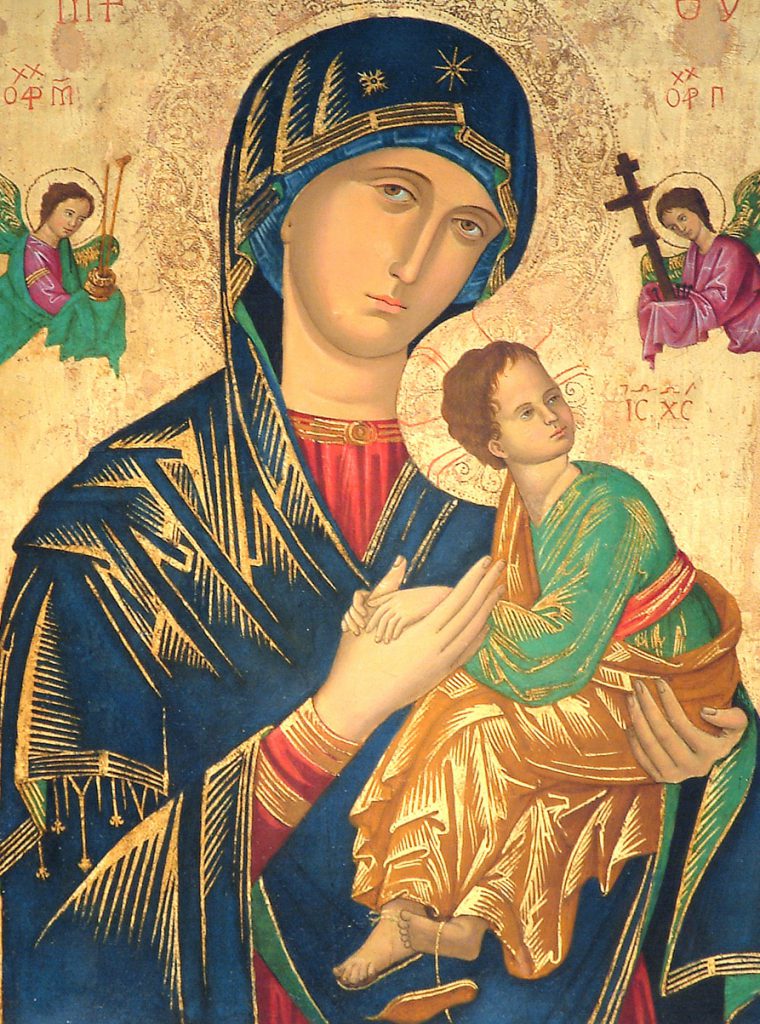
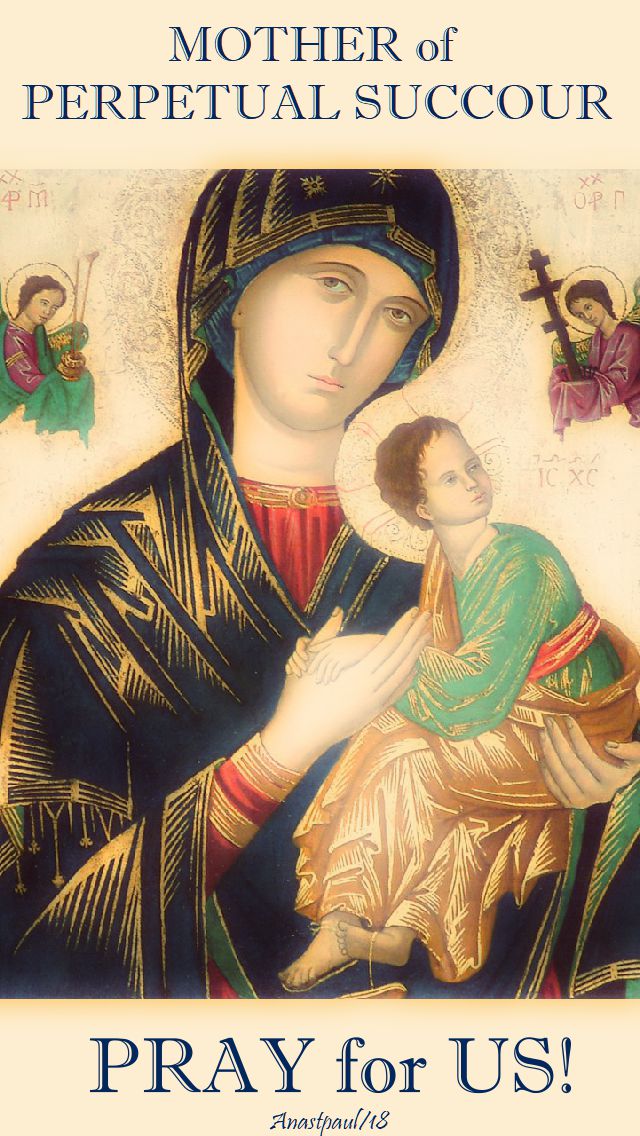
In the icon of Our Mother of Perpetual Help, the Child Jesus is not portrayed with the physical proportions of an infant but appears almost as an adult in miniature form. This has been interpreted to indicate that He is God, having infinite knowledge. Yet He is human as well, for He clings to His Mother’s hand in fear, while gazing up toward the angel over His shoulder. One of His sandals has come loose, indicating the haste with which He had run to her.
Why is the Child Jesus so frightened? The angels in the picture are holding instruments of His Passion and death, with the angel on the left bearing the gall, the lance and the reed, while the angel on the right holds the cross and nails. Their hands are covered with a cloth or veil, much like the humeral veil that the priest holds when blessing with the Blessed Sacrament in the monstrance at Benediction.
The face of Our Lady is grave and sorrowful, with her large eyes directed not at Jesus, but at us. One feels that she is pleading with us to avoid sin, which has caused her Son to suffer so much for us. Her gaze makes us a part of the picture and the pain it portrays. “Will you not love my Son, Who has loved you so much?” she seems to say.
Our Lady is clothed in the colours of royalty; her tunic is of dark red and her mantle is dark blue with a green lining. (According to another interpretation, the dark red is said to be the colour worn by virgins at the time of Christ, while blue was the colour worn by mothers in Palestine.) The Child Jesus also wears the colours of royalty. Both Jesus and Mary have golden halos, but Christ’s halo is decorated with a cross as a sign of His Divinity and Passion. Jewelled crowns were placed on the heads of both Mother and Child of the original icon by order of the Vatican in 1867. (The crowns were removed when the icon underwent restoration in the 1990’s.)
The Greek initials next to the head of Our Lady identify her as “Mother of God,” while those next to the Child are the abbreviation for “Jesus Christ.” The letters over the angels’ heads indicate the one on the left as St Michael and the one on the right as S. Gabriel.
The 8-pointed star on Our Lady’s veil tells us that she is the Star of the Sea, the Star that leads us to Jesus. The small ornate cross to the left of the star reinforces this concept.
Mary’s mouth is small to indicate her spirit of silence and prayer. Her eyes are large, for they see all of our troubles and needs and are always turned toward us.
Christ’s hands, turned palms down into His Mother’s, indicate that He has placed the graces of the Redemption in her keeping. Our Lady’s hand does not clasp those of her Son but remains open, inviting us to put our hands in hers along with those of Jesus.
As in other icons, the background of the painting is gold to symbolize Heaven, where Jesus and Mary now reign in glory. This light of Heaven shines through their clothing, illuminating not only the picture itself but those who behold it. This radiance speaks to us of God’s light and grace, strengthening and consoling us as we journey through life to our heavenly goal.
Finally, it is of no small significance that Our Blessed Mother herself referred to the icon by the title of “Holy Mary of Perpetual Succour.” Surely this, along with the symbolism we see in the picture, should assure us of the loving concern and tenderness our Blessed Mother has for us and her ardent desire to be a source of perpetual help to all who call upon her.
In answer to Pope Pius IX’s injunction to “make her known,” the Redemptorists commissioned several artists to paint copies of the original icon. More than 2,300 such copies, similarly touched to the original, have been sent to other houses of the order around the world. Pope Pius IX also received a copy, which he enshrined in his private chapel and was often seen kneeling before it in prayer. (Excerpt from Sister Mary Agatha, CMRI)
Part of the tradition is that Mary had made it clear that she wished her image to be situated between the great basilicas of St John Lateran (the Pope’s Cathedral) and St Mary Major, her own basilica. For the best part of 300 years from the year 1500, it was famous for the many miracles and graces granted to those who made the pilgrimage to the church of St Matthew on the Via Merulana, which was destroyed during the Napoleonic war.
In January 1855, the Redemptorist priests purchased Villa Caserta in Rome along the Via Merulana and converted it into their headquarters. Without realising it, the property they had purchased was once the church and monastery of Saint Matthew, the site which the Virgin reportedly chose as the icon’s shrine.
Decades later, Pope Pius IX invited the Redemptorist Fathers to set up a Marian house of veneration in Rome, in response to which the Redemptorists built the Church of St Alphonsus Liguori at that location. The Redemptorists were thus established on the Via Merulana, not knowing that it had once been the site of the Church of San Matteo and shrine of the once-famous icon.
Mother of Perpetual Succour, Pray for us!
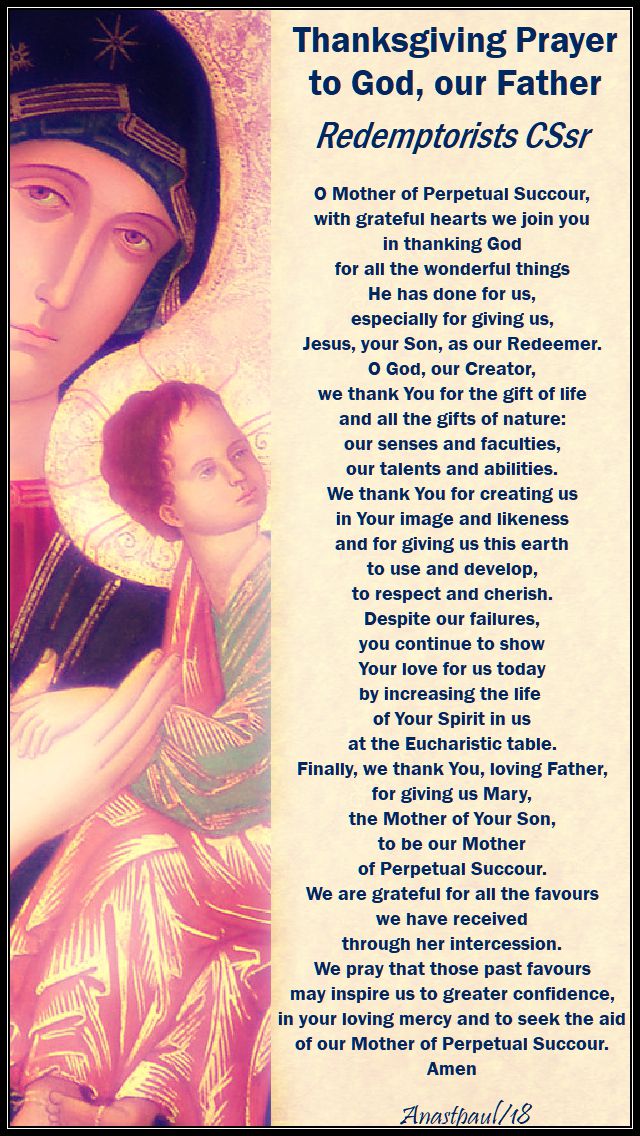
THANKSGIVING PRAYER
O Mother of Perpetual Succour,
with grateful hearts we join you
in thanking God
for all the wonderful things
He has done for us,
especially for giving us,
Jesus, your Son, as our Redeemer.
O God, our Creator,
we thank You for the gift of life
and all the gifts of nature:
our senses and faculties,
our talents and abilities.
We thank You for creating us
in Your image and likeness
and for giving us this earth
to use and develop,
to respect and cherish.
Despite our failures,
you continue to show Your love for us today
by increasing the life of Your Spirit in us
at the Eucharistic table.
Finally, we thank You, loving Father,
for giving us Mary,
the Mother of Your Son,
to be our Mother of Perpetual Succour.
We are grateful for all the favours
we have received through her intercession.
We pray that those past favours
may inspire us to greater confidence,
in your loving mercy and to seek the aid
of our Mother of Perpetual Succour.
Amen
Quote/s of the Day – 27 June – The Memorial of St Cyril of Alexandria (376-444) Father and Doctor
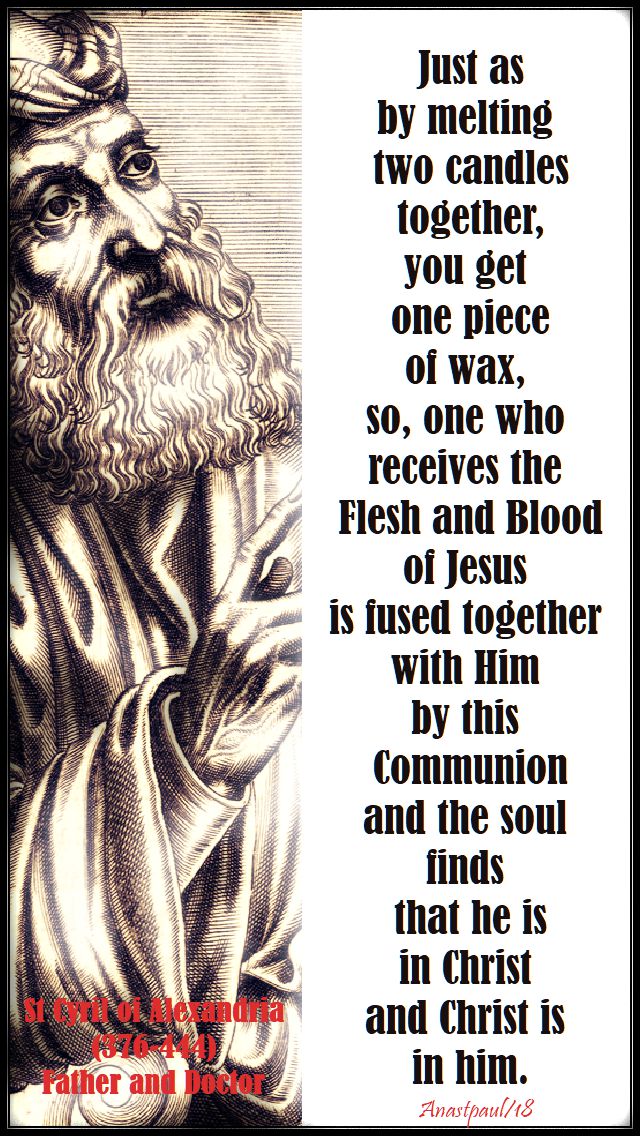
“He who receives Communion is made holy and divinised in soul and body in the same way that water, set over a fire, becomes boiling… Communion works like yeast that has been mixed into dough so that it leavens the whole mass; …Just as by melting two candles together, you get one piece of wax, so, I think, one who receives the Flesh and Blood of Jesus is fused together with Him by this Communion and the soul finds that he is in Christ and Christ is in him.”
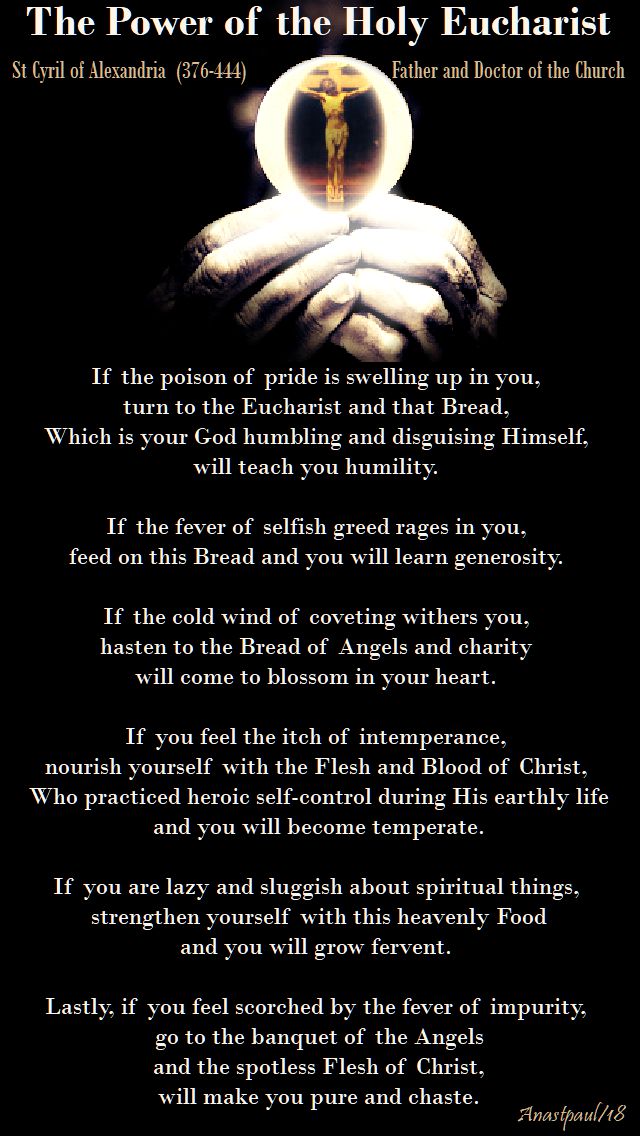
“If the poison of pride is swelling up in you, turn to the Eucharist and that Bread, Which is your God humbling and disguising Himself, will teach you humility.
If the fever of selfish greed rages in you, feed on this Bread and you will learn generosity.
If the cold wind of coveting withers you, hasten to the Bread of Angels and charity will come to blossom in your heart.
If you feel the itch of intemperance, nourish yourself with the Flesh and Blood of Christ, Who practiced heroic self-control during His earthly life and you will become temperate.
If you are lazy and sluggish about spiritual things, strengthen yourself with this heavenly Food and you will grow fervent.
Lastly, if you feel scorched by the fever of impurity, go to the banquet of the Angels and the spotless Flesh of Christ, will make you pure and chaste.”
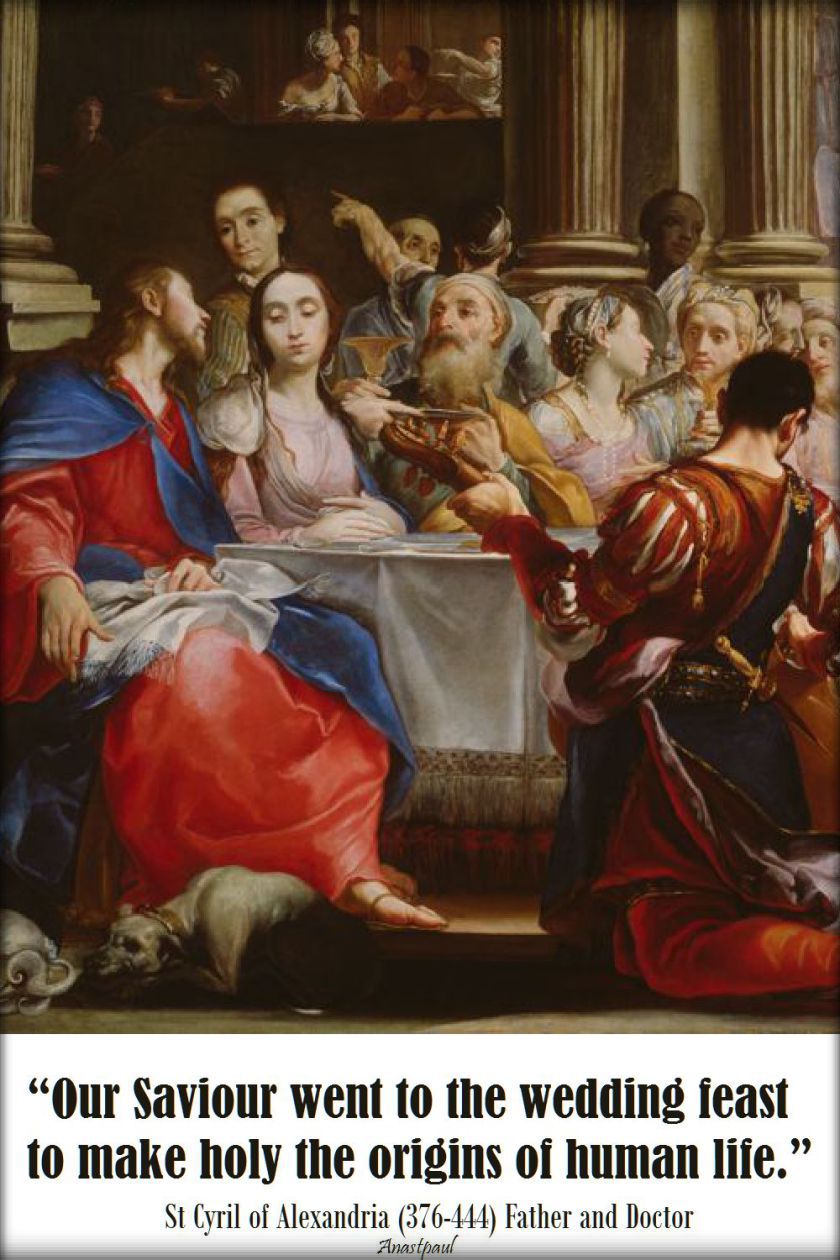
“Our Saviour went to the wedding feast to make holy the origins of human life.”
“From Christ and in Christ, we have been reborn through the Spirit, in order to bear the fruit of life, not the fruit of our old, sinful life but the fruit of a new life founded upon our faith in Him and our love for Him. Like branches growing from a vine, we now draw our life from Christ and we cling to His holy commandment, in order to preserve this life.”
“That anyone could doubt, the right of the holy Virgin to be called the Mother of God, fills me with astonishment. Surely, she must be the Mother of God, if our Lord Jesus Christ is God and she gave birth to Him!”
St Cyril of Alexandria (376-444) Father and Doctor
Our Morning Offering – 27 June – The Memorial of St Cyril of Alexandria (376-444) and the Feast of Our Lady of Perpetual Succour and the Mother of God of Gietrzwald, Poland
Hail, Mother of God By St Cyril of Alexandria (376-444) Father & Doctor of the Church
Hail, Mother and Virgin,
eternal Temple of the Godhead,
Venerable Treasure of Creation,
crown of virginity,
support of the true faith,
on which the Church is founded, throughout the world.
Mother of God,
who contained the infinite God
under your heart,
whom no space can contain.
Through you, the most Holy Trinity, is revealed,
adored and glorified,
demons are vanquished,
Satan cast down from heaven into hell
and our fallen nature again assumed into heaven.
Through you, the human race,
held captive in the bonds of idolatry,
arrives at the knowledge of Truth.
What more shall I say of you?
Hail, through whom kings rule,
through whom the Only-Begotten Son of God
has become the Star of Light
to those sitting in darkness
and in the shadow of death.
Amen
St Cyril of Alexandria (376-444) Father and Doctor of the Church (Optional Memorial)
St Adeodato of Naples
St Aedh McLugack
St Anectus of Caesarea
St Arialdus of Milan
St Arianell of Wales
Bl Benvenutus of Gubbio
St Brogan
St Crescens of Galatia
St Crescentius of Mainz
Bl Daniel of Schönau
Bl Davanzato of Poggibonsi
St Desideratus of Gourdon
St Dimman
St Felix of Rome
St Ferdinand of Aragon
St Gudene of Carthage
St Joanna the Myrrhbearer
St John of Chinon
St Ladislas I of Hungary
St Sampson of Constantinople
St Spinella of Rome
St Tôma Toán
St Zoilus of Cordoba
—
Martyrs Killed Under Communist Regimes in Eastern Europe: Among the thousands of Christians murdered by various Communist regimes in their hatred of the faith, there were 25 members of the Ukrainian Greek Catholic Church and Russian Byzantine Catholic Church, priests, bishops, sisters and lay people, whose stories are sufficiently well documented that we know they were murdered specifically for their faith in eastern Europe and whose Causes for Canonization were opened. Their Causes were combined and they were beatified together. They have separate memorials but are remembered together today. They are –
• Andrii Ischak • Hryhorii Khomyshyn • Hryhorii Lakota • Ivan Sleziuk • Ivan Ziatyk • Klymentii Sheptytskyi • Leonid Feodorov • Levkadia Harasymiv • Mykola Konrad • Mykola Tsehelskyi • Mykolai Charnetskyi • Mykyta Budka • Oleksa Zarytskyi • Ol’Ha Bida • Ol’Ha Matskiv • Petro Verhun • Roman Lysko • Stepan Baranyk • Symeon Lukach • Vasyl Vsevolod Velychkovskyi • Volodomyr Bairak • Volodymyr Ivanovych Pryima • Yakym Senkivsky • Yosafat Kotsylovskyi • Zenon Kovalyk
Beatified – 27 June 2001 by Pope John Paul II in Ukraine
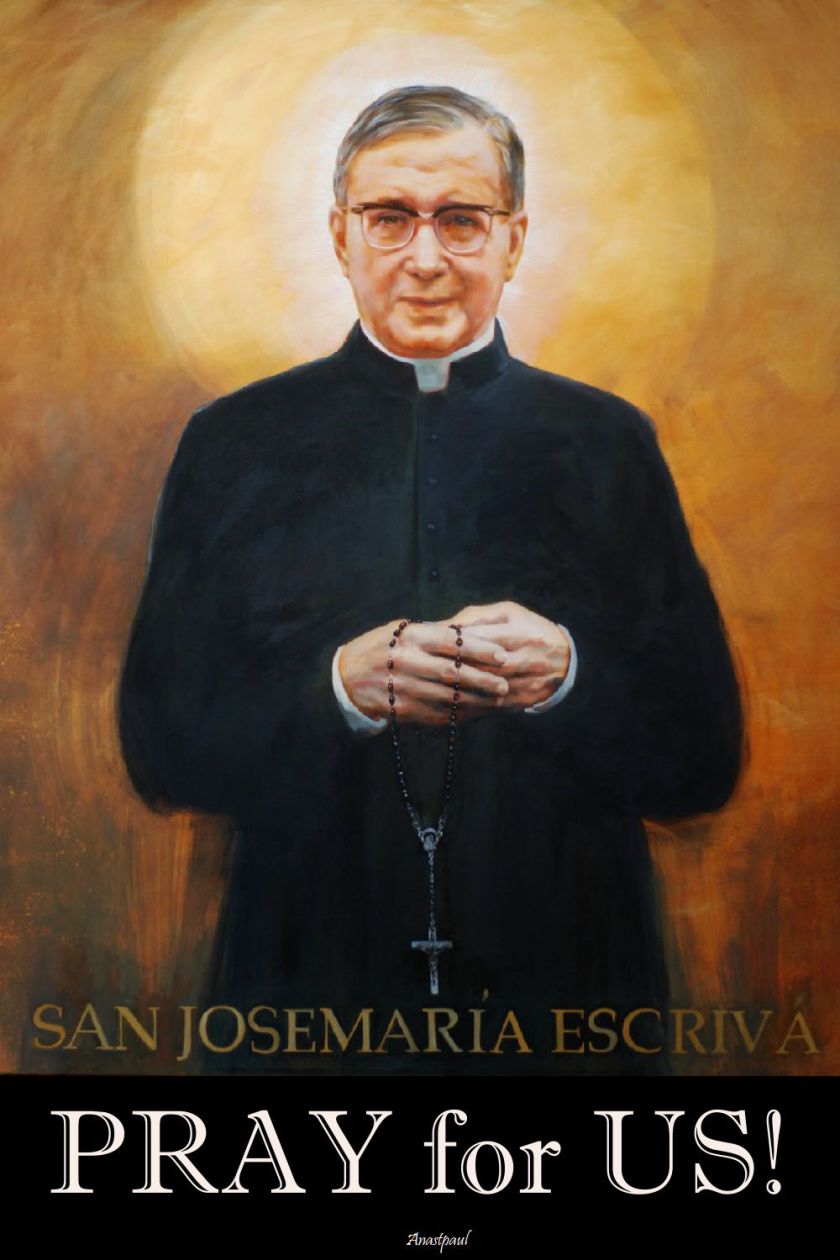
Thought for the Day – 26 June – The Memorial of St Josemaria Escrivá (1902-1975)
Excerpt from St John Paul’s Homily
on the Canonisation of St Josemaria – 6 October 2002
“All who are led by the Spirit of God are sons of God” (Rom 8,14). These words of the Apostle Paul, … help us understand better the significant message of today’s canonisation of Josemaría Escrivá de Balaguer. With docility he allowed himself to be led by the Spirit, convinced that only in this way can one fully accomplish God’s will.
This fundamental Christian truth was a constant theme in his preaching. Indeed, he never stopped inviting his spiritual children to invoke the Holy Spirit to ensure that their interior life, namely, their life of relationship with God and their family, professional and social life, totally made up of small earthly realities, would not be separated but would form only one life that was “holy and full of God”. He wrote, “We find the invisible God in the most visible and material things” (Conversations with Josemaría Escrivá, n. 114).
This teaching of his is still timely and urgent today. In virtue of the Baptism that incorporates him into Christ, the believer is called to establish with the Lord an uninterrupted and vital relationship. He is called to be holy and to collaborate in the salvation of humanity.
To fulfil such a rigorous mission, one needs constant interior growth nourished by prayer. St Josemaría was a master in the practice of prayer, which he considered to be an extraordinary “weapon” to redeem the world. He always recommended: “in the first place prayer; then expiation; in the third place but very much in third place, action” (The Way, n. 82). It is not a paradox but a perennial truth: the fruitfulness of the apostolate lies above all in prayer and in intense and constant sacramental life. This, in essence, is the secret of the holiness and the true success of the saints.
May the Lord help you, dear brothers and sisters, to accept this challenging ascetical and missionary instruction. May Mary sustain you, whom the holy founder invoked as “Spes nostra, Sedes Sapientiae, Ancilla Domini!” (Our Hope, Seat of Wisdom, Handmaid of the Lord).
May Our Lady make everyone an authentic witness of the Gospel, ready everywhere to make a generous contribution to building the Kingdom of Christ! May the example and teaching of St Josemaría be an incentive to us, so that at the end of the earthly pilgrimage, we too may be able to share in the blessed inheritance of heaven! There, together with the angels and all the saints, we will contemplate the face of God and sing His glory for all eternity.”
Mary, Our Hope, Seat of Wisdom, Handmaid of the Lord, Pray for us!
One Minute Reflection – 25 June – Monday of the Twelfth Week of Ordinary Time, Year B
“You hypocrite, first take the log out of your own eye, and then you will see clearly to take the speck out of your brother’s eye.”…Matthew 7:5
REFLECTION – “Let us especially resolve not to judge others, not to doubt their good will, to drown evil in an abundance of good, sowing loyal friendship, justice and peace all around us.”… St Josemaria Escriva (1902-1975)
PRAYER – God of power and mercy, be with us in our endeavours to be true to Your commandments and be light in our world. Grant that we may always act in true humility towards our neighbour, assisting where we are able without allowing our hearts to pass judgment on things we do not see and understand. May our Mother Mary be with us and lead us to the truth of Her Son. We make our prayer through Christ our Lord, in union with the Holy Spirit, one God forever, amen.
Feast of Our Lady of Miracles – 21 June – the patron of the town of Alcamo, Sicily.
The cult of Madonna of Miracles in Alcamo dates back to 21 June 1547, the day people remember the Madonna’s apparition to some women near a stream running north of Alcamo. According to tradition while washing their clothes in the stream, the women, with a blind and a deaf one among them, saw the apparition of a woman with a child and were hit by a gust of pebbles, during the apparition but without receiving any injury or pain; on the contrary, after being hit by the pebbles, they strangely felt a certain sense of wellbeing and recovered their health. After learning the news, the women’s husbands, thinking that it was a joke, went to investigate, thinking that someone was hidden among the bushes around there but they didn’t find anybody.
Then the local authorities inquired on the spot, cut down the near grove and found the ruins of a “cuba”, an old arc of a mill that nobody remembered any longer and inside there was a fresco on a stone made by an anonymous painter of the 13th century representing Our Lady with the Child Jesus, which at first the believers called “Madonna Fons Misericordiae” (that is Our Lady Source of Mercy).
A representation of the discovery of Our Lady of Miracles’ image (inside its chapel in the Basilica of Our Lady of the Assumption in Alcamo).
After this discovery all the people started praying before the rediscovered image and in the following days there were several miracles.7, Our Lady of Miracles became the patron saint of Alcamo, in substitution of the Holy Crucified, who was the patron saint of Alcamo and other near small towns (among which Calatafimi and Salemi). The old patron saint’s memory however remains in Alcamo people’s mind: in fact they call San Francesco di Paola “santu patri” (whose translation means “patron saint”) as the Church named after him was called the Holy Crucified Church.
The Madonna’s discovered image was first called “Our Lady Source of Mercy” but thanks to the high number of subsequent miracles, in 1583 the name was changed into “Our Lady of Miracles”.
Further to these events, Don Fernando Vega, Alcamo’s governor, ordered the construction of the Sanctuary of Our Lady of Miracles, which hosts the Madonna’s image. Inside the Church there is a white marble sarcophagus containing the mortal remains of the governor Don Fernando Vega, according to his will.
The Crowned Painting of the Madonna of Miracles in the Sanctuary at AlcamoDome fresco “The Madonna of Miracles’ Glorification”
Celebrations:
Every year in Alcamo there are the celebrations in honour of Our Lady of Miracles from 19 June until 21 of June. This is the most important religious festivity in Alcamo. The real celebrations are often anticipated by other events, so extending the feast to about two weeks, in this way the beginning of the celebrations changes every year, while the last day is always the 21 June.
The celebrations include: “The pealing of church bells” which opens the celebrations together with the burst of fireworks and the passing of the band through the town streets; in the past Alcamo’s band also joined the musical band of Partinico (a neighbouring small town). The holy Mass in honour of Our Lady of Miracles in the Basilica di Santa Maria Assunta (also called “mother church”), in which all confraternities and laity groups in Alcamo take part. The procession to the Sanctuary of Madonna of Miracles (called “calata”), in which all civil and religious authorities of the town (together with the Mayor) take part; they are preceded by the band of the town. In old times people took also the animals that had recovered from an illness. Inside the sanctuary they sing Vespers and then there is the Eucharistic Blessing/Benediction.
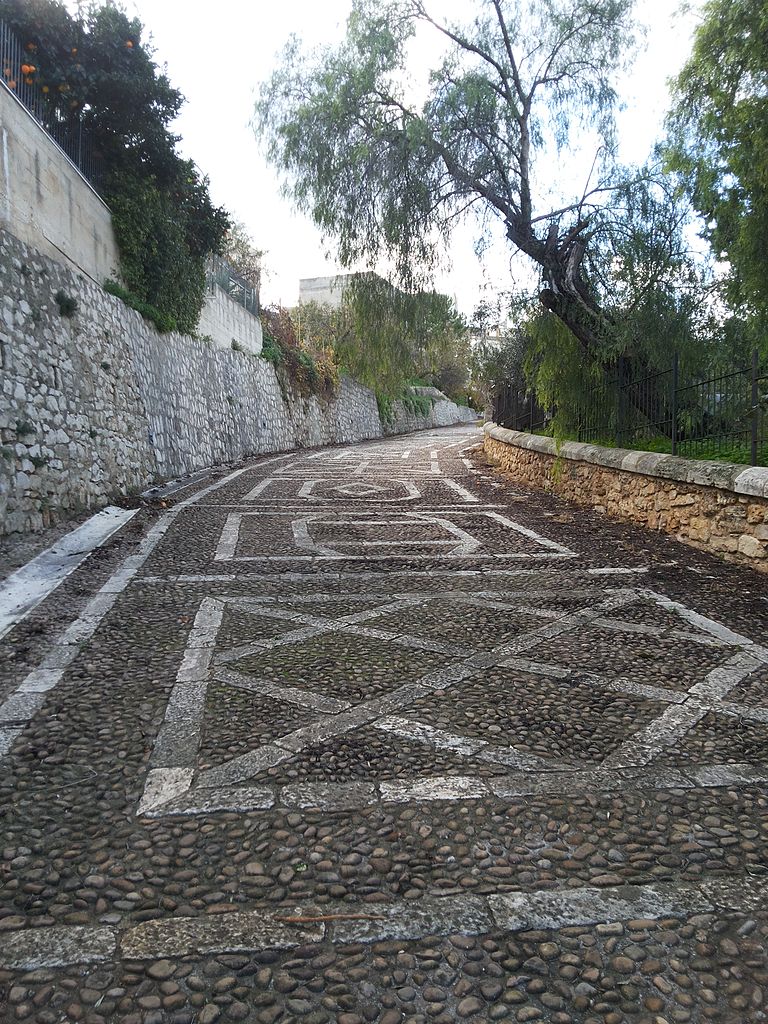
Façade of the sanctuary of Madonna of MiraclesRoute to the Sanctuary
Dance, music and theatrical performances. Sport events. Exhibitions of various kinds, including one about local Craftmanship. “The Market Fair” at Piazza della Repubblica. The Streets entertainers (called “Madonnari”). The Procession of Our Lady of Miracles’ statue along the town streets and return to the mother church. Before this solemn procession, the statue of Our Lady of Miracles, createdin 1720 by Lorenzo Curti from Castelvetrano (see the image of the statue above and the back below), is adorned with a silver 12 star crown (“stellario” in Italian), a crown and a hairpin embellished by precious stones (called “tuppu di la Maronna”) which is placed behind the Madonna’s nape. After that, the statue goes out from the Church, taken along the streets by a group of believers on their shoulders and accompanied by the band and it comes back to the mother church at the end of the procession.
Fireworks near the “bastione” in Piazza Bagolino. They take place at the end of the feast, soon after the statue’s return into the church, at about midnight. The traditional descent to the sanctuary takes place during the so-called “Historical Cortege” with period costumes. This cortege, which anticipates the real “calata”, passes through Corso 6 Aprile and Piazza Ciullo and finally ends at the Castle of the Counts of Modica (also called “Castle of Alcamo”). The workmen of the association “I Cavalieri di San Giorgio” (San Giorgio’s knights) and the Civil Authorities take part in the cortege too. Translated from the Italian).
Madonna of Miracles – Our Lady of Miracles (or Madonna of Miracles) is the patron saint of the town of Alcamo, Italy.
—
St Agofredus of La-Croix
St Alban of Mainz
St Apollinaris of Africa
Bl Colagia
St Corbmac
St Cyriacus of Africa
St Demetria of Rome
St Dominic of Comacchio
St Engelmund
Bl Jacques-Morelle Dupas
St John Rigby
St José Isabel Flores Varela
Bl Juan of Jesus
St Lazarus
St Leutfridus
St Martia of Syracuse
St Martin of Tongres
Bl Melchiorre della Pace
St Mewan of Bretagne
Bl Nicholas Plutzer
St Ralph of Bourges
St Raymond of Barbastro
St Rufinus of Syracuse
St Suibhne the Sage
St Terence
St Ursicenus of Pavia
—
Martyrs of Taw – 3+ saints: Three Christians of different backgrounds who were martyred together – Moses, Paphnutius, Thomas. They were beheaded in Taw, Egypt, date unknown.
Maria in the Forest: Also known as:
• Holy Mary in the Forest
• Maria im Walde
The Apparitions occurred in a wooded area near Dolina, Grafenstein, Carinthia, Austria on the 17, 18 and 19 June 1849 to three young shepherdesses.
—
St Adolph of Utrecht
St Agrippinus of Como
St Albert Chmielowski (1845-1916)
St Antidius of Besançon
Bl Arnold of Foligno
St Avitus of Perche
St Blasto of Rome
St Botolph of Ikanhoe
St Briavel of Gloucestershire
St David of Bourges
St Dignamerita of Brescia
St Diogenes of Rome
St Emily de Vialar
St Gundulphus of Bourges
St Herveus of Bretagne
St Himerius of Amelia
St Hypatius of Chalcedon
St Molling of Wexford
St Montanus of Gaeta
St Nectan of Hartland
Bl Paul Burali d’Arezzo
Bl Peter Gambacorta
St Phêrô Ða
Bl Philippe Papon
Bl Pierre-Joseph Cassant
St Prior
St Rambold of Ratisbon
Bl Ranieri Scaccero
St Theresa of Portugal
—
Martyrs of Apollonia – 7 saints: A group of Christians who fled to a cave near Apollonia, Macedonia to escape persecution for his faith, but were caught and executed. The names we know are – Basil, Ermia, Felix, Innocent, Isaurus, Jeremias and Peregrinus. They were beheaded at Apollonia, Macedonia.
Martyrs of Aquileia – 4 saints: Four Christian martyrs memorialised together. No details about them have survived, not even if they died together – Ciria, Maria, Musca and Valerian. c.100 in Aquileia, Italy.
Martyrs of Chalcedon – 3 saints: Three well-educated Christian men who were sent as ambassadors from King Baltan of Persia to the court of emperor Julian the Apostate to negotiate peace between the two states, and an end of Julian’s persecutions of Christians. Instead of negotiating, Julian imprisoned them, ordered them to make a sacrifice to pagan idols and when they refused, had them executed. Their names were Manuel, Sabel and Ismael. They were beheaded in 362 in Chalcedon (part of modern Istanbul, Turkey) and their bodies burned and no relics survive.
Martyrs of Fez – 4 beati: A group of Mercedarians sent to Fez, Morocco to ransom Christians imprisoned and enslaved by Muslims. For being openly Christian they were imprisoned, tortured, mutilated and executed. Martyrs – Egidio, John, Louis and Paul. They were martyred in Fez, Morocco.
Martyrs of Rome – 262 saints: A group of 262 Christians martyred in the persecutions of Diocletian. In c303 in Rome, Italy. They were buried on the old Via Salaria in Rome.
Martyrs of Venafro – 3 saints: Three Christian lay people, two of them imperial Roman soldiers, who were converts to Christianity and were martyred together in the persecutions of Maximian and Diocletian – Daria, Marcian and Nicander. They were beheaded c.303 in Venafro, Italy. By 313 a basilica had been built over their graves which were re-discovered in 1930. They are patrons of Venafro, Italy.
Quote of the Day – 12 June – The Memorial of Blessed Maria Candida of the Eucharist (1884-1949) (celebrated by the Carmelite Order today)
“I want to be like Mary, to be Mary for Jesus, to take the place of His Mother. When I receive Jesus in Communion, Mary is always present. I want to receive Jesus from her hands, she must make me one with Him. I cannot separate Mary from Jesus. Hail, O Body born of Mary. Hail Mary, dawn of the Eucharist!”
Our Morning Offering – 12 June – June the Month of the Sacred Heart
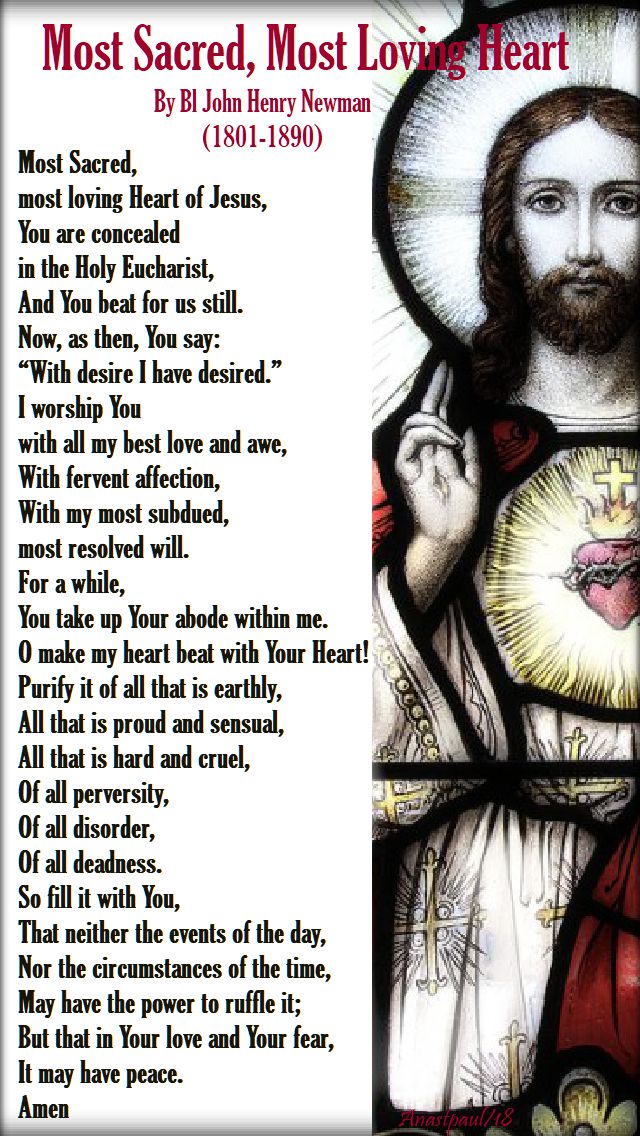
Most Sacred, Most Loving Heart By Bl John Henry Newman (1801-1890)
Most Sacred, most loving Heart of Jesus,
You are concealed in the Holy Eucharist,
And You beat for us still.
Now, as then, You say:
“With desire I have desired.”
I worship You with all my best love and awe,
With fervent affection,
With my most subdued, most resolved will.
For a while You take up Your abode within me.
O make my heart beat with Your Heart!
Purify it of all that is earthly,
All that is proud and sensual,
All that is hard and cruel,
Of all perversity,
Of all disorder,
Of all deadness.
So fill it with You,
That neither the events of the day,
Nor the circumstances of the time,
May have the power to ruffle it;
But that in Your love and Your fear,
It may have peace.
Amen
Our Lady of Montalto: Shrine of Our Lady of Montalto in Messina, Italy
In 1282, the Virgin Mary appeared in a dream to a friar named Nicholas. During the apparition she promised to send a white dove to the Caperrina hill where she wanted a church built in her name. The cornerstone for the Shrine of Our Lady of Montalto was laid in 1295 by Queen Constance of Sicily. It was a monastery for Cistercian nuns from 1389 until 1866. The Santuario della Madonna di Montalto was severely damaged during the 1908 earthquake and rebuilt in 1930. This view of the bell tower gives you a hint at the beauty of this Gothic and Romanesque structure.
St Amphion of Nicomedia
Bl Antonia Maria Verna
Bl Antonio de Pietra
St Arsenius of Konev
St Christian O’Morgair of Clogher
St Chrodobald of Marchiennes
St Cominus
Bl Conrad of Maleville
St Cunera
St Cuniald
St Cyrinus of Antwerp
St Eskil
St Galen of Armenia
St Gaspar Bertoni C.S.S. (1777-1853)
St Gerebald of Châlons-sur-Seine
St Geslar
Bl Guy Vignotelli of Cortona
St John of Sahagun
St Pope Leo III
St Lochinia of Ireland
Bl Lorenzo Maria Salvi
Bl Mercedes Maria of Jesus
St Odulf of Utrecht
St Olympius of AEnos
St Onuphrius of Egypt
Bl Pelagia Leonti of Milazzo
St Peter of Mount Athos
St Placid of Val d’Ocre
Bl Stefan Kielman
St Ternan of Culross
St Valerius of Armenia
Martyrs of Bologna: Three Christians who were martyred at different times and places, but whose relics have been collected and enshrined together – Celsus, Dionysius, and Marcellinus. Their relics were enshrined in churches in Bologna and Rome in Italy.
Martyrs of Rome: Four members of the Imperial Roman nobility. They were all soldiers, one or more may have been officers, and all were martyred in the persecutions of Diocletian – Basilides, Cyrinus, Nabor and Nazarius.
They were martyred in 304 outside Rome, Italy and buried along the Aurelian Way.
Three Holy Exiles: Three Christian men who became Benedictine monks at the Saint James Abbey in Regensburg, Germany, then hermits at Griestatten, and whose lives and piety are celebrated together. – Marinus, Vimius and Zimius.
108 Martyrs of World War II: Also known as
• Polish Martyrs
• 108 Polish Martyrs of the Nazis
• 108 Blessed Polish Martyrs
Among the millions murdered by Nazis in World War II, many were Poles killed for being Poles and many were Catholics killed for being Catholic. As emblematic of this group, 108 Polish Catholics who were murdered for their faith, and whose faithfulness was attested by by witnesses, were beatified as a group of by Pope John Paul II. They each have a separate memorial day on the calendar but they are celebrated as a group today.
• Adalbert Nierychlewski • Adam Bargielski • Aleksy Sobaszek • Alfons Maria Mazurek • Alicja Maria Jadwiga Kotowska • Alojzy Liguda • Anastazy Jakub Pankiewicz • Anicet Koplinski • Antoni Beszta-Borowski • Antoni Julian Nowowiejski • Antoni Leszczewicz • Antoni Rewera • Antoni Swiadek • Antoni Zawistowski • Bogumila Noiszewska • Boleslas Strzelecki • Boniface Zukowski • Bronislao Kostkowski • Bronislaw Komorowski • Bruno Zembol • Czeslaw Jozwiak • Dominik Jedrzejewski • Edward Detkens • Edward Grzymala • Edward Kazmierski • Edward Klinik • Emil Szramek • Fidelis Jerome Chojnacki • Florian Stepniak • Franciszek Dachtera • Franciszek Drzewiecki • Franciszek Kesy • Franciszek Rogaczewski • Franciszek Roslaniec • Franciszek Stryjas • Grzegorz Boleslaw Frackowiak • Henryk Hlebowicz • Henryk Kaczorowski • Henryk Krzysztofik • Hilary Pawel Januszewski • Jan Eugeniusz Bajewski • Jan Franciszek Czartoryski • Jan Nepomucen Chrzan • Jan Oprzadek • Jarogniew Wojciechowski • Jerzy Kaszyra • Jozef Achilles Puchala • Józef Cebula • Jozef Czempiel • Józef Jankowski • Jozef Kowalski • Józef Kurzawa • Jozef Kut • Józef Pawlowski • Jozef Stanek • Jozef Straszewski • Józef Wojciech Guz • Jozef Zaplata • Julia Rodzinska • Karol Herman Stepien • Katarzyna Faron • Kazimiera Wolowska • Kazimierz Gostynski • Kazimierz Grelewski • Kazimierz Tomasz Sykulski • Leon Nowakowski • Leon Wetmanski • Ludwik Mzyk • Ludwik Roch Gietyngier • Maksymilian Binkiewicz • Marcin Oprzadek • Maria Antonina Kratochwil • Maria Klemensa Staszewska • Marian Gorecki • Marian Konopinski • Marian Skrzypczak • Marianna Biernacka • Michal Ozieblowski • Michal Piaszczynski • Michal Wozniak • Mieczyslaw Bohatkiewicz • Mieczyslawa Kowalska • Narcyz Putz • Narcyz Turchan • Natalia Tulasiewicz • Piotr Edward Dankowski • Roman Archutowski • Roman Sitko • Stanislaw Antoni Trojanowski • Stanislaw Kostka Starowieyski • Stanislaw Kubista • Stanislaw Kubski • Stanislaw Mysakowski • Stanislaw Pyrtek • Stanislaw Starowieyski • Stefan Grelewski • Stefan Wincenty Frelichowski • Symforian Ducki • Tadeusz Dulny • Wincenty Matuszewski • Wladyslaw Bladzinski • Wladyslaw Demski • Wladyslaw Goral • Wladyslaw Maczkowski • Wladyslaw Miegon • Wlodzimierz Laskowski • Wojciech Gondek • Zygmunt Pisarski • Zygmunt Sajna Died
between 5 October 1939 and April 1945 in Germany and Nazi-occupied Poland and were Beatified on 13 June 1999 by St Pope John Paul II in Warsaw, Poland.
Our Lady of the Grotto, Mellieħa, Malta: The Sanctuary of Our Lady of Mellieħa is a Marian shrine in the village of Mellieħa in Malta. It was originally constructed in the late 16th century and contains a Byzantine-style fresco, depicting the Blessed Virgin Mary with Christ on her right arm. Tradition has it that the painting was made by St Luke when he was shipwrecked on the island with St Paul. The church expanded several times to accommodate the growing population of the village and the roofed veranda is considered a classic example of 17th century Renaissance architecture. The sanctuary was blessed by Pope John Paul II during his visit to Malta in May 1990.
—
Bl Amata of San Sisto
St Amantius of Tivoli
St Asterius of Petra
St Bardo of Mainz
Bl Bogumilus of Gniezno
St Caerealis of Tivoli
St Censurius of Auxerre
St Crispulus of Rome
Bl Edward Johannes Maria Poppe (1890-1924)
Bl Elisabeth Hernden
Bl Elizabeth Guillen
St Evermund of Fontenay
St Faustina of Cyzicus
Bl Gerlac of Obermarchtal
St Getulius of Tivoli
Bl Henry of Treviso
St Illadan of Rathlihen
St Ithamar of Rochester
Bl John Dominici O.P. (c 1355-1419)
Bl José Manuel Claramonte Agut
Bl Joseph Kugler
St Landericus of Novalese
St Landericus of Paris
Bl Mary Magdalene of Carpi
St Maurinus of Cologne
St Primitivus of Tivoli
St Restitutus of Rome
Bl Thomas Green
St Timothy of Prusa
Bl Walter Pierson
St Zachary of Nicomedia
—
Martyrs of North Africa – 17 saints: A group of seventeen Christians martyred together in North Africa; the only surviving details are two of their names – Aresius and Rogatius. Both the precise location in North Africa and the date are unknown.
Martyrs of the Aurelian Way – 23 saints: A group of 23 martyrs who died together in the persecutions of Aurelian. The only details that survive are three of their names – Basilides, Mandal and Tripos. c.270-275 on the Aurelian Way, Rome, Italy.
Martyrs of the Hulks of Rochefort/Martyrs of La Rochelle – 64 beati: In 1790 the French Revolutionary authorities passed a law requiring priests to swear allegience to the civil constitution, which would effectively remove them from the authority of and allegience to, Rome. Many refused and in 1791 the government began deporting them to French Guyana. 827 priests and religious were imprisoned on hulks (old ships no longer sea-worthy and used for storage, jails, hospitals, etc.) at Rochefort, France to await exile, most on the Deux-Associés and the Washington which had previously been used to house slaves or prisoners. There they were basically ignored to death as there was little provision for food and water, less for sanitation and none at all for medical help. 542 of the prisoners died there.
The survivors were freed on 12 February 1795 and allowed to return to their homes. Many of them wrote about their time on the hulks and many of them wrote about the faith and ministry of those who had died. 64 of them have been positively identified and confirmed to have died as martyrs, dying for their faith, they are:
• Antoine Auriel
• Antoine Bannassat
• Augustin-Joseph Desgardin
• Barthélemy Jarrige de La Morelie de Biars
• Charles-Antoine-Nicolas Ancel
• Charles-Arnould Hanus
• Charles-René Collas du Bignon
• Claude Beguignot
• Claude Dumonet
• Claude Laplace
• Claude Richard
• Claude-Barnabé Laurent de Mascloux
• Claude-Joseph Jouffret de Bonnefont
• élie Leymarie de Laroche
• Florent Dumontet de Cardaillac
• François d’Oudinot de la Boissière
• François François
• François Hunot
• François Mayaudon
• Gabriel Pergaud
• Georges-Edme René
• Gervais-Protais Brunel
• Jacques Gagnot
• Jacques Lombardie
• Jacques Retouret
• Jacques-Morelle Dupas
• Jean Baptiste Guillaume
• Jean Bourdon
• Jean Hunot
• Jean Mopinot
• Jean-Baptiste de Bruxelles
• Jean-Baptiste Duverneuil
• Jean-Baptiste Laborie du Vivier
• Jean-Baptiste Menestrel
• Jean-Baptiste Souzy
• Jean-Baptiste-Ignace-Pierre Vernoy de Montjournal
• Jean-Baptiste-Xavier Loir
• Jean-François Jarrige de la Morelie de Breuil
• Jean-Georges Rehm
• Jean-Nicolas Cordier
• Joseph Imbert
• Joseph Juge de Saint-Martin
• Joseph Marchandon
• Lazare Tiersot
• Louis-Armand-Joseph Adam
• Louis-François Lebrun
• Louis-Wulphy Huppy
• Marcel-Gaucher Labiche de Reignefort
• Michel-Bernard Marchand
• Michel-Louis Brulard
• Nicolas Savouret
• Nicolas Tabouillot
• Noël-Hilaire Le Conte
• Paul-Jean Charles
• Philippe Papon
• Pierre Gabilhaud
• Pierre Jarrige de la Morelie de Puyredon
• Pierre-Joseph le Groing de la Romagère
• Pierre-Michel Noël
• Pierre-Sulpice-Christophe Faverge
• Pierre-Yrieix Labrouhe de Laborderie
• Raymond Petiniaud de Jourgnac
• Scipion-Jérôme Brigeat Lambert
• Sébastien-Loup Hunot
They died between 19 May 1794 and 23 February 1795 aboard prison ships docked at Rochefort, Charente-Maritime, France and were beatified on
1 October 1995 by St Pope John Paul II.
Thought for the Day – 9 June – The Feast of the Immaculate Heart of Mary
“It was through the body of a young, Jewish girl, living in a tiny village called Nazareth, that Jesus, the divine Word, was made flesh. Mary belonged to that part of the people of Israel, who awaited the Lord’s coming with expectation and longing. She had no doubt read about His coming in the Old Testament Scriptures and prayed for it. But she had no idea how it would come about. Most Israelites thought the Messiah would manifest Himself gloriously.
When the Archangel Gabriel announced to Mary that she was to be the “door’ through which the long awaited desire of the nations would be fulfilled, she must have been astonished: “Hail, O favoured one, the Lord is with you! … You will conceive in your womb and bear a son, and you shall call His name Jesus” (Lk 1.28-31). A new life – filled with risks – opened before her. According to the Church’s tradition, Mary, in an exceptional gesture for a Jewish woman, had decided “not to know man” (Lk 1.34). She had discerned virginity to be God’s will. Her Immaculate Heart – the Feast we keep this day – prompted a total giving of herself to God and included the gift of both her body and her heart. Reassuring her that God had not disdained her vow, Gabriel told Mary that, like the glory of God coming upon the ark, so would the Spirit overshadow her. The young “handmaid of the Lord” contemplated the Angel’s words. She treasured them in her heart. Her response, known as her fiat – “let it be done to me as you say” (Lk 1.38) – shows that she entrusted herself fully to God’s designs. She chose to forgo her own plans for God’s. Through her fiat, the Word of God took flesh in the tabernacle of her womb…..
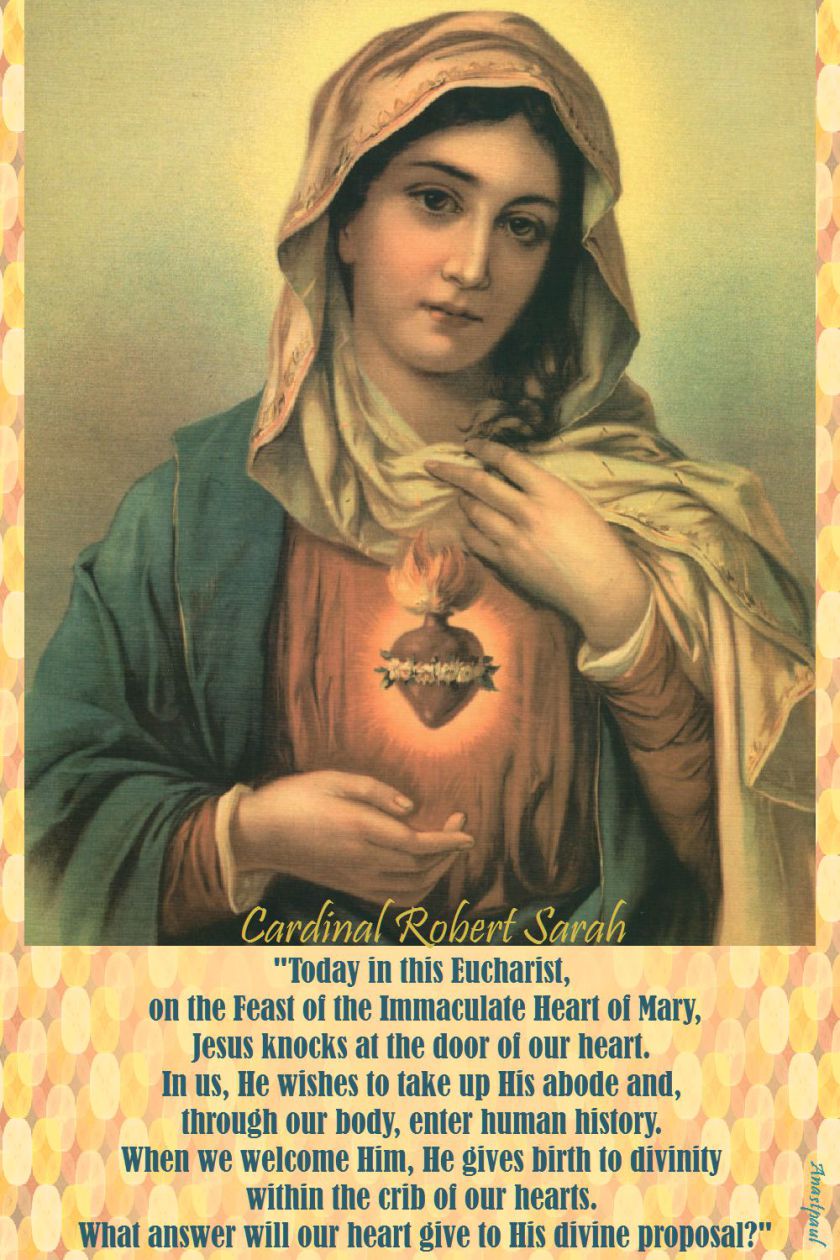
Today in this Eucharist, on the Feast of the Immaculate Heart of Mary, Jesus knocks at the door of our heart. In us, He wishes to take up His abode and, through our body, enter human history. When we welcome Him, He gives birth to divinity within the crib of our hearts. What answer will our heart give to His divine proposal?”…..Cardinal Robert Sarah (16 June 2012)
Our Morning Offering – 9 June – The Feast of the Immaculate Heart of Mary
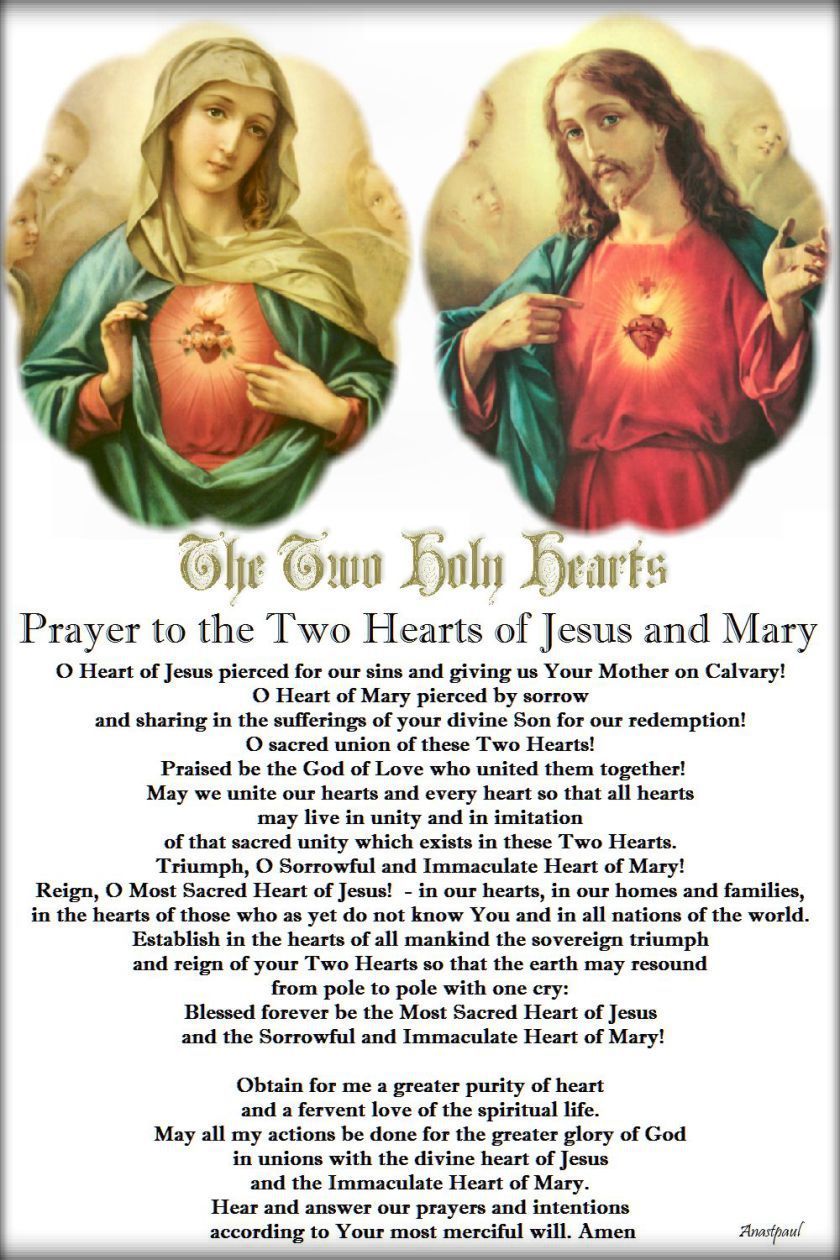
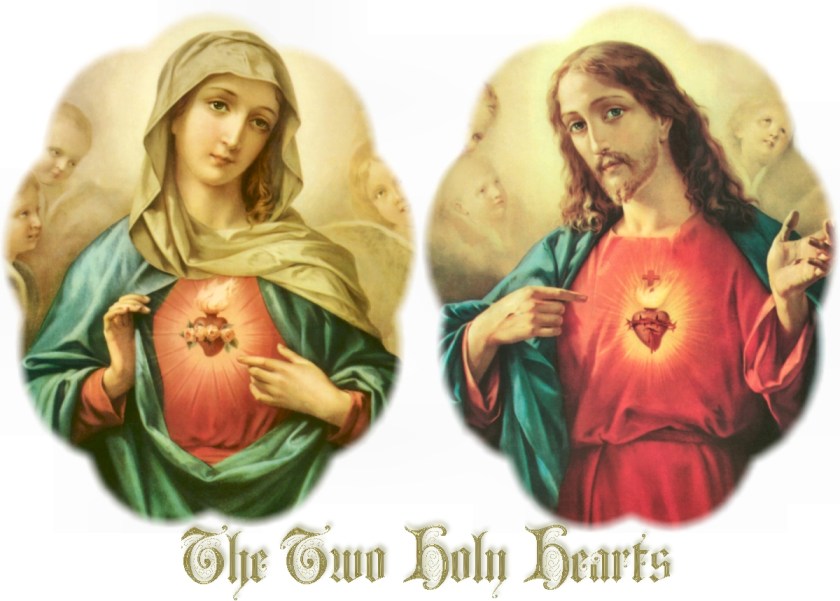
Prayer to the Two Holy Hearts of Jesus and Mary
O Heart of Jesus pierced for our sins
and giving us Your Mother on Calvary!
O Heart of Mary pierced by sorrow
and sharing in the sufferings of your divine Son
for our redemption!
O sacred union of these Two Hearts!
Praised be the God of Love who united them together!
May we unite our hearts and every heart
so that all hearts may live in unity and in imitation
of that sacred unity which exists in these Two Hearts.
Triumph, O Sorrowful and Immaculate Heart of Mary!
Reign, O Most Sacred Heart of Jesus!
– in our hearts, in our homes and families,
in the hearts of those who as yet do not know You
and in all nations of the world.
Establish in the hearts of all mankind the sovereign triumph
and reign of your Two Hearts so that the earth may resound
from pole to pole with one cry:
Blessed forever be the Most Sacred Heart of Jesus
and the Sorrowful and Immaculate Heart of Mary!
Obtain for me a greater purity of heart
and a fervent love of the spiritual life.
May all my actions be done for the greater glory of God
in unions with the divine heart of Jesus
and the Immaculate Heart of Mary.
Hear and answer our prayers and intentions
according to Your most merciful will.
Amen
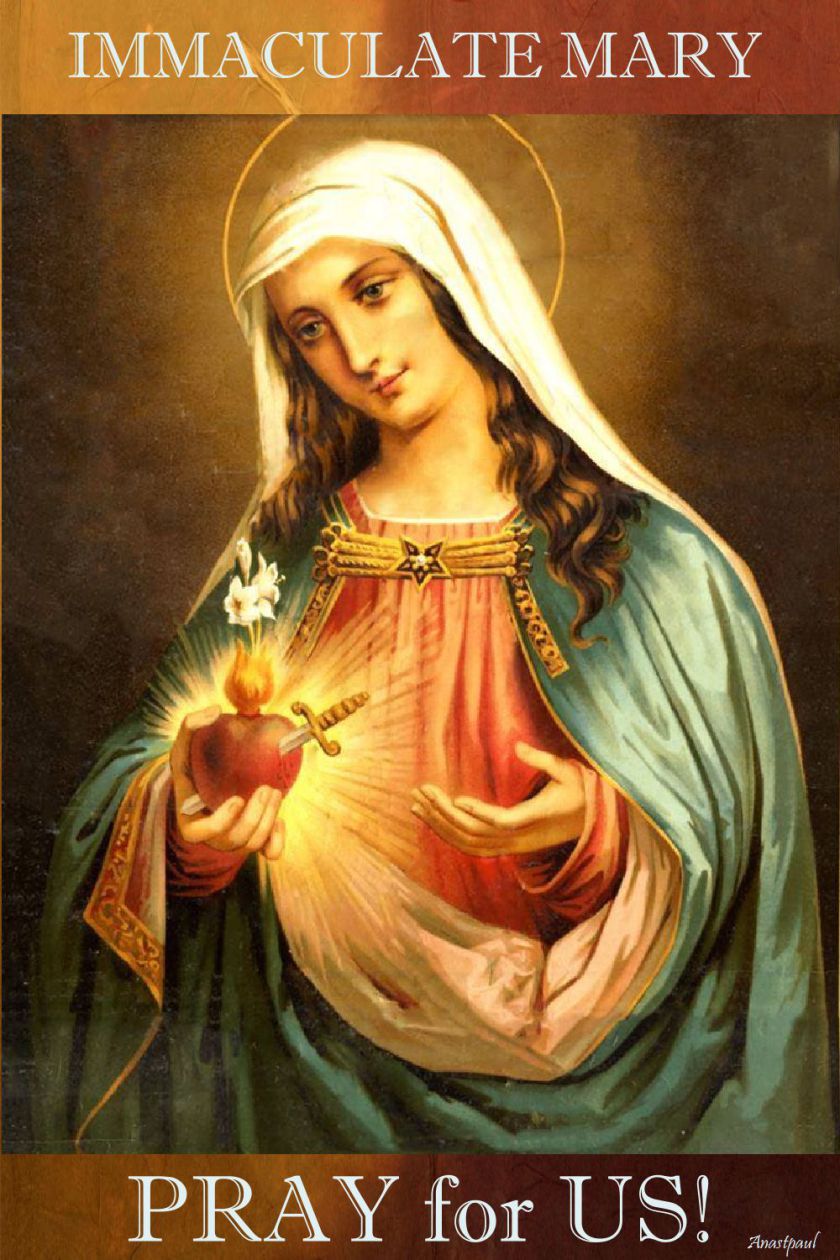
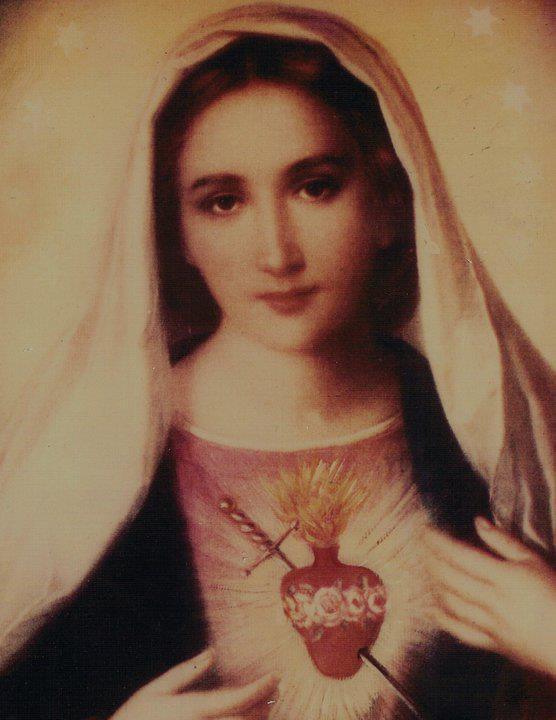
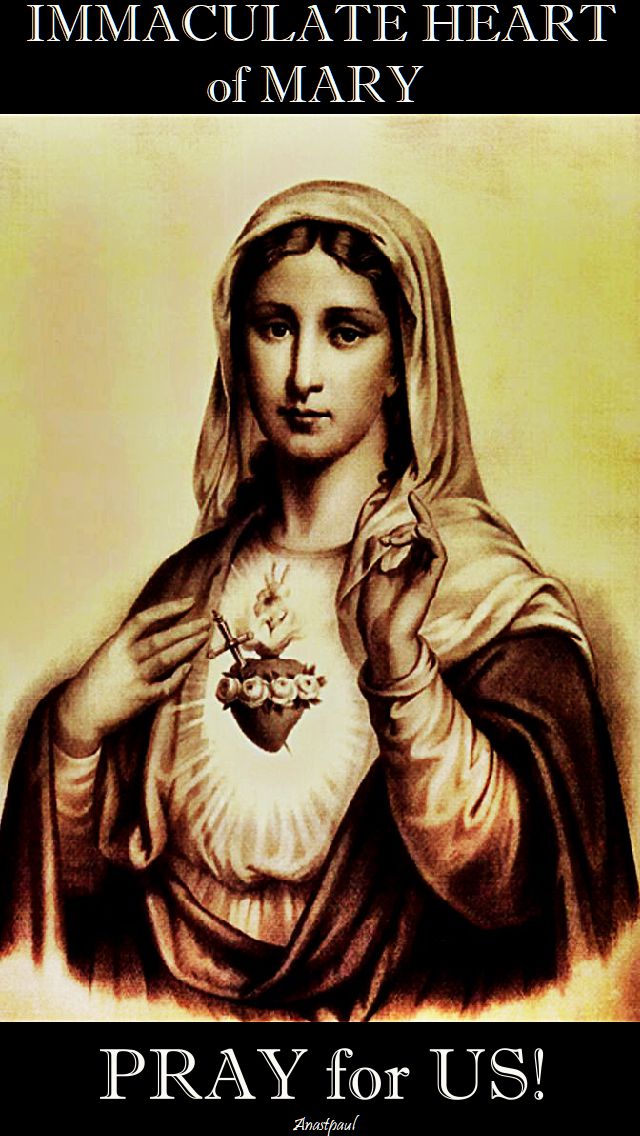
Feast of the Immaculate Heart of Mary – 9 June is a devotional name used to refer to the interior life of the Blessed Virgin Mary, her joys and sorrows, her virtues and hidden perfections and, above all, her virginal love for God the Father, her maternal love for her son Jesus and her compassionate love for all people. Pope Pius XII instituted the feast of the Immaculate Heart of Mary in 1944 to be celebrated on 22 August, coinciding with the traditional octave day of the Assumption. In 1969, Pope Paul VI moved the celebration of the Immaculate Heart of Mary to the Saturday, immediately after the Solemnity of the Sacred Heart of Jesus. This means in practice that it is now held on the third Saturday after Pentecost.
Historically, devotion to the Heart of Mary grew up in parallel but at a lesser intensity than that of devotion to the Heart of Jesus, only starting to become more prominent during the time of St John Eudes. John Eudes was born in 1601 in Normandy, France. He entered the Congregation of the Oratory of France, founded in 1611 by Cardinal de Berulle and was ordained to the priesthood on December 20, 1625. St John brought people to love Christ and the Virgin Mary by speaking tirelessly about their Hearts, the sign of the love God shows for us and the communion to which we are called.
To offer them liturgical worship, he composed Masses and Offices in their honour and had the first Feast of the Holy Heart of Mary celebrated on 8 February 1648, at Autun (France) and the Feast of the Heart of Jesus celebrated on 20 October 1672.
He died on August 19, 1680 and was canonised by Pope Pius XI on May 31, 1925.
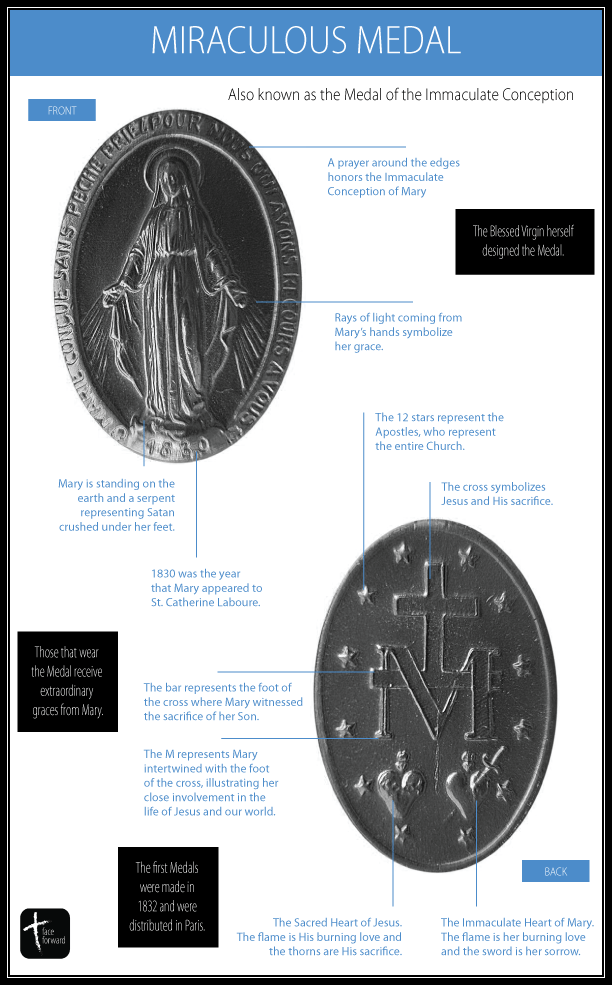
Nevertheless, it was not until after the Apparitions at Rue du Bac concerning the “Miraculous Medal” made to Catherine Labouré in 1830 and the establishment of a society dedicated to the Immaculate Heart of Mary, at the Church of Our Lady of Victories in Paris in 1836, that this particular devotion became really well known.
Since then devotion to the Immaculate Heart of Mary, has gradually grown more widespread in the Church, particularly since the apparitions at Fatima.
The main difference between the devotions to the hearts of Jesus and Mary is that the one concerned with Jesus emphasises His divine heart as being full of love for mankind, but with this love for the most part being ignored or rejected, while devotion to Mary’s heart is essentially concerned with the love that her heart has for Jesus, for God.
Therefore, it is not an end in itself, so the love of her heart is meant to be a model for the way we should love God. The fact that her heart is immaculate, that is sinless, means that she is the only fully human person who is able to really love God in the way that He should be loved.
Honouring Mary’s Immaculate Heart is really just another way of honouring Mary as the person who was chosen to be the Mother of God, recognising her extraordinary holiness and the immense love she bestowed on Jesus as His mother, the person who was called to share in and co-operate in His redemptive sufferings.
The aim of the devotion is to unite mankind to God through Mary’s heart and this process involves the ideas of consecration and reparation. A person is consecrated to Mary’s Immaculate Heart as a way of being completely devoted to God. This involves a total gift of self, something only ultimately possible with reference to God but Mary is our intermediary in this process of consecration.
Because of the strong analogy between Jesus and Mary, the consecration to Mary’s Immaculate Heart is closely linked to the consecration to Jesus’ Sacred Heart, although it is subordinate and dependent on it. That is, although the act of consecration is ultimately addressed to God, it is an act that is made through Mary. And so we pray through Mary, through her Immaculate Heart, we ask to learn true love.
The whole world has been repeatedly consecrated to the Immaculate Heart of Mary by different popes:
Pius XII, 31 October 1942
Paul VI, 21 November 1964
John Paul II, 13 May 1982
John Paul II together with all the bishops of the world, 25 March 1984
Francis, 13 October 2013
The Immaculate Heart of Mary (Feast) (2018)
St Ephrem of Syria (Optional Memorial)
—
Bl Alexander of Kouchta
St Alexander of Prusa
Bl Anne Marie Taigi
St Arnulf of Velseca
St Baithen of Iona
St Columba of Iona
St Comus of Scotland
St Cumian of Bobbio
St Cyrus
Bl Diana d’Andalo
St Diomedes of Tarsus
St Felicianus
Bl Henry the Shoemaker
St Jose de Anchieta
Bl Joseph Imbert
St Julian of Mesopotamia
St Luciano Verdejo Acuña
Bl Luigi Boccardo
St Maximian of Syracuse
St Pelagia of Antioch
St Primus
St Richard of Andria
Bl Robert Salt
Bl Sylvester Ventura
St Valerius of Milan
St Vincent of Agen
—
Martyrs of Arbil – 5 saints: Five nuns who were martyred together in the persecutions of Tamsabur for refusing to renounce Christianity for sun-worship – Amai, Mariamne, Martha, Mary and Tecla. They were beheaded on 31 May 347 at Arbil, Assyria (in modern Kurdistan, Iraq)
The Solemnity of the Most Sacred Heart of Jesus (2018)
Our Lady of Sunday: Also known as Notre-Dame du Dimanche
About the Apparition: An apparition of the Blessed Virgin Mary to Auguste Arnaud on 8 June 1873 and 8 July 1873. Arnaud was married, the father of two, and a winemaker who regularly skipped Sunday Mass to work his vineyards. Our Lady appeared to him in the vineyard on 8 June and reminded him “You must not work on Sundays.” In honour of this blessing, Arnaud placed a cross and a statue of Mary at the site in the field. On 8 July Our Lady appeared again, this time to both Auguste and his neighbors who had gathered there and told them, “You must never work on Sunday! Blessed are those who believe.”
Dates: 8 June and 8 July in 1873
Location: vineyard in Saint-Bauzille-de-la-Sylve, l’Hérault, France
Approval:
1876 by Bishop de Cabrières
—
St Anne Mary Taigi
St Bron of Cassel
St Calliope
St Clodulf of Metz
Bl Engelbert of Schäftlarn
St Eustadiola of Moyen-Moutier
St Fortunato of Fano
St Gildard of Rouen
Bl Giorgio Porta
Bl Giselbert of Cappenberg
St Heraclius of Sens
Bl István Sándor
St Jacques Berthieu
Bl John Davy
Bl John Rainuzzi
Bl Maddallena of the Conception
Bl Mariam Thresia Chiramel Mankidiyan
St Maximinus of Aix
St Medard of Noyon
St Melania the Elder
St Muirchu
St Pacificus of Cerano
Bl Peter de Amer
Bl Robert of Frassinoro
St Sallustian
St Syra of Troyes
St Victorinus of Camerino
St William of York
Thought for the Day – 6 June – The Memorial of St Marcellin Champagnat (1789-1840) Founder of the Marist Brothers and St Norbert (c 1080-1134)
Today’s 2 Saints certainly confirm, once again, that there are two sure ways to sanctity – through the Holy Eucharist and the Mother of God. These are the absolute totality of our Faith, these are the Source and the Heart, these are the only ways we will achieve our goal!
The relationship of Marcellin to Mary was deeply marked by an affective and total trust in her, as the “Good Mother” because it was her work that he undertook.
He wrote once: “Without Mary we are nothing and with Mary we have everything because Mary always has her adorable Son within her arms or in her heart.”
This belief remained constant all through his life. Jesus and Mary were the treasure on which Marcellin had learned to place his own heart. This intimate relationship helped shape the Marian dimension of the Marist spirituality. In the Marist tradition, the phrase “Ordinary Resource” has come to encapsulate our constant reliance on Mary. The motto attributed to Champagnat by his biographer, All to Jesus through Mary, all to Mary for Jesus, captures this close relationship between the Son and the Mother and our Founder’s attitude of confidence in Mary, which we are invited to live.
Mary, Mother, Intercede for us!
St Marcellin, Pray for us!
Excerpt from the Thought for the Day last year:
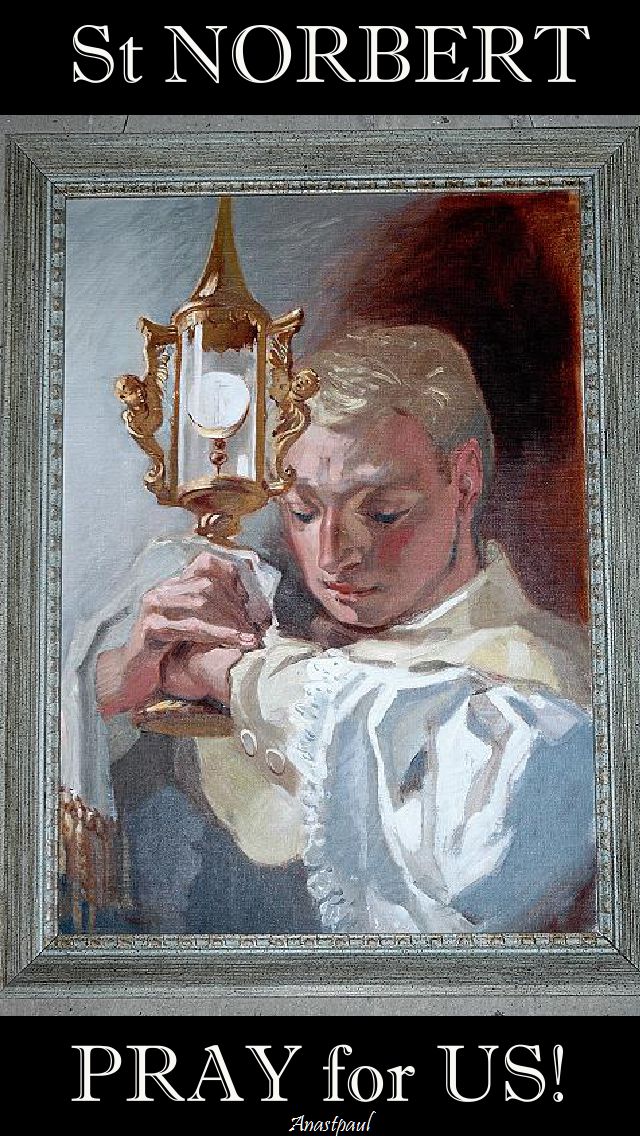
St Norbert was 33 years old before he took God seriously and during the next 20 years he made up for lost time. He did not stop to bewail lost years but gave everything he had to God. It is never too late to begin and God is always waiting for our service. We do not need a bolt of lightening to get started.
Unswerving loyalty to the Church and fervent devotion to the Eucharist, as practiced by Norbert, will continue immeasurably toward maintaining the people of God in accord with the heart of Christ.
Quote/s of the Day – 6 June – The Memorial of St Norbert (c 1080-1134)
On the day of his ordination, St Norbert said:
“O Priest! You are not of yourself because you are of God. You are not of yourself because you are the servant and minister of Christ. You are not your own because you are the spouse of the Church. You are not yourself because you are the mediator between God and man. You are not from yourself because you are nothing. What then are you? Nothing and everything. O Priest! Take care, lest what was said to Christ on the cross be said to you: ‘He saved others, himself he cannot save!”
St Norbert (c 1080-1134)
“All to Jesus through Mary, all to Mary for Jesus.”
Quote of the Day – 3 June 2018 – The Solemnity of Corpus Christi
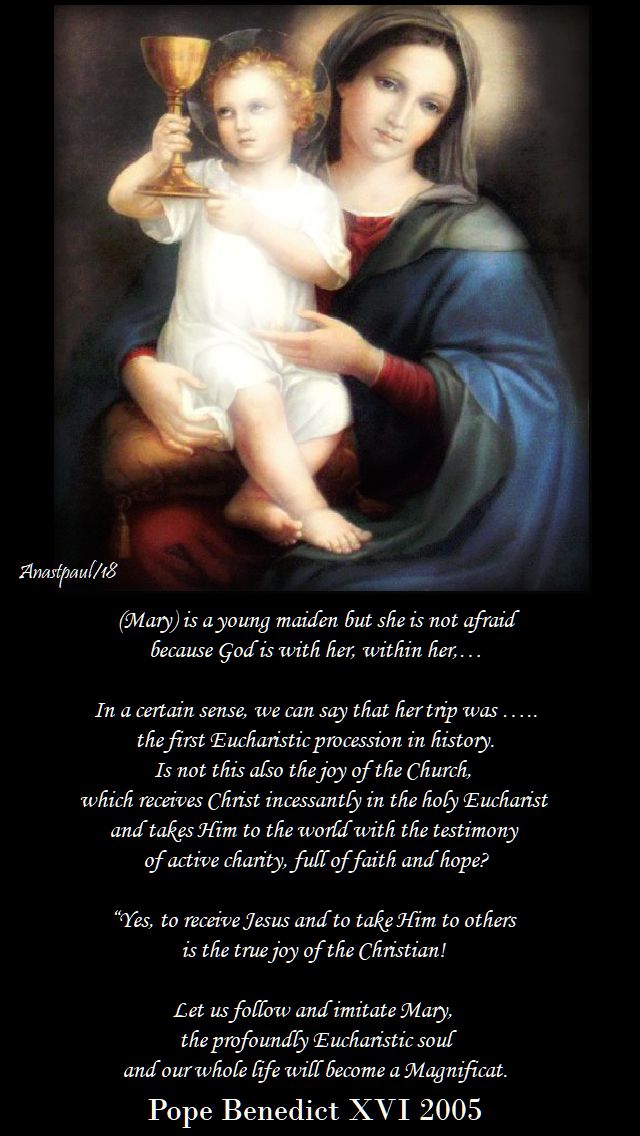
“(Mary) is a young maiden but she is not afraid because God is with her, within her,… In a certain sense, we can say that her trip was ….. the first Eucharistic procession in history. Is not this also the joy of the Church, which receives Christ incessantly in the holy Eucharist and takes Him to the world with the testimony of active charity, full of faith and hope?
“Yes, to receive Jesus and to take Him to others is the true joy of the Christian!
Let us follow and imitate Mary, the profoundly Eucharistic soul and our whole life will become a Magnificat.”
Thought for the Day – 31 May – The Last Day of Mary’s Month and the Feast of the Visitation of the Blessed Virgin Mary from St Bede the Venerable
Writing in the early 8th century, St Bede explains why the Magnificat, Mary’s prayer on the occasion of her Visitation of Elizabeth, is used daily in the liturgy of the hours (a.k.a the divine office) for Vespers or evening prayer. With Mary’s soul, our souls magnify the Lord and rejoice in God our Saviour.
My soul glorifies the Lord and my spirit rejoices in God my saviour.
With these words Mary first acknowledges the special gifts she has been given. Then she recalls God’s universal favours, bestowed unceasingly on the human race.
REJOICE IN GOD’S GREATNESS
When a man devotes all his thoughts to the praise and service of the Lord, he proclaims God’s greatness. His observance of God’s commands, moreover, shows that he has God’s power and greatness always at heart. His spirit rejoices in God his saviour and delights in the mere recollection of his creator who gives him hope for eternal salvation.
These words are offered for all God’s creations but especially for the Mother of God. She alone was chosen and she burned with spiritual love for the son she so joyously conceived. Above all other saints, she alone could truly rejoice in Jesus, her saviour, for she knew that He, who was the source of eternal salvation, would be born in time in her body, in one person both her own son and her Lord.
HOLY IS HIS NAME For the Almighty has done great things for me, and holy is his name.
Mary attributes nothing to her own merits. She refers all her greatness to the gift of the one whose essence is power and whose nature is greatness, for He fills with greatness and strength the small and the weak who believe in Him.
She did well to add: and holy is his name, to warn those who heard and indeed all who would receive His words, that they must believe and call upon His name. For they too could share in everlasting holiness and true salvation, according to the words of the prophet – and it will come to pass, that everyone who calls on the name of the Lord will be saved. This is the name she spoke of earlier – and my spirit rejoices in God my saviour.
VESPERS & THE MAGNIFICAT: AN EVENING CANTICLE
Therefore it is an excellent and fruitful custom of holy Church that we should sing Mary’s hymn at the time of evening prayer. By meditating upon the incarnation, our devotion is kindled and by remembering the example of God’s Mother, we are encouraged to lead a life of virtue. Such virtues are best achieved in the evening. We are weary after the day’s work and worn out by our distractions. The time for rest is near and our minds are ready for contemplation.
The great canticle by the Blessed Virgin Mary, the Magnificat, proclaimed by Mary during her Visitation to St Elizabeth, is celebrated and explained in this excerpt from a homily by Saint Bede the Venerable (Lib 1,4:CCL 122, 25-26, 30) which is used in the Roman Catholic Liturgy’s Divine Office of Readings for the Feast of the Visitation, 31 May, with the accompanying biblical reading being from Song of Songs 2:8-14 and 8:6-7. With Mary’s soul, we proclaim the greatness of the Lord and rejoice in God, her Saviour and ours, each evening in Vespers prayer.
St Bede the Venerable (673-735) Father & Doctor of the Church
One Minute Marian Reflection – 31 May – The Last Day of Mary’s Month and the Feast of the Feast of the Visitation of the Blessed Virgin Mary
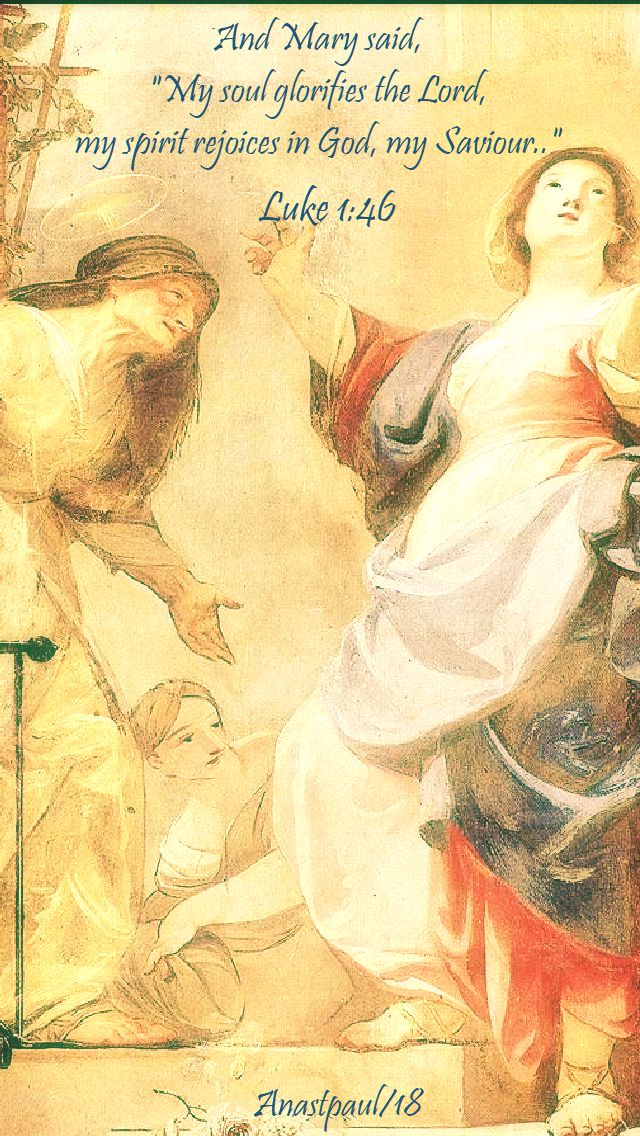
And Mary said, “My soul glorifies the Lord, my spirit rejoices in God, my Saviour”…Luke 1:46
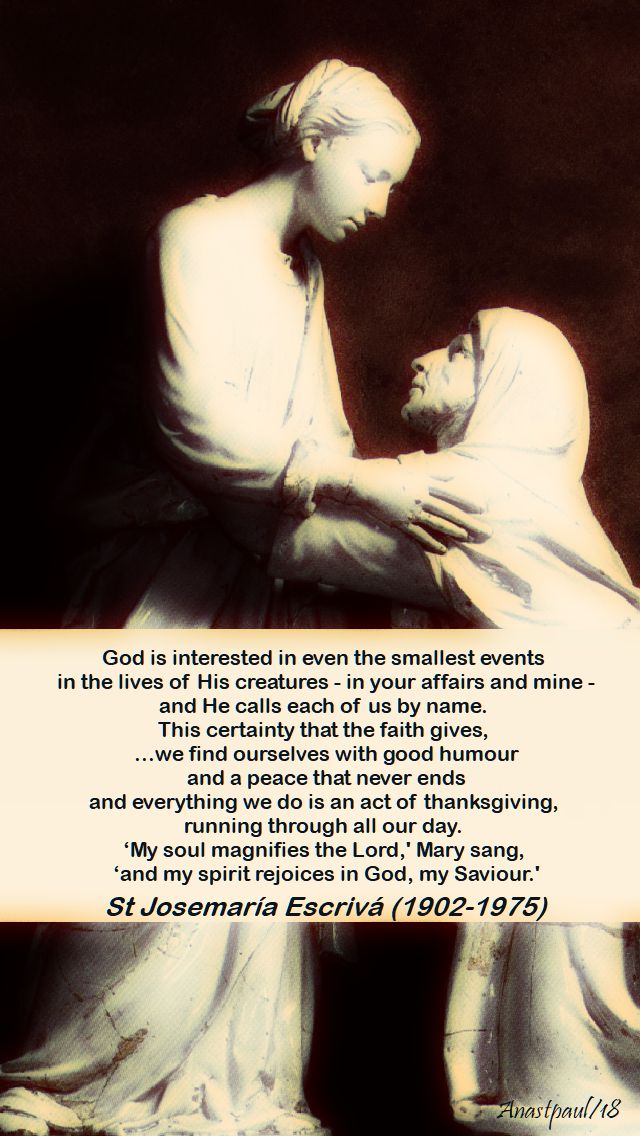
REFLECTION – “THE VISITATION: MARY SINGS OF THE LOVE OF GOD – “God is interested in even the smallest events in the lives of His creatures – in your affairs and mine — and He calls each of us by name. This certainty that the faith gives, enables us to look at everything in a new light. And everything, while remaining exactly the same, becomes different, because it is an expression of God’s love. Our life is turned into a continuous prayer, we find ourselves with good humour and a peace that never ends and everything we do is an act of thanksgiving, running through all our day. ‘My soul magnifies the Lord,’ Mary sang, ‘and my spirit rejoices in God, my Saviour.'” …St Josemaría Escrivá (1902-1975) – “To Jesus through Mary,” Christ is Passing By, 144 Let us offer to our Mother today: The Holy Rosary said with concentration and affection.
PRAYER – Almighty, ever-living God, You inspired the Blessed Virgin Mary, when she carrying Your Son, to visit Elizabeth. Grant that, always docile to the voice of the Holy Spirit, we may, together with our Lady, glorify Your Name and offer You our constant praise and thanksgiving. Through Christ, our Lord, with You and the Holy Spirit, one God forever, amen.
Our Morning Offering – 31 May – The Last Day of Mary’s Month and the Feast of the Visitation of the Blessed Virgin Mary
The Magnificat, is Mary’s great gift to scripture, one of its most beautiful prayers. It is prayed every evening in the Liturgy of the Hours by millions around the world. With that, Mary’s great acclamation becomes the Church’s.
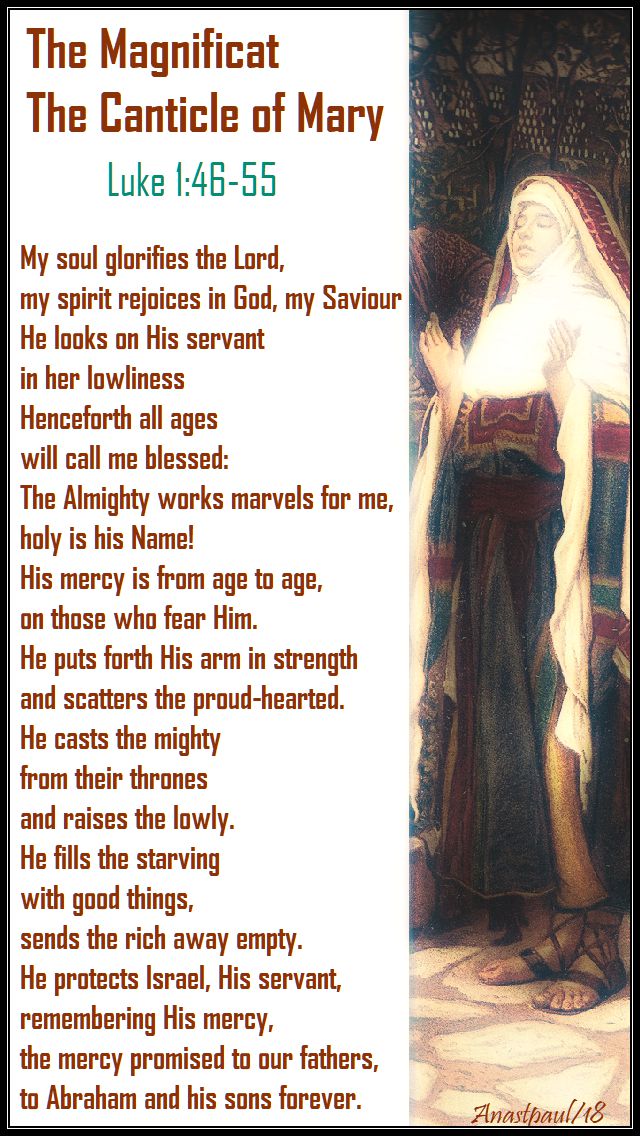
The Magnificat The Canticle of Mary Luke 1:46-55
My soul glorifies the Lord,
my spirit rejoices in God, my Saviour
He looks on His servant in her lowliness
Henceforth all ages will call me blessed:
The Almighty works marvels for me,
holy is his Name!
His mercy is from age to age,
on those who fear Him.
He puts forth His arm in strength
and scatters the proud-hearted.
He casts the mighty from their thrones
and raises the lowly.
He fills the starving with good things,
sends the rich away empty.
He protects Israel, His servant,
remembering His mercy,
the mercy promised to our fathers,
to Abraham and his sons forever.
Excerpt (18) from the Apostolic Exhortation “Marialis Cultus”
Blessed Pope Paul VI – 2 February 1974
“18. Mary is also the Virgin in prayer. She appears as such in the visit to the mother of the precursor, when she pours out her soul in expressions glorifying God and expressions of humility, faith and hope. This prayer is the Magnificat (cf. Lk. 1:46-55), Mary’s prayer par excellence, the song of the messianic times in which there mingles the joy of the ancient and the new Israel. As St Irenaeus seems to suggest, it is in Mary’s canticle, that there was heard once more, the rejoicing of Abraham who foresaw the Messiah (cf. Jn. 8:56)(48) and there rang out in prophetic anticipation the voice of the Church: “In her exultation Mary prophetically declared in the name of the Church: ‘My soul proclaims the glory of the Lord….'”
And in fact Mary’s hymn has spread far and wide and has become the prayer of the whole Church in all ages.”


















 AnaStpaul
You must be logged in to post a comment.