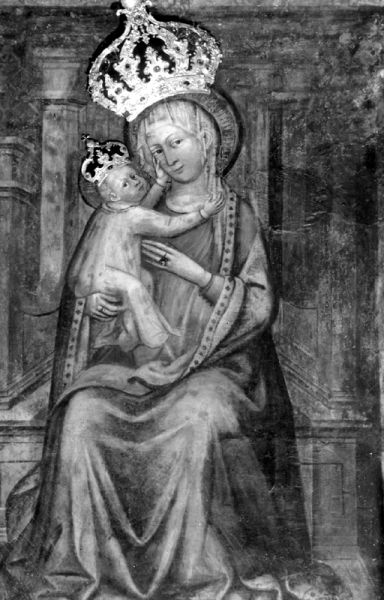
Beata Vergine Maria della Vita/Our Lady of Life: Celebration of the Blessed Virgin Mary as patroness of the Our Lady of Life Hospital in Bologna, Italy, and as depicted in a painting in a sanctuary dedicated to her c 1375 in the hospital.
Patronage – hospitals in the diocese of Bologna, Italy
—
St Agapius of Novara
St Alexius Sanbashi Saburo
St Ambrose Edward Barlow
St Autbert of Avranches
St Barypsabas
St Candida the Younger
St Clement of Sardis
St Finnian of Moville
St Frithestan
Bl Jacques Gagnot
St Nicholas of Tolentino
Bl Ogerius
St Peter Martinez
St Pulcheria
St Salvius of Albi
St Sosthenes of Chalcedon
St Theodard of Maastricht
St Victor of Chalcedon
—
Martyrs of Bithynia – 3 sister saints: Three young Christian sisters martyred in the persecutions of emperor Maximian and governor Fronto: Menodora, Metrodora, Nymphodora. They were martyred in 306 in Bithynia, Asia Minor (in modern Turkey).
Martyrs of Japan – 205 beati: A unified feast to memorialise 205 missionaries and native Japanese known to have been murdered for their faith between 1617 and 1637.
Martyrs of Sigum – 8 saints: A group of Nicomedian martyrs, condemned for their faith to be worked to death in the marble quarries of Sigum. There were priests, bishops and laity in the group but only a few names have come down to us: Dativus, Felix, Jader, Litteus, Lucius, Nemesian, Polyanus, Victor. They were worked to death c 257 in Sigum.
Martyred in the Spanish Civil War:
• Blessed Félix España Ortiz
• Blessed Leoncio Arce Urrutia
• Blessed Tomàs Cubells Miguel
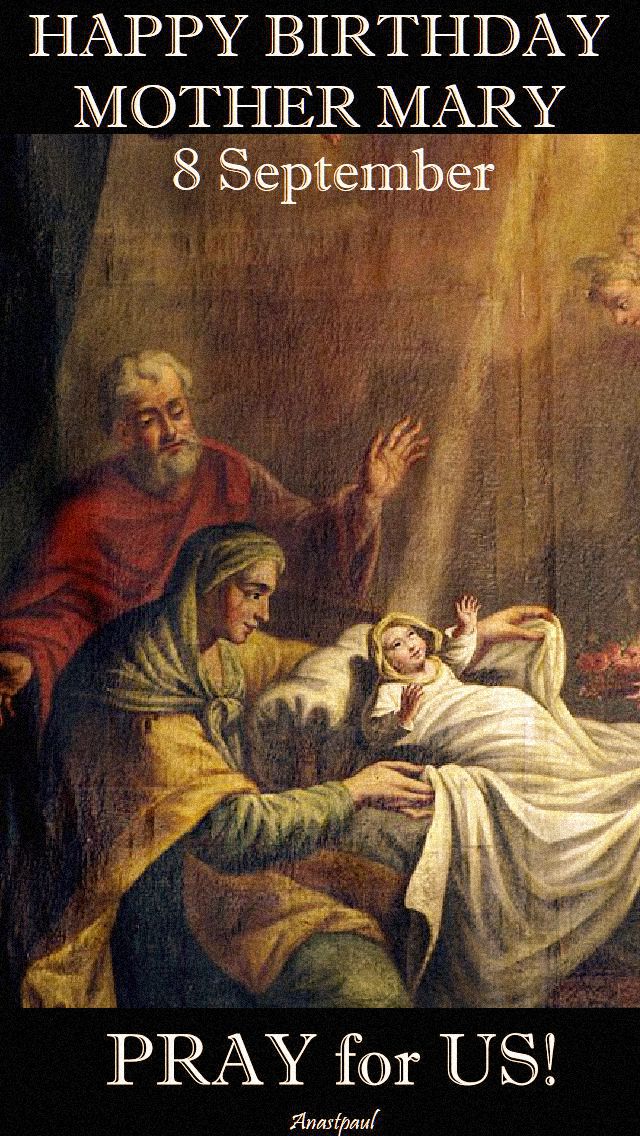
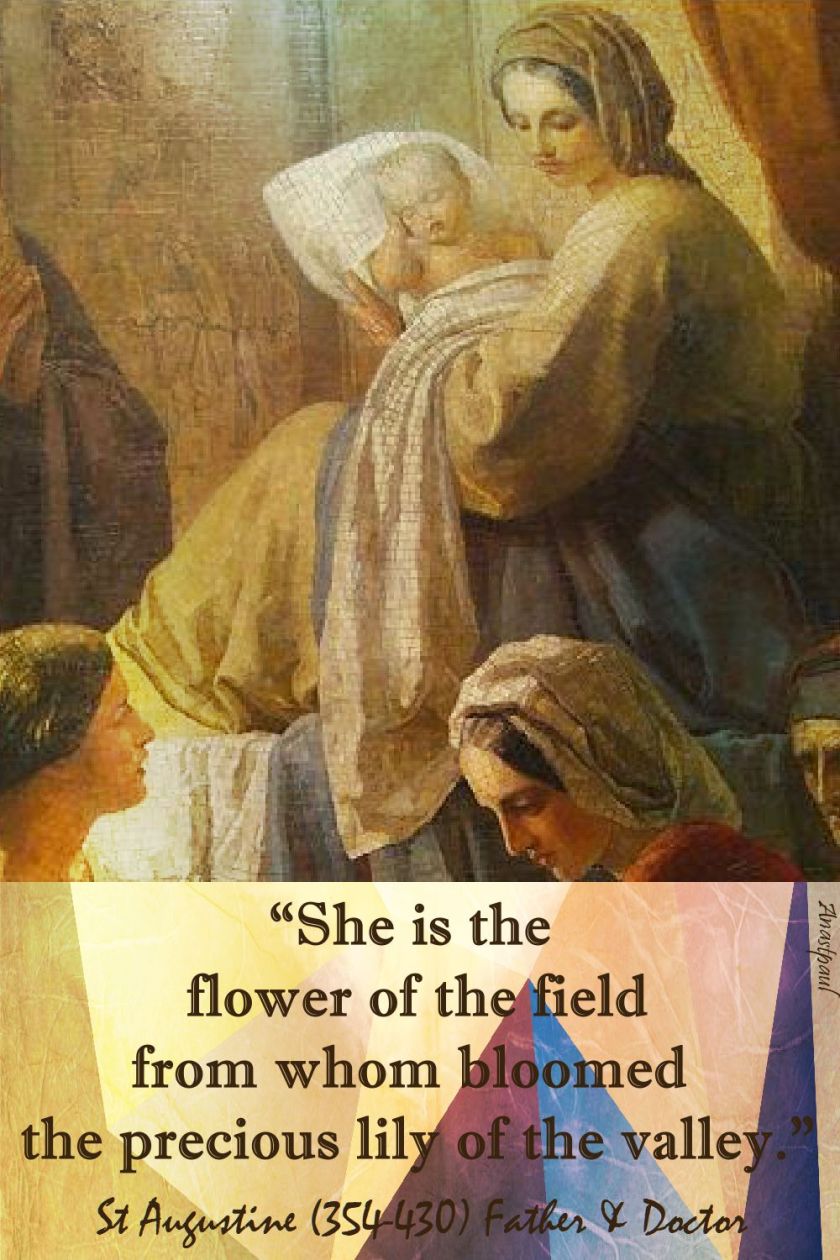
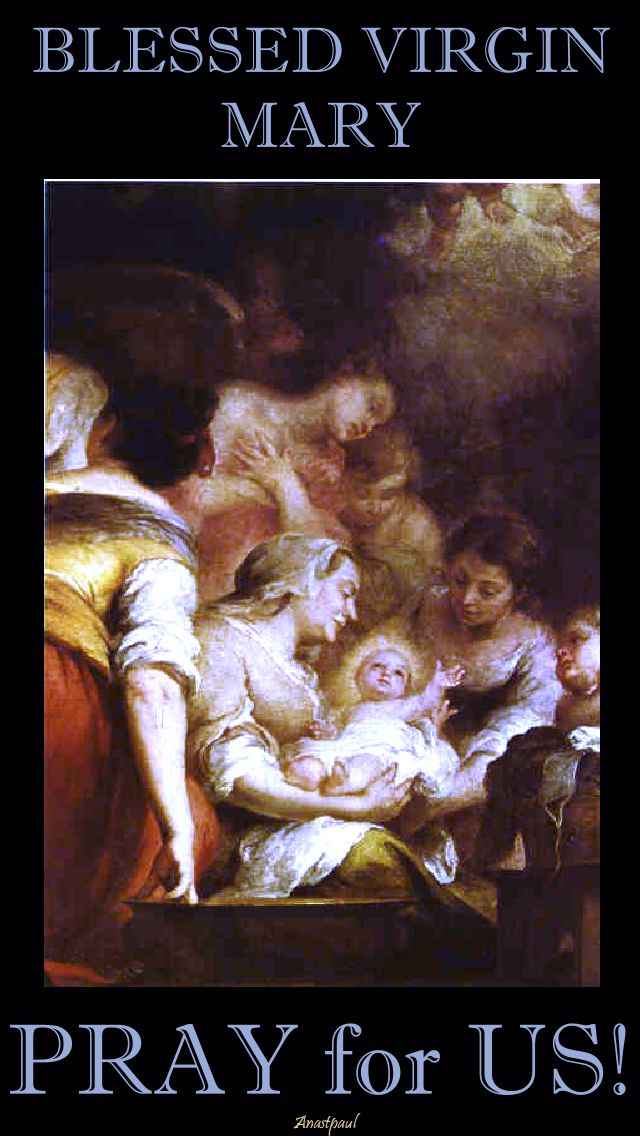
Thought for the Day – – The Feast of the Nativity of the Blessed Virgin Mary
We can see every human birth as a call for new hope in the world. The love of two human beings has joined with God in his creative work. The loving parents have shown hope in a world filled with travail. The new child has the potential to be a channel of God’s love and peace to the world.
This is all true in a magnificent way in Mary. If Jesus is the perfect expression of God’s love, Mary is the foreshadowing of that love. If Jesus has brought the fullness of salvation, Mary is its dawning.
Birthday celebrations bring happiness to the celebrant as well as to family and friends. Next to the birth of Jesus, Mary’s birth offers the greatest possible happiness to the world. Each time we celebrate her birth, we can confidently hope for an increase of peace in our hearts and in the world at large. (Fr Don Miller OFM)
One Minute Reflection – 8 September – The Feast of the Nativity of the Blessed Virgin Mary
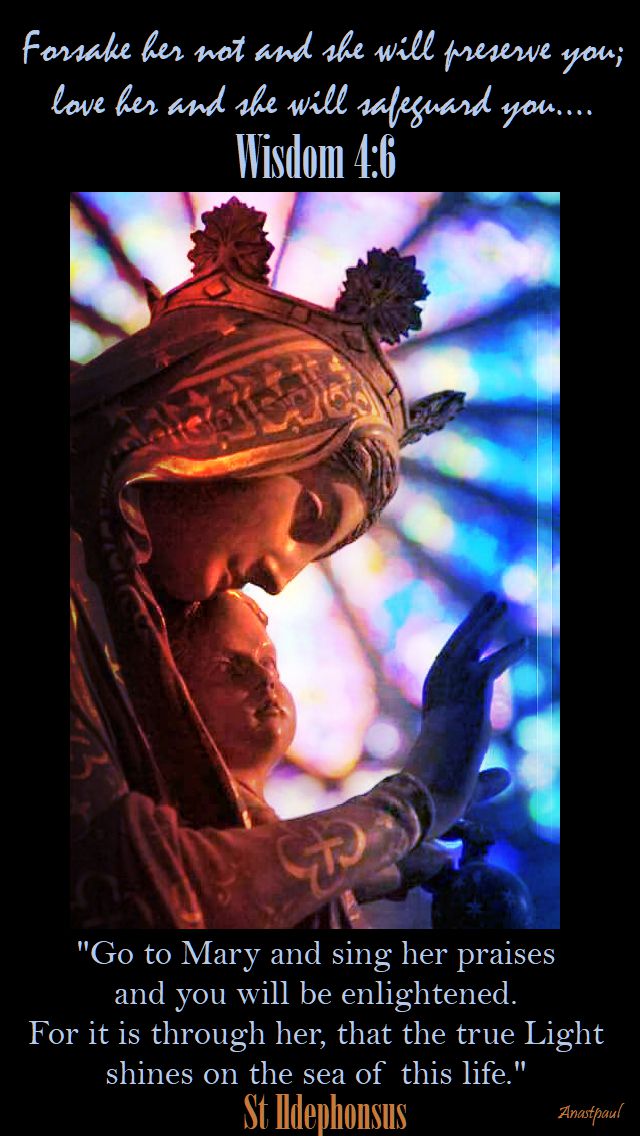
Forsake her not and she will preserve you; love her and she will safeguard you…..Wisdom 4:6
REFLECTION – “Go to Mary and sing her praises and you will be enlightened.
For it is through her that the true Light shines on the sea of this life.”…St Ildephonsus
PRAYER – Lord God, the day of our salvation dawned when the Blessed Virgin gave birth to Your Son.
As we celebrate her nativity, grant us Your grace and Your peace.
Through Christ, our Lord, Your Son in union with the Holy Spirit.
Mary, Mother of God, pray for us, amen.
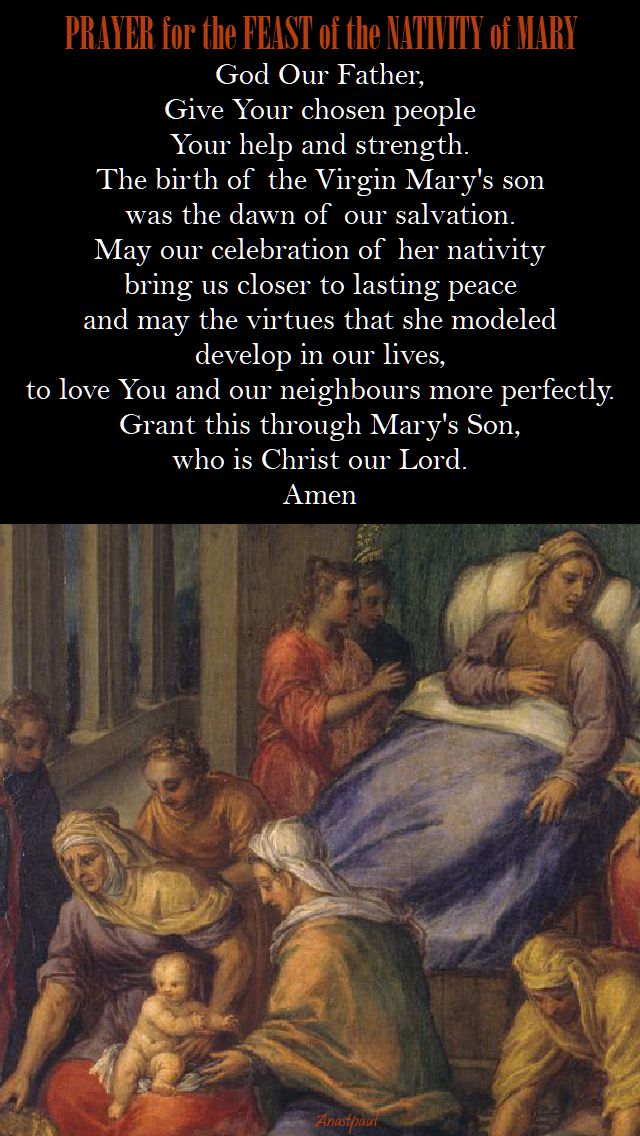
Our Morning Offering – 8 September – The Feast of the Nativity of the Blessed Virgin Mary
God Our Father,
Give Your chosen people
Your help and strength.
The birth of the Virgin Mary’s son
was the dawn of our salvation.
May our celebration of her nativity
bring us closer to lasting peace
and may the virtues that she modeled
develop in our lives,
to love You and our neighbours more perfectly.
Grant this through Mary’s Son,
who is Christ our Lord. Amen
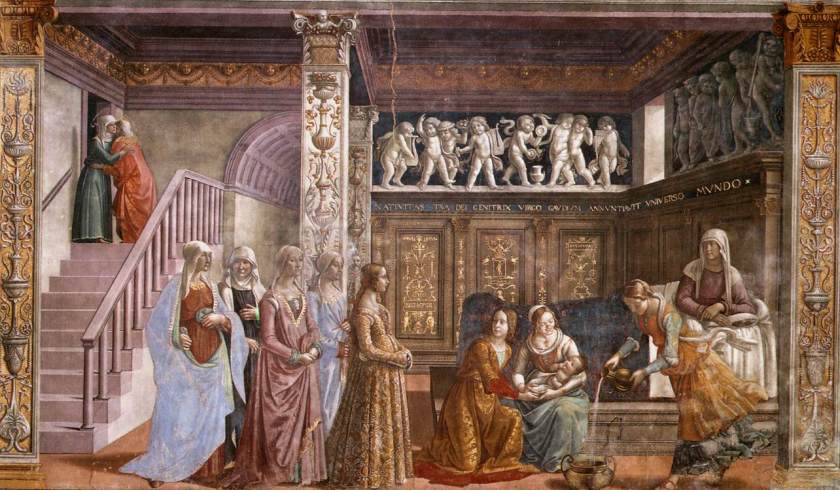
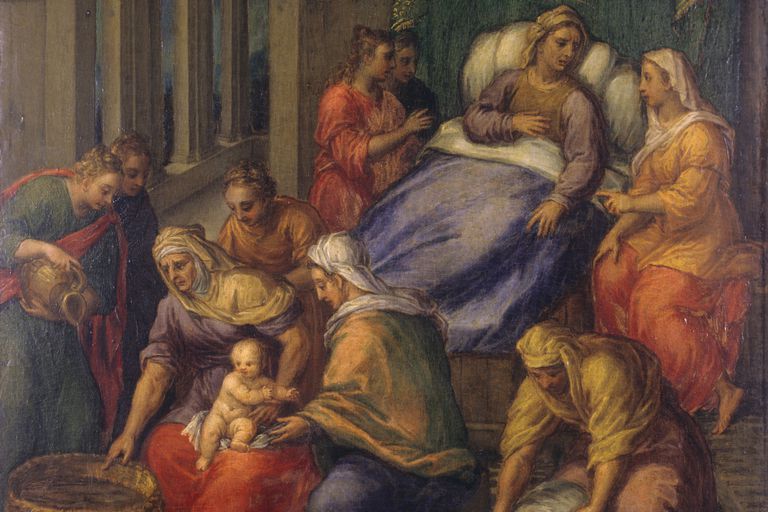
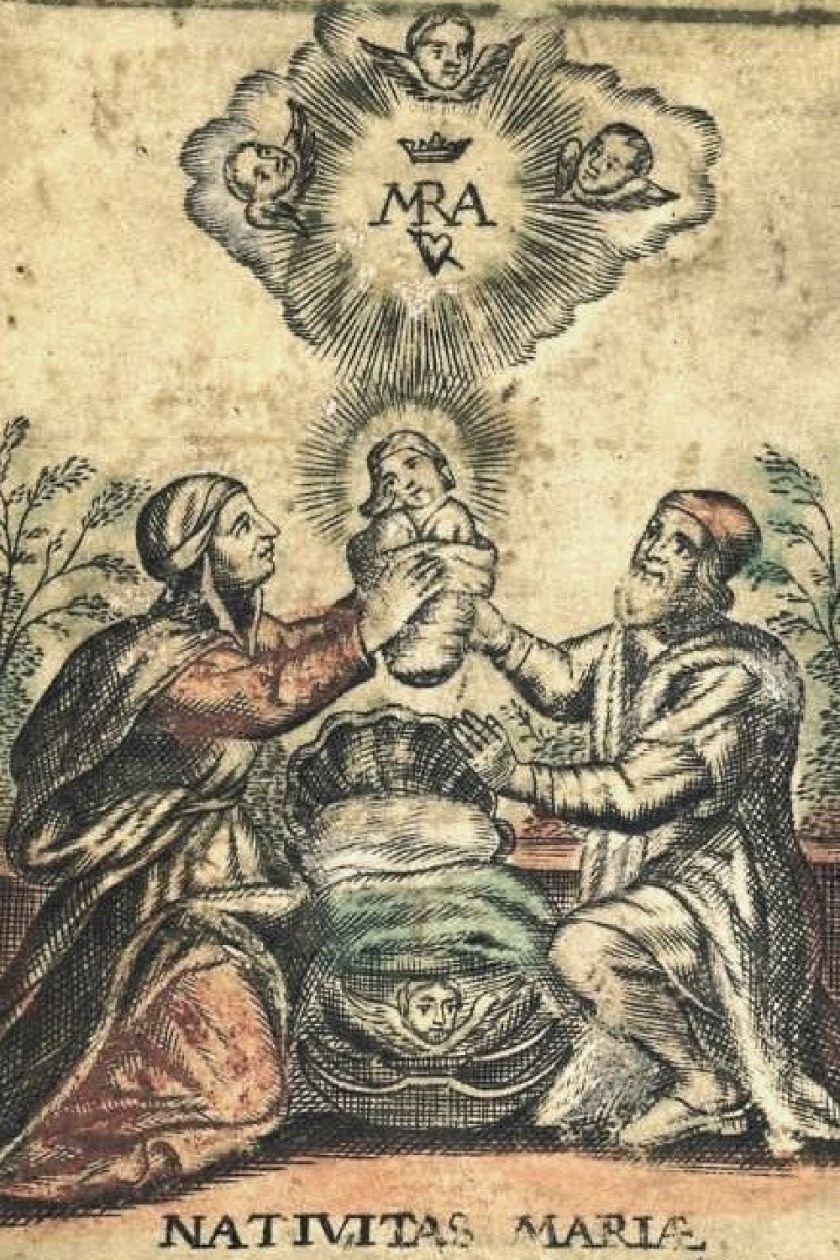
Feast of the Nativity of the Blessed Virgin Mary – 8 September – The Feast of the Nativity of the Blessed Virgin Mary, the day on which Christians East and West commemorate the birth of Mary, the Mother of God, was celebrated as early as the sixth century. We know that from the fact that Saint Romanos the Melodist, an Eastern Christian who composed many of the hymns used in the Eastern Catholic and Eastern Orthodox liturgies, composed a hymn for the feast at that time and it probably originated after the Council of Ephesus in 431, which established her right to the title of “Mother of God.” Patronages: • chefs, cooks and restauranteurs• coffee house owners or keepers
• distillers• drapers• fish dealers or fishmongers• gold workers or goldsmiths• needle and pin makers• potters• silk workers• silver workers or silversmiths• tile makers• 14 cities
The Feast of the Nativity of the Blessed Virgin Mary spread to Rome in the seventh century but it took a couple of more centuries before it was celebrated throughout the West.
HISTORY: Even though we cannot trace the celebration of the Feast of the Nativity of the Blessed Virgin Mary back any further than the sixth century, the source for the story of the birth of the Blessed Virgin Mary is much older. The earliest documented version is found in the Protoevangelium of James, an apocryphal gospel written about C 150. From the Protoevangelium of James, we learn the names of Mary’s parents, Joachim and Anna, as well as the tradition that the couple was childless until an angel appeared to Anna and told her that she would conceive. (Many of the same details appear also in the later apocryphal Gospel of the Nativity of Mary.)
WHY 8 SEPTEMBER: The traditional date of the feast, September 8, falls exactly nine months after the feast of the Immaculate Conception of Mary. Perhaps because of its close proximity to the feast of the Assumption of Mary, the Nativity of the Blessed Virgin Mary is not celebrated today with the same solemnity as the Immaculate Conception. It is, nonetheless, a very important feast, because it prepares the way for the birth of Christ. It is also an unusual feast, because it celebrates a birthday.
WHY DO WE CELEBRATE THE BLESSED VIRGIN MARY’S BIRTHDAY?: The feasts of saints are traditionally celebrated on the day of their death because that is the date on which they entered into eternal life. And, indeed, we also celebrate the Blessed Virgin Mary’s entrance into Heaven on August 15, the Feast of the Assumption.
There are only three people whose birthdays have traditionally been celebrated by Christians. Jesus Christ, at Christmas, Saint John the Baptist and the Blessed Virgin Mary. And we celebrate all three birthdays for the same reason: All three were born without Original Sin. Christ, because He was conceived by the Holy Spirit and is God; Mary, because she was kept free from the stain of Original Sin by the action of God in His foreknowledge that she would agree to be the mother of Christ; and Saint John, because he was blessed in the womb by the presence of his Saviour when Mary, pregnant with Jesus, came to aid her cousin Elizabeth in the final months of Elizabeth’s pregnancy (an event we celebrate in the Feast of the Visitation).
Readings: Micah 5:1-4A or Romans 8:28-30; Psalm 13:6AB, 6C; Matthew 1:1-16, 18-23 or Matthew 1:18-23
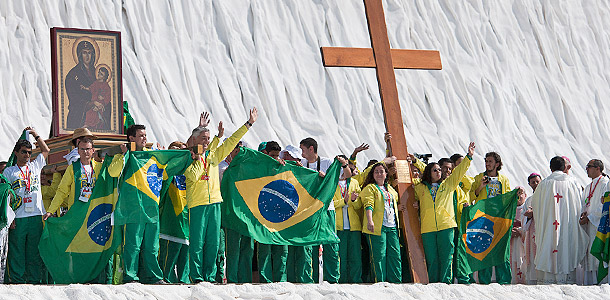
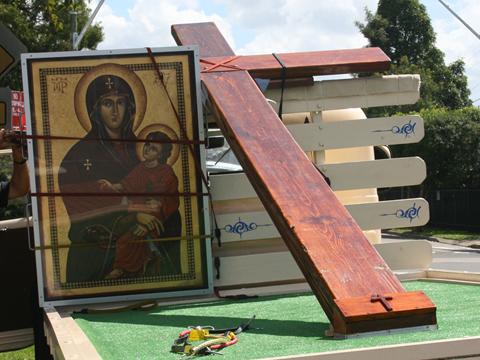
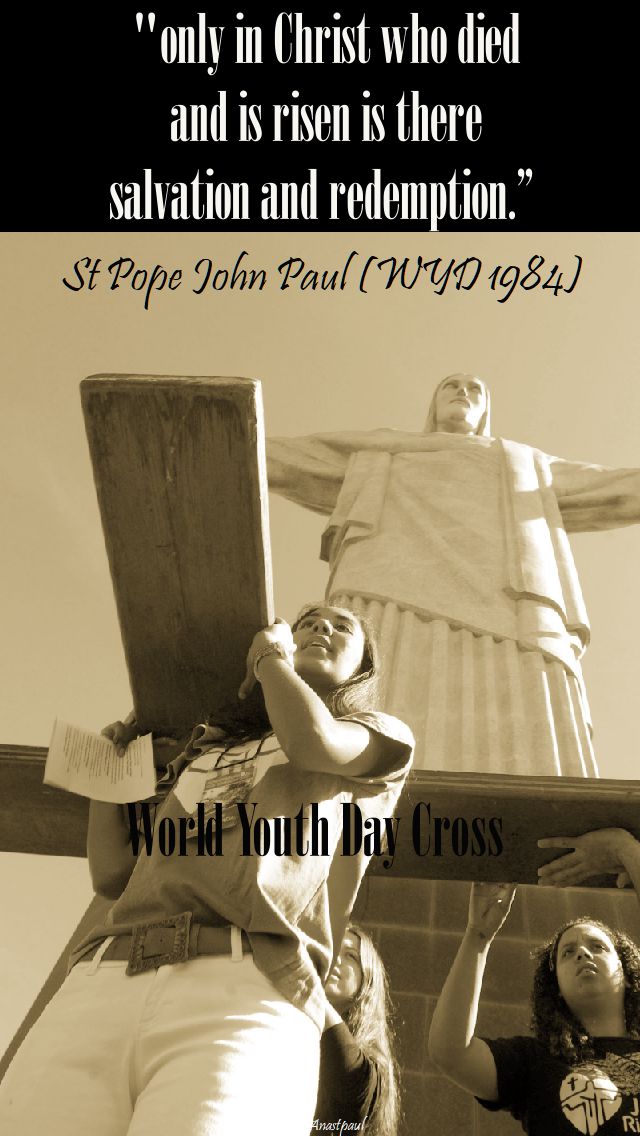
In 1984, at the close of the 1983 Holy Year of the Redemption at the Vatican, St Pope John Paul II entrusted to the young people of the world a simple, 12-foot wooden Cross, asking them to carry it across the world. This is now the heart of every World Youth Day this very simple, powerful, ancient Christian symbol: two large planks of wood, known as the World Youth Day Cross, that many have called the “Olympic Torch” of the huge Catholic festival of young people.
The World Youth Day cross has many names: the Jubilee Cross, the Pilgrim Cross, the Youth Cross. In 1984, at the close of the 1983 Holy Year of the Redemption at the Vatican, St Pope John Paul II entrusted to the young people of the world a simple, twelve-foot wooden Cross, asking them to carry it across the world as a sign of the love which the Lord Jesus has for humankind and “to proclaim to everyone that only in Christ who died and is risen is there salvation and redemption.”Since that day, carried by generous hands and loving hearts, the Cross has made a long, uninterrupted pilgrimage across the continents, to demonstrate, as Pope John Paul II had said, “the Cross walks with young people and young people walk with the Cross.”
The cross does not journey alone. Since 2003 it has been accompanied by an icon of the Blessed Virgin Mary. a copy of the Icon of our Lady known as the ‘Salus Populi Romani’. The original from which this Icon has been copied is considered by some to be from the eighth century and is housed in a chapel in the Basilica of St Mary Major in Rome. St Pope John Paul II entrusted to the youth an icon of the Blessed Mother that would accompany the cross. “It will be a sign of Mary’s motherly presence close to young people who are called, like the Apostle John, to welcome her into their lives.”
The World Youth Day Cross and Icon speak to us of the two focal points of the message of Christianity: of the Cradle and of the Cross; of Christ who was born of Mary and of Christ who was crucified for us; of Christmas and Good Friday; of the Incarnation and the Paschal Mystery. The Icon and Cross, therefore, are potent symbols of the joy and suffering that we experience in our Christian pilgrimage.
Because we follow a crucified Christ, we enter into solidarity with the world’s suffering masses. We experience the power and love of God through the vulnerable and suffering. The Cross teaches us that what could have remained hideous and beyond remembrance is transformed into beauty, hope and a continuous call to heroic goodness.
To celebrate the Triumph of the Cross is to acknowledge the full, cruciform achievement of Jesus’ career. Jesus asks us to courageously choose a life similar to his own. Suffering cannot be avoided nor ignored by those who follow Christ. Following Jesus implies suffering and a cross. The mark of the Messiah is to become the mark of his disciples. (Fr Rosica)
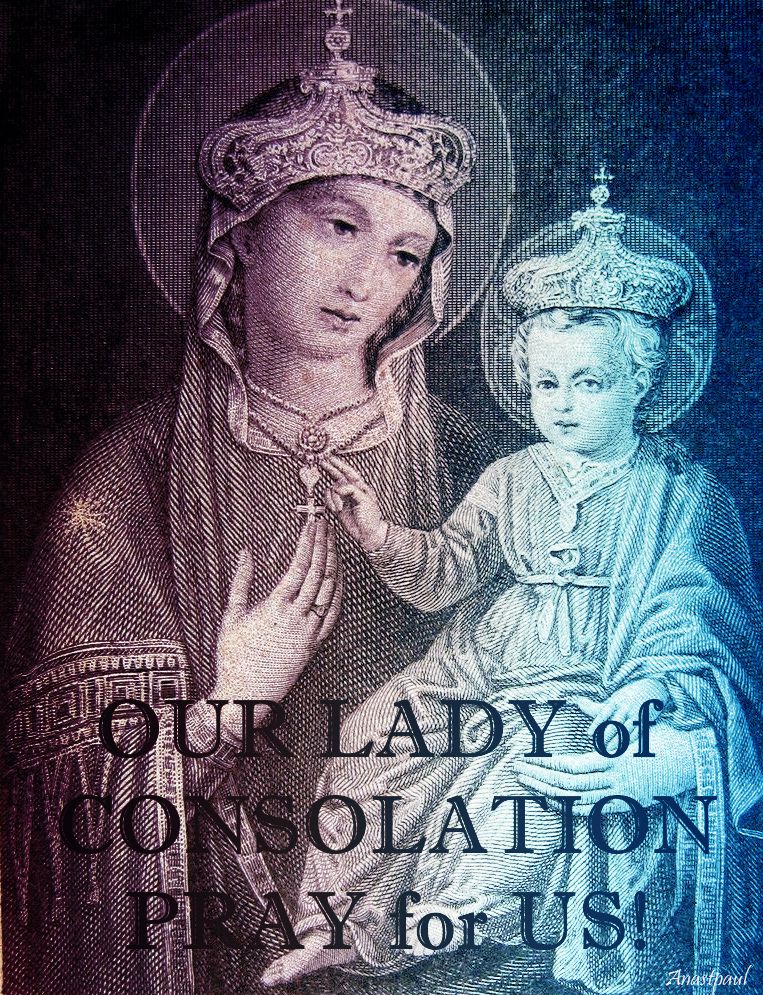
Thought for the Day – 4 September – The Feast of Our Lady of Consolation
Pope Benedict XVI encouraged the faithful to pray to Our Lady of Consolation, stating “From Her We Can Always Learn How to Look Upon Jesus:”
“As we come to the conclusion of this solemn celebration, we offer a prayer to Mary Most Holy, who in Turin is venerated as the principal patroness with the title Blessed Virgin of Consolation. To her I entrust this city and all those who live here. O Mary, watch over the families and the workers; watch over those who have lost faith and hope; comfort the sick, those in prison and all who suffer. O Help of Christians, sustain the young people, the elderly and persons in difficulty. O Mother of the Church, watch over her pastors and the whole community of believers, that they may be “salt and light” in the midst of the world.
The Virgin Mary is she who more than any other contemplated God in the human face of Jesus. She saw him as a newborn when, wrapped in swaddling clothes, he was placed in a manger; she saw him when, just after his death, they took him down from the cross, wrapped him in linen and placed him in the sepulcher. Inside her was impressed the image of her martyred Son; but this image was then transfigured in the light of the Resurrection. Thus in Mary’s heart was carried the mystery of the face of Christ, a mystery of death and of glory. From her we can always learn how to look upon Jesus with a gaze of love and of faith, to recognise in that human countenance, the Countenance of God.”
To our Lord and our God, Jesus Christ, we pray for a greater love of His Mother and to our Blessed Mother, Our Lady of Consolation, we lift our prayers for patience, for support and for comfort in our times of confusion, fear and anxiety. Pray for us, Our Lady of Consolation!
Quote/s of the Day – 4 September – The Feast of Our Lady of Consolation
“Has anyone ever come away from Mary, troubled or saddened or ignorant of the heavenly Mysteries? Who has not returned to everyday life gladdened and joyful because a request has been granted by the Mother of God?”
St Amadeus of Lausanne (1110-1159)
“As the Mother of Christ, Mary is the Mother of our wisdom and justice, of our holiness and redemption. She is more our Mother than the mother of our flesh.”
St Aelred (1109-1166)
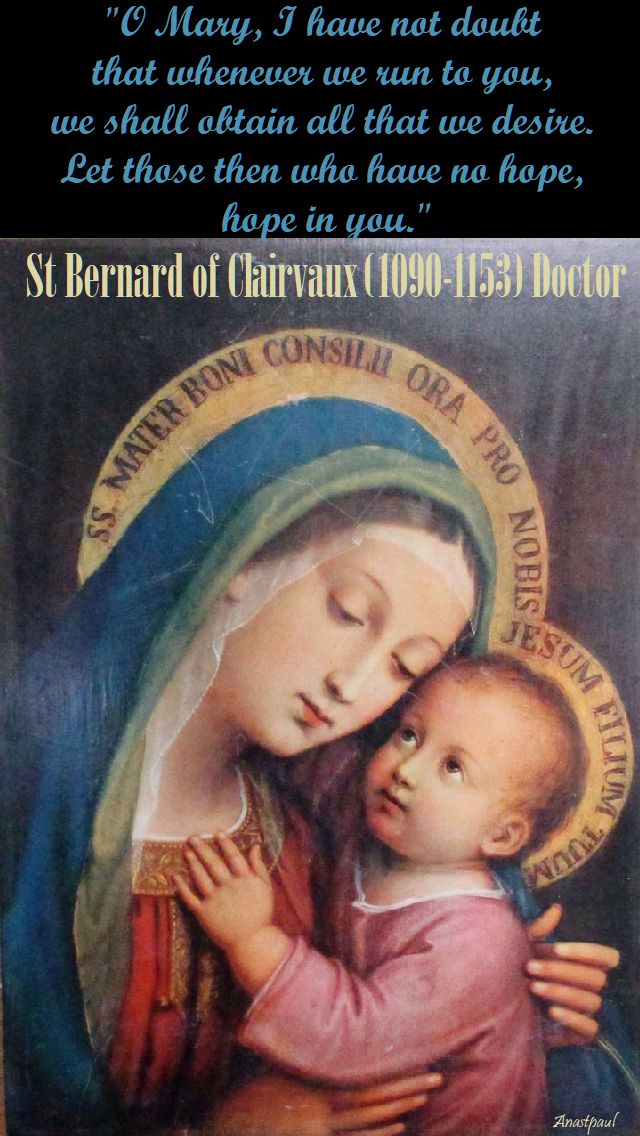
“O Mary, I have not doubt that whenever we run to you, we shall obtain all that we desire. Let those then who have no hope, hope in you.”
St Bernard of Clairvaux (1090-1153) Doctor of the Church
One Minute Reflection – 4 September – The Feast of Our Lady of Consolation
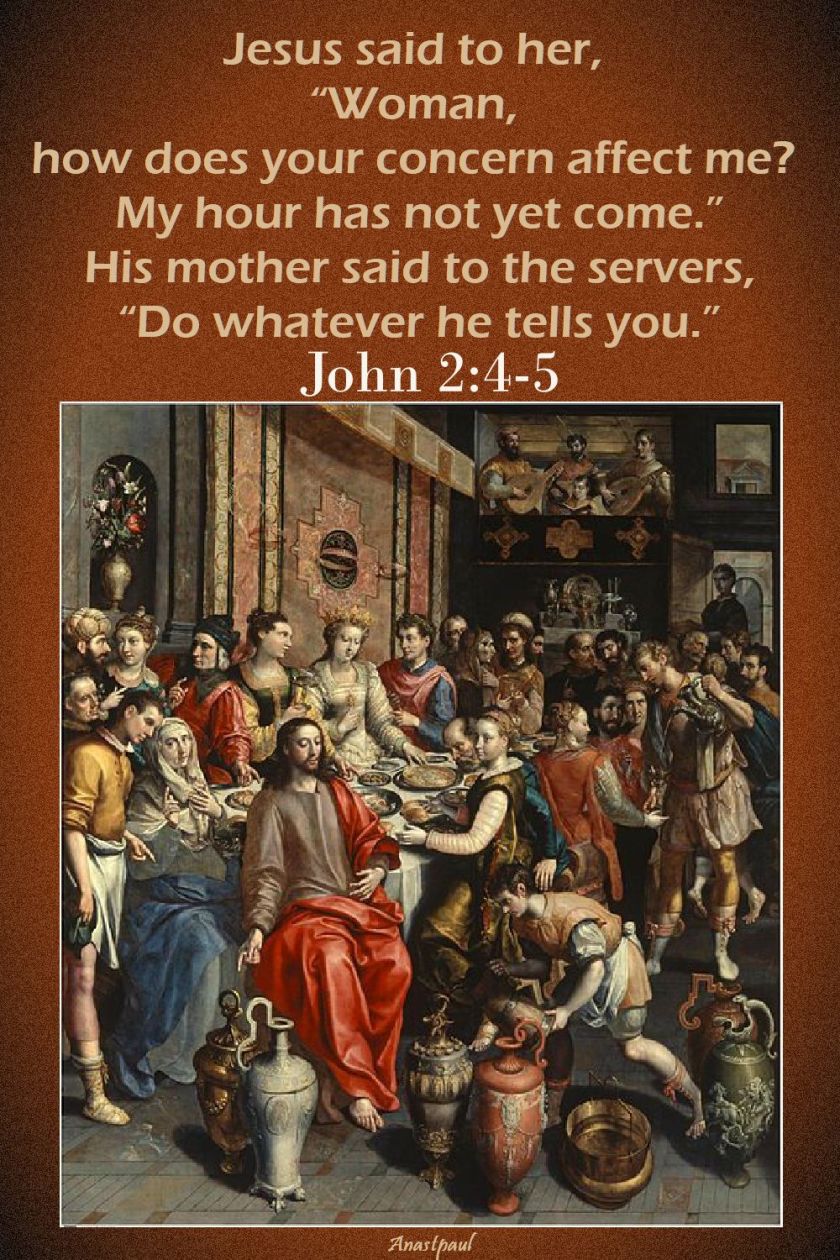
Jesus said to her, “Woman, how does your concern affect me? My hour has not yet come.” His mother said to the servers, “Do whatever he tells you.”….John 2:4-5
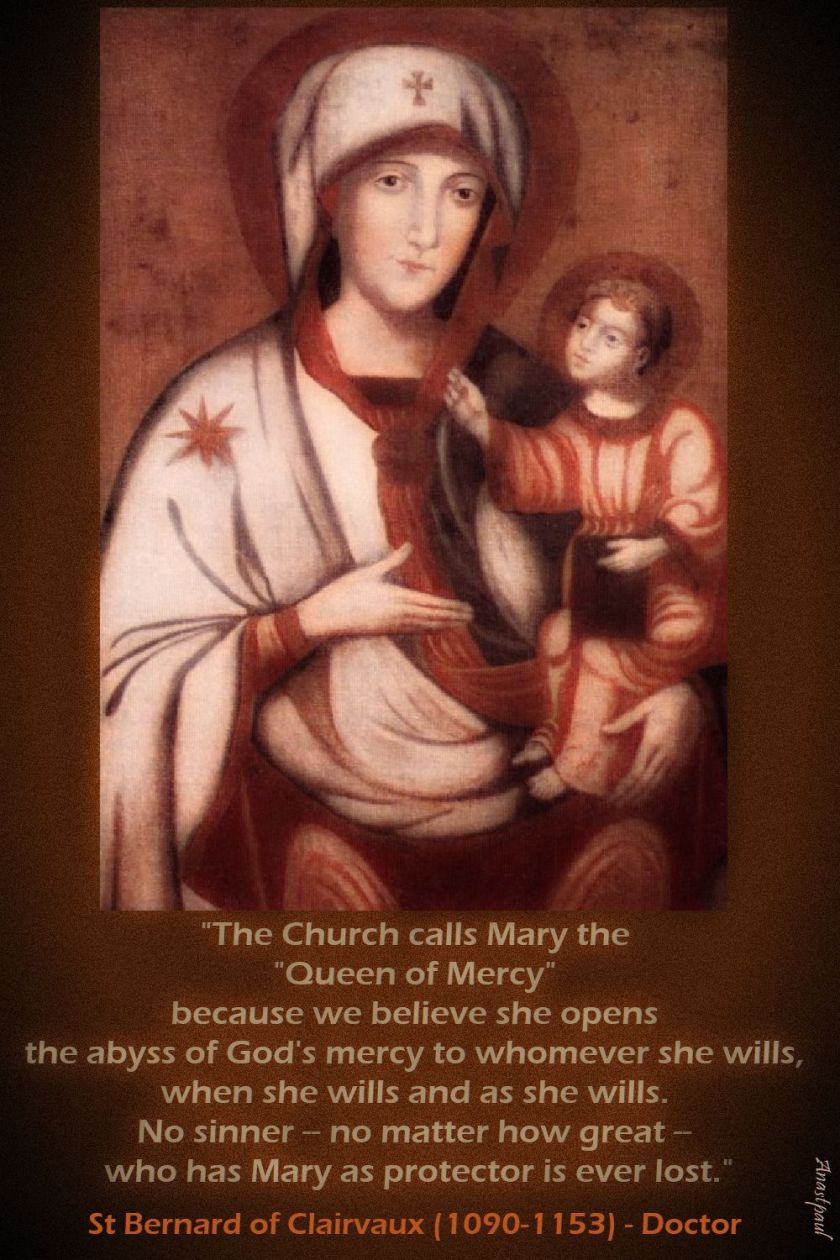
REFLECTION – “The Church calls Mary the “Queen of Mercy” because we believe she opens the abyss of God’s mercy to whomever she wills, when she wills and as she wills.
No sinner — no matter how great — who has Mary as protector is ever lost.”…St Bernard of Clairvaux (1090-1153) – Doctor of the Church
PRAYER – Almighty God, grant that Your faithful, who rejoice in the protection of the Blessed Virgin Mary, may be delivered from every evil here on earth, through her prayer and come to the enduring joys of heaven. Through our Lord, Jesus Christ, in union with the Holy Spirit Mary, our Consolation and Comforter, pray for us! Amen.
Our Morning Offering – 4 September – The Feast of Our Lady of Consolation
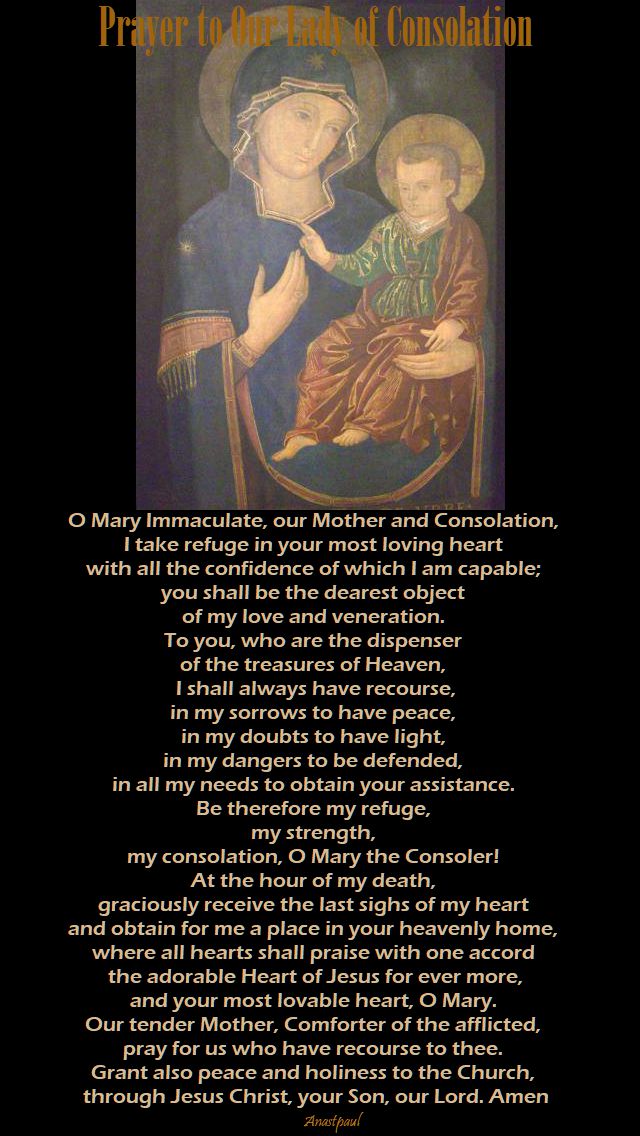
Prayer to Our Lady of Consolation
O Mary Immaculate, our Mother and Consolation,
I take refuge in your most loving heart
with all the confidence of which I am capable;
you shall be the dearest object
of my love and veneration.
To you, who are the dispenser
of the treasures of Heaven,
I shall always have recourse,
in my sorrows to have peace,
in my doubts to have light,
in my dangers to be defended,
in all my needs to obtain your assistance.
Be therefore my refuge,
my strength,
my consolation, O Mary the Consoler!
At the hour of my death,
graciously receive the last sighs of my heart
and obtain for me a place in your heavenly home,
where all hearts shall praise with one accord
the adorable Heart of Jesus for ever more,
and your most lovable heart, O Mary.
Our tender Mother, Comforter of the afflicted,
pray for us who have recourse to thee.
Grant also peace and holiness to the Church,
through Jesus Christ, your Son, our Lord. Amen
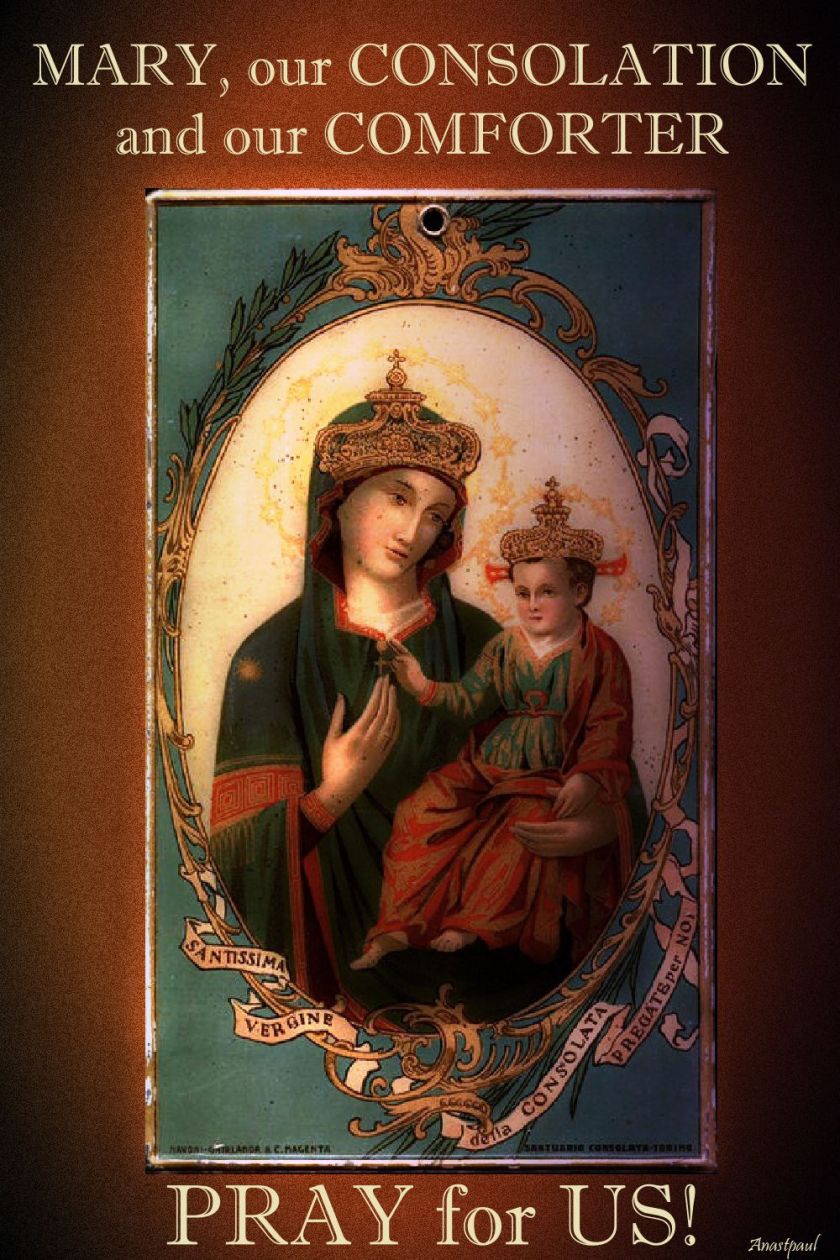
Madonna della Consolazione / Our Lady of Consolation
Beginning in the 2nd century, Catholics venerated Mary as Our Lady of Consolation, one of her earliest titles of honour. The title of Our Lady of Consolation, or Mary, Consoler of the Afflicted, comes from the Latin Consolatrix Afflictorum. It is found in the Litany of Loreto.
The origin of this invocation is derived from the Augustinian monks who propagated this particular devotion. In 1436 the Confraternity of the Holy Cincture of Our Lady of Consolation was founded in Bologna, Italy. It was based on an Augustinian tradition which hold that Saint Monica in the fourth century, was distraught with anxiety for her wayward son, Augustine and that Mary gave her a sash which the Virgin wore, with the assurance that whoever wore this belt would receive her special consolation and protection. Along with Augustine and Monica, Our Lady of Consolation is one of the three patrons of the Augustinians. The “Augustinian Rosary” is sometimes called the “Corona (or Crown) of Our Mother of Consolation.”
In the 1700s members of the Augustinian Order introduced devotion to Our Lady of Consolation to the island of Malta. On 1 December 1722 the Prior General of the Augustinian Order Fr Thomas Cervioni issued the Decree for the erection of the Confraternity of Our Lady of Consolation in the church of St Mark, run by the Augustinians at Rabat, although the devotion had been practiced for some time before. By this time the custom of asking for the final blessing before death in the name of Our Lady of Consolation was very popular and the monks were given a dispensation to leave the monastery at any time to confer it. Processions in Our Lady’s honour were suspended during the French occupation of 1798 to discourage the gathering of crowds.
An ancient story relates St Eusebius of Vercelli brought back an icon of Our Lady of Consolation when he was returning from exile in Egypt in 363. This icon was presented to the city of Turin. Later St Maximus, Bishop of Turin, established a small shrine to house the icon in a church dedicated to St Andrew. The icon became the object of great veneration and the church became the Santuario della Consolata. Giuseppe Allamano, rector of the Santuario della Consolata founded the Consolata Missionaries in 1902; they brought to devotion to Africa. At the age of nineteen Joseph Marello of Turin contracted typhus. He attributed his recovery to Our Lady of Consolation and went on to found the Oblates of St Joseph.
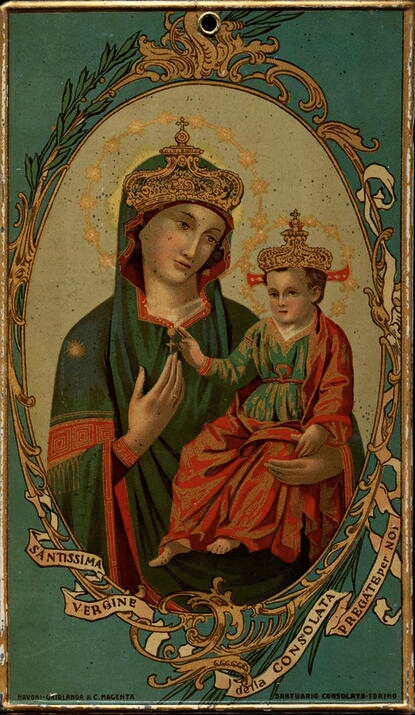
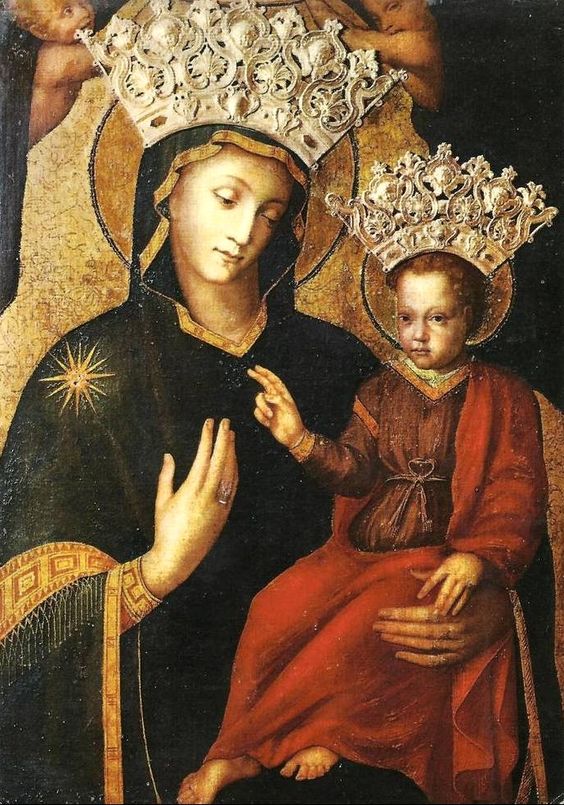
There are several versions of the image of Our Lady of Consolation. The original one is in Turin at the Santuario della Consolata. A star on her shoulder is characteristic of almost all the images. The traditional depiction of Our Mother of Consolation in Augustinian houses shows Mary holding the child Jesus on her lap. Jesus and Mary both hold the Augustinian cincture in their hands.
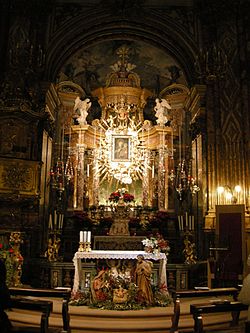
Altar with icon of the Virgin of the Consolation at the Santuario della Consolata or Sanctuary of the Virgin of the Consolation in Turin
In France the dioceses of Vannes, Valence, Montpelier, Laval, Nantes, Périgueux, Tours and many others, possessed churches or chapels dedicated to Mary under this title. In 1652, Pope Innocent X encouraged devotion to Our Lady of Consolation by establishing a confraternity.
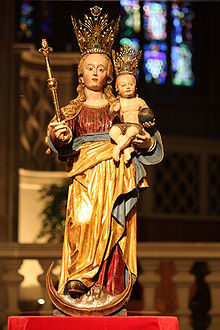
The cult of Our Lady of Luxembourg, Comforter of the Afflicted, was initiated by the Jesuits in 1624 and led to the election of Our Lady as the protectress of the City in 1666 and of the Duchy in 1678. After the destruction of the old pilgrimage chapel at the time of the French Revolution, the statue of Our Lady of Luxembourg was moved to St Peter church, today’s Cathedral in Luxembourg City. Statues depicting her can be found in niches in buildings throughout the city of Luxembourg. From there the devotion was adopted by the English Benedictine nuns of Cambrai.
Immigrants from Luxembourg transposed the cult of Our Lady of Consolation to the United States.
In 1848, Luxembourg immigrants began to settle in the area around Dacada, Wisconsin. The oldest statue of Our Lady of Luxembourg found in the United States, was brought to Dacada by a Luxembourg immigrant, Anna Margaret Deppiesse, in 1849. Mrs. Deppiesse donated it to St. Nicholas Church, where it can be found in an alcove shrine below the choir loft. When the church was remodeled in 1941, a mural depicting Our Lady of Luxembourg (Mary, Consoler of the Afflicted) was added to the apse in the sanctuary. The mural, which honours the parish’s Luxembourgian roots, was painted by liturgical artist, Bernard Grenkhe, using the “al secho” method (i.e., painting on wet plaster so as to make the image permanent.
During the Civil War, three parishioners of St. Augustine’s Parish in Leopold, Indiana fought for the North and were imprisoned at the notorious Andersonville Prison. Henry Devillez, Isidore Naviaux and Lambert Rogier, formerly of Belgium, vowed that if they survived, one of them would make a pilgrimage to Luxembourg and obtain a copy of the statue of Our Lady of Consolation that stood in their ancestral church. Rogier went to Luxembourg in 1867 and upon his return enshrined it in St. Augustine’s, where it now stands to the left of the main altar. In September 2013, Archbishop Joseph W. Tobin of Indianapolis dedicated a larger outdoor garden shrine.
Another centre of veneration and pilgrimage, which also adopted Our Lady, Comforter of the Afflicted is Kevaeler in Germany, not far from the Dutch border. In 1642 a copperplate engraving, representing Our Lady of Luxembourg, was installed in a sanctuary erected the same year. It is one of the best visited Catholic pilgrimage locations in north-western Europe. St Pope John Paul II visited in 1987.
The feast of Our Lady of Consolation is one of the solemnities not inscribed in the General Roman Calendar but which are observed in particular places, regions, churches or religious institutes. Augustinians observe 4 September, the Benedictines on 5 July. The popular girls name “Consuela” is derived from this title.
Our Lady of Consolation: Starting in the 2nd century, Catholics venerated Mary as Our Lady of Consolation, one of her earliest titles of honour. The title of Our Lady of Consolation, or Mary, Consoler of the Afflicted, comes from the Latin Consolatrix Afflictorum. It is found in the Litany of Loreto.
The original Icon of Our Lady of Consolation in Turin, Italy
St Ammianus the Martyr
St Pope Boniface I
St Caletricus of Chartres
St Candida of Naples
St Candida the Elder
St Castus of Ancyra
Bl Catherine of Racconigi
St Fredaldo of Mende
St Hermione
St Ida of Herzfeld
St Irmgard of Süchteln
St Julian the Martyr
St Magnus of Ancyra
St Marcellus of Chalon-sur-Saône
St Marcellus of Treves
St Maximus of Ancyra
St Monessa
St Moses the Prophet
Bl Nicolò Rusca
St Oceanus the Martyr
Bl Peter of Saint James
St Rebecca of Alexandria
St Rhuddlad
St Rosalia/Rose of Viterbo
St Rufinus of Ancyra
St Salvinus of Verdun
Bl Scipion-Jérôme Brigeat Lambert
St Silvanus of Ancyra
St Sulpicius of Bayeux
St Thamel
St Theodore the Martyr
St Ultan of Ardbraccan
St Victalicus
—
Martyred in the Spanish Civil War:
• Blessed Adrián Saiz y Saiz
• Blessed Baltasar Mariano Muñoz Martínez
• Facundo Fernández Rodríguez
• Blessed Francisco Sendra Ivars
• Blessed José Bleda Grau
• Blessed José Muñoz Quero
• Blessed José Pascual Carda Saporta
• Blessed Juan Moreno Juárez
• Blessed José Vicente Hormaechea Apoita
• Blessed Pedro Sánchez Barba
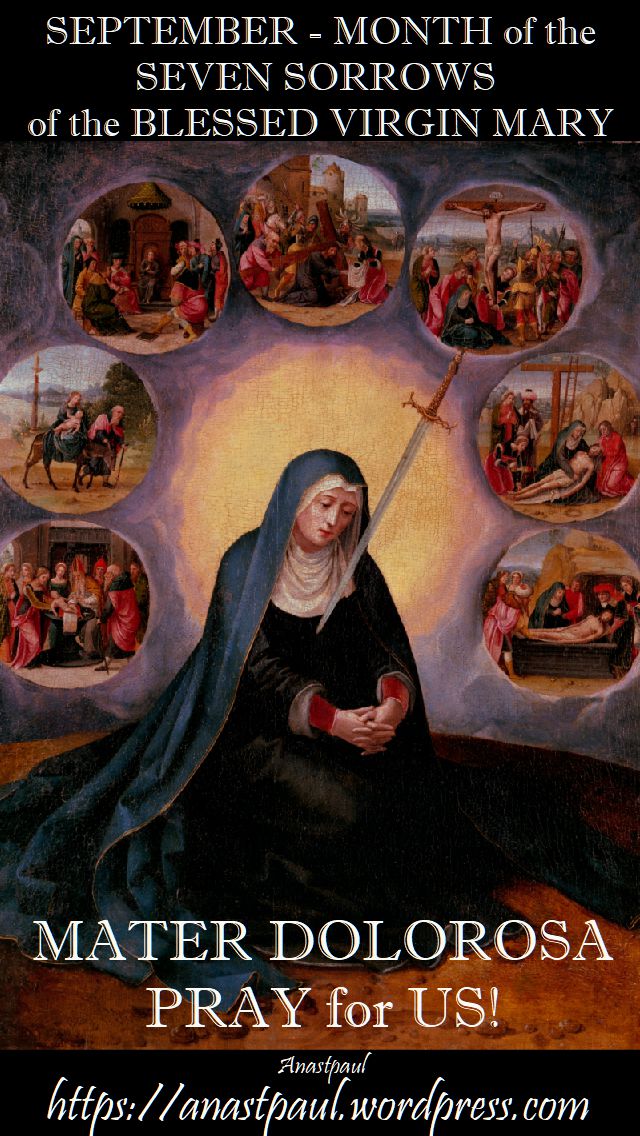
September: Month of the Seven Sorrows of the Blessed Virgin Mary
The Seven Sorrows of the Blessed Virgin Mary
1. The prophecy of Simeon
2. The Flight to Egypt
3. Loss of Child Jesus for 3 days
4. Meeting Jesus carrying His Cross
5. The Crucifixion of Jesus
6. The Pieta – receiving Jesus’ Body
7. The Burial of Jesus
The month of September is dedicated to the Seven Sorrows of Mary.
Devotion to the sorrows of the Virgin Mary dates from the twelfth century, when it made its appearance in monastic circles under the influence of St Anselm and St Bernard.
The Cistercians and then the Servites undertook to propagate it.
The Devotion became widespread in the fourteenth and especially the fifteenth centuries, particularly in the Rhineland and Flanders, where Confraternities of the Sorrowful Mother sprang up. It was in this context that the first liturgical formularies in her honour were composed. A provincial council of Mainz in 1423 made use of these in establishing a “Feast of the Sorrows of Mary” in reparation for Hussite profanations of her images.
In 1494 the feast appeared in Bruges, where the Precious Blood of Christ was venerated; later on it made its way into France. It did not, however, become widespread in France before Benedict XIII included it in the Roman Calendar in 1727.
God vouchsafed to select the very things about Him which are most incommunicable and in a most mysteriously real way communicate them to her. See how He had already mixed her up with the eternal designs of creation, making her almost a partial cause and partial model of it. Our Lady’s co-operation in the redemption of the world gives us a fresh view of her magnificence. Neither the Immaculate Conception nor the Assumption will give us a higher idea of Mary’s exaltation than the title of co-redemptress. Her sorrows were not necessary for the redemption of the world but in the counsels of God they were inseparable from it. They belong to the integrity of the divine plan. Are not Mary’s mysteries Jesus’ mysteries and His mysteries hers? The truth appears to be that all the mysteries of Jesus and Mary were in God’s design as one mystery. Jesus Himself was Mary’s sorrow, seven times repeated, aggravated sevenfold. During the hours of the Passion, the offering of Jesus and the offering of Mary were tied in one. They kept pace together; they were made of the same materials; they were perfumed with kindred fragrance; they were lighted with the same fire; they were offered with kindred dispositions. The two things were one simultaneous oblation, interwoven each moment through the thickly crowded mysteries of that dread time, unto the eternal Father, out of two sinless hearts, that were the hearts of Son and Mother, for the sins of a guilty world which fell on them contrary to their merits but according to their own free will.
“Let Mary never be far from your lips and from your heart. Following her, you will never lose your way. Praying to her, you will never sink into despair. Contemplating her, you will never go wrong.”
Our Morning Offering – 26 August Prayer to Our Lady of Czestochowa
Our Lady of Czestochowa,
Queen of Poland, pray for us.
Holy Mother of Czestochowa,
you are full of grace, goodness and mercy.
I consecrated to you all my thoughts,
words and actions – my soul and body.
I beseech your blessings
and especially prayers for my salvation.
Today I consecrate myself to you, good Mother, totally –
with body and soul amid joy and sufferings,
to obtain for myself and others,
your blessings on this earth
and eternal life in heaven. Amen
Our Lady of Czestochowa, Queen of Poland, pray for us.
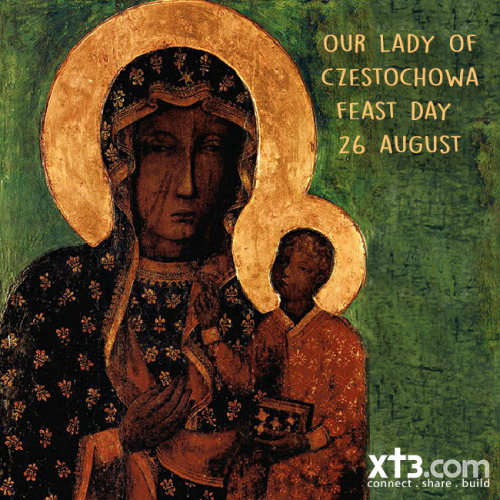
Blessed Feast of Our Lady of Czestochowa, Queen of Poland – 26 August – Also known as – The Black Madonna of Czestochowa, Czarna Madonna, Hodegetria, Imago thaumaturga Beatae Virginis Mariae Immaculatae Conceptae, Matka Boska Czestochowska, One Who Shows the Way. Our Lady of Czestochowa is a revered icon of the Virgin Mary housed at the Jasna Góra Monastery in Częstochowa, Poland. Several Pontiffs have recognised the venerated icon, beginning with Pope Clement XI who issued a Canonical Coronation to the image on 8 September 1717 via the Vatican Chapter. Patron of Poland.
According to tradition, the icon of Jasna Góra (Bright Mountain) was painted by Luke the Evangelist on a tabletop built by Jesus Himself and the icon was discovered by St Helen, mother of Emperor Constantine and collector of Christian relics in the Holy Land. The icon was then enshrined in the imperial city of Constantinople, where it remained for the next 500 years.
JASNA GORA MONASTERY
BASILICA OF OUR LADY OF CZESTOCHOWA AT JASNA GORA
In 803, the painting is said to have been given as a wedding gift from the Byzantine emperor to a Greek princess, who married a Ruthenian nobleman. The image was then placed in the royal palace at Belz, where it remained for nearly 600 years.
History first combines with tradition upon the icon’s arrival in Poland in 1382 with a Polish army fleeing the Tartars, who had struck it with an arrow.
Legend has it that during the looting of Belz, a mysterious cloud enveloped the chapel containing the image. A monastery was founded in Częstochowa to enshrine the icon in 1386 and soon King Jagiello built a cathedral around the chapel containing the icon.
However, the image soon came under attack once again. In 1430, Hussites (pre-Reformation reformers) attacked the monastery, slashed the Virgin’s face with a sword, and left it desecrated in a puddle of blood and mud.
It is said that when the monks pulled the icon from the mud, a miraculous fountain appeared, which they used to clean the painting. The icon was repainted in Krakow, but both the arrow mark and the gashes from the sword were left and remain clearly visible today.
The miracle for which the Black Madonna of Częstochowa is most famous occurred in 1655, when Swedish troops were about to invade Częstochowa. A group of Polish soldiers prayed fervently before the icon for deliverance and the enemy retreated. In 1656, King John Casimir declared Our Lady of Częstochowa “Queen of Poland” and made the city the spiritual capital of the nation.
The Virgin again came to the aid of her people in 1920, when the Soviet Russian Red Army gathered on the banks of the Vistula River, preparing to attack Warsaw. The citizens and soldiers fervently prayed to Our Lady of Częstochowa and on September 15, the Feast of Our Lady of Sorrows, she appeared in the clouds above Warsaw. The Russians were defeated in a series of battles later dubbed the “Miracle at the Vistula.”
During Nazi occupation, Hitler prohibited pilgrimages to Jasna Góra but many still secretly made the journey. In 1945, after Poland was liberated, half a million pilgrims journeyed to Czestochowa to express their gratitude. On September 8, 1946, 1.5 million people gathered at the shrine to rededicate the entire nation to the Immaculate Heart of Mary. During the Cold War, Jasna Góra was a centre of anti-Communist resistance. Czestochowa is regarded as the most popular shrine in Poland, with many Polish Catholics making a pilgrimage there every year. A pilgrimage has left Warsaw every August 6 since 1711 for the nine-day, 140-mile trek. Elderly pilgrims recall stealing through the dark countryside at great personal risk during the German Nazi occupation. Pope John Paul II secretly visited as a student pilgrim during World War II. He was a fervent devotee of the Virgin Mary and of her icon at Czestochowa. As pope, he made pilgrimages to pray before the Black Madonna in 1979, 1983, 1991 and 1997. In 1991, he held his Sixth World Youth Day at Czestochowa, which was attended by 350,000 young people from across Europe.
The four-foot-high painting displays a traditional composition well known in the icons of Eastern Christians. The Virgin Mary is shown as the “Hodegetria” (“One Who Shows the Way”). In it the Virgin directs attention away from herself, gesturing with her right hand toward Jesus as the source of salvation. In turn, the child extends his right hand toward the viewer in blessing while holding a book of gospels in his left hand. The icon shows the Madonna in fleur-de-lis robes.
This image shows Our Lady dressed in special robes at Jasna Gora
Our Lady of Czestochowa – https://www.youtube.com/watch?v=eHTPPBxowQY
—
St Abundius the Martyr
St Alexander of Bergamo
St Anastasius the Fuller
St Bregwin of Canterbury
St Elias of Syracuse
St Eleutherius of Auxerre
St Felix of Pistoia
Bl Herluin
Bl Ioachim Watanabe Jirozaemon
St Irenaeus of Rome
Bl Jacques Retouret
St Jeanne Elizabeth des Bichier des Anges
Bl Jean Bassano
Bl Jean of Caramola
Bl Juan Urgel
Bl Levkadia Herasymiv
Bl Margaret of Faenza
St Mary of Jesus Crucified
St Maximilian of Rome
St Melchizedek the Patriarch
St Orontius of Lecce
St Pandwyna
St Rufinus of Capua
St Secundus the Theban
Bl Stanislaus Han Jeong-Heum
St Teresa de Gesu, Jornet y Ibars
St Victor of Caesarea
St Victor the Martyr
St Vyevain of York
—
Martyrs of Celano – 3 saints: Three Christians, Constantius, Simplicius and Victorinus, martyred in the same area at roughly the same time. That’s really all we know, though it didn’t stop writers in later centuries from inventing colourful histories, making them a father and sons, adding saintly family members, earthquakes, close escapes, etc.
They were martyred in c 159 in the Marsica region of Italy. At some point their relics were interred under the main altar of the San Giovanni Vecchio church in the Collegiata di Celano and were authenticated in 1057 by Pope Stephen IX. The city was depopulated in 1222; when it was re-built, the relics were re-enshrined in the church of San Vittorino on 10 June 1406. Patronage – Celano, Italy.
Martyred in the Spanish Civil War:
• Blessed Emilio Serrano Lizarralde
• Blessed Francesc Casademunt Ribas
• Blessed Josep Maria Tolaguera Oliva
• Blessed Luis Valls Matamales
• Blessed María de Los Ángeles Ginard Martí
• Blessed Pere Sisterna Torrent
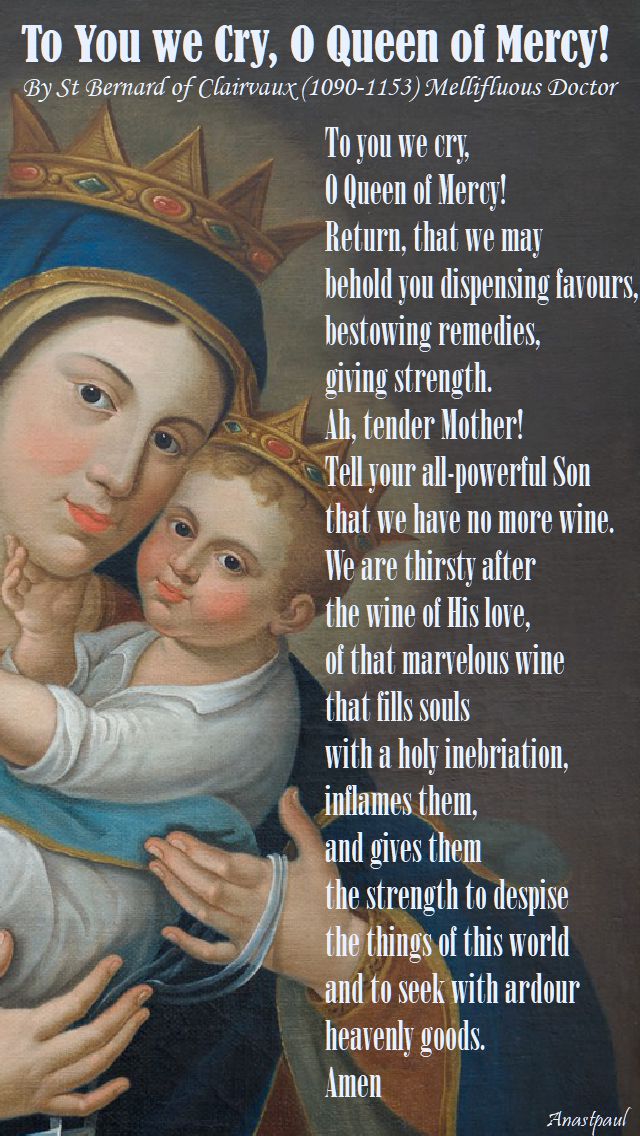
To You we Cry, O Queen of Mercy! By St Bernard of Clairvaux (1090-1153) Doctor mellifluus (Mellifluous Doctor)
To you we cry,
O Queen of Mercy!
Return, that we may
behold you dispensing favours,
bestowing remedies,
giving strength.
Ah, tender Mother!
Tell your all-powerful Son
that we have no more wine.
We are thirsty after the wine of His love,
of that marvelous wine
that fills souls with a holy inebriation,
inflames them,
and gives them the strength to despise
the things of this world
and to seek with ardour heavenly goods.
Amen
Thought for the Day – 22 August – The Queenship of Mary
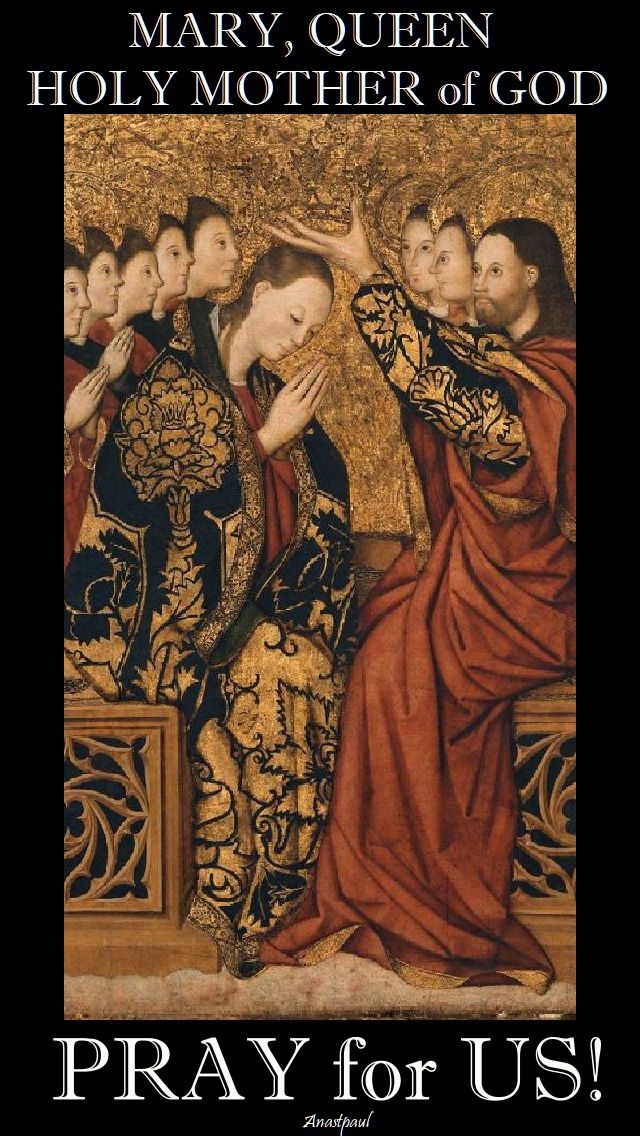
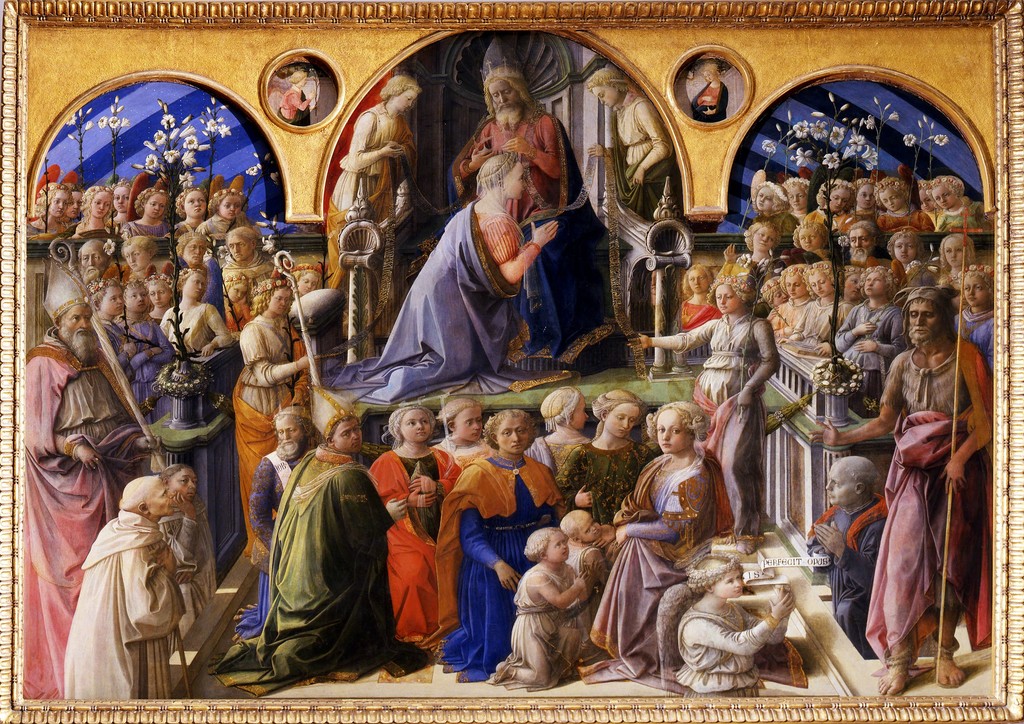
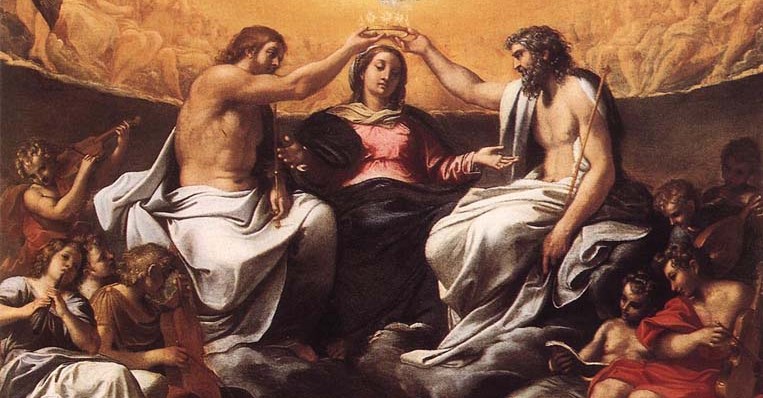
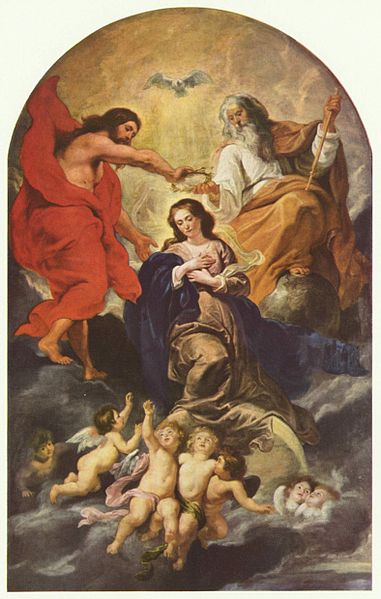
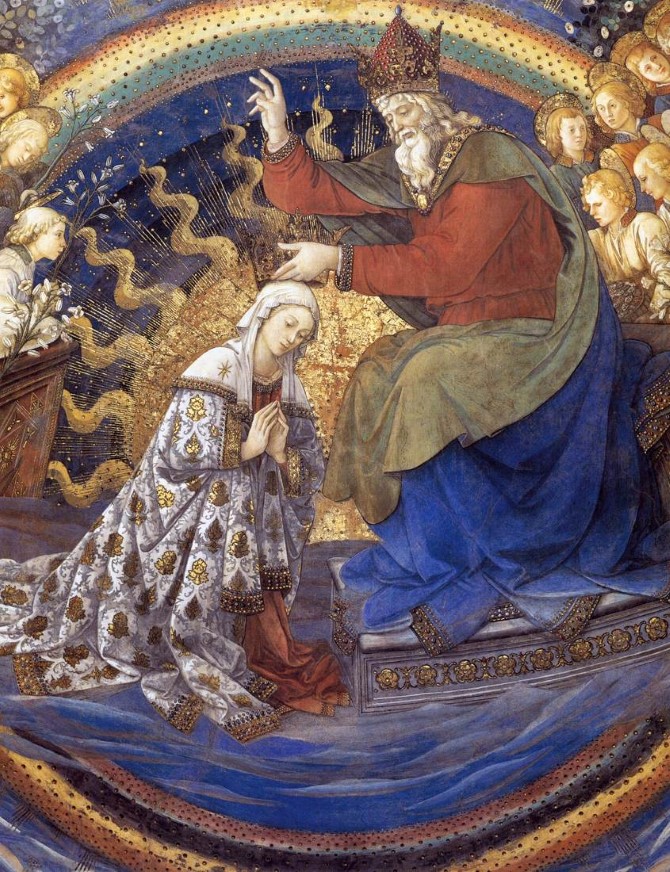
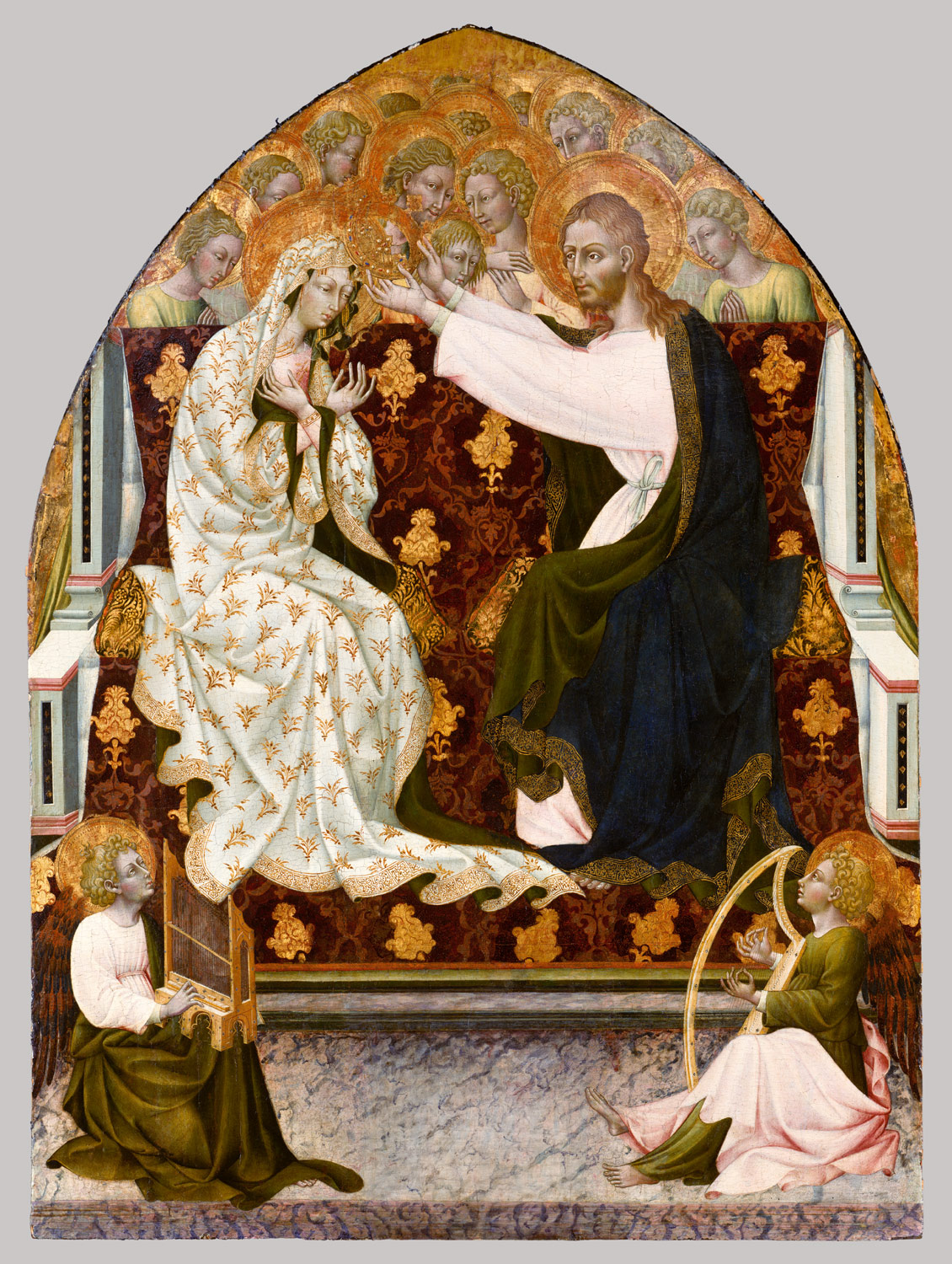
As St. Paul suggests in Romans 8:28–30, God has predestined human beings from all eternity to share the image of his Son. All the more was Mary predestined to be the mother of Jesus. As Jesus was to be king of all creation, Mary, in dependence on Jesus, was to be queen. All other titles to queenship derive from this eternal intention of God. As Jesus exercised his kingship on earth by serving his Father and his fellow human beings, so did Mary exercise her queenship. As the glorified Jesus remains with us as our king till the end of time (Matthew 28:20), so does Mary, who was assumed into heaven and crowned queen of heaven and earth.
In the fourth century St Ephrem called Mary “Lady” and “Queen.” Later Church fathers and doctors continued to use the title. Hymns of the 11th to 13th centuries address Mary as queen: “Hail, Holy Queen,” “Hail, Queen of Heaven,” “Queen of Heaven.” The Dominican rosary and the Franciscan crown as well as numerous invocations in Mary’s litany celebrate her queenship.
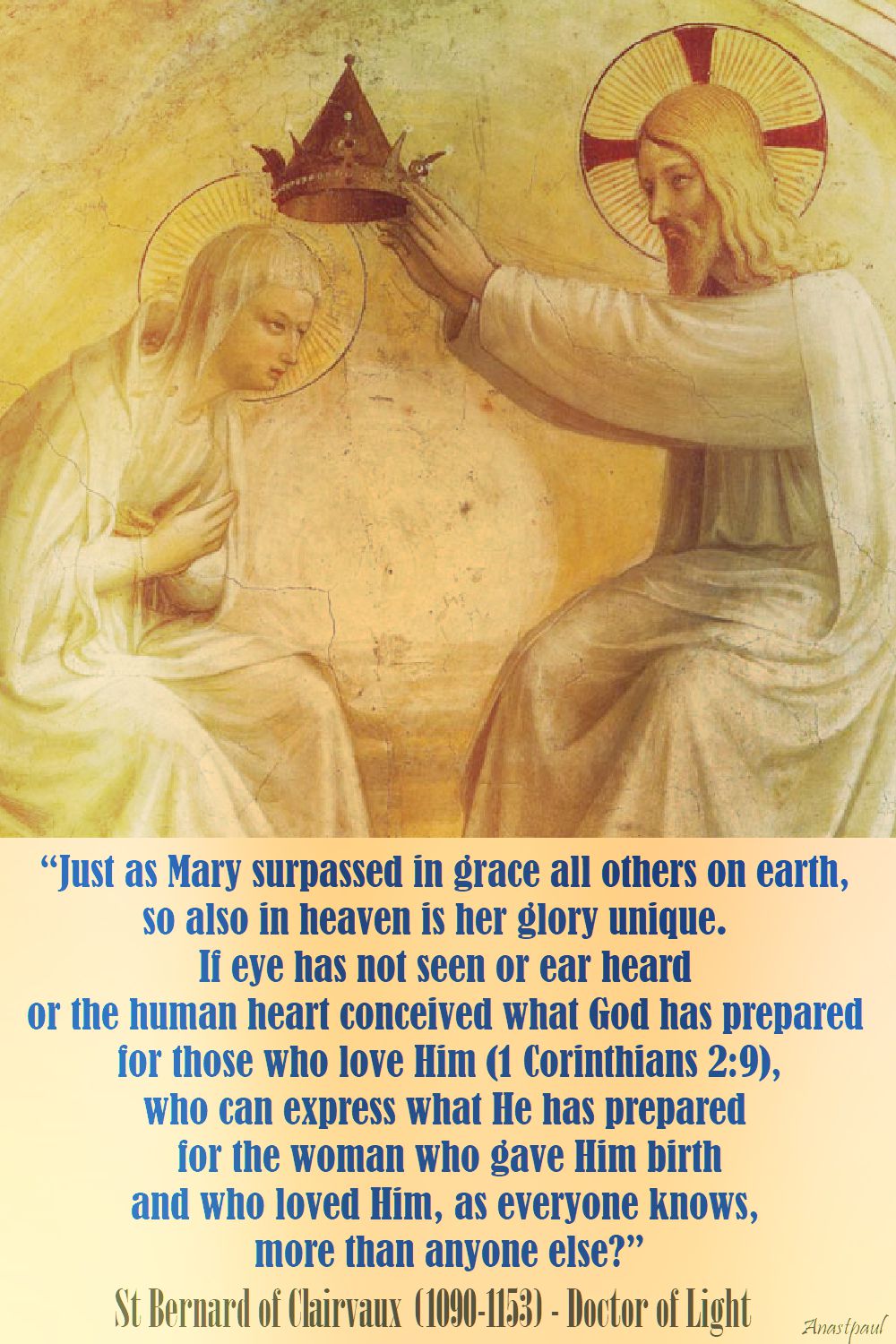
The feast is a logical follow-up to the Assumption and is now celebrated on the octave day of that feast. In his 1954 encyclical To the Queen of Heaven, Pius XII points out that Mary deserves the title because she is Mother of God because she is closely associated as the New Eve with Jesus’ redemptive work because of her preeminent perfection and because of her intercessory power. (Fr Don Miller OFM) “Just as Mary surpassed in grace all others on earth, so also in heaven is her glory unique. If eye has not seen or ear heard or the human heart conceived what God has prepared for those who love Him (1 Corinthians 2:9), who can express what He has prepared for the woman who gave Him birth and who loved Him, as everyone knows, more than anyone else?” (St Bernard of Clairvaux (1090-1153) – Doctor of Light – Mellifluous Doctor)
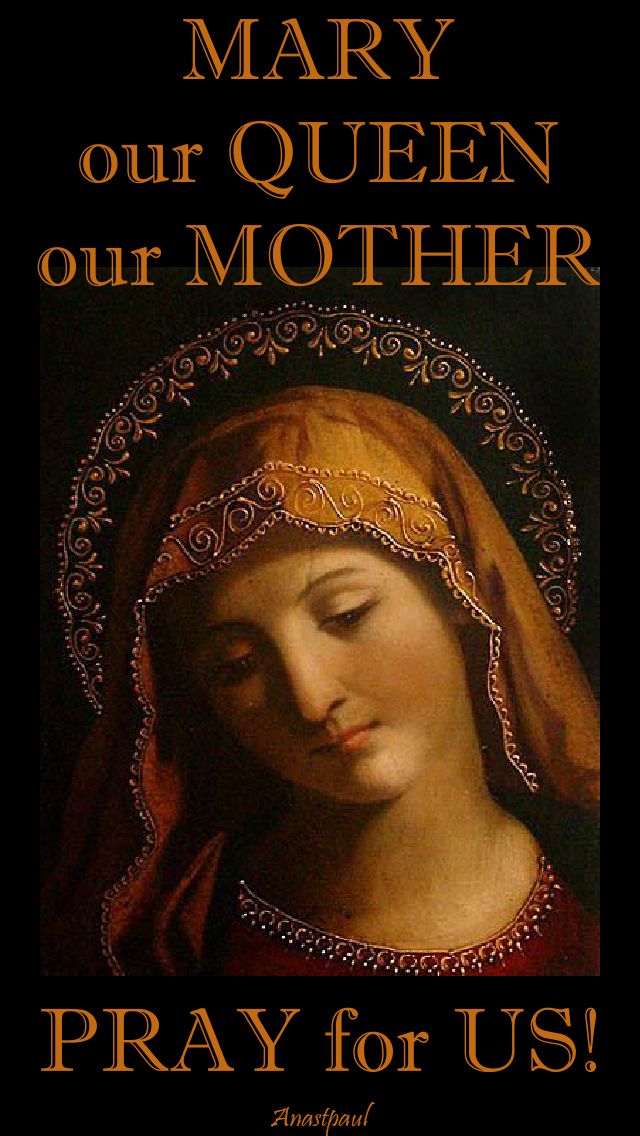
Mary Queen of Heaven and Earth Pray for your children!
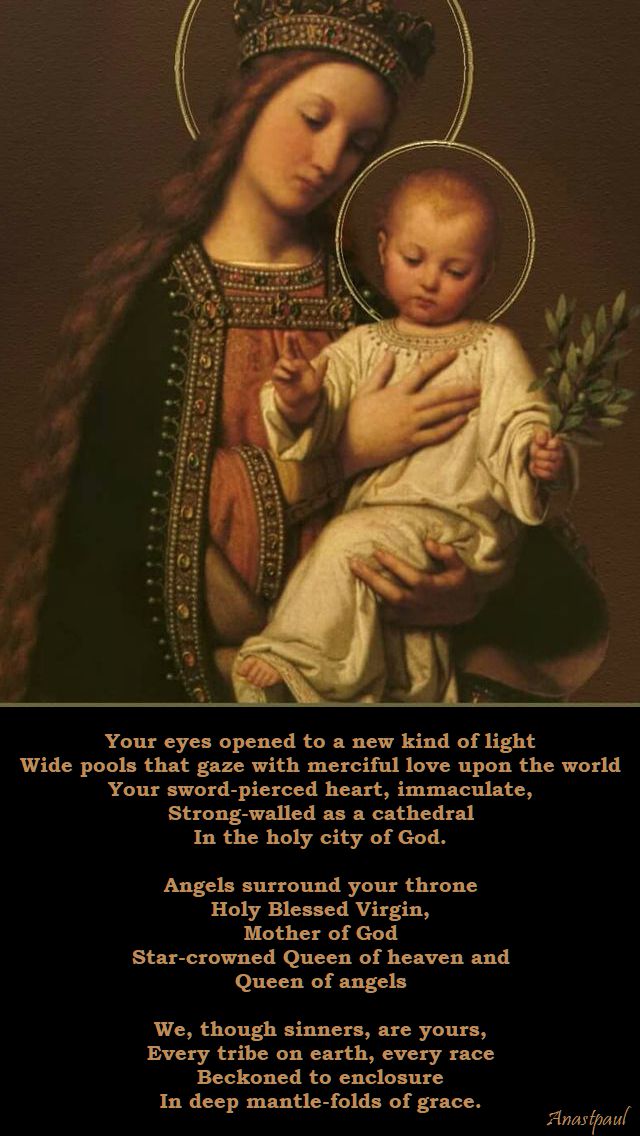
Your eyes opened to a new kind of light Wide pools that gaze with merciful love upon the world Your sword-pierced heart, immaculate,
Strong-walled as a cathedral
In the holy city of God.
Angels surround your throne Holy Blessed Virgin, Mother of God Star-crowned Queen of heaven and Queen of angels
We, though sinners, are yours, Every tribe on earth, every race Beckoned to enclosure In deep mantle-folds of grace.
Quote/s of the Day – 22 August – The Queenship of Mary
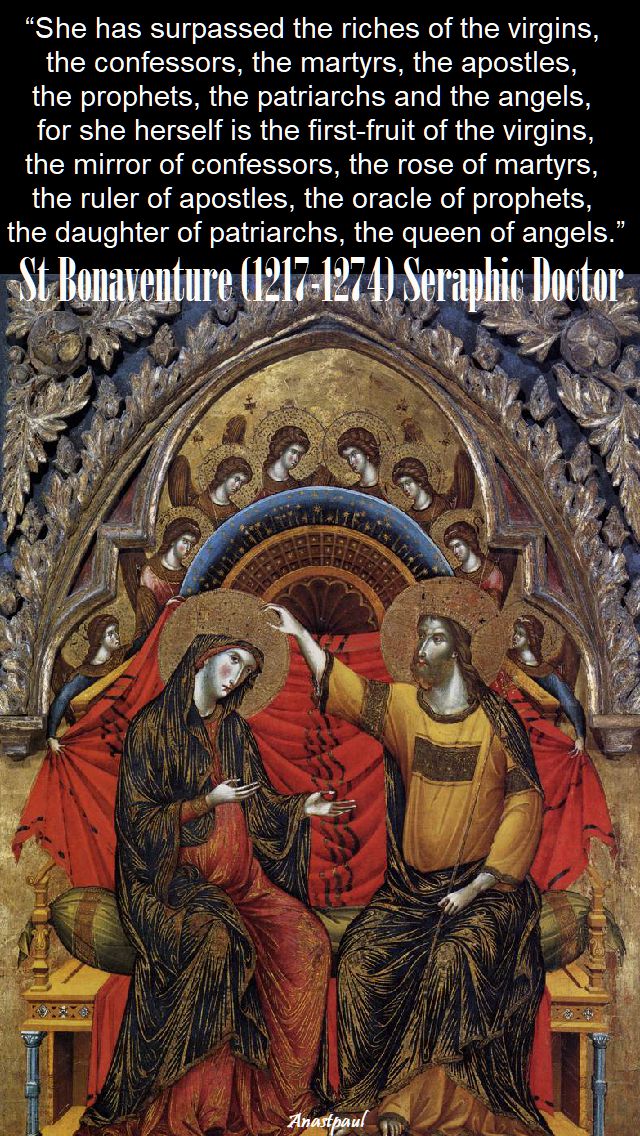
“She has surpassed the riches of the virgins, the confessors, the martyrs, the apostles, the prophets, the patriarchs and the angels, for she herself is the first-fruit of the virgins, the mirror of confessors, the rose of martyrs, the ruler of apostles, the oracle of prophets, the daughter of patriarchs, the queen of angels.”
…St Bonaventure (1217-1274) Seraphic Doctor
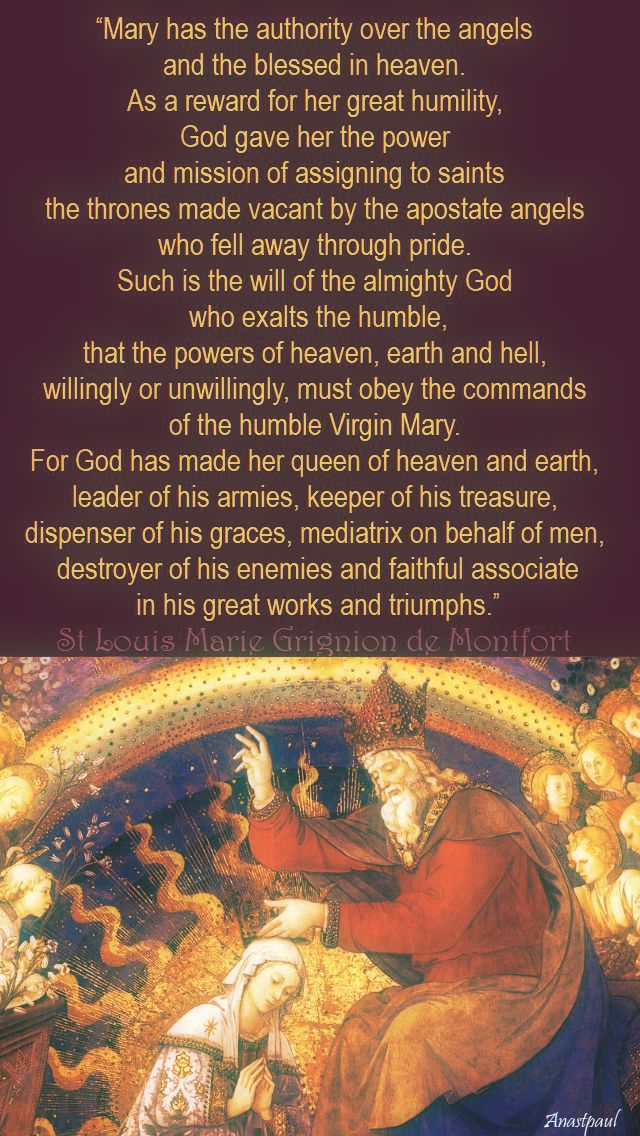
“Mary has the authority over the angels and the blessed in heaven. As a reward for her great humility, God gave her the power and mission of assigning to saints the thrones made vacant by the apostate angels who fell away through pride. Such is the will of the almighty God who exalts the humble, that the powers of heaven, earth and hell, willingly or unwillingly, must obey the commands of the humble Virgin Mary. For God has made her queen of heaven and earth, leader of his armies, keeper of his treasure, dispenser of his graces, mediatrix on behalf of men, destroyer of his enemies and faithful associate in his great works and triumphs.”
…St Louis Marie de Montfort
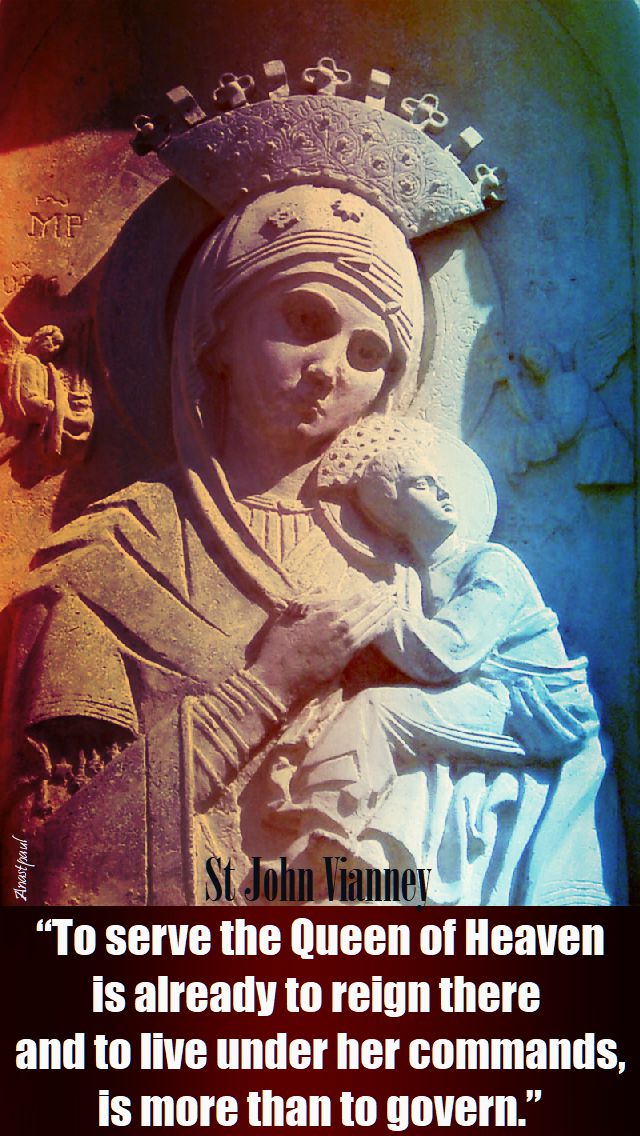
“To serve the Queen of Heaven is already to reign there and to live under her commands, is more than to govern.”
…St John Marie Vianney
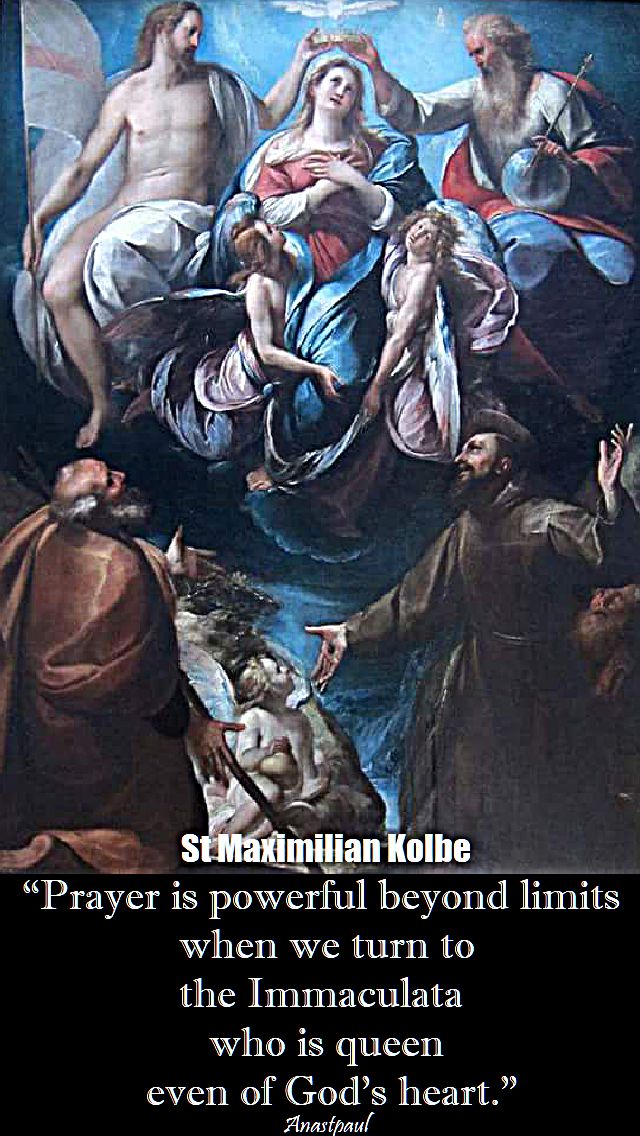
“Prayer is powerful beyond limits when we turn to the Immaculata who is queen even of God’s heart.”
…St Maximilian Kolbe
“No one has access to the Almighty as His mother has – none has merit such as hers. Her Son will deny her nothing that she asks and herein lies her power. While she defends the Church, neither height nor depth, neither men nor evil spirits, neither great monarchs, nor craft of man, nor popular violence, can avail to harm us – for human life is short but Mary reigns above, a Queen forever.”
One Minute Reflection – August 22 – The Memorial of the Queenship of Mary
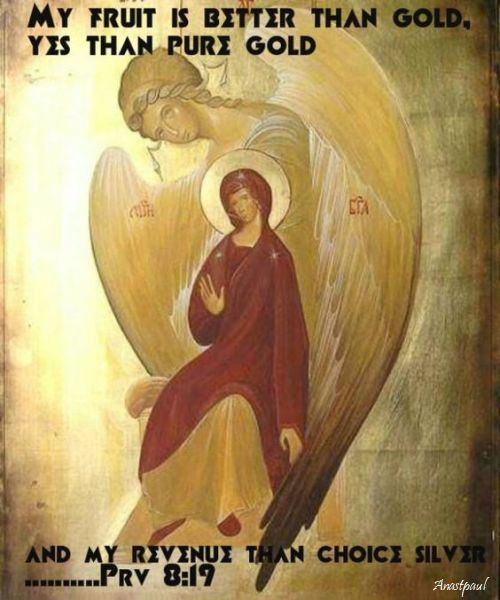
My fruit is better than gold, yes than pure gold and my revenue than choice silver………….Prv 8:19
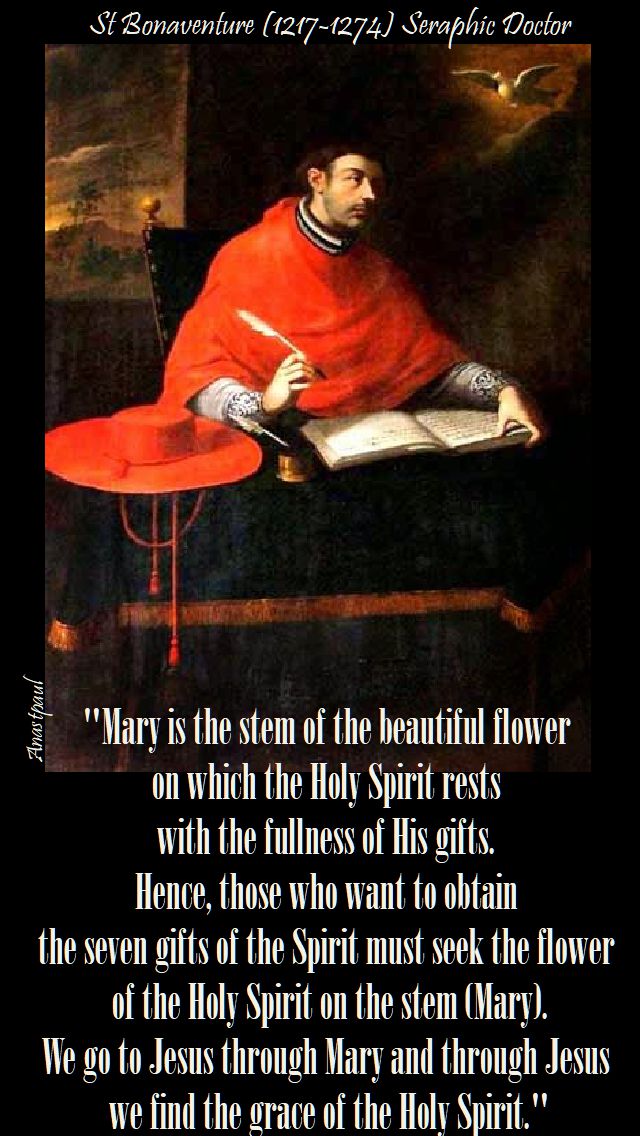
REFLECTION – “Mary is the stem of the beautiful flower on which the Holy Spirit rests with the fullness of His gifts. Hence, those who want to obtain the seven gifts of the Spirit must seek the flower of the Holy Spirit on the stem (Mary).
We go to Jesus through Mary and through Jesus we find the grace of the Holy Spirit.”…St Bonaventure (1217-1274) Seraphic Doctor
PRAYER – Heavenly Father, You made Mary the Spouse of the Holy Spirit. Help me through Mary and Jesus to reach the Spirit and obtain His surpassing gifts. Holy Mother of God, Queen of Heaven and Earth, be my companion and my guide. Amen
Our Morning Offering – 22 August – The Queenship of Mary
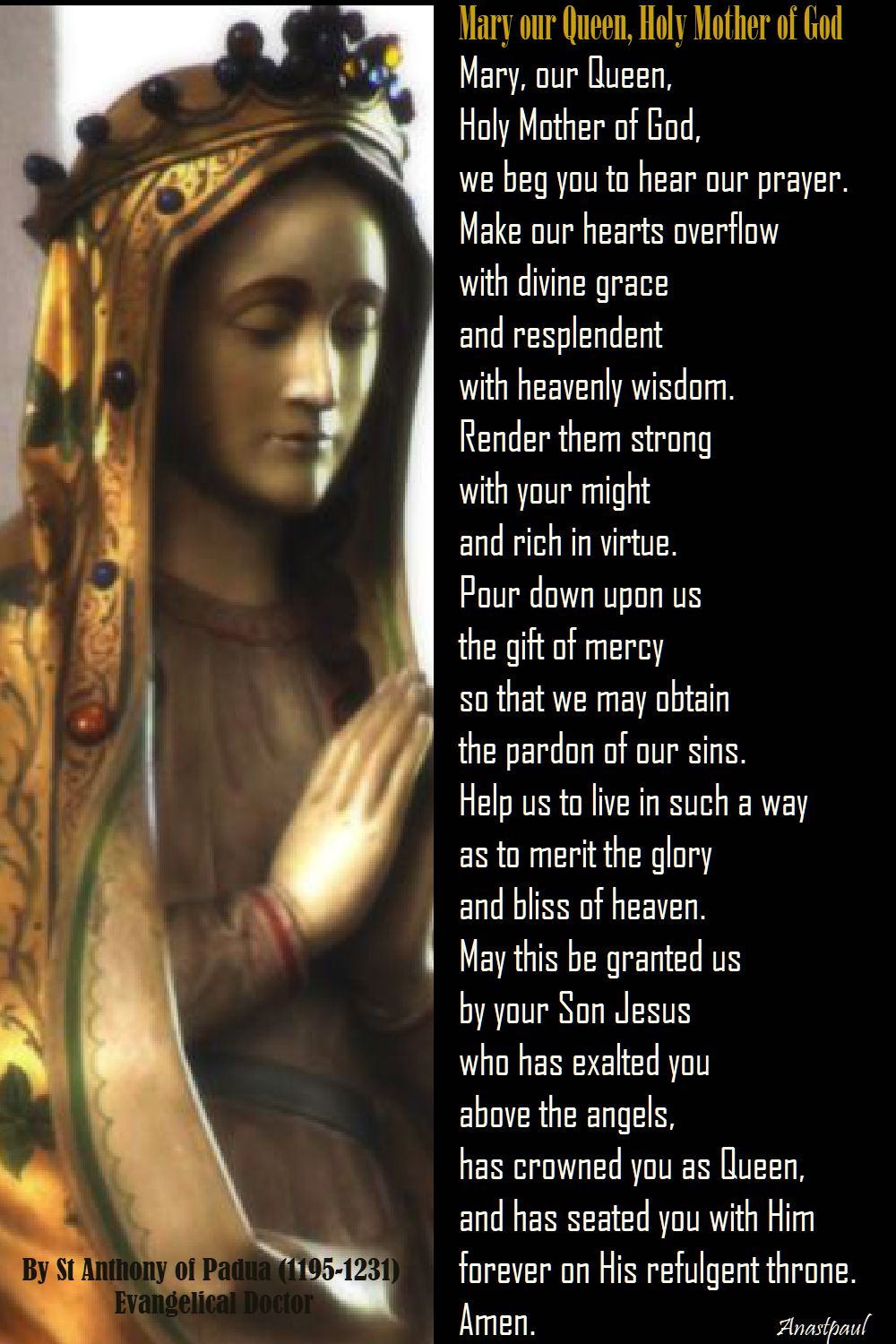
Mary our Queen, Holy Mother of God By St Anthony of Padua (1195-1231) Evangelical Doctor
Mary, our Queen,
Holy Mother of God,
we beg you to hear our prayer.
Make our hearts overflow with divine grace
and resplendent with heavenly wisdom.
Render them strong with your might
and rich in virtue.
Pour down upon us the gift of mercy
so that we may obtain the pardon of our sins.
Help us to live in such a way
as to merit the glory and bliss of heaven.
May this be granted us by your Son Jesus
who has exalted you above the angels,
has crowned you as Queen,
and has seated you with Him
forever on His refulgent throne.
Amen.
The Memorial of the Queenship of Mary – 22 August – A Marian feast day decreed by Pope Pius XII on 11 October 1954, in his encyclical Ad caeli reginam to recognise and celebrate the Blessed Virgin Mary as Queen of the world, of the universe, of the angels, of heaven, Prophets, Apostles, Martyrs, Confessors, Virgins, all Saints,of Families, Queen conceived without original sin Queen assumed into Heaven, Queen of the Most Holy Rosary, Queen of Mercy, Queen of Peace. The movement to officially recognise the Queenship of Mary was initially promoted by several Catholic Mariological congresses in Lyon, France, Freiburg, Germany and Einsiedeln, Switzerland. Pro Regalitate Mariae, an international society to promote the Queenship of Mary, was founded in Rome, Italy by noted Marioligist and writer Father Gabriel Roschini. Patronages – the diocese of Cabinda, Angola.
From early times Christians have believed and not without reason, that she of whom was born the Son of the Most High received privileges of grace above all other beings created by God. He “will reign in the house of Jacob forever,” “the Prince of Peace,” the “King of Kings and Lord of Lords.” And when Christians reflected upon the intimate connection that obtains between a mother and a son, they readily acknowledged the supreme royal dignity of the Mother of God.
In this feast, particularly cherished by the Popes of modern times, we celebrate Mary as the Queen of Heaven and Earth.
Pope Pius IX said of Mary’s Queenship: “Turning her maternal Heart toward us and dealing with the affair of our salvation, she is concerned with the whole human race. Constituted by the Lord, Queen of Heaven and earth and exalted above all choirs of Angels and the ranks of Saints in Heaven, standing at the right hand of Her only-begotten Son, Our Lord Jesus Christ, she petitions most powerfully with Her maternal prayers and she obtains what she seeks.”
And Pope Pius XII added the following: “We commend that on the festival there be renewed the consecration of the human race to the Immaculate Heart of the Blessed Virgin Mary. Upon this there is founded a great hope that there will rejoice in the triumph of religion and in Christian peace…
…Therefore, let all approach with greater confidence now than before, to the throne of mercy and grace of our Queen and Mother to beg help in difficultly, light in darkness and solace in trouble and sorrow…
. . Whoever, therefore, honours the lady ruler of the Angels and of men – and let no one think themselves exempt from the payment of that tribute of a grateful and loving soul – let them call upon her as most truly Queen and as the Queen who brings the blessings of peace, that She may show us all, after this exile, Jesus, who will be our enduring peace and joy.”
St Lomman, Abbot, (5th—early 6th century)
“The Help of Mary, Queen and Mother”
O Mary, when our eyes close in our last sleep and open to behold thy Son, the Just Judge and the Angel opens the Book and the Enemy accuses us; in that terrible hour, come to our aid. Be with us.
When death came to Joseph, you and your Son were with him: Thy Son to judge, thou to console. O Happy Joseph! When death comes for us, be near us. O Mary, when we are held captive in the place of atonement; plead for us and visit us, that we may find consolation in thy presence. Stretch forth thy hand to help us; deliver us from our bondage. We are thy children: Thou art our Mother. As little children we come to thee; we know no fear.
O Mary, He changed water into wine for thee, even as He said: My hour has not yet come. Now He will not refuse thee, when you plead for us thy children. O Mary, come quickly to our aid. Do not let us stray from the Fold. The wolf is waiting to destroy us. There shall be neither night nor day to thy praises.
Adoration to the Father Who created thee! Adoration to they Son, Who took flesh from thee! Adoration to the Holy Spirit, Thy Divine Spouse! Three in One, One in Three. Equal in all things. To Him be glory for ever. Forever. Forever. Amen.
Queenship of Mary (Memorial)
—
St Andrew of Fiesole
St Anthusa of Seleucia
St Antoninus of Rome
St Arnulf of Eynesbury
St Athanasius of Tarsus
Bl Bernard Perani
St Dalmau Llebaría Torné
Bl Élie Leymarie de Laroche
St Epictetus of Ostia
St Ethelgitha of Northumbria
St Fabrician of Toledo
St Felix of Ostia
St Gunifort
St Joan Farriol Sabaté
St John Kemble
St John Wall
St Josep Roselló Sans
St Julio Melgar Salgado
St Maprilis of Ostia
St Martial of Ostia
St Maurus of Rheims
St Narciso de Esténaga y Echevarría
St Philibert of Toledo
Bl Richard Kirkman
St Saturninus of Ostia
Bl Simeon Lukach
St Sigfrid of Wearmouth
St Symphorian of Autun
St Thomas Percy
St Timothy of Rome
Bl William Lacey
_
Martyred in the Spanish Civil War:
• Blessed Dalmau Llebaría Torné
• Blessed Joan Farriol Sabaté
• Blessed Josep Roselló Sans
• Blessed Julio Melgar Salgado
• Blessed Narciso de Esténaga y Echevarría
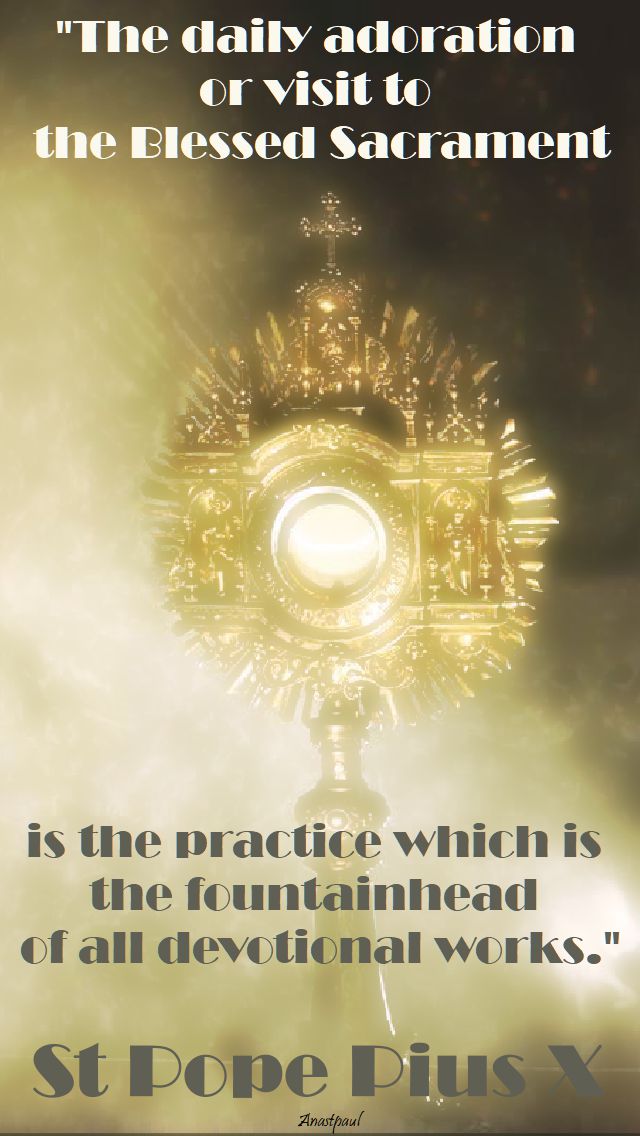
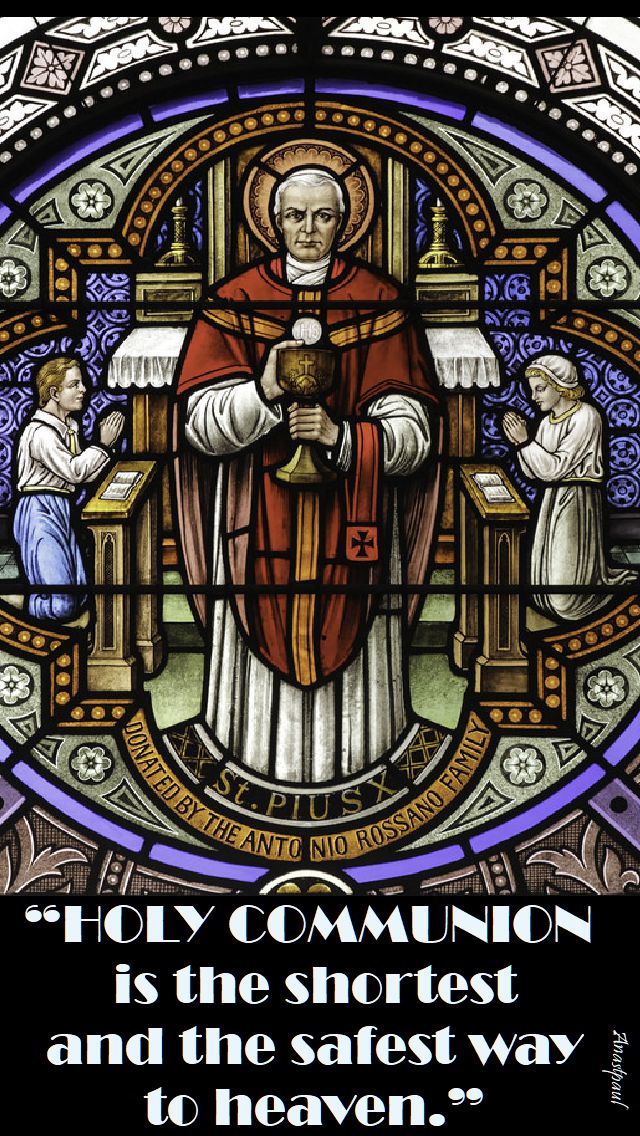
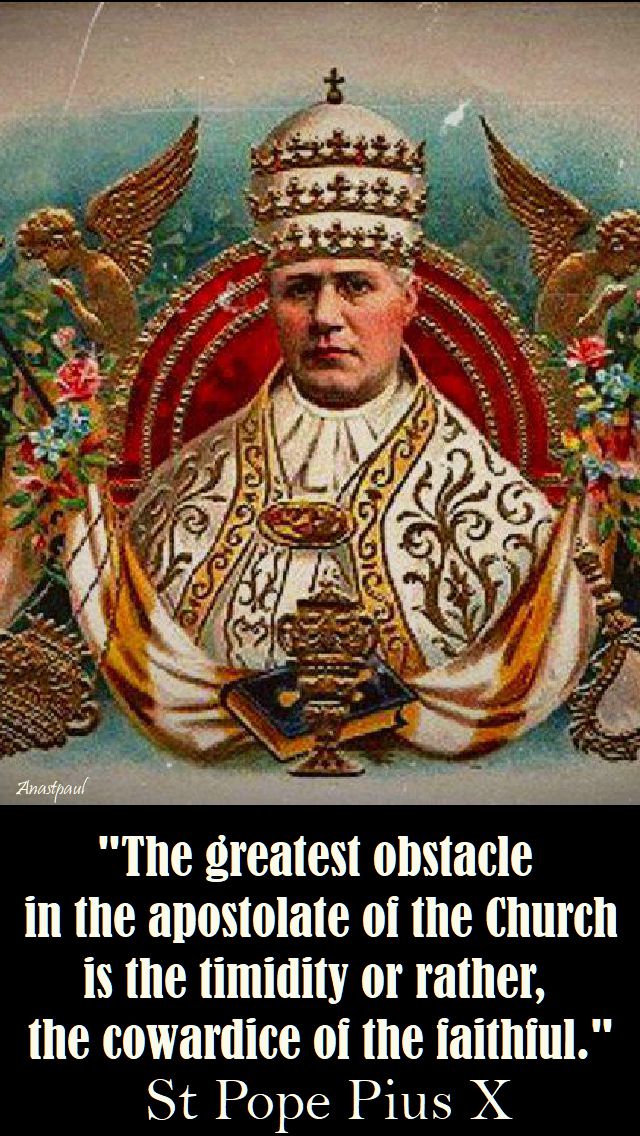
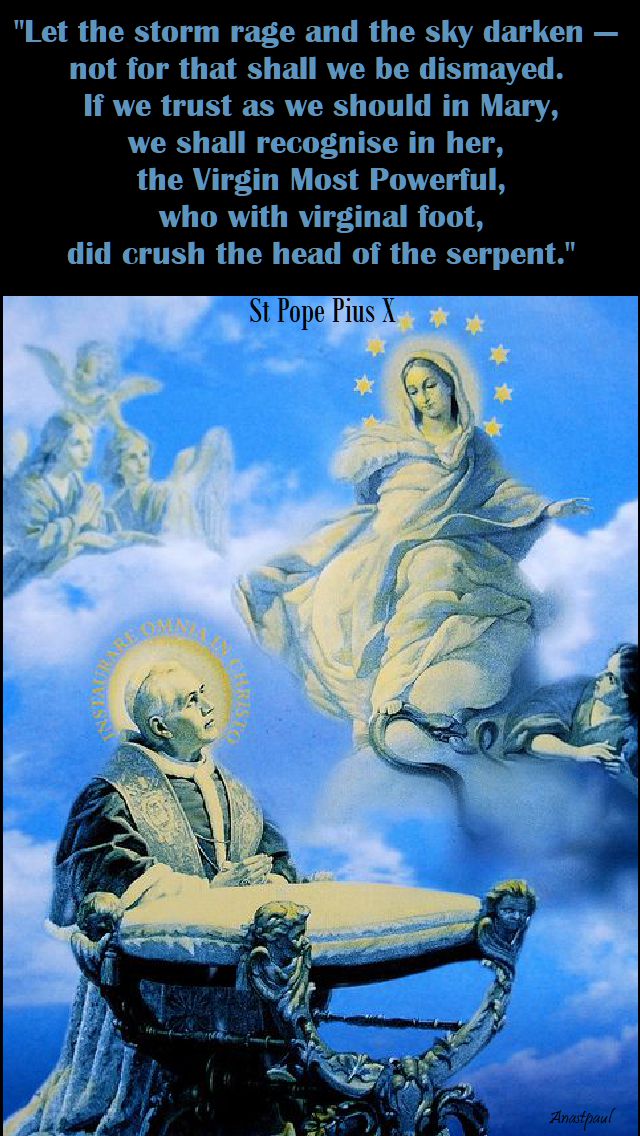
Quote/s of the Day – 21 August – The Memorial of St Pope Pius X
“The daily adoration or visit to the Blessed Sacrament is the practice which is the fountainhead of all devotional works.”
“HOLY COMMUNION is the shortest and the safest way to heaven.”
“The greatest obstacle in the apostolate of the Church is the timidity or rather the cowardice of the faithful.”
“Let the storm rage and the sky darken — not for that shall we be dismayed. If we trust as we should in Mary, we shall recognise in her, the Virgin Most Powerful, who with virginal foot did crush the head of the serpent.”
St Pius X, Pope (Memorial) Our Lady of Knock: Our Lady, Saint Joseph and Saint John the Evangelist appeared in a blaze of light at the south gable of Saint John the Baptist Church, Knock, County Mayo, Ireland. They appeared to float about two feet above the ground and each would occassionally move toward the visionaries and then away from them. The Blessed Virgin Mary was clothed in white robes with a brilliant crown on her head. Where the crown fitted to her brow, she wore a beautiful full-bloom golden rose. She was praying with her eyes and hands raised towards Heaven. Saint Joseph wore white robes, stood on Our Lady’s right and was turned towards her in an attitude of respect. Saint John was dressed in white vestment, stood was on Mary’s left and resembled a bishop, with a small mitre. He appeared to be preaching and he held an open book in his left hand. Behind them and a little to the left of Saint John was a plain altar on which was a cross and a lamb with adoring angels. The apparition was witnessed by fifteen people. Miraculous healings were reported soon after the area and it is now a major pilgrimage destination. Patronage – Ireland.
OLYMPUS DIGITAL CAMERA
—
St Abraham of Smolensk
St Agapius of Edessa
St Agathonicus of Constantinople
St Anastasius Cornicularius
St Aria of Rome
St Avitus I of Clermont
St Bassa of Edessa
Bl Beatrice de Roelas
St Bernhard of Lérida
St Bernard de Alziva
St Bernardo Tolomeo – https://www.youtube.com/watch?v=32y6LTMevbo
St Bonosus
Bl Bruno Zembol
St Camerinus of Sardinia
St Cameron
St Cisellus of Sardinia
St Cyriaca
St Euprepius of Verona
St Fidelis of Edessa
Bl Gilbert of Valenciennes
St Gracia of Lérida
St Hardulph
St Joseph Nien Vien
Bl Ladislaus Findysz
St Leontius the Elder
St Luxorius of Sardinia
St Maria of Lérida
St Maximianus the Soldier
St Maximilian of Antioch
St Natale of Casale Monferrato
St Paternus of Fondi
St Privatus of Mende
St Quadratus of Utica
St Sidonius Apollinaris
St Theogonius of Edessa
Bl Victoire Rasoamanarivo
St Zoticus the Philosopher
Martyred in the Spanish Civil War:
• Blessed Joan Cuscó Oliver
• Blessed Joan Vernet Masip
• Blessed Pedro Mesonero Rodríguez
• Blessed Pere Sadurní Raventós
• Blessed Ramon Peiró Victori
• Blessed Salvador Estrugo Salves
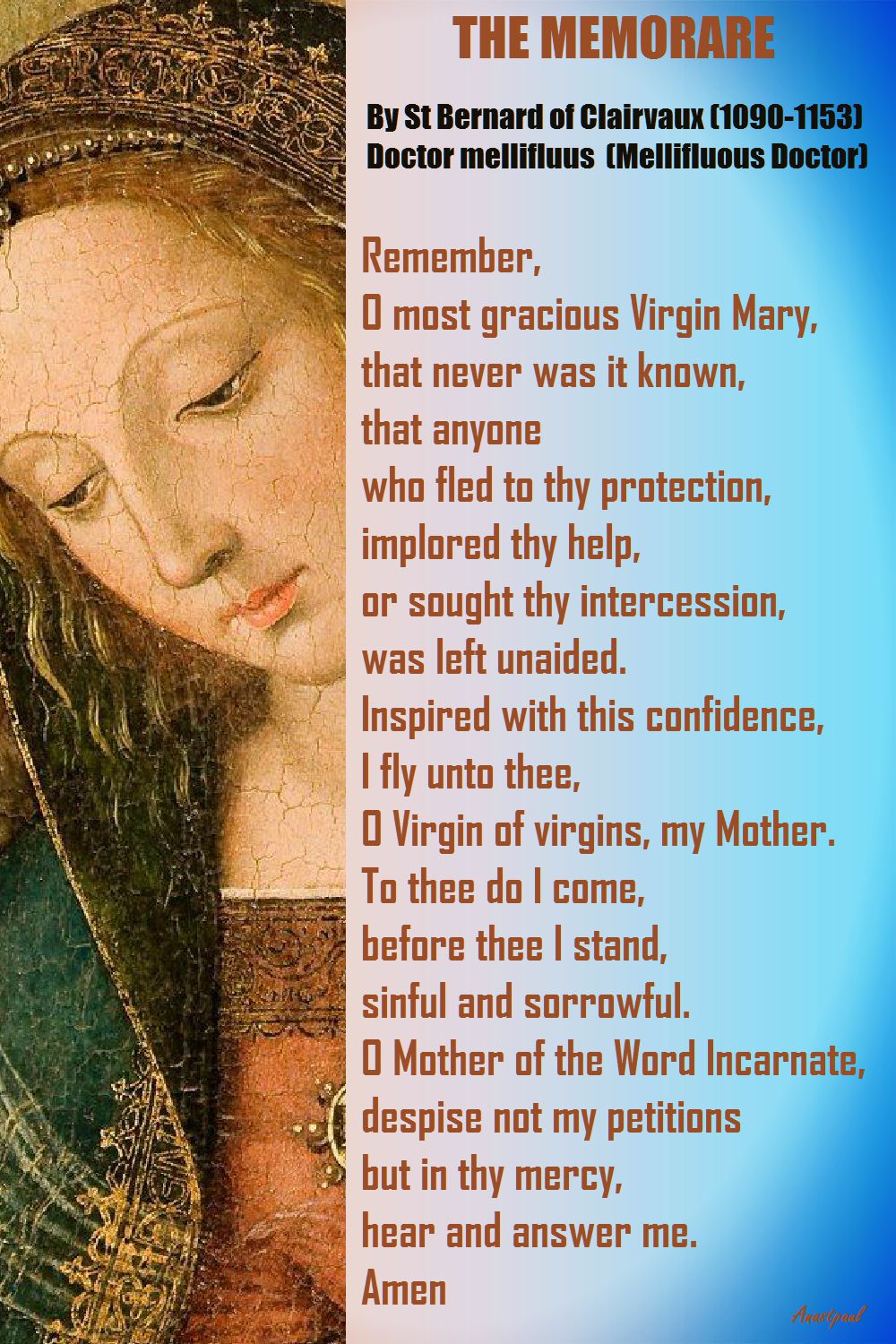
On the Feast Day of St Bernard, August 20, can we do better than call on our Mother
The Memorare by St Bernard of Clairvaux
REMEMBER, O most gracious Virgin Mary,
that never was it known that anyone who fled
to thy protection, implored thy help, or sought
thy intercession was left unaided. Inspired by
this confidence, I fly unto thee, O Virgin of virgins,
my Mother; to thee do I come; before thee I stand,
sinful and sorrowful. O Mother of the Word Incarnate,
despise not my petitions, but in thy mercy
hear and answer me. Amen.
(The Express Novena you will recall, is 9 times the Memorare)
Thought for the Day – 20 August – The Memorial of St Bernard of Clairvaux
Man of the century! Woman of the century! You see such terms applied to so many today—“golfer of the century,” “composer of the century,” “right tackle of the century”—that the line no longer has any punch. But Western Europe’s “man of the twelfth century,” without doubt or controversy, had to be Bernard of Clairvaux. Adviser of popes, preacher of the Second Crusade, defender of the faith, healer of a schism, reformer of a monastic Order, Scripture scholar, theologian, and eloquent preacher: any one of these titles would distinguish an ordinary man. Yet Bernard was all of these—and he still retained a burning desire to return to the hidden monastic life of his younger days.
His ability as arbitrator and counsellor became widely known. More and more he was lured away from the monastery to settle long-standing disputes. On several of these occasions, he apparently stepped on some sensitive toes in Rome. Bernard was completely dedicated to the primacy of the Roman See. But to a letter of warning from Rome, he replied that the good fathers in Rome had enough to do to keep the Church in one piece. If any matters arose that warranted their interest, he would be the first to let them know.
Shortly thereafter it was Bernard who intervened in a full-blown schism and settled it in favour of the Roman pontiff against the antipope.
Bernard felt responsible in some way for the degenerative effects of the crusade. This heavy burden possibly hastened his death, which came August 20, 1153.
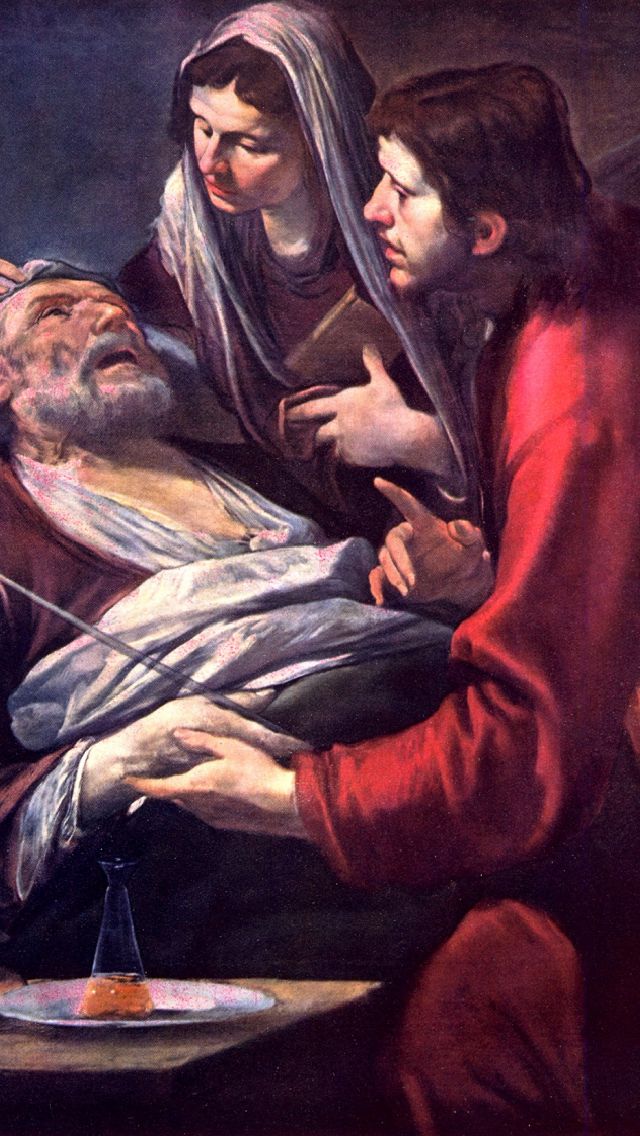
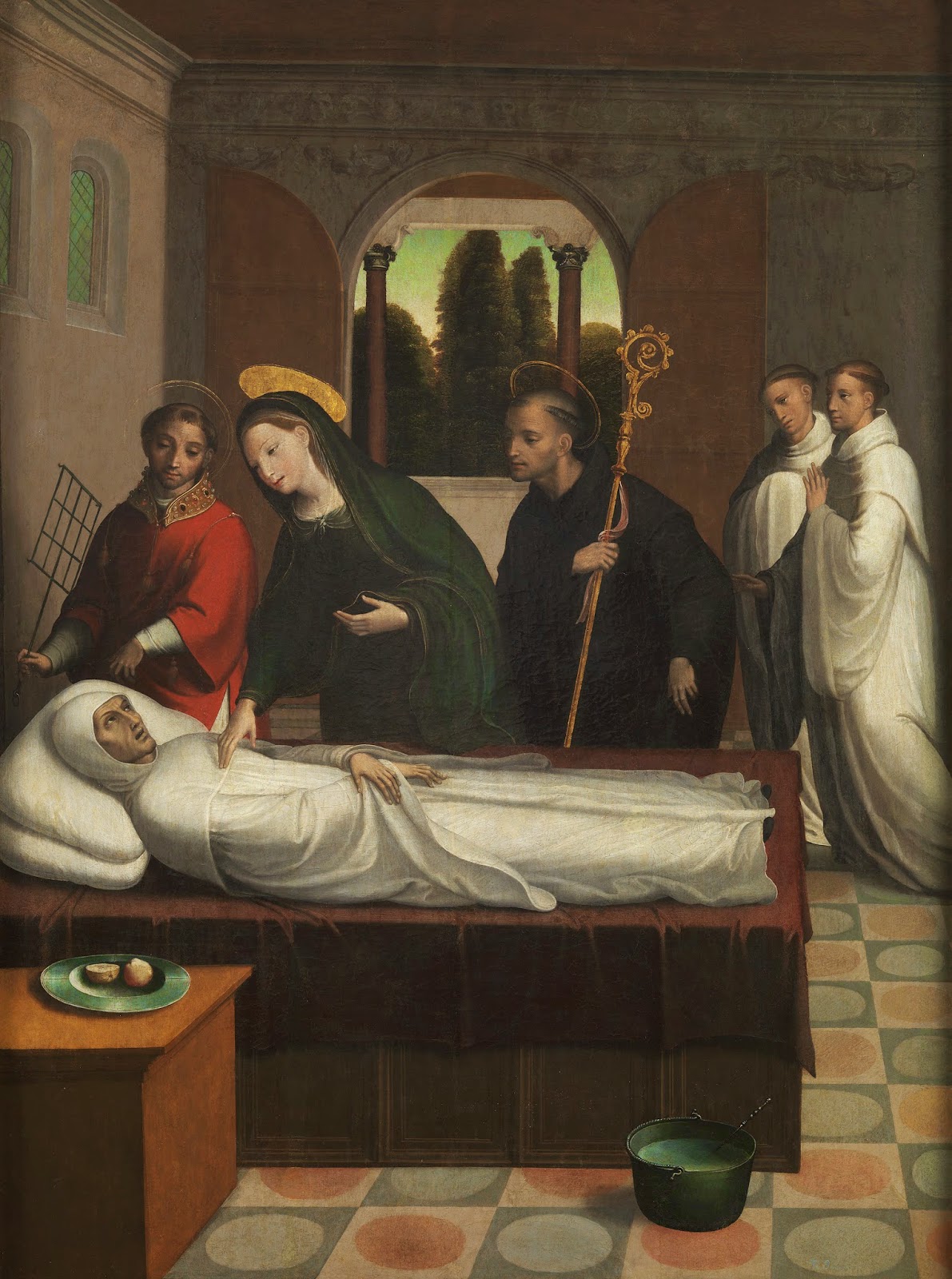
Juan Correa de Vivar (1510 – 16 April 1566) Death of St Bernard – 1545
Bernard’s life in the Church was more active than we can imagine possible today. His efforts produced far-reaching results. But he knew that they would have availed little without the many hours of prayer and contemplation that brought him strength and heavenly direction. His life was characterised by a deep devotion to the Blessed Mother. His sermons and books about Mary are still the standard of Marian theology….Fr Don Miller OFM
Thought for the Day – 17 August – The Memorial of St Hyacinth of Poland – “Apostle of Poland” “Apostle of the North”
“Our readers, we can but fancy, have marvelled at the prodigious labours and travelling of Saint Hyacinth, although we have given only a meager account of them. They extended over a period of nearly forty years and carried him through a large part of Europe and Asia. Doubtless, if they were recorded in detail and in proper sequence, they would be found infinitely more stupendous than we have painted them. He alone could have told them as they should be recounted. Yet it possibly never entered his mind to leave posterity any information on his life. The one thing that engaged his thoughts was, after saving his own soul, to help those of others, to make God known and to extend the kingdom of Christ. The same idea filled the minds of the confrères who were often his companions in labour. In this way, it was only through the scanty records discovered in cities and the early convents that historians have been able to tell us the little we do know about him. Still perhaps never was there a life which should be more completely written than that of Saint Hyacinth Odrowaz.
One may consider the practical, lively faith of the Poles, whether in the home land or in others, as a perpetual miracle of Saint Hyacinth. In no small measure they owe it to him. To that keen faith we must attribute the magnificent institutions of learning, charity, benevolence and the like, as well as the churches, monasteries and similar edifices, in which Poland abounds and in which it has found expression. All these are filled with the spirit which the people largely derived from him. They simply thrill with love and gratitude for him. This true spirit of Catholicity, we must remember, has been preserved undiminished for centuries through wars of every kind, division, hardships, persecution and every sort of oppression-the like of which the world has seen few parallels. We have here, it would seem, the greatest miracle of the zealous apostle’s life. At least, it has contributed more to the glory of God, the good of the Church, and the salvation of souls than any miracle he performed.” (Acta; STANISLAUS, Father, O. P., of Cracow, manuscript Vita Sancti Hyacinthi.)
Saint Hyacinth teaches us to spare no effort in the service of God but to rely for success not on our industry but on the assistance of the Holy Eucharist and the prayer of the Immaculate Mother of God.
St Hyacinth of Poland pray for the Poland, the Church and for us all!

















 AnaStpaul
You must be logged in to post a comment.