Sunday Reflection – 18 February – The First Sunday of Lent Year B
Beyond the daily life of the believer, the Eucharist extends its action to the whole cosmos.
As Teilhard de Chardin wrote: “When He (Christ) says through the priest “This is my body”, His words go well beyond the piece of bread over which they are pronounced: they effect the birth of the whole Mystical Body. Beyond the transubstantiated Host, the priestly action extends to the cosmos itself.”
Every Eucharist is a “Mass on the world.”
This vision inspired a prayer of Teilhard de Chardin that we can make our own, each time we participate in the Mass and even when we cannot participate:
“On the altar of the whole earth I offer You, Lord, the work and the toil of the world…. All that will grow in the world in the course of this day, all that will decline in it and all that will die in it… Receive, Lord, this total Host that Creation presents to You, drawn and moved by You, at the dawn of a new day.”
Fr Raneiro Cantalamessa OFM (Preacher to the Papal Household) “This is My Body”
Our Morning Offering – 18 February – The First Sunday of Lent, Year B
Act of Oblation before Holy Mass
Eternal Father,
we offer You the sacrifice
wherein your Son Jesus
offered Himself upon the Cross
and which He now renews upon this altar.
We adore You and render to You
that honour which is Your due,
acknowledging Your dominion over all things
and our absolute dependence on You.
You are our first beginning and our last end;
we give You thanks for countless benefits received;
we ask You to forgive our sins
and to offer You worthy satisfaction for the same.
Finally to implore Your grace and mercy
for all of us who will offer this sacrifice today,
for all those who are in tribulation and distress,
for all of us sinners,
for the whole world and for the souls in purgatory.
We ask this through Christ our Lord.
Amen.
Quote/s of the Day – 15 February – The Memorial of St Claude de la Colombiere S.J. (1641-1682)
“May the Heart of Jesus Christ be our school! Let us make our abode there. Let us study its movements and attempt to conform ours to them. Yes, O Divine Jesus, I want to live there.”
“When the Holy Spirit is in a soul, He communicates Himself, in one way or another. We can say that He makes virtue contagious and turns a simple faithful into an apostle.”
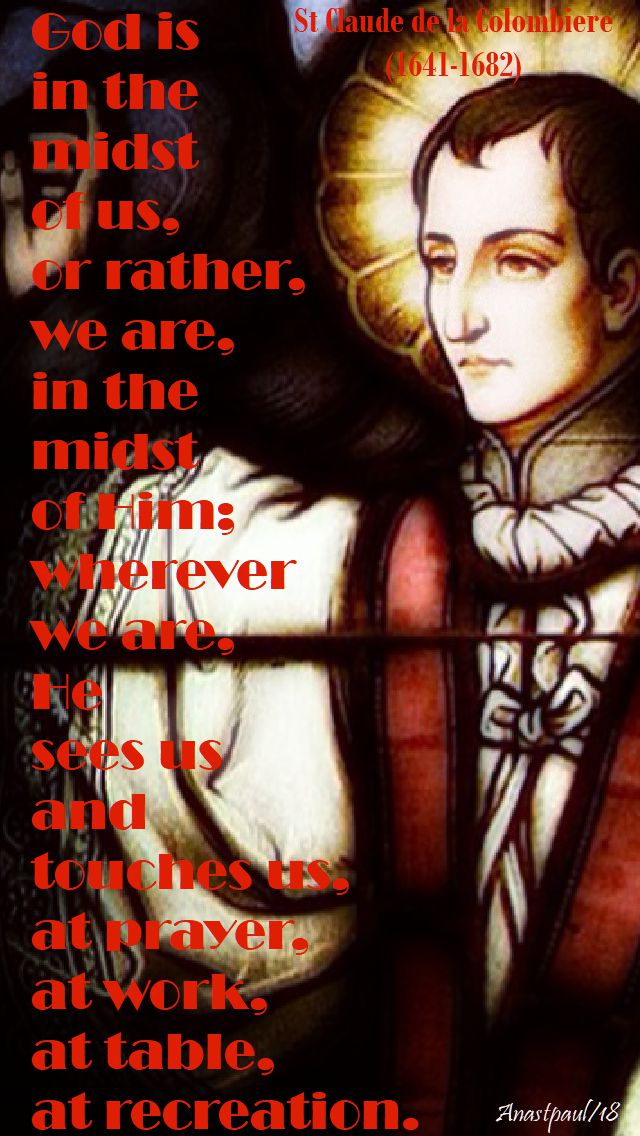
“God is in the midst of us, or rather, we are in the midst of Him; wherever we are, He sees us and touches us, at prayer, at work, at table, at recreation.”
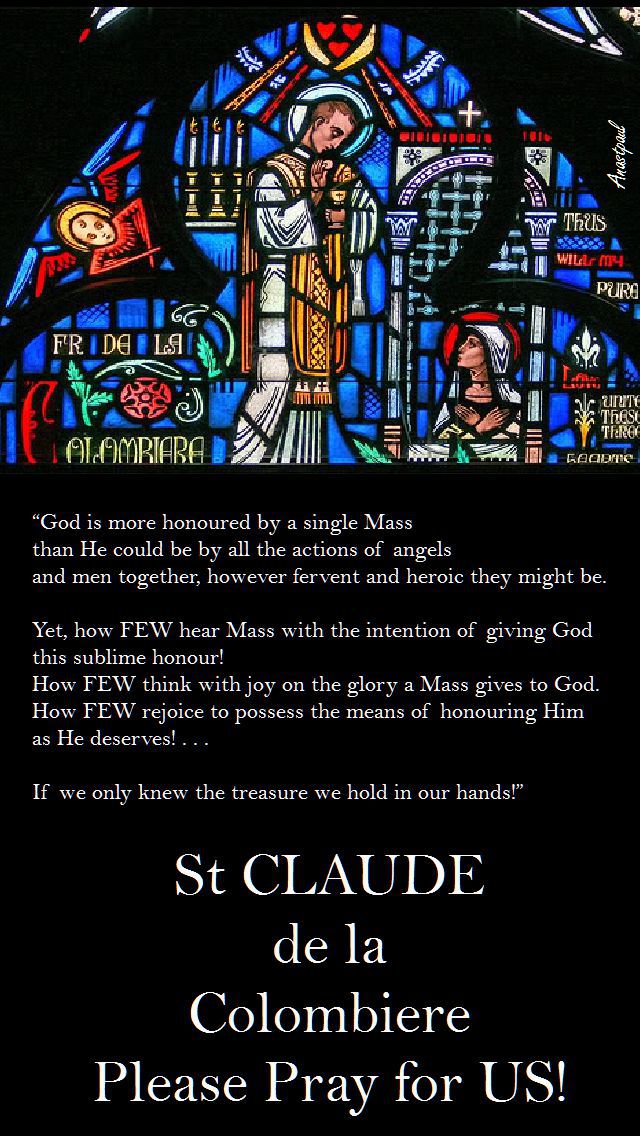
“God is more honoured by a single Mass than He could be by all the actions of angels and men together, however fervent and heroic they might be. Yet, how FEW hear Mass with the intention of giving God this sublime honour! How FEW think with joy on the glory a Mass gives to God. How FEW rejoice to possess the means of honouring Him as He deserves! . . . If we only knew the treasure we hold in our hands!”
St Claude de la Colombiere (1641-1682)
“St Claude has been a dear friend of mine since I discovered his writings quite some years ago. . I count on his intercession. I turn to him when I feel my heart is tired and a little cold and distressed. This Saint of Hearts is a most willing guide leading us to the warmest Heart of Christ full of Mercy and Love.”
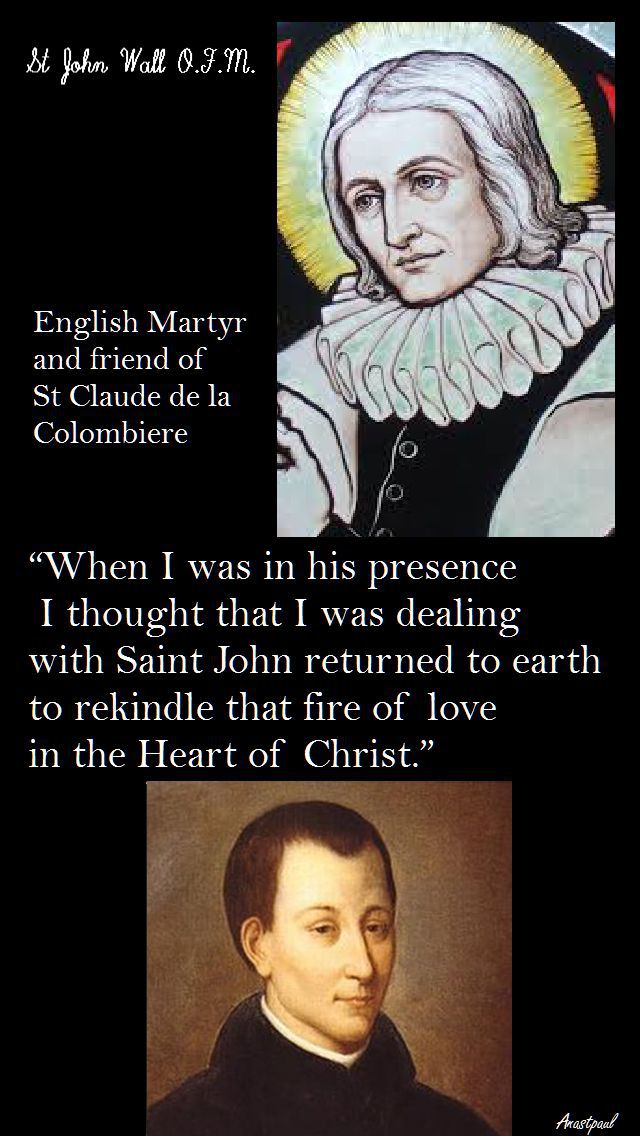
The Franciscan St John Wall O.F.M. (1620-1679) (Joachim of Saint Anne), who was martyred for the crime of being a Catholic priest near Redhill, Corcester, England on August 22nd, 1679, knew Saint Claude. After having spent a night in spiritual conversation with him, the soon–to–be martyr said,
“When I was in his presence I thought that I was dealing with Saint John returned to earth to rekindle that fire of love in the Heart of Christ.”
Sunday Reflection – 11 February 2018 – 6th Sunday of Year B – Pope Benedict and St John Paul
In liturgical prayer, especially the Eucharist and – formats of the liturgy – in every prayer, we do not speak as single individuals, rather we enter into the “we” of the Church that prays. And we need to transform our “I” entering into this “we”. Pope Benedict XVI is one of the great liturgists of our age. His seminal book, “The Spirit of the Liturgy”, written when he was still Joseph Cardinal Ratzinger, is required reading in most seminaries and should be read by every Catholic.
“It is not the individual – priest or layman – or the group that celebrates the liturgy but it is primarily God’s action through the Church, which has its own history, its rich tradition and creativity. This universality and fundamental openness, which is characteristic of the entire liturgy is one of the reasons why it can not be created or amended by the individual community or by experts but must be faithful to the forms of the universal Church.
The entire Church is always present, even in the liturgy of the smallest community. For this reason there are no “foreigners” in the liturgical community. The entire Church participates in every liturgical celebration, heaven and earth, God and man. The Christian liturgy, even if it is celebrated in a concrete place and space and expresses the “yes” of a particular community, it is inherently Catholic, it comes from everything and leads to everything, in union with the Pope, the Bishops , with believers of all times and all places. The more a celebration is animated by this consciousness, the more fruitful the true sense of the liturgy is realised in it.
Dear friends, the Church is made visible in many ways: in its charitable work, in mission projects, in the personal apostolate that every Christian must realise in his or her own environment. But the place where it is fully experienced as a Church is in the liturgy : it is the act in which we believe that God enters into our reality and we can meet Him, we can touch Him. It is the act in which we come into contact with God, He comes to us and we are enlightened by Him.
So when in the reflections on the liturgy we concentrate all our attention on how to make it attractive, interesting and beautiful, we risk forgetting the essential: the liturgy is celebrated for God and not for ourselves, it is His work, He is the subject and we must open ourselves to Him and be guided by Him and His Body, which is the Church.
Let us ask the Lord to learn every day to live the sacred liturgy, especially the Eucharistic celebration, praying in the “we” of the Church, that directs its gaze not in on itself but to God and feeling part of the living Church, of all places and of all time.”…Pope Benedict XVI – Wednesday Audience 3 Oct 2012
“I have been able to celebrate Holy Mass in chapels built along mountain paths, on lakeshores and seacoasts. I have celebrated it on altars built in stadiums and in city squares….This varied scenario of celebrations of the Eucharist, has given me, a powerful experience of its universal and, so to speak, cosmic character – YES, cosmic! Because even when it is celebrated on the humble altar of a country church, the Eucharist is always, in some way, celebrated on the altar of the world. It unites heaven and earth. It embraces and permeates all creation!” St Pope John Paul “Ecclesia de Eucharista no 8”
Our Morning Offering – 11 February – 6th Sunday of Year B
Your Sacred Table – A Prayer Before Holy Communion – By Saint Francis de Sales (1567-1622) Doctor of the Church
Divine Saviour,
we come to Your sacred table
to nourish ourselves,
not with bread but with Yourself,
true Bread of eternal life.
Help us daily to make a good and perfect meal
of this divine food.
Let us be continually refreshed
by the perfume of Your kindness and goodness.
May the Holy Spirit fill us with His Love.
Meanwhile, let us prepare a place
for this holy food by emptying our hearts.
Amen.
Quote/s of the Day – 9 February – The Memorial of Bl Anne Catherine Emmerich (1774-1824)
“The prayer most pleasing to God is that made for others and particularly for the poor souls. Pray for them, if you want your prayers to bring high interest.”
Bl Anne Catherine Emmerich (1774-1824)
“As much as by her patience to endure her physical weaknesses, we are impressed by the strength of character of the new blessed and her firmness in the faith. She received this strength from the Holy Eucharist. In this way, her example opened the hearts of poor and rich men, educated and humble people, to complete loving passion toward Jesus Christ. Still today she communicates to all the salvific message: ‘By his wounds you have been healed’ (see 1 Peter 2:24).”
St Pope John Paul II, homily at the beatification of Blessed Anne, 3 October 2004
Quote/s of the Day – 7 February – The Memorial of Blessed Pope Pius IX (1792-1878)
“The chisel is the pen of the sculptor.”
“If we are the heirs of Christ, let us remain in the peace of Christ. If we are the sons of God, we must be peacemakers….” INTER MULTIPLICES – PLEADING FOR UNITY OF SPIRIT: 21 March 1853
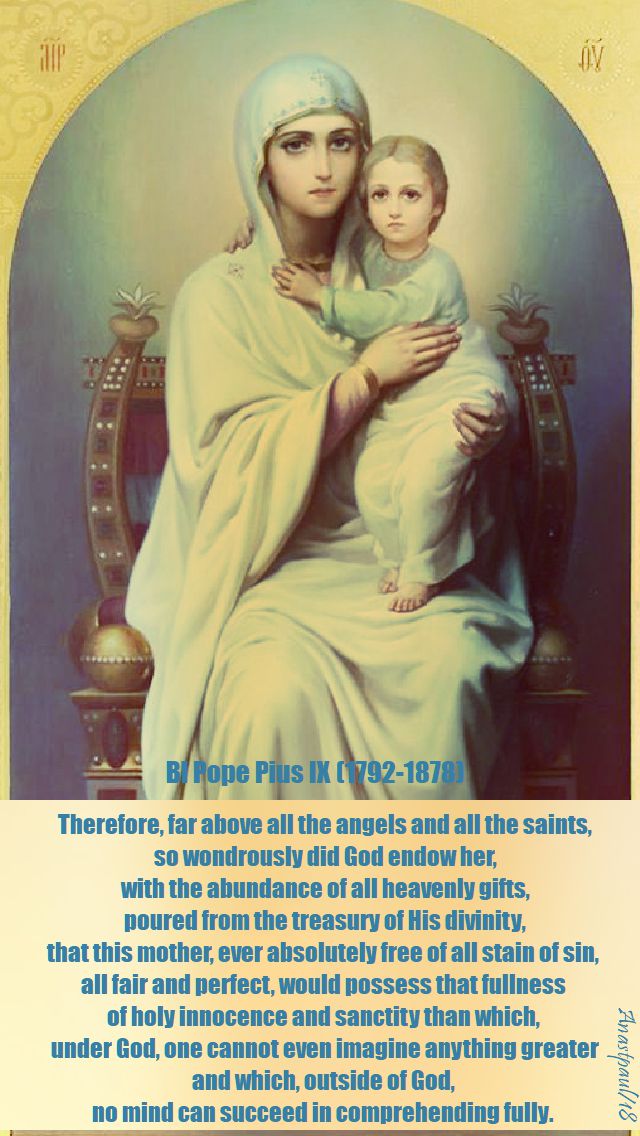
” From the very beginning and before time began, the eternal Father chose and prepared for His only-begotten Son, a Mother, in whom the Son of God would become incarnate and from whom, in the blessed fullness of time, He would be born into this world. Above all creatures did God so love her, that truly in her, was the Father well pleased, with singular delight. Therefore, far above all the angels and all the saints, so wondrously did God endow her, with the abundance of all heavenly gifts, poured from the treasury of His divinity, that this mother, ever absolutely free of all stain of sin, all fair and perfect, would possess that fullness of holy innocence and sanctity than which, under God, one cannot even imagine anything greater and which, outside of God, no mind can succeed in comprehending fully.”- INEFFABILIS DEUS – THE IMMACULATE CONCEPTION: 8 December 1854
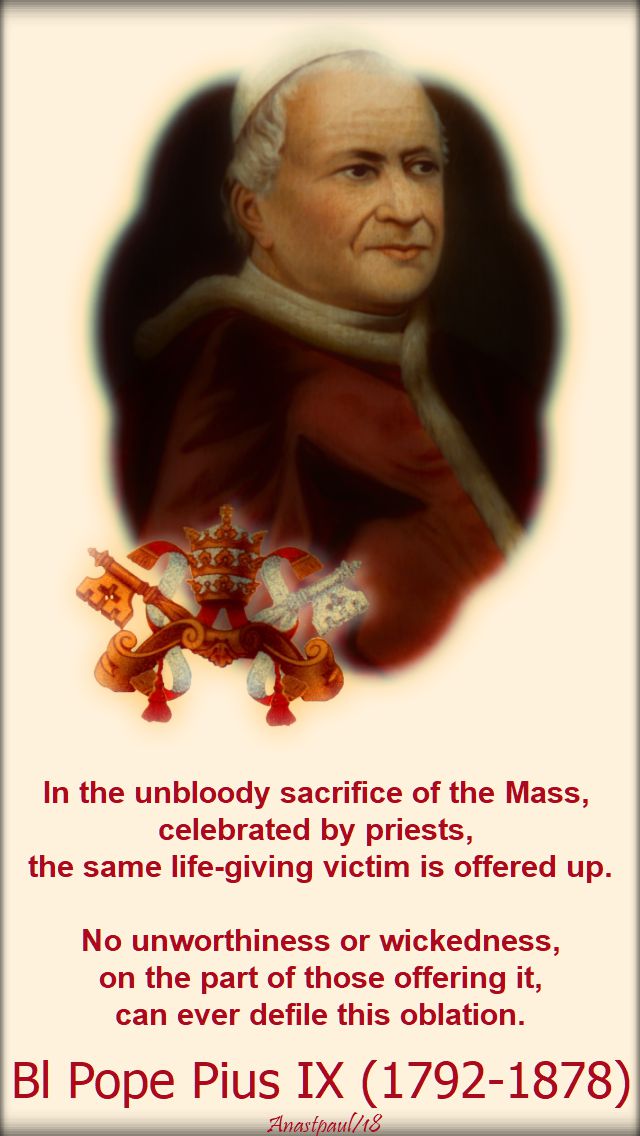
“In the unbloody sacrifice of the Mass, celebrated by priests, the same life-giving victim is offered up. This entreaty reconciles us to God the Father. It “renews in a mysterious way the death of Christ, who having risen from the dead dies no longer. Death no longer has domination over Him.” Still, He is sacrificed for us in the mystery of this sacred oblation. No unworthiness or wickedness on the part of those offering it can ever defile this oblation.”- AMANTISSIMI REDEMPTORIS – ON PRIESTS AND THE CARE OF SOULS: 3 May 1858
In adoring the Blessed Sacrament, our hearts are enlarged and our minds receive the truth
In Lourdes, most miracles take place during the Adoration of the Blessed Sacrament. Medjugorje is no different. Although so much power and grace radiate from the Blessed Sacrament during heartfelt and worthy Adoration, in the end this is not about getting “something”.
The Curé d’Ars referred to a parishioner who said that during Adoration, “I look at Him. And He looks at me.” It is about two people in love with each other – a creature and its God. The deeper our hunger, the more He gives us; indeed, He gives us this hunger for Him.
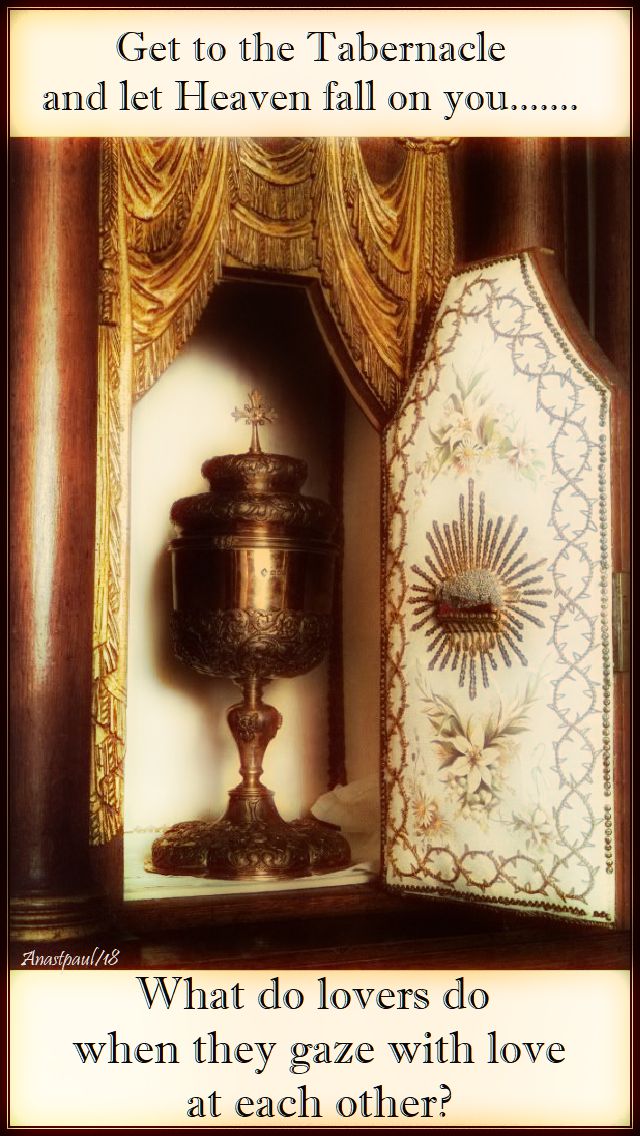
What does one do during Adoration? What do lovers do when they gaze with love at each other? We need silence first of all. When Pope Benedict XVI led Adoration in Hyde Park, about 80,000 young people kept silence with the Pope – to the consternation of media broadcasters. Silence apparently does not make for good television. Television requires continuous chatter. Adoration requires silence.
Secondly, Adoration requires attentiveness. It is heart-breaking to see couples sitting opposite each other in restaurants, both gazing avidly at their smartphone screens instead of each other. It doesn’t take much to see who or what dominates that relationship. We attend to that which we prize foremost. In Adoration we attend to the Lord.
And thirdly, Adoration needs receptivity. In our silence and attentiveness, we receive from God. We are stripped of the illusion that we can do God any favours. He longs to lavish Himself on us. Sitit sitiri, He thirsts to be thirsted for; He longs to be longed for. He will guide us and teach us but only if we let Him. In Adoration we receive from God the truth about God and about ourselves.
In my own experience it is powerful. Jesus waits for us with eager longing. And He longs to lavish Himself on us. It’s like a tower made of champagne glasses and when the top glass is filled it overflows and fills the glasses below. In Adoration, when we are open to receive, God enlarges our hearts to love and that love overflows to others, just like the champagne tower.
Sometimes people experience little change, often because of unconfessed sin or hiding ourselves from the Lord. If we are closed, if we keep our hurts and everything about us hidden from the Lord, then very little can change. Then Adoration will be experienced as a burden to be endured or avoided. But when we are open to the Lord, it is very powerful. God has so many graces He wants to give us and He leads and guides us in prayer through Adoration. Sometimes we keep vigil with the Lord during Adoration, and make acts of reparation and love – because the world needs this so much.
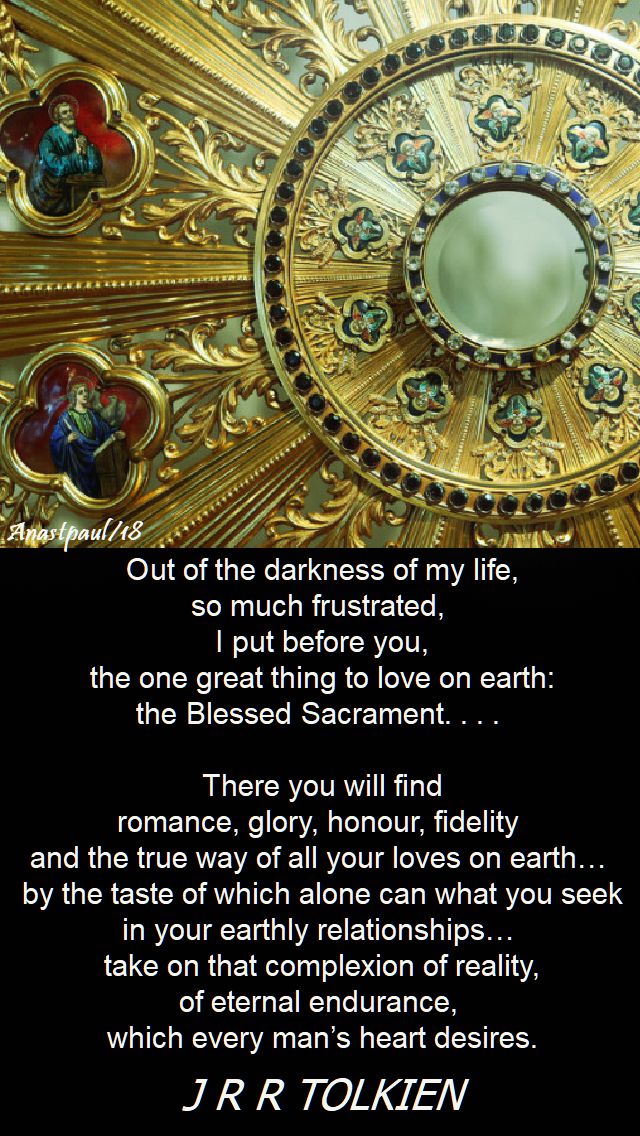
JRR Tolkien once said he did not return to fidelity to the Lord by being chased by Francis Thompson’s Hound of Heaven but through hunger for the Blessed Sacrament, as one starving for love. In a letter to his middle son during World War II (the context of the letter is marriage and sex), he wrote:
“Out of the darkness of my life, so much frustrated, I put before you the one great thing to love on earth: the Blessed Sacrament. . . . There you will find romance, glory, honour, fidelity and the true way of all your loves on earth… by the taste of which alone can what you seek in your earthly relationships… take on that complexion of reality, of eternal endurance, which every man’s heart desires.”
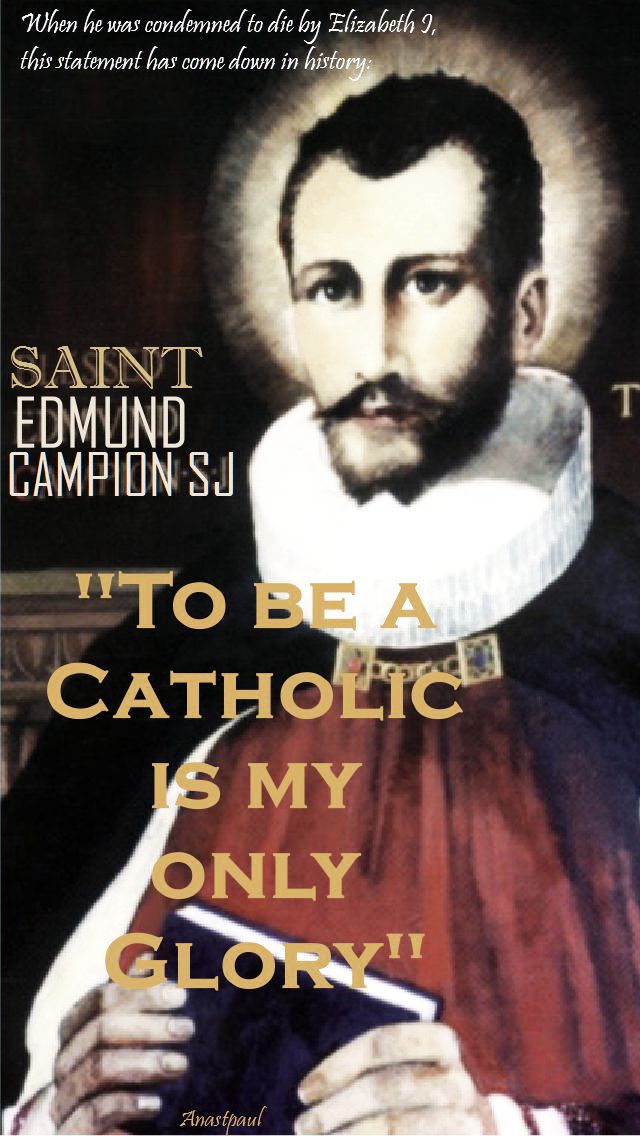
Get to the Tabernacle and let Heaven fall on you…for this is what is called “the totally Catholic devotion” (those who are Catholic to their roots, in their blood, whose way of life, whose food is being Catholic – in the words of St Edmund Campion – ‘To be a Catholic is my only glory.”) – we become what we love!
Partially taken from Fr Leon Pereira OP’s post. He is chaplain to the English-speaking pilgrims in Medjugorje, Bosnia & Herzegovina
Sunday Reflection – 4 February – 5th Sunday of Year B
The Action of God on Calvary is a continuous action throughout Creation Fr Gerard W Hughes S.J. – “God of Surprises”
The same God who manifested Godself in the historical Jesus, once-for-all, is still giving Godself to us in love through the signs and symbols of bread and wine. God is not time-and-space-conditioned. The once-for-all action of God on Calvary is a continuous action throughout creation. In celebrating the Eucharist, we are celebrating our awareness of this tremendous truth.
As our sinfulness can infect and deform our image of God and our understanding of Christ’s passion, death and resurrection, so too, it can distort our understanding of the Eucharist. Instead of a celebration which fills us with joy and wonder, broadening our vision and uniting us with ourselves and with all creation, the Eucharist can become a code and formal ritual, performed mechanically with more attention to rubrics and money-raising, than to God or to one another and, attended by many because they are afraid that their absence might cause their eternal damnation.
Christian communities can be divided into hostile factions over the choice of hymns, the place of tabernacle in the Church, the manner of distributing and receiving Holy Communion, who should and should not be allowed to receive it, what one wears or should wear or not wear, whether women cover their heads, the language used for the liturgy, or whether the Peace of Christ should be given to one another by the congregation!
I am not saying that these questions do not have their importance somewhere, nor am I advocating abolition of all rubrics, rules and regulations but I am saying that many of the questions which absorb our attention, are very secondary. They preoccupy and divide us within the Catholic Church because our vision and understanding of the Eucharist is too limited – we turn this reality of God’s love for all His creation into a sacred object, a thing and we do not allow God to be God to us, even this most wonderful and mysterious event! The Eucharist is given to us so that Christ’s presence may be real in the lives of His people, a living presence.
Quote/s of the Day – 4 February – 5th Sunday of Year B
“Speaking of the Eucharist/the Holy Mass”
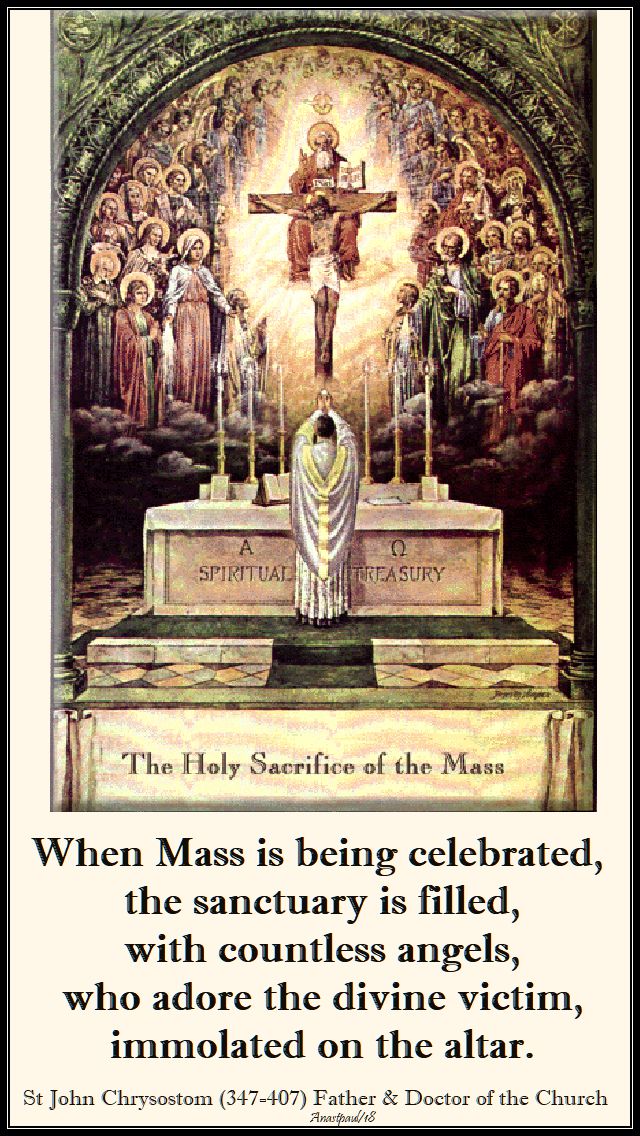
“When Mass is being celebrated, the sanctuary is filled, with countless angels, who adore the divine victim, immolated on the altar.”
St John Chrysostom (347-407) Father & Doctor of the Church
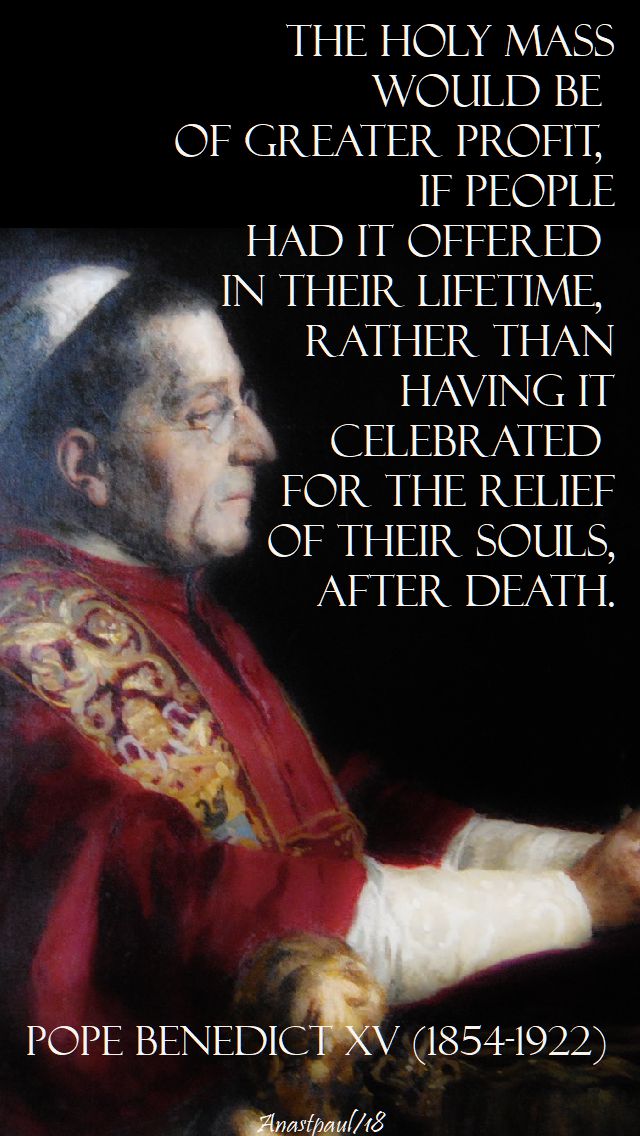
“The Holy Mass would be of greater profit, if people had it offered in their lifetime, rather than having it celebrated for the relief of their souls, after death.”
Pope Benedict XV (1854-1922)
“One merits more, by devoutly assisting at a Holy Mass, than by distributing, all of his goods to the poor and travelling, all over the world, on pilgrimage.”
St Bernard if Clairvaux (1090-1153) Doctor of the Church
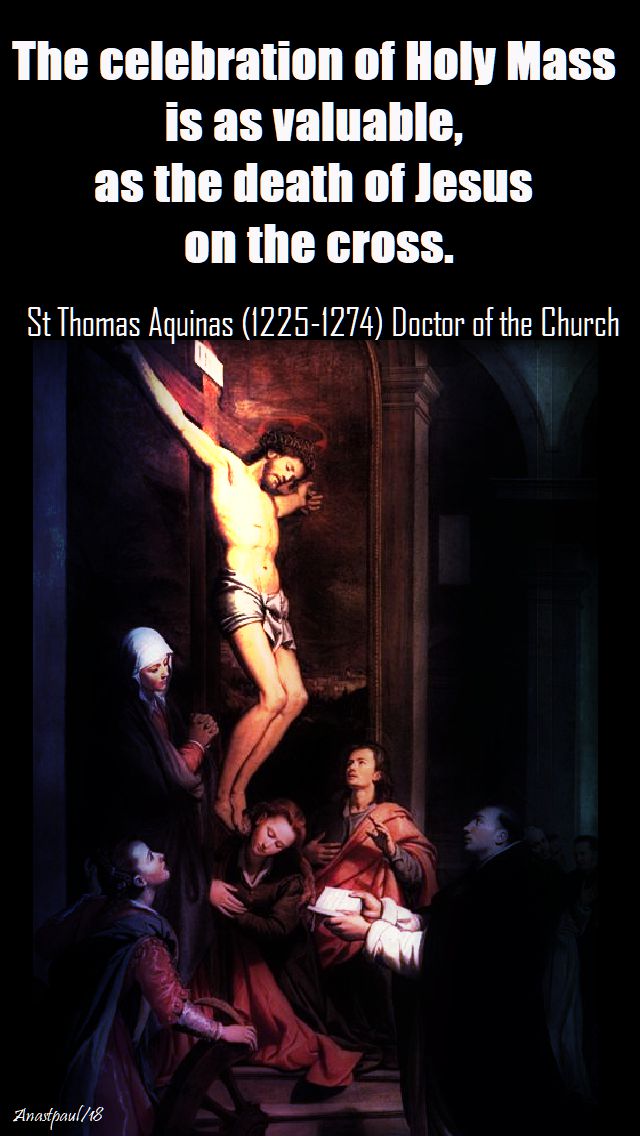
“The celebration of Holy Mass has the same value as the Death of Jesus on the Cross.”
St Thomas Aquinas (1225-1274) Doctor of the Church
“When you have received Him, stir up your heart to do Him homage, speak to Him about your spiritual life, gazing upon Him in your soul, where He is present, for your happiness, welcome Him as warmly as possible and behave outwardly, in such a way, that your actions, may give proof to all, of His Presence.”
St Francis de Sales (1567-1622) Doctor of the Church
“If someone said to us, “At such an hour a dead person is to be raised to life, ” we should run very quickly to see it. But is not the Consecration, which changes bread and wine into the Body and Blood of God, a much greater miracle than to raise a dead person to life? We ought always to devote at least a quarter of an hour to preparing ourselves to hear Mass well. We ought to annihilate ourselves before God, after the example of His profound annihilation in the Sacrament of the Eucharist and we should make our examination of conscience, for we must be in a state of grace. to be able to assist properly at Mass. If we knew the value of the holy Sacrifice of the Mass, or rather, if we had faith, we should be much more zealous to assist at it.”
Quote/s of the Day – 31 January -The Memorial of St John Bosco (1815-1888)
“Do you want our Lord to give you many graces? Visit him often. Do you want him to give you few graces? Visit him seldom. Visits to the Blessed Sacrament are powerful and indispensable means of overcoming the attacks of the devil. Make frequent visits to Jesus in the Blessed Sacrament and the devil will be powerless against you.”
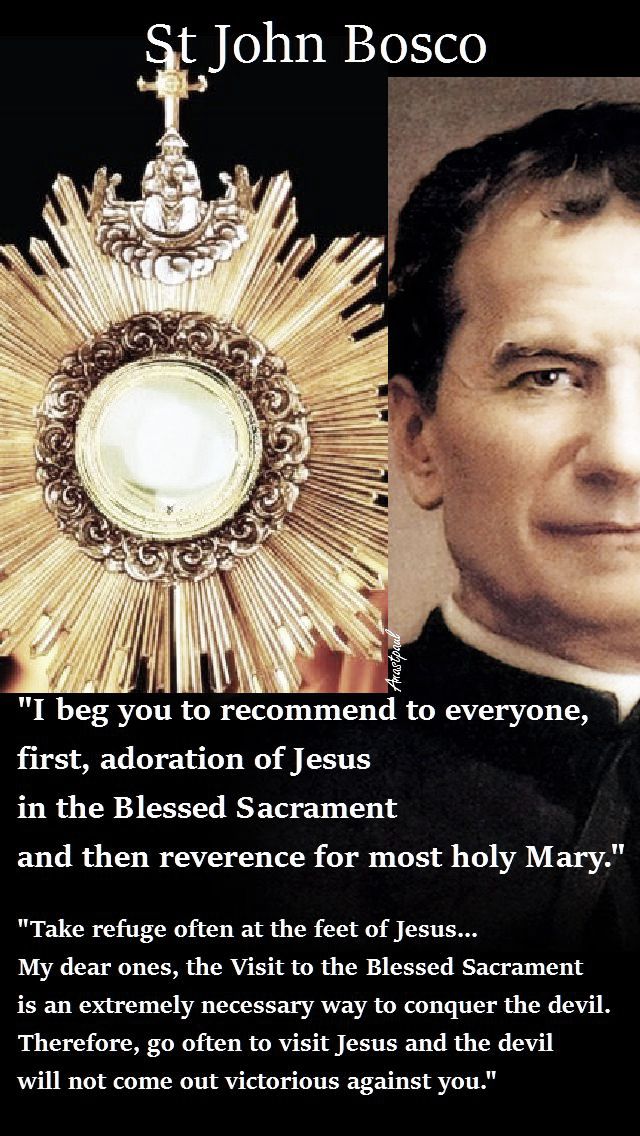
“I beg you to recommend to everyone, first, adoration of Jesus in the Blessed Sacrament and then reverence for most holy Mary.”
“Take refuge often at the feet of Jesus… My dear ones, the Visit to the Blessed Sacrament is an extremely necessary way to conquer the devil. Therefore, go often to visit Jesus and the devil will not come out victorious against you.”
“Jesus could have limited His presence only to the celebration of Mass, but no! He wanted to make a permanent dwelling among us. Night and day He awaits us and offers Himself to us at all times. Like a most tender mother, He opens His arms to us. He is there generously to give us His gifts. He is there to draw us to Him and lead us to paradise with Him.
Oh! Let us go visit Him often.”
“I beg you to recommend to everyone, first, adoration of Jesus in the Blessed Sacrament and then reverence for most holy Mary.”
“Ask the Blessed Virgin for the grace to receive Communion frequently and worthily… Try to imagine, that the Blessed Virgin herself, will give you the Sacred Host. No one would dare strike at the Heart of Jesus while He is in Mary’s hands.”
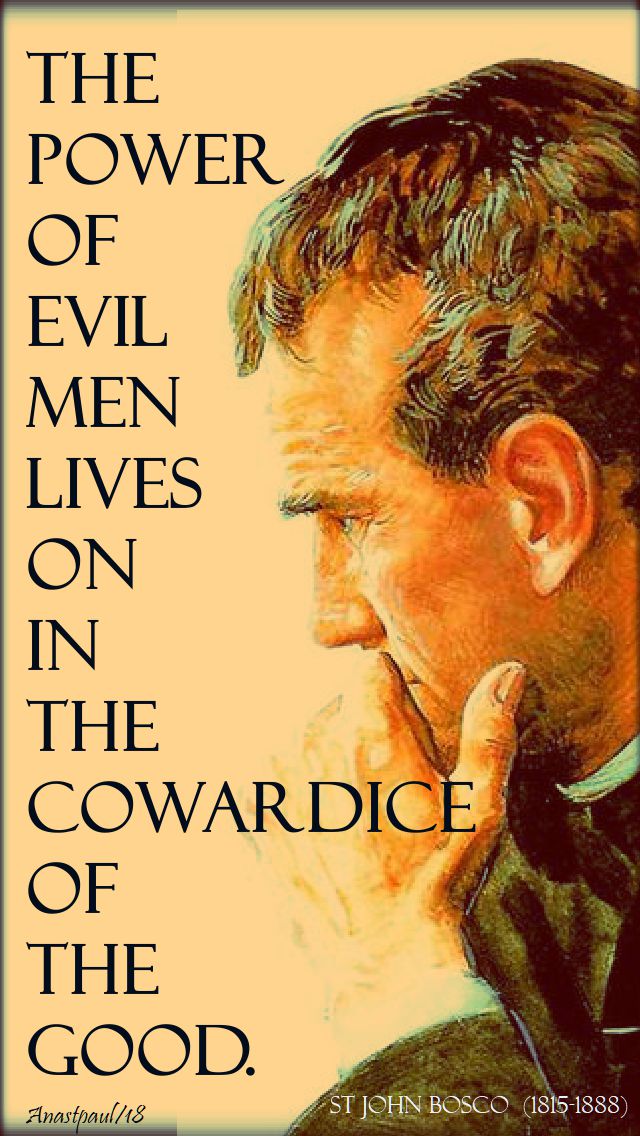
“The power of evil men lives on the cowardice of the good.”
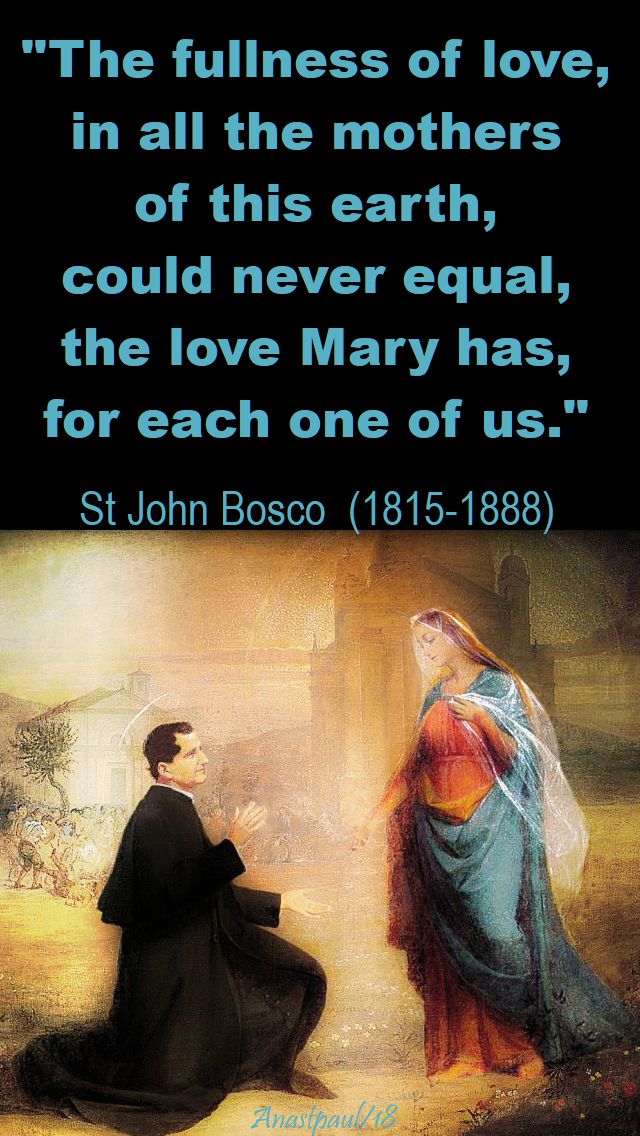
“The fullness of love, in all the mothers of this earth, could never equal, the love Mary has, for each one of us.”
Sunday Reflection – – 28 January – The Memorial of St Thomas Aquinas (1225-1274) Doctor angelicus (Angelic Doctor) and Doctor communis (Common Doctor)
Fr Raneiro Cantalamessa OFM – Preacher to the Papal Household – “This is My Body”
The Eucharist is the Father’s gift to the world. The mystery contained in the words: “God so loved the world that he gave his only Son” (John 3:16) is made present in every Mass. In the priest who offers us the body and blood of Christ at the moment of Communion, we can see, with the eyes of faith, the Father in person, who comes to give us “the bread of heaven, the true bread” and says: “Take, this is the body of my Only Begotten Son, which I have given for you.”
Not only does the Father give us the Eucharist, He also gives Himself in the Eucharist because there is only one indivisible divine nature, in receiving the divinity of the Son, we also receive the Father. “Whoever sees me sees the Father,” also means “whoever receives me, receives the Father.”
One day (it was the Saturday of the Second Week of Lent) after listening to the Gospel passage of the parable of the Prodigal Son, I understood clearly that Communion offered me, there and then, the incredible opportunity of receiving the Father’s forgiving embrace – and not only mentally!
Fr Raneiro Cantalamessa OFM – Preacher to the Papal Household – “This is My Body” (out of interest, this entire book is a series of lectures to the Holy Father and his household, who was St John Paul at the time, (during the Year of the Eucharist 2004-2005) on St Thomas Aquinas, Adore Te Devote.
Quote/s of the Day – 28 January – The Memorial of St Thomas Aquinas (1225-1274) Doctor angelicus (Angelic Doctor) and Doctor communis (Common Doctor)
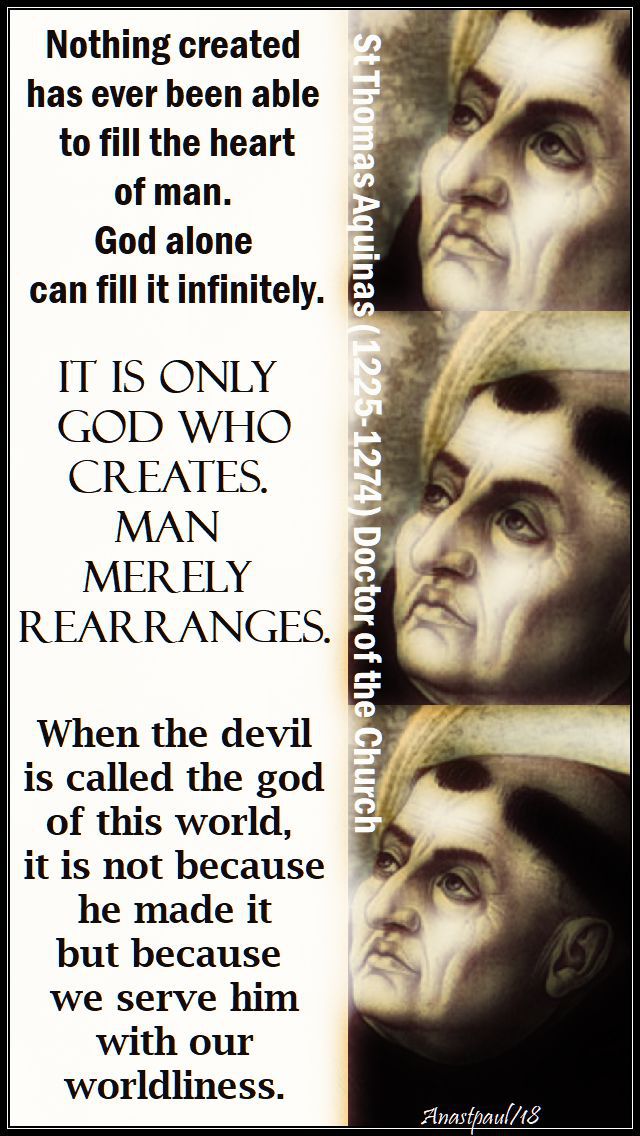
“Nothing created has ever been able to fill the heart of man. God alone can fill it infinitely.”
“It is only God who creates. Man merely rearranges.”
“When the devil is called the god of this world, it is not because he made it but because we serve him with our worldliness.”
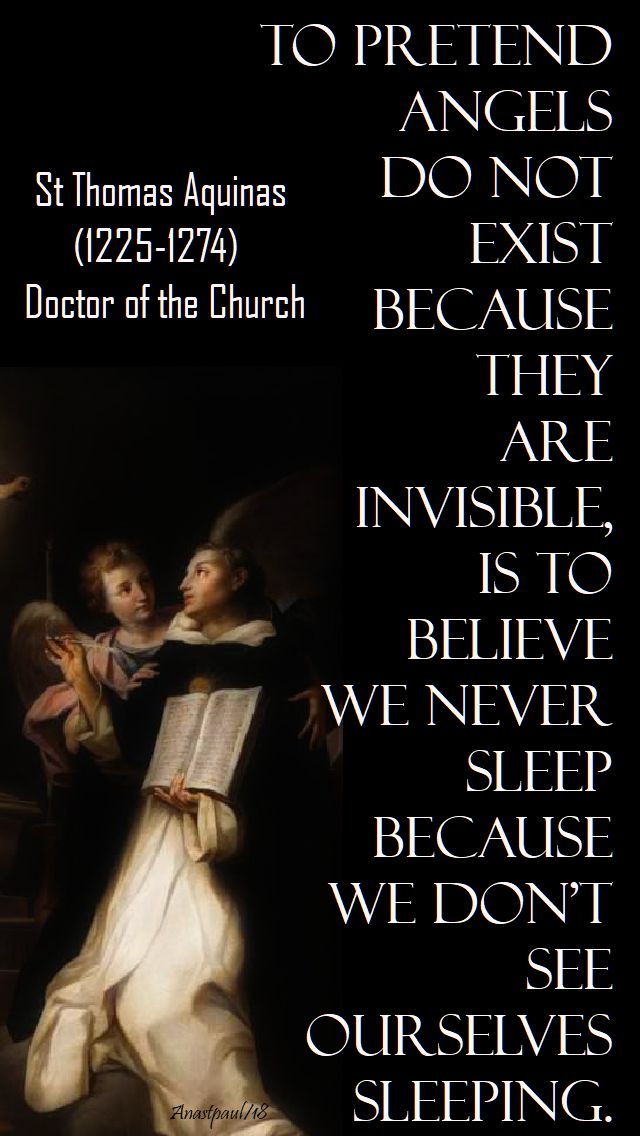
“To pretend angels do not exist because they are invisible, is to believe we never sleep because we don’t see ourselves sleeping.”
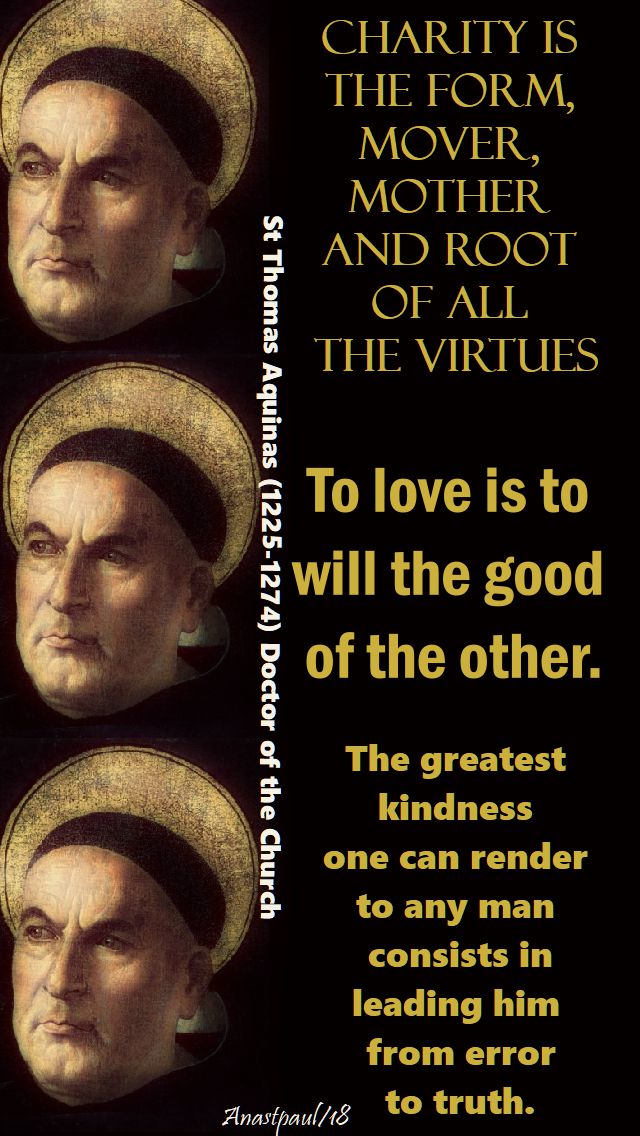
“Charity is the form, mover, mother and root of all the virtues.”
“To love is to will the good of the other.”
“The greatest kindness one can render to any man consists in leading him from error to truth.”
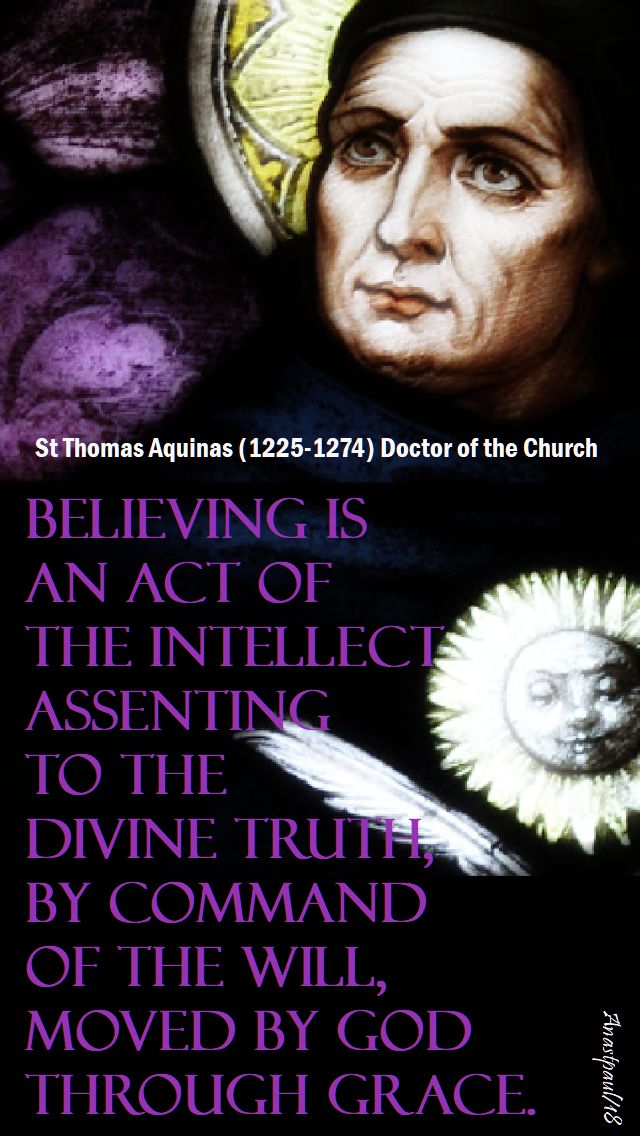
“Believing is an act of the intellect assenting to the divine truth, by command of the will, moved by God through grace.”
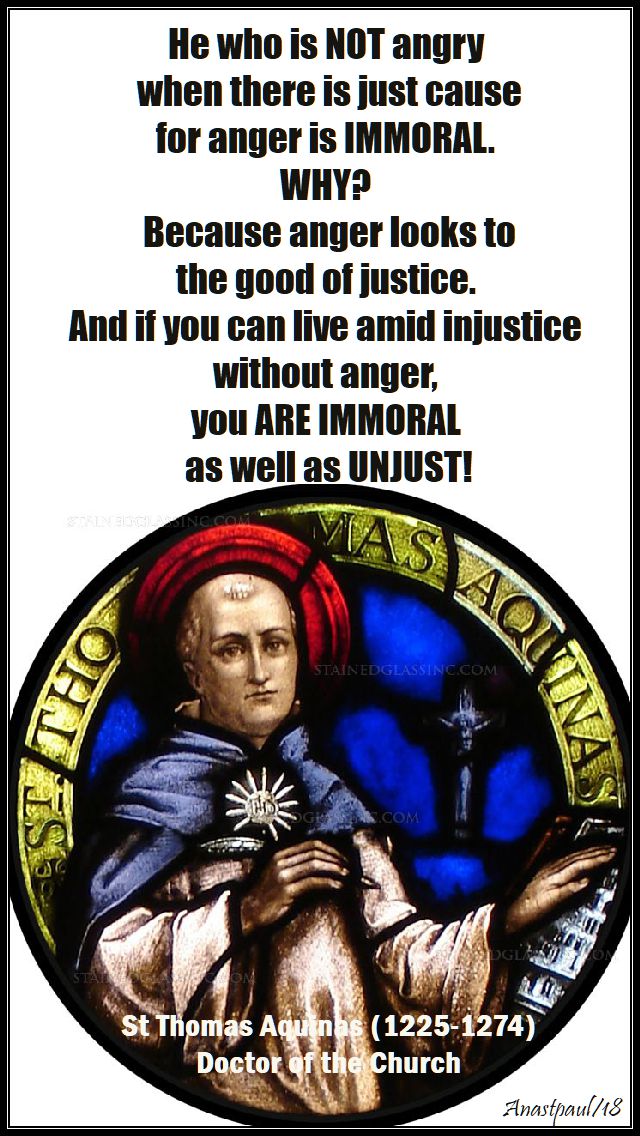
“He who is NOT angry when there is just cause for anger is IMMORAL. WHY? Because anger looks to the good of justice. And if you can live amid injustice without anger, you ARE IMMORAL as well as UNJUST!”
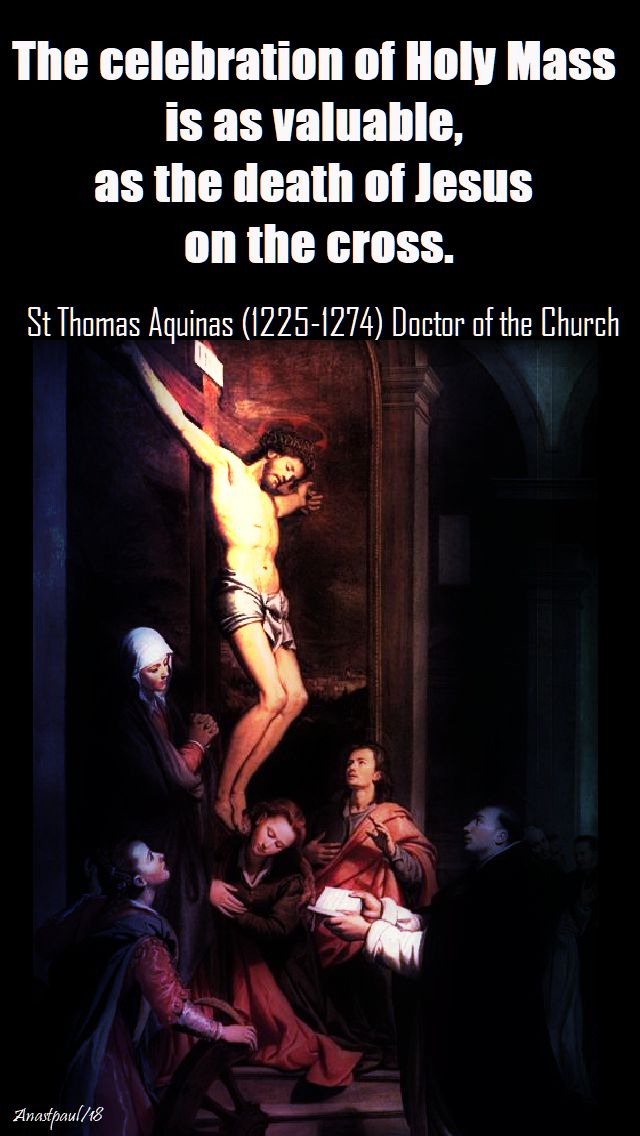
“The celebration of Holy Mass is as valuable, as the death of Jesus on the cross.”
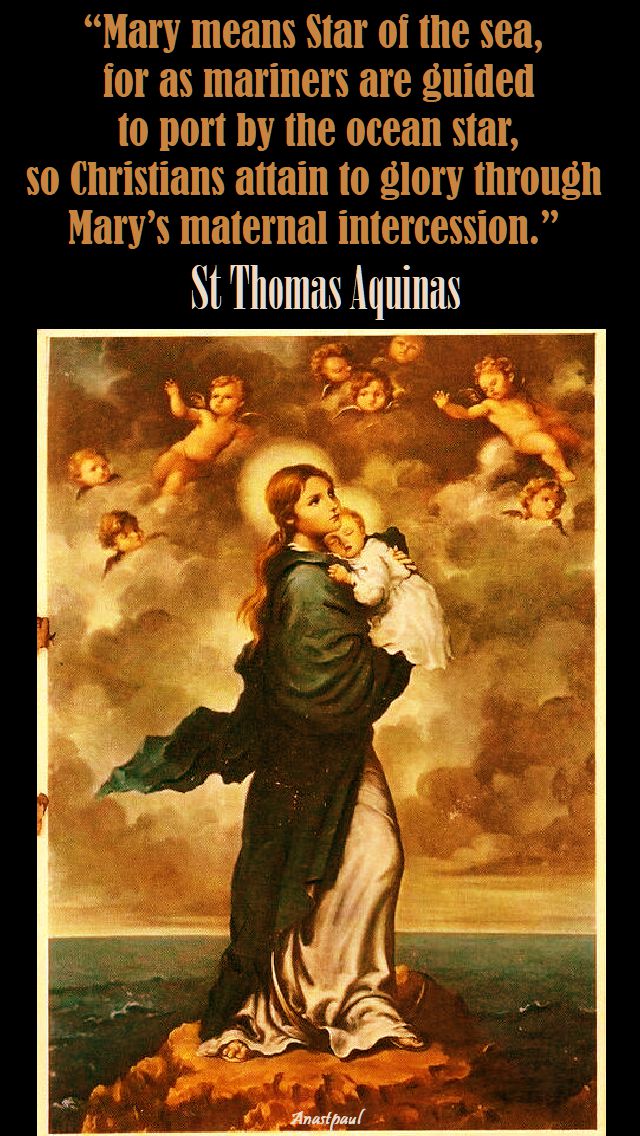
“Mary means Star of the sea, for as mariners are guided to port by the ocean star, so Christians attain to glory through Mary’s maternal intercession.”
St Thomas Aquinas (1225-1274) Doctor of the Church
Our Morning Offering – 28 January – The Memorial of St Thomas Aquinas (1225-1274) Doctor angelicus (Angelic Doctor) and Doctor communis (Common Doctor)
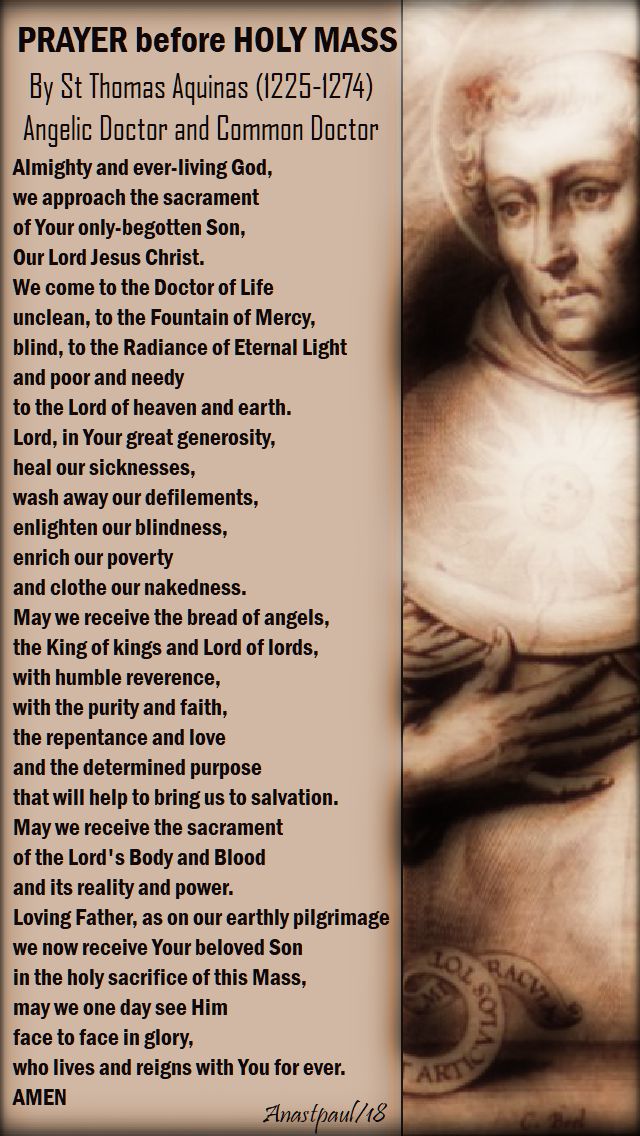
PRAYER before HOLY MASS By St Thomas Aquinas (1225-1274) Angelic Doctor and Common Doctor
Almighty and ever-living God,
we approach the sacrament
of Your only-begotten Son,
Our Lord Jesus Christ.
We come to the Doctor of Life
unclean, to the Fountain of Mercy,
blind, to the Radiance of Eternal Light
and poor and needy
to the Lord of heaven and earth.
Lord, in Your great generosity,
heal our sicknesses,
wash away our defilements,
enlighten our blindness,
enrich our poverty
and clothe our nakedness.
May we receive the bread of angels,
the King of kings and Lord of lords,
with humble reverence,
with the purity and faith,
the repentance and love
and the determined purpose
that will help to bring us to salvation.
May we receive the sacrament
of the Lord’s Body and Blood
and its reality and power.
Loving Father, as on our earthly pilgrimage
we now receive Your beloved Son
in the holy sacrifice of this Mass,
may we one day see Him face to face in glory,
who lives and reigns with You for ever,
AMEN.
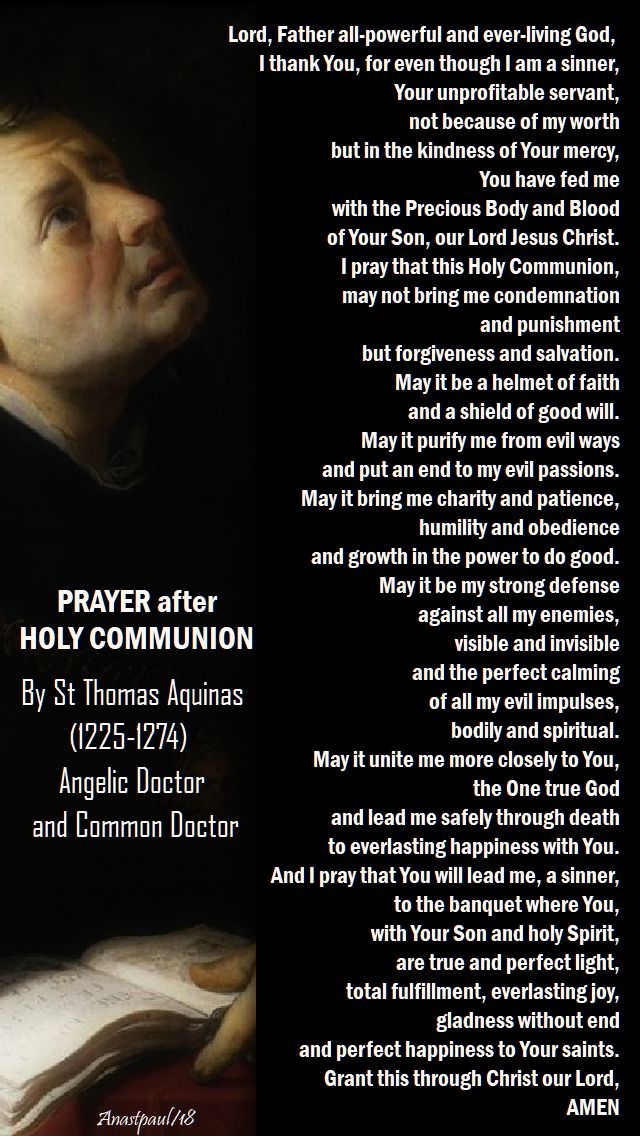
PRAYER after HOLY COMMUNION By St Thomas Aquinas (1225-1274) Angelic Doctor and Common Doctor
Lord, Father all-powerful and ever-living God,
I thank You, for even though I am a sinner,
Your unprofitable servant,
not because of my worth
but in the kindness of Your mercy,
You have fed me
with the Precious Body and Blood
of Your Son, our Lord Jesus Christ.
I pray that this Holy Communion,
may not bring me condemnation
and punishment
but forgiveness and salvation.
May it be a helmet of faith
and a shield of good will.
May it purify me from evil ways
and put an end to my evil passions.
May it bring me charity and patience,
humility and obedience
and growth in the power to do good.
May it be my strong defense
against all my enemies,
visible and invisible
and the perfect calming
of all my evil impulses,
bodily and spiritual.
May it unite me more closely to You,
the One true God
and lead me safely through death
to everlasting happiness with You.
And I pray that You will lead me, a sinner,
to the banquet where You,
with Your Son and holy Spirit,
are true and perfect light,
total fulfillment, everlasting joy,
gladness without end
and perfect happiness to Your saints.
Grant this through Christ our Lord,
AMEN.
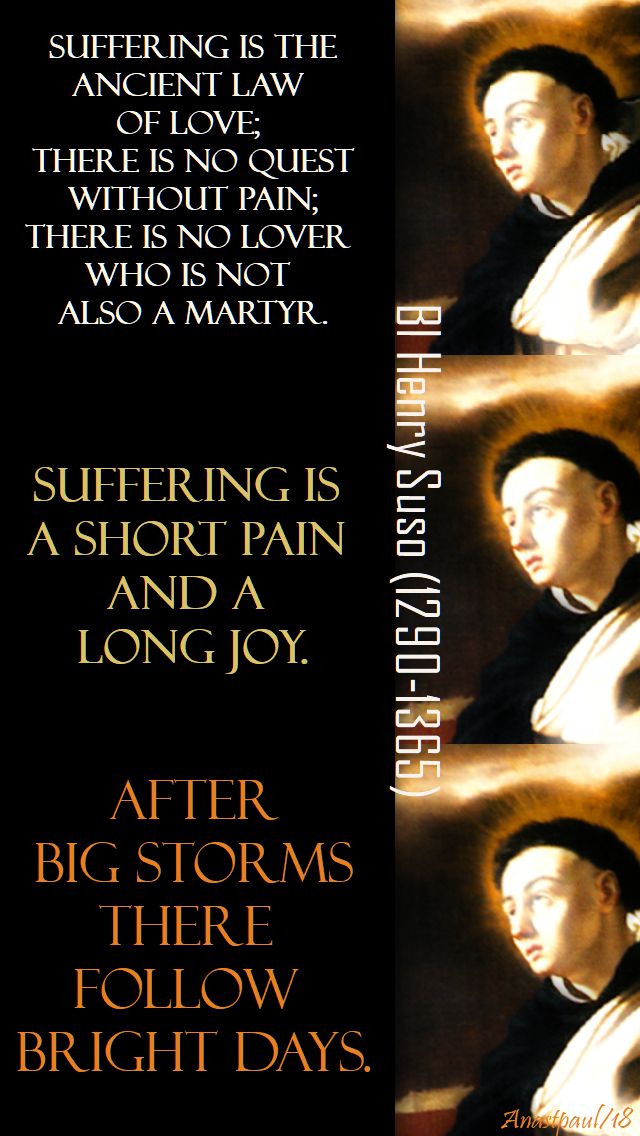
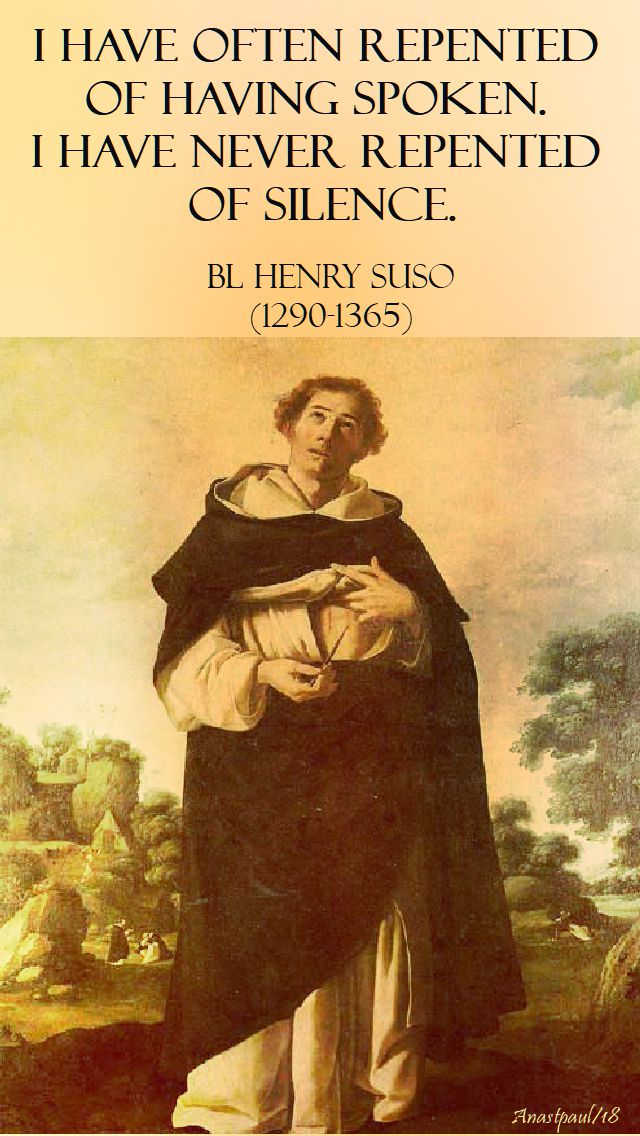
Quote/s of the Day – 25 January – The Memorial of Blessed Henry Suso O.P. (1290-1365)
“Suffering is the ancient law of love; there is no quest without pain; there is no lover who is not also a martyr.”
“Suffering is a short pain and a long joy.”
“After big storms there follow bright days.”
“I have often repented of having spoken. I have never repented of silence.”
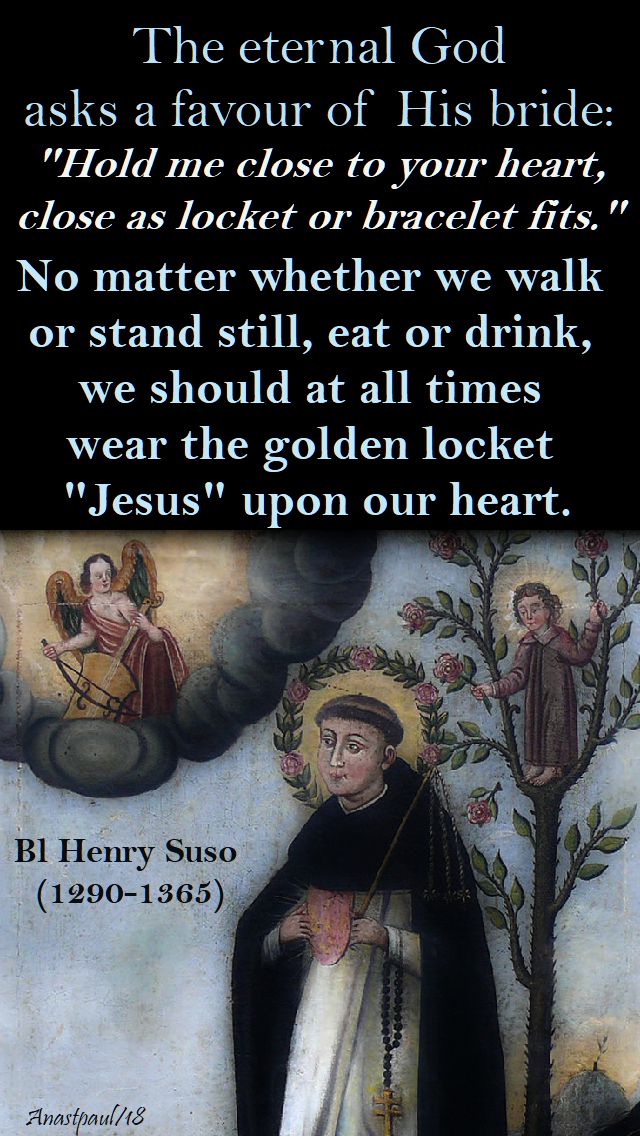
“The eternal God asks a favour of His bride: “Hold me close to your heart, close as locket or bracelet fits.” No matter whether we walk or stand still, eat or drink, we should at all times wear the golden locket “Jesus” upon our heart.”
“Nowhere does Jesus hear our prayers more readily than in the Blessed Sacrament.”
Quote/s of the Day – 22 January – The Memorial of St Vincent Pallotti (1795-1850) and Blessed William Joseph Chaminade (1761-1850)
Before his First Holy Mass
“Not the intellect but God Not the will but God Not the heart but God Not taste but God Not touch but God Not food and drink but God Not clothing but God Not tranquillity but God Not the worldly goods but God. Not riches but God. Not honours but God. Not distinction but God. Not dignities but God. Not advancement but God. God in all God always.”
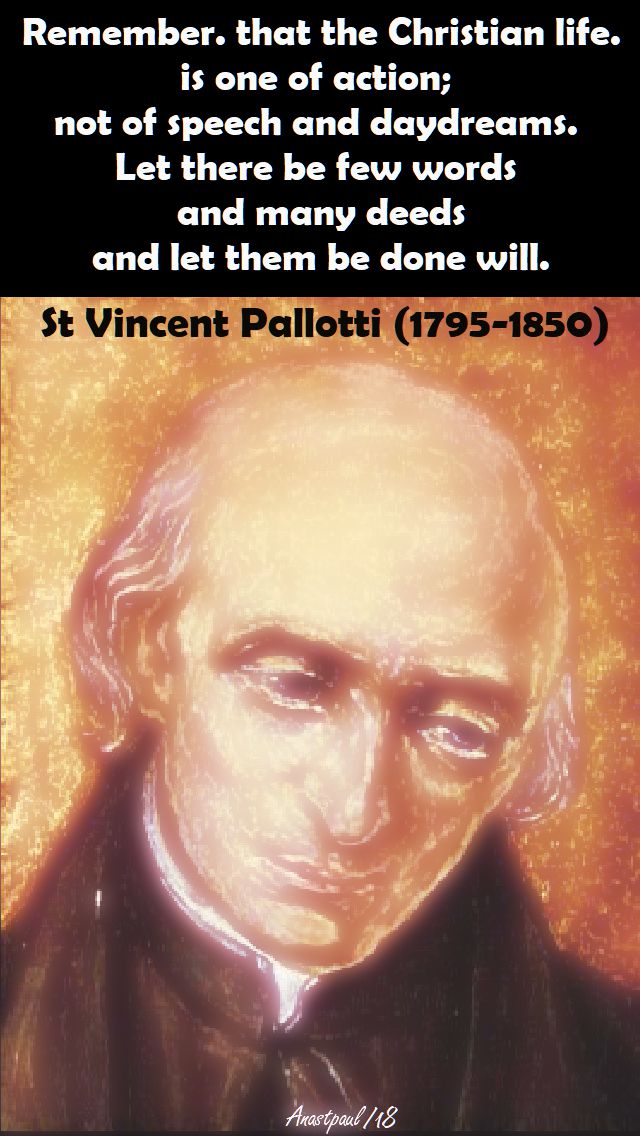
“Remember. that the Christian life. is one of action; not of speech and daydreams. Let there be few words and many deeds and let them be done will.”
St Vincent Pallotti (1795-1850)
“Jesus made Mary the companion of His labours, of His joy, of His preaching, of His death. Mary had a part in all the glorious, joyous and sorrowful mysteries of Jesus.”
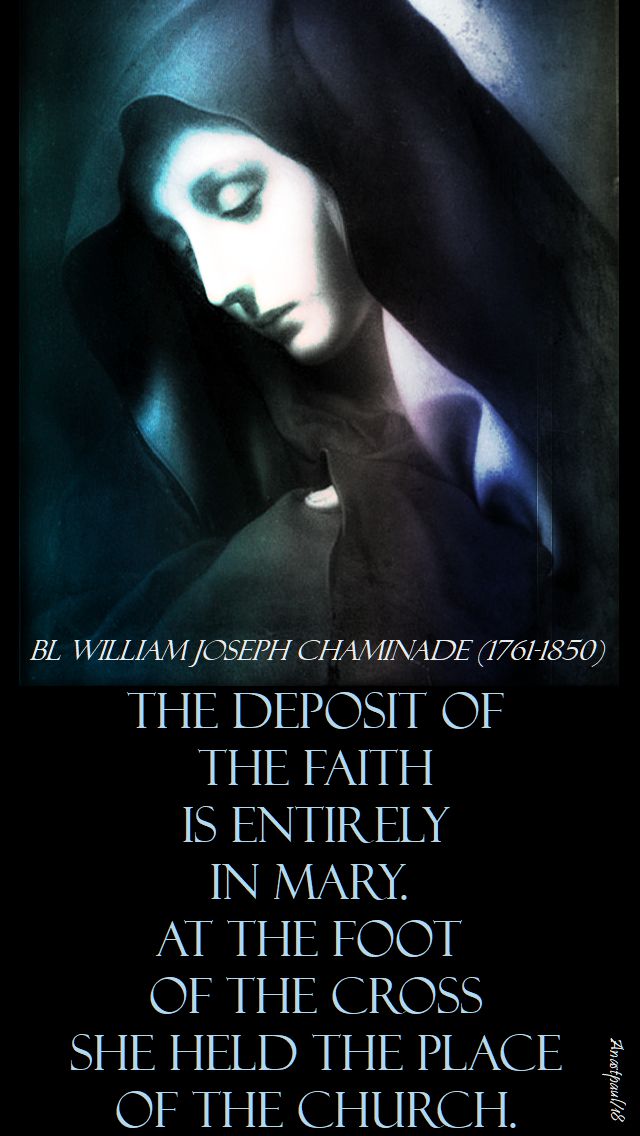
“The deposit of the Faith is entirely in Mary. At the foot of the Cross she held the place of the Church. “
Sunday Reflection – 21 January 2018 – 3rd Sunday in Ordinary Time Year B
Fr Raneiro Cantalamessa OFM “This is My Body”
“What the Sunday celebrations of the Eucharist represented for Christians at the time of the persecutions is shown in a moving way in the acts of the North African Martyrs, Saturninus and companions, who died under the Diocletian persecution in 305.*
They were the first martyrs of the Eucharist. Their words and example might constitute a strong call and the starting point for an examination of conscience for us modern Christians.
To the Roman judge who accused them of having transgressed the emperor’s order not to hold meetings and hand out the Scriptures, the martyrs responded one after the other:
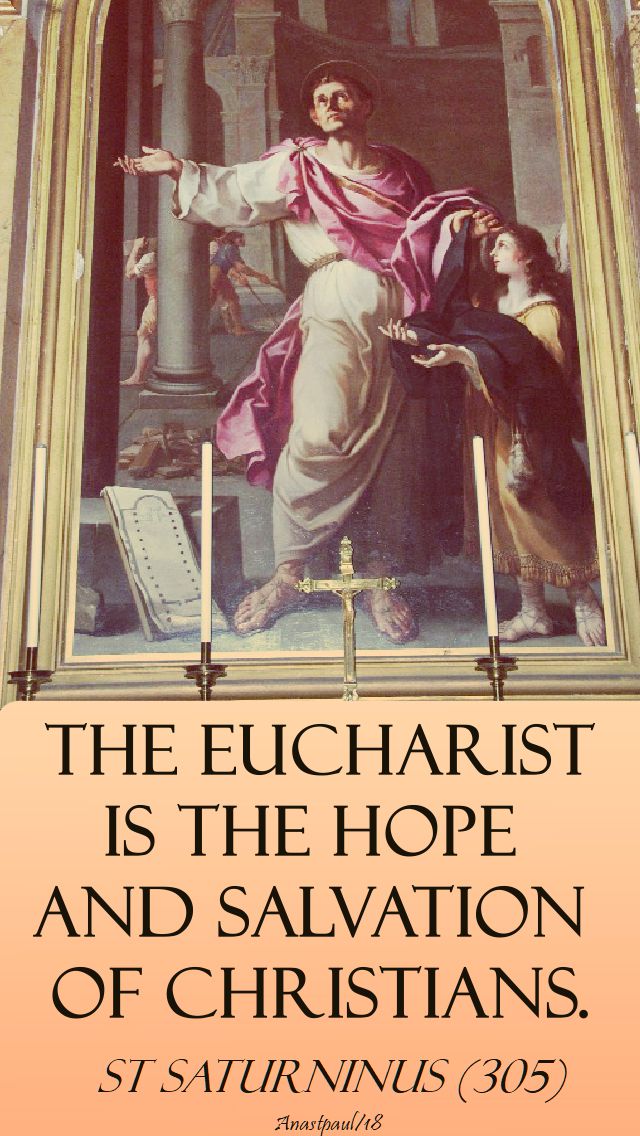
” A Christian cannot live without the Eucharist and the Eucharist without the Christians. Don’t you know that the Christian exists for the Eucharist and the Eucharist for the Christian?” “Yes, I participated with the brothers in the meeting, I celebrated the mysteries of the Lord and I have with me, written in my heart, the divine Scriptures… The Eucharist is the hope and salvation of Christians.”**
* Acta ss. Saturnini et sociorum martyrum (ca.304), 9, 11 (ed PT Ruinart, Acta martyrum 1959). A phrase of these acts: “Sine dominico non possumus” is sometimes translated: ‘We cannot live without Sunday.’ A suggestive translation but unfortunately inexact. The neuter noun dominicum indicates the ‘celebration of the Lord’s Mysteries’, ‘the Lord’s Banquet’, namely ‘the Lord’s Supper’ of 1 Cor 11:20. The term recurs with such meaning in the African writers of the time – Tertullian, Ad Uxorem, 2,4; Cyprian, De opere et eleemosynis, 15.
The accent is therefore on the Eucharist, not on Sunday, the latter is included indirectly, inasmuch as the Lord’s Supper, was celebrated as a rule and for a certain period exclusively, on Sunday. The complete meaning of dominicum is, therefore, that of “Sunday celebration of the Lord’s supper.”
Our Morning Offering – 21 January – 3rd Sunday in Ordinary Time Year B
Prayer before Holy Mass By St John Chrysostom (347-407) Father & Doctor of the Church
O God, loose, remit and forgive
my sins against You.
Whether in word, or in deed, or in thought,
willingly or unwillingly,
knowingly or unknowingly committed,
forgive them all;
for You are good and love mankind.
And through the prayers of Your most holy Mother,
of Your heavenly servants and holy powers
and of all the saints
who have found favour in Your sight,
enable me to receive without condemnation
Your holy and immaculate body
and Your precious blood,
to the healing of my soul and body
and to the driving away of all evil imaginations,
for Yours is the kingdom, the power and the glory,
Father, Son and Holy Spirit,
now and forever and to ages of ages. Amen
Quote/s of the Day – 18 January – “Speaking of the Holy Eucharist/Holy Mass“
“Let us return from that Table, like lions breathing out fire, terrifying to the devil!”
St John Chrysostom (347-407) Father & Doctor of the Church
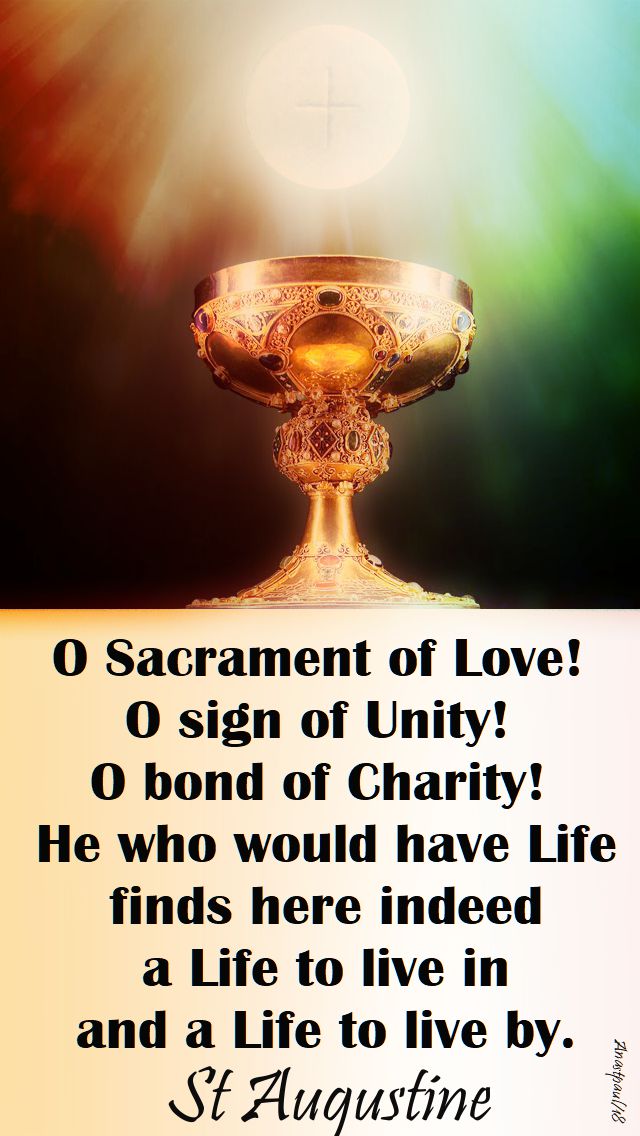
“O Sacrament of Love! O sign of Unity! O bond of Charity! He who would have Life finds here indeed a Life to live in and a Life to live by.”
St Augustine (354-430) Father & Doctor of the Church
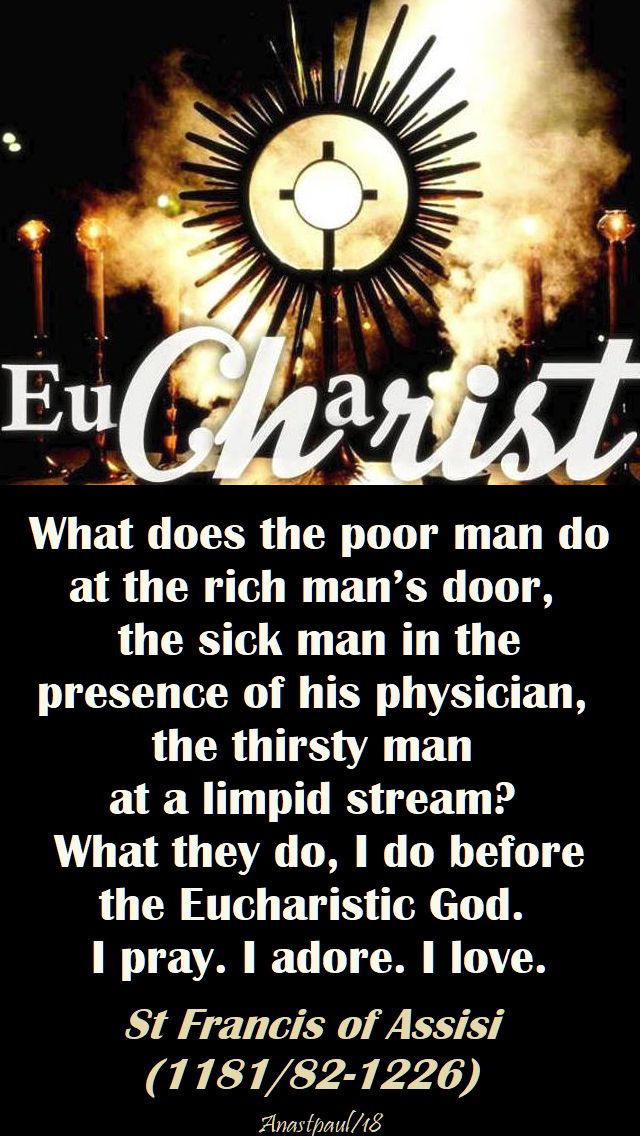
“What does the poor man do at the rich man’s door, the sick man in the presence of his physician, the thirsty man at a limpid stream? What they do, I do before the Eucharistic God. I pray. I adore. I love.”
St Francis of Assisi
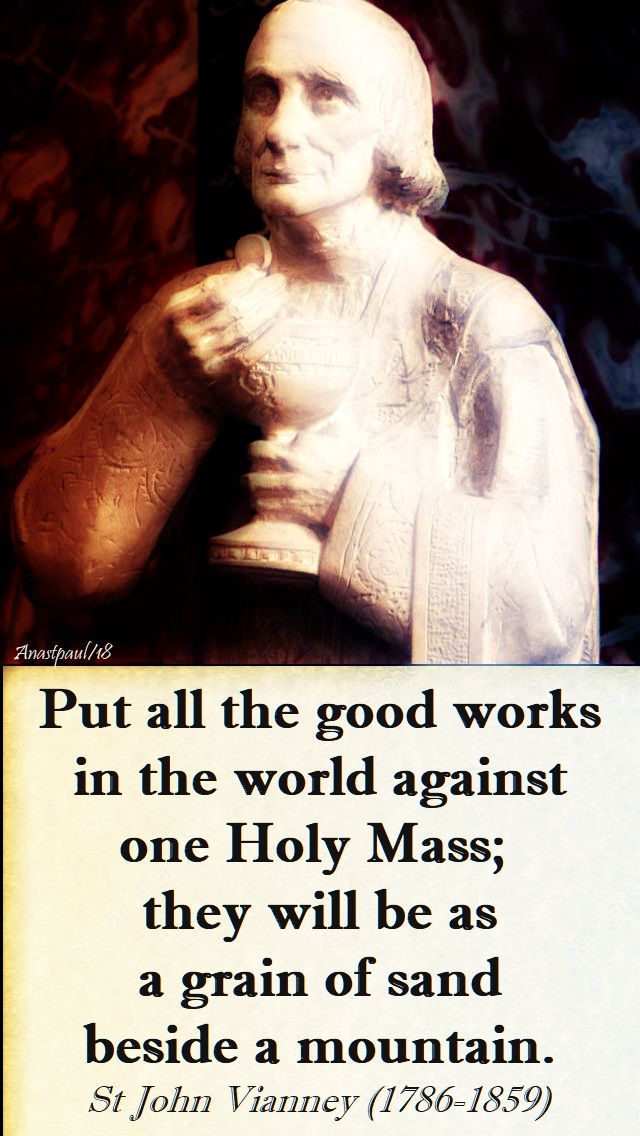
“Put all the good works in the world against one Holy Mass; they will be as a grain of sand beside a mountain.”
St John Marie Baptiste Vianney (1786-1859)
“When you look at the crucifix, you understand how much Jesus loved you then. When you look at the Sacred Host, you understand how much Jesus loves you now.”
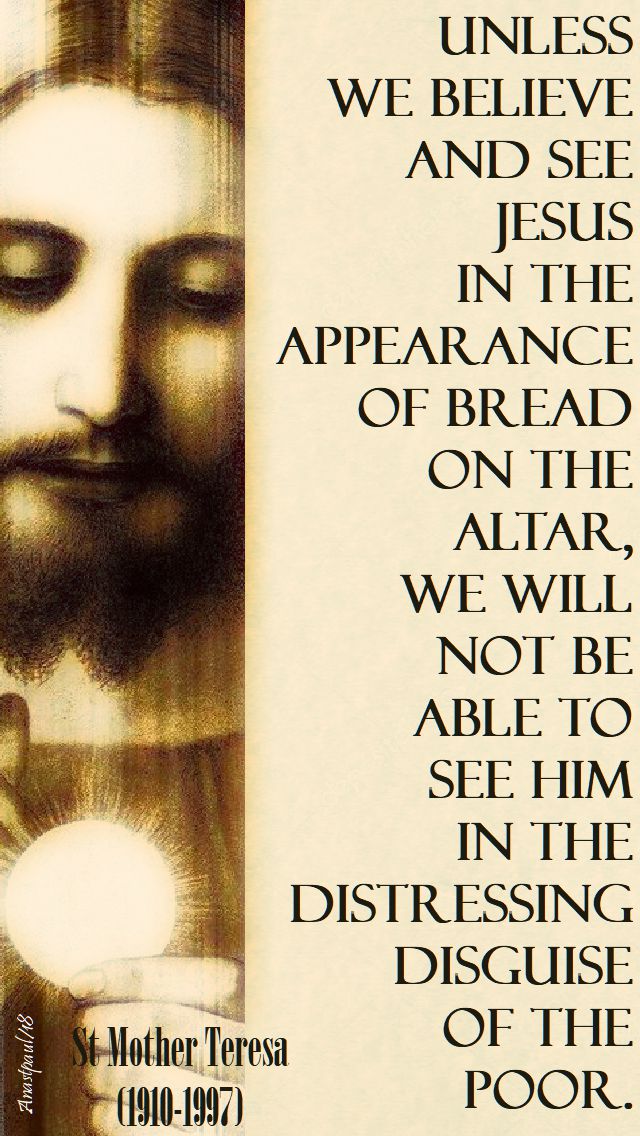
“Unless we believe and see Jesus in the appearance of bread on the altar, we will not be able to see Him in the distressing disguise of the poor.”
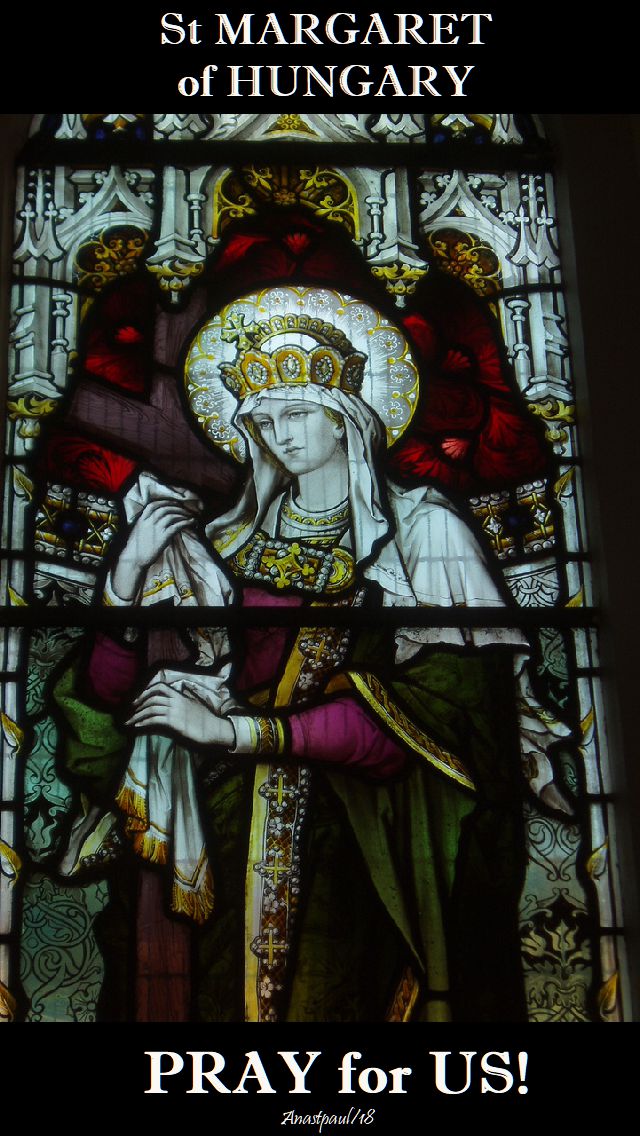
One Minute Reflection – 18 January – The Memorial of St Margaret of Hungary (1242-1270)
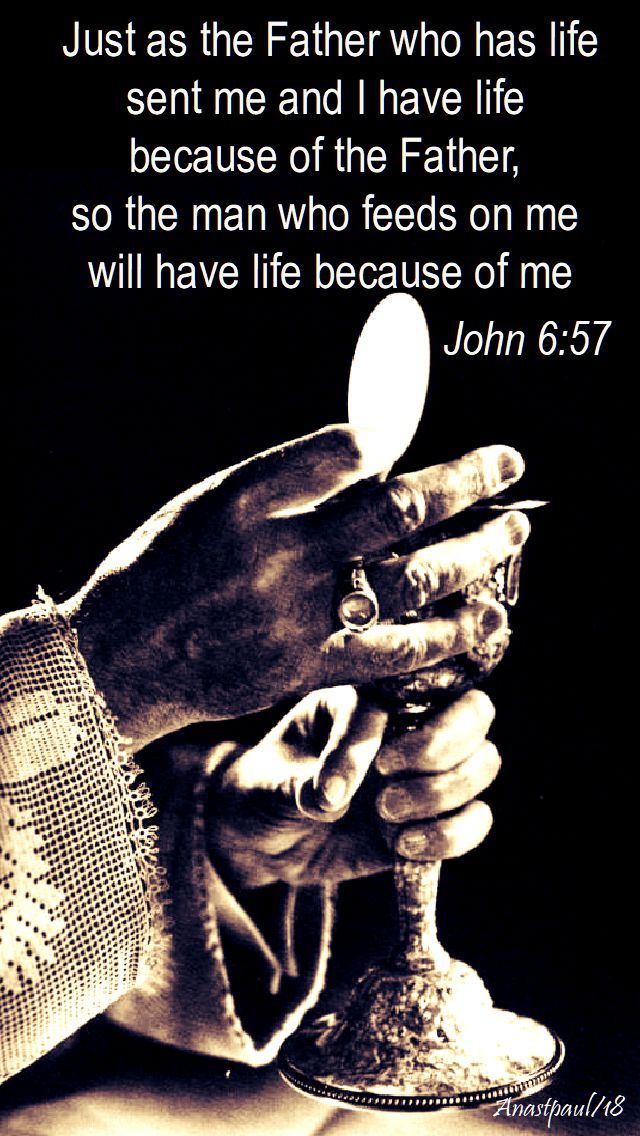
Just as the Father who has life sent me and I have life because of the Father, so the man who feeds on me will have life because of me...John 6:57
REFLECTION – “The Holy Eucharist, is a fire that purifies and consumes all our miseries and imperfections. Do everything in your power to make yourself worthy of the Eucharist and this Divine Fire, will take care of the rest.”…St Hyacinth of Mariscotti T.O.R.(1585-1640)
PRAYER – Living God, You have given me the Eucharist as my food for heavenly life. Help me to partake of it often and so be strengthened on my pilgrim journey on earth. Grant that St Margaret of Hungary, may add us all to her prayers, that by her intercession, we too may learn the true way home. Through Jesus Christ, our Lord, in union with the Holy Spirit, one God forever and ever, amen.
Sunday Reflection – 14 January – The Shepherd Gathers Us
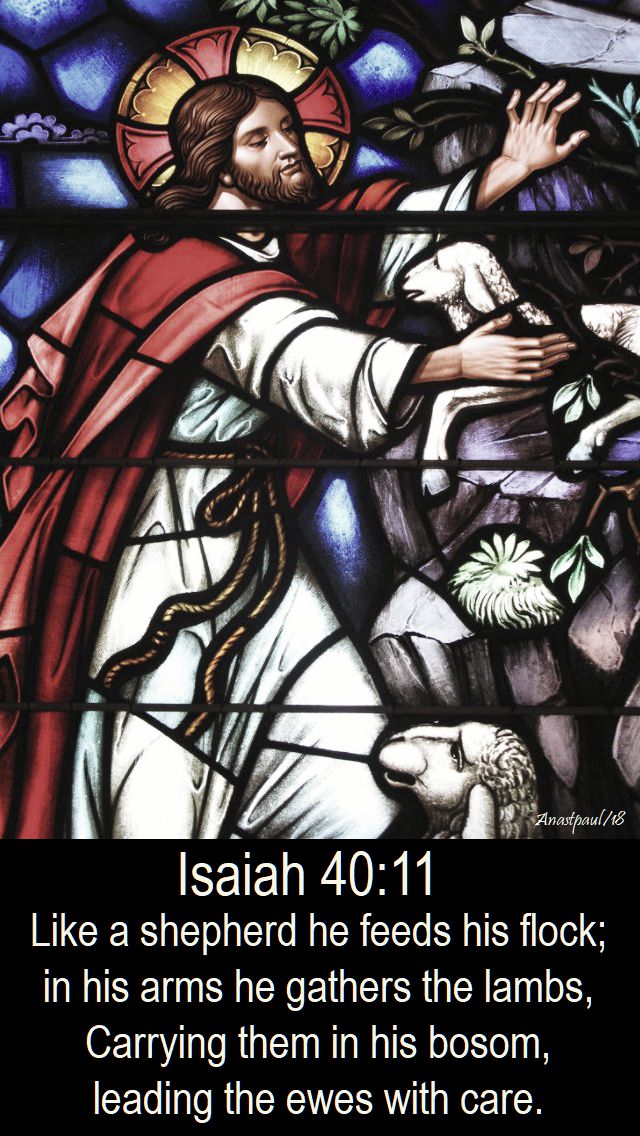
Like a shepherd he feeds his flock; in his arms he gathers the lambs, Carrying them in his bosom, leading the ewes with care….Isaiah 40:11
Jesus promised that whenever a group of people gather in prayer, He will be there with them. The early church took that promise literally. The first disciples had been used to having Jesus physically among them and then, after His Ascension, they often struggled to know what Jesus would want them to do. However, they had a simple formula for every occasion and difficulty – Jesus’ invitation to gather in His Name. They would gather around the Word and the breaking of the bread and, there, let Jesus make His presence felt and effect through them what they could not otherwise accomplish themselves.
As Christians today, we still need to take that same promise literally. Christian life is not sustained only by private acts of prayer, justice and virtue. It is sustained in a community, by gathering ritually around the Word of God and through the breaking of the bread. However, it is important to understand, that this kind of gathering is not simply a social one capable only of doing what social gatherings can do. To gather around the Word of God and the breaking of the bread is a ritual gathering and ritual brings something that normal social gatherings does not – namely, transformative power beyond what can be understood and explained through the physical, psychological and social dynamics that are present.
Lord, You invite me to be part of Your flock. Remind me of that when I am tempted to go off on my own.
Quote/s of the Day – 14 January -Speaking of the Holy Eucharist from the Fathers of the Church
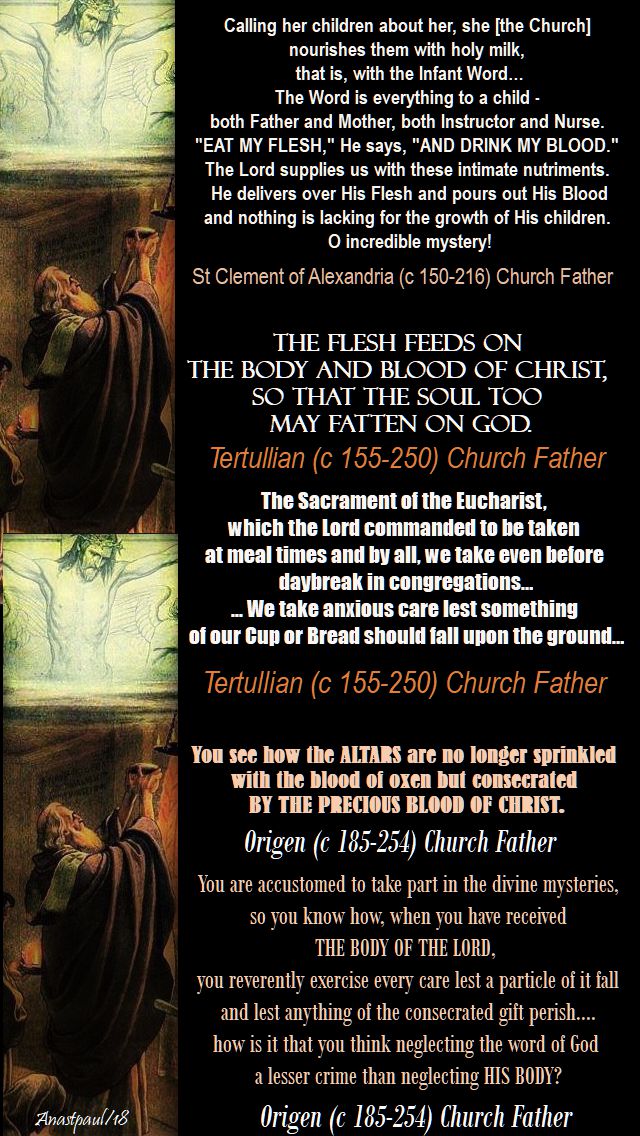
“Calling her children about her, she [the Church] nourishes them with holy milk, that is, with the Infant Word… The Word is everything to a child – both Father and Mother, both Instructor and Nurse. “EAT MY FLESH,” He says, “AND DRINK MY BLOOD.” The Lord supplies us with these intimate nutriments. He delivers over His Flesh and pours out His Blood and nothing is lacking for the growth of His children. O incredible mystery!” (Instructor of Children 1:6:42,1,3)
St Clement of Alexandria (c 150-216) Church Father
“The flesh feeds on THE BODY AND BLOOD OF CHRIST, so that the SOUL TOO may fatten on God.” (Resurrection of the Dead 8:3)
“The Sacrament of the Eucharist, which the Lord commanded to be taken at meal times and by all, we take even before daybreak in congregations… … We take anxious care lest something of our Cup or Bread should fall upon the ground…” (The Crown 3:3-4)
Tertullian (c 155-250) Church Father
“You see how the ALTARS are no longer sprinkled with the blood of oxen but consecrated BY THE PRECIOUS BLOOD OF CHRIST.” (Homilies on Joshua 2:1)
“You are accustomed to take part in the divine mysteries, so you know how, when you have received THE BODY OF THE LORD, you reverently exercise every care lest a particle of it fall and lest anything of the consecrated gift perish…. how is it that you think neglecting the word of God a lesser crime than neglecting HIS BODY?” (Homilies on Exodus 13:3)
Origen (c 185-254) Church Father
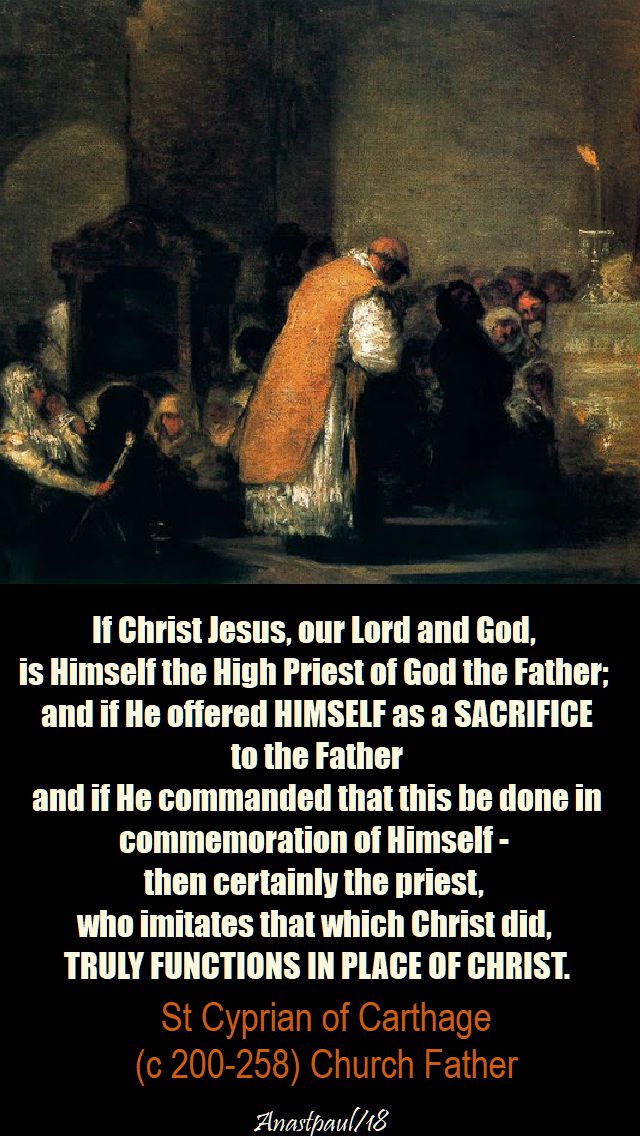
“If Christ Jesus, our Lord and God, is Himself the High Priest of God the Father; and if He offered HIMSELF as a SACRIFICE to the Father and if He commanded that this be done in commemoration of Himself – then certainly the priest, who imitates that which Christ did, TRULY FUNCTIONS IN PLACE OF CHRIST.” (Letters 63:14)
Our Morning Offering – 14 January – 2nd Sunday in Ordinary Time Year B
Prayer before Mass By St Ambrose (340-397) Father & Doctor of the Church
Lord Jesus Christ,
We approach Your banquet table
as saints and sinners
and dare not rely on our own worth,
but only on Your goodness and mercy.
Gracious God of majesty and awe,
We seek Your protection,
We look for Your healing.
We appeal to You, the fountain of all mercy.
Lord Jesus Christ, eternal king,
crucified for us, look upon us with mercy
and hear our prayer, for we trust in You.
Merciful Father, purify us in body and soul
and make us worthy to taste the Holy of Holies.
May Your body and blood,
which we intend to receive,
unworthy as we are,
be for us the remission of our sins,
the washing away of our guilt,
the end of our evil thoughts
and the rebirth of our better instincts.
May it incite us to do the works pleasing to You
and profitable to our health in body and soul
and may it deliver us from evil. Amen
Thought for the Day – 5 January – The Memorial of St John Neumann (1811-1860) – An Adorer of the Blessed Sacrament
St John Nepomucene Neumann (1811–1860), Bishop of Philadelphia from 1852–1860, was graced with an intense devotion to Our Lord in the Sacrament of the Most Holy Eucharist. His personal experience as a boy in Bohemia (modern Czech Republic), then as a priest in the United States and finally as a Redemptorist — a spiritual son of the incomparable Saint Alphonsus Liguori (1696-1787) (Founder of the Redemptorists and Doctor of the Church) — impelled him to promote prolonged prayer before the Blessed Sacrament exposed in the monstrance. No sooner had he become bishop of Philadelphia than he sought to introduce the Quarant’ Ore, or Forty Hours Devotion, already practised for three hundred years in Europe.
The good priests of Philadelphia were, for the most part, opposed to the introduction of the Forty Hours Devotion, fearing that, given the prevailing climate of violent anti-Catholicism nurtured by the Know Nothing Movement, it might exacerbate hostilities against the Church and even expose the Most Holy Sacrament to profanation.
Bishop Neumann had very nearly renounced his project when, overcome by exhaustion late one night, he fell asleep while writing at his desk. A burning candle ignited the papers lying before him. He awoke to smoke rising from the incinerated papers. One document alone remained unscathed; it was the letter he had written to propose the Forty Hours Devotion. Bishop Neumann fell to his knees to give thanks for having been preserved from harm and, as he did so, he experienced a kind of locution. God spoke to him inwardly saying, “As the flames are burning here without consuming or injuring this writing, so shall I pour out My grace in the Blessed Sacrament without prejudice to My honour. Therefore, do not fear profanation and do not hesitate any longer to carry out your designs for My glory.”
Convinced by this sign, Bishop Neumann overrode the objections of his clergy and initiated the celebration of the Forty Hours at the First Diocesan Synod of Philadelphia in April 1853. The Church chosen for the first Forty Hours was that of Saint Philip Neri. It was the latter saint who had, in fact, introduced the Quarant’ Ore to the city of Rome. Bishop Neumann astonished — and edified — his clergy and faithful by spending the greater part of the three days on his knees before the Blessed Sacrament in Saint Philip Neri Church. There was no anti-Catholic backlash. Great crowds of the faithful came, by day and by night, to adore Our Lord exposed to their gaze in the Sacrament of the Altar.
Bishop Neumann carried out his original inspiration by organising the Forty Hours Devotion in the entire diocese of Philadelphia in such a way that each parish would celebrate it in turn during the course of the year. He edited a booklet to facilitate the worthy celebration of the Quarant’ Ore and secured indulgences for the faithful who would participate in the devotion. So successful was the Forty Hours in the diocese of Philadelphia that it spread from there to other dioceses of the United States. In 1866 at the Plenary Council of Baltimore the Forty Hours Devotion was ratified for the whole country.
One of the conclusions of the 2005 Vatican Synod on the Eucharist was the recommendation that the Forty Hours Devotion be reinvigorated and reintroduced everywhere in the Church. This, of course, is fully consonant with the repeated exhortations to Eucharistic adoration of St Pope John Paul II and Pope Benedict XVI.
Saints John and Alphonsus
Saint John Neumann left, among his personal writings, a prayer that, by its language and tenderness, is reminiscent of the outpourings of his spiritual father, Saint Alphonse Liguori, in the presence of the Blessed Sacrament. It reveals something of the soul of Bishop Neumann:
How much do I love You, O my Jesus! I wish to love You with my whole heart, yet I do not love You enough. I have but one desire, that of being near You, in the Blessed Sacrament. Thou art the sweet Bridegroom of my soul. My Jesus, my love, my all, gladly would I endure hunger, thirst, heat and cold to remain always with You in the Blessed Sacrament. Amen
ST JOHN NEUMANN, PRAY FOR THE GROWTH OF EUCHARISTIC ADORATION, PRAY FOR HOLY MOTHER CHURCH, PRAY FOR US ALL!
Quote/s of the Day – 4 January – The Memorial of St Elizabeth Ann Seton (1774-1821)
“Faith lifts the soul, Hope supports it, Experience says it must and Love says…let it be!”
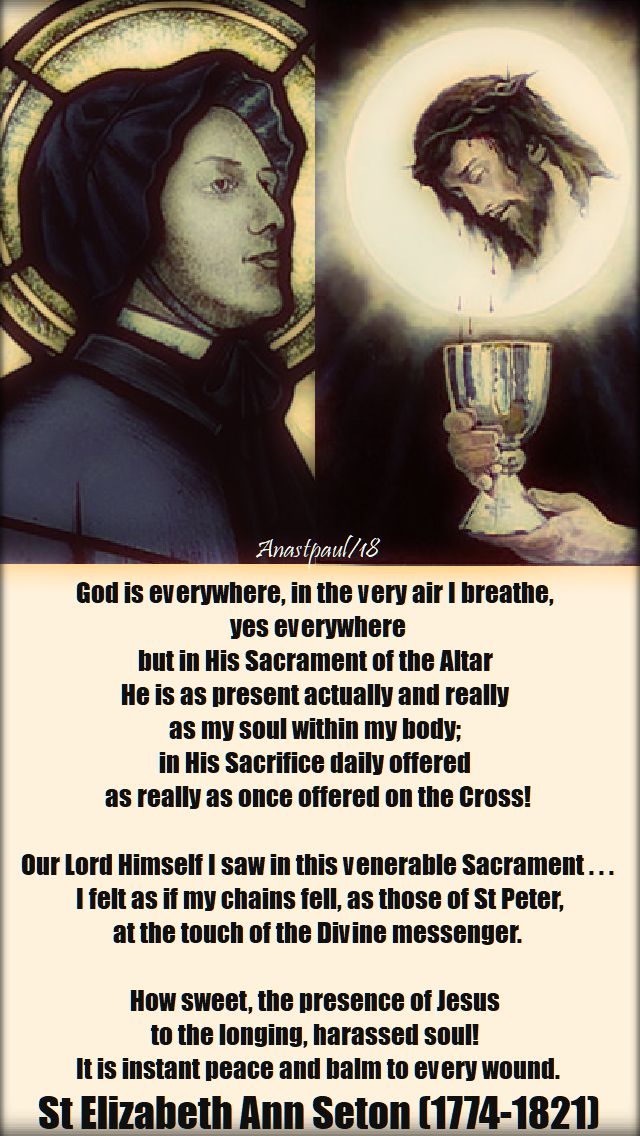
“God is everywhere, in the very air I breathe, yes everywhere but in His Sacrament of the Altar He is as present actually and really as my soul within my body; in His Sacrifice daily offered as really as once offered on the Cross!”
“Our Lord Himself I saw in this venerable Sacrament . . . I felt as if my chains fell, as those of St Peter, at the touch of the Divine messenger.”
“How sweet, the presence of Jesus to the longing, harassed soul! It is instant peace and balm to every wound.”
“We must pray without ceasing, in every occurrence and employment of our lives – that prayer which is rather a habit of lifting up the heart to God as in a constant communication with Him.”
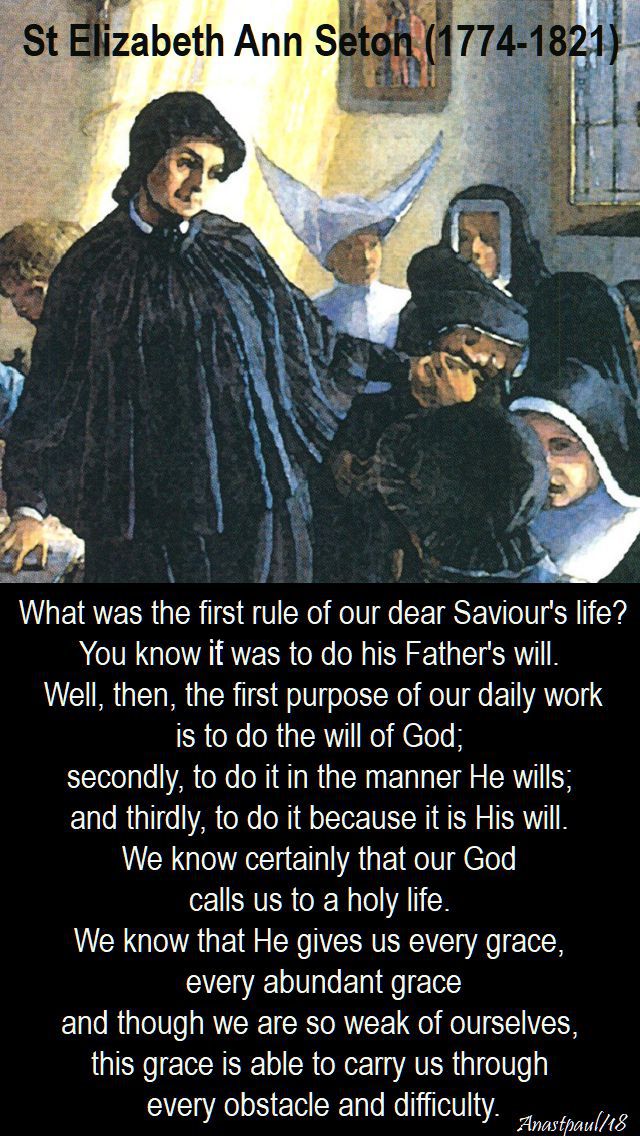
“What was the first rule of our dear Saviour’s life? You know it was to do his Father’s will. Well, then, the first purpose of our daily work is to do the will of God; secondly, to do it in the manner He wills; and thirdly, to do it because it is His will. We know certainly that our God calls us to a holy life. We know that He gives us every grace, every abundant grace and though we are so weak of ourselves, this grace is able to carry us through every obstacle and difficulty.”
“Afflictions are the steps to heaven.”
“Can you expect to go to heaven for nothing? Did not our Saviour track the whole way to it with His tears and blood? And yet you stop at every little pain?”
“The gate of heaven is very low; only the humble can enter it.”
Sunday Reflection – 31 December – Feast of the Holy Family and the Seventh Day of the Octave
While they were eating, He took some bread, and after a blessing He broke it, and gave it to them, and said, “Take it; this is My body.” And when He had taken a cup and given thanks, He gave it to them and they all drank from it. And He said to them, “This is My blood of the covenant, which is poured out for many..…Mark 14:22-24
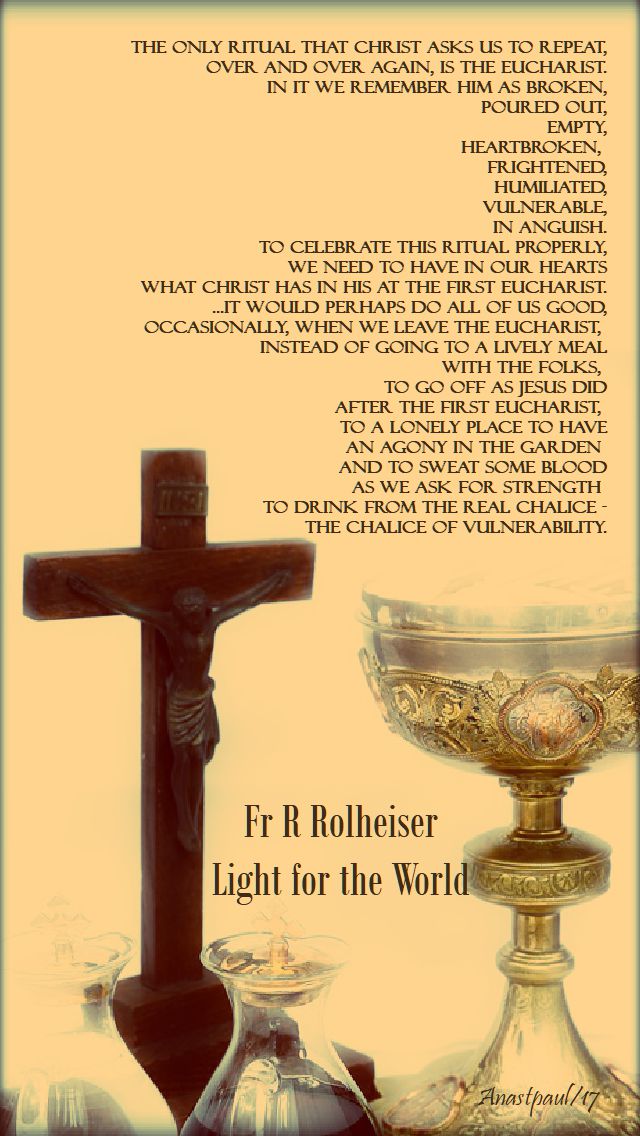
The only ritual that Christ asks us to repeat, over and over again, is the Eucharist. In it we remember Him as broken, poured out, empty, heartbroken, frightened, humiliated, vulnerable, in anguish. To celebrate this ritual properly, we need to have in our hearts what Christ has in His at the first Eucharist.
What was He feeling then?
Joy and thanksgiving. Yes. LOVE for those at the table with Him. Surely. But beyond this, His heart felt anguish, deep longing and fear at the prospect of the pain that was now a certainty before intimacy and community could be achieved.
It would perhaps do all of us good, occasionally when we leave the Eucharist, instead of going to a lively meal with the folks, to go off as Jesus did after the first Eucharist, to a lonely place to have an agony in the garden and to sweat some blood as we ask for strength to drink from the real chalice – the chalice of vulnerability.
Occasionally, when St Augustine handed the Eucharist to a communicant, instead of saying, “the Body of Christ”, he would say, “Receive what you are.”
Augustine had perceived, for whatever reason, that the words of consecration, “this is my body, this is my blood”, are intended more to change the people present, than to change bread and wine.
(Fr R Rolheiser – Light for the World)
Lord Jesus Christ we pray…thank You for abiding with us. May we always reverence the Holy Eucharist, as Your Real Presence amongst us. Amen
One Minute Reflection – 23 December – Saturday of the Third Week of Advent and the Memorial of St John of Kanty (1390-1473)
On coming into the world, Jesus said …..”For I have come down from heaven, not to do My own will but the will of Him who sent Me” (John 6:38). By one offering He has forever perfected those who are being sanctified.
REFLECTION – “Jesus Christ, the God-Man, was born in a manger and is spiritually reborn on the altar. He suffered on Calvary and continues to offer Himself on the altar. In His earthly life, He spread His teaching and worked miracles among the crowds. In the Eucharist, He spans the centuries and communicates Himself to all.”…St John Chrysostom (347-407) Father & Doctor of the Church
PRAYER – Heavenly Father, in contemplating the birth of Your Son in time and in the Eucharist, may I ever attain a new birth. May I through love of You, give my all to my neighbour in true charity. Help me to learn from St John of Kanty to live in humility, true poverty of spirit and charity and of whom we ask for intercession. St John of Kanty, pray for us! Amen
Thought for the Day – 18 December – Monday of Gaudete Week and the Memorial of Bl Giulia Nemesia Valle (1847-1916) – Called “the Angel of Charity”
Try to gather together more frequently to give thanks to God and to praise Him. For when you come together frequently, Satan’s powers are undermined and the destruction that he threatens is done away with in the unanimity of your faith. Nothing is better than peace, in which all warfare between heaven and earth is brought to an end.
None of this will escape you if you have perfect faith and love toward Jesus Christ. These are the beginning and the end of life: faith the beginning, love the end. When these two are found together, there is God and everything else concerning right living follows from them.No one professing faith sins: no one possessing love hates. A tree is known by its fruit. So those who profess to belong to Christ will be known by what they do. For the work we are about is not a matter of words here and now but depends on the power of faith and on being found faithful to the end.
…Nothing is hidden from the Lord but even our secrets are close to Him. Let us then do everything in the knowledge that He is dwelling within us that we may be His temples, and He, God within us. He is and will reveal Himself, in our sight, according to the love we bear Him in holiness.
St Ignatius of Antioch (35-108)
(excerpt from a letter to the Ephesians by Saint Ignatius of Antioch, Bishop, Martyr, Father of the Church)
Faith means the fundamental response to the love that has offered itself up for me. It thus becomes clear that faith is ordered primarily to the inconceivability of God’s love, which surpasses us and anticipates us. Love alone is credible; nothing else can be believed and nothing else ought to be believed. This is the achievement, the ‘work’ of faith: to recognise this absolute prius, which nothing else can surpass; to believe that there is such a thing as love, absolute love and that there is nothing higher or greater than it.
Quote/s of the Day – 7 December – The Memorial of St Ambrose (c 340-397)- Father and Doctor of the Church
“The Church of the Lord is built upon the rock of the apostles among so many dangers in the world; it therefore remains unmoved. The Church’s foundation is unshakable and firm against assaults of the raging sea. Waves lash at the Church but do not shatter it. Although the elements of this world, constantly beat upon the Church with crashing sounds, the Church possesses the safest harbour of salvation for all in distress.”
“Rise, you who were lying fast asleep… Rise and hurry to the Church: here is the Father, here is the Son, here is the Holy Spirit.”
“It is a better thing to save souls for the Lord, than to save treasures. He who sent forth His apostles without gold, He had not need of gold to form His Church. The Church possesses gold, not to hoard but to scatter abroad and come to the aid of the unfortunate.”
“When we speak about WISDOM, we are speaking about CHRIST. When we speak about VIRTUE, we are speaking about CHRIST. When we speak about JUSTICE, we are speaking about CHRIST. When we speak about PEACE, we are speaking about CHRISTt. When we speak about TRUTH, and LIFE and REDEMPTION, we are speaking about CHRIST.”
“If it is “daily bread,” why do you take it once a year? . . . Take daily what is to profit you daily. Live in such a way that you may deserve to receive it daily. He who does not deserve to receive it daily, does not deserve to receive it once a year.”
“Let your door stand open to receive Him, unlock your soul to Him, offer Him a welcome in your mind and then you will see the riches of simplicity, the treasures of peace, the joy of grace. Throw wide the gate of your heart, stand before the sun of the everlasting light.”
“…He, who forgave all, required of all, that what every one remembers to have been forgiven to himself, he also should forgive others.”
“The devil tempts, that he may ruin; God tests, that He may crown.”
“The rich man who gives to the poor does not bestow alms but pays a debt.”
“Therefore, let your words be rivers, clean and limpid, so that you may charm the ears of people. And by the grace of your words win them over to follow your leadership. …. That is, let the meaning of your words shine forth, let understanding blaze out. Let no word escape your lips in vain or be uttered, without depth of meaning.” – from a letter by Saint Ambrose
St Ambrose (c 340-397)- Father and Doctor of the Church
From “The Liturgical Year” by Dom Gueranger O.S.B. (1805-1875)
Volume 1 Advent – Chapter The Fifth
On Hearing Mass During The Time Of Advent
There is no exercise which is more pleasing to God, or more meritorious, or which has greater influence in infusing solid piety into the soul, than the assisting at the holy sacrifice of the Mass. If this be true at all the various seasons of the Christian year, it is so, in a very special manner, during the holy time of Advent. The faithful, therefore, should make every effort in order to enjoy this precious blessing, even on those days when they are not obliged to it by the precept of the Church.
With what gratitude ought they to assist at that divine sacrifice, for
which the world had been longing for four thousand years! God has granted
them to be born after the fulfilment of that stupendous and merciful
oblation and would not put them in the generations of men who died before
they could partake of its reality and its riches! This notwithstanding, they must earnestly unite with the Church in praying for the coming of the Redeemer, so to pay their share of that great debt which God had put upon all, whether living before or after the fulfilment of the mystery of the Incarnation. Let them think of this in assisting at the holy sacrifice.
Let them also remember that this great sacrifice, which perpetuates on
this earth even to the end of time, though in an unbloody manner, the real
oblation of the Body and Blood of Jesus Christ, has this for its express
aim: to prepare the souls of the faithful for the mysterious coming of God,
who redeemed our souls only that He might take possession of them. It not
only prepares, it even effects this glorious advent.
Let them, in the third place, lovingly profit by the presence of and
intimacy with, Jesus, to which this hidden yet saving mystery admits them;
that so, when He comes in that other way, whereby He will judge the world
in terrible majesty, He may recognise them as His friends and even then,
when mercy shall give place to justice, again save them! Amen.
You must be logged in to post a comment.