Thought for the Day – 11 April – Meditations with Antonio Cardinal Bacci (1881-1971)
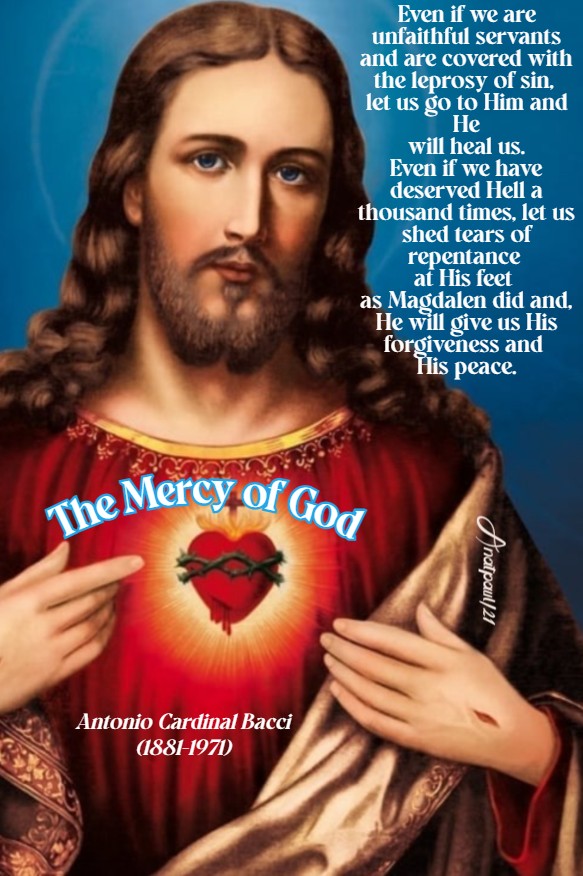
The Mercy of God
“God is the Being, Who is infinitely true, beautiful and good. His goodness is manifested in His infinite love for all the creatures which He has made but, it is in His relations with sinners, in particular, that we call Him merciful. He loves all things which He has created and directs them towards Himself, their beginning and their end. When He is dealing, however, with beings endowed with free will, who can separate themselves from Him and even offend Him, He tries, while respecting the liberty which He has given them, to recall them to Himself, by the influence of His love and of His grace. It is this supernatural outpouring of love towards sinners, which we call mercy.
The mercy of God shines forth in all the pages of Sacred Scripture. In the Old Testament, there is promised and foreshadowed, in many ways, the coming of the Saviour of the sinful human race. In the New Testament, Jesus appears, made man for our salvation, meek and humble of heart and merciful towards the unfortunate, especially towards sinners. For them, He offers His life and His Precious Blood, dying on the Cross with His arms outstretched, as if in an embrace of forgiveness. He tells us that He has not come to call the just but sinners, (Lk 5:32) and, that He has not come to those who are in health but to those who are sick (Mk 2:17); He assures us that, if we ask the Father for anything in His name, it will be given to us (Jn 16:23). So much goodness should move and soften our hearts. Even if we are unfaithful servants and are covered with the leprosy of sin, let us go to Him and He will heal us. Even if we have deserved Hell a thousand times, let us shed tears of repentance at His feet as Magdalen did and, He will give us His forgiveness and His peace.”
Thought for the Day – 8 April – Meditations with Antonio Cardinal Bacci (1881-1971)
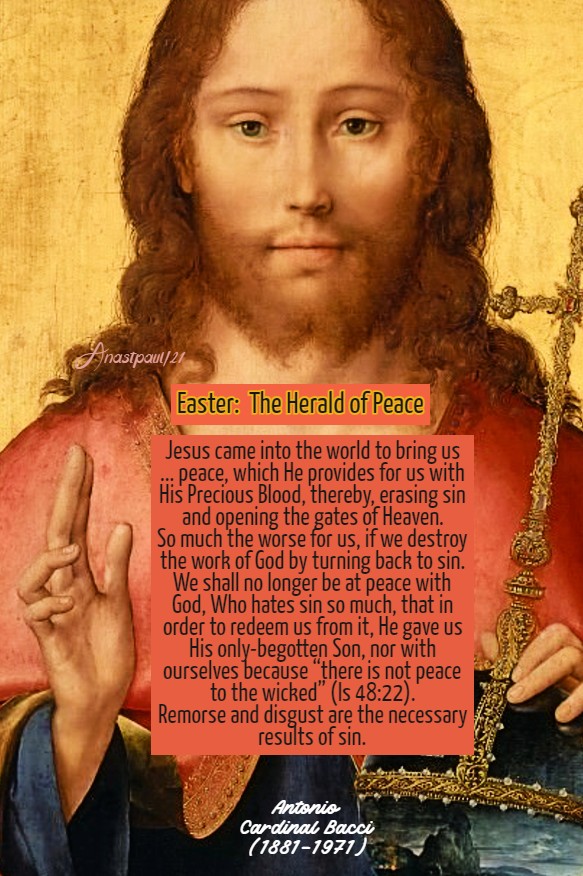
Easter: The Herald of Peace
“For this interior peace to be complete, it is necessary that it should exist in our relations with God, with ourselves and with our neighbour. Peace with God, is especially necessary. This involves the subjection of the intellect and will, to Him, perfect obedience to His law, the avoidance of sin and the entire surrender of ourselves to Him. When we have prepared ourselves in this way, God will visit us with His grace and we shall experience the joy of inward peace.
Jesus came into the world to bring us this peace, which He provides for us with His Precious Blood, thereby, erasing sin and opening the gates of Heaven. So much the worse for us, if we destroy the work of God by turning back to sin. We shall no longer be at peace with God, Who hates sin so much, that in order to redeem us from it, He gave us His only-begotten Son, nor with ourselves because “there is not peace to the wicked” (Is 48:22). Remorse and disgust are the necessary results of sin.
Let us remember, that those who are really content, even in this world, are those who lead good lives. Whoever extinguishes divine grace in himself, destroys the harmony and order which reigned in his soul as a result of the subjection of his reason to his Creator and Redeemer. Then, because we are not at peace with God, nor with ourselves, we cannot really be at peace with men. It is our faith which teaches us, that they are our brothers, redeemed, as we have been, by the Precious Blood of Jesus Christ and that, therefore, we should always love and assist them.”
From a Sermon by St Pope Leo the Great (400-461) Father and Doctor unitatis Ecclesiae
True reverence for the Lord’s passion means, fixing the eyes of our heart on Jesus crucified and recognising in Him our own humanity.
The earth – our earthly nature – should tremble at the suffering of its Redeemer. The rocks – the hearts of unbelievers – should come forth, the massive stones now ripped apart. Foreshadowings of the future Resurrection, should appear in the holy city, the Church of God, what is happening to our bodies, should now take place in our hearts.
No-one, however weak, is denied a share in the victory of the Cross. No-one is beyond the help of the prayer of Christ. His prayer brought benefit to the multitude that raged against Him. How much more, does it bring, to those who turn to Him in repentance.
Ignorance has been destroyed, obstinacy has been overcome. The Sacred Blood of Christ, has quenched the flaming sword that barred access to the tree of life. The age-old night of sin has given place, to the true light.
The Christian people are invited to share the riches of paradise. All who have been reborn have the way open before them, to return to their native land, from which they had been exiled. Unless, indeed ,they close off for themselves, the path that could be opened before the faith of a thief.
The business of this life should not preoccupy us with its anxiety and pride, so that we no longer strive, with all the love of our heart, to be like our Redeemer and to follow His example. Everything that He did, or suffered, was for our salvation – He wanted His Body to share the goodness of its Head.
First of all, in taking our human nature, while remaining God, so that the Word became man, He left no member of the human race, the unbeliever excepted, without a share in His mercy. Who does not share a common nature with Christ, if he has welcomed Christ, who took our nature and is reborn in the Spirit, through whom Christ was conceived?
Again, who cannot recognise in Christ, his own infirmities? Who would not recognise that Christ’s eating and sleeping, His sadness and His shedding tears of love, are marks of the nature of a slave?
It was this nature of a slave, that had to be healed of its ancient wounds and cleansed of the defilement of sin. For that reason, the only-begotten Son of God, became also the Son of Man. He was to have both the reality of human nature and the fullness of the Godhead.
The Body, that lay lifeless in the tomb, is ours. The Body that rose again on the third day, is ours. The Body, that ascended above all the heights of heaven, to the right hand of the Father’s glory, is ours. If then we walk in the way of His commandments and are not ashamed to acknowledge, the price He paid for our salvation in a lowly Body, we too are to rise to share His glory. The promise He made will be fulfilled, in the sight of all: –“whoever acknowledges Me before men, I too will acknowledge him before My Father who is in heaven.”
One Minute Reflection – 1 April – Maundy Thursday, Evening Vigil Mass of the Lord’s Supper, Readings: Exodus 12:1-8, 11-14, Psalms 116:12-13, 15-18, 1 Corinthians 11:23-26, John 13:1-15
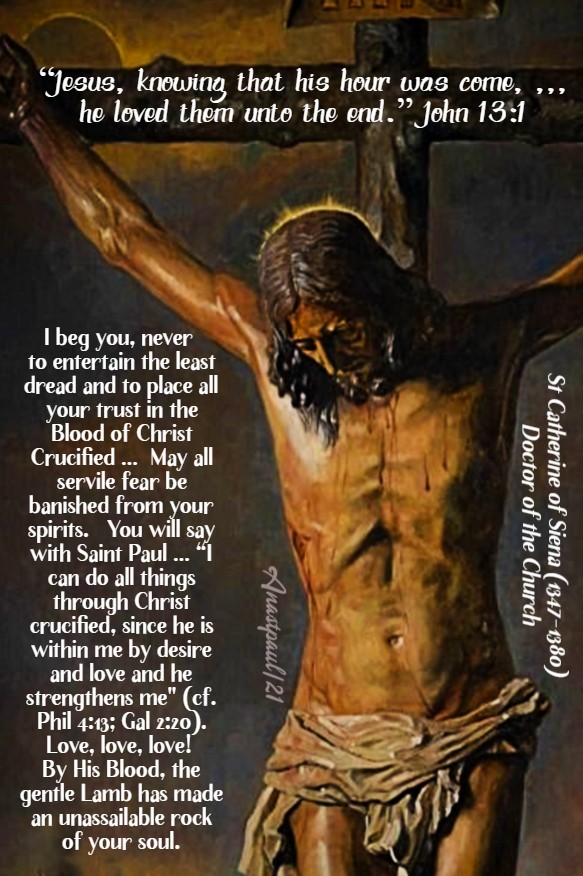
“Jesus, knowing that his hour was come, … he loved them unto the end.” – John 13:1
REFLECTION – “Be obedient to the death, following the example of the spotless Lamb who obeyed His Father even to a shameful death on the Cross. Reflect that He is the way and the rule you are to follow. Always hold Him present before the eyes of your spirit. See how obedient He is, this Word, this Utterance of God! He does not refuse to take up the burden of suffering laid on Him by His Father; to the contrary, He throws Himself into it, spurred on by His great desire. Isn’t this what He reveals during the Last Supper on Maundy Thursday, when He says: “I have eagerly desired to eat this Passover with you before I suffer” (Lk 22:15)? By “eat this Passover” He means, the accomplishment of the Father’s will and His desire. Seeing that scarcely any time lies before Him (He was already looking ahead to the end, when He would sacrifice His body for our sake), He rejoices, He is glad and joyfully says: “I have greatly desired.” Here is the Passover He is speaking about – that which consists in giving His own self as food, in laying down His own body in obedience to the Father.
Jesus had celebrated many another Passover with His disciples but never this one, O unspeakable, sweet and burning charity! You think neither of Your suffering nor of Your humiliating death – if You had thought of them, You would not have been so joyful, You would not have called it a Passover. The Word sees ,that it is He Himself Who has been chosen, He Himself Who has received all our humanity as His spouse. He has been asked to give us His own Blood so that God’s will might be accomplished in us, so that it might be His Blood that sanctifies us. This is, indeed, the sweet Passover, this Lamb without blemish accepts (cf. Ex 12:5) and it is with great love and great desire that He fulfils the Father’s will and wholly carries out His design. What unspeakably sweet love! …
That is why, my beloved, I beg you never to entertain the least dread and to place all your trust in the Blood of Christ Crucified … May all servile fear be banished from your spirits. You will say with Saint Paul …: “I can do all things through Christ crucified, since he is within me by desire and love and he strengthens me” (cf. Phil 4:13; Gal 2:20). Love, love, love! By His Blood, the gentle Lamb has made an unassailable rock of your soul.” – St Catherine of Siena (1347-1380) Dominican tertiary, Doctor of the Church, Co-patron of Europe – Letter 129
PRAYER – Love of You, with our whole heart, Lord God, is holiness. Increase then Your gifts of divine grace in us, so that, as in Your Son’s Death, You made us hope for what we believe, You may likewise, in His Resurrection, make us come to You, our final end. Listen we beg, to the prayers of Your holy ones and may the Blessed Mother walk along with us and keep our hand, ever in hers. Through Jesus Himself, in the unity of the Holy Spirit, God with You, forever and ever, amen.
Quote/s of the Day – 27 March – Saturday of Passion Week or the Fifth Week of Lent, Readings: First Reading: Ezekiel 37: 21-28, Responsorial Psalm: Jeremiah 31: 10, 11-12abcd, 13, Verse Before the Gospel: Ezekiel 18: 31, Gospel: John 11: 45-56
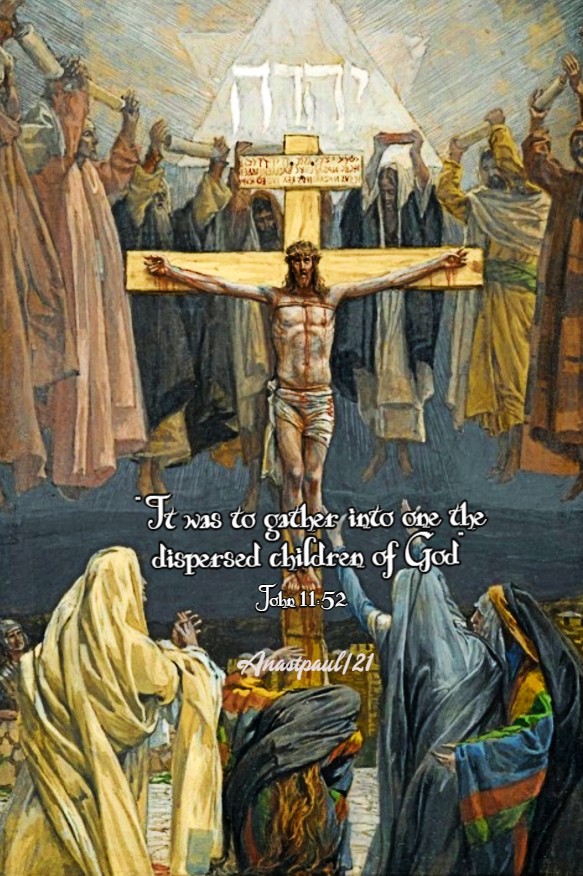
“It was to gather into one the dispersed children of God”
John 11:52
“For Your Cross is the Source of all Blessings, the Origin of all Grace. From the weakness of the Cross believers gain strength, glory for shame, life for death. Now, too, the proliferation of sacrifices has ceased – the one Offering of Your Body and Blood fulfills all those different sacrifices offered throughout the world. For You are the true Lamb of God Who takes away the sin of the world (Jn 1:29). In Yourself You bring to completion all religions of all peoples, so that all these peoples, might make up but one Kingdom.”
St Pope Leo the Great (c 400-461) Father and Doctor Unitatis Ecclesiae
Quote/s of the Day – 16 March – Tuesday of the Fourth Week of Lent, Readings: Ezekiel 47:1-9, 12, Psalms 46:2-3, 5-6,8-9, John 5:1-16
“ … Sin is washed away by the waters of the font, the Holy Spirit is poured forth in the chrism and we obtain both of these gifts, through the hands and the mouth of the Priest. Thus the whole man is reborn and renewed in Christ.”
St Pacian (c 310–391) Bishop of Barcelona
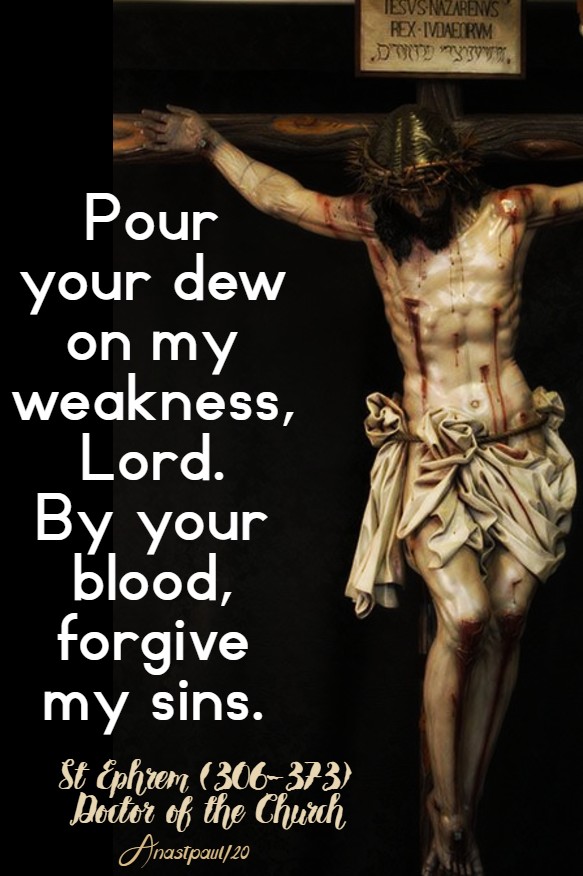
“Pour your dew on my weakness, Lord. By your blood, forgive my sins.”
St Ephrem (306-373) Father & Doctor of the Church
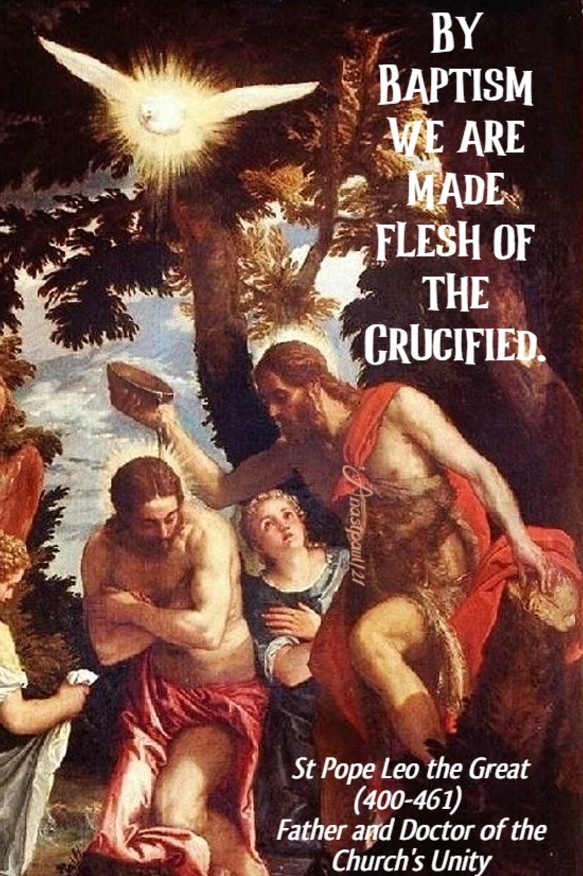
“By Baptism we are made flesh of the Crucified.”
St Pope Leo the Great (400-461) Father and Doctor of the Church’s Unity
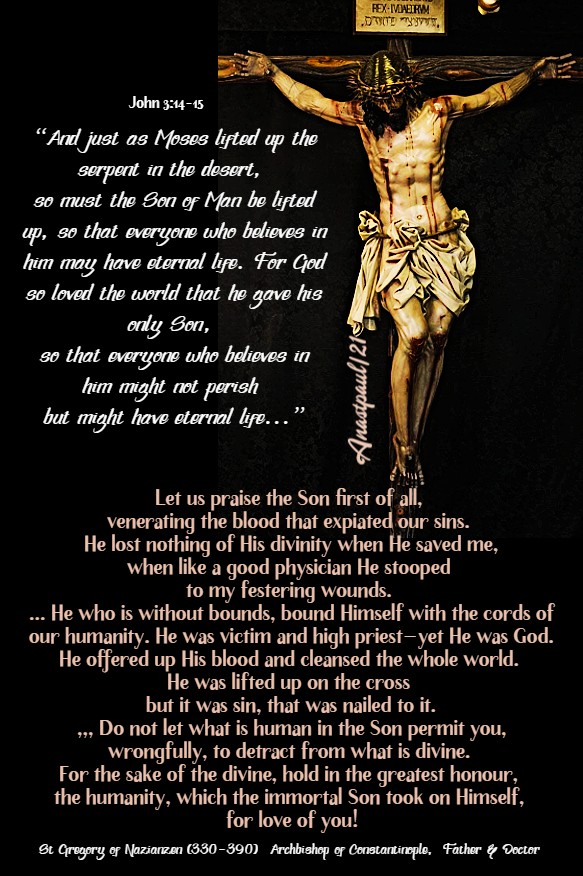
“And just as Moses lifted up the serpent in the desert, so must the Son of Man be lifted up, so that everyone who believes in him may have eternal life. For God so loved the world that he gave his only Son, so that everyone who believes in him might not perish but might have eternal life…” – John 3:14-15
REFLECTION – “Let us praise the Son first of all, venerating the blood that expiated our sins. He lost nothing of His divinity when He saved me, when like a good physician He stooped to my festering wounds. He was a mortal man but He was also God. He was of the race of David but Adam’s creator. He who has no body clothed Himself with flesh. He had a mother who, nonetheless, was a virgin. He who is without bounds, bound Himself with the cords of our humanity. He was victim and high priest—yet He was God. He offered up His blood and cleansed the whole world. He was lifted up on the cross but it was sin, that was nailed to it. He became as one, among the dead but He rose from the dead, raising to life also many who had died before Him. On the one hand, there was the poverty of His humanity, on the other, the riches of His divinity. Do not let what is human in the Son permit you, wrongfully, to detract from what is divine. For the sake of the divine, hold in the greatest honour, the humanity, which the immortal Son took on Himself, for love of you!” – St Gregory of Nazianzen (330-390) Archbishop of Constantinople, Father & Doctor – Poem 2
PRAYER – “All-powerful God, Benefactor and Creator of the universe, hearken to my groaning in my peril. Deliver me from fear and anguish, free me, by the strength of Your might, You who can do all… O Lord Christ, cut the threads of my net with the sword of Your triumphant Cross, with the weapon of life. This net encompasses me on every side, holding me captive so as to bring me to my death. Guide to their rest, my tottering and unsteady steps, heal the stifling fever of my heart.” – St Gregory of Narek (c 951-c 1010) Doctor of the Church – Book of prayers, no 40 (Excerpt)
Thought for the Day – 6 March – Meditations with Antonio Cardinal Bacci (1881-1971)
Filial and Servile Fear
“We should not be afraid of God because He is our greatest benefactor and loves us infinitely. When we are lost, He searches for us as a loving father would search for a wandering son. Because they think only of the majesty and justice of God, some people keep themselves at a distance from Him, as Adam did, after he had sinned. They forget that the Lord told Adam, the sinner, of the coming of the pardoning Redeemer (Gen 3:9). Bossuet truly observes, that “after the curse which came upon men through sin, there has always remained in their hearts, a certain dread of the supernatural, which prevents them from approaching God with confidence.” Jansenism increased this fear, emphasising the justice and majesty of God, rather, than the infinite love of Jesus and the beauty of His teaching.
Some writers compare our souls with the divine majesty and justice, in order to stress our unworthiness but, they forget, that Jesus is “Meek and humble of heart,” that He forgave the penitent woman, the good thief and the adulteress and, had kind words for the lost sheep and the prodigal son. They never think of the wonderful words of the beloved disciple: “God is love” (1 Jn 4:16).
This false fear of God, dries up our piety and lessens our trust in His mercy. It can lead to moroseness, to scrupulosity and to discouragement.
We should avoid this excessive fear which separates us from God. Even though we are sinful and unworthy, we should remember, that God is our loving Father, Who is always ready to help us and to grant us forgiveness. We should recall, moreover, that out of love for us, He did not spare His own Son, (Cf Rom 8:32) but gave Him to us for our redemption. If Jesus shed His blood and died for us, how can we doubt His love?”
Our Morning Offering – 2 March – Tuesday of the Second week of Lent
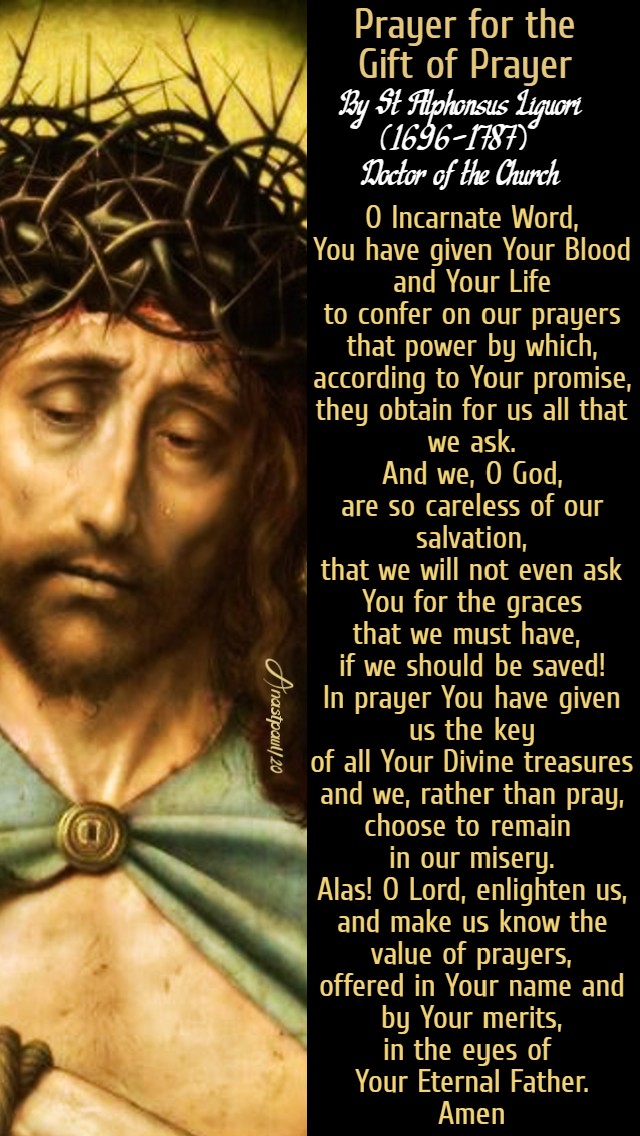
Prayer for the Gift of Prayer By St Alphonsus Liguori (1696-1787) Most Zealous Doctor
O Incarnate Word, You have given Your Blood and Your Life to confer on our prayers that power by which, according to Your promise, they obtain for us all that we ask. And we, O God, are so careless of our salvation, that we will not even ask You for the graces that we must have, if we should be saved! In prayer You have given us the key of all Your Divine treasures; and we, rather than pray, choose to remain in our misery. Alas! O Lord, enlighten us, and make us know the value of prayers, offered in Your name and by Your merits, in the eyes of Your Eternal Father. Amen
Our Morning Offering – 21 February – First Sunday of Lent
Anima Christi
Soul of Christ, sanctify me Body of Christ, save me Blood of Christ, inebriate me Water from the side of Christ, wash me Passion of Christ, strengthen me Good Jesus, hear me Within Your wounds, shelter me from turning away, keep me From the evil one, protect me At the hour of my death, call me Into Your presence lead me to praise You with all Your saints Forever and ever, Amen
For many years the Anima Christi was popularly believed to have been composed by Saint Ignatius Loyola (1491-1556) , as he puts it at the beginning of his Spiritual Exercises and often refers to it. In the first edition of the Spiritual Exercises Ignatius merely mentions it, evidently supposing that the reader would know it. In later editions, it was printed in full. It was by assuming that everything in the book was written by Ignatius that it came to be looked upon as his composition. On this account the prayer is sometimes referred to as the Aspirations of St. Ignatius Loyola and so my image shows St Ignatius at prayer.
However, the prayer actually dates to the early fourteenth century and was possibly written by Pope John XXII but its authorship remains uncertain. It has been found in a number of prayer books printed during the youth of Ignatius and is in manuscripts which were written a hundred years before his birth. The English hymnologist James Mearns found it in a manuscript of the British Museum which dates back to about 1370. In the library of Avignon there is preserved a prayer book of Cardinal Pierre de Luxembourg (died 1387), which contains the prayer in practically the same form as we have it today. It has also been found inscribed on one of the gates of the Alcázar of Seville, which dates back to the time of Pedro the Cruel (1350–1369).
The invocations in the prayer have rich associations with Catholic concepts that relate to the Eucharist (Body and Blood of Christ), Baptism (water) and the Passion of Jesus (Holy Wounds).
Thought for the Day – 8 February – Meditations with Antonio Cardinal Bacci (1881-1971)
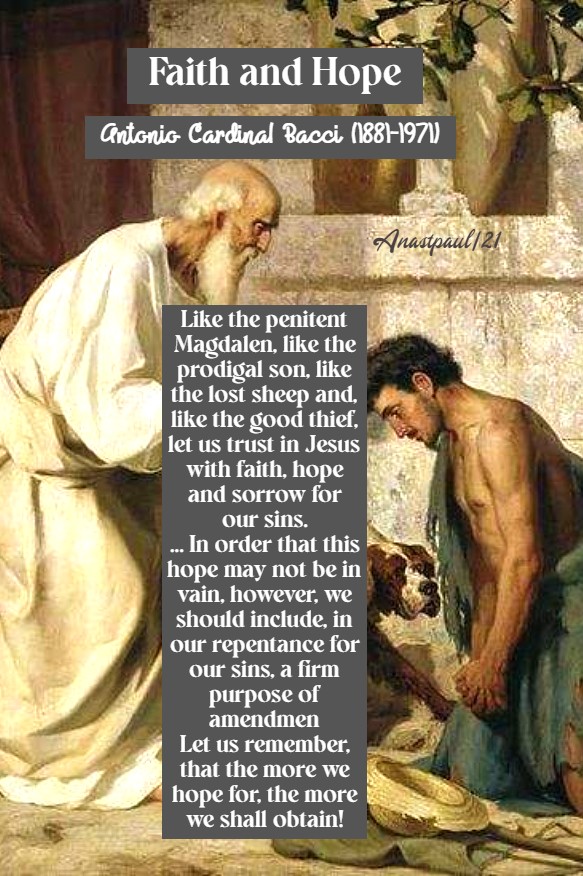
Faith and Hope
“Christian hope derives from faith. When we believe in the infinitely good and merciful God, Who was made man for us and Who shed His Precious Blood, for our salvation, we experience a great hope and a great confidence. No matter how numerous our sins and our defects, as long as we are sincerely repentant, we should continue to hope for the forgiveness of God. Despair, which led Judas to commit suicide, should never be allowed to enter our minds. Like the penitent Magdalen, like the prodigal son, like the lost sheep and, like the good thief, let us trust in Jesus with faith, hope and sorrow for our sins. Let us remember, that He is infinitely good and merciful and ardently desires to pardon us. Together with this hope of God’s forgiveness, we should nurture the hope of gaining Heaven, which the Lord, in His infinite goodness, has promised, not only to innocent souls but, also to repentant sinners. In order that this hope may not be in vain, however, we should include, in our repentance for our sins, a firm purpose of amendment.
Let us remember, that the more we hope for, the more we shall obtain!”
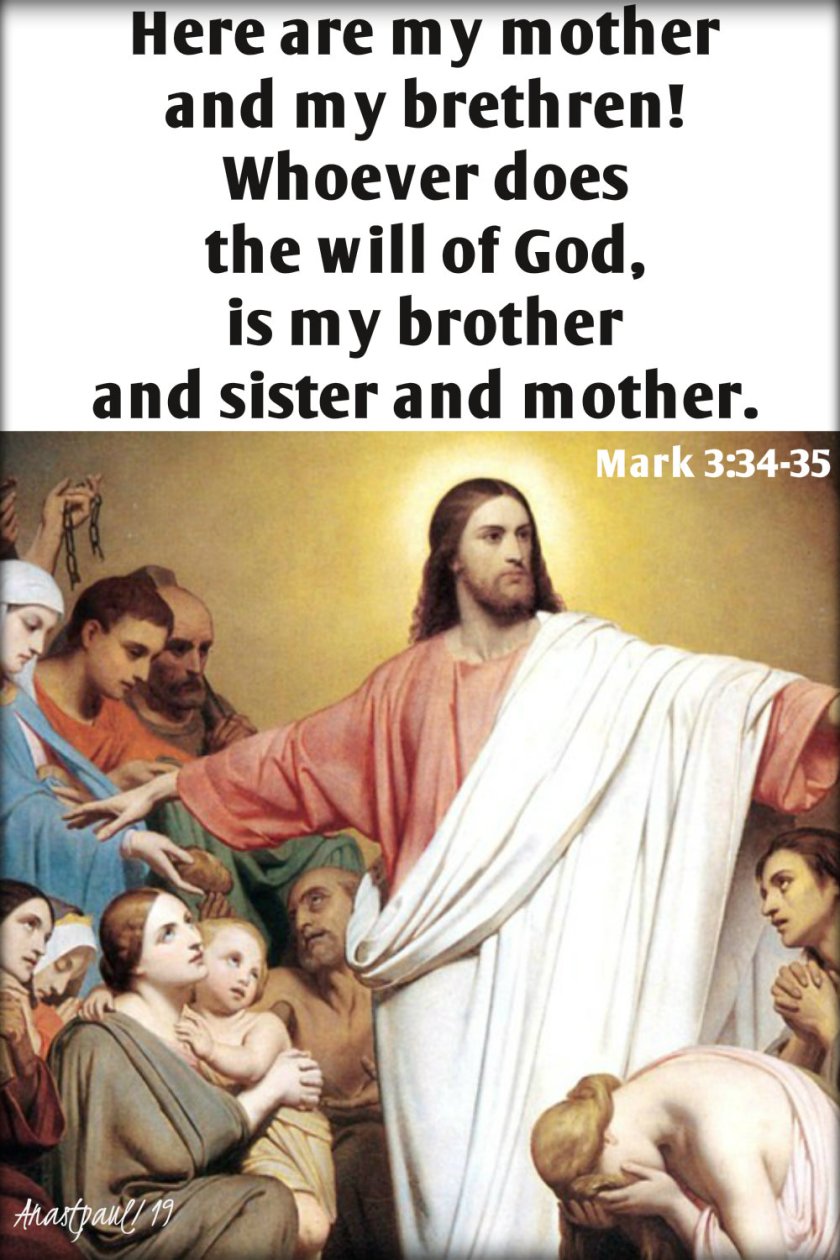
One Minute Reflection – 26 January – Tuesday of the Third Week in Ordinary Time, Readings: 2 Timothy 1:1-8 or Titus 1:1-5, Psalms 96:1-2, 2-3, 7-8, 10, Mark 3:31-35 and The Memorial of Sts Timothy and Titus – Bishops and Disciples and Companions of the Apostle Paul
“Here are my mother and my brethren! Whoever does the will of God, is my brother and sister and mother.”…Mark 3:34-35
REFLECTION – “He did not treat us as our sins deserved. For we are now sons of God. How do we show this? The only Son of God died for us, so that He might not remain alone. He who died as the only Son, did not want to remain as the only Son. For the only Son of God made many sons of God. He bought brothers for Himself by His blood, He made them welcome by being rejected, He ransomed them by being sold, He honoured them by being dishonoured, He gave them life by being put to death.” – St Augustine (354-430) Father and Doctor of Grace – An excerpt from his Sermon 171
PRAYER – Almighty God, You endowed Saints Timothy and Titus with power to preach Your Word. Grant that, living a life of integrity and holiness in this world, reaching out to teach the Gospel both by our lives and our words, we may, through their prayers, come to our true home in heaven. Through our Lord Jesus Christ, in union with the Holy Spirit, one God forever, amen.
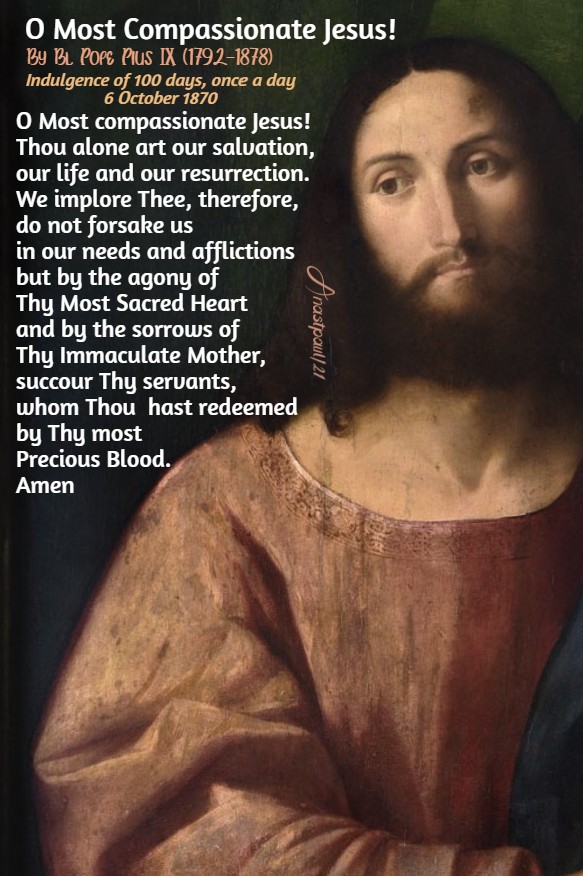
O Most Compassionate Jesus! By Bl Pope Pius IX(1792-1878) Indulgence of 100 days, once a day 6 October 1870
O Most compassionate Jesus! Thou alone art our salvation, our life and our resurrection. We implore Thee, therefore, do not forsake us in our needs and afflictions but by the agony of Thy Most Sacred Heart and by the sorrows of Thy Immaculate Mother, succour Thy servants, whom Thou hast redeemed by Thy most Precious Blood. Amen
Thought for the Day – 19 January – Meditations with Antonio Cardinal Bacci (1881-1971)
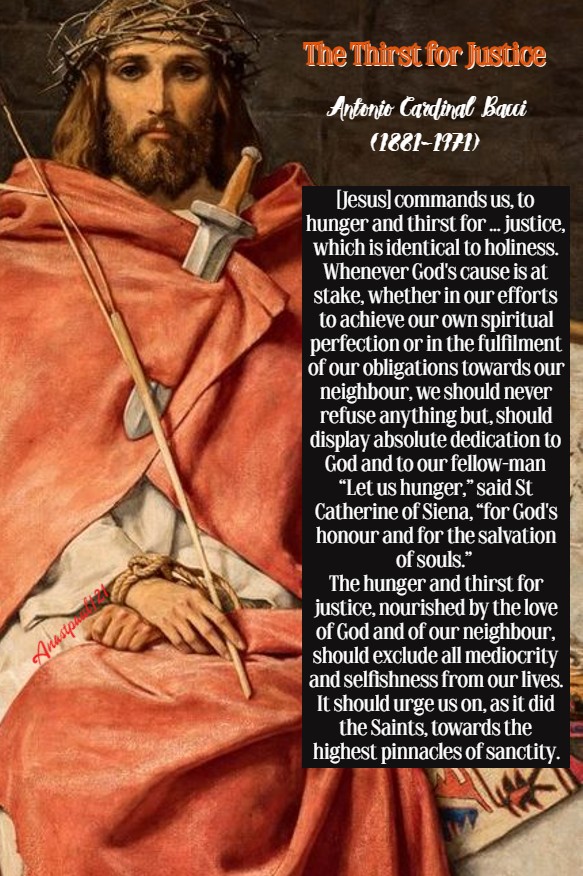
The Thirst for Justice
“Jesus commands us, in the Beatitudes, to seek justice, that is perfection in the fulfilment of our obligations to God, to ourselves and, to our neighbour. He commands us, to hunger and thirst for this justice, which is identical with holiness.
When Christ tells us to hunger and thirst for justice, He imposes on us, the obligation of doing our very best to acquire the virtue of Christian justice, which is the sythesis of all the virtues. We must be aware, therefore, of laziness, apathy, tepidity, or mediocrity, for our advance in spiritual perfection, must be continuous. There must be no hesitation or backsliding. The high target which God has set for us, demands hard work and boundless generosity on our part. Jesus Christ loved us so much that He gave Himself entirely for us and shed His Precious Blood to the last drop, for our Redemption. How can we possibly be niggardly or half-hearted in our relatioas with Him?
Whenever God’s cause is at stake, whether in our efforts to achieve our own spiritual perfection or in the fulfilment of our obliations towards our neighbour, we should never refuse anything but, should display absolute dedication to God and to our fellow-man. “Let us hunger,” said St Catherine of Siena, “for God’s honour and for the salvation of souls” (Vrev di perfezioe, p81). The hunger and thirst for justice, nourished by the love of God and of our neighbour, should exclude all mediocrity and selfishness from our lives. It should urge us on, as it did the Saints, towards the highest pinnacles of sanctity.”
Thought for the Day – 16 January – Meditations with Antonio Cardinal Bacci (1881-1971)
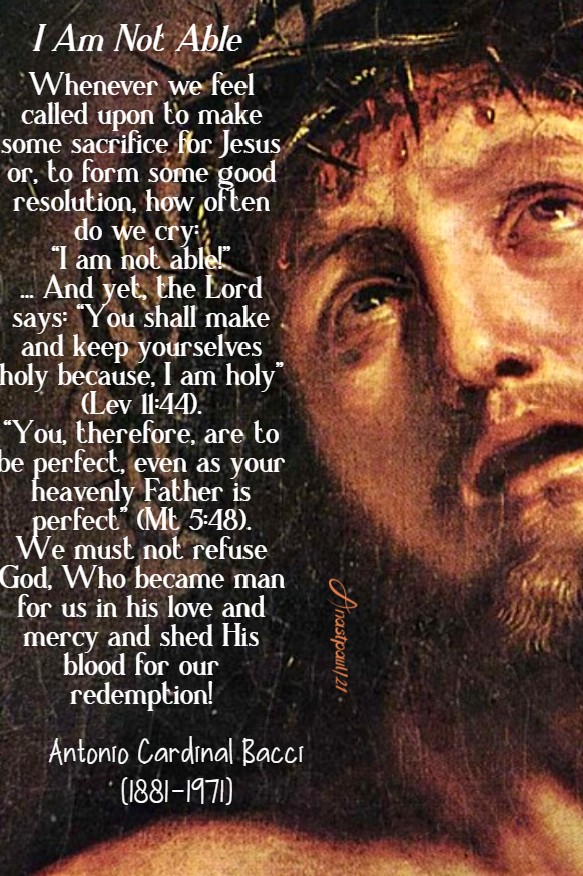
I Am Not Able
“Whenever we feel called upon to make some sacrifice for Jesus or, to form some good resolution, how often do we cry: “I am not able!” It may be a question of praying more fervently, of performing some mortification or, of helping our neighbour spiritually or materially. Or perhaps, it is a matter of saying a few words of apology or, of encouragement to our neighbour, whom we have previously treated with coldness and selfishness. Or. it may be something entirely more generous which is demanded; it may be that God is inviting us to renounce ourselves completely and to dedicate ourselves to Him. Naturally, this requires sacrifice and great generosity of heart. But we say to Jesus when He calls us: “I cannot, it is too difficult!” And yet, the Lord says: “You shall make and keep yourselves holy because, I am holy” (Lev 11:44). “You, therefore, are to be perfect, even as your heavenly Father is perfect” (Mt 5:48). We must not refuse God, Who became man for us in his love and mercy and shed His blood for our redemption!”
Thought for the Day – 23 December – Meditations with Antonio Cardinal Bacci (1881-1971)
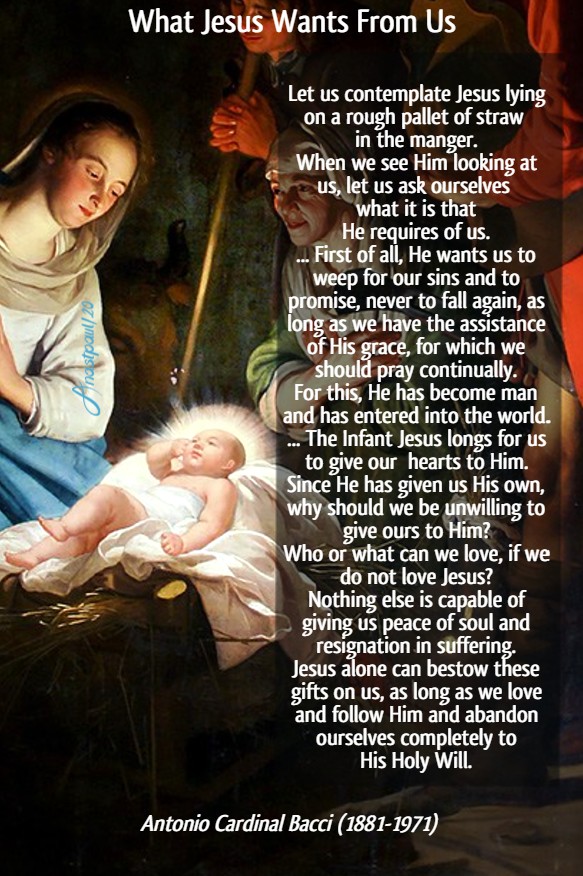
What Jesus Wants From Us
“Let us contemplate Jesus lying on a rough pallet of straw in the manger. When we see Him looking at us, let us ask ourselves what it is that He requires of us. In fact, He wants many things from us. First of all, He wants us to weep for our sins and to promise, never to fall again, as long as we have the assistance of His grace, for which we should pray continually. For this, He has become man and has entered into the world. For this He will work miracles, preach His doctrine and shed His Precious Blood on the Cross. All this He will do to redeem us from sin and to win Heaven for us.
If we return to the path of sin, we destroy the divine work of redemption, inasfar as it applies to ourselves. We make Christ’s passion, death and resurrection useless in our case. We brush aside the chain of favours with which His love has girdled us – the Gospel, the Sacraments and the Church, our good mother who is always at our side to instruct and direct us, to rescue us from peril and, to distribute to us, the gifts of her divine Founder. When we sin, we commit an act of base ingratitude to Jesus and accomplish our own eternal ruin.
The Infant Jesus longs for us to give our hearts to Him. Since He has given us His own, why should we be unwilling to give ours to Him? Who or what can we love, if we do not love Jesus? Nothing else is capable of giving us peace of soul and resignation in suffering. Jesus alone can bestow these gifts on us, as long as we love and follow Him and abandon ourselves completely to His Holy Will.”
Our Morning Offering – 4 December – Friday of the First Week of Advent and the Memorial of St John Damascene (675-749) Father and Doctor of the Church
God, my God, May I Always Abide in You By St John Damascene (675-749)
God, my God, unextinguishable and invisible fire, You make Your angels flaming fire. Out of Your inexpressible love, You have given me Your divine Flesh as food and through this communion of Your immaculate Body and precious Blood, You receive me as a partaker of Your divinity. Permeate all my body and soul, all my bones and sinews. Consume my sins in fire. Enlighten my soul and illumine my mind. Sanctify my body and make Your abode in me together with Your blessed Father and all-holy Spirit, that I may always abide in You, through the intercession of Your immaculate Mother and all Your saints. Amen
Quote/s of the Day – 23 October – Feast of the Most Holy Redeemer
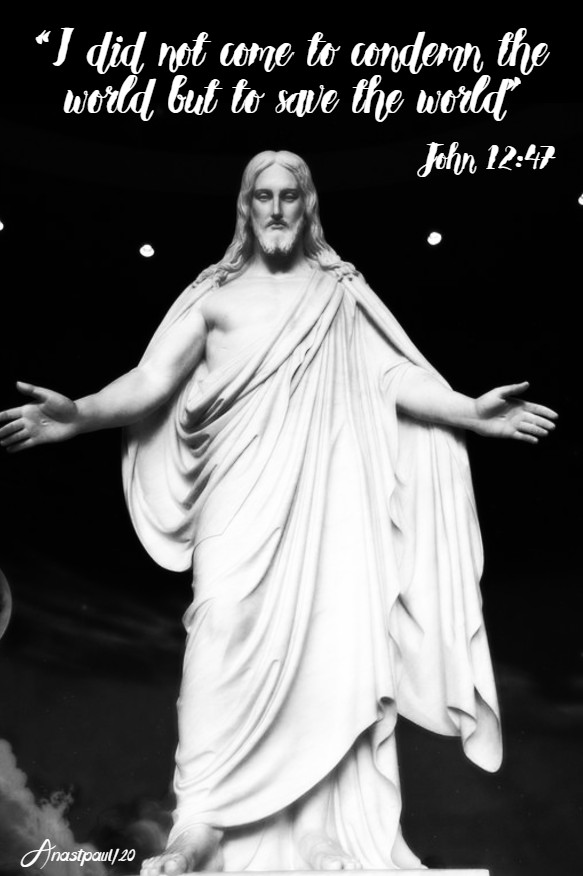
“I did not come to condemn the world but to save the world.”
John 12:47
“Come along then, every human family, full of sin as you are and receive the forgiveness of your sins. For I Myself, am your forgiveness, I am the Passover of salvation, the Lamb slain for your sakes, your redemption, life and resurrection; I am your Light, your Salvation and your King. It is I, who lead you to the heights of heaven, I, who will raise you up; it is I, who will bring you to see the Father who is from all eternity; it is I, who will raise you up by My all-powerful Hand.”
St Melito of Sardis (Died c 180) Bishop, Apologist
Paschal Homily
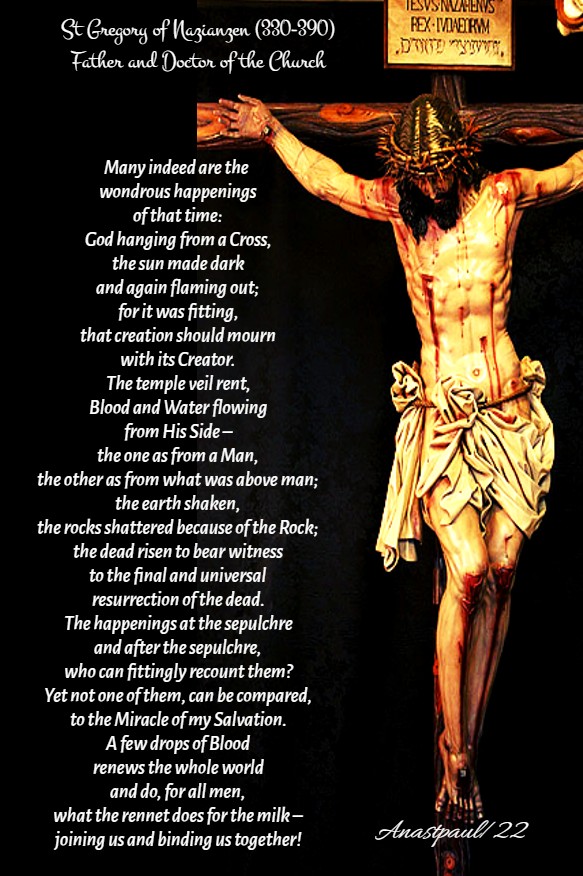
“Many indeed are the wondrous happenings of that time: God hanging from a Cross, the sun made dark and again flaming out; for it was fitting, that creation should mourn with its Creator. The temple veil rent, Blood and Water flowing from His Side – the one as from a Man, the other as from what was above man; the earth shaken, the rocks shattered because of the Rock; the dead risen to bear witness to the final and universal resurrection of the dead. The happenings at the sepulchre and after the sepulchre, who can fittingly recount them? Yet not one of them, can be compared, to the Miracle of my Salvation. A few drops of Blood renews the whole world and do, for all men, what the rennet does for the milk – joining us and binding us together!”
St Gregory of Nazianzen (330-390) Father and Doctor of the Church
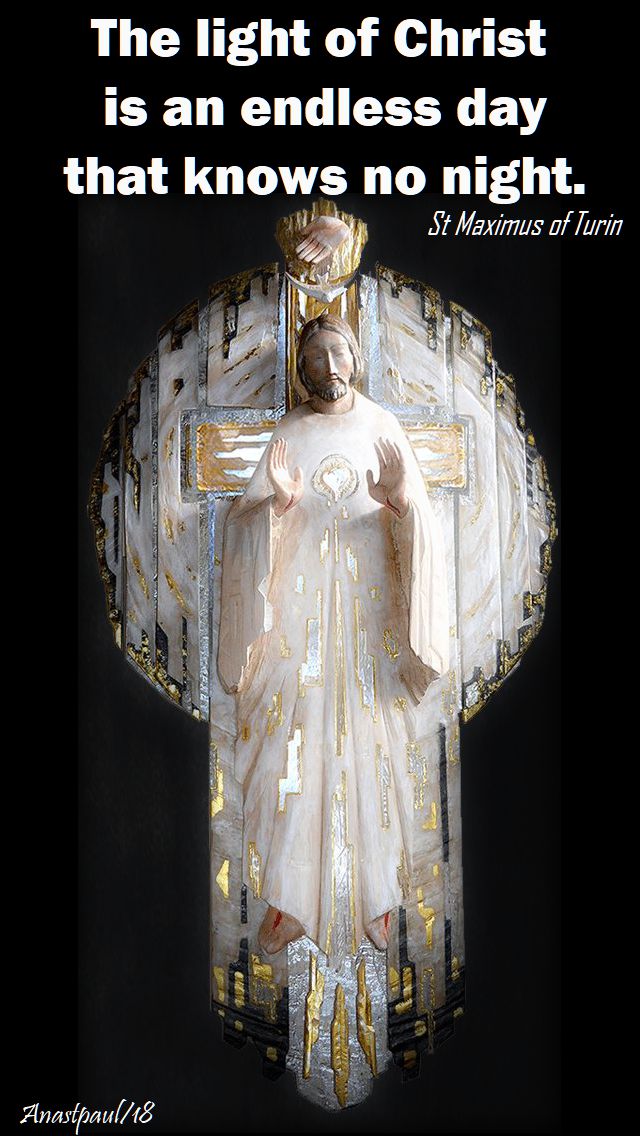
“The light of Christ is an endless day that knows no night.”
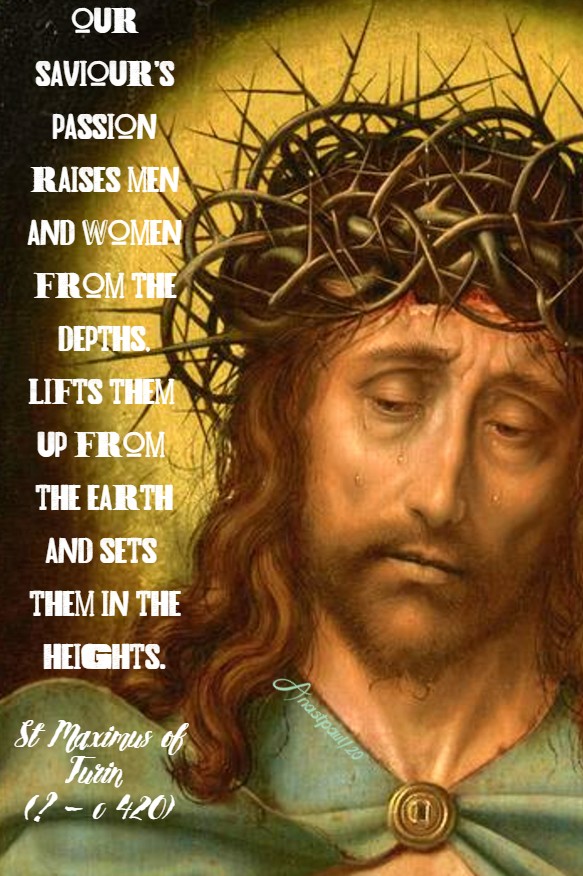
“Our Saviour’s passion raises men and women from the depths, lifts them up from the earth and sets them in the heights.”
St Maximus of Turin (? – c 420)
“As they were looking on, so we too gaze on His wounds as He hangs. We see His blood as He dies. We see the price offered by the Redeemer, touch the scars of His Resurrection. He bows His head, as if to kiss you. His heart is made bare open, as it were, in love to you. His arms are extended, that He may embrace you. His whole body is displayed for your redemption. Ponder how great these things are. Let all this be rightly weighed in your mind – as He was once fixed to the cross, in every part of His body for you, so He may now be fixed in every part of your soul.”
St Augustine (354-430) Father and Doctor of Grace
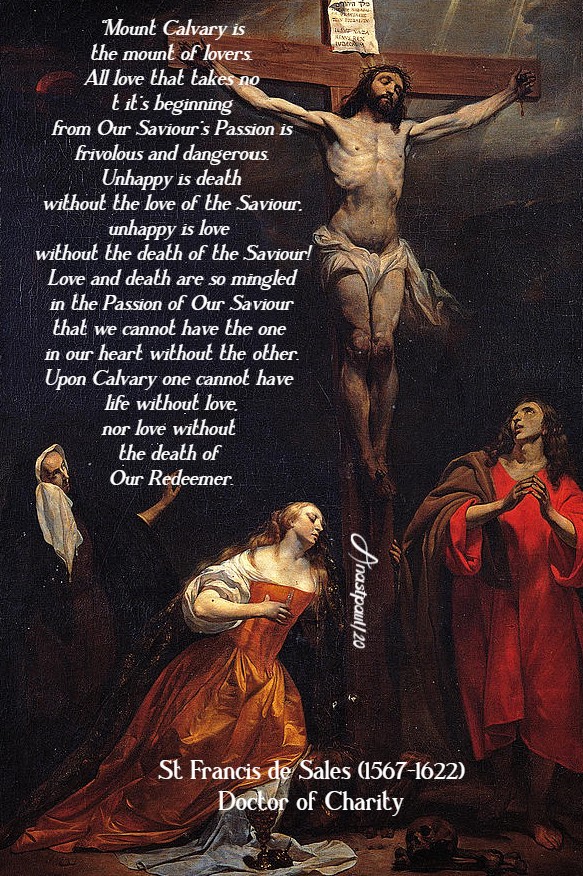
“Mount Calvary is the mount of lovers. All love that takes not it’s beginning from Our Saviour’s Passion is frivolous and dangerous. Unhappy is death without the love of the Saviour, unhappy is love without the death of the Saviour! Love and death are so mingled in the Passion of Our Saviour that we cannot have the one in our heart without the other. Upon Calvary one cannot have life without love, nor love without the death of Our Redeemer.”
St Francis de Sales (1567-1622) Doctor of Charity
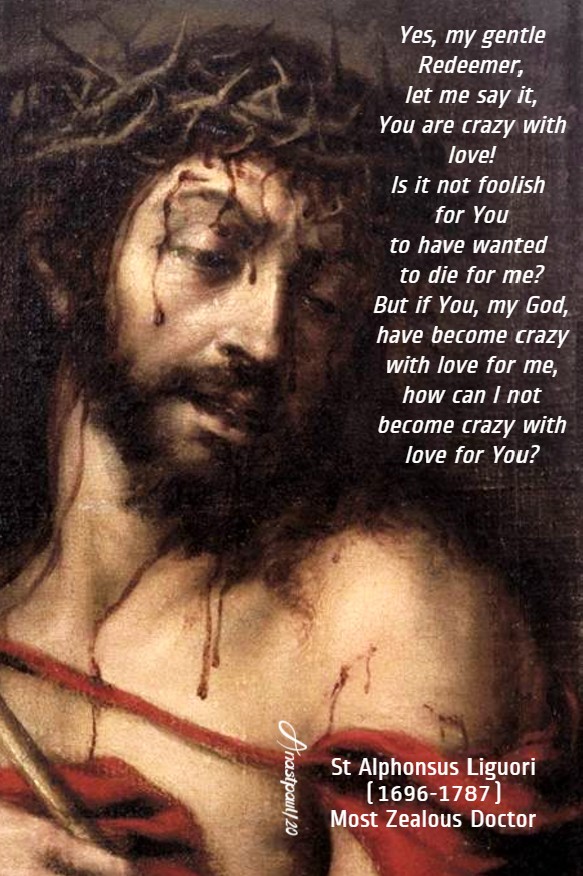
“Yes, my gentle Redeemer, let me say it, You are crazy with love! Is it not foolish for You to have wanted to die for me? But if You, my God, have become crazy with love for me, how can I not become crazy with love for You?”
St Alphonsus Liguori (1696-1787) Most Zealous Doctor
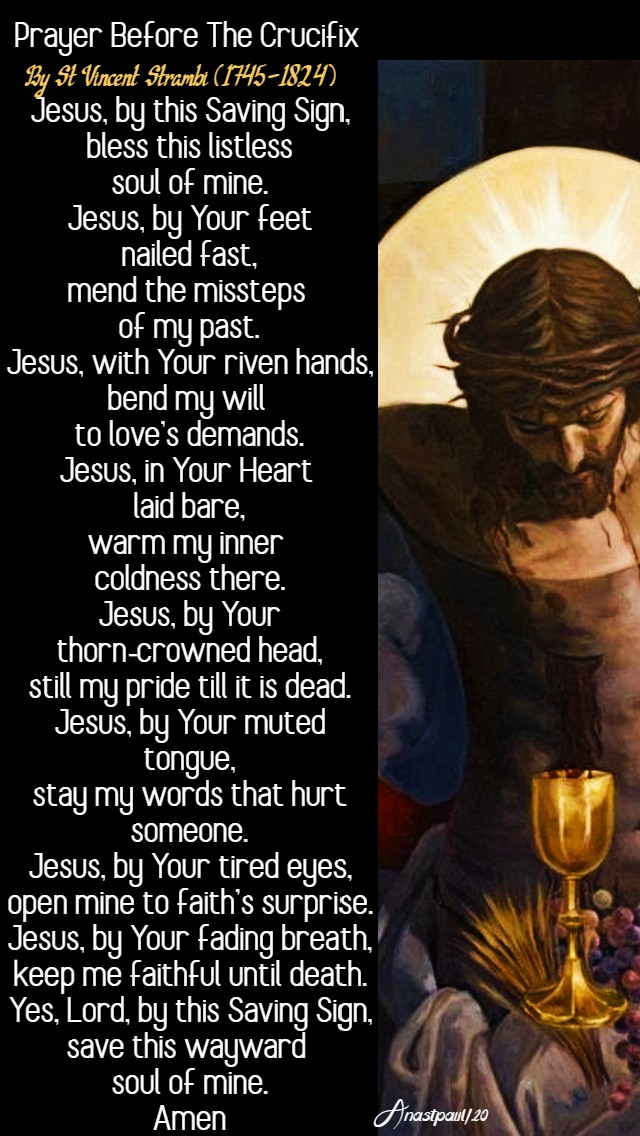
Prayer Before The Crucifix – The Holy Sacrifice of the Mass By St Vincent Strambi (1745-1824)
Jesus, by this Saving Sign, bless this listless soul of mine. Jesus, by Your feet nailed fast, mend the missteps of my past. Jesus, with Your riven hands, bend my will to love’s demands. Jesus, in Your Heart laid bare, warm my inner coldness there. Jesus, by Your thorn-crowned head, still my pride till it is dead. Jesus, by Your muted tongue, stay my words that hurt someone. Jesus, by Your tired eyes, open mine to faith’s surprise. Jesus, by Your fading breath, keep me faithful until death. Yes, Lord, by this Saving Sign, save this wayward soul of mine. Amen
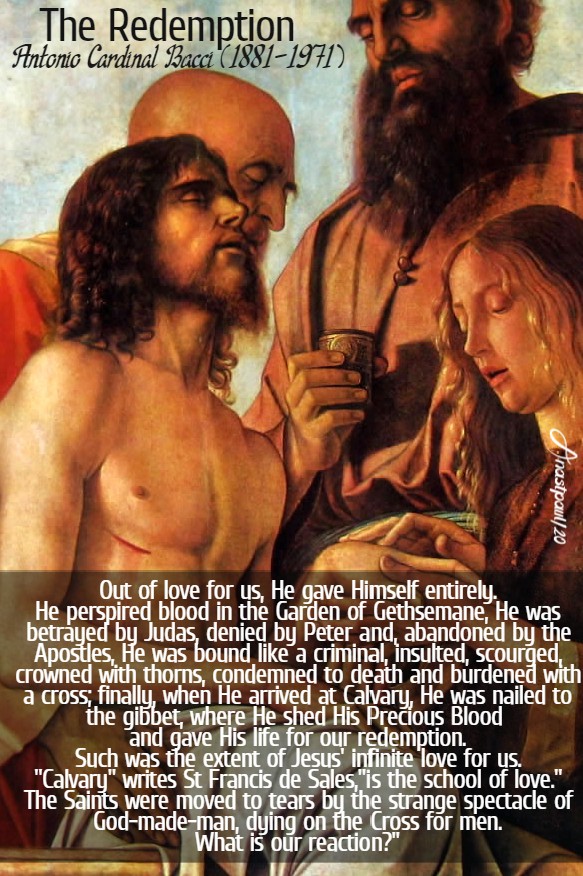
“He perspired blood in the Garden of Gethsemane, He was betrayed by Judas, denied by Peter and, abandoned by the Apostles, He was bound like a criminal, insulted, scourged, crowned with thorns, condemned to death and burdened with a cross; finally, when He arrived at Calvary, He was nailed to the gibbet, where He shed His Precious Blood and gave His life for our redemption. Such was the extent of Jesus’ infinite love for us. “Calvary” writes St Francis de Sales,“is the school of love.” The Saints were moved to tears by the strange spectacle of God-made-man, dying on the Cross for men. What is our reaction?”
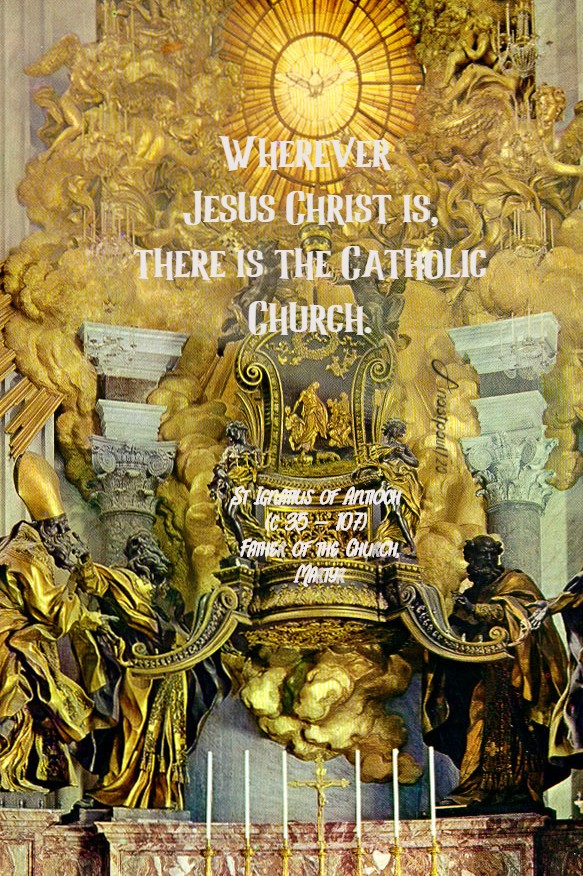
Quote/s of the Day – 17 October – The Memorial of St Ignatius of Antioch (c 35 – 107) Father of the Church, Martyr
“Wherever Jesus Christ is, there is the Catholic Church.”
(Letter to the Smyrnaeans, Ch 8)
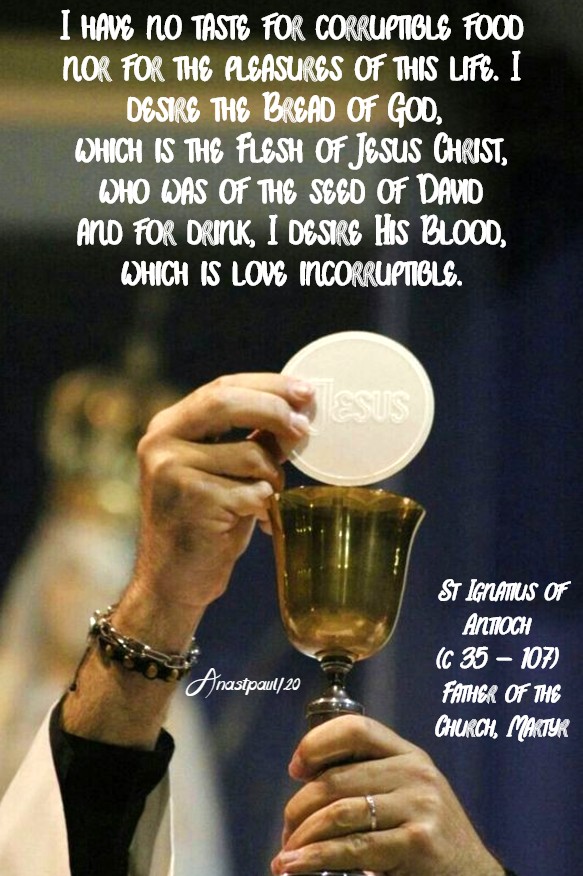
“I have no taste for corruptible food nor for the pleasures of this life. I desire the Bread of God, which is the Flesh of Jesus Christ, who was of the seed of David and for drink, I desire His Blood, which is love incorruptible.”
“Only let it be in the name of Jesus Christ, that I may suffer together with Him! I endure everything because He Himself, Who is perfect man, empowers me.”
Thought for the Day – 10 October – Meditations with Antonio Cardinal Bacci (1881-1971)
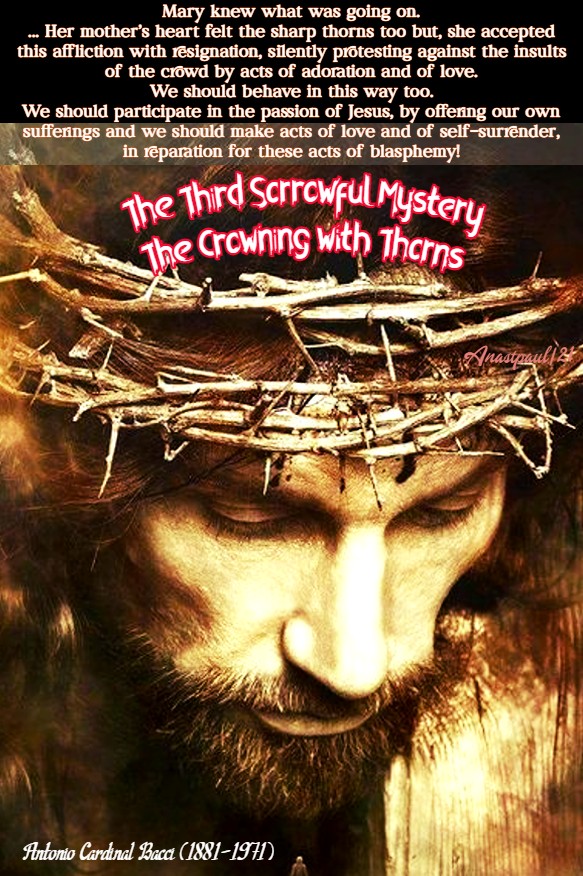
“Month of the Holy Rosary” The Third Sorrowful Mystery The Crowning with Thorns
“This new torture was a diabolical invention decreed by no law or authority. Purely for their own savage entertainment, the soldiers procured a bundle of thorned reeds, which they wound into the shape of a crown and pressed into Jesus’ head.
Mary knew what was going on. She was there with the holy women when Pilate brought her bloodstained Son before the people and, their blasphemous yells pierced her tender heart. Her mother’s heart felt the sharp thorns too but, she accepted this affliction with resignation, silently protesting against the insults of the crowd by acts of adoration and of love. We should behave in this way also. We should participate in the passion of Jesus, by offering our own sufferings and we should make acts of love and of self-surrender, in reparation for these acts of blasphemy!”
Thought for the Day – 9 October – Meditations with Antonio Cardinal Bacci (1881-1971)
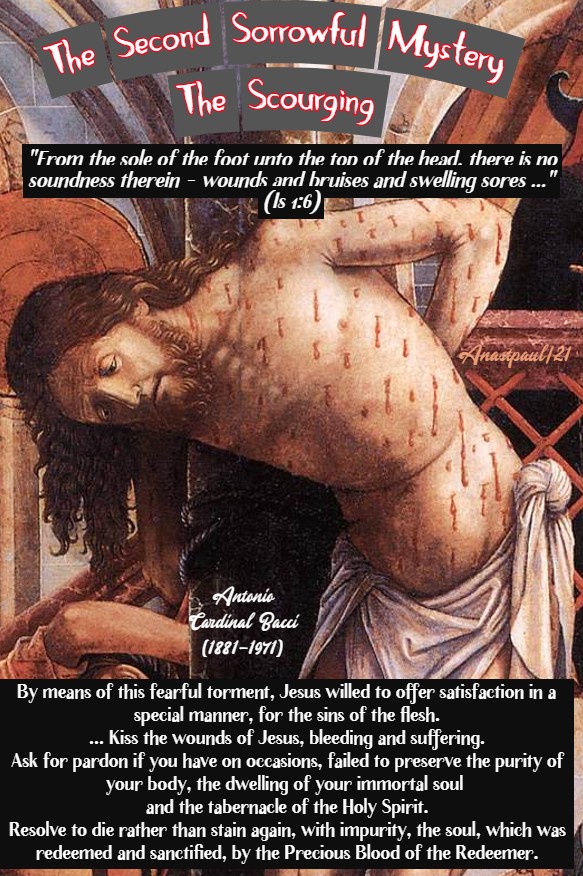
“Month of the Holy Rosary” The Second Sorrowful Mystery The Scourging
“Think about the manner in which Jesus was scourged. His chaste body, is stripped by the jeering soldiers, His hands are tied and He is bound to a pillar. The soldiers come forward with their whips and begin to beat Him mercilessly. As His Blood flows freely to the ground, Jesus quivers with pain and emits a half-suppressed groan. But fresh blows continue to rain down on His bruised flesh. So the prophecy is fulfilled in which Isaias described the punishment of the chosen people, whose sins and whose chastisement, the divine Redeemer has chosen to take on Himself. “From the sole of the foot unto the top of the head, there is no soundness therein – wounds and bruises and swelling sores …“ (Is 1:6).
By means of this fearful torment, Jesus willed to offer satisfaction in a special manner, for the sins of the flesh. In ancient times, sins of impurity provoked the anger of God so much, that they were blotted out by the universal deluge. Now these sins are still numberless, both in the pagan and, unfortunately, in the Christian world but, they are washed away by the saving Blood of Jesus Christ, Who came on earth to make reparation for all the iniquities of men.
Kiss the wounds of Jesus, bleeding and suffering. Ask for pardon if you have on occasions, failed to preserve the purity of your body, the dwelling of your immortal soul and the tabernacle of the Holy Spirit. Resolve to die rather than stain again, with impurity, the soul, which was redeemed and sanctified, by the precious Blood of the Redeemer.”
Thought for the Day – 18 September – Meditations with Antonio Cardinal Bacci (1881-1971)
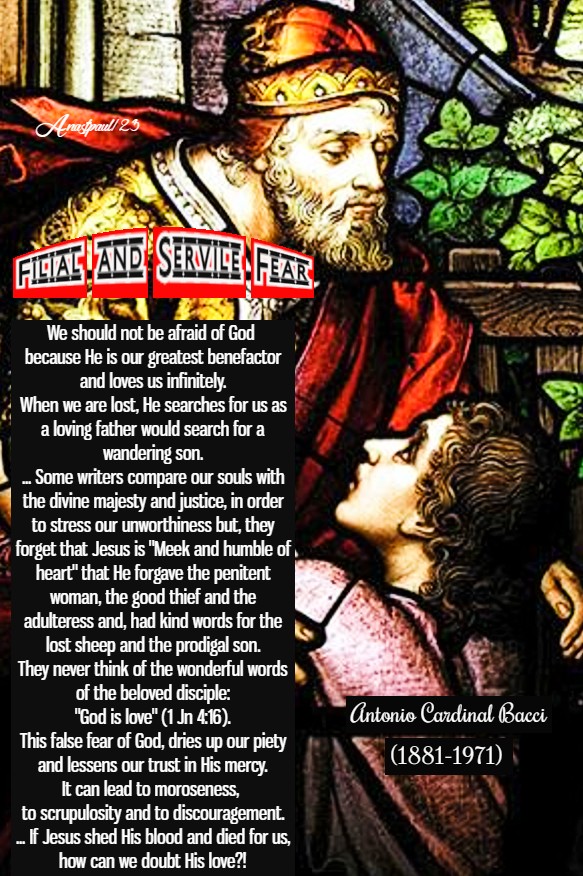
Filial and Servile Fear
“We should not be afraid of God because He is our greatest benefactor and loves us infinitely. When we are lost, He searches for us as a loving father would search for a wandering son. Because they think only of the majesty and justice of God, some people keep themselves at a distance from Him, as Adam did, after he had sinned. They forget that the Lord told Adam, the sinner, of the coming of the pardoning Redeemer (Gen 3:9). Bossuet truly observes, that “after the curse which came upon men through sin, there has always remained, in their hearts, a certain dread of the supernatural, which prevents them from approaching God with confidence.” Jansenism increased this fear, emphasising the justice and majesty of God, rather, than the infinite love of Jesus and the beauty of His teaching.
Some writers compare our souls with the divine majesty and justice, in order to stress our unworthiness but, they forget, that Jesus is “Meek and humble of heart,” that He forgave the penitent woman, the good thief and the adulteress and, had kind words for the lost sheep and the prodigal son. They never think of the wonderful words of the beloved disciple: “God is love” (1 Jn 4:16).
This false fear of God, dries up our piety and lessens our trust in His mercy. It can lead to moroseness, to scrupulosity and to discouragement.
We should avoid this excessive fear which separates us from God. Even though we are sinful and unworthy, we should remember, that God is our loving Father, Who is always ready to help us and to grant us forgiveness. We should recall, moreover, that out of love for us, He did not spare His own Son, (Cf Rom 8:32) but gave Him to us for our redemption. If Jesus shed His blood and died for us, how can we doubt His love?!“
Our Morning Offering – 14 September – Feast of the Exaltation of the Holy Cross
Prayer In Honour of the Holy Cross Third Prayer from the Seven Penitential Psalms Devotion
Almighty God, Lord Jesus Christ, who, for our sake, stretched out Your pure hands on the Cross and redeemed us with Your precious Blood, grant me to feel and understand that I may have true repentance and great perseverance, all the days of my life. Your reign is a reign for all ages. Amen
Thought for the Day – 13 September – Meditations with Antonio Cardinal Bacci (1881-1971)
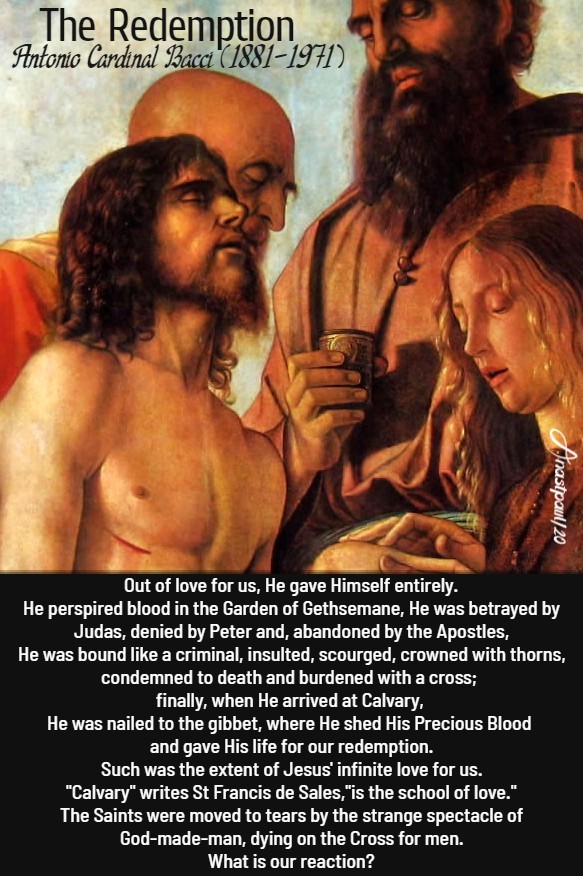
The Redemption
“The Incarnation of God, was sufficient to have saved us. It would have been enough for God made man, to have offered Himself to God, for our redemption in a single act of love. Every act of Jesus, the God-Man, had infinite value and was, therefore, sufficient to be offered to the Father as an infinite satisfaction for all our sins.
But, if Jesus had desired to show more clearly His great love for us, He could have offered Hi sufferings as a child in the cold cave at Bethlehem, when He lay whimpering on a wretched straw bed. He could have offered the sorrow of His exile in Egypt, He could have offered a single drop of His Precious Blood , during the ceremony of the circumcision. He could have offered the difficulties and privations of His simple working life at Nazareth, or the fatiguing exertions of His apostolic journeys. All these, would have been more than enough to have made amends to the divine Father for all the sins of humanity, to have ransomed us from the devil and to have restored to us, God’s grace and love. But in God, everything is infinite. His love has no limit. “Thou shalt love the Lord thy God, with thy whole heart,” He as commanded men “and with thy whole soul and with thy whole strength and with they whole mind and thy neighbour as thyself.” He, Himself, did infinitely more than this, however, Jesus was not satisfied merely to love us, His brothers by adoption, as He loved Himself but, He wished to love us “more than He loved Himself. Greater love than this no-one has,” He said, “that one lay down his life for his friends” (1 Jn 15:13). This was what he Himself did. Sinful though we are, He called us friends. “You are my friends” (Jn 15:14). Out of love for us, He gave Himself entirely. He perspired blood in the Garden of Gethsemane, He was betrayed by Judas, denied by Peter and, abandoned by the Apostles, He was bound like a criminal, insulted, scourged, crowned with thorns, condemned to death and burdened with a cross; finally, when He arrived at Calvary, He was nailed to the gibbet, where He shed His Precious Blood and gave His life for our redemption. Such was the extent of Jesus’ infinite love for us.
“Calvary” writes St Francis de Sales,“is the school of love.” The Saints were moved to tears by the strange spectacle of God-made-man, dying on the Cross for men. What is our reaction?“
Quotes of the Day – 28 August – The Memorial of St Augustine of Hippo (354-430) – Father and Doctor of Grace
“To fall in love with God, is the greatest romance; to seek Him, the greatest adventure; to find Him, the greatest human achievement.”
“You ask what you might offer to God? Offer yourself! What does God expect from you, except yourself?”
“He bought brothers for Himself by His blood, He made them welcome by being rejected, He ransomed them by being sold, He honoured them by being dishonoured, He gave them life by being put to death. So, brethren, rejoice in the Lord, not in the world. That is, rejoice in the truth, not in wickedness, rejoice in the hope of eternity, not in the fading flower of vanity. That is the way to rejoice. Wherever you are on earth, however long you remain on earth, the Lord is near, do not be anxious about anything!”
“God provides the wind but man must raise the sails.”
“A man may lose the good things of this life against his will but, if he loses the eternal blessings, he does so with his own consent.”
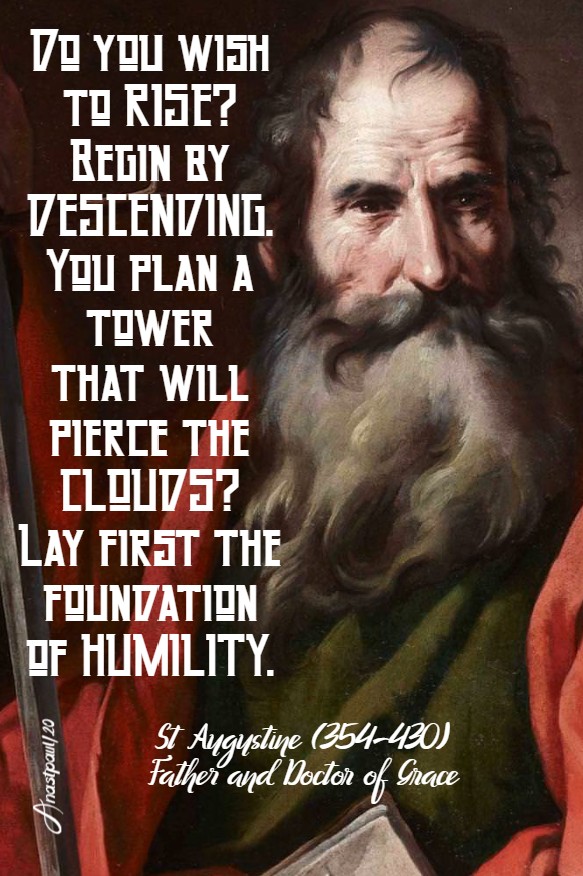
“Do you wish to RISE? Begin by DESCENDING. You plan a tower that will pierce the CLOUDS? Lay first the foundation of HUMILITY.”
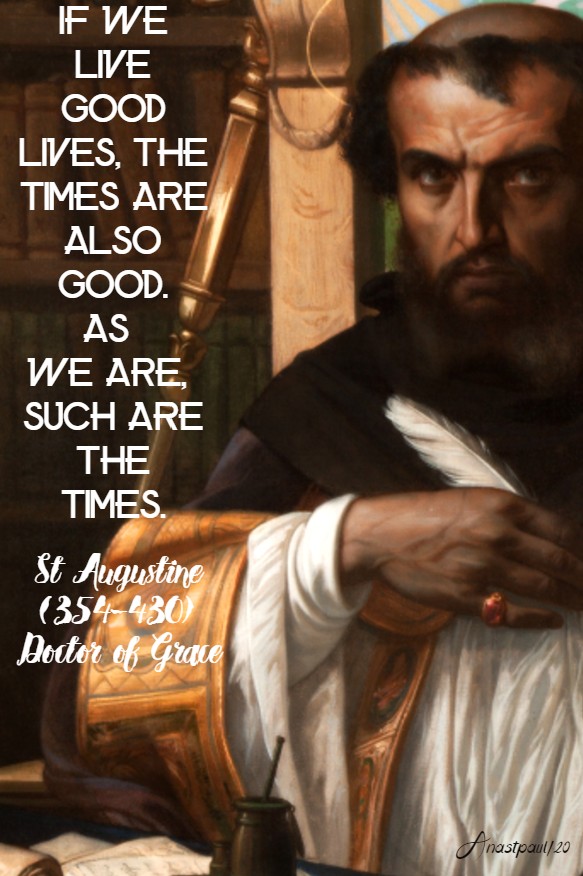
“If we live good lives, the times are also good. As we are, such are the times.”
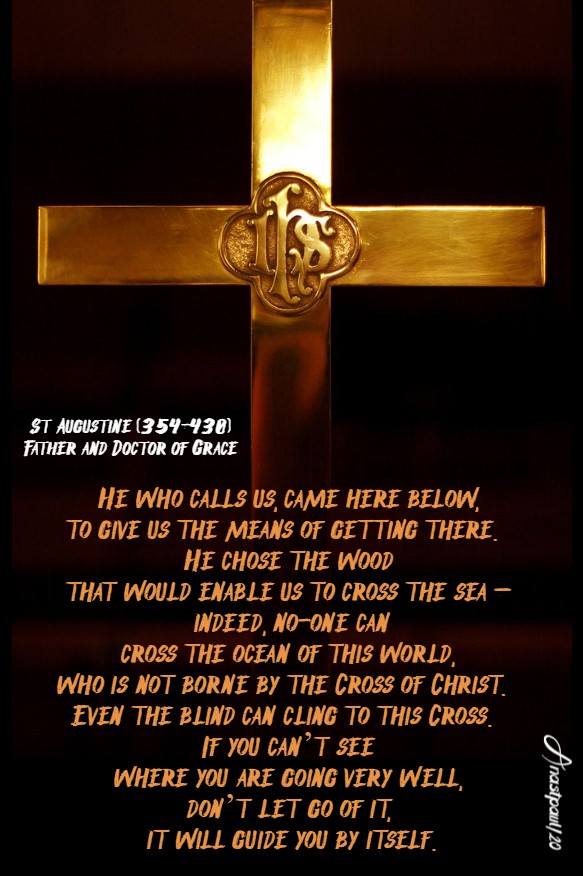
“He who calls us, came here below, to give us the means of getting there. He chose the wood that would enable us to cross the sea – indeed, no-one can cross the ocean of this world, who is not borne by the Cross of Christ. Even the blind can cling to this Cross. If you can’t see where you are going very well, don’t let go of it, it will guide you by itself. ”
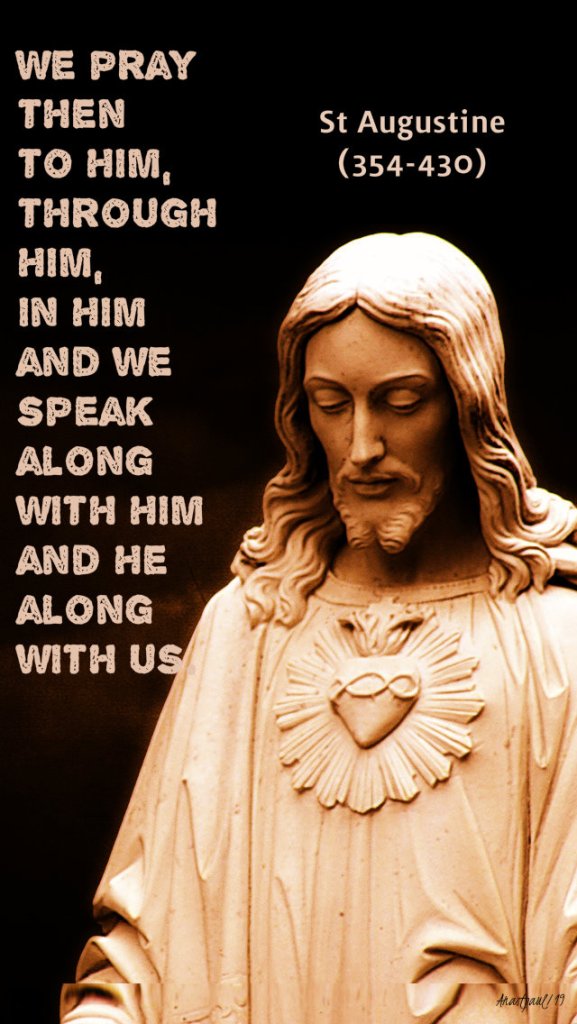
“We pray then to Him, through Him, in Him and we speak along with Him and He along with us. ”
Our Morning Offering – 24 July – “Month of the Most Precious Blood” – Friday of the Sixteenth week in Ordinary Time
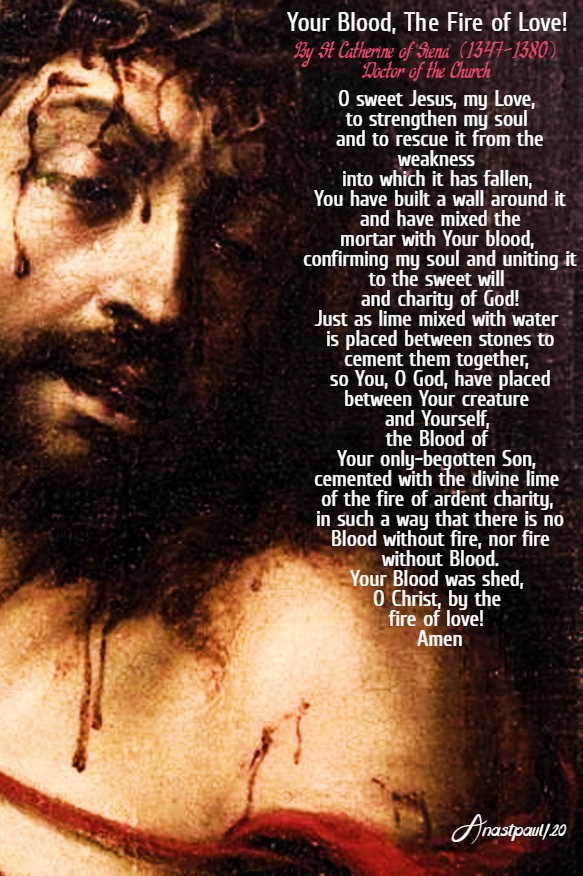
Your Blood, The Fire of Love! By St Catherine of Siena (1347-1380)
O sweet Jesus, my Love,
to strengthen my soul
and to rescue it from the weakness
into which it has fallen,
You have built a wall around it
and have mixed the mortar with Your blood,
confirming my soul and uniting it
to the sweet will and charity of God!
Just as lime mixed with water
is placed between stones to cement them together,
so You, O God, have placed between
Your creature and Yourself,
the Blood of Your only-begotten Son,
cemented with the divine lime
of the fire of ardent charity,
in such a way that there is no Blood
without fire, nor fire without Blood.
Your Blood was shed, O Christ, by the fire of love!
Amen
Our Morning Offering – 19 July – “Month of the Most Precious Blood” – The Sixteenth Sunday of the Year in Ordinary Time
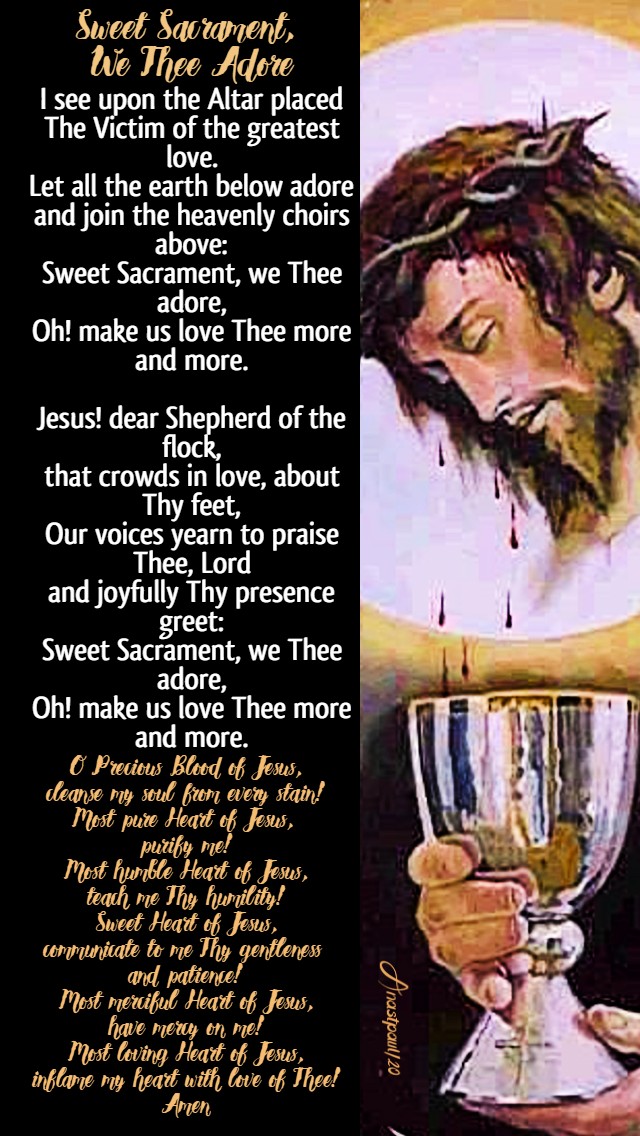
Sweet Sacrament, We Thee Adore
I see upon the Altar placed
The Victim of the greatest love.
Let all the earth below adore
and join the heavenly choirs above:
Sweet Sacrament, we Thee adore,
Oh! make us love Thee more and more.
Jesus! dear Shepherd of the flock,
that crowds in love, about Thy feet,
Our voices yearn to praise Thee, Lord
and joyfully Thy presence greet:
Sweet Sacrament, we Thee adore,
Oh! make us love Thee more and more.
O Precious Blood of Jesus, cleanse my soul from every stain! Most pure Heart of Jesus, purify me! Most humble Heart of Jesus, teach me Thy humility! Sweet Heart of Jesus, communicate to me Thy gentleness and patience! Most merciful Heart of Jesus, have mercy on me! Most loving Heart of Jesus, inflame my heart with love of Thee! Amen
Our Morning Offering – 17 July – “Month of the Most Precious Blood” – Friday of the Fifteenth Week in Ordinary Time
Prayer for the Gift of Prayer By St Alphonsus Liguori (1696-1787) Doctor of the Church
O Incarnate Word,
You have given Your Blood and Your Life
to confer on our prayers that power by which,
according to Your promise,
they obtain for us all that we ask.
And we, O God,
are so careless of our salvation,
that we will not even ask You for the graces
that we must have, if we should be saved!
In prayer You have given us the key
of all Your Divine treasures
and we, rather than pray,
choose to remain in our misery.
Alas! O Lord, enlighten us,
and make us know the value of prayers,
offered in Your name and by Your merits,
in the eyes of Your Eternal Father.
Amen
Our Morning Offering – 14 July – “Month of the Precious Blood” – Tuesday of the Fifteenth Week in Ordinary Time
An Old Morning Prayer – Excerpt From The Blossoms of the Cross — 1894 The Sisters of St Joseph
I rise In God’s strength,
In God’s power,
In the Agony of Christ,
In the Cross of Christ,
In Christ’s Precious Blood,
These will sustain me against my enemies,
visible and invisible.
I rise in the blessing of Christ
which my dearest Jesus left to the whole world.
Protect me, All-Holy Trinity,
God the Father, Who created me,
God, the Son, Who redeemed me in His Precious Blood,
God, the Holy Ghost, Who sanctified me in Holy Baptism.
God, the Father, I give myself to Thee!
God, the Son, I commend myself to Thee!
God, the Holy Ghost, teach me!
Mary, Mother of God, assist me!
All you Saints of God, pray for me!
All you Holy Angels, protect me!
The Cross of Christ preserve me!
Amen
Our Morning Offering – 8 July – “Month of the Most Precious Blood” – Wednesday of the Fourteenth week in Ordinary Time
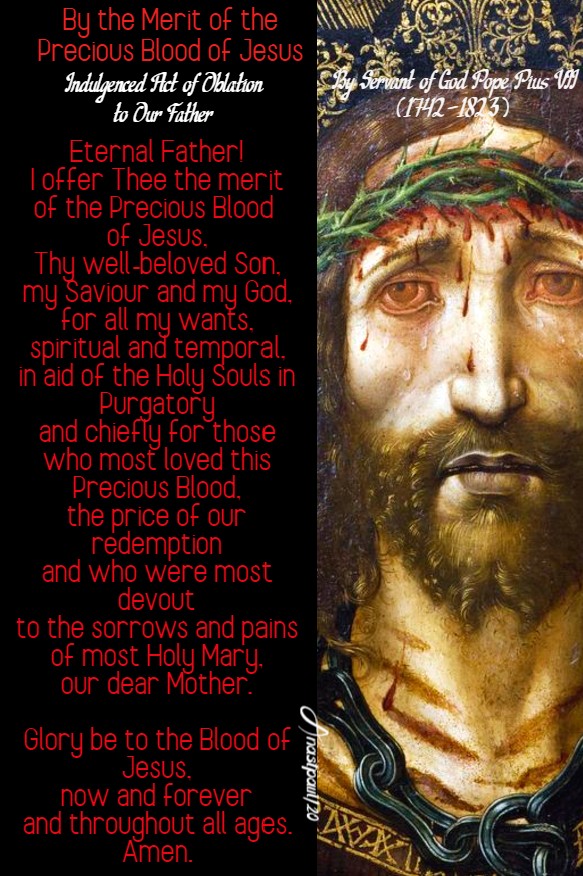
By the Merit of the Precious Blood of Jesus By Servant of God Pope Pius VII (1742-1823) Papacy from 1800 to 1823 Indulgenced Act of Oblation to Our Father
Eternal Father!
I offer Thee the merit
of the Precious Blood of Jesus,
Thy well-beloved Son,
my Saviour and my God,
for all my wants,
spiritual and temporal,
in aid of the Holy Souls in Purgatory
and chiefly for those
who most loved this Precious Blood,
the price of our redemption
and who were most devout
to the sorrows and pains
of most Holy Mary,
our dear Mother.
Glory be to the Blood of Jesus,
now and forever
and throughout all ages.
Amen.
Indulgence of 300 days, each time this prayed is offered 22 September 1817 with a Plenary Indulgence, once a month, under the usual conditions.
In 2007, Pope Benedict XVI approved and granted it the Nihal Obstat – (nothing stands against), the process towards Canonising Pope Pius VII and he was granted the title Servant of God.
In late 2018, the Bishop of Savona announced that the cause for Pius VII would continue following the completion of initial preparation and investigation. The Bishop named a new Postulator and a Diocesan tribunal began work into the cause. The first Postulator for the cause, was Father Giovanni Farris (2007-18) and the current Postulator since 2018, is Father Giovanni Margara.
Note of Interest: On 15 August 1811 – the Feast of the Assumption – it is recorded that the Pope celebrated Mass and was said to have entered a trance and began to levitate in a manner that drew him to the altar. This particular episode aroused great wonder and awe among attendants, which included the French soldiers guarding him, who were awestruck at what had occurred and left records of it.
















 AnaStpaul
You must be logged in to post a comment.