Know today that the Lord will come – in the morning you will see His glory.
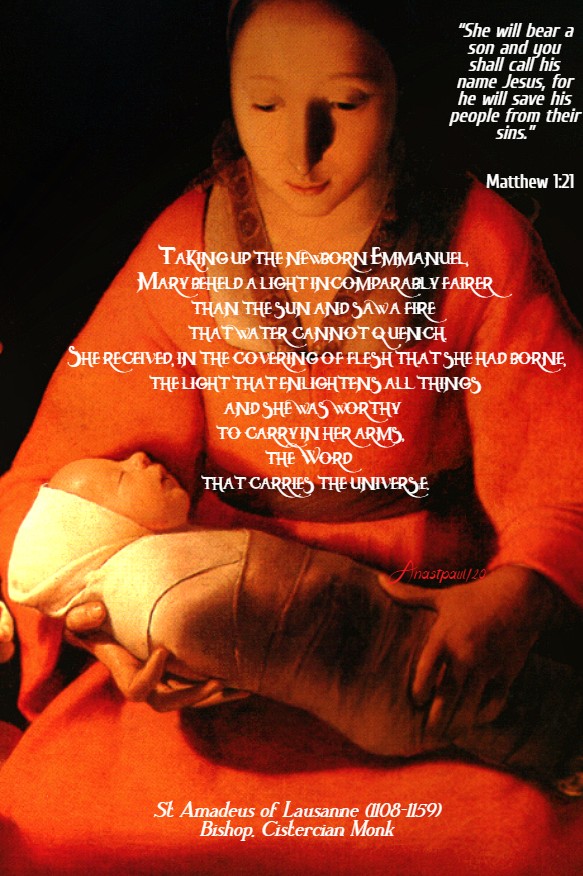
“She will bear a son and you shall call his name Jesus, for he will save his people from their sins.” … Matthew 1:21
REFLECTION – “The heavens were glad, earth exulted when Mary gave birth and hell was troubled and aghast. The heavens in their joy produced a shining star and a glorious army of angels, uttering praise and saying: “Glory to God in the highest and on earth peace to people of good will.” (Lk 2:14) The earth, exulting, brought shepherds giving glory and magi adoring and offering gifts, gold, frankincense and myrrh. … Reflect how that night poured forth light in the darkness and instead of blackness, it offered radiance. It gave light before the sun arose and a brightness which, from its exceeding brilliance, obscured the splendour of the sun. Concerning this night the psalmist says: “Night is my light in my delights” and turning to the Lord he says: “The darkness will not be dark for you and the night will be as bright as the day, for the darkness is as light for him” (cf Ps 38[139]:11-12 LXX). … Taking up the newborn Emmanuel, Mary beheld a Light incomparably fairer than the sun and saw a Fire that water cannot quench. She received, in the covering of flesh Whom she had borne, the Light Who enlightens all things and she was worthy, to carry in her arms, the Word Who carries the universe!– St Amadeus of Lausanne (1108-1159) Bishop, Cistercian Monk – Homilies in praise of the Blessed Virgin Mary, IV, SC 72
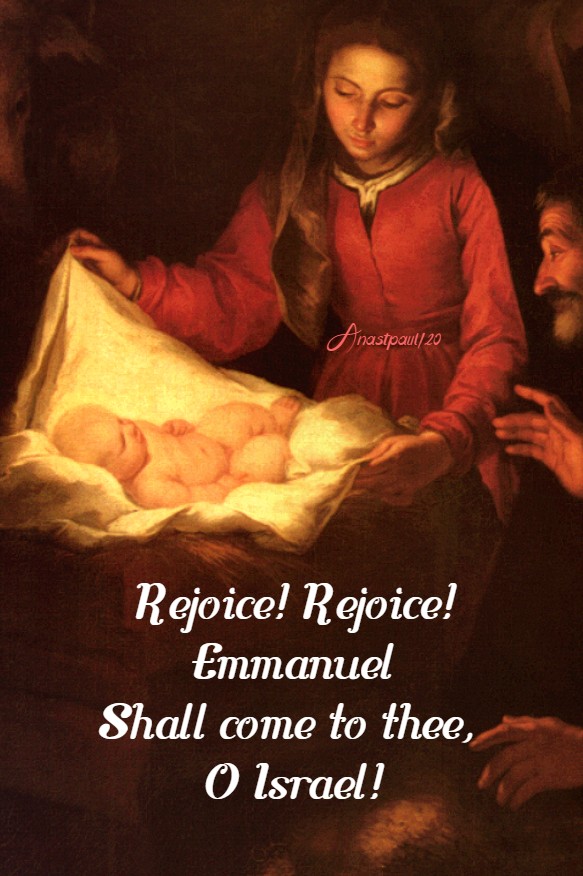
PRAYER – Rejoice! Rejoice! Emmanuel Shall come to thee, O Israel! May the Lord bless us, protect us from all evil and bring us to everlasting life. Amen
Our Morning Offering – 24 December – Vigil of the Nativity of the Lord/Mass at Midnight
What Child is This?
What child is this, who, laid to rest On Mary’s lap, is sleeping? Whom angels greet with anthems sweet, While shepherds watch are keeping? This, this is Christ the King, Whom shepherds guard and angels sing: Haste, haste to bring him laud, The Babe, the Son of Mary!
Why lies He in such mean estate, Where ox and ass are feeding? Good Christians, fear, for sinners here The silent Word is pleading. Nails, spear shall pierce Him through, The cross be borne for me, for you. Hail, hail the Word made flesh, The Babe, the Son of Mary.
So bring Him incense, gold and myrrh, Come peasant king to own Him, The King of kings, salvation brings, Let loving hearts enthrone Him. Raise, raise the song on high, The Virgin sings her lullaby: Joy, joy, for Christ is born, The Babe, the Son of Mary!
By William C Dix (1837-1898) English Hymnist and is sung to the tune of Greensleeves.
24 December – Vigil of the Nativity of the Lord/Mass at Midnight In many Western Christian traditions Midnight Mass is the first liturgy of Christmastide that is celebrated on the night of Christmas Eve, traditionally beginning at midnight when Christmas Eve gives way to Christmas Day. This popular Christmas custom is a jubilant celebration of the Mass in honour of the Nativity of Jesus, even many of those Christian denominations that do not regularly employ the word “Mass” uniquely use the term “Midnight Mass” for their Christmas Eve liturgy.
Saint Thomas Aquinas wrote a commentary on these words and explained in his Summa Theologiae, “And from this the Mass derives its name … the deacon on festival days ‘dismisses’ the people at the end of the Mass, by saying: ‘Ite, missa est,’ that is, the victim [Jesus] has been sent to God through the angel, so that it may be accepted by God.”
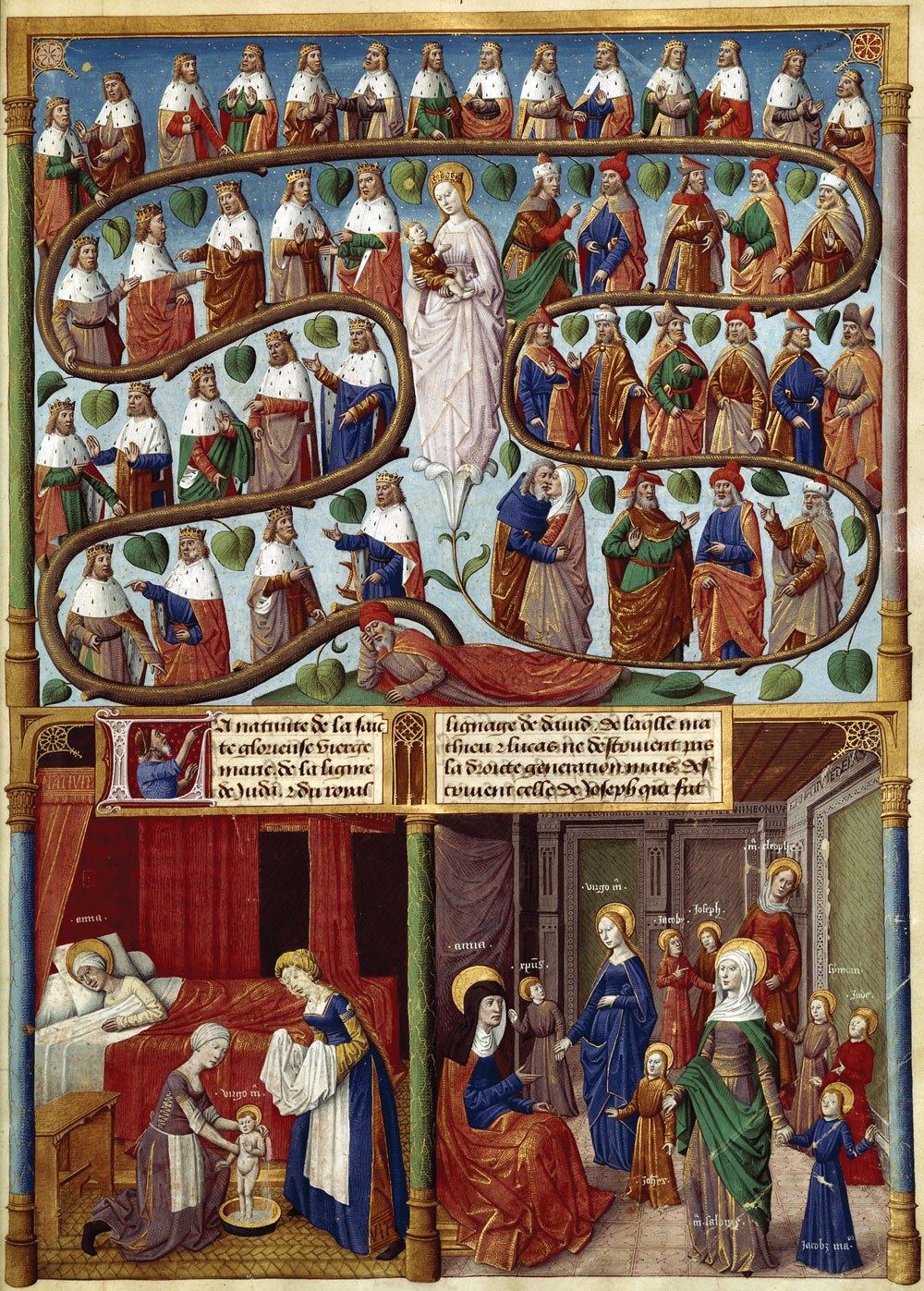
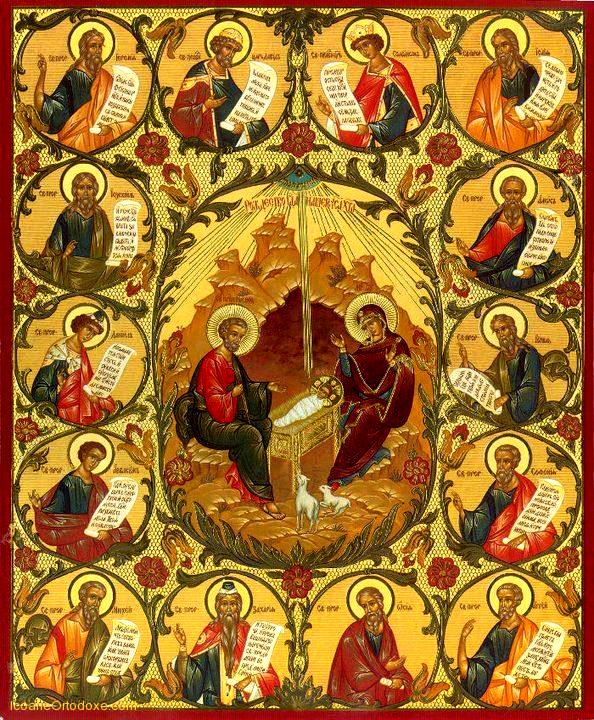
All the Holy Ancestors of Christ – A commemoration of all the holy ancestors of Jesus Christ.
The New Testament has preserved two different genealogies of Our Lord, in Matthew 1; and Luke 3.
Saint Matthew’s list is divided artificially into three equal parts of 14 names each, with several intentional omissions: from Abraham the father of the chosen people to David the king, to whose family the promise was made (2 Kings 7); David and the royal line after him to the Babylonian captivity; the descendants of the royal line from the captivity to Joseph, the legal father of Our Lord.
Saint Luke proceeds in reverse order; he starts from Joseph and goes, beyond Abraham, back to Adam the father of the human race, in accord with the character of his Gospel; and he merely enumerates the names without grouping them according to a thesis or point, as is the case in Saint Matthew.
Few names are common to both lists: viz., those between Abraham and David, then Salathiel and Zorobabel after the captivity, and Joseph the foster-father of Christ; the others are absent from Matthew’s list, or the persons are different. To account for these differences several explanations have been advanced, but no decisive evidence is extant. Not a few authors hold that Saint Luke gives Mary’s genealogy; but this view is more generally considered improbable, so that both lists are taken as giving Joseph’s ancestry. Only it must be supposed that at several points, instead of the actual descent, the one or the other of the lists gives the legal relationship based on adoption in some manner. Our Lord was considered to belong to the family of David; this seems to be taken for granted in the New Testament, where we find no difficulty raised against Him on the ground of His descent. The genealogies show His relationship to the royal family of Juda through Joseph, as it was only through the father, legal or natural, that the rights could be transmitted, and Joseph was the legal father of Jesus. To trace Our Lord’s ancestry through His mother would not have served the purpose of the Evangelists.
Matthew 1:1-17
The book of the genealogy of Jesus Christ, the son of David, the son of Abraham.
Abraham became the father of Isaac, Isaac the father of Jacob, Jacob the father of Judah and his brothers. Judah became the father of Perez and Zerah, whose mother was Tamar. Perez became the father of Hezron, Hezron the father of Ram, Ram the father of Amminadab. Amminadab became the father of Nahshon, Nahshon the father of Salmon, Salmon the father of Boaz, whose mother was Rahab. Boaz became the father of Obed, whose mother was Ruth. Obed became the father of Jesse, Jesse the father of David the king. David became the father of Solomon, whose mother had been the wife of Uriah. Solomon became the father of Rehoboam, Rehoboam the father of Abijah, Abijah the father of Asaph. Asaph became the father of Jehoshaphat, Jehoshaphat the father of Joram, Joram the father of Uzziah. Uzziah became the father of Jotham, Jotham the father of Ahaz, Ahaz the father of Hezekiah. Hezekiah became the father of Manasseh, Manasseh the father of Amos, Amos the father of Josiah. Josiah became the father of Jechoniah and his brothers at the time of the Babylonian exile. After the Babylonian exile, Jechoniah became the father of Shealtiel, Shealtiel the father of Zerubbabel, Zerubbabel the father of Abiud. Abiud became the father of Eliakim, Eliakim the father of Azor, Azor the father of Zadok. Zadok became the father of Achim, Achim the father of Eliud, Eliud the father of Eleazar. Eleazar became the father of Matthan, Matthan the father of Jacob, Jacob the father of Joseph, the husband of Mary. Of her was born Jesus who is called the Messiah.
Thus the total number of generations from Abraham to David is fourteen generations; from David to the Babylonian exile, fourteen generations; from the Babylonian exile to the Messiah, fourteen generations.
Luke 3:23-38
When Jesus began his ministry he was about thirty years of age. He was the son, as was thought, of Joseph, the son of Heli, the son of Matthat, the son of Levi, the son of Melchi, the son of Jannai, the son of Joseph, the son of Mattathias, the son of Amos, the son of Nahum, the son of Esli, the son of Naggai, the son of Maath, the son of Mattathias, the son of Semein, the son of Josech, the son of Joda, the son of Joanan, the son of Rhesa, the son of Zerubbabel, the son of Shealtiel, the son of Neri, the son of Melchi, the son of Addi, the son of Cosam, the son of Elmadam, the son of Er, the son of Joshua, the son of Eliezer, the son of Jorim, the son of Matthat, the son of Levi, the son of Simeon, the son of Judah, the son of Joseph, the son of Jonam, the son of Eliakim, the son of Melea, the son of Menna, the son of Mattatha, the son of Nathan, the son of David, the son of Jesse, the son of Obed, the son of Boaz, the son of Sala, the son of Nahshon, the son of Amminadab, the son of Admin, the son of Arni, the son of Hezron, the son of Perez, the son of Judah, the son of Jacob, the son of Isaac, the son of Abraham, the son of Terah, the son of Nahor, the son of Serug, the son of Reu, the son of Peleg, the son of Eber, the son of Shelah, the son of Cainan, the son of Arphaxad, the son of Shem, the son of Noah, the son of Lamech, the son of Methuselah, the son of Enoch, the son of Jared, the son of Mahalaleel, the son of Cainan, the son of Enos, the son of Seth, the son of Adam, the son of God.
Blessed Mercedarian Sisters – (6 beati): Six cloistered Mercedarian nuns at the convent of Vera Cruz in Berriz, Spain. Noted for their devotion to the rules of the Order and for their deep prayer lives. • Blessed Anna Maria Prieto • Blessed Anna de Arrano • Blessed Orsola de Larisgoizia • Blessed Maguna Mary • Blessed Margaret • Blessed Mary of the Assumption Sarria
Martyred Maidens of Antioch – (40 saints): A group of forty virgins martyred in the persecutions of Decius. None of their names have come down to us. They were martyred in 250 in Antioch, Syria.
Martyrs of Tripoli – (6 saints): A group of Christians martyred together, date unknown. The only details that have surived are six of the names – Drusus, Lucian, Metrobius, Paul, Theotimus and Zenobius. They were martyred in Tripoli, Libya.
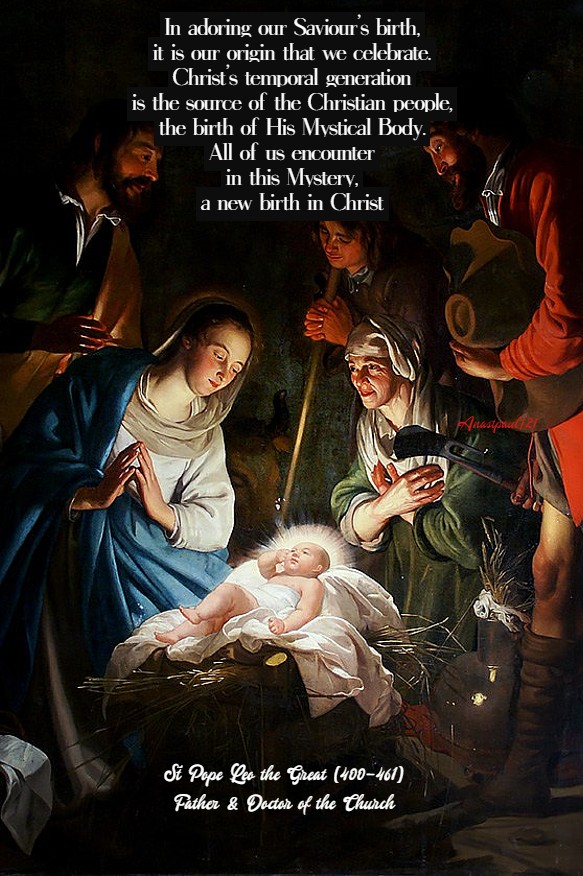
“In adoring our Saviour’s birth, it is our origin that we celebrate. Christ’s temporal generation is the source of the Christian people, the birth of His Mystical Body. All of us encounter in this Mystery, a new birth in Christ.”
St Pope Leo the Great (400-461) Father & Doctor of the Church
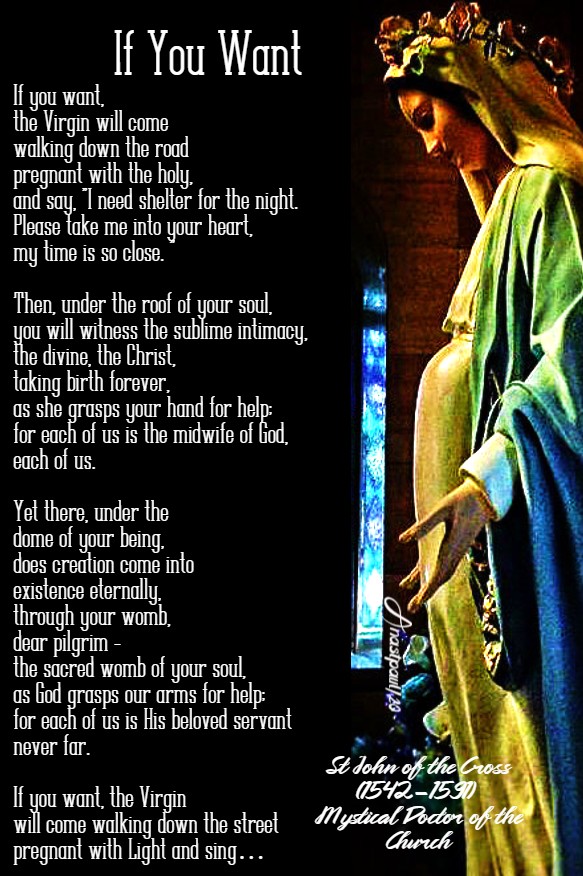
“If you want, the Virgin will come walking down the road pregnant with the Holy, and say, “I need shelter for the night. Please take me into your heart, my time is so close. ”
Then, under the roof of your soul, you will witness the sublime intimacy, the divine, the Christ, taking birth forever, as she grasps your hand for help; for each of us is the midwife of God, each of us.
Yet there, under the dome of your being, does creation come into existence eternally, through your womb, dear pilgrim – the sacred womb of your soul, as God grasps our arms for help; for each of us is His beloved servant never far.
If you want, the Virgin will come walking down the street pregnant with Light and sing…”
St John of the Cross (1542-1591) Mystical Doctor of the Church
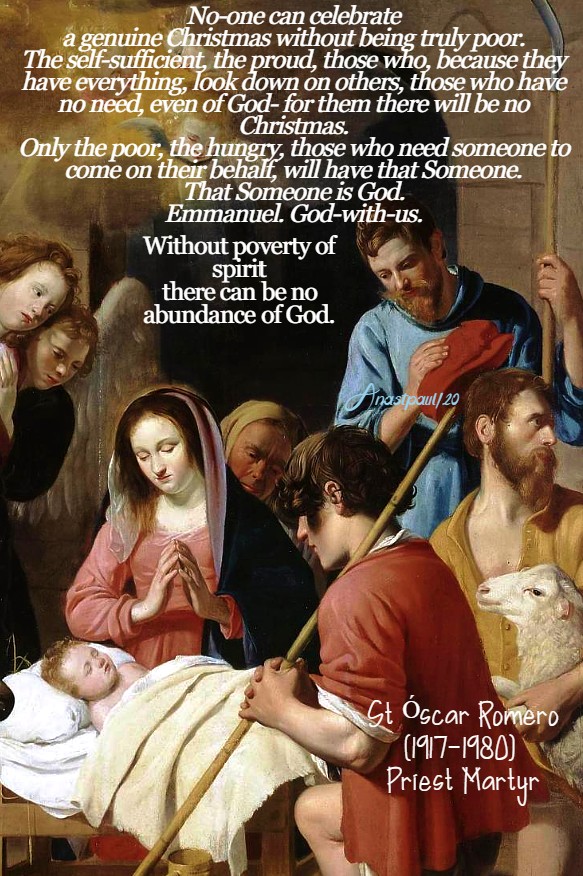
“No-one can celebrate a genuine Christmas without being truly poor. The self-sufficient, the proud, those who, because they have everything, look down on others, those who have no need, even of God- for them there will be no Christmas. Only the poor, the hungry, those who need someone to come on their behalf, will have that Someone. That Someone is God. Emmanuel. God-with-us. Without poverty of spirit there can be no abundance of God.”
Advent Reflection – 23 December – O Emmanuel – Readings: Malachi 3:1-4, 23-24, Psalms 25:4-5,8-9, 10 and 14, Luke 1:57-66
The Lord is at hand, come, let us adore Him.
“He spoke, blessing God ” – Luke 1:64
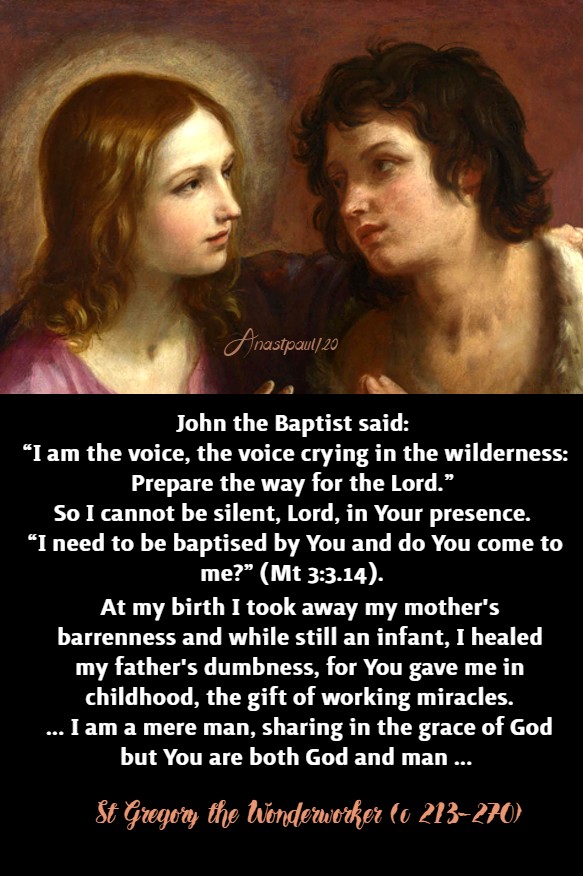
REFLECTION – [John the Baptist said:] “I am the voice, the voice crying in the wilderness: Prepare the way for the Lord.” So I cannot be silent, Lord, in Your presence. “I need to be baptised by you and do you come to me?” (Mt 3:3.14). At my birth I took away my mother’s barrenness and while still an infant, I healed my father’s dumbness, for You gave me in childhood, the gift of working miracles. But when You were born of the Virgin Mary, in the way You willed and in a manner known to You alone, You did not take away her virginity but while preserving it intact, You gave her, in addition, the name of “mother.” Her virginity did not hinder Your birth, nor did Your birth destroy her virginity. On the contrary, two opposites, motherhood and virginity, were easily united by You, because the laws of nature have their origin in You. I am a mere man, sharing in the grace of God but You are both God and man because of Your love for humankind (cf. Wis 1:6). ” – Homily attributed to Saint Gregory the Illuminator (c 213-270) Bishop – Homily on the holy Incarnation, 4
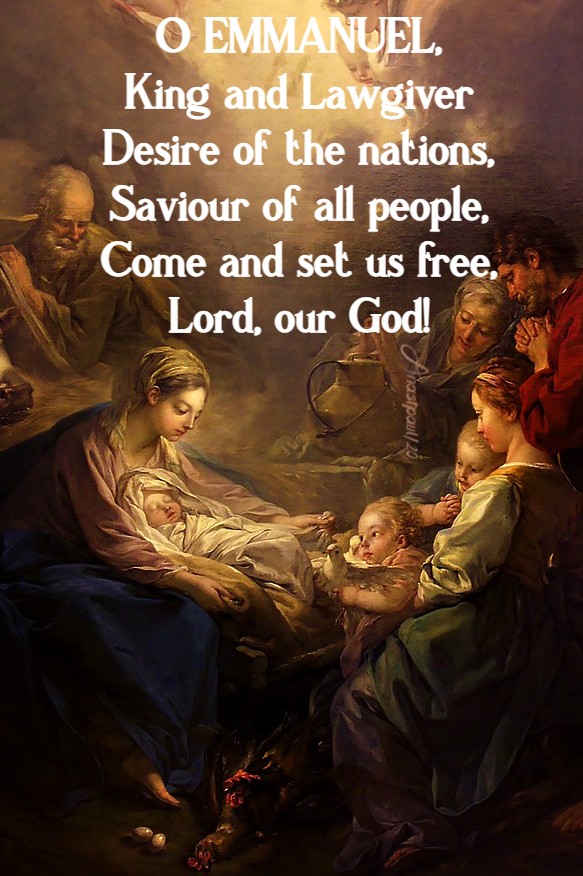
PRAYER O Emmanuel, King and Lawgiver Desire of the nations, Saviour of all people, Come and set us free, Lord, our God!
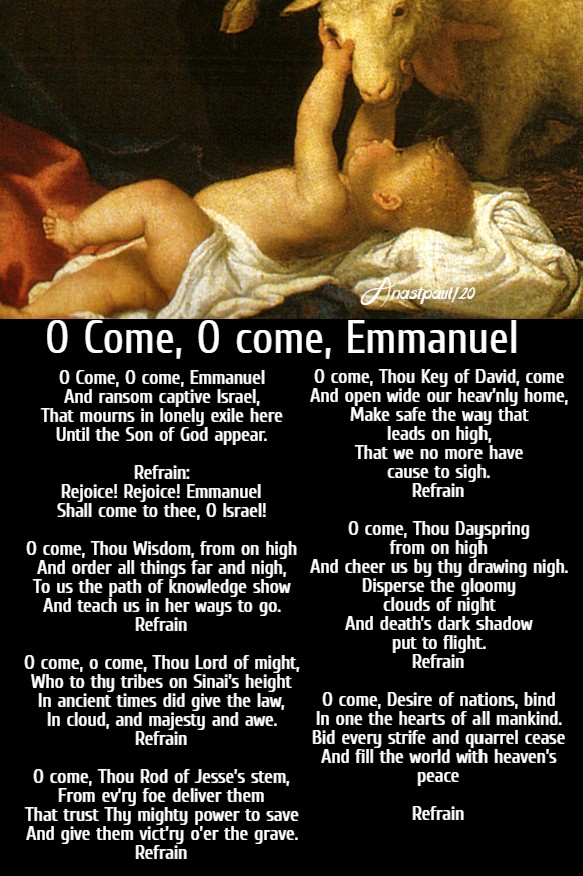
O Come, O come, Emmanuel And ransom captive Israel, That mourns in lonely exile here Until the Son of God appear.
Refrain: Rejoice! Rejoice! Emmanuel Shall come to thee, O Israel!
O come, Thou Wisdom, from on high And order all things far and nigh, To us the path of knowledge show And teach us in her ways to go. Refrain
O come, o come, Thou Lord of might, Who to thy tribes on Sinai’s height In ancient times did give the law, In cloud, and majesty and awe. Refrain
O come, Thou Rod of Jesse’s stem, From ev’ry foe deliver them That trust Thy mighty power to save And give them vict’ry o’er the grave. Refrain
O come, Thou Key of David, come And open wide our heav’nly home, Make safe the way that leads on high, That we no more have cause to sigh. Refrain
O come, Thou Dayspring from on high And cheer us by thy drawing nigh. Disperse the gloomy clouds of night And death’s dark shadow put to flight. Refrain
O come, Desire of nations, bind In one the hearts of all mankind. Bid every strife and quarrel cease And fill the world with heaven’s peace. Refrain
The favourite O Come, O Come Emmanuel carol was originally written in Latin text in the 12th Century. The author of the words and composer to the music of O Come, O Come Emmanuel is unknown. It is, however, believed that the melody was of French origin and added to the text a hundred years later. The Latin was translated into English by John Mason Neale in 1851.
Our Morning Offering – 22 December – Tuesday of the Fourth Week of Advent, O Rex Gentium/O King of all Nations
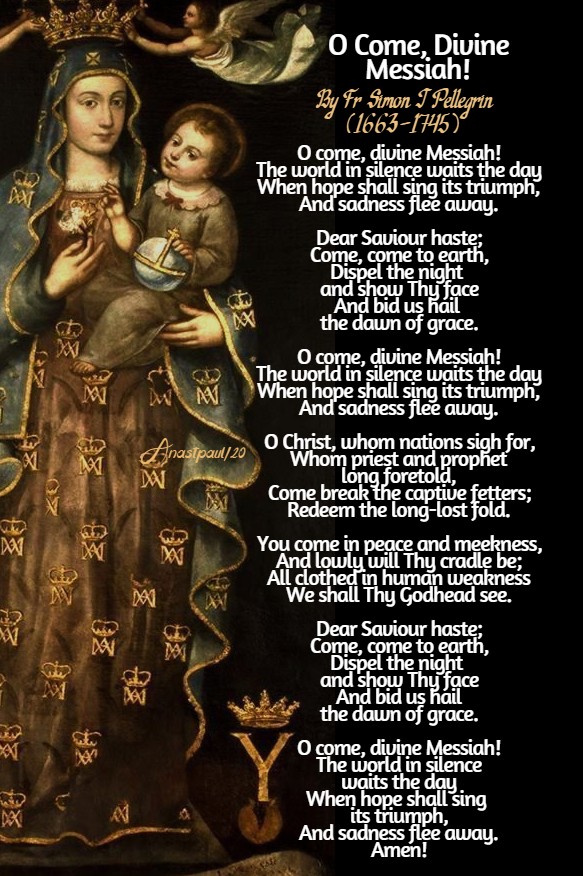
O Come, Divine Messiah! By Abbé Simon J Pellegrin (1663-1745) English Translation of French Carol Venez Divin Messie Translator: Sister Mary of St Philip, SND
O come, divine Messiah! The world in silence waits the day When hope shall sing its triumph, And sadness flee away.
Dear Saviour haste; Come, come to earth, Dispel the night and show Thy face And bid us hail the dawn of grace.
O come, divine Messiah! The world in silence waits the day When hope shall sing its triumph, And sadness flee away.
O Christ, whom nations sigh for, Whom priest and prophet long foretold, Come break the captive fetters; Redeem the long-lost fold.
You come in peace and meekness, And lowly will Thy cradle be; All clothed in human weakness We shall Thy Godhead see.
Dear Saviour haste; Come, come to earth, Dispel the night and show Thy face And bid us hail the dawn of grace.
O come, divine Messiah! The world in silence waits the day When hope shall sing its triumph, And sadness flee away. Amen!
Thought for the Day – 21 December – Meditations with Antonio Cardinal Bacci (1881-1971)
The Silence of the Divine Infant
Jesus Christ is the Eternal Word of God, made man, the infinite and substantial image of the Divine Intellect. Nevertheless, the Divine Infant, Whom we adore in the stable at Bethlehem, is mute and silent. The voluntary humiliation of the Son of God is such, that He, the Word of God, cannot utter a single human syllable. By this chosen silence, however, He teaches us many things. In the first place, He teaches us humility and self-denial. He teaches us, moreover, to recollect ourselves in the Presence of God, so that it may be easier for us to speak with Him and for Him, to make known what He requires of us. The silence of prayer brings forth divine consolations and inspirations to holiness,
Do we love to be silent? It is not necessary to become hermits but, it is essential, from time to time, to place ourselves quietyly in the Presence of God. God cannot be heard through the noise and confusion of the world, whereas, He speaks clearly to the soul, which seeks the silence of prayer. In any case, if we go about looking for the gossip and idle chatter of the world, it is almost impossible not to offend God. “Avoid profane and empty babblings,” St Paul urges us, “for they contribute much to ungodliness” (2 Tim 2:16). “If anyone does not offend in word,” adds St James, “he is a perfect man” (Js 3:2). “The tongue is a little member,” he continues but, goes onto emphasis that it is capable of doing either a great deal of good or a great deal of harm. “With it, we bless God the Father and, with it, we curse men, who have been made after the likeness of God. Out of the same mouth proceed blessing and cursing. These things, my brethren ought not to be so” (Js 3:5-10).
There are two main lessons which we should learn, therefore, from the silence of the Divine Infant. We should learn to love recollection and, we should learn to make proper use of the gift of speech, which can be an equally powerful weapon, in the cause of good, or, in the cause of evil!”
Thought for the Day – 20 December – Meditations with Antonio Cardinal Bacci (1881-1971)
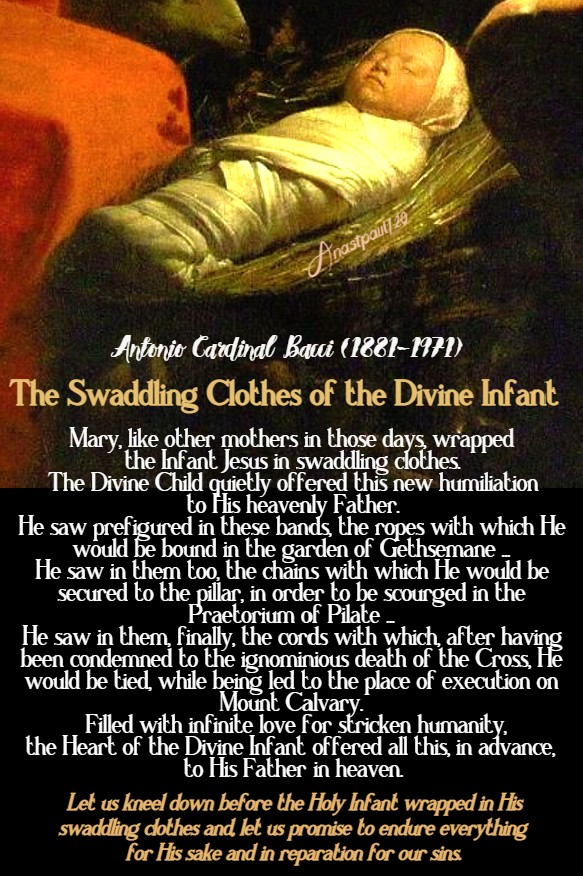
The Swaddling Clothes of the Divine Infant
“Mary, like other mothers in those days, wrapped the Infant Jesus in swaddling clothes. The Divine Child quietly offered this new humiliation to His heavenly Father. He saw prefigured in these bands, the ropes with which He would be bound in the garden of Gethsemane, even after He had given sinful humanity, His celestial teaching, example and miracles and finally, His own Body inthe Sacrament of the Eucharist. He saw in them too, the chains with which He would be secured to the pillar, in order to be scourged in the Praetorium of Pilate among the jeers and insults of the onlookers. He saw in them, finally, the cords with which, after having been condemned to the ignominious death of the Cross, He would be tied, while being led to the place of execution on Mount Calvary. Filled with infinite love for stricken humanity, the Heart of the Divine Infant offered all this, in advance, to His Father in heaven.
Are we making any effort to return such great love? Like Jesus, we are often obliged to endure, both physical and moral anguish. Have we the resignation to offer it all to Jesus, or do we squander our opportunities in useless complaining or in acts of impatience and rebellion? We shall have to go on suffering anyway but, in the latter case, we may have to suffer even more and shall lose all merit in the sight of God.
Let us kneel down before the Holy Infant wrapped in His swaddling clothes and, let us promise to endure everything for His sake and in reparation for our sins.”
Thought for the Day – 19 December – Meditations with Antonio Cardinal Bacci (1881-1971)
The Cradle of the Divine Infant Jesus
Enter once more with faith and love into the stable of Bethlehem. As soon as her Son has been miraculously delivered without any damage to her virginity, Mary adores Him and, with such maternal love as we could never conceive of, she takes Him to her heart. Joseph, kneeling in ecstasy at the sight, bows reverently and kisses the forehead of the Divine Infant. In this moment of blis, he is well rewarded for his unshaken faith and for all the sacrifices which he has made from his youth until the time of his alliance with Mary.
Now Mary and Joseph look around and, since they can find no better cradel for the Baby Jesus, they place Him upon some straw in a manger and cover Him with a rough linen coth. They have nothing else to give the Son of God, King of Kings and Lord of the Universe, Who wishes, at this early stage, to present us with this wonderful example of humility and voluntary poverty. But each of them has once treasure to offer, for they offer and dedicate their hearts to Jesus. Mary’s heart is only less beautiful and pure than that of our Divine Redeemer and St Joseph’s is similar to hers.
Jesus did not come to look for human wealth or greatness but, He came in search of men’s hearts, so that He might make them holy. Throughout the centuries there have been many generous-hearted people who joined with Mary and Joseph in loving Jesus and in dedicating themselves entirely to Him. Does your heart belong completely to Jesus?
Quote of the Day – Saturday of Advent – 19 December
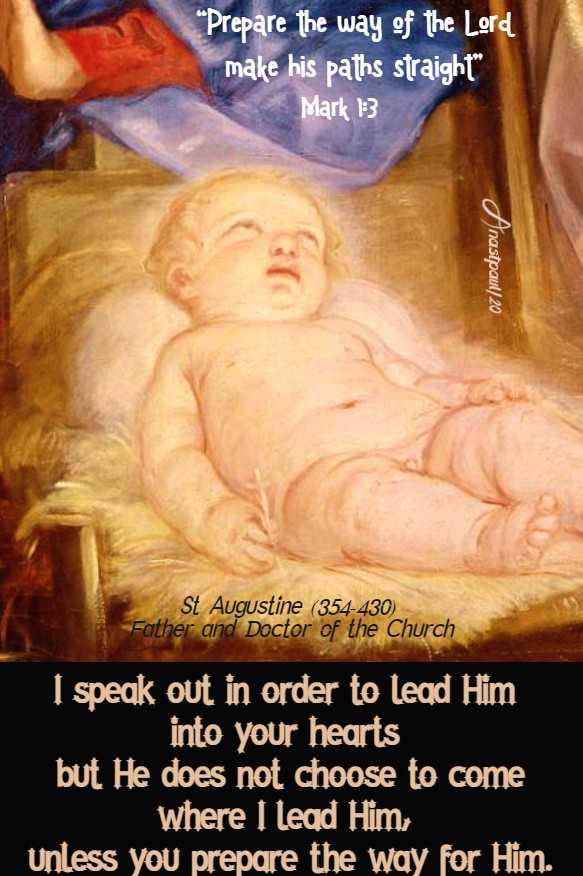
“I speak out in order to lead Him into your hearts but He does not choose to come where I lead Him, unless you prepare the way for Him.”
St Augustine (354-430) Father and Doctor of the Church
“Unreasoning and stupid that you look for God where He is not! Listen and be filled with awe – God is in our hearts, I know it. God lives in the human heart when this heart lives withdrawn from all that is not Him, when this heart heeds God’s knock at it’s door (Rv 3,20) and, sweeping and cleaning all its rooms, makes itself ready to welcome Him who alone truly satisfies.”
Thought for the Day – 18 December – Meditations with Antonio Cardinal Bacci (1881-1971)
Preparation for the Nativity
“The Birth of Our Lord is the most wonderful and most moving mystery of divine omnipotence and goodness. At first thought, the idea of the infinite God becoming man, would seem impossible. Between God and man, there is a vast abyss. Why should God have bridged this gap and assumed our poor mortal nature, becoming like us in everything but sin, while still remaining God? It is a hard question for the human mind to answer. There is only one reply, however. The immensity of God’s power and justice is equalled, by the immensity of His love. It was simply because God loved us infinitely that He took pity on us, lost as we were in sin. He assumed a human body and became man and, He suffered and died for us, so that we might love and obey Him more easily and follow in the way of goodness.
To our poor intellects, God seems not only immense and infinite but also, very remote. For this reason, God determined to come closer to us, so that He became as one of us. He was a tiny infant, crying in a manger; then, He was a lovable young boy Who spoke words of eternal wisdom among the doctors in the Temple; then, He was a prophet Who traversed the countryside of Palestine, teaching and working miracles; finally, He died a martyr’s death on the Cross in the cause of truth and goodness. Reflecting on this mystery of infinite love, let us adore and love Him.”
Our Morning Offering – 18 December and also the Feast of Our Lady of Expectation
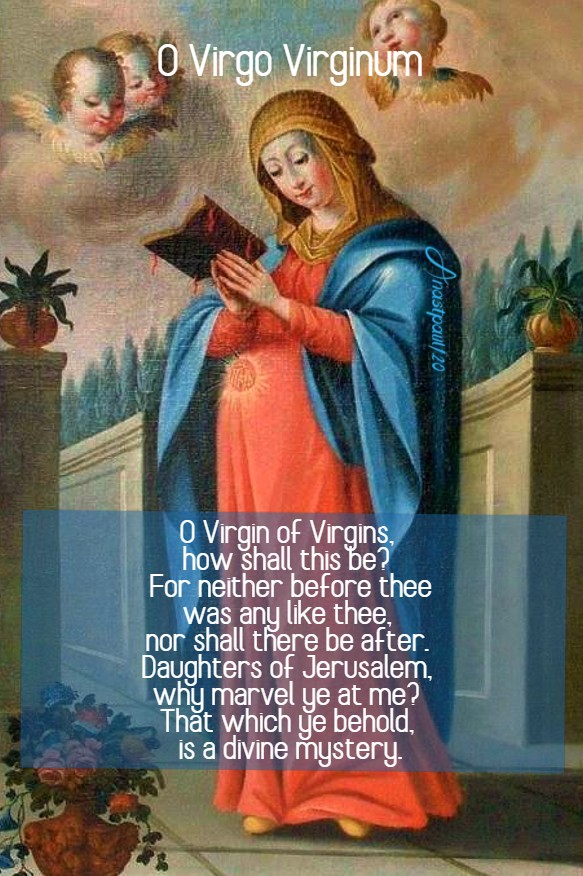
O Virgo Virginum
O Virgin of Virgins, how shall this be? For neither before thee was any like thee, nor shall there be after. Daughters of Jerusalem, why marvel ye at me? That which ye behold, is a divine mystery.
Maiden yet a Mother By Dante Alighieri (1265-1321) Tr Msgr Ronald A Knox (1888-1957)
Maiden yet a mother, daughter of thy Son, high beyond all other, lowlier is none; thou the consummation planned by God’s decree, when our lost creation nobler rose in thee!
Thus His place prepared, he who all things made ‘mid his creatures tarried, in thy bosom laid; there His love He nourished, warmth that gave increase to the root whence flourished our eternal peace.
Nor alone thou hearest When thy name we hail; Often thou art nearest When our voices fail; Mirrored in thy fashion All creation’s gird, Mercy, might compassion Grace thy womanhood.
Lady, let our vision Striving heavenward, fail, Still let thy petition With thy Son prevail, Unto whom all merit, prayer and majesty, With the Holy Spirit And the Father be.
Most authors agree that there were seven original ‘O Antiphons’ and that they are a very ancient expression of Christian Prayer. While their author is unknown, they are cited in at least two works as early as the eighth century. Both Cynewulf, an Anglo-Saxon author and Amalarius, a liturgist and the Archbishop of Trier (died 850), who was a student of the teacher St Alcuin, cite the existence of the ‘O Antiphons’ as early as the seventh/eighth century.
The ‘O Antiphons’ get their name from the fact that they all begin with the interjection ‘O’: O Sapientia (Wisdom); O Adonai (Lord); O Radix Jesse (Root of Jesse); O Clavis David (Key of David); O Oriens (Dawn of the East); O Rex Gentium (King of Gentiles); O Emmanuel.
While the original ‘O Antiphons’ numbered seven, over time a number of others were added to the liturgy of particular regions and sometimes for particular religious feast days which fell during Advent, or even in the liturgy of some medieval religious orders. Some medieval religious churches had as many as twelve O Antiphons which were sung in the Advent Liturgy leading up to Christmas Eve.
Among these, there was an important Marian ‘O Antiphon’ which appears in both the Gallican (France) and Sarum (England) liturgies. Although it is difficult to establish just when this antiphon was first introduced, it was certainly known in the Middle Ages.
This Marian Antiphon is still used today in the liturgy of the Norbertine Order. While the Latin Liturgy begins the O Antiphons on 17 December with ‘O Sapientia,’ and ends on 23 December with ‘O Emmanuel,’ the Liturgy of the Norbertine Order begins their O Antiphons on 16 December with ‘O Sapientia,’ and ends on 23 December with the beautiful Marian Antiphon ‘O Virgo Virginum.’
Thought for the Day – 17 December – Meditations with Antonio Cardinal Bacci (1881-1971)
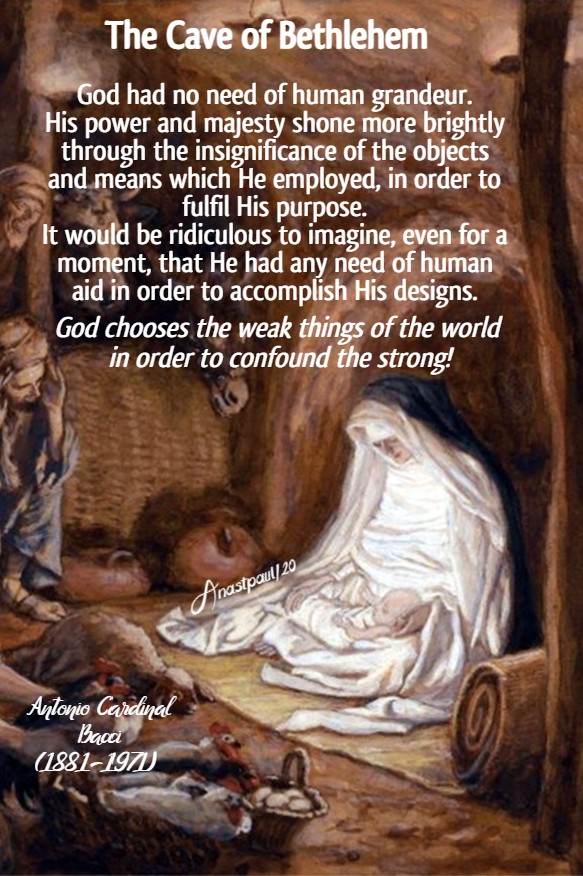
The Cave of Bethlehem
“Why, asked Bossuet, should the Eternal Word of God, infinitely and everlastingly happy, have deigned to assume in time, the fallen state of humanity? Why should He have chosen, as the scene of His miraculous life of love, this insignificant world, a planet almost imperceptible among the myriads of gigantic heavenly bodies? It was for the very same reason, Bossuet replied, that propmpted Him, once He had become man, to choose as His birthplace, the tiny and unknown village of Nazareth in Galilee rather than Rome, the centre of power, or Athens, the centre of learning, or Jerusalem, the capital of the State of Israel. Our world is the Nazareth of creation, one of the smallest planets in the firmament.
God did not even choose, moreover, to be born in the poor but comparatively comfortable house at Nazareth. He preferred to be born in the strange town of Bethlehem. It was the cradle of His ancestral line but it gave Him no welcome and compelled Him to be born in a cold and squalid barn on the straw of a manger. God had no need of human grandeur. His power and majesty shone more brightly through the insignificance of the objects and means which He employed in order to fulfil His purpose. It would be ridiculous to imagine, even for a moment, that He had any need of human aid in order to accomplish His designs. God chooses the weak things of the world in order to confound the strong!” (Missale Romanum, Miss. Virg et Mart).
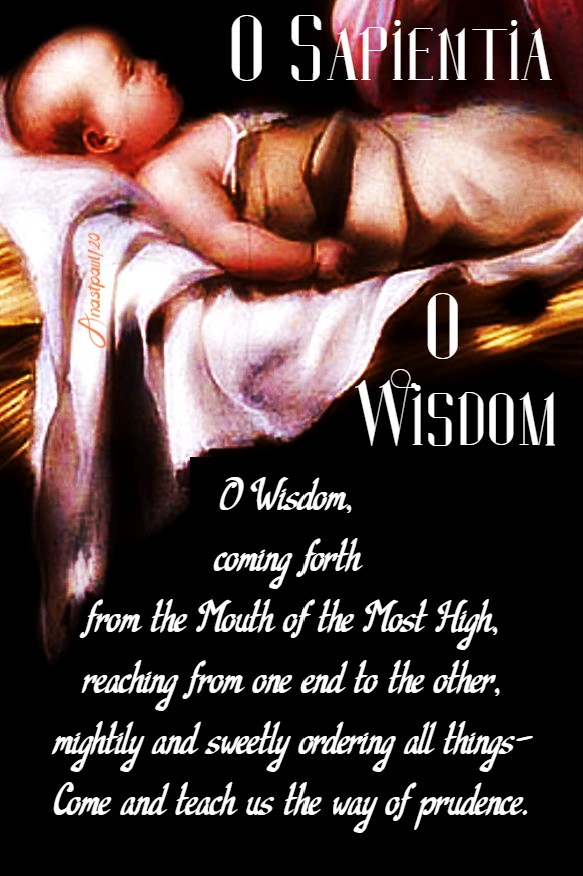
O Sapientia, quae ex ore Altissimi prodiisti, attingens a fine usque ad finem, fortiter suaviterque disponens omnia- veni ad docendum nos viam prudentiae.
O Wisdom, coming forth from the Mouth of the Most High, reaching from one end to the other, mightily and sweetly ordering all things- Come and teach us the way of prudence.
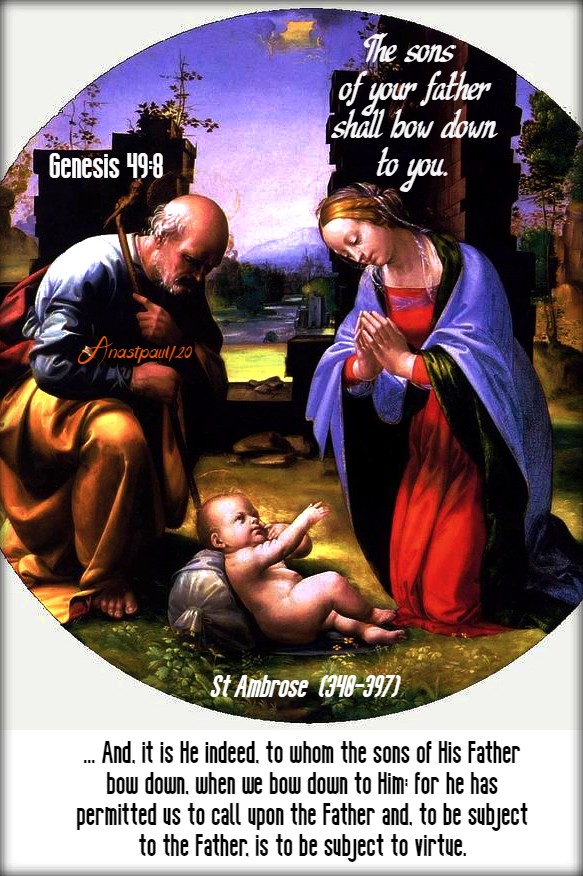
“You, Judah, shall your brothers praise your hand on the neck of your enemies; the sons of your father shall bow down to you.” – Genesis 49:8
REFLECTION – “This text appears to be directed to the Patriarch Judah, indeed but more so that later Judah is meant, the true Confessor who was born of that tribe and who alone is praised by His brothers; of them He says, “I will declare your name to my brothers.” He is the Lord by nature but a brother by grace; His hands, which He stretched out to an unbelieving people, are on the back of His enemies. For with those same hands and by that same passion, Christ protected His own, subjugated hostile powers and made subject to Himself, all people who were without faith and devotion. Of these the Father says to His Son, “And you will rule in the midst of your enemies.” It was their own wickedness that made them enemies, not Christ’s will. In this there is a great gift of the Lord. Previously, spiritual wickedness generally used to make our neck bend to the yoke of captivity. Thus even David wrote that he felt, in some way, the hands of those who triumphed over him, for he said, “Upon my back sinners have wrought.” But now spiritual wickedness is subject to the triumph of Christ and to His hands, as it were; that is, wickedness undergoes the affliction of captivity, being subject forever in deeds and in works. And, it is He indeed, to whom the sons of His Father bow down, when we bow down to Him; for he has permitted us to call upon the Father and, to be subject to the Father, is to be subject to virtue.” – St Ambrose (340-397) One of the original four Doctors of the Latin Church – (The Patriarchs, 4)
PRAYER – Collect: O God, Creator and Redeemer of human nature, Who willed that Your Word should take flesh in an ever-virgin womb, look with favour on our prayers, that Your only Begotten Son, having taken to Himself our humanity, may be pleased to grant us a share in his divinity. Who lives and reigns with You in the unity of the Holy Spirit, one God, for ever and ever. Amen
Rejoice! Rejoice! Emmanuel Shall come to thee, O Israel
Our Morning Offering – 17 December – O Wisdom/O Sapientia
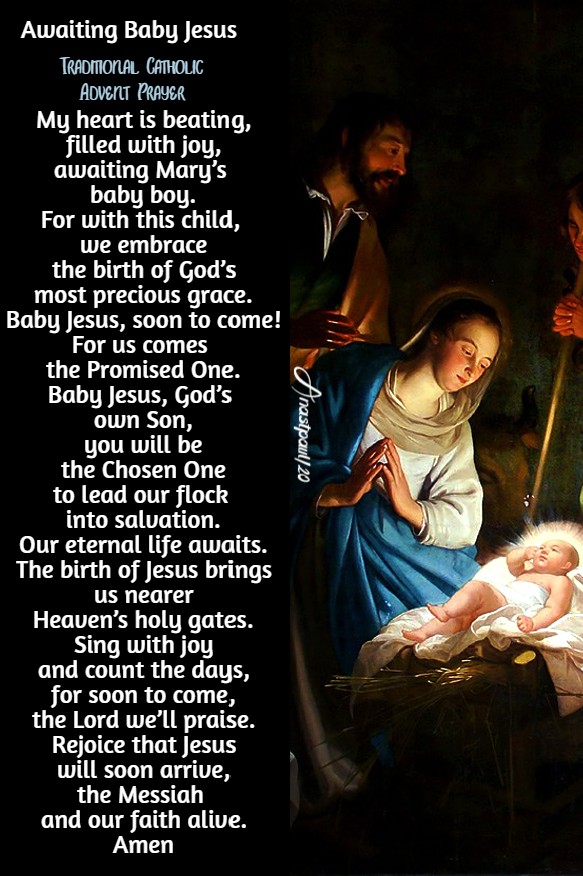
Awaiting Baby Jesus Traditional Catholic Advent Prayer
My heart is beating, filled with joy, awaiting Mary’s baby boy. For with this child, we embrace the birth of God’s most precious grace. Baby Jesus, soon to come! For us comes the Promised One. Baby Jesus, God’s own Son, you will be the Chosen One to lead our flock into salvation. Our eternal life awaits. The birth of Jesus brings us nearer Heaven’s holy gates. Sing with joy and count the days, for soon to come, the Lord we’ll praise. Rejoice that Jesus will soon arrive, the Messiah and our faith alive. Amen
Quote/s of the Day – 16 December – Wednesday of the Third week of Advent
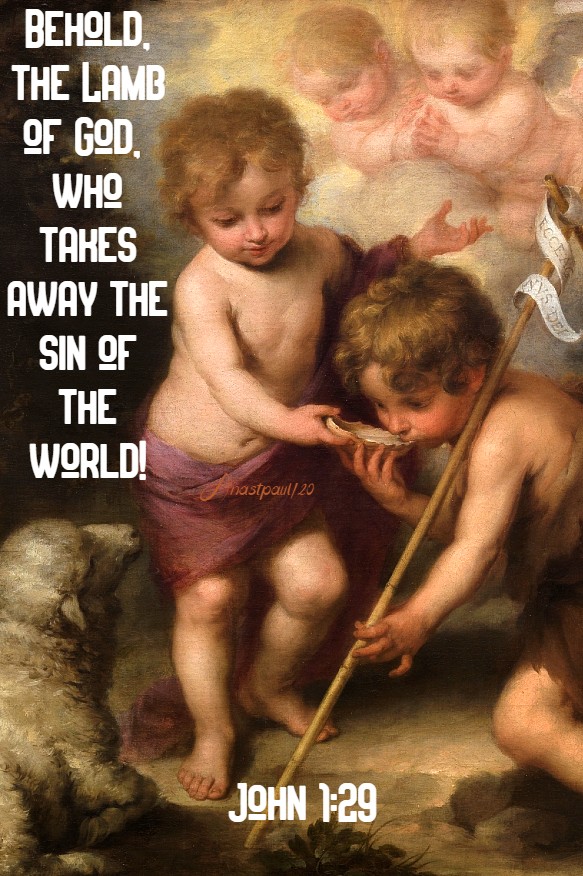
The Lamb of God
“Behold, the Lamb of God, who takes away the sin of the world!”
John 1:29
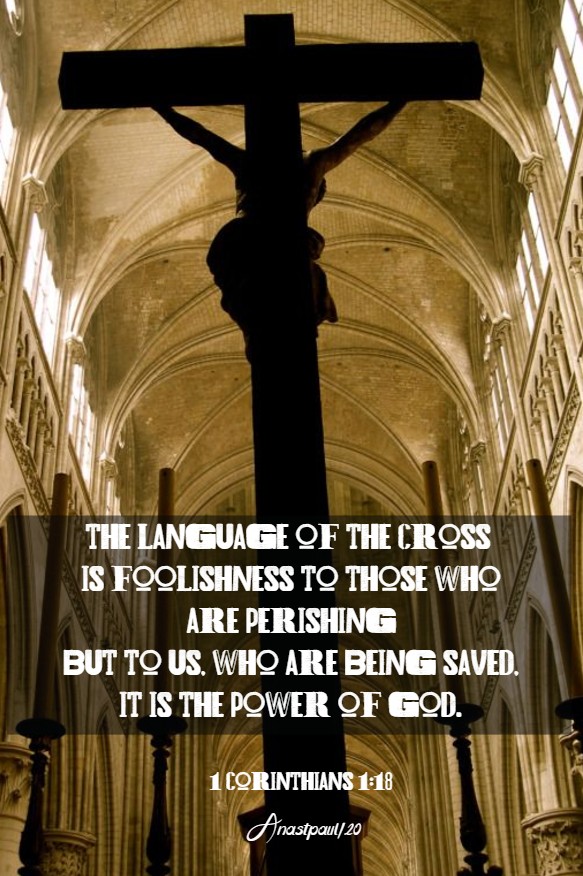
“The language of the cross is foolishness to those who are perishing but to us, who are being saved, it is the power of God”
1 Corinthians 1:18
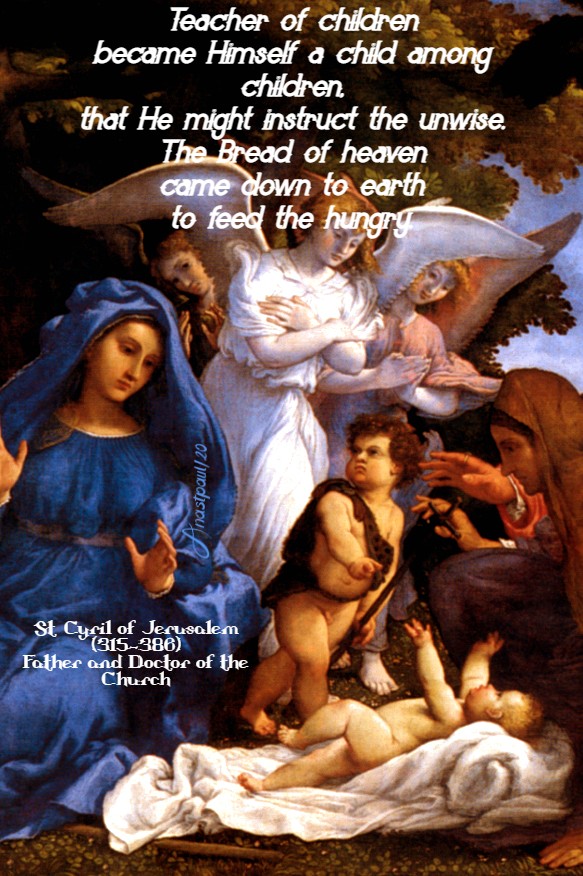
“Teacher of children became Himself a child among children, that He might instruct the unwise. The Bread of heaven came down to earth to feed the hungry.”
St Cyril of Jerusalem (315-386) Father and Doctor of the Church
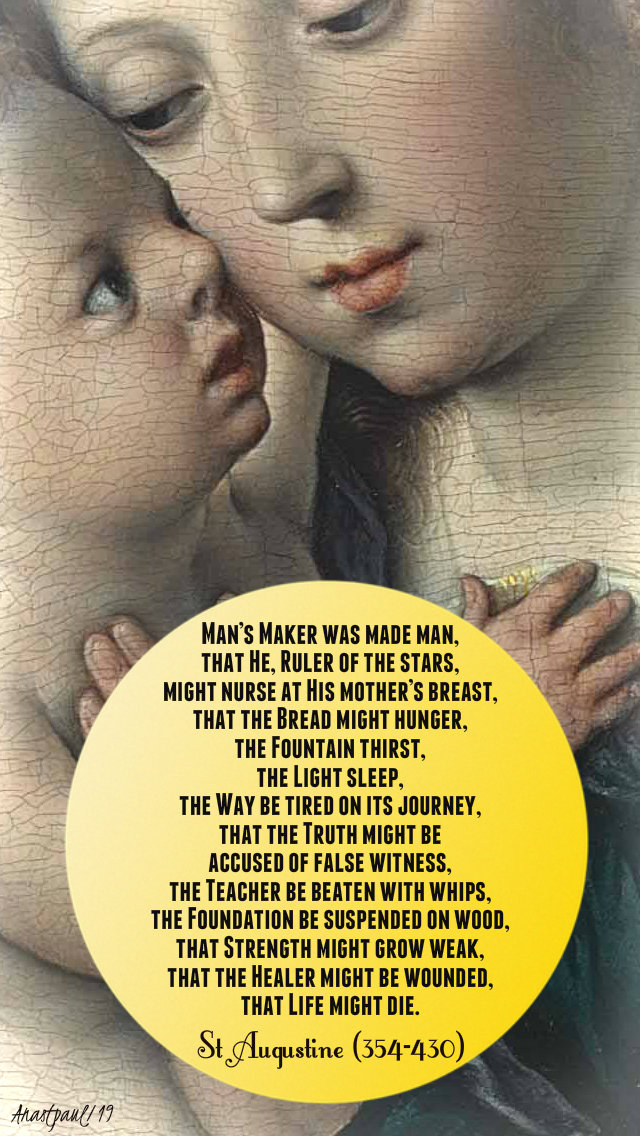
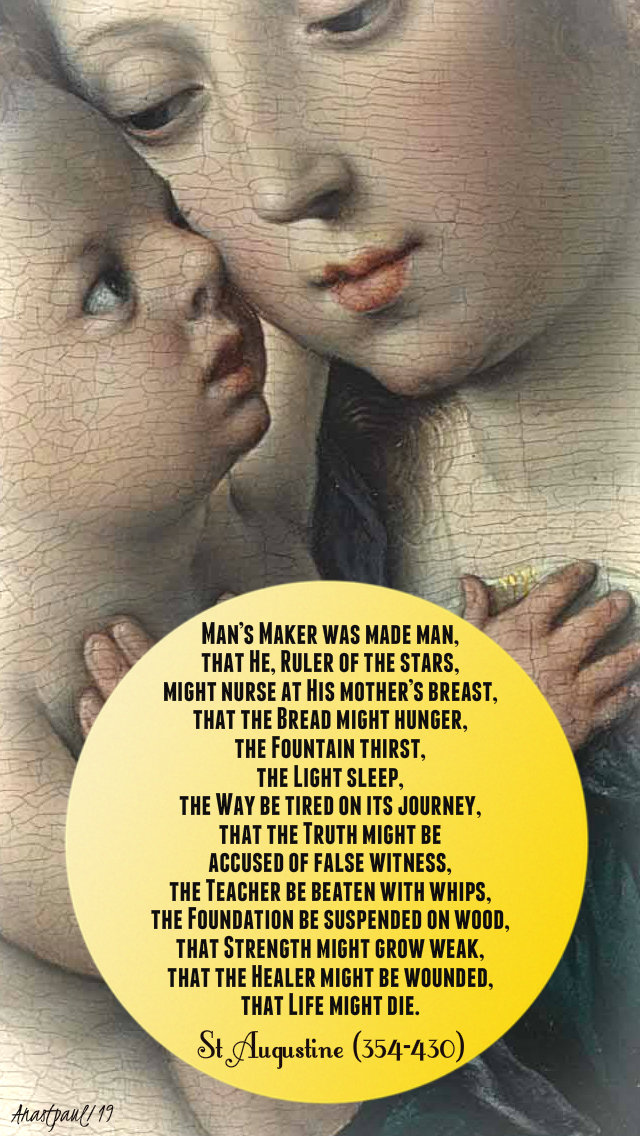
“Man’s Maker was made man, that He, Ruler of the stars, might nurse at His mother’s breast, that the Bread might hunger, the Fountain thirst, the Light sleep, the Way be tired on its journey, that the Truth might be accused of false witness, the Teacher be beaten with whips, the Foundation be suspended on wood, that Strength might grow weak, that the Healer might be wounded, that Life might die.”
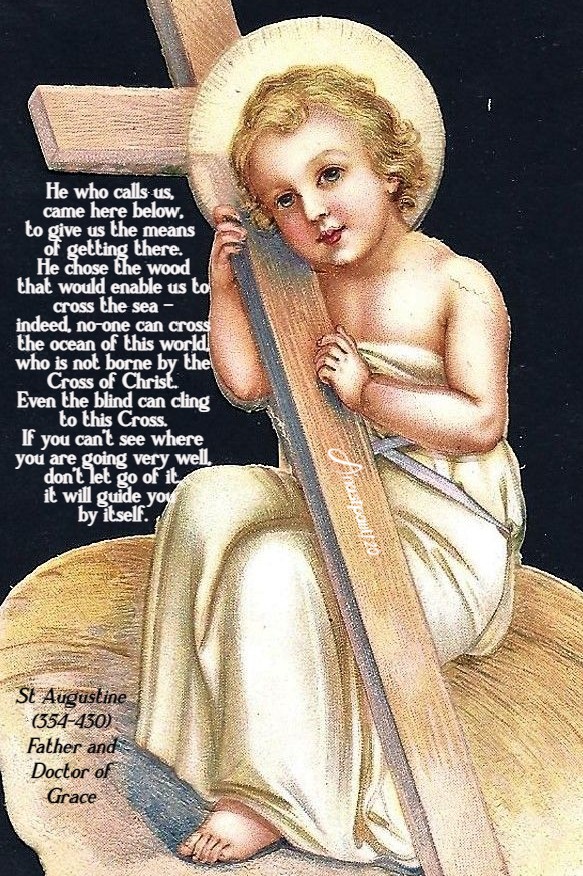
“He who calls us, came here below, to give us the means of getting there. He chose the wood that would enable us to cross the sea – indeed, no-one can cross the ocean of this world, who is not borne by the Cross of Christ. Even the blind can cling to this Cross. If you can’t see where you are going very well, don’t let go of it, it will guide you by itself.”
St Augustine (354-430) Father and Doctor of Grace
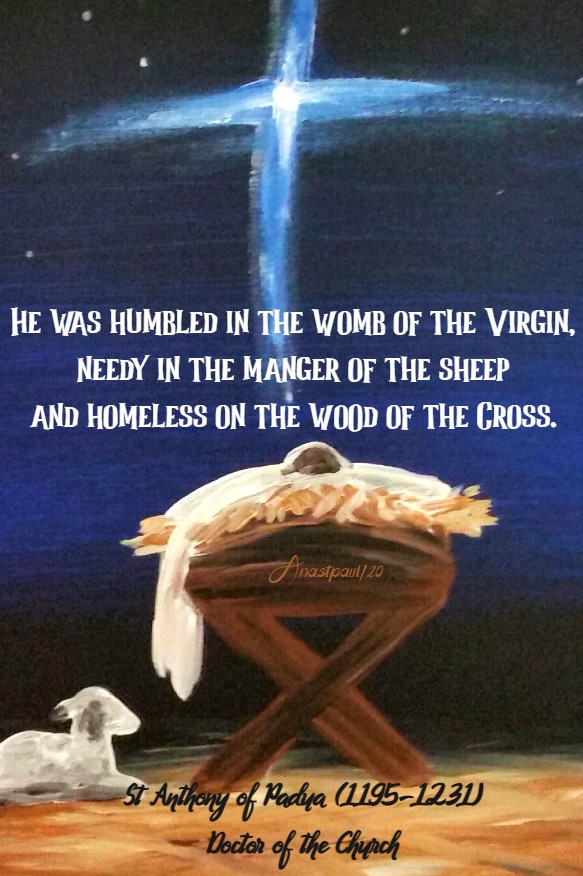
“He was humbled in the womb of the Virgin, needy in the manger of the sheep and homeless on the wood of the Cross.”
St Anthony of Padua (1195-1231) Doctor of the Church
Quote/s of the Day – 12 December – “Month of the Immaculate Conception” – Feast of Our Lady of Guadalupe, Readings: Zechariah 2:14-17, Judith 13:18, 19, Luke 1:26-38.
“And if any man will not receive His birth from a virgin, how shall he receive His resurrection from the dead? For it is nothing wonderful and astonishing and extraordinary, if one who was not born, rose from the dead – nay indeed, we cannot speak of a resurrection of him who came unto being without birth. For one who is unborn and immortal and has not undergone birth, will also not undergo death. For He, who took not the beginning of man, how could He receive His end?”
St Irenaeus (130-202) Martyr, Theologian, Father
“What shall we say, brethren? Is she not our mother? Certainly, brethren, she is in truth our mother. Through her we are born, not to the world but to God.”
“Scripture says, ‘Praise the Lord in his saints’. If the Lord is to be praised in those saints through whom He performs mighty works and miracles, how much more should He be praised in HER, in whom He fashioned Himself, He who is wonderful beyond all wonder.”
St Aelred of Rievaulx (1110-1167) From his sermons – Sermon 20
Advent Reflection – 11 December – Friday of the Second week of Advent, Readings: Isaiah 48:17-19, Psalms 1:1-2, 3, 4 and 6, Matthew 11:16-19
Let us adore the Lord, the king who is to come.
“For John came, neither eating nor drinking and they said, ‘He is possessed by a demon.’ The Son of Man came eating and drinking and they said, ‘Look, he is a glutton and a drunkard, a friend of tax collectors and sinners.’ But wisdom is vindicated by her works.” … Matthew 11:18-19
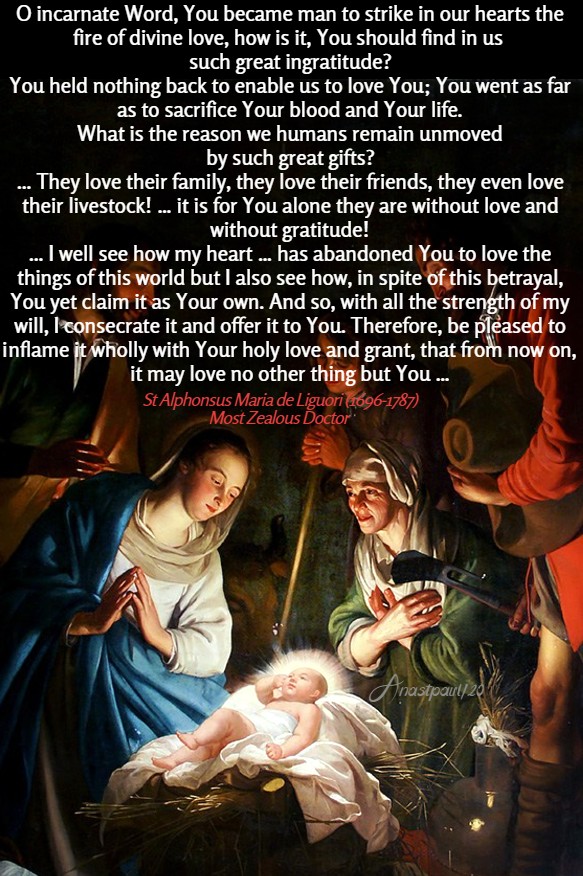
REFLECTION – “O Fire ever burning,” let us say together with Saint Augustine – “inflame our souls.” O incarnate Word, You became man to strike in our hearts the fire of divine love, how is it You should find in us such great ingratitude? You held nothing back to enable us to love You; You went as far as to sacrifice Your blood and Your life. What is the reason we humans remain unmoved by such great gifts? Is it because we know nothing about them? Not at all. People understand and believe, it is for love of them, You came down from heaven to put on human flesh and take on the burden of their woes. They know it is for love of them, You willed to lead a life of constant suffering and undergo a shameful death. How explain, after all this, their living in such absolute forgetfulness of Your unequalled kindness? They love their family, they love their friends, they even love their livestock! … it is for You alone they are without love and without gratitude! But what am I saying? In accusing others of ungratefulness, I condemn myself since my conduct in Your regard is even worse than theirs. Nevertheless, Your mercy gives me courage. I know how long it has borne with me, to forgive me and set me on fire with Your love, if only I am willing to repent and love You.
Oh yes, my God, I want to repent … I want to love You with all my heart. I well see how my heart … has abandoned You to love the things of this world but I also see how, in spite of this betrayal, You yet claim it as Your own. And so, with all the strength of my will, I consecrate it and offer it to You. Therefore, be pleased to inflame it wholly with Your holy love and grant, that from now on, it may love no other thing but You … O my Jesus, I love You, I love You, my sovereign Good! I love You, sole Love of my soul.
O Mary, my mother, you are the “mother of noble loving” (Sir 24:24 Vg.), grant me the grace of loving my God. It is from you that I hope to gain it.” – St Alphonsus Maria de Liguori (1696-1787) – Bishop and Most Zealous Doctor of the Church – 1st Sermon for the Octave of Christmas
PRAYER – Lord, watch over Your people, who come to You in confidence. Strengthen the hearts of those who hope in You. Give courage to those who falter because of their failures. In this holy season of Advent, lead them closer to You in hope, by the power of Your Holy Spirit. May Mary Immaculate, our Mother and Advocate be our eternal succour. Through Christ, our Lord, in the unity of the Holy Spirit, God for all eternity, amen.
Quote/s of the Day – 10 December – Thursday of the Second week of Advent
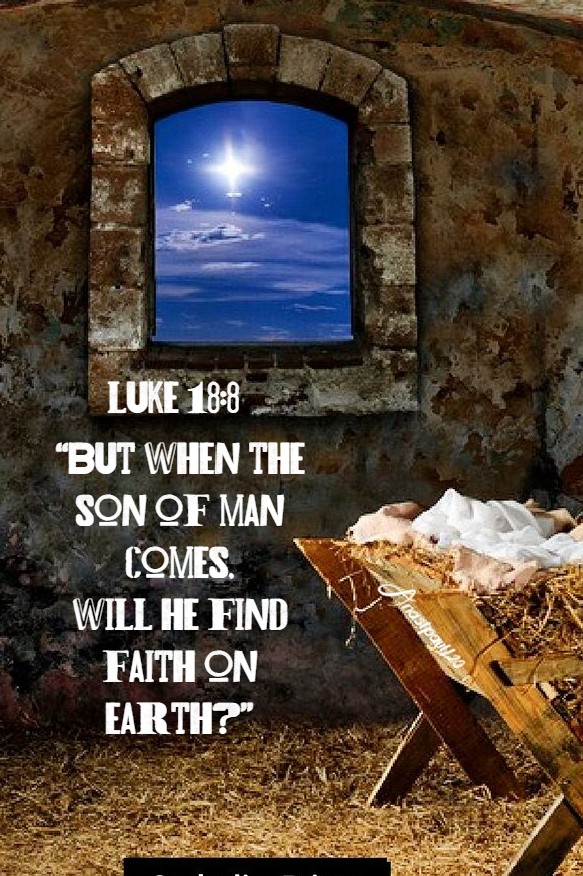
“But when the Son of Man comes, will he find faith on earth?”
Luke 18:8
“Man’s Maker was made man, that He, Ruler of the stars, might nurse at His mother’s breast, that the Bread might hunger, the Fountain thirst, the Light sleep, the Way be tired on its journey, that the Truth might be accused of false witness, the Teacher be beaten with whips, the Foundation be suspended on wood, that Strength might grow weak, that the Healer might be wounded, that Life might die.”
St Augustine (354-430) Father & Doctor of the Church
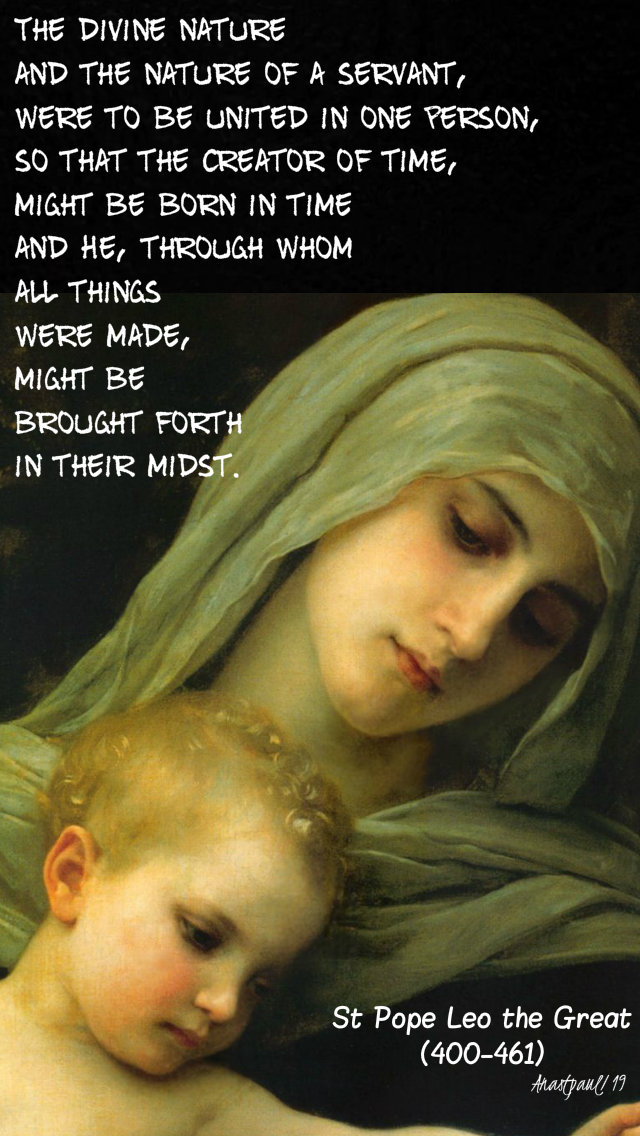
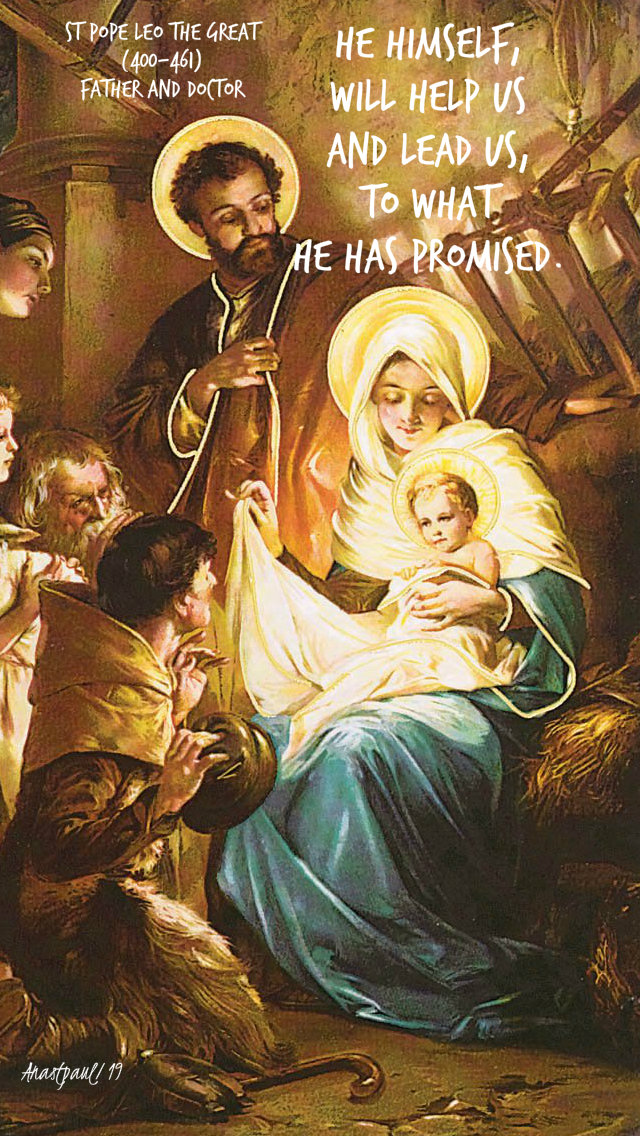
“The divine nature and the nature of a servant, were to be united in one person, so that the Creator of time, might be born in time and He, through whom all things were made, might be brought forth in their midst.”
“He Himself will help us and lead us to what He has promised.”
St Pope Leo the Great (400-461) Father and Doctor of the Church
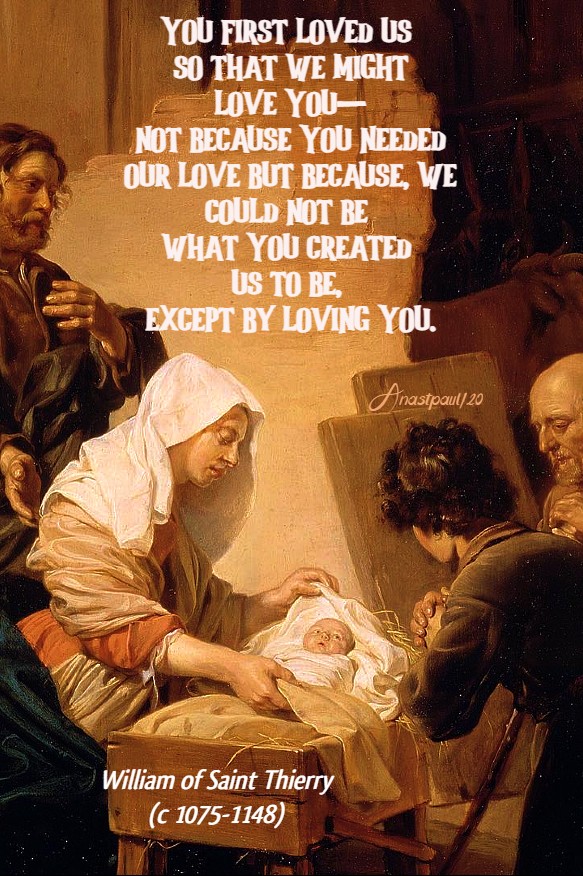
“You first loved us so that we might love You— not because You needed our love but because, we could not be what You created us to be, except by loving You.”
William of Saint Thierry (c 1075-1148) was a twelfth century French Benedictine Abbot of Saint-Thierry, theologian and mystic who became a Cistercian monk and writer.
Our Morning Offering – 9 December – Wednesday of the Second week of Advent
Let Thy goodness, Lord, Appear to Us An Advent Prayer By St Bernard (1090-1153) Father and Mellifluous Doctor of the Church
Let Thy goodness, Lord, appear to us, that we, made in Thy image, conform ourselves to it. In our own strength, we cannot imitate Thy majesty, power and wonder, nor is it fitting for us to try. But Thy mercy reaches from the heavens through the clouds, to the earth below. Thou hast come to us as a small child but Thou hast brought us the greatest of all gifts, the gift of eternal love. Caress us with Thy tiny hands, embrace us with Thy tiny arms and pierce our hearts with Thy soft, sweet cries. Amen
Advent Reflection – 7 December – Monday of the Second Week of Advent, Readings: Isaiah 35:1-10, Psalms 85:9 and 10, 11-12, 13-14, Luke 5:17-26 and the Memorial of St Ambrose (c 340-397)- Father and Doctor of the Church
Let us adore the Lord, the King who is to come.
And amazement seized them all and they glorified God and were filled with awe, saying, “We have seen extraordinary things today.”- Luke 5:26
REFLECTION – “The Word of God has come to dwell in man; he became “Son of man” in order to accustom man to receive God and God to dwell in man, as it has pleased the Father. See now why the sign of our salvation, Emmanuel born of a Virgin, has been given by the Saviour Himself (Is 7:14). Indeed, it is the Saviour Himself who saves men, since of themselves they cannot save themselves. (…) The prophet Isaiah has said: “Strengthen the hands that are feeble, make firm the knees that are weak! Take courage, frightened hearts; be strong, fear not! Here is your God who comes with vindication; he himself comes, he comes to save us,” (Is 35:3-4). For it is only by God’s help and not of ourselves, that we can stand up to our salvation.
And here is another text where Isaiah predicted that the one who saves us is neither simply a man nor an incorporeal being: “It was not a messenger or an angel but the Lord himself who saved his people. Because of his love and pity he forgave them; he redeemed them himself,” (Is 63:9). Yet this Saviour is also truly man, truly visible: “City of Zion, behold: your eyes shall see our Saviour” (…) And another prophet has said: “He will again have compassion on us and cast into the depths of the sea all our sins,” (Mi 7:19) (…) From the land of Judah, from Bethlehem (Mi 5:1) will come the Son of God, He who is also God, to pour out His praise on all the earth (…) Thus God has become man indeed and the Lord Himself has saved us, by giving us the sign of the Virgin.” – St Irenaeus of Lyons (c 130-c 202) Bishop, Church Father, Theologian and Martyr – Against the heresies III
PRAYER – Prayer of St Ambrose O Lord, who has mercy upon all, take away from me my sins and mercifully kindle in me the fire of Your Holy Spirit. Take away from me the heart of stone and give me a heart of flesh, a heart to love and adore You, a heart to delight in You, to follow and enjoy You, for Christ’s sake. Amen
Quote/s of the Day – 6 December – The Second Sunday of Advent
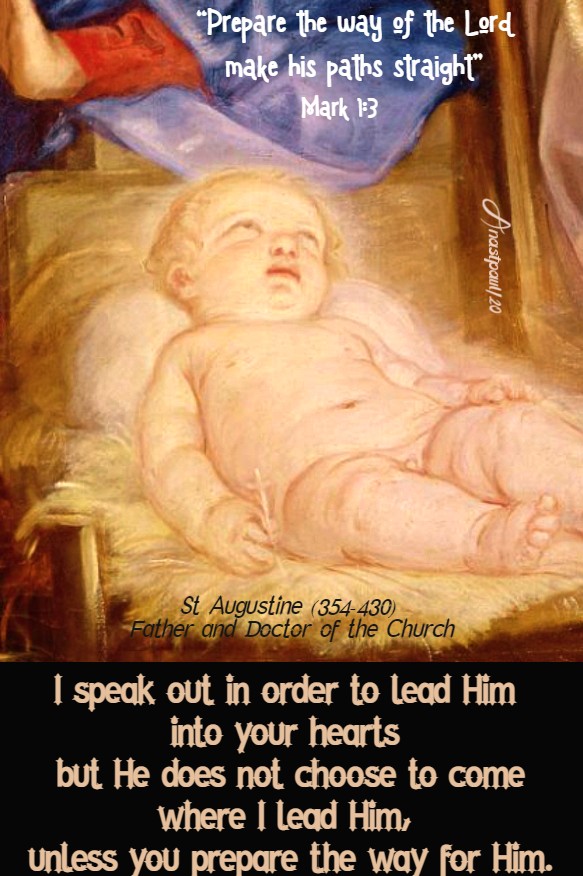
“Prepare the way of the Lord make his paths straight”
Mark 1:3
“Open wide your door to the One who comes. Open your soul, throw open the depths of your heart to see the riches of simplicity, the treasures of peace, the sweetness of grace. Open your heart and run to meet the Sun of eternal light that illuminates all men.”
St Ambrose (340-397) Father and Doctor of the Church
“I speak out in order to lead Him into your hearts but He does not choose to come where I lead Him, unless you prepare the way for Him.”
St Augustine (354-430) Father and Doctor of the Church
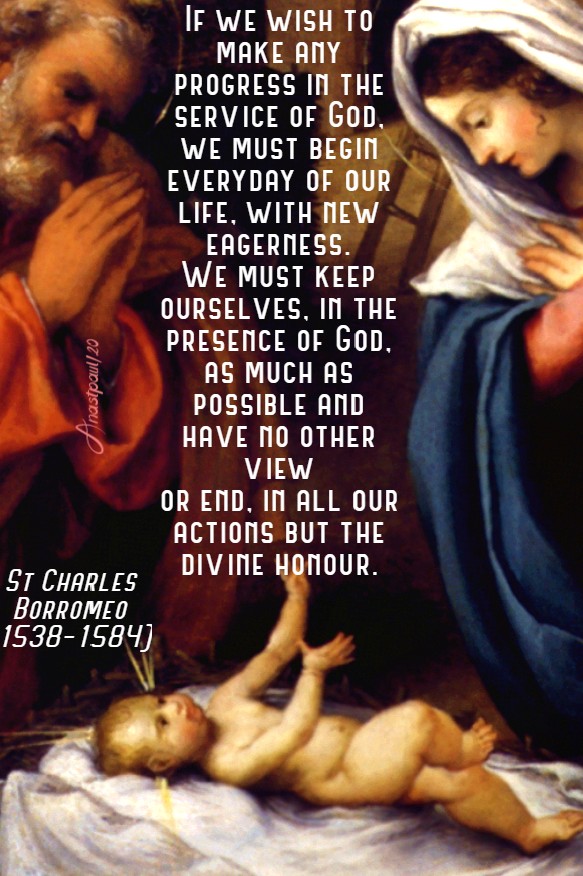
“If we wish to make any progress in the service of God, we must begin everyday of our life, with new eagerness. We must keep ourselves, in the presence of God, as much as possible and have no other view or end, in all our actions but the divine honour.”
Quote/s of the Day – 5 December – Saturday of the First week of Advent
“He is the Word of God who dwelt with man and became the Son of Man, to open the way for man, to receive God, for God to dwell with man, according to the will of the Father.”
St Irenaeus (130-202) Father of the Church
“The very Son of God, older than the ages, the invisible, the incomprehensible, the incorporeal, the beginning of beginning, the light of light, the fountain of life and immortality, the image of the archetype, the immovable seal, the perfect likeness, the definition and word of the Father: He it is who comes to His own image and takes our nature for the good of our nature and unites Himself to an intelligent soul for the good of my soul, to purify like by like.”
St Gregory of Nazianzen (330-390) Father and Doctor of the Church
“He became small because you were small – understand how great He is and you will become great along with Him. This is how houses are built, how the solid walls of a building are raised. The stones brought to construct the building increase, you, too, increase, understanding how great Christ is and how He who appeared to be small is great, very great indeed…”
St Augustine (354-430) Father & Doctor of the Church
“If we would please this Divine Infant, we too must become children, simple and humble. We must carry to Him, flowers of virtue, of meekness, of mortification, of charity. We must clasp Him in the arms of our love.”
St Alphonsus Liguori (1696-1787) Most Zealous Doctor
Thought for the Day – 3 June – “Month of the Sacred Heart” – Meditations with Antonio Cardinal Bacci (1881-1971)
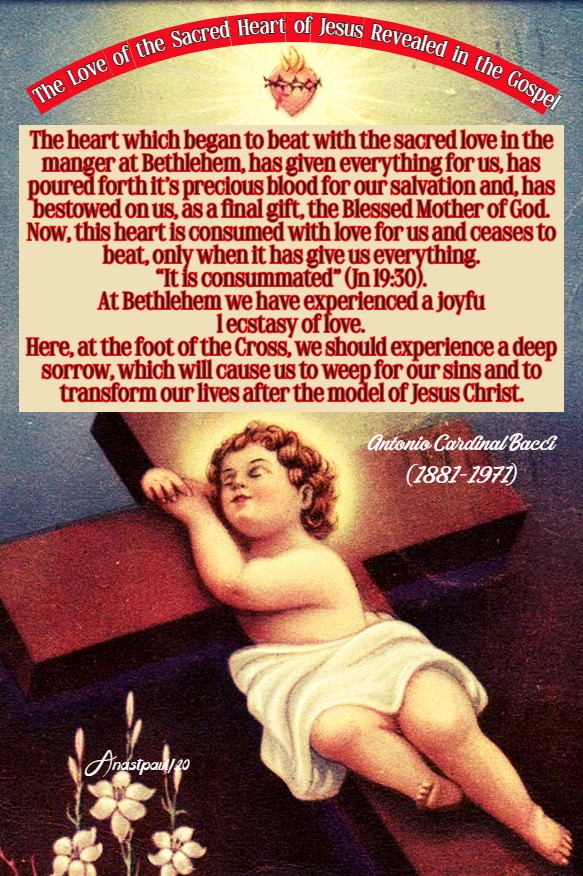
The Love of the Sacred Heart of Jesus Revealed in the Gospel
“If we meditate on the pages of the Gospel, we shall find that they are vibrant with the infinite love of the Sacred Heart of Jesus. Let us, in imagination, enter the cave of Bethlehem and kneel before the crib where the Divine Infant is lying. Darkness is all around, darkness over the earth, darkness in the minds and hearts of the majority of men. But, now, the heavens open and from the brightness the voices of angels ring out, “Glory to God in the highest and on earth, peace among men of goodwill.” Who is this infant? He is the Eternal Word, the substantial image of God, Who, for love of us, has been made man. He is the Infinite One Who has willed to unite Himself with the finite, in order to lift us towards Himself. This little heart is throbbing like that of any baby but, in this throb, is expressed the love of the God-Man. It is a profound mystery, that God should have loved man so much, that He became a tiny infant. Yet, He did this so that we might love Him more easily and in order to show us His own immeasurable love. There is about this Infant, a fascination, at once human and divine, which compels us to love Him, even as Mary, Joseph and the simple shepherds loved Him. He is asking us for love, adoration and complete surrender. Can we refuse Him?
Now let us take ourselves in imagination to Calvary and kneel at the foot of the Cross. The heart which began to beat with the sacred love in the manger at Bethlehem, has given everything for us, has poured forth it’s precious blood for our salvation and, has bestowed on us, as a final gift, the Blessed Mother of God. Now, this heart is consumed with love for us and ceases to beat only when it has give us everything. “It is consummated” (Jn 19:30). At Bethlehem we have experienced a joyful ecstasy of love. Here, at the foot of the Cross, we should experience a deep sorrow, which will cause us to weep for our sins and to transform our lives after the model of Jesus Christ.”
Quote/s of the Day – 21 February – the Memorial of St Peter Damian OSB (1007-1072) Doctor of the Church and St Robert Southwell SJ (1561-1595) Priest and Martyr
The Burning Babe, by Saint Robert Southwell
As I in hoary winter’s night stood shivering in the snow, Surprised I was with sudden heat which made my heart to glow; And lifting up a fearful eye to view what fire was near, A pretty babe all burning bright did in the air appear; Who, scorchëd with excessive heat, such floods of tears did shed As though his floods should quench his flames which with his tears were fed. Alas, quoth he, but newly born in fiery heats I fry, Yet none approach to warm their hearts or feel my fire but I! My faultless breast the furnace is, the fuel wounding thorns, Love is the fire, and sighs the smoke, the ashes shame and scorns; The fuel justice layeth on, and mercy blows the coals, The metal in this furnace wrought are men’s defiled souls, For which, as now on fire I am to work them to their good, So will I melt into a bath to wash them in my blood. With this he vanished out of sight and swiftly shrunk away, And straight I called unto mind that it was Christmas day.
It’s not surprising, it’s one of the great poems of the English language.
St Robert Southwell S.J. (1561-1595) Martyr, Religious Priest, Poet, Hymnodist, Writer, clandestine missionary was born in 1561 in Horsham Saint Faith, Norfolk, England and he was martyred by being hanged, drawn and quartered on 21 February 1595 (aged 33) in Tyburn, London, England. St Robert was Canonised on 25 October 1970 by Blessed Pope Paul VI. “His poetry – we don’t know exactly when he began to write but it must have been very young because he wrote a great deal of which we have the record and by now the English speaking world knows Robert Southwell. His two outstanding poems are ‘The Burning Babe’ and ‘The Virgin Mary to Christ On The Cross.’” (Ven Fr John A Hardon SJ)
Our Morning Offering – 1 January – The Solemnity of Mary, Mother of God and the Octave Day of the Nativity of the Lord
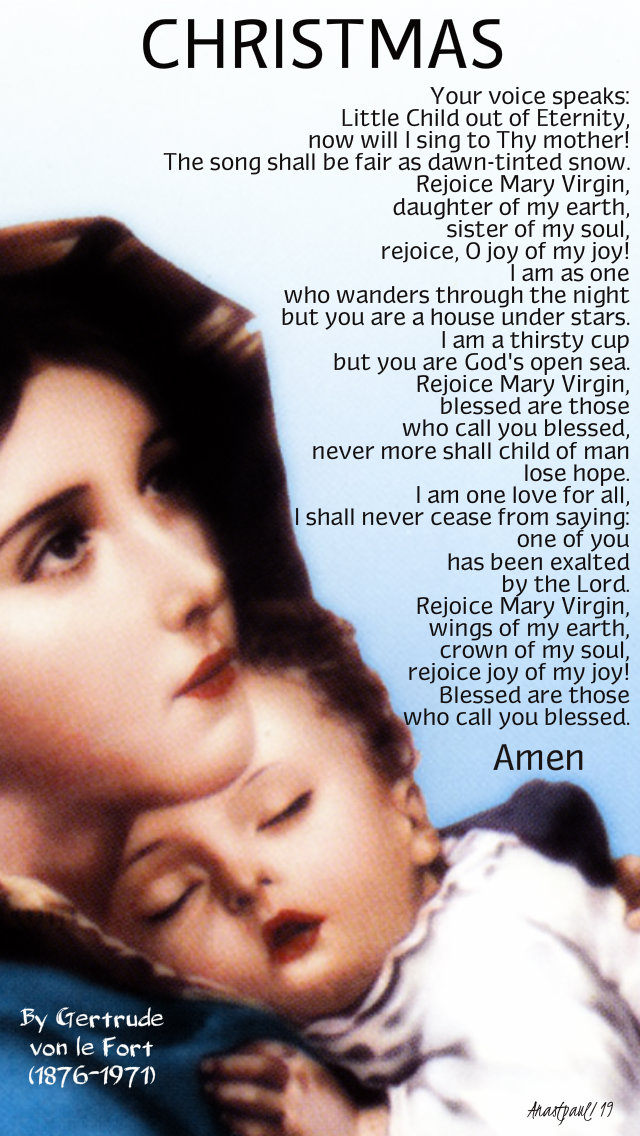
CHRISTMAS By Gertrude von le Fort (1876-1971)
Your voice speaks:
Little child out of Eternity, now will I sing to Thy mother!
The song shall be fair as dawn-tinted snow.
Rejoice Mary Virgin, daughter of my earth, sister of my soul,
rejoice, O joy of my joy!
I am as one who wanders through the night
but you are a house under stars.
I am a thirsty cup but you are God’s open sea.
Rejoice Mary Virgin, blessed are those who call you blessed,
never more shall child of man lose hope.
I am one love for all, I shall never cease from saying:
one of you has been exalted by the Lord.
Rejoice Mary Virgin, wings of my earth, crown of my soul,
rejoice joy of my joy!
Blessed are those who call you blessed.
The Baroness Gertrud von Le Fort (full name Gertrud Auguste Lina Elsbeth Mathilde Petrea Freiin von Le Fort – 11 October 1876 – 1 November 1971 – aged 95) was a German writer of novels, poems and essays. She converted to Catholicism in 1925 and most of her writings came after this conversion. She published over 20 books, comprising poems, novels and short stories. Her work gained her the accolade of being “the greatest contemporary transcendent poet.” Her works are appreciated for their depth and beauty of their ideas and for her sophisticated refinement of style. She was nominated by Hermann Hesse for the Nobel Prize in Literature and was granted an honorary Doctorate of Theology for her contributions to the issue of faith in her works.
53rd Annual World Day of Prayer for Peace: Feast day dedicated to peace. It first observed on 1 January 1968, proclaimed by St Pope Paul VI. It was inspired by the encyclical Pacem in Terris by St Pope John XXIII and with reference to Paul’s encyclical Populorum Progressio. Our Holy Fathers have used this day to make magisterial declarations relevant to the social doctrine of the Church on such topics as the United Nations, human rights, women’s rights, labour unions, economic development, the right to life, international diplomacy, peace in the Holy Land, globalisation, migrants, refugees and terrorism.
Titular Feast of the Society of Jesus – But now celebrated on 3 January, the Feast of the Holy Name of Jesus
Bl Adalbero of Liege
St Baglan of Wales
St Basil of Aix
Bl Bonannus of Roio
St Brogan
St Buonfiglio Monaldi
Bl Catherine de Solaguti
St Clarus of Vallis Regia
St Clarus of Vienne
St Colman mac Rónán
St Colman Muillin of Derrykeighan
St Concordius of Arles
St Connat
St Cuan
St Demet of Plozévet
St Elvan
St Eugendus of Condat
St Euphrosyne of Alexandria
St Fanchea of Rossory
St Felix of Bourges
St Frodobert of Troyes St Fulgentius of Ruspe (c 462 – 533)
St Gisela of Rosstreppe
St Gregory Nazianzen the Elder
Bl Hugolinus of Gualdo Cattaneo
Bl Jean-Baptiste Lego
Bl Jean of Saint-Just-en-Chaussée
St Joseph Mary Tomasi
St Justin of Chieti
Bl Lojze Grozde
St Maelrhys
St Magnus the Martyr
Bl Marian Konopinski
St Mydwyn
St Odilo of Cluny
St Odilo of Stavelot
St Peter of Atroa
St Peter of Temissis
Bl René Lego
St Sciath of Ardskeagh
St Severino Gallo
St Telemachus
St Thaumastus of Mainz
St Theodotus
St Tyfrydog
Bl Valentin Paquay
St Vincent Strambi
St William of Dijon
St Zedislava Berka
St Zygmunt Gorazdowski
—
Breton Missionaries to Britain
Martyred Soldiers of Rome: Thirty soldiers martyred in Rome as a group during the persecutions of Diocletian. We don’t even known their names. They were martyred c 304 at Rome, Italy.
Martyrs of Africa – 8 saints: Eight Christians martyred together in Africa, date unknown. The only details we have are four of their names – Argyrus, Felix, Narcissus and Victor.
Martyred in the Spanish Civil War:
• Blessed Andrés Gómez Sáez

















 AnaStpaul
You must be logged in to post a comment.