Advent and Christmas Wisdom with St Alphonsus Liguori (1696-1787)
19 December
The passion of Jesus lasted throughout His whole life
“Consider that when Abraham was leading his son Isaac to death, that he did not give him notice of it beforehand, even during the short time that was necessary for them to arrive at the mount. But the eternal Father chose that His incarnate Son, whom He had destined to be the victim for the atonement of our sins, should know the sorrow He was to endure from the very first moment that He was in His mother’s womb. The whole life, then, of our blessed Redeemer and all the years that He spent, was a life of pain and tears. His divine heart never passed one moment free from suffering. The martyrs have suffered but assisted by grace, they suffered with you and fervour. Jesus Christ suffered but He suffered with a heart full of weariness and sorrow and He accepted all, for our love.
O sweet, O amiable, O loving heart of Jesus, I thank You. O afflicted and loving heart of my Lord, I thank You for all that You suffered for me!”
Scripture
Rescue me, O my God, from the hand of the wicked, from the grasp of the unjust and cruel man.
Psalm 71:4
Prayer
O ROOT OF JESSE, that stands for an ensign of the people, before whom the kings keep silence and unto whom the Gentiles shall make supplication, come, to deliver us and tarry not.
Advent Action
Speechless I stand before You, contemplating the Father’s mysterious design for our salvation. I revere the elaborate preparations the Father puts in place for Your coming into our midst as one of us. First, He prepares a mother for You, preserving her from sin right from conception and filling her with grace. Then, in the fullness of time, He approaches her announcing His plan and the role she has to play in it. Then, He takes care of her heart-broken husband, Joseph, announcing to him the mystery of Your incarnation. And finally, the Father raises one more prophet to prepare the field for Your mission and to introduce You to our world.
Today, Your Word invites me to reflect on the role of the Baptist in Your redemptive work and challenges me to make space for You to be born in our world and in my heart.
Lord, let my life be a pointer to You as John’s was…I beg You!
Quote/s of the Day – 10 November – The Memorial of St Pope Leo the Great (c 400-461) Doctor of the Church and St Andrew Avellino CR (1521 – 1608)
“By Baptism we are made flesh of the Crucified.”
“The cross of Christ is the true ground and chief cause of Christian hope.”
“Let no one be ashamed of the cross by which Christ has redeemed the world. None of us must be afraid to suffer for the sake of justice or doubt the fulfilment of the promises, for it is through toil that we come to rest and through death that we pass to life.”
“Our sharing in the Body and Blood of Christ has no other purpose than to transform us into that which we receive.”
“He that sees another in error and endeavours not to correct it, testifies himself to be in error.”
“The birthday of the Lord is the birthday of peace.”
“Beyond our grasp, He chose to come within our grasp. Existing before time began, He began to exist at a moment in time.”
St Pope Leo the Great (c 400-461) Doctor of the Church
“One cannot separate the most Holy Eucharist from the Passion of Jesus.”
Thought for the Day – 19 October – The Memorial of St Peter of Alcantara OFM (1499-1562)
Everywhere he could do so, he planted crosses, for the Passion of Our Lord was engraved in his heart.
Wherever they were to be placed, even on mountains and however heavy they might be, he went to the destined sites carrying them on his shoulders. From these heights he would then preach the mysteries of the Cross, afterwards remaining in prayer there. Shepherds saw him several times in the air, at the height of the highest trees of the forests.
Never did he go anywhere except on foot, even in his old age. He was often seen prostrated before a large crucifix, shedding torrents of tears and he was found in ecstasy once at the height of the traverse of a crucifix.
The goal was following Christ in ever greater purity of heart. Whatever obstructed that path could be eliminated with no real loss. If men do not go about barefoot now, nor undergo sharp penances as Saint Peter did, there remain many ways of trampling on the spirit of the world and Our Lord teaches them, when He finds in souls the necessary courage.
Quote/s of the Day 25 June – The Memorial of St Maximus of Turin (? – c 420)
“At Christmas He was born a man; today He is reborn sacramentally. Then He was born from the Virgin; today He is born in mystery. When He was born a man, His mother Mary held Him close to her heart; when He is born in mystery, God the Father embraces Him with His voice when he says: This is my beloved Son, in whom I am well pleased: listen to Him. The mother caresses the tender baby on her lap; the Father serves His Son by His loving testimony. The mother holds the child for the Magi to adore; the Father reveals that His Son is to be worshiped by all the nations.”
“The light of Christ is an endless day that knows no night.”
Thought for the Day – 13 June – The Memorial of St Anthony of Padua (1195-1231) Doctor of the Church
Not only the Nativity, a central point of Christ’s love for humanity but also the vision of the Crucified One inspired in Anthony thoughts of gratitude to God and esteem for the dignity of the human person, so that all believers and non-believers might find in the Crucified One and in His image a life-enriching meaning.
St Anthony writes: “Christ, who is your life, is hanging before you, so that you may look at the Cross, as in a mirror. There you will be able to know, how mortal were your wounds, that no medicine other, than the Blood of the Son of God, could heal. If you look closely, you will be able to realise, how great your human dignity and your value are…. Nowhere other than looking at himself, in the mirror of the Cross, can man better understand how much he is worth”(Sermones Dominicales et Festivi III, pp. 213-214).
In meditating on these words we are better able to understand the importance of the image of the Crucified One for our culture, for our humanity that is born from the Christian faith. Precisely by looking at the Crucified One we see, as St Anthony says, how great are the dignity and worth of the human being. At no other point can we understand how much the human person is worth, precisely because God makes us so important, considers us so important that, in his opinion, we are worthy of his suffering; thus all human dignity appears in the mirror of the Crucified One and our gazing upon him is ever a source of acknowledgement of human dignity…..Pope Benedict XVI (General Audience – February 10, 2010)
One Minute Reflection – 3 June 2018 – The Solemnity of Corpus Christi Year B
And as they were eating, he took bread and blessed and broke it and gave it to them and said, “Take; this is my body.” And he took a cup and when he had given thanks, he gave it to them and they all drank of it. And he said to them, “This is my blood of thec covenant, which is poured out for many...Mark 14:22-24
REFLECTION – “Since we are talking about the Body, know that we, as many of us as partake of the Body, as many as partake of that Blood, we partake of something which is in no way different or separate from that which is enthroned on high, which is adored by the angels, which is next to Uncorrupt Power.”…St John Chrysostom (347-407) Doctor of the Church
PRAYER – Lord Jesus Christ, You gave Your Church, an admirable Sacrament as the abiding memorial of Your Passion. Teach us to worship the sacred mystery of Your Body and Blood, that it’s redeeming power may sanctify us always. Who live and reign with the Father and the Holy Spirit, God, forever, amen.
Arcadio Mas y Fondevila, Corpus Christi Spanish, 1887 Madrid, Museo Nacional del Prado This picture depicts priest and people in adoration at one of the street altars that are a part of the traditional Corpus Christi procession through a town.
Marian Thought for the Day – 23 May “Mary’s Month” – Wednesday in the 7th Week of Ordinary Time Year B
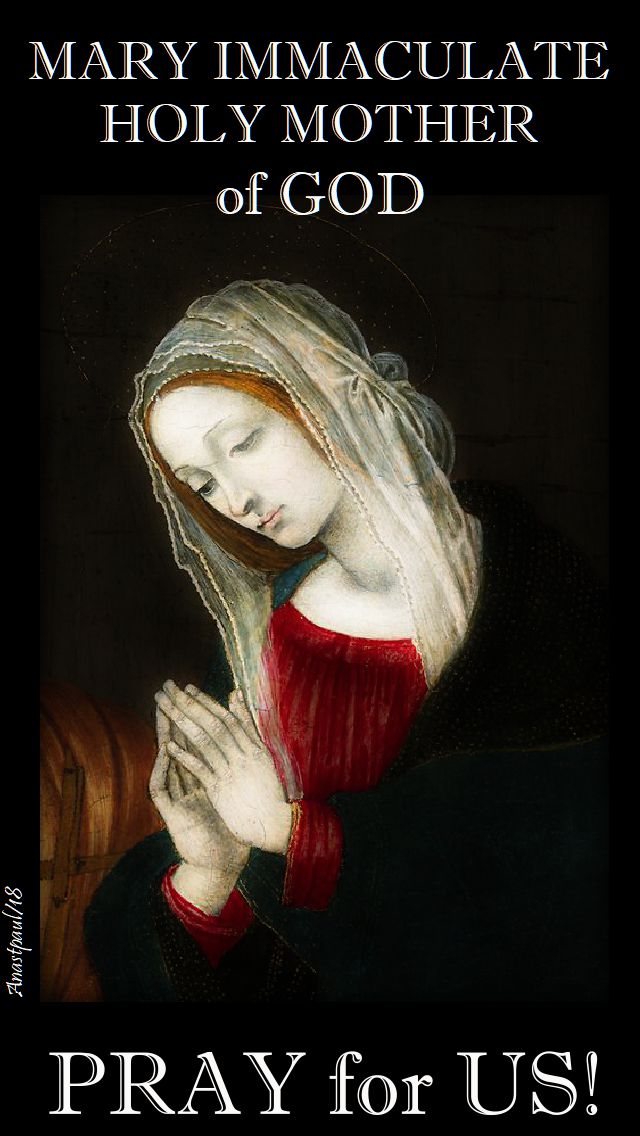
Mary is the “Vas Honorabile,” the Vessel of Honour
Blessed John Henry Newman (1801-1890)
ST PAUL calls elect souls vessels of honour: of honour, because they are elect or chosen; and vessels, because, through the love of God, they are filled with God’s heavenly and holy grace. How much more then is Mary a vessel of honour by reason of her having within her, not only the grace of God but the very Son of God, formed as regards His flesh and blood out of her!
But this title “honorabile,” as applied to Mary, admits of a further and special meaning. She was a martyr without the rude dishonour which accompanied the sufferings of martyrs. The martyrs were seized, haled about, thrust into prison with the vilest criminals and assailed with the most blasphemous words and foulest speeches which Satan could inspire. Nay, such was the unutterable trial also of the holy women, young ladies, the spouses of Christ, whom the heathen seized, tortured and put to death. Above all, our Lord Himself, whose sanctity was greater than any created excellence or vessel of grace—even He, as we know well, was buffeted, stripped, scourged, mocked, dragged about, and then stretched, nailed, lifted up on a high cross, to the gaze of a brutal multitude.
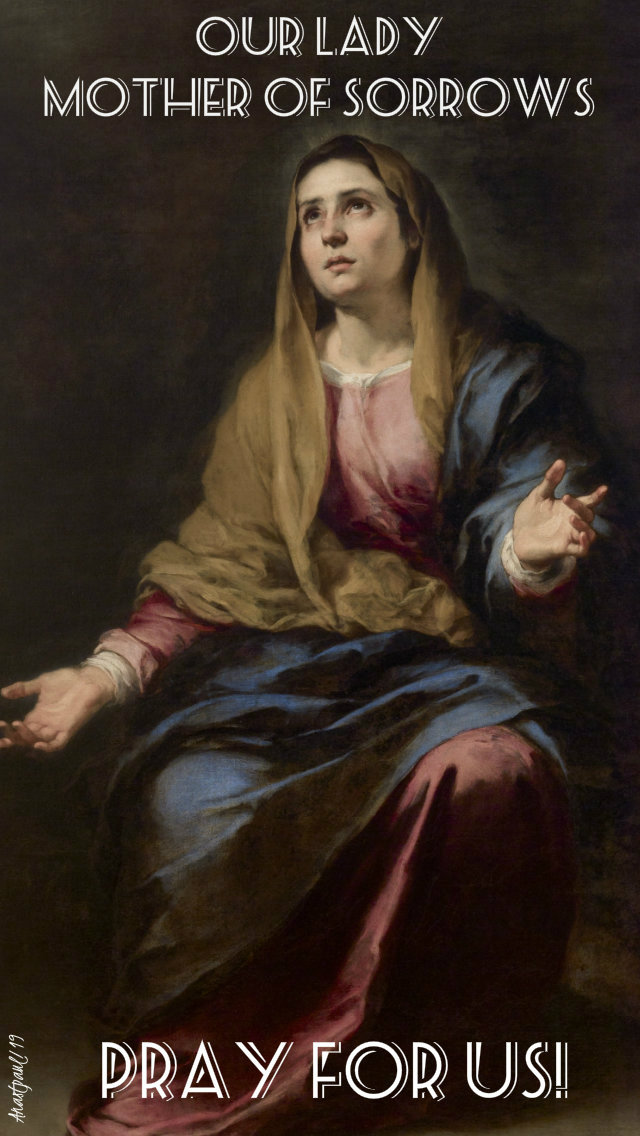
But He, who bore the sinner’s shame for sinners, spared His Mother, who was sinless, this supreme indignity. Not in the body, but in the soul, she suffered. True, in His Agony she was agonised; in His Passion she suffered a fellow-passion; she was crucified with Him; the spear that pierced His breast pierced through her spirit. Yet, there were no visible signs of this intimate martyrdom, she stood up, still, collected, motionless, solitary, under the Cross of her Son, surrounded by Angels and shrouded in her virginal sanctity from the notice of all who were taking part in His Crucifixion.
Mary “Vas Honorabile,” Vessel of Honour – Pray for us!
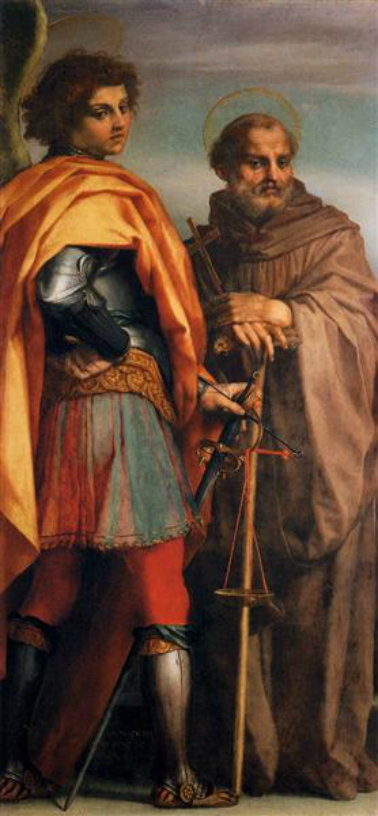
Thought for the Day – 18 May – Friday of the Seventh Week of Eastertide and the Memorial of St Felix of Cantalice O.F.M. Cap.(1515-1587) “Brother Deo Gratias”
Saint Felix did not have what the world esteems; his education was lacking. But he knew five red letters — the wounds of the divine crucified One, Whom he worshipped daily in the Blessed Sacrament and one white one — the Virgin Mary, from whom he one day miraculously received the divine Child in his arms.
St Felix of Cantalice “Brother Deo Gratias”, Pray for us!
One Minute Marian Reflection – 18 May “Mary’s Month” Friday of the Seventh Week of Eastertide
“…and you yourself a sword will pierce...” Luke 2:35
REFLECTION – “MARY: THE CO-REDEMPTRIX – “It is with good reason that the popes have called Mary co-redemptrix. ‘So fully, in union with her suffering and dying Son, did she suffer and nearly die; so fully, for the sake of the salvation of all souls, did she abdicate the rights of a mother over her Son and immolate him, insofar as it was in her power, to satisfy the justice of God, that it can rightly be said that she redeemed mankind together with Christ.’ This gives us a deeper understanding of that moment in the Passion of our Lord on which we shall never tire of meditating: Stabat autem iuxta crucem Iesu mater eius, ‘There, standing by the cross of Jesus, was his mother.'”…St Josemaría Escrivá (1902-1975) – “Mother of God and Our Mother,” Friends of God, 287. Let us offer to our Mother today: Five small hidden sacrifices in honour of the five major wounds of our Lord.
PRAYER – Lord God, in Your wisdom You gave us Your only begotten Son and His Mother to be ours too! You gave us both Your only Divine Son to save us from our sins and His Mother, to help us become Your perfect children. Penetrate our inmost being with Your holy light, so that our way of life may always be worthy of Your great love and the sacrifice of Your Son and His Mother. We ask this through Jesus Christ, our Lord, in the unity of the Holy Spirit, one God forever, amen.
Marian Thought for the Day – 17 May “Mary’s Month” – Thursday of the Seventh Week of Eastertide
Mary is the “Mater Salvatoris,” the Mother of the Saviour
Blessed John Henry Newman (1801-1890)
HERE again, as in our reflections of yesterday, we must understand what is meant, by calling our Lord a Saviour, in order to understand why it is used, to form one of the titles given to Mary in her Litany.
The special name by which our Lord was known before His coming was, as we found yesterday, that of Messias, or Christ. Thus He was known to the Jews. But when He actually showed Himself on earth, He was known by three new titles, the Son of God, the Son of Man and the Saviour; the first expressive of His Divine Nature, the second of His Human, the third of His Personal Office. Thus the Angel who appeared to Mary, called Him the Son of God; the angel who appeared to Joseph called Him Jesus, which means in English, Saviour; and so the Angels, too, called Him a Saviour when they appeared to the shepherds. But He Himself specially calls Himself the Son of Man.
Not Angels only, call Him Saviour but those two greatest of the Apostles, St Peter and St Paul, in their first preachings. St Peter says He is “a Prince and a Saviour” and St Paul says, “a Saviour, Jesus.” And both Angels and Apostles tell us why He is so called—because He has rescued us from the power of the evil spirit and from the guilt and misery of our sins. Thus the Angel says to Joseph, “Thou shalt call His name Jesus, for He shall save His people from their sins;” and St Peter, “God has exalted Him to be Prince and Saviour, to give repentance to Israel and remission of sins.” And He says Himself, “The Son of Man is come to seek and to save that which is lost.”
Now let us consider how this affects our thoughts of Mary. To rescue slaves from the power of the Enemy implies a conflict. Our Lord, because He was a Saviour, was a warrior. He could not deliver the captives without a fight, nor without personal suffering. Now, who are they who especially hate wars? A heathen poet answers. “Wars,” he says, “are hated by Mothers.” Mothers are just those who especially suffer in a war. They may glory in the honour gained by their children but still such glorying, does not wipe out, one particle of the long pain, the anxiety, the suspense, the desolation and the anguish which the mother of a soldier feels. So it was with Mary.
For thirty years she was blessed with the continual presence of her Son—nay, she had Him in subjection. But the time came when that war called for Him, for which He had come upon earth. Certainly He came, not simply to be the Son of Mary but to be the Saviour of Man and, therefore, at length He parted from her. She knew then, what it was to be the mother of a soldier. He left her side; she saw Him no longer, she tried in vain to get near Him. He had for years lived in her embrace and after that, at least in her dwelling—but now, in His own words, “The Son of Man had not where to lay His head.”
And then, when years had run out, she heard of His arrest, His mock trial and His passion. At last she got near Him—when and where?—on the way to Calvary and when He had been lifted upon the Cross. And at length she held Him again in her arms, yes—when He was dead. True, He rose from the dead but still she did not thereby gain Him, for He ascended on high and she did not at once follow Him. No, she remained on earth many years—in the care, indeed, of His dearest Apostle, St John. But what was even the holiest of men, compared with her own Son and Him the Son of God?
O Holy Mary, Mother of our Saviour, in this meditation we have now suddenly passed from the Joyful Mysteries to the Sorrowful, from Gabriel’s Annunciation to thee, to the Seven Dolours. That, then, will be the next series of Meditations which we make about thee.
One Minute Marian Reflection – 17 May “Mary’s Month” – Thursday of the Seventh Week of Eastertide
And at three o’clock Jesus cried out in a loud voice, “Eloi, Eloi, lema sabachthani?” which is translated, “My God, my God, why have you forsaken me?”…Mark 15:34
REFLECTION – “MARY: THE SORROWING MOTHER – “Our Lady is there listening to the words of her Son, united to Him in His suffering, when He cried out ‘My God, my God, why have you forsaken me?’ What could she do? She united herself fully, with the redemptive love of her Son and offered to the Father, her immense sorrow, which pierced her pure heart, like a sharp-edged sword.”…St Josemaría Escrivá (1902-1975) “Mother of God and Our Mother,” Friends of God, 288 Let us offer to our Mother today: The mortification of keeping quiet about any pain or discomfort, any inconvenience or disappointment, uniting it with her pain as she stood by her crucified Son.
PRAYER – Almighty God and Father, forgive the sins of Your people and as nothing we can do is worthy in Your sight, save us through the intercession of the Mother of our Lord Jesus Christ. As Christ suffered for our sins, so Mary, the Blessed Virgin His Mother, suffered with Him and for us too. Grant we pray, that by her prayers we may learn to give You these sufferings alone, in silence for our sins in union with our suffering Lord and His Mother, with the Holy Spirit, one God with You, forever amen.
Quote/s of the Day – 27 April – Friday of the Fourth Week of Eastertide
“Speaking of: Sin and Suffering”
“The dragon, sits by the side of the road, watching those who pass. Beware lest he devour you. We go to the Father of Souls but it is necessary, to pass by the dragon.”
St Cyril of Jerusalem (315-387) Father & Doctor of the Church
“Only those who do not fight are never wounded.”
St John Chrysostom (347-407) Father & Doctor of the Church
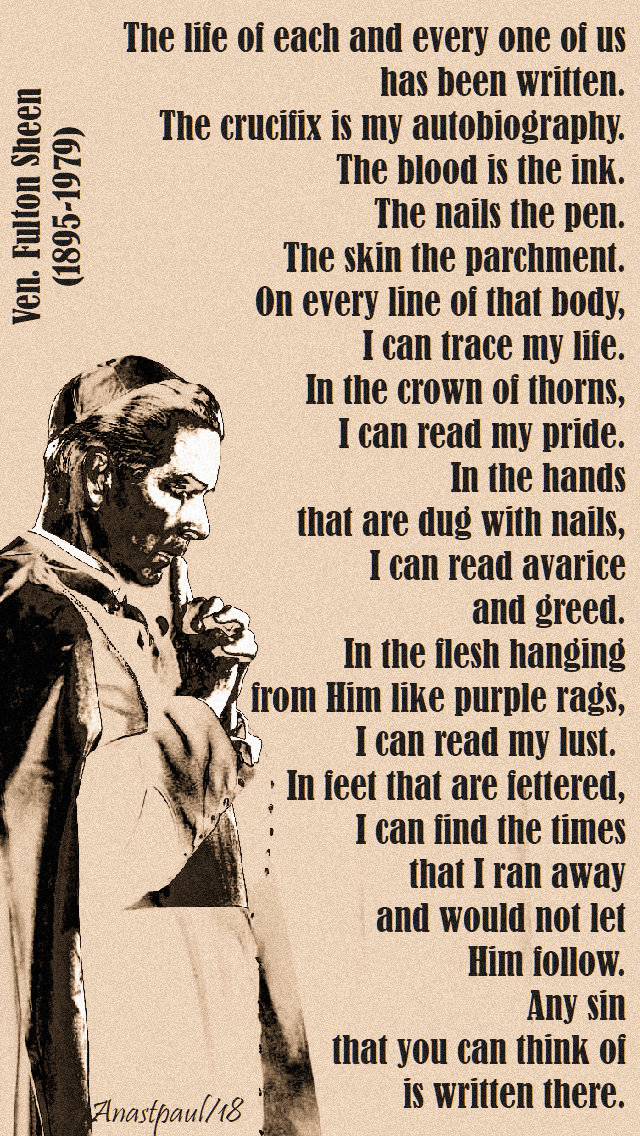
“The life of each and every one of us has been written. The crucifix is my autobiography. The blood is the ink. The nails the pen. The skin the parchment. On every line of that body, I can trace my life. In the crown of thorns I can read my pride. In the hands that are dug with nails, I can read avarice and greed. In the flesh hanging from him like purple rags, I can read my lust. In feet that are fettered, I can find the times that I ran away and would not let Him follow. Any sin that you can think of is written there.”
Venerable Archbishop Fulton Sheen (1895-1979)
“My key to heaven is that I loved Jesus in the night.”
Quote/s of the Day – 19 April – Thursday of the Third Week of Eastertide
“Speaking of: Becoming a Saint”
“Think well. Speak well. Do well. These three things, through the mercy of God, will make a man go to Heaven.”
St Camillus de Lellis (1550-1614)
“He who wishes for anything but Christ, does not know what he wishes; he who asks for anything but Christ, does not know what he is asking; he who works and not for Christ, does not know what he is doing.”
St Philip Neri (1515-1595)
“The great saint may be said, to mix all his thoughts with thanks. All goods look better, when they look like gifts.”
G K Chesterton (1874-1936)
“Enemy-occupied territory – that is what this world is. Christianity is the story of how, the rightful king has landed, you might say landed in disguise and is calling us all, to take part, in a great campaign of sabotage.”
C S Lewis (1898-1963)
“What people don’t realise, is how much Christianity costs. They think faith is a big electric blanket, when of course, it is the cross.”
Flannery O’Connor (1925-1964)
“Take courage! Fix your gaze on our saints.”
Pope Benedict XVI
“Take the Crucifixion personally.”
“The road to holiness goes through your neighbour.”
One Minute Reflection – 15 April – The Third Sunday of Easter Year B
Then he opened their minds to understand the scriptures and said to them, “Thus it is written, that the Christ should suffer and on the third day rise from the dead and that repentance and forgiveness of sins should be preached in his name to all nations, beginning from Jerusalem.”... Luke 24:45-48
REFLECTION – “This very experience of repentance and forgiveness is relived in every community in the Eucharistic celebration, especially on Sundays. The Eucharist, the privileged place in which the Church recognises “the Author of life” (Acts 3: 15) is “the breaking of the bread”, as it is called in the Acts of the Apostles. In it, through faith, we enter into communion with Christ, who is “the priest, the altar and the lamb of sacrifice” (see Preface for Easter, 5) and is among us. Let us gather round Him to cherish the memory of His words and of the events contained in Scripture; let us relive His Passion, death and Resurrection. In celebrating the Eucharist, we communicate with Christ, the victim of expiation and from Him we draw forgiveness and life. What would our lives as Christians be without the Eucharist? The Eucharist is the perpetual, living inheritance which the Lord has bequeathed to us in the Sacrament of His Body and His Blood and which we must constantly rethink and deepen so that, as venerable Pope Paul VI said, it may “impress its inexhaustible effectiveness on all the days of our earthly life” (Insegnamenti, V [1967], p. 779).”…Pope Benedict XVI
PRAYER – Lord God, grant Your people constant joy in the renewed vigour of their souls. Grant them sorrow for their sins and gratitude for the suffering of Your Son. Grant them forgiveness and life in the Holy Eucharist, through which we meet Him, who saved us. Grant, we pray, that we may grow in our love for the saving banquet to which we are called so that we may one day rejoice eternally, with You, in union with our Lord, Jesus Christ and the Holy Spirit, one God, forever amen. “O Lord, let the light of your countenance shine upon us”!
Quote/s of the Day – 7 April – Easter Saturday and the Memorial of St John Baptiste de La Salle (1651-1719)
“When you are at Mass, be there as if you were on Calvary. For it is the same sacrifice and the same Jesus Christ Who is doing for you what He did on the Cross for all human beings.”
“Jesus Christ came to this earth to reign here but not, says Saint Augustine, as other kings do, to raise tribute, enroll armies and visibly do battle against his enemies, for Jesus Christ assures us that His kingdom is not of this world but to establish His reign within our souls, according to what He Himself says, in the holy Gospel, that His kingdom is within us.”
“We must strive to place ourselves completely in God’s hands. Then He will cause us to feel the effects of His goodness and protection – which are, at times extraordinary.”
“Miracles happen by touching hearts.”
“You are called like the apostles to make God known to others.”
“God has chosen you to do his work.”
“Say to Jesus as the apostles did: ‘Lord, teach us to pray’.“
Devotion of The Seven Last Words of Christ – The Seventh Word – 31 March – Holy Saturday 2018
The Seven Last Words of Christ refer, not to individual words but to the final seven phrases that Our Lord uttered as He hung on the Cross. These phrases were not recorded in a single Gospel but are taken from the combined accounts of the four Gospels. Greatly revered, these last words of Jesus have been the subject of many books, sermons and musical settings.
The Seven Last Words of Christ
” Jesus reaches the heights of the depth of his prayer to the Father during His Passion and Death, when He pronounces His supreme “yes” to the plan of God and reveals how the human will finds its fulfilment precisely in adhering fully to the divine will, rather than the opposite. In Jesus’ prayer, in His cry to the Father on the Cross, “all the troubles, for all time, of humanity enslaved by sin and death, all the petitions and intercessions of salvation history are summed up … Here the Father accepts them and, beyond all hope, answers them beyond all hope, answers them by raising His Son. Thus is fulfilled and brought to completion the drama of prayer in the economy of creation and salvation” (CCC 2606)
Pope Benedict 7 March 2012
The Seventh Word
“Into Your hands I commend My spirit” (Luke 23:46)
Gospel: It was now about noon and darkness came over the whole land until three in the afternoon because of an eclipse of the sun. Then the veil of the temple was torn down the middle. Jesus cried out in a loud voice, “Father, into your hands I commend my spirit” and when he had said this, he breathed his last…Luke 23:44-46
The Word Incarnate utters His last sentence and in doing so, every last word takes on a special significance. In the act of dying, the God-Man teaches His brothers and sisters in the human family how to die. What is the final lesson?
Jesus died resigned to the Will of the One Who sent Him. However, we should not see this as passivity; it is an active resignation, which sums up His entire life: “As a man lives so shall He die.”
As we listen to the dying Saviour, two words draw our attention: “Father, into thy hands I commend my spirit.” “Father” and “thy” are the keys to the mystery of death. Jesus, in His humanity, does not rely on His own resources but casts His cares upon His heavenly Father, the Abba (“Papa”) in Whom He encouraged His disciples to have complete trust.
His heart is thus other-directed or, better, Other-directed toward the One “who was able to save Him from death” (Heb 5:7). With eyes fixed on Jesus (cf. Heb 3:1), then, Christians ponder what they need in death. They are three: the grace of perseverance, the grace of final repentance and the grace of a happy death.
Such a gift then leads to that most blessed thing of all – the grace of a happy death. Several years ago I received an early morning call to the hospital to bring Viaticum for a cancer patient I had attended the entire summer. Always thoughtful to a fault, she had restrained her family from contacting a priest during the night, lest he lose sleep. Upon my arrival, the woman stirred herself to prepare for her final encounter with the Eucharist. As I placed the Sacred Host on her tongue, she smiled, swallowed and died. Her son looked at me and said, “Father, that’s all she was waiting for all night.”
What a holy death! What a calming effect it had on her entire family! What a powerful and unforgettable witness she had offered! A holy death ensures a happy death because our eyes are “fixed on Jesus.”
Thinking about death – our own death – should not be an exercise in morbidity but a truly positive opportunity. St Alphonsus Liguori, author of the classic “Way of the Cross,” provides ample food for thought in his reflection for the Fifth Station . It has within it all the serenity of Jesus’ serenity in His final moments and thus recommends itself to our thoughts and as a guide for our actions – perennially.
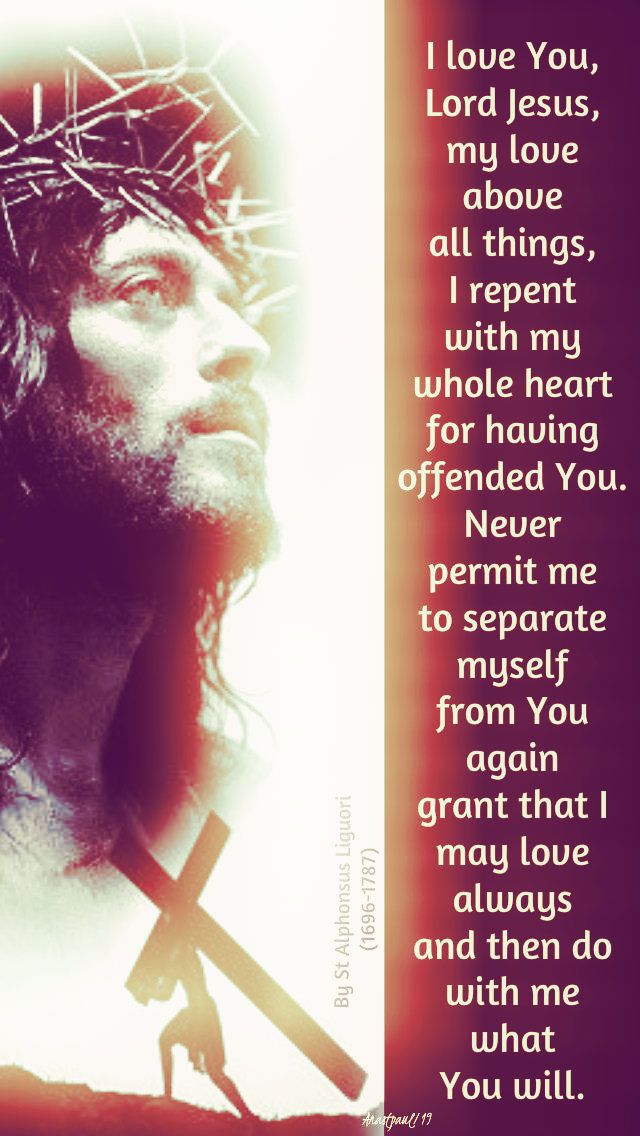
And so we are encouraged to say and to mean: “My beloved Jesus, I will not refuse the cross, as the Cyrenian did; I accept it, I embrace it. I accept in particular the death You have destined for me; with all the pains that may accompany it; I unite it to your death, I offer it to You. You have died for love of me; I will die for love of You, and to please You. Help me by your grace. I love You, Jesus, my love; I repent of ever having offended You. Never permit me to offend You again. Grant that I may love You always and then do with me what you will.” (St Alphonsus Liguori (1696-1787) Doctor of the Church) ...Excerpt from Fr Peter Stravinskas
Prayer of Abandonment to God’s Providence
Lord, Your Cross is high and uplifted;
I cannot mount it in my own strength.
You have promised:
“I, when I am lifted up from the earth,
I will draw all to Myself.”
Draw me, then, from my sins to repentance,
from darkness to faith,
from the flesh to the spirit,
from coldness to ardent devotion,
from weak beginnings to a perfect end,
from smooth and easy paths,
if it be Your will, to a higher and holier way,
from fear to love,
from earth to heaven,
from myself to You.
And as You have said:
“No man can come to Me,
except the Father, who sent Me, draw him,”
give unto me the Spirit Whom the Father hath sent in Your Name,
that in Him and through Him,
I being wholly changed,
may hasten to You
and go out no more for ever.
Amen
(From a Prayer a Day for Lent – 1923)
Our Morning Offering – 31 March – Holy Saturday 2018
Sabbatum Sanctum By Blessed John Henry Newman (1801-1890)
I look at You, my Lord Jesus
and think of Your most holy Body
and I keep it before me,
as a pledge of my own resurrection.
Though I die, as die I certainly shall,
nevertheless, I shall not forever die,
for I shall rise again.
O You, who are the Truth,
I know and believe with my whole heart,
that this very flesh of mine will rise again.
I know, base and odious as it is at present,
that it will one day, if I be worthy,
be raised incorruptible
and altogether beautiful and glorious.
This I know,
this by Your grace,
I will ever keep before me.
Amen
“O injured Lord, what can I say? I am very guilty concerning You, my brother; and I shall sink in sullen despair if You do not raise me. I cannot look on You; I shrink from You; I throw my arms round my face; I crouch to the earth. Satan will pull me down if You do not take pity. It is terrible to turn to You; but oh, turn me and so shall I be turned.
It is a purgatory to endure the sight of You, the sight of myself – I most vile, You most holy. Yet make me look once more on You whom I have so incomprehensibly affronted, for Your countenance is my only life, my only hope and health lies in looking on You whom I have pierced. So I put myself before You; I look on You again; I endure the pain in order to receive the purification.
O my God, how can I look You in the face when I think of my ingratitude, so deeply seated, so habitual, so immovable – or rather so awfully increasing!
You load me day by day with Your favours and feed me with Yourself, as You did Judas, yet not only do I not profit thereby but I do not even make any acknowledgement at the time.
Lord, how long? When shall I be free of this real, this fatal captivity? He who made Judas his prey has got foothold of me in my old age and I cannot get loose. It is the same day after day. When will You give me a still greater grace than You have given, the grace to profit by the graces that You give? When will You give me Your effectual grace, which alone can give life and vigour to this effete, miserable, dying soul of mine?
My God, I know not in what sense I can pain You in Your glorified state but I know that every fresh sin, every fresh ingratitude I now commit, was among the blows and stripes that once fell on You in Your Passion. Oh, let me have as little share in those past sufferings as possible. Day by day goes and I find I have been more and more, by the new sins of each day, the cause of them. I know that at best I have a real share of them all but still it is shocking to find myself having a greater and greater share. Let others wound You – let not me. Let me not have to think that You would have had this or that pang of soul or body the less, except for me.
O my God, I am so fast in prison that I cannot get out. O Mary, pray for me.”
Devotion of The Seven Last Words of Christ – The Fifth Word – 30 March – Good Friday morning 2018
The Seven Last Words of Christ
The Seven Last Words of Christ refer, not to individual words but to the final seven phrases that Our Lord uttered as He hung on the Cross. These phrases were not recorded in a single Gospel but are taken from the combined accounts of the four Gospels. Greatly revered, these last words of Jesus have been the subject of many books, sermons and musical settings.
“Love is not loved”: this reality, according to some accounts, is what upset Saint Francis of Assisi. For love of the suffering Lord, he was not ashamed to cry out and grieve loudly (cf. Fonti Francescane, no. 1413). This same reality must be in our hearts as we contemplate Christ Crucified, He who thirsts for love. Mother Teresa of Calcutta desired that in the chapel of every community of her sisters the words “I thirst” would be written next to the crucifix. Her response was to quench Jesus’ thirst for love on the Cross through service to the poorest of the poor. The Lord’s thirst is indeed quenched by our compassionate love; He is consoled when, in His name, we bend down to another’s suffering. On the day of judgement they will be called “blessed” who gave drink to those who were thirsty, who offered true gestures of love to those in need: “As you did it to one of the least of these my brethren, you did it to me” (Mt 25:40).”
Pope Francis
The Fifth Word
“I thirst” (John 19:28)
Gospel: After this, Jesus knew that everything had now been completed and, so that the scripture should be completely fulfilled, he said: I thirst. A jar full of sour wine stood there; so, putting a sponge soaked in the wine on a hyssop stick, they held it up to his mouth….John 19:28-29
During Our Lord’s Passion, He was twice offered a drink. This first was a mixture of wine and myrrh. This Our Lord refused because it was commonly given to condemned criminals to deaden pain. His Passion and Death would have been rendered worthless if He had allowed anything to mitigate the pain He was about to suffer. The second drink He was offered was sour wine or vinegar. This He drank. In doing so, He drank deeply of the cup which He had begged His Father to remove from Him in the Garden. He drank the last dregs of the cup of our punishment.
Lord God, Your Only Begotten Son drank deeply of the cup of iniquity for my sake. If I were to try to drink the same draft by myself, I would not be able to survive. It is only with Your help that I can hope to drink of my own bitter draught and survive. Help me to turn away from the sweetness of the world and accept the bitter drink that is punishment for my sins. I beg You to send me the grace and strength required to accept this bitter cup. Let not my will be done, but Thine. Amen.
Prayer of Abandonment to God’s Providence
My Lord and my God:
into your hands I abandon the past and the present and the future,
what is small and what is great,
what amounts to a little and what amounts to a lot,
things temporal and things eternal.
Amen. Our Father. Hail Mary. Glory Be.
Quote/s of the Day – 30 March 2018 – Good Friday of the Passion of the Lord
“But far be it from me to glory, except in the Cross of our Lord Jesus Christ, by which the world has been crucified to me and I to the world.”
St Paul
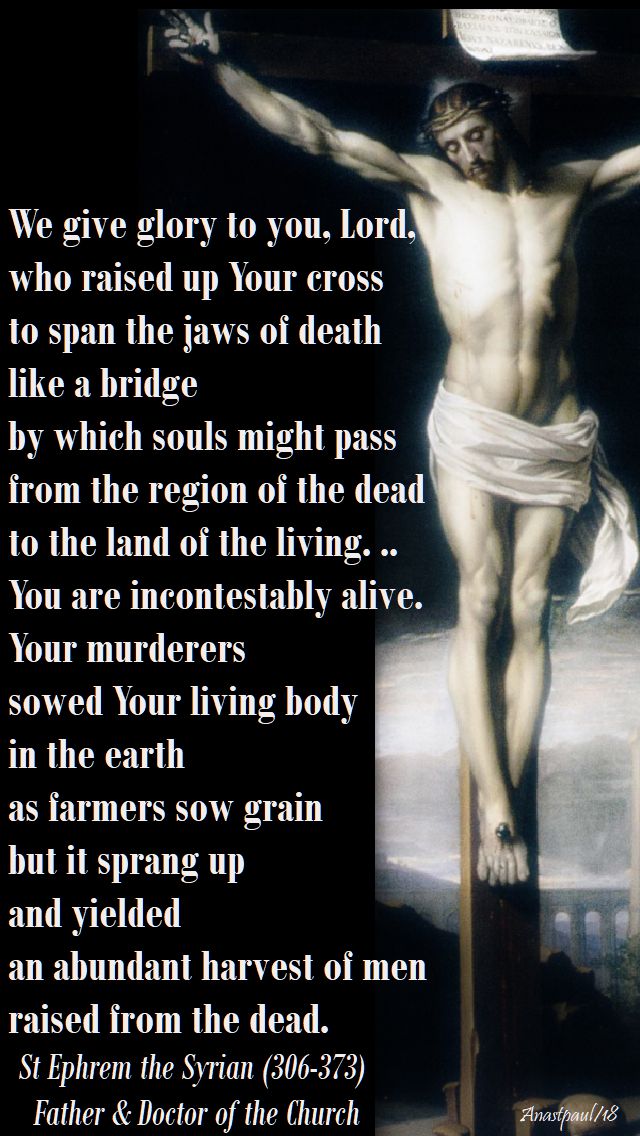
“We give glory to You, Lord, who raised up Your Cross to span the jaws of death like a bridge by which souls might pass from the region of the dead to the land of the living. .. You are incontestably alive. Your murderers sowed Your living body in the earth as farmers sow grain but it sprang up and yielded an abundant harvest of men raised from the dead.”
St Ephrem the Syrian (306-373) Father & Doctor of the Church
“Mount Calvary is the academy of love.”
St Francis de Sales (1567-1622) Doctor of the Church
” …Let us direct today our gaze toward Christ, a gaze frequently distracted by scattered and passing earthly interests. Let us pause to contemplate His Cross. The cross, fount of life and school of justice and peace, is the universal patrimony of pardon and mercy. It is permanent proof of a self-emptying and infinite love that brought God to become man, vulnerable like us, unto dying crucified.”
One Minute Reflection – 30 March 2018 – Good Friday of the Passion of the Lord
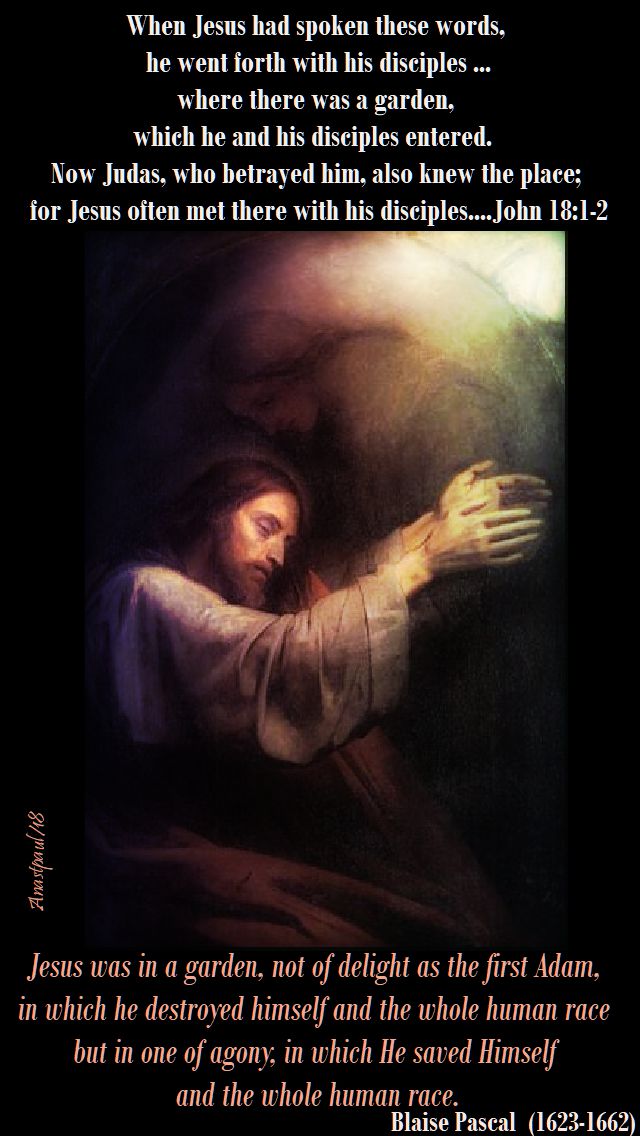
When Jesus had spoken these words, he went forth with his disciples across the Kidron valley, where there was a garden, which he and his disciples entered. Now Judas, who betrayed him, also knew the place; for Jesus often met there with his disciples..…..John 18:1-2
REFLECTION – “Jesus was in a garden, not of delight as the first Adam, in which he destroyed himself and the whole human race but in one of agony, in which He saved Himself and the whole human race.”…Blaise Pascal (1623-1662)
“Do not pass one day without devoting a half hour, or at least a quarter of an hour, to meditation on the sorrowful Passion of your Saviour. Have a continual remembrance of the agonies of your crucified Love and know that the greatest saints, who now, in heaven, triumph in holy love, arrived at perfection in this way.” – St Paul of the Cross (1694-1775)
PRAYER – Be mindful Lord, of this Your family, for whose sake our Lord Jesus Christ, when betrayed, did not hesitate to yield Himself into His enemies hands and undergo the agony of the Cross. Help us holy Father, to ever keep the Cross in our hearts and minds and to accept our own with love of You. Through Jesus our Lord, with the Holy Spirit, one God, amen.
Our Morning Offering – 39 March 2018 – Good Friday of the Passion of the Lord
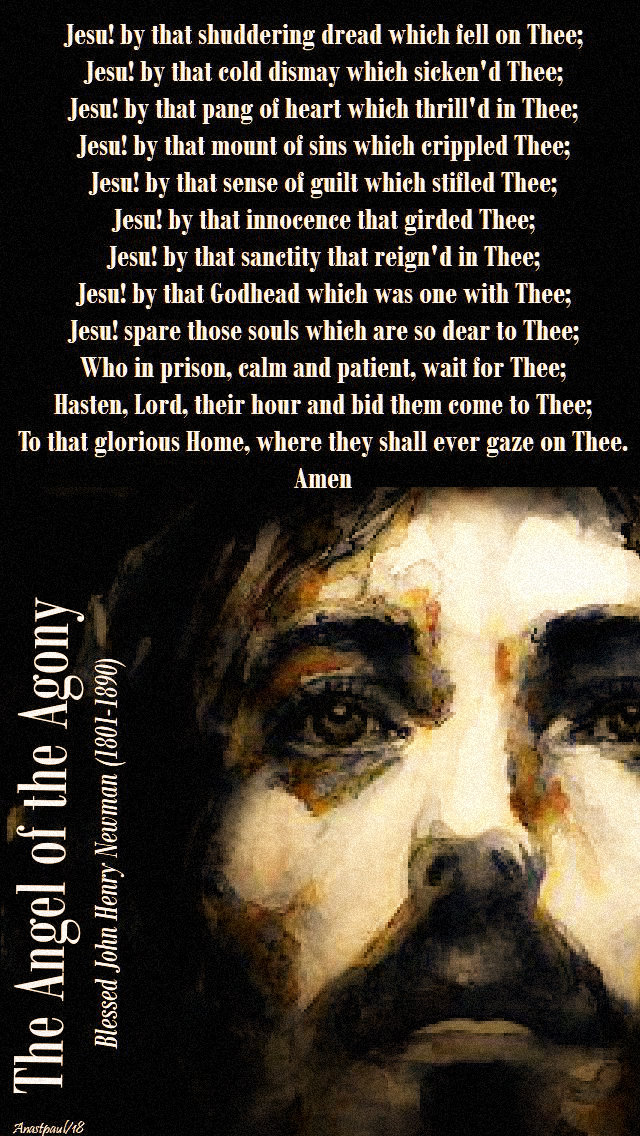
The Angel of the Agony Blessed John Henry Newman (1801-1890)
Jesu! by that shuddering dread which fell on Thee;
Jesu! by that cold dismay which sicken’d Thee;
Jesu! by that pang of heart which thrill’d in Thee;
Jesu! by that mount of sins which crippled Thee;
Jesu! by that sense of guilt which stifled Thee;
Jesu! by that innocence that girded Thee;
Jesu! by that sanctity that reign’d in Thee;
Jesu! by that Godhead which was one with Thee;
Jesu! spare those souls which are so dear to Thee;
Who in prison, calm and patient, wait for Thee;
Hasten, Lord, their hour and bid them come to Thee;
To that glorious Home, where they shall ever gaze on Thee.
Amen
Devotion of The Seven Last Words of Christ – The Fourth Word – 29 March – Holy Thursday 2018
The Seven Last Words of Christ
The Seven Last Words of Christ refer, not to individual words but to the final seven phrases that Our Lord uttered as He hung on the Cross. These phrases were not recorded in a single Gospel but are taken from the combined accounts of the four Gospels. Greatly revered, these last words of Jesus have been the subject of many books, sermons and musical settings. For centuries The Seven Last Words have been built into various forms of devotion for the consideration and consolation of the Christian people.
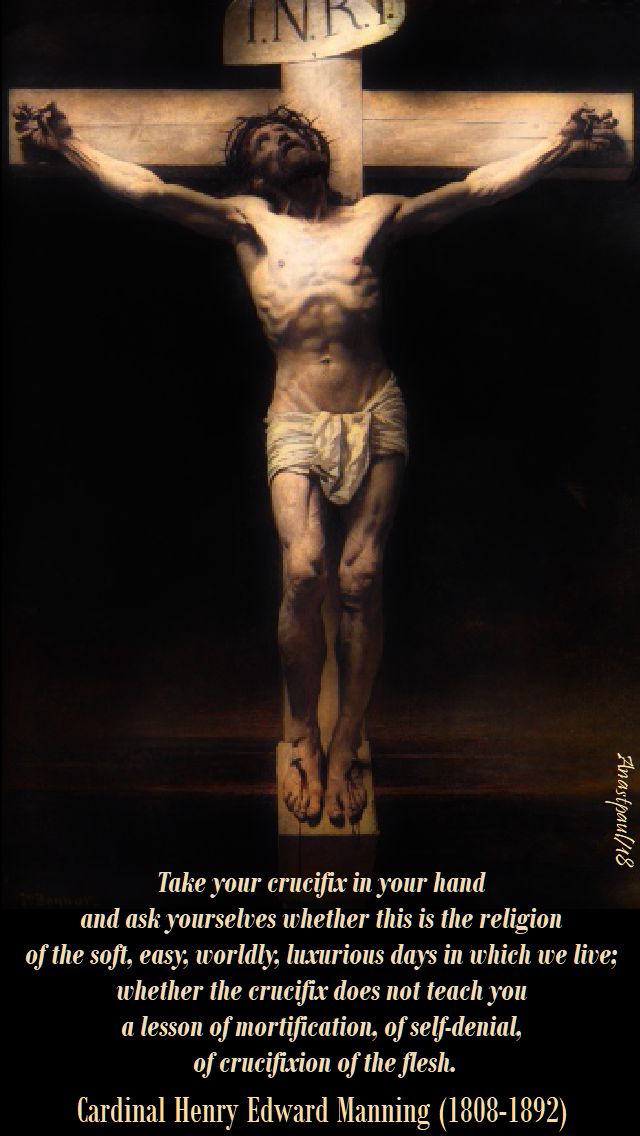
“Take your crucifix in your hand and ask yourselves whether this is the religion of the soft, easy, worldly, luxurious days in which we live; whether the crucifix does not teach you a lesson of mortification, of self-denial, of crucifixion of the flesh.”
Cardinal Henry Edward Manning (1808-1892)
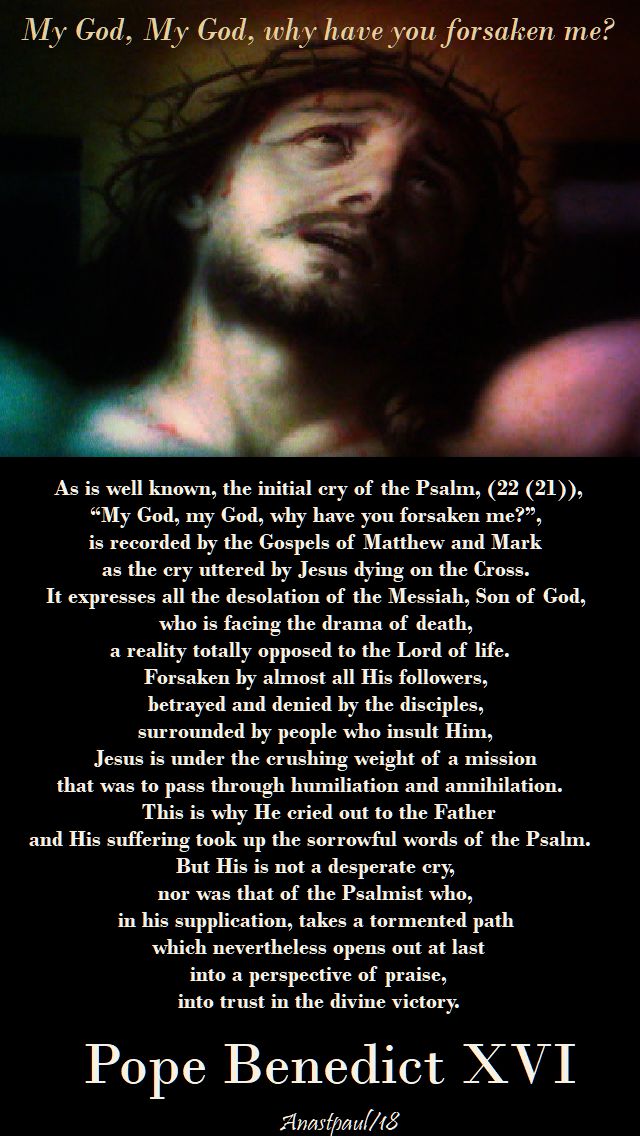
“As is well known, the initial cry of the Psalm 22, “My God, my God, why have you forsaken me?”, is recorded by the Gospels of Matthew and Mark as the cry uttered by Jesus dying on the Cross (cf. Mt 27:46, Mk 15:34). It expresses all the desolation of the Messiah, Son of God, who is facing the drama of death, a reality totally opposed to the Lord of life. Forsaken by almost all His followers, betrayed and denied by the disciples, surrounded by people who insult Him, Jesus is under the crushing weight of a mission that was to pass through humiliation and annihilation. This is why He cried out to the Father and His suffering took up the sorrowful words of the Psalm. But His is not a desperate cry, nor was that of the Psalmist who, in his supplication, takes a tormented path which nevertheless opens out at last into a perspective of praise, into trust in the divine victory.”…Pope Benedict XVI – General Audience 14 September 2011
The Fourth Word
“My God, my God, why have you forsaken me?”
Gospel – From noon onward, darkness came over the whole land until three in the afternoon. And about three o’clock Jesus cried out in a loud voice, “Eli, Eli, lema sabachthani?” which means, “My God, my God, why have you forsaken me?”…Matthew 27:45-46 (Psalm 22(21))
Reflection: To ensure that He suffered every torment that normal man is prone to, Christ allowed Himself to experience despair. Up to this point, Jesus had suffered mainly physically. These torments had left His body racked with pain and agony. But now it was time for the ultimate pain, the pain a soul feels when it is separated from God.
The soul is spiritual being in the image of God. The human soul is like a plant is nourished by the bright sunlight of God. The human soul needs this light to grow and flourish. However, unlike a plant, the human soul does not die when it is separated from God because it cannot die. Instead the soul endures great and debilitating agony. It was this kind of agony that Our Lord willingly accepted on the Cross.
O sinful man, how can you claim that Our Lord does not understand the pain you are going through? He has suffered every imaginable punishment. He has felt the rejection of His own people. He has endured the dreadful physical pains of a brutal scourging and ignominious death on a Cross. He had endured the despair of a soul separated from God. He understands pain, agony, loss and despair. And He wishes to console you . He stands with arms out stretched on the Cross, looking to comfort you in all your distress.
Lord Jesus Christ, You know better than anyone what suffering I am enduring. I beg you to give me the grace and strength to endure these hardships, that I may offer them as penance for my sins. Help me to never refuse my cross, so that by taking it up daily I may be worthy of You one day. Amen.
Prayer of Abandonment to God’s Providence
My Lord and my God:
into your hands I abandon the past and the present and the future,
what is small and what is great,
what amounts to a little and what amounts to a lot,
things temporal and things eternal.
Amen. Our Father. Hail Mary. Glory Be.
Thought for the Day – 29 March – Holy Thursday – The Mass of the Lord’s Supper 2018
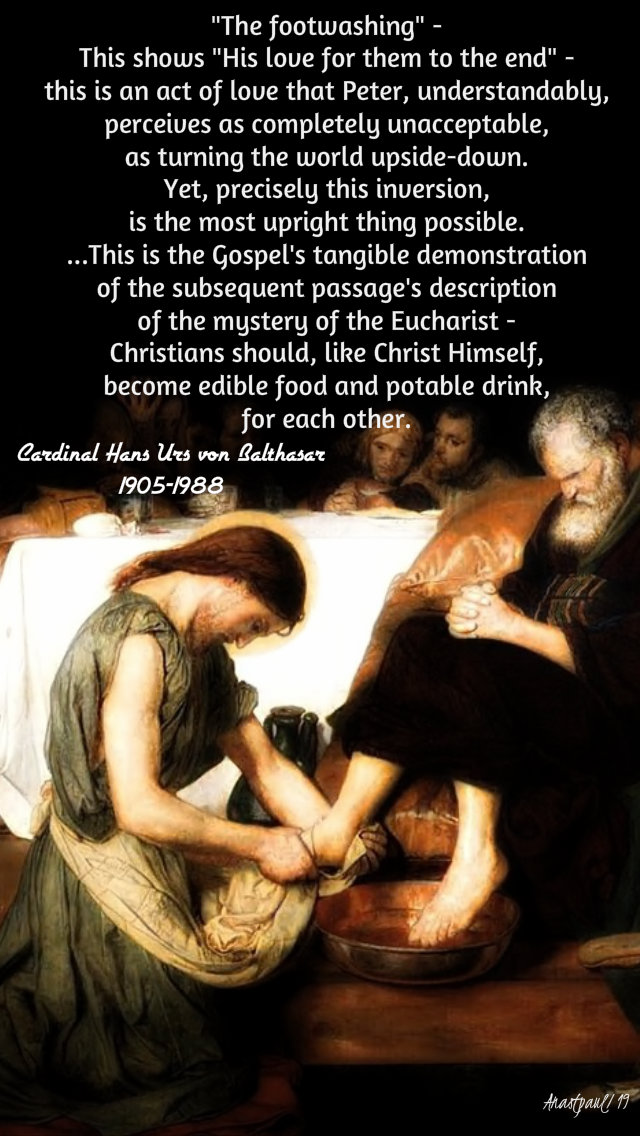
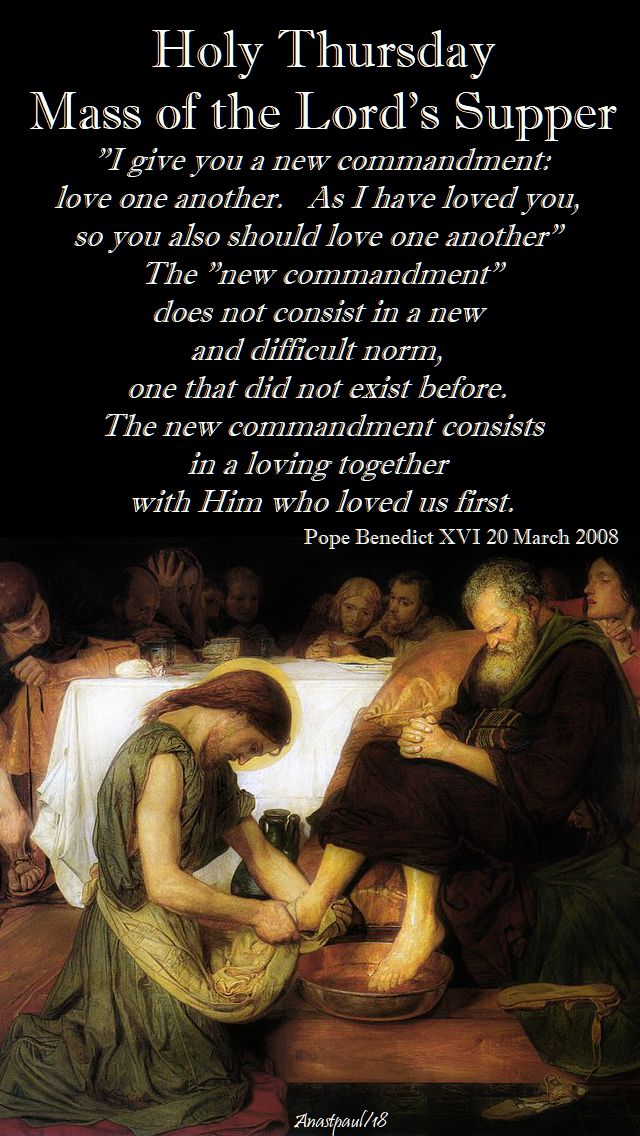
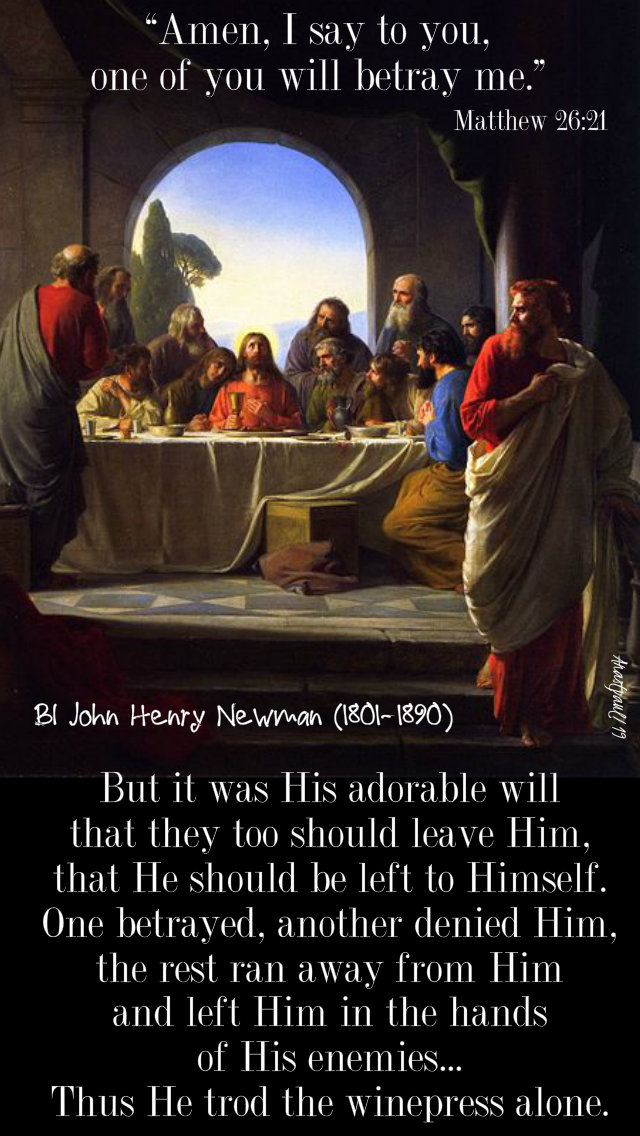
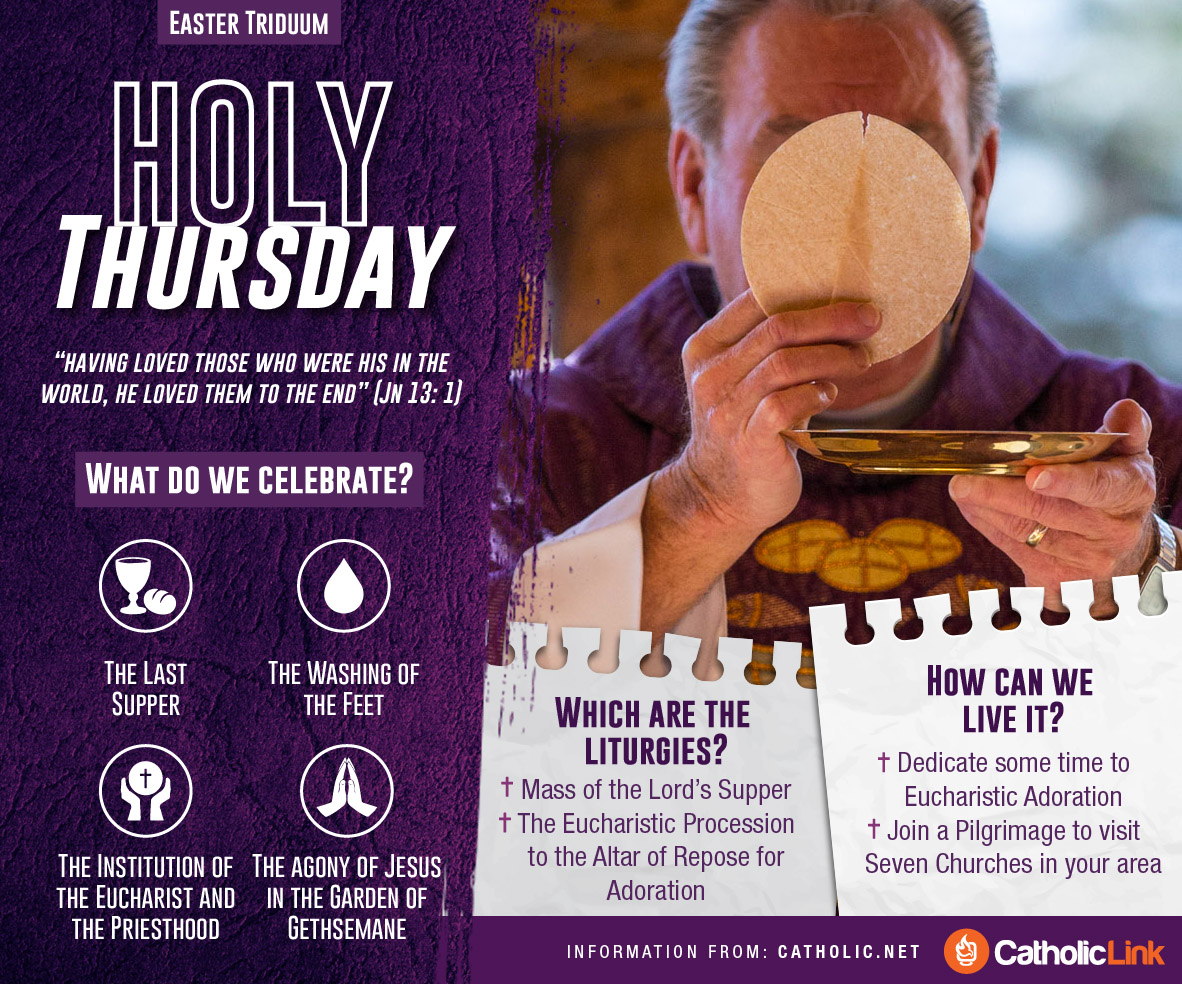
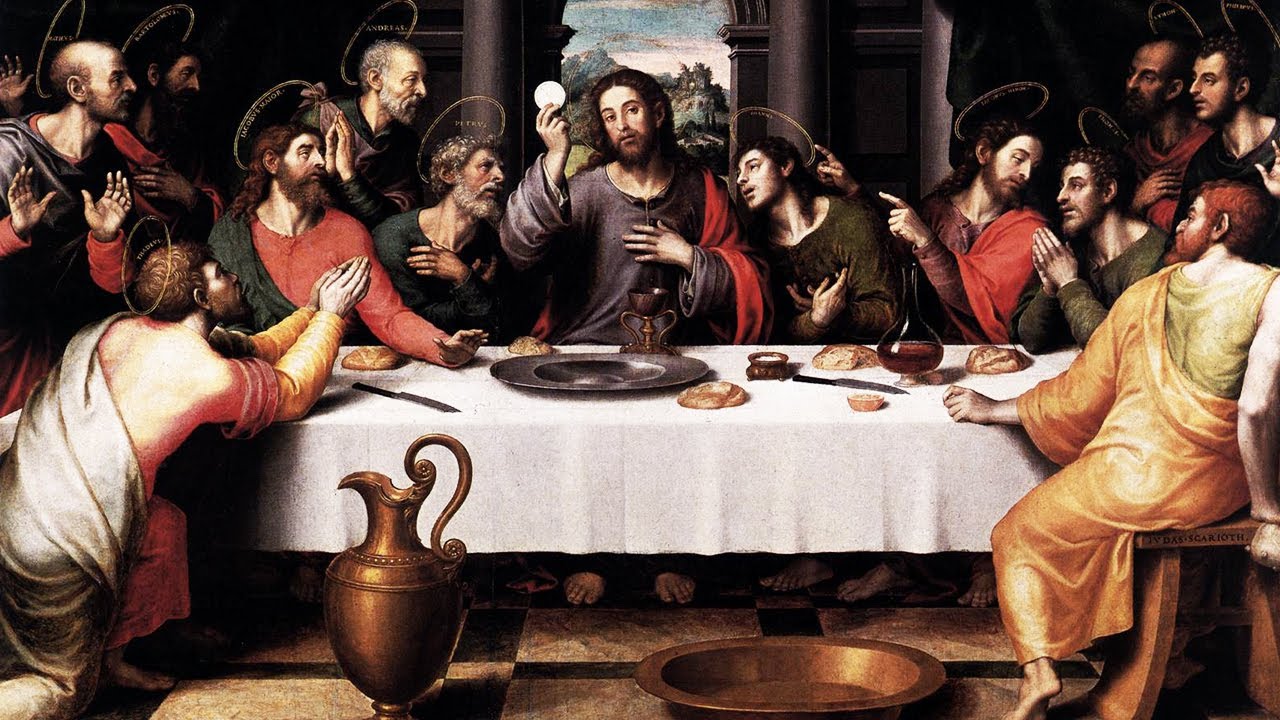
When the Lord tells Peter that without the washing of his feet he would never be able to have any part in Him, Peter immediately and impetuously asks to have his head and hands washed as well. This is followed by the mysterious words of Jesus: “Whoever has bathed has no need except to have his feet washed” (John 13:10). Jesus alludes to a bath that the disciples, according to ritual prescriptions, had already taken; in order to participate in the meal, they now needed only to have their feet washed. But naturally, a deeper meaning is hidden in this. To what does it allude? We do not know for sure. In any case, we should keep in mind that the washing of the feet, according to the meaning of the entire chapter, does not indicate a single specific Sacrament but the “sacramentum Christi” in its entirety – His service of salvation, His descent even to the cross, His love to the end, which purifies us and makes us capable of God.
Here, with the distinction between the bath and the washing of feet, nevertheless, there also appears an allusion to life in the community of the disciples, to life in the community of the Church – an allusion that John may have intentionally transmitted to the community of his time. It then seems clear that the bath that purifies us definitively and does not need to be repeated is Baptism – immersion in the death and resurrection of Christ, a fact that changes our lives profoundly, giving us something like a new a identity that endures, if we do not throw it away as Judas did. But even in the endurance of this new identity, for convivial communion with Jesus we need the “washing of the feet.” What does this mean? It seems to me that the first letter of Saint John gives us the key for understanding this. There we read: “If we say, ‘We are without sin,’ we deceive ourselves, and the truth is not in us. If we acknowledge our sins, he is faithful and just and will forgive our sins and cleanse us from every wrongdoing” (1:8ff.).
We need the “washing of the feet,” the washing of our everyday sins and for this we need the confession of sins. We do not know exactly how this was carried out in the Johannine community. But the direction indicated by the words of Jesus to Peter is obvious: in order to be capable of participating in the convivial community with Jesus Christ, we must be sincere. One must recognise that even in our own identity as baptised persons, we sin. We need confession as this has taken form in the Sacrament of reconciliation. In it, the Lord continually rewashes our dirty feet and we are able to sit at table with Him.
But in this way, the word takes on yet another meaning, in which the Lord extends the “sacramentum” by making it the “exemplum,” a gift, a service for our brother: “If I, therefore, the master and teacher, have washed your feet, you ought to wash one another’s feet” (John 13:14).We must wash each other’s feet in the daily mutual service of love. But we must also wash our feet, in the sense, of constantly forgiving one another. The debt that the Lord has forgiven us is always infinitely greater than all of the debts that others could owe to us (cf. Mt. 18:21-35). It is to this that Holy Thursday exhorts us: not to allow rancour toward others to become, in its depths, a poisoning of the soul. It exhorts us to constantly purify our memory, forgiving one another from the heart, washing each other’s feet, thus being able to join together in the banquet of God.
Holy Thursday is a day of gratitude and of joy for the great gift of love to the end that the Lord has given to us. We want to pray to the Lord at this time, so that gratitude and joy may become in us the power of loving together with His love. Amen.
Pope Benedict XVI 20 March 2008 Holy Thursday – Mass of the Lord’s Supper
Quote/s of the Day – 29 March – Holy Thursday 2018
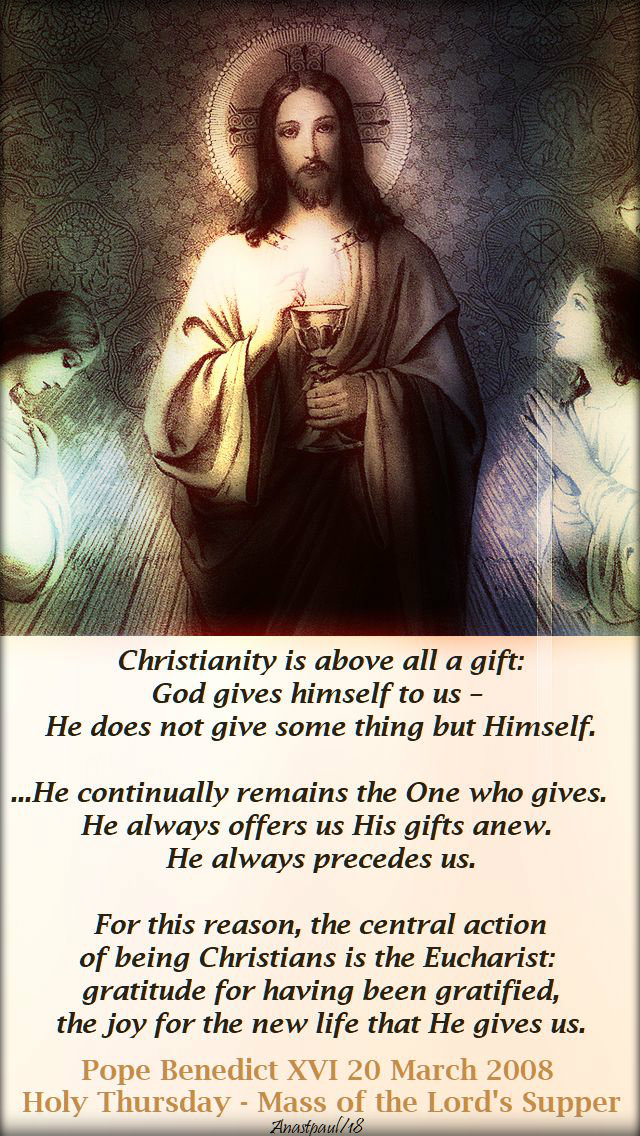
“Christianity is above all a gift: God gives himself to us – He does not give some thing but Himself. And this takes place not only at the beginning, at the moment of our conversion. He continually remains the One who gives. He always offers us His gifts anew. He always precedes us. For this reason, the central action of being Christians is the Eucharist: gratitude for having been gratified, the joy for the new life that He gives us.
In spite of all this, we do not remain passive recipients of the divine goodness. God gratifies us as personal and living partners. The love that is given is the dynamic of “loving together,” it is intended to be a new life within us, beginning from God. We thus understand the words that, at the end of the account of the washing of the feet, Jesus speaks to His disciples and to all of us: “I give you a new commandment: love one another. As I have loved you, so you also should love one another” (John 13:34). The “new commandment” does not consist in a new and difficult norm, one that did not exist before. The new commandment consists in a loving together with Him who loved us first.”
Pope Benedict XVI – 20 March 2008 Holy Thursday – Mass of the Lord’s Supper
Devotion of The Seven Last Words of Christ – The Third Word – 28 March – Wednesday of Holy Week 2018
The Seven Last Words of Christ
The Seven Last Words of Christ refer, not to individual words but to the final seven phrases that Our Lord uttered as He hung on the Cross. These phrases were not recorded in a single Gospel but are taken from the combined accounts of the four Gospels. Greatly revered, these last words of Jesus have been the subject of many books, sermons and musical settings. For centuries The Seven Last Words have been built into various forms of devotion for the consideration and consolation of the Christian people.
“…As we are under great obligations to Jesus, for His Passion endured for our love, so also are we under great obligations to Mary, for the martyrdom which she voluntarily suffered, for our salvation, in the death of her Son”.
St Bonaventure (1217-1274) Doctor of the Church
The Third Word
“Woman, behold, your son.”… “Behold, your mother.” John 19:26-27
Gospel: When Jesus saw his mother and the disciple whom he loved standing near, he said to his mother, “Woman, behold, your son!” Then he said to the disciple, “Behold, your mother!” And from that hour the disciple took her to his own home…Jn 19:26-27
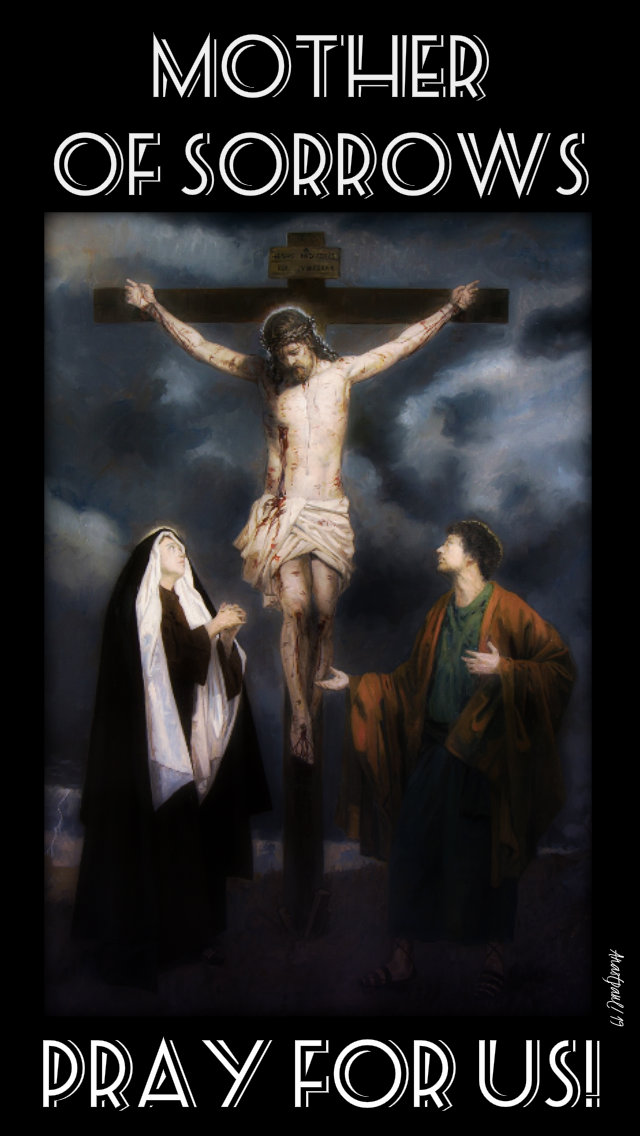
Reflection: Sinful man, behold the sorrowful face of Our Blessed Mother. She, who through her acceptance of God’s will brought the Son of God into the world, now sees Him stretched between heaven and earth suffering unbearable torments for your sake. This Mother, who accepted God’s Gift to the world with great joy, is now overcome with great sorrow to see Him who is Innocent put to death for our sakes. Weep. o sinful man, for you and your sinful habits are the cause of her sorrow.
Looking down on His Most Holy Mother, the Saviour of the world gives her a parting gift: sinful mankind. With four words He gives us who have crucified Him into her care, so that she may care for us with the same kindness and dedication as she had for Him. The sorrow at losing her only Son is replaced with the sorrow of a mother who is forced to watch as her children blindly go down the path to destruction.
But Our Saviour is not finished. Turning to St John and speaking through him to us, He reminds and warns us to honour His mother. How can we return to sin when we remember that our sin hurts Our Blessed Mother twice? First, we hurt her when our sin adds to Our Lord’s suffering. Second, just like any other mother, Our Blessed Mother is saddened to the point of tears when we turn from the narrow path that leads to Salvation and instead take the wide path that leads to Eternal Damnation.
O, Most Blessed Mother,
I beg that you forgive me
for all that I have done to offend you
and your Most Holy Son.
I beg you further to intercede with your Son on my behalf.
I deserve Eternal Punishment for my continual offenses
against both you and your Son.
Take me by the hand so that I may never again offend you
and help me to grow in virtue,
that I may make reparation for my offences.
Amen.
Prayer of Abandonment to God’s Providence
My Lord and my God:
into your hands I abandon the past and the present and the future,
what is small and what is great,
what amounts to a little and what amounts to a lot,
things temporal and things eternal.
Amen. Our Father. Hail Mary. Glory Be.
Quote of the Day – 28 March – Wednesday of Holy Week 2018
By nothing else except the cross of our Lord Jesus Christ has death been brought low, the sin of our first parent destroyed, hell plundered, resurrection bestowed, the power given us to despise the things of this world, even death itself, the road back to the former blessedness made smooth, the gates of paradise opened, our nature seated at the right hand of God and we made children and heirs of God. By the cross all these things have been set aright… It is a seal that the destroyer may not strike us, a raising up of those who lie fallen, a support for those who stand, a staff for the infirm, a crook for the shepherded, a guide for the wandering, a perfecting of the advanced, salvation for soul and body, a deflector of all evils, a cause of all goods, a destruction of sin, a plant of resurrection and a tree of eternal life.
St John Damascene (675-749) Father & Doctor of the Church
Quote/s of the Day – 27 March – Tuesday of Holy Week 2018
“Nobody can reign with Christ without having imitated His Passion. For things of great value can only be acquired at a great price.”
St John Chrysostom (347-407) Father & Doctor of the Church
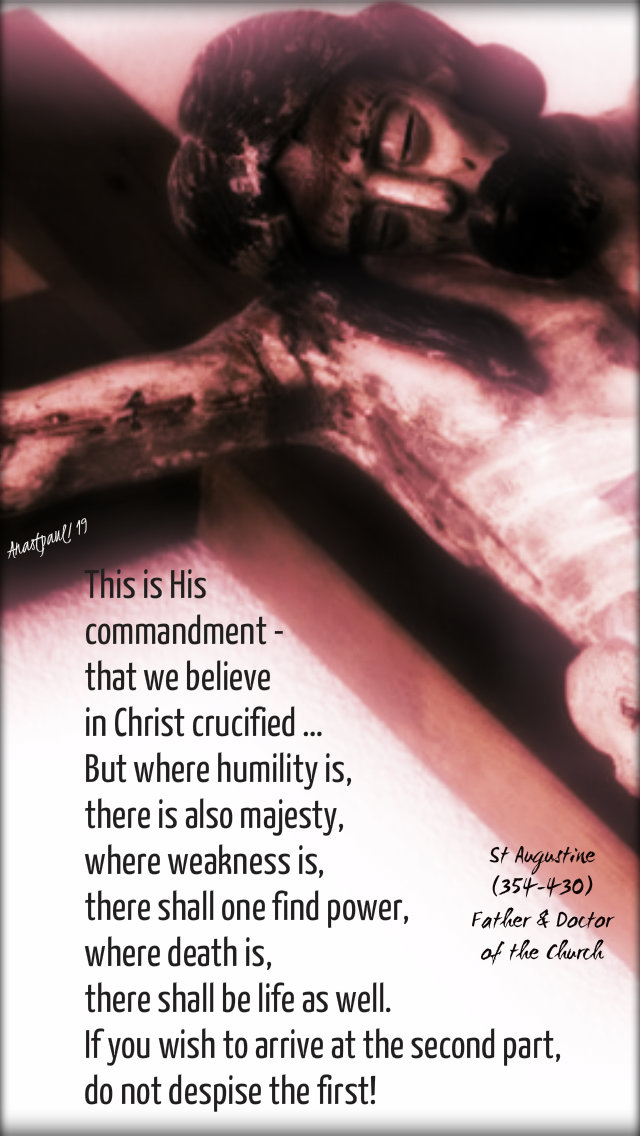
“Great thing is the knowledge of the crucified Christ. How many things are enclosed inside this treasure! Christ crucified! Such is the hidden treasure of wisdom and science. Do not be deceived, then, under the pretext of wisdom. Gather before the covering and pray that it may be uncovered. Foolish philosopher of this world, what you are looking for is worthless… What is the advantage of being thirsty, if you despise the source? … And what is His precept but that we believe in Him and love each other? In whom? In Christ crucified. This is His commandment: that we believe in Christ crucified … But where humility is, there is also majesty, where weakness is, there shall one find power, where death is, there shall be life as well. If you wish to arrive at the second part, do not despise the first. “ (Sermon 160, 3-4).
St Augustine (354-430) Father & Doctor of the Church
Devotion of The Seven Last Words of Christ – The Second Word – 27 March – Tuesday of Holy Week 2018
The Seven Last Words of Christ
The Seven Last Words of Christ refer, not to individual words but to the final seven phrases that Our Lord uttered as He hung on the Cross. These phrases were not recorded in a single Gospel but are taken from the combined accounts of the four Gospels. Greatly revered, these last words of Jesus have been the subject of many books, sermons and musical settings. For centuries The Seven Last Words have been built into various forms of devotion for the consideration and consolation of the Christian people.
“The tree upon which were fixed the members of Him dying was even the chair of the Master teaching.”
St Augustine (354-430) Father & Doctor of the Church
The Second Word
“Amen, I say to you, today you will be with me in Paradise.”
(Lk 23:43)
Gospel: Now one of the criminals hanging there reviled Jesus, saying, “Are you not the Messiah? Save yourself and us.” The other, however, rebuking him, said in reply, “Have you no fear of God, for you are subject to the same condemnation? And indeed, we have been condemned justly, for the sentence we received corresponds to our crimes, but this man has done nothing criminal.” Then he said, “Jesus, remember me when you come into your kingdom.” He replied to him, “Amen, I say to you, today you will be with me in Paradise.”...Lk 23:39-43
Reflection: “The Christian is obliged to be alter Christus, ipse Christus: another Christ, Christ himself. Through baptism all of us have been made priests of our lives, ‘to offer spiritual sacrifices acceptable to God through Jesus Christ.’ Everything we do can be an expression of our obedience to God’s will and so perpetuate the mission of the God-man.
“Once we realize this, we are immediately reminded of our wretchedness and our personal failings. But they should not dishearten us; we should not become pessimistic and put our ideals aside. Our Lord is calling us, in our present state, to share His life and make an effort to be holy. I know holiness can sound like an empty word. Too many people think it is unattainable, something to do with ascetical theology — but not a real goal for them, a living reality. The first Christians didn’t think that way. They often used the word “saints” to describe each other in a very natural manner: ‘greetings to all the saints’;‘my greetings to every one of the saints in Jesus Christ.’
“Take a look now at Calvary. Jesus has died and there is as yet no sign of His glorious triumph. It is a good time to examine how much we really want to live as Christians, to be holy. Here is our chance to react against our weaknesses with an act of faith.”…St Josemaria Escriva – Christ is Passing By, no. 95
Prayer of Abandonment to God’s Providence
My Lord and my God:
into your hands I abandon the past and the present and the future,
what is small and what is great,
what amounts to a little and what amounts to a lot,
things temporal and things eternal.
Amen. Our Father. Hail Mary. Glory Be.
Devotion of The Seven Last Words of Christ – The First Word – 26 March – Monday of Holy Week 2018
The Seven Last Words of Christ
The Seven Last Words of Christ refer, not to individual words but to the final seven phrases that Our Lord uttered as He hung on the Cross. These phrases were not recorded in a single Gospel but are taken from the combined accounts of the four Gospels. Greatly revered, these last words of Jesus have been the subject of many books, sermons and musical settings.
For centuries The Seven Last Words have been built into various forms of devotion for the consideration and consolation of the Christian people. English Catholics of the late Middle Ages were especially devoted to this pious exercise and passed it on in latter-day prayer books.
Hear the famous English mystic, Julian of Norwich (1342-1430) :
Suddenly it came into my mind that I ought to wish for the second wound, that our Lord, of His gift and of His grace, would fill my body full with recollection and feeling of His blessed Passion, as I had prayed before, for I wished that His pains might be my pains, with compassion which would lead to longing for God. . . . And at this suddenly I saw the red blood trickling down from under the crown, all hot, flowing freely and copiously, a living stream, just as it seemed to me that it was at the time when the crown of thorns was thrust down upon His blessed head. . . . With this sight of His blessed Passion and with His divinity, I saw that this was strength enough for me, yesand for all living creatures who will be protected from all the devils from hell and from all spiritual enemies.
Holy Week, especially Good Friday, is an ideal time to make use of this devotion for personal prayer: to silently and prayerfully contemplate Jesus’s passion and death, to be united to Him in His suffering and to dwell on the strength and mercy of His love.
The following meditations are from on the writings of St Josemaria Escrivá (1902-1975)
The First Word
“Father, forgive them for they know not what they do.” (Lk 23:34)
Gospel: When they came to the place called the Skull, they crucified him and the criminals there, one on his right, the other on his left [Then Jesus said, “Father, forgive them, they know not what they do.”] They divided his garments by casting lots…Lk 23:33-34
Reflection: “Christ’s generous self-sacrifice is a challenge to sin. We find it hard to accept the reality of sin, although its existence is undeniable. Sin is the mysterium iniquitatis: the mystery of evil, the inexplicable evil of the creature whose pride leads him to rise up against God. The story is as old as mankind. It began with the fall of our first parents; then came the unending depravities which punctuate the behaviour of mankind down the ages; and, finally, our own personal rebellions. It is very difficult to realise just how perverse sin is and to understand what our faith tells us. We should remember that even in the human context the scale of an offence is frequently determined by the importance of the injured party — his social standing, his qualities. But with sin man offends God, the creature repudiates his creator.
“But ‘God is love.’ The abyss of malice which sin opens wide has been bridged by His infinite charity. God did not abandon men. His plans foresaw that the sacrifices of the old law would be insufficient to repair our faults and re-establish the unity which had been lost. A man who was God would have to offer Himself up. To help us grasp in some measure this unfathomable mystery, we might imagine the Blessed Trinity taking counsel together in its uninterrupted intimate relationship of infinite love. As a result of its eternal decision, the only-begotten Son of God the Father takes on our human condition and bears the burden of our wretchedness and sorrows, to end up sewn with nails to a piece of wood.”…St Josemaria Escriva – Christ is Passing By, no. 95
Prayer of Abandonment to God’s Providence
My Lord and my God:
into Your hands I abandon the past and the present and the future,
what is small and what is great,
what amounts to a little and what amounts to a lot,
things temporal and things eternal.
Amen. Our Father. Hail Mary. Glory Be.
You must be logged in to post a comment.