Quote of the Day- 5 May – Third Sunday of Easter, Year C
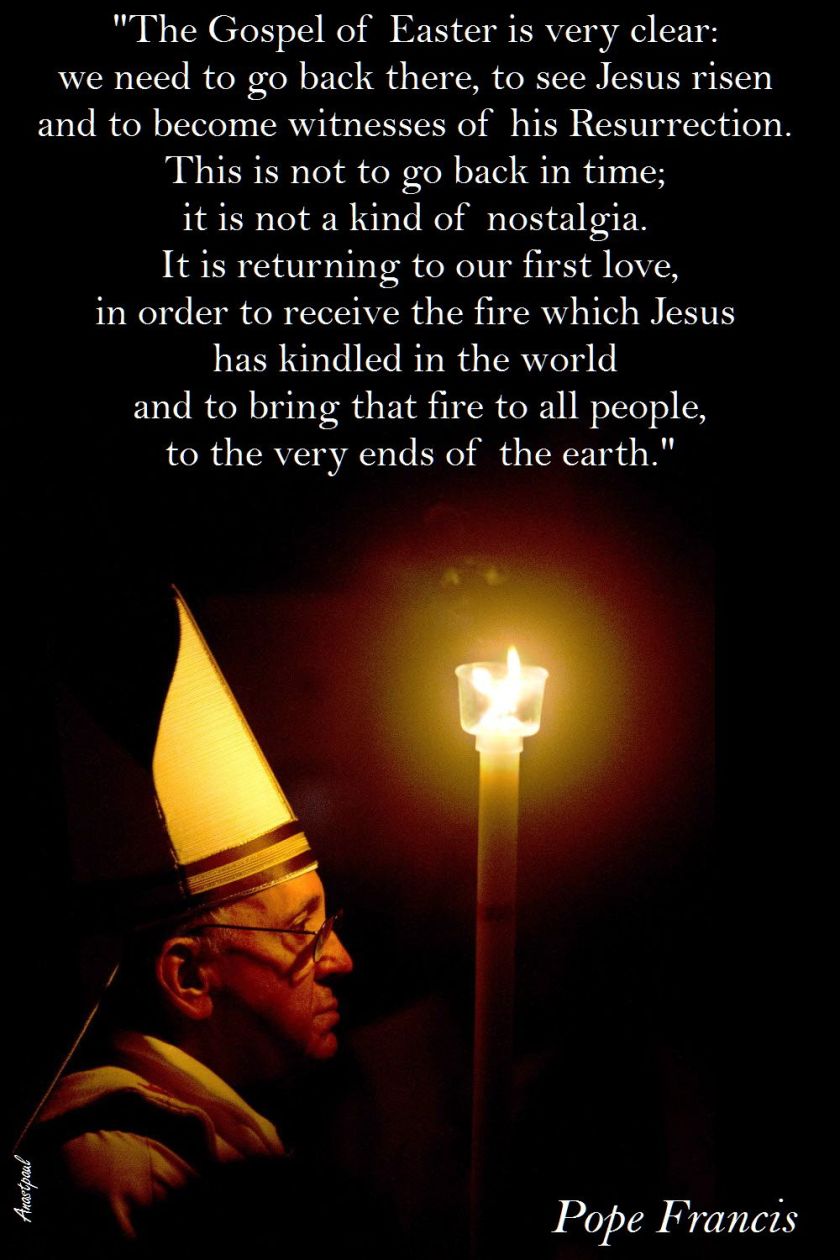
“The Gospel of Easter is very clear – we need to go back there, to see Jesus risen and to become witnesses of His Resurrection. This is not to go back in time, it is not a kind of nostalgia. It is returning to our first love, in order to receive the fire which Jesus has kindled in the world and to bring that fire to all people, to the very ends of the earth.”
Pope Francis
(Easter Vigil Homily, 2014)
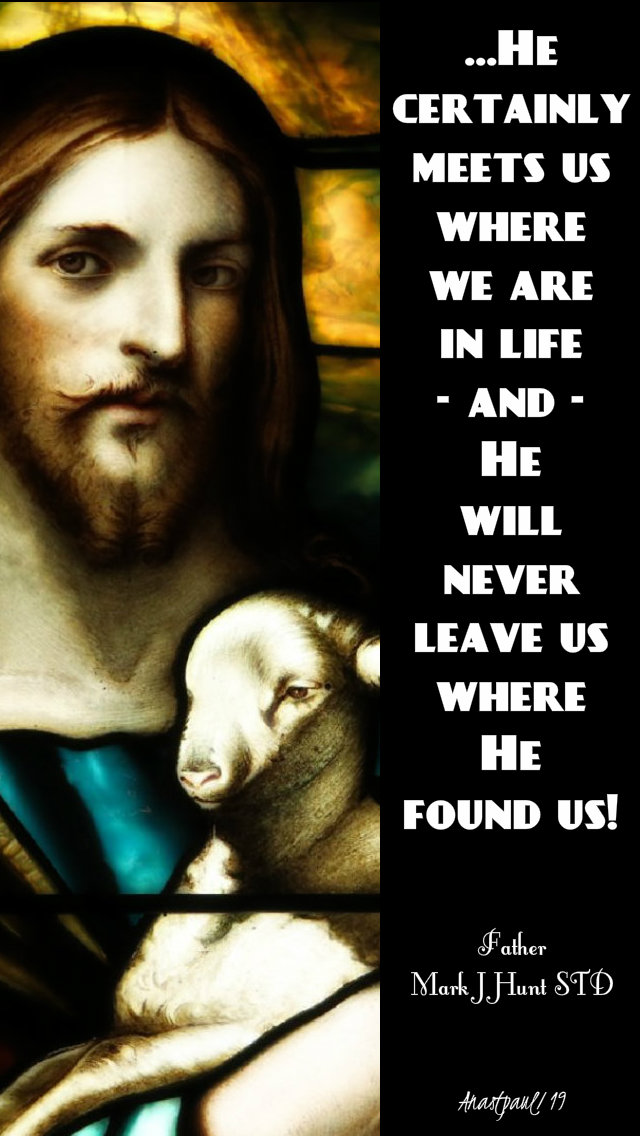
“…He certainly meets us where we are in life – and – He will never leave us where He found us!”
One Minute Reflection – 5 May – Third Sunday of Easter, Year C, Gospel: John 21:1–19 and the Memorial of Saint Nunzio Sulprizio (1917-1836)
“When it was already dawn, Jesus was standing on the shore”...John 21:4
REFLECTION – “When it was already dawn, Jesus was standing on the shore”
What does the sea indicate but the present age, which is disturbed by the uproar of circumstances and the commotion of this perishable life? What does the solidity of the shore signify but the uninterrupted continuance of eternal peace? Therefore, since the disciples were still held in the waves of this mortal life, they were labouring on the sea. But since our Redeemer had already passed beyond His perishable body, after His Resurrection, He stood on the shore, as if He were speaking to His disciples by His actions, of the mystery of His Resurrection: “I am not appearing to you on the sea, because I am not with you in the waves of confusion” (Mt 14:25)
It is for this reason that He said, in another place, to these same disciples after his Resurrection: “These are the words I spoke to you when I was still with you” (Lk 24:44). It was not that He wasn’t with them, when He appeared to them as a bodily presence but… He, in His immortal body, was apart from their mortal bodies. He was saying, that He was no longer with them, even as He stood in their midst. In the passage we read today, He also disclosed, by the place in which He was standing, when He showed Himself on the shore, while they were still at sea, what He professed, when he was with them.”…St Pope Gregory the Great (540-604) Father & Doctor of the Church
PRAYER – Lord God, grant Your people constant joy in the renewed vigour of their souls. They rejoice because You have restored them to the glory of Your adopted children, let them look forward gladly to the certain hope of the resurrection. May the prayers of our Blessed Mother and St Nunzio, who so bravely fought the good fight, be of assistance to us amidst the storms of this mortal life. We make our prayer through our Resurrected Christ, with the Holy Spirit, one God forever, amen, alleluia!
Thought for the Day- 4 May – Saturday of the Second Week of Easter
God’s Plan of Salvation
Second Vatican Council
An excerpt from Sacrosanctum Concilium, #7-8
In His desire that all men should be saved and come to the knowledge of the truth, God spoke in former times to our forefathers through the prophets, on many occasions and in different ways. Then, in the fullness of time He sent His Son, the Word made man, anointed by the Holy Spirit, to bring good news to the poor, to heal the broken-hearted as the physician of body and spirit and the mediator between God and men. In the unity of the person of the Word, His human nature was the instrument of our salvation. Thus in Christ, there has come to be, the perfect atonement that reconciles us with God and we have been given the power to offer the fullness of divine worship.
This work of man’s redemption and God’s perfect glory was foreshadowed by God’s mighty deeds among the people of the Old Covenant. It was brought to fulfilment by Christ the Lord, especially through the paschal mystery of His blessed passion, resurrection from the dead and ascension in glory – by dying He destroyed our death, and by rising again He restored our life. From His side, as He lay asleep on the cross, was born that wonderful sacrament, which is the Church in its entirety.
As Christ was sent by the Father, so in His turn He sent the apostles, filled with the Holy Spirit. They were sent to preach the Gospel to every creature, proclaiming that we had been set free from the power of Satan and from death by the death and resurrection of God’s Son and brought into the kingdom of the Father. They were sent also to bring into effect, this saving work that they proclaimed, by means of the sacrifice and sacraments that are the pivot of the whole life of the liturgy.
So, by baptism men are brought within the paschal mystery. Dead with Christ, buried with Christ, risen with Christ, they receive the Spirit that makes them God’s adopted children, crying out – Abba, Father and so they become the true adorers that the Father seeks.
In the same way, whenever they eat the supper of the Lord they proclaim His death until He comes. So, on the very day of Pentecost, on which the Church was manifested to the world, those who received the word of Peter were baptised. They remained steadfast in the teaching of the apostles and in the communion of the breaking of bread, praising God and enjoying the favour of all the people.
From that time onward the Church has never failed to come together to celebrate the paschal mystery, by reading what was written about Him in every part of Scripture, by celebrating the Eucharist in which the victory and triumph of His death are shown forth, and also by giving thanks to God for the inexpressible gift He has given in Christ Jesus, to the praise of God’s glory.
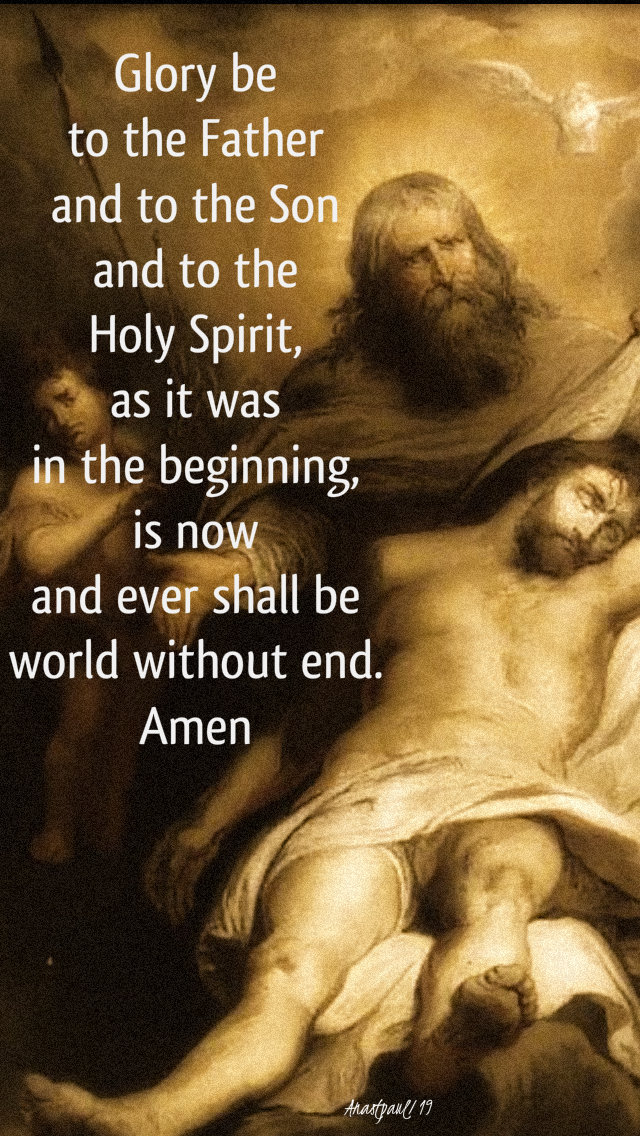
Glory be to the Father and to the Son and to the Holy Spirit, as it was in the beginning, is now and ever shall be world without end. Amen
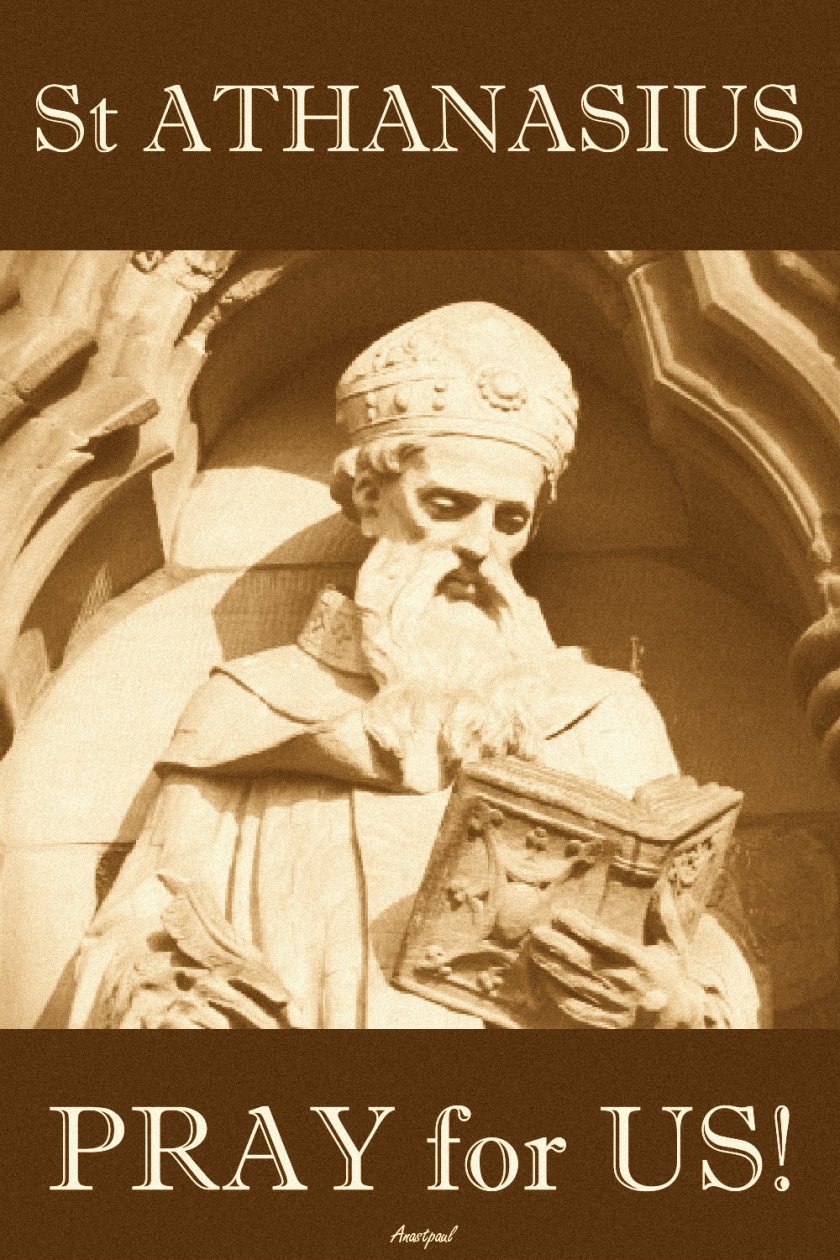
Thought for the Day – 2 May – Thursday of the Second week of Easter, Gospel: John 3:31–36 and the Memorial of St Athanasius (297-373)
On the Incarnation of the Word
Saint Athanasius (297-373)
Bishop, Great Eastern Father & Doctor of the Church
Known as “The Father of Orthodoxy”
An excerpt from On the Incarnation of the Word
The Word of God, incorporeal, incorruptible and immaterial, entered our world. Yet it was not as if He had been remote from it up to that time. For there is no part of the world that was ever without His Presence; together with His Father, He continually filled all things and places.
Out of His loving-kindness for us, He came to us and we see this in the way He revealed Himself openly to us. Taking pity on mankind’s weakness and moved by our corruption, He could not stand aside and see death have the mastery over us, He did not want creation to perish and His Father’s work in fashioning man, to be in vain. He, therefore, took to Himself a body, no different from our own, for He did not wish simply to be in a body or only to be seen.
If He had wanted simply to be seen, He could indeed have taken another and nobler, body. Instead, He took our body in its reality.
Within the Virgin, He built himself a temple, that is, a body, He made it His own instrument in which to dwell and to reveal Himself. In this way, He received from mankind, a body like our own and, since all were subject to the corruption of death, He delivered this body over to death for all and with supreme love, offered it to the Father. He did so, to destroy the law of corruption, passed against all men, since all died in Him. The law, which had spent its force on the body of the Lord, could no longer have any power over His fellowmen. Moreover, this was the way in which the Word was to restore mankind to immortality, after it had fallen into corruption and summon it back, from death to life. He utterly destroyed the power death had against mankind—as fire consumes chaff—by means of the body He had taken and the grace of the Resurrection.
This is the reason why the Word assumed a body that could die, so that this body, sharing in the Word who is above all, might satisfy death’s requirement in place of all. Because of the Word dwelling in that body, it would remain incorruptible and all would be freed forever from corruption, by the grace of the Resurrection.
In death, the Word made a spotless sacrifice and oblation of the body He had taken. By dying for others, He immediately banished death for all mankind.
In this way the Word of God, who is above all, dedicated and offered His temple, the instrument that was His body, for us all, as He said and so paid, by His own death the debt that was owed. The immortal Son of God, united with all men by likeness of nature, thus fulfilled all justice, in restoring mankind to immortality, by the promise of the resurrection.
The corruption of death, no longer holds any power over mankind, thanks to the Word, who has come to dwell among them through His one body.
One Minute Reflection – 28 April – Low Sunday the Octave Day of Easter and Divine Mercy Sunday, Gospel: John 20:19–31
“Peace be with you. As the Father has sent me, even so I send you.” And when he had said this, he breathed on them, and said to them, “Receive the Holy Spirit. If you forgive the sins of any, they are forgiven; if you retain the sins of any, they are retained.”…John 20:21–23
REFLECTION – “This Sunday, … concludes the week or, more properly, the “Octave” of Easter, which the liturgy considers as a single day: “the day which the Lord has made” (Ps 117[116]: 24). It is not a chronological but a spiritual time, which God opened in the sequence of days when He raised Christ from the dead. The Creator Spirit, infusing new and eternal life in the buried body of Jesus of Nazareth, carried to completion the work of creation, giving origin to a “firstfruits” – the firstfruits of a new humanity, which at the same time is a firstfruits of a new world and a new era.
This world renewal can be summed up in a single phrase, the same one that the Risen Jesus spoke to his disciples as a greeting and even more, as an announcement of his victory: “Peace be with you!” (Lk 24: 36; Jn 20: 19, 21, 26).
Peace is the gift that Christ left his friends (see Jn 14: 27) as a blessing destined for all men and women and all peoples. It is not a peace according to a “worldly” mentality, as an equilibrium of forces but a new reality, fruit of God’s Love, of His Mercy. It is the peace that Jesus Christ earned, by the price of His Blood and communicates to those who trust in Him.
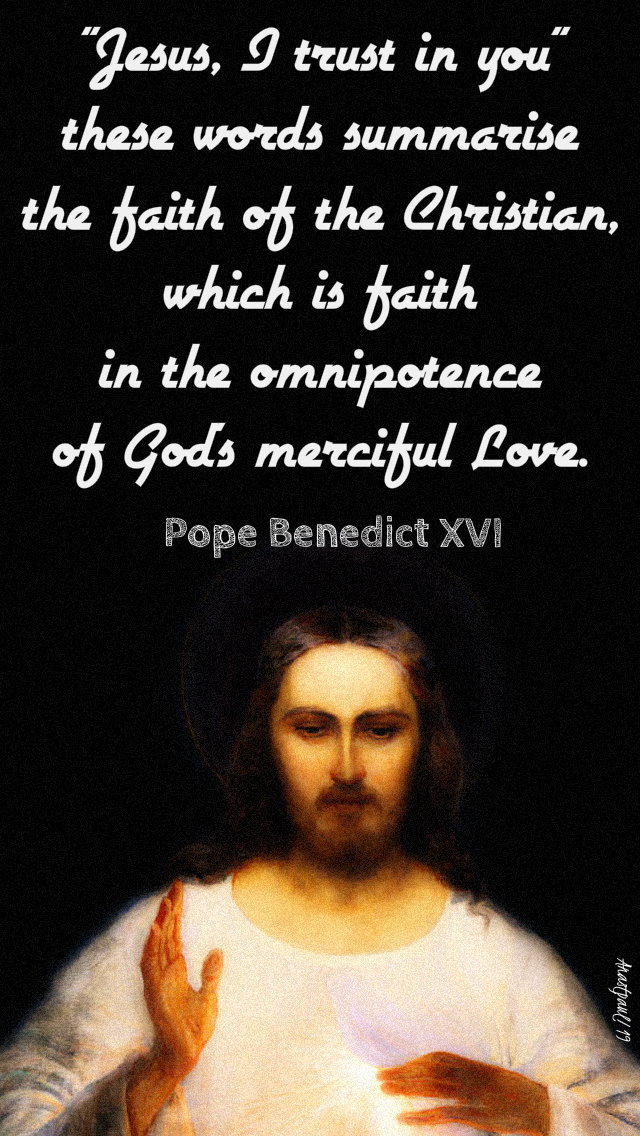
“Jesus, I trust in you” these words summarise the faith of the Christian, which is faith in the omnipotence of God’s merciful Love.”…Pope Benedict XVI – REGINA CÆLI – Second Sunday of Easter, 15 April 2007
PRAYER – Almighty Father, grant we pray that with Mary’s help, Mater Misericordiae, Mother of Jesus who is the incarnation of Divine Mercy, that we become renewed in the Spirit, in order to cooperate in the work of peace which You are accomplishing in the world and which is not just talk, but which is actualised in the countless gestures of charity by all his sons and daughters. Grant we pray, that we taste the beauty of the encounter with the Risen Lord and draw from the source of His merciful love, to be apostles of His peace. Through Christ, Redeemer and Merciful Lord, with the Holy Spirit, God for always and forever, amen.
Thought for the Day – 27 April – Saturday of Easter week
“He is not here, he is going before you to Galilee; there you will see him” (Mk 16:6)
“There is another important aspect (in the Resurrection), Jesus show Himself in the act of departure.
This is clearest in the event of Emmaus and in His meeting with Mary Magdalen. He summons us to go with Him.
Resurrection is not an indulgence of curiosity – it is MISSION. It’s intention is to transform the world! It calls for an active joy, the joy of those who are themselves going along the path of the Risen One.
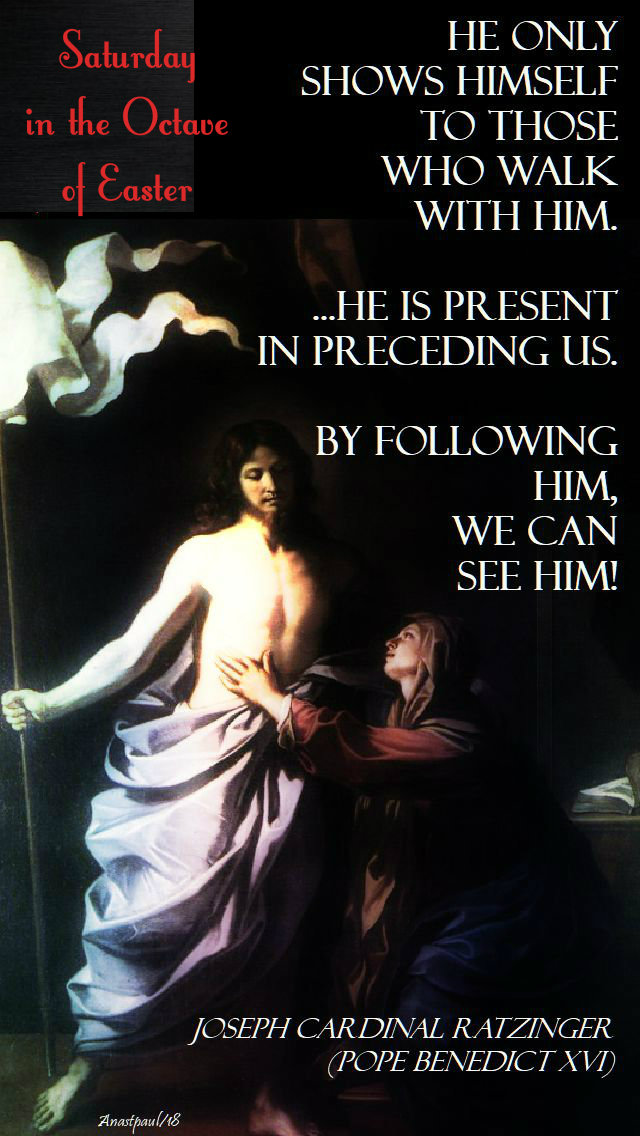
That is true today too – He only shows Himself to those who walk with Him. The angel’s first word to the women was “He is not here, he is going before you to Galilee; there you will see him” (Mk 16:6). So once and for all, we are told where the Risen One is to be found and how we are to meet Him – HE GOES BEFORE YOU. He is present in preceding us. By following Him, we can see Him!”
Joseph Cardinal Ratzinger (Pope Benedict XVI)
The Word of the Witnesses – Seek that Which is Above
One Minute Reflection – 25 April – Thursday of Easter week, Gospel: Luke 24:35–48 and the Memorial of St Mark the Evangelist and St Giovanni Battista Piamarta (1841 – 1913)
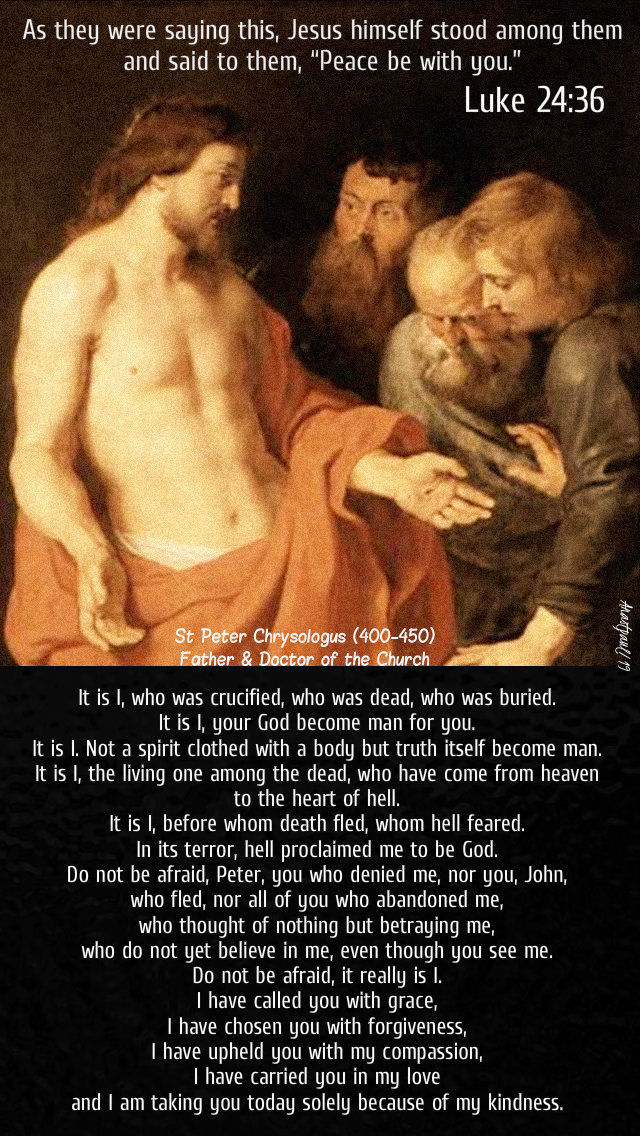
As they were saying this, Jesus himself stood among them and said to them, “Peace be with you.”…Luke 24:36
REFLECTION – “Rebellious people had chased peace from the earth… and thrown the world into its primordial chaos… Among the disciples as well, war was waging, faith and doubt fought furious assaults on one another… Where a storm was raging, their hearts could find no peaceful harbour, no calm port.
At the sight of that Christ who plumbs the hearts, who commands the winds, who is master over tempests and who with a simple sign changes the storm into a serene sky, strengthened them with his peace, saying: “Peace be with you!
It is I, fear not.
It is I, who was crucified, who was dead, who was buried.
It is I, your God become man for you.
It is I. Not a spirit clothed with a body but truth itself become man.
It is I, the living one among the dead, who have come from heaven to the heart of hell.
It is I, before whom death fled, whom hell feared. In its terror, hell proclaimed me to be God. Do not be afraid, Peter, you who denied me, nor you, John, who fled, nor all of you who abandoned me, who thought of nothing but betraying me, who do not yet believe in me, even though you see me.
Do not be afraid, it really is I.
I have called you with grace,
I have chosen you with forgiveness,
I have upheld you with my compassion,
I have carried you in my love and I am taking you today solely because of my kindness.”...St Peter Chrysologus (400-450) Father & Doctor of the Church
PRAYER – Lord God, let there be one faith in our hearts, one love for You, one Way in You, for You are the One Truth and the only Way. We linger in Your light and beg Your unending kindness. Grant that by the prayers of Your saints we may obtain Your strength. St Mark, pray for us. St Giovanni Piamarta, pray for us. Through Christ our Lord, with the Holy Spirit, God for always and forever, amen.
Thought for the Day – 24 April – Wednesday in the Octave of Easter
Christ the source of resurrection and life
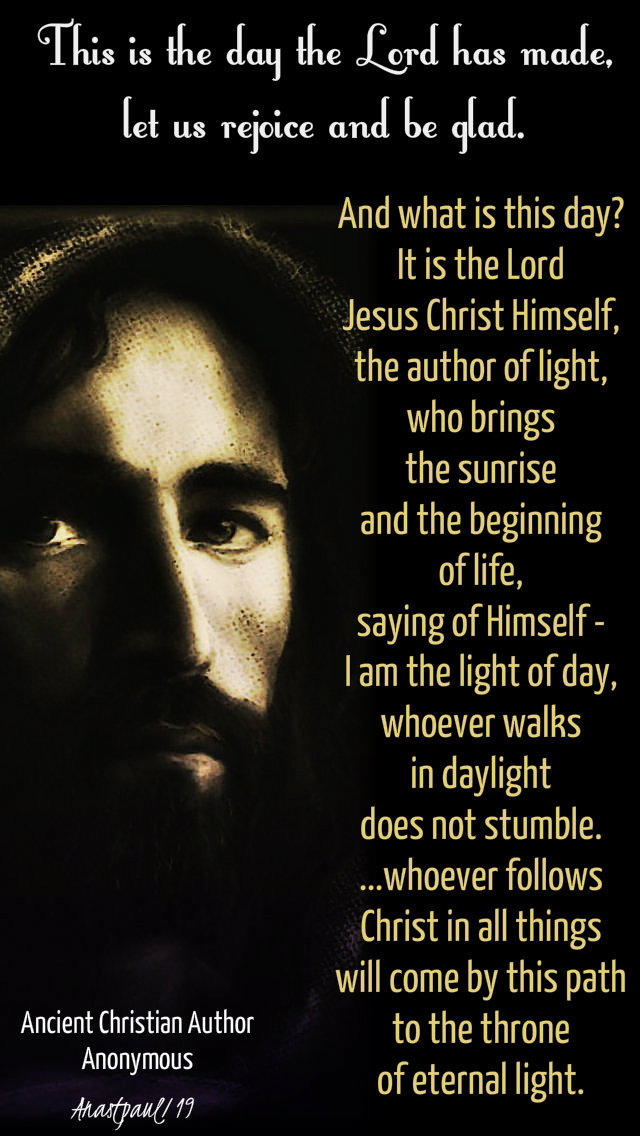
“This is the Day!”
Ancient Christian Author
Anonymous
An excerpt from an Easter Homily
Saint Paul rejoices in the knowledge that spiritual health has been restored to the human race. Death entered the world through Adam, he explains but life has been given back to the world through Christ. Again he says – The first man, being from the earth, is earthly by nature, the second man is from heaven and is heavenly. As we have borne the image of the earthly man, the image of human nature grown old in sin, so let us bear the image of the heavenly man, human nature raised up, redeemed, restored and purified in Christ. We must hold fast to the salvation we have received. Christ was the first fruits, says the Apostle, He is the source of resurrection and life. Those who belong to Christ will follow Him. Modelling their lives on His purity, they will be secure in the hope of His resurrection and of enjoying with Him the glory promised in heaven. Our Lord Himself said so in the gospe -: Whoever follows me will not perish but will pass from death to life.
Thus the passion of our Saviour is the salvation of mankind. The reason why He desired to die for us was that He wanted us, who believe in Him, to live forever. In the fullness of time, it was His will to become what we are, so that we might inherit the eternity He promised and live with Him forever.
Here, then, is the grace conferred by these heavenly mysteries, the gift which Easter brings, the most longed for feast of the year, here are the beginnings of creatures newly formed – children born from the life-giving font of holy Church, born anew with the simplicity of little ones and crying out with the evidence of a clean conscience. Chaste fathers and inviolate mothers accompany this new family, countless in number, born to new life through faith. As they emerge from the grace-giving womb of the font, a blaze of candles burns brightly beneath the tree of faith. The Easter festival brings the grace of holiness from heaven to men. Through the repeated celebration of the sacred mysteries they receive the spiritual nourishment of the sacraments. Fostered at the very heart of holy Church, the fellowship of one community, worships the one God, adoring the triple name of His essential holiness and together with the prophet, sings the psalm which belongs to this yearly festival –
This is the day the Lord has made, let us rejoice and be glad.
And what is this day? It is the Lord Jesus Christ Himself, the author of light, who brings the sunrise and the beginning of life, saying of Himself – I am the light of day, whoever walks in daylight does not stumble. That is to say, whoever follows Christ in all things will come by this path to the throne of eternal light.
Such was the prayer Christ made to the Father while He was still on earth – Father, I desire that where I am, they also may be, those who have come to believe in me and that as you are in me and I in you, so they may abide in us.
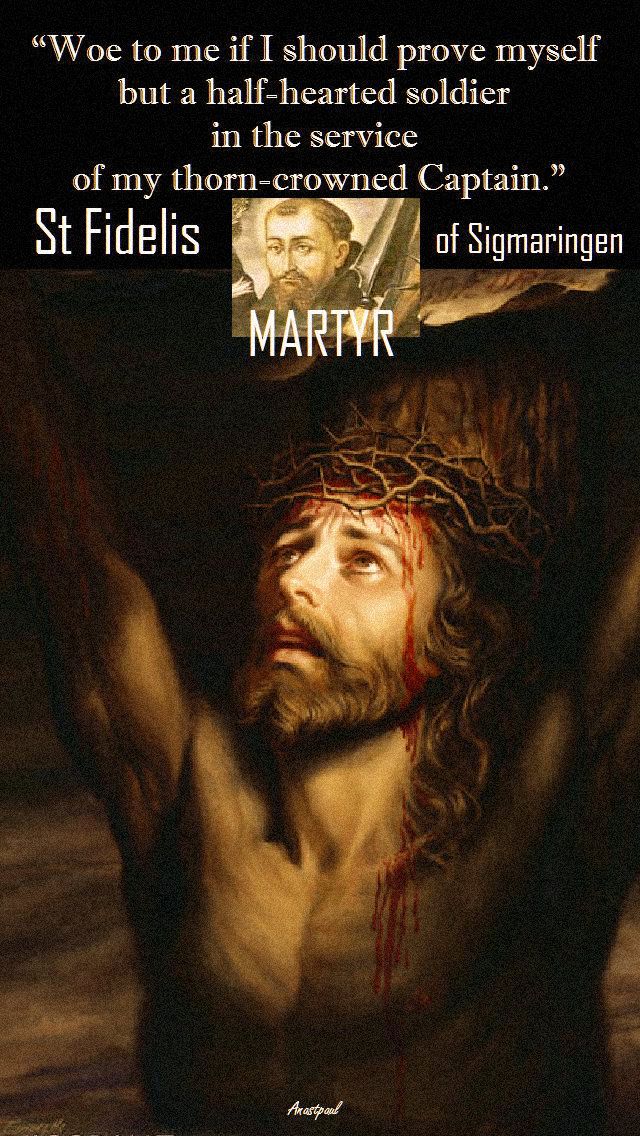
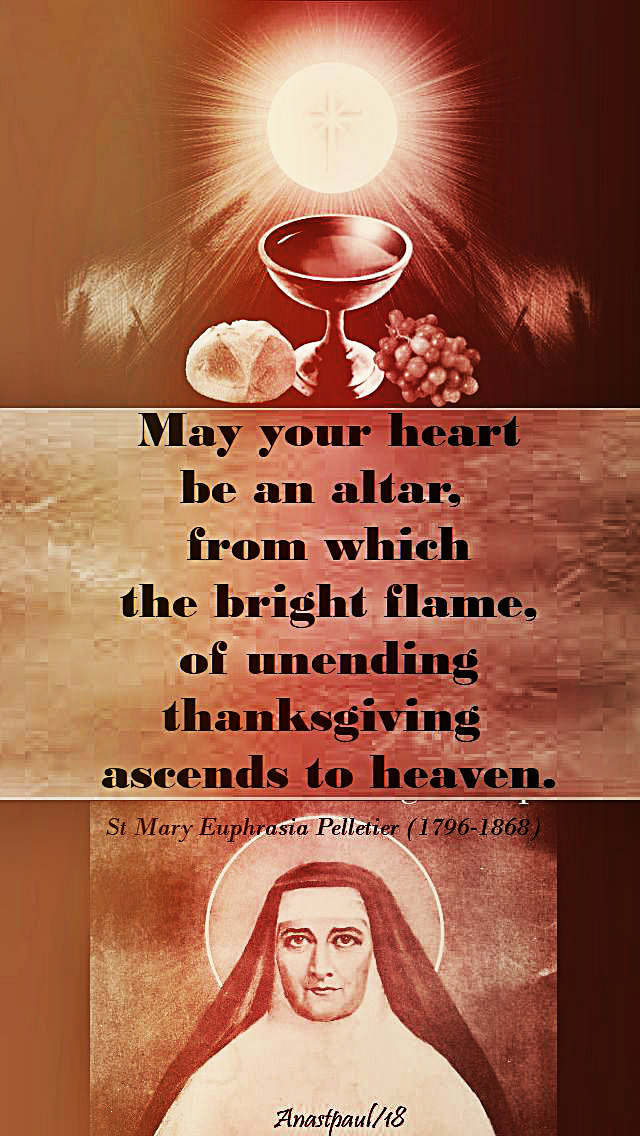
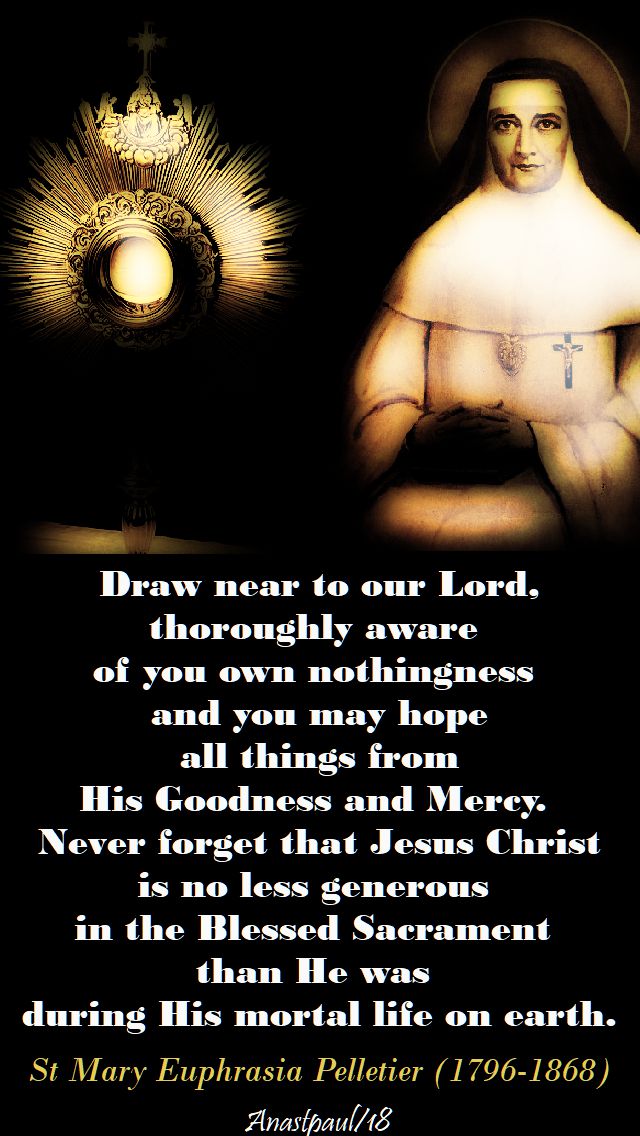
Quote/s of the Day – 24 April – Wednesday of Easter week and the Memorial of St Fidelis of Sigmaringen OFM.Cap. (1577-1622) and St Mary Euphrasia Pelletier (1796-1868)
“Woe to me if I should prove myself but a half-hearted soldier in the service of my thorn-crowned Captain.”
“What made the holy apostles and martyrs endure fierce agony and bitter torments, except faith and especially faith in the resurrection? What is it that today makes true followers of Christ cast luxuries aside, leave pleasures behind and endure difficulties and pain? It is a living faith that expresses itself through love. It is this that makes us put aside the goods of the present in the hope of future goods. It is because of faith that we exchange the present for the future.”
St Fidelis of Sigmaringen (1577-1622)
“May your heart be an altar, from which the bright flame, of unending thanksgiving ascends to heaven.”
“Draw near to our Lord, thoroughly aware of you own nothingness and you may hope all things from His Goodness and Mercy. Never forget that Jesus Christ is no less generous in the Blessed Sacrament than He was during His mortal life on earth.”
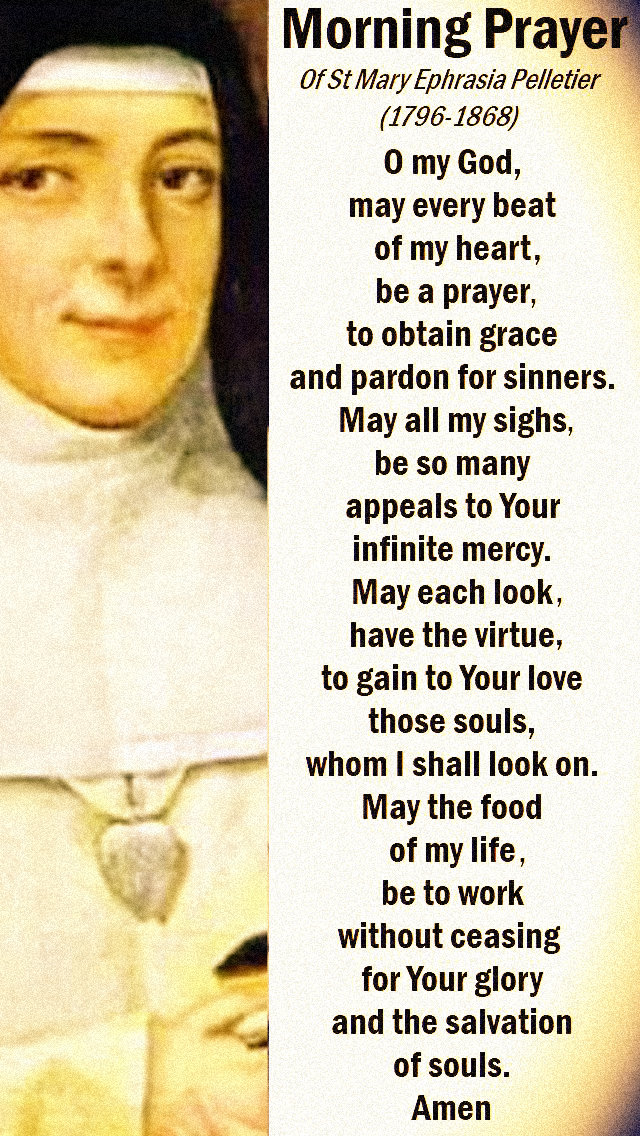
O my God, may every beat of my heart, be a prayer, to obtain grace and pardon for sinners. May all my sighs, be so many appeals to Your infinite mercy. May each look, have the virtue, to gain to Your love, those souls, whom I shall look on. May the food of my life, be to work without ceasing for Your glory and the salvation of souls. Amen
Our Morning Offering – 24 April – Wednesday of Easter week
An Ancient Easter Prayer Roman Missal, Easter Vigil
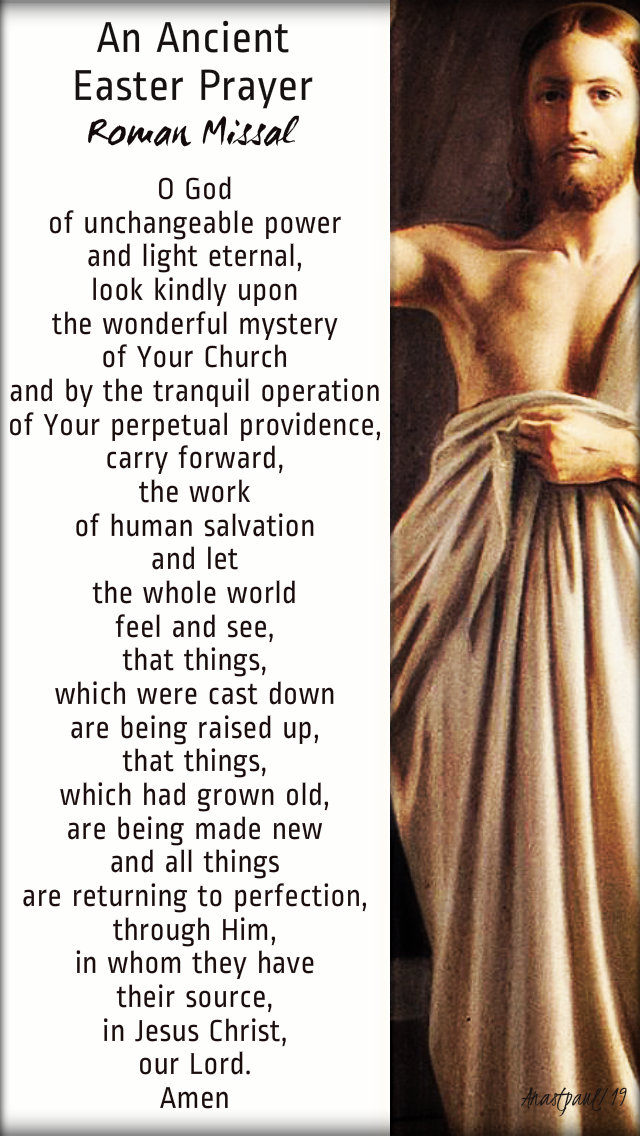
O God of unchangeable power and light eternal,
look kindly upon the wonderful mystery of Your Church
and by the tranquil operation of Your perpetual providence,
carry forward, the work of human salvation
and let the whole world feel and see,
that things, which were cast down
are being raised up,
that things which had grown old,
are being made new
and all things are returning to perfection,
through Him, in whom they have their source,
in Jesus Christ, our Lord.
Amen
Christ is Risen! He is Truly Risen, Alleluia! – Thought for the day – 23 April – Tuesday of Easter Week
So she ran and went to Simon Peter and the other disciple, the one whom Jesus loved and said to them, “They have taken the Lord out of the tomb and we do not know, where they have laid him.”…John 20:2
“Church of men, Church of women”
By Cardinal Hans Urs von Balthasar (1905-1988)
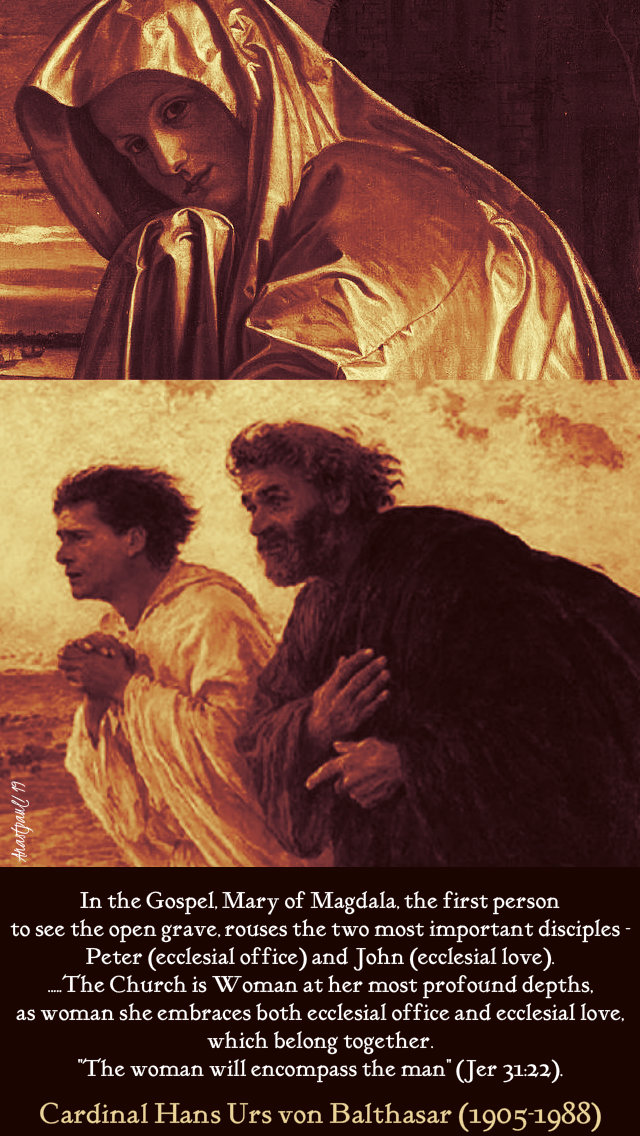
In the Gospel, Mary of Magdala, the first person to see the open grave, rouses the two most important disciples – Peter (ecclesial office) and John (ecclesial love).
Both disciples run there “together” yet not together, for, unburdened by the cares borne by Office, Love runs faster. Yet Love yields to Office when it comes to examining the tomb and Peter thus becomes the first to view the cloth that had covered Jesus’ head and establish that no theft had occurred. That is enough to permit Love to enter, who “sees and believes” – not precisely in the Resurrection but in the correctness of all that has happened with Jesus. This is as far as the two symbolic representatives of the Church go – things have happened properly, faith in Jesus is justified, despite all the opaqueness of the situation.
It is the woman for whom this first turns into genuine belief in the Resurrection. She does not “go home” but perseveres at the place where the dead one disappeared, searching for Him.
The empty place becomes luminous, measured off by the two angels at the head and the foot. But this luminous emptiness is not enough for the Church’s love – the forgiven woman here, seems to represent the Woman herself, Mary the Mother, she has to have her one true Love. This she receives in Jesus’ call – “Mary!” With that, everything is more than complete – the sought after corpse is the eternally Living One. But she dare not hold Him, for He is on His way to the Father and earth ought not hold Him back. Instead it must consent. As it was with His Incarnation, so now with His return to the Father.
This Yes, turns into the happiness of the mission to the brethren, giving is more blessed than holding on.
The Church is Woman at her most profound depths, as woman she embraces both ecclesial office and ecclesial love, which belong together. “The woman will encompass the man” (Jer 31:22).
Christ is Risen! He is Truly Risen, Alleluia! – 22 April – Monday of Easter Week
The Easter praise of Christ
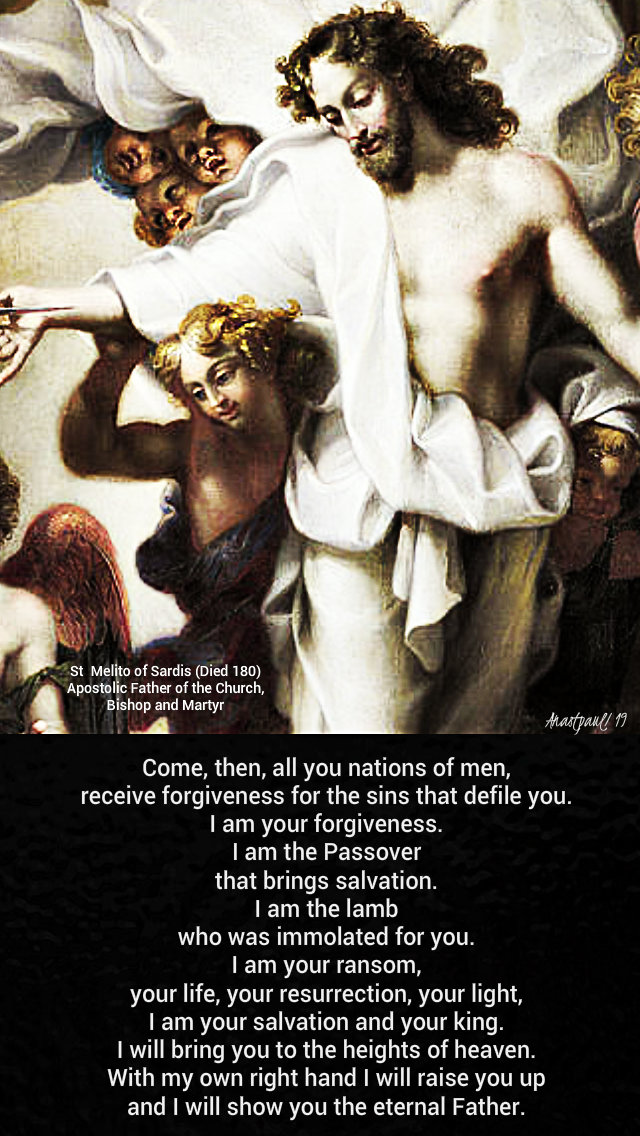
Saint Melito of Sardis (Died 180)
Apostolic Father of the Church, Bishop and Martyr
An excerpt from his Easter Homily
We should understand, beloved, that the paschal mystery is at once old and new, transitory and eternal, corruptible and incorruptible, mortal and immortal. In terms of the Law it is old, in terms of the Word it is new. In its figure it is passing, in its grace it is eternal. It is corruptible in the sacrifice of the lamb, incorruptible in the eternal life of the Lord . It is mortal in his burial in the earth, immortal in his resurrection from the dead.
The Law indeed is old but the Word is new. The type is transitory but grace is eternal. The lamb was corruptible but the Lord is incorruptible. He was slain as a lamb. he rose again as God. He was led like a sheep to the slaughter, yet he was not a sheep. He was silent as a lamb, yet he was not a lamb. The type has passed away; the reality has come. The lamb gives place to God, the sheep gives place to a man and the man is Christ, who fills the whole of creation. The sacrifice of the lamb, the celebration of the Passover and the prescriptions of the Law have been fulfilled in Jesus Christ. Under the old Law and still more under the new dispensation, everything pointed toward Him.
Both the Law and the Word came forth from Zion and Jerusalem but now the Law has given place to the Word, the old to the new. The commandment has become grace, the type a reality. The lamb has become a Son, the sheep a man and man, God.
The Lord, though he was God, became man. He suffered for the sake of those who suffer, He was bound for those in bonds, condemned for the guilty, buried for those who lie in the grave but He rose from the dead and cried aloud: Who will contend with Me? Let him confront Me. I have freed the condemned, brought the dead back to life, raised men from their graves. Who has anything to say against Me? I, He said, am the Christ, I have destroyed death, triumphed over the enemy, trampled hell underfoot, bound the strong one and taken men up to the heights of heaven – I am the Christ.
Come, then, all you nations of men, receive forgiveness for the sins that defile you. I am your forgiveness. I am the Passover that brings salvation. I am the lamb who was immolated for you. I am your ransom, your life, your resurrection, your light, I am your salvation and your king. I will bring you to the heights of heaven. With my own right hand I will raise you up and I will show you the eternal Father.
One Minute Reflection – 22 April – Monday of Easter Week, Gospel: Matthew 28:8–15
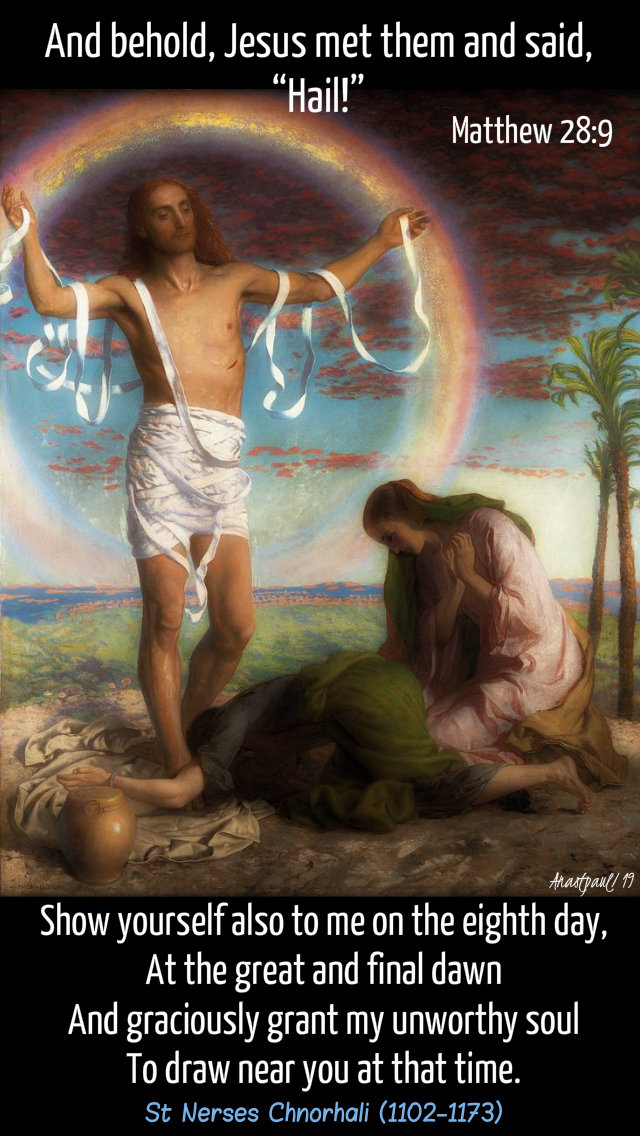
And behold, Jesus met them and said, “Hail!”...Matthew 28:9
REFLECTION –
At dawn you were mourned
By women bearing spices,
Grant that my heart may also shed
Tears of fire for your burning love.
By grace of the angel’s tidings
Shouted from the pinnacle of the rock (Mt 28,2),
Let me hear the last trumpet sound
Proclaiming the resurrection.
With your body born of a Virgin
You were raised from a tomb, virgin and new,
You became for us the first-fruits
And firstborn from the dead
As for me, bound by the Foe
With the evil of bodily sin,
Set me free once more
As you have freed souls in the dwelling of the dead (1Pt 3:19).
You revealed yourself in the garden
To Mary Magdalene,
But have not consented to approach
One who is yet part of a fallen race.
Show yourself also to me on the eighth day,
At the great and final dawn
And graciously grant my unworthy soul
To draw near you at that time.
St Nerses Chnorhali (1102-1173) Armenian Catholic Patriarch
PRAYER – Lord God, grant that Your people may hold fast in life to the mystery of new birth, which they received in faith. May Your glorified Son, Jesus our Hope, who broke the power of hell, destroying sin and death, stay ever with us in our struggles against temptation and guide our steps along the path that leads to a holy earthly end and to You in everlasting life. Mary, holy Mother, please help your children. Through Jesus Christ Our Lord, Who lives and reigns with God The Father, in the unity of the Holy Spirit, forever and ever. Amen
Our Morning Offering – 22 April – Monday of Easter Week
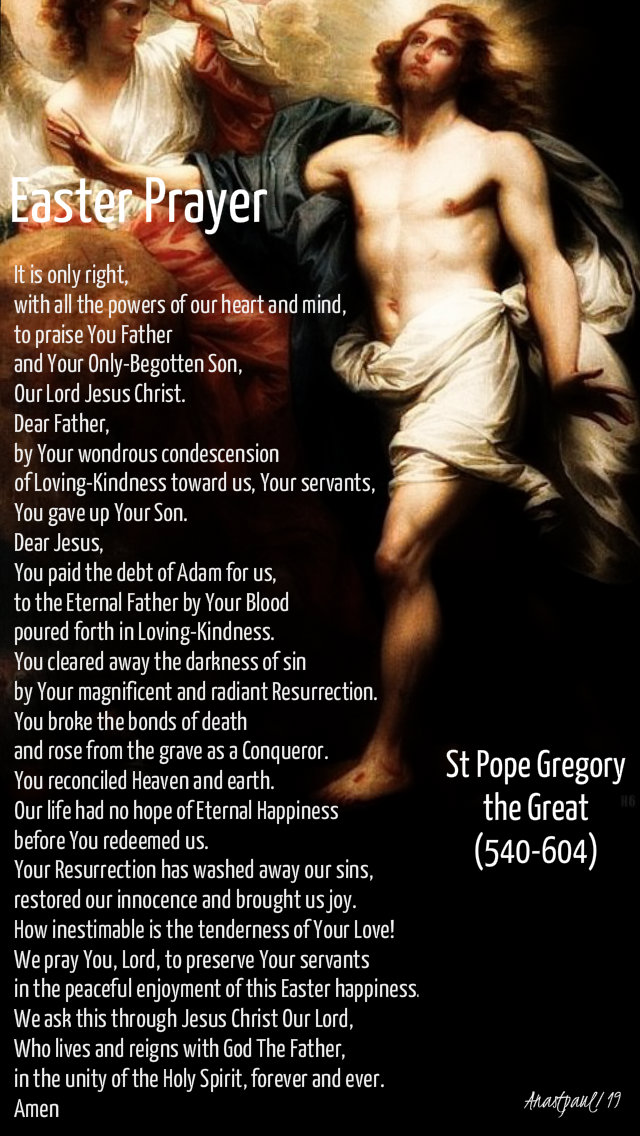
Easter Prayer By St Pope Gregory the Great (540-604) One of the original four Doctors of the Latin Church
It is only right,
with all the powers of our heart and mind,
to praise You Father and Your Only-Begotten Son,
Our Lord Jesus Christ.
Dear Father,
by Your wondrous condescension
of Loving-Kindness toward us, Your servants,
You gave up Your Son.
Dear Jesus,
You paid the debt of Adam for us,
to the Eternal Father by Your Blood
poured forth in Loving-Kindness.
You cleared away the darkness of sin
by Your magnificent and radiant Resurrection.
You broke the bonds of death
and rose from the grave as a Conqueror.
You reconciled Heaven and earth.
Our life had no hope of Eternal Happiness
before You redeemed us.
Your Resurrection has washed away our sins,
restored our innocence and brought us joy.
How inestimable is the tenderness of Your Love!
We pray You, Lord, to preserve Your servants
in the peaceful enjoyment of this Easter happiness.
We ask this through Jesus Christ Our Lord,
Who lives and reigns with God The Father,
in the unity of the Holy Spirit, forever and ever.
Amen
Holy Week Thoughts – 20 April – Holy Saturday – Easter Vigil in the Holy Night
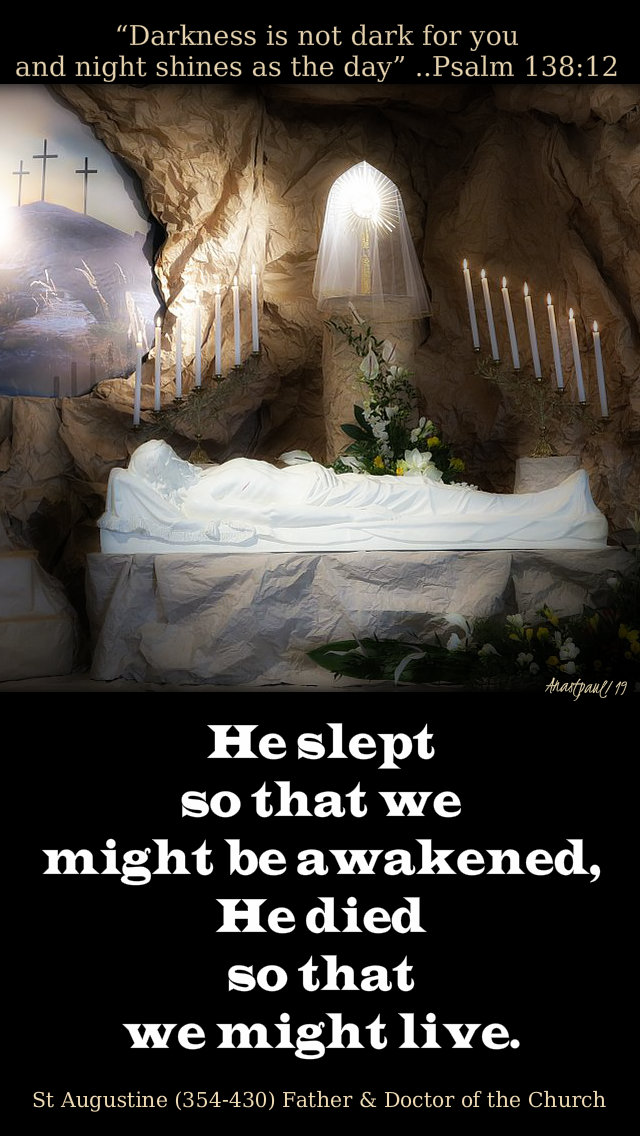
“Darkness is not dark for you and night shines as the day” (Ps 138:12)
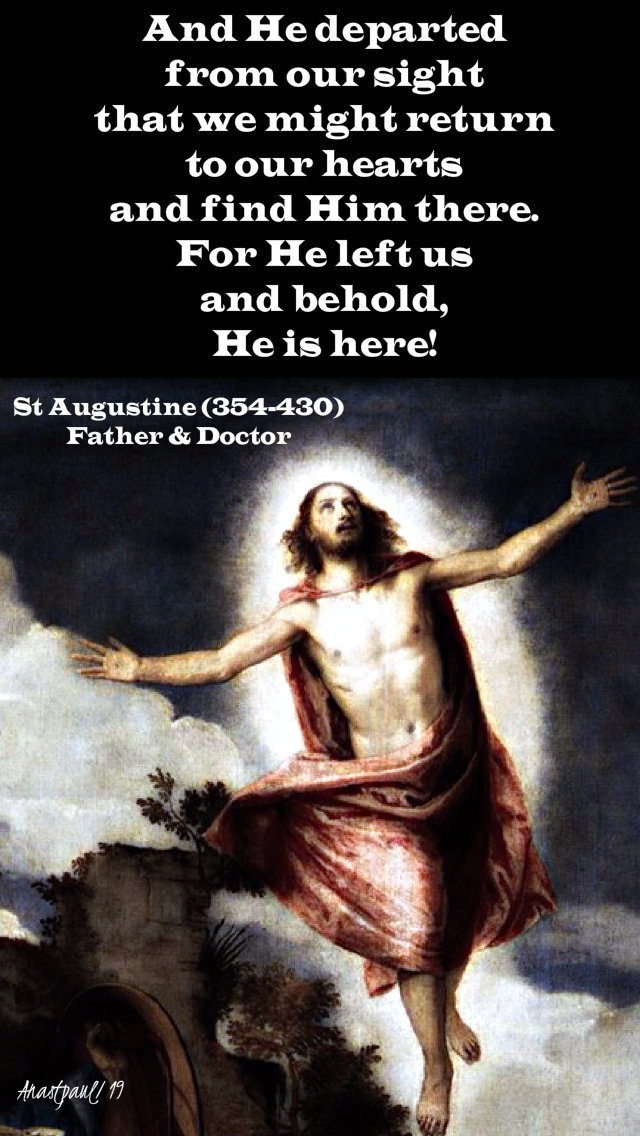
St Augustine (354-430)
Father & Doctor of the Church
We who are mortal need to sleep to restore our strength and, therefore, we interrupt our lives with this image of death that yet leaves us at least some scraps of life. In the same way all those who live in chastity, innocence and fervour, prepare for themselves the life of angels, in exchange for this burden of death, they will receive grace in the eternal life… Now, my brothers, listen to these few words I want to tell you about this coming night that we are about to live through…
Our Lord Jesus Christ has been raised from the dead on the third day, no Christian doubts this. The Holy Gospels testify, that this event occurred during this night… It is not from light to darkness but from darkness to light that we struggle to emerge. The apostle Paul warns us: “The night is advanced, the day is at hand. Let us throw off the works of darkness and put on the armour of light” (Rom 13:12)… Hence we will stay up on this night when the Lord was raised and began, in His flesh, that life of which I spoke to you before, the life that has no death nor sleep. And the flesh that He raised from the tomb, will not die again or fall any longer under the law of death.
The women who loved Him came at dawn to visit His tomb, instead of finding His body they heard the voice of angels announcing His resurrection. No doubt then. that He was raised on the night before this dawn. Thus He, whose resurrection we celebrate during our long vigils, will make us reign with Him in an everlasting life . And even if, while we were watching, His body were still in the tomb and had not yet been raised, our watching would still have all its meaning, since He slept so that we might be awakened, He died so that we might live.
Quote/s of the Day – 20 April – Holy Saturday – Easter Vigil in the Holy Night
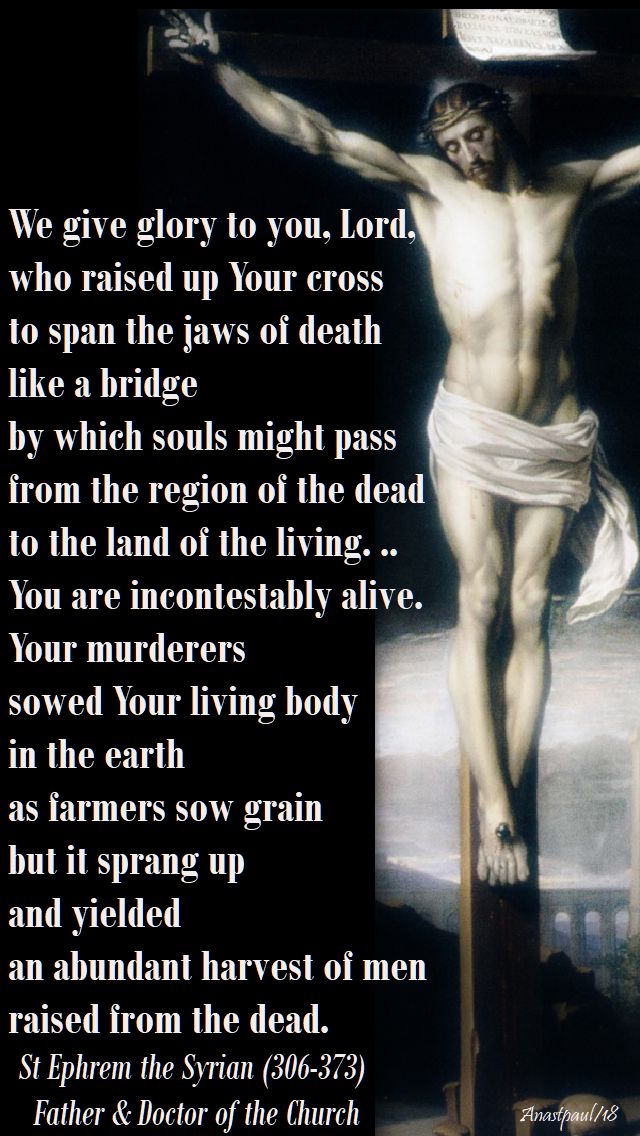
“We give glory to You, Lord, who raised up Your Cross to span the jaws of death like a bridge by which souls might pass from the region of the dead to the land of the living. .. You are incontestably alive. Your murderers sowed Your living body in the earth as farmers sow grain but it sprang up and yielded an abundant harvest of men raised from the dead.”
St Ephrem the Syrian (306-373) Father & Doctor of the Church
“Sursum corda” – lift up your hearts, high above the tangled web of our concerns, desires, anxieties and thoughtlessness – “Lift up your hearts, your inner selves!” In both exclamations we are summoned, as it were, to a renewal of our Baptism: “Conversi ad Dominum” – we must distance ourselves ever anew from taking false paths, onto which we stray so often in our thoughts and actions. We must turn ever anew towards Him who is the Way, the Truth and the Life. We must be converted ever anew, turning with our whole life towards the Lord. And ever anew we must allow our hearts to be withdrawn from the force of gravity, which pulls them down and inwardly we must raise them high,in truth and love. At this hour, let us thank the Lord, because through the power of His word and of the holy Sacraments, He points us in the right direction and draws our heart upwards.”
Pope Benedict
22 March 2008
Yes, Lord, make us Easter people, men and women of light, filled with the fire of Your love. Amen
One Minute Reflection – 20 April – Holy Saturday – Easter Vigil in the Holy Night, Gospel: Luke 24:1-12
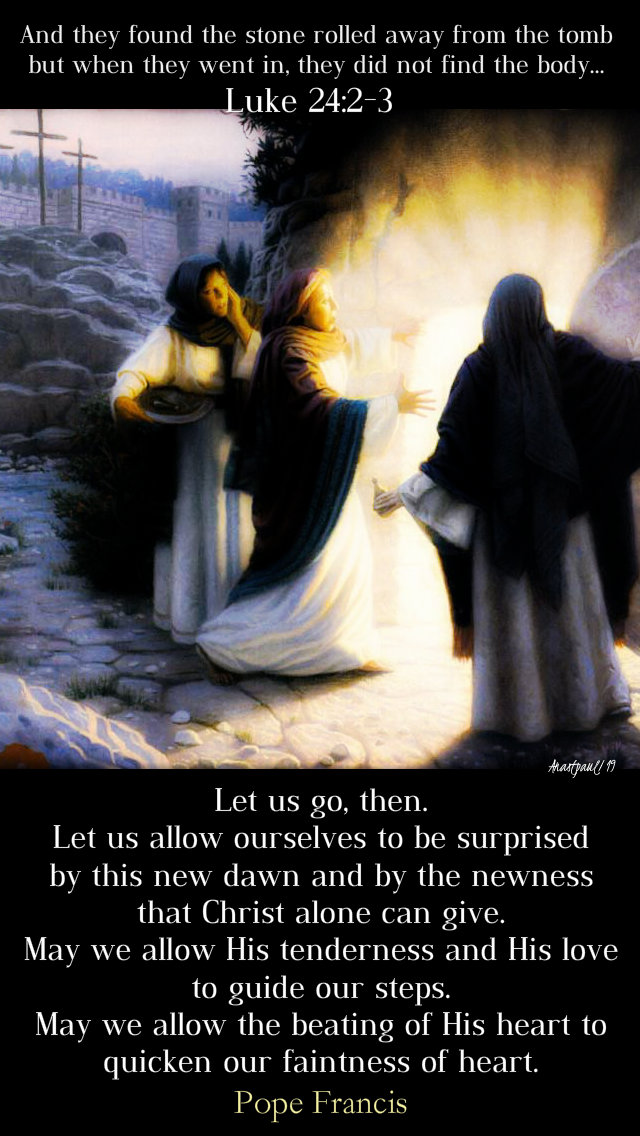
But on the first day of the week, at early dawn, they went to the tomb, taking the spices which they had prepared. And they found the stone rolled away from the tomb but when they went in, they did not find the body…Luke 24:1-3
REFLECTION – “Unlike the disciples, the women are present – just as they had been present as the Master breathed His last on the cross and then, with Joseph of Arimathea, as He was laid in the tomb. Two women who did not run away, who remained steadfast, who faced life as it is and who knew the bitter taste of injustice. If we try to imagine this scene, we can see in the faces of those women any number of other faces – the faces of mothers and grandmothers, of children and young people who bear the grievous burden of injustice and brutality. The faces of those women mirror many other faces too, including perhaps yours and mine. Once again, someone came to tell them: “Do not be afraid” but now adding: “He has been raised as he said!” Do not be afraid, brothers and sisters; he is risen as he said!”
In the resurrection, Christ rolled back the stone of the tomb but He wants also to break down all the walls, that keep us locked in our sterile pessimism, in our carefully constructed ivory towers that isolate us from life, in our compulsive need for security and in boundless ambition, that can make us compromise the dignity of others. Let us go, then. Let us allow ourselves to be surprised by this new dawn and by the newness that Christ alone can give. May we allow His tenderness and His love to guide our steps. May we allow the beating of His heart to quicken our faintness of heart.”…Pope Francis – Homily, Easter Vigil in the Holy Night, 15 April 2017
PRAYER – Almighty, ever-living God, whose only-begotten Son, descended to the realm of the dead and rose from there in glory, grant that Your faithful people, who were buried with Him in Baptism, may, by His Resurrection, obtain eternal life. With Mary His Mother, who in her sorrow remained with Him at the Cross and by whose prayers we receive succour, grant that we too will be with Him in glory. Through Christ our Lord and Redeemer, with the Holy Spirit, God forever, amen.
Our Morning Offering – 20 April – Holy Saturday – Easter Vigil in the Holy Night
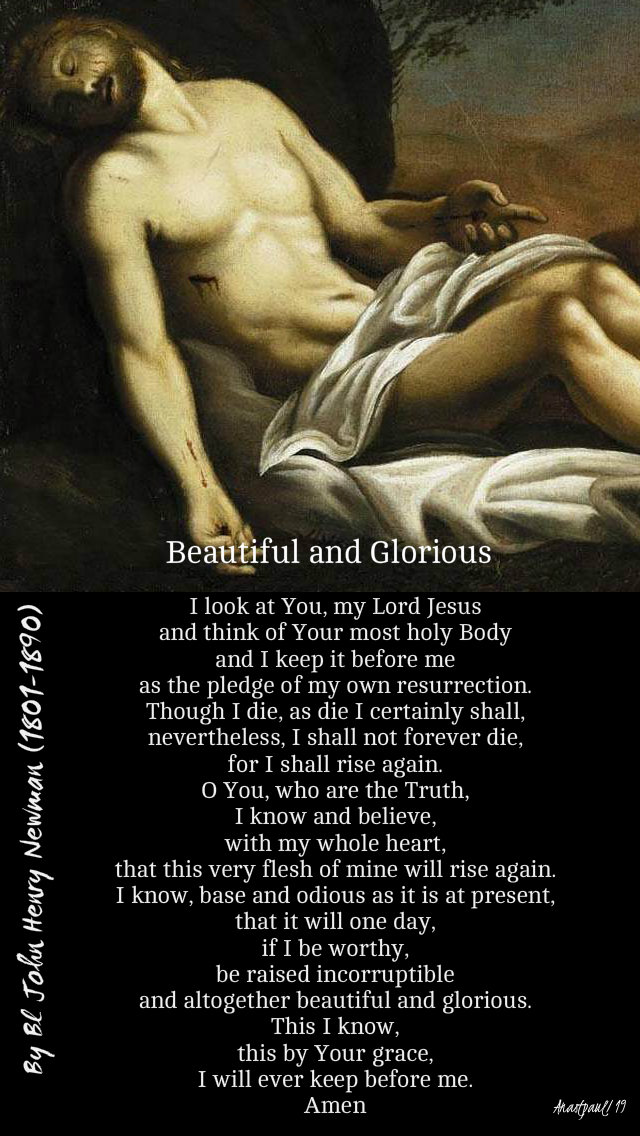
Beautiful and Glorious By Bl John Henry Newman (1801-1890)
I look at You, my Lord Jesus
and think of Your most holy Body
and I keep it before me
as the pledge of my own resurrection.
Though I die, as die I certainly shall,
nevertheless, I shall not forever die,
for I shall rise again.
O You, who are the Truth,
I know and believe,
with my whole heart,
that this very flesh of mine will rise again.
I know, base and odious as it is at present,
that it will one day,
if I be worthy,
be raised incorruptible
and altogether beautiful and glorious.
This I know,
this by Your grace,
I will ever keep before me.
Amen
Saint Augustine (354-430)
Bishop and Great Western Father and Doctor of the Church
An excerpt from his Treatise 84
Dear brethren, the Lord has marked out for us the fullness of love that we ought to have for each other. He tells us – No-one has greater love than the man who lays down his life for his friends. In these words, the Lord tells us what the perfect love we should have for one another involves. John, the evangelist who recorded them, draws the conclusion in one of his letters – As Christ laid down His life for us, so we too ought to lay down our lives for our brothers. We should indeed love one another as He loved us, He who laid down His life for us.
This is surely what we read in the Proverbs of Solomon: If you sit down to eat at the table of a ruler, observe carefully what is set before you, then stretch out your hand, knowing that you must provide the same kind of meal yourself. What is this ruler’s table, if not the one at which we receive the body and blood of Him who laid down His life for us? What does it mean to sit at this table if not to approach it with humility? What does it mean to observe carefully what is set before you, if not to meditate devoutly on so great a gift? What does it mean to stretch out one’s hand, knowing that one must provide the same kind of meal oneself, if not what I have just said: as Christ laid down His life for us, so we in our turn, ought to lay down our lives, for our brothers? This is what the Hpostle Paul said – Christ suffered for us, leaving us an example, that we might follow in his footsteps.
This is what is meant by providing “the same kind of meal.” This is what the blessed martyrs did, with such burning love. If we are to give true meaning, to our celebration of their memorials, to our approaching the Lord’s table, in the very banquet at which they were fed, we must, like them, provide “the same kind of meal.”
At this table of the Lord we do not commemorate the martyrs in the same way as we commemorate others who rest in peace. We do not pray for the martyrs as we pray for those others, rather, they pray for us, that we may follow in His footsteps. They practised the perfect love, of which the Lord said, there could be none greater. They provided “the same kind of meal” as they had themselves received at the Lord’s table.
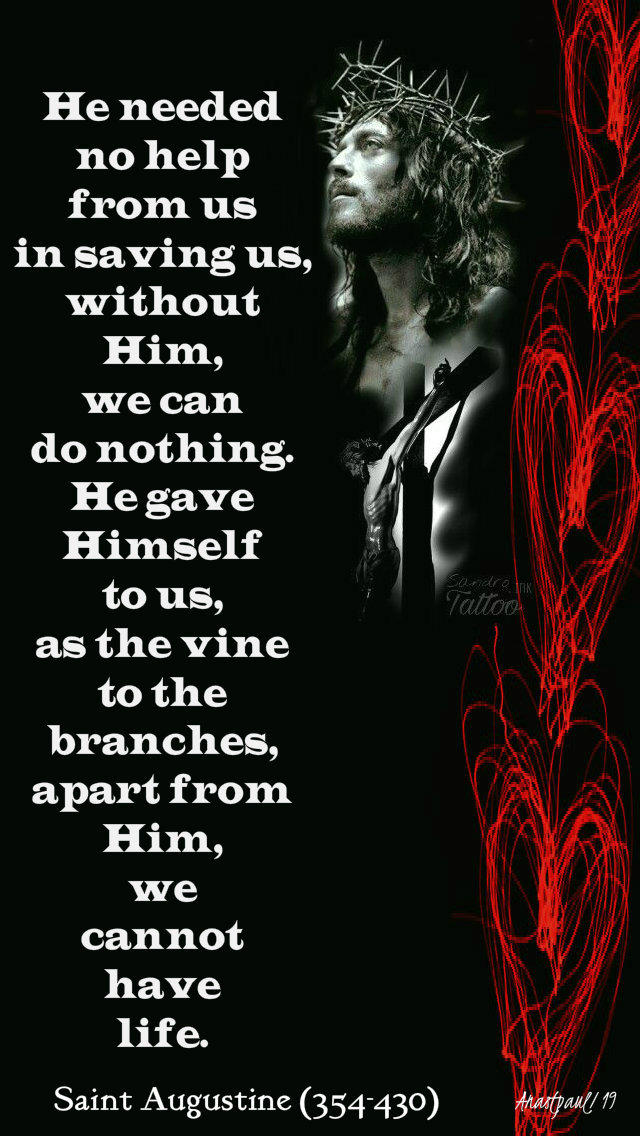
This must not be understood as saying, that we can be the Lord’s equals by bearing witness to Him, to the extent of shedding our blood. He had the power of laying down His life, we by contrast, cannot choose the length of our lives and we die, even if it is against our will. He, by dying, destroyed death in Himself; we are freed from death only in His death. His body did not see corruption, our body will see corruption and only then be clothed through Him, in incorruption, at the end of the world. He needed no help from us in saving us, without Him, we can do nothing. He gave Himself to us, as the vine to the branches, apart from Him, we cannot have life.
Finally, even if brothers die for brothers, yet no martyr by shedding his blood brings forgiveness for the sins of his brothers, as Christ brought forgiveness to us. In this, He gave us, not an example to imitate but a reason for rejoicing. Inasmuch, then, as they shed their blood for their brothers, the martyrs provided “the same kind of meal” as they had received at the Lord’s table. Let us then love one another as Christ also loved us and gave Himself up for us.
Our Morning Offering – 18 April – Holy Thursday Evening Mass of the Lord’s Supper
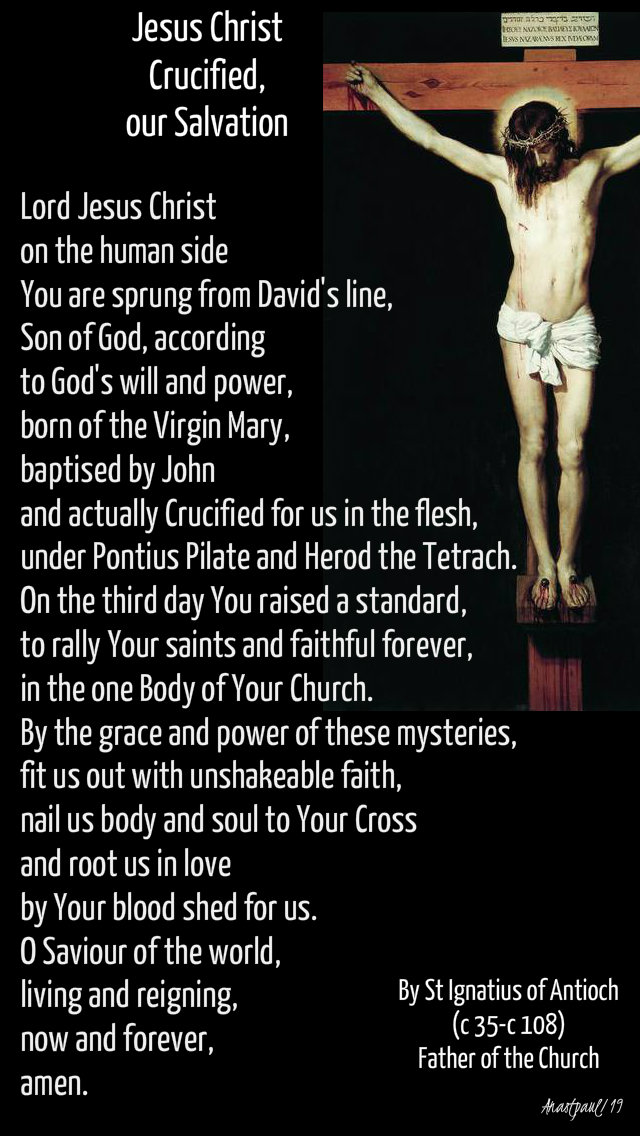
Jesus Christ Crucified, our Salvation By St Ignatius of Antioch (c 35-c 108) Father of the Church
Lord Jesus Christ
on the human side
You are sprung from David’s line,
Son of God, according
to God’s will and power,
born of the Virgin Mary,
baptised by John
and actually Crucified for us in the flesh,
under Pontius Pilate and Herod the Tetrach.
On the third day You raised a standard,
to rally Your saints and faithful forever,
in the one Body of Your Church.
By the grace and power of these mysteries,
fit us out with unshakeable faith,
nail us body and soul to Your Cross
and root us in love
by Your blood shed for us.
O Saviour of the world,
living and reigning,
now and forever,
amen.
Quote/s of the Day – 17 April 2019 – Wednesday of Holy week
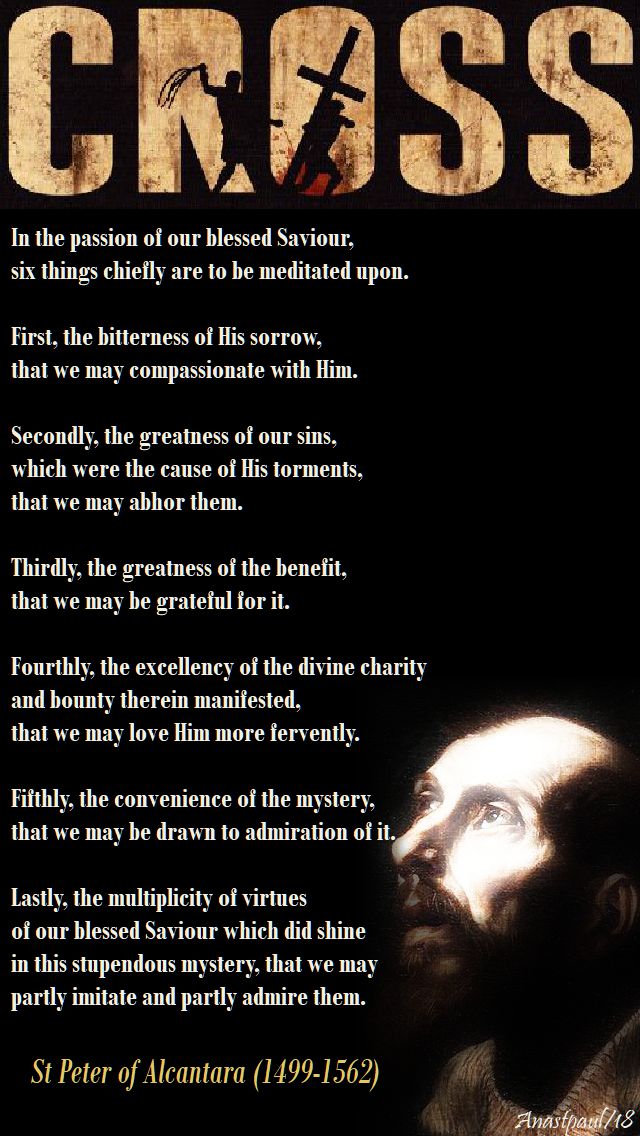
“In the passion of our blessed Saviour, six things chiefly are to be meditated upon.
First, the bitterness of His sorrow, that we may compassionate with Him.
Secondly, the greatness of our sins, which were the cause of His torments, that we may abhor them.
Thirdly, the greatness of the benefit, that we may be grateful for it.
Fourthly, the excellency of the divine charity and bounty therein manifested, that we may love Him more fervently.
Fifthly, the convenience of the mystery, that we may be drawn to admiration of it.
Lastly, the multiplicity of virtues of our blessed Saviour which did shine in this stupendous mystery, that we may partly imitate and partly admire them.”
St Peter of Alcantara (1499-1562)
“Anyone who turns away from the Cross, turns away from the Resurrection.”
Lenten Reflection – 10 April – Wednesday of the Fifth week of Lent, Year C
The Readings:
Deuteronomy 3:14-20, 91-92, 95; Daniel 3:52, 53, 54, 55, 56; John 8:31-42
Jesus said to them, “If you were Abraham’s children, you would do as Abraham did but now you seek to kill me, a man who has told you the truth which I heard from God, this is not what Abraham did....John 8:39-40
Do as Abraham did
St John Chrysostom (345-407)
Doctor of the Church
Looking wholly to God’s promise and setting aside all human ways of looking at things, knowing God to be capable of accomplishments beyond nature to achieve, Abraham put his trust in the words addressed to him, he let no shadow of doubt cross his mind and did not waver as to the meaning he should give God’s words. For, it is in the nature of faith to put its trust in the power of the one who promises… God had promised Abraham that a posterity without number would be born of him. This promise exceeded the possibilities of nature and all purely human forms of perception and that is why his faith towards God “was credited him as righteousness” (Gn 15:6; Gal 3:6).
Well then, if we are on the watch, yet more wonderful promises have been made to us and we will be satisfied to an even greater extent, than human thought can dream. And for this we have only to put our trust in the power of Him who has made these promises to us, so as to merit the righteousness, that comes from faith and obtain the promised reward. For all those good things we are hoping for, far exceed all human conception and thought, so exceedingly wonderful is what we have been promised!
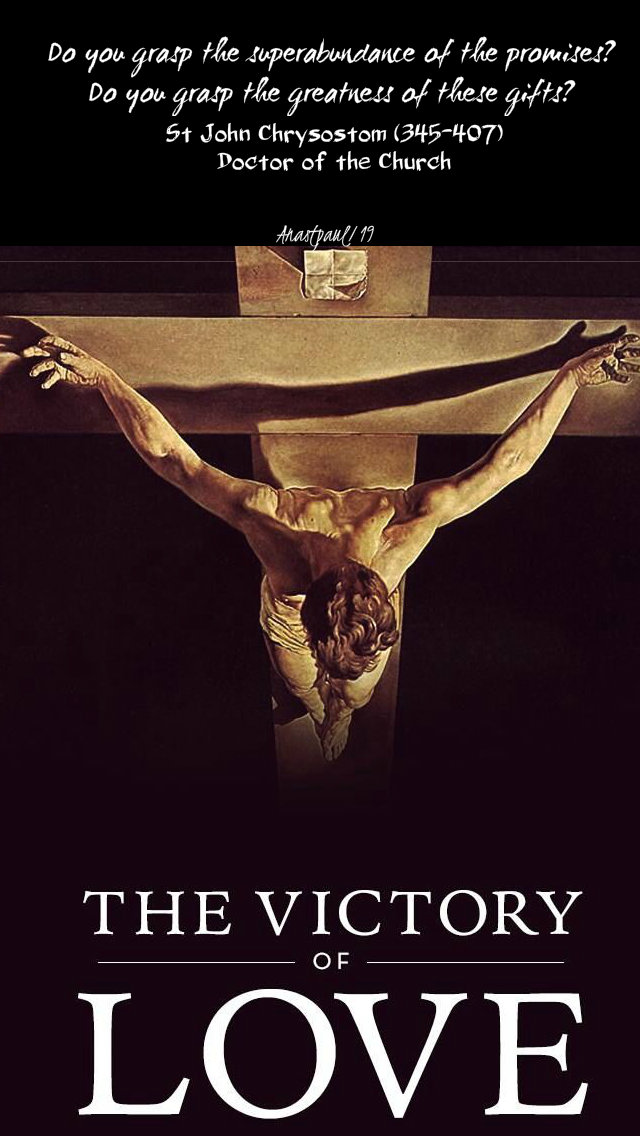
Indeed, these promises do not concern only the present, the flourishing of our lives and the enjoyment of visible goods but they are even more, about the time, when we have left this earth, when our bodies have become subject to corruption, when our remains have been reduced to dust. God promises us, that He will then raise them up and establish them in glorious splendour, “for that which is corruptible must clothe itself with incorruptibility,” Saint Paul assures us (1Cor 15:53). More than this, after the resurrection of our bodies, we have received the promise, of enjoying the Kingdom and of obtaining, throughout endless ages, in the company of the saints, those ineffable goods that “eye has not seen and ear has not heard nor has it not entered the human heart” (1Cor 2:9). Do you grasp the superabundance of the promises? Do you grasp the greatness of these gifts?
Daily Meditation: Enlighten our minds and sanctify our hearts.
In our reflection, Jesus is about to face a fiery furnace,
which represents the full rejection of all our sins,
and the crushing defeat of death itself.
Praying the Stations again,
might help us grow in a sense that this is all “for me,” for my freedom.
We grow in a sense of repentance and deep sorrow.
We grow in a desire to celebrate
the glorious Light in the midst of all darkness.
Rid yourself of all your sins and make a new heart and a new spirit.
Gospel antiphon, based upon Ezekiel 18:31
Closing Prayer:
Loving Creator,
I know in Your great love for me,
You see the deep sorrow in my heart.
Hear my prayers which are offered with such trust in You.
Be with me in both mind and heart
as I renew my life in Your spirit.
May the Lord bless us,
protect us from all evil
and bring us to everlasting life.
Amen
Lenten Thoughts – 9 April – Tuesday of the Fifth Week of Lent, Year C
The Cross of Christ
is the source of all blessings,
the cause of all graces
St Pope Leo the Great (c 400-461)
Bishop of Rome and Great Western Father & Doctor of the Church
An excerpt from his On the Lord’s Passion
Sermon 8
Our understanding, which is enlightened by the Spirit of truth, should receive with purity and freedom of heart the glory of the Cross as it shines in heaven and on earth. It should see with inner vision the meaning of the Lord’s words when He spoke of the imminence of His passion – The hour has come for the Son of Man to be glorified. Afterwards, He said – Now my soul is troubled and what am I to say? Father, save me from this hour. But it was for this that I came to this hour. Father, glorify your Son. When the voice of the Father came from heaven, saying, I have glorified him and will glorify him again, Jesus said in reply to those around him: It was not for me that this voice spoke but for you. Now is the judgement of the world, now will the prince of this world be cast out. And I, if I am lifted up from the earth, will draw all things to myself.
How marvellous the power of the Cross, how great beyond all telling the glory of the passion, here is the judgement-seat of the Lord, the condemnation of the world, the supremacy of Christ crucified.
Lord, you drew all things to Yourself so that the devotion of all peoples everywhere might celebrate, in a sacrament made perfect and visible, what was carried out in the one temple of Judea under obscure foreshadowings.
Now there is a more distinguished order of Levites, a greater dignity for the rank of elders, a more sacred anointing for the priesthood, because Your Cross is the source of all blessings, the cause of all graces. Through the Cross the faithful receive strength from weakness, glory from dishonour, life from death.
The different sacrifices of animals are no more – the one offering of Your body and blood is the fulfilment of all the different sacrificial offerings, for You are the true Lamb of God, You take away the sins of the world. In Yourself, You bring to perfection all mysteries, so that, as there is one sacrifice in place of all other sacrificial offerings, there is also one kingdom gathered from all peoples.
Dearly beloved, let us then acknowledge what Saint Paul, the teacher of the nations, acknowledged so exultantly. This is a saying worthy of trust, worthy of complete acceptance – Christ Jesus came into this world to save sinners. God’s compassion for us is all the more wonderful because Christ died, not for the righteous or the holy but for the wicked and the sinful and, though the divine nature could not be touched by the sting of death, He took to Himself, through His birth as one of us, something He could offer on our behalf.
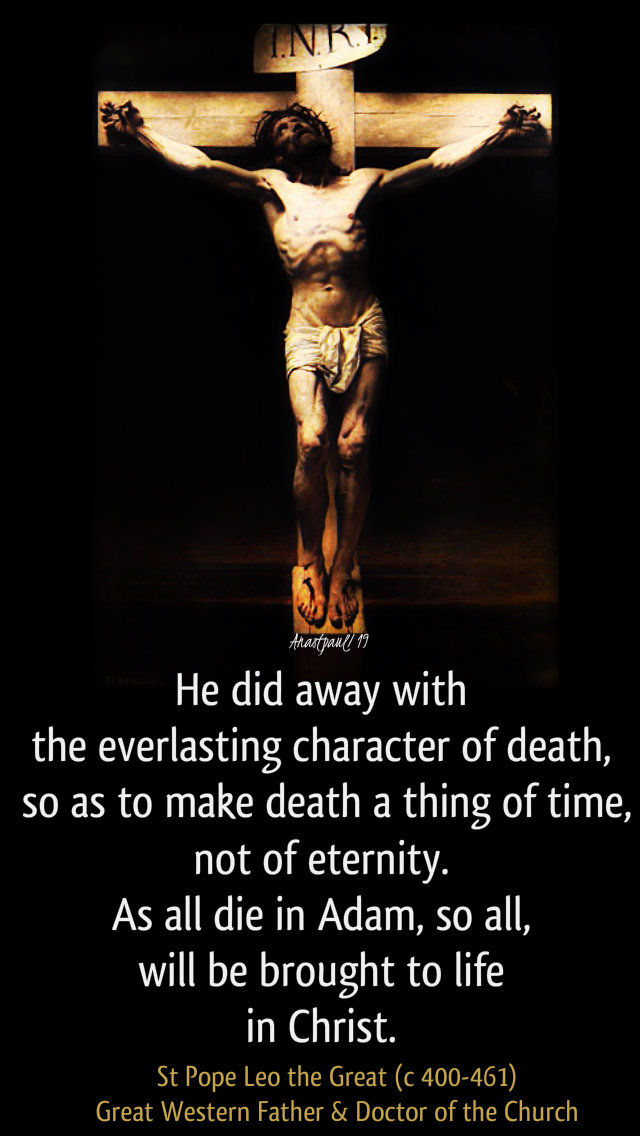
The power of His death once confronted our death. In the words of Hosea the prophet, Death, I shall be your death; grave, I shall swallow you up. By dying He submitted to the laws of the underworld, by rising again, He destroyed them. He did away with the everlasting character of death, so as to make death a thing of time, not of eternity. As all die in Adam, so all, will be brought to life in Christ.
Glory to the Father
and to the Son
and to the Holy Spirit:
as it was in the beginning,
is now, and will be forever.
Amen
Lenten Thoughts – 7 April – The Fifth Sunday of Lent, Year C
“Great thing is the knowledge of the crucified Christ. How many things are enclosed inside this treasure! Christ crucified! Such is the hidden treasure of wisdom and science. Do not be deceived, then, under the pretext of wisdom. Gather before the covering and pray that it may be uncovered. Foolish philosopher of this world, what you are looking for is worthless… What is the advantage of being thirsty, if you despise the source? … And what is His precept but that we believe in Him and love each other? In whom? In Christ crucified. This is His commandment – that we believe in Christ crucified … But where humility is, there is also majesty, where weakness is, there shall one find power, where death is, there shall be life as well. If you wish to arrive at the second part, do not despise the first”
St Augustine (354-430) Father & Doctor (Sermon 160, 3-4)
Lenten Reflection – 6 April – Saturday of the Fourth week of Lent, Year C
The Readings: Jeremiah 11:18-20; Psalm 7:2-3,9BC-10, 11-12; John 7:40-53
Daily Meditation: Apart from You we can do nothing.
The conflict around Jesus grows.
And all the while, we are turning to God for mercy.
What Jesus went through is for me,
that I might have mercy and the gift of everlasting life.
We call upon the Lord for help, for strength, for trust.
My shield is with God, who saves the upright in heart.
Psalm 7:10
“No one laid hands on him”...John 7:44
Origen (c 185-253)
Father, Priest and Theologian
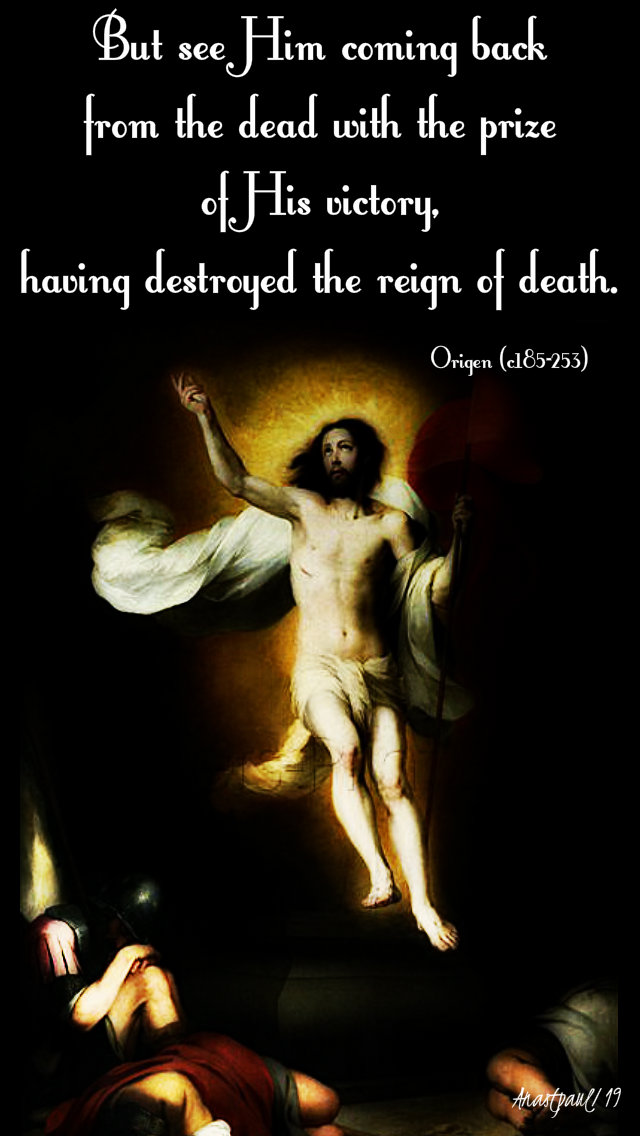
In Christ we encounter such human characteristics that they have nothing to distinguish them from the weakness common to us mortals. At the same time, we encounter characteristics so divine, that they can only be appropriate to the sovereign and ineffable divine nature. Too small to comprehend this, the human mind is so dumbfounded, that it does not know what to take its stand on, nor which path to follow. Is it aware of God in Christ? Yet it sees Him die. Does it take Him to be a man? But see Him coming back from the dead with the prize of His victory, having destroyed the reign of death. In the same way our contemplation needs to be practised with such reverence and fear that, in the same Jesus, it considers the truth of the two natures, avoiding attributing to the divine essence those things that are nor worthy of it or do not belong to it but also avoiding seeing only an illusory appearance in historical events.
In truth, causing such things as these to be heard by human ears, trying to express them in words considerably surpasses our ability, talent and language. I even think it surpasses the capability of the apostles. More still, the explanation of this mystery probably transcends the entire order of angelic powers.
Closing Prayer:
Lord,
what You ask of my life seems so right.
It is how I want to live,
following Your Son, Jesus, so closely.
And yet I fail so often to stay on that path.
I cannot do it alone, loving Lord.
I need Your help and guidance.
I need to remember Your love for me
and I want to remember
how very much I need You in my life.
May the Lord bless us,
protect us from all evil
and bring us to everlasting life.
Amen
Lenten Reflection – 3 April – Wednesday of the Fourth week of Lent, Year C
The Readings:
Isaiah 49:8-15; Psalms 145:8-9, 13CD-14, 17-18; John 5:17-30
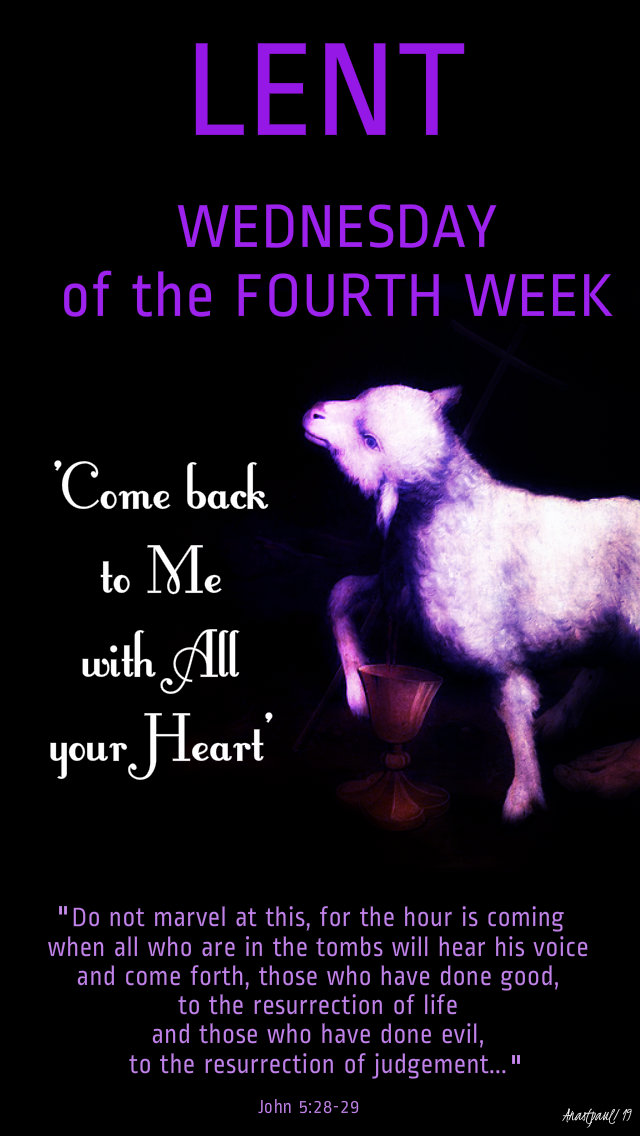
Do not marvel at this for the hour is coming, when all who are in the tombs, will hear his voice and come forth, those who have done good, to the resurrection of life and those who have done evil, to the resurrection of judgement.…John 5:28-29
Daily Meditation: Grant us Your forgiveness.
We know that this whole journey is about our reconciliation.
We know that God wants to forgive us.
We know we are preparing to renew our Baptismal promises,
and “refuse to be mastered by sin.”
Today we hear the invitation and ask more earnestly.
In the marvellous discourse that follows His sign of healing,
Jesus says, “I am not seeking my own will but the will of him who sent me.”
I am filled with a sense of sorrow and gratitude,
as I see what He did for me.
I tell you for certain that everyone who hears my message and has faith in the one who sent me has eternal life and will never be condemned. They have already gone from death to life.
John 5:24
“The dead will hear his voice” – “Lazarus, come forth” (Jn 11:43)
Saint Peter Chrysologus (400-450) Father & Doctor of the Church
Our Lord had raised Jairus’s daughter but while the body was still warm and death was only halfway through its work (Mt 9:18f.)… He also raised the widow’s only son but by halting the stretcher and forestalling the tomb… before the dead man had fallen completely under the law of death (Lk 7:11f.). But the whole event that takes place with regard to Lazarus is unique.. Lazarus, in whom all death’s power had been completed and in whom, equally, a complete image of the resurrection shone out… Christ, indeed, returned as Lord on the third day; Lazarus, as servant, was called back to life on the fourth day…
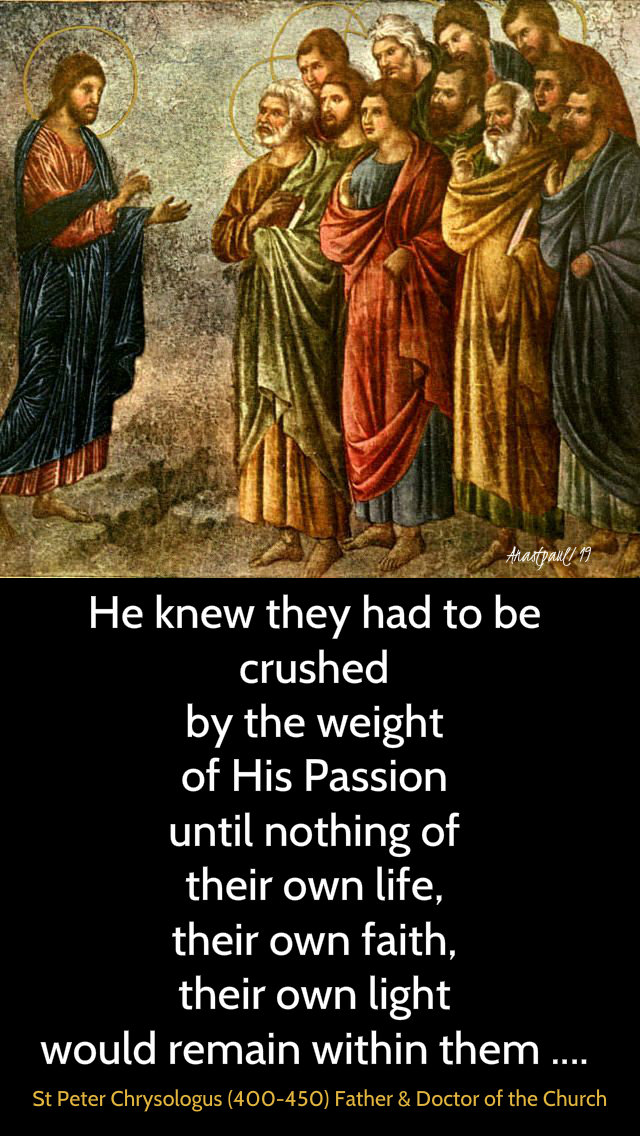
The Lord said and repeated to His disciples: “Behold, we are going up to Jerusalem and the Son of Man will be handed over to the chief priests and the scribes and they will condemn him to death and hand him over to the Gentiles to be mocked and scourged and crucified” (Mt 20:18f.). And when He said this, He saw them growing uncertain, sad, comfortless. He knew they had to be crushed by the weight of His Passion until nothing of their own life, their own faith, their own light would remain within them but, to the contrary, their hearts would be darkened with the almost total darkness of their lack of faith. That is the reason why He let Lazarus’s death continue for four days… From this follows what our Lord said to His disciples: “Lazarus has died. And I am glad for you that I was not there, that you may believe” (vv.14-15). Therefore Lazarus’s death was necessary so that the disciples’ faith might rise from the tomb along with Lazarus.
“That I was not there.” Now was there anywhere where Christ was not?… My brethren, Christ as God was there but Christ the man was not. Christ God was there when Lazarus was dying but now Christ man was going to the dead man because Christ our Lord was going enter into death: “It is there, in death, in the tomb, in hell, that all the power of death is to be crushed through me and my death.”
Closing Prayer:
Loving and merciful God,
I am so aware of my sins and weaknesses.
But as painfully aware of my faults as I am,
Let me also remember Your tender love,
Your gentle and limitless forgiveness.
I come before You filled with pain and guilt
but look into Your eyes and see the forgiving love of my Father,
I so long for in my life.
Help me to forgive the same way.
Teach me to love as You love.
May the Lord bless us,
protect us from all evil
and bring us to everlasting life.
Amen.
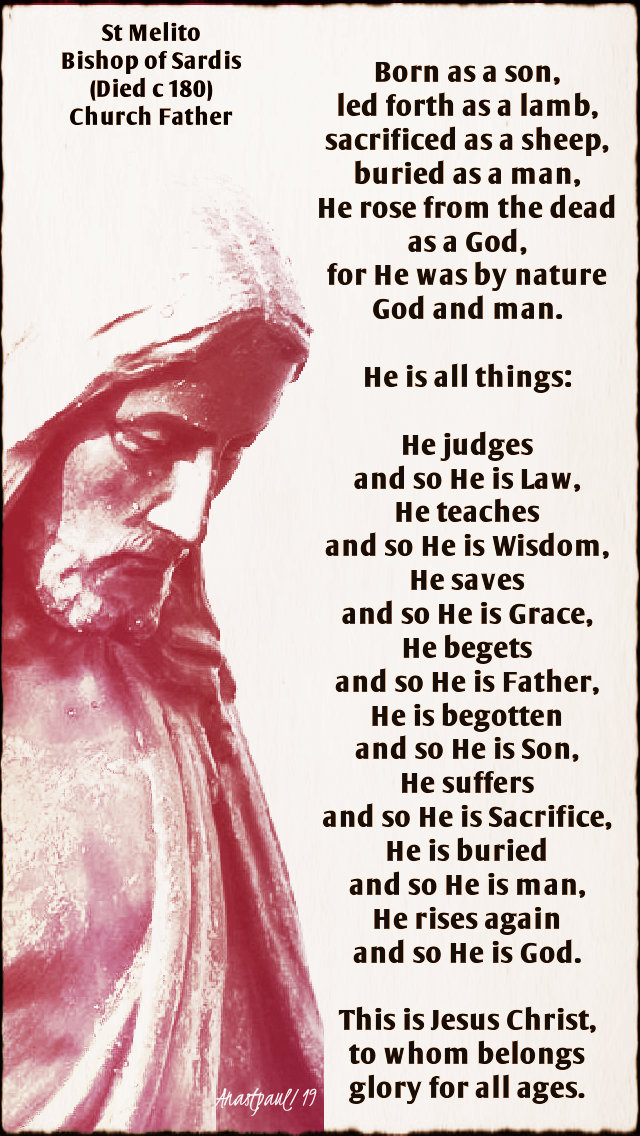
Quote/s of the Day – 1 April – Monday of the Fourth week of Lent, Year C – Saint Melito Bishop of Sardis (Died c 180) Early Church Father
Prayer in Praise of Christ
Born as a son, led forth as a lamb, sacrificed as a sheep, buried as a man, He rose from the dead as a God, for He was by nature God and man.
He is all things: He judges and so He is Law, He teaches and so He is Wisdom, He saves and so He is Grace, He begets and so He is Father, He is begotten and so He is Son, He suffers and so He is Sacrifice, He is buried and so He is man, He rises again and so He is God. This is Jesus Christ, to whom belongs glory for all ages.
“The Lord, though He was God, became man. He suffered for the sake of whose who suffer, He was bound for those in bonds, condemned for the guilty, buried for those who lie in the grave but He rose from the dead and cried aloud: “Who will contend with me? Let him confront me.” I have freed the condemned, brought the dead back to life, raised men from their graves. Who has anything to say against me? I, He said, am the Christ, I have destroyed death, triumphed over the enemy, trampled hell underfoot, bound the strong one and taken men up to the heights of heaven. I am the Christ. Come, then, all you nations of men, receive forgiveness for the sins that defile you. I am your forgiveness. I am the Passover that brings salvation. I am the lamb who was immolated for you. I am your Ransom, your Life, your Resurrection, your Light, I am your Salvation and your King. I will bring you to the heights of heaven. With my own right hand I will raise you up and I will show you the eternal Father.”
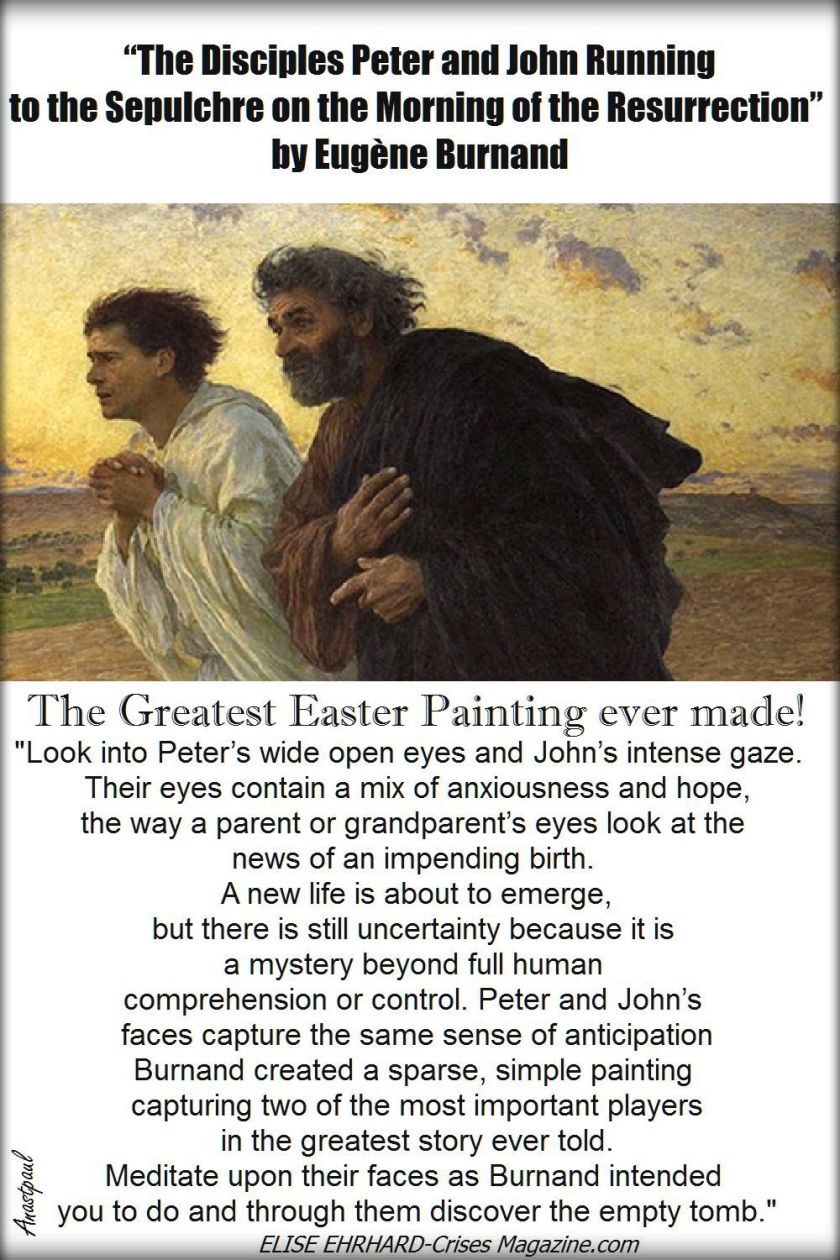
Thought for the Day – 27 December – the Feast of St John the Apostle and Evangelist “The Disciple whom Jesus Loved” and the 3rd Octave Day – “The Greatest Easter Painting Ever Made”
So she ran and went to Simon Peter and the other disciple, the one whom Jesus loved and said to them, “They have taken the Lord out of the tomb and we do not know where they have laid him.” Peter then came out, with the other disciple and they went toward the tomb. They both ran but the other disciple outran Peter and reached the tomb first and stooping to look in, he saw the linen cloths lying there but he did not go in. Then Simon Peter came, following him and went into the tomb, he saw the linen cloths lying and the napkin, which had been on his head, not lying with the linen cloths but rolled up in a place by itself. Then the other disciple, who reached the tomb first, also went in and he saw and believed...John 20:2–8
Tucked away in a central Parisian museum that was once a railway station, there hangs an Easter painting quite unlike any Gospel masterpiece created before or after it. It is not painted by a Rembrandt or a Rubens or the patron saint of artists, Fra Angelico. The painting is the work of a little-known Swiss painter. For those who make a trip to see it, viewing the canvas is a special spiritual experience in their lives.
The work does not even show the risen Jesus. It merely portrays two witnesses, Jesus’ oldest and youngest apostle. The youngest who was the only man brave enough to stay by Jesus’ cross and the only one who did not die a martyr’s death as a result of it. The oldest apostle, who first denied Jesus in fear, yet ultimately chose to be crucified upside down by the Roman authorities, rather than deny Christ’s resurrection.
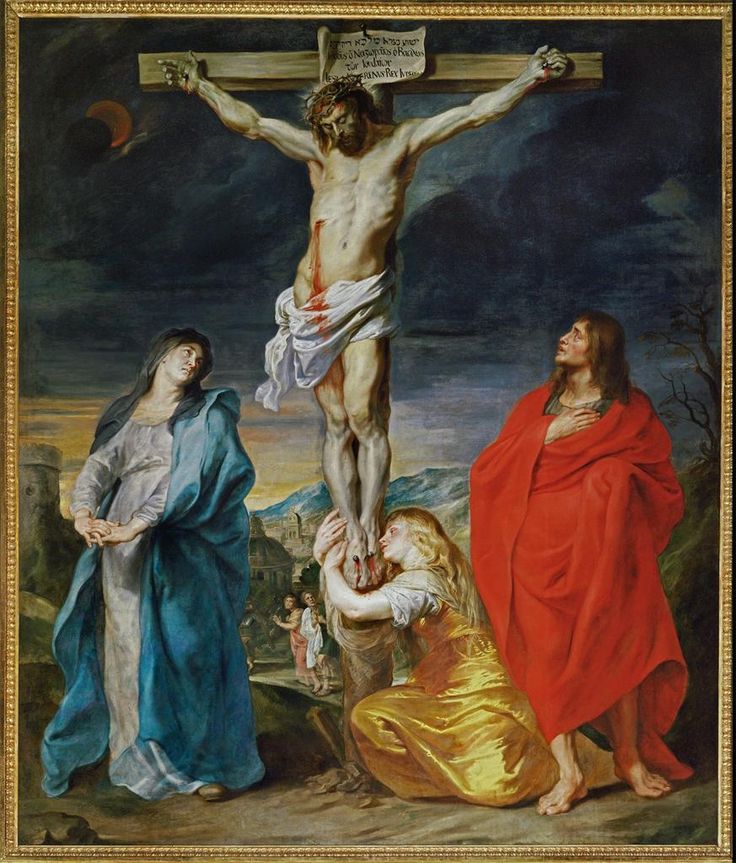
Anton van Dyck
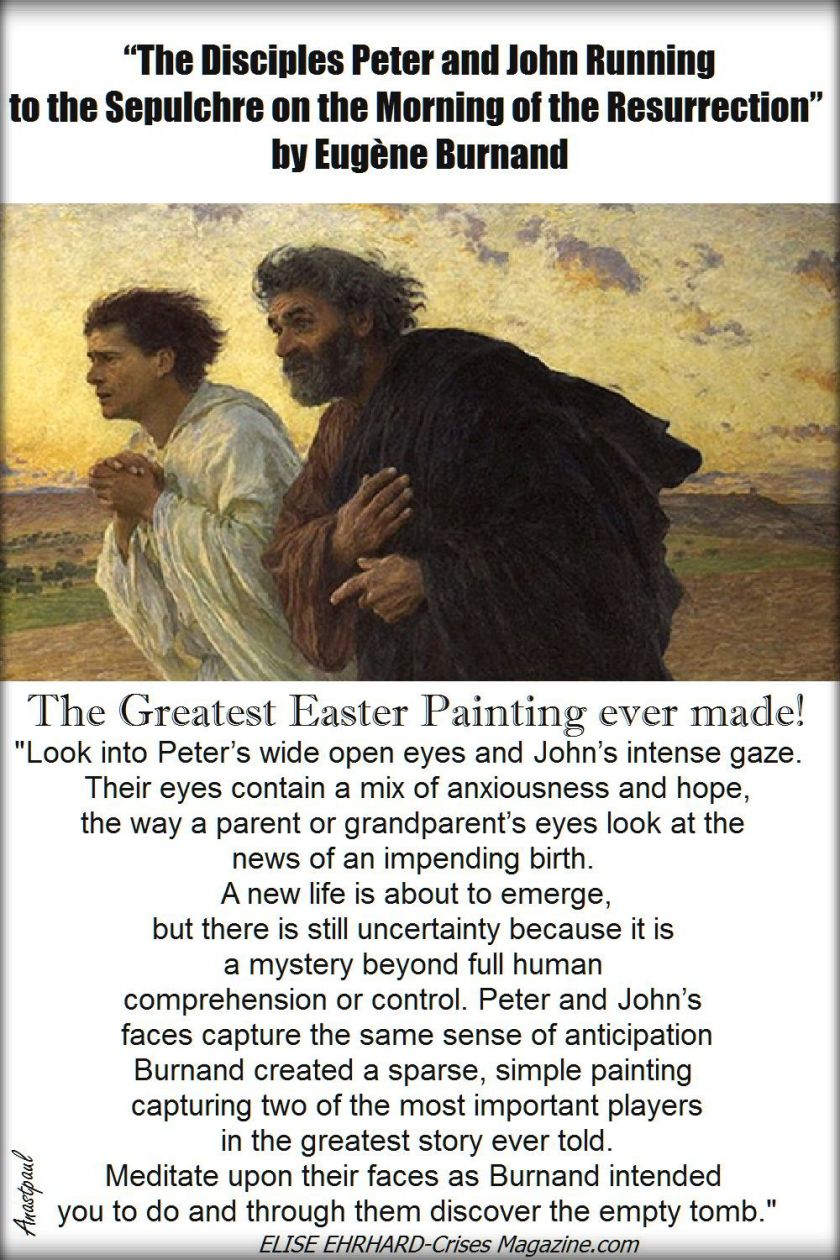
In “The Disciples Peter and John Running to the Sepulchre on the Morning of the Resurrection” by Eugène Burnand, John clasps his hand in prayer while Peter holds his hand over his heart. The viewer feels the rush as their hair and cloaks fly back with the wind. They are sprinting towards discovery of the moment that forever altered heaven and earth. As you look at it, engage for a moment in what the Catholic blogger Bill Donaghy calls “the visual equivalent of Lectio Divina.” As Donaghy notes, “This Resurrection scene does not put us before still figures near a stagnant stone, or figures standing with stony faces in a contrived, plastic posture, pointing to an empty tomb. This scene is dynamic; we are in motion.”
During his time, Burnand was fascinated by the possibilities of the emerging art of photography. Ironically, he would later be dismissed in the twentieth century as too “bourgeois” and anti-modernist when in fact he was merging his love of tradition with his interest in new technological ways of capturing the human person. His painting feels cinematic long before cinema existed as a major art form.
Through the movement and immediacy of the scene, the preceding minutes with Mary Magdalene are palpable. In a sense, she is in the painting too. “You can almost hear her voice in the background, can you not, a few minutes earlier, as she burst into their house…” writes the Episcopal Bishop Dorsey McConnell in an Easter sermon meditating on the painting.
Apart from Jesus’ mother, no other three participants capture the closeness of Jesus’ encounter with humankind quite like John, Peter and Mary of Magdala. Their interactions with Christ embody a relationship to God previously unimaginable to mankind. Jesus turning to Peter as they sit by the fire and asking three times, “Do you love me?”, thereby washing away the sin of the three denials past; Christ turning to John in the midst of his suffering and saying, “Behold, your mother,” giving her to the Church entire. And, of course, the beautiful moment about to transpire in which Jesus’ merely says Mary’s name and she recognises Him with a cry of “Rabbouni!” They are the moments which cause one to wonder, how those who truly hate Christianity (not merely disbelief it) can remain so hostile to its narrative beauty.
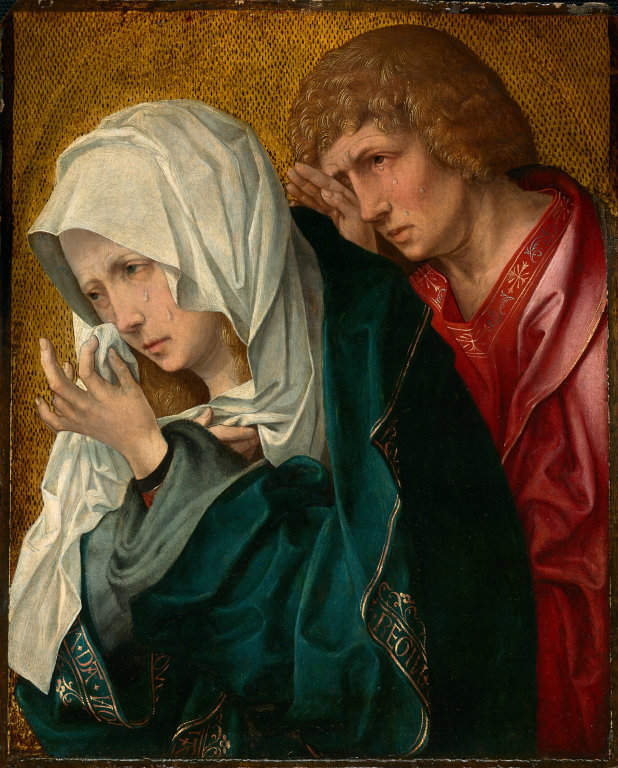
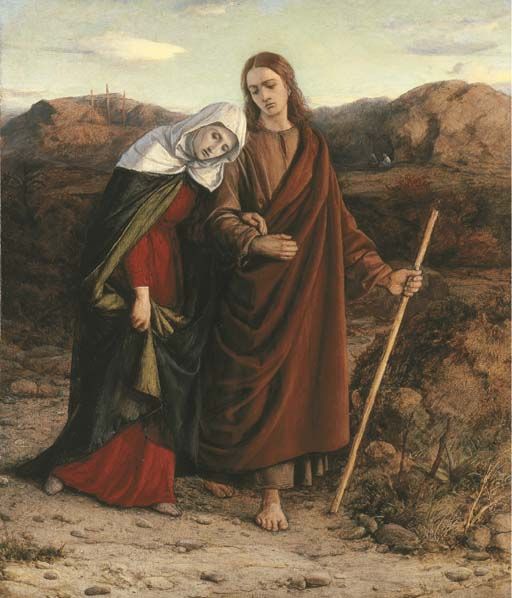
By Rogier van Weyden (1400-1464)By William Dyce (1806-1864)
Look into Peter’s wide open eyes and John’s intense gaze. Their eyes contain a mix of anxiousness and hope, the way a parent or grandparent’s eyes look at the news of an impending birth. A new life is about to emerge but there is still uncertainty because it is a mystery beyond full human comprehension or control. Peter and John’s faces capture the same sense of anticipation.
Burnand created a sparse, simple painting capturing two of the most important players in the greatest story ever told. Meditate upon their faces, as Burnand intended you to do and through them, discover the empty tomb.
Our Morning Offering – 25 December – The Solemnity of the Nativity of Our Lord, Jesus Christ
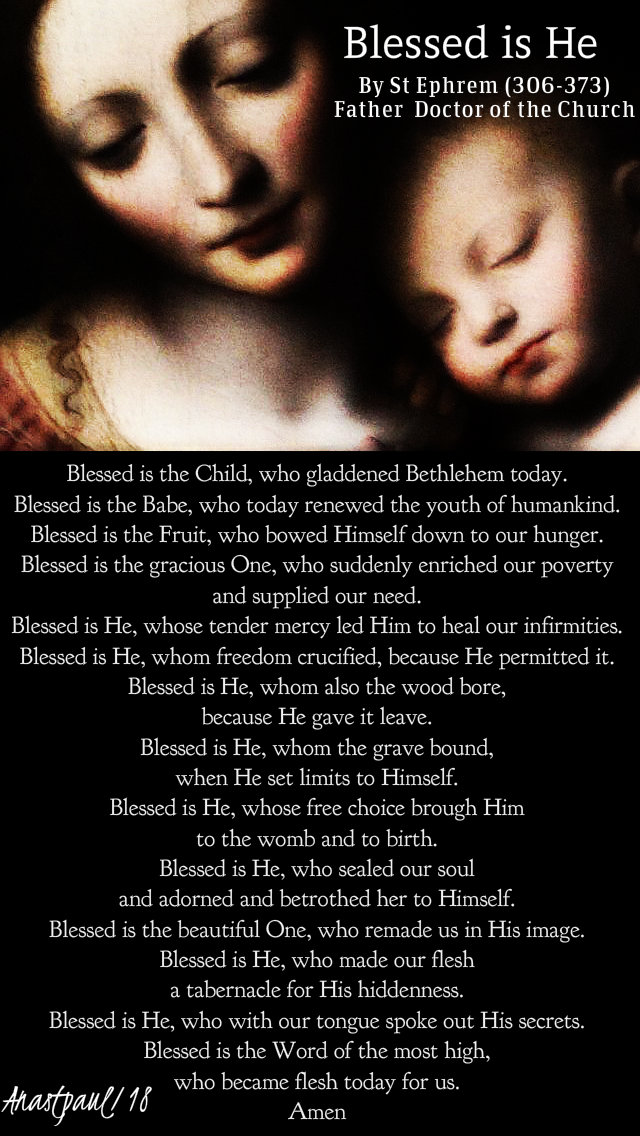
Blessed is He St Ephrem (306-373) Father & Doctor of the Church
Blessed is the Child, who gladdened Bethlehem today.
Blessed is the Babe, who today renewed the youth of humankind.
Blessed is the Fruit, who bowed Himself down to our hunger.
Blessed is the gracious One, who suddenly enriched our poverty
and supplied our need.
Blessed is He, whose tender mercy led Him to heal our infirmities.
Blessed is He, whom freedom crucified, because He permitted it.
Blessed is He, whom also the wood bore, because He gave it leave.
Blessed is He, whom the grave bound, when He set limits to Himself.
Blessed is He, whose free choice brough Him
to the womb and to birth.
Blessed is He, who sealed our soul and adorned and betrothed her to Himself.
Blessed is the beautiful One, who remade us in His image.
Blessed is He, who made our flesh a tabernacle for His hiddenness.
Blessed is He, who with our tongue spoke out His secrets.
Blessed is the Word of the most high, who became flesh today for us.
Amen















 AnaStpaul
You must be logged in to post a comment.