Posted in JESUIT SJ, SAINT of the DAY, VATICAN Resources

Saint of the Day – 15 February – St Claude de la Colombiere SJ (1641-1682)

Saint of the Day – 15 February – St Claude de la Colombiere SJ (1641-1682) Religious Priest, Confessor, Patron of the Sacred Heart of Jesus, Ascetical Writer, Teacher, Preacher, Missionary.   Patronages – Devotion to the Sacred Heart, toy-makers, turners.   St Claude was a Jesuit priest and the confessor of St Margaret Mary Alacoque, the visionary of the Sacred Heart of Jesus.   St Claude was born on 2 February 1641 at Saint-Symphorien d’Ozon, Rhône, France and he died on 15 February 1682 at Paray-le-Monial, Saône-et-Loire, France of hemoptysis (coughing up blood).   He was Canonised on 31 May 1992 by St Pope John Paul II in Rome, Italy.header - St-Claude-alliezSAINT CLAUDE33
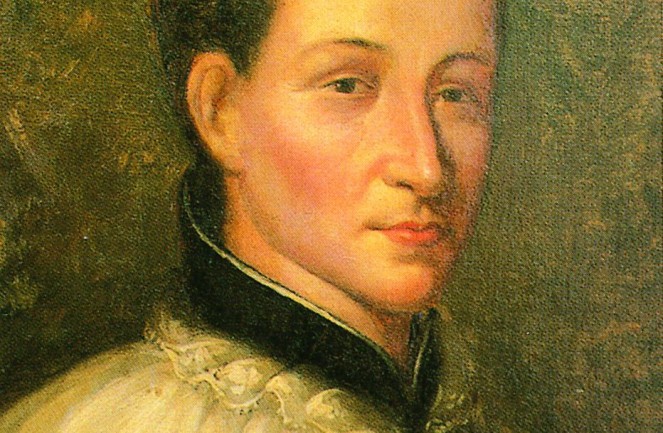
CLAUDE DE LA COLOMBIÈRE, third child of the notary Bertrand de la Colombière and Margaret Coindat, was born on 2nd February 1641 at St Symphorien d’Ozon in the Dauphine, southeastern France.   After the family moved to Vienne, Claude began his early education there, completing his studies in rhetoric and philosophy in Lyon.

It was during this period that Claude first sensed his vocation to the religious life in the Society of Jesus.   We know nothing of the motives which led to this decision.   We do know, however, from one of his early notations, that he “had a terrible aversion for the life embraced”.   This affirmation is not hard to understand by any who are familiar with the life of Claude, for he was very close to his family and friends and much inclined to the arts and literature and an active social life.   On the other hand, he was not a person to be led primarily by his sentiments.   At 17 he entered the Jesuit Novitiate at Avignon.   In 1660 he moved from the Novitiate to the College, also in Avignon, where he pronounced his first vows and completed his studies in philosophy.   Afterwards he was professor of grammar and literature in the same school for another five years.
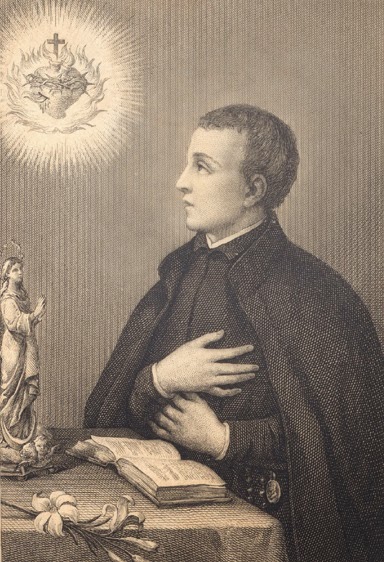
st claude - young

In 1666 he went to the College of Clermont in Paris for his studies in theology.   Already noted for his tact, poise and dedication to the humanities, Claude was assigned by superiors in Paris the additional responsibility of tutoring the children of Louis XIV’s Munster of Finance, Jean Baptiste Colbert.   His theological studies concluded and now a priest, Claude returned to Lyon.   For a time he was teacher in the College, then full-time preacher and moderator of several Marian congregations.20160310131504-sao-claudio-colombiere-banner

Claude became noted for solid and serious sermons.   They were ably directed at specific audiences and, faithful to their inspiration from the gospel, communicated to his listeners serenity and confidence in God.   His published sermons produced and still produce significant spiritual fruits.   Given the place and the short duration of his ministry, his sermons are surprisingly fresh in comparison with those of better-known orators.

The year 1674 was a decisive one for Claude, the year of his Third Probation at Maison Saint-Joseph in Lyon.   During the customary month of the Exercises the Lord prepared him for the mission for which he had been chosen.   His spiritual notes from this period allow one to follow step-by-step the battles and triumphs of the spirit, so extraordinarily attracted to everything human, yet so generous with God.

He took a vow to observe all the constitutions and rules of the Society of Jesus, a vow whose scope was not so much to bind him to a series of minute observances as to reproduce the sharp ideal of an apostle so richly described by St Ignatius.   So magnificent did this ideal seem to Claude that he adopted it as his program of sanctity. That it was indeed an invitation from Christ himself is evidenced by the subsequent feeling of interior liberation Claude experienced, along with the broadened horizons of the apostolate he witnesses to in his spiritual diary.

On 2nd February 1675 he pronounced his solemn profession and was named rector of the College at Paray-le-Monial.   Not a few people wondered at this assignment of a talented young Jesuit to such an out-of the-way place as Paray.   The explanation seems to be in the superiors’ knowledge that there was in Paray an unpretentious religious of the Monastery of the Visitation, Margaret Mary Alacoque, to whom the Lord was revealing the treasures of his Heart but who was overcome by anguish and uncertainty.   She was waiting for the Lord to fulfil his promise and send her “my faithful servant and perfect friend” to help her realise the mission for which he had destined her:  that of revealing to the world the unfathomable riches of his love.Claude de la Colombiere, S.J and St. Margaret Mary

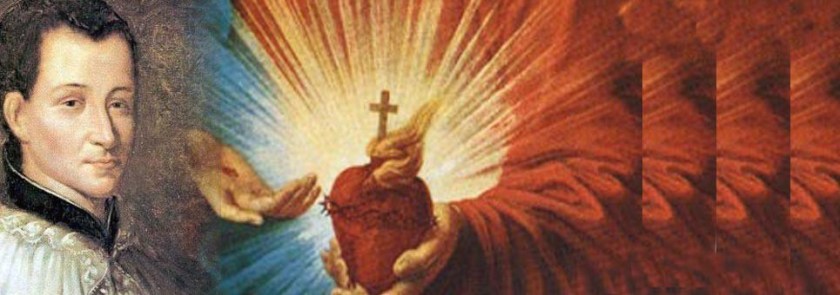
After Father Colombière’s arrival and her first conversations with him, Margaret Mary opened her spirit to him and told him of the many communications she believed she had received from the Lord.   He assured her he accepted their authenticity and urged her to put in writing everything in their regard and did all he could to orient and support her in carrying out the mission received.   When, thanks to prayer and discernment, he became convinced that Christ wanted the spread of the devotion to his Heart, it is clear from Claude’s spiritual notes that he pledged himself to this cause without reserve.   In these notes it is also clear that, even before he became Margaret Mary’s confessor, Claude’s fidelity to the directives of St Ignatius in the Exercises had brought him to the contemplation of the Heart of Christ as symbol of His love.st claudeClaudedelaColombiere
After a year and half in Paray, in 1676 Father La Colombière left for London.   He had been appointed preacher to the Duchess of York – a very difficult and delicate assignment because of the conditions prevailing in England at the time.   He took up residence in St James Palace in October.   In addition to sermons in the palace chapel and unremitting spiritual direction both oral and written, Claude dedicated his time to giving thorough instruction to the many who sought reconciliation with the Church they had abandoned. And even if there were great dangers, he had the consolation of seeing many reconciled to it, so that after a year he said:  “I could write a book about the mercy of God I’ve seen Him exercise since I arrived here!”

The intense pace of his work and the poor climate combined to undermine his health, and evidence of a serious pulmonary disease began to appear.   Claude, however, made no changes in his work or life style.   Of a sudden, at the end of 1678, he was calumniously accused and arrested in connection with the Titus Oates “papist plot”.   After two days he was transferred to the severe King’s Bench Prison where he remained for three weeks in extremely poor conditions until his expulsion from England by royal decree.   This suffering further weakened Claude’s health which, with ups and downs, deteriorated rapidly on his return to France.

During the summer of 1681 he returned to Paray, in very poor condition.   On 15th February 1682, the first Sunday of Lent, towards evening Claude suffered the severe haemorrhage which ended his life.St Claude de la Colombiere

On the 16th of June 1929 Pope Pius XI beatified Claude de la Colombière, whose charism, according to St Margaret Mary Alacoque, was that of bringing souls to God along the gospel way of love and mercy which Christ revealed to us. (vatican.va)ST CLAUDE DE LA COLOMBIERRE
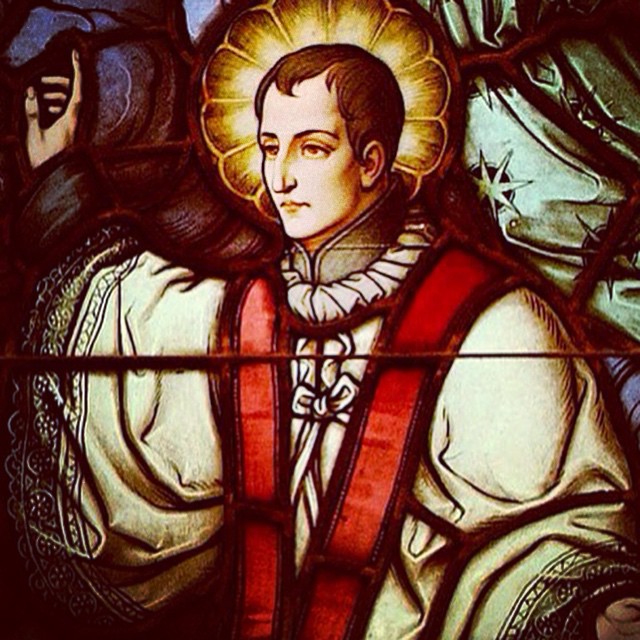
It is said that the day after Claude’s death, Sister Margaret Mary received supernatural assurance that Claude needed no prayers, as he was in already heaven;  he was enjoying the fullness of communio with the Trinity.   Claude was considered a “dry” martyr, having suffered every abuse for the Christian faith except death.   The life of Saint Claude was an example of being in correspondence with the Lord Himself –through the logic of Love– that he was known to be concrete example of mercy in the face of trials.   Saint Claude’s  life of holiness drew many of the Protestants to the Catholic Church.   His was a trust that we must adopt:  “In Thee, O Lord, have I hoped; let me never be confounded.”

May we learn from Saint Claude la Colombiere what it means to be in relationship with Jesus the Good Shepherd, true Divine Love.
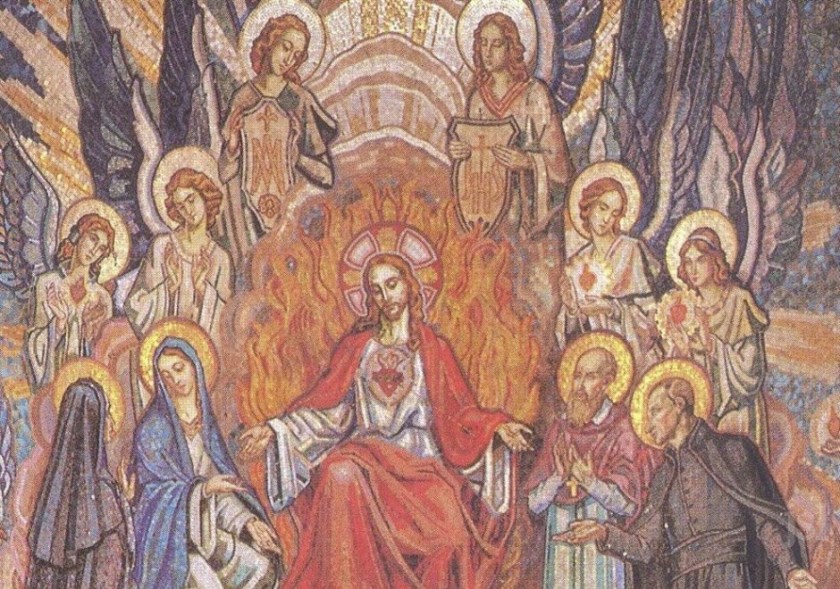
la-mosaique-du-choeur-de-la-chapelle-saint-claude-a-paray-le-monial-photo-richard-plaa-1462194157
Mosaic of the Sacred Heart of Jesus, St Claude la Colombiere Chapel, Paray-le-Monial
Posted in MORNING Prayers, SAINT of the DAY, VATICAN Resources

Thought for the Day – 9 February – The Memorial of Bl Anne Catherine Emmerich (1774-1824)

Thought for the Day – 9 February – The Memorial of Bl Anne Catherine Emmerich (1774-1824)

In a letter to Count Stolberg, Clemens August Droste zu Vischering, the vicar‑general at that time, called Anna Katharina Emmerick a special friend of God.   In the words of Hans Urs von Balthasar we can say, “She brought her friendship with God to bear in solidarity with human beings.”   To bring friendship with God to bear in solidarity with human beings – does this not shed light on an important concern in the life of the church today?

The Christian faith no longer includes everyone.   In our world the Christian community represents people before God.   We must bring our friendship with God to bear, let it be the decisive factor in solidarity with human beings.

Anna Katharina Emmerick is united to us in the community of believers.  This community does not come to an end with death.   We believe in the lasting communion with all whom God has led to perfection.   We are united with them beyond death and they participate in our lives.   We can invoke them and ask for their intercession.   We ask Anna Katharina Emmerick, the newly named Blessed, to bring her friendship with God to bear in solidarity with us and with all human beings. (vatican.va)

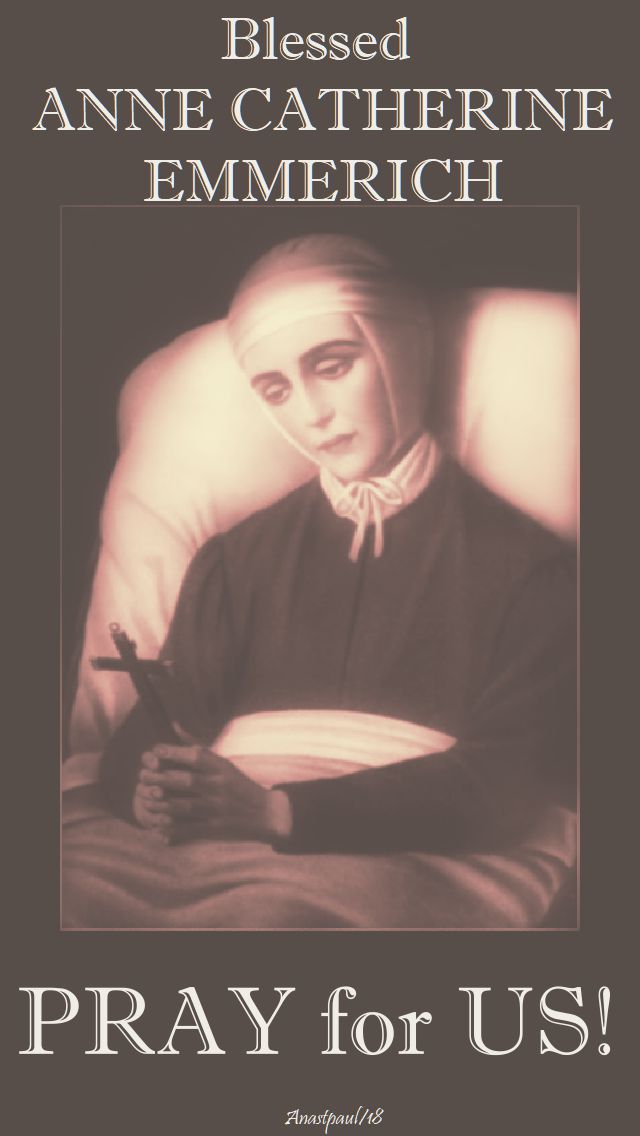
Blessed Anne, pray for us!bl anne - pray for us no 2 - 9 feb 2018

Posted in INCORRUPTIBLES, SAINT of the DAY, The BLESSED VIRGIN MARY, The PASSION, VATICAN Resources

Saint of the Day – 9 February – Blessed Anna Katharina Emmerick/Anne Catherine Emmerich (1774-1824)

Saint of the Day – 9 February – Blessed Anna Katharina Emmerick/Anne Catherine Emmerich (1774-1824) – Handicapped, Virgin, Religious, Penitent, Marian Visionary, Mystic, Ecstatic, Writer and Stigmatist.   Her body is incorrupt.

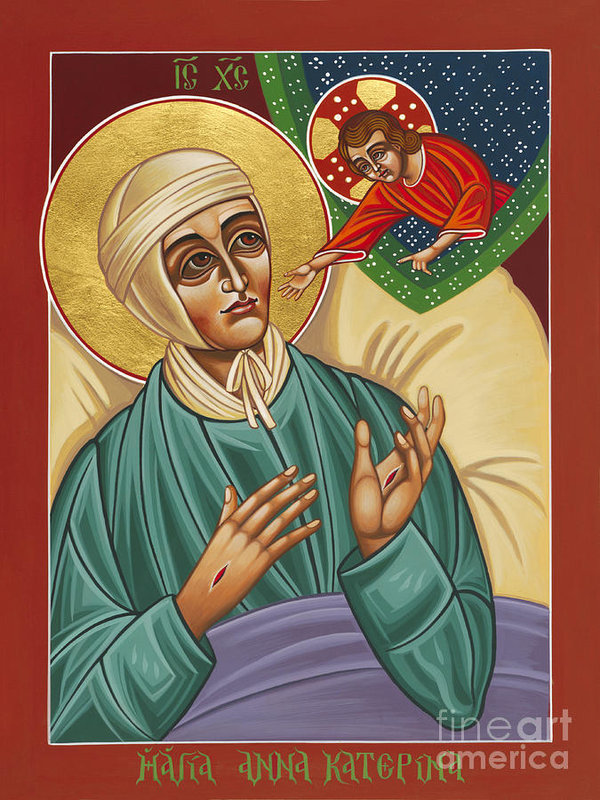
1-blessed-anne-catherine-emmerich-william-hart-mcnichols

Anna Katharina Emmerick was born on 8 September 1774 in the farming community of Flamsche near Coesfeld.   She grew up amidst a host of nine brothers and sisters.   She had to help out in the house and with the farm work at an early age.   Her school attendance was brief, which made it all the more remarkable that she was well instructed in religious matters.   Her parents and all those who knew Anna Katherina noticed early on that she felt drawn to prayer and to the religious life in a special way.

Anna Katharina laboured for three years on a large farm in the vicinity.   Then she learned to sew and stayed in Coesfeld for her further training.   She loved to visit the old churches in Coesfeld and to join in the celebration of Mass.   She often walked the path of Coesfeld’s long Way of the Cross alone, praying the stations by herself.   She wanted to enter the convent but since her wish could not be fulfilled at that time, she returned to her parental home.   She worked as a seamstress and, while doing so, visited many homes.

Anna Katherina asked for admission to different convents but she was rejected because she could not bring a significant dowry with her.   The Poor Clares in Münster finally agreed to accept her if she would learn to play the organ.   She received her parents’ permission to be trained in Coesfeld by the organist Söntgen.   But she never got around to learning how to play the organ.   The misery and poverty in the Söntgen household prompted her to work in the house and help out in the family.   She even sacrificed her small savings for their sake.

Together with her friend Klara Söntgen Anna Katharina was finally able to enter the convent Agnetenberg in Dülmen in 1802.   The following year she took her religious vows.   She participated enthusiastically in the life of the convent.   She was always willing to take on hard work and loathsome tasks.  Because of her impoverished background she was at first given little respect in the convent.   Some of the sisters took offence at her strict observance of the order’s rule and considered her a hypocrite.   Anna Katharina bore this pain in silence and quiet submission.

From 1802 to 1811 Anna Katharina was ill quite often and had to endure great pain.

As a result of secularisation the convent of Agnetenberg was suppressed in 1811 and Anna Katharina had to leave the convent along with the others.   She was taken in as a housekeeper at the home of Abbé Lambert, a priest who had fled France and lived in Dülmen.   But she soon became ill.   She was unable to leave the house and was confined to bed.   In agreement with Curate Lambert she had her younger sister Gertrud come to take over the housekeeping under her direction.

During this period Anna Katharina received the stigmata.   She had already endured the pain of the stigmata for a long time.  The fact that she bore the wounds of Christ could not remain hidden.   Dr Franz Wesener, a young doctor, went to see her and he was so impressed by her that he became a faithful, selfless and helping friend during the following eleven years.   He kept a diary about his contacts with Anna Katharina Emmerick in which he recorded a wealth of details.

A striking characteristic of the life of Anna Katharina was her love for people.   Wherever she saw need she tried to help.  Even in her sickbed she sewed clothes for poor children and was pleased when she could help them in this way.   Although she could have found her many visitors annoying, she received all of them kindly.   She embraced their concerns in her prayers and gave them encouragement and words of comfort.

Many prominent people who were important in the renewal movement of the church at the beginning of the 19th century sought an opportunity to meet Anna Katharina, among them Clemens August Droste zu Vischering, Bernhard Overberg, Friedrich Leopold von Stolberg, Johann Michael Sailer, Christian and Clemens Brentano, Luise Hensel, Melchior and Apollonia Diepenbrock.   The encounter with Clemens Brentano was particularly significant.   His first visit led him to stay in Dülmen for five years.   He visited Anna Katharina daily to record her visions which he later published.

Anna Katharina grew ever weaker during the summer of 1823.   As always she joined her suffering to the suffering of Jesus and offered it up for the salvation of all.   She died on 9 February 1824.   She was buried in the cemetery in Dülmen.   A large number of people attended the funeral.   Because of a rumour that her corpse had been stolen the grave was reopened twice in the weeks following the burial.   The coffin and the corpse were found to be intact.

Clemens Brentano wrote the following about Anna Katharina Emmerick: “She stands like a cross by the wayside”.   Anna Katharina Emmerick shows us the centre of our Christian faith, the mystery of the cross.

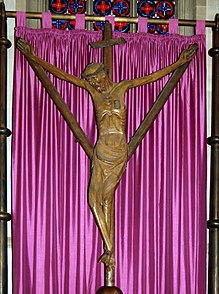
The life of Anna Katharina Emmerick is marked by her profound closeness to Christ.   She loved to pray before the famous Coesfeld Cross and she walked the path of the long Way of the Cross frequently.   So great was her personal participation in the sufferings of our Lord that it is not an exaggeration to say that she lived, suffered and died with Christ. An external sign of this, which is at the same time, however, more than just a sign, are the wounds of Christ which she bore.

220px-Coesfelder_Kreuz_(1)1280px-KlKreuztrCoe9

Anna Katharina Emmerick was a great admirer of Mary.   The feast of the Nativity of Mary was also Anna Katharina’s birthday.   A verse from a prayer to Mary highlights a further aspect of Anna Katharina’s life for us.   The prayer states, “O God, let us serve the work of salvation following the example of the faith and the love of Mary”.   To serve the work of salvation – that is what Anna Katharina wanted to do.

In Colossians the apostle Paul speaks of two ways to serve the gospel, to serve salvation. One consists in the active proclamation in word and deed.   But what if that is no longer possible?   Paul, who obviously finds himself in such a situation, writes: “Now I rejoice in my sufferings for your sake and in my flesh I complete what is lacking in Christ’s afflictions for the sake of his body, that is, the church” (Col 1:24).

Anna Katharina Emmerick served salvation in both ways.   Her words, which have reached innumerable people in many languages from her modest room in Dülmen through the writings of Clemens Brentano, are an outstanding proclamation of the gospel in service to salvation right up to the present day.   At the same time, however, Anna Katharina Emmerick understood her suffering as a service to salvation.   Dr Wesener, her doctor, recounts her petition in his diary:  “I have always requested for myself as a special gift from God that I suffer for those who are on the wrong path due to error or weakness, and that, if possible, I make reparation for them.”   It has been reported that Anna Katharina Emmerick gave many of her visitors religious assistance and consolation.   Her words had this power because she brought her life and suffering into the service of salvation.   In serving the work of salvation through faith and love, Anna Katharina Emmerick can be a model for us all.

Dr Wesener passed on this remark of Anna Katharina Emmerick:  “I have always considered service to my neighbour to be the greatest virtue.   In my earliest childhood I already requested of God that he give me the strength to serve my fellow human beings and to be useful.   And now I know that he has granted my request.”   How could she who was confined to her sickroom and her bed for years serve her highborn?   (vatican.va)

Her Works:  • The Dolorous Passion of Our Lord Jesus Christ
• The Life of Jesus Christ and Biblical Revelations
• The Lowly life and Bitter Passion of Our Lord Jesus Christ and His Blessed Mother

Anna was Beatified on 3 October 2004, by St Pope John Paul II.  However, the Vatican focused on her own personal piety rather than the religious writings associated to her by Clemens Brentano.   Her documents of postulation towards canonisation is handled by the Priestly Fraternity of St Peter.   Father Peter Gumpel who was involved in the analysis of the matter at the Vatican told Catholic News Service: “Since it was impossible to distinguish what derives from Sister Emmerich and what is embroidery or additions, we could not take these writings as a criteria. Therefore, they were simply discarded completely from all the work for the cause”.

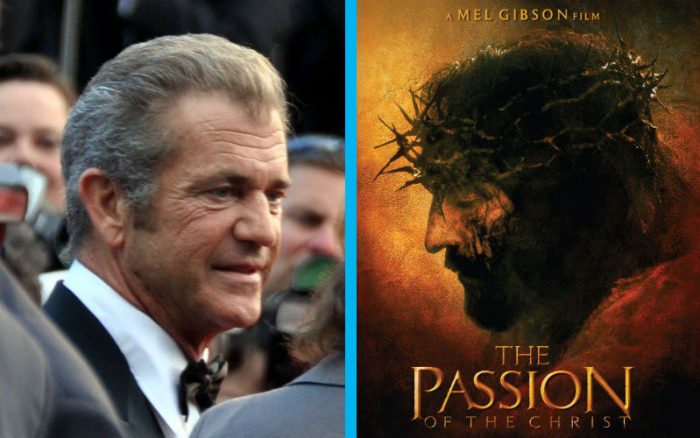
In 2003 actor Mel Gibson brought Anne Catherine Emmerich’s vision to prominence as he used her book The Dolorous Passion as a key source for his movie The Passion of the Christ.   Gibson stated that Scripture and “accepted visions” were the only sources he drew on and a careful reading of Emmerich’s book shows the film’s high level of dependence on it.

In 2007 German director Dominik Graf made the movie The Pledge as a dramatisation of the encounters between Anne Catherine and Clemens Brentano, based on a novel by Kai Meyer.the passion 1the passion

House of the Virgin Mary

220px-House_of_the_Virgin_Mary
Neither Brentano nor Emmerich had ever been to Ephesus and indeed the city had not yet been excavated;  but visions contained in The Life of The Blessed Virgin Mary were used during the discovery of the House of the Virgin Mary, the Blessed Virgin’s supposed home before her Assumption, located on a hill near Ephesus, as described in the book Mary’s House.

In 1881, a French priest, the Abbé Julien Gouyet used Emmerich’s book to search for the house in Ephesus and found it based on the descriptions.   He was not taken seriously at first but sister Marie de Mandat-Grancey persisted until two other priests followed the same path and confirmed the finding.

The Holy See has taken no official position on the authenticity of the location yet but in 1896 Pope Leo XIII visited it and in 1951 Pope Pius XII initially declared the house a Holy Place. St Pope John XXIII later made the declaration permanent. Blessed Pope Paul VI in 1967, St Pope John Paul II in 1979 and Pope Benedict XVI in 2006 visited the house and treated it as a shrine.

Posted in SAINT of the DAY, VATICAN Resources

Saint of the Day – 8 February – St Josephine Bakhita (1869-1947)

Saint of the Day – 8 February – St Josephine Bakhita (1869-1947) and the FOURTH World Day of PRAYER AND AWARENESS AGAINST TRAFFICKING IN PERSONS UNDER THE PATRONAGE OF ST BAKHITA

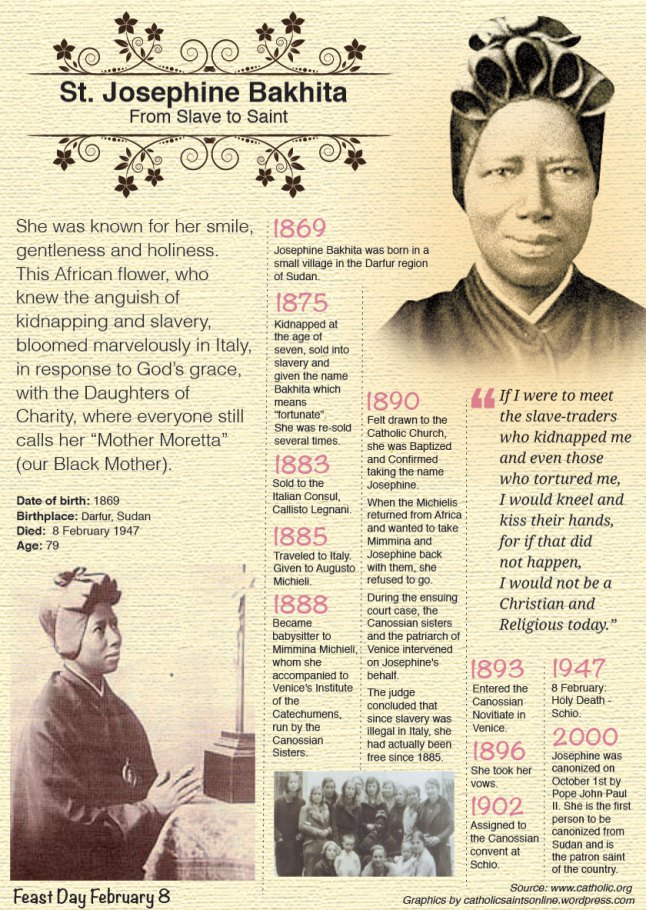
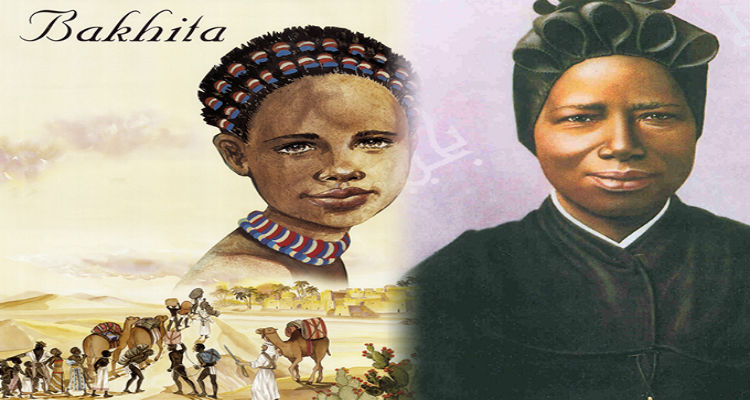
St Josephine Bakhita F.D.C.C. (1869-1947) RELIGIOUS – Patron of Sudan and World Day against Trafficking in Persons.  She was born in Sudan, was kidnapped and sold as a slave and became a Canossian Religious Sister in Italy, living and working there for 45 years.    In 2000 she was declared a Saint by St Pope John Paul II.

bakhita - infoHEADER - St.-Josephine-Bakhita

Mother Josephine Bakhita was born in Sudan in 1869 and died in Schio (Vicenza) in 1947.

This African flower, who knew the anguish of kidnapping and slavery, bloomed marvelously in Italy, in response to God’s grace, with the Daughters of Charity.

Mother “Moretta”

In Schio (Vicenza), where she spent many years of her life, everyone still calls her “our Black Mother”.   The process for the cause of Canonisation began 12 years after her death and on December 1st, 1978 the Church proclaimed the Decree of the heroic practice of all virtues.

Divine Providence which “cares for the flowers of the fields and the birds of the air”, guided the Sudanese slave through innumerable and unspeakable sufferings to human freedom and to the freedom of faith and finally to the consecration of her whole life to God for the coming of his Kingdom.

In Slavery

Bakhita was not the name she received from her parents at birth.   The fright and the terrible experiences she went through made her forget the name she was given by her parents.   Bakhita, which means “fortunate”, was the name given to her by her kidnappers.

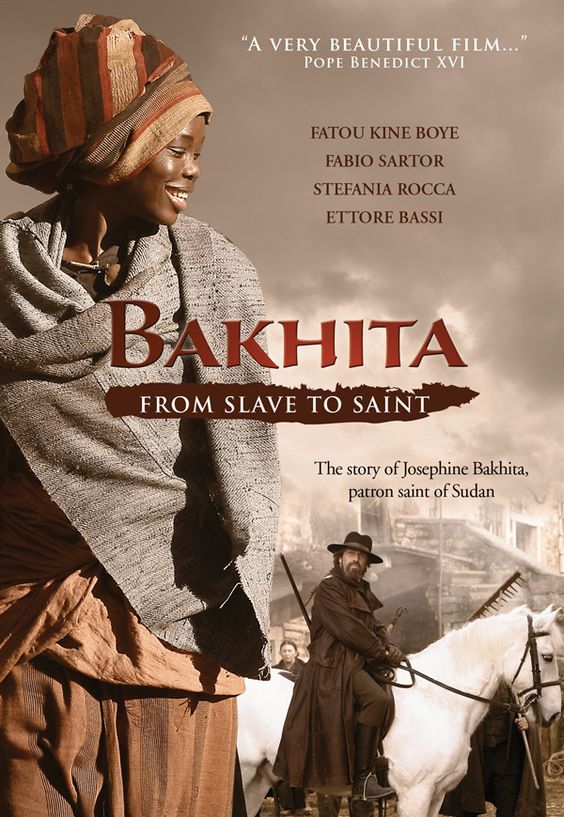
Sold and resold in the markets of El Obeid and of Khartoum, she experienced the humiliations and sufferings of slavery, both physical and moral.bakhita - film

Towards freedom

In the Capital of Sudan, Bakhita was bought by an Italian Consul, Callisto Legnani.   For the first time since the day she was kidnapped, she realised with pleasant surprise, that no one used the lash when giving her orders;  instead, she was treated in a loving and cordial way.   In the Consul’s residence, Bakhita experienced peace, warmth and moments of joy, even though veiled by nostalgia for her own family, whom, perhaps, she had lost forever.   Political situations forced the Consul to leave for Italy.   Bakhita asked and obtained permission to go with him and with a friend of his, a certain Mr Augusto Michieli.

In Italy

On arrival in Genoa, Mr Legnani, pressured by the request of Mr Michieli’s wife, consented to leave Bakhita with them.   She followed the new “family”, which settled in Zianigo (near Mirano Veneto).   When their daughter Mimmina was born, Bakhita became her babysitter and friend.

The acquisition and management of a big hotel in Suakin, on the Red Sea, forced Mrs. Michieli to move to Suakin to help her husband.   Meanwhile, on the advice of their administrator, Illuminato Checchini, Mimmina and Bakhita were entrusted to the Canossian Sisters of the Institute of the Catechumens in Venice.   It was there that Bakhita came to know about God whom “she had experienced in her heart without knowing who He was” ever since she was a child.   “Seeing the sun, the moon and the stars, I said to myself: Who could be the Master of these beautiful things? And I felt a great desire to see him, to know Him and to pay Him homage…”

Daughter of God

After several months in the catechumenate, Bakhita received the sacraments of Christian initiation and was given the new name, Josephine.   It was 9 January 1890.   She did not know how to express her joy that day.   Her big and expressive eyes sparkled, revealing deep emotions.   From then on, she was often seen kissing the baptismal font and saying: “Here, I became a daughter of God!”   With each new day, she became more aware of who this God was, whom she now knew and loved, who had led her to Him through mysterious ways, holding her by the hand.

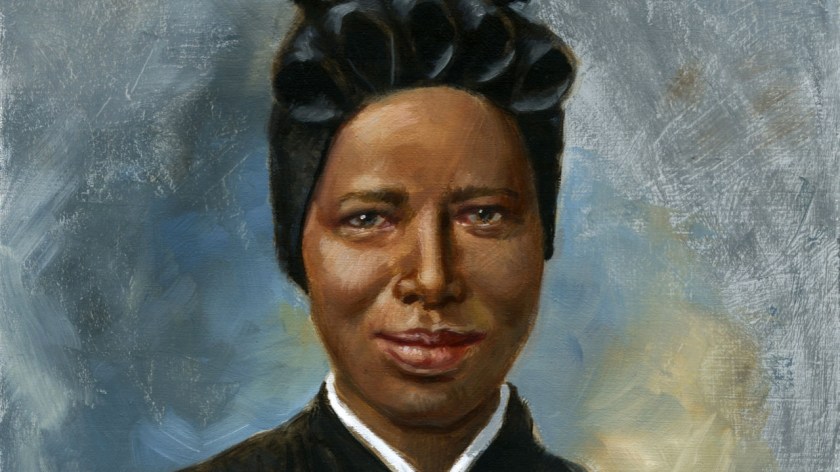
When Mrs. Michieli returned from Africa to take back her daughter and Bakhita, the latter, with unusual firmness and courage, expressed her desire to remain with the Canossian Sisters and to serve that God who had shown her so many proofs of His love.  The young African, who by then had come of age, enjoyed the freedom of choice which the Italian law ensured.st josephine bakhita
Daughter of St Magdalene

Bakhita remained in the catechumenate where she experienced the call to be a religious, and to give herself to the Lord in the Institute of St. Magdalene of Canossa.   On 8 December 1896, Josephine Bakhita was consecrated forever to God whom she called with the sweet expression “the Master!”

For another 50 years, this humble Daughter of Charity, a true witness of the love of God, lived in the community in Schio, engaged in various services:  cooking, sewing, embroidery and attending to the door.   When she was on duty at the door, she would gently lay her hands on the heads of the children who daily attended the Canossian schools and caress them.   Her amiable voice, which had the inflection and rhythm of the music of her country, was pleasing to the little ones, comforting to the poor and suffering and encouraging for those who knocked at the door of the Institute.

Witness of love

Her humility, her simplicity and her constant smile won the hearts of all the citizens.  Her sisters in the community esteemed her for her unalterable sweet nature, her exquisite goodness and her deep desire to make the Lord known.   “Be good, love the Lord, pray for those who do not know Him.   What a great grace it is to know God!”

As she grew older she experienced long, painful years of sickness.   Mother Bakhita continued to witness to faith, goodness and Christian hope.   To those who visited her and asked how she was, she would respond with a smile:  “As the Master desires.”

Final test

During her agony, she re-lived the terrible days of her slavery and more then once she begged the nurse who assisted her:  “Please, loosen the chains… they are heavy!”

It was Mary Most Holy who freed her from all pain.  Her last words were: “Our Lady! Our Lady!” and her final smile testified to her encounter with the Mother of the Lord.

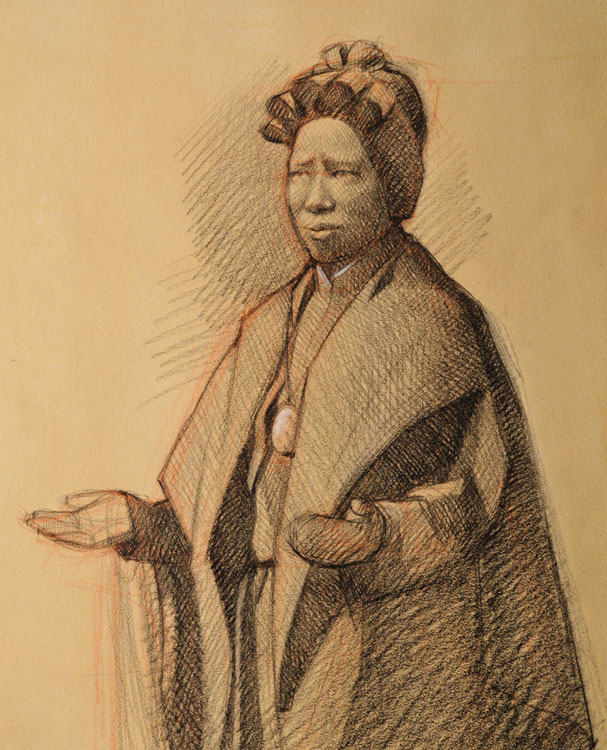
Mother Bakhita breathed her last on 8 February 1947 at the Canossian Convent, Schio, surrounded by the Sisters.   A crowd quickly gathered at the Convent to have a last look at their «Mother Moretta» and to ask for her protection from heaven.   The fame of her sanctity has spread to all the continents and many are those who receive graces through her intercession. (vatican.va)st josephine bakhita - max

Posted in DOCTORS of the Church, DOGMA, INCORRUPTIBLES, MARIAN TITLES, PAPAL ENCYLICALS, SAINT of the DAY, VATICAN Resources

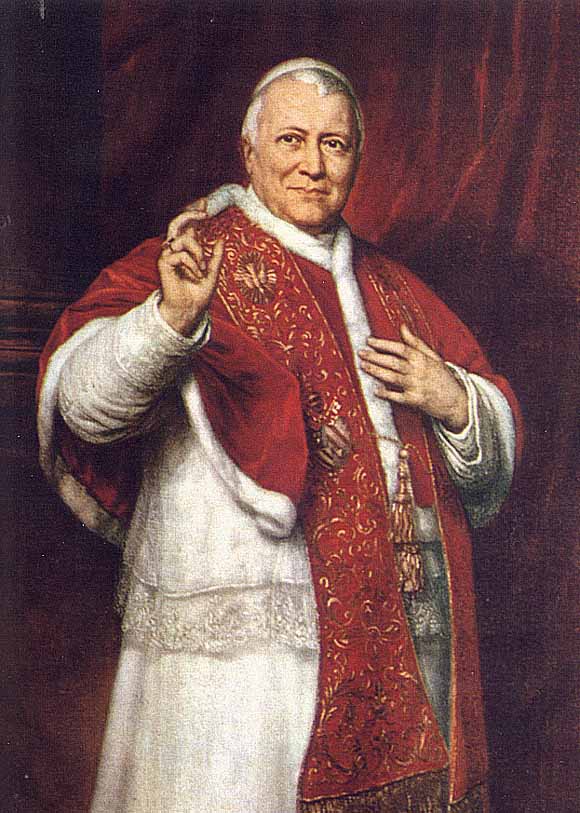
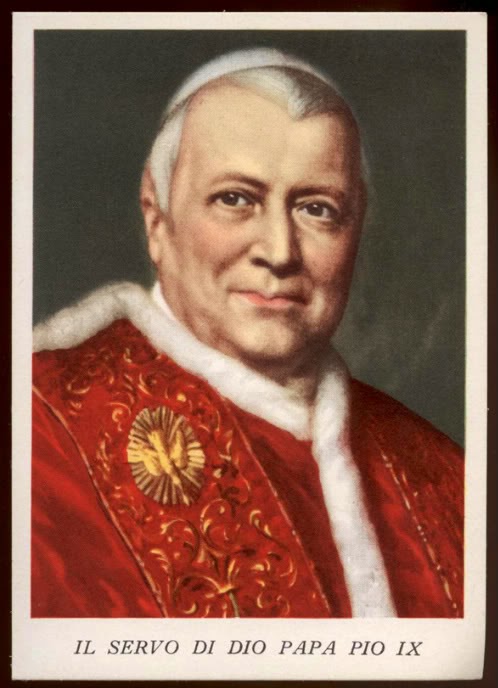
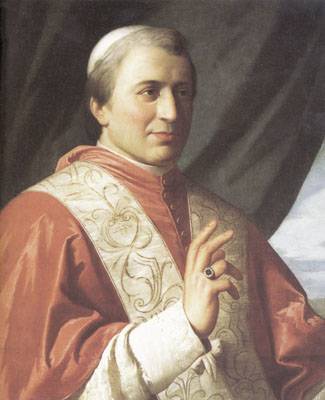
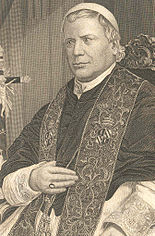
Saint of the Day – 7 February – Blessed Pope Pius IX (1792-1878)

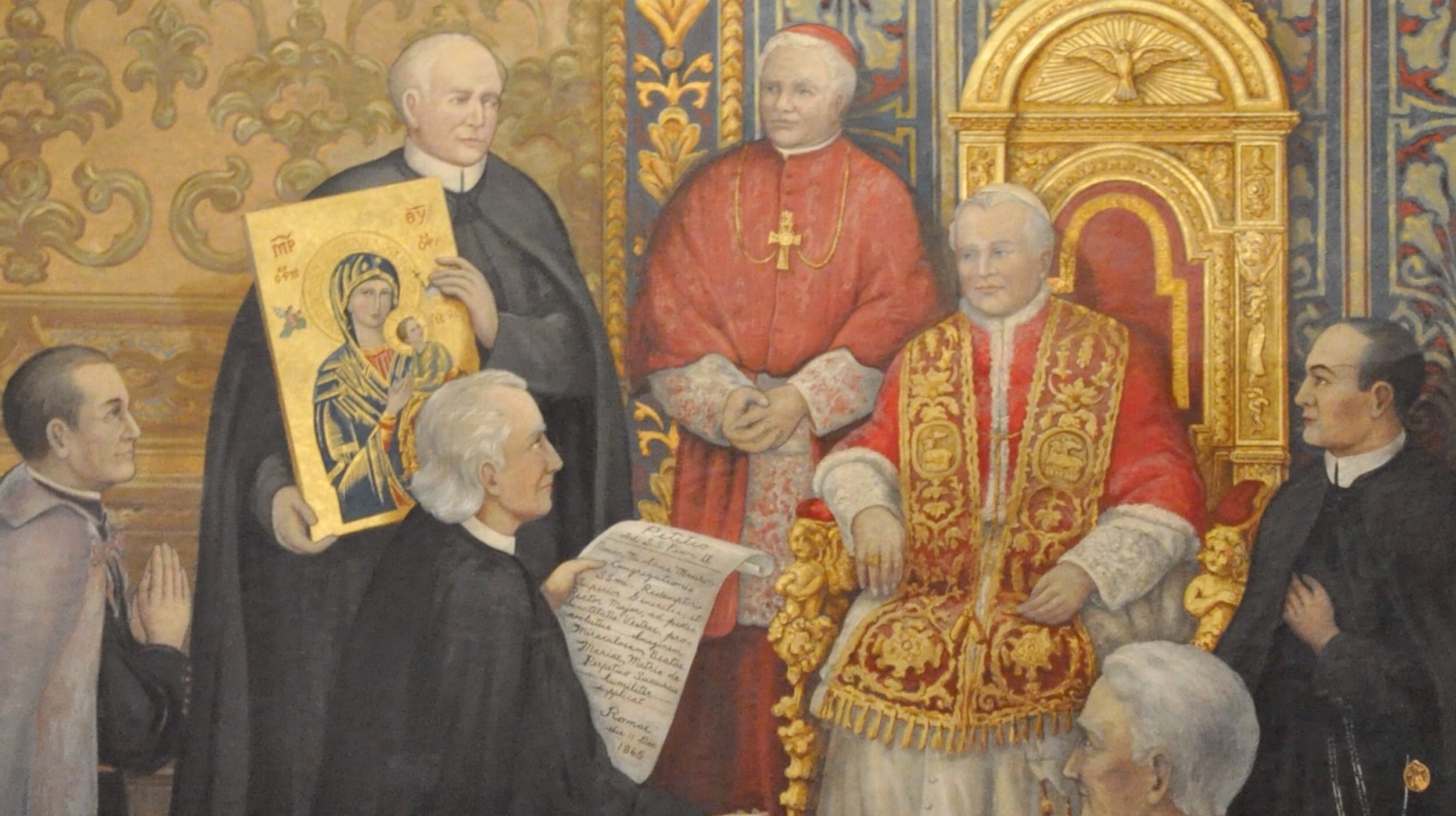
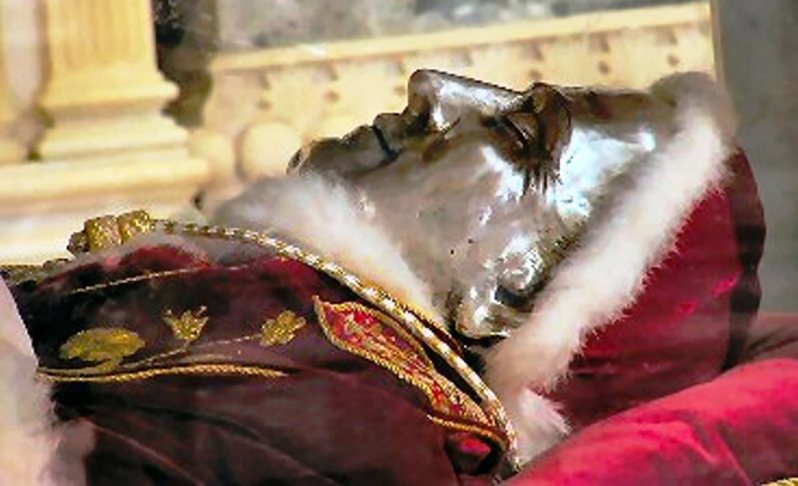
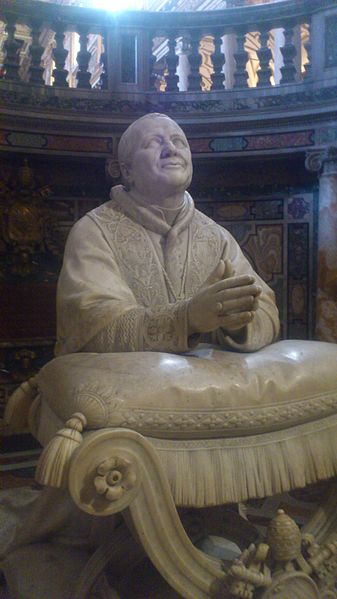
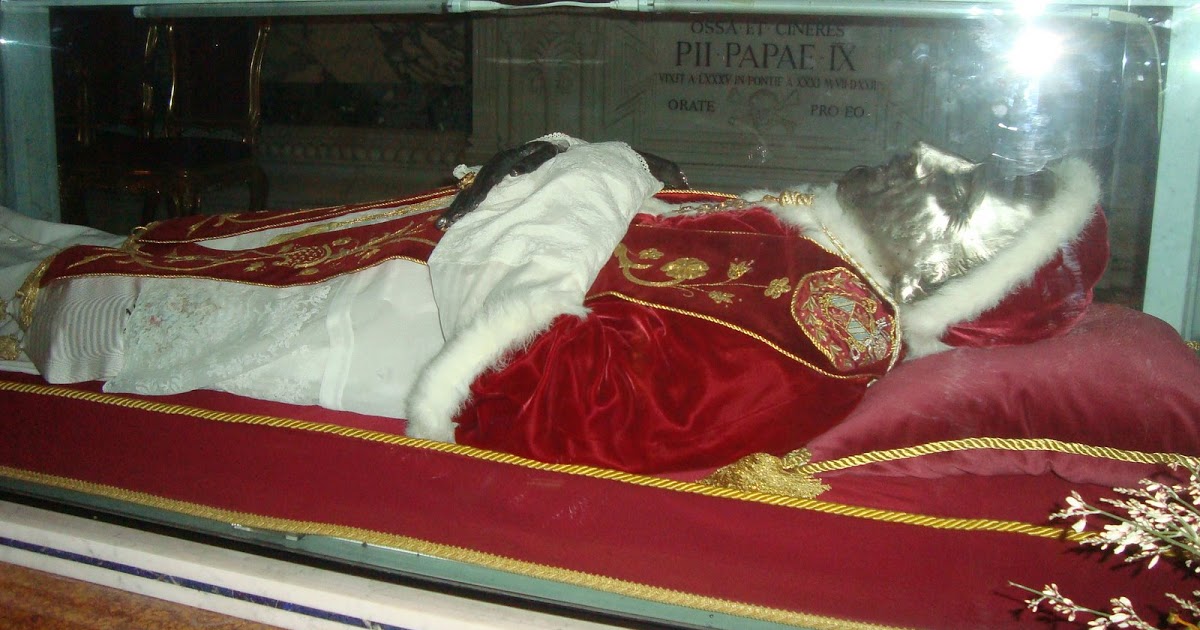
Saint of the Day 7 February – Blessed Pope Pius IX (1792-1878) Bishop of Rome, Writer.  The longest regining Pope.   Bl Pius was born as Giovanni Maria Mastai-Ferretti on 13 May 1792 in Senigallia, Italy and he died on 7 February 1878 in Vatican City of natural causes.  He reigned from 16 June 1846 to the day of his death.   He is the longest-reigning Pope in the history of the Church, serving for over 31 years.    During his Pontificate, Pius IX convened the First Vatican Council (1869–70), which decreed Papal Infallibility and promulgated the Dogma of the Immaculate Conception, thus articulating a long-held belief that Mary, the Mother of God, was conceived without original sin.   He conferred the title Our Mother of Perpetual Succour on a famous Byzantine icon from Crete entrusted to the Redemptorists.   Pope Pius IX named three new Doctors of the Church:  Hilary of Poitiers (1851), Alphonsus Liguori (1871), and Francis de Sales (19 July 1877).   Patronages – Pius Seminary of Rome, Senigallia, Diocese of Senigallia, First Vatican Council.   His body is incorrupt.

our lady of perpetual help

Bl Pope Pius IX was born in Senigallia, Italy, on 13 May 1792, the son of Gerolamo of the Counts Mastai Ferretti and Caterina Solazzi, of the local nobility.   He was baptised on the day of his birth with the name Giovanni Maria.   Of delicate physical constitution but of very lively intelligence, his childhood was marked by little voluntary mortifications and an intense religious life.

In 1809 he moved to Rome for higher studies.   A disease not well diagnosed, which some called epilepsy, forced him to interrupt his studies in 1812.   He was accepted into the Pontifical Noble Guard in 1815 but because of his illness he was immediately discharged. It was at this time that St Vincent Pallotti predicted that he would become Pope and that the Virgin of Loreto would free him eventually from the disease.

After serving briefly in the Tata Giovanni Educational Institute, he participated as a catechist in 1816 in a memorable mission in Senigallia and, immediately thereafter, decided to enter the ecclesiastical state.   He was ordained a priest in 1819.   Conscious of his noble rank, he committed himself to avoiding a prelatial career in order to remain only at the service of the Church.

He celebrated his first Mass in the Church of St Anne of the Carpenters at the Tata Giovanni Institute, of which he was named rector, remaining there until 1823.   He was immediately recognised as assiduous in prayer, in the ministry of the Word, in the celebration of the liturgy, in the confessional and above all in his daily ministry at the service of the humblest and neediest.   He admirably united the active and the contemplative life:  ready for pastoral needs but always interiorly recollected, with strong Eucharistic and Marian devotion and fidelity to daily meditation and the examination of conscience.

In 1823 he left the institute to serve the Apostolic Nuncio in Chile, Mons. Giovanni Muzi. There he remained until 1825, when he was elected President of St Michael’s Hospice, a grand but complex institution in need of effective reform.   To it Mastai applied himself with more than gratifying results but without ever neglecting his priestly duties.   Two years later, at the age of 35, he was consecrated Archbishop of Spoleto.   In 1831 the revolution which had begun in Parma and Modena spread to Spoleto.   The Archbishop did not want the shedding of blood and repaired, as much as possible, the deleterious effects of the violence.   When calm was restored, he obtained a pardon for all, even for those who did not merit it.

Another turbulent see awaited Mastai in Imola, where he was transferred in 1832.   He remained an eloquent preacher, prompt in charity toward everyone, zealous for the supernatural as well as the material well-being of his Diocese, devoted to his clergy and seminarians, a promoter of education for the young, sensitive to the needs of the contemplative life, devoted to the Sacred Heart and to Our Lady, benevolent towards all but firm in his principles.   In 1840 he received the Cardinal’s hat at the age of 48.

Despite having shunned honours, on the evening of 16 June 1846 Mastai found himself burdened with the greatest of them:  he was elected Pope and took the name Pius IX.

He had a difficult pontificate, but precisely because of that he was a great Pope, certainly one of the greatest.   Thoroughly aware of being the “Vicar of Christ” and responsible for the rights of God and of the Church, he was clear, simple consistent.   He combined firmness and understanding, fidelity and openness.

He began with an act of generosity and Christian sensitivity:  amnesty for political crimes.   His first Encyclical was a programmatic vision but anticipated the “Syllabus”:  in it he condemned secret societies, freemasonry and communism.   In 1847 he promulgated a decree granting extensive freedom of the press and instituted a civil guard, the municipal and communal council, the Council of State and the Council of Ministers.   From then on his interventions as Father of all nations and temporal Prince continued unabated.

The question of Italian independence, which he sympathised with, did not set the Prince against the Pope, a fact that alienated the most intransigent liberals.   The situation came to a head on 15 November when Pellegrino Rossi, the head of government, was killed and Pius IX had to take refuge in Gaeta.   After the proclamation of the Roman Republic (9 February 1849), he moved to Portici and later returned to Rome (12 April 1850).   He reorganised the Council of State, established the Council for Finances, granted a new amnesty, re-established the Catholic hierarchy in England and in Holland.

In 1853 he condemned Gallican doctrines and founded the well-known “Seminario Pio”. He established the Commission on Christian Archaeology, defined the dogma of the Immaculate Conception on 8 December 1854 and blessed the rebuilt St Paul’s Basilica which had been destroyed by fire in 1823.

In 1856 he approved the plan for railways in the Papal States and on 24 April 1859 inaugurated the first section between Rome and Civitavecchia.   In 1857 he visited the Papal States and was welcomed everywhere with rejoicing.   He sent missionaries to the North Pole, India, Burma, China and Japan.

Meanwhile dark clouds gathered over him with the Italian “Risorgimento”, the Piedmontese annexations that were dismantling the Papal States and the expropriation of the Legations.   Suffering but undaunted, he continued to show his charity and concern for all.   In 1862 he established a dicastery to deal with the concerns of Eastern-rite Catholics;  in 1864 he published his Syllabus condemning modern errors;  in 1867 he celebrated the 18th centenary of the martyrdom of Peter and Paul;  in 1869 he received the homage of the entire world for the golden jubilee of his priestly ordination.   Later that year he opened the First Vatican Ecumenical Council, the pearl of his pontificate, and closed it on 18 July 1870.

With the fall of Rome (20 September 1870) and of the temporal power, the saddened Pontiff considered himself a prisoner of the Vatican, resisting the “Laws of Guarantees”, but approving the “Work of Congresses”.   He consecrated the Church to the Sacred Heart of Jesus, disciplined the participation of Catholics in political life with the Non expedit and restored the Catholic hierarchy of Scotland.   Suffering from poor health, he gave his last address to the parish priests of Rome on 2 February 1878.   On 7 February the longest pontificate in history ended with his holy death.   His body is incorrupt.   He was Beatified on  3 September 2000 by St Pope John Paul II. (vatican.va).

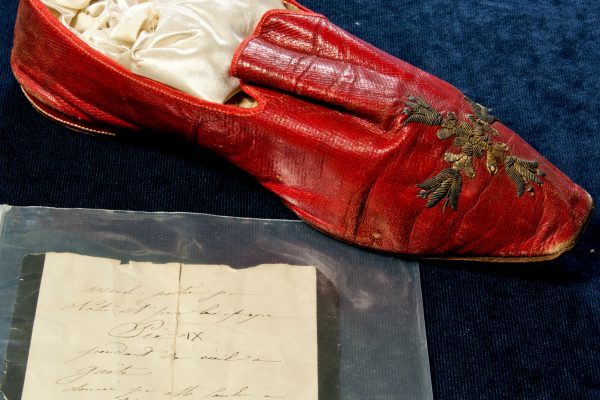
Blessed-Pius-IX-Red-Shoe-Document-of-Authenticity-600x400OLYMPUS DIGITAL CAMERAPius IX ii.-incorrupt

Writings

• Amantissimi Redemptoris – On Priests and the Care of Souls, by Pope Pius IX, 3 May 1858
• Apostolicae Nostrae Caritatis – Urging Prayers For Peace, by Pope Pius IX, 1 August 1854
• Beneficia Dei – On The Twenty-Fifth Anniversary of His Pontificate, by Pope Pius IX, 4 June 1871
• Cum Nuper – On Care for Clerics, by Pope Pius IX, 20 January 1858
• Cum Sancta Mater Ecclesia – Pleading for Public Prayer, by Pope Pius IX, 27 April 1859
• Etsi Multa – On the Church in Italy, Germany, and Switzerland, by Pope Pius IX, 21 November 1873
• Exultavit Cor Nostrum – On the Effects of the Jubilee, by Pope Pius IX, 21 November 1851
• Graves ac Diuturnae – On the Church in Switzerland, by Pope Pius IX, 23 March 1875
• Gravibus Ecclesiae – Proclaiming a Jubilee for 1875, by Pope Pius IX, 24 December 1874
• Incredibili – On Persecution in New Granada, by Pope Pius IX, 17 September 1863
• Ineffabilis Deus – The Immaculate Conception, by Pope Pius IX, 8 December 1854
• Levate – On the Afflictions of the Church, by Pope Pius IX, 21 October 1867
• Maximae Quidem – On the Church in Bavaria, by Pope Pius IX, 18 August 1864
• Meridionali Americae – On the Seminary for Native Clergy, by Pope Pius IX, 30 September 1865
• Neminem Vestrum – On The Persecution Of Armenians, by Pope Pius IX, 2 February 1854
• Nemo Certe Ignorat – On Discipline for Clergy, by Pope Pius IX, 25 March 1852
• Nostis et Nobiscum – On The Church In The Pontifical States, by Pope Pius IX, 8 December 1849
• Nullis Certe Verbis – On the Need for Civil Sovereignty, by Pope Pius IX, 19 January 1860
• Omnem Sollicitudinem – On The Greek-Ruthenian Rite, Pope Pius IX, 13 May 1874
• Optime Noscitis – On Episcopal Meetings, by Pope Pius IX, 5 November 1855
• Optime Noscitis – On The Proposed Catholic University Of Ireland, by Pope Pius IX, 20 March 1854
• Praedecessores Nostros – On Aid for Ireland, by Pope Pius IX, 25 March 1847
• Quae in Patriarchatu – On the Church in Chaldae, by Pope Pius IX, 16 November 1872
• Quanta Cura – Condemning Current Errors, by Pope Pius IX, 8 December 1864
• Quanto Conficiamur Moerore – On Promotion of False Doctrines, by Pope Pius IX, 10 August 1863
• Quartus Supra – On the Church in Armenia, by Pope Pius IX, 6 January 1873
• Qui Nuper – On Pontifical States, by Pope Pius IX, 18 June 1859
• Qui Pluribus – On Faith And Religion, by Pope Pius IX, 9 November 1846
• Quod Nunquam – On the Church in Prussia, by Pope Pius IX, 5 February 1875
• Respicientes – Protesting the Taking of the Pontifical States, by Pope Pius IX, 1 November 1870
• Saepe Venerabiles Fratres – On Thanksgiving For Twenty-Five Years Of Pontificate, by Pope Pius IX, 5 August 1871
• Singulari Quidem – On the Church in Austria, by Pope Pius IX, 17 March 1856
• Syllabus of Errors, by Pope Blessed Pius IX, 8 December 1864
• Ubi Nos – On Pontifical States, by Pope Pius IX, 15 May 1871
• Ubi Primum – On Discipline for Religious, by Pope Pius IX, 17 June 1847
• Ubi Primum – On The Immaculate Conception, by Pope Pius IX, 2 February 1849
• Vix Dum a Nobis – On the Church in Austria, by Pope Pius IX, 7 March 1874

1280703447_papal-items-027
Posted in SAINT of the DAY, VATICAN Resources

Saint of the Day – 6 February – St Alfonso Maria Fusco (1839-1910)

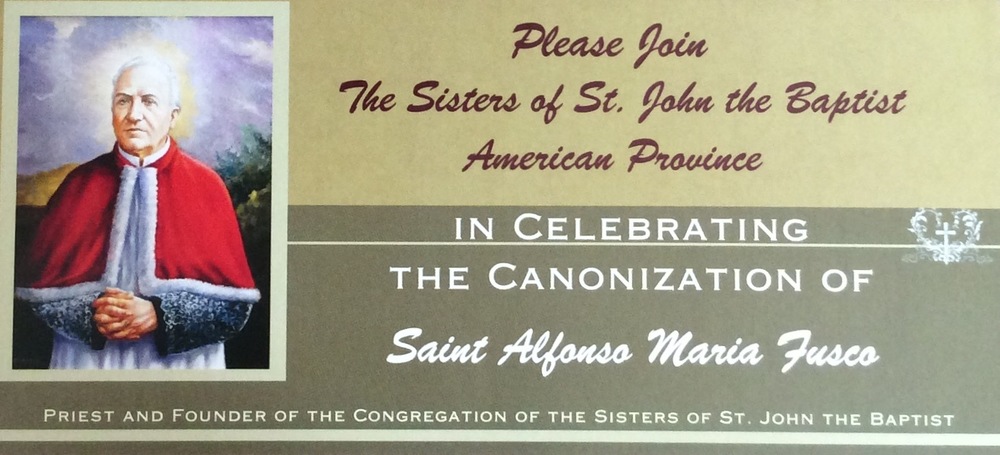
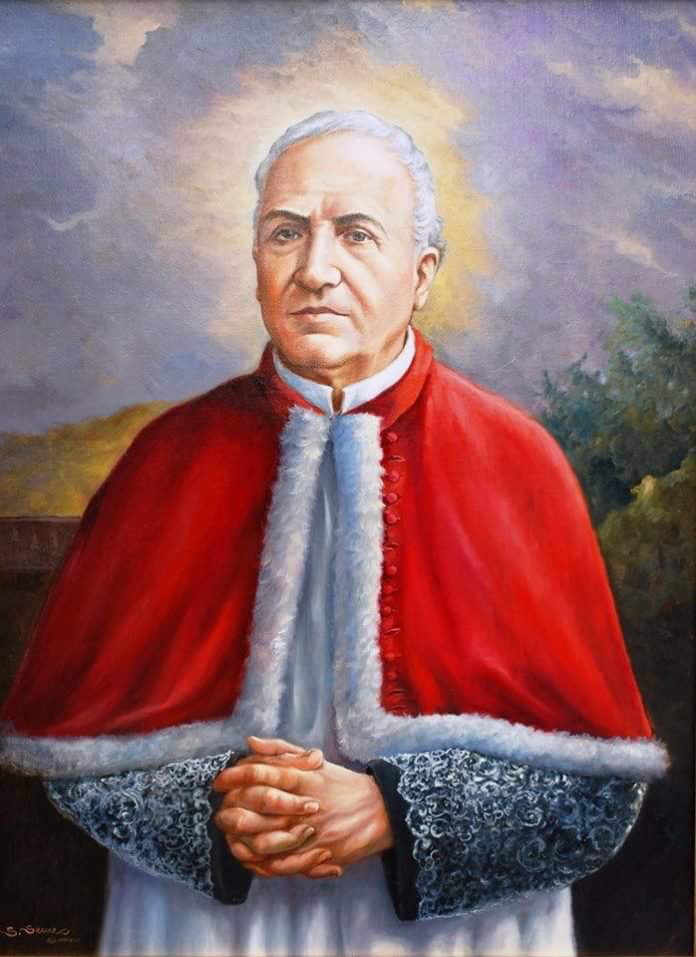
Saint of the Day – 6 February – St Alfonso Maria Fusco (1839-1910) Priest, Founder of the Sisters of Saint John the Baptist – also known as the Baptistine Sisters. Their mission is to evangelise and educate as well as to promote the faith amongst adolescents, with a particular emphasis on those who are poor or abandoned.   Patronages – the Baptistine Sisters .   He was Beatified by St Pope John Paul on 7 October 2001 and Canonised by Pope Francis on 16 October 2016.HEADER - Don-Alfonso-M-F-q

Alfonso Maria Fusco, the oldest of five children, was born on 23 March 1839, in Angri, in the province of Salerno, in the Diocese of Nocera-Sarno.   His parents, Aniello Fusco and Josephine Schiavone, were both of peasant stock but were raised from their infancy with strong Christian principles and with a holy fear of God.   They were married in the Collegiata of St John the Baptist on 31 January 1834 and for four long years the cradle they had lovingly prepared remained painfully empty.   In Pagani, only a short distance from Angri, the relics of St Alfonso Maria de’ Liguori were preserved.   It was to his tomb that Aniello and Josephine went in 1838 to pray.   While they were there, the Redemptorist, Francesco Saverio Pecorelli told them:  “You will have a son; you will name him Alfonso; he will become a priest and will live the life of Blessed Alfonso”.

The little boy quickly revealed a mild, gentle, lovable character, responsive to prayer and to the poor.   When he was seven, he received his First Holy Communion and Confirmation.   He told his parents when he was eleven that he wanted to become a priest and on 5 November 1850, “freely and with the sole desire to serve God and the Church”, as he himself declared many years later, he entered the episcopal Seminary of Nocera dei Pagani.   On 29 May 1863, he was ordained by the Archbishop of Salerno, Monsignor Anthony Salomone, amid the joy of his family and the enthusiasm of the people.

Quickly he distinguished himself among the clergy of the Collegiata of St John the Baptist in Angri for his zeal, his regular attendance at liturgical services and for his diligence in the administration of the sacraments, especially the Sacrament of Reconciliation where he revealed his paternal understanding of his penitents.   He devoted himself to the evangelisation of the people through his simple and incisive style of preaching.

The daily life of Father Alfonso was that of a zealous priest but he carried in his heart an old dream.   In his last years at the seminary, one night he had dreamed that Jesus the Nazarene was calling him to found an institute of Sisters and an orphanage for boys and girls as soon as he was ordained.

It was a meeting with Maddalena Caputo of Angri, a strong-willed woman aspiring to enter religious life, which impelled Father Alfonso to move more quickly in the foundation of the Institute.   On 25 September 1878, Miss Caputo and three other young women met at night in the dilapidated Scarcella house in the Ardinghi district of Angri. The young women wanted to dedicate themselves to their own sanctification through a life of poverty, of union with God and of charity in the care and instruction of poor orphans.   The Congregation of the Baptistine Sisters of the Nazarene was thus begun;  the seed had fallen into the good earth of the hearts of these four zealous and generous women.   Privations, struggles, opposition and trials were their lot but the Lord made that seed grow abundantly.   The Scarcella House was quickly named the Little House of Providence.

Other postulants and the first orphans began to arrive and with them the first problems. The Lord, who allows those whom He loves much to suffer much, did not spare the Founder and his daughters.   Father Alfonso accepted these trials, at times very difficult ones, demonstrating an absolute conformity to the will of God, an heroic obedience to his superiors and an unbounded trust in Divine Providence.

Father Alfonso did not leave many writings.   He loved to speak with the witness of his life.   The short statements, rich in evangelical wisdom, which we find in his writings, and the testimony of those who knew him are flashes which illuminate his simple life, his great love for the Eucharist and for the Passion of Jesus and his filial devotion to the Sorrowful Mother.   He would often repeat to his Sisters:  “Let us become saints, following Jesus closely… Daughters, if you live in poverty, in chastity and in obedience, you will shine like the stars up in the heavens”.

He directed the Institute wisely and prudently.   Like a loving father, he watched over the Sisters and the orphans.  He showed an almost maternal tenderness for all, especially for the most needy of the orphans.   For them there was always space in the Little House of Providence, even when there was a scarcity of food or absolutely nothing.   Then Father Alfonso would reassure his worried daughters saying:  “Don’t worry, my daughters. I am going to Jesus now and He will worry about us!”   And Jesus answered quickly and with great generosity.   To him who believes, everything is possible!

At a time when an education was the privilege of the few, denied to the poor and to women, Father Alfonso did not mind sacrificing to give the children a peaceful life, an education and a trade for the older ones so that once they were grown up, they could live as honest citizens and as committed Christians.   He wanted the Sisters to begin their studies as soon as possible so that they could teach the poor and, through their instruction and evangelisation, prepare the way for Jesus especially in the hearts of the children and of youth.

His tenacious will, totally anchored in Divine Providence, the wise and prudent collaboration of Maddalena Caputo, known as Sr Crocifissa, who was the first superior of the growing Institute, the ongoing spur of the love of God and neighbour, contributed to the extraordinary development of the work in a very short time.   The growing requests for assistance for an ever greater number of orphans and children urged Fr Alfonso to open new houses, first in Campania and then in other regions of Italy.

During the night of 5 February 1910, he felt unwell.   He requested and then received the sacraments on the morning of 6 February.   After having blessed with trembling hands his own daughters weeping around his bed, he exclaimed:  “Lord, I thank you, I have been a useless servant”.   Then, turning to the Sisters: “From heaven I will not forget you. I will pray for you always”.   And he then slept peacefully in the Lord.

News of his death spread quickly and for that entire Sunday, there was a procession of people crying and saying:  “The father of the poor is dead; the saint is dead!”

His witness has been an inspiration of life and a means of grace, especially for his Sisters spread today throughout four continents.   On 12 February 12, 1976, Pope Paul VI recognised his heroic virtues; on 7 October 2001, Pope John Paul II, proclaiming him blessed, offers him as an example to priests and a model for everyone of an educator and protector especially to the poor and the needy.  (vatican.va)st alfonso maria fusco

On 16 October 2016, Pope Francis Canonised St Alfonso, together with Salomon Leclercq, José Sánchez del Río, Manuel González García, Lodovico Pavoni, José Gabriel del Rosario Brochero, Elisabeth of the Holy Trinity Catezbl alfonso fusco


Posted in MORNING Prayers, ON the SAINTS, PAPAL SERMONS, SAINT of the DAY, SPEAKING of ....., St PAUL!, The APOSTLES & EVANGELISTS, VATICAN Resources

Series on the Catechesis of Pope BENEDICT XVI “Speaking of St Paul” – No 1 – Religious and Cultural Environment

Series on the Catechesis of Pope BENEDICT XVI on St Paul

“Speaking of St Paul ” No 1 – Wednesday, 2 July 2008

Religious and Cultural Environment

386px-Marco_Zoppo_-_St_Paul_-_WGA26005
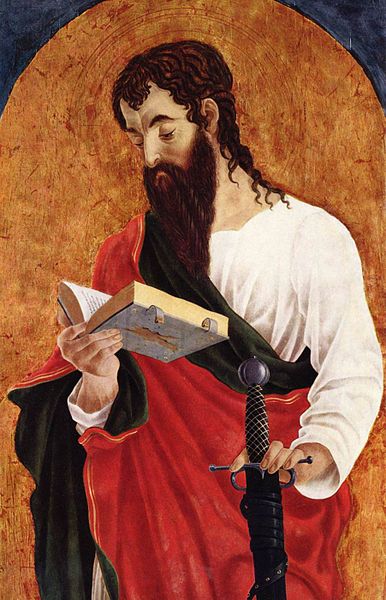
Marco Zoppo (1433–1478) – Italian painter (1433-1478) St Paul circa 1468

Dear Brothers and Sisters,

Today I would like to begin a new cycle of Catechesis focusing on the great Apostle St Paul. As you know, this year is dedicated to him, from the liturgical Feast of Sts Peter and Paul on 29 June 2008 to the same Feast day in 2009.   The Apostle Paul, an outstanding and almost inimitable yet stimulating figure, stands before us as an example of total dedication to the Lord and to his Church, as well as of great openness to humanity and its cultures.   It is right, therefore, that we reserve a special place for him in not only our veneration but also in our effort to understand what he has to say to us as well, Christians of today.   In this first meeting let us pause to consider the environment in which St Paul lived and worked.   A theme such as this would seem to bring us far from our time, given that we must identify with the world of 2,000 years ago.   Yet this is only apparently and, in any case, only partly true for we can see that various aspects of today’s social and cultural context are not very different from what they were then.

A primary and fundamental fact to bear in mind is the relationship between the milieu in which Paul was born and raised and the global context to which he later belonged.   He came from a very precise and circumscribed culture, indisputably a minority, which is that of the People of Israel and its tradition.   In the ancient world and especially in the Roman Empire, as scholars in the subject teach us, Jews must have accounted for about 10 percent of the total population.   Later, here in Rome, towards the middle of the first century, this percentage was even lower, amounting to three percent of the city’s inhabitants at most.   Their beliefs and way of life, is still the case today, distinguished them clearly from the surrounding environment and this could have two results:  either derision, that could lead to intolerance, or admiration which was expressed in various forms of sympathy, as in the case of the “God-fearing” or “proselytes”, pagans who became members of the Synagogue and who shared the faith in the God of Israel.   As concrete examples of this dual attitude we can mention on the one hand the cutting opinion of an orator such as Cicero who despised their religion and even the city of Jerusalem (cf. Pro Flacco, 66-69) and, on the other, the attitude of Nero’s wife, Poppea, who is remembered by Flavius Josephus as a “sympathiser” of the Jews (cf. Antichità giudaiche 20, 195, 252); Vita 16), not to mention that Julius Caesar had already officially recognised specific rights of the Jews which have been recorded by the above-mentioned Jewish historian Flavius Josephus (cf. ibid., 14,200-216).   It is certain that the number of Jews, as, moreover, is still the case today, was far greater outside the land of Israel, that is, in the Diaspora, than in the territory that others called Palestine.

It is not surprising, therefore, that Paul himself was the object of the dual contradictory assessment that I mentioned.   One thing is certain: the particularism of the Judaic culture and religion easily found room in an institution as far-reaching as the Roman Empire.   Those who would adhere with faith to the Person of Jesus of Nazareth, Jew or Gentile, were in the more difficult and troubled position, to the extent to which they were to distinguish themselves from both Judaism and the prevalent paganism.   In any case, two factors were in Paul’s favour.   The first was the Greek, or rather Hellenistic, culture which after Alexander the Great had become a common heritage, at least of the Eastern Mediterranean and of the Middle East and had even absorbed many elements of peoples traditionally considered barbarian.   One writer of the time says in this regard that Alexander “ordered that all should consider the entire oecumene as their homeland… and that a distinction should no longer be made between Greek and barbarian” (Plutarch, De Alexandri Magni fortuna aut virtute, 6, 8).   The second factor was the political and administrative structure of the Roman Empire which guaranteed peace and stability from Britain as far as southern Egypt, unifying a territory of previously unheard of dimensions.   It was possible to move with sufficient freedom and safety in this space, making use, among other things, of an extraordinary network of roads and finding at every point of arrival basic cultural characteristics which, without affecting local values, nonetheless represented a common fabric of unification super partes, so that the Jewish philosopher, Philo of Alexandria, a contemporary of Paul himself, praised the Emperor Augustus for “composing in harmony all the savage peoples, making himself the guardian of peace” (Legatio ad Caium, 146-147).

There is no doubt that the universalist vision characteristic of St Paul’s personality, at least of the Christian Paul after the event on the road to Damascus, owes its basic impact to faith in Jesus Christ, since the figure of the Risen One was by this time situated beyond any particularistic narrowness.   Indeed, for the Apostle “there is neither Jew nor Greek, there is neither slave nor free, there is neither male nor female; for you are all one in Christ Jesus” (Gal 3: 28).   Yet, even the historical and cultural situation of his time and milieu could not but have had an influence on his decisions and his work.   Some have defined Paul as “a man of three cultures”, taking into account his Jewish background, his Greek tongue and his prerogative as a “civis romanus [Roman citizen], as the name of Latin origin suggests.   Particularly the Stoic philosophy dominant in Paul’s time which influenced Christianity, even if only marginally, should be recalled.   Concerning this, we cannot gloss over certain names of Stoic philosophers such as those of its founders, Zeno and Cleanthes and then those closer to Paul in time such as Seneca, Musonius and Epictetus: in them the loftiest values of humanity and wisdom are found which were naturally to be absorbed by Christianity.   As one student of the subject splendidly wrote, “Stoicism… announced a new ideal, which imposed upon man obligations to his peersbut at the same time set him free from all physical and national ties and made of him a purely spiritual being” (M. Pohlenz, La Stoa, I, Florence, 2, 1978, pp. 565 f.).   One thinks, for example, of the doctrine of the universe understood as a single great harmonious body and consequently of the doctrine of equality among all people without social distinctions, of the equivalence, at least in principle, of men and women and then of the ideal of frugality, of the just measure and self-control to avoid all excesses.   When Paul wrote to the Philippians, “Whatever is true, whatever is honourable, whatever is just, whatever is pure, whatever is lovely, whatever is gracious, if there is any excellence, if there is anything worthy of praise, think about these things” (Phil 4: 8), he was only taking up a purely humanistic concept proper to that philosophical wisdom.

In St Paul’s time a crisis of traditional religion was taking place, at least in its mythological and even civil aspects.   After Lucretius had already ruled polemically a century earlier that “religion has led to many misdeeds” (De rerum natura, 1, 101, On the Nature of Things), a philosopher such as Seneca, going far beyond any external ritualism, taught that “God is close to you, he is with you, he is within you” (Epistulae morales to Lucilius, 41, 1).   Similarly, when Paul addresses an audience of Epicurean philosophers and Stoics in the Areopagus of Athens, he literally says: “God does not live in shrines made by man,… for in him we live and move and have our being” (Acts 17: 24, 28).   In saying this he certainly re-echoes the Judaic faith in a God who cannot be represented in anthropomorphic terms and even places himself on a religious wavelength that his listeners knew well.   We must also take into account the fact that many pagan cults dispensed with the official temples of the town and made use of private places that favoured the initiation of their followers.   It is, therefore, not surprising that Christian gatherings (ekklesiai) as Paul’s Letters attest, also took place in private homes.   At that time, moreover, there were not yet any public buildings.   Therefore, Christian assemblies must have appeared to Paul’s contemporaries as a simple variation of their most intimate religious practice.   Yet the differences between pagan cults and Christian worship are not negligible and regard the participants’ awareness of their identity as well as the participation in common of men and women, the celebration of the “Lord’s Supper”, and the reading of the Scriptures.

In conclusion, from this brief over-view of the cultural context of the first century of the Christian era, it is clear that it is impossible to understand St Paul properly without placing him against both the Judaic and pagan background of his time.   Thus he grows in historical and spiritual stature, revealing both sharing and originality in comparison with the surrounding environment.   However, this applies likewise to Christianity in general, of which the Apostle Paul, precisely, is a paradigm of the highest order from whom we all, always, still have much to learn.   And this is the goal of the Pauline Year:  to learn from St Paul, to learn faith, to learn Christ, and finally to learn the way of upright living.

St Paul Pray for us!st paul pray for us - 25 jan2018 - catechesis of pope benedict no 1

Posted in MORNING Prayers, VATICAN Resources

The Octave of Prayer for Christian Unity 18-25 January 2018

The Octave of Prayer for Christian Unity 18-25 January 2018

BIBLICAL REFLECTIONS AND PRAYERS FOR THE EIGHT DAYS
Your right hand, O Lord,
glorious in power
(Ex 15:6)

Day 5:  Hark, the cry of my poor people from far and wide in the land!

Deuteronomy 1:19-35 The Lord God goes before you and carried you

Psalm 145:9-20 The Lord upholds all who are falling

James 1:9-11 The rich will disappear like a flower in the field

Luke 18:35-43 Jesus, Son of David, have mercy on me!

The Caribbean economies have traditionally been based on the production of raw materials for the European market and so have never been self-sustaining.   As a consequence, borrowing on the international market became important for development.   The requirements of such borrowing impose a reduction of spending on transport, education, health and other public services, which impacts most severely on the poor.   The Caribbean Conference of Churches has launched an initiative to address the current debt crisis in the region and through their international networks to come to the aid of the poor.

Reflection

We can imagine the noise of the crowd as Jesus enters Jericho.   Many voices shout down the cry of the blind beggar.   He is a distraction and an embarrassment.   But through all this tumult Jesus hears the blind man’s voice, just as God always hears the cries of the poor in the Hebrew Scriptures.  The Lord who upholds the falling not only hears, he responds.   Thereby, the beggar’s life is radically transformed.

The disunity of Christians can become part of the world’s tumult and chaos.   Like the arguing voices outside Jericho, our divisions can drown out the cry of the poor.  However, when we are united we become more fully Christ’s presence in the world, better able to hear, listen and respond.   Rather than increasing the volume of discord, we are able to truly listen and so discern the voices that most need to be heard.

Prayer

Loving God,
You lift up the poor and distressed
and restore their dignity.
Hear now our cries for the poor of our world,
restore their hope and lift them up,
that all Your people may be one.
This we pray in Jesus name.

Amen.

The right hand of God
is lifting in our land,
lifting the fallen one by one;
each one is known by name,
and rescued now from shame,
by the lifting of the right hand of God.DAY 5 - 22 January 2018 - OCTAVE OF PRAYER FOR CHRISTIAN UNITY 2018 - 18-25 JAN

Posted in CATHOLIC-PRAYERS OF THE CHURCH, MORNING Prayers, PRAYERS for VARIOUS NEEDS, PRAYERS of the CHURCH, VATICAN Resources

The Octave of Prayer for Christian Unity 18-25 January 2018

The Octave of Prayer for Christian Unity 18-25 January 2018

BIBLICAL REFLECTIONS AND PRAYERS DAY 2 – 19 JANUARY

Your right hand, O Lord,
glorious in power
(Ex 15:6)

Day 2: No longer as a slave but a beloved brother

Genesis 1:26-28 God created humankind in God’s own image

Psalm 10:1-10 Why, O Lord, do you stand far off?

Philemon No longer as a slave but more than a slave, a beloved brother

Luke 10:25-37 The Parable of the Good Samaritan

Human trafficking is a form of modern-day slavery in which victims are forced or tricked into sex work, child labour and the harvesting of organs for the profit of the exploiters. It is a global, multimillion-dollar industry. It is also a growing problem across the Caribbean. Reformed Churches in the Caribbean have joined with the Council for World Mission and the Caribbean and North American Council for Mission to educate Christian communities to end the scourge of human trafficking.

Reflection

One of the first things we learn about God in the Hebrew and Christian Bible is that God created humankind in his own image. However, this profound and beautiful truth has often been obscured or denied throughout human history. For instance, in the Roman Empire, the dignity of those enslaved was denied. The Gospel message is entirely different to this. Jesus challenged the social norms that devalued the human dignity of Samaritans, describing the Samaritan as the ‘neighbour’ of the man who had been attacked on the road to Jericho – a neighbour to be loved, according to the Law. And Paul, made bold in Christ, describes the once-enslaved Onesimus as ‘a beloved brother’, transgressing the norms of his society and affirming Onesimus’s humanity.

Christian love must always be a courageous love that dares to cross borders, recognising in others a dignity equal to our own. Like St Paul, Christians must be ‘bold enough in Christ’ to raise a united voice in clearly recognising trafficked persons as their neighbours and their beloved brothers and sisters, and so work together to end modern-day slavery.

Prayer

Gracious God,
draw near to those who are victims of human trafficking,
assuring them that you see their plight and hear their cry.

May your Church be united in compassion and courage to work for that day
when no one will be exploited
and all will be free to live lives of dignity and peace.
This we pray in the name of the Triune God
who can do immeasurably more than we can ask or imagine.
Amen.

The right hand of God
is lifting in our land,
lifting the fallen one by one;
each one is known by name,
and rescued now from shame,
by the lifting of the right hand of God.

For DAY ONE go here:  https://anastpaul.wordpress.com/2018/01/18/the-octave-of-prayer-for-christian-unity-18-25-january-2018/

DAY 2 - 19 JAN - OCTAVE FOR CHRISTIAN UNITY - 19 JAN 2018

For DAY ONE go here:  https://anastpaul.wordpress.com/2018/01/18/the-octave-of-prayer-for-christian-unity-18-25-january-2018/