Quote/s of the Day – 23 March – Saturday in Passion Week
“The illusions of this world soon vanish, especially if a man arms himself with the Sign of the Cross. The devils tremble at the Sign of the Cross of our Lord, by which He triumphed over and disarmed them.”
St Anthony Abbot (251-356)
“The day will come when this Child will no longer be offered in the Temple, nor in Simeon’s arms but outside the City in the arms of the Cross. The day will come when He will not be redeemed by the blood of a sacrifice but redeem others , with His own Blood. …” That will be the evening sacrifice; this is the morning sacrifice; this one is the happiest but that one is the most complete; for this one was offered at the time of birth and that one will be offered in the fullness of time,..”
St Bernard (1091-1153) Mellifluous Doctor of the Church
“Look then on Jesus, the Author and Preserver of faith — in complete sinlessness, He suffered and, at the hands of those who were His own and was numbered among the wicked. As you drink the cup of the Lord Jesus (how glorious it is!), give thanks to the Lord, the Giver of all blessings. May the God of love and peace set your hearts at rest and speed you on your journey; may He meanwhile, shelter you from disturbance by others in the hidden recesses of His Love, until He brings you, at last, into that place of complete plenitude, where you will repose forever in the vision of peace, in the security of trust and in the restful enjoyment of His riches. ”
Our Lenten Journey with the Angels and the Saints – 23 March – Saturday in Passion Week – Jeremias18:18-23, John 12:10-36 – Scripture search here: https://www.drbo.org/
“Shall evil be rendered for good because they have dug a pit for my soul?” Jeremias 18:20
“The hour is come when the Son of man should be glorified.” John 12:23
What Happened on the Cross?
St John Damascene (675-749) Father and Doctor of the Church
“By nothing else except the Cross of our Lord Jesus Christ has death been brought low:
The sin of our first parent destroyed, hell plundered, resurrection bestowed, the power given us to despise the things of this world, even death itself, the road back to the former blessedness made smooth, the gates of paradise opened, our nature seated at the right hand of God and we made children and heirs of God.
By the Cross all these things have been set aright…
It is a seal that the destroyer may not strike us, a raising up of those who lie fallen, a support for those who stand, a staff for the infirm, a crook for the shepherded, a guide for the wandering, a perfecting of the advanced, salvation for soul and body, a deflector of all evils, a cause of all goods, a destruction of sin, a plant of resurrection and a tree of eternal life.”
(Reflections on the Cross of Christ from the Early Church Fathers – Orthodox Faith 4).
One Minute Reflection – 23 March – Saturday in Passion Week – Jeremias18:18-23, John 12:10-36 – Scripture search here: https://www.drbo.org/
“Sir, we wish to see Jesus.” – John 12:21
REFLECTION – “At Jerusalem the crowd cried out: “Hosanna in the highest! Blessed is He Who comes in the Name of the Lord, the King of Israel” (cf Mk 11:10). The phrase “He Who comes.” is well said because He is always coming, He never fails us – “The Lord is close to those who call upon Him in truth. Blessed is He Who comes in the Name of the Lord” (Ps 144:18; 117:26). The gentle King of peace stands at our door… Soldiers here below, Angels in Heaven, mortals and immortals… cry aloud: “Blessed is He Who comes in the Name of the Lord, the King of Israel.” The Pharisees, however, stand aloof (Jn 12:19) and the priests are incensed by it. But the voices which sing God’s praises ring out without ceasing – creation is full of joy…
That is why, on this very day, some Greeks, prompted by this tremendous acclamation to worship God with devotion, approached one of the Apostles, named Philip and said to him: “We would like to see Jesus.” Note well, it is the whole crowd who carries out the task of herald and prompts these Greeks to be converted. Straightaway, these latter address Christ’s disciples – “We would like to see Jesus.” Those gentiles are imitating Zachaeus, not that they climb a sycamore tree [to see Jesus] but, they make haste to rise up in their knowledge of God (Lk 19:3). “We should like to see Jesus” not so much to behold His Face but, to bear His Cross. For Jesus, Who could see their desire, had unambiguously declared to those who were standing by: “Now the hour has come for the Son of Man to be glorified” calling “glory” the conversion of the gentiles.
And He gave the name “glory” to the Cross. For, from that day to this, the Cross is glorified. Indeed, it is the Cross which still today, Consecrates Kings, adorns Priests, protects Virgins, gives constancy to Hermits, reinforces the Marriage bond and strengthens Widows. It is the Cross which makes the Church fruitful, brings light to the peoples, guards the desert, opens paradise.” – St Proclus of Constantinople (Died c446) Archbishop of Constantinople, Confessor, Defender of the Church and of the Blessed Virgin, Writer, renowned Preacher, Father of the C hurch (Sermon for Palm Sunday).
PRAYER – O Lord, may the people dedicated to Thee desire to serve Thee more and more that, taught by these sacred rites, they may be enriched by more precious gift,s as they grow in favour with Thy majesty. Through Jesus Christ, Thy Son our Lord, Who lives and reigns with Thee, in the unity of the Holy Ghost, God, world without end. Amen (Collect).
Our Morning Offering – 23 March – Saturday in Passion Week
What Can I Say? By St Anselm (1033-1109) Magnificent Doctor Marian Doctor
My most merciful Lady, what can I say about the fountains which flowed from thy most pure eyes when thou saw thy only Son before thee, bound, beaten and suffering? What do I know of the flood which drenched thy matchless face, when thou beheld thy Son, thy Lord and thy God, stretched on the Cross without guilt, when the flesh of thy flesh was cruelly butchered by wicked men? How can I judge, what sobs, troubled thy most pure breast, when thou heard, “Woman, behold thy son,” and the disciple, “Behold, thy Mother,” when thou received as a son, the disciple, in place of the Master, the servant, for the Lord? Amen
From “The Prayers and Meditations of Saint Anselm with the Proslogion,” Benedicta Ward, trans,1973, Penguin classics, Penguin Group (UK)
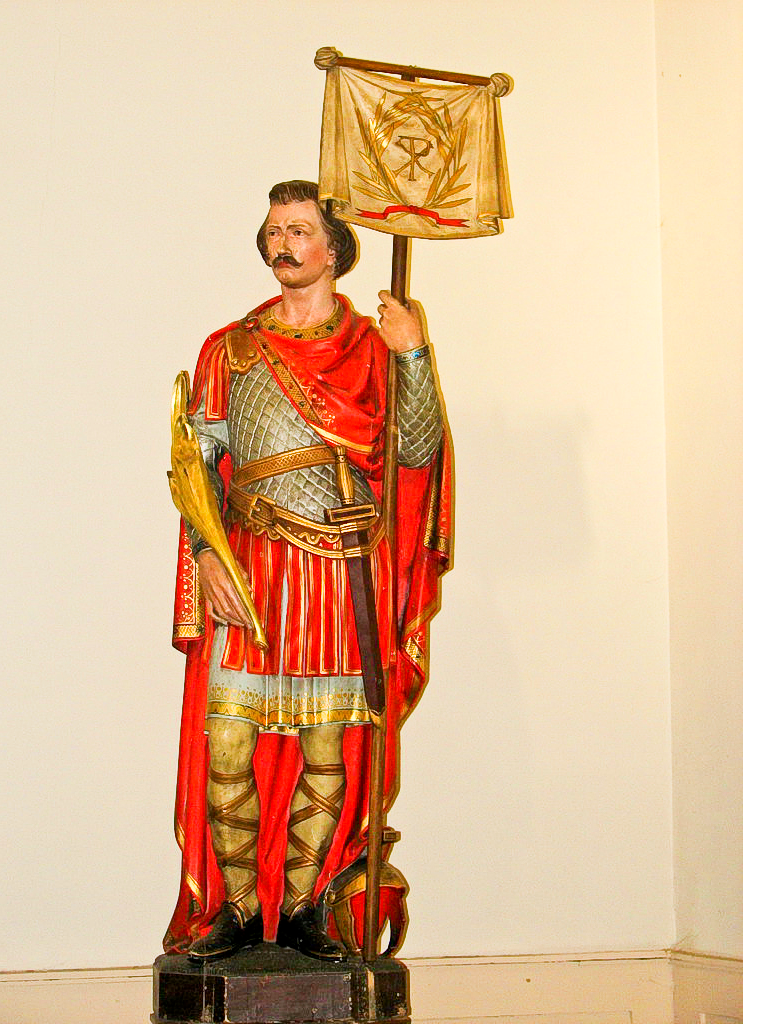
Saint of the Day – 23 March – Saint Ethelwald of Farne (Died 699) Priest, Monk and Hermit. Died on the Island of Inner Farne in 699. Also known as – Ethelwald the Hermit, Aethelwold… Ethelwold … Edelwald… He should not be confused with his near contemporary, Saint Ethelwald the Bishop of Lindisfarne who died in 740).
Inner Farne Island
Little is known about our Saint, apart from that which is recorded in the writings of the Venerable St Bede.
Ethelwald, a holy Priest and Monk of Ripon Monastery, in North Yorkshire, England, being desirous of some solitude, he succeeded to the tiny Hermitage of Saint Cuthbert on the lonely Island of Inner Farne, after the latter’s death in 687.
The Hermitage and Chapel on Inner Farne Isle
The best-known miracle of Ethelwald, related by St Bede, records how the future Abbot Guthrid visited him on Farne with two Lindisfarne Monks and, on his journey home, was saved from shipwreck by the Saint’s prayers. St Bede wrote through the lips of Abbot Guthrid:
“I came,” says he, “to the Island of Fame, with two others of the brethren, desiring to speak with the most reverend Father, Ethelwald. Having been refreshed with his discourse and asked for his blessing, as we were returning home, behold on a sudden, when we were in the midst of the sea, the fair weather, in which we were sailing, was broken and there arose so great and terrible a tempest that neither sails, nor oars, were of any use to us, nor had we anything to expect but death.
After long struggling with the wind and waves to no effect, at last we looked back to see whether it was possible, by any means, at least to return to the Island whence we came but we found that we were, on all sides alike, cut off by the storm and there was no hope of escape by our own efforts.
But looking further, we perceived, on the Island of Fame, our Father Ethelwald, beloved of God, come out of his retreat to watch our course, for, hearing the noise of the tempest and raging sea, he had come forth to see what would become of us. When he beheld us in distress and despair, he bowed his knees to the Father of our Lord Jesus Christ, in prayer for our life and safety and, as he finished his prayer, he calmed the swelling water, in such sort that the fierceness of the storm ceased on all sides and fair winds attended us over a smooth sea to the very shore. When we had landed and had pulled up our small vessel from the waves, the storm, which had ceased a short time for our sake, presently returned and raged furiously during the whole day, so that it plainly appeared that the brief interval of calm had been granted by Heaven, in answer to the prayers of the man of God, to the end that we might escape.”
The man of God remained on the Isle of Inner Fame for twelve years and died there. Upon his death, his body was translated to Lindisfarne and laid next to those of Saints Cuthbert and Edbert. Later his Relics were carried from place to place with those of St Cuthbert until they were settled in Durham Cathedral. Many miracles were attributed by St Florence of Worcester to the intercession of Saint Ethelwald
This is St Cuthbert’s Tombstone and St Ethelwald is presumably nearby
St Benedict of Campagna St Crescentius of Carthage St Ethelwald of Farne (Died 699) Priest, Monk and Hermit St Felix the Martyr St Felix of Monte Cassino St Fergus of Duleek St Fidelis the Martyr St Frumentius of Hadrumetum St Gwinear
St Julian the Confessor St Liberatus of Carthage St Maidoc of Fiddown St Nicon of Sicily
St Ottone Frangipane (1040-1127) Layman, military Knight, Pilgrim, Ascetic, Hermit, Miracle-worker both during life and after his death. Founder of a Pilgrim’s Hospice in Ariano which later became a huge Hospital. Born in 1040 in Rome, Italy and died on 23 March 1127 in Ariano Irpino, Italy of natural causes. His Life: https://anastpaul.com/2023/03/23/saint-of-the-day-23-march-st-ottone-frangipane-1040-1127/
Daughters of Feradhach: They are mentioned in early calendars and martyrologies but no information about them has survived.
Martyrs of Caesarea – 5 Saints: A group of five Christians who protested public games which were dedicated to pagan gods. Martyred in the persecutions Julian the Apostate. The only details we know about them are their names – Aquila, Domitius, Eparchius, Pelagia and Theodosia. They were martyred in 361 in Caesarea, Palestine.
Thought for the Day – 22 March – The Spiritual Combat (1589) – Dom Lorenzo Scupoli OSM (c1530-1610)
“None shall be crowned who has not fought well.” 2 Tim 2: 5
XXXV: … Of the Means Whereby Virtues are Acquired (Part Two)
“The Sacred Words of Holy Scripture, either uttered with the lips or pondered in the heart, as may best suit our case, have a marvellous power to aid us in this exercise. We should, therefore, have many such in readiness to bear upon the virtue we wish to practice and these, we should repeat continually throughout the day and especially, at each rising of the rebellious passion. For instance, if we are striving to attain the virtue of patience, we may repeat the following words, or others like them:
“My children, suffer patiently the wrath which is come upon you.” Baruch 4:25. “The patience of the poor, shall not perish for ever.” Psalm 9:18. “The patient man is better than the valiant and he who ruleth his spirit, than he who taketh cities.” Proverbs 16:32. “In your patience you shall possess your souls.” Luke 21:19. “Let us run with patience to the fight proposed to us.” Hebrews 12:1.
To the same end, we may, in like manner, use such prayers as the following:
“When, O my God, shall this heart of mine be armed with the buckler of patience?” “When shall I learn to bear every trouble with a quiet mind, so I may please my Lord?” “O most dear sufferings which liken me unto my Lord Jesus, crucified for me!” “Only Life of my soul, I shall ever, for Thy glory, live contented amid a thousand torments!” “How blessed shall I be, if, in the midst of the fire of tribulation, I burn with the desire of even greater sufferings!”
Let us use these short prayers and others suitable to our advancement in holiness so that we may acquire the spirit of devotion. These short prayers are called Ejaculations because they are darted like javelins towards Heaven. They have great power to speed us towards virtue and will penetrate even to the heart of God, if only they have these two accompaniments for their wings:
+++ The one – a full certainty that our exercise of virtue is greatly pleasing to our God. +++ The other – a true and fervent desire for the attainment of virtue, for the sole end of pleasing His Divine Majesty.”
Quote of the Day – 22 March – Friday in Passion Week, the Fifth Friday in Lent, Our Lady of the Seven Sorrows
STABAT MATER
At the Cross her station keeping, Stood the mournful Mother weeping, Close to Jesus to the last. Through her heart, His sorrow sharing, All His bitter anguish bearing, Now at length the sword had passed.
Oh, how sad and sore distressed Was that Mother highly blest, Of the sole begotten One! Christ above in torment hangs. She beneath beholds the pangs Of her dying glorious Son.
Is there one who would not weep, Whelmed in miseries so deep, Christ’s dear Mother to behold? Can the human heart refrain From partaking in her pain, In that Mother’s pain untold?
Bruised, derided, cursed, defiled, She beheld her tender Child, All with bloody scourges rent. For the sins of His own nation, Saw Him hang in desolation Till His spirit forth He sent.
O thou Mother: fount of love! Touch my spirit from above, Make my heart with thine accord. Make me feel as thou hast felt; Make my soul to glow and melt With the love of Christ my Lord.
Holy Mother, pierce me through; In my heart each wound renew Of my Saviour Crucified. Let me share with thee His pain, Who for all my sins was slain, Who for me in torment died.
Let me mingle tears with thee, Mourning Him who mourned for me, All the days that I may live. By the Cross with thee to stay; There with thee to weep and pray, Is all I ask of thee to give.
Virgin of all virgins best, Listen to my fond request: Let me share thy grief divine. Let me to my latest breath, In my body bear the death Of that dying Son of thine.
Wounded with His every wound, Steep my soul till it hath swooned In His very blood away. Be to me, O Virgin, nigh, Lest in flames I burn and die, In His awful Judgment day.
Christ, when Thou shalt call me hence, Be Thy Mother my defence, Be Thy Cross my victory. While my body here decays, May my soul Thy goodness praise, Safe in Paradise with Thee. Amen
Note: This text of the Stabat Mater is one of over 60 translations of this famous 13th Century Latin Hymn/Prayer. The Author is uncertain but is believed to be either St Jacopone da Todi OFM (1230-1306) or Pope Innocent III (1161-1216)[reigned from from 8 January 1198 until his death on 16 July 1216]. The title comes from its first line, “Stabat Mater dolorosa” – which means “the sorrowful mother was standing.” It is often used when praying the Stations of the Cross. The original Latin text of the Stabat Mater has also been set to music by such composers as Haydn, Rossini, and Poulenc.
Our Lenten Journey with the Angels and the Saints – 22 March – Friday in Passion Week, the Fifth Friday in Lent, Our Lady of the Seven Sorrows – Judith 13:22, 25; John 19:25-27 – Scripture search here: https://www.drbo.org/
“Virgin of all virgins best, Listen to my fond request: Let me share thy grief divine. Let me to my latest breath, In my body bear the death Of that dying Son of thine.” Stabat Mater
“And from that hour, the disciple took her to his own.” John 19:27
At the Lord’s Cross with His Mother and Ours
Blessed Guerric of Igny O. Cist. (c1080-1157) Cistercian Abbot
“When Jesus was going round towns and villages preaching the Gospel, Mary was His inseparable companion, clinging to His footsteps and hanging upon His words, as He taught, so much so, that neither the storm of persecution, nor dread of punishment, could deter her from following her Son and Master.
“By the Lord’s Cross there stood Mary, His Mother.” Truly a Mother, who did not abandon her Son, even in the face of death! How could she be frightened of death, when “her love was as strong as death,” (Sg 8:6) or rather, stronger than death? Truly she stood by Jesus’ Cross, when, at the same time, the pain of the Cross crucified her mind and, as manifold a sword, pierced her own soul, (Lk 2:35) as she beheld the body of her Son, pierced with wounds. Rightly, therefore, was she recognised as His Mother there and by His care, entrusted to a suitable protector, in which both the mother’s unalloyed love for her Son and the Son’s kindness toward His Mother, were proved to the utmost …
Loving her as He did, Jesus “Loved her to the end” (Jn 13:1), so as not only to bring His life to an end, for her but also, to speak almost His last words for her benefit. As His last will and testament, He committed, to His beloved heir, the care of His Mother… The Church fell to Peter, Mary to John. This bequest belonged to John, not only by right of kinship but too, because of the privilege, love had bestowed and the witness, his chastity bore… It was fitting that none other than the beloved of her Son, should minister to the Mother of the Lord… Providence too arranged, very conveniently that he who was to write a Gospel, should have intimate conferences with her, who knew about them all, for she had taken note from the beginning, of everything that happened to her Son and “treasured all the words concerning Him, pondering them in her heart” (Lk 2:19).” – (4th Sermon for the Assumption).
One Minute Reflection – 22 March – Friday in Passion Week, the Fifth Friday in Lent, Our Lady of the Seven Sorrows – Judith 13:22, 25, John 19:25-27 – Scripture search here: https://www.drbo.org/
REFLECTION – “Mary, the Mother of the Lord, stood by her Son’s Cross. No-one has taught me this but the holy Evangelist John. Others have related how the earth was shaken at the Lord’s Passion, the sky was covered with darkness, the sun withdrew itself and how, the thief was, after a faithful confession, received into paradise. John tells us what the others have not told, how the Lord, while fixed on the Cross called to His Mother. He thought it was more important that, victorious over His sufferings, Jesus gave her the offices of piety, than that He gave her a Heavenly Kingdom. For if it is the mark of religion to grant pardon to the thief, it is a mark of much greater piety, that a mother is honoured with such affection, by her Son. “Behold,” He says, “thy son.” “Behold thy mother.” Christ testified from the Cross and divided the offices of piety, between the mother and the disciple.
Nor was Mary below what was becoming the Mother of Christ. When the Apostles fled, she stood at the Cross and with pious eyes beheld her Son’s wounds. For she did not look to the death of her offspring but to the salvation of the world. Or perhaps, because that “royal hall” knew, that the redemption of the world would be through the death of her Son, she thought that by her death, she also might add something to that universal gift. But Jesus did not need a helper, for the redemption of all, Who saved all without a helper. This is why He says, “I am counted among those who go down to the pit. I am like those who have no help.” He received indeed, the affection of His Mother but sought not another’s help. Imitate her, holy mothers, who in her only dearly beloved Son, set forth so great an example of maternal virtue. For neither have you sweeter children, nor did the Virgin seek the consolation of being able to bear another son.” – St Ambrose (340-397) Archbishop of Milan, Great Western Father and Doctor (Letter 63)
PRAYER – O God, in Whose Passion the sword, according to the prophecy of blessed Simeon, pierced through the soul of Mary, the glorious Virgin and Mother, mercifully grant that we, who reverently commemorate her piercing through and her suffering, may, by the interceding glorious merits of all the saints faithfully standing by the Cross, obtain the abundant fruit of Thy Passion. Through the same Jesus Christ, Thy Son our Lord, Who lives and reigns with Thee, in the unity of the Holy Ghost, God, world without end. Amen (Collect).
Our Morning Offering – 22 March – Friday in Passion Week, the Fifth Friday in Lent, Our Lady of the Seven Sorrows
My Sorrowful Mother, Help Me to Bear My Crosses By St Alphonsus Liguori (1696-1787) Doctor of the Church
My sorrowful Mother, by the merit of that grief which you felt at seeing your beloved Jesus led to death, obtain for me the grace to bear with patience, those crosses which God sends me. I will be fortunate if I also shall know how to accompany you with my cross until death. You and Jesus, both innocent, have borne a heavy cross and shall I, a sinner who has merited hell, refuse mine? Immaculate Virgin, I hope you will help me to bear my crosses with patience. Amen
Saint of the Day – 22 March – Blessed Lukarda of Oberweimar O.Cist (c1275-1309) Virgin, German Cistercian Nun, Mystic, Miracle-worker. She was gifted with visions and the Stigmata of the Wounds of Our Lord. Born in c1275, probably in Erfurt, Germany and died on 22 March (Palm Sunday) 1309 at the Oberweimar Abbey, Weimar, Thuringia (in modern Germany) of natural causes, aged 33. Also known as – Lukarda of Erfurt, Lukardis… Lucardis… Lutgarda… Her name means — “the protector of the people” (Old High German).
Lukarda was born in 1275 or 1276 near Erfurt in Germany. At the age of twelve, she entered the Cistercians of Oberweimar Abbey, near modern-day Weimar.
Although she herself was not physically strong she was placed in the Infirmary of the Monastery to care for the ill and those even less healthy than herself. Lukarda dedicated herself with great assiduity to the needs of all the ailing patients.
Lukarda, afflicted by numerous sufferings which she endured with great patience and firmness of mind, was comforted by the Virgin Mary and Saint John the Baptist. She was deeply devoted to the Passion of Our Lord. Once, during a vision of the Saviour, the image of His Wounds were imprinted on her body and it was announced to her that she would only live for thirty-three years.
She had the gift of miracles, so much so that, through her intercession many people were cured of their sufferings and illnesses. Two blind men regained their sight when clothes stained by the blood of Saint Lukarda’s Stigmata were placed over there eyes.
She died on 22 March 1309 and was buried in the side Chapel of Oberweimar Abbey Church (see below). After her death she was immediately honoured with her own cult and was invoked by many who obtained extraordinary graces and cures through Lukarda’s intercession. She has been remembered and celebrated in Weimar on her Feast day, the Anniversary of her death for Centuries until the protestants sought to disrupt and prevent such devotions.
Church of St Peter and Paul of the former Cistercian Monastery in Oberweimar
Our Lady of the Seven Sorrows THE FEAST DAY OF THE SEVEN DOLORS IS TRADITIONALLY THE FRIDAY OF PASSION WEEK, WHICH IS THE FRIDAY BEFORE GOOD FRIDAY, AND ON 15 SEPTEMBER.
St Callinica of Galatia St Catherine of Sweden St Darerca of Ireland St Deghitche
St Epaphroditus of Terracina (1st Century) First Bishop of Terracina, Italy, Missionary, Evangelist, Disciple of the Apostles, Friend and Envoy of St Paul Apostle. St Hippolytus’ list of the Seventy Disciples includes “Epaphroditus, Bishop of Andriace.” The Roman Martyrology reads: “At Terracina, St Epaphroditus, a disciple of the Apostles, who was Consecrated Bishop of that City by the blessed Apostle Peter.” Biography: https://anastpaul.com/2022/03/22/saint-of-the-day-22-march-saint-epaphroditus-of-terracina-1st-century/
Thought for the Day – 21 March – The Spiritual Combat (1589) – Dom Lorenzo Scupoli OSM (c1530-1610)
“None shall be crowned who has not fought well.” 2 Tim 2: 5
XXXV: … Of the Means Whereby Virtues are Acquired (Part One)
“For the attainment of holiness, we need, besides all that has been already described, a great and generous heart, a will which is neither slack nor remiss but firm and resolute and withal, a certain expectation of having to pass through many bitter and adverse trials.
And furthermore, there are particular inclinations and affections which we may acquire by frequently considering how pleasing they are to God, how excellent and noble in themselves and, how useful and necessary to us, inasmuch as from them and in them, all perfection has its origin and end.
Let us, then, make a steadfast resolution every morning to exercise ourselves therein, according to the occasions which may arise in the course of the day; during which, we should often examine ourselves, to see, whether or not, we have fulfilled them, renewing them afterwards more earnestly. And all this with especial reference to that virtue which we have in hand.
So also, let the examples of the Saints and our prayers and meditations on the life and passion of Christ, which are so needful in every spiritual exercise, be applied principally to the particular virtue in which we are, for the time exercising ourselves.
Let us do the same on all occasions which may arise, however variant in kind, as we shall presently explain more particularly.
Let us so inure ourselves to acts of virtue, both interior and exterior,that we may come at last to perform them with the same promptness and facility, with which, in times past, we performed others agreeable to our natural will. And, as we said before, the more opposed such acts are to these natural wishes, the more speedily will the good habit be introduced into our soul.”
Quote/s of the Day – 21 March – St Benedict OSB (c480-547) Abbot
“Listen and attend with the ear of your heart.”
“Be careful to be gentle, lest in removing the rust, you break the whole instrument.”
“Idleness is an enemy of the soul.”
O God, Be With Us By St Benedict (c480-547)
O God, from Whom to be turned, is to fall, to Whom to be turned, is to rise, and in Whom to stand, is to abide forever. Grant us in all our duties, Thy help, in all our perplexities, Thy guidance, in all our dangers, Thy protection, and in all our sorrows, Thy peace, through Jesus Christ our Lord. Amen.
Our Lenten Journey with the Angels and the Saints – 21 March – Thursday of Passion Week – Ecclesiasticus 45:1-6, Matthew 19:27-29 – Scripture search here: https://www.drbo.org/
“He asked life of Thee, Thou hast given him length of days, forever and ever.” Psalm 20:5
“And everyone who has left house, or brethren, or sisters, or father, or mother, or wife, or children, or lands for My Name’s sake, shall receive a hundredfold and shall possess life everlasting.” Matthew 19:29
Seek for Nothing!
By St John of the Cross (1542-1591) Doctor of the Church
“Seek for nothing, desiring to enter for love of Jesus, with detachment, emptiness and poverty in everything in this world. You will never have to do with necessities greater than those to which you made your heart yield itself – for the poor in spirit are most happy and joyful in a state of privation and he, who has set his heart on nothing, finds satisfaction everywhere.
The poor in spirit (Mt 5:3) give generously all they have and their pleasure consists in being thus deprived of everything for God’s sake and out of love for their neighbour … Not only do temporal goods – the delights and tastes of the senses – hinder and thwart the way of God but, spiritual delights and consolations also, if sought for or clung to eagerly, disturb the way of virtue.” – (Spiritual maxims, nos. 352, 355,356, 364; 1693 Edition).
One Minute Reflection – 21 March – Thursday in Passion Week – St Benedict OSB (c480-547) Abbot – Ecclesiasticus 45:1-6; Matthew 19:27-29 – Scripture search here: https://www.drbo.org/
“… Shall receive a hundredfold and shall possess life everlasting.” – Matthew 19:29
REFLECTION – “The possessions which we have, are not our own: God has given them to us to cultivate and He wishes us to render them fruitful and profitable … Always deprive yourself, therefore, of some part of your means, giving them to the poor with a willing heart … It is true that God will return it to you, not only in the next world but also in this, for there is nothing which makes a person prosper, in temporal matters, so much, as almsgiving. But until such time as God shall repay it, you will always be impoverished to that extent. Oh! how holy and rich is the impoverishment which is caused by almsgiving.
Love the poor and poverty, for by this love you will become truly poor, since, as Scripture says: “We become like the things that we love” (cf Hos 9:10). Love makes those who love, equal to one another: “Who is weak and I am not weak?” says St Paul (2 Cor 11:29). He might have said: “Who is poor, with whom I am not poor?” For love made him become, such as those whom he loved. If, then, you love the poor, you will be truly participating in their poverty and poor like them. Now, if you love the poor, be often among them; be pleased to see them in your house and to visit them in theirs; associate willingly with them; be glad that they are near you in the Churches, in the streets and elsewhere. Be poor in speech with them, speaking to them as their equal but be rich in deed, giving them of your goods, as one who possesses more abundantly.
Will you do even more? … Become a servant of the poor; go to serve them … with your own hands … and at your own expense. This service has more glory in it than a throne!” – St Francis de Sales (1567-1622) Bishop of Geneva and Doctor of the Church (Introduction to the devout life, Part three Ch 15).
PRAYER – May the intercession of the blessed Abbot Benedict, commend us to Thee, O Lord, so that through his merits we may obtain that which we cannot accomplish by our own. T hrough Jesus Christ, thy Son our Lord, Who lives and reigns with Thee, in the unity of the Holy Ghost, God, world without end.. Amen (Collect).
Our Morning Offering – 21 March – Thursday in Passion Week
A Lenten Offering By St Thérèse of the Child Jesus and the Holy Face of Lisieux (1873-1897)
O my God! I offer Thee all my actions of this Lent for the intentions and for the glory of the Sacred Heart of Jesus. I desire to sanctify every beat of my heart, my every thought, my simplest works, by uniting them to Its Infinite Merits and I wish to make reparation for my sins, by casting them into the furnace of Its Merciful Love. O my God! I ask of Thee for myself and for those whom I hold dear, the grace to fulfil perfectly Thy Holy Will, to accept for love of Thee, the joys and sorrows of this passing life, so that we may one day be united together in Heaven, for all eternity. Amen
Saint of the Day – 21 March – Saint Lupicinus of Condat (Died c480) Abbot, previously a Widower, then a Hermit and then founding two Monasteries which became cornerstones of monastic, social and political stability under his administration. Born probably somewhere in the region of the Jura Mountains in France and died at his Monastery there in c480. Also known as – Lupicinus of Lauconne, Lupicinus of Jura, Lupicin… Lupicino… St Lupinus’ Body was certainly incorrupt until the 1700s. I am not sure whether it was protected from the evils destruction of the French Revolution.
The Roman Martyrology reads: “In the territory of Lyons, the Abbot St Lupicinus, whose life was resplendent with the lustre of holiness and miracles.”
Lupicinus, was a man of adamantine faith and austere spirit. After the death of his beloved wife, Lupicinus joined his brother Romanus, a Hermit dedicated to contemplative solitude living in the Jura Mountains, a short distance north of the Western Alps and mainly demarcating a long part of the French–Swiss border.
Together, the two brothers took the first steps towards a monastic destiny of great importance in the region, founding two Monasteries: Condat, later known as Saint-Oyend (another sibling brother, the youngest, who is actually called St Eugendus) and Saint-Claude and Lauconne, later called Saint-Lupicin. Both brothers led the monastic communities with dedication but Lupicinus stood out for his ascetic rigour and iron discipline, applying the monastic rule with severity and intransigence, both in the governance of the community and in the recruitment of new members.
The Monastery Church of St Lupicinus
Upon Romanus’ death, Lupicinus assumed the unified leadership of the two Monasteries, becoming a point of reference, not only for religious life but also for the protection of the surrounding populations. In particular, he distinguished himself as a staunch defender of Count Agrippinus against the aims of the Burgundian King, demonstrating not only spiritual but also political mettle.
His earthly parable ended in 480, leaving an indelible legacy. The memory of Lupicinus and his brother Romanus was handed down by a biography written by a Condat Monk shortly after the death of St Oyend, their fellow Monk. Although the veracity of this document has been questioned by some scholars, others, have recognised its historical value. A further biography, by St Gregory of Tours, offers a less detailed but still, significant account.
St Lupinus Relics were transflated on 3 July of an unspecified year, shortly after his death. A reconnaissance carried out in 1689 miraculously revealed the intact body, strengthening the cult of the Saint. Until the French Revolution, on 6 June each year, the Relics were solemnly transported from the Church of St Lupinus to that of the Chapter of Saint-Claude, in a procession of great popular devotion. The date of celebration of St Lupicinus was set for 21 March and then confirmed by the Roman Martyrology. Together with his brothers Sts Romano and Oyend, he is venerated as a Benedictine Saint, although the Monasteries he founded predated the Rule of Saint Benedict which was adopted at a later time.
In the lives of the first Abbots of Condat, it is mentioned that the Monastery which was built by St Romanus of timber, being consumed by fire, the young brother, St Eugendus, rebuilt it of stone and also that he built a handsome Church in honour of Sts Peter, Paul and Andrew.
St John of Valence (Died 1146) Bishop, Founder of the Abbey of Bonnevaux, Monk, Abbot, Apostle of the poor, Social Reformer. The Roman Martyrology reads: “In Valence in the territory of Vienne in France, St John, Bishop, who, at first Abbot of Bonnevaux, suffered many adversities for the defence of justice and with charity took care of the peasants, the poor and the merchants ruined by debts.” His Life: https://anastpaul.com/2022/03/21/saint-of-the-day-21-march-saint-john-of-valence-died-1146/
Bl Lucia of Verona (1514-1574) Laywoman, Apostle of the Sick
St Lupicinus of Condat (Died c480) brother of St Romanus (Died c460)both Abbots at Condat Monastery. St Romanus is venerated on 28 February,
St Nicholas of Flue (1417-1487) Swiss Hermit and Ascetic who is the Patron Saint of Switzerland. He is sometimes invoked as Brother Klaus. A husband and father, a Mystic, a Writer, farmer, military leader, Member of the assembly, Councillor, Judge, he was respected as a man of complete moral integrity. He was Canonised on 15 May 1947 by Pope Pius XII. About St Nicholas: https://anastpaul.wordpress.com/2018/03/21/saint-of-the-day-21-march-st-nicholas-of-flue-1417-1487/St Nicholas of Flue (1417-1487)
St Serapion the Scolastic (Died c 354-370) Bishop of Thmuis, near Diospolis in the Nile delta of Egypt, Monk and Hermit, Confessor, brilliant Scholar of great learning, Theologian, Writer, a companion to St Anthony, the Desert and a close friend of St Athanasius and gave support to him against the heretic Arians in Egypt, for which action he was exiled. St Serapion’s Life: https://anastpaul.com/2021/03/21/saint-of-the-day-21-march-saint-serapion-the-scolastic-died-c-354-370-bishop/
St Philemon of Rome Bl Santuccia Terrebotti
Martyrs of Alexandria: A large but unknown number of Catholics massacred in several Churches during Good Friday services in Alexandria, Egypt by Arian heretics during the persecutions of Constantius and Philagrio. They were Martyred on Good Friday in 342 in Alexandria, Egypt.
Thought for the Day – 20 March – The Spiritual Combat (1589) – Dom Lorenzo Scupoli OSM (c1530-1610)
“None shall be crowned who has not fought well.” 2 Tim 2: 5
XXXIV: Virtues Are To Be Gradually Acquired, One At A Time and By Degrees
“Although the true servant of Christ who aspires to perfection should set no limit to his advancement, there are some kinds of spiritual fervour which require to be restrained with a certain discretion, lest, being initially embraced too ardently, they should give way and forsake us in the midst of our exercise.
Hence, besides what has been said as to moderation in exterior exercises, we have to learn, moreover that even interior virtues, are best acquired gradually and in their due order – for thus, what is small in the beginning soon becomes great and permanent. Thus, for instance, we should not ordinarily attempt to rejoice in afflictions and to desire them, until we have firstly passed through the lower degrees of the virtue of patience.
Neither would I have you give your chief attention to all, or to many virtues at once but, initially to one and then to the others – for thus, will the virtuous habit be more easily and firmly planted in the soul. For, by the constant exercise of a single virtue, the memory recurs to it more promptly on all occasions, the intellect grows quicker to discern new methods and reasons for attaining it and, the will inclines more readily and fervently to its pursuit, than if occupied with many virtues at one and the same time.
And, by means of the uniformity of the exercise, the acts which relate to any single virtue are produced with less effort from the conformity between them. The one calls forth and aids his fellow and, by their mutual resemblance, they make a deeper impression upon the heart which is prepared and disposed, for the reception of new seed, by having already brought forth similar fruits.
These reasons have the greater force, as we know assuredly that whoever exercises himself well in one virtue, learns, at the same time, how to exercise himself in another and thus, by the inseparable connection between them, all grow together with the increase of one, as rays proceeding from one and the same Divine Light.”
Quote/s of the Day – 20 March – Wednesday in Passion Week – Leviticus 19:1-2, 11-19, 25; John 10:22-38 – Scripture search here: https://www.drbo.org/
“My sheep hear My Voice; I know them and they follow Me.”
John 10:27
“For just as from the Heavens, the rain and snow come down and do not return there, until they have watered the earth, making it fertile and fruitful, giving seed to him who sows and bread to him who eats.” Isaias 55:11
“So the Word that He shall send through His Christ, Who is Himself, the Word and the Message, shall return to Him with great power. For when He shall come and bring it, He shall come down like rain and snow and through Him all that is sown shall spring up and bear righteous fruit … And this is the Voice through which the dead shall live.”
St Aphraates “the Sage” (Died c 345) Abbot, Father of the Church
“Always (read and) listen to it (the Scriptures) with attention and reverence; make good use of it; do not let it fall to earth but take it into your heart like a precious balm. Do all this after the example of the most holy Virgin, for she carefully kept in her heart all the words spoken in praise of her Child. Remember that our Lord gathers up the words we speak to Him in prayer, in measure with the way we gather up those He speaks to us by His preaching.”
St Francis de Sales (1567-1622) Doctor of the Church
(Introduction to the Devout Life Part 2 Chapter 17)
Our Lenten Journey with the Angels and the Saints – 20 March – Wednesday in Passion Week – Leviticus 19:1-2, 11-19, 25; John 10:22-38 – Scripture search here: https://www.drbo.org/
“O Lord my God, I have cried to Thee and Thou hast healed me.” Psalm 29:3
“My sheep hear My Voice. And I know them and they follow Me.
” John 10:27
Seize Christ with the Hands of Faith
St Augustine (354-430) Father and Doctor of Grace
“If the Law calls them gods to whom the Word of God came and Scripture cannot be set aside, how can you say that the One Whom the Father has consecrated and sent into the world, blasphemes because I said, ‘I am the Son of God’? Yes indeed, if God has spoken to us, so that we might be called ‘gods,’ how could the Word of God, the Word which is in God, not be God? If we have been made sharers in His nature and have become gods because God speaks to us, how could this Word, through which this gift comes to us, not be God? … As for you, you approach the Light and receive it and are counted among the children of God but, if you draw back, you become dark and are counted among the children of darkness (cf 1 Thes 5:5). …
“Believe the works, so that you may realise and understand that the Father is in Me and I in the Father.” The Son of God does not say “the Father is in Me and I in the Father” in the same sense as we are able to do. In effect, if our thoughts are good, we are in God; if our lives are holy, God is in us. When we are sharers in His Grace and enlightened by His Light, then we are in Him and He in us. But … recognise what is proper to the Lord and what is a gift made to His servant. What is proper to the Lord is His equality with the Father but the gift granted to His servant is to participate in the Saviour.
“Then they tried to seize Him.” If only they had seized Him! But by faith and intellect, not so as to mock and put Him to death! At this very moment, as I speak to you … all of us, both you and I, are wanting to seize Christ. To ‘seize’ what does that mean? You have ‘seized’ when you have understood. But Christ’s enemies were looking for something different. You have seized in order to possess but they wanted to seize Him in order to get rid of Him! And because this was how they wanted to seize Him, what does Jesus do? “He escaped from their power.” They were unable to seize Him because they did not have the hands of faith. … We truly seize Christ, if our minds grasp the Word!” – (Sermons on the Gospel of John No 48: 9-11).
One Minute Reflection – 20 March – “The Month of St Joseph” – Wednesday in Passion Week – Leviticus 19:1-2, 11-19, 25; John 10:22-38 – Scripture search here: https://www.drbo.org/
“And I give them everlasting life and they shall never perish, neither shall anyone snatch them out of My Hand.” – John 10:28
REFLECTION – “For “no-one snatches us away from His Hands,” according to what was said in the Gospel according to John. Yet, it is not written, that just as no-one snatches us away, no-one also falls from His Hands. For one who is self-determined is free. And, I say, no-one will snatch us away from the Hand of God, no-one can take us. But, we are able to fall from His Hands, if we are negligent!” – Origen (c 185-253) Priest, Theologian, Exegist, Writer, Apologist, Father (Homilies on Jeremiah, 18).
PRAYER – In Thy mercy, O Lord, may this hallowing fast enlighten the hearts of Thy faithful people and since Thou have given them the desire to serve Thee, lend a gracious ear to their prayers.Through Jesus Christ, Thy Son our Lord, Who lives and reigns with Thee, in the unity of the Holy Ghost, God, world without end. Amen (Collect).
Our Morning Offering – 20 March – “The Month of St Joseph” – Wednesday, St Joseph’s Day
Hail, Holy Joseph, Hail! By Father Frederick William Faber CO (1814-1863)
Hail, holy Joseph, hail! Chaste spouse of Mary hail! Pure as the lily flow’r In Eden’s peaceful vale. Hail, holy Joseph, hail! Prince of the house of God! May His best graces be By thy sweet hands bestowed.
Hail, holy Joseph, hail! Comrade of Angels, hail! Cheer thou the hearts that faint, And guide the steps that fail. Hail, holy Joseph, hail! God’s choice wert thou alone! To thee the Word made flesh, Was subject as a Son.
Hail, holy Joseph, hail! Teach us our flesh to tame And, Mary, keep the hearts That love thy husband’s name. Mother of Jesus! bless, And bless, ye Saints on high, All meek and simple souls That to Saint Joseph cry. Amen
Saint of the Day – 20 March – St Guillermo de Peñacorada (Died c1042) Abbot, Miracle-worker. Patronage – Cistierna, Spain and he is invoked for rain in times of drought and he regularly proves his worth, bringing rain whenever needed. Also known as – Guglielmo, William.
We have no information regarding the early life of our Saint today. He became a Monk in the Cluniac Monastery of Satagún in the Province of León in Spain.
In 988 he fled with the other Monks from the horrors of the Almanzor invasion. They initially took refuge in a grotto on the southern slopes of Peñacorada, near Cistierna. This rough Hermitage became a pilgrimage site and remains so today. Below is an image of the Hermitage of Saint Guillermo, which is attended by devotees throughout the year.
After quite a long period in the Grotto, Guillermo and his Friars accepted the hospitality of the Augustinian Abbey near the Sanctuary of the Virgen de la Velilla, in the northern area of Peñacorada. There, after some time, he was elected Abbot and governed with great foresight.
Upon his death he was proclaimed a Saint and immediately afterwards the Monastery was solemnly renamed in his honour.
In the year 1281, the Monastery of St Guillermo de Peñacorada was annexed by King Sancho IV to the Cathedral of León.
Postage Stamp featuring St Guillermo
His Relics are located in La Mata de Monteagudo and lhe is remembered and celebrated on 20 March.
St Photina & Companions / Martyrs of Rome – 9+ Saints: A group of Christians Martyred together in the persecutions of Nero. We know nothing else about them but the names Photina, Sebastian and Victor, Anatolius, Cyriaca, Joseph, Parasceve, Photis.
Blessed Ambrose Sansedoni of Siena OP (1220-1287) Priest and Friar of the Order of Preachers, Preachers, Confessor, Mystic, a powerful and convincing Preacher employed by various Popes as a Diplomatic Peacemaker and that which seems opposed, as a Preacher of the Crusades, Peacemaker. A fellow student with St Thomas Aquinas under St Albert Magnus. His Life: https://anastpaul.com/2023/03/20/saint-of-the-day-19march-blessed-ambrose-sansedoni-of-siena-op-1220-1287-priest/
Anastasius XVI Archippus of Colossi St Benignus of Flay St Cathcan of Rath-derthaighe St Clement of Ireland
St Guillermo de Peñacorada (Died c1042) Abbot St Herbert of Derwenwater Bl Hippolytus Galantini Bl Jeanne Veron Bl John Baptist Spagnuolo St John Nepomucene St John Sergius
Martyrs of Amisus – 8 Saints: A group of Christian women Martyred together in the persecutions of Diocletian. The only details we have are eight of their names – Alexandra, Caldia, Derphuta, Euphemia, Euphrasia, Juliana, Matrona and Theodosia. They were burned to death c 300 in Amisus, Paphlagonia (modern Samsun, Turkey).
Martyrs of San Saba – 20 Saints: Twenty monks who were Martyred together in their monastery by invading Saracens. They were Martyred in 797 when they were burned inside the San Sabas monastery in Palestine.
Martyrs of Syria – 3+ Saints: A group of Christians who were Martyred together in Syria. We know nothing else about them but the names Cyril, Eugene and Paul.
Our Lenten Journey with the Angels and the Saints – 19 March – The Month and Feast of St Joseph
MEDITATION on the Feast of St Joseph, The Patron of a Holy and Happy Death
A Happy or Miserable Eternity
“When a person thinks seriously that on the moment of death, depends a happy or miserable eternity, his heart must be obdurate, indeed, if he be not struck with fear, for if the just be scarcely saved, where will the sinner appear? O, Lord! enter not into judgement with Thy servant, for no-one living is justified in Thy sight!
The holy Abbot Agatho, being seized with trembling at his last hour and his religious having asked him the cause — he replied that although, by the great mercy of God, his conscience did not reproach him with anything, yet that the Divine Judgement being very different from those of men, he was in great alarm. No wonder he should have felt so — all our good works are imperfect in the sight of the Divine Majesty.
If the Angels succour us in this dread moment, do they not prove themselves our true friends? It is in the time of affliction a person knows a sincere friend and behold, in the hour of death, when all abandon us to our fate, when our bodies are consigned to the solitary tomb and our soul “goes to the house of its eternity,” the Angels, faithful to their charge, never depart from us. ” – (Devotion to the Holy Angels)
O My Good Angel Prayer to One’s Guardian Angel Appointing him Intercessory at the Hour of Death By St Charles Borromeo (1538-1584)
My good Angel – I know not when or how I shall die. It is possible I may be carried off suddenly and before my last sigh, I may be deprived of all intelligence. Yet, how many things I would wish to say to God, on the threshold of eternity. In the full freedom of my will today, I come to charge thee to speak for me at that fearful moment. Thou will say to Him, then, O my good Angel – That I wish to die in the Roman Catholic Apostolic Church in which all the Saints, since Jesus Christ, have died and, out of which, there is no salvation. That I ask the grace, of sharing in the Infinite Merits of my Redeemer and that I desire to die, in pressing to my lips, the Cross which was bathed in His Blood! That I detest my sins because they displease Him and that I pardon, through love of Him, all my enemies, as I wish myself to be pardoned. That I die willingly because He orders it and that I throw myself, with confidence, into His adorable Heart, awaiting all His mercy. That in my inexpressible desire to go to Heaven, I am disposed to suffer everything it may please His Sovereign Justice to inflict on me. That I love Him before all things, above all things and for His own sake; that I wish and hope, to love Him with the elect, His Angels and the Blessed Mother, during all eternity. Do not refuse, O my Angel, to be my interpreter with God and to protest to Him, that these, are my sentiments and my will. Amen.
Thought for the Day – 19 March – Meditations with Antonio Cardinal Bacci (1881-1971)
The Patronage of Saint Joseph
“We shall have particular need of the protection of St Joseph at the hour of death. He had the most beautiful of deaths, for Jesus and Mary were by his side. All his life he had lived only for them. He had worked for them, worried about them and loved them. In the end, he was able to see them near him, his own sweet Jesus and his beloved Spouse. His must have been, a very peaceful death. He had fulfilled his mission and Jesus and Mary were there to console him in his last agony.
We shall come to the end of our lives too, perhaps sooner than we imagine. Let us ask the Holy Patriarch for the favour of a happy death. Let us ask him to ensure that Jesus and Mary will help us too, when we are leaving this world.”
Quote/s of the Day – 19 March – The Month and Feast of St Joseph
“So, taking Christ’s genealogy from Joseph – a husband in chastity, he was father in the same way. … Are you saying that he did not conceive Jesus through the operation of nature? Well then, what the Holy Spirit operated, He did for them both. For Joseph was “a just man,” Matthew tells us (1:19). Both husband and wife were just. The Holy Spirit dwelt within their mutual justice and gave each of them, a Son!”
St Augustine (354-430) Father and Doctor of Grace
“How faithful in humility was the great Saint we are celebrating! That cannot be said in all its perfection, for, in spite of what he was, in what poverty and lowliness he lived, all the days of his life – a poverty and lowliness beneath which. he kept hidden and concealed, his great virtues and dignity! … Truly, I am free of doubt that the Angels came, beside themselves with admiration, rank upon rank, to behold and wonder at his humility, while he sheltered that dearest Child in the poor workshop where he worked at his employment, so as to feed the little Boy and the Mother entrusted to him.”
“Behold, the Angel of the Lord appeared to him in his sleep …” Matthew 1:20
“And what wisdom did he not have? For God gave him his most glorious Son to care for … the universal Prince of Heaven and earth … Nevertheless, you can see how low and humbled he was brought, more than can be said or imagined … he went to his own Country and Town of Bethlehem and none but he was turned away from all those inns … Notice how the Angel turns him about with both hands. He tells him he has to go to Egypt and he goes; he orders him to return and he returns. God wants him to be always poor … and he submits to it with love and, not only for a while, for he was poor his whole life long!”
St Francis de Sales (1567-1622) Doctor of the Church
Indulgenced Prayer to St Joseph O St Joseph! Pray for Us Daily
O Joseph! virgin father of Jesus, pure Spouse of the Virgin Mother, pray for us daily to the Son of God, that, armed with the weapons of His grace, we may fight as we ought in life and be crowned by Him in death. Amen
(Indulgence of 100 days, twice a day St Pius X 26 November 1906)
You must be logged in to post a comment.