Thought for the Day – 3 January– Meditations with Antonio Cardinal Bacci (1881-1971)
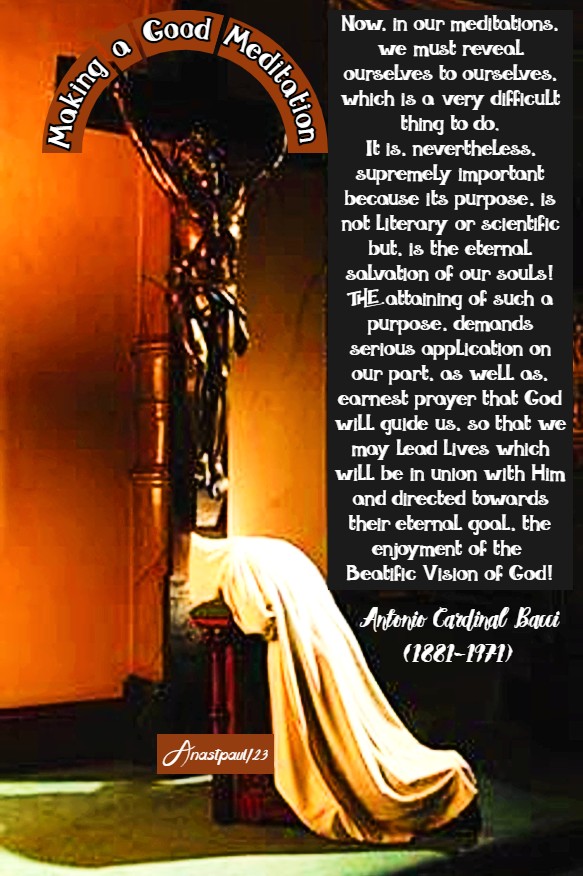
Making a Good Meditation
“Alessandro Manzoni was once asked how he had managed to penetrate so deeply into the human mind. Newman was asked how he had succeeded in discovering the law of universal gravity. Manzoni’s reply was: “By thinking about it.” Newman’s was: “By thinking intensely.”
Now, in our meditations, we must reveal ourselves to ourselves, which is a very difficult thing to do. It is, nevertheless, supremely important because its purpose, is not literary or scientific but, is the eternal salvation of our souls! The attaining of such a purpose, demands serious application on our part, as well as, earnest prayer that God will guide us, so that we may lead lives which will be in union with Him and directed towards their eternal goal, the enjoyment of the Beatific Vision of God!”
“You shall love the Lord your God with all your heart and with all your soul and with all your mind. And the second is like it: You shall love your neighbour as yourself.”
Matthew 22:36,39
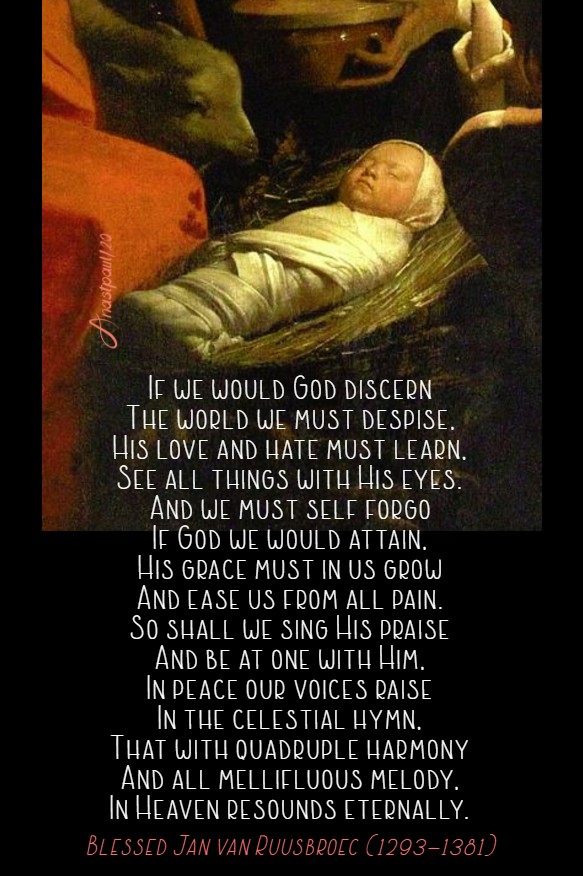
“If we would God discern The world we must despise, His love and hate must learn, See all things with His eyes. And we must self forgo If God we would attain, His grace must in us grow And ease us from all pain. So shall we sing His praise And be at one with Him, In peace our voices raise In the celestial hymn, That with quadruple harmony And all mellifluous melody, In Heaven resounds eternally.”
Bl Jan van Ruusbroec (1293-1381)
“We must make our way towards eternity, never regarding what men think of us, or of our actions, studying only to please God.”
St Francis Borgia (1510-1572)
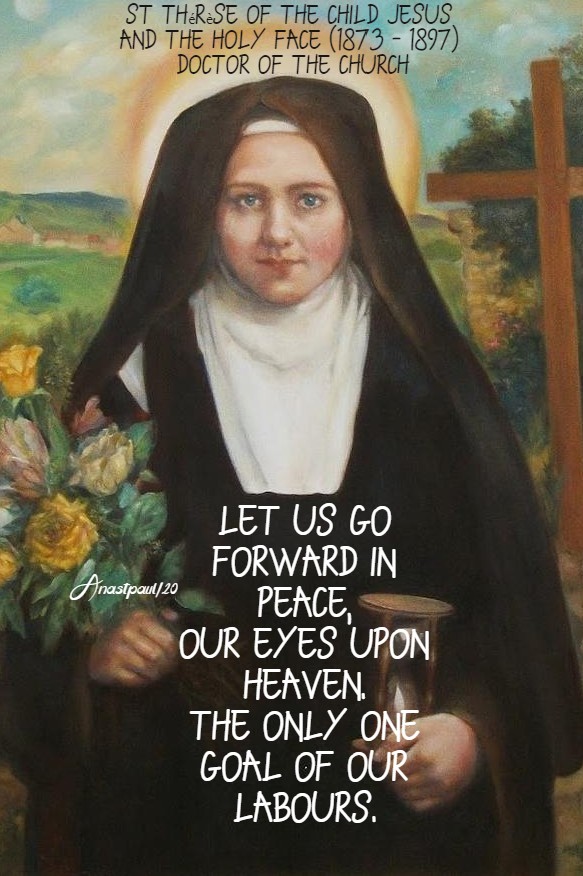
“Let us go forward in peace, our eyes upon Heaven, the only one goal of our labours.”
One Minute Reflection – 3 January – “The Month of the Most Holy Name of Jesus” – Octave Day of St John, Apostle – Ecclesiasticus 15:1-6, John 21:19-24 –Scripture search here: https://www.drbo.org/
“This is that disciple who bears witness concerning these things and who has written these things and we know that his witness is true.” – John 21:24
REFLECTION – “In proportion to the grace that caused Jesus to love him and enabled him to rest on Jesus’ Breast at the Supper (Jn 13:23), John abundantly received [the Spirit’s gifts] of understanding and wisdom (Is 11:2) – understanding with which to comprehend Scripture, wisdom with which to compose his own books with wonderful skill. As a matter of fact, he did not receive this gift right from the time when he rested on our Lord’s Breast, even if he was subsequently able to draw from that Heart “in which are hidden all the treasures of wisdom and knowledge” (Col 2:3). When he says, that when he went into the tomb “he saw and he believed,” he acknowledges that “they did not yet understand the Scripture that Jesus had to rise from the dead” (Jn 20:9). Like all the other Apostles, John received its fullness, when the Holy Spirit came [at Pentecost] and when grace had been given to each of them “according to the measure of Christ’s gift” (Eph 4:7). …
The Lord Jesus loved this disciple more than all the others … and opened the secrets of Heaven to him … to make of him the author of that profound Mystery which man can say nothing about, of himself: the Mystery of the Word, God’s Utterance, the Word made flesh. This is the fruit of that love. Yet even though He loved him, it was not to him that Jesus said: “You are Peter, and on this rock I shall build my Church” (Mt 16:18) … While He loved all His disciples and especially Peter, with a love in mind and soul, our Lord loved John with the love of His Heart …. In the order of Apostleship, Simon Peter received the first place and the “keys of the Kingdom of heaven” (Mt 16:19) but John, won another inheritance, the spirit of understanding, “a wealth of joy and gladness” (Sir 15:6).” – Rupert of Deutz (c 1075- c 1130) Benedictine Monk, Theologian and Writer (The Works of the Holy Spirit, IV, 10 SC 165)
PRAYER – O Lord, graciously shed light upon Thy Church, so that, enlightened by the teachings of blessed John, Thy Apostle and Evangelist, she may gain Thy everlasting rewards.Through Jesus Christ, Thy Son our Lord, Who lives and reigns with Thee, in the unity of the Holy Ghost, God, world without end. Amen (Collect).
Our Morning Offering – 3 January – Octave Day of St John, Apostle
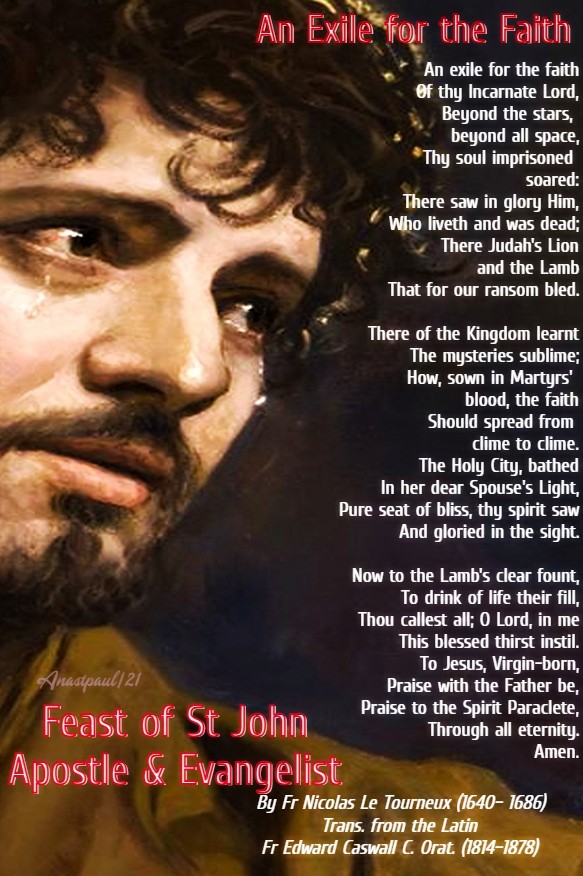
An Exile for the Faith By Father Nicolas Le Tourneux (1640– 1686) Trans. by Fr Edward Caswall C. Orat. (1814–1878)
An exile for the faith Of thy Incarnate Lord, Beyond the stars, beyond all space, Thy soul imprisoned soared, There saw in glory Him, Who liveth and was dead; There Judah’s Lion and the Lamb That for our ransom bled.
There of the Kingdom learnt The mysteries sublime; How, sown in Martyrs’ blood, the faith Should spread from clime to clime. The Holy City, bathed In her dear Spouse’s Light, Pure seat of bliss, thy spirit saw And gloried in the sight.
Now to the Lamb’s clear fount, To drink of life their fill, Thou callest all; O Lord, in me This blessed thirst instil. To Jesus, Virgin-born, Praise with the Father be, Praise to the Spirit Paraclete, Through all eternity. Amen.
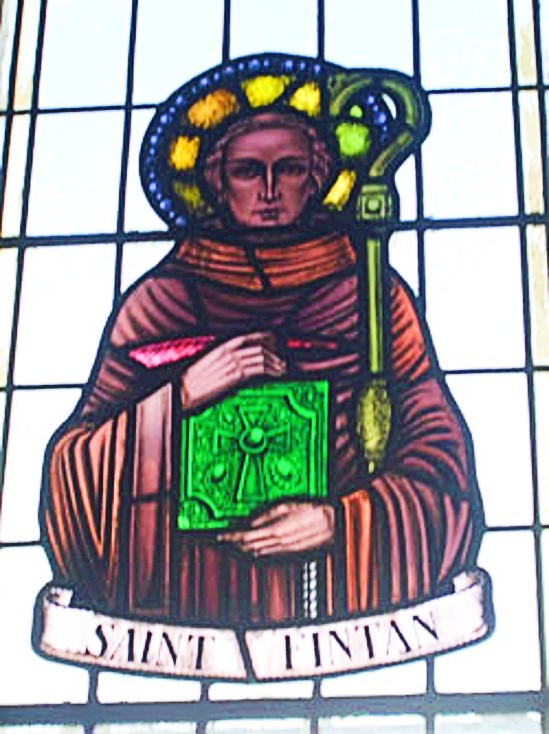
Saint of the Day – 3 January – St Fintan of Doon (Died 6th Century) Abbot, Founder of a Monastery, Miracle-worker. Born in Ireland and died in the 6th Century in Ireland of natural causes. Also known as – Fiontan, Fintanus. Patronage – eye diseases, against blindness, all ailments.
Fintan was a brother to St Finlug, son to Diman who was descended from Mured Manderig, King of Ulster. Alinna, of a noble Limerick family, was his mother.
St Comgall, Abbot of Bangor had founded a school at Bangor in the middle of the 6th Century and it was here that Fintan studied. At this time pirates raided these Monasteries frequently. Fintan, once, asked Finian of Maghbile to lend him a Gospel for his studies but was refused. The next night Fintan and his companions were on guard at the port, fearing an invasion. The pirates, however, firstly raided Magh Bile – the Monastery of St Finian and among the treasures they stole was the Gospel. Later they approached Bangor where Fintan was on guard. When they were about to attack the City, a storm suddenly arose and all the ships were sunk except that which carried the Gospel. The Gospel, along with other artefacts were recovered.
One Spring, a leper came to Fintan and requested some bread, made from newly ripened corn. Fintan instructed the leper to plant a seed in the newly ploughed field. The seed immediately grew and ripened and thus the leper was satisfied.
At this time a pagon king lived in a district called Calathmagh. On hearing of Fintan’s approach, the king instructed his servants to prevent the further progress of Fintan. On reaching a field where the king’s workers were, the Saint and his followers were obstructed from continuing. On requesting permission, they were insulted. Presently a storm arose and the crops were set on fire from which the smoke almost blinded the kings servants. With some Holy Water, Fintan restored their vision and they were deeply grateful to him and many converted.
After these occurrences, Fintan settled at Doon, whose name is derived from the earthen dun and from Blesc who was a vassal to the king at that time. The presence of Fintan’s well and the fact that this is the only place in the area with a name of origin “Dun” verifies that Doon is the place where Fintan settled.
Fintan’s settlement at Doon had been prophesised by St Comgall in the Leabhar Breac which has been translated thus:
“My little foster son shall obtain the fortress, Fintan, by whom the dun will be obtained His city of sacred protection shall be That which is called Doon (Dun Bleisce).”
At Doon, Fintan was welcomed with much hospitality from Columbanus, son to Kynchadhe. A feast, which consisted of a cow and calf and milk had been prepared for Fintan and his seven followers.
St Fintan’s well is situated in a grove of trees in the east corner of lower Kilmoylan townl. The well’s water is reputed to have great healing powers and previously many pilgrims journeyed there to be cured of diverse ailments but most especially of blindness and eye diseases..
“They have left their cot for the holy well Near the Cross in the valley flowing, its bright blude hide haith a spell Light and joy to the blind bestowing.”
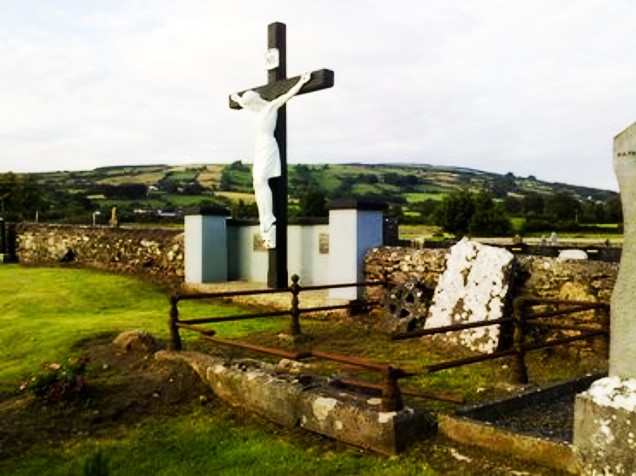
St Fintan is believed to have lived to a very old age. The exact site of St Fintan’s Monastery in Doon is uncertain but we presume it is near the ancient graves of St Fintan’s cemetery in Doon. From St Engus’ comments and other sources, it has been learned that St Fintan’s death fell on the 3rd of January. His Feast-day is celebrated in the Parish. There is no information, however, regarding the year or place of his death.
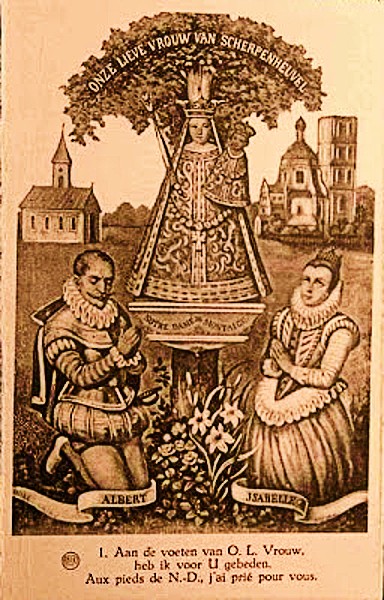
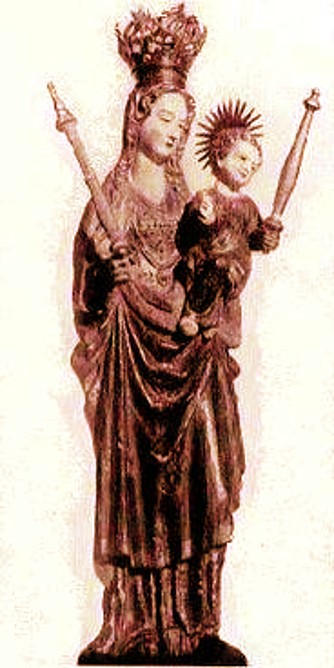
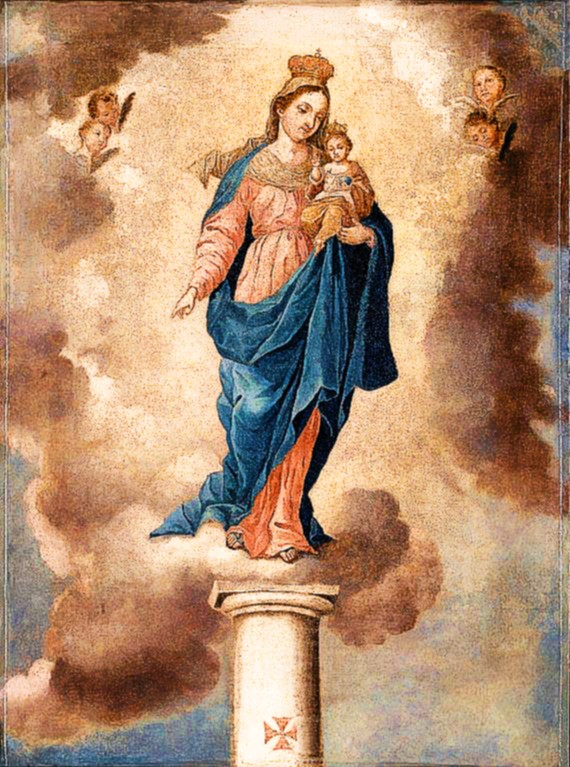
Notre-dame de Montaigu-Zichem / Our Lady of Sichem / Our Lady of Montaigu (474) – 3 January:
The Shrine in Brabant in the Duchy of Louvain, is a replacement of the one below Mount Garizim, Israel. Hadrian restored the temple on Mount Garizim and dedicated it to Jupiter. A small Christian community settled there and on several occasions they suffered greatly at the hands of the pagans. In 474 the Emperor, to avenge an unjust attack on the community, gave Mount Garizim to the Christians, who built on it a Church dedicated to the Blessed Virgin. After the Mohammedan conquest, Christianity practically disappeared from the district. The French made amends by erecting a Shrine to Mary in the Duchy of Louvain. The ancient Statue of Our Lady of Sichem, or as Our Lady of Montaigu-Zichem, which is the title more commonly used today, has been venerated in Belgium from very early times. The Mother of God rewarded the faithful magnanimously for their pious attention. According to legend, a shepherd boy originally found the Statue of Our Lady after it had apparently fallen from a niche cut in an old oak tree. The Statue was mysteriously too heavy for him to lift alone, so he ran to find his master, and have him return to help him replace the statue in its place in the old oak. It is said that in 1306 the Blessed Virgin Mary moved the hearts of the people by causing four drops of blood to flow from the eyes of the Statue. This revived the faith of the people and increased their fervour. A small Chapel was built beneath the tree, which was rebuilt in 1602 and the dedication of Our Lady of Sichem took place in the year 1604 by the Archbishop of Mechlin, Mathias Hovius. From that time forward, there were many miracles as Our Lady seemed to demonstrate her appreciation by granting many favours. The Statue was soon venerated as miraculous, and there have been many pilgrimages to the site during the centuries, continuing even until this day.
St Constant of Gap St Cyrinus of Cyzicus St Daniel Himmerod the Younger Bl Daniel of Padua St Eustadius St Finlugh St Fintan of Doon (Died 6th Century) Abbot St Florentius of Vienne St Florentius of Vienne the Martyr Bl Gerard Cagnoli St Gordius of Cappadocia St Imbenia St Lucian of Lentini St Melorius St Peter of Palestine St Primus of Cyzicus St Salvator of Belluno St Theogenes of Cyzicus St Theonas St Theopemptus of Nicomedia St Wenog Bl William Vives St Zosimus of Cilicia
Martyrs of Africa – 12 Saints: A group of Christians Martyred together in Africa, date unknown, exact location unknown. We know nothing more than their names – Acuta, Candidus, Constantius, Eugenia, Firmus, Hilarinus, Lucida, Martial, Poenica, Possessor, Rogatianus and Statutianus.
Martyrs of Tomi – 7 Saints: A group of Christians Martyred together, date unknown. We know nothing more than their names – Claudon, Diogenius, Eugene, Eugentus, Pinna, Rhodes and Rhodo. They were martyred at Tomi, Exinius Pontus, Moesia (modern Constanta, Romania).
Transport yourself “in spirit” to the Church in Prague where the original Statue of the Infant still stands and let Jesus help you with your intentions!
This wonderful prayer to the Infant Jesus of Prague is known as the Prayer of Father Cyrillus, (c 1637) truly one of the first champions of the loving little Infant!
Prayer of Fr Cyrillus, to the Beloved and Miraculous Infant Jesus of Prague
Jesus, unto Thee I flee, Through Thy Mother praying Thee In my need to succour me. Truly, I believe of Thee God Thou art with strength to shield me; Full of trust, I hope of Thee Thou, Thy grace wilt give to me. All my heart I give to Thee, Therefore, do my sins repent me; From them breaking, I beseech Thee, Jesus, from their bonds to free me. Firm my purpose, is to mend me; Never more will I offend Thee. Wholly unto Thee I give me, Patiently to suffer for Thee, Thee to serve eternally. And my neighbour like to me I will love, for love of Thee. Little Jesus, I beseech Thee, In my need, to succour me, That with Joseph and Mary And the Angels, I may Thee Once enjoy eternally. Amen.
Thought for the Day – 2 January – Meditations with Antonio Cardinal Bacci (1881-1971)
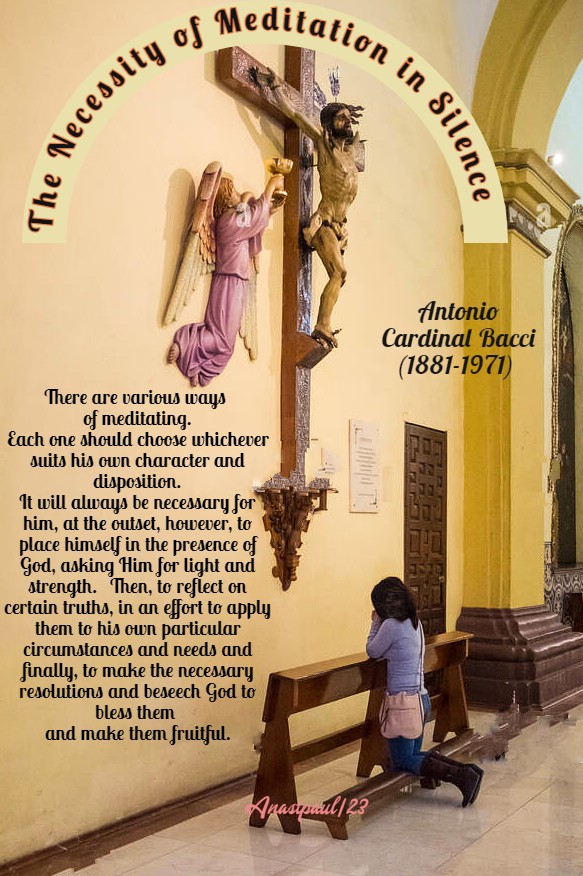
The Necessity of Meditation in Silence
“There are various ways of meditating. Each one should choose whichever suits his own character and disposition. It will always be necessary for him, at the outset, however, to place himself in the presence of God, asking Him for light and strength. Then, to reflect on certain truths, in an effort to apply them to his own particular circumstances and needs and finally, to make the necessary resolutions and beseech God to bless them and make them fruitful.
It is very useful, moreover, to recall to mind frequently, during the rest of the day, the resolutions which have been formed and to accompany these reflections, with short prayers, aspirations and acts of love for God.”
Quote/s of the Day – 2 January – The Feast and the Month of the Most Holy Name of Jesus
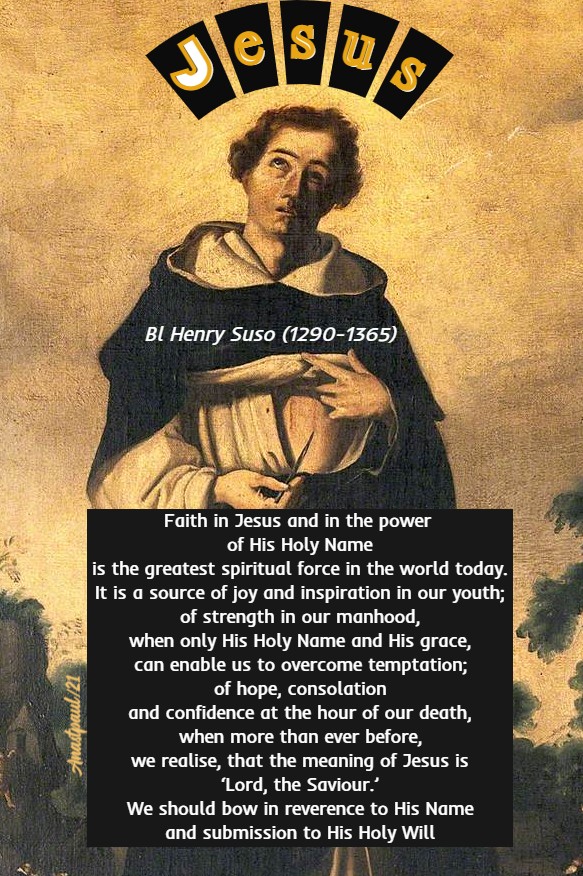
“Faith in Jesus and in the power of His Holy Name is the greatest spiritual force in the world today. It is a source of joy and inspiration in our youth; of strength in our manhood, when only His Holy Name and His grace, can enable us to overcome temptation; of hope, consolation and confidence at the hour of our death, when more than ever before, we realise, that the meaning of Jesus is ‘Lord, the Saviour.’ We should bow in reverence to His Name and submission to His Holy Will.”
Bl Henry Suso OP (1290-1365)
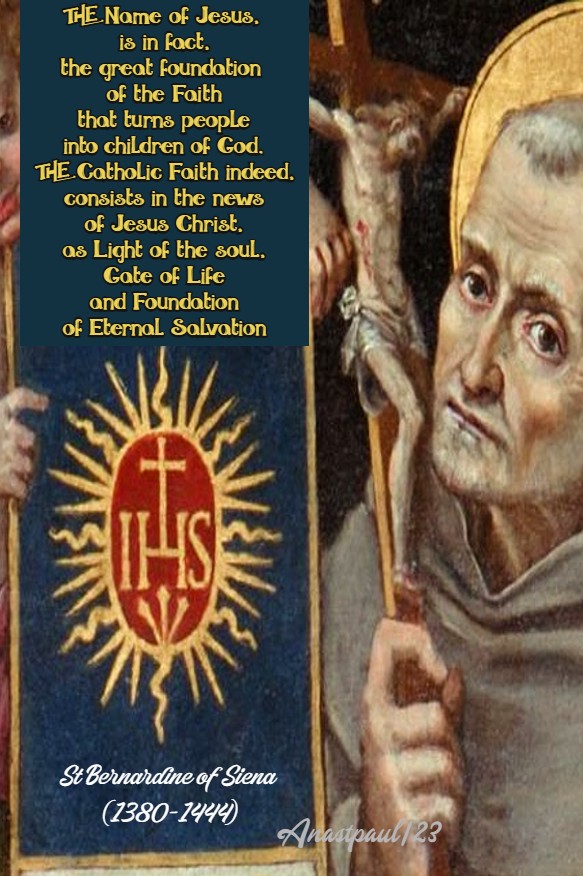
“The Name of Jesus, is in fact, the great foundation of the Faith that turns people into children of God. The Catholic Faith indeed, consists in the news of Jesus Christ, as Light of the soul, Gate of Life and Foundation of Eternal Salvation.”
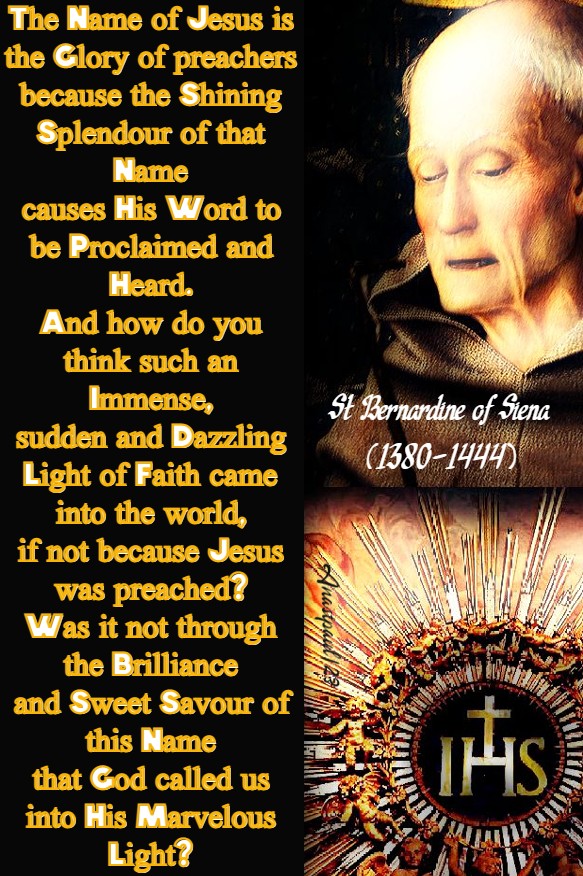
“The Name of Jesus is the glory of preachers because the shining splendour of that Name causes His Word to be proclaimed and heard. And how do you think such an immense, sudden and dazzling Light of Faith came into the world, if not because Jesus was preached? Was it not through the brilliance and sweet savour of this Name that God called us into His marvelous Light?”
One Minute Reflection – 2 January – The Feast and the Month of the Most Holy Name of Jesus – Titus 2:11-15, Luke 2:21 – Scripture search here: https://www.drbo.org/
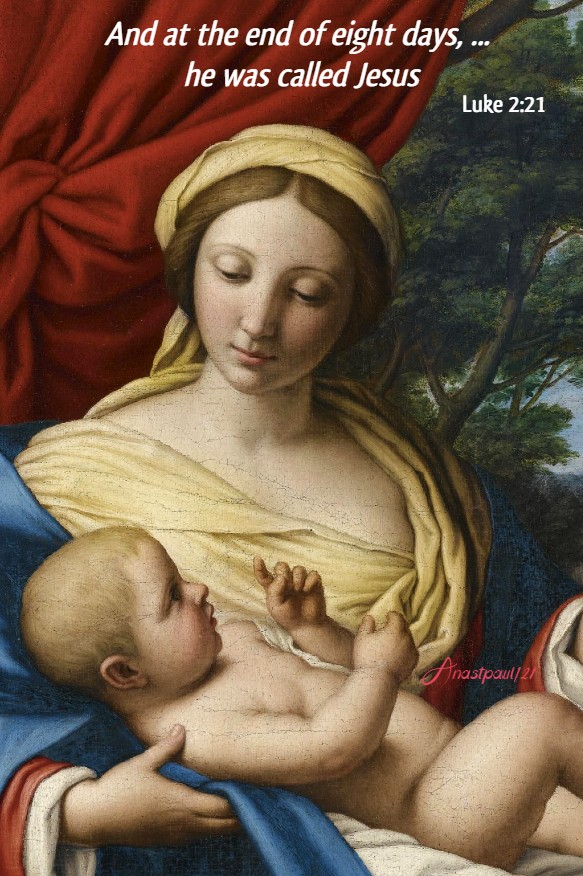
“And at the end of eight days, when He was circumcised, He was called Jesus”…Luke 2:21”
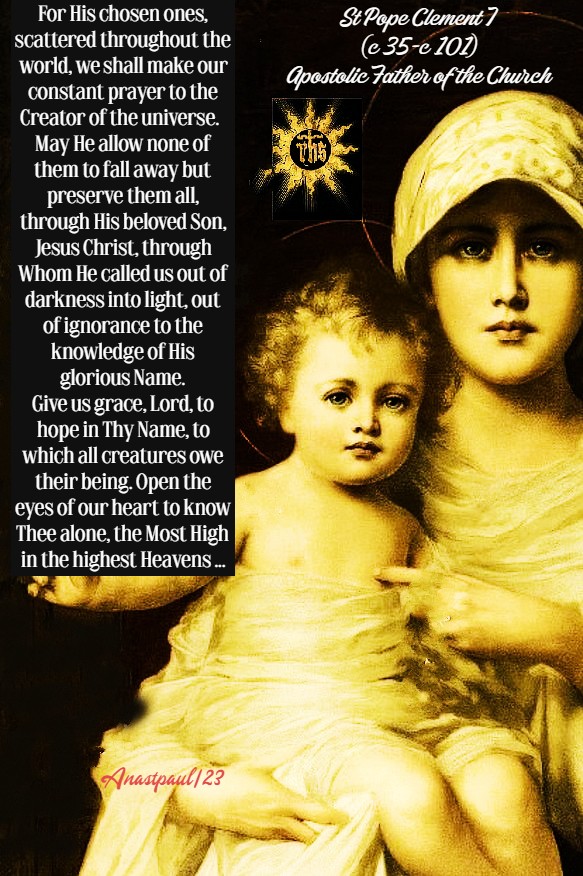
REFLECTION – “For His chosen ones, scattered throughout the world, we shall make our constant prayer to the Creator of the universe. May He allow none of them to fall away but preserve them all, through His beloved Son, Jesus Christ, through Whom He called us out of darkness into light, out of ignorance to the knowledge of His glorious Name.
Give us grace, Lord, to hope in Thy Name, to which all creatures owe their being. Open the eyes of our heart to know Thee alone, the Most High in the highest Heavens, the Holy One, Whose dwelling is in the holy Heaven. Thou abase the arrogance of the proud, frustrate the designs of the godless, exalt the lowly and humble the lofty. Thou give men wealth and take it away; Thou slay them, save them and give them new life. Alone the Benefactor of spirits and God of all flesh, Thy gaze penetrates the depths, Thou observes the doings of men. Helper of those in peril, Saviour of those in despair, Thy created and still, keep watch over all that draws breath. Thou cause the peoples on the earth to multiply and from them all, choose those who love Thee through Jesus Christ, Thy beloved Son. Through Him Thou has instructed us, sanctified us, honoured us.
Lord, we entreat Thee to help us. Come to the aid of the afflicted, pity the lowly, raise up the fallen, show Thy face to the needy, heal the sick, convert the wayward, feed the hungry, deliver the captives, support the weak, encourage the fainthearted. Let all nations know that Thou alone are God; Jesus Christ is Thy Son and we are Thy people and the sheep of Thy pasture. …
Do not hold all the transgressions of Thy servants against them but purify us by Thy truth and so guide our footsteps that, by walking in holiness and justice and simplicity of heart, we may do what is good and pleasing in Thy sight and in the sight of our leaders.
Lord, let the light of Thy Face shine upon us, so that we may enjoy Thy blessings in peace, protected by Thy Strong Hand and freed from all sin, by Thy outstretched Arm and deliver us from those, who hate us unjustly.
Give peace and concord to us and to all mankind, even as Thou gave it to our ancestors, when they devoutly called upon Thee in faith and truth. Lord, Thou alone are able to bestow these and even greater benefits upon us. We praise Thee through Jesus Christ, our High Priest and the champion of our souls. Through Him be glory and majesty to Thee now and throughout all generations, forever and ever. Amen.” – St Clement I (c 35-c 101) Pope from about 88 to 101, Martyr, Apostolic Father of the Church (An excerpt from Letter to the Corinthians).
PRAYER – O God, Thou Who by the fruitful virginity of blessed Mary, have bestowed upon mankind the rewards of eternal salvation, grant, we beseech Thee, that we may enjoy the intercession of her, through whom we have been found worthy to receive among us, the Author of Life, our Lord Jesus Christ Thy Son. Who lives and reigns with Thee, in the unity of the Holy Ghost, God, world without end. Amen (Collect).
Our Morning Offering – 2 January – Feast and Month of the Most Holy Name of Jesus
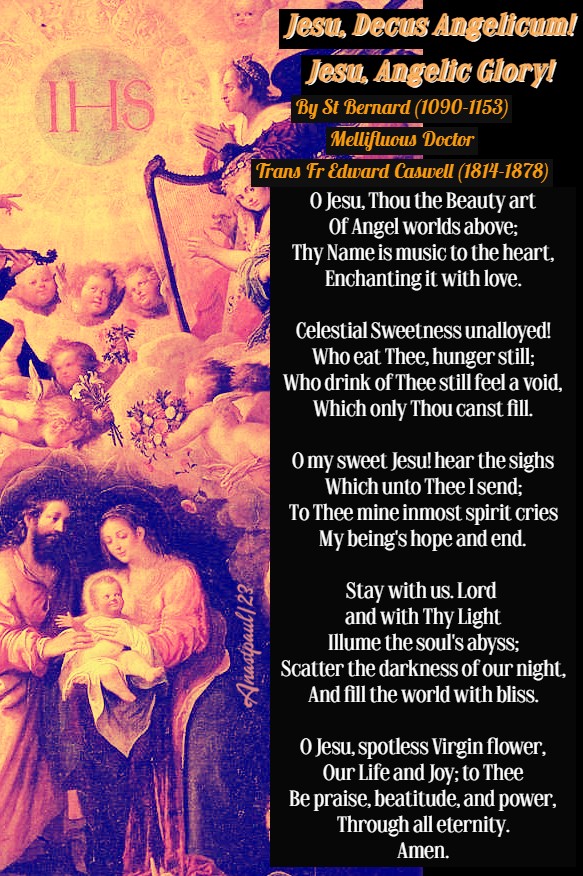
Jesu, Decus Angelicum! Jesu, Angelic Glory! By St Bernard of Clairvaux (1090-1153) Mellifluous Doctor Trans Fr Edward Caswell C.Orat. (1814-1878)
O Jesu, Thou the Beauty art Of Angel worlds above; Thy Name is music to the heart, Enchanting it with love.
Celestial Sweetness unalloyed! Who eat Thee, hunger still; Who drink of Thee still feel a void, Which only Thou canst fill.
O my sweet Jesu! hear the sighs Which unto Thee I send; To Thee mine inmost spirit cries My being’s hope and end.
Stay with us. Lord and with Thy Light Illume the soul’s abyss; Scatter the darkness of our night, And fill the world with bliss.
O Jesu, spotless Virgin flower, Our Life and Joy; to Thee Be praise, beatitude, and power, Through all eternity. Amen.
As noted yesterday, Jesu, Dulcis Memoria is a celebrated 12th century prayer/hymn by St Bernard of Clairvaux (1090-1153), Doctor Mellifluous. The entire hymn has some 42 to 53 stanzas. Parts of this hymn are used for the Feast of the Holy Name of Jesus. So the above are the stanzas used today for the Feast of the Holy Name.
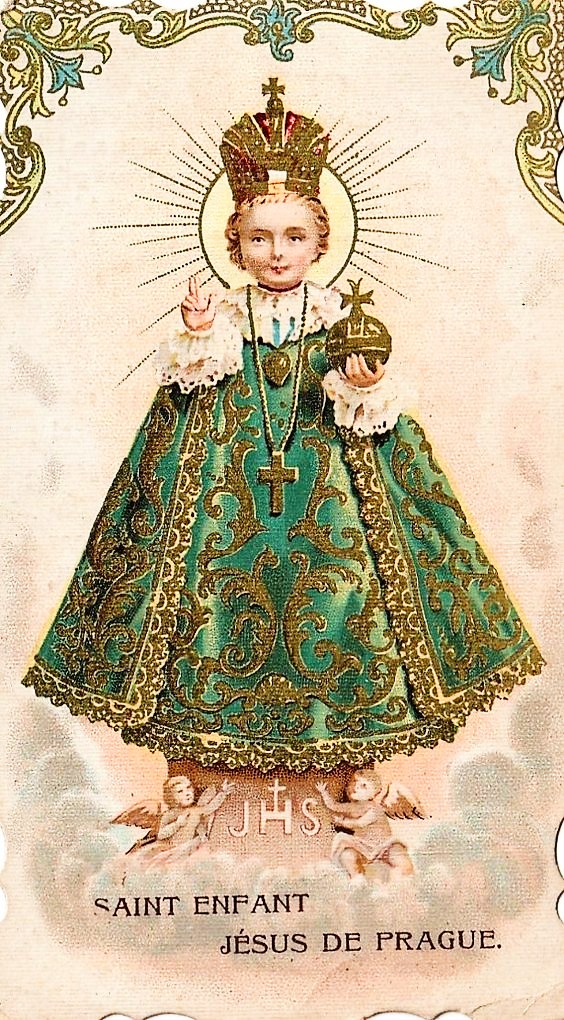
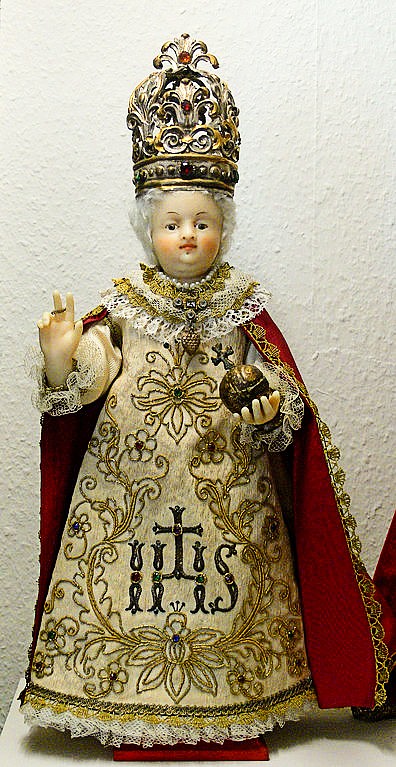
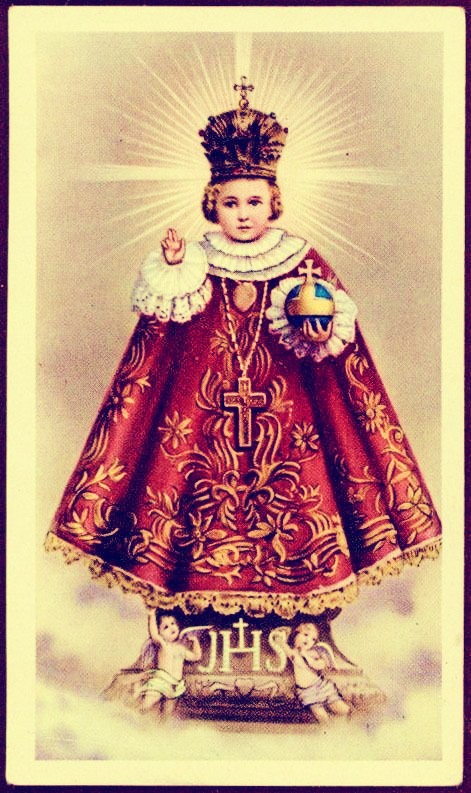
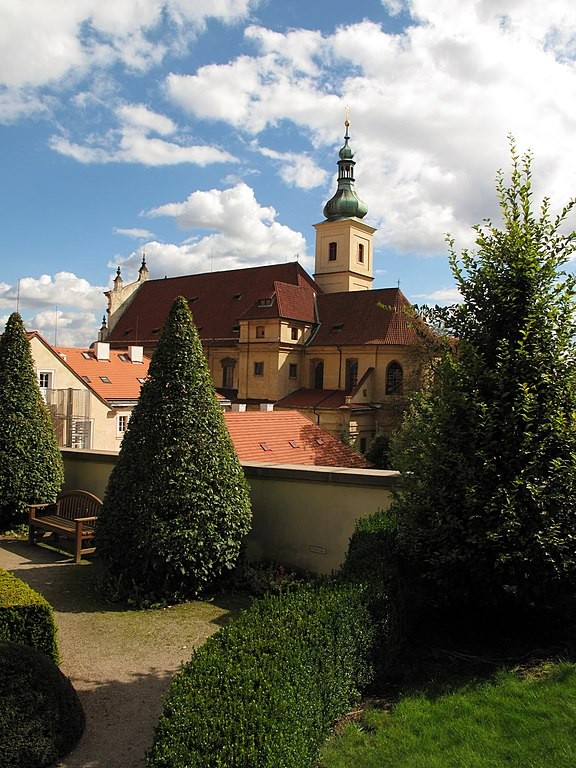
Saint of the Day – 2 January – Feast of the Infant Jesus of Prague – the 16th Century wax-coated wooden Statue of the Child Jesus, holding a globus cruciger (the Orb and Cross) with the right hand being raised in benediction, is of Spanish origin and is just under half a metre in height. It is now located in the Discalced Carmelite Church of Our Lady of Victories in Malá Strana, Prague, Czech Republic, see the Church at the bottom (one where I have been immensely blessed to attend Holy Mass before the Infant each day for a week some years ago). The Statue is venerated on 2 January, on 14 January and on the first Sunday of May.
The Infant above the Altar at Our Lady of Victories in Malá Strana, Prague
In 1556, pious legends claim that the Statue once belonged to St Teresa of Ávila and was donated to the Carmelite Friars by Princess Polyxena of Lobkowicz in 1628 upon her marriage to Czech nobleman.
The image is routinely clothed by the Carmelite Nuns in luxurious fabrics often in the Liturgical Vestment colours relevant to the Seasons and with imperial regalia and a golden crown. In thanksgiving for the numerous graces and cures received, the miraculous Statue at Prague , was solemnly crowned when Pope Leo XII signed and granted its first Pontifical Decree of Canonical Coronation on 24 September 1824. St Pius X granted authorisation via the Decree “Significat Nobis” to erect a namesake Confraternity.
Disturbances in Bohemia due to the Thirty Years’ War brought an end to the special devotions and on 15 November 1631 the army of King Gustavus Adolphus of Sweden took possession of Bohemia’s Capital City. The Carmelite Friary was plundered and the image of the Infant of Prague was thrown into a pile of rubbish behind the Altar. Here it lay forgotten for seven years, its hands broken off, until in 1637, it was found again by Father Cyrillus and placed in the Church’s oratory. One day, while praying before the Statue, Cyrillus heard a voice say, “Have pity on Me and I will have pity on you. Give Me my hands and I will give you peace. The more you honour Me, the more I will bless you.”
A German copy of the Statue, with a white wig instead of the traditional blonde hair, circa. 1870
Copies of the Infant Jesus arrived in Poland in 1680 and it has been popular in Polish homes and Bohemia in general, where the copies are typically placed in glass-enclosed cases. After the start of the Counter-Reformation era of the 17th Century, the Statue spread among Catholics all over the world, with particular devotion developing in South Africa, Australia, Caribbean, Thailand and Sri Lanka.
So many graces have been received by those who invoke the Divine Child before the original Statue that it has been called “The Miraculous Infant Jesus of Prague.” We read the following in an old book printed in Kempt: “All who approach the miraculous Statue and pray there with confidence, receive assistance in danger, consolation in sorrows, aid in poverty, comfort in anxiety, light in spiritual darkness, streams of grace in dryness of soul, health in sickness and hope in despair.”
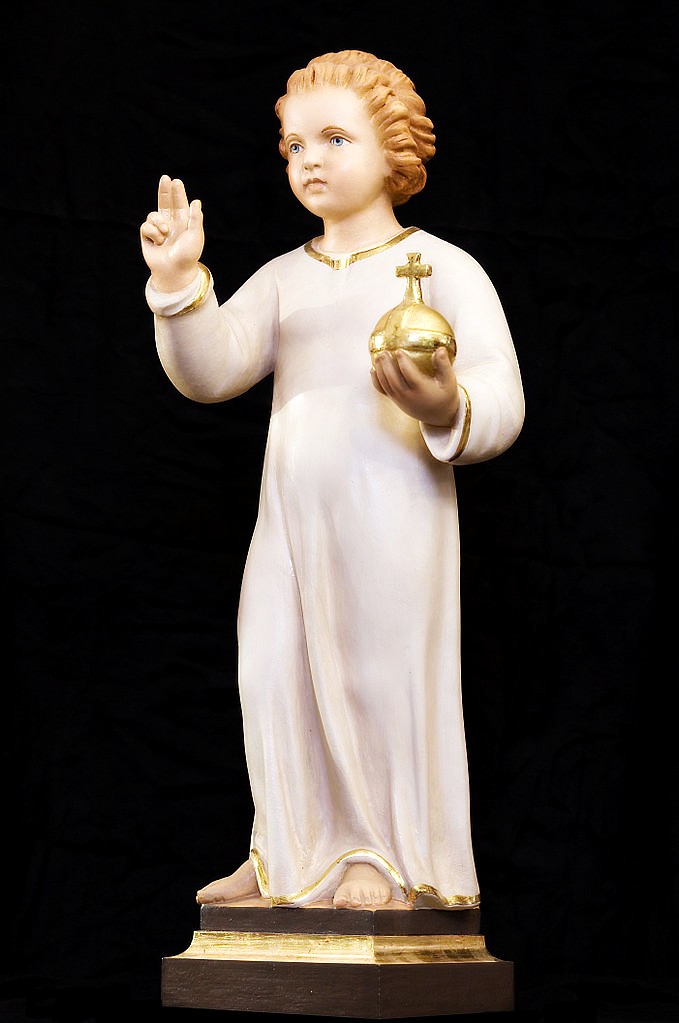
The Infant in it’s bare format
From small beginnings, this devotion has grown to great proportions. The Divine Child attracts an ever increasing number of clients, who appeal to Him in every need.
The Church of Our Lady Victorious, in Malá Strana, Prague, Czech Republic.
Bl Airaldus of Maurienne St Alverius of Agaunum St Asclepius of Limoges St Aspasius of Auch St Baudimius of Auvergne St Blidulf of Bobbio St Dietmar of Prague Bl Guillaume Répin Bl Guillermo de Loarte St Hortulana of Assisi St Isidore of Antioch St Isidore of Nitri St John Camillus the Good St Macarius of Rome
St Mark the Mute St Maximus of Vienne St Munchin of Limerick Bl Odino of Rot St Paracodius of Vienne St Sebastian of Agaunum St Seiriol Bl Stephana de Quinzanis Bl Sylvester of Troina St Telesphorus, Pope St Theodota St Theopistus St Vincentian of Tulle St Viance of Anjou
Many Martyrs Who Suffered in Rome: There were many Martyrs who suffered in the persecutions of Diocletian for refusing to surrender the holy books. Though we know these atrocities occurred, we do not know the names of the Saints and we honour them as a group. c 303 in Rome, Italy.
Martyrs of Antioch – 5 Saints: A group of Christian soldiers Martyred together for their faith. We know the names of five – Albanus, Macarius, Possessor, Starus and Stratonicus. They were born in Greece and were Martyred in Antioch (modern Antakya, Turkey).
Many Martyrs of Britain: The Christians of Britain appear to have escaped unharmed in the earlier persecutions which afflicted the Church but the cruel edicts of Diocletian were enforced in every corner of the Roman Empire and the faithful inhabitants of this land, whether native Britons or Roman colonists, were called upon to furnish their full number of holy Martyrs and Confessors. The names of few are on record but the British historian, Saint Gildas, after relating the Martyrdom of Saint Alban, tells us, that many others were seized, some put to the most unheard-of tortures and others immediately executed, while not a few hid themselves in forests and the caves of the earth, where they endured a prolonged death until God called them to their reward. The same writer attributes it to the subsequent invasion of the English, then a pagan people, that the recollection of the places, sanctified by these Martyrdoms, has been lost and so little honour paid to their memory. It may be added, that, according to one tradition, a thousand of these Christians were overtaken in their flight near Lichfield and cruelly massacred and that the name of Lichfield, or Field of the Dead, is derived from them.
Martyrs of Ethiopia – 3 Saints: A group of Christians Martyred together for their faith. We know the names of three – Auriga, Claudia and Rutile.
Martyrs of Jerusalem – 2 Saints: A group of Christians Martyred together for their faith. We know the names of two – Stephen and Vitalis.
Martyrs of Lichfield: Many Christians suffered at Lichfield (aka Lyke-field, meaning field of dead bodies), England in the persecutions of Diocletian. Though we know these atrocities occurred, we do not know the names of the Saints and we honour them as a group. Their Martyrdom occurred in 304 at Lichfield, England.
Martyrs of Piacenza: A group of Christians who died together for their faith in the persecutions of Diocletian. No details about them have survived. They were Martyred on the site of Church of Madonna di Campagna, Piacenza, Italy.
Martyrs of Puy – 4 Saints: Missionaries, sent by Saint Fronto of Périgueux to the area of Puy, France. Tortured and Martyred by local pagans. We know the names – Frontasius, Severinus, Severian and Silanus. They were beheaded in Puy (modern Puy-en-Velay), France and buried together in the Church of Notre Dame, Puy-en-Velay by Saint Fronto, their bodies laid out to form a cross.
Martyrs of Syrmium – 7 Saints: Group of Christians Martyred together, date unknown. We know the names of seven – Acutus, Artaxus, Eugenda, Maximianus, Timothy, Tobias and Vitus – but very little else. This occurred in the 3rd or 4th century at Syrmium, Pannonia (modern Sremska Mitrovica, Serbia).
Martyrs of Tomi – 3 Saints: Three brothers, all Christian soldiers, in the Imperial Roman army and all three Martyred in the persecutions of Emperor Licinius Licinianus. We know their names – Argeus, Marcellinus and Narcissus – but little else. They were Martyred in 320 at Tomi, Exinius Pontus, Moesia (modern Constanta, Romania).
Let us pray for the strength and courage to withstand the father of lies, and to watch and wait patiently, with our lamps lit, wearing the Armour of God and standing firm in the Faith. “Many are the afflictions of the just but out of them all, will the Lord deliver them.” (Ps 33:20)
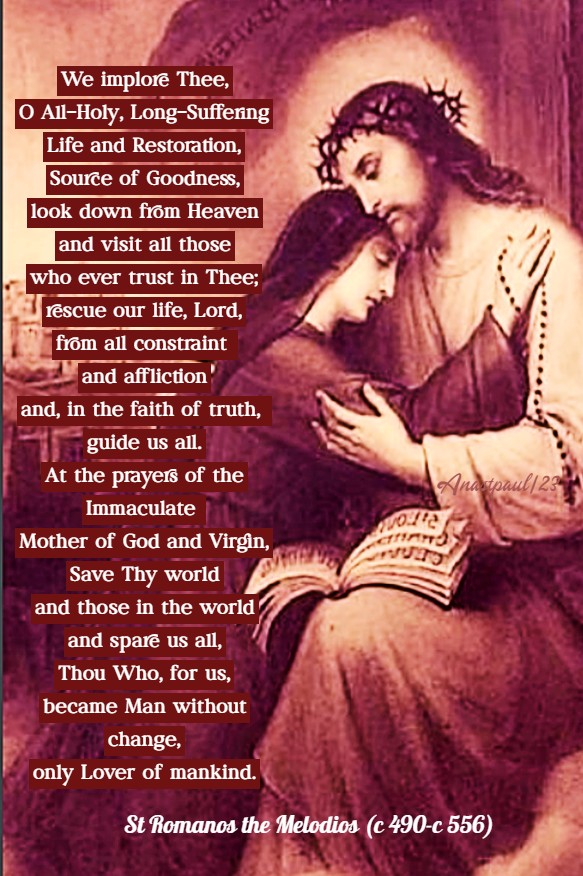
“We implore Thee, O All-Holy, Long-Suffering Life and Restoration, Source of Goodness, look down from Heaven and visit all those who ever trust in Thee; rescue our life, Lord, from all constraint and affliction and, in the faith of truth, guide us all. At the prayers of the Immaculate Mother of God and Virgin, Save Thy world and those in the world and spare us all, Thou Who, for us, became Man without change, only Lover of mankind.”
St Romanos the Melodios (c 490-c 556)
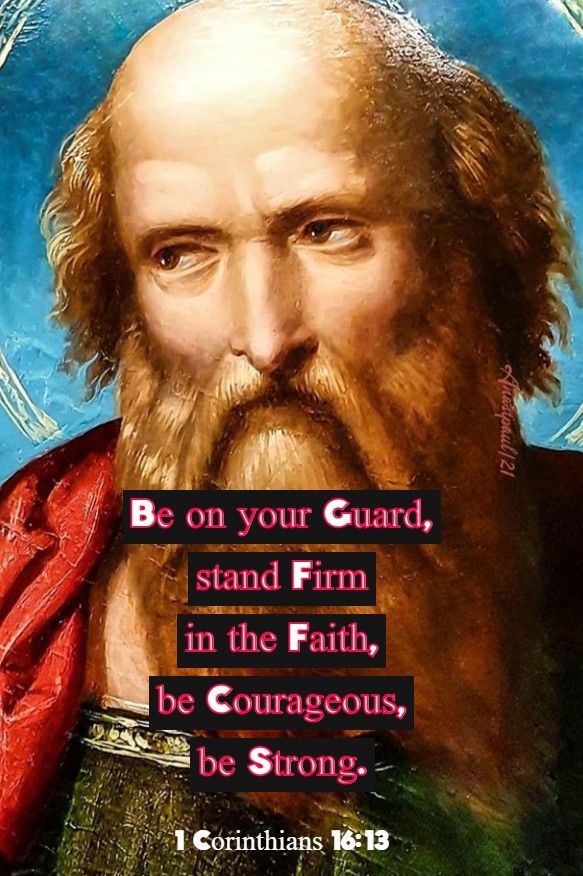
“Be on your guard, stand firm in the faith, be courageous, be strong.”
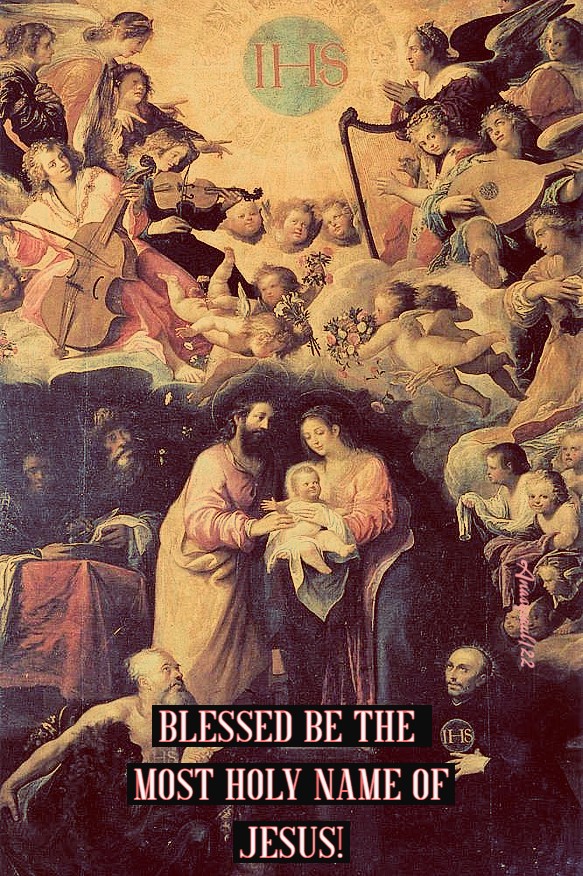
The Name “Jesus” was given to the Holy Child at God’s command (Luke 1:31). The Holy Name is all-powerful because of the Person Who bears it; we honour it because of the command of Christ that we should pray in His Name and because it reminds us of all the blessings we receive through our Holy Redeemer. Hence, St Paul was able to write to the Philippians: “…. at the Name of Jesus, every knee should bend of those in Heaven, on earth and under the earth“ (Phil. 2:10). By means of this devotion we also make amends for improper use of the Holy Name and for the constant blasphemy of this most precious Name.
“Oh Most Sacred Name, Name of peace, Balsam of life, which is the centre of all the sighs, of the most fervent lovers of Jesus. The Sign of those, who truly love Jesus, is to bear Jesus imprinted in the heart and to name often and with devotion, the Most Holy Name of Jesus.”
Thought for the Day – 1 January – Meditations with Antonio Cardinal Bacci (1881-1971)
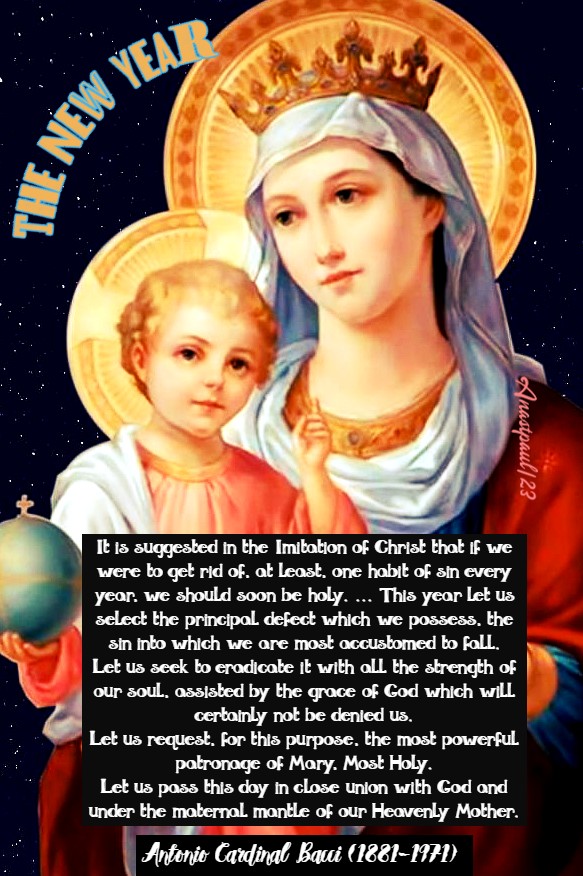
The New Year
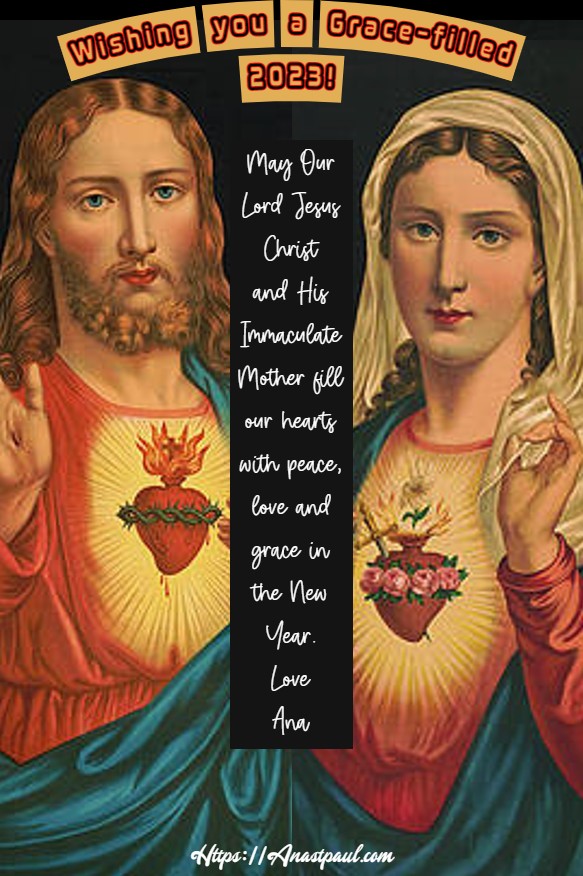
“It is suggested in the Imitation of Christ that if we were to get rid of, at least, one habit of sin every year, we should soon be holy. If we have not tried to do this in the past, let us do it in the future. This year let us select the principal defect which we possess, the sin into which we are most accustomed to fall. Let us seek to eradicate it with all the strength of our soul, assisted by the grace of God which will certainly not be denied us. Let us request, for this purpose, the most powerful patronage of Mary, Most Holy. Let us pass this day in close union with God and under the maternal mantle of our Heavenly Mother.
Finally, let us promise earnestly that all the days of the New Year, will follow the same pattern.”
Quote of the Day – 1 January – “The Month of the Most Holy Name of Jesus”
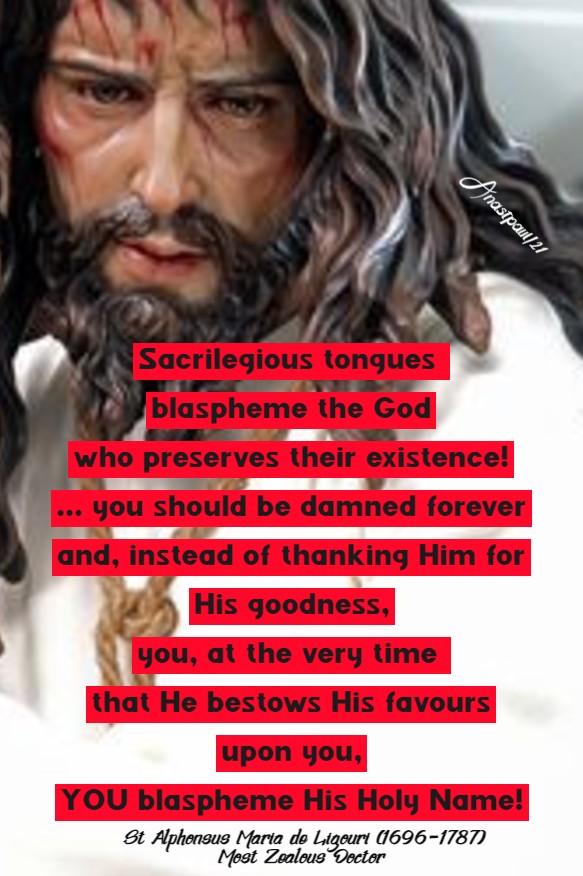
“Sacrilegious tongues blaspheme the God who preserves their existence! … you should be damned forever and, instead of thanking Him for His goodness, you, at the very time that He bestows His favours upon you, YOU blaspheme His Holy Name!”
St Alphonsus Maria de Liguori (1696-1787) Most Zealous Doctor
One Minute Reflection – 1 January – “The Month of the Most Holy Name of Jesus” – Feast of the Circumcision of the Lord – Titus 2:11-15, Luke 2:21 – Scripture search here: https://www.drbo.org/
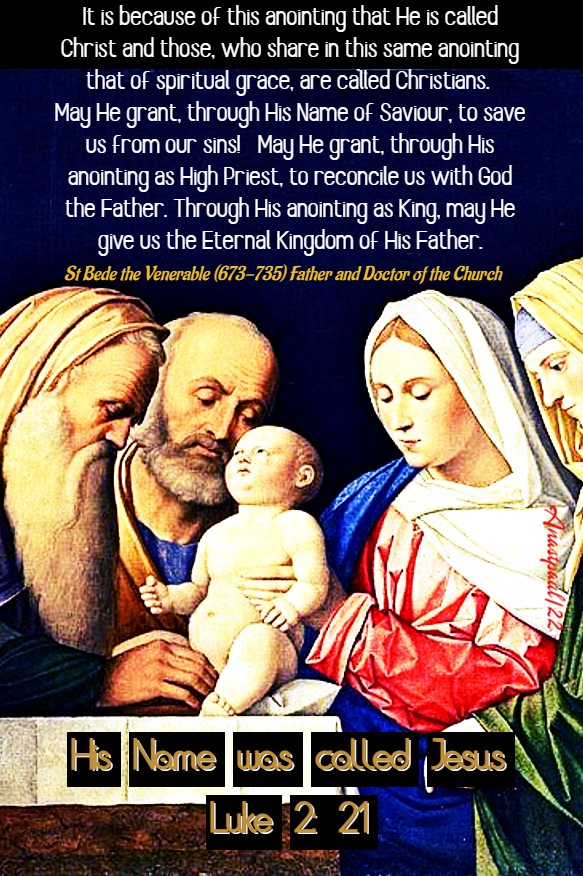
“His Name was called Jesus” – Luke 2:21
REFLECTION – “The Name “Jesus” in Hebrew means “salvation” or “Saviour.” It is a Name that for the prophets, referred to a very specific vocation . From whence came these words, sung with great desire to see Him: “My heart will rejoice in Thy salvation and will be joyful because of His salvation; my soul pines for Thy salvation” (Ps 12:6 ;34:9 ;118:81). “Yet will I rejoice in the Lord and exult in my saving God” (Hab 3:18). And especially: “O God, by Thy Name save me” (Ps 53:3). It is as though one were to say: “O Thou Who are called ‘Saviour,’ by saving me, manifest the glory of Thy Name.” And so the Name of the Son, born of the Virgin Mary, is Jesus, according to the Angel’s explanation: “He shall save His people from their sins”…
As for the word “Christ,” this designates priestly or royal status. Priests and Kings were in fact “chrismated” that is to say, anointed with holy oil. By this means, they became signs of Him Who, appearing in the world as true King and High Priest, received the anointing of “the oil of gladness above Thy fellows” (Ps 44:8). It is because of this anointing that He is called Christ and those, who share in this same anointing that of spiritual grace, are called Christians. May He grant, through His Name of Saviour, to save us from our sins! May He grant, through His anointing as High Priest, to reconcile us with God the Father. Through His anointing as King, may He give us the Eternal Kingdom of His Father.” – St Bede the Venerable (673-735) Father and Doctor of the Church (Homily 5; CCL 122,36).
PRAYER – O God, Thou Who by the fruitful virginity of blessed Mary, have bestowed upon mankind the rewards of eternal salvation, grant, we beseech Thee, that we may enjoy the intercession of her, through whom we have been found worthy to receive among us, the Author of Life, our Lord Jesus Christ Thy Son. Who lives and reigns with Thee, in the unity of the Holy Ghost, God, world without end. Amen (Collect).
Our Morning Offering – 1 January – Feast of the Circumcision of the Lord – “The Month of the Most Holy Name of Jesus”
Jesu Dulcis Memoria By St Bernard of Clairvaux (1090-1153) Father and Mellifluous Doctor Trans Fr Edward Caswell C.Orat. (1814-1878)
Jesus, the very thought of Thee with sweetness fills my breast, But sweeter far Thy face to see and in Thy presence rest.
Nor voice can sing nor heart can frame, Nor can the memory find a sweeter sound than Jesus’ name, O Saviour of mankind.
O hope of every contrite heart, O joy of all the meek to those who fall, how kind Thou art, how good to those who seek!
But what to those who find? Ah this nor tongue nor pen can show, the love of Jesus, what it is none but His loved ones know.
Jesus our only joy be Thou as Thou our prize wilt be. Jesus, be Thou our glory now and through eternity. Amen
Jesu, Dulcis Memoria is a celebrated 12th century prayer/hymn by St Bernard of Clairvaux (1090-1153), Doctor Mellifluous. The entire hymn has some 42 to 53 stanzas. Parts of this hymn are used for the Feast of the Holy Name of Jesus.
Saint of the Day – 1 January – Feast of the Circumcision of the Lord
“At that time, after eight days were accomplished that the Child should be circumcised; His Name was called Jesus, which was called by the Angel, before He was conceived in the womb.” – Luke 2:21
Excerpt from the Catechism of the Council of Trent, (Part IV – “Hallowed be Thy Name“”)
In the Old Law (Gen. 17:12), it was required that every male child should, on the eighth day after his birth, be circumcised and thus admitted among God’s chosen people. The rite of circumcision in the Old Law corresponded to the Sacrament of Baptism in the New Law and was the means of remitting original sin. Our Lord, although free from every sin, submitted to this rite, in order to show that He was a true Son of Abraham, to manifest respect and obedience to the established law and, to prove that He had a real human body. At the time of circumcision, a name was given to the child. Our Lord was called Jesus, which signified His office as Saviour. On this Feast of the Circumcision, therefore, it is most appropriate that we should meditate on the first petition of the Lord’s prayer, “hallowed be thy name.”
I. The first petition of the Lord’s Prayer. In the opening words of the Lord’s Prayer we ask that God’s Name may be honoured, which shows that God’s glory should be our chief desire. This petition does not mean that God’s essential glory or perfection should be increased, nor that the honour given Him on earth, should be equal to that shown Him in Heaven.
II. The objects of this petition. We ask: That we may praise God with our hearts and lips; That those in error may be brought to recognise and revere His Church; That sinners may be converted to His service; That men may learn to refer all blessings to Him as to their Author and source.
CONCLUSION. Our conduct should be in conformity with this petition. Catholics must not cause the Name of God or of His Church, to be profaned by their own evil words and actions. On the contrary, by clean speech and good example, Catholics ought to excite others to exalt the Name of God, to respect the Faith of Christ, and to honour His Church. Good resolutions for the New Year!
Titular Feast of the Society of Jesus – But now celebrated on the Feast of the Holy Name of Jesus
Bl Adalbero of Liege St Baglan of Wales St Basil of Aix Bl Bonannus of Roio St Brogan St Buonfiglio Monaldi Bl Catherine de Solaguti St Clarus of Vallis Regia St Clarus of Vienne St Colman mac Rónán St Colman Muillin of Derrykeighan St Concordius of Arles St Connat St Cuan St Demet of Plozévet St Elvan St Eugendus of Condat St Euphrosyne of Alexandria St Fanchea of Rossory St Felix of Bourges St Frodobert of Troyes
St Gisela of Rosstreppe St Gregory Nazianzen the Elder Bl Hugolinus of Gualdo Cattaneo Bl Jean-Baptiste Lego Bl Jean of Saint-Just-en-Chaussée St Justin of Chieti St Maelrhys St Magnus the Martyr St Mydwyn
St Odilo of Cluny OSB (962-1049) “Archangel of the Monks,” Priest, Monk, 5th Abbot of Clun, Reformer, Apostle of the poor and needy, Marian devotee and promoter of prayer for the Souls in Purgatory. He established All Souls’ Day (on 2 November) in Cluny and its Monasteries as the annual commemoration to pray for all the faithful departed. The practice was soon adopted throughout the whole Church. St Odilo’s Life: https://anastpaul.com/2021/01/01/saint-of-the-day-1-january-saint-odilo-of-cluny-osb-962-1049-the-archangel-of-the-monks/
St Odilo of Stavelot St Peter of Atroa (773–837) Abbpt St Peter of Temissis St Sciath of Ardskeagh St Severino Gallo St Telemachus St Thaumastus of Mainz St Theodotus St Tyfrydog Bl Valentin Paquay St William of Dijon St Zedislava Berka OP (c 1220-1252) Married Laywoman and Mother, Tertiary of the Order of Preachers. Canonised by St Pius X on 28 August 1907.
Breton Missionaries to Britain: Martyred Soldiers of Rome: Thirty soldiers martyred in Rome as a group during the persecutions of Diocletian. We do not even known their names. They were Martyred c 304 at Rome, Italy.
Martyrs of Africa – 8 Saints: Eight Christians Martyred together in Africa, date unknown. The only details we have are four of their names – Argyrus, Felix, Narcissus and Victor.
Thought for the Day – 31 December – Meditations with Antonio Cardinal Bacci (1881-1971)
The Last Day of the Year
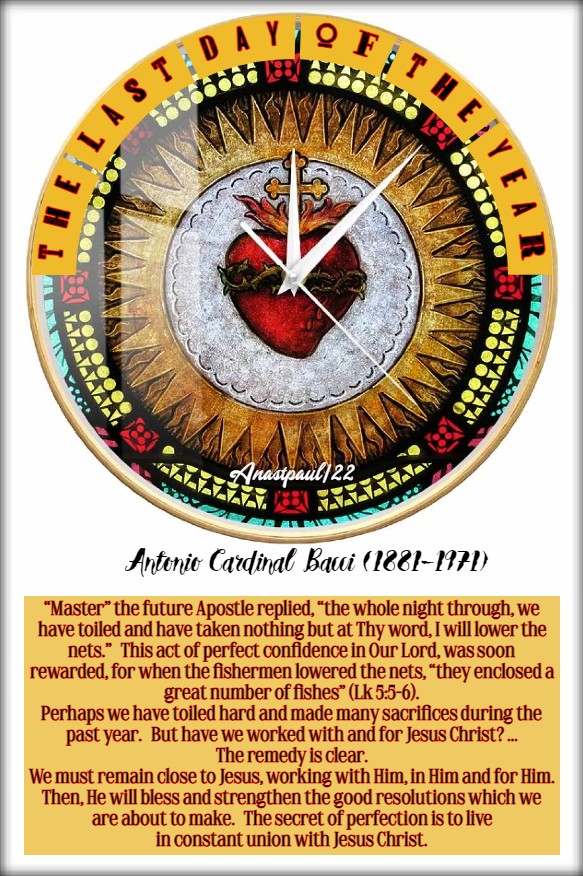
“After he had spent a night fishing in the lake of Galilee without having caught anything, St Peter was ordered by Jesus, to cast his nets back into the sea. “Master” the future Apostle replied, “the whole night through, we have toiled and have taken nothing but at Thy word, I will lower the nets.” This act of perfect confidence in Our Lord, was soon rewarded, for when the fishermen lowered the nets, “they enclosed a great number of fishes” (Lk 5:5-6).
Perhaps we have toiled hard and made many sacrifices during the past year. But have we worked with and for Jesus Christ? We may have thought more of ourselves than of Jesus and, as a result, achieved little or nothing in the spiritual life.
The remedy is clear. We must remain close to Jesus, working with Him, in Him and for Him. Then, He will bless and strengthen the good resolutions which we are about to make. The secret of perfection is to live in constant union with Jesus Christ.”
Quote/s of the Day – 31 December – “The Month of the Divine Infant and the Immaculate Conception”
“Hail, full of grace, the Lord is with thee: blessed art thou among women”
Luke 1:28
“The very fact that God has elected her, proves, that none was ever holier than Mary; if any stain had disfigured her soul, if any other virgin had been purer and holier, God would have selected her and rejected Mary.”
St Jacob of Sarug (c 451-521)
“O daughter of King David and Mother of God, the universal King. O Divine and living object whose beauty has charmed God the Creator; your whole soul is completely open to God’s action and attentive to God alone. … Your womb will be the abode of the one whom no place can contain. Your milk will provide nourishment for God, in the little Infant Jesus. Your hands will carry God and your knees will serve as a throne for Him that is more noble than the throne of the Cherubim. … You are the temple of the Holy Spirit, the city of the living God, made joyous by abundant flowers, the sacred flowers of Divine grace. You are all-beautiful and very close to God, above the Cherubim and higher than the Seraphim, right near God Himself! Amen”
St John Damascene (675-749) Father and Doctor of the Church
Tota Pulchra Es, Maria You Are All Beautiful, Mary Unknown Author – 4th Century
You are all beautiful, Mary, and the original stain is not in you. You are the glory of Jerusalem, you are the joy of Israel, you give honour to our people. You are an advocate of sinners. O Mary, O Mary, Virgin most intelligent, Mother most merciful. Pray for us, Plead for us, To the Lord Jesus Christ.
Tota pulchra es, Maria. Et macula originalis non est in Te. Tu gloria Ierusalem. Tu laetitia Israel. Tu honorificentia populi nostri. Tu advocata peccatorum. O Maria, O Maria, Virgo prudentissima. Mater clementissima. Ora pro nobis. Intercede pro nobis. Ad Dominum Iesum Christum.
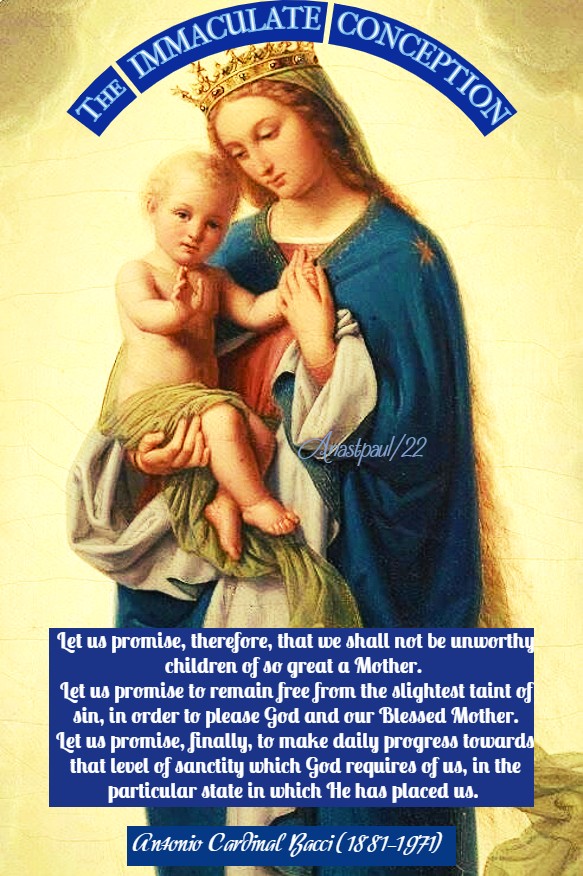
“Let us promise, therefore, that we shall not be unworthy children of so great a Mother. Let us promise to remain free from the slightest taint of sin, in order to please God and our Blessed Mother. Let us promise, finally, to make daily progress towards that level of sanctity which God requires of us, i n the particular state in which He has placed us.”
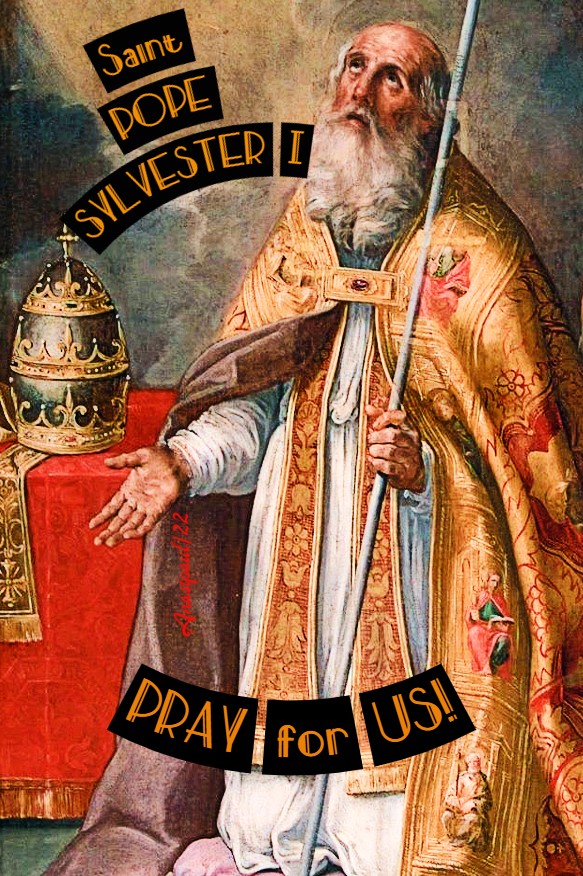
One Minute Reflection – 31 December – “The Month of the Divine Infant and the Immaculate Conception” – The Seventh Day of the Octave of Christmas and the Memorial of St Pope Sylvester I (Died 335) – 2 Timothy 4:1-8, Luke 12:35-40 – Scripture search here: https://www.drbo.org/
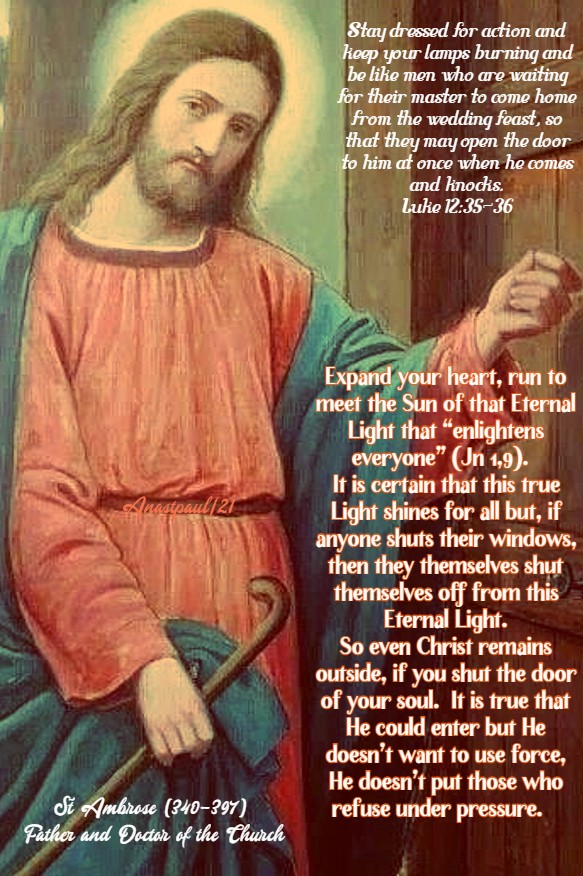
“Stay dressed for action and keep your lamps burning and be like men who are waiting for their master to come home from the wedding feast, so that they may open the door to him at once when he comes and knocks.” – Luke 12:35-36
REFLECTION – “God, the Word, stirs up the lazy and arouses the sleeper. For indeed, someone who comes knocking at the door, is always wanting to come in. But it depends on us, if He does not always enter or always remain.,, May your door be open to Him who comes; open your soul, enlarge your spiritual capacities, that you may discover the riches of simplicity, the treasures of peace and sweetness of grace. Expand your heart; run to meet the Sun of that Eternal Light that “enlightens everyone” (Jn 1,9). It is certain, that this true Light shines for all but, if anyone shuts their windows, then they themselves, shut themselves off from this Eternal Light.
So even Christ remains outside, if you shut the door of your soul. It is true, that He could enter but He does not want to use force, He does not put those who refuse under pressure. Descended from the Virgin, born from her womb, He shines throughout the universe to give light to all. Those who long to receive the light, that shines with an everlasting brightness, open up to Him. No night comes to intervene. Indeed, the sun we see each day, gives way to night’s darkness but the Sun of Justice (Mal 3,20) knows no setting, for Wisdom is not overcome by evil.” – St Ambrose (340-397) Bishop of Milan and Father and Doctor of the Church (12th Sermon on Psalm 118).
PRAYER – Look forgivingly on Thy flock, Eternal Shepherd and keep it in Thy constant protection, by the intercession of blessed Sylvester thy Confessor and Sovereign Pontiff, whom thou didst constitute Shepherd of the whole Church. Through Jesus Christ, Thy Son our Lord, Who lives and reigns with Thee, in the unity of the Holy Ghost, God, world without end. Amen (Collect).
Our Morning Offering – 31 December – The Seventh Day of the Octave of Christmas – “The Month of the Divine Infant and the Immaculate Conception”
Mary of Christmas Unknown Author
I know not how, dear Lady love, To offer you my praise, I cannot fashion as I wish The words that I would raise. You stand afar, celestial Queen, The stars are in your crown, They spangle at each gesture’s path And dust upon your gown. Perhaps I might recall the night You knelt beside the crib, The night when doors and casements shut And left a mountain’s rib, Alone, exposed, to hoard you close Beside the new-born Child And seek in Joseph’s kindly eyes For something worldly-mild. To counteract such mundane chill I hereby set my heart, Dim mirror of an Infant’s warmth, Its flaming but a part, A small, sad part of Endless Love That came on Christmas day To show a mother wonder-bright To guide us on our way. Amen.
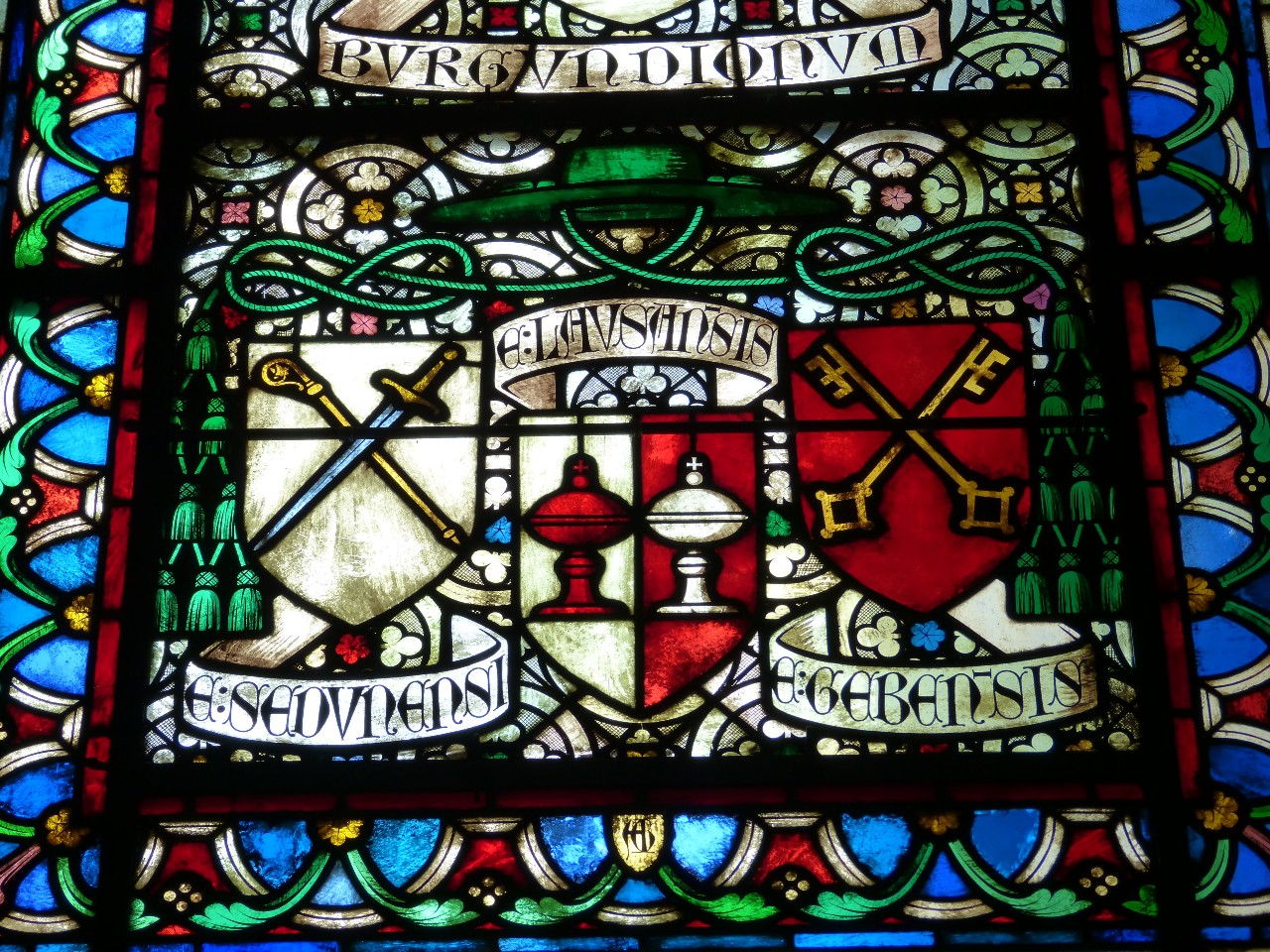
Saint of the Day – 31 December – Saint Marius Aventicus (c 530-594) Bishop of Avenches in Switzerland, a Chronicler (or Historian), Scholar and a skilled Goldsmith, in fact he crafted all the Sacred Vessels for his See. Born in c 530 in the Diocese of Autun, Burgundy (in modern France) and died on 31 December 594 at Lausanne, Switzerland of natural causes. Also known as – Marius Aventicensis, Marco.
Maurius is extolled as an ideal Bishop; as a skilled Goldsmith who made the Sacred Vessels with his own hands; as a protector and benefactor of the poor; as a man of prayer and as a scholar full of enthusiasm for serious intellectual studies. He is also remembered for the Chronicle he compiled of the historical dates and events of the time.
Of the events of his life, little is known. From an inscription on his tomb in the Church of St Thyrsius in Lausanne , we learn that he came of a distinguished, rich and probably Roman family and, at an early age embraced the Ecclesiastical state.
In 574 he was Consecrated as the Bishop of Avenches, took part in the Council of Mâcon in 585 and shortly thereafter, transferred his Episcopal See from Avenches, which was rapidly declining, to Lausanne.
The Coat of Arms of Lausanne Diocese
In 587 he Consecrated St Mary’s Church at Payerne, which had been built at his expense and through his efforts.
After his death he was venerated in the Diocese of Lausanne as a Saint and his Feast was celebrated there on 9 or 12 February. The Church of St Thyrsius received, at an early date the name of St Marius.
A chronicle of his is still preserved and purports to be a continuation of the chronicle of Prosper Tiro, or rather of the “Chronicon Imperiale.” It extends from 455 to 581 and, although consisting only of dry, annalistic notes, it is valuable for Burgundian and Franconian history, especially for the second half of the sixth Century. This explains the fact that, notwithstanding its brevity, it has been frequently published.
Bl Dominic de Cubells St Donatus of Rome St Eustadius of Bourges St Festus of Valencia St Gelasius of Palestine Bl Giuseppina Nicoli St Hermes the Exorcist Saint Marius Aventicus (c 530-594) Bishop
St Offa of Benevento Bl Peter of Subiaco St Pinian St Potentian of Sens St Sabinian of Sens St Theophylact of Ohrid Bl Walembert of Cambrai Bl Wisinto of Kremsmünster St Zeno of Rome St Zoticus of Constantinople
Martyrs of Catania – 10 Saints: A group of early Christians Martyred together, date unknown. The only other information to survive are ten of their names – Attalus, Cornelius, Fabian, Flos, Minervinus, Pontian, Quintian, Sextus, Simplician and Stephen. They were martyred in Catania, Sicily, Italy.
Martyrs of Rome – 10 Saints: A group of Roman women Martyred in an early persecution, date unknown. We known the names of ten of them – Dominanda, Donata, Hilaria, Nominanda, Paolina, Paulina, Rogata, Rustica, Saturnina and Serotina. Their relics were enshrined in the catacombs of Via Salaria, Rome, Italy.
Thought for the Day – 30 December – Meditations with Antonio Cardinal Bacci (1881-1971)
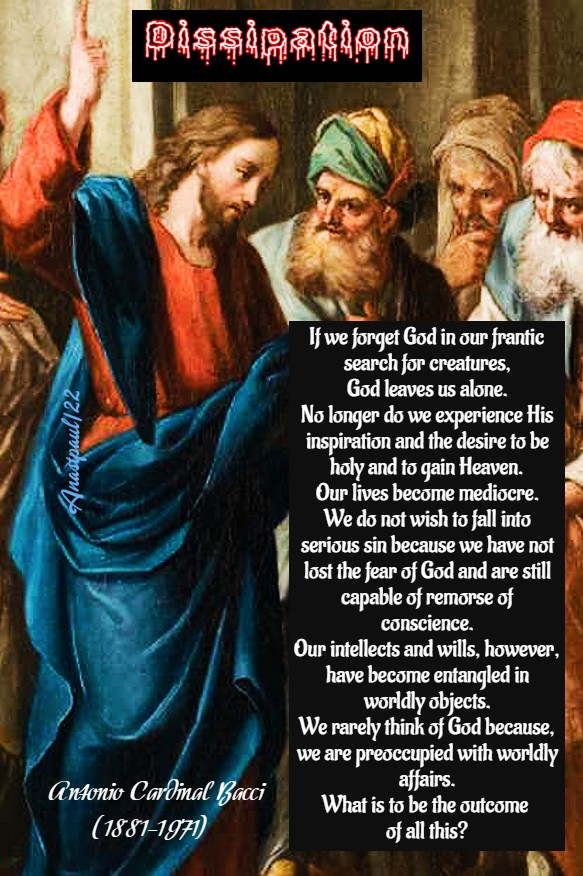
Dissipation
“If we forget God in our frantic search for creatures, God leaves us alone. No longer do we experience His inspiration and the desire to be holy and to gain Heaven. Our lives become mediocre. We do not wish to fall into serious sin because we have not lost the fear of God and are still capable of remorse of conscience. Our intellects and wills, however, have become entangled in worldly objects. We rarely think of God because, we are preoccupied with worldly affairs.
What is to be the outcome of all this? We cannot remain in this state very long. Our spiritual life lacks the supernatural nourishment of grace, with the result that slowly but surely, we slip from dissipation into sin. “With desolation is all the land made desolate,” laments the Holy Spirit, “because there is none that considereth in the heart” (Jer 12:11).”
Quote/s of the Day – 30 December –The Sixth Day of the Octave of Christma – “The Month of the Divine Infant and the Immaculate Conception”
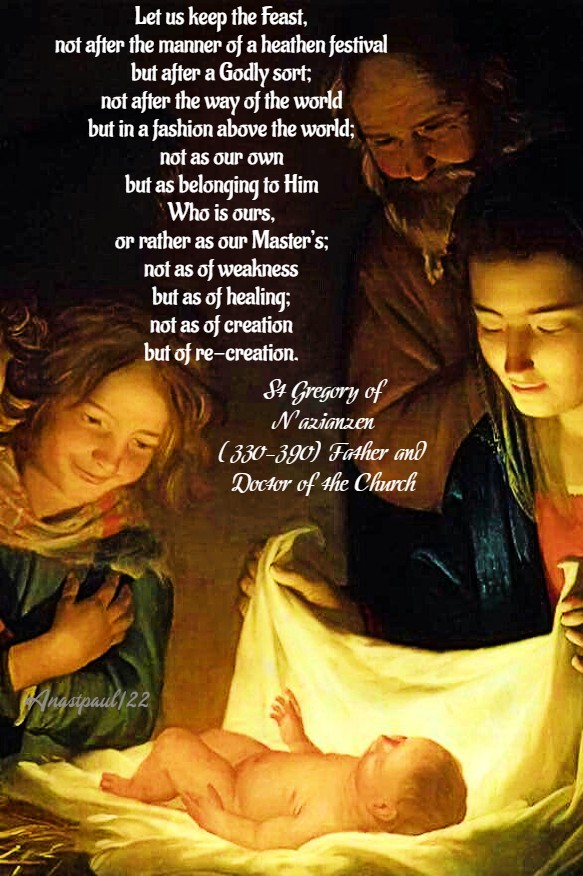
“… Let us keep the Feast, not after the manner of a heathen festival but after a Godly sort; not after the way of the world but in a fashion above the world; not as our own but as belonging to Him Who is ours, or rather as our Master’s; not as of weakness but as of healing; not as of creation but of re-creation.”
St Gregory of Nazianzen (330-390) Archbishop of Constantinople Father and Doctor of the Church
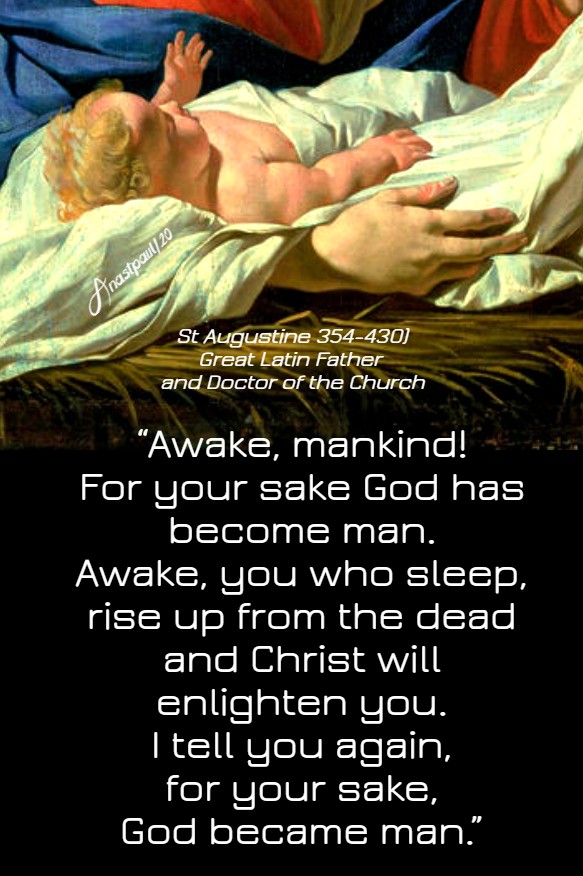
“Awake, mankind! For your sake God has become man. Awake, you who sleep, rise up from the dead and Christ will enlighten you. I tell you again, for your sake, God became man.”
St Augustine 354-430) Great Latin Father and Doctor of the Church
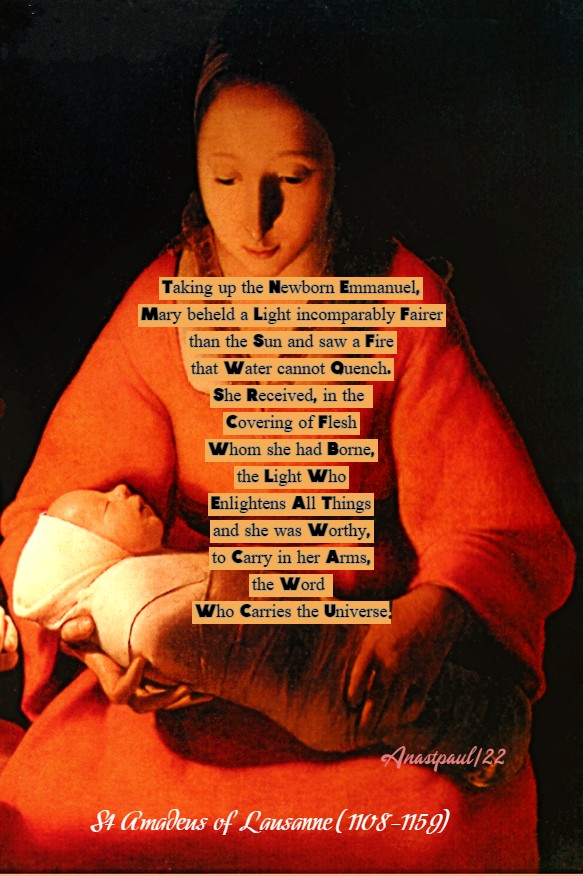
“Taking up the newborn Emmanuel, Mary beheld a Light incomparably fairer than the sun and saw a Fire that water cannot quench. She received, in the covering of flesh Whom she had borne, the Light Who enlightens all things and she was worthy, to carry in her arms, the Word Who carries the universe!” ”
St Amadeus of Lausanne (1108-1159) Bishop, Cistercian Monk
(Homilies in praise of the Blessed Virgin Mary, IV, SC 72)
One Minute Reflection – 30 December – “The Month of the Divine Infant and the Immaculate Conception”– The Sixth Day of the Octave of Christma – Galatians 4:1-7, Luke 2:33-40 – Scripture search here: https://www.drbo.org/
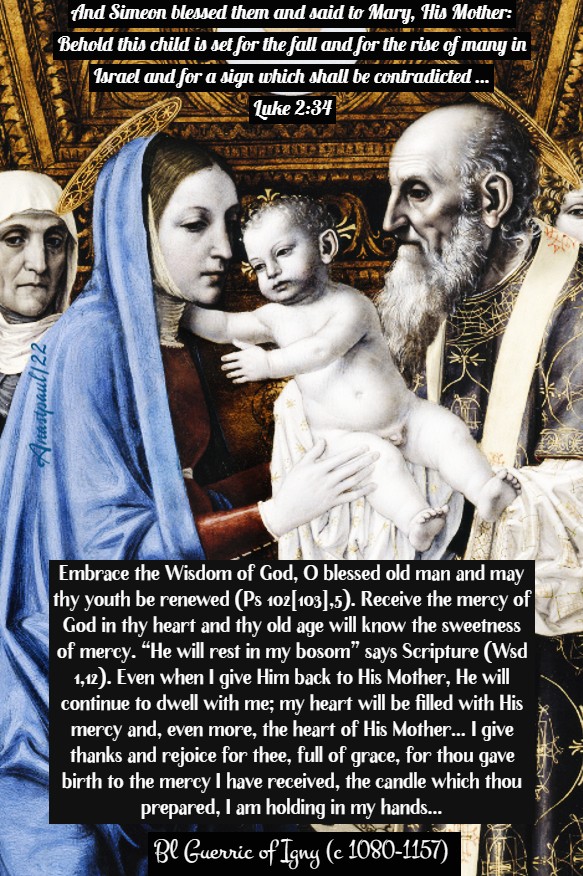
“And Simeon blessed them and said to Mary, His Mother: Behold this child is set for the fall and for the rise of many in Israel and for a sign which shall be contradicted” … Luke 2:34
REFLECTION – “Who is there today who, as he holds a lighted candle in his hand, does not immediately think of the old man, who today received Jesus in his arms, the Word in the flesh, the Light in the wax and Who bore witness that He was the Light that shines upon all nations? The old man was himself a burning flame that enlightens and gives witness to the Light, he who, in the Holy Spirit with Whom he was filled, came to receive, O God, Thy love within Thy Temple (Ps 47[48],10) and bear witness that Thou art the Love and Light of Thy people…
Rejoice, just old man; look now at what thou had once foreseen – darkness has disappeared from the world; the nations walk by Thy Light (Is 60,3). The whole earth is filled with the glory (Is 6,3) of this Light which, in the past, thou used to hide in thy heart and which today, illumines thy eyes… Embrace the Wisdom of God, O blessed old man and may thy youth be renewed (Ps 102[103],5). Receive the mercy of God in thy heart and thy old age will know the sweetness of mercy. “He will rest in my bosom” says Scripture (Wsd 1,12). Even when I give Him back to His Mother, He will continue to dwell with me; my heart will be filled with His mercy and, even more, the heart of His Mother… I give thanks and rejoice for thee, full of grace, for thou gave birth to the mercy I have received, the candle which thou prepared, I am holding in my hands…
And thee, brethren, look at the candle that burns in the hands of Simeon; light thy candles with his light… Then, not only will thou bear a light in thy hands but thou thyselves, will be a light for others. A light in thy hearts, a light in thy lives, a light for thy brothers and sisters.” – Blessed Guerric of Igny (c 1080-1157) Cistercian Abbot (1st Sermon for the Purification, 2-3).
PRAYER – O Almighty and eternal God, direct our actions in conformity with Thy will, that in the name of Thy beloved Son we may be worthy to do good works in abundance.Through the same Jesus Christ, Thy Son our Lord, Who lives and reigns with Thee, in the unity of the Holy Ghost, God, world without end. Amen (Collect).























 AnaStpaul
You must be logged in to post a comment.