Our Morning Offering – 29 March – Wednesday in Passion Week
A Lenten Offering By St Thérèse of the Child Jesus and the Holy Face of Lisieux (1873-1897)
O my God! I offer Thee all my actions of this Lent for the intentions and for the glory of the Sacred Heart of Jesus. I desire to sanctify every beat of my heart, my every thought, my simplest works, by uniting them to Its Infinite Merits and I wish to make reparation for my sins, by casting them into the furnace of Its Merciful Love. O my God! I ask of Thee for myself and for those whom I hold dear, the grace to fulfil perfectly Thy Holy Will, to accept for love of Thee, the joys and sorrows of this passing life, so that we may one day be united together in Heaven, for all eternity. Amen
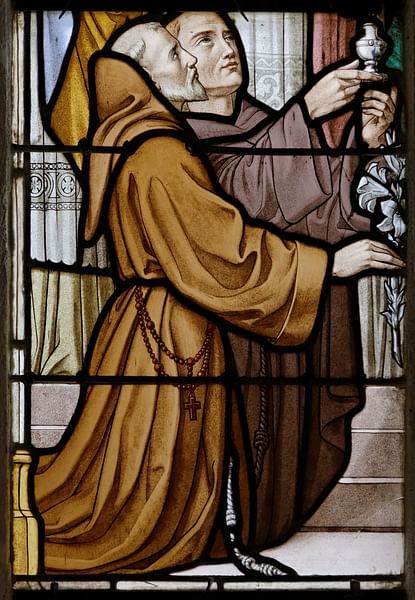
Saint of the Day – 29 March – St Eustasius of Luxeuil (c560–c626) the Second Abbot of Luxeuil Monastery, (after its Founder, St Columbanus) Missionary and Founder of another Monastery in Bavaria, Miracle-worker, Disciple of St Columban. Patronages – against blindness and eye diseases, of all illness and sick people. Also know in Francen as Eustace.
The Roman Martyrology reads today: “In the Monastery of Luxeuil, the decease of the Abbot, St Eustasius, a disciple of St Columban, who had under his guidance, nearly six hundred Monks. Eminent in sanctity, he was also renowned for miracles.”
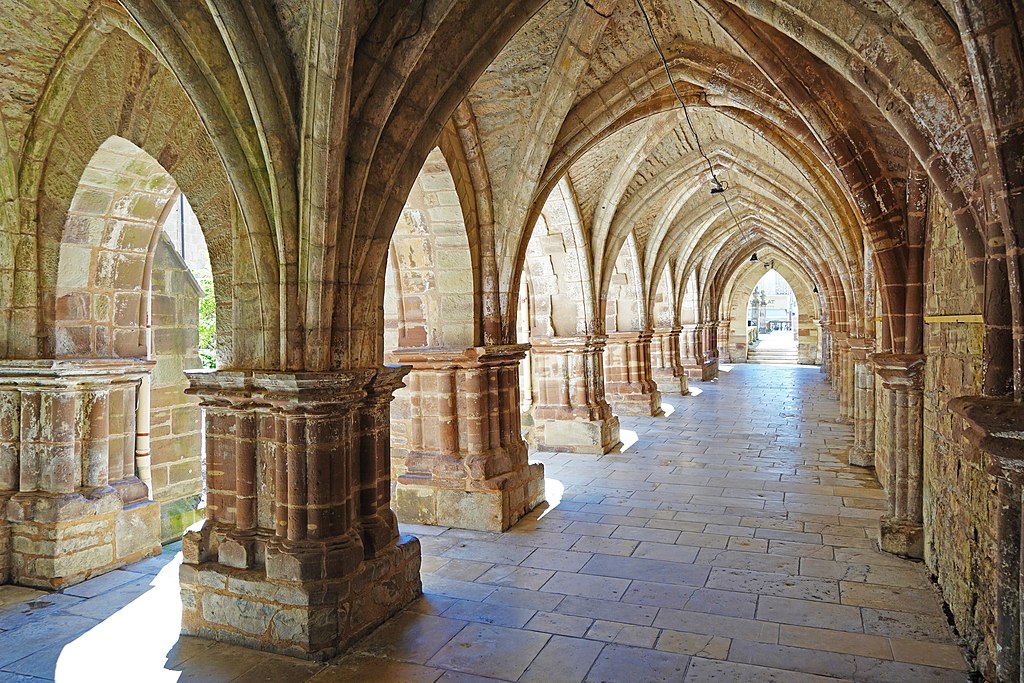
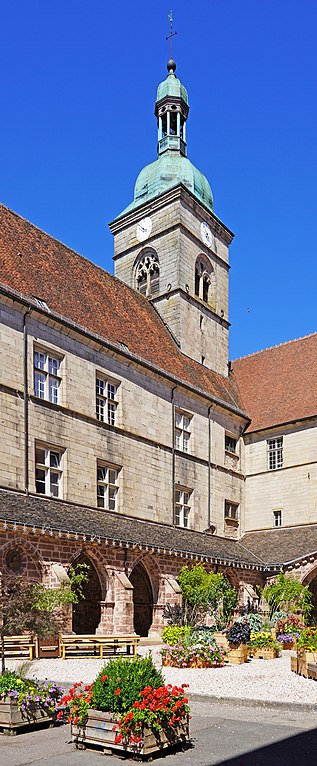
Luxeuil
Eustasius was born in Burgundy and became a Monk at Luxeuil Monastery. When Columbanus, the Founder of Luxeuil, was banished from the Kingdom of Burgundy, on account of his reproving the morals of King Theuderic II, he recommended his community choose Eustasius as his successor. At the time, Eustasius was head of the Monastery School, which under his direction, had established and renowned reputation for learning, devotions and excellence. St Columbanus travelled to Italy and settled in Bobbio, founding a new Monastery there. After the death of Theuderic, Clothaire II sent Eustasius to Bobbio in Italy, to ask St Columbanus to return but the exiled Abbot declined.
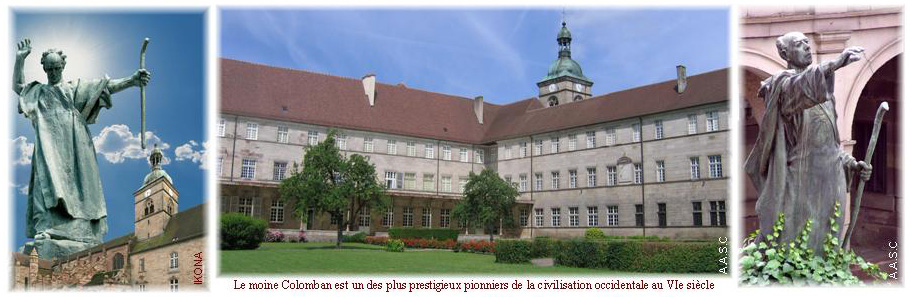
Luxeuil Monastery with Statues of St Columban
Under the administration of Eustasius, the Monastery flourished and acquired renown as a seat of learning and sanctity. Through the royal patronage, its benefices and lands were increased, King Clotaire II devoting a yearly sum, from his own revenues, towards its support. Eustasius and his Monks devoted themselves to preaching in remote districts, not yet evangelised, chiefly in the north-eastern extremities of Gaul. Their missionary work extended even to Bavaria. Between the Monasteries of Luxeuil in France and that of Bobbio in Italy (both founded by Columbanus), connection and intercourse seem to have long been maintained,
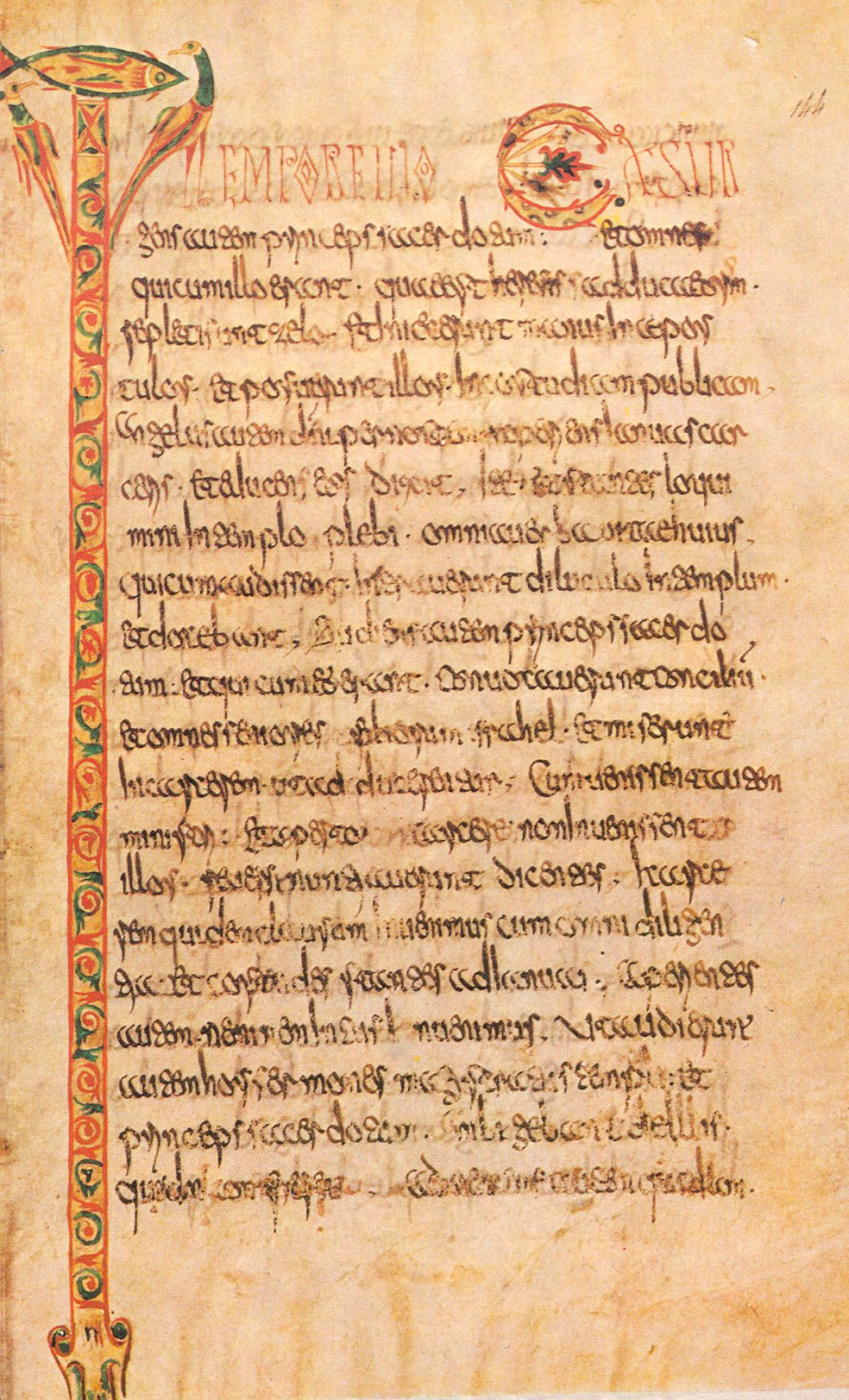
Seventh-century Lectionary produced at Luxeuil
During his Abbacy, the Monastery increased in vocations and contained about 600 Monks and produced both Bishops and Saints, including the Saints Acarius, Amatus, Audomar and Romaric. Eustasius was noted for his humility, continual prayer, and fasting. Eustasius undertook great missionary journeys to the Variscans on the river Doubs and as far as Bavaria. Around 625 he founded a Monastery on the island of Herrenchiemsee in southern Bavaria. He was succeeded as Abbott by St Waldebert.
Eustasius cured St Sadalberga, the Duke of Alsace’s daughter, of blindness. Upon returning from Bavaria, her father, Gundoin, Duke of Alsace, provided hospitality to the Abbot on his travels. Duke Gundoin and his wife brought two of their sons for the Abbot’s blessing but were hesitant to present the blind child. Through the prayers of Eustasius. the child was cured of her blindness. He also cured for St Burgundofara from a deadly illness and assisted her escape from marriage. With Eustasiu’ support and the approval of Bishop Gundoald of Meaux, Burgundofara established an Abbey on her father’s lands and became its first Abbess.
St Mark of Arethusa St Masculas of Africa St Pastor of Nicomedia St Saturus of Africa St Simplicius of Monte Cassino St Victorinus of Nicomedia St William Tempier (Died 1197) Bishop
Martyrs of Nicomedia: Seven Christians who were Martyred together in the persecutions of Diocletian. We know nothing else about them but the names of two – Pastor and Victorinus.
Thought for the Day – 28 March – Meditations with Antonio Cardinal Bacci (1881-1971)
TEMPTATION
“Why does God allow us to endure tempations? According to spiritual writers, there are two main reasons.
(1) because God wishes us to be humble and not to depend too much on ourselves. Before he was tempted, St Peter boasted that he would never deny his Master. When he was tempted, he fell and recognised his weakness.
(2) Because by resisting temptations, we can show our love for Jesus and our readiness to sacrifice everything for Him
Temptations, therefore, can teach us humility, teach us to rely on God alone and can help us to store up merit for our souls.”
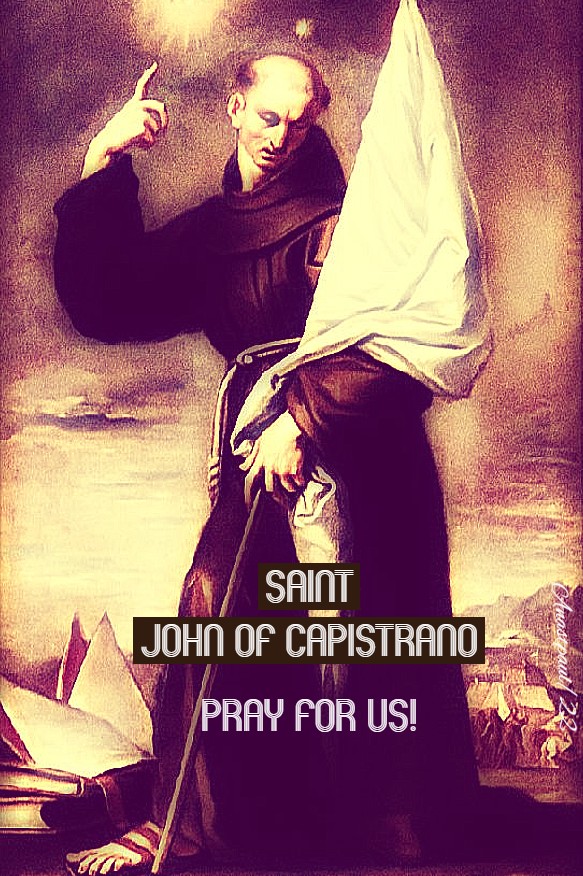
Quote/s of the Day – 28 March – Tuesday in Passion Week and the Memorial of St John of Capistrano OFM (1386-1456) Confessor – Wisdom 10:10-14, Luke 9:1-6 – Scripture search here: https://www.drbo.org/
“Take nothing for your journey, neither staff, nor bag, nor bread, nor money; neither have two tunics.”
Luke 9:3
“Pursue justice, godliness, faith, charity, patience, mildness. Fight the good fight of the faith, lay hold on the life eternal, to which you have been called …”
1 Timothy 6:11-12
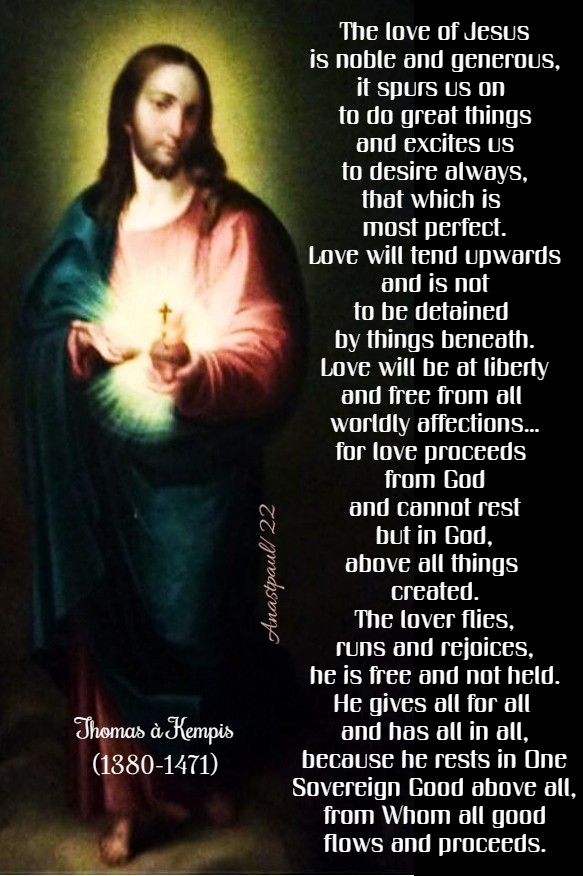
“The love of Jesus is noble and generous, it spurs us on to do great things and excites us to desire always, that which is most perfect. Love will tend upwards and is not to be detained by things beneath. Love will be at liberty and free from all worldly affections… for love proceeds from God and cannot rest but in God, above all things created. The lover flies, runs and rejoices, he is free and not held. He gives all for all and has all in all, because he rests in One Sovereign Good above all, from Whom all good flows and proceeds.”
Thomas à Kempis CRSA (1380-1471) (Book III, Chapter V, 3-4)
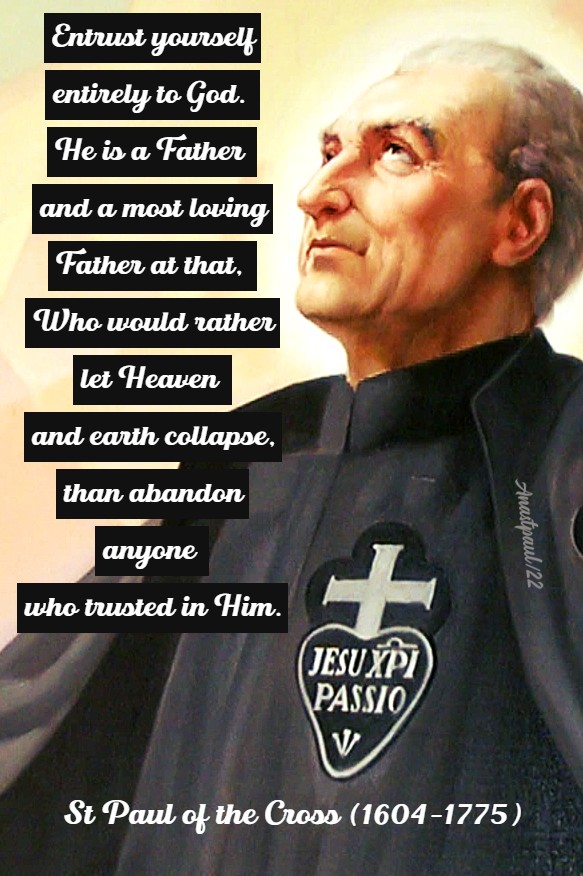
“Entrust yourself entirely to God. He is a Father and a most loving Father at that, Who would rather let Heaven and earth collapse, than abandon anyone who trusted in Him.”
St Paul of the Cross (1604-1775)
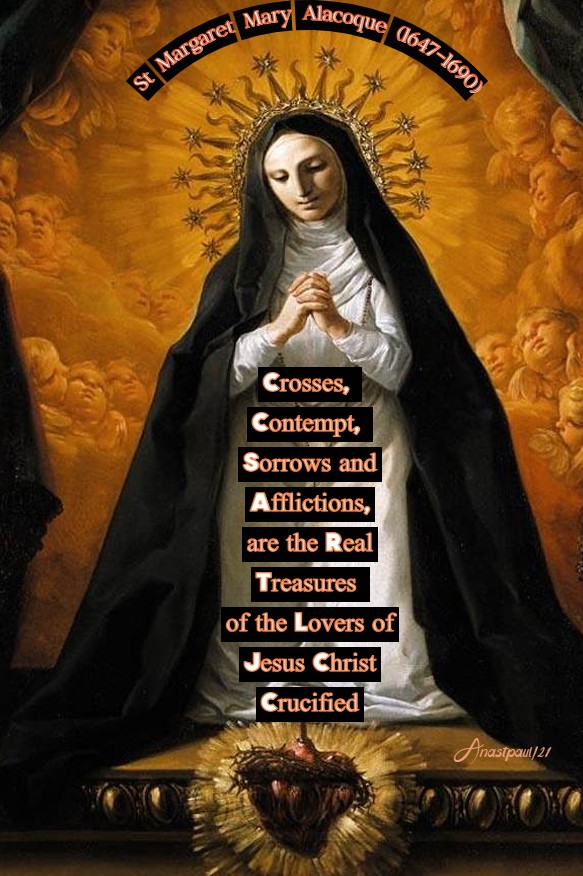
“Crosses, contempt, sorrows and afflictions, are the real treasures of the lovers of Jesus Christ Crucified.”
Our Lenten Journey with St Francis de Sales – 28 March
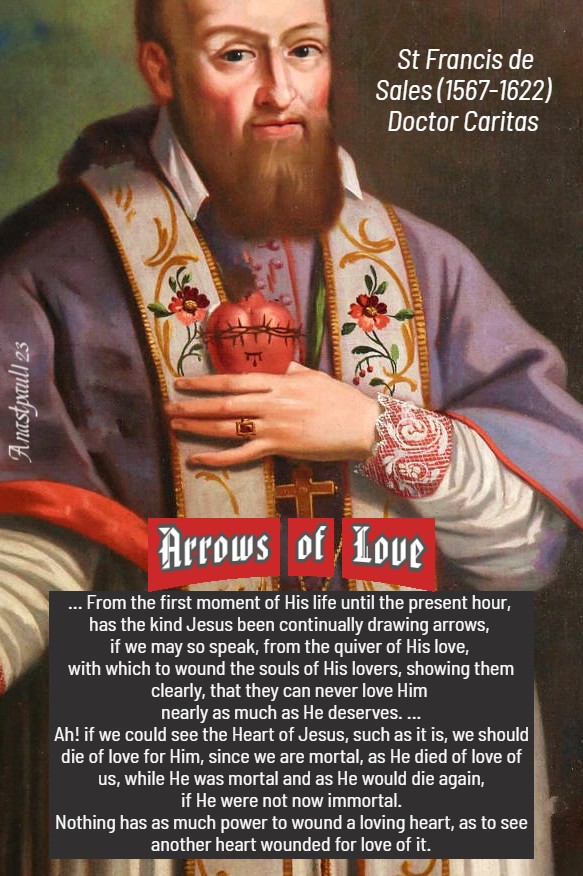
“Arrows of Love” St Francis de Sales
TUESDAY IN PASSION WEEK St Francis de Sales (1567-1622) Doctor Caritas
“HE WISHED, even after His death, to have His side opened, that we might see the thoughts of His Heart, which were all thoughts of love and that we might go to Him with confidence, in order to hide ourselves in His side and to receive, from Him, an abundance of graces and benedictions.
In this manner, from the first moment of His life until the present hour, has the kind Jesus been continually drawing arrows, if we may so speak, from the quiver of His love, with which to wound the souls of His lovers, showing them clearly, that they can never love Him nearly as much as He deserves.
My God, could He show more love to sinners than to become a perfect holocaust for their sins? Ah! if we could see the Heart of Jesus, such as it is, we should die of love for Him, since we are mortal, as He died of love of us, while He was mortal and as He would die again, if He were not now immortal. Nothing has as much power to wound a loving heart, as to see another heart wounded for love of it.” – (Consoling Thoughts of St Francis de Sales).
One Minute Reflection – 28 March – Tuesday in Passion Week and the Memorial of St John of Capistrano OFM (1386-1456) Confessor – Wisdom 10:10-14, Luke 9:1-6 – Scripture search here: https://www.drbo.org/
“Take nothing for your journey, neither staff, nor sack, nor bread, nor money; neither have two tunics.” – Luke 9:3
REFLECTION – “This is a great vision. But if you wish to see it, remove the sandals from your feet. Remove every chain of sin. Remove the chains of the world. Leave behind earthly sandals. Jesus sent the Apostles without sandals, without money, gold and silver, so that they would not carry earthly things with them. The one who seeks to do good is praised, not for his sandals but for the swiftness and grace of his feet. The Scripture says, “How beautiful are the feet of those who preach the gospel of peace, of those who bring glad tidings of good things!” Therefore, remove the sandals from your feet, that they may be beautiful for preaching the Gospel!” – St Ambrose (340-397) Bishop of Milan, Father and Doctor of the Church (Flight From the World 5).
PRAYER – O God, Who, through blessed John, made Thy faithful people conquer the enemies of the Cross by the power of the Most Holy Name of Jesus, grant, we beseech Thee, that by his intercession we may avoid the snares of our spiritual enemies and may be found worthy to receive from Thee, the crown of justice. Through esus Christ, Thy Son our Lord, Who lives and reigns with Thee, in the unity of the Holy Ghost, God, world without end. Amen (Collect).
Our Morning Offering – 28 March – Tuesday in Passion Week
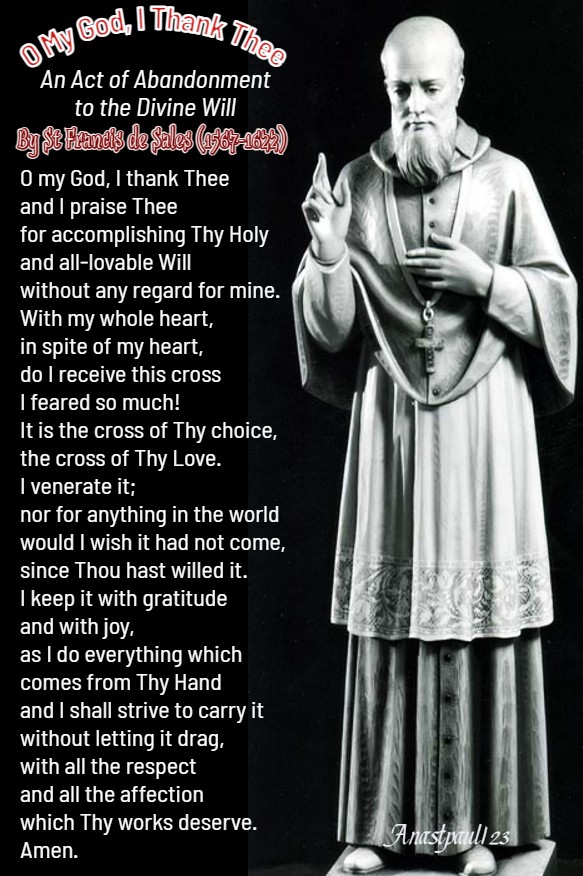
O My God, I Thank Thee An Act of Abandonment to the Divine Will By St Francis de Sales (1567-1622) Doctor Caritas
O my God, I thank Thee and I praise Thee for accomplishing Thy Holy and all-lovable Will without any regard for mine. With my whole heart, in spite of my heart, do I receive this cross I feared so much! It is the cross of Thy choice, the cross of Thy Love. I venerate it; nor for anything in the world would I wish it had not come, since Thou hast willed it. I keep it with gratitude and with joy, as I do everything which comes from Thy Hand and I shall strive to carry it without letting it drag, with all the respect and all the affection which Thy works deserve. Amen.
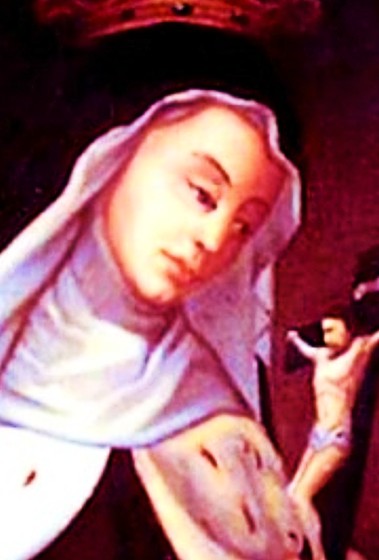
Saint of the Day – 28 March – Blessed Jeanne Marie de Maille TOSF (1331-1414) Virgin, Widow, Recluse Born on 14 April 1331 at the Castle of La Roche, France and died on 28 March 1414 at Tours France of natural causes. Patronages – abuse victims, against in-law problems, against the death of parents, of exiles, people ridiculed for their piety, widows. Also known as – Jane Mary de Maille. Jeanne Marie was Beatified on 27 April 1871 by Pope Pius IX .
Jeanne, the daughter of the wealthy Baron of Maille, was born at the chateau of her father near St Quentin in France. Because she possessed, from her earliest youth, a tender devotion and love for the Blessed Virgin Mary, she was given the additional name of Marie at Confirmation and from then on, she always used it with her Baptismal name. Under the direction of a Franciscan, who conducted the divine services at the chateau, she strove earnestly to attain perfection. Self-denial, mortification, prayer and works of charity towards her neighbour were the special means she employed.
Jeanne Marie was scarcely fifteen years old when her father died. She was placed under the guardianship of her grandfather, who was already quite advanced in years and who, therefore, believed it his duty to see his grandchild settled in life, as soon as possible. He chose as her husband Baron Robert of Silly, a man who was noble both by birth and by virtue. On the evening of their wedding day the grandfather died suddenly. This made such an impression on the pious husband that he readily yielded to the wish of his young wife to live in virginity.
The young couple’s first concern was to order their household in a Christian fashion. Only virtuous and God-fearing persons were admitted as their servants; all had to observe the commandments of God and of the Church faithfully; frivolous conversations, cursing and swearing, as well as games of chance, were not tolerated. In everything their Master and Mistress set the best example. Jeanne Marie interested herself too, in all the needs of her people and never sent a needy person away from her door without giving him assistance.
But the cross is the real test of all true fidelity to God;and it was not to be wanting in this home either. A terrible war broke out between England and France. The Baron of Silly and his vassals took the field in defence of their country but the war was disastrous for France.
Mortally wounded, the young Baron was brought to his chateau but hardly had he arrived there, when the English took possession of it and led him away as a prisoner. Through the efforts of his faithful wife, he obtained his freedom but he died not long afterwards.
Her in-laws were unkind to her and blamed her for her husband squandering his fortune for charitable ends and so deprived her of her widow’s inheritance and cut ties with her. completely. She first went to seek shelter at the home of an old ex-servant but the servant treated her with harshness, when realising she was poor. She went to reside with her mother but left when the latter tried to pressure her into finding another husband. Now Jeanne Marie withdrew entirely from the world. She moved to a little house near the Franciscan Church in Tours. Dressed in the ash-grey habit of the Third Order, she went out to nurse the sick and the poor. The remaining time she spent in prayer.
She prayed especially that God might bless the labours of Priests, particularly those who preached the Divine Word. She prayed most of all for the Universal Church, which at that time had to endure one of its severest trials. Christendom was divided into two groups – one pope resided in Italy, another in France and even saintly people did not know which one was the rightful head of the Church. Confusion and many scandals were the inevitable results. Had the Church been the work of human hands, it must certainly have gone to ruin. In answer to the prayers of many pious souls, God came to the assistance of the Church and Jeanne Marie had the consolation, before her death, of seeing the Church again united under one head.
Blessed Jeanne Marie de Maille died in the year 1414, at the age of eighty-two years. When her remains, clothed in the habit of the Third Order, were brought into the Church, the body appeared to have the freshness of youth. The veneration paid to her since her death was approved by Pope Pius IX.
St John of Capistrano OFM (1386-1456) Priest and Friar of the Friars Minor, Confessor and Preacher. Famous as a Preacher, Theologian and Inquisitor, trained Lawyer, he earned himself the nickname ‘the Soldier Saint’ when in 1456 at age 70 he led a Crusade against the invading Ottoman Empire at the Siege of Belgrade. He was Beatified on 19 December 1650 by Pope Innocent X and Canonised on 16 October 1690 by Pope Alexander VIII. Feast Day moved from 28 March in 1969. Biography: https://anastpaul.com/2017/10/23/saint-of-the-day-23-october-st-john-capistrano-ofm-1386-1456-the-soldier-saint/
St Cyril the Deacon St Dorotheus of Tarsus St Gundelindis of Niedermünster
St Guntramnus (c 532-592) King of the Kingdom of Orléans and Burgundy from 561 until his death in 592, Confessor, Apostle of the needs of the Church and of the poor and sick, Penitent. The Roman Martyrology reads: “At Chalons in France, the demise of St Gontran King, who devoted himself to exercises of piety, renounced the pomps of the world and bestowed his trasures on the Church and the poor,” https://anastpaul.com/2022/03/28/saint-of-the-day-28-march-saint-guntramnus-died-597/
St Hesychius of Jerusalem St Hilarion of Pelecete Blessed Jeanne Marie de Maille (1331-1414) Widow, Recluse St Proterius of Alexandria St Rogatus the Martyr St Successus the Martyr St Tutilo of Saint-Gall
Thought for the Day – 27 March – Meditations with Antonio Cardinal Bacci (1881-1971)
The Passion of Our Lord
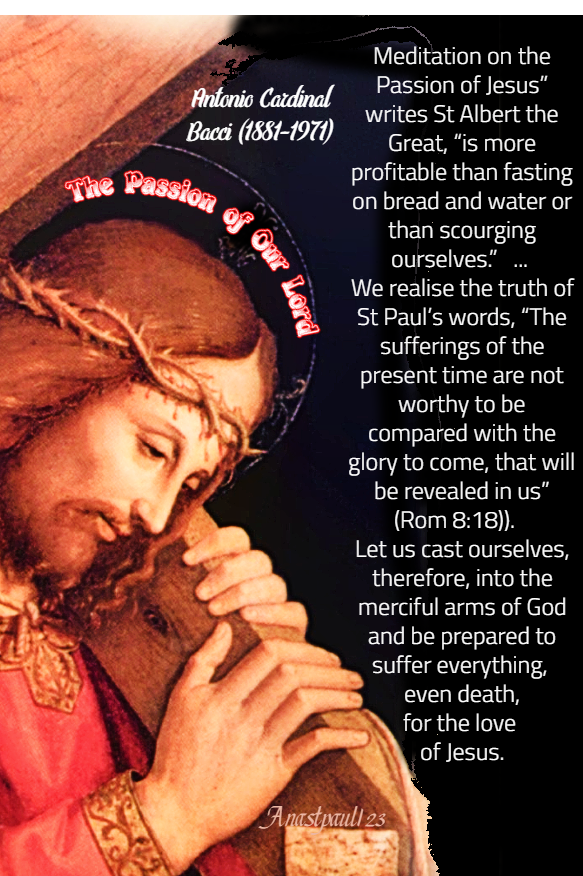
“Meditation on the Passion of Jesus” writes St Albert the Great, “is more profitable than fasting on bread and water or than scourging ourselves.”
This is because, when we meditate with love and gratitude on the Passion of our Redeemer, we have the experience of being transformed and set aglow with charity. We realise the truth of St Paul’s words, “The sufferings of the present time are not worthy to be compared with the glory to come, that will be revealed in us” (Rom 8:18)).
Let us cast ourselves, therefore, into the merciful arms of God and be prepared to suffer everything, even death, for the love of Jesus.”
Quote of the Day – 27 March – The Feast of St John Damascene (675-749) Confessor, Father and Doctor of the Church
The Night Prayers before Retiring The Examination of Conscience, Act of Contrition and Resolutions By St John Damascene (675-749) Confessor, Father and Doctor of the Church
“ (To be said pointing at the bed:) O Lord, Lover of men, is this bed to be my coffin, or wilt Thou enlighten my wretched soul with another day? Here the coffin lies before me and here death confronts me. I fear, O Lord, Thy Judgement and the endless torments, yet I cease not to do evil. My Lord God, I continually anger Thee and Thy immaculate Mother, and all the Heavenly Powers and my holy Guardian Angel. I know, O Lord, that I am unworthy of Thy love but deserve condemnation and every torment. But, whether I want it or not, save me, O Lord. For to save a good man is no great thing and to have mercy on the pure is nothing wonderful, for they are worthy of Thy mercy. But show the wonder of Thy mercy to me, a sinner. In this, reveal Thy love for men, lest my wickedness prevail over Thy unutterable goodness and mercy. And order my life as Thou wilt. (As sleep is the image of death, at night we pray for the departed) With the Saints give rest, O Christ, to the souls of Thy servants where there is no pain, no sorrow, no sighing, but life everlasting.
Kiss your Crucifix and make the Sign of the Cross from the head to the foot of the bed and from two sides and then say the Prayer:
Hail, Most Precious and Life-Giving Cross of the Lord!
Let God arise and let His enemies be scattered and let those, who hate Him, flee from His Presence. As smoke vanishes, let them vanish and as wax melts by the presence of fire, so let the demons perish by the presence of those who love God and who sign themselves with the Sign of the Cross and say in gladness: Hail, Most Precious and Life-Giving Cross of the Lord, for Thou drives away the demons by the power of our Lord Jesus Christ Crucified on thee, Who went down to hell and trampled on the power of the devil and gave us thee, His venerable Cross, for driving away all enemies. O Most Precious and Life-Giving Cross of the Lord, help me with our holy Lady, the Virgin Mother of God and with all the Saints throughout the ages. Amen.
(When about to lie down in bed, say:) Lighten my eyes, O Christ God, lest I sleep in death and lest my enemy says: I have prevailed over him.
Glory be to the Father and to the Son and to the Holy Ghost. Be my soul’s Defender, O God, for I step over many snares. Deliver me from them and save me, O Good One, in Thy love for men. Now and ever and to the ages of ages. Amen. Let us not silently hymn the most glorious Mother of God, holiest of holy Angels but confess her with heart and mouth to be the Mother of God, for she truly bore God Incarnate for us and prays without ceasing for our souls. Amen.
(Just before closing your eyes, say:) Into Thy hands, O Lord Jesus Christ, my God, I surrender my spirit and body; bless me, save me and grant me eternal life. Amen.
Before retiring, The Examination of Conscience: (or if one prefers, before beginning prayers) go through all the points suggested below in your mind and memory.
Give thanks to Almighty God for granting you during the past day, by His grace, His gifts of life and health.
Examine your conscience by going through each hour of the day, beginning from the time you rose from your bed and recall to memory – where you went, how you acted and reacted towards all persons and other creatures and what you talked about. Recall and consider with all care, your thoughts, words and deeds from morning until the evening.
If you have done any good, do not ascribe it to yourself but to God Who gives us all the good things and thank Him. Pray that He may confirm you in this good and enable you to do other good works.
But if you have done anything evil, admit that this comes from yourself and your own weakness, from bad habits or weak will. Repent and pray to the Lover of men that He may forgive you and promise Him firmly, never to do this evil again.
Implore your Creator with tears, to grant you a quiet, undisturbed, pure and sinless night and to enable you, in the coming day, to devote yourself wholly to the glory of His holy Name.
If you find a soft pillow, leave it and put a stone in its place, for Christ’s sake. If you sleep in winter, bear it, saying – Some did not sleep at all!”
St John Damascene (675-749) Father and Doctor of the Church
Our Lenten Journey with St Francis de Sales – 27 March – Monday of Passion Week
“In love, by love, for love and of love” St Francis de Sales
MONDAY IN PASSION WEEK St Francis de Sales (1567-1622) Doctor Caritas
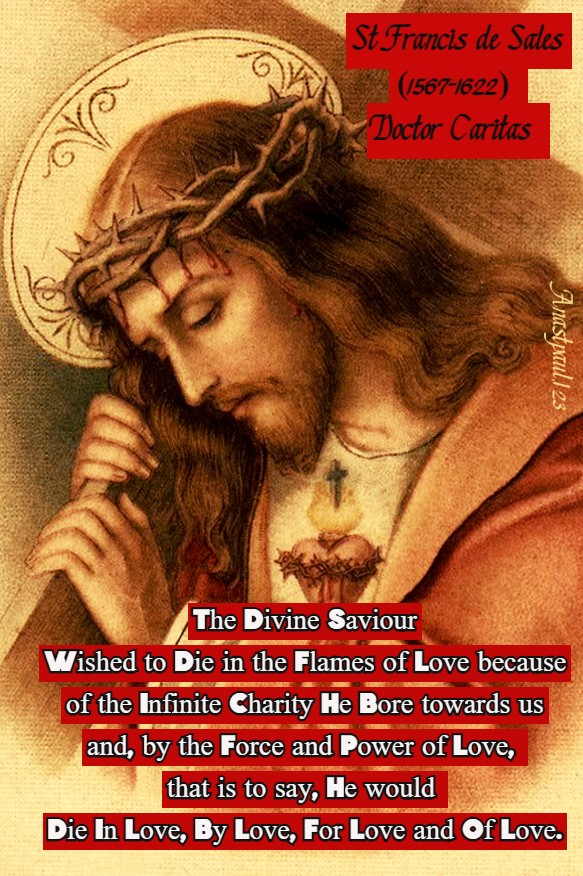
“THE SWEET JESUS was scourged, crowned, condemned, mocked and rejected as man, devoted, destined and dedicated to carry out and endure, the opprobriums and ignominies due in punishment to all sins and He served as a general sacrifice for sin, being made, as it were, an anathema, separated from and abandoned by His Eternal Father.
The Divine Saviour wished to die in the flames of love because of the Infinite Charity He bore towards us and, by the force and power of love, that is to say, He would die in love, by love, for love and of love. This is what He Himself says: “No-one takes away My life but I lay it down of Myself, for I have power to lay it down and to take it up again” .—He was offered, says Isaias because He wished it.” – (Consoling Thoughts of St Francis de Sales).
One Minute Reflection – 27 March – Monday of Passion Week and the Feast of St John Damascene (675-749) Confessor, Father and Doctor of the Church, Confessor, Priest, Monk, Theologian, Writer, Defender of Iconography, Polymath. – Wisdom 10:10-17, Luke 6:6-11 – Scripture search here: https://www.drbo.org/
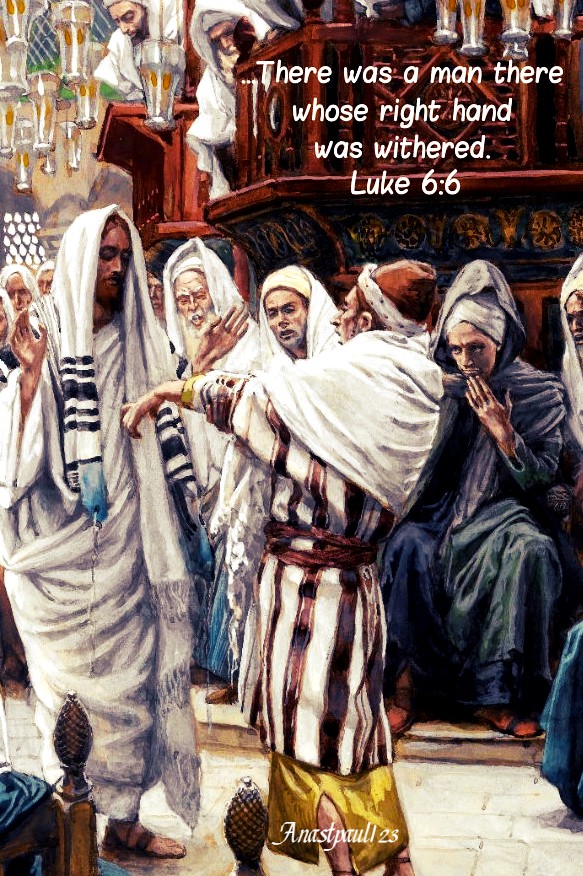
“On another sabbath, he went into the synagogue and taught and there was a man there whose right hand was withered.” … Luke 6:6
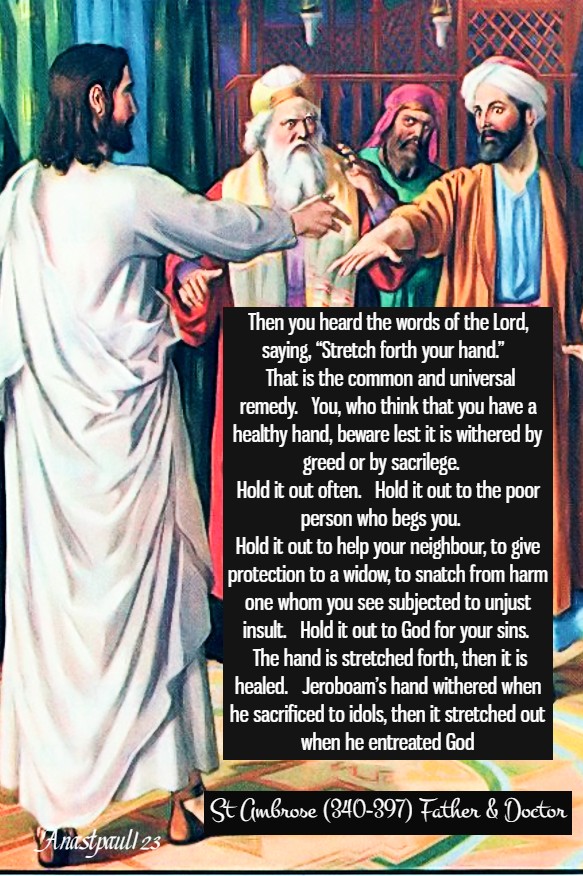
REFLECTION – “Are you angry at me because I have healed the whole man on the Sabbath day?” In this place He revivified,, with the salutary strength of good works, the hand which Adam stretched out to pluck the fruit of the forbidden tree. The hand which had withered through a crime, was healed by good deeds. Christ thereby rebuked the Jews who violated the precepts of the law with evil interpretations. They thought that they should rest even from good works on the Sabbath, since the law prefigured in the present, the form of the future, in which indeed, the days of rest from evils, not from blessings, would come.
Then you heard the words of the Lord, saying, “Stretch forth your hand.” That is the common and universal remedy. You, who think that you have a healthy hand, beware lest it is withered by greed or by sacrilege. Hold it out often. Hold it out to the poor person who begs you. Hold it out to help your neighbour, to give protection to a widow, to snatch from harm one whom you see subjected to unjust insult. Hold it out to God for your sins. The hand is stretched forth, then it is healed. Jeroboam’s hand withered when he sacrificed to idols, then it stretched out when he entreated God.” … St Ambrose(340-397)- One of the 4 original Doctors of the Latin Church – Exposition on the Gospel of Luke, 5
PRAYER – Almighty, eternal God, Who to defend the honour paid to sacred images, filled blessed John with heavenly learning and wondrous strength of soul, grant that, by his intercession and example, we may imitate the virtues of those whose images we honour and may enjoy the help of their patronage. Through Jesus Christ, Thy Son our Lord, Who lives and reigns with Thee, in the unity of the Holy Ghost, God, world without end. Amen (Collect).
Our Morning Offering – 27 March – The Feast of St John Damascene (675-749) Confessor, Father and Doctor of the Church
This Prayer is part of a very long and most beautiful Night Prayer by St John which I will post shortly.
Hail, Most Precious and Life-Giving Cross of the Lord! By St John Damascene (675-749) Confessor, Father and Doctor of the Church
Let God arise and let His enemies be scattered and let those, who hate Him, flee from His Presence. As smoke vanishes, let them vanish and as wax melts by the presence of fire, so let the demons perish by the presence of those who love God and who sign themselves with the Sign of the Cross and say in gladness: Hail, Most Precious and Life-Giving Cross of the Lord, for Thou drives away the demons by the power of our Lord Jesus Christ Crucified on thee, Who went down to hell and trampled on the power of the devil and gave us thee, His venerable Cross, for driving away all enemies. O Most Precious and Life-Giving Cross of the Lord, help me with our holy Lady, the Virgin Mother of God and with all the Saints throughout the ages. Amen.
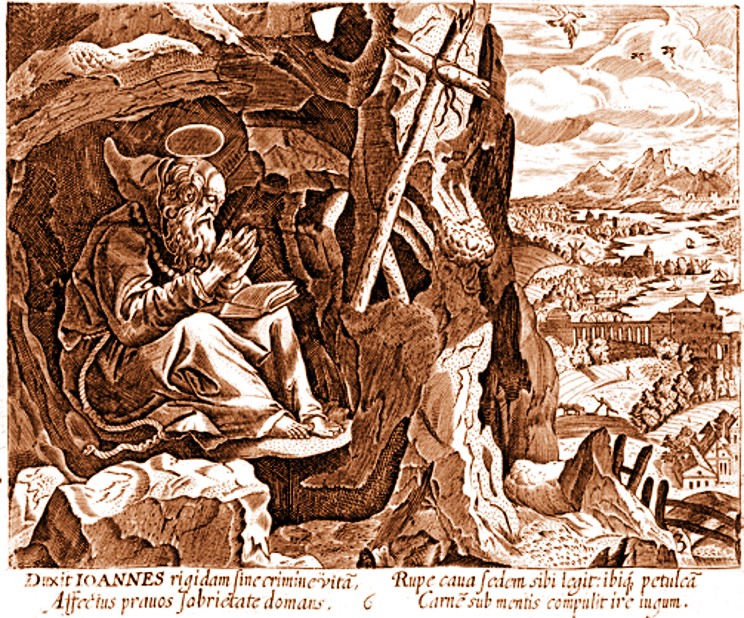
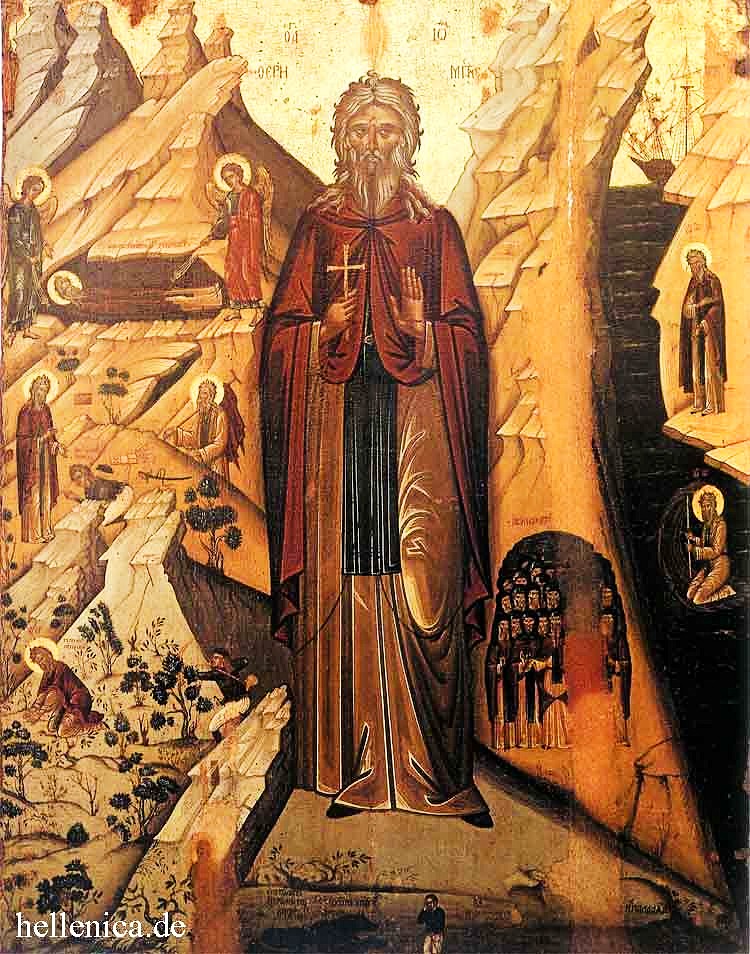
Saint of the Day – 27 March – St John of Lycopolis (c305-394) Hermit, Spiritual Advisor, Miracle-worker. graced with the gifts of prophecy and seeing into the hearts of men. John was known and admired by the great Saints of his time, including Saint Jerome, Saint Augustine, Saint Cassian and others. Born in c305 at Assiut, Egypt and died in 394 of natural causes. Also known as – Johannes av Egypt, John of Egypt, John of the Thebaid, John the Anchorite, John the Egyptian, John the Hermit.
John’s parents were poor and he trained as a carpenter. At the age of 25, he became a Hermit under the guidance of an elderly Recluse He spent a decade with this Hermit, taking direction from him and learning from him. St John Cassian recounts a tale that this spiritual counsellor directed John to water a dry stick every day for a year. After this test of obedience, his superior threw the stick away. When the older Hermit died, John spent the next five years travelling and visiting Monasteries.
John was noted for performing seemingly absurd acts such as rolling rocks from place to place and cultivating dead trees. Finally, he withdrew to the top of a cliff near Lycopolis, Egypt, where he could avoid all human contact. There he carved three small cells within the rock, one for sleeping, one for work and the last for praying. Then he walled them up with himself inside, leaving only a small opening.
He communicated through this opening to those who brought him food and water twice a week. Crowds would gather on those two days to hear him preach.
John never ate until sunset and lived on a diet of dried fruit and vegetables for fifty years. He refused bread and never ate anything cooked. He lived this way well into his nineties.
He possess the spiritual gift of prophecy and often predicting the future and knowing the details of persons he had never met. He predicted future victories to the Emperor Theodosius the Great who became his student, coming to him for advice and counselling.
He avoided seeing women, in particular, to avoid temptation but, he avoided all people for the last fifty years of his life. Saint Augustine wrote that John was tempted by devils and that he performed miraculous cures. St Augustine records that John cured a woman of blindness and then appeared to her in a vision to avoid seeing her in person.
John prayed incessantly and foreseeing his own death, he asked that no-one visit him for three days. He spent these last three days of his life without food or drink or any interaction except with God through prayer. He was discovered dead in his cell, with his body in a position of prayer.
John’s multi-roomed cell was re-discovered in the early 1900s.
St John Damascene (675-749) Confessor, Father and Doctor of the Church, Confessor, Priest, Monk, Theologian, Writer, Defender of Iconography, Poet, a Polymath whose fields of interest and contribution included law, theology, philosophy, music, Marian devotee. Also known as Doctor of Christian Art. Feast moved in 1969 to 4 December. Biography: https://anastpaul.com/2018/12/04/saint-of-the-day-4-december-st-john-damascene-675-749-father-doctor-of-the-church/
Bl Aimone of Halberstadt St Amphilochius of Illyria St Alexander of Drizipara St Alexander of Pannonia St Alkeld the Martyr St Amator the Hermit
Martyrs of Bardiaboch: A group of Christians who were arrested, tortured and executed together for their faith during the persecutions of Persian King Shapur II. Martyrs. – Abibus, Helias, Lazarus, Mares, Maruthas, Narses, Sabas, Sembeeth and Zanitas. 27 March 326 at Bardiaboch, Persia.
Thought for the Day – 26 March – Meditations with Antonio Cardinal Bacci (1881-1971)
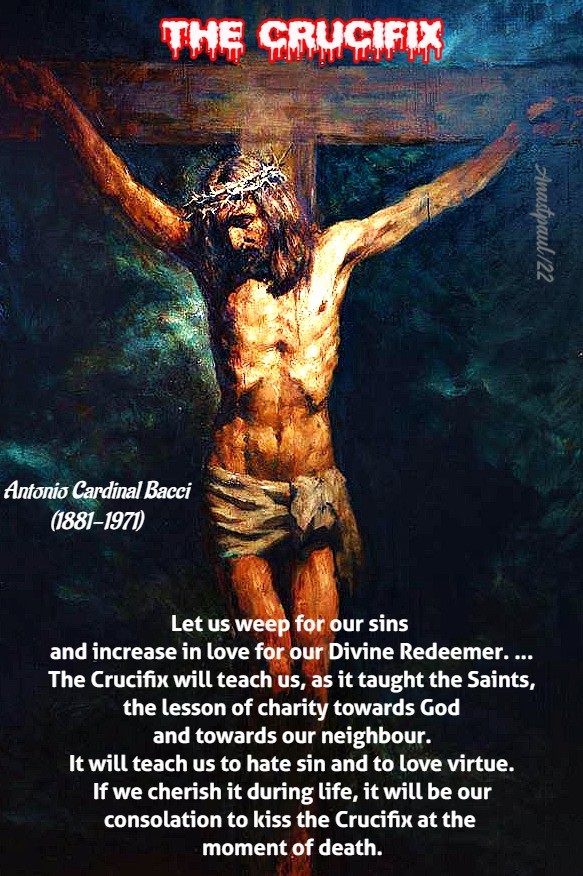
THE CRUCIFIX
“Let us weep for our sins and increase in love for our Divine Redeemer. When we are oppressed by the weight of our own cross, we shall look at the Crucifix and find comfort. When we are tempted, we shall grasp the Crucifix and turn away with horror from thoughts of sin and ingratitude.
The Crucifix will teach us, as it taught the Saints, the lesson of charity towards God and towards our neighbour. It will teach us to hate sin and to love virtue. If we cherish it during life, it will be our consolation to kiss the Crucifix at the moment of death.”
Our Lenten Journey with St Francis de Sales – 26 March – Passion Sunday – Hebrews 9:11-15, John 8:46-59 – Scripture search here: https://www.drbo.org/
“… By means of His death, … they, who have been called, may receive the eternal inheritance, according to the promise, in Christ Jesus our Lord.” Hebrews 9:15
“Amen, amen, I say to you, if anyone keep My word, he will never see death.” John 8:51
DEATH St Francis de Sales (1567-1622) Doctor Caritas
“CONSIDER THE UNCERTAINTY of the day of your death. One day, my soul, you must depart from this body. When will it be? In winter or summer? In town or country? At home or afar? During the day or the night? With or without warning? As a result of illness of accident? Shall I have a chance to go to Confession? Shall I be assisted by a Priest? Will I be prepared? Unhappily, I know the answer to none of these things. Only one thing is certain – that I shall die and sooner than I imagine.”
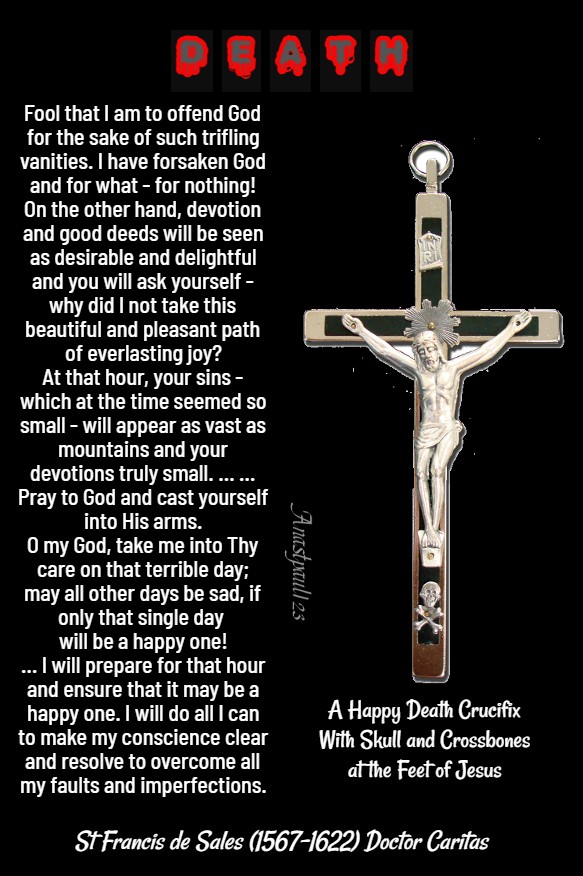
Consider that then, the world will come to an end, as far as you are concerned. You will have no more part in it. It will turn upside down before your eyes, for worldly joys and pleasures and the things you loved in vain, will turn into empty dreams and shadows. Fool that I am to offend God for the sake of such trifling vanities. I have forsaken God and for what – for nothing! On the other hand, devotion and good deeds will be seen as desirable and delightful and you will ask yourself – why did I not take this beautiful and pleasant path of everlasting joy? At that hour, your sins – which at the time seemed so small – willappear as vast as mountains and your devotions truly small. …
Pray to God and cast yourself into His arms. O my God, take me into Thy care on that terrible day; may all other days be sad, if only that single day will be a happy one! Thank God for inspiring these resolutions and offer them to Him, imploring Him to grant you the grace of a Happy Death, through the merits of His Son and through the intercession of the Blessed Virgin Mary and all the Saints. Carry with you always a small Happy Death Crucifix, properly blessed, to obtain a Plenary Indulgence at the hour of death and meditate upon it often.” – (Introduction to the Devout Life – Excerpt from The Fifth Meditation on Death).
WHAT IS A HAPPY DEATH CRUCIFIX? A Crucifix which displays the “Skull and Crossbones” preferably at the Feet of Jesus. “The skull and bones have many symbolic meanings. All Catholics are encouraged to meditate on the “Four Last Things – Death and Judgement, Heaven and Hell” so that they will live in a state of grace and prepare themselves for Heaven. The skull is a great reminder of human mortality. Jesus Christ was Crucified on Golgotha – “the place of the skull,” There is a tradition that Christ, the New Adam, Who conquered sin and death, was Crucified on the gravesite of the first man, Adam, who brought sin and death into the world through his disobedience to God. The skull is a symbol of Adam’s grave. Most important of all, the skull and bones are placed beneath Jesus’ Feet, to show that He triumphed over death and sin on our behalf.”
One Minute Reflection – 26 March – Passion Sunday – Hebrews 9:11-15, John 8:46-59 – Scripture search here: https://www.drbo.org/
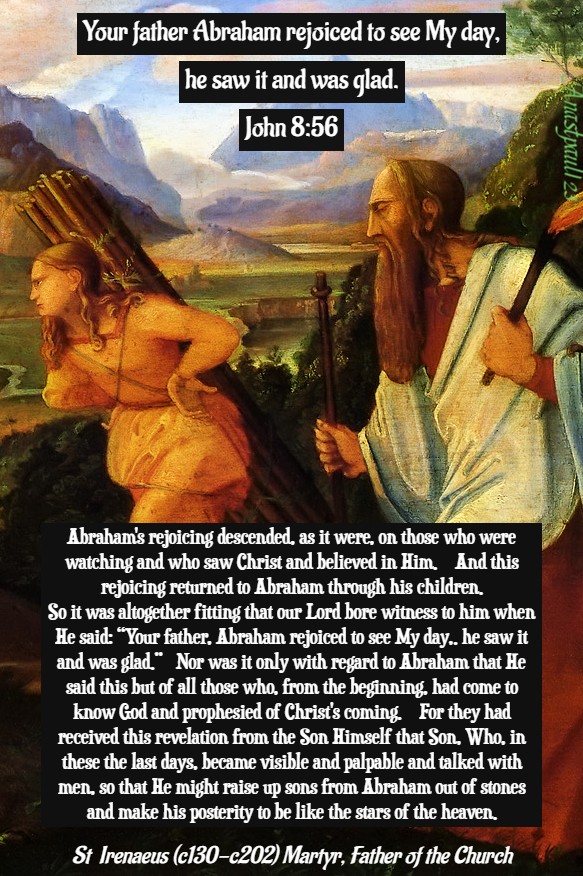
“Your father Abraham rejoiced to see My day, he saw it and was glad.” – John 8:56
REFLECTION – “Since Abraham was a Prophet he saw the day of the Lord’s coming in the Spirit, as also the designs of His Passion, through which, both he and all those like him, who believed in God, would be saved. And he was seized with great joy. Thus, the Lord was not unknown to Abraham, since he longed to see His day… He longed to see His day, so that he, too, might clasp Christ to himself and having seen Him prophetically in the Spirit, he rejoiced.
That is why Simeon, who was of his descendants, fulfilled the Patriarch’s joy and said: “Now, Master, Thou may let Thy servant go in peace, according to Thy Word, for my eyes have seen Thy salvation, which Thou prepared in sight of all peoples”… And Elizabeth said : “My soul proclaims the greatness of the Lord, my spirit rejoices in God my Saviour.” Abraham’s rejoicing descended, as it were, on those who were watching and who saw Christ and believed in Him. And this rejoicing returned to Abraham through his children.
So it was altogether fitting that our Lord bore witness to him when He said: “Your father, Abraham rejoiced to see My day,. he saw it and was glad.” Nor was it only with regard to Abraham that He said this but of all those who, from the beginning, had come to know God and prophesied of Christ’s coming. For they had received this revelation from the Son Himself that Son, Who, in these the last days, became visible and palpable and talked with men, so that He might raise up sons from Abraham out of stones and make his posterity to be like the stars of the heaven.” – St Irenaeus (c130-c202) Martyr, Father of the Church, Bishop of Lyons, Theologian (Against the heresies IV, 5-7).
PRAYER – Look graciously upon Thy household, Almighty God, we beseech Thee that by Thy grace, we may be governed in body and by Thy protection, safeguarded in mind. Through Jesus Christ, Thy Son our Lord, Who lives and reigns with Thee, in the unity of the Holy Ghost, God, world without end.Amen (Collect).
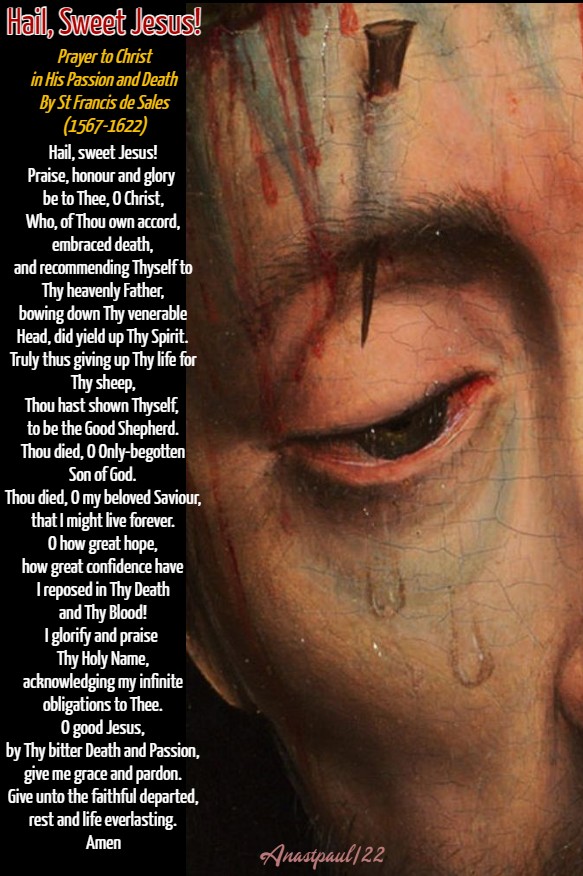
Hail, Sweet Jesus! Prayer to Christ in His Passion and Death By St Francis de Sales (1567-1622) Doctor Caritas
Hail, sweet Jesus! Praise, honour and glory be to Thee, O Christ, Who, of Thou own accord, embraced death, and recommending Thyself to Thy heavenly Father, bowing down Thy venerable Head, did yield up Thy Spirit. Truly thus giving up Thy life for Thy sheep, Thou hast shown Thyself, to be the Good Shepherd. Thou died, O Only-begotten Son of God. Thou died, O my beloved Saviour, that I might live forever. O how great hope, how great confidence have I reposed in Thy Death and Thy Blood! I glorify and praise Thy Holy Name, acknowledging my infinite obligations to Thee. O good Jesus, by Thy bitter Death and Passion, give me grace and pardon. Give unto the faithful departed, rest and life everlasting. Amen.
Saint of the Day – 26 March – St Barontius of Pistoia (Died c725) Monk, Hermit. Barontius was a French nobleman who had been a Courtier at the Court of King Thierry II. Also known as – Barontus, Baronce, Baronto, Baronzio. Barontius
With his son, he had became a Monk at Saint-Pierre de Longoret in the Diocese of Bourges, now the Monastery of Saint-Cyran-du-Jambot.
In around 678, Barontius received a vision of Heaven and hell, in which demons clawed and kicked at him. Accompanied by the Archangel St Raphael, Barontius journeyed through the four levels of Heaven, although he continued to be tormented by the demons, who aimed to pull him down to hell.
He met many he had known, including fellow Monks from Longoreto. St Raphael asked another Angel to bring Saint Peter to them, so that St Peter may evaluate Barontius.
The demons brought their evidence against Barontius, repeating all the sins which Barontius had committed, including those which he had completely forgotten. However, the demons became so annoying that St Peter smacked them with his keys, sending them away. St Peter then decided to send Barontius back to earth via hell, where he saw all of the souls in torment. before returning to earth. When he recovered, he wrote an account of his vision — a large manuscript known as Visio Baronti Monachi Longoretensis.
This vision led to Barontius’ decision to become a Hermit in Italy and he established himself near Pistoia with Desiderius, also a former Monk. They lived an austere, prayerful life and were joined by many disciples.
Barontius died around 725. Both he and Desiderius ‘ names appear in the Martyrologium Romanum as Saints, for celebration today.
St Braulio (590-651) Bishop of Saragossa, Spain, Monk, Confessor, Reformer, Scholar, Advisor, Writer, eloquent Preacher, Apostle of Charity. Saint Braulio was friend and disciple to Saint Isidore of Seville (560-636) Doctor of the Church ) and a prolific writer of letters, hymns, martyrologies, hagiographies and history. He fought against heresy and provided both strength and encouragement in the faith to his congregation. Biography: https://anastpaul.wordpress.com/2018/03/26/saint-of-the-day-26-march-braulio-590-651/
St Desiderius of Pistoia St Eutychius of Alexandria St Felicitas of Padua St Felix of Trier (c 386–c 399) Bishop St Garbhan St Govan
St Ludger (c 742-809) Bishop, Missionary, Founder, Abbot, Writer. Following in the footsteps of the English missionary St Boniface, St Ludger, who was a native Netherlander, brought the faith to the people of Frisia in Holland and the Saxons of north-west Germany. He founded the Werden Abbey and was the first Bishop of Münster in Westphalia, Germany. About St Ludger: https://anastpaul.com/2019/03/26/saint-of-the-day-26-march-st-ludger-c-742-809/
St Maxima the Martyr St Mochelloc of Kilmallock St Montanus the Martyr St Sabino of Anatolia St Sincheall of Killeigh St Wereka
Martyrs of Rome – 5 Saints: A group of Christians Martyred together. The only details to survive are the names – Cassian, Jovinus, Marcian, Peter and Thecla. Rome, Italy, date unknown.
Thought for the Day – 25 March – Meditations with Antonio Cardinal Bacci (1881-1971)
The Annunciation
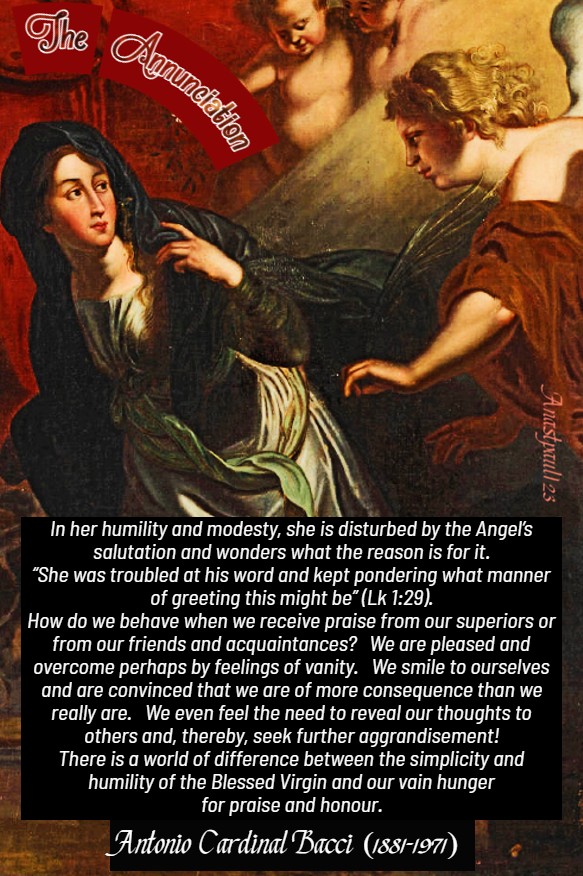
“Consider Mary’s reaction to the reverence and praise with which the Angel greets her. Is she carried away by delight and exaltation at this solemn moment? Nothing of the sort! In her humility and modesty, she is disturbed by the Angel’s salutation and wonders what the reason is for it. “She was troubled at his word and kept pondering what manner of greeting this might be” (Lk 1:29).
How do we behave when we receive praise from our superiors or from our friends and acquaintances? We are pleased and overcome perhaps by feelings of vanity. We smile to ourselves and are convinced that we are of more consequence than we really are. We even feel the need to reveal our thoughts to others and, thereby, seek further aggrandisement! There is a world of difference between the simplicity and humility of the Blessed Virgin and our vain hunger for praise and honour.”
Quote/s of the Day – 25 March – The Annunciation of the Blessed Virgin Mary – Isaias 7:10-15, Luke 1:26-38 – Scripture search here: https://www.drbo.org/
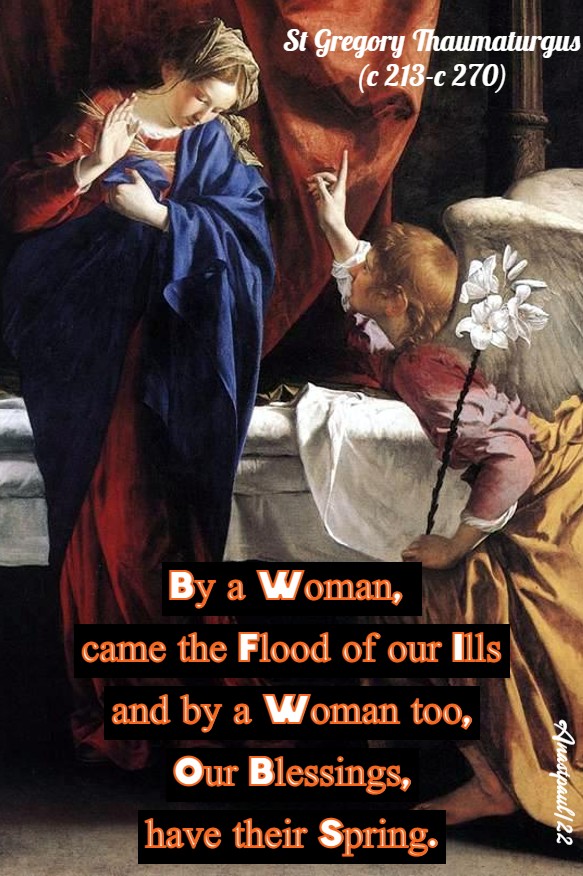
“ By a woman, came the flood of our ills and by a woman too, our blessings, have their spring.”
St Gregory Thaumaturgus (c213-c270) “the Wonder-Worker,” Bishop, Confessor
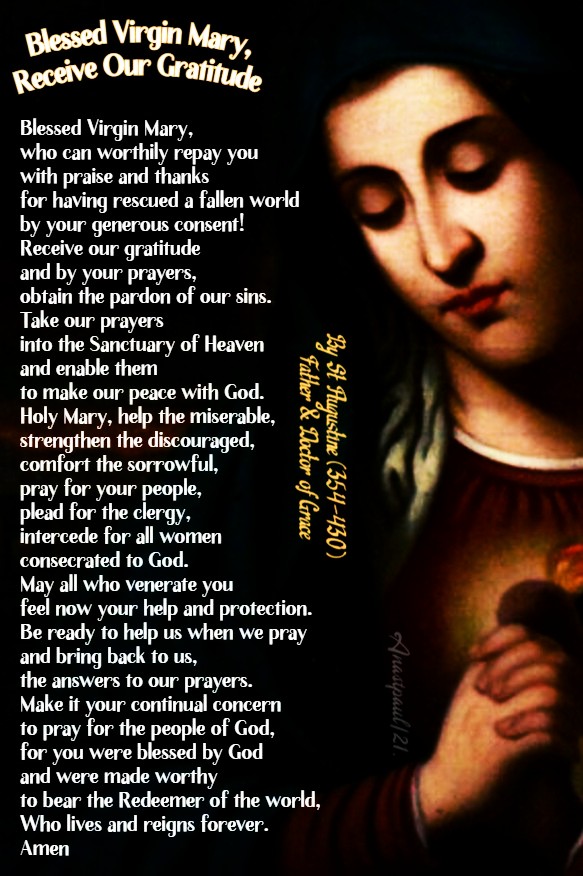
Blessed Virgin Mary, Receive Our Gratitude! By St Augustine (354-430) Father & Doctor of Grace
Blessed Virgin Mary, who can worthily repay you with praise and thanks for having rescued a fallen world by your generous consent! Receive our gratitude and by your prayers, obtain the pardon of our sins. Take our prayers into the Sanctuary of Heaven and enable them to make our peace with God. Holy Mary, help the miserable, strengthen the discouraged, comfort the sorrowful, pray for your people, plead for the clergy, intercede for all women consecrated to God. May all who venerate you feel now your help and protection. Be ready to help us when we pray and bring back to us, the answers to our prayers. Make it your continual concern to pray for the people of God, for you were blessed by God and were made worthy to bear the Redeemer of the world, Who lives and reigns forever. Amen
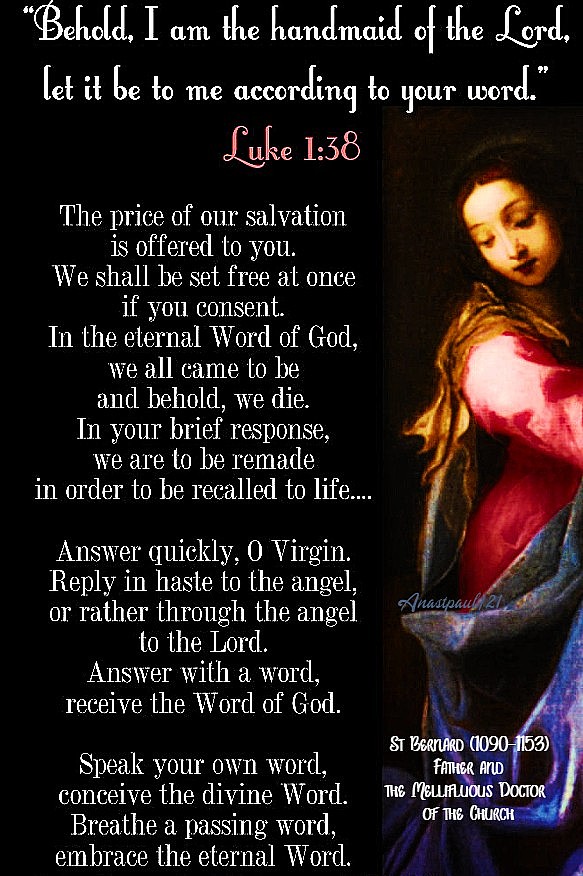
“And Mary said, ‘Behold, I am the handmaid of the Lord. May it be to me according to your word.’”
Luke 1:38
“The price of our salvation is offered to you. We shall be set free at once, if you consent. In the eternal Word of God, we all came to be and behold, we die. In your brief response, we are to be remade. in order to be recalled to life.
… Answer quickly, O Virgin. Reply in haste to the Angel, or rather, through the Angel to the Lord. Answer with a word, receive the Word of God. Speak your own word, conceive the Divine Word. Breathe a passing word, embrace the Eternal Word!”
St Bernard of Clairvaux (1090-1153) The Last Father and the Mellifluous Doctor
Our Lenten Journey with St Francis de Sales – 25 March – The Annunciation of the Blessed Virgin Mary – Isaias 7:10-15, Luke 1:26-38 – Scripture search here: https://www.drbo.org/
“Hail, full of grace, the Lord is with thee, blessed art thou amongst women!” Luke 1:28
“And Mary said to the Angel: How shall this be done as I know not man?” Luke 1:34
CHASTITY and HUMILITY St Francis de Sales (1567-1622) Doctor Caritas
“VIRGINITY AND ABSOLUTE CHASTITY, is an angelic virtue but, although it belongs, more especially to Angels than to men, yet the purity of Our Lady infinitely surpassed that of the Angels, having three great perfections above theirs, even that of the Cherubim and Seraphim…that of the Angels is sterile and can produce no fruit. On the contrary, that of our glorious Mistress was not only fruitful because she produced, for us, this sweet Fruit of Life, Our Lord and Master but, in the second place, she has begotten many virgins. It is it in imitation of her, as we have said, that virgins have vowed their virginity …
But she was not only virgin par excellence above all others, Angels as well as men – she was also more humble than all others. This was manifest excellently on the day of the Annunciation. She then made the greatest act of humility that was ever made, or ever will be made, by a pure creature; for seeing herself exalted by the Angel, who saluted her, saying she was full of grace and that she would conceive a Son Who would be both God and Man…Our Lady, being reassured by the Angel and having learned what God willed to do with her and in her, made this supreme act of humility, saying: “I am the servant of the Lord. Let it be done to me as you say.” She saw herself raised to the highest dignity that ever was or will be, for although it should please God to create anew many worlds, He could never make a pure creature be greater than the Mother of God.
Our Lady humbled herself and acknowledged herself unworthy of being raised to the high dignity of Mother of God, therefore, she was made to be His Mother, for she had no sooner uttered the protestation of her littleness, than, having abandoned herself to Him, by an act of incomparable charity, she became the Mother of the Most High, Who is the Saviour of our souls!” (Sermon on 25 March 1621at a religious Profession).
One Minute Reflection – 25 March – Feast of the Annunciation of the Blessed Virgin Mary – Isaias 7:10-15, Luke 1:26-38 – Scripture search here: https://www.drbo.org/
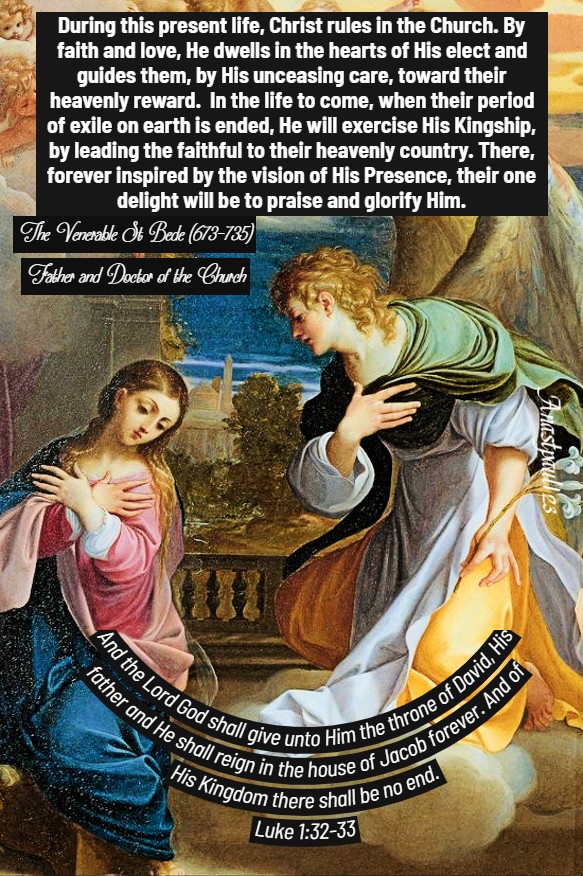
“And the Lord God shall give unto Him the throne of David, His father and He shall reign in the house of Jacob forever. And of His Kingdom there shall be no end.” – Luke 1:32-33
REFLECTION – “The Angel Gabriel was sent from God to a city of Galilee named Nazareth, to a virgin betrothed to a man whose name was Joseph of the house of David and the virgin’s name was Mary.” What is said of the house of David applies, not only to Joseph but also to Mary. It was a precept of the law that each man should marry a wife from his own tribe and kindred. Saint Paul also bears testimony to this, when he writes to Timothy: “Remember Jesus Christ, risen from the dead, descended from David, as preached in my Gospel” (2 Tm 2:8) …
“He will be great and will be called the Son of the Most High and the Lord God will give Him the throne of His father David.” The Angel refers to ,the kingdom of the Israelite nation, as the throne of David because in his time, by the Lord’s command and assistance, David governed it with a spirit of faithful service … As David had once ruled the people with temporal authority, so Christ would now lead them to the eternal Kingdom by His spiritual grace …
“He will reign over the house of Jacob forever”. The house of Jacob here refers to the Universal Church which, through its faith in and witness to Christ, shares the heritage of the Patriarchs. This may apply either to those who are physical descendants of the patriarchal families, or to those, who come from gentile nations and are reborn in Christ, by the waters of Baptism. In this house, Christ shall reign forever, and “of his Kingdom there will be no end.” During this present life, Christ rules in the Church. By faith and love, He dwells in the hearts of His elect and guides them, by His unceasing care, toward their heavenly reward. In the life to come, when their period of exile on earth is ended, He will exercise His Kingship, by leading the faithful to their heavenly country. There, forever inspired by the vision of His Presence, their one delight will be to praise and glorify Him.” – The Venerable St Bede (673-735) Monk, Father and Doctor of the Church (Sermons for Advent No 3).
PRAYER – O God, Who, by the message of an Angel, willed Thy Word to take flesh in the womb of the Blessed Virgin Mary, grant that we, Thy suppliants, who believe her to be truly the Mother of God, may be assisted by her intercession with Thee. Through the same Jesus Christ, Thy Son our Lord, Who lives and reigns with Thee, in the unity of the Holy Ghost, God, world without end. Amen (Collect).
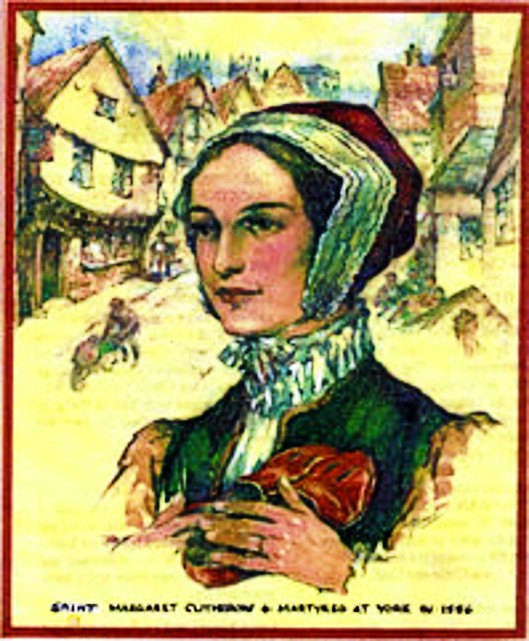
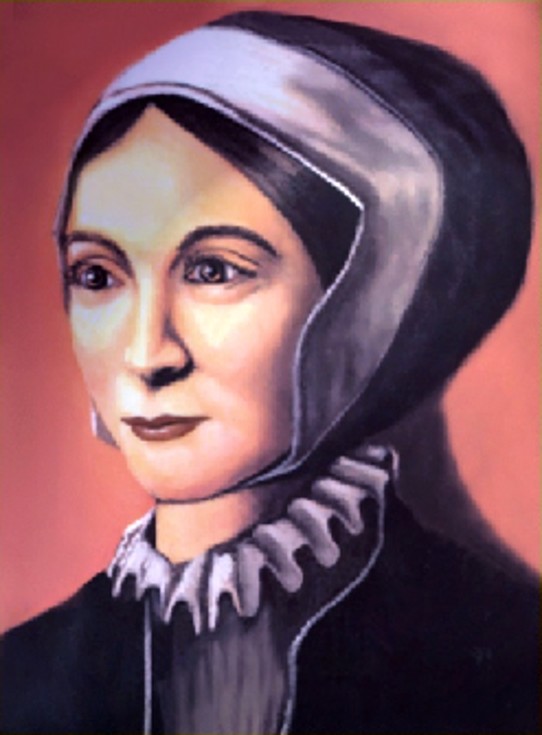
Saint of the Day – 25 March – Blessed Margaret Clitherow (1556-1586) “The Pearl of York”Martyr, Married Laywoman and Mother of 3. Her 2 sons became Priests and her daughter a Nun. She was Beatified on 15 December 1929 by Pope Pius XI and Canonised with the 40 Martyrs of England and Wales. Born in 1556 at York, England as Margaret Middleton and died by being crushed to death, on Good Friday, 25 March 1586 at their home, No 10-11 The Shambles,York. Also known as – Margaret Clitheroe, Margaret Middleton, Margarita, Margherita, Marguerite. “The Pearl of York.” Patronages – the Catholic Women’s League, business-women, converts, Martyrs, Co-Patron of the English Latin Mass Society which organises an annual pilgrimage to her Shrine in York . Additional Memorial – 4 May with the 40 Martyrs.
Margaret was born in 1556, one of five children of Thomas and Jane Middleton. Her father was a respected businessman, a wax-chandler and Sheriff of York, who died when Margaret was fourteen years old.
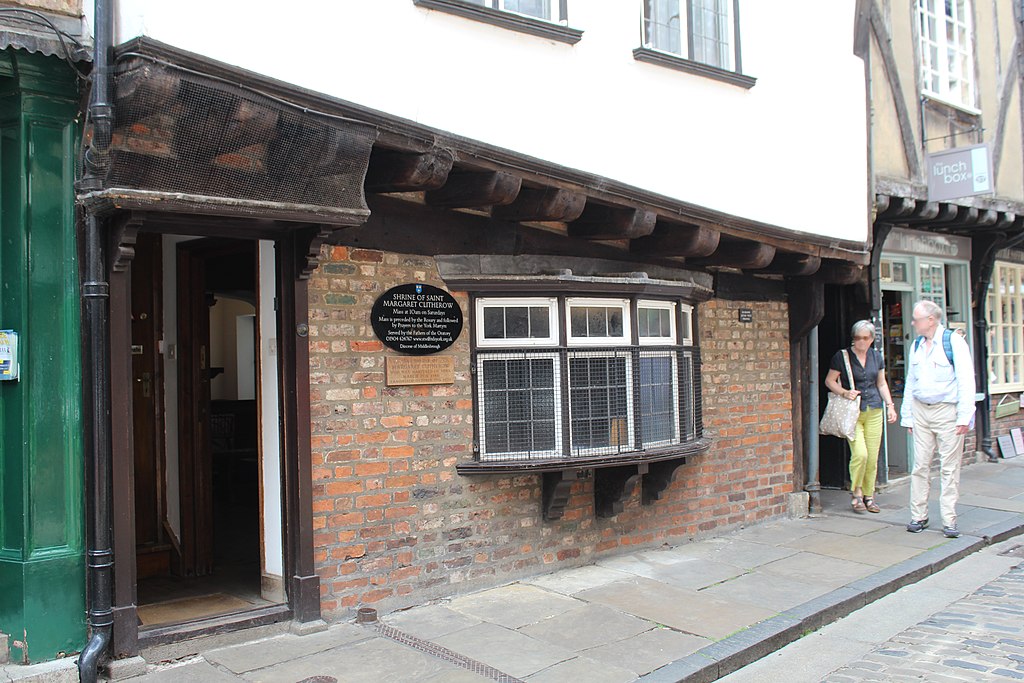
In 1571, she married John Clitherow, a wealthy butcher and a chamberlain of the City and bore him three children. The family lived at today’s renowned tourist destination, “The Shambles” – their business was Nos 35–36, which is now St Margaret’s Shrine..
Margaret converted to Catholicism in 1574. Although her husband, John belonged to the Established Church, he was supportive of his wife and of his brother William, who was a Catholic Priest. He paid the fines Margaret received for not attending the heretical church services. She was first imprisoned in 1577 for failing to attend and two further incarcerations at York Castle followed. Her third child, William, was born in prison!
Margaret risked her life by harbouring and maintaining Priests which was made a capital offence. She provided two chambers, one adjoining her house and, with her house under surveillance, she rented a house some distance away, where she kept Priests hidden and Mass was celebrated throughout the time of the most violent and virulent persecution. Her home became one of the most important hiding places for fugitive Priests in the north of England. Local tradition holds that she also housed her clerical guests in The Black Swan at Peasholme Green, where the Queen’s agents were also lodged!
The Black SDwan
She sent her older son, Henry, to the English College, relocated to Rheims, to train for the Priesthood. Her husband was summoned by the authorities to explain why his oldest son had gone abroad and in March 1586, the Clitherow house was searched. A frightened boy revealed the location of the Priest hole.
Margaret was arrested and called before the York Assizes for the crime of harbouring Catholic Priests. She refused to plead, thereby preventing a trial that would entail her three children being made to testify and being subjected to torture. She was sentenced to death. Although pregnant with her fourth child, she was executed on Lady Day, 1586, (which also happened to be Good Friday that year) in the Toll Booth at Ouse Bridge, by being crushed to death by her own door, the standard inducement to force a plea. Upon hearing the sentence, Margaret exclaimed – “God be thanked, I am not worthy of so good a death as this.”
Before her execution, Margaret was asked to confess her crimes. Instead she confessed, Our Lord Jesus Christ by saying: “I die for the love of my Lord Jesu.” The two Sergeants who should have carried out the execution hired four desperate beggars to do it instead. She was stripped and had a handkerchief tied across her face, then laid across a sharp rock the size of a man’s fist, the door from her own house was put on top of her and loaded with an immense weight of rocks and stones, so that the sharp rock would break her back. Her death occurred within fifteen minutes but her body was left for six hours before the weight was removed.
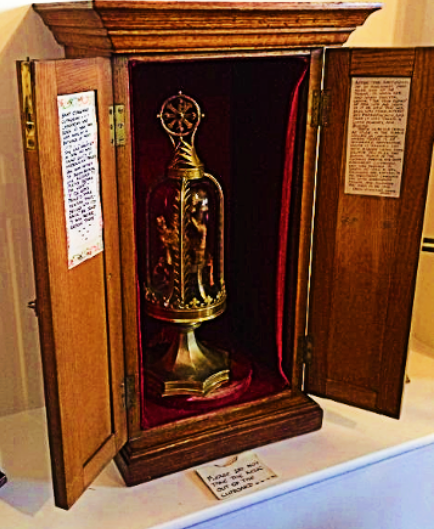
A relic, of her hand, is housed in the Bar Convent in York.
Margaret’s Shrine is at 35–36 The Shambles. John Clitherow had his butcher’s shop at No 35. My family and I have been able to visit this Shrine a few times, taking some of our visitors to venerate St Margaret.































 AnaStpaul
You must be logged in to post a comment.