Our Morning Offering – 26 December – Feast of St Stephen the ProtoMartyr and The Second Day in the Christmas Octave
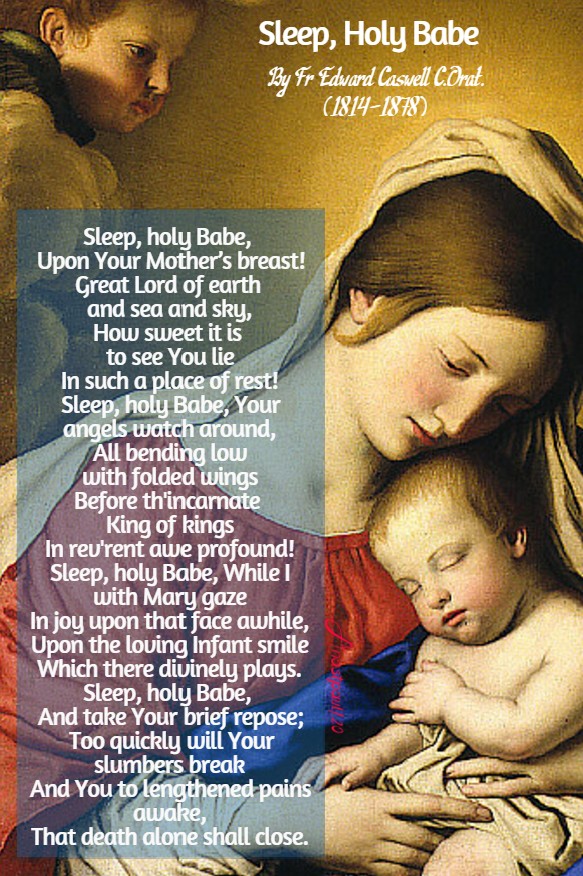
Sleep, Holy Babe By Fr Edward Caswell C.Orat. (1814-1878)
Sleep, holy Babe, Upon Your Mother’s breast! Great Lord of earth and sea and sky, How sweet it is to see You lie In such a place of rest! Sleep, holy Babe, Your angels watch around, All bending low with folded wings Before th’incarnate King of kings In rev’rent awe profound! Sleep, holy Babe, While I with Mary gaze In joy upon that face awhile, Upon the loving Infant smile Which there divinely plays. Sleep, holy Babe, And take Your brief repose; Too quickly will Your slumbers break And You to lengthened pains awake, That death alone shall close.
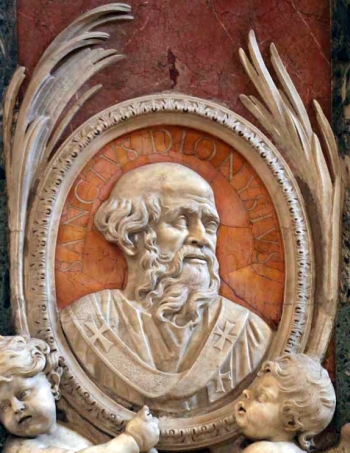
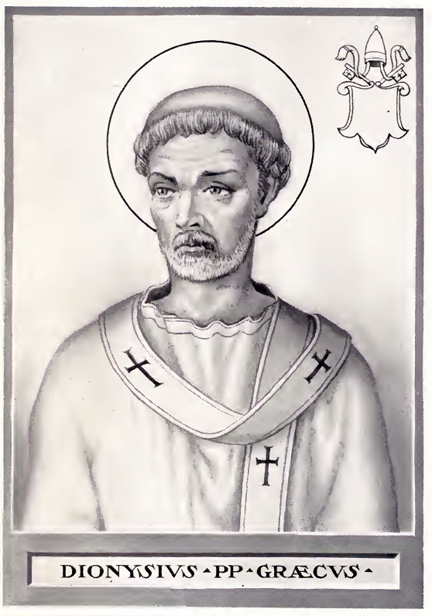
Saint of the Day – 26 December – St Pope Dionysius (Died 268) Bishop of Rome from 22 July 259 to his death on 26 December 268. According to early Church records, Dionysius was the first pope not Martyred for his Faith.
Historians know very little about the early life of Dionysius except that he was Greek and Italian. Though his family came from Greece, he was born in Italy sometime around 200. Some believe that he was born in the small town of Terra Nova but others think that he was born in Magna Graecia. During his early years, he used the name Dionusius, which he changed to Dionysius upon becoming Pope.
Dionysius was not the first man chosen for the next Pope after the death of Sixtus II. Pope Sixtus II was Martyred as were many other Christians at the time. It took nearly a year before Dionysius became the Pope and the Bishop of Rome.
Pope Dionysius had an easier time than Sixtus II did, mainly because of the murder of Emperor Valerian. Valerian was known for the persecution of Christians but the King of Persia issued orders in 260 that led to his capture and murde. Gallienus then became Emperor and issued orders that called for the tolerance of Christians. The new Emperor helped rebuild churches and allowed Christians to practice again. This period became known as the Little Peace of the Church, which lasted for nearly four decades.
Though his predecessor ruled for less than one year, Pope Dionysius reigned for more than nine years and a total of 3,445 days. He was likely in his late 50s when he assumed the throne and in his late 60s when he died. Due to his age, many historians believe that he died of old ages or natural causes. As with previous popes, the Church had his body interred in the Cemetery of Callistus. Many recognise him as a calm and peaceful man who worked hard to reorganise the Church after the many years of persecution and to care for the Christians under his care, in his role as the Holy Vicar of Christ.
St Abadiu of Antinoë Bl Agata Phutta Bi Bl Agnès Phila St Amaethlu of Anglesey St Archelaus of Mesopotamia Bl Bibiana Khamphai Bl Cecilia Butsi Bl Daniel of Villiers St Pope Dionysius (Died 268) St Euthymius of Sardis St Evaristo of Constantinople Bl Giovanni Orsini Bl Jean of Hainaut Bl Lucie Khambang St Margaret of Hohenfels Bl Maria Phon Bl Marinus of Rome Bl Paganus of Lecco Bl Pierre Boffet St Tathai of Wales St Theodore the Sacristan St Vincenza Maria Lopez (1847- 1890) Biography: https://anastpaul.com/2019/12/26/saint-of-the-day-26-december-saint-vincenza-maria-lopez-1847-1890/ St Zeno of Gaza St Pope Zosimus
Thought for the Day – 25 December – Meditations with Antonio Cardinal Bacci (1881-1971)
The Feast of the Nativity
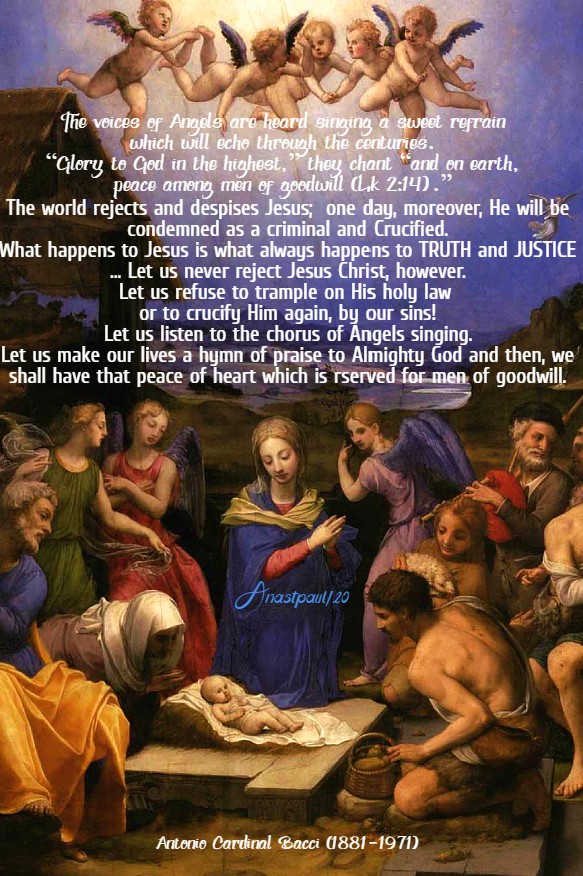
“While the earth, plunged in darkness, ignores the birth of Jesus, the sky brightens above the lowly barn in which the Infant is lying. The voices of Angels are heard singing a sweet refrain which will echo through the centuries. “Glory to God in the highest,” they chant “and on earth, peace among men of goodwill (Lk 2:14).”
The world rejects and despises Jesus; one day, moreover, He will be condemned as a criminal and Crucified. What happens to Jesus is what always happens to TRUTH and JUSTICE, which are often spurned by men but are always victorious in the end. For a time, truth and justice may seem to have been defeated once and for all but then, they triumph in an extraordinary manner. The example of Christ is enough to convince us of this.
Let us never reject Jesus Christ, however. Let us refuse to trample on His holy law or to crucify Him again, by our sins! Let us listen to the chorus of Angels singing. Let us make our lives a hymn of praise to Almighty God and then, we shall have that peace of heart which is rserved for men of goodwill.”
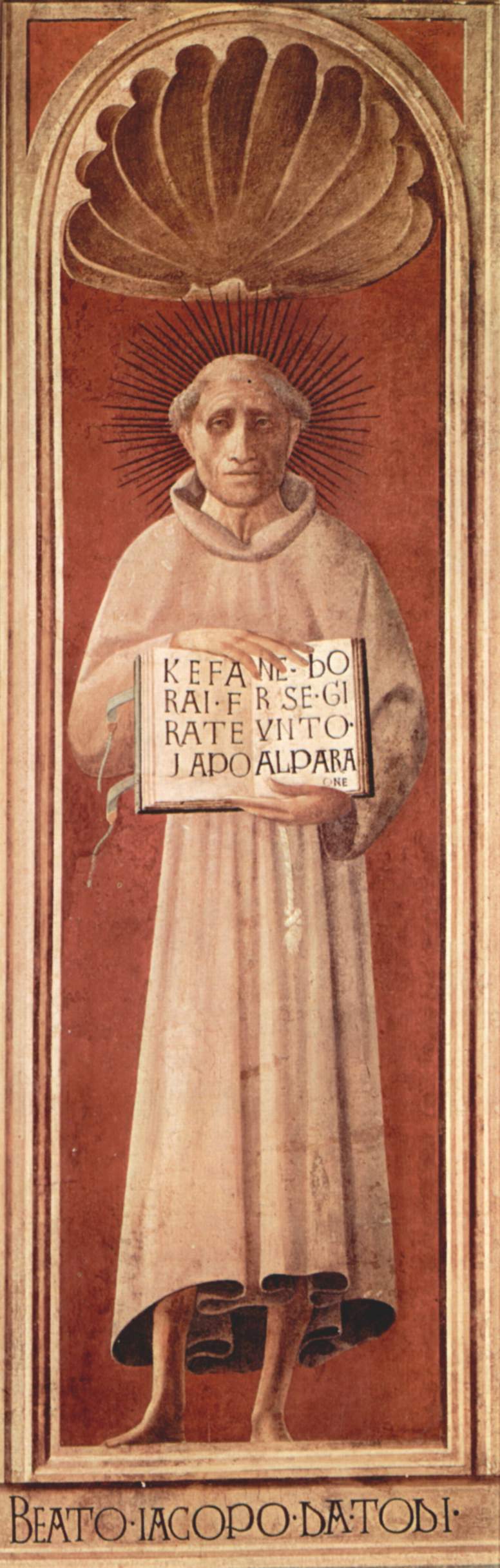
Quote/s of the Day – 25 December – The Solemnity of the Nativity of Our Lord, Jesus Christ and remembering Blessed Jacopone da Todi OFM (1230-1306)
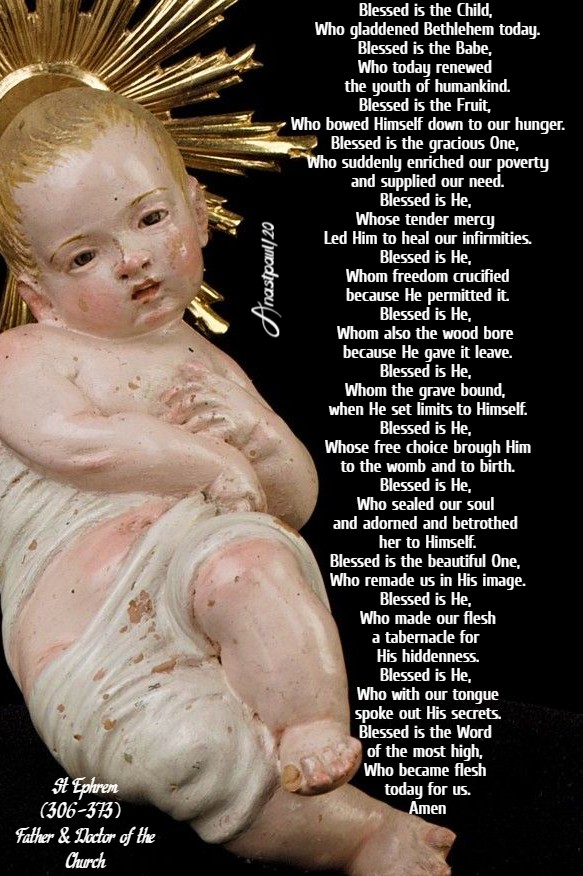
“Blessed is the Child, Who gladdened Bethlehem today. Blessed is the Babe, Who today renewed the youth of humankind. Blessed is the Fruit, Who bowed Himself down to our hunger. Blessed is the gracious One, Who suddenly enriched our poverty and supplied our need. Blessed is He, Whose tender mercy Led Him to heal our infirmities. Blessed is He, Whom freedom crucified because He permitted it. Blessed is He, Whom also the wood bore because He gave it leave. Blessed is He, Whom the grave bound, when He set limits to Himself. Blessed is He, Whose free choice brough Him to the womb and to birth. Blessed is He, Who sealed our soul and adorned and betrothed her to Himself. Blessed is the beautiful One, Who remade us in His image. Blessed is He, Who made our flesh a tabernacle for His hiddenness. Blessed is He, Who with our tongue spoke out His secrets. Blessed is the Word of the most high, Who became flesh today for us. Amen”
St Ephrem (306-373) Father & Doctor of the Church
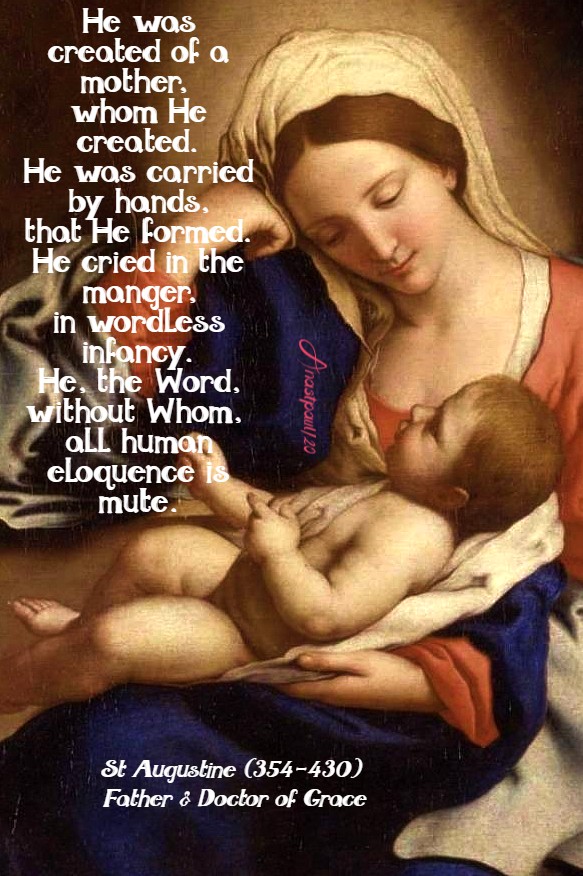
“He was created of a mother, whom He created. He was carried by hands, that He formed. He cried in the manger, in wordless infancy. He, the Word, without Whom, all human eloquence is mute.”
St Augustine (354-430) Father & Doctor of Grace
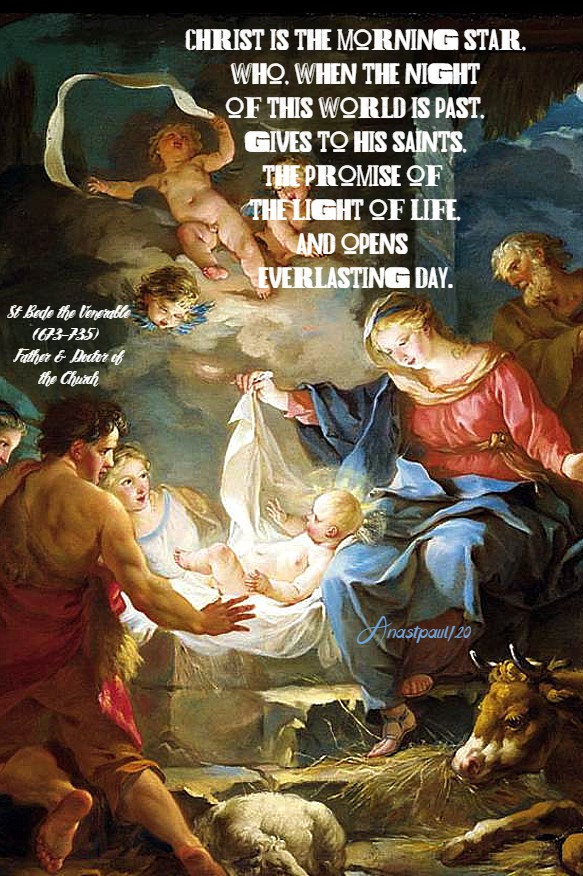
“Christ is the Morning Star, Who, when the night of this world is past, gives to His saints, the promise of the light of life, and opens everlasting day.”
St Bede the Venerable (673-735) Father & Doctor of the Church
“He came from His royal throne, the stern Conqueror of error and the gentle Apostle of love.”
William of Saint Thierry (c 1075-1148)
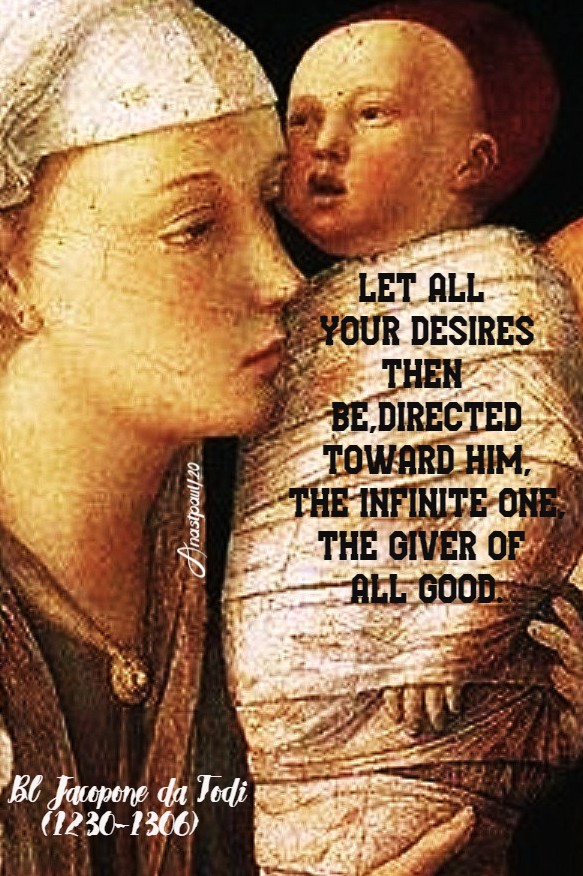
“Let all your desires then be, directed toward Him, the Infinite One, the Giver of all Good.”
Bl Jacopone da Todi (1230-1306)
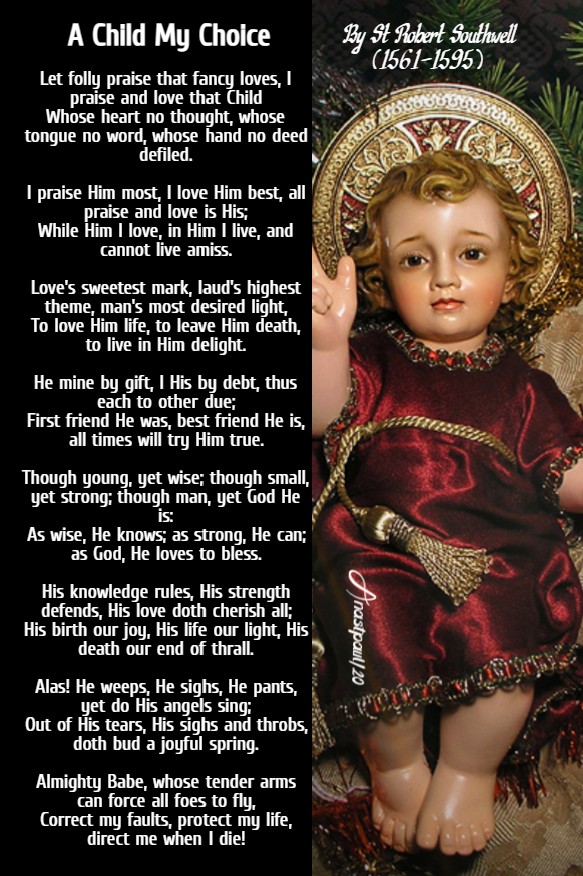
A Child My Choice By St Robert Southwell (1561-1595) Martyr
Let folly praise that fancy loves, I praise and love that Child Whose heart no thought, whose tongue no word, whose hand no deed defiled.
I praise Him most, I love Him best, all praise and love is His; While Him I love, in Him I live, and cannot live amiss.
Love’s sweetest mark, laud’s highest theme, man’s most desired light, To love Him life, to leave Him death, to live in Him delight.
He mine by gift, I His by debt, thus each to other due; First friend He was, best friend He is, all times will try Him true.
Though young, yet wise; though small, yet strong; though man, yet God He is: As wise, He knows; as strong, He can; as God, He loves to bless.
His knowledge rules, His strength defends, His love doth cherish all; His birth our joy, His life our light, His death our end of thrall.
Alas! He weeps, He sighs, He pants, yet do His angels sing; Out of His tears, His sighs and throbs, doth bud a joyful spring.
Almighty Babe, whose tender arms can force all foes to fly, Correct my faults, protect my life, direct me when I die!
Christ has been born for us, come, let us adore Him!
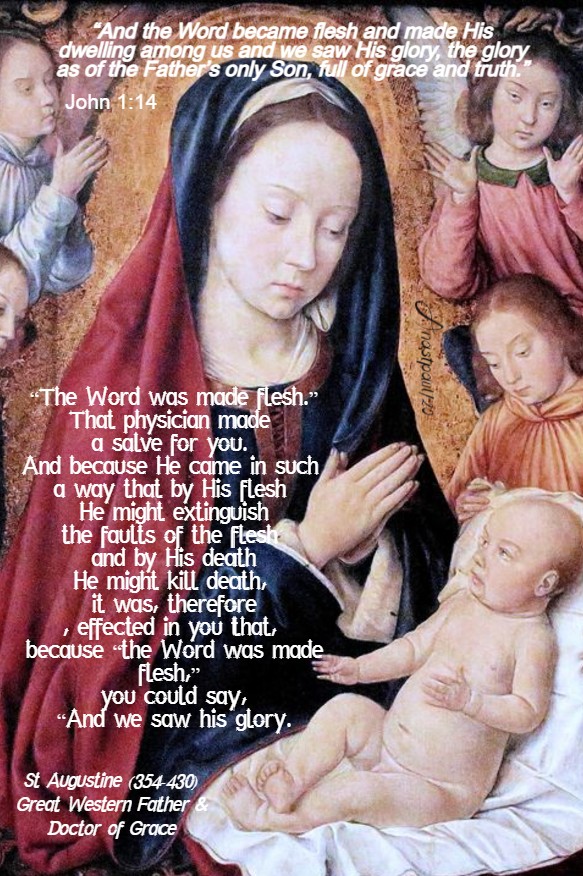
“And the Word became flesh and made His dwelling among us and we saw His glory, the glory as of the Father’s only Son, full of grace and truth.” – John 1:14
REFLECTION – “His glory no-one could see unless he was healed by the lowliness of His flesh. Why could we not see? Concentrate, my beloved people and see what I am saying. Dust, so to speak, had forcibly entered humanity’s eye; earth had entered it, had injured the eye and it could not see the light. That injured eye is anointed; it was injured by earth and earth is put there that it may be healed. For all salves and medicines are nothing but [compounds] of the earth. You have been blinded by dust, you are healed by dust; thus the flesh has blinded you, flesh heals you. For the soul had become carnal by assenting to carnal passions; from that the eye of the heart had been blinded. “The Word was made flesh.” That physician made a salve for you. And because He came in such a way that by His flesh He might extinguish the faults of the flesh and by His death He might kill death, it was, therefore, effected in you that, because “the Word was made flesh,” you could say, “And we saw his glory.” – St Augustine (354-430) Great Western Father & Doctor of Grace –Tractates on the Gospel of John, 2
PRAYER – Almighty God, Your incarnate Word fills us with the new light He brought to men. Let the light of faith in our hearts, shine through all that we do and say. We make our prayer through Jesus Christ, our Lord, with the Holy Spirit, God forever, amen.
The Word was God in the beginning and before all time, today, He is born to us, the Saviour of the world.
Our Morning Offering – 25 December – The Solemnity of the Nativity of Our Lord, Jesus Christ
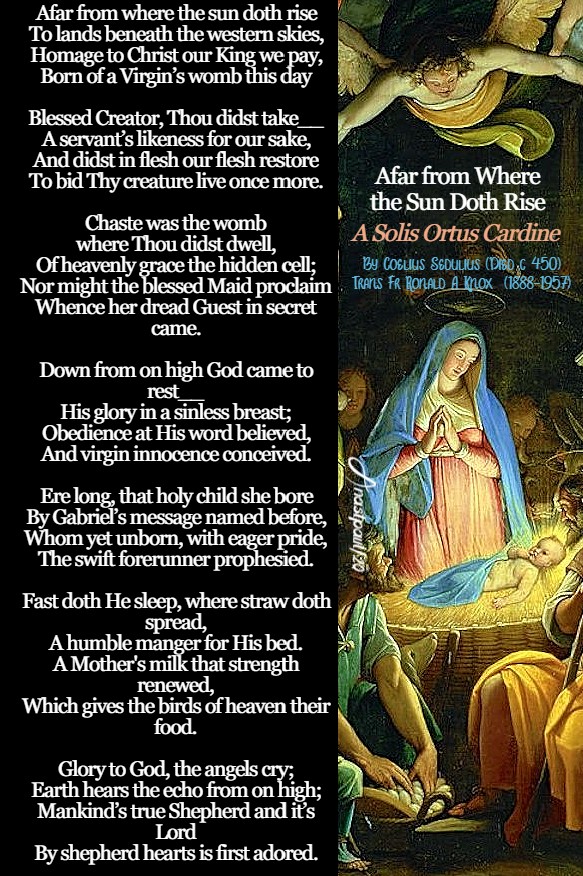
Afar from Where the Sun Doth Rise A Solis Ortus Cardine By Coelius Sedulius (Died c 450) Trans Fr Ronald A Knox (1888-1957)
Afar from where the sun doth rise To lands beneath the western skies, Homage to Christ our King we pay, Born of a Virgin’s womb this day
Blessed Creator, Thou didst take__ A servant’s likeness for our sake, And didst in flesh our flesh restore To bid Thy creature live once more.
Chaste was the womb where Thou didst dwell, Of heavenly grace the hidden cell; Nor might the blessed Maid proclaim Whence her dread Guest in secret came.
Down from on high God came to rest__ His glory in a sinless breast; Obedience at His word believed, And virgin innocence conceived.
Ere long, that holy child she bore By Gabriel’s message named before, Whom yet unborn, with eager pride, The swift forerunner prophesied.
Fast doth He sleep, where straw doth spread, A humble manger for His bed. A Mother’s milk that strength renewed, Which gives the birds of heaven their food.
Glory to God, the angels cry; Earth hears the echo from on high; Mankind’s true Shepherd and it’s Lord By shepherd hearts is first adored.
“A Solis Ortus Cardine…” (Latin for “From the Pivot of the Sun’s Rising”) is a poem by Christian Poet, Coelius Sedulius (Died c 450), recounting Christ’s life from His birth to His resurrection. Its 23 verses each begin with a consecutive letter of the Latin alphabet, making the poem an abecedarius. It is one of the oldest parts of the Roman Catholic liturgy, with two hymns formed from the first seven and four later verses. There have been monastic translations into Anglo-Saxon and later translations into other languages..
Saint of the Day – 25 December – Blessed Jacopone da Todi OFM (1230-1306) Franciscan Friar, Confessor, Hymnist, Poet, Mystic, Lawyer, – an Italian from Umbria in the 13th century. He wrote several laude (songs in praise of the Lord) in the local vernacular. He was an early pioneer in Italian theatre, being one of the earliest scholars who dramatised Gospel subjects. Born in c 1230 at Todi, Italy as Jacopo Benedetti and died on 25 December 1306 at Collazzone, Italy of natural causes, as the Priest intoned the Gloria from midnight Mass. He is also known as Jacomo da Todi, Jacopo Benedetti, Jacopo Benedicti, Jacopone Benedetti da Todi, Jacopone of Todi, James da Todi.
Jacomo, was born a noble member of the Benedetti family in the northern Italian city of Todi. He became a successful lawyer and married a pious, generous lady named Vanna.
His young wife took it upon herself to do penance for the worldly excesses of her husband. One day Vanna, at the insistence of Jacomo, attended a public tournament. She was sitting in the stands with the other noble ladies when the stands collapsed. Vanna was killed. Her shaken husband was even more disturbed when he realised that the penitential girdle she wore was for his sinfulness. On the spot, he vowed to radically change his life.
Jacomo divided his possessions among the poor and entered the Secular Franciscan Order. Often dressed in penitential rags, he was mocked as a fool and called Jacopone, or “Crazy Jim,” by his former associates. The name became dear to him.
After 10 years of such humiliation, Jacopone asked to be received into the Order of Friars Minor. Because of his reputation, his request was initially refused. He composed a beautiful poem on the vanities of the world, an act that eventually led to his admission into the Order in 1278. He continued to lead a life of strict penance, declining to be ordained a priest. Meanwhile, he was writing popular hymns in the vernacular.
Jacopone suddenly found himself a leader in a disturbing religious movement among the Franciscans. The Spirituals, as they were called, wanted a return to the strict poverty of Francis. They had on their side two cardinals of the Church and Pope Celestine V. These two cardinals though, opposed Celestine’s successor, Boniface VIII. At the age of 68, Jacopone was excommunicated and imprisoned. Although he acknowledged his mistake, Jacopone was not absolved and released until Benedict XI became Pope five years later. He had accepted his imprisonment as penance. He spent the final three years of his life more spiritual than ever, weeping “because Love is not loved.”During this time he wrote the famous Latin hymn, Stabat Mater.
On Christmas Eve in 1306 Jacopone felt that his end was near. He was in a convent of the Poor Clares with his friend, Blessed John of La Verna. Like Francis, Jacopone welcomed “Sister Death” with one of his favorite songs. It is said that he finished the song and died as the Priest intoned the “Gloria” from the midnight Mass at Christmas. From the time of his death, Brother Jacopone has been venerated as a saint, both within and outside of the Franciscan Order, although never formally Canonised.
Here lie the bones of Blessed Jacopone dei Benedetti da Todi, Friar Minor, who, having gone mad with love of Christ, by a new artifice deceived the world and took Heaven by violence. – from the tomb of Blessed Jacopone
Stabat Mater Dolorosa is a fine example of religious lyric in the Franciscan tradition. It was inserted into the Roman Missal and Breviary in 1727 for the Feast of the Seven Sorrows of the Blessed Virgin Mary, celebrated on the Friday before Good Friday. Following changes by Pope Pius XII, it now appears on the Feast of Our Lady’s Sorrows celebrated on 15 September. Many composers have set it to music
His contemporaries called Jacopone, “Crazy Jim.” We might well echo their taunt, for what else can you say about a man who broke into song in the midst of all his troubles? We still sing Jacopone’s saddest song, the Stabat Mater, but we Christians claim another song as our own, even when the daily headlines resound with discordant notes. Jacopone’s whole life rang out our song: “Alleluia!” May he inspire us to keep singing.
The Nativity of the Lord, Jesus Christ (Solemnity) Celebration of the anniversary of the birth of Our Lord. In the earliest days of the Church there was no such feast, the Saviour’s birth was commemorated with the Epiphany by the Greek and other Eastern Churches. First mention of the feast, then kept on 20 May, was made by Clement of Alexandria c 200. The Latin Church began c 300 to observe it on 25 December, though there is no certainty that Our Lord was born on that day. Priests have the privilege of saying three Masses, at midnight, daybreak and morning. This was originally reserved to the Holy Father alone – beginning about the 4th century he celebrated a midnight Mass in the Lateran Basilica (in which according to tradition, the manger of Bethlehem is preserved), a second in the church of Saint Anastasia, whose feast comes on 25 December and a third at the Vatican Basilica. Many peculiar customs of the day are the outcome of the pagan celebrations of the January calender. The Christmas tree, of which the first known mention was made in 1605 at Strasbourg, was introduced into France and England in 1840. The feast is a holy day of obligation, preceded by the preparatory season of Advent and by a special vigil – should it fall on a Friday it abrogates the law of abstinence. Today’s Gospel is the prologue of John.
St Adalsindis of Hamay St Alburga of Wilton St Anastasia of Sirmium Bl Artale St Basilée of the Via Latina Bl Bentivoglio de Bonis Bl Diego de Aro St Eugenia of Rome St Fulk of Toulouse Blessed Jacopone da Todi OFM (1230-1306) Franciscan Friar, Author of the “Stabat Mater” St Jovin of the Via Latina Bl Maria Therese von Wüllenweber Bl Matthew of Albano Bl Michael Nakashima Saburoemon Bl Nera St Romulus of Berry — Martyrs of Nicomedia: 20,000 Christians martyred by order of Diocletian. They were reported to have all been in the single basilica to celebrate Christmas. While there unquestionably was an endless series of martyrs under Diocletian, it’s likely the ancient sources exaggerated the numbers of this incident. And as the Christmas holy day was not celebrated in the East in 303, they were probably gathered for another feast. They were burned alive in 303 in the basilica of Nicomedia.
I offer today, special Prayers for you ALL and for all my extended family on WordPress. Most especially, my heart’s deepest thanksgiving for those most generous and loving Donors, who, in their generosity have constantly contributed to the upkeep of this site. For Rosemary, Hugh, Melanie who have sent Christmas gifts –
Thank you!
“Enter his gates with thanksgiving and his courts with praise, give thanks to him and praise his name.” Psalm 100:4
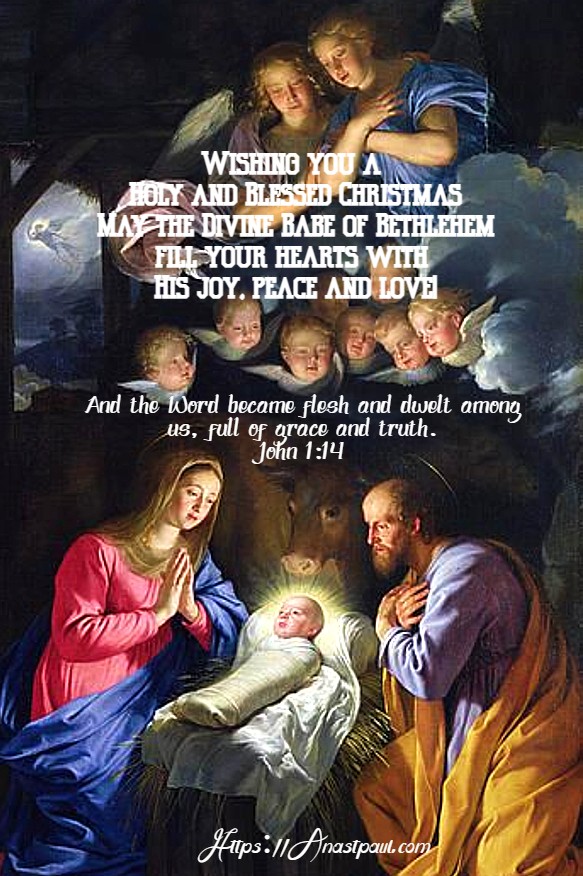
And my wishes for a most Holy and Blessed Christmas May the Divine Babe of Bethlehem fill your hearts with His joy, peace and love! Love Ana
And the Word became flesh and dwelt among us, full of grace and truth; we have beheld his glory, glory as of the only Son from the Father.
Thought for the Day – 24 December – Meditations with Antonio Cardinal Bacci (1881-1971)
The Holy Family – Jesus
“We have in the Holy Family, the highest possible models of perfection – Jesus, Mary and Joseph. As God, Jesus is essentially holy. By means of the Hypostatic Union, this sanctity is transmitted also to His human nature. The holiness of Jesus was only gradually revealed as He grew older because He wished to be like us in everything, save in sin. As the Gospel says, He “advanced in wisdom and age and grace before God and men” (Lk 2:52). Jesus gave us an example of holiness which we should find easier to imitate because it was eternally increasing all the time. He offered us, as an example, the kind of sanctity which has its beginning and foundation in utter humility and detachment from worldly goods. “Learn from me, for I am meek and humble of heart” (Mt 11:29).
Socrates advised his followers to have few desires and to desire these as little as possible, in order to remain content, for the man who is full of desires is always uneasy and restless. This human counsel is very true but, it is incomplete. It recommends detachment from earthly things but fails to tech the ardent and practical desire for supernatural things. Jesus Christ teaches us both. After He has urged us to become gentle and humble like Himself, after He has told us not to worry about the future and not to fret about what to wear and what to eat, He points out the way in which Providence clothes the lilies of the filed and feeds the birds of the air. Then He adds: “Seek the kingdom of God and all these things shall be given you besides” (Cf Lk. 12:22-31).
We must limit and moderate our desire for earthly goods, therefore but, should ardently yearn to love God, to serve and obey Him in this life and to enjoy Him forever in Heaven. This is what the Infant Jesus wishes to teach us.”
Quote/s of the Day – 24 December – The Nativity of the Lord, Mass at Midnight
… Let us keep the Feast, not after the manner of a heathen festival but after a godly sort; not after the way of the world but in a fashion above the world; not as our own but as belonging to Him who is ours, or rather as our Master’s; not as of weakness but as of healing; not as of creation but of re-creation.”
St Gregory of Nazianzen (330-390) Archbishop of Constantinople Father and Doctor of the Church
“Jesus Christ, the God-Man, was born in a manger and is spiritually reborn on the altar. He suffered on Calvary and continues to offer Himself on the altar. In His earthly life, He spread His teaching and worked miracles among the crowds. In the Eucharist, He spans the centuries and communicates Himself to all.”
St John Chrysostom (347-407) Father & Doctor of the Church
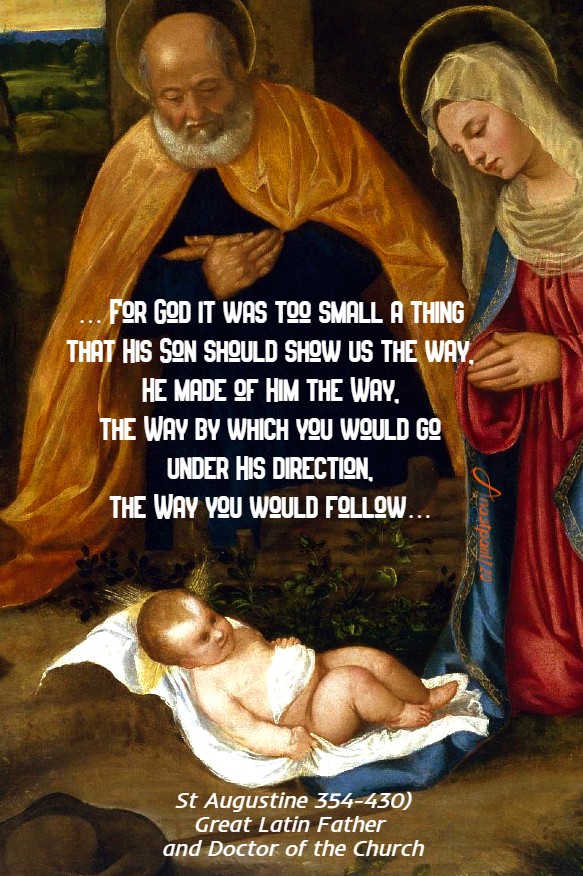
“… For God it was too small a thing that His Son should show us the way, He made of Him the Way (cf Jn 14:6), the Way by which you would go under His direction, the Way you would follow…”
“Awake, mankind! For your sake God has become man. Awake, you who sleep, rise up from the dead and Christ will enlighten you. I tell you again, for your sake, God became man.”
St Augustine 354-430) Great Latin Father and Doctor of the Church
Know today that the Lord will come – in the morning you will see His glory.
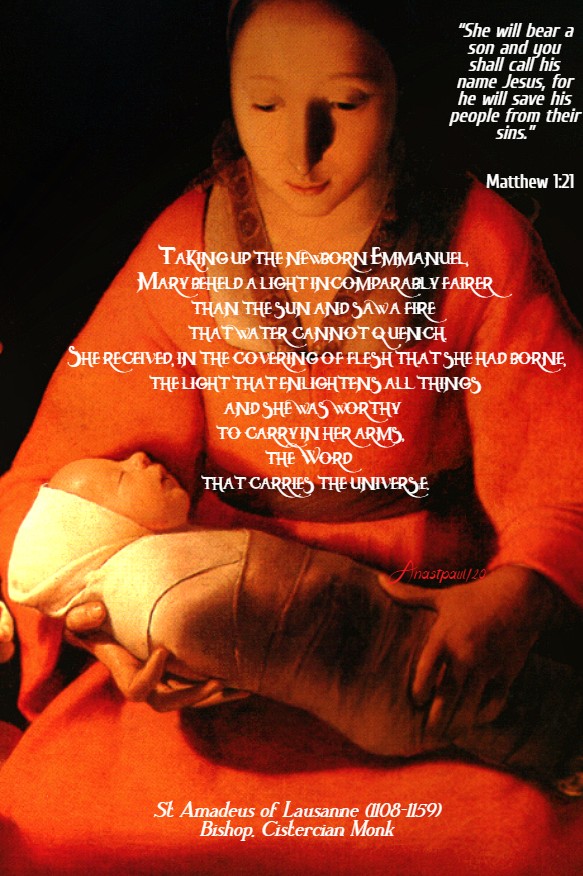
“She will bear a son and you shall call his name Jesus, for he will save his people from their sins.” … Matthew 1:21
REFLECTION – “The heavens were glad, earth exulted when Mary gave birth and hell was troubled and aghast. The heavens in their joy produced a shining star and a glorious army of angels, uttering praise and saying: “Glory to God in the highest and on earth peace to people of good will.” (Lk 2:14) The earth, exulting, brought shepherds giving glory and magi adoring and offering gifts, gold, frankincense and myrrh. … Reflect how that night poured forth light in the darkness and instead of blackness, it offered radiance. It gave light before the sun arose and a brightness which, from its exceeding brilliance, obscured the splendour of the sun. Concerning this night the psalmist says: “Night is my light in my delights” and turning to the Lord he says: “The darkness will not be dark for you and the night will be as bright as the day, for the darkness is as light for him” (cf Ps 38[139]:11-12 LXX). … Taking up the newborn Emmanuel, Mary beheld a Light incomparably fairer than the sun and saw a Fire that water cannot quench. She received, in the covering of flesh Whom she had borne, the Light Who enlightens all things and she was worthy, to carry in her arms, the Word Who carries the universe!– St Amadeus of Lausanne (1108-1159) Bishop, Cistercian Monk – Homilies in praise of the Blessed Virgin Mary, IV, SC 72
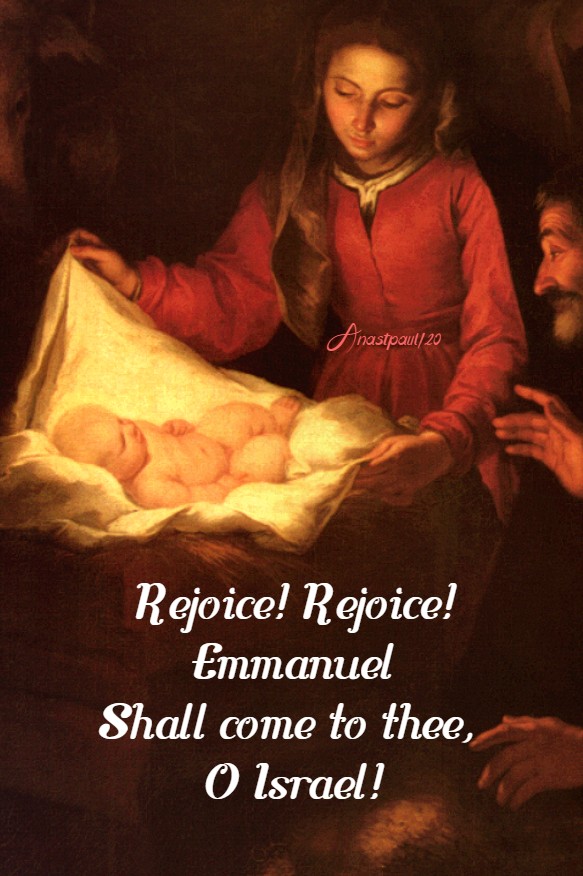
PRAYER – Rejoice! Rejoice! Emmanuel Shall come to thee, O Israel! May the Lord bless us, protect us from all evil and bring us to everlasting life. Amen
Our Morning Offering – 24 December – Vigil of the Nativity of the Lord/Mass at Midnight
What Child is This?
What child is this, who, laid to rest On Mary’s lap, is sleeping? Whom angels greet with anthems sweet, While shepherds watch are keeping? This, this is Christ the King, Whom shepherds guard and angels sing: Haste, haste to bring him laud, The Babe, the Son of Mary!
Why lies He in such mean estate, Where ox and ass are feeding? Good Christians, fear, for sinners here The silent Word is pleading. Nails, spear shall pierce Him through, The cross be borne for me, for you. Hail, hail the Word made flesh, The Babe, the Son of Mary.
So bring Him incense, gold and myrrh, Come peasant king to own Him, The King of kings, salvation brings, Let loving hearts enthrone Him. Raise, raise the song on high, The Virgin sings her lullaby: Joy, joy, for Christ is born, The Babe, the Son of Mary!
By William C Dix (1837-1898) English Hymnist and is sung to the tune of Greensleeves.
Saint of the Day – 24 December – Saint Hanno of Worms OSB (Died 978) Bishop of Worms from 950 until his death, Benedictine Monk – born in the 10th century Hesse, Germany and died on 24 December 978 in Worms, Germany of natural causes. St Hanno – also known as Anno – is also venerated on 20 September by the Benedictines and by the Diocese and City of Worms.
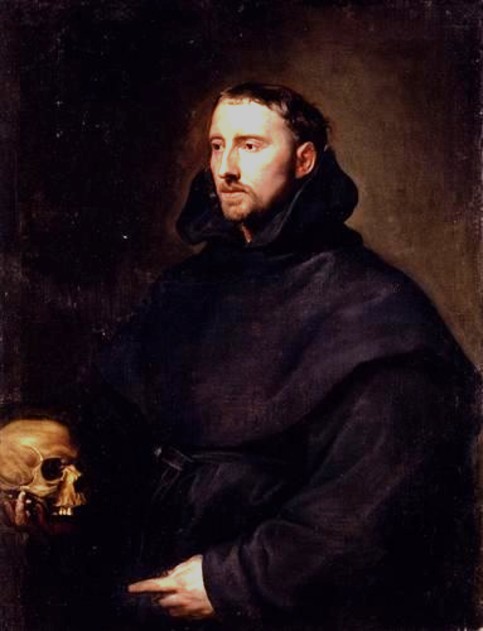
We have no image of St Hanno – this is a portrait of a Benedictine Monk by Sir Antony van Dyck
Hanno came from a noble family from the environment of Emperor Otto I. The Worms Chronicle of Friedrich Zorn (1604), based on older sources, says about the Bishop “a Hess with the name of Hanno” and also cites the text of his grave inscription. He began his Christian theological work as a Monk of the Benedictine Abbey of St Maximin in Trier. King Otto I appointed him first Abbot of the Mauritius monastery in Magdeburg in 937.
Thirteen years later in 950, Hanno became the 15th Bishop of Worms at the behest of the later emperor.
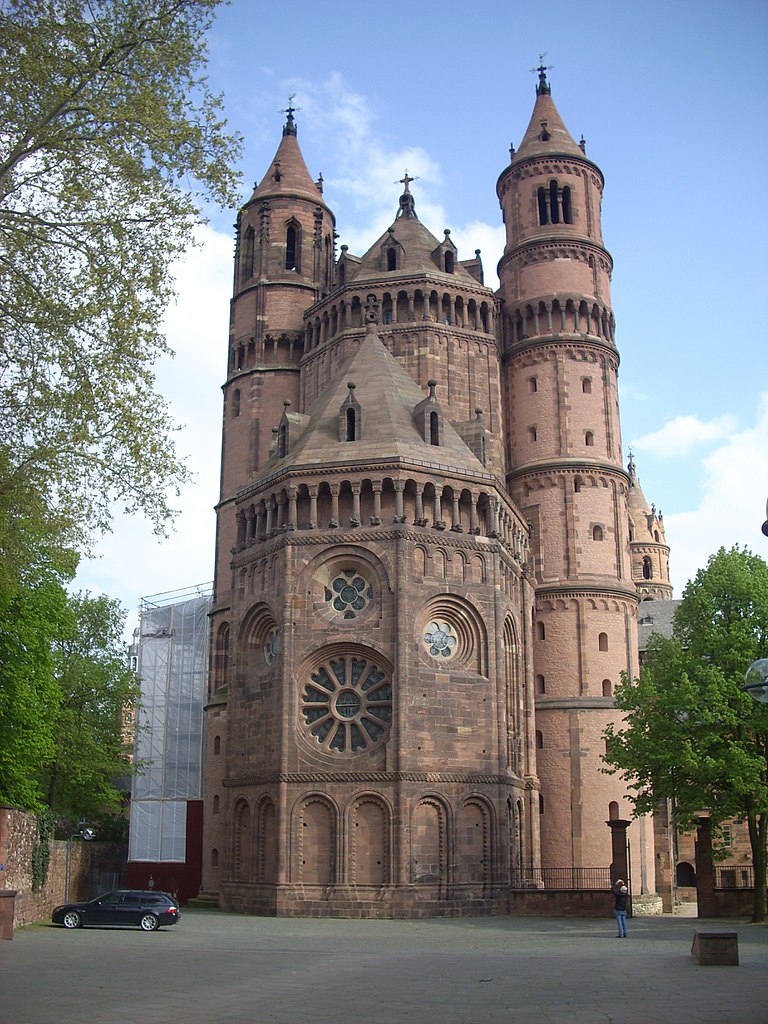
Worms Cathedral
In 952 he took part in the Synod of Augsburg with St Ulrich. In 964 Bishop Hanno visited Rome – in the consecration bull of angels relating to the Swiss Benedictine monastery Maria Einsiedeln, Pope Leo VIII named him on 11 November of that year among the prelates who had come to Rome from Germany and were consulted by him on this matter. Hanno visited Rome again in 970 and visited Ravenna on 29 March with the Empress and Crown Prince Otto. In 976 Emperor Otto II transferred the Mosbach Benedictine monastery to Hanno administration and care.
Since 24 December 978 has been passed down as the anniversary of Hanno’s death, today on Christmas Eve he is listed in the Roman Martyrology.
According to the Worms Chronicle by Friedrich Zorn (1604), the episcopal successor Hildebold, was his brother.
24 December – Vigil of the Nativity of the Lord/Mass at Midnight In many Western Christian traditions Midnight Mass is the first liturgy of Christmastide that is celebrated on the night of Christmas Eve, traditionally beginning at midnight when Christmas Eve gives way to Christmas Day. This popular Christmas custom is a jubilant celebration of the Mass in honour of the Nativity of Jesus, even many of those Christian denominations that do not regularly employ the word “Mass” uniquely use the term “Midnight Mass” for their Christmas Eve liturgy.
Saint Thomas Aquinas wrote a commentary on these words and explained in his Summa Theologiae, “And from this the Mass derives its name … the deacon on festival days ‘dismisses’ the people at the end of the Mass, by saying: ‘Ite, missa est,’ that is, the victim [Jesus] has been sent to God through the angel, so that it may be accepted by God.”
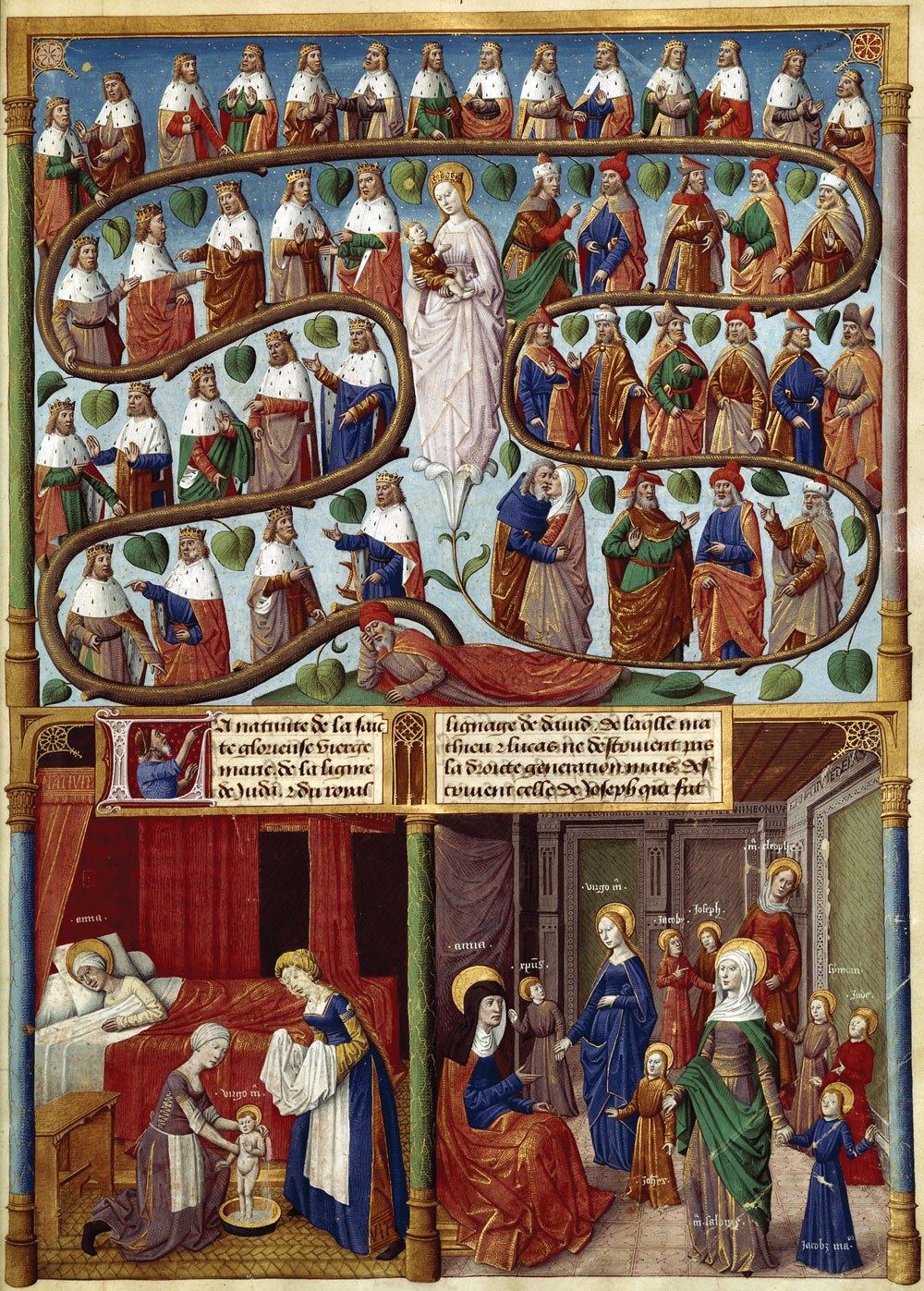
All the Holy Ancestors of Christ – A commemoration of all the holy ancestors of Jesus Christ.
The New Testament has preserved two different genealogies of Our Lord, in Matthew 1; and Luke 3.
Saint Matthew’s list is divided artificially into three equal parts of 14 names each, with several intentional omissions: from Abraham the father of the chosen people to David the king, to whose family the promise was made (2 Kings 7); David and the royal line after him to the Babylonian captivity; the descendants of the royal line from the captivity to Joseph, the legal father of Our Lord.
Saint Luke proceeds in reverse order; he starts from Joseph and goes, beyond Abraham, back to Adam the father of the human race, in accord with the character of his Gospel; and he merely enumerates the names without grouping them according to a thesis or point, as is the case in Saint Matthew.
Few names are common to both lists: viz., those between Abraham and David, then Salathiel and Zorobabel after the captivity, and Joseph the foster-father of Christ; the others are absent from Matthew’s list, or the persons are different. To account for these differences several explanations have been advanced, but no decisive evidence is extant. Not a few authors hold that Saint Luke gives Mary’s genealogy; but this view is more generally considered improbable, so that both lists are taken as giving Joseph’s ancestry. Only it must be supposed that at several points, instead of the actual descent, the one or the other of the lists gives the legal relationship based on adoption in some manner. Our Lord was considered to belong to the family of David; this seems to be taken for granted in the New Testament, where we find no difficulty raised against Him on the ground of His descent. The genealogies show His relationship to the royal family of Juda through Joseph, as it was only through the father, legal or natural, that the rights could be transmitted, and Joseph was the legal father of Jesus. To trace Our Lord’s ancestry through His mother would not have served the purpose of the Evangelists.
Matthew 1:1-17
The book of the genealogy of Jesus Christ, the son of David, the son of Abraham.
Abraham became the father of Isaac, Isaac the father of Jacob, Jacob the father of Judah and his brothers. Judah became the father of Perez and Zerah, whose mother was Tamar. Perez became the father of Hezron, Hezron the father of Ram, Ram the father of Amminadab. Amminadab became the father of Nahshon, Nahshon the father of Salmon, Salmon the father of Boaz, whose mother was Rahab. Boaz became the father of Obed, whose mother was Ruth. Obed became the father of Jesse, Jesse the father of David the king. David became the father of Solomon, whose mother had been the wife of Uriah. Solomon became the father of Rehoboam, Rehoboam the father of Abijah, Abijah the father of Asaph. Asaph became the father of Jehoshaphat, Jehoshaphat the father of Joram, Joram the father of Uzziah. Uzziah became the father of Jotham, Jotham the father of Ahaz, Ahaz the father of Hezekiah. Hezekiah became the father of Manasseh, Manasseh the father of Amos, Amos the father of Josiah. Josiah became the father of Jechoniah and his brothers at the time of the Babylonian exile. After the Babylonian exile, Jechoniah became the father of Shealtiel, Shealtiel the father of Zerubbabel, Zerubbabel the father of Abiud. Abiud became the father of Eliakim, Eliakim the father of Azor, Azor the father of Zadok. Zadok became the father of Achim, Achim the father of Eliud, Eliud the father of Eleazar. Eleazar became the father of Matthan, Matthan the father of Jacob, Jacob the father of Joseph, the husband of Mary. Of her was born Jesus who is called the Messiah.
Thus the total number of generations from Abraham to David is fourteen generations; from David to the Babylonian exile, fourteen generations; from the Babylonian exile to the Messiah, fourteen generations.
Luke 3:23-38
When Jesus began his ministry he was about thirty years of age. He was the son, as was thought, of Joseph, the son of Heli, the son of Matthat, the son of Levi, the son of Melchi, the son of Jannai, the son of Joseph, the son of Mattathias, the son of Amos, the son of Nahum, the son of Esli, the son of Naggai, the son of Maath, the son of Mattathias, the son of Semein, the son of Josech, the son of Joda, the son of Joanan, the son of Rhesa, the son of Zerubbabel, the son of Shealtiel, the son of Neri, the son of Melchi, the son of Addi, the son of Cosam, the son of Elmadam, the son of Er, the son of Joshua, the son of Eliezer, the son of Jorim, the son of Matthat, the son of Levi, the son of Simeon, the son of Judah, the son of Joseph, the son of Jonam, the son of Eliakim, the son of Melea, the son of Menna, the son of Mattatha, the son of Nathan, the son of David, the son of Jesse, the son of Obed, the son of Boaz, the son of Sala, the son of Nahshon, the son of Amminadab, the son of Admin, the son of Arni, the son of Hezron, the son of Perez, the son of Judah, the son of Jacob, the son of Isaac, the son of Abraham, the son of Terah, the son of Nahor, the son of Serug, the son of Reu, the son of Peleg, the son of Eber, the son of Shelah, the son of Cainan, the son of Arphaxad, the son of Shem, the son of Noah, the son of Lamech, the son of Methuselah, the son of Enoch, the son of Jared, the son of Mahalaleel, the son of Cainan, the son of Enos, the son of Seth, the son of Adam, the son of God.
Blessed Mercedarian Sisters – (6 beati): Six cloistered Mercedarian nuns at the convent of Vera Cruz in Berriz, Spain. Noted for their devotion to the rules of the Order and for their deep prayer lives. • Blessed Anna Maria Prieto • Blessed Anna de Arrano • Blessed Orsola de Larisgoizia • Blessed Maguna Mary • Blessed Margaret • Blessed Mary of the Assumption Sarria
Martyred Maidens of Antioch – (40 saints): A group of forty virgins martyred in the persecutions of Decius. None of their names have come down to us. They were martyred in 250 in Antioch, Syria.
Martyrs of Tripoli – (6 saints): A group of Christians martyred together, date unknown. The only details that have surived are six of the names – Drusus, Lucian, Metrobius, Paul, Theotimus and Zenobius. They were martyred in Tripoli, Libya.
Thought for the Day – 23 December – Meditations with Antonio Cardinal Bacci (1881-1971)
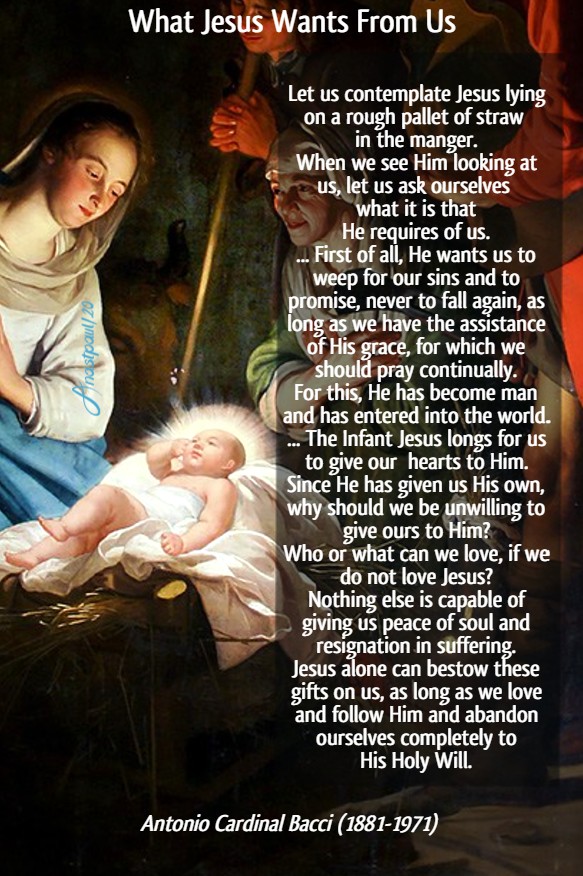
What Jesus Wants From Us
“Let us contemplate Jesus lying on a rough pallet of straw in the manger. When we see Him looking at us, let us ask ourselves what it is that He requires of us. In fact, He wants many things from us. First of all, He wants us to weep for our sins and to promise, never to fall again, as long as we have the assistance of His grace, for which we should pray continually. For this, He has become man and has entered into the world. For this He will work miracles, preach His doctrine and shed His Precious Blood on the Cross. All this He will do to redeem us from sin and to win Heaven for us.
If we return to the path of sin, we destroy the divine work of redemption, inasfar as it applies to ourselves. We make Christ’s passion, death and resurrection useless in our case. We brush aside the chain of favours with which His love has girdled us – the Gospel, the Sacraments and the Church, our good mother who is always at our side to instruct and direct us, to rescue us from peril and, to distribute to us, the gifts of her divine Founder. When we sin, we commit an act of base ingratitude to Jesus and accomplish our own eternal ruin.
The Infant Jesus longs for us to give our hearts to Him. Since He has given us His own, why should we be unwilling to give ours to Him? Who or what can we love, if we do not love Jesus? Nothing else is capable of giving us peace of soul and resignation in suffering. Jesus alone can bestow these gifts on us, as long as we love and follow Him and abandon ourselves completely to His Holy Will.”
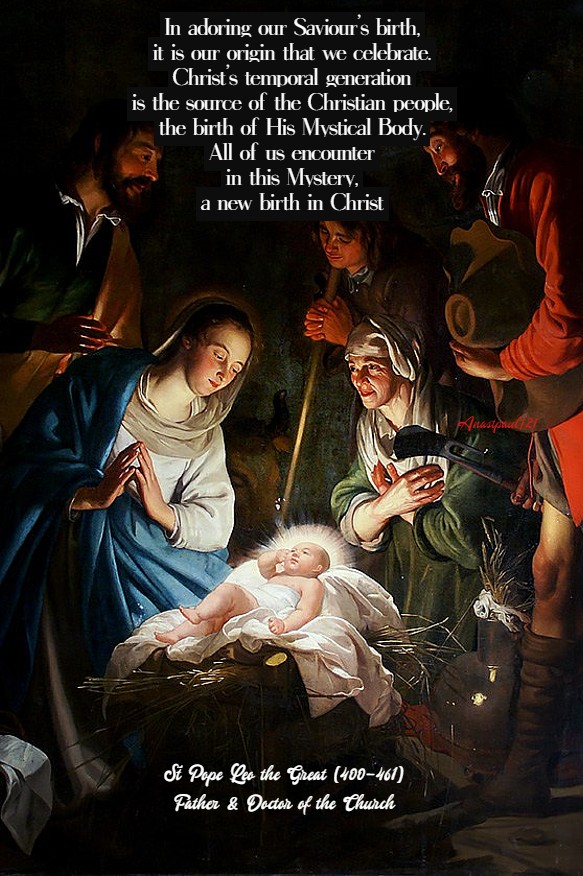
“In adoring our Saviour’s birth, it is our origin that we celebrate. Christ’s temporal generation is the source of the Christian people, the birth of His Mystical Body. All of us encounter in this Mystery, a new birth in Christ.”
St Pope Leo the Great (400-461) Father & Doctor of the Church
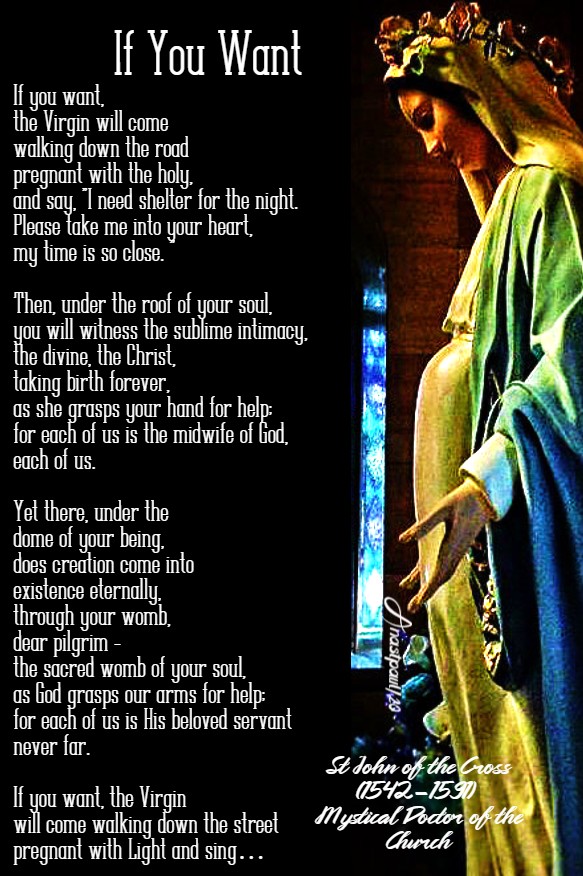
“If you want, the Virgin will come walking down the road pregnant with the Holy, and say, “I need shelter for the night. Please take me into your heart, my time is so close. ”
Then, under the roof of your soul, you will witness the sublime intimacy, the divine, the Christ, taking birth forever, as she grasps your hand for help; for each of us is the midwife of God, each of us.
Yet there, under the dome of your being, does creation come into existence eternally, through your womb, dear pilgrim – the sacred womb of your soul, as God grasps our arms for help; for each of us is His beloved servant never far.
If you want, the Virgin will come walking down the street pregnant with Light and sing…”
St John of the Cross (1542-1591) Mystical Doctor of the Church
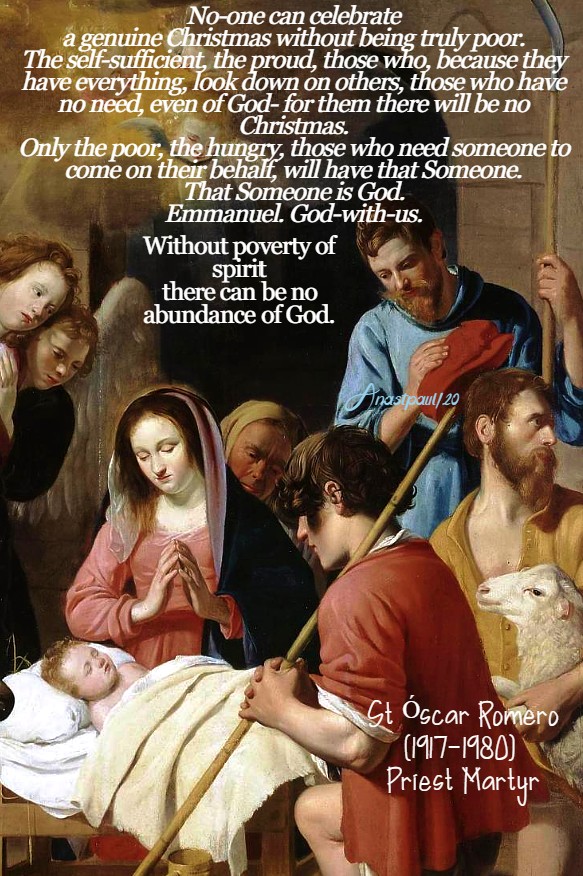
“No-one can celebrate a genuine Christmas without being truly poor. The self-sufficient, the proud, those who, because they have everything, look down on others, those who have no need, even of God- for them there will be no Christmas. Only the poor, the hungry, those who need someone to come on their behalf, will have that Someone. That Someone is God. Emmanuel. God-with-us. Without poverty of spirit there can be no abundance of God.”
Advent Reflection – 23 December – O Emmanuel – Readings: Malachi 3:1-4, 23-24, Psalms 25:4-5,8-9, 10 and 14, Luke 1:57-66
The Lord is at hand, come, let us adore Him.
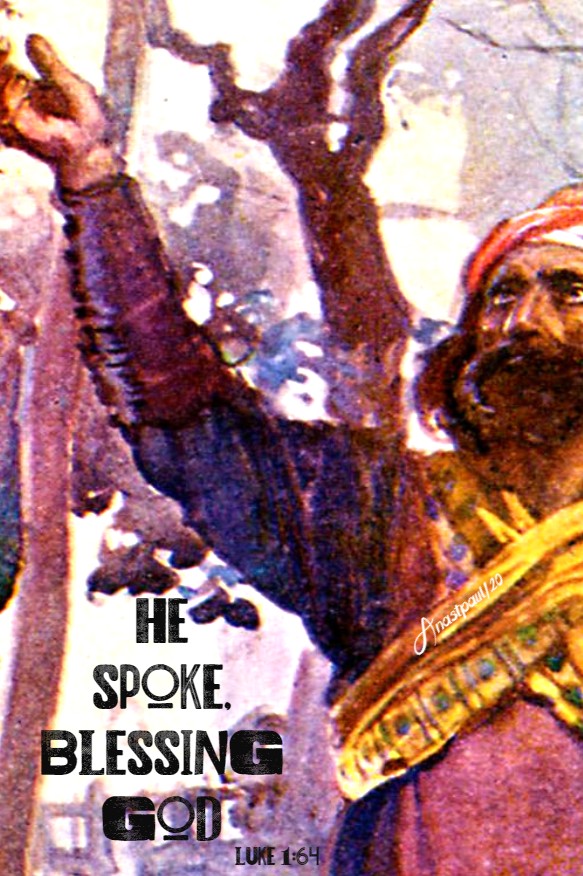
“He spoke, blessing God ” – Luke 1:64
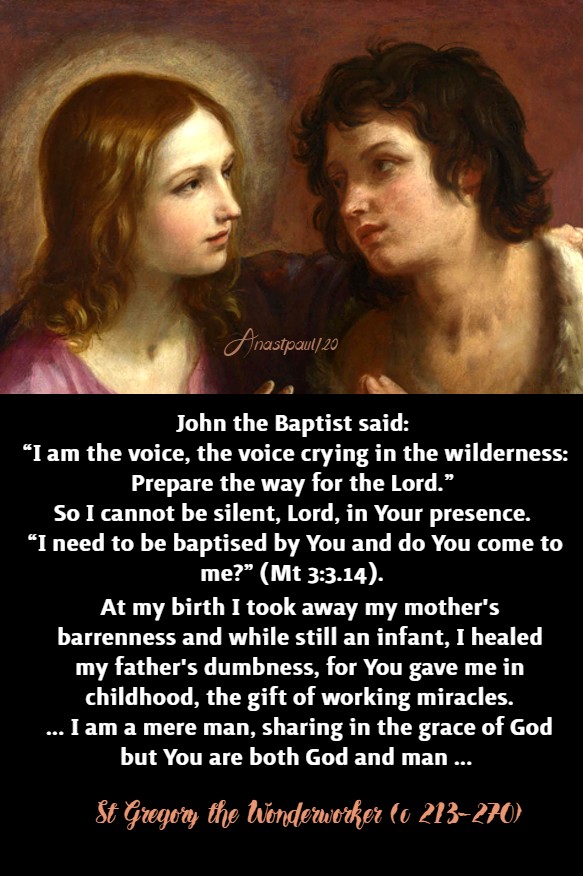
REFLECTION – [John the Baptist said:] “I am the voice, the voice crying in the wilderness: Prepare the way for the Lord.” So I cannot be silent, Lord, in Your presence. “I need to be baptised by you and do you come to me?” (Mt 3:3.14). At my birth I took away my mother’s barrenness and while still an infant, I healed my father’s dumbness, for You gave me in childhood, the gift of working miracles. But when You were born of the Virgin Mary, in the way You willed and in a manner known to You alone, You did not take away her virginity but while preserving it intact, You gave her, in addition, the name of “mother.” Her virginity did not hinder Your birth, nor did Your birth destroy her virginity. On the contrary, two opposites, motherhood and virginity, were easily united by You, because the laws of nature have their origin in You. I am a mere man, sharing in the grace of God but You are both God and man because of Your love for humankind (cf. Wis 1:6). ” – Homily attributed to Saint Gregory the Illuminator (c 213-270) Bishop – Homily on the holy Incarnation, 4
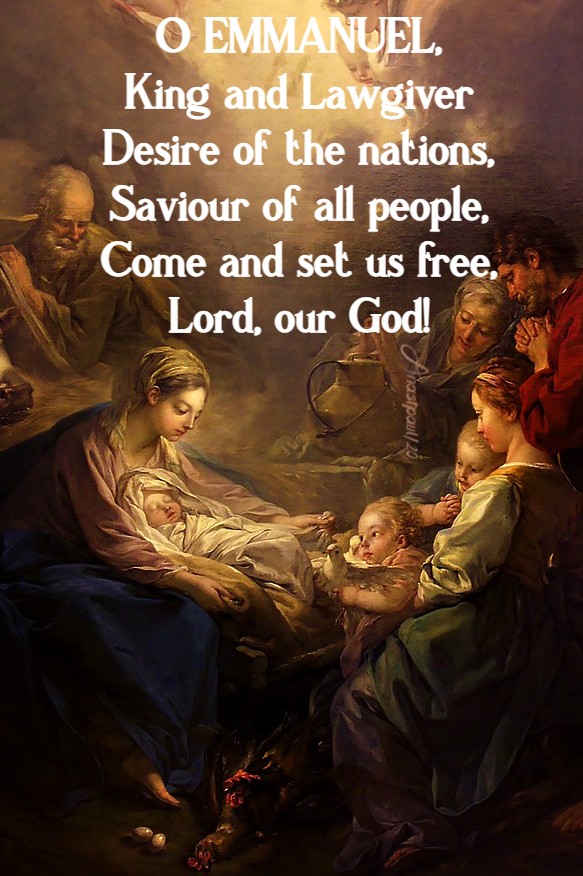
PRAYER O Emmanuel, King and Lawgiver Desire of the nations, Saviour of all people, Come and set us free, Lord, our God!
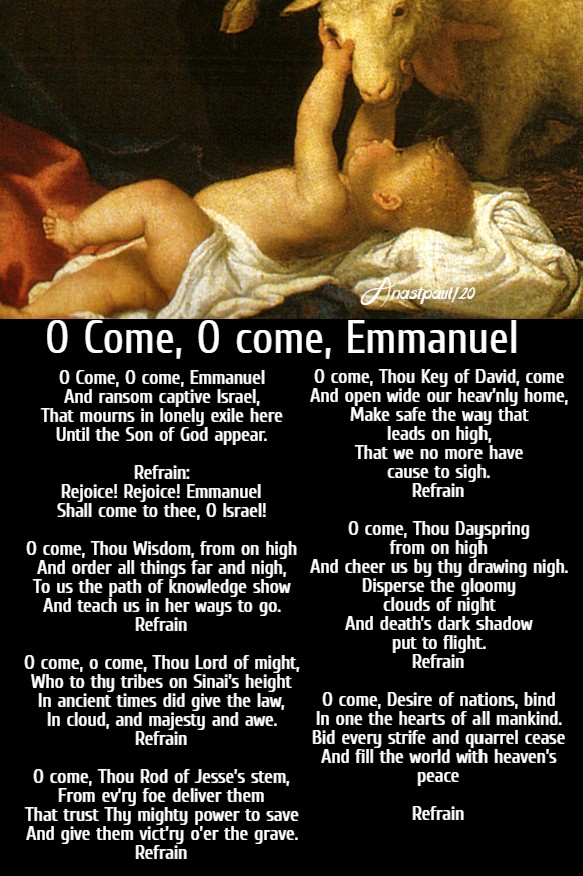
O Come, O come, Emmanuel And ransom captive Israel, That mourns in lonely exile here Until the Son of God appear.
Refrain: Rejoice! Rejoice! Emmanuel Shall come to thee, O Israel!
O come, Thou Wisdom, from on high And order all things far and nigh, To us the path of knowledge show And teach us in her ways to go. Refrain
O come, o come, Thou Lord of might, Who to thy tribes on Sinai’s height In ancient times did give the law, In cloud, and majesty and awe. Refrain
O come, Thou Rod of Jesse’s stem, From ev’ry foe deliver them That trust Thy mighty power to save And give them vict’ry o’er the grave. Refrain
O come, Thou Key of David, come And open wide our heav’nly home, Make safe the way that leads on high, That we no more have cause to sigh. Refrain
O come, Thou Dayspring from on high And cheer us by thy drawing nigh. Disperse the gloomy clouds of night And death’s dark shadow put to flight. Refrain
O come, Desire of nations, bind In one the hearts of all mankind. Bid every strife and quarrel cease And fill the world with heaven’s peace. Refrain
The favourite O Come, O Come Emmanuel carol was originally written in Latin text in the 12th Century. The author of the words and composer to the music of O Come, O Come Emmanuel is unknown. It is, however, believed that the melody was of French origin and added to the text a hundred years later. The Latin was translated into English by John Mason Neale in 1851.
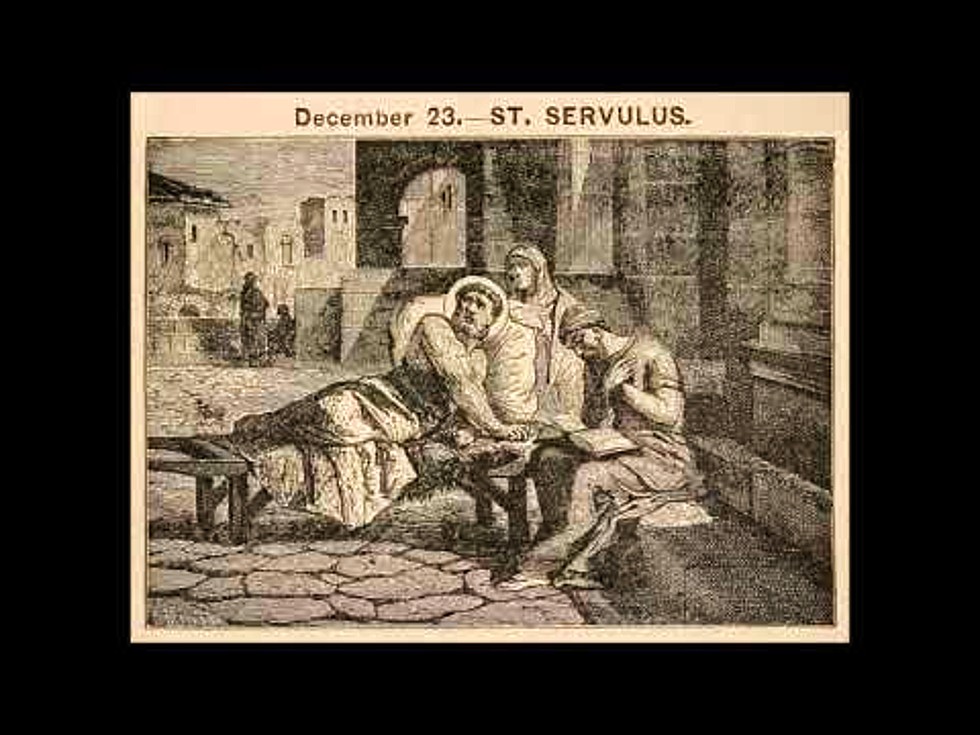
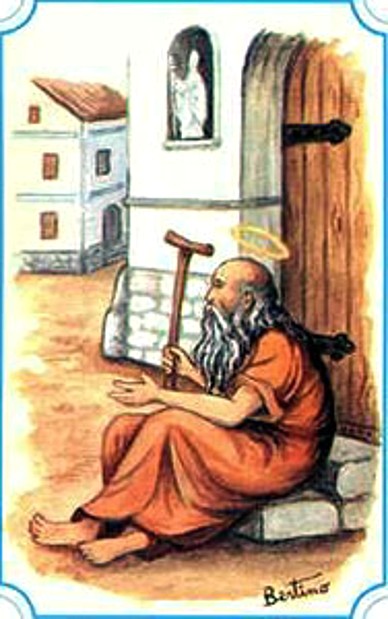
Saint of the Day – 23 December – Saint Servulus (Died c 590) Layman, Beggar, paralysed by Palsy from birth, – born in the 6th century in Rome, Italy and died in c 590 of natural causes.
Saint Servulus was a perfect model of submission to the divine Will; it would be difficult to offer a more consoling example to persons afflicted by poverty, illnesses and the other miseries of life. It is Saint Gregory the Great who narrates for us his edifying story:
“We have seen under the portico of the Church of Saint Clement, a poor man named Servulus, who is known to all the people of Rome as to Us. He was deprived of all the goods of this world; a long illness had reduced him to a pitiful state. From his youth he was paralysed in all his members. Not only could he not stand up but, he was unable to rise from his bed; he could neither sit down nor turn himself from one side to the other, nor bring his hand to his mouth. Nothing in him was sound except his eyes, ears, tongue, stomach and entrails.
This unfortunate man, who had learned the mysteries of religion, meditated unceasingly on the sufferings of the Saviour and never did he complain. He was surrounded by the loving care of his mother and brother. Neither the mother nor the children had ever studied, yet the paralytic had pious books bought for himself, in particular the Psalms and the Holy Gospels and he would ask the religious who came to visit him on his cot, to read from them to him. In this way he learned these books by heart; he spent days and part of the nights in singing or reciting them and meditating them and he constantly thanked the Lord for having taken him to be a victim associated with the pains and sufferings of Jesus Christ.
Many alms came to the little house of the paralytic, to such an extent that he became rich in his poverty. After having taken from these what was necessary for his subsistence and that of his mother, he gave the rest to the indigent, who often assembled around him to be edified by his words and his virtues. His bed of pain was a pulpit of preaching, from which he converted souls.
When the time came which was decreed by God to reward his patience and put an end to his painful life, Servulus felt the paralysis spreading to the vital parts of his body and he prepared for death. At the final moment, he asked those in attendance to recite Psalms with him. Suddenly he cried out: “Ah! Don’t you hear that melody resounding in heaven?’” At that moment his soul escaped from his body, which, until his buria,l gave forth a marvellous fragrance.”
St Gregory the Great concludes the account he gives of Servulus, in a sermon to his people, by observing that the behaviour of this poor sick begger loudly condemns those who, when blessed with good health and fortune, neither do good works nor suffer the least cross with tolerable patience. He speaks of him as one who was well known both to himself and his hearers and says, that one of his monks, who was present at his death, used to speak of the fragrant smell which came from the dead beggar’s body. Servulus was a true lover of God, not careful and troubled about his own life but solicitous that God be honoured and all that he could suffer for this end, he looked upon as reward. By his constancy and fidelity, he overcame the world and all bodily afflictions.
St Servulus was buried at Saint Clement’s Church, Rome, the place that had been his habitual place of prayer and veneration and where, so many came to pay their respects to him and learn from his holy and learned words. From the porch of this Church he was called to heaven. His feast is annually celebrated in that Church on the Coelian Hill outside of which he was wont to lay.
St Besa of Egypt Bl Bincema St Dagobert II of Austrasia Bl Epifanio Gómez Alvaro St Frithbert of Hexham Bl Hartmann of Brixen Bl Herman of Scheda Bl James Aymerich St John Cirita St John Stone St Joseph Cho Yun-ho St Mardonius of Rome St Mazota of Abernethy St Migdonius of Rome Blessed Nicolás Factor-Estaña OFM (1520-1583) His Life: https://anastpaul.com/2019/12/23/saint-of-the-day-23-december-blessed-nicolas-factor-estana-ofm-1520-1583/ St Servulus (Died c 590) Layman St Thorlac Thorhallsson St Victoria St Vintila of Orensee — Martyred Dominicans of Santander – (9 beati) – Martyred in the Spanish Civil War: • Blessed Bernardino Irurzun Otermín • Blessed Eleuterio Marne Mansilla • Blessed Eliseo Miguel Lagro • Blessed Enrique Cañal Gómez • Blessed Enrique Izquierdo Palacios • Blessed Epifanio Gómez Alvaro • Blessed José María García Tabar • Blessed Manuel Gutiérrez Ceballos • Blessed Miguel Rodríguez González • Blessed Pedro Luís y Luís
Martyrs of Crete – (10 saints): A group of ten Christians who died in the persecutions of Decius. They were – • Agathopus • Basilides • Cleomenes • Eunician • Euporus • Evaristus • Gelasius • Saturninus • Theodulus • Zeticus They were martyred in 250 on the island of Crete
Thought for the Day – 22 December – Meditations with Antonio Cardinal Bacci (1881-1971)
The Humility of Mary
“The profound humility of Mary was commensurate with her high dignity. As Dante put it, she was the humblest and noblest of creatures. “Umile ed altra piu che creatura” (Paradiso 33:2) None of the saints was humbler than Mary, just as none of them was greater. It was an Archangel who came down from Heaven and bowed before her as he praised her in the highest terms as “full of grace” and announced the unique dignity she was to receive as Mother of God. She bowed her head in turn and declared herself to be the handmaid of the Lord, ready to do His will in all things. Then she went to visit and congratulate her cousin, Elizabeth, because she had heard from the Angel that she was to be the mother of the Precursor. When she arrived at the house, she was greeted by Elizabeth with the words: “How have I deserved that the mother of my Lord should come to me?” Far from being flattered, however, Mary attributed all her glory to God and replied with the Magnificat, a hymn of praise and gratitude in God’s honour. It was the same when Jesus was born in the manger at Bethlehem. There was a sudden brightness in the sky and the angels sang “Glory to God in the highest and on earth, peace among men of goodwill.” But even though she held the Lord of Heaven and earth, in her arms, the Blessed Virgin asked for nothing for herself. Her only desire was to do the will of God. The love of Jesus was enough for her. She did not seek her own glory but the glory of God. Likewise, on the weary journey into Egypt, she was content because, she was with Jesus and in the obscure life of Nazareth, she desired no other treasure but Her divine Son. During His public life, she followed Him in silence. Once only she spoke in a submissive tone, in order to ask a favour for others but not for herself. It was at the wedding celebrations in Cana, when she asked for the first miracle, in such a way, that it was not even apparent that it was she who had wrung the favour from the filial heart of Jesus. It was always like that, up to the time of Calvary and the Resurrection, the Ascension and Pentecost. She remained humbly in the background all the time. Now, after her departure from this earth, her humility has been gloriously crowned in the dogma of the Assumption and in her Coronation as Queen of Angels and of Saints.”
Quote/s of the Day – 22 December – Tuesday of the Fourth Week of Advent, O Rex Gentium/O King of all Nations, Readings: 1 Samuel 1:24-28, 1 Samuel 2:1, 4-5, 6-7, 8, Luke 1:46-56
“Mary said: My soul proclaims the greatness of the Lord, my spirit rejoices in God my Saviour.” – Luke 1:46-47
“The Lord has exalted me by a gift so great, so unheard of, that language is useless to describe it and the depths of love in my heart can scarcely grasp it. I offer then all the powers of my soul in praise and thanksgiving. As I contemplate His greatness, which knows no limits, I joyfully surrender my whole life, my senses, my judgment, for my spirit rejoices in the eternal Godhead of that Jesus, that Saviour, whom I have conceived in this world of time.”
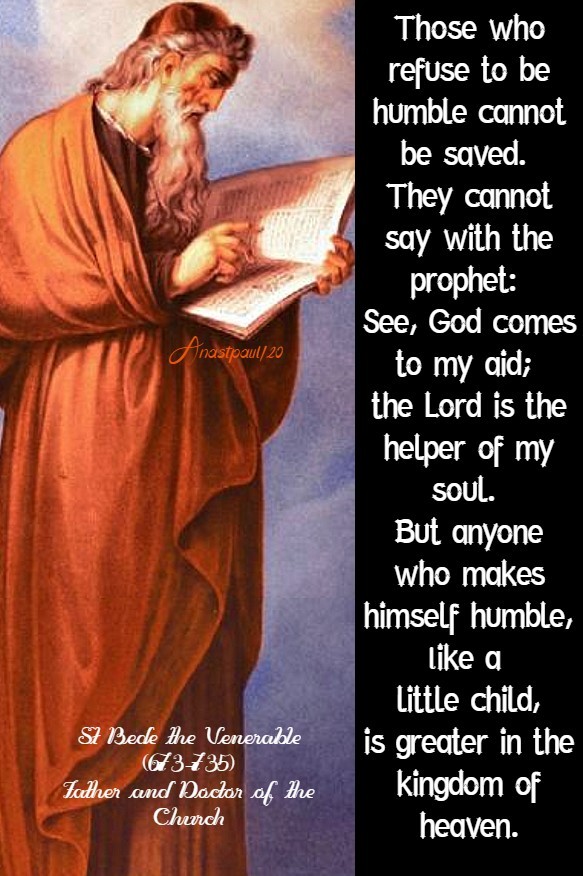
“Those who refuse to be humble cannot be saved. They cannot say with the prophet: See, God comes to my aid; the Lord is the helper of my soul. But anyone who makes himself humble, like a little child, is greater in the kingdom of heaven.”
St Bede the Venerable (673-735) Father and Doctor of the Church
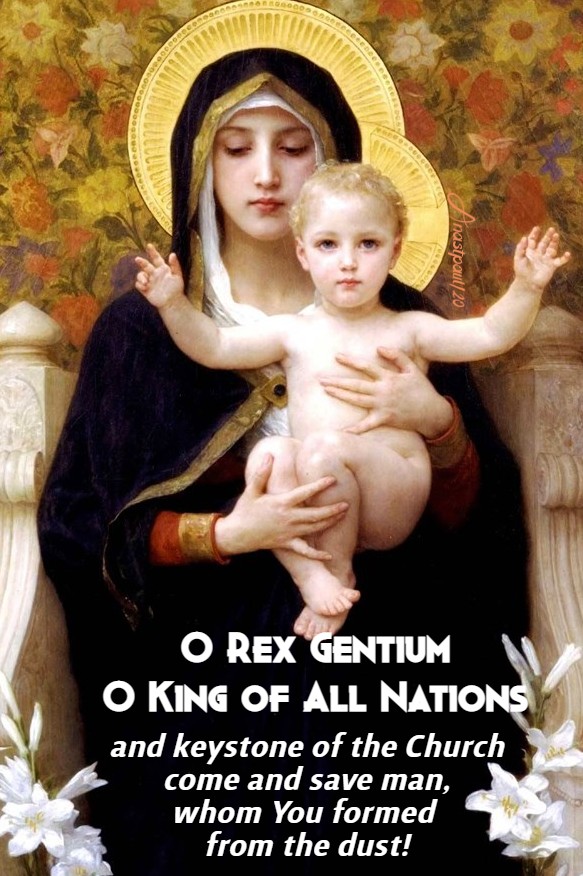
O KING OF ALL NATIONS and keystone of the Church come and save man, whom You formed from the dust!
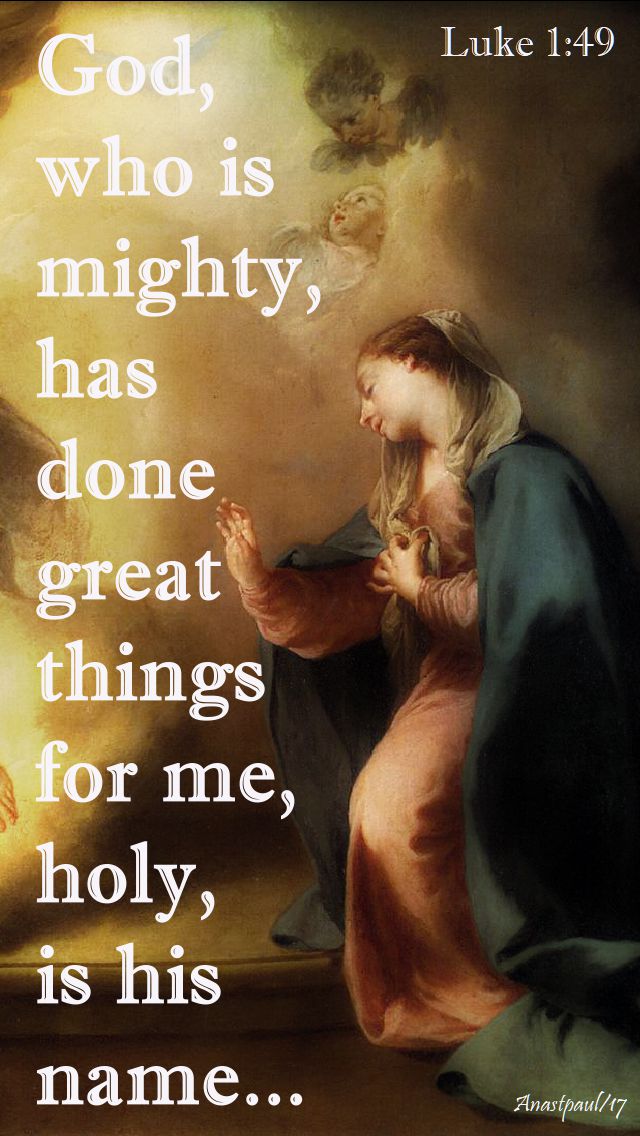
“…For he who is mighty has done great things for me and holy is his name.” … Luke 1:49
REFLECTION – “Then Mary said: “My soul magnifies the Lord and my spirit rejoices in God my Saviour … He has helped Israel his child (Lk 1:54 Gk), remembering his mercy and the covenant he made with Abraham and his descendants forever.” Do you observe how the Virgin surpasses the perfection of the patriarch and seals the covenant God made with Abraham when He said to him: “This is to be the covenant between me and you”? (Gn 17:11) … It is the song of this prophecy that the holy Mother of God addressed to God when she said: “My soul magnifies the Lord …, for He who is Mighty has magnified me; holy is His name. In making me the mother of God He preserves my virginity. The full number of every generation is summed up within my womb, that they may be made holy in it. For He has blessed all ages, men and woman, young people, children, the old” (…)
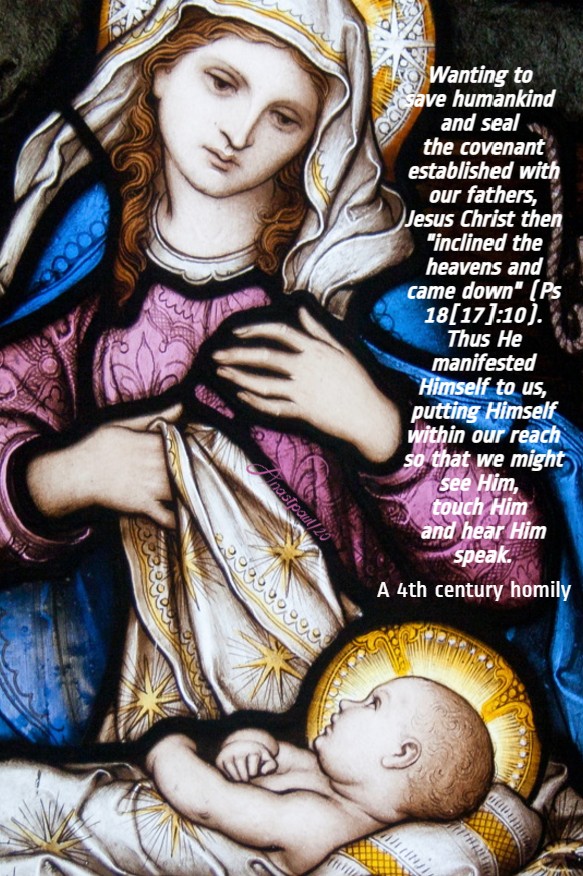
“He has put down the mighty from their thrones and exalted the lowly” (…) The lowly, the gentile peoples hungry for righteousness (Mt 5:6), have been exalted. By making known their lowliness and hunger for God and by begging for God’s word, just as the Canaanite woman asked for crumbs (Mt 15:27), they have been satisfied with the riches concealed within the divine mysteries. For Jesus Christ our God, son of the Virgin, has handed out to the gentiles the whole inheritance of divine favours. He has raised up Israel his child: not just any Israel but His child, on whose exalted birth He bestows honour. This is why the Mother of God calls this people her child and her heir. God, who found this people worn out by the letter, wearied by the Law, calls it to His grace. By giving this name to Israel He raises him up, “remembering his mercy, as he promised to our forefathers, Abraham and his seed for ever.” These few words sum up the whole mystery of our salvation. Wanting to save humankind and seal the covenant established with our fathers, Jesus Christ then “inclined the heavens and came down” (Ps 18[17]:10). Thus He manifested Himself to us, putting Himself within our reach so that we might see Him, touch Him and hear Him speak.” – A 4th century homily (Incorrectly attributed to Gregory of Neocaesarea, called “Thaumaturgos”, no. 2)
Prayer – The Magnificat The Canticle of Mary Luke 1:46-55
My soul glorifies the Lord, my spirit rejoices in God, my Saviour He looks on His servant in her lowliness Henceforth, all ages will call me blessed: The Almighty works marvels for me, holy is His Name! His mercy is from age to age, on those who fear Him. He puts forth His arm in strength and scatters the proud-hearted. He casts the mighty from their thrones and raises the lowly. He fills the starving with good things, sends the rich away empty. He protects Israel, His servant, remembering His mercy, the mercy promised to our fathers, to Abraham and his sons forever. Amen
Our Morning Offering – 22 December – Tuesday of the Fourth Week of Advent, O Rex Gentium/O King of all Nations
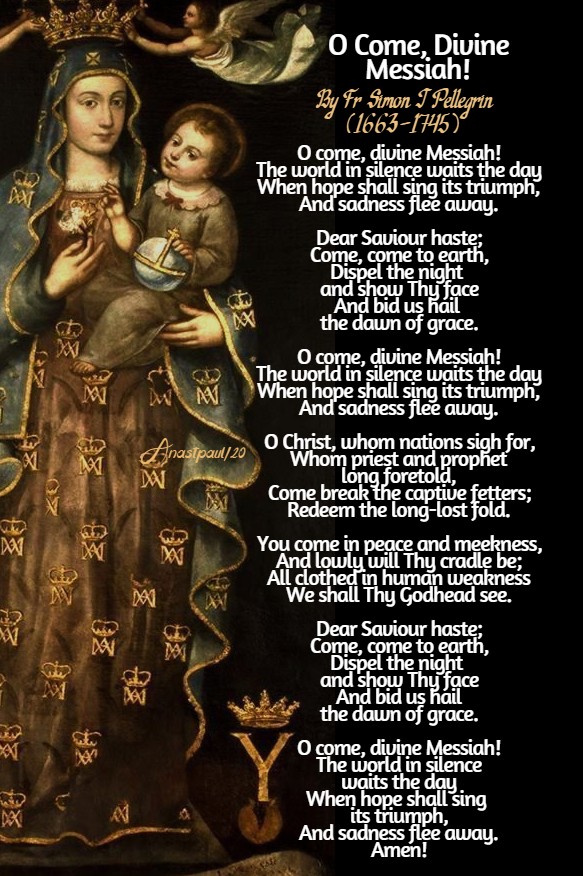
O Come, Divine Messiah! By Abbé Simon J Pellegrin (1663-1745) English Translation of French Carol Venez Divin Messie Translator: Sister Mary of St Philip, SND
O come, divine Messiah! The world in silence waits the day When hope shall sing its triumph, And sadness flee away.
Dear Saviour haste; Come, come to earth, Dispel the night and show Thy face And bid us hail the dawn of grace.
O come, divine Messiah! The world in silence waits the day When hope shall sing its triumph, And sadness flee away.
O Christ, whom nations sigh for, Whom priest and prophet long foretold, Come break the captive fetters; Redeem the long-lost fold.
You come in peace and meekness, And lowly will Thy cradle be; All clothed in human weakness We shall Thy Godhead see.
Dear Saviour haste; Come, come to earth, Dispel the night and show Thy face And bid us hail the dawn of grace.
O come, divine Messiah! The world in silence waits the day When hope shall sing its triumph, And sadness flee away. Amen!
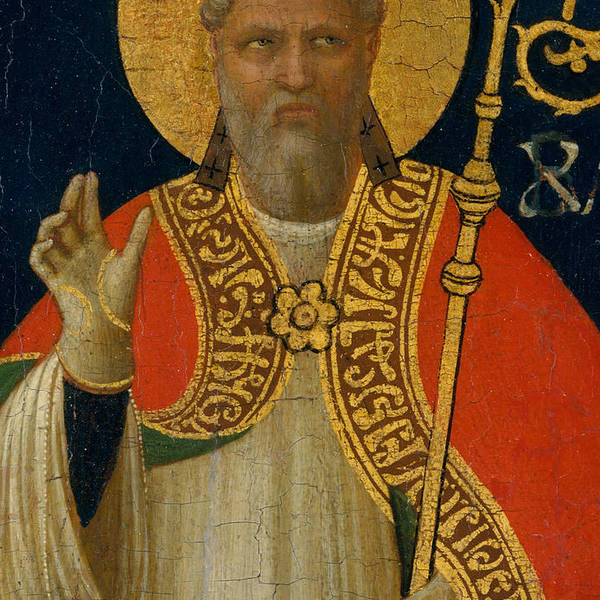
Saint of the Day – 22 December – Saint Hungerus Frisus of Utrecht (Died 866) Bishop of Utrecht – born in the Low Countries, now the Netherlands and died in 866 at Prum, Germany of natural causes. Also known as Hunger.
Painting by Blessed Fra Angelico
St Hungerus was the Bishop of Utrecht from 854 to 866. We are not sure when he was born. After the death of his predecessor Luidger of Utrecht, Luidger’s nephew Craft, was offered the seat. However, Craft, a very wealthy person, refused because he was afraid that he would attract Viking raids.
Instead the Canon, St Hungerus was appointed. At first, his relations with the Vikings were peaceful but eventually Utrecht was threatened by the Vikings, at which the Bishop and the entire clergy of Utrecht fled to Saint Odilienberg, near Roermond. During this time of exile, Hungerus spent his time teaching the faith in the surrounding areas. In 858 King Lothair II made a Monastery available for them. Later, the Bishop settled in Prum and then in Deventer.
By all accounts, St Hungerus was a Godly and pious man, who unlike his predecessors, did not engage in nepotism. In the case of the childless marriage between King Lotharius and his wife, he defended the sanctity of their marriage on Biblical and theological grounds but against his counsel, to secure his succession, Lothair repudiated his wife and married Waldrada, with whom he had a son.
St Hungerus Died in Prum, Germany of natural causes and his feast is today 22 December.
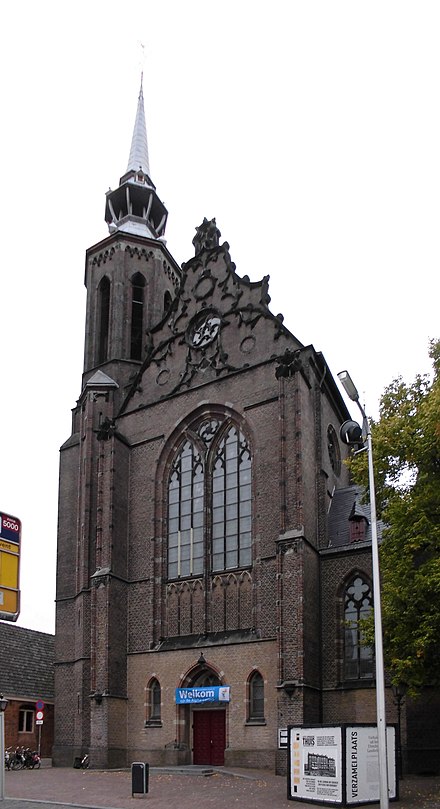
St Catherine Cathedral, the Seat of the Bishop of Utrecht
Martyrs of Ostia – (3 saints): A group of Christians martyred together. The only details about them to survive are three names – Demetrius, Florus and Honoratus. They were martyred at Ostia, Italy.
Martyrs of Rhaitu – (43 saints): 43 monks martyred by Blemmyes, in Raíthu, Egypt, date unknown.
Martyrs of Via Lavicana – (30 saints): A group of 30 Christians martyred together in the persecutions of Diocletian. c 303 in Rome, Italy and were buried between two bay trees on the Via Lavicana outside Rome.
Thought for the Day – 21 December – Meditations with Antonio Cardinal Bacci (1881-1971)
The Silence of the Divine Infant
Jesus Christ is the Eternal Word of God, made man, the infinite and substantial image of the Divine Intellect. Nevertheless, the Divine Infant, Whom we adore in the stable at Bethlehem, is mute and silent. The voluntary humiliation of the Son of God is such, that He, the Word of God, cannot utter a single human syllable. By this chosen silence, however, He teaches us many things. In the first place, He teaches us humility and self-denial. He teaches us, moreover, to recollect ourselves in the Presence of God, so that it may be easier for us to speak with Him and for Him, to make known what He requires of us. The silence of prayer brings forth divine consolations and inspirations to holiness,
Do we love to be silent? It is not necessary to become hermits but, it is essential, from time to time, to place ourselves quietyly in the Presence of God. God cannot be heard through the noise and confusion of the world, whereas, He speaks clearly to the soul, which seeks the silence of prayer. In any case, if we go about looking for the gossip and idle chatter of the world, it is almost impossible not to offend God. “Avoid profane and empty babblings,” St Paul urges us, “for they contribute much to ungodliness” (2 Tim 2:16). “If anyone does not offend in word,” adds St James, “he is a perfect man” (Js 3:2). “The tongue is a little member,” he continues but, goes onto emphasis that it is capable of doing either a great deal of good or a great deal of harm. “With it, we bless God the Father and, with it, we curse men, who have been made after the likeness of God. Out of the same mouth proceed blessing and cursing. These things, my brethren ought not to be so” (Js 3:5-10).
There are two main lessons which we should learn, therefore, from the silence of the Divine Infant. We should learn to love recollection and, we should learn to make proper use of the gift of speech, which can be an equally powerful weapon, in the cause of good, or, in the cause of evil!”
Quote/s of the Day – 21 December – O Oriens/O Radiant Dawn – Weekdays of Advent and The Memorial of St Peter Canisius (1521-1597) Doctor of the Church
“Better that only a few Catholics should be left, staunch and sincere in their religion, than that they should, remaining many, desire as it were, to be in collusion with the Church’s enemies and in conformity with the open foes of our faith.”
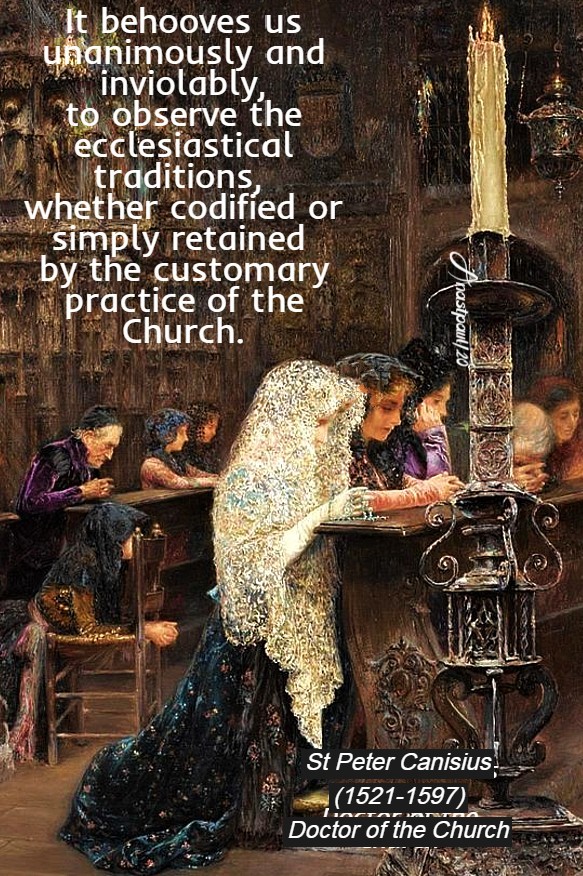
“It behooves us unanimously and inviolably, to observe the ecclesiastical traditions, whether codified or simply retained by the customary practice of the Church.”
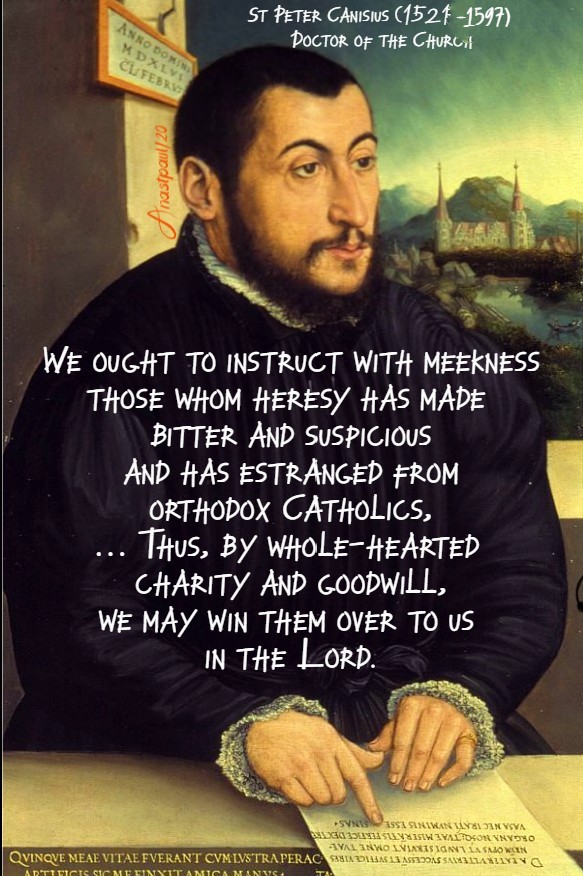
“We ought to instruct with meekness those whom heresy has made bitter and suspicious and has estranged from orthodox Catholics, … Thus, by whole-hearted charity and goodwill, we may win them over to us in the Lord.”
St Peter Canisius (1521-1597) Doctor of the Church
















You must be logged in to post a comment.