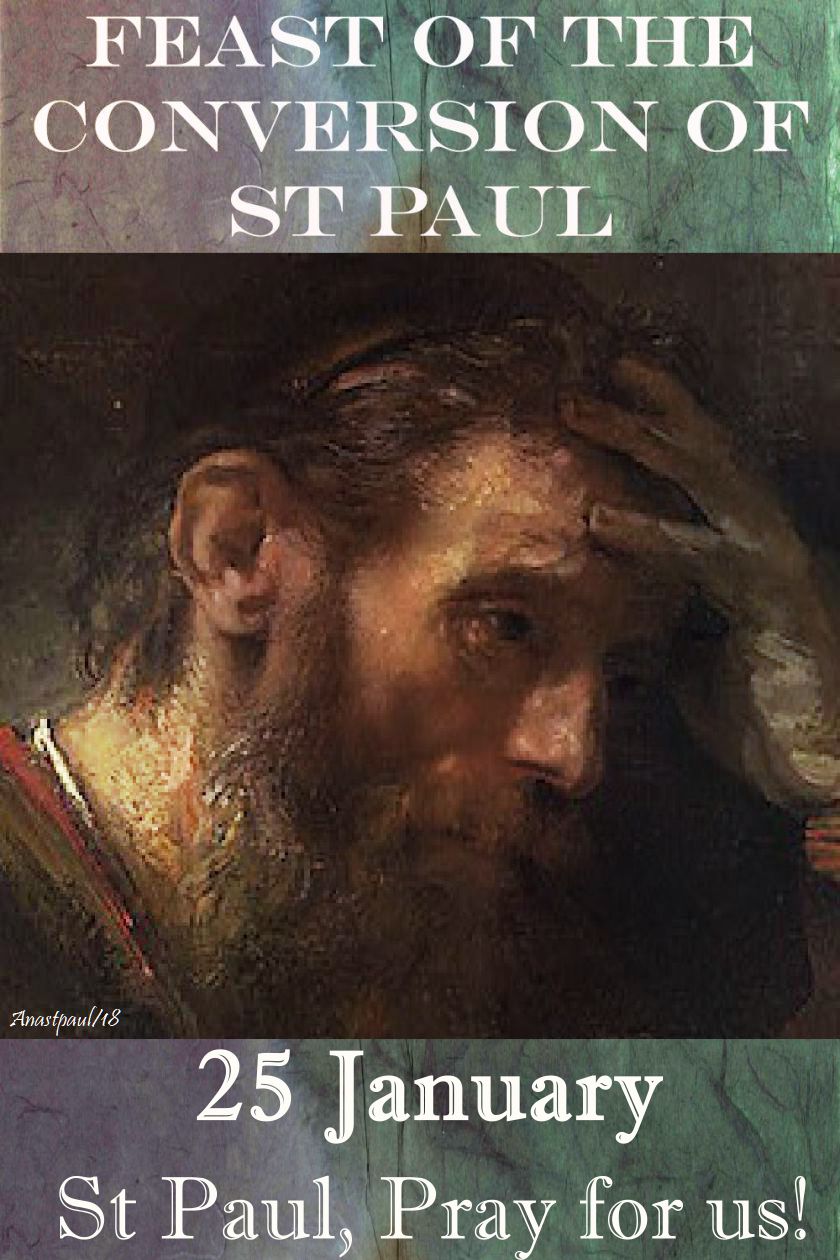
Our Morning Offering – 25 January – The Feast of the Conversion of St Paul
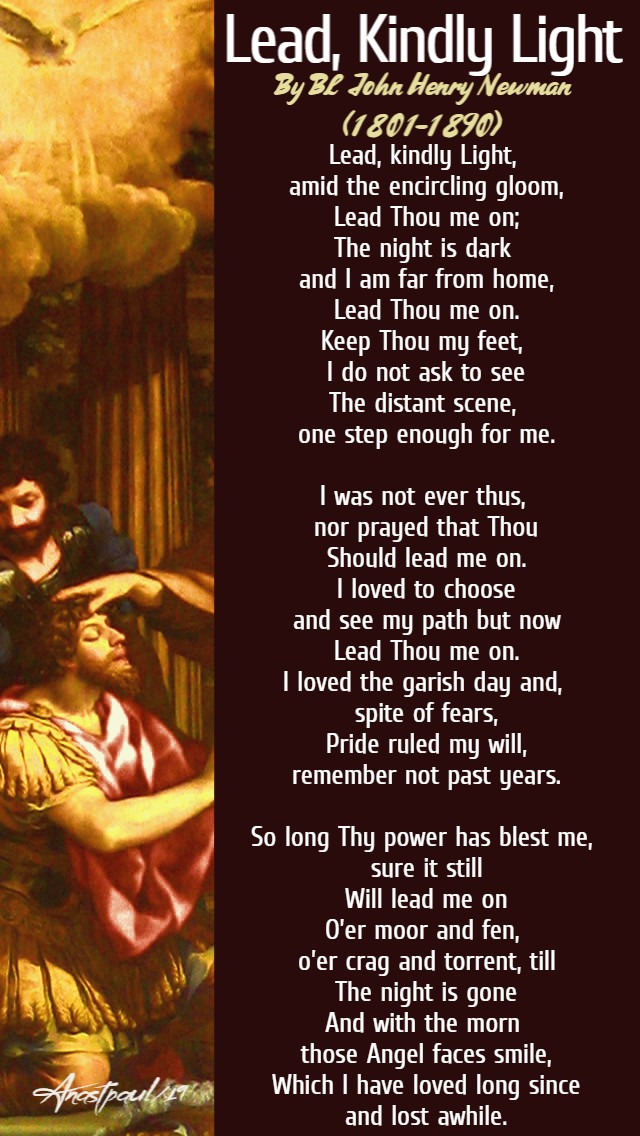
Lead, Kindly Light By Blessed John Henry Newman (1801-1890)
Lead, kindly Light, amid the encircling gloom,
Lead Thou me on;
The night is dark and I am far from home,
Lead Thou me on.
Keep Thou my feet, I do not ask to see
The distant scene, one step enough for me.
I was not ever thus, nor prayed that Thou
Should lead me on.
I loved to choose and see my path but now
Lead Thou me on.
I loved the garish day and, spite of fears,
Pride ruled my wil, remember not past years.
So long Thy power has blest me, sure it still
Will lead me on
O’er moor and fen, o’er crag and torrent, till
The night is gone
And with the morn those Angel faces smile,
Which I have loved long since and lost awhile.
Lead, Kindly Light is a hymn with words written in 1833 by Blessed John Henry Newman (1801-1890) as a poem titled “the Pillar and the Cloud” – it consists of 3 verses, anything after that is not by John Henry.
As a young priest, Newman became sick while in Italy and was unable to travel for almost three weeks. In his own words: “Before starting from my inn, I sat down on my bed and began to sob bitterly. My servant, who had acted as my nurse, asked what ailed me. I could only answer, “I have a work to do in England.” I was aching to get home, yet for want of a vessel I was kept at Palermo for three weeks. I began to visit the churches and they calmed my impatience, though I did not attend any services. At last I got off in an orange boat, bound for Marseilles. We were becalmed for whole week in the Straits of Bonifacio and it was there that I wrote the lines, Lead, Kindly Light, which have since become so well known.”
Why this for St Paul? – this time in Bl John Henry’s life was a time of internal “conversion’ – after, his well-known “Sicily providential illness”, he started to turn towards “Rome” – although first the Oxford Movement had to happen and then some more difficult years before his final conversion but once he had put his hand to the plough, there was no turning back in his journey towards Truth.
I am sure you will agree with me that the words of this most beautiful prayer/poem/hymn, fit the Feast of the Conversion of St Paul perfectly.
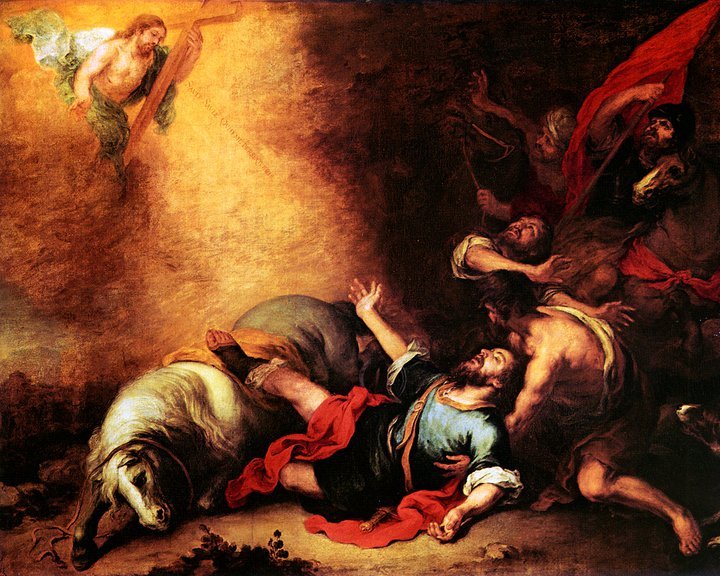
Saint Paul’s entire life can be explained in terms of one experience—his meeting with Jesus on the road to Damascus. In an instant, he saw that all the zeal of his dynamic personality was being wasted, like the strength of a boxer swinging wildly. Perhaps he had never seen Jesus, who was only a few years older. But he had acquired a zealot’s hatred of all Jesus stood for, as he began to harass the Church: “…entering house after house and dragging out men and women, he handed them over for imprisonment” (Acts 8:3b). Now he himself was “entered,” possessed, all his energy harnessed to one goal—being a slave of Christ in the ministry of reconciliation, an instrument to help others experience the one Saviour.
One sentence determined his theology: “I am Jesus, whom you are persecuting” (Acts 9:5b). Jesus was mysteriously identified with people—the loving group of people Saul had been running down like criminals. Jesus, he saw, was the mysterious fulfilment of all he had been blindly pursuing.
From then on, his only work was to “present everyone perfect in Christ. For this I labour and struggle, in accord with the exercise of his power working within me” (Colossians 1:28b-29). “For our gospel did not come to you in word alone but also in power and in the Holy Spirit and [with] much conviction” (1 Thessalonians 1:5a).
Paul’s life became a tireless proclaiming and living out of the message of the cross: Christians die baptismally to sin and are buried with Christ; they are dead to all that is sinful and unredeemed in the world. They are made into a new creation, already sharing Christ’s victory and someday to rise from the dead like Him. Through this risen Christ the Father pours out the Spirit on them, making them completely new.
So Paul’s great message to the world was – You are saved entirely by God, not by anything you can do. Saving faith is the gift of total, free, personal and loving commitment to Christ, a commitment that then bears fruit in more “works” than the Law could ever contemplate.
Conversion of Paul the Apostle (Feast)
Details: https://anastpaul.wordpress.com/2018/01/25/feast-of-the-conversion-of-st-paul-25-january/
St Agape the Martyr
St Agileus of Carthage
St Amarinus of Clermont
St Ananias of Damascus
Bl Antoni Swiadek
Bl Antonio Migliorati
St Apollo of Heliopolis
Bl Archangela Girlani
St Artemas of Pozzuoli
St Auxentius of Epirus
St Bretannion of Tomi
St Donatus the Martyr
St Dwynwen
St Emilia Fernández Rodríguez de Cortés
St Eochod of Galloway
Bl Francesco Zirano
Bl Henry Suso
St Joel of Pulsano
St Juventinus of Antioch
Bl Manuel Domingo y Sol
St Maximinus of Antioch
St Palaemon
St Poppo
St Praejectus of Clermont
St Publius of Zeugma
St Racho of Autun
St Sabinus the Martyr
Bl Teresa Grillo Michel
Thought for the Day – 24 January – “To Philotea – You and Me”
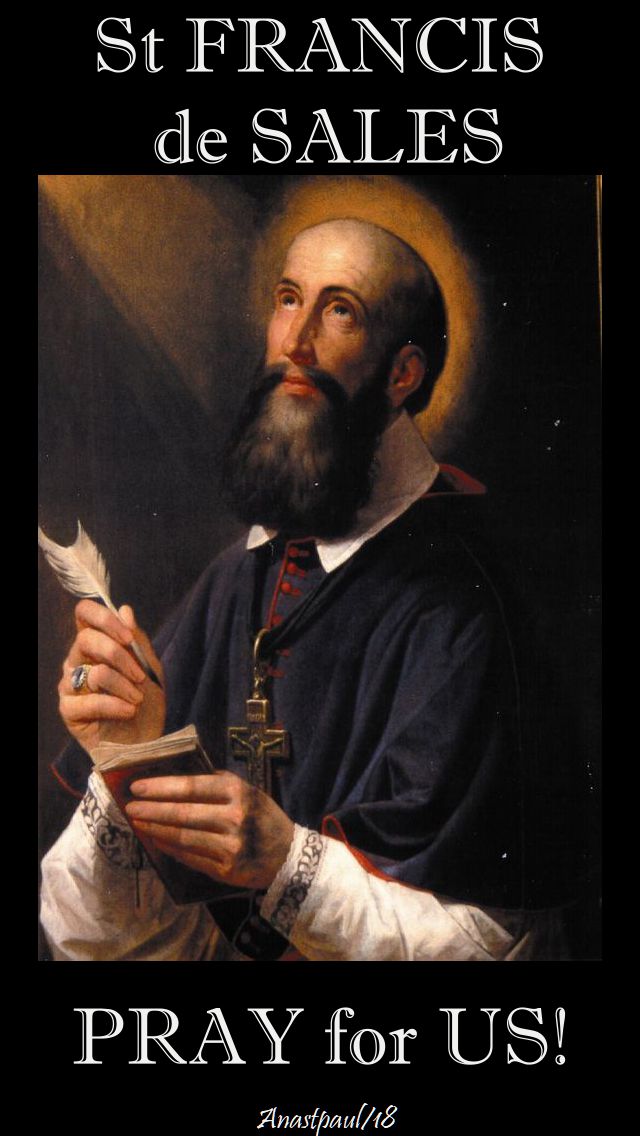
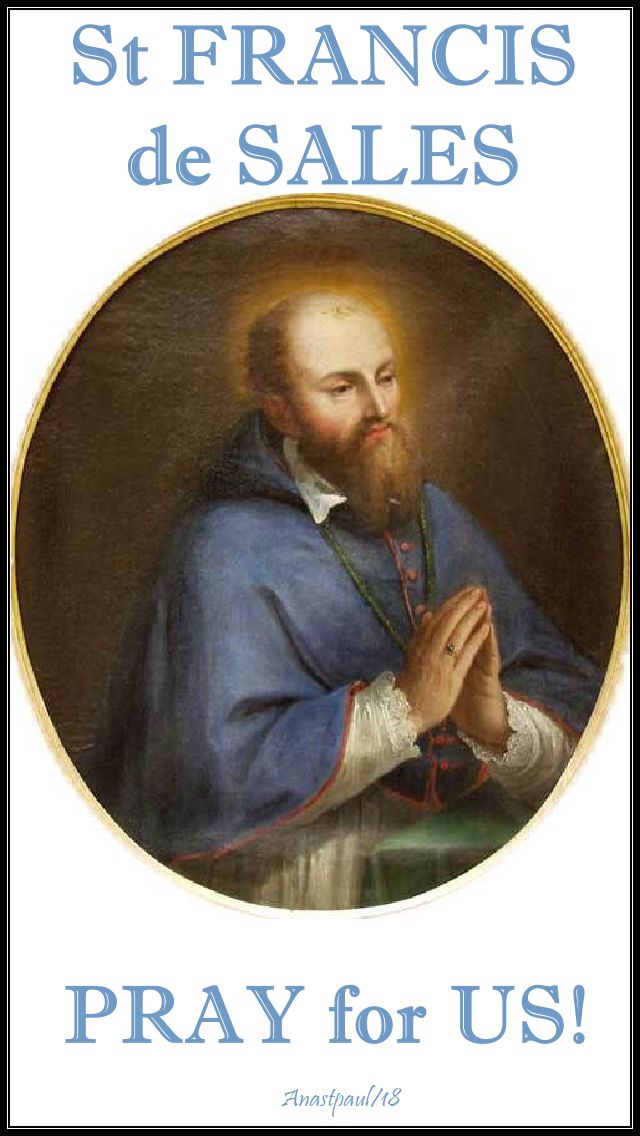
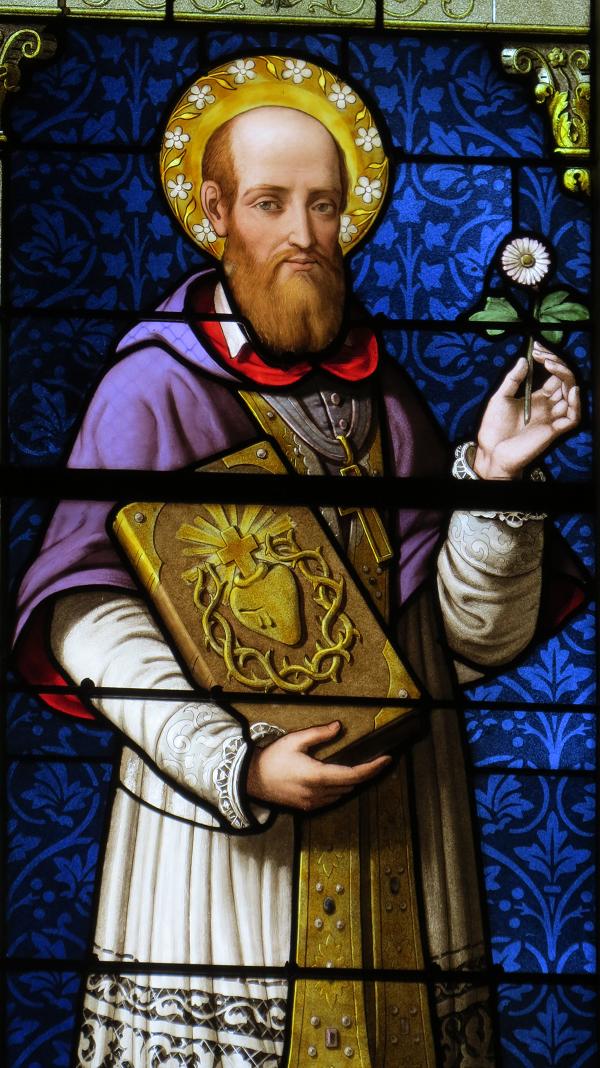
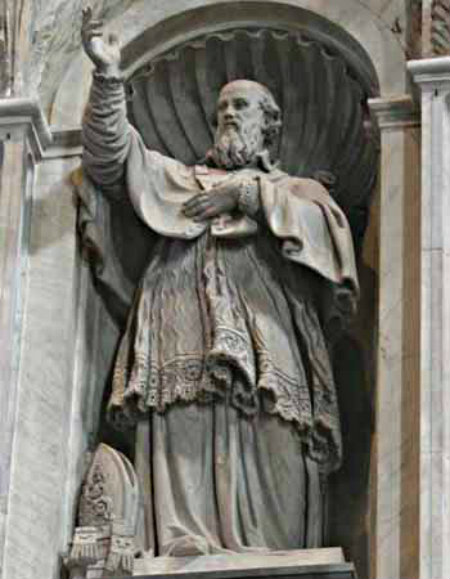
The Memorial of St Francis de Sales (1567-1622) Doctor of the Church:
Doctor Caritatis (Doctor of Charity) ‘The Gentle Christ of Geneva’
Excerpt from Pope Benedict’s Catechesis on St Francis de Sales Wednesday, 2 March 2011
To Philotea, the ideal person to whom he dedicated his Introduction to a Devout Life (1607), Francis de Sales addressed an invitation that might well have seemed revolutionary at the time. It is the invitation to belong completely to God, while living to the full, her presence in the world and the tasks proper to her state. “My intention is to teach those who are living in towns, in the conjugal state, at court” (Preface to The Introduction to a Devout Life).
The Document with which Pope Leo xiii, more than two centuries later, was to proclaim him a Doctor of the Church, would insist on this expansion of the call to perfection, to holiness.
It says: “[true piety] shone its light everywhere and gained entrance to the thrones of kings, the tents of generals, the courts of judges, custom houses, workshops and even the huts of herdsmen” (cf. Brief, Dives in Misericordia, 16 November 1877).
Thus came into being the appeal to lay people and the care for the consecration of temporal things and for the sanctification of daily life on which the Second Vatican Council and the spirituality of our time were to insist.
The ideal of a reconciled humanity was expressed in the harmony between prayer and action in the world, between the search for perfection and the secular condition, with the help of God’s grace that permeates the human being and, without destroying him, purifies him, raising him to divine heights.
Novena to St Paul in preparation for the Feast of The Conversion of St Paul on 25 January
Day Nine – 24 January
The key to conversion? Keeping our focus on the Cross of Jesus Christ, for “the human heart is converted by looking upon (the Crucified) whom our sins have pierced” (CCC 1432 cf. Jn 19:37; Zech 12:10)
LET US PRAY:
Glorious St Paul,
your conversion is a powerful witness to the world
that God loves us and does not give up on us,
no matter how far we stray.
Help me to cling to Christ Crucified
help me to fully participate at every SACRIFICE of the Holy Mass
help me to understand, that this IS He
who showed us the way
gave us the light to follow it in Holy Mother Church
who is His bride and shows us the only truth.
May every circumstance of my life be an occasion
to change my way of thinking,
to renounce self-will and
to surrender myself to the wisdom and tenderness of Jesus Christ
who is acting to make me His saint.
Pray that I may love God’s will and providence for me.
In this confidence, I entrust to you, St Paul,
these, my intentions
…………………………………….
(mention your request)
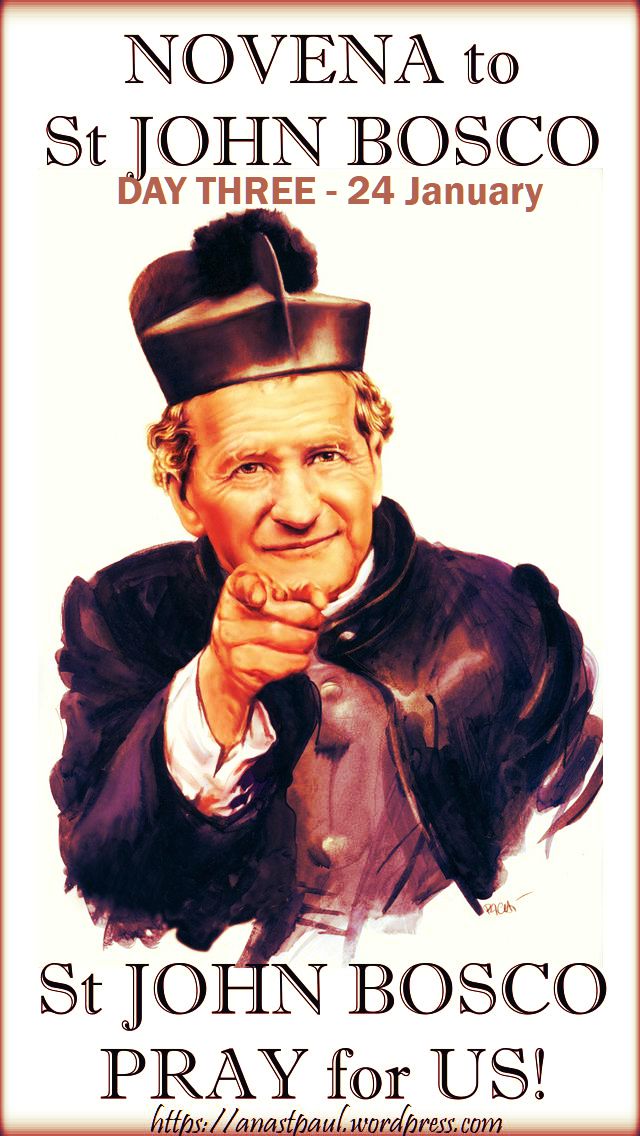
3rd Day – 24 January – Loyalty to the Church and to the Pope
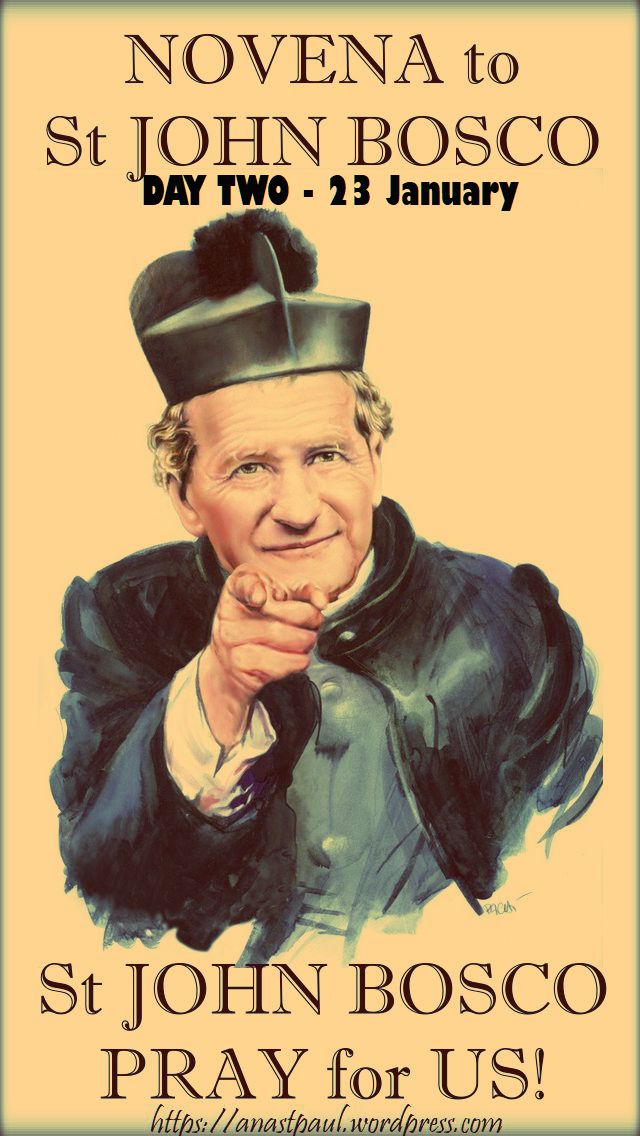
O Saint John Bosco,
you nurtured a filial love for the Church and the Pope
and you courageously spoke and wrote in their defense.
Pray for us that, inspired by your example,
we may be faithful sons and daughters of Holy Mother Church
and may likewise,
love and honour the Holy Father
as the Vicar of Jesus Christ on earth.
Through your intercession
may God grant me the following grace
……………………………….[mention your request].
so that together with others
I may assist in bringing all around me
especially the young to the love of the Church, amen.
Our Father… Hail Mary… Glory to the Father…
St John Bosco Pray for us!
Quote/s of the Day – 24 January – The Memorial of St Francis de Sales (1567-1622) Doctor of the Church: Doctor Caritatis (Doctor of Charity)
‘The Gentle Christ of Geneva’
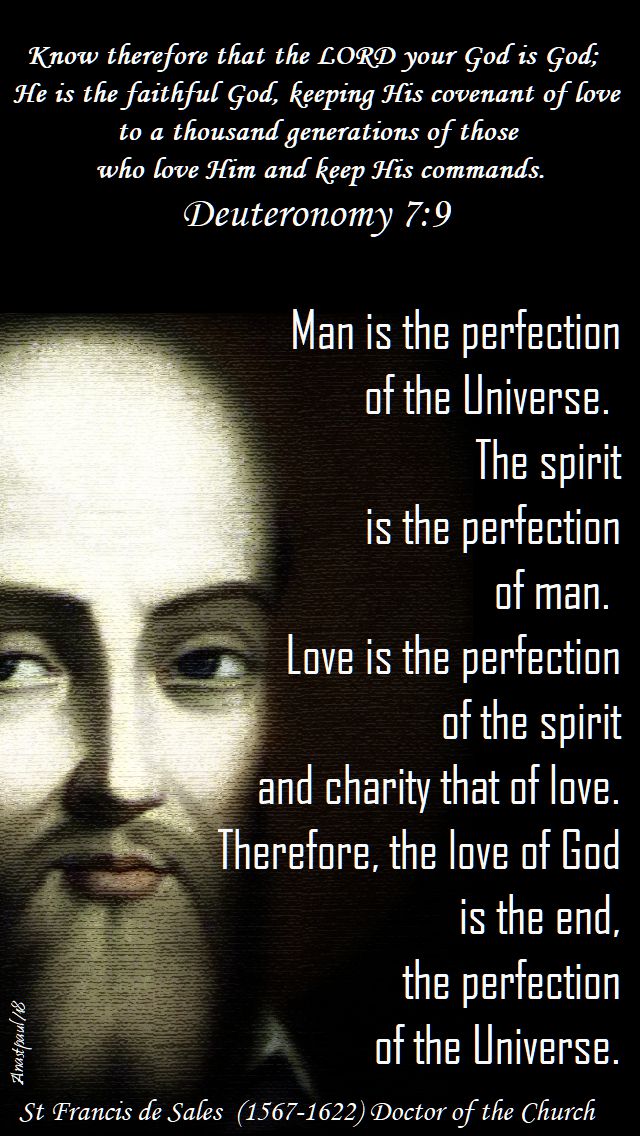
“Man is the perfection of the Universe. The spirit is the perfection of man. Love is the perfection of the spirit and charity that of love. Therefore, the love of God is the end, the perfection of the Universe.”
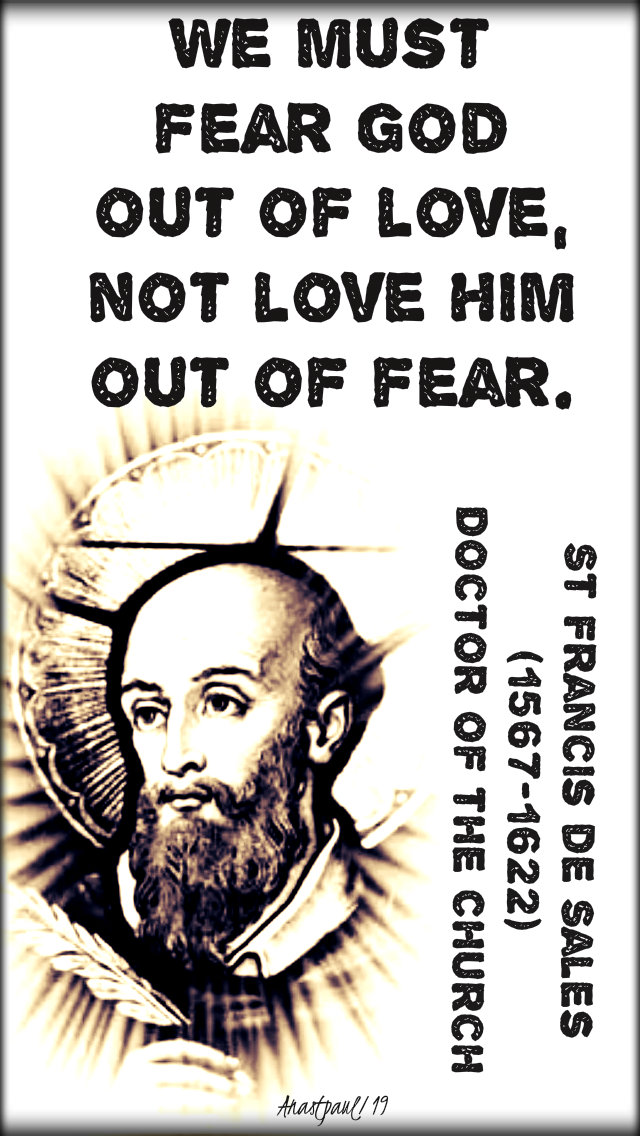
“We must fear God out of love, not love Him out of fear.”
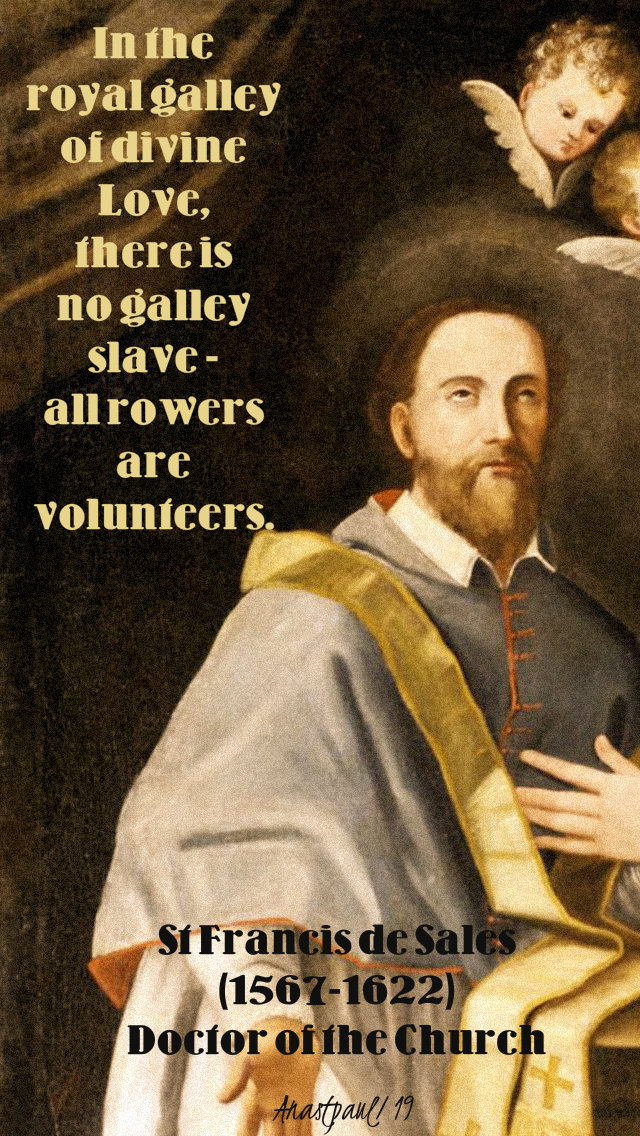
“In the royal galley of divine Love, there is no galley slave – all rowers are volunteers.”
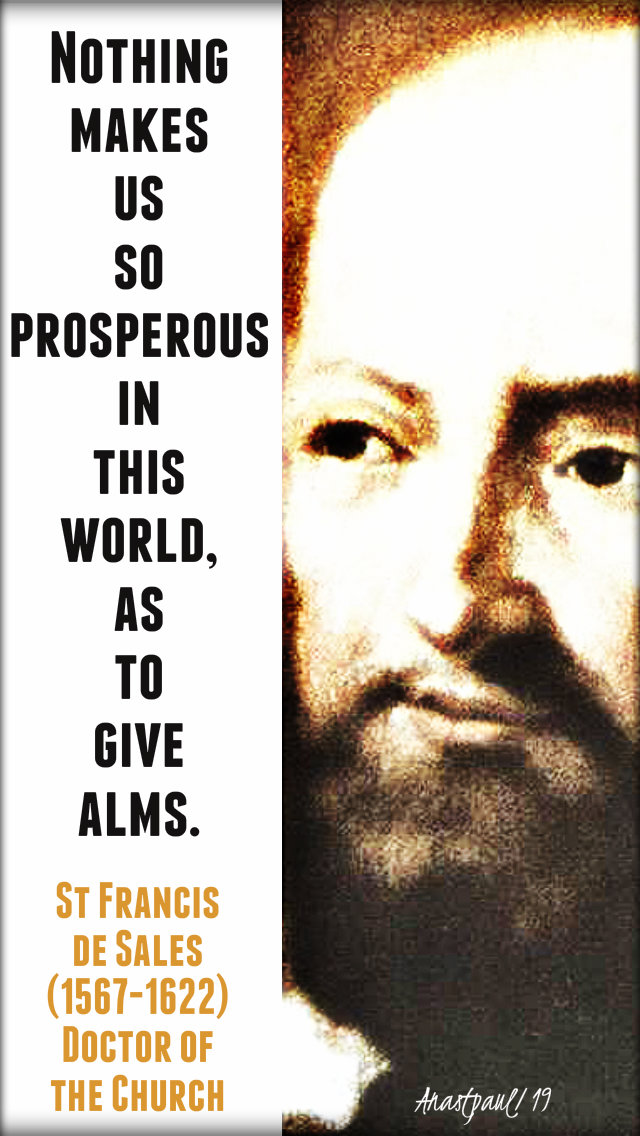
“Nothing makes us so prosperous in this world, as to give alms.”
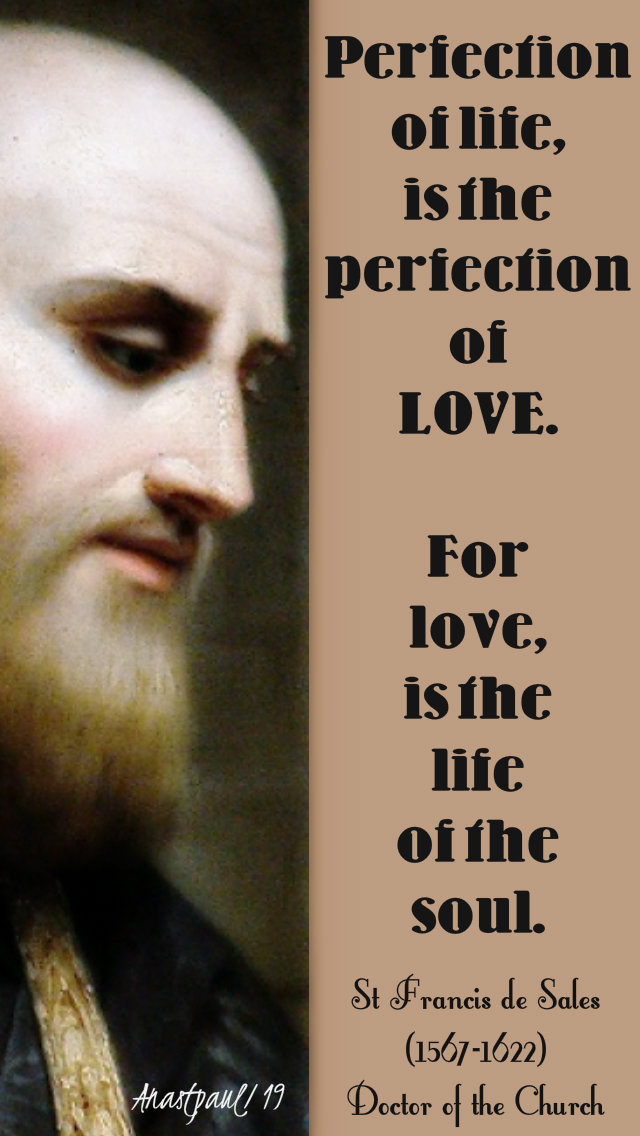
“Perfection of life, is the perfection of love. For love, is the life of the soul.”
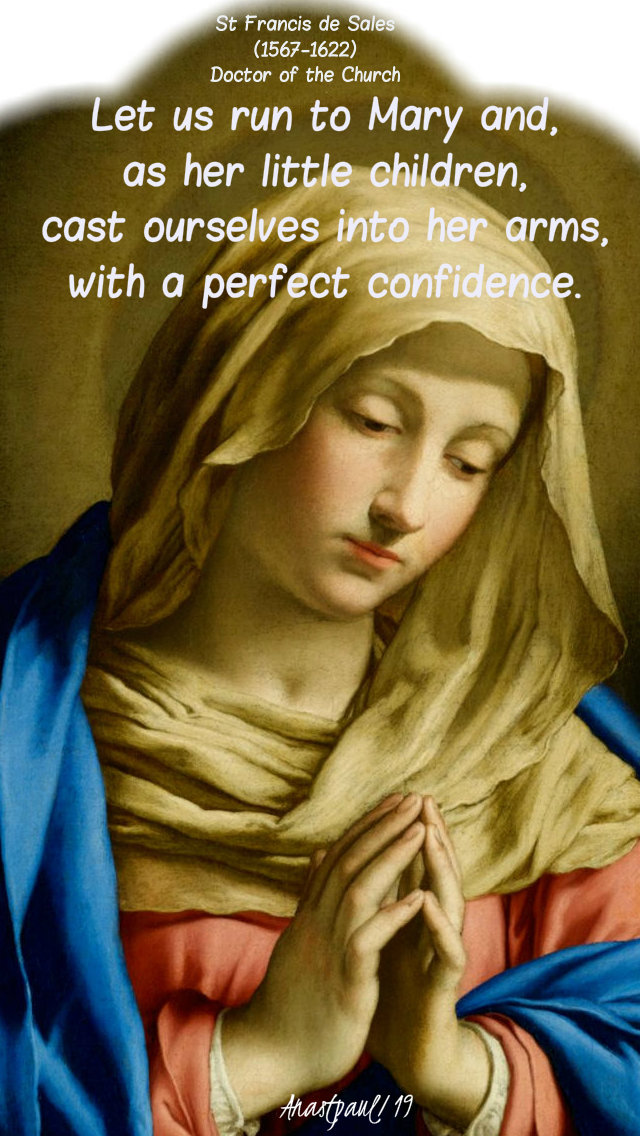
“Let us run to Mary and, as her little children, cast ourselves into her arms, with a perfect confidence.”
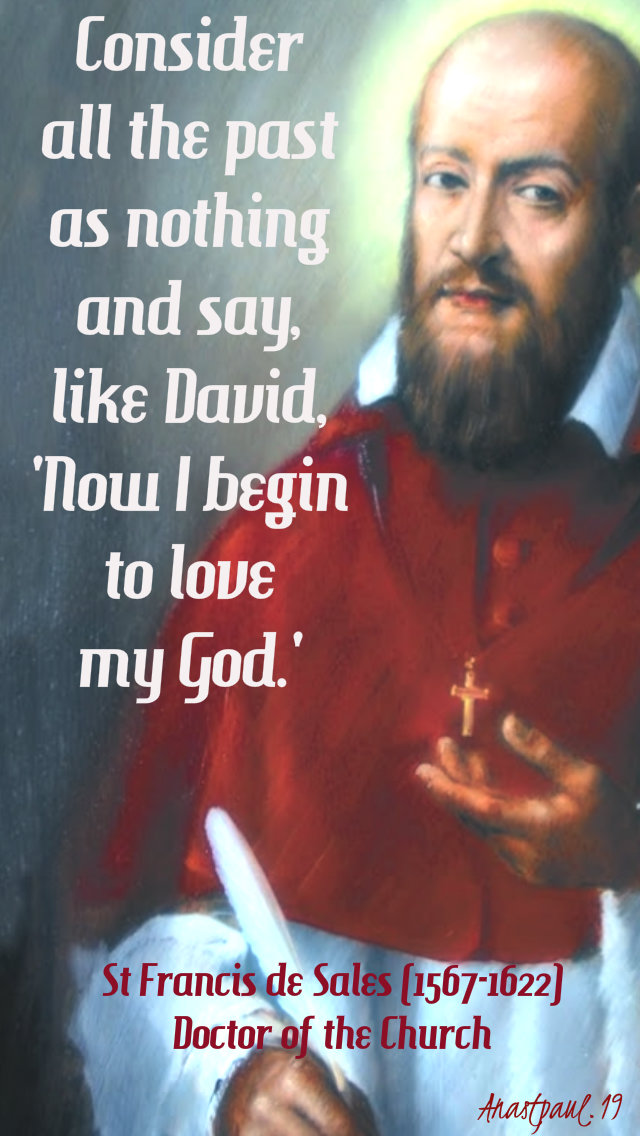
“Consider all the past as nothing and say, like David, ‘Now I begin to love my God.'”
One Minute Reflection – 24 January – Thursday of the Second week in Ordinary Time, Gospel Mark 3:7–12 and The Memorial of St Francis de Sales (1567-1622) Doctor of the Church: Doctor Caritatis (Doctor of Charity) ‘The Gentle Christ of Geneva’
“…a great multitude, hearing all that he did, came to him.”…Mark 3:8
REFLECTION – “Why did the multitude come? What did they need? Whether this multitude went to Jesus out of “need” or because “some were curious”, the true reason is seen in the fact that this crowd was drawn by the Father, it was the Father that drew the crowd to Jesus. We read in the Gospel that ‘Jesus was moved, because He saw these people as sheep without a shepherd’. Therefore, the Father, through the Holy Spirit, draws people to Jesus.
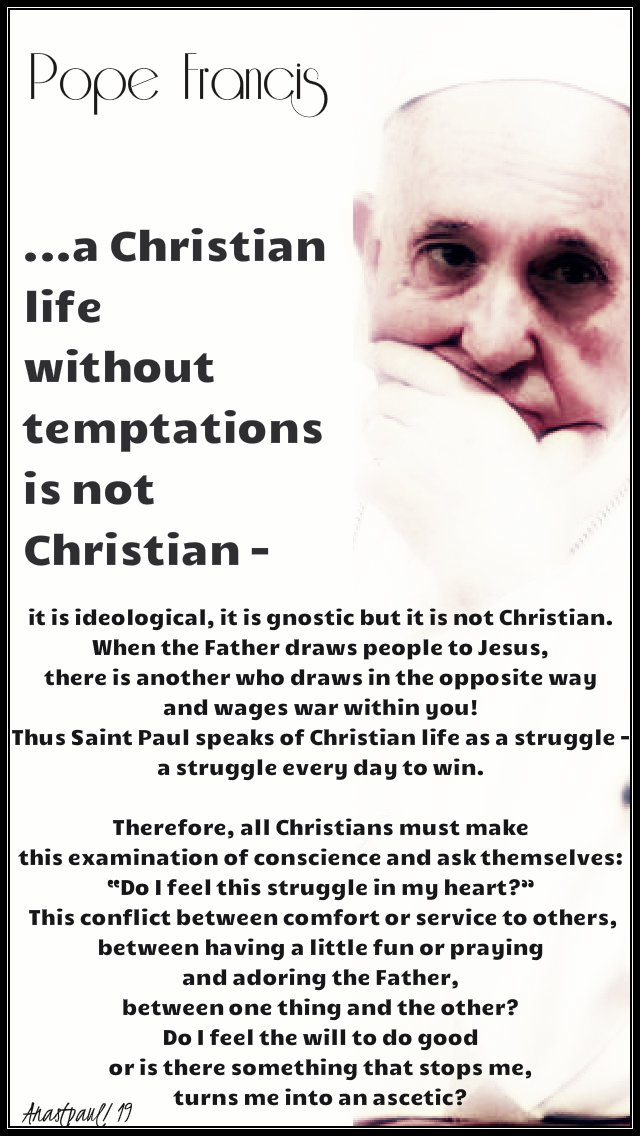
The impure spirits try to impede; they wage war on us. Someone might object – Father, I am very Catholic, I always go to Mass…. But I never have these temptations, thank God! “No! Pray, because you are on the wrong path! because a Christian life without temptations is not Christian – it is ideological, it is gnostic but it is not Christian. When the Father draws people to Jesus, there is another who draws in the opposite way and wages war within you! Thus Saint Paul speaks of Christian life as a struggle – a struggle every day to win.
Therefore, all Christians must make this examination of conscience and ask themselves: “Do I feel this struggle in my heart?” This conflict between comfort or service to others, between having a little fun or praying and adoring the Father, between one thing and the other? Do I feel the will to do good, or is there something that stops me, turns me into an ascetic? And also, do I believe that my life moves Jesus’ heart? If I don’t believe this, I must pray a lot to believe it, so that He may grant me this grace. And we ask the Lord to make us Christians who know how to discern what is happening in our hearts and to choose well the path, through which the Father draws us to Jesus.”..Pope Francis – Santa Marta, 19 January 2017
PRAYER – Lord God, true light and creator of light, grant us the grace to see clearly by the light who is Light, Your only Son. Lead us in His path and send us Your Spirit. Grant us the strength to grow in holiness so that our struggle against the powers of darkness may we a victory over temptation. May the intercession of the master of spirituality, St Francis de Sales, help us and protect us. We make our prayer through Christ our Lord, in the unity of the Holy Spirit, God for all eternity, amen.
Our Morning Offering – 24 January – The Memorial of St Francis de Sales CO, OM, OFM (Cap) (1567-1622) – Doctor of the Church: Doctor caritatis (Doctor of Charity) – ‘The Gentle Christ of Geneva’
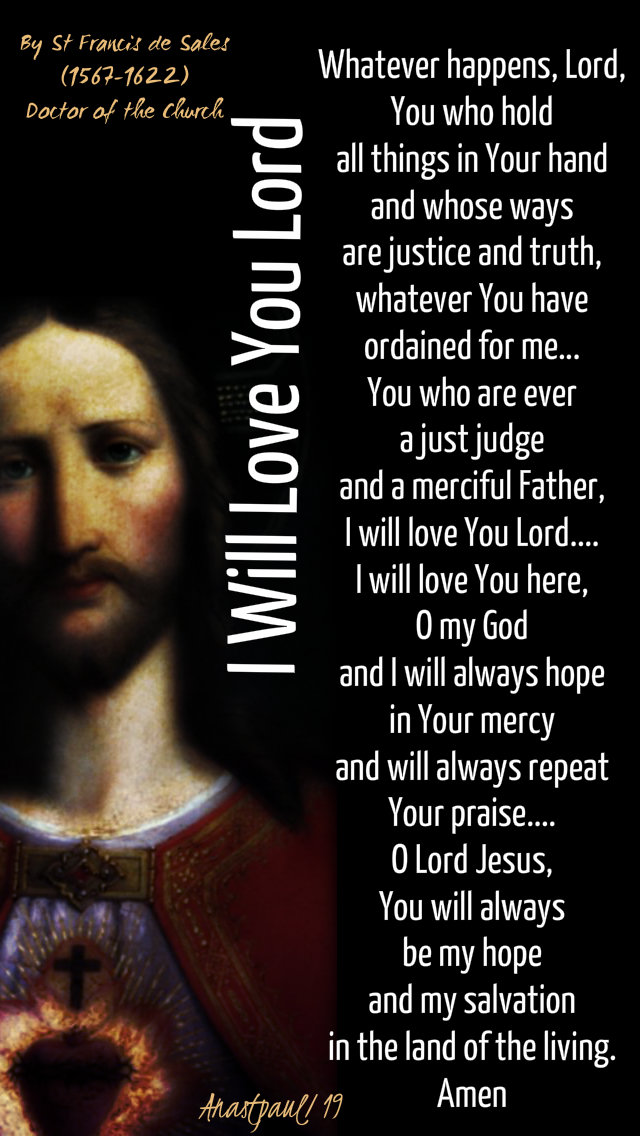
I Will Love You Lord By St Francis de Sales
“Whatever happens, Lord,
You who hold
all things in Your hand
and whose ways
are justice and truth,
whatever You have ordained for me…
You who are ever a just judge
and a merciful Father,
I will love You Lord….
I will love You here,
O my God
and I will always hope
in Your mercy
and will always repeat Your praise….
O Lord Jesus,
You will always be my hope
and my salvation
in the land of the living.
Amen
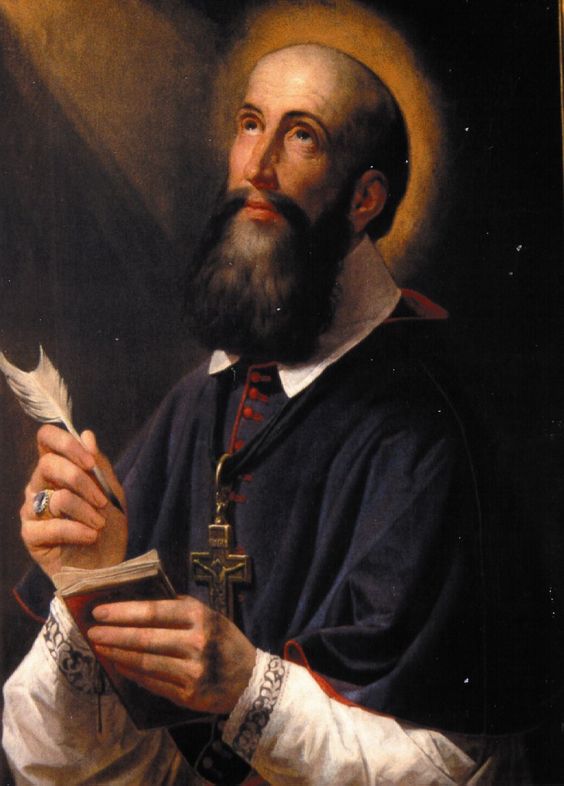
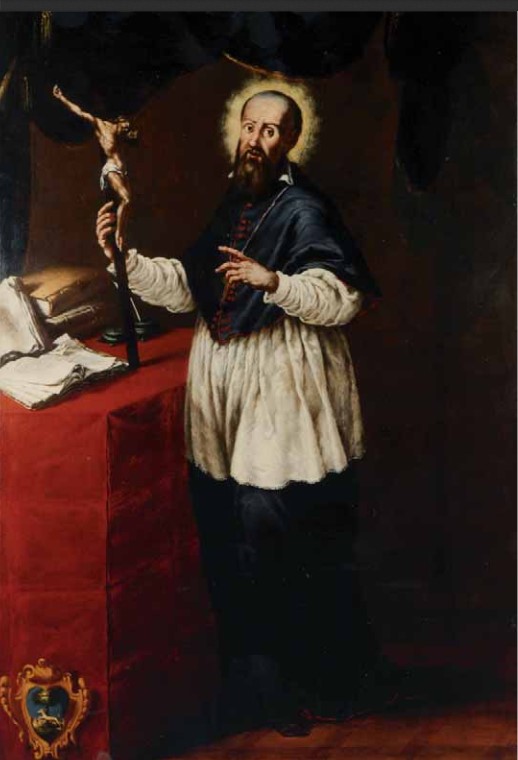
Saint of the Day – 24 January – St Francis de Sales CO, OM, OFM (Cap) (1567-1622) – Doctor of the Church: Doctor caritatis (Doctor of Charity) – ‘The Gentle Christ of Geneva’ and Patronages – against deafness, authors, writers, Catholic press, confessors, deaf people, journalists, teachers, Champdepraz, Aosta, Italy, 8 Diocese, 7 Cities, the Institute of Christ the King Sovereign Priest, the Salesians of Don Bosco. His motto ‘Non-excidet’ – (No failure).
Excerpt from Pope Benedict’s
Catechesis on St Francis de Sales
Wednesday, 2 March 2011
“God is God of the human heart” (The Treatise on the Love of God, I, XV). These apparently simple words give us an impression of the spirituality of a great teacher of whom I would like to speak to you toda – St Francis de Sales, a Bishop and Doctor of the Church.
Born in 1567, in a French border region, he was the son of the Lord of Boisy, an ancient and noble family of Savoy. His life straddled two centuries, the 16th and 17th and he summed up in himself the best of the teachings and cultural achievements of the century drawing to a close, reconciling the heritage of humanism striving for the Absolute that is proper to mystical currents. He received a very careful education, he undertook higher studies in Paris, where he dedicated himself to theology and at the University of Padua, where he studied jurisprudence, complying with his father’s wishes and graduating brilliantly with degrees in utroque iure, in canon law and in civil law.
In his harmonious youth, reflection on the thought of St Augustine and of St Thomas Aquinas led to a deep crisis. This prompted him to question his own eternal salvation and the predestination of God concerning himself, he suffered as a true spiritual drama the principal theological issues of his time. He prayed intensely but was so fiercely tormented by doubt, that for a few weeks he could barely eat or sleep. At the climax of his trial, he went to the Dominicans’ church in Paris, opened his heart and prayed in these words: “Whatever happens, Lord, You who hold all things in Your hand and whose ways are justice and truth, whatever You have ordained for me… You who are ever a just judge and a merciful Father, I will love You Lord…. I will love You here, O my God and I will always hope in Your mercy and will always repeat Your praise…. O Lord Jesus You will always be my hope and my salvation in the land of the living”(I Proc. Canon., Vol. I, art. 4).
The 20-year-old Francis found peace in the radical and liberating love of God – loving Him without asking anything in return and trusting in divine love, no longer asking what will God do with me – I simply love Him, independently of all that He gives me or does not give me. Thus I find peace and the question of predestination — which was being discussed at that time — was resolved, because he no longer sought what he might receive from God, he simply loved God and abandoned himself to His goodness. And this was to be the secret of his life which would shine out in his main work – the The Treatise on the Love of God.
Overcoming his father’s resistance, Francis followed the Lord’s call and was ordained a priest on 18 December 1593. In 1602, he became Bishop of Geneva, in a period in which the city was the stronghold of Calvinism so that his episcopal see was transferred, “in exile” to Annecy. As the Pastor of a poor and tormented diocese in a mountainous area whose harshness was as well known as its beauty, he wrote: “I found [God] sweet and gentle among our loftiest rugged mountains, where many simple souls love Him and worship Him in all truth and sincerity and mountain goats and chamois leap here and there between the fearful frozen peaks to proclaim His praise” (Letter to Mother de Chantal, October 1606, in Oeuvres, éd. Mackey, t. XIII, p. 223).
Nevertheless the influence of his life and his teaching on Europe in that period and in the following centuries is immense. He was an apostle, preacher, writer, man of action and of prayer dedicated to implanting the ideals of the Council of Trent, he was involved in controversial issues dialogue with the Protestants, experiencing increasingly, over and above the necessary theological confrontation, the effectiveness of personal relationship and of charity, he was charged with diplomatic missions in Europe and with social duties of mediation and reconciliation.
Yet above all St Francis de Sales was a director, from his encounter with a young woman, Madame de Charmoisy, he was to draw the inspiration to write one of the most widely read books of the modern age, The Introduction to a Devout Life. A new religious family was to come into being from his profound spiritual communion with an exceptional figure, St Jane Frances de Chantal -The Foundation of the Visitation, as the Saint wished, was characterised by total consecration to God lived in simplicity and humility, in doing ordinary things extraordinarily well – “I want my Daughters”, he wrote, not to have any other ideal than that of glorifying [Our Lord] with their humility” (Letter to Bishop de Marquemond, June 1615).
He died in 1622, at the age of 55, after a life marked by the hardness of the times and by his apostolic effort.”
St Anicet Hryciuk
St Artemius of Clermont
St Bartlomiej Osypiuk
Bertrand of Saint Quentin
St Daniel Karmasz
St Exuperantius of Cingoli
St Felician of Foligno
St Filip Geryluk
Bl Francesc de Paula Colomer Prísas
St Guasacht
St Ignacy Franczuk
Bl John Grove
St Julian Sabas the Elder
St Luigj Prendushi
St Macedonius Kritophagos
Bl Marcolino of Forli
Bl Marie Poussepin
Bl Paula Gambara Costa
St Projectus
St Sabinian of Troyes
St Suranus of Sora
St Thyrsus
Bl William Ireland
—
Martyrs of Asia Minor – 4 saints: A group of Christians martyred together for their faith. The only details to survive are four of their names – Eugene, Mardonius, Metellus and Musonius. They were burned at the stake in Asia Minor.
Martyrs of Podlasie – 13 beati: Podlasie is an area in modern eastern Poland that, in the 18th-century, was governed by the Russian Empire. Russian sovereigns sought to bring all Eastern-rite Catholics into the Orthodox Church. Catherine II suppressed the Greek Catholic church in Ukraine in 1784. Nicholas I did the same in Belarus and Lithuania in 1839. Alexander II did the same in the Byzantine-rite Eparchy of Chelm in 1874, and officially suppressed the Eparchy in 1875. The bishop and the priests who refused to join the Orthodox Church were deported to Siberia or imprisoned. The laity, left on their own, had to defend their Church, their liturgy, and their union with Rome.
On 24 January 1874 soldiers entered the village of Pratulin to transfer the parish to Orthodox control. Many of the faithful gathered to defend their parish and church. The soldiers tried to disperse the people, but failed. Their commander tried to bribe the parishioners to abandon Rome, but failed. He threaten them with assorted punishments, but this failed to move them. Deciding that a show of force was needed, the commander ordered his troops to fire on the unarmed, hymn-singing laymen. Thirteen of the faithful died, most married men with families, ordinary men with great faith.
We know almost nothing about their lives outside of this incident. Their families were not allowed to honour them or participate in the funerals, and the authorities hoped they would be forgotten. They were:
• Anicet Hryciuk
• Bartlomiej Osypiuk
• Daniel Karmasz
• Filip Geryluk
• Ignacy Franczuk
• Jan Andrzejuk
• Konstanty Bojko
• Konstanty Lukaszuk
• Lukasz Bojko
• Maksym Hawryluk
• Michal Wawryszuk
• Onufry Wasyluk
• Wincenty Lewoniuk
Martyrdom:
• shot on 14 January 1874 by Russian soldiers in Podlasie, Poland
• buried nearby without rites by those soldiers
Beatified
6 October 1996 by Pope John Paul II
Martyrs of Antioch:
Babylas
Epolonius
Prilidian
Urban
O Saint John Bosco,
you loved the Blessed Virgin,
Mary Immaculate Help of Christians,
taking her as your Mother and Guide
and becoming her apostle.
Pray for us that,
inspired by your example,
we may grow in true and enduring love
for this sweetest of mothers
and may thus win her powerful protection in life
and especially at the hour of our death.
Through your intercession
may God grant me the following grace………………..
[mention your intention]
so that together with others
I may assist in bringing all, especially the youth,
to the love of Mary Our Help, amen.
Novena to St Paul in preparation for the Feast of The Conversion of St Paul on 25 January
Day Eight – 23 January
“In the ancient Church, Baptism was also called “illumination” because this Sacrament gives light; it truly makes one see. In Paul what is pointed out theologically was also brought about physically – healed of his inner blindness, he sees clearly. Thus St Paul was not transformed by a thought but by an event, by the irresistible presence of the Risen One whom subsequently he would never be able to doubt, so powerful had been the evidence of the event, of this encounter…………….This encounter is a real renewal that changed all his parameters. Now he could say that what had been essential and fundamental for him earlier had become “refuse” for him; it was no longer “gain” but loss, because henceforth the only thing that counted for him was life in Christ.” … Pope Benedict XVI 2008
LET US PRAY:
Glorious St Paul,
your conversion is a powerful witness to the world
that God loves us and does not give up on us,
no matter how far we stray.
May every circumstante of my life be an occasion
to change my way of thinking,
to renounce self-will and
to surrender myself to the wisdom and tenderness of Jesus Christ
who is acting to make me His saint.
Pray St Paul, that I too may be able to acclaim
“It is not I who live, but Christ who lives in me.”
Pray that I may love God’s will and providence for me.
In this confidence, I entrust to you, St Paul,
these, my intentions
…………………………………….
(mention your request)
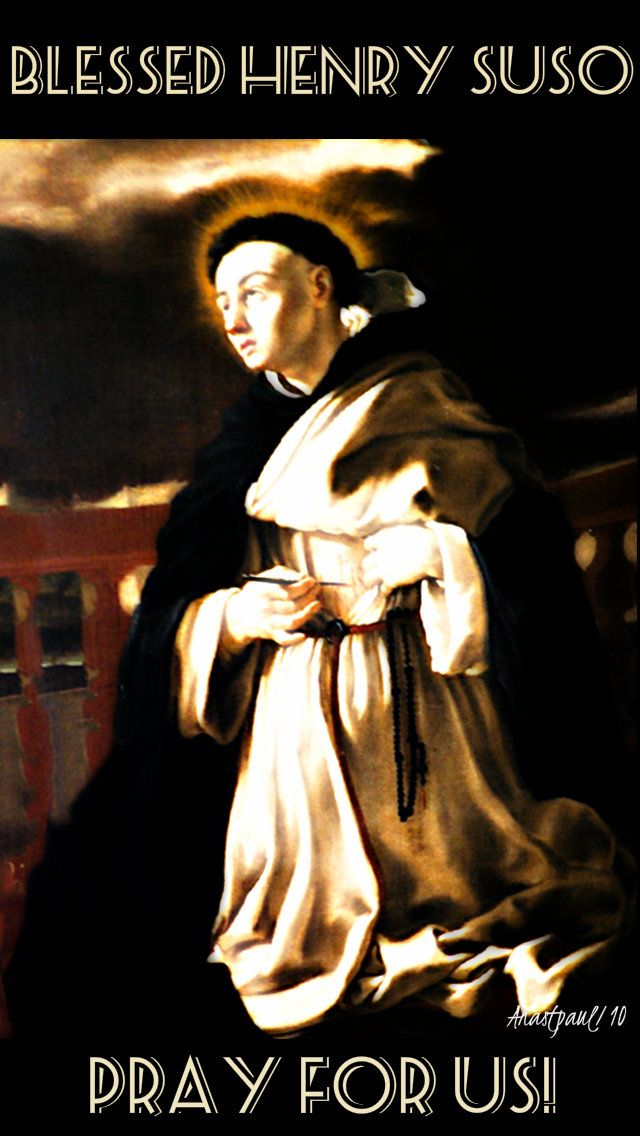
Thought for the Day – 23 January – The Memorial of Blessed Henry Suso OP (1295-1366)
“I desire from the boundless abyss of my heart that all the sufferings and grief that I have ever experienced and, in addition, the painful suffering of all hearts, the pains of all wounds, the groans of all the sick, the sighs of all sad people, the tears of all weeping eyes, the insults suffered by all those oppressed, the needs of all poor indigent widows and orphans, the dire wants of all the thirsty and hungry, the blood spilled by all martyrs, the breaking of their selfish wills by all the joyful and blossoming youth, the painful practices of all the friends of God and all the hidden and open suffering and sorrow that I or any other afflicted person ever experienced with regard to their bodies, possessions, reputation, friends and relatives, or depression, or whatever any man shall suffer up to the last day—I desire that all this may praise You eternally, heavenly Father and honour Your only-begotten suffering Son from eternity to eternity.
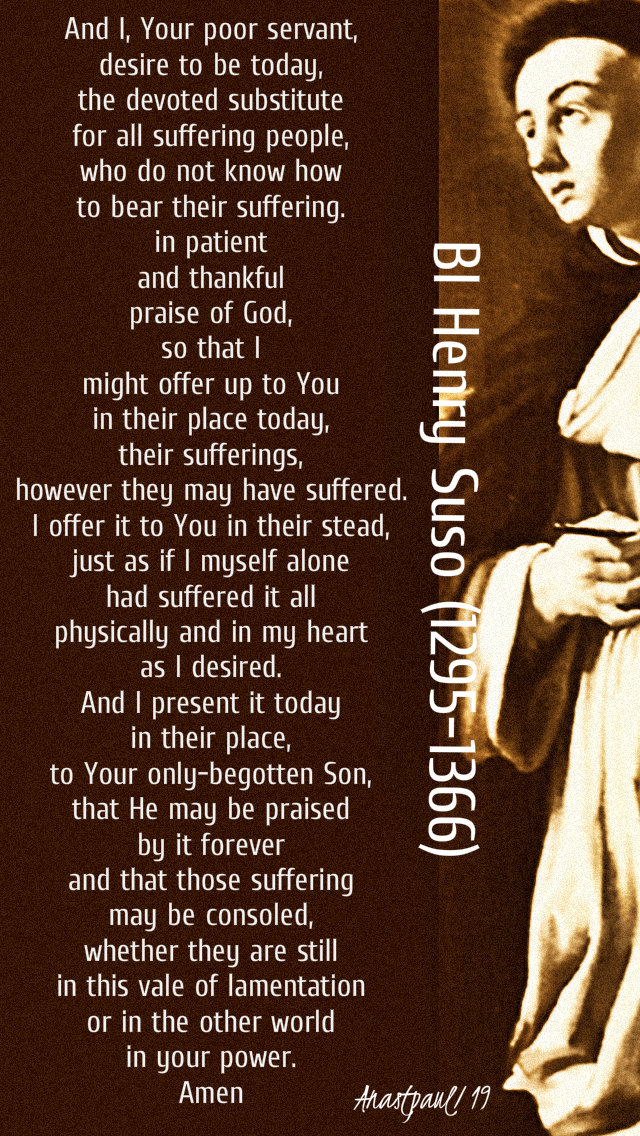
And I, Your poor servant, desire to be today, the devoted substitute for all suffering people, who do not know how to bear their suffering in patient and thankful praise of God, so that I might offer up to You in their place today, their sufferings, however they may have suffered. I offer it to You in their stead, just as if I myself alone had suffered it all, physically and in my heart as I desired. And I present it today in their place to Your only-begotten Son, that He may be praised by it forever and that those suffering, may be consoled, whether they are still in this vale of lamentation, or in the other world in your power.”
Bl. Henry Suso offers this prayer with “the arms of his soul somehow stretched forth to the far ends of the world in heaven and earth.” Our desires too can be extended in prayer to encompass all times and all peoples, especially all those people today who “do not know how to bear their suffering in patient and thankful praise of God,”that even these sufferings may both praise God and win grace and consolation for the afflicted.
Bl Henry Suso, pray for us,
that we may suffer well ourselves and bear in our hearts to God the sufferings of others!
Quote/s of the Day – 23 January – The Memorial of St Ildephonsus (607-667), Blessed Henry Suso OP (1295-1366) and St Marianne Cope (1838-1918)
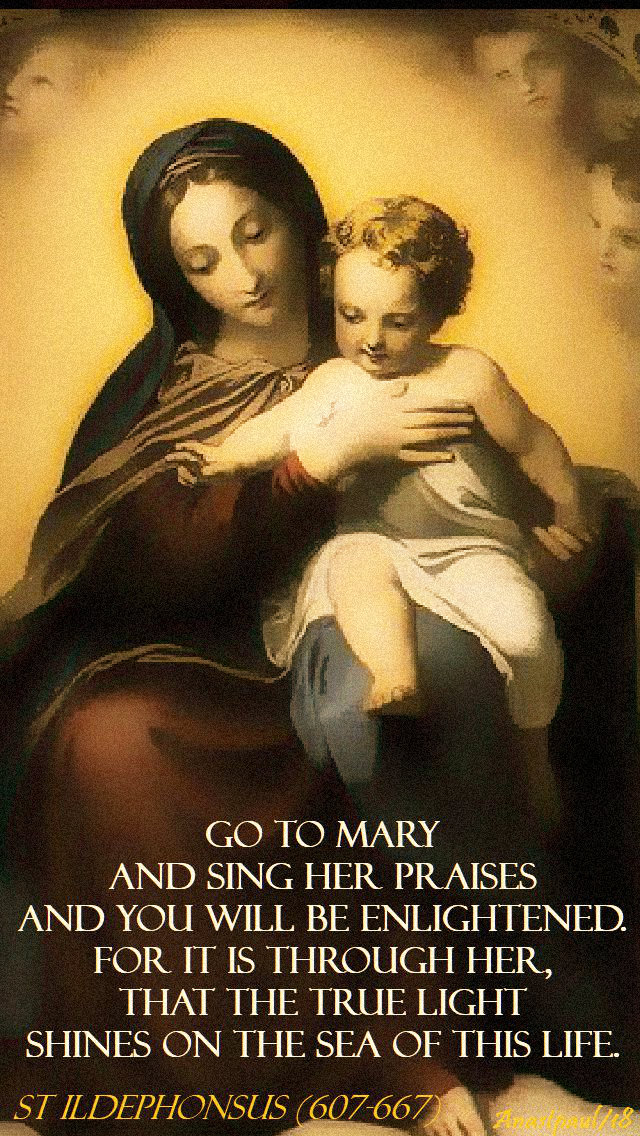
“Go to Mary and sing her praises and you will be enlightened. For it is through her, that the true Light shines on the sea of this life.”
St Ildephonsus (607-667)
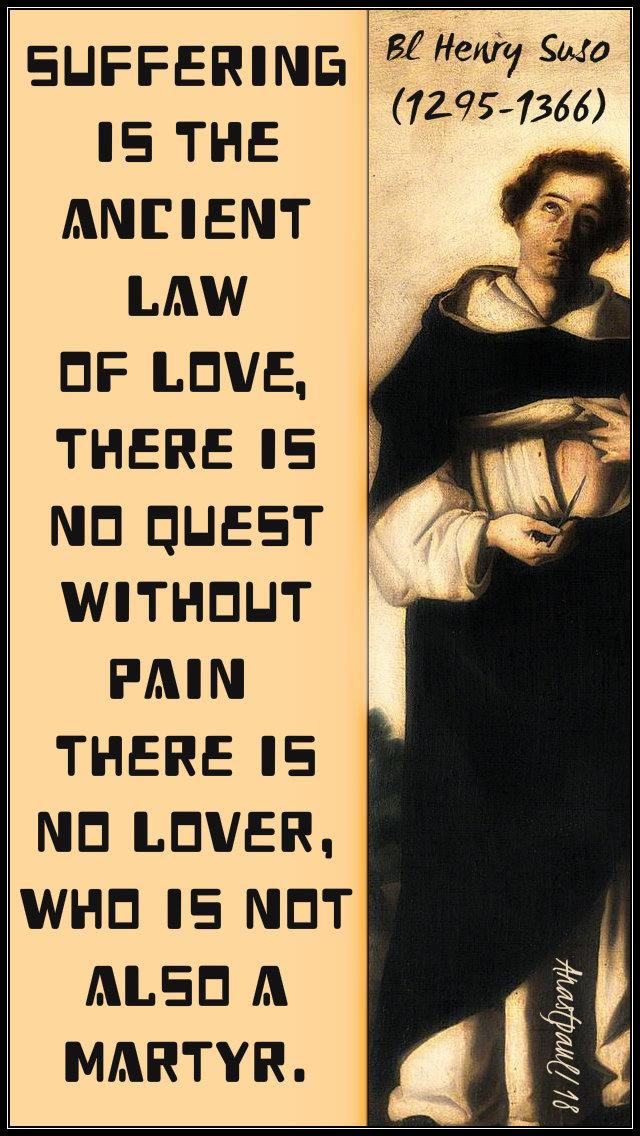
“Suffering is the ancient law of love; there is no quest without pain; there is no lover, who is not also a martyr.”
Blessed Henry Suso (1295-1366)
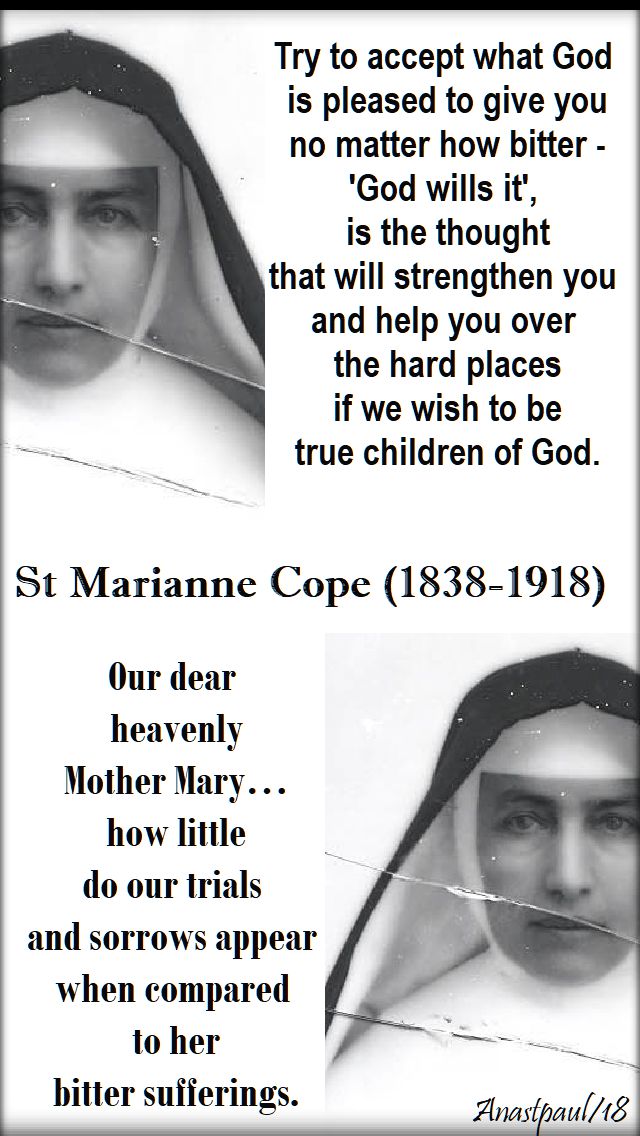
“Try to accept what God is pleased to give you no matter how bitter – ‘God wills it’, is the thought that will strengthen you and help you over the hard places if we wish to be true children of God.”
“Our dear heavenly Mother Mary… how little do our trials and sorrows appear when compared to her bitter sufferings.”
One Minute Reflection – 23 January –Wednesday of the Second week in Ordinary Time – First Reading: Hebrews 7:1–3 – and The Memorial of Blessed Henry Suso OP (1295-1366)
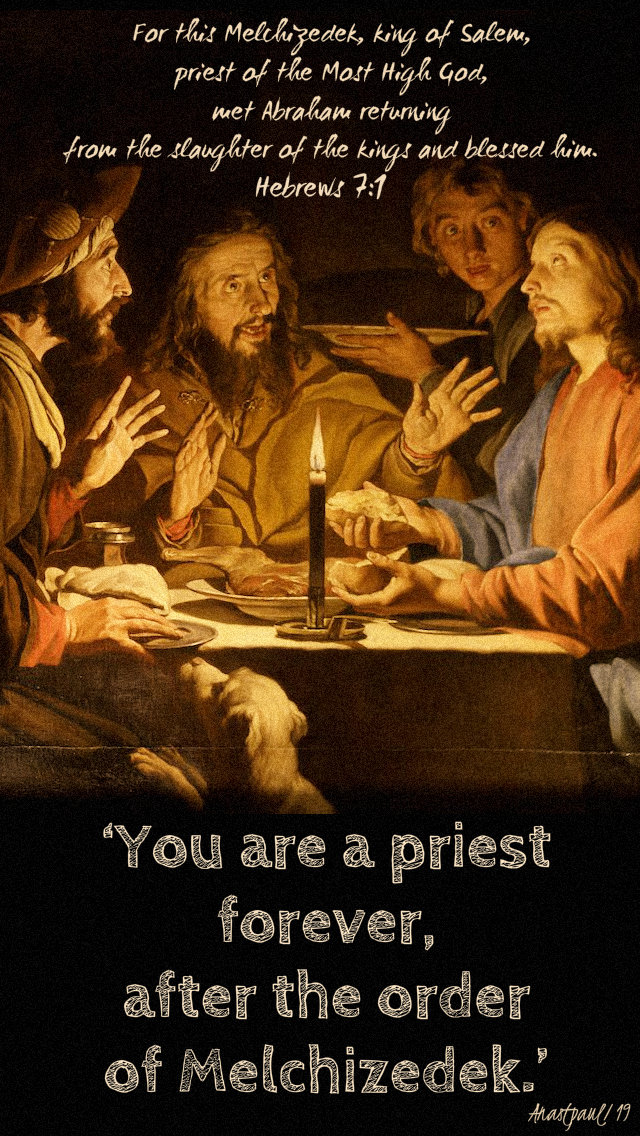
For this Melchizedek, king of Salem, priest of the Most High God, met Abraham returning from the slaughter of the kings and blessed him…Hebrews 7:1
REFLECTION – “An ancient priest of the Mosaic order could only be selected from the tribe of Levi. It was obligatory without exception that he should be of the family descending from Aaron and do service to God in outward worship with the sacrifices and blood of irrational animals. But he that is named Melchizedek, which in Greek is translated “king of righteousness,” who was king of Salem, which would mean “king of peace,” without father, without mother, without line of descent, not having, according to the account, “beginning of years or end of life,” had no characteristics shared by the Aaronic priesthood.
For he was not chosen by humans, he was not anointed with prepared oil, he was not of the tribe of those who had not yet been born and, strangest of all, he was not even circumcised in his flesh and yet he blesses Abraham, as if he were far better than he. He did not act as priest to the Most High God with sacrifices and libations, nor did he minister at the temple in Jerusalem. How could he? It did not yet exist. And he was such, of course, because there was going to be no similarity between our Saviour Christ and Aaron, for He was neither to be designated priest after a period when he was not priest, nor was He to become priest but be it. For we should notice carefully in the words, “You are a priest forever,” he does not say, “You shall be what you were not before,” any more than, “You were that before which you are not now” — but by Him who said, “I am who I am,”1 it is said, “You are, and remain, a priest forever.”
And the fulfilment of the oracle is truly wondrous to one who recognises how our Saviour Jesus, the Christ of God, now performs through His ministers even today, sacrifices after the manner of Melchizedek’s. For just as He, who was priest of the Gentiles, is not represented as offering outward sacrifices but as blessing, Abraham only with wine and bread, so in exactly the same way our Lord and Saviour Himself first and then all His priests among all nations, perform the spiritual sacrifice according to the customs of the church and with wine and bread darkly express the mysteries of His body and saving blood. This, by the Holy Spirit, Melchizedek foresaw and used the figures of what was to come, as the Scripture of Moses witnesses, when it says, “And Melchizedek, king of Salem, brought out bread and wine; he was priest of God Most High, and he blessed Abraham.” And thus it followed that to Him only was the addition of an oath, “The Lord God has sworn and will not change his mind, ‘You are a priest forever after the order of Melchizedek.’”.…Eusebius of Caesarea (c 260-339) Bishop “Father of Church History”
PRAYER – Loving Father, grant me to have a true fervour in Your service. Help me to become a zealous worker for Your honour and glory, in imitation of your Son and of your holy saints. Grant that by the prayers of Blessed Henry Suso, we may grow in love, by Your grace. Through our Lord Jesus Christ, in unity with the Holy Spirit, one God forever.
“In the history of early Christianity there is a fundamental distinction between the first three centuries and those that followed the Council of Nicaea in 325, the first Ecumenical Council. Like a “hinge” between the two periods are the so-called “conversion of Constantine” and the peace of the Church, as well as the figure of Eusebius, Bishop of Caesarea in Palestine. He was the most highly qualified exponent of the Christian culture of his time in very varied contexts, from theology to exegesis, from history to erudition. Eusebius is known above all as the first historian of Christianity but he was also the greatest philologist of the ancient Church.”…Pope Benedict XVI, 13 June 2007
Our Morning Offering – 23 January – The Memorial of Blessed Henry Suso OP (1295-1366)
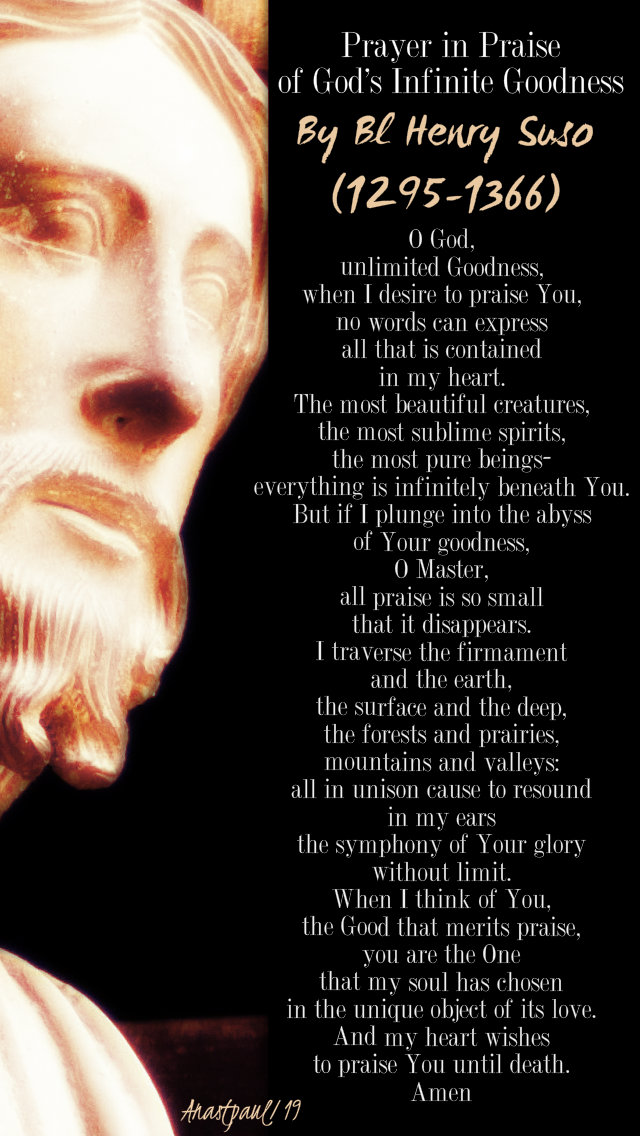
Prayer in Praise of God’s Infinite Goodness By Bl Henry Suso (1295-1366)
O God, unlimited Goodness,
when I desire to praise You,
no words can express
all that is contained in my heart.
The most beautiful creatures,
the most sublime spirits,
the most pure beings-
everything is infinitely beneath You.
But if I plunge into the abyss of Your goodness,
O Master,
all praise is so small that it disappears.
I traverse the firmament and the earth,
the surface and the deep,
the forests and prairies,
mountains and valleys:
all in unison cause to resound in my ears
the symphony of Your glory without limit.
When I think of You,
the Good that merits praise,
you are the One
that my soul has chosen
in the unique object of its love.
And my heart wishes to praise You until death.
Amen
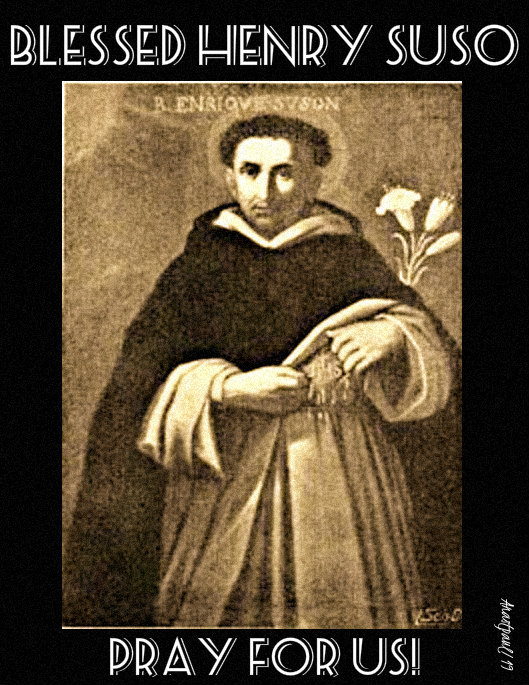
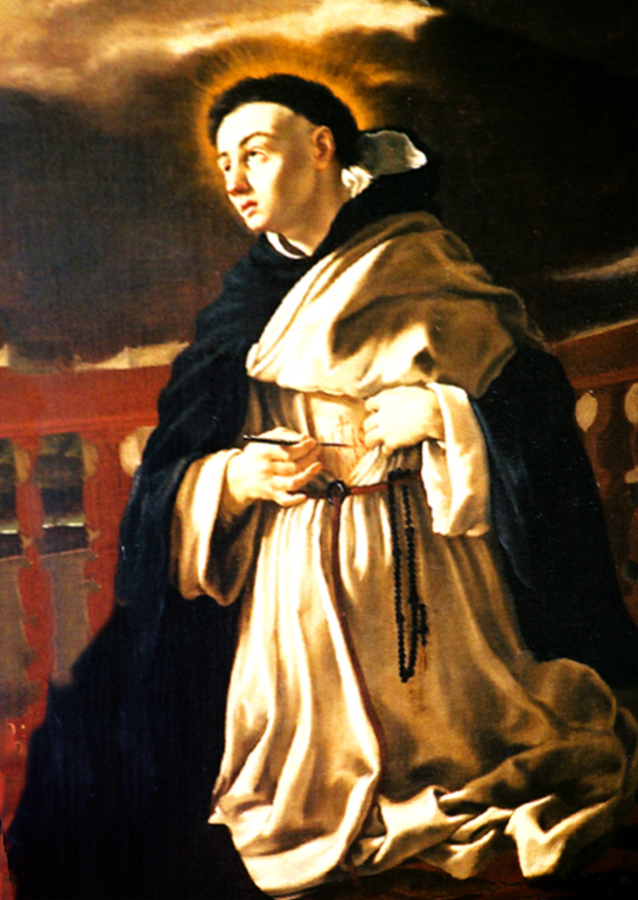
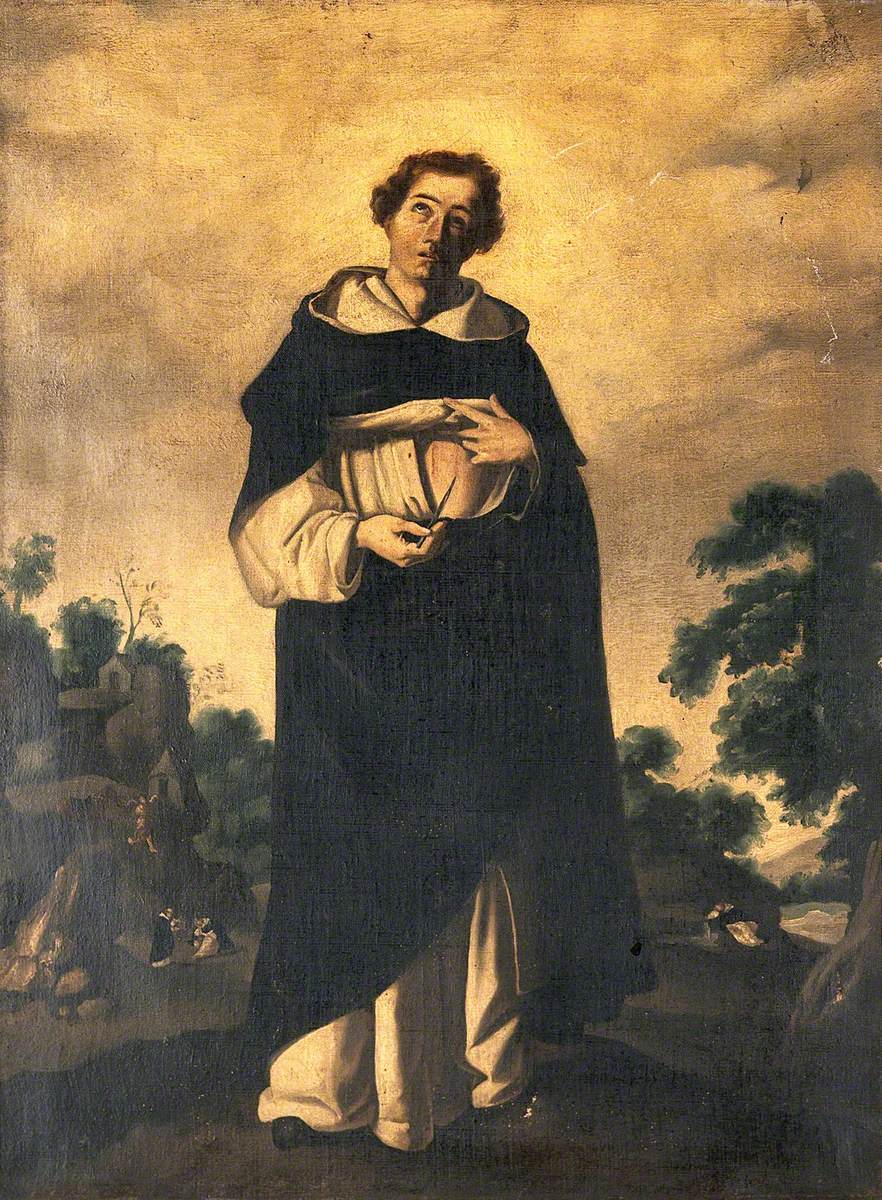
Saint of the Day – 23 January – Blessed Henry Suso OP (1295-1366) Henry (also called Amandus, a name adopted in his writings and Heinrich Seuse in German), was a German Dominican Priest and Friar and the most popular vernacular writer of the fourteenth century. Suso is thought to have been born on 21 March 1295. An important author in both Latin and Middle High German, he is also notable for defending Meister Eckhart’s legacy after Eckhart was posthumously condemned for heresy in 1329. He died in Ulm on 25 January 1366 and was Beatified 1831, by Pope Gregory XVI. Blessed Henry was a Priest, Preacher, Writer, Poet, Mystic. His body is incorrupt.
Henry was born in Switzerland—hence the epithet “Suso,” or “Swiss”—in 1290. The gentle Henry was a great disappointment to his military family. Gifted with a deep awareness of God’s presence within him and drawn to a life of prayer, at the age of thirteen, he entered the Dominican convent at Lake Constance near the Alps on the Swiss-German border. His Dominican formation developed and matured his natural contemplative gifts, giving his prayer an outlet in a joyful zeal to share its fruits with others. Once ordained, he travelled constantly and widely, preaching and hearing confessions.
Bl Henry Suso is known in the Order for his gentleness and slight eccentricity. For example, he once erected a Maypole and danced around it in a joyful display of uninhibited love for the Lord. He used to call his beloved crucified Lord “God’s Eternal Wisdom”, which indeed Christ is. Although in his lifetime Blessed Henry suffered much and was not renowned for being a great theologian or preacher, the manuscripts surviving of his writings suggest he was the most widely read spiritual author in the later Middle Ages until the publication of the Imitatio Christi. Henry wrote the spiritual classic The Little Book of Eternal Wisdom, or The Exemplar. He had a very strong devotion to Christ’s passion and crucifixion and speaks of it in very human terms. This makes him and especially his Little Book of Eternal Wisdom, ideal reading and material for meditation during Lent. In many images you will see him writing the name of Jesus under his heart – it is believed that he really did ‘tattoo’ himself in this way.
From his teens, Henry had imposed severe penances on himself. However, his greatest sufferings were not of his own making. In his innocence, he was constantly misunderstood and taken advantage of. On one preaching tour, Henry was victim of the deceit of his lay companion, who lied about Henry’s poisoning a well in the town. The story was believed and Henry was almost clubbed to death. In another situation, which found him in the middle of disputes between feuding families, he was falsely accused by a woman from one of them as being the father of her child.
Henry was a contemporary of John Tauler OP and Master Eckhart, Dominican theological writers of the Rhineland Mystics of Germany in the fourteenth century. Henry complemented their theology with his beautiful devotional poetry.
He died in Ulm, near Bavaria, in 1365. His body was later found incorrupt and emitting a fragrance reminiscent of that of his Holy Father Dominic 150 years before.
Suso was esteemed as a preacher and was heard in the cities and towns of Swabia, Switzerland, Alsace and the Netherlands. His apostolate, however, was not with the masses but rather with individuals of all classes who were drawn to him by his singularly attractive personality and to whom he became a personal director in the spiritual life.
The words of the Christmas Hymn “In dulci jubilo” are attributed to Suso. In his biography (or perhaps autobiography), it was written: Now this same angel came up to the Servant (Suso) brightly and said that God had sent him down to him, to bring him heavenly joys amid his sufferings, adding that he must cast off all his sorrows from his mind and bear them company and that he must also dance with them in heavenly fashion. Then they drew the Servant by the hand into the dance and the youth began a joyous song about the infant Jesus ..:
In sweet rejoicing,
now sing and be glad!
Our hearts’ joy
lies in the manger;
And it shines like the sun
in the mother’s lap.
You are the alpha and omega!
St Marianne Cope TO.S.F. (1838-1918)
2017 post here: https://anastpaul.wordpress.com/2017/01/23/saint-of-the-day-23-january-st-marianne-cope/
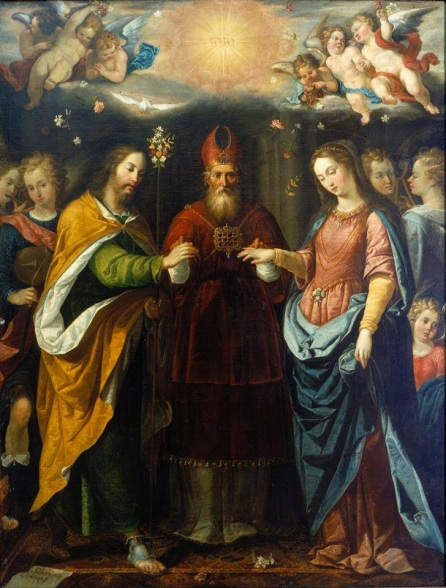
Espousal of the Blessed Virgin Mary – 23 January: Feast in honour of the Blessed Virgin’s espousal to Saint Joseph. It is certain that a real matrimony was contracted by Joseph and Mary. Still Mary is called “espoused” to Joseph (“his mother Mary was espoused to Joseph”, Matthew 1:18) because the matrimony was never consummated. The term spouse is applied to married people until their marriage is consummated. This feast dates from 1517 when it was granted to the nuns of the Annunciation by Pope Leo X with nine other Masses in honour of Our Lady. Adopted by many religious orders and dioceses, it was observed for a time by nearly the whole Church but is no longer in the Calendar.
St Abel the Patriarch
St Agathangelus
St Amasius of Teano
St Andreas Chong Hwa-Gyong
St Aquila the Martyr
St Asclas of Antinoe Bl Benedetta Bianchi Porro (1936-1964)
St Clement of Ancyra
St Colman of Lismore
St Dositheus of Gaza
St Emerentiana
St Eusebius of Mount Coryphe Bl Henry Suso OP (1295-1366) St Ildephonsus (506-667)
Biography: https://anastpaul.wordpress.com/2018/01/23/saint-of-the-day-23-january-st-ildephonsus-607-667/
Bl Joan Font Taulat
St John the Almoner/the Mericiful (Died c 620)
Bl Juan Infante
St Jurmin
St Lufthild
St Maimbod
Bl Margaret of Ravenna
Martyrius of Valeria
St Messalina of Foligno
St Ormond of Mairé
St Parmenas the Deacon
St Severian the Martyr
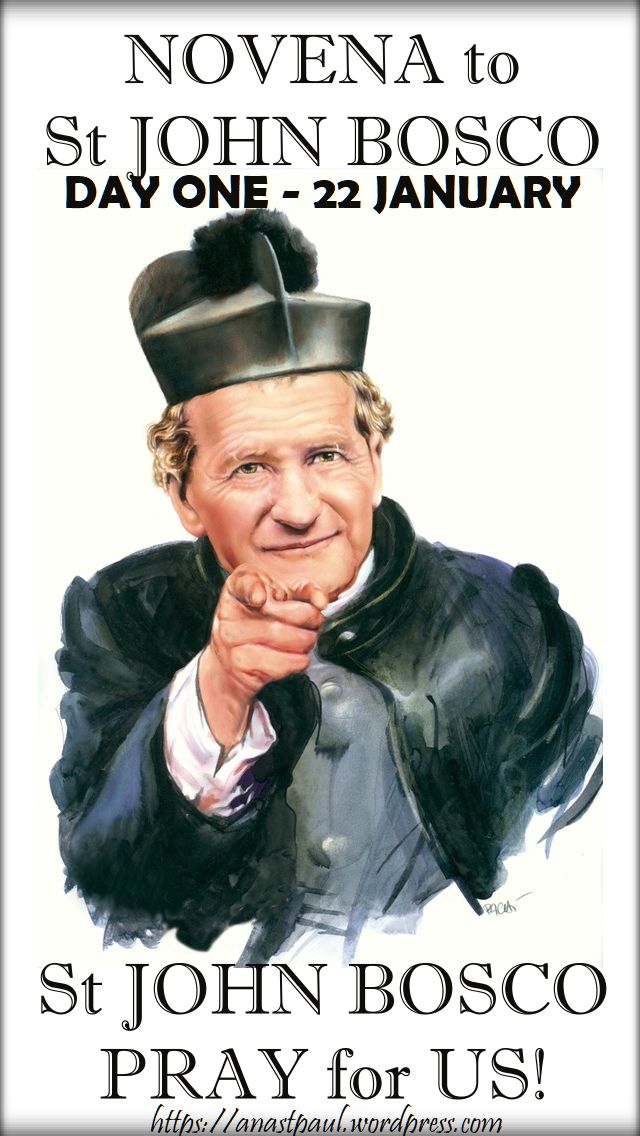
St John Bosco is the Patron of Christian apprentices, editors, publishers, schoolchildren, young people, magicians, juvenile delinquents. Choose ALL young people or your own children. Or simply Pray the 9 days for your own intention.
1st Day – 22 January – Love for Jesus in the Blessed Sacrament
O Saint John Bosco,
you loved Jesus in the Blessed Sacrament
and zealously promoted this devotion
by encouraging participation in the Holy Eucharist,
reception of Holy Communion and daily visits
to Our Lord in the Tabernacle.
Pray for us that, inspired by your example,
we may grow in this love,
so that we may end our days strengthened
and comforted by the Heavenly Food of
the Most Holy Eucharist.
Through your intercession
may God grant me the following grace
……………….………………….
[mention your intention]
so that together with others
I may assist in bringing all, especially the young,
to the love of Christ in the Eucharist, amen.
Novena to St Paul in preparation for the Feast of The Conversion of St Paul on 25 January
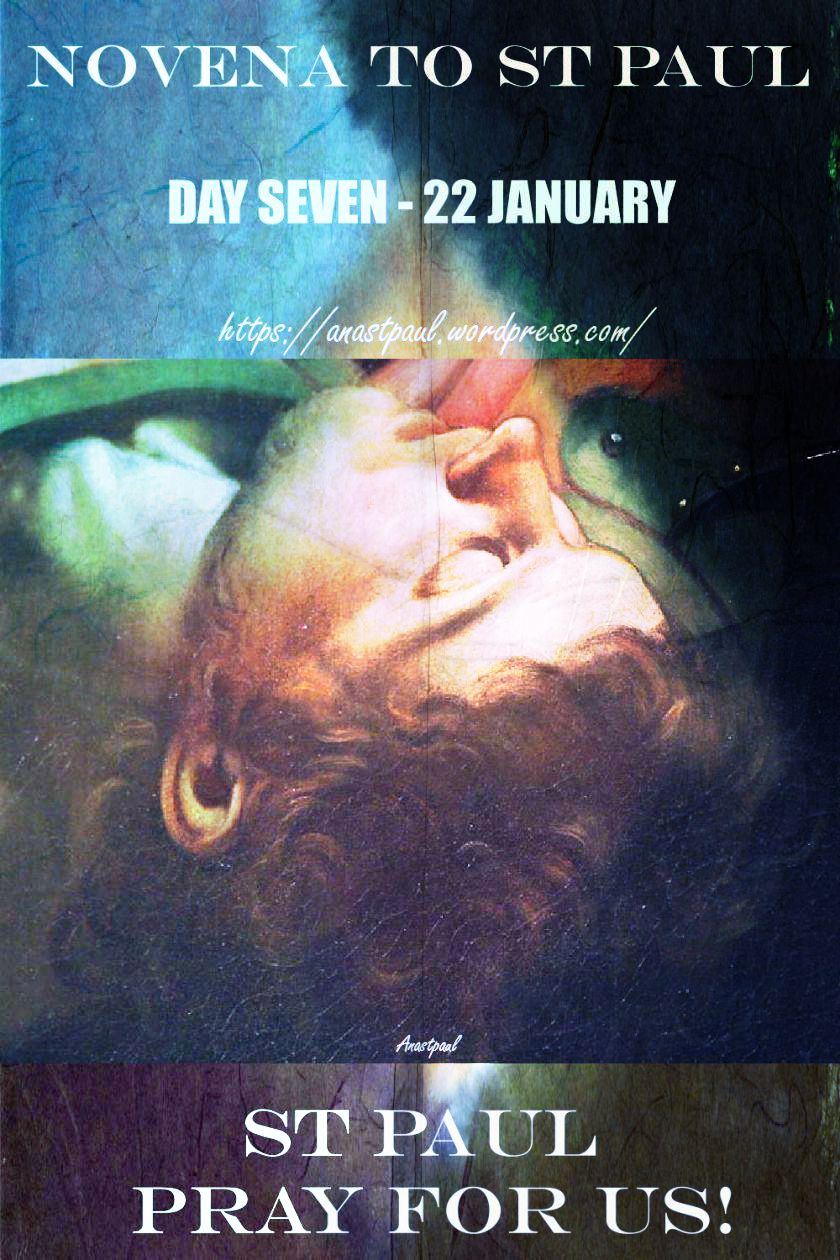
Day Seven – 22 January
“Make no mistake, my brothers, if anyone joins a schismatic he will not inherit God’s Kingdom. If anyone walks in the way of heresy, he is out of sympathy with the Passion. Be careful, then, to observe a single Eucharist. For there is one flesh of our Lord, Jesus Christ and one cup of His blood that makes us one and one altar, just as there is one bishop along with the presbytery and the deacons, my fellow slaves. In that way whatever you do is in line with God’s will.”………………St Ignatius of Antioch
LET US PRAY:
Glorious St Paul,
your conversion is a powerful witness to the world
that God loves us and does not give up on us,
no matter how far we stray.
Help me to cling to Christ in the Blessed Sacrament
help me to fully participate at every Holy Mass
help me to understand, that this IS He
who showed us the way
gave us the light to follow it in Holy Mother Church
who is His bride and shows us the only truth.
May every circumstante of my life be an occasion
to change my way of thinking,
to renounce self-will and
to surrender myself to the wisdom and tenderness of Jesus Christ
who is acting to make me His saint.
Pray that I may love God’s will and providence for me.
In this confidence, I entrust to you, St Paul,
these, my intentions
……………………………..
(mention your request)
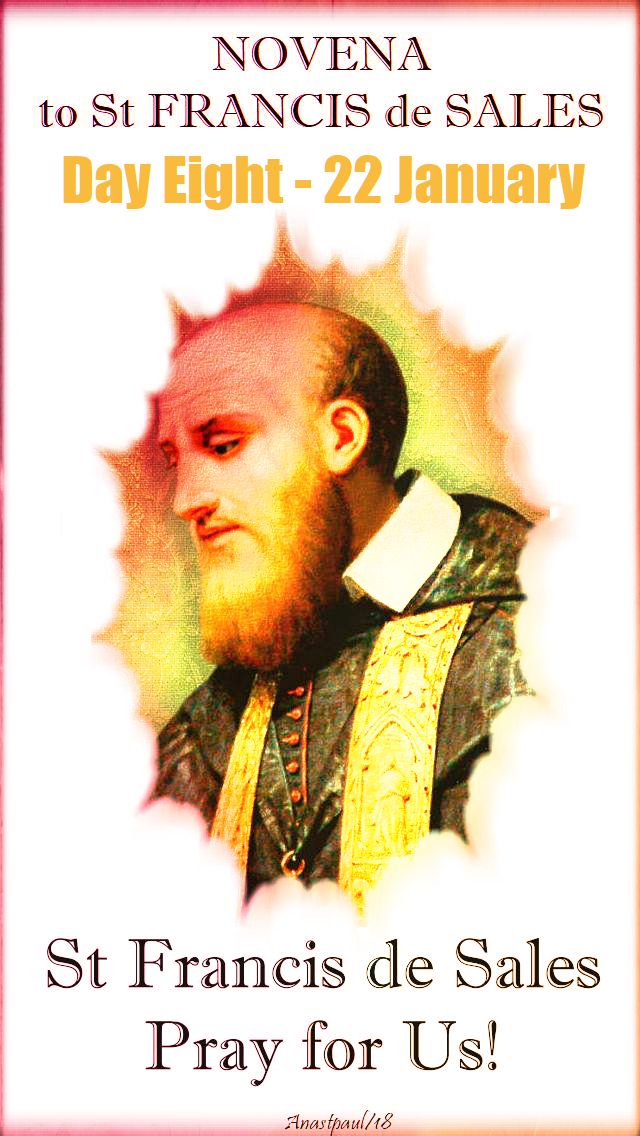
Novena to St Francis de Sales
Day EIGHT – 22 January
“One of the greatest proofs of love that Jesus displayed on the cross was putting up with the imperfections of His neighbour. There He showed us that He has a heart that loves us tenderly and watches over us kindly. He even showed His love for those who put Him to death. In those dire moments the Saviour expressed thoughts of love even for his executioners, pardoning them in the very act of sinning! How petty-minded we are when we cannot bring ourselves to forget some injury received, even after a long time! Whoever sincerely, pardons another, calls down abundant blessings and perfectly imitates Christ.” (St Francis de Sales Spiritual Treatises IV; O. VI, pp. 65-66)
O blessed Francis de Sales,
who on earth did excel in a life of virtue,
especially in the love of God and neighbour,
I earnestly ask you to take me under your compassionate care and protection.
Obtain for me conversion of mind and heart.
Grant that all people, especially
………..……………………..
(names of those whom you wish to include)
may experience the depth of God’s redeeming and healing love.
Teach me to fix my eyes on the things of heaven
even as I walk each day with my feet planted firmly on the earth.
Help me, through the practice of virtue and the pursuit of devotion,
to avoid anything that would otherwise cause me to stumble
in my attempt to follow Christ and to be an instrument of the Holy Spirit.
Encouraged by your prayers and example,
help me to live fully my sacred dignity with the hope of experiencing my sacred destiny: eternal life with God. Receive also this particular need or concern that I now lift up in prayer
….………………………………
(mention your particular need).
O God, for the salvation of all,
You desired that St Francis de Sales—
preacher, missionary, confessor, bishop and founder—
should befriend many along the road to salvation.
Mercifully grant that we,
infused with the humility and gentleness of his charity,
guided by his wisdom and sharing in his spirit may experience eternal life.
Thought for the Day – 22 January – The Memorial of St Vncent of Saragossa (Died 304) Martyr
The martyrs are heroic examples of what God’s power can do.
It is humanly impossible, we realise, for someone to go through tortures such as Vincent had and remain faithful. But it is equally true that by human power alone, no-one can remain faithful, even without torture or suffering.
God does not come to our rescue at isolated, “special” moments. God is supporting the super-cruisers as well as children’s toy boats.
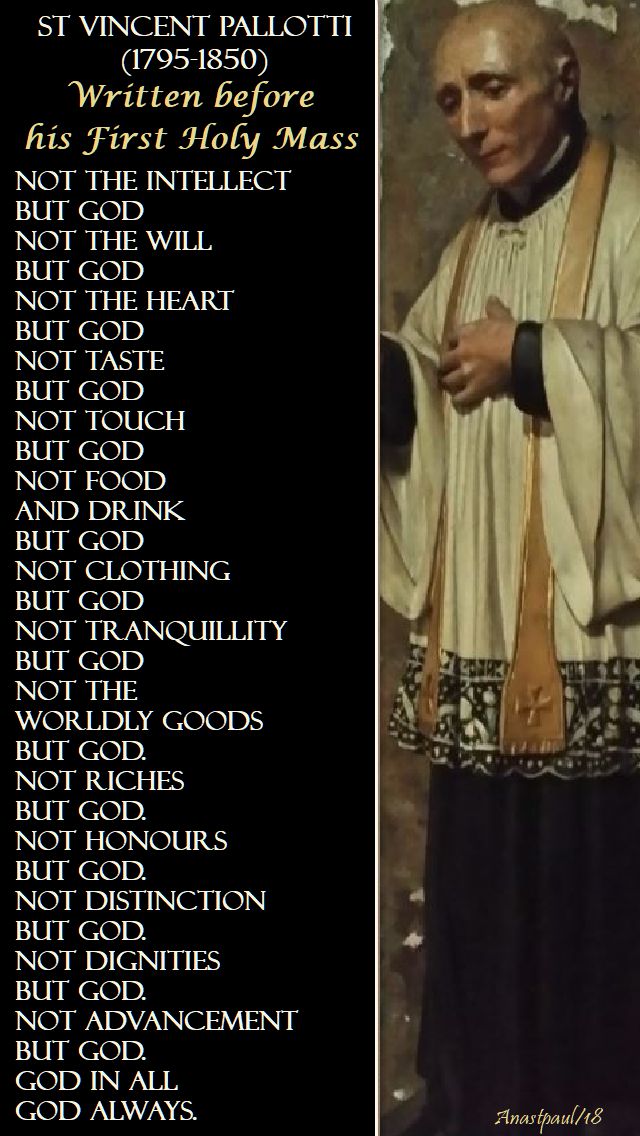
Quote/s of the Day – 22 January – The Memorial of St Vincent Pallotti SAC (1795-1850)
“How great is the dignity of the priesthood! What a dignity, what a dignity!… To be a priest! What does that mean? O God, my God, I do not understand it! What does it mean to present the holy, bloodless sacrifice and to administer the sacraments!” (Written to St Gaspar del Bufalo (1786-1837), just before being ordained, the founder of the Society for the Precious Blood, with whom Vincenzo contracted a deep spiritual friendship.)
Before his First Holy Mass
“Not the intellect but God Not the will but God Not the heart but God Not taste but God Not touch but God Not food and drink but God Not clothing but God Not tranquillity but God Not the worldly goods but God. Not riches but God. Not honours but God. Not distinction but God. Not dignities but God. Not advancement but God. God in all God always.”
“You must be holy in the way that God asks you to be holy. God does not ask you to be a Trappist monk or a hermit. He wills, that you sanctify the world and your everyday life.”
One Minute Reflection – 22 January – Tuesday of the Second week in Ordinary Time, Gospel: Mark 2:23–28 and the Memorial of St Vncent of Saragossa (Died 304) Martyr
“…so the Son of man is lord even of the sabbath.”...Mark 2:28
REFLECTION – “From the first, the law of the Sabbath conferred many and great benefits; for instance, it made the Jews gentle and humane towards those of their own household, it taught them God the Creator’s providence and wisdom… hen God gave the law for the Sabbath He said… that He would have them refrain from evil works only when he said: “You must do no work, except for what is necessary for life” (Ex 12:16 LXX). And in the temple, too, everything continued with more diligence than ever. Thus even by means of the very shadow, He was secretly opening the full light of truth (cf. Col 2:17).
Did Christ then do away with so highly profitable a thing? Far from it; He greatly enhanced it. For it was unnecessary… that we should learn from it, that God made all things or that we should be made kind by it, who are called to imitate God’s own love. For He says: “Be merciful, as your heavenly Father is merciful”(Lk 6:36). It was no longer necessary to fix a day of festival for those who are commanded to keep a feast all their life long. For: “Let us keep the feast,” Saint Paul writes, “not with old leaven, neither with leaven of malice and wickedness but with the unleavened bread of sincerity and truth” (1Cor 5:8)… So now, why is any sabbath required for Christians who are always keeping the feast and whose conversation is in heaven? Yes, my brethren, let us celebrate that continual, heavenly sabbath.”…St John Chrysostom (c 345-407) Father & Doctor
PRAYER – True Light of the world, Lord Jesus Christ, as You enlighten all men for their salvation, give us the grace, we pray, to herald Your coming by preparing the ways of justice and of peace. We walk in faith and by Your Light as St Vincent, fearless of men to the end and trusting only in Your grace, inspires us to follow. Grant that his prayers may assist us on our path. Who live and reign with the Father and the Holy Spirit, God forever, amen.
Our Morning Offering – 22 January – The Memorial of St Vincent of Saragossa (Died 304) – Deacon and Martyr – The Protomartyr of Spain
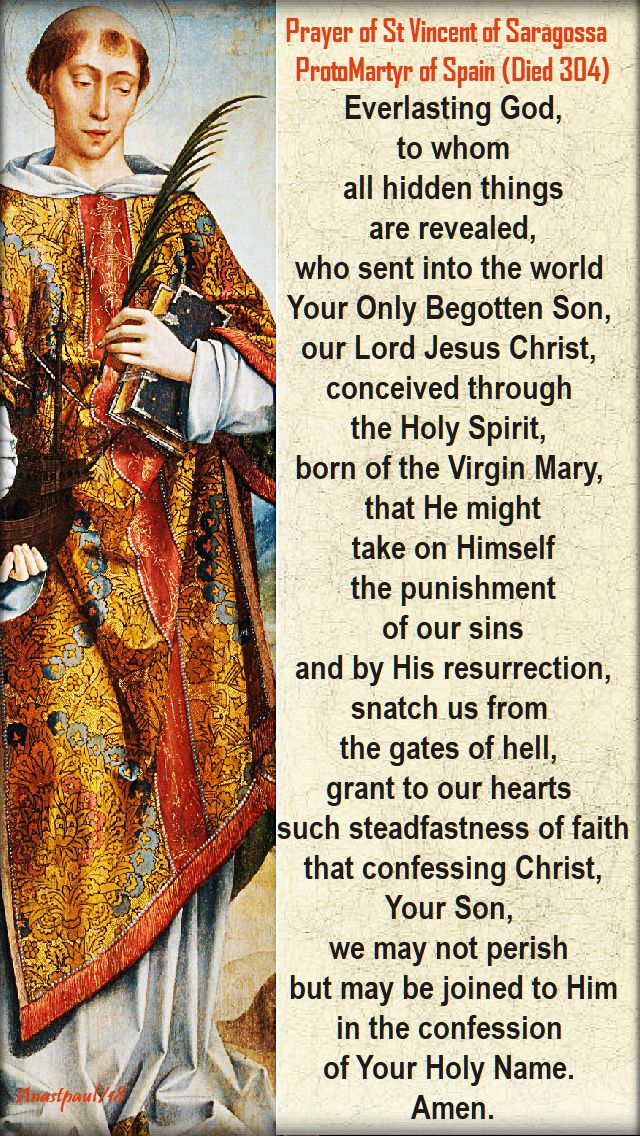
Prayer of St Vincent of Saragossa (Died 304)
Everlasting God,
to whom all hidden things
are revealed,
who sent into the world
Your Only Begotten Son,
our Lord Jesus Christ,
conceived through the Holy Spirit,
born of the Virgin Mary,
that He might take on Himself
the punishment of our sins
and by His resurrection,
snatch us from the gates of hell,
grant to our hearts
such steadfastness of faith
that confessing Christ, Your Son,
we may not perish
but may be joined to Him
in the confession
of Your Holy Name.
Amen
St Anastasius the Persian
St Antonio della Chiesa
Bl Bernard of Vienne
St Blaesilla of Rome
St Brithwald of Ramsbury
St Caterina Volpicelli
St Dominic of Sora
Bl Esteve Santacana Armengol
St Francis Gil de Frederich de Sans
Bl Giuseppe Nascimbeni
St Guadentius of Novara
Bl Ladislao Batthyany-Strattmann
Bl Laura Vicuna
Bl Maria Mancini
St Mateo Alonso de Leciñana St Valerius of Saragossa (Died 315)
St Vincent Pallotti
Bl Walter of Himmerode Bl William Joseph Chaminade SM (1761-1850)
Bl William Patenson
—
Martyrs of Puigcerda:
Orontius
St Victor
St Vincent
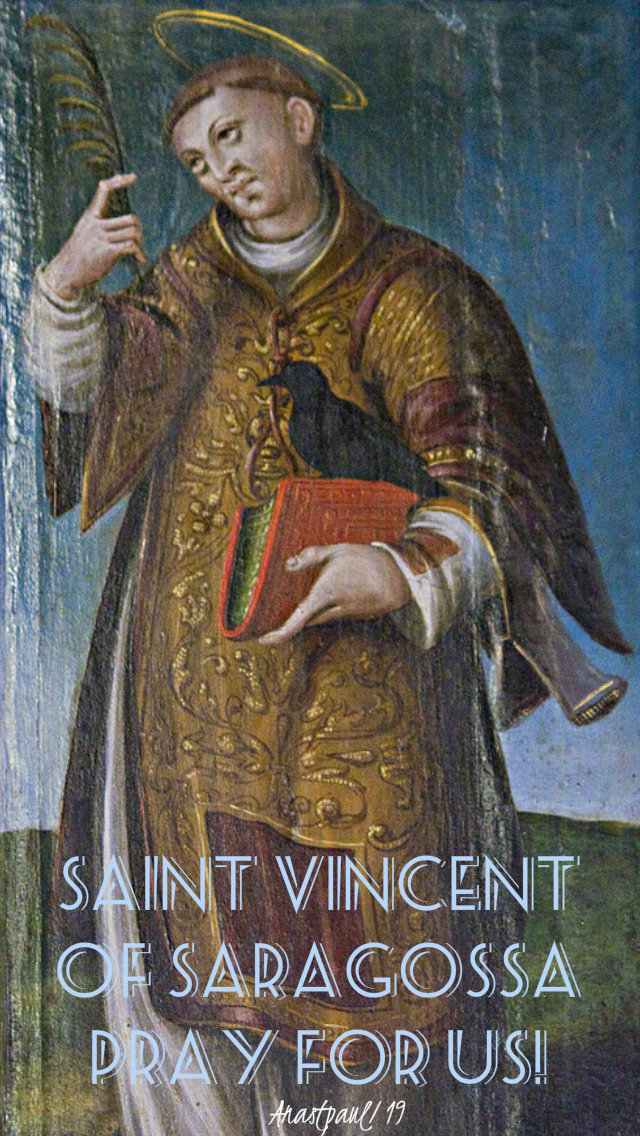
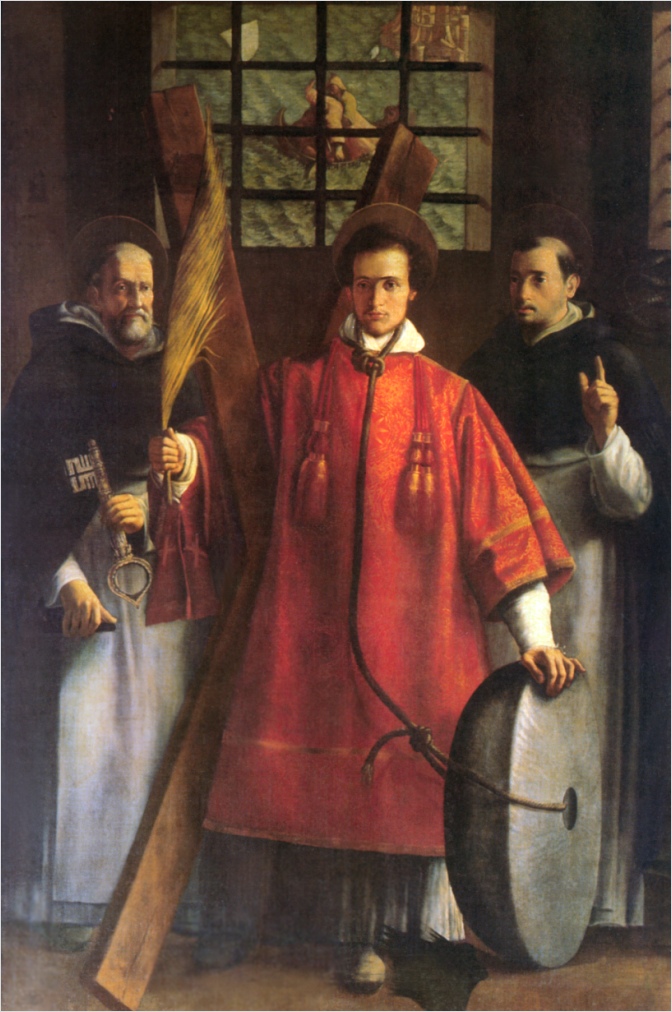
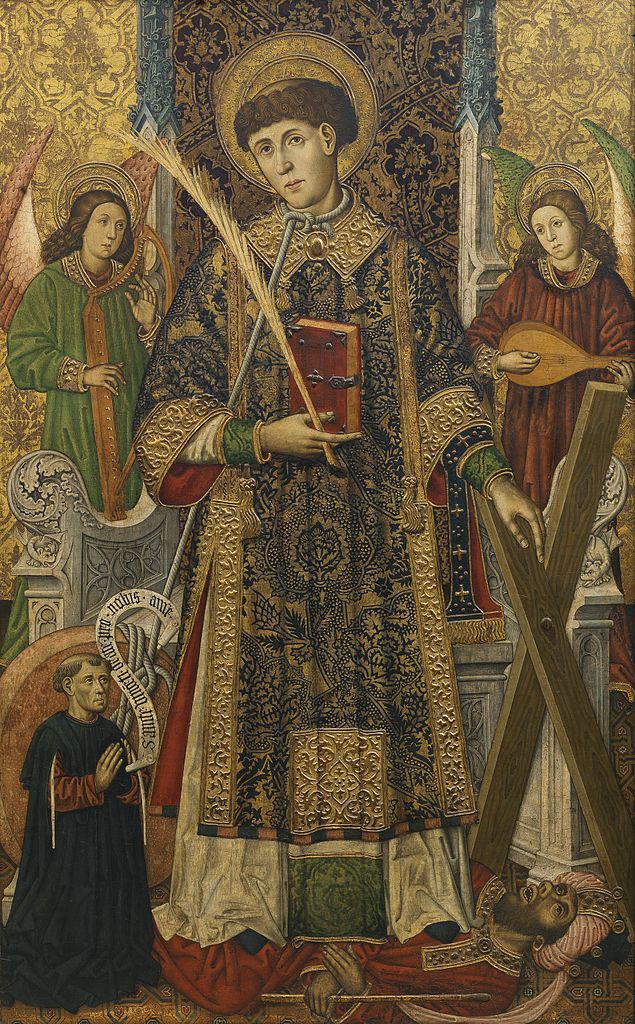
Saint of the Day – 22 January – St Vincent of Saragossa (Died 304) Deacon – Protomartyr of Spain – Archdeacon, Preacher, assistant to St Valerius of Saragossa (Died 315), who was his Bishop and whose Memorial is also today, – also known as Vincent Martyr, Vincent of Zaragoza, Vincent the Deacon, Vincent Tourante, Vincent of Aragon, Vincent of Huesca.Patronages – Lisbon, Valencia, Valencia, Vicenza (Italy), Sao Vicente, vinegar makers, vintners, wine growers and the Order of the Deacons of the Diocese of Bergamo (Italy).
The earliest account of Vincent’s martyrdom is in a carmen (lyric poem) written by the poet Prudentius, who wrote a series of lyric poems, Peristephanon (“Crowns of Martyrdom“), on Hispanic and Roman martyrs.
He was born at Huesca, near Saragossa, Spain sometime during the latter part of the 3rd century; it is believed his father was Eutricius (Euthicius) and his mother was Enola, a native of Osca. Vincent spent most of his life in the city of Saragossa, where he was educated and ordained to the diaconate by Bishop Valerius of Saragossa, who commissioned Vincent to preach throughout the diocese. Because Valerius suffered from a speech impediment, Vincent acted as his spokesman.
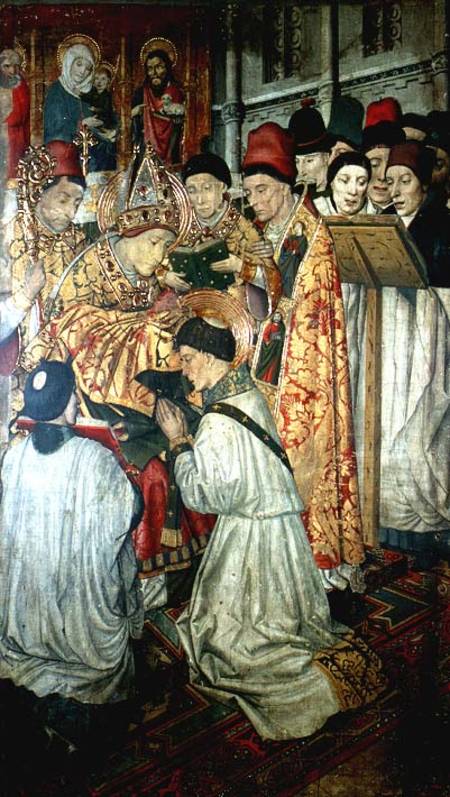
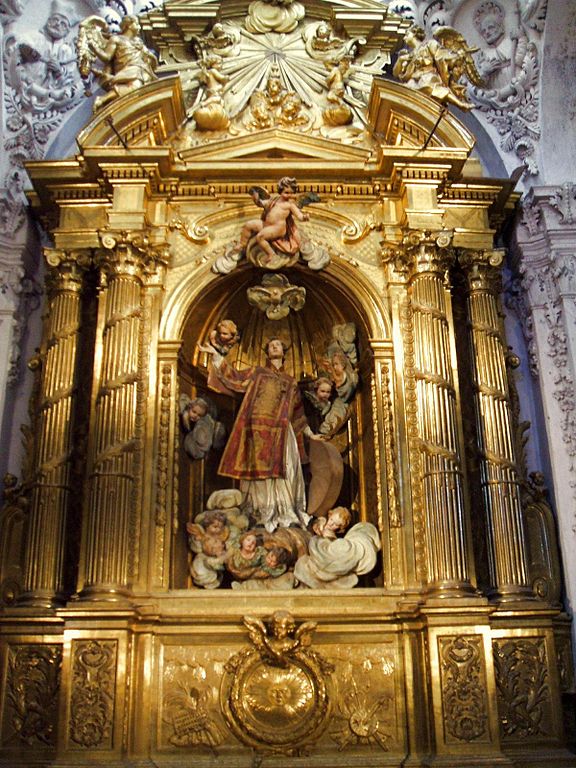
The ordination of St Vincent by St Valerius
When the Roman Emperor Diocletian began persecuting Christians in Spain, both were brought before the Roman governor, Dacian in Valencia. Vincent and his bishop Valerius were confined to the prison of Valencia. Though he was finally offered release if he would consign Scripture to the fire, Vincent refused. Speaking on behalf of his bishop, he informed the judge that they were ready to suffer everything for their faith and that they could pay no heed either to threats or promises.
His outspoken manner so angered the governor that Vincent was inflicted every sort of torture on him. He was stretched on the rack and his flesh torn with iron hooks. Then his wounds were rubbed with salt and he was burned alive upon a red-hot gridiron. Finally, he was cast into prison and laid on a floor scattered with broken pottery, where he died. During his martyrdom he preserved such peace and tranquillity that it astonished his jailer, who repented from his sins and was converted. Vincent’s dead body was thrown into the sea in a sack but was later recovered by the Christians and his veneration immediately spread throughout the Church. The aged bishop Valerius was exiled.
The story that Vincent was tortured on a gridiron is perhaps adapted from the martyrdom of another son of Huesca, Saint Lawrence— Vincent, like many early martyrs in the early hagiographic literature, succeeded in converting his jailer.
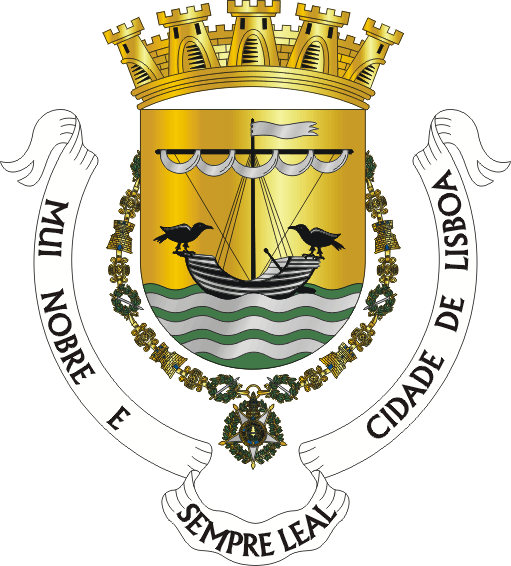
According to legend, after being martyred, ravens protected St Vincent’s body from being devoured by vultures, until his followers could recover the body. His body was taken to what is now known as Cape St Vincent; a shrine was erected over his grave, which continued to be guarded by flocks of ravens. In the time of Muslim rule in the Iberian Peninsula, the Arab geographer Al-Idrisi noted this constant guard by ravens, for which the place was named by him كنيسة الغراب “Kanīsah al-Ghurāb” (Church of the Raven). King Afonso I of Portugal (1139–1185) had the body of the saint exhumed in 1173 and brought it by ship to the Lisbon Cathedral. This transfer of the relics is depicted on the coat of arms of Lisbon.
Coat of Arms of Lisbon depicting the translation of the relics of St Vincent
Though Vincent’s tomb in Valencia became the earliest centre of his cult, he was also honoured at his birthplace and his reputation spread from Saragossa.
A church was built in honour of Vincent, by the Catholic bishops of Iberia, when they succeeded in converting King Reccared and his nobles to Trinitarian Christianity. When the Moors came in 711, the church was razed and its materials incorporated in the Mezquita, the “Great Mosque” of Cordova.
The Cape Verde island of São Vicente, a former Portuguese colony, was named in St Vincent’s honour because it was discovered on 22 January, St Vincent’s feast day, in 1462.
Vincent’s left arm is on display as a relic in Valencia Cathedral, located near the extensive Carrer de Sant Vicent Mártir (Saint Vincent the Martyr Street).
Novena to St Paul in preparation for the Feast of The Conversion of St Paul on 25 January
Day SIX – 21 January
Various daily acts cause our conversion and ultimately our sanctification to grow: examining our conscience and admitting our faults; undertaking works of penance and reconciliation; receiving the correction others give us with an open and humble heart; reaching out to the poor; standing up for what is right and just; accepting the suffering and persecution that come our way; desiring to better our life (see CCC1435).
LET US PRAY:
Glorious St Paul,
your conversion is a powerful witness to the world
that God loves us and does not give up on us,
no matter how far we stray.
Help me to live a life of ongoing conversion.
True conversion means converting my life to the
design of God, the plan He has for me right now.
Pray for me, that I may be filled with passion
for the evangelisation of all those around me,
that my life may be a beacon of the light of Christ.
May the witness of my life inspire other sinners to conversion.
May faith move me to believe that God can
and will change the things in me that seem impossible to rectify.
In this confidence, I entrust to you, St Paul,
these, my intentions
…………………………..
(mention your request)
Novena to St Francis de Sales Day SEVEN – 21 January
“Our intellect is ordinarily full of ideas, opinions and considerations suggested by self-love. This is the root of many conflicts within the soul, putting before us all sorts of reasons dictated by human prudence to justify our pretensions. People who make use of this false prudence, instead of enlightening their intellect, obscure it. They reject advice given to them and let those reasons prevail in their minds which support their own opinions, even wrong ones. Make use of the virtue of prudence because it is good but make good use of it. Employ it only rarely, with simplicity and solely for the glory of God.” (St Francis de Sales – Sermons 30; O. IX, pp. 297-298)
O blessed Francis de Sales,
who on earth did excel in a life of virtue,
especially in the love of God and neighbour,
I earnestly ask you to take me under your compassionate care and protection.
Obtain for me conversion of mind and heart.
Grant that all people, especially
……………………………..
(names of those whom you wish to include)
may experience the depth of God’s redeeming and healing love.
Teach me to fix my eyes on the things of heaven
even as I walk each day with my feet planted firmly on the earth.
Help me, through the practice of virtue and the pursuit of devotion,
to avoid anything that would otherwise cause me to stumble
in my attempt to follow Christ and to be an instrument of the Holy Spirit.
Encouraged by your prayers and example,
help me to live fully my sacred dignity with the hope of experiencing my sacred destiny:
eternal life with God.
Receive also this particular need or concern that I now lift up in prayer.
………………………………………
(mention your particular need).
O God, for the salvation of all, You desired that St. Francis de Sales—
preacher, missionary, confessor, bishop and founder—
should befriend many along the road to salvation.
Mercifully grant that we,
infused with the humility and gentleness of his charity,
guided by his wisdom and sharing in his spirit may experience eternal life.














 AnaStpaul
You must be logged in to post a comment.