Posted in MORNING Prayers, SAINT of the DAY

Thought for the Day – 29 January

Thought for the Day – 29 January

St Gildas the Wise lived in difficult times when the light of Christianity seemed to be dying and a whole nation was lost to the faith.   Yet he himself kept the faith and managed to live a holy life amidst the ruins.   The man of faith walks by the light of Christ and St Gildas is a true example that the darkness of the world does not affect our progress and our sight, for Christ is our vision.

St Gildas the Wise, Pray for us.

st-gildas-the-wise-pray-for-us


Posted in MORNING Prayers, QUOTES of the SAINTS

Quote of the Day – 29 January

Quote of the Day – 29 January

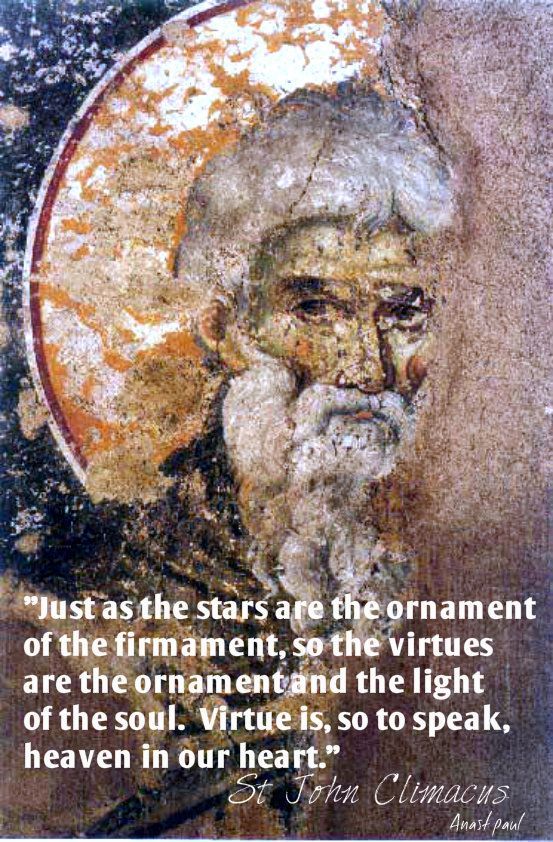
“Just as the stars are the ornament of the firmanent, so the virtues are the ornament and light of the soul.
Virtue is, so to speak, heaven in our hearts.”
~~~~ St John Climacus

just-as-the-stars-st-john-climacus

Posted in MORNING Prayers, QUOTES of the SAINTS, The WORD

One Minute Reflection – 29 January

One Minute Reflection – 29 January

Win your neighbour’s trust while he is poor, so that you may rejoice with him in his prosperity.
In time of trouble remain true to him,so that you may share in his inheritance when it comes………..Sir 22:23

REFLECTION – “Every virtue can attract the friendship of others to us.  For every virtue is a good and anything good is lovable to all and renders lovable all who possess it. Friendship blossoms, grows and is strengthened in the measure that virtue develops.”…….St Thomas Aquinas

PRAYER – Lord Jesus, our true Friend, help me to cultivate virtues and so gain friends. In turn let my friends also pursue virtues – making our friendship closer and bringing us all into Your eternal Friendship in heaven, amen.

sirach-22-verse-23every-vritue

Posted in HYMNS, MORNING Prayers, PRAYERS of the SAINTS, SAINT of the DAY

Our Morning Offering – 29 January

Our Morning Offering – 29 January

Be Thou my vision by St Dallan Forghaill

Be Thou my vision, O Lord of my heart;
Naught be all else to me save that Thou art.
Thou my best thought by day or by night,
Waking or sleeping Thy presence my light.

Be Thou my wisdom and Thou my true Word;
I ever with Thee and Thou with me, Lord;
Thou my great Father, I Thy true son;
Thou in me dwelling and I with Thee one.

Be Thou my battle-shield, sword for my fight,
Be Thou my dignity, Thou my delight.
Thou my soul’s shelter, Thou my high tower.
Raise Thou me heavenward, O Power of my power.

Riches I heed not, nor man’s empty praise,
Thou mine inheritance, now and always;
Thou and Thou only, first in my heart,
High King of heaven my Treasure Thou art.

High King of heaven, my victory won,
May I reach heaven’s joys, O bright heaven’s son,
Heart of my heart, whatever befall
Still be my vision, O ruler of all.

Today, 29 January, is also the Memorial of St Dallan Forghaill (c530- 598)

Born in Connaught, Ireland, he was known for his learning and reputedly went blind because of his intensive studying. St Dallan was an early Christian Irish poet known as the writer of the “Amra Choluim Chille” (“Elegy of Saint Columba”) and “Rop Tú Mo Baile”(“Be Thou My Vision”). He died at the hands of pirates at Inis-coel. Legend has it that St. Dallan made his own head reattach to his body after he was beheaded and thrown into the sea.

Here is a version by Audrey Assad of Be Thou My Vision – St Dallan – https://www.youtube.com/watch?v=Optrm7lF16s

be-thou-my-vision-st-dallan

Posted in SAINT of the DAY

Saint of the Day – 29 January -St Gildas the Wise

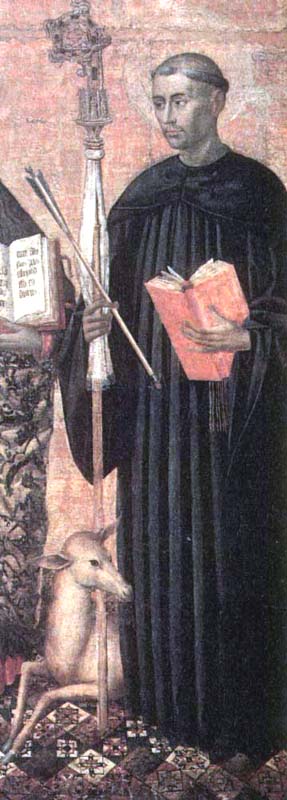
Saint of the Day – 29 January -St Gildas the Wise – also known as Badonicus and Gildas Sapiens(c500-570) Priest and Abbot – Patron of Welsh historians, bell founders.

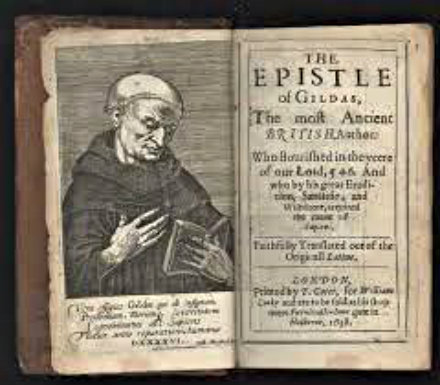
St Gildas was a 6th-century British monk best known for his scathing religious polemic De Excidio et Conquestu Britanniae, which recounts the history of the Britons before and during the coming of the Saxons.   He is one of the best-documented figures of the Christian church in the British Isles during the sub-Roman period and was renowned for his Biblical knowledge and literary style.   In his later life, he emigrated to Brittany where he founded a monastery known as St Gildas de Rhuys.st gildas.jpg

Gildas was born in Scotland on the banks of the Clyde (possibly at Dumbarton), of a noble British family.   His father’s name was Cau or Nau, his brother’s, Huel or Cuil.   He was educated in Wales under St Iltut and was a companion of St. Samson and St. Peter of Léon.   Having embraced the monastic state, he passed over to Ireland, where he was advanced to the priesthood.   He is said to have lived some time in Armagh and then to have crossed to North Britain, his teaching there being confirmed by miracles.

On his return to Ireland, at the invitation of King Ainmire, he strengthened the faith of many and built monasteries and churches.   The Irish annalists associate him with David and Cadoc in giving a special liturgy or Mass to the second order of Irish saints.   He is said to have made a pilgrimage to Rome.   On the homeward journey his love of solitude caused him to retire to the Isle of Houat, off Brittany, where he lived a life of prayer, study and austerity.   His place of retreat having become known, the Bretons induced him to establish a monastery at Rhuys on the mainland whither multitudes flocked (Marius Sepet, “St. Gildas de Rhuys”, Paris, s.d.).

It was at Rhuys he wrote his famous epistle to the British kings.   His relics were venerated there till the tenth century, when they were carried for safety into Berry.   In the eighteenth century they were said to be preserved in the cathedral of Vannes.   He is the patron of several churches and monasteries in Brittany and elsewhere.   His feast is locally observed on 29 January; another feast, 11 May, commemorates the translation of his relics.san_gildas_di_rhuys

The authentic work of St Gildas,  “De excidio Britannae liber querulus”, is now usually divided into three parts: (1) The preface;  (2) A sketch of British history from the Roman invasion to his own time;   (3) An epistle of severe invective addressed to five petty British kings — Constantine, Vortipor, Cyneglas, Cynan, and Maelgwn.   In the same epistle he addresses and rebukes the clergy whom he accuses of sloth and simony.   His writings are clearly the work of a man of no ordinary culture and sanctity and indicate that the author was thoroughly acquainted with the Sacred Scriptures.st gildas writings

Gildas is regarded as the earliest British historian and is quoted by Bede and Alcuin.  Two Manuscript copies of his writings are preserved in Cambridge University library.


Posted in SAINT of the DAY

Saints for 29 January

St Abundantia the Martyr
St Aphraates
St Aquilinus of Milan
St Barbea of Edessa
St Blath of Kildare
Bl Boleslawa Maria Lament
Bl Bronislaw Markiewicz
St Caesarius of Angoulême
Bl Charles of Sayn
St Constantius of Perugia
St Dallan Forghaill
St Gelasius II, Pope
St Gildas the Elder
St Gildas the Wise
St Juniper
St Maurus of Rome
St Papias of Rome
St Sarbellius
St Serrano
St Sulpicius Severus
St Valerius of Trier
St Voloc

Posted in NOVENAS

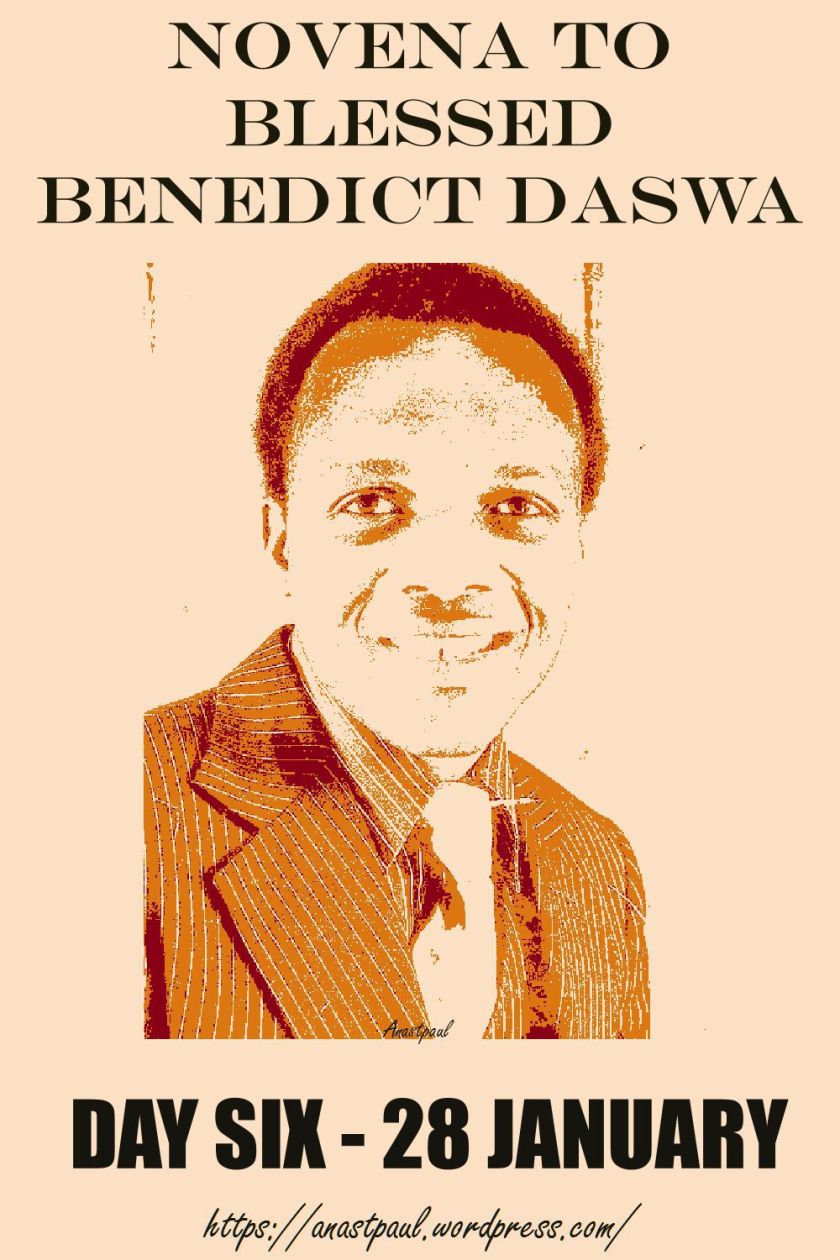
Novena to Bl Benedict Daswa – DAY SIX – 28 January

DAY 6 – A MAN OF PRAYER AND CHARITY TO THE END

People who knew Benedict well observed that he was a prayerful person in his daily life, in his family, and in the Church. He had a deep personal relationship with Christ and was guided and strengthened by his faith in every aspect of life. He had special love and concern for the sick, the vulnerable and those in prison and liked to visit them. He gave freely of his resources to help the poor and the needy in his village, as well the learners in Nweli Primary school. In the afternoon of 2 February 1990, as Benedict was working in his orchard, his sisterin-law urgently requested him to take her very sick child to the doctor at Makwarela (Sibasa).    Before he started his car, he said to her, “Let us first pray”.    On his way back to Mbahe, he gave a lift home to a man living in a neighbouring village. The man was carrying a bag of mealie-meal and was unable to get public transport because of unrest in the area.

Word of God
“For I was hungry and you gave me food, I was thirsty and you gave me drink, I was a stranger and you welcomed me, I was naked and you clothed me, I was sick and you visited me, I was in prison and you came to me.” Then the righteous will answer him, “Lord, when did we see thee hungry and feed thee, or thirsty and give thee drink? And when did we see thee a stranger and welcome thee, or naked and clothe thee? And when did we see thee sick or in prison and visit thee?” And the King will answer them, “Truly, I say to you, as you did it to one of the least of these my brethren, you did it to me”. (Matthew 25, 35-40)

Deepening of Faith
… The whole Church as such, is directly called to the service of charity: “In the very
early days the Church added the agape to the Eucharistic Supper, and thus showed
herself to be wholly united around Christ by the bond of charity. So too, in all ages, she
is recognized by this sign of love, and while she rejoices in the undertakings of others,
she claims works of charity as her own inalienable duty and right. For this reason,
mercy to the poor and the sick, works of charity and mutual aid intended to relieve
human needs of every kind, are held in special honour in the Church”. (CL41)

Reflection: Do I help and support people in need?
Do I pay attention to the poor and destitute in my community?

Prayer: In return for my love they accuse me, even as I make prayer for them.
So they reward me evil for good, and hatred for my love.
(Psalm 109, 4-5)

NOVENA PRAYER:

O Blessed Trinity,
I believe that you dwell in me through my baptism.
I love You, I adore You and I worship You.
I give you thanks for Blessed Benedict,
Whom you chose to bear witness unto death for his faith
In Jesus Christ, my Saviour and my Lord.

Almighty Father, You filled the heart of Blessed Benedict,
With great love and zeal in building up your kingdom.
You gave him the courage and the strength
To stand up for his faith without fear, even the fear of death.

Loving God, keep me free from all deeds of darkness.
Protect me from evil spirits and the powers of evil.
Make me a true apostle of life in my family and in society.
May Your light, O Lord, shine upon me and through me.

Lord Jesus, through the intercession of Blessed Benedict,
I ask that I may follow his example
Of always being ready to forgive in a Christian spirit.
You know all about my many problems and worries
And my great fears when I look to the future.
I draw strength and courage from the life of Blessed Benedict.

I come to You now, Lord, and through his intercession
I ask for this very special favour………
(mention your request/s)
if it is according to Your will.

Help me always to follow the good example of Blessed Benedict.
By daily prayer and regular attendance at Church,
Help me to love You, O Lord, above all things
And to love others as You love me.
Amen.

day-6-benedict

Posted in NOVENAS

Novena to St John Bosco – DAY SEVEN – 28 January

7th Day (January 28) – For Missionaries

O Saint John Bosco,
in your love and concern for all the scattered children of God,
you sent your sons and daughters to the farthest part of the world
to bring the knowledge of the loving God and the Light of the Gospel.
Pray for all missionaries and pray for us, that,
inspired by your example and in your spirit,
we may be united in work and prayer to win souls for Christ.
Through your intercession
may God grant me the following grace…………..
(mention your request)
so that together with Salesian missionaries all over the world
I may assist in bringing all I meet especially the young
to the love of Christ, amen.

Our Father… Hail Mary… Glory to the Father…
St John Bosco, Pray for us!

day-7-bosco

Posted in DOCTORS of the Church, MORNING Prayers, SAINT of the DAY

Thought for the Day – 28 January

Thought for the Day – 28 January

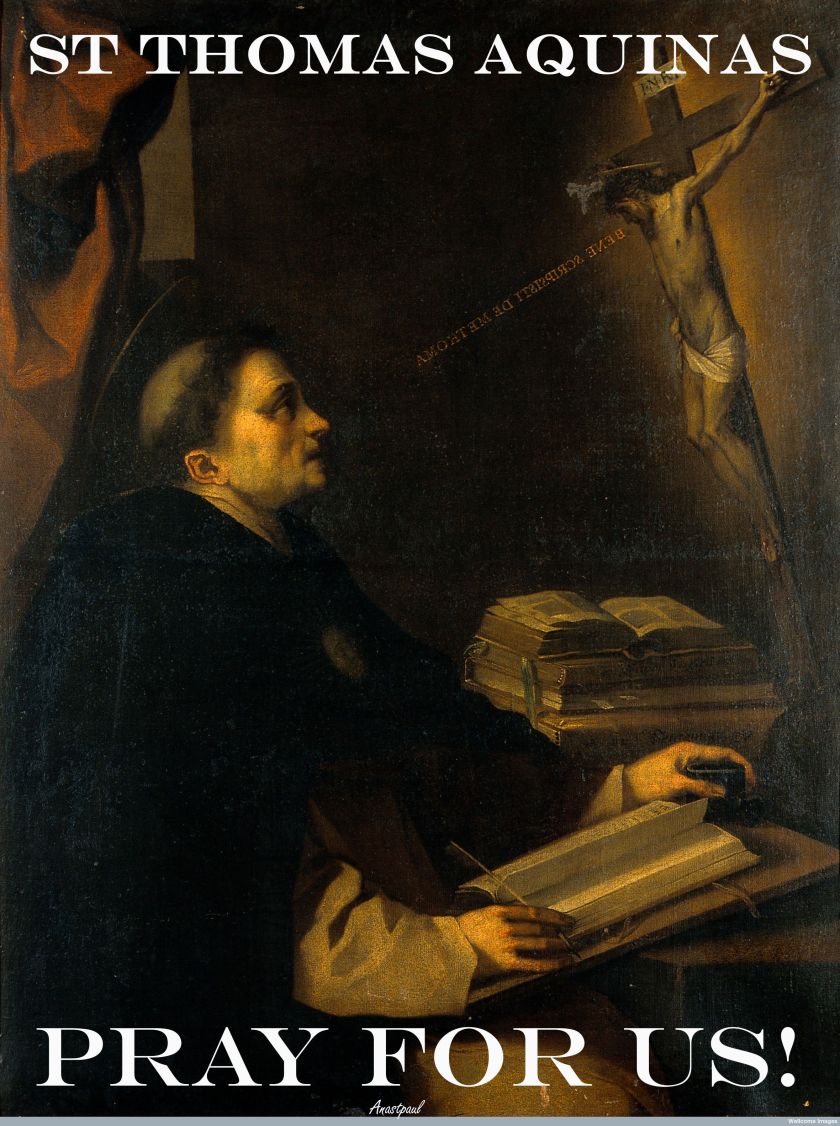
For St Thomas, the goodness of God can be seen in everything and the whole of creation is a mighty love song of God.   He learned more at the foot of the Crucifix and before the Blessed Sacrament, he said, than in all his readings and writings.   We can look to Thomas Aquinas as a towering example of Catholicism in the sense of broadness, universality and inclusiveness.   We should be determined anew to exercise the divine gift of reason in us, our power to know, learn and understand.   At the same time we should thank God for the gift of His revelation, the incarnation of His Son, Jesus Christ who is here with us always in the Holy Sacrament.

St Thomas Aquinas Pray for us!

st-thomas-aquinas-jan-28

st-thomas-pray-for-us


Posted in DOCTORS of the Church, SAINT of the DAY

Saint of the Day – 28 January – St Thomas Aquinas

Saint of the Day – 28 January – St Thomas Aquinas O.P. (1225-1274 aged 49) THE ANGELIC DOCTOR – DOCTOR of the CHURCH/Priest, Religious, Theologian, Philosopher, Write, Teacher, Jurist.   Also known as: Angelic Doctor/Doctor Angelicus/Doctor Communis/Great Synthesizer/The Dumb Ox/The Universal Teacher.    Patron of Academics, Theologians, against storms; against lightning; apologists; book sellers; Catholic academies, Catholic Schools – (proclaimed on 4 August 1880 by Pope Leo XIII), Catholic universities, Catholic Colleges, chastity, learning; pencil makers, philosophers; publishers; scholars; students; University of Vigo and of St. Tomas;, Batangas; theologians, Aquino, Italy; Belcastro, Italy, Diocese of Aquino,  Falena, Italy.

St Thomas Aquinas was an Italian Dominican friar, Catholic priest and Doctor of the Church.   He was an immensely influential philosopher, theologian and jurist in the tradition of scholasticism, within which he is also known as the Doctor Angelicus and the Doctor Communis.   The name Aquinas identifies his ancestral origins in the county of Aquino in present-day Lazio.

He was the foremost classical proponent of natural theology and the father of Thomism. His influence on Western thought is considerable, and much of modern philosophy developed or opposed his ideas, particularly in the areas of ethics, natural law, metaphysics and political theory.   Unlike many currents in the Church of the time, Thomas embraced several ideas put forward by Aristotle—whom he called “the Philosopher”—and attempted to synthesize Aristotelian philosophy with the principles of Christianity.   The works for which he is best known are the Summa Theologiae and the Summa contra Gentiles.   His commentaries on Scripture and on Aristotle form an important part of his body of work. Furthermore, Thomas is distinguished for his eucharistic hymns, which form a part of the Church’s liturgy.

The Catholic Church honours Thomas Aquinas as a saint and regards him as the model teacher for those studying for the priesthood, and indeed the highest expression of both natural reason and speculative theology. In modern times, under papal directives, the study of his works was long used as a core of the required program of study for those seeking ordination as priests or deacons, as well as for those in religious formation and for other students of the sacred disciplines (philosophy, Catholic theology, church history, liturgy, and canon law).

Thomas Aquinas is considered one of the Catholic Church’s greatest theologians and philosophers. Pope Benedict XV declared: “This (Dominican) Order … acquired new luster when the Church declared the teaching of Thomas to be her own and that Doctor, honoured with the special praises of the Pontiffs, the master and patron of Catholic schools.”

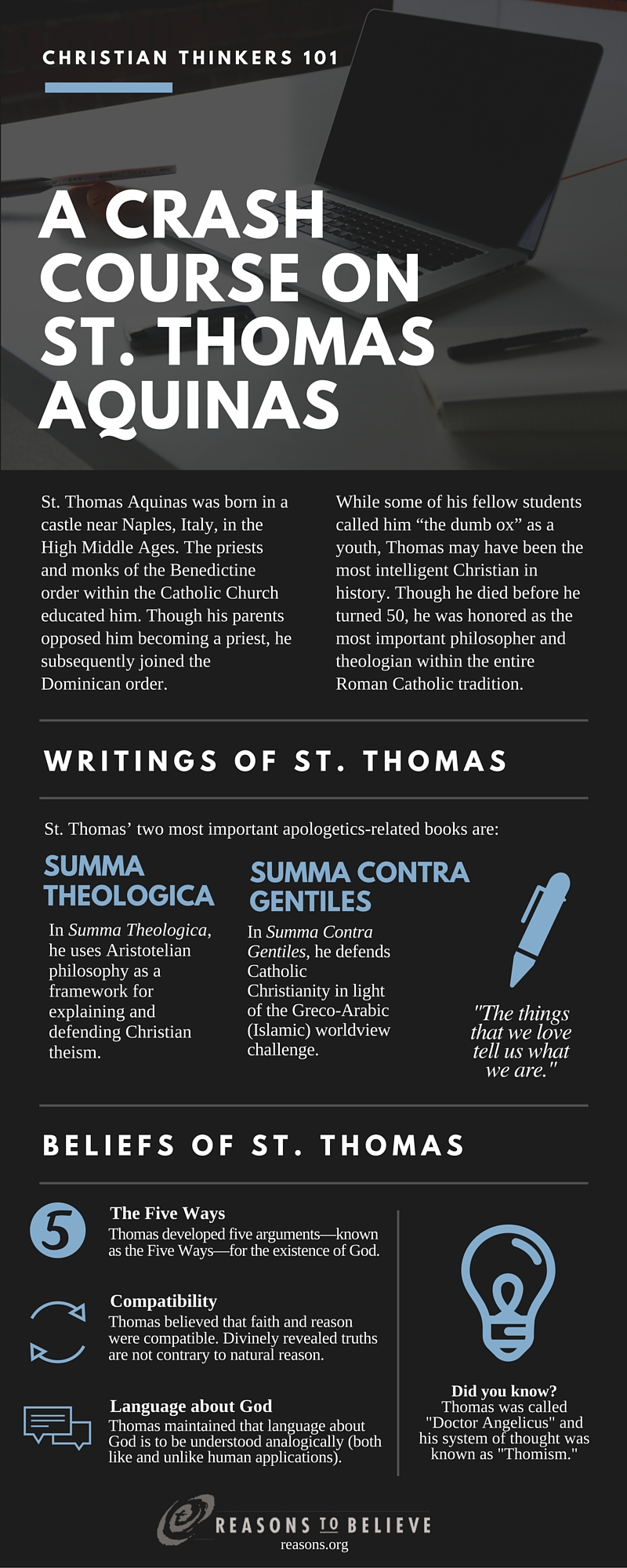
crash-course-aquinasf828980ca600e4f0814c9e37e235a62b

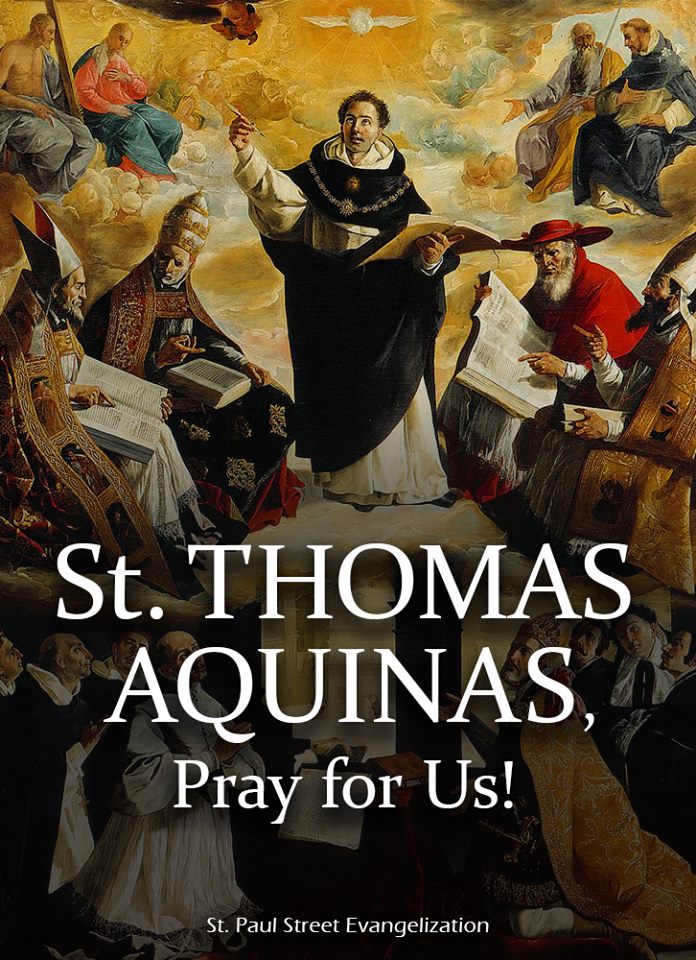
By universal consent, Thomas Aquinas is the preeminent spokesman of the Catholic tradition of reason and of divine revelation.   He is one of the great teachers of the medieval Catholic Church, honoured with the titles Doctor of the Church and Angelic Doctor. (Image below – Benozzo Gozzoli – Triumph of St Thomas Aquinas)

264px-Benozzo_Gozzoli_-_Triumph_of_St_Thomas_Aquinas_-_WGA10334.jpg

At five he was given to the Benedictine monastery at Monte Cassino in his parents’ hopes that he would choose that way of life and eventually became abbot.   In 1239, he was sent to Naples to complete his studies.   It was here that he was first attracted to Aristotle’s philosophy.   By 1243, Thomas abandoned his family’s plans for him and joined the Dominicans, much to his mother’s dismay.   On her order, Thomas was captured by his brother and kept at home for over a year.   Once free, he went to Paris and then to Cologne, where he finished his studies with Albert the Great.   In class, his silence during discussions and his large size earned him the nickname “the dumb ox.”  He held two professorships at Paris, lived at the court of Pope Urban IV, directed the Dominican schools at Rome and Viterbo, combated adversaries of the mendicants, as well as the Averroists and argued with some Franciscans about Aristotelianism.

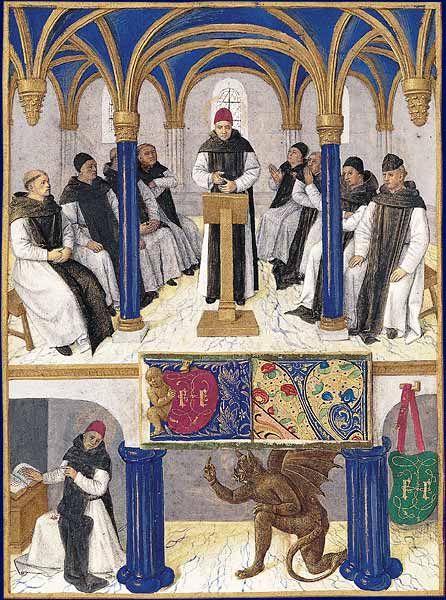
04031f9dfa182cc79fba3383cc3074af
Jean Fouquet

His greatest contribution to the Catholic Church are his writings.   The unity, harmony and continuity of faith and reason, of revealed and natural human knowledge, pervades his writings.   One might expect Thomas, as a man of the gospel, to be an ardent defender of revealed truth.   But he was broad enough, deep enough, to see the whole natural order as coming from God the Creator, and to see reason as a divine gift to be highly cherished.

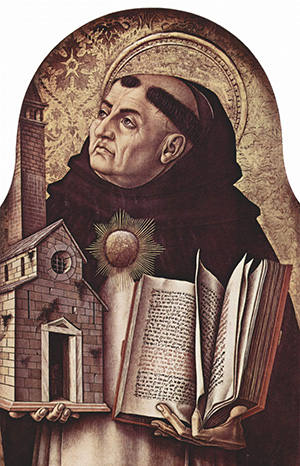
thomas-acquinas

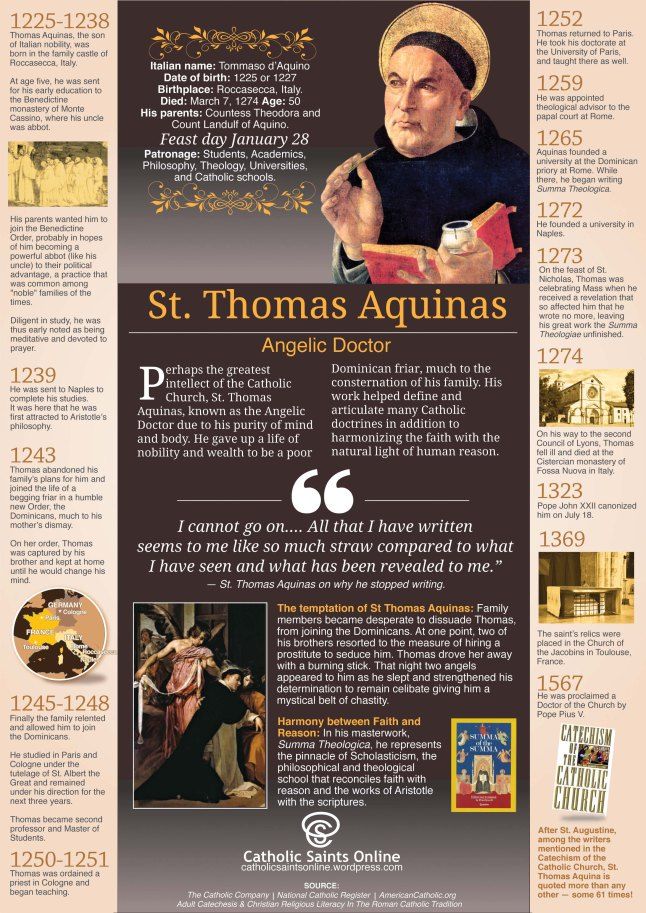
The Summa Theologiae, his last and, unfortunately, uncompleted work, deals with the whole of Catholic theology.   But this brilliant man was very humble.   He knew that all his gifts came from God.   While celebrating Mass on December 6, 1273, he received a revelation from God.  After that, he stopped writing.   He said  “I cannot go on…. All that I have written seems to me like so much straw compared to what I have seen and what has been revealed to me.”  Thomas died at age 49 on his way to the Council of Lyons, France. Pope Gregory X had asked him to come. When asked why he stopped writing, he replied,   He died March 7, 1274.


Posted in DOCTORS of the Church, MORNING Prayers, QUOTES of the SAINTS, SAINT of the DAY

Quote/s of the Day – 28 January

Quote/s of the Day – 28 January

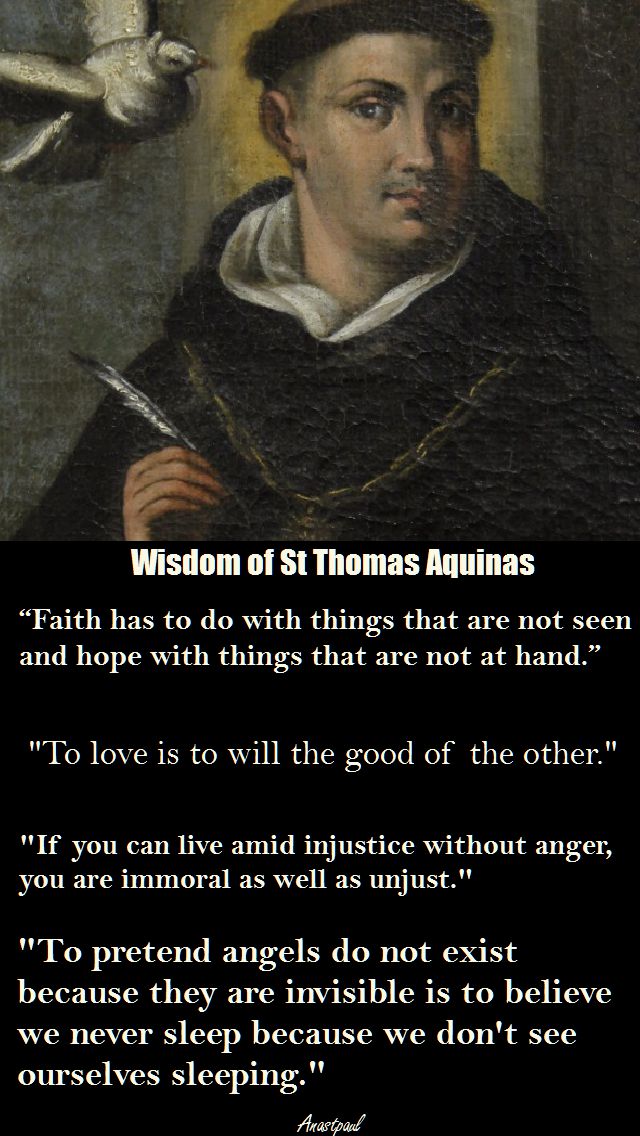
“Faith has to do with things that are not seen
and hope with things that are not at hand.”

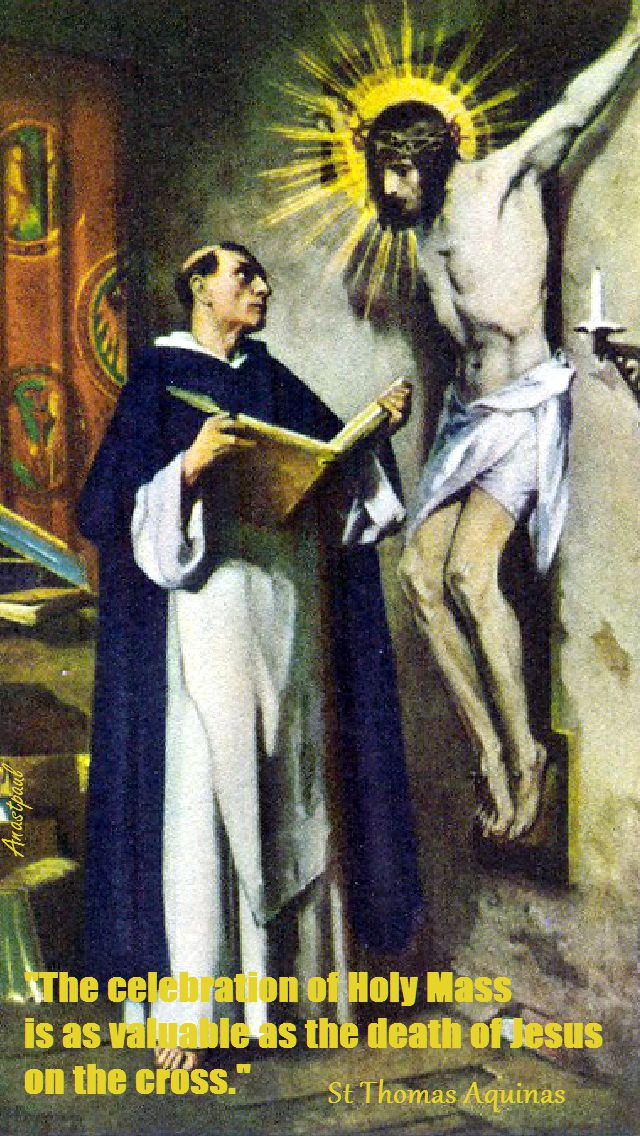
“The celebration of Holy Mass is as valuable
as the death of Jesus on the cross.”

“To love is to will the good of the other.”

“If you can live amid injustice without anger,
you are immoral as well as unjust.”

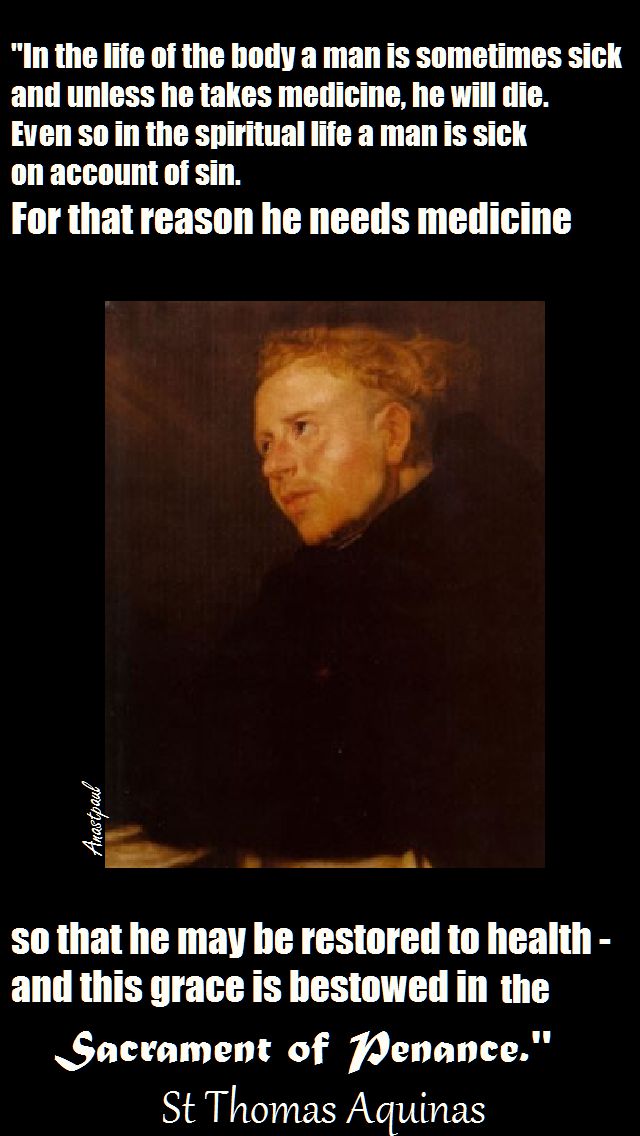
“In the life of the body a man is sometimes sick
and unless he takes medicine, he will die.
Even so in the spiritual life a man is sick
on account of sin.
For that reason he needs medicine
so that he may be restored to health –
and this grace is bestowed in the Sacrament of Penance.”

“To pretend angels do not exist
because they are invisible is to believe
we never sleep because we don’t see
ourselves sleeping.”

“To bear with patience wrongs done to oneself
is a mark of perfection but to bear with patience
wrongs done to someone else is a mark of imperfection
and even of actual sin.”

“All the efforts of the human mind
cannot exhaust the essence of a single fly.”

~~~ ST THOMAS AQUINAS (Saint of the Day)

holy-mass-st-thomas-aquinaswisdom-of-st-thomas-aquinas

if-a-man-is-sick-st-aquinas

Posted in JESUIT SJ, QUOTES of the SAINTS, SAINT of the DAY, The WORD

One Minute Reflection – 28 January

One Minute Reflection – 28 January

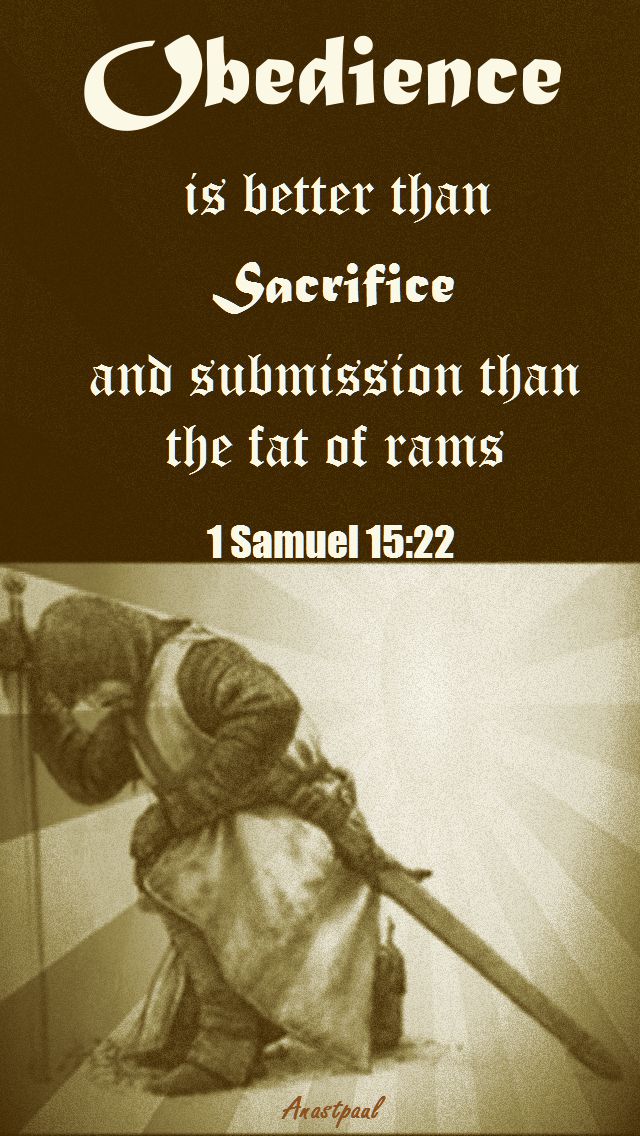
Obedience is better than sacrifice and submission than the fat of rams………….1 Sm 15:22

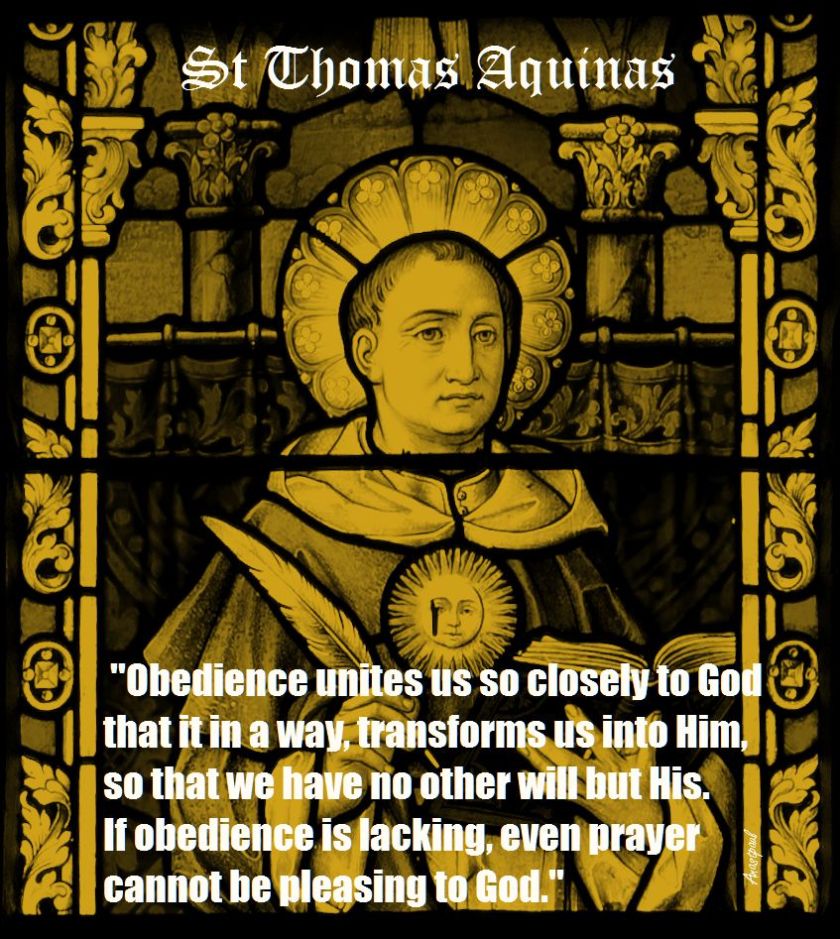
REFLECTION – “Obedience unites us so closely to God that it in a way, transforms us into Him, so that we have no other will but His.   If obedience is lacking, even prayer cannot be pleasing to God.”………….St Thomas Aquinas (Saint of the Day)

PRAYER – Omniscient Lord, teach me to value obedience to Your laws and Your will.   Grant that I may be completely obedient to You in all things.   St Thomas Aquinas pray for us, amen!

1-samuel-15-22obedience-st-aquinasst-thomas-aquinas-pray-for-us


Posted in MORNING Prayers, PRAYERS of the SAINTS, SAINT of the DAY

Our Morning Offering – 28 January

Our Morning Offering – 28 January

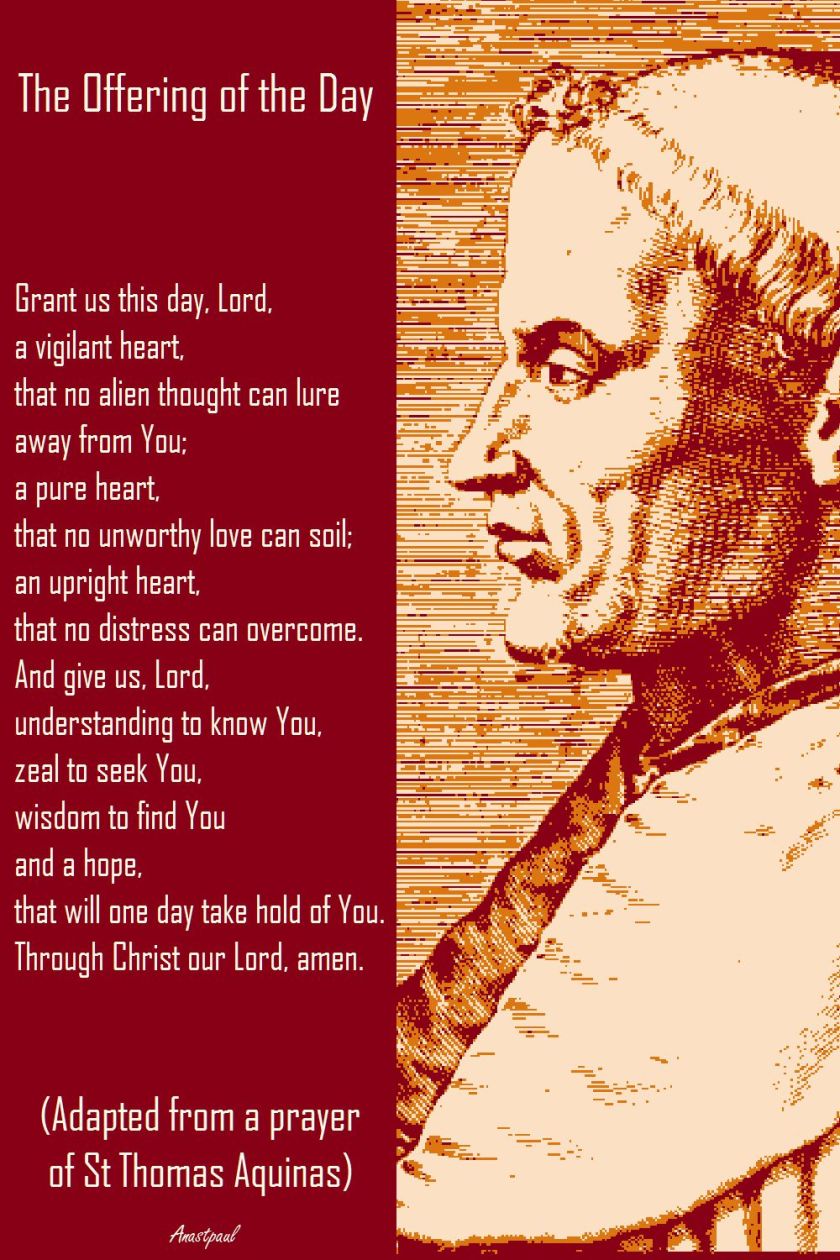
The Offering of the Day

Grant us this day, Lord,
a vigilant heart,
that no alien thought can lure
away from You;
a pure heart,
that no unworthy love can soil;
an upright heart,
that no distress can overcome.
And give us, Lord,
understanding to know You,
zeal to seek You,
wisdom to find You
and a hope,
that will one day take hold of You.
Through Christ our Lord, amen.

(Adapted from a prayer of St Thomas Aquinas)

prayer-st-thomas-aquinas-grant-us-this-day-o-lord


Posted in SAINT of the DAY

Saints for 28 January

St Thomas Aquinas (Memorial)

St Aemilian of Trebi
St Agatha Lin
Bl Amadeus of Lausanne
St Antimus of Brantôme
St Archebran
Bl Bartolomé Aiutamicristo
St Brigid of Picardy
St Callinicus
St Cannera of Inis Cathaig
Bl Charlemagne (a decree of canonization was issued by the anti-pope Paschal III, but this was never ratified by valid authority.)
St Constantly
St Flavian of Civita Vecchia
St Glastian of Kinglassie
Bl James the Almsgiver
St James the Hermit
St Jerome Lu
St John of Reomay
St Joseph Freinademetz
Bl Julian Maunoir
St Julian of Cuenca
St Lawrence Wang
St Leucius of Apollonia
Bl María Luisa Montesinos Orduña
St Maura of Picardy
Bl Mosè Tovini
Bl Odo of Beauvais
Bl Olympia Bida
St Palladius of Antioch
St Paulinus of Aquileia
Bl Peter Won Si-jang
St Richard of Vaucelles
St Thyrsus of Apollonia

Martyrs of Alexandria

Posted in NOVENAS

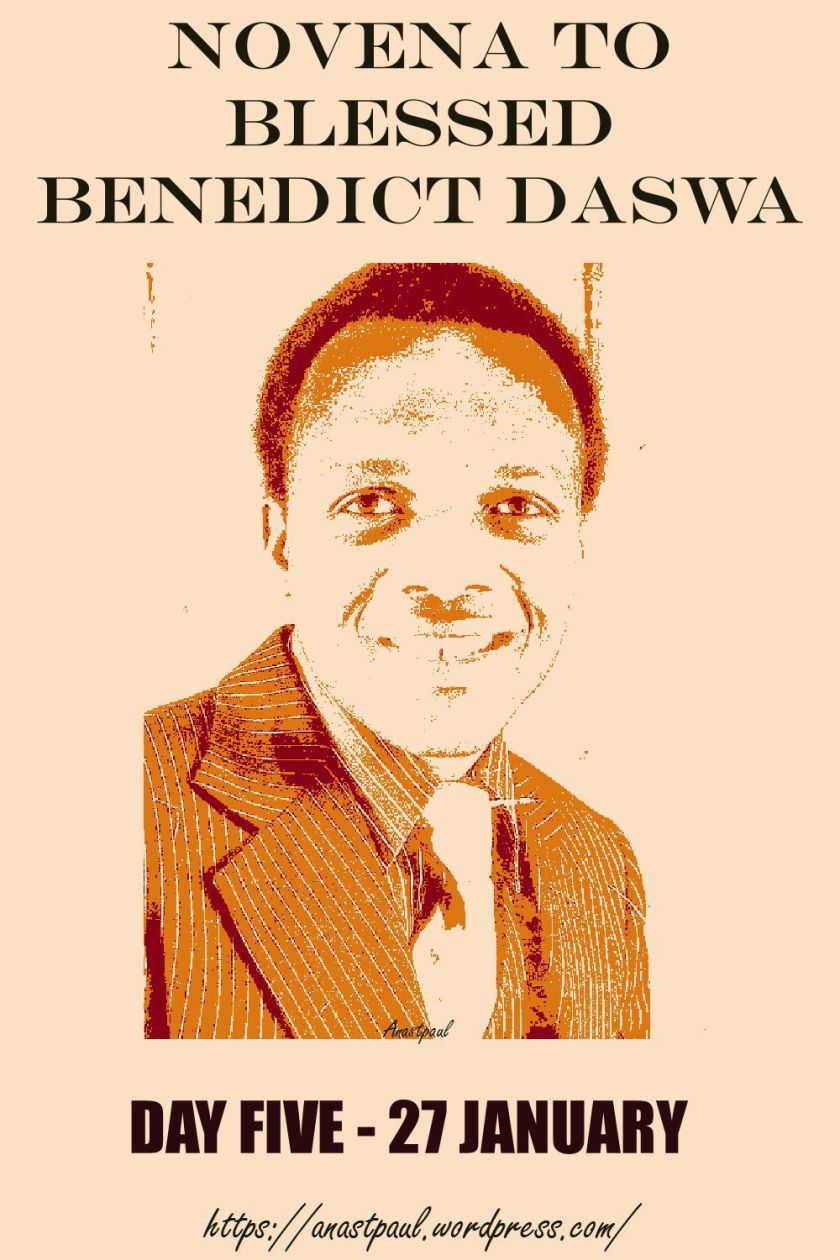
Novena to Bl Benedict Daswa – Day FIVE – 27 January

DAY 5 A MAN COMMITTED TO THE CHURCH
As a voluntary catechist, Benedict Daswa helped to build up the Church community, especially by preparing people for baptism.   He was a member of the Parish Pastoral Council and was always regular at the meetings.   He led the Sunday Service when a priest or a pastoral worker was not available and was very involved in youth ministry, encouraging the young people to live good, productive lives and to be proud of their faith.
Benedict promised his wife that he would start building their house as soon as the new Church of Nweli was finished.  This task of building the first Catholic Church in the area was a project so dear to his heart that he not only helped the priest with his own car to transport the building material for it but worked tirelessly on it and encouraged others to do likewise.   After its completion, true to his promise, he started building his own house.

Word of God
So we, though many, are one body in Christ and individually members one of another. Having gifts that differ according to the grace given to us, let us use them;  if prophecy, in proportion to our faith; if service, in our serving; he who teaches, in his teaching; he who exhorts, in his exhortation; he who contributes, in liberality; he who gives aid, with zeal; he who does acts of mercy, with cheerfulness. (Romans 12, 5-8)

Deepening of Faith
In virtue of their rebirth in Christ there exists among all the Christian faithful a true equality with regard to dignity and the activity whereby all cooperate in the building up of the Body of Christ in accord with each one’s own condition and function. (CCC 872 See also CIC, Can. 208; Cf. LG 32)

Reflection:   What do I do for the Church and in the Church?
Do I contribute to the building/upkeep of the church and its services?

Prayer:   I will not enter my house or get into my bed;
I will not give sleep to my eyes or slumber to my eyelids,
Until I find a place for the Lord,
A dwelling place for the Mighty One of Jacob. (Psalm 132,3-5)

NOVENA PRAYER:

O Blessed Trinity,
I believe that you dwell in me through my baptism.
I love You, I adore You and I worship You.
I give you thanks for Blessed Benedict,
Whom you chose to bear witness unto death for his faith
In Jesus Christ, my Saviour and my Lord.

Almighty Father, You filled the heart of Blessed Benedict,
With great love and zeal in building up your kingdom.
You gave him the courage and the strength
To stand up for his faith without fear, even the fear of death.

Loving God, keep me free from all deeds of darkness.
Protect me from evil spirits and the powers of evil.
Make me a true apostle of life in my family and in society.
May Your light, O Lord, shine upon me and through me.

Lord Jesus, through the intercession of Blessed Benedict,
I ask that I may follow his example
Of always being ready to forgive in a Christian spirit.
You know all about my many problems and worries
And my great fears when I look to the future.
I draw strength and courage from the life of Blessed Benedict.

I come to You now, Lord, and through his intercession
I ask for this very special favour………
(mention your request/s)
if it is according to Your will.

Help me always to follow the good example of Blessed Benedict.
By daily prayer and regular attendance at Church,
Help me to love You, O Lord, above all things
And to love others as You love me.
Amen.

day-5-benedict

Posted in NOVENAS

Novena to St John Bosco – Day SIX – 27 January

6th Day (January 27) – For Salesian Cooperators and the Salesian Family

O Saint John Bosco,
you founded the Association of Salesian Cooperators,
the seed of the worldwide Salesian Family,
in order to ensure the widest possible participation
in the charitable work on behalf of young people.
Pray for all the members of the Salesian Family that,
inspired by your example and bonded in one spirit,
they may share in the Salesian mission and model in their life
and work pastoral educative charity.
Through your intercession may God grant me the following grace………….
(mention your intention)
so that together with the Salesian Family
I may assist all I am able to
and help young people in today’s society.

Our Father… Hail Mary… Glory to the Father…
St John Bosco Pray for us!

day-6-john-bosco

Posted in MORNING Prayers, SAINT of the DAY

Thought for the Day – 27 January

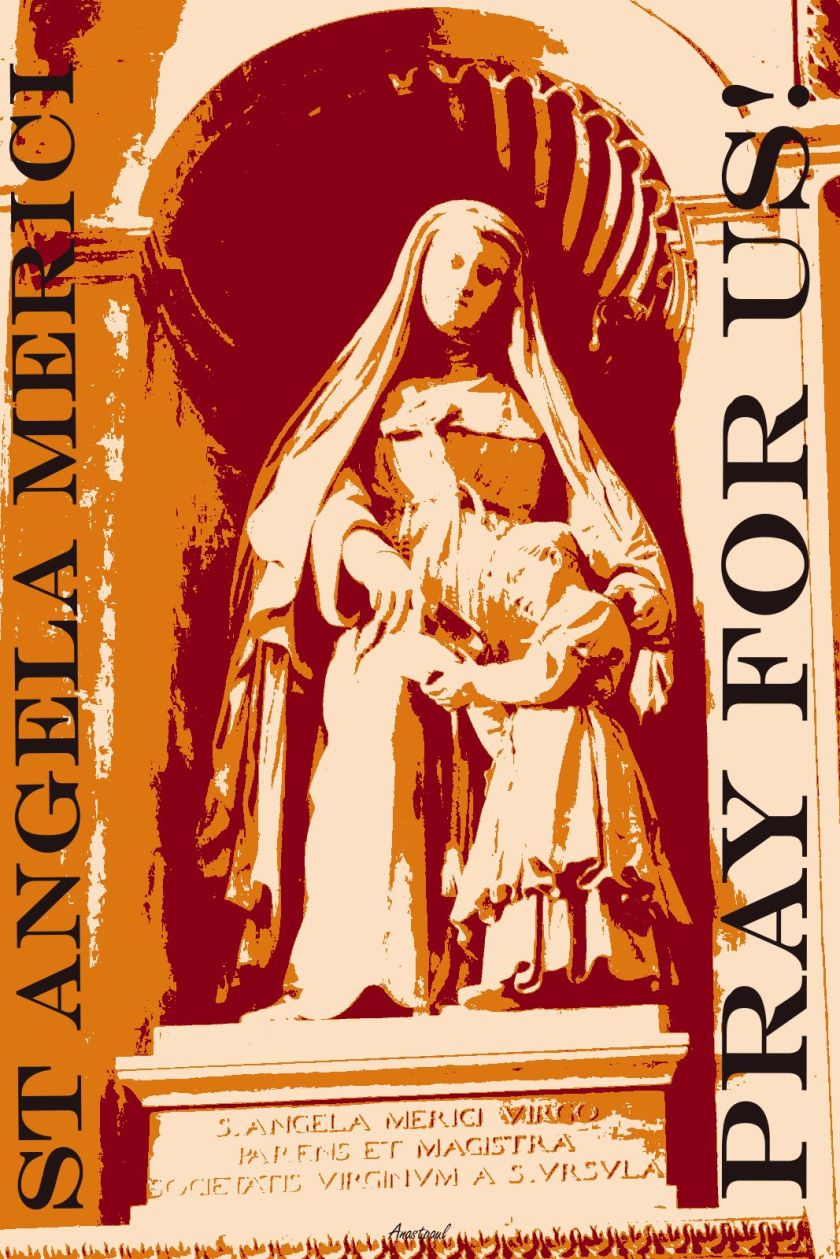
To the long list of authorities Ursulines were to obey—Ten Commandments, Church, parents, civil laws—St. Angela added “divine inspirations that you may recognize as coming from the Holy Spirit.”   A refreshing and liberating rule.   Also a dangerous one, for when it’s obeyed, the Holy Spirit may act in unexpected ways.

Sometimes the “tried and true” ways are no longer adequate and new ways have to be found to bring the Gospel to the world.   Saints like Angela Merici had to find new ways to do the old tasks and innovation has always been a part of genuine sanctity.   New wineskins are often needed for the eternally new wine of the Gospel and the saints were not only holy people, they were often creative geniuses, as well and this IS the Holy Spirit!

St Angela Merici Pray for us!

love-st-angela-merici-pray-for-us

st-angela-merici-jan-27

Posted in MORNING Prayers, QUOTES of the SAINTS, SAINT of the DAY

Quote/s of the Day – 27 January

Quote/s of the Day – 27 January

“Reflect that in reality you have a greater need to serve [the poor] than they have of your service.”

“Do not lose heart, even if you should discover that you lack qualities necessary for the work to which you are called.   He who called you will not desert you, but the moment you are in need He will stretch out His saving hand.”

“Disorder in society is the result of disorder in the family.”

“Consider that the devil doesn’t sleep, but seeks our ruin in a thousand ways.”

“As our Saviour says: “A good tree is not able to produce bad fruit.” He says: A good tree, that is, a good heart as well as a soul on fire with charity, can do nothing but good and holy works. For this reason Saint Augustine said: “Love, and do what you will,” namely, possess love and charity and then do what you will. It is as if he had said: Charity is not able to sin.”

reflect-that

do-notlose-heart

stangelamerici_disorder

74a78bd89f3a962b46976327ae15f976-1


Posted in MORNING Prayers, QUOTES of the SAINTS, SAINT of the DAY, The WORD

One Minute Reflection – 27 January

One Minute Reflection – 27 January

The servant of the Lord must not be quarrelsome but must be kindly toward all…….2 Tm 2:24

REFLECTION – “Exercise pleasantness toward all, taking great care especially that what you have commanded may never be done by reason of force.
For God has given free will to everyone and therefore, never forces anyone – but only indicates, calls and persuades.”……………St Angela Merici

PRAYER – Heavenly Father, teach me how to deal pleasantly with those I in my life. Help me to persuade rather than attempt to force others to do what must be done. Help me always to lead by example and by my life. St Angela Merici, pray for us, amen!

2-tm-2-24st-angela-merici-pray-for-us

Posted in MORNING Prayers, PRAYERS of the SAINTS

Our Morning Offering – 27 January

Our Morning Offering – 27 January

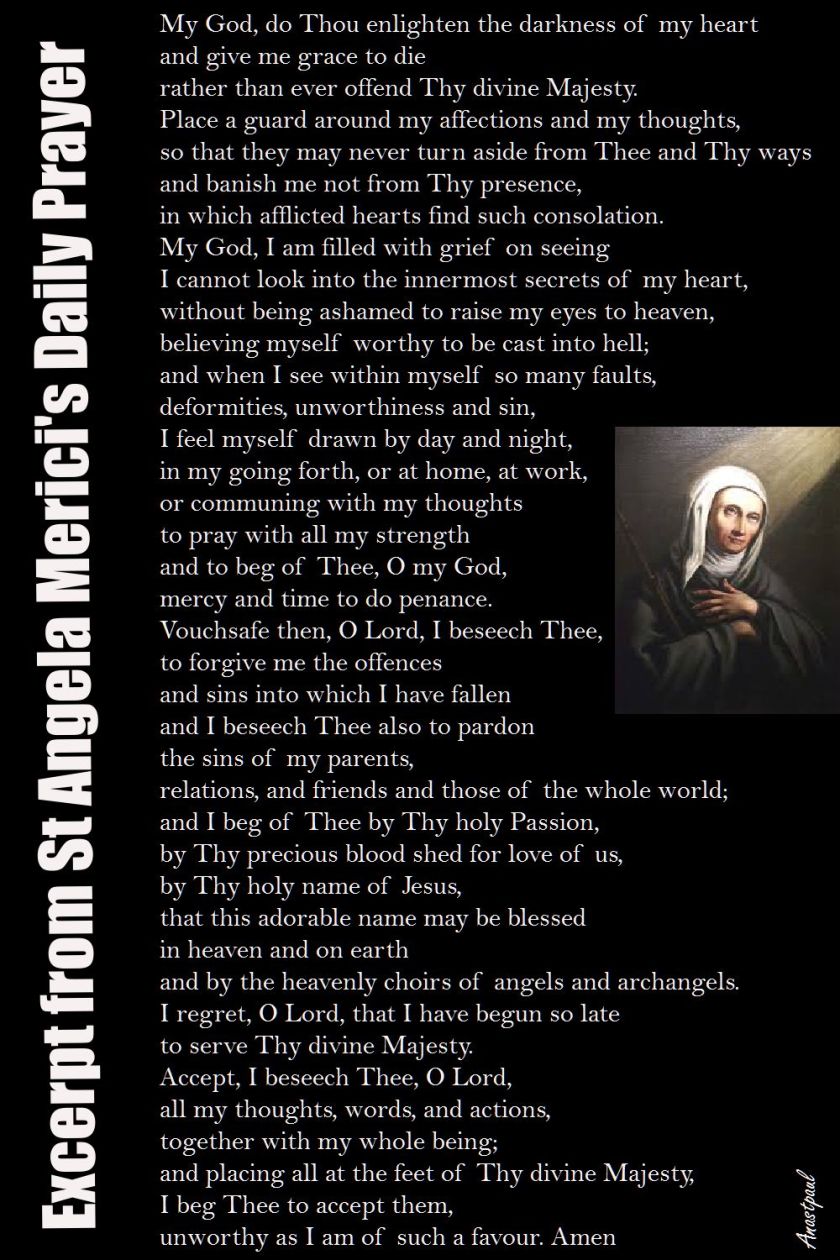
Excerpt from St Angela Merici’s Daily Prayer

My God, do Thou enlighten the darkness of my heart
and give me grace to die
rather than ever offend Thy divine Majesty.
Place a guard around my affections and my thoughts,
so that they may never turn aside from Thee and Thy ways
and banish me not from Thy presence,
in which afflicted hearts find such consolation.
My God, I am filled with grief on seeing
I cannot look into the innermost secrets of my heart,
without being ashamed to raise my eyes to heaven,
believing myself worthy to be cast into hell;
and when I see within myself so many faults,
deformities, unworthiness and sin,
I feel myself drawn by day and night,
in my going forth, or at home, at work,
or communing with my thoughts
to pray with all my strength
and to beg of Thee, O my God,
mercy and time to do penance.
Vouchsafe then, O Lord, I beseech Thee,
to forgive me the offences
and sins into which I have fallen
and I beseech Thee also to pardon
the sins of my parents,
relations and friends and those of the whole world;
and I beg of Thee by Thy holy Passion,
by Thy precious blood shed for love of us,
by Thy holy name of Jesus,
that this adorable name may be blessed
in heaven and on earth
and by the heavenly choirs of angels and archangels.
I regret, O Lord, that I have begun so late
to serve Thy divine Majesty.
Accept, I beseech Thee, O Lord,
all my thoughts, words and actions,
together with my whole being;
and placing all at the feet of Thy divine Majesty,
I beg Thee to accept them,
unworthy as I am of such a favour. Amen

prayer-of-st-angela-merici

Posted in SAINT of the DAY

Saint of the Day – 27 January – St Angela Merici

Saint of the Day – 27 January – St Angela Merici C.S.U. – (1474-1540 died aged 65) Virgin/Religious/Foundress/Teacher – Patron of sickness, handicapped people, loss of parents

St Angela was a religious teacher who founded the Company of St. Ursula in 1535 in Brescia, Italy in which women dedicated their lives to the service of the Church through the education of girls.    From this organization later sprang the monastic Order of Ursulines, whose nuns established places of prayer and learning throughout Europe and, later, worldwide, most notably in North America.

She was born in 1474 at Desenzano del Garda, a small town on the southwestern shore of Lake Garda in Lombardy.   She and her older sister, Giana Maria, were left orphans when she was fifteen years old. They went to live with their uncle in the town of Salò.  Young Angela was very distressed when her sister suddenly died without receiving the Last Rites of the Church and prayed that her sister’s soul rest in peace.   It is said that in a vision she received a response that her sister was in heaven in the company of the saints. She joined the Third Order of St. Francis around that time.   People began to notice Angela’s beauty and particularly to admire her hair.   As she had promised herself to God, and wanted to avoid the worldly attention, she dyed her hair in soot.

Merici’s uncle died when she was twenty years old and she returned to her home in Desenzano, and lived with her brothers, on her own property, given to her in lieu of the dowry that would otherwise have been hers had she married.   She later had another vision that revealed to her that she was to found an association of virgins who were to devote their lives to the religious training of young girls.   This association was a success and she was invited to start another school in the neighboring city, Brescia.
In 1524, while traveling to the Holy Land, Merici became suddenly blind when she was on the island of Crete. Despite this, she continued her journey to the Holy Land and was ostensibly cured of her blindness on her return, while praying before a crucifix, at the same place where she was struck with blindness a few weeks before.   In 1525 she journeyed to Rome in order to gain the indulgences of the Jubilee Year then being celebrated.   Pope Clement VII, who had heard of her virtue and success with her school, invited her to remain in Rome.   Merici disliked attention, however, and soon returned to Brescia.

On 25 November 1535, Merici gathered with 12 young women who had joined in her work in a small house in Brescia near the Church of St Afra, where together they committed themselves in the founding of the Company of St Ursula, placed under the protection of the patroness of medieval universities.   Her goal was to elevate family life through the Christian education of future wives and mothers.   Four years later the group had grown to 28. Merici taught her companions to be consecrated to God and dedicated to the service of their neighbour but to remain in the world, teaching the girls of their own neighbourhood, and to practice a religious form of life in their own homes.   The members wore no special habit and took no formal religious vows.   Merici wrote a Rule of Life for the group, which specified the practice of celibacy, poverty and obedience in their own homes.   The Ursulines opened orphanages and schools.   On 18 March 1537, she was elected “Mother and Mistress” of the group.   The Rule she had written was approved in 1544 by Pope Paul III.   Angela gave the Ursulines a military structure, dividing towns into districts governed hierarchically by mature Christian women. This design allowed the community to support members in daily Christian living and protect them from spiritually unhealthy influences.

The rule that Angela wrote for the company required members to remain faithful to the Christian basics. In the following excerpt, she explains the importance of daily vocal and mental prayer:

“Each one of the sisters should be solicitous about prayer, mental as well as vocal, that is a companion to fasting.   For Scripture says prayer is good with fasting. As by fasting we mortify the carnal appetites and the senses, so by prayer we beg God for the true grace of spiritual life.   Thus, from the great need we have of divine aid, we must pray always with mind and heart, as it is written, “Pray constantly” (1 Thessalonians 5:17 NJB).   To all we counsel frequent vocal prayer that prepares the mind by exercising the bodily senses.   So each one of you, every day will say with devotion and attention at least the Office of the Blessed Virgin and the seven penitential psalms (Psalm 6, 32, 38, 51, 102, 130, and 143) because in saying the office we are speaking with God.

To afford matter and some method in mental prayer, we exhort each one to raise her mind to God and to exercise herself in it every day.   And so in the secret of her heart, let her say: “My Saviour, illumine the darkness of my heart, and grant me grace rather to die than to offend your Divine Majesty any more.   Guard, O Lord, my affections and my senses, that they may not stray, nor lead me away from the light of your face, the satisfaction of every afflicted heart.

I ask you, Lord, to receive all my self-will, that by the infection of sin is unable to distinguish good from evil.   Receive, O Lord, all my thoughts, words, and deeds, interior and exterior, that I lay at the feet of your Divine Majesty.   Although I am utterly unworthy, I beseech you to accept all my being.”

When Merici died in Brescia on 27 January 1540, there were 24 communities of the Company of St. Ursula serving the Church through the region.   Over the years the Ursulines have flourished as the oldest and one of the most respected of the church’s teaching orders.   Her body was clothed in the habit of a Franciscan tertiary and was interred in the Church of St. Afra.


Posted in SAINT of the DAY

Saints for 27 January

St Angela Merici (Optional Memorial) INCORRUPT

(VIDEO – https://www.youtube.com/watch?v=etRhdM26g08 APOSTLESHIP OF PRAYER)

Bl Antonio Mascaró Colomina
St Avitus
St Candida of Bañoles
St Carolina Santocanale
St Devota of Corsica
St Domitian of Melitene
St Emerius of Bañoles
Bl Jurgis Matulaitis-Matulewicz/George Matulaitis
St Gilduin
Bl Gonzalo Diaz di Amarante
St Henry de Osso y Cervello
St John Maria Muzeyi
Bl John of Warneton
St Julian of Le Mans
St Julian of Sora
St Lupus of Châlons
Bl Manfredo Settala
St Marius of Bodon
Bl Michael Pini
St Natalis of Ulster
St Paul Josef Nardini
Bl Rosalie du Verdier de la Sorinière
St Theodoric of Orléans
St Pope Vitalian

Martyrs of North Africa – 30 saints
Datius of Africa and 46 companions
Lucius of Africa and 40 companions

Posted in SAINT of the DAY

Jan. 26: Sts. Timothy and Titus, Bishops AV+ Divine Office Reading.

Posted in NOVENAS

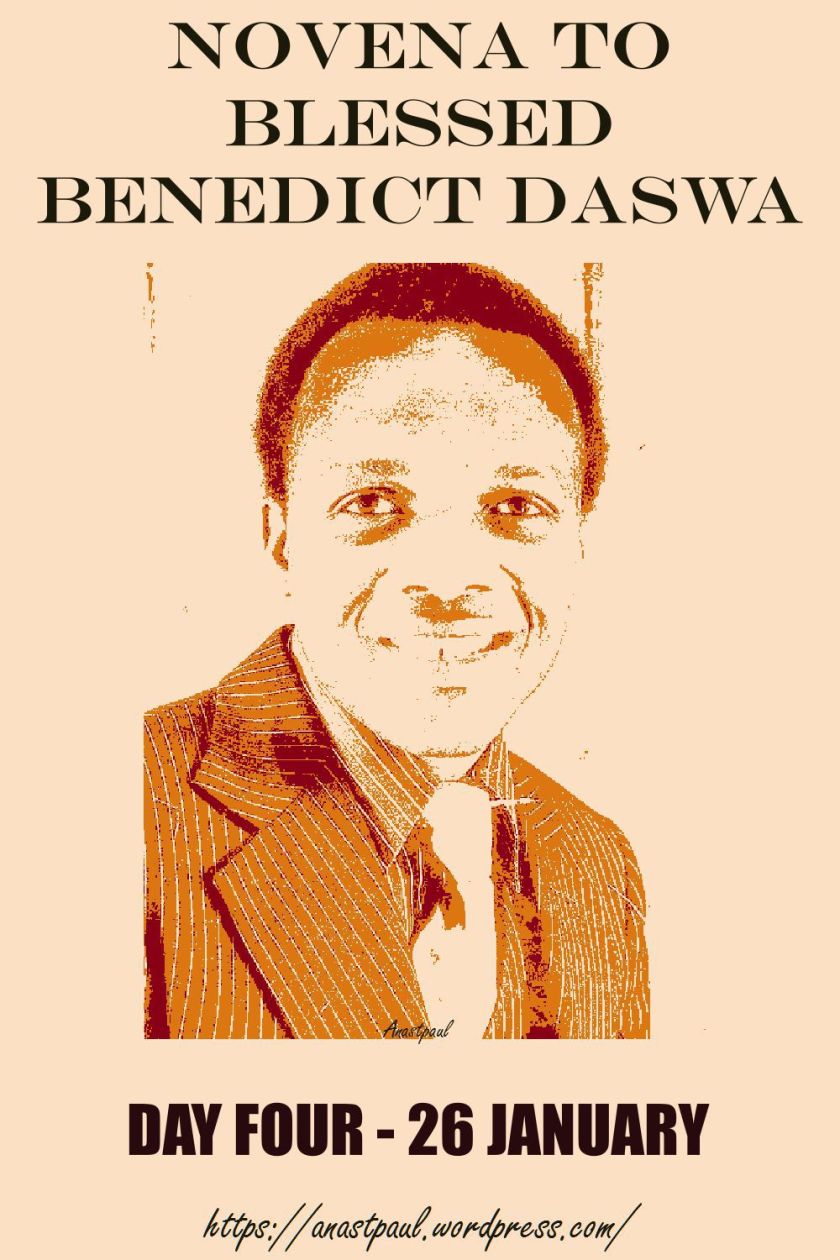
Novena to Bl Benedict Daswa – Day FOUR – 26 January

Novena to Bl Benedict Daswa – Day FOUR – 26 January

DAY 4 A MAN COMMITTED TO THE COMMUNITY

Benedict was highly respected in the community. He was a natural leader and a
confidant of the headman who chose him as the secretary of his council. Always guided by his Christian principles, Benedict was never afraid to speak his mind. He was greatly respected for his honesty and integrity as also for his truthfulness and humility. On one occasion, falsely accused of using school funds to build his house, Benedict’s innocence and good stewardship were upheld after the headman had ordered an
enquiry.
As Benedict believed strongly in character formation through sporting activities for
young people, he started soccer clubs for the youth. He wanted them to be busy,
disciplined, and off the streets. During a drought in the Venda area in the eighties, Benedict used his contacts and persuasive skills to obtain food supplies for the children in his school.

Word of God
You are the salt of the earth; but if salt has lost its taste, how shall its saltness be
restored?   It is no longer good for anything except to be thrown out and trodden under foot by men.   You are the light of the world. A city set on a hill cannot be hid.   Nor do men light a lamp and put it under a bushel but on a stand and it gives light to all in the
house.   Let your light so shine before men, that they may see your good works and give
glory to your Father who is in heaven. (Matthew 5, 13-16)

Deepening of Faith
In order to achieve their task directed to the Christian animation of the temporal order, in the sense of serving persons and society, the lay faithful are never to relinquish their participation in “public life”, that is, in the many different economic, social, legislative, administrative and cultural areas, which are intended to promote organically and institutionally the common good. (CL42)

Reflection:  What/how do I contribute to improve my community?
Do I take my public/political responsibilities seriously?

Prayer:   But you do see; you do observe this misery and sorrow;
You take the matter in hand.   To you the helpless can entrust their cause;
you are the defender of the orphans. (Psalm 10, 14)

NOVENA PRAYER:

O Blessed Trinity,
I believe that you dwell in me through my baptism.
I love You, I adore You and I worship You.
I give you thanks for Blessed Benedict,
Whom you chose to bear witness unto death for his faith
In Jesus Christ, my Saviour and my Lord.

Almighty Father, You filled the heart of Blessed Benedict,
With great love and zeal in building up your kingdom.
You gave him the courage and the strength
To stand up for his faith without fear, even the fear of death.

Loving God, keep me free from all deeds of darkness.
Protect me from evil spirits and the powers of evil.
Make me a true apostle of life in my family and in society.
May Your light, O Lord, shine upon me and through me.

Lord Jesus, through the intercession of Blessed Benedict,
I ask that I may follow his example
Of always being ready to forgive in a Christian spirit.
You know all about my many problems and worries
And my great fears when I look to the future.
I draw strength and courage from the life of Blessed Benedict.

I come to You now, Lord, and through his intercession
I ask for this very special favour………
(mention your request/s)
if it is according to Your will.

Help me always to follow the good example of Blessed Benedict.
By daily prayer and regular attendance at Church,
Help me to love You, O Lord, above all things
And to love others as You love me.
Amen.

day-4-bl-benedict

Posted in NOVENAS

Novena to St John Bosco – DAY FIVE – 26 January

5th Day (January 26) – For Salesian Brothers, Sisters and Priests

O Saint John Bosco,
you founded the Salesian Society
and the Institute of the Daughters of Mary Help of Christians
for the continuation and extension of the work on behalf of young people.
Pray for all your sons and daughters,
the members of these two religious families that,
inspired by your example and imbued with your spirit
they may be faithful to their religious consecration
and steadfast in the Salesian mission.
Through your intercession
may God grant me the following grace……………..
(mention your request)
so that together with the sons and daughters
of your religious families
I may assist and help all especially young people.

Our Father… Hail Mary… Glory to the Father…

St John Bosco Pray for us!

day-5-st-john-bosco

Posted in MORNING Prayers, QUOTES of the SAINTS, SAINT of the DAY, The WORD

Thought for the Day – 26 January

Thought for the Day – 26 January

St Paul makes it clear to Timothy that he is to proclaim the Word with persistence BUT “through all patience.”   This is the most important part of these instructions!   Growth in the Spirit is a lifelong journey, in which great patience is needed.   The one who proclaims the Word needs patience in dealing with the one being taught.   This is a human enterprise and humans are notoriously slow to understand, accept and implement the Word of God in their lives.   Christians are to proclaim the Word without being judgmental.   So, as Paul tells Timothy so he tells you and me to go forth, proclaim the Word, live your faith, treat others with respect and kindness and do it all with patience and love.   Thus faith is the centre of the Christian’s life and from that centre he radiates Christ’s love to all whom he meets. (Msgr. Bernard Bourgeois)

In these letters, we get another glimpse of life in the early Church: great zeal in the apostolate, great communion in Christ, great friendship.   Yet always there is the problem of human nature and the unglamorous details of daily life: the need for charity and patience in “quarrels with others, fears within myself,” as Paul says.   Through it all, the love of Christ sustained them.   At the end of the Letter to Titus, Paul says that when the temporary substitute comes, “hurry to me.”

Sts Timothy and Titus Pray for us!

imagessts-timothy-and-titus-jan-26

Posted in MORNING Prayers, QUOTES of the SAINTS, SAINT of the DAY, The WORD

Quote of the Day – 26 January

Quote of the Day – 26 January

“Proclaim the word;
be persistent
whether it is convenient or inconvenient;
convince,
reprimand,
encourage,
through all patience and teaching.” …………..St Paul (2 Tm 4:2)

2tm4-2

Posted in CATHOLIC Quotes, DOCTORS of the Church, MORNING Prayers, The WORD

One Minute Reflection – 26 January

One Minute Reflection – 26 January

So do not be ashamed of your testimony to our Lord,
nor of me, a prisoner for his sake;
but bear your share of hardship for the Gospel
with the strength that comes from God………..2 Tm 1:1-8
…….to Titus, my true child in our common faith:
grace and peace from God the Father and Christ Jesus our saviour.
For this reason I left you in Crete
so that you might set right what remains to be done…………Ti 1:1-5

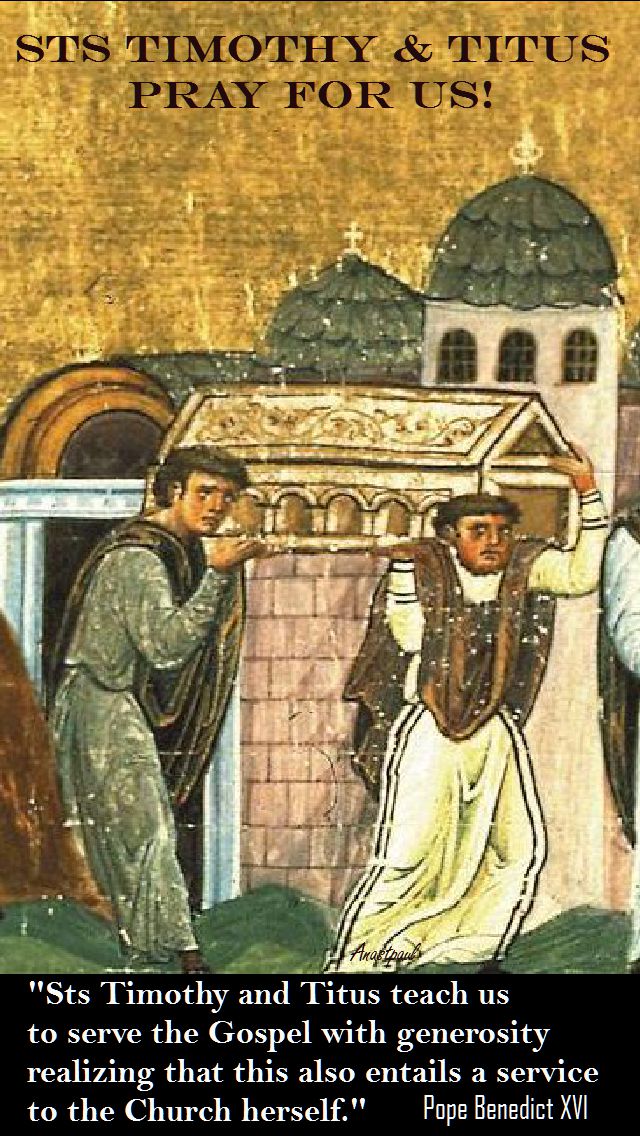
REFLECTION – …. we consider together the two figures of Timothy and Titus, we are aware of certain very significant facts………. it clearly appears that (Paul) he did not do everything on his own but relied on trustworthy people who shared in his endeavours and responsibilities.   The sources concerning Timothy and Titus highlight their readiness to take on various offices that also often consisted in representing Paul in circumstances far from easy.   In a word, they teach us to serve the Gospel with generosity realizing that this also entails a service to the Church herself..”………………Pope Benedict XVI

PRAYER – Father of light, let my life be illumined by the light of Christ and enable me to radiate the Gospel to others.  Teach me, like Sts Timothy and Titus to give my all to the service of the Bride of Christ, His Mystical Body, the Church.   Sts Timothy and Titus, pray for us. amen.

one-minute-reflectionmemorial-sts-tim-and-titus

Posted in MORNING Prayers

Our Morning Offering – 26 January

Our Morning Offering – 26 January

To the Most Holy Trinity

by Blessed James Alberione (Founder of the Pauline Family)

Divine Trinity, Father, Son and Holy Spirit,
present and active in the Church
and in the depths of my soul,
I adore You, I thank You, I love You!
And through the hands of Mary
most holy, my Mother,
I offer, give and consecrate myself
entirely to You
for life and for eternity.
To you, Heavenly Father, I offer,
give and consecrate myself
as Your son/daughter.
To you, Jesus Master, I offer,
give and consecrate myself
as Your brother/sister and disciple.
To you, Holy Spirit,
I offer, give and consecrate myself
as “a living temple”
to be consecrated and sanctified.
Mary, Mother of the Church and my Mother,
who dwells in the presence
of the Blessed Trinity,
teach me to live,
through the liturgy and the sacraments,
in ever more intimate union
with the three divine Persons,
so that my whole life may be
a “glory to the Father, to the Son
and to the Holy Spirit.” Amen.

prayer-to-the-holy-trinity-by-bl-james-alberione

Posted in SAINT of the DAY

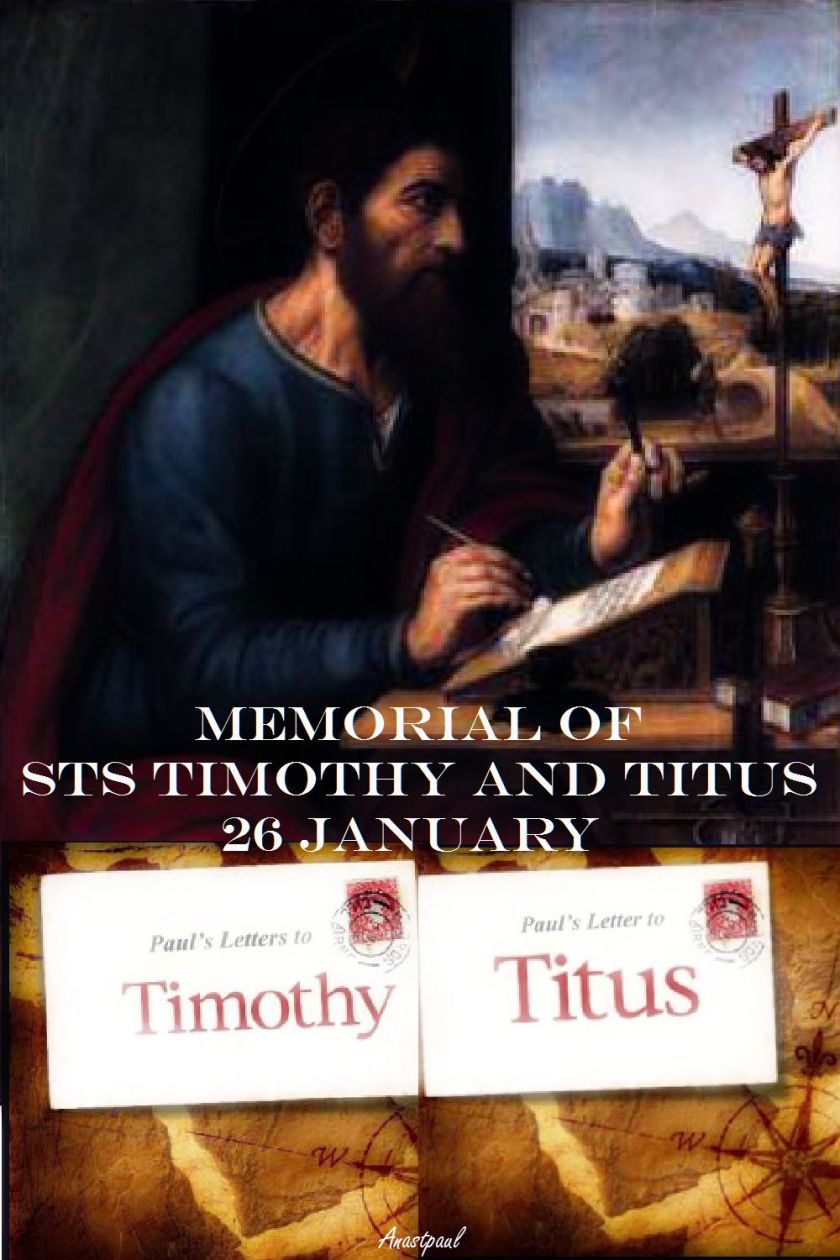
Saint/s of the Day -26 January – St Timothy and St Titus

Saint/s of the Day -26 January – St Timothy and St Titus

St Timothy – (c17-c97) – BISHOP and MARTYR  – Missionary, Peacemaker, Teacher, Administrator, Preacher, Friend and Counsel – Patron against intestinal disorders, against stomach diseases, of Termoli, Italy

Timothy means”honouring God” or “honoured by God” ) – he was an early Christian evangelist and the first first-century Christian bishop of Ephesus, who tradition relates died around the year AD 97. Timothy was from the Lycaonian city of Lystra in Asia Minor, born of a Jewish mother who had become a Christian believer, and a Greek father. The Apostle Paul met him during his second missionary journey and he became Paul’s companion and co-worker along with Silas. The New Testament indicates that Timothy traveled with Saint Paul, who was also his mentor. Paul entrusted him with important assignments. He is addressed as the recipient of the First and Second Epistles to Timothy.
464px-rembrandt_harmensz-_van_rijn_153

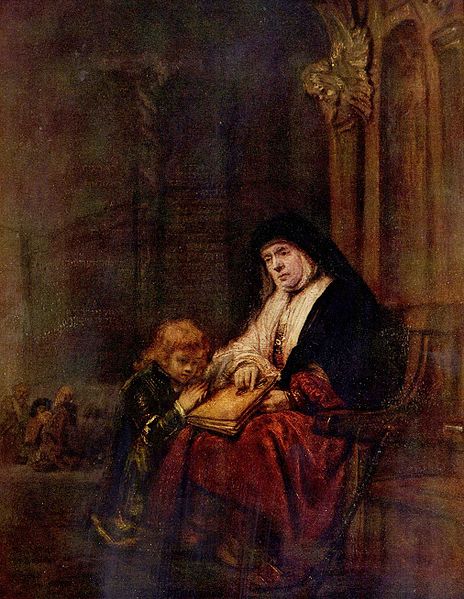
Rembrandt’s Timothy and his grandmother, 1648.

The name “Timothy” means”honouring God” or “honoured by God” ) – he was an early Christian evangelist and the first first-century Christian bishop of Ephesus, who tradition relates died around the year AD 97. Timothy was from the Lycaonian city of Lystra in Asia Minor, born of a Jewish mother who had become a Christian believer, and a Greek father. The Apostle Paul met him during his second missionary journey and he became Paul’s companion and co-worker along with Silas. The New Testament indicates that Timothy traveled with Saint Paul, who was also his mentor. Paul entrusted him with important assignments. He is addressed as the recipient of the First and Second Epistles to Timothy

Timothy became St Paul’s disciple, and later his constant companion and co-worker in preaching. In the year 52, Paul and Silas took Timothy along with them on their journey to Macedonia. Augustine extols his zeal and disinterestedness in immediately forsaking his country, his house and his parents, to follow the apostle, to share in his poverty and sufferings. Timothy may have been subject to ill health or “frequent ailments” and Paul encouraged him to “use a little wine for thy stomach’s sake”. 1 Timothy 5:23

When Paul went on to Athens, Silas and Timothy stayed for some time at Beroea and Thessalonica before joining Paul at Corinth. Timothy next appears in Acts during Paul’s stay in Ephesus (54-57) and in late 56 or early 57 Paul sent him forth to Macedonia with the aim that he would eventually arrive at Corinth. Timothy arrived at Corinth just after 1 Corinthians reached that city. The letter was not well received and Timothy quickly returned to Ephesus to report this to Paul.

Timothy was with Paul in Corinth during the winter of 57-58 when Paul dispatched his Letter to the Romans. (Romans 16:21) According to Acts 20:3-6, Timothy was with Paul in Macedonia just before Passover 58; he left the city before Paul, going ahead of him to await Paul in Troas. (Acts 20:4-5) “That is the last mention of Timothy in Acts”. In the year 64, Paul left St. Timothy at Ephesus, to govern that church.

His relationship with Paul was close. Paul entrusted him with missions of great importance. Timothy’s name appears as the co-author on 2 Corinthians, Philippians, Colossians, 1 Thessalonians, 2 Thessalonians and Philemon. Paul wrote to the Philippians about Timothy, “I have no one like him.” (Philippians 2:19-23) When Paul was in prison and awaiting martyrdom, he summoned his faithful friend, Timothy, for a last farewell.

That Timothy was jailed at least once during the period of the writing of the New Testament is implied in Hebrews mentioning Timothy’s release at the end of the epistle.

The apocryphal Acts of Timothy states that in the year 97, the 80-year-old bishop tried to halt a procession in honor of the goddess Diana by preaching the gospel. The angry pagans beat him, dragged him through the streets, and stoned him to death.
 

St Titus (first century-c96) BISHOP, Disciple of Paul, Missionary, Peacemaker, Teacher, Administrator, Friend – Patron of Crete

Timothy was with Paul in Corinth during the winter of 57-58 when Paul dispatched his Letter to the Romans. (Romans 16:21) According to Acts 20:3-6, Timothy was with Paul in Macedonia just before Passover 58; he left the city before Paul, going ahead of him to await Paul in Troas. (Acts 20:4-5) “That is the last mention of Timothy in Acts”. In the year 64, Paul left St. Timothy at Ephesus, to govern that church.

His relationship with Paul was close. Paul entrusted him with missions of great importance. Timothy’s name appears as the co-author on 2 Corinthians, Philippians, Colossians, 1 Thessalonians, 2 Thessalonians and Philemon. Paul wrote to the Philippians about Timothy, “I have no one like him.” (Philippians 2:19-23) When Paul was in prison and awaiting martyrdom, he summoned his faithful friend, Timothy, for a last farewell.

That Timothy was jailed at least once during the period of the writing of the New Testament is implied in Hebrews mentioning Timothy’s release at the end of the epistle.

The apocryphal Acts of Timothy states that in the year 97, the 80-year-old bishop tried to halt a procession in honor of the goddess Diana by preaching the gospel. The angry pagans beat him, dragged him through the streets, and stoned him to death.
Titus was an early Christian missionary and Church leader, a companion and disciple of Paul the Apostle, mentioned in several of the Pauline epistles including the Epistle to Titus. He is believed to be a Gentile converted to Christianity by Paul and according to tradition, he was consecrated as Bishop of the Island of Crete. Titus brought a fundraising letter from Paul to Corinth, to collect for the poor in Jerusalem. Later, on Crete, Titus appointed presbyters (elders) in every city and remained there into his old age, dying in the city of Candia.
Titus was a Greek, apparently from Antioch, who is said to have studied Greek philosophy and poetry in his early years. He seems to have been converted by Paul, whereupon he served as Paul’s secretary and interpreter. In the year 49, Titus accompanied Paul to the council held at Jerusalem, on the subject of the Mosaic rites. Although the apostle had consented to the circumcision of Timothy, in order to render his ministry acceptable among the Jews, he would not allow the same in regard to Titus, so as not to seem in agreement with those who would require it for Gentile converts.

Towards the close of the year 56, Paul, as he himself departed from Asia, sent Titus from Ephesus to Corinth, with full commission to remedy the fallout precipitated by Timothy’s delivery of 1 Corinthians ( and Paul’s “Painful Visit” ), particularly a significant personal offense and challenge to Paul’s authority by one unnamed individual. During this journey, Titus served as the courier for what is commonly known as the “Severe Letter,” a Pauline missive that has been lost but is referred to in 2 Corinthians. After meeting success on this mission, Titus journeyed north and met Paul in Macedonia, where the apostle, overjoyed by Titus’ success, wrote 2 Corinthians. Titus then returned to Corinth with a larger entourage, carrying 2 Corinthians with him. Paul joined Titus in Corinth later. From Corinth, Paul then sent Titus to organize the collections of alms for the Christians at Jerusalem. Titus was therefore a troubleshooter, peacemaker, administrator and missionary.

Early church tradition holds that Paul, after his release from his first imprisonment in Rome, stopped at the island of Crete to preach. he necessities of other churches requiring his presence elsewhere, he ordained his disciple Titus as bishop of that island and left him to finish the work he had started. Chrysostom says that this is an indication of the esteem St. Paul held for Titus.
Paul summoned Titus from Crete to join him at Nicopolis in Epirus. Later, Titus traveled to Dalmatia. The New Testament does not record his death.