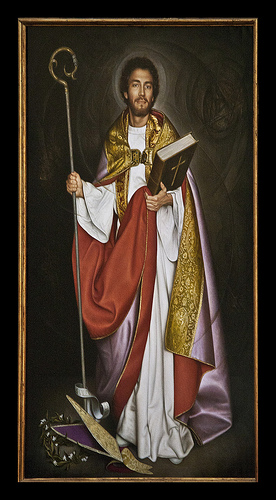
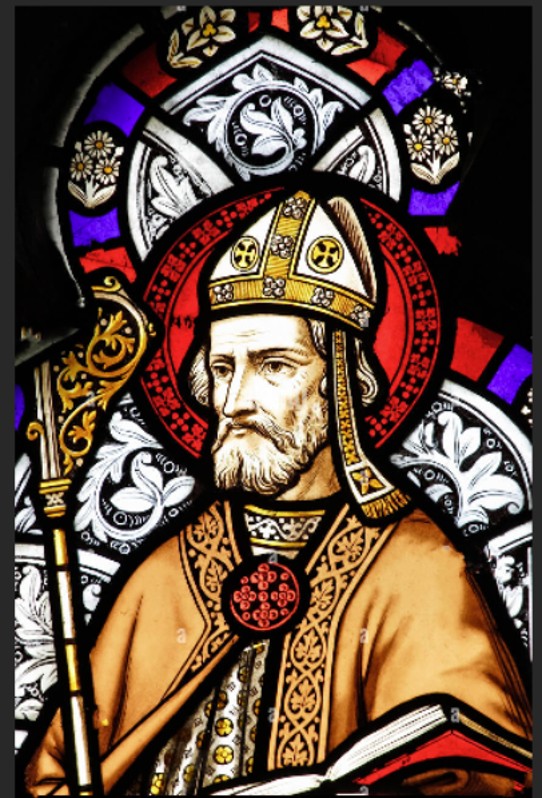
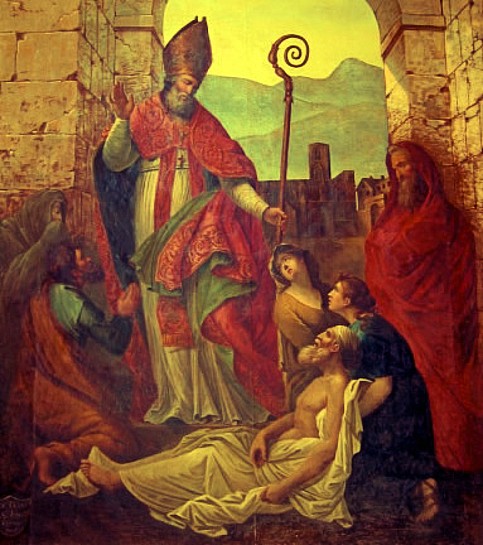
Saint of the Day – 17 February – Saint Silvinus (c650-c717) Bishop, Missionary evangeliser in north-eastern pagain regions of France, gifted with miracles. Born of Celtic origins and died on 15 February c717 at the Abbey of Auchy-les-Moines, Artois, in Belgium of natural causes. Also known as – Silvinus of Thérouanne, … of Toulouse, … of Auchy, Silvain…. Silvin …. Silvino…. Additional Memorial – 15 February in Auchy France.
The Roman Martyrology reads today: “In the territory of Thérouanne, St Silvinus, Bishop of Toulouse.”
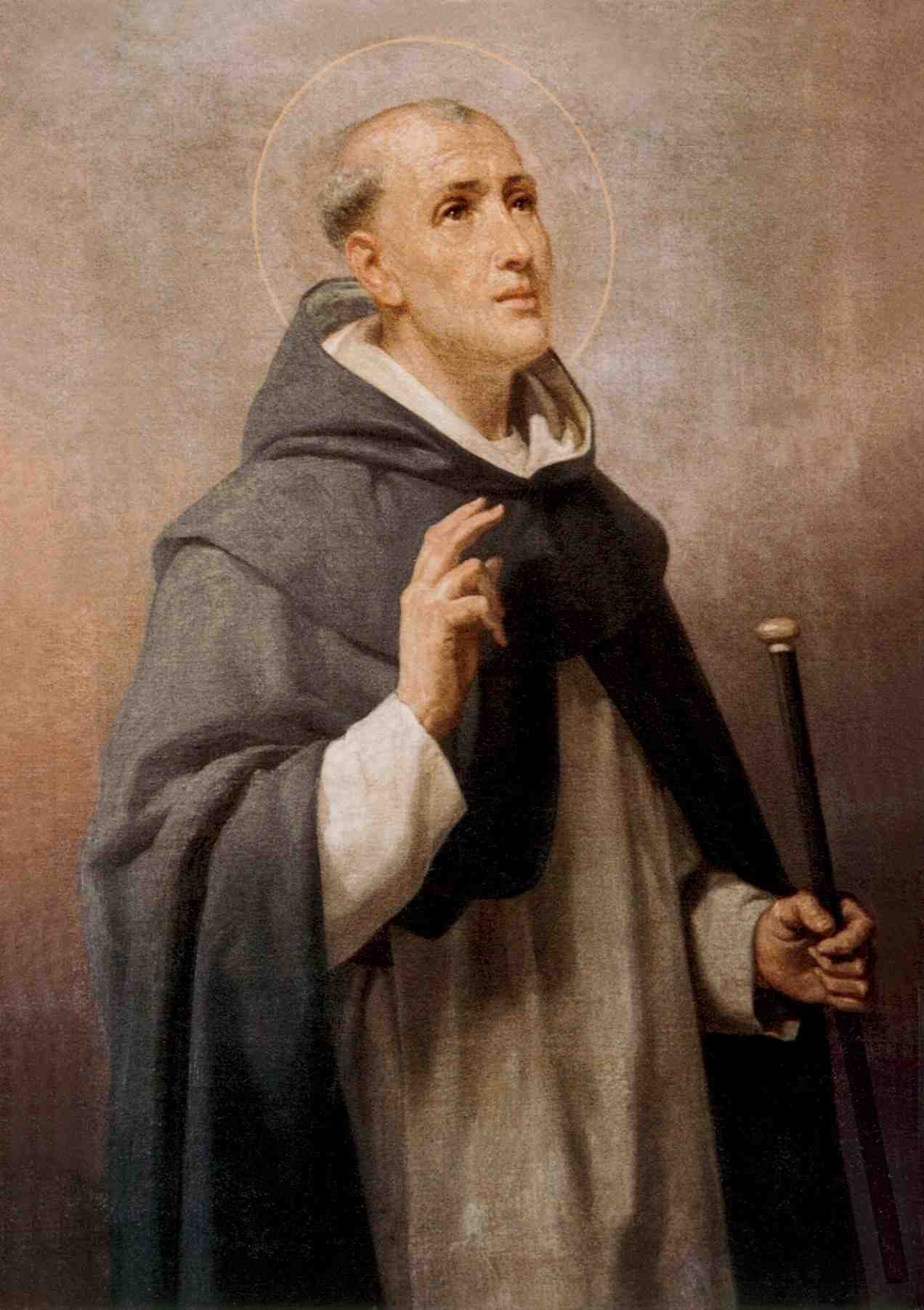
Saint-Sylvain in the Church of Mazerolles
Born to a noble family, Sylvinus was of Celtic origins. He renounced a life of wealth and power, to embrace poverty and celibacy.
Ordained a Priest and then a Bishop, he devoted himself to evangelisation and charity, in north-eastern France, still largely pagan.
Silvinus was distinguished by his humility and austerity and was venerated during his life-time for his sanctity and his intercessory gifts of performing miracles.
He died in c717 and was buried in the Monastery of Auchy-les-Moines. Several Churches, Towns and Villages are named after him (Saint-Sylvain-d’Anjou or Saint-Sylvain [Calvados] ). The male first name, Sylvainm is very popular and common in France, Belgium and other French-speaking regions in Africa and, of course, Quebec, Canada.
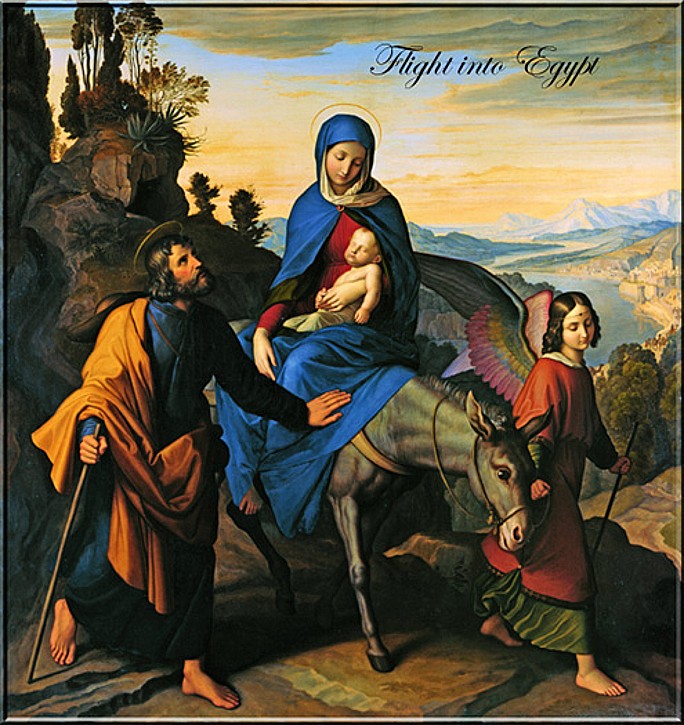
It was on the seventeenth of February, fifty five days after the Nativity of Jesus, when King Herod’s soldiers — sent to slaughter all little boys in Bethlehem and its neighbourhood who were two years old or under, in order to destroy a rival King, Jesus — were getting perilously near the cave at Bethlehem, where at first they little expected Our Lord to be. Saint Joseph received a message from God through an Angel, whereupon he took Our Lady and the Divine Infant and set off leaving the land of the Jews to travel to a land of the Gentiles. They took no-one with them, by way of servants or friends, as Saint Peter Chrysologus tells us.
The Town to which the Holy Family fled was called Fostat. It was three hundred miles from Bethlehem. A Church has been erected there, on the site of the house where the Holy Family lived during their exile. The little Town where the Holy Family lived in Egypt was not far from Heliopolis, a City in which — when Jesus, Mary and Joseph passed through it — statues of pagan gods crashed to the ground. Both Fostat and Heliopolis are not far from Cairo in Egypt.
St Lupiano St Mesrop the Teacher St Polychronius of Babylon St Romulus the Martyr St Secundian the Martyr St Silvinus (c650-c717) Bishop St Theodulus of Caesarea
Thought for the Day – 16 February – Meditations with Fr Richard Frederick Clarke SJ (1839-1900)
Meditations on “The Great Truths” From “The Devout Year” By Fr Richard Frederick Clarke SJ (1839-1900)
16th Day – The Aggravations of Hell
Here will I dwell, for I have chosen it. (Ps cxxxi:14)
Every thought of the lost will aggravate, not alleviate, their sufferings. Let us review one or two of the thoughts which will be ever present to their minds.
+1. They might so easily have been saved! One act of contrition at the last, one grace accepted out of the countless graces which were deliberately set at naught and they might have been with the Angels in Heaven, instead of with the devils in hell. To know that we have just missed some advantage which we might, with a little trouble, have secured for ourselves, is always a tormenting thought. How much more when it is Heaven which is lost!
+2. If the advantage is lost, purely through our own fault, this greatly increases our misery. We fools! We had so many chances, we knew so well we were forfeiting our eternal inheritance! It is this which changes sorrow into remorse and adds to suffering, the horror and blackness of despair! All through our own fault! What a thought to dwell with me through all eternity!
+3. What is it that we have lost? This will be the bitterest thought of all. We have lost the sweet music of Heaven, we have lost the company of the Saints and Angels, we have lost the enchanting happiness of gazing on the Sacred Humanity of Jesus in all its glory and, above all, we have lost the unspeakable joy of the Beatific Vision. We fools! Pray God that the dread of this thought hereafter, may keep you from sin.
Quote/s of the Day – 16 February – Septuagesima Sunday
“So shall the last be first and the first last. For many are called but few chosen.”
Matthew 20:16
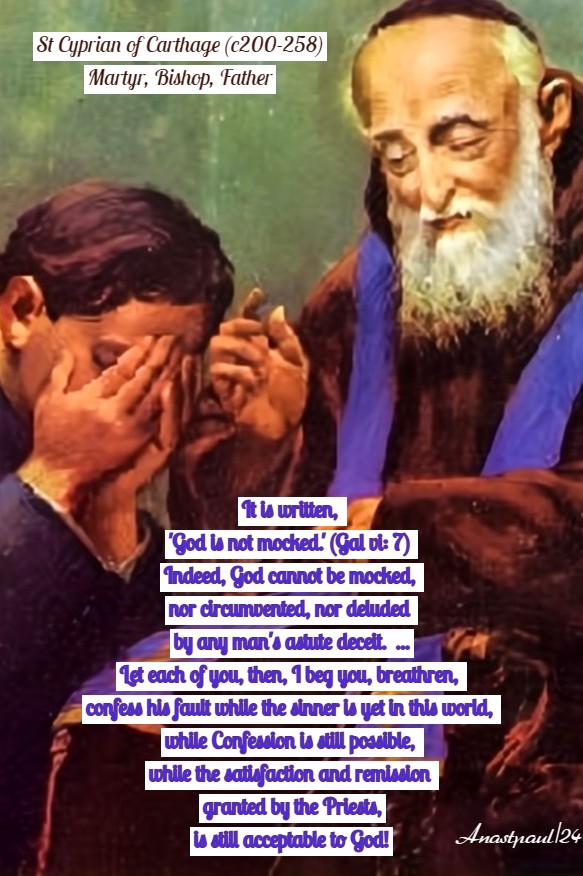
“It is written, ‘God is not mocked.’ (Gal 6: 7) Indeed, God cannot be mocked, nor circumvented, nor deluded by any man’s astute deceit. … Let each of you, then, I beg you, brethren, confess his fault while the sinner is yet in this world, while Confession is still possible, while the satisfaction and remission granted by the Priests, is still acceptable to God!”
St Cyprian of Carthage (c200-258) Martyr, Bishop of Carthage, Father of the Church
“Let us then, my brethren, endure in hope. Let us devote ourselves, side-by-side with our hoping, so that the God of all the universe, as He beholds our intention, may cleanse us from all sins, fill us with high hopes from what we have in hand and grant us the change of heart which saves. God has called you and you have your calling!”
St Cyril of Jerusalem (315-387) Father and Doctor of the Church
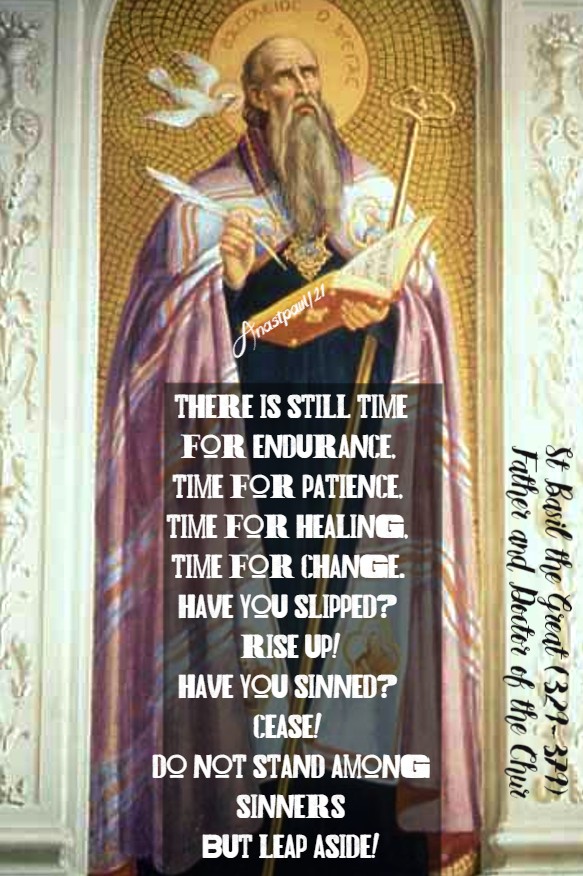
“There is still time for endurance, time for patience, time for healing, time for change. Have you slipped? Rise up! Have you sinned? Cease! Do not stand among sinners but leap aside!”
St Basil the Great (329-379) Father and Doctor of the Church
“Listen to the Lord’s appeal: ‘Come, then, return to Me and learn to know Me as your Father, Who repays good for evil, love for injury and boundless charity for piercing wounds!”
St Peter Chrysologus (c400-450) “Golden Words” Father & Doctor of the Church
One Minute Reflection – 16 February – “The Month of the Blessed Trinity” – Septuagesima Sunday – 1 Corinthians 9:24-27; 10:1-5 – Matthew 20:1-16. – Scripture search here: https://www.drbo.org/
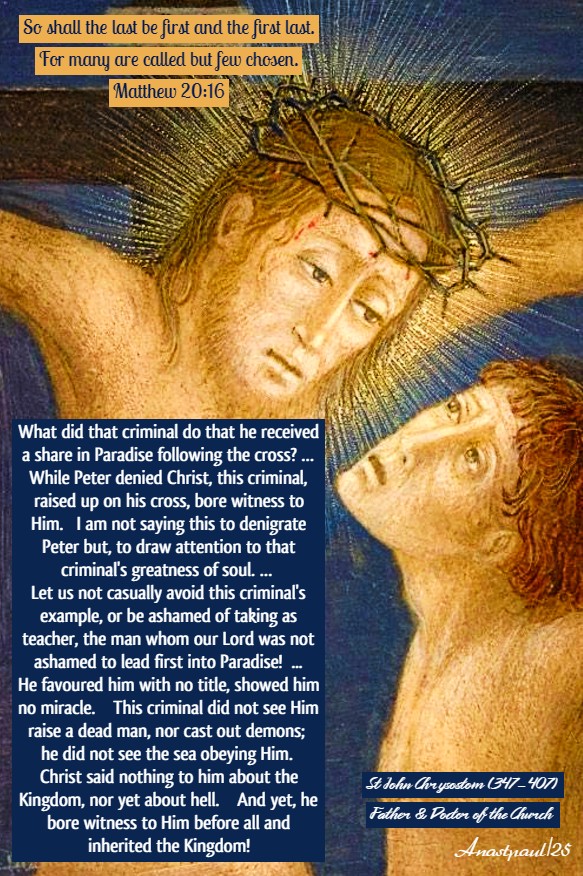
“So shall the last be first and the first last. For many are called but few chosen.” – Matthew 20:16
REFLECTION – “What did that criminal do that he received a share in Paradise following the cross? … While Peter denied Christ, this criminal, raised up on his cross, bore witness to Him. I am not saying this to denigrate Peter but, to draw attention to that criminal’s greatness of soul. … While a whole rabble were standing around Him, murmuring, yelling and heaping oaths and abuse on them both, this criminal paid no attention. He did not even consider the wretched condition of the Crucifixion right before his eyes. All this, he passed over, with a glance full of faith …. He turned towards our heavenly Lord and entrusted himself to Him and said: “Lord, remember me when Thou comes into Thy Kingdom” (Lk 23:42). Let us not casually avoid this criminal’s example, or be ashamed of taking as teacher, the man whom our Lord was not ashamed to lead first into Paradise! …
He did not say to him, as He said to Peter: “Come after me, and I will make you a fisher of men” (Mt 4:19). Nor did he say to him as to the Twelve: “You will sit on twelve thrones, judging the twelve tribes of Israel” (Mt 19:28). He favoured him with no title, showed him no miracle. This criminal did not see Him raise a dead man, nor cast out demons; he did not see the sea obeying Him. Christ said nothing to him about the Kingdom, nor yet about hell. And yet, he bore witness to Him before all and inherited the Kingdom!” – St John Chrysostom (347-407) Bishop of Constantinople, Father & Doctor of the Church (Sermon for Good Friday “The Cross and the criminal” ).
PRAYER – O Lord, we beseech You, graciously hear the prayers of Your people, that we who are justly punished for our sins may be mercifully delivered for the glory of Your name. Through Jesus Christ, Thy Son our Lord, Who lives and reigns with Thee, in the unity of the Holy Ghost, God, world without end. Amen (Collect).
Our Morning Offering – 16 February – Septuagesima Sunday
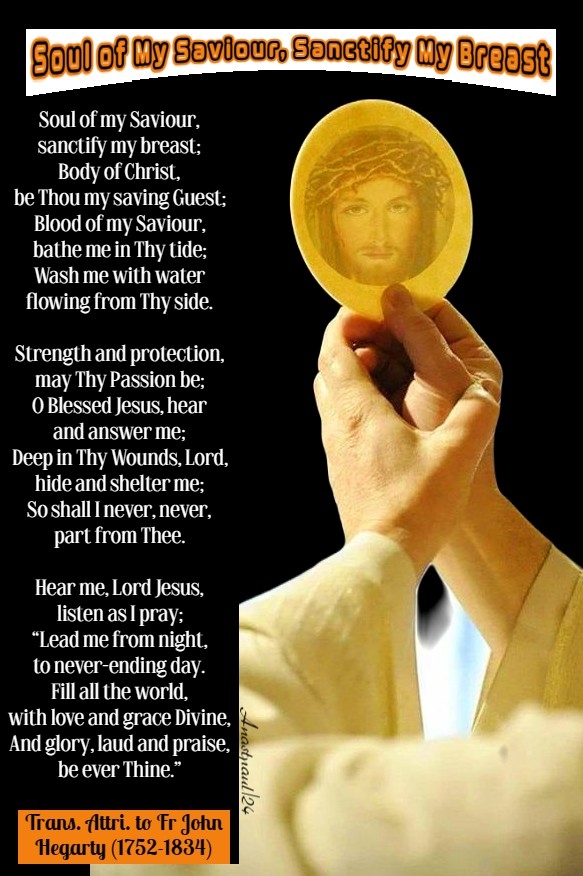
Soul of My Saviour, Sanctify My Breast Trans. Attri. to Fr John Hegarty (1752-1834)
Soul of my Saviour, sanctify my breast; Body of Christ, be Thou my saving Guest; Blood of my Saviour, bathe me in Thy tide; Wash me with water flowing from Thy side.
Strength and protection, may Thy Passion be; O Blessed Jesus, hear and answer me; Deep in Thy Wounds, Lord, hide and shelter me; So shall I never, never, part from Thee.
Hear me, Lord Jesus, listen as I pray; “Lead me from night, to never-ending day. Fill all the world, with love and grace Divine, And glory, laud and praise, be ever Thine.”
This Hymn is based on the original Latin text of the Anima Christi. Fr Hegarty is attributed with its translation and/or arrangement. He was born in County Derry, Ireland, educated at Dublin University and was Ordained in June 1890 and spent most of active apostolic years in Brisbane, Australia. He died aged 82 years.
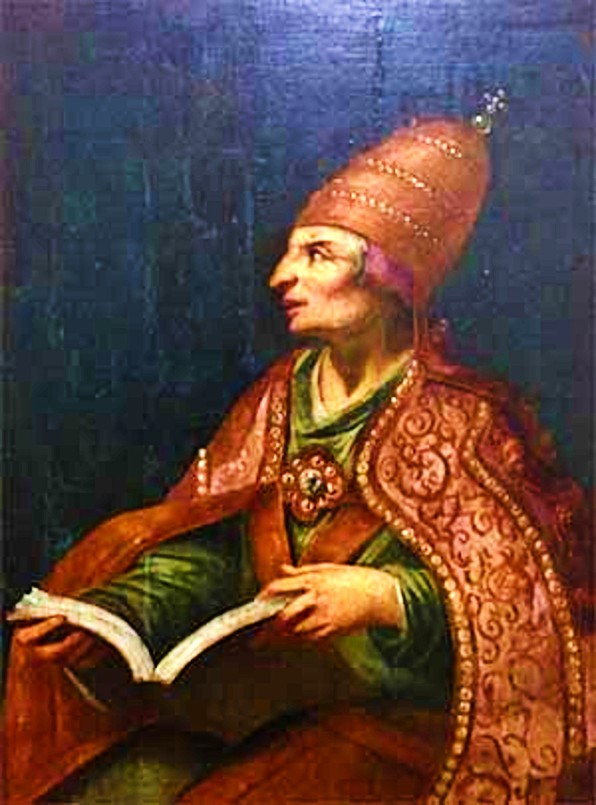
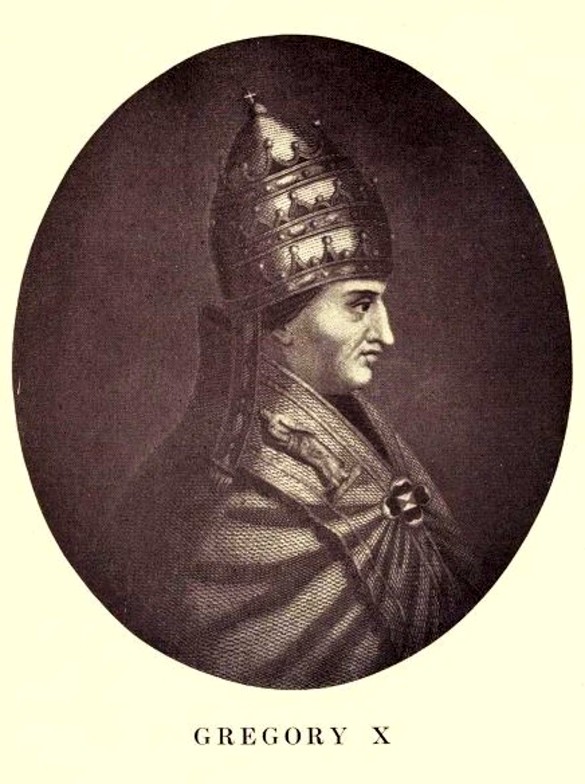
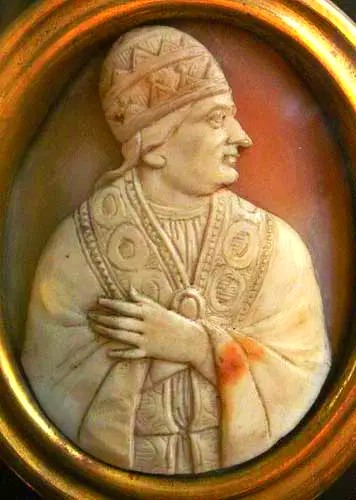
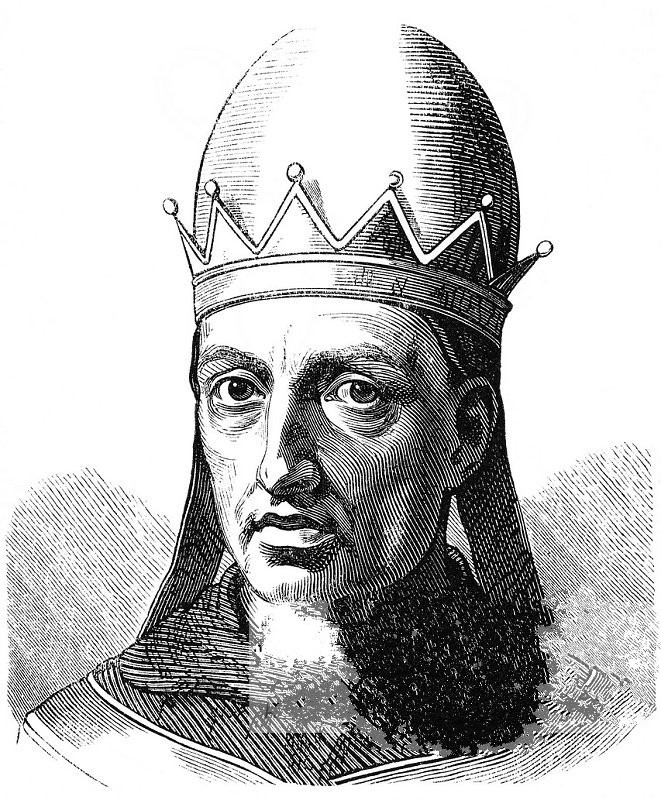
Saint of the Day – 16 February – Blessed Gregory X OFM (or TOSF) (1210-1276) Pope Papacy began 1 September 1271 until his death on 10 January 1276, Diplomat and Peacemaker, Reformer of Papal Elections, Third Order Franciscan. This Tertiary Pope, a friend of St. Bonaventure, was a true son of St Francis, known for his love for the holy places in Palestine and his efforts to promote peace. Born as Theobald Visconti in Piacenza, Italy, in 1210 and died at Rezzo, Italy, on 10 January 1276 of natural causes. Patronages – of Third Order Franciscans, of the Diocese of Aresso, Italy. He wwas Beatified on 8 July 1713 bvbPope Clement XI and addedd to the Martyrology by Pope Benedict XIV (reigned 1740-1758). A miracle is awaited for his Canonisation which remains an open Cause.
The Roman Martyrology reads today: “At Arezzo, in Tuscany, Blessed Gregory X, a native of Piacenza, who was elected Sovereign Pontiff while he was Archdeacon of Liege. He held the 2nd Council of Lyons, received the Greeks into the unity of the Church, appeaseddiscords among Christians, made generous efforts for the recovery of the Holy Land and governed the Church in the most holy manner.”
Gregory X, is remembered for his extraordinary journey from an Archdeacon to the Papacy, despite not being a Priest at the time of his election. His story reflects the influence of Saints and the shaping of Church history.
Theobald Visconti was born into a very distinguished family, studied Canon Law at Paris and Liege and became the Archdeacon of Liége. In this position he was entrusted with preaching the last Crusade. In Paris, where he engaged with intellectual circles for over twenty years, his closest friends were the Franciscans, particularly St Bonaventure.
He accompanied Cardinal Ottoboni on a mission to England. Theobald was at Acre in the Holy Land on pilgrimage, when he was informed that, although he was not yet Ordained, he had been chosen as the Supreme Pontiff. This had been enacted by a committee of six Cardinals who had been charged with selecting a new Pope, when the rest of the Cardinals failed to agree on a candidate to fill the Pontifical throne, which had been vacant for three years.
He returned to Rome, was Ordained a Priest on 19 March and then consecrated as Pope on 27 March 1272, taking the name Gregory X. Perhaps Gregory X’s most enduring legacy is the establishment of the Papal Conclave system. After the prolonged election process which led to his own Papacy, Gregory instituted reforms to expedite future Papal Elections. The Second Council of Lyons decreed that Cardinals should convene in isolation after a Pope’s death, with strict measures to encourage a swift decision. This marked the beginning of the Conclave process, isolating the Cardinals from external influences and streamlining the election process. The Conclave’s name, meaning “with a key”symbolises this seclusion.
He laboured to end the warfare between the Guelphs and the Ghibellines factions, placed Florence under interdict for refusing efforts at reconciliation with its neighbours and approved Rudulph of Hapsburg, as the German Emperor.
Gregory also convoked the 14th General Council at Lyons in 1274 which effected a short-lived reconciliation with the Eastern Churches but was unsuccessful in launching the Crusade (which was the general reason the Eastern Churches were willing to negotiate a reunion).
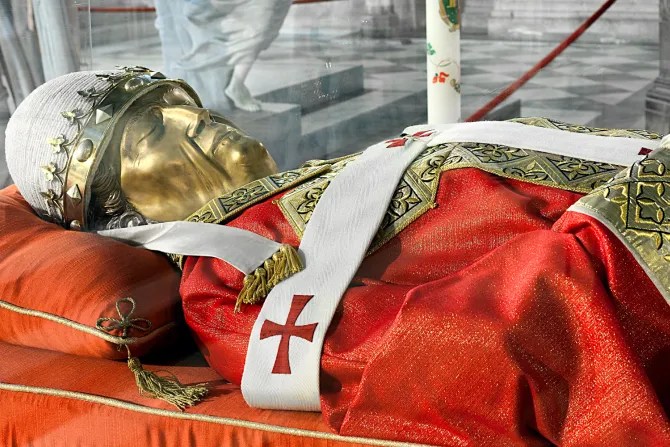
Gregory died on his way back from the Council in Lyons. He is buried inside the Cathedral Church of Arezzo. He was succeeded by the Dominican Peter of Tarantaise of Savoy (Pope Innocent V)Gregory’s close collaborator throughout his Pontificate.
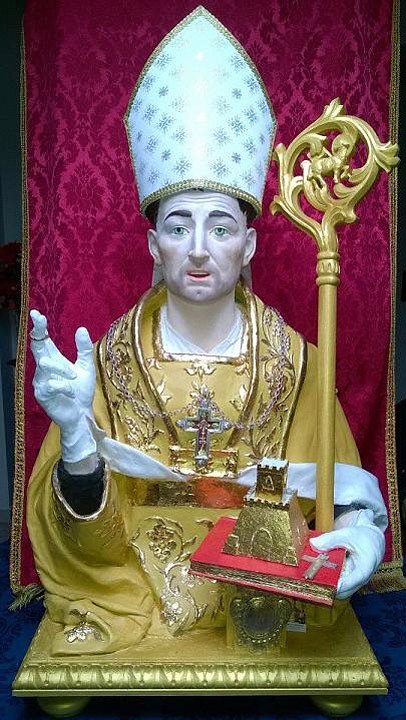
he effigy of Blessed Pope Gregory X can be found in the Cathedral of Arezzo.
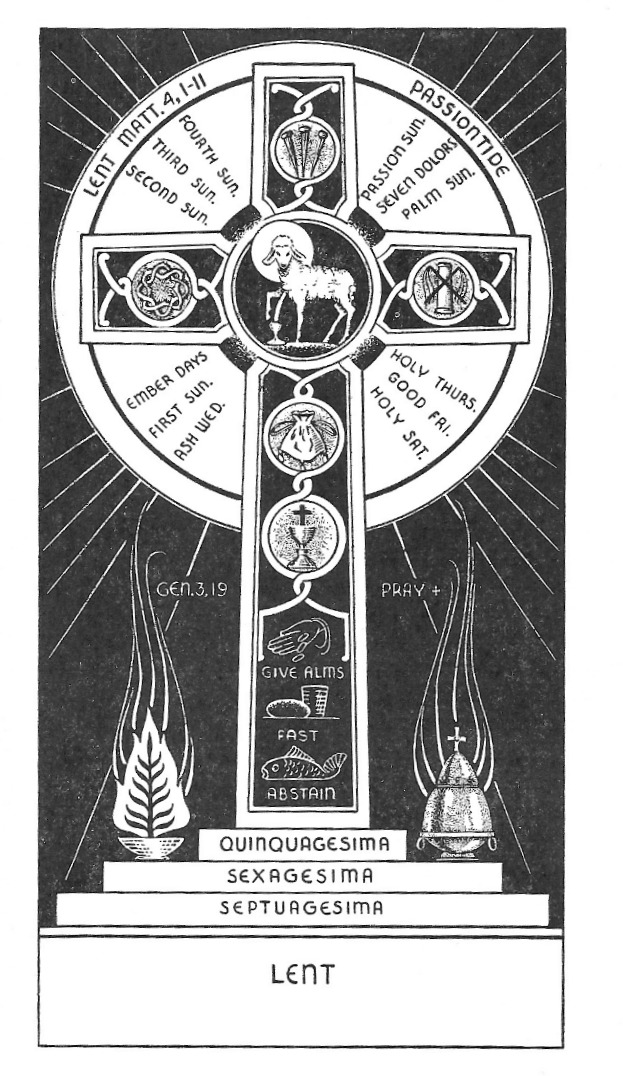
Septuagesima Sunday: The word “Septuagesima” is Latin for “Seventeenth.” It is both the name of the Liturgical Season and the name of the Sunday. Septuagesima Sunday marks the beginning of the shortest Liturgical Season. This Season is seventeen (17) days long and includes the three Sundays before Ash Wednesday. The length of the Season never changes but the start date is dependent on the movable date of Easter, which can fall between 22 March-25 April. Septuagesima Sunday can be as early as 18 January.
Dom Prosper Guéranger OSB (1805-1875) Abbot of Solesmes from 1837-1875, devoted a whole volume of his great work – The Liturgical Year, to Septuagesima. In his Preface, Dom Guéranger referred to Septuagesima as a Season of “transition, inasmuch as it includes the period between two important Seasons – Christmas and Lent.… The Church, therefore, has instituted a preparation for the holy time of Lent. She gives us the three weeks of Septuagesima, during which she withdraws us, as much as may be, from the noisy distractions of the world, in order that our hearts may be the more readily impressed by the solemn warning she is to give us, at the commencement of Lent, by marking our foreheads with ashes.” The Septuagesima Season helps the faithful ease into Lent. I t is a gradual preparation for the serious time of penance and sorrow; to remind the sinner of the grievousness of his errors and to exhort him to penance. Liturgically it looks very much like Lent. The Gloria and Alleluia are omitted, the tone becomes penitential with the Priest wearing Purple Vestments. The main difference is that there are no fasting requirements.
St Faustinus of Brescia (not the St Faustinus brother of St Jovinus – 15 February). Blessed Gregory X (1210-1276) Pope Papacy began 1 September 1271 until his death on 10 January 1276. His Feast was one of those moved in 1969. Today is the date of his celebration. A Very Interesting Pope: https://anastpaul.com/2022/01/10/saint-of-the-day-10-january-blessed-pope-gregory-x-1210-1276/
St Honestus of Nimes St John III of Constantinople
St Julian of Egypt St Juliana of Campania St Juliana of Nicomedia Blessed Mariano Arciero
Martyrs of Cilicia – 12 Saints: A group of Christians who ministered to other Christians who were condemned to work the mines of Cilicia in the persecutions of Maximus. They were arrested, tortured and martryed by order of the governor Firmilian. They were Daniel, Elias, Isaias, Jeremy, Samuel. The group also includes the three known have been sentenced to the mines – Pamphilus, Paul of Jamnia, Valens of Jerusalem and those who were exposed as Christians as a result of these murders – Julian of Cappadocia, Porphyrius of Caesarea, Seleucius of Caesarea, Theodule the Servant. They were Martyred in 309 in Cilicia, Asia Minor (in modern Turkey).
Thought for the Day – 15 February – Meditations with Fr Richard Frederick Clarke SJ (1839-1900)
Meditations on “The Great Truths” From “The Devout Year” By Fr Richard Frederick Clarke SJ (1839-1900)
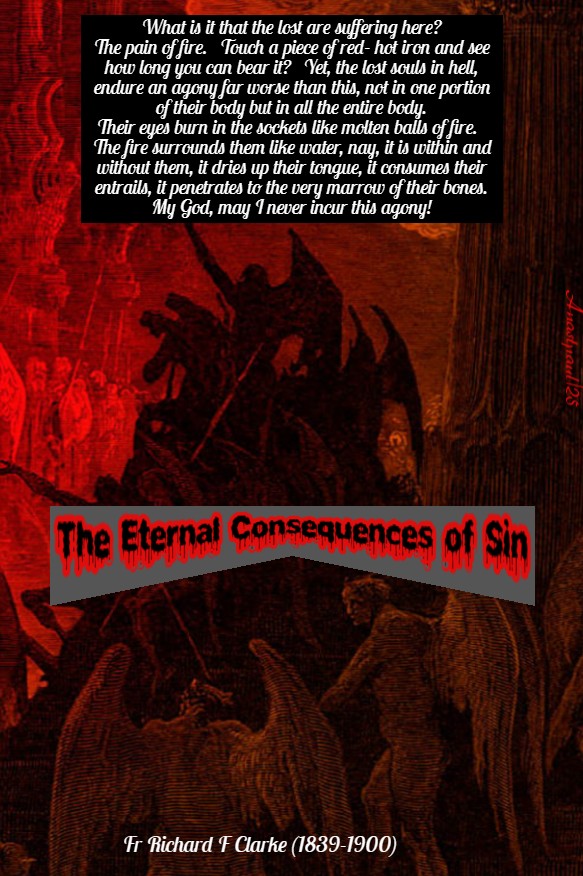
15th Day – The Eternal Consequences of Sin
Whoever was not found written in the Book of Life was cast into the pool of fire. (Apoc xx 15)
Try to represent to your imagination, the eternal prison-house. Listen to the shrieks and howls and cries of despair which issue thence; see the agony written on the faces of the inmates; approach, if you dare, to the devouring flame, taste the burning thirst which longs for one drop of water as an indescribable luxury.
+1. What is it that the lost are suffering here? The pain of fire. Touch a piece of red- hot iron and see how long you can bear it? Yet, the lost souls in hell, endure an agony far worse than this, not in one portion of their body but in all the entire body. Their eyes burn in the sockets like molten balls of fire. The fire surrounds them like water, nay, it is within and without them, it dries up their tongue, it consumes their entrails, it penetrates to the very marrow of their bones. My God, may I never incur this agony!
+2. This fire is no ordinary fire. It is a supernatural fire – the breath of God kindles it. The torment of burning, as known to us, is a suffering far less than the torment of hell. If the lost could be transferred to a bath of seething, molten lead, it would be a far less suffering, than that of the fire in which they are steeped in hell!
+3. About this fire, there is none of the light of ordinary fire. It carries with it the blackness of utter darkness. No ray of light will ever pierce its hideous gloom, no word of comfort, no relief, no hope of change. Nothing to alleviate the eternal misery which comes of sin. Pray that if the love of God or hope of Heaven does not keep you from sinning, at least the fear of hell-fire may stop you in time!
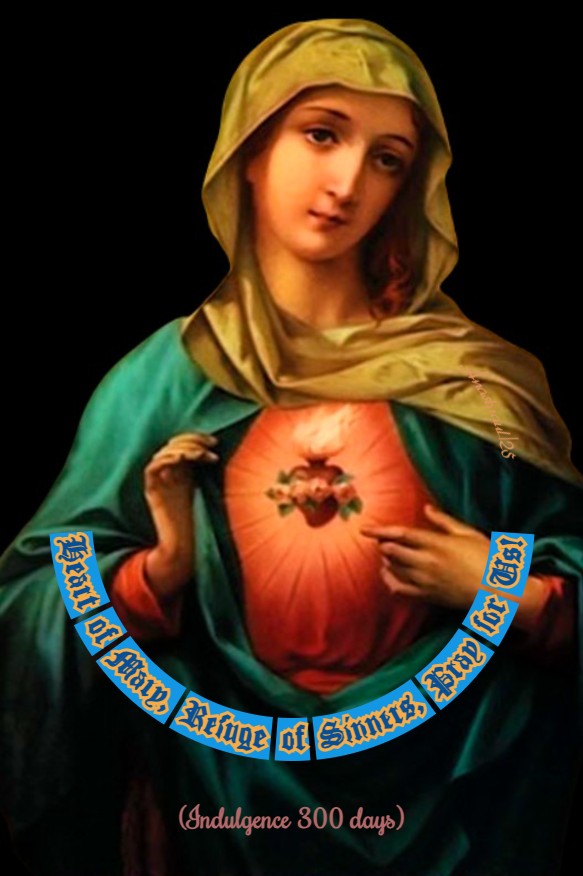
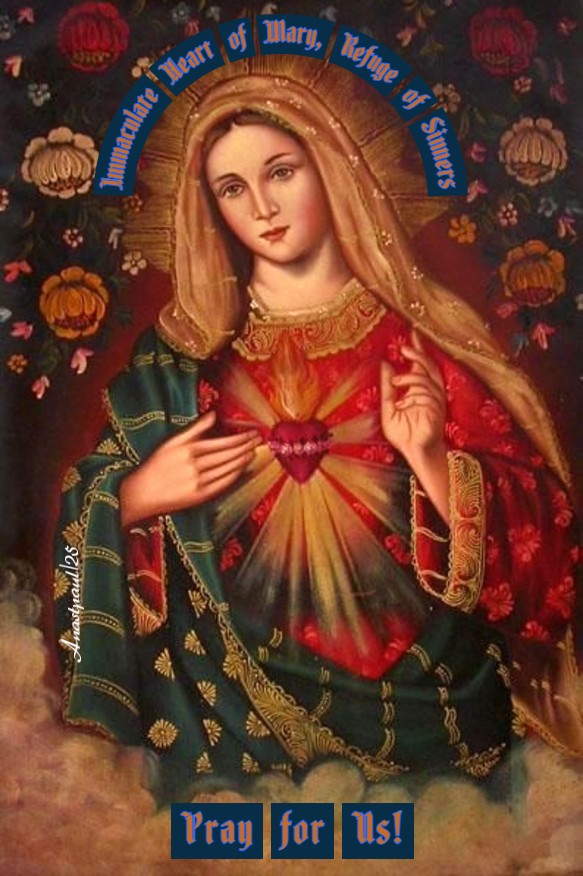
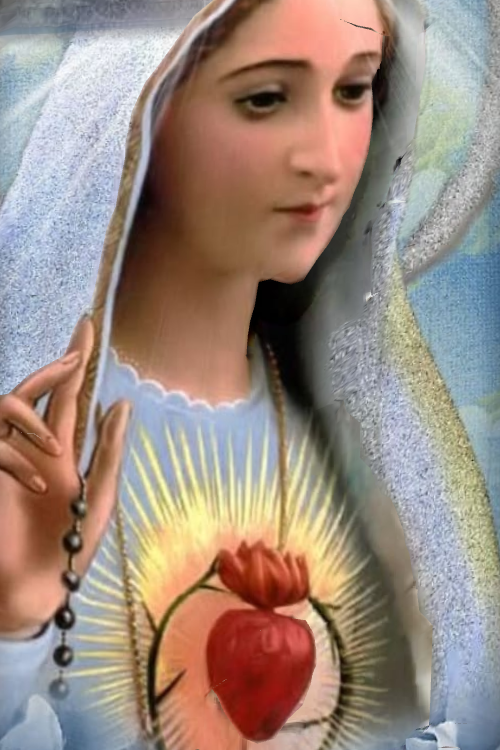
Quote/s of the Day – 15 February – Feast of The Immaculate Heart of Mary, Refuge of Sinners
Heart of Mary, Refuge of Sinners, Pray for Us!
(Indulgence 300 days)
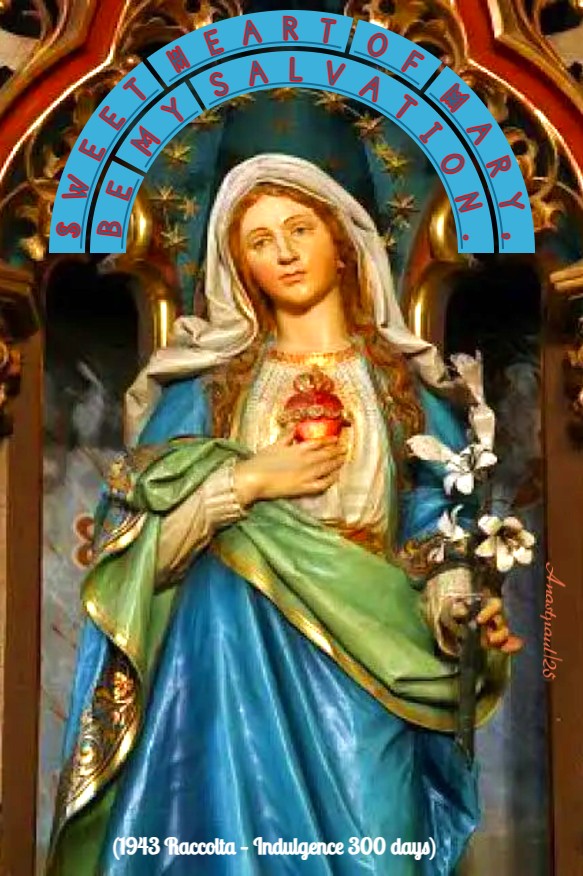
Sweet Heart of Mary, be my salvation.
(1943 Raccolta – Indulgence 300 days)
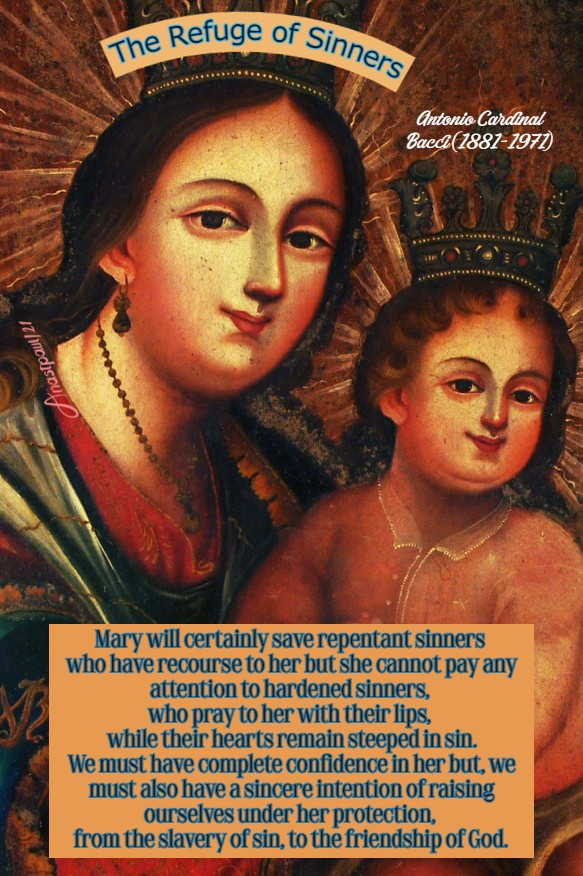
“Mary will certainly save repentant sinners who have recourse to her but she cannot pay any attention to hardened sinners, who pray to her with their lips, while their hearts remain steeped in sin. We must have complete confidence in her but, we must also have a sincere intention of raising ourselves under her protection, from the slavery of sin, to the friendship of God.”
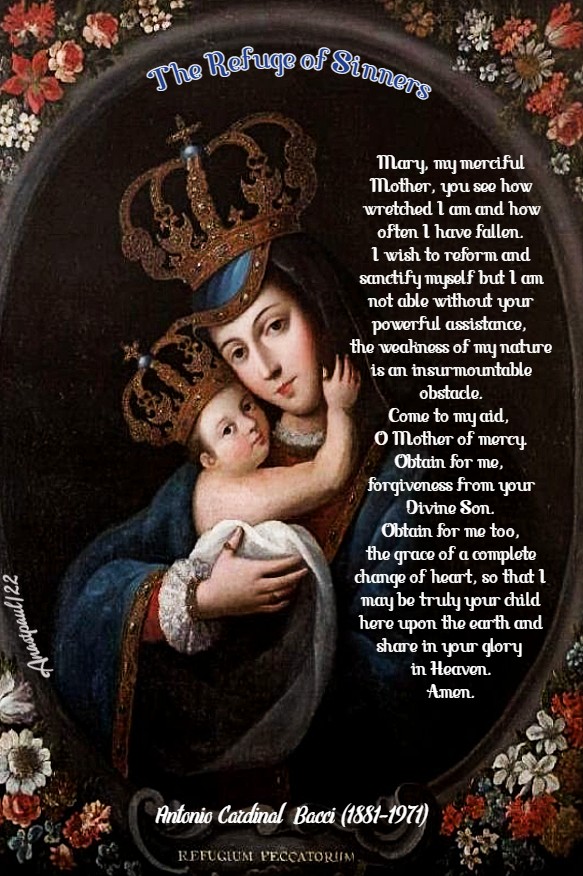
“Mary, my merciful Mother, you see how wretched I am and how often I have fallen. I wish to reform and sanctify myself but I am not able without your powerful assistance, the weakness of my nature is an insurmountable obstacle. Come to my aid, O Mother of mercy. Obtain for me, forgiveness f rom your Divine Son. Obtain for me too, the grace of a complete change of heart, so that I may be truly your child here upon the earth and share in your glory in Heaven. Amen.”
One Minute Reflection – 15 February – “The Month of the Blessed Trinity” – Epiphany VI (Anticipated) – Feast of The Immaculate Heart of Mary, Refuge of Sinners – 1 Thessalonians 1:2-10; – Matthew 13:31-35 – Scripture search here: https://www.drbo.org/
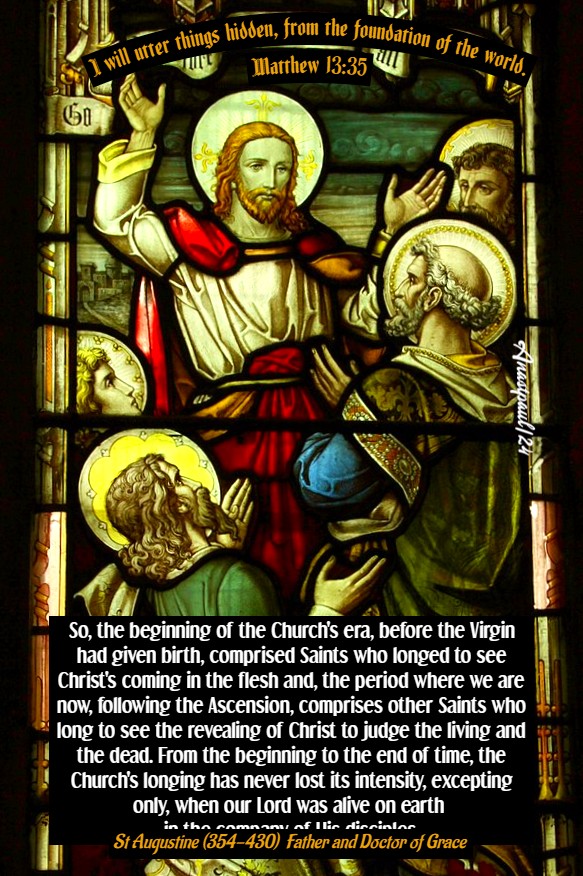
“I will utter things hidden, from the foundation of the world.” – Matthew 13:35
REFLECTION – “In one of the Psalms the Prophet says: “My soul pines for Thy salvation; I hope in Thy Word” (118:1) … Who is expressing this ardent desire if not “the chosen race, the royal priesthood, the people set apart for God” (1 Pt 2:9) each in their own day, in each one of those, who have lived, are living or will live, from humanity’s first beginning until the end of the world? … This is why our Lord Himself, says to His disciples: “Many Prophets and righteous men have wished to see that which you see.” It is their voice, then, we must recognise in this Psalm … Their longing has never come to an end in the Saints, nor does it end even now in “the Body of Christ, the Church” (Col 1:18) until “the Desired of all nations” comes (Hag 2:8) …
So, the beginning of the Church’s era, before the Virgin had given birth, comprised Saints who longed to see Christ’s coming in the flesh and, the period where we are now, following the Ascension, comprises other Saints who long to see the revealing of Christ to judge the living and the dead. From the beginning to the end of time, the Church’s longing has never lost its intensity, excepting only, when our Lord was alive on earth in the company of His disciples.” – St Augustine (354-430) Bishop of Hippo, Father and Doctor of Grace (Discourses on the Psalms Ps 118 No 20).
PRAYER – O God most kind, Who as a salvation for sinners and a refuge for the miserable, didst will the Blessed Virgin Mary to be the Ever Virgin Mother of Thine only Son and the distributor of His graces; grant, we pray, that while celebrating the memory of this most loving Mother’s Heart, we may obtain for sinners, the grace of conversion and an abundance of heavenly gifts, for all the faithful. Through the same Christ our Lord, in the unity of the Holy Ghost, God forever amen. (Collect).
Our Morning Offering – 15 February – Feast of The Immaculate Heart of Mary, Refuge of Sinners
O Mother Blest By St Alphonsus Maira Liguori (1696-1787) Most Zealous Doctor of the Church Trans. Fr Edmund Vaughn C.SS.R. (1827 – 1908 )
O Mother blest, whom God bestows On sinners and on just, What joy, what hope thou givest those Who in thy mercy trust. Thou are clement, thou are chaste, Mary thou art fair, Of all mothers, sweetest best, none with thee compare.
O heavenly Mother, mistress sweet! it never yet was told that suppliant sinner left thy feet, unpitied, unconsoloed. Thou are clement, thou are chaste, …
O Mother, pitiful and mild, Cease not to pray for me; For I do love thee as a child, And sigh for love of thee. Thou art clement, thou art chaste, …
Most powerful Mother, all men know Thy Son denies thee nought; Thou askest, wishest it, and lo! His power thy will hath wrought. Thou art clement, thou art chaste, …
O Mother blest, for me obtain, Ungrateful though I be, To love that God who first could deign To show such love for me. Thou art clement, thou art chaste, Mary, thou art fair. Of all mothers, sweetest, best, None with thee compare.
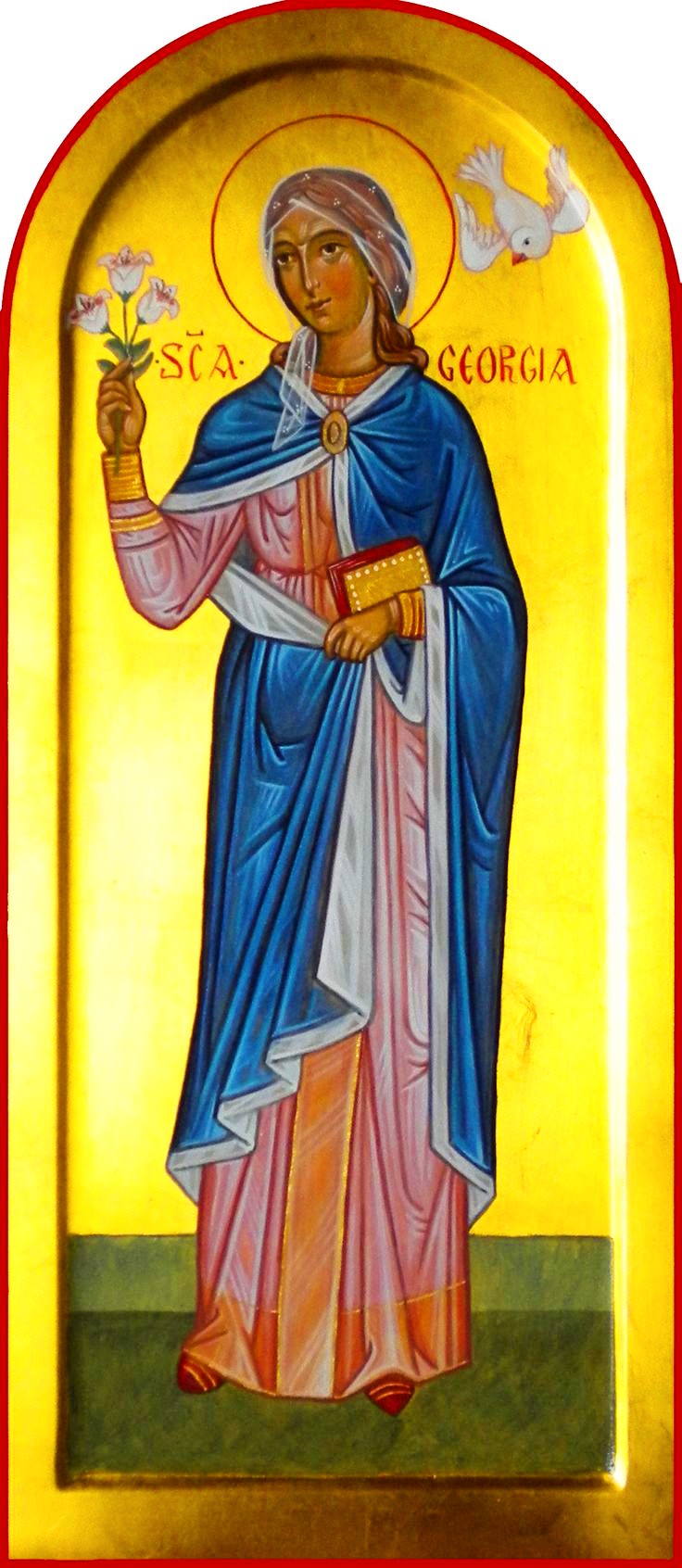
Saint of the Day – 15 February – St Georgia (6th Century) Virgin, Recluse. Also known as – Giorgia.
The Roman Martyrology reads today: “At Clermont in Auvergne, St Georgia Virgin.”
St Gregory of Tours (594), very well informed regarding the history of Auvergne due to the many years he spent there, reports the following concerning the existence and virtues of St Georgia. (De Gloria Confessorum XXXIV).
, “She lived, towards the beginning of the 6th Century, in Clermont, “pious and devoted to God” she retired to the countryside, to offer more freely to God “her hosts of praise” and, everyday, she dedicated herself to fasting and prayer.
At her death, while her body was being transported to the Church, it was accompanied by an immense flock of doves which, during the ceremony in the Church, went to rest on the roof, to then take flight again and follow the coffin as it was carried in procession to the cemetery. They remained to guard the tomb for the rest of the day.
The appearance of the doves symbolised and honoured, the virginity of the Saint.”
Georgia’s remains are kept in the Church of St Cassian in Clermont. The Roman Martyrology mentions her today on 15 Februar, the day on which the Proper of Clermont also inscribes her veneration.
Immaculate Heart of Mary: Refuge of Sinner Listed in the Missal as a Feastday in some place. What does this Feastday mean? The Heart of Mary is the divinely-appointed Refuge of Sinners. “O God,” exclaims St Alphonsus, “how great shall be the remorse of the damned Christian in thinking that, during life, he could have saved his soul with so much facility by invoking the intercession of this Mother of mercy; that he had not done so and that, there shall be no more time to do it.” “Perhaps,” says St Bonaventure, “we are in doubt as to whether Our Lady will hear us when we address our prayers to her. No, Mary does not refuse and never has refused pity and aid, to any sinner who has invoked her intercession.”
St Berach of Kilbarry St Craton St Decorosus of Capua St Dochow St Druthmar of Corvey St Eusebius of Asehia St Farannan of Iona
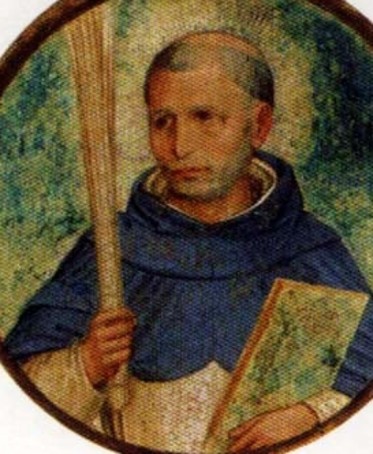
St Faustinus AND St Jovinus (Died c 120) Martyrs, Priest and Deacon respectively. Brothers. Both Evangelists, Preachers. Born at Brescia, Lombardy, Italy and the two brothers died together. They was thrown to the lions but the animals refused to touch them. Then beheaded in 120 at Brescia, Italy.
St Faustus of Monte Cassino St Georgia (6th Century) Virgin St Joseph of Antioch St Onesimus the Slave St Quinidius of Vaison
Thought for the Day – 14 February – Meditations with Fr Richard Frederick Clarke SJ (1839-1900)
Meditations on “The Great Truths” From “The Devout Year” By Fr Richard Frederick Clarke SJ (1839-1900)
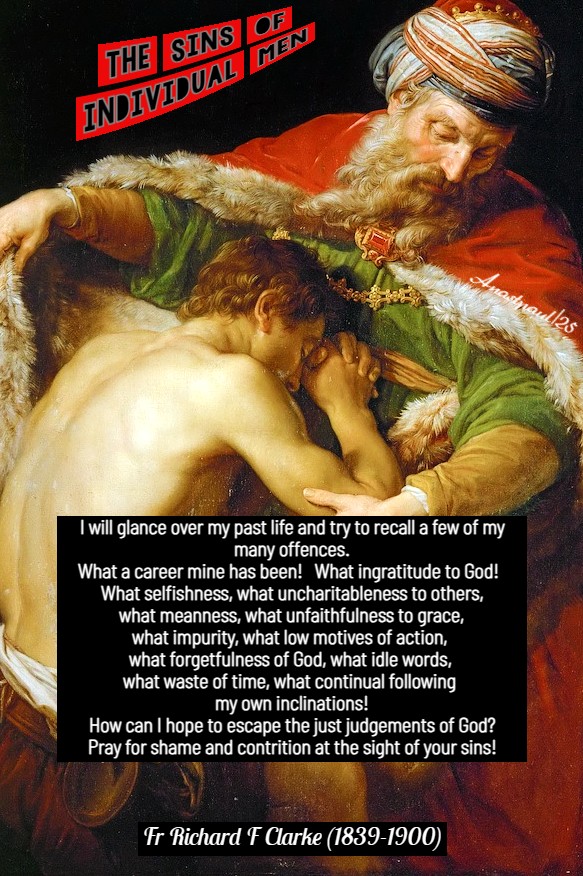
14th Day – The Sins of Individual Men
I will recount to Thee all my years, in the bitterness of my soul. (Ps xxxviii:15)
+1. When we look at the sin of Adam and see the consequences it entailed, what shall we say of the consequences which the sins of each one of us are likely to bring upon our heads? Adam’s was a single sin, as opposed to our countless offences. He did not appreciate the results of sin as we do, he had not witnessed the misery which comes from it, as we do, he had not seen the flames of hell kindled by sin, as we do. How much more grievous then, are the offences of each one of us!
+2. We must remember too, Adam’s sin was forgiven the very day it was committed and God, in His Mercy, sealed His forgiveness by the promise of the Redeemer. Yet, see the consequences of forgiven sin! The long penance, the spread of moral corruption, the disease and death, the misery and sorrow, the banishment from the Face of God, all these still remained, although the guilt of sin was gone. What reason then, for me to tremble at the thought of all my past sins!
+3. I will glance over my past life and try to recall a few of my many offences. What a career mine has been! What ingratitude to God! What selfishness, what uncharitableness to others, what meanness, what unfaithfulness to grace, what impurity, what low motives of action, what forgetfulness of God, what idle words, what waste of time, what continual following my own inclinations! How can I hope to escape the just judgements of God? Pray for shame and contrition at the sight of your sins!
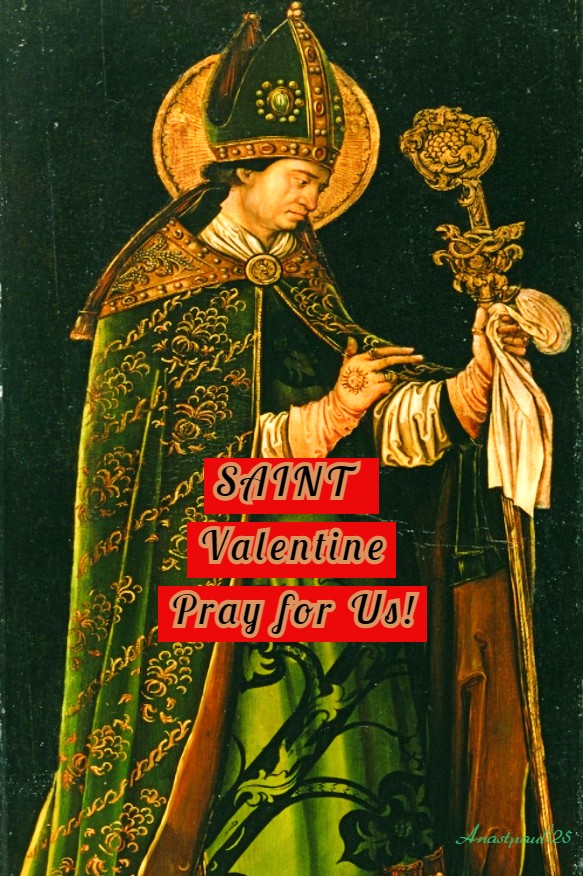
Quote of the Day – 14 February – St Valentine (176-273) Bishop and Martyr
“Love one another as I have loved you.”
John 15:12
“But I say to you, Love your enemies …”
Matthew 5:44
“He gives according to the love He bears us …, according to the courage He sees in each and the love each has for His Majesty. He will see, that whoever loves Him much, will be able to suffer much for Him; whoever loves Him little, will be capable of little. I myself hold, that the measure for being able to bear, a large or small cross, is love …”
St Teresa of Jesus of Avila (1515-1582)
“Take God for your Spouse and Friend and walk with Him continually and you will not sin and will learn to love and the things you must do will work out prosperously for you.”
“The one who walks in the love of God seeks neither gain nor reward but seeks only, with the will, to lose self and all things, for God and this loss, the lover judges to be a gain! Thus it is, as St Paul asserts: “For me death is gain” [Phil 1:21], that is, my death to all things and to myself, for Christ, is my spiritual gain. Consequently, the soul declares: “I was found.” The soul who does not know how to lose himself, does not find himself but rather, loses himself, as Our Lord teaches in the Gospel: “For he who will save his life, shall lose it and he who will lose his life for My Sake, will find it.” (Mt 16:25).”
St John of the Cross (1542-1591) Doctor of the Church
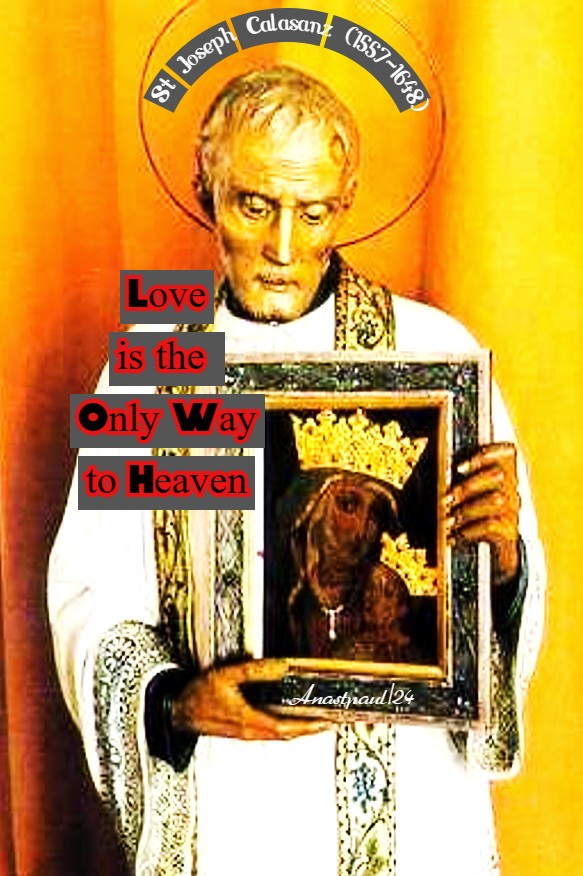
“LOVE is the only way to HEAVEN.”
St Joseph Calasanz (1557-1648)
“The measure of love, is to love without measure.”
St Francis de Sales (1567-1622) Doctor of the Church
One Minute Reflection – 14 February – “The Month of the Blessed Trinity” – St Valentine (176-273) Bishop and Martyr – Wisdom 10:10-14; Matthew 10:34-42 – Scripture search here: https://www.drbo.org/
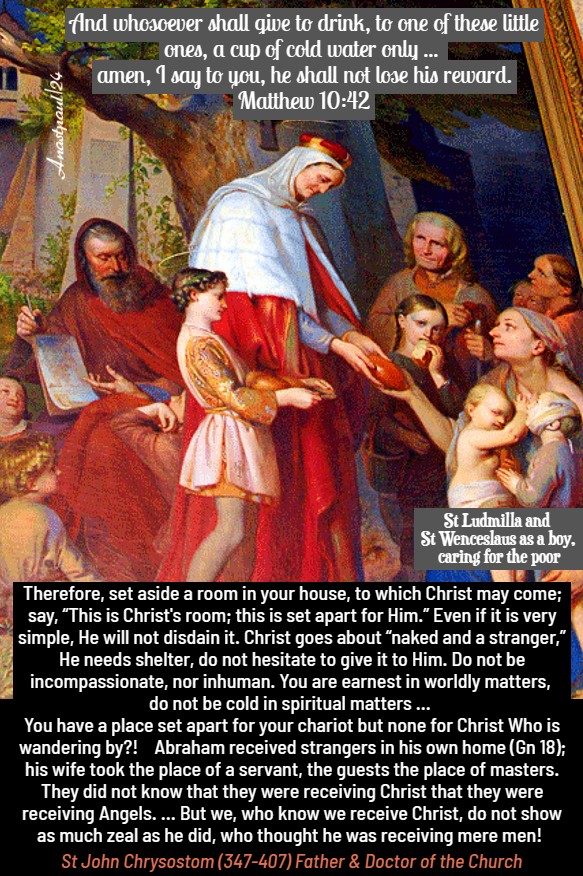
“And whosoever shall give to drink, to one of these little ones, a cup of cold water only … amen, I say to you, he shall not lose his reward.” – Matthew 10:42
REFLECTION – “I was a stranger,” Christ says “and you took Me in” (Mt 25:35). And again, “Insofar as you did this to one of the least of these brothers of Mine, you did it to Me.” (Mt 25:40). In every believer and brother, though they be least of all, Christ comes to you! Open your house, take them in. “Whoever receives a prophet, shall receive a prophet’s reward.” … These are the qualities which ought to be in those who welcome strangers – readiness, cheerfulness, liberality. For strangers feel abashed and ashamed and, unless their host shows real joy, they feel slighted and go away and their being received, in this way, makes it worse, than not to have received them at all.
Therefore, set aside a room in your house, to which Christ may come; say, “This is Christ’s room; this is set apart for Him.” Even if it is very simple, He will not disdain it. Christ goes about “naked and a stranger,” He needs shelter, do not hesitate to give it to Him. Do not be incompassionate, nor inhuman. You are earnest in worldly matters, do not be cold in spiritual matters … You have a place set apart for your chariot but none for Christ, Who is wandering by?!Abraham received strangers in his own home (Gn 18); his wife took the place of a servant, the guests, the place of masters. They did not know that they were receiving Christ, that they were receiving Angels. If Abraham had known it, he would have lavished his whole substance. But we, who know we receive Christ, do not show as much zeal as he did, who thought he was receiving mere men! – St John Chrysostom (347-407) Bishop of Constantinople, Father and Doctor of the Church (Sermon 45 on the Acts of the Apostles),
PRAYER – Grant, we beseech Thee, Almighty God, that we who celebrate the anniversary of the death of Thy holy Martyr, Valentine, may, by his intercession, be delivered from all evils which threaten us. Through our Lord Jesus Christ, Thine Son who livest and reignest with Thee in the unity of the Holy Ghost, One God forever, amen (Collect).
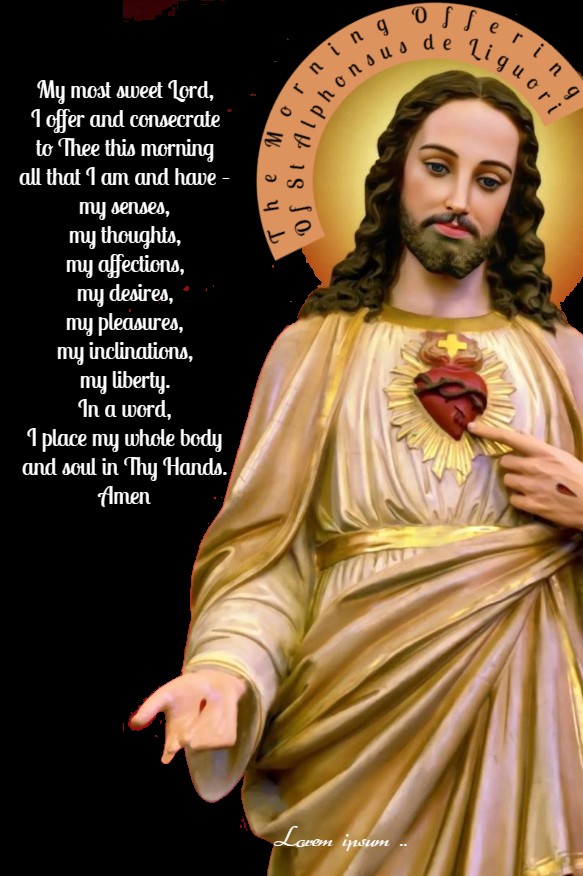
TheMorning Offering Of St Alphonsusde Liguori (1696-1787) Most Zealous Doctor of Church
My most sweet Lord, I offer and consecrate to Thee this morning all that I am and have – my senses, my thoughts, my affections, my desires, my pleasures, my inclinations, my liberty. In a word, I place my whole body and soul in Thy Hands. Amen
Saint of the Day – 14 February – St Auxentius (Died c473) Priest and Abbot in Syria, ex-soldier and Imperial Guard, Hermit. Born in Syria amd died on 14 February 473 at Mount Skopas in Bithynia in present-day Turkey, of natural causes. Also known as – Aussenzio.
The Roman Martyrology reads today: “In Bithynia, the Abbot St Auxentius.”
Auxentius, probably the son of a Persian named Addas, spent much of his life as a Hermit in Bithynia, a region of Constantinople.
Previously, he had been one of the Equestrian Guards of the Eastern Emperor, Theodosius II, who reigned from 408 to 450. Having learned of the eremitic life practiced by numerous ascetics, Auxentius decided to embrace their way of life, settling on the desert hill of Oxia, not far from Constantinople.
Auxentius soon gained a reputation for sanctity and many sought his guidance and advice on spiritual matters. It seems that he too was accused of Monophysitism, a doctrine which denied the human nature of Jesus but, he was soon exonerated.
He built a new hermitage on Mount Skopas, near Chalcedon, dedicating the rest of his life to the practice of mortification and the instruction of his ever-increasing number of disciples, among whom were also some women, who lived at the foot of Mount Skopas in special communities and were known as “the sackcloth-wearers.”
Upon Auxentius’ death, on 14 February probably in 473, the above-mentioned reclusive woemn obtained the Saint’s remains and buried them in the ccommunity Cchurch. On this anniversary, Saint Auxentius, Priest and Abbot is still commemorated today by the Martyrologium Romanum.
St Nostrianus of Naples St Theodosius of Vaison St Valentine of Terni
St Vitale of Spoleto
Martyrs of Terni: Three Christians who gave proper burial to Saint Valentine of Terni. Martyred in the persecutions of Aurelius. 273 in Terni, Italy – Apollonius, Ephebus, Proculus.
Martyrs of Alexandria: A group of Christians murdered in various ways for their faith in Alexandria, Egypt. We know the names and a few details about 16 of them – Agatho, Agatone, Ammonio, Ammonius, Antonius, Bassiano, Bassianus, Cirione, Cyrio, Dionysius, Dionysius, Lucio, Moses, Moses, Proto and Tonione.
Thought for the Day – 13 February – Meditations with Fr Richard Frederick Clarke SJ (1839-1900)
Meditations on “The Great Truths” From “The Devout Year” By Fr Richard Frederick Clarke SJ (1839-1900)
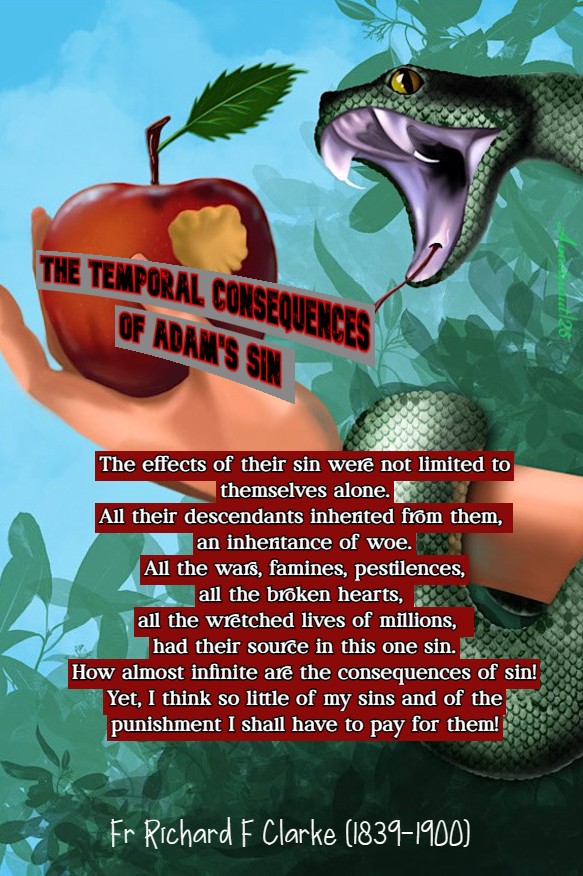
13th Day – The Temporal Consequences of Adam’s Sin
In Adam, all die. (1 Cor xv:22)
No sooner had this first sin been consummated, than a blight fell upon the world. It had become the devil’s empire, for he had made Adam. its king, his slave! What are the consequences to the inhabitants of the world?
+1. Adam and Eve were cast out of Paradise, never again to enter. Their peace was gone, there was confusion within them, concupiscence fought against reason. Pain and sorrow came upon them and disease and death. For nine hundred years, they toiled painfully in weariness upon the earth and after their death, had to wait three thousand years more, before they were admitted to the heavenly Paradise. And all for one sin!
+2. The effects of their sin were not limited to themselves alone. All their descendants inherited from them, an inheritance of woe. All the wars, famines, pestilences, all the broken hearts, all the wretched lives of millions, had their source in this one sin. How almost infinite are the consequences of sin! Yet, I think so little of my sins and of the punishment I shall have to pay for them!
+3. If we would behold the full malice of Adam’s sin, we must stand beneath the Cross and watch our God dying in unutterable anguish. It was sin which nailed Him to the Cross. It was sin which forced from Him, His agonising cry – “My God, why hast Thou forsaken Me?” Pray for a horror of sin, corresponding to its intensity of evil.
Quote/s of the Day – 13 February – “The Month of the Blessed Trinity”
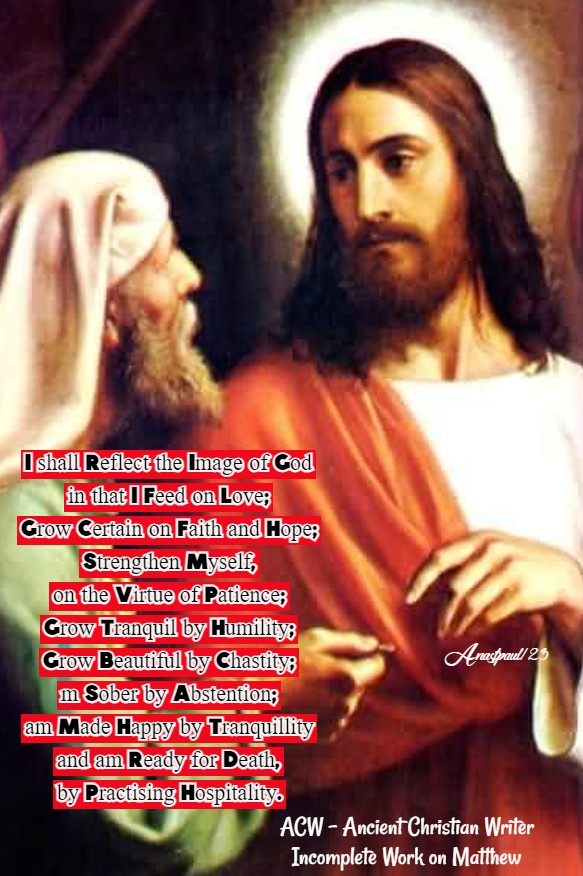
“I shall reflect the image of God in that I feed on love; grow certain on faith and hope; strengthen myself, on the virtue of patience; grow tranquil by humility; grow beautiful by chastity; am sober by abstention; am made happy by tranquillity and am ready for death, by practising hospitality.”
ACW – Ancient Christian Writer Incomplete Work on Matthew
(Homily 40)
“This is the order of our faith, the foundation of the edifice and the support of our conduct – God, the Father, uncreated, uncontainable, invisible, One God, the Creator of all – this is the first article of our faith. And the second article – the Word of God, the Son of God, Christ Jesus our Lord, Who was revealed by the Prophets according to the character of their prophecy and according to the nature of the economies of the Father, by Whom all things were made and Who, in the last times, to recapitulate all things, became a Man amongst men, visible and palpable, in order to abolish death, to demonstrate life and to effect communion between God and man. And the third article – the Holy Ghost, through Whom the Prophets prophesied and the Patriarchs learnt the things of God and the righteous, were led in the path of righteousness and Who, in the last times, was poured out in a new fashion upon the human race, renewing man, throughout the world, to God.”
St Irenaeus (130-202) Martyr, Father of the Church
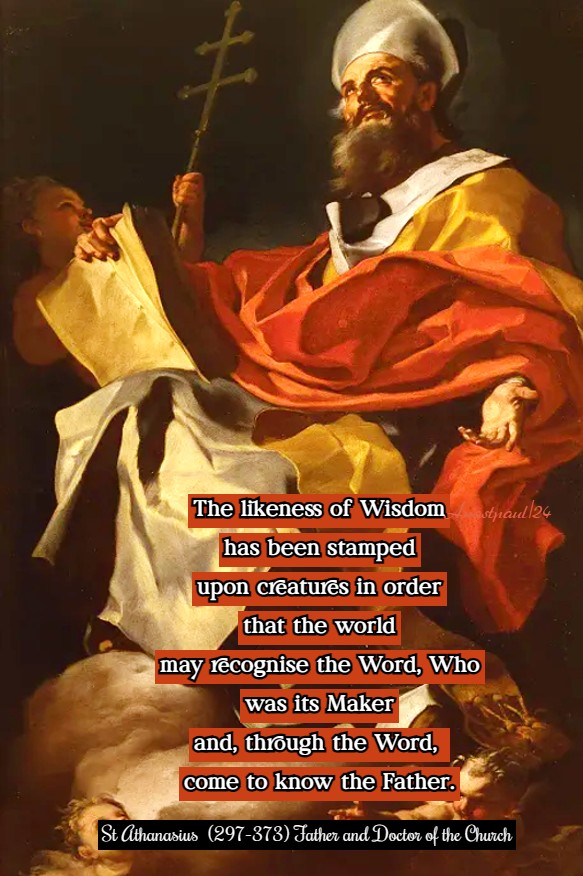
“The likeness of Wisdom has been stamped upon creatures, in order that the world may recognise the Word, Who was its Maker and, through the Word, come to know the Father. ”
St Athanasius (297-373) Father and Doctor of the Church
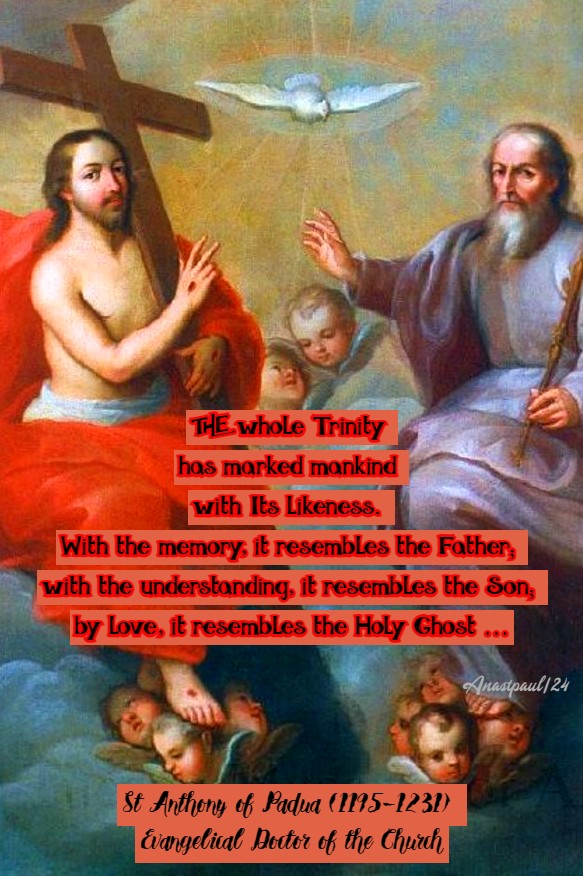
“The whole Trinity has marked mankind with Its likeness. With the memory, it resembles the Father; with the understanding, it resembles the Son; by love, it resembles the Holy Ghost … ”
St Anthony of Padua (1195-1231) Evangelical Doctor of the Church
One Minute Reflection – 13 February – “The Month of the Blessed Trinity” – Ferial Day – Colossians 3:12-17 – Matthew 13:24-30 – Scripture search here: https://www.drbo.org/
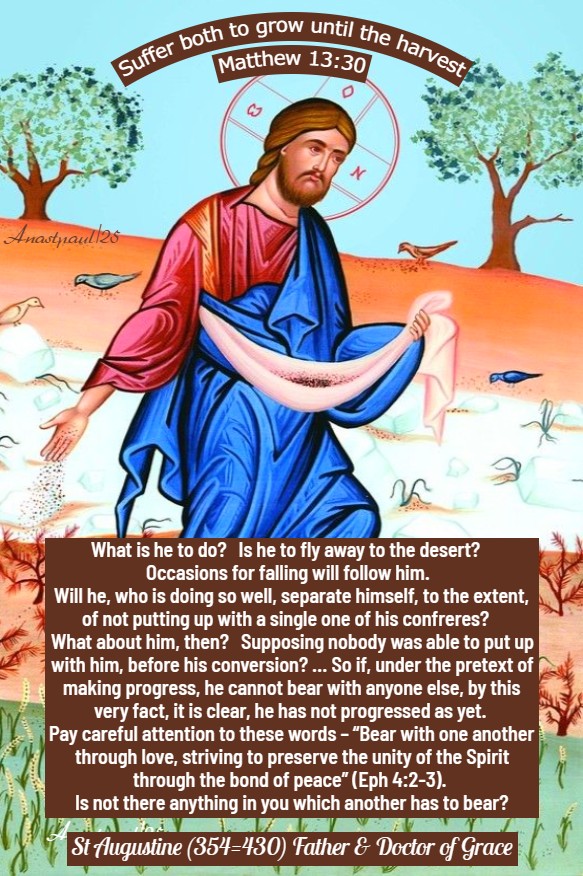
“Suffer both to grow until the harvest” – Matthew 13:30– Matthew 13:30
REFLECTION – “When that which is corruptible in us, clothes itself with incorruptibility and that which is mortal, clothes itself in immortality” (1 Cor 15:54), then there will be perfect sweetness, perfect rejoicing, endless praise and love without fear. … And here below? Do we not enjoy any kind of joy? … Certainly we find joy here below; here we taste in hope, of the life to come, a joy which will satisfy us completely in Heaven.
However, the wheat has much to bear in the midst of the darnel. The seed is mixed up with the straw and the lily grows among the thorns. … And indeed, what is it that was spoken to the Church? “As a lily among thorns, so is my beloved among my maidens” (Sg 2:2). It said, “Among my maidens” and not among foreigners. O Lord, what are the consolations Thou gives us? What the comfort? Or rather, what the alarm? Art Thou calling Thy own maidens “thorns”? By their behaviour, they are thorns, He answers but maidens through My Sacraments. …
But where is the Christian to take refuge then, if he is not to groan in the midst of false brethren? Where is he to go? What is he to do? Is he to fly away to the desert? Occasions for falling will follow him. Will he, who is doing so well, separate himself, to the extent, of not putting up with a single one of his confreres? What about him, then? Supposing nobody was able to put up with him, before his conversion? … So if, under the pretext of making progress, he cannot bear with anyone else, by this very fact, it is clear, he has not progressed as yet. Pay careful attention to these words – “Bear with one another through love, striving to preserve the unity of the Spirit through the bond of peace” (Eph 4:2-3). Is there not anything in you which another has to bear?” – St Augustine (354=430) Father & Doctor of Grace (Discourses on the Psalm Ps 99:8-9).
PRAYER – King of Heaven and earth, Lord God, rule over our hearts and bodies this day. Sanctify us and guide our every thought, word and deed according to the commandments of Thy law, so that now and forever, Thy grace may free and save us. Teach us Lord to walk in the ways of the Cross of Thy Son, our Saviour, longing for and rejoicing always in our heavenly home. Through the same Christ our Lord, with the Holy Ghost, God, forever, amen. (Collect)
Our Morning Offering – 13 February – “The Month of the Blessed Trinity”
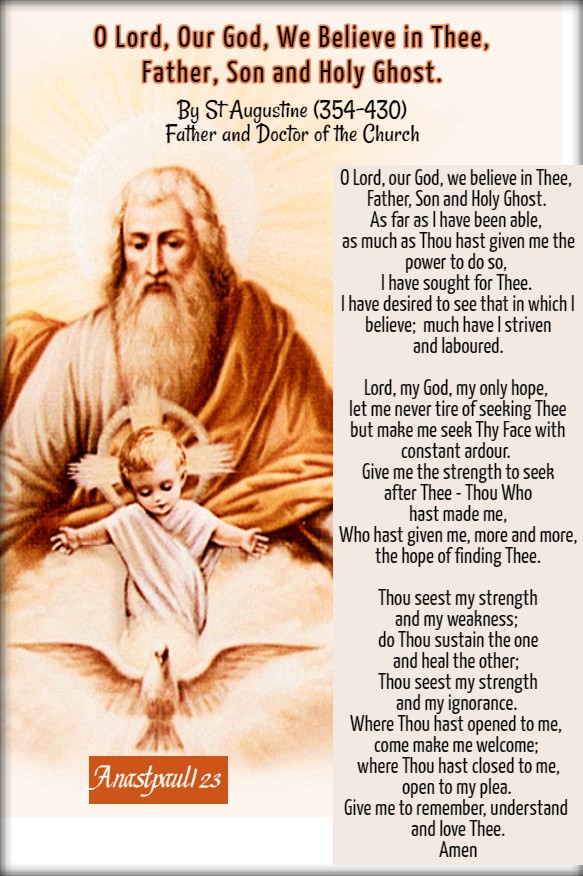
O Lord, Our God, We Believe in Thee, Father, Son and Holy Ghost. By St Augustine (354-430) Father and Doctor of the Church
O Lord, our God, we believe in Thee, Father, Son and Holy Ghost. As far as I have been able, as much as Thou hast given me the power to do so, I have sought for Thee. I have desired to see that in which I believe; much have I striven and laboured.
Lord, my God, my only hope, let me never tire of seeking Thee but make me seek Thy Face with constant ardour. Give me the strength to seek after Thee – Thou Who hast made me, Who hast given me, more and more, the hope of finding Thee. Thou seest my strength and my weakness; do Thou sustain the one and heal the other; Thou seest my strength and my ignorance. Where Thou hast opened to me, come make me welcome; where Thou hast closed to me, open to my plea. Give me to remember, understand and love Thee. Amen
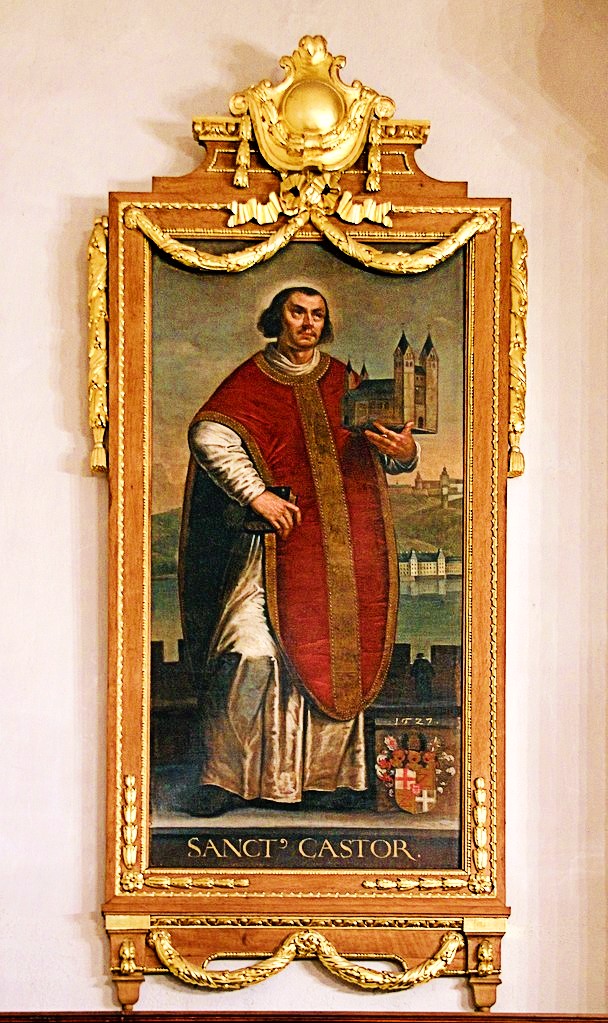
Saint of the Day – 13 February – Saint Castor (Died c400) Priest, Hermit, evangeliser. Born in Aquitaine in France and died in around 400 in Karden , today part of Treis-Karden on the Moselle in Rhineland-Palatinate, Germany. Patronage – of the City of Koblenz, in Germany. Also known as – Castore, Kastor, … of Karden. The name Castor is derived from Greek and means “the excellent one.”
This painting at the Basilica of St Castor in Koblenz
According to the legendary life story from the 10th/12th Century, Castor was a student of the Saint Bishop Maximinus of Trier and was Ordained a Priest by him.
St Castor is presented to Bishop Maximin by his parents. Designed by Joseph Anton Nikolaus Settegast for Frescoes in the Koblenz Cathedral.
He lived as a Hermit in Karden and there, united disciple companions to lead an exemplary pious life. Castor’s companions included the Aquitanian pilgrim Saint Potentinus and Potentinus’ two sons Felicius and Simplicius.
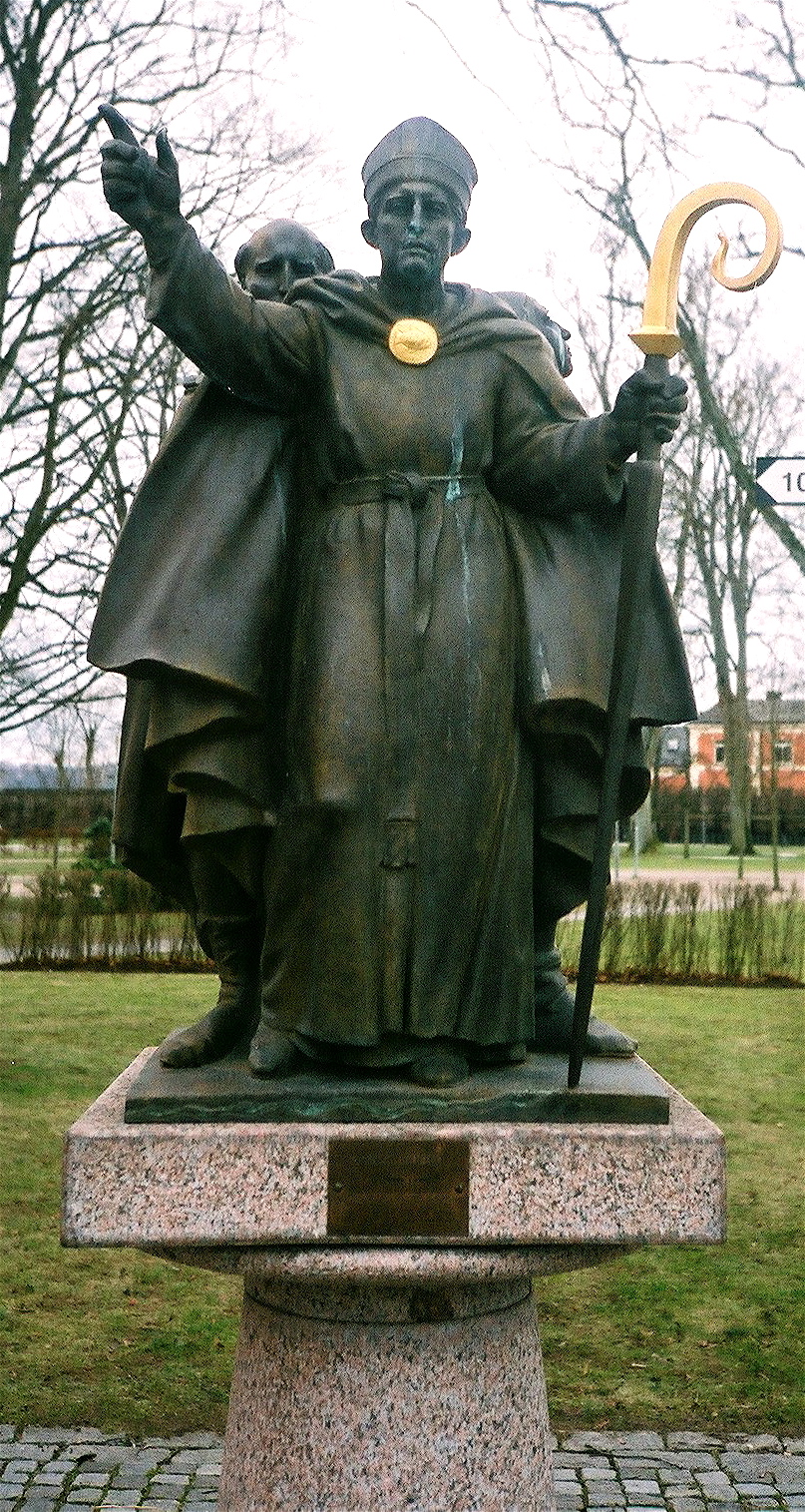
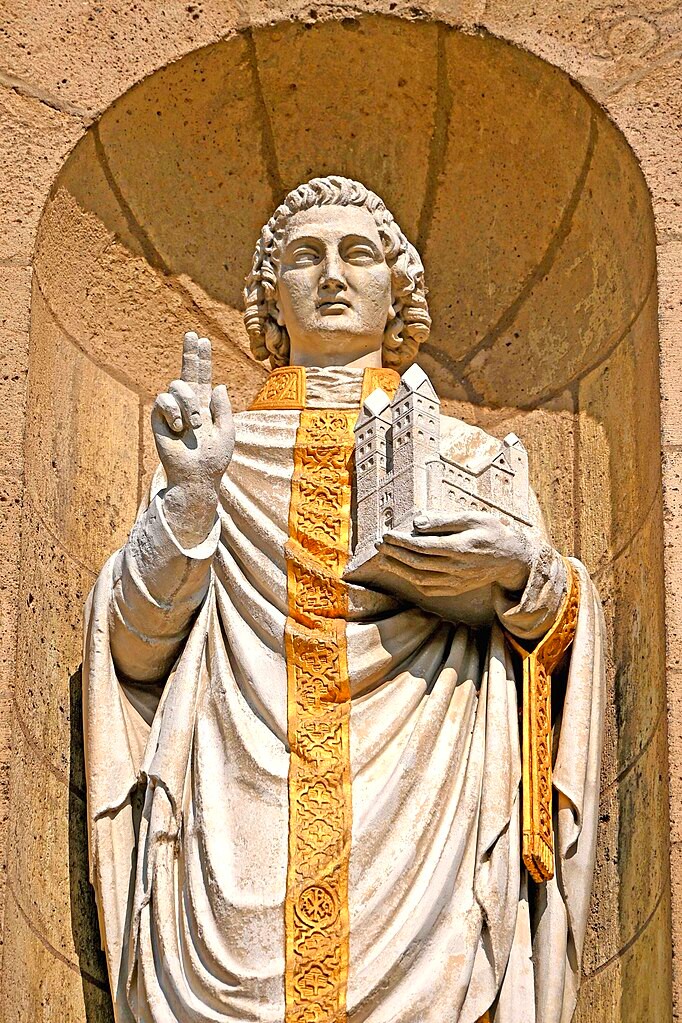
Statue in front of the Church of St Castor in Karden
A tale tells how Castor asked Moselle boatmen for salt. But they only mocked him and wanted to continue sailing. Suddenly a violent wind arose and whipped the waves so high that the boat threatened to capsize. In their distress, the boatmen begged the man of God for help. Castor knelt down and prayed – as suddenly as it had come, the storm subsided. The pagan boatmen were converted by this miracle and thanked Castor with plenty of salt.
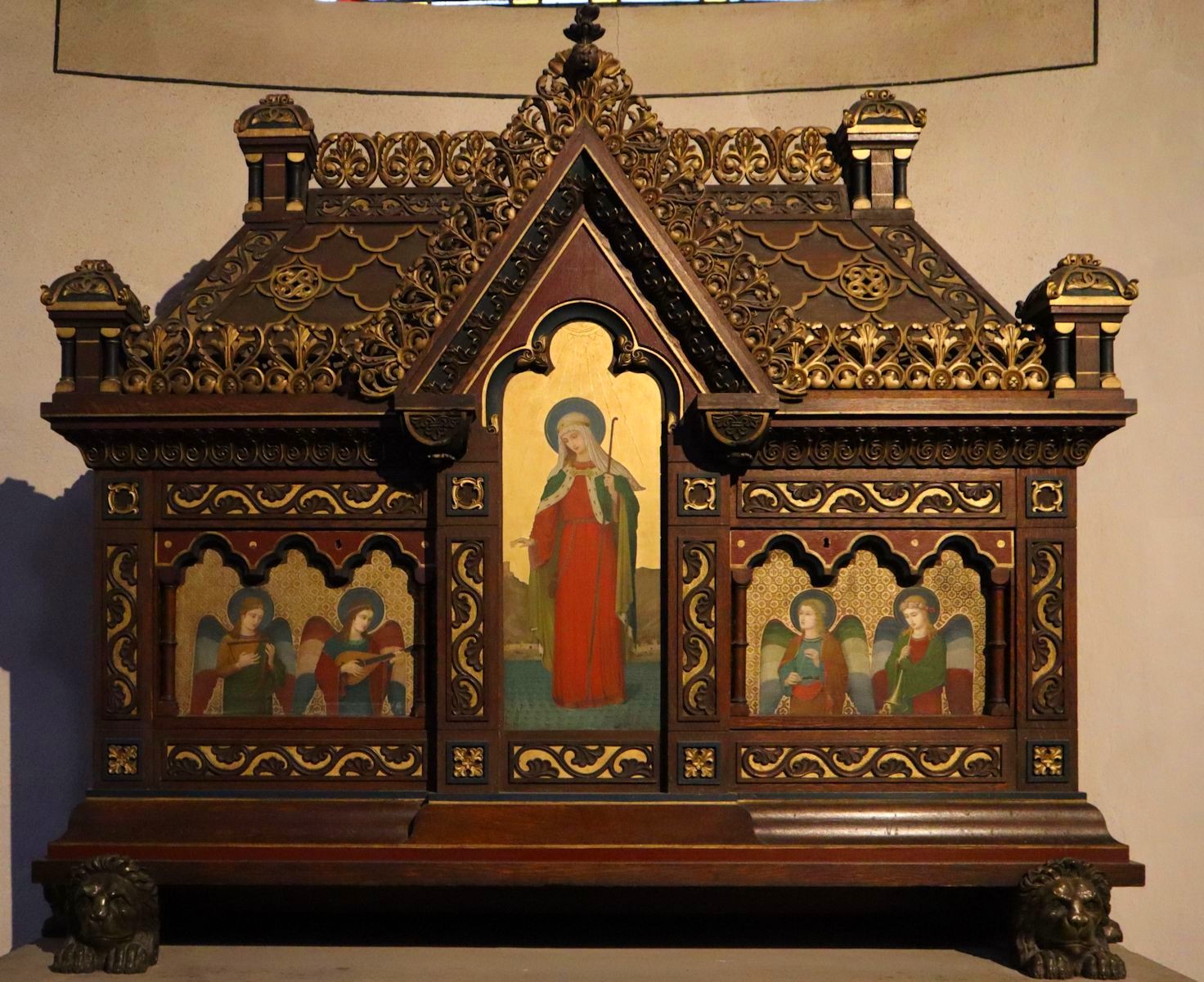
Relic Shrine, 1906, in the Kastorkirche in Koblenz
Castor died at Karden at an advanced age.
Reliquary made of gilded fir-tree wood, 15th Century, in the Church of St Castor in Karden
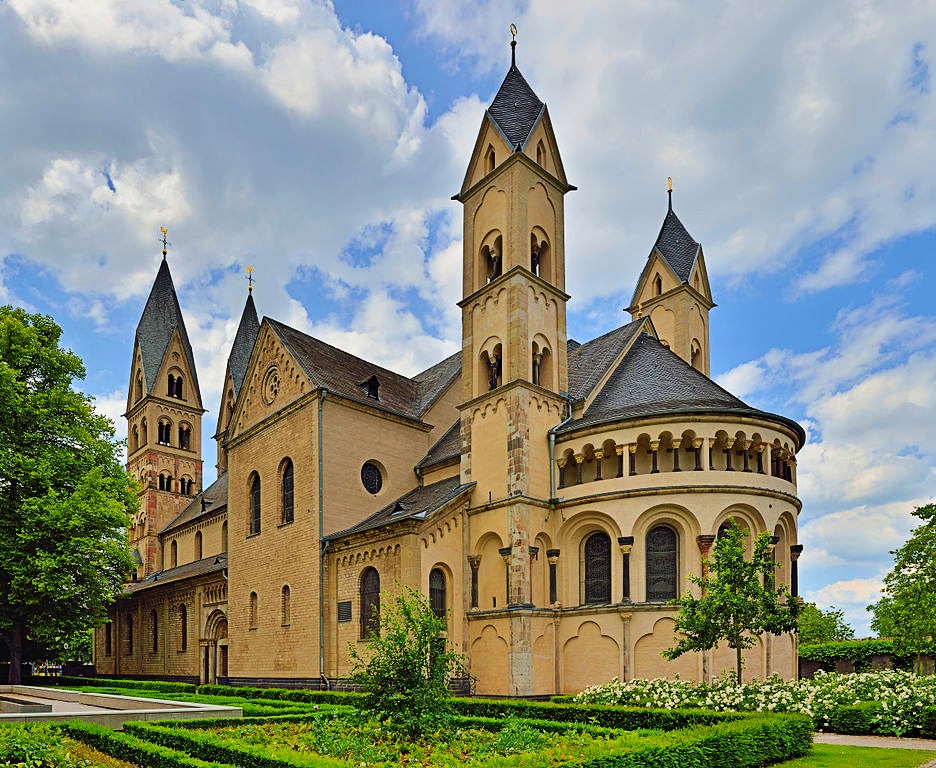
Castor’s cult maintained in Trier was – like that of Potentinus of Steinfeld – evidently intended to strengthen influence in the Lower Moselle region, since the area actually belonged to the Diocese of Mainz. Bishop Wiomad of Trier found – again possibly to document a claim to this area – bones in Karden around 782 which were identified as Castor’s Relics and transferred them to the Church then dedicated to St Paulinus of Trier which then received the Patronage of Castor. In 836, most of these Relics were then brought by Archbishop Hetti of Trier to Koblenz, to the later Collegiate Church built by him, of which Castor became the Patron; this Church was rebuilt in the 11th/12th Century as a Basilica dedicated to St Castor.
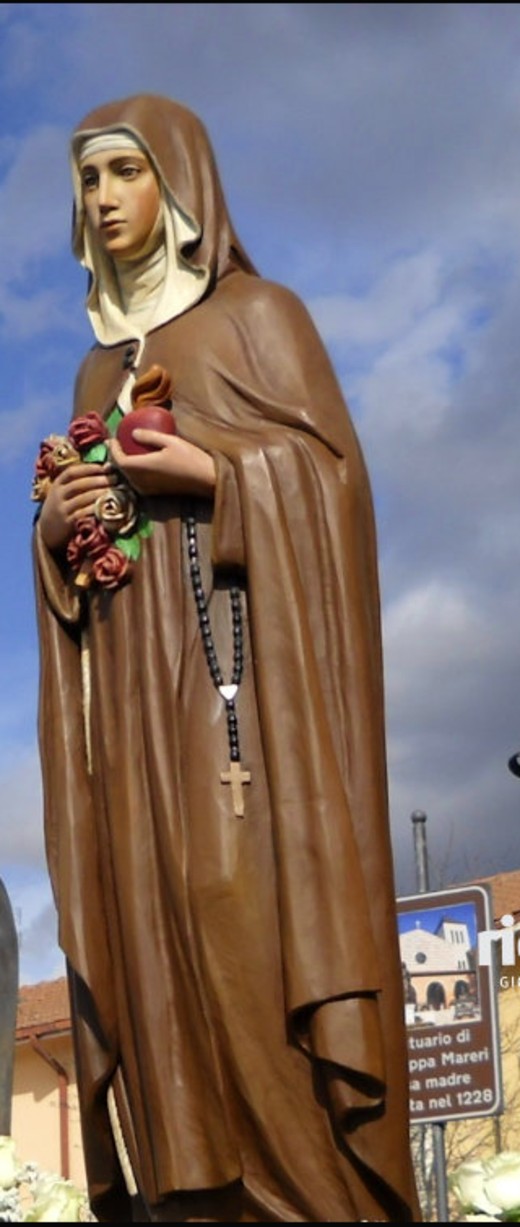
St Catherine de Ricci OP (1522-1590) Virgin, Tertiary of the Order of Preachers, Mystic, Stigmatist, Ecstatic, Counsellor to many in both secular and spiritual matters, a highly admired Administrator and Advisor,blessed with many mystical charism including visions of Christ, both as a Baby and Adult, bilocation and miracles. Her body is Incorrupt. A Mighty Handmaid: https://anastpaul.com/2022/02/13/saint-of-the-day-13-february-saint-catherine-de-ricci-op-1522-1590/
Thought for the Day – 12 February – Meditations with Fr Richard Frederick Clarke SJ (1839-1900)
Meditations on “The Great Truths” From “The Devout Year” By Fr Richard Frederick Clarke SJ (1839-1900)
12th Day – Man’s First Sin
Pride is the beginning of all sin. (Ecclus x:15)
+1. In Paradise before the Fall, Adam and Eve enjoyed a happiness beyond compare. They knew no pain, sickness, sorrow. They were created immaculate and adorned with a high degree of supernatural grace; they were exempt from all concupiscence; their lives passed in a continual round of unfailing delight; each evening God Himself, came to hold sweet converse with them.
+2. What was it which ruined their happiness? The tempter came and suggested to Eve, a distrust of God, whispered into her ear, motives of disobedience. Eve listened and consented and in her heart, deliberately revolted against God. Pride brought with it concupiscence; she looked at the fruit which God had forbidden, took it, ate it, gave it to Adam. He also ate it and thus lost, for himself and all his posterity, the gift of original justice and all the graces and blessings which accompanied it. One single sin ruined the world! How ought I to dread and hate sin?!
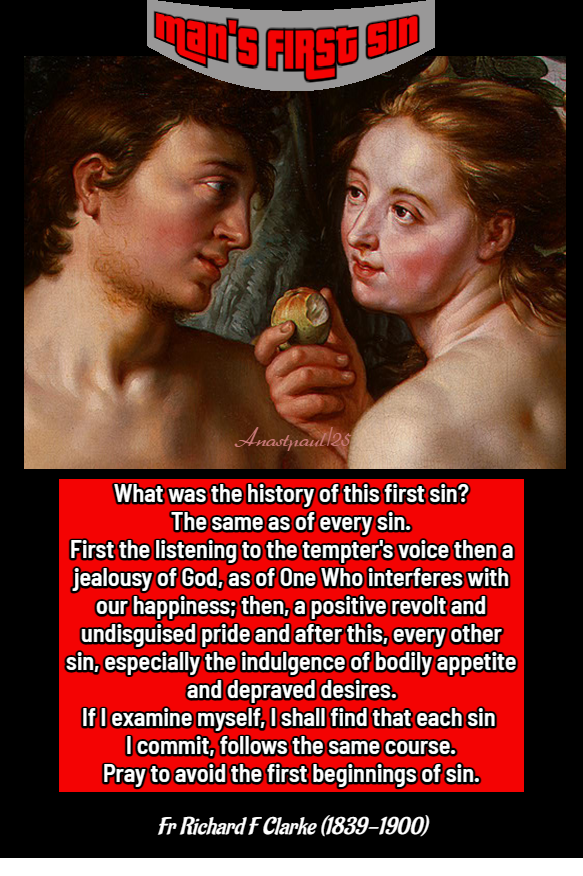
+3. What was the history of this first sin? The same as of every sin. First the listening to the tempter’s voice then a jealousy of God, as of One Who interferes with our happiness; then, a positive revolt and undisguised pride and after this, every other sin, especially the indulgence of bodily appetite and depraved desires. If I examine myself, I shall find that each sin I commit, follows the same course. Pray to avoid the first beginnings of sin.
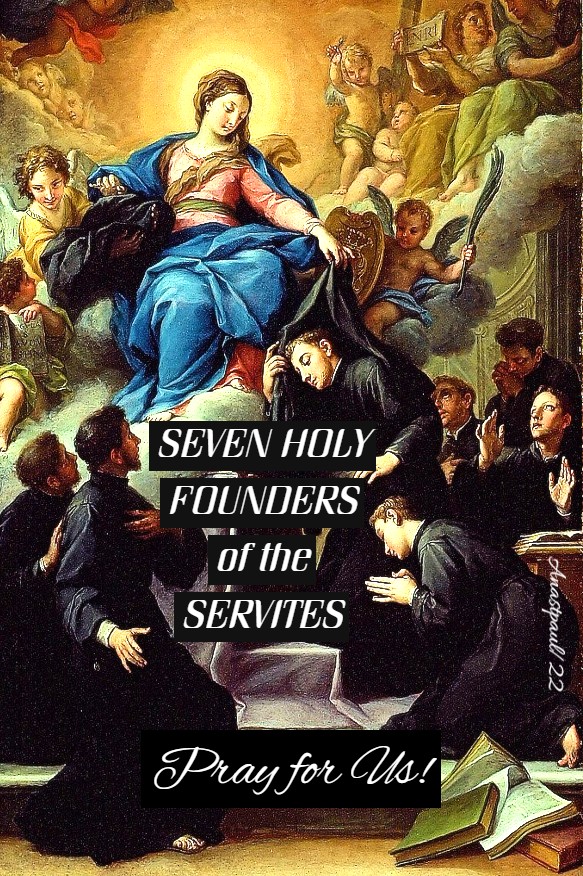
Quote/s of the Day – 12 February – The Seven Holy Founders of the Servite Order (1233) – Ecclesiasticus 44:1-15; Matthew 19:27-29 – Scripture search here: https://www.drbo.org/
“And everyone who has left house, or brethren, or sisters, or father, or mother, or wife, or children, or lands for My Name’s sake, shall receive a hundredfold and shall possess life everlasting.”
Matthew 19:29
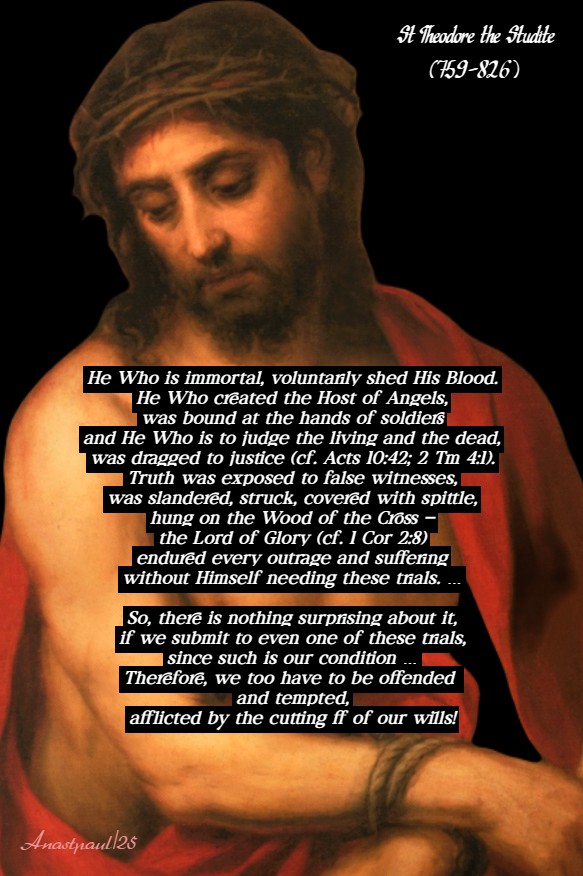
“He Who is immortal, voluntarily shed His Blood. He Who created the Host of Angels, was bound at the hands of soldiers and He Who is to judge the living and the dead, was dragged to justice (cf. Acts 10:42; 2 Tm 4:1). Truth was exposed to false witnesses, was slandered, struck, covered with spittle, hung on the Wood of the Cross – the Lord of Glory (cf. 1 Cor 2:8) endured every outrage and suffering without Himself needing these trials. …
So, there is nothing surprising about it, if we submit to even one of these trials, since such is our condition … Therefore, we too have to be offended and tempted, afflicted by the cutting off of our wills!” (Catecheses 1)
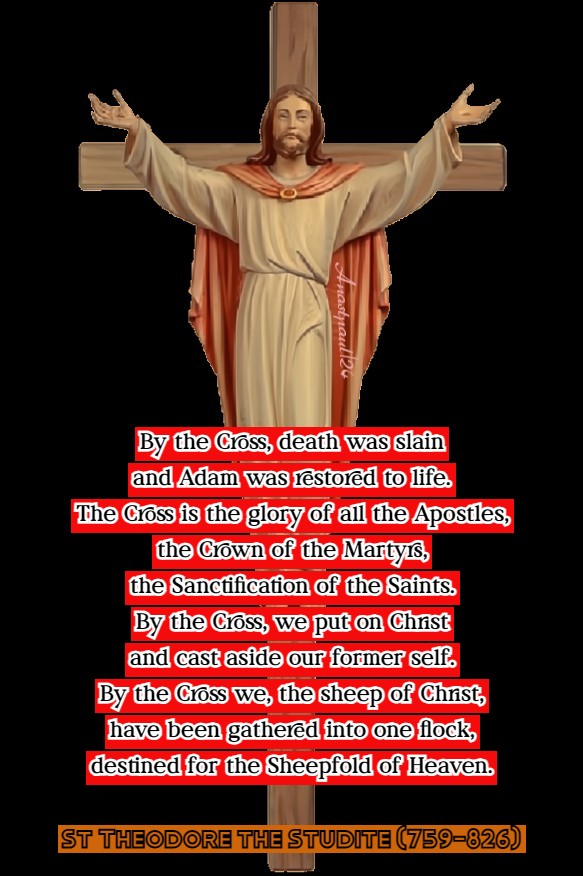
By the Cross, death was slain and Adam was restored to life. The Cross is the glory of all the Apostles, the Crown of the Martyrs, the Sanctification of the Saints. By the Cross, we put on Christ and cast aside our former self. By the Cross we, the sheep of Christ, have been gathered into one flock, destined for the Sheepfold of Heaven.”
St Theodore the Studite (759-826) Abbot, Confessor, Father of the Church
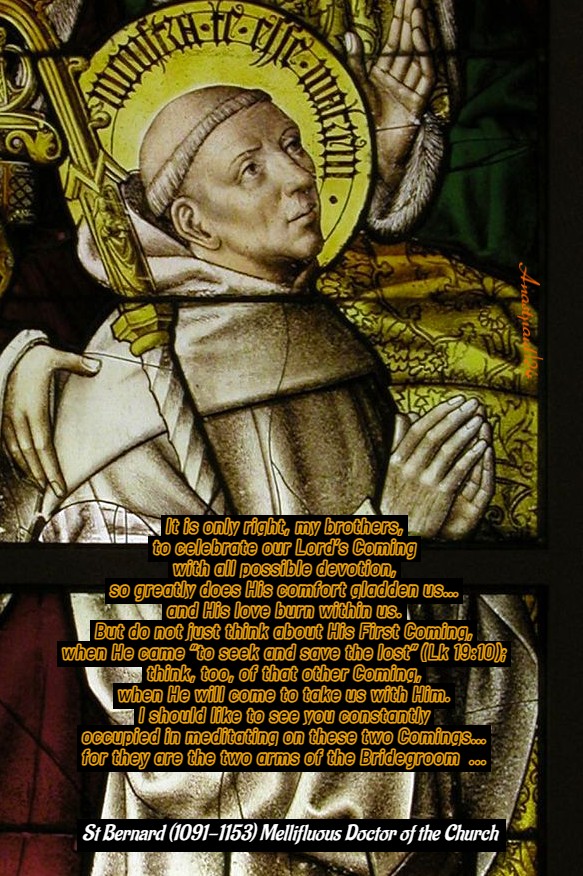
“It is only right, my brothers, to celebrate our Lord’s Coming with all possible devotion, so greatly does His comfort gladden us… and His love burn within us. But do not just think about His First Coming, when He Came “to seek and save the lost” (Lk 19:10); think, too, of that other Coming, when He will come to take us with Him. I should like to see you constantly occupied in meditating on these two Comings… for they are the two arms of the Bridegroom …”
St Bernard (1091-1153) Mellifluous Doctor of the Church
One Minute Reflection – 12 February – “The Month of the Blessed Trinity” – The Seven Holy Founders of the Servite Order (1233) – Ecclesiasticus 44:1-15; Matthew 19:27-29 – Scripture search here: https://www.drbo.org/
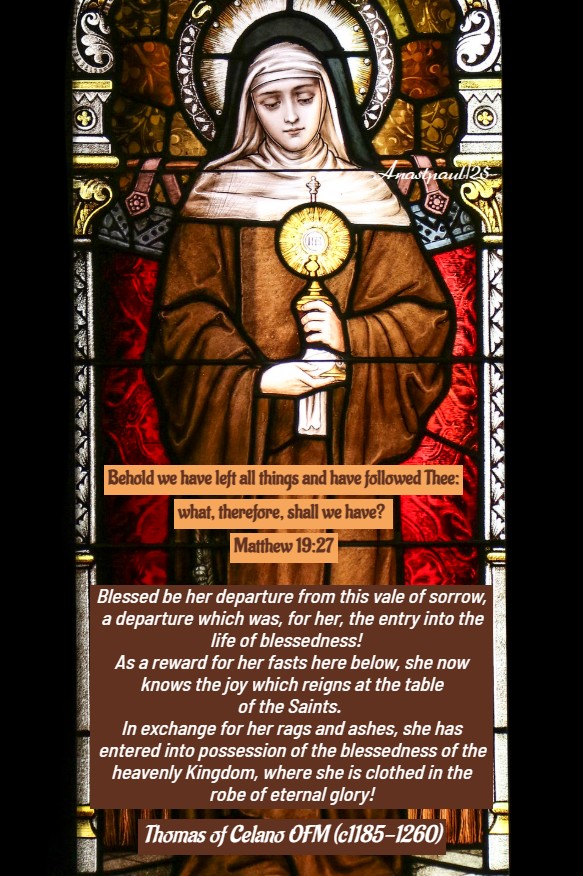
“At that time, Peter said to Jesus: Behold we have left all things and have followed Thee: what, therefore, shall we have? ” – Matthew 19:27
REFLECTION – “For forty years, to use the analogy made by Saint Paul (1 Cor 9:24), Clare had now run the race in the stadium of very great poverty. She was drawing close to the goal of her heavenly vocation and, to the reward promised to the victor … Divine Providence hastened to fulfil what it had in mind for Clare – Christ desired to bring His little, poor one into His Royal Palace at the close of her pilgrimage. She, on her part, longed with all the impulse of her desire … to behold, reigning on high in His Glory, the Christ Whose poverty she had imitated on earth …
All her daughters had gathered around their mother’s bed … Then, speaking to herself, Claire said to her soul: “Go in all safety; you have a good Guide for the road. Go, for He Who created you, has also sanctified you. He has always kept you and loved you with tender love, as a mother loves her child. Blessed are you, O Lord, Who have created me!” One of the Sisters asked her, to whom she was speaking. Clare answered: “To my blessed soul.” Her guide for the journey was not far off. Indeed, turning towards one of her daughters, she said: “Do you see what I can see? – The King of Glory!” …
Blessed be her departure from this vale of sorrow, a departure which was, for her, the entry into the life of blessedness! As a reward for her fasts here below, she now knows the joy which reigns at the table of the Saints. In exchange for her rags and ashes, she has entered into possession of the blessedness of the heavenly Kingdom, where she is clothed in the robe of eternal glory!” – Thomas of Celano OFM (c1185-1260) Franciscan Friar and close assistant to St Francis, Biographer of Saint Francis and Saint Clare (Life of Saint Clare).
PRAYER – O Lord Jesus Christ, Who, to keep alive the memory of Your most holy Mother’s sorrows, through the Seven holy Fathers enriched your Church with a new family of her Servants, graciously grant that we may be so united with them in their sorrows, as also to share their joys. Who lives and reigns with God the Father, in the unity of the Holy Spirit, God, world without end. Amen (Collect).
Our Morning Offering – 12 February – “The Month of the Most Holy and Blessed Trinity”
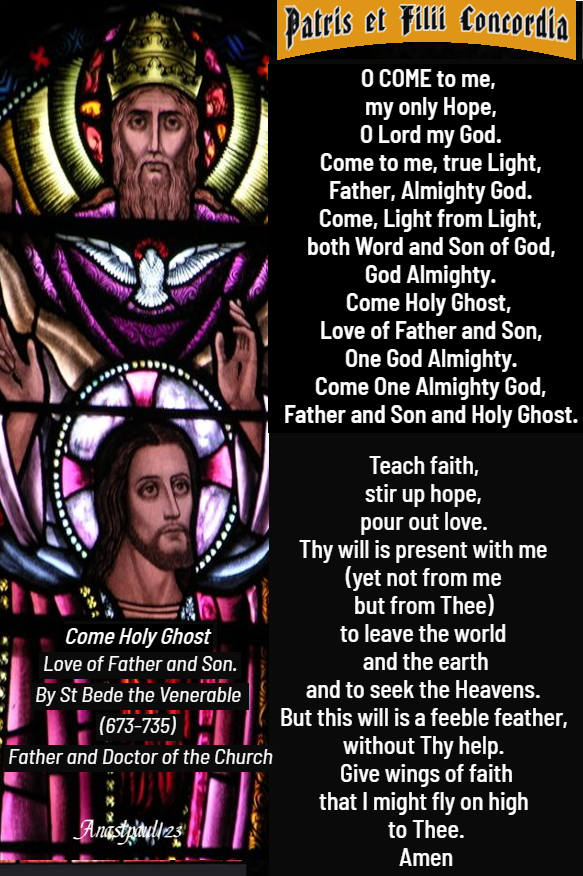
Patris et Filii Concordia Come Holy Ghost, Love of Father and Son. By St Bede the Venerable (673-735) Father and Doctor of the Church
O COME to me, my only Hope, O Lord my God. Come to me, true Light, Father, Almighty God. Come, Light from Light, both Word and Son of God, God Almighty. Come Holy Ghost, Love of Father and Son, One God Almighty. Come One Almighty God, Father and Son and Holy Ghost.
Teach faith, stir up hope, pour out love. Thy will is present with me (yet not from me but from Thee) to leave the world and the earth and to seek the Heavens. But this will is a feeble feather, without Thy help. Give wings of faith that I might fly on high to Thee. Amen




































You must be logged in to post a comment.